

Submitted:
17 January 2026
Posted:
19 January 2026
You are already at the latest version
Abstract
In 2014, NASA measured that the universe has a Euclidean shape. This discovery suggests that the curvature of space is merely a mathematical description of some more basic physical property of space. By extending the principle of equality of mass and energy to the space occupied by dark energy, a model of gravity was developed, where the gravitational force is due to the variable energy density of dark energy. The more curved the space, the lower the energy density of dark energy. A black hole, like any other stellar object, reduces the energy density of dark energy at its center in proportion to its mass and energy. In the centre of a black hole, the gravitational force is zero, as it is in all stellar objects. There are no wormholes in space, and there is no gravitational singularity at the center of a black hole. Gravity inside black holes follows Newton's physics. Reduced energy density of dark energy inside black holes diminishes the value of the Planck constant, which causes atoms and nuclei to decay. Gravitational collapse is replaced by electric collapse.
Keywords:
dark energy
; black holes
; astrophysical jets
; Chandrasekhar limit
; gravitational collapse
; electromagnetic collapse
1. Introduction
In the Introduction section, a novel view on gravity is presented, based on the variable energy of dark energy. In the second section, titled Critique of Gravitational Singularities and of Geometrization of Gravity, the weaknesses of the gravitational singularity model and the curvature of space model are highlighted. The third section, named Gravity inside black holes obeys Newtonian physics, presents that the Newtonian Shell Theorem also applies inside a black hole. The fourth section, named Mini black holes and Schwinger effect, presents the use of the mathematical model of the variable energy density of dark energy for the mini black holes and the novel explanation of the Schwinger effect. The fifth section, is named Post-Newtonian physics replaces gravitational collapse with electromagnetic collapse and explains the physical origin of astrophysical jets. This section presents how the diminished energy density of the dark energy in the centre of neutron stars and black holes causes the increase of electric permittivity, consequently the decrease of the electromagnetic forces between the electrons and the nucleus of the atoms, and their collapse, which generates astrophysical jets. Electromagnetic collapse presents the final result of this research. The sixth section, named A brief historical overview of gravitational physics since Newton, discusses the development of gravitational models from Newton to the present day is discussed. The idea of integrating relativity theory and quantum mechanics into a model of post-Newtonian physics is proposed.
A recent article published in Physical Review Letters suggests, based on astronomical observation, that in black holes, matter decays into dark energy [1]. This discovery requires the revision of black hole physics, which will give a physical explanation of the decay of matter into dark energy. In this article, the mass-energy equivalence principle will be extended to dark energy. This allows us to describe the energy relation of mass between black holes and diminished energy density of dark energy in the centre of black holes, which causes atoms to become unstable and decay into elementary particles and further into dark energy.
The dark energy model has several similarities with the superfluid quantum space model [2], ether model [3], and the quantum vacuum model [4]. Ather, superfluid space, quantum vacuum, and dark energy are different terms that presumably describe the same energy substrate of space. Dark energy is 67% of the energy of the universe. 28% of energy represents hypothetical dark matter, and 5% ordinary matter.
Einstein’s idea that the stellar object curves space is questionable because it was never explained how matter interacts with universal space and changes its geometry. In this article, a model is developed where stellar objects diminish the energy density of dark energy, and this generates gravity. Curvature of space is replaced by the variable energy density of dark energy. The more curved the space, the lower the energy density of dark energy.
Dark energy in intergalactic space can be expressed with Planck units. Planck density is a Planck mass in a Planck volume. Multiplying Planck energy by , we get Planck Energy Density ρPE, see Equation (1).
In intergalactic space, the energy density of dark energy is at its maximum ; in the centre of a black hole, the energy density
of dark energy diminishes accordingly to the mass of a black hole , see Equation (2).
where m is the mass of the black hole and V is its volume. Mass of a given stellar object can be expressed by the
diminished energy density of dark energy in its center, see Equation (3).
where is the mass of a black hole, is the volume of the black hole, and is the energy density of dark energy in the centre of a black hole, black hole [5].
Two stellar objects diminish the energy density of dark energy, and the gravitational force is a pushing force of the outer area of dark energy towards the area with lower energy density. French physicist Mayeul Arminjon also suggested in 2011 that gravity acts as a pressure force of the ether-dark energy-superfluid space [6], see Figure 1.
Black holes are stars with extremely huge masses and extremely dense mass. Diminished energy density of dark energy in the center of a black hole changes its electromagnetic properties to the extent that atoms become unstable; they fall apart into elementary particles, and elementary particles decay into dark energy. This is the explanation for the astronomical observations presented in the recent article published in Physical Review Letters [1]. Several astronomical data confirm that black holes are rejuvenating systems of the universe:
2. Critique of Gravitational Singularities and of Geometrization of Gravity
Roger Penrose predicted that the mass density in the centre of the black hole is infinite [8]. The mass density of the proton is . In the centre of a black hole, matter decays into protons. If we imagine that in a cubic meter of volume there are only protons, then in a cubic meter, there are of protons. Penrose’s proposal about infinite mass density at the center of a black hole contradicts the fact that a proton has a maximum mass density, and a higher mass density cannot exist. His idea of a black hole where the gravitational force towards the center increases because the density of matter there is infinite should be re-examined. It is shown in this article that when going towards the center of a black hole, the energy density of dark energy diminishes in the same way as in all other stellar objects. This means that, also, inside black holes, gravity obeys the Newtonian Shell Theorem. The gravitational force in the centre of a black hole is zero. There is no gravitational collapse of the black hole as Penrose predicted. The black hole is eating itself because atoms in its center become unstable [2].
Schwarzschild metrics suggest that a black hole has a singularity in the center where physical laws break down. These singularities have been debated for more than 100 years, and no final solution has been found [9]. This article proposes that the Schwarzschild singularity is only a mathematical model that has no physical existence; the energy density of the dark energy in the centre of a black hole is so low that atoms become unstable. A black hole eats itself not because of infinite gravity in the center but because of the extremely low energy density of the dark energy in its center.
Schwarzschild radius of a black hole marks the area in the black hole, where low energy density of dark energy causes matter to decay into elementary particles and dark energy, see Equation (4).
Transformation of matter into elementary particles creates in the center of a black hole fresh energy and enormous pressure. A supernova is the explosion of a black hole. When a black hole is too big to explode, as is the case with SMBHs, the fresh energy pressure opens the hole in the direction of the black hole’s axis of rotation [5], see Figure 2.
Removing the singularity from black hole physics eliminates all the mysterious aspects of black holes, which are essentially high-density stars with extremely high mass. There are no holes in space, because there is no curvature of space, see Section 5.
The introduction of the singularity into physics, where the laws of physics break down, is, according to the author, a reckless historical mistake that has led physics in the wrong direction. A physical model that shows matter decaying into dark energy in a black hole challenges the physical existence of the Schwarzschild singularity, which is just a mathematical concept that has led physics in the wrong direction for more than 100 years. Also, the initial singularities of the Big Bang cosmology are more a philosophical debate than real physics. Categorically eliminating the singularity from physics seems to be the best way to progress black hole physics and cosmology [10]. The idea that singularities belong more to philosophy and religion than to physics is entering mainstream physics: “Perhaps surprisingly, both event horizons and spacetime singularities are generally considered to be mathematical idealizations that, while useful approximations to reality, fall short of fully capturing the underlying physics. Specifically, the teleological nature of event horizons makes them inherently undetectable in any finite time experiment. Similarly, spacetime singularities are generally thought to reflect our incomplete understanding of the behavior of spacetime and matter under extreme conditions Fundamentally, both concepts hinge on the notion of infinity: event horizons involve infinite time, while spacetime singularities correspond to infinite curvature, or equivalently, infinite energy and matter density. It is generally anticipated that these idealizations will be replaced by more appropriate concepts as the infinities are resolved into finite quantities” [11].
The geometrization of gravity lacks the empiricism of how matter interacts with empty space, which has no physical properties, and bends it. It is more than 100 years since GR was born, and nobody has explained in physical terms how matter bends space. The idea of bending space leads to the gravitational singularities that we see today are problematic. It is time to turn the page and find other solutions for gravity. The core problem of the gravitational singularities is expressed in the so-called “Penrose’s Singularity Conundrum”, see Figure 3 below.
We have a black hole with a gravitational singularity. One light year from the centre of a black hole, gravity at the point T is finite. How does infinite gravity in the centre of a black hole diminish into finite gravity at the point T? Where does the continuous function of infinite gravity jump to the continuous function of gravity decreasing with the square of the distance? On the first side, conundrum seems unsolvable simply because gravity we know in physics is a function of mass that diminishes by the square of distance. Therefore, it would make sense to eliminate gravitational singularities from physics.
Light bends when passing near stellar objects because the variable energy density of the dark energy changes the refractive index of light. When light moves towards the stellar object, the energy density of dark energy decreases; when light moves away from the object, the energy density of dark energy increases, causing light to bend. The angle of light bending based on the variable energy density of dark energy, see Figure 4.
Mass m in the classical equation for light bending
can be replaced by the variable energy density of dark energy, see Equation (5).
where is Planck energy density of dark energy in
intergalactic space = ,
is the energy density of dark energy in the center
of the Sun, 20 c: Speed of light, R is Sun’s radius.
= × 10-6 × 206264.86
1.75 arc seconds
According to Einstein’s General Relativity (1915), gravity causes light to bend near massive bodies like the Sun, with the bending angle given by where M is the Sun’s mass and R is the impact parameter (Sun’s radius). In his equation, we replaced mass with the variable energy density of dark energy. With the Equation (5) we show that it is not mass that bends the light, it is the diminished energy density of dark energy in the centre of the Sun that changes the refraction index of light which bends light. Gravitational constant G we can express with the energy density of dark energy, see Equation (6):
We combine Equations (5) and (6) and we get:
Velocity of light we can change with Planck units
Equation (8) confirms that the bending of light depends on the volume of the Sun and on the energy density of dark energy in the centre of the Sun. If the Sun had a smaller volume and the same mass, the energy density of dark energy in the center would be lower, and the bending of light would be greater [12].
Geometrization of gravity needs rigorous re-examination by the international scientific community. Insisting on the validity of the idea that curved space carries gravity which was experimentally never-proven models is the main cause of today’s gravitational physics stagnation. NASA measured in 2014 that the universal space has a shape of Euclidean geometry: “Recent measurements (c. 2001) by a number of ground-based and balloon-based experiments, including MAT/TOCO, Boomerang, Maxima, and DASI, have shown that the brightest spots are about 1 degree across. Thus, the universe was known to be flat to within about 15% accuracy prior to the WMAP results. WMAP has confirmed this result with very high accuracy and precision. We now know (as of 2013) that the universe is flat with only a 0.4% margin of error. This suggests that the Universe is infinite in extent; however, since the Universe has a finite age, we can only observe a finite volume of the Universe” [13]. Einstein’s geometrization of gravity has a weak point, namely, we cannot calculate the gravitational force between two stellar objects. Even more than 100 years after its creation, it is still unclear what the units of Einstein’s gravitational tensor are [14]. With the variable energy density of dark energy, we elegantly describe gravitational force and all relativistic phenomena, including the Pioneer anomaly [3]. Keeping the geometrization of gravity as the leading model of gravity seems unfair and represents a major obstacle to the development of gravitational physics, which did not stop with Einstein; its development goes on. Einstein’s gravitational model, where gravity is the result of the geometry of space, led to the idea that gravity is not the primordial force of the universe and is related to entropy [15]. The idea that entropy created at the atomic level of a given stellar object could create a gravitational force is questionable because we know that gravity exists between atoms [16,17,18]. Atoms have a mass, and every mass diminishes the energy density of dark energy, which generates gravitational mass of an atom and consequently gravitational force between two atoms, see Figure 5.
Gravitational mass is a pushing force of dark energy toward the
centre of a physical object. Also, the inertial mass is a pushing force of dark energy toward the
centre of a physical object. Einstein discovered that gravitational and
inertial mass are equal; this is because they have the same origin. Rest mass is not inertial mass . Rest mass interaction with dark energy generates
inertial mass and gravitational mass [19], see
Equation (9).
When a proton is accelerated in a cyclotron, it interacts with the dark energy and absorbs it. This increases its mass. Relativistic mass of proton is a real phenomenon and has nothing to do with the position of the observer; it is a pure technicality of proton interaction with dark energy [2], see Equation (10).
With the increase in velocity, Lorentz factor γ increases, and the proton’s relativistic mass also increases. Also, AGNs that rotate around their axis in the centre of galaxies interact with the dark energy. They absorb dark energy which increases their relativistic mass, and they rotate local dark energy inside the galaxy, which causes galaxies’ rotational curves [3]. The weak point of the geometrization of gravity is that no direct energy relation between mass of a given physical object and curvature of space is mathematically defined. The model of gravity, based on variable energy density of dark energy, has a mathematically well-defined relation between the mass of a given physical object with the variable energy density of the medium of dark energy in which this object exists. This model works from the scale of an atom to the scale of a supermassive black hole. We can calculate the energy density of dark energy in a given physical object center and at any point T at a distance d from the center, see Equation (11) [5].
where is the energy density of dark energy at point T, is the energy density of dark energy in
intergalactic space, is the mass of the physical object, is the radius of the object, and is the distance of point from the centre of the physical object. When tends to the infinite, tends to , see Figure 6.
Figure 6.
Energy density of dark energy at the point T.
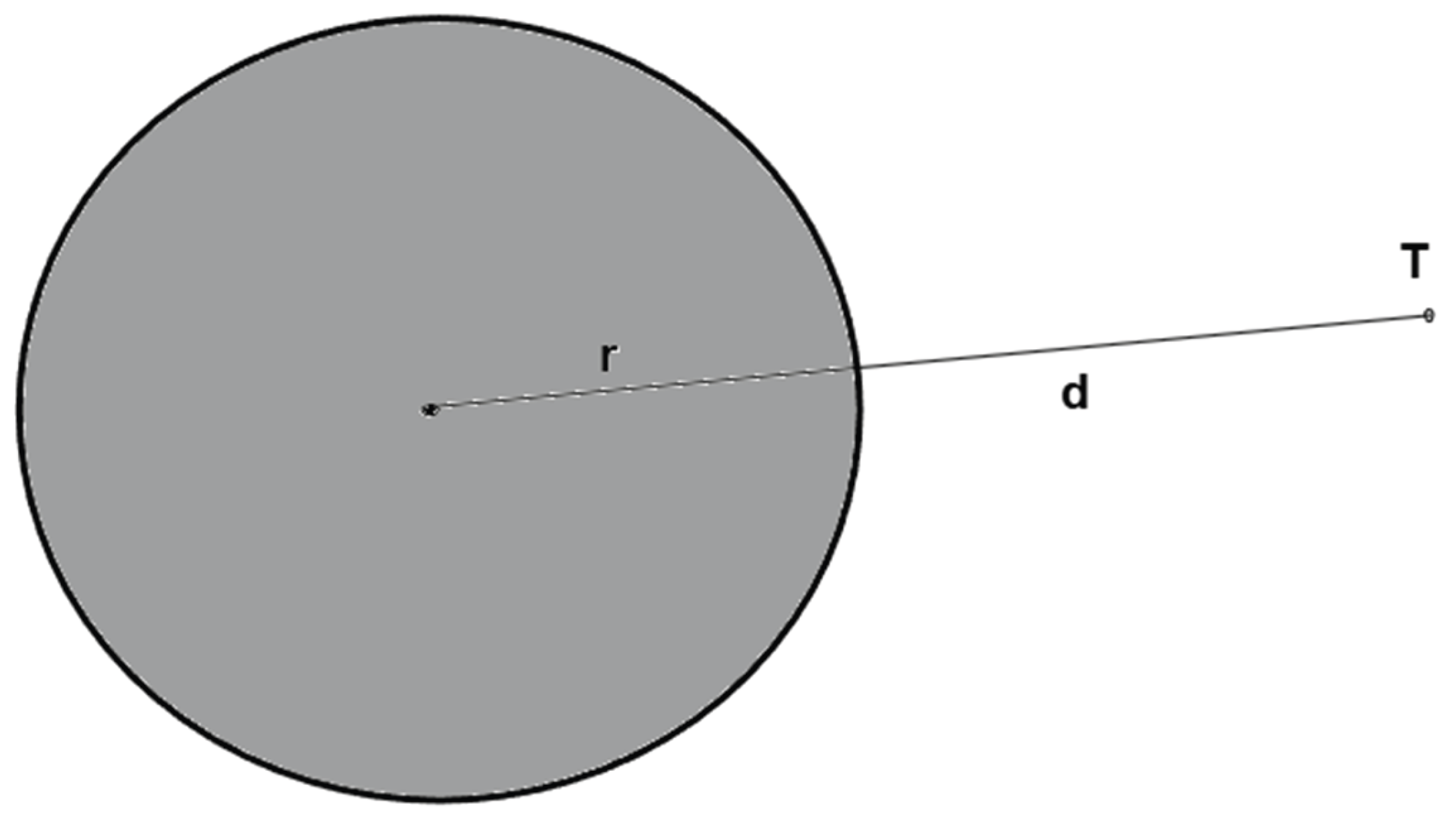
By extending the principle of mass-energy equivalence to dark energy, the curvature of space is replaced by the variable energy density of dark energy. More space is curved and the energy density of dark energy. The energy density of dark energy changes the electromagnetic properties of the local space at the center of the black hole, making the atoms unstable. In this model, the first law of thermodynamics at the center of a black hole is preserved, and the mysterious singular properties of black holes are eliminated.
3. Gravity Inside Black Holes Obeys Newtonian Physics
In Newtonian physics, a black hole is a particular type star with high mass density. Imagine we have two black holes with the same mass. The first one has radius r and the second has radius 2r, see Figure 7.
Gravitational acceleration g on the surface of a smaller black star is bigger than on the surface of the bigger black star, see Equation (12).
The energy density of dark energy in the center of a smaller star is lower than in the centre of the bigger star. That’s why gravitational acceleration g on the surface of a smaller star is bigger than on the surface of a bigger star. Gravitational acceleration g depends on the difference between the energy density of dark energy on the surface of the star and in the centre of the star. We calculate the energy density of dark energy on the surface and in the center of the star with Equation (11). Moving towards the centre of the black star, the energy density of dark energy is decreasing, the difference between energy density at the given point T and the centre is getting smaller and, consequently, gravitational
acceleration is decreasing. In the centre, becomes equal to , and gravitational acceleration there is zero. This is the Newton’s shell theorem inside black stars, expressed by the energy density of dark energy, see Figure 8.
At the point T gravitational acceleration is calculated by Equation (13).
where is the mass of the star without outer shell, is the gravitational constant, is the radius of the mass , is the Planck energy density of dark energy in
intergalactic space, is the energy density in the centre of the black
star, and is the energy density of dark energy at the point T. Gravitational acceleration on the surface is bigger than at the point T because the difference in the energy density on the surface and in the center is bigger than the difference in the energy density between the point T and the center, see Equation (14).
Equations (13) and (14) confirm that the difference
of energy density of dark energy and distance from the centre are two parameters that define the
magnitude of gravitational acceleration .
Imagine there is a black star with a constant mass. The star is extremely dense and has a small radius. The difference between the energy density in the centre and on the surface is extremely high. With the increase of the radius, the difference of energy density is decreasing, and gravitational acceleration on the surface is also decreasing, see Figure 9.
Figure 9 illustrates the basic dynamics between the gravitational acceleration of a black star, its radius, and the difference in energy density of dark energy in the center and on the surface of a black star.
In the model of dark energy presented in this article, dark energy has no antigravitational properties. The idea of how dark energy could generate the repulsion force and cause the accelerated expansion of universal space was never theoretically well defined: “Dark energy is an unpredicted, fictitious form of energy with anti-gravitational properties. It is an embodiment of the cosmological constant Λ, which Einstein introduced as a fudge factor (in the form of an integration constant) when he still believed that the universe ought to be static. This Λ was reintroduced in order to make the observed magnitude versus redshift relation of distant type Ia supernovae compatible with the BB paradigm [20]. In the model described in this article, the variable energy density of dark energy functions as the carrier of gravity. Dark energy is the energy foundation of space.
4. Mini Black Holes and Schwinger Effect
When a star is of the mass bigger than 2,9 mass of the Sun it will collapse into a black hole [21]. We will calculate energy density of dark energy in the centre of such a black star by the Equation (15) taking that star with 2,9
masses of the Sun has a radius of the Sun.
where Schwarzschild volume is calculated with the Sch. Radius of such a black star. We use Equation (4) and calculate the Schwarzschild radius of a star with 2,9 masses of the Sun and radius of the Sun. We get . We calculate Schwarzschild volume and we get . We calculate the energy density of dark energy in
such a black hole, and we get the following numbers below.
We use the same Equation (15) and we calculate the
energy density of dark energy in the centre of a proton, see below.
.
We see that the energy density of dark energy at
the center of a black hole with 2,9 masses of the Sun is far lower than the
energy density in the center of a proton. The energy density of dark energy in
the centre of a proton is much higher than the energy density in the center of
a black hole with 2,9 masses of the Sun. The difference is on the scale of . This confirms that a proton cannot be a black
hole.
In 1971, Hawking predicted existence of mini black
holes: “Since gravitational collapse it is essentially a classical process, it
is probable that black holes could not form with radii less than the Planck
length ~ , the length in which quantum fluctuations of the
metrics are expected to be of order unity. A Schwarzschild radius of this
length would correspond to a mass of about . For lengths larger than it could be a good approximation to ignore quantum
gravitational effects and treat the metrics classically. One might therefore
expect collapsed objects to exist with masses from upwards [22]. We will calculate the energy density of a mini black hole with radius of , and mass .
.
The energy density of dark energy in the centre of such a mini black hole is much lower than the energy density in the center of a black hole with 2,9 masses of the Sun. The difference is on the scale of . This calculation confirms that, theoretically,
Hawking’s mini black hole could exist. In such a mini black hole, the energy
density of dark energy would be at the scale which is close to the absolute absence of dark
energy at the scale of . This opens up interdisciplinary theoretical speculations about the existence of the absolute void, including consciousness, which will not be discussed in this article. More tangible is the idea of the unification of different concepts in physics:
- -
- superfluid vacuum [2]
- -
- time-invariant superfluid quantum space [3]
- -
- ether [4]
- -
- dark energy
- -
- electromagnetic vacuum of QED,
where the electron is a photon with toroidal topology [23]. By itself, the idea arises that the positron could also be a photon with a toroidal topology, where the photon has the opposite direction of motion to the photon in the electron. At low energies, the result of the electron–positron collision is the annihilation of the electron and positron, and the creation of two energetic photons. This supports the model of the electron as a photon with a toroidal topology. The idea that photons are conserved in the electrons and when electrons move to a higher orbit, they emit a photon is outdated. When we heat the piece of iron for 1000 years, it will radiate photons for 1000 years. The heated iron heats the electromagnetic vacuum, which gives virtual photons energy, and they become real photons. Electromagnetic vacuum (superfluid space, dark energy) is the cosmic reservoir of virtual photons [24]. The presented model offers a plausible explanation of Schwinger’s effect [25]. A strong electric field gives energy to the two virtual photons, which are transformed into an electron and a positron.
5. Post-Newtonian Physics Replaces Gravitational Collapse with Electromagnetic Collapse and Explains the Physical Origin of Astrophysical Jets
Post-Newtonian physics integrates quantum mechanics into Newtonian physics with the introduction of the variable energy density of the medium (superfluid space, quantum vacuum, ether, dark energy) that is based on Planck units. This model elevates the physics of black holes from spatial geometry to the level of a physical model based on the variable energy density of the medium. Gravitational collapse as a result of the geometry of space is replaced by electromagnetic collapse, which is a quantum mechanical phenomenon.
In the post-Newtonian description of black hole gravitational collapse is replaced by the electric collapse of atoms in the inner core of black holes and neutron stars. Extremely diminished energy density of superfluid space diminishes the value of reduced Planck constant, this changes electromagnetic properties of space, and atoms become unstable, see Equation (17).
Out of Equation (4), we derive Equation (16), and
we get:
We combine Equations (15) and (16), and we get
Equation (17).
Equation (17) is valid for intergalactic space
where the energy density of dark energy has the Planck energy density. It is
also valid in our solar system, where the diminishment of the dark energy
density is minimal. In the centre of black holes, the Planck energy density is
hugely diminished. Equation (14) shows in the centre of a black hole with , the Planck energy density of dark energy
diminishes by . This diminishes the value of the reduced Planck
constant in the centre of a black hole , see Equation (18).
Diminished reduced Planck constant in the centre of
a black hole increases electric permittivity , see Equation (19).
where e is the elementary charge, α is the fine
structure constant, c is the speed of light, and is the reduced Planck constant in the center of a
black hole. A lower value of the reduced Planck constant increases the electric
permittivity, and this decreases the electric forces between electrons and the
nucleus, which causes, according to the Columb law, the electromagnetic
collapse of the atoms, see Equation (20)
In the black star, the increased electric
permittivity causes the electrostatic forces between the
orbiting electrons and protons in the nucleus to diminish, and the atoms decay.
It also happens that the diminished reduced Planck constant changes the Cornell potential, which defines the stability of nucleons [27]. Changed Cornell potential causes nuclei to decay. In black holes, atoms decay into electrons, protons, and neutrons. That’s why astrophysical jets generated in SMBHs also contain protons [5]. Electromagnetic collapse in black holes is the origin of astrophysical jets and is more convenient than the Blandford–Znajek process [28] and the Penrose process: “We now consider the extraction of rotational energy from a black hole, not least because the rotational energy (defined appropriately) of a black hole should, in general, be comparable with its total mass-energy1[29]. It isn’t easy to imagine how protons could be created from the rotational energy of a black hole. The electromagnetic collapse of matter proposed in this article is more convenient because it explains the physical origin of jets. Electromagnetic collapse is the consequence of a huge diminishment of energy density of the medium, which increases electric permittivity and decreases magnetic permeability, see Equation (21).
< (21)
Increased electric permittivity and decreased magnetic permeability destabilize forces between the nucleus and orbiting electrons of the atom. Also, it destabilizes forces inside the nucleus. On Earth neutron is unstable; its lifetime when isolated is around 15 minutes. In a neutron star, neutrons are stable. Presuming that the electron is a photon with toroidal topology [23], in a neutron star electron has a lower energy, because the photon that builds the electron has lower energy as shown in Equation (22).
2π(22)
Lower energy of the electron causes the bond with
the proton to become stable.
5.1. Post-Newtonian Physics Reintroduces the Medium That Fills Space
Planck units are a great tool for describing the variable density of a medium that fills space (dark energy, superfluid space quantum vacuum, ether). Planck mass in the intergalactic space can be expressed by the
reduced Planck constant, see Equation (23).
(23)
Inside a black hole and any other physical object with a given mass m, the Planck energy density decreases because the Planck mass become smaller, see Equation (24).
(24)
In intergalactic space, one cubic meter of space
contains approximately Planck volumes. In the centre of a black hole or any other stellar or physical object, this number remains the same, but the Planck mass diminishes, and the Planck volume remains the same. This decreases the Planck density and the Planck energy density of a local area in which a black hole or any other physical object exists. In the center of a black hole, the Planck mass is reduced by , see Equation (25).
decreases by the distance from the center d and
becomes zero at an infinite distance. Gravitational force is a function
of the difference between Planck mass and
diminished Planck mass see Equation (26).
Universal space has Euclidean shape, it is
infinite, and is composed of the infinite Planck masses. Every mass m
diminishes the Planck masses from its centre towards infinity. The mass m of a
given physical object from the black hole to the proton is equal to the sum of , see Equation (27).
The gravitational force between two physical
objects is the result of the , see Equation (28).
Mass m of a given physical object can also be
expressed by the difference of the medium density, see Equation (29).
m = (V
m = ΔρV,
(29)
where is the Planck energy density of the medium, is the density of the medium in the centre of the
physical object, is the volume of the object, and Δρ is the difference in
the density of the medium. Since Newton had already proposed a variable density
of the medium, it is referred to as Newton’s delta. Equation (29) gives us the
new version of Newton’s equation for gravitational acceleration and gravitational force , see Equation (30).
Newton had already considered the idea that stellar objects reduce the density of the gravity-bearing medium: “Doth not this aethereal medium in passing out of water, glass, crystal, and other compact and dense bodies in empty spaces, grow denser and denser by degrees, and by that means refract the rays of light not in a point, but by bending them gradually in curve lines? . . . Is not this medium much rarer within the dense bodies of the Sun, stars, planets and comets, than in the empty celestial space between them? And in passing from them to great distances, doth it not grow denser and denser perpetually, and thereby cause the gravity of those great bodies towards one another, and of their parts towards the bodies; everybody endeavoring to go from the denser parts of the medium towards the rarer?” [30]. It isn’t easy to imagine that the Planck mass has a physical existence, that universal space has a granular structure. A more plausible idea is that universal space is a kind of superfluid that has variable density. The Planck density of the medium and the Planck energy density of the medium can be considered as true physical properties of the space-filling medium. Planck’s units are the unsurpassed genius of Max Planck, ruling the micro and macro worlds.
5.2. Critique of Chandrasekhar’s Article on Gravitational Collapse and Penrose’s Article on Gravitational Singularity
In Chandrasekhar’s article from 1975 [31], there is no clear mathematical description and no calculation of how the pressure caused by gravity could break the atoms. Going inside any stellar object, the vertical pressure of matter increases because of the matter’s weight, but this pressure cannot break atoms. Physical pressure as a result of the weight can only break physical objects; it does not work on the atomic level. That’s why Chandrasekar did not explain in his article how this pressure breaks atoms. His article is a mathematical speculation without a physical model and without quantitative calculation. What happens above the Chandrasekar limit of is that the diminished density of the medium changes the electromagnetic properties of the medium, which causes atoms and nuclei of the atom to decay. Coming closer to the centre of a black hole, or any other stellar object, the gravitational force diminishes, and the physical pressure as a result of matter weight also diminishes, see Figure 10.
4000 km under the Earth’s surface 1 kilo of matter will have a weight of 8,64243 N, see Equation (31). Density of the inner core is about 13.000 kg. Mass is 7,32263711407579· kg.
Sagittarius black hole has a mass and radius [32]. Using Equation (30), the weight of an object with a mass of 1 kilo on its surface is . The weight of an object with a mass of 1 kilo on the middle way between surface and center, which is , considering the average mass density is .
Chandrasekhar’s article from 1975 [31] has 2 parts. Chandrasekhar’s first article has 151 citations; in 2021 was cited 16 times. Chandrasekhar’s second article has 290 citations, and in 2021 was cited 38 times. The article is an intellectual virtuosity of mathematical equations, which, unfortunately, have no physical significance. The same mathematical excellence applies to Penrose’s singular equations [8], which, unfortunately, also have no physical meaning. His article, referenced in [8], was published in 1964 and has garnered 2,396 citations. The main obstacle to progress in physics is the mental inertia of erroneous ideas. Kerr has recently admitted that black holes have no physical singularities, that singularities have only a mathematical character [33]. The re-examination of the Chandrasekhar model of gravitational collapse caused by weight pressure has shown that it is incorrect. Chandrasekhar did not give a clear physical explanation of how gravity causes the weight-pressure of mass that breaks atoms. It is shown in this article; gravitational force decreases when approaching the black hole’s center and cannot cause the collapse of the star.
In the 21st century are the mystical properties of black holes as a singularity and an event horizon, are finally properly understood as misguided concepts of 20th-century physics: “Instead of a spacetime singularity covered by an event horizon we will have an essentially quantum object, an extremely compact dark star, which is held up not by any degeneracy pressure but by quantum gravity just as ordinary atoms are sustained by quantum mechanics. Astronomical observations indicate that astrophysical black holes possess dark surfaces and this is consistent with the picture we have just described” [34]. There are no holes in space; black holes are extremely dense stars where the extremely low density of the medium changes the electromagnetic properties and causes electromagnetic collapse. Gravitational singularity, event horizon, and gravitational collapse are part of speculative mathematical physics. Newton’s Shell theorem, electromagnetism, atomic physics, and electromagnetic collapse are within the realm of empirical physics, see Figure 11.
Penrose’s model of gravity inside stellar objects, which is based on the curvature of space, has no experimental verification. Newton’s model of gravity inside stellar objects has experimental verification. Gravitational collapse has no experimental verification; electromagnetic collapse has experimental verification in astrophysical jets. Gravitational collapse is metaphysics; electromagnetic collapse is evidence-based physics.
The current model of black holes lacks a cause-and-effect relationship between the extreme pressure of matter and the decay of atoms. There is no theoretical model, and there is no calculation of how matter pressure could break electromagnetic forces between the electrons and the nucleus of the atoms. The gravitational collapse model has a cause-and-effect gap that appears to be unsolvable, see Figure 12.
The true sequence of cause-and-effect is as follows: an extremely high density of matter (1) causes a remarkable decrease in the density of the medium (2), which causes a change in the electromagnetic properties of the medium (3), which causes the electromagnetic forces inside the atom to diminish and atoms decay (4), see Figure 13.
6. Winds and Jets Get Their Energy from the Same Source
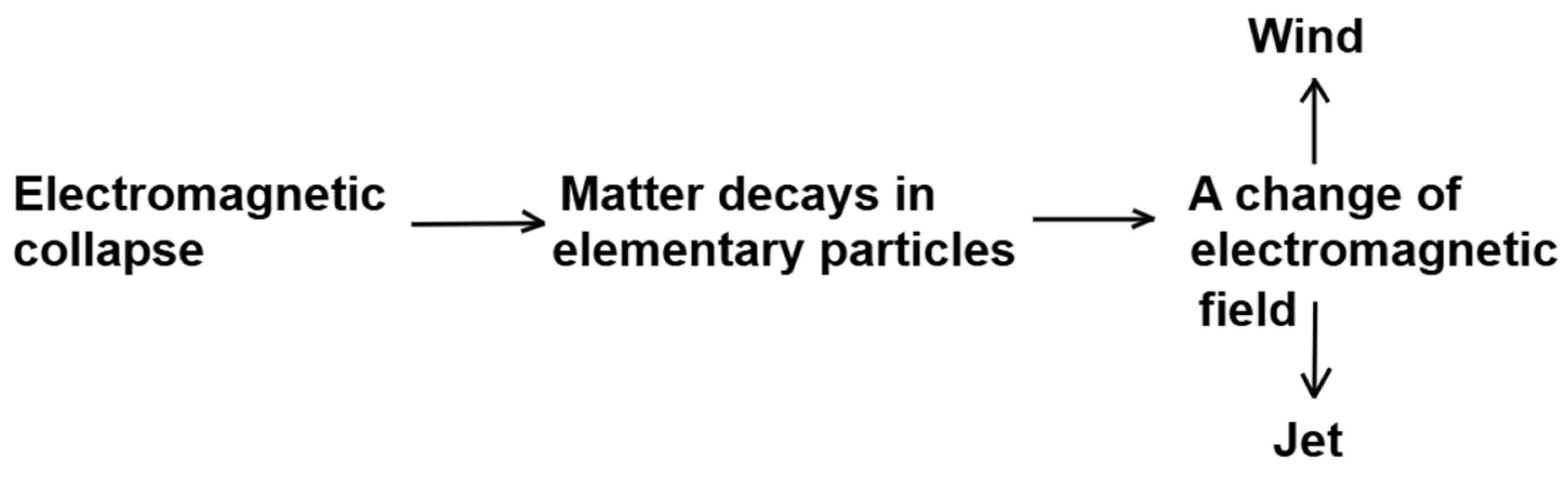
Electromagnetic collapse provides a constant amount of energy that a black hole throws into space. Recent research confirms that sometimes the outflow of energy is in the form of winds, sometimes in the form of jets, but never simultaneously [35].
Dr. Jiachen Jiang: “We’re seeing what could be described as an energetic tug-of-war inside the black hole’s accretion flow. When the black hole fires off a high-speed plasma jet, the X-ray wind dies down, and when the wind starts up again, the jet vanishes. This tells us something fundamental about how black holes regulate their energy output and interact with their surroundings” [36].
Dr. Jiachen Jiang: “Our observations provide clear evidence that black hole binary systems switch between powerful jets and energetic winds – never producing both simultaneously – highlighting the complex interplay and competition between different forms of black hole outflows [36].
Out of the report on this research: “The oscillating behavior exhibited by the black hole indicates a self-regulating mechanism, wherein winds and jets vie for the same energy or mass resources. Notably, both forms of outflows were observed to transport similar quantities of mass and energy, implying that although the nature of the outflow varies, the overall outflow rate remains approximately stable. The study calls into question several long-standing beliefs regarding the powering of outflows. It suggests that the transition between winds and jets is not merely influenced by fluctuations in the amount of material being accreted by the black hole, but may also be contingent upon the magnetic field arrangement within the disk, a crucial element in determining how energy is discharged. In summary, black holes do not merely consume matter; they also regulate it, choosing whether to expel it into space as a concentrated jet or to disperse it in extensive winds. The equilibrium between winds and jets is essential in controlling the growth of black holes, the formation of stars in adjacent areas, and the evolution of entire galaxies. This “cosmic seesaw” provides a significant new perspective on how these mysterious entities influence the universe” [36].
The black hole model in this paper explains that winds and jets originate from the same source, specifically, the electromagnetic collapse at the center of the black hole. The magnetic fields of black holes are dynamic [37] and are likely the key physical factor that determines whether a black hole will produce wind or a jet.
Figure 14.
Winds and jets get their energy from the same source.
7. A Brief Historical Overview of Gravitational Physics Since Newton
Newton’s contribution to gravitational physics is the famous equation for the gravitational force between two physical objects. In his model, the action of the gravitational force remains unclear. Einstein attempted to explain how gravity operates between two physical objects by considering that the curvature of space generates gravitational force. His model is of a mathematical nature and does not explain the physical origin of the gravitational force. There have been several attempts to unify general relativity and quantum physics. In a recent article, authors explored the relationships between photon, electron, and graviton, which is believed to carry the gravitational force [38]. The idea that gravitational force is similar to electromagnetic force has persisted in physics for the past 100 years. However, it has never been theoretically explained how atoms that comprise stellar objects emit gravitons and how they receive them. Also, it is not imaginable how a graviton that is halfway from the Sun to the Earth could keep them together. Gravitational force is carried by the variable energy density of superfluid space (dark energy, quantum vacuum, electromagnetic vacuum) and electromagnetism is the excitation of superfluid space [3].
A model of curved space cannot explain in physical terms how the gravitational force works Replacement of the curvature of space with the variable energy density of dark energy provides the physical model of gravity where gravitational force is a pushing force of space, see Figure 1 and Figure 5. The given mass deforms the space; It reduces the energy density of dark energy, which creates gravity. The basic idea is the same as in Einstein’s model; its advantage is that it can explain the physical origin of the gravitational force. Newtonian gravity, which is based on the ether [19], which is the old name for dark energy, is superior to Einsteinian gravity because it keeps gravity as a force. Gravity is the fundamental force of the dynamics of the universe that governs the motion of entire galaxy clusters, including the local supercluster Laniakea, towards the Great Attractor [39,40]. In 2014, NASA confirmed that universal space has Euclidean shape [13]. It is time, and fair, that the curvature of space as a carrier of gravity is recognized as a model that belongs to the history of physics.
In 2023, Allain Haraux presented his research on black hole physics from the perspective of Newtonian physics [41]. The study of black holes in the context of Newtonian physics without hypothetical singularities has a future because it clarifies the currently problematic picture of black holes, where in singularities the laws of physics no longer apply. John Wheeler was criticizing the singularity of a black hole and suggested it should be replaced by the “fiery marriage” of general relativity and quantum physics: “General relativity must fail at the central singularity and be replaced by a “fiery marriage”, as he called it, of general relativity and quantum physics, by the new laws of quantum gravity that he, Misner, DeWitt, and others were beginning to seek” [42]. It is shown in this article that when we replace the curvature of space with the variable energy density of dark energy, the newborn of this “fiery marriage” is the extension of the mass-energy equivalence principle of a black hole on dark energy, and understanding that Newton’s Shell Theorem works well inside black holes, which are stars with extremely high mass density. In general, no singularity contributes to the progress of cosmology, including the initial singularity of the Big Bang model, which does not conform to the basic principles of empirical science [10].
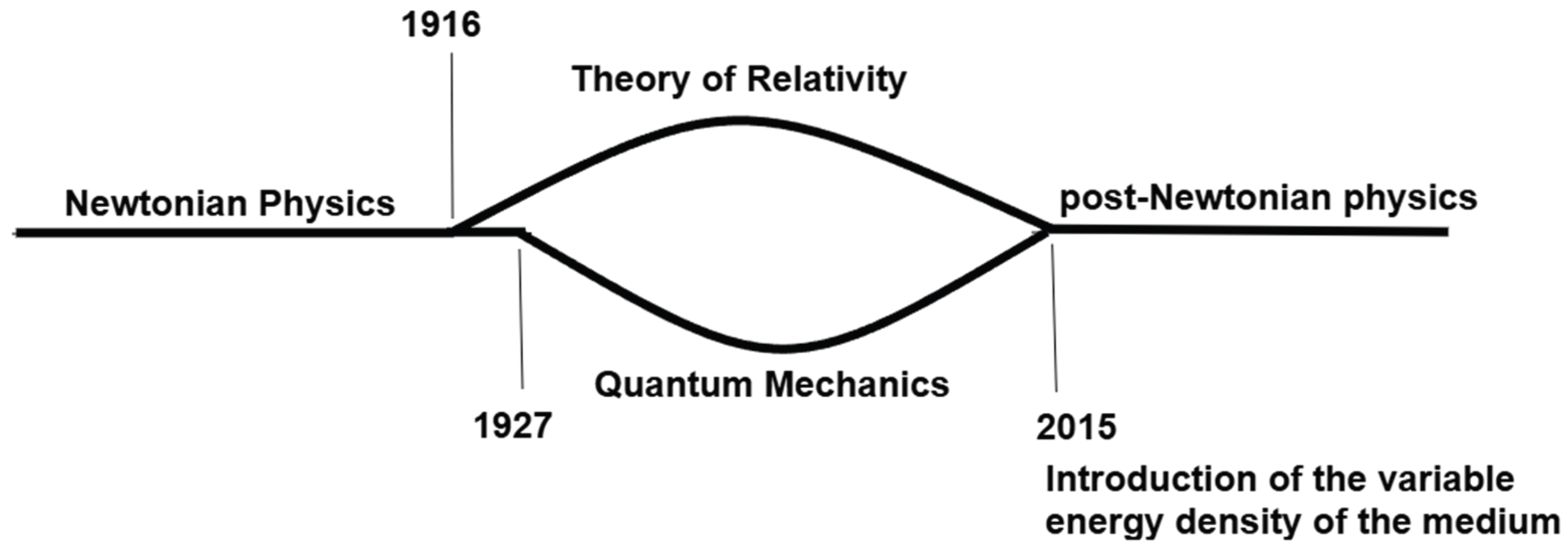
In post-Newtonian physics, his idea that variable density of the medium generates gravity got the exact mathematical description, see Equation (30). Post-Newtonian physics milestone is in 2015 with the extension of the mass-energy equivalence principle to the medium in which stellar objects exist, see Figure 15.
The introduction of variable energy density of the medium is a new attempt to combine general relativity and quantum mechanics. Some of the results have been presented in this article. This research has potential and will be developed by rigorous scientific research methodology, in which models of the world are an accurate bijective mathematical representation of the real world, where each element in the model describes exactly one corresponding model in the physical reality. Historical experience has shown us that the model of curved space and the model of gravitational collapse were introduced by the mathematical scientific mind, which in the 20th century prevailed scientific physical mind. At the beginning of the 21st century scientific physical mind is back in power and should remain forever. Mathematics is an excellent tool of physics, but history teaches us it cannot rule physics. In 2025, the theory of relativity was fully integrated into post-Newtonian physics. With the variable energy density model of the medium, all relativistic models are described. [4]. In the coming years, the integration of quantum physics is planned. According to the author’s vision, the unification of the theory of relativity and quantum physics is possible through their integration into post-Newtonian physics, the core of which is Newtonian physics.
8. Conclusions
The fundamental law of physics is the conservation of energy, which cannot be created or destroyed, but it can transform into another type of energy. With the extension of the mass-energy equivalence to dark energy, we integrated dark energy into the energy conservation law and got a new model of black hole as a rejuvenating system of the universe. In the center of a black hole, old matter with high entropy decays into elementary particles and dark energy, which have a low entropy. Black holes keep the universe young; they reverse the process of entropy increase of matter, where atoms with low atomic number are transformed into atoms with high atomic number. The energy of astrophysical jets that AGNs throw into intergalactic space is the fresh energy for the formation of new stars.
References
- Ahlen, S.P. Positive Neutrino Masses with DESI DR2 via Matter Conversion to Dark Energy. Phys. Rev. Lett. Published. 2025, 135, 081003. [Google Scholar] [CrossRef]
- Fiscaletti, D.; Sorli, A. Generalized uncertainty relations, particles, black holes, and Casimir effect in the three-dimensional quantum vacuum. Theor Math Phys 2023, 214, 132–151. [Google Scholar] [CrossRef]
- Sorli, A. S.; Čelan, Š. Time-Invariant Superfluid Quantum Space as the Unified Field Theory. Reports in Advances of Physical Sciences 2020, 4(3), 2050007. [Google Scholar] [CrossRef]
- Amrit S. Sorli, Einstein Legacy: Ether Relativity and Cosmology. International Journal of Quantum Foundations 2025, Volume 11(Issue 4), pages 527–559. Available online: https://ijqf.org/archives/7583.
- Sorli, Amrit; et al. Re-examination of Penrose’s and Kerr’s singularities and the origin of protons in astrophysical jets. Advanced Studies in Theoretical Physics 18(2), 61–82. Available online: https://www.m-hikari.com/astp/astp2024/astp1-4-2024/92117.html. [CrossRef]
- Arminjon, Mayeul. Gravitation as a pressure force: a scalar ether theory. 2011. [Google Scholar] [CrossRef]
- Nizamov, B.A.; Pshirkov, M.S. Can Observations of 511 keV Line from the M31 Galaxy Shed Light on the AGN Jet Composition? Astron. Lett. 2023, 49, 9–17. [Google Scholar] [CrossRef]
- Penrose, R. Gravitational collapse and space-time singularities. Physical Review Letters 1964, 14(no. 3), 57. [Google Scholar] [CrossRef]
- Lehmkuhl, D. The Prediction and Interpretation of Singularities and Black Holes: From Einstein and Schwarzschild to Penrose and Wheeler. Phys. Perspect. 2025, 27, 176–209. [Google Scholar] [CrossRef]
- Sorli, A.; Jafari, S.; Fiscaletti, D.; Gorjup, N.; Gorjup, R.; Makovec, T. Evidence-based Cosmology – Black holes are rejuvenating systems of the universe. Reports in Advances of Physical Sciences 2023, 7, 2350012. [Google Scholar] [CrossRef]
- Carballo-Rubio, Raúl; et al. Towards a non-singular paradigm of black hole physics. Journal of Cosmology and Astroparticle Physics. 2025. Available online: https://iopscience.iop.org/article/10.1088/1475-7516/2025/05/003.
- Šorli, A.; Saroy, A. Geometry of Space, Gravity, and Bending of Light. Preprints 2025, 2025090060. Available online: Accepted in The Indian Journal of Advanced Physics (IJAP) https://www.ijap.latticescipub.com/. [CrossRef]
- NASA, Our Universe. 2014. Available online: https://wmap.gsfc.nasa.gov/universe/uni_shape.html.
- Porta Mana, P G L; Porta Mana, P G L; Dimensional analysis in relativity and in differential geometry. European Journal of Physics, 42 (2021), no. 4. P G L Porta Mana, Dimensional analysis in relativity and in differential geometry. European Journal of Physics 2021, 42(no. 4 42 no. 4). Available online: https://iopscience.iop.org/article/10.1088/1361-6404/aba90b. [CrossRef]
- Schlatter, A; Kastner, R E. Gravity from transactions: fulfilling the entropic gravity program. Journal of Physics Communications. 2025. Available online: https://iopscience.iop.org/article/10.1088/2399-6528/acd6d7.
- Panda, C.D.; Tao, M.J.; Ceja, M.; et al. Measuring gravitational attraction with a lattice atom interferometer. Nature 2024, 631, 515–520. [Google Scholar] [CrossRef]
- Charman, A.; The ALPHA Collaboration. Description and first application of a new technique to measure the gravitational mass of antihydrogen. Nat Commun 2013, 4, 1785. [Google Scholar] [CrossRef]
- Xu, Victoria; et al. Probing gravity by holding atoms for 20 seconds. Science 2019, 366, 745–749. [Google Scholar] [CrossRef]
- Sorli, A.; Gorjup, N.; Gorjup, R. Replacement of space-time with superfluid space and restoration of Newton’s dynamic ether. Rep. Adv. Phys. Sci. 2023, 7, 2350005. [Google Scholar] [CrossRef]
- Traunmüller, Hartmut. Towards a More Well-Founded Cosmology. Zeitschrift für Naturforschung A 2018, vol. 73(no. 11), 1005–1023. [Google Scholar] [CrossRef]
- Kalogera, V; Baym, G. “The Maximum Mass of a Neutron Star”. The Astrophysical Journal 1996, arXiv:astro470, L61–L64. [Google Scholar] [CrossRef]
- Hawking, Stephen W. “Gravitationally collapsed objects of very low mass”. Monthly Notices of the Royal Astronomical Society 1971, 152, 75. [Google Scholar] [CrossRef]
- Williamson, J.G.; van der Mark, M.B. Is the electron a photon with toroidal topology? Annales de la Fondation Louis de Broglie 1997, Volume 22 no 2. Available online: https://fondationlouisdebroglie.org/AFLB-222/MARK.TEX2.pdf.
- Fiscaletti, Sorli. A three-dimensional non-local quantum vacuum as the origin of photons. Ukr.J.Phys. 2020, 65 2, 106. Available online: https://inspirehep.net/literature/1788393. [CrossRef]
- Schwinger, Julian. “On Gauge Invariance and Vacuum Polarization”. In Physical Review; American Physical Society (APS), 01 06 1951; Volume 82, 5, pp. 664–679. [Google Scholar] [CrossRef]
- Humpherys, David. Understanding the natural units and their hidden role in the laws of physics, (2024) Eur. J. Phys. 45. Available online: https://iopscience.iop.org/article/10.1088/1361-6404/ad61d3.
- Napsuciale, M.; Rodríguez, S.; Villanueva-Gutiérrez, A. E. Complete analytical solution to the Cornell potential and heavy quarkonium structure. Phys. Rev. D Published. 2025, 111, 116022. [Google Scholar] [CrossRef]
- Blandford, R. D.; Znajek, R. L. “Electromagnetic extraction of energy from Kerr black holes”. Monthly Notices of the Royal Astronomical Society 1977, 179(3), 433–456. [Google Scholar] [CrossRef]
- Penrose, R.; Floyd, R. M. “Extraction of Rotational Energy from a Black Hole”. Nature Physical Science 1971, 229(6), 177–179. [Google Scholar] [CrossRef]
- Newton, The Third Book of Optics (1718). Available online: https://www.newtonproject.ox.ac.uk/view/texts/normalized/NATP00051.
- Chandrasekhar, S. The highly collapsed configurations of a stellar mass. Neutron Stars Black Holes Binary X-Ray Sources 48, 259. 1975. Available online: https://adsabs.harvard.edu/full/1935MNRAS..95..207C.
- LENS. 2025. Available online: https://astrophotographylens.com/blogs/astro/sagittarius-a-black-hole.
- Kerr, R.P. Do Black Holes have Singularities? 2023. [Google Scholar] [CrossRef] [PubMed]
- Vaz, C. Black holes as gravitational atoms. Int. J. Mod. Phys. D 2014, 23(12), 1441002. [Google Scholar] [CrossRef]
- Zhang, Z.; Jiang, J.; Carotenuto, F.; et al. Evidence of mutually exclusive outflow forms from a black hole X-ray binary. Nat Astron 2026. [Google Scholar] [CrossRef]
- Matt Higgs, The Cosmic Seesaw, Black holes eject material as winds or jets, but not both at once. Available online: https://warwick.ac.uk/news/pressreleases/the-cosmic-seesaw/.
- Saurabh. Semi-analytic studies of the accretion disk and magnetic field geometry in M 87*. Astronomy & Astrophysics. January 2026, Volume 705. Available online: https://www.aanda.org/articles/aa/full_html/2026/01/aa56880-25/aa56880-25.html.
- Partanen*, Mikko; Tulkki, Jukka. Gravity generated by four one-dimensional unitary gauge symmetries and the Standard Model. Reports on Progress in Physics, Volume 88 2025, 5. Available online: https://iopscience.iop.org/article/10.1088/1361-6633/adc82e. [CrossRef]
- Courtois, H. M.; Mould, J.; Hollinger, A. M.; Dupuy, A.; Zhang, C. P. In search of the Local Universe dynamical homogeneity scale with CF4++ peculiar velocities A&A. 2025, 701, A187. [Google Scholar] [CrossRef]
- 100 Facts about the Laniakea Supercluster, JWST. 2025. Available online: https://www.jameswebbdiscovery.com/universe/100-facts-about-the-laniakea-supercluster.
- Haraux, Alain. A Newtonian approach to general black holes. EECT 2023, 12(6), 1447–1455. [Google Scholar] [CrossRef]
- Missner, Charles W.; Thorne, Kip. S.; Zurek, Wojciech H. John Wheller, relativity, and quantum information. Physics Today. 2009. Available online: https://www.cco.caltech.edu/~kip/PubScans/VI-50.pdf.
Figure 1.
Gravitational force is pushing force of dark energy.
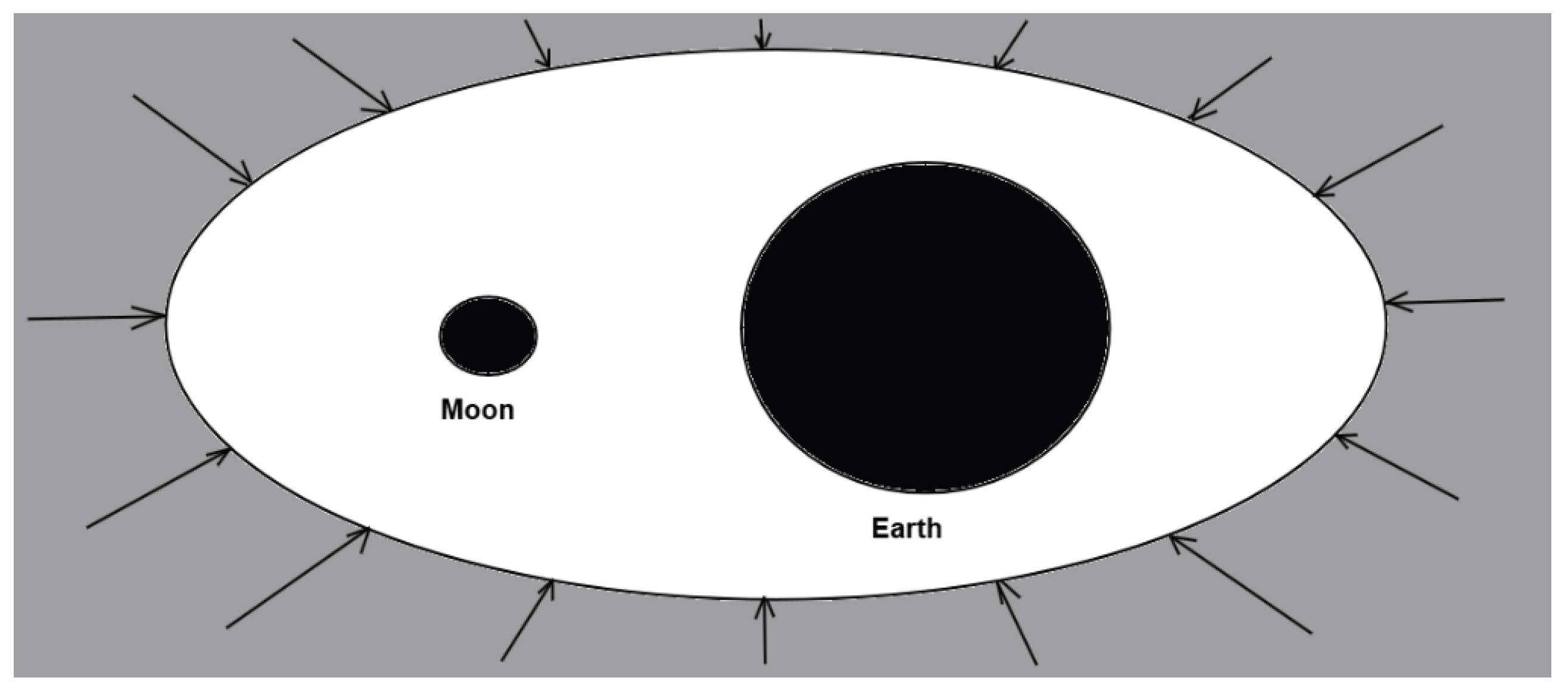
Figure 2.
Explosion of supernova and astrophysical jet from SMBH.
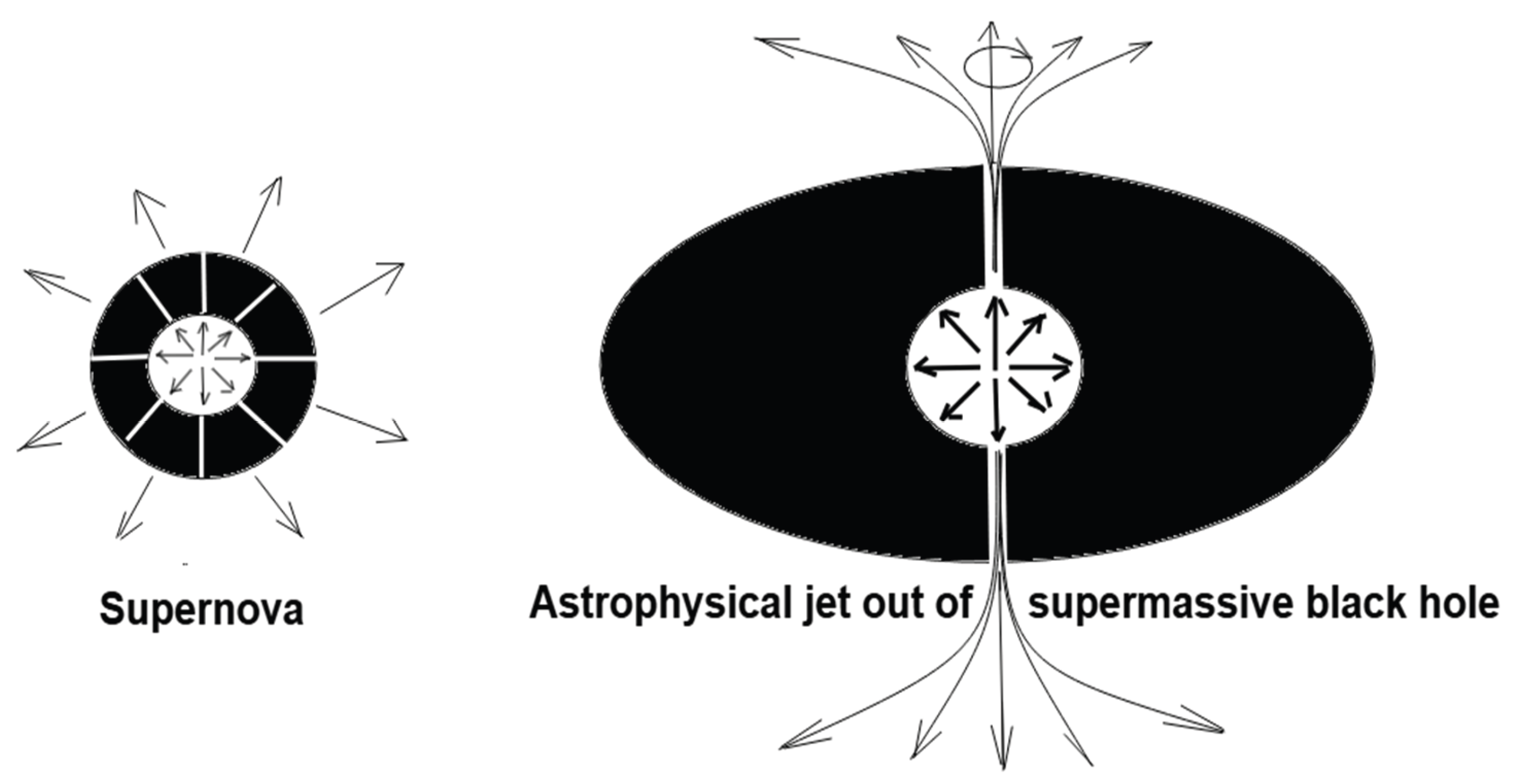
Figure 3.
Penrose’s Singularity Conundrum.
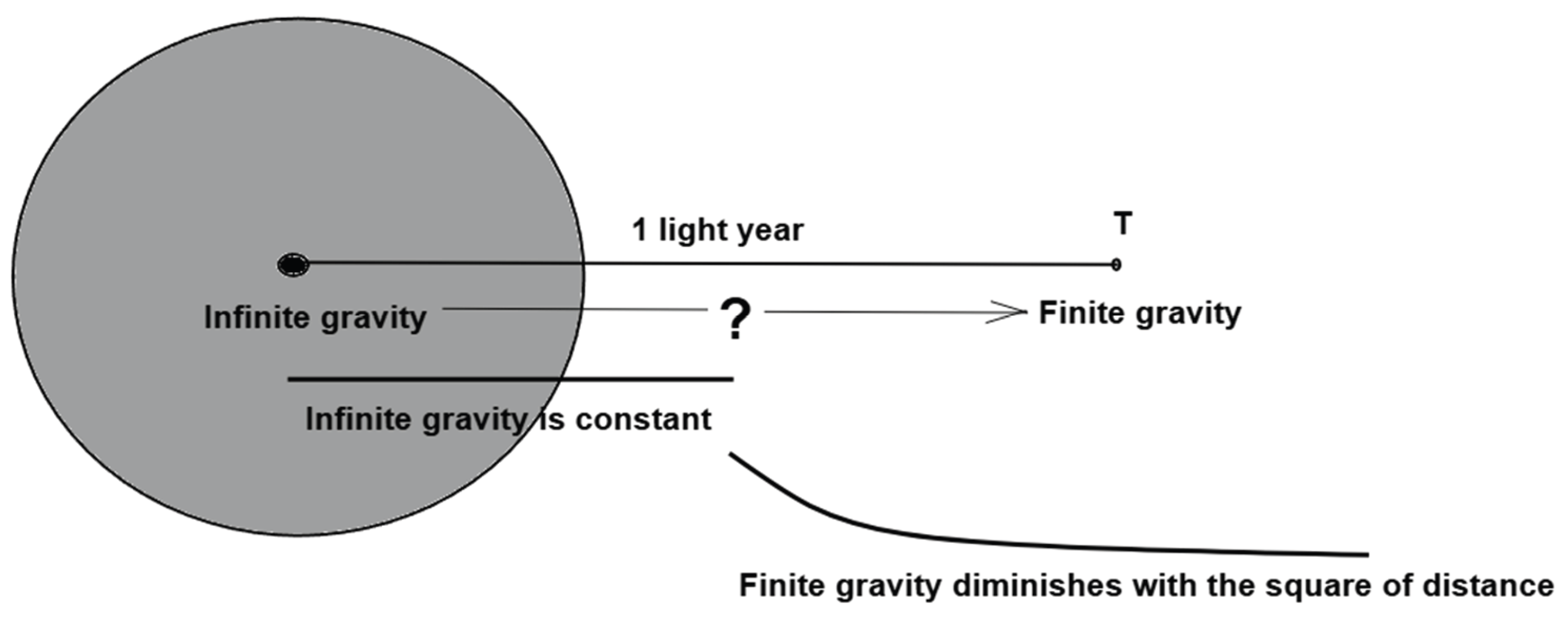
Figure 4.
Bending of light is caused by decrease and increase of energy density of dark energy.
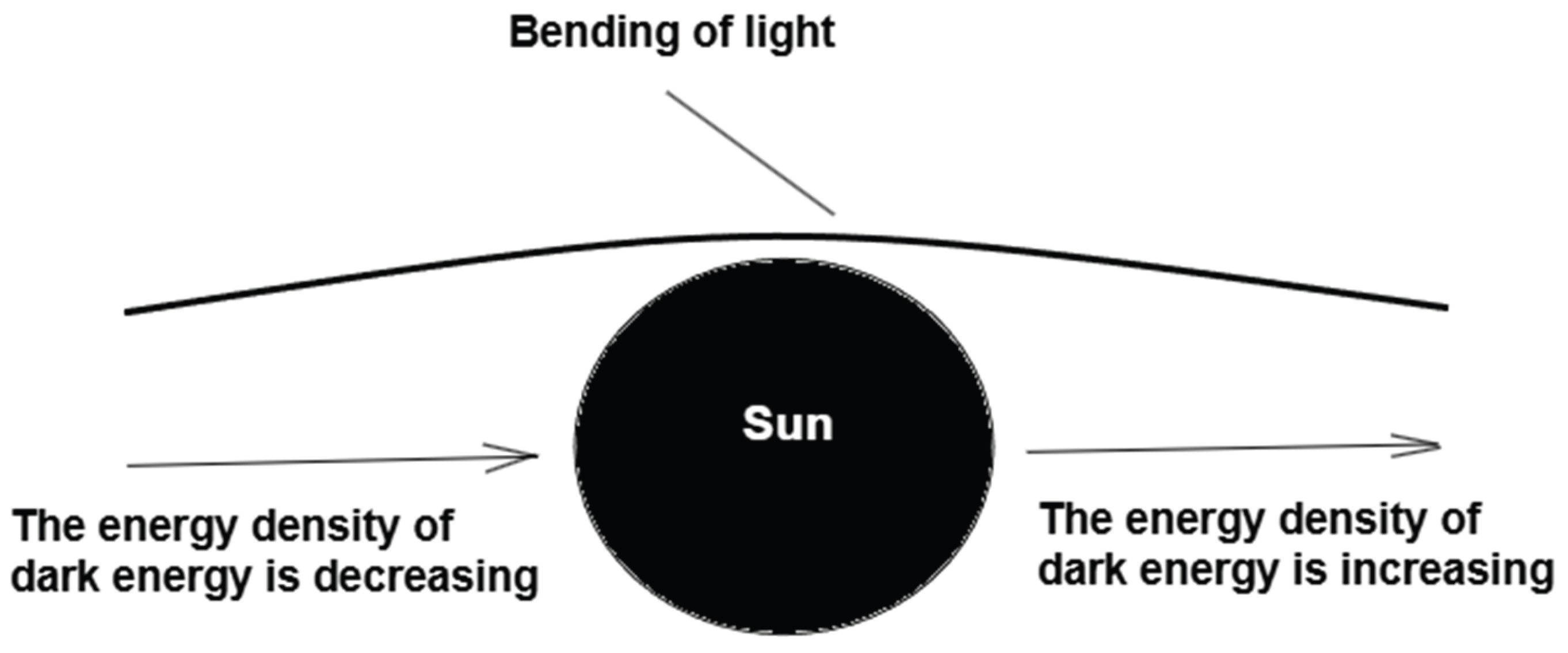
Figure 5.
Gravitational mass and gravitational force.
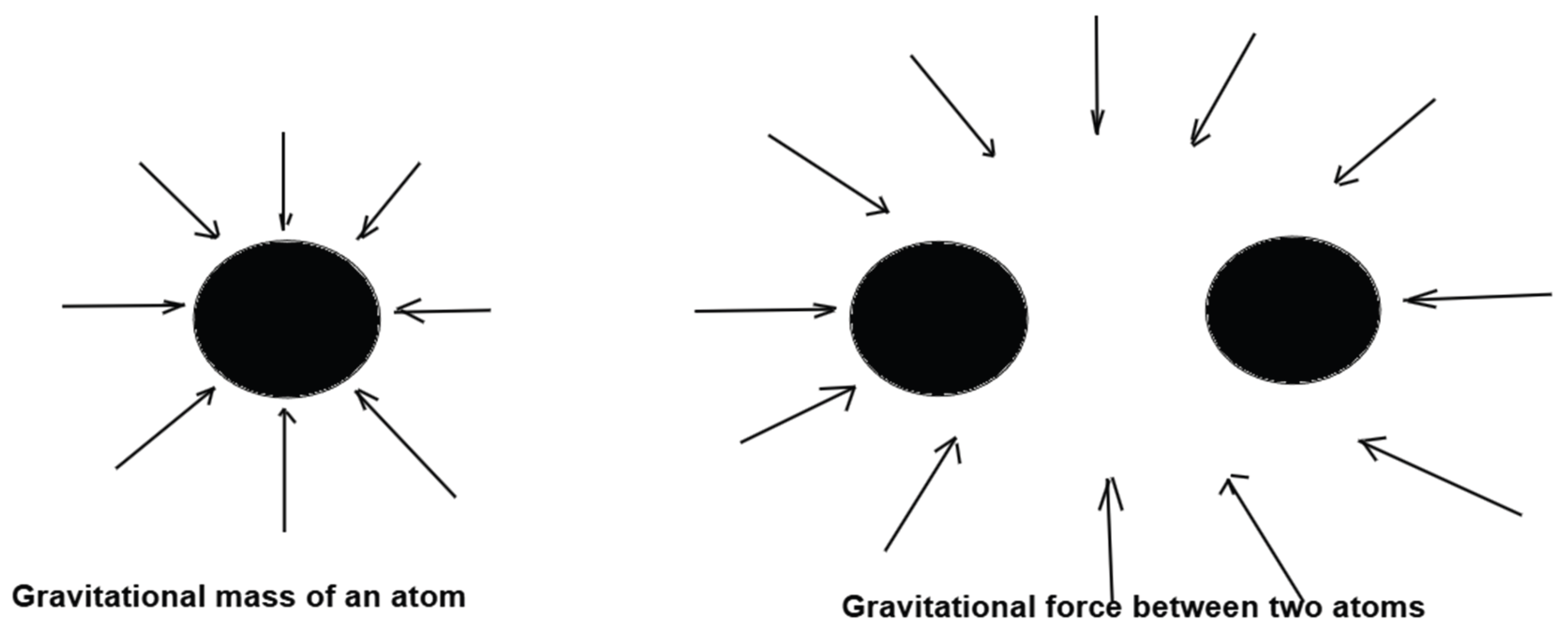
Figure 7.
Two black holes with the same mass m and different radii.
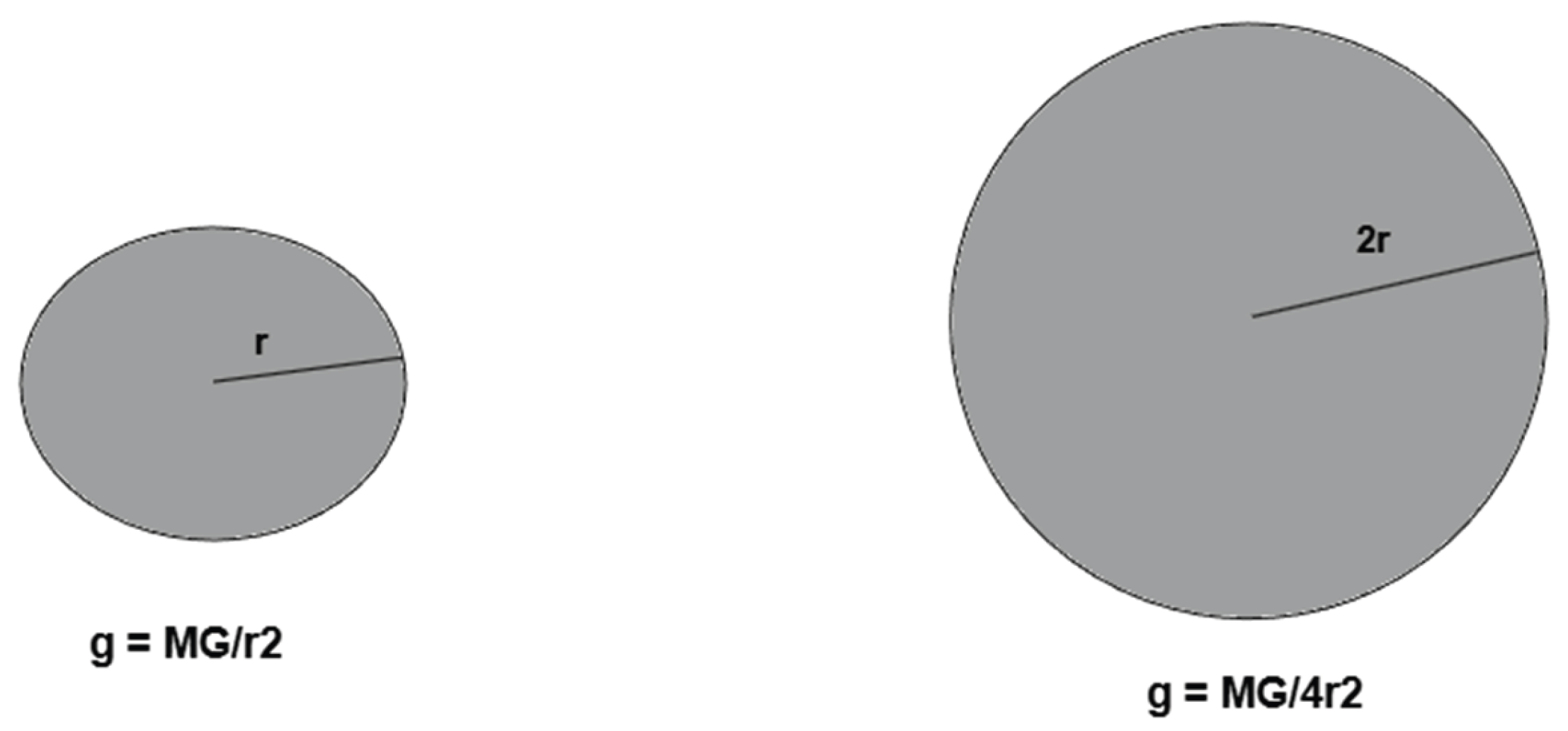
Figure 8.
Newton’s Shell Theorem inside black star.
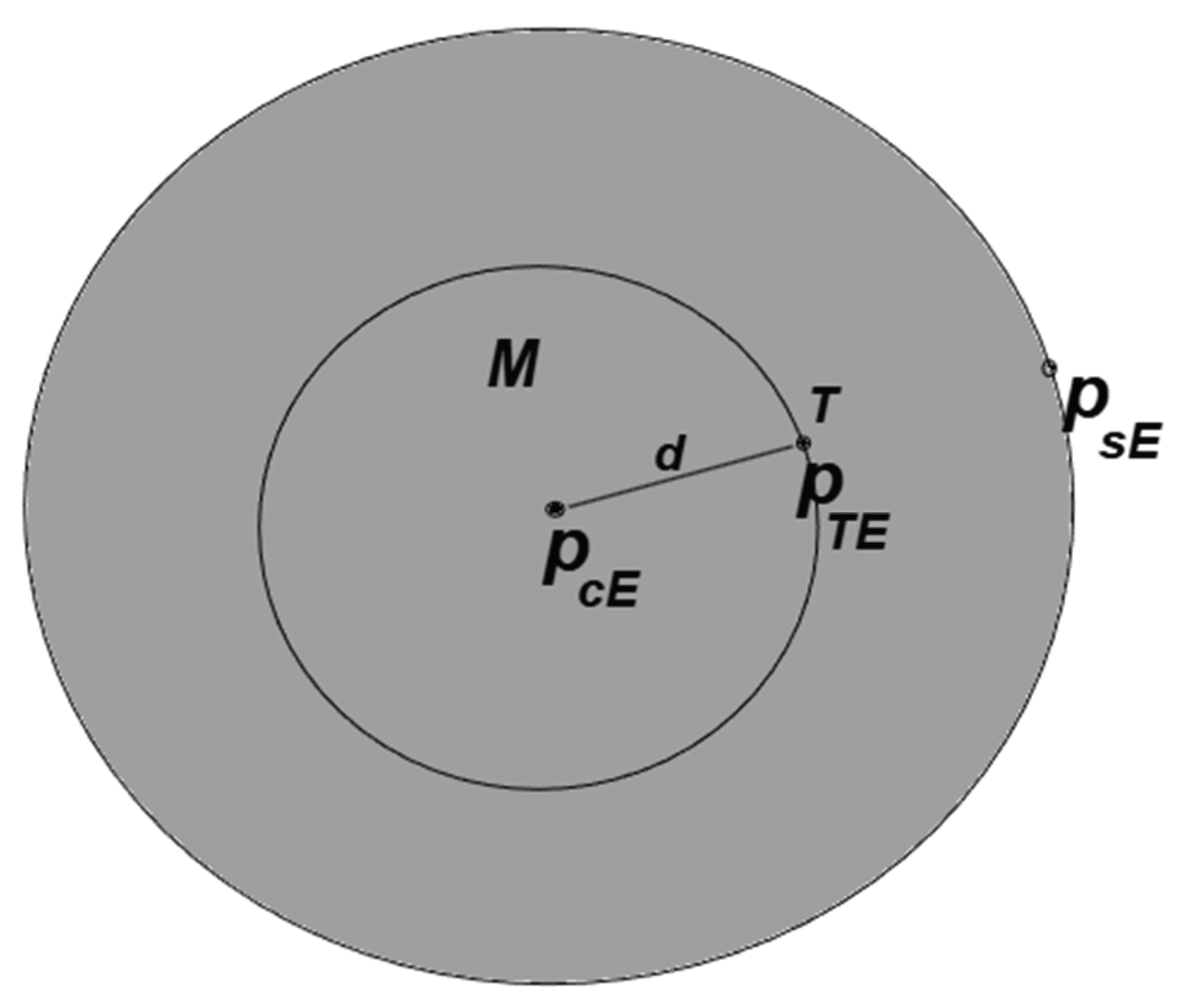
Figure 9.
Relations between energy density of dark energy, radius and gravitational acceleration of a black star.
Figure 9.
Relations between energy density of dark energy, radius and gravitational acceleration of a black star.
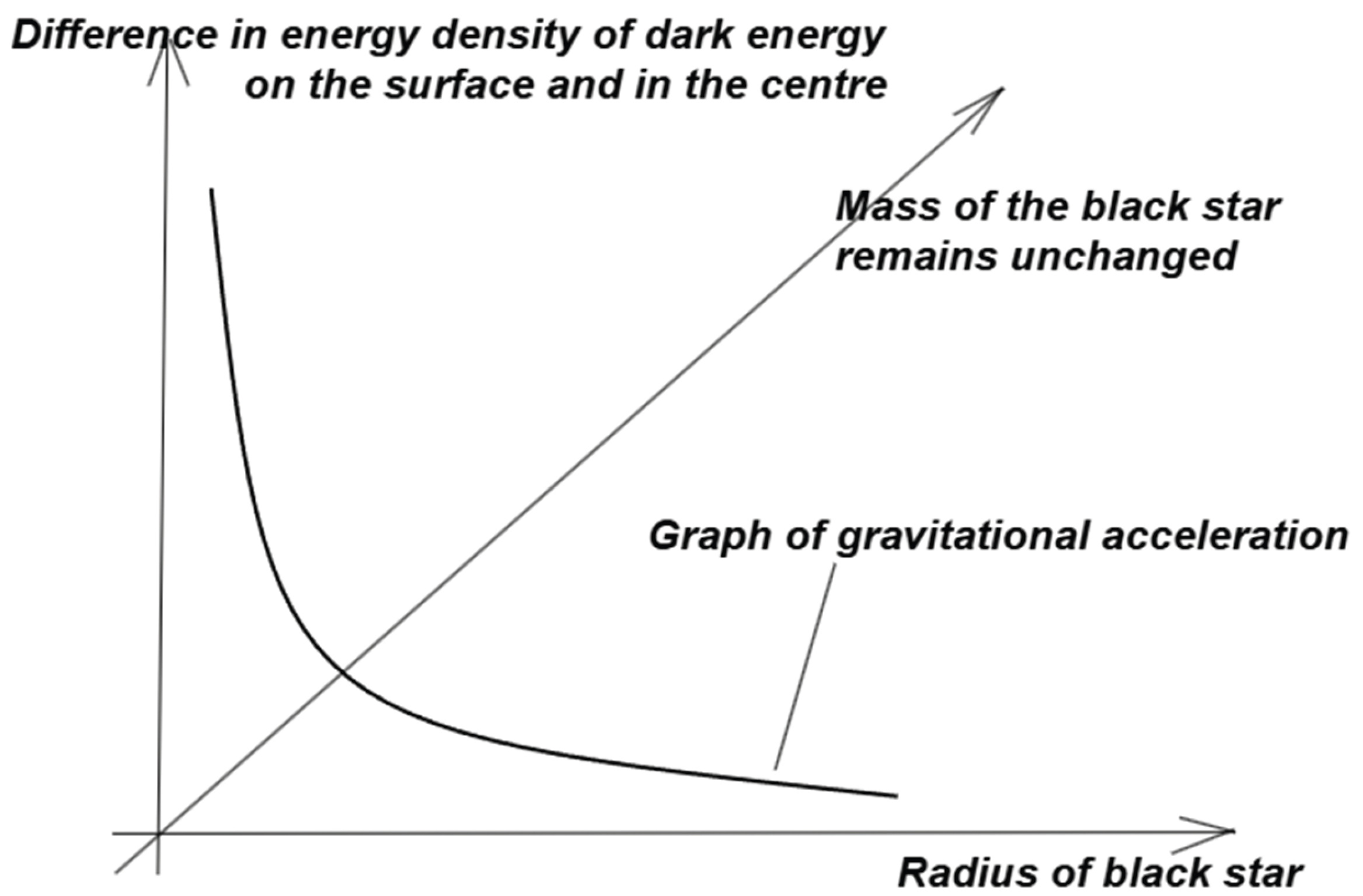
Figure 10.
Figure 10. Diminishment of weight pressure 4000 km under the Earth surface.
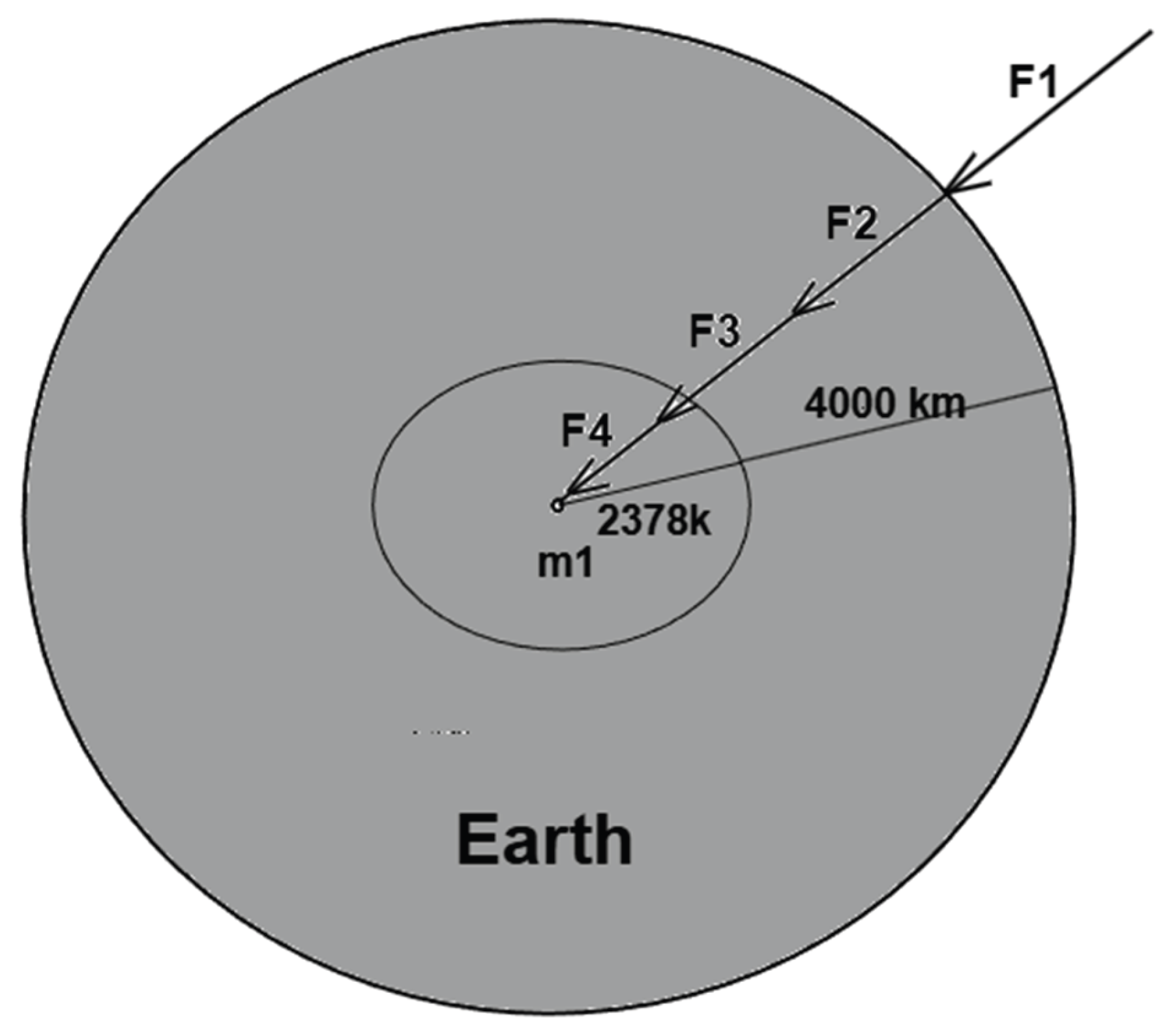
Figure 11.
Penrose gravity and Newton gravity inside the black hole.
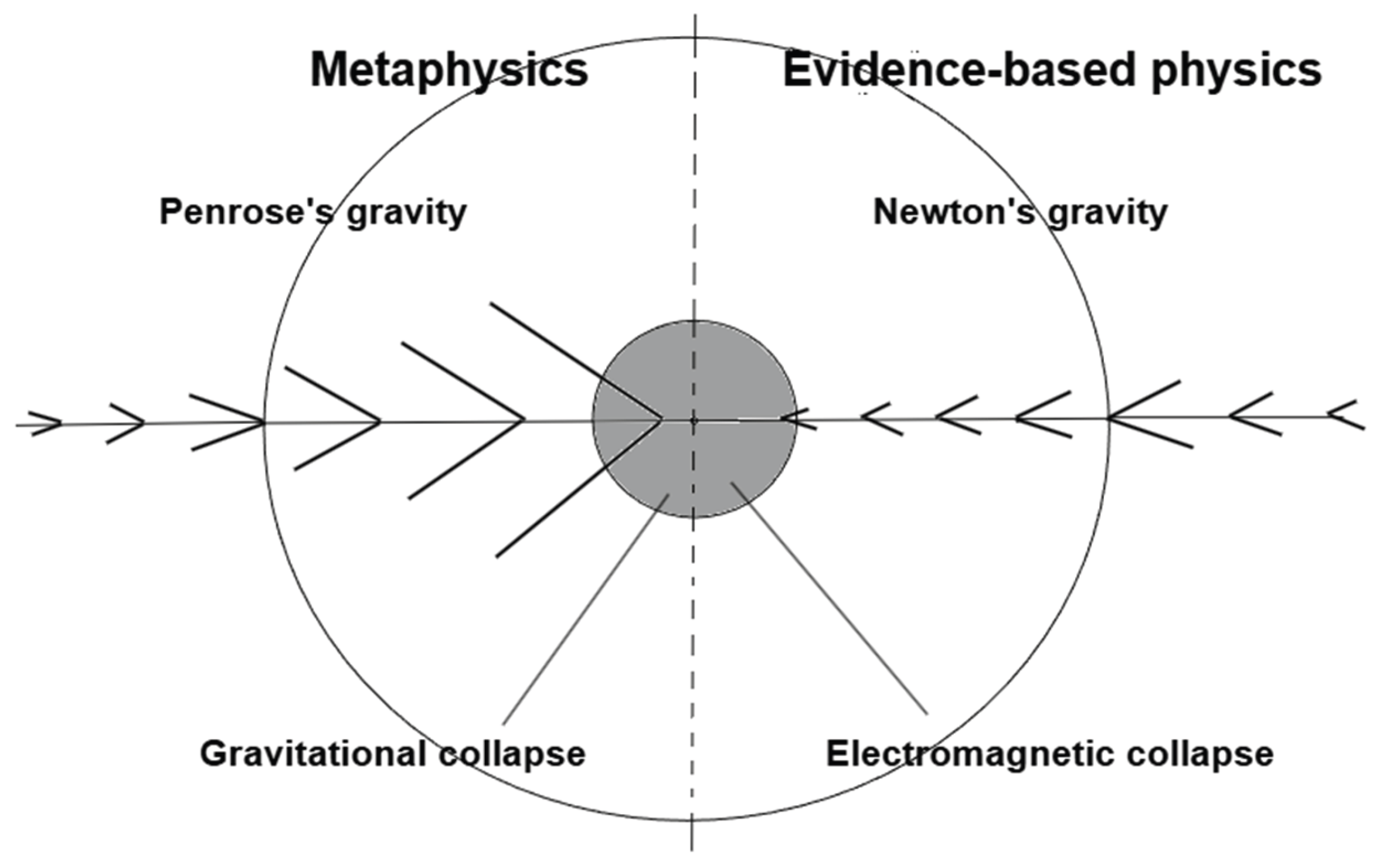
Figure 12.
Gravitational collapse cause-and-effect gap.
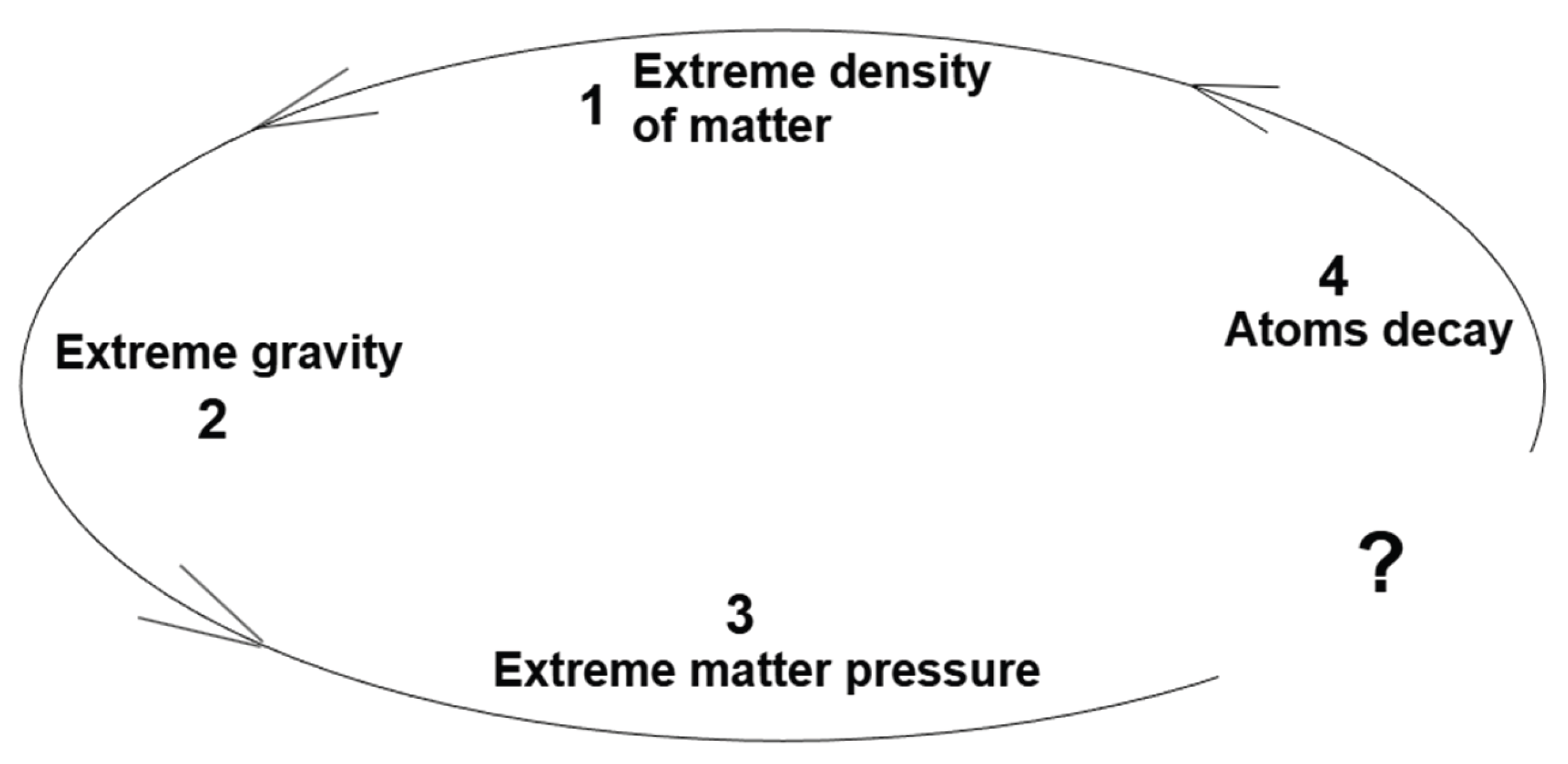
Figure 13.
Real cause-and-effect mechanism of electromagnetic collapse.
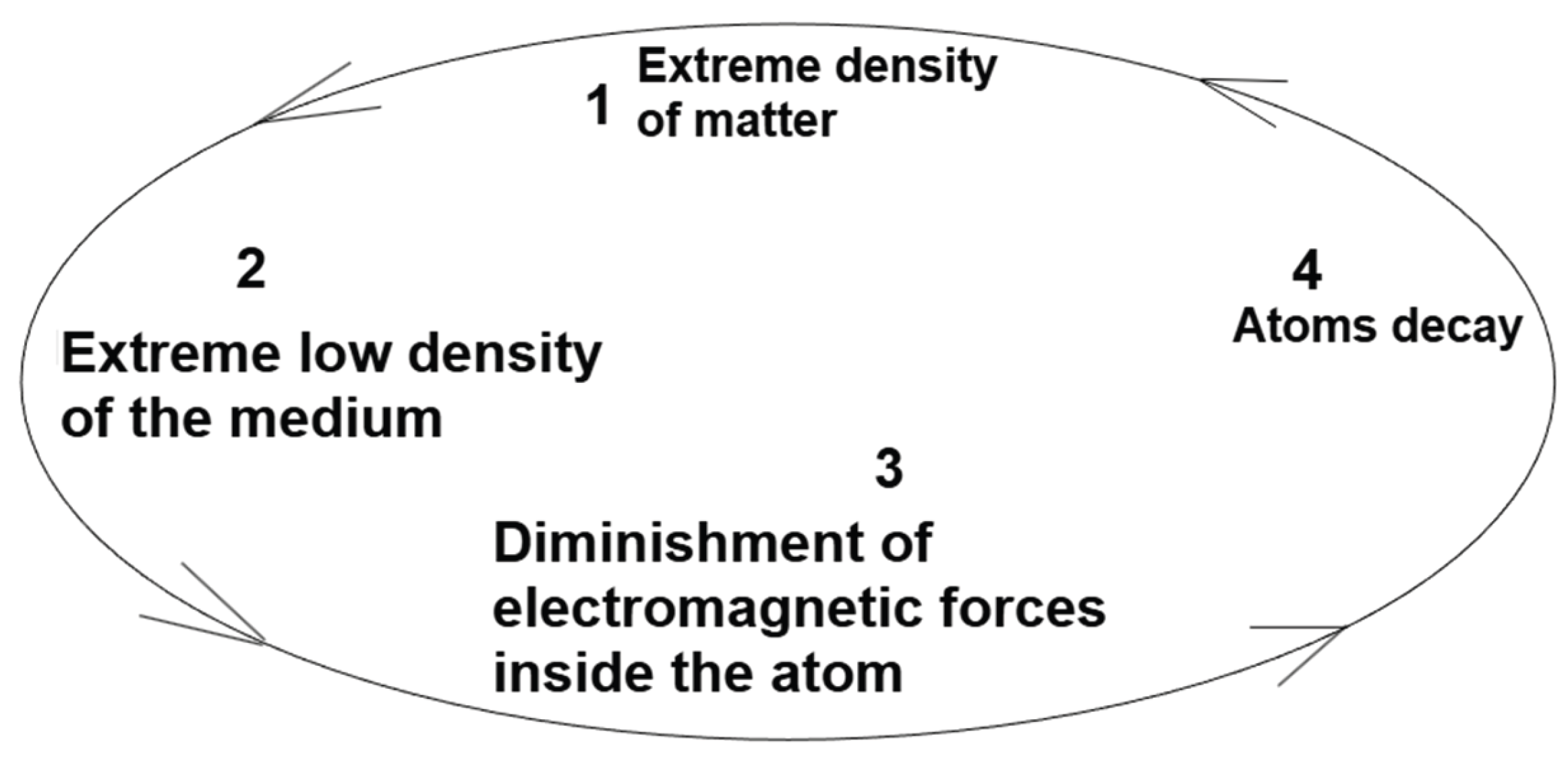
Figure 15.
Development of physics in last 100 years.
Disclaimer/Publisher’s Note: The statements, opinions and data contained in all publications are solely those of the individual author(s) and contributor(s) and not of MDPI and/or the editor(s). MDPI and/or the editor(s) disclaim responsibility for any injury to people or property resulting from any ideas, methods, instructions or products referred to in the content. |
© 2026 by the authors. Licensee MDPI, Basel, Switzerland. This article is an open access article distributed under the terms and conditions of the Creative Commons Attribution (CC BY) license (http://creativecommons.org/licenses/by/4.0/).
Copyright: This open access article is published under a Creative Commons CC BY 4.0 license, which permit the free download, distribution, and reuse, provided that the author and preprint are cited in any reuse.


