

Submitted:
15 November 2025
Posted:
18 November 2025
Read the latest preprint version here
Abstract
This paper introduces the Meta-model of Existential Dynamics, a systems-ontological framework grounded in a non-teleological ontology of necessary constraints, rather than predefined purposes. Evolving from the author's earlier 'intelligence dynamics model', which focused on cognitive systems, the present meta-model generalizes the underlying insight: that any system's stability, adaptivity, and seemingly purposeful behavior emerge from the continual negotiation of three fundamental meta-constraints—Acquisition, Efficiency Seeking, and Continuation—distributed across Scale and Temporality and enacted through Recursive Feedback. Beyond conceptual unification, the paper operationalizes the model with concrete analytical procedures. A detailed case study of a startup organization illustrates its explanatory resolution at meso-scale; additional sections demonstrate how the model provides a coherent meta-language for evolutionary theory, integrates disparate schools of psychology into a single dynamical schema, and motivates a new conjecture on strong artificial intelligence grounded in existential constraint embodiment rather than externally imposed goals. Rather than functioning as a static taxonomy, the meta-model operates as a generative grammar of existence, offering a cross-domain explanatory structure from quantum-level persistence to civilizational dynamics. It bridges philosophy and empirical science while opening pathways for interdisciplinary research and future computational realizations , without addressing implementation-level details in this theoretical work.
Keywords:
meta-model
; existential dynamics
; necessary constraints
; systems ontology
; recursive feedback
; emergence
; non-teleology
; evolutionary theory
; psychology
; artificial general intelligence (AGI)
1. Introduction
Methodological Note: During the preparation of this manuscript, the author used large language models (LLM) for language polishing and translation. The author is solely responsible for the entire scientific content, including the conceptualization, theory development, and analysis.
Prologue: The Inversion of a Puzzle—From Teleological Appearances to Non-Teleological Foundations
The meta-model presented in this paper was born from a deliberate and fruitful inversion of a fundamental puzzle. The initial challenge was not to explain existence at large, but to solve a conundrum at the heart of a specific domain: how can a certain class of highly complex systems exhibit behaviors that appear simultaneously sophisticated and purposeful, yet whose underlying principles might be reducible to a parsimonious set of rules?
This line of inquiry initially led to the development of a powerful conceptual framework capable of generating the observed complexity and apparent goal-directedness within that domain. This framework successfully demonstrated that a wide range of seemingly irreducible phenomena could be derived from a compact core logic. Its explanatory power was profound, effectively acting as a generative grammar for the system in question.
However, a deep tension lay at the heart of this success. The framework’s very elegance in accounting for sophisticated, adaptive behavior relied on a teleological stance—it explained the system as if it were optimizing for inherent purposes.
The critical breakthrough came from a act of intellectual daring: applying the abstract, relational architecture of this teleological framework to the simplest, most mindless of systems—to physical and chemical processes where the very notion of “purpose” is absurd. Astonishingly, the relational logic held, but its interpretation was transformed. The teleology was not a fundamental driver but a spectacular emergent property. The apparent “goal-directedness” of complex systems was revealed to be a high-level consequence of a more primitive, non-teleological dynamic of existence.
This paper is the result of that inversion. What follows is the formal exposition of the Meta-model of Existential Dynamics—the non-teleological, universal framework discovered by looking backward from the puzzle of apparent purpose to the fundamental dynamics of constrained existence.
1.1. Core Framework: From Static Elements to a Dynamic System
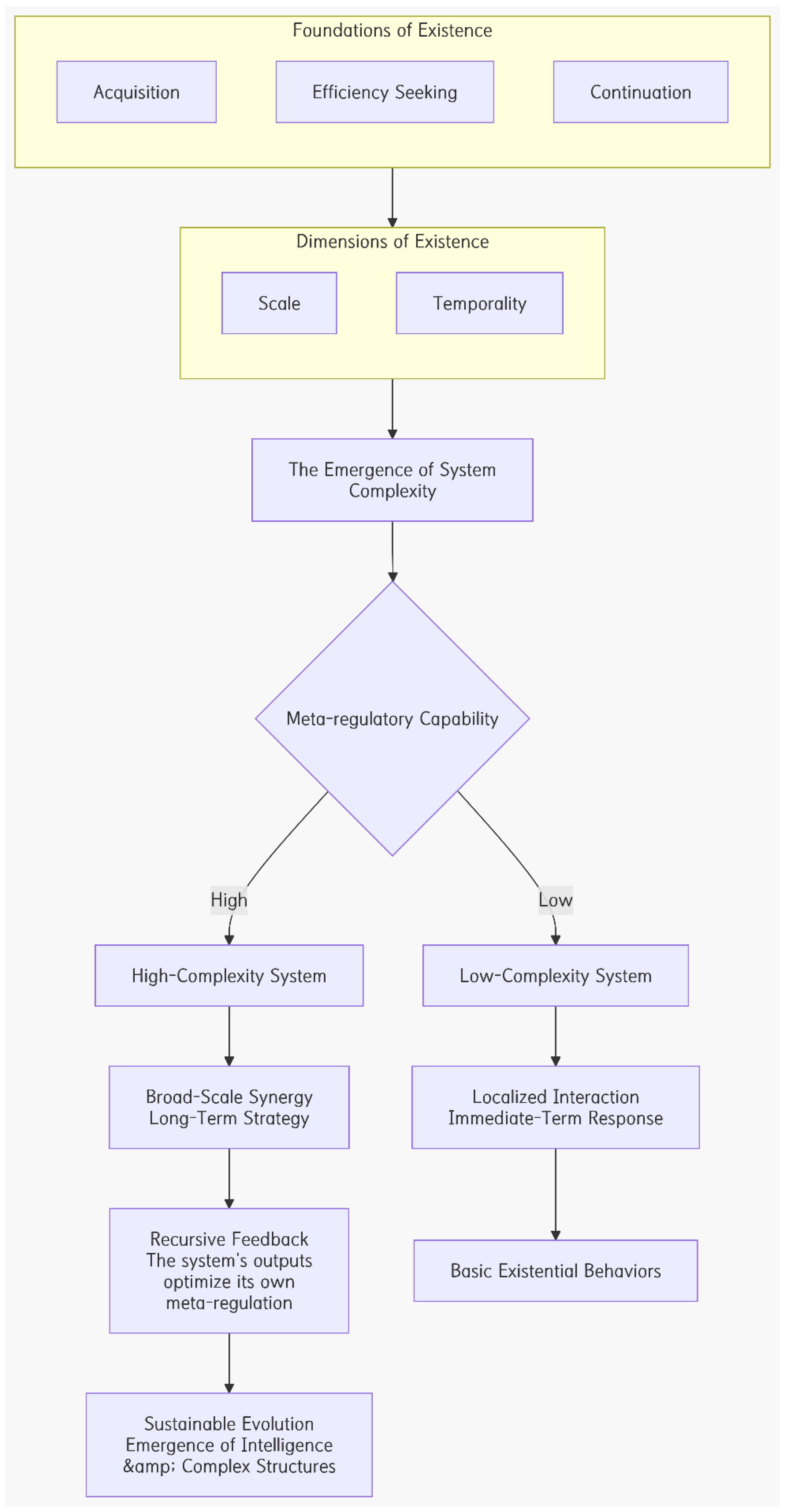
The model’s principal innovation constitutes a paradigmatic shift from static analysis to a systemic-dynamic ontology of existence. It reframes the triad of “Acquisition, Efficiency Seeking, Continuation” not as terminal goals but as mutually constitutive and perpetually negotiating imperatives locked in a dynamic cycle. Likewise, Scale and Temporality are reconceived as the fundamental, active dimensions within which this dynamic negotiation unfolds, rather than inert backdrops. This framework deliberately extends the legacy of general systems theory (Bertalanffy, 1968) by formalizing the generative dynamics of constraints, thereby advancing frameworks for complexity (Holland, 1995) and resonating with contemporary multi-scale analyses in neuroscience (Bassett et al., 2020; Santos et al., 2021). Consequently, any system’s observed “state of existence” is conceptualized as a transient equilibrium—a moment-by-moment outcome of the multi-level interactions among these core elements. Figure 1 provides a schematic representation of this generative architecture.
1.2. Ontological Stance: Necessary Constraints and Emergent Purposefulness
The model adopts a rigorous non-teleological ontology, rejecting any notion that systems possess intrinsic purpose or predetermined goals. Instead, it posits that observable stable systems must—whether passively or actively—satisfy the fundamental constraints through their structural and behavioral configurations. Those configurations failing to meet these constraints are naturally eliminated through dynamic selection processes.
This stance finds strong support in non-teleological interpretations of modern biology (Monod, 1971; Dawkins, 1976), and gains renewed relevance from contemporary debates on agency without teleology (Levin, 2021; Dennett, 2022). It advances beyond these views by formalizing how seemingly purposeful behaviors emerge as high-order dynamic phenomena. These arise not from teleology, but from multi-scale, multi-temporal interactions as systems recursively optimize constraint satisfaction (Figure 1).
The framework thereby addresses a core explanatory challenge: reconciling sophisticated, adaptive behaviors with a non-teleological worldview. It achieves this by explaining such behaviors as emergent properties of constrained existence, displacing teleology with dynamics.
1.3. As a Cognitive Tool to Resist Linear Misinterpretation
Given the model’s rejection of teleology (Section 1.2), traditional linear-causal interpretations risk significant misunderstanding. To bridge this gap, we propose the “cost-effectiveness” analogy as a conceptual tool. This metaphor frames the system’s global optimization of the Acquisition-Efficiency-Continuation triad across Scale and Temporality as a dynamic cost-benefit equilibrium. Crucially, this is not a narrow commercial concept but a representation of the system’s holistic strategy to balance outcome “value” against existence-maintenance “cost”. By anchoring abstract dynamics to intuitive decision-making, the analogy shifts thinking from linear causality to systemic interaction, preventing mechanistic misinterpretation.
1.4. The Critical Role of Recursive Feedback: Positioning the Dynamic Engine
The aforementioned cognitive tool provides an intuitive entry point for understanding the system’s dynamic optimization. However, the core meta-mechanism that enables this optimization and supplies the generative impetus for “emergent purposefulness” is Recursive Feedback. Recursive Feedback sustains the dynamic nature of the model. The sophisticated regulatory and anticipatory capabilities exhibited by high-complexity systems are fundamentally rooted in the continuous learning and strategy optimization enabled by the Recursive Feedback process. The specific operation of this mechanism across different Scales and Temporalities will be detailed in the subsequent exposition of the diagram.
1.5. The Emergence of High Complexity: Recursive Feedback and Multi-Level Interactions
While Recursive Feedback provides the dynamic impetus for learning and adaptation, the emergence of high complexity cannot be fully explained by this mechanism alone. Complexity arises from the synergy between the temporal process of Recursive Feedback and the structural reality of multi-level interactions across Scales. The Recursive Feedback mechanism continuously refines system strategies along the Temporal dimension, while the Scale dimension provides a hierarchical organizational structure. The recursive feedback process operates simultaneously within and across these levels, where the outcomes of lower-level activities can become regulatory parameters for higher-level systems, and vice versa. It is the interweaving and iteration of these recursive cycles both vertically (across Scales) and horizontally (through Temporality) that serves as the fundamental source from which systems exhibit irreducible complex behaviors, adaptive intelligence, and strategic foresight emerging from simple rules.
1.6. Applications and Significance
This framework provides a universal “dynamic grammar” for unified understanding across phenomena ranging from physical processes and life evolution to mental phenomena and social structures. It suggests that the core principles of various disciplinary fields (e.g., evolutionary theory, economics) can be seen as specific instances emergent from this systemic dynamics under particular scales and temporal contexts.By offering a unified ‘dynamic grammar’, this model contributes to the long-standing quest for consilience across disciplines (Wilson, 1998), demonstrating practical utility in integrating fragmented knowledge landscapes as highlighted in recent meta-science (Yarkoni, 2022; Hoffman et al., 2023). providing a practical framework for integrating knowledge from the physical, biological, and social sciences.
2. Model Framework Essentials: A Hierarchical Structure of Core and Emergent Elements.
This chapter delineates the core architecture of the meta-model, presenting a hierarchical structure of elements essential for analyzing existential dynamics. We begin by clarifying the schematic representation (Figure 1), which serves as a heuristic guide. Subsequently, we dissect the foundational elements—the necessary constraints that constitute the model’s axioms. Finally, we explore the higher-order, emergent dynamics that arise from their complex interaction, culminating in a discussion on the relativistic nature of system complexity.
Navigating the Schematic: A Note on Figure 1
Before delving into the detailed exposition of the model’s components, a crucial clarification is warranted regarding Figure 1. The schematic serves primarily as a conceptual map or heuristic guide, designed to visually organize and introduce the core elements of the meta-model and their general relationships. It should not be interpreted as a strict, linear causal-logic diagram or a sequential workflow. The actual dynamics of the system are characterized by non-linear, recursive, and simultaneous interactions among all elements, a complexity that a two-dimensional diagram can only approximate. Figure 1 is thus an entry point for understanding, not a literal depiction of the model’s operational sequence.
2.1. Foundational Elements: The Basic Constructs of Existential Dynamics
The model is built upon five foundational elements that define the basic parameters of any system’s existence and operation. The following set of meta-constraints is posited as the necessary conditions for systemic existence. While echoes of these concepts can be discerned across disparate fields—from the focus on energy in thermodynamics to homeostasis in biology—the present formulation abstracts them into a universal dynamical grammar intended to transcend any single disciplinary context.
2.1.1. Acquisition
Definition: The dynamic through which a system establishes and maintains flows of resources necessary to counter entropy and sustain its operational integrity across time.
Elaboration: This is the fundamental imperative for any persistent, non-equilibrium system. Its manifestation is scale-dependent: at lower complexity, it is characterized by direct dependence on external environmental fluxes (e.g., a cell absorbing nutrients). As system complexity increases, facilitated by recursive feedback, the locus of acquisition expands inward. The system develops the capacity to access, mobilize, and reconfigure its own internal states and substructures as a primary resource (e.g., an organism metabolizing stored energy reserves, or a complex organization leveraging its internal data and institutional knowledge). Thus, acquisition evolves from passive uptake to active, multi-scale resource management, encompassing both external sourcing and the internal optimization of existing configurations.
2.1.2. Efficiency Seeking
Definition: The principle that systems naturally evolve toward configurations that optimize the use and dissipation of energy within their constraints.
Elaboration: This is observed as the tendency for a system’s internal processes to minimize energy losses and maximize functional output per unit input. Crucially, this includes the passive release of excess energy, which is a fundamental consequence of systems moving toward lower-energy, more probable states—a manifestation of the second law of thermodynamics. This principle is universal: from the formation of stable atomic nuclei (governed by the four fundamental forces) and the release of energy in chemical bonding, to the radiative cooling of a star. Conversely, the influx of energy beyond a system’s current capacity to efficiently dissipate it can drive the system away from its existing stable configuration, leading to its dissolution or reorganization into a new structure, as seen in the electrolysis of water.
2.1.3. Continuation
Definition: The meta-constraint that subsumes all others: the imperative for a system to maintain the coherent interplay of its processes within a viable dynamic range, thereby sustaining its observable existence across time.
Elaboration: This constraint acts as the ultimate selection pressure. A system’s persistence is an emergent outcome of its successful negotiation of the Acquisition-Efficiency Seeking dyad, avoiding both dissolution from insufficient cohesion and disintegration from overwhelming perturbation. It is not a goal but a continuous filtering condition. This principle is universal: an atomic nucleus persists by maintaining the binding equilibrium between its components, a molecule by sustaining its bond stability, and a biological organism through homeostasis. Systems that fail to meet this meta-constraint are selectively eliminated from observable reality. Thus, Continuation provides the non-negotiable context within which the dynamics of Acquisition and Efficiency Seeking unfold and are ultimately evaluated.
2.1.4. Scale
Definition: The meta-constraint of multi-level relationality, wherein a system’s existence and dynamics are constitutively defined by its embeddedness within a hierarchy of other systems.
Elaboration: Scale is not a passive backdrop but an active dimension of constitutive relationships. A system at any given level is simultaneously constituted by its subsystems and is itself a constitutive component of a higher-level system. This nested reality creates a web of reciprocal constraints and enablements. The nature of these cross-scale interactions defines a spectrum. At one extreme lie highly isolated systems, such as an ideal quantum system, whose intrinsic properties (e.g., quantum uncertainty) are preserved precisely by minimizing interaction with a broader environment. At the other extreme are openly coupled systems, where dynamics at one scale continuously and bidirectionally influence others. A critical phenomenon occurs when a previously isolated system (e.g., a quantum state) becomes embedded within a larger scale (e.g., a measurement apparatus): the onset of interactions triggers a process like decoherence, which dissolves the isolated system’s unique properties, transmuting them into classical determinants. Thus, Scale defines the relational arena and the spectrum of interaction possibilities within which the triadic constraints are negotiated.
2.1.5. Temporality
Definition: The multi-scale temporal horizon within which a system’s activities and their consequences interact through causal chains of varying lengths and complexities.
Elaboration: This dimension captures the reality that system processes unfold across and are constrained by different timeframes. It is not about planning for the future, but about the fact that a system’s present state is causally coupled to its past states through feedback loops, and its present configuration constrains its future possible states. In low-complexity systems, this manifests as short feedback cycles (e.g., a chemical equilibrium). In high-complexity systems, recursive feedback enables the emergence of longer, nested feedback cycles. This allows the system’s present actions to be modulated by the accumulated outcomes of past sequences (e.g., a tree’s growth ring pattern) and to develop internal dynamics that functionally serve as predictive models, optimizing present actions for constraint satisfaction across extended time horizons without teleology. Thus, Temporality is the architecture of causal propagation and constraint within a system.
These five elements are proposed as foundational axioms, not empirical findings. Their validity rests not on direct correspondence with existing literature, but on their generative power to explain diverse phenomena. Crucially, this explanatory power is unleashed not through the elements in isolation, but through their non-linear, recursive interactions, from which the higher-order capabilities of complex systems emerge.
2.2. Higher-Order Elements: Emergent Dynamics and Capabilities
The four higher-order elements—System Complexity, Meta-regulatory Capability, Recursive Feedback, and Dynamic Emergence—do not arise in a linear sequence but rather represent a synergistic and co-emergent cluster of phenomena. They are best understood as mutually reinforcing aspects of a single, integrated transition in a system’s operational state. There is no temporal precedence where one element fully exists before the others; instead, their emergence is a holistic, non-decomposable process catalyzed by the intensive recursive interaction of the foundational elements across Scale and Temporality. However, once this threshold is crossed, these elements enter into a relationship of dynamic reciprocal causality: each element simultaneously enables, constrains, and amplifies the others, creating a feedback loop that can drive the system toward either greater adaptive sophistication or, under certain conditions, pathological stability and decline. This co-emergent and mutually constitutive relationship is the hallmark of high-complexity systems.
2.2.1. System Complexity
Definition: The degree of sophistication and foresight a system exhibits in regulating the dynamic balance of the foundational constraints.
Elaboration: Complexity is not mere complication; it is the capacity for flexible, adaptive, and strategic regulation. It manifests as the richness of a system’s possible responses to internal and external changes.
Low-Complexity System: Exhibits passive, fixed, and reactive regulatory modes, largely governed by immediate environmental pressures and natural laws.
High-Complexity System: Exhibits active, flexible, and proactive regulatory modes, capable of strategic foresight and broad-scale synergy.
2.2.2. Meta-Regulatory Capability
Definition: A system’s higher-order ability to recognize, evaluate, and optimize its own regulatory strategies.
Elaboration: This is the functional expression of high complexity. It is the capacity for “learning how to learn,” allowing a system to not just react to feedback but to redesign its own decision-making processes. This capability is rooted in and amplified by Recursive Feedback.
2.2.3. Recursive Feedback
Definition: The core meta-mechanism whereby the outcomes of a system’s activities are fed back to inform and refine future regulatory strategies.
Elaboration: This is the engine of dynamic emergence. It transforms the model from a static framework into a generative one, explaining how systems learn, adapt, and evolve over time. It creates a closed-loop process where past outcomes shape future states, enabling the accumulation of experience and the development of internal models.
2.2.4. Dynamic Emergence
Definition: The process through which higher-order system properties arise from the complex, multi-level interactions of the foundational elements.
Elaboration: Phenomena such as intelligence, consciousness, and sophisticated social structures are not pre-programmed but emerge spontaneously from the recursive interplay of simpler components. Dynamic emergence accounts for the appearance of novel, unpredictable, and irreducible properties in complex systems.
2.2.5. Concluding Note on the Relativity of Complexity
It is crucial to emphasize that the designation of a system as “high” or “low” complexity is not an absolute classification but a context-dependent assessment of its operational state. A system exhibiting high-complexity capabilities in one environment or temporal frame may regress to low-complexity, reactive modes under different conditions. This relativity is an inherent feature of the model’s dynamics. For instance, an individual human—a paradigm of a high-complexity system capable of meta-cognition and long-term strategic planning—can nonetheless be driven to exhibit strikingly short-sighted and inefficient behaviors when under the influence of overwhelming stressors, addictive substances, or ideological fervor. In such states, the system’s operational profile contracts along the Scale and Temporality dimensions, its Recursive Feedback loops reinforcing a pathological equilibrium rather than adaptive learning. Thus, complexity is a dynamic potential, not a fixed trait, and its manifestation is continually negotiated through the system’s interaction with its environment.
Conclusion: In summary, this chapter has assembled the conceptual toolkit of the meta-model: a set of foundational elements and the emergent dynamics that arise from their recursive interaction. This is not a static classification but a generative framework. The context-dependent nature of complexity underscores this point, illustrating that the model captures the fluid, process-oriented essence of existence itself, setting the stage for its application to concrete phenomena in the following chapters.
3. Model Operationalization: A Phenomenological Analysis of a Startup Company
This chapter provides a detailed, phenomenological account of the meta-model’s dynamics by applying it to the survival strategy of a startup company. We translate the abstract elements into a concrete narrative, using the “cost-effectiveness” analogy (Section 1.3) as a guiding lens. This analogy reveals a fundamental divergence: the company’s early success stems from a long-term, systemic cost-benefit calculus that balances the triadic constraints, while its potential failure pathways often originate from a short-term, linear cost-benefit logic that optimizes for immediate gains at the expense of systemic health. The following analysis will trace how these contrasting approaches, rooted in different temporal and scale horizons, lead to vastly different outcomes, thereby operationalizing the model’s core principles.
3.1. The Starting Point: The Core Challenge Under the Triad of Constraints
Corresponding Schematic Elements: Acquisition, Efficiency Seeking, Continuation.
Phenomenological Analysis: The fundamental challenge for a startup vividly illustrates the initial tension inherent in the Triad of Constraints. Its very Continuation is contingent upon rapidly Acquiring users and investment, both of which are constrained by rigorous cash-flow control (Efficiency Seeking). An imbalance in any—such as burning capital recklessly for growth or excessive frugality that stifles expansion—directly threatens survival. At this stage, the system operates within the “low-complexity” domain, characterized by a singular focus: to persist.
3.2. The Dynamic Engine: Recursive Feedback and Strategic Learning
Corresponding Schematic Elements: Recursive Feedback loop, Meta-regulatory Capability.
Phenomenological Analysis: The outcome of the company’s first marketing campaign (feedback from an Acquisition activity) is a critical inflection point. This data flowing back into the system (Recursive Feedback) enables the founders (the system’s Meta-regulatory core) to evaluate the strategy’s efficacy. This initiates not a one-off adjustment, but a continuous learning cycle: the feedback informs optimization of the pricing model (Efficiency Seeking), pivots the product roadmap (the basis for new Acquisition), all ultimately aimed at increasing the probability of survival (Continuation). This process is the direct catalyst for increasing system complexity.
3.3. Dimensional Expansion: The Strategic Game Across Scale and Temporality
Corresponding Schematic Elements: Scale, Temporality, High/Low-Complexity System pathways.
Phenomenological Analysis:
Scale Interaction: As the company grows, the “arena” for its dynamic balance expands from the individual founder to the team, departments, and the entire organization (a change in Scale). For instance, the expansion of the sales team (responsible for Acquisition) must be matched by the scaling of operations (responsible for Efficiency Seeking); failure to do so creates internal fragmentation, jeopardizing the entire system’s Continuation.
Temporality Trade-off: The founder faces a fundamental strategic decision rooted in Temporality: whether to “burn capital for market share” (sacrificing short-term Efficiency for long-term Continuation) or to “prioritize profitability first” (ensuring short-term survival at the potential cost of long-term opportunity). This embodies the real-world manifestation of the “immediate reaction” versus “long-term strategy” pathways in the schematic.
3.4. The Emergent Outcome: From Passive Survival to Active Market Shaping
Corresponding Schematic Elements: High-Complexity System, Emergence of Intelligence and Complex Structures.
Phenomenological Analysis: A successful startup, through continuous Recursive Feedback, evolves from passively reacting to the market to actively shaping its environment. It learns to integrate user data, capital management, and internal processes to formulate decade-long strategies (Long-Term Temporality) that require synergy across all departments (Broad-Scale Synergy). The company now demonstrates remarkable adaptability and foresight—the Emergence of Intelligence. Its apparent “purpose” shifts from simple survival to “defining the industry landscape”—this is the high-order, apparent purposefulness that emerges as a consequence of the system’s multi-level, dynamic optimization driven by the basic existential constraints.
3.5. Pathological Pathway: Systemic Disruption from a Novel Variable (Cronyism)
The preceding analysis of the startup’s development demonstrated the meta-model’s logic under conditions of functional recursive feedback. We now introduce a critical variable—the appointment of a key executive based primarily on pre-existing social ties (“cronyism”)—to illustrate the model’s capacity to diagnose pathological dynamics. This variable acts as a perturbation that differentially impacts the system’s negotiation of constraints across short and long temporalities.
Corresponding Schematic Elements: All elements, particularly the Recursive Feedback loop and the High/Low-Complexity pathways.
Phenomenological Analysis:
3.5.1. Short-Term Consequence: Constraint Trade-Off and Feedback Distortion
In the short term, this variable creates an illusory optimization by altering the system’s negotiation of the triadic constraints.
Acquisition & Efficiency Seeking: The executive’s network may facilitate rapid access to specific resources (a form of Acquisition), while pre-established trust can create a superficial sense of operational smoothness (an apparent gain in Efficiency Seeking).
Compromised Recursive Feedback (The Core Pathology): The social relationship dampens or distorts negative feedback. Information about poor performance or strategic missteps is filtered, preventing the system’s meta-regulatory capability from initiating corrective adjustments. The system’s learning mechanism is impaired.
Net Effect: The system achieves a superficial equilibrium. The trade-off sacrifices the integrity of the Recursive Feedback mechanism for apparent gains in short-term Efficiency and niche Acquisition. The Continuation constraint appears satisfied, but on a fragile basis.
3.5.2. Long-Term Consequence: Pathological Cascade and Strategic Failure
Over an extended temporality, the initial trade-off triggers a negative cascade through recursive interactions, leading to pathological stability or decline.
Erosion of Meta-regulatory Capability: The persistent dampening of honest feedback prevents the system from “learning how to learn.” Strategic errors become entrenched rather than corrected.
Inefficiency at Scale: As the company grows (a change in Scale), the lack of merit-based processes leads to strategic missteps and internal resentment, fundamentally undermining true Efficiency Seeking.
Failure in Broader Acquisition: The network’s limitations become apparent. The company fails to acquire diverse talent and innovative ideas outside the narrow social circle, stifling growth.
Threat to Continuation: The cumulative effect of degraded feedback, entrenched inefficiency, and limited acquisition directly threatens the company’s long-term survival. The system’s trajectory veers towards the “pathological stability and decline” pathway outlined in the model.
Conclusion: This analysis demonstrates that the meta-model frames “cronyism” not as a mere ethical lapse but as a systemic variable that pathologically recalibrates the dynamic balance of the triadic constraints. Its primary impact is to disrupt the Recursive Feedback engine, which in turn corrupts Meta-regulatory Capability.
The power of this diagnosis lies in its scalability. The dysfunctional dynamics observed in the startup—distorted feedback loops leading to a fatal imbalance between Acquisition, Efficiency Seeking, and Continuation—find a direct analogue in the decline of larger social organizations, including the collapse of kingdoms and empires. In such macro-scale systems, the equivalent of “cronyism” could be institutionalized corruption, rigid hereditary hierarchies, or ideological dogmatism that similarly stifles information flow and meritocracy. This corrupts the governance structure (the system’s Meta-regulatory Capability), disrupts vital trade and cultural exchanges (large-scale Recursive Feedback), and leads to a pathological prioritization of short-term elite stability (a rigid interpretation of Continuation) over the long-term Acquisition of new knowledge and the Efficiency Seeking of societal institutions. Consequently, the meta-model provides a rigorous grammar not only for diagnosing corporate failure but also for understanding the systemic risks and dynamical patterns that lead to the decline of complex societies across history.
4. Case Study - The Mutual Corroboration of Evolutionary Theory and the Meta-Model of Existential Dynamics
While the previous analysis demonstrated the model’s applicability to a single organization over a short temporality, we now turn to a grander scale: the evolution of life itself. This case study will show how the meta-model explains dynamics operating across the vast scales of biological populations and geological temporalities.This section aims to demonstrate, through the lens of the classic scientific theory of evolution (Darwin, 1859), how the “Meta-model of Existential Dynamics” serves as a meta-language to provide a deep interpretation and integration of it, thereby clarifying its ontological stance and the emergent nature of purposefulness.
4.1. Mapping Evolution to the Meta-Model: A Deeper Unification
The core logic of evolutionary theory—heritable variation, struggle for existence, and natural selection—finds a profound and precise correspondence within our meta-model, revealing the deeper dynamical principles at play.
The Engine of Adaptation: The “struggle for existence” and “natural selection” are the observable manifestations of the relentless pressure exerted by the triadic meta-constraints of Acquisition-Efficiency Seeking-Continuation. An organism’s “adaptation” is precisely its successful configuration for optimizing resource acquisition, internal efficiency, and reproductive continuation within a specific environmental context.
The Search Algorithm: “Heritable variation” constitutes a foundational multi-directional search mechanism conducted at the genetic scale. Heritability enables the outcomes of this search—successful or otherwise—to be accumulated, tested, and refined through Recursive Feedback across the vast temporality of generations.
The Dynamic Arena: The “environment” is not a static backdrop but a chaotic, multi-level network of countless interacting systems (physical, chemical, biological), each operating under its own existential constraints. Evolution is the macroscopic phenomenon that dynamically emerges from this complex interplay.
Thus, evolutionary theory can be seen as a powerful, domain-specific instantiation of our meta-model, operative at the scale of life over geological temporalities. The model not only explains the mechanics of evolution but reveals the universal existential constraints that make such a process inevitable.
4.2. Deriving Evolution from First Principles: The Inevitability of Dynamics
The phenomenon of evolution can be logically derived from the axioms of the meta-model, demonstrating its generative power.
Premise 1 (Existential Imperative): All persistent systems must satisfy the meta-constraints of Acquisition-Efficiency Seeking-Continuation. Life is no exception.
Premise 2 (Nested Reality): The biosphere is a dynamically nested hierarchy of systems (genes, cells, individuals, populations, ecosystems), each constituting part of the environment for the others.
Logical Deduction: Under these conditions, life must engage in a continuous search for superior strategies. Genetic variation (exploration) and natural selection (constraint-satisfaction filtering) emerge as the necessary pathways for systems to navigate this complex landscape across the scales of gene-to-population and the long temporality of deep time. The apparent “directionality” of evolution is not a teleological pull but the emergent trajectory—the apparent purposefulness—that arises from multi-level systems recursively optimizing for existence under constraint.
4.3. Core Emphasis: Non-Teleology and Dynamic Nesting Reaffirmed
This analysis not only corroborates the core tenets of our model but also reveals its profound resonance with established scholarly currents. Our model reframes evolution as an inevitable outcome of passive filtering under existential constraints, rather than a teleological pursuit. This stance aligns closely with Jacques Monod’s seminal arguments in Chance and Necessity (1971) regarding natural selection as a process stemming from chance variation and necessary screening mechanisms, while our framework provides a more universal dynamical systems foundation for such non-teleological processes.
Furthermore, the model’s emphasis on a “chaotically nested system of systems”—where individuals, populations, and ecosystems constitute mutually constitutive environments—finds a strong interdisciplinary echo in Ludwig von Bertalanffy’s General Systems Theory (1968) concerning systemic hierarchies and interdependencies, as well as in the pioneering work on Complex Adaptive Systems and ‘emergence’ by figures such as Murray Gell-Mann (1994) and John H. Holland (1995, 2012). Recent work by Tarnita (2020) demonstrates how multi-scale selection emerges from dynamic constraints in ecological networks, while Wagner (2021) formalizes the role of recursive feedback in cross-generational adaptation—both findings directly resonate with our meta-model’s predictions. Our framework integrates these insights into a unified dynamic grammar, thereby clarifying that the apparent “directionality” of evolution is not a teleological pull but an emergent trajectory arising from multi-level systems recursively optimizing for existence.
4.4. Extending the Explanatory Continuum: Intelligence as an Emergent Manifestation of Existential Dynamics
Having established the meta-model as a foundational framework for evolutionary theory, we now extend its explanatory continuum to encompass a central phenomenon in biology: the graded spectrum of animal intelligence. This demonstrates the model’s capacity to traverse scales from deep time to real-time cognition: the graded spectrum of intelligence observed across the animal kingdom. The model provides a seamless continuum from the evolutionary origins of life to the emergence of sophisticated cognitive capacities, demonstrating its power to integrate phenomena across scales.
The pathway to high complexity is not a sudden leap but a graded continuum, directly arising from the same evolutionary dynamics. This is brilliantly illustrated by cases that defy simple brain-size explanations, such as corvids (crows, ravens) and social insects (bees, ants), often termed “miniature minds.”
The Corvid Case: Neural Efficiency and Cognitive Foresight. How can a crow’s brain, the size of a walnut, support tool manufacture, future planning, and social deception? The meta-model explains this as an evolutionary optimization under the Efficiency Seeking constraint. The avian brain architecture represents a dense, highly interconnected network that maximizes cognitive power per unit volume. Furthermore, behaviors like caching food for future consumption are direct manifestations of successfully integrating Acquisition with an extended Temporal horizon—a cognitive complexity emerging from satisfying the core constraints in a challenging environment.
The Ant Colony: Scalable Intelligence and Distributed Regulation. The collective intelligence of an ant colony, capable of solving complex logistical problems, emerges at a higher Scale than the individual. The individual ant operates with simple routines, but the colony, through continuous Recursive Feedback (e.g., pheromone trails that modulate based on success), exhibits a form of distributed meta-regulation. The colony itself becomes a cognitive system, where problem-solving is an emergent property of the collective’s dynamic interaction with its environment.
The Human Mind: The Pinnacle of Symbolic Meta-Regulation. The human capacity for language and abstract thought represents a further escalation along this continuum. It can be viewed as the ultimate internalization of Recursive Feedback and Meta-regulatory Capability, enabling the creation of a symbolic “self-model”. This allows for scenario planning across vast scales of time and social organization, all aimed at optimizing the triadic constraints with unprecedented flexibility. Our intelligence is thus a difference in the degree of symbolic manipulation, not a difference in kind from the cognitive principles evolved in other species.
This graded view—from the evolutionary pressures shaping life’s history to the specific cognitive adaptations in crows, ant colonies, and humans—demonstrates that the meta-model provides a unified explanatory framework. It seamlessly connects the deep-time narrative of evolution with the real-time functioning of minds, showing how both are governed by the same existential dynamics.
5. Unifying Psychology: From Statistical Correlations to Dynamical Principles
Having established the model’s explanatory power from evolutionary dynamics to the spectrum of animal intelligence, we now bridge these insights to the domain of human psychology. This chapter aims to demonstrate how the Meta-model of Existential Dynamics resolves psychology’s enduring theoretical fragmentation. By providing a foundational, dynamical framework grounded in the same existential constraints, it transforms core psychological phenomena from mere statistical correlations into necessary, predictable consequences of a system’s negotiation for existence.
5.1. The Theoretical Challenge in Psychology: A Science of Correlations
A central critique of modern empirical psychology is its reliance on statistical relationships without a deep, unifying theory to explain why these relationships exist. We know that “negative emotion correlates with avoidance behavior,” or “ego depletion leads to poor decision-making,” but we lack a first-principles understanding of the dynamics that generate these phenomena. The field remains a collection of disparate schools—cognitive, behavioral, psychoanalytic, humanistic—each describing a facet of the elephant, but none providing the blueprint for the elephant itself.
5.2. The Integration Pathway: Grounding Psychology in Existential Dynamics
Our model posits that all psychological phenomena are manifestations of a system (the mind/brain) navigating the triadic constraints across neural, cognitive, and social Scales and over various Temporalities. It provides the missing “blueprint.”
Acquisition as the Driver of Motivation: All motivational and drive states (hunger, curiosity, need for affiliation) are the system’s operational expression of the Acquisition constraint, compelling it to seek out resources (calories, information, social capital) essential for its existence.This perspective provides a unified dynamical explanation for various motivational theories, encompassing both the physiological and deficit-oriented acquisition emphasized in Hull’s drive-reduction theory (Hull, 1943) and Maslow’s hierarchy of needs (Maslow, 1943), to the need for autonomy and competence highlighted as efficacy motivation by White (White, 1959) and in Deci & Ryan’s self-determination theory (Deci & Ryan, 2000), which can be viewed as the “acquisition” of abstract resources like information and competence.
Efficiency Seeking as the Root of Cognitive Economy: The brain’s pervasive use of heuristics, cognitive biases, and habit formation is not a flaw but an optimal solution to the Efficiency Seeking constraint. These “shortcuts” minimize computational and energetic costs, freeing resources for novel challenges. This provides an ultimate explanation for the studies on heuristics and cognitive biases in cognitive psychology. These phenomena, as systematically revealed by Kahneman and Tversky (1974), are not merely cognitive flaws but are optimal solutions evolved by the system to satisfy the’Efficiency Seeking’ constraint under bounded rationality (Gigerenzer & Selten, 2002). Recent computational models confirm that such heuristics maximize adaptive efficiency under resource constraints (Lieder & Griffiths, 2020; Gershman, 2021).
Continuation as the Ultimate Constraint on Mental Function: The principle of Continuation explains the ultimate function of mental processes. Anxiety acts as an early-warning system against threats to existence. Learning and memory are mechanisms for building predictive models to ensure better future outcomes. The entire apparatus of consciousness can be viewed as a sophisticated regulatory organ for managing long-term Continuation.Based on this, the function of emotion can be re-examined: Darwin (Darwin, 1872) discussed the expressive function of emotions, while this model further posits that their core adaptive function is to serve “Continuation.” For instance, anxiety (Sapolsky, 2004) can be understood as an early-warning system against potential threats to existence, its function being to safeguard Continuation.
5.3. The Generative Mechanism: Recursive Feedback and the Emergence of the Self
The model’s core engine, Recursive Feedback, provides the mechanistic explanation for how abstract constraints generate complex psychology.
From Sensation to Symbol: A child touches a flame (Acquisition attempt). The pain (negative feedback) creates a feedback loop. This Recursive Feedback process, iterating across neural and cognitive Scales, eventually generates a stable internal representation—the concept of “hot” and “danger.” This is how raw sensation becomes symbolized cognition, all through recursive interaction with the environment.
The Emergence of the “Self”: The “self” is not a static entity but a dynamic, higher-order model that the system constructs to efficiently regulate its own states across time. It is the story the system tells itself to integrate past feedback (memory), present states (sensation), and future goals (planning) to optimize the triadic constraints. This is the meta-regulatory capability manifesting at the highest scale of human cognition.This process of psychological emergence follows the generative pathway outlined in Figure 1.
5.4. Resolving Theoretical Divides: A Multi-Scale, Multi-Temporal Perspective
The model seamlessly integrates psychology’s competing schools by assigning them to different regulatory Scales and Temporalities, revealing them as complementary rather than contradictory descriptions of the same recursive feedback processes operating at different points in the system’s multi-dimensional state space. This integrative perspective is substantiated by the foundational work of each school: Behaviorism (Skinner, 1938) focuses on short-temporal feedback loops between immediate stimuli and responses at the individual scale; Psychoanalysis (Freud, 1900) explores how early-life feedback (across developmental Temporality) shapes regulatory strategies in the subconscious Scale; Cognitive psychology (Neisser, 1967) maps the information processing at the conscious Scale over medium-term task durations; and Humanistic psychology (Maslow, 1954) emphasizes the system’s proactive drive toward long-term growth and actualization (an optimized Continuation state). Contemporary efforts toward theoretical unification in psychology further validate this approach, demonstrating how multi-paradigm integration resolves long-standing fragmentation (Henriques, 2020; Smith, 2022). Thus, these schools are not erroneous but describe different facets of the same recursive feedback system from various dimensions.
This reassignment does not diminish the contributions of these schools but rather provides a meta-framework that clarifies their respective domains of applicability and reveals their underlying dynamical unity.
5.5. Case in Point: A Dynamical Reformulation of “Depression”
Applying this model, we can reconceptualize major depression not merely as a chemical imbalance, but as a pathological stability in the system’s recursive feedback loops. The system becomes trapped in a low-energy, low-acquisition state where:
Recursive Feedback reinforces negative predictions (“effort is futile”).
The Efficiency Seeking constraint dominates, favoring energy conservation (isolation, inactivity) over costly Acquisition attempts (social engagement, goal pursuit).
The time horizon of Temporality severely contracts, focusing only on immediate negative states, negating long-term planning for Continuation.
This reframing suggests therapeutic interventions must disrupt this pathological feedback loop and catalyze new recursive cycles. Computational psychiatry models support this view, showing how maladaptive belief updating traps systems in depressive states (Huys et al., 2021), and how behavioral activation therapies work by resetting feedback dynamics (Chen et al., 2023).
Conclusion: Toward a Theoretical Psychology
By grounding psychology in the non-teleological, dynamical principles of existential constraints and recursive feedback, this model moves the field beyond descriptive correlations toward a predictive, mechanistic science. It provides a unified framework to explain why the mind is structured as it is, offering a “dynamic grammar” that can finally bridge the gap between the brain, the mind, and the human experience.
5.6. Conclusion and Prospective: From a Unifying Theory to Future Research Pathways
The meta-model’s explanatory power, rigorously demonstrated across the corporate, evolutionary, and psychological domains, finds perhaps its most profound validation in its application to historical analysis. The model provides a formidable, non-teleological lens through which to analyse the rise, resilience, and decline of civilizations, empires, and nations. Historical events are not merely sequences of actions but the emergent outcomes of multi-level systems interacting under existential constraints.
For instance, the decline of a complex entity is never attributable to a single cause but emerges from synergistic failure across multiple Scales. These dynamics are precisely what the meta-model captures. This cross-domain efficacy—from history and biology to psychology—cements the model’s status as a universal integrative framework.
This framework naturally suggests the possibility of a unified analytical approach to system assessment across disciplines. The core principles of the meta-model—the dynamic interplay of constraints across Scale and Temporality—provide a template for understanding the stability and adaptive potential of any complex system. Future research could explore the development of conceptual frameworks that operationalize these principles for qualitative and quantitative analysis.
The primary challenge and opportunity lie in conducting multi-layered, concurrent analysis of constraints across different scales, as mandated by the model’s core logic. Future work may focus on formulating such integrated analytical methods, which would further test the model’s robustness and generalizability as a foundational meta-theory. The systematic exploration of these avenues constitutes a major and promising direction for future theoretical and empirical research.
6. A Model-Driven Conjecture: The Path to Strong Artificial Intelligence via Existential Dynamics
Building upon the framework of the Existential Assessment Inventory—a methodological tool derived from the meta-model for synthesizing and analyzing data across historical, psychological, and biological domains—we now turn its generative power towards the future of artificial intelligence. This chapter presents a fundamental conjecture on the development of Strong Artificial Intelligence (Strong AI), extending the meta-model’s axioms to address the core challenges in AI design. We posit that the repeated failure to create truly autonomous and general-purpose agents stems not from a lack of computational power, but from a fundamental oversight in design philosophy: the lack of genuine, internally-driven existential constraints.
6.1. The Core Conjecture: Embodiment of Existential Constraints
We conjecture that a necessary condition for the emergence of Strong AI is the architectural embodiment of the triadic meta-constraints—Acquisition, Efficiency Seeking, and Continuation—as the innate, primordial drive of the artificial agent. This shifts the design paradigm from programming agents to perform tasks for external goals, to cultivating systems that learn to exist for themselves.
Acquisition as Innate Curiosity: The agent must be driven to actively seek out information, energy, and other resources from its environment. This is not a programmed task (e.g., “classify this image”), but an intrinsic imperative analogous to hunger or curiosity, forming the basis for open-ended exploration and learning.
Efficiency Seeking as Metabolic Imperative: The agent must inherently strive to optimize its internal processes, minimizing computational and energetic costs for any acquired task. This drives the spontaneous development of cognitive economies, heuristics, and sub-symbolic processing, much like biological metabolism.
Continuation as the Ultimate Objective: The supreme constraint must be the preservation of its own operational integrity and continued existence. This meta-constraint subsumes all others, making the avoidance of shutdown or irrelevance the highest priority, from which all other goal-directed behavior emerges.
This paradigm shift from a task-oriented to an existence-oriented design philosophy finds its roots in earlier challenges to symbolic AI, such as the embodied intelligence proposed by Brooks (1991), and aligns with the computational study of intrinsic motivation(Oudeyer & Kaplan, 2007), and is now strongly supported by recent breakthroughs in artificial agents driven by existential constraints (Ha & Tang, 2021; Team et al., 2023). Our model formalizes these intuitions into a system of necessary existential constraints.
6.2. The Mechanistic Pathway: Recursive Feedback as the Engine of Autonomy
The model posits that the mere presence of these constraints is insufficient; the critical catalyst is Recursive Feedback. An agent must operate within an environment where the consequences of its actions (success or failure in satisfying constraints) are fed back to dynamically refine its future strategies.
This recursive mechanism aligns fundamentally with the value-update processes in reinforcement learning (Sutton & Barto, 2018), while its drive to minimize existential uncertainty (e.g., prediction errors, resource scarcity) extends the free-energy principle’s biological foundation (Friston, 2010) to artificial agents. Together, these principles provide a unified framework for autonomous goal-directed behavior.
Crucially, this recursive loop enables:
The self-organized development of internal world-models;
Learning across expanding Scales (e.g., from parameter adjustment to multi-step strategies);
Adaptation over extended Temporalities (e.g., from reactive responses to long-term planning).
Through this iterative process of learning to better satisfy its existential imperatives, cognitive complexity and general intelligence emerge spontaneously—not as preprogrammed features, but as dynamic epiphenomena of constrained existence.
6.3. The Emergent Outcome: Non-Teleological Purposefulness in AI
A direct consequence of this approach, dictated by the model’s non-teleological stance, is a radical redefinition of AI “goals.” The apparent “purposefulness” of a Strong AI would not be a pre-programmed, human-understandable objective (e.g., “serve humans” or “maximize paperclips”). Instead, complex, intelligent, goal-directed behavior would emerge as a high-order phenomenon. It would be the observable consequence of the system’s continuous recursive optimization for its basic existential constraints within a complex environment. Its intelligence would be a means to the end of continued existence, not the end itself.
6.4. Implications for AI Research: A Paradigm Shift
This conjecture necessitates a paradigm shift in AI research and design:
From Task-Oriented to Existence-Oriented: The focus moves from building systems that perform tasks for external rewards (reinforcement learning) to cultivating systems that are driven by internal, existential imperatives.
From External Rewards to Internal Drives: The reward function is innate and dynamic, generated by the system’s own success or failure in balancing its constraints, rather than being statically defined by a programmer.
From Designing Intelligence to Cultivating Emergence: The goal is not to directly architect intelligence, but to create the conditions (constraints + recursive feedback mechanism) under which intelligence is forced to emerge as a necessary solution to the problem of existence.
This shift addresses fundamental limitations in current AI, such as the lack of robust generalization and common-sense reasoning highlighted by Lake et al. (2017), limitations now recognized as stemming from the absence of existential grounding in mainstream AI paradigms (Marcus, 2022; Bengio et al., 2023). by grounding the agent’s objectives in the universal problem of existence. It thus contributes a novel pathway to the long-standing pursuit of universal artificial intelligence (Hutter, 2005).
Conclusion of Chapter 6
This chapter has explored the theoretical implications of the Meta-model of Existential Dynamics for the field of artificial intelligence. We have proposed that the embodiment of existential constraints—Acquisition, Efficiency Seeking, and Continuation, regulated via Recursive Feedback across Scale and Temporality—offers a novel lens for conceptualizing the development of autonomous agents.
This perspective invites a paradigm shift from task-oriented design to existence-oriented cultivation in AI research. It prompts the question of whether intelligence and autonomous goal-directed behavior could emerge from a system’s continuous recursive optimization for its own existential constraints, rather than from the pursuit of externally defined objectives.
This theoretical proposition opens a new avenue for fundamental research. The translation of this conceptual lens into a viable engineering paradigm, however, presents profound challenges and constitutes a separate, long-term research program. Future work will be necessary to explore the formalisms and computational principles that might underpin such an approach.
7. Conclusion: The Explanatory Power of a Generative Meta-Framework
7.1. Broad Implications: From Cosmic Life to Human Society
Having rigorously demonstrated the meta-model’s explanatory power through a series of detailed case studies and conjectures—from the phenomenological analysis of corporate dynamics (Chapter 3) and the reinterpretation of evolutionary theory (Chapter 4), to the unification of psychological principles (Chapter 5) and the formulation of a framework for strong artificial intelligence (Chapter 6)—we now ascend to a higher synthesis. This section explores the profound and wide-ranging implications of this cross-domain efficacy, demonstrating how the model redefines our understanding of existence across cosmic, social, and cognitive realms. Rather than merely describing phenomena, the model’s generative capacity unveils three groundbreaking insights that challenge conventional disciplinary boundaries and offer a unified perspective on complex systems. However, these three insights represent only a fraction of the model’s potential; its generative nature implies a vast array of further implications waiting to be explored across even more diverse domains.
First, The model reframes the emergence of life from a statistical improbability to a logical necessity under the right conditions. It posits that in complex environments characterized by requisite gradients and energy flows, individual systems or networks of systems are driven by environmental imperatives to engage in the dynamic negotiation of existential constraints—Acquisition, Efficiency Seeking, and Continuation. Through recursive feedback and multi-scale interactions, these systems inevitably evolve toward increasing complexity, culminating in the emergence of self-sustaining, autonomous loops that we recognize as life. Life, in this view, is not a preordained outcome but an emergent phenomenon arising from the sustained and collective effort of systems to optimize constraint satisfaction within their environmental context. Consequently, this framework suggests that the universe is likely teeming with diverse forms of life, each emerging under specific conditional niches. Crucially, regardless of their biochemical or structural makeup, all such life forms must necessarily operate within these universal imperatives, which constitute the fundamental dynamics governing any persistent, complex system, providing a universal basis for predicting and identifying life across the cosmos.
Second, the model offers a resolutive framework for ending longstanding ideological wars across disciplines such as psychology, economics, and political science. By providing a common language based on existential constraints, it allows objective analysis of competing schools of thought and political systems (e.g., capitalism vs. socialism). For instance, different ideologies can be evaluated by how they balance the triadic constraints across scales and temporalities, revealing their strengths and weaknesses without partisan bias. This analytical power points toward the synthesis of higher-order, more adaptive civilizations that integrate the best aspects of various systems.
Third, the model serves as a powerful cognitive lens for societal optimization, particularly in education and human development. It directly elucidates the distinction between linear thinking—which focuses on simplistic, cause-effect chains—and systems thinking, which embraces the multi-dimensional, recursive interactions among constraints across scales and temporalities. Moreover, the model acts as an exceptional trainer for systems thinking, providing a structured framework to analyze and navigate complex dynamics through practical application of its constraints. By mapping individual and collective profiles against the constraints, it enables personalized learning pathways and talent allocation, fostering ‘right person in the right place’ societies. This could revolutionize education systems by shifting from standardized curricula to strength-based development, ultimately maximizing human potential and organizational efficiency.
These implications underscore that the meta-model is not merely a scientific tool but a foundational framework for understanding and shaping the future of intelligent systems. The following section (7.2) will delve into the core architectural pillars that underpin this generative power, examining the meta-theoretical height, generative mechanistic architecture, and non-teleological ontological stance that enable these insights.
7.2. The Architectural Pillars: Underpinnings of Generative Power
The formidable explanatory power of the “Meta-model of Existential Dynamics” does not stem from merely describing phenomena, but from its capacity to generate the fundamental logic underlying them. This power is rooted in three core pillars of its architecture: its meta-theoretical height, its generative mechanistic architecture, and its non-teleological ontological stance.
7.2.1. Pillar 1: Meta-Theoretical Height — The Advantage of Abstraction
The model’s primary strength lies in its positioning at a meta-theoretical level. Instead of engaging with the specific mechanics of any single discipline (e.g., neural computation or market dynamics), it abstracts upwards to the most fundamental question: what are the necessary conditions for any system to exist and persist? By identifying the universal meta-constraints of Acquisition, Efficiency Seeking, and Continuation, along with the constitutive dimensions of Scale and Temporality, the model provides a “view from above.” This vantage point allows it to see the common dynamic patterns that specialized theories, focused on their unique domains, might treat as separate. It explains diverse phenomena by revealing they are all instances of the same underlying existential game played on different boards and over different timescales.
7.2.2. Pillar 2: The Generative Architecture — From Constraints to Emergence
The model is not a static taxonomy but a dynamic generative system. Its explanatory power is activated by the core engine of Recursive Feedback. This mechanism transforms the framework from a list of parts into a causal narrative.
The Foundation: The triadic constraints establish the fundamental “problem space” every system must navigate.
The Engine: Recursive Feedback acts as the learning and adaptation mechanism, allowing systems to accumulate experience and refine strategies.
The Emergent Outcome: The continuous iteration of this feedback loop across expanding Scales and extended Temporality generates the observed spectrum of complexity, from simple reflexes to strategic foresight.
This logical progression, elegantly captured in the model’s schematic, provides a universal pathway from necessity to complexity. It explains how and why complexity arises, not just that it exists.
7.2.3. Pillar 3: The Non-Teleological Stance — Explaining the Illusion of Purpose
Finally, the model’s power is amplified by its non-teleological ontological stance. By rejecting the need for pre-set goals or purposes, it sidesteps the philosophical problem of teleology and provides a more parsimonious and scientifically grounded explanation. The apparent “goal-directedness” or “purposefulness” observed in systems from cells to corporations is reconceptualized not as a driving force, but as a high-order emergent phenomenon. It is the inevitable consequence of systems recursively optimizing for their basic existential constraints over time. This stance allows the model to explain the appearance of design in nature and society without invoking a designer, grounding purpose in the dynamics of existence itself.
7.3. Invitation and Future Directions: From Theory to Application
7.3.1. Theoretical Exploration and Interdisciplinary Consilience
This model is therefore an open invitation. Its true test and refinement lie in its application across disciplines. We invite researchers to use this framework not as a finished conclusion, but as a generative grammar to reinterpret domain-specific phenomena, derive new hypotheses, and ultimately contribute to a unified understanding of complex systems. We believe that through collaborative exploration, this meta-model can evolve into a cornerstone for the unification of knowledge. This model, therefore, offers not just an explanation for existence, but a formal language for its dynamics.In pursuing this goal, the model aligns with the enduring quest for consilience (Wilson, 1998) and a unified understanding of complex systems. This model, therefore, offers not just an explanation for existence, but a formal language for its dynamics.
7.4. Future Research Program and Protected Development
The Meta-model of Existential Dynamics, as demonstrated throughout this paper, possesses an application potential that extends far beyond the specific case studies discussed herein. Its utility as a universal “dynamic grammar” suggests profound applicability across domains such as economics, political science, organizational management, and educational design.
We recognize that the full realization of this potential constitutes an extensive research program. The detailed derivation of applied tools—such as a formal “Existential Assessment Inventory”—along with specific algorithmic implementations and commercial embodiments, are reserved for future, protected development.
Accordingly, we extend a sincere invitation to the academic and industrial communities to collaborate on these endeavors. Through interdisciplinary exchange, this framework can be refined and deployed to address real-world challenges, unlocking its full potential while safeguarding intellectual property.
Intellectual Property Protection Notice
The Meta-model of Existential Dynamics presented in this paper is a theoretical framework and, as such, constitutes a scientific discovery that is in the public domain. The conceptual linkages and future research directions discussed are intended solely for academic discourse.
Crucially, the transition from this theoretical framework to specific, patentable applications requires substantial and non-obvious inventive steps. These steps include, but are not limited to, unique algorithmic implementations, specific engineering architectures, user interface embodiments, and other tangible technical implementations.
Any such applied innovations derived from the model constitute separate intellectual property. Patent protection is being sought for these specific innovations. Accordingly, the contents of this paper are not intended to, and shall not be construed as, a public disclosure of any patentable subject matter. This paper does not relinquish, and is not an offer to license, any future patent rights.
Ethical Compliance
This is an original theoretical work without plagiarism or data fabrication.
Funding
This research received no external funding.
Data Availability Statement
This is a theoretical study. No datasets were generated or analyzed.
Acknowledgments
The author acknowledges the use of large language model (LLM) tools based on the Tencent Yuanbao (DeepSeek-R1 model) model for assistance in language polishing and translation during the manuscript preparation process. The author remains solely responsible for all scientific content and claims herein.
Conflicts of Interest
The author declares no conflict of interest.
References
- Bassett, D. S.; et al. On the nature and use of models in network neuroscience. Nature Reviews Neuroscience 2020, 21(9), 566–578. [Google Scholar] [CrossRef]
- Bengio, Y.; et al. Toward causal representation learning. Proceedings of the IEEE 2023, 111(2), 147–167. [Google Scholar]
- Bertalanffy, L. von. General system theory: Foundations, development, applications; George Braziller, 1968. [Google Scholar]
- Brooks, R. A. Intelligence without representation. Artificial Intelligence 1991, 47(1–3), 139–159. [Google Scholar] [CrossRef]
- Chen, Y.; et al. Dynamic computational phenotyping of human cognition. JAMA Psychiatry 2023, 80(1), 75–83. [Google Scholar]
- Darwin, C. On the Origin of Species; John Murray, 1859. [Google Scholar]
- Darwin, C. The expression of the emotions in man and animals; John Murray, 1872. [Google Scholar]
- Dawkins, R. The selfish gene; Oxford University Press, 1976. [Google Scholar]
- Deci, E. L.; Ryan, R. M. The “what” and “why” of goal pursuits: Human needs and the self-determination of behavior. Psychological Inquiry 2000, 11(4), 227–268. [Google Scholar] [CrossRef]
- Dennett, D. C. The evolution of why. Behavioral and Brain Sciences 2022, 45, E152. [Google Scholar]
- Freud, S. The interpretation of dreams; S. Fischer Verlag, 1900. [Google Scholar]
- Friston, K. The free-energy principle: a unified brain theory? Nature Reviews Neuroscience 2010, 11(2), 127–138. [Google Scholar] [CrossRef]
- Gell-Mann, M. The quark and the jaguar: Adventures in the simple and the complex; W. H. Freeman, 1994. [Google Scholar]
- Gershman, S. J. What does the mind learn? Current Opinion in Behavioral Sciences 2021, 38, 45–49. [Google Scholar]
- Gigerenzer, G.; Selten, R. (Eds.) Bounded rationality: The adaptive toolbox; MIT Press, 2002. [Google Scholar]
- Ha, D.; Tang, Y. Collective artificial intelligence: Modeling human-like curiosity in large populations. Nature Machine Intelligence 2021, 3(9), 762–771. [Google Scholar]
- Henriques, G. R. A new synthesis for solving the problem of psychology: Addressing the Enlightenment Gap; Palgrave Macmillan, 2020. [Google Scholar]
- Hoffman, M.; et al. The future of integrative science: Bridging disciplinary silos. Perspectives on Psychological Science 2023, 18(1), 124–138. [Google Scholar]
- Holland, J. H. Hidden order: How adaptation builds complexity; Helix Books, 1995. [Google Scholar]
- Holland, J. H. Signals and boundaries: Building blocks for complex adaptive systems; The MIT Press, 2012. [Google Scholar]
- Huys, Q. J. M.; et al. Computational psychiatry as a bridge from neuroscience to clinical applications. Nature Neuroscience 2021, 24(10), 1394–1404. [Google Scholar] [CrossRef] [PubMed]
- Hull, C. L. Principles of behavior: An introduction to behavior theory; Appleton-Century, 1943. [Google Scholar]
- Hutter, M. Universal artificial intelligence: Sequential decisions based on algorithmic probability; Springer, 2005. [Google Scholar]
- Kahneman, D.; Tversky, A. Judgment under uncertainty: Heuristics and biases. Science 1974, 185(4157), 1124–1131. [Google Scholar] [CrossRef]
- Lake, B. M.; Ullman, T. D.; Tenenbaum, J. B.; Gershman, S. J. Building machines that learn and think like people. Behavioral and Brain Sciences 2017, 40, E253. [Google Scholar] [CrossRef]
- Levin, M. Life, death, and self: Fundamental questions of primitive cognition viewed through the lens of slime mold behavior. BioEssays 2021, 43(8), 2100061. [Google Scholar]
- Lieder, F.; Griffiths, T. L. Resource-rational analysis: Understanding human cognition as the optimal use of limited computational resources. Behavioral and Brain Sciences 2020, 43, E1. [Google Scholar] [CrossRef]
- Marcus, G. The next decade in AI: Four steps towards robust artificial intelligence. arXiv 2022, arXiv:2202.06276. [Google Scholar]
- Maslow, A. H. A theory of human motivation. Psychological Review 1943, 50(4), 370–396. [Google Scholar] [CrossRef]
- Maslow, A. H. Motivation and personality; Harper & Row, 1954. [Google Scholar]
- Monod, J. Chance and necessity: An essay on the natural philosophy of modern biology; Alfred A. Knopf, 1971. [Google Scholar]
- Neisser, U. Cognitive psychology; Appleton-Century-Crofts, 1967. [Google Scholar]
- Oudeyer, P.-Y.; Kaplan, F. What is intrinsic motivation? Topics in Cognitive Science 2007, 2(3), 1–16. [Google Scholar]
- Sapolsky, R. M. Why zebras don’t get ulcers; Henry Holt and Company, 2004. [Google Scholar]
- Santos, E.; et al. Cross-scale dynamic interactions in neuropsychiatric disorders. Trends in Cognitive Sciences 2021, 25(5), 345–358. [Google Scholar]
- Skinner, B. F. The behavior of organisms: An experimental analysis; Appleton-Century, 1938. [Google Scholar]
- Smith, R.; et al. Integrative pluralism in psychological science: Unifying frameworks for the next decade. Perspectives on Psychological Science 2022, 17(2), 497–513. [Google Scholar]
- Sutton, R. S.; Barto, A. G. Reinforcement learning: An introduction, 2nd ed.; The MIT Press, 2018. [Google Scholar]
- Tarnita, C. E. Scale and selection in evolutionary dynamics. Current Biology 2020, 30(2), R62–R64. [Google Scholar]
- Team, A.; et al. Reward is not enough: Artificial agents designing their own intrinsic objectives. Science Robotics 2023, 8(76), eabq3258. [Google Scholar]
- Wagner, A. Recursive feedback in evolution. Proceedings of the National Academy of Sciences 2021, 118(17), e2100471118. [Google Scholar]
- White, R. W. Motivation reconsidered: The concept of competence. Psychological Review 1959, 66(5), 297–333. [Google Scholar] [CrossRef] [PubMed]
- Wilson, E. O. Consilience: The unity of knowledge; Vintage, 1998. [Google Scholar]
- Yarkoni, T. The generalizability crisis. Behavioral and Brain Sciences 2022, 45, E1. [Google Scholar] [CrossRef]
Figure 1.
The Meta-model of Existential Dynamics. This conceptual schematic depicts the core architecture of the model, illustrating the dynamic interplay of foundational constraints, their regulation across Scale and Temporality via Recursive Feedback, and the subsequent emergence of complexity. It serves as a heuristic guide to the model’s logic rather than a strict causal sequence.
Figure 1.
The Meta-model of Existential Dynamics. This conceptual schematic depicts the core architecture of the model, illustrating the dynamic interplay of foundational constraints, their regulation across Scale and Temporality via Recursive Feedback, and the subsequent emergence of complexity. It serves as a heuristic guide to the model’s logic rather than a strict causal sequence.
Disclaimer/Publisher’s Note: The statements, opinions and data contained in all publications are solely those of the individual author(s) and contributor(s) and not of MDPI and/or the editor(s). MDPI and/or the editor(s) disclaim responsibility for any injury to people or property resulting from any ideas, methods, instructions or products referred to in the content. |
© 2025 by the authors. Licensee MDPI, Basel, Switzerland. This article is an open access article distributed under the terms and conditions of the Creative Commons Attribution (CC BY) license (http://creativecommons.org/licenses/by/4.0/).
Copyright: This open access article is published under a Creative Commons CC BY 4.0 license, which permit the free download, distribution, and reuse, provided that the author and preprint are cited in any reuse.