

Submitted:
12 November 2025
Posted:
13 November 2025
You are already at the latest version
Abstract
Background/Objectives: Speech produced by individuals with hearing loss differs notably from that of normal-hearing (NH) individuals. Although cochlear implants (CIs) provide sufficient auditory input to support speech acquisition and control, there remains considerable variability in speech intelligibility among CI users. As a result, speech produced by CI talkers often exhibits distinct acoustic characteristics compared to that of NH individuals. Methods: Speech data were obtained from 8 cochlear-implant (CI) and 8 normal-hearing (NH) talkers, while EEG responses were recorded from 11 NH listeners exposed to the same speech stimuli. Support Vector Machine (SVM) classifiers employing 3-fold cross-validation were evaluated using classification accuracy as the performance metric. This study evaluated the efficacy of Support Vector Machine (SVM) algorithms using four kernel functions (Linear, Polynomial, Gaussian, and Radial Basis Function) to classify speech produced by NH and CI talkers. Six acoustic features—Log Energy, Zero-Crossing Rate (ZCR), Pitch, Linear Predictive Coefficients (LPC), Mel-Frequency Cepstral Coefficients (MFCCs), and Perceptual Linear Predictive Cepstral Coefficients (PLP-CC)—were extracted. These same features were also extracted from electroencephalogram (EEG) recordings of NH listeners who were exposed to the speech stimuli. The EEG analysis leveraged the assumption of quasi-stationarity over short time windows. Results: Classification of speech signals using SVMs yielded the highest accuracies of 100% and 94% for the Energy and MFCC features, respectively, using Gaussian and RBF kernels. EEG responses to speech achieved classification accuracies exceeding 70% for ZCR and Pitch features using the same kernels. Other features such as LPC and PLP-CC yielded moderate to low classification performance. Conclusions: The results indicate that both speech-derived and EEG-derived features can effectively differentiate between CI and NH talkers. Among the tested kernels, Gaussian and RBF provided superior performance, particularly when using Energy and MFCC features. These findings support the application of SVMs for multimodal classification in hearing research, with potential applications in improving CI speech processing and auditory rehabilitation.
Keywords:
1. Introduction
2. Speech/EEG Features
2.1. Log Energy
2.2. Zero Crossing Rate
2.3. Pitch
2.4. Linear Predictive Coefficients
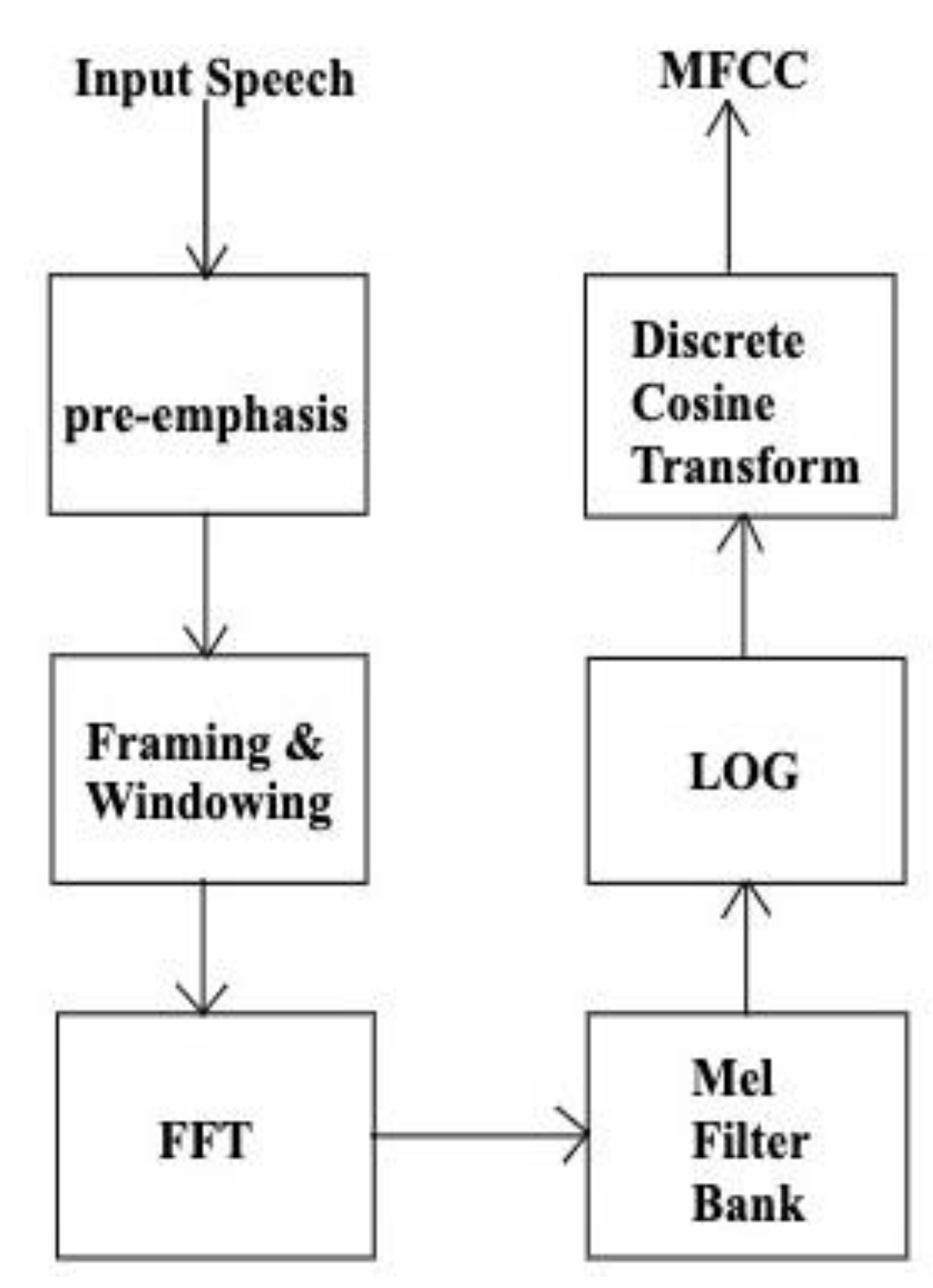
2.5. Mel-Frequency Cepstral Coefficients
2.6. Perceptual Linear Predictive Cepstral Coefficients
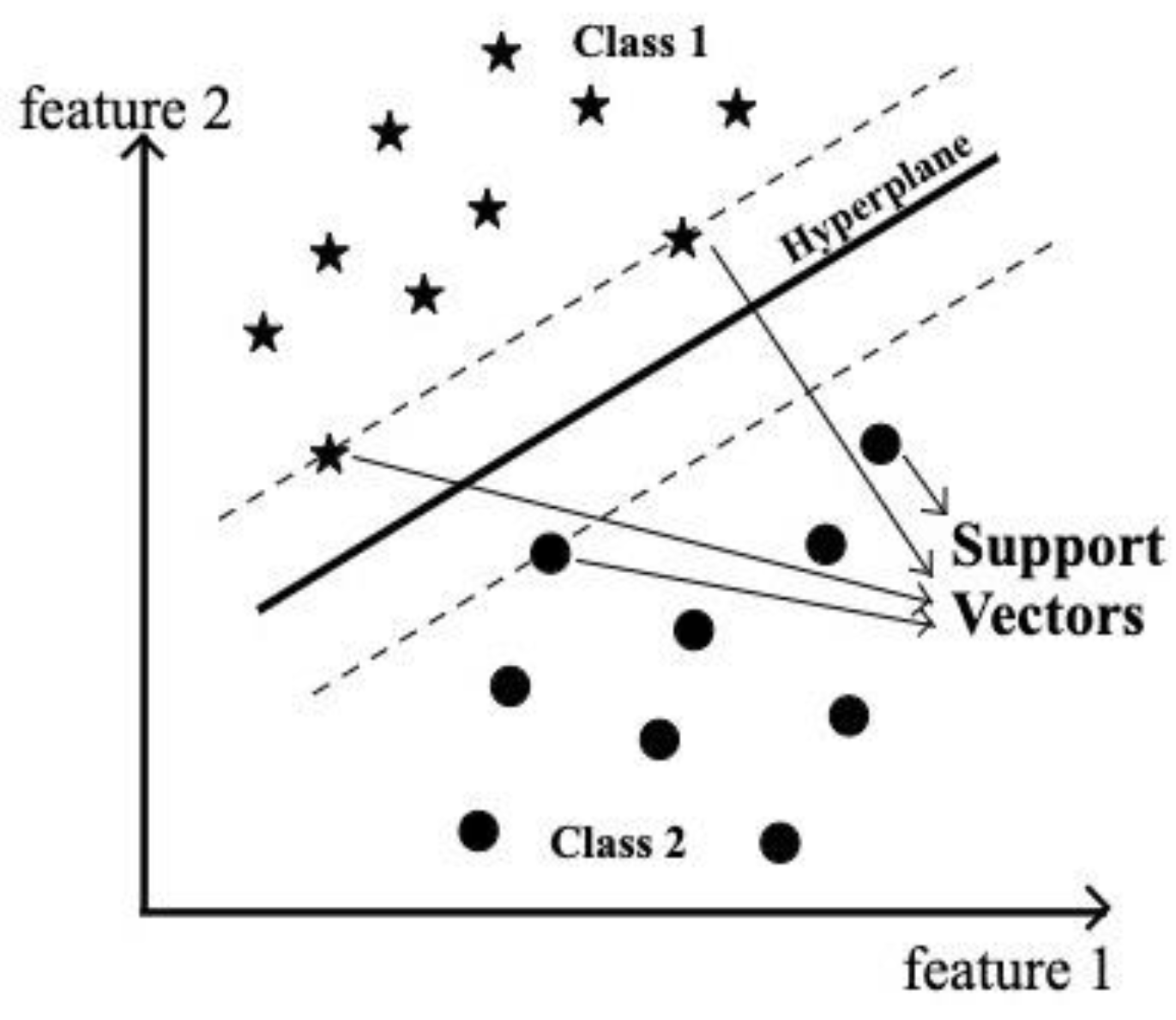
3. Classification Model
- Linear kernel
- Polynomial kernel (Polynomial degree
- Gaussian Kernel
- Radial Basis Function kernel
4. Materials and Methods
4.1. Data Acquisition
4.2. Feature Extraction
4.2.1. Speech
4.2.2. EEG
4.3. CI talkers and NH Talkers Classification: Speech and EEG
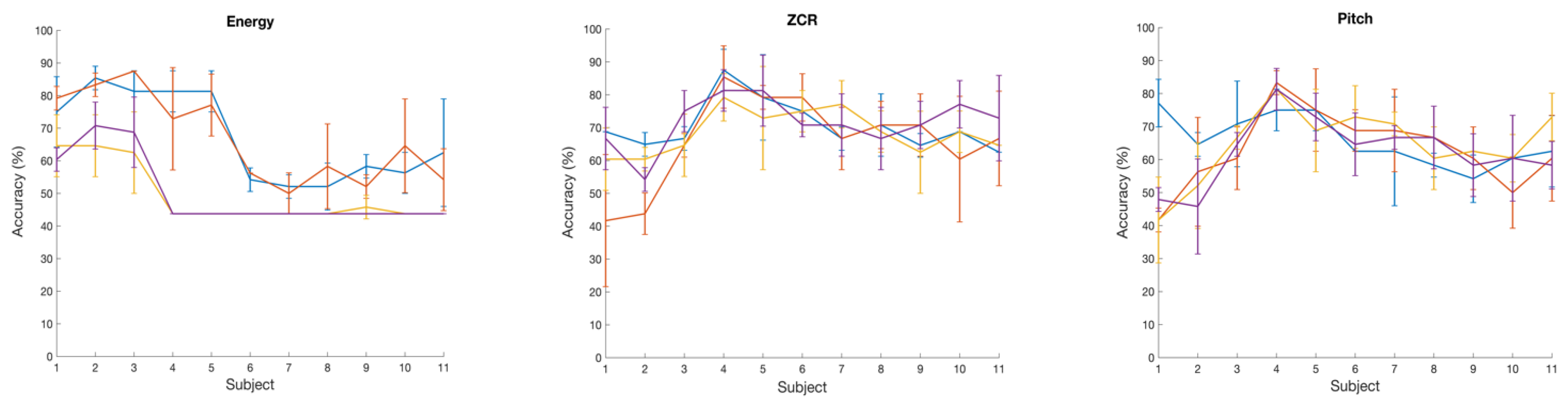
5. Results and Discussion

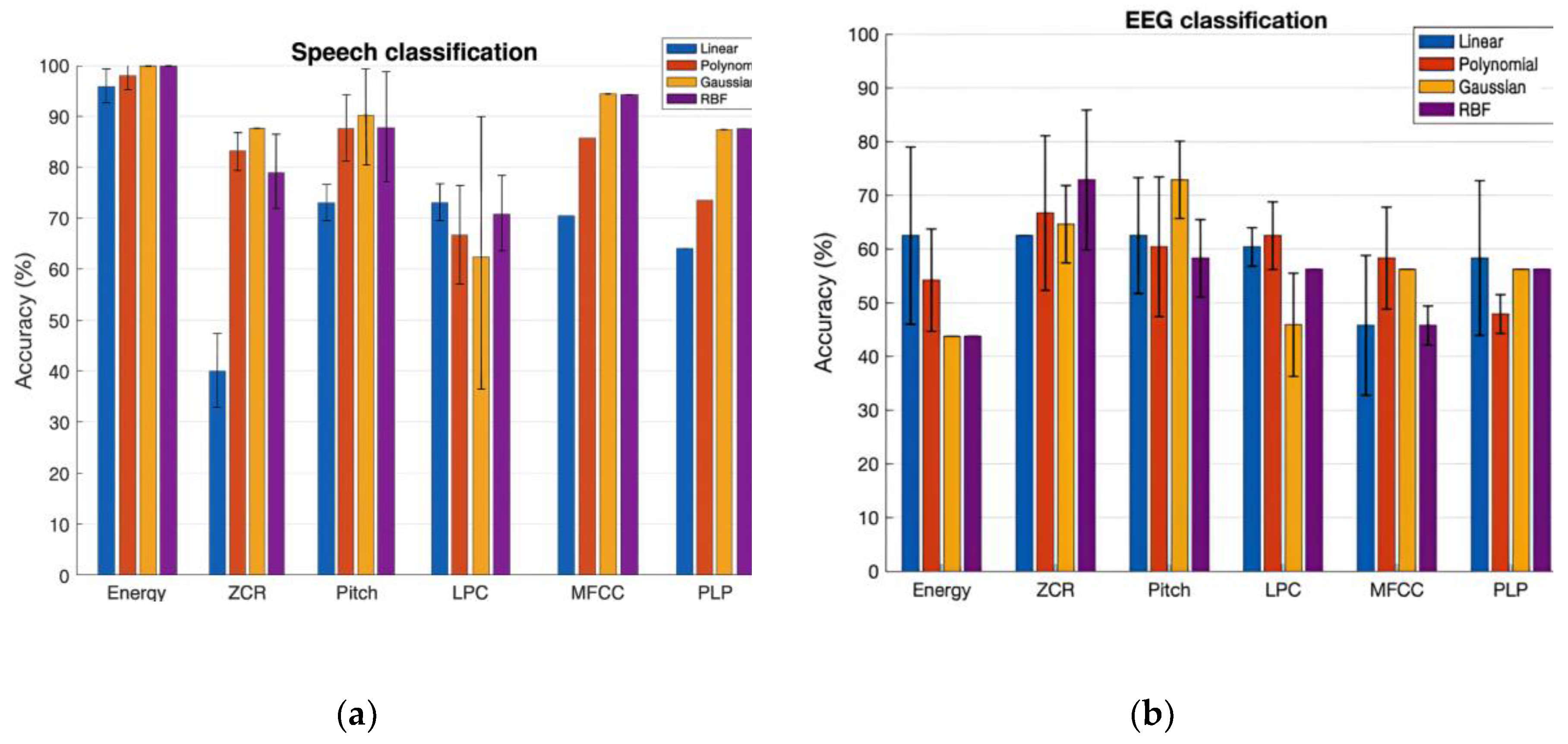
| Feature | Linear | Polynomial | Gaussian | RBF |
|---|---|---|---|---|
| Energy | 97% | 99% | 100% | 100% |
| ZCR | 39% | 83% | 87% | 78% |
| Pitch | 72% | 88% | 95% | 86% |
| LPC | 74% | 67% | 63% | 70% |
| MFCC | 70% | 85% | 94% | 94% |
| PLP (PLP-CC) | 63% | 73% | 86% | 86% |
| Feature | Linear | Polynomial | Gaussian | RBF |
|---|---|---|---|---|
| Energy | 63% | 55% | 45% | 44% |
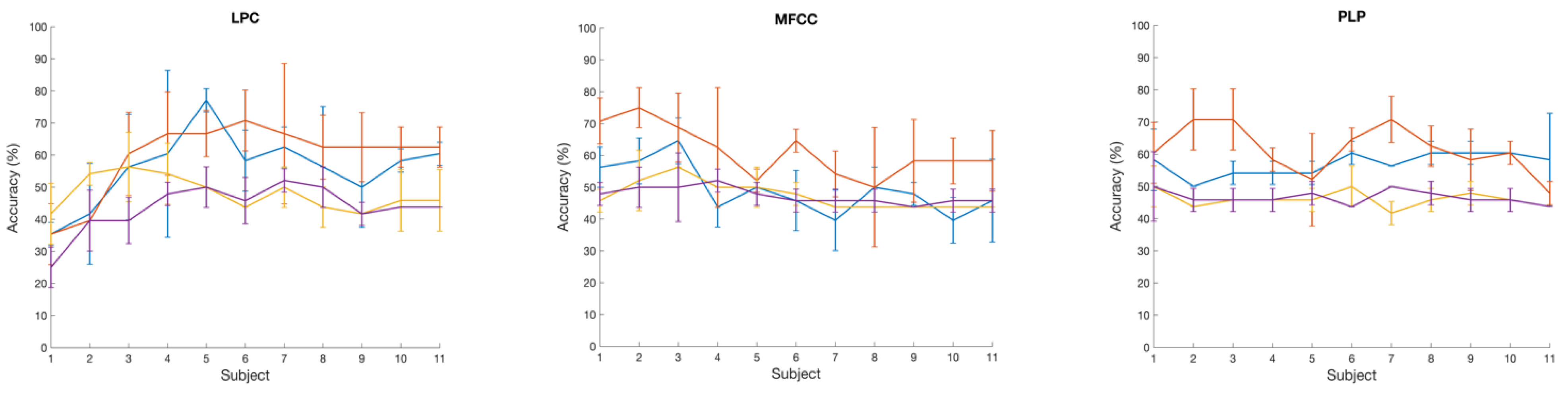
| ZCR | 63% | 68% | 72% | 71% |
| Pitch | 62% | 66% | 70% | 72% |
| LPC | 63% | 58% | 64% | 61% |
| MFCC | 61% | 58% | 55% | 59% |
| PLP (PLP-CC) | 61% | 53% | 56% | 57% |
6. Conclusion
Author Contributions
Funding
Institutional Review Board Statement
Informed Consent Statement
Data Availability Statement
Conflicts of Interest
Abbreviations
| CI | Cochlear Implant |
| EEG | Electroencephalogram |
| LPC | Linear Predictive Coefficients |
| MFCC | Mel-Frequency Cepstral Coefficients |
| NH | Normal-Hearing |
| PLP-CC | Perceptual Linear Predictive Cepstral Coefficients |
| RBF | Radial Basis Function |
| SVM | Support Vector Machine |
| ZCR | Zero-Crossing Rate |
References
- Seifert, E.; Oswald, M.; Bruns, U.; Vischer, M.; Kompis, M.; Haeusler, R. Changes of voice and articulation in children with cochlear implants. Int. J. Pediatr. Otorhinolaryngol. 2002, 66, 115–123. [Google Scholar] [CrossRef] [PubMed]
- Kim, H.; et al. Cochlear implantation in postlingually deaf adult is time-sensitive towards positive outcome: prediction using advanced machine learning techniques. Sci. Rep. 2018, 8, 18004. [Google Scholar] [CrossRef] [PubMed]
- Ruff, S.; et al. Speech production quality of cochlear implant users with respect to duration and onset of hearing loss. ORL 2017, 79, 282–294. [Google Scholar] [CrossRef] [PubMed]
- Dibazar, A.A.; Narayanan, S.; Berger, T.W. Feature analysis for automatic detection of pathological speech. In Proceedings of the Second Joint 24th Annual Conference and the Annual Fall Meeting of the Biomedical Engineering Society, Houston, TX, USA; 2002; Volume 1, pp. 182–183. [Google Scholar]
- Grygiel, J.; Strumiłło, P.; Niebudek-Bogusz, E. Application of Mel Cepstral processing and Support Vector Machines for diagnosing vocal disorders from voice recordings. In Proceedings of the Signal Processing Algorithms, Architectures, Arrangements, Poznan, Poland, 2011, and Applications SPA 2011; pp. 1–4. [Google Scholar]
- Pishgar, M.; Karim, F.; Majumdar, S.; Darabi, H. Pathological Voice Classification Using Mel-Cepstrum Vectors and Support Vector Machine. In Proceedings of the 2018 IEEE International Conference on Big Data, Seattle, WA, USA; 2018; pp. 5267–5271. [Google Scholar]
- Mahmoudi, Z.; Rahati, S.; Ghasemi, M.M.; Asadpour, V.; Tayarani, H.; Rajati, M. Classification of voice disorder in children with cochlear implantation and hearing aid using multiple classifier fusion. Biomed. Eng. Online 2011, 10, 3. [Google Scholar] [CrossRef] [PubMed]
- Xie, L.; Liu, Z.Q. A Comparative Study of Audio Features for Audio to Visual Conversion in MPEG-4 Compliant Facial Animation. In Proceedings of the ICMLC, Dalian, China, 13–16 August 2006. [Google Scholar]
- Alías, F.; Socoró, J.C.; Sevillano, X. A Review of Physical and Perceptual Feature Extraction Techniques for Speech, Music and Environmental Sounds. Appl. Sci. 2016, 6, 143. [Google Scholar] [CrossRef]
- Qiang, H.; Youwei, Z. On prefiltering and endpoint detection of speech signal. In Proceedings of the Fourth International Conference on Signal Processing, Beijing, China, October 1998; Volume 1, pp. 749–752. [Google Scholar]
- Rabiner, L.R.; Schafer, R.W. Digital Processing of Speech Signals; Prentice Hall: Englewood Cliffs, NJ, USA, 1978. [Google Scholar]
- Dave, N. Feature extraction methods LPC, PLP and MFCC in speech recognition. Int. J. Adv. Res. Eng. Technol. 2013, 1. [Google Scholar]
- Davis, S.B.; Mermelstein, P. Comparison of Parametric Representations for Monosyllabic Word Recognition in Continuously Spoken Sentences. IEEE Trans. Acoust. Speech Signal Process. 1980, 28, 357–366. [Google Scholar] [CrossRef]
- Hermansky, H. Perceptual linear predictive (PLP) analysis for speech. J. Acoust. Soc. Am. 1990, 87, 1738–1752. [Google Scholar] [CrossRef] [PubMed]
- Kulkarni, P.N.; Gadhe, D.L. Comparison between SVM and other classifiers for SER. Int. J. Eng. Res. Technol. 2013, 2. [Google Scholar]
- Galić, J.; Popović, B.; Šumarac Pavlović, D. Whispered Speech Recognition using Hidden Markov Models and Support Vector Machines. Acta Polytech. Hung. 2018, 15, 11–29. [Google Scholar] [CrossRef]
- Mendel, L.L.; Lee, S.; Pousson, M.; Patro, C.; McSorley, S.; Banerjee, B.; Najnin, S.; Kapourchali, M.H. Corpus of deaf speech for acoustic and speech production research. J. Acoust. Soc. Am. 2017, 142, EL102. [Google Scholar] [CrossRef] [PubMed]
- Raghavendra, S.; Lee, S.; Chun, H.; Martin, B.A.; Tan, C.T. Cortical entrainment to speech produced by cochlear implant talkers and normal-hearing talkers. Front. Neurosci. 2022, 16, 927872. [Google Scholar] [CrossRef] [PubMed]
- Raghavendra, S.; Lee, S.; Chen, F.; Martin, B.A.; Tan, C.T. Cortical entrainment to speech produced by cochlear implant users and normal-hearing talkers. In Proceedings of the 2022 44th Annual International Conference of the IEEE Engineering in Medicine & Biology Society (EMBC), Glasgow, UK, July 2022; pp. 3577–3581. [Google Scholar]
- Raghavendra, S.; Chun, H.; Lee, S.; Chen, F.; Martin, B.A.; Tan, C.T. Cross-frequency coupling in cortical processing of speech. In Proceedings of the 2022 44th Annual International Conference of the IEEE Engineering in Medicine & Biology Society (EMBC), Glasgow, UK, July 2022; pp. 25–29. [Google Scholar]
- Eyben, F.; Weninger, F.; Gross, F.; Schuller, B. Recent Developments in openSMILE, the Munich Open-Source Multimedia Feature Extractor. In Proceedings of the ACM Multimedia (MM), Barcelona, Spain, October 2013; pp. 835–838. [Google Scholar]
- Bachu, R.G.; Kopparthi, S.; Adapa, B.; Barkana, B.D. Voiced/Unvoiced Decision for Speech Signals Based on Zero-Crossing Rate and Energy. In Proceedings of the IEEE International Joint Conferences on Computer, Information, and Systems Sciences, 2008., and Engineering (CISSE).
- Gouyon, F.; Delerue, O.; Pachet, F. On the use of zero-crossing rate for an application of classification of percussive sounds. In Proceedings of the Third Digital Audio Effect Conference; 2000. [Google Scholar]
- Park, H.; Lee, B. Multiclass Classification of Imagined Speech EEG Using Noise-Assisted Multivariate Empirical Mode Decomposition and Multireceptive Field Convolutional Neural Network. Front. Hum. Neurosci. 2023, 17, 1186594. [Google Scholar] [CrossRef] [PubMed]
- Ravanelli, M.; Parcollet, T.; Bengio, Y. SpeechBrain: A General-Purpose Speech Toolkit. arXiv preprint, 0462; .4. [Google Scholar]
- Wang, Q.H.; Kong, W.Z.; Zhong, J.T.; Shan, Z.Y.; Wang, J.; Li, X.W.; Peng, H.; Hu, B. A Hybrid SVM and Kernel Function–Based Sparse Representation Classification for Automated Epilepsy Detection in EEG Signals. Neurocomputing 2023, 562, 126874. [Google Scholar] [CrossRef]
- Tan, L.; Holland, S. K.; Deshpande, A. K.; Chen, Y.; Choo, D. I.; Lu, L. J. A semi-supervised support vector machine model for predicting the language outcomes following cochlear implantation based on pre-implant brain fMRI imaging. Brain Behav. 2015, 5(12), e00391. [Google Scholar] [CrossRef] [PubMed]
| Authors & Year | Techniques Used | Performance Metrics | Limitations/Remarks |
| Seifert et al. (2002) [1] | Descriptive analysis of voice and articulation changes in children post-CI | N/A (qualitative; no ML) | Small sample (n=10); no machine learning or EEG |
| Kim et al. (2018) [12] | Advanced ML (not specified in title) on postlingually deaf adults | Prediction accuracy not reported in abstract | Focus on timing of implantation; no EEG or speech classification |
| Ruff et al. (2017) [13] | Acoustic analysis of speech quality vs. hearing loss duration | N/A (descriptive) | No ML; clinical correlation only |
| Dibazar et al. (2002) [4] | Feature analysis (MFCC, energy) for pathological speech detection | Not reported | General voice pathology; not CI-specific |
| Grygiel et al. (2011) [5] | Mel Cepstral + SVM for vocal disorder diagnosis | Accuracy: ~80% | Non-CI population; small dataset |
| Pishgar et al. (2018) [6] | Mel-Cepstrum + SVM for pathological voice | Weighted 5-fold CV = 0.7469 (≈ 74.7%) |
General voice disorders; not CI or EEG |
| Mahmoudi et al. (2011) [7] | Multiple classifier fusion on voice disorders in CI/HA children | Accuracy = 96.9% (Avg) | Word-based; no continuous speech or EEG |
| Mendel et al. (2017) [16] | Corpus creation for deaf speech analysis | N/A (data collection) | No classification; acoustic corpus only |
| Tan et al. (2015) [27] | Semi-supervised SVM on pre-implant fMRI | Accuracy: 81.3% (language outcome prediction) | fMRI only, no EEG |
| Raghavendra et al. (2022) [17] | Single-trial EEG regenerative model | Correlation: NH=0.12, CI=0.08 (p<0.05) | This study’s prior work — foundation for current SVM analysis |
Disclaimer/Publisher’s Note: The statements, opinions and data contained in all publications are solely those of the individual author(s) and contributor(s) and not of MDPI and/or the editor(s). MDPI and/or the editor(s) disclaim responsibility for any injury to people or property resulting from any ideas, methods, instructions or products referred to in the content. |
© 2025 by the authors. Licensee MDPI, Basel, Switzerland. This article is an open access article distributed under the terms and conditions of the Creative Commons Attribution (CC BY) license (http://creativecommons.org/licenses/by/4.0/).