

Submitted:
02 July 2025
Posted:
02 July 2025
You are already at the latest version
Abstract
Background/Objectives: Speech intelligibility (SI) is a key indicator of spoken language development, especially for children with hearing loss, as it directly impacts communication and social engagement. However, due to logistical and methodological challenges, SI assessment is often underutilised in clinical practice. This study aimed to evaluate the consistency of an artificial intelligence (AI)-based transcription model in assessing SI in young children with cochlear implants (CI), hearing aids (HA), or normal hearing (NH), in comparison to naïve human listeners. Methods: A total of 580 speech samples from 58 five-year-old children were transcribed by three naïve listeners and the AI model. Word-level transcription accuracy was evaluated using Bland–Altman plots, intraclass correlation coefficients (ICCs), and word error rate (WER) metrics. Performance was compared across the CI, HA, and NH groups. Results: The AI model demonstrated high consistency with naïve listeners across all groups. Bland–Altman analyses revealed minimal bias, with fewer than 6% of sentences falling outside the 95% limits of agreement. ICC values exceeded 0.9 in all groups, with particularly strong agreement in the NH and CI groups (ICCs > 0.95). WER results further confirmed this alignment and indicated that children with CIs showed better SI performance than those using HAs. Conclusions: The AI-based method offers a reliable and objective solution for SI assessment in young children. Its agreement with human performance supports its integration into clinical and home environments for early intervention and ongoing monitoring of speech development in children with hearing loss.
Keywords:
Speech Intelligibility
; Artificial intelligence
; Speech production
; Hearing loss
; Cochlear Implants
; Hearing Aids
; Children
; Natural Language Processing
1. Introduction
Speech intelligibility (SI) reflects the degree to which a speaker’s intended message is understood by listeners [1]. This is a critical skill for children to develop to engage in effective communication and participate fully in social interactions [2]. SI development depends on multiple factors, including speech perception, cognitive processing, linguistic knowledge, and articulation skills [3,4,5]. As an indicator of expressive language development, the assessment and improvement of SI are essential for early language development.
Typically developing children usually acquire SI gradually during early childhood. By the age of four, their speech is nearly 100% intelligible when rated by parents, with consistent results reported across studies using naïve listeners [6,7,8]. In contrast, children with hearing loss (HL), especially those with severe or profound HL, often face significant challenges in developing intelligible speech [9,10,11]. Studies have shown that speech produced by children with severe to profound HL is, on average, only 19-20% intelligible to naïve listeners, with wide variability reported based on the severity of hearing loss and the use of interventions such as hearing aids (HAs) or cochlear implants (CIs) [3,12,13].
The consequences of lower speech intelligibility may extend beyond communication difficulties for children with HL. Extensive research has shown that poor SI can affect how children with HL are perceived by their peers and teachers, hence negatively influence their other areas of development, such as social functioning and overall psychosocial well-being [14,15,16,17,18,19]. Therefore, assessing and tracking SI development from early childhood through adolescence is essential for guiding effective interventions and supporting broader developmental progress [20].
Speech intelligibility measurement has been widely recognised as a useful method for assessing oral communication competence. However, considerable debate remains regarding the optimal approach for measuring it [21]. Factors such as the age and speech production stage of the child, the nature of the spoken material (e.g., isolated words or connected speech), and listener characteristics (e.g., familiarity with the speaker, listener's hearing level, speech perception skills, acoustic listening conditions) can all influence SI outcomes [22,23].
Current methods typically fall into two categories: transcription-based and scale-based procedures [20]. The transcription method requires listeners to write down the words or syllables they heard, with accuracy calculated based on the percentage of correctly transcribed items compared to the original speech stimulus [23,24]. While this approach provides detailed word-level analysis, it is time-consuming and normally requires multiple listeners for sentence transcription to ensure reliable scoring [24]. In the scale-based approach, listeners give an overall impression on a rating scale of how well the speech is understood. This method (e.g. a commonly used tool - the Speech Intelligibility Scale (SIR) is more time-efficient and has been widely adopted for assessing SI outcomes in children using HAs or CIs [25]. However, it provides less detailed information compared to transcription and it may be not sensitive in distinguishing between moderate intelligibility levels, such as 40% versus 60% intelligible [26].
Regardless of the method used, SI judgments can be influenced by the familiarity and experience level of the listeners. If the goal is to reflect unbiased insights into children’s functional communication ability in daily life, researchers have consistently emphasised that the ideal evaluators should be inexperienced listeners with normal hearing and little or no exposure to the speaker’s speech [3,11,20,22,27,28,29,30,31]. However, recruiting panels of inexperienced listeners presents a practical barrier for widespread clinical implementation.
Artificial intelligence (AI) has proven transformative across various fields, with speech-to-text (STT) applications enabling advancements in voice recognition, transcription, and accessibility technologies. AI models like Whisper Large V2 have shown exceptional ability to perform automated transcription tasks with high accuracy and consistency. Unlike traditional methods, AI tools can provide efficient and objective evaluations, presenting a promising opportunity to improve SI assessments in clinical settings.
In recent research, AI-based STT technologies have been successfully applied to assess SI and related outcomes across various populations. For instance, one study uses Automatic Speech Recognition (ASR) systems to evaluate speech impairment severity in oral cancer patients, focusing on intelligibility and voice quality through listener ratings [32]. Another explores a deep neural network (DNN)-based model for predicting SI in noisy environments, aimed at improving audiometry and hearing aid optimization [33]. A separate study applies the Kaldi ASR toolkit to automate the digits-in-noise test, creating an accessible, efficient hearing assessment tool for clinical and remote settings [34]. Another study examines the feasibility of an automated system to assess SI in individuals with aphasia, focusing on clarity, fluidity, and prosody through DNN models and feature engineering, showing potential for providing accurate, accessible feedback in aphasia therapy [35]. Additionally, this study examines the effectiveness of AI-based synthesized speech as an alternative to human-recorded speech in speech-in-noise perception research. Results show that both younger and older adults experience similar masking-release benefits with AI and human speech, with older adults perceiving AI speech as particularly natural and human-like, suggesting its potential value for research focused on aging and speech perception [36]. Finally, a study shows Natural Language Processing (NLP) models, such as OpenAI’s Ada2, as accurate alternatives to human scoring in SI evaluations, particularly under noisy conditions (ref: Leveraging Natural Language Processing Models to Automate Speech-Intelligibility Scoring). Collectively, these studies highlight the expanding role of STT technologies in enhancing clinical precision and accessibility in hearing and speech assessments.
This study aimed to address the challenges in SI assessment by leveraging AI technology. Specifically, the two primary objectives were to apply an AI-based transcription method for the automatic assessment of SI performance in 5-year-old children with CIs, HAs and normal hearing (NH); and to compare the word-level accuracy and consistency of AI-based transcriptions with those of naïve listeners for children across hearing groups.
2. Materials and Methods
2.1. Speech Samples
The speech materials were sentences from the Beginners Intelligibility Test (BIT)[10], a widely used tool for evaluating speech production in children with HL [10,23,37]. The BIT test consists of four lists, each containing ten simple sentences, ranging from two to six words (three to eight syllables) and including 37 to 40 familiar words for young children, such as “The boy is under the table” and “That is a big bed”.
Speech samples were collected from 58 five-year-old children (male: 23, female:35; mean age: 61.4 months, SD: 1.3), as part of a previous study [38]. Each child was randomly assigned one of the four BIT lists. During test administration in a quiet room, a research speech pathologist read each sentence aloud using a picture cue to provide context of the target sentence, and the child was instructed to repeat the sentence. Audio recordings were captured using a Zoom H4N digital recorder with AKG C555L headset microphone at a 44.1 kHz sampling rate. Each child’s 10-sentence recording was further segmented into 10 individual files, with one second of silence before and after each sentence. All recordings were then normalised for root-mean-square (RMS) level using Adobe Audition software (v4.0), resulting in a total of 580 individual audio recordings: 100 from children with CIs, 240 from children using HAs, and 240 from children with NH. Table 1 shows the demographic and clinical characteristics of the 58 children. Among these children, 24 had NH, while 34 had bilateral HL with average air conduction hearing threshold across four frequencies (4FAHL) of 0.5, 1, 2, and 4 kHz in the better ear at 68.8 ± 31.1 dB HL. In the HL group, 10 had bilateral CIs and 24 children used bilateral HAs, with all devices fitted before age three. All children were native English speakers with a monolingual background and had no speech issues or additional disabilities according to parental reports.
2.2. Speech Intelligibility Evaluation by Naïve Listeners
All RMS-normalised recordings were presented via Beyerdynamic DT770 Pro circumaural headphones using the MACarena experiment presentation software [42]. The listeners were 64 adults who were native speakers of Australian English aged between 18 and 40 years old (mean: 20.6 years, SD: 3.4). All adult listeners had passed screening tests with normal hearing and reported no previous exposure to speech produced by children with HL.
Each child’s 10-sentence BIT list was listened to and transcribed by at least three adult naïve listeners independently. Each listener was randomly assigned to transcribe four different BIT lists, each from a different child, with randomised sentence order within each list. After hearing each sentence, listeners provided word-by-word transcription based on what they believed the child had said. If necessary, they were allowed to replay the sentence once. For words or sentences completely unintelligible, they were instructed to either make their best guess or mark it with an ‘X’. Listeners did not hear the same list more than once nor did they listen to a list spoken by the same child more than once. Each listener was assigned recordings from at least one child with NH and one child with HL within the four lists. When more than three transcriptions were available for a child, a random subset of three was used for analysis.
2.3. Selection of AI-Based Speech-to-Text Model
Speech transcription for paediatric populations presents unique challenges compared to adult speech. While state-of-the-art (SOTA) STT models demonstrate impressive performance on adult speech corpora, their direct application to children’s speech often remains limited. This discrepancy arises from several factors. Firstly, STT models are predominantly trained on large-scale datasets comprised almost entirely of adult speech, which differs acoustically from children’s speech due to anatomical differences such as shorter vocal tract length, higher fundamental frequency, and more variable articulation. As a result, models trained on adult speech may fail to generalise to the acoustic patterns characteristic of young children. Children’s speech corpora are significantly smaller than the extensive datasets used to train adult-focused ASR systems, limiting opportunities for robust model training and domain adaptation. Secondly, children’s speech introduces linguistic complexities, such as ungrammatical or poorly constructed sentences, disfluencies (e.g., false starts, filler words, and pauses), and speech sound errors, all of which pose transcription challenges [43,44].
To identify a suitable AI-based model for evaluating intelligibility in children’s speech, we conducted a comparative analysis of a range of SOTA STT models. Due to privacy and ethical considerations associated with the speech recordings used in this study, only offline deployable models were considered, excluding any transcription systems that required internet-based data processing. Within this constraint, we selected five STT models based on their distinct technical strengths and relevance to pediatric speech contexts: Whisper, Wav2Vec, S2T Transformer, DeepSpeech [45], and an offline implementation of Google Speech Recognition (non-API) models (Figure 1). Whisper, developed by OpenAI, is known for its robustness in noisy environments and multilingual support, making it a strong candidate for handling variability in children’s pronunciation. Wav2Vec, with its self-supervised learning framework, excels in scenarios with limited annotated data, making it particularly advantageous for paediatric speech transcription. The S2T Transformer models, based on a sequence-to-sequence architecture, are designed for direct speech translation and transcription tasks. It demonstrates efficient decoding and strong performance in multilingual and low-resource settings, which would be valuable for handling children’s speech variability. Google Speech Recognition (non-API) benefits from extensive training on diverse datasets, providing high baseline accuracy and effectiveness on handling diverse accents and dialects. Finally, DeepSpeech, leveraging its recurrent neural network (RNN) architecture, offers a lightweight, open-source solution with the flexibility to accommodate new datasets. These models collectively offer complementary capabilities, enabling a comprehensive evaluation of their suitability for paediatric speech transcription.
All models were downloaded from Hugging Face, loaded with PyTorch, and implemented using a Python framework to transcribe the audio files. Transcriptions were generated for speech recordings produced by children with NH, and the performance was quantified as the percentage of correctly transcribed words relative to the reference BIT lists. Specifically, a percentage score was calculated for each child by dividing the total number of correctly transcribed words across all 10 sentences by the total number of words in the BIT list. The final transcription performance for each model was then computed by averaging these percentage scores across all tested children’s recording (Figure 1). Among the models tested, the Whisper Large V2 achieved the highest overall accuracy and was therefore selected for all subsequent transcription and analyses in this study.
2.4. Data Scoring on the Transcriptions
All target words in the BIT list were weighted and scored equally [23,30,46]. The transcriptions by naïve listeners were double-checked for correct children's and naïve listeners' IDs, correct audio recording file, list number, and sentence number by two researchers. For each sentence produced by each child, the word-by-word transcription provided by each naive listener was verified independently by two researchers to ensure consistency, with reference to the BIT lists. The AI-based transcriptions were automatic processed using the offline Whisper Large v2 model and scored using the same method as the transcriptions by adult naïve listeners. Therefore, each child’s sentence list has a 4th transcription result generated by AI-based method.
2.5. Data Analysis
The statistical analyses were performed using IBM SPSS Statistics for Windows v.29 [47].
To evaluate the agreement between transcriptions from naïve listeners and the AI-based method, Bland–Altman plots were constructed [48]. These plots visualised the agreement between paired transcriptions by plotting the differences against the mean of the two measures (i.e. the AI model relative to naïve listeners’ transcriptions), indicating mean biases or outliers based on the 95% limits of agreement (LoA).
To assess the overall consistency and reliability of transcriptions across different raters (three naïve listeners and the AI-based model), word-level Intraclass Correlation Coefficient (ICC) analyses were performed. These ICC analyses were conducted separately for children with CIs, HAs, and NH, to evaluate the how well the AI-based method aligned with human performance across different hearing groups. Two-sided p-values <0.05 were used to indicate statistical significance for ICC analysis to allow for the possibility of differences in either direction. No correction for multiple comparisons was applied, as the analyses were limited to the predefined comparisons. Although the ICC assumes normally distributed measurement differences, it is generally robust to moderate deviations from normality, particularly in larger samples such as the current study. ICC was therefore deemed appropriate for evaluating inter-rater agreement in this context [49].
The Word Error Rate (WER) metric, as a recognised benchmark, has been widely used to evaluate the reliability performance of automated STT models in diverse contexts (e.g.[50]). In this study, we also calculated the WER values for the AI model and naïve listeners across hearing groups to further quantitatively assess the transcription errors in terms of substitutions, deletions, and insertions relative to the total number of words in the reference transcription (Equation 1):
where S = the number of substitutions; D = the number of deletions; I = the number of insertions; N = the total number of words in the reference text.
3. Results
3.1. Comparing Word-Level Transcription: AI vs. Naïve Listeners
The Bland-Altman plots (Figure 2) show the comparison of world-level transcription agreement between the AI-based transcription model and individual naïve human listeners. The results are displayed separately for speech samples from children with NH (Fig 1A) and those with HL (Fig 1B). Each plot illustrates the average number of correct words between the AI model and a naïve listener against the difference score between the two methods, as well as the 95% limits of agreement (i.e., limits within which 95% of difference scores will lie).
Across all comparisons, the mean differences between the AI model and human listeners were close to zero, indicating minimal systematic bias in transcription accuracy. The plots also revealed a symmetrical distribution of data points above and below the zero-difference line, which suggests that neither transcription method consistently over- or under-performed relative to the other.
For children with NH, 95% LoA ranged from 4.6% to 7.1%, while for children with HL, the LoA were slightly wider, between 5.6% and 7.6%. For example, in the comparison between the AI model and naïve listener 1, only 4.6% sentences produced by NH children (11 out of 240) and 7.6% of sentences produced by HL children (26 out of 340) fell outside the 95% LoA. In comparison with naïve listener 3, 7.1 % of NH sentences (17/240) and 5.6% of HL sentences (19/340) fell outside the 95% LoA. These patterns suggest that overall agreement between AI model and human listeners was strong, with slightly greater variability in children with HL, possibly reflecting differences in speech clarity and articulation across populations.
3.2. Word-Level Consistency Analysis Between the AI Model and Naive Listeners
The consistency of word-level transcription accuracy between the AI model and naïve listeners was assessed using the ICC, with the AI model treated as an additional rater alongside the three naïve listeners (Table 2).
In the NH group, inter-rater agreement was notably high. The ICC value among naïve listeners reached 0.95, with the AI model demonstrating comparable consistency, achieving an ICC of 0.96 when compared to human listeners.
For the HL group, which combines children with CIs and HAs, word-level transcription reliability remained high, though slightly lower than that observed in the NH group. The ICC among naïve listeners was 0.92, and the AI model maintained a closely aligned value of 0.93. Looking more closely at subgroups within the HL group, children with CIs showed performance that was directly comparable to NH peers. Both naïve listeners and the AI model achieved ICC values of 0.96, indicating a high degree of consistency in word-level transcription accuracy and suggesting relatively stable speech production in the CI group. In contrast, the HA subgroup showed the lowest but still acceptable levels of agreement. The ICC values for naïve listeners and the AI model were 0.90 and 0.91, respectively, which suggests a slightly greater variability in transcription accuracy.
3.3. Word Error Rate Consistency Among AI and Naïve Listener Transcriptions
To further evaluate transcription accuracy, word error rate was calculated by comparing each transcription generated by the AI model and individual naïve listeners, against the reference sentences on a word-by-word basis. This analysis aimed to assess the variability in word-level errors at both the participant level and transcription methods, across different hearing groups. Figure 3 illustrates the average WERs across all 10 sentences produced by each participant. WERs are shown for four transcription methods: the AI model compared to the reference sentence (labelled as “Ref vs AI”), and each of the three naïve listeners compared to the reference (labelled as “Ref vs Naïve 1, 2, or 3”). The results are displayed across three hearing groups (i.e. NH, CI, and HA) in separate subfigures. These visualizations allow for a clearer understanding of performance differences both within and between groups. Lower WER values indicate greater transcription accuracy.
In the NH group, WERs were low across all transcription methods, indicating high intelligibility of children’s speech. Among naïve listeners, listener 1 achieved the lowest average WER (15.2%), followed by listener 2 (15.9%) and listener 3 (19.2%). The AI model's transcribing performance closely aligned with human listeners, with an average WER of 20.5%.
In the CI group, WER consistency was comparably high among transcription methods. The AI model achieved a WER of 22.8%, while naïve listener performances were 20.1% (listener 1), 18.7% (listener 2), and 21.2% (listener 3). This result suggests that, despite having severe to profound hearing loss, children with CIs produced speech that was as intelligible—and as consistently transcribed—as their NH peers. The AI model’s performance in transcribing speech from children with CIs was nearly equivalent to that of the human listeners, highlighting its effectiveness in handling speech from CI users.
By contrast, the HA group exhibited more variable and generally higher WERs across all transcription methods. Naïve listeners performed slightly better with WERs of 30.8% (listener 1), 32.8% (listener 2), and 32.3% (listener 3), compared with the AI model’s result of 40.7%. While no statistical tests were conducted to compare these values, the observed WER difference of approximately 8–10 percentage points may be clinically meaningful, particularly in populations with greater speech variability [21,51]. The higher WERs in this subgroup likely reflect greater variability in speech production among children with moderate severe hearing loss and wearing hearing aids. This increased variability appears to challenge both human and AI transcription. Although the AI model produced higher WER than human listeners, the consistent trend across methods suggests it reliably tracks intelligibility patterns, even under more variable acoustic conditions.
4. Discussion
4.1. Importance of SI Evaluation for Children with HL
Speech intelligibility, as a critical benchmark for expressive speech-language development, reflects how well a child’s speech is understood by listeners and is essential for effective communication in social contexts. Despite its importance, SI assessments are often underutilized in clinical practice due to logistical and methodological challenges. Early identification of SI issues during early childhood, a sensitive period for speech and language development, could allow for timely interventions, guiding appropriate clinical management and family support strategies [20]. Thus, accurate and accessible methods for assessing SI are important for children with HL to monitor intervention progress and optimise language outcomes.
4.2. Summary and Interpretation of Current Findings
This study investigated the transcription accuracy and consistency of an AI-based model (Whisper Large V2), in comparison to naïve human listeners. The integration of multiple analyses approaches underscores its clinical relevance, with the Bland–Altman analysis providing word-level precision, ICCs offering an overall consistency across transcription methods in different hearing groups of children, and WERs capturing variations in word-level transcription errors. The findings indicate that the AI model performs consistently and comparably to human listeners in transcribing children's speech.
The Bland-Altman analysis demonstrated strong agreement between the AI model and individual naïve listeners, with minimal bias and most sentences falling within the 95% LoA for both NH and HL groups. These findings suggest high degree of transcription consistency in word-level across methods. The ICC analysis provided converging evidence, with values exceeding .90 in all groups—a threshold commonly interpreted as “excellent” reliability [49]. In addition, it was noted that the AI model demonstrated the highest consistency with human listeners in the NH and CI groups, achieving ICC values of 0.95 and 0.96, respectively. —matching the performance of listeners. Although slightly lower agreement was observed in the HA group (ICC = 0.91), likely reflecting greater variability in speech intelligibility, these results underscore the robustness of the AI model across varied speech production characteristics and its close alignment with human transcription performance.
The WER analysis further supported these findings by quantifying transcription errors. In both the NH and CI groups, WERs for the AI model fell within the similar range as those of naïve human listeners, generally under 25%, a general indicative threshold widely accepted as adequate transcription quality [51]. Although transcription errors were more frequent in the HA group, the AI model performed consistently with the relative trends of human listeners, which suggests its potential for reliably evaluating speech intelligibility despite the challenges posed by less clear speech production.
A particularly promising finding was that both ICC and WER analyses showed that children with CIs achieved equivalent speech production outcomes to their NH peers, and better outcomes compared to their peers with severe hearing loss who use HAs. This reinforced findings in the literature that children fitted early CIs may demonstrate good speech intelligibility and language skills that comparable with those of typically hearing children [52,53,54,55]. These results also underscore the benefits of early CIs and consequence intervention in supporting speech intelligibility development in children with severe to profound HL.
Overall, these findings validate the selected AI model (Whisper Large V2) as a consistent and effective tool for word-level transcription of children’s speech. Its capability of achieving comparable performance with naïve human listeners, even in more degraded speech conditions, supports its use as a valuable tool for SI evaluation in clinic and home environments.
4.3. Strengths and Limitations
This study provides robust evidence for the potential of the selected AI model as an objective, effective, and reliable tool for the automated transcription of children’s speech recordings. The use of three analysis metrics (Bland–Altman, ICC, and WER) adds methodological rigor and provides a nuanced understanding of AI-based model performance. Given the absence of AI models specifically trained on children’s language, the accuracy levels achieved by Whisper Large V2 offer valuable insights into the feasibility of using existing AI models for the automatic recognition and transcription of pediatric speech. Another strength of this study lies in its use of rigorous consistency analyses, comparing AI-generated transcriptions to those of naïve human listeners across multiple groups of children, including those with NH, CIs and HAs users. The inclusion of a diverse cohort of children enhances the relevance of the findings for clinical applications.
Despite the strengths of this study, several limitations should be acknowledged. First, the dataset was limited to speech recordings from 5-year-old native English-speaking children without reported speech or developmental difficulties. While this controlled design improves interval validity, it restricts generalizability to other age groups and linguistic backgrounds. Second, the sample size of the CI subgroup was relatively small. Although consistent patterns were observed, this may limit statistical power for subgroup comparisons. Future studies should aim to include a larger and more diverse cohort to verify the robustness of these findings. Third, while Whisper Large V2 performed well without specific training on pediatric speech, fine-tuning models with age-appropriate cohort may improve its performance further. In addition, the current study focused on word-level transcription accuracy using the BIT materials. Future work could explore other types of speech materials (e.g. spontaneous speech) or phoneme-level analysis to expand its potential in clinical applications.
4.4. Future Clinical Application
The results of this study also point toward practical, scalable applications of AI for speech intelligibility assessment. In particular, the Whisper Large V2 model demonstrates the potential for integration into a telehealth platform or a user-friendly mobile apps, to support routine monitoring of children’s speech. Such tools could reduce clinician workload, enable more frequent tracking of speech development progress, and empower caregivers to participate actively in home-based interventions.
Recent advancements work by Monaghan et al. [56] has demonstrated that speech-based machine learning models, such as those using wav2vec 2.0 embeddings, can be used not only for assessing intelligibility but also for detecting hearing loss itself directly from children's speech samples. This highlights a broader diagnostic potential for AI-based systems — enabling integrated approaches to both assess intelligibility and identify underlying hearing conditions, all from the same speech data [56].
By addressing current limitations and driving adoption through user-centre design, AI-based SI tool have the potential to transform how speech outcomes are evaluated in children with hearing loss and extending benefits from clinic to home, and ultimately improving long-term communication outcomes.
5. Conclusions
This study demonstrated that the AI-based transcription model (Whisper Large V2) is a reliable and objective tool for the automated assessment of speech intelligibility in young children. Its performance closely matched that of naïve listeners across hearing groups, with the highest consistency observed in children with NH and those using CIs. Notably, CI users demonstrated intelligibility levels comparable to their NH peers and higher than HA users, highlighting the importance of early amplification and intervention. The scalability and consistency of the AI model make it a promising tool for integration into clinical practice and home-based SI evaluations via telehealth platforms, which could further support early intervention and ongoing monitoring of speech development in children with hearing loss.
Author Contributions
Conceptualization, VWZ, AS, and JM; methodology, VWZ and AS.; formal analysis, VWZ and AS; Principal investigation, VWZ and AS; resources, VWZ; data curation, VWZ and AS; writing—original draft, VWZ; writing—review and editing, VWZ, AS, and JM; visualization, VWZ and AS; supervision, VWZ and JM; project administration, VWZ; funding acquisition, VWZ. All authors have read and agreed to the published version of the manuscript.
Funding
This research was carried out by the National Acoustic Laboratories (NAL) and funded by the Australian Government through the Department of Health and Aged Care. NAL is a research division of Hearing Australia, which is a statutory agency and public body created by law, typically an Act of Parliament, to perform specific functions or duties.
Data Availability Statement
Because the datasets are not available outside of the research team as per Hearing Australia Ethics approvals. Requests to access the datasets should be directed to the corresponding author and Hearing Australia Human Research Ethics Committee.
Acknowledgments
We acknowledge the previous research speech pathologists at NAL for collecting the original children’s speech recordings under the Longitudinal Outcomes of Children with Hearing Impairment study. Special thanks to Maxine Lorge for collecting raw data on naïve listeners’ transcriptions and Finn Sonter for cross-checking and digitising the paper-based transcriptions for analysis. We also thank the PACE students from Macquarie University for assisting editing the audio recordings. We acknowledge Jorge Meija and Viji Easwar for their input on the initial conceptualization. Parts of this study are based on educational material previously presented in a webinar for continued.com.
Conflicts of Interest
The authors declare no conflicts of interest.
Abbreviations
The following abbreviations are used in this manuscript:
| 4FA HL | Four frequency averaged hearing loss at 0.5, 1, 2, and 4 kHz |
| AI | Artificial intelligence |
| ASR | Automatic speech recognition |
| BIT | Beginners Intelligibility Test |
| CIs | Cochlear implants |
| DNN | Deep neural network |
| HAs | Hearing aids |
| HL | Hearing loss |
| ICC | Intraclass correlation coefficient |
| LoA | limits of agreement |
| NAL | National Acoustic Laboratories |
| NLP | Natural language processing |
| NH | Normal hearing |
| PTA | Pure tone audiometry |
| RMS | Root-mean-square |
| RNN | Recurrent neural network |
| SI | Speech intelligibility |
| SOA | State-of-the-art |
| STT | speech-to-text |
| WER | Word Error Rate |
References
- Kent, R.D., et al., Toward phonetic intelligibility testing in dysarthria. J Speech Hear Disord, 1989. 54(4): p. 482-499.
- Ruben, R.J., Redefining the survival of the fittest: Communication disorders in the 21st century. Laryngoscope, 2000. 110(2 Pt 1): p. 241-245.
- Monsen, R.B., Toward measuring how well hearing-impaired children speak. J Speech Lang Hear Res, 1978. 21(2): p. 197-219.
- MacNeilage, P.F., The production of speech. Springer-Verlag. New York, United States. 2012.
- Montag, J.L., et al., Speech intelligibility in deaf children after long-term cochlear implant use. J Speech Lang Hear Res, 2014. 57(6): p. 2332-43.
- Weiss, C.E., . Weiss intelligibility test. C.C. Publications. Tigard, Oregon, United States. 1982.
- Coplan, J. and Gleason, J.R., Unclear speech: Recognition and significance of unintelligible speech in preschool children. Pediatrics, 1988. 82(3 Pt 2): p. 447-52.
- Gordon-Brannan, M. and Hodson, B.W., Intelligibility/severity measurements of prekindergarten children’s speech. Am J Speech Lang Pathol, 2000. 9(2): p. 141-150.
- Carney, A.E., Understanding speech intelligibility in the hearing impaired. Topics in Language Disorders, 1986. 6(3): p. 47-59.
- Osberger, M.J., et al., Speech intelligibility of children with cochlear implants. Volta Rev., 1994. 96(5): p. 12.
- Osberger, M.J., Speech intelligibility in the hearing impaired: Research and clinical implications, in Intelligibility in speech disorders: Theory, measurement and management, Kent, R.D., Editor. 2011, John Benjamins Publishing Company. p. 233-264.
- Brannon Jr, J.B., Visual feedback of glossal motions and its influence upon the speech of deaf children. Northwestern University. 1964.
- Yoshinaga-Itano, C., From screening to early identification and intervention: Discovering predictors to successful outcomes for children with significant hearing loss. J Deaf Stud Deaf Educ, 2003. 8(1): p. 11-30.
- Most, T., Weisel, A., and Lev-Matezky, A., Speech intelligibility and the evaluation of personal qualities by experienced and inexperienced listeners. Volta Rev., 1996. 98(4): p. 181-190.
- Most, T., Speech intelligibility, loneliness, and sense of coherence among deaf and hard-of-hearing children in individual inclusion and group inclusion. J. Deaf Stud. Deaf Educ., 2007. 12(4): p. 495-503.
- Most, T., Ingber, S., and Heled-Ariam, E., Social competence, sense of loneliness, and speech intelligibility of young children with hearing loss in individual inclusion and group inclusion. J Deaf Stud Deaf Educ, 2012. 17(2): p. 259-72.
- Most, T., Weisel, A., and Tur-Kaspa, H., Contact with students with hearing impairments and the evaluation of speech intelligibility and personal qualities J. Spec. Educ., 1999. 33(2): p. 103-111.
- Barker, D.H., et al., Predicting behavior problems in deaf and hearing children: the influences of language, attention, and parent-child communication. Dev Psychopathol, 2009. 21(2): p. 373-92.
- Hoffman, M.F., Quittner, A.L., and Cejas, I., Comparisons of social competence in young children with and without hearing loss: a dynamic systems framework. J Deaf Stud Deaf Educ, 2015. 20(2): p. 115-24.
- Ertmer, D.J., Assessing speech intelligibility in children with hearing loss: Toward revitalizing a valuable clinical tool. Lang Speech Hear Serv Sch, 2011. 42(1): p. 52-58.
- Kent, R.D., Miolo, G., and Bloedel, S., The intelligibility of children’s speech: A review of evaluation procedures. Am J Speech Lang Pathol, 1994. 3(2): p. 81-95.
- McGarr, N., The intelligibility of deaf speech to experienced and inexperienced listeners. J Speech Lang Hear Res, 1983. 26: p. 8.
- Chin, S.B., Tsai, P.L., and Gao, S., Connected speech intelligibility of children with cochlear implants and children with normal hearing. Am J Speech Lang Pathol, 2003. 12: p. 12.
- Flipsen Jr. P and Colvard, L.G., Intelligibility of conversational speech produced by children with cochlear implants. J Commun Disord, 2006. 39(2): p. 93-108.
- Nikolopoulos, T.P., Archbold, S.M., and Gregory, S., Young deaf children with hearing aids or cochlear implants: Early assessment package for monitoring progress. Int J Pediatr Otorhinolaryngol, 2005. 69(2): p. 175-86.
- Samar, V.J. and Metz, D.E., Criterion validity of speech intelligibility rating-scale procedures for the hearing-impaired population. J Speech Hear Res, 1988. 31(3): p. 307-16.
- Allen, M.C., Nikolopoulos, T.P., and O'donoghue, G.M., Speech intelligibility in children after cochlear implantation. Am J Otol, 1988. 19(6): p. 742-746.
- Beadle, E.A., et al., Long-term functional outcomes and academic-occupational status in implanted children after 10 to 14 years of cochlear implant use. Otol Neurotol, 2005. 26(6): p. 1152-60.
- Chin, S.B., Bergeson, T.R., and Phan, J., Speech intelligibility and prosody production in children with cochlear implants. J Commun Disord, 2012. 45(5): p. 355-66.
- Habib, M.G., et al., Speech production intelligibility of early implanted pediatric cochlear implant users. Int J Pediatr Otorhinolaryngol, 2010. 74(8): p. 855-9.
- Tobey, E.A., et al., Factors associated with development of speech production skills in children implanted by age five. Ear Hear, 2003. 24(1 Suppl): p. 36S-45S.
- Halpern, B.M., et al., Automatic evaluation of spontaneous oral cancer speech using ratings from naive listeners. Speech Communication, 2023. 149(Apr): p. 84-97.
- Martinez, A.M.C., et al., Prediction of speech intelligibility with DNN-based performance measures. Comput. Speech Lang., 2022. 74(March): p. 34.
- Araiza-Illan, G., et al., Automated speech audiometry: Can it work using open-source pre-trained Kaldi-NL automatic speech recognition?. , 28, 23312165241229057. Trends Hear, 2024. 28: p. 13.
- Le, D., et al., Automatic assessment of speech intelligibility for individuals with Aphasia. IEEE/ACM Trans. Audio Speech Lang. Process, 2016. 24(11): p. 2187-2199.
- Herrmann, B., The perception of artificial-intelligence (AI) based synthesized speech in younger and older adults. Int J Speech Technol, 2023. 26(2): p. 395-415.
- Miyamoto, R.T., et al., Speech intelligibility of children with multichannel cochlear implants. Ann Otol Rhinol Laryngol Suppl, 1997. 168: p. 35-6.
- Ching, T.Y., Leigh, G., and Dillon, H., Introduction to the longitudinal outcomes of children with hearing impairment (LOCHI) study: background, design, sample characteristics. Int J Audiol, 2013. 52 Suppl 2(Suppl 2): p. S4-9.
- Wechsler, D. and Naglieri, J.A., Wechsler Nonverbal Scale of Ability. Harcourt Assessment. San Antonio, TX. 2006.
- Zimmerman, I., Steiner, V.G., and Pond, R.E., Preschool Language Scale. 4th ed. The Psychological Corporation. San Antonio, TX. 2002.
- Ching, T.Y., et al., Factors influencing speech perception in noise for 5-year-old children using hearing aids or cochlear implants. Int J Audiol, 2018. 57(sup2): p. S70-S80.
- Lai, W.K. and Dillier, N., MACarena: A flexible computer-based speech testing environment, in 7th International Cochlear Implant Conference. 2002: Manchester, England.
- Yeung, G. and Alwan, A., On the difficulties of automatic speech recognition for kindergarten-aged children, in Proceedings of the Interspeech. 2018: Hyderabad, India. p. 1661-1665.
- Miller, J.F., Andriacchi, K., and Nockerts, A., Using language sample analysis to assess spoken language production in adolescents. Lang Speech Hear Serv Sch, 2016. 47(2): p. 99-112.
- Hannun, A., et al. Deep speech: Scaling up end-to-end speech recognition. 2014. 1-12.
- Poursoroush, S., et al., Speech intelligibility of cochlear-implanted and normal-hearing children. Iran J Otorhinolaryngol, 2015. 27(82): p. 361-7.
- IBM Corp., IBM SPSS statistics for windows (version 29.0). 2022, IBM Corp.: Armonk, New York, United States.
- Bland, J.M. and Altman, D.G., Statistical methods for assessing agreement between two methods of clinical measurement. Lancet, 1986. 1(8476): p. 307-10.
- Koo, T.K. and Li, M.Y., A guideline of selecting and reporting intraclass correlation coefficients for reliability research. J Chiropr Med, 2016. 15(2): p. 155-63.
- Spille, C., Kollmeier, B., and Meyer, B.T., Comparing human and automatic speech recognition in simple and complex acoustic scene. Comput. Speech Lang., 2018. 52(2018): p. 123-140.
- Way With Words. Word error rate: Assessing transcription service accuracy. Available online: https://waywithwords.net/resource/word-error-rate-transcription-accuracy/. accessed on 18/6/2025.
- Geers, A.E., Factors affecting the development of speech, language, and literacy in children with early cochlear implantation. Lang Speech Hear Serv Sch, 2002. 33(3): p. 172-183.
- Geers, A., et al., Educational factors contributing to cochlear implant benefit in children. International Congress Series, 2003. 154(November): p. 6.
- Tobey, E.A., et al., Factors influencing speech production in elementary and high school-aged cochlear implant users. Ear Hear, 2011. 32(1 Suppl): p. 27S-38S.
- Zhang, V.W., et al., Speech intelligibility outcome of 5-year-old children with severe to profound hearing loss, in 12th Asia Pacific Symposium on Cochlear Implants and Related Sciences (APSCI). 2019: Tokyo, Japan.
- Monaghan, J., et al. Automatic detection of hearing loss from children's speech using wav2vec 2.0 features. in Proceedings of the Interspeech. 2024.
Figure 1.
Transcription performance of evaluated Speech-to-Text Models on NH children’s speech recordings.
Figure 1.
Transcription performance of evaluated Speech-to-Text Models on NH children’s speech recordings.
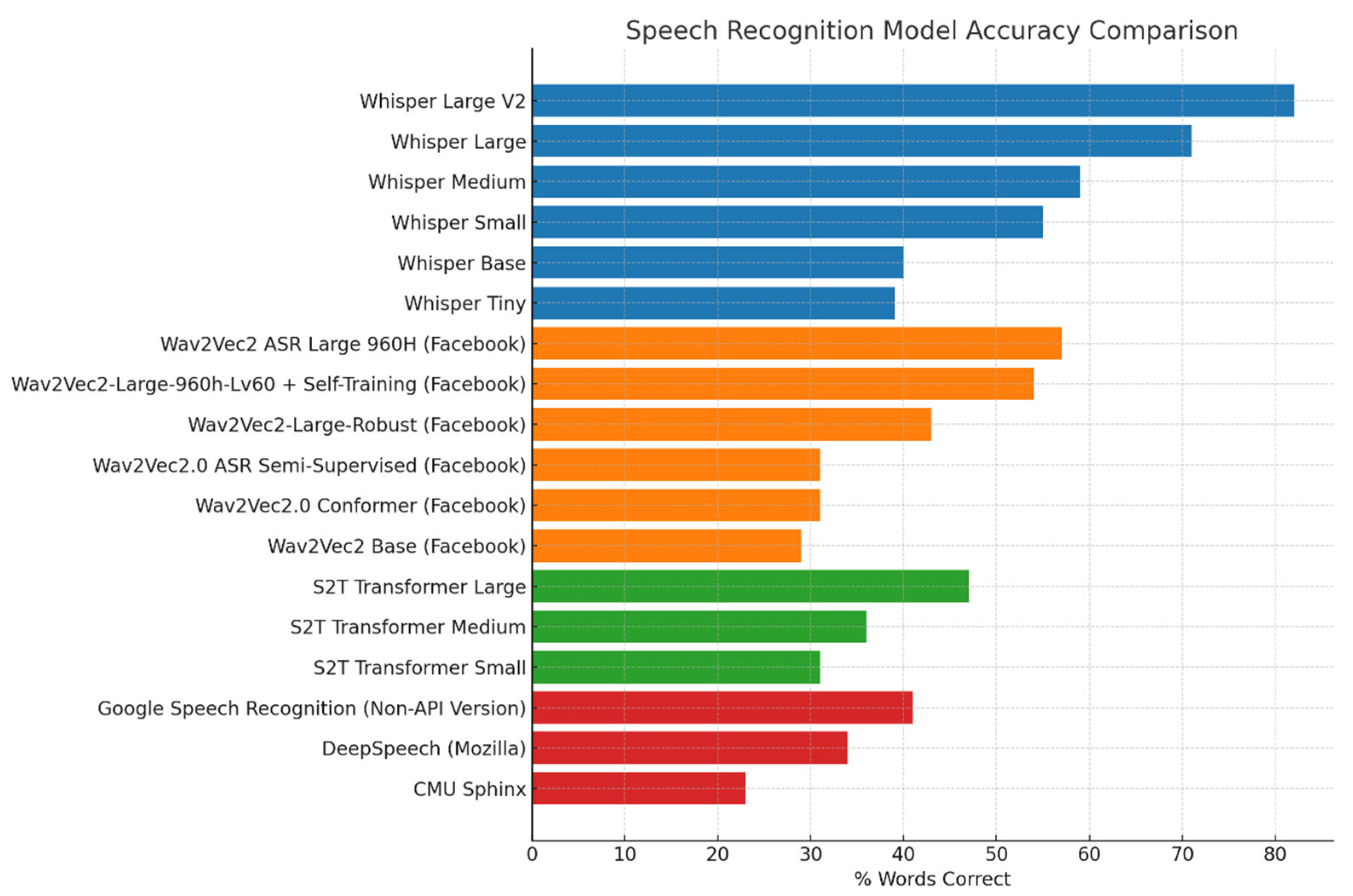
Figure 2.
Bland-Altman plots of number of correct words between AI model vs naïve listeners (difference plotted against averaged number of correct words). The solid line represents the mean difference. The area within 2 dashed lines represents the upper and lower 95% limits of agreement (LOA). Panels (A) and (B) indicate the results from children with NH (n=240 sentences) and those with HL (n=340 sentences), respectively. The x-axis in each figure represents the average number of correct words between each naïve listener and the AI model, and the y-axis represents their difference score.
Figure 2.
Bland-Altman plots of number of correct words between AI model vs naïve listeners (difference plotted against averaged number of correct words). The solid line represents the mean difference. The area within 2 dashed lines represents the upper and lower 95% limits of agreement (LOA). Panels (A) and (B) indicate the results from children with NH (n=240 sentences) and those with HL (n=340 sentences), respectively. The x-axis in each figure represents the average number of correct words between each naïve listener and the AI model, and the y-axis represents their difference score.
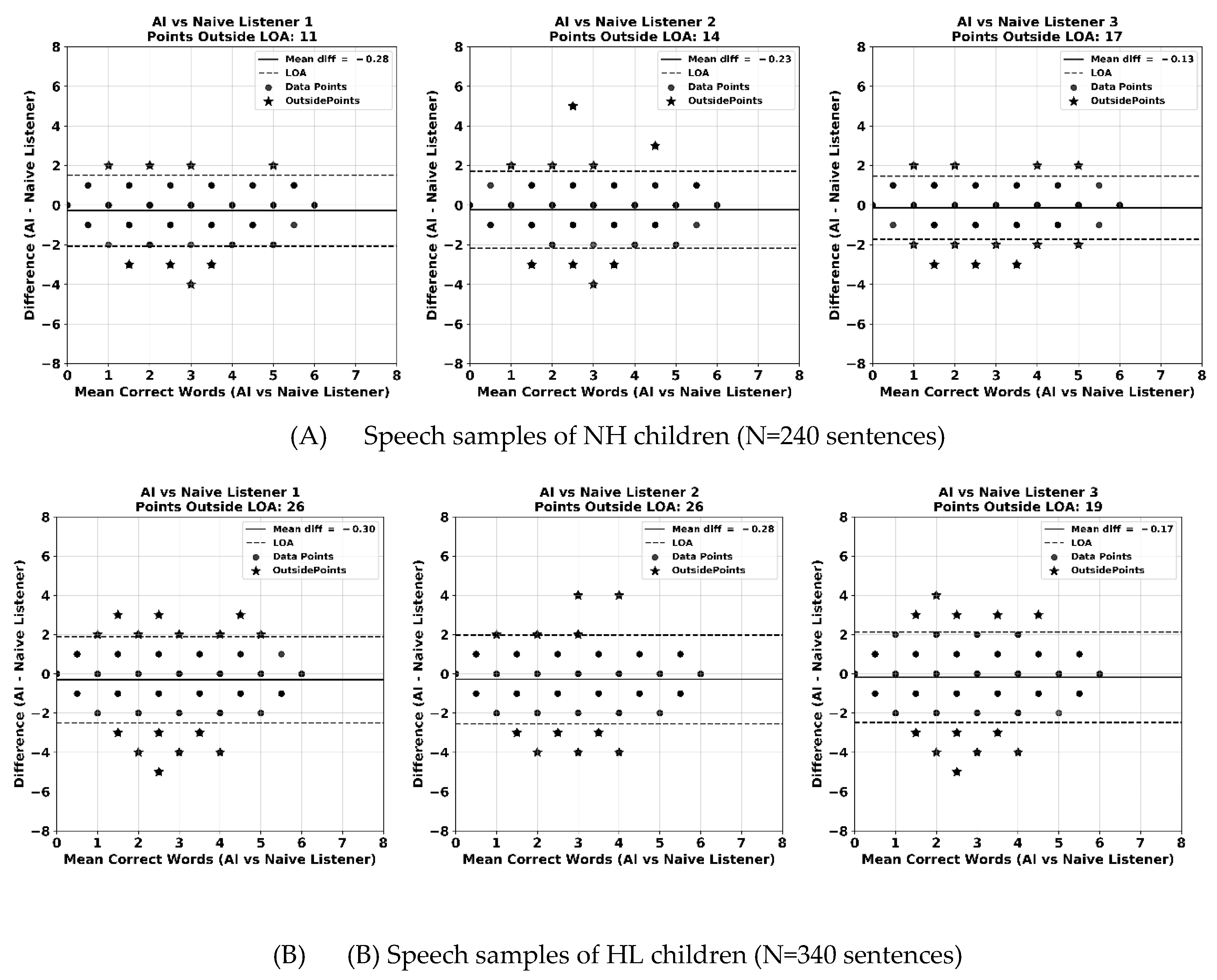
Figure 3.
Average Word Error Rate (WER) per participant across transcription methods for children with NH, CIs and HAs.
Figure 3.
Average Word Error Rate (WER) per participant across transcription methods for children with NH, CIs and HAs.
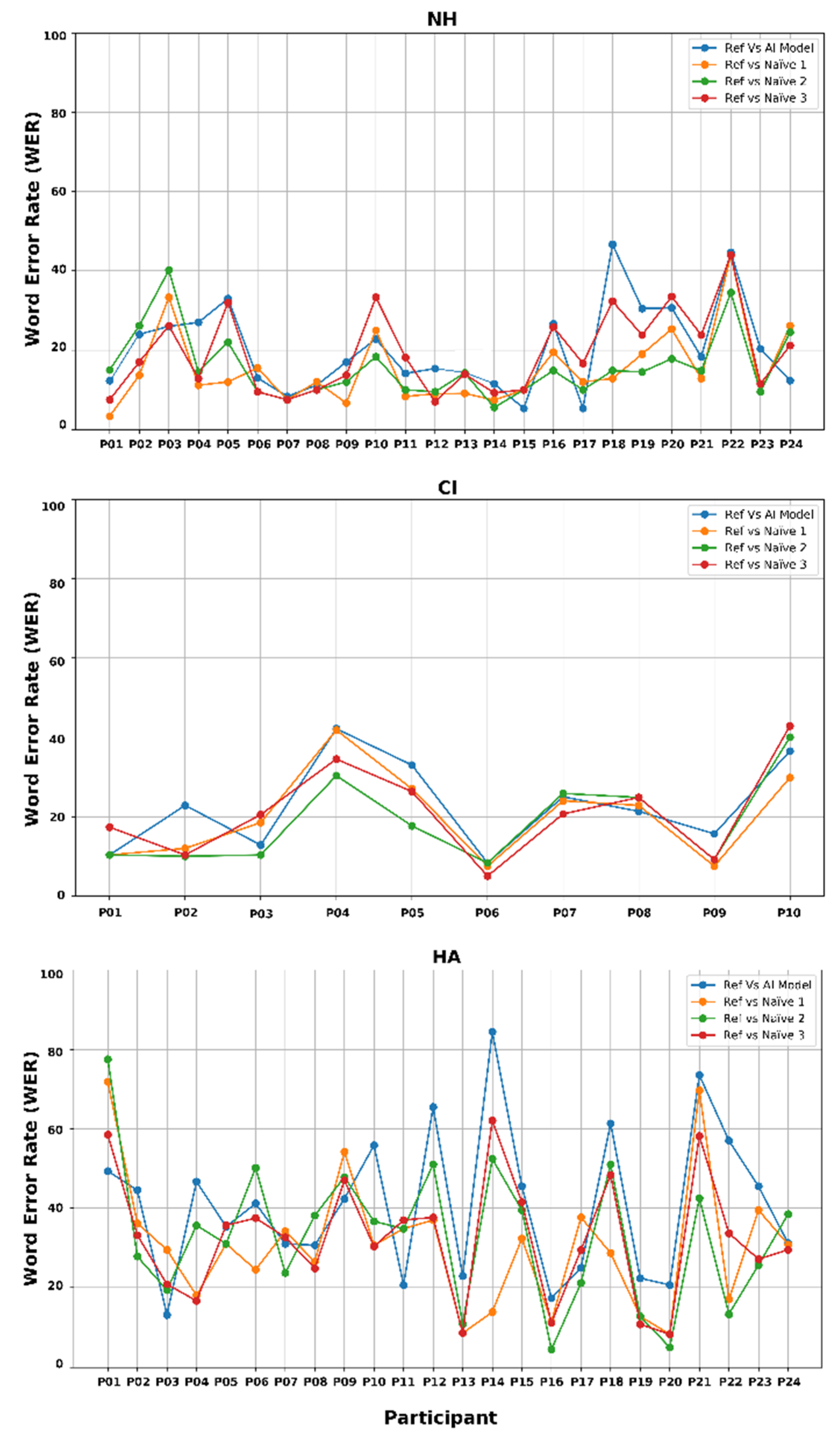

Table 1.
Demographic Information of Child Talkers.
| Characters |
Cochlear Implant (CI) (n =10) |
Hearing Aid (HA) (n = 24) |
Normal Hearing (NH) (n=24) |
| Age at BIT assessment (months), Mean (SD) | 61.4 (1.6) | 61.4 (1.4) | 61.5 (1.5) |
| Gender (Male), n (%) | 3 (30.0%) | 10 (41.7%) | 10 (41.7%) |
| Degree of hearing loss at BIT assessment (4FA HL in better ear), Mean (SD) | 109 (18.4) | 52 (15.1) | na |
| Age at hearing aids fitting, Mean (SD) | 5.3 (5.3) | 5.2 (6.0) | na |
| Age at cochlear implantation, Mean (SD) | 21.8 (16.5) | na | na |
| Nonverbal cognitive ability*, Mean (SD) | 102.2 (14.7) | 92 (13.5) | 103. 9 (15.8) |
| Language score*, Mean (SD) | 104.7 (9.7) | 110.2 (11.9) | 104.6 (9.8) |
Note*: Children’s nonverbal cognitive ability was evaluated by a research psychologist using the Wechsler Nonverbal Scale of Ability (WNV; [39]). Their expressive and receptive language skills were assessed by research speech pathologists using the Pre-school Language Scale, 4th edition (PLS-4; [40]). Both assessments were conducted within the 5- year follow-up interval of the LOCHI study [41].
Table 2.
Intraclass Correlation Coefficients (ICCs) of word-level accuracy across hearing groups for naïve listeners and AI vs human listeners’ comparisons.
Table 2.
Intraclass Correlation Coefficients (ICCs) of word-level accuracy across hearing groups for naïve listeners and AI vs human listeners’ comparisons.
| Hearing Group | Comparison | ICC value | 95% confidence interval | F (df1, df2) | p-value |
| NH group (n=240sentences) |
Within naïve listeners only | 0.95 | [0.94, 0.96] | F (239, 478) = 20.8 | < 0.001 |
| AI model vs naïve listeners | 0.96 | [0.95, 0.96] | F (239, 717) = 22.4 | ||
| HL group (CI and HA) (n=340 sentences) |
Within naïve listeners only | 0.92 | [0.90, 0.93] | F (339, 678) = 11.7 | |
| AI model vs naïve listeners | 0.93 | [0.91, 0.94] | F (339, 1017) = 13.8 | ||
| CIs group only (n=100 sentences) |
Within naïve listeners only | 0.96 | [0.94, 0.97] | F (99, 198) = 20.8 | |
| AI model vs naïve listeners | 0.96 | [0.94, 0.97] | F (99, 297) = 22.1 | ||
| HAs group only (n=240 sentences) |
Within naïve listeners only | 0.90 | [0.87, 0.92] | F (239, 478) = 9.6 | |
| AI model vs naïve listeners | 0.91 | [0.89, 0.93] | F (239, 717) = 11.6 |
Abbreviations: NH, normal hearing; HL, hearing loss; CIs, cochlear implant; HAs: hearing aids.
Disclaimer/Publisher’s Note: The statements, opinions and data contained in all publications are solely those of the individual author(s) and contributor(s) and not of MDPI and/or the editor(s). MDPI and/or the editor(s) disclaim responsibility for any injury to people or property resulting from any ideas, methods, instructions or products referred to in the content. |
© 2025 by the authors. Licensee MDPI, Basel, Switzerland. This article is an open access article distributed under the terms and conditions of the Creative Commons Attribution (CC BY) license (http://creativecommons.org/licenses/by/4.0/).
Copyright: This open access article is published under a Creative Commons CC BY 4.0 license, which permit the free download, distribution, and reuse, provided that the author and preprint are cited in any reuse.


