

Submitted:
11 November 2025
Posted:
13 November 2025
Read the latest preprint version here
Abstract
Background: Parents play a central role in shaping children’s eating behaviors. While previous research has documented associations between parental attitudes and feeding practices, fewer studies have examined how mothers’ own eating styles may contribute to their perceptions of their children’s eating attitudes and behaviors and how these may influence subsequent feeding practices. Objectives: This study tested a cross-sectional mediation model to examine whether mothers’ eating styles predicted their self-reported restrictive feeding practices indirectly through their perceptions of their children’s appetite and subsequently through their concern about their children’s weight. Methods: A total of 488 mothers (M_age = 33.87 years, SD = 4.81, range = 20–49) of children aged 2–6 years (M_age = 3.85 years, SD = 1.33) completed self-report measures, including the Dutch Eating Behavior Questionnaire (DEBQ) for maternal eating styles, the Child Feeding Questionnaire (CFQ) for parental concerns and restrictive practices, and the Children’s Eating Behaviour Questionnaire (CEBQ) for perceptions of child eating attitudes. Structural equation modeling (SEM) was employed to test the hypothesized mediation model, with model fit evaluated using CFI, TLI, RMSEA, and SRMR indices. Results: The best-fitting model showed that maternal eating styles predicted restrictive feeding practices indirectly through maternal perceptions of child appetite and concern about child weight. Specifically, mothers who reported higher emotional and external eating tendencies perceived their children as having stronger appetitive drives, which in turn predicted greater concern about child weight and more restrictive feeding practices. Conclusions: Findings suggest that maternal eating styles may bias mothers’ perceptions of their children’s appetite and influence restrictive feeding practices indirectly through increased concern about child weight. These results underscore the importance of addressing parental cognitions and maternal eating styles in interventions designed to promote healthy child feeding practices.
Keywords:
maternal eating styles
; parental feeding practices
; restrictive feeding
; child eating behavior
; obesity risk
; preschool children
1. Introduction
Childhood obesity and unhealthy eating behaviors remain pressing public health concerns globally and in Chile. According to the World Health Organization (WHO), more than 39 million children under the age of five were overweight or obese in 2020, with prevalence rates steadily increasing across both developed and developing nations [1]. Chile, in particular, ranks among the countries most affected in South America [2]. According to national monitoring data from the Junta Nacional de Auxilio Escolar y Becas (JUNAEB) [3], approximately half of Chilean children entering kindergarten are classified as overweight or obese. These alarming statistics highlight the urgent need to identify psychosocial factors contributing to early eating behaviors and weight-related outcomes.
Parental influence is among the strongest determinants of children’s dietary habits, food preferences, and weight outcomes [4]. The home food environment and parental feeding practices shape not only what children eat but also how they develop attitudes toward food and intake self-regulation [5]. Feeding strategies such as restriction, pressure to eat, and monitoring have been consistently linked with children’s eating patterns and risk of obesity [6,7]. Importantly, beyond specific feeding practices, parental attitudes and dispositions toward child feeding play a crucial role. In particular, parents who are highly concerned about their child’s weight may engage in restrictive feeding to prevent weight gain, yet such strategies can paradoxically increase children’s preference for restricted foods and reduce their ability to regulate appetite [8,9].
A growing body of research has emphasized that parents’ own eating behaviors and psychological tendencies are integral to understanding how they approach child feeding [10,11]. Maternal eating styles—specifically restrained, emotional, and external eating—have been conceptualized as dispositional tendencies that influence how mothers perceive and respond to food-related cues [12,13]. Mothers high in restrained eating may be particularly vigilant about their children’s food intake, while those high in emotional or external eating may misinterpret children’s hunger or satiety cues [14,15]. Such tendencies shape maternal subsequent feeding practices [16,17].
Another key factor in this dynamic is how mothers perceive their children’s eating attitudes and appetitive traits. The Children’s Eating Behaviour Questionnaire (CEBQ) [18] captures parental perceptions of traits such as food responsiveness, enjoyment of food, and satiety responsiveness. These perceptions may or may not reflect children’s actual eating behaviors but stands to reason they likely guide how parents monitor and regulate their children’s feeding. For instance, perceiving a child as highly food responsive (i.e., having a strong drive to eat) may prompt greater use of restrictive feeding practices [17].
Although previous research has examined components of the pathway linking parental and child eating-related variables, few studies have tested comprehensive models integrating maternal eating styles, perceptions of children’s appetitive traits, concern about child weight, and restrictive feeding. For example, Rodgers et al. [16] found that specific maternal feeding practices—particularly instrumental and emotional feeding—predicted subsequent increases in children’s obesogenic eating behaviors and BMI, while maternal monitoring was associated with decreases in food-approach behaviors. However, they did not consider how mothers’ own eating styles might shape their perceptions of children’s appetitive traits or their restrictive feeding. In contrast, Pickard et al. [17] demonstrated that parents’ own eating profiles were directly linked to their children’s latent eating profiles, with these associations mediated by feeding practices such as using food for emotional regulation and maintaining a healthy food environment. Yet, this study did not incorporate parents’ perceptions of children’s appetitive traits or weight-related concerns. Complementary evidence from Haycraft and Blissett [15] showed that higher parental BMI was associated with more controlling feeding, suggesting that parents’ own weight and eating tendencies influence mealtime control. Finally, Russell et al. [17] provided longitudinal evidence that parental restriction and pressure predicted greater food responsiveness and lower satiety responsiveness in children—and that children’s eating traits, in turn, evoked more parental restriction—highlighting reciprocal dynamics but not the motivational roles of parental concern or perception.
Taken together, these studies show that maternal eating styles, perceptions of children’s appetitive traits, and concerns about child weight each contribute to parental feeding practices. However, existing work has examined these links in isolation or within partial models, leaving untested an integrated, sequential model connecting maternal eating styles, perceptions, concern, and restrictive feeding. Addressing this gap is particularly relevant in the preschool years (ages 2–6), when children are highly dependent on caregivers for food provision and when foundational self-regulation patterns in eating are established.
Study Objectives and Hypotheses
The present study aimed to test a structural equation model examining whether maternal eating styles predict restrictive feeding practices indirectly through mothers’ perceptions of their children’s appetite and their concern about child weight. Based on previous findings, we hypothesized that:
1. Higher levels of maternal restrained, emotional, and external eating would predict higher perceived child drive to eat (CEBQ-derived latent factor).
2. Greater perceived child drive would predict higher maternal concern about child weight.
3. Both perceived child drive and maternal concern would, in turn, predict more restrictive feeding practices.
4. The relationship between maternal eating styles and restrictive feeding would be primarily indirect, operating sequentially through perceived child drive and maternal concern.
2. Materials and Methods
2.1. Participants
Participants were 488 mothers of children aged 2 to 7 years. Mothers’ mean age was 33.87 years (SD = 4.81; range = 20–49), and their mean body mass index (BMI) was 26.95 kg/m2 (SD = 5.52; range = 15.92–52.07), placing the sample, on average, in the overweight category according to World Health Organization (WHO) criteria. Mothers reported an average of 1.81 children (SD = 0.95; range = 1.72–7.47). Children’s mean age was 3.85 years (SD = 1.33).
2.2. Procedure
Participants were recruited online via targeted advertisements and posts on social media platforms (e.g., Facebook, Instagram) directed to Chilean parenting communities. Eligibility criteria required participants to be mothers of at least one child aged 2–7 years and to be primarily responsible for feeding that child. After providing electronic informed consent, mothers completed a self-administered questionnaire hosted on a secure online platform. To encourage participation, respondents were entered into a raffle for one of 30 gift cards valued at 45,000 Chilean pesos (CLP), about 45 US dollars.
2.3. Ethics
The study was conducted in accordance with the Declaration of Helsinki and was approved by the Ethics Committee of the School of Psychology, Universidad Adolfo Ibáñez. All participants provided informed consent prior to participation.
2.4. Measures
Maternal Eating Styles. The Dutch Eating Behavior Questionnaire (DEBQ) [12] was used to assess three maternal eating style dimensions: Restrained Eating (Restr_E; 10 items; e.g., “Do you deliberately eat less in order not to become heavier?”; α = .86), Emotional Eating (Em_E; 13 items; e.g., “Do you have a desire to eat when you are irritated?”; α = .93), and External Eating (Ext_E; 10 items; e.g., “If food smells and looks good, do you eat more than usual?”; α = .84). Responses were rated on a 5-point Likert scale (1 = “never” to 5 = “very often”). These subscales demonstrated strong internal consistency and factorial validity in Chilean and Latin American samples. In this study, the three subscale scores were used as indicators of the latent construct Maternal Eating Styles (M_ED_x).
Child Feeding Attitudes and Practices. The Child Feeding Questionnaire (CFQ) [6,7] was employed to assess mothers’ perceptions of child weight, concerns about child weight, and feeding-related practices. Four subscales were used: Concern about Child Weight (Cn_cw; 3 items; e.g., “How concerned are you about your child eating too much when you are not around?”; α = .79), Restriction (Restrict; 8 items; e.g., “I intentionally keep some foods out of my child’s reach”; α = .82), Monitoring (Monit; 3 items; e.g., “How much do you keep track of the high-fat foods your child eats?”; α = .75); and Prohibition (Prohib; 3 items; e.g., “I forbid my child from eating certain foods”; α = .77). In the SEM, Maternal Worry (M_worry) was defined by the Concern items, and Maternal Restriction (M_Restricc) was defined by the Restriction, Monitoring, and Prohibition global scores.
Perceived Child Eating Attitudes. The Children’s Eating Behaviour Questionnaire (CEBQ) [18] assesses parental perceptions of children’s appetitive traits across eight subscales. The present study focused on the food pro-ingestive dimension, which integrates the subscales Food Responsiveness (F_Resp; 5 items; e.g., “My child is always asking for food”; α = .84), Emotional Overeating (Em_Eat; 4 items; e.g., “My child eats more when worried”; α = .76), and Enjoyment of Food (Enjoy_F; 4 items; e.g., “My child loves food”; α = .88). Responses were given on a 5-point Likert scale (1 = “never” to 5 = “always”). These subscales jointly defined the latent variable Child Drive (Ch_drive), representing maternal perceptions of children’s appetite and motivation to eat.
All measures were validated Spanish-language versions with strong psychometric properties and demonstrated reliability in Chilean and Latin American populations.
2.5. Data Analysis
Structural equation modeling (SEM) analyses were conducted in R using the lavaan package [20]. Models were estimated using maximum likelihood with robust standard errors (MLR), which provides Huber–White robust SEs and a Satorra–Bentler (SB)–scaled χ2 test of model fit [21]. Model adequacy was evaluated using robust comparative fit indices (CFI, TLI), the robust RMSEA with 90% confidence intervals, and the SRMR. AIC and BIC were examined for model parsimony.
Four latent variables were specified:
- Maternal eating styles (M_ED_x): DEBQ Restrained, Emotional, and External eating total factor scores.
- Child drive (Ch_drive): CEBQ Food Responsiveness, Enjoyment of Food, and Emotional Overeating total factor scores
- Maternal worry (M_worry): The three CFQ concern-factor items.
- Maternal restriction (M_Restricc): CFQ Restriction composite, Monitoring, and Prohibition factor-total scores.
Two nested models were tested:
Full model: Included direct paths from maternal eating styles to child drive, maternal worry, and maternal restriction, as well as indirect paths through the mediators (Figure 1).
Reduced model: Identical measurement structure but omitting nonsignificant direct paths from maternal eating styles to maternal worry and restriction. Indirect and total effects (e.g., a1c3 and a1b3c4) were computed within lavaan using labeled parameters and tested for significance with the delta method under MLR. Model comparison used the SB-scaled χ2 difference test (lavTestLRT) and inspection of robust fit indices and AIC/BIC values.
3. Results
Model Fit
The reduced model provided a good to excellent fit to the data, χ2(50) = 163.60, p < .001, CFI = .94, TLI = .92, RMSEA = .07, SRMR = .06 [22]. Model comparison indicated that removing the two nonsignificant direct paths (M_ED_x → M_worry_over, M_ED_x → M_Restricc) did not degrade fit, Δχ2(2) = 1.07, p = .59, and slightly improved AIC (29,711 vs. 29,714) and BIC (29,829 vs. 29,840). See Table 1 for complete fit indices.
Structural Paths Standardized path coefficients for the reduced model are shown in Table 2. Maternal eating styles significantly predicted greater child drive (β = .44, p < .001). In turn, child drive predicted both higher maternal worry (β = .39, p < .001) and higher maternal restriction (β = .28, p < .001). Maternal worry also strongly predicted restriction (β = .65, p < .001). Indirect effects indicated two significant mediated pathways linking maternal eating styles to maternal restriction: (a) through child drive (β = .12, p < .001) and (b) sequentially through child drive → maternal worry (β = .11, p < .001). The combined indirect effect was significant (β = .23, p < .001). The total effect of maternal eating styles on restriction remained significant (β = .17, p = .008), even though direct effects were nonsignificant.
4. Discussion
This study tested an integrative model linking maternal eating styles to restrictive feeding practices through mothers’ perceptions of their children’s appetitive traits and concern about child weight in a Chilean sample. Structural equation modeling revealed that maternal restrained, emotional, and external eating were indirectly associated with restrictive feeding via child drive and maternal worry, whereas direct effects were nonsignificant. These findings highlight the role of maternal perceptions and cognitions as mechanisms through which parental traits shape feeding control.
4.1. Interpretation and Theoretical Implications
Consistent with our hypotheses, mothers who reported greater restrained, emotional, or external eating perceived their children as having stronger pro-ingestive drives (e.g., food responsiveness, enjoyment of food, and emotional overeating). This association supports the idea that parents’ own eating tendencies color their perceptions of their children’s appetite cues, a pattern previously observed by Temmen et al. [24]. Both studies suggest that maternal eating tendencies, whether emotional or externally driven, influence how parents interpret and respond to their children’s hunger and satiety signals—often amplifying perceived risk of overeating. These biases likely arise through modeling or projection, whereby parents’ own preoccupations with food and weight heighten their sensitivity to, or misinterpretation of, children’s interest in food [15].
Perceived child drive, in turn, predicted both heightened maternal concern about weight and greater restrictive feeding, consistent with prior evidence that parental perceptions of high appetite or weight risk trigger controlling feeding practices [8]. The strong association between maternal concern and restriction underscores the proximal role of worry about child weight gain in eliciting restrictive control. Collectively, these patterns align with cognitive-behavioral models proposing that parental cognitions—such as perceived appetite risk and weight concern—mediate the link between parental eating tendencies and feeding practices [18]. The absence of a direct path from maternal eating styles to restriction further suggests that interventions should target perceptual and cognitive processes rather than focusing exclusively on behavioral regulation of feeding
4.2. Relation to Previous Research
Previous studies have examined individual components of this pathway but rarely within a single integrated framework. For example, parents’ perceptions of their children’s weight, rather than actual BMI, has been found to predict restrictive and pressuring practices [9]. Similarly, parents’ concern about weight and diet quality appears to predict their use of controlling strategies, particularly among overweight children [8]. Studies of parental eating patterns also support indirect influences: Temmen et al. [24] showed that maternal emotional and external eating predicted greater “feeding to soothe” during infancy, which in turn increased infant food responsiveness. Likewise, Singh et al. [23] reported that maternal restrained eating was associated with more pressure feeding, while emotional and external eating interacted with child weight to predict contradictory concerns about under- or overeating. These findings, together with those from Pickard et al. [19], who identified parallel parent–child eating profiles mediated by feeding practices, converge to suggest that parental eating styles influence feeding behavior indirectly through perceptions and cognitions.
The present study advances this literature by modeling both perceptual (child drive) and cognitive (weight concern) mediators simultaneously and by confirming their sequential contribution to restrictive feeding. This approach integrates prior variable-centered and person-centered findings into a single, theoretically coherent framework, extending transactional models of feeding and appetite regulation [16].
4.3. Practical and Clinical Implications
The findings have important implications for family-based interventions. Efforts to promote adaptive feeding practices should focus not only on observable behaviors but also on the parental cognitions that drive them. Helping parents recognize normal variability in children’s appetite and avoid pathologizing robust eating could reduce unnecessary restriction and meal-related tension. Psychoeducational programs might also address maternal emotional and external eating patterns that amplify weight-related worry, incorporating cognitive-behavioral or mindfulness-based strategies to recalibrate parents’ interpretations of children’s eating behavior. By targeting perceptual accuracy and emotional regulation, such interventions could disrupt a self-reinforcing loop linking maternal anxiety, child feeding control, and children’s subsequent risk of dysregulated eating.
4.4. Strengths, Limitations, and Future Directions
This study contributes novel evidence from a large, non-WEIRD Latin American sample, addressing calls to diversify the populations represented in behavioral research [25,26]. Additional strengths include validated Spanish-language measures and a theoretically grounded SEM model that captures the sequential interplay among eating styles, perceptions, concern, and restriction. However, limitations include the cross-sectional design, which precludes causal inference, and reliance on self-report data, which may introduce shared-method bias. Recruitment via online platforms may also limit generalizability to less connected populations or fathers.
Future research should employ longitudinal and observational methods to clarify temporal ordering and bidirectionality between child appetitive traits and parental feeding. Incorporating fathers and multiple caregivers would further illuminate gender and contextual differences in these dynamics.
4.5. Summary
In summary, the findings support a model in which maternal eating styles shape restrictive feeding indirectly through their influence on perceptions of children’s appetite and weight-related concern. Mothers exhibiting higher restrained, emotional, or external eating are more likely to view their children as food-driven, to worry about potential weight gain, and to impose restrictive control. Addressing these perceptual and cognitive mechanisms may be key to developing interventions that foster more balanced, responsive feeding dynamics and healthier eating development during early childhood.
Author Contributions
Conceptualization, [C.U.P., C.C.M. and C.O.M.]; methodology, [C.U.P. C.C.M., C.O.M. and A.C.B ]; formal analysis, [C.U.P. and A.C.B]; investigation, [C.U.P., C.C.M., C.O.M., F.D.C. and A.C.B.]; resources, [C.U.P., and C.C.M.]; writing—original draft preparation, [C.U.P. and A.C.B.]; writing—review and editing, [C.U.P., C.C.M., C.O.M., A.Q.B. and A.C.B.]; visualization; supervision; project administration, [C.U.P., C.C.M. and F.D.C.]; funding acquisition, [C.U.P. and C.C.M.]. All authors have read and agreed to the published version of the manuscript.
Funding Placeholder
This research was funded by internal research grants from Universidad Adolfo Ibáñez (PAI 2022).
Institutional Review Board Statement Placeholder
The study was conducted according to the guidelines of the Declaration of Helsinki and approved by the Institutional Review Board of Universidad Adolfo Ibáñez, protocol code 44/2022 (September 26).
Informed Consent Statement
Informed consent was obtained from all subjects involved in the study.
Data Availability Statement Placeholder
Data are available upon reasonable request from the corresponding author.
Conflicts of Interest
The authors declare no conflict of interest.
References
- World Health Organization (WHO). Obesity and overweight: Key facts. 2020. Available online: https://www.who.int/news-room/fact-sheets/detail/obesity-and-overweight (accessed on [insert access date]).
- Organization for Economic Co-operation and Development (OECD). Obesity Update 2021; OECD Publishing: Paris, France, 2021; Available online: https://www.oecd.org (accessed on [insert access date]).
- Junta Nacional de Auxilio Escolar y Becas (JUNAEB). Mapa Nutricional 2021; Gobierno de Chile: Santiago, Chile, 2021; Available online: https://www.junaeb.cl (accessed on [insert access date]).
- DeCosta, P.; Møller, P.; Frøst, M.B.; Olsen, A. Changing children’s eating behaviour—A review of experimental research. Appetite 2017, 113, 327–357. [Google Scholar] [CrossRef]
- Musher-Eizenman, D.R.; Goodman, L.; Roberts, L.; Marx, J.; Taylor, M.; Hoffmann, D. An examination of food parenting practices: Structure, control and autonomy promotion. Public Health Nutr. 2019, 22, 814–826. [Google Scholar] [CrossRef]
- Birch, L.L.; Fisher, J.O.; Grimm-Thomas, K.; Markey, C.N.; Sawyer, R.; Johnson, S.L. Confirmatory factor analysis of the Child Feeding Questionnaire: A measure of parental attitudes, beliefs and practices about child feeding and obesity proneness. Appetite 2001, 36, 201–210. [Google Scholar] [CrossRef]
- Navarro, G.; Reyes, I. Validación psicométrica de la adaptación mexicana del Child Feeding Questionnaire. Acta Investig. Psicol. 2016, 6, 2337–2349. [Google Scholar] [CrossRef]
- Gomes, A.I.; Barros, L.; Pereira, A.I. Predictors of parental concerns about child weight in parents of healthy-weight and overweight 2–6-year-olds. Appetite 2017, 108, 491–497. [Google Scholar] [CrossRef] [PubMed]
- Lydecker, J.A.; Grilo, C.M. The apple of their eye: Attitudinal and behavioral correlates of parents’ perceptions of child obesity. Obesity (Silver Spring) 2016, 24, 1124–1131. [Google Scholar] [CrossRef]
- Devonport, T.J.; Nicholls, W.; Fullerton, C. A systematic review of the association between emotions and eating behaviour in normal and overweight adult populations. J. Health Psychol. 2019, 24, 3–24. [Google Scholar] [CrossRef]
- Opichka, K.; Smith, C.; Levine, A.S. Problematic eating behaviors are more prevalent in African American women who are overweight or obese than those who are lean or normal weight. Fam. Community Health 2019, 42, 81–89. [Google Scholar] [CrossRef]
- Andrés, A.; Oda-Montecinos, C.; Saldaña, C. Eating behaviors in a male and female community sample: Psychometric properties of the DEBQ. Terapia Psicol. 2017, 35, 141–152. [Google Scholar] [CrossRef]
- Hummel, G.; Ehret, J.; Zerweck, I.; Winter, S.S.; Stroebele-Benschop, N. How eating behavior, food stimuli and gender may affect visual attention: An eye-tracking study. Eat. Behav. 2018, 31, 60–67. [Google Scholar] [CrossRef] [PubMed]
- Mallan, K.M.; Sullivan, S.E.; de Jersey, S.J.; Daniels, L.A. The relationship between maternal feeding beliefs and practices and perceptions of infant eating behaviours at 4 months. Appetite 2016, 105, 1–7. [Google Scholar] [CrossRef] [PubMed]
- Haycraft, E.; Blissett, J. Maternal and paternal controlling feeding practices: Reliability and relationships with BMI. Obesity 2008, 16, 1552–1558. [Google Scholar] [CrossRef] [PubMed]
- Rodgers, R.F.; Paxton, S.J.; Massey, R.; Campbell, K.J.; Wertheim, E.H.; Skouteris, H.; Gibbons, K. Maternal feeding practices predict weight gain and obesogenic eating behaviors in young children: A prospective study. Int. J. Behav. Nutr. Phys. Act. 2013, 10, 24. [Google Scholar] [CrossRef]
- Russell, C.G.; Haszard, J.J.; Taylor, R.W.; Heath, A.-L.M.; Campbell, K.J. Parental feeding practices associated with child eating and weight: What are parents doing? Appetite 2018, 128, 76–84. [Google Scholar] [CrossRef]
- González, A.; Santos, J.L. Adaptación y aplicación del cuestionario de conducta de alimentación infantil (CEBQ). In Fundamentos de Nutrición y Dietética: Bases Metodológicas y Aplicaciones; Martínez, A., Navas-Carretero, S., Eds.; Editorial Médica Panamericana: Madrid, Spain, 2011; pp. 339–344. [Google Scholar]
- Pickard, A.; Farrow, C.; Haycraft, E.; Herle, M.; Edwards, K.; Llewellyn, C.; Croker, H.; Blissett, J. Associations between parent and child latent eating profiles and the role of parental feeding practices. Appetite 2024, 201, 107589. [Google Scholar] [CrossRef]
- Rosseel, Y. lavaan: An R Package for Structural Equation Modeling. J. Stat. Softw. 2012, 48, 1–36. [Google Scholar] [CrossRef]
- Satorra, A.; Bentler, P.M. A scaled difference chi-square test statistic for moment structure analysis. Psychometrika 2001, 66, 507–514. [Google Scholar] [CrossRef]
- Hu, L.; Bentler, P.M. Cutoff criteria for fit indexes in covariance structure analysis: Conventional criteria versus new alternatives. Struct. Equ. Model. 1999, 6, 1–55. [Google Scholar] [CrossRef]
- Singh, S.; Cordeiro, A.; Epel, E.; Coccia, M.; Laraia, B.; Adler, N.; Arbusto, N.R. Association between maternal eating and young child feeding in a community sample. BMC Pregnancy Childbirth 2023, 23, 470. [Google Scholar] [CrossRef]
- Temmen, C.D.; Lipsky, L.M.; Faith, M.S.; Nansel, T.R. Prospective relations between maternal emotional eating, feeding to soothe, and infant appetitive behaviors. Int. J. Behav. Nutr. Phys. Act. 2021, 18, 105. [Google Scholar] [CrossRef]
- Henrich, J.; Heine, S.J.; Norenzayan, A. The weirdest people in the world? Behav. Brain Sci. 2010, 33, 61–83. [Google Scholar] [CrossRef] [PubMed]
- Muthukrishna, M.; Doebeli, M.; Chudek, M.; Henrich, J. Beyond Western, educated, industrialized, rich, and democratic (WEIRD) psychology: Measuring and mapping scales of cultural and psychological variation. Psychol. Bull. 2020, 146, 855–885. [Google Scholar] [CrossRef]
Figure 1.
Full SEM model.
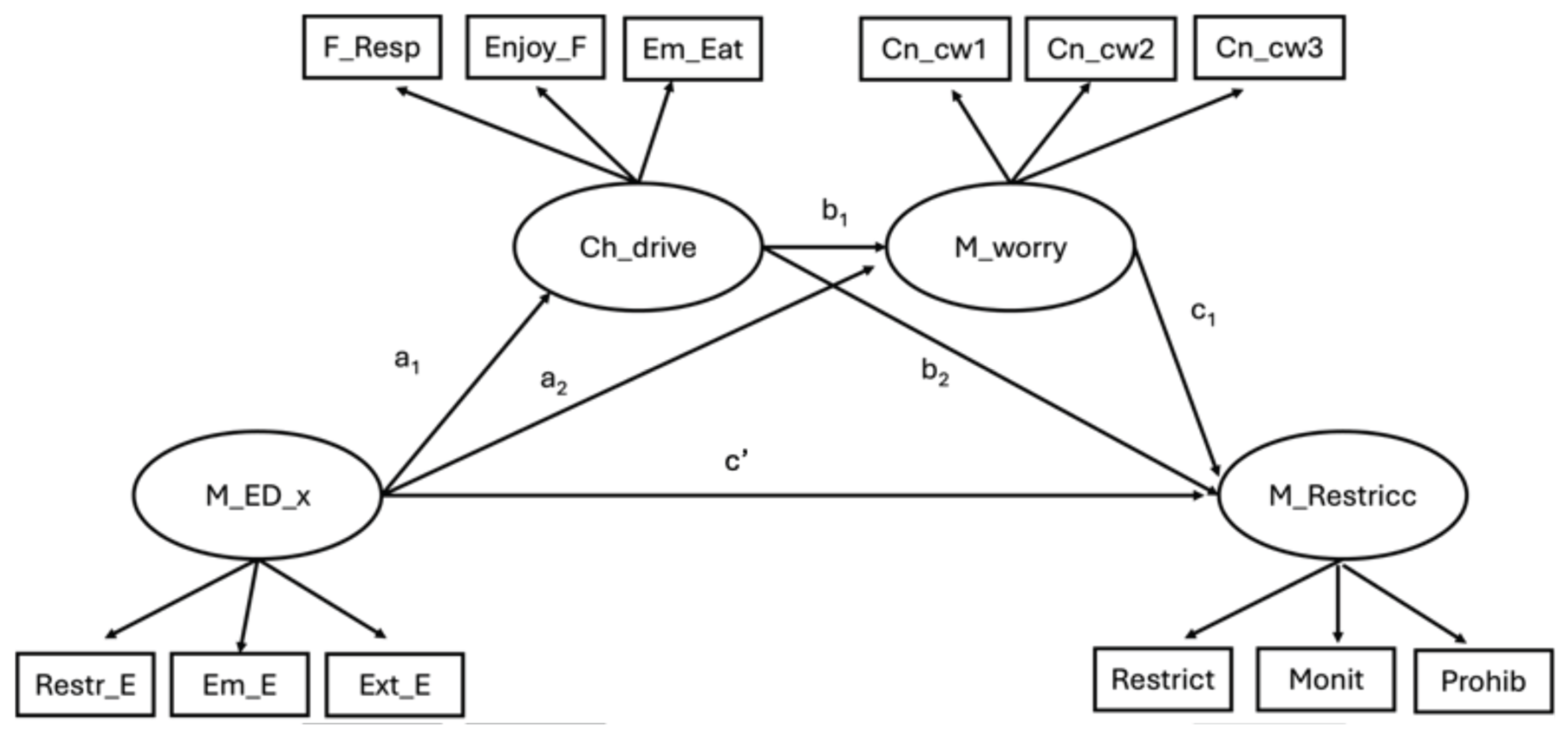

Table 1.
Fit indices for full and reduced structural equation models.
| Model | χ2(df) | R-CFI | R-TLI | R-RMSEA [90% CI] | SRMR | AIC | BIC |
| Full | 162.34 (48)*** | .94 | .91 | .069 [.057, .081] | .056 | 29,714 | 29,840 |
| Reduced | 163.60 (50)*** | .94 | .92 | .067 [.055, .079] | .055 | 29,710 | 29,829 |
Note. R-CFI = Robust Comparative Fit Index; R-TLI = Robust Tucker–Lewis Index; R-RMSEA = Robust Root Mean Square Error of Approximation; SRMR = Standardized Root Mean Square Residual; CI = confidence interval. ***p < .001. 3.2.
Table 2.
Standardized path coefficients for the reduced structural equation model.
| Path | β | SE | z | p |
| Direct effects | ||||
| M_ED_x → Ch_drive (a1) | .44 | .13 | 5.37 | < .001 |
| Ch_drive → M_worry (b1) | .39 | .02 | 6.06 | < .001 |
| Ch_drive → M_Restricc (b2) | .28 | .05 | 4.91 | < .001 |
| M_worry → M_Restricc (c1) | .65 | .21 | 12.89 | < .001 |
| Indirect effects | ||||
| M_ED_x → M_Restricc via Ch_drive (a1*b2) | .12 | .05 | 3.77 | < .001 |
| M_ED_x → M_Restricc via Ch_drive → M_worry (a1*b1*c1) | .11 | .04 | 3.73 | < .001 |
| Total indirect effect (sum of the above) | .23 | .08 | 4.16 | < .001 |
| Total effect: M_ED_x → M_Restricc without mediators (c) |
.17 |
.09 |
2.66 |
.008 |
Note. Standardized coefficients (β) are reported. All effects are based on the reduced model in which nonsignificant direct paths (from maternal eating styles to maternal worry and restriction) were omitted.
Disclaimer/Publisher’s Note: The statements, opinions and data contained in all publications are solely those of the individual author(s) and contributor(s) and not of MDPI and/or the editor(s). MDPI and/or the editor(s) disclaim responsibility for any injury to people or property resulting from any ideas, methods, instructions or products referred to in the content. |
© 2025 by the authors. Licensee MDPI, Basel, Switzerland. This article is an open access article distributed under the terms and conditions of the Creative Commons Attribution (CC BY) license (http://creativecommons.org/licenses/by/4.0/).
Copyright: This open access article is published under a Creative Commons CC BY 4.0 license, which permit the free download, distribution, and reuse, provided that the author and preprint are cited in any reuse.


