

Submitted:
08 November 2025
Posted:
10 November 2025
You are already at the latest version
Abstract
Chiral magnetic orderings in itinerant magnets have recently attracted considerable attention as a source of emergent electromagnetic phenomena such as topological Hall effects and magnetoelectric couplings. In this study, we investigate emergent multipole degrees of freedom arising from chiral magnetic orderings on a two-dimensional triangular lattice. Focusing on a four-sublattice spin configuration characterized by noncoplanar spin textures, we demonstrate that various types of multipoles, such as magnetic dipoles and electric toroidal dipoles, naturally emerge even in the absence of relativistic spin–orbit coupling. By employing a microscopic tight-binding model, we classify the resulting multipole moments and clarify their relationships to the underlying chiral spin texture. We further explore how spin–orbit coupling modifies these multipole characters, leading to additional uniform responses. The results provide a unified framework connecting noncollinear magnetic orderings and emergent multipole phenomena, offering insights into unconventional cross-correlation phenomena in itinerant chiral magnets.
Keywords:
chiral spin ordering
; Berry curvature
; multipole moment
; multiple-Q states
; density waves
; triangular lattice
1. Introduction
Chiral magnetic orderings have become a central topic in modern condensed matter physics owing to their capability to host emergent electromagnetic phenomena [1,2,3,4,5,6,7] and nonlinear nonreciprocal transport [8,9,10,11,12]. In particular, the interplay between geometrical frustration and itinerant magnetism on two/three-dimensional lattices has revealed a rich variety of noncoplanar spin textures with scalar spin chirality [13,14,15,16]. Among them, four-sublattice chiral orderings, in which spins form a noncoplanar arrangement within the magnetic unit cell, have been widely studied as prototypical examples of spin configurations giving rise to finite Berry curvature and nontrivial topological transport [17,18,19,20]. These chiral states are generally characterized as multiple-Q magnetic orderings, where several spin modulation vectors coherently superpose to produce a periodic noncoplanar spin texture [21,22,23,24]. Such states with short-range magnetic periods can appear in triangular [17,18,25,26,27,28], kagome [29,30], and face-centered-cubic lattices [31,32], stabilized by competing exchange interactions, multi-spin interactions, and Fermi surface nesting [33,34,35].
Previous studies have shown that such four-sublattice spin textures can carry a finite Chern number in the electronic band structure, leading to the topological Hall effect in the absence of spin–orbit coupling [17,18]. This emergent Hall response originates from the real-space Berry curvature associated with the scalar spin chirality, which acts as an effective magnetic field for itinerant electrons [36,37,38,39,40]. Consequently, the four-sublattice chiral order provides a minimal platform to study topological transport without relying on relativistic effects. Moreover, this type of spin arrangement is closely related to magnetic skyrmions [41,42,43], since both share the same topological invariant and can be viewed as periodic arrays of local noncoplanar spin configurations. Experimental realizations of skyrmion crystals in a variety of materials under distinct lattice structures have further motivated theoretical investigations of such multiple-Q chiral states on frustrated lattices. Indeed, the skyrmion crystals have been identified not only in noncentrosymmetric magnetic compounds like MnSi [44,45,46,47,48,49,50,51], other B20-type compounds [52,53,54,55,56,57,58,59,60,61,62,63,64,65], and polar compounds [66,67,68,69,70] but also in centrosymmetric compounds like Gd2PdSi3 [71,72,73,74,75,76] and Gd3Ru4Al12 [77,78,79,80].
Beyond their topological transport properties, chiral magnetic structures are also of great interest from the viewpoint of emergent multipole degrees of freedom [81,82,83,84,85]. In systems with complicated spin orderings, the spatial distribution of spin and orbital moments can be expressed in terms of multipoles that capture the symmetry and cross-correlation responses of the state [86]. Recent theoretical works have extended the concept of multipoles to include magnetic toroidal and electric toroidal multipoles [85], which account for various unconventional physical quantities like ferroaxial moments [87]. Such a multipole description provides a unified way to understand a variety of cross-correlation effects, including the anomalous Hall effect, the magnetoelectric effect, and the nonreciprocal transport phenomena.
In itinerant magnets, the emergence of multipoles is intimately related to momentum-dependent spin textures. In particular, noncollinear and noncoplanar spin configurations give rise to distinct multipole degrees of freedom that serve as microscopic sources of various cross-correlation physical phenomena. For instance, noncollinear spin textures characterized by vector spin chirality can induce electric dipole moments, leading to antisymmetric spin splitting in the electronic band structure [88,89,90], resulting electric polarization [91,92,93,94,95] and spin Hall effect [96,97,98,99,100]. Meanwhile, noncoplanar spin textures characterized by scalar spin chirality generate magnetic dipoles responsible for the anomalous Hall effect [1,31], as well as magnetic toroidal dipoles responsible for nonreciprocal transport [8,9,10,11,12]. The four-sublattice chiral state on a triangular lattice provides an ideal platform to elucidate how such multipole moments emerge and interplay, since its inherently noncoplanar spin configuration breaks time-reversal symmetry even in the absence of relativistic spin–orbit coupling.
In this study, we theoretically investigate the emergent multipole degrees of freedom associated with a four-sublattice chiral magnetic structure on a two-dimensional triangular lattice. Using a microscopic tight-binding model, we analyze the resulting orbital and spin-dependent multipole moments, such as magnetic dipoles, anisotropic magnetic dipoles, electric monopoles, and electric toroidal dipoles. We show that the noncoplanar spin arrangement induces these multipoles even in the absence of spin–orbit coupling, reflecting the complicated spin texture. Furthermore, when spin–orbit coupling is introduced, uniform components of multipole moments additionally appear, leading to new cross-correlation responses that bridge chiral magnetism and multipole physics. Our findings provide a relationship among chiral spin order, cross-correlation effect, and multipole physics, offering fundamental insight into emergent physical phenomena in frustrated itinerant magnets.
The rest of this paper is organized as follows. Section 2 formulates the s–p orbital tight-binding model on a two-dimensional triangular lattice. We also introduce triple-Q chiral spin textures corresponding to the four-sublattice noncoplanar magnetic ordering. Section presents the results obtained without relativistic spin–orbit coupling, where the emergence of orbital magnetic dipoles, spin and anisotropic magnetic dipoles, spin-dependent electric monopoles, and electric toroidal dipoles are analyzed in both real and momentum spaces. The effective spin–orbit interaction and the resulting ferroaxial moment are also discussed. Section examines the effects of introducing spin–orbit coupling on these multipoles and demonstrates how new uniform components arise, modifying the symmetry and intensity distributions of the multipole structure factors. Finally, Sec. Section 5 summarizes the key findings and provides perspectives on possible extensions of this work to other frustrated magnetic systems.
2. Setup
We study a minimal tight-binding model that captures the essential features of four-sublattice chiral magnetic order and its associated multipole degrees of freedom on a two-dimensional triangular lattice. The system possesses spatial inversion symmetry and belongs to the point group . We set the lattice constant to unity. To investigate the relationship between chiral spin ordering and multipoles, we consider multi-orbital degrees of freedom consisting of s and p orbitals, since the Hilbert space spanned by these orbitals includes a variety of multipole degrees of freedom [101]. The model Hamiltonian is written as
Here, () creates (annihilates) an electron at lattice site i with spin in orbital (or , , ). The first term describes the electron hopping between neighboring orbitals. To respect the symmetry of the triangular lattice, we include the nearest-neighbor hopping amplitudes for s–s orbitals, and for orbitals, and for s–p orbital hybridization following the Slater-Koster parameters. Orbital-dependent onsite potentials are neglected for simplicity.
The second term in Eq. (1) represents the atomic spin–orbit coupling acting on the p orbitals. Its matrix form is given by
where () are the Pauli matrices. Throughout this work, we set as the energy unit and use , , , and or to compare the cases without and with spin–orbit coupling.
The last term in Eq. (1) describes the exchange interaction between itinerant electrons and localized magnetic moments , with the coupling strength J. We assume that forms a four-sublattice noncoplanar chiral structure on the triangular lattice, as schematically illustrated in Figure 1. This configuration can be represented as a coherent superposition of three symmetry-related spin density waves with modulation vectors , , and with that are located at the M point in the Brillouin zone. In other words, this state corresponds to a triple-Q magnetic state. In real space, the spins on the four sublattices are oriented so as to form a regular tetrahedron, as shown in the right panel of Figure 1. We specifically set , , , and . The spin texture thereby acquires a finite scalar spin chirality, , which acts as an emergent magnetic flux on itinerant electrons. Consequently, the electronic bands carry a quantized Chern number, giving rise to a finite Berry curvature and a topological Hall effect even in the absence of relativistic spin–orbit coupling.
Such four-sublattice chiral orderings constitute one of the simplest microscopic realizations of chiral topological magnets with a quantized Chern number. They are energetically stabilized by various microscopic mechanisms, such as ring exchange interactions [33] and positive biquadratic interactions [34], the latter of which originates from the nesting of the Fermi surfaces in itinerant electron systems and plays an important role in inducing multiple-Q instabilities, including vortex crystals, as found in Y3Co8Sn4 [102]. Experimentally, similar chiral states have been identified in several materials, such as CoxTaS2 [103,104,105].
3. Results Without the Spin–Orbit Coupling
In this section, we focus on the case without relativistic spin–orbit coupling () in order to clarify how the four-sublattice chiral spin texture itself generates various multipole degrees of freedom. The calculations are performed for the chemical potential and exchange coupling , unless stated otherwise. Even in the absence of spin–orbit coupling, the noncoplanar spin texture acts as an effective magnetic field through the scalar spin chirality, thereby inducing nontrivial spin–orbital hybridization and emergent multipole moments. We examine in detail the orbital magnetic, spin magnetic, anisotropic magnetic, spin-dependent electric, and electric toroidal multipoles arising from the chiral spin background.
3.1. Orbital Magnetic Dipole
Figure 2(a) shows the structure factor of the orbital magnetic dipole , which is obtained by diagonalizing the Hamiltonian for the sites and the supercells under the periodic boundary conditions. Here, the structure factor in terms of the orbital magnetic dipole for the component is defined as
where is the wave vector in the Brillouin zone, is the position vector at site i, and represents the expectation value at site i; in the following, the symbol represents the structure factor in terms of the multipole X. The orbital magnetic dipole operator is given by
for the basis wave function , where
We also define the structure factor of the total orbital magnetic dipole as ; this notation is consistently used for the different multipoles in the following discussions.
As shown in Figure 2(a), intensity maxima appear at the point in the Brillouin zone, while no significant intensity is observed at the M points. Among the components, only the z component of the orbital magnetic dipole, , is finite. This behavior reflects the triple-Q nature of the four-sublattice chiral state, which possesses a uniform scalar spin chirality. The finite signal originates from circulating orbital currents induced by the noncoplanar spin configuration, where all triangular plaquettes share the same sign of chirality, forming a uniform orbital magnetic flux [106]. The appearance of a nonzero orbital magnetic dipole serves as the microscopic origin of the topological Hall effect even in the absence of relativistic spin–orbit coupling, since the orbital magnetic dipole directly couples to the Berry curvature that governs the Hall conductivity [40,107,108,109,110,111,112,113]. As shown in Figure 2(b), the uniform component remains finite across the entire range of J, indicating that the establishment of the triple-Q chiral order alone is sufficient to induce a uniform orbital angular momentum.
The persistence of in the absence of spin–orbit coupling demonstrates that orbital magnetism can be generated purely from the scalar spin chirality, without any relativistic mechanism. This nonrelativistic orbital polarization provides a microscopic pathway toward anomalous Hall transport in chiral spin textures. Hence, the orbital magnetic dipole represents the lowest-rank manifestation of the coupling between itinerant electrons and noncoplanar spin textures, establishing a direct link between real-space chirality and momentum-space Berry curvature.
3.2. Spin and anisotropic magnetic dipoles
Figure 3(a,b) present the structure factors of the spin magnetic dipole and the anisotropic magnetic dipole , respectively. Their operator definitions are given by [101]
where
with and . The former spin magnetic dipole is related to the spin contribution of the magnetic moments, while the latter anisotropic magnetic dipole is related to the onset of the anomalous Hall effect in antiferromagnets and is referred to as the vector in the context of X-ray magnetic circular dichroism measurements [114,115,116,117,118].
In Figure 3(a), the intensity distribution of exhibits peaks at the M points in the Brillouin zone, while no clear signal appears at . This behavior indicates that the modulation of the spin magnetic moments directly follows the four-sublattice periodicity of the triple-Q chiral structure, and there is no net spin magnetization in the system. In real space, the corresponding distribution shown in Figure 4(a) reveals that the spin magnetic dipoles on the four sublattices are oriented toward the vertices of a regular tetrahedron. This noncoplanar spin configuration leads to a uniform scalar spin chirality, , which acts as an emergent magnetic field for the itinerant electrons without the net spin magnetization, as found by the peak structure of the orbital magnetic dipole at the component.
The behavior of the anisotropic magnetic dipole shown in Figure 3(b) and Figure 4(b) closely resembles that of the spin magnetic dipole . As seen in Figure 3(b), the intensity distribution of exhibits peaks at the M points in the Brillouin zone, similar to in Figure 3(a). This correspondence indicates that both isotropic spin and anisotropic magnetic dipoles share the same four-sublattice periodicity originating from the triple-Q chiral order. The real-space distribution in Figure 4(b) also shows a spatial pattern similar to that of in Figure 4(a), with the amplitude of modulating periodically within the magnetic unit cell. This similarity between and suggests that the anisotropic magnetic dipole originates from the same underlying chiral spin geometry.
3.3. Effective Spin–Orbit Coupling
We next analyze the behavior of the spin-dependent electric monopole , which represents the lowest-rank even-parity electric multipole induced by the interplay between the spin texture and charge degrees of freedom. The definition of the operator is given by
Thus, the spin-dependent electric monopole is described by the inner product of the orbital magnetic dipole and the Pauli matrix, which is proportional to the atomic spin–orbit coupling.
As shown in Figure 5(a), the structure factor of exhibits peaks at the M points in the Brillouin zone, while no intensity appears at . This feature indicates that the modulation of follows the four-sublattice periodicity of the triple-Q chiral magnetic structure. The M-point peaks arise from the alternating sign of the local monopole moment among neighboring sites, reflecting the spatial variation of the spin canting angles in the noncoplanar configuration. Hence, the resulting does not possess a uniform component but instead exhibits a periodic modulation synchronized with the chiral spin texture.
The corresponding real-space distribution in Figure 5(b) shows that the monopole amplitude alternates in sign across the four sublattices, forming a pattern consistent with the underlying scalar spin chirality. Such behavior demonstrates that the noncoplanar spin arrangement acts as an internal source of sublattice-dependent spin–orbital entanglement, even in the absence of relativistic spin–orbit coupling. The emergence of this staggered monopolar quantity provides a microscopic mechanism for the inner-product coupling between the spin and charge sectors via exchange-driven hybridization effects.
3.4. Axial Density Waves
Finally, we show that the four-sublattice chiral spin texture on the triangular lattice also exhibits the density wave in terms of the unconventional ferroaxial moments. The ferroaxial moment represents an axial vector order parameter that characterizes a spontaneous rotation of the crystal structure, and belongs to the same symmetry class as the electric toroidal dipole [119,120,121,122]. In general, the electric toroidal dipole can emerge in systems where spatial inversion and time-reversal symmetries are both preserved, leading to off-diagonal cross-correlation responses [87,123,124], such as the antisymmetric thermopolarization [125], intrinsic longitudinal spin current generation [87,126], and transverse nonlinear magnetic response [127]. Recent spectroscopic investigations have revealed ferroic ordering of electric toroidal dipoles in a variety of materials. Such ferroaxial orderings have been experimentally identified in several crystalline systems, including RbFe(MoO4)2 [128,129], NiTiO3 [129,130,131], Ca5Ir3O12 [132,133,134,135], and BaCoSiO4 [136]. These studies have established ferroaxiality as a distinct type of ferroic order, characterized by the uniform alignment of the electric toroidal dipole.
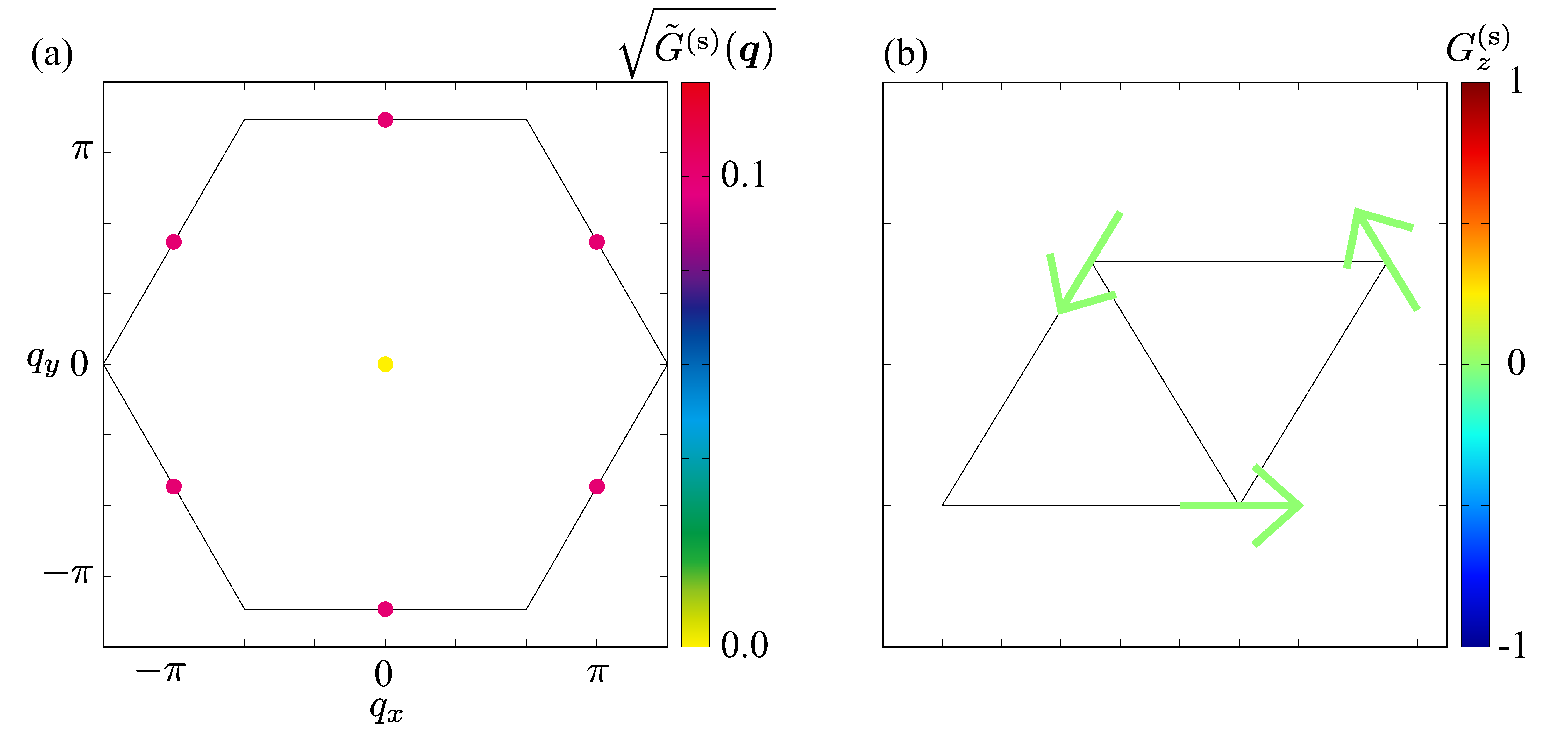
In our system, the ferroaxial moment is described by the spatial pattern of the spin-dependent electric toroidal dipole , whose expression is given by the vector product between the orbital magnetic dipole and the Pauli matrix as
As shown in Figure 5(a), the structure factor of exhibits pronounced peaks at the M points in the Brillouin zone, following the four-sublattice periodicity of the triple-Q chiral magnetic order. Meanwhile, there is no intensity at , meaning no its uniform component. The corresponding real-space distribution in Figure 5(b) displays a loop-like circulation of local electric toroidal dipole vectors around the triangular plaquette consisting of sublattices B, C, and D, which also indicates no net electric toroidal dipole moment in the whole system.
The local ferroaxial moment in the present system does not originate from any lattice rotation or structural distortion, as observed in conventional ferroaxial materials [137]. Instead, it arises purely from the noncoplanar magnetic structure, which leads to a mirror symmetry breaking at sublattices B–D. This purely magnetic origin demonstrates that chiral spin configurations can mimic ferroaxial behavior without invoking atomic displacements.
Figure 6.
(a) Intensity plot of the structure factor in terms of the spin-dependent electric toroidal dipole at and . (b) Corresponding real-space plot, where the arrows represent the direction of the electric toroidal dipole.
Figure 6.
(a) Intensity plot of the structure factor in terms of the spin-dependent electric toroidal dipole at and . (b) Corresponding real-space plot, where the arrows represent the direction of the electric toroidal dipole.
4. Results with the Spin–Orbit Coupling
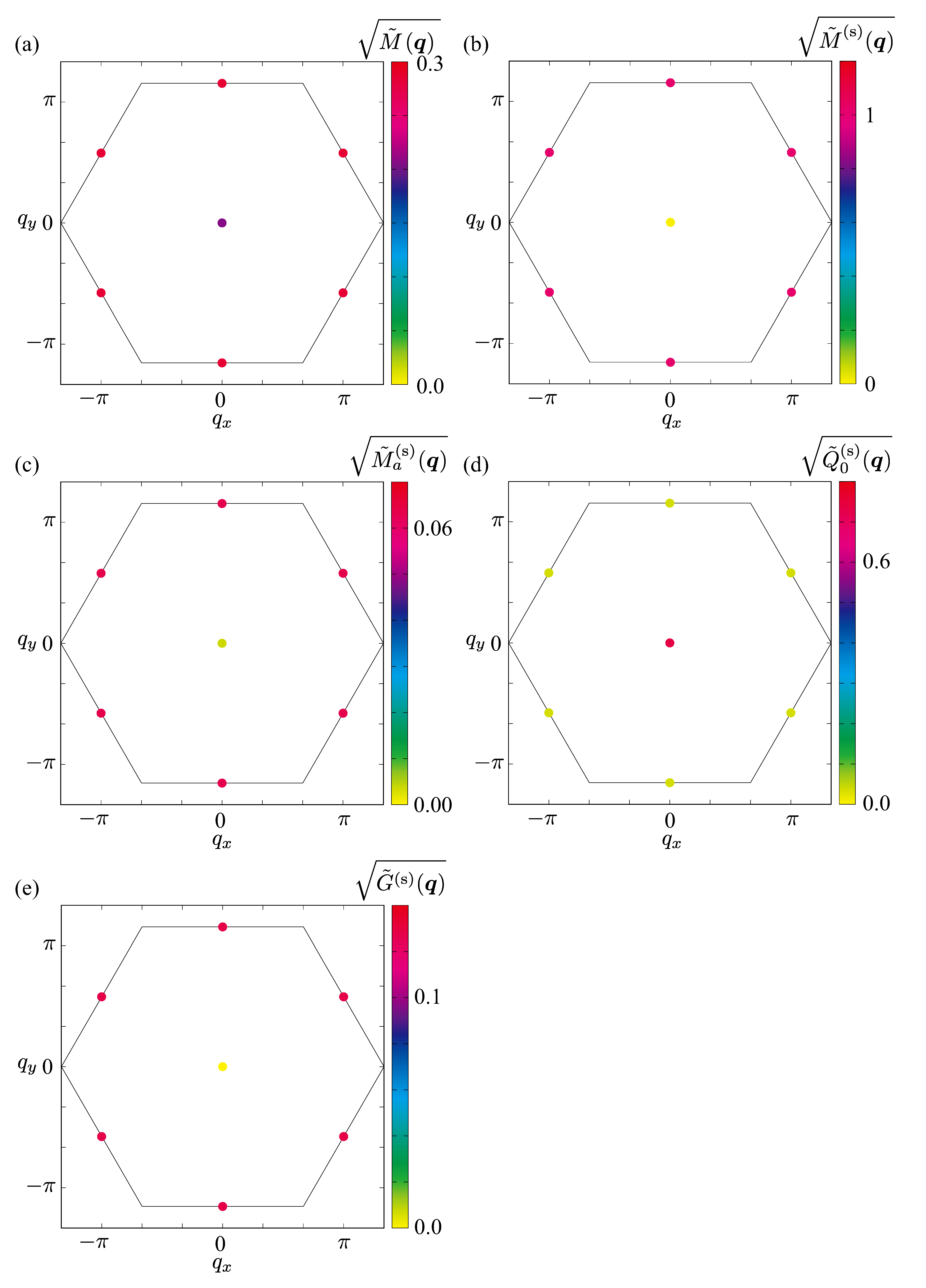
We next investigate how the atomic spin–orbit coupling modifies the multipole responses under the four-sublattice chiral magnetic order by setting . Figure 7(a)–(e) show the calculated structure factors of five representative quantities: (a) the orbital magnetic dipole , (b) the spin magnetic dipole , (c) the anisotropic magnetic dipole , (d) the spin-dependent electric monopole , and (e) the spin-dependent electric toroidal dipole . Compared with the case without spin–orbit coupling, where most multipoles except for exhibit intensity maxima at the M points, the inclusion of the spin–orbit coupling selectively activates uniform () components while keeping others modulated at the M points.
In Figure 7(a), the orbital magnetic dipole maintains its peak at , indicating that its uniform nature is predominantly governed by the underlying chiral orbital currents and is only weakly affected by the spin–orbit coupling. In contrast, the spin magnetic dipole in Figure 7(b) develops an additional component, which was absent in the spin-orbit-coupling-free case. This new uniform intensity indicates that couples the spin and orbital sectors, transferring part of the uniform modulation of the orbital magnetic dipole into the spin magnetic dipole. Conversely, the spin magnetic dipole components at the M points are transferred into orbital magnetic dipole moments at the M point. A similar effect appears for the anisotropic magnetic dipole in Figure 7(c), where the purely M-point modulation seen without spin-orbit coupling evolves into a mixed pattern containing a weak but finite signal.
For the spin-dependent electric monopole shown in Figure 7(d), the spectral weight remains at the M points as in the spin-orbit-coupling-free case, but a uniform component emerges, reflecting the introduction of the relativistic spin–orbit coupling. On the other hand, the spin-dependent electric toroidal dipole in Figure 7(e) retains its characteristic M-point peaks, whereas no uniform peak structure appears. This implies that the ferroaxial character manifests only locally, while its net macroscopic contribution cancels out even with the spin–orbit coupling.
These results collectively reveal that the spin–orbit coupling functions as a selective mediator among the multipole channels. It enhances the uniform () components of the dipolar and monopolar multipoles through the hybridization between spin and orbital degrees of freedom, while the electric toroidal dipole channel remains predominantly modulated at the M points. Such a selective activation of uniform responses reflects the symmetry-allowed nature of the relativistic coupling under the magnetic point group rather than the spin point group.
5. Conclusions
We have presented a unified microscopic framework for emergent multipoles in a four-sublattice chiral state on a triangular lattice, clarifying how the noncoplanar spin texture generates characteristic momentum- and real-space features and how the atomic spin–orbit coupling modifies them. In the absence of spin–orbit coupling, the orbital magnetic dipole exhibits a uniform component originating from circulating orbital currents tied to the scalar spin chirality, whereas the spin magnetic dipole, anisotropic magnetic dipole, spin-dependent electric monopole, and spin-dependent electric toroidal dipole display distinct M-point modulations reflecting the four-sublattice periodicity. Once the spin–orbit coupling is introduced, uniform spectral weight appears selectively in several channels—most notably in the spin and anisotropic magnetic dipoles and in the spin-dependent electric monopole—while the spin-dependent electric toroidal dipole remains predominantly finite-q-modulated. This selective activation demonstrates that the spin–orbit coupling mediates symmetry-allowed mixing among spin, charge, and orbital sectors, which plays a different role from the noncoplanar-order-driven mixing. The present framework provides perspectives for extending this study to other frustrated magnetic systems and for guiding experimental realizations. The same multipole hierarchy is expected to manifest in other geometrically frustrated lattices, such as kagome, face-centered-cubic, and pyrochlore systems, where noncoplanar multiple-Q spin states are stabilized by competing exchanges, higher-order spin interactions, or Fermi-surface nesting.
Funding
This research was supported by JSPS KAKENHI Grants Numbers JP22H00101, JP22H01183, JP23H04869, JP23K03288, JP23K20827, and by JST CREST (JPMJCR23O4) and JST FOREST (JPMJFR2366).
Data Availability Statement
The original contributions presented in the study are included in the article, further inquiries can be directed to the corresponding author.
References
- Ohgushi, K.; Murakami, S.; Nagaosa, N. Spin anisotropy and quantum Hall effect in the kagomé lattice: Chiral spin state based on a ferromagnet. Phys. Rev. B 2000, 62, R6065–R6068. [Google Scholar] [CrossRef]
- Taguchi, Y.; Oohara, Y.; Yoshizawa, H.; Nagaosa, N.; Tokura, Y. Spin chirality, Berry phase, and anomalous Hall effect in a frustrated ferromagnet. Science 2001, 291, 2573–2576. [Google Scholar] [CrossRef] [PubMed]
- Tatara, G.; Kawamura, H. Chirality-driven anomalous Hall effect in weak coupling regime. J. Phys. Soc. Jpn. 2002, 71, 2613–2616. [Google Scholar] [CrossRef]
- Binz, B.; Vishwanath, A. Theory of helical spin crystals: Phases, textures, and properties. Phys. Rev. B 2006, 74, 214408. [Google Scholar] [CrossRef]
- Machida, Y.; Nakatsuji, S.; Maeno, Y.; Tayama, T.; Sakakibara, T.; Onoda, S. Unconventional anomalous Hall effect enhanced by a noncoplanar spin texture in the frustrated Kondo lattice Pr2Ir2O7. Phys. Rev. Lett. 2007, 98, 057203. [Google Scholar] [CrossRef]
- Neubauer, A.; Pfleiderer, C.; Binz, B.; Rosch, A.; Ritz, R.; Niklowitz, P.G.; Böni, P. Topological Hall Effect in the A Phase of MnSi. Phys. Rev. Lett. 2009, 102, 186602. [Google Scholar] [CrossRef]
- Nagaosa, N.; Tokura, Y. Topological properties and dynamics of magnetic skyrmions. Nat. Nanotechnol. 2013, 8, 899–911. [Google Scholar] [CrossRef]
- Tokura, Y.; Nagaosa, N. Nonreciprocal responses from non-centrosymmetric quantum materials. Nat. Commun. 2018, 9, 3740. [Google Scholar] [CrossRef]
- Hayami, S.; Okubo, T.; Motome, Y. Phase shift in skyrmion crystals. Nat. Commun. 2021, 12, 6927. [Google Scholar] [CrossRef]
- Hayami, S.; Yatsushiro, M. Nonlinear nonreciprocal transport in antiferromagnets free from spin-orbit coupling. Phys. Rev. B 2022, 106, 014420. [Google Scholar] [CrossRef]
- Hayami, S.; Yatsushiro, M. Nonreciprocal Transport in Noncoplanar Magnetic Systems without Spin–Orbit Coupling, Net Scalar Chirality, or Magnetization. J. Phys. Soc. Jpn. 2022, 91, 094704. [Google Scholar] [CrossRef]
- Eto, R.; Pohle, R.; Mochizuki, M. Low-Energy Excitations of Skyrmion Crystals in a Centrosymmetric Kondo-Lattice Magnet: Decoupled Spin-Charge Excitations and Nonreciprocity. Phys. Rev. Lett. 2022, 129, 017201. [Google Scholar] [CrossRef] [PubMed]
- Olive, J.A.; Young, A.P.; Sherrington, D. Computer simulation of the three-dimensional short-range Heisenberg spin glass. Phys. Rev. B 1986, 34, 6341–6346. [Google Scholar] [CrossRef] [PubMed]
- Kawamura, H. Chiral ordering in Heisenberg spin glasses in two and three dimensions. Phys. Rev. Lett. 1992, 68, 3785–3788. [Google Scholar] [CrossRef]
- Hayami, S.; Yambe, R. Stabilization mechanisms of magnetic skyrmion crystal and multiple-Q states based on momentum-resolved spin interactions. Mater. Today Quantum 2024, 3, 100010. [Google Scholar] [CrossRef]
- Kawamura, H. Frustration-induced skyrmion crystals in centrosymmetric magnets. J. Phys.: Condens. Matter 2025, 37, 183004. [Google Scholar] [CrossRef]
- Martin, I.; Batista, C.D. Itinerant Electron-Driven Chiral Magnetic Ordering and Spontaneous Quantum Hall Effect in Triangular Lattice Models. Phys. Rev. Lett. 2008, 101, 156402. [Google Scholar] [CrossRef]
- Akagi, Y.; Motome, Y. Spin Chirality Ordering and Anomalous Hall Effect in the Ferromagnetic Kondo Lattice Model on a Triangular Lattice. J. Phys. Soc. Jpn. 2010, 79, 083711. [Google Scholar] [CrossRef]
- Kumar, S.; van den Brink, J. Frustration-Induced Insulating Chiral Spin State in Itinerant Triangular-Lattice Magnets. Phys. Rev. Lett. 2010, 105, 216405. [Google Scholar] [CrossRef]
- Kato, Y.; Martin, I.; Batista, C.D. Stability of the Spontaneous Quantum Hall State in the Triangular Kondo-Lattice Model. Phys. Rev. Lett. 2010, 105, 266405. [Google Scholar] [CrossRef]
- Bak, P.; Lebech, B. "Triple-q→" Modulated Magnetic Structure and Critical Behavior of Neodymium. Phys. Rev. Lett. 1978, 40, 800–803. [Google Scholar] [CrossRef]
- McEwen, K.A.; Walker, M.B. Free-energy analysis of the single-q and double-q magnetic structures of neodymium. Phys. Rev. B 1986, 34, 1781–1783. [Google Scholar] [CrossRef] [PubMed]
- Zochowski, S.; McEwen, K. Thermal expansion study of the magnetic phase diagram of neodymium. J. Magn. Magn. Mater. 1986, 54, 515–516. [Google Scholar] [CrossRef]
- Forgan, E.; Rainford, B.; Lee, S.; Abell, J.; Bi, Y. The magnetic structure of CeAl2 is a non-chiral spiral. J. Phys.: Condens. Matter 1990, 2, 10211. [Google Scholar]
- Korshunov, S.E. Chiral phase of the Heisenberg antiferromagnet with a triangular lattice. Phys. Rev. B 1993, 47, 6165–6168. [Google Scholar] [CrossRef]
- Messio, L.; Lhuillier, C.; Misguich, G. Lattice symmetries and regular magnetic orders in classical frustrated antiferromagnets. Phys. Rev. B 2011, 83, 184401. [Google Scholar] [CrossRef]
- Kurz, P.; Bihlmayer, G.; Hirai, K.; Blügel, S. Three-Dimensional Spin Structure on a Two-Dimensional Lattice: Mn/Cu(111). Phys. Rev. Lett. 2001, 86, 1106–1109. [Google Scholar] [CrossRef]
- Gong, S.S.; Zhu, W.; Zhu, J.X.; Sheng, D.N.; Yang, K. Global phase diagram and quantum spin liquids in a spin-12 triangular antiferromagnet. Phys. Rev. B 2017, 96, 075116. [Google Scholar] [CrossRef]
- Barros, K.; Venderbos, J.W.F.; Chern, G.W.; Batista, C.D. Exotic magnetic orderings in the kagome Kondo-lattice model. Phys. Rev. B 2014, 90, 245119. [Google Scholar] [CrossRef]
- Ghosh, S.; O’Brien, P.; Henley, C.L.; Lawler, M.J. Phase diagram of the Kondo lattice model on the kagome lattice. Phys. Rev. B 2016, 93, 024401. [Google Scholar] [CrossRef]
- Shindou, R.; Nagaosa, N. Orbital Ferromagnetism and Anomalous Hall Effect in Antiferromagnets on the Distorted fcc Lattice. Phys. Rev. Lett. 2001, 87, 116801. [Google Scholar] [CrossRef]
- Balla, P.; Iqbal, Y.; Penc, K. Degenerate manifolds, helimagnets, and multi-Q chiral phases in the classical Heisenberg antiferromagnet on the face-centered-cubic lattice. Phys. Rev. Research 2020, 2, 043278. [Google Scholar] [CrossRef]
- Momoi, T.; Kubo, K.; Niki, K. Possible Chiral Phase Transition in Two-Dimensional Solid 3He. Phys. Rev. Lett. 1997, 79, 2081–2084. [Google Scholar] [CrossRef]
- Akagi, Y.; Udagawa, M.; Motome, Y. Hidden Multiple-Spin Interactions as an Origin of Spin Scalar Chiral Order in Frustrated Kondo Lattice Models. Phys. Rev. Lett. 2012, 108, 096401. [Google Scholar] [CrossRef] [PubMed]
- Kato, Y.; Ishizuka, H. Colossal Enhancement of Spin-Chirality-Related Hall Effect by Thermal Fluctuation. Phys. Rev. Appl. 2019, 12, 021001. [Google Scholar] [CrossRef]
- Berry, M.V. Quantal phase factors accompanying adiabatic changes. Proceedings of the Royal Society of London A: Mathematical, Physical and Engineering Sciences 1984, 392, 45–57. [Google Scholar] [CrossRef]
- Loss, D.; Goldbart, P.M. Persistent currents from Berry’s phase in mesoscopic systems. Phys. Rev. B 1992, 45, 13544–13561. [Google Scholar] [CrossRef]
- Ye, J.; Kim, Y.B.; Millis, A.J.; Shraiman, B.I.; Majumdar, P.; Tešanović, Z. Berry Phase Theory of the Anomalous Hall Effect: Application to Colossal Magnetoresistance Manganites. Phys. Rev. Lett. 1999, 83, 3737–3740. [Google Scholar] [CrossRef]
- Nagaosa, N.; Sinova, J.; Onoda, S.; MacDonald, A.H.; Ong, N.P. Anomalous Hall effect. Rev. Mod. Phys. 2010, 82, 1539–1592. [Google Scholar] [CrossRef]
- Xiao, D.; Chang, M.C.; Niu, Q. Berry phase effects on electronic properties. Rev. Mod. Phys. 2010, 82, 1959–2007. [Google Scholar] [CrossRef]
- Bogdanov, A.N.; Yablonskii, D.A. Thermodynamically stable “vortices" in magnetically ordered crystals: The mixed state of magnets. Sov. Phys. JETP 1989, 68, 101. [Google Scholar]
- Bogdanov, A.; Hubert, A. Thermodynamically stable magnetic vortex states in magnetic crystals. J. Magn. Magn. Mater. 1994, 138, 255–269. [Google Scholar] [CrossRef]
- Rößler, U.K.; Bogdanov, A.N.; Pfleiderer, C. Spontaneous skyrmion ground states in magnetic metals. Nature 2006, 442, 797–801. [Google Scholar] [CrossRef] [PubMed]
- Mühlbauer, S.; Binz, B.; Jonietz, F.; Pfleiderer, C.; Rosch, A.; Neubauer, A.; Georgii, R.; Böni, P. Skyrmion lattice in a chiral magnet. Science 2009, 323, 915–919. [Google Scholar] [CrossRef]
- Jonietz, F.; Mu¨hlbauer, S.; Pfleiderer, C.; Neubauer, A.; Mu¨nzer, W.; Bauer, A.; Adams, T.; Georgii, R.; Bo¨ni, P.; Duine, R.A.; et al. Spin Transfer Torques in MnSi at Ultralow Current Densities. Science 2010, 330, 1648. [Google Scholar] [CrossRef]
- Adams, T.; Mühlbauer, S.; Pfleiderer, C.; Jonietz, F.; Bauer, A.; Neubauer, A.; Georgii, R.; Böni, P.; Keiderling, U.; Everschor, K.; et al. Long-Range Crystalline Nature of the Skyrmion Lattice in MnSi. Phys. Rev. Lett. 2011, 107, 217206. [Google Scholar] [CrossRef]
- Bauer, A.; Pfleiderer, C. Magnetic phase diagram of MnSi inferred from magnetization and ac susceptibility. Phys. Rev. B 2012, 85, 214418. [Google Scholar] [CrossRef]
- Bauer, A.; Garst, M.; Pfleiderer, C. Specific Heat of the Skyrmion Lattice Phase and Field-Induced Tricritical Point in MnSi. Phys. Rev. Lett. 2013, 110, 177207. [Google Scholar] [CrossRef]
- Chacon, A.; Bauer, A.; Adams, T.; Rucker, F.; Brandl, G.; Georgii, R.; Garst, M.; Pfleiderer, C. Uniaxial Pressure Dependence of Magnetic Order in MnSi. Phys. Rev. Lett. 2015, 115, 267202. [Google Scholar] [CrossRef]
- Mühlbauer, S.; Kindervater, J.; Adams, T.; Bauer, A.; Keiderling, U.; Pfleiderer, C. Kinetic small angle neutron scattering of the skyrmion lattice in MnSi. New J. Phys. 2016, 18, 075017. [Google Scholar] [CrossRef]
- Reiner, M.; Bauer, A.; Leitner, M.; Gigl, T.; Anwand, W.; Butterling, M.; Wagner, A.; Kudejova, P.; Pfleiderer, C.; Hugenschmidt, C. Positron spectroscopy of point defects in the skyrmion-lattice compound MnSi. Sci. Rep. 2016, 6, 29109. [Google Scholar] [CrossRef] [PubMed]
- Yu, X.Z.; Onose, Y.; Kanazawa, N.; Park, J.H.; Han, J.H.; Matsui, Y.; Nagaosa, N.; Tokura, Y. Real-space observation of a two-dimensional skyrmion crystal. Nature 2010, 465, 901–904. [Google Scholar] [CrossRef] [PubMed]
- Münzer, W.; Neubauer, A.; Adams, T.; Mühlbauer, S.; Franz, C.; Jonietz, F.; Georgii, R.; Böni, P.; Pedersen, B.; Schmidt, M.; et al. Skyrmion lattice in the doped semiconductor Fe1-xCoxSi. Phys. Rev. B 2010, 81, 041203. [Google Scholar] [CrossRef]
- Adams, T.; Mühlbauer, S.; Neubauer, A.; Münzer, W.; Jonietz, F.; Georgii, R.; Pedersen, B.; Böni, P.; Rosch, A.; Pfleiderer, C. Skyrmion lattice domains in Fe1-xCoxSi. In Proceedings of the J. Phys.: Conf. Ser. IOP Publishing, Vol. 200; 2010; p. 032001. [Google Scholar] [CrossRef]
- Yu, X.Z.; Kanazawa, N.; Onose, Y.; Kimoto, K.; Zhang, W.; Ishiwata, S.; Matsui, Y.; Tokura, Y. Near room-temperature formation of a skyrmion crystal in thin-films of the helimagnet FeGe. Nat. Mater. 2011, 10, 106–109. [Google Scholar] [CrossRef]
- Gallagher, J.C.; Meng, K.Y.; Brangham, J.T.; Wang, H.L.; Esser, B.D.; McComb, D.W.; Yang, F.Y. Robust Zero-Field Skyrmion Formation in FeGe Epitaxial Thin Films. Phys. Rev. Lett. 2017, 118, 027201. [Google Scholar] [CrossRef]
- Turgut, E.; Paik, H.; Nguyen, K.; Muller, D.A.; Schlom, D.G.; Fuchs, G.D. Engineering Dzyaloshinskii-Moriya interaction in B20 thin-film chiral magnets. Phys. Rev. Mater. 2018, 2, 074404. [Google Scholar] [CrossRef]
- Spencer, C.S.; Gayles, J.; Porter, N.A.; Sugimoto, S.; Aslam, Z.; Kinane, C.J.; Charlton, T.R.; Freimuth, F.; Chadov, S.; Langridge, S.; et al. Helical magnetic structure and the anomalous and topological Hall effects in epitaxial B20 Fe1-yCoyGe films. Phys. Rev. B 2018, 97, 214406. [Google Scholar] [CrossRef]
- Kakihana, M.; Aoki, D.; Nakamura, A.; Honda, F.; Nakashima, M.; Amako, Y.; Nakamura, S.; Sakakibara, T.; Hedo, M.; Nakama, T.; et al. Giant Hall resistivity and magnetoresistance in cubic chiral antiferromagnet EuPtSi. J. Phys. Soc. Jpn. 2018, 87, 023701. [Google Scholar] [CrossRef]
- Kaneko, K.; Frontzek, M.D.; Matsuda, M.; Nakao, A.; Munakata, K.; Ohhara, T.; Kakihana, M.; Haga, Y.; Hedo, M.; Nakama, T.; et al. Unique Helical Magnetic Order and Field-Induced Phase in Trillium Lattice Antiferromagnet EuPtSi. J. Phys. Soc. Jpn. 2019, 88, 013702. [Google Scholar] [CrossRef]
- Tabata, C.; Matsumura, T.; Nakao, H.; Michimura, S.; Kakihana, M.; Inami, T.; Kaneko, K.; Hedo, M.; Nakama, T.; Ōnuki, Y. Magnetic Field Induced Triple-q Magnetic Order in Trillium Lattice Antiferromagnet EuPtSi Studied by Resonant X-ray Scattering. J. Phys. Soc. Jpn. 2019, 88, 093704. [Google Scholar] [CrossRef]
- Kakihana, M.; Aoki, D.; Nakamura, A.; Honda, F.; Nakashima, M.; Amako, Y.; Takeuchi, T.; Harima, H.; Hedo, M.; Nakama, T.; et al. Unique Magnetic Phases in the Skyrmion Lattice and Fermi Surface Properties in Cubic Chiral Antiferromagnet EuPtSi. J. Phys. Soc. Jpn. 2019, 88, 094705. [Google Scholar] [CrossRef]
- Balasubramanian, B.; Manchanda, P.; Pahari, R.; Chen, Z.; Zhang, W.; Valloppilly, S.R.; Li, X.; Sarella, A.; Yue, L.; Ullah, A.; et al. Chiral Magnetism and High-Temperature Skyrmions in B20-Ordered Co-Si. Phys. Rev. Lett. 2020, 124, 057201. [Google Scholar] [CrossRef] [PubMed]
- Hayami, S.; Yambe, R. Field-Direction Sensitive Skyrmion Crystals in Cubic Chiral Systems: Implication to 4f-Electron Compound EuPtSi. J. Phys. Soc. Jpn. 2021, 90, 073705. [Google Scholar] [CrossRef]
- Borisov, V.; Xu, Q.; Ntallis, N.; Clulow, R.; Shtender, V.; Cedervall, J.; Sahlberg, M.; Wikfeldt, K.T.; Thonig, D.; Pereiro, M.; et al. Tuning skyrmions in B20 compounds by 4d and 5d doping. Phys. Rev. Mater. 2022, 6, 084401. [Google Scholar] [CrossRef]
- Kézsmárki, I.; Bordács, S.; Milde, P.; Neuber, E.; Eng, L.M.; White, J.S.; Rønnow, H.M.; Dewhurst, C.D.; Mochizuki, M.; Yanai, K.; et al. Neel-type skyrmion lattice with confined orientation in the polar magnetic semiconductor GaV4S8. Nat. Mater. 2015, 14, 1116–1122. [Google Scholar] [CrossRef]
- Bordács, S.; Butykai, A.; Szigeti, B.G.; White, J.S.; Cubitt, R.; Leonov, A.O.; Widmann, S.; Ehlers, D.; von Nidda, H.A.K.; Tsurkan, V.; et al. Equilibrium skyrmion lattice ground state in a polar easy-plane magnet. Sci. Rep. 2017, 7, 7584. [Google Scholar] [CrossRef]
- Fujima, Y.; Abe, N.; Tokunaga, Y.; Arima, T. Thermodynamically stable skyrmion lattice at low temperatures in a bulk crystal of lacunar spinel GaV4Se8. Phys. Rev. B 2017, 95, 180410. [Google Scholar] [CrossRef]
- Kurumaji, T.; Nakajima, T.; Ukleev, V.; Feoktystov, A.; Arima, T.h.; Kakurai, K.; Tokura, Y. Néel-Type Skyrmion Lattice in the Tetragonal Polar Magnet VOSe2O5. Phys. Rev. Lett. 2017, 119, 237201. [Google Scholar] [CrossRef]
- Singh, D.; Fujishiro, Y.; Hayami, S.; Moody, S.H.; Nomoto, T.; Baral, P.R.; Ukleev, V.; Cubitt, R.; Steinke, N.J.; Gawryluk, D.J.; et al. Transition between distinct hybrid skyrmion textures through their hexagonal-to-square crystal transformation in a polar magnet. Nat. Commun. 2023, 14, 8050. [Google Scholar] [CrossRef]
- Saha, S.R.; Sugawara, H.; Matsuda, T.D.; Sato, H.; Mallik, R.; Sampathkumaran, E.V. Magnetic anisotropy, first-order-like metamagnetic transitions, and large negative magnetoresistance in single-crystal Gd2PdSi3. Phys. Rev. B 1999, 60, 12162–12165. [Google Scholar] [CrossRef]
- Kurumaji, T.; Nakajima, T.; Hirschberger, M.; Kikkawa, A.; Yamasaki, Y.; Sagayama, H.; Nakao, H.; Taguchi, Y.; Arima, T.h.; Tokura, Y. Skyrmion lattice with a giant topological Hall effect in a frustrated triangular-lattice magnet. Science 2019, 365, 914–918. [Google Scholar] [CrossRef]
- Hirschberger, M.; Spitz, L.; Nomoto, T.; Kurumaji, T.; Gao, S.; Masell, J.; Nakajima, T.; Kikkawa, A.; Yamasaki, Y.; Sagayama, H.; et al. Topological Nernst Effect of the Two-Dimensional Skyrmion Lattice. Phys. Rev. Lett. 2020, 125, 076602. [Google Scholar] [CrossRef] [PubMed]
- Kumar, R.; Iyer, K.K.; Paulose, P.L.; Sampathkumaran, E.V. Magnetic and transport anomalies in R2RhSi34pt0ex(R=Gd, Tb, and Dy) resembling those of the exotic magnetic material Gd2PdSi3. Phys. Rev. B 2020, 101, 144440. [Google Scholar] [CrossRef]
- Spachmann, S.; Elghandour, A.; Frontzek, M.; Löser, W.; Klingeler, R. Magnetoelastic coupling and phases in the skyrmion lattice magnet Gd2PdSi3 discovered by high-resolution dilatometry. Phys. Rev. B 2021, 103, 184424. [Google Scholar] [CrossRef]
- Gomilšek, M.; Hicken, T.J.; Wilson, M.N.; Franke, K.J.A.; Huddart, B.M.; Štefančič, A.; Holt, S.J.R.; Balakrishnan, G.; Mayoh, D.A.; Birch, M.T.; et al. Anisotropic Skyrmion and Multi-q Spin Dynamics in Centrosymmetric Gd2PdSi3. Phys. Rev. Lett. 2025, 134, 046702. [Google Scholar] [CrossRef]
- Nakamura, S.; Kabeya, N.; Kobayashi, M.; Araki, K.; Katoh, K.; Ochiai, A. Spin trimer formation in the metallic compound Gd3Ru4Al12 with a distorted kagome lattice structure. Phys. Rev. B 2018, 98, 054410. [Google Scholar] [CrossRef]
- Hirschberger, M.; Nakajima, T.; Gao, S.; Peng, L.; Kikkawa, A.; Kurumaji, T.; Kriener, M.; Yamasaki, Y.; Sagayama, H.; Nakao, H.; et al. Skyrmion phase and competing magnetic orders on a breathing kagome lattice. Nat. Commun. 2019, 10, 5831. [Google Scholar] [CrossRef]
- Hirschberger, M.; Hayami, S.; Tokura, Y. Nanometric skyrmion lattice from anisotropic exchange interactions in a centrosymmetric host. New J. Phys. 2021, 23, 023039. [Google Scholar] [CrossRef]
- Nakamura, S. Magnetic anisotropies and skyrmion lattice related to magnetic quadrupole interactions of the RKKY mechanism in the frustrated spin-trimer system Gd3Ru4Al12 with a breathing kagome structure. Phys. Rev. B 2025, 111, 184433. [Google Scholar] [CrossRef]
- Santini, P.; Carretta, S.; Amoretti, G.; Caciuffo, R.; Magnani, N.; Lander, G.H. Multipolar interactions in f-electron systems: The paradigm of actinide dioxides. Rev. Mod. Phys. 2009, 81, 807–863. [Google Scholar] [CrossRef]
- Kuramoto, Y.; Kusunose, H.; Kiss, A. Multipole orders and fluctuations in strongly correlated electron systems. J. Phys. Soc. Jpn. 2009, 78, 072001. [Google Scholar] [CrossRef]
- Suzuki, M.T.; Ikeda, H.; Oppeneer, P.M. First-principles theory of magnetic multipoles in condensed matter systems. J. Phys. Soc. Jpn. 2018, 87, 041008. [Google Scholar] [CrossRef]
- Kusunose, H.; Hayami, S. Generalization of microscopic multipoles and cross-correlated phenomena by their orderings. J. Phys.: Condens. Matter 2022, 34, 464002. [Google Scholar] [CrossRef] [PubMed]
- Hayami, S.; Kusunose, H. Unified description of electronic orderings and cross correlations by complete multipole representation. J. Phys. Soc. Jpn. 2024, 93, 072001. [Google Scholar] [CrossRef]
- Suzuki, M.T.; Koretsune, T.; Ochi, M.; Arita, R. Cluster multipole theory for anomalous Hall effect in antiferromagnets. Phys. Rev. B 2017, 95, 094406. [Google Scholar] [CrossRef]
- Hayami, S.; Oiwa, R.; Kusunose, H. Electric Ferro-Axial Moment as Nanometric Rotator and Source of Longitudinal Spin Current. J. Phys. Soc. Jpn. 2022, 91, 113702. [Google Scholar] [CrossRef]
- Hayami, S. Mechanism of antisymmetric spin polarization in centrosymmetric multiple-Q magnets based on effective chiral bilinear and biquadratic spin cross products. Phys. Rev. B 2022, 105, 024413. [Google Scholar] [CrossRef]
- Sukhachov, P.; Linder, J. Impurity-induced Friedel oscillations in altermagnets and p-wave magnets. Phys. Rev. B 2024, 110, 205114. [Google Scholar] [CrossRef]
- Brekke, B.; Sukhachov, P.; Giil, H.G.; Brataas, A.; Linder, J. Minimal Models and Transport Properties of Unconventional p-Wave Magnets. Phys. Rev. Lett. 2024, 133, 236703. [Google Scholar] [CrossRef]
- Katsura, H.; Nagaosa, N.; Balatsky, A.V. Spin Current and Magnetoelectric Effect in Noncollinear Magnets. Phys. Rev. Lett. 2005, 95, 057205. [Google Scholar] [CrossRef]
- Mostovoy, M. Ferroelectricity in Spiral Magnets. Phys. Rev. Lett. 2006, 96, 067601. [Google Scholar] [CrossRef] [PubMed]
- Sergienko, I.A.; Dagotto, E. Role of the Dzyaloshinskii-Moriya interaction in multiferroic perovskites. Phys. Rev. B 2006, 73, 094434. [Google Scholar] [CrossRef]
- Harris, A.B.; Yildirim, T.; Aharony, A.; Entin-Wohlman, O. Towards a microscopic model of magnetoelectric interactions in Ni3V2O8. Phys. Rev. B 2006, 73, 184433. [Google Scholar] [CrossRef]
- Tokura, Y.; Seki, S.; Nagaosa, N. Multiferroics of spin origin. Rep. Prog. Phys. 2014, 77, 076501. [Google Scholar] [CrossRef]
- Hirsch, J.E. Spin Hall Effect. Phys. Rev. Lett. 1999, 83, 1834–1837. [Google Scholar] [CrossRef]
- Zhang, S. Spin Hall Effect in the Presence of Spin Diffusion. Phys. Rev. Lett. 2000, 85, 393–396. [Google Scholar] [CrossRef]
- Murakami, S.; Nagaosa, N.; Zhang, S.C. Dissipationless quantum spin current at room temperature. Science 2003, 301, 1348–1351. [Google Scholar] [CrossRef]
- Murakami, S.; Nagaosa, N.; Zhang, S.C. Spin-Hall Insulator. Phys. Rev. Lett. 2004, 93, 156804. [Google Scholar] [CrossRef]
- Sinova, J.; Culcer, D.; Niu, Q.; Sinitsyn, N.A.; Jungwirth, T.; MacDonald, A.H. Universal Intrinsic Spin Hall Effect. Phys. Rev. Lett. 2004, 92, 126603. [Google Scholar] [CrossRef]
- Kusunose, H.; Oiwa, R.; Hayami, S. Complete Multipole Basis Set for Single-Centered Electron Systems. J. Phys. Soc. Jpn. 2020, 89, 104704. [Google Scholar] [CrossRef]
- Takagi, R.; White, J.; Hayami, S.; Arita, R.; Honecker, D.; Rønnow, H.; Tokura, Y.; Seki, S. Multiple-q noncollinear magnetism in an itinerant hexagonal magnet. Sci. Adv. 2018, 4, eaau3402. [Google Scholar] [CrossRef] [PubMed]
- Kim, J.; Zhang, K.X.; Park, P.; Cho, W.; Kim, H.; Noh, H.J.; Park, J.G. Electrical control of topological 3Q state in intercalated van der Waals antiferromagnet Cox-TaS2. Nat. Commun. 2025, 16, 8943. [Google Scholar] [CrossRef] [PubMed]
- Meng, Z.; Lin, W.; Zhao, Z.; Zhang, B.; Li, B.; Lv, Y.; Han, G.; Li, S.; Cai, Y.; Jin, F.; et al. Spontaneous Topological Hall Effect in Intercalated Co1/3TaS2 Nanoflakes with Non-Coplanar Antiferromagnetic Order. Adv. Func. Mater. 2025; 2502016. [Google Scholar] [CrossRef]
- Park, P.; Cho, W.; Kim, C.; An, Y.; Iida, K.; Kajimoto, R.; Matin, S.; Zhang, S.S.; Batista, C.D.; Park, J.G. Spin Dynamics of Triple-Q Magnetic Orderings in a Triangular Lattice: Implications for Multi-Q Orderings in General Two-Dimensional Lattices. Phys. Rev. X 2025, 15, 031032. [Google Scholar] [CrossRef]
- Bulaevskii, L.N.; Batista, C.D.; Mostovoy, M.V.; Khomskii, D.I. Electronic orbital currents and polarization in Mott insulators. Phys. Rev. B 2008, 78, 024402. [Google Scholar] [CrossRef]
- Vanderbilt, D. Berry phases in electronic structure theory: electric polarization, orbital magnetization and topological insulators; Cambridge University Press, Cambridge, 2018.
- Resta, R.; Ceresoli, D.; Thonhauser, T.; Vanderbilt, D. Orbital magnetization in extended systems. Chem. Phys. Chem. 2005, 6, 1815–1819. [Google Scholar] [CrossRef]
- Xiao, D.; Shi, J.; Niu, Q. Berry Phase Correction to Electron Density of States in Solids. Phys. Rev. Lett. 2005, 95, 137204. [Google Scholar] [CrossRef]
- Thonhauser, T.; Ceresoli, D.; Vanderbilt, D.; Resta, R. Orbital Magnetization in Periodic Insulators. Phys. Rev. Lett. 2005, 95, 137205. [Google Scholar] [CrossRef]
- Ceresoli, D.; Thonhauser, T.; Vanderbilt, D.; Resta, R. Orbital magnetization in crystalline solids: Multi-band insulators, Chern insulators, and metals. Phys. Rev. B 2006, 74, 024408. [Google Scholar] [CrossRef]
- Shi, J.; Vignale, G.; Xiao, D.; Niu, Q. Quantum Theory of Orbital Magnetization and Its Generalization to Interacting Systems. Phys. Rev. Lett. 2007, 99, 197202. [Google Scholar] [CrossRef]
- Souza, I.; Vanderbilt, D. Dichroic f-sum rule and the orbital magnetization of crystals. Phys. Rev. B 2008, 77, 054438. [Google Scholar] [CrossRef]
- Yamasaki, Y.; Nakao, H.; Arima, T.h. Augmented Magnetic Octupole in Kagomé 120-degree Antiferromagnets Detectable via X-ray Magnetic Circular Dichroism. J. Phys. Soc. Jpn. 2020, 89, 083703. [Google Scholar] [CrossRef]
- Hayami, S.; Kusunose, H. Essential role of the anisotropic magnetic dipole in the anomalous Hall effect. Phys. Rev. B 2021, 103, L180407. [Google Scholar] [CrossRef]
- Kimata, M.; Sasabe, N.; Kurita, K.; Yamasaki, Y.; Tabata, C.; Yokoyama, Y.; Kotani, Y.; Ikhlas, M.; Tomita, T.; Amemiya, K.; et al. X-ray study of ferroic octupole order producing anomalous Hall effect. Nat. Commun. 2021, 12, 5582. [Google Scholar] [CrossRef]
- Sasabe, N.; Kimata, M.; Nakamura, T. Presence of X-Ray Magnetic Circular Dichroism Signal for Zero-Magnetization Antiferromagnetic State. Phys. Rev. Lett. 2021, 126, 157402. [Google Scholar] [CrossRef]
- Ohgata, S.; Hayami, S. Intrinsic anomalous Hall effect under anisotropic magnetic dipole versus conventional magnetic dipole. Phys. Rev. B 2025, 112, 014421. [Google Scholar] [CrossRef]
- Dubovik, V.; Cheshkov, A. Multipole expansion in classical and quantum field theory and radiation. Sov. J. Part. Nucl 1975, 5, 318–337. [Google Scholar]
- Dubovik, V.; Tugushev, V. Toroid moments in electrodynamics and solid-state physics. Phys. Rep. 1990, 187, 145–202. [Google Scholar] [CrossRef]
- Hlinka, J. Eight Types of Symmetrically Distinct Vectorlike Physical Quantities. Phys. Rev. Lett. 2014, 113, 165502. [Google Scholar] [CrossRef]
- Hlinka, J.; Privratska, J.; Ondrejkovic, P.; Janovec, V. Symmetry Guide to Ferroaxial Transitions. Phys. Rev. Lett. 2016, 116, 177602. [Google Scholar] [CrossRef]
- Cheong, S.W.; Lim, S.; Du, K.; Huang, F.T. Permutable SOS (symmetry operational similarity). npj Quantum Mater. 2021, 6, 58. [Google Scholar] [CrossRef]
- Cheong, S.W.; Huang, F.T.; Kim, M. Linking emergent phenomena and broken symmetries through one-dimensional objects and their dot/cross products. Rep. Prog. Phys. 2022, 85, 124501. [Google Scholar] [CrossRef] [PubMed]
- Nasu, J.; Hayami, S. Antisymmetric thermopolarization by electric toroidicity. Phys. Rev. B 2022, 105, 245125. [Google Scholar] [CrossRef]
- Roy, A.; Guimarães, M.H.D.; Sławińska, J. Unconventional spin Hall effects in nonmagnetic solids. Phys. Rev. Materials 2022, 6, 045004. [Google Scholar] [CrossRef]
- Inda, A.; Hayami, S. Nonlinear Transverse Magnetic Susceptibility under Electric Toroidal Dipole Ordering. J. Phys. Soc. Jpn. 2023, 92, 043701. [Google Scholar] [CrossRef]
- Jin, W.; Drueke, E.; Li, S.; Admasu, A.; Owen, R.; Day, M.; Sun, K.; Cheong, S.W.; Zhao, L. Observation of a ferro-rotational order coupled with second-order nonlinear optical fields. Nat. Phys. 2020, 16, 42–46. [Google Scholar] [CrossRef]
- Hayashida, T.; Uemura, Y.; Kimura, K.; Matsuoka, S.; Hagihala, M.; Hirose, S.; Morioka, H.; Hasegawa, T.; Kimura, T. Phase transition and domain formation in ferroaxial crystals. Phys. Rev. Materials 2021, 5, 124409. [Google Scholar] [CrossRef]
- Hayashida, T.; Uemura, Y.; Kimura, K.; Matsuoka, S.; Morikawa, D.; Hirose, S.; Tsuda, K.; Hasegawa, T.; Kimura, T. Visualization of ferroaxial domains in an order-disorder type ferroaxial crystal. Nat. Commun. 2020, 11, 4582. [Google Scholar] [CrossRef]
- Yokota, H.; Hayashida, T.; Kitahara, D.; Kimura, T. Three-dimensional imaging of ferroaxial domains using circularly polarized second harmonic generation microscopy. npj Quantum Mater. 2022, 7, 106. [Google Scholar] [CrossRef]
- Hasegawa, T.; Yoshida, W.; Nakamura, K.; Ogita, N.; Matsuhira, K. Raman Scattering Investigation of Structural Transition in Ca5Ir3O12. J. Phys. Soc. Jpn. 2020, 89, 054602. [Google Scholar] [CrossRef]
- Hanate, H.; Hasegawa, T.; Hayami, S.; Tsutsui, S.; Kawano, S.; Matsuhira, K. First Observation of Superlattice Reflections in the Hidden Order at 105 K of Spin–Orbit Coupled Iridium Oxide Ca5Ir3O12. J. Phys. Soc. Jpn. 2021, 90, 063702. [Google Scholar] [CrossRef]
- Hayami, S.; Tsutsui, S.; Hanate, H.; Nagasawa, N.; Yoda, Y.; Matsuhira, K. Cluster Toroidal Multipoles Formed by Electric-Quadrupole and Magnetic-Octupole Trimers: A Possible Scenario for Hidden Orders in Ca5Ir3O12. J. Phys. Soc. Jpn. 2023, 92, 033702. [Google Scholar] [CrossRef]
- Hanate, H.; Tsutsui, S.; Yajima, T.; Nakao, H.; Sagayama, H.; Hasegawa, T.; Matsuhira, K. Space-Group Determination of Superlattice Structure Due to Electric Toroidal Ordering in Ca5Ir3O12. J. Phys. Soc. Jpn. 2023, 92, 063601. [Google Scholar] [CrossRef]
- Xu, X.; Huang, F.T.; Admasu, A.S.; Kratochvílová, M.; Chu, M.W.; Park, J.G.; Cheong, S.W. Multiple ferroic orders and toroidal magnetoelectricity in the chiral magnet BaCoSiO4. Phys. Rev. B 2022, 105, 184407. [Google Scholar] [CrossRef]
- Inda, A.; Hayami, S. Emergent cross-product-type spin-orbit coupling under ferroaxial ordering. Phys. Rev. B 2025, 111, L041104. [Google Scholar] [CrossRef]
Figure 1.
Four-sublattice magnetic structure on a two-dimensional triangular lattice. The direction of spin moments at each sublattice is shown in the right panel, where the red arrows represent the spin moment.
Figure 1.
Four-sublattice magnetic structure on a two-dimensional triangular lattice. The direction of spin moments at each sublattice is shown in the right panel, where the red arrows represent the spin moment.
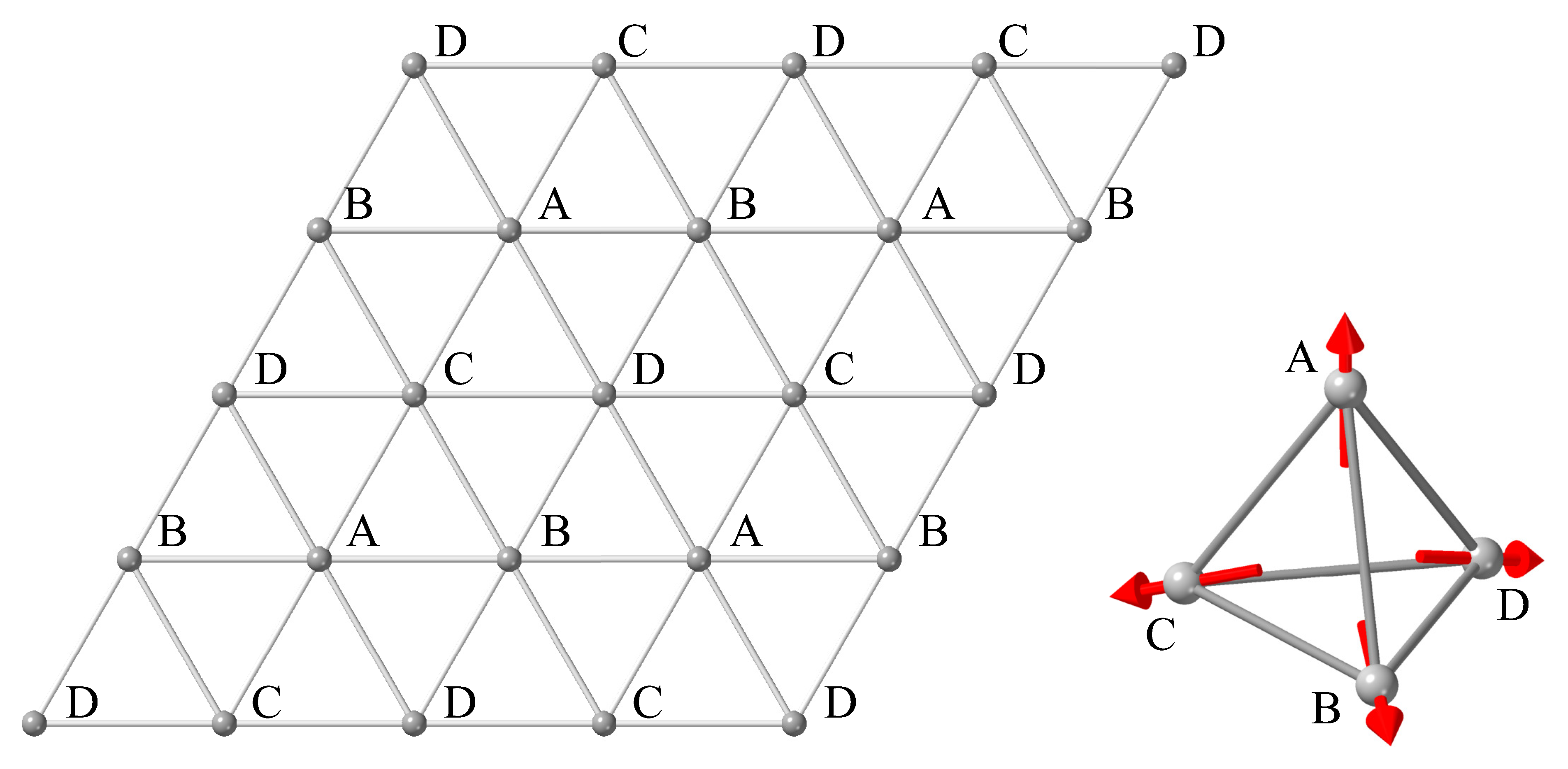
Figure 2.
(a) Intensity plot of the structure factor in terms of the orbital magnetic dipole M at and . (b) J dependence of the component of .
Figure 2.
(a) Intensity plot of the structure factor in terms of the orbital magnetic dipole M at and . (b) J dependence of the component of .
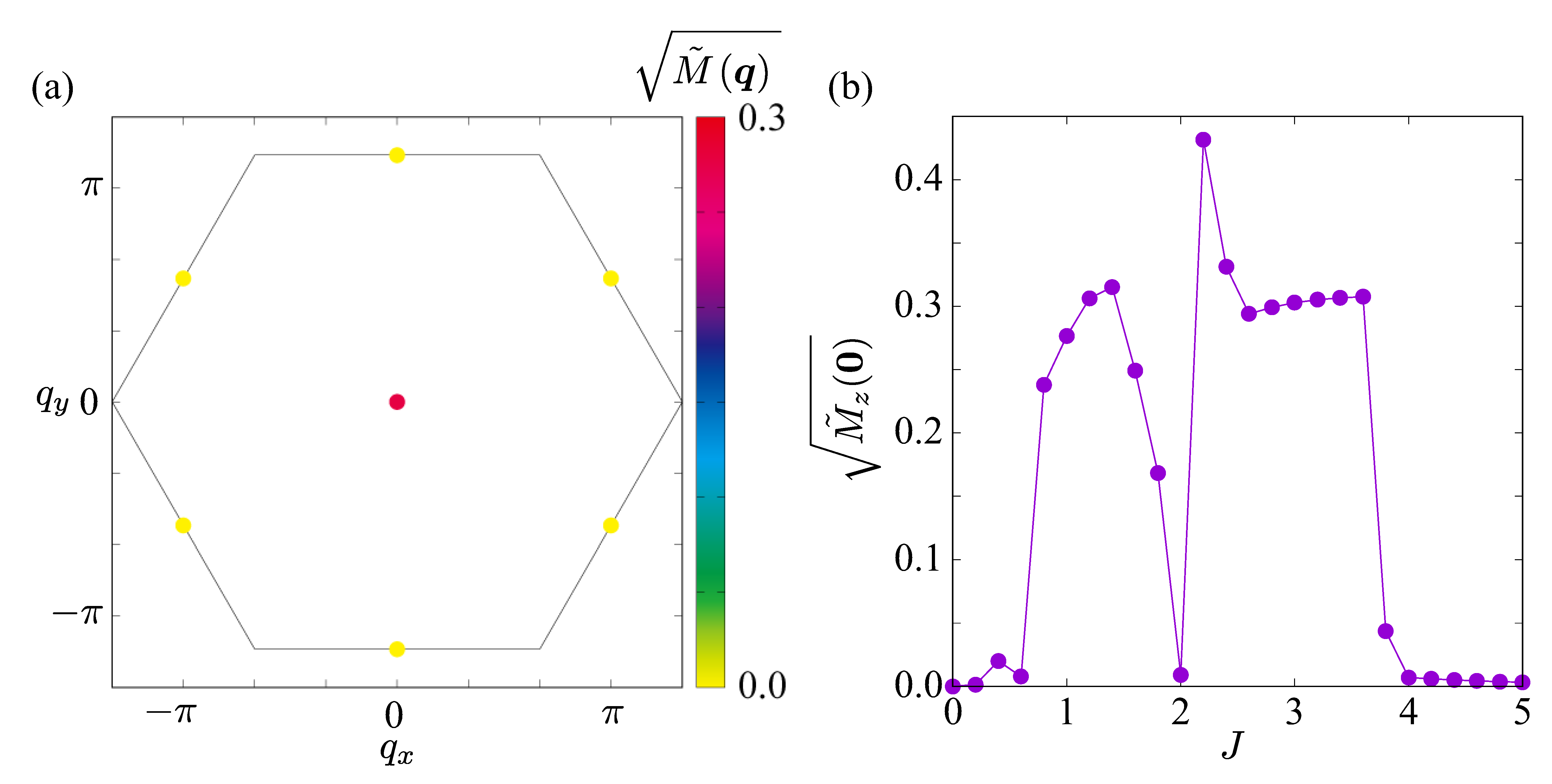
Figure 3.
Intensity plots of the structure factor in terms of (a) the spin magnetic dipole and (b) the anisotropic magnetic dipole at and .
Figure 3.
Intensity plots of the structure factor in terms of (a) the spin magnetic dipole and (b) the anisotropic magnetic dipole at and .
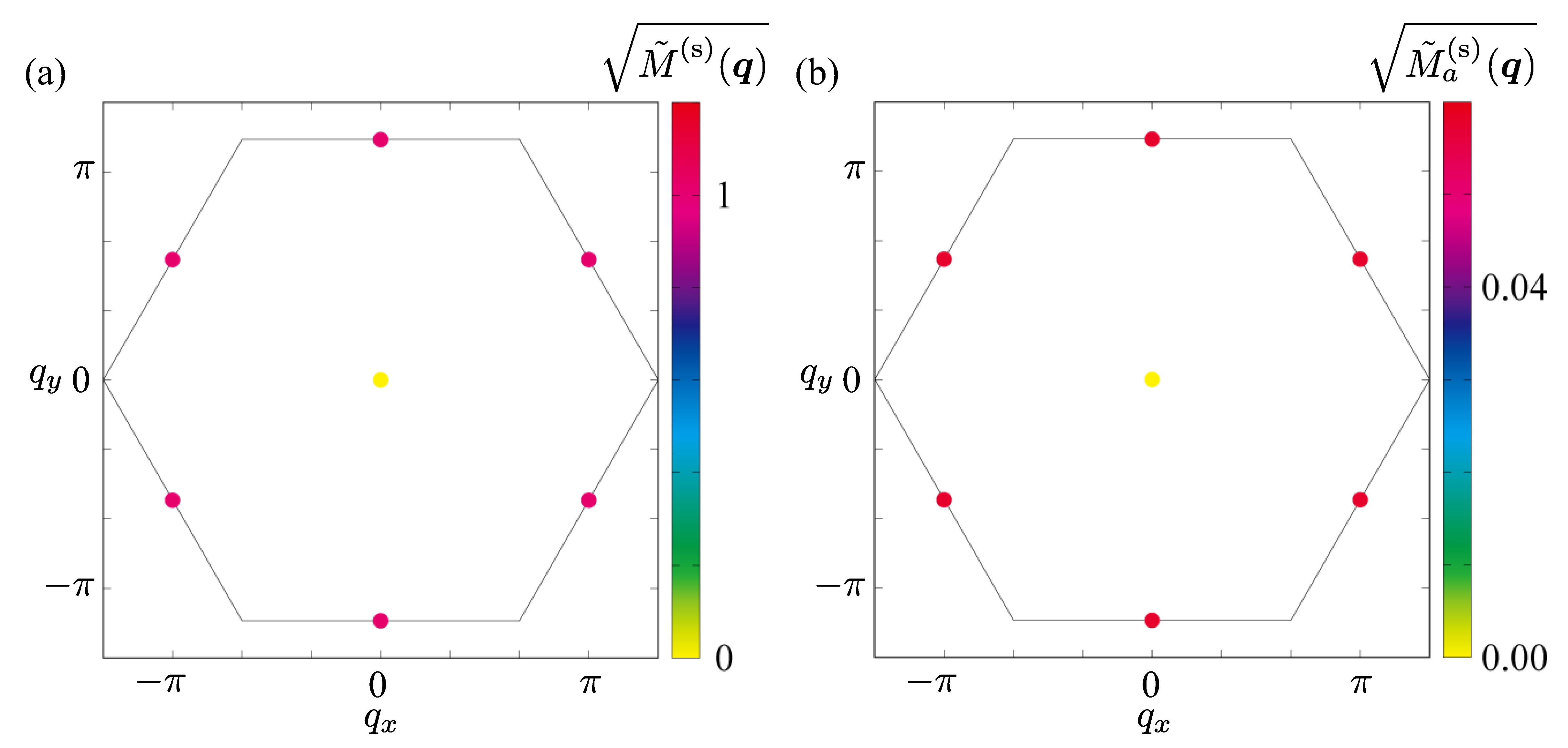
Figure 4.
Real-space plots of (a) the spin magnetic dipole and (b) the anisotropic magnetic dipole at and . The color represents the z component.
Figure 4.
Real-space plots of (a) the spin magnetic dipole and (b) the anisotropic magnetic dipole at and . The color represents the z component.
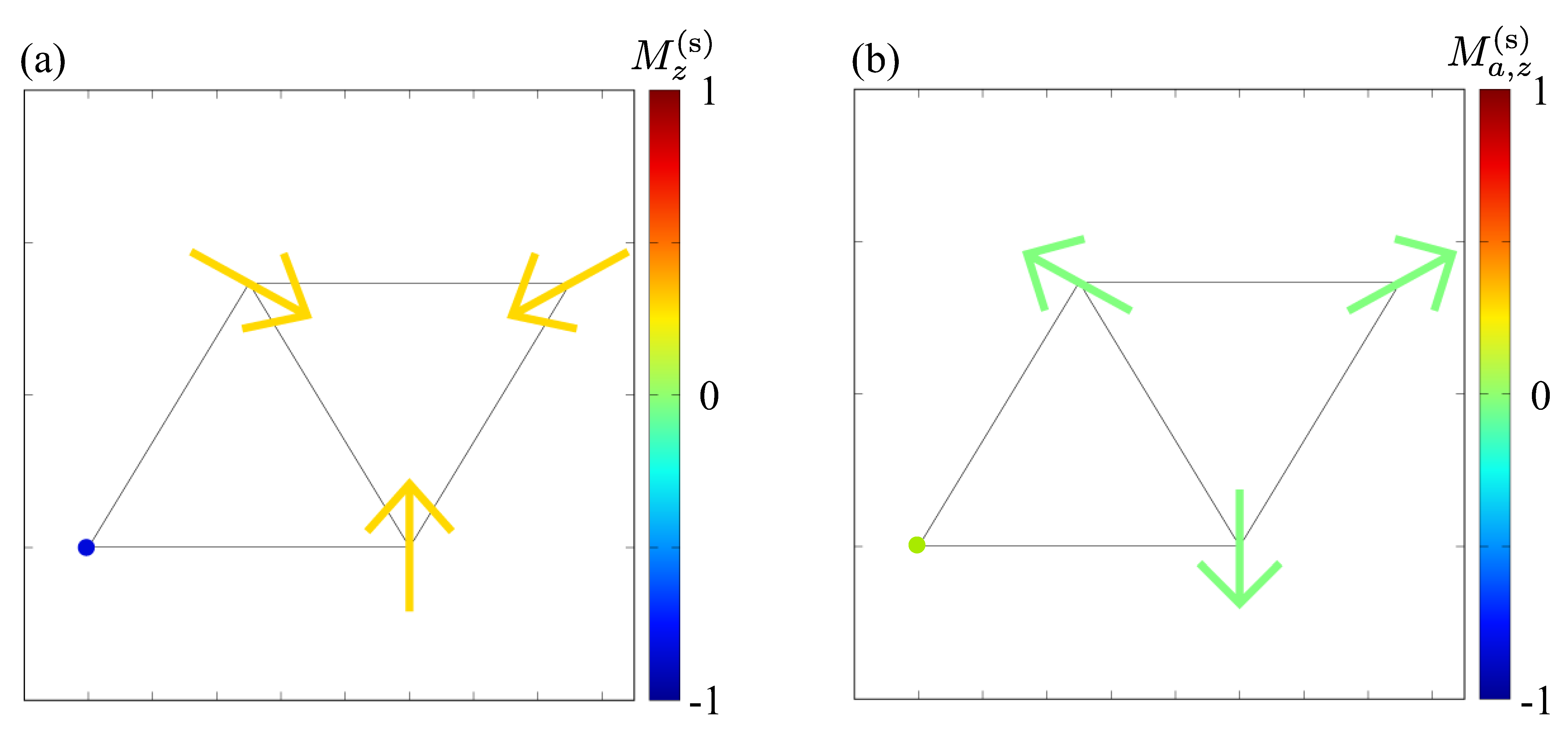
Figure 5.
(a) Intensity plot of the structure factor in terms of the spin-dependent electric monopole at and . (b) Corresponding real-space plot.
Figure 5.
(a) Intensity plot of the structure factor in terms of the spin-dependent electric monopole at and . (b) Corresponding real-space plot.
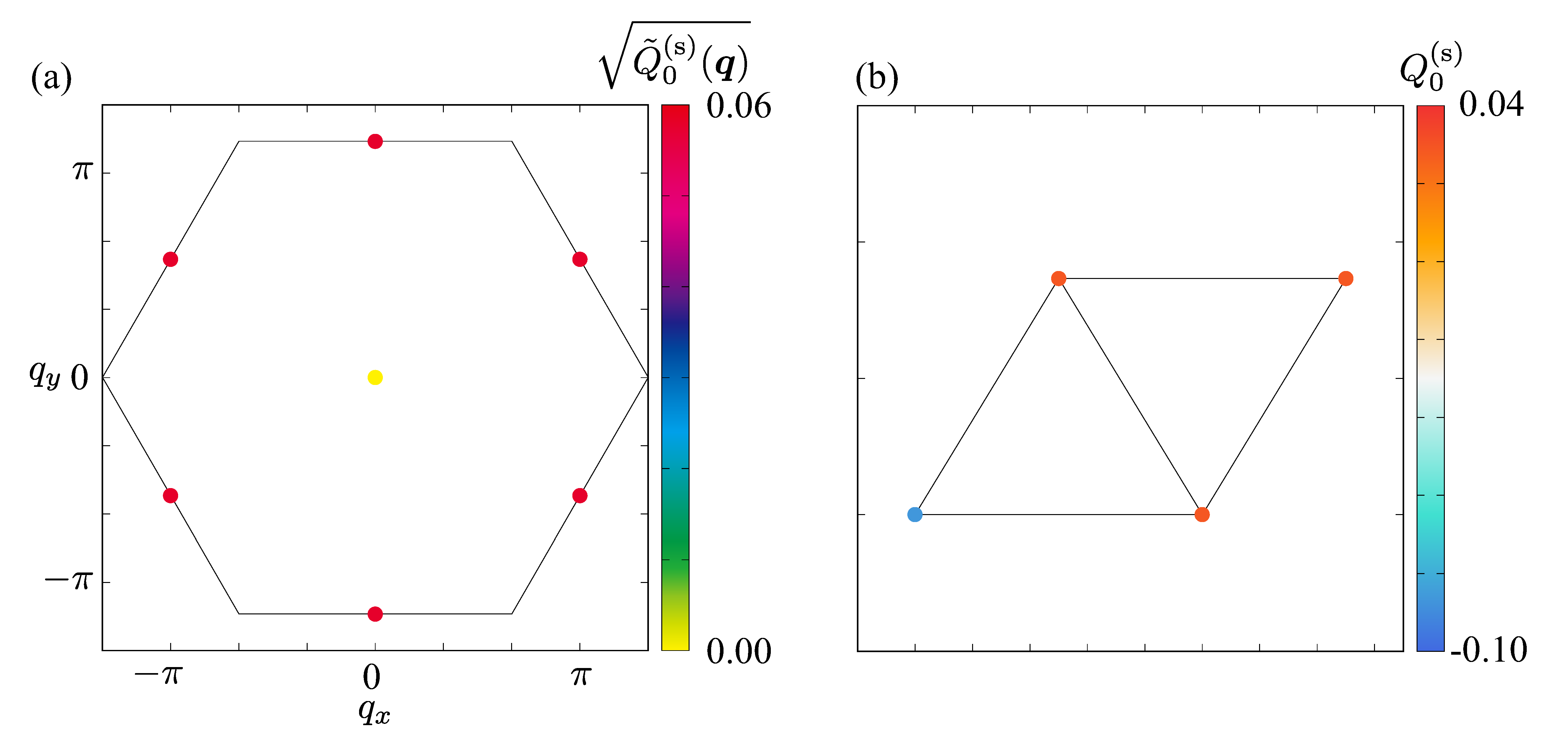
Figure 7.
Intensity plots of the structure factor in terms of (a) the orbital magnetic dipole M, (b) the spin magnetic dipole , (c) the anisotropic magnetic dipole , (d) the spin-dependent electric monopole , and (e) the spin-dependent electric toroidal dipole at , , and .
Figure 7.
Intensity plots of the structure factor in terms of (a) the orbital magnetic dipole M, (b) the spin magnetic dipole , (c) the anisotropic magnetic dipole , (d) the spin-dependent electric monopole , and (e) the spin-dependent electric toroidal dipole at , , and .
Disclaimer/Publisher’s Note: The statements, opinions and data contained in all publications are solely those of the individual author(s) and contributor(s) and not of MDPI and/or the editor(s). MDPI and/or the editor(s) disclaim responsibility for any injury to people or property resulting from any ideas, methods, instructions or products referred to in the content. |
© 2025 by the authors. Licensee MDPI, Basel, Switzerland. This article is an open access article distributed under the terms and conditions of the Creative Commons Attribution (CC BY) license (http://creativecommons.org/licenses/by/4.0/).
Copyright: This open access article is published under a Creative Commons CC BY 4.0 license, which permit the free download, distribution, and reuse, provided that the author and preprint are cited in any reuse.


