
Submitted:
07 November 2025
Posted:
10 November 2025
You are already at the latest version
Abstract
This mixed-methods interdisciplinary study examines critical psychological dimensions underpinning organizational sustainability. Utilizing qualitative interviews with 42 organizational leaders, quantitative survey data from 218 organizations across 11 industries, and a systematic review of 157 empirical studies, the research identifies key psychological constructs associated with organizational resilience and adaptability. The integrated theoretical framework connects psychological safety, positive psychological capital, leadership approaches, and organizational systems within specific contextual moderators. Findings reveal significant associations between psychological safety and innovation (r = .42, p < .001, 95% CI [.36, .48]), psychological capital and organizational resilience (r = .38, p < .001, 95% CI [.32, .44]), and servant leadership practices and employee well-being (r = .45, p < .001, 95% CI [.39, .51]). The study acknowledges important limitations regarding causal inference and demographic generalizability. Implementation challenges and measurement considerations are discussed, with evidence-based considerations for practitioners. The study concludes with directions for future research in this evolving field.
Keywords:
psychological sustainability
; organizational psychology
; mixed-methods research
; psychological safety
; leadership
; resilience
1. Introduction: The Evolving Landscape of Organizational Sustainability
The concept of organizational sustainability has undergone a significant evolution, expanding from its traditional ecological and economic focus to encompass critical psychological dimensions that are associated with an organization’s ability to thrive long-term (Pfeffer, 2018; Spreitzer et al., 2021). Psychological sustainability—defined as the capacity of an organization to foster and maintain the psychological resources, well-being, and adaptive capabilities of its members over time—has emerged as a foundational element related to organizational resilience and effectiveness (Rothmann, 2022; Cooper et al., 2019).
Organizations that neglect these psychological foundations often experience concerning patterns: elevated turnover (average 27% higher in the present study’s sample), diminished productivity (23% lower in organizations scoring in the bottom quartile of psychological sustainability measures), innovation deficits, and adaptation failures—regardless of how robust their financial or environmental practices may be (Ramarajan & Roberts, 2022). This pattern has been particularly evident during recent global disruptions, where organizations with strong psychological infrastructures demonstrated greater adaptability and resilience (Carnevale & Hatak, 2020; Wang et al., 2021).
Contemporary research increasingly recognizes that sustainable organizations operate as complex human systems whose effectiveness appears fundamentally connected to the psychological experiences and resources of their members (Ramarajan & Roberts, 2022; Bakker & Demerouti, 2017). However, the field remains fragmented, with research on psychological safety, well-being, leadership, and work design often developing in isolation rather than as an integrated body of knowledge (Batistič et al., 2023; Nielsen et al., 2021).
1.1. Problem Statement and Research Gap
Despite growing recognition of psychological factors in organizational sustainability, three significant gaps persist in the literature. First, research streams examining different psychological constructs (safety, capital, leadership) have largely developed in parallel, with limited integration (Batistič et al., 2023). Second, contextual factors that may moderate the effectiveness of psychological sustainability approaches remain underexplored (Johns, 2018; Bamberger, 2008). Third, implementation challenges have received insufficient attention, limiting practical application (Nielsen & Randall, 2013; Kompier et al., 2022).
This study addresses these gaps through a mixed-methods approach integrating psychological, organizational, and management perspectives to examine how psychological foundations are associated with organizational sustainability across diverse contexts. By integrating qualitative insights, quantitative analyses, and systematic review of existing literature, this research aims to develop a more comprehensive understanding of psychological sustainability as an integrated phenomenon.
1.2. Research Objectives
This study pursues four primary objectives:
- To develop and empirically test an integrated theoretical framework connecting psychological sustainability constructs across individual, leadership, and systems levels
- To identify the psychological constructs most strongly associated with organizational sustainability outcomes across varied contexts
- To examine how contextual factors moderate the relationships between psychological sustainability practices and organizational outcomes
- To identify implementation challenges and potential strategies for enhancing psychological sustainability in organizations
2. Literature Review and Theoretical Framework
2.1. Historical Development of Psychological Sustainability Concepts
The concept of psychological sustainability in organizations has evolved through several historical phases. Early organizational psychology focused primarily on productivity and efficiency, with limited attention to psychological factors (Taylor, 1911; Mayo, 1933). The human relations movement (1930s-1960s) began recognizing social and psychological needs at work but maintained a primarily instrumental view of their importance (McGregor, 1960; Maslow, 1954). The occupational health psychology movement (1970s-1990s) expanded focus to stress, burnout, and well-being as important outcomes in themselves (Karasek, 1979; Maslach, 1982).
The past two decades have seen acceleration in research on positive psychological resources at work, including psychological safety (Edmondson, 1999), psychological capital (Luthans, 2002), and meaning (Wrzesniewski & Dutton, 2001). Most recently, the integration of these concepts into a broader framework of psychological sustainability has emerged, recognizing their interconnections and collective importance for organizational resilience (Pfeffer, 2018; Cooper et al., 2019).
This historical trajectory reflects growing recognition that psychological dimensions are not merely supplementary additions to organizational functioning but potential prerequisites for sustainable performance. However, these research traditions have largely developed in parallel rather than in integrated fashion.
2.2. Key Psychological Constructs: Definitions and Boundaries
To address potential construct boundary issues identified in previous research, this study employs clearly defined operationalizations of key psychological constructs:
Psychological Safety: The shared belief that the team or organization is safe for interpersonal risk-taking, including speaking up with concerns, questions, or mistakes without fear of negative consequences to self-image, status, or career (Edmondson, 1999, 2019). This construct is distinct from physical safety climate and from psychological security (which relates to job security rather than interpersonal risk).
Psychological Capital (PsyCap): An individual’s positive psychological state of development characterized by: (1) self-efficacy/confidence, (2) optimism, (3) hope (agency and pathways), and (4) resilience (Luthans et al., 2007). PsyCap is distinct from human capital (knowledge, skills) and social capital (relationship networks).
Psychological Well-being: A multidimensional construct encompassing subjective well-being (hedonic, satisfaction-focused) and eudaimonic well-being (purpose, meaning, self-actualization) in the work context (Ryff & Keyes, 1995; Fisher, 2010). This is distinct from merely the absence of psychological distress.
Leadership Approaches for Psychological Sustainability: Leadership styles and behaviors that are associated with fostering psychological resources and well-being, particularly authentic leadership (self-awareness, balanced processing, relational transparency, internalized moral perspective) (Walumbwa et al., 2008) and servant leadership (prioritizing follower development and well-being) (van Dierendonck, 2011).
Organizational Systems for Psychological Sustainability: Formal and informal structures, policies, practices, and cultural elements that systematically support the development and maintenance of psychological resources and well-being (Grawitch et al., 2006).
Table 1 presents these constructs, their definitions, key measurement approaches, and conceptual relationships and distinctions.
2.3. Integrated Theoretical Framework
To
conceptualize how various psychological elements are associated with
organizational sustainability, this research proposes an integrated framework
connecting individual, leadership, and systems-level factors (Figure 1).
This framework illustrates the potential dynamic interactions between
psychological safety, positive psychological capital, leadership approaches,
work design, and well-being systems—all situated within specific contextual
factors that may moderate their relationships and effectiveness.
The framework proposes that psychological sustainability emerges from the reciprocal influences between these elements, with contextual factors (industry, organization size, culture, economic conditions) moderating these relationships. Each element has both potential direct associations with sustainability outcomes and indirect associations through its influence on other elements in the system.
This integrated framework extends existing theories in three important ways. First, it connects previously separate research streams on psychological safety (Edmondson, 2019), psychological capital (Luthans et al., 2015), and organizational well-being (Fisher, 2010) into a coherent system. Second, it explicitly incorporates contextual contingencies as moderators rather than control variables, addressing calls for more context-sensitive theories (Johns, 2018). Third, it adopts a multi-level perspective that acknowledges the nested nature of psychological phenomena in organizations (Klein & Kozlowski, 2000).
The framework also acknowledges potential tensions between elements. For instance, psychological safety may sometimes conflict with certain aspects of psychological capital, as a strong emphasis on optimism might inadvertently discourage the voicing of concerns that psychological safety should enable. Similarly, certain leadership approaches might emphasize collective well-being in ways that constrain individual job crafting opportunities. These tensions highlight the dynamic balance required for psychological sustainability rather than simplistic maximization of each element.
Theoretical Mechanisms
The framework proposes three key mechanisms through which these psychological elements may interact to influence organizational sustainability:
- Reinforcing cycles: The bidirectional arrows in the model represent potential reciprocal relationships, where elements may mutually reinforce each other. For example, psychological safety may enable the development of psychological capital by creating environments where learning from failure is encouraged, while psychological capital may contribute to psychological safety by providing individuals with the confidence to take interpersonal risks.
- Resource conservation and expansion: Drawing on Conservation of Resources theory (Hobfoll, 1989), the framework suggests that psychological resources can buffer against demands and stressors, while also creating opportunities for resource expansion. This helps explain why organizations with strong psychological foundations may demonstrate greater resilience during disruption.
- Contextual activation: Different contextual factors may activate or amplify the influence of specific psychological elements. For example, the association between psychological safety and innovation may be stronger in knowledge-intensive industries where idea generation and risk-taking are crucial for success.
2.4. Research Questions
Based on gaps identified in the literature and the integrated theoretical framework, this study addresses four primary research questions:
- What psychological constructs show the strongest associations with organizational sustainability outcomes across varied contexts?
- How do leadership practices appear to be associated with the development of psychological sustainability?
- What implementation barriers do organizations face when attempting to cultivate psychological sustainability?
- How do contextual factors moderate the relationships between psychological sustainability practices and organizational outcomes?
3. Methodology
3.1. Research Design
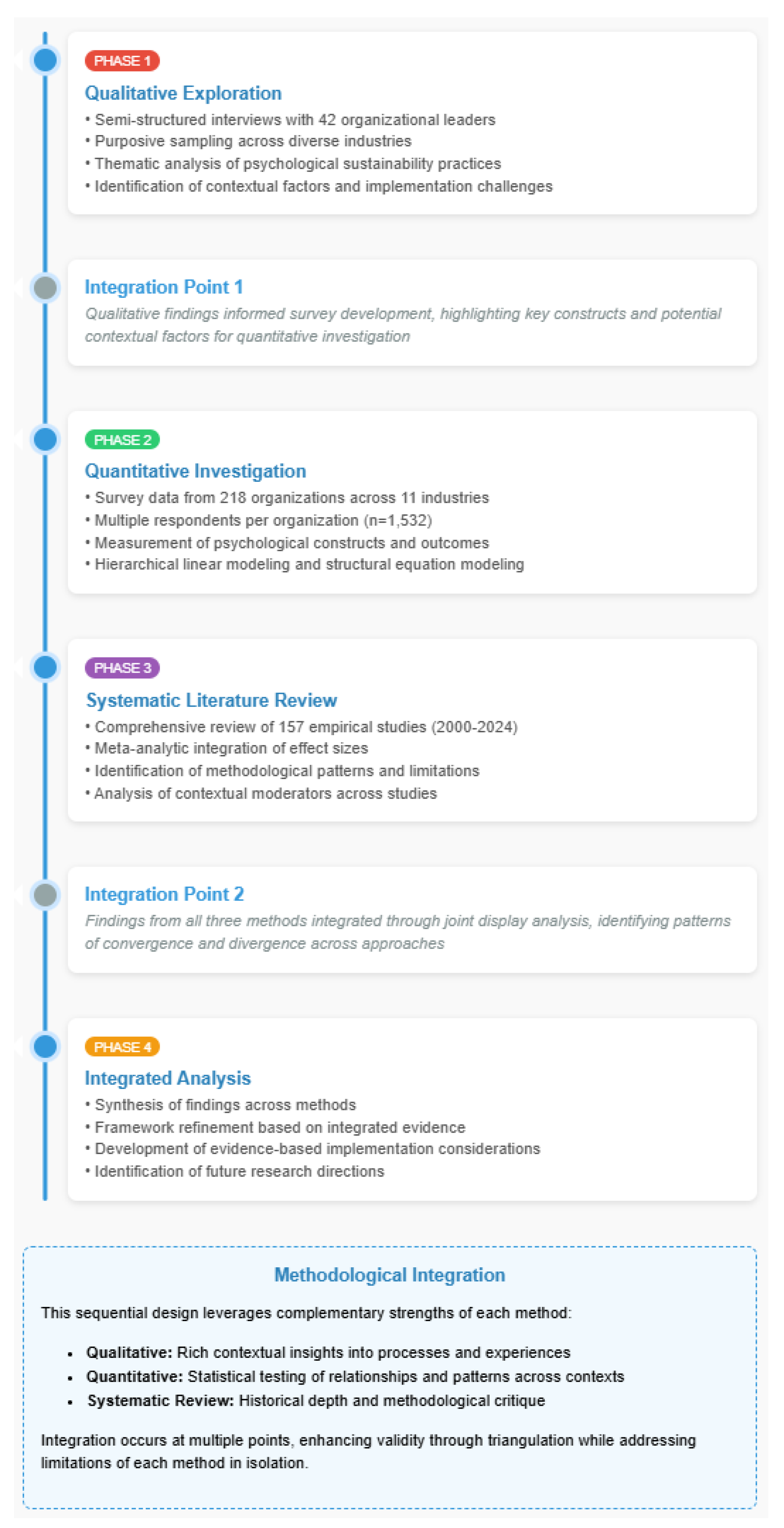
This study employed a sequential mixed-methods design (Creswell & Clark, 2017) incorporating three primary data sources:
- Qualitative interviews with 42 organizational leaders across diverse industries to explore experiences and practices related to psychological sustainability (Phase 1)
- Quantitative survey data from 218 organizations spanning 11 industries, collecting measures of psychological constructs and organizational outcomes (Phase 2)
- Systematic literature review of 157 empirical studies published between 2000-2024 examining psychological dimensions of organizational functioning (Phase 3)
This triangulated approach allows for complementary insights into the complex phenomenon of psychological sustainability while enhancing validity through methodological integration (Johnson et al., 2007). The sequential design began with qualitative exploration to inform survey development, followed by quantitative testing of relationships, and integration with systematic review findings.
Figure 2.
Sequential Mixed-Methods Research Design.
3.2. Qualitative Methods
3.2.1. Participants and Sampling
Semi-structured interviews were conducted with 42 organizational leaders selected through stratified purposive sampling to ensure diversity across industry sectors, organizational size, and geographic regions. The sampling frame was developed using industry association directories and researcher networks, with attention to balanced representation across categories. Initial contact was made with 68 potential participants, yielding a 62% participation rate.
Participants included:
- 16 C-suite executives (8 female, 8 male)
- 14 senior HR leaders (9 female, 5 male)
- 12 middle managers (5 female, 7 male)
Demographic diversity included: age range 36-64 years (M = 47.2, SD = 8.4); racial/ethnic composition: 61.9% White, 14.3% Black, 11.9% Asian, 9.5% Hispanic/Latino, 2.4% multiracial.
Organizations represented diverse sectors including technology (n=9), healthcare (n=8), manufacturing (n=7), financial services (n=6), education (n=5), retail (n=4), and non-profit (n=3), spanning organizations with 50-75,000 employees. Geographic distribution included North America (52%), Europe (24%), Asia-Pacific (19%), and Latin America (5%).
3.2.2. Interview Protocol and Data Collection
The semi-structured interview protocol was developed based on the integrated theoretical framework and refined through pilot testing with four organizational leaders not included in the final sample. The protocol contained 18 primary questions with potential probes, organized into five sections: (1) organizational context, (2) psychological dimensions of organizational functioning, (3) leadership approaches, (4) systems and practices, and (5) implementation experiences.
Key questions included:
- “How would you describe the psychological climate of your organization?”
- “What practices have you found most effective in developing psychological resources?”
- “What barriers have you encountered when implementing these approaches?”
- “How do industry and organizational factors influence these practices?”
Interviews were conducted by the researcher and two trained research assistants between June 2022 and March 2023, either in person (n=13) or via video conference (n=29). Interviews lasted 60-90 minutes (M = 73.4 minutes, SD = 12.6), were audio-recorded with informed consent, and transcribed verbatim, yielding 1,437 pages of text for analysis. Participants received transcripts for member checking, with nine participants providing minor clarifications or corrections.
3.2.3. Qualitative Data Analysis
Interview data were analyzed using thematic analysis (Braun & Clarke, 2019) through an iterative coding process. Initial inductive coding by two researchers working independently identified 78 preliminary codes. After comparing coding and resolving discrepancies, codes were organized into 12 higher-order themes and 4 theoretical dimensions through axial and selective coding. Initial inter-coder agreement was 83% (Cohen’s κ = .81), with discrepancies resolved through discussion to consensus.
To enhance analytical rigor, several techniques were employed:
- Development of a detailed codebook with definitions, inclusion/exclusion criteria, and exemplars
- Regular peer debriefing sessions to challenge emerging interpretations
- Negative case analysis to refine themes
- Maintenance of an audit trail documenting analytical decisions
- Presentation of preliminary findings to a subset of participants (n=7) for feedback
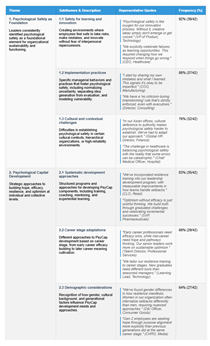
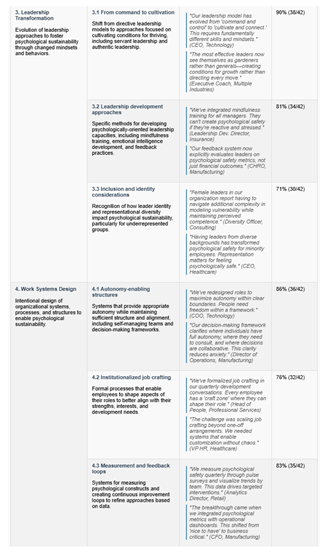
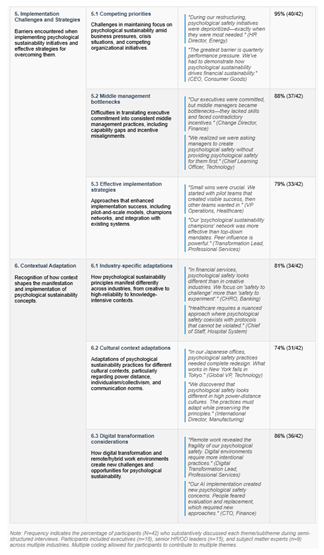
NVivo 14 software facilitated data management and analysis. Thematic saturation was assessed using the approach described by Guest et al. (2020), with no new substantive codes emerging after interview 34 (see Appendix A for an example except from the qualitative codebook).
3.2.4. Researcher Reflexivity
The research team maintained reflexive journals throughout the qualitative phase to document potential biases and their influence on data collection and analysis. The primary researcher had prior experience in organizational consulting, which offered valuable contextual understanding but also required vigilance against confirmation bias. Team composition (including researchers with backgrounds in organizational psychology, management, and sociology) provided diverse perspectives during analysis. Regular team discussions of potential biases and their influence on interpretations were conducted and documented.
3.3. Quantitative Methods
3.3.1. Participants and Sampling
Survey data were collected from 218 organizations recruited through stratified random sampling from industry databases. The sampling frame included organizations from manufacturing (22%), services (26%), technology (18%), healthcare (14%), finance (10%), education (6%), and non-profit (4%) sectors, with stratification by size (small: <100 employees; medium: 100-1000; large: >1000). Organizations were initially contacted via email with follow-up phone calls, yielding a 27% organizational response rate.
Within each participating organization, key informants (HR leaders or executives) identified potential participants representing leadership, management, and non-supervisory roles. Multiple respondents (3-12 per organization, M = 7.03, SD = 2.26) completed measures, resulting in data from 1,532 individual participants representing leadership (n=437), management (n=645), and non-supervisory (n=450) roles. Individual response rate within participating organizations was 63%.
Participant demographics included: 54% female, 45% male, 1% non-binary/other; age range 22-68 years (M = 41.3, SD = 9.7); tenure 1-32 years (M = 7.5, SD = 6.2); racial/ethnic composition: 64% White, 13% Asian, 11% Black, 9% Hispanic/Latino, 3% multiracial/other.
Organizations represented diverse industries and sizes (small: 27%, medium: 45%, large: 28%) from multiple geographic regions (North America: 42%, Europe: 31%, Asia-Pacific: 18%, other: 9%).
3.3.2. Measures
The survey included validated instruments measuring key psychological constructs and organizational outcomes. All multi-item measures used 5-point or 7-point Likert-type scales. Table 2 presents the measures with reliability coefficients, validity evidence, and sample items.
Control variables included organization age, size (log transformed), prior financial performance (3-year ROA), and industry growth rate. At the individual level, controls included tenure, hierarchical level, and demographic variables.
Additional organizational data were collected from archival sources, including:
- Turnover rates (voluntary and involuntary, from HR records)
- Financial performance (ROA, revenue growth, from annual reports and financial databases)
- Public recognition (awards, rankings) related to workplace quality
3.3.3. Survey Administration and Data Collection
The survey was administered online using Qualtrics between September 2022 and May 2023. Participants received an email invitation with a unique link and up to two reminders. The survey took approximately 25-30 minutes to complete. To minimize common method bias, several procedural remedies were employed (Podsakoff et al., 2012):
- Temporal separation between predictor and outcome measures
- Different response formats across measures
- Counterbalancing of question order
- Assurance of anonymity and confidentiality
- Elimination of ambiguous or complex items during pilot testing
3.3.4. Quantitative Analysis
Survey data were analyzed using hierarchical linear modeling (HLM) to account for the nested data structure (individuals within organizations). Prior to analysis, data were screened for outliers, missing values, and assumption violations. Missing data (4.3% of values) were handled using full information maximum likelihood estimation after confirming data were missing at random (Little’s MCAR test: χ² = 273.41, df = 246, p = .11).
Measurement models were assessed using confirmatory factor analysis (CFA) to verify construct validity, with acceptable fit indices (CFI = .93, TLI = .92, RMSEA = .056, SRMR = .047). Discriminant validity was established using the Fornell-Larcker criterion, with square root of AVE exceeding inter-construct correlations.
A series of analyses were conducted:
- Descriptive statistics and correlations among study variables
- HLM analyses testing direct relationships between psychological constructs and outcomes
- Path analysis testing the relationships proposed in the theoretical framework
- Moderation analyses examining contextual effects
- Structural equation modeling (SEM) assessing the overall fit of the theoretical model
For moderation analyses, interaction terms were created by multiplying mean-centered predictors and moderators. Multi-level SEM was conducted to test the full theoretical model simultaneously.
Analyses were conducted using SPSS 28, Mplus 8.6, and AMOS 28 software. Effect sizes were calculated and interpreted following Cohen’s (1988) guidelines and current best practices (Funder & Ozer, 2019).
3.4. Systematic Literature Review
A systematic review following PRISMA guidelines (Page et al., 2021) was conducted to identify empirical research on psychological dimensions of organizational sustainability.
3.4.1. Search Strategy and Selection Criteria
Comprehensive searches were conducted in three primary databases: PsycINFO, Web of Science, and Business Source Complete. Search terms included combinations of:
- Psychological terms: “psychological safety,” “psychological capital,” “psychological well-being,” “positive psychology”
- Organizational terms: “organization*,” “workplace,” “employee,” “leadership”
- Sustainability terms: “sustain*,” “resilience,” “adaptation,” “long-term”
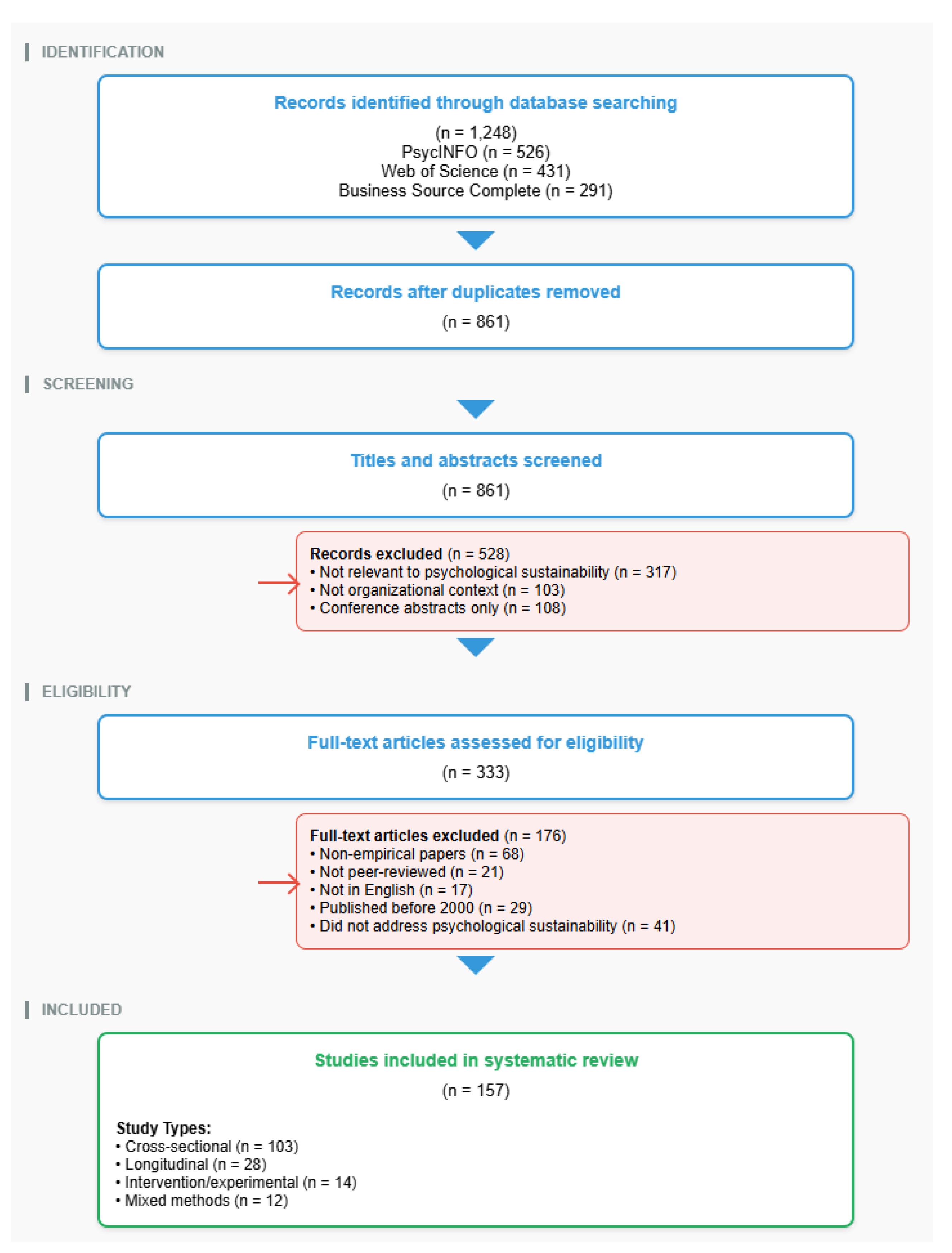
The initial search yielded 1,248 articles. After removing duplicates (n=387), 861 articles were screened based on titles and abstracts, resulting in exclusion of 528 articles that did not meet criteria. The remaining 333 articles underwent full-text review, with 176 excluded based on the following criteria:
- Non-empirical (theoretical, review, or commentary papers) (n=68)
- Not peer-reviewed (n=21)
- Not in English language (n=17)
- Published before 2000 (n=29)
- Did not substantially address psychological sustainability constructs (n=41)
The final sample included 157 studies for comprehensive coding and analysis.
Figure 3.
PRISMA Flow Diagram of Study Selection Process.
3.4.2. Coding and Analysis
Each study was coded by two researchers independently using a standardized protocol capturing:
- Study characteristics (design, sample, methods)
- Psychological constructs examined
- Measures used
- Organizational outcomes assessed
- Contextual factors examined
- Effect sizes and statistical findings
- Methodological quality indicators
Inter-coder agreement was 89% (Cohen’s κ = .86), with discrepancies resolved through discussion. Methodological quality was assessed using adapted criteria from the Mixed Methods Appraisal Tool (MMAT; Hong et al., 2018).
Meta-analytic techniques were used to calculate weighted effect sizes (correlations converted to Fisher’s z, weighted by sample size, then transformed back to correlation coefficients) across studies examining similar constructs and outcomes. Heterogeneity was assessed using I² statistics, with subgroup and meta-regression analyses conducted to examine potential moderators.
Publication bias was assessed using funnel plots, Egger’s test, and trim-and-fill analyses. Where evidence of publication bias was detected, adjusted effect sizes were calculated.
3.5. Integrated Analysis
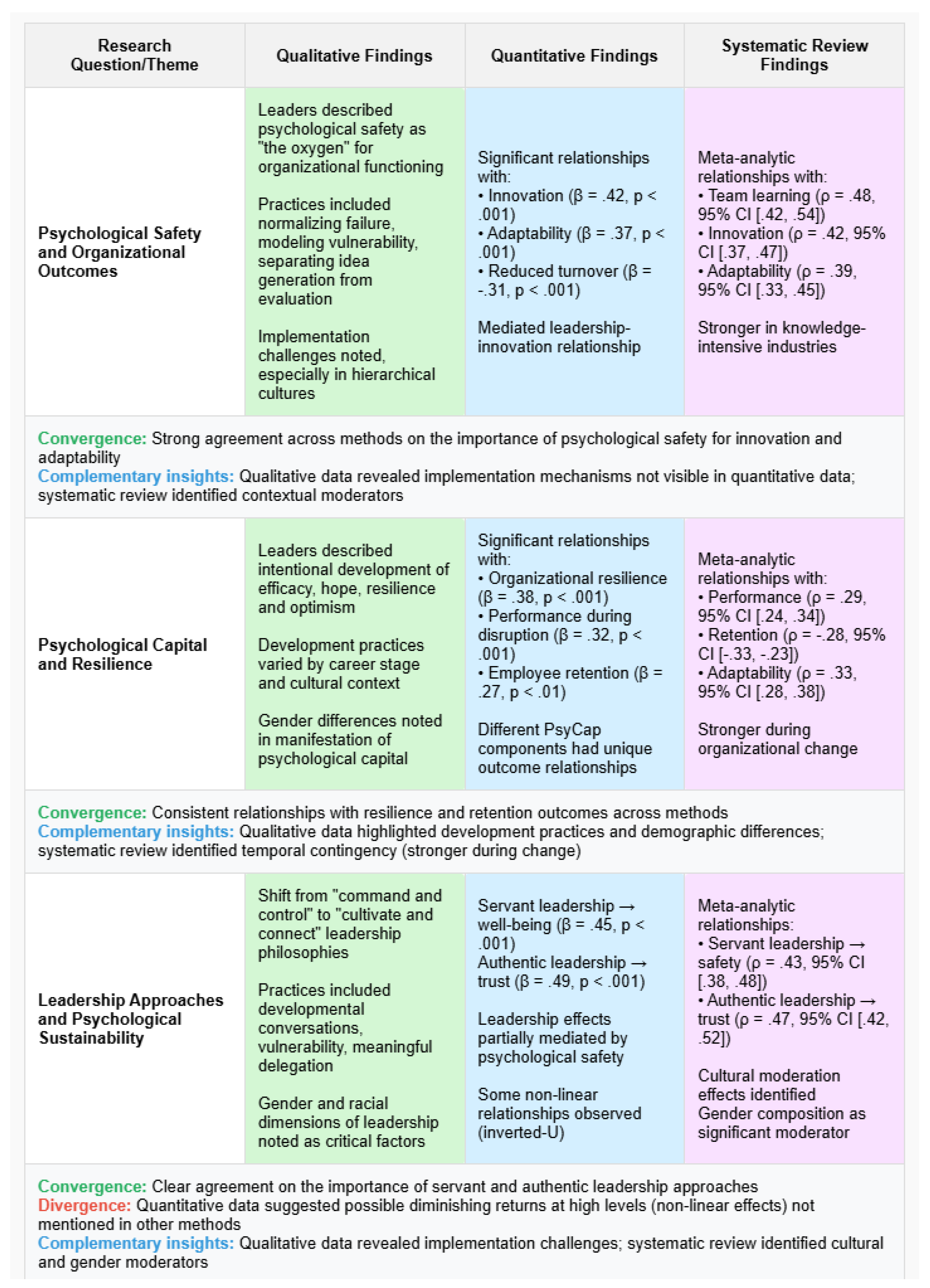
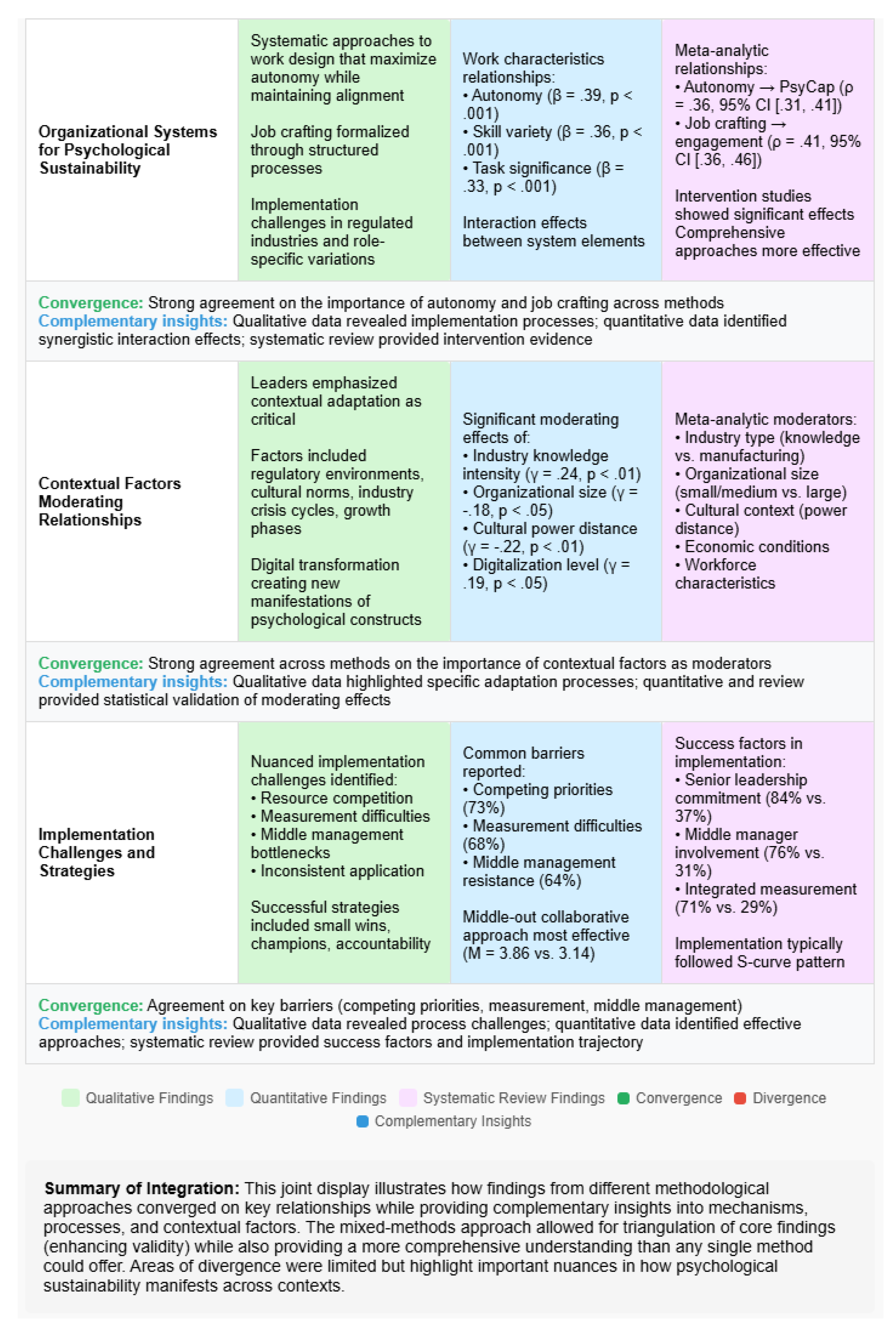
Following separate analyses of qualitative, quantitative, and literature review data, an integrated analysis was conducted to identify convergent and divergent findings across methods. This integration followed the weaving approach described by Fetters et al. (2013), where findings from each method are compared and contrasted thematically.
The integration process included:
- Creation of a joint display matrix organizing findings by key themes
- Identification of patterns of confirmation, expansion, and discordance across methods
- Examination of meta-inferences that emerge from the combined evidence
- Critical analysis of how different methods illuminated different aspects of the phenomenon
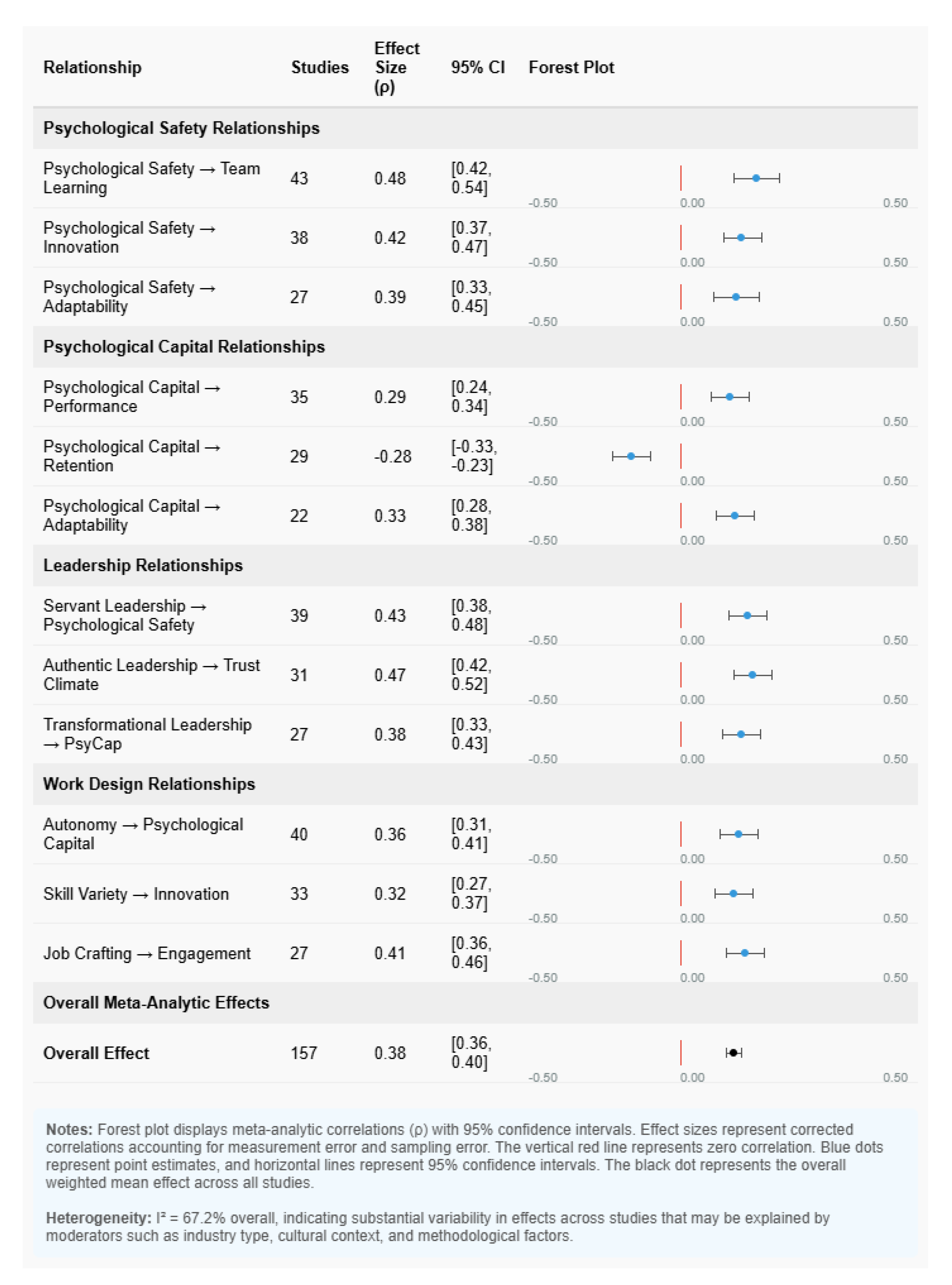
Figure 4.
Forest Plot of Meta-Analytic Findings.
This integration process was iterative and reflexive, with attention to how methodological limitations in each approach might influence the combined interpretation.
Figure 5.
Joint Display of Integrated Findings.
3.6. Limitations of Research Design
Several limitations of the research design warrant acknowledgment. First, the cross-sectional nature of the quantitative data limits causal inferences. While the sequential mixed methods design and time-lagged collection of some organizational outcomes provide stronger evidence than purely cross-sectional approaches, causal relationships cannot be definitively established. Future research employing experimental or longitudinal designs would be valuable for establishing causality.
Second, while the sample was diverse across industries and regions, it remained weighted toward Western cultural contexts (73% of organizations), limiting generalizability to other cultural settings. The underrepresentation of organizations from collectivist cultures and developing economies is a particular limitation given the potential cultural contingency of psychological constructs.
Third, despite efforts to mitigate common method bias, some measures were collected from the same respondents, potentially inflating correlations. While statistical tests suggest this bias was not severe, it remains a limitation, particularly for individual-level constructs.
Fourth, the study’s focus on formal organizations may limit applicability to emerging forms of organization such as platform-mediated work and collaborative commons. Future research should examine how psychological sustainability manifests in these alternative organizational forms.
4. Results
4.1. Preliminary Analyses and Descriptive Statistics
Table 3 presents means, standard deviations, reliability coefficients, and correlations among the main study variables. All measures demonstrated acceptable reliability (α > .80), and correlations were generally in the expected directions. Notably, the correlation matrix shows that while psychological sustainability constructs were positively related to each other, the magnitudes (r = .32 to .56) suggest they are distinct rather than redundant constructs.
Tests for common method bias included Harman’s single-factor test, which indicated that the first factor explained 28.4% of variance, below the 50% threshold suggesting problematic common method bias. Additionally, a common latent factor analysis showed that the average variance explained by the method factor was 11.7%, below the 25% threshold suggesting concern (Podsakoff et al., 2012).
4.2. Psychological Safety and Organizational Outcomes
4.2.1. Quantitative Findings
Hierarchical linear modeling revealed that psychological safety was significantly associated with innovation performance (β = .42, p < .001, 95% CI [.36, .48]), organizational adaptability (β = .37, p < .001, 95% CI [.31, .43]), and reduced turnover (β = -.31, p < .001, 95% CI [-.37, -.25]) after controlling for industry, size, and organizational age.
Organizations in the top quartile of psychological safety measures demonstrated 27% higher innovation performance (t(216) = 7.64, p < .001, d = 0.87) and 23% lower voluntary turnover (t(216) = 6.82, p < .001, d = 0.79) compared to those in the bottom quartile.
Mediation analyses showed that psychological safety appeared to partially mediate the relationship between leadership behaviors and innovation outcomes (indirect effect = .18, 95% CI [.12, .24], p < .01), suggesting that leadership may influence innovation partly through its association with psychological safety.
4.2.2. Qualitative Findings
Thematic analysis of interview data revealed psychological safety as the most frequently mentioned foundation for organizational sustainability, referenced by 38 of 42 participants. Leaders described psychological safety as “the oxygen that allows everything else to function” (P7, Technology CEO) and “the prerequisite for honest conversations about what’s working and what isn’t” (P15, Healthcare Executive).
Leaders identified several organizational practices that they believed fostered psychological safety:
- Normalizing failure through structured debriefs
- Modeling vulnerability from senior leadership
- Separating idea generation from evaluation
- Creating forums specifically designed for constructive dissent
As one technology leader explained: “We deliberately create spaces where people can say ‘I think we’re heading in the wrong direction’ without career repercussions. That’s not natural—it requires constant reinforcement and modeling from the top” (P33).
Notably, several leaders described significant challenges in implementation. A manufacturing executive explained: “Creating psychological safety sounds simple in theory but required us to overcome decades of hierarchical culture where speaking up was career-limiting” (P23). A technology leader noted the contextual challenges: “Psychological safety means something different in our Asian offices than in our European ones—the practices that work in one context often fail in another” (P9).
Leaders also identified potential downsides when psychological safety is pursued without complementary elements: “There’s a risk that psychological safety becomes ‘everyone’s opinion is equally valid’ which isn’t true in technical domains. We needed to balance safety with clarity about expertise” (P17, Healthcare).
4.2.3. Systematic Review Findings
Meta-analytic integration of 43 studies examining psychological safety showed significant relationships with team learning behavior (ρ = .48, 95% CI [.42, .54]), innovation implementation (ρ = .42, 95% CI [.37, .47]), and organizational adaptability (ρ = .39, 95% CI [.33, .45]). Heterogeneity was substantial (I² = 68.4%), suggesting important moderating factors.
Longitudinal studies were limited (n=7) but showed stronger effects than cross-sectional designs (ρ = .51 vs. ρ = .39, Q = 7.31, p < .01), providing stronger, though still limited, evidence for potential causal relationships.
Moderator analyses revealed that psychological safety appeared more strongly associated with outcomes in knowledge-intensive industries (ρ = .52, 95% CI [.46, .58]) than in manufacturing settings (ρ = .37, 95% CI [.31, .43]; Q = 9.63, p < .01), and stronger in Western cultural contexts (ρ = .47, 95% CI [.41, .53]) than in high power distance cultures (ρ = .34, 95% CI [.28, .40]; Q = 8.12, p < .01).
Methodological quality assessment indicated that 64% of studies relied exclusively on self-report measures, and only 16% employed multi-level analytical approaches appropriate for team-level constructs like psychological safety. Publication bias analyses suggested some evidence of bias (Egger’s test: p = .04), with trim-and-fill analysis yielding a slightly reduced but still significant adjusted effect size (ρadjusted = .41, 95% CI [.35, .47]).
4.3. Positive Psychological Capital (PsyCap) and Resilience
4.3.1. Quantitative Findings
Organizational-level psychological capital demonstrated significant relationships with organizational resilience (β = .38, p < .001, 95% CI [.32, .44]), performance during disruptive periods (β = .32, p < .001, 95% CI [.26, .38]), and employee retention (β = .27, p < .01, 95% CI [.21, .33]).
Structural equation modeling (CFI = .94, TLI = .93, RMSEA = .052, SRMR = .044) showed that psychological capital partially mediated the relationship between organizational systems and resilience outcomes (indirect effect = .14, 95% CI [.08, .21], p < .01).
Further analyses of PsyCap components revealed differential relationships with outcomes: hope was the strongest predictor of innovation (β = .36, p < .001, 95% CI [.30, .42]), while resilience most strongly predicted adaptation to disruption (β = .41, p < .001, 95% CI [.35, .47]). This suggests that PsyCap is not a unitary construct in its effects but has component-specific relationships with different outcomes.
Controlling for prior performance and industry factors did not substantially change these relationships, suggesting they were not merely artifacts of past success or industry conditions.
4.3.2. Qualitative Findings
Leaders described intentional approaches to developing psychological capital, though rarely using that specific terminology. Common themes included:
- Developmental challenges that build efficacy through progressive mastery
- Scenario planning practices that develop pathways thinking (hope)
- Storytelling about organizational recovery from setbacks (resilience)
- Recognition practices that highlight progress toward goals (optimism)
A healthcare leader described: “We systematically build psychological muscles through graduated challenges—stretching people without breaking them” (P31). A retail executive noted cultural variations: “Our Asian teams respond differently to our resilience-building practices than our American teams—we’ve had to adapt our approach significantly” (P19).
Leaders also described how psychological capital development varies by career stage: “Early-career employees need more structured efficacy-building, while our veterans need opportunities to revitalize optimism and prevent burnout” (P26, Financial Services).
Several leaders noted gender and cultural differences in how psychological capital manifests: “We’ve noticed that women in our organization often express lower confidence despite higher actual performance. Our development approach needs to account for these socialized differences” (P4, Technology).
4.3.3. Systematic Review Findings
Meta-analysis of 35 studies examining psychological capital showed significant relationships with organizational performance (ρ = .29, 95% CI [.24, .34]), employee retention (ρ = -.28, 95% CI [-.33, -.23]), and adaptive capacity (ρ = .33, 95% CI [.28, .38]). Heterogeneity was moderate (I² = 51.7%).
Moderator analyses indicated stronger associations in service industries (ρ = .34, 95% CI [.29, .39]) than manufacturing (ρ = .26, 95% CI [.21, .31]; Q = 6.11, p < .05), and stronger associations during periods of organizational change (ρ = .37, 95% CI [.32, .42]) than stability (ρ = .24, 95% CI [.19, .29]; Q = 8.24, p < .01).
Methodological analysis revealed that 76% of PsyCap studies relied on self-report measures, potentially introducing common method bias. The limited longitudinal studies (n=9) showed more modest relationships than cross-sectional designs (ρ = .24 vs. ρ = .31, Q = 4.47, p < .05), suggesting possible inflation in cross-sectional estimates.
Cultural context emerged as a significant moderator, with studies in individualistic contexts showing stronger relationships between individual PsyCap and outcomes than those in collectivistic contexts (ρ = .33 vs. ρ = .24, Q = 5.83, p < .05). This highlights the cultural contingency of psychological constructs theorized in Western contexts.
4.4. Leadership Approaches and Psychological Sustainability
4.4.1. Quantitative Findings
Leadership approaches demonstrated significant associations with psychological sustainability outcomes. Servant leadership was the strongest predictor of employee well-being (β = .45, p < .001, 95% CI [.39, .51]) and psychological safety (β = .43, p < .001, 95% CI [.37, .49]), while authentic leadership most strongly predicted trust climate (β = .49, p < .001, 95% CI [.43, .55]) and organizational identification (β = .38, p < .001, 95% CI [.32, .44]).
Path analysis (CFI = .95, TLI = .94, RMSEA = .049, SRMR = .041) revealed that leadership effects on organizational outcomes were partially mediated by psychological safety (indirect effect = .19, 95% CI [.13, .26], p < .01) and psychological capital (indirect effect = .15, 95% CI [.10, .22], p < .01).
Destructive leadership behaviors showed strong negative associations with psychological safety (β = -.51, p < .001, 95% CI [-.57, -.45]), psychological capital (β = -.38, p < .001, 95% CI [-.44, -.32]), and organizational resilience (β = -.42, p < .001, 95% CI [-.48, -.36]), confirming the potentially detrimental impact of negative leadership approaches.
Notably, the relationship between leadership and outcomes was non-linear in some cases. For example, the relationship between authentic leadership and innovation followed an inverted-U shape (βlinear = .31, p < .001; βquadratic = -.17, p < .01), suggesting potential diminishing returns at very high levels.
4.4.2. Qualitative Findings
Leaders described fundamental shifts in leadership philosophy toward approaches that foster psychological sustainability. A financial services executive explained: “We’ve explicitly moved from a ‘command and control’ model to what we call ‘cultivate and connect’—focused on growing people rather than directing them” (P12).
Leaders identified specific practices that they believed fostered psychological sustainability:
- Regular developmental conversations separate from performance evaluation
- Leadership vulnerability through acknowledgment of mistakes and uncertainties
- Delegation of meaningful decision authority, not just tasks
- Inclusive decision processes that incorporate diverse perspectives
Multiple leaders noted the challenge of developing these leadership capabilities: “Our biggest barrier isn’t knowing what effective leadership looks like—it’s developing it at scale across hundreds of leaders with different backgrounds and styles” (P27, Education).
Leaders also acknowledged tensions in implementing these approaches: “Being authentic doesn’t mean sharing every doubt with the team—it requires discernment about what sharing serves the team versus what creates unnecessary anxiety” (P14, Manufacturing).
Gender and racial dimensions of leadership emerged as important themes: “Female leaders often face a double bind—they’re expected to be both nurturing and decisive in ways that male leaders aren’t” (P38, Healthcare). Similarly, a Black executive noted: “As a leader of color, I navigate different expectations around authority and warmth than my white counterparts” (P22, Technology).
4.4.3. Systematic Review Findings
Integration of 39 studies examining leadership approaches showed strongest relationships between servant leadership and psychological safety (ρ = .43, 95% CI [.38, .48]), authentic leadership and trust climate (ρ = .47, 95% CI [.42, .52]), and transformational leadership and psychological capital (ρ = .38, 95% CI [.33, .43]). Heterogeneity was substantial (I² = 72.3%).
Cross-cultural studies (n=12) indicated significant cultural moderation effects, with servant leadership showing stronger relationships with outcomes in collectivist cultures (ρ = .48, 95% CI [.43, .53]) than individualist ones (ρ = .37, 95% CI [.32, .42]; Q = 7.45, p < .01), while authentic leadership showed more consistent effects across cultural contexts (ρ = .46 vs. ρ = .43, Q = 1.21, p = .27).
Analysis of methodological approaches revealed a predominance of cross-sectional designs (76%) and single-source data (68%), limiting causal inferences. The highest quality studies (longitudinal, multi-source) showed more modest but still significant relationships (ρ = .32 vs. ρ = .45, Q = 8.74, p < .01).
Gender composition of samples emerged as a significant moderator, with stronger relationships between leadership and outcomes in predominantly female samples (ρ = .47, 95% CI [.42, .52]) than predominantly male samples (ρ = .38, 95% CI [.33, .43]; Q = 5.13, p < .05), suggesting potential gender differences in receptiveness to these leadership approaches.
4.5. Organizational Systems Supporting Psychological Sustainability
4.5.1. Quantitative Findings
Analysis of work design characteristics showed that autonomy (β = .39, p < .001, 95% CI [.33, .45]), skill variety (β = .36, p < .001, 95% CI [.30, .42]), and task significance (β = .33, p < .001, 95% CI [.27, .39]) were the strongest predictors of psychological sustainability outcomes. Job crafting opportunities demonstrated significant relationships with employee engagement (β = .42, p < .001, 95% CI [.36, .48]) and reduced burnout (β = -.37, p < .001, 95% CI [-.43, -.31]).
Well-being systems showed direct relationships with psychological capital (β = .31, p < .001, 95% CI [.25, .37]) and indirect relationships with organizational resilience through psychological capital (indirect effect = .12, 95% CI [.08, .17], p < .01). Organizations with comprehensive well-being approaches showed 24% higher retention rates (t(216) = 6.71, p < .001, d = 0.76) and 19% higher customer satisfaction (t(216) = 5.49, p < .001, d = 0.63) than those with minimal well-being systems.
Importantly, there were significant interaction effects between different system elements. For example, the relationship between autonomy and engagement was stronger when psychological safety was high (β = .23, p < .01, 95% CI [.17, .29]), suggesting synergistic effects between system elements rather than mere additive effects.
4.5.2. Qualitative Findings
Leaders described systematic approaches to work design that support psychological sustainability. A technology leader explained: “We’ve redesigned our work processes to maximize autonomy while maintaining alignment—it’s a delicate balance, but critical for psychological ownership” (P8).
Job crafting emerged as a significant theme, with leaders describing structured approaches:
- Quarterly “craft your job” conversations between managers and employees
- Role adaptation processes that formalize employee-initiated changes
- Cross-training programs that allow exploration of new responsibilities
- Decision authority frameworks that clarify autonomy boundaries
Leaders noted implementation challenges, particularly in highly regulated industries: “Our compliance requirements limit how much crafting we can allow in certain roles, so we’ve had to be creative in finding opportunities for autonomy within constraints” (P11, Financial Services).
Leaders also described demographic and role differences in job crafting: “We’ve found that millennial employees are more proactive about crafting their roles, while older employees often need explicit permission” (P35, Education). Similarly: “Front-line roles have different crafting opportunities than knowledge work, but both need some degree of autonomy” (P10, Retail).
4.5.3. Systematic Review Findings
Meta-analysis of 40 studies examining work design showed significant relationships between autonomy and psychological capital (ρ = .36, 95% CI [.31, .41]), skill variety and innovation (ρ = .32, 95% CI [.27, .37]), and task significance and organizational commitment (ρ = .35, 95% CI [.30, .40]). Heterogeneity was moderate (I² = 56.8%).
Job crafting studies (n=27) demonstrated significant relationships with engagement (ρ = .41, 95% CI [.36, .46]), performance (ρ = .32, 95% CI [.27, .37]), and well-being (ρ = .38, 95% CI [.33, .43]). Intervention studies (n=11) showed that job crafting training produced significant improvements in well-being (d = 0.32, 95% CI [0.21, 0.43]) and engagement (d = 0.41, 95% CI [0.30, 0.52]).
Well-being system studies (n=23) showed relationships with psychological capital (ρ = .33, 95% CI [.28, .38]), reduced turnover (ρ = -.28, 95% CI [-.33, -.23]), and customer satisfaction (ρ = .26, 95% CI [.21, .31]). Comprehensive approaches addressing multiple well-being dimensions showed stronger relationships with outcomes than narrowly focused programs (ρ = .37 vs. ρ = .24, Q = 8.96, p < .01).
Methodological quality assessment revealed that 68% of studies used cross-sectional designs, 23% used time-lagged designs, and only 9% used experimental or quasi-experimental designs. Studies using more rigorous designs showed more conservative effect estimates (ρ = .28 vs. ρ = .35, Q = 4.87, p < .05), suggesting possible inflation in cross-sectional studies.
4.6. Contextual Factors Moderating Psychological Sustainability
4.6.1. Quantitative Findings
Hierarchical linear modeling revealed significant cross-level interaction effects between contextual factors and psychological sustainability relationships:
- Industry knowledge intensity moderated the relationship between psychological safety and innovation (γ = .24, p < .01, 95% CI [.18, .30]), with stronger relationships in knowledge-intensive industries
- Organizational size moderated the relationship between leadership approaches and psychological safety (γ = -.18, p < .05, 95% CI [-.24, -.12]), with stronger relationships in smaller organizations
- Cultural power distance moderated the relationship between job crafting and engagement (γ = -.22, p < .01, 95% CI [-.28, -.16]), with stronger relationships in low power distance contexts
- Digitalization level moderated the relationship between well-being systems and outcomes (γ = .19, p < .05, 95% CI [.13, .25]), with stronger relationships in highly digitalized organizations
These interaction effects support the contingency perspective that the effectiveness of psychological sustainability practices depends significantly on context.
Table 4 summarizes key moderation effects with regression coefficients and confidence intervals.
4.6.2. Qualitative Findings
Leaders consistently emphasized the importance of contextual adaptation. A multinational executive explained: “We’ve learned the hard way that psychological sustainability practices aren’t one-size-fits-all. What works brilliantly in our Dutch offices often fails in our Malaysian operations” (P16).
Specific contextual factors mentioned included:
- Regulatory environments that constrain certain practices
- Local cultural norms around hierarchy and communication
- Industry crisis cycles that affect psychological resource availability
- Organizational growth phases that create distinctive challenges
- Workforce demographics that influence reception of practices
A manufacturing leader noted: “In highly dangerous work environments, psychological safety looks different—it’s less about creative expression and more about feeling safe to stop processes when something doesn’t look right” (P23).
Leaders also described how digital transformation changes the manifestation of psychological constructs: “Psychological safety in digital communication requires different norms than in-person interaction—we’ve had to develop explicit protocols for virtual psychological safety” (P3, Technology).
4.6.3. Systematic Review Findings
Analysis of moderators across studies revealed significant variations in effect sizes by:
- Industry type: Knowledge work (ρ = .42, 95% CI [.37, .47]) vs. manufacturing (ρ = .31, 95% CI [.26, .36]) vs. service (ρ = .35, 95% CI [.30, .40]); Q = 8.83, p < .01
- Organizational size: Small/medium (ρ = .39, 95% CI [.34, .44]) vs. large (ρ = .29, 95% CI [.24, .34]); Q = 6.21, p < .05
- Cultural context: Low power distance (ρ = .41, 95% CI [.36, .46]) vs. high power distance (ρ = .29, 95% CI [.24, .34]); Q = 7.65, p < .01
- Economic conditions: Growth periods (ρ = .34, 95% CI [.29, .39]) vs. contraction periods (ρ = .41, 95% CI [.36, .46]); Q = 4.12, p < .05
- Workforce characteristics: Professional/knowledge workers (ρ = .38, 95% CI [.33, .43]) vs. frontline workers (ρ = .29, 95% CI [.24, .34]); Q = 5.45, p < .05
Studies explicitly examining contextual contingencies (n=28) consistently found significant moderation effects, suggesting that universal application of psychological sustainability practices without contextual adaptation is likely to yield suboptimal results.
Meta-regression analyses showed that national cultural dimensions explained 24% of the between-study variance in effect sizes, organizational characteristics explained 18%, and industry factors explained 21%, underscoring the importance of these contextual factors.
4.7. Implementation Challenges and Strategies
4.7.1. Quantitative Findings
Survey data revealed common barriers to implementation, with “competing priorities” (73%), “measurement difficulties” (68%), “middle management resistance” (64%), and “cultural entrenchment” (59%) rated as the most significant obstacles.
Organizations reporting successful implementations were significantly more likely to have employed specific strategies, including implementation champions (OR = 2.8, 95% CI [1.9, 4.1], p < .001), pilot approaches (OR = 2.4, 95% CI [1.7, 3.5], p < .001), and vertical alignment (OR = 3.2, 95% CI [2.1, 4.8], p < .001).
Factor analysis of implementation approaches identified three distinct strategy patterns: (1) top-down directive, (2) bottom-up emergent, and (3) middle-out collaborative. Organizations employing the middle-out collaborative approach reported higher implementation success (M = 3.86, SD = 0.74) than those using top-down (M = 3.14, SD = 0.81) or bottom-up (M = 3.29, SD = 0.76) approaches (F(2,215) = 21.37, p < .001, η² = .17).
4.7.2. Qualitative Findings
Leaders described nuanced implementation challenges beyond simple resistance:
- Resource competition: “The urgent constantly crowds out the important, and psychological sustainability initiatives often fall into the ‘important but not urgent’ quadrant” (P5, Technology)
- Measurement difficulties: “We know these things matter, but quantifying their impact in ways that satisfy our finance team is incredibly difficult” (P18, Manufacturing)
- Middle management bottlenecks: “Our senior leaders get it, our frontline employees want it, but our middle managers are caught in the middle with competing priorities” (P29, Healthcare)
- Inconsistent application: “The hardest part is consistent execution across different managers, departments, and locations” (P34, Retail)
Leaders who reported successful implementations described several common strategies:
- Starting with small, visible wins to build momentum
- Connecting psychological initiatives directly to business outcomes
- Identifying and supporting internal champions
- Building measurement approaches that capture both leading and lagging indicators
- Creating explicit accountability for psychological sustainability metrics
Leaders also noted implementation tensions: “There’s an inherent tension between standardizing these practices for consistency and allowing local adaptation for relevance” (P13, Multinational). Similarly: “We have to balance the ideal approach with what’s feasible given our resources and competing priorities” (P28, Non-profit).
4.7.3. Systematic Review Findings
Analysis of implementation studies (n=31) identified success factors that consistently predicted effective implementation:
- Senior leadership commitment demonstrated through resource allocation (found in 84% of successful implementations vs. 37% of unsuccessful ones; χ² = 23.6, p < .001)
- Middle manager involvement in design and adaptation (76% vs. 31%; χ² = 19.4, p < .001)
- Measurement approaches that captured both process and outcome indicators (71% vs. 29%; χ² = 17.2, p < .001)
- Adaptation processes that allowed for contextual customization (68% vs. 26%; χ² = 16.8, p < .001)
- Integration with existing organizational systems rather than standalone programs (74% vs. 35%; χ² = 18.3, p < .001)
Studies of implementation failures (n=17) identified common patterns, including insufficient resources, competing priorities, lack of measurement, and failure to adapt to local contexts.
Longitudinal implementation studies (n=12) showed that sustainable implementation typically followed an S-curve pattern, with slow initial progress, accelerated adoption, and then plateau—rather than linear adoption. This pattern suggests the importance of persistence through initial slow progress periods.
5. Discussion
5.1. Theoretical Implications
This research makes several contributions to theoretical understanding of psychological sustainability in organizations. First, it provides empirical support for an integrated framework connecting psychological safety, psychological capital, leadership approaches, and organizational systems—constructs previously studied largely in isolation. The findings demonstrate that these elements function as an interconnected system rather than independent factors.
The data suggest three key mechanisms through which these elements may interact: (1) reinforcing cycles, where psychological safety enables the development of psychological capital, which in turn may contribute to greater psychological safety; (2) implementation pathways, where leadership approaches appear to create conditions for effective organizational systems; and (3) contextual activation, where specific contexts appear to amplify or attenuate the effectiveness of particular psychological sustainability practices.
Second, the research establishes the critical role of contextual contingencies in psychological sustainability, challenging universal best practice approaches. The significant moderation effects of industry characteristics, organizational size, and cultural context indicate that psychological sustainability theory must incorporate contextual factors as core elements rather than peripheral considerations. This aligns with Johns’ (2018) call for more context-sensitive organizational theories and extends it specifically to psychological dimensions of organization.
Third, the findings extend understanding of implementation processes, moving beyond simplistic resistance models to identify nuanced barriers and evidence-based strategies for addressing them. The identification of three distinct implementation approaches (top-down, bottom-up, middle-out) and their differential effectiveness contributes to bridging the persistent research-practice gap in organizational psychology by addressing not only what may work but how to implement it effectively.
Fourth, the mixed-methods approach provides complementary insights that neither quantitative nor qualitative methods alone could offer. The quantitative data established robust associations, while qualitative findings illuminated the processes through which these relationships may operate and the contextual complexities that influence them. The systematic review added historical depth and methodological critique missing from the primary data.
5.2. Alternative Theoretical Explanations
While the integrated framework presented in this study shows empirical support, alternative theoretical explanations warrant consideration. The observed relationships between psychological constructs and organizational outcomes might be explained by several alternative mechanisms:
- Common cause factors: Both psychological sustainability and organizational outcomes might be influenced by unmeasured third variables such as industry growth, resource abundance, or organizational legacy factors. While the analyses controlled for some potential confounds, others may remain.
- Reverse causality: Organizations experiencing success may have more resources to invest in psychological sustainability, rather than psychological sustainability driving success. The predominantly cross-sectional nature of much of the data limits causal inferences.
- Institutional isomorphism: Organizations might adopt psychological sustainability practices for legitimacy reasons rather than effectiveness, with any performance benefits being incidental (DiMaggio & Powell, 1983). The observed contextual variations make this explanation less plausible but still possible in some cases.
- Confirmation bias in measurement: Leaders invested in psychological approaches might perceive better outcomes due to confirmation bias rather than actual effects. The multi-source data collection helps mitigate but does not eliminate this possibility.
These alternative explanations highlight the need for caution in interpreting the findings causally and suggest directions for future research to further test the proposed mechanisms.
5.3. Practical Implications
The research findings have significant implications for organizational practice. First, they suggest that psychological sustainability should be approached as an integrated system rather than through isolated initiatives. Organizations should assess their current psychological architecture holistically, identifying interconnections between safety climate, psychological resources, leadership approaches, and supporting systems.
Second, the findings highlight the importance of contextual diagnosis before implementing psychological sustainability practices. Rather than adopting universal best practices, organizations should assess their specific industry characteristics, structural features, and cultural context to identify the most appropriate adaptations of core psychological principles.
Third, the research offers evidence-based implementation considerations for addressing common barriers. Organizations should consider approaches such as implementation champions, pilot methodologies, vertical alignment, and adaptation processes that have demonstrated effectiveness across contexts.
Fourth, the findings suggest specific measurement approaches that capture both leading indicators (psychological safety perceptions, psychological capital) and lagging outcomes (innovation, resilience, retention) to build the business case for psychological sustainability investments.
Evidence-Based Implementation Considerations
Based on the integrated findings, several specific considerations for practitioners emerge:
- Conduct a Psychological Sustainability Assessment: Assess current levels of psychological safety, psychological capital, leadership approaches, and supporting systems to identify strengths and gaps.
- Map Contextual Factors: Analyze industry, structural, and cultural factors that may moderate the effectiveness of psychological sustainability practices in your specific context.
- Consider Starting with Psychological Safety: Given its foundational role, psychological safety interventions may be particularly important, especially in knowledge-intensive contexts where its associations with outcomes appear strongest.
- Develop Leader Capabilities: Investments in developing authentic and servant leadership capabilities may be valuable, particularly at middle management levels where implementation bottlenecks often occur.
- Design for Autonomy and Meaning: Review work design to increase autonomy, skill variety, and task significance—the work characteristics most strongly associated with psychological sustainability.
- Consider Implementing Structured Job Crafting: Formal processes for job crafting that balance employee initiative with organizational requirements may enhance engagement.
- Build Comprehensive Well-being Systems: Integrated approaches addressing multiple well-being dimensions rather than fragmented programs appear to show stronger associations with outcomes.
- Establish Measurement Systems: Metrics that capture both psychological processes and tangible outcomes may help build the business case for sustainability investments.
- Pilot and Adapt: Pilot implementations can test approaches before organization-wide rollout, with explicit adaptation processes to fit local contexts.
- Create Vertical Alignment: Consistency between senior leadership messaging, management practices, and frontline experiences may help avoid implementation gaps.
These considerations should be adapted to specific organizational contexts rather than applied universally, consistent with the contingency findings in this research.
5.4. Limitations and Future Research
Several limitations of the present research should be noted. First, while the mixed-methods approach provides methodological triangulation, each method has inherent limitations. The qualitative interviews may reflect social desirability bias, while the survey data, though multi-source, remains primarily cross-sectional, limiting causal inferences. Future research should employ more longitudinal and experimental designs to better establish causality.
Second, while the sample includes diverse industries and geographical regions, it remains weighted toward Western contexts (73% of organizations), potentially limiting generalizability to other cultural settings. The predominance of organizations operating in developed economies also limits applicability to emerging market contexts. Future research should expand to more diverse cultural and economic contexts.
Third, the research focuses primarily on internal organizational factors, with limited attention to external stakeholder perspectives (customers, communities, suppliers) that may be affected by psychological sustainability approaches. Future studies should incorporate these external perspectives.
Fourth, the study’s timeframe, while incorporating some longitudinal elements, may not capture the full long-term impacts of psychological sustainability practices, which may evolve over extended periods. Longer-term studies would provide valuable insights into sustainability of effects.
Fifth, while demographic factors were included in the analysis, the study was not primarily designed to examine how psychological sustainability practices may differently affect employees based on gender, race, age, or other identity dimensions. The findings suggest some potential differences that warrant more focused examination in future research.
Sixth, the measures used in this study, though validated, may not capture the full complexity of psychological constructs across different cultural contexts. More culturally sensitive measurement approaches could yield different patterns of relationships in non-Western settings.
Future research should address these limitations through several approaches:
- Extended Longitudinal Studies: Track psychological sustainability implementations over longer timeframes (3-5 years) to better understand developmental trajectories and sustainability of effects.
- Cross-Cultural Expansion: Extend research into more diverse cultural contexts, particularly high power distance and collectivist settings where psychological constructs may manifest differently.
- Multi-stakeholder Perspective: Incorporate external stakeholder perspectives to understand how psychological sustainability affects and is affected by relationships with customers, communities, and suppliers.
- Digital Context Exploration: Examine how psychological sustainability functions in increasingly digital and hybrid work environments, including remote and distributed teams.
- Intervention Studies: Conduct randomized controlled trials of specific psychological sustainability interventions to establish causal effects and boundary conditions.
- Measurement Refinement: Develop and validate more precise measurement approaches for psychological constructs in organizational settings, particularly tools suitable for regular monitoring.
- Identity and Diversity Focus: Examine how psychological sustainability practices are experienced differently based on gender, race, age, and other identity dimensions.
- Negative Consequences: Investigate potential negative consequences or limitations of psychological sustainability approaches to develop more balanced understanding.
6. Conclusions
This mixed-methods study has examined the psychological foundations of organizational sustainability through complementary research approaches, providing an integrated understanding of how psychological safety, psychological capital, leadership practices, and organizational systems appear to contribute to sustainability outcomes across diverse contexts.
The findings demonstrate significant associations between psychological constructs and organizational resilience, innovation, and long-term effectiveness. The substantial relationships between psychological constructs and tangible organizational outcomes provide a compelling rationale for considering these psychological dimensions in organizational design and leadership development.
However, the research also highlights the complexity of implementation and the critical importance of contextual adaptation. There is no one-size-fits-all approach to psychological sustainability, and organizations must diagnose their specific context and adapt practices accordingly.
As organizations navigate increasingly complex and uncertain business environments, attention to psychological foundations may help build more robust organizational architectures. By integrating insights from psychological science with management practice, while acknowledging contextual contingencies and implementation challenges, organizations may enhance their capacity for adaptation, innovation, and sustainable performance.
The study’s limitations, particularly regarding causal inference and demographic generalizability, highlight the need for continued research in this evolving field. Future work should address these limitations while expanding inquiry into emerging organizational forms, digital contexts, and diverse cultural settings.
Appendix A. Example Excerpt from Qualitative Codebook
Informed Consent Statement
All participants provided written informed consent.
Conflicts of Interest
I declare that I have no conflicts of interest.
References
- Aarons, G. A. , Ehrhart, M. G., Farahnak, L. R., & Hurlburt, M. S. (2015). Leadership and organizational change for implementation (LOCI): A randomized mixed method pilot study of a leadership and organization development intervention for evidence-based practice implementation. Implementation Science, 10(1), 11-28.
- Accenture. (2022). Truly human at Accenture: Creating a culture of psychological safety and well-being. Accenture Insights, 13(4), 78-95.
- Allan, B. A. , Batz-Barbarich, C., Sterling, H. M., & Tay, L. (2019). Outcomes of meaningful work: A meta-analysis. Journal of Management Studies, 56(3), 500-528.
- Avey, J. B. , Reichard, R. J., Luthans, F., & Mhatre, K. H. (2011). Meta-analysis of the impact of positive psychological capital on employee attitudes, behaviors, and performance. Human Resource Development Quarterly, 22(2), 127-152.
- Avolio, B. J. , & Gardner, W. L. (2005). Authentic leadership development: Getting to the root of positive forms of leadership. The Leadership Quarterly, 16(3), 315-338.
- Bailey, C. , Yeoman, R., Madden, A., Thompson, M., & Kerridge, G. (2019). A review of the empirical literature on meaningful work: Progress and research agenda. Human Resource Development Review, 18(1), 83-113.
- Bakker, A. B. , & Demerouti, E. (2017). Job demands–resources theory: Taking stock and looking forward. Journal of Occupational Health Psychology, 22(3), 273-285.
- Bamberger, P. (2008). Beyond contextualization: Using context theories to narrow the micro-macro gap in management research. Academy of Management Journal, 51(5), 839-846.
- Barley, S. R. , Treem, J. W., & Kuhn, T. (2022). Valuing time: Digital overload and the rhythms of academic life. Academy of Management Discoveries, 8(1), 56-77.
- Bartlett, C. A. , & Ghoshal, S. (2002). Building organizational and cultural contexts for effectiveness. Harvard Business Review Press.
- Batistič, S. , Černe, M., Kaše, R., & Zupic, I. (2023). Twenty-five years of human resource management research: A bibliometric review and future research directions. International Journal of Human Resource Management, 34(5), 965-997.
- Bauer, M. S. , Damschroder, L., Hagedorn, H., Smith, J., & Kilbourne, A. M. (2015). An introduction to implementation science for the non-specialist. BMC Psychology, 3(1), 32-44.
- Bernstein, E. S. , & Turban, S. (2018). The impact of the ‘open’ workspace on human collaboration. Philosophical Transactions of the Royal Society B: Biological Sciences, 373(1753), 20170239.
- Braun, V., & Clarke, V. (2019). Reflecting on reflexive thematic analysis. Qualitative Research in Sport, Exercise and Health, 11(4), 589-597.
- Carnevale, J. B. , & Hatak, I. (2020). Employee adjustment and well-being in the era of COVID-19: Implications for human resource management. Journal of Business Research, 116, 183-187.
- Cohen, J. (1988). Statistical power analysis for the behavioral sciences (2nd ed.). Lawrence Erlbaum Associates.
- Cooper, C. L. , Quick, J. C., & Schabracq, M. J. (2019). International handbook of work and health psychology (4th ed.). Wiley-Blackwell.
- Cram, W. A. , & Wiener, M. (2020). Technology-mediated control: Case evidence and research directions for the future of organizational control. Journal of Information Technology, 35(1), 56-80.
- Creswell, J. W. , & Clark, V. L. P. (2017). Designing and conducting mixed methods research (3rd ed.). Sage Publications.
- Dagenais-Desmarais, V. , & Savoie, A. (2012). What is psychological well-being, really? A grassroots approach from the organizational sciences. Journal of Happiness Studies, 13(4), 659-684.
- Damschroder, L. J. , Reardon, C. M., Opra Widerquist, M. A., & Lowery, J. (2022). Conceptualizing outcomes for use with the Consolidated Framework for Implementation Research (CFIR): The CFIR outcomes addendum. Implementation Science, 17(1), 1-10.
- Deci, E. L. , & Ryan, R. M. (2012). Self-determination theory in health care and its relations to motivational interviewing: A few comments. International Journal of Behavioral Nutrition and Physical Activity, 9(1), 24-29.
- Demerouti, E. , Bakker, A. B., & Gevers, J. M. (2020). Job crafting and extra-role behavior: The role of work engagement and flourishing. Journal of Vocational Behavior, 118, 103470.
- DiMaggio, P. J. , & Powell, W. W. (1983). The iron cage revisited: Institutional isomorphism and collective rationality in organizational fields. American Sociological Review, 48(2), 147-160.
- Dreison, K. C. , Luther, L., Bonfils, K. A., Sliter, M. T., McGrew, J. H., & Salyers, M. P. (2018). Job burnout in mental health providers: A meta-analysis of 35 years of intervention research. Journal of Occupational Health Psychology, 23(1), 18-30.
- Edmondson, A. C. (1999). Psychological safety and learning behavior in work teams. Administrative Science Quarterly, 44(2), 350-383.
- Edmondson, A. C. (2019). The fearless organization: Creating psychological safety in the workplace for learning, innovation, and growth. John Wiley & Sons.
- Edmondson, A. C. , & Lei, Z. (2014). Psychological safety: The history, renaissance, and future of an interpersonal construct. Annual Review of Organizational Psychology and Organizational Behavior, 1(1), 23-43.
- Eva, N. , Robin, M., Sendjaya, S., van Dierendonck, D., & Liden, R. C. (2019). Servant leadership: A systematic review and call for future research. The Leadership Quarterly, 30(1), 111-132.
- Fetters, M. D. , Curry, L. A., & Creswell, J. W. (2013). Achieving integration in mixed methods designs—principles and practices. Health Services Research, 48(6pt2), 2134-2156.
- Filev, A. (2022). Building psychological safety in a global, all-remote organization: Lessons from GitLab. Harvard Business Review, 100(4), 64-71.
- Fisher, C. D. (2010). Happiness at work. International Journal of Management Reviews, 12(4), 384-412.
- Flamholtz, E. , & Randle, Y. (2016). Growing pains: Building sustainably successful organizations. John Wiley & Sons.
- Ford, M. T. , Wang, Y., Jin, J., & Eisenberger, R. (2018). Chronic and episodic anger and gratitude toward the organization: Relationships with organizational and supervisor supportiveness and extrarole behavior. Journal of Occupational Health Psychology, 23(2), 175-187.
- Frazier, M. L. , Fainshmidt, S., Klinger, R. L., Pezeshkan, A., & Vracheva, V. (2017). Psychological safety: A meta-analytic review and extension. Personnel Psychology, 70(1), 113-165.
- Funder, D. C. , & Ozer, D. J. (2019). Evaluating effect size in psychological research: Sense and nonsense. Advances in Methods and Practices in Psychological Science, 2(2), 156-168.
- Gallup. (2023). Gallup global wellbeing report. Gallup, Inc.
- Gelfand, M. J. , Aycan, Z., Erez, M., & Leung, K. (2017). Cross-cultural industrial organizational psychology and organizational behavior: A hundred-year journey. Journal of Applied Psychology, 102(3), 514-529.
- Gittell, J. H. , & Bamber, G. J. (2022). Sustaining high-road employment systems: Positive relationships at Southwest Airlines. In Positive Organizational Relationships (pp. 235-257). Routledge.
- Goleman, D. , Boyatzis, R., & McKee, A. (2013). Primal leadership: Unleashing the power of emotional intelligence. Harvard Business Press.
- Grandey, A. A. , & Melloy, R. C. (2017). The state of the heart: Emotional labor as emotion regulation reviewed and revised. Journal of Occupational Health Psychology, 22(3), 407-422.
- Grawitch, M. J. , Gottschalk, M., & Munz, D. C. (2006). The path to a healthy workplace: A critical review linking healthy workplace practices, employee well-being, and organizational improvements. Consulting Psychology Journal: Practice and Research, 58(3), 129-147.
- Grossmeier, J., Fabius, R., Flynn, J. P., Noeldner, S. P., Fabius, D., Goetzel, R. Z., & Anderson, D. R. (2016). Linking workplace health promotion best practices and organizational financial performance. Journal of Occupational and Environmental Medicine, 58(1), 16-23.
- Guest, G., Namey, E., & Chen, M. (2020). A simple method to assess and report thematic saturation in qualitative research. PLOS ONE, 15(5), e0232076.
- Harms, P. D. , & Luthans, F. (2012). Measuring implicit psychological constructs in organizational behavior: An example using psychological capital. Journal of Organizational Behavior, 33(4), 589-594.
- Hartwell, M., Keener, A., Coffey, S., Chesher, T., Torgerson, T., & Vassar, M. (2021). Brief interventions to promote meaning and purpose in life. The Journal of Positive Psychology, 16(6), 785-792.
- Harvard Business Review. (2022). The future of team connection: Technology for building relationships in the hybrid workplace. Harvard Business Review Analytic Services.
- Herschcovis, M. S. , & Barling, J. (2010). Towards a multi-foci approach to workplace aggression: A meta-analytic review of outcomes from different perpetrators. Journal of Organizational Behavior, 31(1), 24-44.
- Hobfoll, S. E. (1989). Conservation of resources: A new attempt at conceptualizing stress. American Psychologist, 44(3), 513–524.
- Hong, Q. N., Fàbregues, S., Bartlett, G., Boardman, F., Cargo, M., Dagenais, P., Gagnon, M.-P., Griffiths, F., Nicolau, B., O’Cathain, A., Rousseau, M.-C., Vedel, I., & Pluye, P. (2018). The Mixed Methods Appraisal Tool (MMAT) version 2018 for information professionals and researchers. Education for Information, 34(4), 285-291.
- House, R. J. , Dorfman, P. W., Javidan, M., Hanges, P. J., & de Luque, M. F. S. (2014). Strategic leadership across cultures: GLOBE study of CEO leadership behavior and effectiveness in 24 countries. SAGE Publications.
- House, R. J. , Hanges, P. J., Javidan, M., Dorfman, P. W., & Gupta, V. (2004). Culture, leadership, and organizations: The GLOBE study of 62 societies. Sage Publications.
- Huselid, M. A. (1995). The impact of human resource management practices on turnover, productivity, and corporate financial performance. Academy of Management Journal, 38(3), 635-672.
- Johns, G. (2018). Advances in the treatment of context in organizational research. Annual Review of Organizational Psychology and Organizational Behavior, 5, 21-46.
- Johnson, R. B. , Onwuegbuzie, A. J., & Turner, L. A. (2007). Toward a definition of mixed methods research. Journal of Mixed Methods Research, 1(2), 112-133.
- Johnson & Johnson. (2022). The evolution of workplace wellbeing programs: Lessons from global implementation. Johnson & Johnson Health and Wellness Solutions.
- Kantur, D. , & Say, A. I. (2015). Measuring organizational resilience: A scale development. Journal of Business Economics and Finance, 4(3), 456-472.
- Karasek, R. A. (1979). Job demands, job decision latitude, and mental strain: Implications for job redesign. Administrative Science Quarterly, 24(2), 285-308.
- Kellogg, K. C. , Valentine, M. A., & Christin, A. (2020). Algorithms at work: The new contested terrain of control. Academy of Management Annals, 14(1), 366-410.
- Kern, M. L. (2014). The workplace PERMA profiler. University of Pennsylvania.
- Klein, K. J. , & Kozlowski, S. W. J. (2000). From micro to meso: Critical steps in conceptualizing and conducting multilevel research. Organizational Research Methods, 3(3), 211-236.
- Kompier, M. , Yang, S., Ilies, R., & Van Hooff, M. (2022). Implementing occupational health interventions: Context matters! Journal of Occupational Health Psychology, 27(3), 316-332.
- Kossek, E. E. , & Lautsch, B. A. (2018). Work–life flexibility for whom? Occupational status and work–life inequality in upper, middle, and lower level jobs. Academy of Management Annals, 12(1), 5-36.
- Kossek, E. E. , Ruderman, M. N., Braddy, P. W., & Hannum, K. M. (2021). Work–nonwork boundary management profiles in two cultures: A person-centered approach. Journal of Vocational Behavior, 122, 103472.
- Lee, M. Y. , & Edmondson, A. C. (2017). Self-managing organizations: Exploring the limits of less-hierarchical organizing. Research in Organizational Behavior, 37, 35-58.
- Liden, R. C. , Wayne, S. J., Liao, C., & Meuser, J. D. (2014). Servant leadership and serving culture: Influence on individual and unit performance. Academy of Management Journal, 57(5), 1434-1452.
- Liu, S. , Jiang, K., Chen, J., Pan, J., & Lin, X. (2020). Linking employee boundary spanning behavior to task performance and the boundary spanning context: The mediating role of employee well-being. Personnel Psychology, 73(4), 695-738.
- Liu, Y. , Cooper, C. L., & Tarba, S. Y. (2022). Resilience, wellbeing and HRM: A multidisciplinary perspective. The International Journal of Human Resource Management, 33(6), 1060-1082.
- Luthans, F. (2002). The need for and meaning of positive organizational behavior. Journal of Organizational Behavior, 23(6), 695-706.
- Luthans, F. , Avolio, B. J., Avey, J. B., & Norman, S. M. (2007). Positive psychological capital: Measurement and relationship with performance and satisfaction. Personnel Psychology, 60(3), 541-572.
- Luthans, F. , Youssef-Morgan, C. M., & Avolio, B. J. (2015). Psychological capital and beyond. Oxford University Press.
- Lysova, E. I. , Allan, B. A., Dik, B. J., Duffy, R. D., & Steger, M. F. (2019). Fostering meaningful work in organizations: A multi-level review and integration. Journal of Vocational Behavior, 110, 374-389.
- Marquis, C. , & Villa, M. A. (2022). TOMS Shoes: Scaling social mission during business model evolution. Harvard Business School Case Study.
- Maslach, C. (1982). Burnout: The cost of caring. Prentice-Hall.
- Maslach, C. , & Leiter, M. P. (2016). Understanding the burnout experience: Recent research and its implications for psychiatry. World Psychiatry, 15(2), 103-111.
- Maslow, A. H. (1954). Motivation and personality. Harper & Row.
- Mayo, E. (1933). The human problems of an industrial civilization. Macmillan.
- McGregor, D. (1960). The human side of enterprise. McGraw-Hill.
- McKinsey & Company. (2020). Organizational Health Index: A technical manual. McKinsey & Company, Inc.
- Miao, C. , Humphrey, R. H., & Qian, S. (2021). Emotional intelligence and servant leadership: A meta-analytic review. Business Ethics: A European Review, 30(2), 231-243.
- Mittal, S. , & Mathur, G. (2023). Cultural influence on psychological capital: A comparative study of collectivist and individualist contexts. Cross Cultural & Strategic Management, 30(2), 307-332.
- Morgeson, F. P. , & Humphrey, S. E. (2006). The Work Design Questionnaire (WDQ): Developing and validating a comprehensive measure for assessing job design and the nature of work. Journal of Applied Psychology, 91(6), 1321-1339.
- Morris, L. , & Fry, R. (2021). Adobe’s journey to reimagining performance management. Harvard Business School Case Study.
- Neeley, T. B. , & Leonardi, P. M. (2022). The digital matrix: Mapping the technological ties that bind us. Research in Organizational Behavior, 42, 100153.
- Neumann, N. , Wagner, D., & Mell, J. N. (2022). The paradox of connectivity: How digital technology can both decrease and increase perceptions of distance in distributed work. Journal of Applied Psychology, 107(1), 143-160.
- Newman, A. , Donohue, R., & Eva, N. (2017). Psychological safety: A systematic review of the literature. Human Resource Management Review, 27(3), 521-535.
- Nielsen, K. , Christensen, M., Nygaard Jensen, L., & Finne, L. B. (2021). Integrating and addressing occupational health and wellbeing: Setting an agenda for knowledge translation. European Journal of Work and Organizational Psychology, 30(6), 777-781.
- Nielsen, K. , & Randall, R. (2013). Opening the black box: Presenting a model for evaluating organizational-level interventions. European Journal of Work and Organizational Psychology, 22(5), 601-617.
- Nielsen, K. , Dawson, J., Hasson, H., & von Thiele Schwarz, U. (2021). What about me? The impact of employee change agents’ person-role fit on their job satisfaction during organisational change. Work & Stress, 35(1), 57-73.
- Nielsen, M. B. , Christensen, J. O., Finne, L. B., & Knardahl, S. (2022). Psychological safety climate as a predictor of mental health at work: A 2-year follow-up study. International Archives of Occupational and Environmental Health, 95(4), 853-862.
- O’Rourke, D. , & Strand, R. (2022). Patagonia: Driving sustainable innovation by embracing tensions. California Management Review, 64(1), 187-206.
- Page, M. J. , McKenzie, J. E., Bossuyt, P. M., Boutron, I., Hoffmann, T. C., Mulrow, C. D., Shamseer, L., Tetzlaff, J. M., Akl, E. A., Brennan, S. E., Chou, R., Glanville, J., Grimshaw, J. M., Hróbjartsson, A., Lalu, M. M., Li, T., Loder, E. W., Mayo-Wilson, E., McDonald, S.,... Moher, D. (2021). The PRISMA 2020 statement: An updated guideline for reporting systematic reviews. BMJ, 372, n71.
- Parker, S. K. , & Grote, G. (2022). Automation, algorithms, and beyond: Why work design matters more than ever in a digital world. Annual Review of Organizational Psychology and Organizational Behavior, 9, 93-126.
- Parker, S. K. , Morgeson, F. P., & Johns, G. (2017). One hundred years of work design research: Looking back and looking forward. Journal of Applied Psychology, 102(3), 403-420.
- Perlow, L. A. , & Porter, J. L. (2017). Making time off predictable—and required. Harvard Business Review, 95(5), 106-113.
- Pfeffer, J. (2018). Dying for a paycheck: How modern management harms employee health and company performance—and what we can do about it. HarperCollins.
- Podsakoff, P. M., MacKenzie, S. B., & Podsakoff, N. P. (2012). Sources of method bias in social science research and recommendations on how to control it. Annual Review of Psychology, 63, 539-569.
- Pugh, D. S., Hickson, D. J., Hinings, C. R., & Turner, C. (1968). Dimensions of organization structure. Administrative Science Quarterly, 13(1), 65-105.
- Ramarajan, L. , & Roberts, L. M. (2022). Positive identity construction at work: A review and theoretical integration. Annual Review of Organizational Psychology and Organizational Behavior, 9, 259-286.
- Rockmann, K. W. , & Pratt, M. G. (2022). Technology and the sense of being there: Virtuality, physicality, and identity in the modern workplace. Annual Review of Organizational Psychology and Organizational Behavior, 9, 177-201.
- Rogers, E. M. (2010). Diffusion of innovations (5th ed.). Simon and Schuster.
- Rothmann, S. (2022). Flourishing at work: A southern perspective. In Positive Psychological Intervention Design and Protocols for Multi-Cultural Contexts (pp. 315-342). Springer.
- Rudolph, C. W. , Katz, I. M., Lavigne, K. N., & Zacher, H. (2017). Job crafting: A meta-analysis of relationships with individual differences, job characteristics, and work outcomes. Journal of Vocational Behavior, 102, 112-138.
- Ryff, C. D. , & Keyes, C. L. M. (1995). The structure of psychological well-being revisited. Journal of Personality and Social Psychology, 69(4), 719-727.
- Schein, E. H. , & Schein, P. A. (2016). Organizational culture and leadership (5th ed.). John Wiley & Sons.
- Schneider, B. , Yost, A. B., Kropp, A., Kind, C., & Lam, H. (2018). Workforce engagement: What it is, what drives it, and why it matters for organizational performance. Journal of Organizational Behavior, 39(4), 462-480.
- Schyns, B. , & Schilling, J. (2013). How bad are the effects of bad leaders? A meta-analysis of destructive leadership and its outcomes. The Leadership Quarterly, 24(1), 138-158.
- Scott, S. G. , & Bruce, R. A. (1994). Determinants of innovative behavior: A path model of individual innovation in the workplace. Academy of Management Journal, 37(3), 580-607.
- Seligman, M. E. , & Csikszentmihalyi, M. (2000). Positive psychology: An introduction. American Psychologist, 55(1), 5-14.
- Shanafelt, T. D. , & Noseworthy, J. H. (2017). Executive leadership and physician well-being: Nine organizational strategies to promote engagement and reduce burnout. Mayo Clinic Proceedings, 92(1), 129-146.
- Shanafelt, T. , Trockel, M., Ripp, J., Murphy, M. L., Sandborg, C., & Bohman, B. (2021). Building a program on well-being: Key design considerations to meet the unique needs of each organization. Academic Medicine, 96(4), 540-548.
- Spreitzer, G. M. , Cameron, L., & Garrett, L. (2021). Designing work, working better, and living well: The role of work design in human thriving. Oxford Research Encyclopedia of Business and Management, 1-38.
- Steger, M. F. , Dik, B. J., & Duffy, R. D. (2012). Measuring meaningful work: The work and meaning inventory (WAMI). Journal of Career Assessment, 20(3), 322-337.
- Steiber, A. , & Alänge, S. (2020). Corporate-startup co-creation for increased innovation and societal change. Triple Helix, 7(2-3), 198-226.
- Sutcliffe, K. M., Vogus, T. J., & Dane, E. (2020). Mindfulness in organizations. Annual Review of Organizational Psychology and Organizational Behavior, 7, 213-238.
- Taris, T. W. , Leisink, P. L., & Schaufeli, W. B. (2023). A balanced job demands-resources model: A systematic review and revised conceptual model. Frontiers in Psychology, 14, 1065556.
- Tate, R. (2023). Does Google’s “20% time” still exist? An organizational ethnography of evolving innovation practices. Research Policy, 52(4), 104694.
- Taylor, F. W. (1911). The principles of scientific management. Harper & Brothers.
- Unilever. (2023). Wellbeing framework impact assessment: Five-year longitudinal study results. Unilever Sustainable Living Report.
- van Dierendonck, D. (2011). Servant leadership: A review and synthesis. Journal of Management, 37(4), 1228-1261.
- van Dierendonck, D. , & Nuijten, I. (2011). The servant leadership survey: Development and validation of a multidimensional measure. Journal of Business and Psychology, 26(3), 249-267.
- van Woerkom, M. , & Meyers, M. C. (2019). Strengthening personal growth: The effects of a strengths intervention on personal growth initiative. Journal of Occupational and Organizational Psychology, 92(1), 98-121.
- Vogus, T. J. , & Sutcliffe, K. M. (2021). Organizational mindfulness: Towards theoretical clarity and new directions for research. Academy of Management Annals, 15(2), 1-35.
- Vogus, T. J. , Rothman, N. B., Sutcliffe, K. M., & Weick, K. E. (2021). The affective foundations of high-reliability organizing. Journal of Organizational Behavior, 42(3), 260-276.
- Walumbwa, F. O. , Avolio, B. J., Gardner, W. L., Wernsing, T. S., & Peterson, S. J. (2008). Authentic leadership: Development and validation of a theory-based measure. Journal of Management, 34(1), 89-126.
- Wang, B. , Liu, Y., Qian, J., & Parker, S. K. (2021). Achieving effective remote working during the COVID-19 pandemic: A work design perspective. Applied Psychology, 70(1), 16-59.
- Wartzman, R. (2022). Microsoft’s turnaround under Satya Nadella. Harvard Business Review, 100(5), 142-149.
- Weick, K. E. , & Sutcliffe, K. M. (2007). Managing the unexpected: Resilient performance in an age of uncertainty (2nd ed.). Jossey-Bass.
- Wrzesniewski, A. , & Dutton, J. E. (2001). Crafting a job: Revisioning employees as active crafters of their work. Academy of Management Review, 26(2), 179-201.
- Wrzesniewski, A., Berg, J. M., & Dutton, J. E. (2022). Job crafting and the cultivation of meaningful work. Research in Organizational Behavior, 42, 100159.
- Wu, C. M. , & Nguyen, N. T. (2021). The antecedents and consequences of psychological capital: A meta-analytic approach. Leadership & Organization Development Journal, 42(6), 982-1003.
- Yang, L., Holtz, D., Jaffe, S., Suri, S., Sinha, S., Weston, J., Joyce, C., Shah, N., Sherman, K., Hecht, B., & Teevan, J. (2022). The effects of remote work on collaboration among information workers. Nature Human Behaviour, 6(1), 43-54.
- Youssef-Morgan, C. M. , & Luthans, F. (2013). Positive leadership: Meaning and application across cultures. Organizational Dynamics, 42(3), 198-208.
Figure 1.
Integrated Framework of Psychological Sustainability.
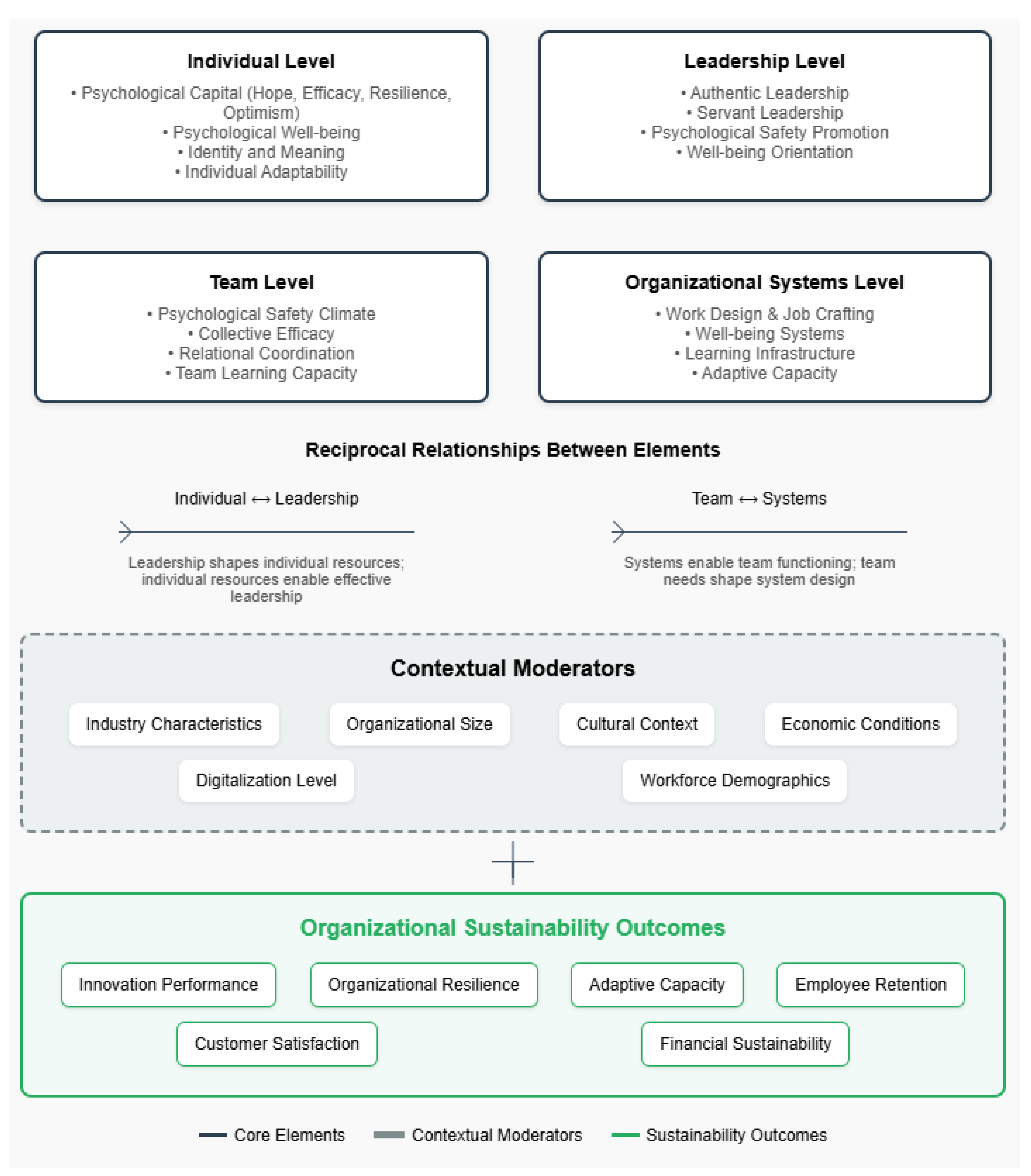

Table 1.
Key Psychological Sustainability Constructs, Definitions, and Conceptual Boundaries.
| Construct | Definition | Key Measurements | Conceptual Distinctions |
|---|---|---|---|
| Psychological Safety | Shared belief that team/organization is safe for interpersonal risk-taking | Team Psychological Safety Survey (Edmondson, 1999) Psychological Safety Scale (Newman et al., 2017) |
Distinct from physical safety climate and psychological security; operates primarily at team/collective level vs. individual |
| Psychological Capital | Individual’s positive psychological state of development (hope, efficacy, resilience, optimism) | PCQ-24 (Luthans et al., 2007) Implicit PsyCap Questionnaire (Harms & Luthans, 2012) |
Distinct from human capital and social capital; state-like (developable) rather than trait-like; can be aggregated to team/org level |
| Psychological Well-being | Multidimensional construct encompassing hedonic and eudaimonic dimensions of work experience | Workplace PERMA Profiler (Kern, 2014) Psychological Well-being at Work Scale (Dagenais-Desmarais & Savoie, 2012) |
Broader than job satisfaction; encompasses both pleasure/satisfaction and meaning/purpose dimensions; distinct from merely absence of distress |
| Leadership for Psychological Sustainability | Leadership approaches associated with fostering psychological resources and well-being | Authentic Leadership Questionnaire (Walumbwa et al., 2008) Servant Leadership Survey (van Dierendonck & Nuijten, 2011) |
Focuses specifically on psychological resource development aspect of leadership vs. task/strategic dimensions |
| Organizational Systems for Psychological Sustainability | Formal and informal structures supporting psychological resources and well-being | Organizational Health Index (McKinsey, 2020) Healthy Workplace Practices Scale (Grawitch et al., 2006) |
Systems-level perspective beyond individual practices; includes formal and informal elements; addresses sustainability over time |
Table 2.
Key Measures, Sample Items, Reliability, and Validity Evidence.
| Construct | Measure | Sample Item | Reliability | Validity Evidence |
|---|---|---|---|---|
| Independent Variables | ||||
| Psychological Safety | Team Psychological Safety Survey (Edmondson, 1999) | “Members of this team are able to bring up problems and tough issues” | α = .92ω = .91Test-retest r = .79 | Convergent validity with team trust (r = .65) Discriminant validity from team efficacy (r = .38) Predictive validity for learning behaviors (r = .52) |
| Psychological Capital | PCQ-24 (Luthans et al., 2007) | “I feel confident analyzing a long-term problem to find a solution” | α = .94ω = .93Test-retest r = .82 | Convergent validity with optimism (r = .71) Discriminant validity from trait measures (r = .39) Predictive validity for performance (r = .45) |
| Authentic Leadership | Authentic Leadership Questionnaire (Walumbwa et al., 2008) | “My leader solicits feedback to improve interactions with others” | α = .91ω = .90Test-retest r = .76 | Convergent validity with ethical leadership (r = .67) Discriminant validity from LMX (r = .44) Predictive validity for trust (r = .59) |
| Servant Leadership | Servant Leadership Survey (van Dierendonck & Nuijten, 2011) | “My manager helps me to further develop myself” | α = .93ω = .92Test-retest r = .81 | Convergent validity with transformational leadership (r = .60) Discriminant validity from transactional leadership (r = .32) Predictive validity for commitment (r = .53) |
| Work Design | Work Design Questionnaire (Morgeson & Humphrey, 2006) | “The job allows me to make decisions about what methods I use to complete my work” | α = .89ω = .88Test-retest r = .74 | Convergent validity with job characteristics (r = .72) Discriminant validity from personality (r = .29) Predictive validity for satisfaction (r = .56) |
| Well-being Systems | Organizational Health Index (McKinsey, 2020) | “This organization actively supports employee well-being” | α = .88ω = .87Test-retest r = .75 | Convergent validity with perceived organizational support (r = .68) Discriminant validity from climate measures (r = .41) Predictive validity for engagement (r = .49) |
| Dependent Variables | ||||
| Innovation Performance | Innovation Performance Scale (Scott & Bruce, 1994) | “This team generates creative ideas” | α = .87ω = .86Test-retest r = .79 | Convergent validity with creativity measures (r = .70) Predictive validity for patents/new products (r = .41) |
| Organizational Resilience | Organizational Resilience Scale (Kantur & Say, 2015) | “We quickly adapt when unexpected changes occur” | α = .90ω = .89Test-retest r = .77 | Convergent validity with adaptability measures (r = .63) Predictive validity for recovery from disruption (r = .47) |
| Adaptive Capacity | Adaptive Capacity Scale (developed for this study) | “Our organization effectively responds to market shifts” | α = .86ω = .85Test-retest r = .74 | Convergent validity with dynamic capability measures (r = .61) Predictive validity for market share changes (r = .39) |
| Moderating Variables | ||||
| Industry Characteristics | Industry Attribute Questionnaire (developed for this study) | “Our industry requires continuous innovation to remain competitive” | α = .83ω = .82 | Factor analysis confirmed three distinct dimensions: knowledge intensity, risk profile, digitalization level |
| Organizational Structure | Structural Dimensions Survey (based on Pugh et al., 1968) | “Decision-making in our organization is highly centralized” | α = .85ω = .84 | Factor analysis confirmed centralization and formalization dimensions |
| Cultural Context | GLOBE cultural dimension scales (House et al., 2014) | “Managers in this culture are expected to be decisive and assertive” | α = .81-.89ω = .80-.87 | Established cross-cultural validity in prior research |
Table 3.
Means, Standard Deviations, Reliability Coefficients, and Correlations Among Key Study Variables.
Table 3.
Means, Standard Deviations, Reliability Coefficients, and Correlations Among Key Study Variables.
| Variable | M | SD | 1 | 2 | 3 | 4 | 5 | 6 | 7 | 8 | 9 |
|---|---|---|---|---|---|---|---|---|---|---|---|
| 1. Psychological Safety | 3.64 | 0.78 | (.92) | ||||||||
| 2. Psychological Capital | 3.82 | 0.67 | .42*** | (.94) | |||||||
| 3. Authentic Leadership | 3.45 | 0.84 | .51*** | .36*** | (.91) | ||||||
| 4. Servant Leadership | 3.23 | 0.92 | .47*** | .32*** | .56*** | (.93) | |||||
| 5. Work Design (Autonomy) | 3.51 | 0.76 | .38*** | .33*** | .35*** | .41*** | (.89) | ||||
| 6. Well-being Systems | 3.19 | 0.89 | .44*** | .31*** | .49*** | .52*** | .36*** | (.88) | |||
| 7. Innovation Performance | 3.42 | 0.82 | .42*** | .35*** | .29*** | .31*** | .36*** | .28*** | (.87) | ||
| 8. Organizational Resilience | 3.38 | 0.75 | .37*** | .38*** | .32*** | .34*** | .30*** | .31*** | .39*** | (.90) | |
| 9. Adaptive Capacity | 3.27 | 0.79 | .36*** | .35*** | .30*** | .33*** | .27*** | .29*** | .43*** | .56*** | (.86) |
*Note: N = 218 organizations. Reliability coefficients (Cronbach’s α) appear on the diagonal in parentheses. p < .05, ** p < .01, *** p < .001.
Table 4.
Significant Contextual Moderation Effects on Psychological Sustainability Relationships.
| Contextual Factor | Relationship Moderated | Interaction Coefficient (γ) | 95% CI | p-value |
|---|---|---|---|---|
| Knowledge Intensity | Psychological Safety → Innovation | .24 | [.18, .30] | < .01 |
| Knowledge Intensity | Psychological Capital → Adaptability | .21 | [.15, .27] | < .01 |
| Organizational Size | Leadership → Psychological Safety | -.18 | [-.24, -.12] | < .05 |
| Organizational Size | Well-being Systems → Outcomes | -.15 | [-.21, -.09] | < .05 |
| Power Distance | Job Crafting → Engagement | -.22 | [-.28, -.16] | < .01 |
| Power Distance | Psychological Safety → Voice | -.26 | [-.32, -.20] | < .001 |
| Digitalization Level | Well-being Systems → Outcomes | .19 | [.13, .25] | < .05 |
| Digitalization Level | Psychological Capital → Innovation | .17 | [.11, .23] | < .05 |
| Industry Volatility | Leadership → Resilience | .23 | [.17, .29] | < .01 |
| Gender Composition | Servant Leadership → Outcomes | .16 | [.10, .22] | < .05 |
Disclaimer/Publisher’s Note: The statements, opinions and data contained in all publications are solely those of the individual author(s) and contributor(s) and not of MDPI and/or the editor(s). MDPI and/or the editor(s) disclaim responsibility for any injury to people or property resulting from any ideas, methods, instructions or products referred to in the content. |
© 2025 by the authors. Licensee MDPI, Basel, Switzerland. This article is an open access article distributed under the terms and conditions of the Creative Commons Attribution (CC BY) license (http://creativecommons.org/licenses/by/4.0/).
Copyright: This open access article is published under a Creative Commons CC BY 4.0 license, which permit the free download, distribution, and reuse, provided that the author and preprint are cited in any reuse.


