

Submitted:
24 July 2025
Posted:
25 July 2025
You are already at the latest version
Abstract
The emergence of sustainable team dynamics concept reflects a critical evolution in organizational theory, aligning the foundations of effective teamwork with imperatives of sustainability. This paper proposes an integrative conceptual framework of Sustainable Team Dynamics (STD) that brings together constructs from organizational behavior, team science, and positive psychology. Grounded in Social Exchange Theory, IMOI (Input–Mediator–Output–Input) model and psychological safety models, the framework posits that factors such as organizational culture, team composition, task characteristics, and social capital shape psychological safety and resilience, which in turn influence team performance and long-term sustainability. To strengthen the theoretical model, a survey of 448 team members was conducted using a structured 24-item Likert questionnaire mapped to eight latent constructs. Descriptive statistics confirmed high internal agreement on team functioning, and correlation analyses supported the model’s directional expectations. Organizational culture, psychological safety and resilience emerged as key predictors of performance, retention and sustainability. These results strengthen the empirical credibility of the STD framework and reinforce its potential for guiding leadership development and sustainable team-building strategies. The paper concludes with implications for leadership development and sustainable HR practices, directions for further validation and practical implementation.
Keywords:
sustainable team dynamics
; human resource management
; team performance
; conceptual model
; empirical validation
; organizational sustainability
; workforce development
Sustainability has evolved from environmental awareness to a strategic business principle, with organizations recognizing its ethical and strategic advantages (Wu, 2022). Strong team dynamics play a vital role in enabling sustainable work practices (Bonaconsa et al., 2021).
The Growing Importance of Sustainability for Businesses
Business success is no longer just about financial
performance but also involves environmental and social factors of TBL framework
of people, planet, and profits (Elkington, 1994).Key drivers making
sustainability imperative include:
- Resource Depletion and Climate Change: Businesses face risks and regulations. Sustainability promotes resource efficiency and climate mitigation (Moslehpour et al., 2022).
- Shifting Stakeholder Expectations: Stakeholders increasingly demand social and environmental responsibility, influencing investment, talent retention and brand loyalty (Suryasa, Rodríguez-Gámez & Koldoris, 2022).
- Regulatory Pressures: Compliance with stricter global regulations protects reputation and avoids penalties.
- Efficiency and Cost Savings: Initiatives like energy efficiency and waste reduction lower operational costs.
Benefits of integrating sustainability include
improved reputation, innovation, risk management, employee engagement, and
talent retention.
Team Dynamics – Engine of Sustainable Practices
Beyond social and environmental benefits,
sustainability unlocks competitive advantage (Belitski et al., 2021; Ding et
al., 2023), enabled by effective team dynamics (Hristov & Chirico, 2023).
Teams that are diverse, motivated, and collaborative drive sustainable
practices (Bates et al., 2023). Critical roles of team dynamics include:
- Knowledge Sharing and Collaboration: Multidisciplinary expertise enables sustainable solutions (Dincă et al., 2023).
- Shared Vision and Goal Setting: Alignment fosters accountability and shared purpose.
- Problem Solving and Innovation: Safe experimentationspaces promote innovative embedding of sustainability into processes.
- Accountability and Ownership: Teams own sustainability goals, driving improvement.
- Motivation and Engagement: Common goals and recognition of sustainability initiatives enhance commitment.
Emerging Challenges in Team Management and Need for Holistic Approach
Globalization, technology, and knowledge economies
demand nuanced team management approaches (Hasan & Hassan, 2021). Beyond
efficiency, today’s teams face new complexities. Geographically dispersed and
project-based teams require cross-time zone coordination and adaptable teams
capable of forming quickly and effectively (Silva et al., 2022). Tech-driven
changes increase the need for continuous upskilling (Li, 2022).
Emerging Challenges
Key concerns for workplace transformations include:
maintaining team cohesion in dispersed teams struggling with trust and
camaraderie compared to co-located teams, requiring shared identity and purpose
(Hsiao & Dillahunt, 2021); managing work-life balance as technology blurs
boundaries, potentially causing burnout, requiring leaders to encourage healthy
boundaries (Taherdoost, 2023); enhancing creativity and innovation through
diverse perspectives while managing conflict and fostering psychological safety
(Hornor, 2022); and addressing knowledge gaps from rapid technological change
requiring continuous upskilling and knowledge management (Li, 2022).
Conventional team management emphasizes output and
fixed metrics. However, long-term success depends on strong team dynamics,
psychological safety and team well-being (Berthelot et al., 2019; Edmondson
& Bransby, 2022). A holistic model balancing results with team care is
needed (Hasan & Hassan, 2021).
Need For Holistic Approach
Holistic team management recognizes interconnected
factors influencing performance (Sessitsch et al., 2023). Key aspects include:
psychological safety fostering trust and innovation (Du et al., 2022); open
communication building inclusion and value; team development activities on
collaboration, and conflict resolution enhancing dynamics and performance
(Akaki et al., 2022; Elyousfi et al., 2021); and prioritizing well-being
through work-life balance and health resources.
Limitations of Traditional Team Dynamics and the Sustainability Imperative
Hierarchical, output-driven models are misaligned
with modern sustainability needs. Today’s environment demands inclusive,
collaborative teams prioritizing psychological safety, open communication, and
empowerment.
Major constraints of traditional models include:
- Short-Termism: Ignoring long-term impacts undermines sustainability.
- Rigid Leadership: Top-down control stifles innovation and ownership.
- Individual Performance Metrics: Competition limits collaborative sustainability efforts.
- Neglected Well-being: Overemphasis on output reduces team contribution to sustainability.
The Sustainability Imperative
Environmental and social challenges make
sustainability strategic for business survival:
- Resource Depletion and Climate Change: Risks from resource depletion and climate impacts necessitate sustainable, resource-efficient practices for long-term viability.
- Stakeholder Expectations: Consumers, investors, and employees increasingly demand corporate responsibility, influencing investment, talent retention, and brand loyalty.
- Regulatory Pressures: Evolving environmental regulations require proactive sustainability to avoid fines, disruptions, and reputational harm.
Strategies for Building Effective Sustainability Teams
Leaders can foster effective teams through
promoting diversity and inclusion to foster innovation; training and
development equipping employees with necessary skills; ensuring open
communication and transparency on goals about goals building trust and alignment;
empowerment and recognition fostering accomplishment and commitment; and
Integrating sustainability into performance management systems
Literature Review
Team success stems from intricate interactions that
enable groups to achieve more than the sum of individual efforts (Dincă et al.,
2023). In contemporary, dynamic environments, communication, personality, and
shared objectives critically influence effectiveness (Balakrishnan, 2022).
Understanding these dynamics is central to fostering collaboration and
performance (Hagen, 2012), particularly when aligned with sustainability
imperatives.
Rethinking Team Dynamics in the Sustainability Era
Modern team models increasingly emphasize
sustainability through foundational shifts in mindset and practice. Key
elements shaping sustainability include:
- Shared Vision and Long-Term Goals: Integrating sustainability into core missions encourages collective commitment (Woodard et al., 2022).
- Psychological Safety and Open Dialogue: Safe environments foster innovation and surface hidden concerns.
- Diversity and Inclusion: Heterogeneity improves problem-solving in complex contexts.
- Cross-Functional Collaboration: Multidisciplinary engagement is essential for addressing sustainability challenges.
- Continuous Learning: Ongoing development supports adaptability to emerging demands.
Leaders advance sustainable teams by enabling
ownership, recognizing contributions, incorporating sustainability metrics into
performance systems, and emphasizing well-being to maintain motivation. While
team effectiveness has a long scholarly history, its intersection with
sustainability is more recent.
Sustainability as a Strategic Framework
No longer limited to environmental goals,
sustainability now incorporates social and economic responsibility. It
emphasizes meeting present needs without compromising future generations (Ryan
& Deci, 2017); and integrates environmental, social, and economic
considerations into organizational decision-making, driving resource efficiency
and social impact alongside profitability (Xu et al., 2023).
Revisiting Team Effectiveness
Research on team effectiveness evolved from
exploring composition and leadership (Elms, Gill, & González-Morales, 2022)
to include psychological safety and group dynamics (Levi, 2020; Wang et al.,
2022). Today’s volatile environments demand adaptability and shared purpose
(Hindricks et al., 2020; Mazzetti & Schaufeli, 2022).
Emergence of Sustainable Team Dynamics
The concept of STD stems from converging strands of
sustainability and team functioning. As organizations embed sustainability
within core strategies, aligning team processes with these priorities becomes
essential (Suryasa, Rodríguez-Gámez & Koldoris, 2022).
Relevant sustainability principles reflected in
team dynamics include:
- Intergenerational Equity: Emphasis on learning and well-being sustains team viability (Melia, 2016).
- Long-Term Thinking: Aligning team goals with sustainability ensures continuity (Lam et al., 2016).
- Systems Thinking: Recognizing interdependencies promotes open collaboration (Yao & Liu, 2022).
Evolving Definitions and Trends
Early frameworks like “high-performance sustainable
teams” introduced in the late 1990s (Raff et al., 2022) and ecological
analogies such as the “natural systems perspective” (Liu et al., 2022) paved
the way for contemporary understandings. Current directions focus on developing
metrics, embedding sustainability in leadership development, and leveraging
technology for virtual collaboration.
Value of STD for Organizations
Adopting sustainable team principles strengthens
resilience and adaptability (Bonaconsa et al., 2021). Key benefits include:
- Innovation: Diversity and safety enhance creativity (Szromek et al., 2022).
- Purpose Alignment: Sustainability-linked objectives foster lasting purpose (Maurer, Whitman & Wright, 2023).
- Engagement: Well-being strategies improve satisfaction and reduce attrition (Sypniewska, Baran & Kłos, 2023).
- Agility: Learning cultures adapt to change (Wu, Liu, & Huang, 2022).
- Resource Optimization: Efficient, lean operations emerge from sustainable practices.
Challenges in STD Implementation
- Balancing short-term business needs with long-term sustainability.
- Creating psychologically safe spaces for diverse participation.
- Countering burnout culture to protect health and motivation.
- Developing valid measures of sustainability-oriented team performance.
Strategic Levers for Leaders
Leaders can shape STD by:
- Aligning teams with a shared vision.
- Promoting inclusion and leveraging diversity.
- Fostering empowerment and recognition.
- Facilitating continuous learning in sustainability practices.
- Using performance systems focused on long-term priorities.
Theoretical Foundations
As sustainability becomes a strategic imperative,
aligning team functioning with environmental, social, and economic concerns is
crucial. Several theoretical models offer lenses to understand and build STD.
Social Exchange Theory (SET)
SET, as developed by Homans and Blau, views social
behavior as exchange-driven, where individuals assess effort versus expected
returns (Ahmad et al., 2023). Core dynamics include:
- Reciprocity: Balanced exchanges reinforce mutual commitment (Xia et al., 2023).
- Trust: Consistent, supportive interactions build confidence and risk-taking.
- Commitment: Shared vision and belonging enhance persistence and creativity.
SET provides a useful scaffold for team
interventions:
- Promoting fairness and recognition.
- Building trust through consistent leadership.
- Strengthening shared goals to foster engagement.
Additional constructs within SET, like Team-Member
Exchange (TMX) and Leader-Member Exchange (LMX), shape satisfaction and
performance (Wijaya, 2020). Perceived Organizational Support (POS) and
Perceived Procedural Justice (PPJ) influence team behaviors (Rhoades &
Eisenberger, 2002; Colquitt, 2001), reinforcing engagement and productivity
(Ahmad et al., 2023).
In evolving work settings, SET remains relevant;
though it must adapt to remote work settings having reduced in-person
interaction and altered supervisory norms(Blau, 1964; Cropanzano &
Mitchell, 2005).
Tuckman’s Stages of Development
Tuckman’s five-stage model (Forming, Storming,
Norming, Performing, Adjourning) offers a roadmap for understanding team
evolution (Jones, 2019; Tuckman & Jensen, 1977). Though often linear in
presentation, teams may cycle back as circumstances change. Adaptations for
virtual teams emphasize establishing clarity early and supporting shared norms
of collaboration and communication (Bush, 2023).
Punctuated-Equilibrium Model
Gersick (1988) proposed that teams do not evolve
linearly but oscillate between stability and rapid change. A midpoint
transition typically marks reflection and a renewed push toward completion.
This model highlights the role of time pressure in shaping productivity
patterns.
Hackman’s Model
Hackman (2002) outlines five conditions for team
effectiveness andsuccess:
- Clear boundaries and interdependence.
- A compelling direction.
- Enabling structure and norms.
- Supportive resources, rewards and leadership.
- Expert coaching.
This model is widely used to diagnose and improve
team performance across sectors (Cavanaugh et al., 2021).Assessments of
Hackman’s model are used diagnostically and summatively to evaluate team
functioning (Hwang, 2018; Smith & Tushman, 2005; Tudor &Trumble, 1996).
IPO and IMOI Models
The Input-Process-Output (IPO) model posits that
team effectiveness hinges on how inputs are transformed into outputs (Kozlowski
& Bell, 2003). Inputs include individual traits, team design, and
environment; processes involve interaction mechanisms; outputs encompass
performance and morale. Critics argue for more dynamic feedback, leading to the
IMOI model, which introduces mediators and cyclical inputs; recognizing that
outcomes can inform future inputs and processes(Ilgen et al., 2005).
Salas Et al.’s Team Performance Model
Building on IPO, Salas et al. integrate contextual
elements like organizational climate, Team Design, Team Processes,
communication structures, and shared mental models (Bouwmans et al., 2021),
acknowledging the critical influence of external factors on internal dynamics.
Dysfunction Models
Katzenbach and Smith, and separately Lencioni
(2002), identify five common dysfunctions of a team: absence of trust, fear of
conflict, lack of commitment, avoidance of accountability, and inattention to
results (Elms, Gill & González-Morales, 2022). Addressing these requires
deliberate cultural and structural change.
Belbin’s Team Roles Model
Belbin’s emphasizes team composition and behavioral
diversity(Lu, Lin & Chen, 2017), identifying nine distinct roles (Ren et
al., 2019), categorized into:
- Thinking: Plant, Monitor Evaluator, Specialist
- Action: Shaper, Implementer, Completer Finisher
- People: Coordinator, Teamworker, Resource Investigator
Each role brings strengths and challenges. For
example, Plants offer creativity while Implementers drive execution. Effective
teams balance roles to optimize task allocation and strengthen group dynamics
(Johnson, 2021).
Additional Models
Frameworks such as the Drexler/Sibbet Model, GRPI,
and Team Performance Curve offer further insight into team development and
alignment. Each highlights unique aspects of team success, from purpose and
roles to interpersonal relationships (Drexler et al., 2008; Rubin et al., 1978;
Katzenbach & Smith, 1993).
Integrative Insights and Future Directions
Integrating these theoretical perspectives enables
organizations to craft comprehensive strategies for building effective,
sustainable teams. SET’s focus on fairness and trust complements structural
models like IPO and Hackman’s framework. Behavioral models help identify and
correct dysfunctions.
Future inquiry should explore how cultural,
technological, and individual variables shape team dynamics; particularly in
virtual and hybrid environments. As work settings evolve, continuous research
is needed to adapt and refine models of team performance and sustainability.
Reframing Sustainability for Team Application
The Brundtland Commission’s definition of
sustainable development emphasizes intergenerational responsibility (Singh,
2022). Sustainability comprises three interdependent pillars:
- Environmental: Focused on climate mitigation, biodiversity, and resource efficiency.
- Social: Concerned with justice, human rights, and access to health and education.
- Economic: Promotes long-term growth through resource efficiency, CSR, and responsible investment.
These dimensions must operate in harmony. Ignoring
one undermines the others. Organizations must weave these principles into all
decisions, ensuring long-term impact (Wang, Xu & Meng, 2023; Camiré et al.,
2021; Clauss et al., 2022).
Integrating Insights from Literature
The reviewed literature underscores a growing
convergence between traditional team effectiveness frameworks and the evolving
imperatives of sustainability. Classic models such as Hackman’s contextual
conditions, Tuckman’s developmental stages, and the IPO framework provide
foundational understanding of how teams form, function, and deliver results.
Meanwhile, constructs rooted in social exchange theory bring to light the
relational mechanisms – trust, reciprocity, and commitment – that underpin
effective collaboration.
Overlaying these with sustainability principles
reveals new dimensions of team functioning: long-term orientation, systemic
awareness, inclusivity, and resource consciousness. This alignment suggests
that sustainable team dynamics are not merely an extension of existing models
but a conceptual evolution shaped by broader societal shifts.
Despite growing attention to this convergence,
there remains a need to clarify how organizations can deliberately cultivate
such dynamics, operationalize them across diverse settings, and measure their
effectiveness beyond output metrics. These gaps provide a compelling foundation
for the present study, which seeks to build an integrative model of sustainable
team dynamics grounded in both theoretical rigor and contemporary relevance.
Conceptual Development: Sustainability in Team & Organization
Team Sustainability: A Contemporary Perspective
From an organizational behavior lens, team
sustainability reflects a team’s capacity to sustain effectiveness,
productivity, and healthy interpersonal dynamics while advancing organizational
goals (Mathieu et al., 2019). It denotes a team’s endurance, adaptability, and
its ability to foster collaboration, trust, and ethical conduct over time
(Wijaya, 2020). The concept increasingly intersects with organizational
sustainability, integrating environmental, social, and economic considerations
(Bansal & Roth, 2000). A sustainable team meets immediate targets while
contributing to long-term stakeholder well-being and organizational resilience
(Dyllick & Hockerts, 2002).Dimensions central to team sustainability
include:
- Longevity: Maintaining functional performance over time.
- Adaptability: Embracing change and evolving work practices.
- Resilience: Recovering from setbacks to maintain cohesion and productivity.
- Ethical Conduct: Upholding integrity and contributing to broader societal and environmental good.
Key enabling factors include trust, shared purpose,
psychological safety, effective communication, and continuous learning; each
reinforcing team cohesion, innovation, and long-term performance.
Sustainability in the Organizational Context
Organizational sustainability operates across three
interrelated pillars:
- Environmental: Resource efficiency, emissions reduction, and waste management.
- Social: Ethical labor, employee well-being, diversity and community engagement.
- Economic: Financial viability pursued responsibly.
These three interconnected pillars emphasize the
need to balance economic goals with social and environmental responsibilities
(Elkington, 1997).
Sustainability principles permeate operations,
supply chains, and human resources. For instance, operations may integrate
energy-saving technologies (Lam & Lai, 2015); supply chains may enforce
ethical sourcing (Krause et al., 2009); and HR may focus on inclusive practices
and continuous development (Avery, 2005). Leadership and organizational culture
are critical enablers (Schein, 2010), embedding sustainability into employee
behavior and decision-making (Bansal, 2005).
Merging Sustainability with Team Management: Theoretical Bases
Although comprehensive frameworks combining
sustainability and team management are still emerging, existing theories
provide strong grounding. SET emphasizes reciprocity and fairness, enhancing
engagement in sustainability when contributions are acknowledged and supported
(Cropanzano & Mitchell, 2005; Cooper-Thomas & Morrison, 2018).
Team effectiveness models – Hackman’s and IPO – are
adaptable. Hackman’s “compelling direction” can incorporate sustainability
goals, while “enabling structures” and “supportive context” facilitate
sustainable practices (Hackman, 2002). IPO frameworks allow sustainability to
be treated as input (e.g., team expertise), process (e.g., cross-functional
problem solving), and output (e.g., environmental or social contributions).
Team development models such as Tuckman’s (Tuckman
& Jensen, 1977) and Gersick’s Punctuated-Equilibrium Model also inform
integration strategies. For example, sustainability values can be embedded
during norming, and reinforced during midpoint transitions when teams
reevaluate direction.
Team Dynamics and Organizational Sustainability (TDOS)
Research increasingly underscores the
interdependence between team dynamics and sustainability outcomes.
Organizations with collaborative cultures and long-term orientation are more
likely to innovate sustainably and engage employees meaningfully (Bansal,
2005). While individual pro-environmental attitudes matter, team cohesion often
proves more decisive for successful sustainability initiatives (Robertson,
2021).
Organizations institutionalize sustainability
through governance mechanisms like board-level oversight and performance-linked
incentives (Flammer, 2013). Leadership remains pivotal – visionary, sustainable
leaders align environmental, social, and economic priorities, cultivating
commitment and trust (Avery, 2005).
Though still conceptually evolving, team
sustainability is being shaped by theoretical insights, leadership behaviors,
and organizational culture (Elkington, 1997; Dyllick & Hockerts, 2002).
Emerging Trends at the TDOS Intersection
Contemporary models (e.g., SET, Hackman, IPO,
Tuckman) offer building blocks for embedding sustainability into team
functioning. “Team sustainability” represents a shift from short-term output
focus to long-term organizational contribution, supported by psychological
safety, shared purpose, and continuous learning.
Recent research highlights micro-level factors such
as employee green behavior (Ones & Dilchert, 2012) and their cumulative
effect on organizational sustainability. Scholars now emphasize systemic,
multi-level approaches rather than isolated strategies.
Future work should focus on developing frameworks
that explicitly link team effectiveness with sustainability. Research can also
explore how communication, conflict resolution, and learning processes influence
sustainability outcomes. Longitudinal studies tracking the performance and
longevity of sustainability-oriented teams could provide practical insights.
Understanding STD is vital as organizations
navigate increasing environmental and social expectations. Teams must evolve
into both performance units and stewards of sustainable development.
Key Drivers of TDOS: Empirical Insights
Leadership and Management Practices
Transformational leadership fosters cohesion,
innovation, and engagement through vision and individualized support (Baker
& Hoidn, 2023). Empowering leaders who delegate and develop team
capabilities drive sustainability-focused innovation and engagement (Zhang
& Bartol, 2010). Clear goal setting and performance feedback remain central
to long-term team success (Mehra, 2022).
Team Composition and Diversity
Empirical findings on diversity remain mixed.
Demographic diversity may initially challenge communication but enhances
creativity in the long term (Nayak & Agarwal, 2011). Cognitive diversity
typically supports better decision-making (Rolin et al., 2023). Inclusivity and
effective diversity management are essential to leveraging diverse viewpoints
(Cunningham et al., 2023).
Communication and Information Sharing
Transparent communication builds trust and cohesion
(Waters et al., 2020). High-quality information sharing correlates with
problem-solving effectiveness (Zha et al., 2022). Psychological safety and
climate significantly shape how freely ideas are exchanged (Nguyen, 2021;
Orekoya, 2023).
Conflict Resolution and Problem Solving
Constructive conflict management approaches such as
collaboration and compromise support innovation and mutual understanding (Kay
& Skarlicki, 2020; Higgins, 2011). Destructive styles like avoidance harm
performance and increase stress (Ausat et al., 2023). Clear roles and
structured methods aid effective resolution.
Organizational Support and Resources
Resource availability – financial, technological,
training – enhances performance and satisfaction (Burack et al., 2023).
Cultures that value learning, collaboration, and recognition strengthen team
sustainability by reinforcing prosocial behaviors.
Integrating Sustainability Principles with Team Dynamics
Modern workplaces demand more than efficiency; they
require teams capable of advancing holistic sustainability goals. Traditional
output-centric models fall short when navigating the complexities of
sustainable operations.
Sustainability now transcends environmental
concerns, encompassing holistic business practices for environmental
responsibility, social justice, and economic viability. Simultaneously, team
research has shifted from static traits to dynamic collaboration and
adaptation. The convergence of these fields leads to the concept of STD as
reorientation of teams toward long-term, systems-focused, and ethical
functioning.
Sustainability Principles Aligned with Team Dynamics
Core sustainability principles align well with
concept of STD:
- Intergenerational Equity: Like sustainability, teams must nurture continuous learning and capability building.
- Long-Term Thinking: Sustainable teams look beyond immediate goals to enduring impact.
- Systems Thinking: Recognizing interdependence, teams adopt collaborative, cross-functional strategies.
- Resource Efficiency: Mindful use of time, talent, and tools reflects sustainable practice.
- Innovation: Teams that support experimentation and diverse inputs adapt better to complex challenges.
Linking Team Models with Sustainability
Established effectiveness models provide valuable
frameworks to support STD through adaptation:
- Hackman’s IPO Model: Incorporate sustainability in inputs (team design), processes (collaboration on green goals), and outputs (triple bottom line results).
- Salas et al.’s Contextual Model: Embed sustainability into organizational influences like leadership and culture.
- Katzenbach and Smith’s Dysfunctions Model: Extend accountability to include environmental and social commitments.
- Belbin’s Roles Model: Highlight the creative and evaluative roles essential for sustainable innovation.
Practical Strategies for Building Sustainable Teams
Practical leadership actions include:
- Shared Vision: Align team missions with sustainability goals to foster commitment.
- Diversity and Inclusion: Use heterogeneous teams to generate innovative, inclusive solutions.
- Empowerment and Recognition: Support ownership of sustainability efforts and reward contributions.
- Continuous Learning: Offer training in sustainability tools and foster knowledge sharing.
- Aligned Performance Management: Integrate sustainability metrics into team evaluations.
- Well-being Focus: Promote work-life balance to sustain motivation and reduce burnout.
- Sustainability-Oriented Leadership: Cultivate leaders who model long-term thinking and collaborative action.
This integrated approach bridges traditional team
dynamics with sustainability imperatives, enabling organizations to build
resilient, effective teams that contribute meaningfully to sustainable
development goals.
Implementation Challenges
Key challenges include:
- Balancing Goals: Leaders must reconcile short-term business pressures with long-term sustainability.
- Fostering Trust: A psychologically safe climate is essential for inclusivity and risk-taking.
- Measuring Impact: Developing sustainability-aligned metrics for teams remains a work in progress.
Conceptual Development: STD
Understanding STD involves requires defining its
core attributes and dimensions before proposing a theoretical model explaining
factors affecting teams’ long-term viability and effectiveness.
Defining STD and Its Core Attributes
STD refers to enduring patterns of team interaction
and shared understanding that enable goal achievement while preserving team
member well-being and long-term viability (Melia, 2016). Unlike conventional
team success models focused on short-term outcomes, STD emphasizes the
durability of team functioning, adaptability, and ongoing positive
contributions.
Core attributes of STD include:
- Shared Purpose and Vision: Unified goals guide team efforts (Wyatt, 2021).
- Mutual Trust and Respect: Foundation for psychological safety and open communication (Liu et al., 2023).
- Effective Communication: Ensures clarity and coordination across tasks.
- Constructive Conflict Management: Navigates disagreements productively, fostering learning and innovation (Kay & Skarlicki, 2020).
- Collective Learning and Adaptability: Supports reflection, improvement, and resilience (Folke et al., 2010).
These attributes have been touched upon in the
broader literature on team effectiveness and sustainability, as discussed
earlier, and remain vital in conceptualizing STD as a long-term capability.
Dimensions of STD
Building on insights from models like Hackman’s
IPO, Tuckman’s team development stages, and SET, STD comprises several
interrelated dimensions:
- Sustainable Team Leadership: Leaders model ethical conduct, empower members, and promote inclusive decision-making that builds collective ownership and accountability (Iqbal & Piwowar-Sulej, 2023).
- Sustainable Team Processes: Teams sustain performance through open communication, transparent decision-making, active listening, collaborative conflict management and a knowledge-sharing culture (McMullin & Dilger, 2021; Lewis, 2022; Yeboah, 2023).
- Sustainable Outcomes: STD is reflected in team well-being (reduced stress, satisfaction, belonging), longevity (maintaining cohesion), and adaptability (responding to shifting demands) (Ji & Yan, 2020; Torricelli & Pellati, 2023).
- Organizational Support: Adequate resources and a culture that values collaboration and development are crucial (Dimas et al., 2023; Lacerenza et al., 2018).
These dimensions echo themes already covered in
team sustainability and TDOS, reinforcing their relevance to STD.
Emerging Literature on STD
Literature on STD is nascent but growing. It
reconceptualizes performance as sustained functionality rather than episodic
success (Lam et al., 2016). Core dimensions frequently cited include:
- Sustained Performance: Continuous achievement under evolving demands.
- Member Well-being: Psychological and physical health, job satisfaction, and sense of belonging.
- Longevity and Viability: Teams that remain effective over time despite disruption.
- Adaptive Capacity: Flexibility and learning to navigate uncertainty.
These aspects have been discussed previously.
Attributes supporting STD include high levels of trust and psychological
safety, strong shared purpose, effective communication and knowledge sharing,
constructive conflict management, and a continuous learning culture.
Frameworks and Empirical Evidence
Emerging frameworks often build on the IPO and IMOI
(Input-Mediator-Output-Input) models (Zhou et al., 2021), integrating cyclical
and temporal perspectives. Positive team climates lead to sustained performance
and reinforce enabling behaviors over time. Adaptive mechanisms, such as
learning culture and resilience, feature prominently.
Empirical studies, while not always labeled as
STD-specific, support many antecedents and outcomes. For example, collaborative
organizational cultures foster sustainability (Meisenbach & Brandhorst,
2018), diversity may contribute to team longevity (Liu et al., 2021), while
effective communication and conflict resolution drive cohesion (Kay &
Skarlicki, 2020).
Meta-analyses have confirmed the role of
leadership, communication, team resilience, diversity and psychological safety
in enabling long-term effectiveness (Mazeed et al., 2023; Dimas, Torres &
Lourenço, 2023). These findings echo themes already developed in earlier
sections on leadership and team dynamics.
Benefits of STD:
STD offers tangible benefits that extend beyond
productivity:
- Innovation and Complex Problem-Solving: Teams that feel safe and supported are better positioned to tackle sustainability challenges with creativity.
- Employee Engagement and Retention: Prioritizing well-being correlates with satisfaction and reduces attrition (Sypniewska, Baran & Kłos, 2023).
- Efficiency and Cost-Reduction: Sustainable teams make better use of resources, enhancing organizational efficiency.
- Resilience and Adaptability: Teams grounded in learning are better equipped to handle change and uncertainty.
These benefits reinforce why STD is not merely a
theoretical concept but a practical imperative for future-ready organizations.
Synthesis: Toward a Sustainable Teaming Paradigm
As seen across prior sections, Sustainable Team
Dynamics represent a vital evolution in team theory – shifting focus from
episodic performance to long-term effectiveness grounded in well-being,
adaptability, and purpose. STD integrates lessons from team effectiveness
models, sustainability principles, and organizational behavior theories into a
unified framework.
By cultivating trust, open communication,
supportive leadership, and adaptive processes, organizations can build teams
that not only deliver results but sustain themselves – and their people –
through change. As the global workplace becomes more complex and values-driven,
investing in STD offers a roadmap for aligning human potential with
sustainability goals.
Proposed Theoretical Model of STD
Building upon the aforementioned dimensions, a theoretical
model of STD is proposed in Figure 1,
conceptualizing the interplay of key organizational constructs that drive
enduring team success. The model posits that organizational culture, team
composition, and task characteristics serve as antecedents
shaping initial team conditions.
A collaborative, learning-oriented culture
emphasizing well-being forms the foundational contextfor sustainability. A team
composition enriched with diverse skills and perspectives
enhances collective problem-solving and adaptability; while complex and
interdependent tasks heighten the need for strong collaboration
and effective communication.
These antecedents influence team sustainability
through mediating mechanisms such as social capital,
psychological safety, and team resilience:
- Social Capital, encompassing trust and shared norms, facilitates cooperation and information sharing (Nutakor et al., 2023).
- Psychological Safety enables open, risk-tolerant communication, which is essential for innovation.
- Team Resilience, the capacity to adapt to adversity and recover from setbacks, sustains performance and promotes long-term viability.
The synergy of these mediating factors leads
to a range of desirable outcomes, including team performance, employee
retention, and organizational sustainability:
- High performance emerges through enhanced collaboration, problem-solving, and adaptability.
- Employee retention improves due to increased well-being, engagement, and a sense of belonging.
- Organizational sustainability benefits from a resilient, innovative, and productive workforce.
Adopting a systems perspective, the model
highlights dynamic interconnections rather than linear causality. It aligns
with foundational theories such as:
- Social Exchange Theory (SET) – emphasizing reciprocal relationships and fairness,
- Conservation of Resources Theory (COR) – focusing on resource acquisition and preservation,
- Broaden-and-Build Theory of Positive Emotions – illustrating how positive experiences foster resilience and growth.
This integrated model bridges structural and psychological elements vital for sustained team functioning,
offering both a theoretical foundation for empirical research and a practical
framework for cultivating resilient, high-performing teams in complex
organizational ecosystems.
STD thus emerge as central to organizational
effectiveness and long-term success. A deep understanding of their core
attributes and dimensions enables organizations to create environments that
support both immediate objectives and long-term team viability.
The proposed model provides a comprehensive
framework for investigating the interplay of antecedents, mediators, and
outcomes. Future research should furthertest and refine this model by
exploring context-specific variables and developing targeted interventions
to foster sustainable teams across diverse organizational settings
Conceptual Framework
The conceptual framework integrates multiple
levels of influence to explain how STD emerge and impact organizational
outcomes. It begins with organizational culture – when centered
on trust, learning, and well-being, culture shapes team norms and fosters psychological
safety. A supportive culture encourages openness, risk-taking, and
adaptability, laying the groundwork for sustainable team functioning.
Team composition – including personality
traits, skills, and shared values – affects how effectively teams utilize
resources and interact. Meta-analyses indicate that teams characterized by high
levels of conscientiousness, agreeableness and value congruence
tend to perform better. Similarly, task characteristics such as
complexity, interdependence, and meaningfulness influence engagement and
collaboration. While such tasks stimulate motivation and commitment, they also
increase the need for robust internal support mechanisms.
At the core of the framework lies team
social capital – defined as the network of strong interpersonal
relationships, trust, and shared norms within the team. Social capital acts as
a mediator between inputs (organizational culture, team composition,
and task design) and team outcomes. High levels of social capital enable:
- Effective knowledge sharing,
- Collective problem-solving, and
- Informal emotional and task-related support.
In turn, this nurtures team resilience – the
collective capacity to withstand, adapt to, and recover from adversity.
Notably, psychological safety and social capital are mutually
reinforcing and pivotal to resilience, as they allow teams to experiment,
adapt, and sustain performance without fear of blame or failure.
Key Interacting Components
This framework proposes that six interacting
components – organizational culture, team composition, task design,
social capital, psychological safety, and resilience – form a virtuous
cycle. When aligned, these elements reinforce each other and produce
three primary outcomes:
- Team Performance: STD enhance innovation, adaptability, and consistent output over time.
- Employee Retention: Supportive, growth-oriented teams reduce burnout and turnover, fostering long-term engagement.
- Organizational Sustainability: Resilient teams contribute to human capital preservation, help meet strategic goals, and align with sustainable human resource management (HRM) principles.
Empirical Validation of Proposed Model
Research Objectives
The study aims to empirically validate the STD
model by:
- Testing relationships among antecedents, mediators, and outcomes.
- Confirming the mediating roles of social capital, psychological safety, and team resilience.
- Assessing the predictive power of antecedents on team performance, retention, and perceived sustainability.
Research Hypotheses
- H1: Organizational culture positively influences social capital.
- H2: Team composition diversity positively influences psychological safety.
- H3: Task interdependence positively influences team resilience.
- H4: Social capital positively affects psychological safety and resilience.
- H5: Psychological safety and resilience mediate the relationship between antecedents and outcomes.
- H6: Higher levels of social capital, psychological safety, and resilience predict enhanced team performance, lower turnover intention, and greater perceived team sustainability.
Constructs and Measures
Please refer the Table 1.
Methodology
Research Design
A quantitative, cross-sectional survey
design was adopted to test the conceptual framework of STD, incorporating key
variables across organizational, interpersonal, and psychological domains.
Instrument Development
A structured 24-item Likert scale questionnaire (1
= Strongly Disagree to 5 = Strongly Agree) was developed, with three items per
construct:
- Q1–Q3: Organizational Culture
- Q4–Q6: Team Composition
- Q7–Q9: Task Characteristics
- Q10–Q12: Social Capital
- Q13–Q15: Psychological Safety
- Q16–Q18: Team Resilience
- Q19–Q21: Team Performance
- Q22–Q24: Retention & Sustainability
For same set of 24 questions, four different
questionnaires were prepared where each questionnaire had six questions worded
negatively. The responses were reverse coded accordingly before analysis.
Construct scores were calculated as the average of the relevant items.
Sample Design
- Population: Cross-functional teams (e.g., Operations, HR, MM, Marketing, R&D, CSR, L&D, Management) across sectors (corporate, nonprofit, academic).
- Sampling: Stratified purposive sampling based on sector and function.
- Sample Size: ~450 responses. This value was confirmed through AI tools to be sufficient for Structural Equation Modeling (SEM) and exceeding the minimum requirement based on G*Power and parameter estimation norms.
Data Analysis Plan
- Data Preparation: Reverse-coded negative items.
- Reliability & Validity: Cronbach’s Alpha for each construct and for entire questionnaire > 0.70.
- Hypothesis Testing:
- o Pearson correlations among constructs
- o Multiple regression analysis
Data Collection and Statistical Processing
Survey was concluded after receipt of 448 responses. The response dataset was generated in MS-Excel for statistical analysis.
Results
Descriptive Statistics
All constructs were measured on a five-point Likert scale. Descriptive analysis of the 448 responses yielded the insights as in Table 2.
Interpretation. Can be summarized as:
- The mean scores (≈4.00) reflect consistently favorable perceptions across all constructs.
- Low standard deviations in outcome variables (Team Performance and Retention and Sustainability) suggest high agreement and low dispersion. Predictors show moderate variability (SD ~0.4).
Correlation Statistics
As shown in the Table 3, all variables show positive directional correlation.
Regression Analysis
Model 1: Predicting Team Performance. Table 4 shows results. R2=0.553, Adjusted R2 = 0.547, F(6, 441) = 91.01, p < 0.0001.
Interpretation. R2 (0.553):55.3% of variance explained. Adjusted R2 (0.547):Model is robust, adjusted for predictors. F(6, 441) = 91.01, p < 0.0001:Model is statistically significant. Team Performance is significantly driven by organizational factors, team environment, and resilience. Task characteristics do not significantly impact performance.
Model 2: Predicting Retention and Sustainability. Table 5 shows the results. We found R2= 0.575, Adjusted R2 = 0.569, F(6, 441) = 99.41, p < 0.0001
Interpretation. R2 (0.575):57.5% of variance explained. Adjusted R2 (0.569): Model is robust, adjusted for predictors. F(6, 441) = 99.41, p < 0.0001:Model is statistically significant. Retention is influenced by job-related factors, safety, culture, and resilience. Team Composition’s effect is weaker here.
Interpretation Summary
The regression models reveal that both team performance and retention and sustainability are significantly influenced by a cluster of psychosocial and structural factors. Organizational culture, psychological safety, social capital, and team resilience consistently emerge as strong predictors across both models, affirming their foundational role in team sustainability.
- Organizational Culture positively shapes team dynamics by fostering a supportive, values-based environment.
- Psychological Safety enhances both innovation and retention by enabling open dialogue and reducing fear of failure.
- Social Capital, through trust and shared norms, bolsters collaboration and resilience.
- Team Resilience contributes not only to adaptive functioning but also to consistent outcomes over time.
Notably, team composition plays a more critical role in driving performance than retention, while task characteristics significantly affect retention but not performance. These divergent effects underscore the context-sensitive nature of STD.
Discussion
The empirical findings offer robust support for the proposed STD model. Consistent with earlier conceptualizations, sustainability emerges as a multi-dimensional construct shaped by cultural, structural, and relational antecedents that interact through key mediators such as psychological safety, social capital, and resilience.
The differential effects observed between team performance and retention and sustainability provide important practical implications:
- For enhancing performance, efforts should prioritize skillful team composition, resilient mindsets, and psychological safety that nurture innovation.
- For promoting retention, attention to task design, supportive culture, and interpersonal trust becomes essential.
- Focus on strengthening Organizational Culture and Psychological Safety to enhance both performance and retention.
- Invest in team resilience training programs to support sustained outcomes as it’s a cross-cutting driver.
- Evaluate task designs to improve employee retention.
- Refine team composition strategies (Adjust team structures) to boost immediate team performance gains.
The high explanatory power (R2 > 0.55) of both models and statistical soundness of predictors underscore the model’s utility for strategic HRM, team coaching, and organizational design.
This analysis underscores the multifaceted drivers of team outcomes. Strategic emphasis on culture, safety, and resilience can significantly improve both employee effectiveness and retention.
These findings align with existing literature emphasizing the value of inclusive leadership, adaptive structures, and well-being-oriented environments in cultivating high-functioning and enduring teams (Liu et al., 2023; Sypniewska et al., 2023; Zhou et al., 2021).
Conclusions and Implications
This study aimed to conceptualize, model, and empirically validate the construct of STD – as a novel HRM concept focused on long-term viability through supportive social and structural mechanisms – by investigating the interplay of organizational antecedents, psychosocial mediators, and team-level outcomes. Drawing upon established theories and emerging literature, the study proposed and tested a comprehensive model integrating elements such as organizational culture, team composition, task characteristics, psychological safety, social capital, and team resilience.
The empirical analysis, based on survey data from 448 respondents across cross-functional teams, provided strong support for the hypothesized relationships. Both regression models demonstrated high explanatory power (R2 = 0.553 for Team Performance; R2 = 0.575 for Retention and Sustainability), validating the robustness of the proposed framework.
Key conclusions emerging from this research are as follows:
Theoretical Contributions
- The study advances the conceptualization of team sustainability by integrating temporal, structural, and psychological dimensions into a unified framework.
- It empirically demonstrates that sustainable team outcomes are not merely a function of performance but are significantly shaped by relational dynamics (trust, psychological safety, shared norms) and adaptive capacities (resilience, learning).
- The identification of distinct predictors for team performance and retention and sustainability adds granularity to the literature on team effectiveness and sustainability.
Practical Implications
The findings have several implications for organizational leaders, HR practitioners, and team designers:
- Cultivating a learning-oriented and inclusive organizational culture emerges as foundational for fostering both high performance and team retention.
- Investment in psychological safety and social capital development – through leadership training, team coaching, and open communication systems – is likely to yield sustainable returns in team functioning.
- Tailoring team composition strategically and designing meaningful, interdependent tasks can enhance performance and engagement.
- Building team resilience should be an explicit developmental priority, especially in volatile and complex operational environments.
These insights align with sustainable HRM principles, reinforcing the need to design people practices that balance productivity with well-being and long-term team viability.
Limitations and Future Research
While the study offers significant insights, certain limitations warrant mention:
- The cross-sectional design limits causal inference. Longitudinal studies could better capture the evolution of sustainable dynamics over time.
- Sectoral and cultural variations were not explored in depth; future studies should examine how industry context, cultural values and team lifecycle stage affect sustainability constructs. This would also need geographic extension of survey population.
- Future research could also:
- Refine the theoretical model through multilevel or longitudinal modeling, examining how sustainable dynamics unfold across time and organizational layers.
- Investigate interventions (e.g., resilience training, inclusion programs) that actively enhance the identified mediators and outcomes.
- Explore team sustainability in remote, hybrid, or AI-augmented team contexts, where dynamics may differ considerably.
References
- Ahmad, A., et al. (2023). Psychological transactions, reciprocity, exchange relationships, and the impact of various factors on this complex process. Scopus.
- Ahmad, R., Nawaz, M. R., Ishaq, R., Khan, H. R. & Ashraf, H. A. (2023). Social exchange theory: Systematic review and future directions.Frontiers in Psychology, 13, 1015921. [CrossRef]
- Akaki, M., Ioki, M., Mitomi, K. & Maeno, T. (2022). Best Practices of Team-Building Activities in a Project-Based Learning Class ‘Design Project’ in a Japanese Graduate School. Proceedings of the Design Society, 2, 2263-2272. [CrossRef]
- Andersson, L. M.& Pearson, C. M. (1999).Tit for tat?Thespiraling effect of incivility in the workplace. Academy of Management Review, 24(3), 452-471. [CrossRef]
- AusatAlmaududi, A.M., Risdwiyanto, A., Arfah, M. & Jemadi, J. (2023).Conflict Management Strategies in Work Teams in the Creative Industry. Kendali: Economics and Social Humanities. [CrossRef]
- Avery, G. C. (2005). Sustainable leadership: Honeybee and locust approaches. Taylor & Francis. ISBN: 9780203723944.
- Baker, J.P. &Hoidn, S. (2023). Transformational Leadership. [CrossRef]
- Balakrishnan, K. (2022). Influence of Cultural Dimensions on Intercultural Communication Styles: Ethnicity in a Moderating Role. Journal of Communication, Language and Culture. [CrossRef]
- Bansal, P. (2005). Evolving sustainably: A longitudinal study of corporate sustainable development. Strategic Management Journal, 26(3), 197–218. [CrossRef]
- Bansal, P. & Roth, K. (2000). Why companies go green: A model of ecological responsiveness. Academy of Management Journal, 43(4), 717-736.
- Bates, G., Le Gouais, A., Barnfield, A., Callway, R., Hasan, M.N., Koksal, C., Kwon, H.R., Montel, L., Peake-Jones, S., White, J., Bondy, K. & Ayres, S. (2023). Balancing Autonomy and Collaboration in Large-Scale and Disciplinary Diverse Teams for Successful Qualitative Research.International Journal of Qualitative Methods. [CrossRef]
- Belitski, M., Guenther, C., Kritikos, A.S. & Thurik, R. (2021). Economic effects of the COVID-19 pandemic on entrepreneurship and small businesses. Small Business Economics, 58, 593 - 609. [CrossRef]
- Bell, S. T. (2007). Deep-level composition variables as predictors of team performance: A meta-analysis. Journal of Applied Psychology, 92(3), 595–615. [CrossRef]
- Berthelot, D., Carlini, N., Goodfellow, I.J., Papernot, N., Oliver, A. & Raffel, C. (2019). MixMatch: A Holistic Approach to Semi-Supervised Learning. ArXiv, abs/1905.02249. https://api.semanticscholar.org/CorpusID:146808485.
- Blau, P. M. (1964). Exchange and Power in Social Life.Routledge. ISBN: 9781138523197.
- Bonaconsa, C., Mbamalu, O.N., Mendelson, M., Boutall, A., Warden, C., Rayamajhi, S., Pennel, T., Hampton, M.I., Joubert, I.A., Tarrant, C., Holmes, A.H. & Charani, E. (2021). Visual mapping of team dynamics and communication patterns on surgical ward rounds: an ethnographic study. BMJ Quality & Safety, 30, 812 - 824. [CrossRef]
- Bouwmans, M., Runhaar, P., Wesselink, R. & Mulder, M. (2021). Team-Oriented HR Practices and Team Performance--Model. PsycTESTS Dataset. [CrossRef]
- Burack, O.R., Mak, W., Howard, M., Isaacs, T. & Reinhardt, J. (2023).The Importance of Adequate Resources and Equipment to Staff Engagement in a Healthcare System. Innovation in Aging, 7, 1136 - 1136. [CrossRef]
- Bush, S. (2023). Leading Teams 2: Stages of Group Development.
- Camiré, M., Newman, T.J., Bean, C. & Strachan, L. (2021).Reimagining positive youth development and life skills in sport through a social justice lens. Journal of Applied Sport Psychology, 34, 1058 - 1076. [CrossRef]
- Cavanaugh, K. J., Logan, J. M., Zajac, S. A. & Holladay, C. L. (2021). Core conditions of team effectiveness: Development of a survey measuring Hackman’s framework. Journal of Interprofessional Care, 35(6), 928-936.
- Clauss, T., Kraus, S. & Jones, P.A. (2022). Sustainability in family business: Mechanisms, technologies and business models for achieving economic prosperity, environmental quality and social equity. Technological Forecasting and Social Change. [CrossRef]
- Colquitt, J. A. (2001). On the dimensionality of organizational justice: A meta-analysis of construct validity. Journal of Applied Psychology, 86(3), 386.
- Cooper-Thomas, H. D.& Morrison, R. (2018). Social exchange in the workplace: The past, the present, and the future. In The Cambridge Handbook of Workplace Affect (pp. 167-184).Cambridge University Press.
- Cropanzano, R. & Mitchell, M. S. (2005). Social exchange theory: An interdisciplinary review. Journal of Management, 31(6), 874-900.
- Cunningham, C.A., Crick, H.Q., Morecroft, M.D., Thomas, C.D. & Beale, C.M. (2023).Reconciling diverse viewpoints within systematic conservation planning. People and Nature. [CrossRef]
- Dimas, I.D., Torres, P., Rebelo, T. & Lourenço, P.R. (2023). Paths to Team Success: A Configurational Analysis of Team Effectiveness. Human Performance, 36, 155 - 179. [CrossRef]
- Dincă, M., Luştrea, A., Craşovan, M., Onițiu, A. & Berge, T. (2023).Students’ Perspectives on Team Dynamics in Project-Based Virtual Learning. SAGE Open, 13. [CrossRef]
- Ding, B., Ferràs Hernández, X. & AgellJané, N. (2023). Combining lean and agile manufacturing competitive advantages through Industry 4.0 technologies: an integrative approach.Production Planning & Control, 34(5), 442–458. [CrossRef]
- Drexler, A. B., Sibbet, D. & Forrester, R. H. (2008).The Drexler/Sibbet team performance model. Grove Consultants International.
- Du, Y., Chen, J., Zhao, C., Liu, C., Liao, F. & Chan, C. (2022). Comfortable and energy-efficient speed control of autonomous vehicles on rough pavements using deep reinforcement learning. Transportation Research Part C: Emerging Technologies. [CrossRef]
- Dyllick, T. & Hockerts, K. (2002). Beyond the business case for corporate sustainability. Business Strategy and the Environment, 11(2), 130-141.
- Edmondson, A. (1999). Psychological safety and learning behavior in work teams. Administrative Science Quarterly, 44(2), 350–383. http://www.jstor.org/stable/2666999.
- Edmondson, A. & Bransby, D. P. (2022). Psychological Safety Comes of Age: Observed Themes in an Established Literature. Annual Review of Organizational Psychology and Organizational Behavior. [CrossRef]
- Egozi-Farkash, H., Lahad, M., Hobfoll, S. E., Leykin, D. & Aharonson-Daniel, L. (2022).Conservation of resources, psychological distress, and resilience during the COVID-19 pandemic. International Journal of Public Health, 67, Article 1604567. [CrossRef]
- Elkington, J. (1994). Towards the Sustainable Corporation: Win-Win-Win Business Strategies for Sustainable Development. California Management Review, 36, 90-100. [CrossRef]
- Elkington, J. (1997). Cannibals with forks: The triple bottom line of 21st century business. Capstone.
- Elms, A. K., Gill, H. & González-Morales, M. (2022). Confidence Is Key: Collective Efficacy, Team Processes, and Team Effectiveness. Small Group Research, 54, 191-218. [CrossRef]
- Elyousfi, F., Anand, A. & Dalmasso, A. (2021). Impact of e-leadership and team dynamics on virtual team performance in a public organization. International Journal of Public Sector Management. [CrossRef]
- Flammer, C. (2013). Corporate social responsibility and shareholder value: The environmental consciousness of investors. Academy of Management Journal, 56(3), 758-779.
- Folke, C., Carpenter, S.R., Walker, B., Scheffer, M., Chapin, T. & Rockström, J. (2010). Resilience thinking: integrating resilience, adaptability and transformability. Ecology and Society, 15, 20. [CrossRef]
- Fredrickson, B. L. (2001). The broaden-and-build theory of positive emotions. American Psychologist, 56(3), 218–226. [CrossRef]
- Gersick, C. J. G. (1988). Time and transition in work teams: Toward a new model of group development. Academy of Management Journal, 31(1), 9-41.
- Hackman, J. R. (2002). Leading teams: Setting the stage for great performances. Harvard Business School Press.
- Hagen, T.M. (2012). Maximizing team performance: key actions will help you improve operations. EMS world, 41 11, 38.
- Hasan, M. & Hassan, A. (2021).The Impact of Team Management on the Organizational Performance in Bahrain Government Sector. International Journal of Business Ethics and Governance. [CrossRef]
- Higgins, J. (2011). Cochrane handbook for systematic reviews of interventions. Version 5.1.0 [updated March 2011]. The Cochrane Collaboration.
- Hindricks, G., Potpara, T.S., Dagres, N., Vanputte, B.P. & Watkins, C.L. (2020). 2020 ESC Guidelines for the diagnosis and management of atrial fibrillation developed in collaboration with the European Association of Cardio-Thoracic Surgery (EACTS). European heart journal. [CrossRef]
- Hobfoll, S. E. (1989). Conservation of resources: A new attempt at conceptualizing stress. American Psychologist, 44(3), 513–524. [CrossRef]
- Hornor, M.S. (2022). Diffusion of Innovation Theory. The SAGE Encyclopedia of Research Design. [CrossRef]
- Hristov, I., Chirico, A. (2023). The cultural dimension as a key value driver of the sustainable development at a strategic level: an integrated five-dimensional approach. Environ Dev Sustain, 25, 7011–7028. [CrossRef]
- Hsiao, J.C. & Dillahunt, T.R. (2021). More than Shared Ethnicity: Shared Identity’s Role in Transnational Newcomers’ Trust in Local Consumer-to-Consumer E-commerce. Extended Abstracts of the 2021 CHI Conference on Human Factors in Computing Systems. [CrossRef]
- Hwang, J. (2018). The impact of talent team optimization and innovative human resource management on organizational performance with the mediating effect of resilience capability. Sustainability, 10(12), 4644.
- Ilgen, D. R., Hollenbeck, J. R., Johnson, M. & Jundt, D. (2005). Teams in organizations: From input-process-output models to IMOI models. Annual review of psychology, Vol. 56, 517-543.
- Iqbal, Q. & Piwowar-Sulej, K. (2023). Sustainable leadership and heterogeneous knowledge sharing: the model for frugal innovation. European Journal of Innovation Management. [CrossRef]
- Ji, H., & Yan, J. (2020). How Team Structure Can Enhance Performance: Team Longevity’s Moderating Effect and Team Coordination’s Mediating Effect. Frontiers in Psychology, 11. [CrossRef]
- Johnson, K. (2021). Leading effective teams.BMJ Leader, 6, 6 - 9. [CrossRef]
- Jones, D.A. (2019). The Tuckman’s Model Implementation, Effect, and Analysis&the New Development of Jones LSI Model on a Small Group. Management Practice eJournal. [CrossRef]
- Katzenbach,J & Smith, D (1992), The Wisdom of Teams: Creating the High-Performance Organization, Harvard Business Press, ISBN 9781422148150.
- ay, A.A .& Skarlicki, D.P. (2020).Cultivating a conflict-positive workplace: How mindfulness facilitates constructive conflict management. Organizational Behavior and Human Decision Processes, 159, 8-20. [CrossRef]
- Krause, D. R., Scannell, T. V. & Pohlen, T. L. (2009). Reverse logistics: A review and future directions. Journal of Business Logistics, 30(2), 271-306.
- Lacerenza, C.N., Marlow, S.L., Tannenbaum, S.I. & Salas, E. (2018). Team Development Interventions: Evidence-Based Approaches for Improving Teamwork. American Psychologist, 73, 517–531. [CrossRef]
- Lam, C.K., Huang, X., Walter, F. & Chan, S.C. (2016).Coworkers’ Relationship Quality and Interpersonal Emotions in Team-Member Dyads in China: the Moderating Role of Cooperative Team Goals. Management and Organization Review, 12, 687 - 716. [CrossRef]
- Lam, P. T. I. & Lai, K. H. (2015). Environmental management and corporate performance: The mediating role of green supply chain management. Journal of Cleaner Production, 100, 237-247.
- Leana, C. R. & Barry, B. (2000). What’s in it for me? Workplace power and employee autonomy. Academy of Management Review, 25(2), 343-352.
- Lencioni, P. (2002). The Five Dysfunctions of a Team. John Wiley &Sons. ISBN 9788126522743.
- Levi, D. (2020). Group Dynamics for Teams. SAGE Publications. ISBN: 9781483378343.
- Lewis, D. (2022). Contesting liberal peace: Russia’s emerging model of conflict management. InternationalAffairs. [CrossRef]
- Li, L. (2022). Reskilling and Upskilling the Future-ready Workforce for Industry 4.0 and Beyond. Information Systems Frontiers, 1-16. [CrossRef]
- Liu, B., Liu, Q., Stone, P., Garg, A., Zhu, Y. & Anandkumar, A. (2021). Coach-Player Multi-Agent Reinforcement Learning for Dynamic Team Composition. ArXiv, abs/2105.08692.
- Liu, H., Xing, L., Wang, C. & Zhang, H. (2022). Sustainability assessment of coupled human and natural systems from the perspective of the supply and demand of ecosystem services. Frontiers in Earth Science. [CrossRef]
- Liu, X., Huang, Y., Kim, J. & Na, S. (2023). How Ethical Leadership Cultivates Innovative Work Behaviors in Employees? Psychological Safety, Work Engagement and Openness to Experience. Sustainability. [CrossRef]
- Lu, H., Lin, P. & Chen, A.N. (2017). An empirical study of behavioral intention model: Using learning and teaching styles as individual differences. Journal of Discrete Mathematical Sciences and Cryptography, 20, 19 - 41. [CrossRef]
- Majeed, M., Irshad, M., Khan, I.U. & Saeed, I. (2023). The Impact of Team Mindfulness on Project Team Performance: The Moderating Role of Effective Team Leadership. Project Management Journal, 54, 162 - 178. [CrossRef]
- Mathieu, J. E., Maynard, M. T., Rapp, T. & Gilson, L. L. (2008). Team effectiveness 1997-2007: A review of recent advancements and a glimpse into the future. Journal of Management, 34(1), 99-134.
- Mathieu, J. E., Tannenbaum, S. I., Kukenberger, M. R., Donsbach, J. S. & Alliger, G. M. (2019). Team effectiveness 1997–2017: A review of recent advancements and a glimpse into the future. Annual Review of Organizational Psychology and Organizational Behavior, 6, 47-81.
- Maurer, H., Whitman, R.G. & Wright, N. (2023). The EU and the invasion of Ukraine: a collective responsibility to act? International Affairs. [CrossRef]
- Mazzetti, G. & Schaufeli, W.B. (2022). The impact of engaging leadership on employee engagement and team effectiveness: A longitudinal, multi-level study on the mediating role of personal- and team resources. PLoS ONE, 17. [CrossRef]
- McMullin, M. & Dilger, B. (2021). Constructive Distributed Work: An Integrated Approach to Sustainable Collaboration and Research for Distributed Teams. Journal of Business and Technical Communication, 35, 469 - 495. [CrossRef]
- Mehra, A. (2022). Effective Team Management Strategies in Global Organizations. Universal Research Reports. [CrossRef]
- Meisenbach, R.J. & Brandhorst, J.K. (2018).Organizational Culture. The International Encyclopaedia of Strategic Communication. [CrossRef]
- Melia, S. (2016).Sustainable travel and team dynamics among mobile health professionals. International Journal of Sustainable Transportation, 10, 131 - 138. [CrossRef]
- Moslehpour, M., Chau, K., Tu, Y., Nguyen, K., Barry, M. & Reddy, K. D. (2022).Impact of corporate sustainable practices, government initiative, technology usage, and organizational culture on automobile industry sustainable performance. Environmental Science and Pollution Research, 29, 83907-83920. [CrossRef]
- Nayak, R.C. & Agarwal, R.K. (2011).A Model of Creativity and Innovation in Organizations. International Journal of Transformations in Business Management, 1(1).
- Nguyen, N. (2021). The Fearless Organization: Creating Psychological Safety in the Workplace for Learning, Innovation, and Growth. The Learning Organization. [CrossRef]
- Nutakor, J.A., Zhou, L., Larnyo, E., Addai-Danso, S. & Tripura, D. (2023). Socioeconomic Status and Quality of Life: An Assessment of the Mediating Effect of Social Capital. Healthcare, 11. [CrossRef]
- Ones, D. S. & Dilchert, S. (2012). Employee green behavior.In N. M. Ashkanasy, C. P. M. Wilderom, & M. F. Peterson (Eds.), The handbook of organizational culture and climate, 2nd ed., 427–462. Sage Publications.
- Orekoya, I.O. (2023). Inclusive leadership and team climate: the role of team power distance and trust in leadership. Leadership & Organization Development Journal. [CrossRef]
- Raff, L.A., Reilly, K., Ratner, S.P., Moore, C.R. & Raff, E. (2022). Building High-Performance Team Dynamics for Rapid Response Events in a US Tertiary Hospital: A Quality Improvement Model for Sustainable Process Change. American Journal of Medical Quality. [CrossRef]
- Ren, L., Cui, L., Chen, C., Dong, X., Wu, Z., Wang, Y. & Yang, Q. (2019).The implicit beliefs and implicit behavioral tendencies towards smoking-related cues among Chinese male smokers and non-smokers. BMC Public Health, 19. [CrossRef]
- Rhoades, L. & Eisenberger, R. (2002). Perceived organizational support: A review of the literature. Journal of Applied Psychology, 87(4), 698.
- Riggle, E. D., Edmondson, D. R. & Hansen, J. D. (2009). Perceived organizational support and pay satisfaction among volunteers: Examining social exchange and equity theory predictions. Journal of Managerial Psychology, 24(4), 290-308.
- Robertson, J. L. (2021). The relationship between pro-environmental attitudes, behaviors, identity, team cohesion, and team performance on a sustainability-related project.
- Rolin, K.H., Koskinen, I., Kuorikoski, J. & Reijula, S. (2023). Social and cognitive diversity in science: introduction. Synthese, 202, 1-10. [CrossRef]
- Rubin, I. M., Plovnick, M. S. & Fry, R. E. (1978).Task-oriented team development. McGraw-Hill. ISBN 0070541973.
- Ryan, R.M. & Deci, E.L. (2017). Self-Determination Theory: Basic Psychological Needs in Motivation, Development, and Wellness. [CrossRef]
- Schein, E. H. (2010). Organizational culture and leadership (Vol. 2). John Wiley & Sons.
- Sessitsch, A., Wakelin, S., Schloter, M., Maguin, E., Cernava, T., Champomier-Vergès, M.&Kostić, T. (2023). Microbiome Interconnectedness throughout Environments with Major Consequences for Healthy People and a Healthy Planet. Microbiology and Molecular Biology Reviews, 87. [CrossRef]
- Silva, F. P. da, Mosquera, P. & Soares, M. (2022). Factors influencing knowledge sharing among IT geographically dispersed teams. Technological Forecasting and Social Change. [CrossRef]
- Singh, V. (2022). Brundtland Commission: A Comparative Analysis of the Energy Gap between India and China. Jindal Journal of Public Policy. [CrossRef]
- Smith, W. K. & Tushman, M. L. (2005). Managing strategic contradictions: A top management model for managing innovation streams. Organization Science, 16(5), 522-536.
- Suryasa, I. W., Rodríguez-Gámez, M. & Koldoris, T. (2022). Post-pandemic health and its sustainability. International Journal of Health Sciences. [CrossRef]
- Sypniewska, B., Baran, M. & Kłos, M. (2023). Work engagement and employee satisfaction in the practice of sustainable human resource management – based on the study of Polish employees. International Entrepreneurship and Management Journal, 1-32. [CrossRef]
- Szromek, A.R., Walas, B. & Kruczek, Z. (2022).The Willingness of Tourism-Friendly Cities’ Representatives to Share Innovative Solutions in the Form of Open Innovations. Journal of Open Innovation: Technology, Market, and Complexity. [CrossRef]
- Taherdoost, H. (2023). A Review of Technology Acceptance and Adoption Models and Theories. International Journal for Multidisciplinary Research. [CrossRef]
- Torricelli, C. & Pellati, E. (2023).Social bonds and the “social premium”. Journal of Economics and Finance, 1-20. [CrossRef]
- Tuckman, B. W. & Jensen, M. A. C. (1977). Stages of small-group development revisited. Group & Organization Studies, 2(4),419-427.
- Tudor, G. J. & Trumble, W. W. (1996). Formative and summative evaluation: Different goals require different methods. Journal of Educational Measurement, 33(1), 1-5.
- Wang, Z., Pan, W., Li, H., Wang, X. & Zuo, Q. (2022). Review of Deep Reinforcement Learning Approaches for Conflict Resolution in Air Traffic Control. Aerospace. [CrossRef]
- Waters, L., Strauss, G., Somech, A., Haslam, N. & Dussert, D. (2020). Does team psychological capital predict team outcomes at work? International Journal of Wellbeing. [CrossRef]
- Wheelan, S. A. (1994). Group processes: A developmental perspective.Allyn and Bacon.
- Wijaya, N. H. S. (2020). The Effect of Team Social Exchange Perspective on Employee Job Satisfaction. The 2020 International Conference on E-Business Intelligence (ICEBI 2020), 177-181.
- Woodard, L., Amspoker, A.B., Hundt, N.E., Gordon, H.S., Hertz, B., Odom, E., Utech, A.E., Razjouyan, J., Rajan, S.S., Kamdar, N.P., Lindo, J., Kiefer, L., Mehta, P. & Naik, A.D. (2022). Comparison of Collaborative Goal Setting With Enhanced Education for Managing Diabetes-Associated Distress and HemoglobinA1c Levels. JAMA Network Open, 5. [CrossRef]
- Wu, C., Liu, C. & Huang, Y. (2022).The exploration of continuous learning intention in STEAM education through attitude, motivation, and cognitive load. International Journal of STEM Education, 9, 1-22. [CrossRef]
- Wu, Y. (2022). Ethically Responsible and Trustworthy Autonomous Systems for 6G. IEEE Network, 36, 126-133. [CrossRef]
- Wyatt, D.A. (2021). Our Shared Purpose: Leadership. AORN journal, 113 3, 223-224. [CrossRef]
- Xia, C., Wang, J., Perc, M. & Wang, Z. (2023).Reputation and reciprocity. Physics of life reviews, 46, 8-45. [CrossRef]
- Xu, J., She, S., Gao, P. & Sun, Y. (2023). Role of green finance in resource efficiency and green economic growth. ResourcesPolicy. [CrossRef]
- Yao, J. & Liu, X. (2022). The effect of activated resource-based fault lines on team creativity: mediating role of open communication and moderating role of humble leadership. Current Psychology, 42, 13411 - 13423. [CrossRef]
- Yeboah, A. (2023). Knowledge sharing in organization: A systematic review. Cogent Business & Management, 10. [CrossRef]
- Zha, Y., Li, Q., Huang, T. & Yu, Y. (2022).Strategic Information Sharing of Online Platforms as Resellers or Marketplaces.Mark. Sci., 42, 659-678. [CrossRef]
- Zhang, X. & Bartol, K.M. (2010). Linking Empowering Leadership and Employee Creativity: The Influence of Psychological Empowerment, Intrinsic Motivation, and Creative Process Engagement. Academy of Management Journal, 53, 107-128. [CrossRef]
- Zhou, W., Pickett, S.T. & McPhearson, T. (2021). Conceptual frameworks facilitate integration for transdisciplinary urban science. npj Urban Sustainability, 1, 1-11. [CrossRef]
Figure 1.
Theoretical Model of STD.
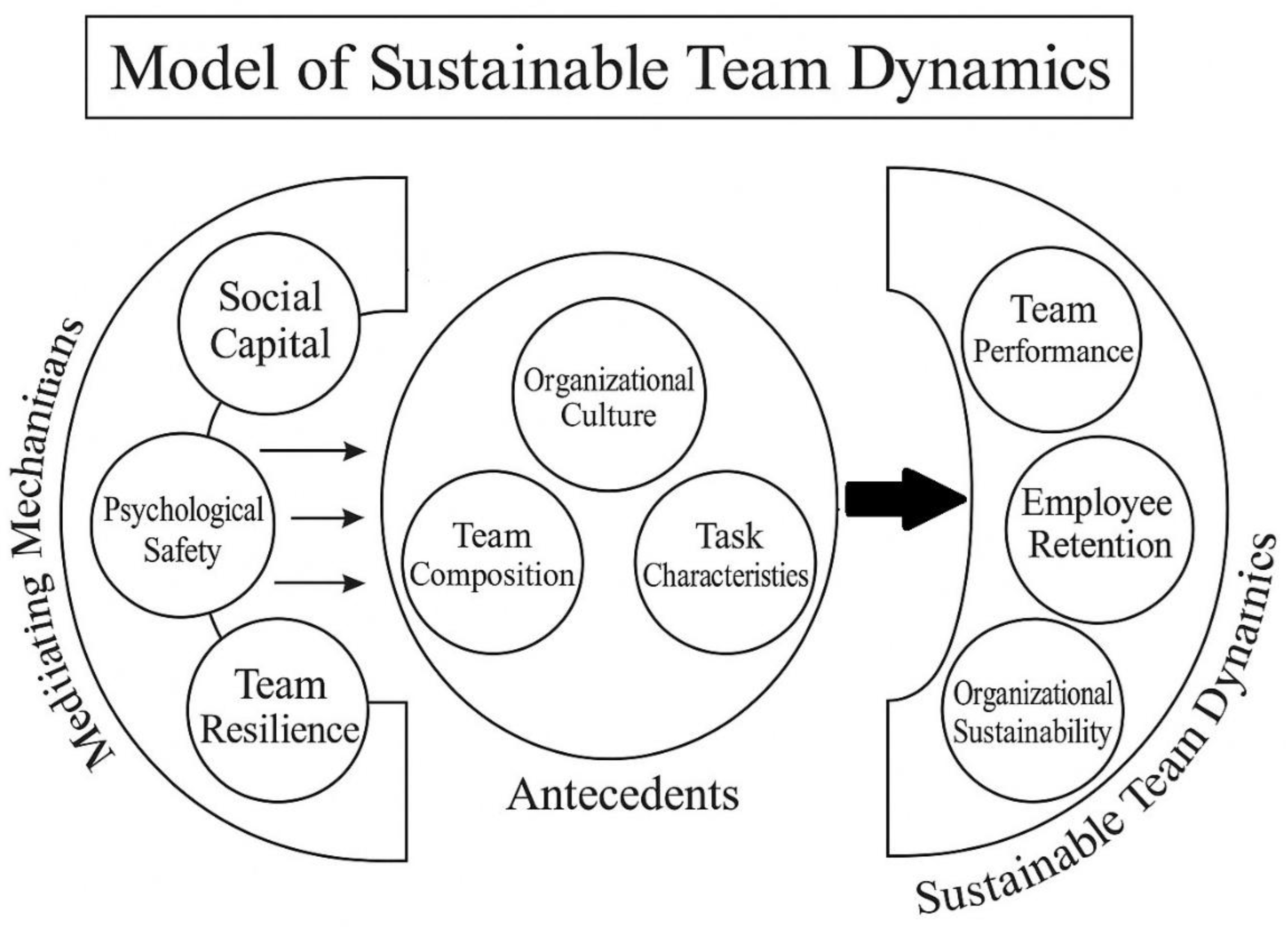

Table 1.
Constructs and Measures.
| Construct | Type | Example Indicators |
| Organizational Culture | Antecedent | Trust, learning orientation, supportiveness |
| Team Composition | Antecedent | Diversity in skills, values |
| Task Characteristics | Antecedent | Complexity, interdependence |
| Social Capital | Mediator | Trust, shared norms, mutual help |
| Psychological Safety | Mediator | Safe to express ideas, tolerance for mistakes |
| Team Resilience | Mediator | Recovery from setbacks, adaptability |
| Team Performance | Outcome | Innovation, productivity, responsiveness |
| Retention Intention | Outcome | Commitment to remain |
| Perceived Sustainability | Outcome | Long-term viability and cohesion |
Table 2.
Descriptive Statistics.
| Variable | Mean | SD | Skewness | Kurtosis | Min | Max | Range |
| Organizational Culture | 3.999 | 0.405 | -0.018 | -1.001 | 3.33 | 4.67 | 1.34 |
| Team Composition | 4.001 | 0.403 | -0.065 | -0.982 | 3.33 | 4.67 | 1.34 |
| Task Characteristics | 3.999 | 0.407 | -0.011 | -0.984 | 3.33 | 4.67 | 1.34 |
| Social Capital | 4.000 | 0.401 | 0.023 | -1.026 | 3.33 | 4.67 | 1.34 |
| Psychological Safety | 3.999 | 0.413 | -0.024 | -0.976 | 3.33 | 4.67 | 1.34 |
| Team Resilience | 4.000 | 0.415 | -0.063 | -1.044 | 3.33 | 4.67 | 1.34 |
| Team Performance | 4.538 | 0.163 | -0.469 | -1.788 | 4.33 | 4.67 | 0.34 |
| Retention Sustainability | 4.537 | 0.163 | -0.450 | -1.806 | 4.33 | 4.67 | 0.34 |
Table 3.
Correlation Statistics.
| 1 | 2 | 3 | 4 | 5 | 6 | 7 | 8 | |
| Org Culture 1 | 1.000 | |||||||
| Team Composition 2 | 0.740 | 1.000 | ||||||
| Task Characteristics 3 | 0.750 | 0.724 | 1.000 | |||||
| Social Capital 4 | 0.716 | 0.741 | 0.722 | 1.000 | ||||
| Psych Safety 5 | 0.733 | 0.754 | 0.746 | 0.754 | 1.000 | |||
| Team Resilience 6 | 0.721 | 0.727 | 0.752 | 0.721 | 0.763 | 1.000 | ||
| Team Performance 7 | 0.667 | 0.657 | 0.612 | 0.649 | 0.665 | 0.663 | 1.000 | |
| Retention Sustainability 8 | 0.665 | 0.656 | 0.674 | 0.659 | 0.689 | 0.673 | 0.643 | 1.000 |
Table 4.
Regression Analysis (Model 1: Predicting Team Performance).
| Predictor | β Coeff. | Std. Err. | t-Stat. | p-Value | Significance |
| Intercept | 3.205 | 0.058 | 53.31 | <0.001 | Significant |
| Org Culture | 0.088 | 0.023 | 3.89 | 0.0001 | Significant, Strong positive influence |
| Team Composition | 0.061 | 0.023 | 2.63 | 0.009 | Significant, Moderate influence |
| Task Characteristics | -0.010 | 0.023 | -0.44 | 0.662 | Not Significant |
| Social Capital | 0.058 | 0.023 | 2.55 | 0.011 | Significant contributor |
| Psychological Safety | 0.061 | 0.024 | 2.56 | 0.011 | Significant Statistically relevant |
| Team Resilience | 0.076 | 0.022 | 3.39 | 0.001 | Significant, Positive, solid effect |
Table 5.
Regression Analysis (Model 2: Predicting Retention and Sustainability).
| Predictor | β Coeff. | Std. Err. | t-Stat. | p-Value | Significance |
| Intercept | 3.168 | 0.057 | 55.94 | <0.001 | Significant |
| Org Culture | 0.058 | 0.022 | 2.62 | 0.009 | Significant Positively related |
| Team Composition | 0.038 | 0.023 | 1.66 | 0.097 | Marginally significant (p > 0.07) |
| Task Characteristics | 0.062 | 0.023 | 2.76 | 0.006 | Significant in this model |
| Social Capital | 0.050 | 0.022 | 2.25 | 0.025 | Meaningful contributor |
| Psychological Safety | 0.075 | 0.023 | 3.25 | 0.001 | Strong predictor |
| Team Resilience | 0.059 | 0.022 | 2.69 | 0.007 | Important role |
Disclaimer/Publisher’s Note: The statements, opinions and data contained in all publications are solely those of the individual author(s) and contributor(s) and not of MDPI and/or the editor(s). MDPI and/or the editor(s) disclaim responsibility for any injury to people or property resulting from any ideas, methods, instructions or products referred to in the content. |
© 2025 by the authors. Licensee MDPI, Basel, Switzerland. This article is an open access article distributed under the terms and conditions of the Creative Commons Attribution (CC BY) license (http://creativecommons.org/licenses/by/4.0/).
Copyright: This open access article is published under a Creative Commons CC BY 4.0 license, which permit the free download, distribution, and reuse, provided that the author and preprint are cited in any reuse.


