

Submitted:
11 June 2025
Posted:
16 June 2025
You are already at the latest version
Abstract
The emergence of sustainable team dynamics concept reflects a critical evolution in organizational theory, aligning the foundations of effective teamwork with imperatives of sustainability. During complex environmental, social and economic challenges, teams serve as operational units as well as strategic vehicles for sustainable transformation. This study defines, conceptualizes and develops a theoretical model for sustainable team dynamics by integrating diverse strands of literature, including team effectiveness theories, sustainability science and organizational behavior. Reviewing frameworks like Input-Process-Output model, Social Exchange Theory and models of psychological safety; the paper constructs a conceptual framework of sustainable team dynamics capturing antecedents, mediating mechanisms and outcomes – emphasizing shared purpose, psychological safety, inclusive leadership and adaptive capacity as essential for fostering teams that are effective in the short term, and resilient and contributive in the long term. The study offers a holistic model that organizations can use to align team performance with broader sustainability objectives.
Keywords:
Sustainable Team Dynamics
; Team Effectiveness
; Team Development
; Organizational Theory
; Leadership
Sustainability has evolved beyond environmental awareness into a core business principle with organizations increasingly recognizingsustainable practices as both ethically responsible and strategically advantageous (Wu, 2022). The critical role of fostering strong team dynamics in achieving sustainable work practices cannot be understated (Bonaconsa et al., 2021).
The Growing Importance of Sustainability for Businesses
Business success is no longer just about financial performance but also involves environmental and social factors of TBL framework of people, planet, and profits (Elkington, 1994). Key drivers making sustainability imperative include:
- Resource Depletion and Climate Change: Businesses heavily dependent on resources or generating significant waste face risks and regulations. Sustainability promotes resource efficiency and climate mitigation (Moslehpour et al., 2022).
- Shifting Stakeholder Expectations: Consumers, investors, and employees increasingly demand environmental and social responsibility, influencing investment, talent retention, and brand loyalty (Suryasa, Rodríguez-Gámez & Koldoris, 2022).
- Regulatory Pressures: Globally stricter regulations impose fines and reputational risks on non-compliant businesses, making proactive sustainability essential.
- Efficiency and Cost Savings: Sustainable initiatives like energy and water efficiency and waste reduction reduce operational costs and resource procurement expenses.
The benefits of Integrating Sustainabilityinclude:
- Enhanced brand reputation attracting conscious consumers
- Increased innovation through new products and operational models
- Improved risk management ensuring continuity
- Talent attraction and retention aligned with social responsibility
- Greater employee engagement and motivation through purposeful initiatives
Team Dynamics –Engine of Sustainable Practices
Sustainability integration not only improves social and environmental impact but unlocks competitive advantages (Belitski et al., 2021; Ding et al., 2023). Effective team dynamics are crucial to implementation (Hristov & Chirico, 2023). Diverse, motivated teams with strong communication, shared vision, and collaborative problem-solving drive sustainable practices (Bates et al., 2023). Critical roles of team dynamics include:
- Knowledge Sharing and Collaboration: Multidisciplinary expertise and open communication enable sustainable solutions (Dincă et al., 2023).
- Shared Vision and Goal Setting: Aligning teams with sustainability goals fosters collective purpose and accountability.
- Problem Solving and Innovation: Creative, safe brainstorming and experimentationspaces promote innovative embedding of sustainability into processes.
- Accountability and Ownership: Teams cultivate shared responsibility for sustainability adherence and continuous improvement.
- Motivation and Engagement: Shared sustainability goals enhance motivation, with recognition of sustainability initiatives boosting engagement.
Strategies for Building Effective Sustainability Teams
Leaders can foster effective teams through promoting diversity and inclusion to foster innovation; training and development equipping employees with necessary skills; ensuring open communication and transparency on goals about goals building trust and alignment; empowerment and recognition fostering accomplishment and commitment; and Integrating sustainability into performance management systems
Emerging Challenges in Team Management and the Need for a Holistic Approach
The workplace is transforming due to globalization, technological advancements, and the knowledge economy, presenting novel challenges to traditional team management (Hasan & Hassan, 2021). While efficiency remains important, a nuanced approach is necessary for modern teamwork complexities.
The Evolving Workplace
Geographically dispersed teams require effective communication across time zones and cultures. The gig economy and project-based work demand adaptable teams capable of forming quickly and effectively (Silva et al., 2022). Technological advancements create opportunities but heighten needs for continuous learning and upskilling (Li, 2022).
Emerging Challenges
Key concerns for workplace transformations include: maintaining team cohesion in dispersed teams struggling with trust and camaraderie compared to co-located teams, requiring shared identity and purpose (Hsiao & Dillahunt, 2021); managing work-life balance as technology blurs boundaries, potentially causing burnout, requiring leaders to encourage healthy boundaries (Taherdoost, 2023); enhancing creativity and innovation through diverse perspectives while managing conflict and fostering psychological safety (Hornor, 2022); and addressing knowledge gaps from rapid technological change requiring continuous upskilling and knowledge management (Li, 2022).
Limitations of Traditional Approaches
Traditional team management often emphasizes task completion and predefined performance metrics. While efficiency is important, focusing only on results overlooks the human element vital for long-term success, including strong team dynamics, psychological safety, and individual well-being (Berthelot et al., 2019; Edmondson & Bransby, 2022). The modern workplace demands a holistic approach that balances task achievement with team member well-being (Hasan & Hassan, 2021). Fostering psychological safety, open communication, and continuous learning while prioritizing well-being; enables leaders to build sustainable, high-performing teams.
The Need for a Holistic Approach
Holistic team management recognizes interconnected factors influencing performance (Sessitsch et al., 2023), considering well-being and psychological aspects beyond task completion. Key aspects include: psychological safety creating environments for risk-taking, idea-sharing, and mistake admission fostering trust and innovation (Du et al., 2022); open communication through regular formal and informal channels building trust and ensuring everyone feels valued; team development through activities focusing on communication, collaboration, and conflict resolution enhancing dynamics and performance (Akaki et al., 2022; Elyousfi et al., 2021); and prioritizing well-being through encouraging breaks, work-life balance, and mental/physical health resources.
Limitations of Traditional Team Dynamics and the Sustainability Imperative
Traditional team dynamics, centered on output within hierarchical structures, are inadequate for today’s complex work environment and sustainability goals. The growing sustainability importance necessitates collaborative, purpose-driven approaches emphasizing psychological safety, open communication, and empowering diverse teams with the knowledge and tools to tackle sustainability challenges. This shift cultivates a more engaged and effective workforce committed to a sustainable future.
Constraints of Traditional Team Dynamics
Traditional dynamics rely on ill-suited concepts. Major constraints include: focus on short-term performance neglecting long-term environmental and social impact undermining sustainability requiring long-term investment; command-and-control leadership stifling creativity and limiting ownership when sustainability needs collaborative approaches valuing diverse perspectives; emphasis on individual performance metrics creating competition discouraging collaborative problem-solving essential for sustainability goals; and limited well-being consideration prioritizing productivity without considering team member welfare, reducing meaningful sustainability contributions.
The Sustainability Imperative
Environmental and social challenges make sustainability strategic for business survival:
- Resource Depletion and Climate Change: Risks from resource depletion and climate impacts necessitate sustainable, resource-efficient practices for long-term viability.
- Stakeholder Expectations: Consumers, investors, and employees increasingly demand corporate responsibility, influencing investment, talent retention, and brand loyalty.
- Regulatory Pressures: Evolving environmental regulations require proactive sustainability to avoid fines, disruptions, and reputational harm.
New Paradigms in Team Dynamics for Sustainability
A holistic team dynamic fosters sustainability by through:
- Shared Vision and Long-Term Goals: Collaborative goal-setting integrates sustainability into team objectives, fostering commitment and collective purpose (Woodard et al., 2022).
- Psychological Safety and Open Communication: Safe environments and open communication encourage early sustainability concerns identification, sharing and innovative problem-solving.
- Diversity and Inclusion: Diverse teams bring varied perspectives essential for addressing complex environmental and social issues.
- Cross-Functional Collaboration: Sustainability demands cooperation across departments for a comprehensive approach.
- Continuous Learning and Knowledge Sharing: Ongoing training and dissemination of best practices equip teams to adapt to evolving sustainability challenges.
Building Sustainable Teams for the Future
Leaders foster teams through: empowerment and recognition creating ownership and commitment with sustainability goal recognition reinforcing behaviours; performance management with sustainability metrics ensuring priority focus and continuous improvement evaluation; and work-life balance initiatives prioritizing well-being for motivated, engaged team members through breaks, balance, and health resources.
Tracing the Roots: Sustainable Team Dynamics Evolution
The term “sustainable team dynamics” is a recent addition to discussions on team effectiveness and organizational behavior; emerging from convergence of sustainability science and team effectiveness literature. While teamwork principles have been studied for decades, specific sustainability integration with team dynamics is relatively recent.
Sustainability: A Paradigm Shift
Sustainability has transcended environmental concerns to encompass holistic business practices. Sustainability principles emphasize meeting present needs without compromising future generations’ ability to meet theirs (Ryan & Deci, 2017). It integrates environmental, social, and economic concernsto organizational decision-making, with businesses prioritizing resource efficiency, waste minimization, and positive social impact alongside economic viability (Xu et al., 2023).
Team Effectiveness Literature: A Foundation for Collaboration
Team effectiveness research has rich history exploring successful teamwork factors. Early models focused on team composition, leadership styles, and communication patterns (Elms, Gill & González-Morales, 2022). Focus shifted toward understanding group dynamics (Levi, 2020), psychological safety, and conflict resolution (Wang et al., 2022). Modern literature emphasizes collaboration (Hindricks et al., 2020), shared vision, and adaptability in dynamic work environments (Mazzetti & Schaufeli, 2022).
The Convergence: Sustainable Team Dynamics Emerge
“Sustainable team dynamics” arises from convergence of complementary fields. As sustainability becomes core business principle, organizations recognize team functioning needs alignment with this objective (Suryasa, Rodríguez-Gámez & Koldoris, 2022). Traditional models focused on short-term productivity within hierarchical structures struggle with long-term sustainability goals.
Sustainability Principles and Team Dynamics
Key sustainability principles relevant to sustainable team dynamics include: intergenerational equity ensuring teams remain effective over time through continuous learning, knowledge sharing, and well-being preventing burnout (Melia, 2016); long-term thinking integrating sustainability into team goals fostering collective focus on sustainable outcomes (Lam et al., 2016); and collaboration and systems thinking necessitating open communication, cross-functional collaboration, and systems thinking considering work interconnectedness with sustainability goals (Yao & Liu, 2022).
Early Influences and Evolving Definitions
While definitive origins are challenging to pinpoint, several early influences exist. “High-performance sustainable teams” was introduced in the late 1990s, emphasizing maintaining effectiveness over time (Raff et al., 2022) and the “natural systems perspective” emerged, drawing parallels between healthy ecosystems and effective teams (Liu et al., 2022).
The Ongoing Evolution
Sustainable team dynamics continues evolving with ongoing research exploring organizational operationalization. Key focus areas include: developing metrics for sustainable team dynamics assessments beyond traditional output measures that capture team learning, psychological safety, and sustainability objective integration; leadership for sustainability requiring development programs integrating empowerment, collaboration, and long-term thinking principles; and understanding technology toleverage remote work and virtual teams for geographically dispersed team dynamics.
Significance of Sustainable Team Dynamics
Sustainable team dynamics are essential for long-term organizational success. For building resilient, innovative, and adaptable organizations, shift from traditional models focused on short-term performance towards more holistic approach to team dynamics characterized by knowledge work, global competition, and sustainability imperatives, is necessitated (Bonaconsa et al., 2021).Key benefits of sustainable team dynamics include:
- Enhanced Innovation and Problem-Solving: Diverse teams with psychological safety and open communication generate innovative ideas and solve complex problems (Szromek et al., 2022).
- Long-Term Goal Alignment: Embedding sustainability in team objectives fosters shared purpose and ensures decisions support enduring organizational success (Maurer, Whitman & Wright, 2023).
- Employee Engagement and Retention: Prioritizing well-being creates motivated, committed and high-performing sustainable teams, reducing turnover and enhancing satisfaction (Sypniewska, Baran & Kłos, 2023).
- Resilience and Adaptability: Sustainable team dynamics cultivate a culture of continuous learning and knowledge sharing (Wu, Liu, & Huang, 2022) helping teams respond to evolving markets, technology, and sustainability challenges.
- Resource Efficiency and Cost Reduction: Sustainable teams minimize waste and optimize resources, contributing to financial sustainability.
Challenges in Cultivating Sustainable Team Dynamics
Despite benefits, fostering sustainable team dynamics presents challenges: balancing short-term and long-term goals integrating sustainability objectives with business imperatives requiring appropriate culture; building psychological safety requiring leaders to foster trust and create spaces for diverse perspectives; prioritizing employee well-being preventing prevalent overwork culture; and developing robust metrics beyond traditional output measures for measuring sustainability in teams.
Strategies for Fostering Sustainable Team Dynamics
Leaders promote sustainable team dynamics through: shared vision and goal setting engaging teams in creating sustainability-integrated visions fostering ownership with collaborative goal-setting ensuring alignment; actively promoting diversity and inclusion for leveraging varied perspectives; empowerment, recognition and appreciation to reinforce and foster responsibility and commitment; continuous training and development of employees for sustainable practices with knowledge sharing culture; and performance management aligned with sustainability ensuring priority focus.
Theoretical Foundations and Literature Review
Team success depends on complex interplay making teams exceed sum of individual member (Dincă et al., 2023). Teams navigate dynamic landscapes where communication styles, personality clashes, and shared goals influence effectiveness (Balakrishnan, 2022). Understanding these dynamics is crucial for fostering collaboration and maximizing performance (Hagen, 2012). A brief overview of the theoretical foundations of team dynamics and sustainability would help in synthesising the idea behind sustainable team dynamics.
Foundational Theories and Models of Team Dynamics: Integrating Sustainability Perspectives
Teams are fundamental to organizational productivity and innovation, and their effectiveness increasingly intersects with sustainability goals. As sustainability becomes integral to strategy, organizations must align team management with environmental, social, and economic imperatives. We will explore foundational theories of team dynamics – social exchange theory (SET), team effectiveness models, and team development frameworks – within the context of sustainability.
Social Exchange Theory and Team Dynamics
Social Exchange Theory (SET), developed by Homans and Blau, provides valuable framework for understanding social interactions including team dynamics. SET posits individuals engage in relationships based on cost-benefit analysis, seeking reward maximization and cost minimization (Ahmad et al., 2023). Social interactions resemble economic exchanges where individuals weigh relationship costs and rewards. SET rests on three principles:
- Social Interactions as Exchanges: Individuals anticipate benefits (e.g., recognition) balanced against costs (e.g., effort).
- Outcomes and Investments: Team members assess if their investments are matched by rewards.
- Comparison Levels: Engagement depends on whether perceived outcomes meet personal expectations as per their “comparison level” – a standard based on past experiences and expectations.
The team interactions and effectiveness can be understood through influence of reciprocity, trust, and commitment.
Reciprocity: Foundation of Social Exchange. Reciprocity suggests individuals maintain relationships perceiving fair benefit-cost exchanges, creating mutual obligation within teams. Positive reciprocity creates cooperation and support cycles when helpful behaviors are reciprocated (Xia et al., 2023). Negative reciprocity occurs when unfair exchanges create resentment and decreased cooperationmanifested as reduced effort, withdrawal or conflict.
In team contexts, reciprocity manifests through: effort and contribution matching where members maintain effort perceiving equal contributions, with unequal contributions creating inequity and decreased motivation; emotional exchange where positive emotions create positive cycles with valued members reciprocating positive behaviour; and knowledge and resource sharing where readily sharing members receive similar support, fostering learning and collaboration culture.
Trust: Catalyst for Effective Interactions. Trust is a fundamental aspect of successful teams. Trust emerges through repeated positive reciprocity and expectation fulfilment. Trustworthy members are reliable, competent, and consistent, fostering open communication, collaboration, and risk-taking. Trust builds through consistent positive exchanges, increasing over time and strengthening collaborative ability. High trust leads to increased communication, knowledge sharing, and collective problem-solving with members seeking help, admitting mistakes, and offering constructive feedback.
Commitment: Power of Shared Purpose. Commitment goes beyond task fulfilment and maximizing individual benefits and is driven by perceived relationship value. Team commitment refers to dedication to goals and member well-being (Qi et al., 2022). Committed employees exceed expectations, take ownership, and persevere through challenges.
Commitment sources include: shared vision and goals creating understanding and shared purpose transcending individual rewards; team identity and belongingness motivating collective good contribution with satisfaction from successful team membership; and investment and sacrifices, creating "sunk cost" commitment where individuals avoid abandoning teams wherein they have heavily invested.
High commitment leads to enhanced performance, increased innovation, and greater challenge resilience with committed teams overcoming obstacles achieving collective success.
SET and Team Dynamics: A Framework for Intervention. SET offers a useful framework to enhance team dynamics by focusing on reciprocity, trust, and commitment.
- Enhancing Reciprocity: Leaders can foster a culture of reciprocity through open communication and recognition programs that acknowledge contributions. Allowing team members opportunities to return favors promotes fairness and team cohesion.
- Building Trust: Trust grows when leaders act consistently, keep commitments, and acknowledge member contributions. Open communication in a safe environment encourages risk-taking and constructive conflict resolution, emphasizing solutions rather than blame.
- Fostering Commitment: Leaders build commitment by creating a shared vision, setting clear goals, and empowering ownership. Opportunities for professional development strengthen members’ sense of purpose.
To leverage SET effectivelyto promote effective team interactions, leaders should focus on:
- Fairness and Equity: Equitable distribution of workload and rewards is essential; perceived inequity damages trust and commitment.
- Fostering Open Communication: A safe space for sharing concerns and feedback maintains trust and reciprocity.
- Building Shared Vision and Goals: Collaborative vision and goal-setting enhance ownership and commitment.
- Recognition and Appreciation: Acknowledging contributions reinforces positive behavior and commitment.
- Conflict Management: Teaching conflict resolution enables constructive handling of disagreements, preserving cohesion.
SET explains interpersonal team interactions through cost-benefit analysis, where individuals pursue relationships with expected net rewards (Cropanzano et al., 2017; Homans, 1961). Central to SET is reciprocity—positive actions are expected to be returned (Gouldner, 1960). Team relationships, guided by fairness, trust, and support, are shaped by team-member exchange (TMX) and leader-member exchange (LMX) (Seers et al., 1995).
TMX assesses the quality of lateral peer interactions, with high TMX marked by cooperation and altruism (Seers, 1989). LMX evaluates vertical leader-member relationships, where high quality enables open communication and support. Positive TMX and LMX together improve satisfaction and team performance (Wijaya, 2020).
Further, perceived organizational support (POS) and perceived procedural justice (PPJ) are critical within SET (Supardi & Hadi, 2020). POS reflects employees’ sense of being valued (Rhoades & Eisenberger, 2002); PPJ relates to perceived fairness of organizational processes (Colquitt, 2001). High POS and PPJ promote reciprocal behaviors such as engagement and productivity (Ahmad et al., 2023; Hadi & Supardi, 2020).
As workplaces evolve, SET must adapt. Remote work, changing leader-employee dynamics, and performance-driven policies necessitate hybrid SET models (Blau, 1964; Cropanzano & Mitchell, 2005; Oh et al., 2014). These incorporate reduced direct interactions, altered supervisory relationships, and shifting team expectations (Leana & Barry, 2000; Wang, 2017).
Limitations and Future Directions. SET centers on rational exchange and may underrepresent emotional factors in team interactions. Cultural differences also affect perceptions of reciprocity and trust. Future research should explore moderating roles of organizational culture, leadership styles, personality traits, and technology’s impact on virtual teams’ dynamics.
Despite these limits, SET remains a valuable framework for understanding and improving team interactions.
Team Development Theories
Tuckman’s Stages of Group Development Model:
Understanding how teams evolve is crucial for maximizing their potential.Bruce Tuckman’s model, developed in the 1960s, offers a valuable framework for navigating this process (Jones, 2019) and outlines five stages teams typically progress through: Forming, Storming, Norming, Performing, and Adjourning(Tuckman & Jensen, 1977).
- Forming: Involves cautious interaction as team members get acquainted, establish ground rules, and clarify goals and roles.
- Storming: Characterized by disagreements and power struggles as members assert themselves and finally clarify roles.
- Norming: Brings cohesion. Consensus develops, collaboration grows, and shared norms are established.
- Performing: Is characterized by effective collaboration. The team reaches peak efficiency, leveraging trust, collaboration, and individual strengths to achieve goals.
- Adjourning: Added later to the model. Teams close projects, evaluate accomplishments, and disband or transition.
While progression is often linear, teams may revisit stages or experience them differently. Recognizing these phases helps leaders anticipate challenges and foster environments conducive to high performance.
Each stage represents a necessary phase in developing a high-performing team. Effective leadership adapts across stages – from directive in forming to supportive in performing and reflective in adjourning.
Tuckman’s Model and Its Application in Virtual Teams. Tuckman’s model – Forming, Storming, Norming, Performing, and later Adjourning (Tuckman & Jensen, 1977) – remains a foundational framework for understanding team development, despite criticism for its linearity. Teams often cycle back to earlier stages, especially under changing circumstances. Nonetheless, the model is adaptable, including for virtual and hybrid teams (Lipnack & Stamps, 1997). In such settings, leaders must proactively establish clarity during forming, mediate conflicts during storming, and reinforce norms that support collaboration and communication (Bush, 2023).
The Punctuated-Equilibrium Model
Gersick’s Punctuated-Equilibrium Model offers a contrasting, nonlinear view of team development, suggesting that teams do not necessarily develop linearly but rather through alternating periods of inertia and rapid change. The model posits that teams establish behavioral patterns early, enter a prolonged period of inertia maintaining stability, and then undergo a critical transition at the project’s midpoint (Gersick, 1988). A major transition typically occurs at the midpoint of the project timeline, regardless of the project’s duration. This midpoint acts as a wake-up call, increasing the team’s awareness of the limited time remaining and prompting a significant shift in their approach, triggering re-evaluation and accelerating performance to meet deadlines. Following this transition, the team enters a second phase characterized by more focused and accelerated activity to complete the project. This model highlights the importance of time awareness and deadlines in shaping team performance. Understanding this pattern can help leaders anticipate key inflection points and intervene effectively during periods of stability, particularly around the midpoint, to enhance team performance and ensure timely project completion (Gersick, 1988).
Team Effectiveness Models
Several models offer team effectiveness perspectives. Hackman’s IPO Model provides foundational structure emphasizing input-process-outcome interplay. Salas et al. adds contextual elements. Katzenbach and Smith model addressesbehavioural dysfunctions hindering success. Tuckman outlines developmental stages andBelbin focuses on individual differences. A quick visit to these models can help us integrate insights into team dynamics.
Hackman’s Model of Team Effectiveness
J. Richard Hackman’s Model of Team Effectiveness offers a multidimensional approach, outlining five essential conditions that foster work team effectiveness, particularly for self-managing and self-designing teams.
- (i)
- Real team: The first condition is the presence of a real team, characterized by clear boundaries, stable membership, and task interdependence among members who rely on each other to accomplish a shared objective.
- (ii)
- Compelling direction:The team needs a compelling direction – a clear, challenging purpose – that energizes and engages all team members. This direction should focus on the desired end result while allowing the team autonomy in determining how to achieve it (Hackman, 2002).
- (iii)
- Enabling structure: Is crucial to ensures thatthe team is designed and so thatwork design, team composition, and behavioral norms promote positive and productive behavior for effective collaboration.
- (iv)
- Supportive context: It involves organizational resources, information, and rewards needed to support the team’s work. This also involves supportive and responsive leadership within the broader organization.
- (v)
- Expert coaching: Teams benefit from expert coaching, whether from leaders or external sources, to help minimize inefficiencies in their processes and harness the potential synergy of teamwork.
Hackman’s model also identifies three outcome dimensions that define team effectiveness. These include:
- (i)
- Team product that exceeds customer expectations.
- (ii)
- Growth in team capabilities over time, and
- (iii)
- A satisfying and meaningful group experience for team members.
These outcomes highlight that team effectiveness is not solely about task accomplishment but also encompasses the development of the team’s collective abilities and the individual experiences of its members.Efforts have been made to develop assessments of Hackman’s framework to measure the core conditions of team effectiveness (Hwang, 2018; Smith & Tushman, 2005). These assessments can be diagnostic, helping to identify areas for improvement, or summative, providing a snapshot of the team’s functioning at a particular point in time (Tudor &Trumble, 1996). The application of Hackman’s model has been explored in various settings, including library teams and interprofessional healthcare teams, demonstrating its broad relevance for understanding and enhancing team performance (Cavanaugh et al., 2021; Rosmalen & Oldehinkel, 2014).
Input-Process-Output (IPO) Model:
The IPO Model provides comprehensive team effectiveness framework (Song, 2023) conceptualizing team effectiveness by examining the interplay between three key components: inputs, processes, and outputs (McGrath, 1964).
- Inputs: Inputs represent the antecedent factors that influence the team, including individual-level factors such as member characteristics (personality traits, skills, knowledge), team-level attributes (team size, structure, resources, clarity of team goals, cohesiveness), and environmental-level contextual elements (organizational support, task characteristics).
- Processes: Processes encompass the interactions, activities, and mechanisms through which team members combine their talents and resources to achieve their goals (Marks et al., 2001). These include communication patterns, coordination, decision-making approaches, conflict management, and the development of group norms. Processes also involve how the team plans its activities and monitors progress.
- Outputs: Outputs are the results or consequences of the team’s actions, which can be tangible (e.g., performance, goal achievement, productivity, quality of output) or intangible (e.g., member satisfaction, team learning, innovation, morale, motivation). The IPO model suggests that team effectiveness is a result of how inputs are transformed through team processes into valued outputs (Kozlowski & Bell, 2003).
The model highlights aligning inputs and processes to achieve desired outcomes, e.g., complex task teams may require high diversity and expertise (input) with effective communication and coordination (processes) for achieving optimal performance (output).
While useful, the IPO model is critiqued for linearity and lack of feedback mechanisms. Although the model offers a valuable framework, it has been noted for its potential oversimplification of complex team dynamics. It may not fully capture the feedback loops where outputs can influence future inputs and processes. To address these limitations, extensions of the model, such as the Input-Mediator-Output-Input (IMOI) model, have been proposed (Kozlowski&Bell, 2003). The IMOI model introduces mediators, acknowledging that a broader range of factors beyond just processes mediate the effects of inputs on outcomes; and explicitly incorporates the potential for cyclical feedback loops, where outputs like team performance can serve as inputs to future team processes (Ilgen et al., 2005).
Comparison: Hackman vs IPO
Both models provide frameworks for understanding team effectiveness, but they approach the topic with different levels of specificity (Kozlowski & Bell, 2003). Hackman’s model offers a more prescriptive approach Hackman’s model is more prescriptive, identifying specific input conditions and output dimensions that define successful teams. It focuses on creating the right context and structure to enable team performance (Hackman, 2002). In contrast, the IPO model is a more general systems framework that categorizes the various factors influencing team effectiveness into inputs, processes, and outputs (McGrath, 1964; Yeatts & Hyten, 1998). It provides a structure for analyzing the different elements at play in team performance without necessarily specifying the ideal conditions like Hackman’s model. While Hackman’s model delves into the specific characteristics of real teams, compelling direction, enabling structures, supportive contexts, and expert coaching; the IPO model offers a more adaptable structure that can be applied across various team types and situations by identifying the relevant inputs, processes, and outputs in each context (Kozlowski & Bell, 2003).
The comparison is summarized in the table below.
Salas et al.’s Team Performance Model:
Building upon IPO Model, Salas et al. add contextual factors (Bouwmans et al., 2021) and acknowledge their role in team effectiveness. Organizational Context includes several factors. Supportive organizational contexts provide the foundation for effective team functioning. Salas et al. highlight the external factors of Organizational Context that influence team effectiveness, including:
- Organizational Strategy and Climate: Leadership support, resource availability, and culture influence team functioning and outcomes.
- Team Design: Structure elements like size, role clarity, skill diversity, and communication channels affect processes.
- Team Synergy: Trust, shared mental models, and communication contribute to a whole greater than the sum of parts.
- Team Processes: This aligns with the concept of processes in the IPO Model, referring to the team’s behaviours and interactions during task execution which are critical to outcomes.
Katzenbach and Smith’s The Five Dysfunctions model:
This diagnostic approach focuses on behavioural aspects undermining team effectiveness, identifying five key dysfunctions (Elms, Gill & González-Morales, 2022):
- Absence of Trust: Prevents open communication and collaboration.
- Fear of Conflict: Suppresses healthy disagreements, leading to groupthink and suboptimal decision-making.
- Lack of Commitment: Ambiguity about goals reduces motivation and execution.
- Avoidance of Accountability: Leads to low ownership and mediocrity.
- Inattention to Results: Prioritizing individual goals over collective purpose hinders success.
The model suggests that addressing these dysfunctions sequentially, starting with trust, is essential for building a cohesive and high-performing team.
Lencioni’s Five Dysfunctions of a Team Model:
Similar to Katzenbach and Smith, Lencioni addresses trust, conflict, commitment, accountability, and results (Lencioni, 2002) but with holistic dysfunction views differing from primarily behavior-focused approaches (Mowday, Porter & Steers, 2013). Both share five dysfunction concepts preventing effective team functioning with slight framing differences: fear of conflict where Katzenbach& Smith view general disagreement fear while Lencioni emphasizes healthy debate importance; accountability with Katzenbach& Smith focusing on general lack while Lencioni emphasizes team-specific accountability; and results where both address lack of focus but Lencioni uses "inattention" emphasizing shared outcome vision.
Belbin’s Team Roles Model:
Belbin’s Team Roles Model, proposed by Meredith Belbin, emphasizes the significance of team composition and the value of having individuals with diverse behavioral styles (Lu, Lin & Chen, 2017). Belbin identifies nine distinct behavioral tendencies individuals bring to teams, each contributing unique strengths and potential pitfalls (Ren et al., 2019). Effective teams balance these roles ensuring well-rounded high-functioning group dynamics (Johnson, 2021).
The model explores how people naturally prefer interacting, problem-solving, and contributing to team goals beyond skills and experience. Nine roles categorize into three areas: Thinking (Plant, Monitor Evaluator, Specialist), Action (Shaper, Implementer, Completer Finisher), and People (Coordinator, Team-worker, Resource Investigator). Each role offers unique strengths and weaknesses.For example, Plants are creative idea generators while Implementers excel at turning ideas into action.Beauty of this model lies in team balance. Understanding member inherent tendencies allows teams to leverage individual strengths by optimized task allocation and address potential shortcomings, building well-rounded units capable of remarkable results.
Other Contemporary Theories of Team Dynamics
Besides These models, several other contemporary theories offer insights into team dynamics. The Drexler/Sibbet Team Performance Model illustrates team development as seven stages, focusing on creating the team and then sustaining performance (Drexler et al., 2008). The Katzenbach and Smith’s Team Performance Curve distinguishes between working groups and high-performance teams, emphasizing the importance of shared purpose, performance goals, and mutual accountability (Katzenbach & Smith, 1993). The GRPI model (Goals, Roles, Procedures, Interpersonal relationships) provides a framework for assessing team effectiveness based on these four key elements (Rubin et al., 1978). Each of these models offers a unique lens through which to understand and improve team dynamics and performance.
Integrating Insights and Further Research Opportunities
By combining these development and effectiveness models, organizations can develop comprehensive strategies for building effective teams. SET’s focus on reciprocity, trust, and commitment complements the IPO and performance models’ systemic perspectives and the behavioral insights of the dysfunctions framework.Leaders who nurture fairness, communication, shared vision, and constructive conflict resolution create conditions for synergy and sustained team success. This overview of team dynamics theories underscores ongoing exploration needed to assess their effectiveness across diverse organizational contexts, especially amid evolving societal and technological landscapes.
Future research and practice can further explore cultural, technological, and individual factors shaping these dynamics, particularly in increasingly virtual and diverse work environments.Investigating how technology influences team interaction and integrating it with established models remain promising areas for future research. The dynamic nature of modern work demands continuous study of factors promoting effective team performance.
Sustainability Concepts
Sustainability has evolved beyond environmental concerns to a holistic development approach. The Brundtland Commission defines sustainable development as “development that meets the needs of the present without compromising the ability of future generations to meet their own needs” (Singh, 2022). This entails integrating three interconnected dimensions: environmental, social, and economic.
Environmental Dimension
Focused on preserving natural resources, key areas include:
Climate Change Mitigation and Adaptation: Addressing greenhouse gas emissions and climate change impacts through renewable energy, conservation, and pollution reduction.
Biodiversity and Ecosystem Services: Protecting biodiversity and maintaining ecosystems that provide critical services like clean water, air purification, and food production.
Waste Management and Resource Efficiency: Minimizing waste, promoting responsible disposal, and adopting circular economy practices to enhance resource recovery and reuse.
Social Dimension
This dimension focuses on promoting equity, justice, and well-being:
Social Justice and Equity: Ensuring equal opportunity, fair resource distribution, nondiscrimination, and inclusive decision-making.
Human Rights and Labor Practices: Upholding rights, fair labor standards, and decent work conditions throughout supply chains.
Health and Education: Guaranteeing access to quality healthcare, safe environments, addressing social determinants of health, and accessible education.
Economic Dimension
Focuses on achieving long-term prosperity without harming environment or society by integrating sustainability into economic activity:
Resource Efficiency: Promoting practices minimizing waste and optimizing resource use.
Green Economy: Transitioning toward economies that prioritize environmental sustainability.
Corporate Social Responsibility: Encouraging businesses to integrate social and environmental concerns alongside financial goals.
Sustainable Economic Growth: Supporting growth decoupled from environmental harm, emphasizing innovation and efficiency.
Responsible Investment: Incorporating environmental, social, and governance (ESG) criteria into investment decisions.
Interconnectedness of Sustainability Dimensions
Three sustainability dimensions are interconnected and mutually reinforcing rather than independent. Environmental degradation can impede economic growth and social well-being, while economic policies focused on short-term gains may undermine environmental and social objectives. Social inequalities also pose barriers to environmental sustainability. Effective sustainable development requires organizations and societies to address all three dimensions simultaneously and in balance. Integrating these principles across individual, organizational, and societal decision-making processes is essential to ensure environmental protection (Wang, Xu & Meng, 2023), social justice (Camiré et al., 2021), and sustained economic prosperity (Clauss et al., 2022), thereby fostering a just, equitable, and environmentally responsible future.
The Concept of Team Sustainability
Team sustainability, from an organizational behavior perspective, refers to the capacity of a team to maintain effectiveness, productivity, and positive interpersonal dynamics over time while achieving organizational goals (Mathieu et al., 2019). It implies a team’s ability to endure, adapt to changes, and foster a culture of collaboration, trust, and ethical practices (Wijaya, 2020). The concept increasingly overlaps with broader organizational sustainability, integrating environmental, social, and economic considerations (Bansal & Roth, 2000). A sustainable team meets its immediate objectives while contributing to the long-term health and viability of the organization and stakeholders (Dyllick & Hockerts, 2002).
The multifaceted dimensions of team sustainability are interconnected and contribute to the overall sustainability of the team within the organizational context (Elkington, 1997). These include:
- Longevity: Refers to the team’s ability to continue functioning effectively over time.
- Adaptability: Enablesopenness and flexibility in team approach to meet challenges and incorporate new ways of working.
- Resilience: Allows bouncing back from setbacks to maintain performance despite difficulties.
- Ethical Conduct: Upholding integrity and contributing positively to the social and environmental well-being of the organization and community.
Factors contributing to team sustainability include:
- Trust:Trust among members and with leaders is foundational to psychological safety and collaboration.
- Shared Purpose: Alignment on mission and goalsprovides direction and motivation.
- Psychological Safety: Expressing ideas without fear of judgment is essential for innovation.
- Effective Communication: Openness and clarity, ensures effective information-sharing and seamless collaboration.
- Continuous Learning: Enables adapting to new challenges, skills-improvement and high performance over time.
Sustainability in Organizational Context
Sustainability in organizations is typically framed through environmental, social, and economic performance. Environmental focuses on emissions reduction, resource conservation and waste management to minimize negative impact on natural environment. Social concerns the impact on people, encompassing fair labor practices, employee well-being, community engagement, and ethical sourcing. Economic sustainability involves long-term financial viability and growth in environmentally and socially responsible way. These three interconnected pillars emphasize the need to balance economic goals with social and environmental responsibilities (Elkington, 1997).
These principles are applied across organizational functions. In operations, this might involve adopting energy-efficient technologies, reducing water consumption, and minimizing waste generation (Lam&Lai, 2015); in supply chain, it issustainable sourcing, ensuring fair labor practices among suppliers, and reducing transportation emissions (Krause et al., 2009). In HR, it involves promoting employee well-being, ensuring diversity and inclusion, and providing opportunities for training and development (Avery, 2005). The integration of these principles into all aspects of the business is crucial for achieving true organizational sustainability (Gladwin et al., 1995).
Leadership and organizational culture are vital to sustainability(Avery, 2005; Schein, 2010). A culture valuing sustainability fosters employee engagement and embeds sustainable practices (Bansal, 2005). Visionary leadership helps overcome resistance and institutionalize sustainable thinking.
Integrating Sustainability with Team Management: Frameworks and Models
While explicit frameworks integrating sustainability with team management are still evolving, the foundational and team dynamics theories provide a strong basis for such integration. SET emphasizes reciprocity: teams are more likely to embrace sustainability when contributions towards it are recognized and supported (Cropanzano & Mitchell, 2005). Fairness and encouragement for sustainability initiatives from leadership enhance commitment to these goals, aligning with the core tenets of SET (Cooper-Thomas & Morrison, 2018).
Team effectiveness models like Hackman’s and the IPO model can incorporate sustainability elements. Hackman’s compelling direction can include sustainability as key mission elements, while enabling structures and supportive contexts can facilitate sustainable practices through resource provision and behavior rewards (Hackman, 2002). The IPO model extends by considering sustainability-related inputs (environmentally aware members, sustainability expertise), processes (collaborative problem-solving for sustainability challenges), and outputs measured by environmental, social, and economic contributions alongside traditional metrics.
Team development theories can also be leveraged to build sustainable teams. Tuckman’s stages inform lifecycle interventions—addressing sustainability resistance during storming, establishing sustainable norms during norming (Tuckman & Jensen, 1977). The Punctuated-Equilibrium Model suggests midpoint transitions as strategic times for introducing sustainability goals, leveraging heightened time awareness (Gersick, 1988).
Intersection of Team Dynamics and Organizational Sustainability: Empirical Insights
Empirical research increasingly explores the relationship between team dynamics and organizational sustainability initiatives (Dyllick & Hockerts, 2002). Collaborative organizational cultures having long-term orientation, enhance sustainable innovations, reduce environmental impact, and improve employee engagement (Bansal, 2005).
The impact of individual pro-environmental orientation on team performance has been explored, with findings suggesting that team cohesion, rather than individual attitudes alone, plays a more substantial role in sustainability project success (Robertson, 2021).Organizations adopting sustainability policies often integrate them deeply through structures like board-level responsibility and performance-linked executive compensation (Flammer, 2013).
Emerging research also highlights the importance of sustainable leadership in aligning economic, social, and environmental goals, fostering trust, commitment, and satisfaction among employees – all of which are important for fostering a team environment conducive to sustainability initiatives (Avery, 2005). While “team sustainability” remains an evolving concept, current literature reinforces the interdependence of team dynamics, leadership, and organizational culture in enabling sustainability strategies (Bansal, 2005; Dyllick & Hockerts, 2002; Elkington, 1997).
Intersection of Team Dynamics and Organizational Sustainability: Emerging Trends
Theories like Social Exchange Theory and models such as Hackman’s and the IPO framework provide foundational tools for enhancing team effectiveness with sustainability considerations. Tuckman’s model and the Punctuated-Equilibrium theory offer developmental insights for embedding sustainability practices across the team lifecycle.
The emerging concept of “team sustainability” reflects a shift from short-term productivity to enduring performance aligned with organizational sustainability goals. Key enablers include trust, shared purpose, psychological safety, effective communication, and continuous learning. As empirical research deepens, it increasingly supports the integration of collaboration, leadership, and cultural alignment in advancing both team and organizational sustainability.
Emerging trends indicate a growing emphasis on the intersection of team management and sustainability. Current trends show increasing. This includes focus on micro-foundations of sustainability within organizational behavior and research on individual-level behaviors such as employee green behavior and its organizational impact (Ones & Dilchert, 2012).
Sustainable leadership continues to gain traction for its role in embedding sustainability into organizational practices and team culture (Avery, 2005; Schein, 2010). Researchers are moving beyond macro-level strategies to more systemic, multilevel approaches integrating sustainability into team functioning.
Future research could develop and validate frameworks specifically targeting team sustainability, offering practical tools for integrating effectiveness with long-term sustainability objectives. Examining the influence of communication, conflict resolution, and other team dynamics on sustainability outcomes would also be valuable. Longitudinal studies tracking the performance and longevity of sustainability-oriented teams could help identify key success factors and challenges over time.
Understanding and fostering sustainable team dynamics is thus critical for long-term organizational success in the face of growing environmental, social, and economic responsibilities. Continued exploration is needed to develop actionable strategies that enable teams to serve as both high-performing units and sustainability champions.
Factors Influencing Team Dynamics and Sustainability: Empirical Studies
Extensive empirical research has examined the factors shaping team effectiveness and longevity. Key areas include:
Team Leadership and Management Practices
Research consistently highlights the pivotal role of leadership in shaping team dynamics.Transformational leadership, characterized by inspiring vision, intellectual stimulation, individualized consideration and inspirational motivation, has been positively linked to enhanced team cohesion, communication, and performance (Baker & Hoidn, 2023).Empowering leadership, which involves delegating authority, fostering autonomy and supporting team members’ development, contributes to increased team innovation and engagement (Zhang & Bartol, 2010).Effective practices such as clear goal setting, performance monitoring and feedback mechanisms maintain focus and drive success over time (Mehra, 2022).
Team Composition and Diversity
Team composition, particularly diversity, yields mixed empirical results. Demographic diversity (age, gender, ethnicity) presents short-term communication and conflict challenges but offers long-term benefits for creativity and problem-solving (Nayak & Agarwal, 2011). Cognitive diversity (knowledge, skills, perspectives) generally enhances innovation and decision quality(Rolin et al., 2023). Success lies in effective diversity management ensuring inclusive processes and leveraging diverse viewpoints (Cunningham et al., 2023).
Communication and Information-sharing Within Teams
Open and frequent communication correlates with trust, cohesion, and task performance (Waters et al., 2020).Research on information sharing emphasizes the importance of both the amount and the quality of information exchanged. Teams engaged in comprehensive and accurate information sharing exhibit better problem-solving abilities and informed decision-making (Zha et al., 2022). Psychological safety and team climate significantly influence members’ comfort in sharing information and ideas (Nguyen, 2021; Orekoya, 2023).
Conflict Resolution and Problem-Solving Approaches:
Conflict management is a critical determinant of team sustainability. Constructive approaches like collaboration and compromise associate with positive outcomes including improved understanding and innovation (Kay & Skarlicki, 2020; Higgins, 2011). Conversely, destructive conflict styles such as avoidance or competition lead to decreased cohesion, increased stress, and reduced performance (Ausat et al., 2023). Research on problem-solving highlights the importance of clear roles, structured approaches and effective information analysisfor generatingsolutions.
Organizational Support and Resources:
Organizational context significantly influences team dynamics and sustainability. Teams with adequate resources like financial support, technology, training, and clear mandates perform better and exhibit higher satisfaction (Burack et al., 2023). Supportive cultures valuing teamwork, collaboration, and learning foster positive dynamics, while team-based rewards and recognition systems contribute to longevity by reinforcing collaborative behaviors.
Emerging Literature on Sustainable Team Dynamics
The concept of sustainable team dynamics is gaining increasing traction in the literature, moving beyond a sole focus on immediate performance to encompass the long-term health and viability of teams.The sustainable team dynamics concept gains traction, moving beyond immediate performance focus to encompass long-term team health and viability. While definitions evolve, literature generally defines it as ongoing interaction patterns and influences enabling consistent goal achievement while maintaining or enhancing member well-being and capacity to adapt and thriveover time (Lam et al., 2016).
Key dimensions identified in the nascent literature include sustained team performance (consistent goal achievement and adaptation to changing demands), team member well-being (psychological and physical health, satisfaction, belonging), team viability and longevity (capacity to remain intact, cohesive, effective despite challenges), and adaptive capacity (ability to learn, innovate, adjust strategies responding to changes).
Sustainable team attributes include high trust and psychological safety levels, strong shared purpose, effective communication and knowledge sharing processes, constructive conflict management, and continuous learning cultures.
Conceptual Frameworks and Theoretical Models
Several conceptual frameworks are emerging to model sustainable team dynamics. These frameworks often build upon existing input-process-output (IPO) or input-mediator-output-input (IMOI) models of team effectiveness (Zhou et al., 2021) by incorporating temporal considerations and a greater emphasis on factors related to well-being and longevity. For instance, some models propose a cyclical process where positive team dynamics lead to sustained performance and well-being, which in turn reinforces positive dynamics over time. Other frameworks emphasize the role of adaptive mechanisms and resilience in maintaining team sustainability despite disruptions.
Empirical Evidence on Sustainable Team Dynamics
While a wealth of research on related constructs, such as team effectiveness, team resilience, and team longevity provides valuable insights, direct studies focused on the antecedents, processes, and outcomes of sustainable team dynamicsare limited.
Antecedents. Studies on the antecedents of team effectiveness offer indirect evidence for the factors influencing sustainable team dynamics. Research on the impact of organizational culture on team performance suggests that cultures emphasizing collaboration and learning may foster more sustainable teams(Meisenbach&Brandhorst, 2018). Certain team diversity configurations and skill mixes might contribute to team longevity (Liu et al., 2021).
Processes. Team processes like communication and conflict resolution directly influence long-term performance. Meta-analyses confirm that effective communication supports performance, while teams skilled in managing conflict maintain cohesion and effective functioning (Kay &Skarlicki, 2020).
Outcomes. Empirical studies on team performance, satisfaction, and survival highlight the long-term implications of sustainable team dynamics. Longitudinal research shows that teams with positive climates experience enhanced well-being, retention, and longevity, which are crucial for long-term team sustainability.
Relevant Reviews and Meta-Analyses. Several reviews and meta-analyses provide valuable syntheses of the existing research relevant to sustainable team dynamics. Meta-analyses on team leadership, diversity, and communication provide quantitative links between these factors and team outcomes (Mazeed et al., 2023). While team resilience reviews elucidate processes that enable recovery from adversity – a vital sustainability component, team effectiveness reviews offer a comprehensive overview of factor influencing long-term success (Dimas, Torres &Lourenço, 2023).
The empirical landscape thus offers a robust base on factors influencing team dynamics, though research on sustainability as a distinct construct is emerging. Existing work on leadership, composition, processes, organizational support, and outcomes like longevity and well-being provides essential groundwork.Emerging literature is beginning to define and model this construct more explicitly, and future empirical investigations are crucial to further validate these frameworks and identify the specific mechanisms that drive long-term team viability and effectiveness in a way that also supports the well-being of team members. Synthesizing existing knowledge with this emerging focus holds significant promise for advancing our understanding of how to build and maintain truly sustainable teams within organizations.
Integrating Sustainability Principles with Team Dynamics Literature
Achieving organizational success necessitates sustainable practice shifts. This goes beyond environmental consciousness, demanding holistic approaches integrating social responsibility, economic viability, and long-term environmental well-being. Contemporary workplaces demand team dynamics paradigm shifts. Traditional models centred on output optimization struggle with modern work complexities, particularly sustainability contexts.
Sustainability transcends environmental concerns, encompassing holistic business practices emphasizing meeting present needs without compromising future generations’ ability to meet theirs (Singh, 2022). Organizations committed to sustainability strive for environmental responsibility, social equity, and long-term economic viability.
Team dynamics research investigates successful teamwork factors. Early models focused on team composition, leadership styles, and communication patterns. Contemporary literature emphasizes collaboration, shared vision, and dynamic work environment adaptability.
There is an essential synergy between sustainability principles and team dynamics, giving rise to the concept of sustainable team dynamics. This approach reorients teams towards collaboration, innovation, and long-term focus, blending immediate objectives with sustainability goals.
Key Sustainability Principles and their Relevance to Team Dynamics
Several key sustainability principles resonate with the concept of sustainable team dynamics:
- Intergenerational Equity: Like sustainable development preserves resources for future generations, sustainable team dynamics foster continuous learning and knowledge sharing, ensuring ongoing team effectiveness and well-being.
- Long-Term Thinking: Sustainable teams prioritize long-term planning, embedding sustainability objectives into their goals, rather than focusing solely on short-term results as in traditional team dynamics.
- Collaboration and Systems Thinking: Sustainability requires cross-functional cooperation. Sustainable teams cultivate open communication and systems thinking, recognizing the interdependence of their work with broader sustainability goals.
- Resource Efficiency: Sustainable teams promote efficient processes and mindful resource use, minimizing waste and environmental impact.
- Innovation and Continuous Improvement: Teams must support experimentation and diversity of ideas to navigate the dynamic path toward sustainability.
Integration of Team Effectiveness Models with Sustainability:
Existing team effectiveness models provide valuable frameworks for fostering sustainable team dynamics. Prominent model adaptations include:
- Hackman’s Input-Process-Outcome (IPO) Model: Incorporate sustainability into inputs (e.g., task designs emphasizing resource efficiency) and processes (e.g., promoting cross-functional collaboration on sustainability issues) to achieve sustainable outcomes.
- Salas et al.’s Team Performance Model: Use contextual factors to include organizational sustainability policies and leadership influences.
- Katzenbach and Smith’s Five Dysfunctions Model: Expand accountability to include responsibility for meeting sustainability objectives.
- Belbin’s Team Roles Model: Highlight the importance of roles like the Plant and Monitor Evaluator for innovation and critical assessment of sustainability impacts.
Practical Strategies for Building Sustainable Teams
Leaders can foster sustainable team dynamics through strategic integration of sustainability principles:
- Shared Vision and Goal Setting: Develop a shared team mission integrating sustainability objectives to foster commitment and alignment.
- Diversity and Inclusion: Promote heterogeneous teams to leverage diverse perspectives essential for innovative sustainability solutions.
- Empowerment and Recognition: Encourage team ownership of sustainability initiatives and acknowledge contributions to maintain motivation.
- Continuous Learning and Development: Provide training on sustainability practices, tools, and regulations, fostering a culture of knowledge sharing.
- Performance Management Aligned with Sustainability: Integrate sustainability metrics into performance evaluations to keep sustainability prioritized and track progress.
- Work-Life Balance and Well-being: Support team members’ physical and mental health to sustain long-term effectiveness and prevent burnout.
- Leadership for Sustainability: Develop leadership that empowers, collaborates, and models long-term sustainability thinking.
This integrated approach bridges traditional team dynamics with sustainability imperatives, enabling organizations to build resilient, effective teams that contribute meaningfully to sustainable development goals.
Challenges and Considerations in Implementation:
Integrating sustainability principles into team dynamics involves certain challenges:
- Balancing Short-Term and Long-Term Goals: Leaders must foster a culture that aligns immediate profitability with long-term sustainability.
- Building Psychological Safety and Trust: A trust-based environment is vital for open communication and valuing diverse perspectives.
- Measuring Sustainability in Teams: Developing robust metrics beyond traditional performance measures remains challenging, requiring further research.
Benefits of Sustainable Team Dynamics:
Sustainable team dynamics offer several advantages:
- Enhanced Innovation and Problem-Solving: Diverse, psychologically safe teams encourage creativity and tackle complex sustainability issues.
- Increased Employee Engagement and Retention: Prioritizing well-being fosters empowerment, leading to higher engagement and reduced turnover. Studies show a positive correlation between high-performing sustainable teams and employee satisfaction (Sypniewska, Baran & Kłos, 2023).
- Improved Resource Efficiency and Cost Reduction: Sustainability-focused teams optimize resource use, lowering long term costs.
- Enhanced Resilience and Adaptability: Continuous learning and a growth mindset equip teams to adapt to evolving challenges.
Conceptualizing Sustainable Team Dynamics
Understanding sustainable team dynamics requires defining its core attributes and dimensions before proposing a theoretical model explaining factors affecting teams’ long-term viability and effectiveness.
Sustainable Team Dynamics: Definition and Core Attributes
Sustainable team dynamics are ongoing patterns of interaction and shared understanding that enable teams to meet goals while maintaining member well-being and long-term viability within the organization (Melia, 2016). This definition underscores that team success extends beyond immediate tasks to enduring adaptability and positive contributions over time.
Several core attributes underpin sustainable team dynamics.
- Shared Purpose and Vision: Aligns efforts toward common objectives (Wyatt, 2021).
- Mutual Trust and Respect: Fosters psychological safety for open expression and risk-taking (Liu et al., 2023).
- Effective Communication: Timely, clear information exchange ensures clarity and coordination.
- Constructive Conflict Management: Navigates disagreements to strengthen relationships and foster innovation (Kay & Skarlicki, 2020).
- Collective Learning and Adaptability: Enables reflection, improvement, and response to change (Folke et al., 2010).
Key Dimensions of Sustainable Team Dynamics
The sustainability of team dynamics is influenced by several interconnected dimensions as explained below:
- Sustainable Team Leadership: Focuses on leadership behaviors that promote long-term team health and effectiveness. Sustainable leaders inspire, empower, and foster shared vision while encouraging inclusive decision-making and collective leadership. Furthermore, sustainable leaders promote inclusive decision-making, encourage diverse perspectives, and facilitate the development of collective leadership within the team (Iqbal & Piwowar-Sulej, 2023), modeling ethical behaviour and accountability.
- Sustainable Team Processes: Centers on recurring interactions that maintain sustainability. These include open communication, transparency, and active listening (McMullin & Dilger, 2021), collaborative conflict management (Lewis, 2022), and a culture of knowledge sharing to build intellectual capital (Yeboah, 2023). Such processes enhance relationships, problem-solving, and adaptability.
- Sustainable Team Outcomes: Encompass the long-term results supporting team and organizational viability. Well-being involves reduced stress, higher job satisfaction, and belonging, contributing to talent retention and engagement. Longevity is the ability to sustain cohesion and effectiveness over time despite challenges (Ji & Yan, 2020). Adaptability reflects responsiveness to changing demands and environmental shifts, enabling agility and resilience (Torricelli & Pellati, 2023).
- Organizational Support and Resources: The organizational environment is critical in fostering sustainable teams. Adequate resources (financial, technological, training) are necessary (Dimas et al., 2023). Supportive culture values collaboration, innovation, and well-being, supported by leadership that promotes teamwork and policies encouraging work-life balance. Investments in team development (e.g., team-building, conflict resolution, coaching) are essential for sustaining long-term effectiveness (Lacerenza et al., 2018).
Proposed Theoretical Model of Sustainable Team Dynamics
Building upon the aforementioned dimensions, a theoretical model of sustainable team dynamics is proposed in Figure 1, conceptualizing the interplay of key organizational constructs that drive enduring team success. The model posits that organizational culture, team composition, and task characteristics serve as antecedents shaping initial team conditions. A collaborative, learning-oriented culture emphasizing well-being forms the foundational context. Diverse skills and perspectives in team composition enhance problem-solving and adaptability, while complex, interdependent tasks necessitate strong collaboration and communication.
These antecedents influence team sustainability through mediating mechanisms: social capital, psychological safety, and team resilience. Social capital, involving trust and shared norms, fosters cooperation and information sharing (Nutakor et al., 2023). Psychological safety encourages open, risk-tolerant communication essential for innovation. Team resilience– adapting to adversity and recovering from setbacks– supports longevity and consistent performance.
The synergy of these mediating mechanisms leads to outcomes such as team performance, employee retention, and organizational sustainability. High performance arises from collaboration, problem-solving and adaptability; retention improves through well-being and belonging; organizational sustainability benefits from innovation, productivity, and a resilient engaged workforce.
Adopting a systems perspective, the model emphasizes dynamic interconnections over linear causality, aligning with social exchange theory, conservation of resources theory, and broaden-and-build theory of positive emotions. It integrates structural and psychological elements vital for sustained team functioning, offering a foundation for empirical research and guide for practical strategies aimed at cultivating resilient, high-performing teams within complex organizational ecosystems.
Sustainable team dynamics thus emerge as central to organizational effectiveness and success. Understanding their core attributes and dimensions helps organizations cultivate team environments that support both immediate goals and long-term team viability. The proposed model provides a comprehensive framework for investigating the interplay of antecedents, mediators, and outcomes. Future research should empirically test and refine this model by exploring context-specific factors and developing interventions that promote sustainable teams.
Conceptual Framework
The conceptual framework integrates multiple influence levels. It begins with organizational culture, which, when centered on trust, learning, and well-being, shapes team norms and psychological safety. A culture of support fosters openness, risk-taking, and adaptability. Teamcomposition–in personality, skills, values– affects how teams utilize resources. Meta-analyses show that teams high in conscientiousness, agreeableness, and shared values perform better. Task characteristics also shape dynamics: complex, interdependent, and meaningful tasks drive engagement but heighten the need for support.
At the core of the framework is team social capital– the network of strong interpersonal relationships, trust, and shared norms within the team – which mediates between inputs (culture, composition, task) and outcomes. High social capital enables effective knowledge sharing, collective problem-solving and informal support. This in turn nurtures team resilience – a collective capacity to withstand, adapt to, and recover from challenges. Psychological safety and social capital are mutually reinforcing and critical to resilience, allowing teams to adapt without fear and maintain performance.
We propose that these interacting components – culture, composition, task design, social capital, psychological safety, and resilience – create a virtuous cycle leading to three core outcomes:
- Team performance – sustainable dynamics enhance innovation, adaptability, and consistent output.
- Employee retention – supportive, growth-oriented teams experience lower burnout and turnover.
- Organizational sustainability – resilient teams safeguard human capital and help organizations meet strategic goals, aligning with sustainable HRM principles.
Research Contribution and Implications
In this article we introduced sustainable team dynamics as a novel HRM concept focused on long-term viability through supportive social and structural mechanisms. The framework integrates social exchange theory (SET), conservation of resources (COR) theory, and broaden-and-build theory to explain how positive team interactions foster enduring performance and well-being.
SET posits that reciprocal support and commitment build trust and loyalty forming the basis of sustained workplace relationships and cooperative behavior (Cropanzano & Mitchell, 2005). In teams, when members feel supported, they reciprocate with commitment and effort, enhancing retention. Similarly, COR posits that individuals strive to acquire and protect valued resources (e.g. time, energy, social support), as their loss causes stress while gain build resilience. Applying COR to teams, we propose that sustainable dynamics involve mechanisms to generate and replenish resources (social, psychological, material), thereby buffering stress and reducing burnout. During crises like COVID-19, empirical studies confirmed that resource loss predicts distress, while resource gain promotes resilience. Fredrickson’s broaden-and-build theory adds that psychological safety with positive emotions and experiences elicit trust and optimism which broaden thinking and build capacities like creativity, cohesion, and adaptability. Together, these theoretical underpinnings delineate how sustainable team dynamics can arise: through a cycle of supportive exchanges, resource accumulation, and positive affect that generate resilience and commitment over the long term.
Building on these foundations, we articulated the conceptual framework of sustainable team dynamics that integrates multiple levels of influence.
Practical Implications
The framework offers several team management and HR development implications. To foster sustainable dynamics, managers should build a supportive culture and prioritize psychological safety through leader training, communication norms, and team learning practices. Regular check-ins and debriefs can surface and resolve tensions early. HR practices should focus on team health during staffing and development. Selection and team formation processes can match complementary personality traits and values. Training in resilience, stress management, and positive psychology can strengthen coping and cohesion. Organizational alignment is key. Companies aiming for sustainability should integrate team well-being into performance metrics, linking team resilience to corporate resilience team health to broader sustainability goals. Having retention and engagement of sustainability-minded employees as organizational KPIs contributes to the “people” dimension of the triple-bottom-line model.
Future Research Directions
Despite the contributions, our conceptual framework opens avenues for empirical inquiry.First, researchers must operationalize and measure sustainable team dynamics, potentially through validated instruments capturing team-level resource gains, planning, and resilience. Second, longitudinal studies should test causality in dynamic processes—for example, how early psychological safety and social capital indicators predict later retention and performance. Multilevel designs can explore interactions between organizational culture and team-level variables. Third, cross-contextual validation is essential. Do sustainable dynamics function similarly across industries, cultures, or remote vs. co-located settings? Comparative studies could assess how economic or environmental pressures moderate effectiveness of sustainable team practices.Finally, intervention research should experimentally test framework components – e.g., leadership coaching or team-building for social capital – to evaluate effects on sustainable long-term outcomes.
Conclusion
This article advances the discourse on sustainable team dynamics by offering an integrated framework that moves beyond short-term metrics toward long-term collaboration, well-being, and adaptability. It links trust, psychological safety, and resilience with environmental, social, and economic responsibility. The proposed model contributes significantly by identifying antecedents, mediating mechanisms, and outcomes defining sustainable teams, situating sustainability as embedded organizational priority teams must actively pursue. By linking constructs such as trust, commitment, and resilience with sustainability objectives, the framework provides pathways for scholars and practitioners to reconceptualise team success in holistic, future-facing terms. Introducing the concept of sustainable team dynamics makes a theoretical contribution by synthesizing multiple established theories to illuminate how teams can be managed for long-term well-being and performance. The practical implications for team leaders and HR professionals are clear: invest in a culture of support, build resilient team climates, and align HR practices with enduring sustainability goals.We hope this work spurs further research to refine measures, conduct longitudinal and multi-level studies, and test the framework across contexts. Empirical validation across varied contexts and robust measurement development are critical next steps. For organizations, this means investing in inclusive leadership, sustainable culture, and performance systems aligned with long-term goals. In doing so, they support resilient teams and contribute meaningfully to broader organizational sustainability.
References
- Ahmad, A.; et al. Psychological transactions, reciprocity, exchange relationships, and the impact of various factors on this complex process. Scopus 2023. [Google Scholar]
- Ahmad, R.; Nawaz, M.R.; Ishaq, R.; Khan, H.R.; Ashraf, H.A. Social exchange theory: Systematic review and future directions. Frontiers in Psychology 2023, 13, 1015921. [Google Scholar] [CrossRef]
- Akaki, M.; Ioki, M.; Mitomi, K.; Maeno, T. Best Practices of Team-Building Activities in a Project-Based Learning Class ‘Design Project’ in a Japanese Graduate School. Proceedings of the Design Society 2022, 2, 2263–2272. [Google Scholar] [CrossRef]
- Andersson, L.M.; Pearson, C.M. Tit for tat? Thespiraling effect of incivility in the workplace. Academy of Management Review 1999, 24, 452–471. [Google Scholar] [CrossRef]
- AusatAlmaududi, A.M.; Risdwiyanto, A.; Arfah, M.; Jemadi, J. Conflict Management Strategies in Work Teams in the Creative Industry. Kendali: Economics and Social Humanities 2023. [Google Scholar] [CrossRef]
- Avery, G.C. Sustainable leadership: Honeybee and locust approaches; Taylor & Francis, 2005; ISBN 9780203723944. [Google Scholar]
- Baker, J.P.; Hoidn, S. Transformational Leadership. 2023. [Google Scholar] [CrossRef]
- Balakrishnan, K. Influence of Cultural Dimensions on Intercultural Communication Styles: Ethnicity in a Moderating Role. Journal of Communication, Language and Culture 2022. [Google Scholar] [CrossRef]
- Bansal, P. Evolving sustainably: A longitudinal study of corporate sustainable development. Strategic Management Journal 2005, 26, 197–218. [Google Scholar] [CrossRef]
- Bansal, P.; Roth, K. Why companies go green: A model of ecological responsiveness. Academy of Management Journal 2000, 43, 717–736. [Google Scholar] [CrossRef]
- Bates, G.; Le Gouais, A.; Barnfield, A.; Callway, R.; Hasan, M.N.; Koksal, C.; Kwon, H.R.; Montel, L.; Peake-Jones, S.; White, J.; Bondy, K.; Ayres, S. Balancing Autonomy and Collaboration in Large-Scale and Disciplinary Diverse Teams for Successful Qualitative Research. International Journal of Qualitative Methods 2023. [Google Scholar] [CrossRef]
- Belitski, M.; Guenther, C.; Kritikos, A.S.; Thurik, R. Economic effects of the COVID-19 pandemic on entrepreneurship and small businesses. Small Business Economics 2021, 58, 593–609. [Google Scholar] [CrossRef]
- Bell, S.T. Deep-level composition variables as predictors of team performance: A meta-analysis. Journal of Applied Psychology 2007, 92, 595–615. [Google Scholar] [CrossRef] [PubMed]
- Berthelot, D.; Carlini, N.; Goodfellow, I.J.; Papernot, N.; Oliver, A.; Raffel, C. MixMatch: A Holistic Approach to Semi-Supervised Learning. ArXiv 2019, abs/1905.02249. Available online: https://api.semanticscholar.org/CorpusID:146808485.
- Blau, P.M. Exchange and Power in Social Life; Routledge, 1964; ISBN 9781138523197. [Google Scholar]
- Bonaconsa, C.; Mbamalu, O.N.; Mendelson, M.; Boutall, A.; Warden, C.; Rayamajhi, S.; Pennel, T.; Hampton, M.I.; Joubert, I.A.; Tarrant, C.; Holmes, A.H.; Charani, E. Visual mapping of team dynamics and communication patterns on surgical ward rounds: An ethnographic study. BMJ Quality & Safety 2021, 30, 812–824. [Google Scholar] [CrossRef]
- Bouwmans, M.; Runhaar, P.; Wesselink, R.; Mulder, M. Team-Oriented HR Practices and Team Performance--Model. PsycTESTS Dataset 2021. [Google Scholar] [CrossRef]
- Burack, O.R.; Mak, W.; Howard, M.; Isaacs, T.; Reinhardt, J. The Importance of Adequate Resources and Equipment to Staff Engagement in a Healthcare System. Innovation in Aging 2023, 7, 1136. [Google Scholar] [CrossRef]
- Bush, S. Leading Teams 2: Stages of Group Development. 2023. [Google Scholar]
- Camiré, M.; Newman, T.J.; Bean, C.; Strachan, L. Reimagining positive youth development and life skills in sport through a social justice lens. Journal of Applied Sport Psychology 2021, 34, 1058–1076. [Google Scholar] [CrossRef]
- Cavanaugh, K.J.; Logan, J.M.; Zajac, S.A.; Holladay, C.L. Core conditions of team effectiveness: Development of a survey measuring Hackman’s framework. Journal of Interprofessional Care 2021, 35, 928–936. [Google Scholar] [CrossRef]
- Clauss, T.; Kraus, S.; Jones, P.A. Sustainability in family business: Mechanisms, technologies and business models for achieving economic prosperity, environmental quality and social equity. Technological Forecasting and Social Change 2022. [Google Scholar] [CrossRef]
- Colquitt, J.A. On the dimensionality of organizational justice: A meta-analysis of construct validity. Journal of Applied Psychology 2001, 86, 386. [Google Scholar] [CrossRef]
- Cooper-Thomas, H.D.; Morrison, R. Social exchange in the workplace: The past, the present, and the future. In The Cambridge Handbook of Workplace Affect; Cambridge University Press, 2018; pp. 167–184. [Google Scholar]
- Cropanzano, R.; Mitchell, M.S. Social exchange theory: An interdisciplinary review. Journal of Management 2005, 31, 874–900. [Google Scholar] [CrossRef]
- Cropanzano, R.; Rupp, D.E.; Byrne, Z.S.; Bhaskar-Shrinivas, P. Social exchange theory: A critical review with theoretical remedies. Academy of Management Annals 2017, 11, 887–916. [Google Scholar] [CrossRef]
- Cunningham, C.A.; Crick, H.Q.; Morecroft, M.D.; Thomas, C.D.; Beale, C.M. Reconciling diverse viewpoints within systematic conservation planning. People and Nature 2023. [Google Scholar] [CrossRef]
- Dimas, I.D.; Torres, P.; Rebelo, T.; Lourenço, P.R. Paths to Team Success: A Configurational Analysis of Team Effectiveness. Human Performance 2023, 36, 155–179. [Google Scholar] [CrossRef]
- Dincă, M.; Luştrea, A.; Craşovan, M.; Onițiu, A.; Berge, T. Students’ Perspectives on Team Dynamics in Project-Based Virtual Learning. SAGE Open 2023, 13. [Google Scholar] [CrossRef]
- Ding, B.; Ferràs Hernández, X.; AgellJané, N. Combining lean and agile manufacturing competitive advantages through Industry 4.0 technologies: An integrative approach. Production Planning & Control 2023, 34, 442–458. [Google Scholar] [CrossRef]
- Drexler, A.B.; Sibbet, D.; Forrester, R.H. The Drexler/Sibbet team performance model. Grove Consultants International 2008. [Google Scholar]
- Du, Y.; Chen, J.; Zhao, C.; Liu, C.; Liao, F.; Chan, C. Comfortable and energy-efficient speed control of autonomous vehicles on rough pavements using deep reinforcement learning. Transportation Research Part C: Emerging Technologies 2022. [Google Scholar] [CrossRef]
- Dyllick, T.; Hockerts, K. Beyond the business case for corporate sustainability. Business Strategy and the Environment 2002, 11, 130–141. [Google Scholar] [CrossRef]
- Edmondson, A. Psychological safety and learning behavior in work teams. Administrative Science Quarterly 1999, 44, 44–350. [Google Scholar] [CrossRef]
- Edmondson, A.; Bransby, D.P. Psychological Safety Comes of Age: Observed Themes in an Established Literature. Annual Review of Organizational Psychology and Organizational Behavior 2022. [Google Scholar] [CrossRef]
- Egozi-Farkash, H.; Lahad, M.; Hobfoll, S.E.; Leykin, D.; Aharonson-Daniel, L. Conservation of resources, psychological distress, and resilience during the COVID-19 pandemic. International Journal of Public Health 2022, 67, 1604567. [Google Scholar] [CrossRef] [PubMed]
- Elkington, J. Towards the Sustainable Corporation: Win-Win-Win Business Strategies for Sustainable Development. California Management Review 1994, 36, 90–100. [Google Scholar] [CrossRef]
- Elkington, J. Cannibals with forks: The triple bottom line of 21st century business. Capstone 1997. [Google Scholar] [CrossRef]
- Elms, A.K.; Gill, H.; González-Morales, M. Confidence Is Key: Collective Efficacy, Team Processes, and Team Effectiveness. Small Group Research 2022, 54, 191–218. [Google Scholar] [CrossRef]
- Elyousfi, F.; Anand, A.; Dalmasso, A. Impact of e-leadership and team dynamics on virtual team performance in a public organization. International Journal of Public Sector Management 2021. [Google Scholar] [CrossRef]
- Flammer, C. Corporate social responsibility and shareholder value: The environmental consciousness of investors. Academy of Management Journal 2013, 56, 758–779. [Google Scholar] [CrossRef]
- Folke, C.; Carpenter, S.R.; Walker, B.; Scheffer, M.; Chapin, T.; Rockström, J. Resilience thinking: Integrating resilience, adaptability and transformability. Ecology and Society 2010, 15, 20. [Google Scholar] [CrossRef]
- Fredrickson, B.L. The broaden-and-build theory of positive emotions. American Psychologist 2001, 56, 218–226. [Google Scholar] [CrossRef]
- Gersick, C.J.G. Time and transition in work teams: Toward a new model of group development. Academy of Management Journal 1988, 31, 9–41. [Google Scholar] [CrossRef]
- Gladwin, T.N.; Kennelly, J.J.; Krause, T.S. Shifting paradigms for sustainable development: Implications for management theory and research. Academy of Management Review 1995, 20, 874–907. [Google Scholar] [CrossRef]
- Gouldner, A.W. The norm of reciprocity: A preliminary statement. American Sociological Review 1960, 25, 161–178. [Google Scholar] [CrossRef]
- Hackman, J.R. Leading teams: Setting the stage for great performances. Harvard Business School Press 2002. [Google Scholar]
- Hadi, S.; Supardi, S. The influence of perceived organizational support and distributive justice on group performance through group engagement. Journal of Leadership in Organizations 2020, 2, 43–57. [Google Scholar]
- Hagen, T.M. Maximizing team performance: Key actions will help you improve operations. EMS world 2012, 41, 38. [Google Scholar]
- Hasan, M.; Hassan, A. The Impact of Team Management on the Organizational Performance in Bahrain Government Sector. International Journal of Business Ethics and Governance 2021. [Google Scholar] [CrossRef]
- Higgins, J. Cochrane handbook for systematic reviews of interventions. Version 5.1.0 [updated March 2011]. The Cochrane Collaboration, 2011. [Google Scholar]
- Hindricks, G.; Potpara, T.S.; Dagres, N.; Vanputte, B.P.; Watkins, C.L. 2020 ESC Guidelines for the diagnosis and management of atrial fibrillation developed in collaboration with the European Association of Cardio-Thoracic Surgery (EACTS). European heart journal 2020. [Google Scholar] [CrossRef]
- Hobfoll, S.E. Conservation of resources: A new attempt at conceptualizing stress. American Psychologist 1989, 44, 513–524. [Google Scholar] [CrossRef]
- Homans, G.C. Social behavior: Its elementary forms. Harcourt, Brace & World 1961. [Google Scholar]
- Hornor, M.S. Diffusion of Innovation Theory. The SAGE Encyclopedia of Research Design 2022. [Google Scholar] [CrossRef]
- Hristov, I.; Chirico, A. The cultural dimension as a key value driver of the sustainable development at a strategic level: An integrated five-dimensional approach. Environ Dev Sustain 2023, 25, 7011–7028. [Google Scholar] [CrossRef]
- Hsiao, J.C.; Dillahunt, T.R. More than Shared Ethnicity: Shared Identity’s Role in Transnational Newcomers’ Trust in Local Consumer-to-Consumer E-commerce. Extended Abstracts of the 2021 CHI Conference on Human Factors in Computing Systems 2021. [Google Scholar] [CrossRef]
- Hwang, J. The impact of talent team optimization and innovative human resource management on organizational performance with the mediating effect of resilience capability. Sustainability 2018, 10, 4644. [Google Scholar]
- Ilgen, D.R.; Hollenbeck, J.R.; Johnson, M.; Jundt, D. Teams in organizations: From input-process-output models to IMOI models. Annual review of psychology 2005, 56, 517–543. [Google Scholar] [CrossRef] [PubMed]
- Iqbal, Q.; Piwowar-Sulej, K. Sustainable leadership and heterogeneous knowledge sharing: The model for frugal innovation. European Journal of Innovation Management 2023. [Google Scholar] [CrossRef]
- Ji, H.; Yan, J. How Team Structure Can Enhance Performance: Team Longevity’s Moderating Effect and Team Coordination’s Mediating Effect. Frontiers in Psychology 2020, 11. [Google Scholar] [CrossRef]
- Johnson, K. Leading effective teams. BMJ Leader 2021, 6, 6–9. [Google Scholar] [CrossRef]
- Jones, D.A. The Tuckman’s Model Implementation, Effect, and Analysis&the New Development of Jones LSI Model on a Small Group. Management Practice Journal 2019. [Google Scholar] [CrossRef]
- Katzenbach, J.; Smith, D. The Wisdom of Teams: Creating the High-Performance Organization; Harvard Business Press, 1992; ISBN 9781422148150. [Google Scholar]
- Kay, A.A.; Skarlicki, D.P. Cultivating a conflict-positive workplace: How mindfulness facilitates constructive conflict management. Organizational Behavior and Human Decision Processes 2020, 159, 159–8. [Google Scholar] [CrossRef]
- Krause, D.R.; Scannell, T.V.; Pohlen, T.L. Reverse logistics: A review and future directions. Journal of Business Logistics 2009, 30, 271–306. [Google Scholar]
- Lacerenza, C.N.; Marlow, S.L.; Tannenbaum, S.I.; Salas, E. Team Development Interventions: Evidence-Based Approaches for Improving Teamwork. American Psychologist 2018, 73, 517–531. [Google Scholar] [CrossRef]
- Lam, C.K.; Huang, X.; Walter, F.; Chan, S.C. Coworkers’ Relationship Quality and Interpersonal Emotions in Team-Member Dyads in China: The Moderating Role of Cooperative Team Goals. Management and Organization Review 2016, 12, 687–716. [Google Scholar] [CrossRef]
- Lam, P.T.I.; Lai, K.H. Environmental management and corporate performance: The mediating role of green supply chain management. Journal of Cleaner Production 2015, 100, 237–247. [Google Scholar]
- Leana, C.R.; Barry, B. What’s in it for me? Workplace power and employee autonomy. Academy of Management Review 2000, 25, 343–352. [Google Scholar]
- Lencioni, P. The Five Dysfunctions of a Team; John Wiley & Sons, 2002; ISBN 9788126522743. [Google Scholar]
- Levi, D. Group Dynamics for Teams; SAGE Publications, 2020; ISBN 9781483378343. [Google Scholar]
- Lewis, D. Contesting liberal peace: Russia’s emerging model of conflict management. InternationalAffairs 2022. [Google Scholar] [CrossRef]
- Li, L. Reskilling and Upskilling the Future-ready Workforce for Industry 4.0 and Beyond. Information Systems Frontiers 2022, 1–16. [Google Scholar] [CrossRef]
- Lipnack, J.; Stamps, J. Virtual teams: People working across boundaries with technology; John Wiley & Sons, 1997. [Google Scholar]
- Liu, B.; Liu, Q.; Stone, P.; Garg, A.; Zhu, Y.; Anandkumar, A. Coach-Player Multi-Agent Reinforcement Learning for Dynamic Team Composition. ArXiv 2021, abs/2105.08692. Available online: https://api.semanticscholar.org/CorpusID:234762819.
- Liu, H.; Xing, L.; Wang, C.; Zhang, H. Sustainability assessment of coupled human and natural systems from the perspective of the supply and demand of ecosystem services. Frontiers in Earth Science 2022. [Google Scholar] [CrossRef]
- Liu, X.; Huang, Y.; Kim, J.; Na, S. How Ethical Leadership Cultivates Innovative Work Behaviors in Employees? Psychological Safety, Work Engagement and Openness to Experience. Sustainability 2023, 15, 3452. [Google Scholar] [CrossRef]
- Lu, H.; Lin, P.; Chen, A.N. An empirical study of behavioral intention model: Using learning and teaching styles as individual differences. Journal of Discrete Mathematical Sciences and Cryptography 2017, 20, 19–41. [Google Scholar] [CrossRef]
- Majeed, M.; Irshad, M.; Khan, I.U.; Saeed, I. The Impact of Team Mindfulness on Project Team Performance: The Moderating Role of Effective Team Leadership. Project Management Journal 2023, 54, 162–178. [Google Scholar] [CrossRef]
- Marks, M.A.; Mathieu, J.E.; Zaccaro, S.J. A temporally based framework and taxonomy of team processes. Academy of Management Review 2001, 26, 356–376. [Google Scholar] [CrossRef]
- Mathieu, J.E.; Maynard, M.T.; Rapp, T.; Gilson, L.L. Team effectiveness 1997-2007: A review of recent advancements and a glimpse into the future. Journal of Management 2008, 34, 99–134. [Google Scholar] [CrossRef]
- Mathieu, J.E.; Tannenbaum, S.I.; Kukenberger, M.R.; Donsbach, J.S.; Alliger, G.M. Team effectiveness 1997–2017: A review of recent advancements and a glimpse into the future. Annual Review of Organizational Psychology and Organizational Behavior 2019, 6, 47–81. [Google Scholar]
- Maurer, H.; Whitman, R.G.; Wright, N. The EU and the invasion of Ukraine: A collective responsibility to act? International Affairs 2023. [Google Scholar] [CrossRef]
- Mazzetti, G.; Schaufeli, W.B. The impact of engaging leadership on employee engagement and team effectiveness: A longitudinal, multi-level study on the mediating role of personal- and team resources. PLoS ONE 2022, 17. [Google Scholar] [CrossRef]
- McGrath, J.E. Social psychology: A brief introduction; Rinehart and Winston: Holt, 1964. [Google Scholar]
- McMullin, M.; Dilger, B. Constructive Distributed Work: An Integrated Approach to Sustainable Collaboration and Research for Distributed Teams. Journal of Business and Technical Communication 2021, 35, 469–495. [Google Scholar] [CrossRef]
- Mehra, A. Effective Team Management Strategies in Global Organizations. Universal Research Reports 2022. [Google Scholar] [CrossRef]
- Meisenbach, R.J.; Brandhorst, J.K. Organizational Culture. The International Encyclopaedia of Strategic Communication 2018. [Google Scholar] [CrossRef]
- Melia, S. Sustainable travel and team dynamics among mobile health professionals. International Journal of Sustainable Transportation 2016, 10, 131–138. [Google Scholar] [CrossRef]
- Moslehpour, M.; Chau, K.; Tu, Y.; Nguyen, K.; Barry, M.; Reddy, K.D. Impact of corporate sustainable practices, government initiative, technology usage, and organizational culture on automobile industry sustainable performance. Environmental Science and Pollution Research 2022, 29, 83907–83920. [Google Scholar] [CrossRef]
- Mowday, R.T.; Porter, L.W.; Steers, R.M. Employee-Organization Linkages: The Psychology of Commitment, Absenteeism, and Turnover; Academic Press: New York, NY, USA, 2013; ISBN 9781483267395. [Google Scholar]
- Nayak, R.C.; Agarwal, R.K. A Model of Creativity and Innovation in Organizations. International Journal of Transformations in Business Management 2011, 1. Available online: https://journals.indexcopernicus.com/api/file/viewByFileId/1301296.
- Nguyen, N. The Fearless Organization: Creating Psychological Safety in the Workplace for Learning, Innovation, and Growth. The Learning Organization 2021. [Google Scholar] [CrossRef]
- Nutakor, J.A.; Zhou, L.; Larnyo, E.; Addai-Danso, S.; Tripura, D. Socioeconomic Status and Quality of Life: An Assessment of the Mediating Effect of Social Capital. Healthcare 2023, 11, 749. [Google Scholar] [CrossRef] [PubMed]
- Oh, I.S.; Guay, R.P.; Kim, K.; Harold, C.M.; Lee, J.H.; Heo, C.; Shin, K.H. Cultural values and leadership: A meta-analysis of relationships across levels of analysis. Organizational Behavior and Human Decision Processes 2014, 124, 172–182. [Google Scholar]
- Ones, D.S.; Dilchert, S. Employee green behavior. In The handbook of organizational culture and climate, 2nd ed.; Ashkanasy, N.M., Wilderom, C.P.M., Peterson, M.F., Eds.; Sage Publications, 2012; pp. 427–462. [Google Scholar]
- Orekoya, I.O. Inclusive leadership and team climate: The role of team power distance and trust in leadership. Leadership & Organization Development Journal 2023. [Google Scholar] [CrossRef]
- Qi, M.; Liu, Z.; Kong, Y.; Yang, Z. The Influence of Identity Faultlines on Employees’ Team Commitment: The Moderating Role of Inclusive Leadership and Team Identification. Journal of Business and Psychology 2022, 37, 1299–1311. [Google Scholar] [CrossRef]
- Raff, L.A.; Reilly, K.; Ratner, S.P.; Moore, C.R.; Raff, E. Building High-Performance Team Dynamics for Rapid Response Events in a US Tertiary Hospital: A Quality Improvement Model for Sustainable Process Change. American Journal of Medical Quality 2022. [Google Scholar] [CrossRef]
- Ren, L.; Cui, L.; Chen, C.; Dong, X.; Wu, Z.; Wang, Y.; Yang, Q. The implicit beliefs and implicit behavioral tendencies towards smoking-related cues among Chinese male smokers and non-smokers. BMC Public Health 2019, 19. [Google Scholar] [CrossRef]
- Rhoades, L.; Eisenberger, R. Perceived organizational support: A review of the literature. Journal of Applied Psychology 2002, 87, 698. [Google Scholar] [CrossRef]
- Riggle, E.D.; Edmondson, D.R.; Hansen, J.D. Perceived organizational support and pay satisfaction among volunteers: Examining social exchange and equity theory predictions. Journal of Managerial Psychology 2009, 24, 290–308. [Google Scholar]
- Robertson, J.L. The relationship between pro-environmental attitudes, behaviors, identity, team cohesion, and team performance on a sustainability-related project. 2021. [Google Scholar]
- Rolin, K.H.; Koskinen, I.; Kuorikoski, J.; Reijula, S. Social and cognitive diversity in science: Introduction. Synthese 2023, 202, 1–10. [Google Scholar] [CrossRef]
- Rosmalen, J.G.M.; Oldehinkel, A.J. Why do findings in epidemiological cohort studies sometimes seem inconsistent? Hackman’s model of group effectiveness as a general framework. PLoS ONE 2014, 9, e109441. [Google Scholar]
- Rubin, I.M.; Plovnick, M.S.; Fry, R.E. Task-oriented team development; McGraw-Hill, 1978; ISBN 0070541973. [Google Scholar]
- Ryan, R.M.; Deci, E.L. Self-Determination Theory: Basic Psychological Needs in Motivation, Development, and Wellness. 2017. [Google Scholar] [CrossRef]
- Schein, E.H. Organizational culture and leadership; John Wiley & Sons, 2010; Volume 2. [Google Scholar]
- Seers, A. Team-member exchange quality: A new construct for role-making research. Organizational Behavior and Human Decision Processes 1989, 43, 118–148. [Google Scholar] [CrossRef]
- Seers, A.; Petty, M.M.; Cashman, J.F. Team-member exchange: Past, present, and future. Research in Personnel and Human Resources Management 1995, 13, 229–274. [Google Scholar]
- Sessitsch, A.; Wakelin, S.; Schloter, M.; Maguin, E.; Cernava, T.; Champomier-Vergès, M.; Kostić, T. Microbiome Interconnectedness throughout Environments with Major Consequences for Healthy People and a Healthy Planet. Microbiology and Molecular Biology Reviews 2023, 87. [Google Scholar] [CrossRef]
- Silva, F.P.; da Mosquera, P.; Soares, M. Factors influencing knowledge sharing among IT geographically dispersed teams. Technological Forecasting and Social Change 2022. [Google Scholar] [CrossRef]
- Singh, V. Brundtland Commission: A Comparative Analysis of the Energy Gap between India and China. Jindal Journal of Public Policy 2022. [Google Scholar] [CrossRef]
- Smith, W.K.; Tushman, M.L. Managing strategic contradictions: A top management model for managing innovation streams. Organization Science 2005, 16, 522–536. [Google Scholar] [CrossRef]
- Song, L. Curriculum Construction Practice of Ideological and Political Education Based on the IPO Model. Applied Mathematics and Nonlinear Sciences 2023, 8, 2817–2826. [Google Scholar] [CrossRef]
- Supardi, S.; Hadi, S. The influence of perceived organizational support and procedural justice on organizational citizenship behavior through work engagement. Journal of Leadership in Organizations 2020, 2, 109–123. [Google Scholar]
- Suryasa, I.W.; Rodríguez-Gámez, M.; Koldoris, T. Post-pandemic health and its sustainability. International Journal of Health Sciences 2022. [Google Scholar] [CrossRef]
- Sypniewska, B.; Baran, M.; Kłos, M. Work engagement and employee satisfaction in the practice of sustainable human resource management—Based on the study of Polish employees. International Entrepreneurship and Management Journal 2023, 1–32. [Google Scholar] [CrossRef]
- Szromek, A.R.; Walas, B.; Kruczek, Z. The Willingness of Tourism-Friendly Cities’ Representatives to Share Innovative Solutions in the Form of Open Innovations. Journal of Open Innovation: Technology, Market, and Complexity 2022, 8, 112. [Google Scholar] [CrossRef]
- Taherdoost, H. A Review of Technology Acceptance and Adoption Models and Theories. International Journal for Multidisciplinary Research 2023. [Google Scholar] [CrossRef]
- Torricelli, C.; Pellati, E. Social bonds and the “social premium”. Journal of Economics and Finance 2023, 1–20. [Google Scholar] [CrossRef]
- Tuckman, B.W.; Jensen, M.A.C. Stages of small-group development revisited. Group & Organization Studies 1977, 2, 419–427. [Google Scholar]
- Tudor, G.J.; Trumble, W.W. Formative and summative evaluation: Different goals require different methods. Journal of Educational Measurement 1996, 33, 1–5. [Google Scholar]
- Wang, L.C. Workplace Social Exchange: Substitutes and Neutralizers of LMX in Team Contexts. Academy of Management Proceedings 2017, 2014, 15175. [Google Scholar] [CrossRef]
- Wang, Z.; Pan, W.; Li, H.; Wang, X.; Zuo, Q. Review of Deep Reinforcement Learning Approaches for Conflict Resolution in Air Traffic Control. Aerospace 2022, 9, 294. [Google Scholar] [CrossRef]
- Waters, L.; Strauss, G.; Somech, A.; Haslam, N.; Dussert, D. Does team psychological capital predict team outcomes at work? International Journal of Wellbeing 2020. [Google Scholar] [CrossRef]
- Wheelan, S.A. Group processes: A developmental perspective. Allyn and Bacon 1994. [Google Scholar]
- Wijaya, N.H.S. The Effect of Team Social Exchange Perspective on Employee Job Satisfaction. The 2020 International Conference on E-Business Intelligence (ICEBI 2020) 2020, 177–181. [Google Scholar]
- Woodard, L.; Amspoker, A.B.; Hundt, N.E.; Gordon, H.S.; Hertz, B.; Odom, E.; Utech, A.E.; Razjouyan, J.; Rajan, S.S.; Kamdar, N.P.; Lindo, J.; Kiefer, L.; Mehta, P.; Naik, A.D. Comparison of Collaborative Goal Setting With Enhanced Education for Managing Diabetes-Associated Distress and HemoglobinA1c Levels. JAMA Network Open 2022, 5. [Google Scholar] [CrossRef]
- Wu, C.; Liu, C.; Huang, Y. The exploration of continuous learning intention in STEAM education through attitude, motivation, and cognitive load. International Journal of STEM Education 2022, 9, 1–22. [Google Scholar] [CrossRef]
- Wu, Y. Ethically Responsible and Trustworthy Autonomous Systems for 6G. IEEE Network 2022, 36, 126–133. [Google Scholar] [CrossRef]
- Wyatt, D.A. Our Shared Purpose: Leadership. AORN journal 2021, 113, 223–224. [Google Scholar] [CrossRef]
- Xia, C.; Wang, J.; Perc, M.; Wang, Z. Reputation and reciprocity. Physics of life reviews 2023, 46, 8–45. [Google Scholar] [CrossRef]
- Xu, J.; She, S.; Gao, P.; Sun, Y. Role of green finance in resource efficiency and green economic growth. ResourcesPolicy 2023. [Google Scholar] [CrossRef]
- Yao, J.; Liu, X. The effect of activated resource-based fault lines on team creativity: Mediating role of open communication and moderating role of humble leadership. Current Psychology 2022, 42, 13411–13423. [Google Scholar] [CrossRef]
- Yeatts, D.E.; Hyten, C. High-performing self-managed work teams: A comparison of theory to practice; Sage Publications, 1998. [Google Scholar]
- Yeboah, A. Knowledge sharing in organization: A systematic review. Cogent Business & Management 2023, 10. [Google Scholar] [CrossRef]
- Zha, Y.; Li, Q.; Huang, T.; Yu, Y. Strategic Information Sharing of Online Platforms as Resellers or Marketplaces. Mark. Sci 2022, 42, 659–678. [Google Scholar] [CrossRef]
- Zhang, X.; Bartol, K.M. Linking Empowering Leadership and Employee Creativity: The Influence of Psychological Empowerment, Intrinsic Motivation, and Creative Process Engagement. Academy of Management Journal 2010, 53, 107–128. [Google Scholar] [CrossRef]
- Zhou, W.; Pickett, S.T.; McPhearson, T. Conceptual frameworks facilitate integration for transdisciplinary urban science. npj Urban Sustainability 2021, 1, 1–11. [Google Scholar] [CrossRef]
Figure 1.
Theoretical Model of Sustainable Team Dynamics.
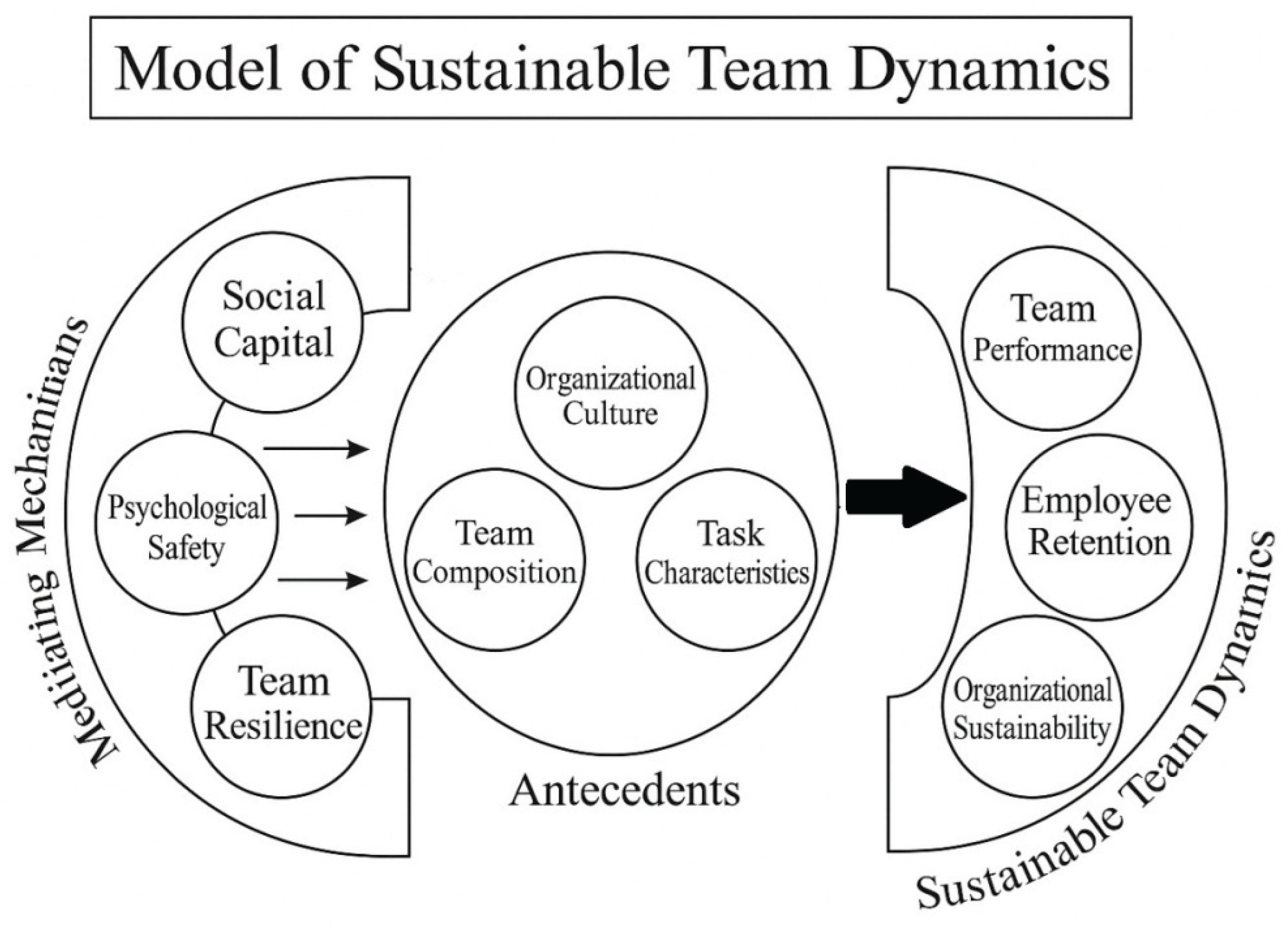

Table 1.
Comparison of Team Effectiveness Models.
| Model | Key Components/Stages | Primary Focus | Strengths | Limitations |
| Hackman’s Model | Real Team, Compelling Direction, Enabling Structure, Supportive Context, Coaching; Acceptable Work Products, Capability Growth, Satisfying Experience | Enabling conditions and output for team effectiveness | Actionable conditions for creating effective teams; Holistic view of effectiveness. | Not accountingfully for dynamic nature of team interactions. |
| IPO Model | Inputs (Individual, Team, Environment), Processes (Communication, Coordination, Conflict Management), Outputs (Performance, Satisfaction, Innovation) | Systematic framework for understanding how inputs lead to processes and outcomes | Flexible and widely applicable structure for analyzing team performance | Over-simplistic, linear, feedback loops not fully captured. |
Disclaimer/Publisher’s Note: The statements, opinions and data contained in all publications are solely those of the individual author(s) and contributor(s) and not of MDPI and/or the editor(s). MDPI and/or the editor(s) disclaim responsibility for any injury to people or property resulting from any ideas, methods, instructions or products referred to in the content. |
© 2025 by the authors. Licensee MDPI, Basel, Switzerland. This article is an open access article distributed under the terms and conditions of the Creative Commons Attribution (CC BY) license (http://creativecommons.org/licenses/by/4.0/).
Copyright: This open access article is published under a Creative Commons CC BY 4.0 license, which permit the free download, distribution, and reuse, provided that the author and preprint are cited in any reuse.


