

Submitted:
07 November 2025
Posted:
07 November 2025
You are already at the latest version
Abstract
In recent years, the increasing use of social media in the workplace has raised concerns about its potential adverse impact on employee productivity and overall organizational success. Consequently, the aim of the study was to enhance the understanding of the relationship between social media addiction, Fear of Missing Out, cyberloafing, work engagement, and organizational commitment using a network analysis approach. The findings reveal a triangular association between social media addiction, Fear of Missing Out, and cyberloafing. Especially Fear of Missing Out and organizational commitment play a central role within the network, bridging work-related attitudes and problematic social media behaviors. Contrarily, social media addiction and cyberloafing appear to play a less central role forwork-related attitudes within the network. Implications for workplace management and suggestions for future research are discussed.
Keywords:
social media addiction
; fear of missing out
; cyberloafing
; work engagement
; organizational commitment
1. Introduction
The use of social networks has increased significantly in recent years. In 2018, 73% of adults in the United States were already using YouTube, and 68% reported using Facebook (Smith & Anderson, 2018). Other social networks, such as Snapchat and Instagram are particularly popular among individuals aged 18 to 24 with each platform being used by more than 70% of young adults (Smith & Anderson, 2018). With this increasing use, social media has become an integral part of everyday life, extending beyond personal use into the professional context (Georgescu & Popescul, 2015). The ubiquitous availability of internet access has enabled employees to engage with social media even during working hours, raising concerns about potential negative effects on employee well-being and work performance. While some critics warn about wasting time, a decreased focus, and the risk of developing addictive behaviors due to private social media use during work hours, others emphasize potential advantages, such as easier communication and support of knowledge and information (Fusi & Feeney, 2018; Georgescu & Popescul, 2015; Van Zoonen, et al., 2017).
While previous research has examined general media use in the workplace, few studies have systemically investigated the complex interrelations between addictive social media behaviors and work-related attitudes such as engagement and commitment. Gaining a deeper understanding of these associations provides valuable insights for organizations seeking to balance the benefits of social media use with the risks of addiction and its potential impact on employee attitudes and performance. This study, therefore aims to examine how problematic social media behaviors, specifically social media addiction, Fear of Missing Out and cyberloafing, are associated with key work-related attitudes such as organizational commitment and work engagement. To better understand the relationship between social media use and work-related attitudes, the following section introduces the theoretical background of the study. To examine how social media addiction, Fear of Missing Out, and cyberloafing relate to work engagement and organizational commitment, it is necessary to first define the central concepts and their interrelations.
2. Theoretical Background
2.1. Social Media Use
Social networks are internet-based platforms that allow users to create personal profiles and maintain or build relationships with others, both offline acquaintances and new contacts (Ellison et al., 2007). These platforms serve various purposes, such as professional networking, dating, or connecting with individuals of similar interests (Ellison et al., 2007). Key elements include internet connectivity and real-time or asynchronous communication (Carr & Hayes, 2015). Due to the continuous availability of internet-enabled smartphones and other mobile devices, social media usage became a core online activity in recent years (Müller, et al., 2020).
The most common reasons for using social media are social interaction, information seeking, pastime, entertainment, relaxation, the facilitation of communication, and user convenience (Whiting & Williams, 2013).
2.1.1. Social Media Addiction
Given its widespread use and central role in everyday life, social media has also been linked to problematic behaviors with social media addiction as one of the most prominent risks associated with regular use. Social media addiction is defined as the excessive use of social networks involving a significant investment of time and energy, which is potentially harming both professional and personal life (e.g., Sun & Zhang, 2021; Andreassen & Pallesen, 2014). The nature of social media itself can facilitate compulsive behavior and potentially fosters addiction (Zivnuska et al., 2019).
According to Griffiths (2000), addiction is defined by six criteria: salience, mood modification, tolerance, withdrawal, conflict, and relapse.Social media addiction includes prioritizing usage over other activities (salience), emotional shifts (mood modification), increased use over time (tolerance), irritability when access is reduced (withdrawal), interference with other life areas (conflict), and returning to excessive use after attempts to quit (relapse; Griffiths, 2000).
The terms social media addiction, problematic social media use and compulsive social media use are used interchangeably in the literature to describe the same phenomenon (e.g., Sun & Zhang, 2021; Beard & Wolf, 2001). Nevertheless, Beard and Wolf (2001) note that each of these terms has a slightly different connotation and therefore reflects a different understanding of excessive social media use.
In addition to understanding these terms, it is important to note that social media use is frequently examined focusing on specific subtypes, such as Facebook addiction (Sun & Zhang, 2021). Younger people seem more at risk of developing addiction symptoms yet often perceive their usage as unproblematic and part of daily life (Kuss & Griffiths, 2017). Therefore, considering social media addiction, researchers should avoid overpathologizing normal behaviors and focus on evidence-based assessments (Griffiths & Kuss, 2017).
2.1.2. Motivational Drivers of Social Media Addiction
Beyond the conceptualization and characteristics of social media addiction, it is crucial to examine the underlying mechanisms that drive such behaviors. Using social networks and browsing profiles of peers is considered an enjoyable and pleasant activity (Kuss & Griffiths, 2011). Therefore, it is likely that this behavior is associated with an activation of the appetitive system, which is closely linked to the experience of addiction (Kuss & Griffiths, 2011). The neurotransmitter dopamine plays a crucial role in a wide range of cognitive functions, including attention, motivation, reward, and mood regulation. When an individual performs a pleasurable activity, dopamine is stimulated in the brain (Macit et al., 2018). Unexpected rewards instigate increased dopamine activity, encouraging the underlying behavior through positive feedback (Haynes, 2018). Over time, the brain learns to respond to cues alone.If the expected reward is not received, dopamine activity drops and, in turn, the learned association is weakened (Haynes, 2018). Social media platforms, such as Facebook, lead users to increasingly associate app use with frequent social rewards (Haynes, 2018). Due to this reinforcement mechanism, checking behavior increases because users seek gratifying notifications (Haynes, 2018). Combined with the minimal effort required to check one's social media accounts, this mechanism creates a strong incentive for repeated and potentially addictive use (Haynes, 2018; Macit et al., 2018).
Social media is mainly used for socializing (Kuss & Griffiths, 2011). Users focus more on maintaining existing contacts than on establishing new ones (Kuss & Griffiths, 2011). The resulting deepening of social contacts offers a number of benefits and future opportunities, such as shared knowledge and collective intelligence, or advantages in a professional context, for example when looking for a job (Kuss & Griffiths, 2011). Even more distant acquaintances are potentially helpful for this purpose, and that is why people consider it as worthwhile to build up a large social network on social media (Kuss & Griffiths, 2011). In accordance with the Uses and Gratifications Theory, this network then serves to satisfy users' communication and socialization needs and is therefore experienced as gratifying (Kuss & Griffiths, 2011; Quan-Haase & Young, 2010). The described benefits of using social media may instigate people to use social networks excessively and habitually, which in turn is likely to foster the development of addictive behaviors (Kuss & Griffiths, 2011; Turel & Serenko, 2012).
2.2. Fear of Missing Out
2.2.1. Definition
In addition to addictive use patterns, another construct that has gained increasing attention in the context of social media is the Fear of Missing Out (FoMO). Fear of Missing Out is a relatively new phenomenon that has increasingly been studied by researchers in recent years. FoMO describes the constant worry that other people experience rewarding experiences while one is absent (Przybylski et al., 2013). People who experience FoMO feel a persistent urge to remain constantly engaged with what is going on (Przybylski et al., 2013).
Social media platforms enable their users to share personal characteristics, such as successes and emotions, through pictures and other posts (Vogel et al., 2014). Moreover, social media platforms provide information about an individual’s social network, including the number of contacts and the frequency and intensity of their interactions within the network (Vogel et al., 2014). This enables users to make upward social comparisons, comparing themselves with others perceived as more popular or socially engaged (Vogel et al., 2014). Individuals with lower perceived social support and higher levels of FoMO are particularly likely to engage in upward comparisons (Gomez et al., 2022). These comparisons can be intensified by the selective emphasis on the most appealing parts of people’s lives in online self-presentation (Liu & Lei, 2025). Consequently, individuals who tend to compare themselves more frequently are more often exposed to other’s self-reported experiences on social media which are often positively biased and focused on rewarding experiences (Reer et al., 2019). This, in turn, may foster the perception that others are doing better, thereby intensifying feelings of missing out (Reer et al., 2019).
2.2.2. Different Contextual Conceptualizations of FoMO
While FoMO is often examined as a general phenomenon, recent research has highlighted the importance of considering its contextual manifestations with special emphasis on workplace settings. When exploring Fear of Missing Out in workplace settings, researchers have generally taken two distinct approaches (e.g., Reimann et al., 2023). In addition to the more general concept of FoMO, the concept of workplace FoMO was introduced by Budnick et al. (2020). In contrast to general FoMO, workplace FoMO describes the constant concern about missing out on rewarding experiences in the workplace context. At the workplace, rewarding experiences can be opportunities for building professional relationships, accessing important information and contributing to organizational decision-making processes that are perceived as instrumental to career success (Budnick et al., 2020). Budnick et al. (2020) propose that workplace FoMO consists of two key components: relational exclusion and informational exclusion. Relational exclusion describes the fear of missing networking or collaborative opportunities that could harm one’s professional relationships (Budnick et al., 2020). Informational exclusion relates to the concern of being left out of relevant social or task-related information in a group (Budnick et al., 2020).
2.2.3. Cognitive and Behavioral Antecedents of Fear of Missing Out
While contextual perspectives highlight where FoMO occurs, research has also focused on the underlying psychological mechanisms that contribute to the development of FoMO. Fear of Missing Out is linked to the Self-Determination Theory (SDT; Przybylski et al., 2013). Self-Determination Theory by Deci and Ryan (1985) is a theory of human motivation that proposes that satisfying the three basic psychological needs of competence, autonomy, and relatedness is crucial for effective self-regulation and psychological well-being. According to Przybylski et al. (2013), situational or chronic deficits in psychological need satisfactions may constitute risk factor for developing FoMO. Empirical studies have shown an association between low psychological need satisfaction and high levels of FoMO (Przybylski et al., 2013; Xie et al., 2018). Research has found evidence for a reversed causal effect, whereby FoMO itself may negatively impact the satisfaction of psychological needs (Groenestein et al., 2024).
Furthermore, there is evidence that the use of social networking sites leads to a vicious cycle when experiencing FoMO (Buglass et al., 2017; Przybylski et al., 2013). The experience of FoMO is often associated with decreased well-being (Buglass et al., 2017). In an attempt to improve their well-being, people may tend to use social media more, which in turn leads to even stronger feelings of FoMO (Buglass et al., 2017). In their longitudinal analysis, Buglass et al. (2017) found empirical support for this cyclical relationship between social media use and the experience of FoMO.
2.4. Procrastination and Cyberloafing
2.4.1. Definition
In addition to FoMO, other workplace-relevant behaviors in the context of social media use, such as procrastination and cyberloafing, have received growing research attention. Procrastination refers to the voluntary postponement of a task due to a lack of motivation to complete it within the designated time (Senécal, et al., 1995). Delays typically occur when individuals are confronted with unpleasant or less attractive tasks and prefer a more appealing task, even though they are aware that this postponement may lead to negative personal consequences (van Eerde, 2016). Chronic procrastinators often feel distress about the delay and recognize their behavior as irrational (Senécal et al., 1995; van Eerde, 2016).
Procrastination is mostly described as a trait or disposition (van Eerde, 2016). Trait procrastination (chronic procrastination) is considered problematic because it impedes the optimal completion of tasks and can ultimately be self-defeating (Ferrari, 1993). Nevertheless, procrastination may also be understood as a temporary state or process (van Eerde, 2016). However, defining it as a state is challenging due to its subjective nature (van Eerde, 2016). Furthermore, Ferrari (1993) distinguishes between functional and dysfunctional procrastination. Functional procrastination refers to situations in which one postpones a task because of prioritizing a more urgent one or to wait for crucial information that facilitates task completion (Ferrari, 1993). In contrast, dysfunctional procrastination refers to the maladaptive and inappropriate postponement of tasks (Ferrari, 1993; Ferrari, 1994).
2.4.2. Cyberloafing
Procrastination occurs across various life domains, especially in academic, occupational, and health-related contexts, but appears less prevalent in social domains like family relationships (van Eerde, 2016). Most research focuses on student samples, while workplace-related studies remain less common. Nowadays, a substantial number of employees use their work computers for personal purposes (Garrett & Danziger, 2008b). A subtype of procrastination that has received increasing attention in research is cyberloafing, also referred to as cyberslacking (Garrett & Danziger, 2008a). In the literature, the terms cyberloafing and cyberslacking can be subtly distinguished but are often used interchangeably (Tandon et al., 2022). Therefore, cyberslacking and cyberloafing are treated as synonyms in this study and the term cyberloafing is used throughout. According to Garrett and Danziger (2008b), cyberloafing is defined as nonwork-related use of a computer during working hours, which is unauthorized (Garrett & Danziger, 2008a). Blanchard and Henle (2008) differentiate between two types of cyberloafing. Minor cyberloafing is defined as a low-severity violation, such as sending and receiving private emails, online shopping or browsing the internet (Blanchard & Henle, 2008). Serious cyberloafing, on the other hand, constitutes more severe violations and includes behaviors such as using social media, communicating with others or engaging in online games (Blanchard & Henle, 2008).
As outlined by Metin et al. (2020), workplace procrastination can be conceptualized as comprising two distinct dimensions: soldiering and cyberloafing. Soldiering is a type of procrastination characterized by nonwork-related behaviors, such as taking long coffee breaks or daydreaming (Metin et al., 2020). When engaging in soldiering behavior, people usually do not have detrimental motives (Metin et al., 2020). Cyberloafing is also often referred to as personal internet use at work, but these two terms are slightly different (Garrett & Danziger, 2008a). Personal internet use has a more neutral connotation, whereas cyberloafing refers to intentional misconduct (Garrett & Danziger, 2008a).
2.4.3. Psychological and Situational Causes of Cyberloafing
A comprehensive understanding of cyberloafing requires an exploration of its antecedents. Cyberloafing at work is a failure in self-regulation, which, in turn, leads to a voluntary postponement of tasks despite being aware of its potential negative consequences (Metin et al., 2020). In research, procrastination is generally described as a strategy for evading unpleasant and undesirable tasks (avoidance procrastination), such as tasks perceived as boring (Simpson et al., 2009).
Therefore, it can be argued that cyberloafing is a reaction to negative emotions in the workplace, which may be caused by dissatisfaction, stress and injustice, and can even lead to behaviors that harm the organization (Garrett & Danziger, 2008a). Nevertheless, for most private internet use at work, it is more likely that individuals are attracted by the opportunities the internet offers than motivated by the desire to harm their employer (Garrett & Danziger, 2008a). There is also some evidence for the existence of arousal procrastination, a type of procrastination driven by the urge to seek stimulation (Simpson et al., 2009). Arousal procrastination is based on arousal-related theories of personality, such as sensation seeking (Simpson et al., 2009).
2.5. Work Engagement
While the previous sections focused on maladaptive behaviors associated with social media use, the following section shifts the focus to positive work-related attitudes, starting with work engagement. Work engagement is a positive psychological state in the context of work (Schaufeli & Bakker, 2004a). It is characterized by employees being full of energy and being capable of dealing with their job demands (Schaufeli & Bakker, 2004a). It reflects the extent to which employees fully apply their skills and potential when facing challenges at work.
According to Bakker and Leiter (2010), work engagement can be understood as a motivational construct. When experiencing high levels of work engagement, employees feel an internal drive to overcome challenges and are willing to invest their full energy into the successful completion of tasks. Employees are highly focused, assume a strong sense of personal responsibility, and frequently experience a state of flow (Bakker & Leiter, 2010). Moreover, management and corporate culture may have an impact on the experience of work engagement (Bakker & Leiter, 2010). If the work environment is stable and the individual values align with the corporate values, work engagement tends to increase.
The term work engagement refers to three core dimensions: vigor, dedication, and absorption (Schaufeli & Bakker, 2004a). Vigor refers to employees who are committed to their work with energy, persevere in the face of difficulties, and are mentally resilient (e.g., Seppälä et al., 2009). Dedication is characterized by feelings such as enthusiasm, passion, excitement, and pride (e.g., Seppälä et al., 2009). Absorption, finally, is characterized by a deep immersion and full concentration on one’s work (e.g., Seppälä et al., 2009). Typically, time seems to pass quickly, and one may struggle to detach from work (e.g., Seppälä et al., 2009). According to Bakker and Schaufeli (2004a), engagement is a pervasive and enduring cognitive state that is not directed toward any specific event, person or situation.
Note that the term work engagement is often associated with other related constructs, which can be conceptually distinguished from engagement. Work engagement is often regarded as the opposite of burnout. However, these two concepts are not perfectly negatively correlated (Schaufeli & Bakker, 2004a).
Another concept that is similar to engagement is the experience of flow. There appears to be an overlap in the experience of both flow and work engagement (Medhurst & Albrecht, 2016). According to Medhurst and Albrecht (2016), the main difference lies in the extent to which conscious self-regulation is involved. Results indicated that participants, when experiencing work engagement, consciously regulated their emotional experiences and cognitive investment at work (Medhurst & Albrecht, 2016). When experiencing flow, on the other hand, participants became so deeply immersed in their work that self-regulation occurred -unconsciously (Medhurst & Albrecht, 2016).
Furthermore, work engagement is also conceptually distinguished from other attitudinal constructs such as job satisfaction or organizational commitment. Research has shown that engagement has incremental criterion-related validity over attitudes such as job satisfaction or satisfaction with their organization (Christian et al., 2011). Engagement can be distinguished from other work-related attitudes because it is closely linked with task-related motivation (Christian et al., 2011). In summary, while work engagement shares certain features with related constructs such as burnout, flow, and job satisfaction, it is nevertheless conceptually distinct due to its strong association with conscious self-regulation and task-related motivation.
2.6. Organizational Commitment
In addition to work engagement, another key positive work-related attitude is organizational commitment. Early approaches to define organizational commitment can be divided into two viewpoints. The first group of definitions concentrates on behaviors through which organizational commitment becomes visible, such as working more than is expected (Mowday et al., 1979). The second group focuses more on attitudes, for example, the extent to which an individual shares their aims and values with the organization (Mowday et al., 1979). Mowday et al. (1979) identified three key points for a definition: identification with the organization’s core values and objectives, willingness to invest effort and personal resources to contribute to the organization’s success, and the intention to remain a part of the organization. Organizational commitment, therefore, is more than just loyalty to an organization (Mowday et al., 1979).
Allen and Meyer (1990) proposed a three-component model of commitment: affective commitment, normative commitment, and continuance commitment. Affective commitment describes the extent to which employees experience emotional attachment to the organization, identify with its values, and participate in the organization (Allen & Meyer, 1990). In line with the definition by Mowday et al. (1979), affective commitment is defined by three key components: belief in and acceptance of organizational aims and values, willingness to actively support and contribute to the organization, and a strong desire to remain a part of the organization.
Normative commitment refers to employees’ perceived obligation and sense of responsibility to remain with their organization (Allen & Meyer, 1990). These obligations can result, for example, from regular payment or the unwillingness to weaken one’s own organization when it is facing financial difficulties (Kanning & Hill, 2013).
Finally, continuance commitment refers to the potential financial, social, or psychological losses resulting from leaving the organization (Allen & Meyer, 1990). When the perceived costs of leaving the organization (such as relocation, lower salary, or losses of benefits) are high, continuance commitment tends to increase. Furthermore, prior investments made within the organization and the resulting benefits, such as professional development or pension entitlements, further contribute to strengthening continuance commitment (Kanning & Hill, 2013).
Like work engagement, the concept of organizational commitment is often discussed alongside related constructs, though it remains conceptually distinct. Organizational commitment can be distinguished from job satisfaction (e.g., Mowday et al., 1979). Commitment describes a global phenomenon that refers to the organization as a whole (Mowday et al., 1979). Job satisfaction, on the other hand, focuses on the job or certain aspects of it, respectively (Mowday et al., 1979). Additionally, organizational commitment tends to remain more stable over time, whereas job satisfaction may fluctuate due to short-term events (Mowday et al., 1979). Especially affective commitment shows strong correlations with job satisfaction (Meyer et al., 2002). However, these correlations are not high enough to indicate a conceptual overlap or redundancy (Meyer et al., 2002).
Furthermore, organizational commitment and work engagement differ conceptually. Work engagement refers to employees’ experiences related to their work (Schaufeli & Bakker, 2004a). Organizational commitment reflects employees’ overall attachment to and loyalty toward the organization (Mowday et al., 1979). Moreover, work engagement seems to be more susceptible to effects of recovery during leisure time (Sonnentag, 2003), whereas organizational commitment is less influenced by such short-term fluctuations (Mowday et al., 1979).
2.7. Hypotheses and Research Question On the basis of the theoretical background, six hypotheses and a research question were derived.
2.7.1. Social Media Addiction and Work Engagement
Social media addiction is assumed to have a negative association with work engagement. When employees are frequently distracted by social media, they are likely to experience interruptions while working on their regular tasks (Koessmeier & Büttner, 2021). Such behaviors impair their effort to spend full energy and concentration on their work, which may, in turn, reduce work engagement. This assumption is supported by research. For instance, Khan et al. (2022) found a significant negative relationship between social network site addiction and work engagement in a sample of Chinese employees. Similarly, Ibrahim et al. (2022) revealed a negative association between social media addiction and employee engagement. In line with these findings, Hoşgör et al. (2021) examined the relationship between social media addiction and work engagement among nurses, and their results confirmed a significant negative association. Therefore, a negative association between social media addiction and work engagement is proposed.
H1: Social media addiction is negatively associated with work engagement.
2.7.2. Social Media Addiction and Organizational Commitment
People can be attached to social media, which means there is a bond between a person and social media (VanMeter et al., 2015). The authors propose that social media can serve as a new attachment focus (VanMeter et al., 2015). Given its central role in facilitating connections with individuals, organizations, and brands, social media may offer users a sense of comfort, safety, and security similar to traditional relational attachments (VanMeter et al., 2015). Considering that social media offers continuous social gratification (Kuss & Griffiths, 2011) and emotional reinforcement (Wang & Wang, 2025), it may become a more immediate and personally rewarding attachment focus than the workplace. Accordingly, this study assumes that individuals addicted to social media develop it as a new attachment focus, thereby reducing the importance of organizational commitment. This negative association between social media addiction and organizational commitment was already found in previous research (Choi, 2018).
H2: Social media addiction is negatively associated with organizational commitment.
2.7.3. Social Media Addiction and Fear of Missing Out
Fear of Missing Out is characterized by the desire to stay informed about what others are experiencing (Przybylski et al., 2013). Social network sites may be especially attractive for those with high levels of FoMO because of the possibility to communicate and stay in touch with others (Przybylski et al., 2013; Ellison et al., 2007). Having high levels of FoMO and being unable to log in and browse through social media may lead to impulsive checking habits which, in turn, may result in an addiction (Griffiths & Kuss, 2017). Higher levels of FoMO have been found to lead to more frequent checking of Facebook, Twitter, Instagram, and MySpace (Abel et al., 2016). The association between FoMO and Social Media Addiction has been confirmed by various studies (e.g., Casale et al., 2018; Tunc-Aksan & Akbay, 2019). In line with previous findings, Garg and Shourie (2023) demonstrated that FoMO and social media addiction are significantly positively related. The mentioned findings suggest that FoMO and social media addiction are strongly related (Griffiths & Kuss, 2017).
H3: Social media addiction is positively associated with Fear of Missing Out.
2.7.4. Fear of Missing Out and Cyberloafing
The relationship between cyberloafing and FoMO has not been comprehensively examined in the literature. FoMO is associated with behaviors such as frequent social media use in daily life (Przybylski et al., 2013) and repetitive checking behaviors (Griffiths & Kuss, 2017). Moreover, among students with high levels of FoMO it is common to use social media during lectures (Przybylski et al., 2013). These behaviors inhibit to work with concentration and therefore may foster procrastination. To support this, Wang et al. (2019), for example, identified a significant positive relationship between FoMO and (general) procrastination. In the study by Chavan et al. (2022), similar results were obtained concerning cyberloafing. FoMO had a direct effect on cyberloafing and was even more influential than personality traits (Chavan et al., 2022). Interview participants explicitly reported engaging in cyberloafing due to FoMO (Chavan et al., 2022). Accordingly, FoMO appears to be a key factor in individuals’ decisions to procrastinate (Ramesh & John, 2023).
H4: Fear of Missing Out is positively associated with cyberloafing.
2.7.5. Cyberloafing and Work Engagement
Cyberloafing is believed to have a negative relationship with work engagement. Employees with high levels of work engagement are resilient, capable of coping with difficulties, and full of energy while working (Schaufeli & Bakker, 2004a). Therefore, engaged employees may not feel the need to engage in non-work-related behaviors (Metin et al., 2018). In contrast, employees with low levels of work engagement may lack cognitive and physical stimulation from their work and are therefore more likely to seek enjoyable distractions, which may lead them to engage in cyberloafing behaviors (Metin et al., 2018). This assumption was confirmed, for instance, in the study by Metin et al. (2018). Oosthuizen et al. (2018) also demonstrated in their study that work engagement and cyberloafing are negatively associated.
H5: Cyberloafing is negatively associated with work engagement.
2.7.6. Cyberloafing and Organizational Commitment
Organizational commitment is defined as an individual's emotional attachment to, identification with, and involvement in the organization, as well as a perceived obligation to remain (Allen & Meyer, 1990). In contrast, cyberloafing involves the use of the internet during working hours for personal purposes, which can reduce productivity and harm the organization (Mills et al., 2001; Muafi, 2023). Such behavior reflects a lack of alignment with organizational goals and values and stands in contrast to the characteristics of strong commitment. Employees with low organizational commitment are less likely to feel morally obliged to use their time productively or act in the best interest of the organization, which makes them more prone to cyberloafing. This assumed negative association has already been supported by research. For example, Hensel and Kacprzak (2020) found a significant negative association between organizational commitment and cyberloafing. Similarly, Niaei et al. (2014) showed that all three dimensions of organizational commitment (affective, normative, and continuance) were negatively associated with cyberloafing behaviors. Additional research supports this connection by showing that employees who perceive their work as meaningful identify more strongly with their organization and demonstrate a stronger emotional bond, which in turn reduces their tendency to engage in cyberloafing (Usman et al., 2021).
H6: Cyberloafing is negatively associated with Organizational Commitment.
2.8. Research Question
It is proposed by the Conservation of Resource (COR) theory that individuals are motivated to obtain, retain, and protect valuable and meaningful resources, such as time, energy, and attention (Hobfoll, 1989). Additionally, they seek to increase their resource pool by investing existing resources (Hobfoll, 1989). When individuals experience social media addiction or Fear of Missing Out (FoMO), they often spend substantial time and energy engaging with social media, thereby depleting resources that would otherwise be available for work-related tasks (Kerse et al., 2025; Zivnuska et al., 2019). Cyberloafing, in this context, may serve as a short-term strategy to protect or regain resources (Koay, 2018), but over time, this behavior can lead to a loss of productivity and further resource depletion. These behaviors are associated with increased workplace social media use, which disrupts workflow through frequent interruptions (Orhan et al., 2021). Such interruptions and distractions have been linked to increased time pressure, a higher probability of error, and reduced residual time for focused work (Baethge et al., 2015; Methot et al., 2021).
Over time, resource-draining behaviors such as social media addiction and cyberloafing, as well as underlying psychological drivers like FoMO, may reduce the cognitive and emotional capacity needed to remain engaged at work and committed to the organization. Consistent with COR theory’s concept of resource loss spirals, these dynamics suggest that once resources are depleted, individuals are more vulnerable to further loss unless new resources are gained or recovered. As both work engagement and organizational commitment require the active investment of energy and attention to be maintained, as noted by Huang et al., (2024), they may be adversely affected by persistent resource-draining behaviors.
In sum, integrating social media addiction, FoMO, cyberloafing, work engagement, and organizational commitment into the framework of the COR theory provides a theoretically grounded approach to understand how these constructs may be interrelated through shared underlying dynamics. However, to date, no empirical study has simultaneously examined all five variables within a unified model, highlighting the need for an exploratory investigation such as the present network analysis. This leads to the following research question:
Research Question: How are Social Media Addiction, Fear of Missing Out, Cyberloafing, Work Engagement, and Organizational Commitment related?
3. Methods
3.1. Open Science Practices
This study was preregistered prior to XXXX on OSF: link. We provide all our materials, analysis code, and data publicly accessible on OSF: link. Due to the double-blind peer review, we will share the link after acceptance of the paper.
3.2. Sample and Procedure
A quantitative study was conducted using an online survey to investigate the proposed hypotheses and research question. Eligible to participate were people between 18 and 67 years of age who were currently studying or employed. Students working part-time alongside their studies were also eligible to participate. Another requirement for participation was being registered on at least one social media platform. Having an account on an instant messaging service such as WhatsApp or Signal was also sufficient, because social networking sites and instant messaging services share similarities and fulfil similar needs (Montag et al., 2015; Quan-Haase &Young, 2010).
The result of the a priori power analysis using the statistical software R and the pwr package indicated that a sample size of approximately 193 participants was appropriate. Note the The calculation was based on a significant level of α = .05, a desired power of .80, and an expected size of r = .20.
The study was conducted at XXX. At the beginning of the survey, participants were asked to provide demographic data including gender, age, education, and employment status. Additionally, participants provided information about which social media platforms they use and how frequently they use them. Finally, participants were asked to look up their general screen time and their social media screen time on their smartphones. After completing the initial part of the study, various questionnaires were presented in randomized order (see Section 3.2, Measures). Since the sample primarily consisted of students, participants were allowed to decide whether they referred to their studies or part-time jobs when answering the work-related questionnaires. However, the questionnaire on organizational commitment could only be answered in relation to employment, as it was not applicable to the academic context. Completion of the survey took approximately 20 minutes.
In total, 506 individuals participated in the study. No participant was unemployed or retired. The data were checked for plausibility by excluding participants with more than 50% missing values or fewer than 25 valid responses. Additionally, participants who did not complete the main part of the survey were excluded. No uniform response patterns (e.g., repeatedly selecting "1") were detected. In total, 54 participants were excluded. Consequently, the final sample of the study included 452 participants.
Specifically, the final sample consisted of 370 women (81.86%) and 80 men (17.70%). Two individuals identified as non-binary (0.44%). The sample primarily included younger participants with a mean age of 23.23 years (SD = 5.89). Because the survey was conducted in Germany and Switzerland, 40.27% (n = 182) of the participants came from Germany and 58.85% (n = 266) from Switzerland. A total of 90.27% (n = 408) of participants reported German as their mother tongue.
Most participants held the German/Swiss university entrance qualification (or equivalent) as their highest level of education (80.53%, n = 364). The second-largest group is people who had already completed a university degree (11.50%, n = 52). Correspondingly, the largest proportion of the sample consists of students (61.50%, n = 278) or students who work alongside their studies (35.84%, n = 162). Only 2.65% (n = 12) of participants reported being employed as their primary activity.
Additionally, participants were asked how many hours each week they dedicated to their studies and, if applicable, how many hours they worked in their job. Most students in the sample indicated working 21-30 hours per week on their studies (28.64%, n = 126), followed closely by those working 31-40 hours (27.27%, n = 120) and 11-20 hours (22.73%, n = 100). A smaller number of participants reported spending 0-10 hours per week on their studies (13.86%, n = 61), while only 6.59% (n = 29) reported working 41-50 hours, and 0.91% (n = 4) reported more than 50 hours per week. Regarding employment, 38.51% (n = 67) of participants reported working 0-10 hours per week, 35.06% (n = 61) worked 11-20 hours and 15.52% (n = 27) worked 21-30 hours. Furthermore, 6.90% (n = 12) worked 31-40 hours, and 4.02% (n = 7) reported working 41-50 hours per week. For a more detailed overview of the demographic data, see Appendix A.
3.3. Measures
The following measurement instruments were used: the German version of the Bergen Social Media Addiction Scale (BSMAS), the German version of the Fear of Missing Out Scale, the German version of the Cyberloafing Scale, the German version of the Utrecht Work Engagement Scale (UWES), and the German version of the Organizational Commitment Questionnaire (OCQ). Appendix B provides a full list of the scales and items employed.
3.3.1. Bergen Social Media Addiction Scale (BSMAS)
The Bergen Social Media Addiction Scale consists of six items based on the core criteria for an addiction (Andreassen et al., 2016). Responses are given on a 5-point Likert scale from “Very rarely” (1) to “Very often” (5). The items refer to the last year, for example, “How often during the last year have you felt an urge to use social media more and more?”. The BSMAS was adapted from the Bergen Facebook Addiction Scale (BFAS) by Andreassen et al. (2012) by replacing the word Facebook with the term social media. In the instructions, social media is described as “Facebook, Twitter, Instagram, and the like”. The German version of the BSMAS was validated by Brailovskaia et al. (2020). A composite mean score was computed, with higher values indicating more social media addiction. The internal consistency of the six-item scale in the present study was good, Cronbach’s α = .79.
3.3.2. Fear of Missing Out Scale
The Fear of Missing Out Scale by Przybylski et al. (2013) consists of 10 items answered on a 5-point Likert scale ranging from “Not at all true of me” (1) to “Extremely true of me” (5). An example item is “I fear my friends have more rewarding experiences than me.” A composite mean score was computed, with higher values indicating higher levels of FoMO. The German version of the scalewas developed by Spitzer (2015). It demonstrated an acceptable internal consistency in the present study (α = .74).
3.3.3. Cyberloafing Scale
The Cyberloafing Scale that was used in this study was originally developed by Lim (2002) andextended by Askew (2012). As no validated German version of the questionnaire was available, the items were self-translated for the purpose of this study. The translation procedure is described in detail in Appendix C. The questionnaire consists of 19 items that describe various cyberloafing behaviors, such as “Visit sports related websites” and “Visit video sharing sites (YouTube, etc.)”. Participants are asked to rate on a 6-point Likert scale (“Never” (1) – “Once a day” (4) – “Constantly” (6) how often they engage in each of the behaviors. A composite mean score was computed with higher values indicating higher levels of cyberloafing. The internal consistency of the Cyberloafing Scale in the present study was very good (α = .89).
3.3.4. Utrecht Work Engagement Scale (UWES)
The Utrecht Work Engagement Scale was developed by Schaufeli and Bakker (2004b) and consists of the three subscales vigor, dedication, and absorption. The original version consists of 17 items; the shortened version, which was used in the present study, consists of nine items, three for each subscale. Example items include “At my job, I feel strong and vigorous.” (vigor), “I am enthusiastic about my job.” (dedication), and “I am immersed in my work.” (absorption).In this study, only the general UWES score was used. Ratings take place on a 7-point Likert scale from “Never” (0) to “Always” (6). The German version of the UWES was developed and validated by Schaufeli and Bakker (2004b). A composite mean score was computed, with higher values indicating higher levels of work engagement. In the present study, the internal consistency of the UWES-9 scale was very good, α = .92.
3.3.5. Organizational Commitment Questionnaire (OCQ)
The Organizational Commitment Questionnaire (OCQ) was first developed by Mowday et al. (1979). The German version of the OCQ was validated by Kanning and Hill (2013) and consists of 15 items concerning affective commitment. The items are answered on a 5-point Likert scale ranging from “Totally disagree” (1) to “Totally agree” (5). Example items include “I would accept almost any type of job assignment in order to keep working for this company.” and “I feel very little loyalty to this organization.” A composite mean score was computed, with higher values indicating higher levels of organizational commitment. In the present study, the internal consistency of the Organizational Commitment Questionnaire was very good (α = .91).
3.4. Statistical Analyses
Descriptive statistics and correlation analyses were performed using the psych package in R (version 4.5.0). To explore the bivariate relationships between key study variables, Pearson correlations were computed using pairwise deletion for missing values.
A network model involving the five measured variables, social media addiction, Fear of Missing Out, cyberloafing, work engagement, and organizational commitment was estimated using the qgraph and igraph packages in R. For estimating the network, pairwise partial correlations were used, which statistically controlled for the influence of the other variables in the network (Epskamp et al., 2018).
To assess the importance of individual nodes, centrality indices were computed (Constantini et al., 2015). Node strength measures the direct connectivity of a node to other nodes, closeness measures the indirect connectivity to other nodes, and betweenness captures how often a node appears on the shortest path linking two other nodes (Epskamp et al., 2018). Expected influence (one-step) corresponds node strength except it retains the positive or negative direction of each edge weight (Robinaugh et al., 2016). To identify bridge nodes connecting social media-related variables and work-related attitudes, bridge strength and bridge expected influence (BEI) were calculated using the networktools package in R. Bridge strength is defined as the sum of all absolute edge weights, ignoring the direction (Jones et al., 2021). Higher values indicate more influence on the other community. Bridge expected influence is also a measure of the sum of all edge weights, but taking the direction into account (Jones et al., 2021).
The robustness of the network was evaluated using the bootnet package in R (Epskamp et al., 2018). First, bootstrapped 95% confidence intervals with 1000 bootstrap samples were calculated to assess the accuracy of the edge weights. A narrower confidence interval indicates a more reliable network (Mullarkey et al., 2019). The stability of the centrality measures, strength, betweenness, closeness, and expected influence, was then estimated by calculating the correlation stability (CS) coefficient via a case-dropping bootstrap approach with 1000 bootstrap samples. The CS coefficient was recommended to be above .50 and never below .25 for sufficient stability (Epskamp et al., 2018).
4. Results
4.1. Social Media Use
Participants were asked to indicate which social media platforms they use. Multiple responses were allowed. The platforms used most frequently were WhatsApp (98.23%, n = 444) and Instagram (90.04%, n = 407). Other commonly used platforms included YouTube (78.10%, n = 353), Snapchat (61.95%, n = 280), and Pinterest (51.99%, n = 235). In contrast, platforms such as Telegram (7.96%, n = 36), Twitter/X (6.19%, n = 28), and XING (1.33%, n = 6) were used less frequently. The majority of participants reported using five (25.00%, n = 113), four (23.20%, n = 105), or six (21.00%, n = 95) different social media platforms. Only 2.21% (n = 10) of the respondents indicated using just one social media platform. Fewer than 5% (n = 19) of the respondents indicated using eight or more different social networks. A complete overview of the social media platforms used can be found in Appendix D.
Additionally, participants rated how often they use different types of social media platforms. Platforms primarily used for private purposes (e.g., Instagram, TikTok, Facebook) were used by 92.03% (n = 416) of participants at least once a day or more. In contrast, 60.84% (n = 275) of the participants reported never using social media platforms for professional purposes (e.g., LinkedIn, XING). 12.39% (n = 56) used them once or twice a month, and only 4.87% (n = 22) used them daily. The most frequently used platforms were messenger services such as WhatsApp or Telegram, with 98.46% (n = 445) reporting daily or more frequent use.
Participants were also asked to report their daily screen time, which could be checked on their smartphones. General screen time among participants showed substantial variation, with a mean of 251.94 minutes per day (SD = 153.55) and a median of 230 minutes. After excluding outliers, the mean screen time decreased slightly to 241.94 minutes (SD = 93.85, Mdn = 230). Screen time related to social media use showed a mean of 167.17 minutes (SD = 206.33, Mdn = 138) and a median of 138 minutes. Again, outliers were excluded and the screen time related to social media use declined to 147.46 minutes (SD = 75.02) and the median to 135 minutes of social media use per day. For a more detailed overview of participants’ use of social media platforms, see Appendix D.
4.2. Testing of Hypotheses
For all used scales, a composite mean score was computed, with higher values indicating greater levels of social media addiction, Fear of Missing Out, cyberloafing, work engagement, and organizational commitment. Descriptive statistics for the study variables are shown in Table 1.
To test Hypotheses 1–6, Pearson’s correlation coefficients (two-tailed, α = .05) were calculated. Hypothesis 1 examined the association between social media addiction and work engagement. The correlation was not significant (r = –.08, p = .11). Therefore, H1 was not supported.
Hypothesis 2 examined the association between social media addiction and organizational commitment. Social media addiction was not significantly associated with organizational commitment (r = –.03, p = .74). Therefore, H2 was rejected.
4.3. Network Analysis
An unregularized partial correlation network was estimated using the estimateNetwork function with the pcor argument in R, which computes pairwise partial correlations between all variables. This approach retains all edges regardless of strength and does not apply shrinkage or model selection. The resulting network is shown in Figure 1.
4.4. Network Structure
Among the five nodes and 10 edges of the network, two edges were notably strong. The nodes WE (“Work Engagement”) and OC (“Organizational Commitment”) had the strongest edge weight (r = .50). The edge weight between the nodes SMA (“Social Media Addiction”) and FOMO (“Fear of Missing Out”) was also very strong (r = .45). Additionally, moderate edge weights were found between OC and FOMO (r = –.26) and SMA and CL (“Cyberloafing”; r = .24). Small edge weights were found between SMA and WE (r = –.15), SMA and OC (r = .16), between FOMO and work engagement (r = .13), and between FOMO and CL (r = .10). Appendix E shows all the edge weights within the network. The bootstrapped 95% confidence interval was narrow and indicates that the estimation of edge weights was relatively precise (see Appendix E).
Nodes SMA (1.01) and OC (1.00) had the highest level of strength centrality, followed by FOMO (0.94) and work engagement (0.87). The lowest level of strength centrality was found in the node CL (0.52). Strength centrality showed limited stability (Correlation Stability (CS) coefficient CS(cor = 0.7) = 0.36) and should therefore be interpreted with caution. The stability of expected influence was acceptable, with a CS coefficient of CS(cor = 0.7) = 0.438, indicating that the stability of this centrality index is adequate for interpretation.
Social media addiction showed the highest expected influence (EI = 0.71), followed by work engagement (EI = 0.57) and Fear of Missing Out (EI = 0.43). In contrast, the lowest expected influence was found for cyberloafing (EI = 0.34) and organizational commitment (EI = 0.31). Although organizational commitment showed high strength centrality, its relatively low expected influence suggests that it is connected to several other nodes, but with a mix of positive and negative associations that may balance each other out. The closeness centrality values across nodes were relatively similar, ranging from CC = 0.03 to CC = 0.05. This indicates that all nodes in the network are comparably close to one another in terms of shortest path distances. However, the stability of closeness centrality was limited, with a correlation stability coefficient of CS(cor = 0.7) = 0.28. Therefore, interpretations based on closeness centrality should be made with caution. Regarding betweenness centrality, the stability coefficient was found to be CS(cor = 0.7) = 0.00, indicating insufficient stability. Consequently, betweenness centrality measures were excluded from further interpretation. Detailed centrality statistics, including both raw and z-standardized values, are presented in Table 2.
Two theoretical communities were defined for the bridge centrality analysis: Problematic Social Media Use (including Social Media Addiction, FoMO, and Cyberloafing) and Work-Related Attitudes (comprising Work Engagement and Organizational Commitment). Among the examined nodes, OC exhibits the highest Bridge Strength (BSC = 0.51), suggesting it plays a key role in linking the two communities, followed by FOMO (0.39) and WE (0.38). SMA (0.31) and CL (0.18) showed lower values. Bridge Expected Influence values, defined as an overall increase in node activation, are relatively close to zero or slightly negative, with WE (BEI = 0.07) and SMA (0.01) showing small positive influence, whereas FOMO (–0.12) and OC (–0.19) show slightly negative influence. This indicates that while some nodes have a small positive influence on bridging communities, others might exert less or an inhibitory influence in this context. The CS-coefficient for strength centrality (including bridge-related metrics) was moderate (0.44), suggesting reasonable but not optimal stability. Therefore, although interpretation of Bridge Strength and Bridge Expected Influence is informative, conclusions should be drawn cautiously.
4.5. Explorative analyses: Network Analysis Using Graphical LASSO with EBIC Model Selection
Due to the large number of weak connections in the general network model, an additional network model was estimated using graphical LASSO regulization with EBIC model selection. To estimate the network structure, the graphical least absolute shrinkage and selection operator (glasso) was applied in combination with the extended Bayesian information criterion (EBIC; Epskamp & Fried, 2018). This approach is often used because it limits the number of spurious edges making the network more interpretable (Epskamp & Fried, 2018). This regulation process compresses edge weights and sets negligible partial correlations to zero (Epskamp & Fried, 2018). Therefore, the result is a more stable and sparser network. To identify the optimal network model, the tuning parameter of the EBIC was set to 0.5, which is commonly recommended to balance the sensitivity and specificity of detecting true edges (Foygel & Drton, 2010).
The resulting network, which encompasses social media addiction, Fear of Missing Out, cyberloafing, work engagement, and organizational commitment among 452 university students, is illustrated in Figure 2. There were five nodes, but only four edges remained in the network. Nodes WE (Work Engagement) and OC (Organizational Commitment) had the strongest edge weight ( r= .42). Nodes FOMO (Fear of Missing Out) and SMA (Social Media Addiction) also had strong edge weight (r = .39). Further, SMA and FOMO were both positively connected to the node CL (Cyberloafing) (SMA-CL: r = .20; FOMO-CL: r = .10).
Additionally, FOMO and OC maintained a negative edge weight of r = -.13. The regularized network analysis revealed a triangular connection between the variables regarding problematic technology use and a strong positive connection between the two work-related variables. Interestingly, the only connection between both clusters was found between FOMO and OC. Appendix F summarizes the edge weights within the network. The stability and accuracy of the estimated edge weights in the regularized network were evaluated using a nonparametric bootstrap procedure with 1000 resamples. Most edge weights show acceptable robustness, whereas some connections have confidence intervals that include zero, indicating less stable estimations.
To further analyze the global structural characteristics of the regularized network, several network indices were computed. The network had a density of 0.5, suggesting that half of all possible connections between nodes were estimated to be nonzero after regularization. The network consisted of a single connected component, which indicates that all nodes were directly or indirectly related. Furthermore, the global clustering coefficient was 0.5, and the average local clustering coefficient was 0.47, suggesting that the tendency for nodes to form connected clusters is moderate. The stability of edge weights was found to be relatively high (CS edge = 0.60) and therefore indicates stable estimation of the structural connections of the network.
As for the first network, the highest strength centrality was found for nodes FOMO (0.63), SMA (0.59), and OC (0.51). The nodes WE (0.37) and CL (0.30), contrarily, seemed to be less important. Strength centrality again showed limited stability (CS strength = 0.36) and should be interpreted with caution. As seen in the first network, SMA showed in the second network again the highest expected influence (0.59), followed by WE (0.37), FOMO (0.36), CL (0.30), and OC (0.24). The correlation stability coefficient for expected influence (CS EI = 0.44) exhibited moderate stability and must be interpreted with caution. For betweenness (CS betweenness = 0.21) and closeness (CS closeness = 0.21), it revealed low stability, therefore, both measures were excluded from further interpretation. As was already apparent in the regularized network visualization, only FOMO and OC served as bridge nodes (both: EI = -0.13). Detailed centrality statistics for the EBICglasso network, including both raw and z-standardized values, are presented in Appendix F.
5. Discussion
5.1. Summary of Results and Interpretation
The aim of the study was to examine the interrelations of social media addiction, Fear of Missing Out, cyberloafing, work engagement, and organizational commitment. By doing so, the study addresses a critical research gap, as these variables are rarely investigated together. The findings contribute to a better understanding of how social media-related variables interact with work-related attitudes. The results revealed several crucial findings.
First, a triangular association between social media addiction, Fear of Missing Out, and cyberloafing became evident. As expected in Hypotheses 3 and 4, there was a significant positive association between social media addiction and Fear of Missing Out and between Fear of Missing Out and cyberloafing. These associations were confirmed both in the general network analysis and in the exploratory regularized network analysis. Furthermore, both networks revealed a positive association between social media addiction and cyberloafing. Taken together, these results highlight that problematic social media use does not manifest in isolation but rather in a cluster of behaviors. These findings are in line with previous research (e.g., Fioravanti et al., 2021; Gullu & Serin, 2020; Turan et al., 2021). What remains unclear, however, is how exactly the three variables interplay. According to Tunc-Aksan and Akbay (2019), FoMO predicts social media addiction because it elicits the urge to often check the own social network sites. In the study by Blackwell et al. (2017) FoMO was again identified as a predictor of social media addiction and had more impact than personality traits. In contrast, Hamutoglu et al. (2020) found evidence that social media addiction predicts FoMO because it may lead to an increased curiosity about what is going on at social media platforms. Therefore, the temporal and causal relationship between FoMO and social media use remains unclear (Groenestein et al., 2024).
Regarding the relationship between FoMO and cyberloafing, it is assumed that the constant worry of missing out on experiences that others have will, in turn, elicit cyberloafing behaviors to satisfy this need (Chavan et al., 2022). Contrarily, Gürbüz et al. (2023) were able to show that cyberloafing leads to FoMO. Similar findings are also found regarding the association of cyberloafing and social media addiction (Abu Seman et al., 2024). Typically, participants prefer more pleasurable activities while procrastinating (Pychyl et al., 2000). Social media is often used for entertainment and passing time as well as for relaxation (Whiting & Williams, 2013). Therefore, using social media is one possible activity that is done while procrastinating. Accordingly, a positive association between procrastination and social media addiction was found (Lian et al., 2018). It is assumed that the urge to use social media platforms may lead to more cyberloafing behaviors (Saritepeci, 2020).
To summarize, there is a lot of evidence that these three constructs strongly intercorrelate. Unfortunately, the direction of associations is not well understood so far. Besides, in research, these three variables are not often studied together. One possible explanation for the ambiguous relationships among the variables is that they may be mutually reinforcing, as suggested for the link between FoMO and social media addiction. (Groenestein et al., 2024; Hamutoglu et al., 2020). These results are crucial, as they offer valuable insights into how social media addiction, FoMO, and cyberloafing can be addressed. It underlines the necessity of not examining these constructs in isolation but rather considering their interplay to better understand their impact, as well as to develop effective interventions.
Second, it is evident in the research conducted that especially FoMO and organizational commitment play a central role within the network. Both have high strength centrality and the highest bridge strength. Moreover, the association between organizational commitment and FoMO were the only bridging association that remained in the regularized model connecting the work-related attitudes with the variables describing social media use. This finding is noteworthy because such an effect was not initially anticipated, and it challenges existing assumptions in the literature. It suggests that FoMO may play a much more central role in linking social media use with work-related attitudes than previously recognized, which calls for a reconsideration of how FoMO is conceptualized and studied in organizational research.
From a theoretical perspective, this result could be interpreted using the Self-Determination Theory (Deci & Ryan, 1985). FoMO may reflect unmet needs for relatedness and autonomy, which in turn could affect organizational commitment (Lenny et al., 2019; Przybylski, et al., 2013). There is no research that focuses on the association between these two variables. Nonetheless, several researchers have argued that FoMO should be examined in a broader context (Dinçer et al., 2022; Özcan & Koç, 2022). FoMO was found to be in the mediator role in various studies and therefore seems to be of high relevance in various fields (Dinçer et al., 2022; Özcan & Koç, 2022). It is assumed that FoMO may play a role in the business context in terms of productivity, organizational commitment, job satisfaction, or leadership, among others (Dinçer et al., 2022; Özcan & Koç, 2022). Thus, the findings of the present study reinforce this assumption and emphasize the significance of FoMO as akey factor in organizational contexts.
Third, there was only a small negative association between cyberloafing and both organizational commitment and work engagement in the general network analysis. This association was removed completely in the regularized network model. Hypotheses 5 and 6, which proposed these associations, were not significant and, in turn, were rejected. This finding is remarkable because it contradicts the common assumption in the literature that cyberloafing is inherently harmful to work-related attitudes. It contrasts with the majority of studies concerning cyberloafing, which tend to frame it mostly negatively (e.g., Metin et al., 2018). Oosthuizen et al. (2018), for example, revealed in their study a direct negative effect of work engagement on cyberloafing.
However, some recent literature suggests cyberloafing may not necessarily need to be discussed in a negative context but can also serve as a coping or recovery mechanism during work and lead to enhanced creativity and increased well-being (Kwala & Agoyi, 2025; Lim & Chen, 2012). Taken together, this indicates that the relationship between cyberloafing and work outcomes may be more nuanced than assumed. These findings suggest that not all forms of cyberloafing are equal in nature or impact. While brief, conscious instances of cyberloafing (e.g., checking messages during a break) may help employees recover and enhance creativity, frequent or uncontrolled cyberloafing could indicate disengagement and harm productivity. Thus, future studies should distinguish between functional micro-breaks and persistent distraction behavior.
This is further supported by qualitative findings from Chavan et al. (2022), who identified six themes in Millennials’ perceptions of cyberloafing, reflecting both its positive and negative facets. These included themes such as cyberloafing as a habit, cyberloafing as a result of boredom, or cyberloafing as a way to gain mental clarity and maintain productivity over a long period of time (Chavan et al., 2022). Andel et al. (2019) found that people engage in cyberloafing behaviors at work to cope with stressful work situations. Cyberloafing can serve as a micro-break that is found to improve participants’ mood and reduce stress (Andel et al., 2019; Liu et al., 2021). Therefore, cyberloafing seems to have a more complex impact in the workplace than previously thought (Andel et al., 2019). These ambiguous findings regarding cyberloafing were further supported by a review by Syed et al. (2020). There, mixed results regarding the influence of cyberloafing on job performance were detected (Syed et al., 2020). These findings suggest that cyberloafing may have both positive and negative effects, outlining that especially the amount of time spent cyberloafing plays a crucial role in describing the effects (Syed et al., 2020). This underlines that cyberloafing should no longer be viewed as a multifaceted phenomenon with both potential risks and benefits for organizations.
A second aspect that should be considered when discussing cyberloafing is its increasing social acceptance in modern workplaces. Lim and Chen (2012) found that employees considered cyberloafing behaviors at work as acceptable if it remained within a limit of 1 hour and 15 minutes per day. This supports the idea that moderate cyberloafing within socially accepted boundaries may not be perceived as harmful. Consistent with this perspective, Hensel and Kacprzak (2020) challenge the common classification of cyberloafing as counterproductive work behavior. Their findings indicate that cyberloafing tends to decrease when employees face a higher workload, suggesting that personal internet use at work often serves to fill unstructured or idle time rather than reflecting an intentional effort to avoid work responsibilities.
From this perspective, the way cyberloafing is typically described in academic literature might not accurately reflect its true nature. Rather than portraying it as a form of deviant behavior, it may be more accurate to interpret it as employees utilizing available time that has not been designated for specific tasks. However, exceeding such informal norms or using cyberloafing as a chronic avoidance strategy could still negatively impact work outcomes. Similarly, in the study by Lim and Teo (2005) two common rationalizations to justify their cyberloafing behavior were detected: normalization and minimization. Normalization refers to the perception that everybody else is doing the same and it is therefore a common behavior (Lim & Teo, 2005). Minimization, on the other hand, describes the downplaying of the behavior’s impact on the organization, for instance by arguing that brief episodes of cyberloafing are harmless (Lim & Teo, 2005).
In sum, these findings suggest that the effects of cyberloafing may vary considerably across individuals and contexts. Rather than being inherently harmful, cyberloafing appears to serve diverse functions, which may even contribute to long-term productivity and well-being. Taken together, it is likely that cyberloafing only becomes problematic when it occurs excessively or serves as a persistent form of disengagement from work tasks. The literature suggests that cyberloafing should not be viewed as a uniform phenomenon, but rather as a spectrum ranging from functional to dysfunctional behavior. Functional cyberloafing refers to short, controlled activities that provide mental breaks and can support well-being and performance. In contrast, dysfunctional cyberloafing involves excessive, uncontrolled digital distractions that may indicate disengagement and reduce productivity. Recognizing this distinction is essential for both research and organizational practice.
Fourth, there was no significant association between social media addiction and both work engagement and organizational commitment. Therefore, Hypotheses 1 and 2 were rejected. Interestingly, in the general network, a weak negative association between social media addiction and work engagement and a weak positive association between social media addiction and organizational commitment was found, but both were removed in the regularized network. The removal of these associations in the regularized network suggests that the relationship may be confounded by other variables or spurious, underlining the importance of considering underlying mechanisms and contextual factors. According to the compensatory internet use theory (Kardefelt-Winther, 2014), internet and social media addiction may serve as coping strategies for negative emotions rather than compulsive behaviors. Hence, social media addiction might result from stressful work situations without necessarily reducing job performance or positive work attitudes. Supporting this, Hassan and Bolong (2021) found a weak positive link between social media addiction and organizational commitment.
These findings further support the assumption that social media addiction probably does not directly harm work-related attitudes.
Fifth, there was a strong positive association between work engagement and organizational commitment, which was stable both in the general network analysis and in the regularized network model. This finding is in line with previous research (e.g., Ahuja & Gupta, 2019). According to the JD-R model, job resources can increase the motivation of employees, which can increase work engagement (Bakker & Demerouti, 2007). It is assumed that job resources and work engagement serve as important predictors of organizational commitment (Hakanen et al., 2006). In this framework, organizational commitment can be seen as a consequence of high levels of work engagement (Schaufeli & Bakker, 2004a; Saks, 2006). Notably, both organizational commitment (Meyer et al., 1989; Rafiei et al., 2014) and work engagement (Corbeanu & Iliescu, 2023) have been positively associated with job performance, highlighting their importance not only for employee attitudes but also for organizational outcomes.
5.1. Limitations
The present study has several limitations that should be considered. Similar to previous research, this study was conducted at universities with a young, university sample. Therefore, students with a part-time job in this study were allowed to decide on their own if they want to answer questions with regard to their study or with regard to their (part-time) job. Student participants without a job answered the questions with regard to their studies, respondents that were working full-time answered the questions with regard to their job. In line with van Eerde (2016), this may result in unclear results because the setting in which the behavior takes place is different. Moreover, the consequences may differ heavily. For example, showing cyberloafing behavior at work may have much more serious consequences than cyberloafing behavior in a lecture, where you just need to sit and listen. Additionally, the experience of work engagement can be different at university or at work. Therefore, to obtain valid results for the professional context, it is recommended to examine full-time workers.
Furthermore, most publications concerning problematic social media use and addiction examine young students between 19 and 25 years of age (Pellegrino et al., 2022). The same accounts for this study. Nowadays, the usage of social media is relevant for almost all generations and therefore the examination of addiction and correlates should be considered for a broader variety of age groups. The different age groups may express different attitudes and perceptions toward social media use and cyberloafing, which was already indicated by the study of Hartijasti and Fathonah (2014) regarding cyberloafing.
Another limitation concerns the broad and inconsistently defined nature of constructs such as social media addiction and problematic social media use. These terms can encompass a wide range of behaviors, from excessive but passive use to ethically questionable or harmful activities such as online stalking or cyberbullying (Sun & Zhang, 2021). As a result, comparing findings across studies is difficult, and conclusions regarding their impact on work-related outcomes should be interpreted with caution.
5.2. Theoretical and Practical Implications
The present study provides new insights into problematic social media use at work and its association with work-related attitudes. A notable finding is the triangular relationship between cyberloafing, social media addiction, and Fear of Missing Out, indicating that these variables are strongly associated. For future studies, these associations should be considered and systematically examined together. Given the potential for these constructs to mutually reinforce one another, a kind of vicious cycle may emerge, which could help explain the inconsistencies and contradictions found in prior research regarding their causal relationships. Additionally, the findings highlight the central role of FoMO in linking problematic social media use with work-related attitudes. This suggests that FoMO may function as a psychological mechanism through which social media use impacts workplace behavior. By identifying FoMO as a potential bridge between these two major research areas, the present results challenge the notion of FoMO as solely a consequence of excessive social media use (Hamutoglu et al., 2020) and instead conceptualize it as a key commonality. Along with the weak or non-existent relations of social media addiction observed in the present study, this finding is crucial for reassessing the relative importance and interplay of these variables.
Furthermore, the ambiguous findings surrounding cyberloafing highlight the need for a more nuanced approach in organizational policies. It remains unclear whether each type of cyberloafing behavior is harmful or whether some can actually function as a micro-break that reduces work-related stress and increases well-being and job satisfaction (Andel et al., 2019). According to Blanchard and Henle (2008), almost 90% of participants engaged in minor forms of cyberloafing, such as checking and sending emails and visiting websites. More serious forms of cyberloafing, including using chatrooms or visiting websites for online gambling, occurred much less frequently (Blanchard & Henle, 2008). Ramayah (2010) demonstrated that especially personal downloading, online shopping, and personal web browsing lead to inefficiency, which subsequently decreases productivity and ultimately lowers job performance (Ramayah, 2010). In his study, up to 25% of work time was wasted unproductively (Ramayah, 2010). These more time-consuming and non-work-related activities exemplify the dysfunctional end of the cyberloafing spectrum, contrasting with minor behaviors such as brief messaging, which may serve recreational purposes. This may explain why findings regarding cyberloafing vary so widely and suggest that more serious forms of cyberloafing are particularly problematic and should be addressed through organizational interventions.
From a practical standpoint, the findings further suggest that organizations should not only pay attention to employees’ private social media use at work but also to their motives and psychological experiences related to it, especially Fear of Missing Out. As was found in the present study, FoMO appears to play a central role in linking problematic social media use to work-related attitudes and behaviors, and may function as a key psychological mechanism that explains how social media engagement relates to workplace outcomes. Organizational interventions should focus on reducing FoMO as a potential driver of problematic social media use, rather than targeting solely cyberloafing behavior.
5.3. Future Research Directions
Future research should investigate the relationship between internet addiction and cyberloafing behaviors in more detail. Both terms are best understood as broad categories that encompass a wide range of distinct phenomena. Of particular relevance to both is the concept of smartphone addiction. With the shift of social media use from desktop computers and laptops to smartphones, the smartphone has become the primary device for social media engagement (Kaplan & Haenlein, 2010). Dursun et al. (2018) found that participants who owned a smartphone scored significantly higher on cyberloafing than those who did not. Similarly, Öztürk and Kerse (2022) identified a significant positive association between smartphone addiction and cyberloafing behavior among students. Moreover, a study by Hartijasti and Fathonah (2014) revealed that more than 50% of participants reported accessing the internet via their smartphones or personal laptops at work. Mobile social networking app usage has been identified as a significant predictor of mobile addiction (Salehan & Negahban, 2013). Smartphone addiction may therefore be understood as a subcomponent of both social networking site addiction (Kuss & Griffiths, 2017) and internet addiction (Özturk & Kerse, 2022). In addition, Dursun et al. (2018) demonstrated a significant association between cyberloafing and the time spent on various social media platforms. Taken together, these findings suggest that smartphone addiction plays a key role in understanding cyberloafing, social media addiction, and related phenomena. However, the present study did not distinguish between different forms of technology use, such as smartphone- or computer-based social media access, nor did it account for nuanced differences between internet addiction, smartphone addiction, and social media addiction.
A second aspect that is interesting for future research is to examine different types of social media platforms and their specific characteristics. Unfortunately, existing definitions of social media are often inconsistent and do not capture the nuanced differences across platforms (Choi, 2018). In line with Pellegrino et al. (2022), it needs to be considered that social media platforms differ in terms of functionality, algorithmic structures, and recommendation systems. Due to the distinct features, users are motivated by various reasons for using a specific platform and therefore behave differently when using it (Pellegrino et al., 2022). This indicates that social media addiction should not be viewed as a homogeneous phenomenon, as its characteristics and impact may vary by platform. Most studies in this field have focused on Facebook and Instagram, but newer platforms such as TikTok or platforms with different purposes, such as YouTube or WhatsApp, are rapidly gaining popularity and require closer investigation (Pellegrino et al., 2022).
A third aspect that may be interesting for future research is the development of intervention strategies. In research, especially interventions for social media addiction are evaluated (Hou et al., 2009). There are interventions such as cognitive reconstruction or self-help interventions through using applications (Hou et al., 2009). Furthermore, web-based interventions using features like automatic notifications, usage limits, and reward systems have demonstrated potential in reducing Facebook addiction among postgraduate students (Dogan et al., 2019). With the present study highlighting the importance of FoMO, the question arises if these interventions also are applicable for reducing FoMO through lowering social media use or if it is necessary to address this underlying Fear of Missing Out on something by a different approach. There is some evidence in research that perceived social support may is a key factor in experiencing FoMO (Garg & Shourie, 2023). Low social support contributes to unmet needs for belonging, which in turn may increase feelings of FoMO (Garg & Shourie, 2023). Additionally, there is evidence that also factors such as stress perception (Fu et al., 2023) and the need for social acceptance (Lenny et al, 2019) play an important role. Future studies should investigate whether interventions targeting social media addiction are also suitable for reducing FoMO, or whether distinct psychological drivers, such as low social support or stress, require different intervention approaches.
A final consideration for future research concerns the cultural context of existing studies. During the literature review, it became apparent that a substantial amount of empirical work on social media addiction, Fear of Missing Out, and cyberloafing originates from non-Western countries, particularly from Turkey as well as East and Southeast Asia (e. g. China, South Korea, Malaysia). There, cultural norms, work environments, and patterns of social media use may differ significantly from those in Western contexts. For example, comparative research has found that social media addiction levels among university students in South Korea are notably higher than those in Turkey, with South Korean students reporting greater emotional support from social media but also more conflicts and negative consequences related to their use (Tutgun Ünal, 2020). This raises concerns about the generalizability of findings. Future research should therefore aim to replicate and extend these findings in more diverse cultural settings to examine whether the identified mechanisms hold across different socio-cultural environments or whether cultural variables may moderate these relationships.
6. Conclusions
This study focuses on problematic social media use at work by applying a network analytical approach. A strong and stable relationship between work engagement and organizational commitment provides support for established models such as the JD-R model. Fear of Missing Out emerged as a central mechanism linking social media addiction and work-related attitudes. The triangular link between FoMO, social media addiction, and cyberloafing may represent a self-reinforcing cycle contributing to persistent dysfunctional behavior.
Interestingly, social media addiction showed only weak ties to work attitudes, highlighting the importance of linkage through variables like FoMO or cyberloafing. From a practical perspective, interventions should address not only screen time but also the psychological drivers of use. Differentiating between types of cyberloafing and platform-specific behaviors could further inform targeted strategies.
Data Availability Statement
The dataset generated and analyzed during the current study is available in the OSF repository: Link.
Appendices
The following appendices provide supplementary material relevant to the study, including demographic data, the full survey instruments, a description of the translation and back-translation procedure of the Cyberloafing Scale, an overview of participants' use of social media platforms, and detailed results of the network analysis, including the EBICglasso network model.
Appendix A
Demographic Data

Table A1.
Native Language of the Participants.
| Language | Frequency | Percentage |
|---|---|---|
| German | 408 | 90.27% |
| Italian | 11 | 2.43% |
| English | 10 | 2.21% |
| Russian | 9 | 1.99% |
| Turkish | 6 | 1.33% |
| French | 5 | 1.11% |
| Portuguese | 5 | 1.11% |
| Arabian | 4 | 0.88% |
| Spanish | 3 | 0.66% |
| Polish | 3 | 0.66% |
| Others | 39 | 5.53% |
Note. Participants were allowed to select more than one native language. .
Table A2.
Occupational Status of the Participants.
| Occupational status | Frequency | Percentage |
|---|---|---|
| Student | 278 | 61.50% |
| Employed | 12 | 2.65% |
| Student and employed | 162 | 35.84% |
| Retired | 0 | 0.00% |
| Unemployed | 0 | 0.00% |
Table A3.
Study-Related Work Hours per Week.
| Language | Frequency | Percentage |
|---|---|---|
| 0-10 hours | 61 | 13.86% |
| 11-20 hours | 100 | 22.73% |
| 21-30 hours | 126 | 28.64% |
| 31-40 hours | 120 | 27.27% |
| 41-50 hours | 29 | 6.59% |
| More than 50 hours | 4 | 0.91% |
Table A4.
Work Hours (Job) per Week.
| Language | Frequency | Percentage |
|---|---|---|
| 0-10 hours | 67 | 38.51% |
| 11-20 hours | 61 | 35.06% |
| 21-30 hours | 27 | 15.52% |
| 31-40 hours | 12 | 6.90% |
| 41-50 hours | 7 | 4.02% |
| More than 50 hours | 0 | 0.00% |
Appendix B
Survey Instruments
Table A5.
Bergen Social Media Addiction Scale (BSMAS): English Version (Andreassen et al., 2012) and German Version (Brailovskaia, et al., 2020).
Table A5.
Bergen Social Media Addiction Scale (BSMAS): English Version (Andreassen et al., 2012) and German Version (Brailovskaia, et al., 2020).
| Items (English) |
Items (German) |
Response Category | |
|---|---|---|---|
| How often during the last year have you . . . | Wie oft innerhalb des letzten Jahres haben bzw. sind Sie… | ||
| 1. | ...spent a lot of time thinking about social media or planned use of social media? | …viel Zeit damit verbracht, über soziale Medien nachzudenken oder die Nutzung von sozialen Medien geplant? | English 1 = very rarely 2 = rarely 3 = sometimes 4 = often 5 = very often German 1 = sehr selten 2 = selten 3 = manchmal 4 = oft 5 = sehr oft |
| 2. | ...felt an urge to use social media more and more? | ...einen Drang verspürt, soziale Medien mehr und mehr zu nutzen? | |
| 3. | … used social media to forget about personal problems? | …soziale Medien genutzt, um persönliche Probleme zu vergessen? | |
| 4. | … tried to cut down on the use of social media without success? | …versucht ohne Erfolg die Nutzung von sozialen Medien zu reduzieren? | |
| 5. | … become restless or troubled if you have been prohibited from using social media? | …unruhig oder besorgt geworden, wenn Ihnen nicht gestattet wurde soziale Medien zu nutzen? | |
| 6. | … used social media so much that it has had a negative impact on your job/studies? | …soziale Medien in einem so hohen Maß genutzt, dass es einen negativen Einfluss auf Ihre Arbeit/Studium/Schule hatte? |
Note. The items are shown in both English and German, as the present survey was conducted in German with German-speaking participants.
Table A6.
Fear of Missing Out Scale: English Version (Przybylski et al.,2013) and German Version (Spitzer, 2015).
Table A6.
Fear of Missing Out Scale: English Version (Przybylski et al.,2013) and German Version (Spitzer, 2015).
| Items (English) |
Items (German) |
Response Category | |
|---|---|---|---|
| 1. | I fear others have more rewarding experiences than me. | Ich fürchte, andere machen mehr belohnende Erfahrungen als ich. |
English 1 = not at all true of me 2 = slightly true of me 3 = moderately true of me 4 = very true of me 5 = extremely true of me German 1 = trifft überhaupt nicht für mich zu 2 = trifft geringfügig für mich zu 3 = trifft etwas für mich zu 4 = trifft sehr für mich zu 5 = trifft extrem gut für mich zu |
| 2. | I fear my friends have more rewarding experiences than me. | Ich fürchte, meine Freunde haben mehr belohnende Erfahrungen als ich. | |
| 3. | I get worried when I find out my friends are having fun without me. | Es beunruhigt mich, wenn ich erfahre, dass meine Freunde ohne mich Spaß haben. | |
| 4. | I get anxious when I don’t know what my friends are up to. | Ich werde ängstlich, wenn ich nicht weiß, was meine Freunde vorhaben. | |
| 5. | It is important that I understand my friends ‘‘in jokes’’. | Es ist wichtig, dass ich die Witze meiner Freunde verstehe. | |
| 6. | Sometimes, I wonder if I spend too much time keeping up with what is going on. | Manchmal frage ich mich, ob ich nicht zu viel Zeit damit verbringe, herauszufinden, was gerade los ist. | |
| 7. | It bothers me when I miss an opportunity to meet up with friends. | Es ärgert mich, wenn ich eine Gelegenheit verpasse, meine Freunde zu treffen. | |
| 8. | When I have a good time it is important for me to share the details online (e.g. updating status). | Wenn es mir gerade gut geht, ist es für mich wichtig, Einzelheiten darüber online mitzuteilen (z. B. meinen Status zu updaten). | |
| 9. | When I miss out on a planned get-together it bothers me. | Wenn ich ein geplantes Treffen verpasse, ärgert mich das. | |
| 10. | When I go on vacation, I continue to keep tabs on what my friends are doing. | Auch wenn ich in Urlaub gehe, verfolge ich das, was meine Freunde so treiben, weiter. |
Note. The items are shown in both English and German, as the present survey was conducted in German with German-speaking participants.
Table A7.
Self-Translated Cyberloafing - Scale (Askew, 2012).
| Items (English) |
Items (German) |
Response Category | |
|---|---|---|---|
| 1. | Visit non-job related websites | Besuch von nicht berufsbezogenen Websites |
English 1 = never 2 = a few times per month 3 = a few times per week 4 = once a day 5 = a few times a day 6 = constantly German 1 = nie 2 = einige Male pro Monat 3 = einige Male pro Woche 4 = einmal pro Tag 5 = einige Male pro Tag 6 = ständig |
| 2. | Visit general news websites | Besuch von allgemeine Nachrichten-Websites | |
| 3. | Visit entertainment websites | Besuch von Unterhaltungs-Websites | |
| 4. | Visit sports related websites | Besuch von sportbezogenen Websites | |
| 5. | Instant message/chat online | Instant messaging/Online chatten | |
| 6. | Download non-work related information | Herunterladen von nicht arbeitsbezogenen Informationen | |
| 7. | Look for employment | Nach einer (anderen) Arbeitsstelle suchen | |
| 8. | Shop online | Online einkaufen | |
| 9. | Play online games | Online-Spiele spielen | |
| 10. | Visit adult-oriented (sexually explicit) websites | Besuch von Websites für Erwachsene (sexuell explizit) | |
| 11. | Visit online discussion boards or forums | Besuch von Online-Diskussionsforen oder -Plattformen | |
| 12. | Visit video sharing sites (YouTube, etc) | Besuch von Videoportalen (YouTube usw.) | |
| 13. | Visit social networking websites (Facebook, etc.) | Besuch von Websites für soziale Netzwerke (Instagram usw.) | |
| 14. | Visit investment or banking websites | Besuch von Websites für Investitionen oder Banken | |
| 15. | Check non-work related email | Abrufen von nicht berufsbezogenen E-Mails | |
| 16. | Send non-work related email | Versenden von nicht berufsbezogenen E-Mails | |
| 17. | Receive non-work related email | Empfangen von nicht berufsbezogenen E-Mails | |
| 18. | Play games on social networking sites (Facebook games) | Spiele in sozialen Netzwerken spielen (Facebook-Spiele) | |
| 19. | Visit social news websites (reddit) | Besuch von sozialen Nachrichten-Websites (reddit) |
Note. The items are shown in both English and German, as the present survey was conducted in German with German-speaking participants.
Table A8.
Utrecht Work Engagement Scale (UWES) – English Version (Schaufeli & Bakker, 2004b) and German Version (Schaufeli & Bakker, 2004b).
Table A8.
Utrecht Work Engagement Scale (UWES) – English Version (Schaufeli & Bakker, 2004b) and German Version (Schaufeli & Bakker, 2004b).
| Items (English) |
Items (German) |
Response Category | |
|---|---|---|---|
| 1. | At my work, I feel bursting with energy. | Bei meiner Arbeit bin ich voll überschäumender Energie. |
English 1 = never 2 = almost never 3 = rarely 4 = sometimes 5 = often 6 = very often 7 = always German 1 = nie 2 = fast nie 3 = ab und zu 4 = regelmäßig 5 = häufig 6 = sehr häufig 7 = immer |
| 2. | At my job, I feel strong and vigorous. | Beim Arbeiten fühle ich mich fit und tatkräftig. | |
| 3. | I am enthusiastic about my job. | Ich bin von meiner Arbeit begeistert. | |
| 4. | My job inspires me. | Meine Arbeit inspiriert mich. | |
| 5. | When I get up in the morning, I feel like going to work. | Wenn ich morgens aufstehe, freue ich mich auf meine Arbeit. | |
| 6. | I feel happy when I am working intensely. | Ich fühle mich glücklich, wenn ich intensiv arbeite. | |
| 7. | I am proud of the work that I do. | Ich bin stolz auf meine Arbeit. | |
| 8. | I am immersed in my work. | Ich gehe völlig in meiner Arbeit auf. | |
| 9. | I get carried away when I’m working. | Meine Arbeit reißt mich mit. |
Note. The items are shown in both English and German, as the present survey was conducted in German with German-speaking participants.
Table A9.
Organizational Commitment Questionnaire (OCQ) – English Version (Mowday et al. (1979) and German Version (Kanning & Hill, 2013).
Table A9.
Organizational Commitment Questionnaire (OCQ) – English Version (Mowday et al. (1979) and German Version (Kanning & Hill, 2013).
| Items (English) |
Items (German) |
Response Category | |
|---|---|---|---|
| 1. | I am willing to put in a great deal of effort beyond that normally expected in order to help this company be successful. |
Ich bin bereit, mich mehr als nötig zu engagieren, um zum Erfolg des Unternehmens beizutragen. |
English 1 = totally disagree … 5 = totally agree German 1 = stimme absolut nicht zu … 5 = stimme völlig zu |
| 2. | I talk up this organization to my friends as a great company to work for. | Freunden gegenüber lobe ich dieses Unternehmen als besonders guten Arbeitgeber. | |
| 3. | I feel very little loyalty to this organization.* | Ich fühle mich diesem Unternehmen nur wenig verbunden.* | |
| 4. | I would accept almost any type of job assignment in order to keep working for this company. | Ich würde fast jede Veränderung meiner Tätigkeit akzeptieren, nur um auch weiterhin für dieses Unternehmen arbeiten zu können. | |
| 5. | I find that my values and the company's values are very similar. | Ich bin der Meinung, dass meine Wertvorstellungen und die des Unternehmens sehr ähnlich sind. | |
| 6. | I am proud to tell others that I am part of this company. | Ich bin stolz, wenn ich anderen sagen kann, dass ich zu diesem Unternehmen gehöre. | |
| 7. | I could just as well be working for a different company as long as the type of work were similar.* | Eigentlich könnte ich genauso gut für ein anderes Unternehmen arbeiten, solange die Tätigkeit vergleichbar wäre.* | |
| 8. | This company really inspires the very best in me in the way of job performance. | Dieses Unternehmen spornt mich zu Höchstleistungen in meiner Tätigkeit an. | |
| 9. | It would take very little change in my present circumstances to cause me to leave this company.* | Schon kleine Veränderungen in meiner gegenwärtigen Situation würden mich zum Verlassen des Unternehmens bewegen.* | |
| 10. | I am extremely glad that I chose this company to work for over others I was considering at the time I joined. | Ich bin ausgesprochen froh, dass ich bei meinem Eintritt dieses Unternehmen anderen vorgezogen habe. | |
| 11. | There’s not too much to be gained by sticking with this organization indefinitely.* | Ich verspreche mir nicht allzu viel davon, mich langfristig an dieses Unternehmen zu binden.* | |
| 12. | Often, I find it difficult to agree with this company's policies on important matters relating to its employees.* | Ich habe oft Schwierigkeiten, mit der Unternehmenspolitik in Bezug auf wichtige Arbeitnehmerfragen übereinzustimmen.* | |
| 13. | I really care about the fate of this company. | Die Zukunft dieses Unternehmens liegt mir sehr am Herzen. | |
| 14. | For me this is the best of all possible companies for which to work. | Ich halte dieses für das beste aller Unternehmen, die für mich in Frage kommen. | |
| 15. | Deciding to work for this organization was a definite mistake on my part.* | Meine Entscheidung, für dieses Unternehmen zu arbeiten war sicher ein Fehler.* |
Note. The items are shown in both English and German, as the present survey was conducted in German with German-speaking participants.
Appendix C
Translation Procedure of the Cyberloafing Scale
The following questionnaire was originally developed in English and was translated into German by the author for use in this study. The questionnaire was translated from English into German using a translation and back-translation process to ensure conceptual equivalence. The original English items were translated into German by the author and subsequently back-translated by an independent third person with advanced English proficiency. Since no substantial deviations occurred between the original items and the back-translated versions, the German translations were used for data collection
Table A10.
Translation and Back-Translation of the Cyberloafing Scale Items.
| Original Item (English) |
Translation (German) |
Back-Translation (English) |
|
|---|---|---|---|
| 1. | Visit non-job related websites |
Besuch von nicht berufsbezogenen Websites | Visiting work-based websites |
| 2. | Visit general news websites | Besuch von allgemeinen Nachrichten-Websites | Visiting news websites |
| 3. | Visit entertainment websites | Besuch von Unterhaltungs-Websites | Visiting entertainment websites |
| 4. | Visit sports related websites | Besuch von sportbezogenen Websites | Visiting sport websites |
| 5. | Instant message/chat online | Sofortnachrichten/Chat online | Direct messenger / online chat |
| 6. | Download non-work related information | Herunterladen von nicht arbeitsbezogenen Informationen | Downloading non-work-related information |
| 7. | Look for employment | Nach einer (anderen) Arbeitsstelle suchen | Looking for another workplace |
| 8. | Shop online | Online einkaufen | Online shopping |
| 9. | Play online games | Online-Spiele spielen | Playing online-games |
| 10. | Visit adult-oriented (sexually explicit) websites | Besuch von Websites für Erwachsene (sexuell explizit) | Visiting adult websites (sexual, explicit) |
| 11. | Visit online discussion boards or forums | Besuch von Online-Diskussionsforen oder -Plattformen | Visiting online-discussion forum or panels |
| 12. | Visit video sharing sites (YouTube, etc) | Besuch von Videoportalen (YouTube usw.) | Visiting video platforms (YouTube etc.) |
| 13. | Visit social networking websites (Facebook, etc.) | Besuch von Websites für soziale Netzwerke (Instagram, Facebook usw.) | Visiting websites of social network platforms (Facebook etc.) |
| 14. | Visit investment or banking websites | Besuch von Websites für Investitionen oder Banken | Visiting investment or banking websites |
| 15. | Check non-work related email | Abrufen von nicht berufsbezogenen E-Mails | Access non-work-related emails |
| 16. | Send non-work related email | Versenden von nicht berufsbezogenen E-Mails | Sending non-work-related emails |
| 17. | Receive non-work related email | Empfangen von nicht berufsbezogenen E-Mails | Receiving non-working-related emails |
| 18. | Play games on social networking sites (Facebook games) | Spiele in sozialen Netzwerken spielen (Facebook-Spiele) | Playing social-network-games (Facebook etc.) |
| 19. | Visit social news websites (reddit) | Besuch von sozialen Nachrichten-Websites (reddit) | Visiting social-network websites (reddit) |
Appendix D
Participants' Use of Social Media Platforms
Table A11.
Social Media Platforms Used.
| Social Media Platform | Frequency | Percentage |
|---|---|---|
| 69 | 15.27% | |
| 407 | 90.04% | |
| 444 | 98.23% | |
| Snapchat | 280 | 61.95% |
| TikTok | 189 | 41.81% |
| 57 | 12.61% | |
| Telegram | 36 | 7.96% |
| Twitter/X | 28 | 6.19% |
| 6 | 1.33% | |
| Twitch | 31 | 6.86% |
| YouTube | 353 | 78.10% |
| 41 | 9.07% | |
| 235 | 51.99% | |
| Others | 10 | 2.21% |
Note. Participants were allowed to select multiple social media platforms they use. The following networks were mentioned by some participants and are included under the category "Others" in the table: Tumblr (3), Discord (2), Signal (2), BeReal (1), Strava (1), and Weverse (1).
Table A12.
Average Number of Social Networks Used per Participant.
| Number of Social Media Platforms Used | Frequency | Percentage |
|---|---|---|
| 1 | 10 | 2.21% |
| 2 | 16 | 3.54% |
| 3 | 58 | 12.80% |
| 4 | 105 | 23.20% |
| 5 | 113 | 25.00% |
| 6 | 95 | 21.00% |
| 7 | 36 | 7.96% |
| 8 | 13 | 2.88% |
| 9 | 3 | 0.66% |
| 10 | 1 | 0.22% |
| 11 | 2 | 0.44% |
Table A13.
Frequency of Social Media Usage for Personal Purposes (e.g., Instagram, TikTok, Facebook).
Table A13.
Frequency of Social Media Usage for Personal Purposes (e.g., Instagram, TikTok, Facebook).
| Frequency of Use | Frequency | Percentage |
|---|---|---|
| Never | 5 | 1.11% |
| 1-2 times per month | 3 | 0.66% |
| 3-4 times per month | 5 | 1.11% |
| 1-2 times per week | 7 | 1.55% |
| 3-4 times per week | 16 | 3.54% |
| At least once per day | 76 | 16.81% |
| 3-4 times per day | 133 | 29.42% |
| More than 4 times per day | 207 | 45.80% |
Table A14.
Frequency of Use of Work-Related Social Media Platforms (e.g., LinkedIn, XING).
| Frequency of Use | Frequency | Percentage |
|---|---|---|
| Never | 275 | 60.84% |
| 1-2 times per month | 56 | 12.39% |
| 3-4 times per month | 26 | 5.75% |
| 1-2 times per week | 35 | 7.74% |
| 3-4 times per week | 19 | 4.20% |
| At least once per day | 22 | 4.87% |
| 3-4 times per day | 16 | 3.54% |
| More than 4 times per day | 3 | 0.66% |
Table A15.
Frequency of Use of Messenger Services (e.g., WhatsApp, Telegram).
| Frequency of Use | Frequency | Percentage |
|---|---|---|
| Never | 0 | 0.00% |
| 1-2 times per month | 0 | 0.00% |
| 3-4 times per month | 2 | 0.44% |
| 1-2 times per week | 4 | 0.88% |
| 3-4 times per week | 1 | 0.22% |
| At least once per day | 22 | 4.87% |
| 3-4 times per day | 63 | 13.94% |
| More than 4 times per day | 360 | 79.65% |
Appendix E
Results of the Network Analysis
Table A16.
Estimated Edge Weights of the Network.
| 1 | 2 | 3 | 4 | 5 | |
|---|---|---|---|---|---|
| Social Media Addiction | - | ||||
| Fear of Missing Out | .45 | - | |||
| Cyberloafing | .24 | .10 | - | ||
| Work Engagement | -.15 | .13 | .09 | - | |
| Organizational Commitment | .16 | -.26 | -.09 | .50 | - |
Figure A1.
Bootstrapped confidence intervals of edge weights in the network.
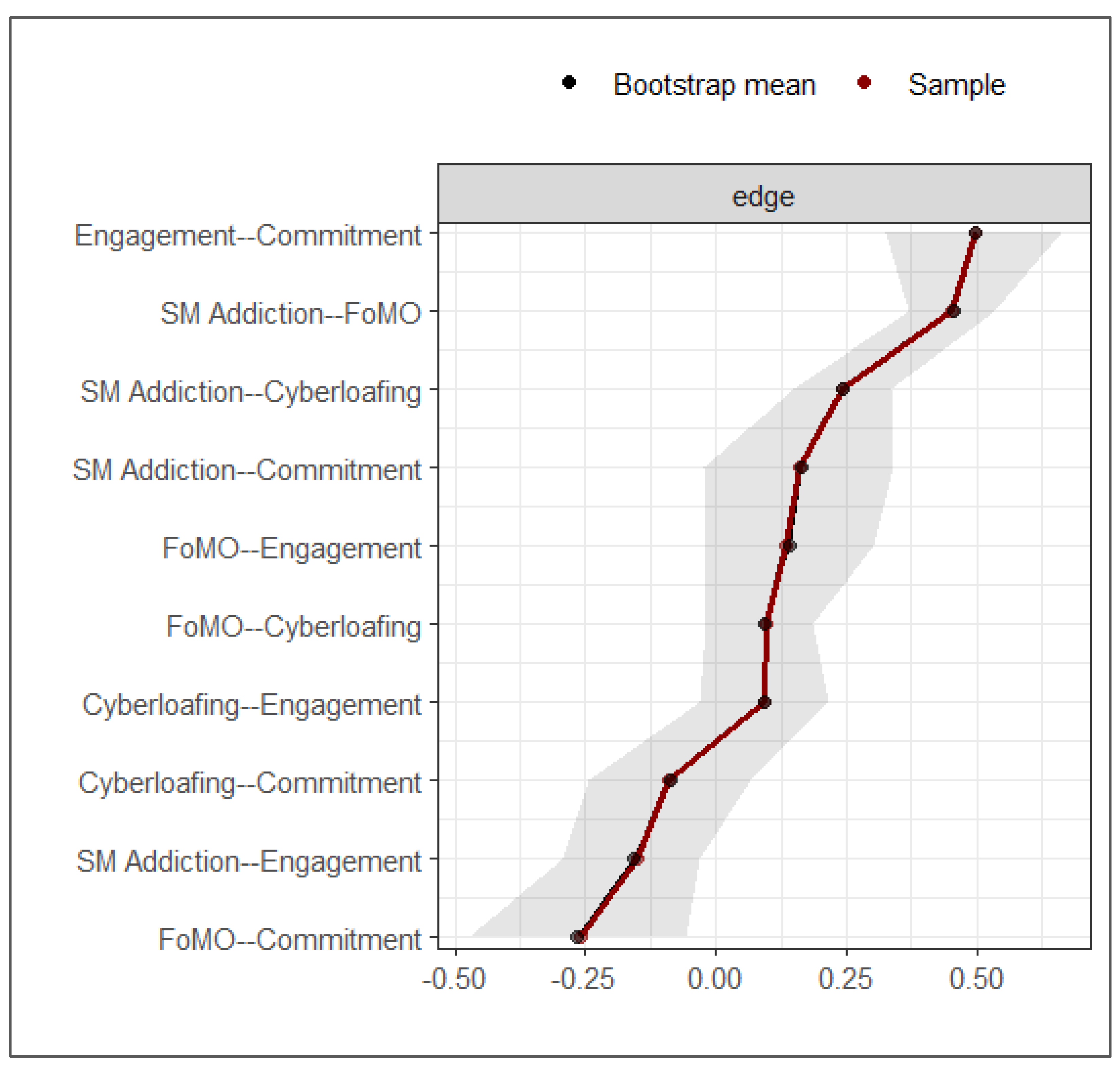
Appendix F
Results of the EBICglasso Network Analysis
Table A17.
Estimated Edge Weights of the EBICglasso Network.
| 1 | 2 | 3 | 4 | 5 | |
|---|---|---|---|---|---|
| 1. Social Media Addiction | - | ||||
| 2. Fear of Missing Out | .39 | - | |||
| 3. Cyberloafing | .20 | .10 | - | ||
| 4. Work Engagement | - | - | - | - | |
| 5. Organizational Commitment | - | -.13 | - | .42 | - |
Table A18.
Centrality Statistics for all Nodes in the EBICglasso Network Model.
| Node | Measure | Value (Absolut) |
Value (z-standardized) |
|
|---|---|---|---|---|
| 1 | Social Media Addiction | Betweenness | 3 | 0.54 |
| 2 | Fear of Missing Out | Betweenness | 3 | 1.10 |
| 3 | Cyberloafing | Betweenness | 0 | -1.10 |
| 4 | Work Engagement | Betweenness | 0 | -1.10 |
| 5 | Organizational Commitment | Betweenness | 3 | 0.54 |
| 6 | Social Media Addiction | Closeness | 0.03 | 0.74 |
| 7 | Fear of Missing Out | Closeness | 0.04 | 1.24 |
| 8 | Cyberloafing | Closeness | 0.02 | -1.05 |
| 9 | Work Engagement | Closeness | 0.02 | -0.90 |
| 10 | Organizational Commitment | Closeness | 0.03 | -0.03 |
| 11 | Social Media Addiction | Strength | 0.59 | 0.81 |
| 12 | Fear of Missing Out | Strength | 0.63 | 1.05 |
| 13 | Cyberloafing | Strength | 0.30 | -1.27 |
| 14 | Work Engagement | Strength | 0.37 | -0.77 |
| 15 | Organizational Commitment | Strength | 0.51 | 0.18 |
| 16 | Social Media Addiction | Expected Influence | 0.59 | 1.64 |
| 17 | Fear of Missing Out | Expected Influence | 0.36 | -0.10 |
| 18 | Cyberloafing | Expected Influence | 0.30 | -0.54 |
| 19 | Work Engagement | Expected Influence | 0.37 | -0.01 |
| 20 | Organizational Commitment | Expected Influence | 0.24 | -1.00 |
Figure A2.
Bootstrapped confidence intervals of edge weights in the network.
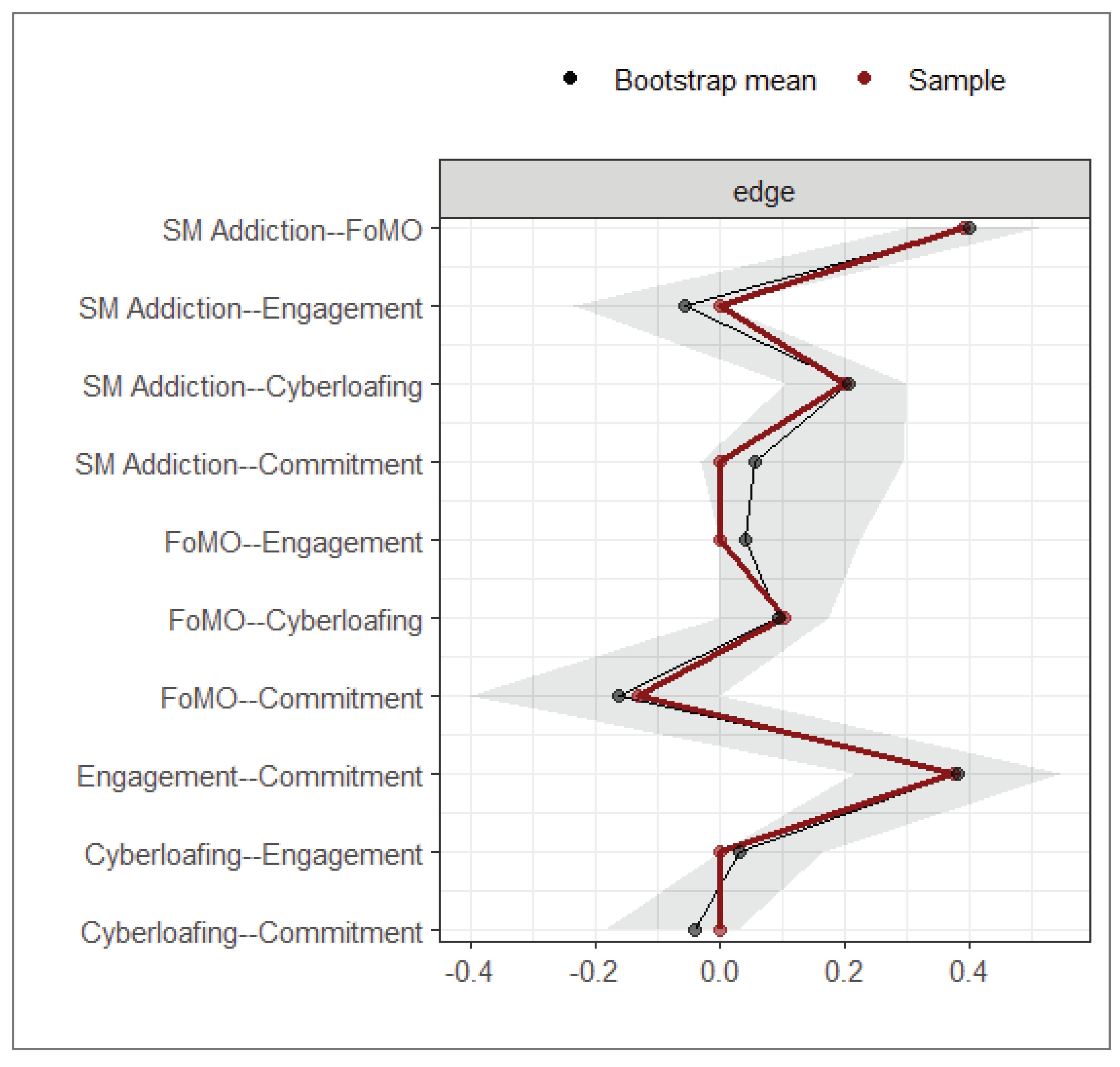
Folgende Ding könntest du schonmal machen:
1. Wenn du magst, könntest du schonmal schauen, welche Formatanforderungen das Journal hat und deine Arbeit dahingehend anpassen.
References
- Abel, J.P.; Buff, C.L.; Burr, S.A. Social Media and the Fear of Missing Out: Scale Development and Assessment. Journal of Business & Economics Research 2016, 14, 33–44. [Google Scholar] [CrossRef]
- Abu Seman, S.A.; Mohd Hashim, M.J.; Zainal, N.Z. & Mohd Ishar, N.I. Distracted in the digital age: Unveiling cyberslacking habits among university students. International Journal of e-Learning and Higher Education https://ir.uitm.edu.my/id/eprint/95092/. 2024, 19, 7–30. [Google Scholar]
- Ahuja, S.; Gupta, S. Organizational commitment and work engagement as a facilitator for sustaining higher education professionals. International Journal of Recent Technology and Engineering 2019, 7, 1846–1851. Retrieved from https://www.researchgate.net/profile/savita-gupta-5/publication/333845020_organizational_commitment_and_work_engagement_a_s_a_facilitator_for_sustaining_higher_education_professionals/links/5d08c2eca6fdcc35c1560539/organizational-commitment-and-work-engagement-a-s-a-facilitator-for-sustaining-higher-education-professionals.pdf.
- Allen, N.J.; Meyer, J.P. The measurement and antecedents of affective, continuance and normative commitment to the organization. Journal of Occupational Psychology 1990, 63, 1–18. [Google Scholar] [CrossRef]
- Andel, S.A.; Kessler, S.R.; Pindek, S.; Kleinman, G.; Spector, P.E. Is cyberloafing more complex than we originally thought? Cyberloafing as a coping response to workplace aggression exposure. Computers in Human Behavior 2019, 101, 124–130. [Google Scholar] [CrossRef]
- Andreassen, C.S.; Billieux, J.; Griffiths, M.D.; Kuss, D.J.; Demetrovics, Z.; Mazzoni, E.; Pallesen, S. The Relationship Between Addictive Use of Social Media and Video Games and Symptoms of Psychiatric Disorders: A Large-Scale Cross-Sectional Study. Psychology of Addictive Behaviors 2016, 30, 252–262. [Google Scholar] [CrossRef]
- Andreassen, C.S.; Pallesen, S. Social network site addiction - an overview. Current Pharmaceutical Design 2014, 20, 4053–4061. [Google Scholar] [CrossRef]
- Andreassen, C.S.; Torsheim, T.; Brunborg, G.S.; Pallesen, S. Development of a Facebook Addiction Scale. Psychological Reports 2012, 110, 501–517. [Google Scholar] [CrossRef]
- Askew, K.L. (2012). The relationship between cyberloafing and task performance and an examination of the theory of planned behavior as a model of cyberloafing (Dissertation). University of South Florida. Retrieved from https://core.ac.uk/download/pdf/154469515.pdf.
- Baethge, A.; Rigotti, T.; Roe, R.A. Just more of the same, or different? An integrative theoretical framework for the study of cumulative interruptions at work. European Journal of Work and Organizational Psychology 2015, 24, 308–323. [Google Scholar] [CrossRef]
- Bakker, A.B.; Demerouti, E. The Job Demands-Resources model: State of the art. Journal of Managerial Psychology 2007, 22, 309–328. [Google Scholar] [CrossRef]
- Bakker, A.B.; Demerouti, E.; Sanz-Vergel, A. Job Demands–Resources Theory: Ten Years Later. Annual Review of Organizational Psychology and Organizational Behavior 2023, 10, 25–53. [Google Scholar] [CrossRef]
- Bakker, A.B.; Hakanen, J.J.; Demerouti, E.; Xanthopoulou, D. Job resources boost work engagement, particularly when job demands are high. Journal of Educational Psychology 2007, 99, 274–284. [Google Scholar] [CrossRef]
- Bakker, A.B.; Leiter, M.P. (2010). Work Engagement: A Handbook of Essential Theory and Research. Psychology Press.
- Beard, K.W.; Wolf, E.M. Modification in the proposed diagnostic criteria for Internet addiction. Cyberpsychology & Behavior: The Impact of the Internet Multimedia and Virtual Reality on Behavior and Society 2001, 4, 377–383. [Google Scholar] [CrossRef]
- Blackwell, D.; Leaman, C.; Tramposch, R.; Osborne, C.; Liss, M. Extraversion, neuroticism, attachment style and Fear of Missing Out as predictors of social media use and addiction. Personality and Individual Differences 2017, 116, 69–72. [Google Scholar] [CrossRef]
- Blanchard, A.L.; Henle, C.A. Correlates of different forms of cyberloafing: The role of norms and external locus of control. Computers in Human Behavior 2008, 24, 1067–1084. [Google Scholar] [CrossRef]
- Bodjrenou, K.; Xu, M.; Bomboma, K. Antecedents of Organizational Commitment: A Review of Personal and Organizational Factors. Open Journal of Social Sciences 2019, 7, 276–289. [Google Scholar] [CrossRef]
- Brailovskaia, J.; Schillack, H.; Margraf, J. (2020). Tell me why are you using social media (SM)! Relationship between reasons for use of SM, SM flow, daily stress, depression, anxiety, and addictive SM use – An exploratory investigation of young adults in Germany. Computers in Human Behavior. Advance online publication. [CrossRef]
- Budnick, C.J.; Rogers, A.P.; Barber, L.K. The Fear of Missing Out at work: Examining costs and benefits to employee health and motivation. Computers in Human Behavior 2020, 104, 106161. [Google Scholar] [CrossRef]
- Buglass, S.L.; Binder, J.F.; Betts, L.R.; Underwood, J.D. Motivators of online vulnerability: The impact of social network site use and FOMO. Computers in Human Behavior 2017, 66, 248–255. [Google Scholar] [CrossRef]
- Çapri, B.; Gündüz, B.; Akbay, S.E. Utrecht Work Engagement Scale-Student Forms' (UWES-SF) Adaptation to Turkish, Validity and Reliability Studies, and the Mediator Role of Work Engagement between Academic Procrastination and Academic Responsibility. Educational Sciences: Theory and Practice Retrieved from https://eric.ed.gov/?id=ej1147496. 2017, 17, 411–435. [Google Scholar]
- Carr, C.T.; Hayes, R.A. Social Media: Defining, Developing, and Divining. Atlantic Journal of Communication 2015, 23, 46–65. [Google Scholar] [CrossRef]
- Casale, S.; Rugai, L.; Fioravanti, G. Exploring the role of positive metacognitions in explaining the association between the Fear of Missing Out and social media addiction. Addictive Behaviors 2018, 85, 83–87. [Google Scholar] [CrossRef] [PubMed]
- Chavan, M.; Galperin, B.L.; Ostle, A.; Behl, A. Millennial’s perception on cyberloafing: Workplace deviance or cultural norm? Behavior & Information Technology 2022, 41, 2860–2877. [Google Scholar] [CrossRef]
- Choi, Y. Narcissism and Social Media Addiction in Workplace. The Journal of Asian Finance Economics and Business 2018, 5, 95–104. [Google Scholar] [CrossRef]
- Christian, M.S.; Garza, A.S.; Slaughter, J.E. Work Engagement: A quantitative review and test of its relations with task and contextual performance. Personnel Psychology 2011, 64, 89–136. [Google Scholar] [CrossRef]
- Corbeanu, A.; Iliescu, D. The Link Between Work Engagement and Job Performance. Journal of Personnel Psychology 2023, 22, 111–122. [Google Scholar] [CrossRef]
- Costantini, G.; Epskamp, S.; Borsboom, D.; Perugini, M.; Mõttus, R.; Waldorp, L.J.; Cramer, A.O. State of the aRt personality research: A tutorial on network analysis of personality data in R. Journal of Research in Personality 2015, 54, 13–29. [Google Scholar] [CrossRef]
- Day, V.; Mensink, D.; O'Sullivan, M. Patterns of Academic Procrastination. Journal of College Reading and Learning 2000, 30, 120–134. [Google Scholar] [CrossRef]
- Deci, E.L.; Ryan, R.M. (1985). Intrinsic Motivation and Self-Determination in Human Behavior. Boston, MA: Springer US. [CrossRef]
- Demerouti, E.; Bakker, A.B.; Nachreiner, F.; Schaufeli, W.B. The job demands-resources model of burnout. Journal of Applied Psychology 2001, 86, 499–512. [Google Scholar] [CrossRef]
- Dinçer, E.; Saygın, M.; Karadal, H. (2022). The Fear of Missing Out (FoMO): Theoretical Approach and Measurement in Organizations. In F. Özsungur (Ed.), Handbook of Research on Digital Violence and Discrimination Studies (pp. 631–651). IGI Global Scientific Publishing. [CrossRef]
- Dogan, H.; Norman, H.; Alrobai, A.; Jiang, N.; Nordin, N.; Adnan, A. A web-based intervention for social media addiction disorder management in higher education: Quantitative survey study. Journal of Medical Internet Research 2019, 21. Retrieved from https://www.jmir.org/2019/10/e14834/.
- Dursun, O.O.; Donmez, O.; Akbulut, Y. Predictors of Cyberloafing among Preservice Information Technology Teachers. Contemporary Educational Technology Retrieved from https://dergipark.org.tr/en/pub/cet/issue/34282/378820. 2018, 9, 22–41. [Google Scholar] [CrossRef]
- Ellison, N.B.; Steinfield, C.; Lampe, C. The Benefits of Facebook “Friends:” Social Capital and College Students’ Use of Online Social Network Sites. Journal of Computer-Mediated Communication 2007, 12, 1143–1168. [Google Scholar] [CrossRef]
- Epskamp, S.; Borsboom, D.; Fried, E.I. Estimating psychological networks and their accuracy: A tutorial paper. Behavior Research Methods 2018, 50, 195–212. [Google Scholar] [CrossRef]
- Epskamp, S.; Fried, E.I. A tutorial on regularized partial correlation networks. Psychological Methods 2018, 23, 617–634. [Google Scholar] [CrossRef] [PubMed]
- Ferrari, J.R. Compulsive procrastination: Some self-reported characteristics. Psychological Reports 1991, 68, 455–458. [Google Scholar] [CrossRef] [PubMed]
- Ferrari, J.R. (1993). Procrastination and impulsiveness: Two sides of a coin? In W. G. McCown, J. Johnson, & M. B. Shure (Eds.), The Impulsive client: Theory, research, and treatment (pp. 265–276). Washington, D.C.: American Psychological Association. [CrossRef]
- Ferrari, J.R. Dysfunctional procrastination and its relationship with self-esteem, interpersonal dependency, and self-defeating behaviors. Personality and Individual Differences 1994, 17, 673–679. [Google Scholar] [CrossRef]
- Feyzi Behnagh, R.; Ferrari, J.R. Exploring 40 years on affective correlates to procrastination: A literature review of situational and dispositional types. Current Psychology 2022, 41, 1097–1111. [Google Scholar] [CrossRef]
- Fioravanti, G.; Casale, S.; Benucci, S.B.; Prostamo, A.; Falone, A.; Ricca, V.; Rotella, F. Fear of Missing Out and social networking sites use and abuse: A meta-analysis. Computers in Human Behavior 2021, 122, 106839. [Google Scholar] [CrossRef]
- Foygel, R.; Drton, M. Extended Bayesian information criteria for Gaussian graphical models. Advances in Neural Information Processing Systems 2010, 23. [Google Scholar]
- Fu, W.; Li, R.; Liang, Y. The Relationship between Stress Perception and Problematic Social Network Use among Chinese College Students: The Mediating Role of the Fear of Missing Out. Behavioral Sciences 2023, 13, 497. [Google Scholar] [CrossRef]
- Fusi, F. & Feeney, M.K. Social Media in the Workplace: Information Exchange, Productivity, or Waste? The American Review of Public Administration 2018, 48, 395–412. [Google Scholar] [CrossRef]
- Garg, G.; Shourie, S. Relationship between Social Media Addiction, FOMO and Self-Esteem among Young Adults. International Journal of Interdisciplinary Approaches in Psychology Retrieved from https://www.psychopediajournals.com/index.php/ijiap/article/view/101. 2023, 1, 381–395. [Google Scholar]
- Garrett, R.K.; Danziger, J.N. Disaffection or expected outcomes: Understanding personal Internet use during work. Journal of Computer-Mediated Communication 2008, 13, 937–958. [Google Scholar] [CrossRef]
- Garrett, R.K.; Danziger, J.N. On cyberslacking: Workplace status and personal internet use at work. Cyberpsychology & Behavior: The Impact of the Internet, Multimedia and Virtual Reality on Behavior and Society 2008, 11, 287–292. [Google Scholar] [CrossRef]
- Georgescu, M.; Popescul, D. Social Media – The New Paradigm of Collaboration and Communication for Business Environment. Procedia Economics and Finance 2015, 20, 277–282. [Google Scholar] [CrossRef]
- Gomez, M.; Klare, D.; Ceballos, N.; Dailey, S.; Kaiser, S.; Howard, K. Do You Dare to Compare? The Key Characteristics of Social Media Users Who Frequently Make Online Upward Social Comparisons. International Journal of Human–Computer Interaction 2022, 38, 938–948. [Google Scholar] [CrossRef]
- González-romá, V.; Schaufeli, W.B.; Bakker, A.B.; Lloret, S. Burnout and work engagement: Independent factors or opposite poles? Journal of Vocational Behavior 2006, 68, 165–174. [Google Scholar] [CrossRef]
- Griffiths, M. Internet addiction fuels other addictions. STUDENTBMJ 1999, 7, 428–429. [Google Scholar]
- Griffiths, M. Internet Addiction - Time to be Taken Seriously? Addiction Research 2000, 8, 413–418. [Google Scholar] [CrossRef]
- Griffiths, M.D.; Kuss, D.J. Adolescent social media addiction (revisited). Education and Health Retrieved from https://irep.ntu.ac.uk/id/eprint/31776/1/pubsub9230_griffiths.pdf. 2017, 35, 49–52. [Google Scholar]
- Groenestein, E.; Willemsen, L.; van Koningsbruggen, G.M.; Kerkhof, P. (2024). Fear of Missing Out and social media use: A three-wave longitudinal study on the interplay with psychological need satisfaction and psychological well-being. New Media & Society. Advance online publication. [CrossRef]
- Gullu, B.F.; Serin, H. The Relationship between Fear of Missing Out (FoMO) Levels and Cyberloafing Behavior of Teachers. Journal of Education and Learning Retrieved from https://eric.ed.gov/?id=ej1270589. 2020, 9, 205–214. [Google Scholar] [CrossRef]
- Gürbüz, F.; Bayrakli, M.; Gezgin, D.M. The effect of cyberloafing behaviors on smartphone addiction in university students: The mediating role of Fear of Missing Out. Journal of Educational Technology and Online Learning 2023, 6, 234–248. [Google Scholar] [CrossRef]
- Hakanen, J.J.; Bakker, A.B.; Schaufeli, W.B. Burnout and work engagement among teachers. Journal of School Psychology 2006, 43, 495–513. [Google Scholar] [CrossRef]
- Hamutoglu, N.B.; Topal, M.; Gezgin, D.M. Investigating Direct and Indirect Effects of Social Media Addiction, Social Media Usage and Personality Traits on FOMO. International Journal of Progressive Education Retrieved from https://eric.ed.gov/?id=ej1249965. 2020, 16, 248–261. [Google Scholar] [CrossRef]
- Hartijasti, Y.; Fathonah, N. Cyberloafing across generation X and Y in Indonesia. Journal of Information Technology Applications & Management 2014, 21. Retrieved from https://koreascience.kr/article/jako201410661372802.page.
- Hassan, K.M.; Bolong, J. Relationship between social media addiction and organizational commitment. Al-I’lam-Journal of Contemporary Islamic Communication and Media Retrieved from https://jcicom.usim.edu.my/index.php/journal/article/download/1/1. 2021, 1, 1–17. [Google Scholar] [CrossRef]
- Haynes, T. (2018). Dopamine, Smartphones & You: A battle for your time.
- Hensel, P.G.; Kacprzak, A. Job Overload, Organizational Commitment, and Motivation as Antecedents of Cyberloafing: Evidence from Employee Monitoring Software. European Management Review 2020, 17, 931–942. [Google Scholar] [CrossRef]
- Hobfoll, S.E. Conservation of resources. A new attempt at conceptualizing stress. American Psychologist 1989, 44, 513–524. [Google Scholar] [CrossRef] [PubMed]
- Hoşgör, H.; Ülker Dörttepe, Z. ; Memiş; K Social media addiction and work engagement among nurses. Perspectives in Psychiatric Care 2021, 57, 1966–1973. [Google Scholar] [CrossRef] [PubMed]
- Hossain, E.; Wadley, G.; Berthouze, N.; Cox, A.L. Social Media Breaks: An Opportunity for Recovery and Procrastination. Proceedings of the ACM on Human-Computer Interaction 2024, 8, 1–46. [Google Scholar] [CrossRef]
- Hou, Y.; Xiong, D.; Jiang, T.; Song, L.; Wang, Q. Social media addiction: Its impact, mediation, and intervention. Cyberpsychology: Journal of Psychosocial Research on Cyberspace 2009, 13. [Google Scholar] [CrossRef]
- Huang, J.; Huang, M.-T.; Wang, F. Social media addiction and employees’ innovative behavior: A moderated mediation model of work engagement and mindfulness. Current Psychology 2024, 43, 34729–34746. [Google Scholar] [CrossRef]
- Ibrahim, M.; Yusra, Y.; Shah, N.U. Impact of Social Media Addiction on Work Engagement and Job Performance. Polish Journal of Management Studies 2022, 25, 179–192. [Google Scholar] [CrossRef]
- Jones, P.J.; Ma, R.; McNally, R.J. Bridge Centrality: A Network Approach to Understanding Comorbidity. Multivariate Behavioral Research 2021, 56, 353–367. [Google Scholar] [CrossRef] [PubMed]
- Kanning, U.P.; Hill, A. Validation of the Organizational Commitment Questionnaire (OCQ) in six languages. Journal of Business and Media Psychology Retrieved from https://journal-bmp.de/wp-content/uploads/kanning-hill-formatiert-final2_aretz_22012014.pdf. 2013, 4, 11–20. [Google Scholar]
- Kaplan, A.M.; Haenlein, M. Users of the world, unite! The challenges and opportunities of Social Media. Business Horizons 2010, 53, 59–68. [Google Scholar] [CrossRef]
- Kardefelt-Winther, D. A conceptual and methodological critique of internet addiction research: Towards a model of compensatory internet use. Computers in Human Behavior 2014, 31, 351–354. [Google Scholar] [CrossRef]
- Kerse, G.; Deniz, V.; Cakici, A.B. The Effect of “Fear of Missing Out at Work (W-FoMO)” on Psychological Well-Being: The Serial Mediating Roles of Smartphone Use After Work and Work-Family Conflict. SAGE Open 2025, 15. [Google Scholar] [CrossRef]
- Khan, A.N.; Moin, M.F.; Khan, N.A.; Zhang, C. A multistudy analysis of abusive supervision and social network service addiction on employee's job engagement and innovative work behavior. Creativity and Innovation Management 2022, 31, 77–92. [Google Scholar] [CrossRef]
- Koay, K.Y. Workplace ostracism and cyberloafing: A moderated–mediation model. Internet Research 2018, 28, 1122–1141. [Google Scholar] [CrossRef]
- Koessmeier, C.; Büttner, O.B. Why Are We Distracted by Social Media? Distraction Situations and Strategies, Reasons for Distraction, and Individual Differences. Frontiers in Psychology 2021, 12, 711416. [Google Scholar] [CrossRef]
- Kuss, D.J.; Griffiths, M.D. Online social networking and addiction-a review of the psychological literature. International Journal of Environmental Research and Public Health 2011, 8, 3528–3552. [Google Scholar] [CrossRef]
- Kuss, D.J.; Griffiths, M.D. Social Networking Sites and Addiction: Ten Lessons Learned. International Journal of Environmental Research and Public Health 2017, 14, 311. [Google Scholar] [CrossRef]
- Kwala, A.F.; Agoyi, M. The Influence of Cyberloafing on Workplace Outcomes: A Study Utilizing the Job Demands-Resources (JD-R) Theory. SAGE Open 2025, 15. [Google Scholar] [CrossRef]
- Lenny, D.J.; Doleck, T.; Bazelais, P. Self-Determination, Loneliness, Fear of Missing Out, and Academic Performance. Knowledge Management & E-Learning Retrieved from https://eric.ed.gov/?id=ej1245586. 2019, 11, 485–496. [Google Scholar]
- Lian, S.-L.; Sun, X.-J.; Zhou, Z.-K.; Fan, C.-Y.; Niu, G.-F.; Liu, Q.-Q. Social networking site addiction and undergraduate students' irrational procrastination: The mediating role of social networking site fatigue and the moderating role of effortful control. PLOS ONE 2018, 13, e0208162. [Google Scholar] [CrossRef] [PubMed]
- Lim, V.K.G. The IT way of loafing on the job: Cyberloafing, neutralizing and organizational justice. Journal of Organizational Behavior 2002, 23, 675–694. [Google Scholar] [CrossRef]
- Lim, V.K.G.; Teo, T.S.H. Prevalence, perceived seriousness, justification and regulation of cyberloafing in Singapore: An exploratory study. Information & Management Retrieved from https://www.sciencedirect.com/science/article/pii/s0378720604001600. 2005, 42, 1081–1093. [Google Scholar]
- Lim, V.K.; Chen, D.J. Cyberloafing at the workplace: Gain or drain on work? Behavior & Information Technology 2012, 31, 343–353. [Google Scholar] [CrossRef]
- Liu, Y.; Gao, Q.; Ma, L. (2021). Taking Micro-breaks at Work: Effects of Watching Funny Short-Form Videos on Subjective Experience, Physiological Stress, and Task Performance. In P.-L. P. Rau (Ed.), Cross-Cultural Design. Applications in Arts, Learning, Well-being, and Social Development (pp. 183–200). Cham: Springer Nature. [CrossRef]
- Liu, Y.; Lei, K. Development and validity test of impression management efficacy scale based on self-presentation behavior of Chinese youth on social media. Frontiers in Psychology 2025, 16, 1494083. [Google Scholar] [CrossRef]
- Macit, H.B.; Macit, G.; Güngör, O. A Research on Social Media Addiction and Dopamine Driven Feedback. Journal of Mehmet Akif Ersoy University Economics and Administrative Sciences Faculty 2018, 5, 882–897. [Google Scholar] [CrossRef]
- Marsh, E.; Perez Vallejos, E.; Spence, A. Digital workplace technology intensity: Qualitative insights on employee wellbeing impacts of digital workplace job demands. Frontiers in Organizational Psychology 2024, 2, 1392997. [Google Scholar] [CrossRef]
- Mathieu, J.E.; Zajac, D.M. A review and meta-analysis of the antecedents, correlates, and consequences of organizational commitment. Psychological Bulletin 1990, 108, 171–194. [Google Scholar] [CrossRef]
- Medhurst, A.R.; Albrecht, S.L. Salesperson work engagement and flow. Qualitative Research in Organizations and Management: An International Journal 2016, 11, 22–45. [Google Scholar] [CrossRef]
- Methot, J.R.; Rosado-Solomon, E.H.; Downes, P.E.; Gabriel, A.S. Office Chitchat as a Social Ritual: The Uplifting Yet Distracting Effects of Daily Small Talk at Work. Academy of Management Journal 2021, 64, 1445–1471. [Google Scholar] [CrossRef]
- Metin, U.B.; Peeters, M.C.W.; Taris, T.W. Correlates of procrastination and performance at work: The role of having "good fit". Journal of Prevention & Intervention in the Community 2018, 46, 228–244. [Google Scholar] [CrossRef] [PubMed]
- Metin, U.B.; Taris, T.W.; Peeters, M.C.W.; Korpinen, M.; Smrke, U.; Razum, J.; Kolářová, M; Baykova, R.; Gaioshko, D. Validation of the Procrastination at Work Scale. European Journal of Psychological Assessment 2020, 36, 767–776. [Google Scholar] [CrossRef]
- Meyer, J.P.; Paunonen, S.V.; Gellatly, I.R.; Goffin, R.D.; Jackson, D.N. Organizational commitment and job performance: It's the nature of the commitment that counts. Journal of Applied Psychology 1989, 74, 152–156. [Google Scholar] [CrossRef]
- Meyer, J.P.; Stanley, D.J.; Herscovitch, L.; Topolnytsky, L. Affective, Continuance, and Normative Commitment to the Organization: A Meta-analysis of Antecedents, Correlates, and Consequences. Journal of Vocational Behavior 2002, 61, 20–52. [Google Scholar] [CrossRef]
- Mills, J.E.; Hu, B.; Beldona, S.; Clay, J. Cyberslacking! Cornell Hotel and Restaurant Administration Quarterly 2001, 42, 34–47. [Google Scholar] [CrossRef]
- Milyavskaya, M.; Saffran, M.; Hope, N.; Koestner, R. Fear of Missing Out: Prevalence, dynamics, and consequences of experiencing FOMO. Motivation and Emotion 2018, 42, 725–737. [Google Scholar] [CrossRef]
- Montag, C.; Błaszkiewicz, K.; Sariyska, R.; Lachmann, B.; Andone, I.; Trendafilov, B.; Eibes, M.; Markowetz, A. Smartphone usage in the 21st century: Who is active on WhatsApp? BMC Research Notes 2015, 8, 331. [Google Scholar] [CrossRef]
- Mowday, R.T.; Steers, R.M.; Porter, L.W. The measurement of organizational commitment. Journal of Vocational Behavior 1979, 14, 224–247. [Google Scholar] [CrossRef]
- Muafi, M. The Effects of Cyberloafing on Organizational Commitment: The Role of Emotional Exhaustion and Job Overload. Jurnal Bisnis: Teori Dan Implementasi 2023, 14, 323–337. [Google Scholar] [CrossRef]
- Mullarkey, M.C.; Marchetti, I.; Beevers, C.G. Using Network Analysis to Identify Central Symptoms of Adolescent Depression. Journal of Clinical Child and Adolescent Psychology: The Official Journal for the Society of Clinical Child and Adolescent Psychology American Psychological Association Division 53 2019, 48, 656–668. [Google Scholar] [CrossRef]
- Müller, S.M.; Wegmann, E.; Stolze, D.; Brand, M. Maximizing social outcomes? Social zapping and Fear of Missing Out mediate the effects of maximization and procrastination on problematic social networks use. Computers in Human Behaviors 2020, 107. [Google Scholar] [CrossRef]
- Niaei, M.; Peidaei, M.M.; Nasiripour, A.A. The relation between staff cyberloafing and organizational commitment in organization of environmental protection. Arabian Journal of Business and Management Review (Kuwait Chapter) Retrieved from https://j.arabianjbmr.com/index.php/kcajbmr/article/view/575. 2014, 3, 59–71. [Google Scholar] [CrossRef]
- Oosthuizen, A.; Rabie, G.H.; Beer, L.T. de Investigating cyberloafing, organisational justice, work engagement and organisational trust of South African retail and manufacturing employees. SA Journal of Human Resource Management 2018, 16. [Google Scholar] [CrossRef]
- Orhan, M.A.; Castellano, S.; Khelladi, I.; Marinelli, L.; Monge, F. Technology distraction at work. Impacts on self-regulation and work engagement. Journal of Business Research 2021, 126, 341–349. [Google Scholar] [CrossRef]
- Özcan, H.M. Koç, U. The Role of Fear of Missing Out (FoMO) in the relationship between personality traits and cyberloafing. Ege Academic Review 2022, 23, 11–26. [Google Scholar] [CrossRef]
- Öztürk, M.; Kerse, G. Smartphone and internet addiction as predictors of cyberloafing levels in students: A mediated model. Education for Information 2022, 38, 189–204. [Google Scholar] [CrossRef]
- Pellegrino, A.; Stasi, A.; Bhatiasevi, V. Research trends in social media addiction and problematic social media use: A bibliometric analysis. Frontiers in Psychiatry 2022, 13, 1017506. [Google Scholar] [CrossRef]
- Przybylski, A.K.; Murayama, K.; DeHaan, C.R.; Gladwell, V. Motivational, emotional, and behavioral correlates of Fear of Missing Out. Computers in Human Behavior 2013, 29, 1841–1848. [Google Scholar] [CrossRef]
- Pychyl, T.A.; Lee, J.M.; Thibodeau, R.; Blunt, A. Five days of emotion: An experience sampling study of undergraduate student procrastination. Journal of Social Behavior & Personality Retrieved from https://search.ebscohost.com/login.aspx?direct=true&profile=ehost&scope=site&authtype=crawler&jrnl=08861641&an=10637249&h=djwg8xkvphsvfnlaue%2b9wjou31yvw5akmpzgr5za1rudwpb957twu68bpkbtlms0m7r5huod%2bg%2f9njmizanspg%3d%3d&crl=c. 2000, 15, 239–254. [Google Scholar]
- Quan-Haase, A.; Young, A.L. Uses and Gratifications of Social Media: A Comparison of Facebook and Instant Messaging. Bulletin of Science Technology & Society 2010, 30, 350–361. [Google Scholar] [CrossRef]
- Rafiei, M.; Taghi Amini, M.; Foroozandeh, N. Studying the impact of the organizational commitment on the job performance. Management Science Letters 2014, 4, 1841–1848. [Google Scholar] [CrossRef]
- Ramayah, T. Personal web usage and work inefficiency. Business Strategy Series 2010, 11, 295–301. [Google Scholar] [CrossRef]
- Ramesh, R.; John, A.S. (2023). Determinants of Procrastination among young adults in their academics and professional lives, Youth Voice Journal. Retrieved from https://search.ebscohost.com/login.aspx?direct=true&profile=ehost&scope=site&authtype=crawler&jrnl=20492073&an=171382950&h=6cemfvxa%2ffykijqbgxkv4vo5w9q6meqg9binrrtxobh9hvdo1iixryd63xagdaplajzrl77jy8sozrkpalnciq%3d%3d&crl=c.
- Reer, F.; Tang, W.Y.; Quandt, T. Psychosocial well-being and social media engagement: The mediating roles of social comparison orientation and Fear of Missing Out. New Media & Society 2019, 21, 1486–1505. [Google Scholar] [CrossRef]
- Reimann, L.-E.; Binnewies, C.; Ozimek, P.; Loose, S. I Do Not Want to Miss a Thing! Consequences of Employees' Workplace Fear of Missing Out for ICT Use, Well-Being, and Recovery Experiences. Behavioral Sciences 2023, 14, 8. [Google Scholar] [CrossRef]
- Robinaugh, D.J.; Millner, A.J.; McNally, R.J. Identifying highly influential nodes in the complicated grief network. Journal of Abnormal Psychology 2016, 125, 747–757. [Google Scholar] [CrossRef]
- Rothblum, E.D.; Solomon, L.J.; Murakami, J. Affective, cognitive, and behavioral differences between high and low procrastinators. Journal of Counseling Psychology 1986, 33, 387–394. [Google Scholar] [CrossRef]
- Rozgonjuk, D.; Sindermann, C.; Elhai, J.D.; Montag, C. (2020). Fear of Missing Out (FoMO) and social media's impact on daily-life and productivity at work: Do WhatsApp, Facebook, Instagram, and Snapchat Use Disorders mediate that association? Addictive Behaviors. (110). Retrieved from https://www.sciencedirect.com/science/article/pii/s0306460320306171.
- Saks, A.M. Antecedents and consequences of employee engagement. Journal of Managerial Psychology 2006, 21, 600–619. [Google Scholar] [CrossRef]
- Salehan, M.; Negahban, A. Social networking on smartphones: When mobile phones become addictive. Computers in Human Behavior 2013, 29, 2632–2639. [Google Scholar] [CrossRef]
- Saritepeci, M. Predictors of cyberloafing among high school students: Unauthorized access to school network, metacognitive awareness and smartphone addiction. Education and Information Technologies 2020, 25, 2201–2219. [Google Scholar] [CrossRef]
- Schaufeli, W.B.; Bakker, A.B. Job demands, job resources, and their relationship with burnout and engagement: A multi-sample study. Journal of Organizational Behavior 2004, 25, 293–315. [Google Scholar] [CrossRef]
- Schaufeli, W.B.; Bakker, A.B. (2004b). Utrecht Work Engagement Scale - Preliminary Manual. Retrieved from Utrecht University website: https://www.wilmarschaufeli.nl/publications/Schaufeli/Test%20Manuals/Test_manual_UWES_English.pdf.
- Schaufeli, W.B. Applying the Job Demands-Resources model: A 'how to'guide to measuring and tackling work engagement and burnout. Organizational Dynamics Retrieved from https://www.sciencedirect.com/science/article/pii/s0090261617300876. 2017, 46, 120–132. [Google Scholar] [CrossRef]
- Senécal, C.; Koestner, R.; Vallerand, R.J. Self-Regulation and Academic Procrastination. The Journal of Social Psychology 1995, 135, 607–619. [Google Scholar] [CrossRef]
- Seppälä, P; Mauno, S.; Feldt, T.; Hakanen, J.; Kinnunen, U.; Tolvanen, A.; Schaufeli, W. The Construct Validity of the Utrecht Work Engagement Scale: Multisample and Longitudinal Evidence. Journal of Happiness Studies 2009, 10, 459–481. [Google Scholar] [CrossRef]
- Simpson, W. Kyle & Pychyl, Timothy A. (2009). In search of the arousal procrastinator: Investigating the relation between procrastination, arousal-based personality traits and beliefs about procrastination motivations, 47, 906–911. Retrieved from https://www.sciencedirect.com/science/article/pii/s0191886909003213.
- Smith, A.; Anderson, M. (2018). Social Media Use in 2018.
- Sonnentag, S. Recovery, work engagement, and proactive behavior: A new look at the interface between nonwork and work. Journal of Applied Psychology 2003, 88, 518–528. [Google Scholar] [CrossRef] [PubMed]
- Spitzer, M. Smartphones, Angst und Stress. Nervenheilkunde 2015, 34, 591–600. [Google Scholar] [CrossRef]
- Steers, R.M. Antecedents and Outcomes of Organizational Commitment. Administrative Science Quarterly 1977, 22, 46. [Google Scholar] [CrossRef]
- Sun, Y.; Zhang, Y. A review of theories and models applied in studies of social media addiction and implications for future research. Addictive Behaviors 2021, 114. [Google Scholar] [CrossRef]
- Syed, S.; Singh, H.; Thangaraju, S.K.; Bakri, N.E.; Hwa, K.Y. & Kusalavan, P.A.L. The impact of cyberloafing on employees' job performance: A review of literature. Journal of Advances in Management Sciences & Information Systems https://www.researchgate.net/profile/sumera-syed/publication/345972045_the_impact_of_cyberloafing_on_employees'_job_performance_a_review_of_literature/links/5fbf38b8458515b7976febf0/the-impact-of-cyberloafing-on-employees-job-performance-a-review-of-literature.pdf. 2020, 6, 16–28. [Google Scholar]
- Tandon, A.; Kaur, P.; Ruparel, N.; Islam, J.U.; Dhir, A. Cyberloafing and cyberslacking in the workplace: Systematic literature review of past achievements and future promises. Internet Research 2022, 32, 55–89. [Google Scholar] [CrossRef]
- Tice, D.M.; Bratslavsky, E.; Baumeister, R.F. Emotional distress regulation takes precedence over impulse control: If you feel bad, do it! Journal of Personality and Social Psychology 2001, 80, 53–67. [Google Scholar] [CrossRef] [PubMed]
- Tunc-Aksan, A.; Akbay, S.E. Smartphone Addiction, Fear of Missing Out, and Perceived Competence as Predictors of Social Media Addiction of Adolescents. European Journal of Educational Research 2019, 8, 559–569. [Google Scholar] [CrossRef]
- Turan, G.B.; Özer, Z. & Atan, G. The relationship between cyberloafing levels and social media addiction among nursing students. Perspectives in Psychiatric Care 2021, 57, 836–843. [Google Scholar] [CrossRef]
- Turel, O.; Serenko, A. The benefits and dangers of enjoyment with social networking websites. European Journal of Information Systems 2012, 21, 512–528. [Google Scholar] [CrossRef]
- Tutgun Ünal, A. A Comparative Study of Social Media Addiction Among Turkish and Korean University Students. Journal of Economy Culture and Society 2020, 62, 307–322. [Google Scholar] [CrossRef]
- Uslukaya, A.; Zincirli, M. Reciprocal relationships between job resources and work engagement in teachers: A longitudinal examination of cross-lagged and simultaneous effects. Social Psychology of Education 2025, 28, 1–26. [Google Scholar] [CrossRef]
- Usman, M.; Javed, U.; Shoukat, A.; Bashir, N.A. Does meaningful work reduce cyberloafing? Important roles of affective commitment and leader-member exchange. Behavior & Information Technology 2021, 40, 206–220. [Google Scholar] [CrossRef]
- Van Eerde, W. (2016). Procrastination and Well-Being at Work. In F. M. Sirios & T. A. Pychyl (Eds.), Procrastination, Health, and Well-Being (pp. 233–253). Elsevier. [CrossRef]
- Van Zoonen, W.; Verhoeven, J.W.; Vliegenthart, R. Understanding the consequences of public social media use for work. European Management Journal 2017, 35, 595–605. [Google Scholar] [CrossRef]
- VanMeter, R.A.; Grisaffe, D.B.; Chonko, L.B. Of “Likes” and “Pins”: The Effects of Consumers’ Attachment to Social Media. Journal of Interactive Marketing 2015, 32, 70–88. [Google Scholar] [CrossRef]
- Vergés, A. On the Desirability of Social Desirability Measures in Substance Use Research. Journal of Studies on Alcohol and Drugs 2022, 83, 582–587. [Google Scholar] [CrossRef]
- Vitak, J.; Crouse, J.; LaRose, R. Personal Internet use at work: Understanding cyberslacking. Computers in Human Behavior 2011, 27, 1751–1759. [Google Scholar] [CrossRef]
- Vogel, E.A.; Rose, J.P.; Roberts, L.R.; Eckles, K. Social comparison, social media, and self-esteem. Psychology of Popular Media Culture 2014, 3, 206–222. [Google Scholar] [CrossRef]
- Wang, J.; Wang, P.; Yang, X.; Zhang, G.; Wang, X.; Zhao, F.; Zhao, M.; Lei, L. Fear of Missing Out and Procrastination as Mediators Between Sensation Seeking and Adolescent Smartphone Addiction. International Journal of Mental Health and Addiction 2019, 17, 1049–1062. [Google Scholar] [CrossRef]
- Wang, J.; Wang, S. The Emotional Reinforcement Mechanism of and Phased Intervention Strategies for Social Media Addiction. Behavioral Sciences 2025, 15, 665. [Google Scholar] [CrossRef]
- Whiting, A.; Williams, D. Why people use social media: A uses and gratifications approach. Qualitative Market Research: An International Journal 2013, 16, 362–369. [Google Scholar] [CrossRef]
- Xie, X.; Wang, Y.; Wang, P.; Zhao, F.; Lei, L. Basic psychological needs satisfaction and Fear of Missing Out: Friend support moderated the mediating effect of individual relative deprivation. Psychiatry Research 2018, 268, 223–228. [Google Scholar] [CrossRef]
- Young, K.S. Internet addiction: Evaluation and treatment. BMJ 1999, 319. [Google Scholar] [CrossRef]
- Zivnuska, S.; Carlson, J.R.; Carlson, D.S.; Harris, R.B.; Harris, K.J. Social media addiction and social media reactions: The implications for job performance. The Journal of Social Psychology 2019, 159, 746–760. [Google Scholar] [CrossRef]
Figure 2.
Network structure based on the EBICglasso estimation. Abbreviations: SMA = Social media addiction, FOMO = Fear of Missing Out, CL = Cyberloafing, WE = Work Engagement, OC = Organizational Commitment.
Figure 2.
Network structure based on the EBICglasso estimation. Abbreviations: SMA = Social media addiction, FOMO = Fear of Missing Out, CL = Cyberloafing, WE = Work Engagement, OC = Organizational Commitment.
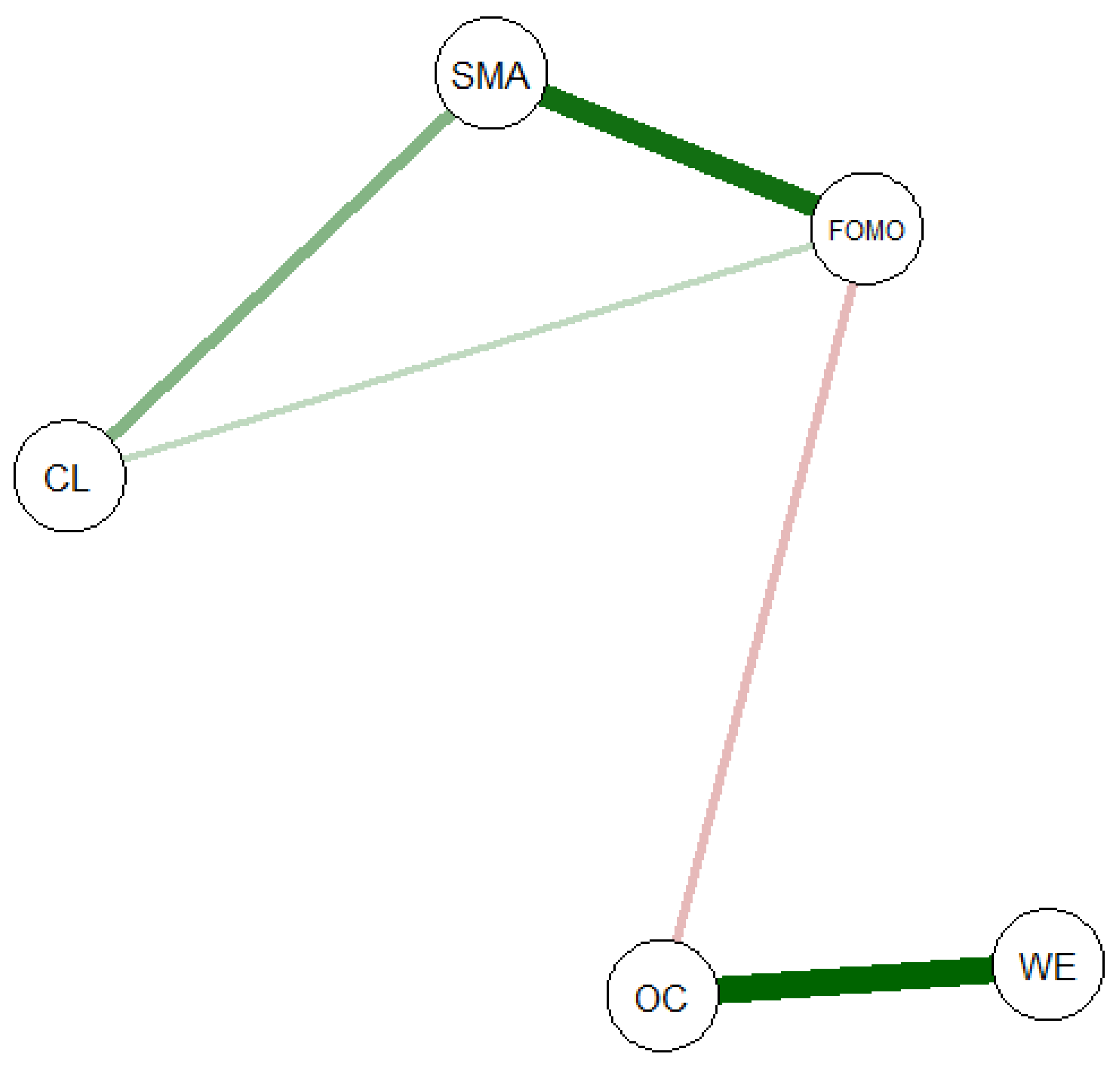
Table 1.
Descriptive Statistics, Response Formats, and Reliability Estimates of the Study Variables.
Table 1.
Descriptive Statistics, Response Formats, and Reliability Estimates of the Study Variables.
| Variable/Scale | Number of Items |
Response Format | Cronbach’s α | M | SD |
|---|---|---|---|---|---|
| Bergen Social Media Addiction Scale | 6 | Very rarely (1) – very often (5) | .79 | 2.68 | 0.80 |
| Fear of Missing Out Scale | 10 | Not at all true of me (1) – Extremely true of me (5) | .74 | 2.62 | 0.59 |
| Cyberloafing Scale | 19 | Never (1) – Once a day (4) – Constantly (6) | .89 | 2.39 | 0.73 |
| Utrecht Work Engagement Scale | 9 | Never (1) – Always (7) | .92 | 4.21 | 0.99 |
| Organizational Commitment Questionnaire (OCQ) | 15 | Totally disagree (1) – Totally agree (5) | .91 | 3.20 | 0.78 |
Table 2.
Centrality statistics across all nodes.
| Node | Measure | Value (Absolut) |
Value (z-standardized) |
|
|---|---|---|---|---|
| 1 | Social Media Addiction | Betweenness | 3 | 1.38 |
| 2 | Fear of Missing Out | Betweenness | 2 | 0.61 |
| 3 | Cyberloafing | Betweenness | 0 | -0.92 |
| 4 | Work Engagement | Betweenness | 0 | -0.92 |
| 5 | Organizational Commitment | Betweenness | 1 | -0.15 |
| 6 | Social Media Addiction | Closeness | 0.05 | 0.83 |
| 7 | Fear of Missing Out | Closeness | 0.05 | 1.06 |
| 8 | Cyberloafing | Closeness | 0.03 | -1.37 |
| 9 | Work Engagement | Closeness | 0.03 | -0.55 |
| 10 | Organizational Commitment | Closeness | 0.05 | 0.04 |
| 11 | Social Media Addiction | Strength | 1.01 | 0.69 |
| 12 | Fear of Missing Out | Strength | 0.94 | 0.36 |
| 13 | Cyberloafing | Strength | 0.52 | -1.72 |
| 14 | Work Engagement | Strength | 0.87 | 0.02 |
| 15 | Organizational Commitment | Strength | 1.00 | 0.66 |
| 16 | Social Media Addiction | Expected Influence | 0.71 | 1.42 |
| 17 | Fear of Missing Out | Expected Influence | 0.43 | -0.27 |
| 18 | Cyberloafing | Expected Influence | 0.34 | -0.78 |
| 19 | Work Engagement | Expected Influence | 0.57 | 0.60 |
| 20 | Organizational Commitment | Expected Influence | 0.31 | -0.97 |
Disclaimer/Publisher’s Note: The statements, opinions and data contained in all publications are solely those of the individual author(s) and contributor(s) and not of MDPI and/or the editor(s). MDPI and/or the editor(s) disclaim responsibility for any injury to people or property resulting from any ideas, methods, instructions or products referred to in the content. |
© 2025 by the authors. Licensee MDPI, Basel, Switzerland. This article is an open access article distributed under the terms and conditions of the Creative Commons Attribution (CC BY) license (http://creativecommons.org/licenses/by/4.0/).
Copyright: This open access article is published under a Creative Commons CC BY 4.0 license, which permit the free download, distribution, and reuse, provided that the author and preprint are cited in any reuse.


