

Submitted:
04 November 2025
Posted:
04 November 2025
You are already at the latest version
Abstract
Against the backdrop of the accelerating global commercialization of autonomous driving, users’ continuance intention has become a critical determinant of whether enterprises can achieve sustainable development. Although existing studies have examined the role of social media in this domain, its psychological and behavioral impacts on users in the context of new technologies remain insufficiently explored. To address this gap, we draw on the S-O-R theoretical framework to examine how social media influences users’ continuance intentions. Specifically, we investigate how social media shapes users’ attitude (experiential attitude and instrumental attitude), and self-efficacy, which in turn drive their continuance intention to use autonomous taxis, as well as the moderating role of pro-environmental self-identity. Based on a survey of 817 respondents in China, the results reveal that social media exerts a positive influence on continuance intention, experiential attitude, and instrumental attitude. Furthermore, experiential attitude, instrumental attitude, and self-efficacy significantly enhance users’ continuance intention, with pro-environmental self-identity moderating the relationship between experiential attitude and continuance intention. In addition to its theoretical and modeling contributions, this study provides practical insights for firms and marketers in the early stages of autonomous taxi deployment.
Keywords:
social media
; experiential attitude
; instrumental attitude
; self-efficacy
; pro-environmental self-identity
; continuance intention
1. Introduction
In recent years, the accelerated advancement of autonomous driving technologies, coupled with the widespread diffusion of the “Mobility as a Service” paradigm, has positioned driverless taxis as a transformative innovation within the urban mobility landscape [1]. At present, many companies, including Waymo, EasyMile, and Apollo, have launched pilot operations of autonomous taxi projects in various locations worldwide, allowing users to experience autonomous taxis within designated trial areas personally. For example, in Atlanta, Uber Technologies and Waymo introduced an autonomous taxi service [2]. Amazon subsidiary Zoox has also initiated an autonomous taxi service in Las Vegas, where users can hail rides through the Zoox app, with free trial rides offered [3]. Similarly, autonomous taxis in China have been piloted in major cities such as Beijing, Shanghai, and Shenzhen, where public attention and acceptance of this emerging mode of mobility continue to increase [4]. For example, Baidu Apollo Go currently operates more than 1,000 autonomous taxis across 15 cities, completing 1.4 million rides in the first quarter of 2025 alone and achieving fully driverless operations [5]. Meanwhile, autonomous taxis are expected to grow from $5.4 billion in 2025 to $47 billion in 2035 [6,7]. As part of a future smart mobility solution, autonomous vehicles will not only offer new commuting options, but will also improve the efficiency of freight transportation and public services, thereby reshaping traditional transportation systems on the road [8,9]. Therefore, it is essential to explore the underlying factors that influence users’ continued intention to use autonomous taxis.
In recent years, autonomous taxis have gradually gained prominence in public discourse. Previous studies have investigated the adoption of autonomous vehicles mainly from technical and consumer perspectives [10,11,12]. Although the literature on public perceptions of autonomous taxis has been growing, these studies often overlook environmental factors that influence users’ attitudes—particularly social media. Social media platforms such as WeChat, Weibo, TikTok, Xiaohongshu, Twitter, and Instagram have become the primary channels through which users share their opinions and experiences [13,14]. As of June 2025, China had 1.123 billion internet users, with an internet penetration rate of 79.7% [15]. Social media provides users with a real, transparent, and highly interactive information environment, which differs from the one-way communication of traditional mass media; such interactivity can shape users’ perceptions and attitudes toward emerging technologies [16]. In recent years, Chinese social media users’ attention to autonomous taxis has continued to rise. A big data analysis based on Weibo revealed that public online discussions about autonomous taxis increased steadily between 2015 and 2023, indicating that the topic has gradually become a mainstream focus of public discourse [17]. However, to date, few studies have thoroughly examined how social media influences users’ continued intention to use autonomous taxis. In other words, although social media use can significantly affect users’ trust and attitudes, whether social media influences users’ continued usage intention and through which factors this influence occurs remains to be further explored.
Previous studies have demonstrated that users’ attitudes are crucial to the autonomous vehicles acceptance and adoption [18]. Users with prior experience (e.g., test rides or trials) tend to develop more positive attitudes [19,20]. Fishbein and Ajzen [21], as well as La Barbera and Ajzen [22], suggest that such experience-based attitudes originate from individuals’ subjective feelings and emotional responses generated during direct interaction with a technology or service. On the other hand, according to the Technology Acceptance Model (TAM), users may also form rational, evaluative attitudes based on the perceived usefulness, ease of use, and functional outcomes of the technology [23,24]. Therefore, we may assume that among both current and potential users of autonomous taxis, a considerable proportion might recognize the convenience and benefits brought by autonomous taxis. However, they may not have positive emotional responses toward engaging with this technology or service. In such cases, experiential measurement of attitude may account for additional variance in intention that cannot be explained by instrumental attitude alone. Based on the recommendations of La Barbera and Ajzen [22],Kraft, et al. [25],McEachan, et al. [26], we distinguish between experiential attitude and instrumental attitude to obtain a more comprehensive understanding of users’ attitudes toward their continuance intention to use autonomous taxis.
Self-efficacy, derived from social cognitive theory, refers to an individual’s confidence and belief in their ability to accomplish specific tasks or behaviors[27]. In the context of autonomous taxis, users’ beliefs in their capability to effectively operate such technology, as well as their perceptions of its safety, play a crucial role in influencing their intention to use and their level of acceptance. To the best of our knowledge, no study has examined the influence of social media on users’ continuance intention to use autonomous taxis from the perspective of self-efficacy. Therefore, this study aims to fill this research gap by integrating self-efficacy with the stimulus–organism–response (SOR) framework to assess the effects of users’ external environment and internal beliefs on their behavior.
Furthermore, we incorporate pro-environmental self-identity as a moderating variable into the research model, since self-identity is a primary predictor of consumer behavior [28] and exerts a more decisive influence than attitudes and values [29]. Pro-environmental self-identity refers to the extent to which individuals perceive themselves as environmentally responsible persons [30]. As an application of electric and intelligent vehicle development, autonomous taxis with environmental characteristics can sustainably reduce carbon emissions associated with private driving [31,32]. This self-identity, as a form of environmental motivation, reflects users’ desire to demonstrate their positive environmental attitudes through riding and using autonomous taxis [33]. Understanding fundamental consumer dimensions, such as values, identity, and ethics, has been regarded as a key prerequisite for achieving sustained engagement in pro-environmental behaviors [34]. Moreover, compared with people living in developing countries, people living in developed countries tend to exhibit more eco-protective consumption behaviors [35,36]. Previous studies, primarily focusing on U.S. users, have examined the relationships among perceived importance, user experience, technological trust, and behavioral intention in the context of autonomous mobility services [37,38]. However, the role of pro-environmental self-identity in promoting continued consumption intention within China’s autonomous taxi market remains insufficiently understood. Therefore, our contribution lies in introducing pro-environmental self-identity into the research framework and strengthening this contribution by assessing its moderating effects on the relationships among experiential attitude, instrumental attitude, self-efficacy, and continued intention.
This study focuses on autonomous taxis for the following reasons. First, as the frontier of autonomous vehicle commercialization, autonomous taxis have already been piloted in several cities, representing a significant trajectory in smart mobility. For example, in Guangzhou, autonomous taxi fleets use vehicles from manufacturers such as Nissan, which are retrofitted by companies like WeRide to achieve SAE (Society of Automotive Engineers) Level 4 automation. According to SAE J3016, driving automation ranges from Level 1 (driver assistance), Level 2 (partial automation), Level 3 (conditional automation), Level 4 (high automation), to Level 5 (full automation with no human involvement) [39]. Second, compared with private autonomous vehicles, autonomous taxis target public users, thus better reflecting people’s acceptance and continuance intention toward new technologies in real mobility services. Finally, autonomous taxis hold significant potential for alleviating urban traffic congestion, promoting green mobility, and fostering sustainable development. Therefore, the implications of this study can provide theoretical references and practical insights for local authorities, mobility service providers, and automobile manufacturers in the policy design, technological development, and market promotion of autonomous taxis.
This paper is structured as follows. The next section presents the theoretical framework. Section 3 provides the literature review and hypothesis development, reviewing theoretical and empirical studies on social media and user psychology and behavior in the context of autonomous taxis. Section 4 introduces the research methodology and design, followed by Section 5, which reports the empirical results. Section 6 discusses the empirical findings. Section 7 presents the study’s conclusions, including the theoretical contributions and managerial implications, and—based on the identified limitations—proposes directions for future research.
2. Theoretical Underpinning
2.1. Stimulus–Organism–Response (S–O-R) Theory
The stimulus-organism-response (S-O-R) framework offers a valuable theoretical lens for analyzing user behavior. It explains how external environmental factors (i.e., stimuli) shape individuals' internal states (i.e., organisms), which in turn drive approach or avoidance behaviors (i.e., responses) [40]. Stimuli are understood as external influences that trigger individual reactions [41]. Prior studies have examined diverse stimuli, such as live-streaming features on social media [42]; multilingual service systems in autonomous taxis [43] and functionalities of smartwatches [44]; and the external characteristics of robots [45]. In this study, the stimulus is conceptualized as social media content related to autonomous taxis.
These external stimuli are then internally interpreted and evaluated by users, shaping their psychological states to facilitate decision-making. The organism will determine the response, which is the externally detectable outcome [46]. These may include knowledge, beliefs, option evaluation, and attitudes. Attitudes and self-efficacy are key predictors of environmentally sustainable usage intentions in the autonomous taxi market and are therefore central to the organismic factors in this study.
Organisms lead to responses, which are externally observable outcomes [46]. Once stimuli shape organisms, users respond by forming favorable or unfavorable intentions or behaviors [47]. A favorable response to stimulus processing is usage intention or continuance usage intention. Intention is an effective predictor of actual behavior [48]. In this context, continuance intention represents a key long-term behavioral response. Consistent with this view, prior research has frequently operationalized both initial usage intention [41,49] and continuance intention [45,50] as the response variable in the S-O-R framework.
This study examines how social media (S) influence continuance intention (R) toward autonomous taxis through attitudes and self-efficacy (O), under the moderating effect of pro-environmental self-identity (PESI). Grounded in the S-O-R framework, this study constructs a comprehensive research model that addresses the critical role of sustainability in consumer behavior. Consequently, it offers valuable managerial implications for enterprises and policymakers in the autonomous mobility sector. The study is empirically tested with large-scale cross-sectional data collected in China, thereby enhancing the external validity and practical relevance of its findings.
3. Literature and Hypotheses Development
3.1. Social Media and Continuance Intention
This study defines social media (SM) as Web 2.0-based platforms (e.g., WeChat, TikTok, Sina Weibo) that facilitate user-generated content and interactive communication [51]. These platforms function as key channels for information dissemination, social interaction, and digital marketing. These platforms are characterized by their ability to support communication between businesses and consumers as well as among consumers themselves, brand marketing, and, most critically, information dissemination. This role is crucial in shaping public acceptance of autonomous taxis, especially in contexts where direct experience is limited. Media channels are primary sources of information that significantly influence individual behavior and technology adoption decisions [52,53]. In developing countries where direct user experience is limited, consumers primarily rely on media channels to obtain information [54]. Hence, understanding how social media influences users' continuance intention is of vital importance. Previous studies have not sufficiently explored this relationship, particularly in the context of an emerging economy such as China. Social media platforms, as channels for disseminating information about autonomous taxi technologies, safety features, and real-world performance, enable experts, industry professionals, and organizations to share updates, research findings, and practical outcomes related to autonomous taxis [54]. For instance, social media operators analyze big data from social networking platforms to gain a more precise understanding of users' preferences and needs [55]. Through transparent data and experience sharing, users can be provided with knowledge of the operating principles, safety, and reliability of autonomous taxis, thereby enhancing their continuance intention [3]. Ghasri and Vij [56], through a study of residents in Sydney, Australia, demonstrated that social media has a significant impact on 90% of users' consideration of autonomous vehicles. Shankar, et al. [57] found that positive social media, characterized by argument quality, engagement/emotional tendency, and consistency, significantly enhances consumers' intention to use mobile banking services. Further, Du, et al. [58] and colleagues revealed that both social and traditional media influence the adoption intention of autonomous vehicles through perceived value, with the effect of social media being more pronounced. In addition, Lee, Baig and Li [52] found that social media can affect users' adoption intention of autonomous vehicles. Therefore, this study proposes the following hypothesis:
H1:
Social media positively influences users' continuance intention in using autonomous taxis.
3.2. Social Media and Experiential Attitude, Instrumental Attitude
The proliferation of artificial intelligence (AI) has increased the visibility of autonomous taxis on social media. The information disseminated through these media can substantially shape consumer attitudes toward this emerging mobility service [56,59,60,61]. Attitude has long been conceptualized as a multidimensional construct [62]. Prior studies commonly distinguish between affective determinants of attitude (e.g., pleasant/unpleasant, good/bad, enjoyable/unenjoyable, satisfying/unsatisfying) and cognitive determinants (e.g., harmful/beneficial, wise/foolish, safe/unsafe) [63,64,65]. Attitudes are often operationalized by asking respondents to rate behaviors on evaluative items such as “good,” “wise,” “pleasant,” or “beneficial.” Batra and Ahtola [66] referred to such affective reactions as the hedonic or experiential dimension of consumer attitudes. Beyond this, Ajzen and Driver [67] argued that a utilitarian or instrumental dimension should also be considered in attitude assessment, as attitudes are equally grounded in perceived functionality and outcomes. In this view, utilitarian purposes represent another determinant of behavioral intention [66], while Voss, Spangenberg and Grohmann [62] confirmed that instrumental attitudes stem from the functions a product performs, whereby product utility shapes consumer evaluations [68]. Specifically, experiential attitude indicates whether the target behavior is enjoyable or pleasant, while instrumental attitude indicates whether the target behavior is valuable and beneficial to the individual [69,70]. Accordingly, this study defines experiential attitude as the affective reactions and subjective experiences generated during interactions with a focal object, and instrumental attitude as the rational evaluation of an object’s functionality, value, and utility.
Ajzen and Driver [67],Davies, et al. [71] emphasized the importance of distinguishing these two dimensions when evaluating attitudes. They suggested that a favorable instrumental attitude may be offset by adverse affective reactions, and vice versa [67]. Thus, treating attitude as a unidimensional construct may obscure its actual representation [68]. Moreover, Davies, Foxall and Pallister [71] noted that due to the distinct nature of experiential and instrumental attitudes, different measurement scales and procedures may be required, and subsequent research has recommended that these dimensions be measured as separate constructs [72].
Extending this distinction, Voss, Spangenberg and Grohmann [62] demonstrated that distinguishing between experiential (affective) and instrumental (functional) attitudes allows for a more nuanced evaluation of marketing strategy effectiveness. Lawton, et al. [73] further showed that experiential attitudes exhibited stronger predictive validity than instrumental attitudes across 14 behavioral intentions and related self-reported behaviors. Similarly, La Barbera and Ajzen [22], in a cross-national study of the United Kingdom and Germany, found that experiential attitudes were closely associated with behavioral intentions. In the UK sample, experiential and instrumental attitudes were only weakly correlated. Moreover, including experiential attitudes in regression analysis increased the explained variance of intention from 0.71 to 0.79. These findings underscore the necessity of explicitly distinguishing experiential from instrumental attitudes in empirical research.
To the best of our knowledge, no prior study has examined how social media shapes users’ attitudes toward autonomous taxis from both experiential and instrumental perspectives. Nevertheless, relevant evidence can be drawn from other domains. In tourism research, social media marketing has been shown to enhance users’ affective perceptions of destinations, as images and videos shared online foster emotional engagement and allow users to “virtually” experience a product or service [74]. In the context of autonomous taxis, exposure to others’ ride experiences via social media platforms may likewise foster positive experiential attitudes. At the same time, social media also shapes instrumental attitudes, which are rooted in utilitarian evaluations. Prior studies have shown that social media exposure can improve consumers’ perceptions of service quality and functionality [75]. For instance, by highlighting autonomous taxis’ safety records, cost advantages, and convenience, social media may encourage the formation of self-interest-oriented evaluations. Based on this reasoning, we propose the following hypothesis:
H2:
Social media positively influences users' experiential attitude toward autonomous taxis.
H3:
Social media positively influences users' instrumental attitude toward autonomous taxis.
3.3. Social Media and Self-Efficacy
According to social cognitive theory, self-efficacy is regarded as one of the most important determinants of individual behavior [27,76]. Adopting a new technology is fundamentally a learning process, wherein self-efficacy-defined as an individual's belief in their capability to successfully perform a behavior-is critical [77,78]. We define self-efficacy as an individual's belief in their ability to use and operate autonomous taxis.
Consumers frequently use social media to guide their purchasing decisions [79]. Prior research has demonstrated that social media has a positive effect on self-efficacy. Du, et al. [80] showed that the media positively influence users' self-efficacy regarding autonomous vehicles. Recent studies have also confirmed that both social media and traditional media can enhance users' self-efficacy toward autonomous vehicles [16,52,58]. Therefore, we propose the following hypothesis:
H4:
Social media positively influences users' self-efficacy in using autonomous taxis.
3.4. Experiential Attitude, Instrumental Attitude, and Continuance Intention
Attitude is an important predictor of continuance intention [81,82]. First, users’ experiential attitude toward autonomous taxis may significantly influence their continuance intention. When users obtain pleasant and positive experiences or feelings, they are more likely to continue using the service. Acceptance studies of autonomous vehicles have shown that affective attitudes (e.g., perceived enjoyment/pleasure) exert a positive effect on behavioral intention [83]. Second, an instrumental attitude represents users’ rational evaluation of the usefulness of autonomous taxis. This relationship can be explained by the Technology Acceptance Model [23]. If individuals perceive that using autonomous taxis is beneficial (e.g., saving time, enhancing safety), they are more inclined to continue using the service. Huang [83],Luo, et al. [84] have shown that users’ attitudes and perceived usefulness directly facilitate their intention to adopt autonomous vehicles. Users who recognize the greater utilitarian benefits of autonomous vehicles tend to have stronger adoption intentions, underscoring the importance of instrumental evaluations [85]. Similarly, Li and Zhao [86] found that both experiential and instrumental attitudes exert significant positive effects on behavioral intention. Therefore, we propose the following hypothesis:
H5:
Experiential attitude influences users'continuance intention toward autonomous taxis.
H6:
Instrumental attitude influences users'continuance intention toward autonomous taxis.
3.5. Self-Efficacy and Continuance Intention
Unlike conventional taxis, autonomous taxis rely entirely on artificial intelligence systems for decision-making and operations during travel, without requiring human drivers to provide real-time services or decision support [87,88]. Even when system failures occur, there is no need for a human driver to monitor the system or regain operational control [89]. Users only need to issue commands and confirm them through the human-machine interface [51].Therefore, the extent to which users believe they can readily understand and operate autonomous taxi systems, especially when making special requests or adjusting travel plans in real time, is particularly critical. Accordingly, individuals' belief in their capability to effectively use autonomous taxis, namely, self-efficacy regarding autonomous taxis, remains an important predictor of users' continuance intention.
Prior studies have confirmed that self-efficacy reduces uncertainty and is a key predictor of proactive behavior. Individuals with high self-efficacy are more willing to confront risks and pursue opportunities rather than avoid problems [90]. Hsu and Chiu [91] demonstrated that self-efficacy can enhance users' behavioral intentions. [52,80] further confirmed that self-efficacy positively predicts the intention to adopt autonomous vehicles. In addition, the relationship between self-efficacy and continuance intention has been successfully tested across different contexts [92,93,94,95]. Therefore, we propose the following hypothesis:
H7:
Self-efficacy influences users' continuance intention toward autonomous taxis.
Combining Hypotheses H1-H7, we propose the mediation hypothesis:
H8:
Experiential attitude could act as a mediator in the relationship between social media and users' continuance intention.
H9:
Instrumental attitude could act as a mediator in the relationship between social media and users' continuance intention.
H10:
Self-efficacy could act as a mediator in the relationship between social media and users' continuance intention.
3.6. Pro-Environmental Self-Identity (PESI)
Understanding users' pro-environmental self-identity (PESI) is vital for marketers, as it offers critical insights into the motivations driving sustainable consumer behavior [30,96]. Previous studies on sustainable behavior have extensively explored the role of PESI, which refers to the extent to which individuals perceive themselves as environmentally friendly [97,98,99]. We conceptualize PESI based on identity theory [100,101,102,103,104]. Self-identity is generally defined as an individual's awareness of self-labels, which includes the values of a particular identity, past experiences, and anticipated goals [105]. Self-identity involves the multiple roles a person plays and requires consistent actions to confirm one's self-concept [97]. Therefore, we define PESI as the extent to which an individual self-identifies as an environmentally responsible person. This self-perception motivates consistent engagement in pro-environmental behaviors.
A critical distinction must be drawn between PESI and environmental identity. The latter has been conceptualized as a sense of connection to nature that shapes one's perception of and relationship with the world [106,107]. Environmental identity emphasizes considering the natural environment as an important part of oneself, whereas PESI reflects the perception of oneself as a person who engages in pro-environmental behaviors [30,108]. Although the two are related, they are not the same. For example, a person may feel connected to the natural environment but, if lacking awareness of or connection between environmental issues and personal behaviors, may not engage in pro-environmental actions [109].
PESI is particularly important for understanding users' continuance intention toward autonomous taxis, because it directly reflects their tendency to engage in such behaviors, rather than merely treating the environment as part of their self-concept. PESI has become a key indicator that helps to understand the motivations behind pro-environmental users' continuance intention and provides insights for promoting sustainable behaviors [99,110,111].
In addition, identity theory argues that individuals committed to identity goals are motivated to engage in behaviors that represent progress toward those goals, thereby reinforcing their self-concept [112]. Self-identity is both content-oriented and socially oriented, with its core focusing on the enduring and stable aspects of an individual's self-concept [108]. Given that continuance intention is essentially a consistent and habitual behavior, rather than a one-time action taken to achieve a specific identity goal, this study argues that incorporating PESI into the theoretical model as a moderating variable is more consistent with the nature of continuance intention [102,108,113].
Research consistently shows that a stronger green self-identity leads consumers to place greater importance on the ecological impact of their choices, thereby increasing their engagement in pro-environmental behavior. For instance, Barbarossa, et al. [114] showed that the stronger the green self-identity, the more consumers valued the environmental impact of car use. Skippon and Garwood [115] found that consumers who were more sensitive to the environmental impact of consumption were more inclined to purchase electric vehicles. Barbarossa, et al. [116] demonstrated that the higher the users' green self-identity, the stronger their intention to adopt sustainable transportation technologies. Recent research has also found that users' environmental attitudes are significant predictors of PESI, and PESI is the strongest predictor of the intention to use autonomous vehicles [117]. In addition, Qin, et al. [118] showed that individuals with higher self-efficacy are more likely to engage in pro-environmental behaviors compared to those with lower self-efficacy. Li, Wang, Gong and Liu [31] demonstrated that an individual's pro-environmental self-identity is not merely a form of value recognition but also a driving force for behavior. Users with a stronger PESI are more inclined to translate their intrinsic values into actual actions, thereby enhancing their decision-making in the adoption of electric vehicles. Currently, there is still little research on PESI in relation to the continuance intention of Chinese users. As a result, this research will contribute uniquely to the existing body of knowledge. Therefore, we posit the following.
H11:
Pro-environmental self-identity moderates the relationships between (a) social media and continuance intention, (b) experiential attitude and continuance intention, (c) instrumental attitude and continuance intention, and (d) self-efficacy and continuance intention.
The theoretical model of this study is presented in Figure 1.
4. Research Method
4.1. Measures
The measurement methods used in this study, namely social media, experiential attitude, instrumental attitude, self-efficacy, pro-environmental self-identity, and continuance intention, were all adapted from prior studies [25,29,105,110,119,120]. Specifically, experiential attitude was measured by asking respondents to evaluate the statement: “In the next two weeks, my continuance intention to use autonomous taxis would be:” on four five-point bipolar adjective scales (bad-good, stressful-relaxed, unpleasant-pleasant, boring-interesting). Similarly, instrumental attitude was assessed with four items on five-point scales (unwise–wise, harmful-beneficial, useless-useful, wrong-right). All items are provided in Appendix A. The questionnaire also included questions about respondents' demographic information. Prior to the primary survey, a pilot test was conducted at a university in South Korea, where 50 questionnaires were distributed to faculty members and students, and modifications to the wording were made based on their feedback.
4.2. Data Collection
We selected China as the research context for the following reasons. First, China is the world's largest automobile market and has demonstrated strong ambitions in developing autonomous vehicles (AVs) [121,122]. This is evidenced by the rapid growth of its autonomous driving sector; according to an International Data Corporation (IDC) report, the market size for relevant platforms reached $81.12 million in 2022, with a growth rate of 106% [123]. Second, Chinese consumers exhibit a relatively higher acceptance of autonomous taxis [124]. A survey conducted by the McKinsey Center for Future Mobility in December 2024 indicated that Chinese consumers show higher acceptance than Western consumers, display greater enthusiasm toward autonomous driving functions, and are more willing to pay for such features [125]. Third, China has a highly developed social media ecosystem with a vast user base. By early 2025, the number of social media users numbered approximately 1.08 billion, accounting for 76.5% of the national population [126]. In terms of platform usage, WeChat and TikTok have become mainstream applications [127].
We collected data through an online survey distributed via a data service platform. To ensure that respondents had experience with autonomous taxis, we included a screening question at the beginning of the questionnaire: “Have you ever taken an autonomous taxi?” If the response was “No,” the questionnaire automatically ended. In total, 1,250 questionnaires were collected. After excluding responses with missing values, completion times of less than 60 seconds, or uniform answers, 817 valid responses remained, resulting in an effective response rate of 65.4%. Detailed demographic information of the sample is presented in Table 1.
5. Data Analysis
5.1. Common Method Variance
To mitigate the potential impact of common method bias on the research results, we anonymized the data collection process and randomized the order of items during measurement. We employed three approaches to assess the issue of common method bias. First, we conducted Harman's single-factor test. The first factor accounted for 31.5% of the total variance, while the total explained variance was 70.32%. This result meets the criterion that the variance explained by the first factor should be less than the 50% threshold of the total explained variance [128], indicating that common method bias was not a serious concern. Second, we constructed a single-factor model by loading all items onto one factor. As shown in Table 2, the model fit was poor (x²/df = 22.790, IFI = 0.476, TLI = 0.433, CFI = 0.475, RMSEA = 0.163, SRMR = 0.129) and significantly worse than that of the baseline model. Finally, we adopted the common latent factor (CLF) approach [128], adding a common factor to the baseline model to build the CLF model. Although the CLF model showed good fit (x²/df = 1.480, IFI = 0.990, TLI = 0.988, CFI = 0.990, RMSEA = 0.024, SRMR = 0.026), it did not significantly improve upon the baseline model. In sum, common method bias did not exert a substantial influence on this study.
5.2. Reliability and Validity
We measured the Kaiser-Meyer-Olkin (KMO) value of the overall questionnaire and conducted Bartlett's test of sphericity to ensure sampling adequacy and structural validity. The results of the KMO test (KMO = 0.882) and Bartlett's test (x²= 9021.311, p < 0.001) indicated that the sample data were suitable for factor analysis [129]. Confirmatory factor analysis (CFA) was employed to examine the model fit. The results showed that the measurement model fit the data well (x²/df = 1.561, RMSEA = 0.026, NFI = 0.967, CFI = 0.988, IFI = 0.988, RFI = 0.960, TLI = 0.985, SRMR = 0.029), meeting the recommended thresholds proposed by [130]. We further assessed the reliability and validity of the measurement model using composite reliability (CR), average variance extracted (AVE), and Cronbach's alpha. As shown in Table 3, for all constructs, AVE exceeded the threshold of 0.5, while CR and Cronbach's alpha were well above the critical value of 0.7 [131], thereby ensuring measurement reliability. All factor loadings were greater than 0.6 and all AVE values were above 0.5, confirming that the data demonstrated good reliability and convergent validity [132].
5.3. Discriminant Validity
The discriminant validity of each construct was supported by the Fornell-Larcker criterion, as the square root of each construct's AVE exceeded the absolute values of its correlations with other constructs. The correlations among constructs ranged from 0.052 to 0.580, indicating that the variables selected in this study demonstrated good discriminant validity [131]. Furthermore, we computed the heterotrait-monotrait ratio (HTMT). All values were well below the conservative threshold of 0.9, providing further evidence of discriminant validity [132]. The results are presented in Table 4.
5.4. Hypotheses Testing
To understand the antecedents of users' continuance intention, we employed Hayes' PROCESS macro in SPSS to run a single moderated mediation model [133]. Although both Model 14 and Model 15 provide the required paths for a moderated mediation model with SM as the exogenous variable, Instrumental Attitude, Experiential Attitude, and Self-efficacy as mediating variables, and PESI as the moderating variable, this study selected the model because it accounts for the potential moderating role of PESI in the relationship between Social Media and Continuance Intention [134].
This study applied the bootstrap method to test the hypotheses, using 5,000 resamples with a 95% confidence interval. The results are shown in Table 5. SM exerted a positive influence on users' Continuance Intention (β = 0.211, p < 0.001), Experiential Attitude (β = 0.303, p < 0.001), and Instrumental Attitude (β = 0.286, p < 0.001), but its effect on Self-efficacy was not significant (β = 0.050, p = 0.170). Therefore, H1-3 were supported, whereas H4 was not supported. Experiential Attitude (β = 0.239, p < 0.001), Instrumental Attitude (β = 0.199, p < 0.001), and Self-efficacy (β = 0.148, p < 0.001) all had significant positive effects on Continuance Intention. Accordingly, H5-7 were supported.
The indirect effect of social media on Continuance Intention through Experiential Attitude was 0.073, with a 95% confidence interval of [0.046, 0.103], and the interval did not include zero. Therefore, the mediating effect of Experiential Attitude was significant, and H8 was supported. The indirect effect of social media on Continuance Intention through Instrumental Attitude was 0.057, with a 95% confidence interval of [0.034, 0.084], and the interval did not include zero. Therefore, the mediating effect of Instrumental Attitude was significant, and H9 was supported. The indirect effect of SM on Continuance Intention through Self-efficacy was 0.007, with a 95% confidence interval of [−0.003, 0.019], and the interval included zero. Therefore, the mediating effect of Self-efficacy was not significant, and H10 was not supported.
Regarding the moderating effects, PESI significantly moderated the relationship between experiential attitude and continuance intention (β = 0.134, p < 0.001). However, the interaction terms for SM and Continuance Intention (β = 0.008, p > 0.05), Instrumental Attitude and Continuance Intention (β = −0.027, p > 0.05), and Self-efficacy and Continuance Intention (β = 0.005, p > 0.05) were not significant. Therefore, H11b was supported, whereas H11a, H11c, and H11d were not supported.
To visualize the moderating effect, we divided the sample into high and low groups based on one standard deviation above and below the mean of Pro-environmental Self-identity, and plotted the moderating effect separately. Figure 2 shows that the higher the level of Pro-environmental Self-identity, the stronger the effect of Instrumental Attitude on Continuance Intention. When Pro-environmental Self-identity was high, Instrumental Attitude had a significant positive effect on Continuance Intention, whereas this effect was weakened when Pro-environmental Self-identity was low.
Table 6 presents the results of the moderated mediation effect test using the bootstrap method. As shown in the table, the indirect effect of social media on users' Continuance Intention through Instrumental Attitude was significant at both high (Coefficients = 0.114, 95% CI = [0.074, 0.160]) and low (Coefficients = 0.031, 95% CI = [0.000, 0.064]) levels of Pro-environmental Self-identity. The index of moderated mediation was 0.041, with a 95% confidence interval of [0.018, 0.067], which did not include zero. The overall performance of the model is visualized in Figure 3.
6. Discussion
Due to the intensification of environmental problems, sustainable development has become a global consensus, and green travel has become more popular. In this study, we examine the influence of social media on users' continuance intention to use autonomous taxis, as well as the factors that contribute to users' continuance intention to use autonomous taxis.
In the study, it was found that social media has a significant positive impact on users' continuance intention to use autonomous taxis. Accordingly, this is consistent with Research Du, Du and Wu [58],Hasan and Sohail [135], particularly since autonomous taxis have not yet been commercialized on a large scale, and users' understanding of this technology is based primarily on social media. Additionally, our study differs from Dwivedi, et al. [136],Loh, et al. [137],Mirbabaie, et al. [138],Zhu, et al. [139]. There is a greater focus on negative information in social media in these studies, since the authors believe that consumers will suffer negative effects from negative information on social media. In our view, this difference in results is due to the fact that users are more likely to be influenced by negative information when confronted with uncertain new technologies [140]. In other words, when autonomous taxis are first introduced to the public, they lack experience and knowledge, and negative information can have a greater impact on the public. In the current phase of research, with the development of autonomous driving technology, users already have a certain amount of experience and cognitive foundation. Therefore, positive information on social media may have a greater impact than negative information [31]. Media-based information cognition becomes an important and positive predictor of users' continuance intention to use autonomous vehicles in the future.
According to the findings of this study, social media has a significant impact on users' experience attitudes and tool attitudes. In previous studies, social media has been shown to enhance users' perceptions of products and attitudes toward the quality of brands [58,74]. However, social media does not have a significant impact on the self-efficacy of users. This study confirms the findings of previous studies related to ride-sharing services [141]. It has been demonstrated in recent studies that social media and mass media are not affecting the user's self-efficacy when it comes to self-driving cars [51]. Both social media communication characteristics and psychological mechanisms can explain this phenomenon. In the first place, social media is an environment in which users rely more on others' experience sharing, comments, feedback, and emotional evaluations than on their own knowledge and ability to form cognitive judgments. In other words, social media has a greater influence on users' behavior than their internal beliefs about their efficacy. As a result, the effect of self-efficacy is weakened by information from external social sources. Second, unlike traditional media, social media's rapid information updates, fragmented content, and diverse sources of information often lead to a sense of uncertainty and make it difficult for users to build a sense of self-efficacy. In other words, without direct operational experience, it is impossible for users to assess their own ability or control during use, so this relationship is not significant.
Furthermore, this study found that experiential attitude, instrumental attitude, and self-efficacy all played a significant role in influencing the continuance intention to use autonomous taxis in the future. The impact of experiential attitude is slightly greater than that of instrumental attitude and self-efficacy. As Ajzen and Driver [67],Lawton, Conner and McEachan [73],Ajzen and Timko [142],Lawton, et al. [143]'s research indicates, experiential attitude is more closely related to intention and behavior than intention alone.
Below are the results of the moderating effect of PESI. First, we found that PESI did not significantly moderate the effects of social media on continuance intentions in the autonomous taxi scenario. It differs from the important role of identity in some green consumption contexts that has been observed previously. [116] has shown that the greater the level of PESI, the more likely they are to adopt sustainable transportation methods. Recent research suggests that PESI is the strongest predictor of intention to use autonomous vehicles [117]. The findings of our study are therefore inconsistent with those of previous studies. There are two inferences we can draw from this. On the one hand, it can be argued that identity variables have a moderated effect. However, identification boundary conditions (such as behavior type, visibility, and contextual fit) may weaken the influence of identity variables. On the other hand, social media may, however, have a more indirect effect on intention through social psychological mechanisms such as trust, subjective norms, and impression management rather than directly amplified by PESI. For the reasons stated above, PESI does not appear to have a moderating effect on the above relationship.
Furthermore, we examined whether PESI can moderate the relationship between experiential attitude, instrumental attitude, and self-efficacy as mediating variables and continuance intentions. As a first finding, PESI was found to moderate the relationship between experiential attitude and continuance intention positively. An increased PESI level enhances the effect of experiential attitude on continuance intention. According to [144], users tend to develop actual behaviors that are consistent with their self-perception of themselves as environmentally conscious individuals when they view themselves as such. In accordance with the above studies, we have found similar results in our study. The results indicate that users with a strong environmental self-identity are more likely to convert positive experiences into continuance intention to use, whereas users with a weak self-identity are less likely to increase their continuance intention to use even with a positive experience. Additionally, PESI was not found to have a significant impact on the relationship between instrumental attitude and self-efficacy. It's inconsistent with previous research. As Lee, Baig and Li [52] has suggested, individual environmental motivation is more than just a measure of value identification, it is also a driving force behind behavior. Users with strong environmental motivation are more likely to translate their intrinsic value into actual action. However, it is surprising that PESI did not modulate instrumental attitude in our study. When it comes to instrumental attitude, PESI may be a primarily emotional and value-oriented identity variable, which can reinforce emotion-related pathways rather than rational or skill-oriented pathways. In this regard, PESI did not moderate instrumental attitudes. In other words, users with strong environmental self-identities may rely more on emotional responses rather than rational cognitive processes when making ongoing decisions. According to Carfora, et al. [145], PESI moderates the relationship between self-efficacy and continuance intention, contrary to previous studies. Considering the result that PESI did not significantly moderate the relationship between self-efficacy and continuance intention to use, we can conclude that self-efficacy represents an individual's belief in their own capabilities. Despite both self-efficacy and self-identity being internal psychological variables, the former reflects the cognitive belief of "whether you can do it" whereas the latter reflects your value identity. There are fundamental differences between the two. In general, PESI has no direct effect on skill perception or operational confidence, but rather affects motivation at the level of value identification. Moreover, autonomous taxis remain a cutting-edge technology that has not yet become widely adopted, so they are still regarded as an innovative field with limited public awareness and experience. Due to these limitations, PESI is not sufficient to alleviate users' perceptions of uncertainty and concerns about emerging technologies' potential risks.
7. Conclusion
7.1. Theoretical Contributions
This study proposes a research model based on the SOR theoretical framework. In this study, we examine how media-based perceptions influence users’ continuance intention to use autonomous taxis in the future. It has been rare for previous studies to examine this perspective, especially in the Chinese context. Therefore, this study provides useful insights and suggestions for improving the continuance intention to use autonomous taxis. In addition, the present study distinguishes between the effects of experiential attitude and instrumental attitude on the intention to continue using social media by users. Thus, this study will contribute to the body of knowledge regarding autonomous taxis and provide new insights for further exploration of continuance intention to use. Lastly, this study incorporates environmental self-identity into the research model as a moderating variable, something that has rarely been used in previous research to investigate autonomous taxi user behavior, especially in societies like China where social norms possess a strong influence. Therefore, this study offers a new perspective on the literature on autonomous taxis and sustainable development.
7.2. Managerial Implications
Increasing vehicle numbers has resulted in an increase in road fatalities, especially in a country like China where rapid urbanization and motorization are combined with road safety concerns [146]. Additionally, in traditional taxis, insufficient driver training and safety management capabilities will further complicate road safety issues, resulting in frequent accidents, posing a risk to public health and safety, and affecting traffic development [54,147]. In general, however, regulators and research institutions believe that highly automated autonomous taxis may, under certain conditions, reduce accidents caused by human factors and may be able to identify threats more quickly and respond more quickly, thus potentially reducing road safety issues and saving lives [148]. The findings of this study will provide insights for the automotive industry, policymakers and regulators, researchers, and self-driving taxi companies.
A social media platform is not only an open platform for disseminating information and facilitating social interaction, but also a tool for enterprises and governments to understand public opinion and guide public perceptions [149,150]. Users can easily obtain, share, and comment on information related to autonomous taxis through social media. Therefore, it is important to use social media platforms effectively to communicate and provide guidance. Social media platforms enable companies to interact with their customers, increasing users' good impressions of their products as well as their trust. An organization may, for instance, increase user retention by analyzing online feedback and comments in order to better understand user expectations, thereby improving product design, optimizing operational strategies, and increasing the likelihood that users will continue to use the company's products in the future.
The first benefit that companies can gain from social media platforms is the opportunity to interact with their customers, which in turn helps to enhance their goodwill and trust in their products. Short videos may be utilized to explain the ride experience and the safety procedures associated with smart travel. Expert or authoritative accounts can also be employed in order to promote the intrinsic value of green travel, strengthening users' psychological identification and enhancing their emotional experience. Additionally, companies should focus on the design of user experiences and enhance the positive impact of experience attitudes. In the study, experiential attitude affected continuance intention to use autonomous taxis more significantly than other factors. Emotions and pleasant experiences are important factors contributing to users' continuance intention to use. Interaction designers can, for instance, concentrate on the details of the design of autonomous taxi services, such as the interface design, voice interaction, and ride comfort, thus improving the user experience. Finally, Chinese consumers' environmental identity is largely influenced by social norms and practical considerations [151]. Accordingly, we can conclude that while Chinese consumers are becoming increasingly aware of environmental issues, when compared to other regions, they may not internalize environmental values as part of their personal identity. For this reason, it may not suffice to rely solely upon the existing environmental identity of the users in order to encourage the continued use and adoption of autonomous taxis in the Chinese context. As an alternative, policymakers and service providers can actively promote and communicate the environmental benefits of autonomous taxis through targeted campaigns that emphasize their importance for reducing carbon emissions, improving energy efficiency, and encouraging sustainable urban transportation, increasing the likelihood that users will continue to use them.
7.3. Research Limitations and Future Studies
Although this study has made significant contributions to the theoretical understanding and practical application of sustainable user adoption of autonomous taxis, it still has certain limitations. Firstly, this study is restricted to China, where driverless taxi technology is relatively mature. It is not yet clear whether there is a difference in the influence of different development levels and cultural backgrounds on the development of driverless taxi technology. It is therefore possible to combine comparisons between countries and cultural backgrounds in the future in order to provide potential users from different cultural backgrounds with a more comprehensive perspective [152].
Secondly, while this study examined the impact of social media on users' continuance intention to use autonomous taxis before their widespread adoption, it did not examine the mechanisms by which negative information on social media platforms influences their continuance intention to use. Several factors can influence public attitudes and behaviors, including negative media narratives about security incidents, technological failures, and privacy risks. Thus, future research should consider negative content on social media, such as public opinion and critical comments, to better understand how social media information influences cognition and behavior.
Lastly, this study only considered the mediating effects of users' experiential attitudes, instrumental attitudes, and self-efficacy, as well as the moderating effects of environmental self-efficacy, but not other variables such as technology anxiety, social norms, or risk perception. Therefore, future research may be able to incorporate additional variables to provide a deeper understanding of how social media influences user behavior.
Author Contributions
Conceptualization, L.C. and B.Z.; methodology, L.C.; software, C.J.; validation, L.W., B.Z.; formal analysis, L.W.; investigation, L.C.; resources, C.J.; data curation, L.C.; writing—original draft preparation, L.C.; writing—review and editing, L.C.; visualization, L.C.; supervision, L.W.; project administration, L.C. All authors have read and agreed to the published version of the manuscript.
Funding
This research received no external funding
Informed Consent Statement
Informed consent was obtained from all subjects involved in the study. Written informed consent has been obtained from the patient(s) to publish this paper.
Data Availability Statement
The data that support the findings of this study are available from the corresponding author upon reasonable request.
Acknowledgments
The authors would like to express their sincere gratitude to all co-authors for their valuable contributions to this work, and to the anonymous reviewers for their insightful comments and constructive suggestions that greatly improved the quality of this manuscript.
Conflicts of Interest
The authors declare no conflicts of interest.
Abbreviations
The following abbreviations are used in this manuscript:
| TAM | Technology Acceptance Model |
| SOR | Stimulus–Organism–Response |
| AI | Artificial Intelligence |
| AVs | Autonomous Vehicles |
| IDC | International Data Corporation |
| CLF | Common Latent Factor |
| KMO | Kaiser-Meyer-Olkin |
| CFA | Confirmatory factor analysis |
| CR | Composite Reliability |
| AVE | Average Variance Extracted |
| SM | Social Media |
| EA | Experiential Attitude |
| IA | Instrumental Attitude |
| SE | Self-efficacy |
| PESI | Pro-Environmental Self-Identity |
| CI | Continuance Intention |
| HTMT | Heterotrait-Monotrait |
Appendix A

Table A1.
List of items by construct.
| Construct | Item | Content | Source |
|---|---|---|---|
| Social Media (SM) |
SM1 | I have encountered information about autonomous taxis shared by individuals within my social media network. | [120] |
| SM2 | I have read posts or reports recommending autonomous taxis on social media platforms. | ||
| SM3 | I have come across news or discussions about autonomous taxis on popular social media platforms or forums. | ||
| Experiential Attitude (EA) |
In the next two weeks, my continuance intention to use autonomous taxis would be: | [25] | |
| EA1 | Bad - Good | ||
| EA2 | Stressful - Relaxing | ||
| EA3 | Unpleasant - Pleasant | ||
| EA4 | Boring - Interesting | ||
| Instrumental Attitude (IA) |
IA1 | Unwise - Wise | |
| IA2 | Harmful - Beneficial | ||
| IA3 | Useless - Useful | ||
| IA4 | Wrong - Right | ||
| Self-efficacy (SE) |
SE1 | I believe I am capable of mastering the skills required to use an autonomous taxi. | [110] |
| SE2 | I believe I can effectively issue commands to an autonomous taxi according to system instructions. | ||
| SE3 | I believe I am able to successfully complete a trip using an autonomous taxi. | ||
| SE4 | Overall, I believe I am capable of using an autonomous taxi. | ||
| Pro-environmental Self-identity (PESI) |
PESI1 | I consider myself an environmentally friendly consumer. | [29,105] |
| PESI2 | I regard myself as someone who is very concerned about environmental issues. | ||
| PESI3 | I would feel uncomfortable if others considered me to have an environmentally friendly lifestyle. (reverse-coded) | ||
| PESI4 | I would not want my family or friends to think of me as someone who cares about environmental issues. (reverse-coded) | ||
| Continuance Intention (CI) |
CI1 | I intend to continue using autonomous taxi services rather than discontinue them. | [119] |
| CI2 | I expect to frequently use autonomous taxi services in the future. | ||
| CI3 | If possible, I would prefer to regularly use autonomous taxi services. | ||
References
- Narayanan, S.; Chaniotakis, E.; Antoniou, C. Shared autonomous vehicle services: A comprehensive review. Transportation Research Part C: Emerging Technologies 2020, 111, 255–293. [Google Scholar] [CrossRef]
- Shepardson, D. Uber, Waymo launch autonomous ride-hailing service in Atlanta. Available online: https://www.reuters.com/business/autos-transportation/uber-waymo-launch-autonomous-ride-hailing-service-atlanta-2025-06-24/ (accessed on 25 June 2025).
- Miller, C. Amazon's Self-Driving Zoox Vehicles Begin Ride-Hailing Service in Las Vegas. Available online: https://www.caranddriver.com/news/a66068584/amazon-zoox-autonomous-ride-hailing-las-vegas/ (accessed on 13 September 2025).
- Wei, W.; Sun, J.; Miao, W.; Chen, T.; Sun, H.; Lin, S.; Gu, C. Using the Extended Unified Theory of Acceptance and Use of Technology to explore how to increase users’ intention to take a robotaxi. Humanities and Social Sciences Communications 2024, 11, 746. [Google Scholar] [CrossRef]
- Peng, T. Chinese robotaxis are gunning for global domination tesla joins the robotaxi race, but Chinese AV companies are ahead. Available online: https://spectrum.ieee.org/tesla-robotaxi-chinese-competitors (accessed on 15 July 2025).
- Chang, A.; Jeng, V.; Delaney, M.; Keung, R. Global Technology: China’s Robotaxi market - the road to commercialization. Available online: https://www.goldmansachs.com/insights/goldman-sachs-research/chinas-robotaxi-market (accessed on 15 May 2025).
- White, E. China vies for lead in the race to self-driving vehicles. Available online: https://www.ft.com/content/41bac535-9237-444b-ba56-a9cf38c11b3f (accessed on 23 May 2025).
- Leonard, J.J.; Mindell, D.A.; Stayton, E.L. Autonomous vehicles, mobility, and employment policy: the roads ahead. Available online: https://workofthefuture.mit.edu/sites/default/files/2020-07/WotF-2020-Research-Brief-Leonard-Mindell-Stayton.pdf (accessed on 22 July 2020).
- Yigitcanlar, T. Autonomous Urban Mobility: Understanding Adoption Parameters, Perceptions, Perspectives; CRC Press: Boca Raton, FL, 2025. [Google Scholar] [CrossRef]
- Adnan, N.; Md Nordin, S.; bin Bahruddin, M.A.; Ali, M. How trust can drive forward the user acceptance to the technology? In-vehicle technology for autonomous vehicle. Transportation Research Part A: Policy and Practice 2018, 118, 819–836. [Google Scholar] [CrossRef]
- Bernhard, C.; Oberfeld, D.; Hoffmann, C.; Weismüller, D.; Hecht, H. User acceptance of automated public transport: Valence of an autonomous minibus experience. Transportation Research Part F: Traffic Psychology and Behaviour 2020, 70, 109–123. [Google Scholar] [CrossRef]
- Lajunen, T.; Sullman, M.J.M. Attitudes Toward Four Levels of Self-Driving Technology Among Elderly Drivers. Frontiers in Psychology 2021. [Google Scholar] [CrossRef] [PubMed]
- He, L.; Yin, T.; Zheng, K. They May Not Work! An evaluation of eleven sentiment analysis tools on seven social media datasets. Journal of Biomedical Informatics 2022, 132, 104142. [Google Scholar] [CrossRef] [PubMed]
- Park, J.; Tsou, M.-H.; Nara, A.; Cassels, S.; Dodge, S. Developing a social sensing index for monitoring place-oriented mental health issues using social media (twitter) data. Urban Informatics 2024, 3, 2. [Google Scholar] [CrossRef]
- (CNNIC), C.I.N.I.C. China has over 1.12 billion internet users, boosting prowess in culture, AI. Available online: https://english.www.gov.cn/archive/statistics/202507/21/content_WS687dd259c6d0868f4e8f4501.html (accessed on 21 July 2025).
- Wu, J.; Kim, S.-T. An integrated SOR and SCT model approach to exploring chinese public perception of autonomous vehicles. Scientific Reports 2025, 15, 21727. [Google Scholar] [CrossRef]
- Li, Y.; Tang, J.H.C.G.; Wang, S.; Peng, Z.; Zhuge, C. Attention and attitudes of Chinese social media users towards autonomous vehicles: sentimental, statistical and spatiotemporal perspectives. Transportation 2025. [Google Scholar] [CrossRef]
- Othman, K. Exploring the implications of autonomous vehicles: a comprehensive review. Innovative Infrastructure Solutions 2022, 7, 165. [Google Scholar] [CrossRef]
- Apolinário-Hagen, J.; Fritsche, L.; Wopperer, J.; Wals, F.; Harrer, M.; Lehr, D.; Ebert, D.D.; Salewski, C. Investigating the Persuasive Effects of Testimonials on the Acceptance of Digital Stress Management Trainings Among University Students and Underlying Mechanisms: A Randomized Controlled Trial. Frontiers in Psychology 2021. [Google Scholar] [CrossRef]
- Zhu, D.H.; Chang, Y.P. Investigating consumer attitude and intention toward free trials of technology-based services. Computers in Human Behavior 2014, 30, 328–334. [Google Scholar] [CrossRef]
- Fishbein, M.; Ajzen, I. Predicting and changing behavior: The reasoned action approach; Psychology Press, Taylor & Francis Group: New York, NY, 2010. [Google Scholar]
- La Barbera, F.; Ajzen, I. Instrumental vs. experiential attitudes in the theory of planned behaviour: two studies on intention to perform a recommended amount of physical activity. International Journal of Sport and Exercise Psychology 2024, 22, 632–644. [Google Scholar] [CrossRef]
- Davis, F.D. Perceived Usefulness, Perceived Ease of Use, and User Acceptance of Information Technology. MIS Quarterly 1989, 13, 319–340. [Google Scholar] [CrossRef]
- Lederer, A.L.; Maupin, D.J.; Sena, M.P.; Zhuang, Y. The role of ease of use, usefulness and attitude in the prediction of World Wide Web usage. In Proceedings of the Proceedings of the 1998 ACM SIGCPR conference on Computer personnel research, Boston, Massachusetts, USA, 1998. [Google Scholar] [CrossRef]
- Kraft, P.; Rise, J.; Sutton, S.; Røysamb, E. Perceived difficulty in the theory of planned behaviour: perceived behavioural control or affective attitude? Br J Soc Psychol 2005, 44, 479–496. [Google Scholar] [CrossRef] [PubMed]
- McEachan, R.; Taylor, N.; Harrison, R.; Lawton, R.; Gardner, P.; Conner, M. Meta-Analysis of the Reasoned Action Approach (RAA) to Understanding Health Behaviors. Ann Behav Med 2016, 50, 592–612. [Google Scholar] [CrossRef] [PubMed]
- Bandura, A. Social Foundations of Thought and Action. 1986.https://psycnet.apa.org/record/1985-98423-000.
- Belk, R.W. Attachment to Possessions. In Place Attachment, Altman, I., Low, S.M., Eds.; Springer US: Boston, MA, 1992; pp. 37–62. [Google Scholar] [CrossRef]
- Sparks, P.; Shepherd, R. Self-Identity and the Theory of Planned Behavior: Assesing the Role of Identification with "Green Consumerism". Social Psychology Quarterly 1992, 55, 388–399. [Google Scholar] [CrossRef]
- van der Werff, E.; Steg, L.; Keizer, K. The value of environmental self-identity: The relationship between biospheric values, environmental self-identity and environmental preferences, intentions and behaviour. Journal of Environmental Psychology 2013, 34, 55–63. [Google Scholar] [CrossRef]
- Li, L.; Wang, Z.; Gong, Y.; Liu, S. Self-image motives for electric vehicle adoption: Evidence from China. Transportation Research Part D: Transport and Environment 2022, 109, 103383. [Google Scholar] [CrossRef]
- Li, L.; Wang, Z.; Chen, L.; Wang, Z. Consumer preferences for battery electric vehicles: A choice experimental survey in China. Transportation Research Part D: Transport and Environment 2020, 78, 102185. [Google Scholar] [CrossRef]
- Rezvani, Z.; Jansson, J.; Bodin, J. Advances in consumer electric vehicle adoption research: A review and research agenda. Transportation Research Part D: Transport and Environment 2015, 34, 122–136. [Google Scholar] [CrossRef]
- Steg, L.; Vlek, C. Encouraging pro-environmental behaviour: An integrative review and research agenda. Journal of Environmental Psychology 2009, 29, 309–317. [Google Scholar] [CrossRef]
- Dermody, J.; Koenig-Lewis, N.; Zhao, A.L.; Hanmer-Lloyd, S. Appraising the influence of pro-environmental self-identity on sustainable consumption buying and curtailment in emerging markets: Evidence from China and Poland. Journal of Business Research 2018, 86, 333–343. [Google Scholar] [CrossRef]
- Diamantopoulos, A.; Schlegelmilch, B.B.; Sinkovics, R.R.; Bohlen, G.M. Can socio-demographics still play a role in profiling green consumers? A review of the evidence and an empirical investigation. Journal of Business Research 2003, 56, 465–480. [Google Scholar] [CrossRef]
- Mu, J.; Zhou, L. Elucidation of user autonomous driving system preference mechanisms under the extension of internal and external factors. Scientific Reports 2025, 15, 30060. [Google Scholar] [CrossRef] [PubMed]
- Mu, J.; Zhou, L.; Yang, C. Research on the Behavior Influence Mechanism of Users’ Continuous Usage of Autonomous Driving Systems Based on the Extended Technology Acceptance Model and External Factors. Sustainability 2024, 16. [Google Scholar] [CrossRef]
- International, S.A.E. Taxonomy and Definitions for Terms Related to Driving Automation Systems for On-Road Motor Vehicles. Available online: https://www.sae.org/standards/content/j3016_202104/ (accessed on.
- Mehrabian, A.; Russell, J.A. The basic emotional impact of environments. Percept Mot Skills 1974, 38, 283–301. [Google Scholar] [CrossRef]
- Lavuri, R.; Chiappetta Jabbour, C.J.; Grebinevych, O.; Roubaud, D. Green factors stimulating the purchase intention of innovative luxury organic beauty products: Implications for sustainable development. Journal of Environmental Management 2022, 301, 113899. [Google Scholar] [CrossRef]
- Imanuddin, K.A.; Handayani, P.W. User continuance intention to use social commerce livestreaming shopping based on stimulus-organism-response theory. Cogent Business & Management 2025, 12, 2479178. [Google Scholar] [CrossRef]
- Wang, L.; Liangyu, C.; Chang, J.; Cheng, T.; Jin, C.; Gu, C. How Multilingual Services Affect Foreign Users' Behavior Intention to Use Robotaxi: An Empirical Study Using Sem and Fsqca. Available at SSRN 534 7552.
- Chou, S.-Y.; Shen, G.C.; Chiu, H.-C.; Chou, Y.-T. Multichannel service providers' strategy: Understanding customers' switching and free-riding behavior. Journal of Business Research 2016, 69, 2226–2232. [Google Scholar] [CrossRef]
- Yang, Y.; Cho, H.-K.; Kim, M.-Y. A Study on Factors Affecting the Continuance Usage Intention of Social Robots with Episodic Memory: A Stimulus–Organism–Response Perspective. Applied Sciences 2025, 15. [Google Scholar] [CrossRef]
- Jacoby, J. Stimulus-Organism-Response Reconsidered: An Evolutionary Step in Modeling (Consumer) Behavior. Journal of Consumer Psychology 2002, 12, 51–57. [Google Scholar] [CrossRef]
- Lavuri, R.; Roubaud, D.; Grebinevych, O. Sustainable consumption behaviour: Mediating role of pro-environment self-identity, attitude, and moderation role of environmental protection emotion. Journal of Environmental Management 2023, 347, 119106. [Google Scholar] [CrossRef]
- Lavuri, R. Organic green purchasing: Moderation of environmental protection emotion and price sensitivity. Journal of Cleaner Production 2022, 368, 133113. [Google Scholar] [CrossRef]
- Purwanto, A. Exploring intention to enroll university using an extended stimulus-organism-response model. Academy of Strategic Management Journal 2021. [Google Scholar]
- Qiu, T.; Li, H.; Chen, Y.; Zeng, H.; Qian, S. Continuance intention toward VR games of intangible cultural heritage: A stimulus-organism-response perspective. Virtual Reality 2024, 28, 149. [Google Scholar] [CrossRef]
- Zhu, G.; Chen, Y.; Zheng, J. Modelling the acceptance of fully autonomous vehicles: A media-based perception and adoption model. Transportation Research Part F: Traffic Psychology and Behaviour 2020, 73, 80–91. [Google Scholar] [CrossRef]
- Lee, J.; Baig, F.; Li, X. Media Influence, Trust, and the Public Adoption of Automated Vehicles. IEEE Intelligent Transportation Systems Magazine 2022, 14, 174–187. [Google Scholar] [CrossRef]
- Zhang, T.; Tao, D.; Qu, X.; Zhang, X.; Zeng, J.; Zhu, H.; Zhu, H. Automated vehicle acceptance in China: Social influence and initial trust are key determinants. Transportation Research Part C: Emerging Technologies 2020, 112, 220–233. [Google Scholar] [CrossRef]
- Vafaei-Zadeh, A.; Jing Yi, T.; Hanifah, H.; Nikbin, D.; Shojaei, S.A. Examining autonomous vehicle adoption: A media-based perception and adoption model. Travel Behaviour and Society 2025, 40, 101041. [Google Scholar] [CrossRef]
- Ghafar, Z. The Positive and Negative Aspects of Social media platforms in many Fields, Academic and Non-academic, all over the World in the Digital Era: A Critical Review. JOURNAL OF DIGITAL LEARNING AND DISTANCE EDUCATION 2024, 2, 707–721. [Google Scholar] [CrossRef]
- Ghasri, M.; Vij, A. The potential impact of media commentary and social influence on consumer preferences for driverless cars. Transportation Research Part C: Emerging Technologies 2021, 127, 103132. [Google Scholar] [CrossRef]
- Shankar, A.; Jebarajakirthy, C.; Ashaduzzaman, M. How do electronic word of mouth practices contribute to mobile banking adoption? Journal of Retailing and Consumer Services 2020, 52, 101920. [Google Scholar] [CrossRef]
- Du, R.; Du, H.; Wu, J. Media and Trust Influence Consumers' Acceptance of Self-driving Cars. In Proceedings of the 2022 10th International Conference on Traffic and Logistic Engineering (ICTLE), 12-14 Aug. 2022; 2022; pp. 57–61. [Google Scholar] [CrossRef]
- Anania, E.C.; Rice, S.; Walters, N.W.; Pierce, M.; Winter, S.R.; Milner, M.N. The effects of positive and negative information on consumers’ willingness to ride in a driverless vehicle. Transport Policy 2018, 72, 218–224. [Google Scholar] [CrossRef]
- Jelinski, L.; Etzrodt, K.; Engesser, S. Undifferentiated optimism and scandalized accidents: the media coverage of autonomous driving in Germany. Journal of Science Communication 2021, 20, A02. [Google Scholar] [CrossRef]
- Wang, S.; Zhao, Z.; Xie, Y.; Ma, M.; Chen, Z.; Wang, Z.; Su, B.; Xu, W.; Li, T. Recent surge in public interest in transportation: Sentiment analysis of Baidu Apollo Go using Weibo data. arXiv 2024, arXiv:2408.10088. [Google Scholar] [CrossRef]
- Voss, K.; Spangenberg, E.; Grohmann, B. Measuring the Hedonic and Utilitarian Dimensions of Consumer Attitude. Journal of Marketing Research - J MARKET RES-CHICAGO 2003, 40, 310–320. [Google Scholar] [CrossRef]
- Crites, S.; Fabrigar, L.; Petty, R. Measuring the Affective and Cognitive Properties of Attitudes: Conceptual and Methodological Issues. Personality and Social Psychology Bulletin 1994, 20, 619–634. [Google Scholar] [CrossRef]
- Fabrigar, L.R.; Petty, R.E. The Role of the Affective and Cognitive Bases of Attitudes in Susceptibility to Affectively and Cognitively Based Persuasion. Personality and Social Psychology Bulletin 1999, 25, 363–381. [Google Scholar] [CrossRef]
- Haddock, G.; Maio, G.R. Chapter Two - Inter-individual differences in attitude content: Cognition, affect, and attitudes. In Advances in Experimental Social Psychology; Olson, J.M., Ed.; Academic Press, 2019; Volume 59, pp. 53–102. [Google Scholar] [CrossRef]
- Batra, R.; Ahtola, O.T. Measuring the hedonic and utilitarian sources of consumer attitudes. Marketing Letters 1991, 2, 159–170. [Google Scholar] [CrossRef]
- Ajzen, I.; Driver, B. Application of the Theory of Planned Behavior to Leisure Choice. Journal of Leisure Research 1992, 24, 207–224. [Google Scholar] [CrossRef]
- Wan, C.; Shen, G.Q.; Choi, S. Experiential and instrumental attitudes: Interaction effect of attitude and subjective norm on recycling intention. Journal of Environmental Psychology 2017, 50, 69–79. [Google Scholar] [CrossRef]
- Ajzen, I. Perceived Behavioral Control, Self-Efficacy, Locus of Control, and the Theory of Planned Behavior. Journal of Applied Social Psychology 2002, 32, 665–683. [Google Scholar] [CrossRef]
- Li, M.Y.; Frieze, I.; Tang, C.S. Understanding adolescent peer sexual harassment and abuse: using the theory of planned behavior. Sex Abuse 2010, 22, 157–171. [Google Scholar] [CrossRef]
- Davies, J.; Foxall, G.R.; Pallister, J. Beyond the Intention–Behaviour Mythology: An Integrated Model of Recycling. Marketing Theory 2002, 2, 29–113. [Google Scholar] [CrossRef]
- Wan, C.; Shen, G.Q.; Yu, A. The role of perceived effectiveness of policy measures in predicting recycling behaviour in Hong Kong. Resources, Conservation and Recycling 2014, 83, 141–151. [Google Scholar] [CrossRef]
- Lawton, R.; Conner, M.; McEachan, R. Desire or reason: predicting health behaviors from affective and cognitive attitudes. Health Psychol 2009, 28, 56–65. [Google Scholar] [CrossRef] [PubMed]
- Vu, D.; Le, T.; Nguyen, T.; Nguyen, T. The Impact Of Social Media Marketing On Cognitive And Affective Destination Image Toward Intention To Visit Cultural Destinations In Vietnam. 2025; pp. 300–315. [CrossRef]
- Kim, S.-B.; Kim, D.-Y.; Wise, K. The effect of searching and surfing on recognition of destination images on Facebook pages. Computers in Human Behavior 2014, 30, 813–823. [Google Scholar] [CrossRef]
- Bandura, A. Self-Efficacy: The Exercise of Control; Worth Publishers: 1997; https://books.google.co.kr/books?id=eJ-PN9g_o-EC.
- Compeau, D.R.; Higgins, C.A. Computer Self-Efficacy: Development of a Measure and Initial Test. MIS Quarterly 1995, 19, 189–211. [Google Scholar] [CrossRef]
- Venkatesh, V.; Thong, J.Y.L.; Xu, X. Consumer Acceptance and Use of Information Technology: Extending the Unified Theory of Acceptance and Use of Technology1. Management Information Systems Quarterly 2012, 36, 157–178. [Google Scholar] [CrossRef]
- Abang Othman, D.N.; Abdul Gani, A.; Ahmad, N.F. Social media information and hotel selection: Integration of TAM and IAM models. Journal of Tourism, Hospitality & Culinary Arts (JTHCA) 2017, 9, 113–124. [Google Scholar]
- Du, H.; Zhu, G.; Zheng, J. Why travelers trust and accept self-driving cars: An empirical study. Travel Behaviour and Society 2021, 22, 1–9. [Google Scholar] [CrossRef]
- Amoroso, D.; Lim, R. The mediating effects of habit on continuance intention. International Journal of Information Management 2017, 37, 693–702. [Google Scholar] [CrossRef]
- Foroughi, B.; Iranmanesh, M.; Kuppusamy, M.; Ganesan, Y.; Ghobakhloo, M.; Senali, M.G. Determinants of continuance intention to use gamification applications for task management: an extension of technology continuance theory. The Electronic Library 2023, 41, 286–307. [Google Scholar] [CrossRef]
- Huang, T. Psychological factors affecting potential users’ intention to use autonomous vehicles. PLOS ONE 2023, 18, e0282915. [Google Scholar] [CrossRef]
- Luo, C.; He, M.; Xing, C. Public Acceptance of Autonomous Vehicles in China. International Journal of Human–Computer Interaction 2024, 40, 315–326. [Google Scholar] [CrossRef]
- Alqahtani, T. Recent Trends in the Public Acceptance of Autonomous Vehicles: A Review. Vehicles 2025, 7, 45. [Google Scholar] [CrossRef]
- Li, W.; Zhao, H. “It’s Up to Me Whether I Do—Or Don’t—Watch Deepfakes”: Deepfakes and Behavioral Intention. SAGE Open 2024, 14. [Google Scholar] [CrossRef]
- Merlin, D.L.A. Comparing Automated Shared Taxis and Conventional Bus Transit for a Small City. Journal of Public Transportation 2017, 20, 19–39. [Google Scholar] [CrossRef]
- Wang, Z.; Li, S. Competition between autonomous and traditional ride-hailing platforms: Market equilibrium and technology transfer. Transportation Research Part C: Emerging Technologies 2024, 165, 104728. [Google Scholar] [CrossRef]
- Sanbonmatsu, D.M.; Strayer, D.L.; Yu, Z.; Biondi, F.; Cooper, J.M. Cognitive underpinnings of beliefs and confidence in beliefs about fully automated vehicles. Transportation Research Part F: Traffic Psychology and Behaviour 2018, 55, 114–122. [Google Scholar] [CrossRef]
- Wood, R.; Bandura, A. Social Cognitive Theory of Organizational Management. Academy of Management Review 1989, 14, 361–384. [Google Scholar] [CrossRef]
- Hsu, M.-H.; Chiu, C.-M. Internet self-efficacy and electronic service acceptance. Decision Support Systems 2004, 38, 369–381. [Google Scholar] [CrossRef]
- Liu, L.; Ye, P.; Tan, J. Exploring college students’ continuance learning intention in data analysis technology courses: the moderating role of self-efficacy. Frontiers in Psychology 2023. [Google Scholar] [CrossRef]
- Mun, I.B.; Hwang, K.-H. Exploring the Influence of Prompt Self-Efficacy: Accurate and Customized Information, Perceived Ease of Use, Satisfaction, and Continuance Intention to Use ChatGPT. International Journal of Human–Computer Interaction. [CrossRef]
- Sharma, S.; Saini, J.R. On the Role of Teachers’ Acceptance, Continuance Intention and Self-Efficacy in the Use of Digital Technologies in Teaching Practices. Journal of Further and Higher Education 2022, 46, 721–736. [Google Scholar] [CrossRef]
- Sharma, T.G.; Hamari, J.; Kesharwani, A.; Tak, P. Understanding continuance intention to play online games: roles of self-expressiveness, self-congruity, self-efficacy, and perceived risk. Behaviour & Information Technology 2022, 41, 348–364. [Google Scholar] [CrossRef]
- Gil-Giménez, D.; Rolo-González, G.; Suárez, E.; Muinos, G. The Influence of Environmental Self-Identity on the Relationship between Consumer Identities and Frugal Behavior. Sustainability 2021, 13, 9664. [Google Scholar] [CrossRef]
- Effron, Daniel A. Beyond “being good frees us to be bad”: Moral self-licensing and the fabrication of moral credentials. In Cheating, Corruption, and Concealment: The Roots of Dishonesty, Prooijen, J.-W.v., Lange, P.A.M.v., Eds.; Cambridge University Press: Cambridge, 2016; pp. 33–54. [CrossRef]
- Qasim, H.; Yan, L.; Guo, R.; Saeed, A.; Ashraf, B.N. The Defining Role of Environmental Self-Identity among Consumption Values and Behavioral Intention to Consume Organic Food. International Journal of Environmental Research and Public Health 2019, 16, 1106. [Google Scholar] [CrossRef] [PubMed]
- Whitmarsh, L.; O'Neill, S. Green identity, green living? The role of pro-environmental self-identity in determining consistency across diverse pro-environmental behaviours. Journal of Environmental Psychology 2010, 30, 305–314. [Google Scholar] [CrossRef]
- Balundė, A.; Jovarauskaitė, L.; Poškus, M.S. Exploring the Relationship Between Connectedness With Nature, Environmental Identity, and Environmental Self-Identity: A Systematic Review and Meta-Analysis. Sage Open 2019, 9, 2158244019841925. [Google Scholar] [CrossRef]
- Longoni, C.; Gollwitzer, P.M.; Oettingen, G. A green paradox: Validating green choices has ironic effects on behavior, cognition, and perception. Journal of Experimental Social Psychology 2014, 50, 158–165. [Google Scholar] [CrossRef]
- Schultz, W.P.; Khazian, A.M.; Zaleski, A.C. Using normative social influence to promote conservation among hotel guests. Social Influence 2008, 3, 4–23. [Google Scholar] [CrossRef]
- Turner, R.H. The Role and the Person. American Journal of Sociology 1978, 84, 1–23. [Google Scholar] [CrossRef]
- Burke, P.J. The Self: Measurement Requirements from an Interactionist Perspective. Social Psychology Quarterly 1980, 43, 18–29. [Google Scholar] [CrossRef]
- Cook, A.J.; Kerr, G.N.; Moore, K. Attitudes and intentions towards purchasing GM food. Journal of Economic Psychology 2002, 23, 557–572. [Google Scholar] [CrossRef]
- Clayton, S.; Opotow, S. Identity and the Natural Environment: The Psychological Significance of Nature; The MIT Press, 2003. [Google Scholar] [CrossRef]
- Schultz, P.W.; Tabanico, J. Self, Identity, and the Natural Environment: Exploring Implicit Connections With Nature. Journal of Applied Social Psychology 2007, 37, 1219–1247. [Google Scholar] [CrossRef]
- Carfora, V.; Buscicchio, G.; Catellani, P. Proenvironmental self identity as a moderator of psychosocial predictors in the purchase of sustainable clothing. Scientific Reports 2024, 14, 23968. [Google Scholar] [CrossRef] [PubMed]
- Stets, J.; Biga, C. Bringing Identity Theory Into Environmental Sociology. Sociological Theory 2003, 21, 398–423. [Google Scholar] [CrossRef]
- Dermody, J.; Hanmer-Lloyd, S.; Koenig-Lewis, N.; Zhao, A.L. Advancing sustainable consumption in the UK and China: the mediating effect of pro-environmental self-identity. Journal of Marketing Management 2015, 31, 1472–1502. [Google Scholar] [CrossRef]
- Kashima, Y.; Paladino, A.; Margetts, E.A. Environmentalist identity and environmental striving. Journal of Environmental Psychology 2014, 38, 64–75. [Google Scholar] [CrossRef]
- Conner, M.; Armitage, C.J. Extending the Theory of Planned Behavior: A Review and Avenues for Further Research. Journal of Applied Social Psychology 1998, 28, 1429–1464. [Google Scholar] [CrossRef]
- Van der Werff, E.; Steg, L.; Keizer, K. I Am What I Am, by Looking Past the Present: The Influence of Biospheric Values and Past Behavior on Environmental Self-Identity. Environment and Behavior 2013, 46, 626–657. [Google Scholar] [CrossRef]
- Barbarossa, C.; Beckmann, S.C.; De Pelsmacker, P.; Moons, I.; Gwozdz, W. A self-identity based model of electric car adoption intention: A cross-cultural comparative study. Journal of Environmental Psychology 2015, 42, 149–160. [Google Scholar] [CrossRef]
- Skippon, S.; Garwood, M. Responses to battery electric vehicles: UK consumer attitudes and attributions of symbolic meaning following direct experience to reduce psychological distance. Transportation Research Part D: Transport and Environment 2011, 16, 525–531. [Google Scholar] [CrossRef]
- Barbarossa, C.; De Pelsmacker, P.; Moons, I. Personal Values, Green Self-identity and Electric Car Adoption. Ecological Economics 2017, 140, 190–200. [Google Scholar] [CrossRef]
- Mehmood, S.; Khan, S. Autonomous vehicles adoption motivations and tourist pro-environmental behavior: the mediating role of tourists’ green self-image. Tourism Review 2024, 80, 664–680. [Google Scholar] [CrossRef]
- Qin, Z.; Wu, Q.; Bi, C.; Deng, Y.; Hu, Q. The relationship between climate change anxiety and pro-environmental behavior in adolescents: the mediating role of future self-continuity and the moderating role of green self-efficacy. BMC Psychology 2024, 12, 241. [Google Scholar] [CrossRef]
- Bhattacherjee, A. Understanding information systems continuance: an expectation-confirmation model. MIS Q. 2001, 25, 351–370. [Google Scholar] [CrossRef]
- Tran, H.T.T.; Corner, J. The impact of communication channels on mobile banking adoption. International Journal of Bank Marketing 2016, 34, 78–109. [Google Scholar] [CrossRef]
- Govorova, A.V. History and Paradoxes of the Chinese Car Market: Eastern Strategies and the Asian Regulator. Studies on Russian Economic Development 2023, 34, 150–158. [Google Scholar] [CrossRef] [PubMed]
- Wang, K.; Li, G.; Chen, J.; Long, Y.; Chen, T.; Chen, L.; Xia, Q. The adaptability and challenges of autonomous vehicles to pedestrians in urban China. Accident Analysis & Prevention 2020, 145, 105692. [Google Scholar] [CrossRef]
- Hong, C.; Wang, J. Autonomous Driving Capabilities Assessment, 2024. Available online: https://my.idc.com/getdoc.jsp?containerId=CHE50962524 (accessed on May 2024).
- Shen, M.; Yu, L.; Xu, J.; Sang, Z.; Li, R.; Yuan, X. Shaping the Future of Urban Mobility: Insights into Autonomous Vehicle Acceptance in Shanghai Through TAM and Perceived Risk Analysis. arXiv 2024. [Google Scholar] [CrossRef]
- Heineke, K.; Kellner, M.; Smith, A.-S.; Rebmann, M. Are consumers ready for remote driving? Available online: https://www.mckinsey.com/features/mckinsey-center-for-future-mobility/mckinsey-on-urban-mobility/are-consumers-ready-for-remote-driving (accessed on 23 September 2024).
- Zhao, H. Social Media Statistics for China [Updated 2025]. Available online: https://www.meltwater.com/en/blog/social-media-statistics-china (accessed on 2 September 2025).
- Pick, J.B.; Ren, F.; Sarkar, A. Social media access and purposeful use in China: Geospatial patterns and socioeconomic and COVID-19 influences. Telecommunications Policy 2025, 49, 103002. [Google Scholar] [CrossRef]
- Podsakoff, P.M.; MacKenzie, S.B.; Lee, J.Y.; Podsakoff, N.P. Common method biases in behavioral research: a critical review of the literature and recommended remedies. J Appl Psychol 2003, 88, 879–903. [Google Scholar] [CrossRef]
- Hair, J.; Page, M.; Brunsveld, N. Essentials of Business Research Methods; 2019. [Google Scholar] [CrossRef]
- Hair, J.; Anderson, R.; Babin, B.; Black, W. Multivariate Data Analysis : Pearson New International Edition. 2013, 740. [Google Scholar]
- Bagozzi, R.P. Evaluating Structural Equation Models with Unobservable Variables and Measurement Error: A Comment. Journal of Marketing Research 1981, 18, 375–381. [Google Scholar] [CrossRef]
- Hair, J.F.; Hult, G.T.M.; Ringle, C.M.; Sarstedt, M.; Thiele, K.O. Mirror, mirror on the wall: a comparative evaluation of composite-based structural equation modeling methods. Journal of the Academy of Marketing Science 2017, 45, 616–632. [Google Scholar] [CrossRef]
- Hayes, A.F.; Montoya, A.K.; Rockwood, N.J. The analysis of mechanisms and their contingencies: PROCESS versus structural equation modeling. Australasian Marketing Journal (AMJ) 2017, 25, 76–81. [Google Scholar] [CrossRef]
- Regorz, A. PROCESS Model 14 moderated mediation. 2021, doi:https://www.regorz-statistik.de/en/process_model_14_moderated_mediation.html.
- Hasan, M.; Sohail, M.S. The Influence of Social Media Marketing on Consumers’ Purchase Decision: Investigating the Effects of Local and Nonlocal Brands. Journal of International Consumer Marketing 2020, 33, 350–367. [Google Scholar] [CrossRef]
- Dwivedi, Y.K.; Ismagilova, E.; Hughes, D.L.; Carlson, J.; Filieri, R.; Jacobson, J.; Jain, V.; Karjaluoto, H.; Kefi, H.; Krishen, A.S.; et al. Setting the future of digital and social media marketing research: Perspectives and research propositions. International Journal of Information Management 2021, 59, 102168. [Google Scholar] [CrossRef]
- Loh, X.K.; Lee, V.H.; Loh, X.M.; Tan, G.W.; Ooi, K.B.; Dwivedi, Y.K. The Dark Side of Mobile Learning via Social Media: How Bad Can It Get? Inf Syst Front 2022, 24, 1887–1904. [Google Scholar] [CrossRef] [PubMed]
- Mirbabaie, M.; Stieglitz, S.; Marx, J. Negative Word of Mouth On Social Media: A Case Study of Deutsche Bahn’s Accountability Management. Schmalenbach Journal of Business Research 2023, 75, 99–117. [Google Scholar] [CrossRef]
- Zhu, G.; Zheng, J.; Du, H.; Hou, J. Insights into Autonomous Vehicles Aversion: Unveiling the Ripple Effect of Negative Media on Perceived Risk, Anxiety, and Negative WOM. International Journal of Human–Computer Interaction 2025, 41, 8684–8701. [Google Scholar] [CrossRef]
- Frank, D.-A.; Chrysochou, P.; Mitkidis, P. The paradox of technology: Negativity bias in consumer adoption of innovative technologies. Psychology & Marketing 2023, 40, 554–566. [Google Scholar] [CrossRef]
- Zhu, G.; So, K.K.F.; Hudson, S. Inside the sharing economy: Understanding consumer motivations behind the adoption of mobile applications. International Journal of Contemporary Hospitality Management 2017, 29. [Google Scholar] [CrossRef]
- Ajzen, I.; Timko, C. Correspondence Between Health Attitudes and Behavior. Basic and Applied Social Psychology - BASIC APPL SOC PSYCHOL 1986, 7, 259–276. [Google Scholar] [CrossRef]
- Lawton, R.; Conner, M.; Parker, D. Beyond cognition: predicting health risk behaviors from instrumental and affective beliefs. Health Psychol 2007, 26, 259–267. [Google Scholar] [CrossRef]
- Udall, A.M.; de Groot, J.I.M.; de Jong, S.B.; Shankar, A. How do I see myself? A systematic review of identities in pro-environmental behaviour research. Journal of Consumer Behaviour 2020, 19, 108–141. [Google Scholar] [CrossRef]
- Carfora, V.; Cavallo, C.; Catellani, P.; Teresa Del, G.; Cicia, G. Why Do Consumers Intend to Purchase Natural Food? Integrating Theory of Planned Behavior, Value-Belief-Norm Theory, and Trust. Nutrients 2021, 13, 1904. [Google Scholar] [CrossRef] [PubMed]
- Yang, C.; Jiang, J.; Zhou, J.; Hitosug, M.; Wang, Z. Traffic safety and public health in China – Past knowledge, current status, and future directions. Accident Analysis & Prevention 2023, 192, 107272. [Google Scholar] [CrossRef] [PubMed]
- Wang, B. Using an evidence-based safety approach to develop China’s urban safety strategies for the improvement of urban safety: From an accident prevention perspective. Process Safety and Environmental Protection 2022, 163, 330–339. [Google Scholar] [CrossRef]
- ITF. Lost in Transmission: Communicating for Safe Automated Vehicle Interactions in Cities. Available online: https://www.itf-oecd.org/communicating-safe-automated-vehicle-cities (accessed on 12 September 2024).
- Mayfield, A. What is social media. 2008, doi:https://www.antonymayfield.com/2008/03/22/what-is-social-media-ebook-on-mashable/.
- Yuan, Y.-P.; Dwivedi, Y.K.; Tan, G.W.-H.; Cham, T.-H.; Ooi, K.-B.; Aw, E.C.-X.; Currie, W. Government Digital Transformation: Understanding the Role of Government Social Media. Government Information Quarterly 2023, 40, 101775. [Google Scholar] [CrossRef]
- Lu, Y.; Park, S.-D. Decoding Green Consumption Behavior Among Chinese Consumers: Insights from Machine Learning Models on Emotional and Social Influences. Behavioral Sciences 2025, 15, 616. [Google Scholar] [CrossRef]
- Alexander Rangel, V.; Vafaei-Zadeh, A.; Hanifah, H.; Nikbin, D. Understanding autonomous vehicle adoption intentions in Malaysia through behavioral reasoning theory. Transportation Research Part F: Traffic Psychology and Behaviour 2024, 107, 1214–1231. [Google Scholar] [CrossRef]
Figure 1.
Original research model.
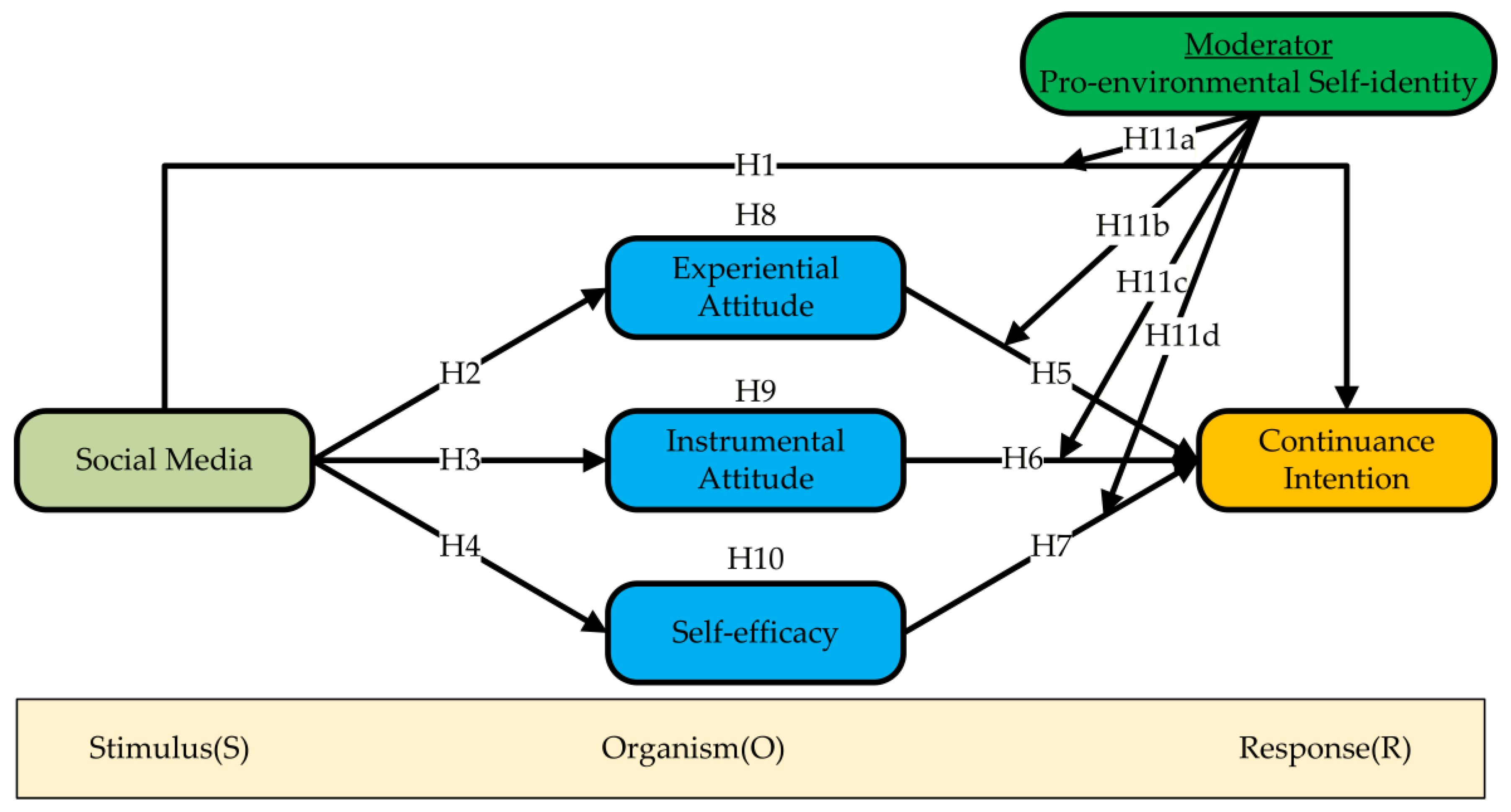
Figure 2.
The moderating effect of pro-environmental self-identity (PESI) on experiential attitude (EA) and continuance intention (CI).
Figure 2.
The moderating effect of pro-environmental self-identity (PESI) on experiential attitude (EA) and continuance intention (CI).

Figure 3.
Parameter estimation of the proposed model.
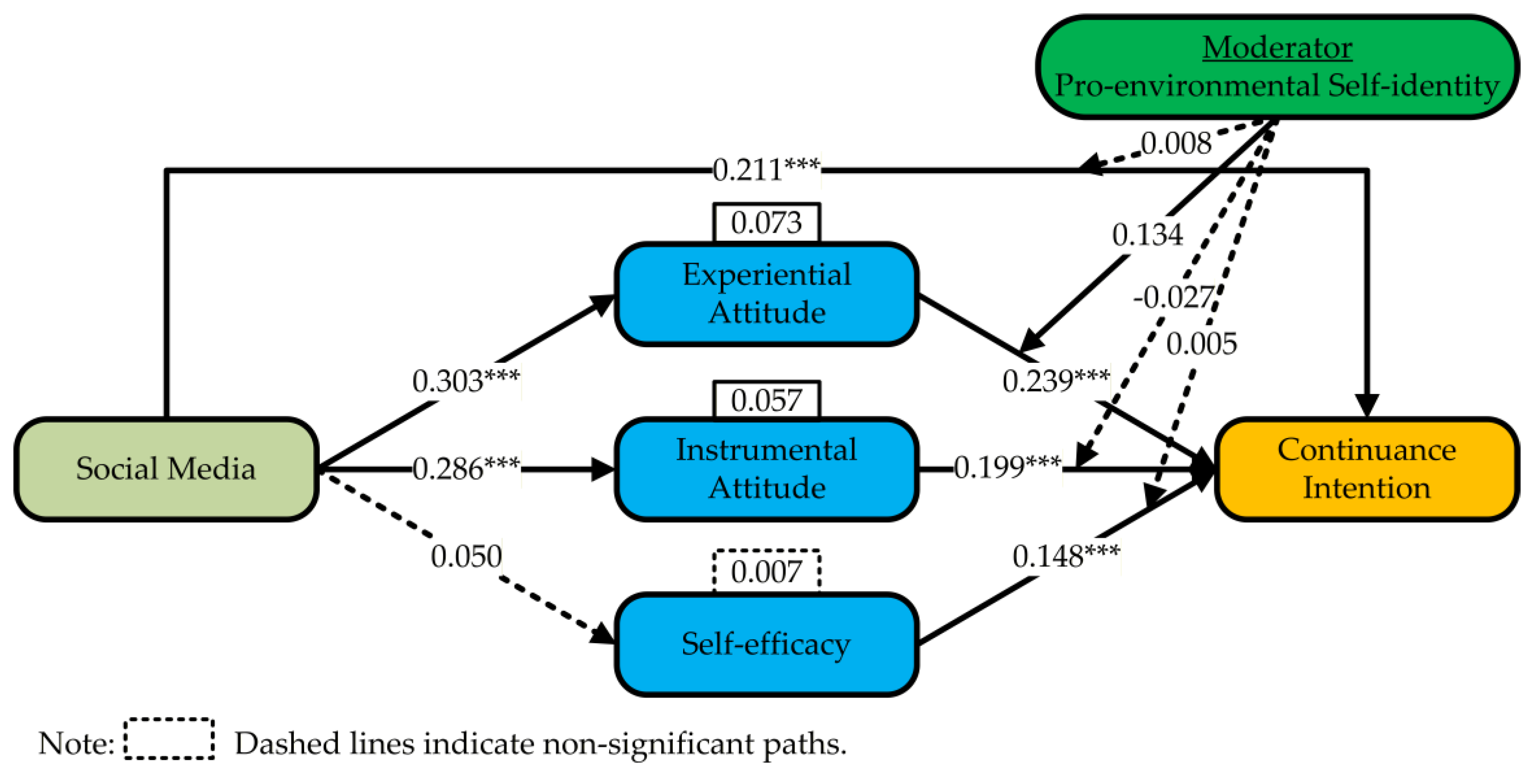
Table 1.
Sample demographics (n = 817).
| Demographics | Items | Frequency | Percentage% |
|---|---|---|---|
| Gender | Male | 428 | 52.4 |
| Female | 389 | 47.6 | |
| Age | Under25 | 125 | 15.3 |
| 26-35 | 117 | 14.3 | |
| 36-45 | 209 | 25.6 | |
| 46-55 | 269 | 32.9 | |
| Over 55 | 97 | 11.9 | |
| Education | High School or Below | 52 | 6.4 |
| Associate Degree | 258 | 31.6 | |
| Bachelor's Degree | 468 | 57.3 | |
| Master's Degree or Above | 39 | 4.8 | |
| Occupation | Government employee | 36 | 4.4 |
| Private employee | 287 | 35.1 | |
| Own business | 261 | 31.9 | |
| Others | 125 | 15.3 | |
| Income status (monthly) | Below CNY ¥5000 | 144 | 17.6 |
| CNY ¥5001-CNY ¥8000 | 265 | 32.4 | |
| CNY ¥8001-CNY ¥11000 | 189 | 23.1 | |
| CNY ¥11001-CNY ¥14000 | 147 | 18 | |
| Above CNY ¥14001 | 72 | 8.8 |
Table 2.
The confirmatory factor analysis.
| Model | x²/df | IFI | TLI | CFI | RMSEA | SMRM |
|---|---|---|---|---|---|---|
| CLF factor | 1.480 | 0.990 | 0.988 | 0.990 | 0.024 | 0.026 |
| 6 factor | 1.561 | 0.988 | 0.985 | 0.988 | 0.026 | 0.029 |
| 5 factor | 4.569 | 0.920 | 0.920 | 0.920 | 0.066 | 0.061 |
| 4 factor | 8.709 | 0.823 | 0.800 | 0.822 | 0.097 | 0.078 |
| 3 factor | 15.399 | 0.662 | 0.626 | 0.661 | 0.133 | 0.107 |
| 2 factor | 21.332 | 0.516 | 0.471 | 0.515 | 0.158 | 0.126 |
| 1 factor | 22.790 | 0.476 | 0.433 | 0.475 | 0.163 | 0.129 |
| Criteria | Acceptable <5 |
Acceptable >0.8 |
Acceptable >0.8 |
Acceptable >0.8 |
Acceptable <0.08 |
Acceptable <0.08 |
| Ideally <3 | Ideally >0.9 | Ideally >0.9 | Ideally >0.9 |
Table 3.
Factor Loading, Composite reliability, Average variance extracted, and Cronbach's alpha.
| Variables | Items | Loadings | CR | AVE | Cronbach's alpha |
|---|---|---|---|---|---|
| Social Media (SM) |
SM1 | 0.608 | .761 | .517 | .755 |
| SM2 | 0.779 | ||||
| SM3 | 0.758 | ||||
| Experiential Attitude (EA) |
EA1 | 0.667 | .839 | .567 | .838 |
| EA2 | 0.787 | ||||
| EA3 | 0.746 | ||||
| EA4 | 0.804 | ||||
| Instrumental Attitude (IA) |
IA1 | 0.872 | .876 | .642 | .871 |
| IA2 | 0.734 | ||||
| IA3 | 0.909 | ||||
| IA4 | 0.666 | ||||
| Self-efficacy (SE) |
SE1 | 0.727 | .873 | .638 | .866 |
| SE2 | 0.931 | ||||
| SE3 | 0.858 | ||||
| SE4 | 0.647 | ||||
| Pro-environmental Self-identity (PESI) |
PESI1 | 0.630 | .873 | .637 | .867 |
| PESI2 | 0.891 | ||||
| PESI3 | 0.745 | ||||
| PESI4 | 0.895 | ||||
| Continuance Intention (CI) |
CI1 | 0.754 | .786 | .555 | .771 |
| CI2 | 0.602 | ||||
| CI3 | 0.857 |
Table 4.
The correlation matrix and discriminant validity tests.
| Constructs | SM | EA | IA | SE | PESI | CI |
|---|---|---|---|---|---|---|
| Social Media (SM) |
0.719 | 0.358 | 0.321 | 0.053 | 0.151 | 0.439 |
| Experiential Attitude (EA) |
0.357 | 0.753 | 0.582 | 0.344 | 0.469 | 0.558 |
| Instrumental Attitude (IA) |
0.319 | 0.580 | 0.801 | 0.412 | 0.335 | 0.506 |
| Self-efficacy (SE) |
0.052 | 0.343 | 0.410 | 0.799 | 0.258 | 0.382 |
| Pro-environmental Self-identity (PESI) |
0.150 | 0.467 | 0.333 | 0.256 | 0.798 | 0.306 |
| Continuance Intention (CI) |
0.436 | 0.554 | 0.502 | 0.379 | 0.303 | 0.745 |
Note: The lower left diagonal is the correlation. The diagonal elements in the bond are the square root of AVE. The HTMT ratio is printed in the upper right diagonal in italic.
Table 5.
Results of the bootstrap analysis on indirect mediating effects.
| Path | Coefficients | S.E. | t | p | 95% CILL | 95% CIUL | Supported |
|---|---|---|---|---|---|---|---|
| Main effects | |||||||
| SM→CI | 0.211 | 0.031 | 6.831 | 0.000 | 0.151 | 0.272 | Yes |
| SM→EA | 0.303 | 0.035 | 8.670 | 0.000 | 0.235 | 0.372 | Yes |
| SM→IA | 0.286 | 0.034 | 8.265 | 0.000 | 0.218 | 0.354 | Yes |
| SM→SE | 0.050 | 0.036 | 1.374 | 0.170 | -0.021 | 0.122 | NO |
| EA→CI | 0.239 | 0.035 | 6.839 | 0.000 | 0.171 | 0.308 | Yes |
| IA→CI | 0.199 | 0.035 | 5.713 | 0.000 | 0.131 | 0.267 | Yes |
| SE→CI | 0.148 | 0.031 | 4.866 | 0.000 | 0.089 | 0.208 | Yes |
| Mediating effects | |||||||
| SM→EA→CI | 0.073 | 0.014 | 0.046 | 0.103 | Yes | ||
| SM→IA→CI | 0.057 | 0.013 | 0.034 | 0.084 | Yes | ||
| SM→SE→CI | 0.007 | 0.006 | -0.003 | 0.019 | NO | ||
| Moderating effects | |||||||
| SM*PESI→CI | 0.008 | 0.031 | 0.267 | 0.790 | -0.052 | 0.069 | NO |
| EA*PESI→CI | 0.134 | 0.036 | 3.696 | 0.000 | 0.063 | 0.204 | Yes |
| IA*PESI→CI | -0.027 | 0.034 | -0.782 | 0.435 | -0.093 | 0.040 | NO |
| SE*PESI→CI | 0.005 | 0.030 | 0.179 | 0.858 | -0.054 | 0.065 | NO |
Notes: n = 817; S.E. = standard error; CI = confidence interval; LL = lower limit; UL = upper limit.
Table 6.
Results of the moderated mediating indirect effects test.
| Mediator | Clusters | Coefficients | S.E. | 95% CILL | 95% CIUL | Index of moderated mediation | |
|---|---|---|---|---|---|---|---|
| Index | 95% CI | ||||||
| EA | High PESI | 0.114 | 0.022 | 0.074 | 0.160 | 0.041 | [0.018,0.067] |
| Low PESI | 0.031 | 0.016 | 0.000 | 0.064 | |||
Notes: n = 817; S.E. = standard error; CI = confidence interval; LL = lower limit; UL = upper limit.
Disclaimer/Publisher’s Note: The statements, opinions and data contained in all publications are solely those of the individual author(s) and contributor(s) and not of MDPI and/or the editor(s). MDPI and/or the editor(s) disclaim responsibility for any injury to people or property resulting from any ideas, methods, instructions or products referred to in the content. |
© 2025 by the authors. Licensee MDPI, Basel, Switzerland. This article is an open access article distributed under the terms and conditions of the Creative Commons Attribution (CC BY) license (http://creativecommons.org/licenses/by/4.0/).
Copyright: This open access article is published under a Creative Commons CC BY 4.0 license, which permit the free download, distribution, and reuse, provided that the author and preprint are cited in any reuse.


