

Submitted:
31 October 2025
Posted:
03 November 2025
You are already at the latest version
Abstract
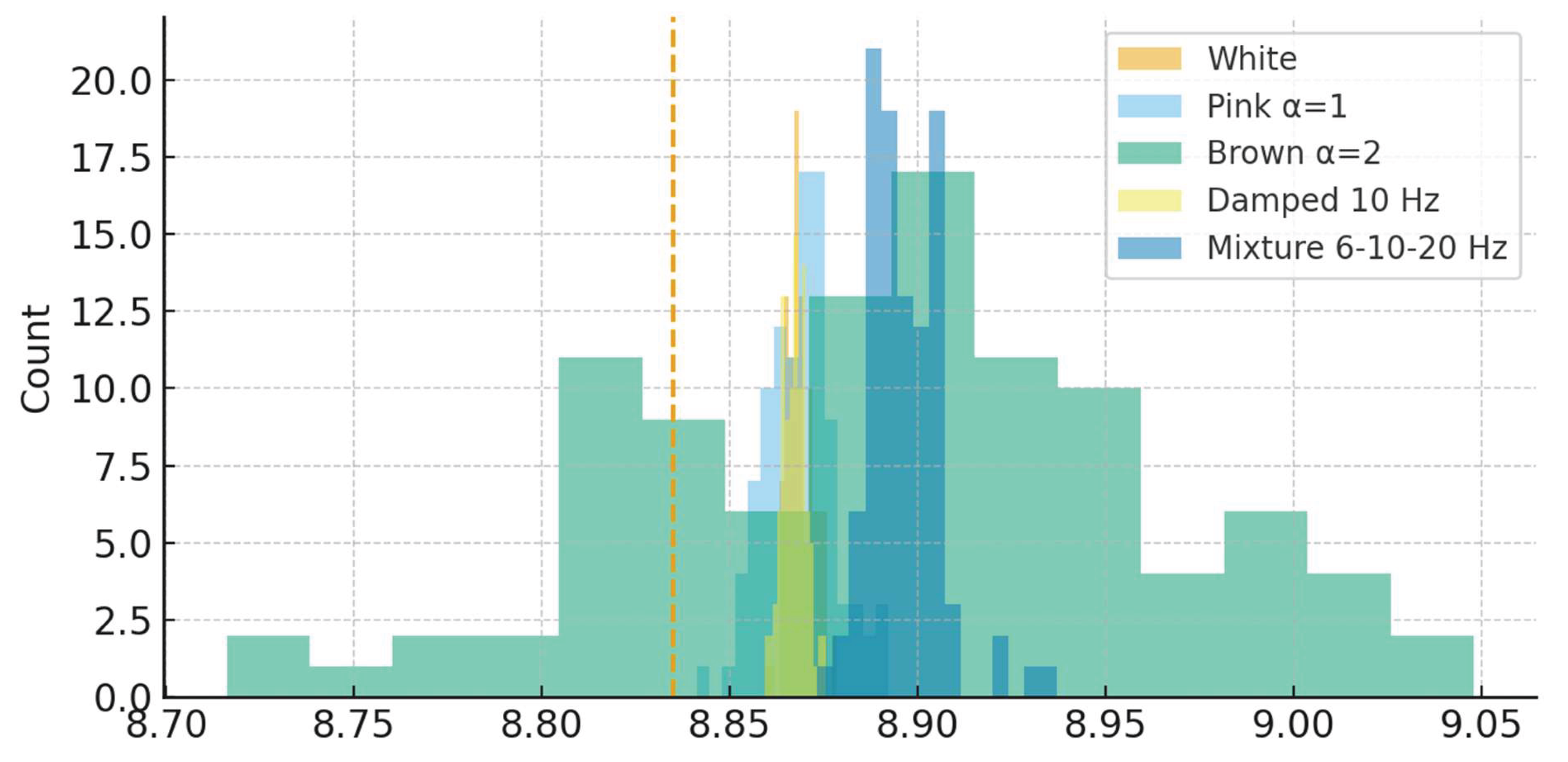
EEG recordings are usually interpreted as real signals of brain activity, yet they are composed of both real and imaginary orthogonal components. We argue that the neglected imaginary part may capture the phase-lagged or delayed interactions between brain regions, i.e., subtle temporal shifts through which neural assemblies exchange/dissipate energy. We propose here imaginary entropy as a quantitative index of time-lagged coupling diversity, derived from the Hilbert-transformed analytic representation of EEG signals. By normalizing the absolute imaginary amplitudes and calculating their Shannon entropy, could quantify how widely the brain’s dissipative interactions are spread across time and space, capturing the extent to which energy exchanges are concentrated or distributed within cortical activity. We showed that resting-state EEG recordings from healthy adults yielded consistent values with little variation across individuals. Comparisons with theoretical simulations including white, pink, and brown noise as well as damped oscillators demonstrated that empirical values align closely with those of pink-to-brown noise, i.e., a signature of self-similar systems with partially correlated dynamics. Grounding the analysis of brain activity in the physical concepts of complex response and energy dissipation traditionally linked to imaginary components, uncovers a hidden dimension of neural dynamics that reflects the balance between coherence and dissipation. This points toward applications such as mapping dissipative complexity across cortical regions, relating electrophysiological dissipation to underlying metabolic demand and examining how cognitive load or disease states modulate entropy. Background. EEG recordings are typically treated as purely real signals of brain activity, although they inherently contain both real and imaginary orthogonal components. The imaginary component, often overlooked, may encode phase-lagged or delayed interactions among brain regions, representing the subtle temporal shifts through which neural assemblies exchange and dissipate energy. New method. We introduce imaginary entropy as a quantitative index of time-lagged coupling diversity. Derived from the Hilbert-transformed analytic representation of EEG signals, is computed by normalizing absolute imaginary amplitudes and calculating their Shannon entropy, thus quantifying how broadly dissipative interactions are distributed across time and cortical space. Results. Resting-state EEG data from healthy adults yielded stable values with minimal interindividual variation. Simulations of white, pink and brown noise, as well as damped oscillators, showed that empirical S_im values closely matched those of pink-to-brown noise, consistent with partially correlated, self-similar systems. Comparison with existing methods. Unlike conventional EEG metrics based on power spectra or phase coherence, isolates the imaginary component directly, linking it to energy dissipation rather than synchronous activity. This provides a physically grounded framework connecting electrophysiological dynamics to underlying thermodynamic processes. Conclusions. Grounded in complex response theory, reveals a hidden layer of neural dynamics reflecting the balance between coherence and dissipation. Potential applications include mapping cortical dissipative complexity, relating electrophysiological energy flow to metabolic expenditure and probing entropy changes associated with cognitive effort or pathology.
Keywords:
Introduction
Methods
Results
Conclusions
Author Contributions
Funding
Ethics Approval and Consent to Participate
Consent for Publication
Availability of Data and Materials
Declaration of Generative AI and AI-Assisted Technologies in the Writing Process
Acknowledgements
Competing Interests
References
- Asano, M., Bliokh, K. Y., Bliokh, Y. P., Kofman, A. G., Ikuta, R., Yamamoto, T., Kivshar, Y. S., Yang, L., Imoto, N., Özdemir, Ş. K., and Nori, F. “Anomalous Time Delays and Quantum Weak Measurements in Optical Micro-Resonators.” Nature Communications 7, no. 13488 (November 14, 2016). [CrossRef]
- Aur, D., and Vila-Rodriguez, F. “Dynamic Cross-Entropy.” Journal of Neuroscience Methods 275 (January 1, 2017): 10–18. [CrossRef]
- Bernardes, T. S., Santos, K. C. S., Nascimento, M. R., Filho, C. A. N. E. S., Bazan, R., Pereira, J. M., de Souza, L. A. P. S., and Luvizutto, G. J. “Effects of Anodal Transcranial Direct Current Stimulation over Motor Cortex on Resting-State Brain Activity in the Early Subacute Stroke Phase: A Power Spectral Density Analysis.” Clinical Neurology and Neurosurgery 237 (February 2024): 108134. [CrossRef]
- Bu, Z., Han, X., Wang, Y., Liu, S., Zhong, L., and Lu, X. “Multi-Wavelength Digital Holography Based on Kramers–Kronig Relations.” Optics Letters 49, no. 24 (December 15, 2024): 7154–7157. [CrossRef]
- Chen, X., Yao, S., Song, J., Ding, T., Li, G., Song, J., Nie, S., Ma, J., and Yuan, C. “Full-Angle Single-Shot Quantitative Phase Imaging Based on Kramers–Kronig Relations.” Optics Letters 49, no. 12 (June 15, 2024): 3512–3515. [CrossRef]
- Colmenares, P. J. “Generalized Dynamics and Fluctuation–Dissipation Theorem for a Parabolic Potential.” Physical Review E 108, no. 1–1 (July 2023): 014115. [CrossRef]
- Davis, J. J. J., Kozma, R., and Schübeler, F. “Analysis of Meditation vs. Sensory Engaged Brain States Using Shannon Entropy and Pearson’s First Skewness Coefficient Extracted from EEG Data.” Sensors (Basel) 23, no. 3 (January 23, 2023): 1293. [CrossRef]
- Deco, G., Lynn, C. W., Sanz Perl, Y., and Kringelbach, M. L. “Violations of the Fluctuation–Dissipation Theorem Reveal Distinct Nonequilibrium Dynamics of Brain States.” Physical Review E 108, no. 6–1 (December 2023): 064410. [CrossRef]
- Giovannelli, Isabella L., and Steven M. Anlage. “Physical Interpretation of Imaginary Time Delay.” Physical Review Letters 135, no. 4 (July 24, 2025): 043801. [CrossRef]
- Hu, H., Han, S., Yang, Y., Liu, D., Xue, H., Liu, G. G., Cheng, Z., Wang, Q. J., Zhang, S., Zhang, B., and Luo, Y. “Observation of Topological Edge States in Thermal Diffusion.” Advanced Materials 34, no. 31 (August 2022): e2202257. [CrossRef]
- Hull, A. C., and Morton, J. B. “Activity-State Entropy: A Novel Brain Entropy Measure Based on Spatial Patterns of Activity.” Journal of Neuroscience Methods 393 (June 1, 2023): 109868. [CrossRef]
- Jaušovec, N., and K. Jaušovec. “Spatiotemporal Brain Activity Related to Intelligence: A Low Resolution Brain Electromagnetic Tomography Study.” Brain Research Cognitive Brain Research 16, no. 2 (2003): 267–72. [CrossRef]
- Jaušovec, N., and K. Jaušovec. “Sex Differences in Brain Activity Related to General and Emotional Intelligence.” Brain and Cognition 59, no. 3 (2005): 277–86. [CrossRef]
- Kaushik, S. S., Robertson, S. H., Freeman, M. S., He, M., Kelly, K. T., Roos, J. E., Rackley, C. R., Foster, W. M., McAdams, H. P., and Driehuys, B. “Single-Breath Clinical Imaging of Hyperpolarized (129)Xe in the Airspaces, Barrier, and Red Blood Cells Using an Interleaved 3D Radial 1-Point Dixon Acquisition.” Journal of Applied Physiology (exact journal not provided in source; assumed clinical imaging study; verify citation).
- Kim, J. Y., Kim, S. H., Seo, J., Kim, S. H., Han, S. W., Nam, E. J., Kim, S. K., Lee, H. J., Lee, S. J., Kim, Y. T., and Chang, Y. “Increased Power Spectral Density in Resting-State Pain-Related Brain Networks in Fibromyalgia.” Pain 154, no. 9 (September 2013): 1792–1797. [CrossRef]
- Kuang, Y., Wu, Z., Xia, R., Li, X., Liu, J., Dai, Y., Wang, D., and Chen, S. “Phase Lag Index of Resting-State EEG for Identification of Mild Cognitive Impairment Patients with Type 2 Diabetes.” Brain Sciences 12, no. 10 (October 17, 2022): 1399. [CrossRef]
- Lau, Z. J., Pham, T., Chen, S. H. A., and Makowski, D. “Brain Entropy, Fractal Dimensions and Predictability: A Review of Complexity Measures for EEG in Healthy and Neuropsychiatric Populations.” European Journal of Neuroscience 56, no. 7 (October 2022): 5047–5069. [CrossRef]
- Le Van Quyen, M., Foucher, J., Lachaux, J., Rodriguez, E., Lutz, A., Martinerie, J., and Varela, F. J. “Comparison of Hilbert Transform and Wavelet Methods for the Analysis of Neuronal Synchrony.” Journal of Neuroscience Methods 111, no. 2 (October 30, 2001): 83–98. [CrossRef]
- Li, M., Gao, Y., Ding, Z., and Gore, J. C. “Power Spectra Reveal Distinct BOLD Resting-State Time Courses in White Matter.” Proceedings of the National Academy of Sciences of the United States of America 118, no. 44 (November 2, 2021): e2103104118. [CrossRef]
- Li, X., Wu, Y., Wei, M., Guo, Y., Yu, Z., Wang, H., Li, Z., and Fan, H. “A Novel Index of Functional Connectivity: Phase Lag Based on Wilcoxon Signed Rank Test.” Cognitive Neurodynamics 15, no. 4 (August 2021): 621–636. [CrossRef]
- Lutkenhoff, E. S., Nigri, A., Rossi Sebastiano, D., Sattin, D., Visani, E., Rosazza, C., D’Incerti, L., Bruzzone, M. G., Franceschetti, S., Leonardi, M., Ferraro, S., and Monti, M. M. “EEG Power Spectra and Subcortical Pathology in Chronic Disorders of Consciousness.” Psychological Medicine 52, no. 8 (June 2022): 1491–1500. [CrossRef]
- Xu, J., and Guo, W. “Imaginary Part of Timelike Entanglement Entropy.” Journal of High Energy Physics 2025, no. 94 (2025). [CrossRef]
- Xue, S., Guo, J., Li, P., and others. “Quantification of Resource Theory of Imaginarity.” Quantum Information Processing 20, no. 383 (2021). [CrossRef]
- Pernice, R., Zanetti, M., Nollo, G., De Cecco, M., Busacca, A., and Faes, L. “Mutual Information Analysis of Brain-Body Interactions during Different Levels of Mental Stress.” Annual International Conference of the IEEE Engineering in Medicine and Biology Society (July 2019): 6176–6179. [CrossRef]
- Phillips, N. S., Rao, V., Kmetz, L., Vela, R., Medick, S., Krull, K., and Kesler, S. R. “Changes in Brain Functional and Effective Connectivity After Treatment for Breast Cancer and Implications for Intervention Targets.” Brain Connectivity 12, no. 4 (May 2022): 385–397. [CrossRef]
- Powanwe, A. S., and Longtin, A. “Mutual Information Resonances in Delay-Coupled Limit Cycle and Quasi-Cycle Brain Rhythms.” Biological Cybernetics 116, no. 2 (April 2022): 129–146. [CrossRef]
- Redwan, S. M., Uddin, M. P., Ulhaq, A., Sharif, M. I., and Krishnamoorthy, G. “Power Spectral Density-Based Resting-State EEG Classification of First-Episode Psychosis.” Scientific Reports 14, no. 1 (July 2, 2024): 15154. [CrossRef]
- Sadeghijam, M., Talebian, S., Mohsen, S., Akbari, M., and Pourbakht, A. “Shannon Entropy Measures for EEG Signals in Tinnitus.” Neuroscience Letters 762 (September 25, 2021): 136153. [CrossRef]
- Sanchez Bornot, J. M., Wong-Lin, K., Ahmad, A. L., and Prasad, G. “Robust EEG/MEG Based Functional Connectivity with the Envelope of the Imaginary Coherence: Sensor Space Analysis.” Brain Topography 31, no. 6 (November 2018): 895–916. [CrossRef]
- Sander, T. H., Bock, A., Leistner, S., Kuhn, A., and Trahms, L. “Coherence and Imaginary Part of Coherency Identifies Cortico-Muscular and Cortico-Thalamic Coupling.” Annual International Conference of the IEEE Engineering in Medicine and Biology Society (2010): 1714–1717. [CrossRef]
- Shiju, S., and Sriram, K. “Hilbert Transform-Based Time-Series Analysis of the Circadian Gene Regulatory Network.” IET Systems Biology 13, no. 4 (August 2019): 159–168. [CrossRef]
- Silva, P. H. R. D., Secchinato, K. F., Rondinoni, C., and Leoni, R. F. “Brain Structural-Functional Connectivity Relationship Underlying the Information Processing Speed.” Brain Connectivity 10, no. 3 (April 2020): 143–154. [CrossRef]
- Snaauw, G., Sasdelli, M., Maicas, G., Lau, S., Verjans, J., Jenkinson, M., and Carneiro, G. “Mutual Information Neural Estimation for Unsupervised Multi-Modal Registration of Brain Images.” Annual International Conference of the IEEE Engineering in Medicine and Biology Society (July 2022): 3510–3513. [CrossRef]
- Stein, A., Thorstensen, J. R., Ho, J. M., Ashley, D. P., Iyer, K. K., and Barlow, K. M. “Attention Please! Unravelling the Link Between Brain Network Connectivity and Cognitive Attention Following Acquired Brain Injury: A Systematic Review of Structural and Functional Measures.” Brain Connectivity 14, no. 1 (February 2024): 4–38. [CrossRef]
- Sun, H., Lin, F., Wu, X., Zhang, T., and Li, J. “Normalized Mutual Information of fNIRS Signals as a Measure for Assessing Typical and Atypical Brain Activity.” Journal of Biophotonics 16, no. 6 (June 2023): e202200369. [CrossRef]
- Tozzi, A., E. Bormashenko, and N. Jausovec. “Topology of EEG Wave Fronts.” Cognitive Neurodynamics 15 (2021a): 887–96. [CrossRef]
- Tozzi, A., J. F. Peters, N. Jausovec, A. P. H. Don, S. Ramanna, I. Legchenkova, and E. Bormashenko. “Nervous Activity of the Brain in Five Dimensions.” Biophysica 1, no. 1 (2021b): 38–47. [CrossRef]
- Tian, W., Zhao, D., Ding, J., Zhan, S., Zhang, Y., Etkin, A., Wu, W., and Yuan, T. F. “An Electroencephalographic Signature Predicts Craving for Methamphetamine.” Cell Reports Medicine 5, no. 1 (January 16, 2024): 101347. [CrossRef]
- Yan, H., Johnston, J. F., Cahn, S. B., King, M. C., and Mochrie, S. G. J. “Multiplexed Fluctuation–Dissipation–Theorem Calibration of Optical Tweezers Inside Living Cells.” Review of Scientific Instruments 88, no. 11 (November 2017): 113112. [CrossRef]
- Yang, S., Xu, G., Zhou, X., Li, J., Kong, X., Zhou, C., Fan, H., Chen, J., and Qiu, C. W. “Hierarchical Bound States in Heat Transport.” Proceedings of the National Academy of Sciences of the United States of America 121, no. 38 (September 17, 2024): e2412031121. [CrossRef]
- Wang, Z., Li, Y., Childress, A. R., and Detre, J. A. “Brain Entropy Mapping Using fMRI.” PLoS One 9, no. 3 (March 21, 2014): e89948. [CrossRef]
- Wang, Z., Zhao, Y., He, Y., and Zhang, J. “Phase Lag Index-Based Graph Attention Networks for Detecting Driving Fatigue.” Review of Scientific Instruments 92, no. 9 (September 1, 2021): 094105. [CrossRef]
- Wu, Y., Zhou, Y., and Song, M. “Classification of Patients with AD from Healthy Controls Using Entropy-Based Measures of Causality Brain Networks.” Journal of Neuroscience Methods 361 (September 1, 2021): 109265. [CrossRef]
- Wu, K. D., Kondra, T. V., Scandolo, C. M., and others. “Resource Theory of Imaginarity in Distributed Scenarios.” Communications Physics 7, no. 171 (2024). [CrossRef]
Disclaimer/Publisher’s Note: The statements, opinions and data contained in all publications are solely those of the individual author(s) and contributor(s) and not of MDPI and/or the editor(s). MDPI and/or the editor(s) disclaim responsibility for any injury to people or property resulting from any ideas, methods, instructions or products referred to in the content. |
© 2025 by the authors. Licensee MDPI, Basel, Switzerland. This article is an open access article distributed under the terms and conditions of the Creative Commons Attribution (CC BY) license (http://creativecommons.org/licenses/by/4.0/).