

Submitted:
27 October 2025
Posted:
28 October 2025
You are already at the latest version
Abstract
Greenhouse gas (GHG) emissions from agricultural crops remain a critical challenge for climate change mitigation. This review synthesizes evidence on cropland management interventions and global N₂O mitigation potential. Agricultural practices such as cover cropping, agroforestry, reduced tillage, and diversification show promise in reducing CO₂, CH₄, and N₂O emissions, yet uncertainties in measurement, verification, and socio-economic adoption persist. Complementing this, global-scale analysis underscores the dominant role of optimized nitrogen fertilization in curbing N₂O emissions while sustaining yields. To bridge gaps between practice-level interventions and global emission dynamics, this paper introduces the ICEMF, a novel approach combining field-based management strategies with spatially explicit emission modelling. Only peer-reviewed articles published in English between 2014 and 2025 were selected to ensure recent and reliable findings. The review highlights knowledge gaps, evaluates policy and technical trade-offs, and proposes ICEMF as a pathway toward scalable and adaptive mitigation strategies in agriculture.
Keywords:
agricultural crops
; greenhouse gas emissions
; mitigation strategies
; nitrous oxide reduction
; soil carbon sequestration
1. Introduction
Agriculture is widely recognized as a major contributor to anthropogenic greenhouse gases (GHGs), emitting carbon dioxide (CO₂), methane (CH₄), and nitrous oxide (N₂O) through soil degradation, livestock-related processes, and intensive crop management [1]. These emissions account for a substantial share of global warming, with croplands serving both as significant sources and potential sinks of GHGs through soil carbon sequestration and improved land management [2]. The need to mitigate these emissions has grown, as agriculture faces pressures from climate change, food security concerns, and sustainability goals [3,4].
Various agronomic interventions have been identified to reduce emissions, including cover cropping, reduced tillage, crop diversification, agroforestry, and organic amendments [5]. These practices enhance soil organic carbon stocks, reduce erosion, and improve resilience to extreme weather events [6]. However, the net benefits of such interventions are context-dependent, often influenced by soil type, climate, and farming system design [7]. In addition, monitoring, reporting, and verification (MRV) frameworks face methodological inconsistencies that limit the reliability of estimates [8].
Nitrous oxide emissions are of particular concern because of their high global warming potential and direct link to nitrogen fertilizer application [9]. Global analyses indicate that N₂O emissions from croplands have quadrupled over the last six decades, with hotspots in Asia and intensive horticultural systems [10]. Strategies such as the “4R” nutrient stewardship (right source, rate, time, and placement) and precision irrigation have been highlighted as effective measures to reduce N₂O while sustaining yields [3]. Crop-specific assessments show maize, rice, wheat, and vegetable systems to be the most significant contributors, and therefore prime targets for mitigation [11].
Despite promising technical potentials, adoption of mitigation strategies is constrained by socio-economic realities [12]. Barriers include land tenure insecurity, lack of capital, risk perception, and compatibility with traditional practices [13]. Policy frameworks, incentive structures, and market-based mechanisms, such as carbon credits, influence adoption rates but bring additional challenges of equity and verification [14]. As a result, biophysical estimates often overstate mitigation potential without accounting for the socio-economic conditions of real farming systems [15].
To address these complexities, this review introduces the ICEMF, a novel synthesis approach that couples practice-level evidence with spatially explicit modeling of N₂O and Soil Organic Carbon (SOC) outcomes. The framework integrates empirical data, regional modeling, and socio-economic adoption pathways, offering a decision-support tool for scalable interventions [16]. By combining technological, agronomic, and policy perspectives, ICEMF provides a roadmap for reducing agricultural GHGs while maintaining productivity [17,18,19].
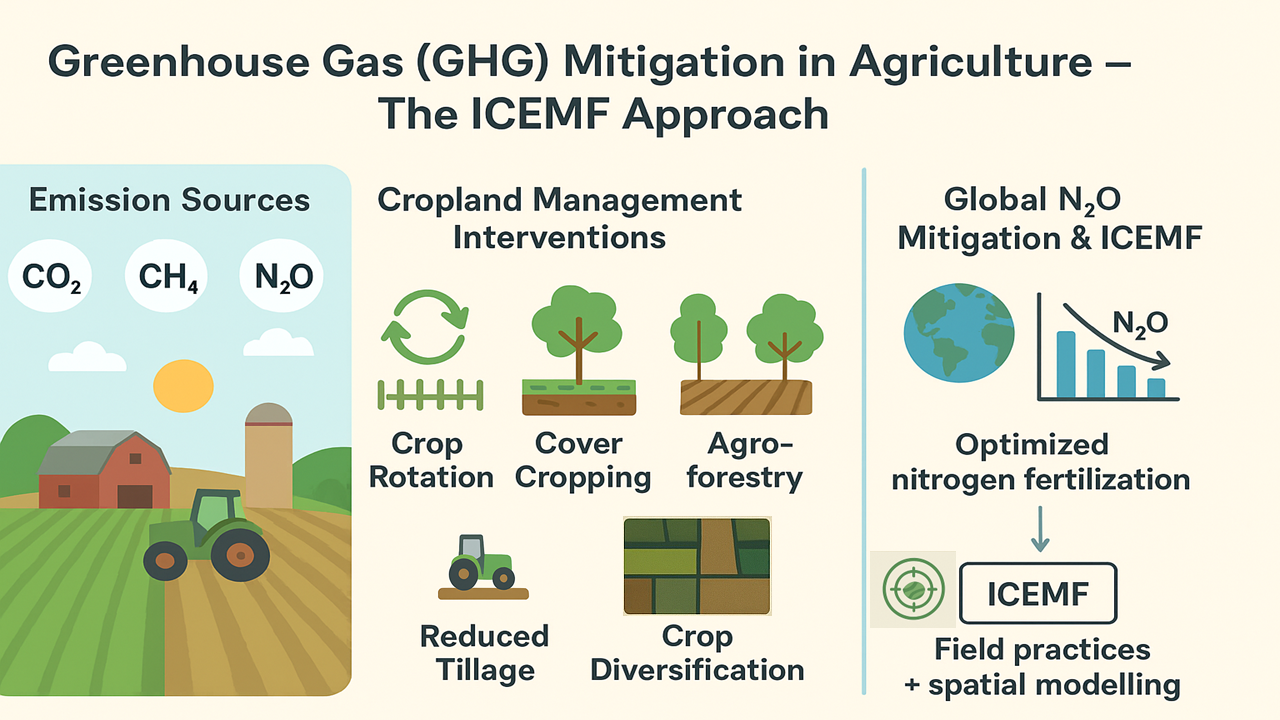
The ICEMF proposed in this study is primarily a conceptual and methodological tool designed to connect field-level management practices with regional and global emission mitigation models. ICEMF integrates empirical data, spatially explicit emission modelling, and socio-economic adoption pathways, offering a decision-support tool for scalable and adaptive mitigation strategies. While ICEMF is currently in a theoretical stage, its application potential is illustrated through a schematic representation (Figure 1), which visualizes the connection between farm-level practices and their broader impacts on global mitigation targets. This schematic aims to clarify how ICEMF bridges the gap between technical agronomic strategies and global emission modeling. Moreover, this figure illustrates the conceptual flow of ICEMF, connecting field-level agricultural practices with spatially explicit emission modeling, regional/global emission models, and socio-economic adoption pathways. It visualizes how farm-level practices contribute to broader global emission mitigation targets, highlighting the integration of empirical data, technical strategies, and socio-economic factors for scalable and adaptive mitigation solutions.
1.1. Contributions
The novel contributions of this study are:
- Proposes the ICEMF as a hybrid approach that unites field-level management practices with global-scale emission modeling.
- Provides a dual synthesis of practice-based interventions and spatially explicit N₂O mitigation assessments, highlighting synergies often overlooked in single-focus reviews.
- Identifies critical policy–practice trade-offs and socio-economic adoption barriers, offering a roadmap for aligning climate targets with farmer-centric solutions.
1.2. Review Context and Objectives
The literature on greenhouse gas emissions in agriculture highlights both the scale of the problem and the diverse mitigation strategies proposed to balance productivity with sustainability. Table 1 shows summary of research gaps. Ullah, Farooque [20] reviewed biochar production processes and demonstrated its potential to reduce soil-based GHG emissions by enhancing carbon storage, soil quality, and microbial activity. Zhu and Miller [21] found that tomato production systems vary widely in emissions, highlighting precision agriculture and low-carbon energy as key interventions. [22] applied a harmonized methodology to soybean production studies, finding significant variability in GHG emissions driven by fertilizer use, irrigation, and regional differences. According to Yuan, Lian [23], examined greenhouse gas emissions from constructed wetlands, emphasizing the role of planting strategies and management practices in reducing secondary pollution. Kabato, Getnet [3] assessed climate-smart agriculture strategies, underscoring the benefits of integrated practices like biochar application, agroforestry, and regenerative agriculture for soil health and emission mitigation. Another study by Symeon, Akamati [24] explored manure management approaches, including anaerobic digestion and composting, as viable tools to reduce GHG emissions in livestock systems. [25] evaluated chicken meat production in South Korea, showing that feed production contributed the largest share of emissions and recommending local feed sourcing and better manure management. [26] synthesized evidence on converting cropland to grassland in peat soils, concluding that effects on CO₂, CH₄, and N₂O emissions remain ambiguous and context-dependent. According to Kukah, Jin [27] reviewed the role of carbon trading, finding that it reduces GHG emissions through innovations in low-carbon technologies, renewable energy, and ecosystem restoration. The study demonstrated that recoupled crop-livestock systems in China could reduce agricultural GHG emissions by over 40%, highlighting their potential for sustainable intensification [28].
Agricultural crop systems are central to global food security but simultaneously represent a major source of GHG emissions, particularly CO₂, CH₄, and N₂O. Despite extensive research on individual mitigation practices, the sector continues to face significant challenges in balancing productivity with climate goals. Measurement uncertainties, limited socio-economic adoption of climate-smart practices, and policy–practice mismatches hinder the scalability of effective solutions. Moreover, most existing approaches focus narrowly on either technical interventions or emission inventories, leaving a gap in integrated frameworks that connect farm-level practices with regional and global mitigation outcomes. This disconnect underscores the urgent need for a comprehensive synthesis that not only reviews emission sources and mitigation strategies but also provides a structured pathway for practical, verifiable, and context-specific solutions to reduce agricultural GHG emissions.
Across the reviewed studies, several recurring gaps emerge. Many mitigation strategies such as biochar application, climate-smart agriculture, and crop–livestock integration show strong potential, yet lack long-term field validation and region-specific performance data. Methodological inconsistencies in life cycle assessments of crops like tomatoes and soybeans limit comparability, highlighting the need for standardized boundaries and harmonized reporting. Ecosystem-based solutions such as constructed wetlands and land-use shifts provide valuable insights, but their greenhouse gas outcomes remain context-dependent and uncertain, requiring more robust monitoring frameworks. Socio-economic and policy barriers, including adoption constraints, insufficient incentives, and integration challenges with existing farming systems, are also insufficiently addressed, limiting scalability. Addressing these gaps through interdisciplinary, multi-scalar studies will be critical to designing effective, verifiable, and farmer-centered greenhouse gas mitigation strategies in agriculture.
The novel objectives of this study are:
- To systematically review GHG emissions from agricultural crop systems and evaluate the effectiveness of diverse management practices.
- To assess the global mitigation potential of N₂O emissions through optimized nitrogen fertilization and complementary agronomic interventions.
- To develop and propose the ICEMF framework as a novel, scalable strategy for integrating technical, environmental, and socio-economic dimensions of GHG mitigation in agriculture.
1.3. Evaluating the Limitations of Current Agricultural GHG Mitigation Frameworks and the Potential of ICEMF to Bridge the Gaps
While the ICEMF offers a novel approach to bridging field-based practices with global emission reduction targets, several existing frameworks share similar goals of mitigating GHG emissions in agriculture. However, these frameworks often face significant challenges related to adoption, scalability, and integration of socio-economic factors. Below, we discuss a few of these frameworks and explain how ICEMF is positioned to overcome their limitations.
1.3.1. The 4R Nutrient Stewardship
The 4R Nutrient Stewardship framework: Right Source at Right Rate, Right Time, and Right Place has been widely adopted globally as a science-based approach to optimize nitrogen fertilizer use [29], with documented potential to reduce N₂O emissions by 55-64% when combined with enhanced-efficiency fertilizers and improve nitrogen recovery efficiency [30,31]. While effective in many commercial farming contexts, the 4R framework faces significant challenges in context-specific adoption, as implementation is highly site-specific and regional challenges vary considerably across continents and farming systems [3,32]. The application of precision fertilization techniques aligned with 4R principles is often limited by technology access and knowledge gaps, especially in smallholder farming systems where farmers face barriers including limited resources, training, and financial support [33]. These constraints are particularly acute in sub-Saharan Africa, where low digital literacy, high equipment costs, and weak extension services impede implementation [34]. Additionally, the benefits of nutrient use efficiency optimization can be inconsistent across different soil types and climatic conditions, as regional environmental factors often equal or exceed the effects of specific fertilizer management practices on N₂O emissions and nutrient losses [31]. Soil emissions occur in spatially and temporally variable 'hot spots' and 'hot moments,' driven by complex interactions among soil properties, weather, and microbial processes, making outcomes difficult to predict and generalize across regions [35,36]. ICEMF integrates spatially explicit emission models and considers socio-economic adoption pathways, ensuring that practices like precision fertilization are scalable and adaptable to local conditions. ICEMF’s inclusion of farmer decision-making factors, including financial incentives and training programs, helps overcome adoption barriers seen in the 4R framework.
1.3.2. Climate-Smart Agriculture (CSA)
CSA aims to integrate climate adaptation, mitigation, and food security in a single framework [37,38]. While CSA has promoted practices such as agroforestry, crop diversification, and conservation tillage [39,40], it often lacks a clear mechanism for scaling these practices across diverse agricultural systems [41]. The climate-smart village approach has attempted to provide an integrative strategy for scaling adaptation options, yet implementation remains challenging across heterogeneous farming contexts [41]. Moreover, CSA's emphasis on climate resilience sometimes overlooks the socio-economic conditions that influence farmers' willingness to adopt these practices [42,43]. Recent evidence demonstrates that adoption barriers extend beyond technical feasibility to include economic constraints, limited extension access, and institutional factors [44,45]. Studies across West Africa reveal that while farmers recognize benefits of CSA practices, barriers such as high initial investment costs, lack of credit access, insufficient labor, and inadequate knowledge significantly impede widespread adoption [46]. Similarly, research from southern Ethiopia and European food supply chains confirms that socio-economic factors including household wealth, market access, cooperative membership, and policy support critically determine technology adoption and farm sustainability outcomes [47,48]. The gap between indigenous knowledge systems and Western scientific approaches further complicates effective adaptation strategies, suggesting that CSA frameworks must better integrate local contexts and traditional practices to achieve meaningful impact [49]. ICEMF provides a more integrated approach by combining technical practices with spatially explicit emission modeling and socio-economic adoption data. This makes ICEMF more actionable at the farm level, particularly in addressing barriers to farmer adoption and economic feasibility in low-resource regions.
1.3.3. Low-Emission Development Strategies (LEDS)
LEDS are national frameworks integrating climate mitigation with development planning across sectors, including agriculture [50]. While valuable for macro-level policy coordination, LEDS face substantial implementation challenges in agriculture. Critical gaps exist between policy objectives and farm-level realities, particularly regarding the technical feasibility and economic viability of mitigation strategies for smallholder systems [51,52]. Research in Sub-Saharan Africa demonstrates that, despite progressive CSA policies, adoption remains constrained by limited access to technology, inadequate extension services, insufficient financial resources, and weak institutional capacity [53,54]. Agricultural mitigation policies face sociopolitical barriers including competing priorities around food security and affordability, organized lobby pressures, and redistributive effects [51]. Studies across Kenya, Tanzania, Ethiopia, and Rwanda reveal persistent challenges in operationalizing LEDS locally due to trade-offs between agricultural expansion and environmental goals, donor dependence, and insufficient integration of local knowledge [53]. The effectiveness of agricultural LEDS is fundamentally constrained by disconnects between national goals and farm-level adoption realities, with conventional top-down systems inadequate for promoting equitable access to climate-smart practices [52,54]. ICEMF fills the gap by integrating farm-level interventions with regional and global emission models, offering a scalable and adaptive solution that bridges the gap between national policies and local agricultural practices. Its focus on farmer-centered solutions and policy incentives ensures that emission reduction strategies are both practical and achievable.
1.3.4. Integrated Assessment Models (IAMs)
IAMs are global frameworks that integrate economic, energy, land-use, agricultural, and climate systems to evaluate the impacts of climate policies on agricultural emissions [55,56]. While valuable for global policy analysis and identifying cost-effective mitigation pathways [57], IAMs face substantial limitations for real-world agricultural implementation. Critical gaps exist in capturing local specificities essential for farm-level adoption, as these models rely on highly aggregated regional representations that obscure within-region heterogeneity of farming systems, soil conditions, and farmer capacities [58,59]. IAMs have been criticized for problematic assumptions that underestimate transformation urgency and inadequately incorporate behavioral, institutional, and socio-political barriers to technology adoption [60]. Specifically, IAMs represent agricultural mitigation through technology diffusion functions assuming rational economic optimization, without adequately capturing complex socio-economic factors driving farmer decisions, including risk aversion, cultural compatibility, perceived usefulness, financial constraints, extension service access, and social network influences [61,62,63]. Research demonstrates that farmer technology adoption depends on multidimensional factors beyond economic calculations, with psychological dimensions (environmental values, innovation aversion), socio-demographics (age, education, farm size), resource endowments (land, labor, capital), and institutional contexts (extension services, policy incentives) all playing critical yet under-represented roles in IAM frameworks [64,65]. Consequently, while IAMs provide important macro-scale strategic insights, their agricultural projections lack the granularity and behavioral realism needed for context-specific implementation, necessitating complementary bottom-up approaches explicitly incorporating farmer heterogeneity and socio-institutional adoption determinants [59,64]. ICEMF offers a more granular approach by integrating field-level practices with global emission models. Unlike IAMs, ICEMF accounts for regional variations in soil types, climate, and farming systems, making it more relevant for on-the-ground implementation. Furthermore, ICEMF’s inclusion of socio-economic adoption pathways ensures that mitigation strategies are not only technically feasible but also economically viable for farmers.
2. Materials and Methods
The literature search was conducted using major academic databases such as Scopus, Web of Science, and ScienceDirect to ensure comprehensive coverage of peer-reviewed studies on greenhouse gas emissions from agricultural crops and mitigation strategies. Keywords and combinations including “greenhouse gas emissions,” “agricultural crops,” “mitigation,” “management practices,” and “climate-smart agriculture” were applied to identify relevant studies published between 2016 and 2025. Additional references were traced through citation tracking of key articles to capture significant contributions not directly retrieved in the initial search.
Studies were included if they focused on greenhouse gas emissions from agricultural crop systems and examined mitigation or management strategies with relevance to CO₂, CH₄, or N₂O. Experimental field studies, meta-analyses, and systematic reviews were all considered to capture a broad spectrum of evidence. Only peer-reviewed articles published in English between 2014 and 2025 were selected to ensure recent and reliable findings. Exclusion criteria comprised studies that addressed emissions unrelated to crops (e.g., purely livestock systems), articles without empirical or methodological relevance, non-English publications, and grey literature such as reports or opinion pieces. To begin with, more than 200 studies were recognized and managed for suitability. A total of 148 studies were selected for review after duplication elimination and language consideration, which were subsequently analyzed and included in the review.
From the eligible studies, key information such as author details, year of publication, study location, crop type, greenhouse gases assessed, and mitigation practices investigated was systematically extracted. Data were organized into thematic categories including soil-based strategies, crop management interventions, nutrient optimization, and policy or socio-economic measures. A narrative synthesis approach was adopted to integrate findings across diverse study designs, with emphasis on identifying common trends, contradictions, and knowledge gaps. Where possible, comparisons were drawn between regional and global perspectives to highlight context-specific variations in emission sources and mitigation outcomes.
The analysis was structured around a thematic framework that links emission sources to management interventions and mitigation outcomes. Studies were grouped into categories reflecting crop and soil management, nutrient optimization, integrated systems, and policy measures, allowing for cross-comparison of strategies. While this framework supports a comprehensive synthesis, several limitations remain. Variability in study designs, life cycle assessment boundaries, and measurement techniques restrict direct comparability of results. In addition, regional disparities in data availability create potential biases toward well-studied systems, while socio-economic dimensions are often underreported. These limitations underscore the need for standardized methodologies and long-term, context-specific studies to strengthen the evidence base.
The ICEMF is designed as a conceptual framework that integrates empirical data from field-based management strategies with regional and global emission models. It incorporates factors such as soil types, crop management practices, and socio-economic conditions to provide region-specific estimates of CO₂, CH₄, and N₂O emissions. The framework uses spatially explicit emission models to predict the outcomes of different mitigation practices at various scales, from farm to global levels. This approach combines data from field studies, agronomic models, and socio-economic adoption pathways, helping policymakers and farmers make informed decisions about which mitigation strategies are most effective under specific conditions.
3. Thematic Analysis
Figure 2 shows thematic analysis of the reviewed literature reveals that mitigation strategies in agricultural crop systems can be broadly grouped into five categories: soil-based approaches (e.g., biochar application, conservation tillage), crop-based practices (e.g., diversification, agroforestry, cover cropping), nutrient management (e.g., precision fertilization, 4R stewardship), integrated systems (e.g., crop–livestock recoupling, constructed wetlands), and policy or socio-economic interventions (e.g., carbon trading, CSA policies). This categorization highlights both the diversity and interconnectedness of approaches, with many practices offering co-benefits such as enhanced soil health, improved productivity, and resilience to climate variability. However, adoption remains uneven, and their effectiveness is often context-specific, emphasizing the need for adaptive frameworks like the ICEMF to harmonize local practices with global climate targets.
3.1. Sources and Trends of Greenhouse Gas Emissions in Agriculture
Agricultural systems contribute significantly to global GHG emissions, primarily through CO₂, CH₄, and N₂O [66]. Soil organic matter degradation, excessive fertilizer use, and land-use change release CO₂, while enteric fermentation and flooded rice fields are major sources of CH₄, N₂O arises mainly from nitrogen fertilizer application and manure management, with its high global warming potential making it a critical focus for mitigation [67]. Recent studies indicate that global agricultural emissions have steadily increased over the past decades, with hotspots in Asia, Latin America, and Sub-Saharan Africa driven by crop intensification and rising fertilizer demand [68,69]. Seasonal variations, cropping intensity, and irrigation practices further influence emission patterns, underlining the complexity of agricultural GHG dynamics [70,71].
The study by Akram and Ali [72] examines the convergence hypothesis of GHG emissions across 93 countries from 1980 to 2017. Using the Phillips and Sul test, the study finds evidence of divergence in emissions trends, suggesting that countries follow different convergence paths. Clustering algorithms identify five distinct convergence clubs, indicating the need for region-specific policies. Figure 3 present the Greenhouse gas emissions in the agriculture sector across 93 Countries (1980-2017), as a group, based on the Phillips and Sul Panel Club Convergence Test. The findings emphasize the importance of considering these divergent paths when designing GHG mitigation strategies and the impact of policy transfers across countries. The study suggests that countries in Clubs 1– 4 should adopt agricultural policies from Club 5, where GHG emissions are lower, particularly focusing on cleaner energy. Strategies to reduce GHG emissions include improving sector efficiency, fostering innovation, reducing deforestation, and using cleaner energy with subsidies. Additionally, addressing poverty and adopting low-cost energy technologies in agriculture are key to sustainable development in lower- and middle-income countries.
Building on the study by Akram and Ali (2021)[72], which examines the convergence hypothesis of GHG emissions across 93 countries from 1980 to 2017, we have generated heatmaps for each of the identified convergence clubs, showing total emissions from 1990 to 2020. The heatmaps visually represent the emissions trends within each club, highlighting the divergent paths observed in the study. These visualizations support the need for region-specific GHG mitigation strategies, emphasizing the importance of targeted policies that reflect the unique emission patterns of each club. The findings underscore the role of tailored interventions to address the emissions disparities across countries. The data for these heatmaps is sourced from the FAOSTAT Database (FAO, 2020). Figure 4 presents heatmaps illustrating the total greenhouse gas emissions (in kilotons) across five regional convergence clubs, as identified through the Phillips and Sul convergence test [72]. These heatmaps visually represent emissions trends from 1990 to 2020, highlighting the disparities in emission patterns across regions. This regional analysis underscores the need for context-specific mitigation strategies and informs the ICEMF framework by emphasizing the importance of spatially explicit emission modeling.
Mukwada, Taylor [73] reported that the trends also reveal significant regional disparities. Developed countries have shown modest declines in emissions due to improved nutrient-use efficiency, conservation tillage, and climate-smart practices, while developing nations continue to face steep increases as agricultural expansion meets food security demands. Studies highlight that rice and maize systems dominate CH₄ and N₂O contributions, respectively, while wheat and soybean systems contribute substantial CO₂ through soil and land-use related emissions [74]. Moreover, climate change feedback loops, including rising temperatures and extreme weather events, exacerbate emission rates and reduce the mitigation capacity of soils [75]. Although progress has been made in quantifying emissions, gaps remain in capturing indirect sources such as post-harvest processes and regional variability in emission factors, emphasizing the need for refined monitoring frameworks and targeted interventions [76]. Table 2 presents a summary of key studies highlighting the sources and trends of greenhouse gas emissions in agriculture, their drivers, and regional or system-specific notes.
3.2. Evaluation of Crop and Soil Management Practices
Crop and soil management practices are central to reducing GHG emissions from agriculture. Conservation tillage, cover cropping, and crop diversification have been shown to enhance soil organic carbon stocks and reduce CO₂ release by minimizing soil disturbance and improving residue retention [77]. Agroforestry systems contribute to long-term carbon sequestration while also providing ecosystem services such as biodiversity support and microclimate regulation [78]. Biochar application has emerged as a promising soil amendment, capable of enhancing soil structure, microbial activity, and long-term carbon storage while mitigating CH₄ and N₂O fluxes [79]. In temperate agricultural regions, biochar demonstrates substantially more consistent and predictable soil CO2 emissions mitigation effects compared to no-till agriculture, which exhibits high climate and soil-dependent variability [80]. Biochar application increases soil organic carbon sequestration by 61% across temperate zones [80], with moderate confidence intervals between 36 - 90%, and decreases annual CO2 emissions by 13.0–17.6% within 1–2 years [81], whereas no-till effectiveness in temperate regions depends critically on soil texture, organic carbon content, and precipitation patterns [82], with future projections showing declining mitigation potential of only 1.4 - 1.7 Mg ha⁻¹ over 30 years under climate change scenarios [83]. The superior consistency of biochar in temperate climates stems from its intrinsic recalcitrance, with 97% of biochar carbon persisting in stable form with mean residence times of approximately 556 years [84], rendering it largely independent of temperate climate fluctuations in temperature and precipitation. In contrast, no-till effectiveness in temperate regions is fundamentally constrained by soil-specific properties and temporal dynamics of seasonal carbon fluxes [85], making it a less reliable climate mitigation strategy compared to biochar application. Biochar reduced N2O emissions by 16.2% based on meta-analysis of 119 paired observations from 18 studies [86], whereas no-till agriculture reduced N2O by 11% (95% CI: -19 to -1%) from 212 observations across 40 studies [87], indicating substantially greater variability in no-till effectiveness (Table 3).
Research has identified multiple interconnected mechanisms through which biochar reduces soil N2O emissions in agricultural systems. Rather than operating through a single pathway, biochar's effectiveness derives from synergistic interactions among five primary mechanisms, each contributing differentially to overall N2O reduction (Figure 5 a). Nitrogen immobilization and adsorption represent the first major mechanism (30% of effect), operating through direct adsorption of NH₄⁺ and NO₃⁻ onto biochar's aromatic carbon surface, thereby reducing substrate availability for nitrification and denitrification pathways that produce N2O [91]. Complete denitrification enhancement represents the second dominant mechanism (30% of effect), functioning through biochar's electron shuttle effect that facilitates electron transfer to soil denitrifying microorganisms and promotes the final reduction of N2O to N2 through upregulation of nosZ genes encoding N2O reductase [92].
Three secondary mechanisms contribute the remaining 40% of mitigation effect: soil physical modification (17.5%) through increases in mesopore size and specific surface area that enhance aeration; soil pH modification (12.5%) through the liming effect that reduces nitrification in acidic soils; and microbial community shifts (10%) that reduce ammonia-oxidizing archaea while promoting N2O-reducing bacteria [91,93]. These interconnected mechanisms produce consistent field-observed N2O reductions of 18-54%, with substantially greater reductions (84%) when biochar is combined with nitrogen fertilization [88,89,94].
The high variability in no-till N2O responses ranging from 19% reductions to 70% increases [87,90] stems from the fundamentally production-enhancing nature of its primary mechanisms (Figure 5 b). Unlike biochar, which operates through multiple N2O reduction pathways, no-till's mechanisms predominantly enhance conditions favorable for N2O production. The dominant mechanism, enhanced denitrification through moisture accumulation (47.5%), creates anaerobic microsites where incomplete denitrification predominates. No-till significantly increased soil denitrification by 85% compared to conventional tillage, with a 33% increase in the (nirK + nirS)/nosZ gene ratio, indicating that N2O is released rather than being further reduced to N2 [95]. This moisture-induced denitrification is particularly problematic in humid temperate regions where water-filled pore space frequently exceeds 70%, creating sustained anaerobic conditions. Substrate availability from residue accumulation (22.5%) and soil compaction effects (17.5%) further promote N2O production by providing carbon for denitrifiers and restricting oxygen penetration [95,96]. Variable nitrification responses (12.5%) add complexity depending on local moisture regimes [96]. The mechanistic basis for no-till's inconsistency contrasts fundamentally with biochar's reliability. Where biochar's mechanisms actively convert N2O to N2 and immobilize nitrogen substrates, no-till's mechanisms create conditions favoring N2O production. This explains why meta-analysis shows conservation tillage increased N2O by 17.8% on average [90], despite some studies reporting reductions. For temperate regions prioritizing consistent N2O mitigation, biochar's reduction-focused mechanisms represent a more reliable approach than no-till's production-enhancing pathways.
Crop rotation is a key practice in sustainable farming, involving the sequence of planting various crops in the same field over multiple seasons to enhance soil fertility and productivity. It is distinct from other methods, such as intercropping and monoculture (monocropping) [97]. Crop rotation increases soil carbon sequestration and lowers CO2 emissions [98]. The case study by Lötjönen and Ollikainen [99] outlines the environmental benefits of crop rotation over monoculture, particularly in terms of reduced fertilization needs, lower nitrogen runoff, and decreased greenhouse gas emissions. Rotating legumes, like clover-wheat, also lowers GHGs emissions and nitrogen runoff [99,100]. Crop rotation helps reduce CO2 emissions by improving soil organic matter (SOM) and minimizing the need for tillage and fertilizers. Systems that incorporate legumes and perennials enhance carbon input and sequestration over time [101,102]. Al-Musawi, Vona [103] highlights the significance of various crop rotation systems for both agricultural and environmental sustainability. The authors explain that crop rotation can notably improve soil structure and organic matter levels, as well as boost nutrient cycling. Additionally, when legumes are incorporated into rotations instead of monoculture systems in Europe, soil organic carbon increases by up to 18%. This practice also helps reduce greenhouse gas emissions, promote carbon sequestration, and lower nutrient leaching and pesticide runoff. Legume-based rotations also influence other greenhouse gases. By improving nitrogen efficiency, these rotations can decrease N2O emissions by as much as 39% [104]. In flooded rice systems, rotating with upland crops like maize or sorghum can reduce CH4 emissions by up to 84% by interrupting anaerobic soil conditions [105]. Similarly, improved irrigation techniques, such as alternate wetting and drying (AWD) in rice systems, have demonstrated the potential to lower CH₄ emissions without reducing yields [106]. These strategies underscore the technical viability of soil- and crop-based interventions, though their outcomes are often highly context-specific and influenced by environmental and management factors [107].
Despite their potential, significant challenges limit the widespread adoption of these practices. Research indicates variability in mitigation outcomes due to soil type, climate conditions, and crop management intensity, making generalized recommendations difficult [108]. For example, while no-till farming may enhance soil carbon in temperate zones, its benefits in tropical systems remain inconsistent [109]. Economic and social barriers, including high costs of inputs, lack of farmer awareness, and limited access to technologies, also hinder uptake [110]. Moreover, long-term impacts are not always well documented, with short-term studies dominating the literature and leaving uncertainties about sustainability over decades [111]. Addressing these gaps requires integrative approaches that combine technical innovations with enabling policies, financial incentives, and knowledge-sharing networks to promote scalable, farmer-centered solutions [112]. Table 4 summarizes key studies on crop and soil management practices, highlighting their potential for GHG mitigation along with associated challenges and limitations.
3.3. Nitrous Oxide Mitigation through Nutrient Management
Agricultural systems are responsible for significant emissions of N₂O, one of the most potent greenhouse gases, mainly due to the application of nitrogen fertilizers and the use of manure. Nutrient management strategies therefore play a pivotal role in reducing N₂O emissions. The “4R” framework right source, right rate, right time, and right placement of fertilizers has consistently been shown to improve nitrogen use efficiency and curb unnecessary losses to the atmosphere [113]. The adoption of enhanced efficiency fertilizers, including slow-release formulations and nitrification inhibitors, further reduces emission intensity while maintaining crop productivity [114]. Precision agriculture technologies such as site-specific nutrient application and sensor-guided irrigation are also gaining traction for optimizing inputs and minimizing hotspots of N₂O production [115]. In rice-based systems, the integration of water-saving irrigation with balanced nutrient management offers significant reductions in both N₂O and CH₄ emissions, supporting multiple climate benefits [116].
However, widespread adoption of these approaches faces both technical and socio-economic challenges. Regional disparities in fertilizer access, affordability, and farmer training often limit implementation in smallholder-dominated agricultural systems [117]. In some contexts, nitrification inhibitors and enhanced efficiency fertilizers remain prohibitively expensive, while their long-term environmental effects are still debated [118]. Additionally, studies highlight a lack of harmonized emission factors for diverse cropping systems, leading to uncertainty in estimating mitigation potential at larger scales [119]. Research also underscores the need for long-term field experiments to validate laboratory or short-duration results, particularly in tropical and semi-arid regions [120]. Without supportive policies, subsidies, and knowledge-sharing mechanisms, the effectiveness of nutrient management as a mitigation strategy will remain underutilized [121,122]. Table 5 outlines key studies on nutrient management strategies for nitrous oxide mitigation, emphasizing technical advances, adoption barriers, and future research needs.
3.4. Socio-Economic and Policy Dimensions of Adoption
While technical interventions for reducing GHG emissions in agriculture are well established, their large-scale adoption is often constrained by socio-economic realities.
Farmers face barriers such as limited access to credit, insecure land tenure, and inadequate extension services, all of which reduce their willingness or ability to invest in sustainable practices [123]. Studies show that adoption rates of conservation tillage, precision nutrient management, and agroforestry remain low in developing regions despite their proven benefits, largely due to upfront costs and perceived risks [124]. Knowledge gaps and lack of training further hinder uptake, especially among smallholder farmers, who form the backbone of global food production [125]. Gender and social inequalities also influence adoption, as women farmers often have less access to resources, technologies, and decision-making platforms [126].
Policy frameworks play a decisive role in shaping adoption outcomes. Well-designed incentives, including subsidies for biochar, carbon credits for agroforestry, and payments for ecosystem services, can accelerate the uptake of mitigation practices [127]. However, the effectiveness of such policies depends on transparent monitoring, verification, and enforcement mechanisms [128]. Market-based approaches, such as carbon trading, are gaining prominence, but they often overlook small-scale farmers and risk exacerbating inequalities [129]. Integrated CSA policies that combine financial support, capacity building, and technology dissemination are essential to overcome these limitations [129]. Strengthening institutional support, aligning national climate commitments with local agricultural strategies, and promoting participatory approaches to policy design can further enhance adoption [130,131]. Table 6 synthesizes socio-economic and policy dimensions affecting the adoption of agricultural GHG mitigation practices, highlighting barriers, incentives, and institutional mechanisms.
3.5. Integrated Approaches and Future Pathways
The complexity of GHG emissions in agriculture highlights the need for integrated approaches that combine technical, ecological, and socio-economic dimensions.
Studies increasingly point to the effectiveness of multi-practice systems, such as combining conservation tillage with biochar application and precision nutrient management, which generate cumulative benefits for carbon sequestration, yield stability, and emission reduction [132]. Integrated crop–livestock systems offer another pathway, recycling organic residues and manure to enhance soil fertility while lowering N₂O and CH₄ emissions [133]. Similarly, CSA frameworks emphasize regenerative practices, diversification, and resilience-building measures that address both mitigation and adaptation needs [134]. The use of digital tools, including remote sensing, artificial intelligence, and decision-support systems, has further strengthened the potential of integrated strategies by enabling more accurate monitoring and site-specific interventions [135].
Looking forward, the future of agricultural GHG mitigation depends on scaling these integrated approaches through supportive policies and international cooperation. Long-term field experiments and region-specific trials are essential to validate the durability and effectiveness of proposed strategies [136]. Emerging innovations such as microbial amendments, carbon farming markets, and recoupled energy–agriculture systems offer promising new avenues but require careful socio-economic and environmental assessment [137]. Bridging the gap between smallholder realities and global climate goals remains a critical challenge, calling for inclusive financing mechanisms, equitable access to technologies, and participatory governance [138]. By uniting scientific advances with farmer-driven practices and robust institutional frameworks, integrated approaches provide a pathway for achieving sustainable and verifiable emission reductions in line with international climate targets [139,140,141]. Table 7 compiles key studies on integrated approaches and future pathways, emphasizing technological, ecological, financial, and policy innovations for agricultural GHG mitigation.
The application of ICEMF in practice requires addressing key barriers such as financial limitations, technology adoption, and socio-economic contexts. Case studies from regions where mitigation strategies have been implemented (e.g., agroforestry in Sub-Saharan Africa) could help validate the framework and refine its predictions. Future research should prioritize long-term field experiments and integrate more localized data to test ICEMF's scalability. Moreover, exploring socio-economic barriers to adoption, such as access to capital and knowledge gaps, will be crucial in improving the practical applicability of the ICEMF framework in different agricultural systems.
3.6. Expanded Policy Implications:
Agricultural policy frameworks need to be tailored to support the adoption of mitigation practices at different scales. For example, the introduction of carbon credits for sustainable practices, such as agroforestry, can incentivise farmers to adopt climate-smart practices. Additionally, policies should include technical support such as training programs and access to low-cost technologies. The ICEMF framework can guide policymakers in designing region-specific policies that combine technical, financial, and socio-economic aspects, ensuring that interventions are both effective and equitable.
4. Addressing Gaps in ICEMF
While the ICEMF presents a novel approach to connecting farm-level agricultural practices with GHG reduction targets, several key gaps must be addressed to enhance its applicability, scalability, and long-term effectiveness. These gaps are outlined in the following areas: long-term validation, improved socio-economic adoption data, region-specific case studies, and methodological inconsistencies.
4.1. Long-Term Validation
ICEMF's current theoretical stage requires long-term field validation to assess the sustained impact of the proposed mitigation strategies. Although empirical data support the potential for emission reductions through practices such as agroforestry, reduced tillage, and biochar application, significant uncertainty remains about the long-term effectiveness of these strategies. For example, how do soil health improvements and GHG reductions evolve over multiple growing seasons or decades? Long-term studies will be essential to capture seasonal variability, the impacts of climate change, and the effects of soil regeneration, ensuring that mitigation practices are both reliable and adaptive over time. Moreover, there is a need for field trials that compare ICEMF-driven practices with conventional farming systems to confirm the real-world benefits across diverse agricultural systems.
4.2. Improved Socio-Economic Adoption Data
One of the significant challenges facing the ICEMF framework is the adoption of mitigation strategies by farmers, particularly in low-resource and smallholder contexts. The integration of socio-economic data into ICEMF is crucial for understanding the barriers to adoption and how socio-economic conditions influence farmers' decision-making. These conditions include access to capital, knowledge, technology, and secure land tenure. For instance, the upfront costs of implementing ICEMF-based practices such as biochar application or precision fertilization may deter farmers from adopting them. Studies show that farmers in developing regions face substantial barriers, including limited access to credit, perceived risks, and a lack of market incentives [12]. To address these barriers, more data is needed on farmer behavior, the effectiveness of financial incentives (e.g., carbon credits), and how government policies can support adoption. Integrating socio-economic modelling into ICEMF will provide better insights into how policies, subsidies, and training programs can be structured to encourage widespread adoption of GHG mitigation practices.
5.3. Region-Specific Case Studies
While ICEMF offers a global framework for agricultural GHG mitigation, its effectiveness will vary significantly across regions due to differences in climatic conditions, soil types, and farming systems. There is a lack of region-specific case studies that demonstrate how ICEMF can be tailored to local conditions. For example, while agroforestry may be a highly effective practice in tropical regions, its applicability in temperate regions may be more limited due to differences in crop types and climate conditions. Likewise, practices like no-till farming may have varying degrees of effectiveness depending on soil texture, precipitation patterns, and crop rotation systems. Region-specific case studies are critical for testing the framework’s adaptability and for refining ICEMF to meet the unique needs of different agricultural systems. In particular, there is a need for cross-regional comparisons that evaluate how the same practice may result in different outcomes in terms of GHG reductions, productivity, and economic viability. These studies will help policymakers and farmers understand how to adapt mitigation strategies to suit local contexts and increase the scalability of ICEMF.
5.4. Methodological Inconsistencies and Standardization
Another critical gap is the lack of standardized methodologies for measuring the impact of ICEMF on GHG emissions. Currently, there is a wide variation in how emission reductions are quantified across studies, with differing methods, emission factors, and LCA boundaries. This inconsistency makes it challenging to compare results across regions and systems. To strengthen ICEMF, there is a need for harmonized metrics for emission measurement that can be applied consistently across diverse agricultural practices and environmental contexts. Furthermore, the integration of advanced technologies, such as remote sensing, artificial intelligence, and machine learning, can enhance the accuracy and scalability of emission modelling, ensuring that ICEMF can be applied to a variety of farming systems globally. Standardizing monitoring, reporting, and verification (MRV) systems will also be crucial for tracking the progress of mitigation strategies and ensuring that they meet global GHG reduction targets.
6. Bridging the Gaps with Case Studies
To demonstrate the practicality and applicability of the ICEMF, several real-world case studies offer valuable insights into the framework's potential to reduce agricultural GHG emissions while maintaining productivity. The following case studies showcase how agricultural practices integrated into the ICEMF framework contribute to global emission reduction targets and regional sustainability goals. For examples: 1) Agroforestry in Southeast Asia. In Indonesia, agroforestry systems have been employed to mitigate carbon emissions and enhance biodiversity. Studies in West Java have shown agroforestry carbon stocks ranging from 74 to 320 Mg ha⁻¹, depending on system age and tree diversity, with mixed-tree systems demonstrating the highest sequestration potential [142]. While agroforestry can contribute to greenhouse gas mitigation, effects on CH₄ and N₂O emissions vary by system type, with soils under agroforestry oxidizing 1.6 kg CH₄ ha⁻¹ yr⁻¹ and emitting 7.7 kg N₂O ha⁻¹ yr⁻¹ on average [143]. However, high rainfall and fluctuations in moisture can lead to challenges in nitrogen cycling and N₂O emissions, affecting the long-term sustainability of these practices. ICEMF’s spatial emission modelling would predict the effectiveness of agroforestry in such regions, accounting for local soil types and moisture levels to optimize GHG reductions. Additionally, socio-economic adoption pathways would ensure that policies and incentives are tailored to the specific needs of farmers in these regions, facilitating widespread adoption. 2) No-Till and reduced tillage practices in the United States. The United States has promoted no-till farming as a conservation practice to reduce soil erosion and potentially sequester carbon. Long-term research from the Kellogg Biological Station over 30 years shows that no-till fields accumulated more soil carbon and had lower global warming impact than conventionally tilled fields, primarily due to greater soil carbon accumulation rather than direct CO₂ emission reductions [144]. However, soil moisture and temperature variability in tropical climates may limit the effectiveness of no-till in regions such as Southeast Asia, where soil compaction and high rainfall can impact the long-term success of this practice. CEMF’s approach would evaluate the effectiveness of no-till in temperate regions using region-specific models that factor in soil moisture and crop type. The framework would also recommend adaptive techniques for temperate zones, ensuring that no-till is integrated with socio-economic support systems for farmers to implement the practice successfully. 3) In Germany and other temperate European regions, biochar application has demonstrated potential for reducing soil N₂O emissions. A meta-analysis indicates overall N₂O reductions of 16.2% across diverse agricultural systems [86]. Long-term field studies in temperate regions confirm biochar maintains its N₂O reduction efficiency even after 4-6 years of ageing, contributing to sustained climate mitigation and improved soil quality [91]. Biochar's effectiveness is particularly pronounced in temperate zones, where seasonal fluctuations have less influence on soil microbial activity. In contrast, its effectiveness in tropical climates may be reduced due to high moisture levels and rapid decomposition of organic matter, which could limit its long-term carbon sequestration potential. ICEMF would model the long-term effectiveness of biochar in different climates, ensuring that its application is prioritized in temperate regions and adapted to tropical systems based on local soil and moisture conditions. The framework’s spatially explicit models would provide specific recommendations on how biochar can best be applied to maximize GHG mitigation, depending on the region and soil type. 4) Precision Fertilization in India. In the Indo-Gangetic Plains of India, including Punjab, site-specific nutrient management using the Nutrient Expert (NE) tool has shown potential for mitigating greenhouse gases. Field trials across 1,594 comparison plots showed that NE-based fertilizer recommendations reduced global warming potential by 2.5% in rice and 12-20% in wheat compared to farmers' conventional fertilization practices [145]. While precision nitrogen management tools such as Leaf Color Charts developed by Punjab Agricultural University can reduce N fertilizer application by 51 kg N/ha in rice and 29 kg N/ha in wheat [146], Punjab remains challenged by chronic over-fertilization, with regions applying N higher than recommended doses on a long-term basis, leading to soil health deterioration [147]. ICEMF can integrate precision fertilization practices into its spatial emission models by assessing soil types, crop management practices, and regional climate conditions. The framework could optimize the use of fertilizers while accounting for regional variability in soil health, moisture, and temperature. Additionally, by incorporating socio-economic adoption pathways, ICEMF can ensure that these practices are accessible to farmers in low-resource regions by providing financial incentives, subsidies, and knowledge-sharing programs. 5) Crop Rotation and Legume Integration in Europe. In southwestern France, low-input cropping systems incorporating grain legumes (33 kg N ha⁻¹ year⁻¹) showed reduced reliance on synthetic fertilizers compared to conventional cereal-based systems (96 kg N ha⁻¹ year⁻¹), though N₂O emissions were slightly higher in the legume-based system (1.12 vs. 0.78 kg N₂O-N ha⁻¹ year⁻¹) due to increased nitrogen cycling from biological nitrogen fixation. Nevertheless, these systems enhanced nitrogen efficiency and offered environmental benefits, including reduced nitrate leaching and pesticide use [148]. Crop rotation, especially legume integration, is a valuable strategy in ICEMF’s toolkit for enhancing soil health and mitigating GHGs. ICEMF can integrate legume-based crop rotations into its regional emission models, using spatially explicit data to assess how soil types, climate conditions, and crop management systems influence GHG reductions and carbon sequestration. The framework can assess the carbon sequestration potential of different crop rotations across various regions, helping tailor mitigation strategies based on local soil and climate conditions.
7. Conclusion
This review highlights the central role of agricultural crop systems in global GHG emissions and the diverse strategies available for mitigation. Practices such as conservation tillage, biochar application, precision nutrient management, crop diversification, and integrated crop–livestock systems show strong potential to reduce emissions while enhancing soil health and productivity. However, significant gaps remain in the literature. One major issue is the lack of long-term validation of these strategies across diverse regions and environmental conditions. Additionally, while much focus has been placed on the technical potential of these interventions, socio-economic barriers, such as land tenure issues and financial limitations, have not been sufficiently addressed.
Thematic analysis reveals that soil-based, crop-based, nutrient-oriented, and policy-driven measures are interconnected, yielding cumulative benefits when implemented in conjunction. However, their effectiveness remains context-dependent, shaped by regional conditions, socio-economic constraints, and policy frameworks. The importance of addressing these gaps is evident: without consideration of socio-economic factors, the scalability of these practices is limited, particularly in developing regions. Moreover, without proper long-term validation, the actual impact of mitigation strategies on GHG emissions remains uncertain.
The proposed ICEMF provides a novel pathway for linking practice-level interventions with global mitigation goals, offering both scientific and practical insights. To achieve meaningful emission reductions, strategies must be adapted to local realities, supported by enabling policies, and scaled through inclusive, farmer-centered approaches that align agricultural development with climate objectives. To move forward, future research should prioritize region-specific field trials and the development of integrated decision-support tools that combine technical, environmental, and socio-economic data. These tools will ensure that mitigation strategies are not only practical but also equitable and scalable, enabling policymakers to design inclusive and sustainable solutions to combat climate change.
Limitation and future work: Broader long-term field validation and socio-economic integration are needed to strengthen evidence and scalability.
Author Contributions
Conceptualizations: A.G.S.D.D.S., T.R. Z.K.A.M., A.S. and S.M.M.; visualization, A.G.S.D.D.S., S.M.M., Z.K.A.M. and A.S.; writing—original draft, A.G.S.D.D.S.; supervision, I.M.K. and Z.M.; writing—review and editing, all authors. All authors have read and agreed to the published version of the manuscript.
Funding
The research was funded and supported by the Tech Coach (Project ID: 101182908; NRDI ID: 2020-2.1.1-ED-2024-00342) and CSR (Project ID: 101216573; NRDI ID: 2025-3.1.2-KÖA-2025-00020) Horizon Europe projects.
Data Availability Statement
Not applicable.
Conflicts of Interest
“The authors declare no conflicts of interest”
Abbreviations
The following abbreviations are used in this manuscript:
| alternate wetting and drying | AWD |
| artificial intelligence and machine learning | AI–ML |
| carbon dioxide | CO2 |
| climate-smart agriculture | CSA |
| Greenhouse gas | GHG |
| greenhouse gases | GHGs |
| Integrated Assessment Models | IAMs |
| Integrated Crop Emission Mitigation Framework | ICEMF |
| Internet of Things | IoT |
| life cycle assessment | LCA |
| Low-Emission Development Strategies | LEDS |
| methane | CH₄ |
| monitoring, reporting, and verification | MRV |
| nitrous oxide | N₂O |
| Nutrient Use Efficiency | NUE |
| Nutrient Expert | NE |
| Soil Organic Carbon | SOC |
References
- Filonchyk, M., et al., Greenhouse gases emissions and global climate change: Examining the influence of CO2, CH4, and N2O. Science of The Total Environment, 2024. 935: p. 173359. [CrossRef]
- Shi, Z., et al., Carbon emissions reduction of cropland management is substantially greater than carbon sequestrations of cropland abandonment in the North China Plain. Climate Policy, 2025: p. 1-17. [CrossRef]
- Kabato, W., et al., Towards climate-smart agriculture: Strategies for sustainable agricultural production, food security, and greenhouse gas reduction. Agronomy, 2025. 15(3): p. 565.
- Yu, B., et al., Agricultural resource management strategies for greenhouse gas mitigation: The land-energy-food-waste nexus based on system dynamics model. Environmental Impact Assessment Review, 2025. 110: p. 107647. [CrossRef]
- Filipović, A., A. Mandić, and M. Banožić, Perennial Crops and Their Role in Mitigating Climate Change Through Carbon Sequestration, in Agroforestry for Monetising Carbon Credits. 2025, Springer. p. 395-432.
- .
- Ogwu, M.C. and E.A. Kosoe, Integrating Green Infrastructure into Sustainable Agriculture to Enhance Soil Health, Biodiversity, and Microclimate Resilience. Sustainability, 2025. 17(9): p. 3838.
- Körner, M.-F., et al., Digital Measuring, Reporting, and Verification (dMRV) for Decarbonization. Business & Information Systems Engineering, 2025: p. 1-13.
- Zhang, Y. and A.L. Collins, Global warming potential of farming systems across England: possible mitigation and co-benefits for water quality and biodiversity. Agronomy for Sustainable Development, 2025. 45(2): p. 22.
- Li, T., et al., Historical and projected cropland impacts of heatwaves in central Asia under climate change. Earth's Future, 2025. 13(3). [CrossRef]
- Hao, Y. and Y. Zhou, An Evaluation of Food Security and Grain Production Trends in the Arid Region of Northwest China (2000–2035). Agriculture, 2025. 15(15): p. 1672. [CrossRef]
- Olumba, C.N., G. Garrod, and F. Areal, Investigating the Constraints and Mitigation Strategies for the Adoption of Sustainable Land Management Practices in Erosion-prone Areas of Southeast Nigeria. Environmental Management, 2025. 75(6): p. 1504-1519.
- Phuong, T.T., et al., Reinforcing adaptation: How climate change perceptions and land tenure security shape ethnic minority resilience in Vietnam. Environmental Development, 2025: p. 101245.
- Awazi, N.P., D. Alemagi, and T.F. Ambebe, Promoting the carbon market in agroforestry systems: the role of global, national and sectoral initiatives. Discover Forests, 2025. 1(1): p. 9.
- Nishihara, G.N., et al., Expert opinions regarding the concept of blue carbon in seaweed systems. Phycological Research, 2025.
- Singh, A.K. and A.K. Patra, Pathways for Sustainable 1 Development and Multi-Criteria Decision-Making Using AI and GIS. Artificial Intelligence, Geographic Information Systems, and Multi-Criteria Decision-Making for Improving Sustainable Development, 2025: p. 1.
- Rakshit, S., et al., Global carbon market: policy pathways for low carbon emissions in the agriculture sector, in Agriculture Toward Net Zero Emissions. 2025, Elsevier. p. 61-81.
- Altarturi, H.H., et al., A bibliometric and content analysis of technological advancement applications in agricultural e-commerce. Electronic commerce research, 2025. 25(2): p. 805-848.
- Zhang, J., et al., Carbon peak roadmap for China’s major energy-intensive industries: a bottom-up modeling approach. Energy, Ecology and Environment, 2025. 10(2): p. 167-181.
- Ullah, M.S., et al., Nexus of biochar production and processes for mitigating soil-based greenhouse gas emissions: a comprehensive review on long and short-term strategies. Biomass Conversion and Biorefinery, 2025. 15(7): p. 9779-9799.
- Zhu, Z. and S.A. Miller, Greenhouse gas emissions of tomato production and supply: A systematic review. Resources, Conservation and Recycling, 2025. 218: p. 108236.
- Lucić, R., et al., Global Greenhouse Gas Emissions and Land Use Impacts of Soybean Production: Systematic Review and Analysis. Sustainability, 2025. 17(8): p. 3396.
- Yuan, Q., et al., A systematic review on greenhouse gas emissions from constructed wetlands: Focusing on effects of planting strategies and emission reduction measures. Journal of Water Process Engineering, 2025. 69: p. 106696.
- Symeon, G.K., et al., Manure management as a potential mitigation tool to eliminate greenhouse gas emissions in livestock systems. Sustainability, 2025. 17(2): p. 586.
- Kang, H.Y., et al., Evaluating the greenhouse gas emissions footprint of chicken meat production in South Korea: A life cycle perspective. Food and Bioproducts Processing, 2025. 150: p. 230-239.
- Holzknecht, A., et al., Effects of converting cropland to grassland on greenhouse gas emissions from peat and organic-rich soils in temperate and boreal climates: a systematic review. Environmental Evidence, 2025. 14(1): p. 1.
- Kukah, A.S.K., et al., How carbon trading contributes to reduction in emission of greenhouse gases: a narrative literature review. Journal of Facilities Management, 2025. 23(3): p. 463-479.
- Cai, Y., F. Zhang, and X. Deng, Recoupled crop-livestock system can potentially reduce agricultural greenhouse gas emissions by over 40% in China. Environmental Impact Assessment Review, 2025. 112: p. 107756.
- Fixen, P.E., A brief account of the genesis of 4R nutrient stewardship. Agronomy Journal, 2020. 112(5): p. 4511-4518.
- Venterea, R.T., J.A. Coulter, and M.S. Dolan, Evaluation of intensive “4R” strategies for decreasing nitrous oxide emissions and nitrogen surplus in rainfed corn. Journal of Environmental Quality, 2016. 45(4): p. 1186-1195. [CrossRef]
- Eagle, A.J., et al., Fertilizer management and environmental factors drive N2O and NO3 losses in corn: A meta-analysis. Soil Science Society of America Journal, 2017. 81(5): p. 1191-1202.
- Johnston, A.M. and T.W. Bruulsema, 4R nutrient stewardship for improved nutrient use efficiency. Procedia Engineering, 2014. 83: p. 365-370.
- Snyder, C.S., Enhanced nitrogen fertiliser technologies support the ‘4R’concept to optimise crop production and minimise environmental losses. Soil Research, 2017. 55(6): p. 463-472.
- Njoroge, S., et al., Precision Agriculture in Africa: Challenges and Opportunities. AGRONOMY ADVISORY PROGRAM COMPARING LABORATORY AND REMOTE SENSING METHODS FOR SOIL NUTRIENT ANALYSIS ADVANCING AGRICULTURAL, 2025: p. 2.
- Kuzyakov, Y. and E. Blagodatskaya, Microbial hotspots and hot moments in soil: concept & review. Soil Biology and Biochemistry, 2015. 83: p. 184-199. [CrossRef]
- Venterea, R.T., et al., Challenges and opportunities for mitigating nitrous oxide emissions from fertilized cropping systems. Frontiers in Ecology and the Environment, 2012. 10(10): p. 562-570.
- Lipper, L., et al., Climate-smart agriculture for food security. Nature climate change, 2014. 4(12): p. 1068-1072.
- Campbell, B.M., et al., Sustainable intensification: What is its role in climate smart agriculture? Current Opinion in Environmental Sustainability, 2014. 8: p. 39-43.
- Steenwerth, K.L., et al., Climate-smart agriculture global research agenda: scientific basis for action. Agriculture & Food Security, 2014. 3(1): p. 11.
- Arslan, A., et al., Diversification under climate variability as part of a CSA strategy in rural Zambia. The Journal of Development Studies, 2018. 54(3): p. 457-480. [CrossRef]
- Aggarwal, P.K., et al., The climate-smart village approach. Ecology and Society, 2018. 23(1).
- Nyasimi, M., et al., Adoption and dissemination pathways for climate-smart agriculture technologies and practices for climate-resilient livelihoods in Lushoto, Northeast Tanzania. Climate, 2017. 5(3): p. 63.
- Rosenstock, T.S., et al., The scientific basis of climate-smart agriculture: A systematic review protocol. 2016.
- Wossen, T., et al., Impacts of extension access and cooperative membership on technology adoption and household welfare. Journal of rural studies, 2017. 54: p. 223-233.
- Billah, M., et al., Constraints and prospects of adoption of climate smart agriculture interventions: Implication for farm sustainability. Climate Smart Agriculture, 2025: p. 100066.
- Agyekum, T.P., et al., Benefits and barriers to the adoption of climate-smart agriculture practices in West Africa: A systematic review. Climate Resilience and Sustainability, 2024. 3(3): p. e279.
- Kassie, M., et al., Economic impacts of fall armyworm and its management strategies: evidence from southern Ethiopia. European Review of Agricultural Economics, 2020. 47(4): p. 1473-1501.
- Pedersen, S.M., et al., Drivers and barriers to climate-smart agricultural practices and technologies adoption: Insights from stakeholders of five European food supply chains. Smart Agricultural Technology, 2024. 8: p. 100478.
- Makondo, C.C. and D.S. Thomas, Climate change adaptation: Linking indigenous knowledge with western science for effective adaptation. Environmental science & policy, 2018. 88: p. 83-91.
- Atteridge, A. and C. Strambo, Seven principles to realize a just transition to a low-carbon economy. 2020: Stockholm Environment Institute.
- Kabir, K., S. de Vries Robbe, and C. Godinho, Climate change mitigation policies in agriculture: An overview of sociopolitical barriers. Wiley Interdisciplinary Reviews: Climate Change, 2024. 15(6): p. e916.
- Ma, W. and D.B. Rahut, Climate-smart agriculture: adoption, impacts, and implications for sustainable development. Mitigation and Adaptation Strategies for Global Change, 2024. 29(5): p. 44.
- Newell, P., et al., Climate smart agriculture? Governing the sustainable development goals in Sub-Saharan Africa. Frontiers in Sustainable Food Systems, 2019. 3: p. 55.
- Onyango, R., D. Nzengya, and L. Lihasi, Strengthening Climate-Smart Agriculture-Responsive Extension in Kenya: Evidence on Inclusion and Effectiveness for Smallholder Farmers. World, 2025. 3(3): p. 62-76. [CrossRef]
- Weyant, J., Some contributions of integrated assessment models of global climate change. Review of Environmental Economics and Policy, 2017. [CrossRef]
- Wilson, C., et al., Evaluating process-based integrated assessment models of climate change mitigation. Climatic Change, 2021. 166(1): p. 3.
- O'Neill, B.C., et al., Key risks across sectors and regions. 2022.
- Harfoot, M., et al., Integrated assessment models for ecologists: the present and the future. Global Ecology and Biogeography, 2014. 23(2): p. 124-143.
- Pye, S., et al., Assessing qualitative and quantitative dimensions of uncertainty in energy modelling for policy support in the United Kingdom. Energy research & social science, 2018. 46: p. 332-344. [CrossRef]
- Asefi-Najafabady, S., L. Villegas-Ortiz, and J. Morgan, The failure of Integrated Assessment Models as a response to ‘climate emergency’and ecological breakdown: the Emperor has no clothes. Globalizations, 2021. 18(7): p. 1178-1188.
- Dibbern, T., L.A.S. Romani, and S.M.F.S. Massruhá, Main drivers and barriers to the adoption of Digital Agriculture technologies. Smart Agricultural Technology, 2024. 8: p. 100459.
- Erekalo, K.T., et al., Understanding the behavioral factors influencing farmers' future adoption of climate-smart agriculture: A multi-group analysis. Journal of Cleaner Production, 2025: p. 145632. [CrossRef]
- Fiore, V., et al., The socio-economic issues of agroecology: a scoping review. Agricultural and Food Economics, 2024. 12(1): p. 16.
- Rizzo, G., et al., Key factors influencing farmers’ adoption of sustainable innovations: a systematic literature review and research agenda. Organic Agriculture, 2024. 14(1): p. 57-84.
- Adnan, N., H.M. Rehman, and M.N. Alam, Exploring agricultural innovation: an empirical investigation of factors influencing the adoption and non-adoption of smart fertilizer technology among farmers in developing countries. Agriculture & Food Security, 2025. 14(1): p. 11.
- Wei, T., et al., Developed and developing world contributions to climate system change based on carbon dioxide, methane and nitrous oxide emissions. Advances in atmospheric sciences, 2016. 33(5): p. 632-643. [CrossRef]
- Biswas, S., N. Chakma, and S. Mollah, Emission of methane and nitrous oxides from agricultural soils and related global warming potentials of Murshidabad District, West Bengal. Singapore Journal of Tropical Geography, 2017. 38(3): p. 313-331.
- Mateo-Sagasta, J., S.M. Zadeh, and H. Turral, More people, more food, worse water?: a global review of water pollution from agriculture. 2018.
- van Loon, M.P., et al., Impacts of intensifying or expanding cereal cropping in sub-Saharan Africa on greenhouse gas emissions and food security. Global change biology, 2019. 25(11): p. 3720-3730.
- Gerten, D., et al., Feeding ten billion people is possible within four terrestrial planetary boundaries. Nature Sustainability, 2020. 3(3): p. 200-208.
- Kim, D.-G., et al., Challenges and opportunities for enhancing food security and greenhouse gas mitigation in smallholder farming in sub-Saharan Africa. A review. Food Security, 2021. 13(2): p. 457-476.
- Akram, V. and J. Ali, Global disparities of greenhouse gas emissions in agriculture sector: panel club convergence analysis. Environmental Science and Pollution Research, 2021. 28(39): p. 55615-55622.
- Mukwada, G., et al., Combating food insecurity in a rapidly changing mountain climate environment: insights from Lesotho. Climatic change, 2020. 163(2): p. 989-1006.
- Mehmood, F., et al., Impacts of irrigation managements on soil CO2 emission and soil CH4 uptake of winter wheat field in the North China plain. Water, 2021. 13(15): p. 2052.
- El-Hawwary, A., et al., Greenhouse gas (CO2, CH4, and N2O) emissions after abandonment of agriculture. Biology and Fertility of Soils, 2022. 58(5): p. 579-591.
- Srivastava, A. and R. Maity, Assessing the potential of AI–ML in urban climate change adaptation and sustainable development. Sustainability, 2023. 15(23): p. 16461.
- Al Amosh, H. and S.F. Khatib, Environmental innovation and carbon emissions reduction in European healthcare: the moderating role of environmental monitoring practices. Cleaner and Responsible Consumption, 2025. 16: p. 100255.
- Nungula, E.Z., et al., Ecosystem services through agroforestry systems and its sustainability. Agroforestry, 2024: p. 223-254.
- Ullah, M.S., et al., The potential of biochar incorporation into agricultural soils to promote sustainable agriculture: Insights from soil health, crop productivity, greenhouse gas emission mitigation and feasibility perspectives—A critical review. Reviews in Environmental Science and Bio/Technology, 2024. 23(4): p. 1105-1130.
- Bekchanova, M., et al., Biochar’s effect on the soil carbon cycle: a rapid review and meta-analysis. Biochar, 2024. 6(1): p. 88. [CrossRef]
- Yang, W., et al., Biochar application influences the stability of soil aggregates and wheat yields. Plant, Soil and Environment, 2024. 70(3): p. 125.
- Bai XiongXiong, B.X., et al., Responses of soil carbon sequestration to climate-smart agriculture practices: a meta-analysis. 2019.
- Sorenson, P.T., A. Bedard-Haughn, and M. St. Luce, Combining predictive soil mapping and process models to estimate future carbon sequestration potential under no-till. Canadian Journal of Soil Science, 2024. 104(4): p. 469-481.
- Woolf, D., J. Lehmann, and D.R. Lee, Optimal bioenergy power generation for climate change mitigation with or without carbon sequestration. Nature communications, 2016. 7(1): p. 13160.
- Wang, Q., et al., Global synthesis of temperature sensitivity of soil organic carbon decomposition: Latitudinal patterns and mechanisms. Functional Ecology, 2019. 33(3): p. 514-523.
- Zhang, X., et al., A meta-analysis study on the use of biochar to simultaneously mitigate emissions of reactive nitrogen gases (N2O and NO) from soils. Sustainability, 2023. 15(3): p. 2384.
- Li, Y., et al., The role of conservation agriculture practices in mitigating N2O emissions: A meta-analysis: Y. Li et al. Agronomy for Sustainable Development, 2023. 43(5): p. 63.
- Kaur, N., et al., How much is soil nitrous oxide emission reduced with biochar application? An evaluation of meta-analyses. GCB Bioenergy, 2023. 15(1): p. 24-37.
- Shrestha, R.K., et al., Biochar as a negative emission technology: A synthesis of field research on greenhouse gas emissions. Journal of Environmental Quality, 2023. 52(4): p. 769-798.
- Mei, K., et al., Stimulation of N2O emission by conservation tillage management in agricultural lands: A meta-analysis. Soil and Tillage Research, 2018. 182: p. 86-93.
- Zhang, Y., et al., Biochar strategy for long-term N2O emission reduction: Insights into soil physical structure and microbial interaction. Soil Biology and Biochemistry, 2025. 202: p. 109685.
- Parasar, B.J. and N. Agarwala, Unravelling the role of biochar-microbe-soil tripartite interaction in regulating soil carbon and nitrogen budget: a panacea to soil sustainability. Biochar, 2025. 7(1): p. 37.
- Kerner, P., et al., Microbial responses to biochar soil amendment and influential factors: a three-level meta-analysis. Environmental science & technology, 2023. 57(48): p. 19838-19848.
- Cayuela, M.L., et al., Biochar's role in mitigating soil nitrous oxide emissions: A review and meta-analysis. Agriculture, Ecosystems & Environment, 2014. 191: p. 5-16. [CrossRef]
- Wang, J. and J. Zou, No-till increases soil denitrification via its positive effects on the activity and abundance of the denitrifying community. Soil Biology and Biochemistry, 2020. 142: p. 107706.
- Yuan, J., et al., Effects of conservation tillage strategies on soil physicochemical indicators and N2O emission under spring wheat monocropping system conditions. Scientific Reports, 2022. 12(1): p. 7066.
- Lika, E., et al., Analyzing shifts in fertilizer use with crop rotation practices in Saskatchewan across distinct periods from 1991–94 to 2016–19. Frontiers in Sustainable Food Systems, 2024. 8: p. 1412443.
- Pravia, M.V., et al., Soil carbon saturation, productivity, and carbon and nitrogen cycling in crop-pasture rotations. Agricultural Systems, 2019. 171: p. 13-22.
- Lötjönen, S. and M. Ollikainen, Does crop rotation with legumes provide an efficient means to reduce nutrient loads and GHG emissions? Review of agricultural, food and environmental studies, 2017. 98(4): p. 283-312.
- Otto, R., et al., Planting legume cover crop as a strategy to replace synthetic N fertilizer applied for sugarcane production. Industrial Crops and Products, 2020. 156: p. 112853.
- Rigon, J.P.G., et al., Cover crop rotations in no-till system: short-term CO2 emissions and soybean yield. Scientia Agricola, 2018. 75(1): p. 18-26.
- Kong, D., et al., Effect of nitrogen fertilizer on soil CO2 emission depends on crop rotation strategy. Sustainability, 2020. 12(13): p. 5271.
- Al-Musawi, Z.K., V. Vona, and I.M. Kulmány, Utilizing Different Crop Rotation Systems for Agricultural and Environmental Sustainability: A Review. Agronomy, 2025. 15(8): p. 1966. [CrossRef]
- Behnke, G.D., et al., Long-term crop rotation and tillage effects on soil greenhouse gas emissions and crop production in Illinois, USA. Agriculture, Ecosystems & Environment, 2018. 261: p. 62-70.
- Cha-un, N., et al., Greenhouse gas emissions, soil carbon sequestration and crop yields in a rain-fed rice field with crop rotation management. Agriculture, Ecosystems & Environment, 2017. 237: p. 109-120.
- Setyanto, P., et al., Alternate wetting and drying reduces methane emission from a rice paddy in Central Java, Indonesia without yield loss. Soil Science and Plant Nutrition, 2018. 64(1): p. 23-30.
- Sharna, S.C., et al., Impact of social, institutional and environmental factors on the adoption of sustainable soil management practices: an empirical analysis from Bangladesh. Land, 2022. 11(12): p. 2206.
- Lagacherie, P., et al., Managing Mediterranean soil resources under global change: expected trends and mitigation strategies. Regional Environmental Change, 2018. 18(3): p. 663-675.
- Somasundaram, J., et al., No-till farming and conservation agriculture in South Asia–issues, challenges, prospects and benefits. Critical Reviews in Plant Sciences, 2020. 39(3): p. 236-279. [CrossRef]
- Durga, N., et al., Barriers to the uptake of solar-powered irrigation by smallholder farmers in sub-saharan Africa: A review. Energy Strategy Reviews, 2024. 51: p. 101294.
- Hocherman, T., T. Trop, and A. Ghermandi, Time lags in environmental governance: A critical review. Ambio, 2025: p. 1-18.
- Vicente-Vicente, J.L., et al., Scaling agroecology for food system transformation in metropolitan areas: Agroecological characterization and role of knowledge in community-supported agriculture farms connected to a food hub in Berlin, Germany. Agroecology and Sustainable Food Systems, 2023. 47(6): p. 857-889.
- Pandit, N.R., et al., Nitrogen Management Utilizing 4R Nutrient Stewardship: A Sustainable Strategy for Enhancing NUE, Reducing Maize Yield Gap and Increasing Farm Profitability. Nitrogen, 2025. 6(1): p. 7.
- Getahun, S., H. Kefale, and Y. Gelaye, Application of precision agriculture technologies for sustainable crop production and environmental sustainability: A systematic review. The Scientific World Journal, 2024. 2024(1): p. 2126734.
- Dirlik, I., F. Uğurlar, and C. Kaya, Sensor-Guided Smart Irrigation for Tomato Production: Comparing Low and Optimum Soil Moisture in Greenhouse Environments. Food and Energy Security, 2025. 14(2): p. e70082.
- Wang, H., et al., Water-saving irrigation is a ‘win-win’management strategy in rice paddies–With both reduced greenhouse gas emissions and enhanced water use efficiency. Agricultural Water Management, 2020. 228: p. 105889.
- Benson, T., Disentangling food security from subsistence agriculture in Malawi. 2021: Intl Food Policy Res Inst.
- Tyagi, J., S. Ahmad, and M. Malik, Nitrogenous fertilizers: Impact on environment sustainability, mitigation strategies, and challenges. International Journal of Environmental Science and Technology, 2022. 19(11): p. 11649-11672. [CrossRef]
- Nemecek, T., J. Schnetzer, and J. Reinhard, Updated and harmonised greenhouse gas emissions for crop inventories. The International Journal of Life Cycle Assessment, 2016. 21(9): p. 1361-1378.
- Kamdi, P.J., D.K. Swain, and S.P. Wani, Developing climate change agro-adaptation strategies through field experiments and simulation analyses for sustainable sorghum production in semi-arid tropics of India. Agricultural Water Management, 2023. 286: p. 108399.
- Shah, F. and W. Wu, Soil and crop management strategies to ensure higher crop productivity within sustainable environments. Sustainability, 2019. 11(5): p. 1485.
- Rowe, H., et al., Integrating legacy soil phosphorus into sustainable nutrient management strategies for future food, bioenergy and water security. Nutrient Cycling in Agroecosystems, 2016. 104(3): p. 393-412.
- Mahapatra, P. and L. Lenka, Behind the barriers: identifying critical credit access challenges in agri-business sector of India, in Advanced Computational Methods for Agri-Business Sustainability. 2024, IGI Global. p. 140-154.
- Tranchina, M., et al., What challenges impede the adoption of agroforestry practices? A global perspective through a systematic literature review. Agroforestry Systems, 2024. 98(6): p. 1817-1837.
- Duffy, C., et al., Agroforestry contributions to smallholder farmer food security in Indonesia. Agroforestry Systems, 2021. 95(6): p. 1109-1124.
- Shahbaz, P., et al., Adoption of climate smart agricultural practices through women involvement in decision making process: Exploring the role of empowerment and innovativeness. Agriculture, 2022. 12(8): p. 1161.
- Mayr, S., et al., Scaling agroforestry through payments for ecosystem services: a scoping review. Climate Policy: p. 1-20.
- Zhelyazkova, A., Justifying enforcement or avoiding blame? The transparency of compliance assessments in the European Union. West European Politics, 2022. 45(2): p. 403-429.
- Olabanji, M.F. and M. Chitakira, The adoption and scaling of climate-smart agriculture innovation by smallholder farmers in South Africa: A review of institutional mechanisms, policy frameworks and market dynamics. World, 2025. 6(2): p. 51.
- Dinesh, D., et al., Facilitating change for climate-smart agriculture through science-policy engagement. Sustainability, 2018. 10(8): p. 2616.
- Baker, D., et al., Aligning strategic and participatory approaches to agri-environment scheme design and implementation to enhance nature recovery outcomes. People and Nature, 2025. 7(2): p. 329-345.
- Srivastava, R.K., Conservation Tillage Practices on GHG Emissions, Soil Health and Overall Agricultural Sustainability. Soil Use and Management, 2025. 41(2): p. e70096.
- Swarnam, T., et al., Climate smart crop-livestock integrated farming as a sustainable agricultural strategy for humid tropical islands. International Journal of Agricultural Sustainability, 2024. 22(1): p. 2298189. [CrossRef]
- Vidadala, R., Reimagining agroforestry: climate-resilient landscapes for regenerative agriculture, in Agroforestry solutions for climate change and environmental restoration. 2024, Springer. p. 171-201.
- Karada, M.S., et al., Precision Agriculture: Merging IoT and AI for Site-Specific Management, in Agriculture 4.0. 2024, CRC Press. p. 133-149.
- Udomkun, P., et al., A Critical Review of Regenerative Soil Management: A Novel Scoring System for SOC and GHG Emissions in Southeast Asia. Soil Use and Management, 2025. 41(3): p. e70118.
- Musa, S.F.P.D. and S. Ariff Lim, Revitalising agriculture through climate change mitigation: a systematic literature review on smart technologies and sustainable practices. International Journal of Climate Change Strategies and Management, 2025. 17(1): p. 483-501.
- Adegbite, O.O. and C.L. Machethe, Bridging the financial inclusion gender gap in smallholder agriculture in Nigeria: An untapped potential for sustainable development. World development, 2020. 127: p. 104755.
- Doukas, H., et al., From integrated to integrative: Delivering on the Paris Agreement. Sustainability, 2018. 10(7): p. 2299.
- Schneider, L. and S. La Hoz Theuer, Environmental integrity of international carbon market mechanisms under the Paris Agreement. Climate Policy, 2019. 19(3): p. 386-400.
- Paipa-Sanabria, E., D. González-Montoya, and J.R. Coronado-Hernández, Green Technologies for Environmental Air and Water Impact Reduction in Ships: A Systematic Literature Review. Journal of Marine Science and Engineering, 2025. 13(5): p. 839.
- Siarudin, M., et al., Carbon sequestration potential of agroforestry systems in degraded landscapes in West Java, Indonesia. Forests, 2021. 12(6): p. 714.
- Kim, D.-G., M.U. Kirschbaum, and T.L. Beedy, Carbon sequestration and net emissions of CH4 and N2O under agroforestry: Synthesizing available data and suggestions for future studies. Agriculture, Ecosystems & Environment, 2016. 226: p. 65-78.
- Robertson, G.P. and S.K. Hamilton, Long-term ecological research at the Kellogg Biological Station LTER site. The ecology of agricultural landscapes: Long-term research on the path to sustainability, 2015. 1: p. 32.
- Sapkota, T.B., et al., Crop nutrient management using Nutrient Expert improves yield, increases farmers’ income and reduces greenhouse gas emissions. Scientific reports, 2021. 11(1): p. 1564.
- Móring, A., et al., Nitrogen challenges and opportunities for agricultural and environmental science in India. Frontiers in Sustainable Food Systems, 2021. 5: p. 505347. [CrossRef]
- Singh, B., Long-term fertilizer nitrogen management—Soil health conundrum. Pedosphere, 2024.
- Peyrard, C., et al., N2O emissions of low input cropping systems as affected by legume and cover crops use. Agriculture, Ecosystems & Environment, 2016. 224: p. 145-156. [CrossRef]
Figure 1.
Schematic Representation of the Integrated Crop Emission Mitigation Framework.
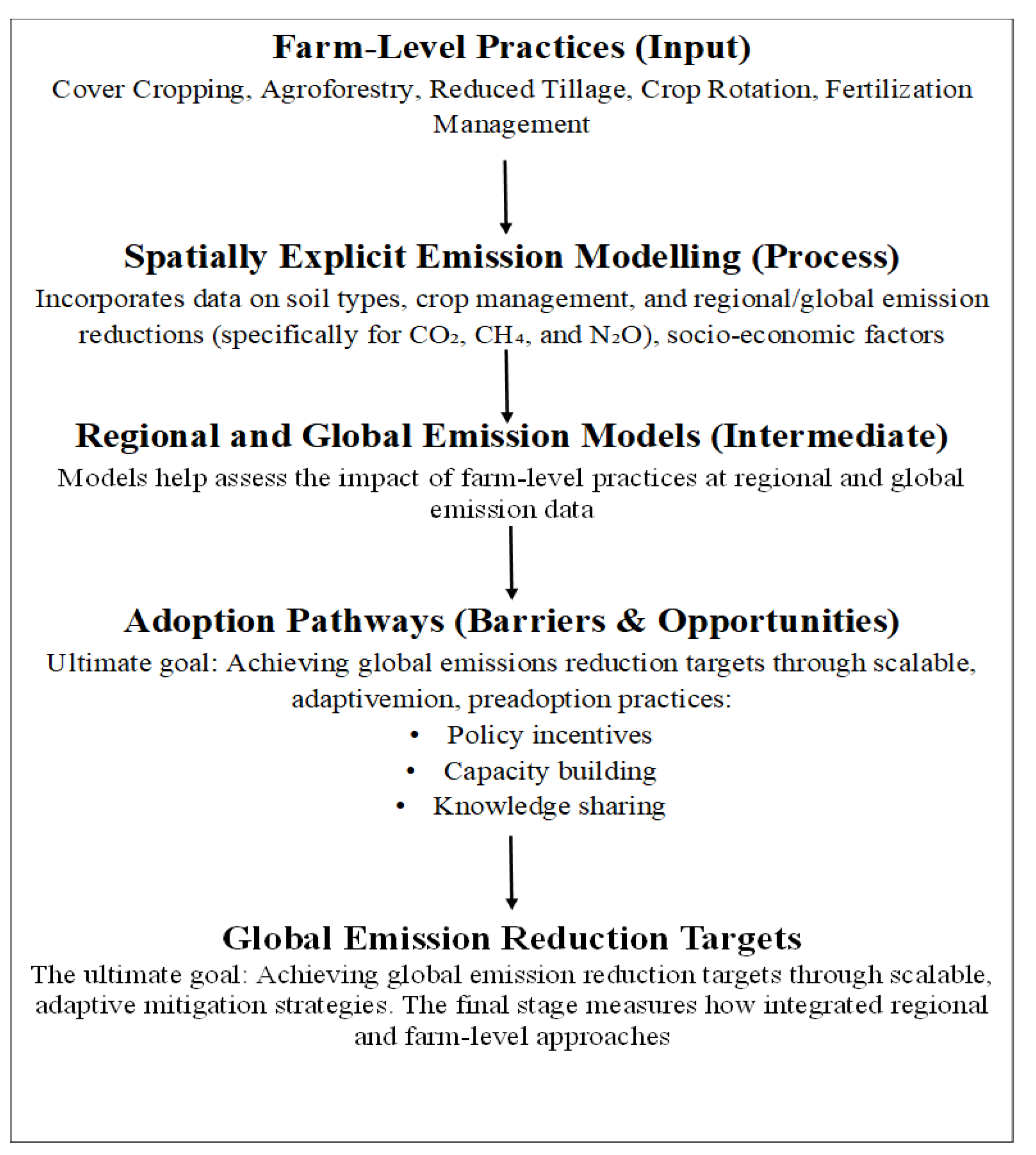
Figure 2.
Thematic categorization of GHG mitigation strategies in agricultural crop systems (soil-based, crop-based, nutrient management, integrated systems, and policy measures).
Figure 2.
Thematic categorization of GHG mitigation strategies in agricultural crop systems (soil-based, crop-based, nutrient management, integrated systems, and policy measures).
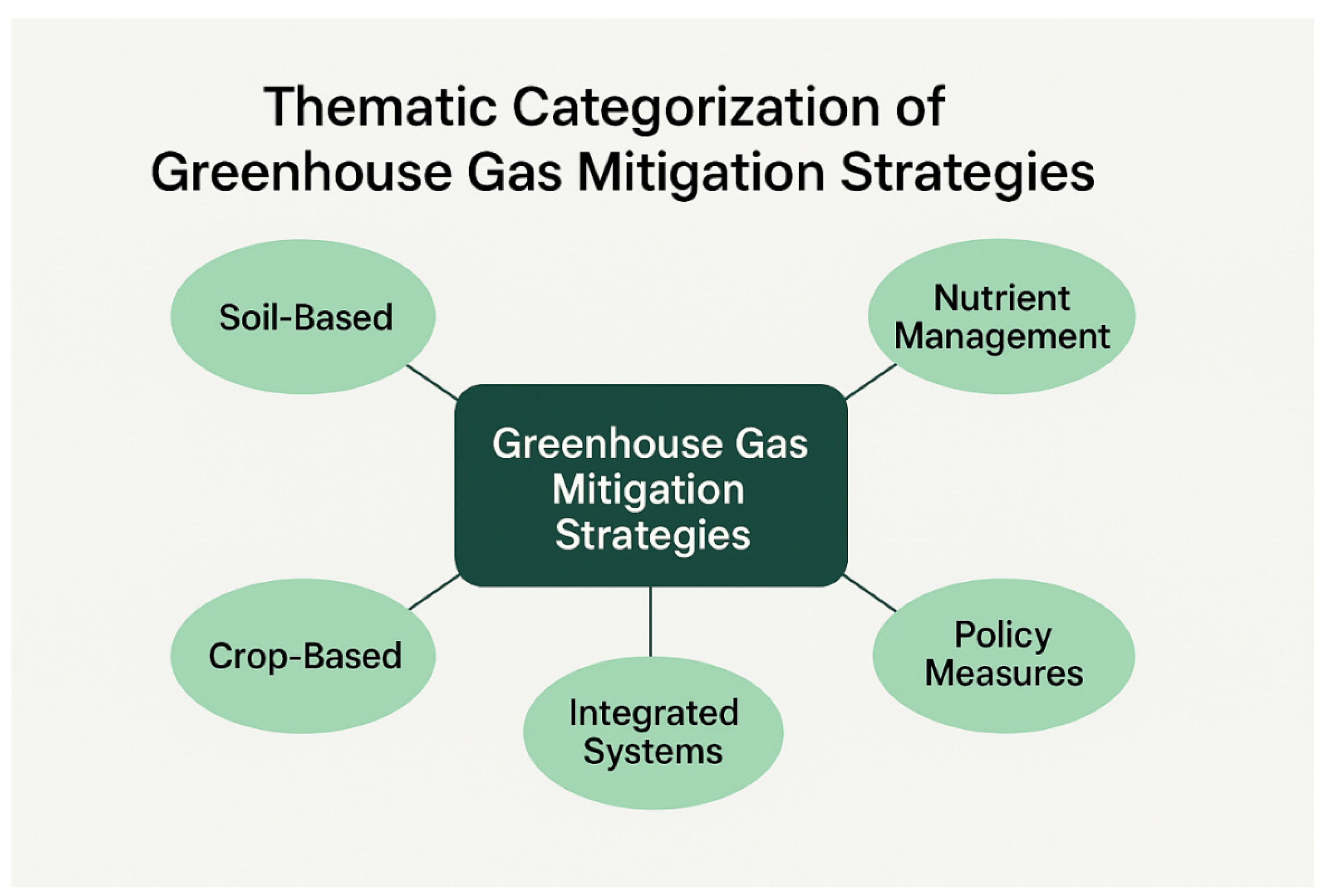
Figure 3.
Global Disparities in Greenhouse Gas Emissions in the Agriculture Sector Across 93 Countries as a Group. Club 1: Belize, Bolivia (Plurinational State of), Botswana, Bulgaria, Burkina Faso, Burundi, Congo, Cuba, El Salvador, Fiji, Gambia, Iraq, Kenya, Lesotho, Malawi, Mali, Mauritania, Mongolia, Namibia, Nicaragua, Pakistan, Senegal, Sierra Leone, Singapore, Togo, Trinidad and Tobago, Uganda, Zambia, Zimbabwe. Club 2: Argentina, Australia, Bangladesh, Benin, Bhutan, Brazil, Cameroon, Colombia, Cyprus, Denmark, Dominican Republic, Eswatini, France, Gabon, Guatemala, Guyana, Honduras, India, Indonesia, Mexico, Mozambique, Nepal, New Zealand, Panama, Peru, Philip-pines, Rwanda, Saint Lucia, South Africa, Thailand, Tonga. Club 3: Austria, Chile, China, Comoros, Costa Rica, Dominica, Ecuador, Egypt, Finland, Grenada, Iran (Islamic Republic of), Jamaica, Jordan, Kiribati, Malaysia, Mauritius, Morocco, Netherlands, Norway, Republic of Korea, Saint Kitts and Nevis, Saudi Arabia, Sri Lanka, Suriname, Sweden, Tunisia, Turkey. Club 4: Cabo Verde, Nigeria, Saint Vincent and the Grenadines. Club 5: Seychelles, Switzerland. Group: Paraguay.
Figure 3.
Global Disparities in Greenhouse Gas Emissions in the Agriculture Sector Across 93 Countries as a Group. Club 1: Belize, Bolivia (Plurinational State of), Botswana, Bulgaria, Burkina Faso, Burundi, Congo, Cuba, El Salvador, Fiji, Gambia, Iraq, Kenya, Lesotho, Malawi, Mali, Mauritania, Mongolia, Namibia, Nicaragua, Pakistan, Senegal, Sierra Leone, Singapore, Togo, Trinidad and Tobago, Uganda, Zambia, Zimbabwe. Club 2: Argentina, Australia, Bangladesh, Benin, Bhutan, Brazil, Cameroon, Colombia, Cyprus, Denmark, Dominican Republic, Eswatini, France, Gabon, Guatemala, Guyana, Honduras, India, Indonesia, Mexico, Mozambique, Nepal, New Zealand, Panama, Peru, Philip-pines, Rwanda, Saint Lucia, South Africa, Thailand, Tonga. Club 3: Austria, Chile, China, Comoros, Costa Rica, Dominica, Ecuador, Egypt, Finland, Grenada, Iran (Islamic Republic of), Jamaica, Jordan, Kiribati, Malaysia, Mauritius, Morocco, Netherlands, Norway, Republic of Korea, Saint Kitts and Nevis, Saudi Arabia, Sri Lanka, Suriname, Sweden, Tunisia, Turkey. Club 4: Cabo Verde, Nigeria, Saint Vincent and the Grenadines. Club 5: Seychelles, Switzerland. Group: Paraguay.

Figure 4.
Heatmaps illustrate total greenhouse gas emissions (in kilotons) in agriculture sector from 1990 to 2020 for countries within five distinct regional clubs: Club 1 (a), Club 2 (b), Club 3 (c), Club 4 (d), Club 5 (e), and a separate Paraguay group (f). Each heatmap shows the total emissions for each country within a specific club, with a colour gradient ranging from light yellow (low emissions) to dark red (high emissions), enabling a visual comparison of emissions across the different regions.
Figure 4.
Heatmaps illustrate total greenhouse gas emissions (in kilotons) in agriculture sector from 1990 to 2020 for countries within five distinct regional clubs: Club 1 (a), Club 2 (b), Club 3 (c), Club 4 (d), Club 5 (e), and a separate Paraguay group (f). Each heatmap shows the total emissions for each country within a specific club, with a colour gradient ranging from light yellow (low emissions) to dark red (high emissions), enabling a visual comparison of emissions across the different regions.
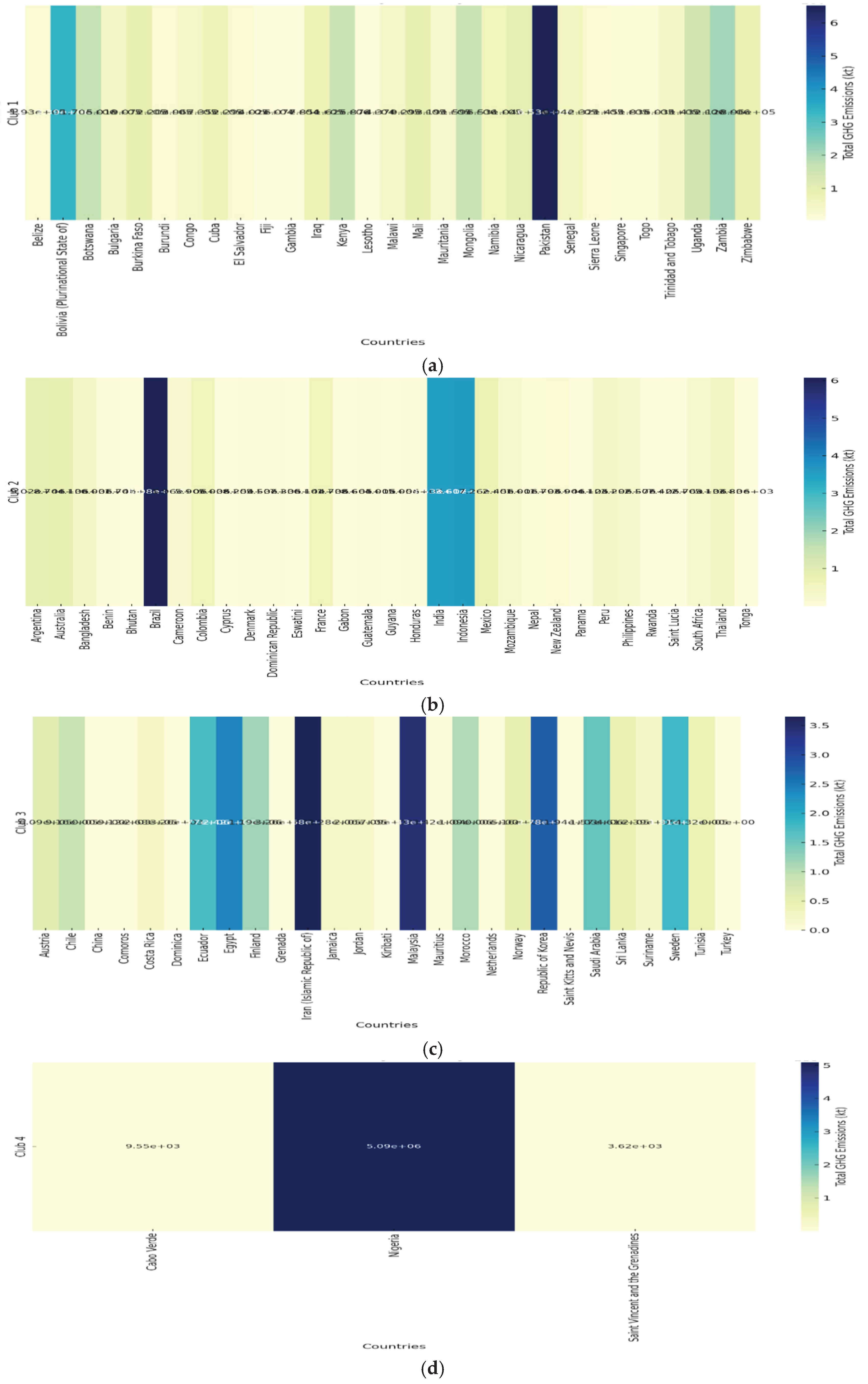
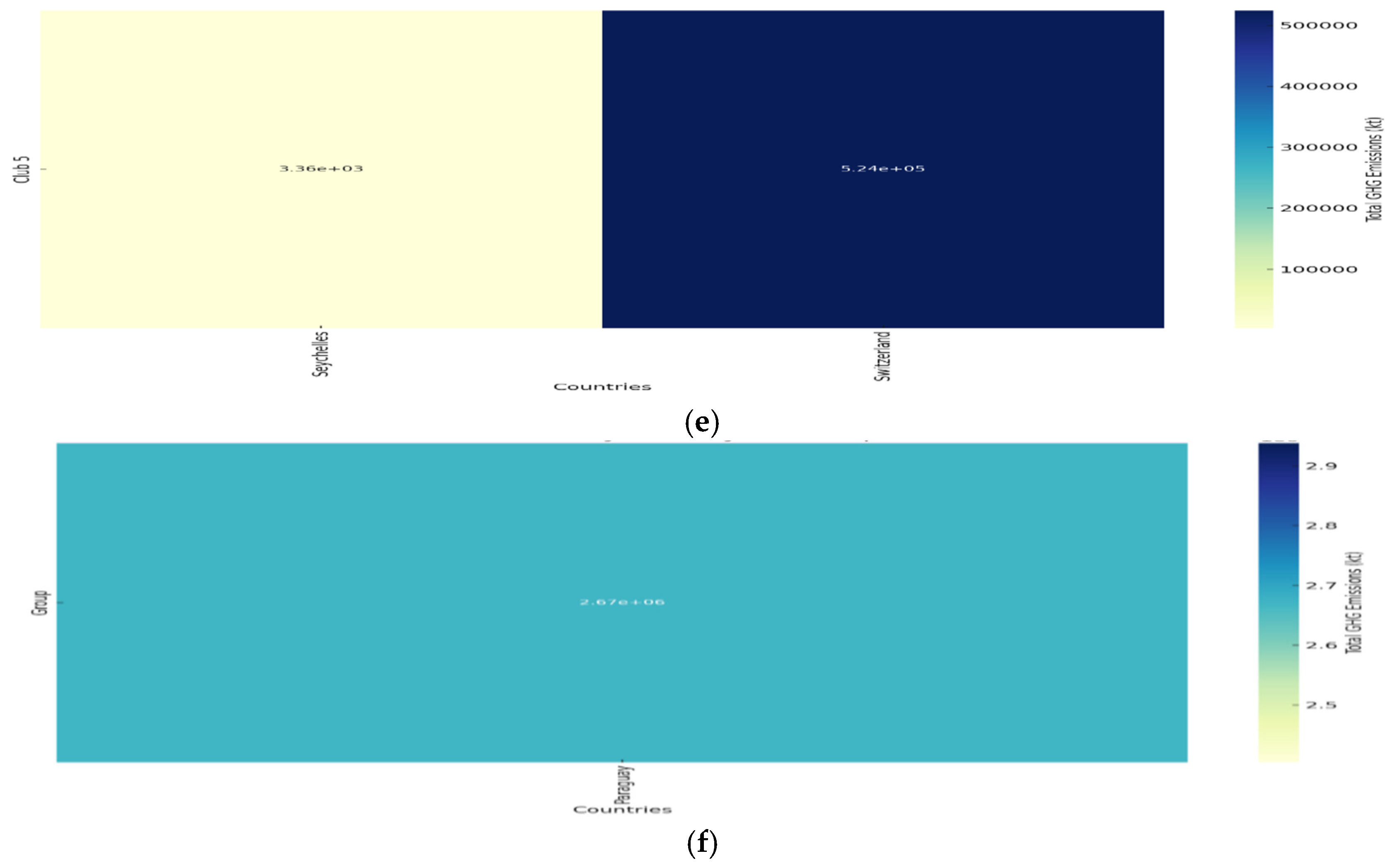
Figure 5.
Mechanism distribution comparison reveals opposing pathways driving divergent N2O outcomes. (a) Biochar: Five reduction-focused mechanisms nitrogen immobilization (30%), complete denitrification enhancement (30%), physical modification (17.5%), pH modification (12.5%), and microbial shifts (10%) produce consistent 18-54% N2O reductions [91,92,94]. (b) No-till: Four production-enhancing mechanisms enhanced denitrification via moisture (47.5%), substrate accumulation (22.5%), compaction (17.5%), and variable nitrification (12.5%) produce variable outcomes from -19% to +70% (Mei et al., 2018; Van Kessel et al., 2020; Xue et al., 2023)[87,90,95]. Mechanism direction explains consistency: biochar promotes N2O→N2 conversion; no-till creates anaerobic conditions favoring N2O production. This fundamental difference accounts for biochar's superior reliability for N2O mitigation in temperate agricultural systems.
Figure 5.
Mechanism distribution comparison reveals opposing pathways driving divergent N2O outcomes. (a) Biochar: Five reduction-focused mechanisms nitrogen immobilization (30%), complete denitrification enhancement (30%), physical modification (17.5%), pH modification (12.5%), and microbial shifts (10%) produce consistent 18-54% N2O reductions [91,92,94]. (b) No-till: Four production-enhancing mechanisms enhanced denitrification via moisture (47.5%), substrate accumulation (22.5%), compaction (17.5%), and variable nitrification (12.5%) produce variable outcomes from -19% to +70% (Mei et al., 2018; Van Kessel et al., 2020; Xue et al., 2023)[87,90,95]. Mechanism direction explains consistency: biochar promotes N2O→N2 conversion; no-till creates anaerobic conditions favoring N2O production. This fundamental difference accounts for biochar's superior reliability for N2O mitigation in temperate agricultural systems.
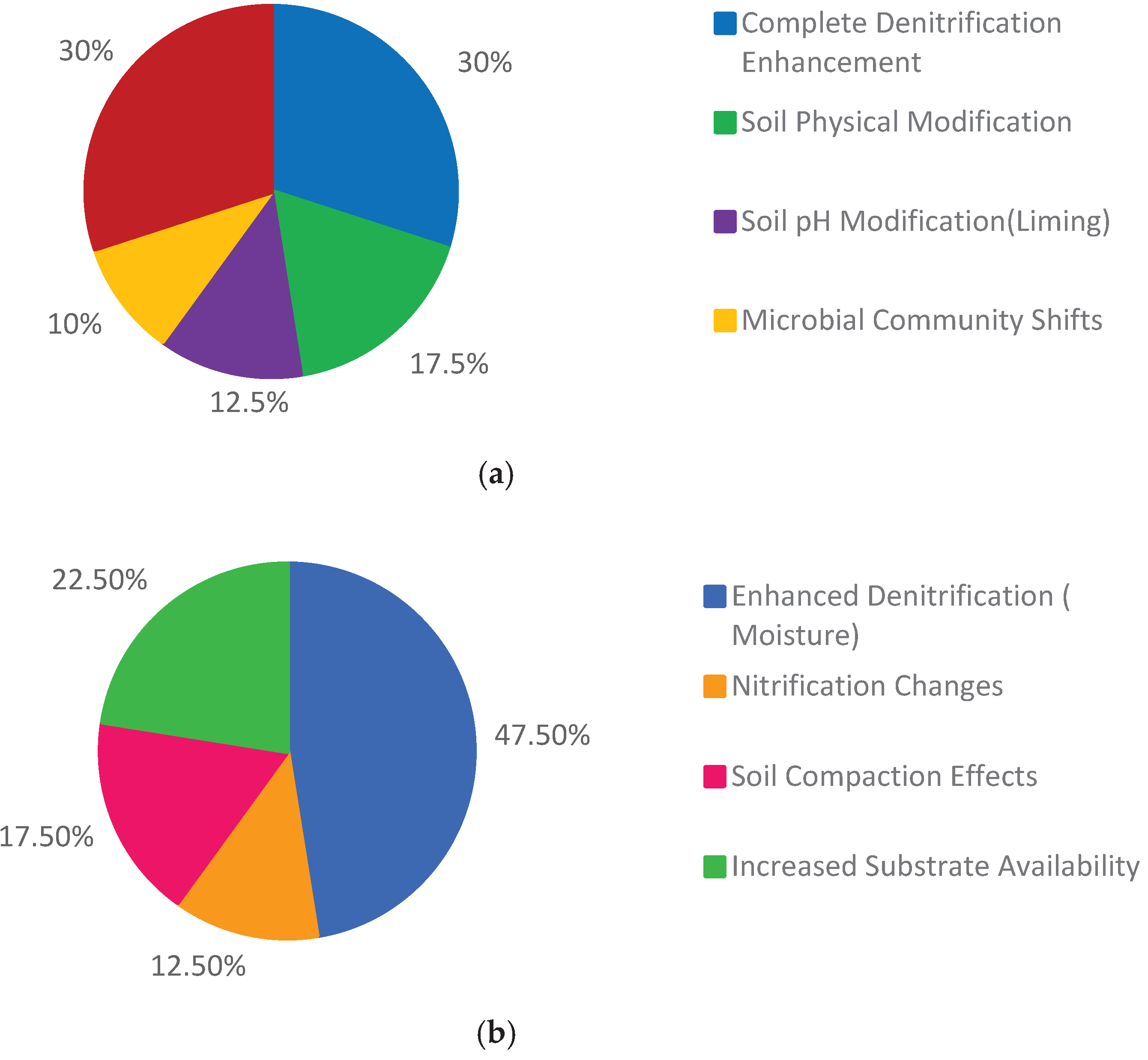

Table 1.
Summarizes the main research gaps.
| Ref. No. | Focus Area | Key Findings | Research Gaps |
|---|---|---|---|
| Ullah, Farooque [20] | Biochar production and soil GHG mitigation | Biochar reduces GHG emissions, improves soil carbon storage and microbial activity | Long-term field trials, co-analysis of biochar aging, better tracking of carbon storage and CO₂ sources |
| Zhu and Miller [21] | Tomato production life cycle assessment (LCA studies) | Median emissions vary widely across open-field, Climate-Uncontrolled Protected Environments (CUPE), and climate-controlled protected environments (CCPE) systems | Lack of standardized boundaries in (LCA), limited decarbonization strategies validated in practice |
| Lucić, Raposo [22] | Soybean production | Harmonized Life Cycle Inventories (LCIs) reveal variability across regions and systems | Insufficient residue management data, limited fertilizer/irrigation detail, weak global representativity |
| Yuan, Lian [23] | Constructed wetlands | Plant choice and management strongly influence GHG outcomes | Need for emission reduction strategies tied to plant diversity/harvesting, more ecosystem-level assessments |
| Kabato, Getnet [3] | Climate-smart agriculture | Integrated climate-smart agriculture (CSA) practices improve soil health and reduce GHG emissions | Site-specific optimization missing, socio-economic and adoption barriers underexplored |
| Symeon, Akamati [24] | Manure management in livestock systems | Composting, anaerobic digestion, and storage improvements reduce emissions | Limited evidence in non-ruminant species, policy and incentive support underdeveloped |
| Kang, Hwang [25] | Chicken meat production (LCA) | Feed production is the largest emission contributor | More data on local feed alternatives, integration of manure management with production systems |
| Holzknecht, Land [26] | Cropland-to-grassland conversion in peat soils | Mixed results on CO₂, CH₄, and N₂O changes | Uncertain long-term impacts, insufficient clarity on soil type and fertilizer use effects |
| Kukah, Jin [27] | Carbon trading and emissions reduction | Supports emission cuts via low-carbon technologies and offsets | Limited agricultural sector focus, need for integration with farm-level practices |
| Cai, Zhang [28] | Recoupled crop-livestock systems in China | Potential 40% emission reduction through system integration | Regional scalability uncertain, lack of long-term adoption studies, limited socio-economic analysis |
Table 2.
Sources and Trends of Greenhouse Gas Emissions in Agriculture.
| Study | Greenhouse Gas Contribution | Key Drivers | Regional / System Notes |
|---|---|---|---|
| Wei, Dong [66] | CO₂, CH₄, N₂O | Developed vs. developing country emissions | Highlights disparities in contributions to climate change |
| Biswas, Chakma [67] | CH₄, N₂O | Agricultural soils and global warming potentials | Case study on emission patterns from Indian soils |
| Mateo-Sagasta, Zadeh [68] | CO₂, N₂O | Fertilizer runoff, water pollution | Links water pollution and agricultural emissions globally |
| van Loon, Hijbeek [69] | CH₄, N₂O | Intensification and cereal cropping | Sub-Saharan Africa identified as emission hotspot |
| Gerten, Heck [70] | CO₂, CH₄ | Cropland expansion, planetary boundaries | Food production scenarios and sustainability trade-offs |
| Kim, Grieco [71] | N₂O, CH₄ | Smallholder farming challenges | Focus on mitigation opportunities in Sub-Saharan Africa |
| Mukwada, Taylor [73] | Mixed (CO₂, CH₄, N₂O) | Climate variability and food insecurity | Case study from Lesotho, showing regional disparities |
| Mehmood, Wang [74] | CO₂, CH₄ | Irrigation management, soil processes | Winter wheat systems in North China Plain |
| El-Hawwary, Brenzinger [75] | CO₂, CH₄, N₂O | Abandonment of agriculture, soil processes | Highlights post-agriculture emission risks |
| Srivastava and Maity [76] | Mixed (CO₂, CH₄, N₂O) | Climate change adaptation, artificial intelligence and machine learning (AI–ML) tools | Stresses monitoring gaps and future opportunities |
Table 3.
Recommended management strategies for N2O mitigation in temperate agricultural regions.
| Strategy | Mean N2O Reduction (%) | Meta-Analysis Details | 95% Confidence Interval | Study |
|---|---|---|---|---|
| Biochar Alone (20 Mg ha⁻¹) | 16.2% | n = 119 observations, 18 studies | 9.8 - 22.6% (estimated) | [86] |
| Biochar + Fertilizer | 38.8% | n = 250+ observations, pooled from 18 meta-analyses | Highly variable | [88] |
| Biochar (Field Studies Only) | 18% | n = 33 field studies (27 Asia, 5 North America, 1 Europe) | -10% to +35% | [89] |
| No-Till/Reduced Tillage | 11% | n = 212 observations, 40 publications | -19% to +1% | [87] |
| Conservation Tillage | -17.8% (Increase) | n = 212 observations, 40 publications | Temperate moderate; Tropical +70.1% | [90] |
Table 4.
Evaluation of Crop and Soil Management Practices.
| Study | Focus Area | Key Findings | Limitations / Challenges |
|---|---|---|---|
| Al Amosh and Khatib [77] | Conservation practices | Environmental innovations reduce carbon emissions | Context limited to healthcare sector, transferability to agriculture debated |
| Nungula, Chappa [78] | Agroforestry systems | Provides ecosystem services, improves soil carbon, biodiversity | Requires long-term investment and land-use planning |
| Ullah, Malekian [79] | Biochar application | Enhances soil structure, microbial activity, and reduces CH₄/N₂O | Feasibility depends on cost, production scalability |
| Setyanto, Pramono [106] | Irrigation practices (AWD in rice) | Reduced CH₄ emissions without yield loss | Adoption limited by water management infrastructure |
| Sharna, Anik [107] | Adoption drivers | Social, institutional, and environmental factors shape soil management practices | Adoption uneven, influenced by local context |
| Lagacherie, Alvaro-Fuentes [108] | Soil resource management | Mitigation strategies proposed for Mediterranean soils | Region-specific insights, not widely generalizable |
| Somasundaram, Sinha [109] | No-till farming | Improved soil carbon in temperate systems | Benefits inconsistent in tropical conditions |
| Durga, Schmitter [110] | Irrigation barriers | Identifies socio-economic challenges in technology uptake | High cost and lack of farmer awareness |
| Hocherman, Trop [111] | Governance timelines | Reviews time lags in environmental policy outcomes | Limited focus on agricultural-specific governance |
| Vicente-Vicente, Borderieux [112] | Agroecology scaling | Highlight’s role of knowledge-sharing and networks | Adoption dependent on community-level participation |
| Al-Musawi, Vona [103] | Crop rotation | Highlights benefits of crop rotation and discusses how crop rotation mitigates greenhouse gas emissions | focused on mainly temperate regions such as Europe and North America Adoption and outcomes among smallholder and subsistence farmers are limited |
Table 5.
Nitrous Oxide Mitigation through Nutrient Management.
| Study | Focus Area | Key Findings | Limitations / Challenges |
|---|---|---|---|
| Pandit, Adhikari [113] | 4R Nutrient Stewardship | Improved NUE, reduced maize yield gap, and higher profitability | Requires farmer training and monitoring systems |
| Getahun, Kefale [114] | Precision agriculture | Systematic review shows potential for sustainable production | Limited adoption in smallholder systems |
| Dirlik, Uğurlar [115] | Sensor-guided irrigation | Reduced water uses and improved efficiency in tomato production | High initial technology cost |
| Wang, Zhang [116] | Water-saving irrigation in rice | Lowered CH₄ and N₂O emissions, improved water efficiency | Dependent on irrigation infrastructure |
| Benson [117] | Fertilizer access in Malawi | Highlights regional disparities in affordability and access | Smallholders face affordability barriers |
| Tyagi, Ahmad [118] | Nitrogenous fertilizers | Discusses sustainability challenges and mitigation strategies | Enhanced fertilizers costly, long-term effects uncertain |
| Nemecek, Schnetzer [119] | Crop inventories | Provided harmonized GHG emission factors | Data gaps across cropping systems |
| Kamdi, Swain [120] | Field experiments in sorghum | Developed adaptation strategies for semi-arid tropics | Needs long-term validation across regions |
| Shah and Wu [121] | Soil and crop strategies | Ensured productivity and sustainability | Requires integration with policy support |
| Rowe, Withers [122] | Legacy phosphorus use | Proposed sustainable nutrient management strategies | Limited large-scale application evidence |
Table 6.
Socio-economic and Policy Dimensions of Adoption.
| Study | Focus Area | Key Findings | Limitations / Challenges |
|---|---|---|---|
| Mahapatra and Lenka [123] | Credit access | Identified barriers in agri-business financing | Limited rural credit availability restricts adoption |
| Tranchina, Reubens [124] | Agroforestry adoption | High upfront costs and risk perception reduce uptake | Adoption low despite proven benefits |
| Duffy, Toth [125] | Smallholder agroforestry | Contributes to food security and resilience | Lack of training and extension support |
| Shahbaz, Ul Haq [126] | Gender and CSA practices | Women’s involvement enhances adoption of climate-smart agriculture | Women face unequal access to resources and decisions |
| Mayr, Pokorny [127] | Payments for ecosystem services | Incentives can accelerate agroforestry adoption | Effectiveness depends on long-term monitoring |
| Zhelyazkova [128] | Policy transparency | Transparent enforcement supports adoption | Weak compliance undermines effectiveness |
| Olabanji and Chitakira [129] | CSA scaling in South Africa | Market and institutional frameworks drive adoption | Smallholders excluded from benefits in some contexts |
| Dinesh, Zougmore [130] | Science–policy engagement | Strengthens CSA adoption pathways | Requires multi-level collaboration |
| Baker, Nye [131] | Participatory agri-environment design | Aligns schemes with farmer needs and nature recovery | Implementation challenges persist |
Table 7.
Integrated Approaches and Future Pathways.
| Study | Focus Area | Key Findings | Limitations / Challenges |
|---|---|---|---|
| Srivastava [132] | Conservation tillage | Improved soil health and reduced GHG emissions | Benefits vary by soil and climate conditions |
| Swarnam, Velmurugan [133] | Crop–livestock integration | Reduced N₂O and CH₄ emissions, enhanced fertility | Requires resource availability and management capacity |
| Vidadala [134] | Regenerative agroforestry | Promotes climate-resilient landscapes | Long adoption timelines and land-use trade-offs |
| Karada, Khan [135] | Digital & AI tools | Internet of Things (IoT) and Artificial intelligence (AI) improve site-specific nutrient and water use | High cost and infrastructure needs |
| Udomkun, Rupngam [136] | Regenerative soil management | Novel scoring system for SOC and GHG monitoring | Limited regional validation |
| Musa and Ariff Lim [137] | Smart technologies | Systematic review shows climate mitigation potential | Requires socio-economic feasibility studies |
| Adegbite and Machethe [138] | Financial inclusion | Access to finance enhances adoption of CSA | Gender gaps persist in smallholder agriculture |
| Doukas, Nikas [139] | Policy integration | Stresses integrative approaches to Paris goals | Requires alignment of global and local policies |
| Schneider and La Hoz Theuer [140] | Carbon markets | Analyzed integrity of Paris mechanisms | Risk of inequitable benefit distribution |
| Paipa-Sanabria, González-Montoya [141] | Green technologies | Novel mitigation for air/water impact in shipping | Lessons need adaptation to agriculture context |
Disclaimer/Publisher’s Note: The statements, opinions and data contained in all publications are solely those of the individual author(s) and contributor(s) and not of MDPI and/or the editor(s). MDPI and/or the editor(s) disclaim responsibility for any injury to people or property resulting from any ideas, methods, instructions or products referred to in the content. |
© 2025 by the authors. Licensee MDPI, Basel, Switzerland. This article is an open access article distributed under the terms and conditions of the Creative Commons Attribution (CC BY) license (http://creativecommons.org/licenses/by/4.0/).
Copyright: This open access article is published under a Creative Commons CC BY 4.0 license, which permit the free download, distribution, and reuse, provided that the author and preprint are cited in any reuse.


