

Submitted:
02 September 2024
Posted:
05 September 2024
You are already at the latest version
Abstract
The present study aims at investigating the potential impact of agricultural policies on GHG emissions from agriculture across the European Union. The study begins with a brief analysis of the context of implementation of the 2014-2022 Common Agricultural Policy (CAP), within which many interventions were designed to improve sustainability and increase competitiveness. It follows a description of the structural changes the European agriculture is witnessing, that are both influenced and contribute influencing policies. The method of Qualitative Comparative Analysis (QCA) is used to investigate possible causalities and to cluster observations based on similar combinations of conditions (i.e., drivers) and outcomes (i.e., positive or negative variations in GHG emissions from agriculture between the end and the begin of the CAP programming period).
The results reveal that the increase in GHG emissions from agriculture over the study period is mainly attributable to the low share of agricultural land under management contracts targeting climate change mitigation and carbon sequestration through the CAP. CAP payments coupled with the production is found to contribute to further increasing GHG emission from agriculture in some eastern and northern EU countries. Livestock concentration, income support payments and the high price of agricultural land drive the increase in GHG emissions for other central and eastern EU countries. The paper concludes addressing existing shortcomings due to conflicting interventions in the current CAP Strategic Plans.
Keywords:
Qualitative Comparative Analysis
; Policy evaluation
; Climate mitigation
; Soil health
; Rural Development Programs
1. Introduction
Agriculture contributes to increasing global warming [1]. A few recent high-profile publications have in fact highlighted agricultural emissions [2] and how they can be reduced to meet international environmental commitments [3].
Intensification of crop and livestock production and unsustainable soil management have been identified as the main drivers of increasing CO2 emissions from agriculture. It is a fact that the agricultural intensification (e.g., growing the same crop year after year, deep tillage techniques, excessive use of chemical inputs) degrades soils [4] and increases the risk of diseases and pest outbreaks. This implies the use of larger amounts of fertilisers, pesticides and herbicides [5] [6], with direct impacts on GHG emissions [7] (Mazzoncini et al. 2015), in addition to pollution and biodiversity loss [8]. It is a fact that the increasing concentration of livestock in some regions exerts serious pressures on the environment, as is the increasing specialisation of farming systems [9], which is making crop diversification increasingly impractical.
However, agricultural systems have the potential not only to reduce GHG emissions, but also to reverse their impact on climate by implementing carbon removal practices, including crop diversification. Reversing the current decline in soil organic carbon not only mitigates climate change, but also makes soils more resilient to disturbances and extreme weather events. Such a reversal can be pursued in the direction of territorial reconfiguration of farming systems towards greater integration between agriculture and livestock.
Changes in agricultural GHG emissions reflect changes in cropping and livestock systems and production methods and these changes are likely to be influenced by various drivers, including policies.
The aim of this study is to investigate the changes in agricultural GHG emissions and their respective causes which have occurred during the 2014-2022 CAP programming period. To this end, we have used country-level observational data and performed a qualitative comparative analysis (QCA) in order to provide some empirical evidence to confirm or reject the study hypotheses.
After presenting and discussing the results in the light of the theoretical expectations, the paper concludes with some policy recommendations to address existing shortcomings in current Strategic CAP Plans, as well as highlighting the limitations of the approach used and some ideas for further research on the topic.
2. The trends of GHG emissions from agriculture
The national inventories of anthropogenic emissions by sources and removals by sinks are reported annually by MSs under the United Nations Framework Convention on Climate Change (UNFCCC) and the Reg. EU 525/2013. They also provide a reference for monitoring the achievement of GHG emission reduction targets at national and European level as set out in the EU regulatory framework, namely the Climate Action Regulation (CAR), also known as the Effort Sharing Regulation (Reg. EU 2018/842 as amended by Reg. EU 2023/857) for the reduction of GHG emissions by 2030, and the recent European Climate Law (Reg. EU 2021/1119) for the overall target of net zero GHG emissions by 2050.
In this context, GHG emissions from agriculture are estimated annually by national environment agencies by combining information on crop and livestock typologies, fertiliser management, crop residue management, livestock and manure management and other sources of agricultural GHG emissions1.
According to the European Environment Agency (EEA) [10], the EU has reduced its net GHG emissions by 31% compared to 1990. Energy supply and energy-intensive industries are the sectors that mostly contributed to this reduction,
As far as agriculture is concerned, GHG emissions from this sector represent about 10% of the total EU GHG emissions [10] [11], but agricultural GHG emissions at EU level changed very little between 2005 and 2021 (-3% compared to -20% between 1990 and 2005). In addition, there are large differences between MSs, with some even showing an increase in GHG emission from agriculture (Figure 1).
Specifically, emissions increased by more than 10% in Cyprus, Hungary, and Bulgaria, while they decreased by more than 10% in Greece [12], where however reductions would mainly be associated with a loss of competitiveness of farms (e.g. a reduction in the number of dairy cows).
Against this background, there has been much debate about whether the climate-friendly farming practices supported by the CAP have actually failed to deliver the desired results, at least in terms of climate change commitments to reduce GHG emissions [13] Some researchers have attributed this failure to the fact that the CAP, through its various reforms, has essentially continued to favour the intensification of EU farming systems [14] [15].
For example, the sudden decline of agricultural land in Europe in the early 90s is thought to be linked to the Mac Sharry CAP reform, considered the first real CAP reform since its inception2, which introduced payments linked to production (coupled payments) instead of price supports [16]. These coupled payments contributed to favouring the gradual abandonment of marginal agricultural land [17] and the concentration of agriculture in the most productive areas. Subsequently, the decoupling of subsidies from production and the introduction of area-based payments linked to compliance with certain environmental requirements (cross-compliance), introduced in 2003 with the Fischler CAP reform, contributed, together with other factors [18], to pushing up land prices [19], forcing small farmers out of business and discouraging new entrants [20]. This seems to have been particularly pronounced for some Mediterranean [21]and Eastern countries [22] that joined the EU between 2004 and 2007 [23].
In this context, it is most appropriate to assess whether and how the 2014-2022 CAP, i.e. the latest CAP programming period, has contributed to influencing existing trends in GHG emissions from European agriculture, and what its implications are for achieving the EU Priority of “Promoting resource efficiency and supporting the shift towards a low carbon and climate resilient economy in agriculture, food and forestry sectors, with a focus on the following areas: (…) (d) reducing greenhouse gas and ammonia emissions from agriculture; (e) fostering carbon conservation and sequestration in agriculture and forestry”3.
2. Data and methods
In what follows, we begin by describing the methodological approach we have taken to examine some of the conditions that are thought to influence the MSs’ GHG emissions, and then provide a description of the data we have used for the analysis and the indexing procedure we have followed.
3.1. The QCA Method
The QCA method allows identifying necessary and sufficient conditions (causes) for an outcome (effect) to occur [28]. A cause is commonly defined as necessary if it must be present for a certain outcome to occur. A cause is defined as sufficient if it can produce a certain outcome, but the outcome can occur even in the absence of the condition [24].
A combination of conditions can contribute influencing the outcome and its negation. There are three common Boolean operation in QCA: negation (the non-occurrence of the condition), logical AND (Boolean multiplication) and logical OR (Boolean addition). Here we use the following notations: ~ for negation, * for multiplication (the Boolean multiplication implies the presence of both conditions), + for addition (the Boolean addition implies the presence of one of the conditions).
Consistency and the coverage parameters of fit, ranging from 0 to 1, allow the existence of necessary and sufficient conditions for an outcome to occur to be verified.
Consistency is the degree to which the empirical evidence is in line with the statement of necessity or sufficiency. For necessity, imperfect consistency is determined when the condition is not present every time the outcome occurs. For sufficiency, imperfect consistency is determined when the outcome does not occur every time the condition is present.
Coverage is the empirical importance of results. For sufficiency, this is the share of the outcome covered by the condition (i.e., how much of the outcome is explained by the condition). For necessity, this is the empirical relevance trivialness of the condition for the outcome (i.e., how much of the negated outcome is explained by the condition).
As a rule of thumb, for the analysis of necessity, the Consistency score must exceed the threshold of 0.9 and the Coverage score the threshold of 0.6, while for the analysis of sufficiency, the Consistency scores must exceed 0.75 while no thresholds are set for Coverage [28].
The analysis of necessity is run on single conditions and, eventually, on the Boolean addition of conditions. Differently the analysis of sufficiency is run on the Boolean multiplication of conditions and, eventually, on their Boolean addition.
In QCA the analysis of sufficiency follows the analysis of necessity, and the analysis of the negated outcome follows the analysis of the outcome. The analysis of sufficiency allows obtaining different solutions which lie between two endpoints of possible results: the conservative solution and the parsimonious solution. The conservative solution is the solution that privileges complexity and is based on observed combinations of conditions. The parsimonious solution allows simplifying the complex solution by including logical reminders in the minimization process. The logical reminders are combination of conditions not observed in the group of the collected observation. An intermediate solution is obtained by avoiding the inclusion of implausible logical reminders and it allows highlighting relevant differences on causal relations. Logical reminders are implausible when they contradict the underlying expectations4.
It is worth noting that we have limited ourselves here to highlighting the general procedure we followed to run QCA, by providing the terminology and concepts we used to enable the interpretation of the results. For a more detailed description of the methodology used, we recommend reading [31] and [30]. The analysis followed for this study was carried out by using the QCA package of R developed by [32].
3.1. Definition of thresholds and directional expectations
Table 1 provides information on the indicators chosen to investigate the factors that should contribute to influencing changes in agricultural emissions and used to carry out the QCA. There are one outcome variable and ten conditions (Table 1). The outcome is the '2014-2022 change in GHG emissions', which is annually reported by MSs to the EEA (see section 2 for more details). The ten conditions take the form of structural changes, policy interventions or land market prices. Information on structural changes and land market prices is obtained from Eurostat, while information on policy interventions is obtained from Agridata and comes from the national reports on the implementation of the CAP, which are annually submitted by the MSs to the European Commission. The structural changes concern the 2014-2022 variation in the utilised agricultural area (UAA) and in the number of livestock units (LVK), as well as the variation in farms with a size larger than 100 ha UAA (LANDSP) and in the number of farms with livestock with a size larger than 300 LSU (LVKSP). These pieces of information make it possible to measure the physical growth of the agricultural sector and its concentration during the period considered.
The land market is only represented by the change in the average selling price of agricultural land between 2014 and 2022. Land prices are supposed to reflect the dynamics of the land market but are often a barrier to entry for small farmers (see section 2 for more details).
Finally, policy interventions are included here in the form of the CAP financial resources for 2014-2022 for income support (BASIC) and coupled payments (FUNDVCS) and the percentage of agricultural and forest land under management contracts contributing to the Focus Area 5E ( (LANDCSQ) and the Focus Area 5D (LANDGHG), which are expected to influence farming practices in different ways.
Focus areas 5D and 5E, as above mentioned, are respectively the specific priorities addressing the climate in the MS’ Rural Development Programs (RDP) for the programming period of the II Pillar of the CAP 2014-2022, i.e. the programs addressing the development of UE rural areas to be implemented by 2025. Within these policy instruments, Focus areas 5D includes most of the RDP agri-environment-climate measures aimed at reducing the use of inputs (e.g. conservation agriculture, organic farming), while Focus areas 5E mainly includes measures aimed at adapting to climate change and mitigating climate change (e.g. conversion of arable land to pasture and meadow, afforestation, pasture and forest management). Because of its importance in the CAP, we have chosen to include income support to farmers (the so-called “I Pillar” of the CAP”). To this end, we have considered here an additional binary variable, the Single Area Payment Scheme (SAPS), which allows to distinguish between those MS where income support is distributed to farmers through a limited number of entitlements (SAPS=0) and those MS where income support is proportional to the UAA (SAPS=1).
The thresholds shown in Table 1 have been defined according to a calibration procedure intended to minimize skewness (balanced distribution of observations between in and out, i.e. presence/absence of a condition) and to ensure robustness (no appreciable change in the results when the thresholds for individual conditions are slightly changed), except for the outcome and the structural conditions that deal with changes in their status, where the central threshold is necessarily set equal to zero to deal with no changes and the SAPS condition which is binary (see Annex A for further details).
Table 2 provides the directional expectation of the set of conditions for the GHG outcome. For instance, it is assumed that any increase in GHG emissions is primarily influenced by the dimensional growth of the agricultural sector, i.e., increase in the UAA and in the LSU, but also by: the lack of incentives influencing the adoption of sustainable practices, which affects the quality of the growth, the presence of perverse incentives, such as the coupled support, which incentivizes the concentration of the agricultural areas and livestock in the most productive regions [44], and the income support, which contributes to influencing land market causing land prices to rise, thus countering access to land by small farmers and further facilitating the transfer of land from small to large farms [19].
The inclusion of directional expectations in the analysis allows the identification of an intermediate solution, which is more complex than the parsimonious solution, but which allows the discrimination of cases that display conditions consistent and inconsistent with expectations.
3. Results and discussion
Following the QCA procedure described above, we have checked the existence of necessary and sufficient conditions for both the outcome and its negation. Necessary conditions only exist for the outcome GHG (Figure 2).
The existence of complex necessary conditions (combination of conditions) for the outcome GHG implies that more reasons can explain the increase in GHG emissions from agriculture over the period analysed here. Namely, the absence of land under management contracts to reduce emissions or increase carbon sequestration, ~LANDCSQ + ~LANDGHG, is necessary for the outcome GHG to occur (dots in the upper right quadrant of Figure 2). However, the same condition also holds for some MSs that show a reduction in GHG emissions (dots in the lower right quadrant of Figure 2). This explains why the condition ~LANDCSQ + ~LANDGHG is necessary for the outcome GHG to occur, since no increase in emissions is found when this condition is absent (with the sole exception of RO, a deviant case of consistency in kind, shown in the upper left quadrant of Figure 2).
Conversely, the absence of necessary conditions characterises the negated outcome, meaning that there are no necessary conditions supporting the reduction of GHG emissions (~GHG), at least with respect to the variables analysed here.
Note that the analysis of necessity involves the whole set of observations, since it requires the presence of the condition if the outcome is present (i.e. the result implies the presence of the condition), whereas the analysis of sufficiency can involve only part of the set of observations, since it requires the presence of the outcome if the condition is present (i.e. the result does not imply the presence of the condition, i.e. the result can be present even if the condition is not present). Thus, the analysis of sufficiency complements the analysis of necessity by allowing the clustering of observations for different combinations of conditions that are found to be sufficient for the outcome to occur.
Table 3 shows the results of the analysis of sufficiency for both GHG and its negation. Without loss of generality, we only provide the intermediate solution following the procedure described above, avoiding the inclusion of logical reminders that are inconsistent with the necessary conditions and with our expectations in the minimisation procedure.
The information provided in table 3 is complemented by the information provided in figure 3, which shows the cases that are not covered by the analysis of sufficiency (upper-left quadrant of Figure 3a and 3b) and the cases contradicting the statement of sufficiency (down-right quadrant of Figure 3a and 3b). For both the outcome GHG and its negation, there are no deviant cases (absence of observations in the lower right quadrant of Figure 3a and 3b), but the coverage is not perfect (presence of observations in the upper left quadrant of Figure 3a and 3b). The lack of coverage is especially evident for the negated outcome, meaning that some cases are not captured by the analysis, suggesting that for these cases other conditions than those analysed here can explain the reduction in emissions during the observation period.
From the analysis provided in figure 1, table 3 and figure 2, the following equations can be deducted for both the outcome and its negation:
The conditions provided in equation (1) are found to be necessary and sufficient for the outcome GHG to occur. Necessity is determined by ~LANDGHG + ~LANDCSQ, meaning that the outcome cannot occur in the absence of this condition, while sufficiency is determined by the combination of conditions in brackets, meaning that the presence of these conditions reveals the presence of the outcome.
Not surprisingly, table 3 shows that the low share of agricultural land under CAP management contracts for the 2014-2022 aimed at reducing emissions or at improving carbon sequestration helps to explain the actual increase in GHG emissions in most MSs. In any case, the combination of ~ LANDGHG and ~LANDCSQ turns out to be a necessary but not sufficient condition to explain the increase in GHG emissions. In fact, the analysis of sufficiency provides additional details that help to further disentangle the causes of the increase in GHG emissions.
Apparently, the increase in GHG emissions from agriculture which occurred in some MSs (SI and HR; LU and DK; FI; MT) over the study period is associated with the reduction of agricultural land under management contracts for climate change mitigation and the reduction of agricultural land (~SAPS*~LANDGHG*~LAND) The simple argument for this unexpected combination of conditions is that the increase in emissions associated with the low share of agricultural land under management contracts for climate change mitigation more than offsets the reduction in emissions associated with the loss of agricultural land. The latter in turn is mainly associated with land abandonment [13] and urban sprawl [33] [34] [35] [36], with urban sprawl being largely the main driver. However, to the best of our knowledge, this has not yet been sufficiently explored by researchers and remains an issue to be further explored, given the relevance of this phenomenon revealed by this study.
For another group of MSs (LU and DK; AT; IE), the increase in GHG emissions is associated with the combined effect of the increase in land prices, the high level of basic payments and the increase in the concentration of livestock farms (BASIC*LVKSP*LANDPRICE). Such a combination of conditions supports our expectations described in Section 2, which in turn are based on the theoretical insights of [18] and the evidence addressed by [37] in Europe and, most recently, by [38] in China. Namely, there is some evidence that income support payments help to influence the land market, with the value of the land increasing with the level of the payments. The increase in the value of the agricultural land hampers access to land by small farmers, thereby accelerating the process of concentration of both land and livestock. Finally, the process of concentration appears to be accompanied by the intensification of farming systems, with associated environmental consequences [39] [40].
However, the concentration of livestock farms seems to trigger an increase in GHG emissions from agriculture even if this is associated with a low effort to mitigate climate change and to a high effort to increase carbon sequestration (LVKSP*~LANDGHG*LANDCSQ). This relationship is found for a heterogeneous group of MSs (MT and CY, PT, DK, LV). At a first sight, this relationship sounds contradictory. Nevertheless, the increase in carbon sequestration practices in agriculture is not necessarily associated with a reduction in emissions. For example, trade-offs have been documented for tillage management [41], crop rotations [42] , and especially for the application of organic fertilisers [43]. This suggests that the concentration of livestock production poses the problem of animal waste management that might justify the disbursement of subsidies aimed at favouring the use of organic amendments and fertilizers for the MSs covered by this relationship.
For a final group of MSs (FI and SE; BG; PL), the increase in GHG emissions is associated with the combined effect of the reduction in the land under management contracts for carbon sequestration practices and the high share of funds for coupled payments and the low level of the basic payment (FUNDVCS*~BASIC*~LANDCSQ). There is some evidence that coupled payments encourage the intensification of farming systems, i.e., indirectly incentivise the use of inputs such as fertilisers and pesticides [44], and this would likely be further facilitated if they were not accompanied by other regulatory instruments and subsidies aimed to promote sustainable farming practices (as previously reported, the basic payment is provided in compliance with minimum conditionality requirements).
With respect to the conditions related to the reduction of GHG emissions, the performance scores show less consistent relationships compared to the conditions related to the increase of GHG emissions, which is reflected in the strength of the relationships between conditions and outcomes that can be considered sufficient but not necessary. This indicates that the phenomenon in question is not fully explained by the conditions analysed here. It appears that for a group of MSs (IT; UK; DE and BE) the reduction in GHG emissions over the period considered is associated with a combination of a high proportion of agricultural land under management contracts covering both climate change mitigation and carbon sequestration and the application of the BASIC instead of the SAPS, which was found to have no impact on land prices (~SAPS * LANDGHG * LANDCSQ).
For other MSs, the reduction in GHG emissions is associated with a high proportion of agricultural land under management contracts for climate change mitigation (DE; EE) and a high proportion of agricultural land under management contracts for carbon sequestration (FR; BE; LT), which may offset the possible perverse effects of basic payments on land prices and coupled payments on the intensification of farming systems.
Among the MSs not included in our analysis, it is worth mentioning ES, where the reduction in GHG emissions is attributed to the ambitious afforestation programme financed and implemented during the study period [27]. This seems to compensate for the lack of other subsidies aimed at sustainable agriculture and the increasing concentration of livestock farms. In addition to that, the conditions explored in our paper did not contribute to well explain the reduction in emissions recorded for EL for the period of investigation. Here we found only necessary conditions. The agricultural sector of EL faced important changes in recent years [46] but not in the period of investigation, suggesting that the recorded reduction in emission during this is attributed mainly to a further extensification of the cultivated land accompanied with important public subsidies. Among the MSs not included in our analysis, it is finally worth mentioning RO where the increasing GHG emissions is attribute to the important deforestation the country is facing in some area [47].
5. Conclusions
By and large, the analysis proposed in this study provides straightforward explanations for the increase in GHG emissions from agriculture during the 2014-2022 CAP programming period. Less obvious are the causes that might explain the reduction in emissions. In general, the increase in GHG emissions from agriculture is driven by a mix of perverse incentives (e.g. income support payments and voluntary coupled payments), i.e. incentives that have unintended/unwanted consequences (e.g. favouring the concentration and intensification of farming systems) and the absence of desired incentives (e.g. funds to promote climate change mitigation and carbon sequestration practices). On the other hand, the reduction of GHG emissions from agriculture is associated with the existence of a mix of desired incentives, sometimes capable to offset the perverse effects of other policy instruments. The existence of a relationship between policy instruments and environmental impacts seems to be particularly evident for those Member States that use a coherent mix of policy instruments, i.e. mainly aimed at increasing competition (BG, PL, FI and SE) or at increasing sustainability (IT, DE, UK, EE and LT). However, there are also cases where perverse incentives can hinder the impact of desired incentives (PT, DK, LT, CY and MT) and vice versa (FR, BE, LT). In addition to the above considerations, emissions were found to be increasing mainly in Eastern and Northern European MS (BG, PL, CZ, HR, SI, LV, FI, SE) and to decreasing in Central and Southern MS (FR, DE, IT, ES). However, it is worth noting that not all countries are equally responsible in their commitment to reduce emissions. This is reflected in the different environmental commitments that each EU MS must fulfil in order to comply with international climate agreements, which are addressed in the Effort Sharing Regulation (EU) 2018/842.
In any case, the analysis so far shows the lack of a comprehensive and coherent policy framework to ensure a more sustainable agriculture in the EU. The lack of a common vision, which is partly reflected in the different ways in which MSs design policy instruments and finance their agriculture may contribute to limiting the EU's ability to meet future environmental and climate change objectives.
The study presented in this paper is not completely exhaustive in addressing how the CAP has contributed to influencing the environmental impacts of the agricultural sector. This is mainly because we have not examined how Member States have designed their policy instruments, which are often only similar in appearance, as commitments for the same instruments may differ significantly between Member States, as addressed by [27]. Furthermore, the analysis carried out in this study provides only qualitative information, showing the existence of a relationship between conditions and outcomes, but not quantifying the influence of conditions on outcomes.
Most importantly, the results obtained through this formalized QCA analyses do not "prove" causal relations. Rather, they reveal patterns of associations across sets of observations, thereby providing support for the existence of such causal relations. Hence, whether it makes sense to interpret associations as causal relations depends on the insights derived from within-case analyses provided in the discussion, as well as existing empirical and theoretical knowledge of the phenomenon under investigation, provided in section 2.
Apart from that, he limited number of observations available for the study and the lack of information and policy evaluations at territorial level allows detecting very general causalities. Nevertheless, the causal relationship explored in this study are likely to persist in the 2023-2027 CAP programming period, as the same incentives will continue to be used, albeit with some variations (e.g., the introduction of agri-environmental schemes and crop rotation conditionality).
However, further research is needed to understand the circumstances that have led to some of these incentives having perverse effects and to explore how best to combine incentives to pursue different objectives, thereby minimising possible trade-offs and contributing to the development of future agricultural policies in the EU.
Author Contributions
Francesco Galioto conceived and wrote the manuscript. Francesca Varia revised and improved the original version. Giovanni Dara Guccione administered the project and supervised the activity. All authors contributed revising the original version. All authors have read and agreed to the published version of the manuscript.
Funding
This research was funded by European Joint Program for SOIL “Towards climate-smart sustainable management of agricultural soils” (EJP SOIL), grant number 862695.
Data Availability Statement
Data are available under request.
Acknowledgments
In this section, you can acknowledge any support given which is not covered by the author contribution or funding sections. This may include administrative and technical support, or donations in kind (e.g., materials used for experiments).
Conflicts of Interest
The authors declare no conflicts of interest.
Appendix A
Figure A1 provides information about the calibration on the variables listed in table 1. Calibration is a fundamental operation in Qualitative Comparative Analysis. It is a transformational process from the raw numerical data to set membership scores, based on a certain number of qualitative anchors or thresholds. The choice of the calibration thresholds should be theoretically informed and must be justified as it influence the results of the analysis.
Figure A1.
Calibration of the outcome and conditions.
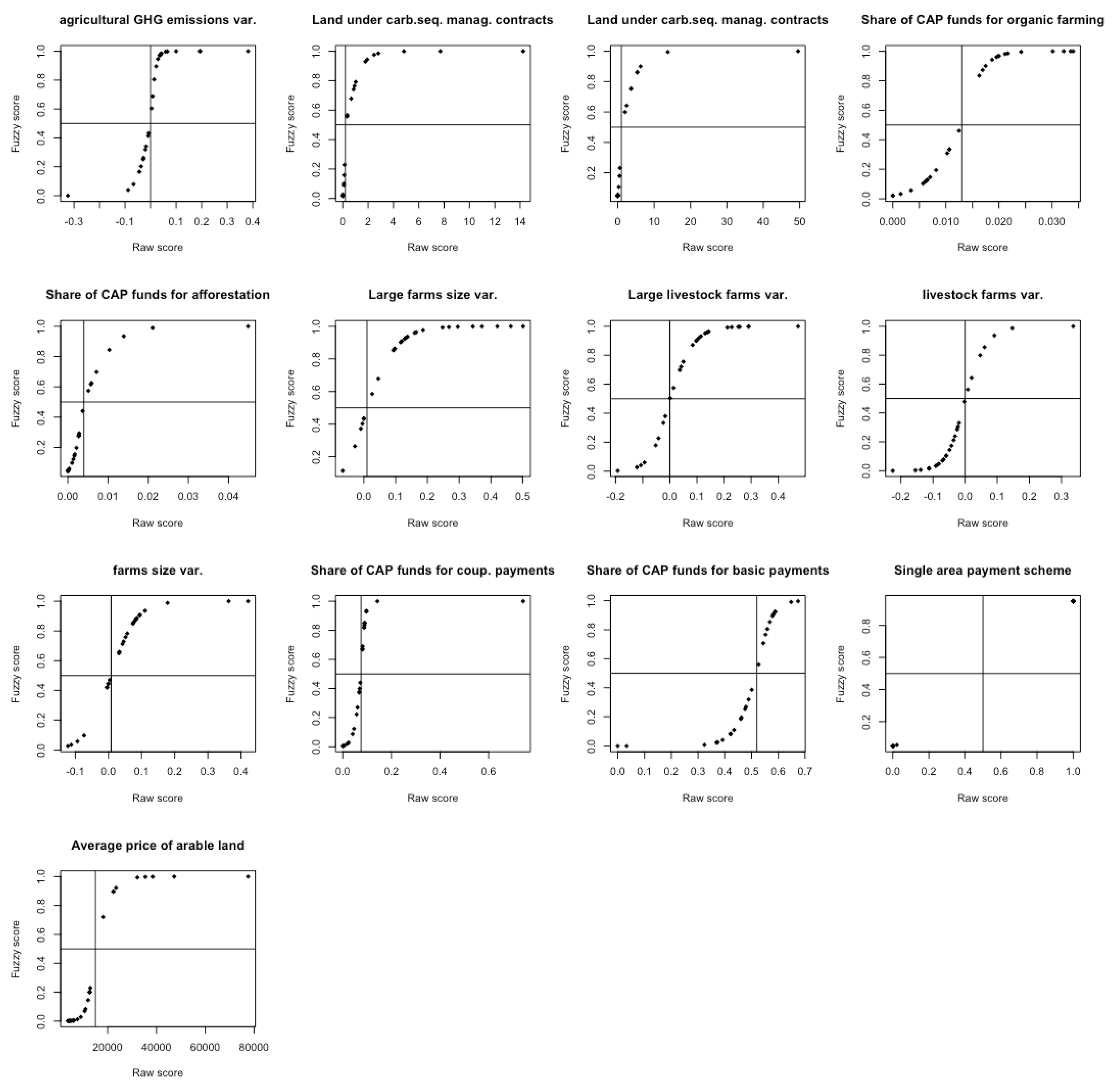
Note: on the y-axis we report the fuzzy scores used for the analysis and on the x axis the raw scores drawn from official data. The dotted lines are alternative threshold used to check for robustness.
The threshold was set at 0 for both the outcome and the structural conditions addressing a variation for the period of investigation, while median values were used to define thresholds for policy conditions and 0.5 for the binary SAPS condition. A certain arbitrariness can be identified in the selectin of median values for policy conditions. For these conditions we performed a robustness check consisting in running the same QCA procedure described in the main text but using alternative calibration thresholds. The outcome of the robustness check did not contradict the original one, but it was found being less robust, considering the higher skewness associated with the alternative calibration thresholds.
References
- Leahy, S.; Clark, H.; Reisinger, A. Challenges and Prospects for Agricultural Greenhouse Gas Mitigation Pathways Consistent with the Paris Agreement. Frontiers in Sustainable Food Systems 2020, 4, 69. [Google Scholar] [CrossRef]
- Poore, J.; Nemecek, T. Reducing Food’s Environmental Impacts through Producers and Consumers (Vol 363, Eaaw9908, 2019). Science 2019, 363, 939. [Google Scholar]
- Springmann, M.; Clark, M.; Mason-D’Croz, D.; Wiebe, K.; Bodirsky, B.L.; Lassaletta, L.; De Vries, W.; Vermeulen, S.J.; Herrero, M.; Carlson, K.M.; et al. Options for Keeping the Food System within Environmental Limits. Nature 2018, 562, 519–525. [Google Scholar] [CrossRef] [PubMed]
- Viguier, L.; Cavan, N.; Bockstaller, C.; Cadoux, S.; Corre-Hellou, G.; Dubois, S.; Duval, R.; Keichinger, O.; Toqué, C; de Cordoue, A.L.T.; Angevin, F. Combining Diversification Practices to Enhance the Sustainability of Conventional Cropping Systems. European Journal of Agronomy 2021, 127. [Google Scholar] [CrossRef]
- Trębicki, P.; Finlay, K. Pests and Diseases under Climate Change; Its Threat to Food Security. Food Security and Climate Change 2018, 229–249. [Google Scholar]
- Ukhurebor, K.E.; Aigbe, U.O.; Olayinka, A.S.; Nwankwo, W.; Emegha, J.O. Climatic Change and Pesticides Usage: A Brief Review of Their Implicative Relationship. Assumption University EJournal of Interdisciplinary Research 2020, 5, 44–49. [Google Scholar]
- Mazzoncini, M.; Antichi, D.; Tavarini, S.; Silvestri, N.; Lazzeri, L.; D’Avino, L. Effect of Defatted Oilseed Meals Applied as Organic Fertilizers on Vegetable Crop Production and Environmental Impact. Industrial Crops and Products 2015, 75, 54–64. [Google Scholar] [CrossRef]
- Sokos, C.K.; Mamolos, A.P.; Kalburtji, K.L.; Birtsas, P.K. Farming and Wildlife in Mediterranean Agroecosystems. Journal for Nature Conservation 2013, 21, 81–92. [Google Scholar] [CrossRef]
- Buckwell, A.; Nadeu, E. What Is the Safe Operating Space for EU Livestock; RISE Foundation: Brussels, Belgium, 2018; pp. 1–108. [Google Scholar]
- European Environment Agency. Trends and projections in Europe 2023. EEA Report 07//2023, Copenhagen, Denmark, 2023a. Available online: https://www.eea.europa.eu/publications/trends-and-projections-in-europe-2023.
- Mbow, Hans-Otto Pӧrtner, Andy Reisinger, Josep Canadell, and Phillip O’Brien.. “Special Report on Climate Change, Desertification, Land Degradation, Sustainable Land Management, Food Security, and Greenhouse Gas Fluxes in Terrestrial Ecosystems (SR2).” Ginevra, IPCC 650. 2017.
- European Environment Agency, 2023b. “EEA Greenhouse Gases — Data Viewer.” Retrieved August 28, 2023. Available online: https://www.eea.europa.eu/data-and-maps/data/data-viewers/greenhouse-gases-viewer (accessed on 1 May 2023).
- European Court of Auditors. 2021. Available online: https://op.europa.eu/webpub/eca/special-reports/cap-and-climate-16-2021/en/.
- Pe'er, G.; Bonn, A.; Bruelheide, H.; Dieker, P.; Eisenhauer, N.; Feindt, P.H.; Hagedorn, G.; Hansjürgens, B.; Herzon, I.; Lomba, Â.; Marquard, E. Action Needed for the EU Common Agricultural Policy to Address Sustainability Challenges. People and Nature 2020, 2, 305–316. [Google Scholar] [CrossRef]
- Stainforth, T.; Bowyer, C. Climate and Soil Policy Brief: Better Integrating Soil into EU Climate Policy. 2020. [Google Scholar]
- Frascarelli, A. L’evoluzione Della Pac e Le Imprese Agricole: Sessant’anni Di Adattamento. Agriregionieuropa 2017, 13, 1–7. [Google Scholar]
- Galioto, F.; Musotti, F. The Governance of Agricultural Lands in Marginal Areas: A Conceptual Framework. Ecological Economics 2023, 212, 107933. [Google Scholar] [CrossRef]
- Ciaian, P.; Baldoni, E.; Kancs, D.A.; Drabik, D. The Capitalization of Agricultural Subsidies into Land Prices. Annual Review of Resource Economics 2021, 13, 17–38. [Google Scholar] [CrossRef]
- Ciaian, P.; Kancs, D.; Swinnen, J.F.M. The Impact of the 2013 Reform of the Common Agricultural Policy on Land Capitalization in the European Union. Applied Economic Perspectives and Policy 2013, 36, 643–673. [Google Scholar] [CrossRef]
- Nyéléni Europe and Central Asia. 2021. Roots of Resilience : Land Policy for an Agroecological Transition in Europe.
- Spinelli, L.; Fanfani, R. L’evoluzione Delle Aziende Agricole Italiane Attraverso Cinquant’anni Di Censimenti (1961-2010). Agriregionieuropa 2012, 8, 6. [Google Scholar]
- Fiona, H. Fewer, Bigger, More Intensive: EU Vows to Stem Drastic Loss of Small Farms. The Guardian, 21 May 2021; 4. [Google Scholar]
- Michalek, J.; Ciaian, P.; Kancs, d. Capitalization of the Single Payment Scheme into Land Value: Generalized Propensity Score Evidence from the European Union. Land Economics 2014, 90, 260–289. [Google Scholar] [CrossRef]
- Ragin, C.C. The Comparative Method: Moving beyond Qualitative and Quantitative Strategies. JSTOR 1987. [Google Scholar]
- Arts, B.; De Koning, J. Community Forest Management: An Assessment and Explanation of Its Performance through QCA. World Development 2017, 96, 315–325. [Google Scholar] [CrossRef]
- Lankoski, J.; Thiem, A. Linkages between Agricultural Policies, Productivity and Environmental Sustainability. Ecological Economics 2020, 178, 106809. [Google Scholar] [CrossRef]
- Galioto, F.; Nino, P. Investigating the Reasons behind the Choice to Promote Crop Diversification Practices through the New CAP Reform in Europe. Land Use Policy 2023, 133, 106861. [Google Scholar] [CrossRef]
- Wagemann, C.; Schneider, C.Q. Notions and Operations in Set Theory. In Set-Theoretic Methods for the Social Sciences. A Guide to Qualitative Comparative Analysis; Cambridge University Press: New York, 2012; pp. 42–56. [Google Scholar]
- Aarebrot, F.H.; Bakka, P.H. Die Vergleichende Methode in Der Politikwissenschaft. In Vergleichende Politikwissenschaft; Springer, 2003; pp. 57–76. [Google Scholar]
- Schneider, C.Q.; Wagemann, C. Doing Justice to Logical Remainders in QCA: Moving beyond the Standard Analysis. Political Research Quarterly 2013, 66, 211. [Google Scholar]
- Ragin, C.C. Using Fuzzy Sets ( FsQCA ). Configurational Comparative Methods 2009, 87–121. [Google Scholar]
- Dusa, A. QCA with R: A Comprehensive Resource; Springer, 2018. [Google Scholar]
- Hatab, A.A.; Cavinato, M.E.R.; Lindemer, A.; Lagerkvist, C.J. Urban Sprawl, Food Security and Agricultural Systems in Developing Countries: A Systematic Review of the Literature. Cities 2019, 94, 129–142. [Google Scholar] [CrossRef]
- Gumma, M.K.; Mohammad, I.; Nedumaran, S.; Whitbread, A.; Lagerkvist, C.J. Urban Sprawl and Adverse Impacts on Agricultural Land: A Case Study on Hyderabad, India. Remote Sensing 2017, 9, 1136. [Google Scholar] [CrossRef]
- Jiang, L.; Deng, X.; Seto, K.C. The Impact of Urban Expansion on Agricultural Land Use Intensity in China. Land Use Policy 2013, 35, 33–39. [Google Scholar] [CrossRef]
- Meyer, M.A.; Früh-Müller, A. Patterns and Drivers of Recent Agricultural Land-Use Change in Southern Germany. Land Use Policy 2020, 99, 104959. [Google Scholar] [CrossRef]
- Pe’er, G.; Dicks, L.V.; Visconti, P.; Arlettaz, R.; Báldi, A.; Benton, T.G.; Collins, S.; Dieterich, M.; Gregory, R.D.; Hartig, F.; Henle, K.; Hobson, P.R.; Kleijn, D.; Neumann, R.K.; Robijns, T.; Schmidt, J.; Shwartz, A.; Sutherland, W.J.; Turbé, A.; Wulf, F.; Scott, A.V. EU Agricultural Reform Fails on Biodiversity. Science 2014, 344, 1090–1092. [Google Scholar] [CrossRef]
- Lin, W.; Huang, J. Impacts of Agricultural Incentive Policies on Land Rental Prices: New Evidence from China. Food Policy 2021, 104, 102125. [Google Scholar] [CrossRef]
- EEA. 2023c. Loss of HNV Farmland Due to Agricultural Intensification per NUTS3. European Environmental Agency. Retrieved March 16, 2023. 2023. Available online: https://www.eea.europa.eu/data-and-maps/figures/loss-of-hnv-farmland-due-1.
- Schreinemachers, P.; Tipraqsa, P. Agricultural Pesticides and Land Use Intensification in High, Middle and Low Income Countries. Food Policy 2012, 37, 616–626. [Google Scholar] [CrossRef]
- Bhattacharyya, S.S.; Leite, F.F.G.D.; France, C.L.; Adekoya, A.O.; Ros, G.H.; de Vries, W.; Melchor-Martínez, E.M.; Iqbal, H.M.; Parra-Saldívar, R. Soil Carbon Sequestration, Greenhouse Gas Emissions, and Water Pollution under Different Tillage Practices. Science of the Total Environment 2022, 826, 154161. [Google Scholar] [CrossRef]
- Gu, J.; Yuan, M.; Liu, J.; Hao, Y.; Zhou, Y.; Qu, D.; Yang, X. Trade-off between Soil Organic Carbon Sequestration and Nitrous Oxide Emissions from Winter Wheat-Summer Maize Rotations: Implications of a 25-Year Fertilization Experiment in Northwestern China. Science of the Total Environment 2017, 595, 371–379. [Google Scholar] [CrossRef]
- Hijbeek, Renske, Marloes P. van Loon, and Martin K. van Ittersum. 2019. “Fertiliser Use and Soil Carbon Sequestration: Trade-Offs and Opportunities.” CCAFS Working Paper.
- Gohin, A. Assessing CAP Reform: Sensitivity of Modelling Decoupled Policies. Journal of Agricultural Economics 2006, 57, 415–440. [Google Scholar] [CrossRef]
- Vadell, E.; de-Miguel, S.; Pemán, J. Large-Scale Reforestation and Afforestation Policy in Spain: A Historical Review of Its Underlying Ecological, Socioeconomic and Political Dynamics. Land Use Policy 2016, 55, 37–48. [Google Scholar] [CrossRef]
- Dimopoulos, T.; Helfenstein, J.; Kreuzer, A.; Mohr, F.; Sentas, S.; Giannelis, R.; Kizos, T. Different responses to mega-trends in less favorable farming systems. Continuation and abandonment of farming land on the islands of Lesvos and Lemnos, Greece. Land Use Policy 2023, 124, 106435. [Google Scholar] [CrossRef]
- Dimopoulos, T.; Helfenstein, J.; Kreuzer, A.; Mohr, F.; Sentas, S.; Giannelis, R.; Kizos, T. Different responses to mega-trends in less favorable farming systems. Continuation and abandonment of farming land on the islands of Lesvos and Lemnos, Greece. Land Use Policy 2023, 124, 106435. [Google Scholar] [CrossRef]
| 1 | It is estimated [10] that almost 50% of the total GHG emissions in the
agriculture sector stems from livestock, with methane (CH4) released from
enteric fermentation. Emissions of nitrous oxide (N2O) from soil
associated with fertiliser application (31%), and the management of manure
(16%) are also significant in the primary sector. |
| 2 | From its inception in '57 to '92,
the CAP had adopted sectorial price policies which encourage farmers to
increase their production, resulting in a shift from deficiency to excess
production for many categories of agricultural products. Consequently, the EU had
to bear high costs to support prices in order to defend farmers’ incomes and
dispose of surpluses. |
| 3 | This refers to Priority 5 (specifically to Focus Area 5D
and Focus Area 5E) as defined in Article 5 of the Regulation EU 1305/2013 on
support for rural development by the European Agricultural Fund for Rural
Development (EAFRD). |
| 4 | In the present paper we partialy
rely on the enhanced standard analysis procedure developed by [30] to handle
logical reminders. This approach allows to avoid the use of
incoherent logical reminders: logical reminders contradicting the statement of
necessity, logical reminders contradicting expectations, and logical reminders
contradicting simplifying assumptions. The first element of incoherence implies
avoiding the inclusion of the negated necessary conditions on the logical
reminders used to simplify the solution, since the presence of a necessary
condition requires that the outcome cannot be observed in its absence. The
second element of incoherence implies avoiding the use of logical reminders
contradicting the underlying directional expectations for the minimization of
the outcome. The third element of incoherence implies avoiding the use of the
same reminders for the logical minimization of the outcome and its negation for
the analysis of sufficiency, since sufficiency implies that a condition cannot
be observed for both the outcome and the negated outcome. We consider this last
element of the enhanced standard analysis incorrect,
since logical reminders are unobserved combinations of conditions whose
exclusive role is to simplify the solution, allowing common combinations to be
identified among the observations considered in the analysis. Indeed,
simplifying the solution means excluding conditions for which relationships
cannot be determined, either because they are irrelevant or (most probably)
because there are not enough observations to capture their influence. For the
same reason, it does not make sense to initially limit the number of conditions
based on the number of observations. Rather, one must start from a deep
knowledge of the problem and use the conditions that can explain the phenomenon
under investigation, irrespective of the number of observations under analysis.
Variables excluded from the intermediate solution should not be considered as
uninfluential in a broad sense, but as irrelevant for the group of observations
studied. |
Figure 1.
Variation in GHG emissions from agriculture (2022-2014 % var) Source: our elaboration on Eurostat [12]. Notes: Since the entry into force of the Withdrawal Agreement which established the UK's exit from the EU (on 31 January 2020 at midnight CET), the UK must be considered as a third country. However, it has been included for the purposes of this research. CY – Cyprus; HU – Hungary; BG – Bulgaria; SL – Slovenia; SE – Sweden; IE – Ireland; CZ – Czech Republic; PL – Poland; LU – Luxemburg; DK – Denmark; HR – Croatia; FI – Finland; MT – Malta; RO – Romania; AT – Austria; LV – Latvia; PT – Portugal; BE – Belgium; NL – Netherlands; FR – France; EE – Estonia; ES – Spain; IT – Italy; UK – United Kingdom; DE – Germany; LT – Lithuania; SK – Slovakia; EL – Greece.
Figure 1.
Variation in GHG emissions from agriculture (2022-2014 % var) Source: our elaboration on Eurostat [12]. Notes: Since the entry into force of the Withdrawal Agreement which established the UK's exit from the EU (on 31 January 2020 at midnight CET), the UK must be considered as a third country. However, it has been included for the purposes of this research. CY – Cyprus; HU – Hungary; BG – Bulgaria; SL – Slovenia; SE – Sweden; IE – Ireland; CZ – Czech Republic; PL – Poland; LU – Luxemburg; DK – Denmark; HR – Croatia; FI – Finland; MT – Malta; RO – Romania; AT – Austria; LV – Latvia; PT – Portugal; BE – Belgium; NL – Netherlands; FR – France; EE – Estonia; ES – Spain; IT – Italy; UK – United Kingdom; DE – Germany; LT – Lithuania; SK – Slovakia; EL – Greece.
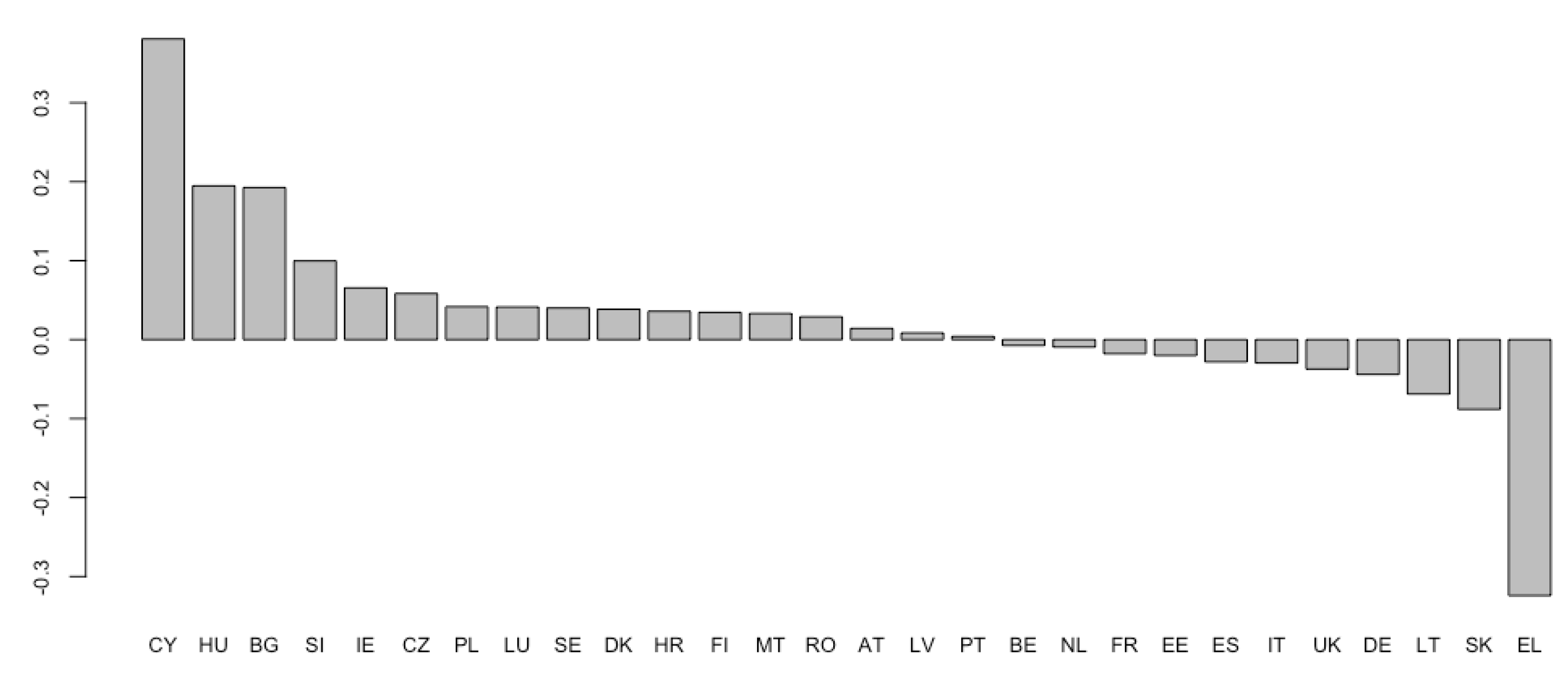
Figure 2.
Analysis of necessity. Notes: ~, negated outcome; +, set union. Performances indicators: Consistency – Presence of cases showing opposite outcomes; Coverage – Presence of cases not explained by the relation; Relevance of Necessity – Presence of the negated outcome when the condition is absent. Range of performance indicators: 0 (low performances) – 1 (high performances). Performances thresholds: Consistency, 0.900 (required); Coverage, 0.600; Relevance of necessity, 0.500.
Figure 2.
Analysis of necessity. Notes: ~, negated outcome; +, set union. Performances indicators: Consistency – Presence of cases showing opposite outcomes; Coverage – Presence of cases not explained by the relation; Relevance of Necessity – Presence of the negated outcome when the condition is absent. Range of performance indicators: 0 (low performances) – 1 (high performances). Performances thresholds: Consistency, 0.900 (required); Coverage, 0.600; Relevance of necessity, 0.500.
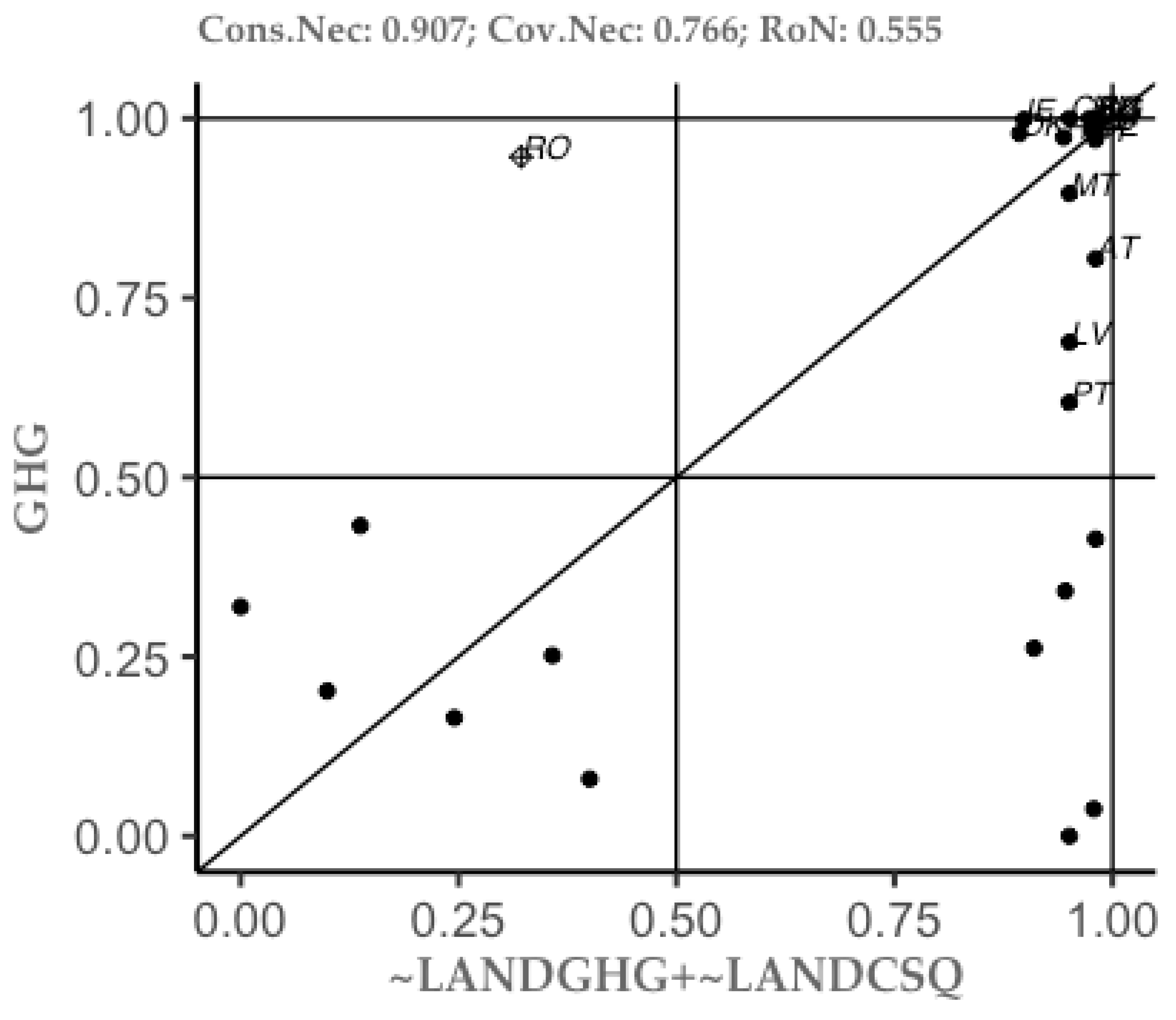
Figure 3.
Analysis of Sufficiency. Intermediate solutions for the outcome (GHG) and its negation (~GHG). Notes: Cases situated above the diagonal are consistent. In the upper left quadrant are deviant cases for coverage; in the lower right quadrant are deviant cases consistent in kind.
Figure 3.
Analysis of Sufficiency. Intermediate solutions for the outcome (GHG) and its negation (~GHG). Notes: Cases situated above the diagonal are consistent. In the upper left quadrant are deviant cases for coverage; in the lower right quadrant are deviant cases consistent in kind.
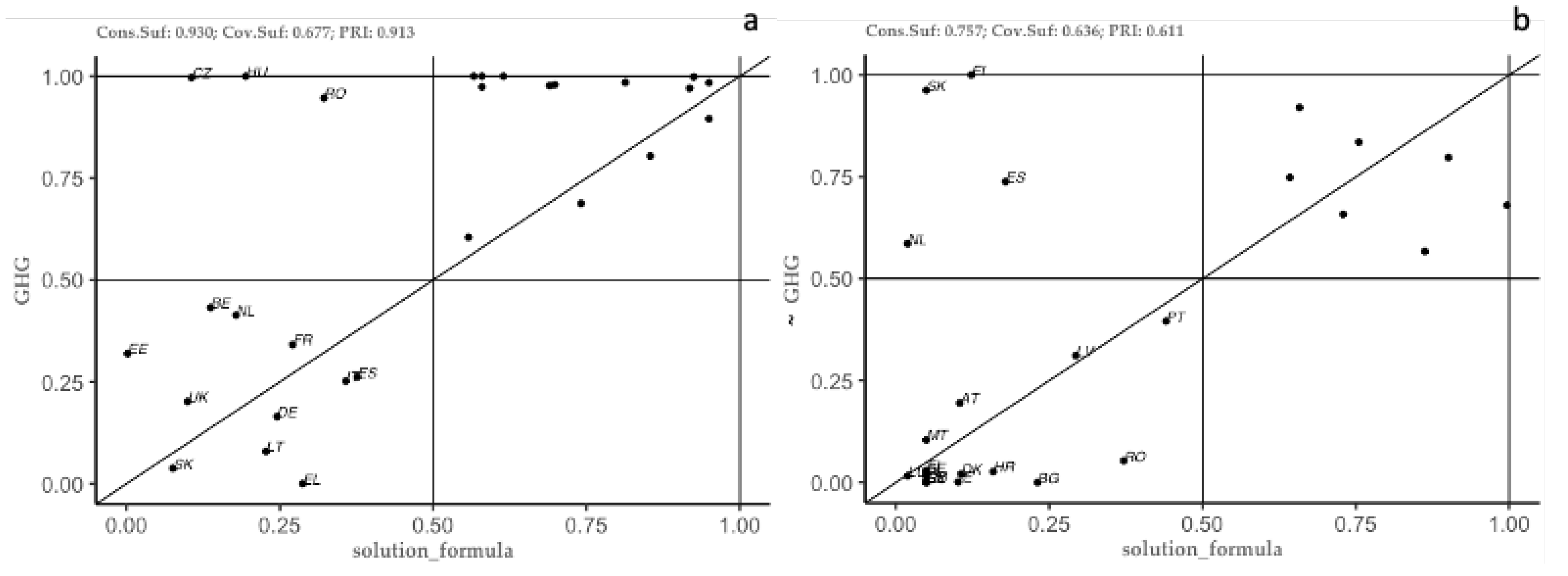

Table 1.
Measurement and calibration.
| Type of set | Set | Description | Calibration3 (set membership) | Source | |||
|---|---|---|---|---|---|---|---|
| Fully out | Neither in or out | Fully in | |||||
| 0.05 | 0.5 | 0.95 | |||||
| Outcome | GHG | 2022-2014 variation of GHG emissions from agriculture' (% var). | -0.080 | 0.000 | 0.030 | European Environment Agency. Data source: https://agridata.ec.europa.eu/ | |
| Conditions | Structural changes | LAND | 2022-2014 UAA variation of farms with a size larger than 100 ha (% var). | -0.100 | 0.008 | 0.120 | Eurostat. Data source: https://ec.europa.eu/eurostat/ |
| LVK | 2022-2014 size variation of livestock farms larger than 300 LSU2 (% var). | -0.080 | 0.000 | 0.100 | |||
| LANDSP | 2022-2014 UAA variation of farms with a size larger than 100 ha (% var). | -0.100 | 0.000 | 0.150 | |||
| LVKSP | 2022-2014 size variation of livestock farms larger than 300 LSU (% var). | -0.100 | 0.000 | 0.130 | |||
| Policy interventions | SAPS | Countries for which the Basic Payment Scheme (BPS) is based on the eligible hectares declared by farmers and where the level is the same for all hectares in the country (0-1). | 0.000 | 0.500 | 1.000 | Declarations of expenditure for the European Agricultural Fund for Rural Development. Data source: https://agridata.ec.europa.eu/ | |
| BASIC | Income support fund ratio on the total 2014-2022 CAP funding (%). | 0.400 | 0.520 | 0.600 | |||
| FUNDVCS | Funds ratio addressed to coupled payments on the total 2014-2022 CAP funding (%). | 0.032 | 0.075 | 0.100 | |||
| LANDCSQ | Percentage of agricultural and forest land under management contracts contributing to carbon sequestration, focus area 5E1 (% on the UAA). | 0.050 | 0.200 | 2.000 | Annual implementation reports of Rural Development programs. Data source: https://agridata.ec.europa.eu/ | ||
| LANDGHG | Percentage of agricultural land under management contracts targeting reduction of GHG and/or ammonia emissions, focus area 5D1 (% on the UAA). | 0,005 | 1.000 | 8.000 | |||
| Land market | LANDPRICE | 2022-2014 average sales prices of agricultural lands (euro/ha of UAA). | 10000 | 15000 | 25000 | Eurostat. Data source: https://ec.europa.eu/eurostat/ | |
Notes: 1 Focus areas 5E and 5D - The hectares of agricultural land and forestry area under management contracts targeting environmental and climate action within these Focus Areas are reported by MSs to the European Commission in the Annual Implementation reports (AIR) of Rural Development programmes. Physical investments to reduce emissions and subsidies to support for more environmentally friendly farming practices, among which Agri-environment-climate measures and organic farming are the key measures interventions addressing Focus Area 5D. Conversion of arable land to agroforestry, afforestation and forest management are the key measures addressing Focus Area 5E. 2 LSU – Livestock Standard Unit. 3 Calibration – all the conditions and the outcome are transformed into binary values using the percentile thresholds reported in the column headings associated to the real values provided inside the table.
Table 2.
Directional expectations for the outcome GHG.
| Description of the expectations | Logical reminders not used to simplify the solution | |
|---|---|---|
| The growth of the agricultural sector positively influences GHG emissions | ~LAND*~LVK | |
| Beneficial incentives addressing farming practices negatively influence GHG emissions | LANDCSQ*LANDGHG | |
| The SAPS coupled with a high level of basic payment leads to anincrease in land prices, limiting access to land for small holders and favouring land concentration, which has a positive influence on GHG emissions | ~LANDPRICE*~BASIC*~SAPS *~LANDSP*~LVKSP | |
| The coupled support favours the intensification of farming systems which has a positive influence on GHG emissions | ~FUNDVCS |
Notes: ~, negated outcome; *, set intersection.
Table 3.
Analysis of sufficiency. Raw performances scores of the intermediate solution.
| Outcome | Conditions | Cons.ncy | PRI | Raw coverage | Unique coverage | Cases |
| GHG | ~SAPS*~LANDGHG*~LAND | 0.932 | 0.912 | 0.327 | 0.041 | SI; HR; LU; DK; FI; MT |
| BASIC*LVKSP*LANDPRICE | 0.962 | 0.951 | 0.240 | 0.088 | LU; DK; AT; IE | |
| ~LANDGHG*LANDCSQ*LVKSP | 0.884 | 0.821 | 0.260 | 0.027 | PT; DK; MT; CY; LV | |
| FUNDVCS*~BASIC*~LANDCSQ | 0.955 | 0.939 | 0.315 | 0.014 | FI; SE; BG; PL | |
| Solution formula | 0.930 | 0.913 | 0.677 | |||
| ~GHG | ~SAPS*LANDGHG*LANDCSQ | 0.819 | 0.699 | 0.354 | 0.020 | IT; DE; UK; BE |
| BASIC*LANDGHG*~LANDPRICE | 0.623 | 0.408 | 0.203 | 0.009 | DE; EE | |
| FUNDVCS*~BASIC*LANDCSQ*LAND | 0.805 | 0.609 | 0.381 | 0.000 | FR; BE; LT | |
| Solution formula | 0.757 | 0.611 | 0.636 |
Notes: ~, negated outcome; *, set intersection. Cases separated by semicolons belong to different truth table rows. Performances indicators: Consistency – Presence of cases showing opposite outcomes; Proportional reduction in inconsistency (PRI) – Presence of cases showing opposite outcomes (additional to consistency); Coverage – Presence of cases not explained by the relation. Range of performance indicators: 0 (low performances) – 1 (high performances). Performances thresholds: Consistency, 0.750; PRI, 0.600.
Disclaimer/Publisher’s Note: The statements, opinions and data contained in all publications are solely those of the individual author(s) and contributor(s) and not of MDPI and/or the editor(s). MDPI and/or the editor(s) disclaim responsibility for any injury to people or property resulting from any ideas, methods, instructions or products referred to in the content. |
© 2024 by the authors. Licensee MDPI, Basel, Switzerland. This article is an open access article distributed under the terms and conditions of the Creative Commons Attribution (CC BY) license (http://creativecommons.org/licenses/by/4.0/).
Copyright: This open access article is published under a Creative Commons CC BY 4.0 license, which permit the free download, distribution, and reuse, provided that the author and preprint are cited in any reuse.


