

Submitted:
25 October 2025
Posted:
27 October 2025
You are already at the latest version
Abstract
The swine industry represents a significant contributor to global meat supply but also exerts considerable pressure on natural resources through feed production, greenhouse gas (GHG) emissions, and nutrient losses. The integration of food industry by-products into pig diets offers a promising pathway to mitigate these environmental impacts while maintaining productivity and animal welfare. Such by-products can serve as nutritionally valuable feed ingredients, reducing waste streams and supporting the principles of a circular economy. This review synthesizes current knowledge on the nutritional properties, environmental implications, and economic advantages of incorporating food industry by-products into pig feeding systems. It further outlines the challenges related to feed safety, variability in composition, and regulatory aspects. Overall, the sustainable valorization of food processing residues as animal feed represents a viable strategy to reduce the environmental footprint of pig production without compromising growth performance or health outcomes.
Keywords:
circular economy
; by-products
; environmental footprint
; sustainable development goals
; pigs
1. Introduction
The growing global demand for food—driven by population growth, longer life expectancy, and rising living standards—poses major challenges for sustainable agriculture. By 2050, food demand is projected to increase by up to 50%, intensifying pressure on agricultural systems to boost productivity while minimizing environmental impacts [1,2,3]. This pressure is further exacerbated by climate change, urbanization, and land-use transformation, which collectively constrain the availability of natural resources [4,5]. Both crop and livestock production are under growing scrutiny due to their competing demands for land, water, and energy, as well as their contributions to air, water, and soil pollution [6,7]. Global pig production has increased by 140% since the 1960s. The rising world population and the improvement of socioeconomic conditions in many countries have led to higher meat consumption, including pork [8]. Global pork production benefits from cheaper feed and higher productivity, but it faces challenges from geopolitics and ongoing disease risks. Swine production’s role is essential for the global economy and food security; however, its significant impacts -including high use of water, increased feed consumption, land use, greenhouse gas (GHG) emissions, food loss- are pushing the environment to its limits [9,10]. Modern pig production faces growing economic, environmental, and health-related challenges, including rising feed and energy costs, limited resources, and increased emissions [11].
Feed production represents the largest single cost and environmental input in intensive livestock systems, accounting for 65–85% of total farm-gate value for poultry and pigs [12]. Feed represents the largest share of both economic and environmental costs in pig production, making ingredient selection and formulation critical considerations [13,14,15]. Beyond its effects on animal health, welfare, and productivity, feed composition also influences farm profitability and overall environmental performance, particularly in relation to GHG emissions, land use, fossil energy consumption, and water quality [15,16]. The competition between feed, food, fuel, and fiber production—the so-called 4F challenge—intensifies the need for sustainable alternatives that minimize resource conflicts. Rising demands for land and water, coupled with the expansion of energy crop cultivation, highlight the necessity of more efficient and environmentally sound feed solutions [17,18]. Sustainable practices such as waste reduction, diet reformulation, and water-efficient cropping have already shown potential to reduce environmental burdens [19].
Within this framework, reducing the environmental footprint per unit of animal product is essential [17,18,20]. Incorporating alternative feed ingredients with lower ecological costs, higher nutrient availability, and better cost-efficiency has become central to modern pork production systems [21]. While pigs typically have smaller carbon footprint per kilogram of meat compared to ruminants, due to their better feed conversion efficiency, their total environmental impact remain high because of the extensive scale of global pig production [22]. Pig production systems differ in their capacity to achieve key sustainability objectives, including reduced environmental and climate impacts, minimized land use, economic viability, and enhanced animal welfare [23]. However, the broader understanding of sustainability can give rise to dilemmas that require trade-offs [24]. This complexity is also evident in the Sustainable Development Goals (SDGs) [25], where progress toward one goal may inadvertently have negative effects on others.
Strategies like improving feed efficiency, using precision farming techniques, and incorporating agricultural by-products into pig feeds are becoming more popular [26,27]. Adopting a circular economy approach in livestock production, which utilizes agricultural by-products and co-products, can enable the reduction, reuse, and redistribution of resources [27].
Potential by-products which may be considered for swine diets may be classified from their primary product origin as follows: a) Grain: distilling by-products/co-products, brewing by-products, milling by-products, baking by-products, b) Animal: milk by-products, meat by-products, egg by-products, c) Vegetable: potato by-products, cull beans, field peas, c) Sugar and starch production: cane, beet and corn molasses, salvage candy. Former Food Products (FFPs), also known as ex-foods, may offer a valuable opportunity to enhance resilience in animal feeding systems. Given their strong nutritional properties, FFPs show considerable promise for consistent inclusion in animal diets. However, their use and potential benefits in animal nutrition are not yet fully explored. Using food industry by-products in pig diets helps address these problems. It diverts waste, reduces environmental stress, improves feed efficiency, and supports a circular economy that keeps resources in use rather than wasting them [28]. Additionally, this practice supports global agricultural and livestock sustainability policies and helps ease pressure on natural ecosystems.
The objective of this review is to comprehensively examine the environmental, nutritional, and economic implications of incorporating food industry by-products into pig diets, while addressing the associated challenges and identifying prospects for future application.
2. Nutritional Value of Food Industry By-Products
Food by-products encompass a wide variety of materials with diverse nutritional properties (Table 1). These include energy-rich residues, protein sources, and fibrous fractions. Understanding their nutrient composition is crucial for formulating balanced diets.
Figure 1.
Beneficial effects of some by-products using in pig diets.
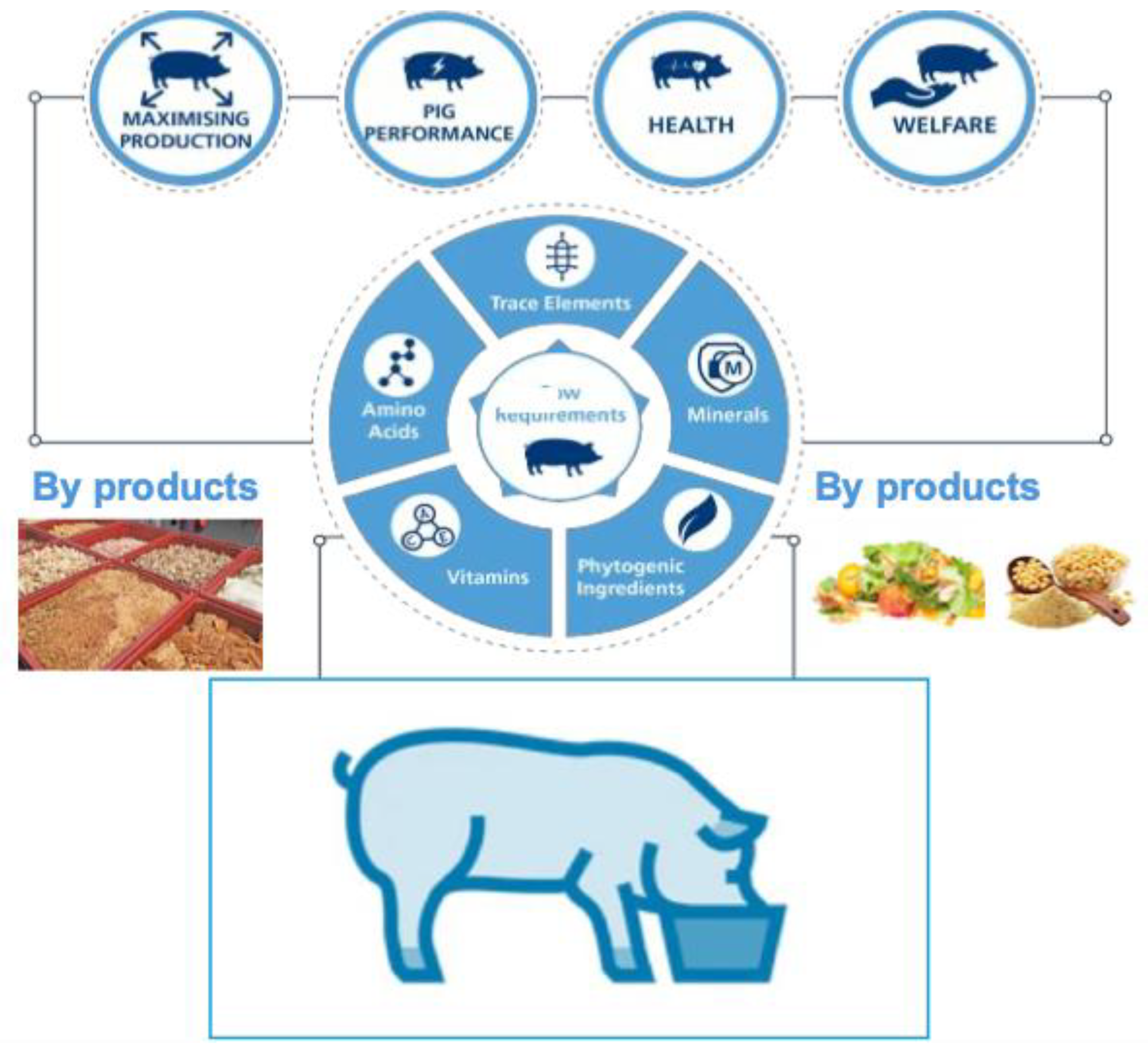
FFPs are generally classified into two main groups: those originating from the confectionery sector (e.g., chocolates, biscuits, and sweet snacks) and those from the wearer sector (e.g., bread, pasta, savoury snacks, and potato chips), including other high-quality baked goods. These materials are typically high in carbohydrates (starch, simple sugars) and may also contain considerable concentrations of fat [12]. On a dry matter basis, FFPs usually contain around 50–60% starch [33] and about 10% protein, which limits their classification as a significant protein source for livestock [12]. Because FFPs represent a heterogeneous mix of various ex-food types and origins, it is difficult to establish a standardized nutritional composition. Nevertheless, they can serve as an effective source of simple sugars, processed starch, fat, and readily available energy in post-weaning piglet diets. However, their inclusion rates must be managed carefully. Regarding weaners or grower/finisher pigs, further research is required to determine whether higher inclusion levels of FFPs influence growth performance and meat quality [12,31,34,35,36].
Appropriate processing methods such as drying, pelleting, and ensiling are vital for ensuring feed safety, stabilizing nutrients, and preventing microbial spoilage [29]. The combination of multiple by-products in the same diet can also improve nutrient diversity and balance, compensating for deficiencies inherent in individual materials.
Studies investigating both productive and environmental outcomes of by-product inclusion employ several complementary methodologies (Table 2). These analytical frameworks collectively allow for evaluation of not only growth and efficiency metrics but also sustainability indicators and economic feasibility.
Several European countries with established swine industries have successfully integrated by-products into feed systems. In France and the Netherlands, for example, incorporating bakery waste led to approximately 15% lower feed-related GHG emissions and partially replaced imported cereals, thus lowering the carbon footprint of production [10]. In Germany, the inclusion of brewers’ spent grains improved fiber intake and gut health while substituting soybean meal with a sustainable, locally sourced alternative [30]. In Denmark, fruit and vegetable pulp replaced 20–25% of conventional feed ingredients, maintained growth performance, and reduced feed costs by roughly 8–10%, while also diverting large volumes of organic waste from disposal sites [9].
3. Feedstuffs
The applied strategies that concern the generated agro-industrial by-products serve as critical mechanisms in the mitigation of the emerged environmental issues such as global warming, air and water pollution and the GHG emissions. The generated agro-industrial by-products within European Union (EU) are estimated at 16 million tons, with Germany (3 millions of tons), United Kingdom (UK) (2.6 millions of tons), Italy (1.9 millions of tons), France (1.8 millions of tons), and Spain (1.6 millions of tons) forming the major producers. The livestock sector is responsible for a total emission of 10% of the global GHG [37]. Additionally, it must be noted that nowadays the commercial price of cereal grains and soybean products have revealed a remarkable increment which has a direct impact on the livestock field, resulting in increased production costs [38]. Therefore, it is crucial to discover novel alternative sources capable of offering opportunities with lower operational costs. The agro-industrial by-products form an intriguing case, since they can be adopted by the livestock industry. In specific, latter can be characterized as raw materials instead of wastes due to their nutritional composition, since they are consisted of a plethora of valuable components. The already existing technologies provide the ability to recycle and re-use them in various applications, such as feed additives [39].
The Regulation (EC) No 767/2009 of the European Parliament and of the Council, refers that as “feed materials” can be characterized the products which are derived from vegetables and animals and provide the ability to fulfill animal’s nutritional requirements [40]. Furthermore, latter legislation also includes products which are generated by industrial processing procedures, organic or inorganic compounds with or without feed additives. These products are going to be used: a) for instant oral animal feeding, b) after processing, c) for the development of a compound feed, d) as premixture agents [41]. It is remarkable that these alternative feeding strategies have gained interest, since their final goal concerns the development of enhanced novel feedstuffs with improved quality by incorporating the aforementioned by-products, exerting thus a positive impact on pigs’ health and welfare. Table 3 describes the incorporation of agro-industrial by-products into feedstuffs.
According to Lee et al. [42] the addition of fermented apple in finishing pigs’ diet by 2% w/w, revealed beneficial effects in some crucial parameters namely, growth performance, daily feed intake, feed efficiency as well as carcass weight. Moreover, apple pomace was incorporated into finishing pigs’ ration by 10 or 20% w/w, promoting thus the presence of beneficial bacteria and the reduction of volatile fatty acids emissions. It must be noted that the addition by 10% w/w led to an enhanced nitrogen retention efficiency [43]. Fermented apple pomace with Lactobacillus plantarum was included in finishing pigs’ feedstuffs leading to significant results with latter’s addition exhibiting a positive impact in some crucial characteristics. In specific, feed efficiency was found to be improved, and the average daily feed intake was reduced without affecting animal’s final body weight and back fat thickness [47]. A similar pattern was observed after the addition of Fermented Grape pomace with Lactobacillus plantarum in finishing pigs’ diet. This addition improved the presence of the beneficial bacteria with a parallel reduction of VFA emissions in faeces [43]. Another study examined the incorporation of strawberry by-products in pigs’ conventional feedstuffs. In specific, Islam et al. [48], included fermented strawberry pomace with Lentinus edodes in pigs’ diet and the results revealed beneficial effect on the lean tissues of growers’ pigs. Pluschke et al. [49], reported that the addition of mango pulps in a ratio of 15% w/w improved the efficiency of starch and protein digestion efficiency to a certain extent. Another study examined the fortification of pigs’ feed with tomato residues by 3 or 5%w/w revealing a slight effect in pork’s meat attributes and more specifically in tenderness [51]. Tomato silage was added by 30%w/w of dry matter basis in fermentable liquid diets for growing-finishing pigs, promoting thus their growth parameters, without presenting negative impact on carcass standards [52]. Furthermore, pigs’ diet afforded a replacement with carrot wastes by 20-25% w/w. Latter by-products, are consisted of 11.3 MJ/kg dry matter metabolizable energy justifying their utilization as ideal animal feed [58]. Liotta et al. [54] enhanced pigs’ feedstuff by incorporating olive cake processing waste in a ratio of 5 and 10% w/w. The results indicated a reduced backfat thickness, a decreased intramuscular fat level, as well as a modification in their fatty acid content. Additionally, MUFA’s and PUFA’s presence was found to be improved [54]. In another research, a fermented mixture of olive mill stone waste and Lathyrus clymenum pericarp (80-20% w/w) with Pleurotus ostreatus was used as feed supplement in pigs’ nutrition [55]. In specific, the authors incorporated latter mixture in piglets’ conventional feedstuff by 5% w/w and the results revealed improved antioxidant blood parameters [55]. Another study in the existing literature examined the effects of Cordyceps militaris spent mushroom substrate as a feed additive in growing pigs’ diet. The authors stated that the addition of 2g/kg exhibited a positive impact, since it improved pigs’ performance, facilitated immunoglobulin secretion and enhanced the antioxidant activity. Furthermore, latter addition reduced cholesterol, and MDA’s presence [56]. Liu et al. [57], studied the fortification of finishing pigs’ feed with Mulberry leaves by 3,6,9,12% w/w. The obtained results indicated a higher loin-eye area and an increased crude protein profile. Moreover, this supplement exerted a positive impact on animals’ health since this addition enhanced inosine monophosphate content and amino acids in muscle tissues.
4. Environmental Benefits
4.1. Greenhouse Gas Emission Reduction
The livestock sector contributes approximately 15% of global anthropogenic GHG emissions, with pork production responsible for roughly 9% of livestock-related emissions [59]. Within the EU, agricultural GHG emissions predominantly stem from enteric fermentation (45%), soil management (38%), and manure management (15%) [60]. Unlike ruminants, pigs generate relatively low emissions from enteric fermentation [61]. Instead, feed and manure represent the most significant sources of environmental impact in swine production systems [62]. Consequently, optimizing feed formulations and manure management practices is critical for reducing the environmental footprint of the sector [63,64].
Replacing conventional feed ingredients with food by-products decreases GHG emissions associated with crop cultivation, fertilizer use, and transport [10]. Moreover, a 10-25% reduction in CO₂-equivalent emissions per kg of pork when by-products are included, is indicated. The reduction in emissions is especially meaningful when imported soybean meal is replaced by domestic by-products, as this substitution decreases emissions from transport and associated deforestation [28].
Feeding piglets by-products as well as reducing GHG emissions, also diverts land, water, and energy away from production of virgin resources, such as cereals and soybean meal [28,29]. The transformation of food processing waste into high-end feed products enables the food industry to reduce dependency on virgin resources, deforestation associated with soy production, and to improve biodiversity [65]. This approach is also in alignment with the main pillars of circular economy and promotes a closed-loop system which converts the potential waste into a valuable resource according to European Union’s Circular Economy Action Plan [65,66].
On the other hand -the positive view- the avoidance of landfill disposal, the cost reduction associated with waste management and potential carbon credit initiatives could also provide financial incentives for farmers that implement circular feed strategies [28,67]. Furthermore, the usage of by-products effects positively to several national and international sustainable development goals (SDGs), such as climate change mitigation, lessen of environmental pollution, and the promotion of more sustainable food production [10].
Further studies on the optimization of nutrient content, retention of bioactive compound content in processing, and feed safety may allow the climate and sustainability benefits of this approach to be further enhanced [68,69,70]. Considering these aspects of integration, the use of food processing waste as pig feed becomes a highly efficient, practical and environmentally friendly means of tackling the dual issues of livestock production and climate change.
4.2. Land and Water Use
The use of industry by-products for feeding pigs, has been found to reduce the reliance on arable land and freshwater resources, and subsequently towards more sustainable agricultural systems, while previous research showed the saving of 15-30% of land use and 10-20% of water footprint, depending on the by-product type and proportion used [9,15,29]. Demand of products such as cereals and soybeans, which cultivation demands extensive land and irrigation could be reduced by repurpose fruit and vegetable pulp, bakery waste and other agro-industrial residues [10,28,31]. This strategy could beneficially effect, by liberating arable land for other purposes -reforestation, biodiversity conservation etc.- but could also alleviate the strain of water resources, which tend to be increasingly limited, highly impacted from climate change.
Decrease in land use and water consumption, is typically major when by-products are produced and used locally, because transportation emissions and the need for extra resources are reduced [66]. Furthermore, by-product integration is consistent with the circular economy initiative promoted by the recycle of energy and nutrients instead of wasting them [65,67]. This approach not only contributes to the preservation of natural resources but also enhances the resilience and sustainability of animal production in the wake of the increasing environmental challenges. As a paradigm, precision feeding techniques combined with high moisture by-products can significantly lessen the environmental footprint of swine production and parallelly improve the nutrient utilization efficiency [30,69]. The ongoing advances in by-products processing techniques, such as drying, ensiling and fermentation, contribute to feed stability, the retention of their nutrients and their all-year round availability [68,70].
4.3. Food Waste Mitigation
The redirection of bakery, dairy, and brewing waste from landfills for use as pig feed is a key strategy to address the issue of food waste in the context of climate change adaptation. Methane (CH4) produced from the anaerobic decomposition organic waste in landfills poses also a significant concern due to its high potential for global warming, considered as more than 30 times more potent than CO2 over a century [71]. With conversion of 1 ton of food waste into pig feed, it is estimated that approximately 0.3 tons of CO2-equivalent methane emissions can be prevented, and results in a notable decrease in the overall carbon footprint of food production systems [9,10].
Furthermore, approximately the one-third of all food produced globally is either lost or wasted, with environmental, economic, and social repercussions [29]. The recycle of these substances not only decreases the volume of waste sent to landfills but also save nutrients and promotes sustainable resource utilization [28,29]. When food waste residues are consumed instead of traditional crops like soybeans and grains, which are land-, water- and energy- intensive, the environmental impact is further mitigated [10,15].
By-products from local sourcing also increase the sustainability of this solution through reduced emission from transport and by strengthening local circular economies [66]. Also, the addition of residues high in bioactive compounds could have advantages for animal welfare and health without negative effects on growth performance, which would be a double good for environmental efficiencies and efficiencies of livestock systems [68,69,70].
Future work will need to investigate the optimization of food by-products through selection choice, cost-benefit use, and inclusion rates to maximize emissions reductions and understand impacts on long-term performance of animals to create equivalent verification or measurement protocols of environmental impacts. There is also a need to consider how to incorporate studies that investigate future processing technologies, such as fermentation or ensiling, that optimize nutrient availability because feed safety and availability 365 days a year are critical and can also be a much larger benefit to global food waste reduction [65,67]. Through the strategic by-product use of food processing, pork production systems could significantly contribute to management of waste and waste disposal sustainably, climate change mitigation, and the promotion of a circular economy.
4.4. Circular Economy Integration
Integrating circular bioeconomy strategies—such as manure management for biogas production, alternative feed ingredients, and wastewater recycling—enhances resource efficiency and reduces environmental footprints [72]. Adding food processing by-products into pig diets is a prime example of industrial symbiosis, in which waste streams from one industry are converted to useful inputs for another, creating a low-resource and low-environmental-input closed-loop system. This approach decreases the reliance on fresh feed sources such as soybean meal or grains and can also assist to conserve water, save arable lands, and energy while lowers GHG emissions [10,28]. Moreover, this method fosters circularity within the agri-food system [9,65].
Furthermore, this strategy opens avenues to create new products, such as revalorizing bioactive compounds for the development of functional feed additives that enhance animal welfare and improve meat quality [66,68,69]. The circular economy approach encompasses a comprehensive system that integrates environmental stewardship, animal welfare practices, and practical business strategies in modern pork production.
4.5. Beneficial Effects on Animal Health, Welfare and Performance
Studies show that the use of by-products has no negative impact on growth performance. For example, feed conversion ratio (FCR) is not affected or slightly improved (2.4–2.8 compared to 2.5–3.0 for normal feed), and average daily gain (ADG) is not significantly changed (700–900 g/day) [29,30]. Also, some by-products, like brewers’ grains and whey, have beneficial effects on the gut health. They help different types of beneficial microbes grow and outcompete harmful bacteria, which could lead to a decrease of antibiotics use [9]. Finally, the meat quality is not affected in parameters such as protein, fat, and tasty [15].
In addition, some by-products have important compounds like plant-based polyphenols and antioxidants that can improve animal health [73,74,75,76,77]. By enhancing the immune system of animals, can have beneficial effects on animals’ health overall [77]. Food industry by-products (e.g., fruit and vegetable peels, seeds, cereal, dairy, beer and pulp) contain important compounds, such as polyphenols, carotenoids, and glucosinolates. For example, grape, tomato waste, red corn cobs, and grape and olive are enrich with these compounds [70,75,77,78]. These compounds have various beneficial effects on immune system, redox status, growth performance and animal health and welfare [79,80,81,82,83]. Recent studies on pigs reported that plant-based polyphenols revealed to benefit growth performance, support the immune system and protect against oxidative stress damage [79,80].
Modern pig production systems are increasingly required to reconcile productivity goals with enhanced animal welfare and reduced environmental impacts, while systematically incorporating circular bioeconomy principles to strengthen resource efficiency and long-term sustainability [72]. Nutrition is a key factor not only in maintaining pig health but also ensuring high standards of animal welfare. Nutritional interventions that enhance animal welfare can concurrently improve productivity, product quality, and overall profitability. Animal welfare has become an important basis of sustainable production and improvements in environmental impact are likely to come at the expense of animal welfare, or vice versa, regardless of cost [23]. Feeding strategies aligned with circular bioeconomy principles leverage local ingredients and by-products to maximize resource efficiency, whereas conventional methods may overlook pigs’ changing nutritional needs, resulting in nutrient waste and higher feed costs [84].
4.6. Alignment with the UN Sustainable Development Goals
The evidence synthesized in Section 4.1–4.5 shows that integrating food-industry by-products into pig diets advances multiple sustainability outcomes through three main mechanisms: (i) substitution of high-impact primary crops, (ii) avoidance of emissions and resource use associated with alternative waste management, and (iii) valorization of bioactive fractions that support animal robustness without sacrificing performance—collectively underpinning SDGs 12, 13, 6, and 15 (Figure 2).
SDG 12 — Responsible Consumption and Production: By-product feeding operationalizes circular-economy and industrial symbiosis principles, preventing waste and retaining nutrients within the agri-food system (Targets 12.2, 12.3, and 12.5). System-level assessments and comparative scenarios show that redirecting former foodstuffs to feed reduces waste generation and enables cascading biomass use [9,85,86]. Governance and safety frameworks enable responsible production and disclosure (Target 12.4) [87,88].
SDG 13 — Climate Action: Life-cycle evidence indicates that by-product inclusion typically reduces feed-related greenhouse-gas emissions per kilogram of pork by roughly 10–25% through (a) substitution of emissions-intensive ingredients and (b) avoided-waste emissions when former foodstuffs are diverted from landfill or other treatments (Targets 13.2 and 13.3) [9,86]. Replacement of imported soybean meal with domestic by-products further limits transport emissions and mitigates deforestation-linked carbon losses [28].
SDG 6 — Clean Water and Sanitation: Substituting irrigated crops with locally sourced by-products reduces blue-water use and improves water-use efficiency (Target 6.4) [89,90]. Coupling by-product inclusion with precision feeding decreases nutrient oversupply and excretion, lowering eutrophication risks and supporting water-related ecosystems (Targets 6.3 and 6.6) [91].
SDG 15 — Life on Land: Demand reductions for land-intensive feed crops spare cropland and relieve pressure on habitats and biodiversity (Targets 15.1 and 15.5) [86,89]. In EU-relevant pork systems, redirecting former foodstuffs to pig feed reduces cropland use and reliance on soymeal imports linked to deforestation risk (Target 15.2) [28].
Performance, welfare, and business viability (enablers across SDGs): Evidence shows no penalty—and in some cases small gains—in FCR/ADG when diets are formulated isonutritionally with common by-products, while certain bioactive-rich streams support gut health and robustness [9,29,30]. These outcomes facilitate adoption by maintaining productivity, while circular-economy governance and safety guidance ensure compliance and trust [87,88].
Suggested indicators for verification: Operational tracking can include: (i) percentage of ration derived from food industry by-products (Targets 12.2 and 12.5) [28,86]; (ii) greenhouse-gas intensity (kg CO₂-eq per kg pork, farm gate) with separate reporting of substitution and avoided-waste credits (Target 13.2) [9,92]; (iii) blue-water footprint per kg pork (Target 6.4) [89,90]; (iv) nutrient excretion intensity (kg N and kg P per kg pork) (Targets 6.3, 6.6) [91,92]; (v) cropland requirement and displacement of the feed basket based on crop-specific land-use intensities, and share of soy/cereals verified deforestation-free (Target 15.2) [28,86,89]; and (vi) median transport distance/tonne-km for by-product sourcing (supports SDG 13 co-benefits).
In sum, the practices detailed in Section 4.1–4.5 provide coherent, evidence-based pathways for pig production systems to advance progress toward SDG 12 (circular resource use and waste prevention), SDG 13 (greenhouse-gas mitigation), SDG 6 (water-use efficiency and quality), and SDG 15 (land sparing and biodiversity protection)—without compromising animal performance.
5. Challenges and Limitations
Despite the numerous environmental and growth performance benefits associated with inclusion of by-products in pig feed, several obstacles hinder their widespread use. The primary concern is linked to the inconsistency in nutritional value which can greatly vary, based on its source, season of production and the processing techniques [29,68]. This inconsistency negatively impacts to levels of energy, proteins, fiber and bioactive compounds present in feed, which are all critical for animals’ health and growth.
Microbiological safety is also an important aspect to consider. Improper handling and storage of fruit, vegetable, bakery, or dairy residue from the food industry can contain pathogenic microorganisms [10,31,65]. Processing can provide a means to alleviate the risks of pathogenic microorganisms while also maintaining the nutritional and functional properties of the resulting feed material [68,69]. Among the different feed materials, FFPs can be a particularly valuable, nutrient-dense feed. However, studying the “safe” inclusion of these products into pig diets should be carried out inclusively [36]. Processing (e.g., baking, extrusion, frying) applied during food processing of raw materials such as grains or tubers can change starch structure and glycaemic index, causing the carbohydrates to become rapidly fermentable and possibly affect gut physiology or metabolism. Also, due to the varied source materials of FFPs, through a standardized pre-processing procedure, some materials may contain traces of packaging or handling materials that should be removed as well. Developing a traceability and certification scheme for feed handling would improve feed safety and would help in formally determining a standard in environments transporting FFP materials. Ultimately, how FFPs can be safely valorized in relation to their environment affects animal health as well as guarantees food safety for the human population.
Adequate formulation of diets is crucial to achieve amino acid, mineral, vitamin, and energy balance with the incorporation of by-products [93]. Nutrient content fluctuations require advanced formulation tools and on-going laboratory analysis. Computer surveillance and feed formulating software can assist in facilitating real-time adjustments so that animals are fed correctly, and growth performance, immune status, and overall welfare are maintained [30,94]. Regulatory restraints also present obstacles, particularly for by-products from animals, treated waste streams, or those that are not classified as safe to feed [28,65]. Guidelines, certification programs, and standardized processing protocols must be made available to facilitate compliance with the law and increase farmers’ confidence.
Resolving such issues requires a multi-step approach, including standardization of by-product quality, severe quality control, cooperative agreements between feed producers, food manufacturers, and government authorities, and investment in processing plants. Research should target synergistic use of a range of by-products, fortification methods with basic nutrients, and long-term effects on animal health and performance, as well as environmental sustainability [70,75,77].
6. Future Perspectives
The use of food processing by-products as animal feeds provides a viable means to achieve sustainable innovation in livestock production. Processes such as fermentation, pelleting, and ensiling, besides improving nutrient digestibility and shelf life, also help in preserving bioactive compounds and reducing microbial contamination [29,68]. Such innovations promote better feed efficiency, animal health, and resilience in production.
Precision feeding systems and digital monitoring gear now make it possible to provide real-time evaluation of nutrient intake, growth rate, and metabolic indicators [30,69,79]. The technologies enable adaptive composition of the diet and continuous optimization of by-product inclusion. Tracking the amount of functional compounds also ensures welfare levels and immune system maintenance [27].
Future research directions include the determination of synergistic by-product blends of maximum nutritional and functional quality, supplementation with limiting nutrients as required, and identification of long-term effects on immunity, performance, and meat quality [70,75,77]. Future research should also determine stability of bioactive compounds during storage, their effect on meat quality, and economic feasibility of inclusion of such material into industrial production systems. Combined, these technologies can transform food by-products into the focal point of a sustainable pig livestock production.
Both EU and national policies are increasingly guiding the transition toward more sustainable livestock systems by encouraging innovation, implementing emission reduction strategies, and enhancing resource management [95,96]. Policy instruments would accelerate uptake. Incentives such as carbon credits, tax credits, or subsidies for farms that adopt circular feeding strategies would encourage broader industry participation [28,66]. Furthermore, aligning livestock feed policies to national and international food waste reduction targets, sustainability measures, and climate change mitigation efforts can achieve systemic benefits, including reduced environmental impact, improved animal welfare, and add to economic resilience [9,67].
Innovative methods that use multi-objective optimization tools in feed formulation will continue to enhance sustainability in pig production. It was only recently that introducing an equivalent model into the environmental, nutritional, and economic contexts, demonstrated that the right balance of performance vs ecological footprint can be calculated based on a combination of feeds [21]. The activation of these optimization models, along with supporting public policy and targeted incentives (carbon credits or sustainability directed subsidies) can enable the broader implementation of circular feed ingredients in commercial systems. Furthermore, combining this framework with the European Green Deal [97] as well as the Farm-to-Fork Strategy [98], is likely to enhance or accelerate the transition to a more climate-neutrally developed and more resource-efficient livestock sector. A standardized LCA database and regulation guidelines specific to circular feed ingredients would give the scientific as well as legislative assurance for these developments.
Sustainable pork production increasingly depends on careful feed ingredient sourcing, the application of life cycle assessment (LCA), and consideration of antinutritional factors within multi-objective feed formulation and precision nutrition frameworks. Additionally, advancing and implementing strategies that upcycle nutrients from lower-value by-products and food waste streams into swine feed ingredients are critical to reducing the environmental footprint of pork production. Collectively, these approaches support broader One Health objectives and contribute to the transition toward circular agricultural and food systems [99].
7. Conclusions
Feeding pigs food industry by-products is a smart, research-backed way to reduce pollution, use fewer resources, and maintain the health, welfare and productivity of the animals. This practice aligns with efforts to cut down on waste and help combat climate change. Thoughtfully done, to include appropriate processing, careful monitoring, and appropriate regulations – by-products used as feed could be a feasible, long-term solution for the global swine industry.
Together, by tackling these issues and leveraging the ideas described in this study, by-products from the food industry can form the foundation of a sustainable pig production system influencing improved environmental footprints, animal welfare, and circular, resilient agricultural systems.
Author Contributions
Conceptualization, V.G.P.; methodology, V.G.P., N.T., G.I.P., K.K., and D.G.; writing—original draft preparation, V.G.P., N.T., G.I.P., C.E., K.K., L.F., E.M., and D.G.; writing—review and editing, V.G.P., D.A., G.M., and D.G.; visualization, V.G.P.; supervision, V.G.P., N.T., G.I.P., K.K, and D.G.
Funding
This research received no external funding.
Institutional Review Board Statement
Not applicable.
Conflicts of Interest
The authors declare no conflicts of interest.
Abbreviations
The following abbreviations are used in this manuscript:
| GHG | Greenhouse gas |
| FFPs | Former Food Products |
| SDGs | Sustainable development goals |
| FCR | Feed conversion ratio |
| ADG | Average daily gain |
| EU | European Union |
| UK | United Kingdom |
| LCA | Life cycle assesment |
| MUFA | Monounsaturated fatty acid |
| PUFA | Polyunsaturated fatty acid |
| ADFI | Average daily feed intake |
| BW | Body weight |
| VFA | Volatile fatty acids |
| MDA | Malondialdehyde |
References
- van Dijk, M.; Morley, T.; Rau, M.L.; Saghai, Y. A Meta-Analysis of Projected Global Food Demand and Population at Risk of Hunger for the Period 2010–2050. Nat. Food 2021, 2, 494–501. [Google Scholar] [CrossRef]
- Falcon, W.P.; Naylor, R.L.; Shankar, N.D. Rethinking Global Food Demand for 2050. Popul. Dev. Rev. 2022, 48, 921–957. [Google Scholar] [CrossRef]
- Vastolo, A.; Serrapica, F.; Cavallini, D.; Fusaro, I.; Atzori, A.S.; Todaro, M. Editorial: Alternative and Novel Livestock Feed: Reducing Environmental Impact. Front. Vet. Sci. 2024, 11, 1441905. [Google Scholar] [CrossRef]
- Praveen, B.; Sharma, P. A Review of Literature on Climate Change and Its Impacts on Agriculture Productivity. J. Public Aff. 2019, 19, e1960. [Google Scholar] [CrossRef]
- Güneralp, B.; Reba, M.; Hales, B.U.; Wentz, E.A.; Seto, K.C. Trends in Urban Land Expansion, Density, and Land Transitions from 1970 to 2010: A Global Synthesis. Environ. Res. Lett. 2020, 15, 044015. [Google Scholar] [CrossRef]
- de Vries, M.; de Boer, I.J.M. Comparing Environmental Impacts for Livestock Products: A Review of Life Cycle Assessments. Livest. Sci. 2010, 128, 1–11. [Google Scholar] [CrossRef]
- Aziz, T.; Maqsood, M.A.; Kanwal, S.; Hussain, S.; Ahmad, H.R.; Sabir, M. Fertilizers and Environment: Issues and Challenges. In Crop Production and Global Environmental Issues; Hakeem, K.R., Ed.; Springer International Publishing: Cham, Switzerland, 2015; pp. 575–598. [Google Scholar]
- Kim, S.W.; Gormley, A.; Jang, K.B.; Duarte, M.E. Current status of global pig production: an overview and research trends. Anim. Biosci. 2024, 37, 719–729. [Google Scholar] [CrossRef]
- Salemdeeb, R.; zu Ermgassen, E.K.H.J.; Kim, M.H.; Balmford, A.; Al-Tabbaa, A. Environmental and health impacts of using food waste as animal feed: A comparative analysis of food waste management options. J. Clean. Prod. 2017, 140, 871–880. [Google Scholar] [CrossRef]
- Santos, L.; Ferreira, M.; Domingos, I.; Oliveira, V.; Rodrigues, C.; Ferreira, A.; Ferreira, J. Life Cycle Assessment of Pig Production in Central Portugal: Environmental Impacts and Sustainability Challenges. Sustainability 2025, 17, 426. [Google Scholar] [CrossRef]
- Dutt, T. Commercial Pig Farming Scenario, Challenges, and Prospects. In Commercial Pig Farming; Elsevier: Amsterdam, The Netherlands, 2025; pp. 1–14. [Google Scholar]
- Luciano, A.; Tretola, M.; Ottoboni, M.; Baldi, A.; Cattaneo, D.; Pinotti, L. Potentials and challenges of former food products (food leftover) as alternative feed ingredients. Animals 2020, 10, 125–132. [Google Scholar] [CrossRef] [PubMed]
- McAuliffe, G.A.; Chapman, D.V.; Sage, C.L. A Thematic Review of Life Cycle Assessment (LCA) Applied to Pig Production. Environ. Impact Assess. Rev. 2016, 56, 12–22. [Google Scholar] [CrossRef]
- Andretta, I.; Hickmann, F.M.W.; Remus, A.; Franceschi, C.H.; Mariani, A.B.; Orso, C.; Kipper, M.; Létourneau-Montminy, M.-P.; Pomar, C. Environmental Impacts of Pig and Poultry Production: Insights From a Systematic Review. Front. Vet. Sci. 2021, 8, 750733. [Google Scholar] [CrossRef]
- Makkar, H.P.S.; Ankers, P. Towards Sustainable Animal Diets: A Survey-Based Study. Anim. Feed Sci. Technol. 2014, 198, 309–322. [Google Scholar] [CrossRef]
- de Quelen, F.; Brossard, L.; Wilfart, A.; Dourmad, J.-Y.; Garcia-Launay, F. Eco-Friendly Feed Formulation and On-Farm Feed Production as Ways to Reduce the Environmental Impacts of Pig Production Without Consequences on Animal Performance. Front. Vet. Sci. 2021, 8, 689012. [Google Scholar] [CrossRef] [PubMed]
- Govoni, C.; Chiarelli, D.D.; Luciano, A.; Ottoboni, M.; Perpelek, S.N.; Pinotti, L.; Rulli, M.C. Global assessment of natural resources for chicken production. Adv. Water Resour. 2021, 154, 103987–103997. [Google Scholar] [CrossRef]
- Govoni, C.; Chiarelli, D.D.; Luciano, A.; Pinotti, L.; Rulli, M.C. Global assessment of land and water resource demand for pork supply. Environ. Res. Lett. 2022, 17, 074003–074015. [Google Scholar] [CrossRef]
- Pinotti, L.; Luciano, A.; Ottoboni, M.; Manoni, M.; Ferrari, L.; Marchis, D.; Tretola, M. Recycling food leftovers in feed as opportunity to increase the sustainability of livestock production. J. Clean. Prod. 2021, 294, 126290–126303. [Google Scholar] [CrossRef]
- Flachowsky, G.; Meyer, U. Challenges for plant breeders from the view of animal nutrition. Agriculture 2015, 5, 1252–1276. [Google Scholar] [CrossRef]
- Wachong Kum, S.; Voccia, D.; Grimm, M.; Froldi, F.; Suciu, N.A.; Lamastra, L. Reducing the Environmental Impacts of Pig Production Through Feed Reformulation: A Multi-Objective Life Cycle Assessment Optimisation Approach. Sustainability 2025, 17, 8509. [Google Scholar] [CrossRef]
- Lestingi, A. Alternative and Sustainable Protein Sources in Pig Diet: A Review. Animals 2024, 14, 310. [Google Scholar] [CrossRef]
- Olsen, J.V.; Andersen, H.M.-L.; Kristensen, T.; Schlægelberger, S.V.; Udesen, F.; Christensen, T.; Sandøe, P. Multidimensional Sustainability Assessment of Pig Production Systems at Herd Level—The Case of Denmark. Livest. Sci. 2023, 270, 105208. [Google Scholar] [CrossRef]
- Gamborg, C. , Sandøe, P. Sustainability in farm animal breeding: a review. Livest. Prod. Sci. 2005, 92, 221–231. [Google Scholar] [CrossRef]
- United Nations, 2020. Available online: https://sdgs.un.org/goals (accessed on 17 February 2025).
- Lassaletta, L.; Estellés, F.; Beusen, A.H.W.; Bouwman, L.; Calvet, S.; van Grinsven, H.J.M.; Doelman, J.C.; Stehfest, E.; Uwizeye, A.; Westhoek, H. Future Global Pig Production Systems According to the Shared Socioeconomic Pathways. Sci. Total Environ. 2019, 665, 739–751. [Google Scholar] [CrossRef] [PubMed]
- Papakonstantinou, G.I.; Voulgarakis, N.; Terzidou, G.; Fotos, L.; Giamouri, E.; Papatsiros, V.G. Precision Livestock Farming Technology: Applications and Challenges of Animal Welfare and Climate Change. Agriculture 2024, 14, 620. [Google Scholar] [CrossRef]
- Zu Ermgassen, E.K.H.J.; Phalan, B.; Green, R.E.; Balmford, A. Reducing the land use of EU pork production: Where there’s will, there’s a way. Food Policy 2016, 58, 35–48. [Google Scholar] [CrossRef] [PubMed]
- Baldini, C.; Gardoni, D.; Guarino, M. A critical review of the recent evolution of Life Cycle Assessment applied to milk production. J. Clean. Prod. 2017, 140, 421–435. [Google Scholar] [CrossRef]
- Wilkinson, J. M. Re-defining efficiency of feed use by livestock. Animal, 2011, 5, 1014–1022. [Google Scholar] [CrossRef]
- Termatzidou, S.-A.; Dedousi, A.; Kritsa, M.-Z.; Banias, G.F.; Patsios, S.I.; Sossidou, E.N. Growth Performance, Welfare and Behavior Indicators in Post-Weaning Piglets Fed Diets Supplemented with Different Levels of Bakery Meal Derived from Food By-Products. Sustainability 2023, 15, 12827. [Google Scholar] [CrossRef]
- Makkar, H.P.S. Feed resources and their sustainability for animal production. Anim. Front. 2017, 7, 7–13. [Google Scholar]
- Giromini, C.; Ottoboni, M.; Tretola, M.; Marchis, D.; Gottardo, D.; Caprarulo, V.; Baldi, A.; Pinotti, L. Nutritional evaluation of former food products (ex-food) intended for pig nutrition. Food Addit. Contam. Part A 2017, 34, 14361445. [Google Scholar] [CrossRef]
- Luciano, A.; Tretola, M.; Mazzoleni, S.; Rovere, N.; Fumagalli, F.; Ferrari, L.; Comi, M.; Ottoboni, M.; Pinotti, L. Sweet vs. Salty Former Food Products in Postweaning Piglets: Effects on Growth, Apparent Total Tract Digestibility and Blood Metabolites. Animals 2021, 11, 3315–3326. [Google Scholar] [CrossRef]
- Luciano, A.; Espinosa, C.D.; Pinotti, L.; Stein, H.H. Standardized total tract digestibility of phosphorus in bakery meal fed to pigs and effects of bakery meal on growth performance of weanling pigs. Anim. Feed Sci. Technol. 2022, 284, 115148–115157. [Google Scholar] [CrossRef]
- Pinotti, L.; Ferrari, L.; Fumagalli, F.; Luciano, A.; Manoni, M.; Mazzoleni, S.; Govoni, C.; Rulli, M.C.; Lin, P.; Bee, G.; Tretola, M. ; Review: Pig-based bioconversion: the use of former food products to keep nutrients in the food chain. Animal 2023, 2, 100918. [Google Scholar] [CrossRef] [PubMed]
- Correddu, F.; Lunesu, M.F.; Buffa, G.; Atzori, A.S.; Nudda, A.; Battacone, G.; Pulina, G. Can agro-industrial by-products rich in polyphenols be advantageously used in the feeding and nutrition of dairy small ruminants? Animals 2020, 10, 131. [Google Scholar] [CrossRef]
- Vasta, V. , Luciano, G. The effects of dietary consumption of plants secondary compounds on small ruminants’ products quality. Small Rumin. Res. 2011, 101, 150–159. [Google Scholar] [CrossRef]
- Simitzis, P.E.; Deligeorgis, S.G. Agroindustrial by-products and animal products: A great alternative for improving food-quality characteristics and preserving human health, in: Food Quality: Balancing Health and Disease. Elsevier, 2018; pp. 253–290.
- Regulation (EC) No 767/2009. The impact of Regulation (EC) 767/2009 on the practice of feed advertising in Europe, /: at: https; (accessed on 24 July 2025)2357.
- Furnols, M.F.; Realini, C.; Montossi, F.; Sañudo, C.; Campo, M.; Oliver, M.; Nute, G.; Guerrero, L. Consumer’s purchasing intention for lamb meat affected by country of origin, feeding system and meat price: A conjoint study in Spain, France and United Kingdom. Food Qual. Prefer. 2011, 22, 443–451. [Google Scholar] [CrossRef]
- Lee, S.D.; Kim, H.Y.; Jung, H.J.; Ji, S.Y.; Chowdappa, R.; Ha, J.H.; Song, Y.M.; Park, J.C.; Moon, H.K.; Kim, I.C. The effect of fermented apple diet supplementation on the growth performance and meat quality in finishing pigs. Anim. Sci. J. 2009, 80, 79–84. [Google Scholar] [CrossRef]
- Cho, S.; Cho, J.; Hwang, O.; Yang, S.; Park, K.; Choi, D.; Yoo, Y.; Kim, I. Effects of fermented diets including grape and apple pomace on amino acid digestibility, nitrogen balance and volatile fatty acid (VFA) emission in finishing pigs. J. Anim. Vet. Adv. 11, 3444–3451. [CrossRef]
- Pieszka, M.; Szczurek, P.; Bederska-Łojewska, D.; Migdał, W.; Pieszka, M.; Gogol, P.; Jagusiak, W. The effect of dietary supplementation with dried fruit and vegetable pomaces on production parameters and meat quality in fattening pigs. Meat Sci. 2017, 126, 1–10. [Google Scholar] [CrossRef]
- Julia, S.; Dieter, T.; Hermann, L.; Heinrich, H.D.M.; Michael, W.P. The influence of apple-or red-grape pomace enriched piglet diet on blood parameters, bacterial colonisation, and marker gene expression in piglet white blood cells. Food Nutr. Sci. 2011, 2, 366–376. [Google Scholar]
- Sehm, J.; Lindermayer, H.; Dummer, C.; Treutter, D.; Pfaffl, M. The influence of polyphenol rich apple pomace or red--wine pomace diet on the gut morphology in weaning piglets. J. Anim. Physiol. Anim. Nutr. 2007, 91, 289–296. [Google Scholar] [CrossRef] [PubMed]
- Ikusika, O.O.; Akinmoladun, O.F.; Mpendulo, C.T. Enhancement of the Nutritional Composition and Antioxidant Activities of Fruit Pomaces and Agro-Industrial Byproducts through Solid-State Fermentation for Livestock Nutrition: A Review. Fermentation 2024, 10, 227. [Google Scholar] [CrossRef]
- Islam, M.R.; Hassan, Y.I.; Das, Q.; Lepp, D.; Hernandez, M.; Godfrey, D.V.; Orban, S.; Ross, K.; Delaquis, P.; Diarra, M.S. Dietary organic cranberry pomace influences multiple blood biochemical parameters and cecal microbiota in pasture-raised broiler chickens. J. Funct. Foods 2020, 72, 104053. [Google Scholar] [CrossRef]
- Pluschke, A.M.; Williams, B.A.; Zhang, D.; Gidley, M.J. Dietary pectin and mango pulp effects on small intestinal enzyme activity levels and macronutrient digestion in grower pigs. Food Funct. 2018, 9, 991–999. [Google Scholar] [CrossRef]
- Yang, K.; Qing, Y.; Yu, Q.; Tang, X.; Chen, G.; Fang, R.; Liu, H. By-product feeds: Current understanding and future perspectives. Agriculture 2021, 11, 207. [Google Scholar] [CrossRef]
- Chung, S.H.; Son, A.R.; Le, S.; Kim, B.G. Effects of dietary tomato processing byproducts on pork nutrient composition and loin quality of pigs. Asian J. Anim. Vet. Adv. 2014, 9, 775–781. [Google Scholar] [CrossRef]
- Aguilera-Soto, J.; Mendez-Llorente, F.; López-Carlos, M.A.; Ramírez-Lozano, R.; Carrillo-Muro, O.; Escareno-Sanchez, L.; Medina-Flores, C. Effect of fer mentable liquid diet based on tomato silage on the performance of growing finishing pigs. Interciencia 2014, 39, 428–431. [Google Scholar]
- Chu, G.M.; Park, B.K. Effects of fermented carrot by-product diets on growth performances, carcass characteristics and meat quality in fattening pigs. Acta Agric. Scand. A Anim. Sci. 2023, 72, 40–48. [Google Scholar] [CrossRef]
- Liotta, L.; Chiofalo, V.; Lo Presti, V.; Chiofalo, B. In vivo performances, carcass traits, and meat quality of pigs fed olive cake processing waste. Animals 2019, 9, 1155. [Google Scholar] [CrossRef]
- Eliopoulos, C.; Papadomichelakis, G.; Voitova, A.; Chorianopoulos, N.; Haroutounian, S.A.; Markou, G.; Arapoglou, D. Improved Antioxidant Blood Parameters in Piglets Fed Diets Containing Solid-State Fermented Mixture of Olive Mill Stone Waste and Lathyrus clymenum Husks. Antioxidants 2024, 13, 630. [Google Scholar] [CrossRef]
- Boontiam, W. , Wachirapakorn, C., Wattanachai, S. Growth performance and hematological changes in growing pigs treated with Cordyceps militaris spent mushroom substrate. Vet. World 2020, 13, 768. [Google Scholar] [CrossRef]
- Liu, Y.; Li, Y.; Peng, Y.; He, J.; Xiao, D.; Chen, C.; Li, F.; Huang, R.; Yin, Y. Dietary mulberry leaf powder affects growth performance, carcass traits and meat quality in finishing pigs. J. Anim. Physiol. Anim. Nutr. 2019, 103, 1934–1945. [Google Scholar] [CrossRef]
- Hung, Y.-T.; Lo, H.H.; Awad, A.; Salman, H. Potato wastewater treatment, in: Handbook of Industrial and Hazardous Wastes Treatment. CRC Press, 2004; pp. 894–951.
- Gerber, P.J.; Steinfeld, H.; Henderson, B.; Mottet, A.; Opio, C.; Dijkman, J.; Falcucci, A.; Tempio, G. Tackling Climate Change through Livestock: A Global Assessment of Emissions and Mitigation Opportunities.; Food and Agriculture Organization of the United Nations: Rome, Italy, 2013; ISBN 92-5-107920-X. [Google Scholar]
- Mielcarek-Bocheńska, P.; Rzeźnik, W. Greenhouse Gas Emissions from Agriculture in EU Countries—State and Perspectives. Atmosphere 2021, 12, 1396. [Google Scholar] [CrossRef]
- Zervas, G.; Tsiplakou, E. An Assessment of GHG Emissions from Small Ruminants in Comparison with GHG Emissions from Large Ruminants and Monogastric Livestock. Atmos. Environ. 2012, 49, 13–23. [Google Scholar] [CrossRef]
- Gislason, S.; Birkved, M.; Maresca, A. A Systematic Literature Review of Life Cycle Assessments on Primary Pig Production: Impacts, Comparisons, and Mitigation Areas. Sustain. Prod. Consum. 2023, 42, 44–62. [Google Scholar] [CrossRef]
- Ferket, P.R.; Van Heugten, E.; Van Kempen, T.A.T.G.; Angel, R. Nutritional Strategies to Reduce Environmental Emissions from Nonruminants. J. Anim. Sci. 2002, 80, E168–E182. [Google Scholar] [CrossRef]
- Andretta, I.; Hauschild, L.; Kipper, M.; Pires, P.G.S.; Pomar, C. Environmental Impacts of Precision Feeding Programs Applied in Pig Production. Animal 2018, 12, 1990–1998. [Google Scholar] [CrossRef] [PubMed]
- Sagar, N.A.; Pareek, S.; Sharma, S.; Yahia, E.M.; Lobo, M.G. Fruit and Vegetable Waste: Bioactive Compounds, Their Extraction, and Possible Utilization. Compr. Rev. Food Sci. Food Saf. 2018, 17, 512–531. [Google Scholar] [CrossRef] [PubMed]
- Rosales, T.K.O.; Fabi, J.P. Valorization of polyphenolic compounds from food industry by-products for application in polysaccharide-based nanoparticles. Front. Nutr. 2023, 10, 1144677. [Google Scholar] [CrossRef] [PubMed]
- Avila-Nava, A.; Medina-Vera, I.; Toledo-Alvarado, H.; Corona, L.; Márquez-Mota, C.C. Supplementation with antioxidants and phenolic compounds in ruminant feeding and its effect on dairy products: a systematic review. J. Dairy Res. 2023, 90, 216–226. [Google Scholar] [CrossRef]
- Kammerer, D.R. , Kammerer, J., Valet, R., Carle, R. Recovery of polyphenols from the by-products of plant food processing and application as valuable food ingredients. Food Res. Intern.
- Waqas, M.; Salman, M.; Sharif, M.S. Application of polyphenolic compounds in animal nutrition and their promising effects. J. Anim. Feed Sci. 2023, 14, 1–15. [Google Scholar] [CrossRef]
- Núñez-Gómez, V.; González-Barrio, R.; Periago, M.J. Interaction between Dietary Fibre and Bioactive Compounds in Plant By-Products: Impact on Bioaccessibility and Bioavailability. Antioxidants 2023, 12, 976. [Google Scholar] [CrossRef]
- IPCC. Climate Change 2021: The Physical Science Basis. Contribution of Working Group I to the Sixth Assessment Report of the Intergovernmental Panel on Climate Change. Cambridge University Press. 2021.
- Sossidou, E.N.; Banias, G.F.; Batsioula, M.; Termatzidou, S.-A.; Simitzis, P.; Patsios, S.I.; Broom, D.M. Modern Pig Production: Aspects of Animal Welfare, Sustainability and Circular Bioeconomy. Sustainability 2025, 17, 5184. [Google Scholar] [CrossRef]
- Jahazi, M. A.; Hoseinifar, S. H. ; Jafari,V.; Hajimoradloo, A.; Van Doan, H.; and Paolucci, M. Dietary Supplementation of Polyphenols Positively Affects the Innate Immune Response, Oxidative Status, and Growth Performance of Common Carp, Cyprinus carpio L, Aquaculture 2020, 17.
- Georganas, A.; Kyriakaki, P.; Giamouri, E.; Mavrommatis, A.; Tsiplakou, E.; Pappas, A. Mediterranean agro-industrial by-products and food waste in pig and chicken diets: which way forward? Livest. Sci. 2024, 289, 105584. [Google Scholar] [CrossRef]
- Mei, H.; Li, Y.; Wu, S.; He, J. Natural plant polyphenols contribute to the ecological and healthy swine production. J Anim Sci Biotechnol. 2024, 15, 146. [Google Scholar] [CrossRef]
- Di Meo, M.C.; Licaj, I.; Varricchio, R.; De Nisco, M.; Stilo, R.; Rocco, M.; Bianchi, A.R.; D’Angelo, L.; De Girolamo, P.; Vito, P.; Zarrelli, A.; Varricchio, E. Functional Feed with Bioactive Plant-Derived Compounds: Effects on Pig Performance, Muscle Fatty Acid Profile, and Meat Quality in Finishing Pigs. Animals 2025, 15, 535. [Google Scholar] [CrossRef] [PubMed]
- Nudda, A. , Carta, S., Correddu, F., Caratzu, M. F., Cesarani, A., Hidalgo, J., Pulina, G., & Lunesu, M. F. A meta-analysis on use of agro-industrial by-products rich in polyphenols in dairy small ruminant nutrition. Animal, 1015. [Google Scholar]
- Riahi, C.; Badia, A.D.; Oscar, C.; Raquel, C.; Giuseppe, M.; Prentza, Z; Papatsiros, V. G. Detoxification of emerging mycotoxins in broiler chickens using an innovative liquid anti-mycotoxins solution. Veterinaria 2025, 61, N. [Google Scholar]
- Papakonstantinou, G. .; Meletis, E.; Petrotos, K.; Kostoulas, P.; Tsekouras, N.; Kantere, M.C.; Voulgarakis, N.; Gougoulis, D.; Filippopoulos, L.; Christodoulopoulos, G.; Athanasiou, L.V.; Papatsiros VG. Effects of a Natural Polyphenolic Product from Olive Mill Wastewater on Oxidative Stress and Post-Weaning Diarrhea in Piglets. Agriculture 2023, 13, 1356. [Google Scholar]
- Papatsiros, V.G.; Eliopoulos, C.; Voulgarakis, N.; Arapoglou, D.; Riahi, I.; Sadurní, M.; Papakonstantinou, GI. Effects of a Multi-Component Mycotoxin-Detoxifying Agent on Oxidative Stress, Health and Performance of Sows. Toxins 2023, 15, 580. [Google Scholar] [CrossRef]
- Papatsiros, V.G.; Katsogiannou, E.G.; Papakonstantinou, G.I.; Michel, A.; Petrotos, K.; Athanasiou, L.V. Effects of Phenolic Phytogenic Feed Additives on Certain Oxidative Damage Biomarkers and the Performance of Primiparous Sows Exposed to Heat Stress under Field Conditions. Antioxidants, 2022, 11, 593. [Google Scholar] [CrossRef]
- Papatsiros, V.G.; Papakonstantinou, G.I.; Katsogiannou, E.; Gougoulis, D.A.; Voulgarakis, N.; Petrotos, K.; Braimaki, S.; Galamatis, D.A.; El-Sayed, A.; Athanasiou, L.V. Effects of a Phytogenic Feed Additive on Redox Status, Blood Haematology, and Piglet Mortality in Primiparous Sows. Stresses 4, 293–307. [CrossRef]
- Papatsiros, V.G.; Papakonstantinou, G.I.; Voulgarakis, N.; Eliopoulos, C.; Marouda, C.; Meletis, E.; Valasi, I.; Kostoulas, P.; Arapoglou, D.; Riahi, I.; Christodoulopoulos, G.; Psalla, D. Effects of a Curcumin/Silymarin/Yeast-Based Mycotoxin Detoxifier on Redox Status and Growth Performance of Weaned Piglets under Field Conditions. Toxins 16, 168. [CrossRef]
- Ait-Sidhoum, A.; Guesmi, B.; Cabas-Monje, J.; Roig, J.M.G. The Impact of Alternative Feeding Strategies on Total Factor Productivity Growth of Pig Farming: Empirical Evidence from Eu Countries. Span. J. Agric. Res. 2021, 19, e0106. [Google Scholar] [CrossRef]
- Siddique, S.; Grassauer, F.; Arulnathan, V.; Sadiq, R.; Pelletier, N. A review of life cycle impacts of different pathways for converting food waste into livestock feed. Sustain. Prod. Consum. 2024, 46, 310–323. [Google Scholar] [CrossRef]
- van Hal, O.; de Boer, I.J.M.; Muller, A.; de Vries, S.; Erb, K.-H.; Schader, C.; Gerrits, W.J.J.; van Zanten, H.H.E. Upcycling food leftovers and grass resources through livestock: Impact of livestock system and productivity. J. Clean. Prod. 2019, 219, 485–496. [Google Scholar] [CrossRef]
- EFSA. Food and feed safety vulnerabilities in the circular economy. EFSA Support. Publ. 2022, 19, EN–7226. [Google Scholar] [CrossRef]
- EFSA FEEDAP Panel. Guidance on the assessment of the safety of feed additives for the target species. EFSA J, 2017, 15, 5021. [Google Scholar]
- Poore, J.; Nemecek, T. Reducing food’s environmental impacts through producers and consumers. Science 2018, 360, 987–992. [Google Scholar] [CrossRef]
- Ridoutt, B.G.; Pfister, S. A revised approach to water footprinting to make transparent the impacts of consumption and production on global freshwater scarcity. Global Environ. Change 2010, 20, 113–120. [Google Scholar] [CrossRef]
- Pomar, C.; Remus, A. Precision pig feeding: A breakthrough toward sustainability. Anim. Front. 2019, 9, 52–59. [Google Scholar] [CrossRef]
- Dourmad, J.-Y.; Ryschawy, J.; Trousson, T.; Bonneau, M.; Gonzalez, J.; Houwers, H.W.J.; Hviid, M.; Zimmer, C.; Nguyen, T.L.T.; Morgensen, L. Evaluating environmental impacts of contrasting pig farming systems with life cycle assessment. Animal 2014, 8, 2027–2037. [Google Scholar] [CrossRef] [PubMed]
- Serra, V.; Salvatori, G.; Pastorelli, G. Dietary Polyphenol Supplementation in Food Producing Animals: Effects on the Quality of Derived Products. Animals 2021, 11, 401. [Google Scholar] [CrossRef] [PubMed]
- Vlaicu, P.A.; Untea, A.E.; Varzaru, I.; Saracila, M.; Oancea, A.G. Designing Nutrition for Health—Incorporating Dietary By-Products into Poultry Feeds to Create Functional Foods with Insights into Health Benefits, Risks, Bioactive Compounds, Food Component Functionality and Safety Regulations. Foods 2023, 12, 4001. [Google Scholar] [CrossRef]
- Firoiu, D.; Ionescu, G.H.; Cismaș, C.M.; Costin, M.P.; Cismaș, L.M.; Ciobanu, Ș.C.F. Sustainable Production and Consumption in EU Member States: Achieving the 2030 Sustainable Development Goals (SDG 12). Sustainability 2025, 17, 1537. [Google Scholar] [CrossRef]
- Kabato, W.; Getnet, G.T.; Sinore, T.; Nemeth, A.; Molnár, Z. Towards Climate-Smart Agriculture: Strategies for Sustainable Agricultural Production, Food Security, and Greenhouse Gas Reduction. Agronomy 2025, 15, 565. [Google Scholar] [CrossRef]
- European Commission. The European Green Deal. 2019.
- European Commission. A Farm to Fork Strategy for a fair, healthy and environmentally-friendly food system. Communication from the Commission, COM(2020) 381 final, Brussels.
- Shurson, G.C.; Urriola, P.E. Sustainable swine feeding programs require the convergence of multiple dimensions of circular agriculture and food systems with One Health. Anim. Front. 2022, 12, 30–40. [Google Scholar] [CrossRef] [PubMed]
Figure 2.
Environmental benefits using food by-products in pig diet.


Table 1.
Beneficial effects of some by-products using in pig diets.
| By-product | Major nutrients | Potential inclusion Rate | Beneficial effects | References |
| Whey |
|
10–15% of diet |
|
[29] |
| Brewers’ spent grains |
|
15–25% |
|
[30] |
| Bakery waste |
|
10–20% |
|
[10,31] |
| Fruit/vegetable pulp |
|
5–15% |
|
[9] |
| Oilseed meals |
|
5–20% |
|
[32] |
Table 2.
Approaches to evaluate environmental and productive impacts of by-products in pig diets.
| Approach | Evaluated impacts | References |
| Life Cycle Assessment (LCA) | Quantification of GHG emissions, energy demand, land and water use, and overall resource efficiency | [10] |
| Growth performance trials | Average daily gain (ADG), feed conversion ratio (FCR), and carcass characteristics | [30] |
| Nutritional analysis | Determination of crude protein, amino acid profile, fiber content, and energy digestibility | [29] |
| Waste diversion metrics | Measurement of the proportion of food residues redirected from landfills to feed use | [9] |
| Economic assessment | Evaluation of feed cost reduction and profitability associated with by-product utilization | [28] |
Table 3.
Addition of agro-industrial by-products to feedstuffs.
| By-Product | Age | Type | Concentration | Effects | Reference |
| Apple | Finishing pigs | Fermented apple supplement | 2% w/w | Improved growth performance and feed quality | [42] |
| Finishing pigs | Apple pomace | 10 or 20% w/w | Promotion of beneficial bacteria Reduced volatile fatty acids emissions Increased FCR |
[43,44] | |
| Piglets | Apple pomace | 3.5% w/w | Beneficial effects on gut microbiota and blood parameters | [45,46] | |
| Finishing pigs | Fermented apple pomace with Lactobacillus plantarum | Enhanced feed efficiency, Lowered ADFI without effect on animal’s final BW and back fat thickness |
[47] | ||
| Grape pomace | Finishing pigs | Fermented Grape pomace with Lactobacillus plantarum |
Improved beneficial bacteria and reduced VFA emissions in faeces | [43] | |
| Strawberry | Growing pigs | Fermented Strawberry pomace with Lentinus edodes | Positive effect on the lean tissues | [48] | |
| Mango | Growing pigs | Mango pulp | 15% w/w | Improved the efficiency of starch Protein digestion to a certain extent |
[49,50] |
| Tomato | Pigs | Tomato residues | 3% or 5% w/w | Slight affection in pork’s meat attributes | [51] |
| Finishing pigs | Tomato silage | 30% w/w | Promotion of growth performance | [52] | |
| Carrot | Finishing pigs | Carrot wastes | 20–25% w/w | Increase of FCR Improved meat quality |
[44,53] |
| Olive | Growing-finishing pig | Olive Cake Processing Waste |
5, 10% w/w | Reduced backfat thickness and intramuscular fat Changed their fatty acid content Increased levels of MUFA and PUFA Improved-quality indices |
[54] |
| Piglets | Fermented Mixture of Olive Mill Stone Waste and Lathyrus clymenum pericarp with Pleurotus ostreatus | 5% w/w | Improved antioxidant blood parameters | [55] | |
|
Cordyceps. militarisspent mushroom substrate |
Growing pigs | Cordyceps. militaris spent mushroom substrate | 2g/kg | Improved growth performance and immunoglobulin secretion Enhanced antioxidant activity Reduced cholesterol, and MDA’s levels |
[56] |
| Mulberry | Finishing pigs | Mulberry leaves | 3,6,9,12% w/w | Higher loin-eye area and increased crude protein’s levels Enhanced inosine monophosphate content and amino acids in muscle tissues |
[57] |
| Strawberry | Finishing pigs | Strawberry pomace | 10% w/w | improved fatty acid composition in pork meat | [44] |
* feed conversion ratio (FCR), average daily gain (ADG), average daily feed intake (ADFI), body weight (BW), volatile fatty acids (VFA), malondialdehyde (MDA), monounsaturated fatty acids (MUFA), polyunsaturated fatty acids (PUFA).
Disclaimer/Publisher’s Note: The statements, opinions and data contained in all publications are solely those of the individual author(s) and contributor(s) and not of MDPI and/or the editor(s). MDPI and/or the editor(s) disclaim responsibility for any injury to people or property resulting from any ideas, methods, instructions or products referred to in the content. |
© 2025 by the authors. Licensee MDPI, Basel, Switzerland. This article is an open access article distributed under the terms and conditions of the Creative Commons Attribution (CC BY) license (https://creativecommons.org/licenses/by/4.0/).
Copyright: This open access article is published under a Creative Commons CC BY 4.0 license, which permit the free download, distribution, and reuse, provided that the author and preprint are cited in any reuse.


