
Submitted:
22 October 2025
Posted:
27 October 2025
You are already at the latest version
Abstract
Helichrysum species (Asteraceae) are renowned for their diverse phytochemical profiles and traditional medicinal applications. Among their specialized metabolites, phloroglucinol-α-pyrone derivatives represent a structurally unique and pharmacologically significant class of compounds. This review consolidates over five decades of phytochemical research, documenting 52 distinct compounds isolated from 11 Helichrysum species across the Mediterranean, African, and Iranian regions. The compounds are organized into structural subclasses, including monopyrones, dipyrones, and various phloroglucinol derivatives distinguished by their molecular scaffolds. Isolation yields reported in the literature range from trace amounts to relatively abundant constituents (0.48% w/w), with arzanol emerging as the most extensively studied compound. Bioactivity profiles reveal anti-inflammatory, antimicrobial, antioxidant, and antiparasitic properties, with arzanol demonstrating potent dual inhibition of mPGES-1 and 5-LOX. This comprehensive compilation provides essential reference data for future investigations into the chemistry and therapeutic potential of α-pyrone secondary metabolites from Helichrysum species.
Keywords:
1. Introduction
2. Literature Search Methodology
3. Phloroglucinol-α-Pyrones from Helichrysum
3.1. Alpha-Pyrone Ring Modifications
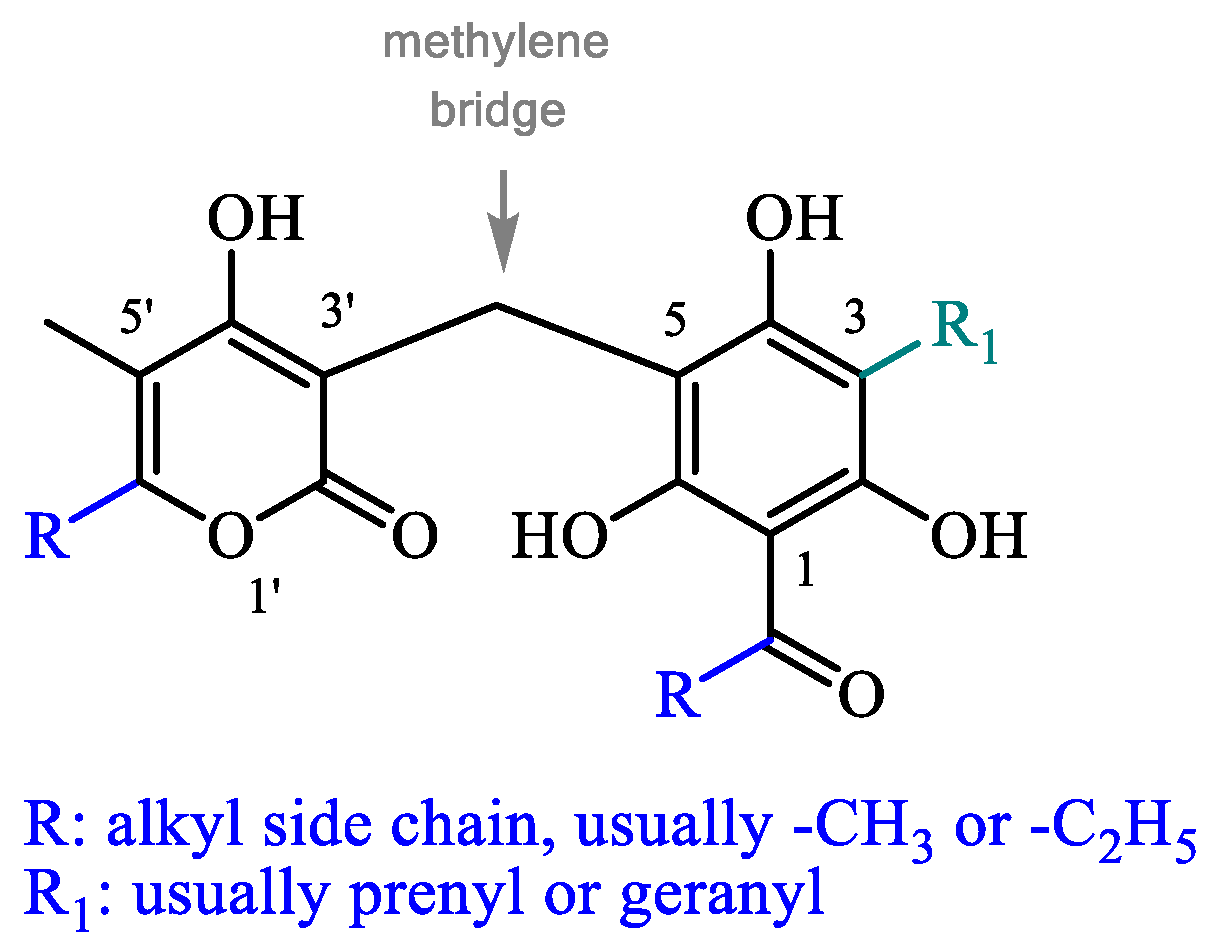
3.2. Phloroglucinol Ring Modifications
3.3. C3 Side Chain
3.4. C1 Acyl Group Diversity

| Plant Name | Compounds Discovered | Plant Parts | Ref. |
|---|---|---|---|
| Helichrysum arenarium (L.) Moench | Dipyrones: | ||
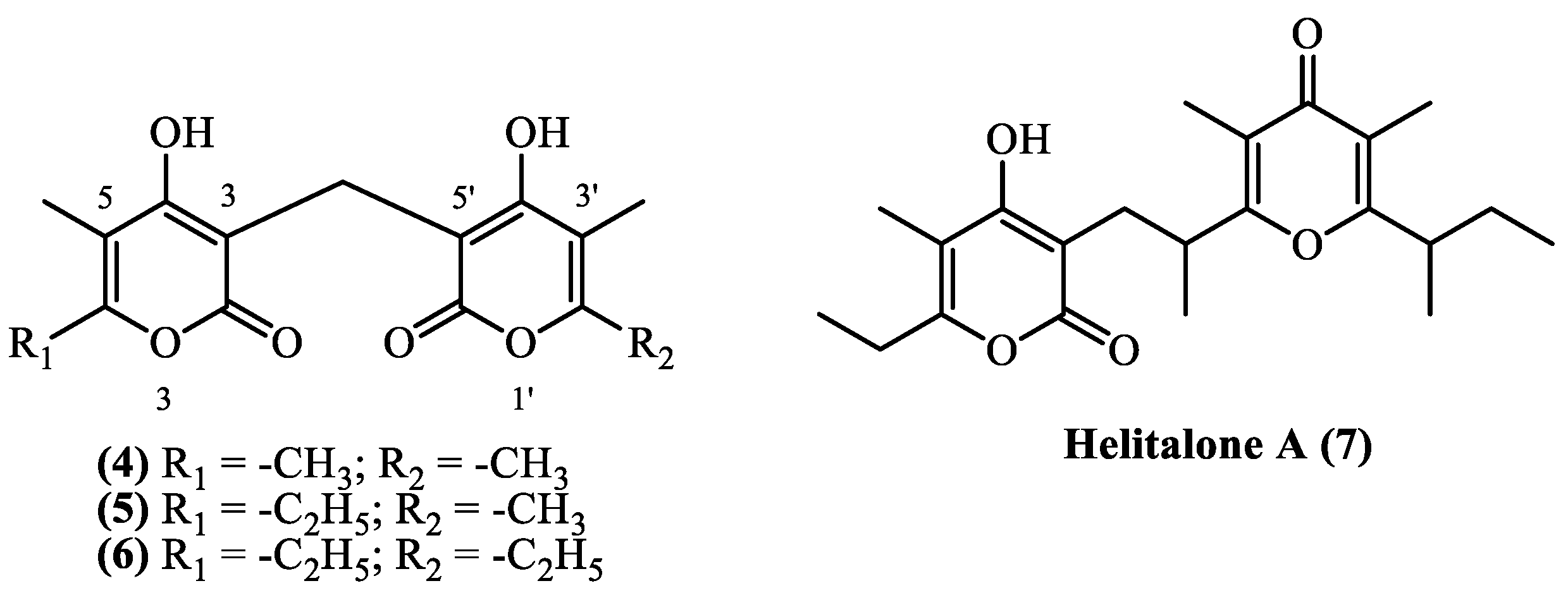
| Helipyrone A-C (4-6) | Roots | [5] | |
| 2-prenyl PGs: | |||
| Arenol A (29) | Aerial parts with flowers | [16] | |
| Helichrysum auriceps Hilliard | 3-prenyl methoxy PGs: | ||
| Auricepyrone (19), 23-Methylauricepyrone (20) | Roots | [6] | |
| Helichrysum cephaloideum DC. | 3-NA PGs: | ||
| Norauricepyrone (8), Methyl-norauricepyrone (9) | Roots | [15] | |
| 3-prenyl methoxy PGs: | |||
| Auricepyrone (19) | Roots | [6,7] | |
| Auricepyrone (19) | Aerial parts | [6] | |
| 23-Methylauricepyrone (20) | Roots | [6,7] | |
| 23-Methylauricepyrone (20) | Aerial parts | [6] | |
| 23-ethyl-6-O-desmethyl-4-O-methylauricepyrone (21) | Roots | [15] | |
| Benzofuranes: | |||
| 22-Methyl-22-ethyl-italipyrone (37) | Roots | [7,15] | |
| 22-Methyl-22-propyl-italipyrone (38) | Aerial parts | [7,15] | |
| Helichrysumitalicum ssp. Microphyllum | Мonopyrones: | ||
| Micropyrone (3) | Aerial parts (non-woody) with flowers | [8,9,17] | |
| Dipyrones: | |||
| Helipyrone A (6) | Aerial parts (non-woody) with flowers | [8,9,17] | |
| 3-prenyl PGs: | |||
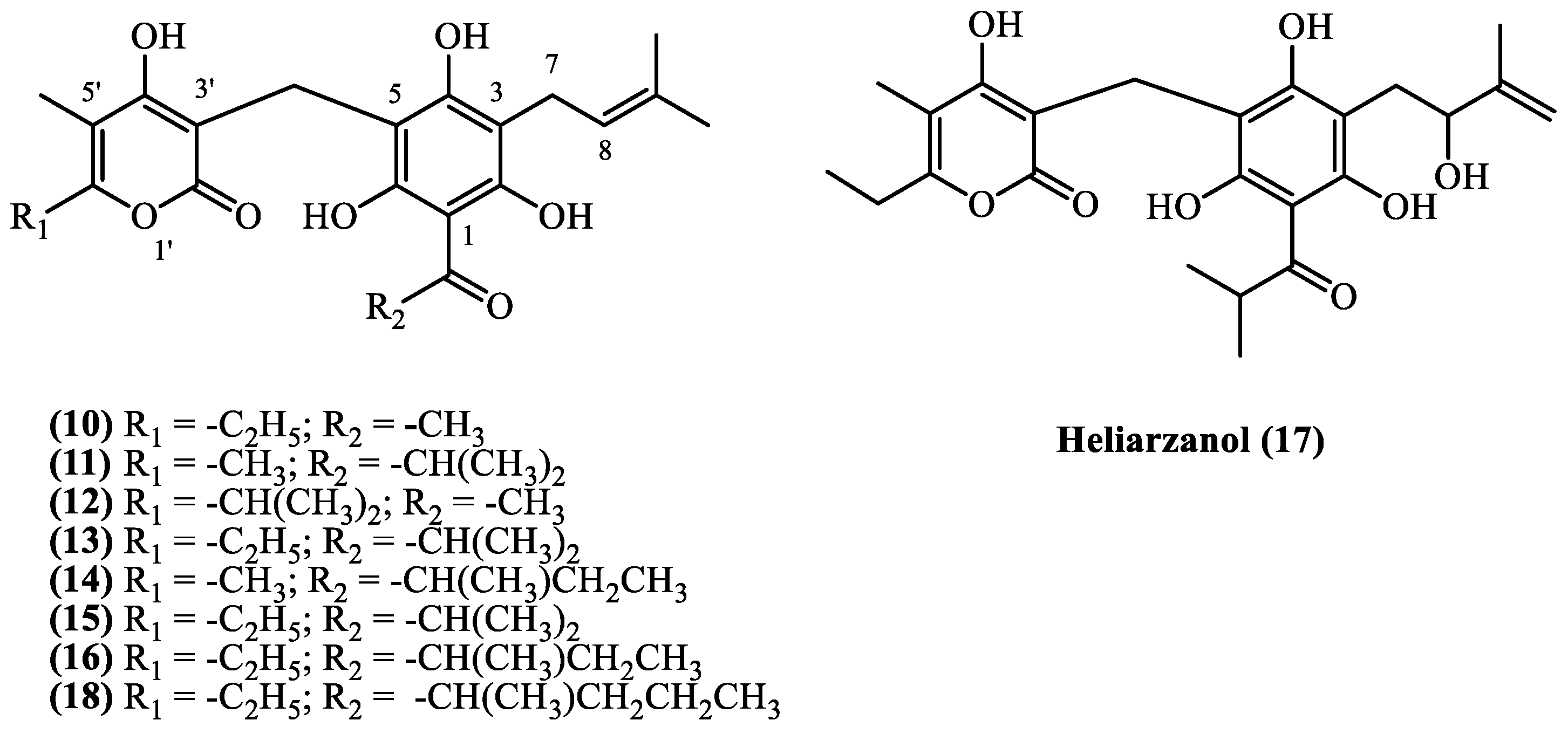
| Arzanol (10) | Aerial parts (non-woody) with flowers | [8,9,17] | |
| Heliarzanol (17) | Aerial parts (non-woody) with flowers | [9] | |
| Helichrysum italicum (Roth) G.Don | Monopyrones: | ||
| Micropyrone (3) | Aerial parts (non-woody) with flowers | [14] | |
| Dipyrones: | |||
| Helipyrone A (6) | Aerial parts with flowers | [7,12,18] | |
| Helitalone A (7) | non-woody Aerial parts with flowers | [14] | |
| 3-prenyl PGs: | |||
| Arzanol (10), Helitalone B (12) | non-woody Aerial parts with flowers | [14] | |
| Amino PGs: | |||
| Helichrytalicine B (31), Helichrytalicine A (32) | leaf material | [12] | |
| Benzofuranes: | |||
| Italipyrone (36) | Aerial parts with flowers | [7] | |
| Hetero-trimer PGs: | |||
| Italidipyrone (43), 23-Methyl-italidipyrone (44) | Aerial parts with flowers | [7] | |
| Helichrysum mixtum (Kuntze) Moeser | 3-prenyl PGs: | ||
| 23-Methyl-6-O-desmethylauricepyrone (16), 23-ethyl-6-O-desmethyl-auricepyrone (18) | Roots |
[15] | |
| Benzopyranes: | [15] | ||
| Isobutyryl-helichromenopyrone (34) | Roots | [15] | |
| Methylbutyryl-helichromenopyrone (35) | Aerial parts | [15] | |
| 22-Methyl-22-ethyl-italipyrone (37), 22-Methyl-22-propyl-italipyrone (38) | Roots | [15] | |
| Helichrysum odoratissimum Sweet. | 3-prenyl PGs: | ||
| 6-O-Desmethylauricepyrone (13), 23-Methyl-6-O-desmethylauricepyrone (16) | Aerial parts | [7] | |
| Helichrysum oocephalum Boiss. | Dipyrones: | ||
| Helipyrone A-C (4-6) | Aerial parts | [11] | |
| 3-prenyl PGs: | |||
| Arenol B (11), Arenol C (14), 3-prenyl norauricepyrone (15), 23-Methyl-6-O-desmethylauricepyrone (16) | Aerial parts | [11] | |
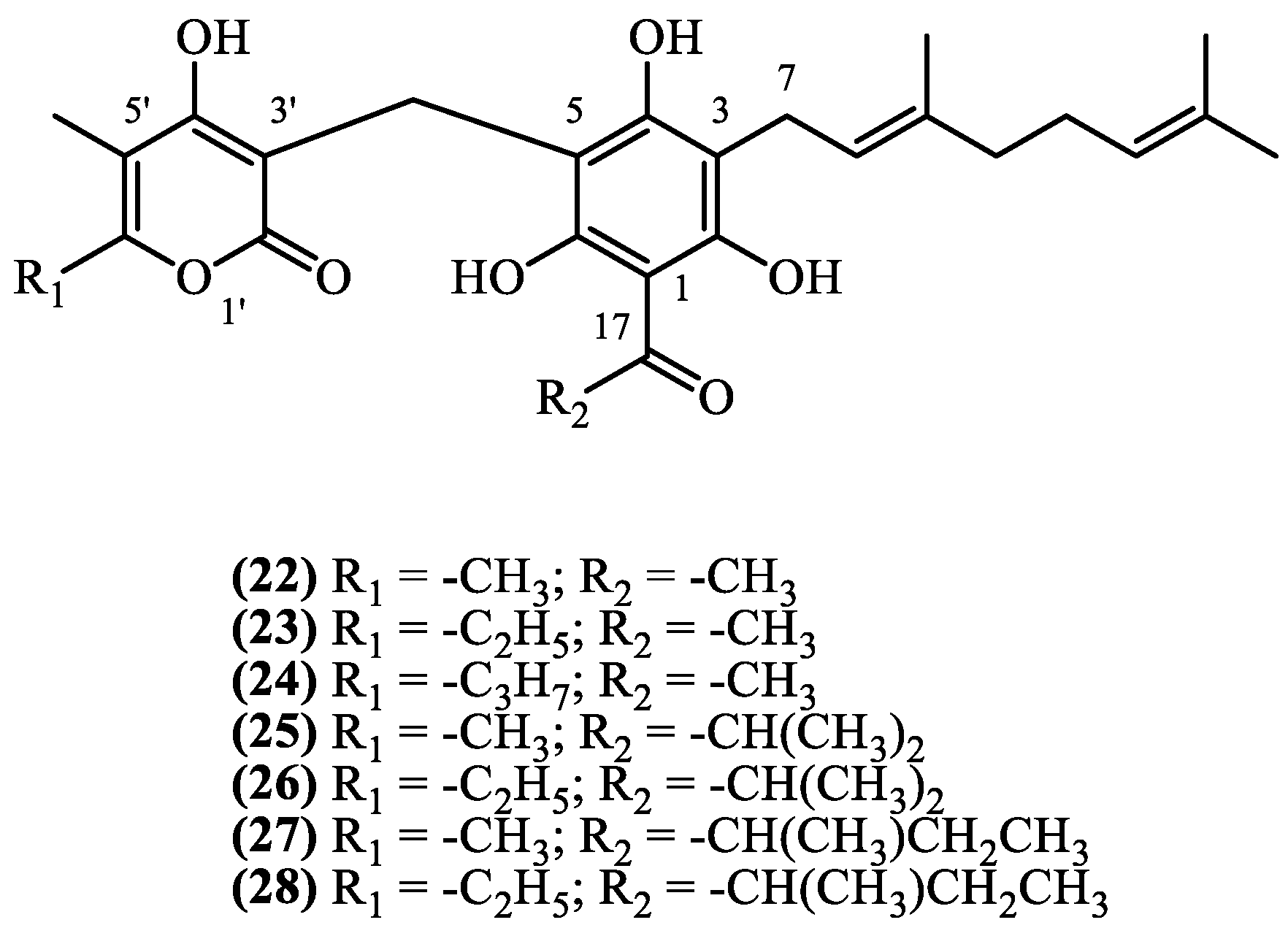
| Achyroclinopyrone A (26, 28, 25, 27) | Aerial parts | [11] | |
| Benzofuranes: | |||
| Helicyclol (40) | Aerial parts | [11] | |
| Chromane PGs: | |||
| Cycloarzanol C (41), Helicepyrone (42) | Aerial parts | [11] | |
| Hetero-trimer PGs: | |||
| Italidipyrone (43), 23-Methyl-italidipyrone (44) | Aerial parts | [11] | |
| Spiroketals: | |||
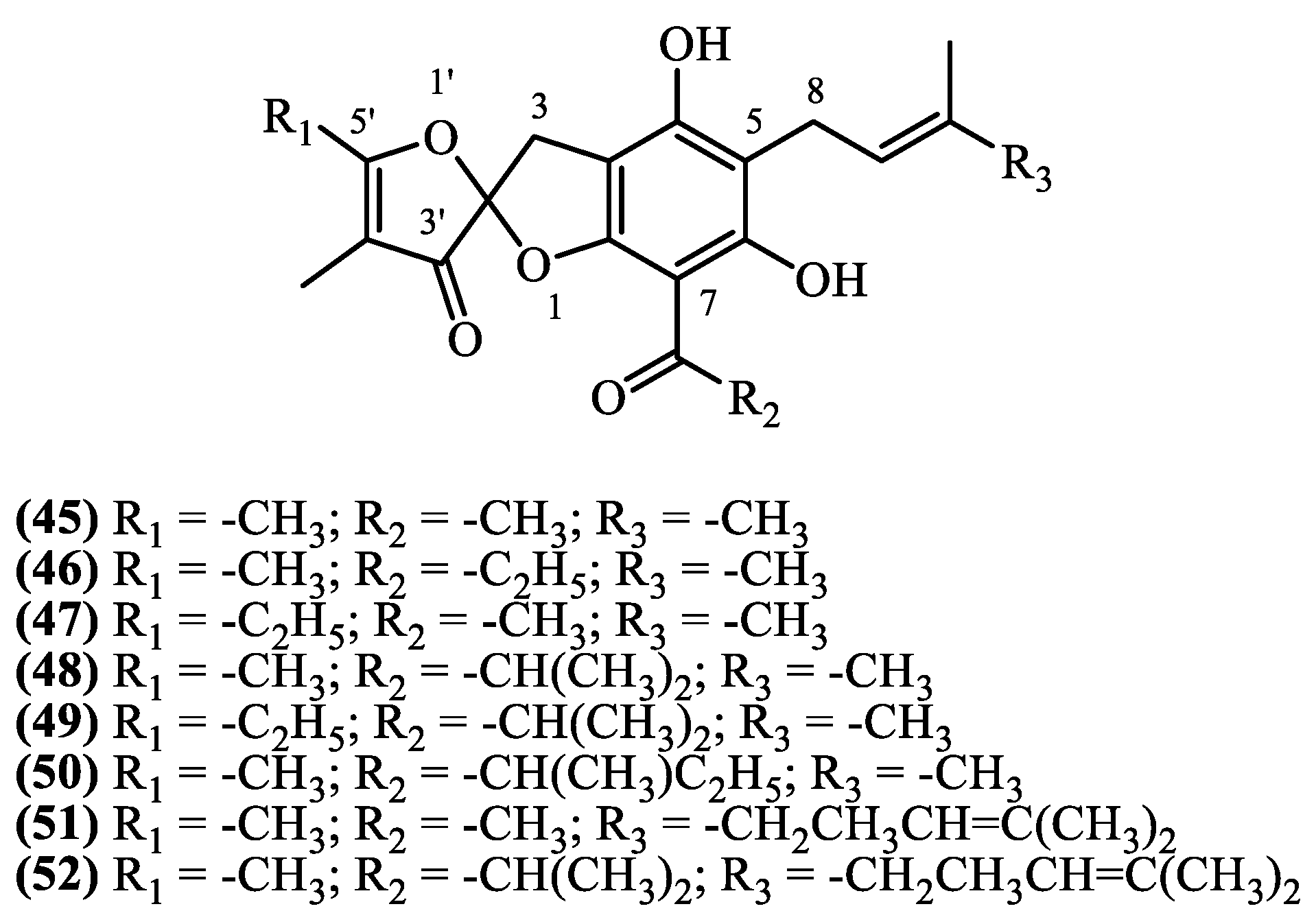
| Helispiroketals A-H (45, 46, 49, 50, 48, 47, 52, 51) | Aerial parts | [11] | |
| Helichrysum plicatum DC. ssp. Plicatum | Benzopyranes: | ||
| Plicatipyrone (33) | Flower heads | [7] | |
| Helichrysum stenopterum DC. | 3-prenyl PGs: | ||
| 23-Methyl-6-O-desmethylauricepyrone (16), 23-ethyl-6-O-desmethyl-auricepyrone (18) | Aerial parts | [15] | |
| Helichrysum stoechas (L.) Moench | Dipyrones: | ||
| Helipyrone A (6) | Roots | [19] | |
| Helipyrone A (6) | Aerial parts with flowers | [13,20] | |
| Helipyrone B (Norhelipyrone) (5) | Roots | [19] | |
| Helipyrone B (Norhelipyrone) (5) | Aerial parts with flowers | [20] | |
| Helipyrone C (Bisnorhelipyrone) (4) | Roots | [19] | |
| Helipyrone C (Bisnorhelipyrone) (4) | Aerial parts with flowers | [20] | |
| 3-prenyl PGs: | |||
| Arzanol (10) | flowers | [13] | |
| 3-geranyl PGs: | |||
| 18,18-bis-desmethyl Achyroclinopyrone C (22) | Roots | [19] | |
| 18,18-bis-desmethyl Achyroclinopyrone C (22) | Aerial parts with flowers | [13] | |
| 18,18-bis-desmethyl Achyroclinopyrone A (23) | Roots | [19] | |
| 2-prenyl PGs: | |||
| Arenol A (29) | Aerial parts with flowers | [20] | |
| Homoarenol (30) | Aerial parts with flowers | [16,20] | |
| Benzopyranes: | |||
| Plicatipyrone (33), Italipyrone (36) | Aerial parts with flowers | [20] | |
| Helichrysum stoechas subsp. barrelieri (Ten.) Nym | Benzofuranes: | ||
| 20-(3,3′-Dimethylallyl)-italipyrone (39) | Flower heads | [7] | |
| Helichrysum zeyheri Less. | |||
| Monopyrones: | |||
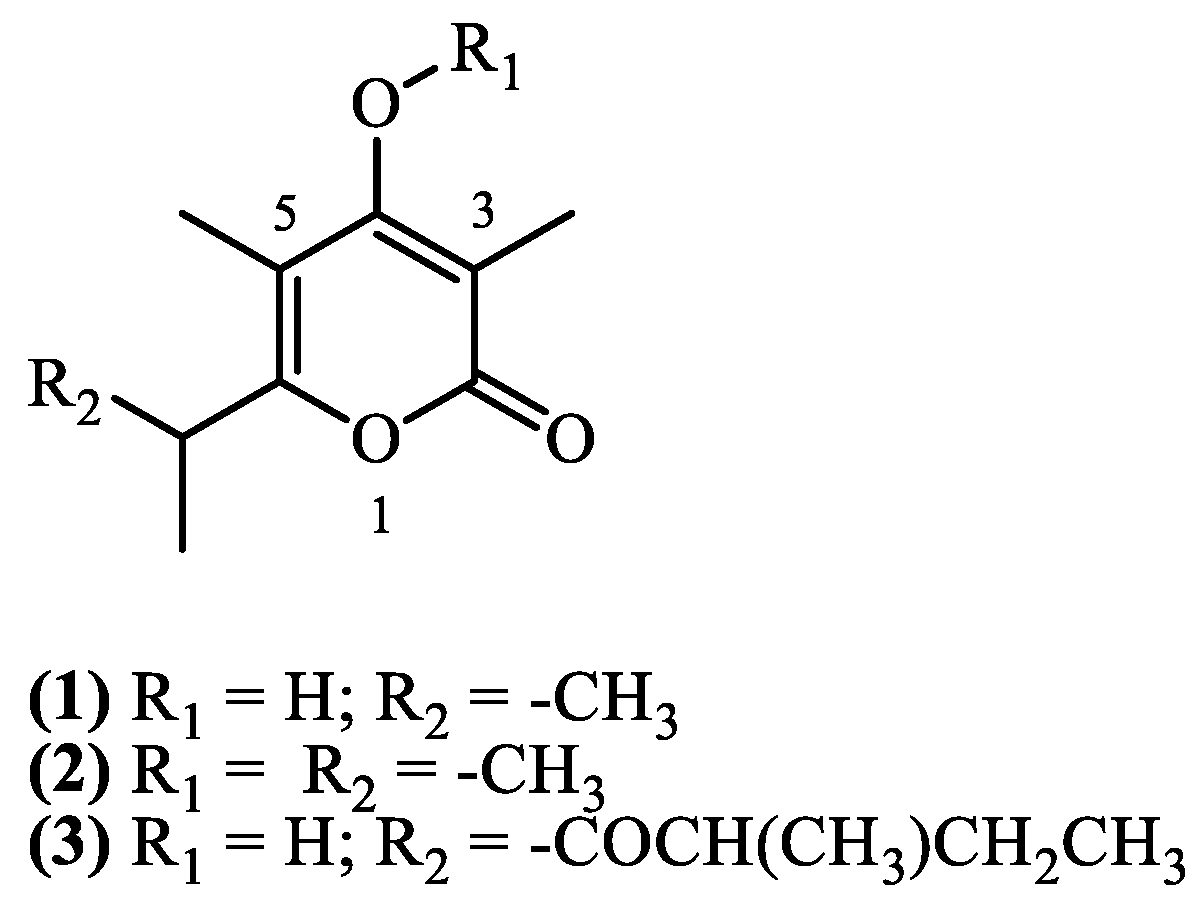
| 3,5-dimethyl-4-hydroxy-6-isopropyl alphapyrone (1), 3,5-dimethyl-4-(methoxy)-6-isopropyl alphapyrone (2) | Aerial parts | [15] |
4. Monopyrones
5. Dipyrones
6. 3-NA PGs
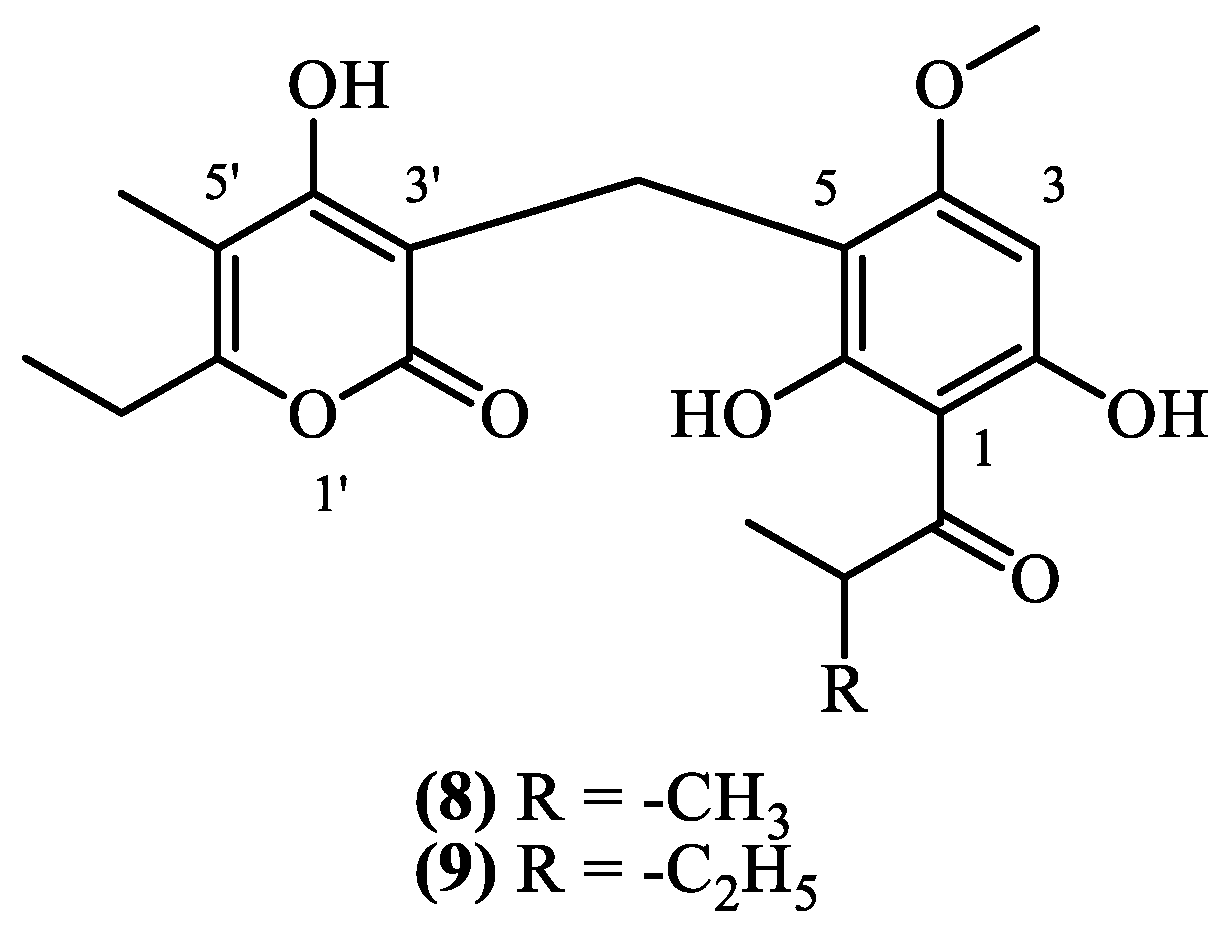
7. 3-prenyl PGs
8. 3-prenyl methoxy PGs
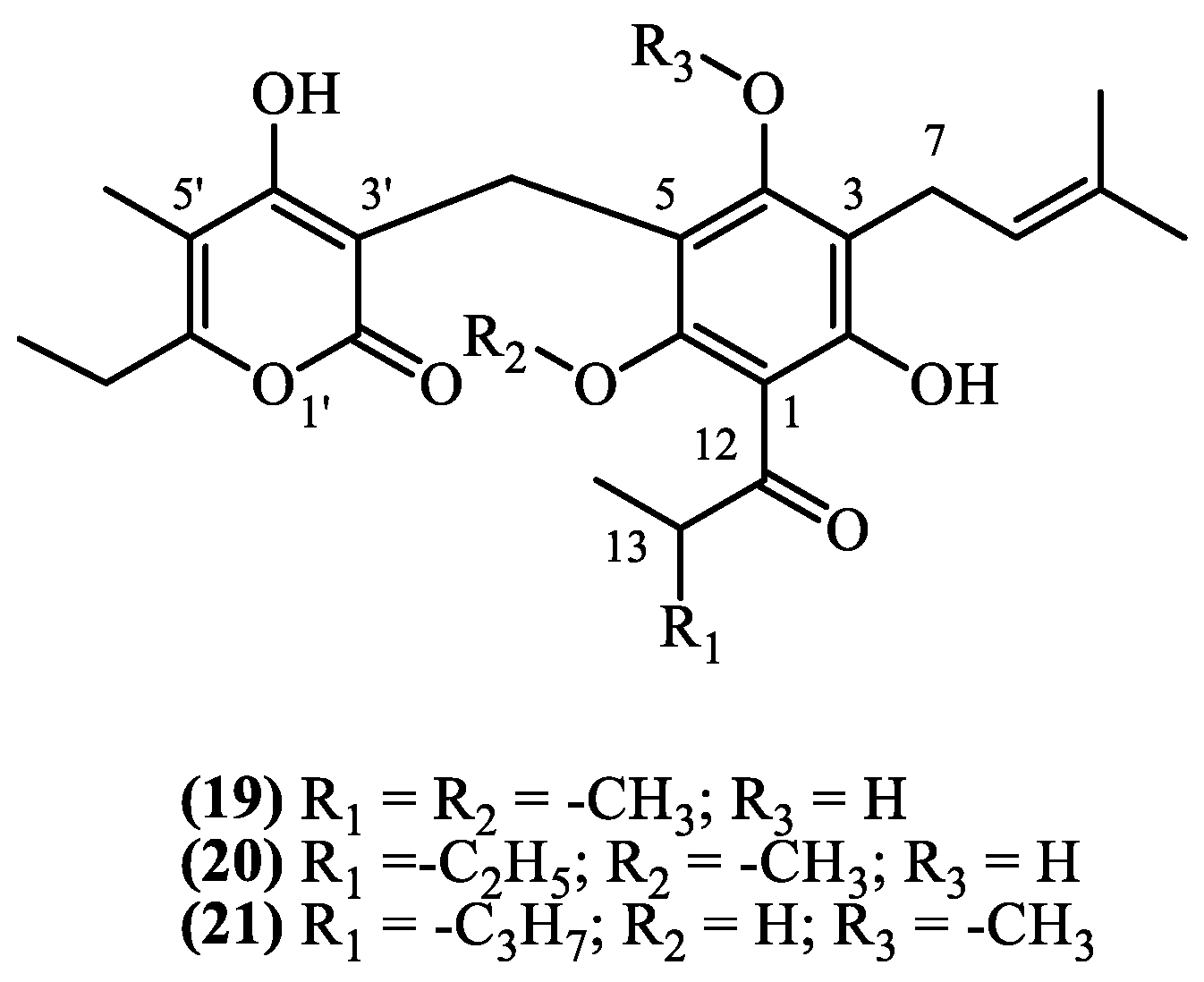
9. 3-geranyl PGs
10. 2-prenyl PGs
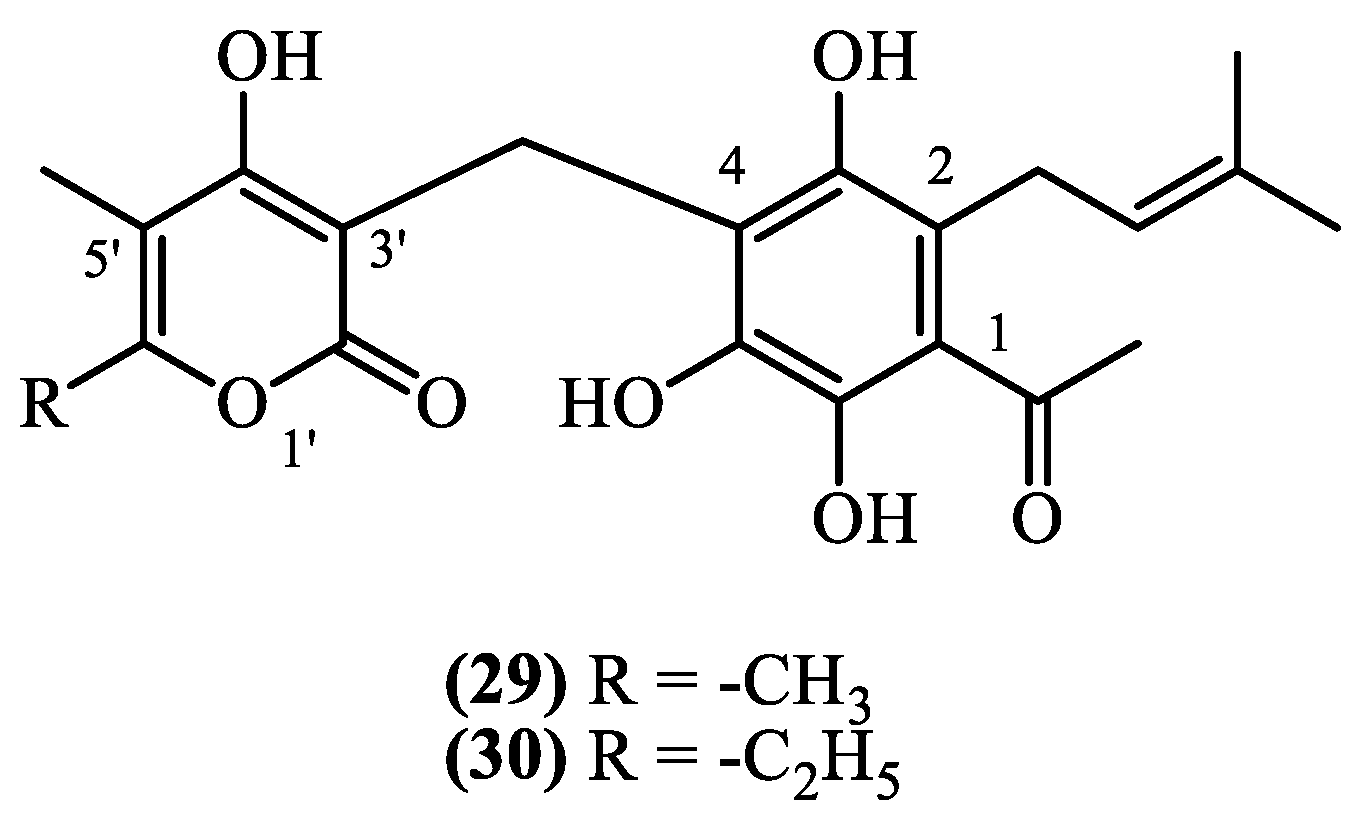
11. Amino PGs
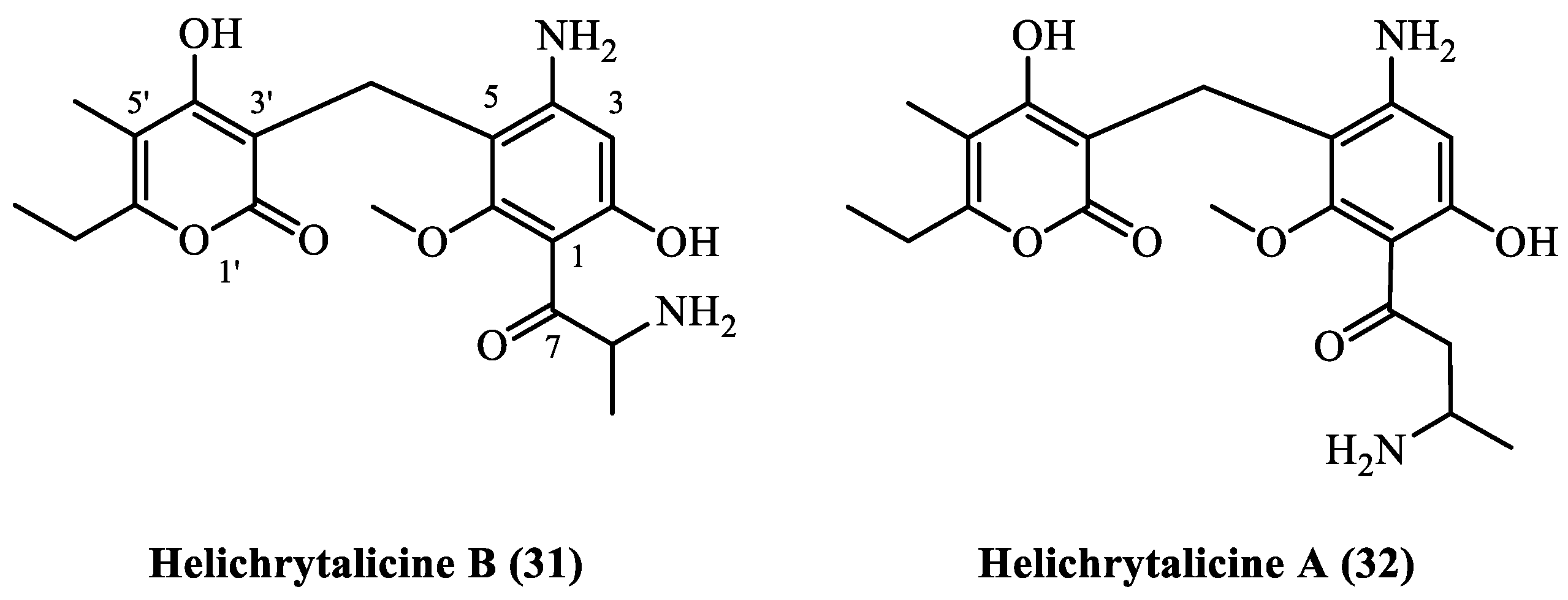
12. Benzopyranes
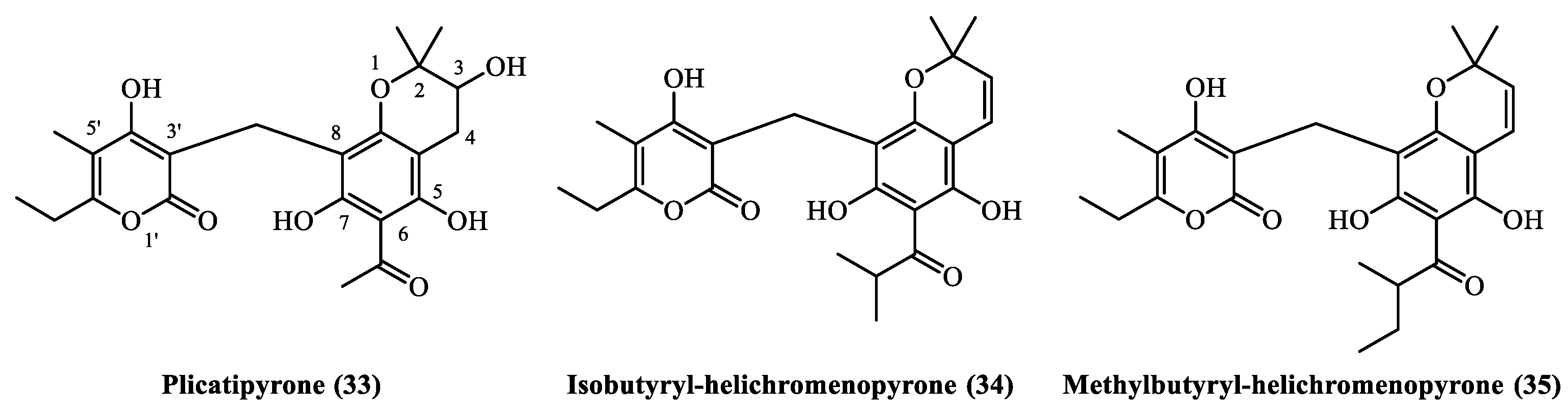
13. Benzofuranes
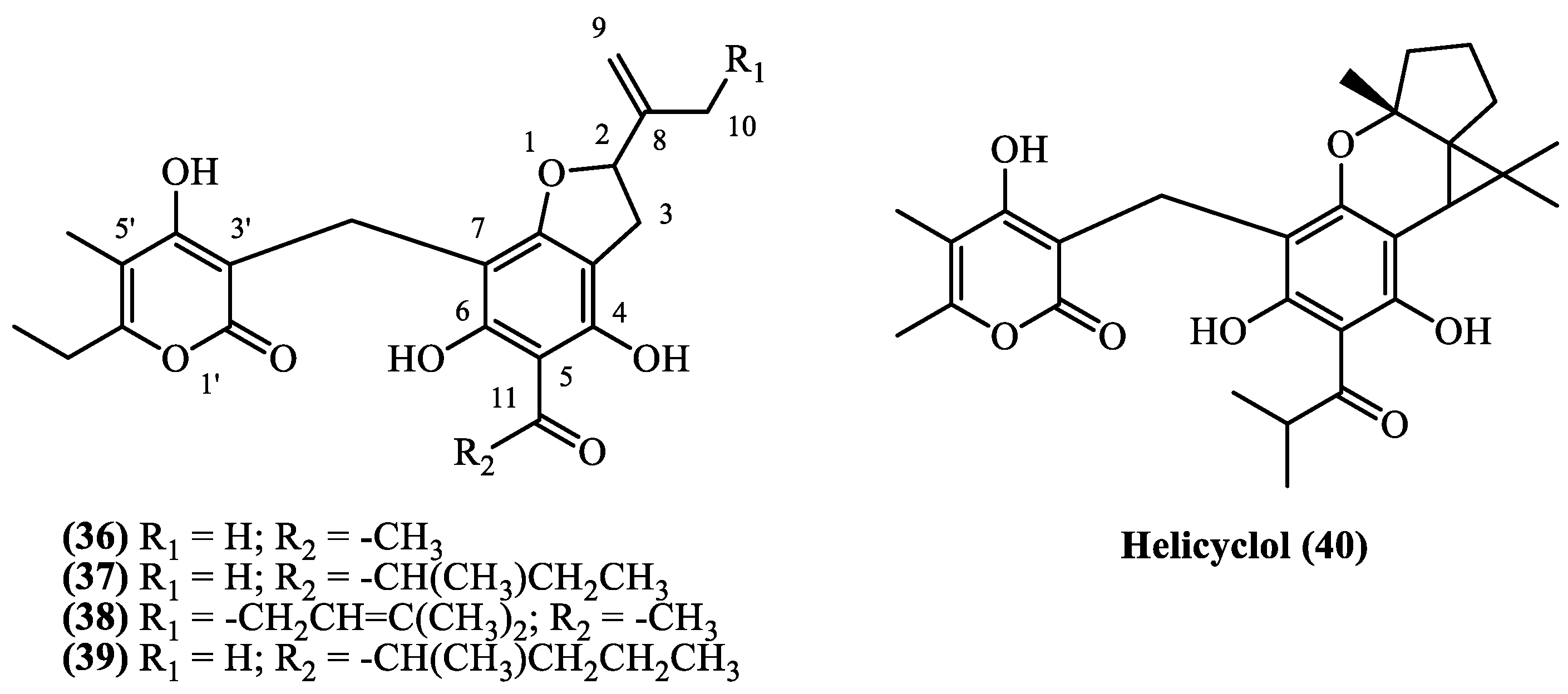
14. Chromane PGs
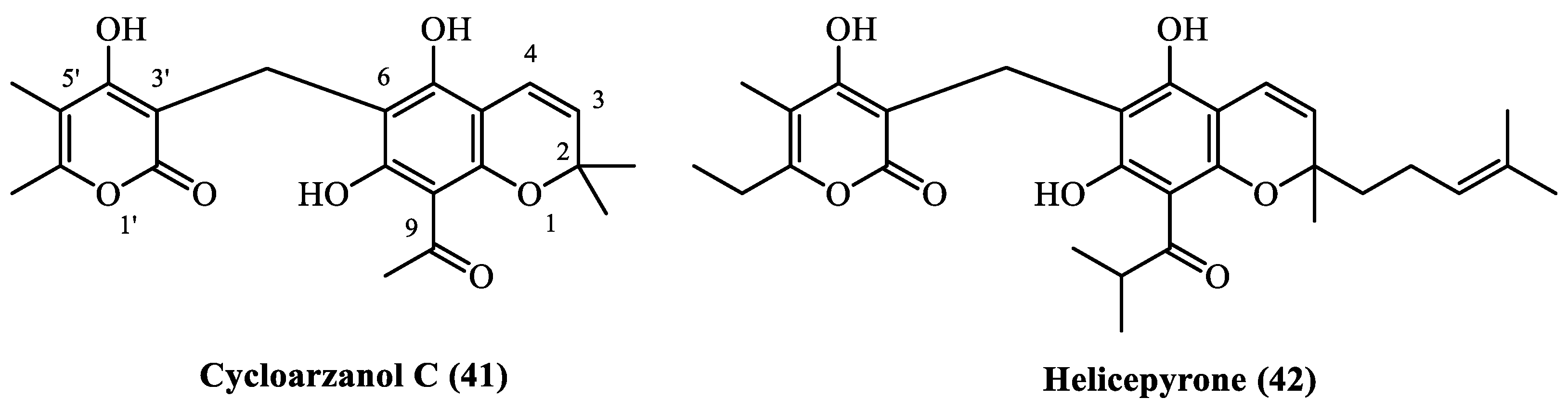
15. Hetero-trimer PGs
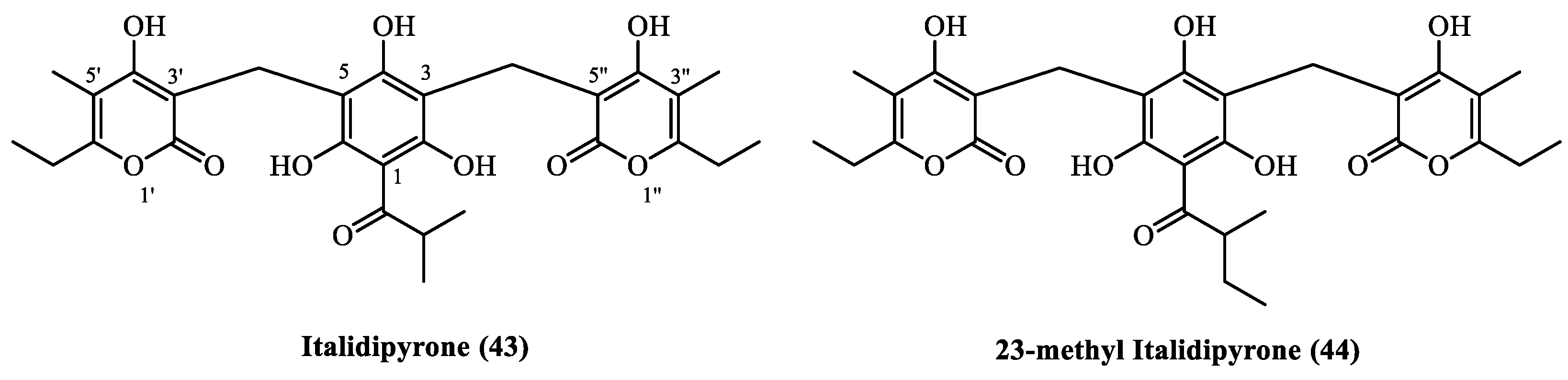
16. Spiroketals
17. Conclusions
| Entry | Compound Name | Extraction Conditions | Extracted Amount | Plant Name, Location | Plant Parts | Subclass | Ref. |
| 1 | 3,5-dimethyl-4-hydroxy-6-isopropyl alphapyrone (1) | Extracted with Et2O-petrol (1:2) at rt. The extracts obtained after removal of long chain saturated carbons with MeOH, were first separated by CC (silica gel) and further by TLC (silica gel PF 254). | Plant material: 150 g Amount isolated: 20 mg Yield: 0.0133 % |
Plant name: Helichrysum zeyheri Less. Location: Transvaal, South Africa (wildgrown) |
Aerial parts | Monopyrones | [15] |
| 2 | 3,5-dimethyl-4-(methoxy)-6-isopropyl alphapyrone (2) | The same as for entry 1, compound 1 | Plant material: 150 g Amount isolated: 50 mg Yield: 0.0333 % |
Plant name: Helichrysum zeyheri Less. Location: Transvaal, South Africa (wildgrown) |
Aerial parts | Monopyrones | [15] |
| 3 | Micropyrone (3) | Maceration with acetone (3 × 4 L) at rt; residue (51 g) adsorbed on silica gel and fractionated by vacuum chromatography into petroleum-ether, EtOAc, and acetone fractions; the EtOAc eluate crystallized from EtOAc/petroleum ether. | Plant material: 1000 g Amount isolated: 482 mg Yield: 0.0482 % |
Plant name: Helichrysum italicum ssp. Microphyllum Location: near Arzana (NU, Sardinia), Italy |
Aerial parts (non-woody) + flowers | Monopyrones | [8] |
| 4 | Micropyrone (3) | Maceration with acetone (3 × 2 L, rt); crude residue (12 g) dissolved in EtOAc/hexane (1:1, 200 mL each) and left overnight; precipitate collected and recrystallised from toluene–acetone. Later silica-gel fractions (hexane/EtOAc 6:4) triturated with diethyl ether | Plant material: 540 g Amount isolated: 29 mg Yield: 0.0054 % |
Plant name: Helichrysum italicum ssp. Microphyllum Location: Sardinia, Italy (wildgrown) |
Aerial parts + flowers | Monopyrones | [17] |
| 5 | Micropyrone (3) | Acetone extraction (2 × 15 L, rt); 50g of the crude residue (from a total of 202 g gummy residue) was partitioned between petroleum ether and 90 % MeOH (1 h, 30 °C); fractions of the aq MeOH phase chromatographed on silica gel (petroleum ether→EtOAc); finally - trituration with ether | Plant material: 5000 g Amount isolated: 162.5 mg Yield: 0.0129 % |
Plant name: Helichrysum italicum ssp. Microphyllum Location: Arzana (Sardinia), Italy (wildgrown) |
Aerial parts + flowers | Monopyrones | [9] |
| 6 | Micropyrone (3) | Acetone extraction (3 × 5 L, rt); crude residue (20 g) fractionated by silica-gel vacuum liquid chromatography (hexane → EtOAc → CH2Cl2 → MeOH); chromatographed on Sephadex LH-20 and semi-prep HPLC | Plant material: 500 g Amount isolated: 7.5 mg Yield: 0.0015 % |
Plant name: Helichrysum italicum (Roth) G.Don Location: Sardinia, Italy (wildgrown) |
non-woody Aerial parts + flowers | Monopyrones | [14] |
| 7 | Helipyrone C (Bisnorhelipyrone) (4) | Extracted with petroleum ether and ethanol, followed by solvent partitioning; CC on silica gel using chloroform–methanol (98:2), and after acetylation, the compounds were further purified by silica gel chromatography (hexane–ether, 9:1) and preparative TLC to yield diacetyl derivatives, which in turn, after deacetylation, provided helipyrone (6), bisnorhelipyrone (4), and norhelipyrone (5). | Plant material: 1500 g Amount isolated: n.d. Yield: n.d. |
Plant name: Helichrysum arenarium (L.) Moench Location: near Malacky, Slovakia (wildgrown) |
Roots | Dipyrones | [5] |
| 8 | Helipyrone C (Bisnorhelipyrone) (4) | Methanol percolation (20 L, 24 h, rt); crude MeOH extract (55 g dry extract) partitioned with petroleum ether, CH₂Cl₂, EtOAc, n-BuOH; CH₂Cl₂ fraction (12 g) silica-gel CC (n-hexane → CHCl₃) then RP-HPLC (MeCN/TFA 55→100 %) | Plant material: 4000 g Amount isolated: 1.9 mg Yield: 4.8e-05 % |
Plant name: Helichrysum oocephalum Boiss. Location: Mashhad, Razavi Khorasan, Iran |
Aerial parts | Dipyrones | [11] |
| 9 | Helipyrone C (Bisnorhelipyrone) (4) | Successive extraction with hexane, CHCl3, EtOAc, MeOH at rt; silica-gel column chromatography (hexane–EtOAc); preparative TLC (CHCl3–MeOH 99:1) | Plant material: 400 g Amount isolated: n.d. Yield: n.d. |
Plant name: Helichrysum stoechas (L.) Moench Location: Dunes of the forest domain of Olonne, near Les Sables d’Olonne, Vendée, France |
Roots | Dipyrones | [19] |
| 10 | Helipyrone C (Bisnorhelipyrone) (4) | Maceration of dried aerial parts with CH2Cl2 (3 × to exhaustion, RT); CH2Cl2 extract concentrated in vacuo, chromatographed on silica-gel 60 (CHCl3/MeOH gradient) then silica-gel 60 H; active fractions purified by preparative TLC | Plant material: 700 g Amount isolated: n.d. Yield: n.d. |
Plant name: Helichrysum stoechas (L.) Moench Location: Sierra Perenchiza, near Chiva, Valencia, Spain |
Aerial parts + flowers | Dipyrones | [20] |
| 11 | Helipyrone B (Norhelipyrone) (5) | Same as for entry 7, compound 4 | Plant material: 1500 g Amount isolated: n.d. Yield: n.d. |
Plant name: Helichrysum arenarium (L.) Moench Location: near Malacky, Slovakia (wildgrown) |
Roots | Dipyrones | [5] |
| 12 | Helipyrone B (Norhelipyrone) (5) | Procedure the same as entry 8, compound 4 | Plant material: 4000 g Amount isolated: 0.4 mg Yield: 1e-05 % |
Plant name: Helichrysum oocephalum Boiss. Location: Mashhad, Razavi Khorasan, Iran |
Aerial parts | Dipyrones | [11] |
| 13 | Helipyrone B (Norhelipyrone) (5) | Procedure the same as entry 9, compound 4 | Plant material: 400 g Amount isolated: n.d. Yield: n.d. |
Plant name: Helichrysum stoechas (L.) Moench Location: Dunes of the forest domain of Olonne, near Les Sables d’Olonne, Vendée, France |
Roots | Dipyrones | [19] |
| 14 | Helipyrone B (Norhelipyrone) (5) | Procedure the same as entry 10, compound 4 | Plant material: 700 g Amount isolated: n.d. Yield: n.d. |
Plant name: Helichrysum stoechas (L.) Moench Location: Sierra Perenchiza, near Chiva, Valencia, Spain |
Aerial parts + flowers | Dipyrones | [20] |
| 15 | Helipyrone A (6) | Procedure the same as entry 11, compound 5 | Plant material: 1500 g Amount isolated: n.d. Yield: n.d. |
Plant name: Helichrysum arenarium (L.) Moench Location: near Malacky, Slovakia (wildgrown) |
Roots | Dipyrones | [5] |
| 16 | Helipyrone A (6) | Procedure the same as entry 3, compound 3 | Plant material: 1000 g Amount isolated: 245 mg Yield: 0.0245 % |
Plant name: Helichrysum italicum ssp. microphyllum Location: near Arzana (NU, Sardinia), Italy |
Aerial parts (non-woody) + flowers | Dipyrones | [8] |
| 17 | Helipyrone A (6) | Maceration with acetone (3 × 2 L, RT); crude residue (12 g) dissolved in EtOAc/hexane (1:1, 200 mL each) and left overnight; precipitate collected and recrystallised from toluene–acetone. Fractionation on silica-gel column (hexane → EtOAc); | Plant material: 540 g Amount isolated: 120 mg Yield: 0.0219 % |
Plant name: Helichrysum italicum ssp. microphyllum Location: Sardinia, Italy (wildgrown) |
Aerial parts + flowers | Dipyrones | [17] |
| 18 | Helipyrone A (6) | Same as entry 5, compound 3; Aqueous MeOH phase fraction crystallized from diethyl ether to give helipyrone |
Plant material: 5000 g Amount isolated: 320 mg Yield: 0.0256 % |
Plant name: Helichrysum italicum ssp. microphyllum Location: Arzana (Sardinia), Italy (wildgrown) |
Aerial parts + flowers | Dipyrones | [9] |
| 19 | Helipyrone A (6) | Methanol ultrasound extraction of dried leaves (3 × 1 h, RT); crude residue (38.7 g) partitioned between H2O and EtOAc; EtOAc layer (8.8 g) fractionated on Sephadex LH-20 (hexane/CHCl3/MeOH 3:1:1; EtOAc fractions from methanol extract subjected to silica-gel CC (2-butanone/hexane 1:4) and preparative TLC. | Plant material: n.d. Amount isolated: 1.2 mg Yield: n.d. |
Plant name: Helichrysum italicum (Roth) G.Don Location: Castel Volturno (Caserta, Italy) (wildgrown) |
Leaf material | Dipyrones | [12] |
| 20 | Helipyrone A (6) | Methanol maceration; Celite adsorption; Soxhlet extraction with petroleum ether; The residue was purified by silica-gel chromatography (CH2Cl2–MeOH gradient). | Plant material: 37000 g Amount isolated: n.d. Yield: n.d. |
Plant name: Helichrysum italicum (Roth) G.Don Location: Italy (commerial source) |
Aerial parts + flowers | Dipyrones | [7] |
| 21 | Helipyrone A (6) | Defatted by refluxing in petroleum ether (2 h); extracted three times with 80:20 ethanol–water (3 × 5 L, RT); combined hydroalcoholic extracts partitioned between H2O and CHCl3; CHCl3 phase concentrated to dryness; residue purified by silica-gel column chromatography (CHCl3→MeOH gradient) and preparative TLC. | Plant material: 10000 g Amount isolated: 250 mg Yield: 0.0025 % |
Plant name: Helichrysum italicum (Roth) G.Don Location: Italy (commerial source) |
Aerial parts | Dipyrones | [18] |
| 22 | Helipyrone A (6) | Procedure the same as entry 8, compound 4 | Plant material: 4000 g Amount isolated: 2.7 mg Yield: 6.79e-05 % |
Plant name: Helichrysum oocephalum Boiss. Location: Mashhad, Razavi Khorasan, Iran |
Aerial parts | Dipyrones | [11] |
| 23 | Helipyrone A (6) | Procedure the same as entry 9, compound 4 | Plant material: 400 g Amount isolated: n.d. Yield: n.d. |
Plant name: Helichrysum stoechas (L.) Moench Location: Dunes of the forest domain of Olonne, near Les Sables d’Olonne, Vendée, France |
Roots | Dipyrones | [19] |
| 24 | Helipyrone A (6) | Cold maceration (3 × 24 h, 4 °C) with MeOH (1 L each); combined extracts evaporated to dryness (3.5 g); after CHCl3/MeOH (95:5→60:40) silica-gel CC, purified on Sephadex LH-20. | Plant material: 35 g Amount isolated: 14.5 mg Yield: 0.041 % |
Plant name: Helichrysum stoechas (L.) Moench Location: Villanueva de Gállego (Zaragoza, Spain) |
Aerial parts + flowers | Dipyrones | [13] |
| 25 | Helipyrone A (6) | Procedure the same as entry 10, compound 4 | Plant material: 700 g Amount isolated: n.d. Yield: n.d. |
Plant name: Helichrysum stoechas (L.) Moench Location: Sierra Perenchiza, near Chiva, Valencia, Spain |
Aerial parts + flowers | Dipyrones | [20] |
| 26 | Helitalone A (7) | Procedure the same as entry 6, compound 3 | Plant material: 500 g Amount isolated: 5 mg Yield: 0.001 % |
Plant name: Helichrysum italicum (Roth) G.Don Location: Sardinia, Italy (wildgrown) |
Non-woody Aerial parts + flowers | Dipyrones | [14] |
| 27 | Norauricepyrone (8) | Procedure the same as entry 1, compound 1 | Plant material: 190 g Amount isolated: 2 mg Yield: 0.001052 % |
Plant name: Helichrysum cephaloideum DC. Location: Transvaal, South Africa (wildgrown) |
Roots | 3-NA PGs | [15] |
| 28 | Methyl-norauricepyrone (9) | Procedure the same as entry 1, compound 1 | Plant material: 190 g Amount isolated: 2 mg Yield: 0.001052 % |
Plant name: Helichrysum cephaloideum DC. Location: Transvaal, South Africa (wildgrown) |
Roots | 3-NA PGs | [15] |
| 29 | Arzanol (10) | Procedure the same as entry 16, compound 6 | Plant material: 1000 g Amount isolated: 965 mg Yield: 0.0965 % |
Plant name: Helichrysum italicum ssp. microphyllum Location: near Arzana (NU, Sardinia), Italy |
Aerial parts (non-woody) + flowers | 3-prenyl PGs | [8] |
| 30 | Arzanol (10) | Maceration with acetone (3 × 2 L, RT); crude residue (12 g) dissolved in EtOAc/hexane (1:1, 200 mL each) and left overnight; precipitate collected and recrystallised from toluene–acetone; mother liquors chromatographed on silica gel (hexane → EtOAc gradient) | Plant material: 540 g Amount isolated: 437 mg Yield: 0.081 % |
Plant name: Helichrysum italicum ssp. microphyllum Location: Sardinia, Italy (wildgrown) |
Aerial parts + flowers | 3-prenyl PGs | [17] |
| 31 | Arzanol (10) | Same as entry 5, compound 3; aqueous MeOH phase fraction crystallized from ether, then silica-gel CC (petroleum ether/EtOAc) |
Plant material: 5000 g Amount isolated: 3700 mg Yield: 0.296 % |
Plant name: Helichrysum italicum ssp. microphyllum Location: Arzana (Sardinia), Italy (wildgrown) |
Aerial parts + flowers | 3-prenyl PGs | [9] |
| 32 | Arzanol (10) | Procedure the same as entry 6, compound 3 | Plant material: 500 g Amount isolated: 10 mg Yield: 0.002 % |
Plant name: Helichrysum italicum (Roth) G. Don Location: Sardinia, Italy (wildgrown) |
Non-woody Aerial parts + flowers | 3-prenyl PGs | [14] |
| 33 | Arzanol (10) | Cold maceration (3 × 24 h, 4 °C) with MeOH (1 L each); combined extracts evaporated to dryness (3.5 g) and chromatographed on silica gel (n-BuOH :H2O 82:18 → 70:10:30) then Sephadex LH-20. | Plant material: 35 g Amount isolated: 170 mg Yield: 0.48 % |
Plant name: Helichrysum stoechas (L.) Moench Location: Villanueva de Gállego (Zaragoza, Spain) |
Flowers | 3-prenyl PGs | [13] |
| 34 | Arenol B (11) | Procedure the same as entry 8, compound 4 | Plant material: 4000 g Amount isolated: 0.4 mg Yield: 1e-05 % |
Plant name: Helichrysum oocephalum Boiss. Location: Mashhad, Razavi Khorasan, Iran |
Aerial parts | 3-prenyl PGs | [11] |
| 35 | Helitalone B (12) | Procedure the same as entry 6, compound 3 | Plant material: 500 g Amount isolated: 3.1 mg Yield: 0.00062 % |
Plant name: Helichrysum italicum (Roth) G. Don Location: Sardinia, Italy (wildgrown) |
Non-woody Aerial parts + flowers | 3-prenyl PGs | [14] |
| 36 | 6-O-Desmethylauricepyrone (13) | Ether : petroleum-ether (3:1, RT) extraction of air-dried aerial parts; silica-gel column (Activity Stage II) followed by repeated preparative TLC (Si-gel GF254) | Plant material: 90 g Amount isolated: 120 mg Yield: 0.133 % |
Plant name: Helichrysum odoratissimum Sweet. Location: South Africa (wildgrown) |
Aerial parts | 3-prenyl PGs | [7] |
| 37 | Arenol C (14) | Procedure the same as entry 8, compound 4 | Plant material: 4000 g Amount isolated: 0.8 mg Yield: 2e-05 % |
Plant name: Helichrysum oocephalum Boiss. Location: Mashhad, Razavi Khorasan, Iran |
Aerial parts | 3-prenyl PGs | [11] |
| 38 | 3-prenyl norauricepyrone (15) | Procedure the same as entry 8, compound 4 | Plant material: 4000 g Amount isolated: 0.5 mg Yield: 1.25e-05 % |
Plant name: Helichrysum oocephalum Boiss. Location: Mashhad, Razavi Khorasan, Iran |
Aerial parts | 3-prenyl PGs | [11] |
| 39 | 23-Methyl-6-O-desmethylauricepyrone (16) | Procedure the same as entry 1, compound 1 | Plant material: 10 g Amount isolated: 7 mg Yield: 0.0699 % |
Plant name: Helichrysum mixtum (Kuntze) Moeser Location: Transvaal, South Africa (wildgrown) |
Roots | 3-prenyl PGs | [15] |
| 40 | 23-Methyl-6-O-desmethylauricepyrone (16) | Procedure the same as entry 36, compound 13 | Plant material: 90 g Amount isolated: 30 mg Yield: 0.033 % |
Plant name: Helichrysum odoratissimum Sweet. Location: South Africa (wildgrown) |
Aerial parts | 3-prenyl PGs | [7] |
| 41 | 23-Methyl-6-O-desmethylauricepyrone (16) | Procedure the same as entry 8, compound 4 | Plant material: 4000 g Amount isolated: 0.3 mg Yield: 7.5e-06 % |
Plant name: Helichrysum oocephalum Boiss. Location: Mashhad, Razavi Khorasan, Iran |
Aerial parts | 3-prenyl PGs | [11] |
| 42 | 23-Methyl-6-O-desmethylauricepyrone (16) | Procedure the same as entry 1, compound 1 | Plant material: 100 g Amount isolated: 90 mg Yield: 0.09 % |
Plant name: Helichrysum stenopterum DC. Location: Transvaal, South Africa (wildgrown) |
Aerial parts | 3-prenyl PGs | [15] |
| 43 | Heliarzanol (17) | Same as entry 31, compound 10; Mother liquors from arzanol isolation chromatographed on silica gel (hexane/EtOAc 55:45) and preparative HPLC. |
Plant material: 5000 g Amount isolated: 4.5 mg Yield: 0.00036 % |
Plant name: Helichrysum italicum ssp. microphyllum Location: Arzana (Sardinia), Italy (wildgrown) |
Aerial parts + flowers | 3-prenyl PGs | [9] |
| 44 | 23-ethyl-6-O-desmethyl-auricepyrone (18) | Procedure the same as entry 1, compound 1 | Plant material: 10 g Amount isolated: 7 mg Yield: 0.0699 % |
Plant name: Helichrysum mixtum (Kuntze) Moeser Location: Transvaal, South Africa (wildgrown) |
Roots | 3-prenyl PGs | [15] |
| 45 | 23-ethyl-6-O-desmethyl-auricepyrone (18) | Procedure the same as entry 1, compound 1 | Plant material: 100 g Amount isolated: 90 mg Yield: 0.09 % |
Plant name: Helichrysum stenopterum DC. Location: Transvaal, South Africa (wildgrown) |
Aerial parts | 3-prenyl PGs | [15] |
| 46 | Auricepyrone (19) | Extracted with diethyl ether/petroleum ether (1:2) at rt; combined extracts separated on silica gel column chromatography (activity grade II), further purified by repeated TLC (Si gel GF254). | Plant material: 50 g Amount isolated: 7.5 mg Yield: 0.01499 % |
Plant name: Helichrysum auriceps Hilliard Location: Natal (South Africa) |
Roots | 3-prenyl methoxy PGs | [6] |
| 47 | Auricepyrone (19) | Same as entry 46, compound 19 | Plant material: 30 g Amount isolated: 3.75 mg Yield: 0.0125 % |
Plant name: Helichrysum cephaloideum DC. Location: Natal (South Africa) |
Roots | 3-prenyl methoxy PGs | [6] |
| 48 | Auricepyrone (19) | Same as entry 46, compound 19 | Plant material: 50 g Amount isolated: 1.25 mg Yield: 0.0025 % |
Plant name: Helichrysum cephaloideum DC. Location: Natal (South Africa) |
Aerial parts | 3-prenyl methoxy PGs | [6] |
| 49 | Auricepyrone (19) | Ether : petroleum-ether (1:7, RT) extraction of shredded roots; silica-gel column (Activity Stage II) followed by repeated preparative TLC (Si-gel GF254) | Plant material: 50 g Amount isolated: n.d. Yield: n.d. |
Plant name: Helichrysum cephaloideum DC. Location: South Africa (wildgrown) |
Roots | 3-prenyl methoxy PGs | [7] |
| 50 | Auricepyrone (19) | Procedure the same as entry 1, compound 1 | Plant material: 190 g Amount isolated: 15 mg Yield: 0.007894 % |
Plant name: Helichrysum cephaloideum DC. Location: Transvaal, South Africa (wildgrown) |
Roots | 3-prenyl methoxy PGs | [15] |
| 51 | 23-Methylauricepyrone (20) | Procedure the same as entry 46, compound 19 | Plant material: 50 g Amount isolated: 22.5 mg Yield: 0.0449 % |
Plant name: Helichrysum auriceps Hilliard Location: Natal (South Africa) |
Roots | 3-prenyl methoxy PGs | [6] |
| 52 | 23-Methylauricepyrone (20) | Procedure the same as entry 46, compound 19 | Plant material: 30 g Amount isolated: 11.25 mg Yield: 0.03749 % |
Plant name: Helichrysum cephaloideum DC. Location: Natal (South Africa) |
Roots | 3-prenyl methoxy PGs | [6] |
| 53 | 23-Methylauricepyrone (20) | Procedure the same as entry 48, compound 19 | Plant material: 50 g Amount isolated: 3.75 mg Yield: 0.00749 % |
Plant name: Helichrysum cephaloideum DC. Location: Natal (South Africa) |
Aerial parts | 3-prenyl methoxy PGs | [6] |
| 54 | 23-Methylauricepyrone (20) | Procedure the same as entry 49, compound 19 | Plant material: 50 g Amount isolated: n.d. Yield: n.d. |
Plant name: Helichrysum cephaloideum DC. Location: South Africa (wildgrown) |
Roots | 3-prenyl methoxy PGs | [7] |
| 55 | 23-ethyl-6-O-desmethyl-4-O-methylauricepyrone (21) | Procedure the same as entry 1, compound 1 |
Plant material: 190 g Amount isolated: 15 mg Yield: 0.007894 % |
Plant name: Helichrysum cephaloideum DC. Location: Transvaal, South Africa (wildgrown) |
Roots | 3-prenyl methoxy PGs | [15] |
| 56 | 18,18-bis-desmethyl Achyroclinopyrone C (22) | Chloroform extraction (plant dipped for 10 min at RT); silica-gel CC (n-hexane–EtOAc); preparative TLC (CHCl3); semipreparative reversed-phase HPLC (MeOH–phosphate buffer) | Plant material: 500 g Amount isolated: 16 mg Yield: 0.0032 % |
Plant name: Helichrysum decumbens Cambess. Location: La Manga del Mar Menor, Murcia, Spain (wildgrown) |
Aerial parts + flowers | 3-geranyl PGs | [29] |
| 57 | 18,18-bis-desmethyl Achyroclinopyrone C (22) | Successive extraction with hexane, CHCl3, EtOAc, MeOH at rt; silica-gel CC (hexane–EtOAc); preparative TLC (CHCl3–MeOH 99:1) | Plant material: 400 g Amount isolated: n.d. Yield: n.d. |
Plant name: Helichrysum stoechas (L.) Moench Location: Dunes of the forest domain of Olonne, near Les Sables d’Olonne, Vendée, France |
Roots | 3-geranyl PGs | [19] |
| 58 | 18,18-bis-desmethyl Achyroclinopyrone C (22) | Procedure the same as entry 24, compound 6 Obtained from silica-gel fractions after polarity-gradient CH2Cl2/MeOH chromatography, separated from arzanol by recrystallisation |
Plant material: 35 g Amount isolated: 30 mg Yield: 0.08569 % |
Plant name: Helichrysum stoechas (L.) Moench Location: Villanueva de Gállego (Zaragoza, Spain) |
Aerial parts + flowers | 3-geranyl PGs | [13] |
| 59 | 18,18-bis-desmethyl Achyroclinopyrone A (23) | Procedure the same as entry 56, compound 22 | Plant material: 500 g Amount isolated: 4 mg Yield: 0.0008 % |
Plant name: Helichrysum decumbens Cambess. Location: La Manga del Mar Menor, Murcia, Spain (wildgrown) |
Aerial parts + flowers | 3-geranyl PGs | [29] |
| 60 | 18,18-bis-desmethyl Achyroclinopyrone A (23) | Procedure the same as entry 9, compound 4 | Plant material: 400 g Amount isolated: n.d. Yield: n.d. |
Plant name: Helichrysum stoechas (L.) Moench Location: Dunes of the forest domain of Olonne, near Les Sables d’Olonne, Vendée, France |
Roots | 3-geranyl PGs | [19] |
| 61 | 8'-methyl-18,18-bis-desmethyl Achyroclinopyrone A (24) |
Procedure the same as entry 56, compound 22 Detected as trace amounts by reversed-phase HPLC (MeOH–phosphate buffer) |
Plant material: 500 g Amount isolated: traces Yield: n.d. |
Plant name: Helichrysum decumbens Cambess. Location: La Manga del Mar Menor, Murcia, Spain (wildgrown) |
Aerial parts + flowers | 3-geranyl PGs | [29] |
| 62 | Achyroclinopyrone C (25) | Same as entry 8, compound 4 | Plant material: 4000 g Amount isolated: 1.1 mg Yield: 2.8e-05 % |
Plant name: Helichrysum oocephalum Boiss. Location: Mashhad, Razavi Khorasan, Iran |
Aerial parts | 3-geranyl PGs | [11] |
| 63 | Achyroclinopyrone A (26) | Procedure the same as entry 62, compound 25 | Plant material: 4000 g Amount isolated: 1.5 mg Yield: 3.75e-05 % |
Plant name: Helichrysum oocephalum Boiss. Location: Mashhad, Razavi Khorasan, Iran |
Aerial parts | 3-geranyl PGs | [11] |
| 64 | Achyroclinopyrone D (27) | Procedure the same as entry 62, compound 25 | Plant material: 4000 g Amount isolated: 2.1 mg Yield: 5.3e-05 % |
Plant name: Helichrysum oocephalum Boiss. Location: Mashhad, Razavi Khorasan, Iran |
Aerial parts | 3-geranyl PGs | [11] |
| 65 | Achyroclinopyrone B (28) | Procedure the same as entry 62, compound 25 | Plant material: 4000 g Amount isolated: 1.2 mg Yield: 2.99e-05 % |
Plant name: Helichrysum oocephalum Boiss. Location: Mashhad, Razavi Khorasan, Iran |
Aerial parts | 3-geranyl PGs | [11] |
| 66 | Arenol A (29) | n.d. | Plant material: n.d. g Amount isolated: n.d. Yield: n.d. |
Plant name: Helichrysum arenarium (L.) Moench Location: n.d. |
Non-woody Aerial parts + flowers | 2-prenyl PGs | [16] |
| 67 | Arenol A (29) | Procedure the same as entry 10, compound 4 | Plant material: 700 g Amount isolated: n.d. Yield: n.d. |
Plant name: Helichrysum stoechas (L.) Moench Location: Sierra Perenchiza, near Chiva, Valencia, Spain |
Aerial parts + flowers | 2-prenyl PGs | [20] |
| 68 | Homoarenol (30) | Procedure the same as entry 10, compound 4 | Plant material: 700 g Amount isolated: n.d. Yield: n.d. |
Plant name: Helichrysum stoechas (L.) Moench Location: Sierra Perenchiza, near Chiva, Valencia, Spain |
Aerial parts + flowers | 2-prenyl PGs | [20] |
| 69 | Homoarenol (30) | n.d. | Plant material: n.d. Amount isolated: n.d. Yield: n.d. |
Plant name: Helichrysum stoechas (L.) Moench Location: n.d. |
non-woody Aerial parts + flowers | 2-prenyl PGs | [16] |
| 70 | Helichrytalicine B (31) | Methanol ultrasound extraction of dried leaves (3 × 1 h, RT); crude residue (38.7 g) partitioned between H2O and EtOAc; EtOAc layer (8.8 g) fractionated on Sephadex LH-20 (hexane/CHCl3/MeOH 3:1:1), followed by silica-gel CC and preparative TLC. | Plant material: n.d. Amount isolated: 2.3 mg Yield: n.d. |
Plant name: Helichrysum italicum (Roth) G.Don Location: Castel Volturno (Caserta, Italy) (wildgrown) |
Leaf material | Amino PGs | [12] |
| 71 | Helichrytalicine A (32) | Procedure the same as entry 70, compound 31 | Plant material: n.d. Amount isolated: 6 mg Yield: n.d. |
Plant name: Helichrysum italicum (Roth) G.Don Location: Castel Volturno (Caserta, Italy) (wildgrown) |
Leaf material | Amino PGs | [12] |
| 72 | Plicatipyrone (33) | Extracted with petroleum ether, followed by EtOH partition and chloroform extraction. The residue was purified by silica-gel CC using cyclohexane:EtOAc (8:2) | Plant material: 4500 g Amount isolated: 10 mg Yield: 0.000222 % |
Plant name: Helichrysum plicatum DC. ssp. plicatum Location: Yildiz Dagi and Camlibel (Sivas), Turkey (wildgrown) |
Flower heads | Benzopyranes | [7] |
| 73 | Plicatipyrone (33) | Procedure the same as entry 10, compound 4 | Plant material: 700 g Amount isolated: n.d. Yield: n.d. |
Plant name: Helichrysum stoechas (L.) Moench Location: Sierra Perenchiza, near Chiva, Valencia, Spain |
Aerial parts + flowers | Benzopyranes | [20] |
| 74 | Isobutyryl-helichromenopyrone (34) | Procedure the same as entry 1, compound 1 | Plant material: 10 g Amount isolated: 1 mg Yield: 0.01 % |
Plant name: Helichrysum mixtum (Kuntze) Moeser Location: Transvaal, South Africa (wildgrown) |
Roots | Benzopyranes | [15] |
| 75 | methylbutyryl-helichromenopyrone (35) | Procedure the same as entry 1, compound 1 | Plant material: 100 g Amount isolated: 1 mg Yield: 0.001 % |
Plant name: Helichrysum mixtum (Kuntze) Moeser Location: Transvaal, South Africa (wildgrown) |
Aerial parts | Benzopyranes | [15] |
| 76 | Italipyrone (36) | Procedure the same as entry 20, compound 6 | Plant material: 37000 g Amount isolated: 25 mg Yield: 6.799e-05 % |
Plant name: Helichrysum italicum (Roth) G.Don Location: Italy (commerial source) |
Aerial parts + flowers | Benzofuranes | [7] |
| 77 | Italipyrone (36) | Procedure the same as entry 10, compound 4 | Plant material: 700 g Amount isolated: n.d. Yield: n.d. |
Plant name: Helichrysum stoechas (L.) Moench Location: Sierra Perenchiza, near Chiva, Valencia, Spain |
Aerial parts + flowers | Benzofuranes | [20] |
| 78 | 22-Methyl-22-ethyl-italipyrone (37) | Same as entry 49, compound 19 | Plant material: 50 g Amount isolated: 2.5 mg Yield: 0.005 % |
Plant name: Helichrysum cephaloideum DC. Location: South Africa (wildgrown) |
Roots | Benzofuranes | [7] |
| 79 | 22-Methyl-22-ethyl-italipyrone (37) | Procedure the same as entry 1, compound 1 | Plant material: 190 g Amount isolated: 15 mg Yield: 0.007894 % |
Plant name: Helichrysum cephaloideum DC. Location: Transvaal, South Africa (wildgrown) |
Roots | Benzofuranes | [15] |
| 80 | 22-Methyl-22-ethyl-italipyrone (37) | Procedure the same as entry 1, compound 1 | Plant material: 10 g Amount isolated: 5 mg Yield: 0.05 % |
Plant name: Helichrysum mixtum (Kuntze) Moeser Location: Transvaal, South Africa (wildgrown) |
Roots | Benzofuranes | [15] |
| 81 | 22-Methyl-22-propyl-italipyrone (38) | Same as entry 49, compound 19; Isolated after de-acetylation. |
Plant material: 50 g Amount isolated: 2.5 mg Yield: 0.005 % |
Plant name: Helichrysum cephaloideum DC. Location: South Africa (wildgrown) |
Roots | Benzofuranes | [7] |
| 82 | 22-Methyl-22-propyl-italipyrone (38) | Procedure the same as entry 1, compound 1 | Plant material: 200 g Amount isolated: 15 mg Yield: 0.007499 % |
Plant name: Helichrysum cephaloideum DC. Location: Transvaal, South Africa (wildgrown) |
Aerial parts | Benzofuranes | [15] |
| 83 | 22-Methyl-22-propyl-italipyrone (38) | Procedure the same as entry 1, compound 1 | Plant material: 10 g Amount isolated: 5 mg Yield: 0.05 % |
Plant name: Helichrysum mixtum (Kuntze) Moeser Location: Transvaal, South Africa (wildgrown) |
Roots | Benzofuranes | [15] |
| 84 | 20-(3,3′-Dimethylallyl)-italipyrone (39) | Extracted with petroleum ether; partitioned with EtOH; the dry residue extracted with chloroform. The extract (8.9 g) was purified by silica-gel CC, followed by rechromatography using cyclohexane:ethyl acetate (9:1). | Plant material: 1600 g Amount isolated: 80 mg Yield: 0.005 % |
Plant name: Helichrysum stoechas subsp. barrelieri (Ten.) Nym Location: Mudanya (Bursa), Turkey (wildgrown) |
Flower heads | Benzofuranes | [7] |
| 85 | Helicyclol (40) | Procedure the same as entry 62, compound 25 | Plant material: 4000 g Amount isolated: 0.5 mg Yield: 1.2e-05 % |
Plant name: Helichrysum oocephalum Boiss. Location: Mashhad, Razavi Khorasan, Iran |
Aerial parts | Benzofuranes | [11] |
| 86 | Cycloarzanol C (41) | Procedure the same as entry 62, compound 25 | Plant material: 4000 g Amount isolated: 0.5 mg Yield: 1.299e-05 % |
Plant name: Helichrysum oocephalum Boiss. Location: Mashhad, Razavi Khorasan, Iran |
Aerial parts | Chromane PGs | [11] |
| 87 | Helicepyrone (42) | Procedure the same as entry 62, compound 25 | Plant material: 4000 g Amount isolated: 1 mg Yield: 2.5e-05 % |
Plant name: Helichrysum oocephalum Boiss. Location: Mashhad, Razavi Khorasan, Iran |
Aerial parts | Chromane PGs | [11] |
| 88 | Italidipyrone (43) | Procedure the same as entry 20, compound 6 | Plant material: 37000 g Amount isolated: 36 mg Yield: 9.729e-05 % |
Plant name: Helichrysum italicum (Roth) G.Don Location: Italy (commerial source) |
Aerial parts + flowers | Hetero-trimer PGs | [7] |
| 89 | Italidipyrone (43) | Procedure the same as entry 8, compound 4 | Plant material: 4000 g Amount isolated: 0.8 mg Yield: 2e-05 % |
Plant name: Helichrysum oocephalum Boiss. Location: Mashhad, Razavi Khorasan, Iran |
Aerial parts | Hetero-trimer PGs | [11] |
| 90 | 23-Methyl-italidipyrone (44) | Procedure the same as entry 20, compound 6 | Plant material: 37000 g Amount isolated: 9 mg Yield: 2.43e-05 % |
Plant name: Helichrysum italicum (Roth) G.Don Location: Italy (commerial source) |
Aerial parts + flowers | Hetero-trimer PGs | [7] |
| 91 | 23-Methyl-italidipyrone (44) | Procedure the same as entry 8, compound 4 | Plant material: 4000 g Amount isolated: 1.5 mg Yield: 3.8e-05 % |
Plant name: Helichrysum oocephalum Boiss. Location: Mashhad, Razavi Khorasan, Iran |
Aerial parts | Hetero-trimer PGs | [11] |
| 92 | Helispiroketal A (45) | Procedure the same as entry 8, compound 4 | Plant material: 4000 g Amount isolated: 1.9 mg Yield: 4.8e-05 % |
Plant name: Helichrysum oocephalum Boiss. Location: Mashhad, Razavi Khorasan, Iran |
Aerial parts | Spiroketals | [11] |
| 93 | Helispiroketal B (46) | Procedure the same as entry 8, compound 4 | Plant material: 4000 g Amount isolated: 0.9 mg Yield: 2.3e-05 % |
Plant name: Helichrysum oocephalum Boiss. Location: Mashhad, Razavi Khorasan, Iran |
Aerial parts | Spiroketals | [11] |
| 94 | Helispiroketal F (47) | Procedure the same as entry 8, compound 4 | Plant material: 4000 g Amount isolated: 1.2 mg Yield: 3e-05 % |
Plant name: Helichrysum oocephalum Boiss. Location: Mashhad, Razavi Khorasan, Iran |
Aerial parts | Spiroketals | [11] |
| 95 | Helispiroketal E (48) | Procedure the same as entry 8, compound 4 | Plant material: 4000 g Amount isolated: 1 mg Yield: 2.5e-05 % |
Plant name: Helichrysum oocephalum Boiss. Location: Mashhad, Razavi Khorasan, Iran |
Aerial parts | Spiroketals | [11] |
| 96 | Helispiroketal C (49) | Procedure the same as entry 8, compound 4 | Plant material: 4000 g Amount isolated: 0.7 mg Yield: 1.8e-05 % |
Plant name: Helichrysum oocephalum Boiss. Location: Mashhad, Razavi Khorasan, Iran |
Aerial parts | Spiroketals | [11] |
| 97 | Helispiroketal D (50) | Procedure the same as entry 8, compound 4 | Plant material: 4000 g Amount isolated: 1 mg Yield: 2.5e-05 % |
Plant name: Helichrysum oocephalum Boiss. Location: Mashhad, Razavi Khorasan, Iran |
Aerial parts | Spiroketals | [11] |
| 98 | Helispiroketal H (51) | Procedure the same as entry 8, compound 4 | Plant material: 4000 g Amount isolated: 1.1 mg Yield: 2.8e-05 % |
Plant name: Helichrysum oocephalum Boiss. Location: Mashhad, Razavi Khorasan, Iran |
Aerial parts | Spiroketals | [11] |
| 99 | Helispiroketal G (52) | Procedure the same as entry 8, compound 4 | Plant material: 4000 g Amount isolated: 2.2 mg Yield: 5.5e-05 % |
Plant name: Helichrysum oocephalum Boiss. Location: Mashhad, Razavi Khorasan, Iran |
Aerial parts | Spiroketals | [11] |
Supplementary Materials
Acknowledgments
References
- Baričevič, D.; Stopar, K.; Bartol, T.; Luthar, Z. Genetics of Helichrysum spp. and Opportunities for Breeding. In Breeding of Ornamental Crops: Annuals and Cut Flowers; Springer: 2025; pp. 143–164.
- Lephatsi, M.M.; Choene, M.S.; Kappo, A.P.; Madala, N.E.; Tugizimana, F. An integrated molecular networking and docking approach to characterize the metabolome of Helichrysum splendidum and its pharmaceutical potentials. Metabolites 2023, 13, 1104. [Google Scholar] [CrossRef]
- Bojilov, D.; Manolov, S.; Ahmed, S.; Dagnon, S.; Ivanov, I.; Marc, G.; Oniga, S.; Oniga, O.; Nedialkov, P.; Mollova, S. HPLC Analysis and In Vitro and In Silico Evaluation of the Biological Activity of Polyphenolic Components Separated with Solvents of Various Polarities from Helichrysum italicum. Molecules 2023, 28, 6198. [Google Scholar] [CrossRef] [PubMed]
- Samanidis, I.; Krigas, N.; Athanasiadis, V.; Makrygiannis, I.; Mantiniotou, M.; Lalas, S.I. A Comparative Phytochemical Investigation of the Greek Members of the Genus Helichrysum Mill., with Emphasis on the Local Endemic Helichrysum amorginum Boiss and Orph. Plants 2025, 14, 229. [Google Scholar] [CrossRef] [PubMed]
- Vrkcoč, J.; Dolejš, L.; Buděšínský, M. Methylene-bis-2H-pyran-2-ones and phenolic constituents from the root of Helichrysum arenarium. Phytochemistry 1975, 14, 1383–1384. [Google Scholar] [CrossRef]
- Bohlmann, F.; Zdero, C. Neue phloroglucin-derivate aus Helichrysum-arten. Phytochemistry 1980, 19, 153–155. [Google Scholar] [CrossRef]
- Hänsel, R.; Cybulski, E.-M.; Çubukçu, B.; Meriçli, A.H.; Bohlmann, F.; Zdero, C. Neue pyron-derivate aus Helichrysum-arten. Phytochemistry 1980, 19, 639–644. [Google Scholar] [CrossRef]
- Appendino, G.; Ottino, M.; Marquez, N.; Bianchi, F.; Giana, A.; Ballero, M.; Sterner, O.; Fiebich, B.L.; Munoz, E. Arzanol, an anti-inflammatory and anti-HIV-1 phloroglucinol α-pyrone from Helichrysum italicum ssp. microphyllum. Journal of natural products 2007, 70, 608–612. [Google Scholar] [CrossRef]
- Taglialatela-Scafati, O.; Pollastro, F.; Chianese, G.; Minassi, A.; Gibbons, S.; Arunotayanun, W.; Mabebie, B.; Ballero, M.; Appendino, G. Antimicrobial phenolics and unusual glycerides from Helichrysum italicum subsp. microphyllum. Journal of natural products 2013, 76, 346–353. [Google Scholar] [CrossRef]
- Rosa, A.; Atzeri, A.; Nieddu, M.; Appendino, G. New insights into the antioxidant activity and cytotoxicity of arzanol and effect of methylation on its biological properties. Chemistry and physics of lipids 2017, 205, 55–64. [Google Scholar] [CrossRef]
- Akaberi, M.; Danton, O.; Tayarani-Najaran, Z.; Asili, J.; Iranshahi, M.; Emami, S.A.; Hamburger, M. HPLC-Based Activity Profiling for Antiprotozoal Compounds in the Endemic Iranian Medicinal Plant Helichrysum oocephalum. Journal of Natural Products 2019, 82, 958–969. [Google Scholar] [CrossRef]
- D'Abrosca, B.; Buommino, E.; Caputo, P.; Scognamiglio, M.; Chambery, A.; Donnarumma, G.; Fiorentino, A. Phytochemical study of Helichrysum italicum (Roth) G. Don: Spectroscopic elucidation of unusual amino-phlorogucinols and antimicrobial assessment of secondary metabolites from medium-polar extract. Phytochemistry 2016, 132, 86–94. [Google Scholar] [CrossRef]
- Les, F.; Venditti, A.; Cásedas, G.; Frezza, C.; Guiso, M.; Sciubba, F.; Serafini, M.; Bianco, A.; Valero, M.S.; López, V. Everlasting flower (Helichrysum stoechas Moench) as a potential source of bioactive molecules with antiproliferative, antioxidant, antidiabetic and neuroprotective properties. Industrial crops and products 2017, 108, 295–302. [Google Scholar] [CrossRef]
- Werner, J.; Ebrahim, W.; Özkaya, F.C.; Mándi, A.; Kurtán, T.; El-Neketi, M.; Liu, Z.; Proksch, P. Pyrone derivatives from Helichrysum italicum. Fitoterapia 2019, 133, 80–84. [Google Scholar] [CrossRef]
- Jakupovic, J.; Kuhnke, J.; Schuster, A.; Metwally, M.; Bohlmann, F. Phloroglucinol derivatives and other constituents from South African Helichrysum species. Phytochemistry 1986, 25, 1133–1142. [Google Scholar] [CrossRef]
- Vrkoč, J.; Dolejš, L.; Sedmera, P.; Vašíčková, S.; Šorm, F. The structure of arenol and homoarenol, α-pyrone derivatives from Helichrysum arenarium (L.) moench. Tetrahedron Letters 1971, 12, 247–250. [Google Scholar] [CrossRef]
- Rosa, A.; Deiana, M.; Atzeri, A.; Corona, G.; Incani, A.; Melis, M.P.; Appendino, G.; Dessì, M.A. Evaluation of the antioxidant and cytotoxic activity of arzanol, a prenylated α-pyrone–phloroglucinol etherodimer from Helichrysum italicum subsp. microphyllum. Chemico-Biological Interactions 2007, 165, 117–126. [Google Scholar] [CrossRef] [PubMed]
- Opitz, L.; Hänsel, R. Helipyron, ein methylen-bis-triacetsäurelacton aus Helichrysum italicum. Tetrahedron Letters 1970, 11, 3369–3370. [Google Scholar] [CrossRef]
- Lavault, M.; Richomme, P. Constituents of Helichrysum stoechas variety olonnense. Chemistry of natural compounds 2004, 40. [Google Scholar] [CrossRef]
- Rios, J.; Recio, M.; Villar, A. Isolation and identification of the antibacterial compounds from Helichrysum stoechas. Journal of Ethnopharmacology 1991, 33, 51–55. [Google Scholar] [CrossRef]
- Akaberi, M.; Sahebkar, A.; Azizi, N.; Emami, S.A. Everlasting flowers: Phytochemistry and pharmacology of the genus Helichrysum. Industrial Crops and Products 2019, 138, 111471. [Google Scholar] [CrossRef]
- Minassi, A.; Cicione, L.; Koeberle, A.; Bauer, J.; Laufer, S.; Werz, O.; Appendino, G. A Multicomponent Carba-Betti Strategy to Alkylidene Heterodimers–Total Synthesis and Structure–Activity Relationships of Arzanol. 2012.
- Bauer, J.; Koeberle, A.; Dehm, F.; Pollastro, F.; Appendino, G.; Northoff, H.; Rossi, A.; Sautebin, L.; Werz, O. Arzanol, a prenylated heterodimeric phloroglucinyl pyrone, inhibits eicosanoid biosynthesis and exhibits anti-inflammatory efficacy in vivo. Biochemical pharmacology 2011, 81, 259–268. [Google Scholar] [CrossRef]
- Rosa, A.; Pollastro, F.; Atzeri, A.; Appendino, G.; Melis, M.P.; Deiana, M.; Incani, A.; Loru, D.; Dessì, M.A. Protective role of arzanol against lipid peroxidation in biological systems. Chemistry and Physics of Lipids 2011, 164, 24–32. [Google Scholar] [CrossRef]
- Piras, F.; Sogos, V.; Pollastro, F.; Appendino, G.; Rosa, A. Arzanol, a natural phloroglucinol α-pyrone, protects HaCaT keratinocytes against H2O2-induced oxidative stress, counteracting cytotoxicity, reactive oxygen species generation, apoptosis, and mitochondrial depolarization. Journal of Applied Toxicology 2024, 44, 720–732. [Google Scholar] [CrossRef] [PubMed]
- Piras, F.; Sogos, V.; Pollastro, F.; Rosa, A. Protective effect of arzanol against H2O2-induced oxidative stress damage in differentiated and undifferentiated SH-SY5Y Cells. International Journal of Molecular Sciences 2024, 25, 7386. [Google Scholar] [CrossRef] [PubMed]
- Borgonetti, V.; Caroli, C.; Governa, P.; Virginia, B.; Pollastro, F.; Franchini, S.; Manetti, F.; Les, F.; López, V.; Pellati, F.; Galeotti, N. Helichrysum stoechas (L.) Moench reduces body weight gain and modulates mood disorders via inhibition of silent information regulator 1 (SIRT1) by arzanol. Phytotherapy Research 2023, 37, 4304–4320. [Google Scholar] [CrossRef] [PubMed]
- Belekar, V.; Shah, A.; Garg, P. High-throughput virtual screening of phloroglucinol derivatives against HIV-reverse transcriptase. Molecular Diversity 2013, 17, 97–110. [Google Scholar] [CrossRef]
- Tomás-Lorente, F.; Iniesta-Sanmartín, E.; Tomás-Barberán, F.A.; Trowitzsch-Kienast, W.; Wray, V. Antifungal phloroglucinol derivatives and lipophilic flavonoids from Helichrysum decumbens. Phytochemistry 1989, 28, 1613–1615. [Google Scholar] [CrossRef]
- Tomás-Barberán, F.; Iniesta-Sanmartín, E.; Tomás-Lorente, F.; Rumbero, A. Antimicrobial phenolic compounds from three Spanish Helichrysum species. Phytochemistry 1990, 29, 1093–1095. [Google Scholar] [CrossRef]
Disclaimer/Publisher’s Note: The statements, opinions and data contained in all publications are solely those of the individual author(s) and contributor(s) and not of MDPI and/or the editor(s). MDPI and/or the editor(s) disclaim responsibility for any injury to people or property resulting from any ideas, methods, instructions or products referred to in the content. |
© 2025 by the authors. Licensee MDPI, Basel, Switzerland. This article is an open access article distributed under the terms and conditions of the Creative Commons Attribution (CC BY) license (http://creativecommons.org/licenses/by/4.0/).


