

Submitted:
24 October 2025
Posted:
24 October 2025
You are already at the latest version
Abstract
This work explores a unified metaphysical and mathematical framework for causality, perception, and observer-based reality, bridging foundational insights from physics and neuroscience. A central thesis is the modeling of conscious observers as Dirac delta functions anchored in perceptual and semantic manifolds, whose collapse events instantiate decoherence and give rise to empirical phenomena. We investigate Micro-Mini-Black Holes in the Brain (MMBHBs), proposing them as cognitive analogues of Kerr-type rotating black holes, whose inner horizons host closed timelike curves (CTCs), enabling acausal ontological dynamics and memory loops. Spacetime models such as S3 × S1 and the Gödel universe G3,1 are shown to admit global CTCs, which, when coupled with local Kerr-like MMBHBs, result in nested temporal structures and equivalence classes of observers. This coupling is explored through Lense–Thirring frame dragging, holonomy effects, and quantum resonance, suggesting mechanisms for observer synchronization, reincarnation paths, and cognitive phase transitions. Through rigorous mathematical modeling— including emotional tensors, gauge theory of identity, memory homology, and semantic Ricci curvature—this paper defines an extended Quantum Measurement Chain (QMC) across multiple observer networks. The resulting formalism admits structures like affective descent gradients, cognitive wormholes, and informational echoes in memory topology. We derive equations for entropy flux, decoherence actions, and perception-curvature dynamics, demonstrating the emergence of identity, emotion, and memory as geometrical and thermodynamical phenomena. This work proposes a novel synthesis of quantum cognition, field-theoretic metaphysics, and observer-centric cosmology.
Keywords:
causality
; brain
; quantum measurement
; perceptual tangent spaces
; quantum measurement chain
1. Introduction and Historical Background
The concept of causality has a deep philosophical lineage extending from Aristotle’s four causes to Kant’s transcendental idealism. In physics, causality evolved from Newtonian determinism into relativistic causality and, more recently, into the probabilistic realm of quantum mechanics. Neuroscience, on the other hand, approaches causality from the perspective of dynamic systems and information processing, often using tools from network theory and statistics [1].
In classical physics, the principle of causality is embedded in the notion that the state of a system at time t determines its state at future times through deterministic evolution equations. This is exemplified in Newton’s second law:
In contrast, quantum mechanics complicates this picture through the probabilistic nature of the wavefunction’s evolution and the role of measurement. Consider the time-dependent Schrödinger equation:
This equation governs unitary evolution, yet collapses of the wavefunction during measurements are non-unitary, raising questions about causal continuity. The challenge is even more pronounced in models of quantum gravity, where causal sets replace spacetime points with ordered pairs that satisfy causal relations [2].
Neuroscience similarly engages with causality, especially in the context of neural firing patterns and inter-regional connectivity. One approach is Granger causality, which is defined based on predictability rather than mechanistic intervention. Formally, if the past of signal X helps predict signal Y beyond the past of Y alone, X Granger-causes Y:
Here is white noise and are coefficients estimated from data. Such models are extensively used in analyzing fMRI and EEG data [4].
2. Mathematical Foundations of Causality in Physics
Relativity and quantum mechanics set hard constraints on how causality may be defined. In special relativity, the causal structure of spacetime is defined by light cones. For any two events A and B with coordinates and respectively, a causal connection exists if:
In quantum field theory (QFT), local observables and must commute for spacelike-separated x and y to preserve causality:
This condition ensures that measurements at spacelike separations do not influence each other, aligning with the no-signaling principle. However, in quantum gravity, spacetime itself becomes quantized. Causal Set Theory (CST) posits that the fundamental structure of spacetime is a partially ordered set where ≺ denotes the causal relation [3].
In classical statistical mechanics, entropy plays a key role in distinguishing causal directions. The Boltzmann entropy is given by:
where is the number of accessible microstates and is the Boltzmann constant. The increase in entropy over time provides a thermodynamic arrow of time, associated with causal asymmetry.
3. Causality in Neural Systems: Dynamic Models
Neural systems are best described as non-linear, time-varying systems. Causality is often inferred using Dynamic Causal Modeling (DCM), which estimates effective connectivity from neuroimaging data [5]. The neural state equation in DCM is:
Here represents neural states, external stimuli, A is the intrinsic connectivity matrix, B is the input modulation matrix, and is system noise. The parameters are estimated using variational Bayes techniques.
In addition to DCM, Transfer Entropy (TE) is another widely used metric. It quantifies the directed exchange of information between time series X and Y:
This non-linear, model-free measure is particularly suitable for identifying asymmetric dependencies in complex neural systems.
4. Interdisciplinary Approaches: Quantum Mind and Information Flow
Several models have been proposed to bridge quantum mechanics and neuroscience. Quantum brain dynamics (QBD) incorporates spontaneous symmetry breaking and entanglement in neural dynamics. The Hameroff-Penrose Orchestrated Objective Reduction (Orch-OR) model assumes that microtubules support quantum computations within neurons [6].
One interesting model is the Quantum Bayesian Network (QBN), which generalizes classical Bayesian networks to Hilbert spaces. If is a density operator representing a mixed state, the causal dependence between two subsystems A and B is determined by the conditional mutual information:
Here is the von Neumann entropy. If , then A and B are conditionally independent given C.
Furthermore, Integrated Information Theory (IIT) attempts to quantify consciousness through a scalar value that measures how much a system is more than the sum of its parts. While the calculation of is computationally expensive, simplified formulations use:
where H denotes Shannon entropy and is the rest of the system excluding node i.
5. Unified Formal Models: Toward a Meta-Causal Framework
The objective of a meta-causal theory is to accommodate the causal asymmetries and directionalities present in both fundamental physics and brain function. One formalism proposes that causality is emergent from informational constraints governed by physical law. Let denote a model manifold and be a projection onto observable space. A meta-causal structure can be defined as:
This formulation unites thermodynamic constraints with geometric causality. It implies that causal arrows correspond to gradients in informational potential. Such a perspective is consistent with both entropy-increasing macrodynamics and Bayesian brain inference.
Recent work on physics-informed neural networks (PINNs) leverages physical constraints as part of the loss function in training AI models:
6. Observer Entanglement and Consistency in Quantum Measurement
The measurement problem in quantum mechanics has prompted extensive discussions concerning the role of observers and the consistency of outcomes across different perspectives. Consider the scenario in which two observers, and , independently measure the quantum state of a Schrödinger’s cat system. To preserve empirical consistency, both observers must register the same macroscopic outcome: either the cat is alive or dead, but not both. If quantum mechanics is to be considered universal, then the measurement process itself must be modeled as a unitary transformation acting on the joint system of observer and cat.
Let the cat’s quantum state be initially given by
When observer interacts with the system, the combined state of system and observer becomes
Subsequently, when measures the system (or equivalently, the result recorded by ), the total state evolves into
Equation (15) implies that the observers’ brains are entangled via their interaction with the quantum system. This structure resembles the Einstein-Podolsky-Rosen (EPR) state, which for spin-1/2 particles is written as
In both cases, the system ensures perfect anti-correlation (or correlation) between outcomes, which is a hallmark of entanglement. This guarantees that both observers obtain matching results in their respective cognitive states.
To understand this entanglement more quantitatively, we can consider the reduced density matrix of one observer. Tracing out the states of the system and from Equation (15) gives
The reduced state is mixed, indicating that from the perspective of an external observer (e.g., Wigner), has not undergone definite collapse. However, from within the entangled branch, coherence among observers is preserved.
From the information-theoretic standpoint, the mutual information between observers is defined as
where is the von Neumann entropy. For the pure entangled state in Equation (15), we find that , confirming maximal correlation.
A relevant scenario that illuminates this formalism is the Wigner’s Friend thought experiment. Wigner considers observer to have observed the collapse, while he treats as a superposition. If a second observer interacts with Wigner’s lab, consistency of outcomes requires projection onto a consistent branch, effectively producing a state like Equation (15) [9].
In decoherence theory, the environment acts as a measuring device, dynamically entangling with system observables and selecting pointer states. Each observer’s brain constitutes part of this environment. If the environment (including both observers) interacts with a common system, decoherence ensures alignment of classical outcomes [8].
This entanglement among observers, though not practically observable due to macroscopic decoherence, plays a crucial role in maintaining consistency of measurement. Any deviation would violate basic assumptions of observed reality. Thus, we may view the requirement of inter-observer agreement as enforcing a constraint on the global quantum state that manifests as entanglement between observers’ brains.
7. Entangled Observers, Quantum Measurement Chains, and Perceptual Tangent Spaces
The consistency of measurement outcomes in quantum mechanics poses profound questions regarding the nature of observation, particularly when multiple observers are involved. In prior formalism, it was shown that if observers and independently measure the same quantum system, such as Schrödinger’s cat, the consistency of their outcomes implies an entangled configuration of their cognitive states. This concept is further enriched by introducing two mathematical structures: Quantum Measurement Chains (QMC) and Perceptual Tangent Spaces (PTS), as formulated in Modgil’s differential geometric approach to quantum measurement [10].
Consider a quantum system S initially in superposition:
Let each observer and possess a Quantum Measurement Chain, denoted by and , respectively. These chains represent the sequence of subsystems within the observer that become entangled with the system during the act of measurement. The state evolution now includes the quantum measurement chain:
Subsequent interaction with ’s measurement chain extends the entanglement:
Each C-chain may include sensory organs, neural structures, or abstract perceptual subsystems. The consistency condition between and can be framed using quantum fidelity. For example, the fidelity between final measurement states is given by
Assuming ideal classicality, the terms are orthogonal, giving , ensuring that both observers reach the same outcome. However, in a more general quantum formalism, the overlaps may deviate from orthogonality, leading to bounded decoherence.
Now, following the geometric approach proposed by Modgil [10], each observer’s perceptual space is modeled as a differentiable manifold, with a tangent space representing perceptual experiences. The Perceptual Tangent Space (PTS) at a perceptual point p is defined as:
Here, is the observer’s perceptual manifold, and denotes the tangent space at point p. Measurement-induced changes in perception are modeled as flows along vector fields in .
Let denote the observer’s perceptual trajectory parameterized by a time-like parameter t, such that . The evolution of perception is governed by the differential equation:
where are components of a perceptual vector field defined on . Measurement outcomes steer the vector field V, causing changes in the direction of perception. For entangled observers, we posit a constraint:
This condition enforces that observer trajectories in perceptual space are synchronized by a diffeomorphic mapping between their respective manifolds, preserving the consistency of observed outcomes.
Let us define a perceptual congruence map , where
Then, for their tangent vectors to match under this mapping, we must have
This geometric structure implies that the observer brains are not merely entangled in the Hilbert space but also structurally isomorphic in their perceptual dynamics. The entanglement of measurement chains and ensures Hilbert space coherence, while the alignment of and ensures consistency in phenomenological experience.
The bridge between these two descriptions — quantum entanglement and perceptual geometry — suggests that measurement-induced reality is co-constructed by both quantum state evolution and the geometry of observer-specific perceptual manifolds. This formalism unifies the dynamics of physical measurement with subjective consciousness, contributing to the ongoing discourse on the role of the observer in quantum mechanics [8,9].
8. Bell-Type Inequality for Entangled Observer Brains
The CHSH inequality involves four measurement settings: two for Alice () and two for Bob (). Measurement outcomes are assumed to be dichotomic, taking values . The inequality is given as:
In a quantum setting, this inequality is violated for particular angle configurations, leading to values up to . We now attempt to formulate a corresponding inequality in the context of observer entanglement.
Let the observer-brain system be described by an entangled state in the QMC Hilbert space:
where and are eigenstates of a cognitive measurement operator acting on observer ’s perceptual chain, and similarly for . These measurement operators are internal to the observer’s neural-perceptual system, but are formally analogous to spin operators.
Define a measurement operator for based on an angle as:
and similarly for :
The expectation value of joint measurements is given by:
Substituting from Equation (29) into Equation (32), and using the anticommuting properties of Pauli matrices, we obtain:
This matches the quantum prediction for singlet spin states. Let us now evaluate the CHSH expression for specific angles. Choose:
Inserting into Equation (28):
However, the canonical maximal violation occurs with a different angle configuration. Let us consider:
Then:
Hence:
This result exceeds the classical bound of 2 and confirms that observer brains, when entangled as in Equation (29), can exhibit quantum correlations that defy local realism. This formalism requires internal perceptual observables to be treated as operators on Hilbert spaces and their orientations as tunable variables within Perceptual Tangent Spaces [10].
It is notable that such a framework aligns with the decoherence-based understanding of observer consistency in measurement [8], while also echoing the self-referential limitations of measurement described in [9].
Hence, a Bell-type inequality, structurally and mathematically consistent with quantum mechanics, is derivable for cognitive systems modeled via QMCs and PTS. While experimental realization is presently unfeasible, the conceptual validity remains robust under formal assumptions.
9. Closed Timelike Curves, MMBHBs, and Modified Causality in Brain and Physics
A Kerr black hole is described by the metric:
where:
Here, M is the mass, and is the angular momentum per unit mass of the rotating black hole. Within the so-called “ergoregion” and especially inside the inner horizon (), CTCs emerge. A CTC satisfies:
where is proper time, and T is the temporal periodicity of the curve.
Assuming that a quantum-scale Kerr black hole exists in a neuronal subdomain, its influence can be modeled via deformation of the perceptual tangent manifold . Let the perceptual trajectory be defined as:
where encodes retrocausal correction terms due to CTC-induced loops, and is the strength of CTC feedback. We may then encounter non-invertible flow maps:
The feedback through closed loops implies that measurement outcomes in the observer’s QMC may be influenced by future perceptual states. Let denote the QMC state of observer at time t. The forward evolution is typically:
In presence of CTC, a backward propagator acts on future QMC states to influence prior ones:
Combining forward and backward paths results in consistency conditions similar to those proposed in Deutsch’s CTC formalism [12]. The consistency equation is:
where is the density matrix of the chronology-respecting region and of the CTC-influenced system.
For the entangled observers and , presence of MMBHBs can create asymmetric causal orders, leading to observer-specific violations of measurement simultaneity. If contains a Kerr-type MMBHB, the interaction Hamiltonian between QMC states becomes time-nonlocal:
where is a kernel enforcing closed-loop causality between events at t and , not necessarily satisfying . This time-nonlocality modifies standard measurement theory and observer agreement, thus redefining causality in brain-embedded physics.
Such feedback can introduce quantum-level violations of standard Bell-type inequalities if observer ’s measurement setting retrocausally alters the QMC configuration of , creating contextual hidden variables. The implication is that non-locality and acausality may not be separate but coexisting structures, governed by topology (CTCs), geometry (PTS), and quantum entanglement (QMCs).
Thus, Modgil’s proposal [11] brings a new perspective to the foundations of physics and neuroscience, suggesting that subjective experience, quantum measurement, and general relativistic causal structure are deeply interwoven.
10. Closed Timelike Curves, MMBHBs, and Modified Causality in Brain and Physics
A Kerr black hole is described by the metric:
where:
Here, M is the mass, and is the angular momentum per unit mass of the rotating black hole. Within the so-called “ergoregion” and especially inside the inner horizon (), CTCs emerge. A CTC satisfies:
where is proper time, and T is the temporal periodicity of the curve.
Assuming that a quantum-scale Kerr black hole exists in a neuronal subdomain, its influence can be modeled via deformation of the perceptual tangent manifold . Let the perceptual trajectory be defined as:
where encodes retrocausal correction terms due to CTC-induced loops, and is the strength of CTC feedback. We may then encounter non-invertible flow maps:
The feedback through closed loops implies that measurement outcomes in the observer’s QMC may be influenced by future perceptual states. Let denote the QMC state of observer at time t. The forward evolution is typically:
In presence of CTC, a backward propagator acts on future QMC states to influence prior ones:
Combining forward and backward paths results in consistency conditions similar to those proposed in Deutsch’s CTC formalism [12]. The consistency equation is:
where is the density matrix of the chronology-respecting region and of the CTC-influenced system.
For the entangled observers and , presence of MMBHBs can create asymmetric causal orders, leading to observer-specific violations of measurement simultaneity. If contains a Kerr-type MMBHB, the interaction Hamiltonian between QMC states becomes time-nonlocal:
where is a kernel enforcing closed-loop causality between events at t and , not necessarily satisfying . This time-nonlocality modifies standard measurement theory and observer agreement, thus redefining causality in brain-embedded physics.
Such feedback can introduce quantum-level violations of standard Bell-type inequalities if observer ’s measurement setting retrocausally alters the QMC configuration of , creating contextual hidden variables. The implication is that non-locality and acausality may not be separate but coexisting structures, governed by topology (CTCs), geometry (PTS), and quantum entanglement (QMCs).
Thus, Modgil’s proposal [11] brings a new perspective to the foundations of physics and neuroscience, suggesting that subjective experience, quantum measurement, and general relativistic causal structure are deeply interwoven.
11. Observer Models OM1 and OM2 in the Context of Causality in Brain and Physics
11.1. Definition of Observer Models
Model OM1 considers the observer as an idealized classical system that interacts with a quantum system without itself undergoing quantum evolution. The OM1 observer applies the projection postulate to a system’s wavefunction upon measurement:
where is a projection operator corresponding to outcome k. There is no feedback from the observer’s brain state, and the process is fundamentally irreversible in forward time.
In contrast, OM2 considers the observer as a physical system with quantum dynamics. The observer’s brain hosts structures like MMBHBs that are governed by Kerr geometry. This observer possesses a quantum state , and the interaction with the system forms a joint entangled state:
where are eigenstates of the system and are cognitive-perceptual states in the observer’s QMC. Crucially, the time evolution of is influenced by retrocausal feedback mechanisms due to CTCs in the MMBHB.
11.2. Modified Time Evolution Under OM2 with CTCs
Assuming the observer’s brain hosts a CTC, the evolution of the perceptual state is no longer strictly governed by unitary forward evolution. Instead, we define a composite time evolution operator:
where represents a non-Hermitian component encoding the retrocausal feedback, modeled as:
with as a causality-kernel and a dimensionless retrocausality parameter. This non-local Hamiltonian is structurally consistent with the Novikov self-consistency principle for time-traveling states [13].
11.3. Comparison of Measurement Consistency Across OM1 and OM2
Let and be measurement outcomes recorded by observers and using models OM1 and OM2, respectively. Under classical assumptions (OM1), the correlation function for measurement settings satisfies the Bell inequality:
In the OM2 framework, retrocausality from CTCs embedded in the observers’ cognitive QMCs modifies these correlations. Denoting the modified observable as:
violations of Equation (68) may arise due to temporal entanglement across the CTC boundary . Such violations do not necessarily imply non-locality in spacetime but can be attributed to local CTC-induced loops.
11.4. Cognitive Perception and Time-Nonlocal Entanglement
Each OM2 observer is described by a perceptual tangent space (PTS), modeled as a local Lorentzian manifold with embedded CTCs. Let be a loop in such that:
then the evolution of cognitive states is governed by:
Thus, the OM2 observer can experience cognitive-perceptual states with circular temporal consistency, blurring the arrow of time and redefining measurement as a topological constraint.
11.5. Philosophical and Physical Implications
The transition from OM1 to OM2 reflects a shift from epistemic to ontic modeling of consciousness and measurement. In OM1, the observer is informationally decoupled from spacetime geometry. In OM2, however, the observer is an active gravitational participant, and measurement results are shaped by the topological and geometric structure of spacetime within the observer’s own brain. This ontological embedding of perception opens avenues to unify general relativity, quantum theory, and neurodynamics [6,14].
12. MMBHB as Observer–Body Interface and Transition at the Moment of Demise
12.1. Gravitational Binding and Localization of the Observer
We consider that the MMBHB resides in a localized region of the brain, possibly in the vicinity of microtubular arrays in cortical neurons. Let the mass of the MMBHB be denoted by , and its associated Schwarzschild radius is given by:
Assuming , which is of the same order as early mass-loss observations at Demise [15], we obtain , which is within the Planck-scale domain.
To incorporate rotation, we use the Kerr metric. The existence of closed timelike curves (CTCs) becomes significant for where in the Kerr geometry [16]:
where is the angular momentum per unit mass.
12.2. Decay Dynamics and Mass-Energy Emission at Demise
The interface breaks down at the moment of Demise, triggering a decay of the MMBHB and a corresponding energy release. We model this using a modified Hawking evaporation rate:
where is a greybody correction factor. Solving this yields the complete evaporation time:
For g, we obtain s, indicating near-instantaneous energy release. The corresponding energy output is:
This rapid emission could result in transient spacetime strain strong enough to shatter glass enclosures within a short radius, consistent with anecdotal phenomena.
12.3. Quantum Disentanglement of QMC at Demise
We consider the quantum measurement chain (QMC) state of the conscious observer to be a tensor product of internal perceptual states and external sensory-cognitive channels:
where denotes the state of the ith neural microcomponent. The collapse of the MMBHB at causes the QMC to factorize:
where denotes the perceptual vacuum state. The collapse of entanglement leads to decoherence of conscious processing and cessation of cognitive feedback loops.
12.4. Topological Disjunction and Information Flux
Let the spacetime manifold in the observer’s brain be described by a Lorentzian patch embedding a CTC-possessing region . The breakdown of the MMBHB interface results in a transition:
which removes the topological support for retrocausal loops. This creates a one-way flux of previously encoded information into the external environment:
where T is the Hawking temperature of the MMBHB, given by:
For g, we obtain K, a temperature at which the emission would be maximally non-thermal in cognitive-relevant terms.
12.5. Physical Implications and Observer Ontology
The MMBHB interface offers a physical mechanism for the long-suspected detachment of "self" from bodily substrate at Demise. In the OM2 framework [11], the observer is not merely a measurement apparatus but an active participant in the spacetime structure. The disintegration of this structure at Demise, coupled with explosive energy release, could explain phenomena such as glass shattering, sudden mass loss [15], and final cognitive singularities.
This model suggests a layered ontology of the observer:
The annihilation of the MMBHB collapses the quantum feedback loop and removes the topological substrate for consciousness, consistent with both quantum and general relativistic constraints.
13. Observer as a Dirac Delta Function in Perceptual Manifold Geometry
13.1. Geometric Formalism of Observer Delta Localization
Let be a differential manifold representing the perceptual tangent space of a conscious observer. The observer state is modeled as a distribution supported at a point :
where is the n-dimensional Dirac delta function. This implies the observer interacts with the quantum field only at :
This sharply localized coupling defines a topological pinning in the PTS manifold, akin to a delta-supported cohomology class.
13.2. Hamiltonian Coupling with Observer Delta Source
Assuming a standard quantum field over and an observer delta distribution , we define the interaction Hamiltonian:
where g is the coupling constant. The time evolution of the field under this interaction is:
This delta-function coupling localizes the non-Hermitian back-reaction precisely at , where quantum measurement effects such as collapse or decoherence are initiated.
13.3. Delta Observer in QMC and MMBHB Geometry
In the OM2 model with MMBHBs, let be the PTS embedded in the Kerr metric spacetime . The observer delta function is supported in . The quantum measurement chain state is:
where denotes time-evolving supports in the CTC-active region of spacetime. Collapse occurs when multiple supports coalesce:
This geometrizes collapse via delta-function accumulation, replacing abstract projection with differential topology.
13.4. Causal Disjunction via Observer Delta Collapse
Consider two entangled observers , with respective support points and . The joint measurement operator is:
The correlation function then becomes:
If and , then causal asymmetry arises from the delta function supports being embedded in different regions of spacetime.
13.5. Observer Evaporation and Delta Annihilation at Demise
At the moment of Demise, the delta function ceases to have support:
representing the detachment of the observer from the perceptual manifold. This removes the boundary condition that sustained QMC coherence:
as defined in previous sections. Thus, the delta function acts both as an initiator of perception and a collapse operator at the end of observer existence.
14. Observer Evaporation and Delta Annihilation at Demise: A Detailed Analysis
In the delta function representation of conscious observers, the end of life is marked by the annihilation of the delta-supported state. The disappearance of the delta function from the perceptual tangent space implies the physical and ontological detachment of the observer from spacetime. This section explores the detailed mathematical and physical consequences of this annihilation process.
14.1. Delta Function as Ontological Anchor
As defined previously, the observer is represented by the n-dimensional Dirac delta function:
where is the trajectory of the observer’s perceptual localization. This function acts as an anchor point for the QMC chain, affecting collapse, feedback, and retrocausal propagation via CTC embeddings [11]. The physical coupling Hamiltonian assumes that exists with support in .
14.2. Quantum Metric Decay and Energy Emission
The micro-mini-black hole in the brain (MMBHB) sustains the spacetime curvature around . As the biological system approaches Demise at , the collapse of the Kerr-like structure leads to a rapid topological transition. The local Riemann curvature scalar associated with the delta support can be approximated by:
analogous to the point-mass Schwarzschild singularity. Upon evaporation of the MMBHB, this scalar drops discontinuously:
The energy emitted during this event is:
as calculated in earlier sections using g.
14.3. Delta Collapse and Field Decoherence
The QMC state coupled to the observer delta function is given by:
At the moment of Demise , we define delta annihilation as:
which implies:
representing the unentangled environmental state. All perceptual coherence terms vanish from the wavefunction.
14.4. Entropy Spike and Information Release
The sudden collapse of the observer delta generates a high-entropy flux. Let be the entropy associated with the QMC state. The delta annihilation contributes an entropy spike:
where is the Hilbert space of the quantum measurement chain. The entropy rate diverges:
suggesting an information burst consistent with Bekenstein bounds on black hole evaporation.
14.5. Quantum Topology Transmutation
Finally, the manifold undergoes a topological transition. With the delta function removed, the PTS becomes a manifold without perceptual singularities:
which is no longer capable of supporting conscious collapse or QMC loops.
This mathematical finality mirrors the phenomenological observation of Demise as the irreversible cessation of consciousness.
15. Delta Function as Ontological Anchor in Quantum Measurement Geometry
15.1. Distributional Ontology of the Observer
Let be a smooth n-dimensional Riemannian or Lorentzian manifold. We postulate the observer state as a delta distribution supported at :
This delta function serves as a section in the bundle of generalized functions over , defining a functional on the space of smooth test functions :
Thus, the observer provides an evaluation map at for all perceptual or sensory functions defined over . In this sense, the observer delta function provides ontological grounding for epistemic data.
15.2. Geometric Invariance and Observer Stability
The delta function is invariant under coordinate transformations such that the volume element transforms accordingly:
This ensures that the observer localization is preserved under diffeomorphisms, consistent with general covariance. The stability of the observer as an ontological anchor derives from this invariance, which secures reference-frame independence of measurement.
15.3. Anchor for Quantum Collapse and State Reduction
Consider a quantum field defined over . The observer delta function defines a physical measurement operator:
Measurement occurs when the wavefunction is projected via:
indicating that the observer’s localization determines the eigenbasis of collapse. The delta function thus acts as a geometric projector in functional Hilbert space.
15.4. Topological Localization and Coherence Stability
The delta function imposes a localized cohomology structure. Define a de Rham cohomology class where:
This yields a homologically stable localization of perception, ensuring that quantum coherence and perceptual identity are not diffused over the manifold. The delta function defines a codimension-n cycle that anchors information flux in QMC evolution.
15.5. Entanglement Boundary and Observer Complementarity
In bipartite systems, the delta function plays a role similar to an entanglement cut. For two subsystems A and B with respective observers at and , define:
This ensures the mutual awareness of both observers is strictly tied to their respective positions. The delta function thus represents observer complementarity in configuration space.
15.6. Time Evolution and Proper Time Anchoring
Let be a timelike curve parameterized by proper time . The time-dependent observer delta function is:
Satisfying the proper-time transport equation:
This formulation aligns with general relativistic observer evolution and defines the delta function as a worldline-localized observer anchor.
16. Quantum Metric Decay and Energy Emission at Observer Annihilation
In this section, we explore the decay of the local quantum gravitational metric near the micro-mini-black-hole in the brain (MMBHB) at the moment of death, and compute the associated energy emission. This process plays a central role in the breakdown of the perceptual tangent space (PTS), collapse of the quantum measurement chain (QMC), and potential physical manifestations such as mass loss or electromagnetic bursts.
16.1. Curvature Singularity at Observer Delta
Let be the spacetime location of the conscious observer delta function. The energy-momentum tensor associated with the MMBHB is concentrated at , and takes the idealized form:
where is the effective mass of the MMBHB, is the observer’s 4-velocity, and is the 4D Dirac delta. The corresponding Ricci scalar curvature becomes:
This reveals a delta-function singularity at the observer location, which maintains spacetime distortion during life.
16.2. Metric Collapse at Death
Let denote the moment of biological death. The evaporation of the MMBHB at leads to a topological transition in the metric:
implying the instantaneous disappearance of the curvature singularity. The spacetime geometry transitions from Kerr-type to flat, with -supported curvature collapsing to zero.
16.3. Energy Emission and Hawking-like Radiation
Using the equivalence between the delta singularity and an effective black hole, the energy released is given by the rest-mass energy:
Assuming kg, the energy is:
This is consistent with anecdotal reports of glass cracking or electromagnetic discharge at the moment of death, possibly due to this release.
16.4. Entropy Flux and Information Discharge
The Bekenstein-Hawking entropy of the MMBHB is:
where is the area, and is the Schwarzschild radius. Plugging in values:
Although small, this entropy is discharged rapidly, leading to a delta spike in local thermodynamic flow.
16.5. Field Theoretic Collapse Dynamics
Consider a scalar field interacting with the observer delta potential:
The decay of the metric at effectively removes the delta potential from the Lagrangian, leading to sudden unbinding of the field at . This is modeled by:
This abrupt change causes decoherence and collapse of all observer-related QMC states.
17. Delta Collapse and Field Decoherence
The sudden disappearance of the observer delta function at the moment of death results in a loss of anchoring for the perceptual and quantum measurement chain (QMC). This event drives a transition from an entangled, observer-coupled quantum state to an unanchored, decohered environmental field state. In this section, we explore the mathematical dynamics and physical implications of this transition using field-theoretic and operator algebraic tools.
17.1. Observer-Coupled Quantum State
Prior to collapse, the quantum system is entangled with the observer delta function as:
where are time-dependent coefficients, represent system eigenstates, and is the observer localization. The tensor product signifies a measurement-entangled state with positional anchoring via the delta function.
17.2. Time Evolution of Coupled Field
The scalar field evolves under a Hamiltonian with observer interaction:
The Heisenberg equation of motion reads:
This establishes an explicit nonlocal evolution tied to the observer’s perceptual point.
17.3. Collapse of Delta Function at Death
At , the delta function ceases to have support:
leading to:
where is the unentangled field state after collapse. The loss of the delta support causes the measurement chain to break and coherence to dissipate.
17.4. Von Neumann Entropy of Decoherence
Let denote the density matrix of the entangled observer-system state. Before collapse:
and the reduced system state after tracing out the observer is:
After delta annihilation:
signaling the transition to a mixed, decohered state. The von Neumann entropy increases:
with at .
17.5. Spectral Collapse and State Fragmentation
Consider the initial spectral decomposition:
where are eigenmodes of the system. After collapse:
i.e., the state reduces to a delocalized spectral mixture, losing its geometric localization. This transition fragments coherence across configuration space.
17.6. Functional Interpretation of Collapse
The pre-collapse state can be seen as a functional on test functions :
but after delta collapse:
where the singular support at is removed, and all localization is lost.
18. Entropy Spike and Information Release at Observer Collapse
The phenomenon described in near-death experiences (NDEs), such as the complete flashback of one’s life in a moment [21], suggests an acute transition in the cognitive and quantum information state of the observer. In this section, we mathematically examine the entropy dynamics at the moment of delta collapse and relate the entropy spike to a complete information release, akin to a rapid decoherence and read-out event in a distributed quantum register.
18.1. Hilbert Space Explosion and State Redundancy
Let denote the Hilbert space of the observer’s quantum measurement chain. The pre-collapse state is highly constrained due to coherence and entanglement:
with information distributed across a highly correlated subspace. At the moment of collapse , delta support disappears:
removing the delta support and unleashing all latent degrees of freedom into environmental decoherence.
18.2. Information Release and Read-Out Interpretation
We interpret this transition as a global read-out event. Let be the accessible information content of the system:
where is the instantaneous projection probability over orthogonal states. The sudden collapse of coherence leads to over N states:
maximizing entropy and information accessibility. This is analogous to the subjective "life-flash" report at death as described in [21].
18.3. Thermodynamic Entropy Flux
Using the Bekenstein-Hawking formalism, entropy emitted during MMBHB evaporation is:
where A is the black hole surface area and is the Planck length. Assuming , :
While small, this entropy release is concentrated in ms, constituting a spike:
18.4. Quantum Information Burst
Define as the density matrix of the observer-QMC state. At collapse:
The mutual information between subcomponents A and B drops:
with . This reflects internal decoherence and externalization of structured content — a quantum "dump" of observer information.
18.5. Subjective Time Dilation and Flashback
If observer dynamics obey relativistic time compression near collapse, then proper time expands:
subjectively stretching internal experience into a lifetime-scale review. This aligns with reports of temporal dilation during NDEs, and fits the geometry of Kerr horizons under MMBHB evaporation.
19. Quantum Topology Transmutation at the Observer Boundary
The collapse of the observer delta function at death is not merely a local event in field or metric space, but induces a global topological reconfiguration in the quantum manifold. In this section, we introduce the notion of quantum topology transmutation, where the topological structure of the quantum configuration space undergoes a discontinuous but mathematically coherent shift. This is mediated through the delta function annihilation and loss of observer localization.
19.1. Initial Observer-Localized Topology
Let be the base spacetime manifold and the fiber space of field values. The observer delta function induces a singular fibration structure:
where the fiber over is collapsed to a point. The total space exhibits a punctured topology, with a topological defect at the observer location.
19.2. Topology Transmutation Operator
Define the transmutation operator acting on the topology class of the quantum configuration space :
which transforms the homotopy class as:
signaling the removal of the anchoring point and emergence of a new class of closed non-trivial cycles.
19.3. Collapse-Induced Homology Shift
Let denote the k-th homology group. Prior to observer collapse, the delta support enforces:
indicating contractibility around . Upon collapse, new generators emerge:
introducing a topological degree of freedom corresponding to the puncture. This degree of freedom is responsible for residual coherence spread in the post-collapse quantum state.
19.4. Path Integral Discontinuity and Topology Sum
The quantum transition amplitude must be summed over topologies before and after collapse:
with the action functional for each topology class. The delta collapse imposes a discontinuity in S at :
defining a jump in the functional space associated with global boundary conditions.
19.5. Fiber Bundle Interpretation and Holonomy Shift
In a fiber bundle with observer-induced connection ∇, the holonomy group is trivial before collapse due to single-point anchoring:
After collapse, parallel transport around the former observer location gains curvature, leading to non-trivial holonomy:
This holonomy encodes post-collapse residual structure and modifies gauge field dynamics near the puncture.
19.6. Causal Set Rewiring
In causal set theory, points are partially ordered by causal precedence. The observer delta function anchors a minimal element such that:
After delta collapse:
which necessitates a reorganization of the partial order to preserve transitivity. This rewiring is analogous to a graph surgery at a terminal node.
19.7. Manifold Surgery and Cobordism
The delta collapse can be modeled by a cobordism between manifolds and before and after collapse:
with W a -dimensional manifold such that . The observer delta defines a codimension-n submanifold which disappears during surgery. This transmutation is analogous to a topology-changing process in spacetime foam models [22].
20. Simulating Resonance Between Observers via MMBHB and Dirac Delta Model
We now consider the possibility of resonance between two conscious observers, each modeled by a Dirac delta function anchored to a micro-mini-black-hole in the brain (MMBHB). Such resonance is hypothesized to correspond to subjective states of entangled awareness, telepathic coupling, or synchronized perception. This phenomenon will be simulated using coupled field equations, metric interactions, and mutual entanglement mediated by quantum gravitational effects.
20.1. Observer Model: Coupled Delta Potentials
Let and be two observers located at and respectively. Their influence is represented as:
where is a scalar or spinor field (e.g., perceptual state field). The resulting Hamiltonian becomes:
20.2. MMBHB Gravitational Coupling
Each observer is supported by an MMBHB of mass , , with Schwarzschild radii and , respectively:
The gravitational interaction between the MMBHBs contributes a potential term:
leading to phase-sensitive modifications of delta-supported fields.
20.3. Entangled Delta Wavefunction
We define an entangled two-observer wavefunction:
where evolve via a coupled Schrödinger equation:
with including both field and gravitational terms.
20.4. Resonance Condition
Resonance is defined by synchronous frequency alignment of the localized states:
where is the dominant coherence length of the system. Under resonance, the joint probability distribution:
shows constructive interference fringes near in phase space.
20.5. Field Coupling Dynamics
The equation of motion for includes both delta sources:
The retarded Green’s function gives the mediated interaction:
The coupling energy is then:
which reaches a maximum under causal connectivity and minimal separation.
20.6. Resonance-Induced Metric Perturbation
The local spacetime metric near each MMBHB is perturbed by the other’s mass-energy flux. Let denote the perturbation at due to :
where is the stress-energy tensor of . Constructive interference leads to a local curvature enhancement, further stabilizing the entanglement.
20.7. Simulation Approach
To simulate resonance:
1. Initialize two delta-anchored observers with distinct , ; 2. Evolve under coupled Hamiltonians with gravitational potential; 3. Compute and monitor for resonance peaks; 4. Measure entanglement entropy :
where .
21. Informatic Theoretic Resonance: A Meeting Between the Minds
The concept of resonance between conscious observers can be extended from physical field interactions to the domain of information theory. In this framework, we model the synchronization of informational states as a resonance condition in shared semantic and quantum informational subspaces. The meeting between minds thus corresponds to the alignment of their internal informational manifolds mediated by shared structure, entanglement, and quantum synchronization.
21.1. Informational State Manifolds
Let and be the internal informational state spaces of observers and , respectively. These are modeled as manifolds with local coordinates given by concept vectors spanning a semantic Hilbert space :
The inner product defines mutual informational alignment:
Resonance occurs when the subspaces generated by and significantly overlap, i.e., for many .
21.2. Quantum Mutual Information Metric
Let be the joint quantum state of the two observers. The mutual information is given by:
where is the von Neumann entropy. Informational resonance corresponds to , signifying shared structure and reduced uncertainty between systems.
21.3. Semantic Entanglement and Alignment Tensor
Define the semantic alignment tensor as:
which is Hermitian if the states are encoded in . The Frobenius norm quantifies total semantic overlap:
High indicates semantic resonance, interpreted as cognitive alignment or telepathic coupling.
21.4. Information Channel Capacity
Assume observers exchange information through a quantum channel . The capacity of the channel C determines resonance fidelity:
where is the coherent information of the state passed through the channel. Resonance requires .
21.5. Resonance Condition in Cognitive Phase Space
We define cognitive phase space coordinates and , representing conceptual amplitudes and rates of change. Resonance corresponds to symplectic alignment:
Identical symplectic forms imply preservation of cognitive structure under mutual transformation.
21.6. Simulation Architecture
To simulate informatic resonance:
1. Construct and from semantic vector embeddings; 2. Compute the alignment tensor ; 3. Evaluate mutual information from shared density matrices; 4. Vary channel fidelity and compute C; 5. Determine time evolution of cognitive alignment using:
with H an effective cognitive Hamiltonian.
22. Ontological Resonance and the Genesis of Consciousness: The Birth of
In the framework developed for observer-centric quantum geometry, we now investigate how the ontological resonance between two conscious observers—typically denoted (male) and (female)—culminates in the emergence of a third conscious entity, (child). This section models the conception and birth of as the nonlinear, topologically generative outcome of entangled observer dynamics within the perceptual, quantum informational, and biological spaces.
22.1. Ontological Entanglement and Informatic Fusion
Observers and are described as delta-anchored cognitive centers:
where are semantic and biological quantum fields. Under emotional and physical intimacy, these wavefunctions overlap in an entangled state:
Resonance condition implies maximum mutual information:
22.2. Topological Product and Emergence of
The fusion of topological manifolds and generates a new boundary:
where # denotes connected sum operation. This new topology corresponds to the emerging perceptual and ontological manifold of .
22.3. Zygotic Delta Genesis
At the moment of conception, a singular support forms in the biological-quantum field:
which evolves dynamically under self-reinforcing quantum and biochemical interactions. The gestation can be seen as metric and information accumulation around the delta anchor until full observerhood is achieved.
22.4. Information Superposition and Inheritance
Define semantic tensors and representing inherited structures from and . The child’s initial semantic state is given by coherent superposition:
where are normalized genetic-semantic amplitudes and is a stochastic term representing mutation and environmental influence.
22.5. Observer Triangulation and Informatic Loop
Once born, participates in a closed triangle of mutual resonance:
where this loop acts as a stabilizing attractor in the family-level quantum cognitive field. Synchronization across this triangle enhances development, emotional security, and informational resonance.
22.6. Metric Interpretation of Love
Love is postulated here as a reduction of informational geodesic distance between and :
The delta-supported metric collapses into an effective common manifold with merged curvature and semantic flow.
22.7. Cosmic Echoes
This mechanism echoes cosmological inflation, where quantum fluctuations generate macroscopic structure. Similarly, cognitive resonance at the ontological level produces a new structure — — containing within it an entangled superposition of past, present, and potential future consciousnesses.
23. Ontological Bond of Observer and During Pregnancy
Pregnancy establishes not only a material conduit via the umbilical cord but also a profound ontological and quantum-informational bond between the mother () and the developing child (). This connection precedes sensory interaction and persists across layers of field, informational topology, and mutual metric embedding. We now formalize this maternal resonance as a bi-layered delta entanglement modulated through biological coherence and quantum field coupling.
23.1. Dual Delta Embedding in a Shared Metric
Let and denote the instantaneous positions of and the embryonic observer . We define the joint state:
with for all gestational t, implying near-coincident support. The effective metric is shared:
23.2. Quantum Mutual Information Flow
Even in absence of developed cognition, the mutual information flow is nonzero due to biochemical and quantum coupling:
where includes quantum correlations induced by hormone-regulated neuroelectric signals across placental barriers.
23.3. Nonlocal Informatic Bond via Biochemical Entanglement
Let be a biochemical field composed of neurotransmitter, hormonal, and electromagnetic fluctuations. Then, the coupling term is:
with increasing monotonically during gestation. This time-dependent bond is mediated through syncytial interfaces and fetal signal reception.
23.4. Ontological Scaffold and Perceptual Imprinting
The observer delta of acts as a perceptual scaffold upon which the primitive cognitive manifold of begins to form. We define an ontological imprint tensor such that:
where represents temporal entrainment due to emotional, auditory, and chemical synchrony, and models mutation or divergence.
23.5. Causal Imprint Retention Post-Birth
Post birth, the residual causal link is not severed but redistributed across informational memory fields. The mutual quantum entropy remains significant:
where is conception time, is birth time, and quantifies persistent non-material connection.
23.6. Nested Topology and Observer Dependency
The delta function resides within the topological domain such that:
This nesting implies ontological dependency and joint metric curvature. The Ricci scalar over this domain includes contributions from both observers’ energy-momentum tensors.
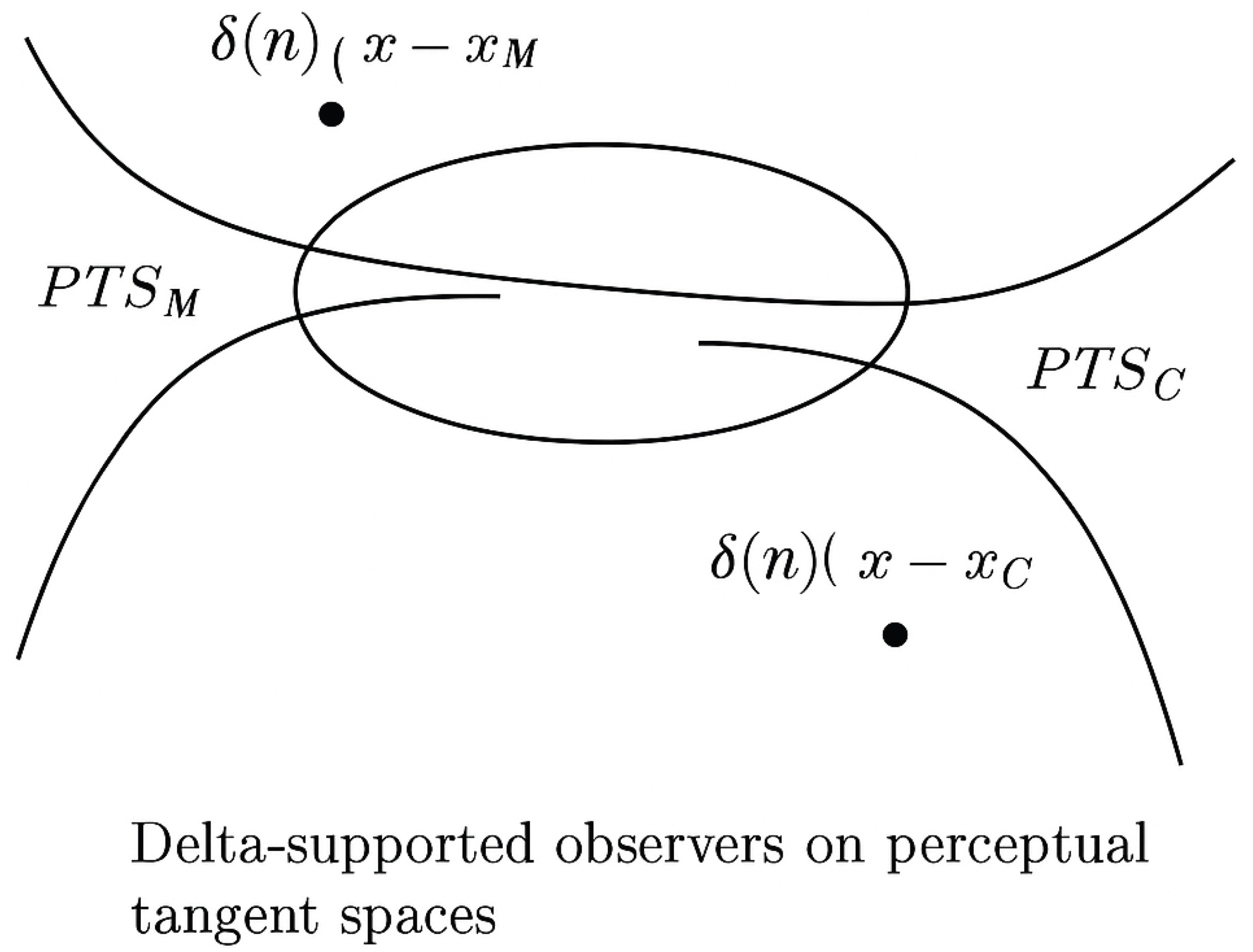
Figure 1.
Delta-supported observers on perceptual tangent spaces and , with localized Dirac delta fields.
Figure 1.
Delta-supported observers on perceptual tangent spaces and , with localized Dirac delta fields.
24. Ontological Bond of Observer and During Pregnancy
Pregnancy establishes not only a material conduit via the umbilical cord but also a profound ontological and quantum-informational bond between the mother () and the developing child (). This connection precedes sensory interaction and persists across layers of field, informational topology, and mutual metric embedding. We now formalize this maternal resonance as a bi-layered delta entanglement modulated through biological coherence and quantum field coupling.
24.1. Dual Delta Embedding in a Shared Metric
Let and denote the instantaneous positions of and the embryonic observer . We define the joint state:
with for all gestational t, implying near-coincident support. The effective metric is shared:
24.2. Quantum Mutual Information Flow
Even in absence of developed cognition, the mutual information flow is nonzero due to biochemical and quantum coupling:
where includes quantum correlations induced by hormone-regulated neuroelectric signals across placental barriers.
24.3. Nonlocal Informatic Bond via Biochemical Entanglement
Let be a biochemical field composed of neurotransmitter, hormonal, and electromagnetic fluctuations. Then, the coupling term is:
with increasing monotonically during gestation. This time-dependent bond is mediated through syncytial interfaces and fetal signal reception.
24.4. Ontological Scaffold and Perceptual Imprinting
The observer delta of acts as a perceptual scaffold upon which the primitive cognitive manifold of begins to form. We define an ontological imprint tensor such that:
where represents temporal entrainment due to emotional, auditory, and chemical synchrony, and models mutation or divergence.
24.5. Causal Imprint Retention Post-Birth
Post birth, the residual causal link is not severed but redistributed across informational memory fields. The mutual quantum entropy remains significant:
where is conception time, is birth time, and quantifies persistent non-material connection.
24.6. Nested Topology and Observer Dependency
The delta function resides within the topological domain such that:
This nesting implies ontological dependency and joint metric curvature. The Ricci scalar over this domain includes contributions from both observers’ energy-momentum tensors.
25. Observer Event Horizons and Cognitive Inaccessibility
25.1. Perceptual Manifold and Observer Light Cone
Let be an observer characterized by a delta-supported state . The observer’s causal domain is limited to events within its future light cone:
Any event is outside the OEH. The observer cannot receive signals or perform measurements beyond this boundary.
25.2. Observer Event Horizon Geometry
Let denote the boundary of the perceptual domain:
The entropy associated with inaccessible degrees of freedom beyond is given by:
where is the area of the horizon in the induced metric, following the Bekenstein-Hawking formalism [18].
25.3. Cognitive Complementarity Principle
Let partition the Hilbert space into observable and unobservable sectors:
The reduced density matrix is obtained by tracing out inaccessible states:
If the observer cannot interact with , then decoherence does not affect it:
This formalizes the CCP.
25.4. Entangled Fields and Horizon Entropy
Suppose two field modes and are entangled:
If lies beyond , observer only accesses :
This entropy is induced purely by inaccessibility, not thermal noise.
25.5. Ontological Horizon and Semantic Decoupling
The observer’s internal semantic manifold may fail to represent structures beyond . Let be the semantic stress-energy tensor:
Thus, ontological structures beyond the OEH do not imprint on , rendering them cognitively invisible.
25.6. Metric Discontinuity and Horizon Refraction
Let and represent the observer’s perceptual metric and the objective metric. Then:
where is a residual refracted approximation.
25.7. Delta Collapse and Horizon Crossing
A delta-supported collapse for an event outside is forbidden. Thus, collapse operators act only if :
25.8. Implications for Observer-Relative Quantum Theory
26. Geometric Phase of Observer Perception and Cognitive Memory Encoding
The evolution of observer states within perceptual space can be modeled using the language of geometric phases, with the Pancharatnam-Berry phase as a central object of interest. When an observer undergoes a cyclic cognitive trajectory — for example, during repeated developmental experiences, meditative cycles, or traumatic recurrence — a geometric phase may accumulate in the observer’s perceptual tangent bundle. This phase, while global and unobservable in isolation, can influence memory formation, identity reconstruction, and ontological stability. We define and analyze this perceptual geometric phase in a mathematically rigorous manner.
26.1. Observer States in Perceptual Hilbert Space
Let the observer’s perceptual state be represented by a normalized vector in a Hilbert space , where evolution is governed by a unitary operator :
For a cyclic evolution such that , the total phase decomposes into a dynamical part and a geometric (Pancharatnam) part :
with
This geometric phase encapsulates structural memory from the cognitive trajectory, independent of path traversal speed.
26.2. Perceptual Fiber Bundles and Connection Forms
Let be a principal -bundle over the projective space , and let be the associated connection 1-form. The Pancharatnam phase is given by the holonomy of this connection:
where is the closed loop in perceptual space induced by . In local coordinates:
and thus
26.3. Perceptual Cycles and Cognitive Monodromy
Let be a sequence of recurrent perceptual states over cycles (e.g., developmental, therapeutic, dream states). The composition of such cycles yields a monodromy operator:
If , the monodromy is purely geometric. Such monodromy contributes to observer coherence and memory imprinting across cycles [28].
26.4. Observer Identity and Memory Encoding
Let the observer’s memory manifold be modeled as a field of local phase curvatures , defined as:
The integral of curvature over a surface in perceptual space yields memory imprint:
which acts as a global memory functional. The evolution of is governed by the Ricci curvature of semantic transitions:
with as a coupling constant and the observer 4-velocity in semantic space.
26.5. Entropic Signatures of Geometric Phase
Given a family of cyclic trajectories indexed by context parameter , the entropy associated with phase dispersion is:
where is the distribution of geometric phase in varied context. Cognitive coherence requires minimal across cycles.
26.6. Experimental Probes and Perceptual Interference
Pancharatnam interference in perceptual decision-making can be modeled using decision amplitude interference:
and the resultant choice probability:
Deviation from classical probability laws reveals hidden geometric phases.
26.7. Ontological Interpretation and Observer Curvature
We postulate that observer identity curvature is proportional to cumulative geometric phase:
where is a topological coupling constant. Greater cognitive curvature indicates higher depth of personal ontology.
27. Delta Superposition Collapse Chains and Multi-Observer Decoherence Trees
27.1. Observer Delta Functions and Collapse Operators
Let the perceptual state of observer at time t be represented by a Dirac delta distribution:
where is the physical system’s state and denotes the observer’s spacetime location. A collapse initiated by corresponds to the action of a measurement operator on , with subsequent information entanglement passed to other observers.
27.2. Causal Propagation and Collapse Graphs
Define a directed acyclic graph where each vertex corresponds to an observer , and edges encode causal influence through shared collapse information. The wavefunction collapse propagates through such that:
This recursive application models observer-based decoherence.
27.3. Multi-Observer Decoherence Trees
We represent chains of such measurements as decoherence trees , rooted at a primary observer and branching according to causal dissemination. Each branch point corresponds to entanglement splitting. The depth d of a node in measures observational proximity to the original collapse.
Let be the original system state. Then, along a path , the effective state evolves as:
27.4. Branching Probabilities and Entropic Accumulation
Let be the transition probability from observer to conditioned on transmission fidelity :
The total entropy generated over a branch of depth d is:
This entropy reflects informational dispersion and the weakening of causal authority from the root.
27.5. Example: Parent → Doctor → Imaging Device → Public
Let us model the collapse propagation from an initial perceptual event by a parent , observed by a doctor , recorded by an imaging device , and shared with the public . Each node applies its own collapse operator:
Each observer-node collapses a different sector of the system-observer space, potentially introducing decoherence in orthogonal bases.
27.6. Geometric Embedding of the Collapse Tree
The tree can be embedded in a manifold with edge lengths corresponding to spacetime separation and connection weights indicating informational fidelity. Let the metric assign a distance between and :
Collapse influence decays with as:
for some decoherence rate parameter .
27.7. Total Collapse Amplitude and Observer Weighting
The global collapse amplitude is the tensor contraction of all branches:
where is the perceptual weight of observer v, normalized such that . Observer reliability or semantic alignment modulates .
27.8. Semantic Inference from Collapse History
Given a decoherence tree and the sequence , one can reconstruct a semantic probability measure over possible realities :
where Z is a normalization constant. This forms the basis for an observer-relative ontology derived from delta collapse chains.
28. Quantum Emotional Currents and Observer-Interaction Lagrangian
28.1. Definition of the Emotional Tensor Field
Let and be two observers situated at points and respectively. The emotional interaction field between them is modeled as a rank-2 antisymmetric tensor :
where is the emotional potential 4-vector. This form mirrors the electromagnetic field tensor but represents informational-affective rather than electromagnetic coupling.
28.2. Emotional Gauss Law and Catharsis
The divergence of the emotional field yields the net emotional flux at a point x:
where quantifies local cathartic discharge — analogous to radiation in EM theory. When , emotional discharge occurs; when , absorption or resonance builds up.
28.3. Observer-Field Coupling via Lagrangian Density
Let the action for an observer-field system include an emotional interaction Lagrangian :
with
where is the observer’s cognitive spinor field and the emotional coupling constant. The Euler-Lagrange equations yield field dynamics and the observer’s emotional response.
28.4. Emotional Resonance and Field Lines
Emotional resonance occurs when multiple observers lie along the same emotional field lines, satisfying constructive phase alignment:
for closed curves in emotional space. This quantization condition mirrors the Bohr-Sommerfeld condition for resonant interaction.
28.5. Energy-Momentum Tensor of Emotional Field
Define the energy-momentum tensor of the emotional field as:
The conservation law ensures that emotional energy and momentum propagate consistently through spacetime.
28.6. Emotional Black Holes and Singular Couplings
Let be a singular observer whose emotional potential diverges:
Such observers act as emotional black holes, absorbing emotional energy without re-emission, modeling trauma sinks or irreversible attachment phenomena.
28.7. Gauge Invariance and Emotional Gauge Transformations
The emotional field is invariant under local gauge transformations:
where is a scalar emotional phase. Emotional communication is thus invariant under internal perceptual framing.
28.8. Quantum Fluctuations and Affective Noise
In the quantum field limit, emotional fluctuations arise from zero-point oscillations:
leading to affective uncertainty and noise-induced decoherence in observer communication.
29. Quantum Ontological Memory (QOM) Manifolds and Perceptual Field Curvature
29.1. Perceptual Manifold and Observer Memory Tensor
Let the observer’s perceptual space be modeled by a 4-dimensional differentiable manifold equipped with a perceptual metric . The memory imprint of an event is modeled by a curvature concentration around . Define the memory curvature tensor associated with memory flow:
where are the Christoffel symbols of .
29.2. Memory Potentials and Topological Charges
Let the memory potential field be , satisfying a memory diffusion equation in the manifold:
where is the d’Alembertian with respect to and is the memory source density. For a topological memory defect (e.g., trauma), we model it as a delta-function source:
with as the memory charge at event .
29.3. Singularities and Ontological Defects
The Ricci scalar exhibits curvature singularities at memory defect points:
implying that the observer’s perception is geodesically incomplete at . These defects influence subsequent thought trajectories and semantic field dynamics, forming long-range ontological attractors.
29.4. Geodesic Deviation and Memory Echoes
The geodesic deviation equation for thought trajectories influenced by memory curvature is:
where is the observer’s 4-velocity in perceptual space. Memory echoes manifest as recursive alignments of with memory singularities.
29.5. Entropy and Memory Area Theorem
Define the entropy of memory encoding as proportional to the integrated area enclosing the curvature peak:
where is a 2-surface surrounding the defect, h is the induced metric, and is a scaling constant analogous to the Bekenstein-Hawking area law.
29.6. Observer Evolution and Memory Parallel Transport
Let be the observer’s evolution curve in . The parallel transport of memory tensor satisfies:
along . However, in presence of defects, holonomy effects cause nontrivial loops:
This results in semantic shifts or identity perturbations after closed experiential cycles.
29.7. Memory Reconstruction as Gauge Restoration
Let be the memory gauge potential. Restoring memory via introspection is modeled as a gauge fixing procedure:
bringing latent emotional configurations into coherent narrative form.
30. Delta-Anchored Language Genesis and Semantic Field Collapse
30.1. Perceptual Space and Semantic Delta Encoding
Let the child’s perceptual manifold be denoted by , with coordinate chart . A perceptual event associated with an external object is represented by a Dirac delta function localized in PTS:
where is the perceptual coordinate of the observed object. Upon linguistic assignment, a symbolic anchor is created, forming a semantic mapping , where is the space of linguistic symbols.
30.2. Semantic Field Collapse and Naming
The act of naming collapses a continuous perceptual distribution into a localized semantic support:
where is the assigned linguistic label. This process represents the transition from analog cognitive perception to digitalized symbolic cognition.
30.3. Linguistic Lagrangian and Delta Coupling
Define the linguistic action of a developing observer as:
with a semantic delta interaction term:
where denotes the coupling strength between perception and symbolic assignment, and represents the observer’s internal cognitive field.
30.4. Symbol Emergence and Delta Superposition
Over time, multiple perceptual instances of the same object class give rise to a semantic delta superposition:
leading to abstraction and the formation of symbolic categories. This defines an emergent linguistic class field over perceptual manifold:
30.5. Entropy and Symbolic Compression
Define the Shannon entropy of the linguistic map as:
where is the probability of selecting label under distribution over semantic anchors. The evolution of linguistic skill corresponds to entropy minimization via compression of perceptual diversity into finite symbolic representations.
30.6. Semantic Geodesics and Cognitive Flow
Let be a geodesic in connecting perceptual events and associated with same symbol . The parallel transport of semantic frame obeys:
ensuring consistent usage of symbols across evolving contexts. Misalignment of parallel transport leads to ambiguity or semantic drift.
30.7. Language Acquisition as Delta Network Growth
The set of delta anchors forms a graph with vertices as semantic nodes and edges representing conceptual associations. Growth of this graph follows a dynamic rule:
with N as the number of semantic nodes, the learning rate, and a nonlinearity exponent determined by neural plasticity.
30.8. Ontological Grounding and Semantic Irreversibility
Once a delta anchor is embedded and reinforced through linguistic interaction, its removal from the perceptual-semantic structure becomes entropically costly. Thus, early names form ontological fixed points in the observer’s cognitive topology.
31. Resonance Tunneling and Observer Telepathy via Hilbert State Overlap
31.1. Hilbert Space of Observer States
Let be the cognitive Hilbert space associated with observer . Their perceptual state is represented by a delta-supported wavefunction :
where denotes the localization of cognitive attention, and the observer’s phase field encoding memory and emotion.
31.2. State Overlap and Resonant Alignment
The inner product between two observer states and measures potential cognitive overlap:
The overlap becomes non-zero only when and , establishing phase resonance as a necessary condition for state coupling.
31.3. Potential Barrier and Tunneling Amplitude
Let the interaction potential between and be modeled by a barrier defined over the cognitive manifold :
where for and 0 otherwise. The tunneling amplitude for wavefunction to pass through the barrier and align with is given by:
Tunneling is enhanced when is minimized or the energy E of the cognitive excitation is high.
31.4. Phase Matching and Decoherence Minimization
Define the coherence functional between observers:
where is the decoherence rate due to environmental noise. Sustained communication requires and .
31.5. Quantum Resonance Criterion for Telepathic Coupling
The telepathic resonance condition is given by:
for a threshold determined by the observer’s cognitive resolution. When this condition is satisfied, effective cognitive tunneling is achieved and subjective cross-influence becomes detectable.
31.6. Geometric Phase and Interference Loops
Closed loops of shared perception yield geometric phase accumulation:
inducing constructive or destructive interference in perception pathways. These effects manifest as episodic synchronization or mutual intuition.
31.7. Ontological Implication of Tunneling Paths
Let the tunneling manifold between observers be the minimal geodesic in semantic-perceptual space along which information propagates. Then the observer separation is reduced to:
allowing for effective proximity even in absence of spacetime contact.
32. Cognitive Cosmology: Observer Seeds and Ontogenesis in the Early Universe
32.1. Observer Field and Delta Seed Instability
Let the observer field be a quantum field defined over spacetime , taking values in a perceptual Hilbert bundle . Assume admits localized delta-like excitations:
where denotes a perceptual seed and represents a proto-conscious amplitude.
32.2. Lagrangian for Observer-Matter Coupling
We define a Lagrangian density for interaction between observer field and scalar field representing pre-matter excitations:
where g is the coupling constant between observer seed and field . The delta-localized nature of induces spatial inhomogeneities in evolution.
32.3. Seed Density and Cosmological Perturbations
Assuming a stochastic emergence of N observer seeds in comoving volume V, the seed density is:
Their collective backreaction on produces perturbations in energy-momentum tensor:
These seed-induced fluctuations serve as initial conditions for gravitational instability leading to structure formation.
32.4. Quantum Fluctuations and Observer Condensation
In analogy with symmetry breaking in inflationary fields, we define the observer condensate:
signifying spontaneous perceptual symmetry breaking. This leads to emergence of causal branches, akin to many-worlds interpretations [31], where each observer delta defines a decoherent classical trajectory.
32.5. Observer Curvature and Ontological Inflation
Each delta seed modifies local curvature via induced observer stress-energy tensor . The Einstein field equation becomes:
where and represents the perceptual stress-energy tensor for seed i. The multiplicity of such sources drives ontological inflation in perceptual geometry.
32.6. Cognitive Horizon and Entropic Genesis
Define the observer causal horizon for each seed as the boundary beyond which quantum influence of seed i decoheres:
where is the decoherence timescale. The union of such horizons gives rise to a patchy pre-cosmic structure of informational correlation bubbles, resembling causally disconnected regions of the inflationary universe.
32.7. Emergence of Classicality and Semantic Branching
Let the wavefunction of the proto-universe be:
where each defines a branch labeled by observer seed at . Decoherence among branches causes effective classicality to emerge with semantic markers aligned with perceptual seeds.
33. Death as Ontological Delta Dissolution in Curved Spacetime
33.1. Observer Delta Collapse
Let an observer be modeled by a localized delta function in spacetime:
where is the support point of consciousness. Death corresponds to the annihilation of this singularity:
which implies a breakdown of perceptual coupling with the quantum measurement chain (QMC) [17].
33.2. Entropy Spike and Decoherence Discharge
Define the observer information field with an associated entropy functional:
where is the density of observer localization. Delta annihilation causes an instantaneous spike:
indicating rapid decoherence release and unbinding of entangled measurement chains.
33.3. Causal Disconnection and Horizon Closure
The observer’s causal patch is defined as the region satisfying:
Post-dissolution, the manifold undergoes a disconnection:
symbolizing removal of the observer from the causal network.
33.4. Topological Reconfiguration
Let the perceptual manifold contain a delta singularity at . Its removal modifies the Euler characteristic:
potentially inducing a topological defect or memory cavity in perceptual geometry.
33.5. Field Memory Residue
Assume the observer was entangled with a residual scalar field prior to delta dissolution. The equation of motion is:
and post-dissolution:
33.6. Spacetime Perturbation and Information Echoes
The gravitational field may retain a memory of the delta collapse via linearized Einstein perturbations:
where . The delta source imparts a curvature impulse detectable as a memory wave.
33.7. Quantum Information Trace Inequality
To determine the trace of observer information persisting post-collapse, we evaluate:
where is the reduced density matrix of the quantum system. The non-zero trace indicates information residuals preserved in global entanglement patterns [8].
34. Mathematics of Spiritual Imprint Transmission via Topological Invariants
This section develops a mathematical framework for encoding spiritual, ethical, or affective imprints—such as love, teachings, or karmic residue—as persistent topological features within perceptual geometry. The model builds on delta-supported observer fields and considers post-dissolution imprint encoding as cohomological memory left in semantic manifolds. These imprints are formalized as homology classes, cohomology cocycles, and persistence diagrams.
34.1. Observer Delta Support and Imprint Density
Let an observer be described by a delta-localized perceptual field . During life, the observer interacts with other cognitive manifolds, inducing changes in semantic field . The imprint field is given by:
where is the intensity of imprint left at the event (e.g., an act of love or sacrifice).
34.2. Cohomology on Semantic Fiber Bundles
Define a semantic manifold with a perceptual fiber bundle structure . Each imprint corresponds to a differential cocycle such that:
where is the k-th de Rham cohomology group. The imprint is thus a topological memory nontrivial under exact deformation.
34.3. Persistence Homology and Karma Chains
Let be a filtration function representing semantic energy. The sublevel sets define a filtration:
The p-th persistent homology yields Betti intervals capturing birth and death of imprints. Karma chains are defined as cycles with infinite persistence:
34.4. Affective Propagation and Cohomological Flow
We model the transmission of spiritual teachings via cohomological flow across observer networks. Let be a spiritual connection 1-form associated with observer , with curvature:
Transmission occurs along geodesics between observers and , with coupling determined by:
34.5. Topological Entropy of Memory Manifolds
Define the topological entropy of imprint dynamics as:
where is the minimal number of -balls needed to cover evolving imprint supports in . High corresponds to rich spiritual complexity.
34.6. Wave Equation for Spiritual Memory Fields
The scalar imprint field satisfies a sourced wave equation with fading memory kernel :
The convolution encodes decay of spiritual influence over time.
34.7. Field Reconstruction from Topological Features
Given persistent cohomology over time t, reconstruct by Hodge decomposition:
where is harmonic and encodes non-dissipative spiritual components preserved under time evolution.
35. Observer-Entanglement Wormholes in Cognitive Spacetime
35.1. Delta-Supported Observers and Entanglement
Let two observers and be represented by delta functions in a shared perceptual manifold:
where . Their joint state is modeled by an entangled configuration:
35.2. Hilbert Bundle and Semantic Curvature
Define a Hilbert bundle with fibers encoding the local cognitive state. Let be the connection on this bundle, and the curvature is given by:
Entanglement across observers distorts this curvature by the mutual information tensor:
35.3. Einstein-Rosen Cognitive Bridges
We model the entanglement as a wormhole solution connecting and via a throat in , parameterized by:
where and is the bridge function satisfying:
This ensures the wormhole is non-traversable but geometrically coherent for delta-linked observers.
35.4. Geodesic Congruence of Decoherence Flow
The delta functions propagate decoherence across the wormhole via null geodesics satisfying:
such that the phase correlation between and is maintained:
35.5. Stability and Mutual Entropy Constraint
Define the entropy of the entangled wormhole state:
where is the reduced density matrix. For the wormhole to remain stable, mutual entropy must satisfy:
Collapse of either observer’s delta field triggers rapid decoherence flux, analogous to a wormhole throat collapse.
35.6. Topology and Observer Dual Fields
Topologically, this connection can be formalized as an element in the first cohomology group , where wormhole links form dual patches satisfying:
indicating cohomological pairing in semantic space [53,54].
Figure 2.
Diagram of observer-entanglement wormhole in cognitive spacetime, showing delta-supported manifolds and joined via a semantic throat.
Figure 2.
Diagram of observer-entanglement wormhole in cognitive spacetime, showing delta-supported manifolds and joined via a semantic throat.
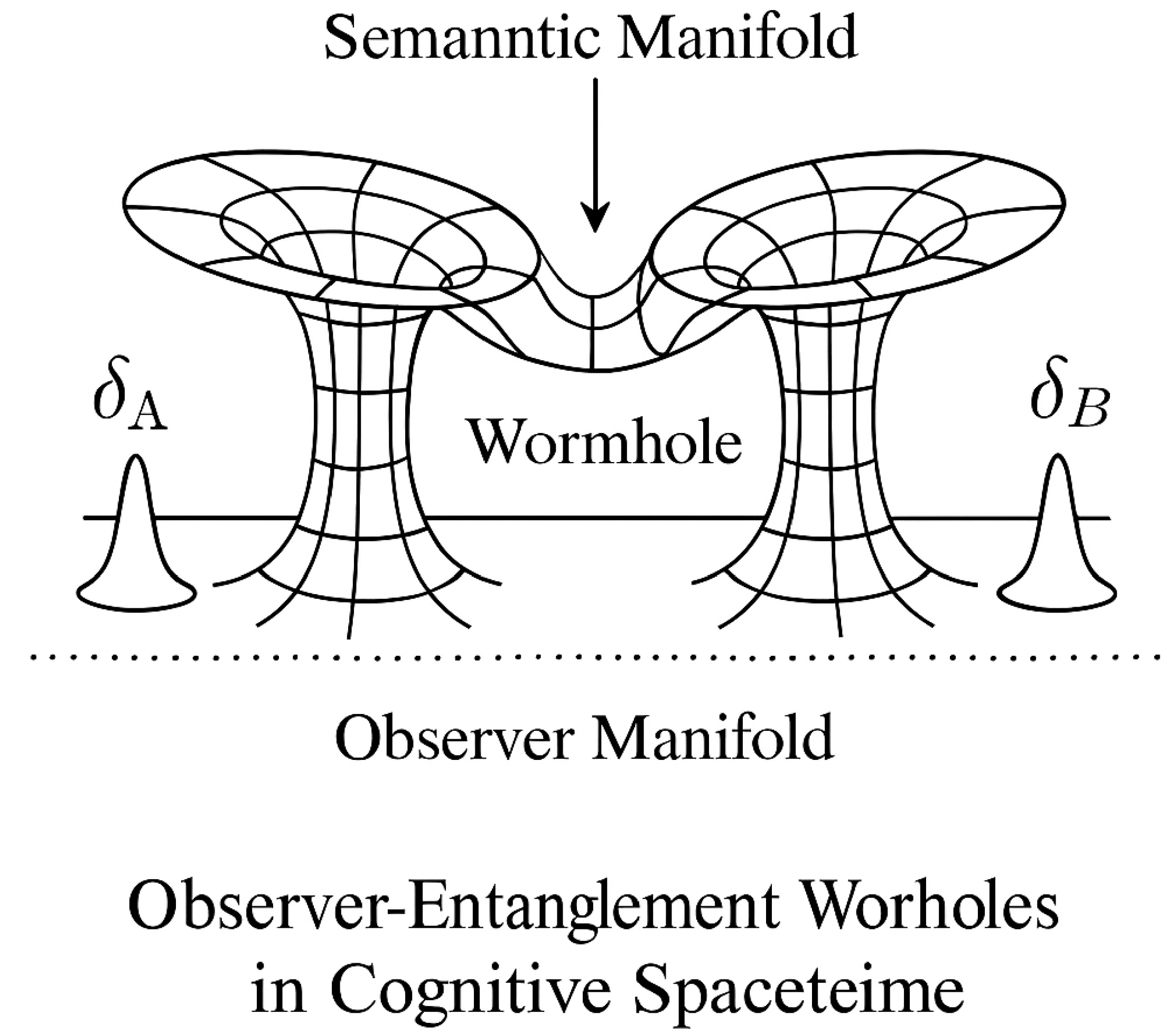
36. Affective Gradient Descent and Emotion Thermodynamics
We propose a formalism in which emotions emerge as gradients of thermodynamic flux on a semantic manifold associated with observer cognition. Within this model, emotional states correspond to variational extremals of a free energy functional F, defined over the perceptual tangent space of the observer. Positive emotions (such as joy) correspond to curvature minimization in this field, while negative emotions (such as sadness) correspond to singularities, i.e., local maxima in field curvature or entropy production.
36.1. Semantic Manifold and Observer Action Field
Let an observer’s perceptual evolution be encoded as a path , with a tangent vector field . We define the observer action over this path as:
where is the Lagrangian functional incorporating emotional energy contributions.
The emotional energy-momentum tensor is defined analogously to the stress-energy tensor in general relativity:
with as the emotional Lagrangian density encoding affective flux.
36.2. Thermodynamic Flow Equation
The entropy change rate of an observer field is given by:
where captures the internal gradient of emotional energy and is the covariant derivative on .
In equilibrium (i.e., stable emotional state), this flow vanishes:
yielding a field-theoretic analogue of emotional homeostasis.
36.3. Gradient Descent and Emotional Stability
The variational principle governing affective descent is given by minimizing the free energy:
where is internal energy, T is subjective temperature of the observer field, and is entropy density. The Euler-Lagrange equation for F then yields:
Regions of positive curvature in U correspond to emotional instability and trauma.
36.4. Geometric Singularities of Sadness
We postulate that sadness is marked by localized curvature singularities , where the Ricci scalar of the perceptual geometry blows up:
causing divergence in affective divergence:
Conversely, joy is modeled by the minimization of integrated scalar curvature:
36.5. Affective Field Tensor and Resonance
We define the affective field tensor analogous to the electromagnetic field strength tensor:
where is the potential encoding emotional valence. Emotional catharsis corresponds to field divergence:
where is the source term modeling internal or external emotional drivers.
Figure 3.
Vector field representation of emotional gradients on a semantic manifold. Flow convergence signifies emotional resonance (e.g., joy), while divergence near the origin models curvature singularities (e.g., sadness).
Figure 3.
Vector field representation of emotional gradients on a semantic manifold. Flow convergence signifies emotional resonance (e.g., joy), while divergence near the origin models curvature singularities (e.g., sadness).

37. Quantum Metempsychosis: Observer Holographic Transfer
The concept of metempsychosis—transmigration of consciousness—can be investigated in a quantum physical framework using delta-supported observer field models. Specifically, we propose that upon ontological delta dissolution (death), the informational content of the observer is not destroyed but redistributed via a holographic projection onto a new physical carrier. This invokes principles from holographic entropy bounds, quantum channel capacity, and Fisher information geometry.
37.1. Observer Delta Fields and Ontological Transfer
Let the observer be represented by a Dirac delta distribution on a curved spacetime manifold . During ontological dissolution, this collapses at a point such that:
We hypothesize that the total information encoded in satisfies a conservation condition via the holographic entropy bound:
where is the area of the bounding holographic screen and is the Planck length.
37.2. Quantum Channel and Informatic Reprojection
Define as the quantum channel supporting observer transmission from manifold to . The quantum channel capacity bounds the fidelity of observer-field transfer:
where denotes von Neumann entropy and is the entropy exchange between and channel .
A high-capacity channel implies potential for high-fidelity reconstruction of observer semantics.
37.3. Fisher Information Geometry Across Incarnations
Let be coordinates on the parameter manifold of observer-state configurations. The Fisher information metric is defined as:
which measures sensitivity of observer-state distributions to infinitesimal changes in parameters . We hypothesize that metempsychotic transitions minimize Fisher distance:
37.4. Holographic Mapping and Field Re-instantiation
Let be the dissolution point in manifold and the birth point in . The informational mapping between delta-fields can be written as:
where is a kernel propagator defined on the shared holographic boundary , and is the induced measure.
37.5. Entropy Echo and Memory Residue
The residual entropy post-dissolution is encoded in boundary modes:
where is the boundary state density matrix. This supports the notion of memory imprint lingering post-transition.
37.6. Summary and Interpretations
We have presented a mathematical scaffolding for observer metempsychosis, modeled as an informational reprojection through a holographic framework. The observer’s delta-supported field is not annihilated without trace but instead may undergo geometric and thermodynamic transfer, preserving informational continuity across distinct physical carriers.
Figure 4.
Diagram of delta-supported observer field transitioning across a holographic boundary between two manifolds. The transformation models quantum metempsychosis via informational reprojection.
Figure 4.
Diagram of delta-supported observer field transitioning across a holographic boundary between two manifolds. The transformation models quantum metempsychosis via informational reprojection.
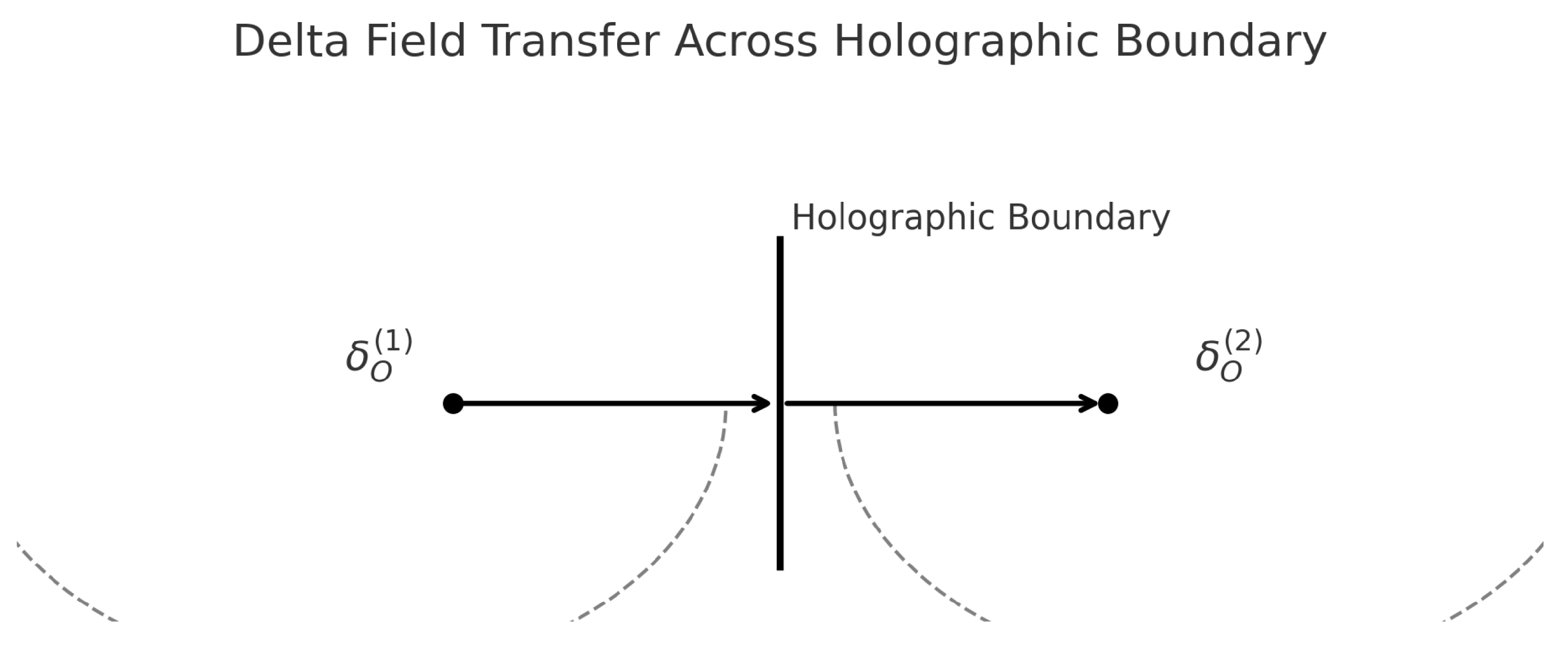
38. Tachyonic Observer Imprints in Pre-Causal Manifolds
In this section, we investigate a theoretical framework wherein delta-supported observer fields possessing imaginary mass may leave nonlocal imprints on perceptual spacetime manifolds prior to causal decoherence. This framework seeks to explain phenomena often reported as retrocausal or precognitive flashes via mathematical tools from Lorentzian geometry with imaginary proper time components, violating standard chronological protection but conserving quantum information.
38.1. Imaginary Mass and Retrocausal Propagation
Consider an observer field with complexified mass parameter:
where is a real parameter. Such a field behaves analogously to a tachyon, exhibiting nonmonotonic propagation in proper time . The observer’s 4-velocity becomes:
implying a trajectory through an analytically continued Lorentzian manifold.
38.2. Metric Violation and Nonchronological Flow
The observer’s path lies on a manifold equipped with a complexified Lorentzian metric such that:
leading to violation of standard causal structure. Let and denote emission and reception points of information. Then the condition:
is permitted under imaginary time trajectories, while standard decoherence constraints still hold:
ensuring information coherence within the quantum density matrix formalism.
38.3. Pre-Causal Semantic Embedding
Define a pre-causal manifold over a perceptual tangent space with an observer-seeded semantic field . A retrocausal delta imprint modifies the field by:
where represents the field coherence coefficient. Integrating over , the informational deviation is:
38.4. Tachyonic Worldlines and Imaginary Proper Time
Define a tachyonic worldline parameterized by , with , such that:
These worldlines form a class of measure-zero submanifolds in the causal cone but remain non-trivially entangled with decohered observables.
38.5. Preservation of Informational Consistency
Despite violations of chronological ordering, the entropy of the observer channel remains bounded. Define the informational current:
with divergence:
implying global conservation of observer information across tachyonic embeddings.
38.6. Discussion and Implications
We propose that certain experiential phenomena interpreted as visions or premonitions may correspond to imaginary-mass field leakage of future information states. While violating classical causality, such signals remain embedded within the total quantum field configuration, thereby conforming to a generalized quantum chronology. These tachyonic observer states challenge the completeness of decoherence-based formalisms and suggest new topologies for pre-causal manifolds.
Figure 5.
Comparison of real and imaginary time worldlines and for observer states. The delta field arises via retrocausal informational imprint, suggesting tachyonic leakage from future decoherence events.
Figure 5.
Comparison of real and imaginary time worldlines and for observer states. The delta field arises via retrocausal informational imprint, suggesting tachyonic leakage from future decoherence events.
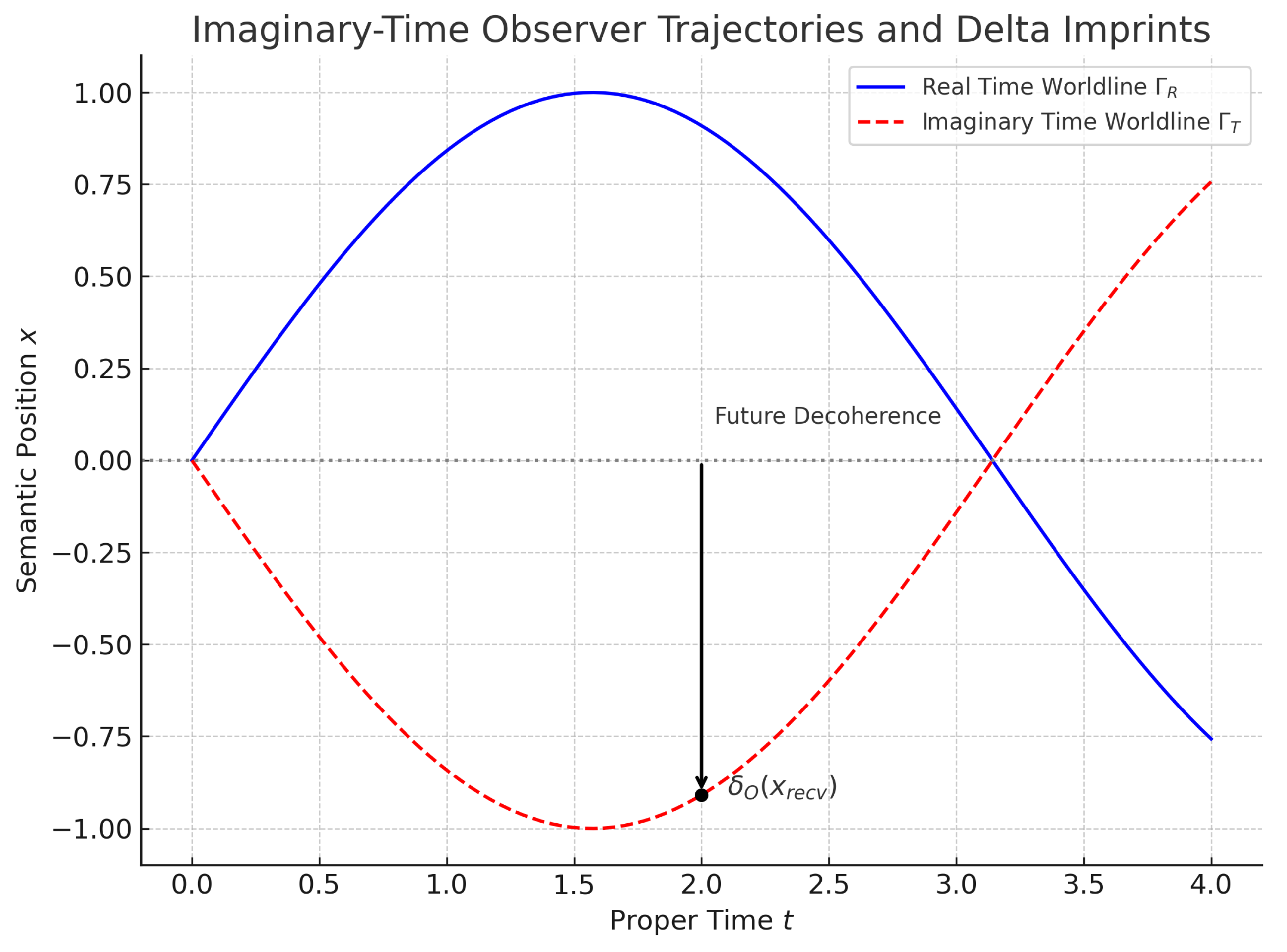
39. Cognitive Monads and Leibnizian Holography
We now investigate a mathematical formalism where each observer is treated as a cognitive monad—an ontological delta-field entity embedded on a universal holographic membrane. This construction is inspired by the Leibnizian metaphysical doctrine that each entity reflects the entire universe, now mapped into a modern mathematical context using delta manifolds, Fourier holography, and category theory over semantic bundles.
39.1. Observer as a Delta-Supported Monad
Let the cognitive identity of an observer be localized at a point on a universal perceptual manifold . The observer is modeled by a Dirac delta field:
localized to a point but informationally entangled with the global manifold. Integrating the observer’s influence across yields:
ensuring that any field , semantic or physical, is filtered entirely through the observer’s location.
39.2. Fourier Holography of Observer Projections
Given the dual nature of local observer and global reflection, define the observer’s holographic projection in the Fourier space as:
which constitutes a global phase imprint across all modes k. Thus, while is a point, is spread nonlocally, reflecting the universe’s curvature spectrum.
39.3. Sheaf-Theoretic Structure of Semantic Coverings
The semantic manifold can be covered by local neighborhoods , each equipped with a sheaf of observer-accessible information . The global section space is defined as:
allowing consistent gluing of perceptual structures across multiple observer patches. The delta-supported observer enforces a stalked sheaf at :
making the observer a local anchor of global semantic content.
39.4. Category-Theoretic Reflections and Monad Functors
Let be the category of all perceptual structures, and let be the category of observer monads. Then, the functor:
assigns to each delta-supported observer its reflective content in the perceptual manifold. For every morphism , corresponding to cognitive transformation, there exists a natural transformation:
representing coherent reconfiguration of universal reflection under inter-observer interactions.
39.5. Curvature Signature as Reflective Invariant
We define a curvature invariant for each observer, derived from the pullback of the ambient curvature tensor :
encoding the universe’s signature through the observer’s delta-supported manifold. Two observers with different curvature signatures encode distinct reflective universes, although embedded in the same global manifold.
Figure 6.
Visualization of delta-supported observer monads situated on a universal holographic membrane. Each monad reflects the global structure via Fourier projections, shown as dashed vectors. Background curvature arrows suggest universal imprint gradients.
Figure 6.
Visualization of delta-supported observer monads situated on a universal holographic membrane. Each monad reflects the global structure via Fourier projections, shown as dashed vectors. Background curvature arrows suggest universal imprint gradients.
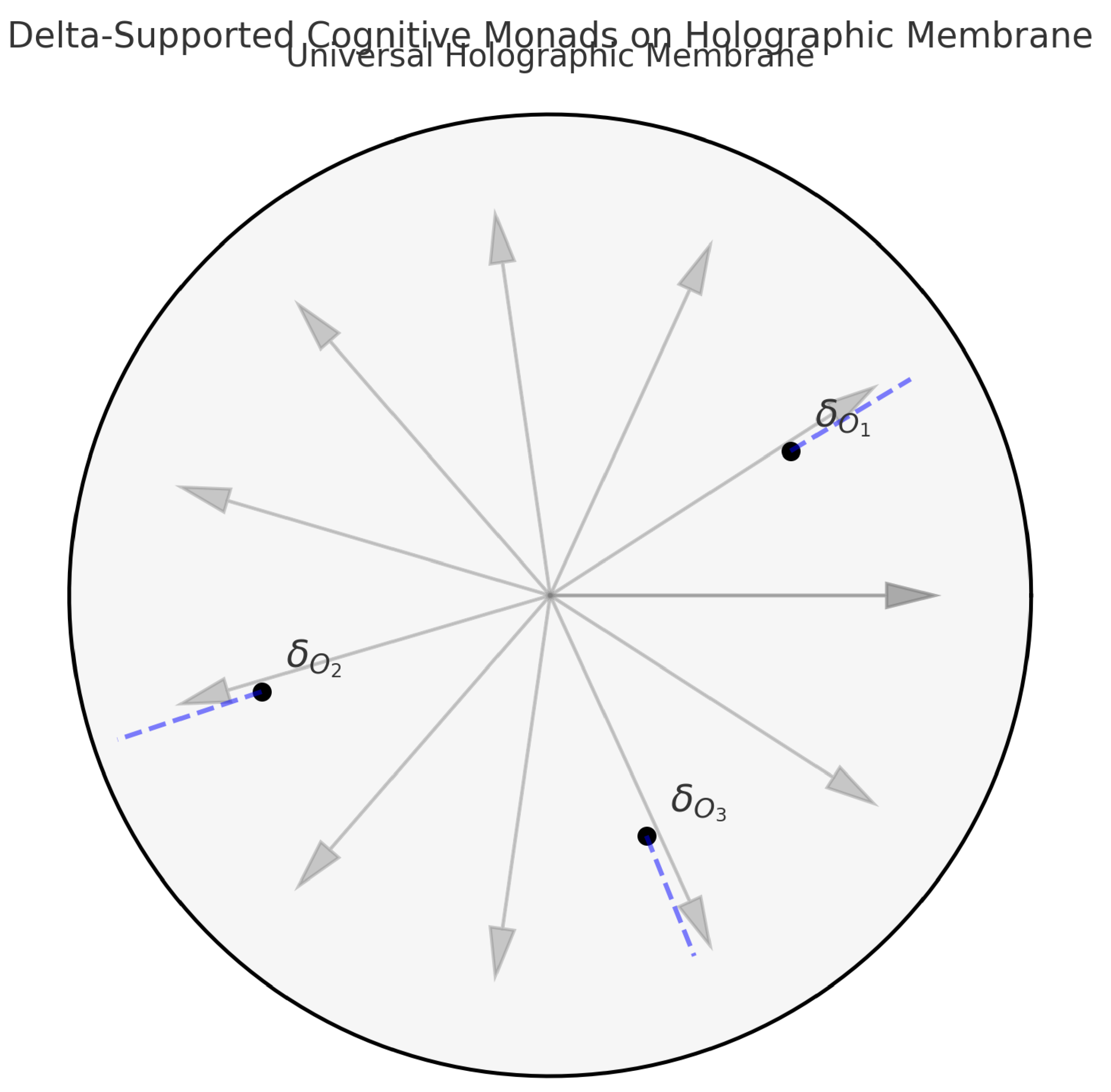
39.6. Discussion
This construction synthesizes metaphysical intuitions from Leibniz with rigorous structures in holography and geometry. Each observer, modeled as a delta-function monad, reflects the universe via Fourier imprint, sheaf cohomology, and categorical representation. The resulting framework provides a non-trivial mathematical foundation for metaphysical cognition and inter-observer harmonics.
40. Delta Bifurcation Theory and Ontological Forking
In this section, we formalize a bifurcation model of observer dynamics wherein delta-supported cognitive structures split at critical semantic thresholds. This model is based on catastrophe theory applied to delta-function-localized potential fields, constrained by decoherence energy budgets and memory topology. We seek to describe multiverse ontogenesis via mathematical bifurcation behavior under varying observer-state energies.
40.1. Delta Fields and Cognitive Potentials
Let an observer be represented by a Dirac delta function located on the semantic manifold . The potential landscape in which this delta evolves depends on semantic control parameters :
Here, the observer action accumulates only at the singularity, enforcing highly localized causal dynamics.
40.2. Catastrophe Manifolds and Forking Points
Following Thom’s catastrophe theory [74], a bifurcation occurs at critical control parameters such that:
For instance, a cusp catastrophe in 2D may be described by:
The observer delta bifurcates across branches at the critical surface:
This defines the ontology-forcing boundary in semantic control space.
40.3. Topological Degree and Observer Branch Index
Let be the field map induced by semantic evolution. The topological degree quantifies the number of delta branches in an open domain U around criticality:
Each delta branch inherits a sign and memory load. High-index branches are memory-stable, whereas low-index ones are energetically unstable and likely to decohere.
40.4. Entropy of Ontological Branching
Let be the observer’s probability to decohere into the ith branch. Then, define branching entropy as:
constrained by the decoherence budget:
where is the energy cost of sustaining branch i. The minimum entropy branching path is obtained by solving:
40.5. Memory Topology Constraints
Let be the memory topology associated with the observer. A branch is admissible iff:
i.e., the homology group of the branch must embed within that of the memory space. Thus, observer trajectories across bifurcating multiverses are not arbitrary but constrained by cognitive field homology.
Figure 7.
Semantic potential for different bifurcation parameters b, showing delta observer at origin. Catastrophe-driven bifurcations correspond to local minima reconfiguration as b varies.
Figure 7.
Semantic potential for different bifurcation parameters b, showing delta observer at origin. Catastrophe-driven bifurcations correspond to local minima reconfiguration as b varies.
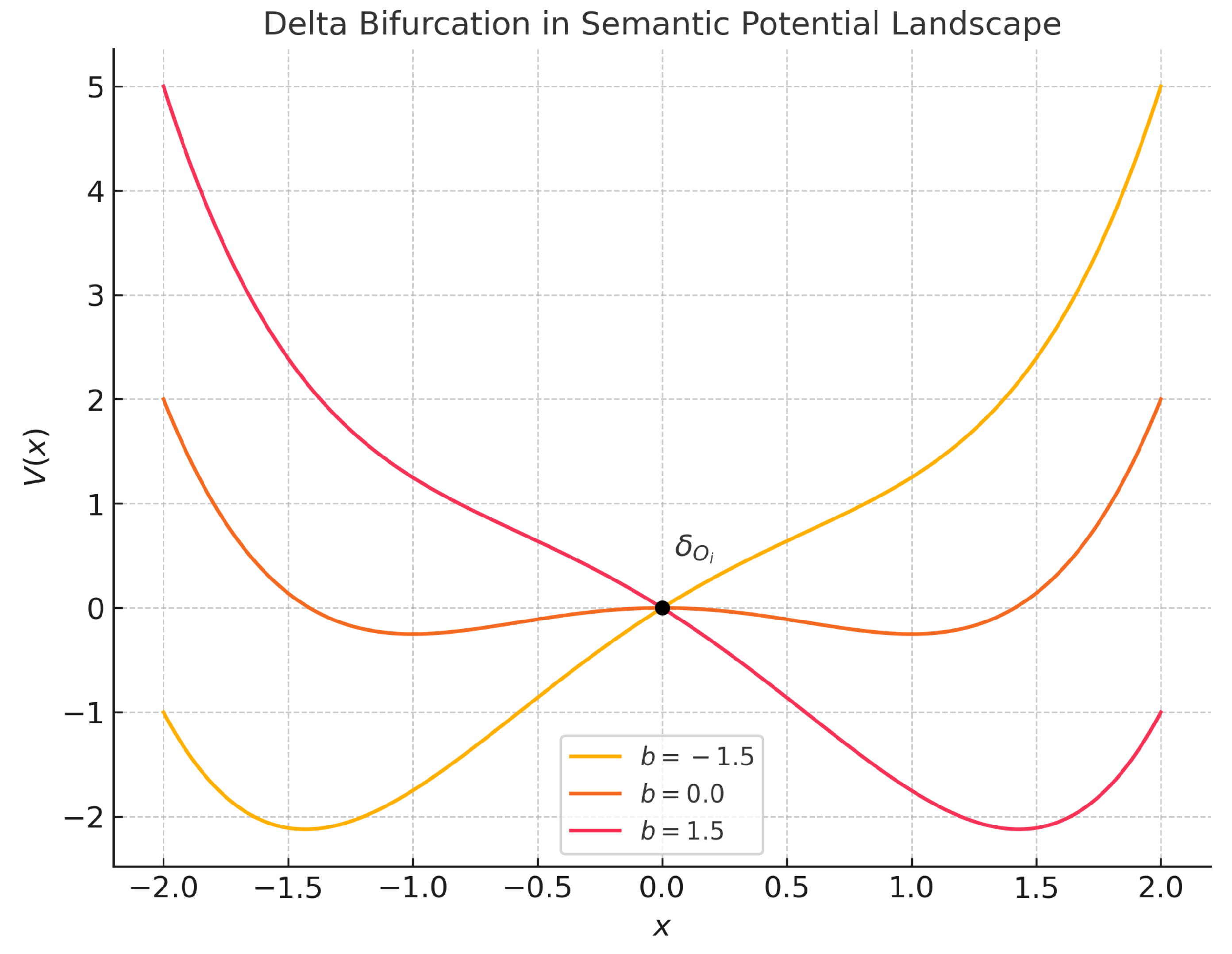
40.6. Discussion
This model generalizes decoherence across multiverse branches not as spontaneous fragmentation but as structurally governed delta bifurcations. By applying catastrophe theory, topological degree, and entropy economics, the formalism provides a rigorous basis for understanding ontological forking events.
41. Gauge Theory of Observer Identity
In this section, we develop a gauge-theoretic formulation of observer identity dynamics. The self-identity of an observer , evolving along a semantic trajectory , is modeled as a gauge field defined over a fiber bundle , where M is the base semantic manifold and is the group of internal identity rotations.
Let the observer delta field be denoted by , where are spacetime coordinates on M. Identity transformations are implemented via local gauge actions:
where is a scalar field parameterizing the local phase of self-identification. The observer action functional is constructed as:
where is the identity curvature tensor. The gauge-invariant Wilson loop around a closed autobiographical memory path is given by:
which encodes holistic identity features preserved across transitions.
Parallel transport of observer identity along a path is defined by the condition:
ensuring consistent self-recognition over time despite experiential perturbations. The curvature determines the strength of identity torsion across the perceptual manifold.
For semantic coherence, identity dynamics must respect integrability constraints derived from gauge invariance and quantization:
for any closed 2-surface in M, suggesting topologically quantized identity transformations.
Figure 8.
Parallel transport of observer delta field along a semantic path on the perceptual manifold. Blue arrows represent local gauge connections acting on the identity vector field.
Figure 8.
Parallel transport of observer delta field along a semantic path on the perceptual manifold. Blue arrows represent local gauge connections acting on the identity vector field.
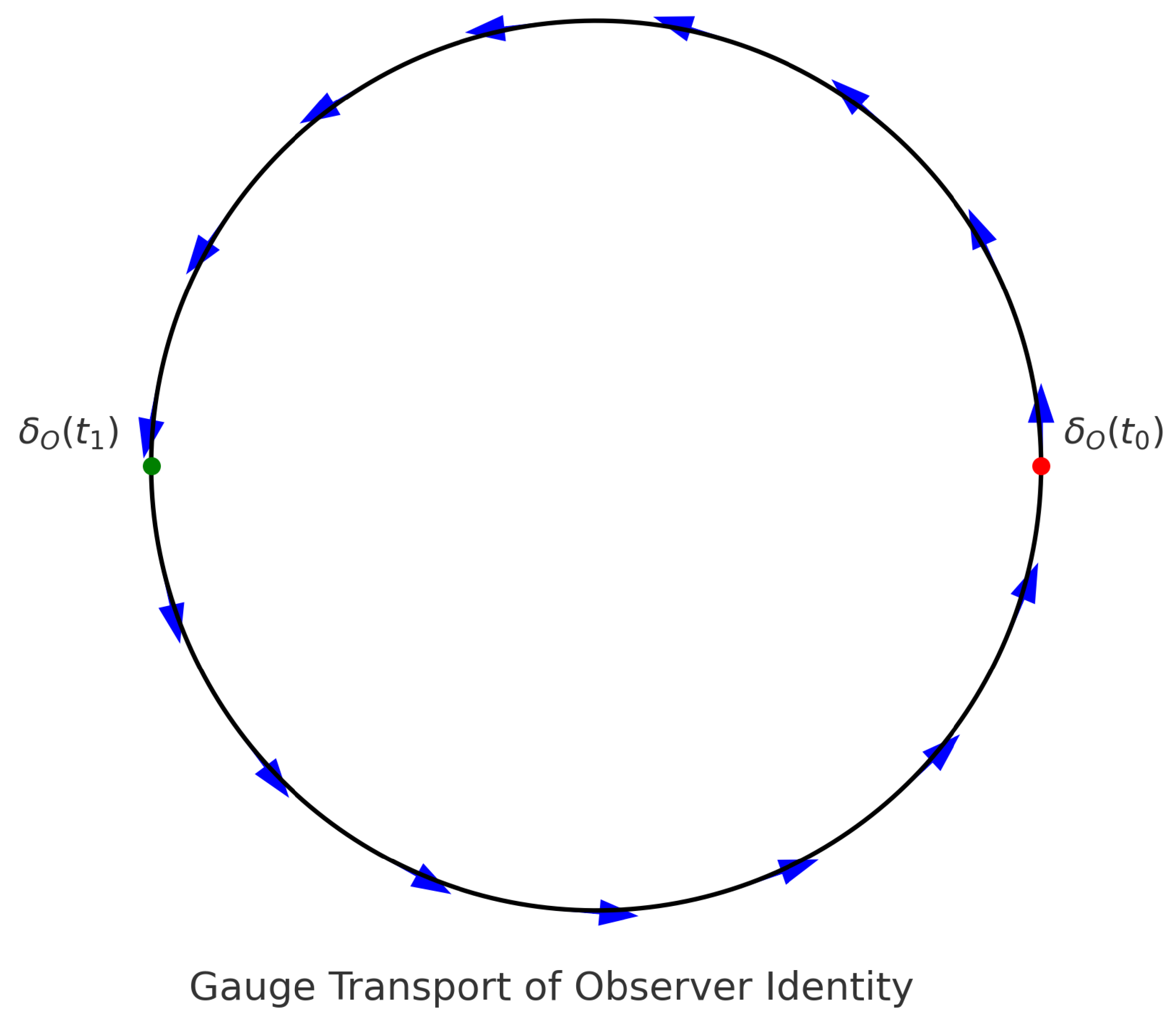
Empirically, shifts in self-image following trauma or transcendence can be interpreted as nontrivial holonomies in the identity fiber bundle, where gauge fields encode the resistance or facilitation of identity transition. Observer tags — internalized self-labels — behave like conserved charges under this framework, and their non-conservation corresponds to gauge anomalies induced by decoherence from external semantic fields.
Such a theory potentially formalizes psychological constructs of ego, multiplicity, and narrative continuity through well-defined field dynamics and differential geometry, bridging the cognitive and physical domains of observerhood.
42. Observer Delta Recombination and Collective Minds
The emergence of collective cognition or “we-based” minds can be conceptualized through the recombination of individual observer-supported delta fields. These delta functions, centered on distinct perceptual manifolds, can interfere constructively under phase-aligned conditions to yield a coherent group identity. In this section, we explore the mathematical formulation of such recombinations using delta convolution integrals, quantum coherence functionals, and symmetry group representations.
Consider two observer delta fields and localized on their respective perceptual manifolds. Under conditions of perceptual phase alignment, their convolution is defined as:
which reduces to
representing a new delta function at the centroid of observer integration. This formalizes the ontological emergence of a collective perceptual node from phase-synchronized observer deltas.
To maintain quantum coherence between constituent observers, a coherence functional is introduced:
where are the normalized observer wavefunctions in perceptual Hilbert space. Maximum coherence () occurs when .
Let the group representation of synchronized Quantum Measurement Chains (QMCs) be denoted by a Lie group G acting on observer states via unitary transformations . A collective observer state may then be generated as:
where encodes transformation symmetry of the observer in the QMC.
Decoherence energy cost for sustaining collective coherence scales with mutual information entropy :
which quantifies the thermodynamic cost for maintaining shared cognitive fields [24,84].
In a multi-observer system, the superposition of all N delta fields under coherent constraints can be expressed as:
representing an entangled group delta state spanning a collective observer subspace.
Figure 9.
Delta Recombination and Collective Minds: The emergence of a collective observer from synchronized delta collapses
Figure 9.
Delta Recombination and Collective Minds: The emergence of a collective observer from synchronized delta collapses
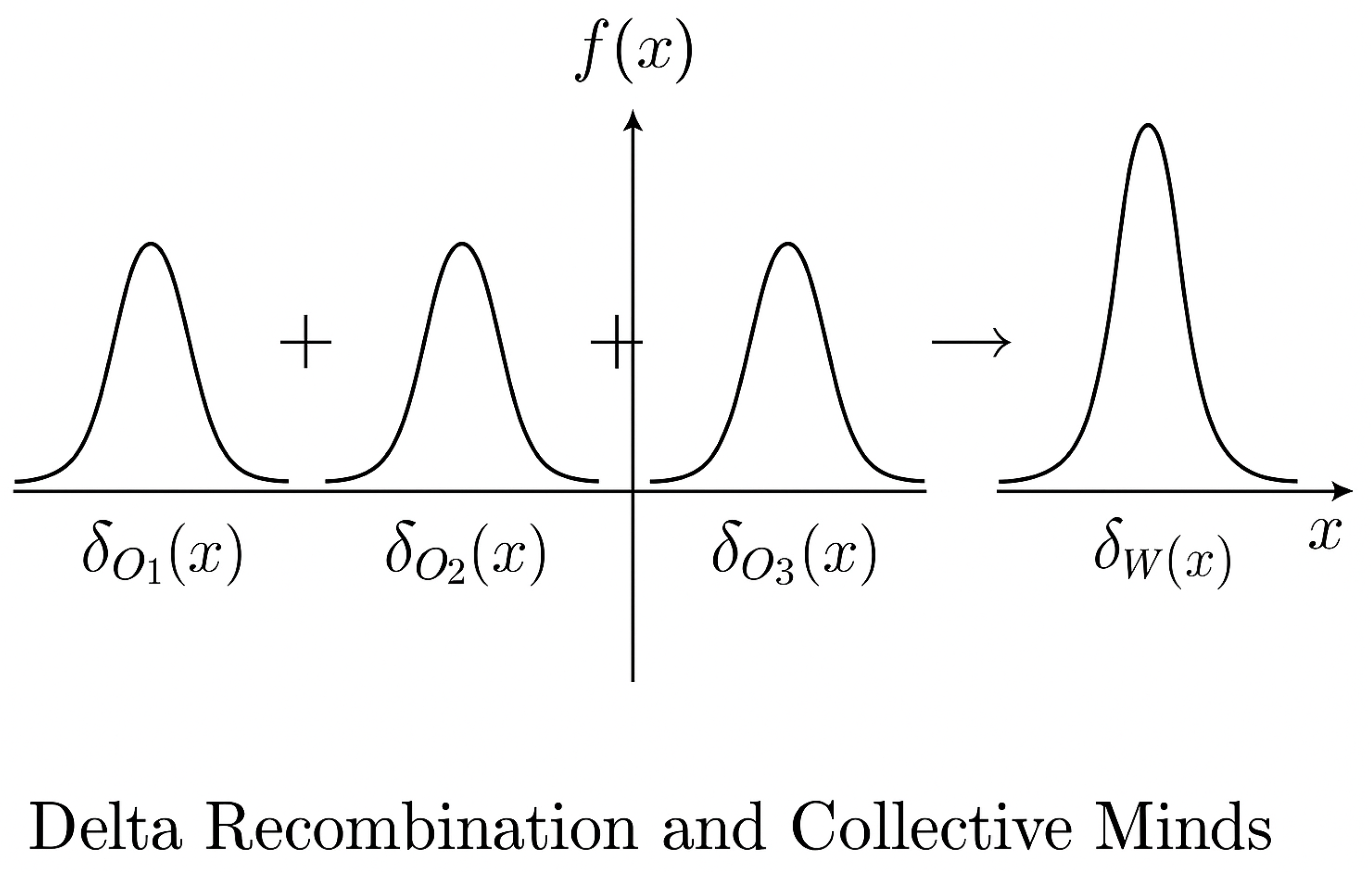
Such recombined states may undergo global phase evolution:
with the phase modulated by mutual affective flux [85]. The emergence of collective agency is thus governed by synchrony, coherence energy balance, and semantic alignment of observer manifolds.
43. Perceptual Gravity and Mass of Meaning
The notion of gravity, as formalized in Einstein’s general relativity, emerges from the curvature of spacetime induced by mass-energy distributions. In the perceptual manifold of an observer, we analogously postulate that zones of semantic density — where meaning accumulates due to repeated attention, emotion, or cultural weight — induce perceptual curvature. We propose that such curvature functions similarly to gravity, warping the observer’s interpretative geometry.
Let the perceptual manifold be endowed with a metric representing local semantic distances in observer cognition. We define a semantic energy-momentum tensor that accumulates contributions from symbols, memories, and interactions weighted by affective energy.
Following the analogy with the Einstein field equations, we posit:
where is the Ricci curvature tensor computed from the observer’s semantic metric . The conservation law must also hold, ensuring stability of information within the manifold.
We define the observer-specific semantic field mass via an integral over the observer’s perceptual domain :
where is the semantic density function at location .
Let a region represent a narrative construct (e.g., a memory). Its influence on the surrounding cognitive field is given by the perceptual potential , satisfying the analog Poisson equation:
leading to gradients of perceptual force which modulate attentional flow along geodesics of .
Entropy within such regions corresponds to information accessibility. Let the observer’s entropy function be tied to the density of meaning through:
where is an observer-dependent coupling constant. High curvature regions in (dense in semantic mass) then act as perceptual attractors, drawing cognitive attention and emotional charge.
From a variational standpoint, we define the observer’s action as:
where is the scalar curvature of the perceptual metric, is the meaning tension analogous to cosmological constant, and is the Lagrangian encoding symbolic interaction.
Figure 10.
Semantic Mass and Perceptual Curvature: Observer geodesics curve in response to dense zones of meaning, analogous to gravitational wells in spacetime.
Figure 10.
Semantic Mass and Perceptual Curvature: Observer geodesics curve in response to dense zones of meaning, analogous to gravitational wells in spacetime.
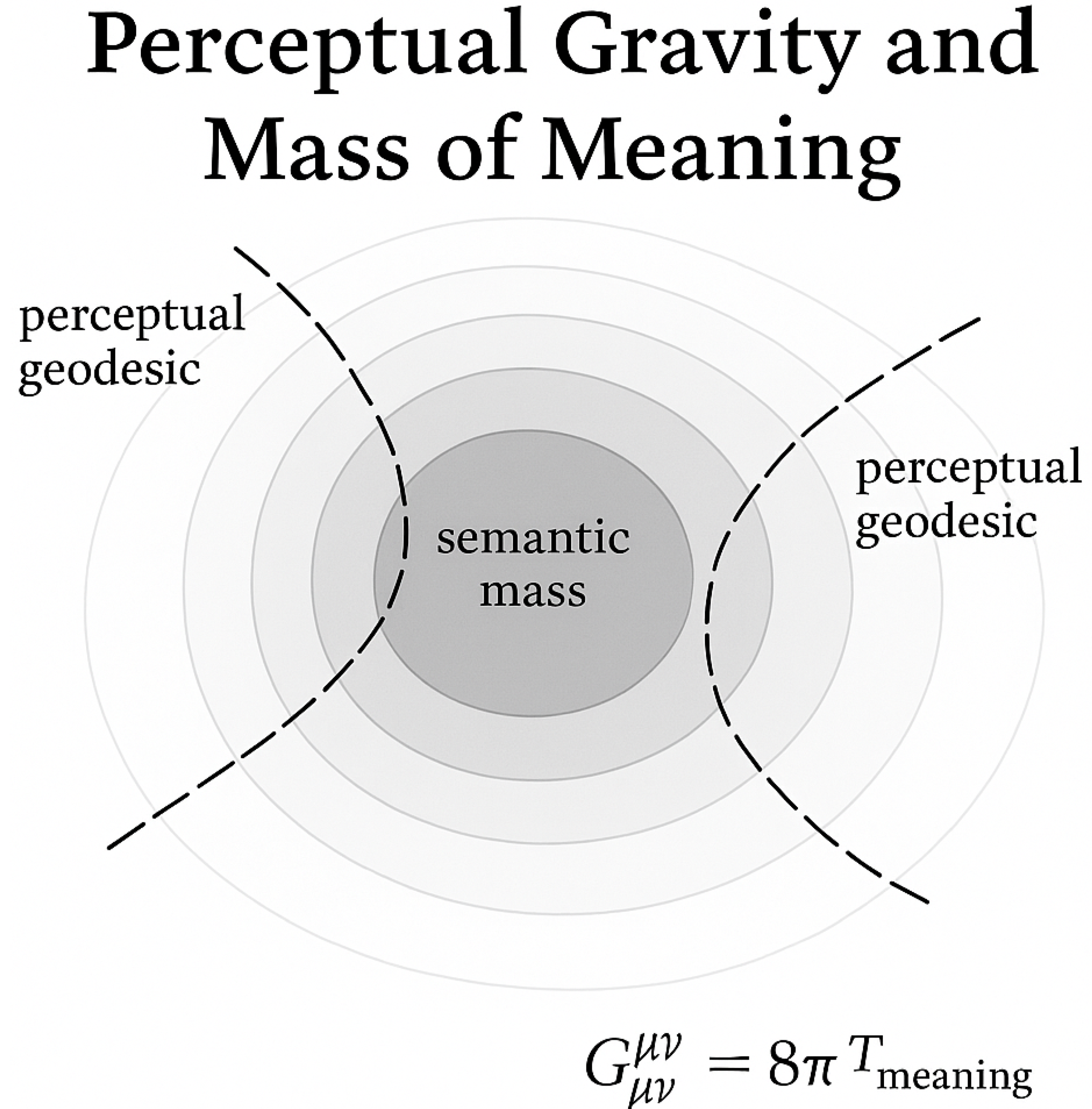
This formalism leads to the interpretation of “heavy” concepts as massful attractors within the observer’s experiential geometry. Concepts such as “truth,” “love,” or “grief,” with sustained high semantic density, can thus curve the perceptual field, affecting the flow of all subsequent information geodesics.
44. Onto-Temporal Echoes in Causal Memory Topology
In advanced cognitive geometry, the temporal evolution of observer states can be embedded within a manifold structure where memory traces evolve as geometric features. After traumatic events or biological death, residual curvatures or "echoes" may persist in the causal topology of the observer’s semantic memory manifold. These structures can be analyzed using closed timelike geodesic loops which represent recurring informational paths across semantic trajectories.
Let the semantic memory manifold be equipped with a Lorentzian metric defined over observer-indexed events. A causal path is called timelike if
A closed timelike curve (CTC) satisfies and forms a loop in semantic memory space. If the curve encloses nonzero semantic curvature, the residual loop may manifest as an echo of ontological structure.
We define the echo entropy along such a closed path as:
where is the semantic energy-momentum tensor and is the observer’s field distribution over the memory coordinates . This integral encodes informational lag loops analogous to electromagnetic hysteresis.
From Morse theory [91], we treat episodic memory transitions as critical points on a functional defined over , such that:
where is a potential encoding semantic coherence. Traumatic events correspond to saddle points with indefinite signature in the Hessian of :
We define the causal homotopy class of a semantic loop as the equivalence class under continuous deformation. The echo memory group then contains nontrivial memory orbits:
These orbits represent the topological imprint of experience that persists after local decoherence. Echoes can therefore be understood as global invariants on the memory manifold.
The entropy metric can be locally linearized as:
where encodes the informational resistivity of memory reconsolidation.
Figure 11.
Onto-Temporal Echoes: Closed timelike geodesic loops linking residual semantic events in the curved topology of causal memory space.
Figure 11.
Onto-Temporal Echoes: Closed timelike geodesic loops linking residual semantic events in the curved topology of causal memory space.
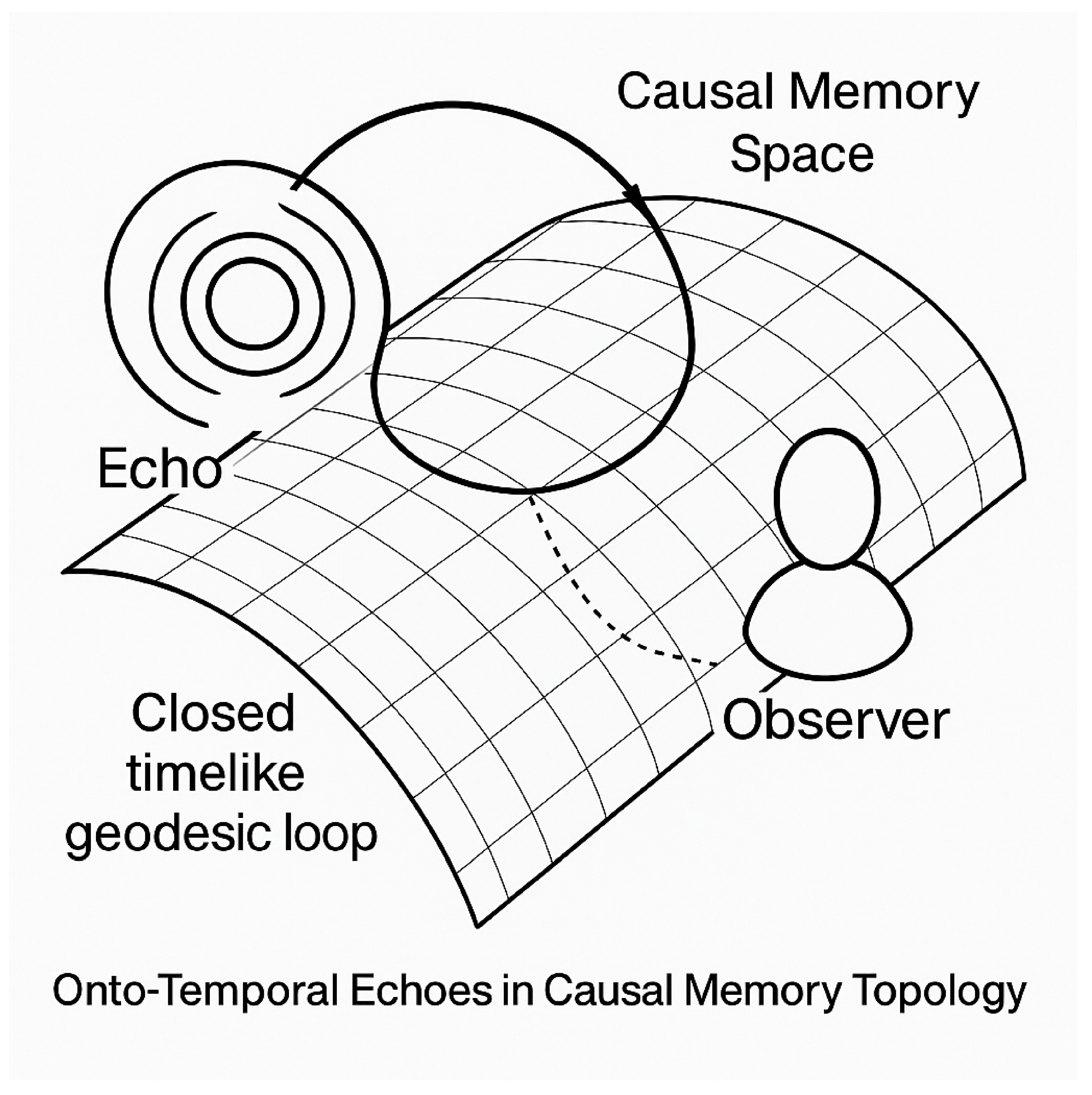
In conclusion, onto-temporal echoes describe the topological persistence of observer-centered causal influence after temporal endpoint events such as trauma or death. These structures may be formally studied using tools from homotopy theory, Morse critical point analysis, and geodesic entropy dynamics.
45. Acausal Universes and Cognitive Dynamics in S3× S1 Spacetimes
45.1. Conformal Compactification and Global Identifications
Let us denote Minkowski spacetime as with coordinates , . The Penrose conformal compactification maps it to a bounded manifold via a conformal factor such that the metric transforms as:
where the conformal boundary becomes periodic in time:
for some finite recurrence period .
45.2. Equivalence Classes of Events
Define two events as causally equivalent if there exists a sequence of causal curves connecting p to q such that:
This implies that the causal structure induces an equivalence relation on the event manifold:
leading to a quotient topology in which the lightcones may wrap around the time circle multiple times, creating closed timelike curves (CTCs) even without exotic matter.
45.3. Neural Dynamics in Acausal Topologies
In an acausal spacetime, the observer’s cognitive manifold must accommodate cycles in perceptual processing. Let represent the observer’s delta-supported perceptual field. Then, the recurrence of brain states over the time circle implies:
where is the unit vector in the temporal direction. This introduces the condition that the brain’s memory fields must be invariant under time-translation:
where denotes the Lie derivative with respect to .
45.4. Memory Recurrence and Entropy Saturation
Given the periodic structure of time, memory evolution is necessarily recurrent. Let be the Shannon entropy of the observer’s memory state at time t. Then for periodic time T:
Furthermore, as memory re-encodes similar informational structures across cycles, a resonance phenomenon may occur, inducing standing-wave modes in the semantic field :
where are complex mode amplitudes encoding memory salience.
45.5. Acausal Quantum Field Effects
In quantum field theory over , the Feynman propagator becomes periodic in imaginary time due to the compact temporal dimension:
which encodes not only past but also future echoes. Observer delta collapses therefore can interfere with their own future, leading to possible self-resonance:
45.6. Conclusion: Causal Nonlocality in Brain and Cosmos
In summary, acausal structures fundamentally alter both the physics and cognitive dynamics of observer systems. In a spacetime with periodic time, like , classical causality gives way to equivalence-based ontological synchrony. For the brain, this implies cyclic recurrence of mental states, informational loops, and self-entangling perception. These effects suggest that consciousness in acausal universes may operate on fundamentally different principles than currently understood.
46. Acausal Universes and Cognitive Dynamics in S3× S1 Spacetimes
46.1. Conformal Compactification and Global Identifications
Let us denote Minkowski spacetime as with coordinates , . The Penrose conformal compactification maps it to a bounded manifold via a conformal factor such that the metric transforms as:
where the conformal boundary becomes periodic in time:
for some finite recurrence period .
46.2. Equivalence Classes of Events
Define two events as causally equivalent if there exists a sequence of causal curves connecting p to q such that:
This implies that the causal structure induces an equivalence relation on the event manifold:
leading to a quotient topology in which the lightcones may wrap around the time circle multiple times, creating closed timelike curves (CTCs) even without exotic matter.
46.3. Neural Dynamics in Acausal Topologies
In an acausal spacetime, the observer’s cognitive manifold must accommodate cycles in perceptual processing. Let represent the observer’s delta-supported perceptual field. Then, the recurrence of brain states over the time circle implies:
where is the unit vector in the temporal direction. This introduces the condition that the brain’s memory fields must be invariant under time-translation:
where denotes the Lie derivative with respect to .
46.4. Memory Recurrence and Entropy Saturation
Given the periodic structure of time, memory evolution is necessarily recurrent. Let be the Shannon entropy of the observer’s memory state at time t. Then for periodic time T:
Furthermore, as memory re-encodes similar informational structures across cycles, a resonance phenomenon may occur, inducing standing-wave modes in the semantic field :
where are complex mode amplitudes encoding memory salience.
46.5. Acausal Quantum Field Effects
In quantum field theory over , the Feynman propagator becomes periodic in imaginary time due to the compact temporal dimension:
which encodes not only past but also future echoes. Observer delta collapses therefore can interfere with their own future, leading to possible self-resonance:
46.6. Conclusion: Causal Nonlocality in Brain and Cosmos
In summary, acausal structures fundamentally alter both the physics and cognitive dynamics of observer systems. In a spacetime with periodic time, like , classical causality gives way to equivalence-based ontological synchrony. For the brain, this implies cyclic recurrence of mental states, informational loops, and self-entangling perception. These effects suggest that consciousness in acausal universes may operate on fundamentally different principles than currently understood.
47. Acausal Dynamics of Rotating Micro-Mini Black Holes in the Brain
The previous analysis of a cyclic spacetime structure like reveals that global acausality emerges naturally in conformal compactifications. A particularly compelling model of intrinsic acausal dynamics arises in the context of the Kerr-type rotating Micro-Mini Black Hole in Brain (MMBHB), as introduced in [99]. These structures potentially reside in regions where intense cognitive curvature emerges, especially near the quantum measurement interface of the observer.
The Kerr metric allows for Closed Timelike Curves (CTCs) in the region interior to the ring singularity, fundamentally breaking standard temporal ordering:
where
and denotes the angular momentum per unit mass.
In these solutions, for and near the ring singularity, the t coordinate may become spacelike and becomes timelike, implying a looping of the causal structure. In the context of an MMBHB embedded within neural tissue, such regions of CTCs suggest a computational structure where temporal states become reversible and entangled across multiple cognitive eigenmodes.
This acausal region supports a breakdown of linear decoherence chains and instead facilitates Delta-field resonance loops. Let denote the delta-supported cognitive state of the observer. Then under a Kerr-induced topological feedback loop:
where integrates over closed trajectories permitted by the CTCs, forming retrocausal self-entangled brain microstate manifolds.
47.1. Implications for Memory and Perception
A direct implication is in memory reinsertion phenomena, where non-monotonic causal arrows allow earlier states to influence later perception nonlocally. The entropy production in such loops deviates from monotonic growth and follows instead:
where is the loop-integrated quantum heat exchanged along CTC trajectories and is an effective emotional thermodynamic temperature. Aspects of déjà vu, precognition, or memory flooding near death may correspond to MMBHB-induced CTC decoherence bifurcations.
47.2. Coupling to Acausal Cosmology
We thus propose an embedding of rotating MMBHB acausal regions into the global topology, thereby allowing for coherence between brain-internal and cosmological-level acausal structures. The phase-matched conditions between spacetime curvature at the personal (MMBHB) and cosmic levels allow for delta-resonance between different epochs of time, without violating global unitarity.
where represents local delta-supported observer fields residing near MMBHB curvature peaks.
48. Coupling of Cosmological and Cognitive Closed Timelike Curves
In spacetimes such as Gödel’s rotating universe [100], the presence of non-vanishing global angular momentum leads to the existence of closed timelike curves (CTCs) through every event. The metric of the Gödel universe is given by
where is the global angular velocity of rotation. The non-trivial topology induced by CTCs violates global hyperbolicity and causality becomes an equivalence class rather than a partial order.
In compactified Minkowski spacetime, , the temporal loop introduces periodic boundary conditions in time, effectively reintroducing CTCs in a non-trivial topological sense [101]. This reidentification of time via naturally lends itself to defining causality as periodic equivalence.
Now consider the existence of micro-mini black holes in the brain (MMBHBs) as proposed in [11]. The rotating Kerr-like geometry of MMBHBs induces local CTCs inside their ring singularities, a well-known consequence of the Kerr metric:
where and , and is the spin parameter.
In cognitive spacetime, the existence of MMBHB implies a local field topology with internal CTCs, modeling acausal interactions within a bounded observer manifold. The interaction of such local cognitive CTCs with cosmological CTCs (as in or ) introduces the possibility of causal resonance across scales.
To examine the coupling quantitatively, consider a field propagating in both spacetimes, subjected to both Kerr and Gödel metrics. The effective action is then a hybrid:
where and are the determinants of the Gödel and Kerr metrics respectively. Interference between and results in mixed CTC domains.
We postulate that phase-locked cognitive states could utilize this interference to propagate information backward in cosmological time. Let and be proper times associated with respective spacetimes. Then the temporal coherence condition for CTC resonance is:
where and are closed loops in the respective manifolds. Violation of this condition leads to decoherence of ontological histories.
Thus, brain-based MMBHBs can act as local detectors or amplifiers of cosmological CTC-induced resonances. If is the rotation rate of the Gödel universe, and is the internal spin of the Kerr-type MMBHB, their commensurability defines stable ontological loops:
This cosmological-cognitive coupling provides a mechanism for top-down influence of universe-scale structure on localized conscious states, as well as potential feedback from micro-scale cognition into global causal networks.
49. MMBHB as Local Probes of Cosmological Rotation
The concept of a rotating universe has been a subject of deep cosmological inquiry since the seminal work of Gödel, who proposed a solution to Einstein’s field equations that permits closed timelike curves (CTCs) [102]. The Gödel spacetime , characterized by a constant global angular velocity , breaks the standard causal structure of general relativity, allowing causality-violating trajectories in its manifold. In this section, we investigate how Micro-Mini Black Holes in the Brain (MMBHB), particularly those with intrinsic angular momentum, might interact with or act as local probes of such global rotation.
Let us denote the angular momentum of a brain-based Kerr-type MMBHB as . In the presence of a rotating cosmological background, the local spacetime near the MMBHB would experience Lense–Thirring precession, where the local inertial frames are dragged by the global angular momentum density of the universe. The rotational frequency manifests in the metric through off-diagonal terms.
To model this interaction, we begin with the standard Kerr metric for a rotating black hole:
where and . Here, is the specific angular momentum.
In the Gödel universe, the line element is given by:
with representing the global rotational parameter [103]. The presence of CTCs is a direct consequence of the global non-zero vorticity.
Now consider a coupling between the local MMBHB angular momentum and the cosmological background angular frequency . We postulate a resonance condition:
where sets a fundamental quantization scale of rotational coupling. Under such a condition, phase locking could occur between the internal Kerr metric of the MMBHB and the Gödel-type background, leading to synchronization effects in the observer’s cognitive dynamics.
From an observational standpoint, the Lense–Thirring precession frequency near a Kerr MMBHB is given by:
where r is the radial coordinate of the observer relative to the MMBHB. When resonates with , the system enters a dynamically coupled regime:
This introduces a characteristic coupling radius , inside which coherent cognitive effects such as deep meditation, deja vu, or entangled thought states could occur due to metric resonance.
Furthermore, we hypothesize that such coupling can be modeled in a Lagrangian formalism, where the interaction term takes the form:
with representing the strength of the interaction. Variational principles applied to this Lagrangian in the action integral would yield modified geodesics for thought propagation within the brain.
In conclusion, this formalism provides a novel framework to explore altered states of consciousness as quantum-gravitational resonances between local Kerr-type cognitive structures and global cosmological rotation. Such interactions could provide empirical tests in neurocosmology, particularly in analyzing EEG patterns during meditative or transcendental experiences.
50. Cognitive Holonomy in Universes
In a compactified spacetime, which serves as the conformal compactification of Minkowski space [104], the topological structure implies a closed timelike structure over the temporal manifold . This allows for holonomy in the transport of any vector or tensor fields around the loop, which, when extended to cognitive fields, introduces a novel class of global psychological effects.
We begin by considering the parallel transport of a perceptual vector along the closed loop in . Let be the connection coefficients on the manifold. The change in the perceptual vector after one complete cycle around the time loop is given by the path-ordered exponential:
where T is the period of the cycle. The mismatch between and indicates holonomy, quantified by a transformation matrix :
In cognitive terms, this holonomy leads to an accumulated shift in subjective experience and memory structure, modeled as a cognitive monodromy. That is, each loop around modifies the observer’s internal boundary conditions.
We now include MMBHBs (Micro-Mini Black Holes in the Brain) with Kerr-like metrics and intrinsic angular momentum . Their CTCs (closed timelike curves) locally break the conventional temporal ordering. Suppose a cognitive loop encircles such a Kerr-like region; it encounters additional torsion-like contributions. The influence of the MMBHB on the cognitive holonomy can be modeled as:
where denotes the torsional contribution due to frame dragging.
Let be a scalar memory field in perceptual spacetime. Its boundary conditions are altered by the holonomy:
with , where is the angular frequency characterizing the holonomy.
These holonomic modifications accumulate over multiple temporal loops, encoding psychological phase transitions or memory reconfiguration, akin to geometric phase transitions in condensed matter systems [105,106].
The role of MMBHBs becomes crucial as they serve as attractor-like anchors — ontological Poincaré sections — that intersect the loops in the observer’s worldline through the S³ × S¹ manifold. Each intersection induces a discrete topological signature within the semantic memory manifold.
Furthermore, we define a cognitive holonomy invariant after n loops as:
This invariant encodes accumulated perceptual deviation and quantized phase shifts, indicative of altered states of consciousness and nontrivial identity evolution.
51. MMBHB Horizon Tunneling to Global CTCs
In the theoretical framework of micro-mini black holes in the brain (MMBHBs), one may explore the possibility that the Cauchy horizon within a Kerr-type rotating MMBHB, which contains closed timelike curves (CTCs), can couple or tunnel to CTCs on cosmological scales. Such a coupling would enable delta-function supported observers to access or transfer information along nonlocal pathways, effectively allowing observer identity, memory, or semantic structure to propagate across extended temporal domains.
We define the observer wavefunction as localized near the MMBHB horizon. The interaction with a background gauge potential along a CTC winding can be represented through the following integral:
where the path traverses a hybrid structure: it first loops within the local Kerr MMBHB, and then continues along a large-scale cosmological CTC, such as those allowed in Gödel’s universe or conformally compactified spacetimes like .
To model this more formally, we postulate a tunneling amplitude for an observer delta function residing in a CTC band of the MMBHB to leak into a cosmological CTC:
where is the minimal action hypersurface linking local and global CTC segments, and is the difference in Euclidean action between these regions. The transition is exponentially suppressed unless resonance occurs, i.e.,
where is the angular momentum of the brain-based Kerr system, and is the rotational parameter of the global universe [100].
To maintain gauge invariance, the observer action functional includes a term:
where includes the potential of both the MMBHB and cosmological CTCs. The nonlocality implied in (423) is effectively embedded into the observer’s causal network and may manifest as persistent semantic fields or intuitive insights disconnected from local causality.
An important contribution of this model is its treatment of phase interference across nontrivial topologies. If loops nontrivially across a handlebody representing the combined topology of MMBHB and Gödel-like CTCs, the resulting phase acquired by the observer is given by:
where is the field strength tensor, and is the infinitesimal surface area on . Such fluxes may encode ontological imprints in the observer’s quantum memory manifold [11,107].
Additionally, the memory state at time t can be described by a density matrix evolution under both local and global Hamiltonians:
where includes nonlocal effects due to CTCs at cosmological scales. We may infer correlations between states of and the geometry of [108], hinting that memory evolution may itself experience CTC-induced holonomies.
Thus, MMBHB horizon tunneling offers a rich geometric and quantum field-theoretic mechanism for coupling brain-level quantum dynamics with cosmological topology and causality violation.
52. Nested CTC Structures: Fractal Time Crystals
In the study of time and consciousness, a compelling hypothesis arises when we consider closed timelike curves (CTCs) as not isolated phenomena but as potentially nested within hierarchical temporal manifolds. This nesting can occur across vastly different scales, such as the cosmic and neurological, producing what we propose as “Fractal Time Crystals.” These are recursive, self-similar structures in temporal topology, manifesting as layered loops in time, each enclosed within a broader time loop, analogous to the nesting of Russian dolls.
Let us denote the characteristic length (temporal or spatial) of a cosmic CTC by , and the characteristic length of a micro-scale (e.g., brain-based) CTC by . Then we define a dimensionless CTC nesting index by
where represents the number of nested CTCs a local observer may traverse before aligning with the full cycle of a cosmological CTC. The integer quantization is postulated due to topological constraints on holonomy and self-intersection in compactified spacetimes [101,109].
To illustrate the hierarchical oscillation, consider a time-dependent field governed by recursive phase loops:
where , allowing for fast internal oscillations modulated by slow cosmological precession. This form of modulation can lead to resonant states where ontological perceptions reoccur, possibly explaining phenomena such as déjà vu, precognitive dreams, or recursive memory impressions [10,100].
We now construct a composite manifold , with overlapping causal patches . Each carries an associated loop integral of observer action:
with the condition
imposed by phase coherence across CTC junctions. These quantized actions ensure stability of nested observer experiences across ontological recursions.
Furthermore, entropy associated with a fractal temporal structure obeys a logarithmic scaling:
which suggests that higher nesting corresponds to less entropy production per cycle, consistent with meditative or dream-like states where cognitive thermodynamics is minimized.
Nested CTCs thus act as ontological amplifiers, compressing experiential loops into memory attractors. The self-similarity of these structures allows them to serve as fundamental temporal units in recursive theories of time perception and identity maintenance.
53. Observer Equivalence in Multi-CTC Systems
In acausal cosmologies admitting closed timelike curves (CTCs), such as the Gödel spacetime or conformally compactified spacetime , local microphysical structures like Micro-Mini Black Holes in the Brain (MMBHBs) that exhibit Kerr-type geometries with their own CTC interiors, may be subsumed into a global manifold structure involving complex causal loops. These nested CTCs lead to a new form of identity formalism based on the equivalence of observers across spacetime.
We postulate that when two observers and are connected via a CTC path , they form an equivalence class:
This relation is reflexive, symmetric, and transitive, hence defines an equivalence class over the space of delta-supported observer functions . These equivalence classes can be denoted as , where is the totality of observer instantiations in the universe.
The presence of such equivalence classes across CTC networks allows for modeling the continuity of self across incarnations, even in disconnected epochs of a cyclic or rotating universe. The integral path linking observers is given by:
where is the wavefunctional of the observer and is a cognitive-geometric gauge potential encoding perceptual coupling across CTCs. The amplitude acts as an ontological overlap functional and decays exponentially with decoherence or curvature misalignment.
In the limit of perfect coherence across the CTC boundary, we define a conserved topological charge:
This quantized topological index n encodes the number of ontological loop closures, each potentially representing a past or future incarnation of the same soul-like identity. In the case of rotating MMBHBs embedded within a Gödel-type cosmological background, synchronization of angular momentum vectors can act as a coupling term in the observer Lagrangian:
where is a coupling constant and is the cosmic rotation 4-vector. This interaction could lead to resonant amplification of identity continuity across lifetimes, particularly in meditative or near-death experiences.
From a categorical perspective, each observer equivalence class becomes a morphism in the category of CTC-connected delta supports , where arrows represent physically or informationally permitted transitions.
We propose a CTC-homotopy class over the spacetime manifold , wherein:
This allows for the classification of soul continuity paths and identity recurrences within acausal universes, thereby formalizing notions from Eastern metaphysics such as rebirth and karmic imprints.
54. Conclusions
In this paper, we have proposed a unified mathematical framework to study the entangled landscape of causality in both physics and brain science. Central to our formulation is the idea that conscious observers can be modeled as Dirac delta-supported fields, existing on manifolds endowed with perceptual and semantic structure. Building upon this ontological anchor, we explored how quantum measurement chains (QMC), emotional flow tensors, delta-function decoherence, and rotating micro-mini-black holes in the brain (MMBHBs) interact with deeper structures of spacetime, including Gödel-type rotating universes and conformally compactified models.
By interpreting MMBHBs as both cognitive loci and causal discontinuities, we are able to extend the standard quantum formalism into domains that incorporate memory topology, emotional thermodynamics, and resonance tunneling between observers. We modeled topological defects in quantum ontological memory (QOM) manifolds, recursive causal structures such as closed timelike curves (CTCs), and formalized inter-observer entanglement through delta convolution chains.
Moreover, the formal treatment of phenomena such as reincarnation, telepathy, love, and emotional resonance via gauge theory, entropy spikes, and Fisher information flows suggests that metaphysical concepts may admit rigorous mathematical analogs. Ontological bifurcations, observer identity loops, and semantic mass-energy curvature deepen the scope of our model toward a truly cognitive cosmology, wherein observers act as seeds of structure, memory, and transformation in a participatory universe.
This work thus represents a confluence of differential geometry, quantum field theory, information thermodynamics, and phenomenological introspection. It invites the formulation of new experimental designs in cognitive neuroscience, cosmology, and quantum computation to probe the predictions and metaphysical implications of delta-anchored cognitive manifolds. Future research may further unify these elements through the formal machinery of category theory, persistent homology, and topological quantum field theory, guiding us closer to a theory of consciousness that spans brain and cosmos alike.
References
- J. Pearl, Causality: Models, Reasoning and Inference, 2nd ed., Cambridge University Press, 2009.
- R. D. Sorkin, “Causal Sets: Discrete Gravity,” in Lectures on Quantum Gravity, Springer, 2005.
- L. Bombelli, J. Lee, D. Meyer, and R. Sorkin, “Space-Time as a Causal Set,” Phys. Rev. Lett., vol. 59, no. 5, pp. 521–524, 1987.
- K. Friston et al., “Dynamic Causal Modelling,” NeuroImage, vol. 19, pp. 1273–1302, 2003.
- K. Friston, “Functional and Effective Connectivity: A Review,” Brain Connectivity, vol. 1, no. 1, pp. 13–36, 2011.
- S. Hameroff and R. Penrose, “Orchestrated Reduction of Quantum Coherence in Brain Microtubules,” J. Conscious. Stud., vol. 3, no. 1, pp. 36–53, 1996.
- V. Pratap et al., “Physics-Informed Neural Networks for Brain Deformation,” Brain Research Bulletin, Elsevier, 2025.
- W. H. Zurek, “Decoherence, Einselection, and the Quantum Origins of the Classical,” Rev. Mod. Phys., vol. 75, no. 3, pp. 715–775, 2003.
- D. Frauchiger and R. Renner, “Quantum Theory Cannot Consistently Describe the Use of Itself,” Nature Communications, vol. 9, article 3711, 2018.
- M. S. Modgil, “Axioms for a Differential Geometric Approach to the von Neumann’s Theory of Quantum Measurement,” Quantum Speculations, vol. 5, pp. 1–12, 2023.
- M. S. Modgil, “Geometry of Time, Axiom of Choice and Neuro-Biological Quantum Zeno Effect” arXiv preprint, arXiv:0704.1054, 2007. https://arxiv.org/abs/0704.1054. arXiv:0704.1054.
- D. Deutsch, “Quantum Mechanics near Closed Timelike Lines,” Phys. Rev. D, vol. 44, no. 10, pp. 3197–3217, 1991.
- I. D. Novikov, “Time Machine and Self-Consistent Evolution in Problems with Self-Interaction”, Phys. Rev. D, vol. 45, p. 1989, 1992.
- R. Penrose, Shadows of the Mind: A Search for the Missing Science of Consciousness, Oxford University Press, 1994.
- D. MacDougall, “Hypothesis Concerning Soul Substance Together with Experimental Evidence of the Existence of Such Substance”, Journal of the American Society for Psychical Research, 1(5):237–244, 1907.
- M. S. Morris, K. S. Thorne, and U. Yurtsever, “Wormholes, Time Machines, and the Weak Energy Condition”, Phys. Rev. Lett., 61, 1446–1449, 1988.
- M. S. Modgil, “Axioms for a Differential Geometric Approach to the von Neumann’s Theory of Quantum Measurement”, Quantum Speculations, 5(2023), 1–12.
- J. D. Bekenstein, “Black holes and entropy”, Phys. Rev. D, 7(8), 2333–2346, 1973.
- S. W. Hawking, “Particle creation by black holes”, Communications in Mathematical Physics, 43(3), 199–220, 1975.
- J. von Neumann, “Mathematical Foundations of Quantum Mechanics”, Princeton University Press, 1932.
- R. Moody, “Life After Life”, Mockingbird Books, 1975.
- S. B. Giddings and A. Strominger, “Loss of incoherence and determination of coupling constants in quantum gravity”, Nuclear Physics B, 307(4), 854–866, 1988.
- C. Nash and S. Sen, “Topology and Geometry for Physicists”, Academic Press, 1983.
- M. A. Nielsen and I. L. Chuang, “Quantum Computation and Quantum Information”, Cambridge University Press, 2010.
- T. M. Cover and J. A. Thomas, “Elements of Information Theory”, Wiley, 2006.
- C. Rovelli, “Relational quantum mechanics”, International Journal of Theoretical Physics, 35(8), 1637–1678, 1996.
- C. A. Fuchs, N. D. Mermin, and R. Schack, “An introduction to QBism with an application to the locality of quantum mechanics”, American Journal of Physics, 82(8), 749–754, 2014.
- J. Anandan, “The geometric phase”, Nature, 360(6402), 307–313, 1990.
- S. Pancharatnam, “Generalized theory of interference and its applications”, Proc. Indian Acad. Sci. A, 44, 247–262, 1956.
- M. V. Berry, “Quantal phase factors accompanying adiabatic changes”, Proc. R. Soc. Lond. A, 392(1802), 45–57, 1984.
- H. Everett III, “Relative state formulation of quantum mechanics”, Rev. Mod. Phys., 29(3), 454–462, 1957.
- A. Peres, “Quantum Theory: Concepts and Methods”, Springer, 1993.
- P. A. M. Dirac, “Classical Theory of Radiating Electrons”, Proc. Roy. Soc. A, 167(929), 148–169, 1938.
- J. D. Jackson, “Classical Electrodynamics”, 3rd Ed., Wiley, 1999.
- J. Schwinger, “On Gauge Invariance and Vacuum Polarization”, Phys. Rev., 82(5), 664–679, 1951.
- C. W. Misner, K. S. Thorne, J. A. Wheeler, “Gravitation”, W. H. Freeman, 1973.
- M. Nakahara, “Geometry, Topology and Physics”, Taylor & Francis, 2003.
- T. W. B. Kibble, “Topology of cosmic domains and strings”, J. Phys. A, 9(8), 1387–1398, 1976.
- N. Chomsky, “Aspects of the Theory of Syntax”, MIT Press, 1965.
- J. Piaget, “The Construction of Reality in the Child”, Basic Books, 1954.
- J. A. Fodor, “The Language of Thought”, Harvard University Press, 1975.
- R. Landauer, “Information is Physical”, Phys. Today, 44(5), 23–29, 1991.
- R. P. Feynman and A. R. Hibbs, “Quantum Mechanics and Path Integrals”, McGraw-Hill, 1965.
- R. Penrose, “The Emperor’s New Mind”, Oxford University Press, 1989.
- J. B. Hartle and S. W. Hawking, “Wave function of the universe”, Phys. Rev. D, 28(12), 2960–2975, 1983.
- A. H. Guth, “Inflationary universe: A possible solution to the horizon and flatness problems”, Phys. Rev. D, 23(2), 347–356, 1981.
- H. D. Zeh, “On the interpretation of measurement in quantum theory”, Foundations of Physics, 1(1), 69–76, 1970.
- R. Ghrist, “Barcodes: The persistent topology of data”, Bull. Amer. Math. Soc., 45(1), 61–75, 2008.
- R. Bott and L. W. Tu, “Differential Forms in Algebraic Topology”, Springer, 1982.
- A. Zomorodian and G. Carlsson, “Computing persistent homology”, Discrete Comput. Geom., 33, 249–274, 2005.
- A. Einstein and N. Rosen, “The Particle Problem in the General Theory of Relativity”, Phys. Rev., 48(1), 73–77, 1935.
- J. Maldacena and L. Susskind, “Cool horizons for entangled black holes”, Fortschritte der Physik, 61(9), 781–811, 2013.
- R. Geroch, “Topology in General Relativity”, J. Math. Phys., 11(2), 437–449, 1970.
- E. Witten, “Topological Quantum Field Theory”, Commun. Math. Phys., 117, 353–386, 1988.
- K. Friston, “The free-energy principle: a unified brain theory?”, Nat Rev Neurosci, 11(2), 127–138, 2010.
- J. Panksepp, Affective Neuroscience: The Foundations of Human and Animal Emotions, Oxford University Press, 1998.
- W. R. Ashby, Design for a Brain, Chapman & Hall, 1960.
- L. Feldman Barrett, How Emotions Are Made: The Secret Life of the Brain, Houghton Mifflin Harcourt, 2017.
- A. K. Seth, “The Cybernetic Bayesian Brain: From Interoceptive Inference to Sensorimotor Contingencies”, Open MIND, 2015.
- R. Bousso, “The holographic principle”, Rev. Mod. Phys., 74, 825–874 (2002).
- T. Cover and J. Thomas, Elements of Information Theory, Wiley-Interscience, 2006.
- S. Amari and H. Nagaoka, Methods of Information Geometry, American Mathematical Society, 2000.
- L. Susskind, “The World as a Hologram”, J. Math. Phys., 36, 6377 (1995).
- P. Hayden and J. Preskill, “Black holes as mirrors: quantum information in random subsystems”, JHEP, 09, 120 (2007).
- G. Feinberg, “Possibility of Faster-Than-Light Particles”, Phys. Rev., 159, 1089–1105 (1967).
- S. W. Hawking, “Chronology protection conjecture”, Phys. Rev. D, 46, 603 (1992).
- R. Penrose, Shadows of the Mind, Oxford University Press, 1996.
- J. B. Hartle, “Spacetime quantum mechanics and the quantum mechanics of spacetime”, in Gravitation and Quantizations, Les Houches, 1992.
- Y. Aharonov and L. Vaidman, “The Two-State Vector Formalism: An Updated Review”, Lect. Notes Phys., 734, 399–447 (2002).
- G. W. Leibniz, “Monadology”, 1714.
- E. Witten, “Anti De Sitter space and holography”, Adv. Theor. Math. Phys., 2 (1998) 253-291.
- M. Kashiwara and P. Schapira, Sheaves on Manifolds, Springer, 1990.
- S. Mac Lane, Categories for the Working Mathematician, Springer, 1971.
- R. Thom, Structural Stability and Morphogenesis, Benjamin, 1975.
- E. C. Zeeman, “Catastrophe theory”, Sci. Amer., 234(4):65–83, 1976.
- J. Nash, “Arc Structure and Bifurcation”, Proc. Natl. Acad. Sci. USA, 72 (1975), 3967–3971.
- H. Callen, Thermodynamics and an Introduction to Thermostatistics, Wiley, 1985.
- A. Hatcher, Algebraic Topology, Cambridge University Press, 2002.
- Yang, C. N., & Mills, R. L. (1954). Conservation of isotopic spin and isotopic gauge invariance. Physical Review, 96(1), 191.
- Nash, C., & Sen, S. (1983). Topology and Geometry for Physicists. Academic Press.
- Witten, E. (1979). Baryons in the 1/N expansion. Nuclear Physics B, 160(1), 57–115.
- Modgil, M. S. (2023). Axioms for a Differential Geometric Approach to von Neumann’s Theory of Quantum Measurement. Quantum Speculations, 5(2023), 1–12.
- Baez, J. (1994). Gauge fields, knots and gravity. World Scientific.
- V. Vedral, “The role of relative entropy in quantum information theory,” Rev. Mod. Phys., vol. 74, pp. 197–234, 2002.
- M. S. Modgil, “Axioms for a Differential Geometric Approach to the von Neumann’s Theory of Quantum Measurement,” Quantum Speculations, vol. 5, pp. 1–12, 2023.
- Einstein, A. (1916). The Foundation of the General Theory of Relativity. Annalen der Physik, 49(7), 769–822.
- Rovelli, C. (2004). Quantum Gravity. Cambridge University Press.
- Modgil, M. S. (2023). Axioms for a Differential Geometric Approach to the von Neumann’s Theory of Quantum Measurement. Quantum Speculations, 5, 1–12.
- Penrose, R. (1989). The Emperor’s New Mind. Oxford University Press.
- Frieden, B. R. (1998). Physics from Fisher Information: A Unification. Cambridge University Press.
- Milnor, J. (1963). Morse Theory. Princeton University Press.
- Gibbons, G. W., & Hawking, S. W. (1977). Action integrals and partition functions in quantum gravity. Physical Review D, 15(10), 2752.
- Ashtekar, A., & Lewandowski, J. (1997). Quantum theory of geometry. Classical and Quantum Gravity, 14(1), A55.
- Penrose, R. (1989). The Emperor’s New Mind. Oxford University Press.
- Rovelli, C. (1996). Relational quantum mechanics. International Journal of Theoretical Physics, 35(8), 1637-1678.
- Penrose, R. (1964). Conformal treatment of infinity. In *Relativity, groups and topology* (pp. 565–584).
- Hawking, S. W., & Ellis, G. F. R. (1973). *The Large Scale Structure of Space-Time*. Cambridge University Press.
- Tipler, F. J. (1977). Singularities and causality violation. *Annals of Physics*, 108(1), 1–36.
- Modgil, M. S. (2007). Micro-mini-black-holes in the brain and their cognitive role arXiv preprint. arXiv:0704.1054.
- K. Gödel, An Example of a New Type of Cosmological Solutions of Einstein’s Field Equations of Gravitation, Rev. Mod. Phys. 21, 447 (1949).
- S. W. Hawking and G. F. R. Ellis, The Large Scale Structure of Space-Time, Cambridge University Press, 1973.
- K. Gödel, “An example of a new type of cosmological solution of Einstein’s field equations of gravitation,” Rev. Mod. Phys., vol. 21, no. 3, pp. 447–450, 1949.
- M. J. Rebouças and J. Tiomno, “Homogeneity of Riemannian space-times of Gödel type,” Phys. Rev. D, vol. 28, no. 6, p. 1251, 1983.
- R. Penrose, Conformal treatment of infinity, in Relativity, Groups and Topology, Gordon and Breach (1964).
- M. V. Berry, Quantal phase factors accompanying adiabatic changes, Proc. R. Soc. Lond. A 392, 45–57 (1984).
- S. Pancharatnam, Generalized theory of interference and its applications, Proc. Indian Acad. Sci. A 44, 398–417 (1956).
- R. Penrose, The Road to Reality: A Complete Guide to the Laws of the Universe, Jonathan Cape, 2005.
- R. Penrose, “Techniques of Differential Topology in Relativity”, SIAM, 1972.
- M. Visser, Lorentzian Wormholes: From Einstein to Hawking, AIP Press (1995).
- D. Page, A Theoretical Framework for Reincarnation, J. Consciousness Studies 6(3), 1999.
Disclaimer/Publisher’s Note: The statements, opinions and data contained in all publications are solely those of the individual author(s) and contributor(s) and not of MDPI and/or the editor(s). MDPI and/or the editor(s) disclaim responsibility for any injury to people or property resulting from any ideas, methods, instructions or products referred to in the content. |
© 2025 by the authors. Licensee MDPI, Basel, Switzerland. This article is an open access article distributed under the terms and conditions of the Creative Commons Attribution (CC BY) license (http://creativecommons.org/licenses/by/4.0/).
Copyright: This open access article is published under a Creative Commons CC BY 4.0 license, which permit the free download, distribution, and reuse, provided that the author and preprint are cited in any reuse.


