
Submitted:
22 October 2025
Posted:
22 October 2025
You are already at the latest version
Abstract
Silicon PhotoMultipliers (SiPMs), constitute the enabling technology for a diverse and rapidly growing range of applications in experimental physics. The development of detectors based on silicon photosensors for acquisition of fast signals coming from Cherenkov and fluorescence emissions started by particle showers in the atmosphere, is the main goal of the current ASI/INFN Agreement, named ASI/INFN_EUSO-SPB2 (Extreme Universe Space Observatory - Super Pressure Balloon 2), addressed to the next generation of telescopes in balloon-borne and space-based experiments. In such framework, a survey of performances of different SiPMs available on the market has been performed to identify the best sensors for space applications, where high thermal excursions and environmental radiation must be mainly taken into account with respect to ground-based experiments. In the present contribution, a characterization protocol for SiPM qualification has been applied to the (8x8) Hamamatsu S13161-3050AE-08 SiPM array in the (-40, +30)°C temperature range. The protocol is adopted for validating several key parameters: breakdown voltage, quenching resistance, gain, dark count rate and probability of cross-talk. Experimental methods and instrumental set-ups implemented for measuring them and their dependence on temperature are shown and some results are discussed.
Keywords:
space-based telescopes
; SiPMs
; thermal excursions
1. Introduction
In the recent years, novel semiconductor photosensors, such as Silicon Photo-Multipliers (SiPMs), have been developed for fundamental science experiments, constituting an innovative technology for a diverse and rapidly growing range of applications. Especially, in the framework of the astroparticle physics, an intense investigation of using SiPMs is ongoing in order to design and implement the next generation of telescopes in ground-based, balloon-borne and space-based experiments [1,2]. In particular, the development of telescopes, with a focal surface based on SiPMs, for acquisition of fast light signals coming from Cherenkov and fluorescence emissions, started by charged secondary particles during the development of the Extensive Air Showers (EASs) in terrestrial atmosphere, represents a challenging pathfinder for indirect measurements of Ultra-High-Energy Cosmic Rays (UHECRs) from space [3]. In such context, the current Italian ASI/INFN Agreement n.2021-8-HH.2-2022, with the successive supplements and the additional Agreement n.2020-26-Hh.0., signed between the Italian Space Agency (ASI) and the National Institute of Nuclear Physics (INFN), named ASI/INFN_EUSO-SPB2 (Extreme Universe Space Observatory − Super Pressure Balloon 2) Project, plays a key role. It is devoted to the design, development, production and completion of a Cherenkov and/or fluorescence telescope prototype for space applications, with the ultimate purpose of enhancing the Technology Readiness Level (TRL). It intends to demonstrate the maturity of such technique for flight-qualification, specifically of the mechanics, hardware, front-end, read-out and data acquisition electronics, of the firmware and software for triggers and slow-control systems, of the algorithms and codes for simulation, reconstruction and data analysis and also for atmospheric monitoring, with an ultimate goal of assembling and completing a telescope prototype, including all the test and integration pre-flight campaigns. The ASI and INFN (with its Divisions of Bari, Catania, Napoli, Roma 2 and Torino), as partners, and the University of Catania and University of Torino, as sub-partners, participate to the aforementioned Project. It represents the base for an implementation of Cherenkov and fluorescence telescopes of the JEM-EUSO Program [4], in particular directly connected with its recent intermediate sub-orbital SPB2 (Super Pressure Balloon 2) [5] mission and the new PBR (POEMMA Balloon with Radio) [6] balloon-borne flight, approved and funded by the NASA (National Aeronautics and Space Administration) USA Space Agency, for a launch planned in Spring 2027 from the Wanaka base in New Zealand. The PBR intermediate mission will be the closest prototype to date for the large-size space-based POEMMA (Probe Of Extreme Multi-Messenger Astrophysics) mission [7], a stereo double telescope to be considered for a NASA Probe Mission in the next decade.
2. SiPMs as Photodetectors for Space Applications
A SiPM is composed of a matrix of identical micro-cells, each one consisting of a so-called Geiger-mode Avalanche Photo-Diode (G-APD) or Single-Photon Avalanche Diodes (SPAD) and a quenching resistor (R) connected in series. The micro-cells are connected in parallel to a bias voltage (V). SiPMs are also known as Multi-Pixel Photon Counters (MPPCs), naming a micro-cell as pixel. Every pixel produces the same signal when it is hit by a photon and the sum of the pixel responses gives the channel output. The typical dimension of a SiPM sensor is between , the number of micro-cells per device ranges from several hundreds to several tens of thousands and micro-cells vary between in size. As an example the S13161-3050AE-08 Hamamatsu has channels of and micro-cell . The SiPMs as photodetectors present numerous pearls over conventional vacuum tube Photo-Multiplier Tubes (PMTs): solid-state technology and compact size; cost-effectiveness, modularity, magnetic field immunity, low voltage operation, high Photon Detection Efficiency (PDE), high Gain (G) and large output signal, wide dynamic range. Nevertheless, the SiPMs are usually more sensitive in their performances to the temperature and present also other pitfalls: higher costs for larger detection area, high Dark Count Rate (DCR), radiation sensitivity, probability Cross-Talk (pCT) leading to increased noise and reduced signal-to-noise ratio, limited dynamic range and bandwidth, not highly sensitive below 400 nm and too sensitive at higher wavelengths. The design, assembly and completion of a telescope for space applications, based on a focal surface formed by SiPM arrays, must take into account all the above-mentioned factors and meets a proper balance among pearls and pitfalls of SIPMs. Moreover, in pinpointing the best SiPM sensors for space-based experiments, the extreme ambient conditions, where high thermal excursions and environmental radiation prevail, must be carefully evaluated in contrast to ground-based experiments. In the framework of the ASI/INFN_EUSO-SPB2 Project, a specific Working Package (WP), identified as WP4400: Characterization, selection and validation of SiPMs, is devoted to the definition of a procedure to characterize and select the SiPM sensors that best fit experimental requirements for space applications. The most important outcome of an extensive survey on various SiPMs was a complete study of the () Hamamatsu S13161-3050AE-08 SiPM array [8], showing the best performances over a wide range of temperatures [9]. In the present contribution, the protocol adopted for validating several key parameters of SiPMs: breakdown voltage, quenching resistance, gain, dark count rate and probability of cross-talk and their dependance on the temperature excursions is introduced. The technical details and description of the experimental set-up and the procedural steps implemented for the measurements are reported to follow (Section 3).
3. Settling a Measurement Protocol for Surveying SiPM Sensors for Space Applications
Under the context of the ASI/INFN_EUSO-SPB2 WP4400 (Characterization, selection and validation of SiPMs), an extensive procurement, listed in Table 1), of different SiPMs available on market (Broadcom Corporation, Hamamatsu Photonics, KETEK Gmbh, SensL Tecnologies Ltd manufacturing companies) was acquired and a preliminary survey was conducted through measurements on their basic properties at controlled temperature conditions.
In the preliminary phase, the survey was focused on a sub-set of the available inventory starting from a first comparison between Hamamatsu and KETEK SiPMs, whose specific properties are summarised in the Table 2. In addition, the wavelength spectral response range is () nm for the Hamamatsu SiPMs with CS option while () nm, with a peak in sensitivity at 450 nm wavelength, for the KETEK Si photosensor. The operating temperature range is (C for the Hamamatsu SiPMs and C for the KETEK SiPMs.
The primitive measurements were performed, before at room temperature and then at controlled set (25C) temperature, by illuminating the SiPM sensor with a monochromatic LASER fixed on an optical work bench (see (a) Figure 1) and using a convergent lens to focus the LASER light pulses conducted by an adapter fiber, with the signal read by an oscilloscope. Later, the measurements were structured by putting the system in a proper large dark box (see (b) Figure 1), replacing a LED as light source, using a customized mechanical support to place SiPMs and the optical fiber conducting the light pulsed inside the dark box, by reading the signals from the SiPM sensor by means of a CAEN (DT550W) Front-End and Read-out System (FERS) Evaluation Board, a compact all-in-one, user-friendly and complete platform for the read-out of large arrays of detectors (SiPMs, Multi-Anode-PMTs, Gas Tubes, Si detectors, etc.). Successive advances were to substitute an enhanced version (DT5202) of the CAEN FERS Evaluation Board and properly to put the equipment inside a climatic chamber (specifications of all the aforementioned equipments in Table 3), as described to follow.
Thanks to the extended fine-tuning of the different experimental set-up prototypes and the training on various SiPMs, a definitive experimental system, organized in two configurations, and a characterization protocol were designed, optimized and finalized for the qualification of SiPMs exposed to thermal excursions. Both configurations make use of an SH-242 environmental chamber, produced by ESPEC, hosting each time the photosensor, to perform tests at controlled thermal excursions. The climatic chamber spans temperature range; its interior size is . In order to connect the SiPMs to the instrumentations, located outside the climatic cell, proper cables (at least 1 m long) are used. A specific Printed Circuit Board (PCB) (see (a) Figure 2) has been designed and locally manufactured by the Electronics Unit of the INFN-Division of Catania (INFN-CT) in order to interface the SiPM sensor to the Front-End and Read-Out electronics. The SiPM tile is properly illuminated with light pulses at 400 nm by a LED driver (CAEN SP5601 model, 6 ns), fed through a 40 cm CAEN AI2740 FC optical fiber. A compact mechanical structure (see (b) Figure 2), properly fitting the climatic cell dimensions, was specifically devised to support the PCB and the SiPM tile and to hang the optical fiber conducting the light source inside the climatic cell. The SiPM sensors can be illuminated, as an alternative to the LED light pulses, with a LASER light source (Picoquant PDL 800-D with LDH P-C 405B head at 402 nm and time jitter ps), which is equipment at the local Laboratory’s disposal.
The definitive system consists in two different experimental configurations (see Figure 3): (a) the first configuration mainly uses a pico-ammeter to measure the leakage currents accurately in order to determine two key parameters (the V voltage breakdown and the quencing resistance) by means of the direct measurement of the curves, both in forward-bias and reverse-bias mode, (b) the second configuration mainly uses a CAEN DT5202 FERS Evaluation Board to evaluate other three key parameters (the G gain, the DCR dark count rate and the pCT probability cross-talk) by means of the direct measurement of the multi-peak spectra.
The (a) set-up allows powering individual anodes and collect the leakage current from the cathode in the reverse-bias measurement, and viceversa in the forward-bias one. A Keysight e36106b DC power supply was used to power the SiPM sensors while a Keithley 6487 pico-ammeter has been adopted for precise current measurements. Both devices were automatically operated using a specifically developed LabView program that allows setting the voltage range for supplying the photosensors, the stabilization time, used for stabilizing the SiPM after each voltage change, and the measurement time, the time interval during the current is acquired. In the (b) set-up, the photosensor is directly connected to the CAEN DT5202 FERS device based on 2 Citiroc-1 A chips produced by Weeroc. The device permits carrying out photon counting, saving the signal Time Stamp and the Time over Threshold for each signal, accepting an external trigger (in such case, from the LED driver). The data acquisition is automatically operated using Janus software, an open source software specifically developed for the control and read-out of FERS-5200 boards. The specifications of all the aforementioned equipments are reported in Table 3.
The measurement protocol specifies measurements of all the characterizing parameters as a function of temperature at fixed V overvoltage for each channel of each SiPMs. After a visual inspection in clean room by using a microscope (for identifying possible scratches, bubbles and other manufacturing defects or incidental damages), measurements at temperature variations in a climatic chamber are accomplished. The protocol is based on the premise that the breakdown voltage V is the most important parameter characterizing a SiPM sensor, from which the G and the PDE derive. It is best specified by the overvoltage V, defined as the difference between the bias voltage V (e.g. the actual applied or operating voltage) and the V as VV V. To determine the V, a compromise should be reached between gain and noise, knowing that both of them increase for high overvoltage values. To define a convenient value, a few multi-photon spectra in the dark conditions are acquired at a room temperature and different overvoltages. The protocol foresees that all the measurements are performed at a fixed and at a fixed temperature, for each channel of a selected SiPM array. The
- 1)
-
I-V (I current-V voltage) curves, in
- a)
- reverse-bias
- b)
- forward-bias mode;
- 2)
- multi-photon spectra (in technical jargon, named finger plots or light spectra), when the SiPM is properly illuminated by a controlled light source (LED or LASER), at different V;
- 3)
- multi-photon spectra (in technical jargon, named staircase plots or dark spectra), without illuminating it, at different V voltages
are measured and the corresponding key parameters are extracted:
- 1a)
- V,
- 1b)
- R,
- 2)
- G and G(V) as function of V voltage at a fixed ,
- 3a)
- DCR and DCR(V) as function of V at a fixed ,
- 3b)
- pCT and pCT(V) as function of V at a fixed .
Lastly, in order to characterize the SiPM key parameters completely, all the measurements are repeated at different T temperatures in a predetermined excursion range for each channel of the selected SiPM array, so the evolution in temperature of key parameters, e.g. V(T), R(T), G(T), DCR(T) and pCT(T) is extracted. Obviously, the temperature range can be selected on demand, only depending on the effective operating temperature range of the climatic chamber, and also the V range or the fixed temperature . A complete procedure, e.g. acquisition of (I-V) curves and multi-peak spectra for all the channels of a given SiPM matrix under thermal excursions, needs a long duration, approximately () hours. Clearly, it depends on the number of channels forming the SiPM array and to be tested and on the selected width and single interval of T and V ranges. Nevertheless it derives also from the required dead-times due to the climatic chamber for ranging from higher to lower temperatures and viceversa.
4. Results
4.1. Foundation of a Local Laboratory for Qualification of SiPMs in Space Applications
In the course of time, all the equipments procured, the know-how and the expertise acquired, the enabling technology achieved in the implementing experimental set-ups, and the enabling methodology in applying an operational protocol, optimized for the characterisation of photosensors exposed to thermal excursions, provided the foundation of a local Laboratory (named Laboratory of Photosensors for Astroparticle Physics) for qualification of SiPMs in space applications and, in general, in a variety of applications in experimental physics. At present, that Laboratory is an important and unique facility in the testing of SiPM sensors for space applications. Nevertheless, the experimental set-up configurations currently adopted do not represent the ultimate system and the methodologies (and the subsequent protocol) to date followed are not definitive, but rather they are constantly developing. Possible enhancements are under study with concrete upgrades of the experimental set-ups. In particular, two integrating spheres (2P4M Thorlabs 50 mm) with their own accessories have already been procured and available at the Laboratory in order to enable an uniform illumination of the SiPM sensor and measure with accuracy an additional and important SiPM key parameter: the photon detection efficiency (PDE). Moreover, a methodology for the measurement of the after-pulse parameter is also under study. Furthermore, a remarkable development in performing the thermal excursions is also under consideration by means of using a bigger and powerful climatic chamber with larger dimensions and a wider temperature range , available at the INFN-Division of Catania. Additionally, for the time being, a fine-tuning of tools for electronics data archiving and sharing and of algorithm codes for data analysis is ongoing and an automisation of the whole experimental protocol, for making possible massive SiPM characterization, with a proper optimization of timings is underway.
4.2. The Case Study of the () Hamamatsu S13161-3050AE-08 SiPM Array
The whole protocol of measurements, described in (Section 3), executable by means of the two experimental set-up configurations, has been totally and successfully applied to a specific SiPM sensor as a case study: the () Hamamatsu S13161-3050AE-08 SiPM array [8] (see Figure 4). The () channel SiPM array, having the pixel pitch of 50 m, is equipped with connector and is manufactured by the Hamamatsu Photonics company as S13361 series for precision measurements in astrophysical applications. It is characterized by a reduced cross talk and dark count (compared to previous products), low after pulse, extended photon counting capability and exceptional photon detection efficiency. Moreover, it presents a COB (Chip On Board) package with minimal dead space, a special tiling forming a large sensitive area, an excellent uniformity and low voltage operation.
The most important outcome of the application to this case study was a complete qualification of the SiPM sensor in question, by measuring the key parameters , R, G, DCR, pCT, having chosen the T range equal to , with , the fixed temperature and the selected V range equal to ( V), with V = 0.5 V. To determine the V, a few dark spectra were acquired at and different overvoltages (typical values range from 0 V up to 5 V), in the end by selecting the +3 V value as the best choice for the V . Instead of fixing the same bias voltage for all temperatures, it is more convenient to keep constant the overvoltage. Details and conclusions can be found in a published paper [9], the main results can be summarised as follows:
- the V voltages, measured at the same temperature for all 64 channels, are almost constant and 94% of them show a value within 1 from the mean value;
- the observed homogeneity is better with respect to what reported in the literature for the same SiPM array,
- V decreases as the temperature decreases,
- R seems almost independent of the temperature,
- the G and pCT are stable,
- the DCR level decreases as the temperatures decrease.
4.3. Application of the Measurement Protocol to the Balloon-Borne PBR Mission
In the framework of the JEM-EUSO Program, the intermediate PBR mission is an ideal model of the next generation of telescopes in balloon-borne and space-based experiments. The PBR Mission [10] is a scientific mission involving an instrument designed to be carried by a NASA suborbital Super Pressure Balloon (SPB) with a projected duration of up to 100 days, circling over the Southern Ocean. The PBR instrument consists of a 1.1 m aperture Schmidt telescope with two photo-detectors in its hybrid Focal Surface (FS): a Fluorescence Camera (FC) [11] and a Cherenkov Camera (CC) [12], both mounted on a frame that can be tilted to point from nadir up to 13 degrees above the horizon. The CC uses 32 Hamamatsu SiPMs, each SiPM is a S13161-3050AE-08 array, consisting of () 64 channels of ) mm pixels, totaling 2048 channels for the entire camera. The experimental set-ups and the measurement protocol, here described for qualifying SiPM sensors in space applications, find natural application to the PBR CC detector. Working along the same lines, a measurement protocol for a massive characterization and calibration of the 32 SiPM photosensors in the temperature range has been properly customised and the experimental set-up conveniently adapted, as reported in detail in [13] reference.
Funding
This research was funded by AGENZIA SPAZIALE ITALIANA (ASI) and ISTITUTO NAZIONALE FISICA NUCLEARE (INFN) ASI/INFN Agreement n.2021-8-HH.0, the successive supplements and the additional Agreement n.2020-26-Hh.0., Research Project "EUSO-SPB2 (Extreme Universe Space ObservatorySuper Pressure Balloon)”, WP4400 Characterization, Selection and Test of SiPM tiles.
Acknowledgments
We also acknowledge the invaluable contributions of the administrative and technical staffs at our home institutions, in particular the Electronics Unit of the INFN-Division of Catania. This work would not have been possible without the financial support of the ASI/INFN Agreement n.2021-8-HH.0, the successive supplements and the additional Agreement n. 2020-26-Hh.0., Research Project "EUSO-SPB2 (Extreme Universe Space ObservatorySuper Pressure Balloon)”, WP4400 Characterization, Selection and Test of SiPM tiles.
Conflicts of Interest
The funders had no role in the design of the study; in the collection, analyses, or interpretation of data; in the writing of the manuscript; or in the decision to publish the results.
Abbreviations
The following abbreviations are used in this manuscript:
| ASI | Agenzia Spaziale Italiana (Italian Space Agency) |
| EAS | Extensive Air Shower |
| EUSO-SPB2 | Extreme Universe Space Observatory − Super Pressure Balloon 2 |
| G-APD | Geiger-mode Avalanche Photo-Diode |
| INFN | Istituto Nazionale di Fisica Nucleare (National Institute of Nuclear Phsyics) |
| JEM-EUSO | Joint Exploratory Missions towards an Extreme Universe Space Observatory |
| MPPC | Multi-Pixel Photon Counter |
| NASA | National Aeronautics and Space Administration |
| PMT | Photo-Multiplier Tube |
| POEMMA | Probe Of Extreme Multi-Messenger Astrophysics |
| PBR | POEMMA Balloon with Radio |
| SiPM | Silicon Photo-Multiplier |
| SPAD | Single-Photon Avalanche Diode |
| SPB2 | Super Pressure Balloon 2 |
| TRL | Technology Readiness Level |
| UHECR | Ultra High Energy Cosmic Ray |
| WP | Working Package |
References
- Ambrosi, G.; Vagelli, V. ; Applications of silicon photomultipliers in ground-based and space-borne high-energy astrophysics. The European Physical Journal Plus 2022, 137, 170. [Google Scholar] [CrossRef]
- Casolino, M.; Cambié, G.; Marcelli, L.; Reali, E. Use of SiPM development for space-borne and ground detectors: From Lazio-Sirad and Mini-EUSO to Lanfos. Nucl. Instrum. Meth. A 2021, 986, 164649. [Google Scholar] [CrossRef]
- Bisconti, F. Use of Silicon Photomultipliers in the Detectors of the JEM-EUSO Program. Instruments 2023, 7, 4–55. [Google Scholar] [CrossRef]
- Caruso, R. for the JEM-EUSO Collaboration Overview of the JEM-EUSO Program. In Proceedings of the 7th International Symposium on Ultra High Energy Cosmic Rays (UHECR 2024), Malargu¨e (Mendoza), Argentina, (17-21 November 2024); POS(UHECR2024)060, 484 2025.
- Adams Jr, J.H. et al. The EUSO-SPB2 fluorescence telescope for the detection of Ultra-High Energy Cosmic Rays. Astropart. Phys. 2025, 165, 103046. [CrossRef]
- Eser, J. for the JEM-EUSO Collaboration POEMMA-Balloon with Radio: An Overview. In Proceedings of the 39th International Cosmic Ray Conference (ICRC2025), Geneva, Switzerland, (15-24 July 2025); POS(ICRC2025)249, 501 2025.
- Olinto, A.V. et al. The POEMMA (Probe of Extreme Multi-Messenger Astrophysics) Observatory. J COSMOL ASTROPART P 2021, 06, 007.
- Hamamatsu Corporation - Datasheet of S13361 Series SiPMs. Available online:https://www.hamamatsu.com/content/dam/hamamatsu-photonics/sites/documents/99_SALES_LIBRARY/ssd/s13361-3050_series_kapd1054e.pdf (accessed on 11 October 2025).
- Persiani, R.; Lombardo, C.; Millesoli, S.; Tortorici, F.; Albergo, S.; Cappuzzello, F.; Caruso, R.; Petta, C.M.A.; Tuvé, C. Characterization of Hamamatsu S13161-3050AE-08 SiPM (8×8) array at different temperatures with CAEN DT5202. Nucl. Instrum. Meth. A 2023, 1057, 188732. [Google Scholar] [CrossRef]
- Osteria, G. for the JEM-EUSO Collaboration The POEMMA Balloon Radio mission. In Proceedings of the 2nd Advances in Space AstroParticle Physics (ASAPP2025), Sant Feliu de Guxols, Girona (ES) (12-16 May 2025); Special Issue of MDPI Particles, to be published.
- Cafagna, F. for the JEM-EUSO Collaboration The Fluorescence Camera for the PBR mission. In Proceedings of the 2nd Advances in Space AstroParticle Physics (ASAPP2025), Sant Feliu de Guxols, Girona (ES) (12-16 May 2025); Special Issue of MDPI Particles, to be published.
- Panico, B. for the JEM-EUSO Collaboration The Cherenkov Camera for the PBR mission. In Proceedings of the 2nd Advances in Space AstroParticle Physics (ASAPP2025), Sant Feliu de Guxols, Girona (ES) (12-16 May 2025); Special Issue of MDPI Particles, to be published.
- Caruso, R. for the JEM-EUSO Collaboration The test and calibration system for the Elementary Cells of the Cherenkov Camera in the PBR Mission. In Proceedings of the 39th International Cosmic Ray Conference (ICRC2025), Geneva, Switzerland, (15-24 July 2025); POS(ICRC2025)211, 501 2025.
Figure 1.
a) the optical work bench with the convergent lens used during the primitive measurements. (b) the customized mechanical support to house the SiPM array and the optical fiber, conducting the LED light pulses, inside a specific dark box for preliminary measurements at room temperature.
Figure 1.
a) the optical work bench with the convergent lens used during the primitive measurements. (b) the customized mechanical support to house the SiPM array and the optical fiber, conducting the LED light pulses, inside a specific dark box for preliminary measurements at room temperature.
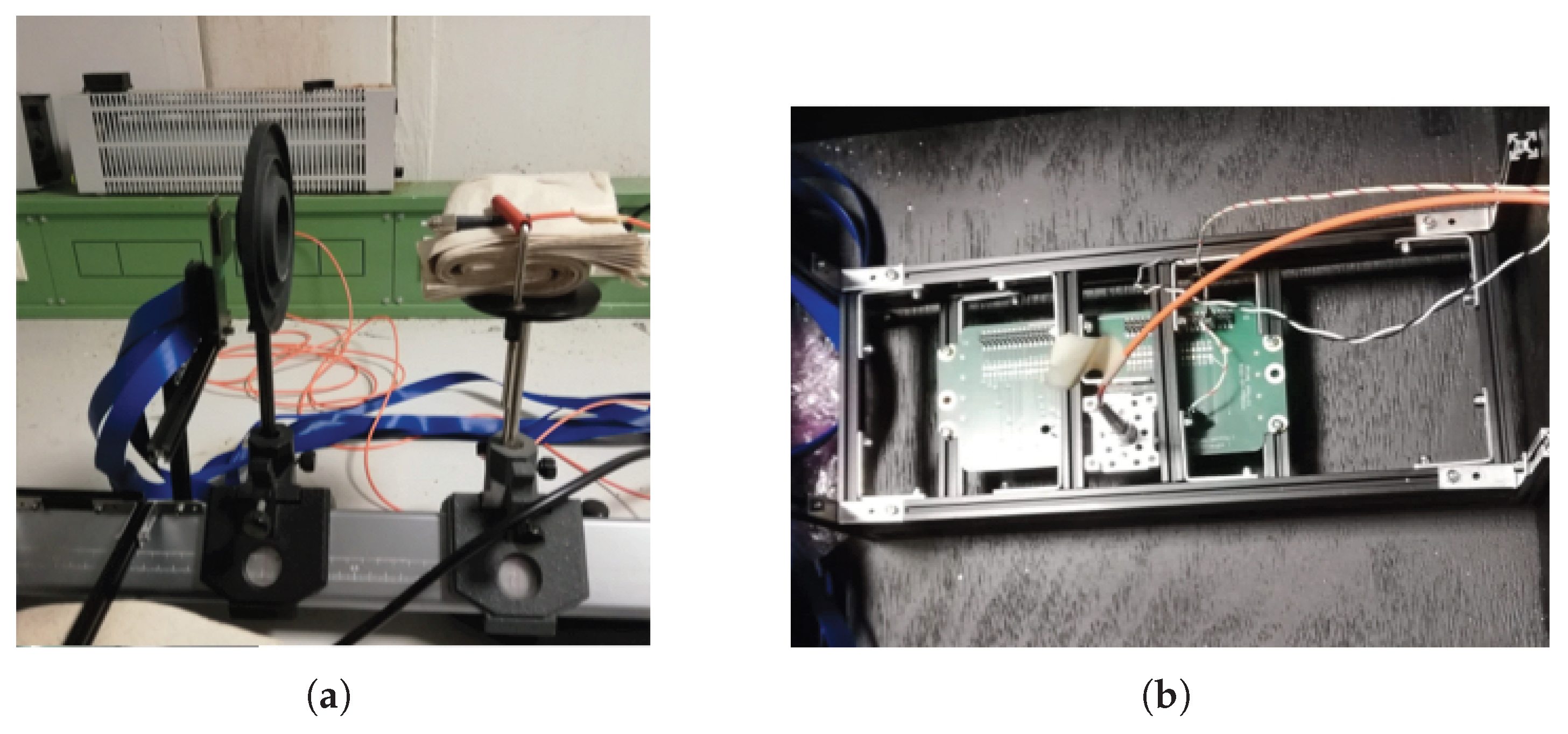
Figure 2.
a) the PCB designed and manufactured by the Electronics Unit of the INFN-CT. (b) the compact mechanical stand to house SiPM sensor, PCB and the optical fiber inside the climatic chamber.
Figure 2.
a) the PCB designed and manufactured by the Electronics Unit of the INFN-CT. (b) the compact mechanical stand to house SiPM sensor, PCB and the optical fiber inside the climatic chamber.
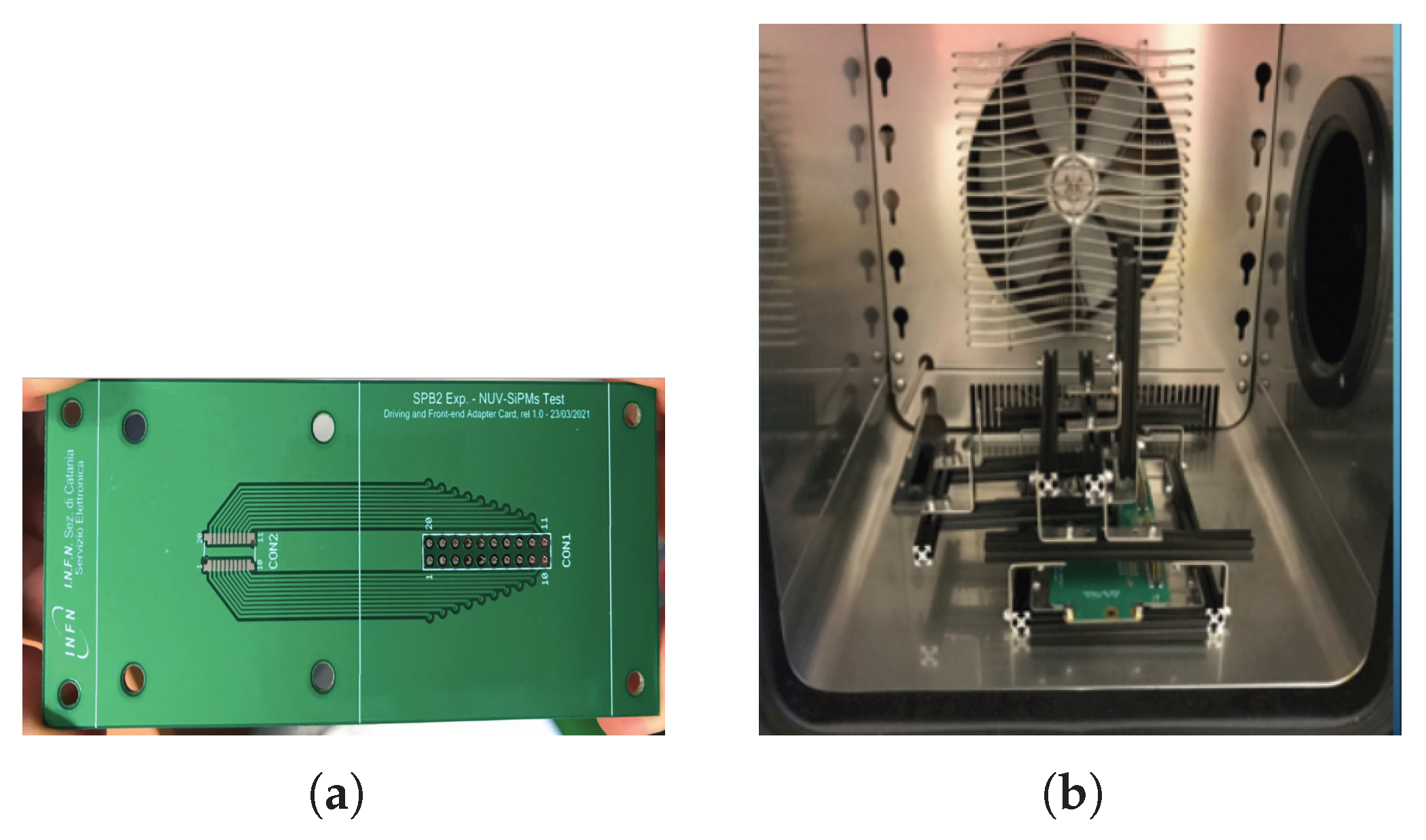
Figure 3.
a) the schematic representation of the experimental set-up configuration used for measuring the SiPM (I-V) curves at different temperatures. (b) the schematic representation of the experimental set-up configuration used for measuring the SiPM multi-peak spectra at different temperatures.
Figure 3.
a) the schematic representation of the experimental set-up configuration used for measuring the SiPM (I-V) curves at different temperatures. (b) the schematic representation of the experimental set-up configuration used for measuring the SiPM multi-peak spectra at different temperatures.
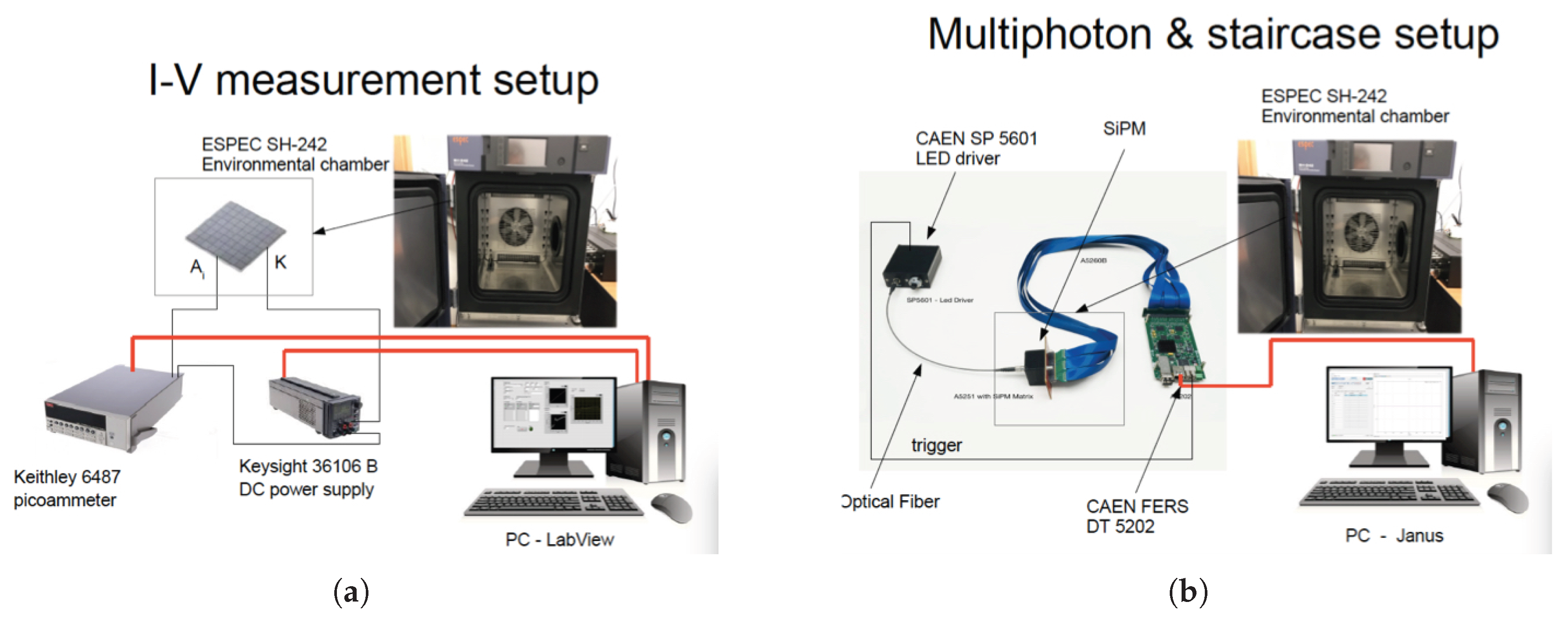
Figure 4.
The () Hamamatsu S13161-3050AE-08 SiPM array: (a) photograph of the SiPM sensor. (b) A schematic top view of its geometry and dimensions. (c) Overvoltage specifications of gain, cross talk probability and photon detection efficiency. (d) Photon detection efficiency as a function of the wavelength at , from the Hamamatsu datasheets [8].
Figure 4.
The () Hamamatsu S13161-3050AE-08 SiPM array: (a) photograph of the SiPM sensor. (b) A schematic top view of its geometry and dimensions. (c) Overvoltage specifications of gain, cross talk probability and photon detection efficiency. (d) Photon detection efficiency as a function of the wavelength at , from the Hamamatsu datasheets [8].
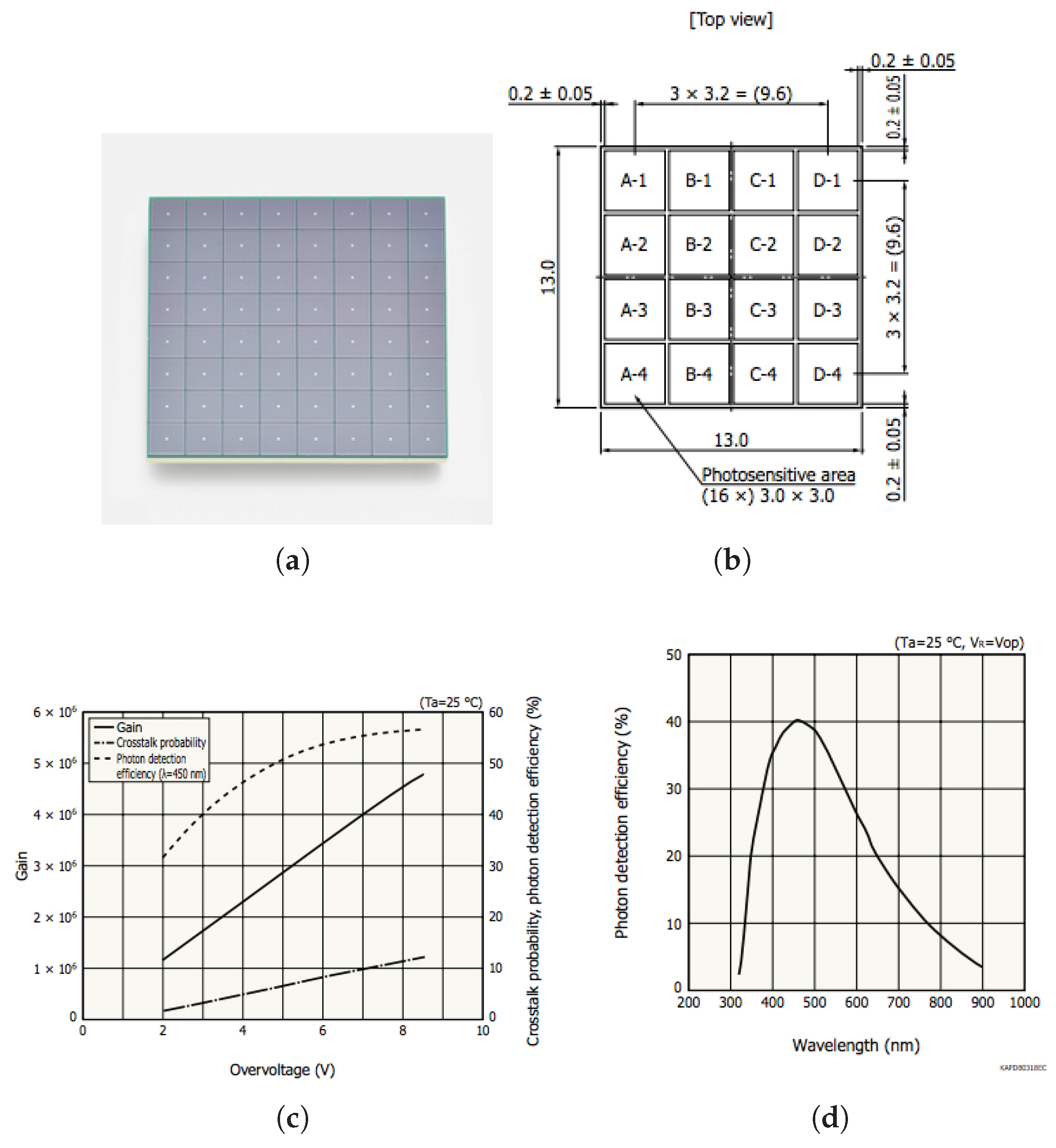

Table 1.
Inventory of all the different SiPM sensors procured with their basic characteristics.
| Manufacturing company | Model | Number of SiPMs | V (V)1 | V (V)2 | Connector | Channels |
|---|---|---|---|---|---|---|
| Hamamatsu | S14160-1315PS | 2 | - | 41.77 | to be sold. | 1 |
| Hamamatsu | S14160-4050HS | 2 | 37.90 | 40.60 | to be sold. | 1 |
| Hamamatsu | S14160-1310PS | 2 | - | 42.40 | to be sold. | 1 |
| Hamamatsu | S14160-3010PS | 2 | - | 42.66 | to be sold. | 1 |
| Hamamatsu | S14160-3015PS | 2 | - | 42.00 | to be sold | 1 |
| Hamamatsu | S13360-6050CS | 2 | 50.97 | 53.97 | PIN A-K | 1 |
| Hamamatsu | S13360-1325CS | 2 | 52.65 | 57.65 - | PIN A-K | 1 |
| Hamamatsu | S13360-6025C | 2 | 51.87 | 56.87 | PIN A-K | 1 |
| Hamamatsu | S13360-1350CS | 2 | 49.49 | 54.49 | PIN A-K | 1 |
| SensL | ARRAYJ 30035 16P PCB | 1 | - | - | CONN | 4x4 |
| SensL | ARRAYC 60035 64P PCB | 1 | - | - | CONN | 8x8 |
| SensL | MICROFC 10010 SMT TR1 | 6 | - | - | to be sold. | 1 |
| SensL | MICROFC SMA 30035 GEVB | 1 | - | - | SiPM on board | - |
| SensL | MICROFC SMTPA 60035 GEVB | 1 | - | - | PIN A-K | 1 |
| SensL | MICROFC 30035 SMT TR1 | - | - | - | to be sold. | - |
| SensL | MICROFC 60035 SMT TR1 | - | - | - | to be sold. | - |
| SensL | no name | - | - | - | to be sold. | - |
| SensL | MICROFC SMA 60035 GEVB | - | - | - | SiPM on board | - |
| SensL | MICROFC SMTPA 10010 GEVB | 1 | - | - | PIN A-K | 1 |
| SensL | MICROFC SMA 10010 GEVB | 1 | - | - | SiPM on board | - |
| SensL | Arrayx BOB6 64S GEVK | - | Eval board | - | - | - |
| SensL | Arrayx BOB6 64p GEVK | - | Eval board | - | - | - |
| Broadcom | AFBR S4E001 | 1 | Eval board | - | - | - |
| Broadcom | AFBR S4N44P163 | 1 | - | - | - | - |
| Ketek | PA3347-WL-A0-A0-0808 | 1 | - | - | Samtec | 8x8 |
| Ketek | PM3347-WL-A0 PIN | 2 | - | - | PIN A-K | 1 |
| Ketek | PM3325-WB-D0 PIN | 1 | - | - | PIN A-K | - |
| Ketek | PM3315-WL-A0 | 2 | - | - | PIN A-K | - |
| Ketek | PM3335-WL-A0 | 2 | - | - | PIN A-K | - |
| Ketek | PM3315-WL-A0 PIN | 2 | - | - | PIN A-K | - |
| Ketek | PM3335-WL-A0 PIN | 2 | - | - | PIN A-K | - |
1V is for the operating voltage in unit of Volt (V). 2V is for the breakdown voltage in unit of Volt (V).
Table 2.
Specific properties of selected Hamamatsu SiPMs versus KETEK SiPMs.
| Company | Model | Number of pixels | Fill factor % | Window R-index | Active area (mm) |
|---|---|---|---|---|---|
| Hamamatsu | S13360-1350CS | 667 | 74 | 1.41 | 1.3 x 1.3 |
| Hamamatsu | S13360-6050CS | 1440 | 74 | 1.41 | 6 x 6 |
| Hamamatsu | S13361-3050-AE-08 | 3584 | 74 | 1.55 | 3 x 3 |
| KETEK | PM3335-WL-A0 | 7396 | 80 | 1.52 | 3 x 3 |
| KETEK | PM3347-WL-A0 | 4096 | 80 | 1.52 | 3 x 3 |
| KETEK | PM3347-WL-A0-0808 | 4096 | 80 | 1.52 | 3 x 3 |
Table 3.
Specifications of different equipments used in different stages of the evolution of an experimental system for qualification of SiPMs and to this day at disposal in the local Laboratory .
Table 3.
Specifications of different equipments used in different stages of the evolution of an experimental system for qualification of SiPMs and to this day at disposal in the local Laboratory .
| Equipment | Manufacturing company | Model | Main specifications |
|---|---|---|---|
| SiPM sensors | (see Table 1) | (see Table 1) | (see Table 1) |
| Climatic chamber | ESPEC | SH-242 | |
| FERS | CAEN | DT5550W | 2 Petiroc WeeROC ASICs |
| on-board power supply | |||
| 64 ch, 80MS/s, 14bit ADC | |||
| FERS | CAEN | DT5202 | 2 Citiroc-1A WeeROC ASICs |
| on-board power supply | |||
| 64 ch, 80MS/s, 14bit ADC | |||
| DC Power supply | Keysight | e36106b | 0 ÷ 100 V |
| pico-ammeter | Keithley | 6487 | 2 nA ÷ 20 mA |
| LED driver | CAEN | SP5601 | 400 nm, 6 ns |
| optical fiber | CAEN | AI2740 | 40 cm |
| LASER driver | Picoquant | PDL 800-D | time jitter ps |
| LDH P-C 405B head | monochromatic 402 nm | ||
| oscilloscope | Lecroy Wafesurfer | 3024z | 200 MHz, 4 GS/s |
| 4 channels, 10 Mpts/ch | |||
| cables/connectors | miscellaneous | LEMO, BNC, SMA, MCX | miscellaneous |
| convergent lens | f = 100 mm |
Disclaimer/Publisher’s Note: The statements, opinions and data contained in all publications are solely those of the individual author(s) and contributor(s) and not of MDPI and/or the editor(s). MDPI and/or the editor(s) disclaim responsibility for any injury to people or property resulting from any ideas, methods, instructions or products referred to in the content. |
© 2025 by the authors. Licensee MDPI, Basel, Switzerland. This article is an open access article distributed under the terms and conditions of the Creative Commons Attribution (CC BY) license (http://creativecommons.org/licenses/by/4.0/).
Copyright: This open access article is published under a Creative Commons CC BY 4.0 license, which permit the free download, distribution, and reuse, provided that the author and preprint are cited in any reuse.


