Preprint
Article

This version is not peer-reviewed.

Application of Gas Chromatographic Retention Indices to GC and GC–MS Identification with Variable Limits for Deviations Between Their Experimental and Reference Values

A peer-reviewed article of this preprint also exists.

Submitted:

20 October 2025

Posted:

21 October 2025

You are already at the latest version

Abstract

The potential of the new algorithm for comparing experimental and reference values of gas chromatographic retention indices (RI) is discussed. This algorithm is designed to eliminate significant elements of uncertainty typical of numerous contemporary recommendations, primarily the fixed limiting values of permissible deviations, DRI = (RIref – RIexp). The algorithm proposed implies the calculation of deviations DRI for selected most reliably identified constituents of multicomponent mixtures with known reference RI values, followed by calculation of coefficients of regression equations DRI = (RIref – RIexp) = aRIexp + b for total sets of analytes. These equations allow recalculating the experimentally determined RIs into the corrected values RIcorr = RIexp + DRI. Such algorithm makes it possible to use reference RI values for semi-standard nonpolar polydimethylsiloxane phases (with 5% phenyl groups and others) for the comparison with data determined with standard nonpolar polydimethylsiloxanes and vice versa. It is applicable both to statistically processed reference data and to results of single measurements.

Keywords: 
;  ;  ;  ;  ;  

1. Introduction

At present, gas chromatography–mass spectrometry (GC-MS) appeared to be the most effective and widely applicable hyphenated technique for analysis of organic com pounds in complex mixtures. This is due to the availability not only of modern equip ment, but also of detailed and well-systemized informational support. It includes data bases of standard mass spectra (electron ionization, 70 eV) and gas chromatographic retention indices (RI [1]) on standard nonpolar (polydimethylsiloxanes) and polar (polyethylene glycols) stationary phases. The example of combination of these parame ters is NIST mass spectral database [2], which has been supplemented with RIs since 2005. The last version of this database (2023) contains mass spectra of 347,000 compounds and RIs of 153,000 compounds.
The database application efficiency is determined not by the number of objects included, but by the algorithms for comparing experimental and reference (library) data, both mass spectra and RIs. Many of previously proposed mass spectrometric algorithms (some of them were considered in the monograph [3]) are currently of only historical interest because the most widely used is the algorithm proposed by employees of the Finnigan Co. in 1978 [4] and its subsequent modifications. Its essence is as follows: Each mass spectrum under comparison can be represented as a vector in an N-dimensional space, where N is the number of signals (in other words, the maximal m/z value). The numerical expression of mutual correspondence of these vectors (other terms are Similarity, Match Factor (MF), etc.) is the square of cosine of the angle (Θ) between them, 0 ≤ cos2Θ ≤ 1. For greater clarity, the normalization condition often transforms into 0 ≤ MF ≤ 100, or 0 ≤ MF ≤ 1000 (the maximal MF value corresponds to the maximal similarity of mass spectra, and the minimal MF value, to their complete dissimilarity). The normalization 0 ≤ MF ≤ 100 is sometimes called a percentage match, which is incorrect.
In contrast to multidimensional mass spectra, GC retention indices are unidimen sional analytical parameters (one number). It would seem that assessing the degree of coincidence of unidimensional values should be much simpler compared to multidimensional values. However, this is not the case, and this problem remains unsolved to date. The experimental RI values cannot exactly match with reference data, because the former values are influenced by experimental errors, and the latter values, by interlaboratory irreproducibility. The reason of restricted interlaboratory reproducibility of RIs is their dependence on the conditions of GC analyses, primarily on temperature, even at fixing the stationary phase. In turn, the temperature depends on the geometry of the chromatographic column and the amount of the stationary phase in it. In addition, the RI values depend on the ratio of peak areas of the analytes and reference compounds [5]. Hence, if we postulate any RI values as the reference information, RIref, and compare the experimental RIexp values with them, the differences ΔRI between them turn out to be inconstant. Theoretically, we can imagine the existence of limiting values for these differences, ΔRIlim. Combining all these premises, we can formulate the simplest condition of GC identification using retention indices:
ΔRI = |RIexp–RIref| ≤ ΔRIlim
If ΔRI > ΔRIlim, the identification must be considered impossible even at the “ideal” mutual correspondence of the mass spectra.
The values ΔRIlim depend not only on the nature of the stationary phase and specific conditions of the analysis, but also on the chemical nature of analytes and the features of the database used. In accordance with the long-established practice, the correctness of GC identification is most often illustrated by direct comparison (for visual perception) of the experimental and reference values; see, e.g., publications [6,7,8,9,10,11,12,13,14,15], but the number of examples can be increased many times.
Attempts have been made to create combined criteria for joint mass spectrometric and gas chromatographic identification. For example, Smith with coauthors [16] propo sed the criterion F = U⋅MF as follows:
U = 1, if ΔRI ≤ 5,
1 – 0.05|ΔRI|, if 5 < |ΔRI| ≤ 20 = ΔRIlim
0, if |ΔRI| > 20,
where MF is the mass-spectrometric match factor and U is the measure of correspon dence of GC RIs. In other words, small differences ΔRI (≤ 5 index units) do not affect the results of mass-spectrometric identification, while large differences (> 20 i.u.) mean elimination of this option from further consideration despite the best correspondence of mass spectra. Such condition (cited in publication [17]) seems to be useful as very preliminary estimates, but it has obvious disadvantages, namely:
  • The choice of fixed value ΔRIlim = 20 i.u. seems to be illogical because the differences between experimental and reference data can take both larger and smaller values depending on the chemical nature of analytes and types of stationary phases under comparison;
  • Condition (2) implies the symmetrical distribution of ΔRI, in other words, the equally probable deviations of experimental and reference data both at ΔRI < 0 and ΔRI > 0, but in the general case it is not obvious.
The differences in the real interlaboratory RI distribution can be best illustrated by histograms for 2,6-dimethyloctane (Figure 1a) and 1,2,3,4-tetrahydronaphthalene (tetralin), (Figure 1b). Both histograms are unsymmetrical, which means the theoretical incorrectness of conventional statistical data processing. Moreover, the histogram for tetralin allows us to identify the two-modality RI distribution, which is quite common, but the explanations for this can be quite complex [17]. However, because other algorithms of data processing are too complicated, we have to calculate arithmetic averages together with their standard deviations, which gives 933 ± 3 for 2,6-dimethyloctane (a) and 1152 ± 15 for tetralin (b). The first compound illustrates the good interlaboratory RI reproducibility, but the second case is more typical of numerous organic compounds.
Such spread of RI values depends on the chemical nature of analytes and determines the difficulties and uncertainties of their application [18,19]. It explains the use of arith metic averages in combination with the corresponding evaluations of permissible deviati ons. The author’s preferences are commonly accepted standard deviations, <RI> ±sRI [20]. According to the relationships of statistical processing, the intervals <RI> ± sRI include about 68% of values of the initial data set; the intervals <RI> ± 2sRI, about 95%; and the intervals <RI> ± 3sRI, about 99.7%. In addition, the reference data presented without deviations are known, e.g., reference data for constituents of essential oils [21]. In the NIST database [2] and in some secondary data summaries based on [2] (see, e.g., [22]), the RI spread historically is customarily characterized by MAD values (medians of absolute deviations). This means that the intervals <X> ± MAD contain only 50% of values of the initial data set. Furthermore, the number of single RI measurements (measured in one laboratory) in the last versions of the NIST database increased noticeably; such data have no measures of possible deviations at all.
The mentioned features of interlaboratory distributions of RI values explain the difficulties of selecting the criteria for comparing their experimental and reference values. Nevertheless, there is an actual need for creating the corresponding algorithm. The algorithm must have the following properties:
- it should not include any limiting values of possible deviations between experimental and reference RI values;
- it should be applicable to asymmetrically distributed reference RI values;
- it should be applicable to both statistically processed reference data and the results of single measurements;
- it should be applicable to comparing the RI values determined using columns with semi-standard stationary phases (terminology used in database [2]) with reference data for standard nonpolar stationary phases and vice versa;
- it should be applicable to RI values measured for both capillary and packed chroma tographic columns at various temperatures without any artificial restrictions.
This paper discusses the possibilities of creating an algorithm that meets all the above-listed conditions.

2. Results and Discussion

It is appropriate to start the discussion of an algorithm that meets a priori require ments listed above not with a theoretical consideration, but with a specific example. At the same time, this example illustrates the symbolism used.

2.1. Optimization of Comparing the Experimental and Reference Values of GC Reten tion Indices

To start the discussion, let us select the example of GC retention indices of 20 compounds of the same chemical class (alkylarenes) listed in Table 1, but measured under very specific conditions, namely, packed column with semi-standard phase Apiezon L (15% on Celite C-22) at 100°C [23]. According to contemporary concepts, such conditions are completely outdated because too high content of the stationary phase leads to too high temperature of chromatographic separation.
As a result of using such obsolete analytical conditions and semi-standard phase, all the experimental RIs exceed contemporary reference RI values [2] by approximately 30 i.u. (differences vary from 12 to 48 i.u.). The values of Δref-exp = RIref – RIexp for all the compounds are presented in Table 1. The comparison of these values requires taking into account not only their random variations, but also systematic differences caused by nonequivalence of determination conditions. This means that we must take into account the possible dependence of amendments Δref-exp = RIref – RIexp on the values of RIexp themselves:
Δref-exp = (RIref – RIexp) = aRIexp + b
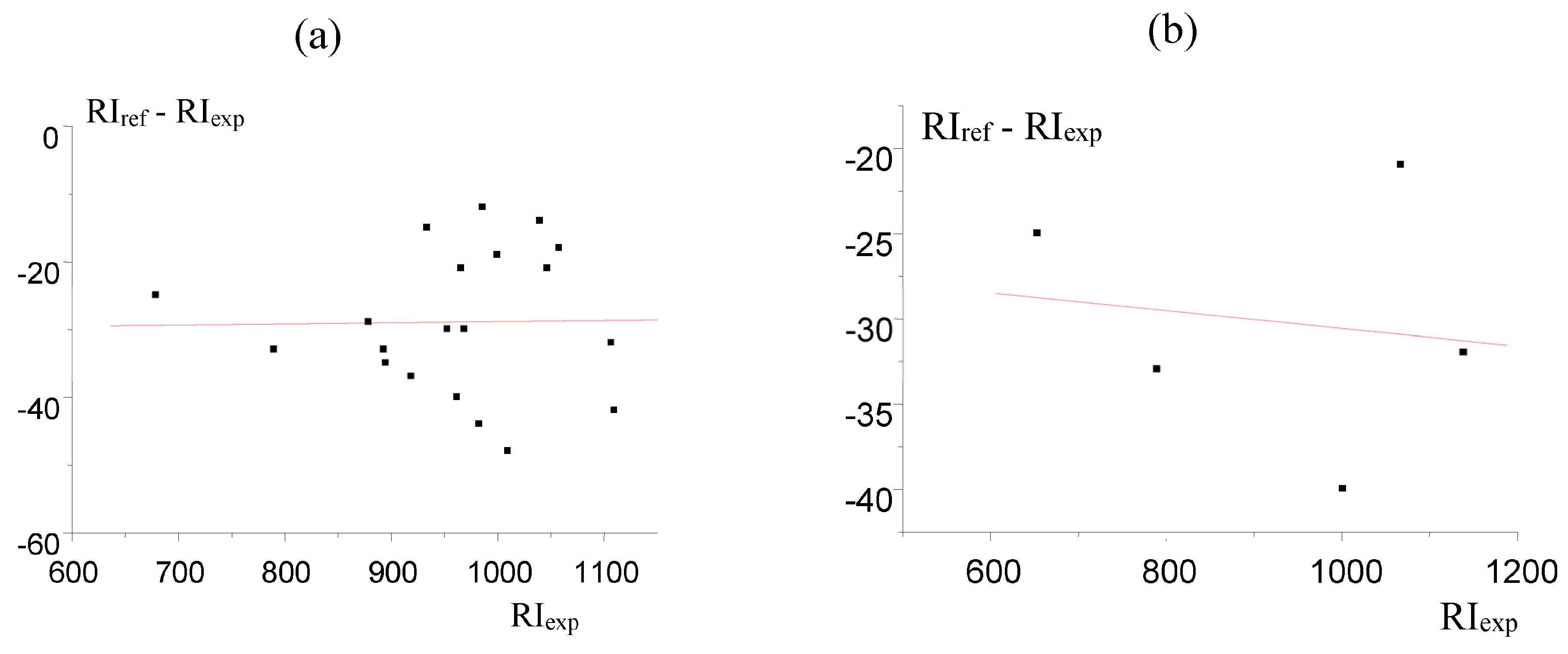
The plot of the dependence (3) (swarm of dots) is shown in Figure 2(a).
Thus, we come to the following conclusions. Firstly, the Δref-exp values show significant scatter. Hence, secondly, there are no reasons to approximate these data by polynomials of higher orders. Thirdly, the standard deviation of coefficient “a” of dependence (3) exceeds in absolute value the value of the coefficient itself, which means weak dependence of amendments Δref-exp on RIexp values. Finally, the determination of the parameters of equation (3) (even at the small value of coefficient “a”) allows us to con vert the experimental data published in [23] to the corrected RIcorr values specially for comparing with information from the contemporary database [2]:
RIcorr = RIexp + Δref-exp
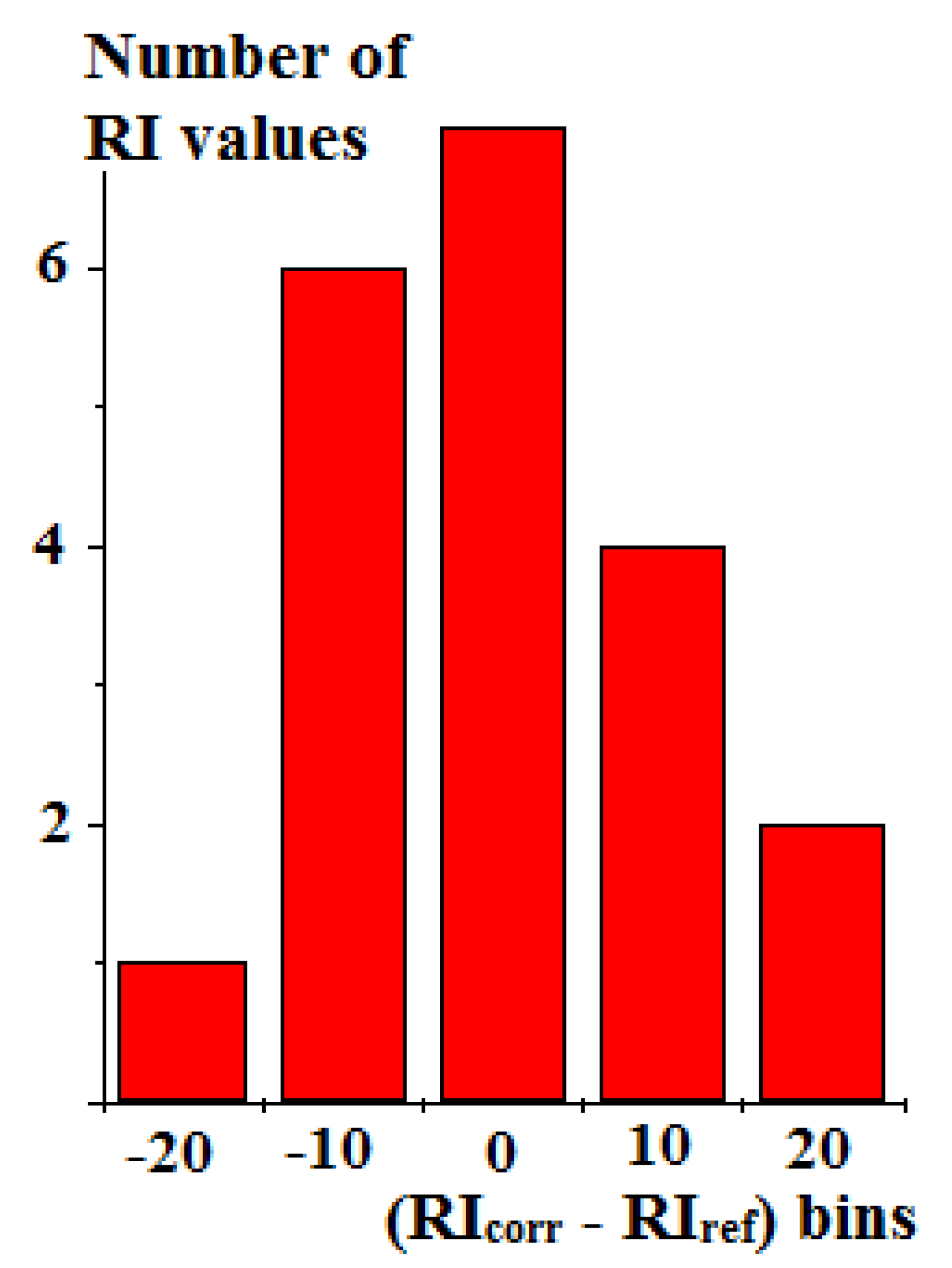
All the RIcorr values are listed in Table 1 also. As we can see, the average absolute values of differences Δcorr-ref (9 ± 6) appeared to be three times smaller than the average absolute value of differences Δref-exp (29 ± 10). In should be noted that the average corrected values ± standard deviations considered taking the signs of the initial data into account differ from zero statistically insignificantly (0 ± 11). Their distribution can be additionally illustrated by the corresponding histogram (Figure 3). It is slightly asymmetric, but this is typical of GC retention indices of many organic compounds:
However, the correction of the experimental RI values for providing the possibility of their optimal comparison with the available reference data is only the “half” of the problem. The second part is the evaluation of the permissible deviations of RIcorr values from RIref for accepting or rejecting the gas chromatographic identification. In the least-squares method, the formula exists for so-called “corridor of errors” for evaluating the possible deviations of points from the regression equation y = ax + b [24]:
S ( x )   =   s y 1 R 2 N 2 1 + a < x > 2 s x 2
where sx2 = (<x2> <x>2/N)/N, sy2 = (<y2> <y>2/N)/N, R = (<xy> <x><y>/N)/(Nsxsy)
However, this relationship seems too complicated for routine calculations; simpler evaluations are preferable. If the dependence ΔRIcorr = f(RIexp) is expressed rather weakly (like it is in the example considered), we can accept ΔRIcorr ≈ const. The first recommen dation implies using the evaluations of the standard deviations of ΔRIcorr, namely, sΔRIcorr. Most of ΔRIcorr values do not exceed ΔRIcorr + sΔRIcorr, while the values exceeding ΔRIcorr + 2sΔRIcorr can be excluded from consideration. The second way to evaluate the possible deviations is based on such parameter as “sum of residuals”, S0. For numerous examples (including those considered above), the following inequality is correct:
ΔRIcorr + sΔRI < S0 < ΔRIcorr + 2sΔRI
This means that the RIcorr data for GC identification should be chosen within intervals RIref ± 2S0:
RIref – 2S0 < RIcorr < RIref + 2S0
The Δcorr-ref values in Table 1 indicate that only one of 20 compounds (1,2,3-tri me thyl benzene) does not meet this criterion. It is a statistically acceptable result (95% of correct answers).
However, the illustration of data processing mentioned above looks like an artificial example because it implies recalculating RI values of all analytes without exception (at the hypothetical condition that we know all of them a priori). In real analyses of complex mixtures, we do not know all analytes before analysis (to identify them is the final aim), but usually we can identify only several constituents using their specific mass spectro metric signs or preliminary chemical information. Hence, the application of the algorithm considered to real multicomponent mixtures requires modification.

2.2. Application of the Algorithm of Comparing the Experimental and Reference GC Retention Indices to Multicomponent Mixtures

This is one of the most common analytical tasks. Most often, complex multicomponent mixtures under analysis contain some simple constituents that can be unambiguously identified without special proces sing of GC data. These components are, for example, impurities in commonly used solvents and reagents, plasticizers (like, e.g., phthalates), and so on. Hence, we can select just these compounds for comparing their RIexp and RIref values. The number of such “reference points” may not be so large, but it is important that they should be evenly distributed in different parts of chromatograms (at the beginning, in the middle, and in the final part). Of course, if the samples under analysis contain small number of constitu ents (e.g., 1–2), the preliminary analysis of artificial mixtures of similar composition becomes necessary.
Continuing the consideration of the above-mentioned example (Table 1, Figure 2 and Figure 3), we can select from 20 alkylarenes only five, namely, benzene, toluene (the first segment of the chromatogram), 1,3,5-trimethylbenzene (middle position), butylbenzene, and 1,2,4,5-tetramethylbenzene (the last part). All the selected compounds are marked in Table 1 in bold. After that, we should repeat the same mathematical operations as were done for the complete data set (equations (3), (4), (6), and (7)) for this reduced data set. Obviously, we obtain different values of the coefficients of the linear regression equation (3) than for the full data set (see footnotes to Table 1).
The plot of the dependence (3) for the reduced data set is shown in Figure 2(b). It illus trates slight variations of the angular coefficient “a” in equation (3); the dependence becomes slightly ascending instead of slightly descending. The values of ΔRIcorr* = (RIcorr – RIref) together with Δcorr-ref* are marked with asterisks in Table 1 for comparison with the initial values of ΔRIcorr = (RIcorr – RIref) and Δcorr-ref. However, the average value of Δcorr-ref* (8 ± 6) appeared to be very close to Δcorr-ref (9 ± 6). The same is true for the sum of residuals (S0): 10.8 and 8.4, respectively. This means that RIcorr* does not correspond to RIref ± 2S0 intervals for only one compound of 20 (namely, for tert-butylbenzene), which is statistically acceptable (95% of correct results).
The above reasoning can be illustrated by considering the RI values for 32 essential oil constituents, published by Engewald and co-authors [25] for a column with a standard nonpolar polydimethylsiloxane stationary phase, DB-1. The results of this data proces sing in comparison with the reference RI values from database [2] for identical phases are presented in Table 2. The reduced data set includes six compounds easily identifiable by mass spectra, namely, α-pinene, limonene, linalool, camphor, neral, and geranial (marked in bold). Similarly to Table 1, the parameters of all equations (RIref – RIexp) = aRIexp + b for both complete and reduced data sets are indicated in the footnotes to Table 2. The average value of the difference RIref – RIexp for the complete data set is 13 i.u., and for the corrected reduced data set it is twice less, 6 i.u.
The single compound with RIcorr values that do not meet condition (7) for both complete and reduced data sets is isosafrole, 5-(1-propenyl)-1,3-benzodioxole. This is most probably due to the unreliable reference RI value for this compound in database [2]. Indeed, the RI value for isosafrole in [25] is 1357, while the reference value is 1327 ± 31 [2]. Such a large standard deviation is explained by uniting the RI values for so-called α- and β-isosafroles (cis and trans isomers) together. The RI value for the most often determined β-isosafrole (trans-isomer) is 1358 ± 6 (value from author’s RI collection). Keeping this fact in mind, we obtain for this compound Δcorr-ref* = –1 instead of +30. After this correction, the RI value for isosafrole (the last eluted compound) can be inclu ded into reduced data set. It is an additional illustration of the efficiency of the suggested approach.
The same example of 32 essential oil components can be considered using another database of reference information for semi-standard stationary phases [21]. Data proces sing in this case is illustrated by Table 3 similar to Table 2. The parameters of the equations (RIref – RIexp) = aRIexp + b are presented in the footnotes.
The statistical characteristics of the data sets in Table 2 and Table 3 are close to each other. For the second of them, the average value of the difference Δref-exp for the complete initial data set is 8 i.u., the average value of Δcorr-ref for the corrected values is 5± 4 i.u., and for the reduced data set it is 6 ± 4 i.u. However, this example illustrates the possibility of identifying compounds characterized by RIs on standard nonpolar phases using reference data for semi-standard phases. The algorithms of data processing are the same in both cases.
Among 32 compounds in Table 3, only one, myrcene, does not meet criterion (7). The values of RIcorr and RIcorr* for myrcene differ from reference RIs [21] by more than 2S0; the cause of this difference remains unclear.
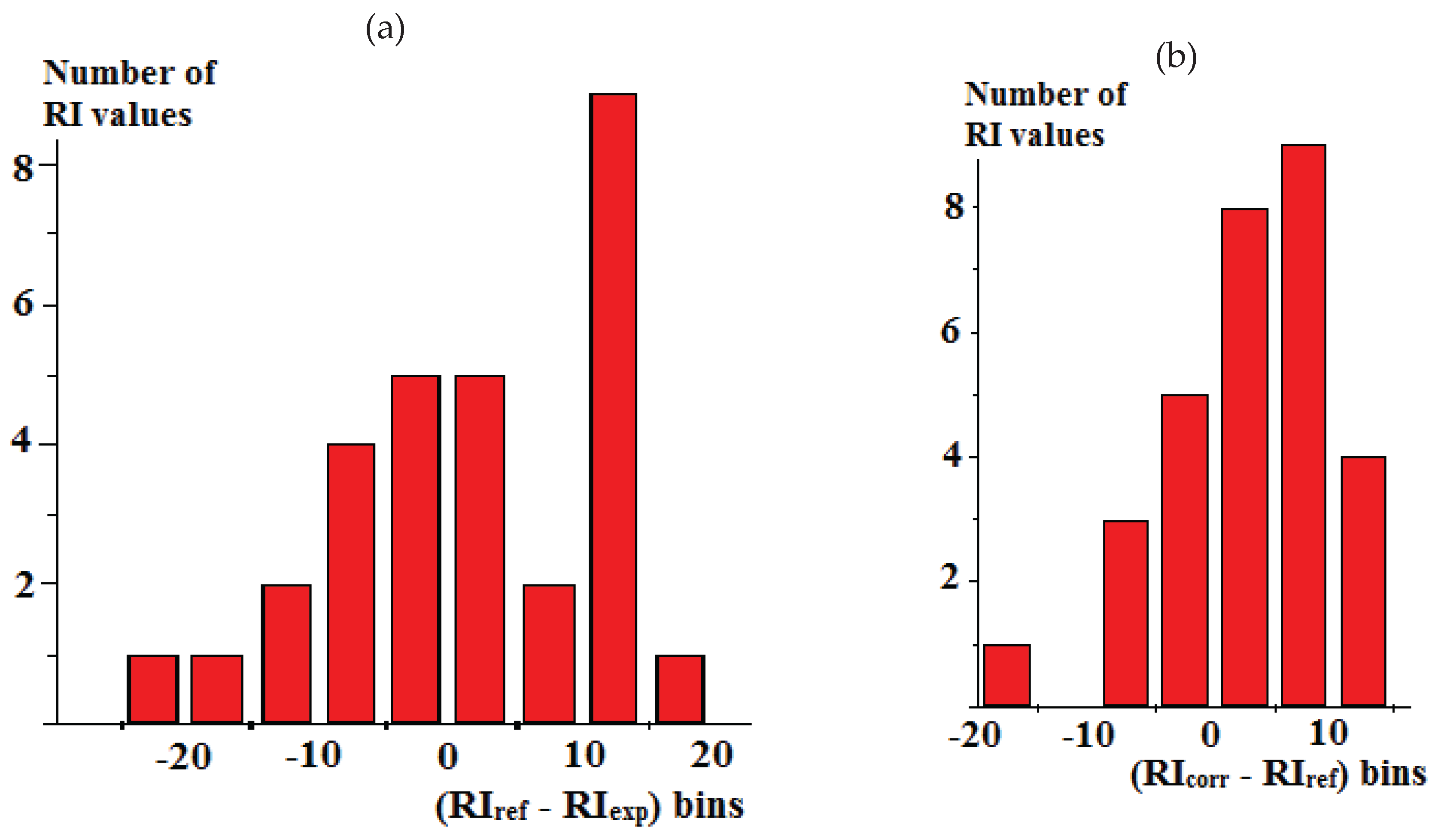
Similarly to Figure 3 (above), it seems reasonable to characterize the distributions of Δref-exp and Δcorr-ref for the reduced data set by the corresponding histograms. Figure 4(a) illustrates the spread of the initial differences (RIref – RIexp); it is rather asymmetric, and most of the values are located within the range from –15 to +15 i.u. The distribution of the (RIcorr – RIref) values (b) corresponds to the data of Table 3 for comparing the RI data measured on standard nonpolar phases with the reference data for semi-standard phases and, moreover, calculated for the reduced data set. It is only slightly narrower (from –10 to +15 i.u.), but it becomes much more symmetric.
Hence, the algorithm proposed minimizes the shift of the differences of the initial experimental and reference RI values relative to zero and makes the distribution of these values narrower and more symmetric.
An important illustration of this algorithm is the situation when the reference RI values are determined under the conditions close to those of the experimental determina tion of RI values. It arises when the types of stationary phases are the same and the temperature conditions are close. In these cases, both coefficients “a” and “b” of equation (3) are obviously close to zero. To confirm this, let us consider the last Table 5, which illustrates the results of experimental testing of the algorithm using as an example a simple (only 10 constituents whose content exceeds 0.1% of the total peak area) sample of Lavandula angustifolia essential oil. Both experimental and reference data relate to the same semi-standard nonpolar stationary phases: HP-5 (experimental) and DB-5 (refe rence [21]). Therefore, the coefficients of the equation (RIref – RIexp) = aRIexp + b (3) appear to be minimal among all examples considered above: a = 0.008, b = –8.5; the difference Δcorr-ref = RIcorr – RIref is only 2 ±1, and the sum of residuals is S0 = 5.
The list of compounds in Table 4 includes two minor sesquiterpenes С15Н24 with the retention indices of 1365 and 1384, remaining unidentified. The application of the algorithm considered gives corrected values of their retention indices, namely, 1361 and 1380. Hence, in the reference set of data [21] we should find sesquiterpenes with RIs within the intervals 1356–1366 and 1375–1385. Screening in the first of them leads to the rather “exotic” silfiperfol-4,7(14)-diene with RI 1358. However, an analog of this compound previously was identified in some species of Lavandula genus [26], and RI of silfiperfol-4,7(14)-diene determined in [27] (1367) is also close to RIcorr in Table 5. However, the identification of this compound should be considered as tentative.
For the next sesquiterpene with RI within the interval 1375–1385, according to data bases [2] and [21], there are several possible candidates:
RI Compound Number of RI values for stan dard/semi-standard phases in [2]
1376 [2] α-Copaene 377/698
1377 [21] Silfiperfol-6-ene None
1379 [21] β-Patchoulene 10/23
1380 [21] Daucene 16/14
1381 [21] β-Panansinene 1/5
Let us additionally take into account the number of averaged RI values available for every compound in database [2] for standard/semi-standard nonpolar phases. It allows using such auxiliary (probability) criterion as the number of previous mentions of a par ticular compound [28]. Four compounds with the suitable RI from [21] appear to be little mentioned compared to α-copaene with RI 1376 [2] (377/698). However, this identifi cation should also be considered as tentative.

3. Materials and Methods

The principal feature of this work is the possibility of using practically unlimited number of examples taken from the literature. However, for special consideration we selected the RI values of alkylarenes on Apiezon L phase [23] (can be classified as semi-standard),data for essential oil constituents on standard DB-1 nonpolar phase [25], and experimental data for essential oil of Lavandula angustifolia L. on semi-standard HP-5phase. The reference RI data for the standard and semi-standard nonpolar phases were taken from the NIST17 database [2].
The sample of Lavandula angustifolia essential oil (Technical Specification 20.53.10-006-74840603-2018, Mirrolla Lab., Leningrad district, nD20 1.4568) was purchased in a regular pharmacy. Isobutyl alcohol was of chemically pure grade (GOST (State Standard) 6016-77, Angarsk Chemical Reagent Plant, Russia); the internal references (n-tridecane and n-tetradecane) and other reference n-alkanes С7–С18 were of chemically pure grade for chromatography (Reakhim, Moscow, Russia).
Gas chromatographic analysis of Lavandula angustifolia essential oil was carried out using its 10% solution in isobutyl alcohol with a Khromatek-Kristall 5000.2 gas chromatograph (Yoshkar-Ola, Russia) equipped with a flame ionization detector and a WCOT capillary column (length 10 m, internal diameter 0.53 mm, semi-standard HP-5 stationary phase, film thickness 2.65 μm). The analysis was performed with programmed heating from 90 to 240°С, ramp 6 deg min–1. The carrier gas was nitrogen, flow rate 3.8 mL min–1, linear velocity 34 cm s–1, split ratio 1 : 3. The injector and detector temperature was 200°С. A 10 μL microsyringe volume was used for injecting 1.0 μL samples. The solution of n-alkanes C7–C18 for determining the retention indices was injected separately.
Before GC–MS analysis, the previous sample of Lavandula angustifolia essential oil was diluted 100-fold with the same solvent. The analysis was performed with a Shimadzu QO 2010 SE gas chromatograph–mass spectrometer equipped with an Optima 5 MS GC column, length 30 m, internal diameter 0.32 mm, and film thickness 0.25 μm, with programmed heating in the range 90–270°С, ramp 6 deg min–1. The carrier gas was helium, flow rate 1.82 mL min–1, linear velocity 53.3 cm s–1, split ratio 1 : 10. The injector temperature was 200°С, and the interface and ion source temperature was 250°С. The ionization energy was 70 eV, the mass range was 40–500 Da,and the chromatogram recording start delay time was 2.0 min.
Processing and presentation of the results. Excel (Microsoft Office 2010) and Origin (versions 4.1 and 8.1) software was used for the statistical data processing and construction of the histograms. The QBasic program was used for calculating the linear-logarithmic RIs [1].

4. Conclusion

The suggested algorithm for comparing the experimental and reference GC retention indices as an important element of chromatographic and GC–MS identification of organic compounds is aimed at eliminating a significant element of uncertainty inherent in many contemporary recommendations: the use of fixed limiting differences between the experimental and reference GC retention indices, ΔRI = (RIref – RIexp) ≤ RIlim.The new algorithm is the most effective for complex multicomponent mixtures in which reliably identified components with known reference RI values can be revealed. It includes calculating the coefficients of regression equations ΔRI = (RIref – RIexp) = aRIexp + b, followed by using these relations for recalculating of all other RI values into corrected data RIcorr = RIexp + ΔRI. This algorithm allows interpreting retention indices measured on standard nonpolar polydimethylsiloxane stationary phases using reference data for semi-standard nonpolar phases like polydimethylsiloxanes containing 5% phenyl groups and vice versa. It is applicable both to statistical processing of reference data (presented in the format “average arithmetic value ± permissible deviation”) and to the results of single determinations. Furthermore, it allows using different RI databases and, if neces sary, comparing different databases with each other and even recalculating the reference data from one database (e.g., semi-standard) into another one (standard).

Data Availability Statement

The original contributions presented in this study are included in the article. Further inquiries can be directed to the corresponding author.

Acknowledgments

This experimental part of this work was carried out at the Center for Chemical and Materials Research of the Research Park of St. Petersburg State University. The authors are grateful to the staff of this Center for assistance.

Conflicts of Interest

The authors declare no conflict of interest.

References

  1. Kovats’ Retention Index System. In Encyclopedia of Chro ma tography. Ed. J. Ca zes. 3rd Edn. Taylor & Francis. New York. 2010, 2, 1304-1310.
  2. The NIST Mass Spectral Library (NIST/EPA/NIH EI MS Library, 2017 Release). Soft ware/Data Ver si on; NIST Standard Reference Database, Number 69, August 2017. Na ti onal Insti tute of Standards and Techno logy, Gaithersburg, MD 20899: http://webbook.nist.gov (Accessed: September 2025).
  3. Isidorov, V.A.; Zenkevich, I.G. Gas chromatographic – mass spectrometric deter mination of impurities of organic compounds in atmosphere. Khimia Publ. Lenin grad, 1982. (In Russian).
  4. Sokolov, S.; Karnofsky, J.; Gustafson, P. The Finnigan Library Search Program. Finn. Appl. Rep., 1978, № 2.
  5. Zenkevich, I.G.; Ukolova, E.S. Dependence of chromatographic retention indices on a ratio of amounts of target and reference compounds // J. Chromatogr. A. 2012, 1265, 133-143. doi: 10.1016/j. chroma.2012.09.076.
  6. Rospondek, M.J.; Narynowski, L.; Chachaj, A.; Gora, M. Novel aryl polycyclic aro matic hydrocarbons: phenylphenanthrene and phenylanthracene identification, oc currence and distribution in sedimentary rocks // Org. Geochem. 2009, 40, 986-1004. doi: 10.1016/j.orggeochem.2009.06.001.
  7. Costa, R.; Pizzimenti, F.; Marotta, F.; Dugo, P.; Santi, L.; Mondelo, L. Volatiles from steam-distilled leaves of some plant species from Madagascar and New Zealand and evaluation of their biological activity // Nat. Prod. Commun. 2010, 5(11), 1803-1808.
  8. Wang, X.-L.; Yu, W.-J.; Zhou, Q.; Han, R.-F.; Huang, D.F; Metabolic response of pak choi leaves to amino acid nitrogen // J. Integrative Agricult. 2014, 13(4), 778-788.
  9. Bodner, M.; Vagalinski, B.; Makarov, S.E.; Antic, D.Z.; Vujisic, L.V.; Leis, H.-J.; Ras potnig, G. “Quinone millipedes” reconsidered: evidence for a mosaic-like taxono mic distribution of phenol-based secretion across the julidae // J. Chem. Ecol. 2016, 42, 249-258. doi: 10.1007/s10886-016-0680-4.
  10. Jung, E.P.; Alves, R.C.; Rocha, W.F. de C.; Monteiro, S. da S.; Ribeiro, L. de O.; Mo reira, R.F.A. Chemical profile of the volatile fraction of Bauhinia forficata leaves: an evaluation of commercial and in natura samples // Food Sci. Technol. 2022, 42, № e34122.
  11. Trovato, E.; Micalizzi, G.; Dugo, P.; Utczas, M.; Mondello, L. Use of linear reten tion indices in GC-MS. In: Baser K.H.C., Buchbauer G. Handbook of essential oils. Science, technology, and applications. 2015. Boca Raton (CA.). CRC Press, 2015.
  12. Weissburg, J.R.; Johanningsmeier, S.D.; Dean, L.L. Volatile compounds profiles of raw and roasted peanut seeds of the runner and Virginia market-types // J. Food Res. 2023, 12(3), 47-68. doi: 10.5539/jfr.v12n3p47.
  13. Wesolowska, A; Jadczak, D.; Zyburtowich, K. Influence of distillation time and dis tillation apparatus on the chemical composition and quality of Lavandula angu s tifolia Mill, essential oil // Polish J. Chem. Technol. 2023, 25(4), 36-43.
  14. Albarico, G.; Unbanova, K.; Houdkova, M.; Bande, M.; Tulin, E.; Kokoskova, T.; Ko ko ska, L. Evaluation of chemical composition and anti-staphylococcal activity of essential oils from leaves of two indigenous plant species, Litsea leytensis and Pi per philippinum // Plants. 2024, 13, № 3555. doi: 10.3390/plants13243555.
  15. Castillo, L.N.; Calva, J.; Ramirez, J.; Vidari, G.; Arnijos, C. Chemical analysis of the essential oils from three populations of Lippia dulcis Trevir. grown at different lo cations in southern Ecuador // Plants. 2024, 13, № 253. doi: 10.3390/plants13020253.
  16. Smith, D.H.; Achenbach, M.; Yeager, W.I.; Andersson, P.J.; Fitch, W.H.; Rind fleisch, T.C. // Quantitative comparison of combined gas chromatographic/mass spectro metric profiles of complex mixtures // Anal. Chem. 1977, 49(11), 1623-1632. doi: 10.1021/ac50019a041.
  17. Zenkevich, I.G.; Babushok, V.I.; Linstrom, P.J.; White, V E.; Stein, S.E. Applica tion of histograms in evaluation of large collections of gas chromatographic indi ces // J. Chromatogr. A. 2009, 1216, 6651-6661. doi: 10.1016/j.chroma.2009.07.065.
  18. Bizzo, H.R.; Brilhante, N.S.; Nolvachai, Y.; Marriott, P.J. Use and abuse of reten tion indices in gas chromatography // J. Chromatogr. A. 2023, 1708, № 464376. doi: 10.1016/j.chroma.2023.464376.
  19. Matheson, A. Identifying and rectifying the misuse of retention indices in GC // LC-GC International. 2024, 20(12), 2-8.
  20. Zenkevich, I.G. Information maintenance of gas chromatographic identification of organic compounds in ecoanalytical investigations // J. Anal. Chem. 1996, 51(11), 1140-1148. (In Russian).
  21. Adams, R. Identification of essential oils components by GC/MS. Version 4. Carol Stream, IL: Allured Publ. Corp., 2007. 804 p.
  22. Babushok, V.I.; Linstrom, P.J.; Zenkevich, I.G. Retention Indices for Frequently Re ported Compounds of Plant Essential Oils // J. Phys. Chem. Ref. Data. 2011, 40(4), № 043101. doi: 10.1063/1.3653552.
  23. Brown, I. The composition of a Lurgi brown coal tar. III. The neutral oil fraction boi ling from 30 to 130°C and 130–172°C // Austr. J. Appl. Chem. 1960, 11(4), 403-433.
  24. Linnik, Yu.V. Least squares method and fundamentals of proces sing the obser va tions. Moscow, Physical-Mathematical Literature Press, 1958. 334 p. (In Russi an).
  25. Engewald, W.; Knobloch, T.; Haufe, G.; Muller, M.; Pohris, V. A novel method for terpene pattern determination of essential oils by selectivity tuning in GC // Frese nius’ J. Anal. Chem. 1991, 341(10), 641-643. doi: 10.1007/BF00322279.
  26. Benadi, T.; Lemhadri, A.; Harboul, K.; Chtibi, H.; Khabbach, A.; Jadouali, S.M.; Qu e sa da-Romero, L.; Louahliq, S.; Hammani, K.; Ghaleb, A.; Lee, L.-H.; Bouyahya, A.; Rusu, M.E.; Akhazzane, M. Chemical profiling and biological pro perties of es sential oils of Lavandula stolchas L., collected from three Moroccan sites: in vitro and in silico investigations // Plants. 2023, 12(6), № 1413. doi: 10.3390/plants120614-13.
  27. Obistioiu, D.; Cristina, R.T.; Schmerold, I.; Chizzola, R.; Stolze, K.; Nichita, I.; Chiu r ciu, V. Chemical characterization by GC-MS and in vitro activity against Candida albicans of volatile fractions prepared from Artemisia dracunculus, Artemisia ab ro tanum, Artemisia absinthium and Artemisia vulgaris // Chem. Cent. J., 2014, 8(6), ID 24475951. doi: 10.1186/1752-153X-8-6.
  28. Zenkevich, I.G. Non-traditional cri teria for the identification of organic compo unds by chromatography and chroma to graphy – mass spectrometry // J. Anal. Chem. 1998, 53(8), 725-731. (In Russian).
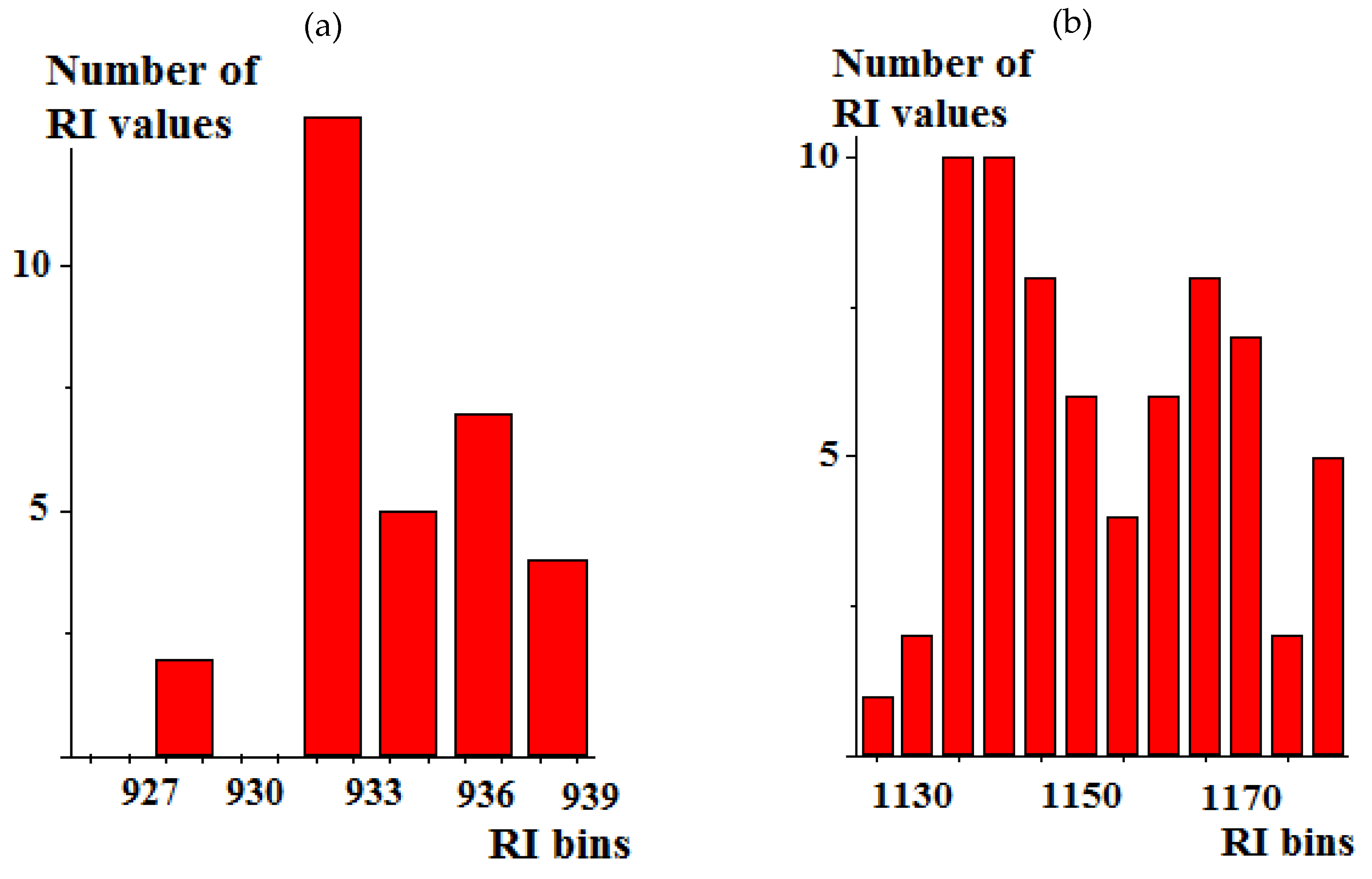
Figure 1. Histograms illustrating the distribution of reference RI values for (a) 2,6-dimethyloctane and (b) 1,2,3,4-tetrahydronaphthalene (tetralin) on standard nonpolar polydimethylsiloxane stationary phases [2]. The bin sizes are (a) 2 i.u. (index units) and (b) 5 i.u. The average RI values are (a) 933 ± 3 and (b) 1152 ± 15.
Preprints 181601 g001
Figure 2. (a) Linear approximation of the differences ΔRIref-exp = (RIref – RIexp) vs. RIexp plots for the complete data set from [23]; reference data are taken from NIST database [2]. The parameters of the regression equation are indicated in the footnotes to Table 1; (b) the same data for the reduced data set for five alkylarenes selected from their total list [23].
Preprints 181601 g002
Figure 3. Histogram of the distribution of retention indices of alkylarenes [23] recalculated into RIcorr values. The bin size is 10 i.u. The average RI value of the data considered with their signs is 0 ± 11.
Preprints 181601 g003
Figure 4. Histograms illustrating the results of comparing the RI data for essential oil components [24] with the reference data [21] for semi-standard non polar stationary phases (a) before and (b) after their correction. The bin sizes for both histograms are 5 i.u.
Preprints 181601 g004
Table 1. Comparison of the retention indices published in [23] with RI values from NIST database [2] on standard nonpolar polydimethylsiloxane stationary phases.
Compound RIexp
[23]
RIref
[2]

Δref-exp
Complete set of
reference data
Reduced set of
reference data
RIcorr Δcorr-ref RIcorr* Δcorr-ref
Benzene 679 654± 7 -25 650 -4 650 -4
Toluene 790 757± 6 -33 761 +4 760 +3
Ethylbenzene 879 850 ± 6 -29 850 0 849 -1
m-Xylene 893 860 ± 6 -35 866 +6 865 +5
p-Xylene 893 860 ± 6 -33 864 +4 863 +3
o-Xylene 919 881 ± 6 -37 890 +9 889 +8
Isopropylbenzene 934 919 ± 7 -15 905 -14 904 -15
Propylbenzene 966 945 ± 5 -21 937 -8 936 -9
1-Methyl-4-ethylbenzene 983 953 ± 5 -30 954 +1 953 0
tert-Butylbenzene 998 986 ± 7 -12 969 -17 968 -18
1-Methyl-2-ethylbenzene 999 969 ± 5 -30 970 +1 969 0
1,3,5-Trimethylbenzene 1002 962± 6 -40 974 +12 972 +10
sec-Butylbenzene 1019 1000 ± 5 -19 991 -9 989 -11
1,2,4-Trimethylbenzene 1027 983 ± 5 -44 999 +16 997 +14
1,3-Diethylbenzene 1054 1040 ± 5 -14 1026 -14 1023 -17
1,2,3-Trimethylbenzene 1058 1010 ± 6 -48 1030 +20 1027 +17
Butylbenzene 1068 1047± 6 -21 1040 -7 1037 -10
1-Methyl-2-propylbenzene 1076 1058 ± 5 -18 1048 -10 1045 -13
1,2,4,5-Tetramethylbenzene 1139 1107± 5 -32 1111 +4 1108 +1
1,2,3,5-Tetramethylbenzene 1152 1110 ± 6 -42 1124 +14 1121 +11
Average standard deviation of reference RI values, sRI 5.8
Average difference Δref-exp: -29 ± 10
Average difference Δcorr-ref: 9 ± 6
(0 ± 11)**
8 ± 6*
(-1 ± 10)**
Footnotes: The names and numerical data for compounds included in the reduced data set are marked in bold; *) RIcorr and Δcorr-exp values are calculated using the reduced data set; **) average values ± standard deviations considered taking into account the signs of the initial data are indicated in parentheses. The parameters of the equation Δref-exp = RIref – RIexp = aRIexp + b for the complete data set are a = 0.002± 0.024, b = –30.5±23.3, R = -0.02, and S0 = 10.8, and for the reduced data set, a = –0.005± 0.021, b = –25.3± 20.6, R = –0.14, and S0 = 8.4.
Table 2. Comparison of the retention indices of essential oils constituents [24] with RI values from the NIST database [2] on standard nonpolar polydimethylsiloxane stationary phases.
Compound RIexp RIref [2] Δref-exp Complete set of reference data Reduced set of reference data
RIcorr Δcorr-ref RIcorr* Δcorr-ref*
α-Pinene** 950 933± 4 -17 936 +3 930 -3
Camphene 969 946 ± 5 -23 956 +10 950 +4
Myrcene 985 983 ± 3 -2 970 -15 967 -18
3-Carene 1022 1006 ± 5 -16 1010 +4 1005 -1
Limonene 1038 1017± 3 -21 1026 +9 1022 +5
Linalool 1089 1086± 3 -3 1077 -9 1076 -10
Isofenchol 1114 - - - - - -
Fenchone 1120 1105 ± 6 -15 1109 +4 1108 +3
Citronellal 1138 1134 ± 4 -4 1127 -7 1127 -7
(Z)-Verbenol 1144 1133 ± 5 -11 1133 0 1148 +15
Camphor 1146 1123± 6 -23 1135 +12 1136 +13*
(Z)-Pinocarveol*** 1146 1135 ± 7 -11 1135 0 1136 +1
1126 ± 6 -20 1135 +9 1136 +10
(E)-Verbenol 1147 1133 ± 5 -14 1136 +3 1137 +4
Isopulegol 1148 1144 ± 5 -4 1137 -7 1138 -6
(Z)-Pinocamphone 1160 1140 ± 5 -20 1149 +9 1150 +10
Borneol 1171 1151 ± 18 -20 1161 +10 1162 +11
Menthol*** 1174 1157 ± 2 -17 1164 +7 1165 +8
1165 ± 6 -9 1164 -1 1165 0
Terpinen-4-ol 1178 1164 ± 5 -14 1168 +4 1169 +5
Carenol 1188 - - - - - -
α-Terpineol 1189 1175 ± 5 -14 1179 +4 1181 +6
Neocarveol 1189 - - - - - -
Myrtenol 1195 1181 ± 5 -14 1185 +4 1187 +6
Verbenone 1202 1184 ± 7 -18 1092 +8 1194 +10
Neral 1223 1218± 5 -5 1213 -5 1216 -2
Carvone 1230 1218 ± 6 -12 1220 +2 1227 +9
Geraniol 1238 1237 ± 4 -1 1229 -8 1232 -5
Linalyl acetate 1242 1241 ± 2 -1 1233 -8 1236 -5
Geranial 1250 1249± 8 -1 1241 -8 1245 -4
Safrol 1275 1269 ± 7 -6 1266 -3 1271 +2
Bornyl acetate 1280 1270 ± 5 -10 1271 +1 1276 +6
(Z)-Pinocarvyl acetate 1301 - - - - - -
Isosafrol 1357 1327 ± 31 -30 1349 +224* 1357 +304*
1358 ± 65* +1 1349 -9 1357 -1
Average standard deviation of reference RI values, sRI 6.3
Average difference Δref-exp: 13.2
Average difference Δcorr-ref: 7 ± 5 6 ± 4
Footnotes: Dash means no information in database [2]; *) RIcorr and Δcorr-exp values are calculated using the reduced data set; **) the names and numerical data for compounds included in the reduced data set are marked in bold; ***) compounds with two different RI values in database [2]; 4*) isosafrole is the single compound for which the values of ΔRIcorr for both complete and reduced data sets differ from the average values of RIcorr – RIref by more than two standard deviations (see comments in the text); 5*) RI value for β-isosafrole from author’s RI collection. The parameters of the equation Δref-exp = RIref – RIexp = aRIexp + b for the complete data set are a = 0.014± 0.021, b = –26.8±24.2, R = 0.13, and S0 = 11.6, and for the reduced data set, a = 0.049± 0.035, b = –66.6± 39.6, R = 0.57, and S0 = 9.0.
Table 3. Comparison of the retention indices of essential oils constituents [24] with the reference RI values from [21] for semi-standard non polar stationary phases.
Compound RIexp RIref [21] Δref-exp Complete set of reference data Reduced set of reference data
RIcorr Δcorr-ref RIcorr* Δcorr-ref*
α-Pinene** 950 932 -18 933 +1 933 +1
Camphene 969 946 -23 953 +7 954 +8
Myrcene 985 988 +3 970 -18*** 972 -16***
3-Carene 1022 1008 -14 1010 +2 1012 +4
Limonene 1038 1024 -14 1028 +4 1029 +5
Linalool 1089 1095 +6 1083 -12 1085 -10
Isofenchol 1114 1114 0 1110 -4 1112 -2
Fenchone 1120 1118 -2 1116 -2 1119 +1
Citronellal 1138 1148 +10 1136 -12 1139 -9
(Z)-Verbenol 1144 1137 -7 1142 +5 1145 +8
Camphor 1146 1141 -5 1144 +3 1147 +6
(Z)-Pinocarveol 1146 1135 -11 1144 +9 1147 +12
(E)-Verbenol 1147 1140 -7 1145 +5 1148 +8
Isopulegol 1148 1145 -3 1146 +1 1149 +4
(Z)-Pinocamphone 1160 1172 +12 1159 -13 1163 -9
Borneol 1171 1165 -6 1171 +6 1175 +10
Menthol 1174 1167 -7 1174 +7 1178 +11
Terpinen-4-ol 1178 1174 -4 1179 +5 1182 +8
Carenol 1188 - - - - - -
α-Terpineol 1189 1189 0 1191 +2 1194 +5
Neocarveol 1189 - - - - - -
Myrtenol 1195 1194 -1 1197 +3 1201 +6
Verbenone 1202 1204 +2 1205 +1 1208 +4
Neral 1223 1235 +12 1227 -8 1231 -4
Carvone 1230 1239 +9 1235 -4 1239 0
Geraniol 1238 1249 +11 1244 -5 1248 -1
Linalyl acetate 1242 1254 +12 1248 -6 1252 -2
Geranial 1250 1264 +14 1257 -7 1261 -3
Safrol 1275 1285 +10 1284 -1 1288 +3
Bornyl acetate 1280 1284 +4 1289 +5 1293 +11
(Z)-Pinocarvyl acetate 1301 1311 +10 1312 +1 1316 +5
Isosafrol 1357 1373 +16 1372 -1 1377 +4
Average difference Δref-exp: 8.4
Average difference Δcorr-ref: 5 ± 4 6 ± 4
Footnotes: Dash means no information in [21]; *) RIcorr and Δcorr-exp values are calculated using the reduced data set; **) the names and numerical data for compounds included in the reduced data set are marked in bold; ***) myrcene is the single compound for which ΔRIcorr values for both complete and reduced data sets differ from the average values of RIcorr – RIref by more than two standard deviations. The parameters of the equation RIref – RIexp = aRIexp + b for the complete data set are a = 0.080 ± 0.014, b = –93.4 ± 16.5, R = 0.72, and S0 = 7.8, and for the reduced data set, a = 0.091± 0.019, b = –103.0 ± 22.4, R = 0.90, and S0 = 6.5.
Table 4. Comparison of the retention indices of components of Lavandula angustifolia essential oil with reference data from [21] (all RI values were measured on semi-standard nonpolar stationary phases).
RIexp RIref [21] ΔRIref-exp RIcorr ΔRIcorr
Camphene 949 946 -3 948 +2
Myrcene 993 988 -5 992 -1
(Е)-Ocimene 1038 1044 +6 1037 -1
γ-Terpinene 1049 1054 +5 1048 -1
Linalool 1100 1095 -5 1098 +3
Alloocimene 1136 1128 -8 1134 -2
Linalyl acetate 1256 1254 -2 1253 -3
С15Н24* 1365 - - 1361 -
С15Н24* 1384 - - 1380 -
Aromadendrene 1443 1439 -4 1439 -4
Average difference Δref-exp: 4.8
Average difference Δcorr-ref: 2 ± 1
Footnotes:*) For identification of the sesesquiterpenes, see discussion in the text. Parameters of the equation ΔRIref-exp = aRIref + b: a = –0.007 ± 0.012, b = 6.0 ± 13.9, R = –0.23, and S0 = 5.2.
Disclaimer/Publisher’s Note: The statements, opinions and data contained in all publications are solely those of the individual author(s) and contributor(s) and not of MDPI and/or the editor(s). MDPI and/or the editor(s) disclaim responsibility for any injury to people or property resulting from any ideas, methods, instructions or products referred to in the content.
Copyright: This open access article is published under a Creative Commons CC BY 4.0 license, which permit the free download, distribution, and reuse, provided that the author and preprint are cited in any reuse.
Prerpints.org logo

Preprints.org is a free preprint server supported by MDPI in Basel, Switzerland.

Subscribe

Disclaimer

Terms of Use

Privacy Policy

Privacy Settings

© 2025 MDPI (Basel, Switzerland) unless otherwise stated