Preprint
Article

This version is not peer-reviewed.

Identification of Sex-Dependent Aroma Compounds in Gonads of Commercially Valuable Sea Urchins: Implications for Gastronomical Use of Paracentrotus lividus

A peer-reviewed article of this preprint also exists.

Submitted:

15 October 2025

Posted:

16 October 2025

You are already at the latest version

Abstract

Background: The edible gonads of the sea urchin Paracentrotus lividus are highly valued, yet sex cannot be determined externally, limiting selective harvest and quality control. Objective: To test whether headspace solid-phase microextraction gas chromatography–mass spectrometry (HS-SPME–GC–MS) combined with chemometrics can discriminate sex from gonadal volatilomes. Methods: Gonads from 29 individuals (21 females, 8 males) were profiled by HS-SPME–GC–MS. Spectral data were modeled with Partial Least Squares–Linear Discriminant Analysis (PLS–LDA); Variable Importance in Projection (VIP) scores highlighted key features, and Mann–Whitney tests (FDR-adjusted) assessed univariate differences. Tentative identifications were assigned by library match and curated for potential environmental artefacts. Results: Chemometric modeling yielded a clear female–male separation. Female gonads were enriched in low-odour-threshold oxygenates—aldehydes (hexanal, heptanal) and alcohols (1-penten-3-ol, 1-octen-3-ol)—together with diet-linked monoterpenes (e.g., D-limonene), consistent with PUFA LOX/HPL pathways and macroalgal inputs. Male gonads were dominated by saturated/branched hydrocarbons and long-chain alcohols with limited direct odour impact. Minor aromatic hydrocarbons (e.g., styrene; 1,3-bis(1,1-dimethylethyl)-benzene) were retained as environmental/artefact markers and excluded from biological interpretation. Conclusions: HS-SPME–GC–MS volatilomics coupled with PLS–LDA effectively distinguishes the sex of P. lividus gonads and rationalizes reported sensory differences. The marker set offers a basis for future non-destructive sexing workflows, pending confirmation with retention indices, authentic standards, and GC-olfactometry.

Keywords: 
;  ;  ;  ;  ;  ;  ;  

1. Introduction

Sea urchins are marine invertebrates that have gained increasing attention as high-value seafood, particularly in Mediterranean and East Asian markets. Among the various species, Paracentrotus lividus is of special gastronomic interest due to the consumption of its gonads, often marketed as “sea urchin roe” or “uni.” The gonads, which represent the reproductive and storage organs, exhibit significant variation in size, color, texture, and flavor depending on biological sex, reproductive stage, habitat, and feeding regime. In Mediterranean gastronomy, female gonads are often perceived as superior in taste and aroma and thus fetch higher market prices; nonetheless, controlled studies in echinoids indicate that sex and season jointly modulate sensory profiles, with gender effects not always unidirectional across contexts [1,2]. Despite this practical importance, the sex of sea urchins cannot be determined externally, especially before spawning. Traditionally, sex identification requires dissection, which is destructive and incompatible with live handling or product quality preservation. From the perspective of aquaculture, traceability, and food authentication, the development of non-invasive or minimally invasive tools for sex determination is a pressing need, enabling early selection for breeding or market purposes while enhancing product consistency.
In recent years, omics-based platforms have been applied to food authentication and quality assessment. Volatilomics, the study of volatile organic compounds (VOCs), is gaining ground as a non-destructive and sensitive strategy for detecting subtle biological differences in complex matrices. VOCs are produced as metabolic end-products of enzymatic pathways and reflect an organism’s physiological and genetic state. In sea urchins, VOCs may arise from the interaction between gonadal tissue enzymes, lipids, amino acids, and microbial flora, making them a promising source of sex-linked biochemical signals. Headspace solid-phase microextraction coupled with gas chromatography–mass spectrometry (HS-SPME–GC–MS) has become a powerful analytical technique for VOC profiling in foods and biological samples, offering high sensitivity, minimal sample preparation, and broad chemical coverage (aldehydes, alcohols, ketones, esters, hydrocarbons, terpenes) [3]. Furthermore, combining GC–MS data with chemometric analysis (e.g., PCA, PLS-DA) enables effective classification of samples based on multivariate VOC signatures [3].
Several studies have demonstrated the capacity of GC–MS-based VOC fingerprinting to distinguish between products with subtle differences. For example, honey varieties and bee species have been differentiated by HS-SPME–GC–MS volatile fingerprints [4]. In meat systems, HS-SPME–GC–MS workflows have identified quantitative markers of shelf-life and freshness across multiple product types under controlled storage [5]. Comparable strategies have been applied to fungal matrices such as truffles, where comprehensive reviews and recent studies align sensory notes with specific VOC families and analytical workflows [6,7,8]. In seafood quality/shelf-life, VOC profiling likewise underpins objective discrimination and spoilage assessment. Together, these examples illustrate how standardized HS-SPME–GC–MS pipelines, interpreted through chemometrics, can robustly classify complex food matrices.
However, no study has yet tested VOC fingerprinting for sex determination in echinoderms, and particularly in P. lividus. Nevertheless, echinoid work indicates that diet and physiology strongly shape odor-active volatiles: kelp-feeding in Mesocentrotus nudus modulates odor-active compounds and reduces off-notes, while early P. lividus GC-MS data documented matrix-dependent volatile patterns (fresh vs. processed) [9,10]. Building on this rationale, we propose a novel methodological approach to distinguish male and female P. lividus gonads based on HS-SPME–GC–MS VOC fingerprinting coupled with multivariate analysis. Our goal is to identify sex-specific VOC signatures that may serve not only for biological classification but also as predictors of organoleptic quality in gourmet markets. Our dataset includes samples from 29 individuals (21 females and 8 males), with volatile profiles extracted under standardized conditions and subjected to chemometric evaluation.

2. Materials and Methods

2.1. Sample Collection and Preparation

A total of 29 adult specimens of Paracentrotus lividus were collected in May, during the peak reproductive season, from the Mediterranean coast of Alicante (Spain). Individuals were transported live to the laboratory in aerated seawater and sacrificed immediately under ethical guidelines approved for marine invertebrate studies. Collection complied with environmental regulations limiting the harvest of P.lividus.
Sex identification was performed through visual inspection of gonads after dissection, based on gamete morphology and color, resulting in 21 females and 8 males. Gonads were excised, homogenized, and initially stored at −20 °C. All samples were subsequently deep-frozen at −80 °C to prevent volatile degradation and then lyophilized under vacuum. Approximately 100 mg of the freeze-dried gonadal tissue from each individual was weighed and transferred into 20 mL glass vials sealed with PTFE/silicone septa for headspace analysis. The vials were stored at −20 °C until gas chromatography–mass spectrometry (GC–MS) analysis.

2.2. VOC Extraction and GC–MS Analysis

Volatile organic compounds were extracted using headspace solid-phase microextraction (HS-SPME). Each vial was incubated at 50 °C for 10 minutes with agitation. A 50/30 μm divinylbenzene/carboxen/polydimethylsiloxane (DVB/CAR/PDMS) fiber (Supelco, Bellefonte, PA, USA) was then inserted into the headspace and exposed for 30 minutes to allow VOC adsorption. GC–MS analysis was performed using an Agilent 7890A gas chromatograph coupled to a 5975C inert mass selective detector (Agilent Technologies, Santa Clara, CA, USA). The instrument was equipped with an HP-5MS capillary column (30 m × 0.25 mm, 0.25 μm film thickness). The temperature program was as follows: initial 40 °C for 5 minutes, ramped at 5 °C/min to 250 °C, and held for 5 minutes. The injector was maintained at 250 °C in splitless mode. Helium was used as the carrier gas at a constant flow of 1.0 mL/min. Mass spectra were recorded in electron ionization (EI) mode at 70 eV with a scan range of m/z 35–400. Compound identification was achieved by spectral comparison with the NIST 11 Mass Spectral Library, selecting the compound with the highest matching quality score (Qual%). Only identifications with Qual% ≥ 70 were retained for analysis, as recommended for untargeted volatilomics studies [9].

2.3. Data Processing and Statistical Analysis

Supervised models were built with Partial Least Squares–Linear Discriminant Analysis (PLS–LDA) using the plslda routine from libPLS v1.95 in MATLAB version 2024 (MathWorks, Natick, MA, USA). In this approach, PLS extracts latent variables (LVs) that maximize covariance between X and y, and LDA is then fitted on the PLS score space to obtain a linear decision boundary for class prediction. The libPLS toolbox provides integrated routines for pretreatment, cross-validation and PLS-LDA modeling; it is openly available at the project website (https://www.libpls.net/) [10,11,12].
Variable Importance in Projection (VIP) scores were computed from the final PLS model to rank VOC contributions. Complementary Mann–Whitney U tests compared autoscaled peak areas by sex; resulting p-values were adjusted by Benjamini–Hochberg FDR, and Cliff’s δ quantified effect size.

3. Results

The gonadal samples of Paracentrotus lividus were analyzed using Gas Chromatography-Mass Spectrometry (GC-MS), yielding their corresponding chromatographic profiles (Figure 1). Although the figure displays only two representative spectra—one from a female and one from a male specimen—clear differences can be observed between them (Figure 1).
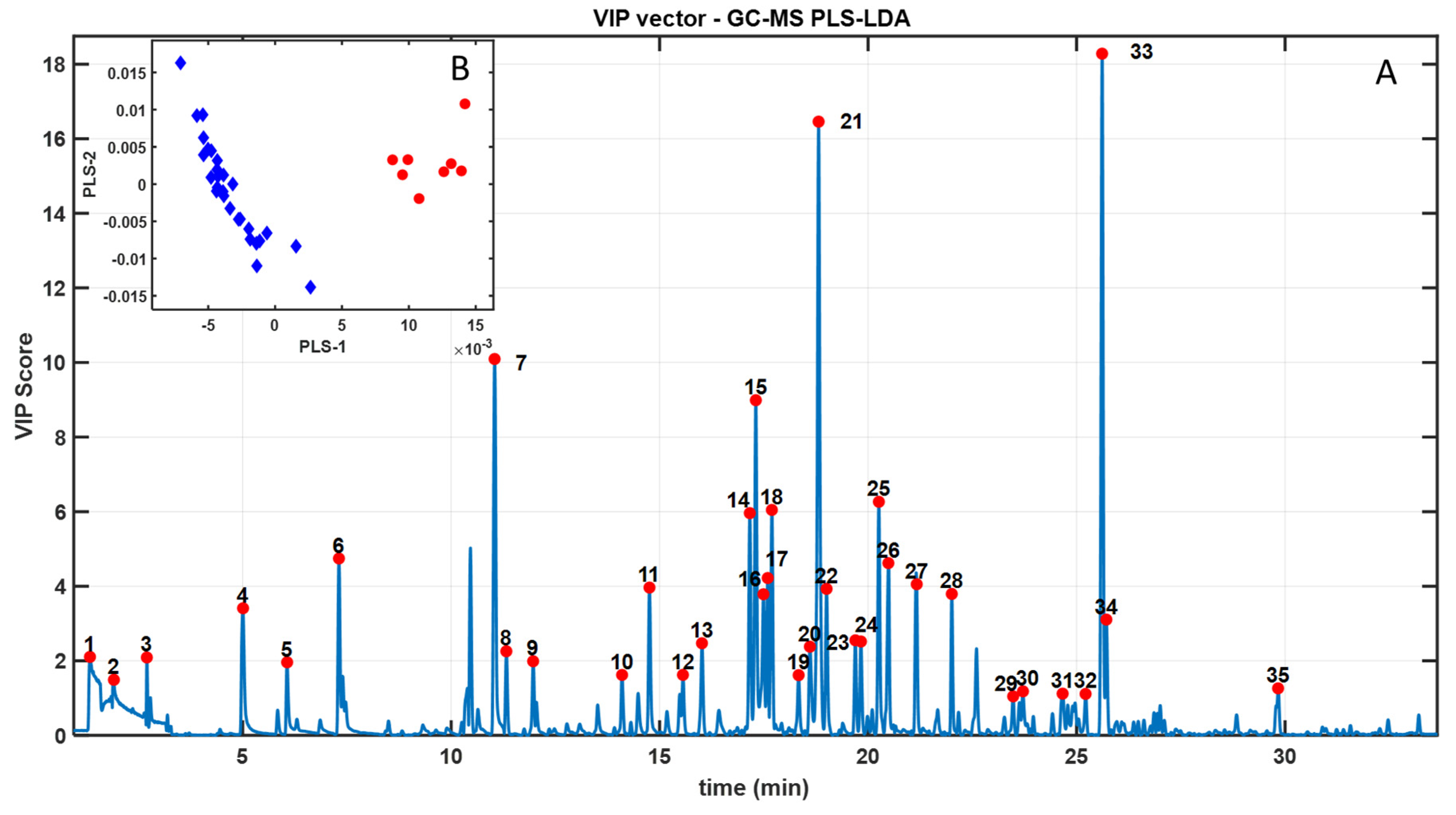
The GC-MS spectra of all samples were subjected to chemometric analysis, specifically employing Partial Least Squares–Linear Discriminant Analysis (PLS-LDA) (Figure 2) [10,11,12]. The resulting score plot (Figure 2, inset) revealed a clear separation between male and female samples, indicating distinct VOC profiles associated with sex (Table 1) [1,13]. Furthermore, the Variable Importance in Projection (VIP) scores derived from the PLS-LDA model identified the chromatographic signals contributing most significantly to this separation (Figure 2).
In the VIP profile, the most significant peaks contributing to the discrimination between sexes were annotated numerically (Table 1) [1,13,14]. The next step in our workflow involved extracting the normalized peak areas corresponding to these signals from the raw GC-MS data. Peak identification was performed using the GC-MS instrument software, which also provided identification quality scores, acknowledging that not all identifications are equally reliable or unambiguous.
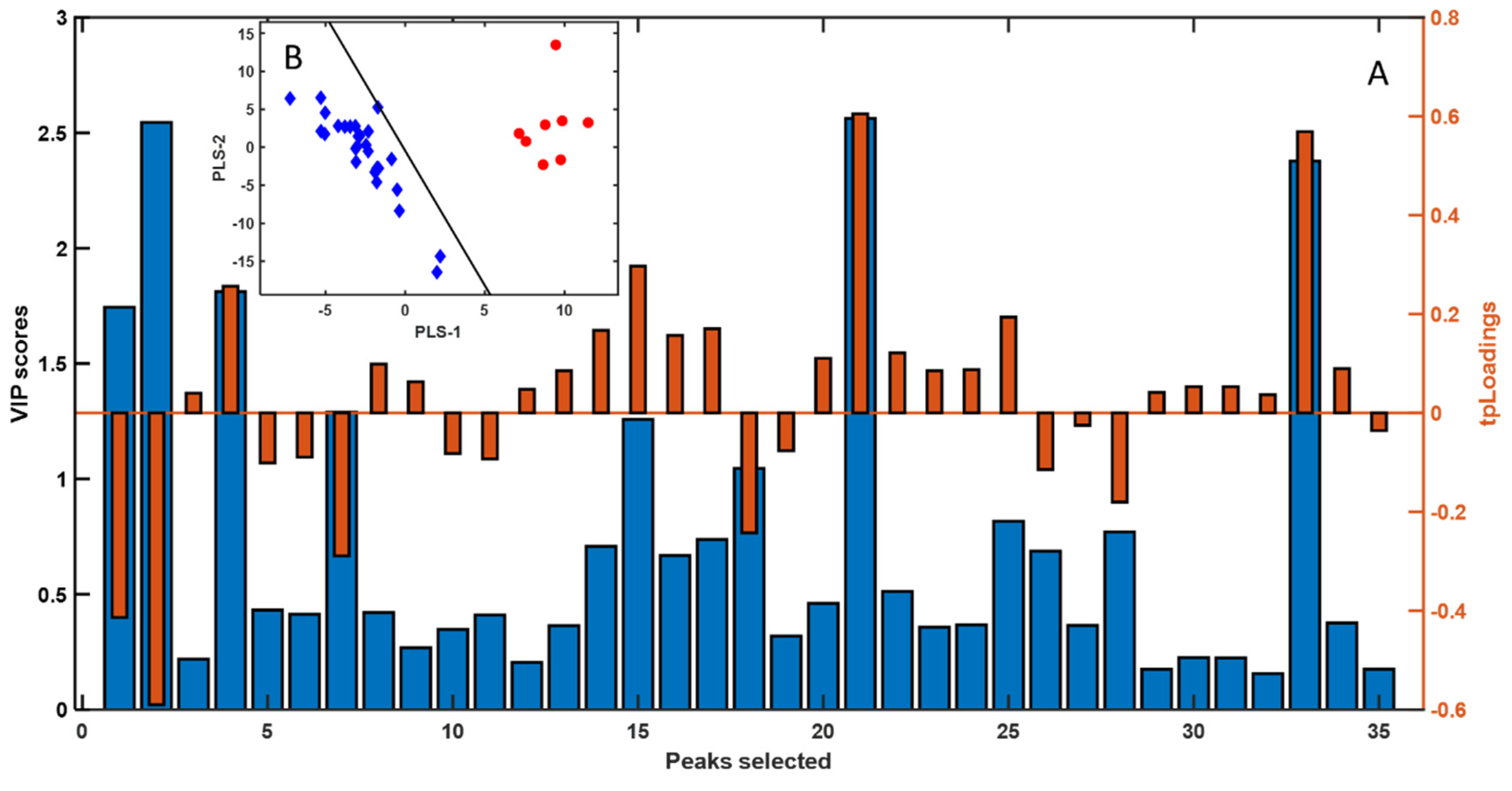
Once the normalized peak areas were extracted for all samples, we employed supervised chemometric modeling (PLS_LDA) to determine which compounds were most influential in differentiating between male and female gonadal profiles. Again, a PLS-LDA approach was applied, this time using only the 35 selected peak areas (Table 1) as input variables. The resulting score plot (Figure 3B) displayed an excellent separation between male and female groups, reinforcing the discriminative power of these selected VOCs.
Additionally, the VIP scores and corresponding loadings plot (Figure 3) highlighted the key compounds driving the separation observed in the PLS-LDA model. This refinement of the dataset allowed us to focus on a subset of VOCs with both statistical and sensory relevance in the differentiation of sexes.
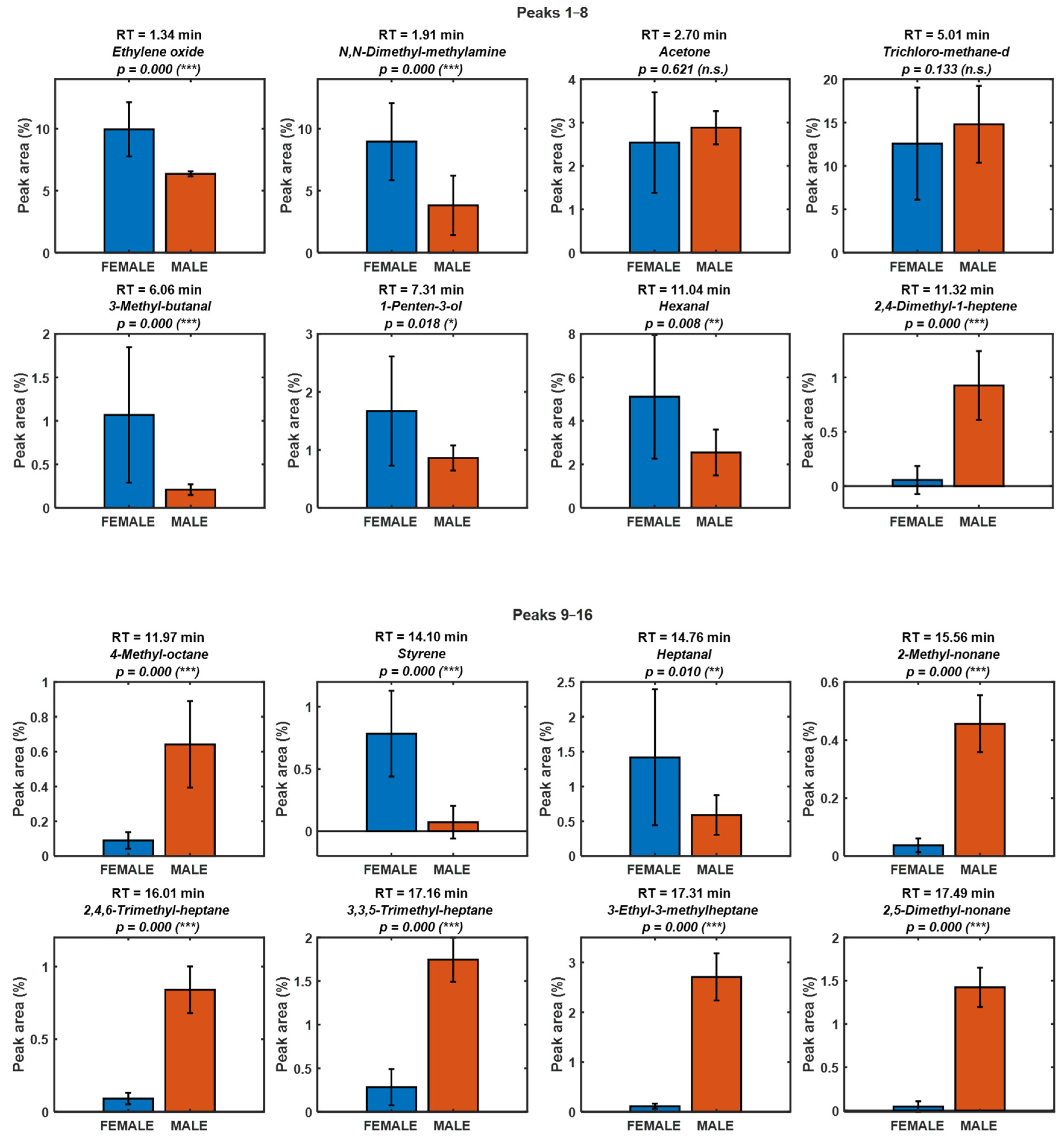
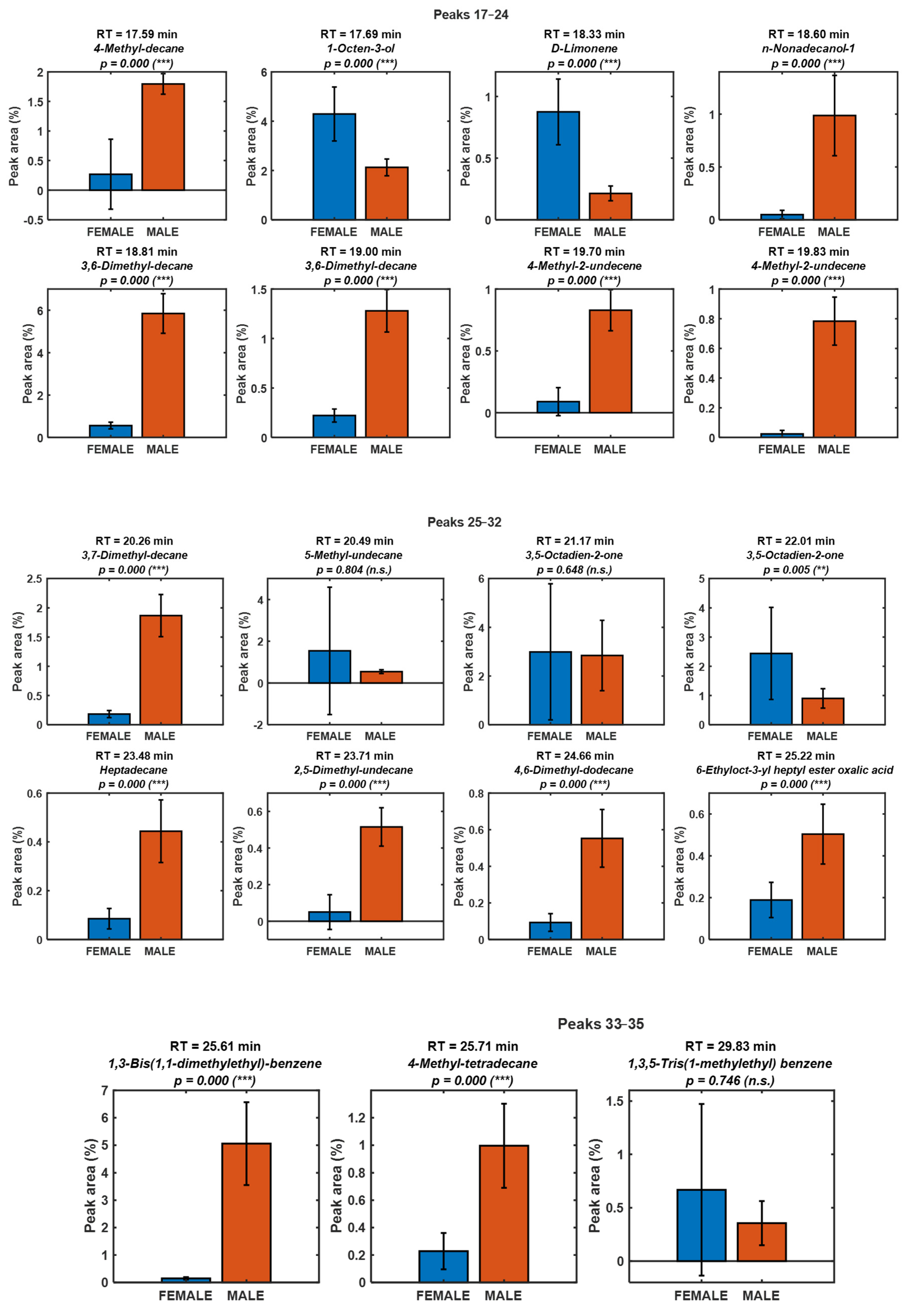
The Mann–Whitney U test identified statistically significant differences in the relative abundance of multiple volatile compounds between male and female Paracentrotus lividus gonads. The analysis revealed that 30 out of 35 compounds exhibited statistically significant differences (p < 0.05), with normalized U statistics (U_stat) ranging from –0.67 to +1.32. These values indicate both the magnitude and direction of enrichment: positive U_stat values reflect compounds more abundant in males, while negative values indicate female enrichment. To visualize these differences, histograms were generated for each compound, displaying the distribution of normalized peak areas across both sexes (Figure 4). These histograms clearly illustrate the distinct abundance patterns for key volatiles, with several compounds showing markedly higher concentrations in female gonads (e.g., hexanal, 1-octen-3-ol, or D-limonene) [15,16], while others, such as methylamine derivatives, were more prevalent in male samples [1,13,14].
Compounds with the highest U_stat values—such as 2,4-Dimethyl-1-heptene, 4-Methyl-octane, 2-Methyl-nonane, and 2,4,6-Trimethyl-heptane (U_stat = 1.321, p ≤ 2×10⁻⁵) were consistently more abundant in male samples. In contrast, compounds such as N,N-Dimethyl-methylamine (U_stat = –0.554, p = 2.1×10⁻⁴), Ethylene oxide (U_stat = –0.536, p = 2.8×10⁻⁴), and D-Limonene (U_stat = –0.67, p = 3×10⁻⁵), with negative U-statistics, were significantly enriched in females.
The combined use of univariate (Mann–Whitney U test) and visual (histogram) analyses (Figure 4) provided robust evidence supporting the hypothesis that the volatile profile of P. lividus gonads is influenced by sex. This statistical approach not only confirmed the trends observed in the chemometric models but also highlighted specific compounds with the greatest discriminatory power.
The family-level grouping in Table 2 delineates two distinct volatilome signatures. Female gonads are enriched in low-threshold oxygenated volatiles [1,14]—notably aldehydes (hexanal, heptanal) and alcohols (1-penten-3-ol, 1-octen-3-ol)—together with diet-linked monoterpenes (e.g., D-limonene), consistent with lipoxygenase-mediated PUFA oxidation [15] and macroalgal terpenoid intake. This ensemble underpins ‘fresh-green’, ‘citrus’, and ‘marine’ notes and aligns with prior GC-MS/GC-O reports in sea urchins [1,13,14]. In contrast, male gonads are dominated by saturated/branched hydrocarbons and long-chain alcohols with high odour thresholds, indicating a more structural lipid profile with limited direct sensory impact [1,13]. Minor aromatic hydrocarbons (e.g., styrene; 1,3-bis(1,1-dimethylethyl)-benzene) should be treated as potential environmental markers rather than endogenous aroma drivers [14]. Overall, this dichotomy explains the stronger and more complex bouquet typically observed for females and reinforces the multivariate separation.

4. Discussion

The volatile organic compounds (VOCs) profile of female Paracentrotus lividus gonads reveals a chemically rich matrix shaped by their reproductive physiology, active lipid metabolism, and dietary intake. In this study, several key VOCs were identified as abundant in female gonads, including D-limonene, 1-penten-3-ol, 1-octen-3-ol, hexanal, heptanal, butanal (3-methyl-), and N,N-dimethyl-methylamine, each of which contributes significantly to the sensory characteristics of the product [1,13].
These findings confirm a pronounced chemical dimorphism in P. lividus, with sex-specific compound profiles that may influence flavor perception and ecological function [17]. The presence of certain hydrocarbons and alcohols in males may contribute to less favorable organoleptic properties, while the enrichment of aldehydes and oxygenated compounds in females may enhance flavor complexity. Notably, the absence of male-associated compounds in female gonads could be a key factor in their preferred taste.
The prominence of D-limonene is particularly notable. This monoterpene, likely derived from the ingestion of macroalgae rich in terpenoids [14], imparts sweet and citrusy aromatic notes, which have been associated with higher sensory acceptance in other echinoid species such as Mesocentrotus nudus and Evechinus chloroticus [13,18]. The accumulation of such lipid-soluble compounds in female gonads can be explained by their higher metabolic activity during the reproductive phase, where energy storage in the form of lipids is crucial for gametogenesis.
Additionally, oxygenated volatiles such as 1-penten-3-ol and 1-octen-3-ol play a pivotal role in shaping the olfactory perception of female gonads. Both compounds, products of enzymatic oxidation of polyunsaturated fatty acids (PUFAs) through lipoxygenase pathways [16,19], are known to elicit green, herbaceous (1-penten-3-ol) and earthy-mushroom (1-octen-3-ol) aromas, respectively. Their elevated levels in females, compared to males, are consistent with previous findings that associate a higher PUFA content and oxidative turnover with a more complex and intense aroma profile in female sea urchin gonads [14].
Aldehydes, such as hexanal, heptanal, and 3-methyl-butanal, further enrich this profile. Hexanal, a primary oxidation product of linoleic acid, contributes fresh-green and cut grass-like notes that enhance perceptions of freshness in seafood products [1]. Heptanal adds a waxy, slightly citrus aroma, while 3-methyl-butanal (isovaleraldehyde) imparts nutty, toasted nuances, originating from branched-chain amino acid catabolism or secondary lipid oxidation. These aldehydes, being potent odorants, are responsible for the sweet, marine and slightly roasted sensory profile often attributed to premium-quality female gonads [17].
Interestingly, N,N-dimethyl-methylamine, typically associated with spoilage markers in fishery products, was also detected in controlled levels in female samples. Unlike trimethylamine (TMA), which arises from microbial spoilage, the presence of dimethylated amines in fresh gonads may stem from endogenous nitrogenous metabolism. At low concentrations, these amines may contribute to a subtle marine aroma, enhancing the oceanic freshness of the product without reaching thresholds associated with off-flavors [18].
Contrary to the female gonads, hydrocarbons such as decanes, heptanes, and nonanes, although detected, are unlikely to contribute significantly to aroma perception due to their high olfactory thresholds. Their occurrence is more reflective of the structural lipid matrix rather than volatile compounds directly influencing flavor [13]. However, their relative proportions can be informative as biochemical markers of lipid stability and tissue composition.
The biochemical origin of these volatiles is closely linked to both endogenous metabolic processes (e.g., lipid peroxidation, amino acid degradation) and exogenous dietary inputs (e.g., algal-derived terpenes). Previous studies have established dietary influence on the volatile profile of sea urchin gonads, feeding macroalgae such as Eisenia bicyclis or Saccharina japonica demonstrating elevated levels of terpenoids and fruity esters, enhancing their organoleptic appeal [14]. Therefore, the prevalence of D-limonene and related compounds in female gonads of P. lividus can be seen as a biochemical footprint of dietary modulation.
In summary, the volatile signature of female Paracentrotus lividus gonads is characterized by a higher abundance of oxygenated volatiles (aldehydes, alcohols) and terpenes, which collectively contribute to a sweet, fresh, and marine aroma profile. These chemical differences underpin the commonly reported sensory distinctions between male and female gonads, with female gonads often described as more flavorful, complex, and preferred by consumers. The integration of terpenoid-derived fruity notes, lipid oxidation products, and marine-associated amines establishes a chemical basis for sex-based sensory differentiation in this species.
Understanding these VOC profiles not only provides insight into the chemical determinants of gonadal flavor quality but also opens avenues for targeted quality control, selection of premium gonads, and optimization of aquaculture feeding strategies aimed at enhancing desirable sensory attributes.
The VOCs profile of male Paracentrotus lividus gonads is markedly different from that of females, reflecting a metabolic orientation towards structural lipid stability rather than the generation of bioactive aromatic compounds. In this study, the VOCs predominantly identified in male gonads comprised saturated and branched aliphatic hydrocarbons, such as 3,6-dimethyldecane, 3-ethyl-3-methylheptane, tetradecane (4-methyl-), heptadecane, and a series of heptanes, nonanes, undecanes, along with n-nonadecanol-1 and various minor alkenes.
From a sensory perspective, these long-chain hydrocarbons and alcohols possess high olfactory thresholds, rendering them virtually odorless at concentrations typical in sea urchin gonads. Their presence, therefore, does not contribute significantly to the aromatic profile perceived by consumers. Instead, these compounds serve as biochemical indicators of the lipidic structural matrix composition, with their higher abundance in males suggesting a more static and inert lipid profile compared to the metabolically dynamic female gonads.
The predominance of saturated hydrocarbons in male gonads [1,13]can be interpreted as a reflection of lower lipid turnover and oxidative activity, consistent with their reproductive physiology. Unlike females, whose gonadal maturation involves significant lipid mobilization for gamete production, male gonads tend to maintain a stable structural lipid reserve, which is chemically expressed through the accumulation of aliphatic hydrocarbons with minimal oxygenation. This phenomenon has been previously reported in sea urchins of different species, where male gonads exhibit simplified volatile profiles dominated by inert lipid derivatives [13,17].
Additionally, the presence of n-nonadecanol-1, a long-chain fatty alcohol, reinforces this structural lipid-oriented composition. Fatty alcohols of high molecular weight, commonly derived from wax esters or cuticular lipids, are not expected to contribute directly to aroma due to their extremely low volatility. Their detection in male gonads aligns with a biochemical signature of tissue stability and lower metabolic oxidation of lipid stores.
An interesting finding is the detection of 1,3-bis(1,1-dimethylethyl)-benzene, an aromatic hydrocarbon that, while not typically considered a sea urchin metabolite, showed significantly higher abundance in males. whose presence may originate from environmental contamination (e.g., microplastics, packaging materials) or result as an analytical artefact from sample processing [19]. Although it is not typically regarded as a natural metabolite of sea urchins, its elevated abundance in male gonads might suggest differences in bioaccumulation linked to environmental exposure or physiological absorption. Notably, recent studies have indicated that this compound contributes to unpleasant sensory notes, described as pungent, plastic-like, and phenolic, particularly under oxidative conditions in edible oils [20,21]. This suggests that, beyond being a potential marker of environmental contamination, 1,3-bis(1,1-dimethylethyl)-benzene may negatively impact the flavor profile of the gonads, especially in male individuals where it was found in higher concentrations. Therefore, its presence warrants further investigation not only from a toxicological or environmental standpoint, but also in terms of its possible contribution to off-flavors in sea urchin gonads.
In the context of sea urchin gonads, the elevated levels of this compound in males may partially explain the inferior organoleptic qualities often attributed to male samples. Its aromatic structure and volatility suggest it could influence sensory perception even at low concentrations, contributing to bitter or acrid nuances that contrast with the more delicate and appealing flavor profile of female gonads. Therefore, beyond its role as a possible environmental marker, 1,3-bis(1,1-dimethylethyl)-benzene may have direct implications for consumer preference and culinary value, reinforcing the chemical basis for sex-linked flavor differentiation in P. lividus.
Moreover, unsaturated hydrocarbons such as 2,4-dimethyl-1-heptene and 2-undecene (4-methyl-) were also identified among the volatiles of male gonads. Despite their structural diversity, these alkenes are known to possess limited aromatic potency and do not significantly modulate the sensory perception of the gonads.
Comparatively, the minimal presence of oxygenated volatiles (e.g., aldehydes, alcohols with low detection thresholds, and terpenoids) in male gonads accounts for their commonly reported bland and neutral flavor profile. This simplified volatile signature contrasts with the richer, more complex bouquet observed in female gonads, which are characterized by a higher occurrence of oxidation products and diet-derived terpenoids [14,18].
These findings are consistent with prior research indicating that male sea urchin gonads exhibit a less pronounced aromatic profile, often described as milder, smoother, and lacking the fruity-marine notes associated with female gonads. This distinction has been linked not only to metabolic factors but also to sex-specific lipid deposition patterns and reproductive roles [17].
From an applied perspective, the identification of a volatile profile dominated by inert hydrocarbons in males suggests that chemical markers for quality differentiation should focus on the absence of bioactive VOCs rather than the presence of off-flavors. Therefore, the sensory quality of male gonads is not diminished by spoilage-related volatiles but is inherently less complex due to their static biochemical composition.
In summary, male Paracentrotus lividus gonads exhibit a volatile profile characterized by aliphatic hydrocarbons and long-chain alcohols with negligible olfactory impact, reflecting a stable lipidic matrix and reduced metabolic activity compared to females (Table 2). This chemical signature supports the organoleptic perception of male gonads as milder and less aromatic, providing a biochemical basis for sex-related sensory differentiation in this species.
To further investigate the presence of potential VOCs differentiating male and female gonadal tissues, the complete dataset comprising 8 female and 26 male Paracentrotus lividus specimens was analyzed. It is important to note that this species is legally protected along the Mediterranean coasts (Comunitat Valenciana), and its collection is subject to strict regulation. This constraint would be less critical if P. lividus exhibited external sexual dimorphism; however, sex determination is only possible post-mortem, upon gonadal extraction.

5. Conclusions

This study demonstrates that the sea urchin (Paracentrotus lividus) gonad volatilome exhibits sex-dependent signatures measurable by HS-SPME-GC-MS. Multivariate modelling (PLS–LDA) and univariate tests (Mann–Whitney with FDR correction) consistently separated females and males, indicating that compositional differences are robust at the metabolite level. Female gonads were enriched in low-odour-threshold oxygenates—notably aldehydes (hexanal, heptanal) and alcohols (1-penten-3-ol, 1-octen-3-ol)—together with diet-linked monoterpenes (e.g., D-limonene), whereas male gonads were dominated by saturated/branched hydrocarbons and long-chain alcohols associated with a more structural lipid profile. These patterns align with a PUFA-LOX/HPL origin for oxygenated volatiles and with macroalgal inputs to terpene composition, providing a mechanistic rationale for the fresher/green–citrus “marine” notes typically attributed to females.
To ensure transparency, minor environmental/artefact markers (e.g., styrene; 1,3-bis(1,1-dimethylethyl)-benzene; chloroform-d; ethylene oxide) were retained in the reporting but excluded from biological interpretation. Together, the family-level grouping, effect-size patterns, and VIP rankings provide a coherent volatilome framework that explains the greater sensory complexity observed for females and corroborates the multivariate separation.
Limitations and next steps. Tentative identifications based on library matches should be consolidated with retention indices and authentic standards; where confidence is low, compounds should remain annotated as Unknown with diagnostic ions. Future work should integrate GC-O and absolute/semi-quantitative calibration to validate odour impact, evaluate seasonality, diet, and maturation stage, and expand to geographical cohorts. From an applied perspective, the sex-dependent volatilome offers candidate markers for quality control, product differentiation, and aquaculture feeding trials aimed at optimizing desirable aroma attributes.

Author Contributions

Funding obtained: F.C.M.-E. and P.S-J. Conceived and designed the experiments: R.I-C, E.C.-G., F.C.M.-E. and P.S-J. Performed the analysis and figures: R.I-C. and F.C.M.-E. Analyzed the data: R.I-C. and F.C.M.-E. Wrote the manuscript: R.I.-C. and F.C.M.-E. Reviewed the manuscript: R.I-C., E.C.-G., F.C.M.-E. and P.S-J. Collected the urchin samples: E.C.-G. and P.S-J. All authors have read and agreed to the published version of the manuscript.

Funding

This research was funded by CONVOCATORIA DEL PROGRAMA PROPIO DEL CENTRO DE GASTRONOMÍA DEL MEDITERRÁNEO (Gasterra 2024-25) UA_DENIA PARA EL FOMENTO DE LA I+D+i EN El ÁMBITO DE LA GASTRONOMÍA (GASTERRA 2025).

Institutional Review Board Statement

This study was conducted under the framework of the GASTERRA projects (2024-2025) and received ethical approval from the Research Ethics Committee of the University of Alicante (Reference: UA-2024-10-24_2).

Informed Consent Statement

Not applicable.

Data Availability Statement

The data presented in this study are available on request from the corresponding author.

Acknowledgments

The authors would like to thank Pablo Candela and Pilar Blasco (SSTTI, University of Alicante) for technical assistance with HS-SPME-GC-MS experiments.

Conflicts of Interest

The authors declare no conflicts of interest.

References

  1. Phillips, K., J. Niimi, N. Hamid, P. Silcock and P. Bremer. “Sensory and volatile analysis of sea urchin roe from different geographical regions in new zealand.” LWT - Food Science and Technology 43 (2010): 202-13. 10.1016/j.lwt.2009.08.008. https://linkinghub.elsevier.com/retrieve/pii/S0023643809002333.
  2. Rocha, F., H. Peres, P. Diogo, R. Ozório and L. M. P. Valente. “The effect of sex, season and gametogenic cycle on gonad yield, biochemical composition and quality traits of paracentrotus lividus along the north atlantic coast of portugal.” PeerJ 7 (2019): 10.7717/peerj.6177. [CrossRef]
  3. Brattoli, M., G. De Gennaro, V. De Pinto, A. Demarinis Loiotile, S. Lovascio and M. Penza. “Odour detection methods: Olfactometry and chemical sensors.” Sensors 11 (2011): 5290-322. 10.3390/s110505290. [CrossRef]
  4. Wang, K. “Discrimination of honeys by hs-spme–gc–ms volatile fingerprints.” Food Chemistry (2019): 10.1016/j.foodchem.2018.07.111. [CrossRef]
  5. Acquaticci, L., S. Angeloni, C. Baldassarri, G. Sagratini, S. Vittori, E. Torregiani, R. Petrelli and G. Caprioli. “A new hs-spme-gc-ms analytical method to identify and quantify compounds responsible for changes in the volatile profile in five types of meat products during aerobic storage at 4 °c.” Food Research International 187 (2024): 10.1016/j.foodres.2024.114398. [CrossRef]
  6. Epping, R., M. O’Sullivan, S. Higgins, M. Cremonesi, A. Voilley and N. Cayot. “Changes in tuber melanosporum aroma during storage: Spme-gc-ms versus sensory.” Foods 13 (2024): 837. 10.3390/foods13060837. [CrossRef]
  7. Mustafa, A. M., S. Angeloni, D. Abouelenein, S. Vittori and G. Caprioli. “An overview on truffle aroma and main volatile compounds.” Molecules 25 (2020): 5948. 10.3390/molecules25245948. [CrossRef]
  8. Gloaguen, Y., M. Riu-Boni, T. Stark and P. Schieberle. “Characterization of the volatilome of tuber canaliculatum by hs-spme-gc-ms.” ACS Omega 7 (2022): 26534-44. 10.1021/acsomega.2c02877. [CrossRef]
  9. Takagi, S., Y. Sato, Y. Murata, A. Kokubun, K. Touhata, N. Ishida and Y. Agatsuma. Quantification of the flavor and taste of gonads from the sea urchin mesocentrotus nudus using gc–ms and a taste-sensing system. 20. 2020,.
  10. Li, H., Y. Liang, Q. Xu and D. Cao. “Key wavelengths screening using competitive adaptive reweighted sampling method for multivariate calibration.” Anal Chim Acta 648 (2009): 77-84. 10.1016/j.aca.2009.06.046. http://www.ncbi.nlm.nih.gov/pubmed/19616692.
  11. Tang, L., S. L. Peng, Y. M. Bi, P. Shan and X. Y. Hu. “A new method combining lda and pls for dimension reduction.” Plos One 9 (2014): 10.1371/journal.pone.0096944. <Go to ISI>://WOS:000336653300053.
  12. Wen, Z. C., T. Sun, X. Geng and M. H. Liu. “Discrimination of pressed and extracted camellia oils by vis/nir spectra combined with uve-pls-lda.” Spectroscopy and Spectral Analysis 33 (2013): 2354-58. 10.3964/j.issn.1000-0593(2013)09-2354-05. <Go to ISI>://WOS:000326064200011.
  13. Niimi, J., M. Leus, P. Silcock, N. Hamid and P. Bremer. “Characterisation of odour active volatile compounds of new zealand sea urchin (evechinus chloroticus) roe using gc-o-fscm.” Food Chemistry 121 (2010): 601-07. 10.1016/j.foodchem.2009.12.071. https://linkinghub.elsevier.com/retrieve/pii/S0308814609014927.
  14. Takagi, S., Y. Sato, A. Kokubun, E. Inomata and Y. Agatsuma. “Odor-active compounds from the gonads of mesocentrotus nudus sea urchins fed saccharina japonica kelp.” PLOS ONE 15 (2020): 10.1371/journal.pone.0231673. https://journals.plos.org/plosone/article?id=10.1371/journal.pone.0231673.
  15. Su, T., G. Zhang, Y. Zhao, J. Zhang, X. Shang, Q. Shen, S. Hua and X. Zhu. “The biosynthesis of 1-octen-3-ol by a multifunctional fatty acid dioxygenase and hydroperoxide lyase in agaricus bisporus.” Journal of Fungi 8 (2022): 10.3390/jof8080827. https://www.mdpi.com/2309-608X/8/8/827.
  16. Morawicki, R. O. and R. B. Beelman. “Study of the biosynthesis of 1-octen-3-ol using a crude homogenate of agaricus bisporus in a bioreactor.” Journal of Food Science 73 (2008): C135-C39. [CrossRef]
  17. Baião, L. F., C. Rocha, R. C. Lima, A. Marques, L. M. P. Valente and L. M. Cunha. “Sensory profiling, liking and acceptance of sea urchin gonads from the north atlantic coast of portugal, aiming future aquaculture applications.” Food Research International 140 (2021): 10.1016/j.foodres.2020.109873. https://pubmed.ncbi.nlm.nih.gov/33648191/.
  18. Sato, Y., S. Takagi, E. Inomata and Y. Agatsuma. “Odor-active volatile compounds from the gonads of the sea urchin mesocentrotus nudus in the wild in miyagi prefecture, tohoku, japan.” Food and Nutrition Sciences 10 (2019): 860-75.
  19. Rodríguez-Bernaldo de Quirós, A., J. López-Hernández, M. J. González-Castro, C. de la Cruz-García and J. Simal-Lozano. “Comparison of volatile components in fresh and canned sea urchin (paracentrotus lividus, lamarck) gonads by gc–ms using dynamic headspace sampling and microwave desorption.” European Food Research and Technology 212 (2001): 643-47. 10.1007/s002170100315. https://link.springer.com/article/10.1007/s002170100315.
  20. Eriotou, E., I. K. Karabagias, S. Maina, D. Koulougliotis and N. Kopsahelis. “Geographical origin discrimination of “Ntopia” Olive oil cultivar from ionian islands using volatile compounds analysis and computational statistics.” Eur Food Res Technol 247 (2021): 3083-98. 10.1007/s00217-021-03863-2.
  21. Kopsahelis, N., I. K. Karabagias, H. Papapostolou and E. Eriotou. “Cultivar authentication of olive oil from ionian islands using volatile compounds and chemometric analyses.” Journal of Food Measurement and Characterization 18 (2024): 4402-16. 10.1007/s11694-024-02502-0. [CrossRef]
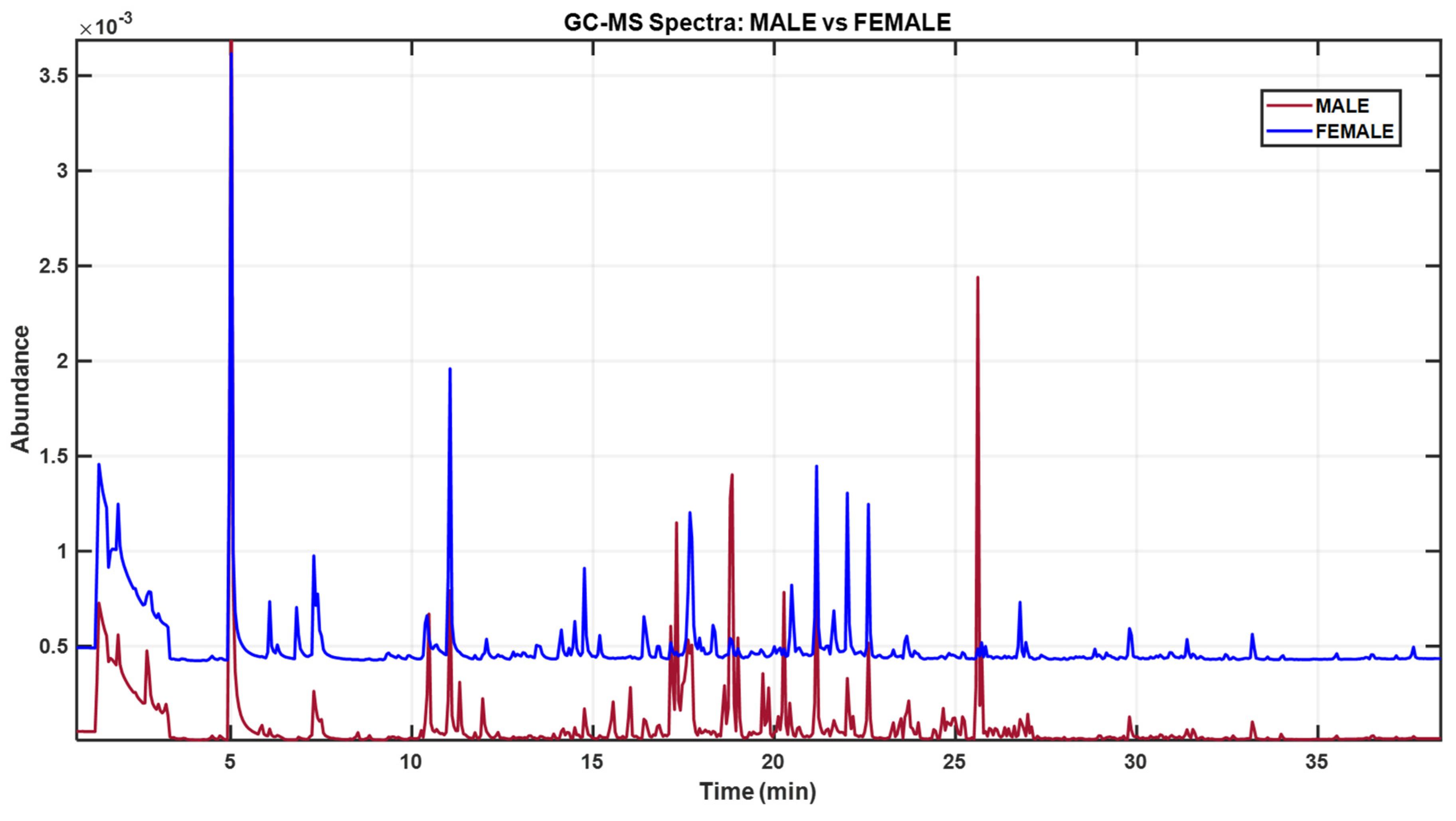
Figure 1. Representative HS-SPME-GC-MS TICs of P. lividus gonads from a female (blue) and a male (red) specimen.
Preprints 180959 g001
Figure 2. Sex discrimination based on GC-MS volatilome. (A) VIP scores derived from the PLS-LDA model applied to GC-MS spectral data of P. lividus gonads. The inset (B) shows the PLS-LDA score plot showing male (red circles) and female (blue diamonds).
Preprints 180959 g002
Figure 3. (A) VIP scores and corresponding loadings plot from the PLS-LDA model, constructed using the normalized areas of the selected GC-MS peaks (Table 1). The inset (B) shows the PLS-LDA score plot depicting sample classification based on sex. Males (red circles) and female (blue diamonds).
Preprints 180959 g003
Figure 4. Histograms representing the normalized peak area distribution of the identified volatile compounds in male (orange) and female (blue) Paracentrotus lividus gonads. Each subplot corresponds to a specific compound. Statistical significance was assessed using the Mann–Whitney U test, with p-values indicated for each compound. compounds significant are marked (* q<0.05, ** q<0.01, *** q<0.001), indicating significant sex-based differences in abundance.
Preprints 180959 g004aPreprints 180959 g004b
Table 1. identifications of the peaks by retention time (RT).
Number RT (min) Name Chemical class Putative origin
1 1.34 Ethylene oxide Epoxide Environmental/artefact
2 1.91 N,N-Dimethyl-methylamine Amine Biogenic amine / degradation
3 2.70 Acetone Ketone Uncertain
4 5.01 Trichloro-methane-d Halogenated solvent Environmental/artefact
5 6.06 3-Methyl-butanal Aldehyde Biogenic (PUFA oxidation, LOX/HPL)
6 7.31 1-Penten-3-ol Alcohol Biogenic (PUFA oxidation, LOX/HPL)
7 11.04 Hexanal Aldehyde Biogenic (PUFA oxidation, LOX/HPL)
8 11.32 2,4-Dimethyl-1-heptene Alkene Biogenic (low odor impact)
9 11.97 4-Methyl-octane Other Uncertain
10 14.10 Styrene Aromatic
hydrocarbon
Environmental/artefact
11 14.76 Heptanal Alkane Biogenic (low odor impact)
12 15.56 2-Methyl-nonane Aromatic
hydrocarbon
Environmental (possible packaging/ambient)
13 16.01 2,4,6-Trimethyl-heptane Alkane Biogenic (low odor impact)
14 17.16 3,3,5-Trimethyl-heptane Alkane Biogenic (low odor impact)
15 17.31 3-Ethyl-3-methylheptane Monoterpene Diet-derived (macroalgae) / biogenic
16 17.49 2,5-Dimethyl-nonane Alkane Biogenic (low odor impact)
17 17.59 4-Methyl-decane Alkane Biogenic (low odor impact)
18 17.69 1-Octen-3-ol Aldehyde Biogenic (PUFA oxidation, LOX/HPL)
19 18.33 D-Limonene Alkane Biogenic (low odor impact)
20 18.60 n-Nonadecanol-1 Alkane Biogenic (low odor impact)
21 18.81 3,6-Dimethyl-decane Alkane Biogenic (low odor impact)
22 19.00 3,6-Dimethyl-decane Alkene Biogenic (low odor impact)
23 19.70 4-Methyl-2-undecene Alkene Biogenic (low odor impact)
24 19.83 4-Methyl-2-undecene Alkane Biogenic (low odor impact)
25 20.26 3,7-Dimethyl-decane Ketone Biogenic (PUFA oxidation, LOX/HPL)
26 20.49 5-Methyl-undecane Ketone Biogenic (PUFA oxidation, LOX/HPL)
27 21.17 3,5-Octadien-2-one Alkane Biogenic (low odor impact)
28 22.01 3,5-Octadien-2-one Alkane Biogenic (low odor impact)
29 23.48 Heptadecane Alkane Biogenic (low odor impact)
30 23.71 2,5-Dimethyl-undecane Alkane Biogenic (low odor impact)
31 24.66 4,6-Dimethyl-dodecane Alkane Biogenic (low odor impact)
32 25.22 6-Ethyloct-3-yl heptyl ester oxalic acid Ester Uncertain (low-volatility ester unlikely in HS-SPME; keep tentative)
33 25.61 1,3-Bis(1,1-dimethylethyl)-benzene Aromatic hydrocarbon Environmental/artefact
34 25.71 4-Methyl-tetradecane Alkane Biogenic (low odor impact)
35 29.83 1,3,5-Tris(1-methylethyl) benzene Aromatic hydrocarbon Environmental/artefact
Table 2. Comparative Overview of VOC Profiles in Female and Male Gonads of Paracentrotus lividus.
Attribute Female Gonads Male Gonads
Dominant Chemical Families Terpenes, Aldehydes, Alcohols, Ketones, Amines Saturated and Branched Hydrocarbons, Long-chain Alcohols, Aromatic Hydrocarbons
Key Compounds D-Limonene, Hexanal, Heptanal, 1-Penten-3-ol, 1-Octen-3-ol, 3-Methyl-butanal 3,6-Dimethyldecane, 3-Ethyl-3-methylheptane, Heptadecane, n-Nonadecanol-1
Sensory Attributes Sweet, fruity, citrus, green-herbaceous, earthy-mushroom, marine freshness Neutral, mild, smooth; negligible aroma intensity
Aromatic Complexity High – Presence of low-threshold oxygenated volatiles and terpenes Low – Dominance of high-threshold saturated hydrocarbons
Lipid Metabolic Activity Indicator High lipid turnover and oxidative activity associated with reproductive phase Stable lipid matrix, lower oxidative activity
Dietary Influence Markers Presence of diet-derived terpenoids (e.g., D-limonene) Minimal or absent; no terpenoid accumulation
Spoilage/Degradation Markers Controlled levels of amines (e.g., N,N-dimethyl-methylamine) linked to freshness perception Not detected; no significant spoilage-related VOCs
Environmental Contamination Indicators Styrene (low levels, potential packaging or environmental marker) 1,3-Bis(1,1-dimethylethyl)-benzene (potential environmental marker)
Organoleptic Profile Summary Rich, sweet, fruity-marine aroma with complex aromatic bouquet Mild, bland, structurally neutral flavor, lacking fruity or marine aromatic complexity
Disclaimer/Publisher’s Note: The statements, opinions and data contained in all publications are solely those of the individual author(s) and contributor(s) and not of MDPI and/or the editor(s). MDPI and/or the editor(s) disclaim responsibility for any injury to people or property resulting from any ideas, methods, instructions or products referred to in the content.
Copyright: This open access article is published under a Creative Commons CC BY 4.0 license, which permit the free download, distribution, and reuse, provided that the author and preprint are cited in any reuse.
Prerpints.org logo

Preprints.org is a free preprint server supported by MDPI in Basel, Switzerland.

Subscribe

Disclaimer

Terms of Use

Privacy Policy

Privacy Settings

© 2025 MDPI (Basel, Switzerland) unless otherwise stated