

Submitted:
17 October 2025
Posted:
20 October 2025
You are already at the latest version
Abstract
Plant Growth regulators (PGRs) such as aminoethoxyvinylglycine (AVG), 1-methylcyclopropene (MCP), and thidiazuron (TDZ) are widely used to enhance fruit production. The objective of this study was to evaluate the effect of PGRs on fruit set, productive and fruit quality parameters of the plum cultivar 'Leticia' in highland region of southern Brazil, during the 2021/22 and 2022/23 growing seasons. AVG, MCP, and TDZ were applied at full bloom, in a randomized complete block design with four rep-lications. The biennial mean data were subjected to multivariate analysis using princi-pal component analysis. All PGRs affected fruit set and productive and fruit quality parameters. The strongest correlations were observed with 182 mg L⁻¹ TDZ for fruit set, and with 62.5 mg L⁻¹ and 125 mg L⁻¹ AVG and 21.43 mg L⁻¹ MCP for productive param-eters. Applications of 125 mg L⁻¹ AVG, 21.43 mg L⁻¹ MCP, and 182 mg L⁻¹ TDZ induced the development of fruits with larger diameter and higher fresh weight, respectively. The 182 mg L⁻¹ TDZ treatment showed a significant positive correlation with fruit set and productive and fruit quality parameters of the 'Leticia' plum cultivar under the edaphoclimatic conditions of southern Brazil during the 2021/2022 and 2022/2023 grow-ing seasons.
Keywords:
Prunus domestica L.)
; thidiazuron
; aminoethoxyvinylglycine
; 1-methylcyclopropene
; yield parameters
; fruit quality
1. Introduction
The plum (Prunus domestica L.) is the second most economically important stone fruit worldwide, with approximately 2.5 million hectares cultivated and an annual production of 12.3 million tons [1]. In Brazil, commercial production is dominated by P. salicina Lindl., with cultivars such as ‘Letícia’ and ‘Fortune’ being the most widely grown. The total cultivated area is around 3,500 hectares, with production exceeding 50,000 tons in the 2021/2022 season, mostly concentrated in the southern states of Santa Catarina and Rio Grande do Sul [2]. Despite growing interest, domestic production still fails to meet market demand, and imports remain essential [3]. This scenario results largely attributed to the limited availability of cultivars adapted to local conditions and to gametophytic self-incompatibility, which prevents self-pollination and reduces fruit set. Effective fruit set depends on several factors, including cross-pollination, the presence of compatible pollinizers, active pollinating agents, and synchronized blooming between cultivars [4]. In Southern Brazil, adverse weather conditions such as excessive rainfall, low temperatures, or cloudy periods during bloom can negatively impact pollination efficiency, pollen viability, and fruit set, ultimately reducing yield and fruit quality [5,6].
In addition to cross-pollination requirements and floral synchronization, effective fruit set depends on a balanced hormonal regulation, particularly between abscission-promoting hormones such as ethylene and abscisic acid, and those that inhibit abscission, including auxins, cytokinins, gibberellins, and polyamines [7]. Modulation of this hormonal balance through the application of plant growth regulators (PGRs) has proven to be a promising strategy for improving fruit retention, increasing yield, and potentially enhancing fruit quality [8,9,10].
Among the PGRs with commercial potential are aminoethoxyvinylglycine (AVG), 1-methylcyclopropene (1-MCP), and thidiazuron (TDZ). AVG inhibits ethylene biosynthesis by blocking 1-aminocyclopropane-1-carboxylic acid (ACC) synthase, reducing flower and fruit abscission and senescence [5]. 1-MCP acts by binding to ethylene receptors and inhibiting its perception, thus delaying fruit drop and senescence [8]. TDZ, a synthetic cytokinin, has shown positive effects on fruit set and yield in mango [10], apple [11], and pear [12,13].
While these PGRs have been tested in several fruit crops, studies on their efficacy in Japanese plum under subtropical conditions, especially in southern Brazil, remain scarce. Moreover, interannual climate variability in this region poses an additional challenge to fruit set and productivity. Therefore, this study aimed to evaluate the effects of AVG, 1-MCP, and TDZ on fruit set, yield performance, and fruit quality in the Japanese plum cultivar ‘Letícia’ under the edaphoclimatic conditions of southern Brazil during the 2021/2022 and 2022/2023 growing seasons.
2. Materials and Methods
2.1. Experimental Area
The experiments were conducted in a commercial orchard of ‘Letícia’ plum (Prunus salicina Lindl.) with the pollinizer cultivar ‘SM6’, established in 2005 in the municipality of Lages, Santa Catarina, Brazil (27°46'2.85"S, 50°10'55.13"W), at an altitude of 880 m above sea level, during the 2021/22 and 2022/23 growing seasons. The climate of the region is classified as humid mesothermal (Cfb) according to the Köppen classification [14]. Daily data on maximum and minimum temperatures, rainfall, and solar radiation were recorded by the A880 automatic weather station of the National Institute of Meteorology [1]. The soil is classified as a typical dystrophic Bruno Oxisol [16], with a high clay content (430 g kg⁻¹) and organic matter (95 g kg⁻¹). The orchard was trained in a “Y” system with a planting density of 2,000 trees per hectare, spaced 1.0 m × 5.0 m between trees and rows, respectively.
2.2. Experimental Protocol
The treatments consisted of the application of three plant growth regulators at full bloom (BBCH 65), using the commercial formulation concentrations: aminoethoxyvinylglycine (AVG, 150 g kg⁻¹), thidiazuron + diuron (TDZ, 120 g L⁻¹ of thidiazuron and 60 g L⁻¹ of diuron), and 1-methylcyclopropene (1-MCP, 17.15 g L⁻¹). The tested doses, based on active ingredient concentration, were as follows: control (no application); AVG at 31.3, 62.5, 93.6, and 125.0 mg L⁻¹; 1-MCP at 21.4, 42.9, and 64.3 mg L⁻¹; and TDZ at 182.0 mg L⁻¹. All applications were performed using an electric backpack sprayer with constant pressure of 20 bar, delivering a spray volume of 1,000 L ha⁻¹.
2.3. Fruit Set
Fruit set was assessed by counting the number of flowers at full bloom and the number of fruits 30 days after treatments application, on four branches per plant. At the pre-harvest stage (physiological maturity), the following productive and fruit quality parameters were assessed using a sample of 20 fruits from each experimental plot:
2.4. Productive Parameters
a) Yield and productivity were determined by counting the total number of fruits per plant and calculating the weight in kilograms (kg) and in tons per hectare (t ha⁻¹), respectively, by multiplying the yield per plant by the number of plants per hectare;
b) Fresh mass (FM), expressed in grams (g) per fruit, was determined by weighing a sample of 80 fruits from each treatment;
c) Equatorial diameter and height (in centimeters, cm) were measured using a graduated ruler, by aligning the fruits side by side.
2.5. Fruit Quality Parameters
a) Pulp firmness (PF) was measured in Newtons (N) using a texture analyzer equipped with a 9 mm diameter probe. A portion of the fruit epidermis was removed from two opposite sides of the equatorial region using a ‘peeler’ to allow proper assessment of PF;
b) Soluble solids content (SSC), expressed in °Brix, was determined using a digital refractometer (model ITREFD-45). The readings were taken from juice extracted from median slices of fruits collected from each experimental plot.
c) Fruit color was measured using a Minolta colorimeter (model CR 400), and expressed in terms of lightness (L), chroma (C), and hue angle (Hue).
2.6. Experimental Design and Data Analysis
The experiments followed a randomized complete block design with four replicates, each plot consisting of seven trees. Statistical analysis was based on the mean values obtained across the two growing seasons. The normality of the variables was assessed through ‘kurtosis’ and ‘skewness’. The optimal number of clusters was determined using the ‘silhouette’ coefficient, and cluster formation was carried out using the non-hierarchical k-means algorithm. Subsequently, a multivariate approach was applied using principal component analysis (PCA). All analyses were performed in the RStudio statistical programming environment, using R software version 4.3.1 [17].
3. Results
According to meteorological data collected in Lages, SC, from January 2021 to September 2023 (Figure 1), notable climatic differences were observed between the 2021–2022 and 2022–2023 growing seasons, particularly during the critical stages of “Leticia’ plum development. During the winter dormancy period (April to August), the 2022 season showed lower average temperatures and a greater number of days with minimum temperatures below 7.2 °C compared to 2021. As illustrated in Figure 2, both chilling hours and chill units were higher in 2022, indicating a colder and more prolonged chilling period.
The beginning of sprouting, observed in late August and early September, occurred under different thermal conditions. In 2021 growing season, sprouting started under slightly warmer temperatures, with daily means around 16 °C. In 2022 growing season, cooler temperatures persisted during this phase, with daily means below 14 °C, which may have delayed or influenced the uniformity of bud break.
The flowering phase, which occurred predominantly in early to mid-September, followed these initial sprouting conditions. In 2022, flowering took place under more stable and moderate temperatures (12 to 18 °C), while in 2021, temperatures during this stage were often higher, exceeding 20 °C during the day.
During fruit set and initial development (October to November), the 2021–2022 growing season experienced irregular rainfall, including peaks in October. In contrast, the 2022–2023 growing season had more balanced precipitation and moderate temperatures, contributing to more stable conditions during early fruit development.
The fruit growth and maturation period (December to February) was hotter in 2021–2022 growing season, with maximum temperatures often above 30 °C, especially in December and January. In 2022–2023 growing season, temperatures during this phase were milder, with fewer peacks of high temperatures and more even rainfall distribution. By the time of physiological and commercial maturity, reached in February in both growing seasons, average temperatures were slightly lower in 2022–2023 growing season than in the previous season.
The Principal Component Analysis (PCA) of the Figure 3 and 4 performed using fruit set, productive and fruit quality parameters data for the 2021/22 and 2022/23 growing seasons showed clear separation among the treatments with different plant growth regulators (PGRs). Table 1, Table 2, and Table 3 present numerical values derived from PCA analyses. These tables are complementary to the PCA figures and are provided to facilitate a clearer understanding of the data structure and variable contributions underlying the principal components.
Treatments with higher yield, including AVG at 62.5 mg L⁻¹, AVG at 125.0 mg L⁻¹, 1-MCP at 64.31 mg L⁻¹, and the untreated control, clustered together, reflecting similar levels of productivity regardless of fruit set percentage. Treatments such as AVG at 31.25 mg L⁻¹, 1-MCP at 21.43 mg L⁻¹, and AVG at 93.60 mg L⁻¹ showed intermediate behavior for both variables (Figure 3 and Table 1).
In contrast, TDZ at 182 mg L⁻¹ showed the highest fruit set percentage (4.98%), which was different from most treatments, while also maintaining a high yield (41.01 t ha⁻¹), comparable to the top-yielding treatments. 1-MCP at 42.90 mg L⁻¹ presented similar fruit set values to TDZ, though its productivity was lower. Meanwhile, treatments such as AVG 31.25 mg L⁻¹, 1-MCP 21.43 mg L⁻¹, and AVG 93.60 mg L⁻¹ showed intermediate values for both fruit set and productivity (Figure 3 and Table 1).
As shown in Figure 4 and detailed in Table 2 and Table 3, fruit quality varied among treatments. TDZ at 182 mg L⁻¹ resulted in significantly larger fruits, with higher average fruit mass and greater height and diameter, confirming its effectiveness in maintaining fruit size even under high fruit set conditions. Among the treatments with similar productivity to TDZ, only 1-MCP at 21.43 mg L⁻¹ produced fruits of comparable size and weight. The remaining high-yielding treatments, including AVG at 62.5 mg L⁻¹, AVG at 125.0 mg L⁻¹, and the control, resulted in fruits with smaller dimensions and lower individual weight (Table 2).
Regarding fruit color attributes, most treatments showed similar values for epidermal luminosity (EL), chroma (EC), and hue angle (EH), indicating no major differences in visual appearance. An exception was AVG at 93.60 mg L⁻¹, which produced fruits with slightly lower red intensity, as reflected by a higher hue angle. No significant differences were observed among treatments in terms of pulp firmness (PF) or soluble solids (SS; °Brix), with values remaining within commercially acceptable ranges for both growing seasons (Table 3).
4. Discussion
Environmental factors, particularly temperature, precipitation, and chilling accumulation, played a key role in the variation of fruit set and yield between the two growing seasons. The highland region of Lages, SC, is characterized by a humid subtropical mesothermal climate (Cfb), with annual rainfall around 1,400 mm and an average temperature of approximately 15.6°C, but interannual variability is frequent and may significantly impact floral development and fertilization [3].
The region of Lages experienced different chilling accumulation patterns over the two growing seasons. In 2021, chilling accumulation was higher, contributing to more uniform budbreak and flowering [5], whereas in 2022, warmer winter temperatures and less consistent chilling likely caused irregular sprouting and reduced flowering uniformity [11,18]. These climatic differences likely impacted the hormonal responsiveness and fruit set outcomes across treatments.
Unfavorable weather conditions during bloom — such as high rainfall or low solar radiation — can interfere with pollinator activity and pollen tube growth, thereby limiting fertilization success [4]. This is especially relevant in self-incompatible cultivars like ‘Letícia’, which rely on cross-pollination. Reductions in effective pollination period or pollen viability have been linked to lower fruit set in previous studies [6].
The application of PGRs significantly affected fruit set, yield, and quality, and their effects were strongly influenced by concentration and seasonal climatic conditions. TDZ at 182 mg L⁻¹ notably increased fruit set, consistent with its cytokinin-like activity that stimulates floral bud retention and parthenocarpic development [10,19]. It also contributes to the inhibition of cytokinin degradation, enhancing endogenous levels and reducing flower abscission [8]. Similar results were observed by [5] and [20] in apples and plums.
1-MCP and AVG also contributed to fruit set and yield, acting mainly through ethylene suppression. AVG inhibits the activity of ACC synthase, a key enzyme in ethylene biosynthesis [21], delaying senescence and reducing early fruit drop. In the present study, AVG at 62.5 and 125.0 mg L⁻¹ resulted in lower fruit set compared to TDZ, but led to the highest yields, likely due to improved retention and better resource partitioning. Similar findings were reported by [12] in ‘Rocha’ pears treated with AVG. Interestingly, TDZ not only enhanced fruit set but also maintained fruit size, indicating an effective balance between reproductive load and assimilate supply [6]. This contrasts with the typical trade-off seen in other crops, where increased fruit set results in smaller fruits due to competition [22,23].
Other growth regulators such as NAA, GA₃, and 6-BA have also been shown to reduce flower and fruit abscission and improve fruit quality traits like pulp firmness and diameter [24,25]. Although not tested here, these findings align with our observations that hormonal regulation can directly affect both physiological and commercial traits.
Fruit quality parameters such as soluble solids content and Pulp firmness were not significantly affected by the treatments in this study, consistent with other reports suggesting stronger influence from environmental and genetic factors [23,26]. The treatment AVG 93.6 mg L⁻¹ also resulted in brighter skin coloration, possibly due to reduced anthocyanin accumulation from ethylene inhibition.
Overall, the interaction between PGR type, dose, and seasonal climate conditions was critical to treatment success. While TDZ and AVG proved consistent across both growing seasons, 1-MCP performance was more variable — highlighting the importance of proper timing and environmental compatibility. These findings reinforce the need for adaptive management of PGRs, considering both cultivar and climate, particularly in regions with high interannual variability such as the Highland regions of Southern Brazil.
5. Conclusions
The use of plant growth regulators positively influences effective fruit set and fruit yield in ‘Letícia’ plum trees. The application of TDZ, especially at doses of 5 and 10 mg L⁻¹, promotes greater effective fruit set and increases fruit fresh weight. TDZ and AVG also contributes to the increase in fruit transverse diameter, showing potential as a tool for improving fruit production. No significant differences were observed among treatments for pulp firmness and soluble solids content.
Author Contributions
Sabrina Baldissera, Daiana Petry, Leo Rufato, and Amauri Bogo - Conceived and designed the experiments. Sabrina Baldissera, Flávia Lourenço da Silva, and André Berner Armbrust - Performed the ex-periments. Daiana Petry, Leo Rufato, and Amauri Bogo - Analyzed and interpreted the data.
Funding
This study was supported by scholarships granted by the Support Fund for the Maintenance and Development of Higher Education (FUMDES – SC, Brazil) and the Coordination for the Improvement of Higher Education Personnel (CAPES – Brazil). The authors also thank Rasip company for providing access to the orchard for the trials.
Data Availability Statement
The data that support the findings of this study are available from the corresponding author upon reasonable request.
Acknowledgments
The authors thank the Santa Catarina State University (CAV-UDESC), the Santa Catarina State Foundation for Research Support (FAPESC), and the National Council for Scientific and Technological Development (CNPQ) for financial support.
Conflicts of Interest
The authors declare that they have no conflicts of interest, competing financial interests or personal relationships that could have appeared to influence the work reported in this paper.
References
- Faostat. Food and Agriculture Organization of the United Nations - Crops and livestock products (2022). Available online: https://www.fao.org/faostat/en/#data/QCL/visualize (accessed on 29 October 2023).
- Epagri. Empresa de Pesquisa Agropecuária e Extensão Rural de Santa Catarina. Santa Catarina se firma como segundo maior produtor de ameixa do país. (2022). Available online: https://www.epagri.sc.gov.br/index.php/tag/analise-economica/page/2/ (accessed on 25 October 2023).
- Embrapa. Agência Embrapa de Informação Tecnológica. Ameixa: Pós-Produção - Mercado. (2023). Available online: https://www.embrapa.br/agencia-de-informacao-tecnologica/cultivos/ameixa/pos-producao/mercado. (accessed on 05 November 2024).
- Milošević N, Glišić I, Đorđević M, Cerović R, Radičević S, Marić S, Milošević T, Nikolić D. Influence of pollination treatments and temperature regimes on progamic phase and fruit set in three European plum (Prunus domestica L.) cultivars tollerant/resistant to Sharka virus. Eur J Agron 149: 126909 (2023) . [CrossRef]
- Barać G, Mastilović J, Kevrešan Z, Milić B, Kovač R, Milović M, Kalajdžić J. Horticulturae 8 (7): 621 (2022) . [CrossRef]
- Sabir IA, Liu X, Jiu S, Whiting M, Zhang C. Plant growth regulators modify fruit set, fruit quality, and return bloom in sweet cherry. HortScience 56 (8):1-10 (2021) . [CrossRef]
- Kaur A, Kaur N, Singh H, Murria S, Jawanda SK. Efficacy of plant growth regulators and mineral nutrients on fruit drop and quality attributes of plum cv. Satluj purple. Plant Physiol Rep 26 (3): 541–547 (2021) . [CrossRef]
- Igwe EO, Charlton KE. A systematic review on the health effects of plums (Prunus domestica and Prunus salicina). Phytother Res 30 (5): 701–731 (2016) https://10.1002/ptr.5581.
- Bons HK, Kaur M. Role of plant growth regulators in improving fruit set, quality and yield of fruit crops: a review. J Hortic Sci Biotechnol 95 (2): 137-146 (2020) . [CrossRef]
- Jiang T, Luo C, Wan W, Liang R, Lu T, Li Y, Xie F, Chen C, Li X, Xie X, He X. Effects of thidiazuron on the quality and storage properties of mango fruit during postharvest. Food Qual Saf 8: 1-11 (2024) . [CrossRef]
- Rufato, L, Sander GF, Welter PD, Pereira MFG, da Silva PS, Schultz AF, Petry D. New strategy using plant growth regulator AVG to increase fruit set on apples in mild climatic region in southern Brazil. Acta Hortic 1346 (2022) . [CrossRef]
- Carra B, Pasa MS, Abreu ES, Dini M, Pasa CP, Ciotta MN, Herter FG, Mello-Farias P. Plant growth regulators to increase fruit set and yield of ‘Rocha’ pear trees in Southern Brazil. An Acad Bras Cienc 93 (3) (2021) . [CrossRef]
- Attia, S. M. Enhancing fruit set, yield and quality of LeConte pear trees by preharvest foliar spray of some plant growth regulators. SVU Int J Agric Sci 4 (4): 1-7 (2022) . [CrossRef]
- Peel MC, Finlayson BL, McMahon TA. Updated world map of the Koppen-Geiger climate classification. Hydrol Earth Syst Sci 11: 633-1644 (2007) . [CrossRef]
- Agroconnect. Climatic data for Lages, Santa Catarina, Brazil. (2024). Available online: https://www.agroconnect.com.br/ (accessed on 02 November 2024).
- Santos HG, Jacomine PKT, Anjos LHC, Oliveira VA, Lumbreras JF, Coelho MR. Brazilian Soil Classification System. Ed. Embrapa, 5th ed. (2018). Available form: <Available form: https://www.embrapa.br/busca-de-publicacoes/-/publicacao/1094001/brazilian-soil-classification-system >. (accessed on 02 November 2024).
- R Core Team. A Language and Environment for Statistical Computing. R Foundation for Statistical Computing, Vienna, Austria. (2023) available: <https://www.R-project.org/>.
- Yun SK, Bae H, Yoon IK, Nam EY, Kwon JH, Jun JH, Chung KH. Effect of GA Paste on Physiological Fruit Drop and Fruit Characteristics in 'Formosa ' Plums (Prunus salicina Lindl.). J. Bio-Env Con 22: 309-315 (2013) https://10.12791/ksbec.2013.22.4.309.
- Ji Y, Wang A. Recent Advances in Phytohormone Regulation of Apple-Fruit Ripening. Plants 10, 2061 (2021) . [CrossRef]
- Trejo EJO, Brizzolara S, Cardillo V, Ruperti B, Bonghi C, Tonutti P. The impact of PGRs applied in the field on the postharvest behavior of fruit crops. Sci Hortic 318: 112103 (2023) . [CrossRef]
- Yang SF, Hoffman NE. Ethylene Biosynthesis and its Regulation in Higher Plants. Annu Rev Plant Physiol 35 (1984) . [CrossRef]
- Gao J, Zhuang S, Zhang W. Advances in Plant Auxin Biology: Synthesis, Metabolism, Signaling, Interaction with Other Hormones, and Roles under Abiotic Stress. Plants 13 (17): 2523 (2024) . [CrossRef]
- Mazzoni-Putman SM, Brumos J, Zhao C, Alonso JM, Stepanova AN. Auxin Interactions with Other Hormones in Plant Development. Cold Spring Harb Perspect Biol 13(10): a039990 (2021) . [CrossRef]
- Barać G, Mastilović J, Kevrešan Z, Milić B, Kovač R, Milović M, Kalajdžić J, Bajić A, Magazin N, Keserović Z. Enhancement of Hollywood plum setting, retention and fruit quality. Horticulturae 8 (7): 621 (2022) . [CrossRef]
- Rajput V, Sehrawat SK, Bhatia SK. Growth regulators and nutrient application reduces fruit drop and improves fruit quality in Prunus salicina Lindl. Cv. Kala amritsari. Int J Pure Appl Biosci 5: 735-743 (2017) https://10.18782/2320-7051.2535.
- Al-Saif AM, Sas-Paszt L, Ayoub A, Abada HS, Mosa WFA. Improving the Productivity and Reducing the Drop Percentages of Fruits in Pear by the External Application of Some Plant Growth Regulators. Bioresources 19 (3): 5880–5894 (2024) https://10.15376/biores.19.3.5880-5894.
Figure 1.
Rainfall (mm), average temperature (Avg. Temp; °C), minimum temperature (Min. Temp; °C), and maximum temperature (Max. Temp; °C) recorded in the municipality of Lages/SC, Brazil, from January 2021 to December 2023.
Figure 1.
Rainfall (mm), average temperature (Avg. Temp; °C), minimum temperature (Min. Temp; °C), and maximum temperature (Max. Temp; °C) recorded in the municipality of Lages/SC, Brazil, from January 2021 to December 2023.
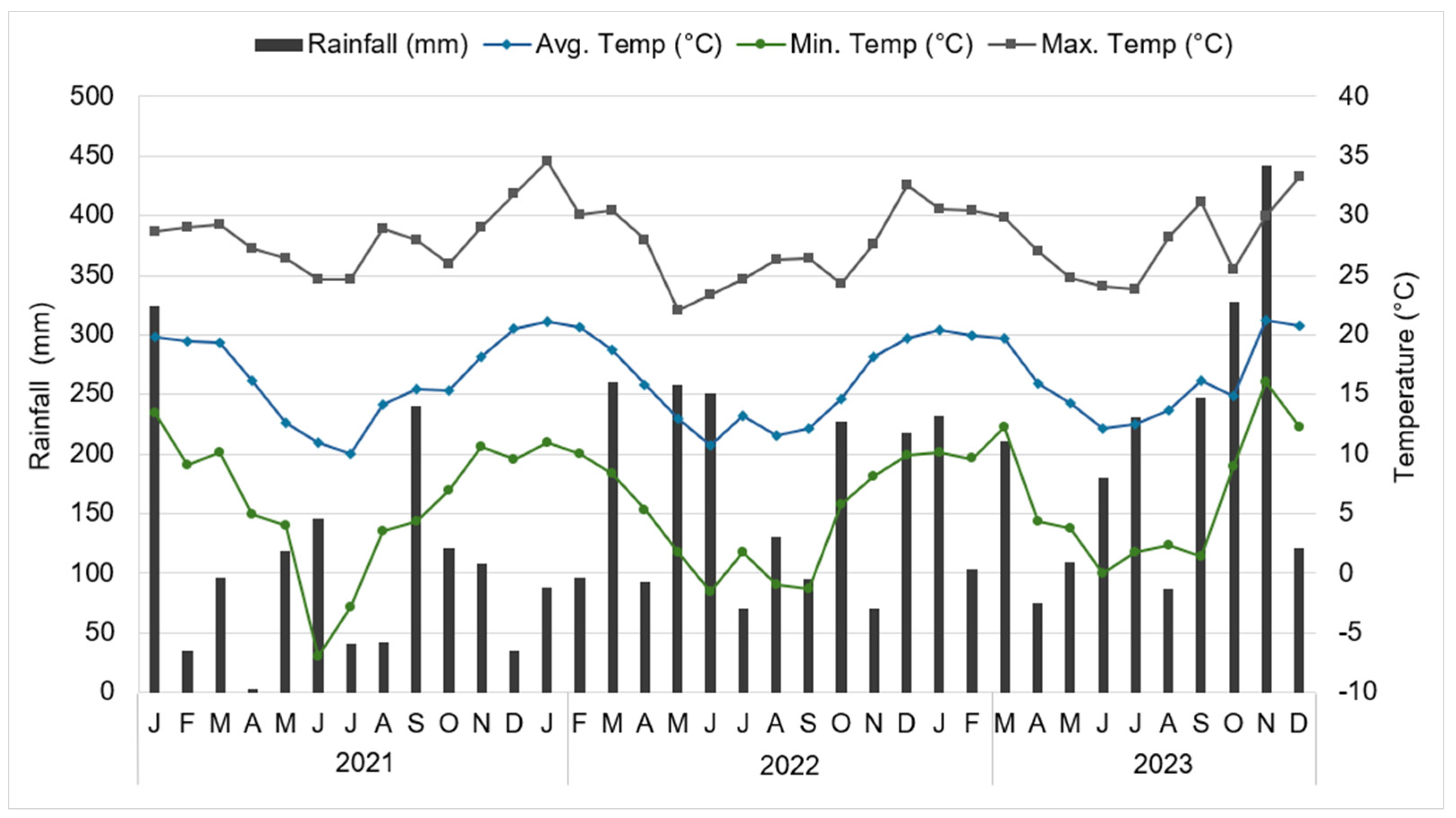
Figure 2.
Chilling units (CU) (Modified North Carolina Method) and chilling hours (CH) (≤ 7.2 °C) accumulated during the period from April 1 to September 30 in the years 2021, 2022, and 2023 for the municipality of Lages/SC, Brazil.
Figure 2.
Chilling units (CU) (Modified North Carolina Method) and chilling hours (CH) (≤ 7.2 °C) accumulated during the period from April 1 to September 30 in the years 2021, 2022, and 2023 for the municipality of Lages/SC, Brazil.
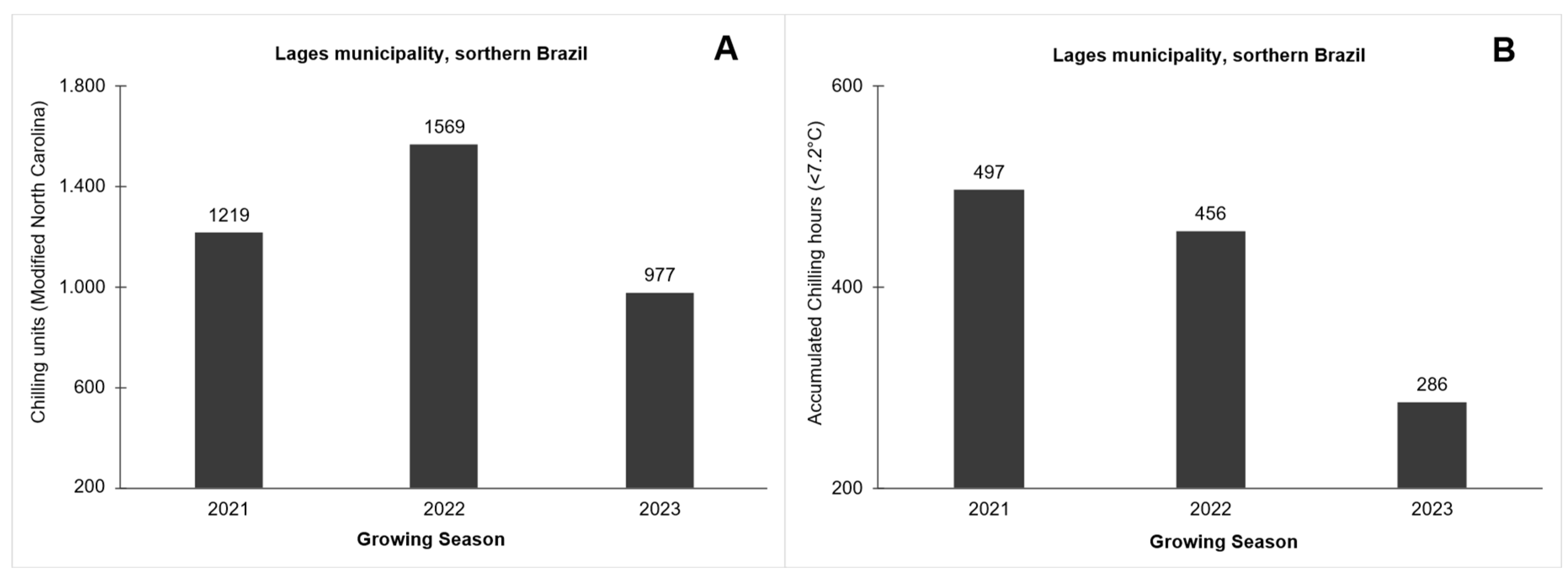
Figure 3.
Principal Component Analysis for yield parameters of 'Letícia' plum trees under application of different plant growth regulators for fruit set management, during the 2021/22 and 2022/23 growing seasons. AVG: aminoethoxyvinylglycine; TDZ: thidiazuron; 1-MCP: 1-methylcyclopropene.
Figure 3.
Principal Component Analysis for yield parameters of 'Letícia' plum trees under application of different plant growth regulators for fruit set management, during the 2021/22 and 2022/23 growing seasons. AVG: aminoethoxyvinylglycine; TDZ: thidiazuron; 1-MCP: 1-methylcyclopropene.
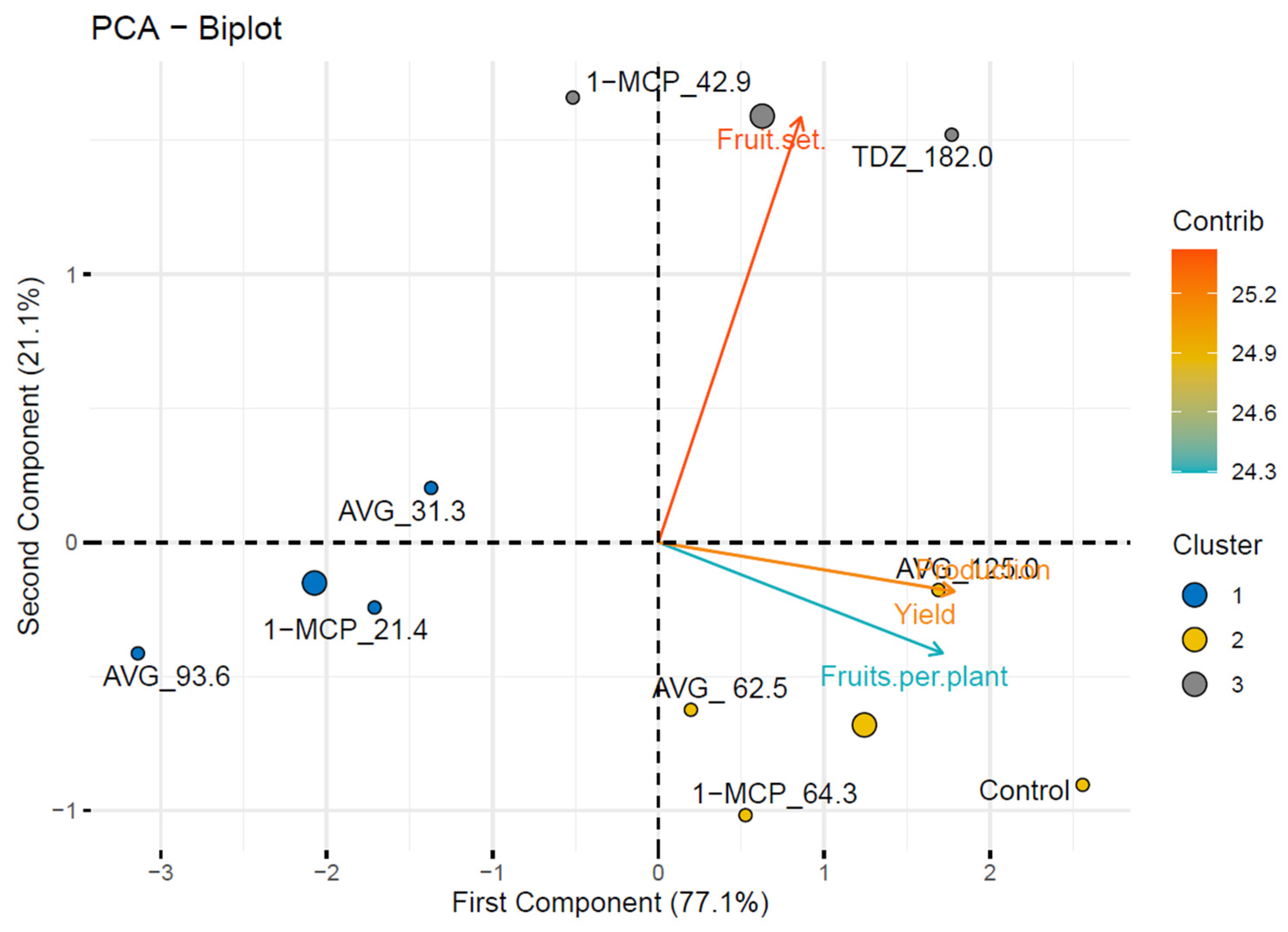
Figure 4.
Principal Component Analysis of fruit quality parameters of 'Letícia' plum trees with application of different plant growth regulators for fruit set management, during the 2021/22 and 2022/23 growing seasons. Fresh fruit mass (g), fruit height (FH), fruit diameter (FD), ratio FH/FD, epidermal luminosity (EL), epidermal chroma (EC), epidermal Hue angle (EH), pulp firmness (PF; N) and soluble solids (SS; °Brix). AVG: aminoethoxyvinylglycine; TDZ: thidiazuron; 1-MCP: 1-methylcyclopropene.
Figure 4.
Principal Component Analysis of fruit quality parameters of 'Letícia' plum trees with application of different plant growth regulators for fruit set management, during the 2021/22 and 2022/23 growing seasons. Fresh fruit mass (g), fruit height (FH), fruit diameter (FD), ratio FH/FD, epidermal luminosity (EL), epidermal chroma (EC), epidermal Hue angle (EH), pulp firmness (PF; N) and soluble solids (SS; °Brix). AVG: aminoethoxyvinylglycine; TDZ: thidiazuron; 1-MCP: 1-methylcyclopropene.
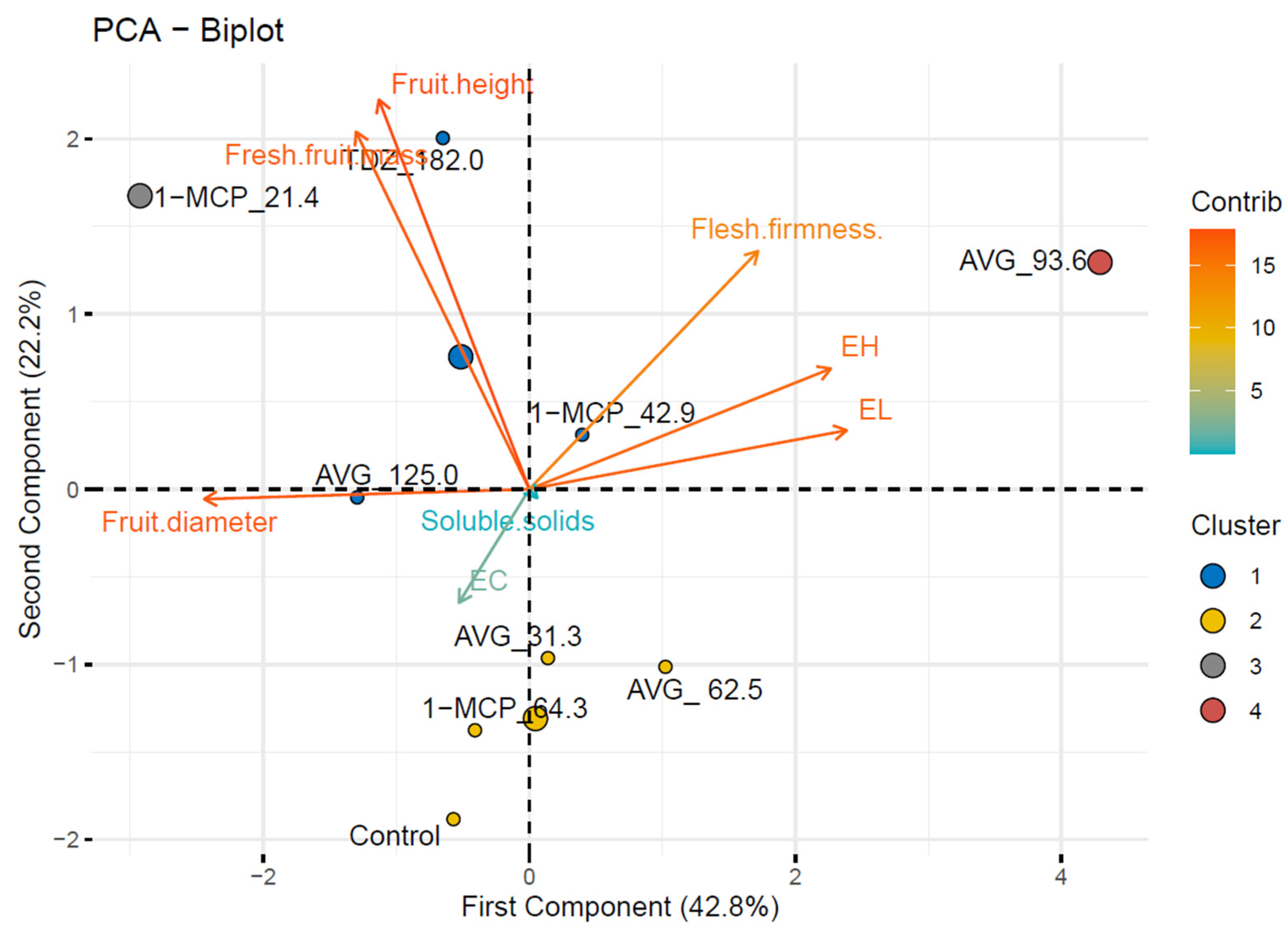

Table 1.
Yield parameters from principal component analysis of 'Letícia' plum cultivar under application of plant growth regulators, during the 2021/22 and 2022/23 growing seasons.
Table 1.
Yield parameters from principal component analysis of 'Letícia' plum cultivar under application of plant growth regulators, during the 2021/22 and 2022/23 growing seasons.
| Treatments | Fruit set 30 DAA* | Fruits per plant | Production | Yield |
| (%) | n° plant-1 | kg plant-1 | t ha-1 | |
| Control | 3.82 | 291 | 21.37 | 42.73 |
| 31.3 mg L-1 (AVG) | 3.81 | 277 | 16.96 | 33.92 |
| 62.5 mg L-1 (AVG) | 3.61 | 255 | 18.79 | 37.57 |
| 93.6 mg L-1 (AVG) | 3.19 | 203 | 15.29 | 30.59 |
| 125.0 mg L-1 (AVG) | 4.07 | 270 | 20.41 | 40.83 |
| 64.3 mg L-1 (1-MCP) | 3.42 | 256 | 19.46 | 38.91 |
| 42.9 mg L-1 (1-MPC) | 4.76 | 235 | 17.34 | 34.68 |
| 21.4 mg L-1 (1-MPC) | 3.48 | 214 | 17.11 | 34.21 |
| 182.0 mg L-1 (TDZ) | 4.98 | 251 | 20.50 | 41.01a |
*Days After Application; AVG: aminoethoxyvinylglycine; TDZ: thidiazuron; 1-MCP: 1-methylcyclopropene.
Table 2.
Yield parameters from principal component analysis of 'Letícia' plum cultivar under application of plant growth regulators, during the 2021/22 and 2022/23 growing seasons.
Table 2.
Yield parameters from principal component analysis of 'Letícia' plum cultivar under application of plant growth regulators, during the 2021/22 and 2022/23 growing seasons.
| Treatments | Fresh fruit mass | Fruit height | Fruit diameter |
| g | cm | cm | |
| Control | 73.22 | 4.72 | 4.82 |
| 31.3 mg L-1 (AVG) | 75.74 | 4.69 | 4.79 |
| 62.5 mg L-1 (AVG) | 73.87 | 4.68 | 4.73 |
| 93.6 mg L-1 (AVG) | 76.00 | 4.76 | 4.31 |
| 125.0 mg L-1 (AVG) | 77.35 | 4.76 | 4.87 |
| 64.3 mg L-1 (1-MCP) | 76.64 | 4.69 | 4.75 |
| 42.9 mg L-1 (1-MPC) | 75.09 | 4.77 | 4.81 |
| 21.4 mg L-1 (1-MPC) | 81.66 | 4.91 | 4.96 |
| 182.0 mg L-1 (TDZ) | 80.89 | 4.85 | 4.91 |
Table 3.
Fruit quality parameters from principal component analysis of 'Letícia' plum fruits under application of plant growth regulators during the 2021/22 and 2022/23 growing seasons.
Table 3.
Fruit quality parameters from principal component analysis of 'Letícia' plum fruits under application of plant growth regulators during the 2021/22 and 2022/23 growing seasons.
| Treatments | Colorimetry | Flesh Firmness | Soluble solids | ||
| EL | EC | EH | N | °Brix | |
| Control | 43.92 | 29.05 | 36.28 | 11.66 | 10.94 |
| 31.3 mg L-1 (AVG) | 44.95 | 28.75 | 35.23 | 16.11 | 10.85 |
| 62.5 mg L-1 (AVG) | 45.05 | 29.46 | 36.04 | 21.98 | 10.35 |
| 93.6 mg L-1 (AVG) | 46.84 | 28.85 | 46.20 | 23.78 | 10.90 |
| 125.0 mg L-1 (AVG) | 42.82 | 28.60 | 36.02 | 16.16 | 10.35 |
| 64.3 mg L-1 (1-MCP) | 44.47 | 29.86 | 35.75 | 14.59 | 10.75 |
| 42.9 mg L-1 (1-MPC) | 44.71 | 28.36 | 35.05 | 21.74 | 10.60 |
| 21.4 mg L-1 (1-MPC) | 43.17 | 29.43 | 32.73 | 16.07 | 10.99 |
| 182.0 mg L-1 (TDZ) | 44.81 | 28.91 | 37.67 | 19.95 | 10.46 |
Epidermis luminosity (EL), epidermis chroma (EC), epidermis hue angle (EH).
Disclaimer/Publisher’s Note: The statements, opinions and data contained in all publications are solely those of the individual author(s) and contributor(s) and not of MDPI and/or the editor(s). MDPI and/or the editor(s) disclaim responsibility for any injury to people or property resulting from any ideas, methods, instructions or products referred to in the content. |
© 2025 by the authors. Licensee MDPI, Basel, Switzerland. This article is an open access article distributed under the terms and conditions of the Creative Commons Attribution (CC BY) license (http://creativecommons.org/licenses/by/4.0/).
Copyright: This open access article is published under a Creative Commons CC BY 4.0 license, which permit the free download, distribution, and reuse, provided that the author and preprint are cited in any reuse.


