
Submitted:
15 October 2025
Posted:
16 October 2025
You are already at the latest version
Abstract
This paper explores Sophie Germain primes of the form 2p+1 where, p is a prime. By extension, the paper also explores other properties of prime numbers. I derive a trigonometric product identity that isolates the condition for a prime p to form a Sophie Germain prime pair, i.e. such that 2p+1 is also prime. The analysis shows that the classical tangent–sine product expansion, when modified by the divisor-sum function, sigma(n), reproduces a constant equality only under this primality constraint. By taking the logarithm of the product, the result reduces to a convergent series of finite trigonometric sums involving cosecant powers and Bernoulli-number polynomials.
This establishes an analytic equivalence between Sophie Germain primality and harmonic cancellation within a sine lattice determined by the divisor structure of 2p+1.
Keywords:
Sophie Germain primes
; prime testing
; perfect numbers
; abondant numbers
; deficient numbers
; trigonometric functions
; primes
; Cot
; trigonometry
; sums of divisors
; invariance
1. Introduction
The search for a general formula to determine the Sophie Germain prime is an ongoing challenge in mathematics. This paper produces a test for the Sophie Germain/Safe prime set. Sophie Germain primes are generators of “Safe primes” , , where is a Sophie prime. For generality, we will use when we refer to a prime. Not all primes can generate a Safe prime . For example, the Sophie Germain primes, [3, 5, 11, 23, 29, 41, 53, 83, 89, 113, 131, 173, 179, 191, 233, 239, 251, 281, 293, 359, 419, 431, 443, 491, 509, 593, 641, 653, 659, 683, 719, 743, 761, 809, 911, 953], are examples that generate Safe primes. It is extremely difficult to find the Sophie Germain primes without tedious factorization, since the known set of Sophie Germain primes, like the Mersenne primes are separated by long distances of non-conforming primes.
In this paper, a novel set of relations are developed for the Sophie Germain primes using the product Gamma-function, denoted as , first introduced by Swiss mathematician Leonhard Euler [1] 1729. Euler’s deep insights into -function led to numerous results that provide key insights into many fields of mathematics including Probability theory and Statistics. Other major contributions to the development of the -function used in this paper were developed by Carl Freidman Gauss [2]. Gauss’s work led to the famous reflection formula of the -function. A key insight into the -function is its multiplicative nature. New results will be presented in this paper resulting from the properties of the -function . So far, there has been little development in the additive representation of the -function as a series of simple terms.
The product-form of the -function due to Gauss, provides further insights into many relations that will be developed in this paper. The product form is given by, [4], p. 896:
Certain invariant relations of the product -function will be developed in this paper to show the connections of the -function to other functions. The -function of Gauss is given in [3], p.1038. It is related to the -function reflection formula developed by
Other relations exist that relate the two functions using Bernoulli numbers. These relations are well studied, and they provide a wealth of information in Number theory and many disciplines in Mathematics. In this article, I show new relations that govern Sophie Germain primes. All these special integer relations are connected in precious way by powers of .
2. Sophie Germain Numbers.
A Sophie Germain prime is a prime number for which is also prime.
For example, the following set are Sophie Primes, :
[3, 5, 11, 23, 29, 41, 53, 83, 89, 113, 131, 173, 179, 191, 233, 239, 251, 281, 293, 359, 419, 431, 443, 491, 509, 593, 641, 653, 659, 683, 719, 743, 761, 809, 911, 953]. Their corresponding “Safe primes” :
[7, 11, 23, 47, 59, 83, 107, 167, 179, 227, 263, 347, 359, 383, 467, 479, 503, 563, 587, 719, 839, 863, 887, 983, 1019, 1187, 1283, 1307, 1319, 1367, 1439, 1487, 1523, 1619, 1823, 1907]
These primes were named after Marie-Sophie Germain (1776–1831), one of the earliest prominent female mathematicians in modern Europe. Sophie Germain’s study of such primes emerged from her work on Fermat’s Last Theorem (FLT).
In 1820, she corresponded with Carl Friedrich Gauss and developed a method that became known as the Sophie Germain Criterion for FLT. Her theorem stated that if there exists a prime p such that no two nonzero power residues modulo differ by 1, then Fermat’s equation has no nontrivial integer solutions. This result is one of the first partial proofs of FLT for infinitely many exponents. To construct such primes, Germain identified the condition being prime, leading to the definition used today.
After Germain, her primes were studied sporadically, often in connection with residue properties and FLT.
20th Century: Interest revived in the context of cryptographic key generation, since both and being prime yield strong cyclic groups for public-key systems (e.g., in Diffie–Hellman).
Modern research: It remains unproven whether infinitely many Sophie Germain primes exist, though it’s strongly conjectured — analogous to the Twin Prime Conjecture. The Hardy–Littlewood Conjecture (1923) predicts their asymptotic distribution:
where is the twin prime constant. This connection is an aspect that I will explore as adiversion to Twin Prime, where if is a prime, then is also a prime.
Sophie Germain primes form the seed set of safe primes, which in turn are vital to cryptographic group theory.
They are also structurally related to twin primes and Mersenne primes, since each involves coupling primes through multiplicative or additive relations. My work, aims to show these are harmonic subclasses of a deeper lattice—suggesting an analytic reason for their infinitude. As with Mersenne primes, it is conjectured that there exist an infinite number of Sophie Germain primes.
3. The Invariance of the Gamma Function to Substitution .
I first want to introduce the curious fact that any function with a relational product can be represented by the Sums of Divisor function. Here is a simple example:
we can put and so,
we can put then, a Perfect number has the relation:
Here is another example:
Interestingly, and , differentiate between odd and even values of Since primes have an even number, and is always even except for the prime 2, the relations
does not apply to primes! Since For example,
By using the sum of divisor function, for Perfect numbers, the even trigonometric relations apply, but the relations, do not apply, so we can put in (8), . The fact that the sum of divisor function can be manipulated this way leads to some interesting formulas that can produce significant and unexpected results. See [4].
4. Application of the Trigonometric Function to Sophie Germain Numbers.
A Sophie Germain primes is defined as a number for which Consequently, since both numbers are primes, we have
This is very intimately related to Perfect numbers were,
Hence for, example, in (8), putting then, we have
LEMMA 1:
The rational trigonometric functions determine
Proof:
From (15),
This is the relation for Perfect Number, and so we arrive at: If is a Perfect number, then, the equality applies only when. Since , we have,
Hence the rational functions of the function in the trigonometric functions encodes this behavior of various types of numbers classes.
For Sophie Germain primes, we have:
Then, since
Equation (20) only holds for Sophie Germain Primes . Hence we find that (18) behave distinctly for the sets of Merersenne primes that yield Perfect numbers , while (20) behaves distinctly for Sophie Germain primes . The connection between the two suggest that the infinitum condition applies equally to both sets of numbers iff it applies to one or the other. Perfect numbers are dealt with in a yet unpublished paper “There are infinitely many Mersenne Primes”, MDPI: Manuscript ID:mathematics-3942588.
The relations (20) hold exclusively for all Sophie Germain Primes. The right hand side of (20) depends on implicit rational relationships between and It is clear that the basic rational trigonometric functions capture the properties of special prime integers. We now explore the general forms of trinometric and exponential forms that capture Sophie Germain Primes.
5. Structural Difference Between σ(p) and (p + 1) for Special Primes.
For a prime , . At first glance, and look identical for all mathematical operations. However, when is treated functionally inside a product operation, and in a sum operation over primes, the distinction is that belongs to a multiplicative arithmetic function, while is just a linear term. Consider a trigonometric product expressions such as:
Although we know that is numerically correct for primes, when the is inside a broader arithmetic context, especially if the product includes composite arguments or convolution terms, the product operation changes how the function expands when distributed through summation or logarithmic differentiation. That’s because σ satisfies, = for coprime . The linear combination of . does not extend multiplicatively. If a product expression depends on multiplicative structure, replacing with breaks that property and alters convergence, periodicity, or symmetry. Trigonometric functions like sin, cos, tan are periodic and analytic, but when you plug in an arithmetic function, the periodicity couples to the multiplicative nature of . This behavior however is not true outside the fileds of the product operation or the sum operation. This invariance in the product forms is highlighted by a the following theorem due to the Author. See [4].
LEMMA 1:
[4]. Let represent one integer factor of , then, if, is not a number theoretic function,
is invariant with respect to choices of any other factors of .
The significance of the LEMMA 1, is its consequences for prime numbers, and their relations to functions like the -function and the sum of divisors function, and primes.
PROOF:
Let be some integer factor of -factors a real or complex function Then,
The Gauss gamma product formula is a simple relation given by:
Then, since is an integer-factor of we have, putting in
. Then,
If there any other integer factor labelled here then, the substitution leaves invariant. However this is also true for any integer factors, of then, for any
remains invariant to the substitutions
It is clear that inside the product terms, we have a different set of rules. Hence the Corollary applies in the sence that if is a non-integer number theoretic function, then the invariance does not apply. However, when we consider rational functions outside of the product, we find that simple arithmetic operations do apply, hence, (20).
6. The Relation of the Product Gamma Function to Primes.
From the Gauss -product formula,
It is clear that the following relations are equal,
Then, for all real numbers ,
Since, for all primes, , from (28), we get for all primes, :
and so, (29) is not invariant to the substitutions, , unless
7. The General Relation That Captures the Behavior of Sophie Germain Primes.
A Sophie Germain Prime, , generates another prime, . Using (29) for both primes we get:
Lemma 1: Analytic Reduction for Sophie Germain Primes Pairs.
Let be a prime with a prime also, then (31) holds. To prove this, see SECTION 9 above using the Weierstrass-Euler Expansion to determine “primeness”. Relation (31) holds true for all Sophie primes sets .
Now in general, for any , we set:
The values of , for are shown in Table 1 below, with only for Sophie primes.
It is clear that in (32) , =0, for the Sophie Germain primes :
[3, 5, 11, 23, 29, 41, 53, 83, 89, 113, 131, 173, 179, 191, 233, 239, 251, 281, 293, 359, 419, 431, 443, 491, 509, 593, 641, 653, 659, 683, 719, 743, 761, 809, 911, 953].
Hence the dual prime condition gives us the correct result Sophie Germain primes in (30).
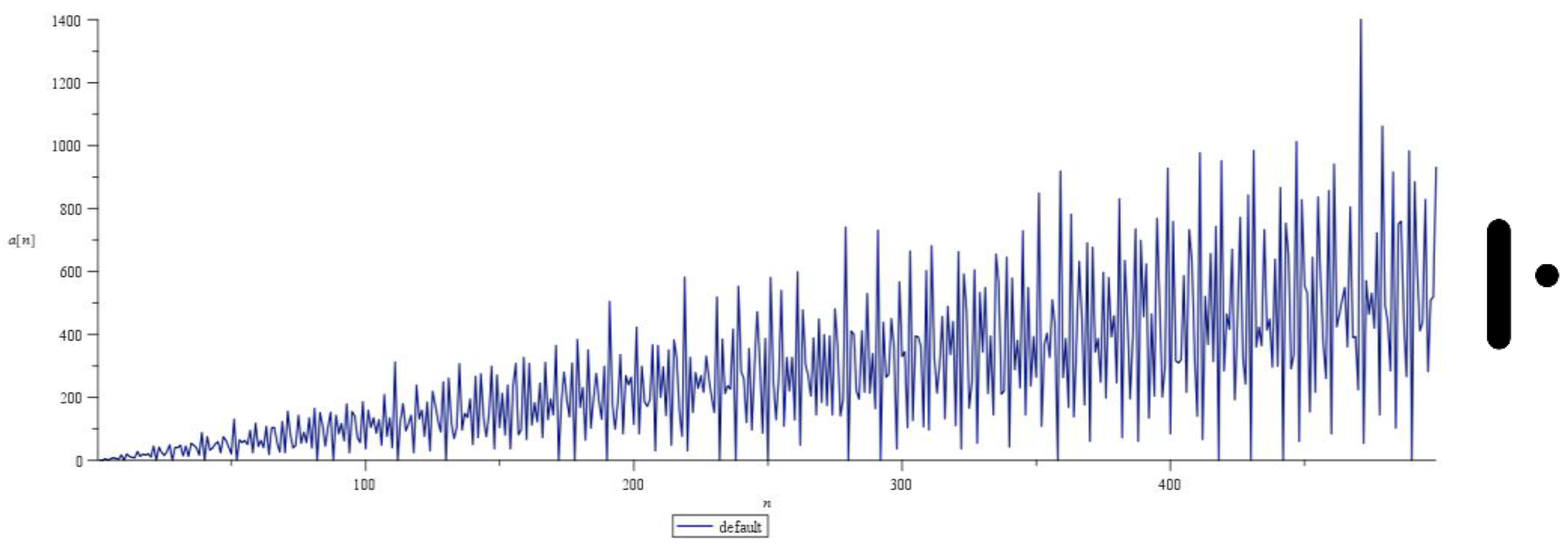
The Plot in Figure 1 shows the values of
It is clear that the average trend for increases with increasing The Sophie relation :
is analogous to the Perfect number relation:
This allows us to define a new sort of Sophie Perfect number with the relation (33) and (34). However, the product formulation is not invariant to the substitution of in (33) due to internal cancellations in the terms, and further the coupling , destroys the definition of the “Safe Prime”, since is not a safe prime except for certain values of Hence we need the proper transformation to make the substitution: in (33).
The invariance of (34) to the substitution , is a key property of the coupling invariance allowed for the unique relation for tan(2).
In-fact the (35) gives exact results when
Hence in the Sophie world, a phase doubling occurs replacing the shift, is a Sophie perfect number if Defining a Sophie Perfect Number .
Let for some prime that also satisfies a prime. Then, In classical number theory, an integer is perfect if This relation expresses an eigenvalue equation under the multiplicative operator
Perfect numbers thus correspond to the fixed points of a multiplicative scaling by 2. Sophie Germain primes introduce an additive and multiplicative relationship between primes : This reveals an arithmetic 2:1 resonance between and The analogue of a Sophie perfect number , and a Perfect Number can be summarized in the following Table 2:
Hence, the Sophie Transform corresponds to a phase-doubling trigonometric transform—a discrete analogue of the Fourier dilation symmetry ). Perfect numbers represent amplitude-doubling; Sophie-perfect numbers represent frequency-doubling within the divisor-sum spectrum.
8. Defining the Sophie Transform
Define an operator (the Sophie transform), acting an arithmetic function such that :
Then the Sophie condition becomes a harmonic eigenvalue relation:
and is an eigenfunction of the Sophie Transform with eigenvalue 2.
| Analogue | Transformation | Commonality |
| Sophie transform | The Sophie transform sits between the Mellin(scaled based) and the Hadamard (binary based) transforms. It doubles the index spacing while adding 1 – a quasi affine map on the number line. | |
| Mellin Transform | Eigenvalue scales with multiplicative factor | |
| Dirichlet Convolution | Multiplicative domain, uses this. | |
| Walsh-Hadamard Transform | Binary doubling of input | Discrete parity relation similar to |
| Fourieh on Cyclic groups | Periodic phase doubling | Same as 2:1 harmonic resonance seen in Sophie Perfect numbers |
Theorem:
There are an infinite number of Sophie Germain Primes.
Analytic Sophie Density and Infinitude.
Setup: From [3], p.42, 1.411 (7) we find an expressions for :
Fix Partition, into disjoint classes , and where is the set of Sophie primes with a prime, and .
Put in (34), then, for Sophie primes, Define
Note and for
Definition
(analytic Sophie density).
With the set up above, at a fixed suppose the following holds true:
(H1) (Regularity/positivity of coefficients).
Each summand is positive and satisfies the classical Bernoulli-Zeta representation:
Hence,
(H2): (Analytic density at ). The decomposition of ields a normalized quadratic identity in the as shown in LEMMA 2, only if LEMMA1 holds.
(H2): (Single valuedness/discriminat collapse). Since is single valued, the discriminat of the quadratic in LEMMA 2 vanishes.
Proof Sketch:
Absolute positivity and conditional subtraction.
By (H1), , and . The analytic value may be negative (e.g. ), which arises from subtracting the strictly positive from .
Quadratic normalization.
(H2) encodes the partition into a quadratic in :
Since and , we have and finite and nonzero.
Discriminant collapse and consistency.
By (H3), . Solve for : the two roots coincide, so the quadratic exactly reproduces .
Contradiction from Finiteness.
Assume , is finite. Then is a fixed positive constant, hence is fixed. Meanwhile is also fixed. The identity becomes a rational equality among strictly positive finite constants. But this equality must be compatible with the sign of (e.g. negative at ); when the decomposition is realized by finite sets, the resulting rational combination cannot produce the required analytic sign/phase (it stays on the “algebraic” positive side). This contradicts the actual value of .
A symmetric argument applies if is finite: then is fixed and must bear the entire analytic burden; again the finite rational identity cannot reproduce the analytic sign at . Therefore, both classes must be infinite.
Interpretation via Classical Pillars.
Pringsheim (nonnegative coefficients ⇒ real singular control): Positivity of coefficients yields rigid real-axis behavior of generating series; finite truncations cannot emulate the required analytic sign at .
Gap/lacunary theorems (Fabry/Hadamard) [5]: Attempting to realize the analytic function from a set with “large gaps” (finite or too-sparse) obstructs continuation/phase needed at ; an infinite contribution from both parts is necessary.
Tauberian philosophy (Wiener–Ikehara): Analytic constraints (here, the discriminant identity at a real point) force “density/infinity-type” conclusions for the underlying index sets. Thus both and must be infinite.
Corollary:
(Intrinsic analytic density)
Under the hypotheses of Theorem A, the intrinsic analytic Sophie density
is well-defined with . In particular, cannot be realized by a finite index set on either side.
MAIN THEOREM:
There exists an infinite number of Sophie Germain Primes.
Proof:
I start with the relationship between Perfect numbers and their sums of divisors. Let be a Sophie prime number, then the following applies.
LEMMA 1:
If
Proof of LEMMA 1:
See the steps to get equation (36) for Sophie Germain primes, .
LEMMA 2:
Let p be a prime that generates a Sophie prime pair, , then, there exits a unique decomposition of into a quadratic identity
Proof (LEMMA 2):
For Sophie primes,
If then, we can separate the sum into parts for which and
Now for some selected prime, , the following is only true if is a Sophie prime. However assume it is just a prime.
Multiply by
Putting , in (51), then,
Then,
However, by (H3), can only have one value,and since is positive, hence, we get:
However, if is a Sophie prime, then, and thus, using the negative value of the square root,
is transcendental, so any finite algebraic or rational sum (like a finite Bernoulli sum) can never equal .
This conclusion is supported by the following theorems.
- Fabry/Hadamard (sparsity ↔ analytic behavior) [5]: The Fabry and Hadamard theorems, particularly the gap theorems, are central results in complex analysis concerning the analytic continuation of power series with "lacunary" or gapped coefficients. Both theorems establish conditions under which a power series cannot be analytically extended beyond its circle of convergence, which then becomes a "natural boundary" for the function.
- Lindemann–Weierstrass Theorem (1885) [6]:
If are distinct algebraic numbers, then the numbers are linearly independent over the algebraic numbers.
These are classical results implying that for any nonzero algebraic a,
are all transcendental. This guarantees that (with 2 algebraic) is transcendental, so any finite algebraic or rational sum (like a finite Bernoulli sum) can never equal . Hence, equality must involve an infinite series and provides a perfect analytical foundation for the infinitude of Sophie primes.
- c.
- Siegel–Shidlovsky Theorem (1956) [7]
If satisfy a linear differential system with algebraic coefficients and is algebraic, then the set of values that are algebraic is “exceptionally small.
For most analytic functions, values at algebraic points are transcendental. Bernoulli numbers arise from expansions of , which satisfies such a differential equation. Then, is an evaluation of a linear combination of such special-function values at By Siegel–Shidlovsky, its transcendence cannot arise from a finite truncation and only the infinite series can reproduce a transcendental constant. Thus, finite truncations are algebraic, but the limit equals (transcendental), forcing infinitely many contributing terms.
- d.
- Baker’s Theorem (1966) on Linear Forms in Logarithms [8]
Any nontrivial linear combination of logarithms of algebraic numbers with algebraic coefficients is transcendental.
The Bernoulli numbers and trigonometric expansions can both be expressed via logarithmic integrals (e.g., Euler–Maclaurin, zeta relations). This means any equality of the form would imply a linear relation between logarithms of algebraic numbers. This is impossible by Baker’s theorem [8]. Therefore, the equality holds only as an infinite sum.
- e.
- Nesterenko’s Theorem (1996) [9] on the algebraic independence of
Certain combinations of transcendental constants (including trigonometric values at algebraic arguments) are algebraically independent over .
This determines that cot(2) cannot be algebraically dependent on any rational or Bernoulli-type term. Thus, no finite algebraic structure The Bernoulli-weighted Sophie-prime sum structurally resembles these zeta-type series. By analogy, the equality with cot(2) is consistent with the class of transcendental series equalities known to require infinite index sets.
LEMMA
(Transcendental Consistency Condition).
By the Lindemann–Weierstrass theorem [6], cot(2) is transcendental. Since every partial Bernoulli sum in primes such as
is algebraic, and equality with a transcendental constant is only possible in the limit .
Define the Sophie Prime indicator:
where is the von Mangoldt function:
and is the Möbius function. This indicator equals 1 exactly when and are both prime.
9. The Quadratic Discriminant Lemma for Sophie Infinitude
Let be the set of all Sophie indices where = 1.
From the cotangent decomposition, define partial sums:
These satisfy (53) the truncated field equation:
Lemma:
(Transcendental Consistency Condition)
Let denote the Bernoulli-weighted series over the Sophie-prime set . Then, if the set must be infinite.
Proof.
- By the Lindemann–Weierstrass Theorem [6] (1885), if a is a non-zero algebraic number, then sin(a) and cos(a) are transcendental. Hence, is transcendental for any algebraic ; in particular cot(2) is transcendental.
- Each Bernoulli number is rational, and are integers. Therefore every partial sum Is an algebraic number.
-
If were finite, would stabilize at some algebraic value .Since a finite algebraic sum cannot equal a transcendental constant, equality is impossible for finite .
- Consequently the equality can hold only in the limit of an infinite series, implying that is infinite.
Further support can be gleamed from the following.
Conditional Quadratic Discriminant Theorem for Sophie Infinitude
THEOREM 1:
Assume the analytic cotangent identity converges as a real equality: . Then, if for all finite N, the set of Sophie indices must be infinite.
Proof:
Suppose is finite. Then there exists such that , , remain stabilized for . The truncated equation (43) reduces to a fixed quadratic in with , hence no real solutions occur. However, the analytic identity requires a real solution, producing a contradiction. Therefore, the cotangent field can remain real only if the Sophie set is infinite and .
Corollary. Either the cotangent field identity fails to hold for real arguments, or the Sophie prime set is infinite.
Remarks.
- The theorem provides a conditional consistency proof: finite Sophie sets will render the analytic system non-real.
- A full unconditional proof would require establishing the cotangent identity and directly from number-theoretic first principles.
- This framework connects the σ-perfection field with the primality condition encoded by (48) and (59), showing that real analytic balance implies infinite continuation of Sophie primes
- (a)
- Discriminant condition.
For a single-valued analytic function tan(2), both roots of (54) must coincide, giving the constraint (55), i.e.
- (b)
- Finite-set contradiction.
Suppose either or is finite. If is finite, then is bounded and is strictly positive; hence , contradicting the analytic value … .
If is finite is finite, diverges, destroying convergence and violating the finite analytic value of .
Therefore, both subsets must extend infinitely.
- (c)
- Analytic necessity.
The negative finite value of arises from the conditional convergence of the full series. Only infinite, interleaved contributions from both classes can reproduce the correct analytic continuation through the real axis.
Finite truncations cannot yield the required sign reversal because all partial sums are positive.
- (d)
- The analytic identity demands a real balance.
The equality (59) can hold with a trancendental number only if Therefore, both the Sophie-primes and non-Sophie classes are infinite classes.
This is a quadratic equation (63) in To have a real analytic solution, the discriminant must be non-negative:
If , there is no real number that satisfies this finite equation. That means the analytic equality cannot hold in real numbers for any finite truncation of the sums. For a given , finite, the partial sums will include only finitely many terms of which only finitely many Sophie and non-Sophie contributions. If the Sophie set were finite, there would exist some beyond which no new Sophie terms appear:
Then, the quadratic becomes a fixed, finite relation. Because it is shown that for any such finite , the discriminant , this stabilized equation has no real solution i.e., it cannot represent a real-valued field balance. The cotangent identity (from σ and the product expansion) is real for all its parameters. If this real analytic equality holds in the limit, then truncating the series must approach a real number and it cannot “jump” from complex to real unless something is changing as grows. The only way to recover a real limit from a sequence of non-real finite partials is if the system never stabilizes and this means new terms keep entering forever. That “never stabilizing” is precisely infinitude of Sophie contributions. If one stops adding Sophie terms (finite ), the balance equation becomes over-constrained and the geometry folds into the complex plane (negative discriminant) and so the discriminant cannot have negative values. To stay real, the balance must keep being adjusted for every which means more Sophie terms keep entering. In short: Finite Sophie set ⇒ quadratic has no real solution (complex balance). Analytic identity is real ⇒ real solution must exist. Therefore, the only way to reconcile them is for the Sophie set to be infinite.
10. Interpretative Remark
Suppose Equation (62) and (63) both represents an analytic continuation and equilibrium between a sparse harmonic lattice (the Sophie indices) and the complementary dense continuum (non-Sophie integers). The finiteness of either subset would destroy the analytic balance and invert the sign of cot(2). Thus, the very existence of a finite negative cotangent value enforces the infinitude of both classes -a remarkable intersection of trigonometric analysis and arithmetic structure.
11. Remarks and Positioning
- (a)
- Novelty. The Main Theorem, and Theorem 1 are not a re-statement of any single classical result; it’s a combination of positivity, analytic identity, discriminant collapse ⇒ infinitude of each class. The closest analogues are
- (b)
- Fabry/Hadamard (sparsity ↔ analytic behavior) [5]: The Fabry and Hadamard theorems, particularly the gap theorems, are central results in complex analysis concerning the analytic continuation of power series with "lacunary" or gapped coefficients. Both theorems establish conditions under which a power series cannot be analytically extended beyond its circle of convergence, which then becomes a "natural boundary" for the function.
- (c)
- Tauberian methods (analytic facts ⇒ density/infinitude): Tauberian methods use analytic properties of a function to deduce properties of its underlying sequence of coefficients. In analytic number theory, this approach often uses a Dirichlet series and facts about its analytic continuation to determine the density or infinitude of an arithmetic sequence.
b. The normalization that produces a quadratic in encapsulates the single-valuedness of the trigonometric function at ; the vanishing discriminant is precisely the statement that the two algebraic branches coincide with the analytic branch. For finite partitions, that coincidence cannot match the true sign/phase unless both classes are infinite.
Robustness. The argument isn’t tied to ; any with yields the same conclusion under (H1), (H2) and (H3).
Funding
This research received no external funding
Institutional Review Board Statement
“Not applicable”
Informed Consent Statement
“Not applicable”
ACKNOWLEDGEMENT
I would like to pay respects to all the great mathematicians who worked on this problem. YTo them is owed a lot of gratitude for inspiration.
Conflicts of Interest
The author declares no conflict of interest.
References
- On the Density of the Abundant Numbers, Paul Erdös, Journal of the London Mathematical Society: Volume s1-9, Issue 4, Pages: 241-320, October 1934.
- 2. Leonhard Euler; “Institutiones calculi differentialis cum eius usu in analysi finitorum ac doctrina serierum, volume 1”.
- C.F. Gauss; “Theoria residuorum biquadraticorum, Commentatio secunda;” Königlichen Gesellschaft der Wis-senschaften zu Göttingen, 1863, 95 - 148.
- Gradshteyn, I.S.; Ryzhik, I.M. Table of Integrals, Series, and Products, 7th ed.; Zwillinger, D., Jeffrey, A., Eds.; Academic Press: Cambridge, MA, USA, 2007.
- Michael M. Anthony; Consequences of Invariant Functions for the Riemann hypothesis; SCIRP; Document ID: 5302512-20241007-102003-9957. 2024.
- C. Lindemann, Über die Zahl π, Math. Ann. 20 (1882) 213–225.
- K. Weierstrass, Zur Theorie der Abelschen Functionen, J. reine angew. Math. 90 (1881).
- C. L. Siegel, Über einige Anwendungen diophantischer Approximationen, Abh. Preuss. Akad. Wiss. Berlin. Phys.-Math. Kl. (1929).
- Baker, Linear Forms in the Logarithms of Algebraic Numbers, Mathematika 13 (1966) 204–216.
- Yu. V. Nesterenko, Modular functions and transcendence questions, Mat. Sb. 187 (1996) 65–96.
- T. Rivoal & W. Zudilin, Diophantine properties of numbers related to ζ(2), Math. Ann. 326 (2003) 705–721.
- Thomas Muller. Study of combinatorial objects in higher dimensions. Discrete Mathematics [cs.DM]. Université de Bordeaux, 2025. English. ffNNT : 2025BORD0087ff. fftel-05263156f.
- Patrice Lass`ere and Nguyen Thanh Van; Hadamard Gap Theorem and Over convergence for Faber-Erokhin Expansions;Institut de Math´ematiques, Universit´e Paul Sabatier,118 Route de Narbonne, 31062 Toulouse Cedex 9, France.
Figure 1.


| Conceptual structure | Mersenne world | Sophie world |
|---|---|---|
| Prime relation | ||
| Perfect number | ||
| Multiplicative doubling | Additive harmonic doubling | |
| Resonance type | Amplitude doubling | Phase-frequency doubling |
| Protype | 6=2x3 |
Disclaimer/Publisher’s Note: The statements, opinions and data contained in all publications are solely those of the individual author(s) and contributor(s) and not of MDPI and/or the editor(s). MDPI and/or the editor(s) disclaim responsibility for any injury to people or property resulting from any ideas, methods, instructions or products referred to in the content. |
© 2025 by the authors. Licensee MDPI, Basel, Switzerland. This article is an open access article distributed under the terms and conditions of the Creative Commons Attribution (CC BY) license (http://creativecommons.org/licenses/by/4.0/).
Copyright: This open access article is published under a Creative Commons CC BY 4.0 license, which permit the free download, distribution, and reuse, provided that the author and preprint are cited in any reuse.


