

Submitted:
13 October 2025
Posted:
14 October 2025
You are already at the latest version
Abstract
The fiberboard industry remains heavily reliant on synthetic, formaldehyde-based adhesives, which, despite their cost-effectiveness and strong bonding performance, present significant environmental and human health concerns due to volatile organic compound (VOC) emissions. In response to growing sustainability imperatives and regulatory pressures, the development of non-toxic, renewable, and high-performance bio-based adhesives has emerged as a critical research frontier. This review, conducted through both narrative and systematic approaches, synthesizes current advances in green adhesive technologies with emphasis on lignin, tannin, starch, protein, and hybrid formulations, alongside innovative synthetic alternatives designed to eliminate formaldehyde. The Evidence for Policy and Practice Information and Coordinating Centre (EPPI) framework was applied to ensure a rigorous, transparent, and reproducible methodology, encompassing the identification of research questions, systematic searching, keywording, mapping, data extraction, and in-depth analysis. Results reveal that while bio-based adhesives are increasingly capable of approaching or matching the mechanical strength and durability of urea-formaldehyde adhesives, challenges persist in terms of water re-sistance, scalability, cost, and process compatibility. Hybrid systems and novel cross-linking strategies demonstrate particular promise in overcoming these limitations, paving the way toward industrial viability. The review also identifies critical research gaps, including the need for standardized testing protocols, techno-economic analysis, and life cycle assessment to ensure the sustainable implementation of these solutions. By integrating environmental, economic, and technological perspectives, this work high-lights the transformative potential of green adhesives in transitioning the fiberboard sector toward a low-toxicity, carbon-conscious future. It provides a roadmap for research, policy, and industrial innovation.
Keywords:
biodegradable adhesive
; carcinogenic
; eco-friendly adhesive
; environmental
; fiberboard industry
; formaldehyde-based adhesives
; occupational health
1. Introduction
The global fiberboard industry is undergoing a critical transformation, driven by increasing awareness of environmental sustainability, occupational health, and consumer safety. Traditionally, urea-formaldehyde (UF) adhesive has dominated as the adhesive of choice in the production of fiberboard and other wood-based composites, owing to its low cost, strong bonding properties, and ease of application. However, mounting scientific research evidence highlights their considerable drawbacks, particularly their formaldehyde emissions, which have been linked to adverse health outcomes and environmental burdens [1,2,3]. Formaldehyde is classified as a human carcinogen by the International Agency for Research on Cancer [4], and prolonged exposure has been associated with respiratory irritation, asthma, and heightened risks of nasopharyngeal cancer. Several scientific studies agreed that in residential and occupational settings, fiberboard products containing UF adhesives continue releasing volatile organic compounds (VOCs) throughout their service life, thereby compromising indoor air quality [5,6]. The fiberboard industry plays a pivotal role in the global construction and furniture sectors, producing essential materials such as Medium Density Fiberboard (MDF) and Particleboard. These products are primarily manufactured by bonding wood fibers using synthetic adhesives, notably urea-formaldehyde (UF) adhesive. While effective in providing structural integrity, the use of UF and formaldehyde-based adhesives has raised significant health and environmental concerns due to the formaldehyde emissions they produce.
Formaldehyde, a colorless and pungent-smelling gas, is classified as a human carcinogen. Prolonged exposure to formaldehyde can result in cancer, including nasal and sinus cancer and leukemia. These cancers take several years or decades to develop [1,7,8]. Working eight hours daily for 40 years at the level of the government standard would give you a risk of about 2 in a thousand of getting cancer [4]. Repeated exposure to formaldehyde may cause bronchitis, skin, and asthma-like allergy. Some people are susceptible to formaldehyde, whereas others do not react to the same level of exposure. There is limited evidence that formaldehyde may damage the developing fetus and affect female fertility [9]. Recent studies illustrate the scale of the problem. For example, Nielsen et al. [8], Cheung et al. [10], and H’ng et al. [11], reported that particleboards bonded with UF resins released between 0.12–0.50 mg/m3 of formaldehyde, often exceeding the World Health Organization’s safe indoor limit of 0.10 mg/m3. Similarly, Frihart et al. [12], and Du et al. [13], observed that formaldehyde emissions from UF-bonded panels remained detectable more than five years after production, confirming their long-term risks to human health.
From an environmental perspective, adhesives contribute significantly to the overall ecological footprint of wood-based panels. The synthesis of UF adhesive relies heavily on non-renewable petrochemical feedstocks, and their life cycle is marked by high carbon emissions, limited biodegradability, and toxic by-products [14,15]. End-of-life disposal poses particular challenges. Incineration of UF-bonded panels releases nitrogen oxides, carbon monoxide, and free formaldehyde vapors [16,17]. Landfilled residues pose a risk of leaching harmful compounds into soil and groundwater, creating long-term ecological hazards. These environmental impacts are equally concerning. UF adhesives contribute to volatile organic compound (VOC) emissions, which lead to indoor air pollution and contribute to environmental degradation. The persistence of these emissions poses long-term ecological risks, necessitating a shift towards more sustainable practices in the industry.
In response, green adhesives have emerged as viable and sustainable alternatives. Derived from renewable sources such as lignin, tannins, soy protein, starch, and cashew nut shell liquid, these adhesives offer several significant advantages, including reduced toxicity, lower VOC emissions, renewable sourcing, biodegradability, and compatibility with circular economy principles. Several studies indicate that soy-based adhesives achieved formaldehyde emissions near zero, corresponding only to the volatile organic compounds from the wood itself and met the formaldehyde emission regulation, effectively eliminating the hazard while maintaining mechanical strength comparable to UF panels [18,19]. Dunky [20], and Mantanis et al., [21], reported that tannin-based adhesives achieved bonding strengths of 0.8–1.0 MPa, which falls within industrial standards for medium-density fiberboard (MDF).
Moreover, global regulatory frameworks are accelerating this shift. The European Union enforces strict emission classes for formaldehyde (E1: ≤0.124 mg/m3; E0: ≤0.05 mg/m3), while the California Air Resources Board (CARB Phase II) requires ≤0.05 ppm for MDF. These standards have pressured manufacturers to seek safer adhesive technologies. At the same time, consumer preferences are evolving. Surveys indicate that over 70% of buyers in Europe and North America prefer eco-labeled furniture products, creating market incentives for the adoption of green adhesives [22]. The fiberboard industry has demonstrated increasing readiness to transition. Pilot-scale trials of soy-based and lignin-based adhesives in Europe and Asia have shown promising results in large-scale production, although cost competitiveness and durability under humid conditions remain challenges [23]. Advances in nanocellulose reinforcement and enzyme-assisted curing are indeed making bio-based adhesives more commercially viable by improving their mechanical strength, sustainability, and curing properties [24]. Nanocellulose, derived from abundant cellulose, enhances adhesives by providing superior reinforcement. At the same time, enzyme-assisted processes offer more precise, eco-friendly curing methods, addressing limitations of traditional adhesives and paving the way for broader adoption in various industries, especially wood-based products [25,26].
Against this backdrop, the concept of “Greening the Bond”, advancing sustainable and non-toxic adhesives for the fiberboard industry, has gained both scholarly and industrial significance. Transitioning from UF-based adhesives to green adhesives addresses urgent health and environmental concerns, aligning with global sustainability agendas such as the United Nations Sustainable Development Goals (SDGs 3, 9, 12, and 13) [27]. This study, therefore, explores empirical evidence, technological advancements, and industrial opportunities surrounding the adoption of green adhesives, providing both academic insights and practical guidance for stakeholders in the fiberboard sector.
2. Materials and Methods
2.1. Narrative Literature Review
A narrative literature review was conducted in the first section of the review to identify the utilization of various green adhesives for producing fiberboards that meet or exceed international industrial standards. Several studies emphasize that a narrative review is an amalgamation of published articles that typically summarizes the contents of each manuscript [28]. The focus was on publications from Academic Sources, including Google Scholar and ResearchGate, as well as other relevant publications related to the thematic areas of the review. The decision to source literature from these platforms was deliberate, as they provide access to a comprehensive body of academic resources that enhance the depth and credibility of the study. Google Scholar offers a wide range of peer-reviewed articles, books, and conference proceedings, while also providing practical tools such as citation tracking and related works for efficient literature mapping. Academia and ResearchGate, on the other hand, expand accessibility to preprints, working papers, and grey literature, which are valuable for identifying current debates and emerging research gaps. Additionally, these platforms facilitate scholarly networking, enabling direct engagement with authors for clarification, feedback, and potential collaboration. Collectively, these sources ensure that the research is informed by diverse, credible, and up-to-date academic contributions, thereby enhancing the reliability and scholarly relevance of the study.
Baumeister [29] emphasized that a narrative review is appropriate when a literature review is desired in relation to a collection of quantitative studies that have used diverse methodologies or examined different theoretical conceptualizations, constructs, and/or relationships. Siddaway et al., [29] and Campbell et al. [30] confirmed that narrative reviews synthesize the results of individual quantitative studies, without reference to the statistical significance of the findings. They serve as a handy means of linking studies on different topics for reinterpretation or interconnection, thereby developing or evaluating a new theory [28,32].
2.2. Systematic Literature Review
This method was adopted to collect literature on green adhesives and harmful adhesives from published studies and literature that utilizes these two groups of adhesives in the production of fiberboards. Siddaway et al., [28] advocated that systematic reviews of scientific research aim to answer specific review questions from published research reports by identifying relevant studies, characterizing such studies to form a systematic map of research in the area, extracting relevant data to establish the value of the findings, and synthesizing and reporting the outcomes.
The Systematic literature review in this study adopted the Evidence for Policy and Practice Initiative (EPPI) [33] method, which the Organization for Economic Co-operation and Development (OECD) 2002 report emphasized that it builds up the methodologies for scientific reviews and exploits the results for future research, which are the most critical efforts currently needed for accumulating knowledge on educational research. Bennett et al. [34] reiterated that the [33] review method tends to contain studies with a wider variety of research designs and draws extensively on those of systematic reviews undertaken in other areas. The main phase of the [33] method used is outlined in Table 1.
The [33] method is essential because it provides a systematic, transparent, and structured approach to reviewing literature. It ensures clarity of focus through well-defined research questions, applies rigorous inclusion and exclusion criteria to minimize bias, and uses a clear review protocol to enhance reproducibility. Comprehensive searching, keywording, and mapping help organize and identify knowledge gaps, while in-depth review and quality assessment strengthen reliability. Ultimately, structured reporting and dissemination enhance the credibility, accessibility, and utility of the findings for both researchers and policymakers, thereby supporting evidence-based decision-making.
3. Results and Discussion
The results in Figure 1 presents the results of a keyword search conducted across 1,107 published articles, including 54 from MDPI Sustainability (2023–2025), 23 from Academia, 66 from Elsevier, 37 from ResearchGate, and 128 from MDPI Polymers, as well as contributions from international scientific conference proceedings, policy documents, theses, handbooks, and public health publications spanning 1992 to 2025.
As illustrated in Figure 2, the largest share of publications appeared in MDPI Polymers (19.34%). A significant proportion of globally influential papers emphasized concerns regarding formaldehyde emissions and their link to cancer risk, as well as the development of eco-friendly fiberboards with reduced formaldehyde content, sustainable bio-based adhesives for wood composites, and formaldehyde-free bio-adhesives for plywood, particleboards, and the entire fiberboard industry. Notably, 98% of the reviewed literature was published between 2008 and 2025, compared to only 2% between 1992 and 2007, indicating a sharp increase in scholarly attention over the past two decades.
Several interrelated drivers justify the urgent need for growing research and policy engagement on the review. First, formaldehyde-based adhesives, though long established in composite wood production, are now widely recognized as a significant source of indoor air pollution and a proven human carcinogen, leading to increasing health and regulatory concerns worldwide. Second, the global shift towards sustainable materials and green chemistry has intensified efforts to identify renewable, bio-based, and non-toxic adhesive alternatives that align with circular economy principles. Third, the rapid growth in demand for engineered wood products, such as fiberboard, MDF, and particleboard, has heightened the urgency to develop safer and more sustainable adhesive systems that ensure industrial scalability while minimizing environmental footprints. Finally, policymakers, industry stakeholders, and the scientific community view the transition toward non-toxic adhesives not only as a health imperative but also as an opportunity to enhance competitiveness, meet evolving consumer preferences, and comply with stringent emission regulations such as E0 and Super E0 standards. Consequently, the discourse surrounding sustainable and non-toxic adhesives extends beyond laboratory innovation to broader socio-economic, environmental, and regulatory frameworks, explaining why it has become a focal point of research and policy debate over the past two decades.
3.1. Narrative Literature Review
3.1.1. The Paradigm Shift in the Fiberboard Adhesive Industry
Replacing petrochemical, formaldehyde-based adhesives, such as urea-formaldehyde, phenol-formaldehyde, and melamine formaldehyde, in the fiberboard industry is a high priority due to indoor-air health risks, regulatory pressure, and sustainability goals. Numerous biomass-derived and residue-sourced materials have been evaluated as primary binders, co-binders, or performance enhancers. This review organizes them by biochemical class and supply origin, emphasizing technological properties evaluation data (dimensional stability, static bending, compression, hardness, internal bond, and tensile) as observed by [35].
This focused narrative review draws on scientific studies and reviews of published documents and reports from 2008 to 2025, identified in major databases, journals, and report publication outlets. Representative searches targeted combinations of terms such as “soy protein adhesive particleboard”, “lignin adhesive Medium Density Fiberboard (MDF)”, “tannin citric acid adhesive”, “starch adhesive particleboard”, “chitosan wood adhesive”, “cellulose nanofibrils adhesives”, “bacterial cellulose adhesives”, and “bio-polyurethane particleboard”. Key scientific papers and high-quality reviews were prioritized, and all the appropriate sources were duly cited throughout the paper.
- Plant-Derived Protein Sources
1.1 Soy Protein (Soymeal, Soy Protein Isolates)
Several studies have confirmed that soy protein adhesives are the most extensively studied bio-protein adhesives for agroforest-based panel boards [36,37]. Denatured soy protein adhesives, when crosslinked (for example, with tannin additions or polycarboxylic acids) or chemically modified, can reach internal bond (IB) strengths in ranges that approach commercial UF resins for non-structural panels (typical IB reported ~0.6–0.9 MPa in many lab/pilot studies) and show near-zero formaldehyde emissions [38,39]. However, unmodified soy adhesives are moisture-sensitive and often require additives (such as crosslinkers and hydrophobic modifiers) and process adjustments (including hot-press conditions) to meet industrial standards. Several empirical studies and reviews document formulation strategies and pilot trials [40,41].
The availability of soy does not need to be overemphasized, as several studies and reports have confirmed. Soymeal is abundant as a by-product of oil extraction, making it a low-cost feedstock in major soy-producing regions. Using meal valorizes an existing residue stream [42,43]. However, it is imperative to appreciate that trade-offs include food and industrial utilization, which could be the imminent concerns in some contexts [44,45].
1.2 Polyphenolic Feedstocks: Tannins and Tannin-Based Systems Tannins (Mimosa, Quebracho, other Bark Extracts)
Tannins are polyphenolic extracts from bark and wood that can act as phenol replacements or as primary adhesives. Studies have confirmed that tannin-citric acid adhesives exhibit strong bonding and improved water resistance, without the use of formaldehyde, with internal bond values and dimensional stability comparable to or surpassing those of phenol formaldehyde adhesives in several studies, making them suitable for specific applications. The citric acid in these formulations promotes esterification reactions with tannin, enhancing both mechanical properties and durability [46,47]. Pilot work has moved tannin-citric adhesives toward pre-commercial trials [48,49].
Tannins, which are renewable compounds derived from plant sources like agroforestry residues, face practical limitations in their industrial use due to regional variations in their chemical composition and inconsistent supply. These naturally occurring polyphenols protect plants, but their structures and concentrations vary depending on the species and location, creating challenges for their consistent application in green chemistry and other industries [50,51]. The multiple carboxyl groups on CA react with the hydroxyl groups of tannins and other components, forming covalent bonds and ester linkages. This results in a more robust, water-resistant material, which is a key benefit for wood-based panel applications as a sustainable alternative to formaldehyde-based adhesives [52,53].
1.3 Lignin and Lignin-Derived Materials Technical Lignin (Kraft, Organosolv, Soda)
Lignin, an abundant pulping by-product, offers phenolic structures that can substitute phenol in phenol-formaldehyde-type adhesive or be modified into reactive adhesives. Studies show that partial substitutions (often 30-50% phenol replacement) can produce acceptable mechanical properties; chemically modified lignin (phenolation, methylolation, depolymerization) increases reactivity and bond performance. These authors further agreed that these modifications create more suitable reactive sites on the lignin molecule, leading to resins with improved mechanical strength, thermal stability, and adhesive properties, while also offering environmental benefits by reducing reliance on fossil-based phenol and lowering formaldehyde emissions [54,55,56,57]. Reviews and experimental papers document lignin-modified copolymers, lignin-phenol formaldehyde alternatives, and lignin-based polyurethane precursors [58,59,60,61].
However, studies indicate that lignin's high availability from biorefineries is challenged by its inherent structural heterogeneity, which refers to variations in its molecular weight and functional groups depending on the biomass source and extraction method. This variability makes it challenging to achieve consistent formulation properties when using lignin as a raw material [62,63]. For example, Kraft lignin and lignosulfonates differ significantly in their structure and properties, making one more suitable for some applications and the other for different ones [64,65].
1.4 Saccharide and Starch Sources ˗ Native and Modified Starches (cassava, corn, potato)
Starch is inexpensive and widely used in adhesives. Historically, modified starches (oxidation, esterification, grafting, PVA blends) have improved thermal behaviour and water resistance. Studies show that moderate IB (commonly 0.5–0.7 MPa) and acceptable panel properties are achieved when reinforced or blended, particularly for non-structural boards. Many successful lab and pilot formulations use starch modified chemically or combined with other polymers such as PVA to reduce hydrophilicity [66,67]. However, hydrophilicity and susceptibility to biodegradation in humid conditions remain the primary limitations, unless the material is chemically crosslinked or hydrophobized [68,69].
1.5 Marine and Animal By-Products ˗ Chitosan (from chitin)
Chitosan (deacetylated chitin) from crustacean shells has adhesive and film-forming properties. Recent studies have shown that chitosan-based adhesives crosslinked with bio-aldehydes, such as vanillin, or combined with epoxies, can produce MDF and particleboard with competitive IB and improved mechanical and water resistance. Formulations with chitosan, where epoxy ratios are adjusted for viscosity and cure time, have been tested with positive results [70,71]. Additional benefits include inherent antimicrobial properties and flame-retardant hybrid formulations (with ammonium polyphosphate) in some studies [70]. Mohan et al. [72] confirmed that the cost and supply of chitosan (from seasonal shellfish waste) and the need for crosslinkers and curing agents can raise costs and complicate the ‘fully green’ adhesive trajectory.
- 2.
- Gelatin and animal proteins
Animal gelatin and collagen have adhesive properties (historically used as glues). Gelatin-based adhesives exhibit good initial bonding but have poor water resistance unless chemically modified; hence, their use is typically limited or combined with crosslinkers [73,74].
2.1 Microbial and Biotech-Derived Materials Bacterial Cellulose
Bacterial cellulose (from Gluconacetobacter and Komagataeibacter spp.) forms strong nanofibrous networks with high tensile strength. Studies have explored bacterial cellulose as a reinforcement or as an adhesive component (after chemical modification) to enhance mechanical properties and improve interface adhesion [75,76]. Bacterial cellulose can be functionalized to enhance adhesion to lignocellulosic fibers. While bacterial cellulose is promising, current production costs and scale limitations restrict its immediate industrial uptake [75].
2.2 Microbial Polyesters and Exopolysaccharides
Compounds such as polyhydroxyalkanoates (PHAs) and certain microbial exopolysaccharides have been evaluated for use as composite binders; however, most of the existing work remains exploratory/pioneering [77,78]. Research works focus on improving their physical and mechanical properties, addressing high production costs, and developing new applications, particularly for biomedical and sustainable materials, which is highly recommended [79,80].
2.3 Plant Oils and Bio-Polyols (bio-polyurethanes)
Vegetable oils (epoxidized soybean oil, castor oil derivatives) have been used as polyols in bio-polyurethane adhesives. Scientific trials have shown that vegetable polyurethane adhesives can effectively bond particleboards, sometimes as complete replacements for urea formaldehyde in non-structural boards or as partial replacements [66,81]. These systems can offer good water resistance and rapid curing when combined with suitable isocyanates or cross-linkers. However, many such adhesives still rely partly on petrochemical isocyanates (unless fully bio-isocyanates are available), creating hybrid sustainability profiles [82].
2.4 Nano-and micro-reinforcements / performance enhancers ˗ Cellulose nanofibrils (CNF) and cellulose nanocrystals (CNC)
Cellulose nanofibrils (CNF) and nanocrystals (CNC) used at low loadings (1-5% w/w) can dramatically improve adhesive cohesion and interface strength, enhance mechanical properties of boards, and reduce thickness swelling by creating dense interphases [164,165,166,167]. Numerous experimental studies show that adding CNF to tannin or starch matrices enhances IB and stiffness; CNF can also act as a rheology modifier, improving application and penetration into wood particles [83].
Nanoclays, silica from rice husk, and other fillers ˗ Inorganic fillers (nano-silica, modified clays) used sparingly improve dimensional stability and sometimes fire performance. Rice husk silica has been studied as a low-cost additive that can increase hardness and water resistance [84].
2.5 Crosslinking Strategies and Benign Catalysts
A recurring theme in several studies is the use of benign crosslinkers (citric acid, vanillin, glyoxal substitutes, enzymatic crosslinking) and reactive blends (protein + tannin, lignin + polycarboxylic acids) to improve water resistance and thermal stability without reintroducing toxic formaldehyde-releasing agents [85,86,87]. Enzymatic treatments (laccase, peroxidase) have been explored to catalyze oxidative coupling of phenolics such as those found in lignin or tannin systems, offering low-temperature curing routes. A study shows such strategies can markedly improve performance while maintaining low toxicity [46].
2.6 Life-Cycle and Environmental Evidence
Several life-cycle studies and review works on LCAs (reviewed across bio-adhesive literature) show substantial reductions in cradle-to-gate greenhouse gas emissions for adhesives derived from residues (soy meal, pulping lignin, tannin from bark) compared to petrochemical urea formaldehyde and phenol formaldehyde adhesives, commonly reported reductions range widely but can be in the order of 30-60% depending on system boundaries and feedstock sourcing [88,89]. However, LCAs also highlight trade-offs: energy-intensive chemical modifications, use of non-renewable crosslinkers, and land-use (if feedstocks are grown specifically) can reduce or eliminate the advantage unless residues are prioritized. Empirical LCA work, therefore, emphasizes the use of industrial residues and minimal additional processing [84].
2.6 Evidence of Industrial Readiness, Economics, and Scalability
Bamidele et al. [90], Jayalath et al. [91], and Zeng et al. [92], confidently confirmed that soy protein and hybrid Emulsion Polymer Isocyanate (EPI) and Polyurethane (PU) systems are the closest to industrial adoption, with pilot and some commercial implementations. Soy systems often need formulation tailoring and blending to meet pressing cycle requirements. Tannin-citric acid adhesives have advanced to pilot trials and show promise as near-market solutions where tannin supply is available [40,88,93]. Mateo et al. [94] observed that lignin has the highest feedstock availability; however, the cost of consistent modification and variable chemistry requires further research and development, as well as supply chain standardization. Hence, Correa-Guillen et al. [95] and Islam et al. [96] emphasized that despite its availability and potential as a sustainable alternative to fossil fuels, the heterogeneity of lignin necessitates more work to create consistent, value-added products and fully unlock its potential in the bioeconomy.
High-value bio-materials (chitosan, bacterial cellulose, Cellulose nanofibrils (CNF), and nanocrystals (CNC) offer excellent performance improvements but are constrained by cost; they are typically viable as additives or for specialty panels rather than stand-alone adhesives at current prices [61]. While they offer significant performance benefits, including improved mechanical strength and sustainability, Islam et al. [96], Oliveira et al. [97], and Chen et al. [98] opined that economic viability is often restricted to niche applications or blending with other materials to reduce overall cost. The authors further emphasized that future development would focus on cost reduction and improving properties such as durability and mechanical strength to enable broader applications, including the replacement of synthetic adhesives.
3.1.2. Some Performance of Green Adhesives
Li et al. [40] prepared soy adhesives augmented with tannin resin and reported improved water resistance and internal bond strength relative to unmodified soy adhesives, bringing performance closer to urea-formaldehyde benchmarks under optimized pressing conditions. The authors further reported a tannin-citric acid adhesive with strong adhesion and reduced water absorption and thickness swelling. Pilot panels met several standard property targets for interior panels [40]. Additionally, medium-density fiberboard produced with vanillin-crosslinked chitosan by Cao et al. [99] and Dhawale et al. [100] achieved competitive mechanical properties and a formaldehyde-free profile, demonstrating the effectiveness of bio-aldehyde crosslinking. Again, reviews and experimental work have reported the successful partial replacement of phenol with lignin in phenol-formaldehyde adhesive (up to ~50% replacement) with modest performance compromises and a lower petrochemical content [96]. Laboratory experimental evaluation of the mechanical properties of panels bonded with cassava starch as adhesive recorded acceptable performance according to international standards [66,67].
Scientific research over the last decade has shown that multiple alternative feedstocks can serve as the basis for eco-friendly adhesives in fiberboard manufacture [101,102]. Soy protein, tannin-citric acid systems, lignin-based formulations, modified starches, chitosan hybrids, and bio-polyurethane systems each have distinct advantages. The most successful near-term strategies combine (a) abundant or residue feedstocks (soymeal, lignin, tannin), (b) benign crosslinkers (citric acid, vanillin, enzymatic), and (c) targeted use of high-performance nano-additives (CNF and CNC) to meet industrial performance targets while preserving sustainability gains. Continued work on feedstock standardization, cure kinetics, cost reduction, and full LCAs will be decisive for large-scale substitution of formaldehyde-releasing adhesives [103]. These ‘green’ or eco-friendly sources not only reduce reliance on petrochemical adhesives (such as urea formaldehyde UF, phenol formaldehyde PF, and melamine formaldehyde MF adhesives) but also serve as an impetus for the utilization of waste streams and renewable biomaterials, making them attractive under circular economy frameworks.
Green adhesives are emerging as viable alternatives to conventional urea-formaldehyde (UF) resins due to their low toxicity, renewable sourcing, and biodegradability. These initiatives aim to critically reduce occupational health risks and environmental impacts while maintaining the performance standards required in the fiberboard industry. Starch-based adhesives, derived from corn, potato, or cassava starch, offer good bonding strength when chemically modified, such as cross-linking with citric acid and tannin. Several studies have shown that modified starch adhesives can achieve internal bond strengths comparable to those of formaldehyde-based adhesives (Table 2), while significantly reducing formaldehyde emissions [104,105,106]. Lignin, a natural polymer abundant in wood, can partially or fully replace phenol in phenol-formaldehyde resins, also known as phenol-formaldehyde adhesives. Research indicates that lignin-based adhesives can reduce formaldehyde emissions by up to 60% without compromising mechanical properties [107,108]. Tannin-based adhesives extracted from quebracho or mimosa can polymerize with aldehydes or furfuryl alcohol to form durable, formaldehyde-free adhesives. Tannin-based adhesives have demonstrated excellent water resistance and bond strength, making them suitable for interior and semi-exterior panels [109]. Protein-based adhesives, derived from soy or casein proteins, offer a renewable option for low-emission fiberboards. Soy-based adhesives have been reported to reduce formaldehyde emissions to near-zero levels, although curing times and moisture resistance remain a challenge [110,111,112].
3.1.3. Industrial Applications and Case Studies
Pilot studies using starch-lignin hybrid adhesives have produced MDF panels with comparable mechanical properties to UF-bonded panels, while achieving formaldehyde emissions below E0 standards. Tannin-furfural adhesives have been applied successfully in small-scale commercial production, demonstrating enhanced moisture resistance and reduced VOC emissions. Recent research studies suggest that blending bio-based adhesives with small percentages of synthetic resins can optimize performance while maintaining low toxicity [113,114]. Evidence indicates that bio-based adhesives can significantly reduce formaldehyde emissions, mitigating health risks for workers and end-users. Mechanical performance is approaching parity with that of conventional adhesives, particularly when chemical modifications or hybrid formulations are employed. Challenges persist in terms of moisture resistance, curing time, and cost, indicating that further research is needed to facilitate widespread adoption.
3.1.4. The Urgent Need for a Paradigm Shift in Adhesive Utilization in the Fiberboard Industry
Growing regulatory pressure and public concern about indoor air quality have accelerated research into eco-friendly, low-emission adhesives for the wood-based panel industry (fiberboard, particleboard, MDF, OSB, etc.). This review synthesizes published studies on the health, economic, and environmental benefits of replacing conventional formaldehyde-based adhesives (mainly urea-, phenol-, and melamine-formaldehyde) with bio-based or low-emission adhesive systems (soy protein, tannin-citric acid, lignin-derived, starch-based, chitosan, and hybrid emulsion polymer isocyanate (EPI) and polyurethane (PU) systems). It will be appreciated that health risks tied to formaldehyde exposure provide a strong, evidence-based rationale for substitution. Additionally, life-cycle and techno-economic studies demonstrate material- and process-dependent environmental and cost advantages for many bio-adhesives, particularly when feedstock residues are utilized and chemical modification is minimized. Lastly, hybridization and application of performance enhancers (nanocellulose, benign crosslinkers) can narrow performance gaps and improve industrial viability. We conclude with practical recommendations for industry and research priorities [8]. Urea formaldehyde (UF) resins remain widely used in interior fiberboards due to their low cost and rapid cure. However, formaldehyde is carcinogenic to humans (IARC Group 1) and is associated with mucosal irritation and other adverse respiratory effects at occupational and indoor concentrations. Regulatory action (standards, emission limits) and consumer demand for low-VOC products are placing economic and operational pressure on manufacturers to adopt lower-emission binders. The shift to bio- or low-emission adhesives therefore has the potential to improve public health, reduce environmental impacts, and open new market niches, provided adhesives meet performance and cost constraints [8].
Firstly, the weight of toxicological evidence, summarized in the International Agency for Research on Cancer (IARC) and Institute for Health Metrics and Evaluation (IHME) reviews and Environmental Protection Agency (EPA) toxicological documents, classifies formaldehyde as carcinogenic, and further documents irritation and respiratory effects at low concentrations relevant to indoor and occupational exposure. Hence, reducing formaldehyde sources in building products is a direct public-health intervention [8,16,115]. Individuals concerned about formaldehyde exposure from personal care products and cosmetics can avoid using products that contain or release formaldehyde. Formaldehyde can be listed on a product label under various names, including formalin, formic aldehyde, methanal, methyl aldehyde, methylene glycol, and methylene oxide. Also, some chemicals that are used as preservatives can release formaldehyde, such as benzylhemiformal, 2-bromo-2-nitropropane-1,3-diol, 5-bromo-5-nitro-1,3-dioxane, diazolidinyl urea, 1,3-dimethylol-5,5-dimethylhydantoin (or dimethyloldimethyl (DMDM) hydantoin), imidazolidinyl urea, sodium hydroxymethylglycinate, and quaternium-15 [3,117,118].
Secondly, several fiberboard studies consistently report near-zero formaldehyde emissions from fiberboards bonded with protein-, tannin-, lignin-, starch-, or chitosan-based adhesives compared with formaldehyde-based controls. For example, pilot and laboratory studies of soy-based systems and tannin-citric acid adhesives measured emissions well below regulatory thresholds (California Air Resources Board (CARB) and Toxic Substances Control Act (TSCA) limits) and typically below detection limits used in chamber tests, implying removal of a significant indoor air carcinogen source [119,120,121,122]. These substitution studies, therefore, translate directly into lower occupant and worker exposure risks [123]. Beyond formaldehyde, substitution of petrochemical resins can reduce worker exposure to other hazardous monomers, volatile byproducts, and dusts associated with petrochemical resin production. Several occupational hygiene studies have demonstrated lower measured VOC loads in facilities using low-emission binders or well-designed hybrid systems, which improve worker respiratory outcomes and reduce regulatory liability [124,125,126,127,128]. Consequently, substituting UF/PF/MF with validated eco-friendly adhesives meaningfully reduces formaldehyde exposure. It should reduce related acute (irritation, asthma symptoms) and long-term (cancer risk) burdens in populations exposed to panel off-gassing and in manufacturing workers [8].
Furthermore, multiple LCAs and cradle-to-gate assessments show bio-based adhesives (particularly those using industrial residues such as soymeal, pulping lignin, or condensed tannins) can reduce greenhouse gas emissions and fossil energy use relative to conventional petroadhesive [129,130,131,132,133,134]. Reported reductions vary by system boundary and feedstock. Still, recent LCA studies report approximately 30% or greater reductions in key impact categories for bio-adhesives under favorable assumptions (residue feedstocks, minimal high-energy chemical processing) [135,136,137]. For example, a 2022 comparative LCA found an overall environmental impact approximately 30% lower for a model bio-adhesive than the petrochemical alternative; more recent techno-economic and LCA work on soy and lignin blends also reports substantial reductions when optimized [133,134,135,136,137,138].
Consequently, using agricultural and industrial by-products (such as soymeal from oil extraction, kraft lignin from pulping, condensed tannins from bark, and cassava and starch) converts waste streams into value, averting emissions that would otherwise arise from disposal (e.g., combustion, landfill) and reducing demand for virgin petrochemicals. LCA case studies highlight this “residue advantage” as the most critical determinant of net environmental benefit [139,140]. Where adhesives require energy-intensive chemical modification (e.g., phenolation, glyoxalation) the benefits shrink, emphasizing the need to minimize such processing or to power it with low-carbon energy [141].
Lifecycle Analyses (LCAs) also show reduced human toxicity potential (mainly via lower formaldehyde release and lower fossil chemical production). However, some bio-adhesive pathways can increase eutrophication or agricultural land-use impacts if they rely on dedicated crops rather than residues; therefore, feedstock choice drives tradeoffs [142,143,144]. Thus, Eisen et al. [129] emphasized in their LCA that the use of residues and process simplicity are required to avoid regrettable trade-offs. Hence, responsibly sourced bio-adhesives, especially those prioritizing industrial residues and low-energy modification, can substantially reduce GHGs and toxicity impacts compared with UF, PF, and MF adhesives as the magnitude depends strongly on feedstock and processing choices [145,146].
Historically, UF adhesives have a significant cost advantage. However, recent techno-economic analyses indicate the unit cost gap is narrowing for certain bio-adhesives when (a) feedstocks are low-cost residues, (b) scale is increased, and (c) process integration reduces modification needs [92,147,148]. A 2024/2025 techno-economic and LCA analysis of isolated soy protein and lignin-based adhesives reveals that, under plausible commercial-scale scenarios, bio-adhesive costs approach parity with specialty petrochemical adhesives, particularly when co-products and waste valorization are considered. Sensitivity analyses in these studies consistently reveal that feedstock price, modification energy, and catalyst and crosslinker costs are the primary cost drivers [149,150,151,152]. LCAs generally show that bio-based adhesives reduce fossil energy demand and greenhouse gas emissions. However, results vary depending on the feedstock type. Adhesives derived from agricultural residues (soy meal, pulping lignin) outperform those requiring dedicated land or energy-intensive modification. Toxicity profiles are more favorable than UF resins, provided that hazardous crosslinkers are avoided [149].
It is imperative to appreciate that eco-friendly panels can command price premiums in green building and furniture markets (LEED, EPD, low-VOC certifications) [134,135]. Several market studies and pilot commercialization reports document cases where manufacturers recovered increased binder costs through product differentiation and access to sustainability-driven procurement contracts. Moreover, regulatory compliance costs (monitoring, emission controls, liability) associated with formaldehyde can be reduced or avoided with low-emission adhesives, providing indirect economic benefits [153,154,155,156]. Replacing formaldehyde-emitting adhesives can reduce occupational health incidents, lower absenteeism and medical costs, and potentially decrease workers’ compensation claims, yielding economic benefits that are rarely considered in simple per-ton adhesive cost comparisons but are material at the facility scale. Occupational health economics literature links reduced hazardous exposures to decreased long-term employer costs [157,158,159]. Although the upfront adhesive material cost for many bio-adhesives remains higher than that of commodity UF, techno-economic studies and market evidence indicate viable pathways to commercial competitiveness, especially when considering residue feedstocks, economies of scale, product premiums, and avoided regulatory and health costs. Key levers are feedstock sourcing and simplifying modification steps [160].
It is therefore worth noting that the health, environmental, and economic benefits are only valuable if adhesive performance meets industrial requirements, as has been identified in performance tradeoffs and mitigations (linking benefits to viability). A study by Aladejana et al. [71], and Sandberg [161] indicated that soya-based adhesives can reach acceptable internal bond strengths for many panel grades when denatured and crosslinked, but need improvements in water resistance (solved partly via crosslinkers, blends, or process optimization). Aladejana et al. [71] identified that tannin-citric acid adhesives demonstrate promising mechanical and water-resistance performance in produced fiberboards, as well as low emissions, making them attractive near-term alternatives where a tannin supply exists. Li et al. [65], and Kumar et al. [93], also emphasized that lignin-derived adhesives offer considerable substitution potential but often require chemical upgrading (adding cost/energy); partial PF replacement (e.g., 30-50%) is currently the most pragmatic route. Whereas the utilization of performance enhancers such as cellulose nanofibrils, nano-silica, and benign crosslinkers (citric acid, vanillin, enzymatic coupling), has been scientifically shown to raise mechanical performance and moisture resistance, helping to preserve the health and environmental advantages while reaching industrial targets [162].
Several studies indicate that eco-friendly adhesives can deliver clear health benefits (notably by removing formaldehyde-based sources), meaningful environmental benefits (GHG and toxicity reductions when residue feedstocks and low-energy processing are used), and emerging economic advantages (through residue valorization, market premiums, and avoided regulatory and health costs) [163,164,165,166,167]. The remaining barriers are primarily technological (water resistance, cure kinetics, and static bending), supply chain-related (feedstock standardization), and economic scale. Focused research and development, pilot projects, and policy incentives that internalize health and environmental externalities will accelerate adoption and allow industry to realize these benefits at scale [8].
It must, however, be appreciated that UF adhesives remain the industry standard due to their cost efficiency and mechanical strength. However, their disadvantages are significant. Formaldehyde emissions - off-gassing during production and product use contribute to poor indoor air quality and long-term health risks [168]. Occupational hazards - workers in fiberboard manufacturing industries are at elevated risk of respiratory ailments and skin sensitization [142,144]. Environmental footprint - derived from non-renewable petroleum sources, with energy-intensive synthesis [169]. Although PF resins release less formaldehyde during use, they require higher curing temperatures and remain fossil-based, raising concerns of limiting sustainability [113]. The fiberboard industry is at a crossroads, with regulatory and consumer pressures driving the transition away from toxic petrochemical adhesives. Bio-based alternatives particularly soy protein, tannin-citric acid, and lignin-modified adhesives, show significant promise but require further optimization in water resistance, cost, and industrial integration. Hybrid adhesives currently serve as transitional solutions. Ultimately, collaboration among researchers, industry stakeholders, and policymakers will be essential to accelerate the commercialization and scale sustainable, non-toxic bonding technologies.
3.2. Systematic Literature Review
The fiberboard industry continues to rely predominantly on urea-formaldehyde (UF) adhesives despite their toxicity, formaldehyde emissions, and reliance on non-renewable feedstocks. In response to increasing environmental, health, and regulatory pressures, research on bio-based and non-toxic adhesive alternatives has intensified. This systematic review synthesizes scientific studies from 1992 to 2025 on green adhesives for fiberboard, with emphasis on performance metrics, environmental impact, and industrial readiness. Using the PRISMA methodology. Findings indicate that protein-based (soy), tannin-citric acid, and chemically modified lignin adhesives show the most promise for scale-up. However, they often lag UF in terms of water resistance and curing speed. Hybrid bio-synthetic adhesives bridge this gap in performance but reduce biodegradability. Life-cycle assessments consistently show lower greenhouse gas emissions and reduced toxicity for bio-based systems. The review identifies persistent barriers to adoption, cost, curing kinetics, and feedstock variability, and highlights pathways for industrial integration, regulatory alignment, and future research (Figure 3).
Wood-based panels (WBPs), including particleboard, medium-density fiberboard (MDF), and oriented strandboard, are among the most widely produced engineered wood products worldwide (Figure 4). Adhesives are critical to their manufacture, with urea-formaldehyde (UF) adhesive being the most dominant due to its low cost, rapid curing, and acceptable mechanical performance. However, UF adhesives are significant sources of formaldehyde emissions, a compound classified as a Group 1 human carcinogen by the International Agency for Research on Cancer (IARC). Prolonged exposure causes respiratory irritation, asthma, and increased cancer risk among workers and end-users. Whereas phenol-formaldehyde (PF) and melamine-formaldehyde (MF) adhesives offer some improvements in durability and emissions control but remain petrochemical-based, energy-intensive, and toxic to varying degrees. Against this backdrop, the push for bio-based, low-toxicity adhesives has become a research and industrial priority. These alternatives, derived from proteins, lignins, tannins, and polysaccharides, are touted for their low emissions, renewable sourcing, and potential for biodegradability.
Due to the combined effects of population growth, economic growth, and end-user acceptance, the consumption of reconstituted wood panels is rising quickly in many regions of the world (Figure 4). Rapid growth is expected to continue through at least 2030. Remarkably rapid demand growth is forecast for particleboard, with consumption expected to double or triple between 2020 and 2025 [151].
According to the FAO [152], global wood-based panel production reached 408 million m³, representing a 1% increase over the previous year (404 million m³) and a 9% increase over the four years. Particleboard was the product category that experienced the fastest production growth, driven by the rapid and consistent expansion in the Asia-Pacific region. Asia-Pacific region accounted for 61 percent of the global output in 2018 (248 million m3), followed by Europe (90 million m3, or 22 percent), North America (48 million m3, or 12 percent), Latin America and the Caribbean (19 million m3, or 4 percent), and Africa (3 million m3, or 1%). Production in Europe, Latin America, and the Caribbean increased by 2 percent in 2018. According to IMARC [155], the factors that have contributed to influencing the market demand are its affordability, ease of installation, high density, and uniformity. Despite its density, particleboard is the lightest type of fiberboard and is less dense than even medium-density fiberboard. The latest report by IMARC Group titled, “Particleboard Market: Global industry trend, share, size, growth, opportunity and forecast 2019-2024”, finds that the particleboard market reached a value of US$19.3 billion in 2018, growing at a CAGR of 6.1% during 2011-2018 IMARC, [155]. However, the rate of production does not equal demand in the market IMARC, [155]. With the ever-increasing demand and the availability of biomass raw materials, there is an urgent need for the establishment of more particleboard manufacturing industries.
Currently, adhesives mainly used in the particleboard industry are formaldehyde-based adhesives: urea formaldehyde, melamine formaldehyde, phenol formaldehyde, melamine-urea-phenol-formaldehyde, and melamine-urea-formaldehyde [21]. They are both thermosetting polymers of the condensation type [170]. In comparison, urea formaldehyde adhesives are primarily used for interior-use panels; the incorporation of melamine, an organic base and a byproduct of cyanamide, results in adhesives with lower susceptibility to hydrolysis and, consequently, wood panels with improved water and weather resistance [171,172]. It should be noted, however, that in wood adhesives, the application parameters, other than the adhesive's own characteristics, can account for a substantial part of the performance [30,173]. Aminoplastic adhesives remain the most critical for various types of wood-based panels, particularly in particleboard and medium-density fiberboard [174,175,176,177]. Aminoplastic adhesives, as synthetic adhesives made from amino-compounds, include two basic types: urea-formaldehyde and melamine-urea-formaldehyde, with different proportions of melamine (C3H6N6). Nearly all kinds of requirements can be met with aminoplastic adhesives. Polymeric diphenylmethane diisocyanate adhesives are commonly used in bonding wood panels because of the high bond strength they provide. Usually, they are a mixture of monomeric diphenylmethanediisocyanate and methylene-bridged oligo-aromatic isocyanates with several isocyanate groups (NCO groups) on each molecule [178,179,180]. Other adhesives used in the industry include methylene diphenyl diisocyanate, 4,4’-methylenediphenyl isocyanate, Polyurethane adhesive, resorcinol adhesive, polyester adhesive, epoxy adhesive, cement, and bio-based adhesives (such as lignin, soya, oil palm, and plant protein) [181].
The global demand for particleboard, medium-density fiberboard (MDF), and oriented strandboard (OSB) is increasing at a rate of 5-7% annually (Figure 4). Yet, their production relies predominantly on petrochemical-derived synthetic thermosetting adhesives such as urea formaldehyde (UF), melamine formaldehyde (MF), phenol formaldehyde (PF), melamine-urea-phenol-formaldehyde (MUPF), methylene diphenyl diisocyanates (MDI), polyurethanes (PU), and resorcinol adhesives. These adhesives offer both durability and cost-effectiveness, but their implications for human health and the environment are substantial. This review has confirmed strongly that formaldehyde-based resins are among the most significant contributors to Indoor formaldehyde emissions, with levels in newly manufactured wood-based panels often exceeding 0.3 ppm, surpassing the World Health Organization’s (WHO) recommended limit of 0.1 ppm. Long-term exposure has been linked to respiratory diseases, eye irritation, and an increased risk of nasopharyngeal cancer. Isocyanate-based systems, particularly methylene diphenyl diisocyanate (MDI) and polyurethane (PU), present occupational hazards, as chronic exposure is associated with asthma rates of up to 5-10% among exposed workers. Environmentally, these adhesives are non-biodegradable, contribute to persistent organic pollution, and depend on petroleum feedstocks, whose extraction and refining processes are responsible for substantial greenhouse gas emissions (Table 3 and Figure 5).
The results presented in Table 3 indicate that several green adhesives, including lignin- and tannin-based formulations, as well as hybrid blends, achieve bond strength and durability levels comparable to those of conventional urea-formaldehyde (UF) adhesives. Notably, green adhesives consistently exhibit near-zero formaldehyde emissions, thereby significantly reducing associated health risks. Although UF adhesives currently dominate the market, hybrid and synthetic formaldehyde-free alternatives are emerging as commercially viable options, as illustrated in Figure 5. Nonetheless, further optimization of bio-based adhesives is required, particularly in terms of moisture resistance, curing time, and cost-effectiveness, to facilitate their broader adoption in industry.
The comparative visualization of adhesive types in terms of environmental impact and industrial readiness is presented in Figure 5. Urea-formaldehyde adhesives demonstrate high industrial readiness but are associated with significant environmental and health hazards. Bio-based adhesives, though classified as eco-friendly and renewable, currently exhibit moderate performance in both environmental impact reduction and industrial scalability. Hybrid and advanced synthetic alternatives achieve a balance between sustainability and large-scale applicability, thereby representing the most promising direction for future adhesive development. Given the rising market demand, tightening environmental regulations, and consumer preference for eco-friendly products, the transition to green adhesive technology is not only a sustainability imperative but also a strategic industrial opportunity. The wood composites industry must accelerate this paradigm shift to ensure long-term competitiveness, health, safety, and ecological balance.
In contrast, green adhesives, developed from renewable resources such as lignin, tannins, soy protein, and starch, have demonstrated a reduction of up to 80-90% in VOC emissions compared to UF-based resins. Life-cycle assessments (LCA) show that bio-based adhesives can reduce carbon footprints by 30-60%, depending on the raw material and processing technology. Furthermore, their biodegradability and non-toxic nature make them safer for end-users and compliant with stricter emission standards such as E0 and super E0 classifications in Japan, Korea, and certain parts of Europe. Table 4 categorizes the adhesive types and characterizes them. Bio-based adhesives, such as those derived from soy, tannin, lignin, and polysaccharides, offer sustainable alternatives to formaldehyde resins; however, most face challenges related to water resistance, cost, or scalability. Soy and tannin systems show the most significant promise, while lignin works well as a phenol substitute when modified, and starch/chitosan remain limited. Hybrid systems, such as emulsion polymer isocyanate (EPI) and bio-polyurethanes, achieve strong, durable bonds but still rely partly on fossil inputs.
The environmental implications of UF adhesives are concerning, as Elcosh [9] emphasized that UF adhesives release formaldehyde gas into the atmosphere, contributing to indoor air pollution and posing health risks to occupants. Whereas Pérez-de-Mora [175] observed that the persistence of UF resins in the environment leads to long-term contamination of soil and water sources, as Dorieh et al. [176] and Thetkathuek et al. [178] informed that recycling UF-bonded fiberboard is complicated due to the chemical stability of the resin, hindering the recovery and reuse of materials. Several studies, including that of the American Cancer Society, have confirmed that formaldehyde, a key component of UF adhesives, is classified as a human carcinogen by the International Agency for Research on Cancer (IARC). The authors emphasized that prolonged exposure has been linked to cancers such as nasopharyngeal cancer and leukemia [3,176,178]. US DL [112] and Thetkathuek et al. [178] informed that occupational exposure to formaldehyde vapors can lead to respiratory symptoms, including nasal inflammation, asthma, and bronchitis. Benítez-Andrades et al. [142], and Goossens & Aerts [179] confirmed that direct contact with formaldehyde can cause dermatitis, eye irritation, and allergic reactions. Long-term and chronic exposure to formaldehyde has been associated with impaired lung function and other long-term health issues [1,143,144].
3.2.1. Technological Advancements in Green Adhesives for the Fiberboard Industry
With innovative formulations, Gonçalves et al. [7] and Kumar et al. [93], have confirmed that recent research has focused on hybrid adhesives, which combine bio-based materials (starch, lignin, and tannin) with small percentages of synthetic resins to optimize bond strength and moisture resistance. Whereas Wang et al. [76] and Antov et al. [197] emphasized that nanomaterials, such as cellulose nanocrystals and nanoclays, have been incorporated to enhance adhesive performance, thereby improving internal bond strength and dimensional stability. Akhil et al. [180] and Faheem & Khan [181] observed that advanced curing methods, such as microwave-assisted or hot-press curing, accelerate polymerization and reduce formaldehyde emission during panel production. These techniques also enable energy-efficient manufacturing, aligning with sustainability goals [181,182]. Automation and controlled adhesive application systems have been observed to minimize overuse and waste, enhancing panel uniformity and lowering production costs [183] and continuous monitoring of moisture content and temperature during pressing ensures optimal adhesive curing, further improving panel quality [81,82].
3.2.2. Green Adhesives, the Sustainable Alternatives
Several studies emphasized that materials such as lignin, tannin, starch, and proteins derived from renewable sources have been explored as alternatives to UF adhesives. These bio-based adhesives are biodegradable and exhibit lower toxicity [22,25]. Furthermore, advancements in resin technology have led to the development of adhesives that do not emit formaldehyde, reducing health and environmental risks [40,41]. However, while green adhesives may offer comparable performance in terms of bonding strength and durability, challenges remain regarding their cost-effectiveness and scalability for industrial applications [15,46].
3.2.3. Challenges in Adopting Green Adhesives
The review outlined some technical challenges that could impede the adoption of green adhesive in the fiberboard industry. Ashori and Kuzmin [70], observed that some bio-based adhesives exhibit lower or inconsistent bonding strength under high humidity conditions. Gonçalves et al. [7] and Dunky [20], emphasized that many green adhesives require longer curing times compared to UF resins, which affects production efficiency. It has also been observed that existing industrial machinery may require modification to handle bio-based adhesives effectively [26,109]. Other challenges may include economic considerations, as confirmed by Aristri et al. [50] and Arias et al. [88], who noted that certain bio-based feedstocks, such as tannin or lignin extracts, are more expensive than conventional chemicals. At the same time, Rasche [184] opined that small-scale laboratory successes often face hurdles in industrial-scale production due to supply chain constraints. Gonçalves et al. [7] again emphasized that regulatory and market barriers, as well as a lack of unified international standards for green adhesives, can delay market acceptance. The authors further acknowledged that manufacturers accustomed to conventional resins may be hesitant to adopt new technologies without clear economic incentives.
3.2.3. Future Directions and Research Opportunities
Studies indicate that one of the areas of interest in research opportunities is material innovation exploration of novel renewable polymers such as hemicellulose derivatives or algae-based adhesives [185,186,187]. Hence, emphasis has been laid on the development of hybrid adhesives that combine bio-based and synthetic components to optimize performance while minimizing toxicity [188,189]. Collaboration among materials scientists, chemists, engineers, and environmental experts to enhance adhesive performance and sustainability [289]. Sala et al. [189] revealed that the urgent need for life cycle assessments (LCA) to quantify environmental benefits and guide policy decisions need not be overemphasized. Hence, Shan and Ji [190] and Jensen [191] hinted that encouraging government subsidies or tax incentives for manufacturers adopting green adhesives could be a great impetus. Brenton et al. [192] and Clapp et al. [193] emphasized that developing international standards and certifications for low-emission panels to facilitate market acceptance is of high importance.
To disseminate this knowledge, Campbell et al. [30] observed that workshops and training programs are required to educate stakeholders on safe, sustainable, and cost-effective alternatives. Whereas academic-industry collaborations to translate laboratory research into commercial applications are imminent [194]. Hence, extensive evidence indicates that conventional UF adhesives present serious health and environmental concerns, whereas bio-based and formaldehyde-free alternatives provide sustainable and often comparable performance; however, addressing the technical, economic, and regulatory challenges will require continued research, innovation, and strong collaboration among academia, industry, and policymakers to enable a complete transition to safer and eco-friendly fiberboard production.
Sandberg [161] noted that the global wood industry is the largest user of adhesives, with approximately 80% of all wood and wood-based products involving some form of bonding. Moreover, 70% of the total volume of adhesives produced is consumed by the woodworking industry. Several studies indicate that Adhesives in the fiberboard industry, especially for the agroforest fiberboard industry, typically use formaldehyde-based thermosetting adhesives, such as urea-formaldehyde (UF), phenolic-formaldehyde (PF), and melamine-formaldehyde (MF), to provide strength and moisture resistance. Other structural adhesives for composites include epoxies, polyurethanes, methacrylates (MMA), and MS polymers. The specific adhesive choice depends on factors like the desired bond strength, environmental exposure, curing time, and whether the composite is for interior or exterior applications [90,195]. Table 5 exhibits some of the prominent adhesives, their characteristics, and utilization.
Several studies indicate that in the fiberboard industry, static bending characteristics, internal bond strength, thickness swelling, water absorption, hardness, compression, screw withdrawal resistance, and resistance to fungi deterioration (durability) are the most prominent panel properties evaluated for industrial utilization [67,104,114]. Hence, if a particular adhesive bond meets these requirements according to international standards, it must be adopted for industrial use. However, if otherwise, then additives could be employed to enhance the performance of the adhesive. SGE [201] noted that these adhesives are designed to meet the requirements of different properties and achieve the targets for products’ shear, peel, and fatigue resistance within the same products. The author further noted that the rapid development of hybrid technologies is one of the prevailing trends in the construction chemicals sector today [201]. According to reports published by FEICA [202], hybrid products are among the fastest-growing product categories. It is therefore recommended that a hybrid adhesive be the preferred choice for the fiberboard industry; hence, all research, as well as graduate and postgraduate projects, should focus on the development of a hybrid adhesive for the fiberboard industry.
Author Contributions
Conceptualization P.M., R.R.d.M., A.S.P., J.A., G.T. and F.R.; methodology, P.M., A.S.P., R.R.d.M., J.A., G.T., H.D.; software, E.A.d.O.P., and F.R.; validation, H.D., J.d.M. and M.E.C.d.S.C; formal analysis, P.M., A.S.P. and R.R.d.M.; investigation, P.M., A.S.P. and R.R.d.M.; resources, A.S.P. and R.R.d.M.; data curation, P.M. and H.D.; writing—original draft preparation, P.M., A.S.P. and R.R.d.M.; writing—review and editing, P.M., A.S.P., R.R.d.M. and G.T.; data curation, visualization, writing—review and editing, P.M., A.S.P., R.R.d.M. and J.A.; supervision, G.M.R. F.L.G.d.M. and R.R.d.M.; project administration, A.S.P. and R.R.d.M.; funding acquisition, A.S.P. and R.R.d.M. All authors have read and agreed to the published version of the manuscript.
Funding
This research was funded by the National Council for Scientific and Technological Development (CNPq), grant number Finance code 001 and the APC was funded by Finance code 001. Pimenta and Melo thank the National Council for Scientific and Technology Development (CNPq) for research funding (Finance code 001); Prosper Mensah thank the funding (Finance code 101) from CAPES (Coordination for the Improvement of Higher Education Personnel—Brazil).
Data Availability Statement
The data presented in this study are available on request from the corresponding author.
Acknowledgments
The authors acknowledge financial support from the National Council for Scientific and Technological Development (CNPq, Finance Code 001). The lead author also acknowledges CAPES (Coordination for the Improvement of Higher Education Personnel) for a Foreign Visiting Professor scholarship, UFERSA and UFRN for institutional support, and the CSIR-Forestry Research Institute of Ghana for granting permission to conduct this research.
Conflicts of Interest
The authors declare that they have no conflicts of interest.
References
- Nielsen, G.D.; Wolkoff, P. Cancer effects of formaldehyde: a proposal for an indoor air guideline value. Arch. Toxicol. 2010, 84, 423–446. [Google Scholar] [CrossRef]
- NAS National Academy of Sciences (2023). National Library of Medicine. Review of EPA’s 2023 Draft Formaldehyde Assessment. https://www.ncbi.nlm.nih. 6004.
- ACS (2024). Formaldehyde and Cancer Risk. Cancer Risk and Preventive Navigation. American Cancer Society Medical and Editorial Content Team. https://www.cancer.org/cancer/risk-prevention/chemicals/formaldehyde.html?utm_source=chatgpt.
- ACS (2024b). American Cancer Society. Formaldehyde and Cancer Risk. https://www.cancer.org/cancer/risk-prevention/chemicals/formaldehyde.html#:~:text=One%20of%20its%20major%20goals,if%20Something%20Is%20a%20Carcinogen.
- Salo, L. (2017). The effects of coatings on the indoor air emissions of wood board. A? Aalto-yliopisto. Insinooritieteiden korkeakoulu. https://aaltodoc.aalto. 8849. [Google Scholar]
- Salthammer, T. , Gu, J., Gunschera, J., & Schieweck, A. (2023). Release of chemical compounds and particulate matter. In Springer Handbook of Wood Science and Technology (pp. 1949-1974). Cham: Springer International Publishing. [CrossRef]
- Gonçalves, F.D.; Carvalho, L.H.; Rodrigues, J.A.; Ramos, R.M. Wood-Based Panels and Volatile Organic Compounds (VOCs): An Overview on Production, Emission Sources and Analysis. Molecules 2025, 30, 3195. [Google Scholar] [CrossRef] [PubMed]
- Nielsen, G.D.; Larsen, S.T.; Wolkoff, P. Re-evaluation of the WHO (2010) formaldehyde indoor air quality guideline for cancer risk assessment. Arch. Toxicol. 2016, 91, 35–61. [Google Scholar] [CrossRef] [PubMed]
- Elcosh (2010). Medium Density Fiberboard (MDF) Safety for Carpenters. elcosh – Electronic library of Construction Occupational Safety & Health. Mount Sinai School of Medicine. https://www.elcosh.org/document/2098/d001086/Medium%2BDensity%2BFiberboard%2B%28MDF%29%2BSafety%2Bfor%2BCarpenters.html?utm_source=chatgpt.
- Cheung, K.; McLean, D.; Pearce, N.; Douwes, J.; Cheung, K.; McLean, D. & Douwes, J. (2010). Exposures to hazardous airborne substances in the wood conversion sector. https://publichealth.massey.ac.nz/assets/Uploads/ACCwoodconversionreport-with-all-corrections-accepted-DEC-2010-v1.
- H`ng, P.; Lee, S.; Loh, Y.; Lum, W.; Tan, B. Production of Low Formaldehyde Emission Particleboard by Using New Formulated Formaldehyde Based Resin. Asian J. Sci. Res. 2011, 4, 264–270. [Google Scholar] [CrossRef]
- Frihart, C.R.; Chaffee, T.L.; Wescott, J.M. Long-Term Formaldehyde Emission Potential from UF- and NAF-Bonded Particleboards. Polymers 2020, 12, 1852. [Google Scholar] [CrossRef]
- Du, H.; Zhang, H.; Fan, Y.; Zheng, Y.; Yuan, S.; Jia, T.-T.; Li, M.; Hou, J.; Li, Z.; Li, Y.; et al. A novel fluorescent probe for the detection of formaldehyde in real food samples, animal serum samples and gaseous formaldehyde. Food Chem. 2023, 411, 135483. [Google Scholar] [CrossRef]
- Boliandi, A. (2017). Development and characterization of new unsaturated polyester from renewable resources. https://www.politesi.polimi. 1058. [Google Scholar]
- Garcia Gonzalez, M.N. (2018). Development and life cycle assessment of polymeric materials from renewable sources. https://hdl.handle. 1058. [Google Scholar]
- George, J.S.; Uthaman, A.; Reghunadhan, A.; Lal, H.M.; Thomas, S.; P, P.V. Bioderived thermosetting polymers and their nanocomposites: current trends and future outlook. Emergent Mater. 2022, 5, 3–27. [Google Scholar] [CrossRef]
- Seychal, G. (2025). Developing non-isocyanate polyurethane chemistry for more sustainable structural composites in a circular economy. http://hdl.handle. 1081. [Google Scholar]
- Yeboah, G.O. (2022). Assessing the use of bonded sawdust as a substitute material for carving in Ghana: Case study at Kumasi Metropolis in Ashanti Region (Doctoral dissertation, University of Education Winneba). http://41.74.91. 8080. [Google Scholar]
- Iswanto, A.H.; Lee, S.H.; Hussin, M.H.; Hamidon, T.S.; Hajibeygi, M.; Manurung, H.; Solihat, N.N.; Nurcahyani, P.R.; Lubis, M.A.R.; Antov, P.; et al. A comprehensive review of lignin-reinforced lignocellulosic composites: Enhancing fire resistance and reducing formaldehyde emission. Int. J. Biol. Macromol. 2024, 283, 137714. [Google Scholar] [CrossRef]
- Dunky, M. (2021). Wood adhesives based on natural resources: a critical review: Part III. Tannin-and lignin-based adhesives. Progress in adhesion and adhesives, 6, 383-529. [CrossRef]
- Mantanis, G.I.; Athanassiadou, E.T.; Barbu, M.C.; Wijnendaele, K. Adhesive systems used in the European particleboard, MDF and OSB industries. Wood Mater. Sci. Eng. 2017, 13, 104–116. [Google Scholar] [CrossRef]
- Xiao, G.; Liang, J.; Li, D.; Tu, Y.; Zhang, B.; Gong, F.; Gu, W.; Tang, M.; Ding, X.; Wu, Z.; et al. Fully Bio-Based Adhesive from Tannin and Sucrose for Plywood Manufacturing with High Performances. Materials 2022, 15, 8725. [Google Scholar] [CrossRef]
- Vnučec, D.; Kutnar, A.; Goršek, A. Soy-based adhesives for wood-bonding – a review. J. Adhes. Sci. Technol. 2016, 31, 910–931. [Google Scholar] [CrossRef]
- Zhang, X.; Zhu, Y.; Yu, Y.; Song, J. Improve Performance of Soy Flour-Based Adhesive with a Lignin-Based Resin. Polymers 2017, 9, 261. [Google Scholar] [CrossRef]
- Olaiya, N.; Oyekanmi, A.A.; Hanafiah, M.M.; Olugbade, T.; Adeyeri, M.; Olaiya, F. Enzyme-assisted extraction of nanocellulose from textile waste: A review on production technique and applications. Bioresour. Technol. Rep. 2022, 19. [Google Scholar] [CrossRef]
- Samyn, P.; Meftahi, A.; Geravand, S.A.; Heravi, M.E.M.; Najarzadeh, H.; Sabery, M.S.K.; Barhoum, A. Opportunities for bacterial nanocellulose in biomedical applications: Review on biosynthesis, modification and challenges. Int. J. Biol. Macromol. 2023, 231, 123316. [Google Scholar] [CrossRef]
- THE 17 GOALS | Sustainable Development. Accessed: Sep. 20, 2023. [Online]. Available: https://sdgs.un.
- Siddaway, A.P.; Wood, A.M.; Hedges, L.V. How to Do a Systematic Review: A Best Practice Guide for Conducting and Reporting Narrative Reviews, Meta-Analyses, and Meta-Syntheses. Annu. Rev. Psychol. 2019, 70, 747–770. [Google Scholar] [CrossRef]
- Baumeister, R. F. Writing a literature review. In the Portable Mentor: Expert Guide to a Successful Career in Psychology 2013, ed. M.J. Prinstein, MD Patterson, pp. 119–32. New York: Springer. 2nd ed.
- Campbell, M.; Katikireddi, S.V.; Sowden, A.; Thomson, H. Lack of transparency in reporting narrative synthesis of quantitative data: a methodological assessment of systematic reviews. J. Clin. Epidemiology 2019, 105, 1–9. [Google Scholar] [CrossRef]
- Sahni, S.; Sinha, C. Systematic Literature Review on Narratives in Organizations: Research Issues and Avenues for Future Research. Vision: J. Bus. Perspect. 2016, 20, 368–379. [Google Scholar] [CrossRef]
- Saz-Gil, I.; Bretos, I.; Díaz-Foncea, M. Cooperatives and Social Capital: A Narrative Literature Review and Directions for Future Research. Sustainability 2021, 13, 534. [Google Scholar] [CrossRef]
- EPPI (2002). Evidence for Policy and Practice Initiative (EPPI). www.eppi.ioe.ac.uk.
- Bennett, J.; Lubben, F.; Hogarth, S.; Campbell, B. Systematic reviews of research in science education: rigour or rigidity? Int. J. Sci. Educ. 2005, 27, 387–406. [Google Scholar] [CrossRef]
- Watcharakitti, J.; Win, E.E.; Nimnuan, J.; Smith, S.M. Modified starch-based adhesives: A review. Polymers 2022, 14, 2023. [Google Scholar] [CrossRef]
- Yan, Q.; Xue, J.; Wang, J.; Gou, J.; Semple, K.; Dai, C.; Zhang, S. A formaldehyde-free, high-performance soy protein-based adhesive enhanced by hyperbranched sulfuretted polyamidoamine-epichlorohydrin resin. Int. J. Biol. Macromol. 2025, 305, 141252. [Google Scholar] [CrossRef]
- Kacem, M.; Dib, M.; Yahyaoui, M.I.; Boussetta, A.; Jamil, M.; Asehraou, A.; Moubarik, A. A new technology for assembling silylated MgAl-Hydrotalcite with a protein derived from shrimp waste to engineer an innovative antimicrobial biocomposite. Inorg. Chem. Commun. 2025, 173. [Google Scholar] [CrossRef]
- Hu, Y.; Bao, Z.; Li, Z.; Wei, R.; Yang, G.; Qing, Y.; Li, X.; Wu, Y. Develop a novel and multifunctional soy protein adhesive constructed by rosin acid emulsion and TiO2 organic-inorganic hybrid structure. Int. J. Biol. Macromol. 2024, 277, 134177. [Google Scholar] [CrossRef] [PubMed]
- Bian, Y.; Guo, Q.; Cao, J.; Li, J. Soy Protein Adhesive Enhanced Through Supramolecular Interaction with Tannic Acid Modified Montmorillonite. Chem. – A Eur. J. 2024, 31, e202402718. [Google Scholar] [CrossRef]
- Li, H.; Wang, Y.; Xie, W.; Tang, Y.; Yang, F.; Gong, C.; Wang, C.; Li, X.; Li, C. Preparation and Characterization of Soybean Protein Adhesives Modified with an Environmental-Friendly Tannin-Based Resin. Polymers 2023, 15, 2289. [Google Scholar] [CrossRef] [PubMed]
- Azeem, B. Stimuli-Responsive Starch-Based Biopolymer Coatings for Smart and Sustainable Fertilizers. Gels 2025, 11, 681. [Google Scholar] [CrossRef] [PubMed]
- Sánchez-Arreola, E.; Martin-Torres, G.; Lozada-Ramírez, J.D.; Hernández, L.R.; Bandala-González, E.R.; Bach, H. Biodiesel production and de-oiled seed cake nutritional values of a Mexican edible Jatropha curcas. Renew. Energy 2015, 76, 143–147. [Google Scholar] [CrossRef]
- Gambarato, B.C.; Carvalho, A.K.F.; De Oliveira, F.; da Silva, S.S.; da Silva, M.L.; Bento, H.B.S. Soy Molasses: A Sustainable Resource for Industrial Biotechnology. Sustainability 2025, 17, 5667. [Google Scholar] [CrossRef]
- Taherzadeh, O.; Caro, D. Drivers of water and land use embodied in international soybean trade. J. Clean. Prod. 2019, 223, 83–93. [Google Scholar] [CrossRef]
- Liu, X.; Yu, L.; Cai, W.; Ding, Q.; Hu, W.; Peng, D.; Li, W.; Zhou, Z.; Huang, X.; Yu, C.; et al. The land footprint of the global food trade: Perspectives from a case study of soybeans. Land Use Policy 2021, 111. [Google Scholar] [CrossRef]
- Li, J.; Lei, H.; Xi, X.; Li, C.; Hou, D.; Song, J.; Du, G. A sustainable tannin-citric acid wood adhesive with favorable bonding properties and water resistance. Ind. Crop. Prod. 2023, 201. [Google Scholar] [CrossRef]
- Chen, Y.; Zou, J.; Yu, M.; Mondal, A.K.; Li, S.; Tang, Z. Physically crosslinked tannic acid-based adhesive for bonding wood. Cellulose 2024, 31, 6945–6954. [Google Scholar] [CrossRef]
- Das, A.K.; Islam, N.; Faruk, O.; Ashaduzzaman; Dungani, R. Review on tannins: Extraction processes, applications and possibilities. South Afr. J. Bot. 2020, 135, 58–70. [Google Scholar] [CrossRef]
- Hussin, M.H.; Latif, N.H.A.; Hamidon, T.S.; Idris, N.N.; Hashim, R.; Appaturi, J.N.; Brosse, N.; Ziegler-Devin, I.; Chrusiel, L.; Fatriasari, W.; et al. Latest advancements in high-performance bio-based wood adhesives: A critical review. J. Mater. Res. Technol. 2022, 21, 3909–3946. [Google Scholar] [CrossRef]
- Aristri, M.A.; Lubis, M.A.R.; Iswanto, A.H.; Fatriasari, W.; Sari, R.K.; Antov, P.; Gajtanska, M.; Papadopoulos, A.N.; Pizzi, A. Bio-Based Polyurethane Resins Derived from Tannin: Source, Synthesis, Characterisation, and Application. Forests 2021, 12, 1516. [Google Scholar] [CrossRef]
- Pagliaro, M.; Albanese, L.; Scurria, A.; Zabini, F.; Meneguzzo, F.; Ciriminna, R. Tannin: a new insight into a key product for the bioeconomy in forest regions. Biofuels, Bioprod. Biorefining 2021, 15, 973–979. [Google Scholar] [CrossRef]
- Yu, H.; Wang, Y.; Wang, R.; Ge, Y.; Wang, L. Tannic acid crosslinked chitosan/gelatin/SiO2 biopolymer film with superhydrophobic, antioxidant and UV resistance properties for prematuring fruit packaging. Int. J. Biol. Macromol. 2024, 275, 133368. [Google Scholar] [CrossRef] [PubMed]
- Teymoori, M.; Poorkhalil, A.; Farrokhzad, H.; Tabesh, H. Glucose responsive microneedle patch using a reversible and an irreversible crosslinking agents. Results Eng. 2025, 27. [Google Scholar] [CrossRef]
- Iswanto, A.H.; Manurung, H.; Sohail, A.; Hua, L.S.; Antov, P.; Nawawi, D.S.; Latifah, S.; Kayla, D.S.; Kusumah, S.S.; Lubis, M.A.R.; et al. Thermo-Mechanical, Physico-Chemical, Morphological, and Fire Characteristics of Eco-Friendly Particleboard Manufactured with Phosphorylated Lignin Addition. J. Renew. Mater. 2024, 12, 1311–1341. [Google Scholar] [CrossRef]
- Liu, T.; Yang, Y.; Yan, L.; Lin, B.; Dai, L.; Huang, Z.; Si, C. Custom-designed polyphenol lignin for the enhancement of poly(vinyl alcohol)-based wood adhesive. Int. J. Biol. Macromol. 2024, 258, 129132. [Google Scholar] [CrossRef]
- Benhamou, A.A.; Abid, L.; Calvez, I.; Cloutier, A.; Nejad, M.; Stevanovic, T.; Landry, V. Advances in Lignin Chemistry, Bonding Performance, and Formaldehyde Emission Reduction in Lignin-Based Urea-Formaldehyde Adhesives: A Review. ChemSusChem 2025, 18, e202500491. [Google Scholar] [CrossRef]
- Nafisah, P.M.; Wibowo, E.S.; Mubarok, M.; Darmawan, W.; Lubis, M.A.R.; Santoso, A.; Kusumah, S.S.; Afif, S.; Park, B.-D. The role of lignin in enhancing adhesion performance and reducing formaldehyde emissions of phenol–resorcinol–formaldehyde resin adhesives. Int. J. Biol. Macromol. 2025, 323, 147251. [Google Scholar] [CrossRef] [PubMed]
- Bairami Habashi, R. , & Abdollahi, M. Functionalization of Lignin by Phenolation. Springer Nature. Handbook of Lignin 2025, 1–34. [Google Scholar] [CrossRef]
- Dona, N.L.K.; Smith, R.C. Tailoring Polymer Properties Through Lignin Addition: A Recent Perspective on Lignin-Derived Polymer Modifications. Molecules 2025, 30, 2455. [Google Scholar] [CrossRef] [PubMed]
- Watumlawar, E. C. , & Park, B. D. (2025). Lignin-Based Wood Adhesives. In Green Lignocellulosic-Based Panels: Manufacturing, Characterization and Applications (pp. 29-65). Singapore: Springer Nature Singapore. [CrossRef]
- Zhao, D.; Li, Z.; Zhang, Y.; Fu, P. The role of lignin in adhesives for lignin-based formaldehyde-based resins: a review. Biomass- Convers. Biorefinery 2025, 15, 16307–16341. [Google Scholar] [CrossRef]
- Oladzadabbasabadi, N.; Dheyab, M.A.; Tavassoli, M.; Naebe, M.; Jafarzadeh, S.; Ghasemlou, M.; Ivanova, E.P.; Adhikari, B. Leveraging lignin as mussel-bioinspired adhesives and fillers for sustainable food-packaging applications: A review. Int. J. Biol. Macromol. 2025, 318, 145029. [Google Scholar] [CrossRef]
- Putra, N.R.; Suharmiati, S.; Yaseen, Z.M.; Airlangga, B. Advancements and trends in lignin extraction from wood residue: a bibliometric and comprehensive review. Wood Mater. Sci. Eng. 2025, 1–20. [Google Scholar] [CrossRef]
- Aro, T.; Fatehi, P. Production and Application of Lignosulfonates and Sulfonated Lignin. ChemSusChem 2017, 10, 1861–1877. [Google Scholar] [CrossRef]
- Li, C.; Wang, Z.; Hou, M.; Cao, X.; Jia, W.; Huang, L.; Wu, L.; Wang, B.; Sheng, X.; Guo, Y.; et al. Comparative study on the physicochemical characteristics of lignin via sequential solvent fractionation of ethanol and Kraft lignin derived from poplar and their applications. Ind. Crop. Prod. 2024, 223. [Google Scholar] [CrossRef]
- Mensah, P.; de Melo, R.R.; Mitchual, S.J.; Owusu, F.W.; Mensah, M.A.; Donkoh, M.B.; Paula, E.A.d.O.; Pedrosa, T.D.; Junior, F.R.R.; Rusch, F. Ecological adhesive based on cassava starch: a sustainable alternative to replace urea-formaldehyde (UF) in particleboard manufacture. Mater. De Jan. 2024, 29, e20230373. [Google Scholar] [CrossRef]
- Mensah, P.; de Melo, R.R.; Paula, E.A.d.O.; Pimenta, A.S.; de Moura, J.; Rusch, F. Eco-Friendly Particleboards Produced with Banana Tree (Musa paradisiaca) Pseudostem Fibers Bonded with Cassava Starch and Urea-Formaldehyde Adhesives. J. Renew. Mater. 2025, 13, 1475–1489. [Google Scholar] [CrossRef]
- Wang, X.; Huang, L.; Zhang, C.; Deng, Y.; Xie, P.; Liu, L.; Cheng, J. Research advances in chemical modifications of starch for hydrophobicity and its applications: A review. Carbohydr. Polym. 2020, 240, 116292. [Google Scholar] [CrossRef]
- Fatima, S.; Khan, M.R.; Ahmad, I.; Sadiq, M.B. Recent advances in modified starch based biodegradable food packaging: A review. Heliyon 2024, 10, e27453. [Google Scholar] [CrossRef]
- Ashori, A.; Kuzmin, A. Effect of chitosan-epoxy ratio in bio-based adhesive on physical and mechanical properties of medium density fiberboards from mixed hardwood fibers. Sci. Rep. 2024, 14, 1–11. [Google Scholar] [CrossRef] [PubMed]
- da Silva, R.L.C.G.; Bezjak, D.; Corrales, T.P.; Kappl, M.; Petri, D.F. Chitosan/vanillin/polydimethylsiloxane scaffolds with tunable stiffness for muscle cell proliferation. Int. J. Biol. Macromol. 2024, 286, 138445. [Google Scholar] [CrossRef] [PubMed]
- Mohan, K.; Ganesan, A.R.; Ezhilarasi, P.; Kondamareddy, K.K.; Rajan, D.K.; Sathishkumar, P.; Rajarajeswaran, J.; Conterno, L. Green and eco-friendly approaches for the extraction of chitin and chitosan: A review. Carbohydr. Polym. 2022, 287, 119349. [Google Scholar] [CrossRef] [PubMed]
- Raza, F. , Su, J., Zhong, J., & Qiu, M. (2023). Recent Advancement of Gelatin for Tissue Engineering Applications. In Interaction of Nanomaterials with Living Cells (pp. 821-837). Singapore: Springer Nature Singapore. [CrossRef]
- Pulidori, E.; Duce, C.; Bramanti, E.; Ciccone, L.; Cipolletta, B.; Tani, G.; Ioio, L.D.; Birolo, L.; Bonaduce, I. Characterization of the secondary structure, renaturation and physical ageing of gelatine adhesives. Sci. Rep. 2025, 15, 1–17. [Google Scholar] [CrossRef]
- Sun, Z.; Li, X.; Tang, Z.; Li, X.; Morrell, J.J.; Beaugrand, J.; Yao, Y.; Zheng, Q. Antibacterial Films Made of Bacterial Cellulose. Polymers 2022, 14, 3306. [Google Scholar] [CrossRef]
- Wang, Y.-Y.; Zhao, X.-Q.; Li, D.-M.; Wu, Y.-M.; Wahid, F.; Xie, Y.-Y.; Zhong, C. Review on the strategies for enhancing mechanical properties of bacterial cellulose. J. Mater. Sci. 2023, 58, 15265–15293. [Google Scholar] [CrossRef]
- Gregory, D.A.; Taylor, C.S.; Fricker, A.T.; Asare, E.; Tetali, S.S.; Haycock, J.W.; Roy, I. Polyhydroxyalkanoates and their advances for biomedical applications. Trends Mol. Med. 2022, 28, 331–342. [Google Scholar] [CrossRef]
- Madbouly, S.A. Bio-based polyhydroxyalkanoates blends and composites. Phys. Sci. Rev. 2021, 8, 1107–1125. [Google Scholar] [CrossRef]
- Pradhan, S.; Khan, M.T.; Moholkar, V.S. Polyhydroxyalkanoates (PHAs): Mechanistic Insights and Contributions to Sustainable Practices. Encyclopedia 2024, 4, 1933–1947. [Google Scholar] [CrossRef]
- Jaffur, B.N.; Khadoo, P.; Kumar, G.; Surroop, D. Enhanced production, functionalization, and applications of polyhydroxyalkanoates from organic waste: A review. Int. J. Biol. Macromol. 2025, 302, 140358. [Google Scholar] [CrossRef] [PubMed]
- Faria, D.L.; Gonçalves, F.G.; Maffioletti, F.D.; Scatolino, M.V.; Soriano, J.; Protásio, T.d.P.; Lopez, Y.M.; Paes, J.B.; Mendes, L.M.; Junior, J.B.G.; et al. Particleboards based on agricultural and agroforestry wastes glued with vegetal polyurethane adhesive: An efficient and eco-friendly alternative. Ind. Crop. Prod. 2024, 214. [Google Scholar] [CrossRef]
- Maulana, M.I.; Lubis, M.A.R.; Febrianto, F.; Hua, L.S.; Iswanto, A.H.; Antov, P.; Kristak, L.; Mardawati, E.; Sari, R.K.; Zaini, L.H.; et al. Environmentally Friendly Starch-Based Adhesives for Bonding High-Performance Wood Composites: A Review. Forests 2022, 13, 1614. [Google Scholar] [CrossRef]
- Cui, J.; Lu, X.; Zhou, X.; Chrusciel, L.; Deng, Y.; Zhou, H.; Zhu, S.; Brosse, N. Enhancement of mechanical strength of particleboard using environmentally friendly pine (Pinus pinaster L.) tannin adhesives with cellulose nanofibers. Ann. For. Sci. 2014, 72, 27–32. [Google Scholar] [CrossRef]
- Shi, B. , Wu, D., Lin, Y., Xu, X., Xie, S., Zhao, G., & Wang, Y. Advances in Nanocellulose-Based Composites for Sustainable Food Packaging. BioResources 2025, 20.
- Wu, H.; Liao, D.; Chen, X.; Du, G.; Li, T.; Essawy, H.; Pizzi, A.; Zhou, X. Functionalized Natural Tannins For Preparation of a novel non-isocyanate polyurea-based adhesive. Polym. Test. 2022, 117. [Google Scholar] [CrossRef]
- Li, Y.; Ren, B.; Ding, S.; Yan, Y.; Wang, J.; Gao, Y.; Cao, Y.; An, H.; Zeng, X.; Wang, B.; et al. Enhanced adhesion of novel biomass-based biomimetic adhesives using polyaspartamide derivative with lignin. J. Appl. Polym. Sci. 2024, 141. [Google Scholar] [CrossRef]
- Yammine, P.; El Safadi, A.; Kassab, R.; El-Nakat, H.; Obeid, P.J.; Nasr, Z.; Tannous, T.; Sari-Chmayssem, N.; Mansour, A.; Chmayssem, A. Types of Crosslinkers and Their Applications in Biomaterials and Biomembranes. Chemistry 2025, 7, 61. [Google Scholar] [CrossRef]
- Arias, A.; González-García, S.; González-Rodríguez, S.; Feijoo, G.; Moreira, M.T. Cradle-to-gate Life Cycle Assessment of bio-adhesives for the wood panel industry. A comparison with petrochemical alternatives. Sci. Total. Environ. 2020, 738, 140357. [Google Scholar] [CrossRef]
- Irman, N.; Latif, N.H.A.; Brosse, N.; Gambier, F.; Syamani, F.A.; Hussin, M.H. Preparation and characterization of formaldehyde-free wood adhesive from mangrove bark tannin. Int. J. Adhes. Adhes. 2022, 114. [Google Scholar] [CrossRef]
- Bamidele, M.O.; Bamikale, M.B.; Cárdenas-Hernández, E.; Bamidele, M.A.; Castillo-Olvera, G.; Sandoval-Cortes, J.; Aguilar, C.N. Bioengineering in Solid-State Fermentation for next sustainable food bioprocessing. Next Sustain. 2025, 6. [Google Scholar] [CrossRef]
- Jayalath, P.; Ananthakrishnan, K.; Jeong, S.; Shibu, R.P.; Zhang, M.; Kumar, D.; Yoo, C.G.; Shamshina, J.L.; Therasme, O. Bio-Based Polyurethane Materials: Technical, Environmental, and Economic Insights. Processes 2025, 13, 1591. [Google Scholar] [CrossRef]
- Zeng, Y.; Xu, P.; Yang, W.; Chu, H.; Wang, W.; Dong, W.; Chen, M.; Bai, H.; Ma, P. Soy protein-based adhesive with superior bonding strength and water resistance by designing densely crosslinking networks. Eur. Polym. J. 2021, 142. [Google Scholar] [CrossRef]
- Kumar, A.; Patil, P.B.; Pinjari, D. Eco-friendly adhesives for wood panels: advances in lignin, tannin, protein, and rubber-based solutions. J. Adhes. Sci. Technol. 2025, 39, 2628–2669. [Google Scholar] [CrossRef]
- Mateo, S.; Fabbrizi, G.; Moya, A.J. Lignin from Plant-Based Agro-Industrial Biowastes: From Extraction to Sustainable Applications. Polymers 2025, 17, 952. [Google Scholar] [CrossRef]
- Correa-Guillen, E.; Henn, K.A.; Österberg, M.; Dessbesell, L. Lignin’s role in the beginning of the end of the fossil resources era: A panorama of lignin supply, economic and market potential. Curr. Opin. Green Sustain. Chem. 2025, 54. [Google Scholar] [CrossRef]
- Islam, N.; Rahman, F.; Das, A.K.; Hiziroglu, S. An overview of different types and potential of bio-based adhesives used for wood products. Int. J. Adhes. Adhes. 2022, 112. [Google Scholar] [CrossRef]
- Oliveira, P.R.; May, M.; Panzera, T.H.; Scarpa, F.; Hiermaier, S. Reinforced biobased adhesive for eco-friendly sandwich panels. Int. J. Adhes. Adhes. 2020, 98. [Google Scholar] [CrossRef]
- Chen, L.; Long, Y.; Huang, B.; Sun, C.; Kang, S.; Wang, Y. Technological innovations review in reducing formaldehyde emissions through adhesives and formaldehyde scavengers for building materials. Environ. Res. 2025, 273, 121242. [Google Scholar] [CrossRef]
- Cao, Y.; Qin, C.; Zhao, Z.; Wang, Z.; Jin, C. Preparation and Properties of Medium-Density Fiberboards Bonded with Vanillin Crosslinked Chitosan. Polymers 2023, 15, 2509. [Google Scholar] [CrossRef]
- Dhawale, P.; Gadhave, S.; Gadhave, R.V. Environmentally Friendly Chitosan-Based Wood/Wood Composite Adhesive: Review. Green Sustain. Chem. 2023, 13, 237–253. [Google Scholar] [CrossRef]
- Huang, C.; Peng, Z.; Li, J.; Li, X.; Jiang, X.; Dong, Y. Unlocking the role of lignin for preparing the lignin-based wood adhesive: A review. Ind. Crop. Prod. 2022, 187. [Google Scholar] [CrossRef]
- Maulana, S.; Wibowo, E.S.; Mardawati, E.; Iswanto, A.H.; Papadopoulos, A.; Lubis, M.A.R. Eco-Friendly and High-Performance Bio-Polyurethane Adhesives from Vegetable Oils: A Review. Polymers 2024, 16, 1613. [Google Scholar] [CrossRef] [PubMed]
- BPF (2025). Life Cycle Analysis (LCA) - A Complete Guide to LCAs. British Plastic Federation. https://www.bpf.co.uk/sustainable_manufacturing/life-cycle-analysis-lca.aspx#:~:text=An%20LCA%20is%20a%20standardised,service%2C%20or%20the%20material).
- Salleh, K.M.; Hashim, R.; Sulaiman, O.; Hiziroglu, S.; Nadhari, W.N.A.W.; Karim, N.A.; Jumhuri, N.; Ang, L.Z.P. Evaluation of properties of starch-based adhesives and particleboard manufactured from them. J. Adhes. Sci. Technol. 2014, 29, 319–336. [Google Scholar] [CrossRef]
- Zhang, X.; Xu, C.; Liu, Z.; Shi, S.Q.; Li, J.; Luo, J.; Gao, Q. A water-resistant and mildewproof soy protein adhesive enhanced by epoxidized xylitol. Ind. Crop. Prod. 2022, 180. [Google Scholar] [CrossRef]
- Liu, P.; Ling, J.; Mao, T.; Liu, F.; Zhou, W.; Zhang, G.; Xie, F. Adhesive and Flame-Retardant Properties of Starch/Ca2+ Gels with Different Amylose Contents. Molecules 2023, 28, 4543. [Google Scholar] [CrossRef]
- Gao, S.; Cheng, Z.; Zhou, X.; Liu, Y.; Wang, J.; Wang, C.; Chu, F.; Xu, F.; Zhang, D. Fabrication of lignin based renewable dynamic networks and its applications as self-healing, antifungal and conductive adhesives. Chem. Eng. J. 2020, 394. [Google Scholar] [CrossRef]
- Ahire, J.; Mousavi-Avval, S.; Rajendran, N.; Bergman, R.; Runge, T.; Jiang, C.; Hu, J. Techno-economic and life cycle analyses of bio-adhesives production from isolated soy protein and kraft lignin. J. Clean. Prod. 2024, 447. [Google Scholar] [CrossRef]
- Xu, T.; Zhang, S.; Wang, Y.; Pan, A.; Zheng, G.; Zhang, X.; Xu, Y. A bio-based soy protein adhesive with high strength, toughness, and mildew resistance. Mater. Today Commun. 2025, 46. [Google Scholar] [CrossRef]
- Atamer, Z. Production and Physicochemical Properties of Casein-Based Adhesives. 20, 19. [CrossRef]
- La Torre, G.; Vitello, T.; Cocchiara, R.; Della Rocca, C. Relationship between formaldehyde exposure, respiratory irritant effects and cancers: a review of reviews. Public Heal. 2023, 218, 186–196. [Google Scholar] [CrossRef]
- U.S. DL (2025), U.S. U.S. DL (2025), U.S. Department of Labor. Hair Salons - Formaldehyde in Your Products. Occupational Safety and Health Administration. Assessed 25. https://www.osha. 20 July.
- Li, J.; Ren, F.; Liu, X.; Chen, G.; Li, X.; Qing, Y.; Wu, Y.; Liu, M. Eco-friendly fiberboards with low formaldehyde content and enhanced mechanical properties produced with activated soybean protein isolate modified urea-formaldehyde resin. Eur. Polym. J. 2024, 210. [Google Scholar] [CrossRef]
- Savov, V.; Valchev, I.; Antov, P.; Yordanov, I.; Popski, Z. Effect of the Adhesive System on the Properties of Fiberboard Panels Bonded with Hydrolysis Lignin and Phenol-Formaldehyde Resin. Polymers 2022, 14, 1768. [Google Scholar] [CrossRef] [PubMed]
- Vanicream, (2025). Formaldehyde Releasers. What are they? https://www.vanicream.
- Salem, M.Z.M.; Böhm, M.; Barcík, Š.; Srba, J. Inter-laboratory comparison of formaldehyde emission from particleboard using ASTM D 6007-02 method. Eur. J. Wood Wood Prod. 2012, 70, 621–628. [Google Scholar] [CrossRef]
- Hassannejad, H.; Shalbafan, A.; Rahmaninia, M. Reduction of formaldehyde emission from medium density fiberboard by chitosan as scavenger. J. Adhes. 2018, 96, 797–813. [Google Scholar] [CrossRef]
- Ghahri, S.; Yang, L.; Du, G.; Park, B.-D. Transition from formaldehyde-based wood adhesives to bio-based alternatives. BioResources 2025, 20. [Google Scholar] [CrossRef]
- Gonçalves, D.; Bordado, J.M.; Marques, A.C.; dos Santos, R.G. Non-Formaldehyde, Bio-Based Adhesives for Use in Wood-Based Panel Manufacturing Industry—A Review. Polymers 2021, 13, 4086. [Google Scholar] [CrossRef]
- Ecochain (2023). Cradle-to-Gate in LCA. Definition, methods, Benefits. ISO 9001 and 27001 certified. https://ecochain. %93.
- Latimer, J. , Sengupta, A. & Dash, R. (2023). LCA Stages: The Four Stages of Life Cycle Assessment. VAAYU -Insight. https://www.vaayu.
- Mao, D.; Yang, S.; Ma, L.; Ma, W.; Yu, Z.; Xi, F.; Yu, J. Overview of life cycle assessment of recycling end-of-life photovoltaic panels: A case study of crystalline silicon photovoltaic panels. J. Clean. Prod. 2023, 434. [Google Scholar] [CrossRef]
- Calvez, I.; Garcia, R.; Koubaa, A.; Landry, V.; Cloutier, A. Recent Advances in Bio-Based Adhesives and Formaldehyde-Free Technologies for Wood-Based Panel Manufacturing. Curr. For. Rep. 2024, 10, 386–400. [Google Scholar] [CrossRef]
- Soto-Vázquez, R. Life-cycle assessment in mining and mineral processing: A bibliometric overview. Green Smart Min. Eng. 2025, 2, 73–83. [Google Scholar] [CrossRef]
- Tserpes, K.; Tzatzadakis, V. Life-Cycle Analysis and Evaluation of Mechanical Properties of a Bio-Based Structural Adhesive. Aerospace 2022, 9, 64. [Google Scholar] [CrossRef]
- Peydayesh, M.; Bagnani, M.; Soon, W.L.; Mezzenga, R. Turning Food Protein Waste into Sustainable Technologies. Chem. Rev. 2022, 123, 2112–2154. [Google Scholar] [CrossRef]
- Finnveden, G.; Hauschild, M.Z.; Ekvall, T.; Guinée, J.B.; Heijungs, R.; Hellweg, S.; Koehler, A.; Pennington, D.; Suh, S. Recent developments in Life Cycle Assessment. J. Environ. Manag. 2009, 91, 1–21. [Google Scholar] [CrossRef] [PubMed]
- EC European Commission. Green Forum- Energy, Climate Change and Environment. Life Cycle Assessment: the scientific foundation of the Environmental Footprint methods. EC Directorate-General for Environment. (Assessed , 2025). https://green-forum.ec.europa. 12 August.
- Eisen, A.; Bussa, M.; Röder, H. A review of environmental assessments of biobased against petrochemical adhesives. J. Clean. Prod. 2020, 277. [Google Scholar] [CrossRef]
- Park, S.; Jeong, B.; Park, B.-D. A Comparison of Adhesion Behavior of Urea-Formaldehyde Resins with Melamine-Urea-Formaldehyde Resins in Bonding Wood. Forests 2021, 12, 1037. [Google Scholar] [CrossRef]
- Umoren, S. A. & Saji, V. S. (2022). Resin Based Polymer. Polymeric Material in Corrosion Inhibition. https://www.sciencedirect.com/topics/chemical-engineering/urea-formaldehyde-resins#:~:text=The%20most%20important%20amino%20resins%20are%20UF,their%20pure%2C%20modified%2C%20and%20integrated%20forms%20have.
- Ong, H.; Mahlia, T.; Masjuki, H.; Honnery, D. Life cycle cost and sensitivity analysis of palm biodiesel production. Fuel 2012, 98, 131–139. [Google Scholar] [CrossRef]
- Singh, A.; Rorrer, N.A.; Nicholson, S.R.; Erickson, E.; DesVeaux, J.S.; Avelino, A.F.; Lamers, P.; Bhatt, A.; Zhang, Y.; Avery, G.; et al. Techno-economic, life-cycle, and socioeconomic impact analysis of enzymatic recycling of poly(ethylene terephthalate). Joule 2021, 5, 2479–2503. [Google Scholar] [CrossRef]
- LEED (2025). LEED Rating System. LEED-certified green buildings are better buildings. https://www.usgbc.org/leed.
- NODA (2025) Green Premium, Brown Discounts: The Value of Sustainability in Real Estate. https://noda.
- Hiziruglo, S. (2018). Basics of Formaldehyde Emission from Wood Composite Panels. Okstate.edu. OSU Extension. https://extension.okstate.edu/fact-sheets/basics-of-formaldehyde-emission-from-wood-composite-panels.html#:~:text=Many%20studies%20were%20carried%20out,ppm%20and%200.
- OECD (2018). Environment Working Paper No. 134. Organization for Economic Co-operation and Development. Economic valuation in formaldehyde regulation by Alistair Hunt and Nick Dale, University of Bath. https://www.oecd.org/content/dam/oecd/en/publications/reports/2018/06/economic-valuation-in-formaldehyde-regulation_3958877f/c0f8b8e5-en.
- RTI (1984). A Preliminary Assessment of the Benefits of Reducing Formaldehyde Exposures. Research Triangle Park. North Carolina 27709. https://www.epa.gov/sites/default/files/2017-09/documents/ee-0106_1-3_acc.
- NIH (1999). National Library of Medicine Toxicological Profile for Formaldehyde. https://www.ncbi.nlm.nih.gov/books/NBK597627/?utm_source=chatgpt.
- Smedley, J. Dick, F., Sadhra, S. (2013). OXFORD Handbook of Occupational Health. https://saude.ufpr.br/epmufpr/wp-content/uploads/sites/42/2020/07/Oxford-Handbook-of-Occupational-Health-2nd-Ed-2012.
- Muilu-Mäkelä, R. , Brännström, H., Weckroth, M., Kohl, J., Da Silva Viana, G., Diaz, M.,... & Yli-Hemminki, P. (2024). Valuable biochemicals of the future: The outlook for bio-based value-added chemicals and their growing markets. https://jukuri.luke. 8272. [Google Scholar]
- Benítez-Andrades, J. A. , García-Llamas, P., Taboada, Á., Estévez-Mauriz, L. (2023). Global Challenges for a Sustainable Society. EURECA-PRO. The European University for Responsible Consumption and Production. Springer Proceedings in Earth and Environmental Sciences. [CrossRef]
- Long, C. M. , Sax, S. N., & Lewis, A. S. Potential indoor air exposures and health risks from mercury off-gassing of coal combustion products used in building materials. Coal Combustion and Gasification Products 2012, 4, 68–74. [Google Scholar]
- Thetkathuek, A.; Yingratanasuk, T.; Ekburanawat, W.; Jaidee, W.; Sa-Ngiamsak, T. The risk factors for occupational contact dermatitis among workers in a medium density fiberboard furniture factory in Eastern Thailand. Arch. Environ. Occup. Heal. 2020, 76, 255–265. [Google Scholar] [CrossRef]
- Chen, N.; Lin, Q.; Rao, J.; Zeng, Q. Water resistances and bonding strengths of soy-based adhesives containing different carbohydrates. Ind. Crop. Prod. 2013, 50, 44–49. [Google Scholar] [CrossRef]
- Frihart, C.R.; Hunt, C.G. Protein structure and wood adhesives. Ind. Crop. Prod. 2025, 229. [Google Scholar] [CrossRef]
- Kalami, S.; Chen, N.; Borazjani, H.; Nejad, M. Comparative analysis of different lignins as phenol replacement in phenolic adhesive formulations. Ind. Crop. Prod. 2018, 125, 520–528. [Google Scholar] [CrossRef]
- Fazeli, M.; Mukherjee, S.; Baniasadi, H.; Abidnejad, R.; Mujtaba, M.; Lipponen, J.; Seppälä, J.; Rojas, O.J. Lignin beyond the status quo: recent and emerging composite applications. Green Chem. 2023, 26, 593–630. [Google Scholar] [CrossRef]
- Bekhta, P. Recent Developments in Eco-Friendly Wood-Based Composites II. Polymers 2023, 15, 1941. [Google Scholar] [CrossRef] [PubMed]
- Thomas, J.M.; Harris, K.D.M. Some of tomorrow's catalysts for processing renewable and non-renewable feedstocks, diminishing anthropogenic carbon dioxide and increasing the production of energy. Energy Environ. Sci. 2016, 9, 687–708. [Google Scholar] [CrossRef]
- Intelligence, M. (2019). Global Carotenoid Market—Growth, Trends, and Forecast (2018–2023). Hyderabad, India. Carotenoids Market Growth, Size, Share, Trends and Forecast to 2025 (marketdataforecast.
- FAO Food and Agriculture Organization of the United Nations F. A. O. (2001). State of the World’s forest. 151 p. FAO, Forestry Department, Rome, Italy. Fiber Futures. (2007). Leftover Straw Gets New Life. Available at http://www.sustainable-future.org/futurefibers/solutions.html#Anchor-Leftove-10496. (Accessed 25). 20 July.
- GWMI (2020). The international wood industry in one information service. Global Wood Markets Information. https://www.globalwoodmarketsinfo.
- FAO (2018). Food and Agriculture Organization of the United Nations. Global Forest Products. Facts and Figures. https://openknowledge.fao.org/server/api/core/bitstreams/80da7381-fc20-44bb-b0a0-7e8c35334a80/content#:~:text=Wood%2Dbased%20panel%20and%20sawnwood,and%20408%20million%20m%C2%B3%20respectively.
- IMARC (2019). Particle Board Market: Global Industry Trends, Share, Size, Growth, Opportunity and Forecast 2020-2025. https://www.imarcgroup.
- Mantanis, G. , & Berns, J. (2001, April). Strawboards bonded with urea formaldehyde resins. In 35th International Particleboard/Composite Materials Symposium Proceedings (pp. 137-144). Washington State University: Pullman, WA. http://mantanis.users.uth.gr/IC2001.pdf#:~:text=With%20the%20combined%20extruder%2Drefiner%20technology%2C%20the%20UF,figures%20close%20to%20particleboard%20and%20MDF%20standards.
- Dunky, M. (2017). Adhesives in the wood industry. In Handbook of adhesive technology (pp. 511-574). CRC Press. [CrossRef]
- Athanassiadou, E. , Markessini, C. In and Tsiantzi, S. (2010). Producing panels with formaldehyde emission at wood level. In Proceedings of the 7th European Wood-Based Panel Symposium, European Panel Federation and Wilhelm Klauditz Institute, Hannover, Germany, 13–15 October 2010; pp. 110–117. [Google Scholar]
- Athanassiadou, E. , Markessini, C. and Tsiantzi, S. (2015). Industrial amino adhesives satisfying stringent formaldehyde limits. In 2015 Melamine Conference, , Dubai, available at: http://www. chimarhellas.com/wp-content/uploads/2016/03/CHIMAR-HELLASDUBAI.pdf. 15–16 November.
- Tobisch, S. , Dunky, M., Hänsel, A., Krug, D., & Wenderdel, C. (2023). Survey of wood-based materials. In Springer Handbook of Wood Science and Technology (pp. 1211-1282). Cham: Springer International Publishing. [CrossRef]
- Sandberg, D. (2016). Additives in wood products-today and future development. In Environmental impacts of traditional and innovative forest-based Bioproducts (pp. 105-172). Singapore: Springer Singapore. [CrossRef]
- Andrew, J.J.; Sain, M.; Ramakrishna, S.; Jawaid, M.; Dhakal, H.N. Environmentally friendly fire retardant natural fibre composites: A review. Int. Mater. Rev. 2024, 69, 267–308. [Google Scholar] [CrossRef]
- Nadhari, W.N.A.W.; Ishak, N.S.; Danish, M.; Atan, S.; Mustapha, A.; Karim, N.A.; Hashim, R.; Sulaiman, O.; Yahaya, A.N.A. Mechanical and physical properties of binderless particleboard made from oil palm empty fruit bunch (OPEFB) with addition of natural binder. Mater. Today: Proc. 2020, 31, 287–291. [Google Scholar] [CrossRef]
- Okeke, F.O.; Ahmed, A.; Imam, A.; Hassanin, H. Study on agricultural waste utilization in sustainable particleboard production.CONFERENCE NAME, LOCATION OF CONFERENCE, COUNTRYDATE OF CONFERENCE; p. 02007.
- Němec, M.; Prokůpek, L.; Obst, V.; Pipíška, T.; Král, P.; Hýsek, Š. Novel kraft-lignin-based adhesives for the production of particleboards. Compos. Struct. 2024, 344. [Google Scholar] [CrossRef]
- Lopes, P.J.G.; Calegari, L.; Silva, W.A.d.M.; Gatto, D.A.; Neto, P.N.d.M.; de Melo, R.R.; Bakke, I.A.; Delucis, R.d.A.; Missio, A.L. Tannin-based extracts of Mimosa tenuiflora bark: features and prospecting as wood adhesives. Appl. Adhes. Sci. 2021, 9, 1–16. [Google Scholar] [CrossRef]
- Cesprini, E.; Causin, V.; De Iseppi, A.; Zanetti, M.; Marangon, M.; Barbu, M.C.; Tondi, G. Renewable Tannin-Based Adhesive from Quebracho Extract and Furfural for Particleboards. Forests 2022, 13, 1781. [Google Scholar] [CrossRef]
- Sustainability Satellite (2025). Formaldehyde Emissions. Fundamentals. https://lifestyle.sustainability-directory.com/term/formaldehyde-emissions/#:~:text=The%20Lifestyle%20Connection%20%E2%86%92%20Our%20Homes%20as%20Ecosystems&text=The%20widespread%20use%20of%20composite,for%20a%20much%20longer%20period.
- Shasavari, A. , Karimi, A. , Akbari, M., & Alizadeh Noughani, M. Environmental impacts and social cost of non-renewable and renewable energy sources: a comprehensive review. Journal of Renewable Energy and Environment 2024, 11, 12–27. [Google Scholar] [CrossRef]
- Luo, J.; Zhang, J.; Gao, Q.; Mao, A.; Li, J. Toughening and Enhancing Melamine–Urea–Formaldehyde Resin Properties via in situ Polymerization of Dialdehyde Starch and Microphase Separation. Polymers 2019, 11, 1167. [Google Scholar] [CrossRef] [PubMed]
- Kliase, S. & Heiderscheit, B. (2023). A sustainable tannin-citric acid wood adhesive with favorable bonding properties and water resistance. Southwest Forest University. SCISPACE. https://scispace.
- Guo, J.; Hu, H.; Zhang, K.; He, Y.; Guo, X. Revealing the Mechanical Properties of Emulsion Polymer Isocyanate Film in Humid Environments. Polymers 2018, 10, 652. [Google Scholar] [CrossRef] [PubMed]
- Sawpan, M. A. (2020). Bio-polyurethane and Others. In Industrial Applications of Biopolymers and their Environmental Impact (pp. 272-291). CRC Press. https://www.taylorfrancis.com/chapters/edit/10. 1201. [Google Scholar]
- AC (2025). Adhesives Coatings. EPI Glue for Wood. https://www.adhesivesandcoatings.com/adhesives/furniture-and-home/epi-glue-for-wood/#:~:text=Emulsion%20polymer%20isocyanate%2C%20EPI%20glue%20for%20wood,as%20different%20emulsion%20and%20hardener%20combinations%20exist. 20 July.
- Pérez-De-Mora, A.; Madejón, E.; Cabrera, F.; Buegger, F.; Fuβ, R.; Pritsch, K.; Schloter, M. Long-term impact of acid resin waste deposits on soil quality of forest areas I. Contaminants and abiotic properties. Sci. Total. Environ. 2008, 406, 88–98. [Google Scholar] [CrossRef] [PubMed]
- Dorieh, A.; Khan, A.; Selakjani, P.P.; Pizzi, A.; Hasankhah, A.; Meraj, M.; Pirouzram, O.; Abatari, M.N.; Movahed, S.G. Influence of wood leachate industrial waste as a novel catalyst for the synthesis of UF resins and MDF bonded with them. Int. J. Adhes. Adhes. 2021, 111. [Google Scholar] [CrossRef]
- Troilo, S.; Besserer, A.; Rose, C.; Saker, S.; Soufflet, L.; Brosse, N. Urea-Formaldehyde Resin Removal in Medium-Density Fiberboards by Steam Explosion: Developing Nondestructive Analytical Tools. ACS Sustain. Chem. Eng. 2023, 11, 3603–3610. [Google Scholar] [CrossRef]
- Thetkathuek, A.; Yingratanasuk, T.; Ekburanawat, W. Respiratory Symptoms due to Occupational Exposure to Formaldehyde and MDF Dust in a MDF Furniture Factory in Eastern Thailand. Adv. Prev. Med. 2016, 2016, 1–11. [Google Scholar] [CrossRef]
- Goossens, A.; Aerts, O. Contact allergy to and allergic contact dermatitis from formaldehyde and formaldehyde releasers: A clinical review and update. Contact Dermat. 2022, 87, 20–27. [Google Scholar] [CrossRef]
- Akhil, U.V.; Radhika, N.; Saleh, B.; Krishna, S.A.; Noble, N.; Rajeshkumar, L. A comprehensive review on plant-based natural fiber reinforced polymer composites: Fabrication, properties, and applications. Polym. Compos. 2023, 44, 2598–2633. [Google Scholar] [CrossRef]
- Faheem, M.; Khan, K.A. Harnessing sustainable biocomposites: a review of advances in greener materials and manufacturing strategies. Polym. Bull. 2025, 1–44. [Google Scholar] [CrossRef]
- Abtew, M.A.; Atalie, D.; Dejene, B.K. Recycling of cotton textile waste: Technological process, applications, and sustainability within a circular economy. J. Ind. Text. 2025, 55. [Google Scholar] [CrossRef]
- Marques, A.C.; Mocanu, A.; Tomić, N.Z.; Balos, S.; Stammen, E.; Lundevall, A.; Abrahami, S.T.; Günther, R.; de Kok, J.M.M.; de Freitas, S.T. Review on Adhesives and Surface Treatments for Structural Applications: Recent Developments on Sustainability and Implementation for Metal and Composite Substrates. Materials 2020, 13, 5590. [Google Scholar] [CrossRef] [PubMed]
- Rasche, C. (2020). Exploring the sustainability potential of an algae-based wood adhesive: Comparative and explorative environmental life cycle assessment of algae-vs. formaldehyde-based adhesives for particleboard production.
- Madrid, M. , Turunen, J., & Seitz, W. (2023). General industrial adhesive applications: Qualification, specification, quality control, and risk mitigation. In Advances in Structural Adhesive Bonding (pp. 849-876). Woodhead Publishing. [CrossRef]
- A Pethrick, R. Design and ageing of adhesives for structural adhesive bonding – A review. Proc. Inst. Mech. Eng. Part L: J. Mater. Des. Appl. 2014, 229, 349–379. [Google Scholar] [CrossRef]
- Zia, K. M. , Zuber, M., & Ali, M. (Eds.). (2017). Algae based polymers, blends, and composites: chemistry, biotechnology and materials science. Elsevier. https://books.google.com.br/books?
- Rabl, A.; Holland, M. Environmental Assessment Framework for Policy Applications: Life Cycle Assessment, External Costs and Multi-criteria Analysis. J. Environ. Plan. Manag. 2008, 51, 81–105. [Google Scholar] [CrossRef]
- Sala, S. , Reale, F., Cristobal-Garcia, J., Marelli, L., & Pant, R. Life cycle assessment for the impact assessment of policies. Report EUR 2016, 28380. https://www.researchgate.net/profile/Serenella-Sala/publication/312384681_Life_cycle_assessment_for_the_impact_assessment_of_policies/links/587cf57908aed3826aefffd4/Life-cycle-assessment-for-the-impact-assessment-of-policies.
- Shan, C.; Ji, X. Environmental Regulation and Green Technology Innovation: An Analysis of the Government Subsidy Policy's Role in Driving Corporate Green Transformation. Ind. Eng. Innov. Manag. 2024, 7, 39–46. [Google Scholar] [CrossRef]
- Jensen, H. H. (2025). Government Initiatives. In Circular Economy Opportunities and Pathways for Manufacturers: Manufacturing Renewed (pp. 33-59). Cham: Springer Nature Switzerland. [CrossRef]
- Brenton, P.; Edwards-Jones, G.; Jensen, M.F. Carbon Labelling and Low-income Country Exports: A Review of the Development Issues. Dev. Policy Rev. 2009, 27, 243–267. [Google Scholar] [CrossRef]
- Clapp, C. , Briner, G., & Karousakis, K. (2010). Low-emission development strategies (LEDS): Technical, institutional and policy lessons. https://www.oecd.org/content/dam/oecd/en/publications/reports/2010/11/low-emission-development-strategies-leds_g17a22f6/5k451mzrnt37-en.
- Boltze, J.; Wagner, D.-C.; Barthel, H.; Gounis, M.J. Academic-industry Collaborations in Translational Stroke Research. Transl. Stroke Res. 2016, 7, 343–353. [Google Scholar] [CrossRef]
- PB Premium Bond (Assessed , 2025). Best Adhesive for Aluminum Composite Panel; Composite Panel Adhesive. https://premiumbond. 09 June.
- Gibbons, L. (2016). What adhesive types are best for bonding composite? Permabond. Engineering Adhesive. https://permabond.
- Wang, W.; Shen, H.; Zhang, H.; Zhang, Y.; Zhou, Y.; Zhao, D. CHARACTERIZATION OF AROMATIC FIBERBOARDS. Wood Res. 2021, 66, 403–414. [Google Scholar] [CrossRef]
- Shirmohammadi, M. , & Leggate, W. (2022). Review of Existing Methods for Evaluating Adhesive Bonds in. Engineered Wood Products for Construction, 141. https://books.google.com.br/books?hl=en&lr=&id=GNJuEAAAQBAJ&oi=fnd&pg=PA141&dq=Cyanoacrylate/instant+adhesive+fiberboards&ots=OH-eqHjpFJ&sig=2PvyOSP1gtMbMYT9ZbSpSIii26c&redir_esc=y#v=onepage&q&f=false.
- Taghiyari, H.R.; Karimi, A.; Tahir, P.M. Organo-silane compounds in medium density fiberboard: physical and mechanical properties. J. For. Res. 2015, 26, 495–500. [Google Scholar] [CrossRef]
- Nuryawan, A.; Sutiawan, J.; Utomo, B.T.; Risnasari, I.; Karolina, R.; Masruchin, N. Panel products made of oil palm trunk bagasse (OPTB) and MMA (Methyl methacrylate)-styrofoam binder. Glob. For. J. 2023, 1, 72–80. [Google Scholar] [CrossRef]
- SGE (2024). Technology that connects-Hybrid adhesives as a key to successful installations. SELENA Global Experience https://selena.com/en/technology-that-connects-hybrid-adhesives-as-a-key-to-successful-installation/#:~:text=Then%20take%20into%20account%20the%20conditions%20that,requirements%20regarding%20curing%20time%20and%20bond%20strength.
- FEICA (2023-2028) European Adhesives & Sealants Market 2023-2028, report prepared by Smithers for FEICA; The European Adhesives & Sealants Market Report 2023-2028 – A quantitative demand analysis and trend forecast : Feica.
- Sánchez-Arreola, E.; Martin-Torres, G.; Lozada-Ramírez, J.D.; Hernández, L.R.; Bandala-González, E.R.; Bach, H. Biodiesel production and de-oiled seed cake nutritional values of a Mexican edible Jatropha curcas. Renew. Energy 2015, 76, 143–147. [Google Scholar] [CrossRef]
Figure 1.
This is a figure. Schemes follow the same formatting. Keywords search results from different data sources. Legends: Others - refer to all the other 69 publishing sources that registered fewer than five matching keywords.
Figure 1.
This is a figure. Schemes follow the same formatting. Keywords search results from different data sources. Legends: Others - refer to all the other 69 publishing sources that registered fewer than five matching keywords.
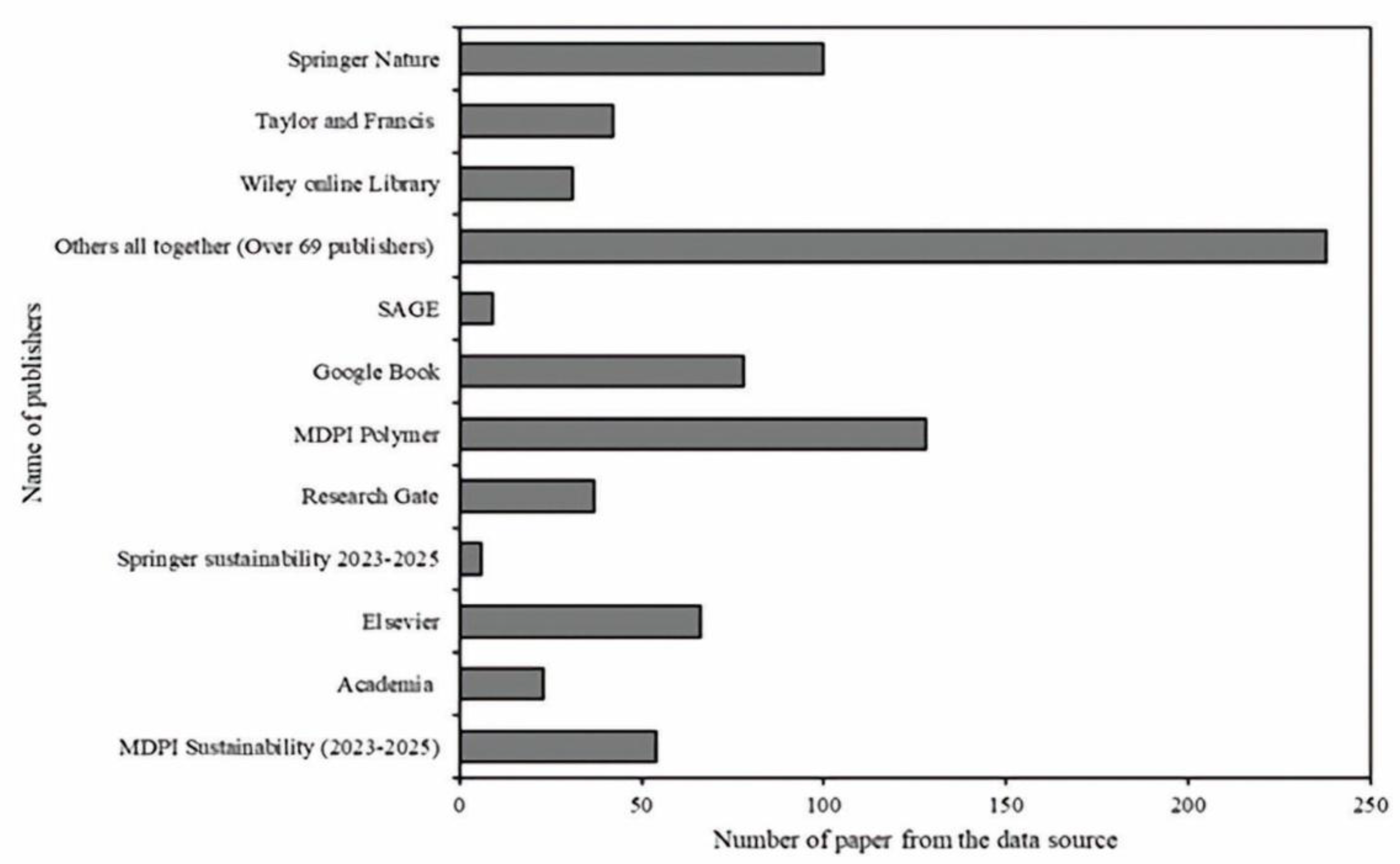
Figure 2.
Publications by journals. Legend: Policies - From several policy formulation sources (32 of them); Others - Are the other online publishing sources; Journal landscape - Many journals that recorded fewer than three articles (82 Journals); IJBM - International Journal of Biological Macromolecules; IJA&A - International Journal of Adhesion and Adhesives; JAS&T - Journal of Adhesion Science and Technology.
Figure 2.
Publications by journals. Legend: Policies - From several policy formulation sources (32 of them); Others - Are the other online publishing sources; Journal landscape - Many journals that recorded fewer than three articles (82 Journals); IJBM - International Journal of Biological Macromolecules; IJA&A - International Journal of Adhesion and Adhesives; JAS&T - Journal of Adhesion Science and Technology.

Figure 3.
Pathway mapping the conventional adhesives to green adhesives in the fiberboard industry. Source: Designed by the authors with data from the review.
Figure 3.
Pathway mapping the conventional adhesives to green adhesives in the fiberboard industry. Source: Designed by the authors with data from the review.
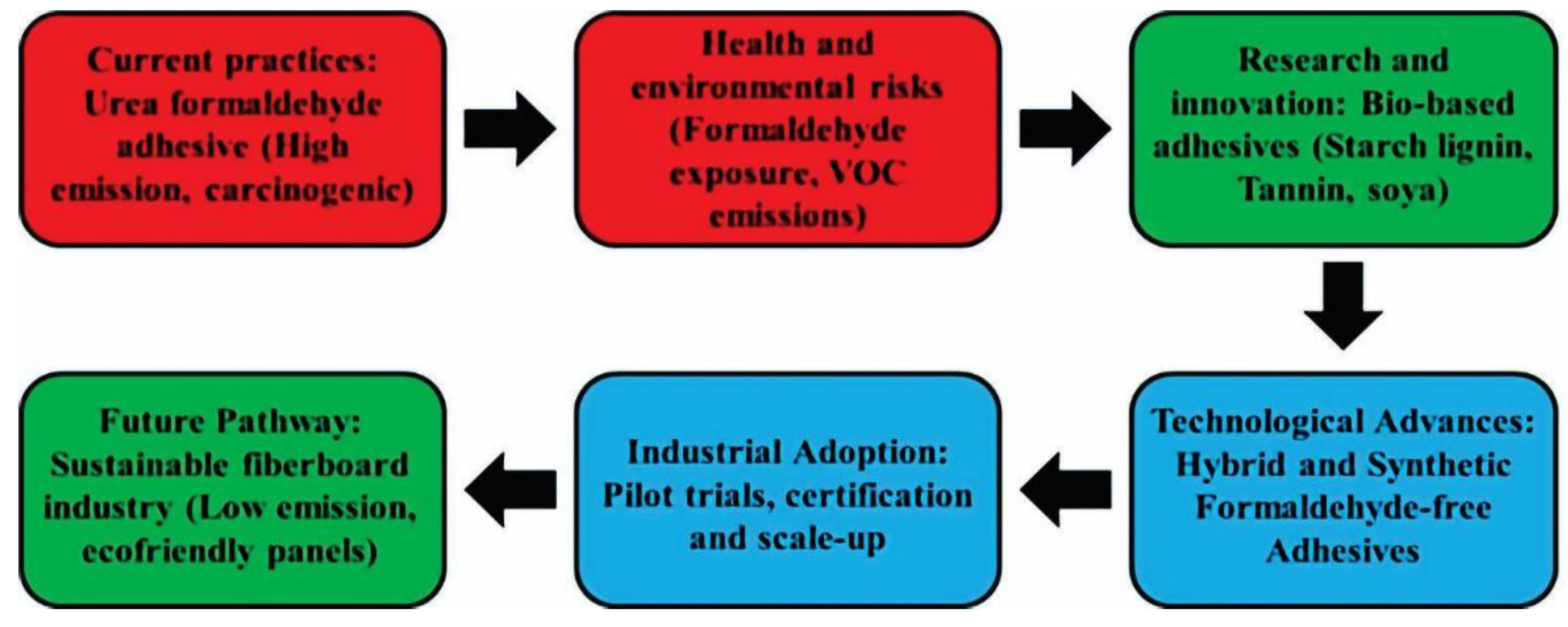
Figure 4.
Pathway Global demand growth for fiberboards. Source: Intelligence [151], FAO [152]; and GWMI [153]. MDF data include dry-formed high-density fiberboard. Source: Designed by the authors with data from the review.

Figure 5.
Adhesive types: Environmental impact and Industrial readiness. Source: Designed by the authors with data from the review.
Figure 5.
Adhesive types: Environmental impact and Industrial readiness. Source: Designed by the authors with data from the review.
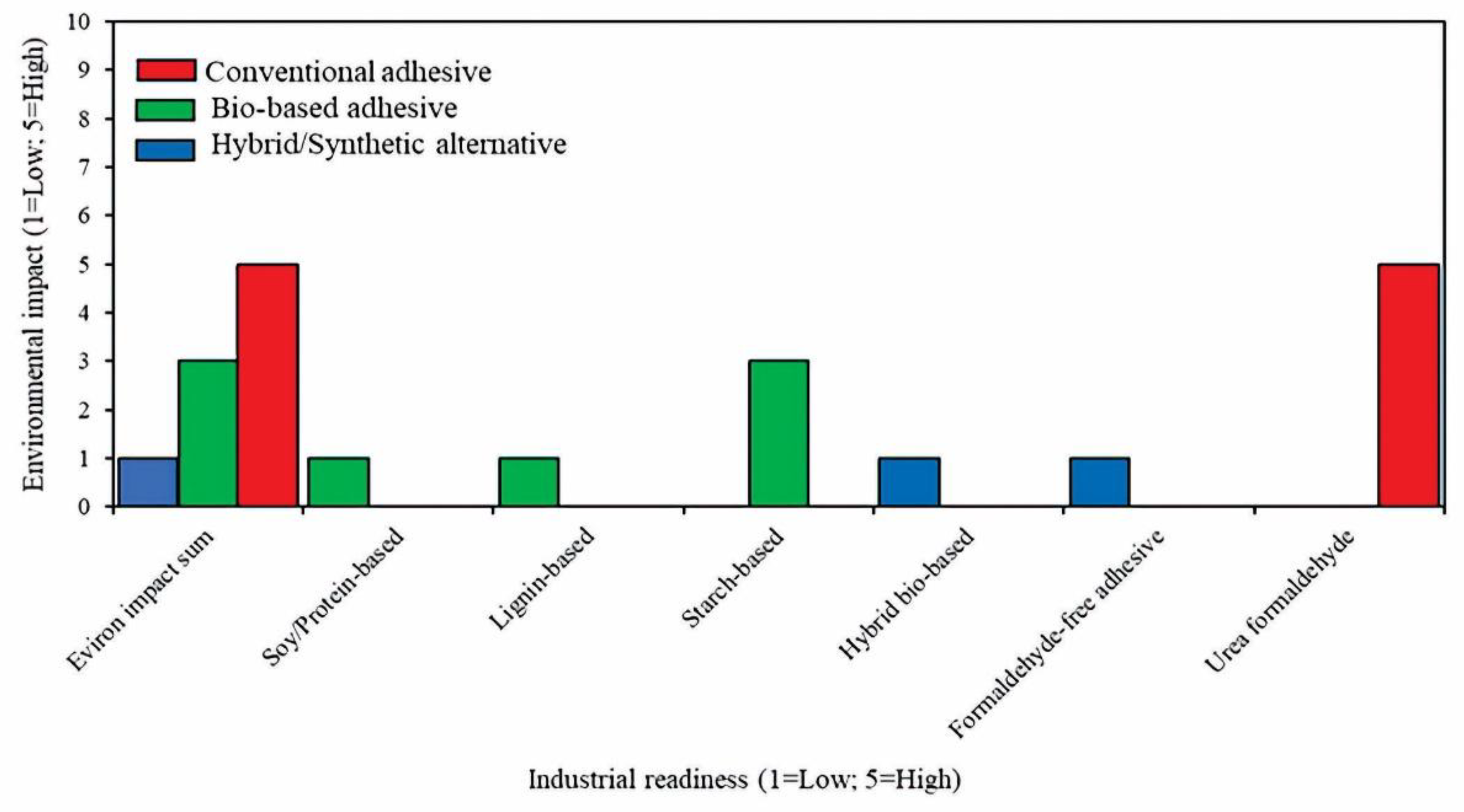

Table 1.
Phases of the EPPI systematic literature review method.
| N° | Review phases | Critical activities performed |
|---|---|---|
| 1 | Identification of the review research question | Consultation with Review Group members to develop and refine the review research question |
| 2 | Developing inclusion/exclusion criteria | Developing inclusion and exclusion criteria to enable decisions to be made about which studies are to be included in the review |
| 3 | Producing the protocol for the review | Producing an overall plan for the review, describing what will happen in each of the phases |
| 4 | Searching | Search of literature for potentially relevant reports of research studies, to include electronic searching, hand searching, and personal contacts |
| 5 | Screening | Applying inclusion and exclusion criteria to potentially relevant studies |
| 6 | Keywording | Applying adhesives in fiberboard production core keywords, and review-specific keywords to include studies to characterize their main contents |
| 7 | Producing the systematic map | Using keywords to generate a systematic map of the area that summarizes the work that has been undertaken |
| 8 | Identifying the in-depth review question | Consultation with Review Group members to identify area(s) of the map to explore in detail, and develop the in-depth research review question |
| 9 | Data extraction | Extracting the key data from studies included in the in-depth review, including reaching judgements about quality |
| 10 | Producing the report | Writing up the research review in a specified format |
| 11 | Dissemination | Publicizing the findings of the review, including the production of summaries by users |
Source: Bennett et al. [34], pages 391-392.
Table 2.
Performance Comparison of green adhesives to formaldehyde-based adhesives.
| Adhesive types | Internal bond strength (MPa) | Dimensional stability | Formaldehyde emission |
|---|---|---|---|
| Soy-based | 0.60-0.85 | Moderate | Near zero |
| Tannin-based | 0.68-0.92 | Excellent | Near zero |
| Lignin-based | 0.70-0.95 | Good | Very low |
| Starch-based | 0.65-0.90 | Moderate | Low |
| Urea formaldehyde | 0.75-1.00 | Moderate | High |
Table 3.
Characterization of adhesive types, resources, performance, environmental impact, and industrial readiness.
Table 3.
Characterization of adhesive types, resources, performance, environmental impact, and industrial readiness.
| Adhesive type | Source / Composition | Bond strength (Internal bond, MPa) | Water moisture resistance | Formaldehyde emission | Industrial readiness / Application | Key references |
|---|---|---|---|---|---|---|
| Urea Formaldehyde (UF) | Synthetic adhesive | 0.75-1.00 | Moderate | High | Widely used, standard in fiberboard | Gao et al., [107]; Nadhari et al., [163]. |
| Starch-based | Corn, potato, cassava, wheat, oil palm | 0.65-0.90 | Moderate | Low | Pilot and lab-scale, some commercial MDF applications | Nadhari et al., [163] ; Okeke et al., [164] |
| Lignin-based | Wood or industrial byproducts | 0.70-0.95 | Good | Very low | Pilot and niche commercial applications | Gao et al., [107]; Němec et al., [165] |
| Tannin-based | Quebracho mimosa, Cashew residue extracts. | 0.68-0.92 | Excellent | Near zero | Small-scale commercial particleboards and MDF | Lopes et al., [166] |
| Soya/Protein-based | Soy, casein | 0.60-0.85 | Moderate | Near zero | Limited commercial adoption, ongoing research | Li et al., [113] |
| Hybrid bio-based adhesive | Starch lignin, tannin, furfural blends | 0.70-0.95 | Good-Excellent | Near zero | Pilot industrial trial; scalable potential | Cesprini et al., [167]; Mensah et al., [167] |
| Synthetic formaldehyde-free adhesive | Bio-derived monomers | 0.75-1.00 | Good | Near zero | Ready for industrial adoption; emerging markets | Kumar et al., [93] |
Source: Designed by the authors with data from the review.
Table 4.
Adhesive Categories and Characterization.
| Adhesive Categories | Characterization | Key references |
|---|---|---|
| Protein-Based Adhesives |
Soy protein is the most extensively studied bio-adhesive. Denaturation and crosslinking enhance internal bonding (IB) strength (0.6-0.9 MPa), but water resistance remains lower than that of UF. Commercial trials (e.g., Columbia Forest Products) demonstrate industrial viability in non-structural panels. Other proteins (blood meal, casein, egg albumin) show promising adhesion but lack scalability. | Li et al., [86]; Zhang et al., [105]; Xu et al., [109] |
| Tannin-Based Adhesives |
Tannin-citric acid (TCA) adhesives achieve IB values >0.8 MPa and reduced WA/TS compared to starch-based adhesives. Pilot studies demonstrate durability comparable to phenol formaldehyde (PF) adhesives, without the use of toxic reagents. Extracted mainly from mimosa and quebracho bark; scalability linked to forestry residues. |
Kumar et al., [93] ; Li et al., [65]; Kliase & Heiderscheit, [171]; |
| Lignin-Based Adhesives |
Lignin substitution for phenol in PF resins has reached up to 50% replacement without significant loss of performance. Modified lignins (phenolated, methylolated) show enhanced reactivity. Challenges: heterogeneity of industrial lignin and higher curing temperatures |
Li et al., [46]; Li et al., [65]; Zhao et al., [61] |
| Polysaccharide-Based Adhesives | Starch-based adhesives remain hydrophilic; however, oxidation or esterification can improve performance. IB ~0.5–0.7 MPa reported, still below UF benchmarks. Chitosan adhesives offer antimicrobial benefits, but are restricted by high costs |
Watcharakitti et al., [35]; Maulana et al., [82]; Liu et al., [106] |
| Hybrid and Low-Emission Synthetic Systems | Emulsion polymer isocyanate (EPI) and bio-polyurethane systems combine bio-based polyols with petrochemicals, achieving high IB values (>1 MPa) and excellent water resistance. However, partial reliance on fossil inputs reduces sustainability. | Guo et al., [172]; Sawpan, [173]; AC, [174]; |
Source: Designed by the authors with data from the review.
Table 5.
Adhesive characteristics and utilization.
| Adhesives | Characteristics | Utilization | Sources |
|---|---|---|---|
| Oil palm starch | highest internal-bonding strength | Bond rubberwood particleboard | Salleh et al., [104] |
| Wheat starch | Good internal bonding strength, but requires additive enhancement. | Bond rubberwood particleboard, rice husks | Salleh et al., [104] |
| Soybean protein | Bonding strengths have exceeded commercial UF adhesives | Production of plywood, blockboard, and engineering flooring substrates | Xu et al., [109] |
| Acrylated epoxidized soybean oil (AESO) | Superior mechanical properties, water resistance, and high-temperature resistance | Bamboo particleboards | Zhang et al. [105] |
| Palm-oil-based dimethacrylate | Superior mechanical properties, water resistance, and high-temperature resistance | Bamboo particleboards | Zhang et al. [105] |
| Gum Arabic | Particleboard is recommended to be used for construction to eliminate the health hazards resulting from high formaldehyde emissions from urea formaldehyde resin-based particleboards | Macadamia nutshells, rice husk, sawdust. | Suleiman et al., [201] |
| melamine-, phenol-, Urea- formaldehyde | Acceptable mechanical and physical properties performance, strong bonding performance | Strawboards and non-wood-based particleboard | Mantanis & Berns, [21] |
| Epoxy | Heat-curable single composite. Provide high-strength bonds to many composite materials | Fiber composite industry | Ashori et al. [70] ; Gibbons, [196] |
| Structural acrylic | Form very high-strength bonds to a composite that has high peel strength, providing gap-filling properties | Ideal for bonding of rough surfaces. High fiber-content composite | Gibbons, [196], Wang et al., [197] |
| Cyanoacrylate/instant adhesive | Create strong bonds very quickly in applications that don’t require high impact or peel resistance | Can be used in place of clamps or jigs to hold the assembly in place while a longer curing two-component adhesive bonds | Gibbons [196]; Shirmohammadi & Leggate, [198] |
| UV curable | Inkjet coating on the substrate surface to bond the composite to clear glass or plastic | They also coat composites, wood-based substrates, and MDF | Zhang et al. [24] ; Henke et al. [206]; |
| MS polymer | Reduce water absorption (WA) and thickness swelling in fiberboards | Wood fibers, Agro-Forest residues, Kenaf fiber | Taghiyari et al. [199] |
| Methyl methacrylate | high strength and water resistance. | Rice straw and natural wood particles, oil palm trunk bagasse | Nuryawan et al., [200]; Mas' Ud et al., [207] |
| Polyurethane | Bond fiber well in exhibiting high-performance properties performance | Wood and other non-wood fibers | Seychal, [17] ; Aristri et al., [50]; Maulana et al., [102]; |
| Urethane | Excellent impact resistance and good adhesion to most plastics | Bonds well to woods, concrete, and rubber with reduced resistance to solvents and high temperatures | 3M A, [204] |
| Cassava starch | Excellent static bending strength, hardness, and internal bond | Bonds banana fiberboard, Ceiba pentandra, Cocoa stem, Elephant grass particleboards | Mensah et al., [66]; Mensah et al., [67] |
Source: Designed by the authors with data from the review.
Disclaimer/Publisher’s Note: The statements, opinions and data contained in all publications are solely those of the individual author(s) and contributor(s) and not of MDPI and/or the editor(s). MDPI and/or the editor(s) disclaim responsibility for any injury to people or property resulting from any ideas, methods, instructions or products referred to in the content. |
© 2025 by the authors. Licensee MDPI, Basel, Switzerland. This article is an open access article distributed under the terms and conditions of the Creative Commons Attribution (CC BY) license (http://creativecommons.org/licenses/by/4.0/).
Copyright: This open access article is published under a Creative Commons CC BY 4.0 license, which permit the free download, distribution, and reuse, provided that the author and preprint are cited in any reuse.


