
Submitted:
09 October 2025
Posted:
09 October 2025
You are already at the latest version
Abstract
This review examines the ecological aspects of studying fungi (including those pathogenic to humans) in atmospheric aerosols. The concentration of fungal spores in the atmosphere of various regions of the Earth is the result of complex interactions between abiotic and biotic environmental factors. The most significant parameters are temperature, dew point, relative humidity, and wind speed. The spore season is determined by meteorological conditions by more than 40%. The sensitivity of moisture-loving and dry-spore-forming micromycetes to weather changes exhibits statistically significant differences. For example, maximum wind speed and minimum relative humidity are identified as the most effective independent variables for predicting Alternaria spore concentrations in the air. Results obtained over a long period of the study for the West Siberian region are examined in more detail.
Keywords:
atmospheric aerosol
; microscopic fungi
; spore concentration
; environmental factors
1. Introduction
It is well known that indoor aerosols can contain a wide variety of pathogenic and allergenic fungi [1,2]. These include representatives of the genera Alternaria, Aspergillus, Cladosporium, and Penicillium. These fungi enter indoor air from both indoor aerosol sources and the atmosphere.
Atmospheric aerosols contain a wide variety of culturable microorganisms, including representatives of fungi of all groups living in soil, plants, animals, aquatic and other systems of the Earth [3,4,5,6,7]. Propagules of microscopic fungi (conidia, spores, mycelium) enter the air from the soil with dust particles, from plants, fruits and animals; they are carried with air currents over long distances, including transcontinental ones, and colonize new suitable substrates [8,9,10,11]. As a result, fungi are found in wildlife, participate in a variety of processes, and often play a positive role in the maintenance and functioning of any natural ecosystem. Fungi also play a negative role, causing various diseases in humans, animals, and cultivated plants, as well as damage to materials, including food products, industrial structures, archival documents, and art’s masterpieces. Researchers are interested in aerobiological studies that consider the quantitative and taxonomic composition of fungal spores in the air for several reasons [12]:
1) fungal spores play an important role as a trigger for the development of allergic diseases in humans;
2) The study of “fungi’s aerosol” allows us to determine the degree of resilience of ecosystems in connection with global warming;
3) geospatial distribution of fungal spores, as one of the main components of bioaerosols, and their transport over long distances.
The main source of fungal spores in the air is surface mycobiota (molds, plant parasites and other fungi living on plants, on the soil surface, on man-made substrates, in the surface monolayer of water bodies, etc.) [3,13,14,15,16]. Most species of fungi have special mechanisms by which they can actively release spores into a freely moving turbulent layer of air [13,17,18,19,20,21]. But even without active release of spores, constant wind erosion causes them to be blown away from plants, with soil particles and water splashes, enter the atmosphere again, increasing the concentration of aerosol in the air.
Knowledge of the diversity of fungi in the air and the impact of various meteorological factors on their concentrations in the atmosphere is of great importance for solving a number of fundamental and applied issues related to medicine, agriculture, and ecology. There are quite a lot of publications in the literature about the presence of fungi in indoor air and their impact on human health, but they will remain outside the scope of this review. The aim of the work is to review the information presented in the literature concerning only fungi in atmospheric aerosol and the influence of environmental factors on them.
2. The Influence of Environmental Factors on the Concentration of Fungal Spores in the Atmosphere
The concentration of fungal spores in the atmosphere is the result of complex interactions between biotic and abiotic environmental factors, which include geographic location, weather conditions, time of day, air pollution, the presence of vegetation, animals, humans, etc. The total number of spores in the aerosol varies from a few species to 4×10⁵ m-3 [4,5,6,22,23,24,25,26,27,28,29]. Some spores are characterized by a pronounced circadian (daily) periodicity of appearance in the bioaerosol, although for other fungi this may not be observed [30,31,32,33].
In some regions, fungal spores make the largest contribution to the composition of bioaerosols. For example, according to publications [34,35,36,37], this is the case, in particular, in the Amazon River basin. Modeling by Heald and Spracklen [38] led to the conclusion that 23% of all primary organic aerosol emissions are due to fungi. Similar calculations [25,47,48,49,50,51,52,53,54,55,56,57,58,59,60,61,62,63,64,65,66,67,68,69,70,71,72,73,74,75,76,77,78,79,80,81] were later extended to include fungi acting as ice nuclei in clouds in [39]. In general, fungi in atmospheric aerosols predominate in the air of some regions [31,32,33,34,35,36,37,38,39,40,41,42], while in other regions bacterial aerosols predominate [42,43,44,45,46].
Currently, research is actively underway in different countries of the world, on different continents, to study the effect of meteorological factors on the concentration of spores [25,47,48,49,50,51,52,53,54,55,56,57,58,59,60,61,62,63,64,65,66,67,68,69,70,71,72,73,74,75,76,77,78,79,80,81]. The results of numerous studies using multiple regression analysis show the absence of a unified model of the influence of meteorological variables on the number of spores and their qualitative composition. Various combinations of factors determine the concentration of spores of different types of fungi. The individual value of each parameter is difficult to estimate due to the dynamic nature of the atmosphere [32,55,63,68,72,82]. However, temperature and dew point (or the relative humidity associated with it) are considered by many researchers to be the most important [83,84,85,86,87]. Significant correlations have been established for different geographical regions between the number of spores of individual fungal species, temperature, and relative humidity [53,57,59,60,62,67,75,78,81,84,896]. It was revealed that during the day, changes in the concentration of spores of individual fungal genera had three variants: in the morning, the maximum values were reached by Cladosporium spores, nighttime peaks were for Coprinus and Leptosphaeria, and simultaneously, different behavior throughout the day was noted for Aspergillus/Penicillium spores [22,31,93,97]. The influence of extreme weather events on the concentration of spores in the air should also be mentioned [98,99].
The average air temperature significantly affects not only the abundance of micromycetes in the air, but also accelerates the onset of spore seasons. The early start and late end of the season determines its extension from 20 to 60 days, depending on the geographical location. The time to reach the cumulative amount of 50% of the spores can be reduced to 25 days. For Cladosporium, the acceleration of the moment of maximum spore concentration per m3 of air was found to be from 26 to 56 days [63,82,100]. The spores of moisture-loving fungi (Didymella, Ganoderma) are more sensitive to weather changes, in contrast to dry-spore species (Alternaria, Botrytis, Cladosporium) [61,100,101,102,103]. Long-term studies of the concentration of Alternaria and Cladosporium spores in the atmosphere of seven countries and four biogeographic regions of Europe have shown that local climate, vegetation and landscape management structure are the determining parameters for the total concentration of spores. The air temperature and wind speed determine the season of the spores of these species [28,48,59,67,92,98,101,104,105,106,107,108,109,110]. In [30], the maximum wind speed and minimum relative humidity are indicated as the most effective independent variables for predicting the general trend in the concentration of Alternaria spores in the air. Weekly concentrations of Alternaria spores in the atmosphere can be predicted based on the expected maximum temperature and concentration of spores during the year. The values of the concentration of Cladosporium spores per week can be predicted based on the concentration of spores of fungi of the genus Alternaria [107[. A prognostic model has also been developed for fungi of the genus Ganoderma [111].
Attempts have been made to build monthly models for predicting the concentration of Alternaria spores in the air based on data on humidity, as the most important variable, on the day of the study. This is a new approach to modeling time series with short spore seasons, which makes it possible to predict the concentration of Alternaria spores with high accuracy [59,112]. A model for the prediction of fungi aerosol concentration dynamics in the surface layer of the atmosphere was developed in Russia [113] and a model based on the analysis of fungal DNA in the air was described in [114].
A study of the duration of the Alternaria spore season in central and eastern Europe showed that, regardless of geographical location, the first stage (0-0.9% of Alternaria spores in the air) was the longest (up to 60 days), and the last (97.5 to 99% of fungal spores) was the shortest (22 days or less). There was a significant variation in the number of spores per cubic meter of air (from 139 in the north to 2295 in the central part of Europe). The number of days exceeding the threshold value of 300 spores per m3, associated with serious health problems in atopic people, varied from 0 to 1 in the north and up to 29 in the central part of the study areas [115]. A number of meteorological parameters are significantly correlated with the concentration of Alternaria spores in the Australia’s atmosphere, including average, minimum and maximum temperatures, dew point temperatures, and air pressure. Some of these meteorological values (average, minimum and maximum temperatures, dew point temperature) show significant correlations with a lag of 1, 2, and 3 days, as well as for the same day. Regression models show that up to 31.1% of the changes in the Alternaria spore concentration in this region can be explained by meteorological factors [103].
There is evidence that meteorological factors do not affect the concentration of Aspergillus/Penicillium spores. An increase in the concentration of spores of these species has been found in the evening and at night, when air humidity is usually higher [106].
Clouds, time of day, atmospheric pressure, and dew point temperature were also significant factors influencing Cladosporium spore concentration. The maximum abundance of Cladosporium spores in the air decreased between 12 and 17 hours [61,116]. A positive correlation (P < 0.02) was found between the concentration of Cladosporium spores and the average daily temperature, relative humidity, as well as a negative correlation with precipitation. A mathematical model has been developed for calculating Cladosporium spores using an annual seasonal cycle and significant weather variables [117]. Mantoani [118] found a doubling of the concentration of Cladosporium spores in the air with an increase in winter temperature in the Brazilian Atlantic forest, however, the observed biodiversity of fungi decreased.
The transport of spore by air masses movements, depending on the prevailing meteorological conditions, can be carried out at micro-, meso- (up to 100 km) and macroscales (more than 100 and up to thousands km). Surface and elevated inversions, cumulus and layered clouds play a certain role in the transport of spore masses (clouds), including phytopathogenic fungi, to different distances from the source. The transboundary transfer of rust uredospores from Greece, Bulgaria, Romania, Turkey and other countries in concentrations ranging from 0.9 to 80.3 units/m3 has been experimentally proven [119]. It was shown that the rotation of the Earth is one of the main factors in the spread of spores, which is amplified by the prevailing winds, using the example of the spread of spring wheat smut spores in the Urals. It is possible to monitor the phytosanitary situation and develop protective measures knowing the direction of the prevailing winds saturated with fungal spores [120]. The leading influence of prevailing winds in the transport of spores, primarily of rust and smut fungi, and the development of epiphytotics is indicated by a number of authors [119,121]. Earlier studies on the biogenic component of atmospheric aerosol in the south of Western Siberia showed that the sources located in Central Asia and Northwestern Kazakhstan have the greatest impact on the Siberian region [122]. The paper [123] indicate that the massive development of brown rust on spring wheat in Western Siberia is a consequence of the introduction of uredospores from winter crops in the southern regions of the European part of Russia. In recent years, a new aggressive strain of stem rust Ug 99 (Uganda 99) has been actively migrating towards the prevailing winds, and in the next 3-5 years it will be able to reach the states of Central Asia, from where the pathogen may be introduced into Western Siberia [124,125].
3. Fungi in Atmospheric Aerosols of Western Siberia
Long-term studies of the fungal component of bioaerosol in the air of southern Western Siberia, conducted in 2001-2025, showed that the concentration of spores and the composition of fungi aerosol undergo seasonal and diurnal changes due to meteorological factors and its proximity to certain plants with clear seasonal dynamics, as well as with the specifics of the life cycles of the fungal species themselves [17,39,61,64,68,69,126,127].
A seasonal increase in the number of fungi in the air was observed in the spring-summer and early autumn periods, followed by a decrease in the late autumn period. The minimum number of fungi was observed in winter. In some years with an atypical warm winter for this region (2016), the presence of single spores of dark-colored fungi Aureobasidium, Penicillium in ground air samples in January was noted. In 2021, the appearance of sclerotic fungi was recorded in the south of Western Siberia, which were stably present in bioaerosol starting in April. Flour fungi, also not typical for previous years, were found in a number of samples starting in May 2021. Basidial fungi, which traditionally appear abundantly in August and September, have been isolated in small numbers from samples since April this year. These examples illustrate what was noted earlier in Kobzar [12]: global climate warming leads to changes in the quantitative and specific composition of spores in the aerosol; new species may appear in the region or there is a sharp increase in the level of existing fungal spores.
Гnpigmented isolates prevailed in the summer months, represented mainly by mycelial forms of fungi. By the end of the growing season, the proportion of pigmented isolates increases, including fungi of the genera Alternaria, Cladosporium, Penicillium, Trichoderma, as well as basidial and fusarium fungi, which is consistent with the seasonal dynamics of species, the abundance of which increases during the growing season [128].
The number of fungi in the summer months was also uneven in the samples taken using the Optical-E laboratory aircraft [129] at altitudes of 500-7000 m. Pigmented fungi (Alternaria, Cladosporium, Penicillium, Aureobasidium) prevailed here, which is consistent with the generally accepted opinion that the presence of pigments, especially melanin, in the cell membranes of fungi helps protect them from unfavorable factors, especially UV rays. Few spores were also observed during the winter months at altitudes from 1,500 to 7,000 m. Alternaria spores were found mainly at an altitude of 500 m, Fusarium spores reached a height of 1000 m. Aspergillus, Penicillium, and Cladosporium spores were recorded at all altitudes starting from 500 m. The species of the genera Microstoma, Sporobolomyces, Bullera, Aureobasidium, Sporidiobolus, Saccharmyces, cryptococcus, Candida, and Rhodotorula are represented among the yeasts and yeast–like fungi, which were especially abundant in April 2014 in high-altitude (0.5 - 2.0 km) atmospheric air samples [130]. These results are consistent with the available data that the spores of the fungi Cladosporium and Penicillium are present in the atmosphere throughout the year, and their highest concentrations are found during summer and autumn [61,67,77,104,106,131,132].
The number of Penicillium spores in the air positively correlated with daily relative humidity, average temperature, and dew point, which confirms and agrees with the available literature data [97]. The data on the number of Penicillium spores in different seasons, obtained by us and other researchers, confirm the thesis about the influence of meteorological factors in a specific geographical area on the concentration of spores [133,134,135].
Our research confirms the available evidence also that Cladosporium fungi are the most common in the atmosphere [26,59,61,92,106,133,134,136,137,138,139].
The trend of long-term dynamics of the number of fungal spores during the day is an increase in their number in the morning, a decrease in the afternoon and a repeated increase in the evening.
There is evidence in the literature that the time of the daily maximum varies for spores of different groups. A number of fungi (in particular, Cladosporium and Alternaria) are characterized by a “diurnal type” of distribution of spore concentration in the air, with a maximum in the afternoon (from 12 to 18 hours), while for basidiospores it is the opposite, in the morning (from 2 to 9 hours) [3,68]. Diurnal variations in concentration are determined by the taxonomic position of the spores and their volatility. Concentrations of basidiospores and conidia of deuteromycetes and basidiomycetes exhibit similar diurnal variations [17]. No clear trend of a daily maximum was observed for spores of different taxonomic groups in our studies. The maximum concentration of Cladosporium spores in the surface air was reached in the evening hours, which is consistent with existing data [106]. It is known that higher concentrations of fungal propagules (including Aspergillus and Penicillium) are observed at midnight and early morning hours, which is explained by an active mechanism of their release induced by a high dew point and increased air humidity at dawn [139]. In our studies, a tendency towards a high number of spores in the early morning hours was observed, but a clear association of the indicated genera with this time of day was not found.
The data obtained during the study confirmed the idea that, to accurately calculate the concentration of viable propagules and fully capture the biodiversity of mycoflora, it is necessary to use different cultivation temperature regimes, including low-temperature conditions, which allow, in particular, the identification of psychrophilic species. Fungal abundance during cultivation at low positive temperatures (6 - 10 °C) was 1.33 - 4.2 times higher than during cultivation under standard conditions.
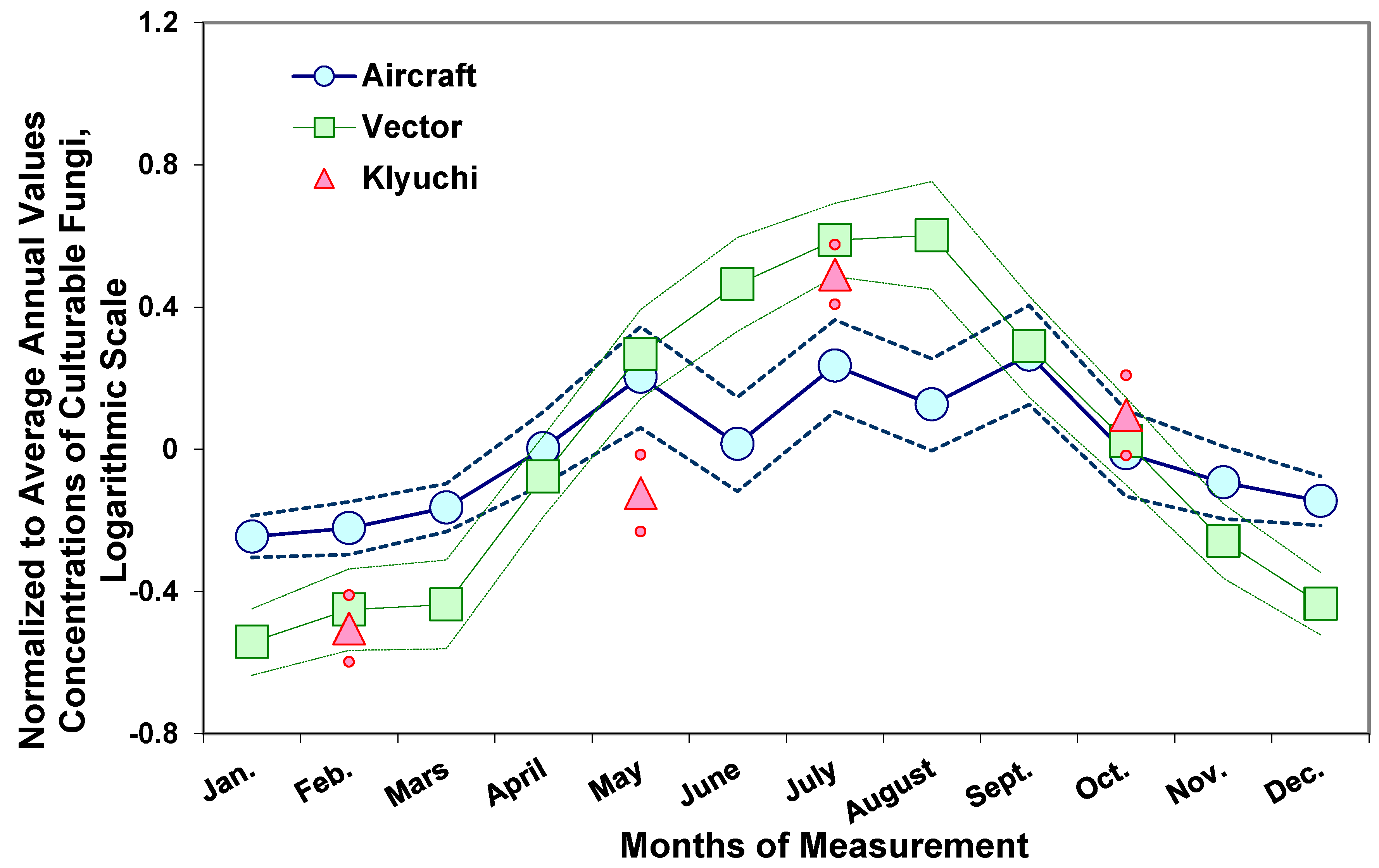
The authors’ long-term observations of the total concentration of fungi in the atmosphere of the south of Western Siberia and their intra-annual variability, averaged over the observation period, are presented in Figure 1 and Figure 2.
As follows from a comparison of the data presented in Figure 1 with previously published data for the total concentrations of culturable microorganisms in the same measurements [140], the concentration of culturable micromycetes decreases during the observation period by a significantly smaller amount than the total concentration of culturable microorganisms, and their share in the total concentration of culturable microorganisms, as noted above, is not large.
As for the intra-annual dynamics of changes in the concentrations of micromycetes in the atmosphere of the south of Western Siberia, they are practically identical in the amplitude of changes to those for the total concentrations of culturable microorganisms in the same measurements [140]. Consequently, the climate changes occurring over 25 years of observations have affected the bacterial component of atmospheric aerosol to a greater extent than its fungal one.
Overall, the results of the study of the fungal component in atmospheric aerosol in southern Western Siberia showed that the abundance of fungal spores in the air varies widely depending on the sampling location, season, and time of day. Moreover, the results of the study in southern Western Siberia are quite comparable with those for other regions of the world, where bacteria predominate among the microorganisms in atmospheric aerosol.
4. Conclusions
This review demonstrates that the most significant parameters affecting the concentration of micromycetes in atmospheric aerosols are temperature, dew point, relative humidity, and wind speed. Average air temperature not only significantly influences the abundance of micromycetes in the air but also accelerates the onset of spore-producing seasons, which are determined by meteorological conditions by more than 40%. The sensitivity of moisture-loving and dry-spore-producing micromycetes to weather changes exhibits statistically significant differences.
A study of the fungal component in atmospheric aerosol in southern Western Siberia revealed wide variations in the abundance of fungal spores in the air depending on the sampling location, season, and time of day. And it should be noted that the results of the study in southern Western Siberia are quite comparable with those for other regions of the world, where bacteria predominate among the microorganisms in atmospheric aerosol.
Author Contributions
Conceptualization, T.V.T. and V.I.G.; formal analysis, V.I.G.; investigation, V.I.G., T.V.T. and S.A.S.; resources, S.A.S.; data curation, S.A.S.; writing—original draft preparation, V.I.G; writing—review and editing, S.A.S.; supervision, S.A.S.; project administration, S.A.S.; funding acquisition, S.A.S.; All authors have read and agreed to the published version of the manuscript.
Funding
This research was partially funded by Russian Federation Rospotrebnadzor, grant numbers GZ 14/18 and GZ 11/21.
Institutional Review Board Statement
Not applicable.
Informed Consent Statement
Not applicable.
Data Availability Statement
The data are presented in Excel files in local database and can be supplied by request.
Conflicts of Interest
The authors declare no conflict of interest.
References
- World Health Organization. WHO Guidelines for Indoor Air Quality: Dampness and Mould. World Health Organization, Geneva, Switzerland, 2009. Available online: https://www.who.int/publications/i/item/9789289041683 (accessed on 25 September 2025).
- Šantl-Temkiv, T.; Sikoparija, B.; Maki, T.; Carotenuto, F.; Amato, P.; Yao, M.; Morris, C.E.; Schnell, R.; Jaenicke, R.; Pöhlker, C.; et al. Bioaerosol field measurements: Challenges and perspectives in outdoor studies. Aerosol Sci. Technol. 2020, 54, 520–546. [Google Scholar] [CrossRef]
- Gregory, P.H. Microbiology of atmosphere. Leonard Hill: London, Great Britain, 1961.
- Fröhlich-Nowoisky, J.; Pickersgill, D.A.; Després, V.R.; Pöschl, U. High diversity of fungi in air particulate matter. PNAS 2009, 106, 12814–12819. [Google Scholar] [CrossRef] [PubMed]
- Després, V.R.; Huffman, J.A.; Burrows, S.M.; Hoose, C.; Safatov, A.S.; Buryak, G.; Fröhlich-Nowoisky, J.; Elbert, W.; Andreae, M.O.; Pöschl, U.; Jaenicke, R. Primary Biological Aerosols in the Atmosphere: A review. Tellus 2012, 64, 15598. [Google Scholar] [CrossRef]
- Fröhlich-Nowoisky, J.; Burrows, S.M.; Xie, Z.; Engling, G.; Solomon, P.A.; Fraser, M.P.; Mayol-Bracero, O.L.; Artaxo, P.; Begerow, D.; Conrad, R.; et al. Biogeography in the air: Fungal diversity over land and oceans. Biogeoscience 2012, 9, 1125–1136. [Google Scholar] [CrossRef]
- Qi, Y.; Li, Y.; Xie, W.; Lu, R.; Mu, F.; Bai, W.; Du, S. Temporal-spatial variations of fungal composition in PM2.5 and source tracking of airborne fungi in mountainous and urban regions. Sci. Total Environ. 2020, 708, 135027. [Google Scholar] [CrossRef]
- Brown, J.K.M.; Hovmøller, M.S. Aerial dispersal of pathogens on the global and continental scales and its impact on plant disease. Science 2002, 297, 537–541. [Google Scholar] [CrossRef]
- Kobziar, L.N.; Thompson, G.R., III. Wildfire smoke, a potential infectious agent. Bacteria and fungi are transported in wildland fire smoke emissions. Science 2020, 370, 1408–1410. [Google Scholar] [CrossRef]
- Grewling, Ł.; Magyar, D.; Chłopek, K.; Grinn-Gofroń, A.; Gwiazdowska, J.; Siddiquee, A.; Ianovici, N.; Kasprzyk, I.; Wójcik, M.; Lafférsová, J.; et al. Bioaerosols on the atmospheric super highway: An example of long distance transport of Alternaria spores from the Pannonian Plain to Poland. Sci. Total Environ. 2022, 819, 153148. [Google Scholar] [CrossRef]
- Rodó, X.; Pozdniakova, S.; Borràs, S.; Matsuki, A.; Tanimoto, H.; Armengol, M.; Pey, I.; Vila, J.; Muñoz, L.; Santamaria, S.; et al. Microbial richness and air chemistry in aerosols above the PBL confirm 2,000-km long-distance transport of potential human pathogens. PNAS 2024, 121, e2404191121. [Google Scholar] [CrossRef]
- Kobzar, B.N. Fungal spores and climate change. Meditsina Kyrgyzstana 2016, 3, 22–26, (In Russ.). [Google Scholar]
- Elbert, W.; Taylor, P.E.; Andreae, M.O.; Pöschl, U. Contribution of fungi to primary biogenic aerosols in the atmosphere: Wet and dry discharged spores, carbohydrates, and inorganic ions. Atmos. Chem. Phys. 2007, 7, 4569–4588. [Google Scholar] [CrossRef]
- Castaño, C.; Oliva, J.; Martínez de Aragón, J.; Alday, J.G.; Parladé, J.; Pera, J.; Bonet, J.A. Mushroom emergence detected by combining spore trapping with molecular techniques. Appl. Environ. Microbiol. 2017, 83, e00600-17. [Google Scholar] [CrossRef] [PubMed]
- Alsante, A.N.; Thornton, D.C.O.; Brooks, S.D. Ocean Aerobiology. Front. Microbiol. 2021, 12, 764178. [Google Scholar] [CrossRef] [PubMed]
- Duquenne, P.; Simon, X.; Coulais, C.; Koehler, V.; Degois, J.; Facon, B. Bioaerosol exposure during sorting of municipal solid, commercial and industrial waste: Concentration levels, size distribution, and biodiversity of airborne fungal. Atmosphere 2024, 15, 461. [Google Scholar] [CrossRef]
- Ryzhkin, D.V.; Elanskii, S.N.; Zheltikova, T.M. Monitoring the concentration of spores of Cladosporium and Alternaria fungi in the atmospheric air of Moscow. Atmosfera. Pulmanologiya i allergologiya 2002, 2, 30–31, (In Russ.). [Google Scholar]
- Lagomarsino Oneto, D.; Golan, J.; Mazzino, A.; Pringlec, A.; Seminara, A. Timing of fungal spore release dictates survival during atmospheric transport. PNAS 2020, 117, 5134–5143. [Google Scholar] [CrossRef]
- Li, X.; Fu, H. Fungal Spore Aerosolization at Different Positions of a Growing Colony Blown by Airflow. Aerosol Air Qual. Res. 2020, 20, 2826–2833. [Google Scholar] [CrossRef]
- Löbs, N.; Barbosa, C.G.G.; Brill, S.; Walter, D.; Ditas, F.; de Oliveira Sá, M.; de Araújo, A.C.; de Oliveira, L.R.; Godoi, R.H.M.; Wolff, S.; et al. Aerosol measurement methods to quantify spore emissions from fungi and cryptogamic covers in the Amazon. Atmos. Meas. Tech. 2020, 13, 153–164. [Google Scholar] [CrossRef]
- Mohaimin, A.Z.; Krishnamoorthy, S.; Shivanand, P. A critical review on bioaerosols—Dispersal of crop pathogenic microorganisms and their impact on crop yield. Braz. J. Microbiol. 2024, 55, 587–628. [Google Scholar] [CrossRef]
- Fernández, D.; Valencia, R.M.; Molnár, T.; Vega, A.; Sagüés, E. Daily and seasonal variations of Alternaria and Cladosporium airborne spores in León (North-West, Spain). Aerobiologia 1998, 14, 215–220. [Google Scholar] [CrossRef]
- Burch, M.; Levetin, E. Effects of meteorological conditions on spore plumes. Int. J. Biometeorol. 2002, 46, 107–117. [Google Scholar] [CrossRef]
- Safatov, A.S.; Teplyakova, T.V.; Belan, B.D.; Buryak, G.A.; Vorob’eva, I.G.; Mikhailovskaya, I.N.; Panchenko, M.V.; Sergeev, A.N. Atmospheric Aerosol Fungi Concentration and Diversity in the South of Western Siberia. Atmos. Oceanic Optics. 2010, 23, 73–79. [Google Scholar] [CrossRef]
- Aira, M.-J.; Rodríguez-Rajo, F.-J.; Fernández-González, M.; Seijo, C.; et al. Spatial and temporal distribution spores in the Iberian Peninsula atmosphere, and meteorological relationships: 1993–2009. Int. J. Biometeorol. 2013. V. 57 (2). P. 265–274. [CrossRef]
- Vorob’eva, I.G.; Teplyakova, T.V.; Safatov, A.S.; Buryak, G.A. Complexes of microscopic fungi in air aerosols of the south of Western Siberia. Uspekhi meditsinskoy mikologii 2014, 13, 83–84, (In Russ.). [Google Scholar]
- Sadyś, M.; Strzelczak, A.; Grinn-Gofroń, A.; Kennedy, R. Application of redundancy analysis for aerobiological data. Int. J. Biometeorol. 2015, 59, 25–36. [Google Scholar] [CrossRef]
- Apangu, G.P.; Frisk, C.A.; Adams-Groom, B.; Petch, G.M.; Hanson, M.; Skjøth, C.A. Using qPCR and microscopy to assess the impact of harvesting and weather conditions on the relationship between Alternaria alternata and Alternaria spp. spores in rural and urban atmospheres. Int. J. Biometeorol. 2023, 67, 1077–1093. [Google Scholar] [CrossRef] [PubMed]
- Vishwakarma, Y.K.; Ram, K.; Gogoi, M.M.; Banerjee, T.; Singh, R.S. Size-segregated characteristics of bioaerosols during foggy and non-foggy days of winter, meteorological implications, and health risk assessment. Environ. Sci.: Adv. 2024, 3, 1163. [Google Scholar] [CrossRef]
- Sidel, B.F.F.; Bouziane, H.; del Mar Trigo, M.; El Haskouri, F.; Bardei, F.; Redouane, A.; Kadiri, M.; Riadi, H.; Kazzaz, M. Airborne fungal spores of Alternaria, meteorological parameters and predicting variables. Int. J. Biometeorol. 2015, 59, 339–346. [Google Scholar] [CrossRef] [PubMed]
- Gusareva, E.S.; Acerbi, E.; Lau, K.J.X.; Luhung, I.; Premkrishnan, B.N.V.; Kolundžija, S.; Purbojati, R.W.; Wong, A.; Houghton, J.N.I.; Miller, D.; et al. Microbial communities in the tropical air ecosystem follow a precise diel cycle. PNAS 2019, 116, 23299–23308. [Google Scholar] [CrossRef]
- González-Alonso, M.; Boldeanu, M.; Koritnik, T.; Gonçalves, J.; Belzner, L.; Stemmler, T.; Gebauer, R.; Grewling, Ł.; Tummon, F.; Maya-Manzano, J.M.; et al. Alternaria spore exposure in Bavaria, Germany, measured using artificial intelligence algorithms in a network of BAA500 automatic pollen monitors. Sci. Total Environ. 2023, 861, 160180. [Google Scholar] [CrossRef]
- Heo, K.J.; Jeong, S.B.; Lim, C.E.; Lee, G.W.; Lee, B.U. Diurnal Variation in Concentration of Culturable Bacterial and Fungal Bioaerosols in Winter to Spring Season. Atmosphere 2023, 14, 537. [Google Scholar] [CrossRef]
- Jaenicke, R.; Matthias-Maser, S.; Gruber, S. Omnipresence of biological material in the atmosphere. Environ. Chem. 2007, 4, 217–220. [Google Scholar] [CrossRef]
- Artaxo, P.; Maenhaut, W.; Storms, H.; van Grieken, R. Aerosol characteristics and sources for the Amazon basin during the wet season. J. Geophys. Res. 1990, 95, 16971–16985. [Google Scholar] [CrossRef]
- Artaxo, P.; Storms, H.; Bruynseels, F.; van Grieken, R.; Maenhaut, W. Composition and sources of aerosols from the Amazon basin. J. Geophys. Res. 1988, 93, 1605–1615. [Google Scholar] [CrossRef]
- Huffman, J.A.; Sinha, B.; Garland, R.M.; Snee-Pollmann, A.; Gunthe, S.S.; Artaxo, P.; Martin, S.T.; Andreae, M.O.; Pöschl, U. Size distributions and temporal variations of biological aerosol particles in the Amazon rainforest characterized by microscopy and real-time UV-APS fluorescence techniques during AMAZE-08. Atmos. Chem. Phys. 2012, 12, 11997–12019. [Google Scholar] [CrossRef]
- Heald, С.L.; Spracklen, D.V. Atmospheric budget of primary biological aerosol particles from fungal spores. Geophys. Res. Lett. 2009, 36, L09806. [Google Scholar] [CrossRef]
- Sesartic, A.; Lohmann, U.; Storelvmo, T. Modelling the impact of fungal spore ice nuclei on clouds and precipitation. Environ. Res. Lett. 2013, 8, 014029. [Google Scholar] [CrossRef]
- Kaarakainen, P.; Meklin, T.; Rintala, H.; Hyvärinen, A.; Kärkkäinen, P.; Vepsäläinen, A.; Hirvonen, M.-R.; Nevalainen, A. Seasonal variation in airborne microbial concentrations and diversity at landfill, urban and rural sites. Clean 2008, 36, 556–563. [Google Scholar] [CrossRef]
- Lee, B.U.; Lee, G.; Heo, K.J. Concentration of culturable bioaerosols during winter. J. Aerosol Sci. 2016, 94, 1–8. [Google Scholar] [CrossRef]
- Tignat-Perrier, R.; Dommergue, A.; Thollot, A.; Magand, O.; Vogel, T.M.; Larose, C. Microbial functional signature in the atmospheric boundary layer. Biogeosciences 2020, 17, 6081–6095. [Google Scholar] [CrossRef]
- Crawford, C.; Reponen, T.; Lee, T.; Iossifova, Y.; Levin, L.; Adhikari, A.; Grinshpun, S.A. Temporal and spatial variation of indoor and outdoor airborne fungal spores, pollen and (1→3)-β-D-glucan. Aerobiologia 2009, 25, 147–158. [Google Scholar] [CrossRef]
- Chen, X.; Ran, P.; Ho, K.; Lu, W.; Li, B.; Gu, Z.; Song, C.; Wang, J. Concentrations and size distributions of airborne microorganisms in Guangzhou during summer. Aerosol Air Qual. Res. 2012, 12, 1336–1344. [Google Scholar] [CrossRef]
- Bowers, R.M.; Clements, N.; Emerson, J.B.; Wiedinmyer, C.; Hannigan, M.P.; Fierer, N. Seasonal variability in bacterial and fungal diversity of the near-surface atmosphere. Environ. Sci. Technol. 2013, 47, 12097–12106. [Google Scholar] [CrossRef] [PubMed]
- Hai, V.D.; Hoang, S.M.T.; Hung, N.T.Q.; Ky, N.M.; Gwi-Nam, B.; Ki-hong, P.; Chang, S.W.; Bach, Q.-V.; Nhu-Trang, T.-T.; Nguyen, D.D. Characteristics of airborne bacteria and fungi in the atmosphere in Ho Chi Minh city, Vietnam—A case study over three years. Int. Biodeterior. Biodegrad. 2019, 145, 104819. [Google Scholar] [CrossRef]
- Gonçalves, F.L.T.; Bauer, H.; Cardoso, M.R.A.; Alves, M.R.; Pukinskas, S.; Matos, D.; Melhem, M.; Puxbaum, H. Indoor and outdoor atmospheric fungal spores in the São Paulo metropolitan area (Brazil): Species and numeric concentrations. Int. J. Biometeorol. 2010, 54, 347–355. [Google Scholar] [CrossRef]
- Maya-Manzano, J.M.; Muñoz-Triviño, M.; Fernández-Rodríguez, S.; Silva-Palacios, S.I.; Gonzalo-Garijo, A.; Tormo-Molina, R. Airborne Alternaria conidia in Mediterranean rural environments in SW of Iberian Peninsula and weather parameters that influence their seasonality in relation to climate change. Aerobiologia 2016, 32, 95–108. [Google Scholar] [CrossRef]
- Pyrri, I.; Kapsanaki-Gotsi, E. Diversity and annual fluctuations of culturable airborne fungi in Athens, Greece: A 4-year study. Aerobiologia 2012, 28, 249–262. [Google Scholar] [CrossRef]
- O’Connor, D.J.; Sadyś, M.; Skjøth, C.A.; Healy, D.A.; Kennedy, R.; Sodeau, J.R. Atmospheric concentrations of Alternaria, Cladosporium, Ganoderma and Didymella spores monitored in Cork (Ireland) and Worcester (England) during the summer of 2010. Aerobiologia. 2014, 30, 397–411. [Google Scholar] [CrossRef]
- Shams-Ghahfarokhi, M.; Aghaei-Gharehbolagh, S.; Aslani, N.; Razzaghi-Abyaneh, M. Investigation on distribution of airborne fungi in outdoor environment in Tehran, Iran. J. Environ. Health Sci. Eng. 2014, 12, 54. [Google Scholar] [CrossRef]
- Akgül, H.; Yılmazkaya, D.; Akata, I.; Tosunoğlu, A.; Bıçakçı, A. Determination of airborne fungal spores of Gaziantep (SE Turkey). Aerobiologia 2016, 32, 441–452. [Google Scholar] [CrossRef]
- Sindt, C.; Besancenot, J.-P.; Thibaudon, M. Airborne Cladosporium fungal spores and climate change in France. Aerobiologia 2016, 32, 53–68. [Google Scholar] [CrossRef]
- Irga, P.J.; Torpy, F.R. A survey of the aeromycota of Sydney and its correspondence with environmental conditions: Grass as a component of urban forestry could be a major determinant. Aerobiologia 2016, 32, 171–185. [Google Scholar] [CrossRef]
- Martínez Blanco, X.; Tejera, L.; Beri, Á. First volumetric record of fungal spores in the atmosphere of Montevideo City, Uruguay: A 2-year survey. Aerobiologia 2016, 32, 317–333. [Google Scholar] [CrossRef]
- Vélez-Pereira, A.M.; De Linares, C.; Rosario, D.; Belmonte, J. Temporal trends of the airborne fungal spores in Catalonia (NE Spain), 1995–2013. Aerobiologia 2016, 32, 23–37. [Google Scholar] [CrossRef]
- Sadyś, M.; Kaczmarek, J.; Grinn-Gofron, A.; et al. Dew point temperature affects ascospore release of allergenic genus Leptosphaeria. Int. J. Biometeorol. 2018, 62, 979–990. [Google Scholar] [CrossRef]
- Antón, S.F.; de la Cruz, D.R.; Sánchez, J.S.; Reyes, E.S. Analysis of the airborne fungal spores present in the atmosphere of Salamanca (MW Spain): A preliminary survey. Aerobiologia 2019, 35, 447–462. [Google Scholar] [CrossRef]
- Grinn-Gofroń, A.; Nowosad, J.; Bosiacka, B.; Camacho, I.; Pashley, C.; Belmonte, J.; de Linares, C.; Ianovici, N.; Manzano, J.M.M.; Sadyś, M.; et al. Airborne Alternaria and Cladosporium fungal spores in Europe: Forecasting possibilities and relationships with meteorological parameters. Sci. Total Environ. 2019, 653, 938–946. [Google Scholar] [CrossRef]
- Sarda-Estève, R.; Baisnée, D.; Guinot, B.; Sodeau, J.; O’Connor, D.; Belmonte, J.; Besancenot, J.-P.; Petit, J.-E.; Thibaudon, M.; Olive, G.; et al. Variability and Geographical Origin of Five Years Airborne Fungal Spore Concentrations Measured at Saclay, France from 2014 to 2018. Remote Sens. 2019, 11, 1671. [Google Scholar] [CrossRef]
- Ščevková, J.; Hrabovský, M.; Kováč, J.; Rosa, S. Intradiurnal variation of predominant airborne fungal spore biopollutants in the Central European urban environment. Environ. Sci. Pollut. Res. 2019, 26, 34603–34612. [Google Scholar] [CrossRef]
- Grewling, Ł.; Bogawski, P.; Szymanska, A.; Nowak, M.; Kostecki, Ł.; Smith, M. Particle size distribution of the major Alternaria alternata allergen, Alt a 1, derived from airborne spores and subspore fragments. Fungal Biology 2020, 124, 219–227. [Google Scholar] [CrossRef]
- Olsen, Y.; Skjøth, C.A.; Hertel, O.; Rasmussen, K.; Sigsgaard, T.; Gosewinkel, U. Airborne Cladosporium and Alternaria spore concentrations through 26 years in Copenhagen, Denmark. Aerobiologia 2020, 36, 141–157. [Google Scholar] [CrossRef]
- Redondo, M.A.; Berlin, A.; Boberg, J.; Oliva, J. Vegetation type determines spore deposition within a forest–agricultural mosaic landscape. FEMS Microbiol. Ecol. 2020, 96, fiaa082. [Google Scholar] [CrossRef] [PubMed]
- Fayad, R.K.; Al-Thani, R.F.; Al-Naemi, F.A.; Abu-Dieyeh, M.H. Diversity, Concentration and Dynamics of Culturable Fungal Bioaerosols at Doha, Qatar. Int. J. Environ. Res. Public Health 2021, 18, 182. [Google Scholar] [CrossRef] [PubMed]
- Galán, C.; Smith, M.; Damialis, A.; Frenguelli, G.; Gehrig, R.; Grinn-Gofroń, A.; Kasprzyk, I.; Magyar, D.; Oteros, J.; Šaulienė, I.; et al. Airborne fungal spore monitoring: Between analyst proficiency testing. Aerobiologia 2021, 37, 351–361. [Google Scholar] [CrossRef]
- Kasprzyk, I.; Grinn-Gofroń, A.; Ćwik, A.; Kluska, K.; Cariñanos, P.; Wójcik, T. Allergenic fungal spores in the air of urban parks. Aerobiologia 2021, 37, 39–51. [Google Scholar] [CrossRef]
- Grinn-Gofroń, A.; Bogawski, P.; Bosiacka, B.; Nowosad, J.; Camacho, I.; Sadyś, M.; Skjøth, C.A.; Pashley, C.H.; Rodinkova, V.; Çeter, T.; et al. Abundance of Ganoderma sp. in Europe and SW Asia: Modelling the pathogen infection levels in local trees using the proxy of airborne fungal spore concentrations. Sci. Total Environ. 2021, 793, 148509. [Google Scholar] [CrossRef]
- Nageen, Y.; Asemoloye, M.D.; Põlme, S.; Wang, X.; Xu, S.; Ramteke, P.; Pecoraro, L.W. Analysis of culturable airborne fungi in outdoor environments in Tianjin, China. BMC Microbiol. 2021, 21, 134. [Google Scholar] [CrossRef]
- Nageen, Y.; Wang, X.; Pecoraro, L. Seasonal variation of airborne fungal diversity and community structure in urban outdoor environments in Tianjin, China. Front. Microbiol. 2023, 13, 1043224. [Google Scholar] [CrossRef]
- Vélez-Pereira, A.M.; De Linares, C.; Canela, M.; Belmonte, J. Spatial distribution of fungi from the analysis of aerobiological data with a gamma function. Aerobiologia 2021, 37, 461–477. [Google Scholar] [CrossRef]
- Charalampopoulos, A.; Damialis, A.; Vokou, D. Spatiotemporal assessment of aeromycoflora under differing urban green space, sampling height, and meteorological regimes: The atmospheric fungiscape of Thessaloniki, Greece. Int J. Biometeorol. 2022, 66, 895–909. [Google Scholar] [CrossRef]
- Hanson, M.C.; Petch, G.M.; Ottosen, T.B.; Skjøth, C.A. Climate change impact on fungi in the atmospheric microbiome. Sci. Total Environ. 2022, 830, 154491. [Google Scholar] [CrossRef]
- Maya-Manzano, J.M.; Fernández-Rodríguez, S.; Hernández-Trejo, F.; Díaz-Pérez, G.; Gonzalo-Garijo, Á.; Silva-Palacios, I.; Muñoz-Rodrígue, A.F.; Tormo-Molina, R. Seasonal Mediterranean pattern for airborne spores of Alternaria. Aerobiologia 2012, 28, 515–525. [Google Scholar] [CrossRef]
- Mantoani, M.C.; Emygdio, A.P.M.; Degobbi, C.; Ribeiro Sapucci, C.; Guerra, L.C.C.; Dias, M.A.F.S.; Dias, P.L.S.; Zanetti, R.H.S.; Rodrigues, F.; Araujo, G.G.; Silva, D.M.C.; Duo Filho, V.B.; Boschilia, S.M.; et al. Rainfall effects on vertical profiles of airborne fungi over a mixed land-use context at the Brazilian Atlantic Forest biodiversity hotspot. Agric. Forest Meteorol. 2023, 331, 109352. [Google Scholar] [CrossRef]
- Motlogeloa, O.; Fitchett, J.M. Climate and human health: A review of publication trends in the trends in the International Journal of Biometeorology. Int. J. Biometeorol. 2023, 67, 933–955. [Google Scholar] [CrossRef]
- Rodríguez-Fernández, A.; Blanco-Alegre, C.; Vega-Maray, A.M.; Valencia-Barrera, R.M.; Molnár, T.; Fernández-González, D. Effect of prevailing winds and land use on Alternaria airborne spore load. J. Environ. Manag. 2023, 332, 117414. [Google Scholar] [CrossRef] [PubMed]
- Garcia, R.F.R.; Saltos, H.T.V. Airborne bacteria and fungi in coastal Ecuador: A correlation analysis with meteorological factors. Vis. Sustain. 2024, 22, 195–214. [Google Scholar] [CrossRef]
- Palaz, E.; Menteşe, S.; Bayram, A.; Kara, M.; Elbir, T. Seasonal variability of airborne mold concentrations as related to dust in a coastal urban area in the Eastern Mediterranean. Environ. Sci. Pollut. Res. 2024, 31, 40717–40731. [Google Scholar] [CrossRef] [PubMed]
- Sánchez Espinosa, K.C.; Aira, M.J.; Fernández-González, M.; Rodríguez-Rajo, F.J. Airborne Alternaria Spores: 70 Annual Records in Northwestern Spain. J. Fungi 2024, 10, 681. [Google Scholar] [CrossRef]
- Karabıcak, S.; Bıyıklıoğlu, O.; Farooq, Q.; Oteros, J.; ·Galán, C.; Çeter, T. Investigating the relationship between atmospheric concentrations of fungal spores and local meteorological variables in Kastamonu, Türkiye. Aerobiologia 2025, 41, 289–301. [Google Scholar] [CrossRef]
- Grinn-Gofroń, A.; Bosiacka, B. Effects of meteorological factors on the composition of selected fungal spores in the air. Aerobiologia 2015, 31, 63–72. [Google Scholar] [CrossRef]
- Troutt, C.; Levetin, E. Correlation of spring spore concentrations and meteorological conditions in Tulsa, Oklahoma. Int. J. Biometeorol. 2001, 45, 64–74. [Google Scholar] [CrossRef]
- Stennett, P.J.; Beggs, P.J. Alternaria spores in the atmosphere of Sydney, Australia, and relationships with meteorological factors. Int. J. Biometeorol. 2004, 49, 98–105. [Google Scholar] [CrossRef]
- Alshareef, F.; Robson, G.D. Prevalence, persistence, and phenotypic variation of Aspergillus fumigatus in the outdoor environment in Manchester, UK, over a 2-year period. Med. Mycol. 2014, 52, 367–375. [Google Scholar] [CrossRef] [PubMed]
- Almeida, E.; Caeiro, E.; Todo-Bom, A.; Ferro, R.; Dionísio, A.; Duarte, A.; Gazarini, L. The influence of meteorological parameters on Alternaria and Cladosporium fungal spore concentrations in Beja (Southern Portugal): Preliminary results. Aerobiologia 2018, 34, 219–226. [Google Scholar] [CrossRef]
- Muafa, M.H.M.; Quach, Z.M.; Al-Shaarani, A.A.Q.A.; Nafis, M.M.H.; Pecoraro, L. The influence of car traffic on airborne fungal diversity in Tianjin. China Mycology 2024, 15, 506–520. [Google Scholar] [CrossRef]
- Hasnain, S.N.; Fatima, K.; Al-Frayh, A.; Al-Sedairy, S.T. Prevalence of airborne basidospores in three coastal cities of Saudi Arabia. Aerobiologia 2005, 21, 139–145. [Google Scholar] [CrossRef]
- Herrero, A.D.; Ruiz, S.S.; Gutiérrez Bustillo, M.; Morales, P.C. Study of airborne fungal spores in Madrid, Spain. Aerobiologia 2006, 22, 133–140. [Google Scholar] [CrossRef]
- Mullins, J.; Hutchenson, P.S.; Slavin, R.G. Aspergillus fumigatus spore concentration in outside air: Cardiff and St Louis compared. Clin. Exp. Allergy 1984, 14, 351–354. [Google Scholar] [CrossRef]
- De Antoni Zoppas, B.C.; Valencia-Barrera, R.M.; Vergamini Duso, S.M.; Fernández-González, D. Fungal spores prevalent in the aerosol of the city of Caxias do Sul, Grande do Sul, Brazil, over a 2-year period (2001-2002). Aerobiologia 2006, 22, 119–126. [Google Scholar] [CrossRef]
- Oliveira, M.; Ribeiro, H.; Delgado, J.L.; Abreu, I. The effects of meteorological factors on airborne fungal spore concentration in two areas differing in urbanization level. Int. J. Biometeorol. 2009, 53, 61–73. [Google Scholar] [CrossRef]
- Almaguer, M.; Rojas, T.I.; Rodríguez-Rajo, F.J.; Aira, M.-J. Airborne fungal succession in a rice field of Cuba. Eur. J. Plant Pathol. 2012, 133, 473–482. [Google Scholar] [CrossRef]
- Das, S.; Gupta-Bhattacharya, S. Monitoring and assessment of airborne fungi in Kolkata, India, by viable and non-viable air sampling methods. Environ. Monitor. Assess. 2012, 184, 4671–4684. [Google Scholar] [CrossRef]
- Almaguer, M.; Aira, M.-J.; Rodríguez-Rajo, F.J.; Rojas, T.I. Temporal dynamics of airborne fungi in Havana (Cuba) during dry and rainy seasons: Influence of meteorological parameters. Int. J. Biometeorol. 2014, 58, 1459–1470. [Google Scholar] [CrossRef] [PubMed]
- Ščevková, J.; Dušička, J.; Mičieta, K.; Aira, M.-J. The effects of recent changes in air temperature on trends in airborne Alternaria, Epicoccum and Stemphylium spore seasons in Bratislava (Slovakia). Aerobiologia 2016, 32, 69–81. [Google Scholar] [CrossRef]
- Almaguer, M.; Rojas-Flores, T.I.; Rodríguez-Rajo, F.J.; Aira, M.-J. Airborne basidiospores of Coprinus and Ganoderma in a Caribbean region. Aerobiologia 2014, 30, 197–204. [Google Scholar] [CrossRef]
- Grinn-Gofroń, A.; Strzelczak, A. Changes in concentration of Alternaria and Cladosporium spores during summer storms. Int. J. Biometeorol. 2013, 57, 759–768. [Google Scholar] [CrossRef]
- Keishams, F.; Goudarzi, G.; Hajizadeh, Y.; Hashemzadeh, M.; Teiri, H. Influence of meteorological parameters and PM2.5 on the level of culturable airborne bacteria and fungi in Abadan, Iran. Aerobiologia 2022, 38, 233–245. [Google Scholar] [CrossRef]
- Kasprzyk, I.; Kaszewski, B.M.; Weryszko-Chmielewska, E.; Nowak, M.; Sulborska, A.; Kaczmarek, J.; Szymanska, A.; Haratym, W.; Jedryczka, M. Warm and dry weather accelerates and elongates Cladosporium spore seasons in Poland. Aerobiologia 2016, 32, 109–126. [Google Scholar] [CrossRef]
- Sadyś, M.; Kennedy, R.; West, J.S. Potential impact of climate change on fungal distributions: Analysis of 2 years of contrasting weather in the UK. Aerobiologia 2016, 32, 127–137. [Google Scholar] [CrossRef]
- Peternel, R.; Čulig, J.; Hrga, I. Atmospheric concentrations of Cladosporium spp. and Alternaria spp. spores in Zagreb (Croatia) and effects of some meteorological factors. Ann. Agric. Environ. Med. 2004, 11, 303–307. [Google Scholar]
- Stępalska, D.; Wołek, J. Intradiurnal periodicity of fungal spore concentrations Alternaria, Botrytis, Cladosporium, Didymella, Ganoderma) in Cracow, Poland. Aerobiologia 2009, 25, 333–340. [Google Scholar] [CrossRef]
- Rodríguez-Rajo, F.J.; Iglesias, I.; Jato, V. Variation assessment of airborne Alternaria and Cladosporium spores at different bioclimatical conditions. Mycol. Res. 2005, 109, 497–507. [Google Scholar] [CrossRef] [PubMed]
- Grinn-Gofroń, A.; Rapiejko, P. Occurrence of Cladosporium spp. and Alternaria spp. spores in Western, Northern and Central-Eastern Poland in 2004-2006 and relations to some meteorological factors. Atmos. Res. 2009, 93, 747–758. [Google Scholar] [CrossRef]
- Oliveira, M.; Ribeiro, H.; Delgado, J.L.; Abreu, I. Seasonal and intradiurnal variation of allergenic fungal spores in urban and rural areas of the North of Portugal. Aerobiologia 2009, 25, 85–98. [Google Scholar] [CrossRef]
- Recio, M.; Trigo, M.M.; Docampo, S.; Melgar, M.; García-Sánchez, J.; Bootello, L.; Cabezudo, B. Analysis of the predicting variables for daily and weekly fluctuations of two airborne fungal spores: Alternaria and Cladosporium. Int. J. Biometeorol. 2012, 56, 983–991. [Google Scholar] [CrossRef]
- Grinn-Gofroń, A.; Strzelczak, A.; Stępalska, D.; Myszkowska, D. A 10-year study of Alternaria and Cladosporium in two Polish cities (Szczecin and Cracow) and relationship with the meteorological parameters. Aerobiologia 2016, 32, 83–94. [Google Scholar] [CrossRef]
- Ianovici, N. Atmospheric concentrations of selected allergenic fungal spores in relation to some meteorological factors, in Timişoara (Romania). Aerobiologia 2016, 32, 139–156. [Google Scholar] [CrossRef]
- Skjøth, С.A.; Damialis, A.; Belmonte, J.; de Linares, C.; Fernández-Rodríguez, S.; Grinn-Gofroń, A.; Jędryczka, M.; Kasprzyk, I.; Magyar, D.; Myszkowska, D.; et al. Alternaria spores in the air across Europe: Abundance, seasonality and relationships with climate, meteorology and local environment. Aerobiologia 2016, 32, 3–22. [Google Scholar] [CrossRef]
- Sadyś, M.; Skjøth, C.A.; Kennedy, R. Forecasting methodologies for Ganoderma spore concentration using combined statistical approaches and model evaluations. Int. J. Biometeorol. 2016, 60, 489–498. [Google Scholar] [CrossRef]
- Grinn-Gofroń, A.; Strzelczak, A. Artificial neural network models of relationships between Alternaria spores and meteorological factors in Szczecin (Poland). Int. J. Biometeorol. 2008, 52, 859–868. [Google Scholar] [CrossRef]
- Glagolev, M.V.; Sabrekov, A.F.; Faustova, E.V.; Marfenina, O.E. Modelling of concentration dynamics of fungal aerosols in the atmospheric boundary layer: I. Basic processes and equations. Environ. dynamics global climate change 2016, 7, 85–102, (In Russ.). [Google Scholar] [CrossRef]
- Abrego, N.; Furneaux, B.; Hardwick, B.; Somervuo, P.; Palorinne, I.; Aguilar-Trigueros, C.A.; Andrew, N.R.; Babiy, U.V.; Bao, T.; Bazzano, G.; et al. Airborne DNA reveals predictable spatial and seasonal dynamics of fungi. Nature 2024, 631, 835–842. [Google Scholar] [CrossRef]
- Kasprzyk, I.; Rodinkova, V.; Šaulienė, I.; Ritenberga, O.; Grinn-Gofron, A.; Nowak, M.; Sulborska, A.; Kaczmarek, J.; Weryszko-Chmielewska, E.; Bilous, E.; Jedryczka, M. Air pollution by allergenic spores of the genus Alternaria in the air of central and eastern Europe. Environ. Sci. Pollut. Res. 2015, 22, 9260–9274. [Google Scholar] [CrossRef]
- Grinn-Gofroń, A.; Strzelczak, A. Hourly predictive artificial neural network and multivariate regression tree models of Alternaria and Cladosporium spore concentrations in Szczecin (Poland). Int. J. Biometeorol. 2009, 53, 555–562. [Google Scholar] [CrossRef] [PubMed]
- Katial, R.K.; Zhang, Y.; Jones, R.H.; Dyer, P.D. Atmospheric mold spore counts in relation to meteorological parameters. Int. J. Biometeorol. 1997, 41, 17–22. [Google Scholar] [CrossRef] [PubMed]
- Mantoani, M.C.; Ribeiro Sapucci, C.; Guerra, L.C.C.; Andrade, M.F.; Dias, M.A.F.S.; Dias, P.L.S.; Ifanger Albrecht, R.; Pereira Silva, E.; Rodrigues, F.; Araujo, G.G.; et al. Airborne fungal spore concentrations double but diversity decreases with warmer winter temperatures in the Brazilian Atlantic Forest biodiversity hotspot. The Microbe 2025, 7, 100300. [Google Scholar] [CrossRef]
- Sanin, S.S. Epiphytotiology of cereal rusts: Modeling, monitoring, control. D. Sci. Thesis, All-Russian Research Institute of Plant Protection, St. Petersburg, November 1998. (In Russ.).
- Bogdanova, V.V.; Goloshchapov, A.P.; Evseev, V.V. Monitoring the mass of phytopathogenic fungi spores. Agrarian Bulletin of the Urals 2010, 2, 52–54, (In Russ.). [Google Scholar]
- Shamanin, V.P.; Morgunov, A.I.; Chursin, A.S.; Merkeshina, N.N.; Shtubey, T.Y.; Levshunov, M.A.; Karakoz, I.I. Is stem rust a threat to wheat crops in Western Siberia? Adv. Curr. Nat. Sci. 2011, 2, 56–60. Available online: https://natural-sciences.ru/ru/article/view?id=15926 (accessed on 29 September 2025). (In Russ.).
- Andreeva, I.S.; Borodulin, A.I.; Buryak, G.A.; Zhukov, V.A.; Zykov, S.V.; Marchenko, Y.V.; Marchenko, V.V.; Olkin, S.E.; Petrishchenko, V.A.; Pyankov, O.V.; et al. Biogenic Component of Atmospheric Aerosol in the South of West Siberia. Chem. Sustain. Develop. 2002, 10, 523–537. [Google Scholar]
- Reuter, B.G. Phytopathological and immunological bases for reducing damage from brown rust of wheat in Western Siberia. D. Sci. Thesis, Ukranian Research Institute of Plant Protection, Kiev, 1984. (In Russ.).
- Koishybaev, M. Features of the spread of especially dangerous wheat diseases in Kazakhstan, resistance of varieties and intraspecific diversity of pathogens. Immunogenetic Protect. Agric. Crops Dis.: Theory Practice 2012, 118–126. (In Russ.).
- Koishybaev, M. Risk of spread of brown, stem and yellow rust on cereal crops. In: Atlas of Natural and Man-Made Hazards and Risks of Emergencies in the Republic of Kazakhstan. Almaty, Kazakhstan, 2010, 206–208. (In Russ.).
- Marfenina, O.E.; Ivanova, A.E.; Kul’ko, A.B. Features of the spread of opportunistic fungi in the external environment. In Proceedings Modern mycology in Russia. Moscow, Russia, 2002, p. 68. (In Russ.).
- Marfenina, O.E.; Kolosova, E.D.; Glagolev, M.B. Number of fungal diaspores deposited from surface air layers at the areas with different vegetation cover in Moscow city. Mycology Phytopathology 2016, 50, 379–385, (In Russ.). [Google Scholar]
- Teplyakova, T.V.; Vorobyeva, I.G.; Vechkanov, V.A.; Andreeva, I.S.; Safatov, A.S.; Buryak, G.A.; Simonenkov, D.V.; Belan, B.D. Complexes of microscopic fungi in atmospheric aerosols of Southwestern Siberia at the altitudes of 500-7000 m in 2014. In Proceedings European Aerosol Conference 2015, Milano, Italy, September 6-11, 2015, P. 2AAS_P063.
- Belan, B.D.; Ancellet, G.; Andreeva, I.S.; Antokhin, P.N.; Arshinova, V.G.; Arshinov, M.Y.; Balin, Y.S.; Barsuk, V.E.; Belan, S.B.; Chernov, D.G.; et al. Integrated airborne investigation of the air composition over the Russian Sector of the Arctic. Atmos. Meas. Tech. 2022, 15, 3941–3967. [Google Scholar] [CrossRef]
- Andreeva, I.S.; Solovyanova, N.A.; Vechkanov, V.A.; Morozova, V.V.; Tikunova, N.V. Psychrotolerant yeasts in atmospheric aerosols of Western Siberia. Inter-Medical 2015, 7, 105–111, (In Russ.). [Google Scholar]
- Sousa, L.; Camacho, I.C.; Grinn-Gofroń, A.; Camacho, R. Monitoring of anamorphic fungal spores in Madeira region (Portugal), 2003–2008. Aerobiologia 2016, 32, 303–315. [Google Scholar] [CrossRef]
- Olsen, Y.; Gosewinkel, U.B.; Skjøth, C.A.; Hertel, O.; Rasmussen, K.; Sigsgaard, T. Regional variation in airborne Alternaria spore concentrations in Denmark through 2012–2015 seasons: The influence of meteorology and grain harvesting Aerobiologia 2019, 35, 533–551. [CrossRef]
- Balandina, S.Y.; Semerikov, V.V.; Shvarts, K.G. The implementation of microbiological monitoring of the concentration of mold spores in the atmospheric air. Medicus 2015, 4, 43–46, (In Russ.). [Google Scholar]
- Balandina, S.Y.; Semerikov, V.V.; Shvarts, K.G. A study of seasonal dynamics of micromycetes content in outdoor air near a medical institution. Bull. Udmurt Univer. Ser. Biol. Earth Sci. 2015, 25, 7–10, (In Russ.). [Google Scholar]
- Martinez-Bracero, M.; Markey, E.; Clancy, J.H.; McGillicuddy, E.J.; Sewel, G.; O’Connor, D.J. Airborne Fungal Spore Review, New Advances and Automatisation. Atmosphere 2022, 13, 308. [Google Scholar] [CrossRef]
- Kasprzyk, I.; Rzepowska, B.; Wasylów, M. Fungal spores in the atmosphere of Rzeszów (South-East Poland). Ann. Agric. Environ. Med. 2004, 11, 285–289. [Google Scholar] [PubMed]
- Ivanova, A.M.; Kirtsideli, I.Y. Microfungi complexes in the air of Saint-Petersburg. Mycology Phytopathology 2007, 41, 40–47, (In Russ.). [Google Scholar]
- Vasilenko, M.I.; Zaika, Y.I. Comparative estimation of the specific variety of microscopic fungi in the atmosphere of different functional zones of the city of Belgorod. Belgorod State Univer. Sci. Bull. Nat. Sci. 2011, 14, 42–48, (In Russ.). [Google Scholar]
- Grinn-Gofroń, A. Airborne Aspergillus and Penicillium in the atmosphere of Szczecin, (Poland) (2004–2009). Aerobiologia 2010, 27, 67–76. [Google Scholar] [CrossRef]
- Safatov, A.S.; Andreeva, I.S.; Buryak, G.A.; Olkin, S.E.; Reznikova, I.K.; Belan, B.D.; Panchenko, M.V.; Simonenkov, D.V. Long-Term Studies of Biological Components of Atmospheric Aerosol: Trends and Variability. Atmosphere 2022, 13, 651. [Google Scholar] [CrossRef]
Figure 1.
Trends in average annual concentrations of micromycetes in the atmosphere of the south of Western Siberia at three observation sites: aircraft sounding of the atmosphere, the site of the Federal Budgetary Scientific Institution State Research Center of Virology and Biotechnology Vector of Rospotrebnadzor, and the site in the Klyuchi settlement. Data for 2025 are limited to September.
Figure 1.
Trends in average annual concentrations of micromycetes in the atmosphere of the south of Western Siberia at three observation sites: aircraft sounding of the atmosphere, the site of the Federal Budgetary Scientific Institution State Research Center of Virology and Biotechnology Vector of Rospotrebnadzor, and the site in the Klyuchi settlement. Data for 2025 are limited to September.
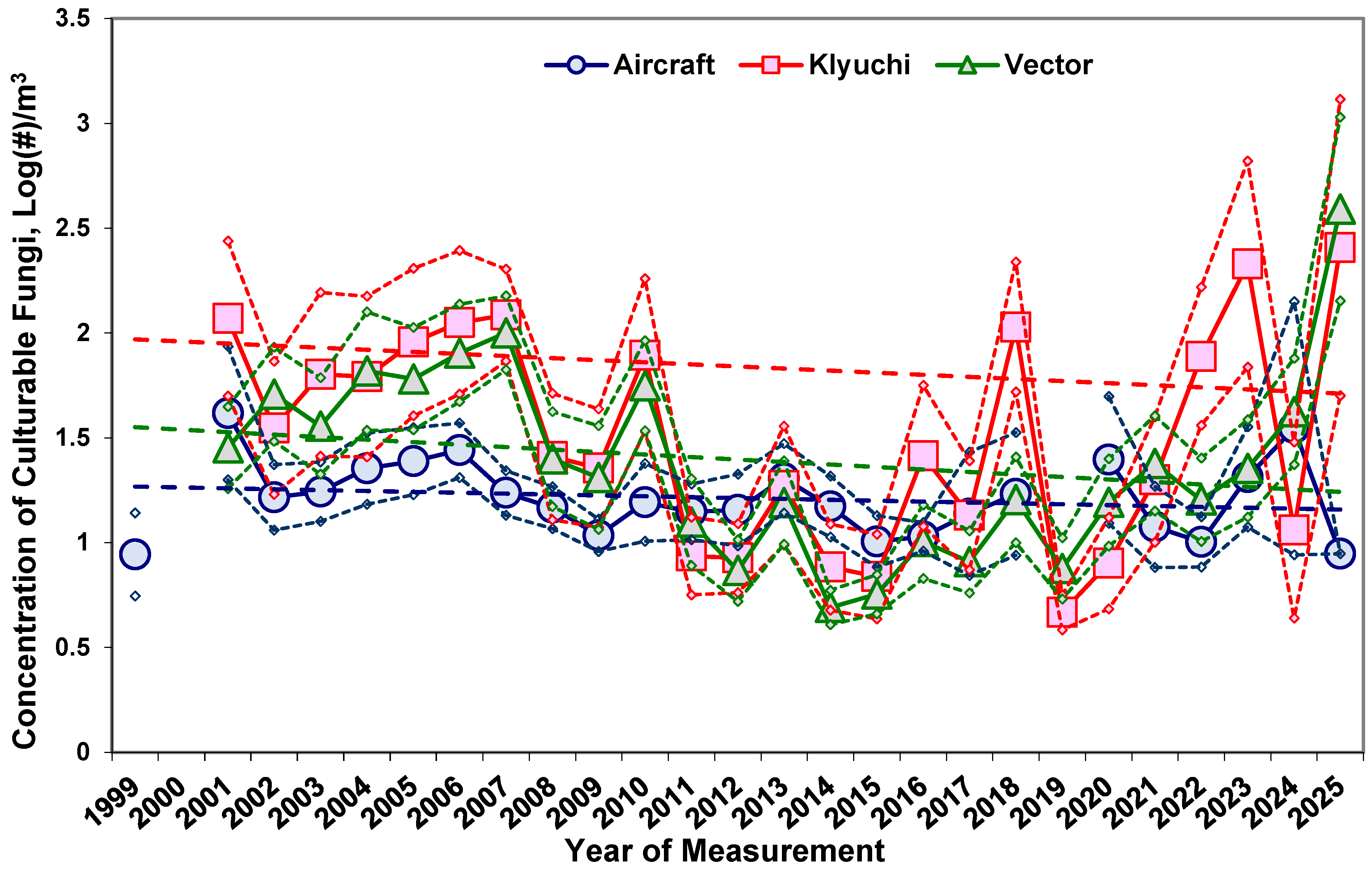
Figure 2.
Dynamics of annual atmospheric concentrations of micromycetes in southern Western Siberia at three observation sites: aircraft atmospheric sounding, the Vector site of the Federal Research Center for Virology and Biotechnology of Rospotrebnadzor, and the site in the Klyuchi settlement. Values for each month, averaged over the entire observation period, and the 95% confidence interval are shown.
Figure 2.
Dynamics of annual atmospheric concentrations of micromycetes in southern Western Siberia at three observation sites: aircraft atmospheric sounding, the Vector site of the Federal Research Center for Virology and Biotechnology of Rospotrebnadzor, and the site in the Klyuchi settlement. Values for each month, averaged over the entire observation period, and the 95% confidence interval are shown.
Disclaimer/Publisher’s Note: The statements, opinions and data contained in all publications are solely those of the individual author(s) and contributor(s) and not of MDPI and/or the editor(s). MDPI and/or the editor(s) disclaim responsibility for any injury to people or property resulting from any ideas, methods, instructions or products referred to in the content. |
© 2025 by the authors. Licensee MDPI, Basel, Switzerland. This article is an open access article distributed under the terms and conditions of the Creative Commons Attribution (CC BY) license (http://creativecommons.org/licenses/by/4.0/).
Copyright: This open access article is published under a Creative Commons CC BY 4.0 license, which permit the free download, distribution, and reuse, provided that the author and preprint are cited in any reuse.


