

Submitted:
08 October 2025
Posted:
09 October 2025
You are already at the latest version
Abstract
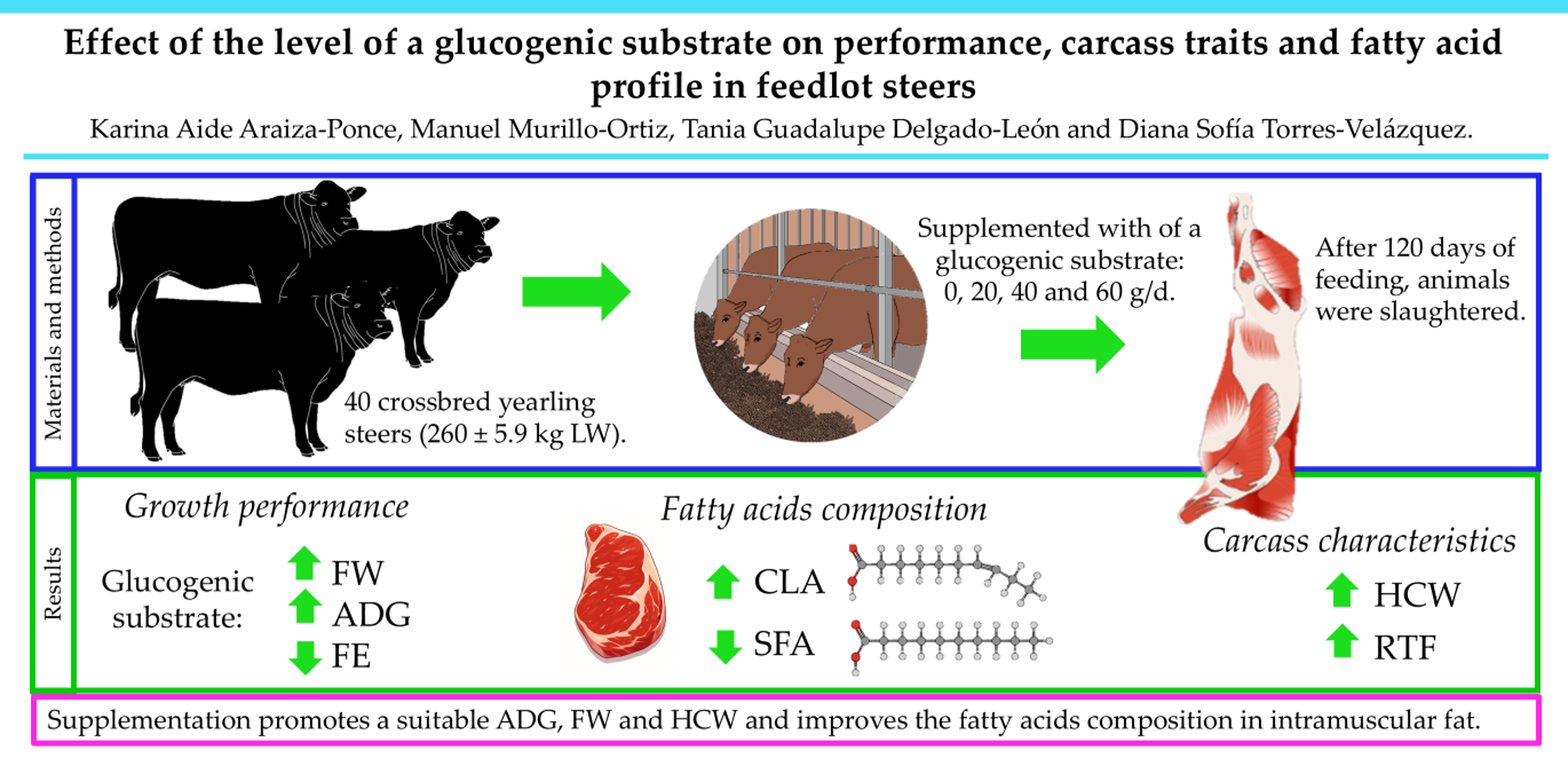
Several strategies have been used to improve fat deposition and fatty acids composition; however, most of them are focused on reducing saturated fatty acids by increasing the content polyunsaturated acids. This study aimed to evaluate performance, carcass traits and fatty acids composition in the intramuscular fat of steers. Forty crossbred yearling steers (260 ± 5.9 kg LW) were supplemented with four levels of a glucogenic substrate: 0, 20, 40 and 60 g/d (T1, T2, T3 and T4, respectively). Animals were slaughtered after feeding trial, carcass traits and intramuscular fat samples were obtained. Final weight (FW) and average daily gain (ADG) increased with supplementation (p< 0.05); however, dry matter intake decreased in T2 (p< 0.05). Hot carcass weight, area rib eye and rib fat thickness increased with supplementation (p< 0.05). Likewise, saturated, monounsaturated and polyunsaturated fatty acids contents increased with supplementation of 60 g of glucogenic substrate (T3) versus T1 (p< 0.05). Additionally, Ω6/Ω3 ratio was different between treatments (p< .05). This ratio increased 20% with the addition of 20 g of glucogenic substrate compared to T1. Supplementation with 40 g/d of glucogenic substrate may improve fat deposition and fatty acids composition in intramuscular fat as well as enhance performance and carcass traits of feedlot cattle.
Keywords:
fatty acids
; longissimus muscle
; performance productive
; glucogenic precursor
1. Introduction
Consumers and their increasing interest in nutritional factors affecting their health and well-being promote the enhancement in quality of edible animal products [1,2]. Special emphasis has been placed on reducing intake of saturated fatty acids (SFA) by increasing intake of unsaturated fatty acids (UFA) instead. The latter has been promoted since the evidence of cardiovascular diseases and the intake of SFA have been positively correlated [3,4]. Several strategies have been encouraged influencing the fat deposition and fatty acids composition of beef [5]; however, most of them are focused on reducing SFA by increasing the content of Ω3 UFA, including conjugated linoleic acid (CLA; C18:2 c9, t11) which biological effects on human health have been extensively studied in the last decades [6,7].
It has been stated that beef cattle which is fed with grass produce higher ratios of unsaturated fatty acids, especially Ω3 fatty acids [8,9]. In addition, the use of grass and other alternative ingredients as animal feedstuffs offers minimal environmental impact; consequently there is an increasing interest in production of these types of forages [10]. Moreover, some studies have revealed that the use of additives as supplementation for beef cattle fed with forage increases production efficiency and improves meat quality [11,12]. The main additives used in intensive beef animal production are yeast cultures, fibrolytic enzymes and ionophores [13,14,15]. Nevertheless, glucogenic precursors (i.e., propionate salts) are commonly used to increase production of ruminal propionate by incorporating propionate as a substrate in the gluconeogenesis pathway that takes place in the liver [16,17]. Similarly, propane-1,2-diol (PG) has been utilized as a glucogenic substrate increasing milk yield and energetic balance in cattle [18,19]. Thus, both glucogenic substrates, propionate salts and PG, are often used to improve productive characteristics of cattle. However, there are few published reports about supplementation of glucogenic precursors and their effect on body condition, beef lipids profile and feed efficiency. Therefore, our hypothesis is that supplementation with a glucogenic substrate may improve productive performance, carcass traits and fat deposition and composition in meat. For that reason, this study was designed to assess productive performance, carcass characteristics, and fatty acid composition in steers that received varying levels of a glucogenic substrate supplement.
2. Materials and Methods
The study received approval of the institutional Animal Care Committee of the Agriculture and Livestock of Durango, Mexico, and was conducted according to the Official Mexicans Norms [20].
2.1. Animals and Experimental Treatments
Forty crossbred yearling steers (260 ± 5.9 kg LW) were used in a feeding trail to investigate the effects of a glucogenic substrate (3.3% of propane-1,2-diol; 6.9% of calcium propionate) on growth performance, carcass quality and fatty acids profile. Steers were vaccinated and wormed upon arrival at experimental center prior to start the study. The animals were randomly housed into individual pens (3 × 6 m) supplied with feed bunks and water and were fed with 1 of 4 experimental treatments. The chemical composition and experimental treatments are presented in Table 1. Diets were provided twice daily (8:00 and 15:00 h). Intake was restricted to 2.8% LW daily to each animal. Minerals and vitamins were supplied by meeting nutritional requirements for beef cattle gaining 1.5 kg/d [21].
2.2. Growth Performance
Animals were weighed every 28 days to record average daily gain (ADG) during the entire experiment by dividing the shrunk BW gained (final BW minus initial BW) by the number of days on feed. Initial and final BW were determined by taking the BW means of the steers before feeding during 2 consecutive days at the beginning and at the end of the experiment. Feed delivery to each pen was recorded daily, and refusals were weekly collected to determine dry matter intake (DMI) as the difference between dietary offered and refusals. Feed efficiency (FE) was calculated by dividing ADG by DMI.
2.3. Slaughter and Carcass Data
After 120 days of feeding, all the animals were slaughtered at a commercial beef slaughterhouse. Animals handling was in accordance with good animal welfare practices whereas slaughtering was performed according to procedures stated in the Mexico’s official norm for slaughtering [22]. After slaughtering, carcasses were weighed and stored at 4 °C during 24 h. Samples of the 12th rib in the longissimus muscle were obtained and areas were measured with a planimeter. Measurements at 3/4 of the ventral length over the longissimus muscle were taken and rib fat thickness (RFT) was determined [23]. Dressing percentage (DP) was calculated using the hot carcass weight (HCW) divided by final BW and then multiplying the result by 100 [24].
2.4. Fatty Acid Composition
Approximately 1 kg of samples of the transverse section were collected from the longissimus muscle and frozen for further analysis. Samples were freeze-dried and the fatty material was extracted using a mixture of chloroform–methanol [25] and methylated according to the AOAC procedures [26] for fatty acid determination. Fatty acid methyl esters (FAME) were separated by injecting 5 µL in a GC 6890N (Agilent Technologies Inc., Wilmington, DE) equipped with a flame ionization detector and a HP-Innowax polyethylene glycol capillary column (30 m x 0.32 mm x 0.15 µm, J&W Scientifics). GC oven temperature was programmed from 200°C (held constant for 1 min) to 230°C at a rate of 5°C/ min and held for 5 min and to 250°C at a rate of 5°C/min and held for 5 min. Helium was the carrier gas at a split ratio of 40:1 and a constant flow rate of 40 mL/min. Injector temperature was set to 250°C. Identification and quantification of FAMEs were achieved by comparison of retention time and concentration of a FAME standard (Sigma-Aldrich, USA).
2.5. Statistical Analysis
All data were analyzed as a completely randomized design using GLM procedures (SAS Inst. Inc., Cary, NC, USA). HCW was used as a covariate and means were adjusted for RTF, RA and DP. Means comparison for all data was evaluated by Tukey’s multiple range test.
3. Results
3.1. Growth Performance and Carcass Characteristics
The growth performance parameters are presented in Table 2. Final weight (FW), ADG, and FE were different among treatments (p<0.05). Increases of 18 and 90% in the FW and ADG were observed in T4 with respect to T1, respectively (p<0.05). Otherwise, FE was reduced when supplementing T2 (p<0.05).
Table 3 presents the adjusted means for RTF, rib eye area (RA) and DP of the supplemented steers using HCW as a covariate. The HCW increased about 15% when T2 was fed compared with T1 (p<0.05). RTF increased 121% in animals supplemented with 60 g of glucogenic substrate (T4) compared to T1 (p<0.05). Otherwise, RA was not affected by supplementation (p<0.05). Nevertheless, DP showed no differences among experimental treatments (p<0.05).
3.2. Fatty Acids Composition
Table 4 presents the fatty acid content in the longissimus muscle. Significant differences were detected among C10:0, C14:0, C16:0, and C18:0 (p<0.05).
No changes were observed in cis 9,18:1 with supplementation of glucogenic precursor (p>0.05). However, CLA (cis 9, cis 12, 18:2) concentration increased 55% compared to T1 (p<0.05); whereas the concentration of rumenic acid increased 67.5% on T4 compared to T1 (p<0.05). Additionally, CLA increased on T2, T3 and T4. The addition of 20 g of glucogenic precursor decreased SFA by about 9% in T2 compared with T1 (p<0.05). Additionally, Ω6/Ω3 ratio was different between treatments (p<0.05). This ratio increased 20% in T2 compared to T1.
4. Discussion
4.1. Growth Performance and Carcass Characteristics
The observed differences in FW and ADG between treatments may be explained due to the energy density provided by the glucogenic substrate [27,28]. Moreover, Simioni et al. [29] and Lahart et al. [30] fed steers with high-grain diets during finishing phase and reported lower values in ADG, DMI and FE than those registered in this study. Additionally, a high-grain diet is more expensive than considering the possible addition or supplementation of glucogenic substrates as an energy source for finishing beef steers [31,32]. Likewise, Nusri-un et al. [33] and Fruet et al. [34] reported an increase of about 2% in HCW in animals fed with similar diets.
Carbohydrates contained in diets contribute about 50% of metabolic energy [21]. Hence, compounds different to carbohydrates provide energy which is stored as glycogen and can be synthesized to non-essential amino acids and fatty acids, increasing the muscle mass in the animal [35]. In addition, Ferreira et al. [36] observed lower RA values of about 87.1 cm2 when added de-oiled wet distiller grains (WDG) as feedstuffs to finishing beef steers. Van Cleef et al. [37] reported similar HCW and DP when supplemented finishing bulls with a glucogenic substrate. Otherwise, according to the quality standards proposed by the USDA, the DP obtained in the present study agrees to a Yield Grade 1 quality level, since the DP obtained is higher than 52%. The Yield Grade 1 is described as a carcass covered with a thin layer of external fat over the loin and rib, as well as slight deposits of fat in the flank, kidney, pelvis and heart [38,39].
4.2. Fatty Acids Composition
The fatty acid profile showed higher values than those reported by Castagnino et al. [40], especially myristic and palmitic acid, these authors evaluated the effect of a glucogenic precursor in Nellore breed bulls. Pilarczyk y Wójcik [41] stated that these results can be attributed to a low activity of the enzyme D9-desaturase. San Vito et al. [23] registered similarly values of palmitic acid in the muscle longissimus from Nellore young bulls fed pasture and supplemented with crude glycerin. The same authors mentioned that the glucogenic precursors increased intramuscular fat and higher marbling score.
Bai et al. and Maciel et al. [42,43] reported similar values in C18:1, C16:0, CLA and rumenic acid in steers fed with different sources of fatty acids, on grass and grains systems. Thus, increases in CLA and rumenic acid concentration would occur because of the availability of glucogenic compounds. These compounds can be used as precursors for fatty acids to be deposited intramuscularly [44]. Moreover, glycerol inhibits lipolysis in the rumen, a prerequisite for rumen fatty acid biohydrogenation [45]; thus, there is an improvement in the quality of meat by the incorporation of a higher proportion of unsaturated fatty acids due to a reduction in the accumulation of free fatty acids in rumen [46]. The optimal concentrations of conjugated linoleic acids (CLA) that promote beneficial effects on human health are still unknown [47]. According to Badawy et al. [47] and Dinh et al. [48] intramuscular fat consists of a variety of fatty acids. However, oleic, palmitic, stearic, linoleic and myristic acids represent more than 92% of all fatty acids. In addition, ruminant fat is the only one which contains fatty acids derived from ruminal biohydrogenation of dietary lipids. In this investigation the sum of these acids was on average 86%.
Saturated fatty acids are important for human health, because they are classified as hipercholestolemic. In this study, SFA decreased with the addition of 20 and 60 g/d of glucogenic precursor. In general, animals with lower intramuscular fat deposition rates present a more polyunsaturated profile, since intramuscular fat consists of SFA and MUFA; whereas, PUFA are almost exclusively found in phospholipids of muscle cell membrane [49].
Excessive amounts of Ω6 PUFA and a very high Ω6/Ω3 ratio, promote a pathogenesis, including cancer, and cardiovascular, inflammatory and autoimmune diseases. Thus, increased levels of Ω3 PUFA (a low Ω6/Ω3 ratio) present suppressive effects. In addition, a 4/1 ratio was associated with a reduction of 70% in total mortality [50].
5. Conclusions
Supplementation with glucogenic precursor used in this study promotes a suitable ADG, FW, and HCW in feedlot cattle. Likewise, supplementation increases RTF and fat deposition. Moreover, supplementation improves the fatty acid composition by decreasing SFA and increasing CLA and rumenic acid in intramuscular fat from the longissimus muscle. Supplementation of 40 g/d of the glucogenic substrate resulted in a profitable option to enhance quality parameters in meat and to increase productive performance in beef cattle. On the other hand, research on supplementation with the glucogenic substrate at higher levels and in different diets is highly recommended for further investigations.
Author Contributions
Conceptualization, M.M.-O and K.A.A.-P.; methodology, D.S.T.-V; software, T.G.D.-L.; validation, M.M-O.; formal analysis, K.A.A-P; investigation, D.S.T.-V.; resources, K.A.A-P and D.S.T.-V.; data curation, T.G.D.-L; writing—original draft preparation, M.M.-O.; writing—review and editing, D.S.T.-V. and K.A.A.-P.; visualization, T.G.D.-L.; supervision, K.A.A.-P.; project administration, D.S.T.-V.; funding acquisition, M.M.O. All authors have read and agreed to the published version of the manuscript.
Funding
This manuscript received no external financial support for the research, authorship, and/or publication.
Institutional Review Board Statement
All procedures and management of steers in this study were performed in accordance with the guidelines established by the State Committee for the Promotion and Protection of Livestock of the State of Durango (Mexico) and in accordance with the Official Mexican Standard NOM-062-ZOO-1995, for slaughtering procedures were conducted according to the Official Mexican Standard NOM-033-Z00-1995.
Informed Consent Statement
Not applicable.
Data Availability Statement
The data that support the findings of this study are available from the corresponding author upon reasonable request.
Conflicts of Interest
The authors declare no conflicts of interest.
References
- Cuchillo-Hilario, M.; Fournier-Ramírez, M.-I.; Díaz Martínez, M.; Montaño Benavides, S.; Calvo-Carrillo, M.-C.; Carrillo Domínguez, S.; Carranco-Jáuregui, M.-E.; Hernández-Rodríguez, E.; Mora-Pérez, P.; Cruz-Martínez, Y.R.; et al. Animal Food Products to Support Human Nutrition and to Boost Human Health: The Potential of Feedstuffs Resources and Their Metabolites as Health-Promoters. Metabolites 2024, 14, 496. [Google Scholar] [CrossRef] [PubMed]
- Wood, J.D.; Giromini, C; Givens, D.I. Animal-derived foods: consumption, composition and effects on health and the environment: an overview. Frontiers in Animal Science 2024. 5:1332694. [CrossRef]
- Perna, M.; Hewlings, S. Saturated Fatty Acid Chain Length and Risk of Cardiovascular Disease: A Systematic Review. Nutrients 2023, 15, 30. [Google Scholar] [CrossRef] [PubMed]
- Hooper L, Martin N, Jimoh OF, Kirk C, Foster E, Abdelhamid AS. Reduction in saturated fat intake for cardiovascular disease. Cochrane Database of Systematic Reviews 2020, Issue 5. Art. No.: CD011737. [CrossRef]
- Scollan, N.D.; Dannenberger, D.; Nuernber, K.; Richardson, I.; MacKintosh, S.; Hocquette, J.F.; Moloney, A.P. Enhancing the nutritional and health value of beef lipids and their relationship with meat quality. Meat Science. 2014; 97:3:384-394. [CrossRef]
- Basak, S.; Duttaroy, A.K. Conjugated linoleic acid and its beneficial effects in obesity, cardiovascular disease, and cancer. Nutrients 2020, 12(7), 1913. [Google Scholar] [CrossRef] [PubMed]
- Abdelhamid, A.S.; Martin, N.; Bridges, C.; Brainard, J.S.; Wang, X.; Brown, T.J.; Hanson, S.; Jimoh, O.F.; Ajabnoor, S.M.; Deane, K.H.; et al. Polyunsaturated fatty acids for the primary and secondary prevention of cardiovascular disease. Cochrane Database of Systematic Reviews. 2018, 7, CD012345. [Google Scholar] [CrossRef] [PubMed]
- Krusinski, L., Sergin, S., Jambunathan, V.; Rowntree, J.E.; Fenton, J.I. Attention to the Details: How Variations in U.S. Grass-Fed Cattle-Feed Supplementation and Finishing Date Influence Human Health. Frontiers in Sustainable Food Systems 2022. 6:851494. [CrossRef]
- Nogoy, K.M.C.; Sun, B.; Shin, S.; Lee, Y.; Li, X.Z.; Choi, S.H; Park, S. Fatty acid composition of grain-and grass-fed beef and their nutritional value and health implication. Food science of animal resources 2022, 42 (1), 18. [CrossRef]
- Davis, H.; Magistrali, A.; Butler, G.; Stergiadis, S. Nutritional Benefits from Fatty Acids in Organic and Grass-Fed Beef. Foods 2022, 11, 646. [Google Scholar] [CrossRef] [PubMed]
- Ponnampalam, E. N.; Jairath, G.; Alves, S. P.; Gadzama, I. U.; Santhiravel, S.; Mapiye, C.; Holman, B. W. Sustainable livestock production by utilising forages, supplements, and agricultural by-products: Enhancing productivity, muscle gain, and meat quality–A review. Meat Science 2025, 109921. [Google Scholar] [CrossRef] [PubMed]
- Fernandes, L.D.; Vasconcelos, A.B.; Lobo Júnior, A.R.; Rosado, G.L.; Bento, C.B. Effects of different additives on cattle feed intake and performance-a systematic review and meta-analysis. Anais da Academia Brasileira de Ciências 2024, 96, e20230172. [Google Scholar] [CrossRef] [PubMed]
- Naves, K.R.S.; Moraes, K.A.K.; Cunha, L.O.d.; Petrenko, N.B.; Ortelam, J.C.; Sousa, J.N.; Covatti, C.F.; Nunes, D.; Chaves, C.S.; Menezes, F.L.d.; et al. Additives in Supplements for Grazing Beef Cattle. Animals 2024, 14, 3688. [Google Scholar] [CrossRef] [PubMed]
- Kondratovich Lucas B.; Jhones O. Sarturi; Carly A. Hoffmann; Michael A. Ballou; Sara J. Trojan; Pedro RB Campanili. Effects of dietary exogenous fibrolytic enzymes on ruminal fermentation characteristics of beef steers fed high-and low-quality growing diets. Journal of animal science 2019. 97, 7: 3089-3102. [CrossRef]
- National Academies of Sciences, Engineering, and Medicine. Nutrient Requirements of Dairy Cattle: Eighth Revised Edition. Washington (DC): National Academies Press (US); 2021. Chapter 16, Feed Additives. Washington, DC: The National Academies Press. [CrossRef]
- Rathert-Williams, A. R.; Salisbury, C. M.; Lindholm-Perry, A. K.; Pezeshki, A.; Lalman, D. L.; Foote, A. P. Effects of increasing calcium propionate in a finishing diet on dry matter intake and glucose metabolism in steers. Journal of Animal Science 2021, 99(12), skab314. [Google Scholar] [CrossRef] [PubMed]
- King, T.M.; Beard, J.K.; Norman, M.M.; Wilson, H.C.; MacDonald, J.M.; Mulliniks, J.T. Effect of protein and glucogenic precursor supplementation on forage digestibility, serum metabolites, energy utilization, and rumen parameters in sheep. Translational Animal Science 2021. Dec 14;6(1):t xab229. [CrossRef]
- Arita-Portillo, C. R.; Elizondo-Salazar, J. A. Efecto del uso de una mezcla de compuestos gluconeogénicos en vacas lecheras en transición. Agronomía Costarricense 2023, 47(2), 111-120. [CrossRef]
- Mikuła, R.; Pruszyńska-Oszmałek, E.; Kołodziejski, P.A.; Nowak, W. Propylene Glycol and Maize Grain Supplementation Improve Fertility Parameters in Dairy Cows. Animals 2020. Nov 18;10(11):2147. [CrossRef]
- NOM-062-ZOO-1999; Especificaciones Técnicas para la Producción, Cuidado y Uso de los Animales de Laboratorio. Norma Oficial Mexicana; Diario Oficial de la Federación: Mexico City, Mexico, 2001; pp. 128–134.
- National Academies of Sciences, Engineering, and Medicine. (2016). Nutrient Requirements of Beef Cattle: Eighth Revised Edition. Washington, DC: The National Academies Press. [CrossRef]
- NOM-033-SAG/ZOO-2014; Métodos para dar muerte a los animales domésticos y silvestres. Norma Oficial Mexicana; Diario Oficial de la Federación: Mexico City, Mexico, 2015; pp. 1-48.
- San Vito, E.; Lage, J. F.; Ribeiro, A. F.; Silva, R. A.; Berchielli, T. T. Fatty acid profile, carcass and quality traits of meat from Nellore young bulls on pasture supplemented with crude glycerin. Meat science 2015, 100, 17–23. [Google Scholar] [CrossRef] [PubMed]
- Ferreira, I.M.; Oliveira, K.A.; Cidrini, I.A.; de Abreu, M.J.; Sousa, L.M.; Batista, L.H.; Homem, B.G.; Prados, L.F.; Siqueira, G.R.; Resende, F.D. Performance, intake, feed efficiency, and carcass characteristics of young Nellore heifers under different days on feed in the feedlot. Animals 2023. Jul 7;13(13):2238. [CrossRef]
- Bligh, E. G., & Dyer, W. J. A rapid method of total lipid extraction and purification. Canadian journal of biochemistry and physiology 1959, 37(8), 911-917. [CrossRef]
- AOAC. Official Methods of Analysis of AOAC International, 21st ed.; AOAC: Gaithersburg, MD, USA, 2019. [Google Scholar]
- Chen, K., Shui, Y.; Deng, M.; Guo, Y.; Sun, B.; Liu, G.; Liu, D., Li, Y. Effects of different dietary energy levels on growth performance, meat quality and nutritional composition, rumen fermentation parameters, and rumen microbiota of fattening Angus steers. Frontiers in Microbiology 2024. May 6; 15:1378073. [CrossRef]
- Honig, A.C.; Inhuber, V.; Spiekers, H.; Windisch, W., Götz, K.U.; Schuster, M.; Ettle, T. Body composition and composition of gain of growing beef bulls fed rations with varying energy concentrations. Meat science 2022 Feb 1; 184:108685. [CrossRef]
- Simioni, T.A.; Torrecilhas, J.A.; Messana, J.D., Granja-Salcedo, Y.T.; San Vito, E.; Lima, A.R.; Sanchez, J.M.; Reis, R.A.; Berchielli, T.T. Influence of growing-phase supplementation strategies on intake and performance of different beef cattle genotypes in finishing phase on pasture or feedlot. Livestock Science. 2021 Sep 1; 251:104653. [CrossRef]
- Lahart, B.; Prendiville, R.; Buckley, F.; Kennedy, E.; Conroy, S.B.; Boland, T.M.; McGee, M. The repeatability of feed intake and feed efficiency in beef cattle offered high-concentrate, grass silage and pasture-based diets. Animal. 2020 Nov;14(11):2288-97. [CrossRef]
- Santos, A.S.; Villela, S.D.; de Paula Leonel, F., Verardo, L.L.; Regina Paschoaloto, J.; Paulino, P.V.; de Almeida Matos, É.M.; de Almeida Martins, P.G.; Dallago, G.M.; Costa, P.M. Performance and economic analysis of Nellore cattle finished in feedlot during dry and rainy seasons. Livestock Science. 2022 Jun 1;260:104903. [CrossRef]
- San Vito, E.; Granja-Salcedo, Y.T.; Lage, J.F.; Oliveira, A.S.; Gionbelli, M.P.; Messana, J.D.; Dallantonia, E.E.; Reis, R.A.; Berchielli, T.T. Crude glycerin as an alternative to corn as a supplement for beef cattle grazing in pasture during the dry season. Semina: Ciências Agrárias. 2018 Aug 20;39(5):2215-32. [CrossRef]
- Nusri-Un, J.; Kabsuk, J.; Binsulong, B.; Sommart, K. Effects of cattle breeds and dietary energy density on intake, growth, carcass, and meat quality under Thai feedlot management system. Animals. 2024 Apr 15;14(8):1186. [CrossRef]
- Fruet, A.P., Stefanello, F.S.; Trombetta, F.; De Souza, A.N.; Júnior, A.R., Tonetto, C.J., Flores, J.L.; Scheibler, R.B.; Bianchi, R.M.; Pacheco, P.S.; De Mello, A. Growth performance and carcass traits of steers finished on three different systems including legume–grass pasture and grain diets. Animal. 2019 Jul;13(7):1552-62. [CrossRef]
- Ladeira, M.M.; Carvalho, J.R.; Chizzotti, M.L.; Teixeira, P.D.; Dias, J.C.; Gionbelli, T.R.; Rodrigues, A.C.; Oliveira; D.M. Effect of increasing levels of glycerin on growth rate, carcass traits and liver gluconeogenesis in young bulls. Animal Feed Science and Technology. 2016 Sep 1;219:241-8. [CrossRef]
- Ferreira, M.; Niehues, M.B.; Tomaz, L.A.; Baldassini, W.; Ladeira, M.; Arrigoni, M.; Martins, C.L.; Gionbelli, T.; Paulino, P.; Neto, O.R. Dry matter intake, performance, carcass traits and expression of genes of muscle protein metabolism in cattle fed increasing levels of de-oiled wet distillers grains. Animal Feed Science and Technology. 2020 Nov 1;269:114627. [CrossRef]
- Van Cleef, E.H.; Uwituzem, S.; Alvarado-Gilis, C.A.; Miller, K.A., Van Bibber-Krueger, C.L.; Aperce, C.C., Drouillard, J.S. Elevated concentrations of crude glycerin in diets for beef cattle: feedlot performance, carcass traits, and ruminal metabolism. Journal of Animal Science. 2019 Oct 3;97(10):4341-8. [CrossRef]
- Ahmed, M.R.; Reed, D.D., Jr.; Young, J.M.; Eshkabilov, S.; Berg, E.P.; Sun, X. Beef Quality Grade Classification Based on Intramuscular Fat Content Using Hyperspectral Imaging Technology. Applied Sciences. 2021, 11, 4588. [Google Scholar] [CrossRef]
- Holland, R.; Loveday, D. Understanding yield grades and quality grades for value-added beef producers and marketers. Institute of Agriculture, University of Tennessee, Knoxville. 2013 Dec 1.
- Castagnino, P.S.; Fiorentini, G.; Dallantonia, E.E.; San Vito, E.; Messana, J.D.; Torrecilhas, J.A.; Sobrinho, A.G.; Berchielli, T.T. Fatty acid profile and carcass traits of feedlot Nellore cattle fed crude glycerin and virginiamycin. Meat science. 2018 Jun 1; 140:51-8. [CrossRef]
- Pilarczyk, R.; Wójcik, J. Fatty acids profile and health lipid indices in the longissimus lumborum muscle of different beef cattle breeds reared under intensive production systems. Acta Scientiarum Polonorum Zootechnica. 2015. 14(1), 109–126.
- Maciel, I.C.; Schweihofer, J.P.; Fenton, J.I.; Hodbod, J.; McKendree, M.G.; Cassida, K.; Rowntree, J.E. Influence of beef genotypes on animal performance, carcass traits, meat quality, and sensory characteristics in grazing or feedlot-finished steers. Translational Animal Science. 2021 Oct 1;5(4):txab214. [CrossRef]
- Bai, H.; Wang, L.; Lambo, M.T.; Li, Y.; Zhang, Y. Effect of changing the proportion of C16: 0 and cis-9 C18: 1 in fat supplements on rumen fermentation, glucose and lipid metabolism, antioxidation capacity, and visceral fatty acid profile in finishing Angus bulls. Animal Nutrition. 2024 Sep 1;18:39-48. [CrossRef]
- Ladeira, M.M.;, Schoonmaker, J.P.; Gionbelli, M.P.; Dias, J.C.; Gionbelli, T.R.; Carvalho, J.R.; Teixeira, P.D. Nutrigenomics and beef quality: a review about lipogenesis. International journal of molecular sciences. 2016 Jun 10;17(6):918. [CrossRef]
- Ding, J.; Zhan, T.; Teng, J.; Liu, Y.; Yu, Z.; Ma, L.; Bu, D. Different sources of DHA have distinct effects on the ruminal fatty acid profile and microbiota in vitro. Journal of Agriculture and Food Research. 2025; 21:101875. [CrossRef]
- Toral, P.G.; Monahan, F.J.; Hervás, G.; Frutos, P.; Moloney, A.P. Modulating ruminal lipid metabolism to improve the fatty acid composition of meat and milk. Challenges and opportunities. Animal. 2018. Dec;12(s2):s272-81.
- Badawy, S.; Liu, Y.; Guo, M.; Liu, Z.; Xie, C.; Marawan, M.A.; Ares, I.; Lopez-Torres, B.; Martinez, M.; Maximiliano, J.E.; Martinez-Larranaga, M.R. Conjugated linoleic acid (CLA) as a functional food: Is it beneficial or not?. Food Research International. 2023 Oct 1;172:113158. [CrossRef]
- Dinh, T.T.; To, K.V.; Schilling, M.W. Fatty acid composition of meat animals as flavor precursors. Meat and Muscle Biology. 2021 Aug 10;5(1). [CrossRef]
- Nguyen, D.V.; Nguyen, O.C.; Malau-Aduli, A.E. Main regulatory factors of marbling level in beef cattle. Veterinary and Animal Science. 2021. Dec 1;14: 100219. [CrossRef]
- Simopoulos, A.P. An increase in the omega- 6/omega-3 fatty acid ratio increases the risk for obesity. Nutrients. 2016; 8:3:128. [CrossRef]

Table 1.
Ingredients, chemical composition and fatty acids composition of experimental treatments.
| Treatments | ||||
| Ingredients | T1 | T2 | T3 | T4 |
| Alfalfa hay (%) | 15.0 | 15.0 | 15.0 | 15.0 |
| Oat hay (%) | 15.0 | 15.0 | 15.0 | 15.0 |
| Cottonseed meal (%) | 20.0 | 20.0 | 20.0 | 20.0 |
| Rolled corn (%) | 47.0 | 47.0 | 47.0 | 47.0 |
| Mineral premix* (%) ж Calcium carbonate (%) ж Monensin (g) ж Glucogenic substrate† (g/a/d) | 1.0 ж 2.0 ж 2 ж 0 | 1.0 ж 2.0 ж 2 ж 20 | 1.0 ж 2.0 ж 2 ж 40 | 1.0 ж 2.0 ж 2 ж 60 |
| Chemical composition (g/kg) | ||||
| Organic matter | 940 | 940 | 940 | 940 |
| Crude protein | 135 | 135 | 135 | 135 |
| Ether extract | 2.8 | 2.8 | 2.8 | 2.8 |
| Neutral detergent fiber | 490 | 490 | 490 | 490 |
| Acid detergent fiber | 195 | 195 | 195 | 195 |
| Fatty acids (g/100 g total fatty acids) | ||||
| C16:0 | 40.9 | 40.9 | 40.9 | 40.9 |
| C14:0 | 4.3 | 4.3 | 4.3 | 4.3 |
| C16:1 | 1.5 | 1.5 | 1.5 | 1.5 |
| C18:1 (c9) | 49.9 | 49.9 | 49.9 | 49.9 |
| C18:2 (c9, c12) | 3.4 | 3.4 | 3.4 | 3.4 |
*Minerals premix containing: P (12%), Ca (12%), Na (9%), Mg (1.7%), Zn (0.5%); † Glucogenic mix: 3.3% propylene-1,2-diol, 6.9% calcium propionate, 89.8% excipient.
Table 2.
Performance of beef steers fed with experimental treatments.
| Treatments | |||||
| T1 | T2 | T3 | T4 | SEM | |
| FW, kg | 422.7±8.23b | 488.3±5.04ab | 461.2±10.03ab | 499.3±13.8a | 36.09 |
| ADG, kg/d | 1.1±0.01c | 1.7±0.07b | 1.9±0.04b | 2.1±0.01a | 0.15 |
| DMI, kg/d | 11.5±1.51a | 10.7±1.53a | 11.4±1.25a | 11.1±1.10a | 0.75 |
| FE | 0.11±0.006a | 0.09±0.004b | 0.11±0.005a | 0.11±0.009a | 0.004 |
ab Different letters in the same row indicate significant differences (P<0.05); FW = Final weight; ADG = Average daily gain; DMI = Dry matter intake; FE = Feed efficiency (kg gain/kg DMI); SEM: Standard error of difference between means.
Table 3.
Carcass traits of beef steers fed on experimental treatments.
| Treatments | |||||
| T1 | T2 | T3 | T4 | SEM | |
| RTF, mm | 3.7±1.00b | 6.8±1.09a,b | 6.5±1.00a,b | 8.2±1.06a | 3.31 |
| RA, cm2 | 91.4±4.23a | 96.5±4.63a | 94.4±4.23a | 94.2±4.49a | 14.02 |
| DP, % | 57.6±0.89a | 59.4±0.98a | 59.8±0.90a | 59.56±0.95a | 2.98 |
ab Different letters in the same row indicate significant differences (P<0.05); RTF = Rib fat thickness, RA = Rib eye area; DP = Dressing percentage; SEM: Standard error of difference between means.
Table 4.
Fatty acid profile in steers supplemented with a glucogenic precursor (g/100g FAME).
| T1 | T2 | T3 | T4 | SEM | P< | |
| 10:0 | 0.01b | 0.09a | 0.03b | 0.03b | 0.005 | 0.05 |
| 14:0 | 2.01b | 2.47b | 3.66a | 2.08b | 0.449 | 0.05 |
| 16:0 | 29.34a | 24.71b | 29.20a | 28.01a | 0.338 | 0.05 |
| 18:0 | 18.51a | 18.35ab | 17.42ba | 17.01b | 0.228 | 0.05 |
| Cis 9 16:1 | 2.12c | 2.63c | 4.72a | 3.64b | 0.520 | 0.05 |
| Cis 9 18:1 | 37.21a | 37.15a | 37.26a | 37.82a | 0.571 | 0.05 |
| Cis cis 9, 12 18:2 | 2.74b | 3.92a | 4.26a | 3.78a | 0.434 | 0.05 |
| Cis 9 trans 11 18:2 | 0.37c | 0.41c | 0.51b | 0.62a | 0.207 | 0.05 |
| Cis cis cis 9,12,15 18:3 | 0.35c | 0.42c | 0.48b | 0.59a | 0.063 | 0.05 |
| SFA | 49.87a | 45.62c | 50.31a | 47.13b | 0.229 | 0.05 |
| MUFA | 39.33a | 39.78a | 41.98a | 41.46a | 0.430 | 0.05 |
| PUFA | 3.46a | 4.75a | 5.25a | 4.99a | 0.237 | 0.05 |
| Ω6/Ω3 | 7.82b | 9.30a | 8.87a | 6.40b | 0.655 | 0.05 |
abc Different letters in the same row indicate significant differences (P<0.05); FAME= Fatty acids methyl esters; SFA= Saturated fatty acids; MUFA= Monounsaturated fatty acids; PUFA= Polyunsaturated fatty acids.
Disclaimer/Publisher’s Note: The statements, opinions and data contained in all publications are solely those of the individual author(s) and contributor(s) and not of MDPI and/or the editor(s). MDPI and/or the editor(s) disclaim responsibility for any injury to people or property resulting from any ideas, methods, instructions or products referred to in the content. |
© 2025 by the authors. Licensee MDPI, Basel, Switzerland. This article is an open access article distributed under the terms and conditions of the Creative Commons Attribution (CC BY) license (http://creativecommons.org/licenses/by/4.0/).
Copyright: This open access article is published under a Creative Commons CC BY 4.0 license, which permit the free download, distribution, and reuse, provided that the author and preprint are cited in any reuse.


