
Preprint
Review

This version is not peer-reviewed.

Antibiotic Resistance Gene Enrichment on Plastic Wastes in Aquatic Ecosystems and Fishery Products

A peer-reviewed article of this preprint also exists.

Submitted:

07 October 2025

Posted:

08 October 2025

You are already at the latest version

Abstract

This comprehensive review gathers the current knowledge on the link between plastics wastes and antibiotic resistance genes (ARGs) selection and transmission in aquatic ecosystems that can lead to the ARG contamination of fishery products, a relevant source of MPs introduction in the food chain. Indeeed, plastic debris in aquatic environments aare covered by a biofilm (plastisphere) in which antibiotic-resistant bacteria (ARB) are selected and the horizontal gene transfer (HGT) of ARGs is facilitated. The types of plastic wastes considered in this study for their role in ARG enrichment are mainly microplastics (MPs) but also nanoplastics (NPs) and macroplastics. Studies regarding freshwaters, seawaters, aquaculture farms and ARG accumulation favored by MPs in aquatic animals were considered. Most studies were focused on the identification of the microbiota and its correlation with ARGs in plastic biofilms and a few evaluated the effect of MPs on ARG selection in aquatic animals. An abundance of ARGs higher in the plastisphere than in the surrounding water or natural solid substrates such as sand, rocks and wood was repeatedly reported. The studies regarding aquatic animals showed that MPs alone or in association with antibiotics favored the increase of ARGs in the exposed organisms with the risk of their introduction in the food chain. Therefore, the reduction of plastic pollution in waterbodies and in aquaculture waters could mitigate the ARG threat. Further investigations focused on ARG selection in aquatic animals should be carried out to better assess the health risks and increase the awareness on this ARG transmission route to adopt appropriate countermeasures.

Keywords: 
;  ;  ;  ;  ;  ;  

1. Introduction

According to the first global and regional estimate of antimicrobial resistance (AMR) mortality, in the years 1990 to 2021 deaths directly attributable to the drug resistance of an infection or associated with a drug-resistant infection increased by more than 25 000 annually with methicillin-resistant S aureus (MRSA), multidrug-resistant tuberculosis, carbapenem-resistant Klebsiella pneumoniae, and carbapenem-resistant Acinetobacter baumannii as the bacteria most often implicated. It was also estimated that until 2050, 39·1 million deaths attributable to AMR and 169 million deaths associated with AMR may occur for people aged 70 years and older [1].
Plastic wastes represent a widespread pollutant in the environment deriving from multiple sources among which agriculture and food production with almost 50 million tonnes of plastic used for cultivations, animal husbandry, fishery, forestry, and food packaging in 2019 foreseen to rise to 9.5 million tonnes in 2030 globally [2]. The main sources of plastic wastes in aquatic ecosystems derive from wastewater treatment plants (WWTPs), irrigation with wastewater, sludge fertilization and landfill leachates reaching surface and groundwater [3].
According to the fragment size plastic materials are classified as macroplastics (>2.5 cm), mesoplastics (between 0.5 and 2.5 cm), microplastic or MPs (<5 mm) and nanoplastics or NPs (<100 nm) [3,4]. MPs of polymers such as polyethylene (PE), polypropylene (PP), polystyrene (PS), polyethylene therephthalate (PET), polyvinyl chloride (PVC) originate from the direct emission in the environment of microbeads, or from the chemical or mechanical fragmentation of larger plastic debris. These constitute a major component of marine litter, defined as any solid waste of human origin discarded in the sea or which reaches the sea by dispersion from other environments [5,6].
The occurrence of MPs in form of textile microfibers or other shapes in the gastrointestinal tract of marine fish and seafood species intended for human consumption was demonstrated in numerous investigations so these food sources pose a high risk of MP introduction in the human diet. Indeed, small fishes and seafood are consumed without previous evisceration and it was also shown that fish evisceration does not prevent the presence of MPs in edible tissues [5,7,8]. MPs were detected in aquatic organisms such as fishes, crustaceans, molluscs, algae, corals, and marine mammals in at least 57 countries and regions and their concentration was found to increase from zooplankton to fishes. Benthic crustaceans and molluscs can contain hundreds or several thousand MP particles, respectively, that derive both from sediment and water. These are ingested or adsorbed by respiration by fishes and can even be transferred to eggs. The amounts of MPs in fishes depend on the level of local pollution, size of the fish, type of feeding, rapidity of movements and depth inhabited by the species. Aquaculture fishes were found to ingest higher amounts of MPs than wild fishes from the same area and mostly as fibers since these are not retained by the water filtration system. In addition, MPs in these systems originate from the plastic made equipment [9].
The absorption of antibiotics by MPs in aquatic environments started to be investigated after observing that sulfonamides, trimethoprim and fluoroquinolones are stable in water and that MPs can transfer organic pollutants to the food web of aquatic organisms. It emerged that ciprofloxacin, amoxicillin and tetracycline are adsorbed on polyamide (PA) by hydrogen bond formation and that ciprofloxacin, amoxicillin, trimethoprim, sulfadiazine and tetracycline absorbed at levels that followed the order PP > PS > PE > PVC. The adsorption on MPs was more efficient in freshwater than in seawater since both antibiotics such as ciprofloxacin and amoxicillin and MPs are negatively charged in this environment [10].
Plastic wastes dispersed in seawater and freshwater harbor a specific biofilm microbiota denominated “plastisphere”, a term coined after that scanning electron microscopy (SEM) showed the presence of a varied microbial consortium on plastic debris filtered from the North Atlantic ocean. This biofilm comprised also pathogens of the genus Vibrio as shown by High throughput sequencing (HTS) of the small rRNA gene subunit [11]. Biofilm formation occurs through the phases of adsorption of microorganisms on the plastic surface, formation of multilayered clusters of bacterial cells and development of a three-dimensional network [3]. Biomass growth on plastic particles is favored by the so called “ecocorona” resulting from the accumulation on their surface of organic and inorganic materials that facilitate the colonization by microorganisms [12]. Plastic biofilms can contain up to 100 - 5000 folds higher loads of antibiotic-resistant bacteria (ARB) compared to the surrounding water [3,13] since antibiotic adsorption implies a selective pressure that favors the predominance of ARG bacterial carriers [14]. Mobile genetic elements (MGEs) implicated in ARG horizontal gene transfer (HGT) and detected in the plastisphere include the class 1 integron, gene cassette capture elements involved in ARG spread and encoding the integrase intI1 and plasmids pBB55, pGS05 and the conjugative plasmid RP4 that encodes resistance to kanamycin, tetracycline, and ampicillin [4,14].
Biofilm development is favored by plastic degradation caused by exposure to UV rays, aging, oxidation and thermal stresses that increase surface roughness and favor bacterial colonization. Size, shape and color were shown to influence the biofilm development on MPs. Biofilms alter the morphology, hydrophobicity, surface area and functional groups in MPs affecting their capacity to adsorb chemical pollutants [14]. For example, photoaging in water led to an increase of high energy binding sites and increased adsorption of tetracycline on PVC MPs and in the biofilm formed in a suspension of activated sludge the abundance of microorganisms and the abundance of the tetracycline ARGs tetA, tetB, tetC, tetD, tetE, tetG, tetK determined by qPCR was higher on aged MPs [15].
In one of the first studies the MP-associated microbiota was found to vary in composition according to nutrient availability, salinity and proximity to the coast and differed between PE and PS. Bacterial families enriched in MPs in all coastal stations were Hypomonadaceae and Erythrobacteraceae. Hypomonadaceae produce strongly adhering polysaccharides and present cell appendages called prosthecae that allow the uptake on nutrients from a vast area. Therefore, these bacteria are the first to adhere even to smooth MPs. Erythrobacteraceae are abundant on MPs because they degrade the polycyclic aromatic hydrocarbons (PAHs) adsorbed on plastic. In addition, the potentially pathogenic genus Tenacibaculum of the family Flavobacteriaceae was detected both on PE and PS. The genus Sphingopyxis of the family Sphingomonadaceae was abundant on MPs in a WWTP and found to harbor a Class I integron encoding ARGs leading to the hypothesis that MPs represent a hotspot for ARG HGT [16]. Indeed, it was shown that the high bacterial density in MP biofilms facilitates ARG transfer by the main three routes, i.e. natural transformation, conjugation and transduction [14]. Therefore, the detrimental effects on health of MP ingestion by humans and animals, that are oxidative stress, cytotoxicity, chronic inflammation, neurologic and immune disorders, and toxicity caused by the release of chemicals including bisphenol A (BPA), polychlorinated biphenyls (PCBs), polycyclic aromatic hydrocarbons (PAHs) and organochlorine pesticides [5], can be further exacerbated by their potential to disseminate AMR.
The purpose of this comprehensive review was summarizing the updated evidences on the involvement of plastic debris in ARG and multidrug resistance genes (MDRGs) selection, increase and HGT in aquatic environments and of their transmission to aquatic organisms, among which species used as food. The scientific articles regarding these topics were retrieved from Google Scholar (https://scholar.google.com/schhp?hl=it, accessed on 24 September 2025), and EMBASE (https://www-embase-com.bibliosan.idm.oclc.org/ accessed on 24 September 2025) with two search strings, namely “antibiotic resistance AND microplastics AND water” (string 1), and “antibiotic resistance AND microplastics AND fish” or with the word “mollusc” or “mollusk”, or “crustacean”, or “shellfish”, or “seafood” or “sea food” in place of “fish”(string 2). The searches were sorted by relevance in GoogleScholar without time restriction and article screening was continued until two consecutive pages did not provide further relevant publications. The scientific articles considered in this study were selected among the first 770 retrieved from GoogleScholar and the 283 articles retrieved in Embase with the search string 1. With the search string 2 with all its variants the first 50 articles retrieved in GoogleSchola were considered while in Embase 12 articles were retrieved with the word "fish", 9 with the words "sea food", 4 with the word "seafood", 4 with the word "crustacean" and 3 with the word "mollusc". A first selection was done by title, a second selection by abstract content and a third selection by whole text content. The articles finally considered were those documenting the role of plastic wastes in selection and spread of ARGs and MDRGs in aquatic species habitats. Special attention was dedicated to the correlations established between the microbiota in the plastisphere and ARGs and to the factors found to influence their composition. Therefore, also articles elucidating the physiological mechanisms that favor ARG HGT in the plastisphere were commented. Both non-biodegradable (NBPs) and biodegradable plastics (BDPs) were taken into account and NPs and macroplatics were also considered as substrates involved in ARG selection and transmission. Throughout the text the indicated ARG gene functions are those defined by the Comprehensive Antibiotic Resistance Database (CARD, https://card.mcmaster.ca/home, accessed on 20 July 2025) and the nomenclature of the miicroorganisms was that used in the original source. The currently valid names can be found at https://lpsn.dsmz.de/ (accessed on 30 September 2025). The studies cited in each section are ordered chronologically to highlight the evolution of investigation methods and the progression of research achievements.

2. Antibiotic Adsorption on Plastic Polymers

The adsorption of environmental antibiotic residues to plastic debris drives their colonization by ARB and investigations regarding antibiotic binding contribute to explain the ARG selection dynamics. Adsorption isotherms were initially used to this aim by using antibiotic concentrations in the range 0.2 – 50 mg/L that are much higher than those found in the environment, that are of the order ng/L or µg/L. Adsorption isotherms showed that aged plastics have an increased adsorption capacity and that the interactions favoring the binding of substances to plastics are i electrostatic, i.e. dependent on the electrical charges of the polymer and the antibiotic, ii hydrophobic, i.e. occurring between non-polar plastics such as PS, PE, PP, and PET and antibiotics at a rate dependent on the hydrophobicity of the latter, iii of Van der Waals and π-π type for aliphatic polymers, such as PVC and PE and aromatic polymers, such as PS, and iiii pore-filling with greater pores in plastic debris adsorbing an higher number of antibiotic molecules. Moreover, antibiotic adsorption increases as the MP particle size decreases because of the greater surface/volume ratio. For this reason, aging of MPs caused by UV rays, mechanical shearing and exposure to extreme temperatures increases their adsorption capacity. Parameters such as pH, presence of electrolytes, dissolved organic matter and competing contaminants influence antibiotic adsorption rate on MPs [17].
Recently, machine learning (ML) was applied to obtain generalizable prediction models for the adsorption of different antibiotics to plastic materials. One of these models is based on data of poly-parameter Linear Free-Energy Relationships (ppLFER) molecular descriptors based on Quantitative Structure Property Relationship (QSPR) obtained from scientific publications on single adsorbents and adsorbates and combines the algorithms tree-based random forest (RM), eXtreme Gradient Boosting (XGB) and Light Gradient Boosting machine (LGBM). The characteristics considered for the adsorbents in the model are the specific surface area (SSA), that determines the number of active sites, the carbon percentage (C%), that determines surface homogeneity and influences the affinity for the adsorbates as dependent on hydrogen bonds and Van der Waals forces, the H to C ratio that determines the aromaticity of MPs and their interaction with aromatic antibiotics and the O to C ratio that indicates the presence of hydroxyl, carboxyl and carbonyl groups and the tendency to interact with ionic antibiotics. For the antibiotics the Abraham descriptors correlating structure and properties in different conditions were taken into account. The output parameter was the logarithm of the solute equilibrium partitioning coefficient “Kd”. The best fitting model allowed to maximize the coefficient of determination (R2) and minimize the Root Mean Square Error (RMSE). The SHapley Additive exPlanation (SHAP) method allowed to identify as top adsorption predictors the hydrophobicity of the antibiotic, the polymer surface polarity, the fraction of ionized species at the test pH and the molecular volume [18].
The molecular dynamics (MD) approach to the study of antibiotics-MP interactions represents another alternative to the experimental methods to elucidate the antibiotic adsorption dynamics in MPs and define how these contribute to their transport and persistence for risk assessment and remediation monitoring. Amoxicillin, tetracycline and ciprofloxacin were used as model molecules, 50 repeat units of PP and PS as model MPs and a model water with added NaCl ions as natural environment in computational simulations of all the possible molecule interactions based on the molecular structures. Oxidative aging was simulated by introducing (-OH) and carbonyl (-C = O) groups. This method predicted the adsorption enhancement by aged MPs due to the increased roughness and introduction of polar groups. It was shown that PS particularly when aged, adsorbs the antibiotics more efficiently than PP for its higher hydrophobicity and π-π interactions with aromatic antibiotics but PP also efficiently binds the antibiotics after aging due to the increased polarity. This model indicated that MPs prolong the persistence of antibiotics in aquatic environments. The root-mean square deviation (RMSD) analysis demonstrated the structural stability of molecules during the adsorption process [19].
In addition to the antibiotics, plastic polymers adsorb extracellular DNA particularly in conditions of high ionic strength that reduce electrostatic repulsion. Among PE, PET and PS MPs, PET showed the highest adsorption capacity for linear DNA possibly facilitated by the ester groups and adsorption occurred in a short time (30 min) [20].

3. Demonstrations of ARG HGT in the Plastisphere

Studies demonstrating ARG HGT by natural transformation or conjugation in MP biofilms or in presence of NPs were carried out in controlled conditions using model bacteria. It was shown that E. coli DH5α exposed to PS NPs was transformed with increased frequency with the plasmid pUC19 encoding ampicillin resistance, produced dose-dependent amounts of reactive oxygen species (ROS), as determined with the fluorescent dye H2DCF-DA, and showed increased catalase (Cat), superoxide dismutase (Sod) and glutathione peroxidase (GSH-Px) activities. Addition of the ROS scavenger thiourea reversed ROS formation and decreased the transformation frequency, thus confirming that oxidative stress favored transformation. Moreover, NPs induced an increased expression of the secretion system genes secA, secB, of the arginine translocase gene tatA and the gene hofB involved in the synthesis of the type II/IV conjugative pilus [21].
A strain of Bacillus subtilis and a strain of Acinetobacter baylyi, naturally competent bacteria, were allowed to form biofilms in a mineral solution on PE, PP and PS MPs in presence of plasmid pUC19 and the non-conjugative plasmids pRK415, encoding tetracycline resistance and the green fluorescent protein gene gfp for the identification of tranformants by fluorescence microscopy. The frequency of transformation for both plasmids was higher in the MP biofilms than in sand used as control natural substrate (NS) and in water and its extent followed the order PP > PE > PS with PP showing the highest bacterial density. The transformation frequency was higher in MPs of 300 µM size compared to those of 3 mm size and on MPs aged by exposure to UV light. Transcriptome analysis showed that on PS and PP biofilms, the flagellum movement genes motA, glgA, and bssR and the quorum sensing (QS) gene lsrK were upregulated in B. subtilis, the genes involved in the synthesis of polysaccharides pgaA and pgaB were upregulated and biofilm formation genes, comA and pliX slightly upregulated in both bacteria in smaller PP particles with a higher expression level on aged particles. In a multi-species microcosm in river water, the transformation efficiency of pRK415 was higher in the MP biofilms than in the NS at some time intervals and the transformants identified by 16S rRNA gene sequencing belonged to the species B. cereus, Paraclostridium spp. and Enterococcus faecalis. The latter species was detected only in MPs [22].
The role of QS in ARG transfer by transformation in MP biofilms was demonstrated in B. subtilis CGMCC 1.286 that produces acyl-homoserine lactones (AHLs) QS signal molecules, including C8-HSL, 3-oxo-C10-HSL, and C12-HSL. Their exogenous addition at concentrations varying from 0 to 10,000 ng/L led to a dose-dependent increase of extracellular polysaccharides (EPS) synthesis and transformation frequency of pRK415 in biofilms formed on PS, PE and PP MPs in mineral solution. This was of the order of 10-4, higher on MPs than on NS, since the bacterial density in the MP biofilms was about one hundred-fold higher. The QS inhibitors 2(5 H)-furanone, furaneol, coumarin, and benzpyrole led to the decrease of EPS production and transformation efficiency. AHL presence led to the upregulation of the competence genes comX and comA, of the environmental DNA uptake gene recO, and of the EPS production genes tasA, epsG, and tapA. The latter were downregulated upon exposure to QS inhibitors [23].
A frequency of plasmid transfer by conjugation three orders of magnitude higher than in water was observed in PS MPs in a microcosm containing water from Lake Stechlin (Germany) in which the E. coli MG1655 donor chromosomally tagged with the red-fluorescence expressing cassette lacIq-Lpp-mCherry-kmR, and harboring the self-transmissible trimethoprim resistance plasmid pKJK5 tagged with gfp, and a Pseudomonas spp. recipient isolated from the lake were incubated. The lacI repressed gfp in the plasmid donor so this could be expressed only in the transconjugants that were revealed by green fluorescence using flow cytometry and confocal microscopy. Bacteria detached with two methods from PS MPs deployed for four weeks in the lake received plasmid pKJK5 in mating experiments with the E. coli donor with one order of magnitude higher transfer frequency than free-living bacteria isolated from the lake water. Metataxonomy showed that the microbiota comprised mainly Gammaproteobacteria, Actinobacteria and Betaproteobacteria but with a different genera distribution between MPs and water and that Arthrobacter was the genus transformed vith highest frequency [24].
The same donor/recipient system was used to demonstrate that tire wear particles (TWP) of 10/100 μm size constituted by styrene-butadiene rubber supported conjugation particularly at 1:10 and 1:100 donor/recipient ratio. Indeed, the bacteria colonized the TWPs. The transfer frequency was 27-fold higher than in suspension and in PS MPs. HGT was enhanced by TWPs also when a lake water bacterial community was tested as recipient [25].
SEM showed that the red fluorescent donor E. coli MG1655 mentioned above and the recipient E. coli ATCC 25922, or recipient sludge bacteria, incubated in LB broth at 37°C in presence of 0 to 500 mg/L on a polydimethylsiloxane (PDMS) membrane chip formed a biofilm on PS particles with a diameter greater than 2 µm while particles of 0.2 µm size aggregated on the bacterial cell surface. At MP concentrations lower than 200 mg/L the 0.2 µm particles promoted conjugation and at higher MP concentrations also the larger particles. The plasmid transfer to sludge bacteria was maximum on particles of 15 µm/20 µm at the concentration 500 mg/L that induced the upregulation of the mating genes trbBp and traF and the DNA transfer and replication genes trfAp and traJ in E. coli. The 0.2 µm particles increased cellular ROS and membrane permeability. The contact of transconjugants with MPs was demonstrated by complementation of fluorescence observation with clear field images and taking into account the theoretical geometric contact probability [26].
The E. coli HB101 donor strain harboring plasmid RP4 and the recipient strain E. coli NK5449 resistant to rifampicin showed no significant variation in the expression of genes related to oxidative stress in biofilms formed in 4 mm PP, PS, PVC, and PE particles in simulated estuarine water and controlled nutrient concentration. However, a 4 to 11-fold increased expression of the outer membrane protein genes ompA, a pathogenicity factor involved in adhesion and invasion, ompC, and ompF that form osmo-protection and antibiotic resistance channels and a 1 to 5-fold increased expression of traG involved in the formation of the mating apparatus, conjugative pilus and DNA transfer occurred at a higher extent in PE biofilms [27].
A theoretical investigation with E. coli as donor and Pseudomonas aeruginosa as recipient indicated that the average binding energy with the predicted active codons of E. coli plasmid harboring multiple ARGs for enzymes involved in HGT, i.e. the relaxase, the type IV secretion system (T4SS) coupling protein (T4CP) and its component VirB5, and the DNA ligase of P. aeruginosa, increased by 1.12 to 2.02 folds in presence of PP, PVC, PET, PE, PS, and polycarbonate (PC), in agreement with previous evidence that VirB5 is upregulated in presence of PE and PVC MPs. The multiple criteria decision making (MCDM) method VIKOR indicated PP as the material with the highest risk of HGT. The GROningen MAchine for Chemical Simulations (Gromacs, https://www.gromacs.org/ accessed on 12 April 2025) biomolecule interaction prediction software indicated that PP stress increased by 3 to 4-fold the number of hydrogen bonds between the active codons and the relaxase and by 8 to 10-fold those with VirB5. The latter increased also upon exposure to PC [28].
Conjugative transfer occurred between the donor strain P. putida KT2440::lacIq-dsRed, harboring the conjugative plasmid gfp-RP4 and the recipient strain E. coli NK5449 in LB medium in the presence of PVC and PS MPs. Laser scanning confocal microscopy (LSCM) allowed to observe green fluorescing transconjugants appearing earlier and at higher ratio on donors during biofilm growth and maturation on PVC compared to PS [29]. The conjugal transfer on PVC was most probably favored by oxidative stress since ROS were more abundant in PVC and in the smaller particles, and, according to flow cytometry analysis, induced a dose-dependent membrane permeabilization in the recipient bacteria. An enrichment of DNA replication and repair pathways and QS signal transduction systems in smaller particles, was determined by functional prediction with Tax4Fun [30]. The PVC leachate obtained by rinsing MP particles promoted HGT while, in the case of PS, the solid particles rather than the leachate favored HGT. A Bliss independence model analysis [31] highlighted that the effect of PVC particles and leachate on HGT frequency was synergistic [29].
Poly lactic acid (PLA) is the most widespread BDP whose production in the world is steadily increasing. It has a degradation time of decades and a high tendency to fragmentation with consequent debris accumulation in water and the release of large amounts of its highly toxic plasticizer dibutyl phthalate (DBP) that constitutes from 10% to 70% of its weight. PLA MPs and DBP after 12 h incubation increased of about two-fold the conjugation frequency between E. coli Stbl4 donor of a mobilizable plasmids encoding chloramphenicol and tetracycline resistance and E. coli JM109 recipient at 100 mg/L and 0.1–100 μg/L, respectively, and the combination PLA MPs 1 mg/L and DBP 1 μg/L slightly increased the conjugation frequency [32].
Transformation with the pAC plasmid encoding chloramphenicol resistance increased by 28% in presence of 10 to 100 mg/L PLA MPs and by 1.2 to 1.5-fold in presence of DBP reaching the highest level for the combination PLA MPs 1 mg/L and DBP 1 μg/L. ROS formation increased in the bacteria exposed to 1 to 100 μg/L DBP and was enhanced when also PLA MPs were present. Staining with 2′, 7′ - dichlorofluorescein diacetate (DCFH-DA) showed maximum membrane permeability in presence of 100 mg/L PLA, 100 μg/L DBP, and the combination PLA MPs 1 mg/L and DBP 1 μg/L. An increase in the total antioxidant capacity (TAOC), activation of the SOS response indicated by the upregulation of umuC and lexA, a 3-fold increase of EPS levels and adhesion, upregulation of the membrane permeability genes ompA and ompC and the mating genes trfAp and trbBp were observed in donor cells. In addition, DBP induced the upregulation of the DNA translocation, recombination, and replication genes bhsA, ybaV, nfsB, and recF [32].
Among the BDPs polyhydroxybutyrate (PHB) and PLA and the NBP PS NPs, the latter originated fewer NPs after exposure to light in water for 60 days. No toxicity of the NPs was observed on E. coli DH5α harboring the plasmid RP4 and E. coli HB101 used as donor and recipient, respectively, to analyze plasmid conjugation frequency. Exposure to PS NPs did not vary the plasmid transfer frequency possibly for their low concentration while for the BDPs an increase of the transfer frequency was observed mostly for PLA since PHB NPs were unstable in solution and aggregated. The increase intransfer frequency was of up to 28-fold for PLA NPs and up to about 13-fold for PHB NPs. An increase of about 2-fold of membrane permeability based on LDH release was observed upon exposure of the two strains to PLA NPs and the expression of proteins ompA and ompB was maximum with an increase of 6/7-fold. Both BDP NPs induced the upregulation of the global regulators korA, korB, and trbA with consequent increase of the trfAp and trbBp expression level [33].
PS spherical particles of about 1 µm size at 1 mg/L concentration, as possibly found in the water environment, increased the conjugative transfer frequency of plasmid RP4 from E. coli DH5α to E. coli HB101. However, its combination with 1 mg/L of the neurotoxic and endocrine disruptor plasticizer di (2-ethylhexyl) phthalate (DEHP) decreased the transfer frequency possibly for the increased hydrophobicity of the PS/DEHP combination [34].
The acquisition of phenotypic AMR occurred in E. coli ATCC 700926 let to attach for 24 h to 10 µm diameter PS spheres at concentrations ranging between 10,000 and 15,000/µL in LB broth and exposed to sublethal concentrations of ampicillin, ciprofloxacin, doxycycline, and streptomycin. The MIC for ciprofloxacin, doxycycline, and streptomycin increased by 100-fold after 10 days for the cells detached from the 500 µm PS MPs. Moreover, a 75 to 171-fold increase of multidrug resistance (MDR) was observed. After 10 days from the cessation of antibiotic exposure, the bacteria exposed also to MPs or to MPs alone retained or increased the level of AMR at a higher extent than those exposed only to the antibiotics, particularly those exposed to doxycycline and MPs. The minimum inhibitory concentration (MIC) for ciprofloxacin increased more than 3-fold after exposure to sublethal concentrations of this antibiotic and bigger PS particles and more than 2-fold for smaller particles reaching values higher than the clinical E. coli breakpoint in the presence of MPs only. Cells detached from MPs had an increased capacity to form biofilms in petri dishes, impaired motility and enhanced increase of ciprofloxacin MIC compared to planktonic cells [35].
Finally, PS MPs were found to increase the mutation rate, calculated as the ratio of bacteria acquiring resistance to rifampicin on total bacteria, in E. coli K12. This was maximum on particles functionalized with NH2 to acquire a positive charge and with 0.1 µm diameter combined with norfloxacin at concentrations possibly found in estuary water. These combinations also promoted the highest conjugation frequency of plasmid RP4 between E. coli strains and the increase of ROS and membrane permeability [36].

4. Occurrence of ARGs and Bacterial Hosts on Plastic Fragments in Waterbodies

The experimental procedures adopted in the studies regarding the plastisphere formation, ARG selection and HGT in water environments are not described in depth in this review since they are detailed in a dedicated review that illustrates their advantages, disadvantages and evolution. These consisted in the analysis of the biofilm formed either after in situ deployment of MPs in cages in waterbodies or after MP suspension in laboratory scale microcosms containing waters from natural sites or suspensions that mimick their composition. Alternatively, the direct microbiological and biomolecular examination of plastic debris isolated from the aquatic environments and collected by pumping and filtration coupled with the identification of the plastic polymers and analysis of plastic degradation by Fourier transform infrared (FTIR) and Raman spectroscopy was also applied. SEM was adopted to observe plastic degradation, biofilm growth and EPS formation. The studies on the microbial community composition in the plastisphere were carried out either by isolation and molecular identification of the isolates by 16S rRNA gene sequencing or by whole DNA extraction from the plastic samples followed by high throughput sequencing (HTS) of 16S rRNA gene regions, e.g. V4, V6, V3/V4, V4/V5, and V4/V6, for prokaryotes or the 18S rRNA gene, the ribosomal internal transcribed spacers, ITS, and the 26S rRNA gene for eukaryotes [37]. This type of analysis is referred to as “metataxonomic” in this review.
ARGs and MDRGs were sought by quantitative Polymerase Chain Reaction (qPCR), high throughput qPCR (HT-qPCR) and/or metagenome sequencing that allowed to simultaneously identify the microbial composition of the plastisphere and the enriched cell functions. Bacterial abundance was generally determined as 16S rRNA gene copy number and the relative abundance of ARGs was expressed as copy number of ARGs on the 16S rRNA gene copy number. These parameters were compared with those in water or natural solid substrates such as sand, gravel or wood. Therefore, the definition “relative abundance” in this review is used with the above meaning, unless otherwise specified. Network correlation analysis was widely used to identify the most probable bacterial hosts of ARGs, ARG associations and ARG variation with environmental parameters [37].
A systematic review based on 69 plastisphere metagenome datasets from literature sources defined the correlation between the bacterial community abundance and ARGs in MPs from water environments by using the machine learning algorithms multiple linear regression (MLR), multilayer perceptron (MLP), gradient boosting decision tree (GBDT), and random forest (RF). Among the plastic polymers PVC recurred most often, followed by PE and polyhydroxialcanoate (PHA) and fibers were the MP shape most frequently recurring. The bacterial groups associated to MPs were, in order of abundance, Pseudomonadota, Actinomycetota and Bacteroidetes with genera diversity ranging from about nine hundred on PLA to more than two thousand on phenol formaldehyde (PF). ARGs reads per million decreased from more than one thousand to less than one hundred in the order PHA > PLA > PE > PS > PFP > PP > PF > PA and PET. More than 85% of the ARGs were MDRGs followed by ARGs for sulfonamides, tetracyclines and aminoglycosides in order of abundance. ARGs for macrolides, penicillin and rifampicin were also often reported. The enriched ARG types differed with the MP polymer and the BDPs presented the highest risk of ARG spread. All the four algorithms allowed to predict the presence of ARGs on the basis of the occurrence of bacterial genera and the MP type, particularly the MLR. A more accurate prediction of the ecological risks and the efficiency of ARG removal treatments will be achieved by taking into account the water environment, i.e. freshwater or seawater, MP aging, antibiotic occurrence and more numerous metagenomic datasets [38].
Salinity influences microbial diversity, abundance and ARG type in the plastisphere according to a study in which poly-butyleneadipate-co-terephthalate (PBAT) and PET MPs were submerged in freshwater and seawater in separate tanks for two weeks and then those in freshwater were transferred to seawater and viceversa for additional four weeks. The quinolone resistance gene qnrS and the sulfonamide resistance gene sul2 were dominant in the plastisphere in both water types but the tetracycline resistance gene tetA and qnrA were detected in seawater only after the transfer being most probably released from the plastisphere. Conversely, the macrolide resistance gene mefA became bound to MPs after the transfer being most probably already present in seawater. Rhizobiaceae, Romboutsia and Clostridium_sensu_stricto_13 decreased after MP transfer to seawater possibly inhibited by salinity. Network analysis showed that fewer bacterial genera in the PBAT plastisphere were positively correlated with the ARGs in seawater compared to freshwater while the opposite was observed for PET, particularly for tetA and the chloramphenicol resistance gene cmlA1. When entering freshwater PBAT became colonized by genera positively correlated with qnrS, among which Afipia and the Rhizobiaceae. The genus Bacillus was positively correlated with sul2 and the beta-lactamase blaQ and the genera Gemmobacter, Conexibacter and Lamia, were positively correlated with tetA, tetC, tetX and the erythromycin esterase ereB. When MPs entered seawater, the MGEs tnpA04 and tetA, qnrS, and blaQ became strongly associated to the genus Labrenzia and the family Vicinamibacteraceae while tnpA05 co-occurred with qnrB in Coxiella spp., the Acidobacteriota Sva0996_marine_group, and genera Croceibacter and Tumebacillus, indicating HGT among different genera. The biodegradable PBAT enriched more ARGs than PET possibly for the release of carbon sources and rougher surfaces that favored bacterial adhesion [39].
The study mentioned above indicated that the microbial groups harboring ARGs in MPs in freshwater or seawater differ in composition so the following sections treat separately the studies regarding freshwaters, seawaters and waters with intermediate degrees of salinity.

4.1. ARGs in the Plastisphere in Freshwater

This section regards studies on the ARG occurrence in the plastisphere from rivers and lakes carried out in different countries.
One of the earliest investigations reported that the MPs collected from two urban rivers of Jiaxing City (China) in the Yangtze River Delta, constituted mainly by PE and PP, based on metataxonomic analysis, harbored a lower microbiota diversity than water with a significantly enrichment in Gammaproteobacteria, Bacilli, Anaerolineae and Firmicutes, and the genera Deinococcus-Thermus, and Nitrospira. The abundance of ARGs by qPCR was lower in MPs than in water except for some genes including tetM, tetS, and tetW. Co-occurrence analysis indicated Proteobacteria as ARG hosts in MPs and the integrase genes intI1 and intI2 enriched in MPs indicated a higher risk of ARG spread in the MP biofilm [40].
Metataxonomic analysis showed that at different time intervals during 30 days incubation in waters of an urban area the bacterial phylum mostly enriched in the plastisphere compared to water was Comamonadaceae followed by Planctomycetaceae. The enriched bacterial species were M. abscessus, B. megaterium and P. putida. The ARGs enriched in MPs based on HT-qPCR were the fluoroquinolone efflux pump qepA, lnuF, aadA7, blaOXY-1 and tetG F. The ARG ermE was particularly enriched in MPs, and floR, cphA and aph4-Ib were found only in MPs at some time intervals [41].
In the Dutch portion of the Rhine River sampled in winter and summer, the MP concentrations were higher in summer and those with 2-10 µm size were more abundant. PA and PVC prevailed but PE, PET, PP, PS, polyurethane (PU) and isoprene were also detected. Metataxonomic analysis showed that the genera Flavobacterium, Simplicispira and Pseudomonas were positively associated with PET, Acinetobacter with PP, Hydrogenophaga with PS, Pseudarcicella with isoprene, and Synechococcus with PU. The ARGs sul1 and ermB were specifically sought and showed a prevalence of about 94 and 99%, respectively in all samples [42].
PHB, low-density PE (LDPE) and high-density PE (HDPE) deployed for 11 days in an Arctic lake of the Svalbard islands (Norway) were colonized by Proteobacteria and the much less abundant phyla Cyanobacteria, Bacteroidetes, Actinobacteria and Verrucomicrobia. Mycoplana spp. predominated both on BDPs and NBPs followed by Erythromicrobium, Zymomonas, Comamonadaceae and Rhodobacter. Moreover, Sphingomonadaceae, Pseudanabaena and Sphingomonas were detected in NBPs and Moraxellaceae and Polaromonas in BDPs. The ARGs sulI and ermB were specifically sought by qPCR and detected in all polymers with higher abundance than in water and rock biofilm and both were particularly abundant in HDPE [43].
MPs, water, sediment, and wood particles were collected at eleven sites along the Ganjiang river (China) where the most abundant MPs were PE, PP, and polybutadiene (PBD) and in which metataxonomic analysis showed an enrichment in the genera Flavobacterium, Rhodoferax, cyanobacteria, an Unindentified_bacterium, and Pseudomonas spp., including the potentially pathogenic P. protegens and P. stutzeri. ARGs were not enriched in MPs, but their relative abundance and that of the intI1 gene were positively correlated hinting HGT. Genes ermF and ermB were found only in MPs and their most probable host was Streptococcus mitis [44].
Along the whole Beilun River at the China-Vietnam border characterized by areas with different degrees of urbanization the abundance of ARGs in MPs defined by HT-qPCR varied between multiples of 103 and 106 copies/g among 14 sites, were higher than in water and conferred resistance to beta-lactams, aminoglycosides, multiple drugs, MLS, tetracyclines, sulfonamides, vancomycin and chloramphenicol in order of abundance. IS6100, IS26, and tnpA-6 were the MGE indicators most frequently detected. ARG and MGE abundance and number increased from rural to urban regions, particularly aminoglycoside, MDR and tetracycline ARGs, and decreased slightly along the estuary. Thirty ARGs among which tetA, tetB, sul1 and qacH predominated and were detected at all sites. In peri-urban and urban areas some genes such as aac(6′)-Ib, blaVEB, qnrB4, ermB, pbrT, tetE, the integron encoded trimethoprim resistance dihydrofolate reductase dfrA1, vanG and mexB were newly found. In the rural regions ARGs were more abundant in PE, in the peri-urban regions in PE and PF and in the urban regions in PP. This was explained with the larger SSA of PE and PP. Aminoglycoside ARGs were enriched in MPs compared to water and mostly on PE while the most abundant ARGs in PP were tetB and tetG. Network correlation analysis showed that IS6100 co-occurred with 20 ARGs in peri-urban and urban areas and that the genera Vibrio, Flavobacterium, and Chryseobacterium carried at least five ARGs. The latter genus occurs in clinical settings. MDR bacteria such as the genera Muriicola, Robiginitalea, and Woeseia potential host of up to 39 ARGs occurred in urban areas while bacteria in the rural area showed at most of 16 co-occurring ARGs. Socioeconomic factors population density, presence of hospitals and levels of domestic sewage were positively correlated with ARG occurrence. In particular the population density was positively correlated with aminoglycoside and sulfonamide ARGs. These factors were correlated with MGEs as well and explained 88% of the ARG occurrence variance. In the rural areas ARGs were better correlated with the bacterial composition compared to the peri-urban and urban regions. The projection pursuit regression (PPR) model allowed to highlight that all MP types except pentafluorophenyl acrylate (PFP) showed an increased ARG dissemination risk with urbanization that followed the order PP > PE > PS > PF > PFP [45].
In PE and PS MPs deployed for 30 days in two sites of the Houxi River watershed (China) dominant taxa in the plastisphere were Proteobacteria, Bacteroidetes, and Cyanobacteria. Oxyphotobacteria were enriched in MPs in a natural reserve area while α-Proteobacteria were enriched in the bay area. The number of ARGs in the plastisphere was significantly lower than in water and even more in the natural reserve area but a positive correlation was found between the relative abundance of ARGs and MGEs. The bay MP samples carried a higher abundance of potential pathogens than water among which K. pneumoniae and Enterobacter cloacae associated with at least two ARGs [46].
In the Huangpu River (China) sampled at ten sites PET fibers were the main MP component followed by PA, polymethyl methacrylate (PMMA), PE and PP. Metagenome sequencing showed that the relative abundance of ARGs for tetracycline and chloramphenicol was higher and ARGs for rifamycin and vancomycin were selectively enriched in MPs. ARG profiles were more diverse in MPs than in water with a total of 313 subtypes and subtypes of the lyncosamide resistance gene lnuA, a not specified tetracycline resistance gene, the integron-encoded ribosyltransferase arr conferring rifampicin resistance, the efflux pump component mexI, blaLRA-12, and the efflux pump gene rosA were selectively enriched. MGEs associated to MPs were less diverse than in water but the plasmid genes Rep13, Rep21, Rep7, tnpAB, linked to 13 subtypes of ARGs, and ISRj1 were more abundant. Moreover, rep21 and lnuA, Rep7 and the tetracycline resistance gene showed strong positive correlations indicating HGT potential for these ARGs. Correlation network analysis showed that the Proteobacteria genus Afipia was highly correlated with 28 ARGs, including the aminoglycoside acetyltransferase aac(2′)-I, arr, the chloramphenicol acetyltransferase cat, mexI, blaTEM-1, and tetV [47].
PE, PVC and PET MPs were incubated in bottles containing filtered river water for one month in presence of antibiotic-resistant bacteria (ARB) carrying the ARGs tetA, tetC, tetO, sul1 and intI1 or in presence of extracellular ARGs tetA and blaTEM in plasmids. The ARB studied had been selected by incubating the river water samples in presence of 0.1 mg/L tetracycline for five days and isolating the bacteria grown on LB medium supplemented with antibiotics. After five days all the intracellular ARGs were detected on the MPs with higher relative abundance in PET and PVC and with sul1, tetA, and intI1 at three orders of magnitude higher than tetC and tetO. Extracellular tetA decreased in MPs in the first 15 days and increased later while blaTEM, already at initial levels of 9 Log copy number/g, further increased. The bacterial genera identified in MPs by metataxonomy and positively correlated with the intracellular tetA, tetC, sul1 were Pseudomonas, Solobacterium, Achromobacter, Aeromonas, Beggiatoa, Propionivibrio, and Paludibacter, with the latter three genera also positively correlated with tetO while intI1 was positively correlated with Tolumonas, Pseudorhodobacter, and Rhodoferax [48].
PLA and PVC MP biofilms incubated for 14 days in bioreactors containing water from the Haihe River (China) were analyzed by metataxonomy, shotgun metagenomic and metatranscriptomic. The PLA biofilm was the most diverse with enriched Planctomycetes, Spirochaetes, Gemmatimonadetes, Deinococcus-Thermus, Tenericutes, Fibrobacteres, and Cyanobacteria. In the PVC biofilm Deinococcus-Thermus, Tenericutes, Epsilonbacteraeota, Actinobacteria, Cyanobacteria, and Bacteroidetes were enriched. Metagenomic analysis identified the macrolide resistance gene macB and MDRGs, in particular ceoB, part of an efflux system conferring resistance to chloramphenicol, trimethoprim, and ciprofloxacin, as highly abundant in the plastisphere. The diversity of ARGs was the highest on PLA with 173 ARGs detected, among which 75 encoding resistance to 18 antibiotics and predominantly MDRGs were transcribed and showed a higher expression level in MP biofilms. Twenty-nine ARGs and 13 ARG transcripts were detected only in the plastisphere. Alignment with the plasmid protein database indicated that some ARGs expressed at a higher extent in the plastisphere than in water were plasmid encoded, thus with HGT potential. Correlation networks showed that ARGs were distributed mainly in the phylum Proteobacteria, followed by Firmicutes, Bacteroidetes, Desulfobacteraeota, Actinobacteria, and Desulfuromonadaeota. Among the identified bacterial hosts E. cloacae, found only in PLA, expressed the tetG gene [49].
PET and PBAT incubated in waters collected in the West Lake, a canal and the Qiantang River (China) for two weeks showed an increased relative abundance of the ARGs initially present in water more remarkable in PBAT, particularly the tet genes. When the MPs were transferred to another water sample some ARGs such as tetC, tetG, sul1 and sul2, were released in the receiving water. Conversely, cmlA1 present in water increased in the PBAT MPs and was no more detected in water. Positive correlations of ARGs with intI1, particularly in PET, and with tnpA05 were found [50].
The pathogenic bacterium Morganella morganii that can cause severe infection in different organs, was isolated from Artificial Plastic Substrates (APSs) submerged in the Bracciano lake (Italy) for one month. The isolates carried intI1 and the ARGs tetC, sul1, sul3, the chloramphenicol resistance genes cmlA1 and cmxA and the extended-spectrum beta-lactamases (ESBL) blaCTX-M-01 and blaCTX-M-02 [51].
PP and PET MPs after 30 days of incubation in microcosm experiments with river water showed a more abundant biomass compared with gravel rock reaching numbers of the order of 105 CFU/g. The gene tetB was present in PP as also the ARB genera Pedobacter and Pseudomonas [52].
The biofilms in PVC, PE, polycaprolactone (PCL) and PLA MPs deployed at ten sites with different density of urbanization in the Houxi River (China) and analyzed by metagenomic sequencing showed an abundance of MDRGs, and ARGs to macrolide-lincosamide-streptogramin (MLS), sulfonamide and polymyxin, and MGEs increasing with the bacterial population density. The most prevalent ARGs in urbanized sites were the bacitracin resistance gene bacA, the polymyxin B resistance gene ugd (pmrE), sul1, sul2, the multidrug resistance transporter msbA and the efflux pump component acrB. The most prevalent MGEs were tnpA, tnpA1, tnpA2, tnpA3, tnpA5 and intI1. Aminoglycoside resistance genes significantly increased on PCL and PVC while quinolone resistance genes increased in PLA and PE. The abundance of MGEs in MPs followed the order PVC < PCL < PE < PLA. Forty-eight metagenome assembled genomes (MAGs) assigned to Burkholderiales, Pseudomonadales, Enterobacterales and to the genera Pseudomonas and Aeromonas presented the highest ARG risk. The human fecal marker crAssphage was positively correlated with ARGs and intI1, indicating that human fecal pollution caused the ARG increase [53].
Metataxonomic analysis of the plastisphere of PET, PP and Mater-Bi (Mater-Bi, Novamont, Italy) submerged in the Lake Maggiore (Italy) for 43 days showed a distinct composition of the microbiota and a higher abundance of potential pathogens, including the genera Streptococcus, Rickettsia, Shewanella and Sphingomonas, than water. The microbial diversity was greater in the plastic materials compared to cellulose but lower than in wood. ARGs were more abundant on PET and PP, in particular tetA, while the intI1 gene was more abundant on Mater-Bi and PET [54].
MPs collected from the surface water of the Poyang Lake, the largest freshwater lake in China and National Natural Reserve, were constituted mainly by PE and PP. Shotgun metagenomics showed that these harbored a less diverse microbiota than the surrounding water dominated by Proteobacteria followed by Actinobacteria. P. fluorescens was the most abundant pathogen and A. junii, A. caviae, A. sobria, Brevundimonas diminuta, K. pneumoniae and Rahnella aquatilis were also detected. The relative abundance of ARGs for bacitracin, beta-lactams, polymyxin, fosfomycin, quinolones and sulfonamides, and their subtype number was significantly higher on MPs with 184 unique subtypes in PE and 46 in PP. The MDRG mexC, blaLRA-13 and fosA7, were detected only in MPs. The genes bacA, blaTHIN-B, and the MDRGs mdtB, mexE-mexF-oprN were among those mostly enriched in PP while mdtB was enriched in PE. Network correlation analysis showed that A. veronii was associated with the beta-lactamases blaOXA-12, cphA6, cphA8, and cphA3 and Arthrobacter spp. with many ARGs, among which the MDRG mdsB, the novobiocin exporter novA, the rifampin phosphotransferase rphA, and emrK. Moreover, three novel beta-lactamases were identified with the fARGene software [55]. These showed extended spectrum beta-lactamase (ESBL) and carbapenemase activities after cloning and expression in E. coli BL21 [56]
Metagenome sequence analysis, showed that PBAT, polybutylene succinate (PBS), PHA, PLA, PP, PE, PVC, and PS MPs deployed in situ in four lakes in Wuhan (China) for two months contained a more diverse microbiota and a larger number of opportunistic pathogens than water. Proteobacteria predominated on all the polymers, Firmicutes, Nitrospiria, and Verrucomicrobia were enriched on PE, PP, PS, PVC, and PLA while Proteobacteria and Candidatus Parcubacteria were enriched on PHA, PBS, and PBAT. Among pathogens, Cystobacter fuscus was the most abundant in all MPs, Ralstonia solanacearum, Burkholderia cenocepacia, and B. glumae were enriched on the PHA, PBS, and PBAT and Coxiella burnetii, Legionella pneumophila, and Xylella fastidiosa on the other plastics. A null-model-based stochasticity index highlighted that the ARG assembly was dominated by stochastic processes in PP and by deterministic processes in the other MPs. MGEs, mainly transposases, were enriched and differently distributed among the plastic polymers. Network analysis showed a higher number of potential ARG hosts in BDPs among which Riemerella anatipestifer, an avian pathogen, was associated with the MGEs IS621, ISBaba6, ISBf10, istA, and tnpA27 and to the ARGs novA, the macrolide exporter macB, mdsB, the multidrug efflux pump sav1866, the tiamulin efflux pump taeA, the polymyxin resistance gene arnC, and the quinolone resistance gene mfd. Vibrio campbellii was associated with the MGEs ISBaba6 and tnpA and with the ARGs novA, blaCRP, taeA, the polymyxin resistance gene pmrE and tet4 while V. cholerae was associated with the amoxicillin resistance gene pbp1a, the fosfomicin resistance gene murA, the efflux pump efrA, the macrolide efflux pump mtrA, and tetPB and the MGE istA15 [57].
Twenty-two bacterial isolates obtained from plastic substrates present in lake water and identified by 16S rRNA gene sequencing as Lysinibacillus spp., Exiguobacterium acetylicum, Klebsiella pneumoniae, K. oxytoca and K. michiganensis were submerged in a lake for 30 days in presence of MPs and adhered to the particles at rates decreasing in the order PS, styrene acrylonitrile resin (SAN), and, equally, PP and PET. Klebsiella spp. was re-isolated from PS and SAN only. After re-isolation, all five bacterial groups shared the gene blaTEM, Lysinibacillus spp. and Klebsiella spp. shared blaSHV, Lysinibacillus spp., E. acetylicum and K. michiganensis MDRG adeA, Lysinibacillus spp., E. acetylicum and K. pneumoniae tetA, Lysinibacillus spp., K. pneumoniae and K. oxytoca the efflux pump component acrB, Lysinibacillus spp., K. pneumoniae and K. michiganensis sul1, Lysinibacillus spp. and K. pneumoniae blaCTX-M, Lysinibacillus spp. and E. acetylicum the beta-lactam resistance gene mecA, Lysinibacillus spp. and K. michiganensis tetW and the efflux pump acrF, E. acetylicum and K. pneumoniae cmxA and K. pneumoniae and K. oxytoca sul2. In addition, K. oxytoca harbored blaCTX and the MDRG acrR, and K. michiganensis harbored tetB. The genes intI1 and intI1V were detected in almost all isolates. These results indicated that HGT events occurred for most of the ARGs detected and involved all the bacteria studied [58].
MPs distribute at different depths in waters according to their density, size and shape. Therefore, it was investigated how ARGs distribute vertically in PET and PLA MPs deployed in the Qinhuai river (China) during 60 days. At higher depth, biofilm formed more rapidly on PLA but the biofilm biomass was lower compared to lower depths as a consequence of lower temperature and oxygen availability. However, the relative abundance of ARGs, including qnrS, blaNDM-1, which encodes the superbug New-Delhi metallo-beta-lactamase-1 for resistance to most beta-lactams and carbapenems, floR, sul1, qnrA, tetG, and the colistin resistance gene mcr1 encoding an enzyme that modifies the affinity of lipid A for this antibiotic, increased more remarkably in MPs than in water, and particularly in PLA. Metataxonomy showed that the genera Kouleothrix and Nitrospira were enriched in PLA and Hydrogenophaga and Flavobacterium were enriched in PET. Correlation analysis linked Hydrogenophaga, Nitrospira, Methyloversatilis, and Ellin6067 to ARGs in PLA, and Dinghuibacter, Ahniella, Dechloromonas, and Acinetobacter to ARGs in PET. The potential of HGT, indicated by the abundance of intI1 and tnpA05, increased with depth. The intI1 gene prevailed and was more abundant in PET [59].
A subsequent study carried out in the same river found that proximity to the sediment led to an increase of ARG abundance and HGT probability more in PET than in PLA MPs after incubation in cages in deep water for 30 days and further incubation of a group of cages at the sediment-water interface for additional 30 days. The abundance of ARGs determined by HT-qPCR in deep water was nearly double in PLA compared to PET while at the sediment-water interface the ARGs abundance in PLA decreased by more than 50%, and in PET it increased more than 3-fold. The concentration of nitric and ammonia nitrogen, and phosphates were positively correlated with most ARGs and these increased at the sediment-water interface showing that the availability of nutrients favored ARG increase in PET. Network correlation analysis indicated that the genera Sphingomonas, Nitrospira, Nitrosomonas, Flavobacterium, and Kouleothrix were positively correlated with most ARGs. The total abundance of MGEs in PLA slightly decreased while it increased of about 1.5-fold in PET, indicating a higher probability of HGT in this polymer. The MGEs tnpA1, tnpAcp2, tniA, IS91, and intI1 were positively correlated with ARGs, including the aminoglycoside nucleotidyltransferase aadA, sul1, sul2, efrB, and ermF [60].
Processes favoring HGT were upregulated in PET and downregulated in PLA. These included QS, as indicated by an increased amount of AHLs autoinducers and the upregulation of argAB, argD, argJ, lsrG, rpfC, and ahlD, membrane permeability, as indicated by a higher release of the intracellular enzyme lactate-dehydrogenase (LDH) and upregulation of secA, gspD, yidC, secY, srp54, ftsY, tolC, and gspE, ROS production, as indicated by the upregulation of katG, katE, gpx, alkB, soxX, SOD1, and SOD2, stress response as indicated by the upregulation of DNA integration and repair genes recA, uvrA, uvrB, dnaE, and polA, polysaccharide synthesis, as indicated by the upregulation of lpxA, lpxB, lpaD, and lpxH, and protein export, as indicated by the upregulation of tatA, tatB, and tatC. Moreover 11 components of the T4SS system, in particular virB10 encoding an inner and outer membrane translocase and virD4 encoding a receptor for substrate conjugation including ARGs, were upregulated in PET [60].
In MPs sampled at multiple sites from the middle to the final part of the Red River (Vietnam) the abundance of the biofilm biomass was not correlated with the plastic polymer type except for PET and polytridecanolactone (PTDL). Bacteria were isolated on MacConkey agar supplemented with 1 µg/mL cefotaxime from almost all sampling sites and their highest concentration was of the order 105 CFU/mL on MPs from industrial sites and more abundant in freshwater. The presence of Chlorophyll-a originating from primary production was positively correlated with ARB abundance on MPs. Among 207 isolates, 99% were identified by 16S rRNA gene sequencing as Aeromonas spp. including A. veronii and A. caviae while E. coli was isolated only from one site. ESBL genes were detected in 23 isolates by PCR among which blaSHV from one site, blaTEM and blaSHV from another site and these genes plus blaCTX-M from a site receiving hospital effluents [61].
PE, PP, PS, PLA, and PHA MPs were incubated for 35 days in the Central Lake (China) and EPS formation and biomass increased during four weeks to up to multiples of 107 cells/g. The order of biomass abundance was PHA > PLA > grit used as NS > PP and PS. Shotgun metagenomic analysis showed that Plantomycetes were present only in MPs, Alphaproteobacteria were enriched in PE, PP and PS and Betaproteobacteria were enriched in PHA and PLA. The pathogens P. aeruginosa, P. fluorescens, S. enterica, Mycobacteroides abscessus, Burkholderia pseudomallei, and K. pneumoniae showed a lower relative abundance on NBPs than in water and BDPs. Shigella flexneri and E. coli were enriched in PLA and P. aeruginosa, a WHO priority 1 pathogen [62], in PHA. The relative abundance of ARGs was slightly higher on MPs than in water in the order PHA > PLA > PS > PE > PP. The relative abundance of MGEs was higher on BDPs with ICE SXT/R391 enriched in PHA and intI1 in both BDPs. Co-occurrence network analysis showed that 74 ARGs and 29 MGEs shared positive correlations. Proteobacteria, mainly P. fluorescens, Xanthomonas campestris and X. citri, were the main ARG and MGE hosts and were more abundant in MPs, particularly in BDPs. ARGs classified as rank I risk, based on co-occurrence with MGEs and occurrence in pathogens [63], namely bacA, mecA, qacA, tolC, dfrA1, the macrolide phosphotransferases mphA, and mphB, were more abundant in PHA [64].
In six laxes sampled in the Jiuzhaigou karst plateau (China) in 2023 fibrous MPs prevailed and were identified as PE, PET, PP and PS. Metagenome sequencing showed the predominance of Proteobacteria, Bacteroidota, and Actinobacteria in the plastisphere and higher abundance of Actinobacteria and Chloroflexi in MPs from the sediment. ARGs in the plastisphere were shared with water and sediment but showed a higher alpha-diversity in the MPs. The most abundant ARG was the MDR gene evgS [65].
Urban water bodies, namely an urban park lake, an urban river trait, and the urban-rural lake in Chengdu (China) were contaminated by PP, PE and PS and nylon MPs, respectively. In all three sites metataxonomy showed the presence of Proteobacteria as the most abundant phylum, Chloroflexi, Firmicutes, Actinobacteriota and Cyanobacteriota and the genera Acinetobacter, Rhizobium and Exiguobacterium. Pseudomonas spp. and Acinetobacter spp. were particularly enriched in the river. Metagenome sequencing revealed more than 100 ARGs at each site with 72 in common. The most abundant ARG at all sites was bacA, followed sul1, sul2, ceoB, the MDR efflux pump component smeE, acrB, tet39 and tetC. The the aminoglycoside O-nucleotidyltransferases genes ant(2″)-Ia, ant(3″)-Ia were detected in the river. Based on the presence of MGEs, mainly transposases and recombinases, the risk of HGT was similar in the three environments. Integrases were detected only in the river. Among the bacterial groups carrying MGEs Acinetobacter spp. prevailed in the river and Rhodopseudomonas spp. in the rural lake. Aminoglycosides, bacitracin and tetracyclines ARGs were mostly chromosomal, while sulfonamides and rifampicin ARGs were mainly plasmid encoded. Network correlation analysis showed positive correlations of pathogenic Gammaproteobacteria, Pseudomonadota, Acidobacteriota and Actinomycetota with bacA and sul1 in the urban lake, of pathogenic Deltaproteobacteria and Desulfobacterales and sul1, sul2, acrB, and ant(2”)-Ia in the river A and pathogenic Gammaproteobacteria with sul1, sul2, smeE in the rural lake. Moreover, pathogenic Gammaproteobacteria and Pseudomonadota in the urban lake were positively correlated with istA, istB, tnpA, and tnpA-1, pathogenic Pseudomonadota and Hyphomicrobiales in the river were positively correlated with istA3, istB1, IS91, and tnpA and pathogenic Pseudomonadota in the rural lake were positively correlated with tniB, intI1 and qacEdelta MGEs [66].
Metagenome sequencing of the plastisphere in additive-free BDPs polycaprolactone (PCL) and PHB MPs and the NBPs PP and PS and of the biofilm on wood used as NS control deployed in a river in Shenzhen (China) for four weeks revealed that the BDP plastisphere pose a higher risk score (risk I-III) than the microbiota in the other sample types for its highest ARG dissemination risk. In the study the CompRanking workflow was developed to assess the contribution of the plastisphere resistome to environmental and health risks. This resource is freely available at https://github.com/GaoyangLuo/CompRanking (accessed on 29 September 2025). The risk scale used considered as risk III contigs comprising ARGs, as risk II contigs with co-located ARGs and MGEs, and as risk I contigs with co-located ARGs and MGEs from pathogens. The risks deriving for each contig type for the MPs were expressed as ratio contig type number/total contig number. It was observed that the MDRGs ompR, oprM, mexE, golS, emrB, mtrD, ceoB, adeF, and ARGs polymyxin resistance efflux pump rosB, the beta-lactamase IND-6, bacA, the aminoglycoside ARG kdpE and the kasugamycin ARG ksgA were enriched in BDPs. Among these, bacA was particularly abundant and only ceoB and rosB were also moderately enriched in NBPs together to oqxB compared to water and wood. The defined AMR risk was BDPs > Water > Wood > NBPs. All particles including wood showed a higher prevalence of ARGs associated to MGEs than water thus a higher HGT risk. Moreover, in the BDPs ARGs were mainly distributed among phages while in the NBPs these were mainly linked to plasmids indicating a different contribution of transduction and conjugation to HGT in the two plastispheres and generalized transduction by phages could lead to a more efficient ARG spread in BDPs than conjugation in NBPs. The SOS-related genes recA, lexA, uvrA and ROS-related genes sodB, aphC and soxR, significantly correlated with the AMR Risk Score, were more abundant in BDPs than in other sample types and a higher percentage of MAGs from BDPs carried virulence factors. Some identified genomes, such as SYFN01, Xanthobacter and Allorhizobium contained MGEs close to ARGs being most probably involved in ARG dissemination [67].

4.1.2. The Effect of WWTP Effluents on the Plastisphere ARG Content

Hotspots for the association of ARGs to MPs are WWTPs effluents that can cause the pollution of waterbodies if MP removal is not complete [68]. WWTP effluents are the main source of MPs in rivers and even those with a 99.9% removal efficiency release numbers of MP particles of the order of 105 per day while with a 98% removal efficiency release multiples of 109 MP particles per day [69]. Indeed, MPs can persist after the wastewater treatment process because of their resistance to sedimentation [70]. Moreover, MPs decrease the efficiency of ARG removal in WWTPs which are a hotspot of drug-resistant bacteria, ARG concentration and selection [69]. In addition, it was reported that UV disinfection enhanced the conjugation frequency between the donor E. coli DH5α harboring plasmid RP4 and streptomycin-resistant enterotoxigenic (ETEC) E. coli in a solution simulating wastewater in presence of 0.02 g/L and 0.1 g/L of PS and PLA MPs, mostly for PS at the lower MP concentration. The E. coli ARGs tetW and tetC and intI1 disappeared after UV treatment in absence of MPs while they increased in presence of MPs that exerted protection effects on the bacterial host. Protection was determined by the light shielding effect of the MPs that was more intense for PLA. The conjugative transfer was favored by the adhesion of bacteria to MPs and mostly on PLA, that released a higher amount of carbon nutrients, and was enhanced by the upregulation of EPS export genes and of the mating pair formation and replication genes traF, traG and trfAp. Moreover, the generation of NP fragments upon irradiation increased oxidative stress and membrane permeability in bacteria mostly for PS that released maller NPs [71].
A highly infectious potential of the biofilms formed in PE MPs submerged for 14 days in a WWTP effluent was demonstrated by using Galeria meillonella larvae in which the detached biofilm was injected. Metataxonomic analysis showed that the human pathogens Serratia marcescens, K. pneumoniae, A. hydrophila, Leclercia adecarboxylata and Enterobacter sichuanensis which were detected at 0.5% relative abundance before injection, became dominant in the insect 24 h post-injection with Serratia spp. and Klebsiella spp. at a relative abundance of 73% and 76% with a survival reduction of 30% compared to the biofilm formed upstream from the WWTP discharge [72].
In a chemostat experiment simulating the introduction of treated wastewaters into waters from the Maggiore Lake (Italy) PS MPs favored the persistence of bacteria deriving from the treated wastewater. Automated ribosomal intergenic spacer analysis (ARISA) showed a bacterial diversity higher on the MPs than in water where diversity decreased with the increase of MP concentration. Quantification by qPCR of the 16S rRNA gene copies and the integrase gene intI1 showed that the relative abundance of MGEs in MPs increased with MP concentration in the plastishere but not in water [73].
Tetracycline, that was frequently detected in WWTP effluents, was tested for degradation in the plastisphere of PVC and PLA MPs incubated for 28 days in river water. PLA and PVC adsorbed more tetracycline than quartzite used as control and MP biofilms showed a simpler microbial composition than those formed on quartzite particles. The ARGs tetA, tetC, tetM, and tetX and the integrase gene intI1, detected by qPCR, were more abundant in MP biofilms as also the probable bacterial carriers of those genes identified by metataxonomy as Pseudomonas spp., Flavobacteriaceae, and actinobacteria [74].
Principal coordinate analysis (PCoA) of metagenomic data from LDPE and waste LDPE (W-LDPE) incubated for one week in the River Sowe (United Kingdom) showed that the most abundant bacterial genus in all biofilms was Sphaerotilus, an iron catcher and EPS producer that favors the adhesion of other microorganisms. Acinetobacter spp and Aeromonas spp. were abundant in all the biofilms while Pseudomonas spp., including P. aeruginosa, were significantly more abundant on W-LDPE which also showed a higher relative abundance of ARGs. HT-qPCR targeted on 48 ARGs allowed to observe that qepA was mostly enriched in wood and PE and sul1 in PE and PP incubated ex situ in a river water and sediment microcosm in presence of azithromycin, ciprofloxacin and sulphametazole. These had concentrations three orders of magnitude lower than the European Committee on Antimicrobial Susceptibility Testing (EUCAST) breakpoints (www.eucast.org, accessed on 25 July 2025) simulating concentrations in WWTP effluent [75].
Vancomycin-resistant A. hydrophila and P. aeruginosa and sulfamethazole-resistant Bacillus cereus isolated from the effluent of a WWTP in Madrid (Spain) were incubated in presence of MPs in synthetic WWTP effluent with different total organic carbon (TOC) concentrations. On day 7, SEM showed biofilm maturation and detachment indicating ARB dispersion. Addition of 20 µg/L vancomycin, ciprofloxacin, sulfamethoxazole, and ampicillin antibiotics led to a reduction of ARB in MPs but sul1, the vancomycin resistance gene vanA and intI1 were detected only in the MP biofilm and increased at TOC values higher than 15 mg/L. The addition of 80 µg/L antibiotics caused the disappearance of intI1, the decrease of sul1 and the increase of vanA. In a real WWTP filtered effluent a greater survival of the bacteria naturally present and a concentration of ARGs and intI1 higher than in water were observed in PS MPs biofilm. SEM showed the formation of a biofilm after 30 days also for MPs incubated in tap water indicating that MPs can favor ARGs and intI1 selection even in household water [76].
In PE, PET, PP MPs, deployed singly or in mixture upstream and downstream from a WWTP discharge for 28 days in the Mondego River (Portugal), ciprofloxacin-resistant bacteria were more abundant than in sand, particularly in the downstream site, and on PP. These belonged mainly to the genus Aeromonas, and those resistant to cefotaxime to the genus Pseudomonas. Fifty-four Enterobacteriaceae isolates resistant to antibiotics and with unique BOX-PCR profiles derived from the MP mix were identified by 16S rRNA gene sequencing, matrix-assisted laser desorption ionization (MALDI) mass spectrometry and phenoptypic tests as E. coli, Citrobacter spp., Enterobacter spp., K. pneumoniae and Shigella species. All except one were strong biofilm formers and most were resistant to ciprofloxacin, levofloxacin, piperacillin, ticarcillin, ticarcillin/clavulanic acid, gentamicin, sulfamethoxazole/trimethoprim, tetracycline, aztreonam and cefepime. These harbored the ARGs aacA4-cr, qnrS, qnrB, qnrVC, and blaCTX-M which was the most prevalent gene with the subtypes blaCTX-M-15, blaCTX-M-32 and blaCTX-M-55 flanked upstream by a ISEcp1 insertion sequence and downstream by orf477. Two Enterobacter spp., 5 E. coli, and 3 K. pneumoniae strains were able to transfer by conjugation the gene blaCTX-M to E. coli CV601 which acquired resistance to piperacillin, ticarcillin, aztreonam, ceftazidime and cefotaxime [77].
By using the same experimental set-up and metataxonomy, it was shown that PP harbored a more complex microbiota than water both upstream and downstream from the WWTP with a clear PCoA separation between upstream and downstream samples, between PP and PET and between the MP mixture and each polymer. Comamonadaceae and Weeksellaceae increased in downstream MP samples that harbored the fecal bacterial genera Bifidobacterium, Enterobacter, and Escherichia-Shigella. The pathogenic genera Acinetobacter, Aeromonas, Arcobacter, Clostridium, Flavobacterium, Legionella, Mycobacterium, and Pseudomonas were associated with all MPs and Bacillus spp. and Treponema spp. with at least one but not with water. The genera Clostridium, Mycobacterium and Flavobacterium were significantly enriched in PET, and Arcobacter, Pseudomonas, Citrobacter and Clostridium in the MP mixture. The genes aadA2, blaGES, the quaternary ammonium resistance genes qacE∆1 and qacH and the transposase gene tnpA, were only detected in MPs and the total abundance of beta-lactam and sulfonamide ARGs and integrases were higher in the plastisphere than in water. The genes blaCTX-M-5, blaVEB, blaVIM, sul2, ereA, the macrolide resistance system matA/mel, and intI1 were enriched in the MP mixture and in PET which showed the highest abundance of MDRGs at both sites. The genes aadA2, blaIMP, blaOXA-10, blaSHV, sul1 were enriched only in the MP mixture. ARGs for sulfonamides and MGEs were more abundant on PP [78].
LDPE, PET, PS, PVC items and the control substrates glass and rock were deployed for one year in a site surrounded by natural areas (site 1) and one downstream of a WWTP discharge (site 2) in the Henares River (Spain). Seven antibiotics were detected at a total concentration of about 300 ng/L at site 1 and ten at almost one hundred times higher concentration at site 2. SEM showed that the biofilm started to form during the first month, with presence of EPS after three months and appeared multilayered after six and twelve months. Metataxonomic analysis indicated a higher diversity of bacterial populations on plastics at site 2. Diversity increased on all polymers during time at site 1 except for PVC, possibly for the release of toxic substances by this material, while at site 2 bacterial diversity decreased, except for LDPE. Proteobacteria followed by Bacteroidetes and Cyanobacteria dominated in all particles. Among the ARGs specifically sought ermF was present at the highest concentrations on plastics after 6 months and qnrSrtF11A was more abundant on plastics and glass after three months [79].
Metataxonomy showed a higher microbial diversity than in water for HDPE, LDPE, PP, and PS MPs incubated for 10 weeks in treated wastewater microcosm. In the MP biofilms Pseudomonas spp., Hyphomicrobium spp., Mycobacterium spp., Flavobacterium longum, and Rhizobiaceae were enriched and Stenotrophomonas maltophilia and sul1 significantly increased [80].
Among PE, PET, PBAT, PLA and PBAT/PLA MP mixture and gravel incubated in a WWTP effluent in a not specified geographic site in China for 30 days, PE and PET became more hydrophobic and porous because of degradation. The carbonyl index (CI), defined as the absorbance ratio of the carbonyl moieties and methylene moieties, increased for the BDPs. PCoA of shotgun metagenomic data showed that the microbial populations in MPs and gravel were distinct from each other and from those in water. Pathogens P. aeruginosa, S. enterica, S. aureus, E. coli, and Mycobacterium tuberculosis were more abundant in the plastisphere and ARGs were 4 to 5 times higher in the biofilms. In PE aadA, ereA, located on MGEs and thus prone to HGT, and the rifamycin resistance gene rbpA were particularly abundant. The MGE encoded genes qacE1, sul2, tetX2, the aminoglycoside phosphotransferase genes aph(6)-Id and aph(3′')-Ib and the florfenicol resistance gene floR, were detected in PET, PBAT/PLA, and PLA. The number of contigs encoding both ARGs and MGEs was higher in biofilms indicating a more efficient HGT. The health risks of ARGs (HRA) was highest in PET, followed by PE, for the high abundance of the gene ermB, a multidrug resistance gene and quinolone resistance. Candidatus Microthrix carrying tetA48, kdpE, and the multidrug resistance gene rpoB2 was the dominant host of ARGs followed by unclassified Burkholderiales and unclassified Pseudomonadota. Acinetobacter spp. carrying 44 ARGs, including aadA, ksgA, and aph(3′)-I was associated to PET and PLA. QS functions were about 2-fold enriched and positively correlated with the HRA in the plastisphere [69].
In the biofilm on plastic debris from the South African Msunduzi River that presented total dissolved solids (TDS) and specific conductivity (SC) well above the permissible limits, shotgun metagenomic highlighted that Pseudomonadota was the most abundant phylum, significantly more than in water, at all the sampling sites. Pseudomonas and Flavobacterium prevailed in the plastisphere in an industrial area, while Acinetobacter, Acidovorax, Limnohabitans and Polynucleobacter in an agricultural area, Undibacterium and Sphaerotilus in urban areas, and Klebsiella spp. and Zoogloea in WWTP outlet sites. The alpha-diversity in the plastisphere was lower than in water, possibly for the selective pressure exerted by MPs and associated pollutants but 26 ARG types with 372 subtypes showed an average relative abundance significantly higher than in water. These included aac(6′)-Im, the aminoglycoside nucleotidyltransferase gene aadA, bacA, the beta-lactamases carO, cfxA2 and cfxA6, the ciprofloxacin phosphotransferase crpP, dfrA1, dfrA14, dfrB2, dfrA2d, qacH, fosA, fosA5, fosC2, fosX, rosA, vanR, vanS, ereA, ermF, lnuC, macA, macB, msrE, the MLS resistance genes vat, vatF and vgaC, rpoB2, abeM, abeS, acrB, adeB, adeF, adeK, adeN, adeR, mdfA, mexA, mexB, mexD, mexF, mexJ, mexL, mexN and mexT, ugd (pmrE), arr, sul1, sul2, tet34, tet39, tet40, tetA, tetO, tetR, tetW, tetX, and the triclosan resistance genes triA, triB, and triC. The ARGs were mostly associated with plasmids and phages and positively correlated with Pseudomonadota, Bacteroidetes, Actinomycetota, Bacillota, Cyanobacteria, Verrucomicrobia, Chloroflexota, Planctomycetes and Nitrospirae. Among water quality parameters, pH was associated to mupirocin and nitroimidazole ARGs, salinity to mupirocin, nitroimidazole and rifamycin ARGs, TDS and SC to mupirocin, diaminopyrimidine, fosfomycin, diaminopyrimidine, β-lactams and tetracycline ARGs. SC was also positively correlated with nitroimidazole ARGs [81].
Long-read metagenomics with the Nanopore sequencing technology (Oxford Nanopore Technology, UK) showed that in the biofilms developed during 30 days on MPs and rocks deployed in situ and in water samples in the Jiuxiang River and in the Taihu Lake (China), the alpha-diversity in the plastisphere was the highest, followed by that on the stone biofilm. The genera Variovorax, Rubrivivax and Thauera, found to contribute to tetracycline ARG selection, were enriched in the biofilms and ARG were more abundant in the MP biofilm than in water and rock with the enrichment of mexF and a class B beta-lactamase and dfrA and ompR uniquely detected. The plasmid encoded ARGs were more abundant on MPs as well as genes related to plasmid activity, DNA integration, transposition and adhesion thus indicating a higher HGT efficiency. The most prevalent ARGs were rRNA adenine methyltransferases, resistance to elfamycin and to tetracyclines associated to the taxa Herbaspyrillum and Limnohabitans [82].
At a WWTP outlet site in the Yangtze river (China) the amounts of MPs were maximum, followed by those in the estuary and those at upstream sites, smaller particles of 0.1-0.5 µm predominated and were found also downstream while bigger particles were only present there and not in other sites, PE, PP, PS and PA were identified with PE found also in other sites and fibrous MPs were enriched constituting about 70% of the MPs downstream. The intracellular ARGs determined by HT-qPCR were twice more abundant than upstream and were positively correlated with intracellular MGEs transposases, plasmids, tnpA, IS91, tnpA7 and ISI247 and the extracellular ARGs were about 2.000-fold higher than upstream. Intracellular ARGs aph-VIII and blasvh11 were detected only in the plastisphere and extracellular ARGs bacA, blaGES, cmlA1, dfrA1 and qnrS2 were introduced. Metagenome analysis allowed to identify 12 contigs with high risk ARGs adjacent to MGEs, 8 of these were associated to MPs and 5 to the WWTP discharge site with the association sul1 and tnpA as the most frequent. The intracellular ARGs were positively correlated mostly with the fiber shape of MPs followed by fragments. Pseudomonas genus most frequently carried bacA, the three genera, i.e. CAMDGX01, PHCI01 and Shewanella associated with fibrous MPs carried bacA, novA, mexF, mcr-4,3 and blaOXA-541 and the genera Pseudomonas and Serratia associated with fragments carried bacA, arnA, mexB, the P. aeruginosa efflux pump component muxB, aac(6’)-Ic and the aminoglycoside efflux pump acrD. Quantitative microbial risk assessment (QMRA) indicated that the infection risk by priority risk AMR pathogens was significantly increased by the WWTP effluent [83].
Some of the reviewed studies established associations of specific ARGs with bacterial hosts in plastic debris from freshwater and these associations shed light on the identity of the main ARG donors and partners in HGT with the possibility to trace their origin based on knowledge on their typical habitats. The established ARG-bacteria associations are reported in Table 1.

4.2. ARG Presence in the Plastisphere In Seawater

An early study on the occurrence of ARGs in the plastisphere in seawater regarded the analysis of metagenome datasets, 12 from MPs, 12 from macroplastics and 16 from seawater, collected in the North Pacific Gyre and available from the Sequence Read Archive (SRA) of the National Center for Biotechnology Information (NCBI, https://www.ncbi.nlm.nih.gov/, accessed on 2 July 2025). ARGs were found in all the plastic-associated microbial communities but only in one fourth of the water samples. Micro- and macroplastics harbored a more diverse microbiota than water and a relative abundance of ARGs about one order of magnitude greater with c.a. 10-3 copies per 16S rRNA gene copy. Sixty-four ARGs for resistance to thirteen antibiotics were identified on plastics, among which MDRGs and genes for aminoglycoside resistance were the most abundant not distinct in diversity and copy number for different plastic particle sizes. ARGs were significantly associated with Flavobacteriaceae, Cyanobacteria subsection III family l, Sneathiellaceae, and Flammeovirgaceae. Those identified were aac(3)-I, aadE, aac(2')-I, aph(3')-I, bacA, the bacitracin resistance gene bcrA, blaTEM variants 1 and 185, blaVEB variants 1, 2, 3, 4, 5, 6, and 8, cat, fosX, fosA, rosA, ksgA, the macrolide efflux genes macA and B, vatA, C and D, mexB, E, F, I, T, W, ompR, acrB, the MDRGs mdtK, bpeF, acrA, tolC, oprC, ceoB, smeB, adeJ, adeB, cmeB, mdtB, mdtC, mdtF, amrB, and cpxR, and ARGs tetA, tetC, tetP, tetV, tet34, tet35, tet39, tet41, vanB and vanR. Genes for beta-lactam and tetracycline resistance showed co-occurrence in the correlation network [84].
Among 37 bacteria isolated, from macroplastic samples collected at the intertidal zone of Vestland county, a, isolates of the fish pathoges A. salmonicida were resistant to ampicillin and isolates of the opportunistic human pathogens M. morganii and A. beijerinckii were resistant to at least three classes of antibiotics. Whole genome sequencing (WGS) highlighted the presence of class C beta-lactamases and chloramphenicol acetyltransferase catB in all the isolates, and class B2 metallo-beta-lactamase cphA in three A. salmonicida isolates, with a new variant in two cases. Moreover, all Aeromonas isolates carried the quinolone resistance gene qnrA. The A. beijerinckii isolate harbored new variants of class A beta-lactamases, an aminoglycoside acetyltransferase and cat [85].
PE fragments of 5-10 cm retrieved from a stream in Vallone Casteldaccia (Italy) and from seawater in front of the stream was analyzed by metataxonomic analysis. Hundreds of operational taxonomic units (OTUs) were detected in all samples and in PE from freshwater and the surrounding water their number was similar while in PE from seawater the number of OTUs was about four-fold higher than in water. Bacterial phyla were not enriched in PE MPs compared to water except for Dadabacteria, Elusimicrobia, and Hydrogenedentes in MPs from seawater. The PE from the sea and seawater formed a separate cluster from PE from freshwater and the surrounding water in PCoA analysis. The ARGs ermB, tetA, tetW, sul2, blaTEM, blaCTX-M, and qnrS and int1 were sought by PCR and the gene blaTEM was detected in all samples, ermB, qnrS, sul2, and tetA on PE from both environments, blaCTX-M in PE from seawater and tetW in PE from freshwater [86].
It was demonstrated that the leachate from PVC, which contains organic, inorganic substances and zinc, can enrich ARGs in coastal surface waters microcosms in absence of PVC solid particles. This leachate was prepared by acid washing plastic containers and tested at two concentrations during an incubation of six-days. An increase of ARG abundance, but not diversity, was observed with increasing leachate amount. Aminoglycoside ARGs, mainly efflux pumps, target modification and the beta-lactamase ampC, and MDRGs were enriched while MLS ARGs decreased. ARGs were associated to the genera Tritonibacter, Alteromonas, a genus that can grow in plastic leachate, and Alcanivorax. Among these, Alteromonas can transmit integrative conjugative elements (ICEs) to human pathogens [87].
In a study carried out at two sites in the coast of Barcelona (Spain) where waters from WWTPs, two rivers and recreational plants merge, in MPs collected during two cruises in 2022 the 16S rRNA gene copies were of the order 106/mm2. The genes sul1, tetW, blaTEM were detected in 3 to 5 of six MP samples collected in each site at levels ranging from tens to hundreds of copies/mm2. The number of positive samples and ARG levels were lower for MPs from the sediment [88].
In PE, PP, PS and PVC MPs deployed in a marine environment not heavily impacted by human activities close to Busan City (South Korea) for 102 days a strong biofilm formed after 63 days particularly on PE and PP. Metataxonomic analysis showed a higher microbial diversity in the MPs than in water with the enrichment of Acidimicrobiia and Planctomycetes while Anaerolineae were present only in MPs. The bacterial genera detected on MPs were Methylotenera, involved in EPS formation, Granulosicoccus, Maritimimonas, Ketobacter, Pseudahrensia, Aquibacter, and Aquimarina. MP ARGs were significantly more abundant in water except for tetracycline ARGs including tetM and tetS. ARGs detected in MPs were in order of abundance tetA, sul1, tetC, ermB, tetQ, and qnrS. The genes tetA and sulI were more abundant on PVC. The MGE intI1 and ARGs ermB, sul1, and tetC increased on PE, PP and PS until day 63 and decreased later while tetA increased until day 102. Network correlation analysis suggested that Coxiella spp. and Pseudahrensia spp. were the possible hosts of tetA and tetQ, respectively, while the genera Fuerstia, Methylotenera, Halioglobus, Ahrensia, Rubritalea, and Algibacter were potential hosts of ermB [89].
Shotgun metagenomic showed that in two coastal sites of the Tyrrhenian Sea (Italy), one little impacted by human activities and the other with high anthropogenic pollution, and in a pelagic site the genera Vibrio and Alivibrio spp., Shewanella and Buchnera spp. were the most abundant components of the biofilm both on natural organic particles and in MPs sampled from surface waters. The ARG qnrS was only present in particles and among MAGs associated to MPs one identified as Rhizobiales contained bacA, a Photobacterium spp. encoded two copies of tolC, acrB and tet34, and Pleurocapsa spp. encoded vatF next to MGEs [90].
MPs sampled at two sites close to the sea shore in Reunion Island (Madagascar), one receiving human pollution and the other almost exempt from it in metataxonomic analysis showed a lower microbial diversity and a different abundance of genera than water with cultivable bacteria counts of about 107 CFU/g. Sixteen among 105 isolates were assigned by Matrix-Assisted Laser Desorption Ionization Time-of-Flight (MALDI-TOF) to the genera Bacillus, Enterococcus, Pseudomonas and Pantoea and showed non-intrinsic resistance to penicillin, ampicillin and ticarcillin [91].
Coral reefs formed by scleractinian corals are a complex ecosystem hosting at least 25% marine organisms found to be polluted by MPs, mainly PET and cellophane (CF). PET MPs were submerged for 18 days in two coral reef sites in the Hainan province (China) where the antibiotics trimethoprim, sulfaquinoxaline, florfenicol, norfloxacin, and enrofloxacin were detected, with also ofloxacin and ciprofloxacin in one site. Biofilm formation in the MPs was confirmed by SEM and a metataxonomic analysis highlighted a microbial population distinct from that of water and including the genera Acinetobacter, Desulfovibrio, Desulfopila, IheB3-7, Lutibacter, Hellea, Halarcobacter, Candidatus_Falkowbacteria, Neptuniibacter, and Rhodovulum. Seventeen genera and five ARGs showed positive correlations in the plastisphere among which sul2, that was the most abundant, correlated with nine bacterial genera, and the less abundant ARG was qnrB. All bacterial genera were correlated with at least two ARGs and Vibrio spp. with sul1 [92].
In the touristic and fishing coastal areas of Monastir and Mahdia (Tunisia) 66 isolates were obtained from MPs separated by density from the sediment. These were distinguished by 16S - 23S rRNA internal transcribed spacer fingerprinting and assigned by 16S rRNA sequencing to the genera Acinetobacter, Pseudomonas, Bacillus, Staphylococcus, Shewanella, Aeromonas, Vibrio, Stutzerimonas, Exiguobacterium and Enterobacter. Phenotypic antibiotic resistance testing provided 41 MDR profiles comprising resistance to beta-lactams, glycopeptides, aminoglycosides, rifampicins, polymyxins and quinolones. A strain of S. arctica, a species able to form biofilms, showed the highest level of MDR and resistance to beta-lactams for the presence of the blaTEM gene that occurred in 10% of the isolates [93].
PE and PVC panels were deployed for up to 12 months at 5 m and 20 m depth in two bays of the Ross Sea (Antarctica), one exposed to human pollution and the other not impacted by human activities, during an Italian Antarctic campaign (2017–2018). The plastisphere biofilm was quantified by a staining technique and bacteria were isolated and identified by sequencing a region of the 16S rRNA gene. The PVC biofilm was more abundant for the human impacted site and at the not impacted site was less abundant than that on PE. AMR was determined phenotypically towards three antibiotic classes The highest ARB number in PVC was unexpectedly found at the not impacted site at 20 m depth. On the PE panels deployed in the site impacted by human pollution ARB represented 70% and 90% of the isolates from panels submerged at 5 and 20 m depth, respectively, while at a control site without human impact ARB percentages were about halved. The multiple antibiotic resistance (MAR) index, i.e. the number of resistances on the number of antibiotics tested, was generally higher for PE than PVC but for the latter a higher MAR index was calculated in the not impacted bay. For PVC resistance to quinolones, lincosamides, and rifamycins mostly influenced the MAR index while for PE reistance to beta-lactams, cephalosporins, oxazolidinones, and glycopeptides prevailed. Also, seawater contained ARB that accounted for 62/72% isolates thus showing the presence of a resistome in an environment not contaminated by antibiotics [94].
Mangroves are a source of pollutants directly connecting land and sea for their capacity to retain MPs, and associated antibiotics, pathogens and ARGs [34]. These ecosystems contribute MPs to aquatic organisms, as shown by their isolation from a mudskipper fish (Periophthalmus waltoni) in Southern Iran [95]. PP, high-density PE, PS, PET, and PCL MPs were buried in mangrove soil in three sites of the Guangdong Province (China) for 30 days and reached about 108 ARG copies/g, more abundant than in sediment in two sites. The most frequently detected ARGs were sul1 and sul2 and, in a site with higher human impact, ermF. The gene msbA was also enriched. PET showed the highest ARG enrichment, PP and PE constantly showed high ARG abundance and PS showed a tetA and tetT enrichment higher than other MPs. The gene intI2 was the most abundant MGE gene in PLC in one site. ARGs on MPs were significantly correlated with intI1 and intI2 and with human impact and environmental factors. Proteobacteria and Firmicutes predominated in most MPs and the genera Acinetobacter, Bacillus, Desulfobulbus, Fonticella and Vibrio were positively correlated with ARGs [96].
In 42 coastal mangrove sites including urban areas, aquaculture areas and natural reserves along the Southern coastline of China between April and November 2021, PP, PE, polyadiohexylenediamine (PA66), polymethyl methacrylate (PMMA), PS, PET, and PVC debris were identified. The ARGs sul2 was the most abundant in the plastisphere especially in the aquaculture zones, and tetA, tetT, sul2, msbA, ermF were detected by qPCR with an absolute abundance of the order 106 – 109 copies/g with a total ARG level of the order 1017 copies at all sites. ARG abundance was higher in the urban area where ermF predominated. Among MGEs, intI1 was detected at absolute abundance of the order 104 -106 copies/g. Most ARGs except msbA were positively correlated with intI1 indicating the potential for HGT spread [97].
After incubation for 1 month of PE, PS, and PVC MPs in the National Mangrove Reserve in Zhangzhou (China) a significant separation was observed between the bacterial communities in MPs and soil and among the three MPs with higher abundance of the Proteobacteria families Sphingomonadaceae and Rhodobacteria and of ARGs, mainly MDRGs, bacA and bcrA in MPs. High-risk ARGs of Ranks I and II, defined according to the classification system of Zhang et al. [63] were more abundant in the plastisphere with a predominance of quinolone resistance, followed by MDR and aminoglycoside resistance. The relative abundance of plasmids, integrons and insertion elements, was higher for MPs and these were positively associated with ARGs. MPs, and particularly PS, showed a higher relative abundance of the pathogens S. aureus, P. aeruginosa, Listeria monocytogenes, M. tuberculosis, Bordetella pertussis, E. coli, and Salmonella enterica. The first four species predominated and were positively correlated with high risk ARGs. Contigs of ARG-carrying plasmids were more abundant on MPs and particularly on PE showing HGT potential. ARGs, adhesion virulence factors and MGEs were colocalized in pathogenic bacteria, mostly for Pseudomonas spp. and only in MPs [98].
Some of the reviewed studies established associations between ARGs and bacterial hosts in plastic debris in seawater that are reported in Table 2.

4.3. ARG Presence in the Plastisphere in Estuaries and Brackish Waters

Estuaries are characterized by salinity gradients and the presence of multiple pollution sources. PS, PP, PE, PET and PVC macroplastics sampled at seven sites of the Yangtze Estuary (China) were found to harbor the genes intI, sul1, tetA, tetW, aac(6′)-Ib, chl, determined by qPCR, at higher levels than sediment and water. The ARGs ranged between multiples of 106 copies/g and 109 copies/g among the sites. The average abundance of intI1 was of about 108 copies/g in the MP biofilm. The copy number of the 16S rRNA gene ranged between multiples of 109 to 1011/g in plastic biofilms, explaining the high absolute abundance of ARGs in the plastisphere. The same polymer showed different biofilm communities in different sites and the correlation between antibiotic concentrations and the absolute abundance of the corresponding ARGs was not significant. All ARGs were negatively correlated with salinity [99].
Among plastic polymers deployed for 153 days at the interface water/sediment in the Laguna Madre, a coastal lagoon and estuarine area in Mexico PHA presented a higher relative abundance of ARGs than water, ceramic used as control and PET with dfrE among the most abundant genes and the multidrug efflux pump crp, macB and pmrE among the enriched genes. The sul genes were present only in water and PET. MAGs and the reconstructed resistomes confirmed that the identified ARGs were abundant in PHA. In addition, the ARGs bacA, fosX and vatB were found in some samples. Among the isolates from PHA submitted to WGS two close neighbors of the Bacillus cereus and B. thuringiensis groups harbored ARGs for resistance to 10 and 20 antibiotic classes, respectively, and were phenotypically resistant to ampicillin, carbenicillin, cephalothin, and penicillin, vancomycin and bacitracin with intermediate resistance to clindamycin and erythromycin [100].
MPs collected near the estuaries of the Yangtze, Sheyang, Guanhe and Xinyi rivers (China) harbored a number of 16S rRNA gene copies of the order 109 and sul1 was the intracellular ARG mostly enriched among those searched by qPCR, namely tetA, tetM, tetX, sul1, sul2, blaTEM, blaNDM-1, ereA, and ermB, that were all detected. Extracellular ARGs obtained from the filtrate of the cell suspension used to extract intracellular DNA showed a higher enrichment on MPs, possibly influenced by the selective pressure and aging. The number of intracellular and extracellular ARG were in the order of 108 copies/g and 107 copies/g, respectively, and decreased in the sites more distant from the coast possibly for the increased salinity. The genera Bacillus, Lactobacillus, Pseudomonas, Streptococcus and 32 bacterial species were positively correlated with ARGs. The genes blaNDM-1, tetA, tetX, sul1 and sul2 correlated with Proteobacteria and blaTEM, ermB, ereA, tetX, and sul1 with Bacteroidota. Redundancy analysis highlighted a positive correlation of intracellular tetA and sul1 with pH and a negative correlation of sul1 and sul2 with total nitrogen. The extracellular ARG tetM, sul1, blaTEM, blaNDM-1 were negatively correlated with pH and positively correlated with total nitrogen and total phosphorous thus showing a connection with nutrient availability [101].
In Haihe Estuary connecting the Haihe River to the Bohai Sea (China), PET MPs of about 3 mm size were incubated sequentially at three sites progressively closer to the sea thus determining a “mobile plastisphere”. This was always dominated by Proteobacteria that represented more than 50% of the microbiota identifed by metagenomic analysis and Bacteroidota followed at about half percentages. The phyla Planctomycetota, Verrucomimicrobia, Gemmatimonadetes, and Nitrospirae were enriched. The Thermodesulfobacteria increased during the transfer towards increased salinity while other phyla decreased but diversity at the species level increased. MDRGs and ARGs for resistance to glycopeptides, beta-lactams, pleuromutilin, fluoroquinolones, triclosan, aminoglycosides, rifamycin, and bicyclomycin decreased in the sea and in the site just upstream the number of ARG subtypes was higher. Beta-lactam and fluoroquinolone ARGs increased at the second site and the number of subtypes remained stable at site 3. In all cases the number of subtypes followed the order beta-lactams > multidrug > glycopeptides > MLS. Among 814 ARG subtypes detected 655 persisted at all sites. Proteobacteria were the main ARG hosts and at downstream sites Bacteroidota hosts increased. Moreover, at species level bacterial ARG hosts were different in the mobile plastisphere and in the sea. Pathogenic ARG carriers detected at all sites were E. cloacae, K. pneumoniae, M. tuberculosis and V. parahaemolyticus that decreased in the travel and were not detected in the sea. Other detected pathogenic ARG hosts that also decreased were P. aeruginosa, Burkholderiales and Y. enterocolitica. The PPR model indicated that estuarine environments reduce the ARG risk deriving from land sources. Nevertheless, the AMR risk at site 3 was still high and could be transferred to the marine ecosystem [102].
At four sites in a pharmaceutical and chemical industrial park in the Yangtze River Delta region, China, rubber, polyisoprene chlorinated (PLC) and PE were detected in groundwater samples obtained from wells, representing about 61%, 9%, and 8% of the MP abundance, respectively. Rubber and PLC were positively correlated with the antibiotics roxithromycin, sulfamethazine and clindamycin. PE and PLC were positively correlated with sul1, ermF and intI1 while rubber and PA were negatively correlated with the ARGs. The microbial groups identified by metataxonomic analysis, namely Comamonadaceae, Acinetobacter, Pseudomonas, Simplicispira, and Proteiniphilum, showed significant positive correlations with ARGs [103].
In the fresh and brackish waters adjacent to the metropolitan areas of Tokyo, Saitama and Chiba (Japan) the highest level of MPs was near the outlet of the Arakawa River and the most abundant MPs were PE and PP followed by PA and smaller amounts of PS, PET, PVC and PU. Shotgun metagenome analysis highlighted a lower diversity of bacteria on MPs than in water with the selection of bacterial populations including the genera Exiguobacterium, Eubacterium, Dolichospermum, Anabaena, Gloeothece, Nodularia and Planktothrix. Among 1110 ARGs detected, 38 were exclusively found on MPs and with different relative abundance in the Tone River and the Arakawa River. The most abundant ARGs in MPs were the MDRG rsmA followed by qacG, vanT, vanY, vanW, vanH, blaOXA-53, blaOXA-912, and blaIND-6 and ARG subtypes present only in MPs were blaOXA-912, blaOXA-726, fosA8, the aminoglycoside resistance genes rmtF and apmA. MGEs, namely subtypes of is_tn, phage genes, such as rev, rev_3, phage_integrase, tnpR, Relaxase, Int_CTnDOT, Tn916, Phage_GPA were more abundant in the plastisphere than in water. Correlation network analysis showed that the genera Citrobacter, Aeromonas, Sulfitobacter, and Lacinutrix were potential hosts for bacA, AcrAB-TolC, a mutated marR conferring resistance to ciprofloxacin and tetracycline, the acrAB inducer marA, vanG, adeF, qacG, vanH, and K. pneumoniae was the probable host of a mutated kpnF efflux pump conferring resistance to most antibiotics [104].
PE, PP, and PS MPs with sizes 3 mm, 200 μm, and 30 μm deployed for two months in the Xinglin Bay (China) had a zeta potential between -48 mV for particles of 30 µm and -5 mV for particles of 3 mm and the specific surface area calculated as Brunauer-Emmett-Teller was up to ten-fold larger for the 30 μm MPs. Indeed, the biofilm detached from the smaller particles showed an OD595 five to nine-fold higher than that from the 3 mm MPs. The most abundant ARGs in the MP biofilms encoded MDR, bacitracin and sulfonamide resistance and the ARG profiles changed with MP particle size for PE and PP. Shotgun metagenomic showed that the composition of the microbiota did not vary significantly with the MP particle sizes and the dominant bacterial groups Proteobacteria, Actinobacteria, Firmicutes and Bacteroidetes presented a higher diversity than in water. The pathogens P. aeruginosa, L. pneumophila, K. pneumoniae, M. tuberculosis, A. hydrophila, A. baumannii, B. pseudomallei, and Brucella melitensis were more abundant in the MPs. The co-occurrence of intI1 with genes aac(6′)-I and bacA and ICEKpn342-1 and intI1 with mexT on the same contigs was observed. The zeta potential and contact angle were negatively correlated with ARG abundance. The risk score calculated by taking into account the occurrence of ARGs, MGEs and pathogens increased with particle size for PS and PP while the opposite was observed for PE [105].
PE, PLA, PS, PVC, MPs and Tetra Pak incubated in the same bay for 50 days showed a higher risk of ARG transmission compared to wood, rock and glass as demonstrated by combining single-cell spectroscopy and HT-qPCR carried out in a SmartChip Real-time PCR system with 384 primer pairs for ARGs, taxonomic markers, MGEs, and the 16S rRNA gene. The biofilm on wood was the most abundant but positive co-occurrence correlations were more numerous and correlation networks less complex among microbial groups in MPs. Metataxonomic analysis of bacteria and fungi and the neutral community model (NCM) indicated that deterministic processes like species interaction and niche differentiation influenced the microbial assembly on MPs that presented a ten-fold higher health risk for the proportion of metabolically active hosts of high-risk ARGs. D2O-labeled single-cell Raman spectroscopy applied to the microbial communities challenged with ciprofloxacin and the last-resort antibiotics colistin and meropenem showed that ARB for these antibiotics were more abundant on MPs than on natural surfaces. Tetra Pak, PS, and PLA showed a higher abundance cyprofloxacin-resistant bacteria, PLA a higher abundance of meropenem-resistant bacteria and all MPs a higher abundance of colistin-resistant bacteria. Moreover, the colistin resistance gene mcr1 was connected to 32 bacterial genera, some of which positively correlated to the MGEs mobA, IncQ_oriT, and orf 37-IS26, indicating HGT potential. The genotypic health risk index (GHRI) for a ARGs that depends on abundance in the environment, mobility, association to pathogens and resistance to antibiotics of clinical relevance, was highest for Tetra Pak followed by wood and then the MPs and it was mainly influenced by ARGs for aminoglycosides and tetracycline and MDRGs. The integrated health risk index (IHRI) that takes into account biofilm biomass, metabolic activity, ARGs present, phenotypic AR, and pathogen abundance was nine to twenty-fold higher for Tetra Pak, PLA, and PS mainly influenced by phenotypic AMR as the dominant factor followed by surface hydrophobicity [106].
Some studies established associations of ARGs and bacterial hosts in plastic debris in estuarine waters as reported in Table 3.

4.4. The Role of Viruses in ARG Transmission in the Plastisphere

A role for transduction in the HGT of ARGs in plastic debris was indicated by their presence in the genomes of viruses detected in the plastisphere as observed in a study on PE, PP, PS, PE-fiber (PF), and PE-fiber-PE (PFP) deployed in five sites upstream and downstream from the estuary of the Bei-Lun River (Vietnam) for 30 days. Metagenomic analysis showed that the viral community was distinct among polymers but not among sites and the abundance of each virus varied among sites. For example, the circular DNA virus-25 associated to sewage was more abundant in the estuary. Eleven ARGs were detected in viral genomes among which the fluoroquinolone resistance gene gyrB4 was the most abundant. Moreover, 90% of the virus associated ARGs were found in PP upstream of the estuary and in PE downstream and in the estuary. The viruses detected in PP harbored vatB, dfrE, rpoB, rpoC, gyrB1 and gyrB2 while those detected in PE harbored gyrB3, parC, parE, gyrB4, and gyrA. The PPR model by taking into account the ARGs and virulence factors in the viral genomes indicated that the potential risk related to the MPs was highest for PP and positively correlated with its highly positive z potential that favors the binding of the [29] DNA. Moreover, network correlation showed more numerous interactions between viruses and bacteria on PP [107].
In the biofilm formed during 21 days on PE MPs deployed in the Xixuan Island sea (China) metagenomic analysis showed the presence of 4999 phages of which 609 were associated with the genera Vibrio and Bacillus. Twenty-eight ARGs encoding resistance to MLS, aminoglycosides, beta-lactams, bicyclomycin, fosfomycin, and multiple drugs were found in the genomes of the DNA viruses while in the RNA viruses the ARG OmpK37 encoding a beta-lactamase from K. pneumoniae was identified [108].
From the analysis of 180 publicly available plastisphere metagenome datasets from different environments 4062 phage contigs were identified, were significantly associated with pathogens and ARB mostly in BDPs and encoded ARGs that can be horizontally transferred [109]. This underlines the importance of further investigating the role of viruses in ARG HGT in the plasisphere in aquatic environments.

5. Effects of MPs on ARG Selection in Aquatic Animals and Fishery Products

5.1. Presence of ARGs in MPs in Aquaculture Farms

MPs colonized by ARB in aquatic environments can directly contaminate fishery products and transmit ARGs or elicit ARG selection in the intestinal tract of the animals but this connection was limitedly investigated. Aquatic animals are one of the main sources of MPs in the human diet since fishes ingest MPs by mistaking them for food and by trophic exchange. Moreover, MPs accumulate in filtering molluscs. In particular, the European Food Safety Authority in a scientific advice on contaminants in the food chain warned that a 225 g portion of Chinese mussels can contain up to 900 MP particles [110]. MP contamination can reach human consumers from different steps of the aquatic trophic transfer in which mussels, clams and crabs are the primary consumers, small fishes the secondary consumers and predatory fishes the tertiary consumers [111]. Fishes more prone to accumulate MPs are those feeding on a wide range of preys compared to those with selective feeding [108]. Moreover, MPs showed detrimental synergistic effects with the veterinary antibiotics oxytetracycline, florfenicol, and sulfamethoxazole on Mytilus coruscus mussels among which antibiotic accumulation in tissues [112].
Aquaculture is a relevant source of MPs in aquatic environments due to its large use of plastic items such as fishing nets, floats and packaging materials [113]. The effects of MPs in aquaculture are environmental degradation, toxicity and selection of ARGs that ultimately determine a loss of productivity of these systems [114]. Mariculture, i.e. aquaculture practiced near the coasts, is a hotspot of ARG selection for its relevant use of antibiotics often added to the feed. The mariculture effluent, which can contain antibiotic residues in some countries, is discharged directly into the sea where these residues are diluted to sub-lethal concentrations that promote the enrichment of ARGs such as sul1, and sul2 and the tet genes [115].
Antibiotics are adsorbed by the plastic debris as shown by a study on PS, PP, PE, PET and PVC MPs aged for eight weeks in a scallop farm, an abalone farm and in a site without mariculture farms in the Dongshan bay (China). A maximum antibiotic concentration of 26 ng/g was detected in MPs with PP showing the highest adsorption rate for sulfanitran followed by danofloxacin, marbofloxacin, josamycin, tetracycline and doxacycline. The diversity of the MP associated bacteria was higher than in water with a predominance of Proteobacteria and Bacteroidetes and the genus Vibrio followed by Firmicutes and Actinobacteria. PCoA indicated the dinstinctness of the MP microbiota from that of water and between the two mariculture farms but not among the MP types. The human health risk quotient (HQ) posed by the antibiotics adsorbed on MPs was derived from the estimated daily intake (EDI) and the acceptable daily intake (ADI) and josamycin in scallops reached an HQ value of risk [116].
In a recirculating mariculture plant in Fujian Province (China), PET fibers were the dominant MP type in biofilter water, recycled water, and fish pond and were released by the biofilter made of this material. The number of copies of the 16S rRNA gene on the MPs from the three compartments was of the order 107 - 108/g and the absolute abundance of ARGs determined by qPCR was of the order of 109 copies/g with sul, tet, qnr and erm genes at 3-4 orders of magnitude higher than in water. The genes tetX, qnrA and ermF predominated but tetB, tetG, qnrB and qnrS were also detected. The intI1 indicator of HGT potential was of three orders of magnitude higher on MPs than in water. The microbial phyla detected, namely Proteobacteria, Bacteroidetes, Planctomycetes, Chloroflexi, Actinobacteria, Firmicutes, Chlorobi, Cyanobacteria, and Spirochaetae were more abundant in MPs and the species richness was higher than in water. Twenty-five bacterial genera were present only in MPs or enriched in MPs and were positively correlated with intI1 and at least five ARGs, including sul1, sul2, tetG, ermF, and qnrS [117].
Similar results were obtained for a recirculating mariculture farm in Yantai (China) in which fibrous PET MPs derived from the filter were the most abundant MPs in all compartments. Cultivable bacteria reached multiples of 108 CFU/g in MPs, three orders of magnitude higher than in water, at all sampling points and presented a higher percentage of ARB resistant to chloramphenicol, tetracycline and sulfafurazole with a minority resistant to gentamicin, ciprofloxacin, penicillin and erythromycin. Based on metataxonomic analysis of bacteria grown in presence of antibiotics, the microbial population of ARB on MPs was more diverse than in water with a predominance of Proteobacteria and Bacteroidetes and the genera, Vibrio, Muricauda, Ruegeria and Sunxiuqinia. Among these, Maricauda carried the highest number of ARGs followed by Ruegeria and Vibrio and the most frequently detected ARGs were floR, sul2 and blaSHV. Multiresistant bacteria (MARB), among which the pathogen V. alginolyticus predominated, were more abundant in MPs as well. The most frequent multiple resistance profile included resistance to tetracycline, sulfurazole, erythromycin and penicillin followed by the same profile plus resistance to chloramphenicol. The integrase gene intI1 was detected in 83.8% of MARB isolates and was associated with aadA2, aadA5, aadB, dfrA1, dfrA27, ereA and arr2 [118].
In another study on a mariculture plant, the distribution and relative abundances of ARGs and MDRGs in water and MPs were not found to be significantly different. The most abundant ARG encoded chloramphenicol resistance and the intI1 was the most abundant MGE indicator [119].
Oysters, a relevant aquaculture product, accumulate MPs by filtration. Exposure of oysters for 30 days to PE, PP, PET, poly-hydroxybutyrate (PHB) and PLA, and control particles of wood and glass was carried out in a farm in Zhenhai Bay (China). Biomass growth was slower on NBPs but after 14 and 30 days it was comparable to that formed on BDPs and SEM imaging highlighted the formation of EPS. Metataxonomic analysis showed that the microbial diversity on MPs became higher than in water at day 14. The Proteobacteria families Rhodobacteraceae, Comamonadaceae and Pseudomonadaceae, and, at day 30, also Flavobacteriaceae and Sphingomonadaceae, were the most abundant phyla on MPs, and were higher than in water. Biomarker genera were for PE the hydrocarbon-degrading Alcanivorax, the polycyclic aromatic hydrocarbon degrader Erythrobacter and the potentially pathogenic genus Tenacibaculum, for PLA Hydrogenophaga and the potential pathogen Pseudoalteromonas, and for PP by Candidatus Amoebophilus. The relative abundance of sul1, qnrS and blaTEM was lower in MPs than in water due to the higher biomass but the relative abundance of intI1 was higher in MPs, indicating a high risk of ARG HGT [120]. Moreover, P. aeruginosa, a Priority 1 ARB pathogen [121], was enriched in MPs [120].
PLA MPs and florfenicol were found to alter the ARG profile of the phytoplankton component Chlorella pyrenoidosa whose phycosphere hosts bacteria and ARGs and has a role in their spread in rivers. The exposure was carried out for 21 days in fish pond water and qPCR showed that the treatment with PLA MPs and florfenicol increased of more than two-fold the abundance of sul1, sul2, floR, fexA, fexB, the oxazolidinone resistance gene optrA, cfr and the phenicol resistance gene pexA and MGEs intI1, IS613, tnpA01, tnpA02 and tnpA03 in the algal phycosphere that reached multiples of 1010 copies/L, and a relative abundance increase by 2 orders of magnitude. Metataxonomic and co-occurrence analyses revealed that in the phycosphere Devosia, Flavobacterium, Hydrogenophaga and Methylophylus were potential hosts for ARGs [122].
Samples of water, sediment, plastics, and fish intestine were collected in a Sciaenops ocellatus farm in Mauritius where fishes were grown in open cages and at different distances from a river estuary and a lagoon channel. Metataxonomic analysis highlighted that in floating macroplastic Proteobacteria abundance was higher than in water, sediments and fish gut with higher diversity of pathogenic microorganisms at the estuarine position and 30 bacterial species shared with the fish microbiota. Among these, V. alginolyticus, Photobacterium damselae and Staphylococcus epidermidis were isolated. Most Vibrionaceae showed high phenotypic resistance to ampicillin and tircacillin and about 3% were resistant to norfloxacin, ciprofloxacin, ofloxacin and levofloxacin but none to the antibiotics used in the farm. The MAR index was higher for plastic-associated bacteria [123].
In mariculture sediments MPs can reach a concentration of the order 105 particles per kg, at least ten-fold higher than in other sediments. PS and PVC particles with sizes ranging between 0–120 μm and 0.5–2.0 mm were incubated for 60 days in presence of tetracycline and sulfamethoxazole at the concentrations typically found in water and sediment collected in an aquaculture farm in Jiaozhou Bay (China). The microbiota present in sediments was pre-adapted to these antibiotics and the abundance of 13 ARG genes, determined by qPCR, increased to a maximum of 88% reaching the order of 108 copies/g. Among these, the floR gene known to be harbored by Salmonella spp. and previously reported in different seafood products. The greatest ARG profile distinctness was found between the PS and PVC particles. In PS tetW was selectively enriched, while in PVC the absolute abundance of sul1, sul2, and sul3 increased. These findings agree with the previously reported preferential adsorption of tetracycline in PS and sulfamethoxazole in PVC. ARGs qacH01 and floR were significantly enriched in PS while matA, blaTEM, amp276, aadA5, and aadE were significantly enriched in PVC. The relative abundance of intI1 and the transposase gene tnpA, increased in the presence of MPs and was positively correlated with the ARGs [29].
Metataxonomic analysis showed a significantly lower bacterial diversity in mariculture sediments exposed to PVC while exposure to PS enriched Proteobacteria, Bacteroidetes, Gemmatimonadetes, and Firmicutes. The neutral and null models showed that the PS treatment enhanced the migration of the microbiota components and ARGs to the sediment. Both polymers, but PVC at a higher extent, promoted the assembly of the microbiota by deterministic processes as under the effect of a selective pressure possibly exerted by the release of Zn, Cu, phthalates and BPA, and both polymers favored the increase of ARG hosts. Network correlation analysis indicated that PS enriched Ralstonia, Planctomicrobium, Vulcanibacillus, Desulfitibacter, and Conexibacter carrying floR, aadA5, and blaTEM, while PVC enriched Tistlia, Subgroup_10, Candidatus_Alysiosphaera, and Pelagibius carrying tetW, sul3, matA, and blaTEM. At the biofilm maturation stage both polymers were completely coated with bacteria and the 16S rRNA gene copy number reached multiples of 1012/g but significantly lower for PVC and higher on smaller particles that are most likely ingested by benthic invertebrates such as mussels and clams [29].
In a high-density farm producing the shrimp Penaeus vannamei in the Guangdong coast (China) PE MPs of three sizes were deployed to investigate the presence of ARGs after two months. On the large particles level-I-risk ARGs including the genes for the blaLCR-1, cmlA5, the MLS resistance gene linG, aph(3'')-Ib, ant(6)-Ia, aph(6)-Id, and aac(6′)-Ib9, were significantly more abundant than in water. On MPs the dominant bacterial genera were different from those in water and the most abundant were Paracoccus, Thauera, Thiobacillus, Halothiobacillus and Ruegeria. The pathogenic genera Brucella, Brevundimonas, Escherichia, Enterococcus, and Pseudomonas were significantly more abundant than in water. The genera Brucella and Brevundimonas were positively correlated with catB3 and Pseudomonas with qacH. On smaller MPs Sphingomonadales, Pirellulales, Desulfobulbaceae and Desulfocapsaceae and the genera Vibrio, Kangsaoukella, Roseobacter, Roseovarius, and Shimia, were enriched while Rickettsiales, and the genus Granulosicoccus were enriched on medium-size particles. A significant positive correlation was found between TOC and ARG abundance and a negative correlation was found between MP roughness and ARG abundance [114].
PBAT- and PP-MPs were deployed for three months in a Tilapia aquaculture farm in Haikou (China) in which 3,000 fishes were grown and antibiotics were used rarely and only in case of disease during the study period. The giant viruses Pandoraviruses that undergo gene duplications and are prone to HGT with their bacterial hosts prevailed on MPs. Chao1 index and the Abundance-based Coverage Estimator (ACE) were higher for PBAT than for other MPs and the biomass was higher for PHA and PLA. Bacterial assembly in MPs was driven by deterministic processes as shown by the Raup-Crick box plot compared to the other matrices analyzed, i.e. water, sediment and fish gut. Abundance and number of subtypes of ARGs where higher in MPs and bacA and sul2 were particularly abundant in PP. Moreover, MGEs were more abundant in PP and the tnpA transposase was more abundant in PBAT and PP. Rank I ARGs associated to the ESKAPE pathogens (E. faecium, S. aureus, K. pneumoniae, A. baumannii, P. aeruginosa and Enterobacter spp.) and pathogens classified as Priority 1 (carbapenem-resistant A. baumannii, carbapenem-resistant P. aeruginosa, carbapenem and third-generation cephalosporin-resistant Enterobacteriaceae), Priority 2 (vancomycin-resistant E. faecium, methicillin and vancomycin-resistant S. aureus, clarithromycin-resistant Helicobacter pylori, fluoroquinolone-resistant Campylobacter spp, fluoroquinolone and third-generation cephalosporin-resistant Neisseria gonorrhoeae) [62] and Priority 3 fluoroquinolone-resistant Shigella spp. were found at higher levels in PBAT. Network correlation analysis showed stronger correlations between ARGs and microbial groups in MPs [124].

5.2. Selection of ARGs in Aquatic Animals Induced by MPs

An indirect mechanism of MP driven ARG selection and transmission in animal hosts is the induction of changes in the gut microbiota with the emergence of ARG carriers and activation of pathways favoring ARG spread. The zebrafish D. rerio is a model for studying the impact of different factors on the intestinal microbiota since it is simple to breed, has a short life cycle and structure and functional similarity of the intestine with the human gut. Oxytetracycline was combined with MPs and NPs to evaluate toxicity effects in this animal. After an exposure of 30 days, HT-qPCR with 384 primer sets targeting ARGs, MGEs and the 16S rRNA gene showed that the normalized copy numbers of ARGs and MGEs in the intestinal microbiota were significantly higher than the control in the treatments with NPs and MPs and NPs combined with oxytetracycline. The enriched ARGs in the treatments with MPs and NPs alone and with these combined with oxytetracycline were different with MDRGs more abundant for the MP and NP treatment. The microbiota composition was determined by metataxonomic analysis and Pseudomonadales and Burkholderiales were positively correlated with ARGs [125].
Exposure of the crucian carp Carassius auratus, a freshwater fish, separately or in combination to roxithromycin and PS MPs, not degraded or exposed to UV light with formation of hydroxyl groups and a modification of the carbonyl region in the Attenuated Total Reflectance FTIR (ATR-FTIR), determined an increase of the antibiotic in the fish intestine that was higher in the presence of MPs and even more for aged MPs. Moreover, inflammatory cell infiltration was observed in the intestine after exposure to the combined aged PS MPs and roxithromycin while cilia defects were observed after exposure to the antibiotic combined with not degraded PS MPs. Metagenome sequence analysis showed that the genera Gemmobacter, Bosea, Rhizobium, and Shinella increased in the intestinal microbiota after exposure to the MPs/antibiotic combination. Roxithromycin exposure led to an increased number of ARGs encoding resistance to bacitracin, tetracycline, sulfonamide and chloramphenicol and its combination with MPs led to the increase of sul1 positively correlated to different microbial genera [126].
In C. auratus exposed to aged MPs (AMPs) and roxithromycin for 14 days, the antibiotic accumulation in tissues and organs, especially gut, brain and kidney, was higher for smaller MPs. Compared with exposure to the antibiotic alone, the presence AMPs of 0.5 μm, 5 μm and 50 μm size led to an increase of Proteobacteria, Fusobacteriota and Firmicutes in fish gut and reduced the abundance of Cetobacterium, a probiotic genus that produces vitamin B12, butyrate and acetate, while Shinella, Paracoccus, Gemmobacter, Pseudorhodobacter, Vibrio and Aeromonas increased [127].
Oryzias melastigma or marine medaka euryhaline fishes were exposed for four weeks to PS MPs at about 108 particles/m3 and tetracycline at 43 ng/mL, doses possibly found in the environment, singly or in combination. Metataxonomic analysis showed that exposure to tetracycline combined or not with MPs increased the levels of Proteobacteria and Bacteroidetes, lowered the levels of Firmicutes and Actinobacteria and changed the relative abundance of 15 bacterial genera in the intestinal microbiota. Among 35 tetracycline resistance genes sought by HT-qPCR, tetD, tetG-02, tetO, tetQ, tetR, tetW, tet35 and tet34, were detected in the group exposed only to the MPs, and tetO, tetR, tetW and tet35, in the tetracycline/MP combination group. Therefore, it was concluded that the increase in the number of the tet ARGs in the group exposed to PS MPs alone was a consequence of their effect on the intestinal microbiota [128].
Biofilms in MPs with adsorbed oxytetracycline were artificially obtained and tested for their effects on zebrafish after 30 days of exposure in comparison with biofilms on MPs without adsorbed oxytetracycline, MPs alone, and the control. Metagenome sequence analysis showed that the relative abundance of intestinal Proteobacteria increased after exposure to MPs with biofilm with or without oxytetracycline and Fusobacteria increased mostly after exposure to MPs with biofilm and adsorbed oxytetracycline. The number of ARG subtypes significantly increased in all MP treatments, with or without biofilm and it was 104 for the group exposed to MPs with biofilm, and 101 for the group exposed to MPs with biofilm and oxytetracycline. MDRGs were the most numerous resistance genes in each group, followed by ARGs for macrolides, vancomycin and tetracyclines in this order. Moreover, a strong correlation was found between pathogenic bacteria and ARGs [129].
Exposure for 8 weeks to PVC MPs combined with either sulfamethazine or oxytetracycline exerted no significant effects on body weight and length of carps Cyprinus carpio but metataxonomic analysis revealed effects on the intestinal microbiota composition. The groups exposed separately to PVC, sulfamethazine, oxytetracycline and to PVC/sulfamethazine showed higher diversity of the gut microbiota than the group exposed to PVC/oxytetracycline and the group exposed to PVC/sulfamethazine showed the highest alpha-diversity. Exposure only to PVC or the antibiotics induced an increase of Fusobacterium spp., and Firmicutes that was enhanced in the PVC/oxytetracycline group. The genus Enterobacter, host of the MDRGs acrA-05, acrR-01, tolC-02, and tolC-03 and tetracycline ARGs tetD-01, tetD-02, and tetR-02, was more abundant in the groups exposed separately to PVC and sulfamethazine. HT-qPCR showed that 101 ARGs and 8 MGEs were present in all groups but in higher number in the single antibiotic and the PVC/sulfamethazine group. Treatment with PVC/oxytetracycline enriched tetracycline resistance genes, mostly tetM-01, tetM-02 and tetPB-03, while the PVC/sulfamethazine treatment led to the increase of cmxA. Most ARGs were associated to Proteobacteria and Actinobacteria and the composition of the microbial population had a greater influence on ARG distribution than on MGE occurrence [130].
ARG HGT in the mussel M. galloprovincialis was investigates upon exposure to PE MPs covered by a biofilm formed in a seawater simulating solution by E. faecium UC7251 and L. monocytogenes strains Scott A and DSM 15675. The E. faecium strain harboring ant(6)-Ia, aph(3′)-III, aad(6)-Ia, ant1, ermB, mrsC, satA, isaE, lnuB, and tetL in an integrative and conjugative element (ICE) present on a mobilizable megaplasmid and the transposon Tn916 carrying tetM on the chromosome was used as MDR ARG donor and L. monocytogenes strains were used as pathogenic recipient representatives. Conjugation with HGT of tetM and ermB did not occur between planktonic cells but the transfer of tetM occurred in the MP biofilm and in mussels exposed to the MPs at a higher extent than in water so it was concluded that the MP concentration consequent to the filtering activity of mussels favored ARG HGT [131].
The widely used antibiotic ciprofloxacin was detected in different aquatic environments at concentrations ranging from a few to hundreds μg/L and between 9.1 and 14.54 μg/kg in Asian green mussel Perna viridis farmed on the Chinese coastline. In shellfish aquaculture MP presence is caused mainly by usage of plastic structures, such as rope cultivation supports. The intestine of P. viridis can accumulate MPs at average levels of 10 particles per mussel for a surface area of about 3 m2/g, pores of about 20 μm and prevailing PP composition. Exposure to artificial MP particles at a concentration of 0.6 mg/L and to 1 μg/L ciprofloxacin mimicking the amounts found in the environment led to a 60% higher concentration of the antibiotic in mussels compared to exposure to ciprofloxacin alone with an average final concentration of 142 μg/kg wet weight. Metagenomic analysis highlighted a decrease of the genus Spirochaeta and lactic acid bacteria and an increase of the pathogenic genera Treponema and Vibrio in the mussels exposed to the antibiotic. Rather than a change in the types of ARGs, a shift in ARG carriers was observed as an effect of selective pressure, for example MLS ARG carriers shifted from Paenibacillaceae to Lachnospiraceae. The target hazard quotients (THQs) and cancer risk (CR) indicated a negligible toxic risk associated with frequent or occasional consumption of the contaminated mussels by children and adults but these risks were significantly heightened. The mussels exposed to MP and cyprofloxacin after cooking exceeded the lower value of Minimal Selective Concentration (MSC) of the antibiotic, namely a concentration lower than the MIC, that can select for resistant bacteria as dietary exposure dose for the human gut microbiome (DEGM) [132].
The enhancement of veterinary antibiotics oxytetracycline and florfenicol accumulation in edible bivalve molluscs upon exposure to MPs was observed and was explained with the suppression of detoxifixation genes. The level of accumulation was well below the the estimated THQs but the DEGMs for the antibiotics tested were greater than or similar to the MSC thus indicating a risk for AMR development [133].
Macrobenthic invertebrates such as shrimp, shellfish and snails retain plastic particles, mostly NPs, from the surrounding water at a rate proportional to their biomass and different species of aquatic invertebrates were found to carry ARGs. In spiral shells at different sites it was observed that NPs were only found in the animal gut while bigger particles were present in significantly lower amounts than in the sediment. PET, PP, PU, PVC, PA and PS MPs were found in comparable concentrations in the shellfish gut and in the sediment. All the benthic macroinvertebrates, and particularly Chironomidae larvae, showed higher MP concentrations than water and benthic fish gut. Among ARGs specifically detected by qPCR, tetA, sul1, sul2, and sul3, were always at higher levels in spiral shells and the gene tetA showed a higher ratio between copy number and number of plastic particles and a negative correlation between the copy number and the particle size. To elucidate the effect of MP degradation on the increase of ARG copy number, Chironomidae larvae were fed with PE MPs of about 42 µm and E. coli K12 MG1655 harboring the conjugative plasmid RP4. The number of MP particles and their size decreased during the experiment as a consequence of degradation. The copy number of the plasmid gene traG determined by qPCR increased in presence of MPs, in particular when the E. coli strain was fed after 15 days of MP exposure thus indicating enhanced conjugative transfer after MP degradation. Moreover, the conjugative genes trfAp and trbBp, and the SOS response genes recA, polB, ruvA, recN, and uvrB were strongly upregulated in the gut of the Chironomidae larvae upon exposure to MPs and E. coli, more than upon exposure to E. coli alone, particularly after 15 days of MP feeding. In a E. coli deletion mutant for the lexA repressor the HGT of plasmid RP4 was more efficient than in the native strain confirming the involvement of the SOS response [134].
An in situ exposure experiment of M. coruscus to PE MPs was conducted on the Xixuan Island (China) for 21-days to evaluate the effect on the viral community composition in the digestive gland. Shotgun metagenomic showed that 25 viral operational taxonomic units (vOTUs) in the MP microbial biofilm carried ARGs predominantly associated with MDR and MLS resistance for a total of 22 subtypes. The relative abundance of ARGs in the digestive gland of M. coruscus after MP ingestion significantly decreased except for MDR genes such as efrA and patB which increased [135].
PE and PET MPs aged for three months in a flow-through oyster Magallana angulata aquaculture farm harbored a number of copies of the 16S rRNA gene of the order of 1010/g and a number of copies of intI1, sul1, sul2, tetC, and the plasmid-encoded multi-resistance efflux pump oqxB at copy numbers of 106/107, 108, 107, 106 and 105/g, respectively. The gene tetG was present in about 107 copies/g on PET and the number of copies of intI1, sul1, ermB, and the chloramphenicol exporter fexA significantly differed between the two plastic types. In the oysters exposed to PE for 14 days the genes oqxB and tetA increased by about 8 and 12-fold, while in those exposed to PET oqxB, tetG and intI1 increased by 6, 5 and 1- fold, respectively. The number of copies of sul1 was significantly higher in the PET group compared to the PE group. In oyster excreta all ARGs were enriched, except for tetC, indicating that the excreta can transmit the ARGs to other aquatic organisms with consequent introduction in the food chain. The intI1 gene increased in oysters exposed to MPs and their excreta, and in oysters it was positively correlated with sul2 and tetG while in the excreta it was positively correlated with sul1 [136].
One study analyzed the effect of trophic transfer of MPs on ARG selection in aquatic animals examining the effect of PP-MPs in the transfer of oxytetracycline from the shrimp Neocaridina denticulata to the crucian carp Carassius carassius. Shrimps were exposed to 200 μg/L oxytetracycline, a concentration in the range of those found in aquaculture environments, alone or in association with 100 μg/L PP-MPs, and fed to carps in controlled conditions. After 14 days of exposure, oxytetracycline levels in shrimp gut and carp liver and gut was significantly higher in presence of the MPs/antibiotic combination compared to the antibiotic alone. Oxytetracycline induced an increase of Actinobacteria and Firmicutes in the shrimp, and Bacteroidetes in the carp, while its combination with MPs it induced the increase of Actinobacteria in the shrimp and Firmicutes in the carp. Exposure to oxytetracycline and MPs from water increased the number of Gemmobacter, Rhizobium, and Shinella and pathogenic bacteria in both animals compared to the antibiotic alone, while trophic assumption of oxytetracycline and MPs by the fish led to an increase of the genera Gemmobacter, Pseudorhodobacter, Cetobacterium and Acinetobacter, and a decrease of Akkermansia and Bacteroides to a greater extent than when assumed directly from water. MPs enhanced the increase of tetA, cml_e3, sul1, tetG, and aph33iB in the shrimp gut induced by oxytetracycline and tetE, tetA, sul1, and tetM increased in the carp gut after exposure to MPs and oxytetracycline through water while only tetE increased after exposure to the sole oxytetracycline. This increase was enhanced when the carp assumed the antibiotic by eating the shrimp exposed to oxytetracycline and even more when the shrimp was also exposed to MPs. In this case, tetA and streptomycin ARGs increased suggesting that MPs adsorbed oxytetracycline enhancing its trophic transfer. Based on correlations networks, the ARGs tetA, tetG, sul1, catb3, and cml_e3, aph33iB and aph6iD had a higher number of potential hosts in the shrimp intestine while tetM, tetB, tet36, tetC and aac6iB had a higher number of potential hosts in the intestines of the crucian carp comprising Clostridium, unclassified_ f_ Clostridiaceae and Bacteroides [137].
According to the studies reviewed here, some connections were established between exposure to MPs associated or not with antibiotics and ARG selection in aquatic animals. The most remarkable are illustrated in Figure 1.

5. Discussion

This comprehensive review collected the evidences from numerous recent studies that plastic wastes of different dimensions favor the selection and the enrichment of ARB and ARGs in water environments. This mainly occurs because MPs function as a solid support for the formation of a bacterial biofilm that favors HGT events involving MGEs whose abundance was often found to be positively correlated with that of ARGs and MDRGs and/or enriched in the plastisphere [29,40,44,45,46,47,49,50,60,64,67,69,73,74,76,77,78,82,83,84,89,90,96,97,98,99,103,104,105,106,107,108,117,118,120,122,124,136]. Even if some studies reported an ARG abundance in plastic biofilms lower than in water, still positive correlations of ARGs with MGEs and bacterial carriers were found in the plastisphere thus indicating an increased HGT risk in MPs [40,44,46]. In particular, the occurrence of ARGs in MPs lower than in water found in those few studies contradicts the findings of the other investigations but the inconsistency is most probably due to the use of targeted detection of relatively few ARGs by qPCR that might have missed other ARGs present.
The studies affording the MP route of AMR transmission increased yearly from 1 and 2 in 2018 and 2019, respectively, to 5 and 7 in 2020 and 2021, respectively, 14 in 2022 and 2023 and 24 in 2024. In the current year 21 studies were published, indicating the increased interest of the scientific community for the concern posed by plastic wastes in AMR spread in water environments in which a fauna including edible species is directly exposed to these contaminants.
Though only eight studies analyzed the effect of exposure to MPs/NPs and antibiotics on the AMR profile of aquatic animals, the ARG selection by MPs in the gut microbiota of fishes, crustaceans and mollusks was demonstrated [125,127,128,129,131,132,136,137]. Moreover, the increase of ARGs and MDRGs in aquatic organisms also by NPs was demonstrated in D. rerio [125]. Therefore, the widespread presence of ARGs and MDRGs in plastic debris in aquatic environments such as rivers, lakes, estuaries, mangroves, sea, coral reefs and aquaculture farms [29,39,40,41,42,43,44,45,46,47,49,50,51,52,53,54,55,56,57,58,59,60,61,62,63,64,65,66,67,69,70,73,74,75,76,77,78,79,80,81,82,83,84,85,86,87,88,89,90,91,92,93,94,95,96,97,98,99,100,101,102,103,104,105,106,107,108,116,117,118,119,120,121,122,123,124,125,126,127,128,129,130,131,132,133,134,135,136,137] are indicative of undesired effects occurring in aquatic animals and of the need to reduce their exposure to MPs to limit the risk of ARG introduction in the food chain.
ARG selection and HGT in the plastisphere occur in waterbodies with different degrees of salinity and was reported in different countries, even in extreme climates [43,94] showing that plastic wastes are a hotspot of AMR spread globally. The majority of in situ and ex situ studies on ARGs and MDRGs presence in the plastisphere in aquatic environments was carried out in China and regarded both waterbodies and aquaculture farms [29,40,44,45,46,47,48,49,50,53,56,57,59,64,65,66,67,68,69,82,83,92,96,97,98,99,101,102,103,105,108,114,116,117,118,120] while rather few studies were carried out in Europe [42,43,51,54,73,75,76,77,78,79,85,86,88,90], four in Asian countries other than China [61,89,104,107], four in African countries [81,91,93,125], one in Antarctica [94] and one in America [100]. This uneven study distribution implies that a preponderant part of the globe is still unmonitored and the issue of ARG enrichment by plastic wastes in waterbodies is still not contrasted compared to other measures adopted to contain the AMR pandemic [138].
Nevertheless, the problem of MP presence and plastisphere development in rivers, lakes and seas as final acceptors of wastewaters is of great concern since MPs, owing to their low density, remain suspended in waters and are transferred from WWTPs, agricultural and industrial runoffs to waterbodies with their microbial load [59,69,72]. Some of the studies clearly showed the relevant role of WWTPs in reshaping the composition of microbial consortia and ARG assembly in MP biofilms [45,72,73,76,78,79,81,88]. On the other hand, it was reported that the MPs can be covered by a biofilm even in tap water where they could promote ARG enrichment and spread [76]. Moreover, plastic aging due to exposure to light and fragmentation enhances the bacterial adhesion rate and ARG enrichment [15,126,134].
Some specific ARGs and MDRGs were detected in multiple studies and most of these in all aquatic environments considered in this review, i.e. freshwater, seawater, estuarine sites and aquaculture farms. Those detected in all four environments were sul1 reported in 31 instances [29,42,45,48,50,51,53,58,59,60,66,75,76,78,80,81,83,88,89,92,96,99,101,103,115,117,120,122,126,134,136,137], sul2 in 21 instances [29,39,50,53,58,60,66,69,78,81,86,92,96,97,101,115,117,118,122,124,134,136], tetA in 17 instances [39,45,48,54,58,74,81,84,86,89,96,97,99,101,134,136,137], blaTEM, ermB and tetW in nine instances [29,40,42,43,44,45,48,58,61,69,71,81,86,88,89,93,99,101,120,128,136] and ermF in eight instances [44,60,79,81,96,97,103,117]. MDRGs were detected in 25 studies and in most cases more than one representative was detected in the same environment so it can be stated that MDR was more widespread than resistance to single antibiotic classes [38,45,47,49,53,56,58,66,67,78,81,82,83,84,87,90,98,102,104,105,106,119,125,129,130]. ARGs not found in all the environments but detected both in freshwater and seawater showing to be little affected by salinity were bacA reported in 14 studies [54,56,64,66,67,81,83,84,90,98,100,104,105,123], tetC in 11 studies [39,48,50,51,66,71,74,84,89,136,137], qnrS in eight studies [39,59,77,86,89,90,117,120], tolC in six studies [60,64,84,90,104,130] and qnrA in four studies [39,59,85,117]. Other genes were detected in freshwater and in aquaculture farms and some were also present in estuarine environments. These, ordered in decreasing number of reports from eight to five, were, tetG, dfrA1, ereA, tetB and tetM [40,41,45,49,50,52,58,59,64,69,74,78,81,83,89,101,117,118,128,130,136,137]. Other genes present both in freshwater and seawater and some detected also in estuarine waters but not in aquaculture farms were the efflux pump gene acrB in seven studies [54,58,66,81,84,90,104], macAB, mexF and ceoB in four studies and the MDR transporters msbA, rosA, and fosX in three studies [47,49,53,56,57,66,67,81,82,83,84,96,97,100]. As MGE indicator, the integrase gene intI1 was most frequently detected in all the environments, as reported by 29 studies [29,40,44,48,50,51,53,54,58,59,60,64,66,71,73,74,76,78,79,89,96,97,99,103,105,117,118,119,120,122,136]. The next most frequently detected MGE indicator in both freshwater and seawater was tnpA [29,53,57,66,78,83,124] with its variants found only in freshwater [39,45,47,50,53,57,59,60,66,83,122].
Notably, different studies reported the detection of genes for ESBLs, ARGs of major global burden [139] in plastic biofilms [29,41,47,48,51,58,59,61,77,78,83,84,86,88,93,101,104,114,118,120] and the ability of bacteria isolated from the plastisphere to disseminate ESBL via conjugation was demonstrated [56,77].
Compared to the systematic review of Zhu et al. [38] in which only metagenome datasets were considered with a predominance of those from PVC, in this literature survey also results obtained with other molecular techniques and experimental approaches were considered. Results agreed on the higher ARG abundance in BDPs compared to NBPs but not in the ranking of the NBPs based on ARG abundance. The results on the frequency of ARG types detected agreed in the predominance of MDRGs, sulfonamide and tetracycline ARGs. MDRGs presence was reported by 25 studies reviewed here and most found the co-occurrence of several of those genes [38,45,47,49,53,56,58,66,67,78,81,82,83,84,87,90,98,102,104,105,106,119,125,129,130]. Aminoglycoside ARGs that were indicated as the most abundant after tetracycline ARGs by Zhu et al. [38] and predominating in the study of Yang et al. [84], were reported by 23 studies commented here and were represented by a diverse group of genes [29,41,60,66,67,69,78,81,83,84,85,104,105,114,137].
According to some studies, the type of plastic polymer influenced transformation and conjugation frequency and the selection or abundance of different bacterial groups, ARG classes and MGEs [22,27,28,29,33,38,39,42,43,45,48,49,50,52,53,54,56,57,58,59,60,64,67,69,75,78,79,89,94,96,98,100,103,106,107,120,124,136]. PP was identified in different studies as the polymer with highest tendency to promote biofilm formation. In particular, it showed a higher biomass abundance compared to PE and PS in a study of mixed biofilm formation and HGT between B. subtilis and A. baylyi [22]. Moreover, the MCDM method VIKOR indicated PP as the material with the highest risk of HGT since biomolecule interaction prediction indicated that PP stress strengthened the binding of active codons by the relaxase and VirB5 proteins involved in conjugation [28]. The ARG assembly in PP in freshwater was found to be dominated by stochastic processes [57] and ciprofloxacin-resistant bacteria were more abundant in PP upstream and downstream from a WWTP in the Mondego River (Portugal) [77,78,96]. In addition, PP, followed by PE was the polymer harboring more viral ARGs and positively correlated with the highly positive z potential that favor the binding of negatively charged DNA [107]. Network correlation showed more numerous interactions between viruses and bacteria on PP [107] and PP also showed the highest antibiotic adsorption rates in mariculture [116]. Based on the above findings, it appears that PP binds more efficiently than other NBPs microorganisms, environmental DNA and antibiotics, thus representing a high-risk material for ARG HGT and spread.
Several studies indicated PVC as the polymer with highest tendency to release toxic components. In particular, bacterial diversity was lower than on other polymers deployed in the Henares River (Spain) for the possible release of inhibitory substances [79] and also in mariculture sediments exposed to PVC a significantly lower bacterial diversity was observed. Moreover, it was shown that PVC more than other polymers promoted a microbiota assembly driven by deterministic processes that could depend on a selective pressure possibly exerted by the release of Zn, Cu, phthalates and BPA [29]. On the other hand, it was demonstrated that the PVC leachate promoted ARG increase [87] and HGT with a synergistic effect with PVC particles in a study in which use of green fluorescing transconjugants allowed to observe their appearance on the surface of PVC earlier than on PS and with a higher ratio of transconjugants to donors. The conjugal transfer on PVC was possibly favored by oxidative stress as inferred from the higher abundance of ROS in bacteria adhering to PVC [29].
BDPs, among which PLA is the most largely used and whose amount is increasing globally, also cause ARB and ARG enrichment favored by the high tendency to fragmentation with the formation of small particles. Different studies showed that BDPs can pose a higher risk than NBPs in ARG increase and spread [49,50,57,59,64,71]. Moreover, a synergistic effect with the toxic plasticizer DBP was demonstrated for PLA [32].
Part of the in situ studies commented here established vague relationships between bacterial hosts and ARGs or MDRGs while other associated bacterial groups and, in some cases, definite bacterial genera or species to the detected ARGs by network correlation analysis or experimentally [Table 1, Table 2 and Table 3]. Moreover, predictive models were developed to associate specific ARGs to the respective bacterial hosts [38]. Establishing these connections precisely could allow to limit the probability of ARG HGT in the plastisphere by reducing or preventing contamination by particular microbial groups able to transmit or acquire AMR genes. Indeed, the sources of these microorganisms could be identified and more strictly and efficiently controlled. Since, different studies demonstrated the contribution of WWTP effluents and urbanization to ARG enrichment in the plastisphere, the improvement of the water purification process is pivotal in the mitigation of the related risks. Therefore, further efforts should be dedicated to the study of the effects of wastewater treatments in reducing the persistence of specific ARB [69]. In particular, action is required in improving the effectiveness of constructed wetlands in eliminating ARB, ARGs and MPs that are implicated in their selection [140].
Another source of ARG harboring MPs are the aquaculture plants and the task of simultaneously eliminating MPs and ARB/ARGs from aquaculture effluents is challenging. Different chemical, physical and biological technologies and their combinations were tested but still need optimization. Feasible treatments are MP physical removal by coagulation and filtration through materials such as polyaluminum chloride, magnetic biochar modified with quaternary phosphonium salt and reverse osmosis, and ARG/MGE elimination through chemical oxidation by Fenton or H2O2 oxidation, ozone or polysulfate treatment, or anaerobic combined oxidation. Promising technologies are advanced oxidation processes with a combination of UV light and H2O2, or high-frequency electromagnetic field with low-dose chlorine [141].
A biological purification method exploits the symbiosis between bacteria and algae in constructed wetlands (CWs), that has the potential to remove both MPs and ARGs. In this consortium algae utilize CO2 to produce organic matter that can be transformed by bacteria into inorganic matter utilized by the microalgae. These generate large amounts of oxygen by photosynthesis and that facilitates the degradation activities of aerobic bacteria. Use of suspended algae such as Scenedesmus and Chlorella was found to quickly remove high amounts of MPs and ARGs from aquaculture water. However, at this time research on the removal of MPs by bacteria and algae consortia is still limited. Another promising strategy exploiting a biological process is based on the microbial fuel cells (MFCs) in which microorganisms able to produce electricity and antibiotic-degrading bacteria form a biofilm on the anode. In this system antibiotics are degraded while electricity is generated thus allowing aquaculture wastewater decontamination with production of bioelectric energy. The efficiency of the mentioned decontamination processes is strongly influenced by environmental factors so they still require optimization [141].
Another aspect to be further explored is the role of MPs in increasing the ARG content in natural matrices such as water and sediment. Indeed, a recent study based on long read metagenome analysis of river water and sediment microcosms showed that the presence of MPs increased the diversity of ARGs in the surroundig matrices. Indeed, in presence of MPs after 7 and 14 days a higher number of ARGs were detected in the sediment, among which blaTEM-116, the oxytetracycline resistance gene otrC, the MLS efflux pump gene oleC, and oqxB at day 7 and dfrB3, the tetracycline efflux pump tcr3, oleC, and otrA at day 14. Moreover, MPs determined the increase of Aeromonas spp. i.e. A. salmonicida, A. hydrophila and A. veronii. For water samples changes in the relative abundance of Proteobacteria classes were observed and ARGs dfrB3, mphE, oleC, tcr3 and otrA were detected at day 7 and qepA4, oqxB and otrA at day 14 while in absence of MPs only the vatF gene responsible for resistance to dalfopristin, pristinamycin, and virginiamycin was detected [142].

6. Conclusions

The concern of ARBs and ARGs selection and increase in waterbodies favored by plastic wastes was observed in most of the studies affording this subject and all agreed on the facilitation of HGT in the plastic biofilm for the enrichment in MGEs and their positive correlations with ARGs and/or their bacterial hosts. As a consequence, the directly exposed aquatic animals beyond suffering the direct toxicity of plastic particles such as MPs and NPs are also affected by the perturbation of the gut microbiota with selection of ARG carriers. These can be propagated by trophic transfer and can be particular detrimental for human health if present in edible species, particularly those that are consumed raw. New studies linking plastic contaminants with ARB and ARG selection should be aimed at elucidating the factors that favor ARB establishment and ARG propagation in aquatic environments to find strategies that can mitigate the associated risks. The number of studies aimed to evaluate the effects of MPs covered by a plastisphere on ARG selection in aquatic organisms and their transmission in the food chain should be increased to better estimate the dimensions of the problem.

Author Contributions

Conceptualization, F.R., S.S. and G.C.; methodology, F.R.; investigation, F.R. and S.S. resources; data curation, F.R.; writing—original draft preparation, F.R.; writing—review and editing, F.R. and G.C.; supervision, G.C. All authors have read and agreed to the published version of the manuscript.

Funding

This research received no external funding.

Institutional Review Board Statement

Not applicable.

Informed Consent Statement

Not applicable.

Data Availability Statement

No new data were created in this study.

Conflicts of Interest

The authors declare no conflicts of interest.

List of Abbreviations

ACE Abundance-based Coverage Estimator
ADI Acceptable daily intake
AHL Acyl-homoserine lactones
AMR Antimicrobial resistance
APS Artificial plastic substrate
ARB Antibiotic-resistant bacteria
ARG Antibiotic resistance gene
ARISA Automated ribosomal intergenic spacer analysis
BDP Biodegradable plastic
BPA Bisphenol A
CF Cellophane
CR Cancer risk
DBP Dibutyl phthalate
DCFH-DA 2′, 7′ - Dichlorofluorescein diacetate
DEGM Dietary exposure dose for the human gut microbiome
DEHP (2-ethylhexyl) Phthalate
EDI Estimated daily intake
EPS Extracellular polysaccharides
ESBL Extended spectrum beta-lactamase
ESKAPE E. faecium, S. aureus, K. pneumoniae, A. baumannii, P. aeruginosa, Enterobacter spp.
FTIR Fourier transform infrared
GBDT Gradient boosting decision tree
GHRI Genotypic health risk index
HDPE High-density PE
HGT Horizontal gene transfer
HQ Human health risk quotient
HT-qPCR High throughput qPCR
HTS High throughput sequencing
ICE Integrative conjugative element
IHRI Integrated health risk index
LDPE Low-density PE
LGBM Light Gradient Boosting machine
LSCM Laser scanning confocal microscopy
MAG Metagenome assembled genome
MALDI Matrix-assisted laser desorption ionization
MALDI-TOF Matrix-Assisted Laser Desorption Ionization Time-of-Flight
MAR Multiple antibiotic resistance
MARB Multiresistant bacteria
MCDM Multiple criteria decision making
MD Molecular dynamics
MDR Multidrug resistance
MDRG Multidrug resistance gene
MGE Mobile genetic element
MIC Minimum inhibitory concentration
ML Machine learning
MLP Multilayer perceptron
MLR Multiple linear regression
MLS Macrolide-lincosamide-streptogramin
MP Microplastic
MRSA Methicillin-resistant S aureus
MSC Minimal Selective Concentration
NBP Non-biodegradable plastic
NCM Neutral community model
NP Nanoplastic
OTU Operational taxonomic unit
PA Polyamide
PAH Polycyclic aromatic hydrocarbon
PBAT Poly-butyleneadipate-co-terephthalate
PBD Polybutadiene
PBS Polybutylene succinate
PCB Polychlorinated biphenyl
PCL Polycaprolactone
PCoA Principal coordinate analysis
PDMS Polydimethylsiloxane
PE Polyethylene
PET Polyethylene therephthalate
PF Phenol formaldehyde
PF PE-fiber
PFP Pentafluorophenyl acrylate
PFP PE-fiber-PE
PHA Polyhydroxyalkanoate
PHB Polyhydroxybutyrate
PLA Poly lactic acid
PLC Polyisoprene chlorinated
PMMA polymethyl methacrylate
PMMA Polymethyl methacrylate
PP Polypropylene
ppLFER Poly-parameter Linear Free-Energy Relationships
PPR Projection pursuit regression
PS Polystyrene
PTDL Polytridecanolactone
PU Polyurethane
PVC Polyvinyl chloride
QS Quorum sensing
QSPR Quantitative Structure Property Relationship
RF Random forest
RM Random forest
RMSD Root-mean square deviation
RMSE Root Mean Square Error
ROS Reactive oxygen species
SAN Styrene acrylonitrile resin
SC Specific conductivity
SEM Scanning electron microscopy
SHAP SHapley Additive exPlanation
SRA Sequence Read Archive
SSA Specific surface area
T4SS Type IV secretion system
TAOC Total antioxidant capacity
TDS Total dissolved solids
THQ Target hazard quotients
TOC Total organic carbon
TWP Tire wear particles
vOTU Viral operational taxonomic unit
WGS Whole genome sequencing
W-LDPE Waste LDPE
WWTP Wastewater treatment plant
XGB eXtreme Gradient Boosting

References

  1. Global Burden of Disease 2021 Antimicrobial Resistance Collaborators. Global Burden of Bacterial Antimicrobial Resistance 1990-2021: A Systematic Analysis with Forecasts to 2050. Lancet 2024, 404, 1199–1226. [Google Scholar] [CrossRef] [PubMed]
  2. Food and Agriculture Organization of the United Nations. Assessment of agricultural plastics and their sustainability a call for action. Rome 2021. https://openknowledge.fao.org/items/94eb5786-232a-496f-8fcf-215a59ebb4e3 (accessed on 17 December 2024).
  3. Khare, T.; Mathur, V.; Kumar, V. Agro-Ecological Microplastics Enriching the Antibiotic Resistance in Aquatic Environment. Curr. Opin. Environ. Sci. Health 2024, 37, 100534. [Google Scholar] [CrossRef]
  4. Gigault, J.; Halle, A.T.; Baudrimont, M.; Pascal, P.-Y.; Gauffre, F.; Phi, T.-L.; El Hadri, H.; Grassl, B.; Reynaud, S. Current Opinion: What Is a Nanoplastic? Environ. Pollut. 2018, 235, 1030–1034. [Google Scholar] [CrossRef] [PubMed]
  5. Alberghini, L.; Truant, A.; Santonicola, S.; Colavita, G.; Giaccone, V. Microplastics in Fish and Fishery Products and Risks for Human Health: A Review. Int. J. Environ. Res. Public Health 2022, 20, 789. [Google Scholar] [CrossRef]
  6. Santonicola, S.; Volgare, M.; Rossi, F.; Castaldo, R.; Cocca, M.; Colavita, G. Detection of Fibrous Microplastics and Natural Microfibers in Fish Species (Engraulis Encrasicolus, Mullus Barbatus and Merluccius Merluccius) for Human Consumption from the Tyrrhenian Sea. Chemosphere 2024, 363, 142778. [Google Scholar] [CrossRef]
  7. Volgare, M.; Santonicola, S.; Cocca, M.; Avolio, R.; Castaldo, R.; Errico, M.E.; Gentile, G.; Raimo, G.; Gasperi, M.; Colavita, G. A Versatile Approach to Evaluate the Occurrence of Microfibers in Mussels Mytilus Galloprovincialis. Sci. Rep. 2022, 12, 21827. [Google Scholar] [CrossRef]
  8. Santonicola, S.; Volgare, M.; Schiano, M.E.; Cocca, M.; Colavita, G. A Study on Textile Microfiber Contamination in the Gastrointestinal Tracts of Merluccius Merluccius Samples from the Tyrrhenian Sea. Ital. J. Food Saf. 2024, 13, 12216. [Google Scholar] [CrossRef]
  9. Li, Y.; Ling, W.; Hou, C.; Yang, J.; Xing, Y.; Lu, Q.; Wu, T.; Gao, Z. Global Distribution Characteristics and Ecological Risk Assessment of Microplastics in Aquatic Organisms Based on Meta-Analysis. J. Hazard. Mater. 2025, 491, 137977. [Google Scholar] [CrossRef]
  10. Li, J.; Zhang, K.; Zhang, H. Adsorption of Antibiotics on Microplastics. Environ. Pollut. 2018, 237, 460–467. [Google Scholar] [CrossRef]
  11. Zettler, E.R.; Mincer, T.J.; Amaral-Zettler, L.A. Life in the “Plastisphere”: Microbial Communities on Plastic Marine Debris. Environ. Sci. Technol. 2013, 47, 7137–7146. [Google Scholar] [CrossRef]
  12. Galloway, T.S.; Cole, M.; Lewis, C. Interactions of Microplastic Debris throughout the Marine Ecosystem. Nat. Ecol. Evol. 2017, 1, 116. [Google Scholar] [CrossRef]
  13. Zhang, G.; Chen, J.; Li, W. Conjugative Antibiotic-Resistant Plasmids Promote Bacterial Colonization of Microplastics in Water Environments. J. Hazard. Mater. 2022, 430, 128443. [Google Scholar] [CrossRef] [PubMed]
  14. Zhou, R.; Huang, X.; Xie, Z.; Ding, Z.; Wei, H.; Jin, Q. A Review Focusing on Mechanisms and Ecological Risks of Enrichment and Propagation of Antibiotic Resistance Genes and Mobile Genetic Elements by Microplastic Biofilms. Environ. Res. 2024, 251 Pt 2, 118737. [Google Scholar] [CrossRef] [PubMed]
  15. Tian, Y.; Zhu, J.; Ying, C.; Luo, H.; Zhang, S.; Zhang, L.; Li, R.; Li, J. Photoaging Processes of Polyvinyl Chloride Microplastics Enhance the Adsorption of Tetracycline and Facilitate the Formation of Antibiotic Resistance. Chemosphere 2023, 320, 137820. [Google Scholar] [CrossRef] [PubMed]
  16. Oberbeckmann, S.; Kreikemeyer, B.; Labrenz, M. Environmental Factors Support the Formation of Specific Bacterial Assemblages on Microplastics. Front. Microbiol. 2018, 8. [Google Scholar] [CrossRef]
  17. Stapleton, M.J.; Ansari, A.J.; Hai, F.I. Antibiotic Sorption onto Microplastics in Water: A Critical Review of the Factors, Mechanisms and Implications. Water Res. 2023, 233, 119790. [Google Scholar] [CrossRef]
  18. Gao, Z.; Kong, L.; Han, D.; Kuang, M.; Li, L.; Song, X.; Li, N.; Shi, Q.; Qin, X.; Wu, Y.; Wu, D.; Xu, Z. Deciphering the Adsorption Mechanisms between Microplastics and Antibiotics: A Tree-Based Stacking Machine Learning Approach. J. Clean. Prod. 2025, 486, 144589. [Google Scholar] [CrossRef]
  19. Abdollahi, S.; Raissi, H.; Farzad, F. The role of microplastics as vectors of antibiotic contaminants via a molecular simulation approach. Sci Rep 2025, 15, 27007. [Google Scholar] [CrossRef]
  20. Müller, N.D.; Kirtane, A.; Schefer, R.B.; Mitrano, D.M. EDNA Adsorption onto Microplastics: Impacts of Water Chemistry and Polymer Physiochemical Properties. Environ. Sci. Technol. 2024, 58, 7588–7599. [Google Scholar] [CrossRef]
  21. Wang, X.; Li, H.; Chen, Y.; Meng, X.; Dieketseng, M.Y.; Wang, X.; Yan, S.; Wang, B.; Zhou, L.; Zheng, G. A Neglected Risk of Nanoplastics as Revealed by the Promoted Transformation of Plasmid-Borne Ampicillin Resistance Gene by Escherichia Coli. Environ. Microbiol. 2022, 24, 4946–4959. [Google Scholar] [CrossRef]
  22. Wang, H.; Xu, K.; Wang, J.; Feng, C.; Chen, Y.; Shi, J.; Ding, Y.; Deng, C.; Liu, X. Microplastic Biofilm: An Important Microniche That May Accelerate the Spread of Antibiotic Resistance Genes via Natural Transformation. J. Hazard. Mater. 2023, 459, 132085. [Google Scholar] [CrossRef] [PubMed]
  23. Liu, X.; Huang, C.; Yu, H.; Yang, Y.; Ma, L.; Zhao, B.; Zhong, T.; Zhang, L.; Peng, W.; Gong, W.; Ding, Y. Quorum Sensing Regulating the Heterogeneous Transformation of Antibiotic Resistance Genes in Microplastic Biofilms. J. Environ. Chem. Eng. 2024, 12, 113698. [Google Scholar] [CrossRef]
  24. Arias-Andres, M.; Klümper, U.; Rojas-Jimenez, K.; Grossart, H.-P. Microplastic Pollution Increases Gene Exchange in Aquatic Ecosystems. Environ. Pollut. 2018, 237, 253–261. [Google Scholar] [CrossRef] [PubMed]
  25. Jaffer, Y.D.; Abdolahpur Monikh, F.; Uli, K.; Grossart, H.-P. Tire Wear Particles Enhance Horizontal Gene Transfer of Antibiotic Resistance Genes in Aquatic Ecosystems. Environ. Res. 2024, 263 Pt 3, 120187. [Google Scholar] [CrossRef]
  26. Luo, Y.; Xu, T.; Li, B.; Liu, F.; Wu, B.; Dobson, P.S.; Yin, H.; Chen, Z.; Qiu, Y.; Huang, X. The Effects of Small Plastic Particles on Antibiotic Resistance Gene Transfer Revealed by Single Cell and Community Level Analysis. J. Hazard. Mater. 2024, 480, 136271. [Google Scholar] [CrossRef]
  27. Zhou, Y.; Zhang, G.; Zhang, D.; Zhu, N.; Bo, J.; Meng, X.; Chen, Y.; Qin, Y.; Liu, H.; Li, W. Microplastic Biofilms Promote the Horizontal Transfer of Antibiotic Resistance Genes in Estuarine Environments. Mar. Environ. Res. 2024, 202, 106777. [Google Scholar] [CrossRef]
  28. Xiao, B.; Pu, Q.; Ding, G.; Wang, Z.; Li, Y.; Hou, J. Synergistic Effect of Horizontal Transfer of Antibiotic Resistance Genes between Bacteria Exposed to Microplastics and per/Polyfluoroalkyl Substances: An Explanation from Theoretical Methods. J. Hazard. Mater. 2025, 492, 138208. [Google Scholar] [CrossRef]
  29. Liu, Y.; Liu, L.; Wang, X.; Shao, M.; Wei, Z.; Wang, L.; Li, B.; Li, C.; Luo, X.; Li, F.; Zheng, H. Microplastics Enhance the Prevalence of Antibiotic Resistance Genes in Mariculture Sediments by Enriching Host Bacteria and Promoting Horizontal Gene Transfer. Eco Environ Health 2025, 4, 100136. [Google Scholar] [CrossRef]
  30. Aßhauer, K.P.; Wemheuer, B.; Daniel, R.; Meinicke, P. Tax4Fun: Predicting Functional Profiles from Metagenomic 16S rRNA Data. Bioinformatics 2015, 31, 2882–2884. [Google Scholar] [CrossRef]
  31. Zhao, W.; Sachsenmeier, K.; Zhang, L.; Sult, E.; Hollingsworth, R.E.; Yang, H. A New Bliss Independence Model to Analyze Drug Combination Data. J. Biomol. Screen. 2014, 19, 817–821. [Google Scholar] [CrossRef]
  32. Jiang, Z.; Zeng, J.; Wang, X.; Yu, H.; Yue, L.; Wang, C.; Chen, F.; Wang, Z. Biodegradable Microplastics and Dissemination of Antibiotic Resistance Genes: An Undeniable Risk Associated with Plastic Additives. Environ. Pollut. 2025, 372, 125952. [Google Scholar] [CrossRef]
  33. Liu, X.; Wang, X.; Wang, R.; Guo, S.; Ahmad, S.; Song, Y.; Gao, P.; Chen, J.; Liu, C.; Ding, N. Effects Comparison between the Secondary Nanoplastics Released from Biodegradable and Conventional Plastics on the Transfer of Antibiotic Resistance Genes between Bacteria. Environ. Pollut. 2023, 317, 120680. [Google Scholar] [CrossRef]
  34. Li, Y.; Liu, X.; Guo, S.; Wang, L.; Tang, J. The Combination of Polystyrene Microplastics and Di (2-Ethylhexyl) Phthalate Promotes the Conjugative Transfer of Antibiotic Resistance Genes between Bacteria. Ecotoxicol. Environ. Saf. 2025, 289, 117681. [Google Scholar] [CrossRef]
  35. Gross, N.; Muhvich, J.; Ching, C.; Gomez, B.; Horvath, E.; Nahum, Y.; Zaman, M.H. Effects of Microplastic Concentration, Composition, and Size on Escherichia Coli Biofilm-Associated Antimicrobial Resistance. Appl. Environ. Microbiol. 2025, 91, e0228224. [Google Scholar] [CrossRef]
  36. Shen, H.; Yang, M.; Yin, K.; Wang, J.; Tang, L.; Lei, B.; Yang, L.; Kang, A.; Sun, H. Size- and Surface Charge-Dependent Hormetic Effects of Microplastics on Bacterial Resistance and Their Interactive Effects with Quinolone Antibiotic. Sci. Total Environ. 2023, 903, 166580. [Google Scholar] [CrossRef]
  37. Shruti, V.C.; Kutralam-Muniasamy, G.; Pérez-Guevara, F. Diagnostic Toolbox for Plastisphere Studies: A Review. Trends Analyt. Chem. 2024, 181, 117996. [Google Scholar] [CrossRef]
  38. Zhu, T.; Li, S.; Tao, C.; Chen, W.; Chen, M.; Zong, Z.; Wang, Y.; Li, Y.; Yan, B. Understanding the Mechanism of Microplastic-Associated Antibiotic Resistance Genes in Aquatic Ecosystems: Insights from Metagenomic Analyses and Machine Learning. Water Res. 2024, 268 Pt A, 122570. [Google Scholar] [CrossRef] [PubMed]
  39. Zhou, Q.; Zhang, J.; Fang, Q.; Zhang, M.; Wang, X.; Zhang, D.; Pan, X. Microplastic Biodegradability Dependent Responses of Plastisphere Antibiotic Resistance to Simulated Freshwater-Seawater Shift in Onshore Marine Aquaculture Zones. Environ. Pollut. 2023, 331 Pt 2, 121828. [Google Scholar] [CrossRef]
  40. Wang, J.; Qin, X.; Guo, J.; Jia, W.; Wang, Q.; Zhang, M.; Huang, Y. Evidence of Selective Enrichment of Bacterial Assemblages and Antibiotic Resistant Genes by Microplastics in Urban Rivers. Water Res. 2020, 183, 116113. [Google Scholar] [CrossRef]
  41. Yang, K.; Chen, Q.-L.; Chen, M.-L.; Li, H.-Z.; Liao, H.; Pu, Q.; Zhu, Y.-G.; Cui, L. Temporal Dynamics of Antibiotic Resistome in the Plastisphere during Microbial Colonization. Environ. Sci. Technol. 2020, 54, 11322–11332. [Google Scholar] [CrossRef]
  42. Mughini-Gras, L.; van der Plaats, R.Q.J.; van der Wielen, P.W.J.J.; Bauerlein, P.S.; de Roda Husman, A.M. Riverine Microplastic and Microbial Community Compositions: A Field Study in the Netherlands. Water Res. 2021, 192, 116852. [Google Scholar] [CrossRef]
  43. González-Pleiter, M.; Velázquez, D.; Casero, M.C.; Tytgat, B.; Verleyen, E.; Leganés, F.; Rosal, R.; Quesada, A.; Fernández-Piñas, F. Microbial Colonizers of Microplastics in an Arctic Freshwater Lake. Sci. Total Environ. 2021, 795, 148640. [Google Scholar] [CrossRef]
  44. Hu, H.; Jin, D.; Yang, Y.; Zhang, J.; Ma, C.; Qiu, Z. Distinct Profile of Bacterial Community and Antibiotic Resistance Genes on Microplastics in Ganjiang River at the Watershed Level. Environ. Res. 2021, 200, 111363. [Google Scholar] [CrossRef] [PubMed]
  45. Li, R.; Zhu, L.; Yang, K.; Li, H.; Zhu, Y.-G.; Cui, L. Impact of Urbanization on Antibiotic Resistome in Different Microplastics: Evidence from a Large-Scale Whole River Analysis. Environ. Sci. Technol. 2021, 55, 8760–8770. [Google Scholar] [CrossRef] [PubMed]
  46. Li, H.; Luo, Q.; Zhao, S.; Zhao, P.; Yang, X.; Huang, Q.; Su, J. Watershed Urbanization Enhances the Enrichment of Pathogenic Bacteria and Antibiotic Resistance Genes on Microplastics in the Water Environment. Environ. Pollut. 2022, 313, 120185. [Google Scholar] [CrossRef]
  47. Xu, C.; Lu, J.; Shen, C.; Wang, J.; Li, F. Deciphering the Mechanisms Shaping the Plastisphere Antibiotic Resistome on Riverine Microplastics. Water Res. 2022, 225, 119192. [Google Scholar] [CrossRef]
  48. Zhang, S.; Liu, X.; Qiu, P.; Chen, B.; Xu, C.; Dong, W.; Liu, T. Microplastics Can Selectively Enrich Intracellular and Extracellular Antibiotic Resistant Genes and Shape Different Microbial Communities in Aquatic Systems. Sci. Total Environ. 2022, 822, 153488. [Google Scholar] [CrossRef]
  49. Wu, X.; Liu, Z.; Li, M.; Bartlam, M.; Wang, Y. Integrated Metagenomic and Metatranscriptomic Analysis Reveals Actively Expressed Antibiotic Resistomes in the Plastisphere. J. Hazard. Mater. 2022, 430, 128418. [Google Scholar] [CrossRef]
  50. Zhou, Q.; Zhang, J.; Zhang, M.; Wang, X.; Zhang, D.; Pan, X. Persistent versus Transient, and Conventional Plastic versus Biodegradable Plastic? -Two Key Questions about Microplastic-Water Exchange of Antibiotic Resistance Genes. Water Res. 2022, 222, 118899. [Google Scholar] [CrossRef]
  51. Ferheen, I.; Spurio, R.; Mancini, L.; Marcheggiani, S. Detection of Morganella Morganii Bound to a Plastic Substrate in Surface Water. J. Glob. Antimicrob. Resist. 2023, 32, 104–107. [Google Scholar] [CrossRef]
  52. Li, Y.-Q.; Zhang, C.-M.; Yuan, Q.-Q.; Wu, K. New Insight into the Effect of Microplastics on Antibiotic Resistance and Bacterial Community of Biofilm. Chemosphere 2023, 335, 139151. [Google Scholar] [CrossRef]
  53. Yan, W.; Bai, R.; Zhang, Q.; Jiang, Y.; Chen, G.; Zhang, Y.; Wu, Y.; Guo, X.; Xiao, Y.; Zhao, F. Metagenomic Insights into Ecological Risk of Antibiotic Resistome and Mobilome in Riverine Plastisphere under Impact of Urbanization. Environ. Int. 2024, 190, 108946. [Google Scholar] [CrossRef]
  54. Sabatino, R.; Zullo, R.; Di Cesare, A.; Piscia, R.; Musazzi, S.; Corno, G.; Volta, P.; Galafassi, S. Traditional and Biodegradable Plastics Host Distinct and Potentially More Hazardous Microbes When Compared to Both Natural Materials and Planktonic Community. J. Hazard. Mater. 2024, 465, 133166. [Google Scholar] [CrossRef]
  55. Berglund, F.; Österlund, T.; Boulund, F.; Marathe, N.P.; Larsson, D.G.J.; Kristiansson, E. Identification and Reconstruction of Novel Antibiotic Resistance Genes from Metagenomes. Microbiome 2019, 7, 52. [Google Scholar] [CrossRef] [PubMed]
  56. Liu, S.; Cao, J.; Yu, J.; Jian, M.; Zou, L. Microplastics Exacerbate the Ecological Risk of Antibiotic Resistance Genes in Wetland Ecosystem. J. Environ. Manage. 2024, 372, 123359. [Google Scholar] [CrossRef] [PubMed]
  57. Zhang, W.; Geng, J.; Sun, M.; Jiang, C.; Lin, H.; Chen, H.; Yang, Y. Distinct Species Turnover Patterns Shaped the Richness of Antibiotic Resistance Genes on Eight Different Microplastic Polymers. Environ. Res. 2024, 259, 119562. [Google Scholar] [CrossRef] [PubMed]
  58. Ferheen, I.; Spurio, R.; Marcheggiani, S. Emerging Issues on Antibiotic-Resistant Bacteria Colonizing Plastic Waste in Aquatic Ecosystems. Antibiotics (Basel) 2024, 13. [Google Scholar] [CrossRef]
  59. Chen, Y.; Yan, Z.; Zhou, Y.; Zhang, Y.; Jiang, R.; Wang, M.; Yuan, S.; Lu, G. Dynamic Evolution of Antibiotic Resistance Genes in Plastisphere in the Vertical Profile of Urban Rivers. Water Res. 2024, 249, 120946. [Google Scholar] [CrossRef]
  60. Chen, Y.; Liu, S.; Ouyang, T.; Jiang, R.; Ma, J.; Lu, G.; Yuan, S.; Yan, Z. Reshaping the Antibiotic Resistance Genes in Plastisphere upon Deposition in Sediment-Water Interface: Dynamic Evolution and Propagation Mechanism. J. Hazard. Mater. 2025, 496, 139532. [Google Scholar] [CrossRef]
  61. Thao, L.T.; Hien, V.T.T.; Tram, N.T.; Hieu, V.H.; Gutierrez, T.; Thi Thu Ha, H.; Dung, P.M.; Thi Thuy Huong, N. First Evidence of Microplastic-Associated Extended-Spectrum Beta-Lactamase (ESBL)-Producing Bacteria in the Red River Delta, Vietnam. J. Hazard. Mater. Lett. 2024, 5, 100129. [Google Scholar] [CrossRef]
  62. Tacconelli, E.; Carrara, E.; Savoldi, A.; Harbarth, S.; Mendelson, M.; Monnet, D.L.; Pulcini, C.; Kahlmeter, G.; Kluytmans, J.; Carmeli, Y.; Ouellette, M.; Outterson, K.; Patel, J.; Cavaleri, M.; Cox, E.M.; Houchens, C.R.; Grayson, M.L.; Hansen, P.; Singh, N.; Theuretzbacher, U.; Magrini, N.; Aboderin, A.O.; Al-Abri, S.S.; Awang Jalil, N.; Benzonana, N.; Bhattacharya, S.; Brink, A.J.; Burkert, F.R.; Cars, O.; Cornaglia, G.; Dyar, O.J.; Friedrich, A.W.; Gales, A.C.; Gandra, S.; Giske, C.G.; Goff, D.A.; Goossens, H.; Gottlieb, T.; Guzman Blanco, M.; Hryniewicz, W.; Kattula, D.; Jinks, T.; Kanj, S.S.; Kerr, L.; Kieny, M.-P.; Kim, Y.S.; Kozlov, R.S.; Labarca, J.; Laxminarayan, R.; Leder, K.; Leibovici, L.; Levy-Hara, G.; Littman, J.; Malhotra-Kumar, S.; Manchanda, V.; Moja, L.; Ndoye, B.; Pan, A.; Paterson, D.L.; Paul, M.; Qiu, H.; Ramon-Pardo, P.; Rodríguez-Baño, J.; Sanguinetti, M.; Sengupta, S.; Sharland, M.; Si-Mehand, M.; Silver, L.L.; Song, W.; Steinbakk, M.; Thomsen, J.; Thwaites, G.E.; van der Meer, J.W.M.; Van Kinh, N.; Vega, S.; Villegas, M.V.; Wechsler-Fördös, A.; Wertheim, H.F.L.; Wesangula, E.; Woodford, N.; Yilmaz, F.O.; Zorzet, A. Discovery, Research, and Development of New Antibiotics: The WHO Priority List of Antibiotic-Resistant Bacteria and Tuberculosis. Lancet Infect. Dis. 2018, 18, 318–327. [Google Scholar] [CrossRef]
  63. Zhang, A.-N.; Gaston, J.M.; Dai, C.L.; Zhao, S.; Poyet, M.; Groussin, M.; Yin, X.; Li, L.-G.; van Loosdrecht, M.C.M.; Topp, E.; Gillings, M.R.; Hanage, W.P.; Tiedje, J.M.; Moniz, K.; Alm, E.J.; Zhang, T. An Omics-Based Framework for Assessing the Health Risk of Antimicrobial Resistance Genes. Nat. Commun. 2021, 12, 4765. [Google Scholar] [CrossRef] [PubMed]
  64. Hu, Z.; Wang, W.; Wang, J.; Xiao, Y.; Shi, J.; Wang, C.; Mai, W.; Li, G.; An, T. Selective Enrichment of High-Risk Antibiotic Resistance Genes and Priority Pathogens in Freshwater Plastisphere: Unique Role of Biodegradable Microplastics. J. Hazard. Mater. 2024, 480, 135901. [Google Scholar] [CrossRef] [PubMed]
  65. Zhou, M.; Luo, C.; Zhang, J.; Li, R.; Chen, J.; Ren, P.; Tang, Y.; Suo, Z.; Chen, K. Potential Risk of Microplastics in Plateau Karst Lakes: Insights from Metagenomic Analysis. Environ. Res. 2025, 270, 120984. [Google Scholar] [CrossRef] [PubMed]
  66. Shu, J.; Hou, S.; Cao, H.; Liu, X.; Cai, W.; Zeng, Y.; Luo, X.; Tu, W.; Zhang, Y.; Zhao, C.; Chen, Z. Spread Performance and Underlying Mechanisms of Pathogenic Bacteria and Antibiotic Resistance Genes Adhered on Microplastics in the Sediments of Different Urban Water Bodies. Environ. Pollut. 2025, 382, 126758. [Google Scholar] [CrossRef]
  67. Luo, G.; Fan, L.; Liang, B.; Guo, J.; Gao, S.-H. Determining Antimicrobial Resistance in the Plastisphere: Lower Risks of Nonbiodegradable vs Higher Risks of Biodegradable Microplastics. Environ. Sci. Technol. 2025, 59, 7722–7735. [Google Scholar] [CrossRef]
  68. Liu, Y.; Liu, W.; Yang, X.; Wang, J.; Lin, H.; Yang, Y. Microplastics Are a Hotspot for Antibiotic Resistance Genes: Progress and Perspective. Sci. Total Environ. 2021, 773, 145643. [Google Scholar] [CrossRef]
  69. Wang, Y.; Liu, X.; Huang, C.; Han, W.; Gu, P.; Jing, R.; Yang, Q. Antibiotic Resistance Genes and Virulence Factors in the Plastisphere in Wastewater Treatment Plant Effluent: Health Risk Quantification and Driving Mechanism Interpretation. Water Res. 2025, 271, 122896. [Google Scholar] [CrossRef]
  70. Akdogan, Z.; Guven, B. Microplastics in the Environment: A Critical Review of Current Understanding and Identification of Future Research Needs. Environ. Pollut. 2019, 254 Pt A, 113011. [Google Scholar] [CrossRef]
  71. Zhang, X.; Wang, J.; Yang, Z.; Zhang, Z.; Wang, M.; Zhang, T.; Chen, Y.; Wu, X.; Liu, P.; Jia, H. Microplastics Exacerbated Conjugative Transfer of Antibiotic Resistance Genes during Ultraviolet Disinfection: Highlighting Difference between Conventional and Biodegradable Ones. Environ. Sci. Technol. 2025, 59, 834–845. [Google Scholar] [CrossRef]
  72. Woodford, L.; Messer, L.F.; Ormsby, M.J.; White, H.L.; Fellows, R.; Quilliam, R.S. Exploiting Microplastics and the Plastisphere for the Surveillance of Human Pathogenic Bacteria Discharged into Surface Waters in Wastewater Effluent. Water Res. 2025, 281, 123563. [Google Scholar] [CrossRef]
  73. Eckert, E.M.; Di Cesare, A.; Kettner, M.T.; Arias-Andres, M.; Fontaneto, D.; Grossart, H.-P.; Corno, G. Microplastics Increase Impact of Treated Wastewater on Freshwater Microbial Community. Environ. Pollut. 2018, 234, 495–502. [Google Scholar] [CrossRef] [PubMed]
  74. Wang, J.; Peng, C.; Dai, Y.; Li, Y.; Jiao, S.; Ma, X.; Liu, X.; Wang, L. Slower Antibiotics Degradation and Higher Resistance Genes Enrichment in Plastisphere. Water Res. 2022, 222, 118920. [Google Scholar] [CrossRef] [PubMed]
  75. Zadjelovic, V.; Wright, R.J.; Borsetto, C.; Quartey, J.; Cairns, T.N.; Langille, M.G.I.; Wellington, E.M.H.; Christie-Oleza, J.A. Microbial Hitchhikers Harbouring Antimicrobial-Resistance Genes in the Riverine Plastisphere. Microbiome 2023, 11, 225. [Google Scholar] [CrossRef] [PubMed]
  76. Perveen, S.; Pablos, C.; Reynolds, K.; Stanley, S.; Marugán, J. Growth and Prevalence of Antibiotic-Resistant Bacteria in Microplastic Biofilm from Wastewater Treatment Plant Effluents. Sci. Total Environ. 2023, 856 Pt 2, 159024. [Google Scholar] [CrossRef]
  77. Silva, I.; Rodrigues, E.T.; Tacão, M.; Henriques, I. Microplastics Accumulate Priority Antibiotic-Resistant Pathogens: Evidence from the Riverine Plastisphere. Environ. Pollut. 2023, 332, 121995. [Google Scholar] [CrossRef]
  78. Silva, I.; Tacão, M.; Henriques, I. Wastewater Discharges and Polymer Type Modulate the Riverine Plastisphere and Set the Role of Microplastics as Vectors of Pathogens and Antibiotic Resistance. J. Water Proc.engineering 2025, 71, 107419. [Google Scholar] [CrossRef]
  79. Martínez-Campos, S.; González-Pleiter, M.; Rico, A.; Schell, T.; Vighi, M.; Fernández-Piñas, F.; Rosal, R.; Leganés, F. Time-Course Biofilm Formation and Presence of Antibiotic Resistance Genes on Everyday Plastic Items Deployed in River Waters. J. Hazard. Mater. 2023, 443 Pt B, 130271. [Google Scholar] [CrossRef]
  80. Eytcheson, S.A.; Brown, S.A.; Wu, H.; Nietch, C.T.; Weaver, P.C.; Darling, J.A.; Pilgrim, E.M.; Purucker, S.T.; Molina, M. Assessment of Emerging Pathogens and Antibiotic Resistance Genes in the Biofilm of Microplastics Incubated under a Wastewater Discharge Simulation. Environ. Microbiol. 2025, 27, e70103. [Google Scholar] [CrossRef]
  81. Malla, M.A.; Nomalihle, M.; Featherston, J.; Kumar, A.; Amoah, I.D.; Ismail, A.; Bux, F.; Kumari, S. Comprehensive Profiling and Risk Assessment of Antibiotic Resistomes in Surface Water and Plastisphere by Integrated Shotgun Metagenomics. J. Hazard. Mater. 2025, 487, 137180. [Google Scholar] [CrossRef]
  82. Zhang, Q.; Fan, Y.; Qian, X.; Zhang, Y. Unraveling the Role of Microplastics in Antibiotic Resistance: Insights from Long-Read Metagenomics on ARG Mobility and Host Dynamics. J. Hazard. Mater. 2025, 490, 137804. [Google Scholar] [CrossRef] [PubMed]
  83. Ni, N.; Qiu, J.; Ge, W.; Guo, X.; Zhu, D.; Wang, N.; Luo, Y. Fibrous and Fragmented Microplastics Discharged from Sewage Amplify Health Risks Associated with Antibiotic Resistance Genes in Aquatic Environments. Environ. Sci. Technol. 2025, 59, 15919–15930. [Google Scholar] [CrossRef] [PubMed]
  84. Yang, Y.; Liu, G.; Song, W.; Ye, C.; Lin, H.; Li, Z.; Liu, W. Plastics in the Marine Environment Are Reservoirs for Antibiotic and Metal Resistance Genes. Environ. Int. 2019, 123, 79–86. [Google Scholar] [CrossRef] [PubMed]
  85. Radisic, V.; Nimje, P.S.; Bienfait, A.M.; Marathe, N.P. Marine Plastics from Norwegian West Coast Carry Potentially Virulent Fish Pathogens and Opportunistic Human Pathogens Harboring New Variants of Antibiotic Resistance Genes. Microorganisms 2020, 8, 1200. [Google Scholar] [CrossRef]
  86. Sucato, A.; Vecchioni, L.; Savoca, D.; Presentato, A.; Arculeo, M.; Alduina, R. A Comparative Analysis of Aquatic and Polyethylene-Associated Antibiotic-Resistant Microbiota in the Mediterranean Sea. Biology 2021, 10, 200. [Google Scholar] [CrossRef]
  87. Vlaanderen, E.J.; Ghaly, T.M.; Moore, L.R.; Focardi, A.; Paulsen, I.T.; Tetu, S.G. Plastic Leachate Exposure Drives Antibiotic Resistance and Virulence in Marine Bacterial Communities. Environ. Pollut. 2023, 327, 121558. [Google Scholar] [CrossRef]
  88. Liang, H.; de Haan, W.P.; Cerdà-Domènech, M.; Méndez, J.; Lucena, F.; García-Aljaro, C.; Sanchez-Vidal, A.; Ballesté, E. Detection of Faecal Bacteria and Antibiotic Resistance Genes in Biofilms Attached to Plastics from Human-Impacted Coastal Areas. Environ. Pollut. 2023, 319, 120983. [Google Scholar] [CrossRef]
  89. Kim, H.; Yoo, K. Marine Plastisphere Selectively Enriches Microbial Assemblages and Antibiotic Resistance Genes during Long-Term Cultivation Periods. Environ. Pollut. 2024, 344, 123450. [Google Scholar] [CrossRef]
  90. Di Cesare, A.; Sathicq, M.B.; Sbaffi, T.; Sabatino, R.; Manca, D.; Breider, F.; Coudret, S.; Pinnell, L.J.; Turner, J.W.; Corno, G. Parity in Bacterial Communities and Resistomes: Microplastic and Natural Organic Particles in the Tyrrhenian Sea. Mar. Pollut. Bull. 2024, 203, 116495. [Google Scholar] [CrossRef]
  91. Sababadichetty, L.; Miltgen, G.; Vincent, B.; Guilhaumon, F.; Lenoble, V.; Thibault, M.; Bureau, S.; Tortosa, P.; Bouvier, T.; Jourand, P. Microplastics in the Insular Marine Environment of the Southwest Indian Ocean Carry a Microbiome Including Antimicrobial Resistant (AMR) Bacteria: A Case Study from Reunion Island. Mar. Pollut. Bull. 2024, 198, 115911. [Google Scholar] [CrossRef]
  92. Zhou, Z.; Tang, J.; Tang, K.; An, M.; Liu, Z.; Wu, Z.; Cao, X.; He, C. Selective Enrichment of Bacteria and Antibiotic Resistance Genes in Microplastic Biofilms and Their Potential Hazards in Coral Reef Ecosystems. Chemosphere 2024, 352, 141309. [Google Scholar] [CrossRef]
  93. Hassen, W.; Danioux, A.; Oueslati, A.; Santana-Rodríguez, J.J.; Sire, O.; Sedrati, M.; Ben Mansour, H. Dissemination of Antibiotic-Resistant Bacteria Associated with Microplastics Collected from Monastir and Mahdia Coasts (Tunisia). Microb. Pathog. 2024, 198, 107193. [Google Scholar] [CrossRef] [PubMed]
  94. Caruso, G.; Azzaro, M.; Dell’Acqua, O.; Papale, M.; Lo Giudice, A.; Laganà, P. Plastic Polymers and Antibiotic Resistance in an Antarctic Environment (Ross Sea): Are We Revealing the Tip of an Iceberg? Microorganisms 2024, 12. [Google Scholar] [CrossRef] [PubMed]
  95. Maghsodian, Z.; Sanati, A.M.; Ramavandi, B.; Ghasemi, A.; Sorial, G.A. Microplastics Accumulation in Sediments and Periophthalmus Waltoni Fish, Mangrove Forests in Southern Iran. Chemosphere 2021, 264 Pt 2, 128543. [Google Scholar] [CrossRef] [PubMed]
  96. Sun, R.; He, L.; Li, T.; Dai, Z.; Sun, S.; Ren, L.; Liang, Y.-Q.; Zhang, Y.; Li, C. Impact of the Surrounding Environment on Antibiotic Resistance Genes Carried by Microplastics in Mangroves. Sci. Total Environ. 2022, 837, 155771. [Google Scholar] [CrossRef]
  97. Sun, R.; Li, T.; Qiu, S.; Liu, Y.; Wu, Z.; Dai, Z.; Liao, Y.; Chen, X.; Chen, S.; Li, C. Occurrence of Antibiotic Resistance Genes Carried by Plastic Waste from Mangrove Wetlands of the South China Sea. Sci. Total Environ. 2023, 864, 161111. [Google Scholar] [CrossRef]
  98. Li, H.-Q.; Wang, W.-L.; Shen, Y.-J.; Su, J.-Q. Mangrove Plastisphere as a Hotspot for High-Risk Antibiotic Resistance Genes and Pathogens. Environ. Res. 2025, 274, 121282. [Google Scholar] [CrossRef]
  99. Guo, X.-P.; Sun, X.-L.; Chen, Y.-R.; Hou, L.; Liu, M.; Yang, Y. Antibiotic Resistance Genes in Biofilms on Plastic Wastes in an Estuarine Environment. Sci. Total Environ. 2020, 745, 140916. [Google Scholar] [CrossRef]
  100. Di Cesare, A.; Pinnell, L.J.; Brambilla, D.; Elli, G.; Sabatino, R.; Sathicq, M.B.; Corno, G.; O’Donnell, C.; Turner, J.W. Bioplastic Accumulates Antibiotic and Metal Resistance Genes in Coastal Marine Sediments. Environ. Pollut. 2021, 291, 118161. [Google Scholar] [CrossRef]
  101. Peng, R.; Xu, Y.; Li, R.; Wang, W.; Wang, H.; Zhang, X.; Yuan, Q. Marine Microplastics Enrich Antibiotic Resistance Genes (ARGs), Especially Extracellular ARGs: An Investigation in the East China Sea. Mar. Pollut. Bull. 2024, 209 Pt B, 117260. [Google Scholar] [CrossRef]
  102. Zhao, X.; Niu, Z.; Ma, Y.; Zhang, Y.; Li, Y.; Zhang, R. Exploring the Dynamics of Antibiotic Resistome on Plastic Debris Traveling from the River to the Sea along a Representative Estuary Based on Field Sequential Transfer Incubations. Sci. Total Environ. 2024, 923, 171464. [Google Scholar] [CrossRef] [PubMed]
  103. Yashir, N.; Sun, Q.; Zhang, X.; Ma, M.; Wang, D.; Feng, Y.; Song, X. Co-Occurrence of Microplastics, PFASs, Antibiotics, and Antibiotic Resistance Genes in Groundwater and Their Composite Impacts on Indigenous Microbial Communities: A Field Study. Sci. Total Environ. 2025, 961, 178373. [Google Scholar] [CrossRef] [PubMed]
  104. Guruge, K.S.; Goswami, P.; Kanda, K.; Abeynayaka, A.; Kumagai, M.; Watanabe, M.; Tamamura-Andoh, Y. Plastiome: Plastisphere-Enriched Mobile Resistome in Aquatic Environments. J. Hazard. Mater. 2024, 471, 134353. [Google Scholar] [CrossRef] [PubMed]
  105. Lin, W.; Cao, S.; Wu, Q.; Xu, F.; Li, R.; Cui, L. Size Effects of Microplastics on Antibiotic Resistome and Core Microbiome in an Urban River. Sci. Total Environ. 2024, 919, 170716. [Google Scholar] [CrossRef]
  106. Yang, K.; Xu, F.; Xing, X.; Wei, J.; Chen, Q.-L.; Su, J.-Q.; Cui, L. Microplastics Pose an Elevated Antimicrobial Resistance Risk than Natural Surfaces via a Systematic Comparative Study of Surface Biofilms in Rivers. Environ. Sci. Technol. 2025. [Google Scholar] [CrossRef]
  107. Li, R.; Zhu, L.; Cui, L.; Zhu, Y.-G. Viral Diversity and Potential Environmental Risk in Microplastic at Watershed Scale: Evidence from Metagenomic Analysis of Plastisphere. Environ. Int. 2022, 161, 107146. [Google Scholar] [CrossRef]
  108. Ma, Y.; Dong, X.; Sun, Y.; Li, B.; Ma, H.; Li, H.; Zhao, X.; Ran, S.; Zhang, J.; Ye, Y.; Li, J. Diversity and Functional Roles of Viral Communities in Gene Transfer and Antibiotic Resistance in Aquaculture Waters and Microplastic Biofilms. Environ. Pollut. 2025, 381, 126636. [Google Scholar] [CrossRef]
  109. Xia, R.; Yin, X.; Balcazar, J.L.; Huang, D.; Liao, J.; Wang, D.; Alvarez, P.J.J.; Yu, P. Bacterium-Phage Symbiosis Facilitates the Enrichment of Bacterial Pathogens and Antibiotic-Resistant Bacteria in the Plastisphere. Environ. Sci. Technol. 2025, 59, 2948–2960. [Google Scholar] [CrossRef]
  110. EFSA Panel on Contaminants in the Food Chain (CONTAM). Presence of Microplastics and Nanoplastics in Food, with Particular Focus on Seafood. EFSA J. 2016, 14, e04501. [Google Scholar] [CrossRef]
  111. Jangid, H.; Dutta, J.; Karnwal, A.; Kumar, G. Microplastic Contamination in Fish: A Systematic Global Review of Trends, Health Risks, and Implications for Consumer Safety. Mar. Pollut. Bull. 2025, 219, 118279. [Google Scholar] [CrossRef]
  112. Han, Y.; Zhou, W.; Tang, Y.; Shi, W.; Shao, Y.; Ren, P.; Zhang, J.; Xiao, G.; Sun, H.; Liu, G. Microplastics Aggravate the Bioaccumulation of Three Veterinary Antibiotics in the Thick Shell Mussel Mytilus Coruscus and Induce Synergistic Immunotoxic Effects. Sci. Total Environ. 2021, 770, 145273. [Google Scholar] [CrossRef]
  113. Song, K.; Wang, R.; Yang, G.; Xie, S.; Chen, Y.; Yang, F.; Huang, W.; Zhang, T.; Feng, Z. Pollution Concerns in Mariculture Water and Cultured Economical Bivalves: Occurrence of Microplastics under Different Aquaculture Modes. J. Clean. Prod. 2023, 406, 136913. [Google Scholar] [CrossRef]
  114. Su, H.; Xu, W.; Hu, X.; Xu, Y.; Wen, G.; Cao, Y. The Impact of Microplastics on Antibiotic Resistance Genes, Metal Resistance Genes, and Bacterial Community in Aquaculture Environment. J. Hazard. Mater. 2025, 489, 137704. [Google Scholar] [CrossRef] [PubMed]
  115. Gong, W.; Guo, L.; Huang, C.; Xie, B.; Jiang, M.; Zhao, Y.; Zhang, H.; Wu, Y.; Liang, H. A Systematic Review of Antibiotics and Antibiotic Resistance Genes (ARGs) in Mariculture Wastewater: Antibiotics Removal by Microalgal-Bacterial Symbiotic System (MBSS), ARGs Characterization on the Metagenomic. Sci. Total Environ. 2024, 930, 172601. [Google Scholar] [CrossRef] [PubMed]
  116. Yu, X.; Du, H.; Huang, Y.; Yin, X.; Liu, Y.; Li, Y.; Liu, H.; Wang, X. Selective Adsorption of Antibiotics on Aged Microplastics Originating from Mariculture Benefits the Colonization of Opportunistic Pathogenic Bacteria. Environ. Pollut. 2022, 313, 120157. [Google Scholar] [CrossRef] [PubMed]
  117. Lu, J.; Zhang, Y.; Wu, J.; Luo, Y. Effects of Microplastics on Distribution of Antibiotic Resistance Genes in Recirculating Aquaculture System. Ecotoxicol. Environ. Saf. 2019, 184, 109631. [Google Scholar] [CrossRef]
  118. Zhang, Y.; Lu, J.; Wu, J.; Wang, J.; Luo, Y. Potential Risks of Microplastics Combined with Superbugs: Enrichment of Antibiotic Resistant Bacteria on the Surface of Microplastics in Mariculture System. Ecotoxicol. Environ. Saf. 2020, 187, 109852. [Google Scholar] [CrossRef]
  119. Lu, J.; Wu, J.; Wang, J. Metagenomic Analysis on Resistance Genes in Water and Microplastics from a Mariculture System. Front. Environ. Sci. Eng. 2022, 16. [Google Scholar] [CrossRef]
  120. Xiao, S.; Zhang, Y.; Wu, Y.; Li, J.; Dai, W.; Pang, K.; Liu, Y.; Wu, R. Bacterial Community Succession and the Enrichment of Antibiotic Resistance Genes on Microplastics in an Oyster Farm. Mar. Pollut. Bull. 2023, 194 Pt A, 115402. [Google Scholar] [CrossRef]
  121. Antimicrobial Resistance Collaborators. Global Burden of Bacterial Antimicrobial Resistance in 2019: A Systematic Analysis. Lancet 2022, 399, 629–655. [Google Scholar] [CrossRef]
  122. Jia, J.; Liu, Q.; Wu, C. Microplastic and Antibiotic Proliferated the Colonization of Specific Bacteria and Antibiotic Resistance Genes in the Phycosphere of Chlorella Pyrenoidosa. J. Hazard. Mater. 2023, 455, 131618. [Google Scholar] [CrossRef] [PubMed]
  123. Naudet, J.; d’Orbcastel, E.R.; Bouvier, T.; Godreuil, S.; Dyall, S.; Bouvy, S.; Rieuvilleneuve, F.; Restrepo-Ortiz, C.X.; Bettarel, Y.; Auguet, J.-C. Identifying Macroplastic Pathobiomes and Antibiotic Resistance in a Subtropical Fish Farm. Mar. Pollut. Bull. 2023, 194 Pt B, 115267. [Google Scholar] [CrossRef] [PubMed]
  124. Xie, S.; Peng, L.; Zhou, Z.; Xu, N.; Li, S.; Feng, Y. Biodegradable Microplastics Amplify Antibiotic Resistance in Aquaculture: A Potential One Health Crisis from Environment to Seafood. J. Hazard. Mater. 2025, 498, 139932. [Google Scholar] [CrossRef] [PubMed]
  125. Yu, Z.; Zhang, L.; Huang, Q.; Dong, S.; Wang, X.; Yan, C. Combined Effects of Micro-/Nano-Plastics and Oxytetracycline on the Intestinal Histopathology and Microbiome in Zebrafish (Danio Rerio). Sci. Total Environ. 2022, 843, 156917. [Google Scholar] [CrossRef]
  126. Zhang, P.; Lu, G.; Sun, Y.; Yan, Z.; Dang, T.; Liu, J. Metagenomic Analysis Explores the Interaction of Aged Microplastics and Roxithromycin on Gut Microbiota and Antibiotic Resistance Genes of Carassius Auratus. J. Hazard. Mater. 2022, 425, 127773. [Google Scholar] [CrossRef]
  127. Zhang, P.; Lu, G.; Sun, Y.; Zhang, J.; Liu, J.; Yan, Z. Aged Microplastics Change the Toxicological Mechanism of Roxithromycin on Carassius Auratus: Size-Dependent Interaction and Potential Long-Term Effects. Environ. Int. 2022, 169, 107540. [Google Scholar] [CrossRef]
  128. Zhao, P.; Lu, W.; Avellán-Llaguno, R.D.; Liao, X.; Ye, G.; Pan, Z.; Hu, A.; Huang, Q. Gut Microbiota Related Response of Oryzias Melastigma to Combined Exposure of Polystyrene Microplastics and Tetracycline. Sci. Total Environ. 2023, 905, 167359. [Google Scholar] [CrossRef]
  129. Yu, Z.; Qiu, D.; Zhou, T.; Zeng, L.; Yan, C. Biofilm Enhances the Interactive Effects of Microplastics and Oxytetracycline on Zebrafish Intestine. Aquat. Toxicol. 2024, 270, 106905. [Google Scholar] [CrossRef]
  130. Li, W.; Zeng, J.; Zheng, N.; Ge, C.; Li, Y.; Yao, H. Polyvinyl Chloride Microplastics in the Aquatic Environment Enrich Potential Pathogenic Bacteria and Spread Antibiotic Resistance Genes in the Fish Gut. J. Hazard. Mater. 2024, 475, 134817. [Google Scholar] [CrossRef]
  131. Milani, G.; Cortimiglia, C.; Belloso Daza, M.V.; Greco, E.; Bassi, D.; Cocconcelli, P.S. Microplastic-Mediated Transfer of Tetracycline Resistance: Unveiling the Role of Mussels in Marine Ecosystems. Antibiotics (Basel) 2024, 13, 727. [Google Scholar] [CrossRef]
  132. Li, J.; You, L.; Gin, K.Y.-H.; He, Y. Impact of Microplastics Pollution on Ciprofloxacin Bioaccumulation in the Edible Mussel (Perna Viridis): Implications for Human Gut Health Risks. Environ. Technol. Innov. 2024, 36, 103860. [Google Scholar] [CrossRef]
  133. Zhou, W.; Han, Y.; Tang, Y.; Shi, W.; Du, X.; Sun, S.; Liu, G. Microplastics Aggravate the Bioaccumulation of Two Waterborne Veterinary Antibiotics in an Edible Bivalve Species: Potential Mechanisms and Implications for Human Health. Environ. Sci. Technol. 2020, 54, 8115–8122. [Google Scholar] [CrossRef] [PubMed]
  134. Ma, J.; Lv, C.; Gong, Z.; Zhang, K.; Wang, S.; Li, R.; Chen, K.; Zhu, F.; Wang, D.; Qiu, Z.; Ding, C. Promotion of Microplastic Degradation on the Conjugative Transfer of Antibiotic Resistance Genes in the Gut of Macrobenthic Invertebrates. Ecotoxicol. Environ. Saf. 2025, 293, 117999. [Google Scholar] [CrossRef]
  135. Liang, X.; Li, B.; Dong, X.; Zhao, X.; Li, H.; Ye, Y.; Ma, H.; Ran, S.; Li, J. Impact of Microplastics Exposure on the Reconfiguration of Viral Community Structure and Disruption of Ecological Functions in the Digestive Gland of Mytilus Coruscus. J. Hazard. Mater. 2025, 494, 138692. [Google Scholar] [CrossRef]
  136. Yu, Y.; Qian, J.; Wang, W.; Xie, M.; Tan, Q.-G.; Chen, R. Effects of Aged Microplastics on the Abundance of Antibiotic Resistance Genes in Oysters and Their Excreta. Mar. Environ. Res. 2025, 210, 107284. [Google Scholar] [CrossRef]
  137. Zhang, P.; Lu, G.; Sun, Y.; Yan, Z.; Zhang, L.; Liu, J. Effect of Microplastics on Oxytetracycline Trophic Transfer: Immune, Gut Microbiota and Antibiotic Resistance Gene Responses. J. Hazard. Mater. 2024, 470, 134147. [Google Scholar] [CrossRef]
  138. Pitiot, A.; Rolin, C.; Seguin-Devaux, C.; Zimmer, J. Fighting Antibiotic Resistance: Insights into Human Barriers and New Opportunities: Antibiotic Resistance Constantly Rises with the Development of Human Activities. We Discuss Barriers and Opportunities to Get It under Control: Antibiotic Resistance Constantly Rises with the Development of Human Activities. We Discuss Barriers and Opportunities to Get It under Control. Bioessays 2025, 47, e70001. [Google Scholar] [CrossRef]
  139. Husna, A.; Rahman, M.M.; Badruzzaman, A.T.M.; Sikder, M.H.; Islam, M.R.; Rahman, M.T.; Alam, J.; Ashour, H.M. Extended-Spectrum β-Lactamases (ESBL): Challenges and Opportunities. Biomedicines 2023, 11, 2937. [Google Scholar] [CrossRef]
  140. Zhang, S.; Cui, L.; Zhao, Y.; Xie, H.; Song, M.; Wu, H.; Hu, Z.; Liang, S.; Zhang, J. The Critical Role of Microplastics in the Fate and Transformation of Sulfamethoxazole and Antibiotic Resistance Genes within Vertical Subsurface-Flow Constructed Wetlands. J. Hazard. Mater. 2024, 465, 133222. [Google Scholar] [CrossRef]
  141. Li, H.; Shen, M.; Li, M.; Tao, S.; Li, T.; Yang, Z. Removal of Microplastics and Resistance Genes in Livestock and Aquaculture Wastewater: Current Knowledge and Future Directions. J. Environ. Chem. Eng. 2024, 12, 113384. [Google Scholar] [CrossRef]
  142. Cholewińska, P.; Wojnarowski, K.; Szeligowska, N.; Pokorny, P.; Hussein, W.; Hasegawa, Y.; Dobicki, W.; Palić, D. Presence of Microplastic Particles Increased Abundance of Pathogens and Antimicrobial Resistance Genes in Microbial Communities from the Oder River Water and Sediment. Sci. Rep. 2025, 15, 16338. [Google Scholar] [CrossRef] [PubMed]
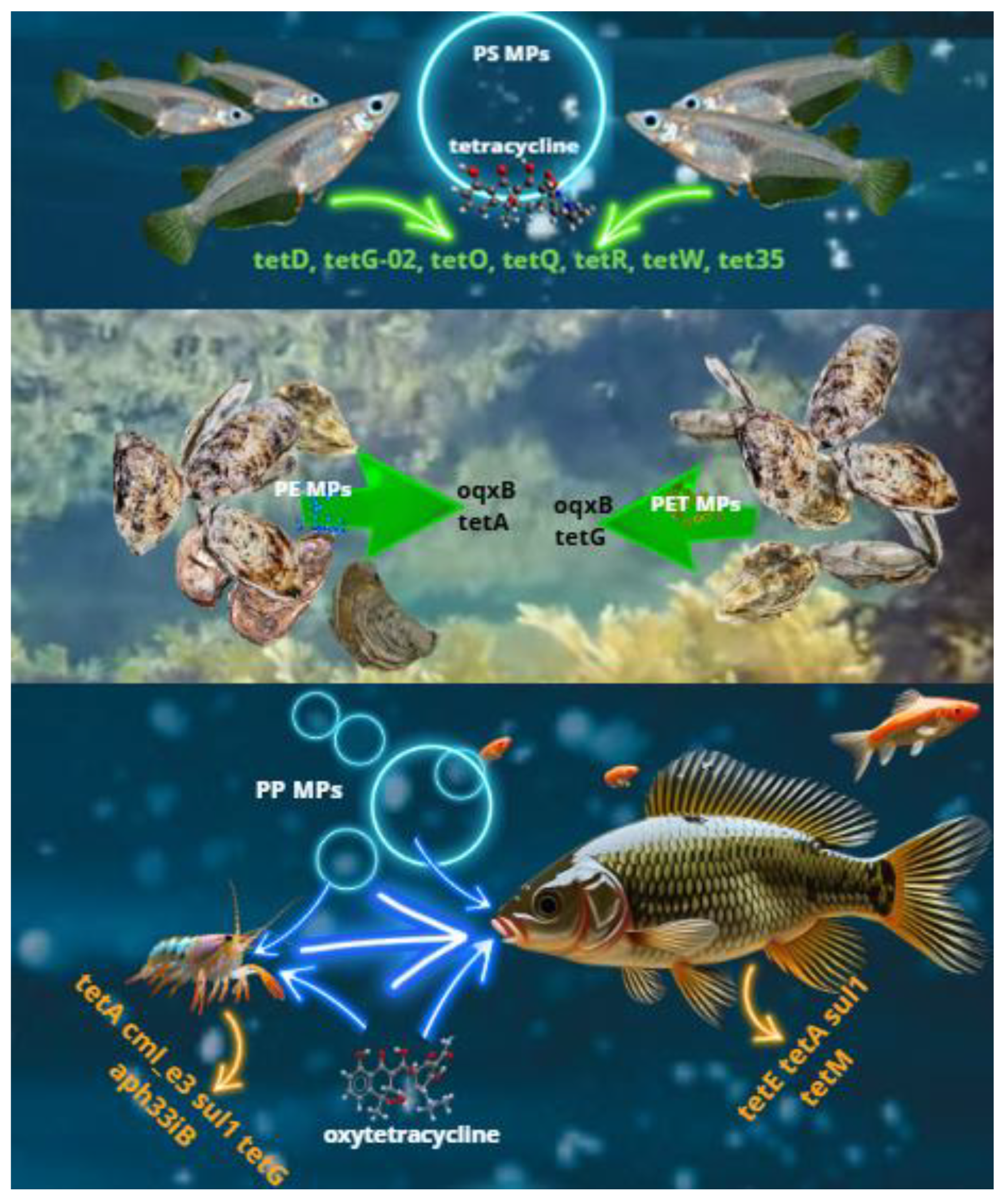
Figure 1. The demonstrated effects of exposure to MPs and antibiotics on ARG enrichment in fishery products. PE (polyethilene), PET (polyethylene therephtalate), PP (polypropylene) [128,136,137].
Preprints 179931 g001
Table 1. ARGs and most probable or confirmed bacterial hosts identified in plastic polymers in freshwater with polymer types and study sites.
Plastic polymer Site Bacterial host ARG Reference
PBAT, PET
microcosm
Afipia, Rhizobiaceae qnrS [39]
Bacillus spp. sul2, blaQ
Gemmobacter,
Conexibacter, Lamia
tetA, tetC, tetX, ereB
PE, PP, PBD Ganjiang river (China) Streptococcus mitis ermF, ermB [44]
Mixed polymers Huangpu River (China) Afipia spp. aac(2′)-I, arr, cat, mexI, blaTEM-1, tetV [45]
PVC, PLA freshwater microcosm with tetracycline Pseudomonas spp., Flavobacteriaceae,
Actinobacteria
tetA, tetC, tetM, and tetX [21]
PET, PVC freshwater microcosm with tetracycline Genera Pseudomonas,
Solobacterium, Achromobacter, Aeromonas, Beggiatoa,
Propionivibrio, and Paludibacter
tetA, tetC, sul1, tetO [48]
Mixed polymers Haihe River (China) Enterobacter cloacae tetG [49]
APSs Bracciano Lake (Italy) Morganella morganii tetC, sul1, sul3, cmlA1, cmxA, blaCTX-M-01, blaCTX-M-02 [51]
Mixed polymers Mondego river (Portugal) E. coli, Citrobacter spp.,
Enterobacter spp., Klebsiella pneumonia, Shigella spp.
aacA4-cr, qnrS, qnrB, qnrVC, blaCTX-M, blaCTX-M-15, blaCTX-M-32, blaCTX-M-55 [77]
PE, PP Poyang Lake (China) A. veronii blaOXA-12, cphA6, cphA8, cphA3 [23]
Arthrobacter spp. mdsB, novA, rphA, emrK
BDPs Lakes in Wuhan (China) Riemerella anatipestifer novA, macB, mdsB, sav1866, taeA, arnC, mfd [57]
Vibrio campbellii novA, blaCRP, taeA, pmrE, tet4
V. cholerae pbp1a, murA, efrA, mtrA, tetPB
Mixed
polymers
Lake water Lysinibacillus spp.,
Exiguobacterium acetylicum,
K. pneumoniae, K. oxytoca,
K. michiganensis
blaTEM (shared by all bacteria), blaSHV, adeA, tetA, acrB, sul1, mecA, tetW, acrF, cmxA, sul2 [58]
Mixed
polymers
Red River (Vietnam) Aeromonas spp. blaTEM, blaSHV, blaCTXM [61]
PHA Central Lake (China) Proteobacteria bacA, mecA, qacA, tolC, dfrA1, mphA, mphB [64]
Mixed polymers treated wastewater microcosm Stenotrophomonas maltophilia sul1 [80]
PET, PLA Treated wastewater Candidatus Microthrix tetA48, kdpE, rpoB2 [69]
Acinetobacter spp. 44 ARGs including aadA, ksgA, aph(3′)-I
Mixed polymers Jiuxiang River and Taihu Lake (China) Variovorax, Rubrivivax,
Thauera
ARGs for tetracycline [71]
Herbaspyrillum,
Limnohabitans
ARGs for MLS, elfamycin and tetracyclines
Not
specified
Urban lake in Chengdu (China) Gammaproteobacteria, Pseudomonadota, Acidobacteriota, Actinomycetota bacA, sul1 [66]
Urban river trait Chengdu (China) Deltaproteobacteria, Desulfobacterales sul1, sul2, acrB, ant(2″)-Ia
Rural lake Chengdu (China) Gammaproteobacteria sul 1, sul 2, smeE
Not
specified
Yangtze river (China) genera CAMDGX01, PHCI01, Shewanella bacA, novA, mexF, mcr-4,3,
blaOXA-541
[83]
genera Pseudomonas, Serratia bacA, arnA, mexB, muxB,
aac(6’)-Ic, acrD
APSs, Artificial Plastic Substrates; PBAT, poly butyleneadipate-co-terephthalate; PBD, polybutadiene; PE, polyethylene; PET, polyethylene therephtalate; PP, polypropylene; BDPs, biodegradable plastics; PHA, polyhydroxyalkanoate; PLA, polylactic acid; PVC, polyvinylchloride.
Table 2. ARGs and respective most probable or confirmed bacterial hosts identified in plastic polymers from seawater with polymer types and study sites.
Plastic polymer Site Bacterial host ARG Reference
Mixed polymers Vestland county, Norway A. salmonicida, M. morganii, A. beijerinckii class C beta-lactamases, catB [85]
A. salmonicida cphA
Aeromonas spp. qnrA
A. beijerinckii class A beta-lactamase,
aminoglycoside
acetyltransferase, cat
PBAT, PET microcosm Labrenzia,
Vicinamibacteraceae
tetA, blaQ [39]
PBAT, PET microcosm Labrenzia,
Vicinamibacteraceae,
Acidobacteriota, Coxiella, Croceibacter, Tumebacillus
qnrB
Not specified among PE, PP, PS and PVC Busan City (South Korea) Coxiella spp. tetA [89]
Pseudahrensia spp. tetQ
Genera Fuerstia,
Methylotenera, Halioglobus, Ahrensia, Rubritalea,
Algibacter
ermB
Mixed polymers Tyrrhenian Sea (Italy) Rhizobiales bacA [90]
Photobacterium spp. tolC, acrB, tet34
Pleurocapsa spp. vatF
PET Coral reef, Hainan (China) Nine bacterial genera sul2 [92]
Vibrio spp. sul1
Mixed polymers Monastir, Mahdia
(Tunisia)
Shewanella arctica blaTEM [93]
PBAT, poly butyleneadipate-co-terephthalate; PE, polyethylene; PET, polyethylene therephtalate; PP, polypropylene; PS, polystyrene; PVC, polyvinyl chloride.
Table 3. ARGs and respective bacterial hosts identified in plastic polymers from estuarine and brackish waters with polymer types and study sites.
Plastic polymer Site Bacterial host ARG Reference
Mixed polymers Laguna Madre (Mexico) Bacillus cereus ARGs for 10 antibiotic classes [100]
B. thuringiensis ARGs for 20 antibiotic classes
Mixed polymers Yangtze, Sheyang, Guanhe and Xinyi rivers (China) Proteobacteria blaNDM-1, tetA, tetX, sul1, sul2 [101]
Bacteroidota blaTEM, ermB, ereA, tetX, sul1
Mixed polymers Tokyo, Saitama, Chiba (Japan) Genera Citrobacter, Aeromonas, Sulfitobacter, Lacinutrix bacA, acrAB-TolC, mutated marR, acrAB inducer marA, vanG, adeF, qacG, vanH [104]
K. pneumoniae kpnF
Disclaimer/Publisher’s Note: The statements, opinions and data contained in all publications are solely those of the individual author(s) and contributor(s) and not of MDPI and/or the editor(s). MDPI and/or the editor(s) disclaim responsibility for any injury to people or property resulting from any ideas, methods, instructions or products referred to in the content.
Copyright: This open access article is published under a Creative Commons CC BY 4.0 license, which permit the free download, distribution, and reuse, provided that the author and preprint are cited in any reuse.
Prerpints.org logo

Preprints.org is a free preprint server supported by MDPI in Basel, Switzerland.

Subscribe

Disclaimer

Terms of Use

Privacy Policy

Privacy Settings

© 2025 MDPI (Basel, Switzerland) unless otherwise stated
