

Submitted:
16 June 2023
Posted:
19 June 2023
You are already at the latest version
Abstract
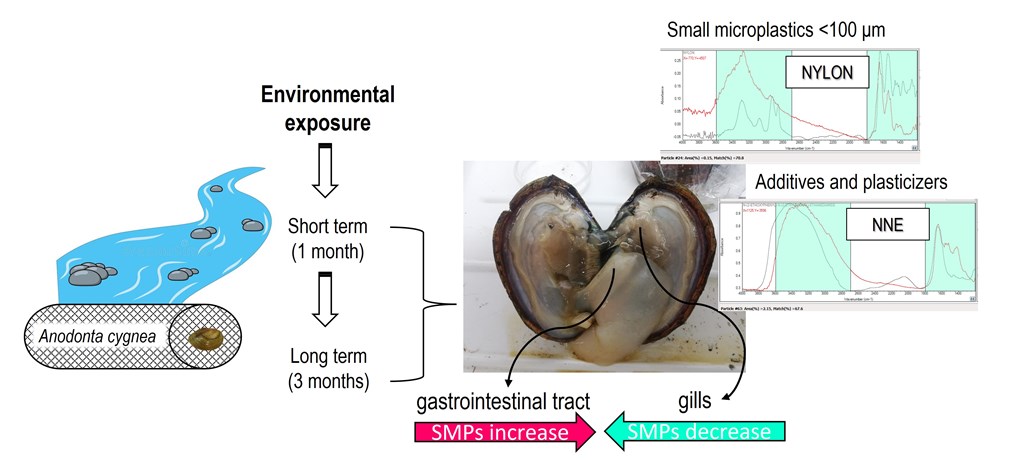
Microplastics are widespread in freshwater environments and could impact these ecosystems. Bivalves are freshwater organisms that are particularly exposed to microplastic contamination. Therefore, in this preliminary study, the accumulation of microplastics, plasticizers, and additives in the freshwater bivalves Anodonta cygnea through active biomonitoring was investigated. Specimens commercially bought were exposed in three rivers in Central Italy for different exposure times: short (1 month) and long (3 months). The gills and the gastrointestinal tract (GIT) were analyzed separately to evaluate the possible uptake and ingestion of particles via Micro-FTIR. For the first time, small microplastics (SMPs, 5-100 µm), plasticizers, additives, and other micro-litter components, e.g., natural and non-plastic synthetic fibers (APFs) were identified in the bivalve A. cygnea. The most abundant polymer in the gills (94.4%), and GITs (66.1%) was polyamide, which had the highest concentration in each river. A decrease in SMPs' abundance was observed over time in the gills in each river, while the abundance in GIT increased. Compared to polymers, a greater variety of APFs was observed in rivers. The APFs changed during the time of exposure and between different rivers more evidently than polymers, allowing a clearer identification of the possible sources. These results highlighted plastic pollution by SMPs using freshwater bivalves as sentinel organisms and the need to investigate further the additives that can be proxies of the presence of microplastics in the environment and biota.
Keywords:
freshwaters
; environmental exposure
; gills
; gastrointestinal tracts
; biological uptake
; nylon
; rayon
1. Introduction
The issue of microplastic pollution regarding occurrence, source and possible impacts, raised the interest of many scientists and its presence in the environment is well documented [1,2,3,4,5,6]. These ubiquitous pollutants are widespread in freshwaters, which can be affected by anthropogenic factors (e.g., proximity of urban centres, low efficiency of wastewater treatments plants (WWTPs), use of sewage debris for fields), while natural factors (e.g., wind, storms, floods) contribute to their dispersion in the aquatic environment [7,8,9]. Aquatic organisms can actively ingest microplastics (MPs < 5 mm) [10,11,12,13] and these particles may exert adverse effects on individual, cellular or molecular levels [14,15,16]. The most common effect of MPs is the reduction of food uptake probably due to false food satiation and particularly observed in combination with other contaminants [17,18,19]. Indeed, MPs can also represent vectors of environmental pollutants, and pathogen microorganisms increasing the ecological risk due to the adsorptive capacity [20,21]. Besides, the presence of additives in plastic materials to enhance polymer properties poses several chemical risks to biota [22].
The techniques to investigate MP concentration in environmental matrices may provide responses limited in time as water and sediment are affected by several environmental perturbations that can modify the level of plastic contamination very quickly [23]. Moreover, in the case of sediment, the processing analyses are more complicated than most biota due to the complexity of the soil matrix [23]. In this sense, the use of bioindicators can provide an integrated assessment of plastic pollution [24,25,26]. Among the proposed bioindicators, bivalves result to be valued sentinel organisms indicating the plastic level in the aquatic environment [23,27,28]. The high sizes of several species belonging to the Unionidae family, such as Anodonta cynea (Linnaeus, 1758), provide sufficient material for chemical analysis even when population density is low [29].
Anodonta cygnea is a freshwater bivalve indigenous in several countries of Europe and Asia [30]. This freshwater mussel is one of the largest bivalves occurring in permanent rivers with slow currents, lakes, and pools; sometimes, it has also been observed in canals, drainage, and dam reservoirs [31]. Bivalves A. cygnea inhabit water bodies characterized by fertile bottom sediments and by high concentrations of dissolved oxygen [32,33]. This species can filter several liters of water (2.6-2.9 l/h) and for this reason, it is selected as a natural filter in aquaculture [34,35]. Given the feeding strategy and the high dimensions, mussels could uptake MPs and in particular small microplastics (SMPs, < 100 μm) similar to the size of seston, as well as additives, plasticizers, and other micro-litter components, e.g., natural and non-plastic synthetic fibers (APFs) [12]. Despite the multiple advantages of using bivalves as bioindicators of MP pollution, freshwater bivalves are poorly investigated especially in the field [36].
To fill this gap, the aim of the study was to assess the uptake and ingestion of SMPs and APFs in A. cygnea by analyzing gills and gastrointestinal tract (GIT) separately. Bivalves in three rivers of central Italy were exposed for one and three months, investigating the quantity, size, and shape of SMPs and APFs. By this research, A. cygnea was evaluated as a sentinel organism which can be employed for biomonitoring of MPs pollution in freshwater environments.
2. Material and methods
2.1. Experimental design and environmental exposure of bivalves
Eighteen specimens of A. cygnea of similar size (Table S1) were purchased from commercial breeding in Italy, and the species has been confirmed by the morphology of the shell (Aldridge, 1999). Three specimens were analyzed immediately after being bought to have SMPs data about the environmental pre-exposure (T0). The other specimens were exposed to environmental conditions in three different rivers (Marta, Aniene, Sacco) for different exposure times. The rivers are located in the Lazio Region, and the investigated sites are located in their potamal tracts (Figure 1). The physicochemical parameters of rivers are shown in Table S2.
The sites are surrounded by different land uses; the Aniene River is characterized predominantly by urban use, while the Marta River and the Sacco River by agricultural use. Aniene River flows entirely in Lazio Region (99 km) and is the second largest tributary of the Tiber River, crossing a large part of the city of Rome characterized by a high degree of anthropization [37]. The investigated site is located in the urban park of Aniene Valley in the Est part of Rome city, where the Aniene received many WWTPs discharges. Marta River flows into the Tyrrhenian Sea after a course of 54 km, and the site of investigation is located in the cultivated countryside near Tarquinia, a small city in the north of the Lazio Region. Finally, the Sacco River, a tributary of the Liri River, flows for 87 km in the territory of Frosinone, in the south of Lazio, and is surrounded by an agricultural and industrial context. The investigated site is located near Colleferro city, where the river becomes polluted due to the discharges of many industries in the area [38].
Five specimens of A. cygnea were placed in a homemade iron cage that allowed flow-through conditions in each river. A stone that allowed the trap to sink and settle on the superficial bottom (5 cm) was inserted in each cage. The cages were attached to a riparian tree by a rope of about 30 meters. In this way, the traps can reach the middle part of the river to avoid the riverbanks and any lowering of the water level that would cause the death of specimens. Specimens were collected from the cages to evaluate the short time (ST) after one month (August) and long time (LT) after three months (August-October) of environmental exposure. To evaluate plastic accumulations during ST and LT 2 and 3 individuals respectively were analysed. Despite the small number of samples investigated, A. cygnea provides sufficient material for analysis given its large size.
2.2. Quality assurance/quality control (QA/QC)
To avoid airborne plastic contamination, the shells were opened, and the gills and the GIT were removed with dissecting scissors and steel tweezer under a laminar flow hood wearing cotton lab coats and nitrile gloves. Stored samples were sent to the Institute of Polar Sciences (CNR-ISP, Venezia-Mestre, Italy) for MP analysis. The specimens of the same sampling date and river were pooled in one sample. The pooled samples were analyzed in replicates (n=3) for gills and GITs. All pre-analytical operations were conducted in a plastic-free clean room ISO7, where atmospheric pressure, humidity, temperature, and particle pollution are controlled. Only glass and steel objects were employed. All glassware (including filtration apparatus) is washed with a 2% solution of Contrad 70 (Decon Laboratories Limited, UK) and rinsed several times with ultrapure water. Then, all glassware and inox steel tools were decontaminated with a 50% (v/v) solution of methanol (for HPLC ≥ 99.9% Sigma Aldrich, Merck, Darmstadt, Germany) and ethanol (absolute, for HPLC, ≥99.8% Sigma Aldrich, Merck, Darmstadt, Germany) and allowed to dry under a fume hood in the cleanroom. Reagent blanks (i.e. ultra-pure water, filters and reagents) and procedural blanks were performed. The aluminum oxide filters (ANODISC filters, Supported Anopore Inorganic Membrane, 0.2 μm, 47 mm, Whatman™, Merck, Darmstadt, Germany) were placed in decontaminated Petri glass dishes after filtration using decontaminated steel tweezers and covered with aluminum foil. Contamination was also avoided when transferring filters from the cleanroom to the Micro-FTIR laboratory, stored in glass Petri dishes and covered with clean aluminum foil. During the Micro-FTIR analyses, each filter was quickly put on stage and then covered with the protection of the instrument. During all operations, cotton lab coats and nitrile gloves were worn.
2.3. Dissection of gills and gastrointestinal tracts
After the sample collection, bivalves exposed to environmental conditions were transported to the laboratory and stored frozen (-20 °C) in aluminum foil divided per sampling location until dissection. The wet gills and the wet GITs were weighed (0.1 g, Kern 440-47) and stored separately in a sterile glass container with 80% ethanol pooled per different samplings and control. For each specimen, the maximum shell length, width and height were measured (Table S1).
2.4. SMPs and APFs extraction procedures and analysis via Micro-FTIR
The extraction and purification procedure were employed according to the method developed by [12] which has resulted in minimising any possible polymer degradation and the method's yield is >90%. Particles were not further denatured, even polyamide, which can be denatured by temperature ≥ 55 °C often employed in extraction procedures [12,13,39].
Briefly, after the H2O2 (30%-RPE for analysis-ACS-Reag.Ph.Eur.-Reag.USP, Carlo Erba) digestion of gills and GITs, the digested samples were filtered whit a vacuum pump Laboport® (VWR International, Milan, Italy) and quantification and simultaneous polymer identification of the filters were conducted using a Micro-FTIR Nicolet iN10 infrared microscope (Thermo Fisher Scientific, Madison, WI, USA). Each filter was analyzed in transmittance mode with the Particles Wizard section of Omnic™ Picta™ software, which also allows the collection of each particle's length and width through its imaging [12,40]. The analysis parameters are reported in Supplementary information (Figure S1). The quantification was performed via microscopic counting: at least 14 count fields (1.8 mm2 each) were randomly chosen with no overlapping on the surface of the filter (area 1734.07 mm2). The spectral background was acquired on a clean point of each count field, and each spectrum was identified by comparison with a suite of reference libraries (see Table S3), and spectra with a match percentage (match %) ≥ 65% were accepted. Only the SMPs and AFPs characterized by the optimal match of identification were quantified. The total number of SMPs and AFPs per gills or GITs and the weight of SMPs per specimen were then calculated according to the equations reported in [12] (see also formulae in Supplementary information).
SMPs were related to geometric solids, thanks to their aspect ratio. The aspect ratio (AR) is the ratio between the maximum length (L) and the maximum width (W) of the smallest rectangle (bounding box) enclosing the particle chosen. When the AR ≤ 1, the particle is considered sphere; when the AR ≤ 2, ellipse/elongated; when the AR ≥ 3, cylinder, and in case AR ≥ 9 a fiber [12].
2.5. Statistical analysis
The abundance and distribution of SMPs and APFs and their weights are expressed as the number of particles per gram wet weight (g ww). The normality distribution of the dataset was evaluated by the Saphiro-Wilk test. In the case of the normality hypothesis was rejected, non-parametric test was performed. The differences in SMPs and APFs concentrations in the same river between different times of exposure (ST vs LT) both in gills and GITs were tested by Chi-square test. The differences in SMPs and APFs distributions among sites were analyzed using the non-parametric Kruskal–Wallis test and Dunn's post-hoc test for multiple comparisons. The statistical significance level was set at p-value < 0.05. Statistical analyses were performed using GraphPad Prism software (version 8.0.1).
3. Results and Discussion
3.1. SMPs uptake and ingestion by Anodonta cygnea
This study represents the first record of SMPs and APFs in the freshwater bivalve A. cygnea, highlighting that this species can ingest these particles in the environment. This is a starting research that in the future would need to use more individuals to confirm the results found. During the environmental exposure, SMPs were found in all the samples. Overall, 18 plastic polymers with their acronyms were identified (Table S4). These analyses confirm the presence of SMPs in bivalves, both in the gills and GITs of the organisms exposed in the three rivers. Figure 2a shows the abundance of the SMPs accumulated in gills and GITs (n SMPs/g ww), while Figure 2b the relative weight of SMPs (µg SMPs/g ww). The weight shows that although the particles are abundant, they are contaminants at the level of µg/g. There are polymers that are more abundant in terms of particle number, but not in weight because they can be small particles or low-density polymers.
The average value of SMPs found in the T0 sample was the highest (1953 SMPs/g ww). Other studies confirmed that the MP concentrations were higher in the aquaculture compared natural environment [41,42]. Concerning the environmental samples, the highest average value, considering together gills and GITS, of SMPs was found in Aniene River (1615 SMPs/g ww), followed by Marta River (1445 SMPs/g ww) and finally Sacco River (980 SMPs/g ww). In literature, a correlation was found between the degree of urbanization and MP concentration [43,44,45]. Indeed, Aniene is a river flowing within the city of Rome and the one surrounded by the highest rate of urbanization and population density, considered both predictors of plastic pollution [46,47]. In addition, research conducted in the potamal tracts of rivers located in the Lazio Region, including some of the same sites investigated in this study, found the highest concentration of plastic along the riverbank of Aniene River [48].
The differences in SMPs concentration in gills between different times of exposure (ST vs LT) were found to be significant in each river: Aniene (χ2 = 752.2; df = 5; p < 0.0001), Marta (χ2 = 422.2; df = 8; p <0.0001) and Sacco (χ2 = 599.1; df = 5; p <0.0001). Significant differences were also found in polymer concentrations in GITs: Aniene (χ2 = 4831; df = 6; p < 0.0001), Marta (χ2 = 2300; df = 5; p <0.0001) and Sacco (χ2 = 526.3; df = 5; p <0.0001). In gills, the abundance of SMPs significantly decreased over time in each river, suggesting that gills act as a zone of interchange between medium and organism, while in GIT the abundance of SMPs significantly accumulated over time (Figure 2). There is another study that investigated the accumulation in Unio pictorum bivalves exposed to sewage treatment plant effluents over time, finding an increase in MPs concentration after 28 days of exposure but without analyzing the organs separately [49].
Gills are used to filter nutrients and eliminate, through exhaling siphon, debris, including SMPs, producing faeces and pseudofaeces. A study highlighted that in Corbicula fluminea exposed to nanoplastics the production of faeces and pseudofaeces increased, suggesting the enhancement of mechanisms for the release of non-edible particulate matter [50]. Another explanation for the reduction of SMPs in gills over time may be the decreasing filtration rate caused by physiological or internal restraints due to MPs [19]. The filtration of bivalves is mainly influenced by environmental conditions which determine the filtration rate [34]. In our case study, the investigated sites were characterized by similar chemical-physical conditions and were in optimal oxygen and pH conditions, therefore the filtration efficiency remains unchanged between different rivers. Through filtration and excretion, bivalves impact the cycle of nutrients in freshwater ecosystems [51], including the environmental concentrations of MPs. It is important to consider that all the substances and particles, including MPs, expelled in the water column by bivalves become part of the trophic chain [52].
In addition to the MPs expelled, those accumulated in the bivalve can also pose a threat to the organism itself and its predators. Indeed, several laboratory studies highlighted the toxic effects of MP exposure in different species of freshwater bivalves, such as tissue damage, inflammatory response, intestinal damage, protein modulation and neurotoxicity [17,53,54,55]. In particular, the MP uptake may affect the reproduction process of Unionid individuals, as these bivalves incubate their larvae in the brood sacs constituted by gill filaments and septum [52,56]. Furthermore, the consumption by predators of bivalves that have accumulated MPs can cause biomagnification phenomena along the trophic chain [57,58].
Once the MP uptake by gills has occurred, the SMPs can be transferred and accumulated in different organs as has been verified by laboratory studies. In our case study, we found an increasing accumulation of SMPs in GITs compared to gills over time. Indeed, [59] found that on mantles and gills there was a small number of SMPs (~ 100 µm), while in digestive glands and gonads there was a high concentration. Similarly, other studies identified the highest concentrations of SMPs (32-250 µm) in the intestine parts [16,60]. Since laboratory studies have shown a constant depuration of MPs by bivalves, it means that the investigated rivers are in continuous plastic pollution and the SMPs remain to be bioavailable [61]. This hypothesis should be confirmed by carrying out studies also on the surrounding water and sediment matrices, especially by investigating the surficial sediment in which MPs resulted more similar to those found in bivalves [27,62].
Given the diversity of polymers found in each river, the bivalve A. cygnea represents a suitable sentinel organism to highlight plastic pollution in freshwater systems. The uptake in the field reflects the bioavailability and environmental concentration of SMPs in freshwater systems [27,59]. Polymers with a diverse range of densities were found, such as from PP (density = 0.905 g cm−3) to PTFE (density = 2.2 g cm−3) (Table S4). In Figure S1 are reported some spectra with the highest match of identification.
The differences observed in polymers distribution in the gills between different rivers resulted to be non-significant (H = 5.132; p = ns). The same result was found for the polymer distributions in GITs, no significant difference between samples was found (H = 7.237; p = ns). Indeed, in all sites, the most abundant polymer both in gills (94.4%) and GITs (66.1%) was polyamide (PA-6), known commonly as nylon. Therefore, the distribution of polymers in different rivers was similar as PA-6 is predominant in the SMPs composition. The extraction procedure of SMPs used in this research allowed to identify polymers with high accuracy, allowing the detection of PA-6 which can be easily lost due to high temperatures or aggressive treatments [12,13,39,63,64]. PA-6 is very common in fishing nets and fish tackles employed in bivalve and fish farms [65]; a very high concentration was found in T0 (16742 SMPs/g ww) from the specimens taken directly by the commercial breeding. Moreover, PA-6 is widely employed in fabrics for clothes and carpets and can be released from washing machines or originate from agricultural employment and transported by leaching or wind [40,66,67,68,69]. PA-6 was therefore ubiquitous and widely spread both in sites with more urban contexts, such as Aniene River, and agricultural contexts, such as Marta and Sacco rivers. Moreover, in other studies investigating aquatic biota, both marine and freshwater, nylon was the most abundant polymer found [13,70,71,72].
All average size values of plastic particles found were <100 μm. Indeed, is highlighted from laboratory studies that bivalves incorporated mainly the smaller size of MPs (17–88 μm) as are easier to digest compared to larger ones often rejected by organisms [52]. The average length and width of SMPs found in gills were 52.68 ± 7.38 μm and 26.55 ± 3.90 μm respectively, while in GITs was 58.38 ± 7.02 μm and 30.52 ± 3.47 μm respectively. In Table S5 are shown the values of SMPs' sizes for each site. Despite the size of the different rivers was very variable reflecting the specific conditions of pollution, overall, SMPs are larger in the GITs than the gills, probably because the larger particles are retained and accumulated while the smaller ones are easier to expel. The SMPs' sizes were found to be very similar to the sizes of nutrients and microalgae typically ingested by these freshwater bivalves. Therefore, probably the SMPs are confused to be micronutrients and once uptake by the gills are then accumulated in the GITs [12,17,70]. Since the average size of SMPs found in the gills was very diverse, especially compared to T0, it means that there was a complete replacement. Therefore, bivalves are good representative organisms of the condition of environmental disturbance of a specific site filtering plastics of different sizes.
Microplastic uptake has been highlighted in other species of bivalves [27,62,73,74] proving that these filter feeders are excellent bioindicators of MPs, reflecting the variability of plastic pollution in freshwaters. Comparing the accumulation of SMPs in A. cygnea in literature is impossible since it represents the first record. Moreover, the comparison between this result and results obtained from other research in bivalves is hindered by the scarcity of studies that investigate the concentration of SMPs by analyzing separately organs and using proper techniques for polymer identification. However, considering other bivalve species and different methodologies employed lower concentrations were found. In other species belonging to Unionidae family, Anodonta anatina and Unio pictorum, were found 20.6–37.7 mps/individual and 0-9 mps/individual respectively [49,75]. Instead, considering species of smaller sizes, such as Corbicula fluminea (0.3-4.9 MPs/g ww; [27]) or Dreissena polymorpha (0.03-0.23 items/individual; [76]) the concentration of MPs decreased. Indeed, the body size results be a relevant parameter for the possible MP quantities ingested, increasing with higher size [11,61]. Moreover, the number of particles ingested is also affected by their size (Sendra et al., 2021). The average size of SMPs found in gills and GITs of this study was smaller than sizes found in other species, such as Corbicula fluminea and Limnoperna fortunei in which the dominant sizes were 500-1000 µm and 250-1000 µm respectively and lower concentrations of MPs ingested were found [27,77]. However, the comparison of concentrations between different bivalve species is speculative as all variables affecting the filtration rate should be taken into account.
Overall, SMPs shape was ellipse (70%), followed by sphere (15%) and cylinder (15%; Figure 3a). Fiber shape was occasionally found. Specifically, ellipse was the most abundant shape found in each river (Figure 3b). Other studies have also found the ellipse as the most abundant shape [12,13], while many others report fiber as the most common shape [27,62,75,76]. Probably this may be due to the different methods of considering the shapes of MPs, but it is fundamental to understand that in nature there are more elongated/irregular shapes than perfect spheres. These types of shapes can be accumulated by bivalves in different organs and are more difficult to expel [77]. Often in laboratory studies, MP spheres are used as they are easier to obtain, but it is necessary to further investigate the shapes that mainly interact with biota in the environment.
3.2. AFPs uptake and ingestion by Anodonta cygnea
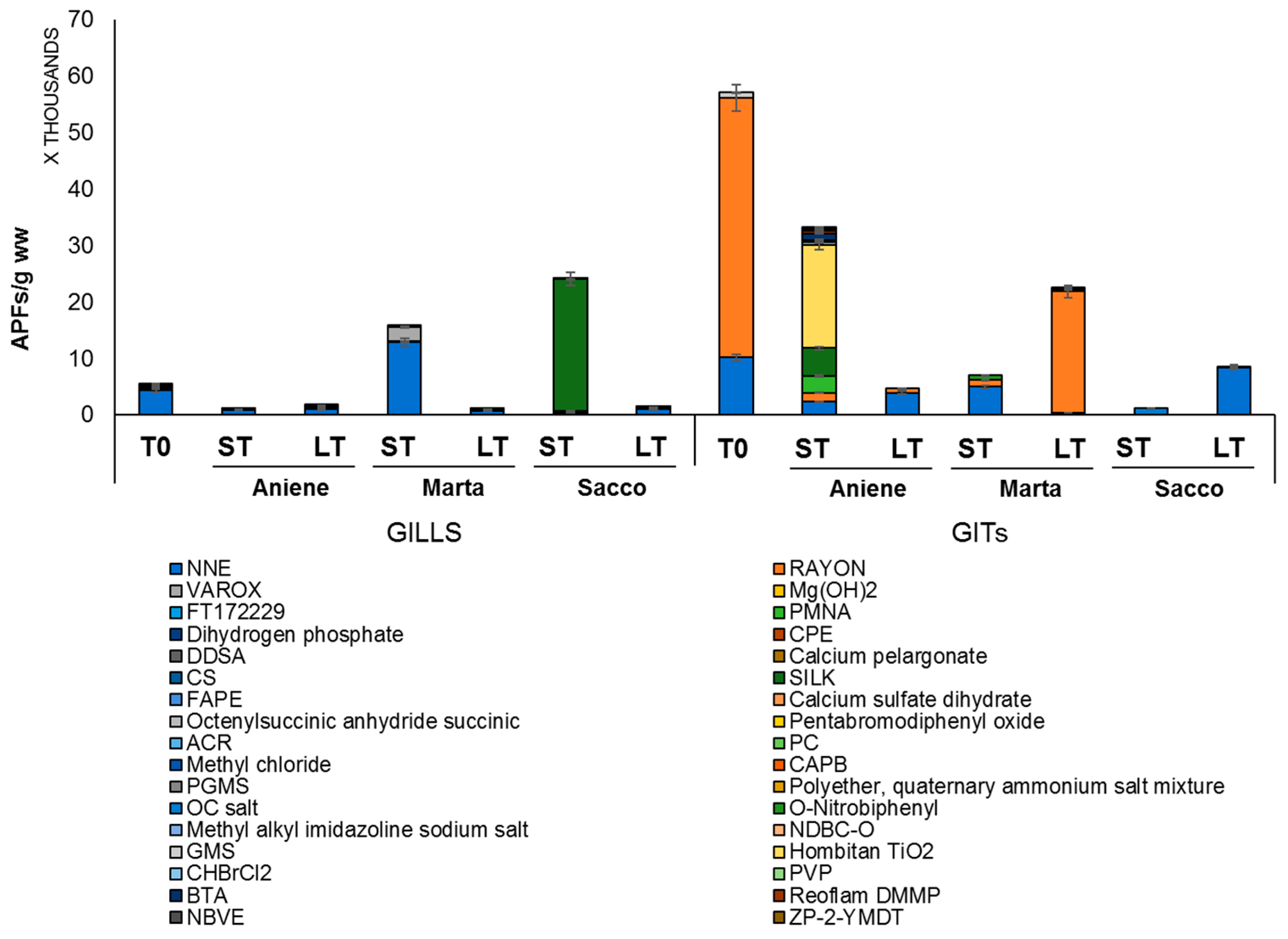
During the environmental exposure, 34 APFs and their acronyms were identified (Table S6). The abundance (n APFs/g ww) of the APFs accumulated by A. cygnea in gills and in GITs are shown in Figure 4.
The differences in APFs concentration between different times of exposure (ST vs LT) in each river were found to be significant: Aniene (χ2 =819.3; df = 15; p < 0.0001), Marta (χ2 = 2624; df = 7; p <0.0001) and Sacco (χ2 = 16040; df = 7; p <0.0001). Significant differences between times of exposure were also found in APFs concentrations in GITs: Aniene (χ2 = 19807; df = 10; p < 0.0001), Marta (χ2 = 21706; df = 4; p <0.0001) and Sacco (χ2 = 9585; df = 2; p <0.0001). Although the significant difference in APFs concentrations between ST and LT of each river, there is no clear trend in the decrease or increase over time in gills and GITs as observed for polymers.
Among the APFs, silk (47.57%) was the most abundant observed in the gills overall. Silk is a natural component, and its presence can be related to one produced by bivalves [78] and other aquatic invertebrates, such as caddisflies and dipterans [13]. Following, in gills N-(2-ethoxyphenyl)-n-(2-ethylphenyl)-ethanediamide (NNE) (41.60%) and Varox (5.35%) were very abundant overall. NNE is an additive with the function of light stabiliser employed in linear low-density polyethene polymers intended for repeat food contact use [79] . Varox is a vulcanising additive to polymerize resins and obtain tyres, tapes and flexible tubes in rubber and plastic (Yue et al., 2006). In GITs, the most abundant APFs was rayon (53.15%) overall. Following NNE (22.44%) and hombitan TiO2 (13.63%) were very common. Rayon is a non-plastic synthetic fiber composed of cellulose regenerated with caustic soda to obtain viscose or cellophane and has been found in different habitats [80]. Commercial TiO2 is a colour additive used as pigment or filler in plastics, paints, paper, foods, ceramics, and pharmaceuticals and it is also a sunscreen [81]. Nanoparticles of TiO2 were found to inhibit growth and cause direct physical effects on algae Phaeodactylum tricornutum [82].
Overall, the differences observed in APFs distribution in the gills resulted to be non-significant (H = 10.13; p = ns). About the APFs distributions in GITs there was a significant difference between samples (H = 22.19; p = 0.0011). The multiple comparison by Dunn post hoc analyses revealed significant differences between T0 and Aniene ST (p = 0.0409), Aniene ST and Aniene LT (p = 0.0056), Aniene ST and Marta ST (p = 0.0280), Aniene ST and Sacco ST (p = 0.0010), Aniene ST and Sacco LT (p = 0.0047). The APFs changed during the time of exposure and between different rivers more evidently than polymers, allowing a clear diversification of the possible sources. In particular, Aniene River resulted to be the most diverse among the others regarding the types of APFs found, mainly characterized by additives related to urban WWTPs rather than an agricultural discharge as in the case of Marta and Sacco rivers.
Specifically, in Aniene River the most common additives were TiO2 and NNE, and only in this site calcium pelargonate, an anionic surfactant used in lacquers, pharmaceuticals, plastic, and DDSA, another surfactant, were found in gills after ST of exposure, probably due to the presence of several ditches, discharge and WWTPs [37]. In October, after LT of exposure, there was an increase in APFs in gills related to wastewaters, such as: calcium sulfate dihydrate, used for water treatment, pharmaceuticals, insecticides, and plaster; propylene carbonate, used in cosmetics, personal care products, detergents, and degreasers [79]. Moreover, in the GITs several APFs only found in Aniene River and related to WWTP were found, such as TiO2 and polyvynilpirollidone (PVP).
In Marta River, styrene butadiene rubber (SRB), a polymer mainly used to produce tyres, was found in August (ST) in the gills and Varox was found both in August and October, highlighting a relationship between exposure times. The APFs in Sacco River change widely over time in the GITs, suggesting that there was an exchange between the bivalves and the surrounding medium. In this river, rayon and silk were very abundant, while cocamide, an additive used in cosmetics, was present in smaller quantities. However, although the Sacco River is mainly characterized by SMPs and AFPs that suggest agricultural sources, there are also contributions from industrial activities, such as methyl chloride, used in the production of methylcellulose, and butyl rubber, and octadecanoic acid, calcium salt (OC salt), used as an ingredient for paper collation and metal stearates. In fact, in this area, there are paper factories, many chemical industries and landfills, in addition to the agricultural use of the territory [83].
The APFs can be toxic to biota as polymers, and since they are less studied their effects can be underestimated or completely unknown [79]. Besides, the toxicological effects of a polymer depend on the chemical additives employed and the toxicity of a polymer without the additives is much lower [84]. Therefore, it is important that future studies analyse their bioavailability, accumulation, and toxicity. Studies on additives and plasticisers to date conducted, have shown their toxicity on different aquatic organisms [22,85]. Moreover, impacts on human health have been identified, such as breast cancer, apoptosis, and genotoxicity [86].
4. Conclusions
For the first time, native bivalves A. cygnea resulted to be suitable model organisms for investigating the freshwater pollution of SMPs and APFs. Worth mentioning point of the study is the separation of the organs, gills and GITs that allowed to investigate uptake and ingestion of SMPs and APFs. The input of this research is to find the polymers and additives that are accumulated in the bivalves and consequently bioavailability, in order to suggest those to be investigated in laboratory studies to analyse the toxicological effects. The analytic method used permitted to find at the same time SMPs and APFs present in bivalves with high efficiency as polyamide, the polymer that easier is denatured by temperature and aggressive treatments, was found in high quantities. Analyses of APFs allow a higher diversification of the possible sources than SMPS because are more specific usage related. The high number of particles found may be due to the synergy of the method used and the size of the bivalves.
The gills seem to act as a zone of interchange with the medium and the number of particles decreased over time, while the GITs accumulate particles increasing the concentration over time. Studies of active biomonitoring, as in this case, are very useful because allow obtaining comparable data thanks to the same quantity of organisms analysed in different sites. Investigating the shape of MPs in freshwater environments is important to understand which shape should focus on during laboratory experiments to reproduce as much as possible the environmental condition and analyse the possible effects on the organism. Further investigation on APFs is needed as they can be considered as tracers of the presence of microplastics in the environment and biota.
Supplementary Information
The online version contains supplementary material available at Preprints.org.
Author Contributions
G.C.: Conceptualization, Data curation, Formal analysis, Investigation, Writing - original draft, Writing - review & editing. F.C.: Data curation, Formal analysis, Investigation, Methodology, Supervision, Writing - review & editing. B.R.: Data curation, Formal analysis, Investigation, Methodology, Writing - review & editing. M.S.: Funding acquisition, Conceptualization, Resources, Supervision, Visualization, Writing - review & editing.
Funding
This investigation was supported by funds of the Ministry of Education, University and Research for the base research individual activities, and by the Grant of Excellence Departments, MIUR-Italy (Article 1, Paragraphs 314–337, Law 232/2016).
Data Availability Statement
The datasets used and/or analyzed during the current study are available from the corresponding author on reasonable request.
Acknowledgements
Thanks to regional authority Roma Natura to give the authorization to conduct this research in the Nature Reserve of Aniene Valley and for his support in carrying out research within the park.
Competing Interests
The authors declare no competing interests.
Ethics Approval
Not applicable.
Consent to Participate
Not applicable.
Consent for Publication
Not applicable.
References
- Cera, A.; Cesarini, G.; Scalici, M. Microplastics in Freshwater: What Is the News from the World? Diversity 2020, 12, 276. [Google Scholar] [CrossRef]
- Chang, X.; Fang, Y.; Wang, Y.; Wang, F.; Shang, L.; Zhong, R. Microplastic Pollution in Soils, Plants, and Animals: A Review of Distributions, Effects and Potential Mechanisms. Science of The Total Environment 2022, 850, 157857. [Google Scholar] [CrossRef]
- Hu, T.; Shen, M.; Tang, W. Wet Wipes and Disposable Surgical Masks Are Becoming New Sources of Fiber Microplastic Pollution during Global COVID-19. Environ Sci Pollut Res 2022, 29, 284–292. [Google Scholar] [CrossRef] [PubMed]
- Cera, A., Gallitelli, L., Cesarini, G., Scalici, M., 2022. Occurrence of microplastics in freshwater. In Microplastic Pollution: Environmental Occurrence and Treatment Technologies; Hashmi, M.Z., Ed.; Emerging Contaminants and Associated Treatment Technologies; Springer International Publishing: Cham, 2022, pp. 201–226. [CrossRef]
- Munyaneza, J.; Jia, Q.; Qaraah, F.A.; Hossain, M.F.; Wu, C.; Zhen, H.; Xiu, G. A Review of Atmospheric Microplastics Pollution: In-Depth Sighting of Sources, Analytical Methods, Physiognomies, Transport and Risks. Science of The Total Environment 2022, 822, 153339. [Google Scholar] [CrossRef]
- Olivieri, Z.; Cesarini, G.; Orsini, M.; De Santis, S.; Scalici, M. Uptake of Microplastics in the Wedge Clam Donax Trunculus: First Evidence from the Mediterranean Sea. Water 2022, 14, 4095. [Google Scholar] [CrossRef]
- Windsor, F.M.; Durance, I.; Horton, A.A.; Thompson, R.C.; Tyler, C.R.; Ormerod, S.J. A Catchment-scale Perspective of Plastic Pollution. Glob Change Biol 2019, 25, 1207–1221. [Google Scholar] [CrossRef]
- D’Souza, J.M.; Windsor, F.M.; Santillo, D.; Ormerod, S.J. Food Web Transfer of Plastics to an Apex Riverine Predator. Glob Change Biol 2020, 26, 3846–3857. [Google Scholar] [CrossRef]
- Xu, S.; Ma, J.; Ji, R.; Pan, K.; Miao, A.-J. Microplastics in Aquatic Environments: Occurrence, Accumulation, and Biological Effects. Science of The Total Environment 2020, 703, 134699. [Google Scholar] [CrossRef] [PubMed]
- Ribeiro, F.; O’Brien, J.W.; Galloway, T.; Thomas, K.V. Accumulation and Fate of Nano- and Micro-Plastics and Associated Contaminants in Organisms. TrAC Trends in Analytical Chemistry 2019, 111, 139–147. [Google Scholar] [CrossRef]
- Jâms, I.B.; Windsor, F.M.; Poudevigne-Durance, T.; Ormerod, S.J.; Durance, I. Estimating the Size Distribution of Plastics Ingested by Animals. Nat Commun 2020, 11, 1594. [Google Scholar] [CrossRef] [PubMed]
- Corami, F.; Rosso, B.; Roman, M.; Picone, M.; Gambaro, A.; Barbante, C. Evidence of Small Microplastics (<100 Μm) Ingestion by Pacific Oysters (Crassostrea Gigas): A Novel Method of Extraction, Purification, and Analysis Using Micro-FTIR. Marine Pollution Bulletin 2020, 160, 111606. [Google Scholar] [CrossRef] [PubMed]
- Corami, F.; Rosso, B.; Iannilli, V.; Ciadamidaro, S.; Bravo, B.; Barbante, C. Occurrence and Characterization of Small Microplastics (<100 Μm), Additives, and Plasticizers in Larvae of Simuliidae. Toxics 2022, 10, 383. [Google Scholar] [CrossRef] [PubMed]
- Browne, M.A.; Underwood, A.J.; Chapman, M.G.; Williams, R.; Thompson, R.C.; Van Franeker, J.A. Linking Effects of Anthropogenic Debris to Ecological Impacts. Proc. R. Soc. B. 2015, 282, 20142929. [Google Scholar] [CrossRef] [PubMed]
- De Sá, L.C.; Oliveira, M.; Ribeiro, F.; Rocha, T.L.; Futter, M.N. Studies of the Effects of Microplastics on Aquatic Organisms: What Do We Know and Where Should We Focus Our Efforts in the Future? Science of The Total Environment 2018, 645, 1029–1039. [Google Scholar] [CrossRef]
- Hariharan, G.; Purvaja, R.; Anandavelu, I.; Robin, R.S.; Ramesh, R. Accumulation and Ecotoxicological Risk of Weathered Polyethylene (WPE) Microplastics on Green Mussel (Perna Viridis). Ecotoxicology and Environmental Safety 2021, 208, 111765. [Google Scholar] [CrossRef]
- Guilhermino, L.; Vieira, L.R.; Ribeiro, D.; Tavares, A.S.; Cardoso, V.; Alves, A.; Almeida, J.M. Uptake and Effects of the Antimicrobial Florfenicol, Microplastics and Their Mixtures on Freshwater Exotic Invasive Bivalve Corbicula Fluminea. Science of The Total Environment 2018, 622–623, 1131–1142. [Google Scholar] [CrossRef]
- Oliveira, P.; Barboza, L.G.A.; Branco, V.; Figueiredo, N.; Carvalho, C.; Guilhermino, L. Effects of Microplastics and Mercury in the Freshwater Bivalve Corbicula Fluminea (Müller, 1774): Filtration Rate, Biochemical Biomarkers and Mercury Bioconcentration. Ecotoxicology and Environmental Safety 2018, 164, 155–163. [Google Scholar] [CrossRef]
- Pedersen, A.F.; Gopalakrishnan, K.; Boegehold, A.G.; Peraino, N.J.; Westrick, J.A.; Kashian, D.R. Microplastic Ingestion by Quagga Mussels, Dreissena Bugensis, and Its Effects on Physiological Processes. Environmental Pollution 2020, 260, 113964. [Google Scholar] [CrossRef] [PubMed]
- Zettler, E.R.; Mincer, T.J.; Amaral-Zettler, L.A. Life in the “Plastisphere”: Microbial Communities on Plastic Marine Debris. Environ. Sci. Technol. 2013, 47, 7137–7146. [Google Scholar] [CrossRef] [PubMed]
- Wang, J.; Guo, X.; Xue, J. Biofilm-Developed Microplastics As Vectors of Pollutants in Aquatic Environments. Environ. Sci. Technol. 2021, acs.est.1c04466. [CrossRef]
- Beiras, R.; Verdejo, E.; Campoy-López, P.; Vidal-Liñán, L. Aquatic Toxicity of Chemically Defined Microplastics Can Be Explained by Functional Additives. Journal of Hazardous Materials 2021, 406, 124338. [Google Scholar] [CrossRef]
- Li, J.; Lusher, A.L.; Rotchell, J.M.; Deudero, S.; Turra, A.; Bråte, I.L.N.; Sun, C.; Shahadat Hossain, M.; Li, Q.; Kolandhasamy, P.; et al. Using Mussel as a Global Bioindicator of Coastal Microplastic Pollution. Environmental Pollution 2019, 244, 522–533. [Google Scholar] [CrossRef]
- Bonanno, G.; Orlando-Bonaca, M. Perspectives on Using Marine Species as Bioindicators of Plastic Pollution. Marine Pollution Bulletin 2018, 137, 209–221. [Google Scholar] [CrossRef]
- Fossi, M.C.; Vlachogianni, T.; Galgani, F.; Innocenti, F.D.; Zampetti, G.; Leone, G. Assessing and Mitigating the Harmful Effects of Plastic Pollution: The Collective Multi-Stakeholder Driven Euro-Mediterranean Response. Ocean & Coastal Management 2020, 184, 105005. [Google Scholar] [CrossRef]
- Savoca, M.S.; Kühn, S.; Sun, C.; Avery-Gomm, S.; Choy, C.A.; Dudas, S.; Hong, S.H.; Hyrenbach, K.D.; Li, T.-H.; Ng, C.K.; et al. Towards a North Pacific Ocean Long-Term Monitoring Program for Plastic Pollution: A Review and Recommendations for Plastic Ingestion Bioindicators. Environmental Pollution 2022, 310, 119861. [Google Scholar] [CrossRef]
- Su, L.; Cai, H.; Kolandhasamy, P.; Wu, C.; Rochman, C.M.; Shi, H. Using the Asian Clam as an Indicator of Microplastic Pollution in Freshwater Ecosystems. Environmental Pollution 2018, 234, 347–355. [Google Scholar] [CrossRef] [PubMed]
- Strehse, J.S.; Maser, E. Marine Bivalves as Bioindicators for Environmental Pollutants with Focus on Dumped Munitions in the Sea: A Review. Marine Environmental Research 2020, 158, 105006. [Google Scholar] [CrossRef]
- Beone, G.M.; Ravera, O. Vantaggi e limiti del monitoraggio ambientale mediante l’analisi chimica dei Lamelli- branchi. 2003.
- Lopes-Lima, M. Anodonta cygnea. The IUCN Red List of Threatened Species 2014: e.T156066A21400900, 2014. [CrossRef]
- Killeen, I., Aldridge, D., Oliver, G. Freshwater bivalves of Britain and Ireland. National Museum of Wales Occasional Publication 2004, 82, 1 – 114.
- Zając, K. Habitat preferences of swan mussel Anodonta cygnea (Linnaeus 1758) (Bivalvia, Unionidae) in relation to structure and successional stage of floodplain waterbodies. Ekologia (Bratislava) 2002, 21, 345 – 355.
- Rosińska et al. 2008.
- Kryger, J.; Riisgard, H.U. Filtration Rate Capacities in 6 Species of European Freshwater Bivalves. Oecologia 1988, 77, 34–38. [Google Scholar] [CrossRef] [PubMed]
- Ranjbar, R.; Shariati, F.P.; Tavakoli, O.; Ehteshami, F. Fabrication of a New Reactor Design to Apply Freshwater Mussel Anodonta Cygnea for Biological Removal of Water Pollution. Aquaculture 2021, 544, 737077. [Google Scholar] [CrossRef]
- Kukkola, A.; Krause, S.; Lynch, I.; Sambrook Smith, G.H.; Nel, H. Nano and Microplastic Interactions with Freshwater Biota – Current Knowledge, Challenges and Future Solutions. Environment International 2021, 152, 106504. [Google Scholar] [CrossRef] [PubMed]
- Ceschin, S.; Zuccarello, V.; Caneva, G. Role of Macrophyte Communities as Bioindicators of Water Quality: Application on the Tiber River Basin (Italy). Plant Biosystems - An International Journal Dealing with all Aspects of Plant Biology 2010, 144, 528–536. [Google Scholar] [CrossRef]
- Fantini et al., 2012.
- Al-Azzawi, M.S.M.; Kefer, S.; Weißer, J.; Reichel, J.; Schwaller, C.; Glas, K.; Knoop, O.; Drewes, J.E. Validation of Sample Preparation Methods for Microplastic Analysis in Wastewater Matrices—Reproducibility and Standardization. Water 2020, 12, 2445. [Google Scholar] [CrossRef]
- Corami, F.; Rosso, B.; Bravo, B.; Gambaro, A.; Barbante, C. A Novel Method for Purification, Quantitative Analysis and Characterization of Microplastic Fibers Using Micro-FTIR. Chemosphere 2020, 238, 124564. [Google Scholar] [CrossRef] [PubMed]
- Mathalon, A.; Hill, P. Microplastic Fibers in the Intertidal Ecosystem Surrounding Halifax Harbor, Nova Scotia. Marine Pollution Bulletin 2014, 81, 69–79. [Google Scholar] [CrossRef]
- Chen, G.; Li, Y.; Wang, J. Occurrence and Ecological Impact of Microplastics in Aquaculture Ecosystems. Chemosphere 2021, 274, 129989. [Google Scholar] [CrossRef]
- Wang, W.; Ndungu, A.W.; Li, Z.; Wang, J. Microplastics Pollution in Inland Freshwaters of China: A Case Study in Urban Surface Waters of Wuhan, China. Science of The Total Environment 2017, 575, 1369–1374. [Google Scholar] [CrossRef] [PubMed]
- Battulga, B.; Kawahigashi, M.; Oyuntsetseg, B. Distribution and Composition of Plastic Debris along the River Shore in the Selenga River Basin in Mongolia. Environ Sci Pollut Res 2019, 26, 14059–14072. [Google Scholar] [CrossRef]
- Yin, L.; Wen, X.; Du, C.; Jiang, J.; Wu, L.; Zhang, Y.; Hu, Z.; Hu, S.; Feng, Z.; Zhou, Z.; et al. Comparison of the Abundance of Microplastics between Rural and Urban Areas: A Case Study from East Dongting Lake. Chemosphere 2020, 244, 125486. [Google Scholar] [CrossRef]
- Crew, A.; Gregory-Eaves, I.; Ricciardi, A. Distribution, Abundance, and Diversity of Microplastics in the Upper St. Lawrence River. Environmental Pollution 2020, 260, 113994. [Google Scholar] [CrossRef]
- Huang, Y.; Tian, M.; Jin, F.; Chen, M.; Liu, Z.; He, S.; Li, F.; Yang, L.; Fang, C.; Mu, J. Coupled Effects of Urbanization Level and Dam on Microplastics in Surface Waters in a Coastal Watershed of Southeast China. Marine Pollution Bulletin 2020, 154, 111089. [Google Scholar] [CrossRef]
- Cesarini, G.; Scalici, M. Riparian Vegetation as a Trap for Plastic Litter. Environmental Pollution 2022, 292, 118410. [Google Scholar] [CrossRef]
- Domogalla-Urbansky, J.; Anger, P.M.; Ferling, H.; Rager, F.; Wiesheu, A.C.; Niessner, R.; Ivleva, N.P.; Schwaiger, J. Raman Microspectroscopic Identification of Microplastic Particles in Freshwater Bivalves (Unio Pictorum) Exposed to Sewage Treatment Plant Effluents under Different Exposure Scenarios. Environ Sci Pollut Res 2019, 26, 2007–2012. [Google Scholar] [CrossRef] [PubMed]
- Baudrimont, M.; Arini, A.; Guégan, C.; Venel, Z.; Gigault, J.; Pedrono, B.; Prunier, J.; Maurice, L.; Ter Halle, A.; Feurtet-Mazel, A. Ecotoxicity of Polyethylene Nanoplastics from the North Atlantic Oceanic Gyre on Freshwater and Marine Organisms (Microalgae and Filter-Feeding Bivalves). Environ Sci Pollut Res 2020, 27, 3746–3755. [Google Scholar] [CrossRef]
- Vaughn, C.C.; Hakenkamp, C.C. The Functional Role of Burrowing Bivalves in Freshwater Ecosystems: Functional Role of Bivalves. Freshwater Biology 2001, 46, 1431–1446. [Google Scholar] [CrossRef]
- Moreschi, A.C.; Callil, C.T.; Christo, S.W.; Ferreira Junior, A.L.; Nardes, C.; De Faria, É.; Girard, P. Filtration, Assimilation and Elimination of Microplastics by Freshwater Bivalves. Case Studies in Chemical and Environmental Engineering 2020, 2, 100053. [Google Scholar] [CrossRef]
- Magni, S.; Gagné, F.; André, C.; Della Torre, C.; Auclair, J.; Hanana, H.; Parenti, C.C.; Bonasoro, F.; Binelli, A. Evaluation of Uptake and Chronic Toxicity of Virgin Polystyrene Microbeads in Freshwater Zebra Mussel Dreissena Polymorpha (Mollusca: Bivalvia). Science of The Total Environment 2018, 631–632, 778–788. [Google Scholar] [CrossRef]
- Li, Z.; Feng, C.; Pang, W.; Tian, C.; Zhao, Y. Nanoplastic-Induced Genotoxicity and Intestinal Damage in Freshwater Benthic Clams ( Corbicula Fluminea ): Comparison with Microplastics. ACS Nano 2021, 15, 9469–9481. [Google Scholar] [CrossRef]
- Fu, L.; Xi, M.; Nicholaus, R.; Wang, Z.; Wang, X.; Kong, F.; Yu, Z. Behaviors and Biochemical Responses of Macroinvertebrate Corbicula Fluminea to Polystyrene Microplastics. Science of The Total Environment 2022, 813, 152617. [Google Scholar] [CrossRef]
- Cummings, K.S.; Graf, D.L. Mollusca Bivalvia. Ecology and Classification of North American Freshwater Invertebrates.
- Akhbarizadeh, R.; Moore, F.; Keshavarzi, B. Investigating Microplastics Bioaccumulation and Biomagnification in Seafood from the Persian Gulf: A Threat to Human Health? Food Additives & Contaminants: Part A 2019, 36, 1696–1708. [Google Scholar] [CrossRef]
- Prata, J.C.; Da Costa, J.P.; Lopes, I.; Duarte, A.C.; Rocha-Santos, T. Environmental Exposure to Microplastics: An Overview on Possible Human Health Effects. Science of The Total Environment 2020, 702, 134455. [Google Scholar] [CrossRef] [PubMed]
- Facchetti, S.V.; La Spina, R.; Fumagalli, F.; Riccardi, N.; Gilliland, D.; Ponti, J. Detection of Metal-Doped Fluorescent PVC Microplastics in Freshwater Mussels. Nanomaterials 2020, 10, 2363. [Google Scholar] [CrossRef]
- Kolandhasamy, P.; Su, L.; Li, J.; Qu, X.; Jabeen, K.; Shi, H. Adherence of Microplastics to Soft Tissue of Mussels: A Novel Way to Uptake Microplastics beyond Ingestion. Science of The Total Environment 2018, 610–611, 635–640. [Google Scholar] [CrossRef]
- Weber, A.; Jeckel, N.; Weil, C.; Umbach, S.; Brennholt, N.; Reifferscheid, G.; Wagner, M. Ingestion and Toxicity of Polystyrene Microplastics in Freshwater Bivalves. Environ Toxicol Chem 2021, 40, 2247–2260. [Google Scholar] [CrossRef]
- Baldwin, A.K.; Spanjer, A.R.; Rosen, M.R.; Thom, T. Microplastics in Lake Mead National Recreation Area, USA: Occurrence and Biological Uptake. PLoS ONE 2020, 15, e0228896. [Google Scholar] [CrossRef]
- Naidoo, T.; Goordiyal, K.; Glassom, D. Are Nitric Acid (HNO3) Digestions Efficient in Isolating Microplastics from Juvenile Fish? Water Air Soil Pollut 2017, 228, 470. [Google Scholar] [CrossRef]
- Munno, K.; Helm, P.A.; Jackson, D.A.; Rochman, C.; Sims, A. Impacts of Temperature and Selected Chemical Digestion Methods on Microplastic Particles. Environ Toxicol Chem 2018, 37, 91–98. [Google Scholar] [CrossRef]
- MacKenzie, A.F.; Basque, K.; Maltby, E.A.; Hodgson, M.; Nicholson, A.; Wilson, E.; Stuart, R.; Smith-Palmer, T.; Wyeth, R.C. Effectiveness of Several Commercial Non-Toxic Antifouling Technologies for Aquaculture Netting at Reducing Mussel Biofouling. Aquaculture 2021, 543, 736968. [Google Scholar] [CrossRef]
- Napper, I.E.; Thompson, R.C. Release of Synthetic Microplastic Plastic Fibres from Domestic Washing Machines: Effects of Fabric Type and Washing Conditions. Marine Pollution Bulletin 2016, 112, 39–45. [Google Scholar] [CrossRef] [PubMed]
- Bigalke, M.; Fieber, M.; Foetisch, A.; Reynes, J.; Tollan, P. Microplastics in Agricultural Drainage Water: A Link between Terrestrial and Aquatic Microplastic Pollution. Science of The Total Environment 2022, 806, 150709. [Google Scholar] [CrossRef] [PubMed]
- Haque, Md.M.; Nupur, F.Y.; Parvin, F.; Tareq, S.M. Occurrence and Characteristics of Microplastic in Different Types of Industrial Wastewater and Sludge: A Potential Threat of Emerging Pollutants to the Freshwater of Bangladesh. Journal of Hazardous Materials Advances 2022, 8, 100166. [Google Scholar] [CrossRef]
- Rezaei, M.; Abbasi, S.; Pourmahmood, H.; Oleszczuk, P.; Ritsema, C.; Turner, A. Microplastics in Agricultural Soils from a Semi-Arid Region and Their Transport by Wind Erosion. Environmental Research 2022, 212, 113213. [Google Scholar] [CrossRef]
- Iannilli, V.; Corami, F.; Grasso, P.; Lecce, F.; Buttinelli, M.; Setini, A. Plastic Abundance and Seasonal Variation on the Shorelines of Three Volcanic Lakes in Central Italy: Can Amphipods Help Detect Contamination? Environ Sci Pollut Res 2020, 27, 14711–14722. [Google Scholar] [CrossRef] [PubMed]
- Sfriso, A.A.; Tomio, Y.; Rosso, B.; Gambaro, A.; Sfriso, A.; Corami, F.; Rastelli, E.; Corinaldesi, C.; Mistri, M.; Munari, C. Microplastic Accumulation in Benthic Invertebrates in Terra Nova Bay (Ross Sea, Antarctica). Environment International 2020, 137, 105587. [Google Scholar] [CrossRef]
- Salazar-Pérez, C.; Amezcua, F.; Rosales-Valencia, A.; Green, L.; Pollorena-Melendrez, J.E.; Sarmiento-Martínez, M.A.; Tomita Ramírez, I.; Gil-Manrique, B.D.; Hernandez-Lozano, M.Y.; Muro-Torres, V.M.; et al. First Insight into Plastics Ingestion by Fish in the Gulf of California, Mexico. Marine Pollution Bulletin 2021, 171, 112705. [Google Scholar] [CrossRef] [PubMed]
- Su, L.; Xue, Y.; Li, L.; Yang, D.; Kolandhasamy, P.; Li, D.; Shi, H. Microplastics in Taihu Lake, China. Environmental Pollution 2016, 216, 711–719. [Google Scholar] [CrossRef] [PubMed]
- McCoy, K.A.; Hodgson, D.J.; Clark, P.F.; Morritt, D. The Effects of Wet Wipe Pollution on the Asian Clam, Corbicula Fluminea (Mollusca: Bivalvia) in the River Thames, London. Environmental Pollution 2020, 264, 114577. [Google Scholar] [CrossRef] [PubMed]
- Berglund, E.; Fogelberg, V.; Nilsson, P.A.; Hollander, J. Microplastics in a Freshwater Mussel (Anodonta anatina) in Northern Europe. Science of The Total Environment 2019, 697, 134192. [Google Scholar] [CrossRef] [PubMed]
- Pastorino, P.; Prearo, M.; Anselmi, S.; Menconi, V.; Bertoli, M.; Dondo, A.; Pizzul, E.; Renzi, M. Use of the Zebra Mussel Dreissena polymorpha (Mollusca, Bivalvia) as a Bioindicator of Microplastics Pollution in Freshwater Ecosystems: A Case Study from Lake Iseo (North Italy). Water 2021, 13, 434. [Google Scholar] [CrossRef]
- Pazos, R.S.; Spaccesi, F.; Gómez, N. First Record of Microplastics in the Mussel Limnoperna Fortunei. Regional Studies in Marine Science 2020, 38, 101360. [Google Scholar] [CrossRef]
- Fritzsching, K.J.; Duan, P.; Alberts, E.M.; Tibabuzo Perdomo, A.M.; Kenny, P.; Wilker, J.J.; Schmidt-Rohr, K. Silk-Like Protein with Persistent Radicals Identified in Oyster Adhesive by Solid-State NMR. ACS Appl. Bio Mater. 2019, 2, 2840–2852. [Google Scholar] [CrossRef]
- Hahladakis, J.N.; Velis, C.A.; Weber, R.; Iacovidou, E.; Purnell, P. An Overview of Chemical Additives Present in Plastics: Migration, Release, Fate and Environmental Impact during Their Use, Disposal and Recycling. Journal of Hazardous Materials 2018, 344, 179–199. [Google Scholar] [CrossRef] [PubMed]
- Peng, G.; Xu, P.; Zhu, B.; Bai, M.; Li, D. Microplastics in Freshwater River Sediments in Shanghai, China: A Case Study of Risk Assessment in Mega-Cities. Environmental Pollution 2018, 234, 448–456. [Google Scholar] [CrossRef] [PubMed]
- Hamzeh, M.; Sunahara, G.I. In Vitro Cytotoxicity and Genotoxicity Studies of Titanium Dioxide (TiO2) Nanoparticles in Chinese Hamster Lung Fibroblast Cells. Toxicology in Vitro 2013, 27, 864–873. [Google Scholar] [CrossRef] [PubMed]
- Wang, Y.; Zhu, X.; Lao, Y.; Lv, X.; Tao, Y.; Huang, B.; Wang, J.; Zhou, J.; Cai, Z. TiO2 Nanoparticles in the Marine Environment: Physical Effects Responsible for the Toxicity on Algae Phaeodactylum Tricornutum. Science of The Total Environment 2016, 565, 818–826. [Google Scholar] [CrossRef] [PubMed]
- Longo, V.; Forleo, A.; Ferramosca, A.; Notari, T.; Pappalardo, S.; Siciliano, P.; Capone, S.; Montano, L. Blood, Urine and Semen Volatile Organic Compound (VOC) Pattern Analysis for Assessing Health Environmental Impact in Highly Polluted Areas in Italy. Environmental Pollution 2021, 286, 117410. [Google Scholar] [CrossRef]
- Beiras, R.; Bellas, J.; Cachot, J.; Cormier, B.; Cousin, X.; Engwall, M.; Gambardella, C.; Garaventa, F.; Keiter, S.; Le Bihanic, F.; et al. Ingestion and Contact with Polyethylene Microplastics Does Not Cause Acute Toxicity on Marine Zooplankton. Journal of Hazardous Materials 2018, 360, 452–460. [Google Scholar] [CrossRef]
- Koelmans, A.A.; Besseling, E.; Foekema, E.M. Leaching of Plastic Additives to Marine Organisms. Environmental Pollution 2014, 187, 49–54. [Google Scholar] [CrossRef]
- Campanale; Massarelli; Savino; Locaputo; Uricchio A Detailed Review Study on Potential Effects of Microplastics and Additives of Concern on Human Health. IJERPH 2020, 17, 1212. [CrossRef]
Figure 1.
Location of the investigated sites (red circles) in three different rivers of Lazio Region (Central Italy) where specimens of Anodonta cygnea were exposed for short and long times. For all figures, colors only in the online version.
Figure 1.
Location of the investigated sites (red circles) in three different rivers of Lazio Region (Central Italy) where specimens of Anodonta cygnea were exposed for short and long times. For all figures, colors only in the online version.
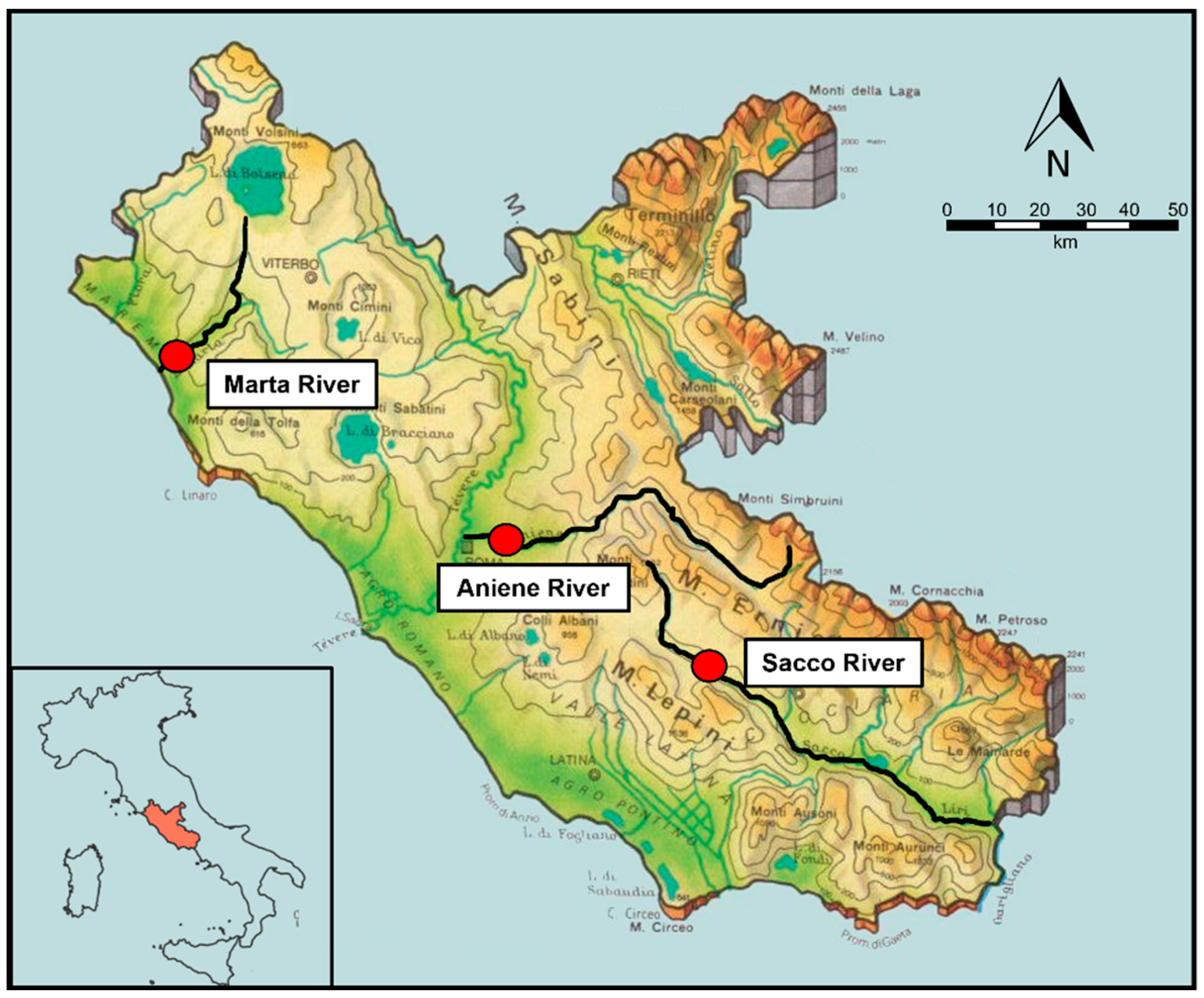
Figure 2.
Concentrations (a) and weight (b) of different small microplastic polymers (SMPs) in gills and GITs of bivalves A. cygnea exposed in 3 rivers (Aniene, Marta, Sacco) for short time (ST) and long time (LT). T0 is referred to the individuals of pre-exposure.
Figure 2.
Concentrations (a) and weight (b) of different small microplastic polymers (SMPs) in gills and GITs of bivalves A. cygnea exposed in 3 rivers (Aniene, Marta, Sacco) for short time (ST) and long time (LT). T0 is referred to the individuals of pre-exposure.
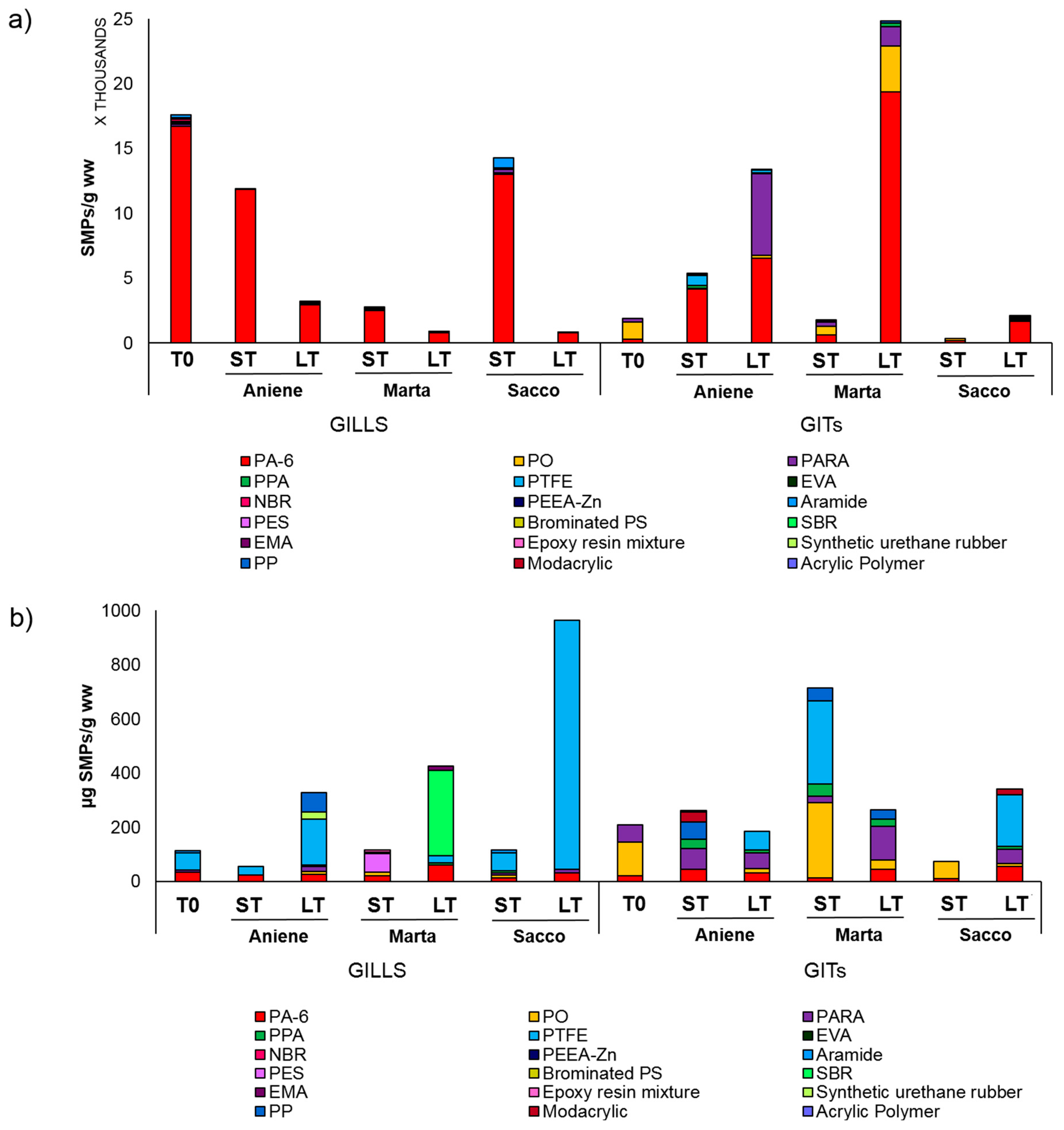
Figure 3.
Frequency (%) of SMPs shapes total (a) and found in gills and GITs from different rivers (b). Sphere (AR ≤1), ellipse (AR ≤2), cylinder (AR ≥3) or fiber (AR ≥9).
Figure 3.
Frequency (%) of SMPs shapes total (a) and found in gills and GITs from different rivers (b). Sphere (AR ≤1), ellipse (AR ≤2), cylinder (AR ≥3) or fiber (AR ≥9).
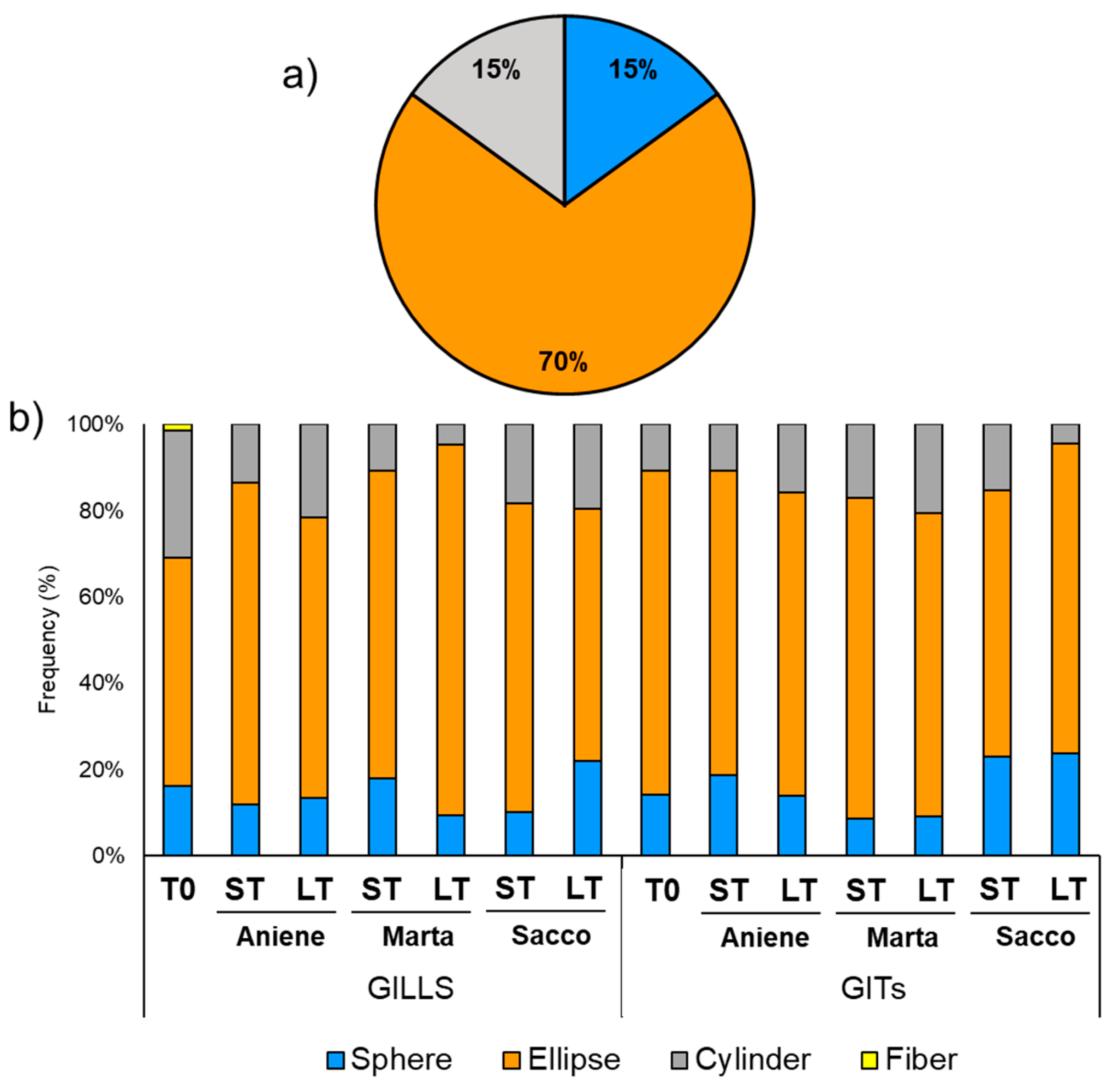
Figure 4.
Concentrations of different additives, plasticizers, and other micro-litter components (APFs) in A. cygnea gills and GITs exposed in 3 rivers (Aniene, Marta, Sacco) for short time (ST) and long time (LT). T0 is referred to the individuals of pre-exposure.
Figure 4.
Concentrations of different additives, plasticizers, and other micro-litter components (APFs) in A. cygnea gills and GITs exposed in 3 rivers (Aniene, Marta, Sacco) for short time (ST) and long time (LT). T0 is referred to the individuals of pre-exposure.
Disclaimer/Publisher’s Note: The statements, opinions and data contained in all publications are solely those of the individual author(s) and contributor(s) and not of MDPI and/or the editor(s). MDPI and/or the editor(s) disclaim responsibility for any injury to people or property resulting from any ideas, methods, instructions or products referred to in the content. |
© 2023 by the authors. Licensee MDPI, Basel, Switzerland. This article is an open access article distributed under the terms and conditions of the Creative Commons Attribution (CC BY) license (http://creativecommons.org/licenses/by/4.0/).
Copyright: This open access article is published under a Creative Commons CC BY 4.0 license, which permit the free download, distribution, and reuse, provided that the author and preprint are cited in any reuse.


