

Submitted:
03 October 2025
Posted:
08 October 2025
You are already at the latest version
Abstract
Iron-rich metallurgical slag is an underutilized precursor in alkali-activated materials (AAMs), despite its abundance and potential in sustainable construction and waste immobilization. This study evaluates a binary AAM system (Aachen GP), comprising 50 wt.% blast furnace slag (BFS) and 50 wt.% iron-rich slag (Fe2O3≈ 24.6 wt.%), against a BFS-only reference (SCK GP). Characterization included isothermal calorimetry, Fourier Transform Infrared Spectroscopy (FTIR), X-ray diffraction (XRD), thermogravimetric analysis (TGA), Scanning Electron Microscopy with Energy Dispersive X-ray spectroscopy (SEM–EDX), Brunauer–Emmett–Teller (BET) surface area, water permeability, porosity, and compressive strength. Aachen GP showed delayed setting (32.9 h), reduced cumulative heat (∼70 J/g), and lower bound water (4.6% at 28 days), indicating limited gel formation. Compared to SCK GP, it had higher porosity (38.4%), water permeability (1.42×10⁻¹⁰ m/s), and BET surface area (12.4 m2/g), but lower 28-day strength (14.4 MPa vs. 43 MPa). Structural analysis revealed unreacted crystalline phases and limited amorphous gel. While Aachen GP meets regulatory strength thresholds (≥8 MPa) for low- to intermediate-level wasteforms in Belgium and Germany, its elevated porosity may impact long-term containment. Further studies on radionuclide leaching and durability under thermal and radiation stress are recommended.
Keywords:
alkali-activated materials
; blast furnace slag
; compressive strength
; heat release
; iron incorporation
; iron-rich slag
; mechanical performance
; microstructural analysis
; morphology
; nuclear waste management
; slag-based AAM
; water accessible porosity
; water permeability
; thermal stability
; X-ray diffraction
; isothermal calorimetry
1. Introduction
Radioactive waste originates from a variety of sources, including nuclear power generation, medical procedures, industrial applications, research activities, and defense operations. This waste exhibits a wide range of physical states, radioactivity levels, and half-lives, necessitating classification into categories such as very low-, low-, intermediate-, and high-level waste [1,2]. Once classified, radioactive wastes undergo a series of processes—treatment, conditioning, and immobilization—that convert them into stable forms suitable for long-term storage and deep geological disposal. Given the heterogeneity of their composition and radioactivity, the selection of an effective immobilization method is critical to ensure safety and stability [2,3].
Historically, Ordinary Portland cement (OPC) has been the predominant immobilization material for radioactive waste due to its proven effectiveness, cost-efficiency, and widespread availability [4]. However, the production of Portland cement presents significant environmental challenges, primarily its high carbon footprint. Cement manufacturing contributes approximately 5–8% of global anthropogenic CO2 emissions [5,6], mainly due to the calcination of limestone and the energy-intensive nature of the process [7]. With annual global production exceeding 2.9 Gt, OPC accounts for nearly 14% of total industrial energy consumption, emitting between 0.82 t and 1.0 t of CO2 per tonne produced [8].
These environmental concerns have prompted life cycle assessments advocating a transition from OPC to alternative low-carbon binders that substantially reduce CO2 emissions [9,10]. Among these alternatives, alkali-activated materials (AAMs), calcium sulfoaluminate cements (CSAC), phosphate cements, and magnesium silicate hydrate cements (M-S-H) show promise, with AAMs being particularly suitable for immobilizing intermediate- and high-level radioactive waste [4].
AAMs are inorganic binders produced by chemically activating aluminosilicate-rich industrial wastes [11]. Geopolymers, a subset of AAMs, are typically formed from low-calcium aluminosilicate precursors (e.g., fly ash, metakaolin) using highly alkaline solutions, such as sodium or potassium hydroxide and silicate. This activation process dissolves aluminosilicate species and leads to the formation of a three-dimensional amorphous to semi-crystalline aluminosilicate network [4,11].
AAMs exhibit exceptional chemical durability due to their cross-linked aluminosilicate network, which offers strong resistance to chemical degradation and radionuclide leaching. Their inorganic, dense network structure also imparts radiation resistance, maintaining stability under irradiation. Additionally, their low permeability limits water ingress and radionuclide migration. AAMs have a high waste loading capacity, enabling encapsulation of a wide range of waste types, including complex and reactive wastes. From a sustainability perspective, the use of industrial by-products in AAM production reduces waste and lowers the embodied carbon footprint compared to traditional OPC [4,12], while still enabling efficient radionuclide immobilization [11].
Many studies have investigated the use of AAMs for the solidification and immobilization of radioactive waste due to their excellent chemical and physical properties. Early work by Davidovits et al. pioneered this area in the late 1990s, focusing on the potential of AAMs for radioactive waste encapsulation [3]. Walkley et al. [13] explored the immobilization mechanisms of Sr and Ca in metakaolin-based AAMs, finding that Sr2+ and Ca2+ cations can be structurally incorporated into metakaolin-based AAM gels without disrupting their fundamental aluminosilicate framework, while inducing minor, predictable changes in gel chemistry that are favorable for radioactive waste immobilization.
A study by El Alouani et al. [14] demonstrated that metakaolin-based AAMs possess a highly porous, amorphous structure with abundant active sites for contaminant binding, showing high adsorption capacities for heavy metals and radionuclides and maintaining effectiveness through multiple reuse cycles. Lin et al. [15] confirmed that metakaolin-based AAM binders can effectively solidify spent ion exchange resins with up to 12 wt% resin loading, achieving compressive strengths exceeding 13.6 MPa after 28 days curing. Their formulations also demonstrated low leachability for radionuclides Cs+ and Sr2+ with leaching indices greater than 10 according to ANSI/ANS 16.1 standards, indicating strong immobilization performance. Additionally, the AAM matrix significantly reduced radionuclide release in aggressive environments such as sodium chloride solutions, underscoring the necessity of solidification prior to disposal. Girke et al. [16] demonstrated that AAMs effectively immobilize hydrophobic nuclear graphite waste, yielding compressive strengths up to 60 MPa and excellent long-term durability, including freeze–thaw resistance. This highlights the potential of AAMs not only for radionuclide encapsulation but also for stabilizing complex radioactive waste forms such as reactor graphite. Frederickx et al. [17] reported superior mechanical strength and lower leaching of Cs+ and Sr2+ in metakaolin-based matrices compared to BFS-based AAMs.
AAMs offer advantages including high alkalinity, low porosity, excellent chemical durability, and strong resistance to radionuclide leaching under repository-relevant conditions. Criado et al. [18] identified curing conditions as critical in influencing carbonation and gel development in fly ash-based AAMs.
Iron-rich metallurgical slags, characterized by Fe2O3 content exceeding 20%, are abundantly produced by the steel industry, but their influence on geopolymerization remains not fully understood [19]. Findings have been mixed; some studies suggest iron incorporation enhances material properties [20], while others indicate it inhibits gel formation [21]. Lemougna et al. [19] employed 57Fe Mössbauer spectroscopy to reveal that Fe ions can integrate into the binder network without substantially improving gel quality, whereas Mancini et al. [22] showed residual metallic Fe(0) may oxidize under certain conditions, producing expansive corrosion products such as magnetite, goethite, and hematite, potentially causing microcracking.
Iron can substitute aluminum in tetrahedral sites, act as a network modifier, or form distinct iron-rich phases, each affecting gel chemistry, microstructure, and chemical durability [23,24]. Despite several studies investigating Fe-rich precursors, comprehensive research specifically addressing high-Fe slag blends for radioactive waste immobilization remains scarce [25,26,27].
To address these gaps, this study evaluates an AAM made from a 50/50 blend of blast furnace slag and iron-rich slag (Fe2O3 = 24.559%), referred to as “Aachen GP” in comparison with a blast furnace slag-only reference (“SCK GP”). Specifically, the objectives are to:
- Quantify early-age reaction kinetics (setting time, heat evolution) to identify potential retardation from iron-rich slag addition.
- Characterize total porosity and pore-size distribution to evaluate the impact of iron oxides on microstructural development.
- Assess permeability and mechanical properties (7- and 28-day compressive strength) relative to regulatory standards.
- Compare results against a conventional blast furnace slag-only AAM reference (SCK GP).
Through a comprehensive multi-technique approach, incorporating isothermal calorimetry, FTIR, XRD, TGA, BET, SEM–EDX, and mechanical/permeability testing, this study aims to advance the understanding of Fe-rich AAMs as sustainable, low-carbon immobilization matrices. Durability and radionuclide leaching performance will be assessed in subsequent investigations.
2. Methodology
Materials and Experimental Methods
Two alkali-activated materials (AAMs) were synthesized: a reference blast furnace slag AAM (SCK GP) and an experimental iron-rich slag AAM (Aachen GP).
The BFS used in SCK GP was obtained from Ecocem Benelux (Netherlands) and conformed to EN 15167-1 specifications, featuring a Blaine fineness of 397 kg−1 to 451 kg−1, a maximum particle size of 63 μm, and a density of 2890 kgm−3. Its chemical composition was provided by the supplier (Ecocem Benelux B.V., 01 January 2023) and is included in Table 1. The iron-rich slag used in Aachen GP was sourced from Siempelkamp (Germany). It was initially delivered in coarse form (5 cm to 20 cm), as shown in Figure 1, and subsequently ground to a particle size distribution comparable to BFS ( μm) using a Retsch PM 100 planetary ball mill.
The chemical composition of the iron-rich slag was analyzed using a Thermo Scientific™ Niton™ Tracer 5i handheld X-ray fluorescence (XRF) analyzer. The results are reported as oxide weight percentages (wt.%). A comparative overview of both BFS and iron-rich slag compositions is provided in Table 1.
Several formulations using iron-rich slag as the sole precursor were evaluated through small-scale trial mixes, which varied in water-to-binder W/B ratio and alkali activator dosage. All formulations using only iron-rich slag failed to set within 48 hours. To overcome this issue, a binary system combining iron-rich slag and BFS was developed.
To overcome the limitations observed in the preliminary iron-rich slag-only formulations, a binary binder system comprising 50 wt.% iron-rich slag and 50 wt.% blast furnace slag (BFS) was developed, hereafter referred to as Aachen GP. For comparison, the reference alkali-activated material (SCK GP) was prepared using 100 wt.% BFS.
Both formulations were designed to achieve comparable workability and mechanical integrity, with water-to-binder ratios of 0.475 for Aachen GP and 0.45 for SCK GP. In these formulations, the binder mass included both the aluminosilicate precursor (BFS and/or iron-rich slag) and the solid fraction of the alkaline activator, while the water content included both free water and the water present in the sodium silicate solution.
The alkaline activators differed between the two systems. For Aachen GP, activation was carried out using only 10 mol/L NaOH. The NaOH solution was prepared in advance from reagent-grade NaOH pellets (98.0 wt.%, Sigma Aldrich), stored in sealed polypropylene containers, and allowed to equilibrate at room temperature (20–22°C) for at least 24 h prior to mixing. For SCK GP, a combination of 10 mol/L NaOH and a commercial sodium disilicate solution (54.5 wt.% SiO2, 27.5 wt.% Na2O, 18.0 wt.% H2O) was used. The NaOH solution was prepared under the same conditions as described for Aachen GP, while the sodium disilicate solution was added on the day of casting. The mix proportions are summarized in Table 2.
2.1. Sample Preparation
Sample preparation was performed using a Matest E093N mortar mixer (230 V/50 Hz; 450 × 480 × 760 mm). The mixing sequence began with homogenization of the activating solution and water at low speed (140 rpm) for 2 min, followed by incorporation of the binder materials for an additional 2 min at the same speed. After scraping down the bowl, the mixture was mixed at high speed (3000 rpm) for 2 min. Subsequently, fine sand (≤2 mm) was added and mixed at low speed for 4 min. This procedure ensured homogeneous distribution of all components and consistent fresh properties. The prepared pastes were then cast into the following molds:
- Prismatic molds (40 × 40 × 160 mm) for flexural strength testing.
- Cubic molds (40 × 40 × 40 mm) for compressive strength, water-accessible porosity, and microstructural analysis.
- Cylindrical molds (25 × 97 mm) for water permeability testing.
2.2. Curing Conditions
All specimens were cured under controlled conditions at 20 °C and 95% relative humidity. Due to their different setting behaviors, SCK GP samples were demolded after 24 h, while Aachen GP samples were demolded after 48 h. Figure 2 shows the Aachen GP cubic specimens (40 × 40 × 40 mm), and Figure 3 shows the corresponding prismatic specimens (40 × 40 × 160 mm).
After demolding, all specimens were maintained under the same curing conditions for either 7 or 28 days, depending on the intended testing schedule. These curing periods were selected to evaluate both early-age and longer-term development of mechanical, microstructural, and transport properties.
2.3. Characterization Methods
2.3.1. Fresh-State Behavior: Workability, Viscosity, and Setting Time
The fresh-state behavior of the AAMs was evaluated through a series of tests assessing workability, viscosity, setting time, and heat evolution. These properties provide essential insights into early reactivity.
Workability was assessed using a mini-slump test (cone: 70 mm top diameter, 100 mm bottom diameter, 60 mm height). The spread percentage was calculated using the following equation:
where is the initial diameter of the mini-slump cone (70 mm) and is the measured final diameter of the spread mortar after lifting the cone.
Viscosity measurements were performed using an RM100 viscometer (Lamyrheology, France) equipped with the MS-R4 spindle. Each test used 20 g of fresh mortar, measured over a 1-hour period at 21.4 °C, with a constant shear rate of . The device directly recorded a torque value of 0.317 mN·m and a corresponding shear stress of 95.1 kPa, as provided by the instrument’s internal calibration system. The calculation method used by the viscometer software was not disclosed by the manufacturer, and the values were taken as reported.
Setting time was measured in accordance with EN 196-3:1995 using an automatic VICAT apparatus (MPM-6, Bluhm & Feuerherdt GmbH, Germany) at . Measurements were taken at 12-minute intervals. The initial setting time corresponded to a penetration depth of 37 mm, while the final setting time was defined as the point at which the penetration depth reached 0.5 mm.
Heat evolution was monitored using an I-Cal 8000 HPC isothermal calorimeter (Calmetrix, USA) at a constant temperature of 20 °C over 15 days. Three 100 g samples were analyzed:
- Reference SCK GP (100 wt.% BFS)
- Aachen GP (50 wt.% iron-rich slag : 50 wt.% BFS)
- Modified Aachen GP (75 wt.% iron-rich slag : 25 wt.% BFS)
2.3.2. Mechanical Performance: Flexural and Compressive Strength Testing
Mechanical performance was assessed using a Servo Plus Evolution hydraulic press (Matest, Italy), equipped with two loading cells: 250 kN for compression and 15 kN for flexural testing. Prior to testing, all specimens were visually inspected to ensure the absence of surface defects or irregularities.
Flexural strength testing was conducted on prismatic specimens (40 × 40 × 160 mm) at both 7 and 28 days of curing. Tests were performed according to ASTM standards using a loading rate of 0.05 kN/s, with a 10% post-peak load stop criterion. For each test, three specimens were evaluated per mix composition and curing age to ensure statistical reliability.
Compressive strength was determined on cubic specimens (40 × 40 × 40 mm) after 7 and 28 days of curing, using a loading rate of 2.4 kN/s in accordance with ASTM guidelines. Each test was terminated at 10% below the peak load to avoid post-failure deformation. Three specimens per mix and curing age were tested, and the mean value was used for analysis.
2.3.3. Porous Structure Analysis: Water-Accessible Porosity (WAP), Water Permeability (WP), and Nitrogen Adsorption (N2-Ads)
Three complementary techniques were employed for pore structure characterization: Water Accessible Porosity (WAP), Water Permeability (WP), and nitrogen adsorption (N-ads).
WAP was evaluated using a vacuum saturation and boiling procedure developed by SCK CEN, Belgium [28], on samples cured for 7 and 28 days. The six-step process involved drying specimens at 110 °C, vacuum saturation for 48 hours, and subsequent boiling for 5 hours. WAP (%) was calculated as follows:
where is the oven-dry mass, is the saturated mass, and is the apparent mass under water.
WP was measured at 28 days using the constant-flow method on cylindrical specimens (25 × 97 mm), according to protocols developed by SCK CEN, Belgium and described by Phung et al. [29]. Specimens were vacuum-saturated and tested under pressure gradients of 2–5 bar. The permeability coefficient () was calculated using Darcy’s law, once stable flow conditions were achieved, defined as a pressure difference variation below 10% over at least 24 hours:
where Q is flow rate, H is sample thickness (0.025 m), g is gravitational acceleration (9.81 m/s2), is water density (997 kg/m3), A is exposed area (0.007462 m2), and is pressure gradient.
Nitrogen adsorption (N-ads) measurements were performed using a TriStar II 3020 analyzer (Micromeritics, USA) to assess the porous structure in the mesopore range (2–50 nm). Samples were isopropanol-dried for 15 days, ground to 500 µm,and degassed at 150 °C under a vacuum of mbar for 24 h before analysis. Surface area was calculated using the Brunauer–Emmett–Teller (BET) method within the relative pressure range of 0.05–0.30:
where is monolayer capacity, is Avogadro’s number, and a is nitrogen molecule cross-sectional area (0.162 nm2).
2.3.4. Morphological and Microstructural Analysis: Scanning Electron Microscopy (SEM), Fourier-Transform Infrared Spectroscopy (FTIR), X-ray Diffraction (XRD), Thermogravimetric Analysis (TGA)
Scanning Electron Microscopy (SEM) imaging was conducted using a Phenom tabletop SEM operating at 15 kV in high-vacuum mode with the secondary-electron detector. The working distance was maintained at 10 mm, and a spot size of 3 nm was used. Approximately 1 cm3 cubic samples were embedded in Epofix resin, polished to a 1 µm surface finish, and gold-coated with a 5 nm layer. Sample preparation followed the SCK CEN resin-impregnation and polishing method [30], and image quality was verified by optical microscopy during preparation. For each sample, multiple micrographs were acquired at different magnifications to assess morphological variation.
Attenuated Total Reflectance - Fourier Transform Infrared Spectroscopy (ATR-FTIR) spectra were collected using a Bruker Tensor II spectrometer (Germany) for five samples: raw iron-rich slag powder, and cured SCK GP and Aachen GP samples at 7 and 28 days. Prior to testing, all samples were dried in isopropanol for 15 days, ground, and sieved to 125 µm to ensure consistency in particle size.
Phase identification was carried out using a Bruker D8 diffractometer equipped with Cu K radiation (40 kV, 40 mA) and a Ni K filter to suppress the Cu K line. Powdered samples (sieved to 125 m) were blended with 10 wt.% ZnO as an internal standard to quantify amorphous content by Rietveld calibration. Scanning was performed over a 2 range of 5–60° using a step size of 0.02° and a dwell time of 0.2 s per step. This range was chosen to capture all major crystalline phases expected in slag-based and geopolymeric systems, including low-angle amorphous humps and key silicate or iron-bearing phases. XRD analyses were conducted on:
- Raw iron-rich slag powder (to establish baseline mineralogy)
- Cured SCK GP and Aachen GP samples at 7 and 28 days
Phase quantification was conducted using Rietveld refinement in Profex [31], an open-source graphical interface for the BGMN program commonly applied in mineralogical phase analysis. The refinement employed a pseudo-Voigt peak profile, a sixth-order Chebyshev polynomial for background fitting, and simultaneous refinement of scale factors, unit-cell parameters, and phase weight fractions.
Thermogravimetric Analysis (TGA) was performed using a Netzsch STA 409PC instrument (Malvern Panalytical, UK) on four samples: SCK GP and Aachen GP at 7 and 28 days.
Measurements were conducted from 25 °C to 1000 °C at a heating rate of 10 °C/min under an argon atmosphere (50 mL/min). Derivative thermogravimetric (DTG) curves were smoothed and fitted to identify peak positions and full width at half maximum (FWHM) values. Temperature intervals for mass loss interpretation were defined based on DTG peak fitting and used to assign thermal degradation mechanisms.
3. Results and Discussion
3.0.1. Workability, Viscosity, and Setting Time
Fresh-state characterization revealed distinct rheological behaviors between the BFS-based reference (SCK GP) and the iron-rich slag formulation (Aachen GP). Mini-slump tests (; spread measured as the percentage increase over the 25 mm mold diameter) showed spreads of 242.86% for SCK GP and 171.4% for Aachen GP. The substantially lower spread for Aachen GP indicates reduced workability upon replacing blast-furnace slag with iron-rich slag.
Viscosity measurements (; rotational viscometer with reading precision) confirmed the trends observed in the mini-slump tests (see Figure 4). SCK GP exhibited an initial viscosity of with a viscosity increase rate of , whereas Aachen GP showed a higher initial viscosity of and a slightly steeper increase rate of . The higher initial viscosity and faster thickening rate of Aachen GP indicate reduced workability and quicker structural buildup due to the stiffening effect of the iron-rich slag. In Figure 4, the purple line represents SCK GP (100% BFS), and the green line represents Aachen GP (50% BFS + 50% iron-rich slag).
The setting time results further highlight the differences in early-age behavior between the two AAM formulations. Aachen GP required 32.9 h to reach its final set—nearly double the 16.4 h observed for SCK GP. These findings indicate that iron incorporation substantially reduces flowability, increases viscosity, and prolongs setting.
These characteristics can be attributed to the physicochemical effects of iron under alkaline activation. Beersaerts et al. [32] demonstrated that Fe-rich slag particles promote surface flocculation and intensified interparticle interactions in high-pH suspensions. This leads to increased mortar viscosity and early structural buildup prior to substantial gel formation. In addition, Fe2+ undergoes precipitation reactions to form Fe(OH)2 and Fe(OH)3, which consume local hydroxide ions and inhibit the dissolution of reactive aluminosilicate species. Bernal et al. [21] showed that this effect suppresses the initial dissolution stage in iron-containing AAMs, delaying the onset of gel nucleation. These phenomena collectively hinder the workability of the fresh mix while prolonging the setting time, consistent with our experimental observations for Aachen GP.
3.1. Reaction Kinetics: Isothermal Calorimetry
The isothermal calorimetry results reveal distinct differences in reaction kinetics among the three AAM formulations: SCK GP (100% BFS), Aachen GP (50% BFS + 50% iron-rich slag), and Modified Aachen GP (25% BFS + 75% iron-rich slag). The heat flow patterns recorded over a 15-day period are presented in Figure 5. SCK GP exhibited the highest total heat release, whereas incorporation of iron-rich slag into the mix reduced both the intensity and duration of the exothermic reactions, indicating lower reactivity and slower formation of the geopolymeric network. The reactivity further decreases with increasing content of iron-rich slag.
The corresponding cumulative heat release profiles are shown in Figure 6, where the total cumulative heat release was approximately 90 J/g for SCK GP, 70 J/g for Aachen GP, and 60 J/g for Modified Aachen GP. The observed decline in cumulative heat with increasing iron slag content further supports the conclusion that higher iron content leads to a reduced extent of reaction and a slower development of the alkali-activated matrix. The onset of significant heat evolution occurred at approximately 0.8 hours for SCK GP, 1.5 hours for Aachen GP, and 2.1 hours for Modified Aachen GP. The first exothermic peak was observed at approximately 2.5 hours for SCK GP, 4.2 hours for Aachen GP, and 5.7 hours for Modified Aachen GP. A second acceleration peak was present in all formulations but delayed and attenuated in iron-rich systems. The peak intensities of the first exothermic peak were highest for SCK GP, reaching 1.45 mW/g, compared to 0.92 mW/g for Aachen GP and 0.75 mW/g for Modified Aachen GP. The time to reach the second heat evolution peak was also formulation-dependent: 11.2 hours for SCK GP, 15.6 hours for Aachen GP, and 18.3 hours for Modified Aachen GP.
The integrated results and interpretation reveal pronounced differences in reaction kinetics between the BFS-based SCK GP and the iron-rich Aachen GP. In Aachen GP, both the initial dissolution and acceleration peaks were delayed and attenuated, while cumulative heat release over 15 days was significantly lower. Such suppressed or delayed exothermic events are consistent with prior observations in alkali-activated systems where inadequate silica availability or precursor reactivity leads to weak second-stage geopolymerisation [18]. In similar systems, oxidation of Fe2+ to Fe3+ has been associated with redox-related kinetic delays, as Lemougna et al. [19] observed using Mössbauer spectroscopy. A comparable effect may contribute to the delayed kinetics observed in Aachen GP, although this has not been directly confirmed here. This aligns with the flatter calorimetric curves and suppressed second exothermic peak observed in Aachen GP. Furthermore, Ponomar et al. [25] explained that in systems lacking external silicate activators—such as our Aachen GP—the reliance on internal slag dissolution limits silica availability and gel formation. This limited silica availability hampers early gel nucleation and reaction front propagation, leading to a suppressed heat release profile. Criado et al. [18] reported similar findings in fly ash systems where curing constraints or low silicate levels delayed the onset and reduced the intensity of exothermic reactions. Fe incorporation is hypothesized to disrupt network connectivity—possibly through distorted tetrahedral or fivefold coordination—which may reduce the extent of polymerization, as suggested in prior studies. Additionally, the absence of a silicate activator in the Aachen GP mix further hampers early gelation and delays reaction front propagation. This condition has been shown to reduce heat release rates and prolong setting times in Fe-rich formulations [25]. Finally, Beersaerts et al. [32] reported that interfacial Fe-oxyhydroxide layers may form around slag particles in Fe-rich AAMs. These layers act as passive diffusion barriers, hindering the transport of reactive ions such as OH− and dissolved silicates, thereby slowing down the geopolymerisation process. This mechanism aligns with our observations of reduced cumulative heat release and suppressed intensity of the second heat evolution peak in Aachen GP and Modified Aachen GP. Together, these effects result in a flattened calorimetric response, with cumulative heat release reduced by up to 30% and second-stage peaks nearly suppressed in high-Fe formulations.
3.2. Flexural and Compressive Strength Testing
Mechanical testing revealed clear trends in strength development for both AAM systems over time. As shown in Figure 7, Aachen GP exhibited flexural strengths of 4 MPa at 7 days and 5 MPa at 28 days. In comparison, the SCK GP achieved 8 MPa and 10 MPa at the same curing intervals, respectively. All values for both mixes exceeded the minimum flexural strength requirement of 1 MPa defined in the Belgian waste acceptance criteria [33].
Compressive strength results, shown in Figure 8, demonstrate that Aachen GP reached 10 MPa at 7 days and increased to MPa at 28 days. The reference SCK GP showed significantly higher strengths of 30 MPa and 43 MPa, respectively. Notably, all measured values exceed the acceptance thresholds for compressive strength: 8 MPa for Belgium [33] and 10 MPa for Germany [34]. These results confirm that both materials meet regulatory strength requirements for radioactive waste immobilization.
Although both mixes exceeded national waste acceptance criteria, the compressive and flexural strengths of the Aachen GP mortar were markedly lower than those of the BFS-based SCK GP. This performance gap reflects not only differences in reactivity but also in the underlying gel chemistry and microstructural development induced by iron incorporation. Nonetheless, the compressive strength values measured for Aachen GP (10.0 MPa at 7 days and 14.4 MPa at 28 days) are within the range reported by Girke et al. [16] for geopolymer-graphite mixtures, which exhibited compressive strengths between 5 and 26 MPa depending on mixture composition. In systems like SCK GP, calcium-rich BFS reacts readily under alkaline activation to form C–A–S–H-type gels with dense morphology and strong load-bearing capacity. In contrast, the binary Fe-rich system in Aachen GP produces a more porous and weaker matrix. As highlighted in Ponomar et al. [25], the reduced mechanical integrity observed in Aachen GP may be linked to partial substitution of Al or Si by Fe in tetrahedral sites, which has been associated with lower polymerization degrees and discontinuous gel networks in related systems [25]. Moreover, iron-rich phases such as fayalite and Fe-martensite, detected in XRD patterns of rich slag and Aachen GP (Figure 21 and Figure 23), are largely inert under alkaline conditions and do not participate in the binding gel formation. Bernal et al. [21] showed that such phases tend to persist post-activation and contribute minimally to matrix strength. This finding is further reinforced by Mancini et al. [22], who used advanced X-ray spectroscopy to show that Fe-bearing crystalline phases in BFS-based cements remain chemically inert under alkaline conditions and are not incorporated into the gel structure. The absence of soluble silicate in the activator in Aachen GP further exacerbates the issue. Without external silicate input, gel formation relies entirely on precursor dissolution, which is slower and less efficient in iron-dominated systems. As Lemougna et al. [19] noted, redox cycling of Fe2+/Fe3+ creates structural instability during gelation, weakening the cohesion of the developing matrix. These chemical limitations are compounded by the morphological consequences of iron incorporation. The SEM observations revealed increased heterogeneity and unreacted particle remnants in Aachen GP, which remained visible in the SEM micrographs at 28 days. This is consistent with Beersaerts et al. [32], who reported that iron-rich slag mortars tend to exhibit weaker interfacial zones and a more porous transition layer between aggregates and paste. Thus, the reduced mechanical performance of Aachen GP is not solely due to slower reaction kinetics but arises from a synergistic interplay between incomplete dissolution, gel disruption by Fe coordination, redox-induced structural accommodation, and microstructural heterogeneity. These results confirm that while Fe-rich AAMs are viable for low to intermediate-level waste immobilization, their mechanical limitations must be carefully managed through optimized mix design and activation strategies. The observed high porosity and permeability of Aachen GP may accelerate radionuclide transport under repository conditions, warranting targeted leach testing in future campaigns.
3.2.1. Water Absorption (WAP), Water Permeability (WP) and Nitrogen Adsorption (N-Ads)
The water-accessible porosity (WAP) and water permeability (WP) results for Aachen GP and SCK GP are presented in Table 3. Aachen GP exhibits WAP values of 37.4% at 7 days and 38.4% at 28 days, with a WP coefficient of 1.42 × 10⁻¹⁰ m s−1. In contrast, the BFS reference (SCK GP) shows lower porosities (34.4% and 35.5%, respectively) and a WP over three orders of magnitude lower (2.8 × 10⁻¹³ m s−1), highlighting the more open pore network in the iron-rich system [11,21]. For Aachen GP, WAP increased slightly from () at 7 days to () at 28 days, while the WP remained consistently high at (). In contrast, SCK GP showed lower WAP values of () at 7 days and (), and a WP nearly three orders of magnitude lower at (). Overall, SCK GP exhibited both lower porosity and substantially reduced permeability at all measured time points.
The WAP results clearly indicate that the incorporation of iron-rich slag in Aachen GP leads to higher porosity compared to the BFS-based SCK GP. This is attributed to the lower degree of geopolymerisation and the presence of undissolved Fe-rich particles, which limit overall gel yield and leave voids between particles, thereby producing a looser microstructure. Bernal et al. [21] observed similar behavior in BFS systems containing residual iron phases that remained chemically inert under activation, thereby reducing matrix continuity and densification. In Aachen GP, the slower kinetics of gel formation—as evidenced by calorimetry and FTIR—may also contribute to a looser microstructure, where pore networks remain unsealed during early hydration. This leads to a greater retention of interconnected voids, directly influencing WAP at both early and later curing stages. The permeability measurements revealed that Aachen GP exhibits water transport rates more than three orders of magnitude higher than SCK GP. This substantial difference cannot be explained by WAP alone and instead reflects the nature of the pore network. Beersaerts et al. [32] reported that Fe-rich slag systems often form porous interfacial transition zones around unreacted particles, which act as preferential flow channels. These zones are particularly prominent when slag particles are not effectively encapsulated by gel, which appears to be the case in Aachen GP based on SEM observations. As a result, permeability is not only a function of total porosity but also of pore connectivity and tortuosity, both of which are negatively impacted by the heterogeneous microstructure introduced by iron. The nitrogen adsorption–desorption isotherms for the 28 day samples, shown in Figure 9, exhibit Type IV behavior with H3 hysteresis loops for both SCK GP and Aachen GP samples, confirming the presence of mesoporous structures. At the highest relative pressure (), Aachen GP adsorbs nearly five times more nitrogen than SCK GP, indicating a substantially larger mesopore volume. The corresponding BET surface areas and pore characteristics are summarized in Table 4. Aachen GP exhibits significantly higher BET surface areas (8.2 m2g−1 at 7 days and 12.4 m2g−1 at 28 days) compared to SCK GP (4.1 m2g−1 and 6.8 m2g−1, respectively), confirming the increased mesoporosity induced by iron-rich slag [21].
The BET results and nitrogen adsorption isotherms reinforce the conclusion that Aachen GP possesses a more open, mesoporous structure. The higher surface area and pore volume, particularly the increase from 7 to 28 days, indicate that porosity is not refined over time but continues to evolve—suggesting an extended window of incomplete densification. Ponomar et al. [25] linked similar trends to poorly cross-linked gel systems in Fe-rich AAMs, where incomplete geopolymerisation limits pore closure. The pore size distribution (Figure 10) reveals that Aachen GP exhibits significantly higher incremental pore volumes across almost all pore sizes compared to SCK GP, with a prominent peak at approximately 40 nm–50 nm. These wider pore throats, coupled with higher total volume, reflect less efficient space filling during gel growth. The lack of silicate activators in Aachen GP likely contributes to this outcome, as soluble silicates are known to refine porosity and accelerate polymer condensation.
The cumulative pore volume measurements (Figure 11) show that Aachen GP reaches a total pore volume of approximately 0.09 cm3 g−1, more than four times higher than the 0.02 cm3 g−1 observed for SCK GP. Over the curing period from 7 to 28 days, both materials exhibited a slight decrease in average pore width—from 35 nm to 32 nm for Aachen GP, and from 33 nm to 31 nm for SCK GP—indicating a limited but consistent refinement of pore structure during curing.
The BJH-derived pore size distribution revealed that Aachen GP exhibits a multimodal distribution, with a prominent peak in the mesopore region, particularly between 40 and 50 nm, indicating dominant features in this range. These wider pore throats, coupled with higher total volume, reflect less efficient space filling during gel growth. These features are indicative of ineffective particle encapsulation and poor gel-to-particle adhesion, both of which increase permeability and reduce mechanical integrity [19,32]. The persistence of such mesoporous networks also helps explain the elevated water-accessible porosity and the significantly higher permeability values observed in Aachen GP. Together, these characteristics suggest a more open and less consolidated microstructure, which can affect long-term durability and performance in radioactive waste immobilization scenarios.
3.3. Scanning Electron Microscopy (SEM)
SEM investigations revealed clear contrasts in microstructural development between the iron-rich Aachen GP and the BFS-based SCK GP systems. At 7 days, Aachen GP displayed a heterogeneous and incompletely reacted microstructure with visible porosity and unreacted slag grains. By 28 days, the matrix showed partial densification and a more continuous gel, yet residual porosity and inclusions remained, indicating slower reaction kinetics associated with the high Fe content of the precursor. In contrast, SCK GP already exhibited a dense and homogeneous matrix at 7 days with minimal visible porosity; at 28 days further consolidation of the gel network was evident, consistent with a higher degree of precursor reactivity relative to Aachen GP. Across both AAM systems, three distinct microstructural components were consistently identified:
- Unreacted Precursor Particles: Residual materials observed as bright angular inclusions; EDX indicated high Ca, Si, Al, and Mg with low Na content.
- Pore Networks: SCK GP exhibited smaller, more uniformly distributed pores, whereas Aachen GP displayed larger, irregular, and often interconnected pores, aligning with its initially higher porosity.
- AAM Gel Matrix: SCK GP developed a more homogeneous gel structure with Si/Al ratios typically between 1.5 and 3.0, while Aachen GP showed a heterogeneous gel matrix with visible variations in density and composition.
At low magnification (350×), clear differences in the extent of reaction and gel densification were observed. Aachen GP at 7 days (Figure 12) showed a porous, heterogeneous network with many unreacted slag particles. Pixel-based image analysis confirmed a porosity of approximately 14.8%. By 28 days (Figure 13), the porosity remained high at 13.9%, with bright inclusions of inert Fe-rich particles embedded in the matrix. In contrast, SCK GP exhibited a denser structure from the outset: at 7 days (Figure 14) the porosity was 11.9%, decreasing slightly to 10.6% at 28 days (Figure 15). These results confirm that BFS-based mixes achieve more efficient matrix densification than Fe-rich systems at equivalent curing times.
At intermediate magnification (790×), pore morphology became more distinct. Aachen GP at 28 days (Figure 16) showed large, irregular, and interconnected pores with 15.2% porosity, indicating incomplete gel encapsulation. By contrast, SCK GP at 28 days (Figure 17) exhibited finer, tortuous pores with a lower porosity of 9.8%, consistent with advanced geopolymerization and denser network formation.
At high magnification (5000×), the contrasts between systems became most pronounced. Aachen GP at 28 days (Figure 18) displayed rough, discontinuous gel regions with bright Fe-rich inclusions and irregular pore morphologies, corresponding to 16.5% porosity. In contrast, SCK GP at 28 days (Figure 19) showed a refined, densely packed gel matrix with smooth gel regions, limited residual particles, and homogeneously distributed microporosity, with a much lower porosity of 8.7%.
Quantitative analyses supported these observations. Surface porosity (Fiji) showed that Aachen GP had 15% porosity at 7 days versus 12% for SCK GP; by 28 days, both systems converged to ∼10%, although Aachen GP retained greater textural irregularity, indicating slower and less efficient densification. Pixel-level segmentation confirmed porosity ranges of 14.8–16.5% for Aachen GP and 8.7–11.9% for SCK GP across scales.
EDX compositional ranges further highlighted the contrast: SCK GP contained oxygen (39.64–54.88%), silicon (8.76–19.86%), calcium (6.18–20.27%), sodium (3.41–7.36%), aluminum (3.18–7.04%), and minimal iron (0.00–0.17%). Aachen GP exhibited oxygen (32.60–55.13%), silicon (10.13–18.37%), calcium (4.21–31.40%), sodium (2.95–8.34%), aluminum (3.22–7.24%), and higher iron (0.00–4.27%).
These findings are consistent with prior observations in Fe-rich AAM systems. Beersaerts et al. [32] showed that Fe-rich slag suspensions form interfacial oxide layers during early hydration, hindering complete dissolution and yielding loosely bound, porous microstructures. Lemougna et al. [19] reported that iron species can adopt distorted tetrahedral or fivefold coordination, disrupting gel continuity and delaying matrix organization. In the present study, the rougher matrix morphology and persistent unreacted particles in Aachen GP are consistent with these mechanisms. This microstructural evidence also explains the lower compressive strength and higher permeability observed in Aachen GP compared with SCK GP. The EDX analysis further supports this interpretation: Aachen GP exhibited Fe contents up to 4.27%, whereas SCK GP showed only trace levels (≤0.17%). Such elevated Fe signatures align with the presence of iron-rich phases that, as Bernal et al. [21] noted, remain largely inert and physically embedded rather than contributing to the reactive gel, potentially acting as stress concentrators.
3.4. Microstructural and Phase Development
3.4.1. Gel Structure: Attenuated Total Reflectance Fourier Transform Infrared Spectroscopy (ATR-FTIR) Analysis
ATR-FTIR spectroscopy was used to evaluate the molecular structure evolution of SCK GP and Aachen GP at 7 and 28 days. The FTIR spectra for all samples are presented in Figure 20, and a detailed overview of the major FTIR bands and their structural assignments for Aachen GP at 28 days is summarized in Table 5. Broad absorption bands were observed around 3400 cm−1 across all samples, corresponding to O–H stretching vibrations from physically bound water and hydroxyl groups [35,36,37,38]. These bands remained approximately stable over time. H–O–H bending vibrations appeared at 1650 cm−1 for all formulations and curing ages, consistent with characteristic water-related features in alkali-activated slag systems [35,36,37,38]. For Aachen GP, the carbonate-related C–O stretching band was observed at 1410 cm−1 after 7 days and at 1475 cm−1 after 28 days [35,37,38], while for SCK GP, the carbonate band appeared at 1400 cm−1. The Si–O–T asymmetric stretching band in Aachen GP appeared at 970 cm−1 after 7 days and shifted to 960 cm−1 after 28 days [32,35]. This evolution indicates a gradual progression in network polymerization. However, the broad shape and relatively high initial wavenumber of the band suggest an incomplete or less connected gel network, particularly at early age. In contrast, the SCK GP sample shows a consistently lower and sharper Si–O–T band (around 960 cm−1), indicating a more advanced degree of silicate polymerization. The delayed and diffuse band response in Aachen GP may be attributed to iron disrupting the aluminosilicate framework or participating in alternate bonding environments, as reflected by the broader FTIR features and slower structural development [37].
In the case of Aachen GP, additional peaks were detected in the lower wavenumber region, particularly at 670 cm−1 and 514 cm−1, which are tentatively assigned to Si–O–Fe linkages. These features are consistent with literature reports on iron-rich geopolymers, especially in KOH-activated systems, indicating possible incorporation of iron into the silicate network [38]. In NaOH-activated matrices such as Aachen GP, however, the intensity of these bands is typically lower and may overlap with Al–O or Si–O bending modes, warranting cautious interpretation. Additionally, a weak band near 550 cm−1, shifting slightly to 560 cm−1 at 28 days, may correspond to Fe–O stretching vibrations [36,39,40]. Similar low-wavenumber features were not observed in the SCK GP spectra, further highlighting the influence of iron in the Aachen GP formulation. Si–O–Si bending and O–Si–O deformation bands were observed in the 790 cm−1 to 650 cm−1 range for both systems, with a distinct Si–O–Si bending band at 700 cm−1 [35]. Additional features in the 625 cm−1 to 830 cm−1 region may include overlapping Si–O vibrations and fayalite-related bands, as previously reported in FTIR analysis of iron-rich slags [36]. The spectra of Aachen GP, particularly in the low wavenumber region (400 cm−1 to 800 cm−1), appeared more complex, with multiple overlapping bands and greater intensity variation, likely due to iron-containing bonds. Similar features have been reported in prior studies on iron-rich slag systems [35]. The ATR-FTIR spectra of Aachen GP therefore revealed higher band positions for the main Si–O–T stretching vibration compared to SCK GP, suggesting a lower degree of polymerisation and altered gel composition. This shift can be attributed to the partial substitution of Fe into the silicate network. As shown by Lemougna et al. [19], Fe in alkali-activated systems can be incorporated into the gel network in distorted tetrahedral or five-fold coordination, influencing the band shape and position in the 950–1000 cm−1 region. Tentative low-intensity bands at 670 and 514 cm−1 in Aachen GP may indicate Si–O–Fe linkages, although overlap with Al–O or Si–O bending modes makes this interpretation cautious [38]. Additionally, a weak shoulder at 880 cm−1 may reflect delayed gel development or early Fe substitution, though this assignment remains speculative.
The absence of a strong silicate activator in Aachen GP likely exacerbated these effects, as the system must rely on in-situ dissolution of the iron-rich slag to supply reactive silica. This condition limits gel reorganisation and condensation, leading to broader and higher wavenumber bands, consistent with lower polymerisation [25]. The complexity of the low-frequency region, including a weak Fe–O vibration near 550–560 cm−1, supports the conclusion that iron is not merely inert but chemically participates in gel formation, albeit in a structurally disruptive manner. The limited early-age binder formation was reflected in both the delayed stabilization of the Si–O–T band and the persistence of broad, low-intensity features in the 900 cm−1 to 1000 cm−1 region. The absence of a sharp and well-defined framework vibration at early age implies incomplete network polymerization at 7 days, further correlating with low calorimetric heat release and slow setting behavior.
3.4.2. Phase Evolution and Crystalline Interference: X-Ray Diffraction (XRD) Analysis
XRD analysis was first conducted on the raw iron-rich slag powder to establish its initial crystalline phase composition prior to activation. As shown in Figure 21, the material contains crystalline phases including fayalite (Fe2SiO4) as the dominant iron silicate, along with minor quartz (SiO2), cristobalite, and tentatively iron silicide (FeSi). These phases reflect the metallurgical origin of the slag and its iron-rich nature. The presence of fayalite and Fe-silicide is particularly significant, as these phases are known to be largely inert during geopolymerisation and may persist as crystalline inclusions in the final matrix.
After establishing the precursor composition, XRD measurements were performed on SCK GP and Aachen GP samples cured for 7 and 28 days in order to monitor crystalline phase evolution and quantify amorphous content. Phase quantification was carried out using Rietveld refinement. At 7 days, the XRD pattern of Aachen GP revealed trace levels of calcite (1.71%), corundum (1.36%), cristobalite (0.51%), quartz (residual, unquantified), and fayalite (0.55%) (Figure 22). The Rietveld analysis indicated that the overall amorphous content was approximately 85%, with about 15% crystalline phases. By 28 days, the crystalline fraction remained at a similar level, although new metallic Fe-bearing phases (0.11%, tentatively Fe0 or Fe-silicide) and SiO2 (low-cristobalite, P3221) (11.14%) appeared, alongside residual corundum (0.96%), cristobalite (0.39%), and fayalite (0.81%) (Figure 23). The persistence of these crystalline inclusions reflects the partial reactivity of the iron-rich precursor and the limited extent of crystalline phase transformation during curing.
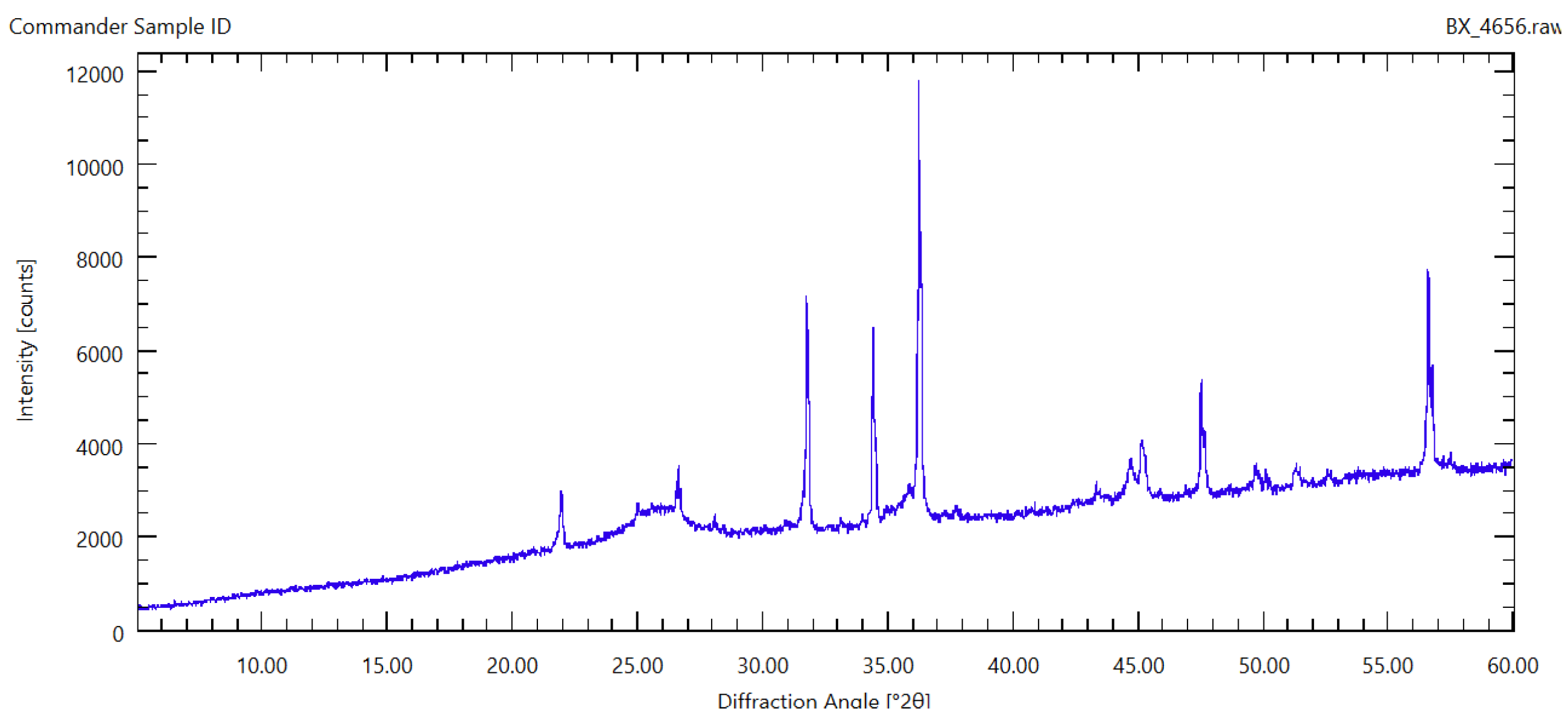
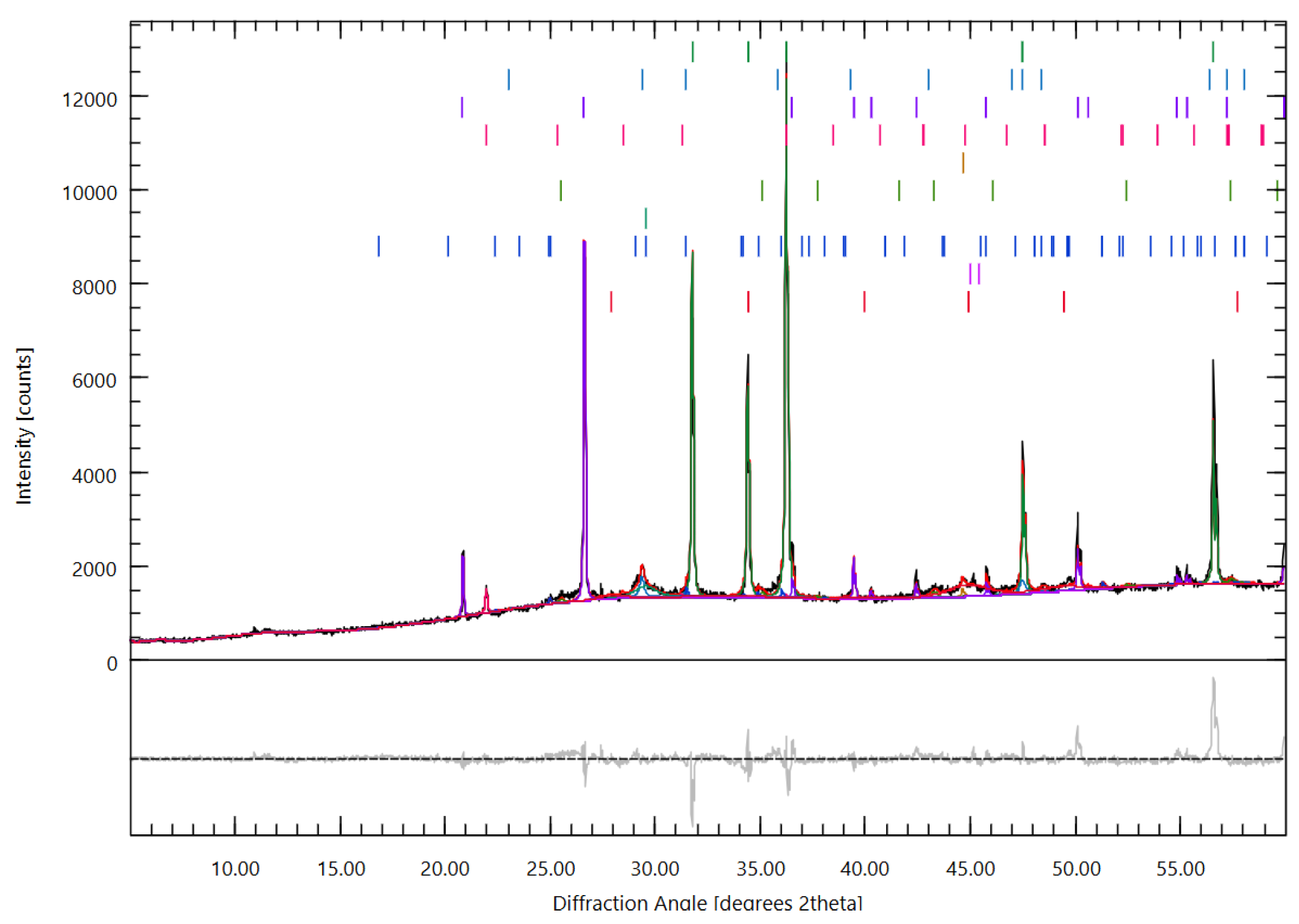
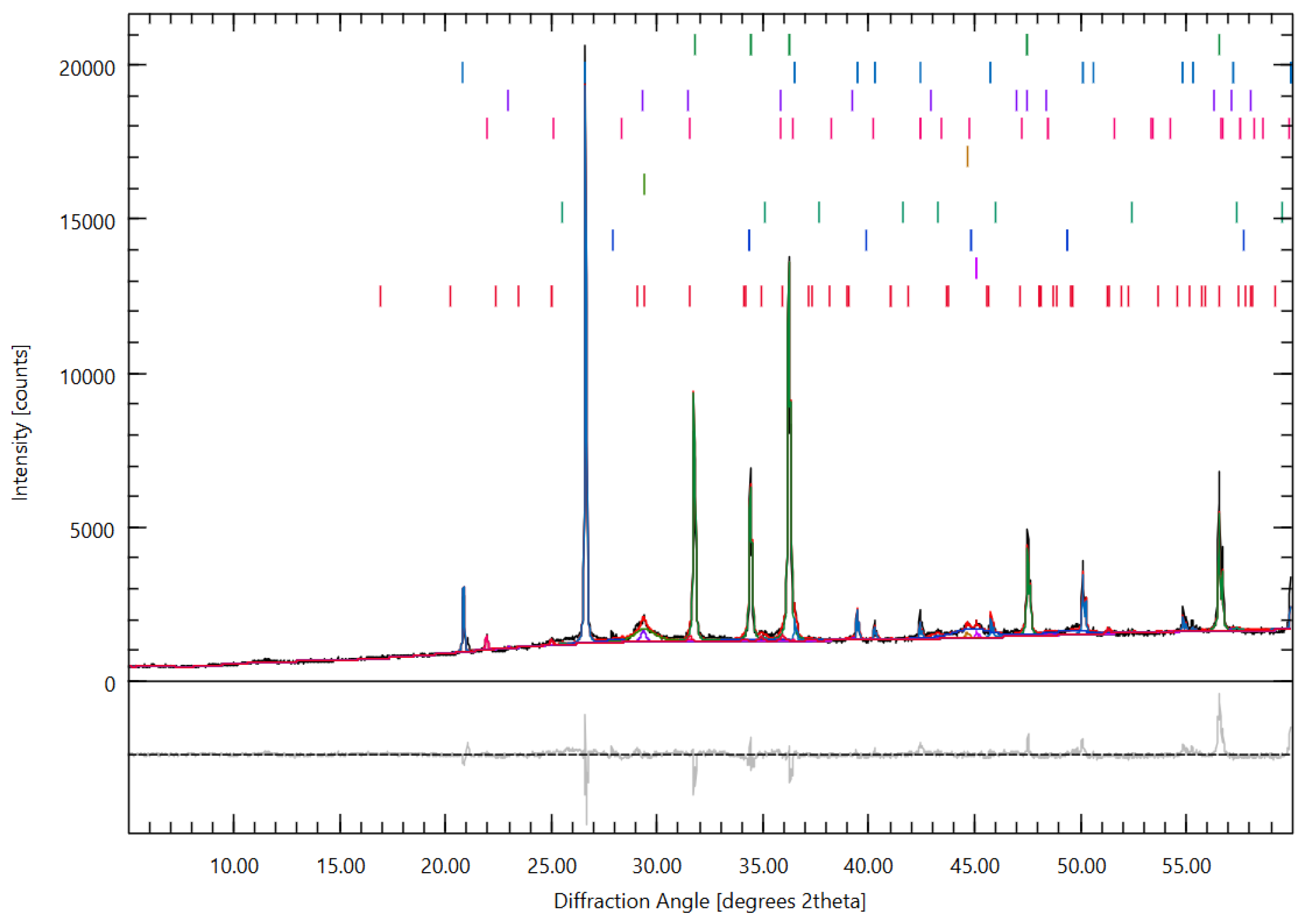
Figure 21.
XRD diffraction pattern of the raw iron-rich slag precursor showing fayalite (25.0°, 31.7°, 34.4°), hematite, minor quartz (26.6°), cristobalite (21.9°), and iron silicide (26.6°). ZnO peaks (31.7°, 34.4°, 36.2°, 47.5°, 56.6°) are from the internal standard.
Figure 21.
XRD diffraction pattern of the raw iron-rich slag precursor showing fayalite (25.0°, 31.7°, 34.4°), hematite, minor quartz (26.6°), cristobalite (21.9°), and iron silicide (26.6°). ZnO peaks (31.7°, 34.4°, 36.2°, 47.5°, 56.6°) are from the internal standard.
Figure 22.
XRD pattern of Aachen GP at 7 days showing trace crystalline phases: calcite (29.4°), corundum, cristobalite (21.9°), quartz (26.6°), and fayalite (25.0°). Broad hump (20–36°) indicates amorphous geopolymer gel. ZnO internal standard peaks: 31.7°, 34.4°, 36.2°, 47.5°, 56.6°.
Figure 22.
XRD pattern of Aachen GP at 7 days showing trace crystalline phases: calcite (29.4°), corundum, cristobalite (21.9°), quartz (26.6°), and fayalite (25.0°). Broad hump (20–36°) indicates amorphous geopolymer gel. ZnO internal standard peaks: 31.7°, 34.4°, 36.2°, 47.5°, 56.6°.
Figure 23.
XRD pattern of Aachen GP at 28 days showing persistence of inert phases (corundum, cristobalite, fayalite) and emergence of SiO2 (11.1%). Metallic Fe-bearing phases (Fe0, Fe-silicide) also detected. Amorphous hump (20–36°) indicates gel phase. ZnO internal standard peaks: 31.7°, 34.4°, 36.2°, 47.5°, 56.6°.
Figure 23.
XRD pattern of Aachen GP at 28 days showing persistence of inert phases (corundum, cristobalite, fayalite) and emergence of SiO2 (11.1%). Metallic Fe-bearing phases (Fe0, Fe-silicide) also detected. Amorphous hump (20–36°) indicates gel phase. ZnO internal standard peaks: 31.7°, 34.4°, 36.2°, 47.5°, 56.6°.
For comparison, the SCK GP system (100% BFS) exhibited a different phase evolution pathway. At 7 days, the crystalline fraction was approximately 22% (mainly quartz, calcite, and corundum), with about 78% amorphous content. By 28 days, the amorphous fraction increased to 85%, reflecting progressive gel formation and partial consumption of reactive BFS glass, while crystalline phases such as quartz and calcite persisted. This indicates that BFS undergoes more extensive dissolution and reorganisation into a geopolymer gel network compared to the Fe-rich Aachen GP system.
As shown in Figure 24, both SCK GP and Aachen GP display broad amorphous humps centered around 29° 2, consistent with the formation of gel-like reaction products. Crystalline peaks—primarily from quartz and the ZnO internal standard—are also visible. The higher quartz peak intensity in SCK GP at 28 days reflects a greater proportion of unreacted crystalline material rather than new crystallisation. These results highlight the higher crystallinity and larger crystallite sizes in BFS-based SCK GP, whereas the broader amorphous humps in Aachen GP are characteristic of dominant amorphous AAM gel and nano-scale disordered phases. Together, these patterns support the interpretation that BFS-rich systems develop a more ordered microstructure than Fe-rich blends.
The quantitative Rietveld refinement results are shown in Figure 25, which provides the relative amorphous and crystalline fractions as well as the dominant crystalline phases for both mixes at 7 and 28 days. For Aachen GP, the amorphous fraction was approximately 85% at both curing ages, with a crystalline content of about 15%. At 7 days, the crystalline phases consisted mainly of calcite (1.71%), corundum (1.36%), cristobalite (0.51%), fayalite (0.55%), and trace quartz. By 28 days, similar levels of crystallinity were retained, but with the emergence of low-cristobalite SiO2 (11.14%), alongside residual corundum (0.96%), cristobalite (0.39%), fayalite (0.81%), and metallic Fe-bearing phases (0.11%, tentatively Fe0/Fe-silicide).
In contrast, SCK GP displayed a higher crystalline fraction of about 22% at 7 days, composed primarily of quartz, calcite, and corundum, with an amorphous fraction of 78%. By 28 days, the amorphous fraction increased to approximately 85%, with the crystalline fraction reduced to about 15%, indicating progressive gel formation and partial consumption of the BFS precursor. The dominant crystalline phases at this age were persistent quartz, minor calcite, and minor corundum.
These quantitative results confirm that Aachen GP consistently exhibits lower reactivity, reflected by the persistence of inert crystalline phases such as corundum, cristobalite, and fayalite. Their retention likely contributes to the heterogeneous microstructure observed in SEM and correlates with the reduced strength development and slower reaction kinetics discussed earlier. By comparison, the BFS-based SCK GP shows more extensive dissolution and reorganisation into a gel-rich matrix, as evident from the increasing amorphous fraction between 7 and 28 days.
Overall, the XRD analysis of Aachen GP revealed delayed formation of crystalline reaction products, along with the persistence of inert phases such as fayalite and corundum. This behavior contrasts with SCK GP, where a clearer evolution of crystalline and semi-crystalline phases was observed. Bernal et al. [21] reported similar findings, showing that iron-rich particles in BFS remained largely undissolved under alkali activation, persisting as discrete phases and not contributing significantly to the gel structure. The emergence of SiO2 (P3221) in Aachen GP only after 28 days suggests that silicate crystallisation is significantly delayed in iron-rich systems. This may reflect slower gel maturation or secondary precipitation processes, both of which are hallmarks of Fe-interfered geopolymerisation pathways [25].
The presence of metallic Fe-bearing phases at 28 days implies redox activity during curing, consistent with the oxidation pathways observed in Mössbauer spectroscopy studies of Fe-based AAMs [19]. The dominance of broad amorphous humps and the absence of strong gel-related peaks at early stages further confirms that the presence of iron disrupts typical C–(A)–S–H or N–A–S–H-type gel crystallisation. Mancini et al. [22] further support this interpretation: their spectroscopic study revealed that in BFS cements, iron tends to localize within the amorphous fraction unless stabilized by sufficient Ca/Si ratios or coordinated by specific ligand environments. In the absence of such stabilizing conditions—like in Aachen GP—iron is more likely to persist as distinct crystalline phases or precipitate in reduced forms (e.g., Fe-silicide, Fe0), which are visible in the 28-day XRD patterns.
This persistence of crystalline iron-bearing phases confirms that only a limited fraction of iron becomes chemically incorporated into the gel network. Instead, much of it acts as an inert component, influencing the redox balance and potentially disrupting silicate condensation. This contributes to the observed delay in silica crystallization and the reduced degree of gel polymerisation in Aachen GP. Therefore, while iron may partially participate in the AAM network—as suggested by Mössbauer and FTIR evidence—it also introduces structural and redox constraints that affect both gel morphology and long-range ordering. These findings highlight the dual role of iron in Fe-rich AAMs: as a network-modifying element and as a crystallization barrier.
3.5. Thermal Stability and Gel Hydration: Thermogravimetric Analysis (TGA)
Thermogravimetric analysis (TGA) was conducted to examine the thermal decomposition profiles of SCK GP and Aachen GP samples at 7 and 28 days of curing. The TGA curves in Figure 26 illustrate temperature-dependent mass loss across all samples, with multistep decomposition behavior observed in the range of 25 to 950 °C. All samples exhibited an initial mass loss below 105 °C, associated with the evaporation of physically adsorbed moisture. A second dominant mass loss step was recorded between 105 and 600 °C, corresponding to the release of chemically bound water from gel phases. Beyond 600 °C, further weight loss was observed, attributed to the decomposition of carbonate phases and the formation of crystalline residues.
The derivative thermogravimetric (DTG) curves in Figure 27 provide further insight into the decomposition kinetics, showing distinct peaks corresponding to each decomposition stage. For clarity, vertically shifted DTG curves are presented in Figure 28 to aid in distinguishing overlapping thermal events. Quantitative evaluation of mass loss showed that SCK GP samples had higher total weight loss than Aachen GP samples at both curing times. The calculated values for total mass loss (up to 950 °C) and bound water content (105–600 °C) are summarized in Table 6. Longer curing times resulted in increased bound water and overall mass loss for both material systems.
The higher bound water content observed in SCK GP—reflected by greater mass loss in the 105–600 °C range—indicates more extensive gel formation. This trend is consistent with the calorimetric data, which showed higher cumulative heat release and more pronounced exothermic activity in SCK GP, reflecting a more complete dissolution–polycondensation sequence. In contrast, the reduced bound water content in Aachen GP correlates with its lower reactivity, as evidenced by isothermal calorimetry, lower mechanical strength, and greater microstructural porosity. These results confirm that iron-rich formulations under NaOH activation produce fewer reactive monomers. As demonstrated by Bernal et al. [21] and Adediran et al. [37], Fe-rich slags often contain phases that do not participate in gel formation and instead persist as inert inclusions—consistent with the limited mass loss observed during gel dehydroxylation and secondary phase breakdown.
Moreover, the weaker decomposition peaks associated with layered double hydroxides (LDH) and carbonates in Aachen GP indicate fewer secondary hydration products, complementing the FTIR and XRD findings that revealed delayed gel formation and incomplete phase evolution. Mohebbi et al. [41] and Adediran et al. [37] highlighted that higher gel maturity corresponds to increased thermal signals from stable LDH and carbonate phases, a characteristic more evident in the SCK GP matrix.
Taken together, the thermal stability trends observed in TGA reinforce the broader interpretation from SEM and porosity data: Aachen GP forms a less dense, poorly hydrated matrix with elevated water-accessible porosity and higher permeability. The lower dissolution of iron slag confirms that iron not only reduces reaction kinetics but also limits gel yield, thereby weakening the material’s structural cohesion. These findings underscore the need for tailored mix designs or silicate-enhanced activation strategies when using Fe-rich slag systems for durable waste immobilization applications.
4. Conclusions
This study evaluated the fresh-state behavior, microstructural development, pore structure, morphology, and mechanical performance of a binary alkali-activated material (Aachen GP), composed of 50 wt.% blast furnace slag and 50 wt.% iron-rich slag, in comparison to a reference BFS-only AAM (SCK GP). The objective was to assess the suitability of the iron-rich blend for radioactive waste immobilization applications.
The results demonstrate that incorporating iron-rich slag in the blend leads to delayed setting, reduced reaction heat, and significantly lower mechanical strength compared to the BFS reference mix. Despite these reductions, the Aachen GP formulation still meets the minimum regulatory strength requirements for low- to intermediate-level radioactive waste immobilization.
Porosity and permeability characterization revealed that Aachen GP develops a more open and connected pore network, which may negatively influence long-term durability and containment performance. Morphological analysis using SEM confirmed this trend, showing a more heterogeneous microstructure with a greater amount of unreacted particles, whereas the BFS reference formed a denser and more homogeneous gel matrix. These observations align with BET and calorimetry results, confirming the inhibitory influence of iron on gel continuity and structural densification.
The observed performance differences are attributed to the role of iron in disrupting the AAM gel network. Fe2+/Fe3+ ions likely substitute for Si or Al in tetrahedral or distorted coordination environments, thereby reducing the degree of polymerisation and promoting the formation of a less cohesive, porous matrix. This interpretation is consistent with the delayed calorimetric response, lower gel-bound water content, higher surface area, and larger pore volume observed in the iron-rich formulation.
Future work should focus on evaluating the chemical durability and radionuclide immobilisation performance of Fe-containing AAMs. Dedicated leaching studies targeting high-risk isotopes such as Cs-137, Sr-90, and Co-60 should be conducted under repository-relevant conditions, including acidic, sulfate-rich, and thermally cycled environments. Long-term ageing tests, radiation exposure assessments, and monitoring of microcracking evolution should also be carried out to ensure material stability and containment efficacy over extended timescales.
Author Contributions
Shymaa Ali Fathi Ali: Conceptualization, Methodology, Investigation, Formal analysis, Data curation, Visualization, Writing—original draft. Lander Frederickx: Methodology, Technical support, Validation, Writing—review & editing. Emile Mukiza: Investigation, Formal analysis, Validation, Writing—review & editing. Michael Ojovan: Supervision, Writing—review & editing. Hans-Jürgen Steinmetz: Conceptualization, Supervision, Project administration, Partial funding acquisition.
Funding
This research was supported by Aachen University of Applied Sciences, which provided funding for a three-month internship undertaken by the first author. The Belgian Nuclear Research Centre (SCK CEN) hosted the first author for a four-month research internship, granting full access to laboratories and instrumentation without charging any fees or stipend.
Data Availability Statement
The data that support the findings of this study are available from the first author, Shymaa Ali Fathi Ali, upon reasonable request. Raw data and analysis files from scanning electron microscopy (SEM–EDX), X-ray diffraction (XRD), FTIR spectroscopy, isothermal calorimetry, and other characterization techniques are held by the first author, with archival copies maintained at Aachen University of Applied Sciences. The iron-rich slag samples used in this study were provided by Siempelkamp GmbH (Germany) to Aachen University of Applied Sciences. The blast furnace slag and other materials were accessed through the Belgian Nuclear Research Centre (SCK CEN) during the master’s thesis internship. Material specifications and characterization data are available upon reasonable request from the first author.
Acknowledgments
The authors thank Siempelkamp GmbH (Germany) for supplying the iron-rich slag samples used in this study. We acknowledge Prof. Hans-Jürgen Steinmetz (FH Aachen University of Applied Sciences) for project oversight and administrative support, and Prof. Michael Ojovan (Imperial College London) for his role as academic supervisor. Special thanks are extended to Dr. Lander Frederickx and Dr. Emile Mukiza (SCK CEN) for their continuous technical guidance, progress meetings, and practical support during the experimental program.
Conflicts of Interest
The authors declare no conflict of interest.
Declaration of Generative AI Use
During the preparation of this work, the author(s) used Claude 3.5 Sonnet (Anthropic) to assist with grammar and spelling checks, enhance readability, and verify LaTeX formatting of the manuscript. After using this tool, the author(s) reviewed and edited all content as needed and take full responsibility for the final published version.
References
- International Atomic Energy Agency. Status and Trends in Spent Fuel and Radioactive Waste Management. Technical Report NW-T-1.14 (Rev. 1), International Atomic Energy Agency, Vienna, Austria, 2022. Available from IAEA Publications.
- Ojovan, M.I.; Steinmetz, H.J. Approaches to Disposal of Nuclear Waste. Energies 2022, 15, 7804. [Google Scholar] [CrossRef]
- Davidovits, J. Geopolymers: Inorganic Polymeric New Materials. Journal of Thermal Analysis 1991, 37, 1633–1656. [Google Scholar] [CrossRef]
- Ayele, T.B.; Duguma, A.B.; Bekele, A.M.; Huang, W.; Abegaz, F. Recent Advances in Alternative Cementitious Materials for Nuclear Waste Immobilization: A Review. Sustainability 2023, 15, 689. [Google Scholar] [CrossRef]
- Duxson, P.; Fernández-Jiménez, A.; Provis, J.L.; Lukey, G.C.; Palomo, A.; van Deventer, J.S.J. Geopolymer Technology: The Current State of the Art. Journal of Materials Science 2007, 42, 2917–2933. [Google Scholar] [CrossRef]
- Xu, H.; Van Deventer, J. The geopolymerisation of alumino-silicate minerals. International Journal of Mineral Processing 2000, 59, 247–266. [Google Scholar] [CrossRef]
- Gartner, E. Industrially interesting approaches to “low-CO2” cements. Cement and Concrete Research 2004, 34, 1489–1498. [Google Scholar] [CrossRef]
- Thwe, E.; Khatiwada, D.; Gasparatos, A. Life cycle assessment of a cement plant in Naypyitaw, Myanmar. Cleaner Environmental Systems 2021, 2, 100007. [Google Scholar] [CrossRef]
- Teh, S.; Wiedmann, T.; Castel, A.; de Burgh, J. Hybrid life cycle assessment of greenhouse gas emissions from cement, concrete and geopolymer concrete in Australia. Journal of Cleaner Production 2017, 152, 312–320. [Google Scholar] [CrossRef]
- McLellan, B.; Williams, R.; Lay, J.; van Riessen, A.; Corder, G. Costs and carbon emissions for geopolymer pastes in comparison to ordinary Portland cement. Journal of Cleaner Production 2011, 19, 1080–1090. [Google Scholar] [CrossRef]
- Provis, J.L.; van Deventer, J.S.J. Alkali-activated Materials: State-of-the-Art Report. RILEM Technical Committee 224-AAM 2014, pp. 1–388. [CrossRef]
- Komnitsas, K.; Zaharaki, D. Geopolymerisation: A Review and Prospects for the Minerals Industry. Minerals Engineering 2007, 20, 1261–1277. [Google Scholar] [CrossRef]
- Walkley, B.; Ke, X.; Hussein, O.; Bernal, S.; Provis, J. Incorporation of strontium and calcium in geopolymer gels. Journal of Hazardous Materials 2019, 382, 121015. [Google Scholar] [CrossRef]
- El Alouani, S.e.a. Application of geopolymers for treatment of water contaminated with organic and inorganic pollutants: State-of-the-art review. Journal OF Environmental Chemical Engineering 2021, 9. [Google Scholar] [CrossRef]
- Lin, X.e.a. Performance study of ion exchange resins solidification using metakaolin-based geopolymer binder. Progress in Nuclear Energy 2020, 129. [Google Scholar] [CrossRef]
- Girke, N.; Steinmetz, H.; Bukaemsky, A.; Bosbach, D.; Hermann, E.; Griebel, I. Cementation of Nuclear Graphite using Geopolymers. In Proceedings of the Proceedings of the NUWCEM 2011, Avignon, France, October 2011; pp. 11–14.
- Frederickx, L.; Mukiza, E.; Phung, Q.T. Leaching of a Cs- and Sr-Rich Waste Stream Immobilized in Alkali-Activated Matrices. Sustainability 2025, 17, 1756. [Google Scholar] [CrossRef]
- Criado, M.; Palomo, A.; Fernández-Jiménez, A. Alkali activation of fly ashes. Part 1: Effect of curing conditions on the carbonation of the reaction products. Fuel 2005, 84, 2048–2054. [Google Scholar] [CrossRef]
- Lemougna, P.N.; MacKenzie, K.J.D.; Jameson, G.N.L.; Rahier, H.; Melo, U.F.C. The role of iron in the formation of inorganic polymers (geopolymers) from volcanic ash: A 57Fe Mössbauer spectroscopy study. Journal of Materials Science 2013, 48, 5280–5286. [Google Scholar] [CrossRef]
- Bell, J.L.; Kriven, W.M. Formation of an Iron-based Inorganic Polymer (Geopolymer). Journal of Ceramic Engineering and Science Proceedings 2009, 30, 301–312. [Google Scholar] [CrossRef]
- Bernal, S.; Rose, V.; Provis, J. The fate of iron in blast furnace slag particles during alkali-activation. Materials Chemistry and Physics 2014, 146, 1–5. [Google Scholar] [CrossRef]
- Mancini, A.; Lothenbach, B.; Geng, G.; Grolimund, D.; Sanchez, D.F.; Fakra, S.C.; Dähn, R.; Wehrli, B.; Wieland, E. Iron Speciation in Blast Furnace Slag Cements. Cement and Concrete Research 2021, 140, 106287. [Google Scholar] [CrossRef]
- Lemougna, P.N.; Wang, K.t.; Tang, Q.; Cui, X.m. Study on the Development of Inorganic Polymers from Red Mud and Slag System: Application in Mortar and Lightweight Materials. Construction and Building Materials 2017, 156, 486–495. [Google Scholar] [CrossRef]
- Nikolov, A.; Rostovsky, I.; Nugteren, H. Geopolymer Materials Based on Natural Zeolite. Case Studies in Construction Materials 2017, 6, 1–6. [Google Scholar] [CrossRef]
- Ponomar, V.; Yliniemi, J.; Adesanya, E.; Ohenoja, K.; Illikainen, M. An overview of the utilisation of Fe-rich residues in alkali-activated binders: Mechanical properties and state of iron. Journal of Cleaner Production 2022, 330, 129900. [Google Scholar] [CrossRef]
- Onisei, S.; Pontikes, Y.; Angelopoulos, G.N.; Snellings, R.; Dierckx, P.; Vandewalle, L. Synthesis of inorganic polymers made of fayalite slag and fly ash and their properties as construction materials. Journal of Hazardous Materials 2012, 205–206, 101–110. [Google Scholar] [CrossRef] [PubMed]
- Komnitsas, K.; Zaharaki, D.; Perdikatsis, V. Effect of synthesis parameters on the compressive strength of low-calcium ferronickel slag inorganic polymers. Journal of Hazardous Materials 2009, 161, 760–768. [Google Scholar] [CrossRef] [PubMed]
- Jacops, E.; Phung, Q.T.; Frederickx, L.; De Schutter, G.; Verhoef, E.; Maes, N. Diffusive Transport of Dissolved Gases in Potential Concretes for Nuclear Waste Disposal. Sustainability 2021, 13, 10007–10024. [Google Scholar] [CrossRef]
- Phung, Q.T.; Maes, N.; Jacques, D.; De Schutter, G.; Ye, G. Study of the Time-dependent Behaviour of the Concrete Buffer of a Radioactive Waste Disposal. Construction and Building Materials 2016, pp. 141–151. [CrossRef]
- Phung, Q.T.; Maes, N.; Jacques, D.; Bruneel, E.; Van Driessche, I.; Ye, G.; De Schutter, G. Effect of Limestone Fillers on Microstructure and Permeability Due to Carbonation of Cement Pastes Under Controlled CO2 Pressure Conditions. Construction and Building Materials 2015, 82, 376–390. [Google Scholar] [CrossRef]
- Döbelin, N.; Kleeberg, R. Profex: a graphical user interface for the Rietveld refinement program BGMN. Journal of Applied Crystallography 2015, 48, 1573–1580. [Google Scholar] [CrossRef]
- Beersaerts, G.; Vananroye, A.; Sakellariou, D.; Clasen, C.; Pontikes, Y. Rheology of an alkali-activated Fe-rich slag suspension. Journal of Non-Crystalline Solids 2021, 561, 120747. [Google Scholar] [CrossRef]
- ONDRAF/NIRAS. Waste Plan for the Long-term Management of Conditioned High-level and/or Long-lived Radioactive Waste and Overview of Related Issues. Technical Report NIROND 2011-02 E, Belgian Agency for Radioactive Waste and Enriched Fissile Materials, Avenue des Combattants 107 A, 1470 Genappe, Belgium, 2011.
- Commission on Storage of High-Level Radioactive Waste. Final Report: Responsibility for the Future - Nuclear Waste Management in Germany. Technical report, Federal Ministry for the Environment, Nature Conservation and Nuclear Safety, Germany, 2024.
- Nikolov, A. Alkali-activated geopolymers based on iron-rich slag from copper industry. In Proceedings of the IOP Conference Series: Materials Science and Engineering, 2020, Vol. 951, p. 012006. [CrossRef]
- Adediran, A.; Yliniemi, J.; Lemougna, P.N.; Perumal, P.; Illikainen, M. Recycling high volume Fe-rich fayalite slag in blended alkali-activated materials: Effect of ladle and blast furnace slags on the fresh and hardened state properties. Journal of Building Engineering 2023, 63, 105436. [Google Scholar] [CrossRef]
- Adediran, A.; Yliniemi, J.; Moukannaa, S.; Ramteke, D.; Perumal, P.; Illikainen, M. Enhancing the thermal stability of alkali-activated Fe-rich fayalite slag-based mortars by incorporating ladle and blast furnace slags: Physical, mechanical and structural changes. Cement and Concrete Research 2023, 166, 107098. [Google Scholar] [CrossRef]
- Chemist, A.; ul Amin, N.; Ahmad, H.; Noor, S.; Sultana, S.; Huzaifa, U.; Ahmad, H.; Awwad, F.; Ismail, E. Synthesis and characterization of novel iron-modified geopolymer cement from laterite clay as low energy material. AIP Advances 2024, 14. [Google Scholar] [CrossRef]
- Ponomar, V.; Adesanya, E.; Ohenoja, K.; Illikainen, M. High-temperature performance of slag-based Fe-rich alkali-activated materials. Cement and Concrete Research 2022, 161, 106960. [Google Scholar] [CrossRef]
- Nikolov, A.; Titorenkova, R.; Velinov, N.; Delcheva, Z. Characterization of a novel geopolymer based on acid-activated fayalite slag from local copper industry. Bulgarian Chemical Communications 2019, 50, 54–60. [Google Scholar]
- Mohebbi, A.; Allahverdi, A. Thermal analysis of alkali-activated materials: A review on gel structures and stability. Thermochimica Acta 2020, 689, 178649. [Google Scholar]
Figure 1.
Coarse iron-rich slag as received from Siempelkamp (Germany), with typical particle sizes ranging from 5 cm to 20 cm.
Figure 1.
Coarse iron-rich slag as received from Siempelkamp (Germany), with typical particle sizes ranging from 5 cm to 20 cm.

Figure 2.
Demolded Aachen GP cubic specimen (40 × 40 × 40 mm) prior to curing used for compressive strength testing and other analysis.
Figure 2.
Demolded Aachen GP cubic specimen (40 × 40 × 40 mm) prior to curing used for compressive strength testing and other analysis.
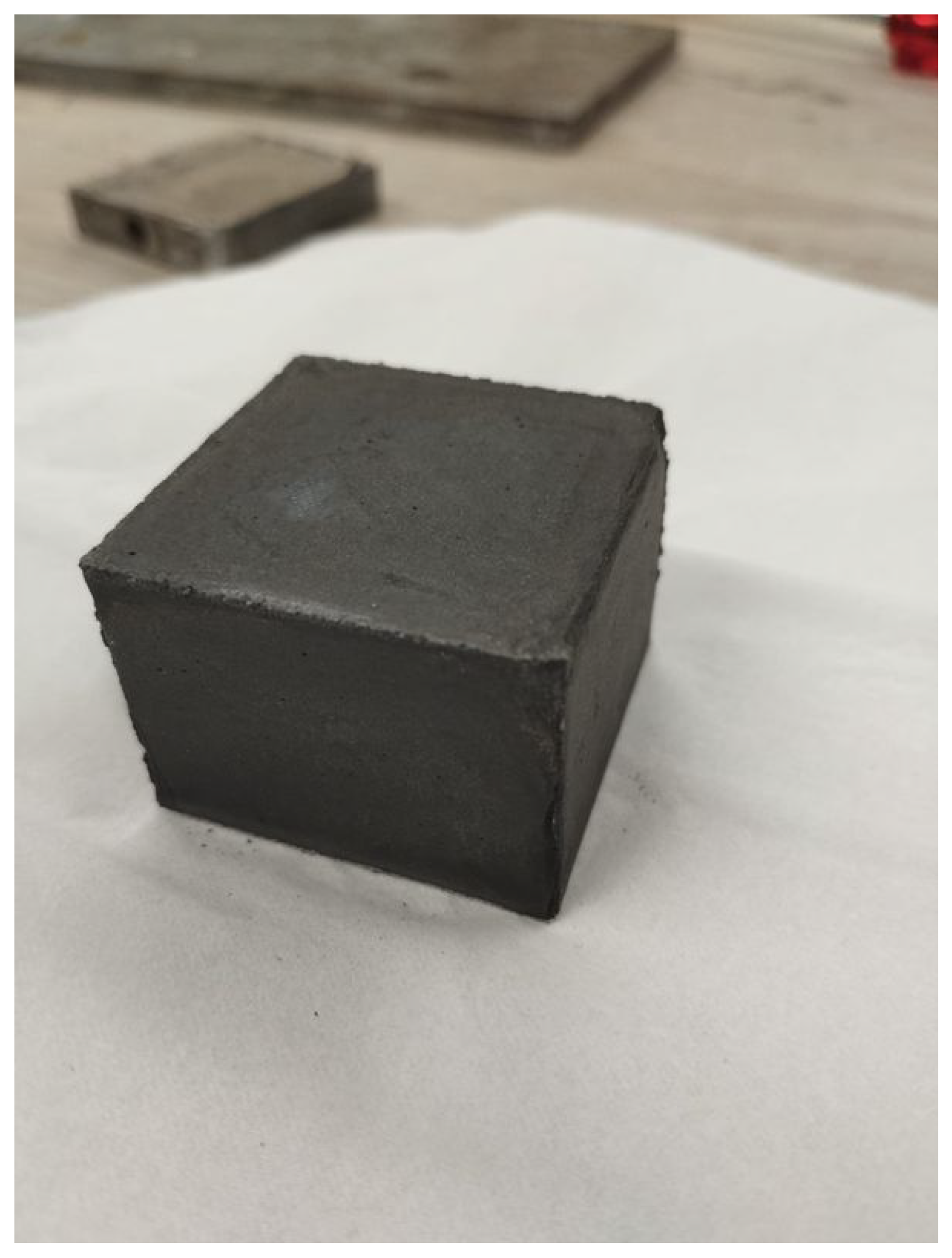
Figure 3.
Demolded Aachen GP prismatic specimens (40 × 40 × 160 mm) prior to curing used for flexural strength testing
Figure 3.
Demolded Aachen GP prismatic specimens (40 × 40 × 160 mm) prior to curing used for flexural strength testing
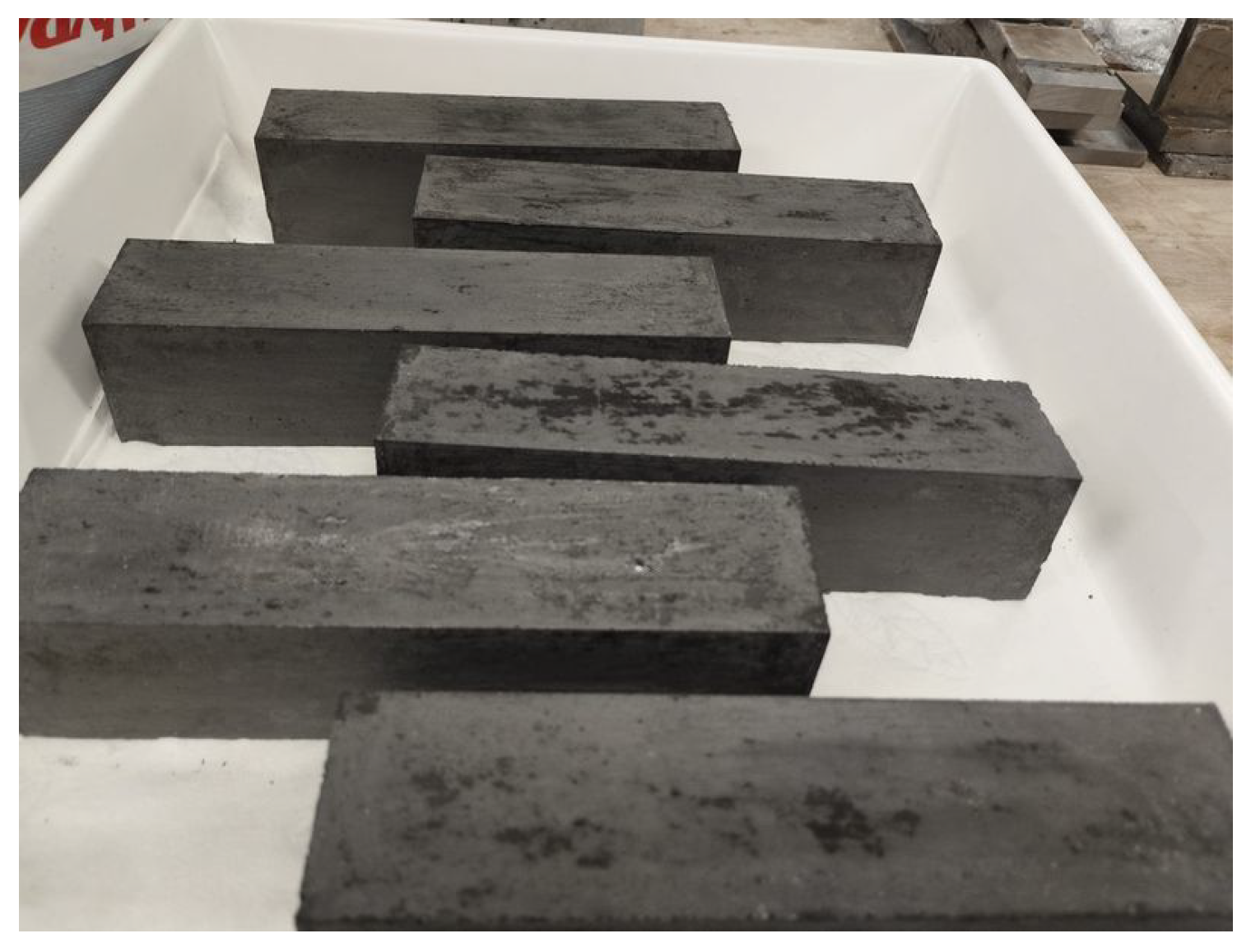
Figure 4.
Viscosity development of SCK GP and Aachen GP over 60 minutes. Linear trendlines are fitted to the experimental data.
Figure 4.
Viscosity development of SCK GP and Aachen GP over 60 minutes. Linear trendlines are fitted to the experimental data.
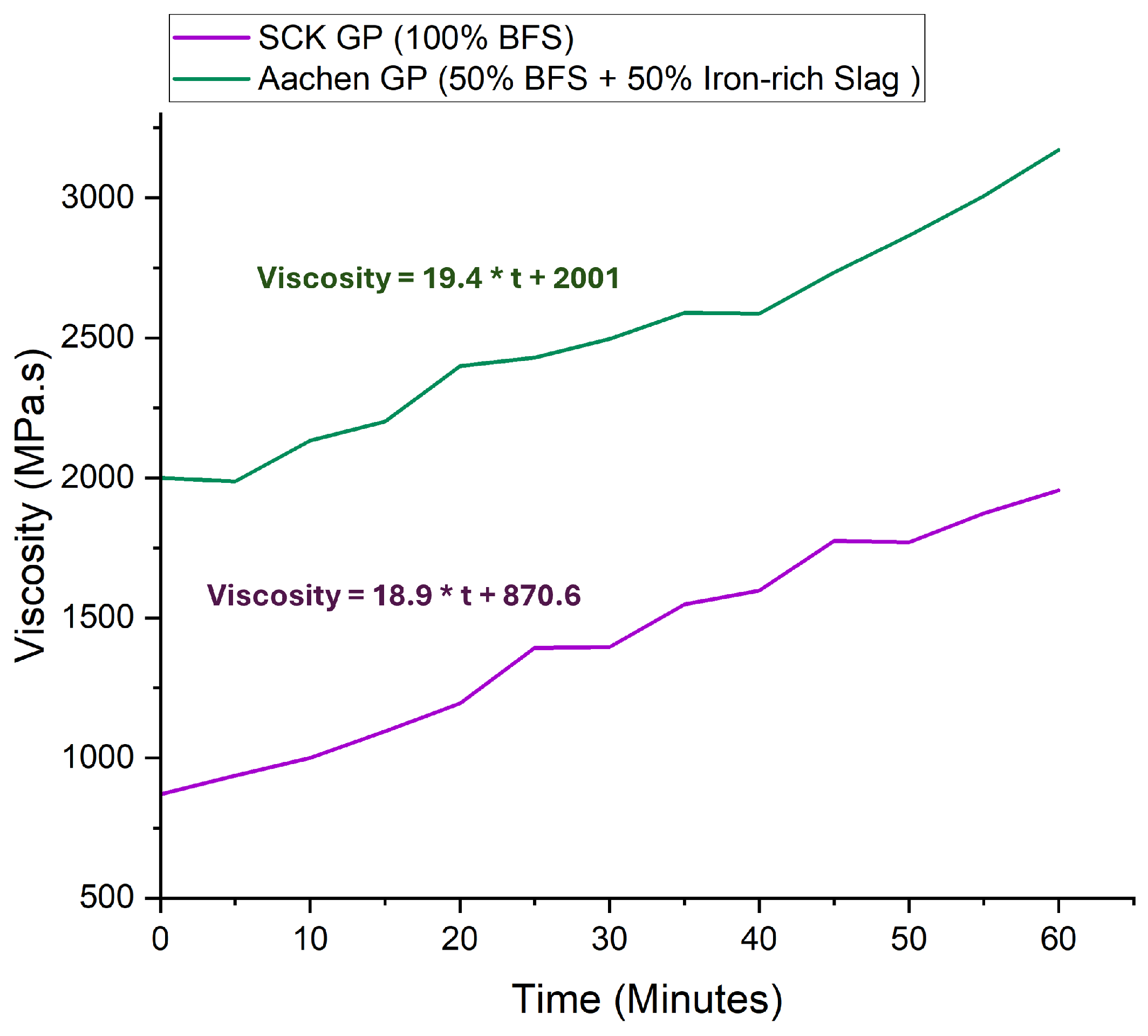
Figure 5.
Heat flow curves of alkali-activated materials (AAMs) during geopolymerisation, showing (a) full heat evolution over 15 days, (b) the first exothermic peak, and (c) the second acceleration peak for SCK GP, Aachen GP, and Modified Aachen GP. The purple line represents SCK GP (100% BFS), the green line represents Aachen GP (50% BFS + 50% iron-rich slag), and the pink line represents Modified Aachen GP (25% BFS + 75% iron-rich slag).
Figure 5.
Heat flow curves of alkali-activated materials (AAMs) during geopolymerisation, showing (a) full heat evolution over 15 days, (b) the first exothermic peak, and (c) the second acceleration peak for SCK GP, Aachen GP, and Modified Aachen GP. The purple line represents SCK GP (100% BFS), the green line represents Aachen GP (50% BFS + 50% iron-rich slag), and the pink line represents Modified Aachen GP (25% BFS + 75% iron-rich slag).
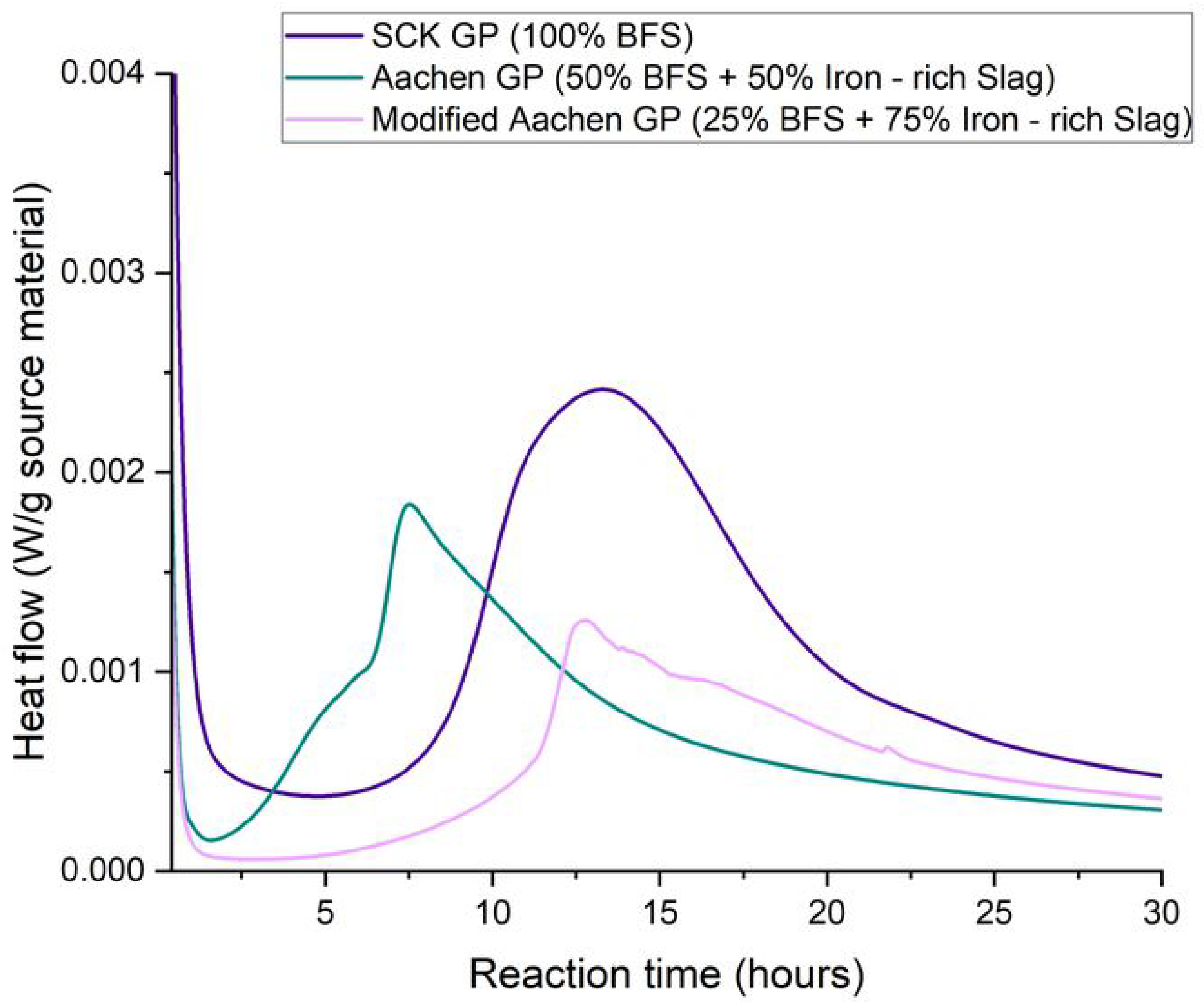
Figure 6.
Cumulative heat profiles of alkali-activated materials (AAMs) measured under isothermal conditions at 20 °C over a period of 15 days. The purple line represents SCK GP (100% BFS), the green line represents Aachen GP (50% BFS + 50% iron-rich slag), and the pink line represents Modified Aachen GP (25% BFS + 75% iron-rich slag).
Figure 6.
Cumulative heat profiles of alkali-activated materials (AAMs) measured under isothermal conditions at 20 °C over a period of 15 days. The purple line represents SCK GP (100% BFS), the green line represents Aachen GP (50% BFS + 50% iron-rich slag), and the pink line represents Modified Aachen GP (25% BFS + 75% iron-rich slag).
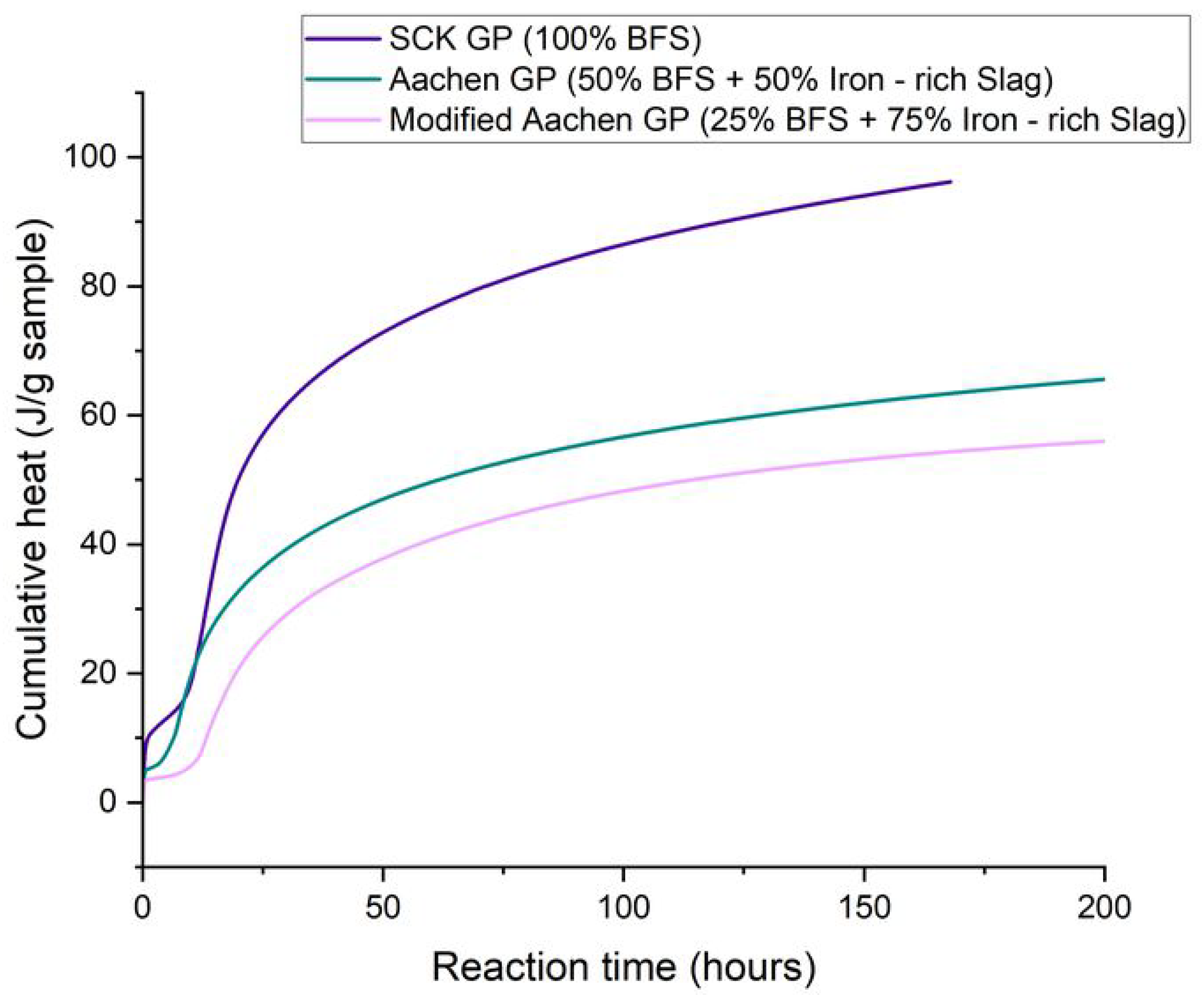
Figure 7.
Flexural strength development of AAMs at 7 and 28 days. The purple bars represent SCK GP (100% BFS), and the green bars represent Aachen GP (50% BFS + 50% iron-rich slag). The blue line indicates the minimum flexural strength requirement (1 MPa) for nuclear waste acceptance criteria in Belgium [33].
Figure 7.
Flexural strength development of AAMs at 7 and 28 days. The purple bars represent SCK GP (100% BFS), and the green bars represent Aachen GP (50% BFS + 50% iron-rich slag). The blue line indicates the minimum flexural strength requirement (1 MPa) for nuclear waste acceptance criteria in Belgium [33].
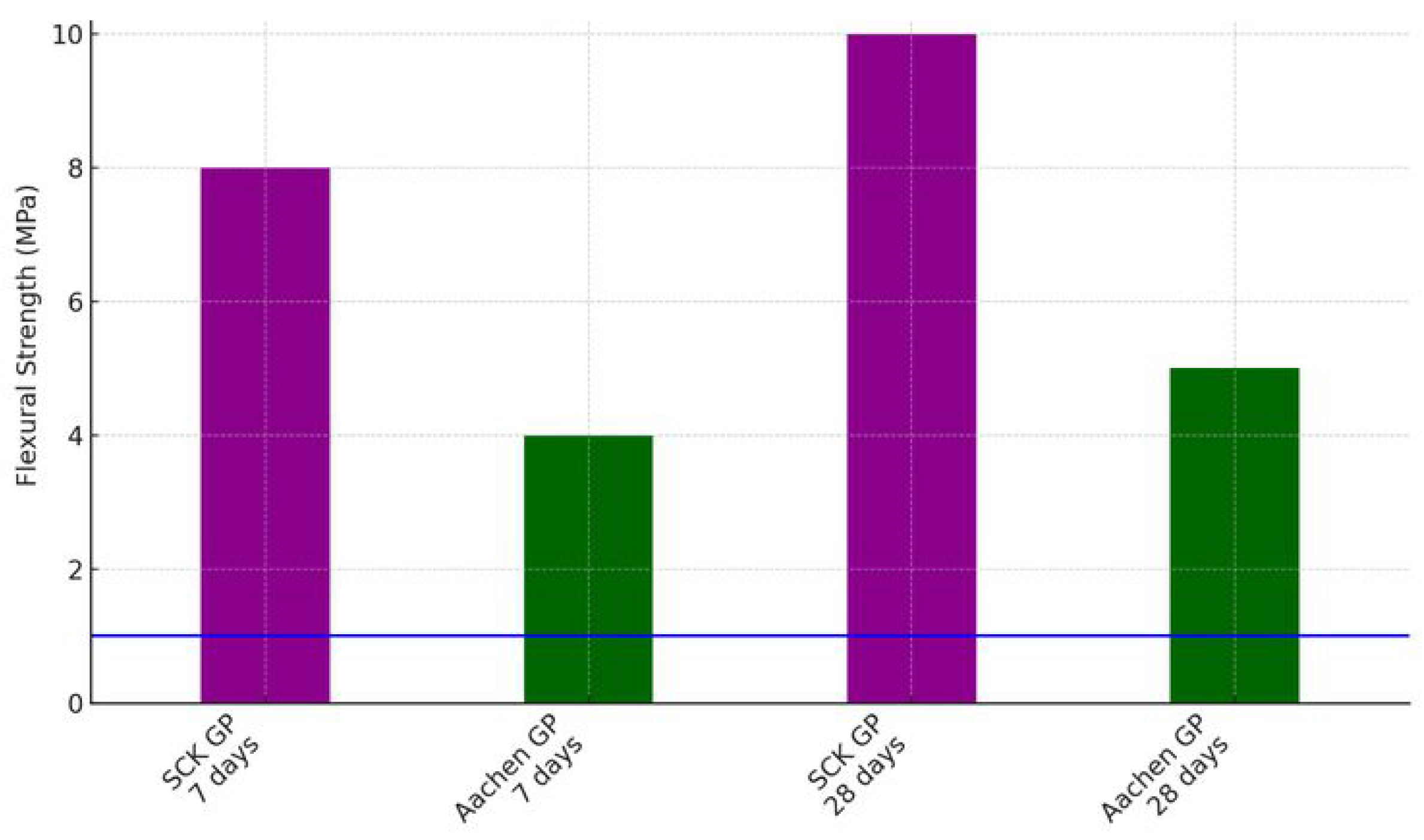
Figure 8.
Compressive strength development of AAMs at 7 and 28 days. The purple bars represent SCK GP (100% BFS), and the green bars represent Aachen GP (50% BFS + 50% iron-rich slag). Blue and green lines indicate the minimum requirements for Belgian (8 MPa) and German (10 MPa) waste acceptance criteria, respectively [33,34].
Figure 8.
Compressive strength development of AAMs at 7 and 28 days. The purple bars represent SCK GP (100% BFS), and the green bars represent Aachen GP (50% BFS + 50% iron-rich slag). Blue and green lines indicate the minimum requirements for Belgian (8 MPa) and German (10 MPa) waste acceptance criteria, respectively [33,34].
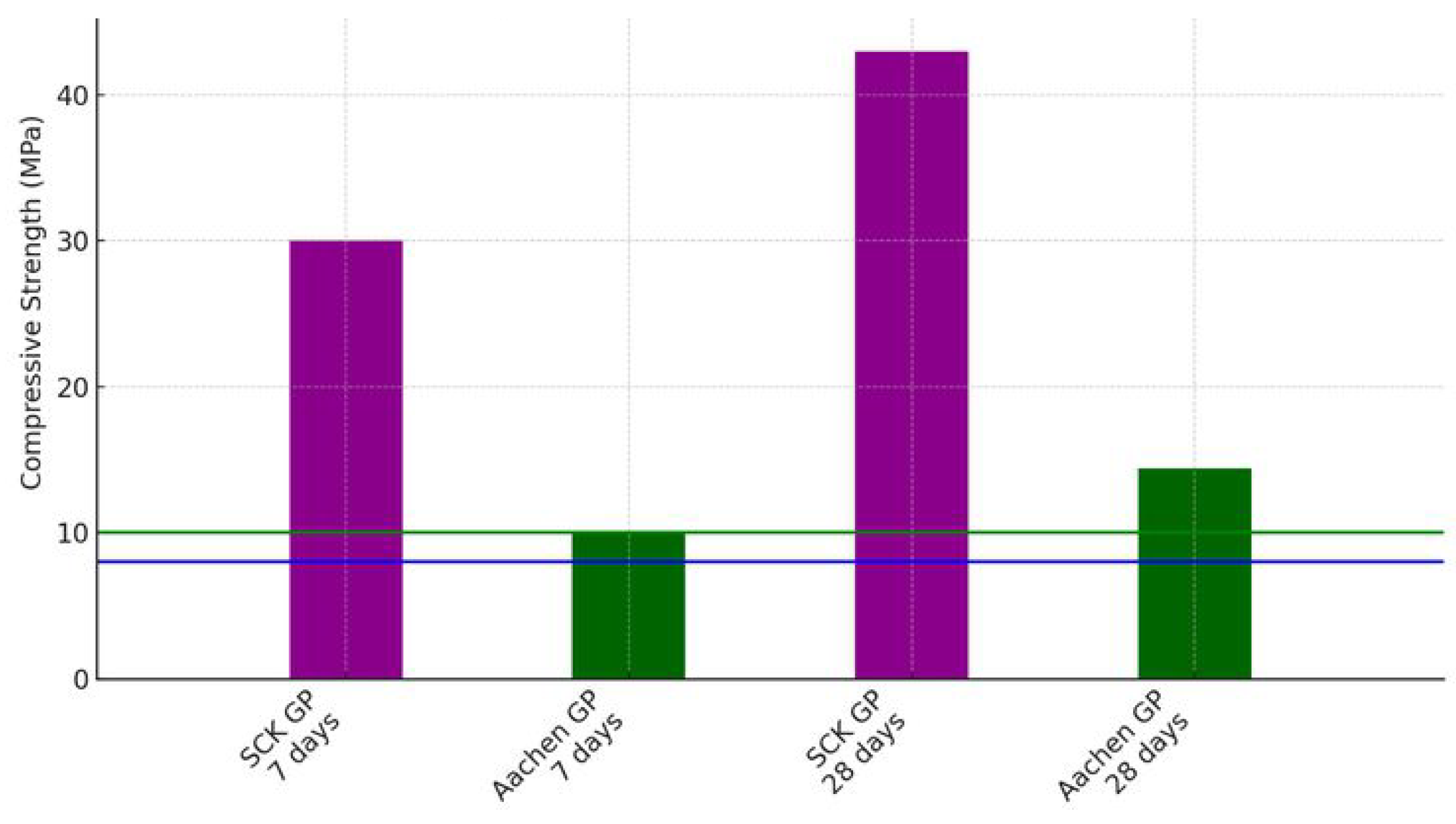
Figure 9.
Nitrogen adsorption-desorption isotherms of SCK GP (100% BFS) at 28 days and Aachen GP (50% BFS + 50% iron-rich slag) at 28 days showing Type IV behavior with H3 hysteresis loops.
Figure 9.
Nitrogen adsorption-desorption isotherms of SCK GP (100% BFS) at 28 days and Aachen GP (50% BFS + 50% iron-rich slag) at 28 days showing Type IV behavior with H3 hysteresis loops.
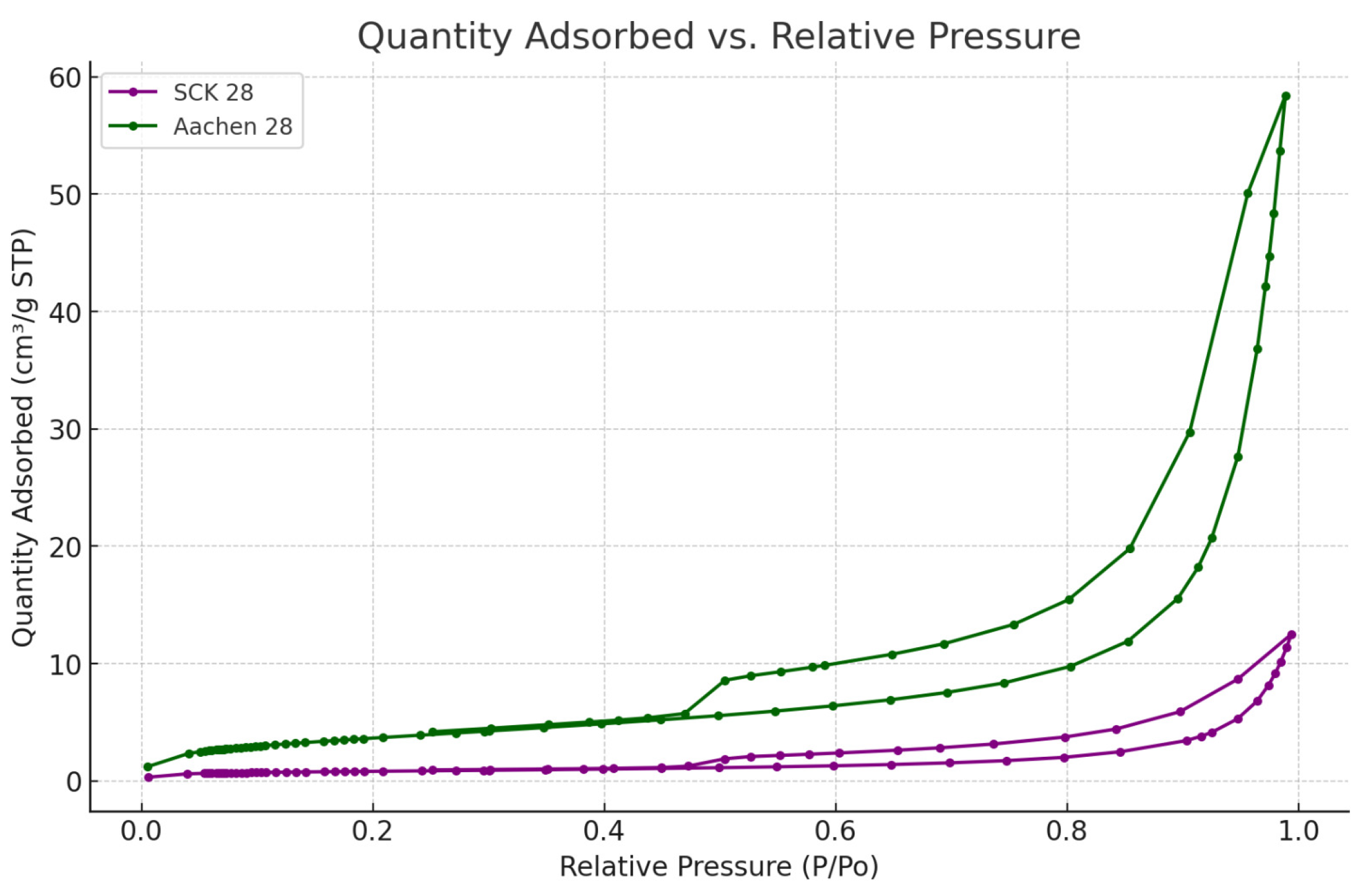
Figure 10.
Pore size distribution curves of SCK GP (100% BFS) at 28 days and Aachen GP (50% BFS + 50% iron-rich slag) at 28 days derived from BJH analysis.
Figure 10.
Pore size distribution curves of SCK GP (100% BFS) at 28 days and Aachen GP (50% BFS + 50% iron-rich slag) at 28 days derived from BJH analysis.
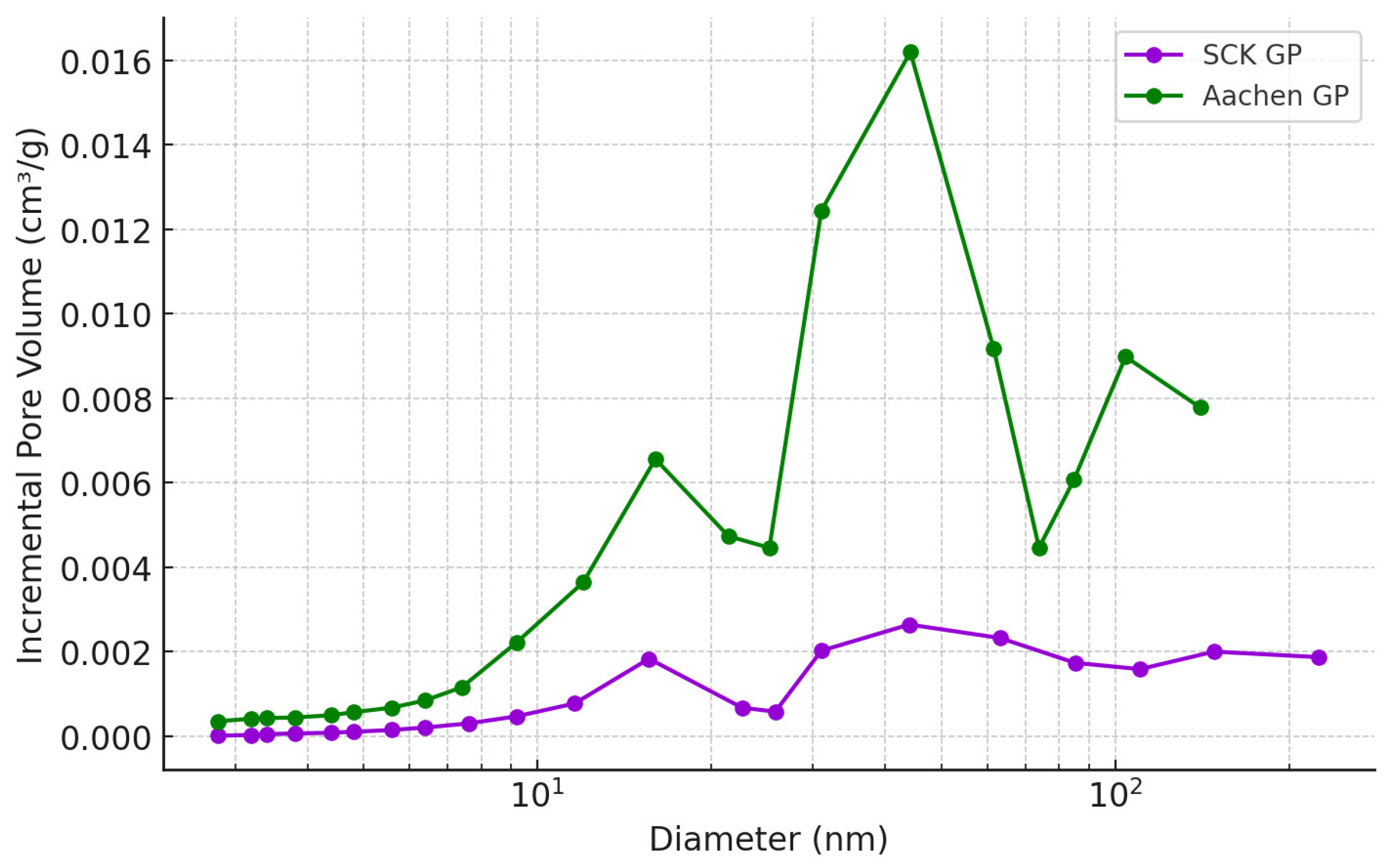
Figure 11.
Cumulative pore volume versus pore diameter for SCK GP (100% BFS) at 28 days and Aachen GP (50% BFS + 50% iron-rich slag) at 28 days showing total accessible pore volume distribution.
Figure 11.
Cumulative pore volume versus pore diameter for SCK GP (100% BFS) at 28 days and Aachen GP (50% BFS + 50% iron-rich slag) at 28 days showing total accessible pore volume distribution.
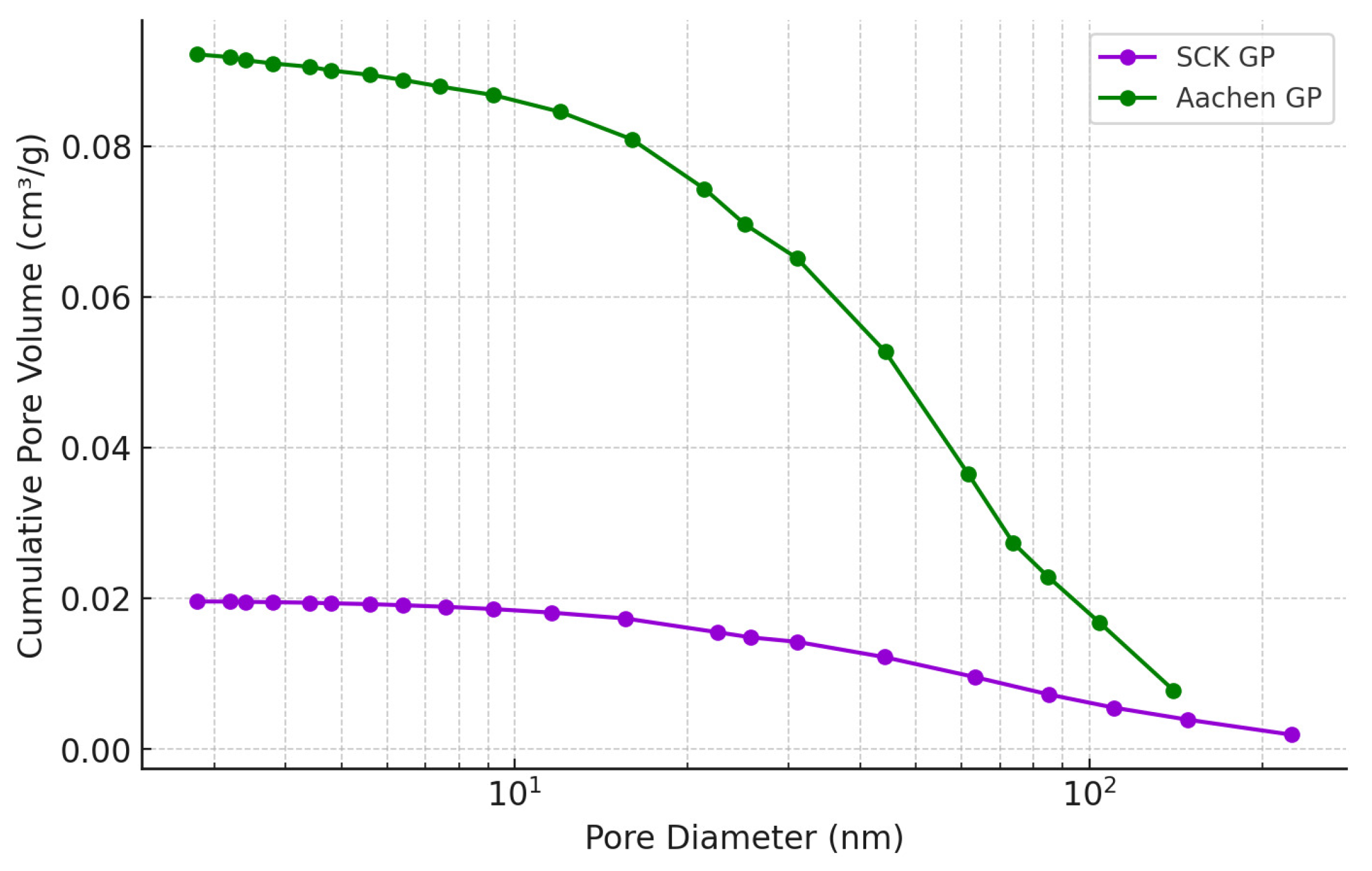
Figure 12.
SEM micrograph of Aachen GP at 7 days (350×) showing a heterogeneous and incompletely reacted microstructure. Bright angular particles correspond to unreacted slag grains, while the darker background contains early-stage geopolymer gel. The irregular distribution and visible voids reflect delayed or inhibited reaction due to the high Fe content of the precursor.
Figure 12.
SEM micrograph of Aachen GP at 7 days (350×) showing a heterogeneous and incompletely reacted microstructure. Bright angular particles correspond to unreacted slag grains, while the darker background contains early-stage geopolymer gel. The irregular distribution and visible voids reflect delayed or inhibited reaction due to the high Fe content of the precursor.
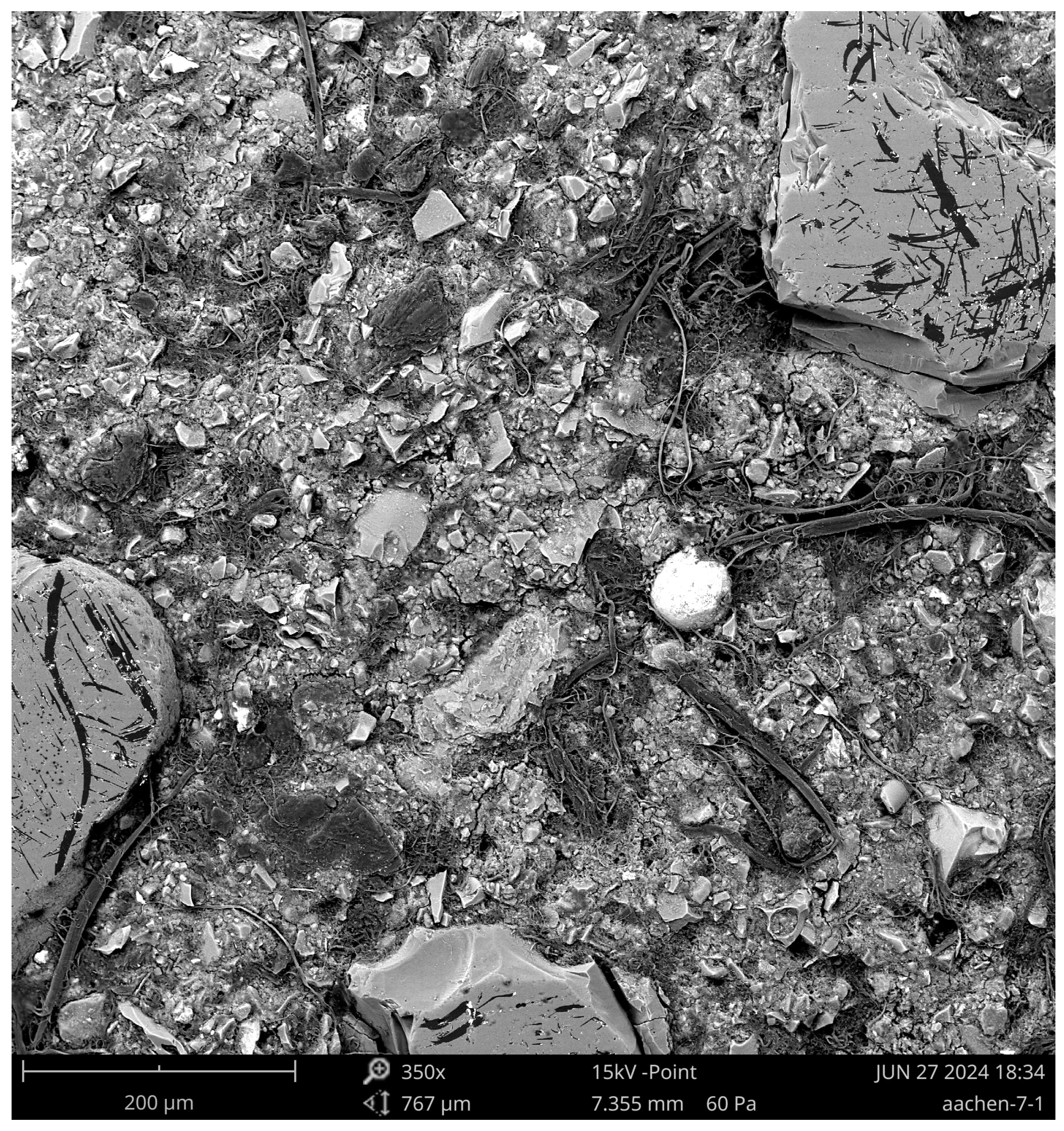
Figure 13.
SEM micrograph of Aachen GP at 28 days (350×) showing a partially densified microstructure. Bright, angular inclusions correspond to unreacted slag particles embedded in a developing gel matrix. Compared to the 7-day sample, the matrix appears more continuous, yet significant heterogeneity and residual porosity remain, suggesting incomplete geopolymerization due to the high Fe content.
Figure 13.
SEM micrograph of Aachen GP at 28 days (350×) showing a partially densified microstructure. Bright, angular inclusions correspond to unreacted slag particles embedded in a developing gel matrix. Compared to the 7-day sample, the matrix appears more continuous, yet significant heterogeneity and residual porosity remain, suggesting incomplete geopolymerization due to the high Fe content.

Figure 14.
SEM micrograph of SCK GP at 7 days (350×) showing a dense, homogeneous alkali-activated matrix. The continuous gel phase and minimal visible porosity reflect high precursor reactivity and effective polymerization. Uniform particle distribution further confirms efficient dissolution of the BFS precursor and well-integrated matrix development.
Figure 14.
SEM micrograph of SCK GP at 7 days (350×) showing a dense, homogeneous alkali-activated matrix. The continuous gel phase and minimal visible porosity reflect high precursor reactivity and effective polymerization. Uniform particle distribution further confirms efficient dissolution of the BFS precursor and well-integrated matrix development.
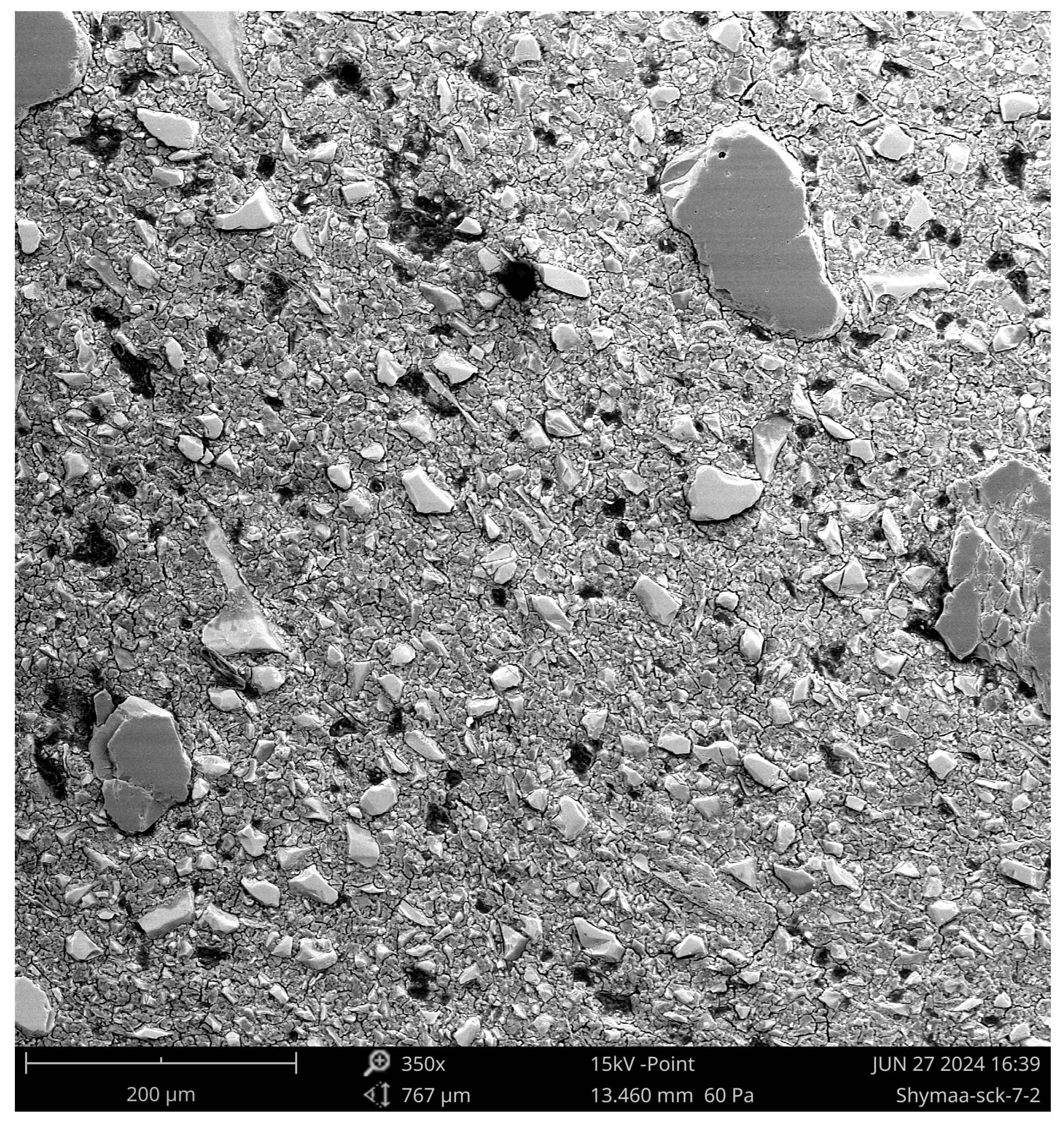
Figure 15.
SEM micrograph of SCK GP at 28 days (350×) showing a refined, consolidated gel matrix. Minimal porosity and few unreacted particles remain, indicating advanced geopolymerisation and strong matrix densification compared to the Fe-rich system.
Figure 15.
SEM micrograph of SCK GP at 28 days (350×) showing a refined, consolidated gel matrix. Minimal porosity and few unreacted particles remain, indicating advanced geopolymerisation and strong matrix densification compared to the Fe-rich system.
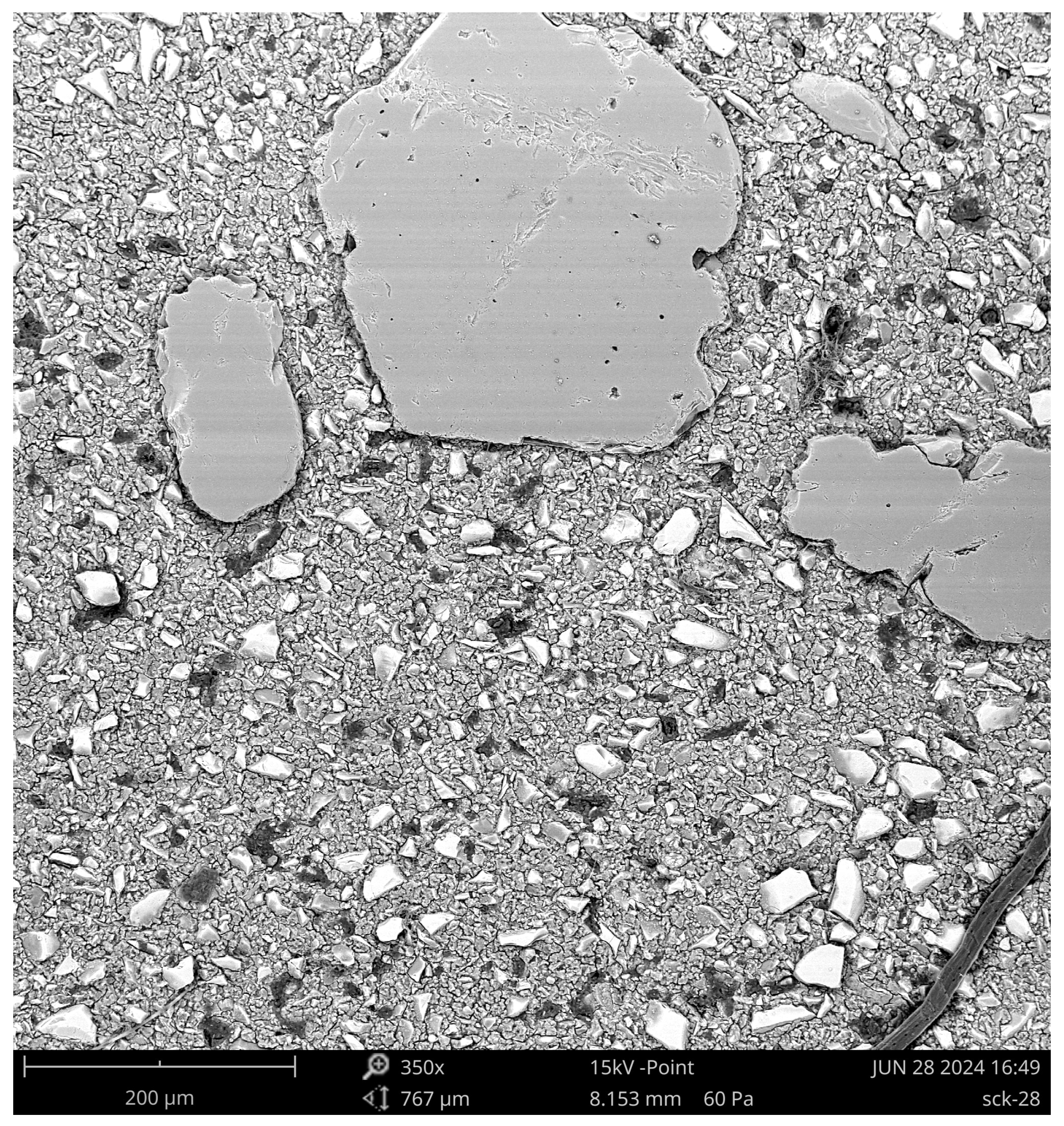
Figure 16.
SEM micrograph of Aachen GP at 28 days (790×) showing large, irregular, and interconnected pores with residual slag inclusions. The open pore structure indicates incomplete encapsulation by the gel, consistent with higher measured porosity and slower reaction kinetics.
Figure 16.
SEM micrograph of Aachen GP at 28 days (790×) showing large, irregular, and interconnected pores with residual slag inclusions. The open pore structure indicates incomplete encapsulation by the gel, consistent with higher measured porosity and slower reaction kinetics.

Figure 17.
SEM micrograph of SCK GP at 28 days (790×) showing a denser gel network with finer, tortuous pore structure and lower overall porosity compared to Aachen GP. This morphology reflects advanced geopolymerisation and higher reactivity of the BFS precursor.
Figure 17.
SEM micrograph of SCK GP at 28 days (790×) showing a denser gel network with finer, tortuous pore structure and lower overall porosity compared to Aachen GP. This morphology reflects advanced geopolymerisation and higher reactivity of the BFS precursor.

Figure 18.
SEM micrograph of Aachen GP at 28 days (5000×) showing a rough, discontinuous gel structure with Fe-rich inclusions and irregular micropores. This morphology reflects limited densification and disruption of the gel network by iron-bearing phases.
Figure 18.
SEM micrograph of Aachen GP at 28 days (5000×) showing a rough, discontinuous gel structure with Fe-rich inclusions and irregular micropores. This morphology reflects limited densification and disruption of the gel network by iron-bearing phases.

Figure 19.
SEM micrograph of SCK GP at 28 days (5000×) showing a compact, smooth gel matrix with homogeneously distributed microporosity. Residual particles are rare, and the continuous matrix indicates advanced geopolymerisation and high structural integrity.
Figure 19.
SEM micrograph of SCK GP at 28 days (5000×) showing a compact, smooth gel matrix with homogeneously distributed microporosity. Residual particles are rare, and the continuous matrix indicates advanced geopolymerisation and high structural integrity.
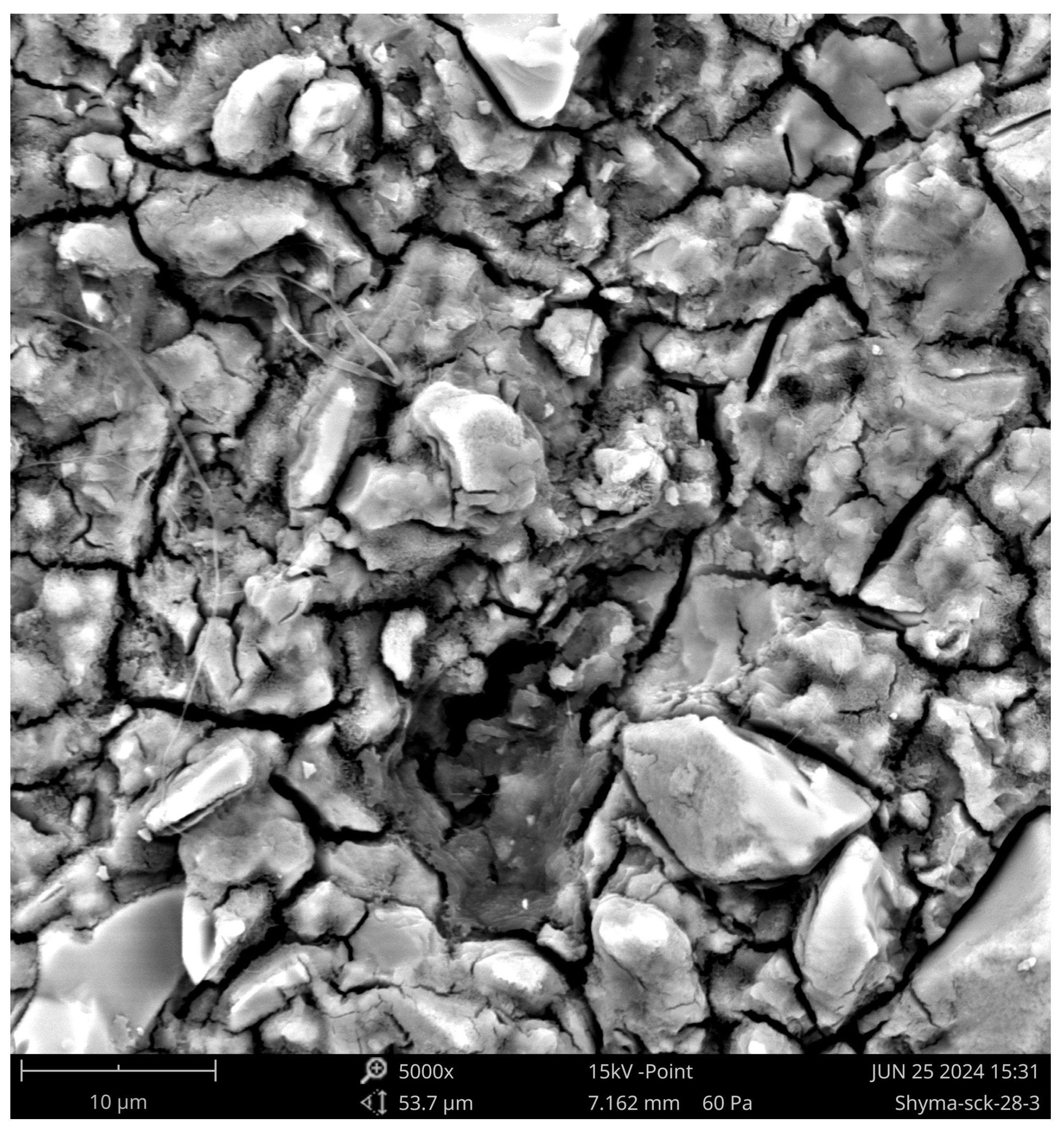
Figure 20.
ATR-FTIR spectra of SCK GP and Aachen GP at 7 and 28 days, vertically shifted to aid visualization. The image shows the evolution of Si–O–T, Fe–O, and carbonate vibrations during geopolymerisation.
Figure 20.
ATR-FTIR spectra of SCK GP and Aachen GP at 7 and 28 days, vertically shifted to aid visualization. The image shows the evolution of Si–O–T, Fe–O, and carbonate vibrations during geopolymerisation.
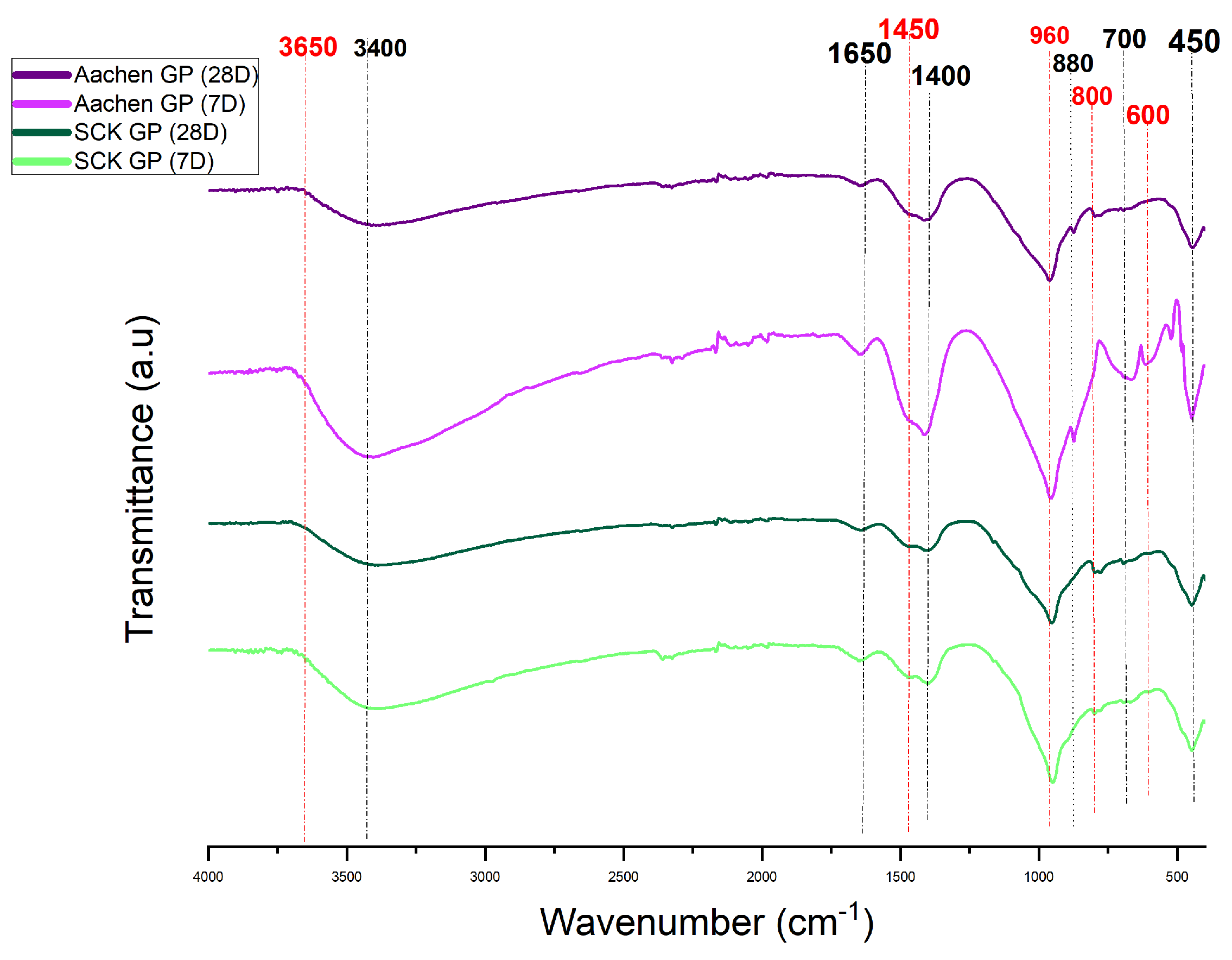
Figure 24.
Stacked XRD patterns of the raw iron-rich slag, Aachen GP (7 and 28 days), and SCK GP (7 and 28 days), vertically offset for clarity. Major reflections are identified as cristobalite (21.9°), fayalite (25.0°, 31.7°, 34.4°), quartz (26.6°, 45.8°, 50.1°, 54.8°, 59.9°), and calcite (29.4°, 39.4°). Metallic Fe/Fe–silicide contributions are visible near 26.6°. ZnO internal standard peaks are located at 31.7°, 34.4°, 36.2°, 47.5°, and 56.6°(marked with *). The broad amorphous hump between 20–36° 2 indicates the formation of geopolymeric gel phases, with SCK GP showing stronger gel development than Aachen GP.
Figure 24.
Stacked XRD patterns of the raw iron-rich slag, Aachen GP (7 and 28 days), and SCK GP (7 and 28 days), vertically offset for clarity. Major reflections are identified as cristobalite (21.9°), fayalite (25.0°, 31.7°, 34.4°), quartz (26.6°, 45.8°, 50.1°, 54.8°, 59.9°), and calcite (29.4°, 39.4°). Metallic Fe/Fe–silicide contributions are visible near 26.6°. ZnO internal standard peaks are located at 31.7°, 34.4°, 36.2°, 47.5°, and 56.6°(marked with *). The broad amorphous hump between 20–36° 2 indicates the formation of geopolymeric gel phases, with SCK GP showing stronger gel development than Aachen GP.
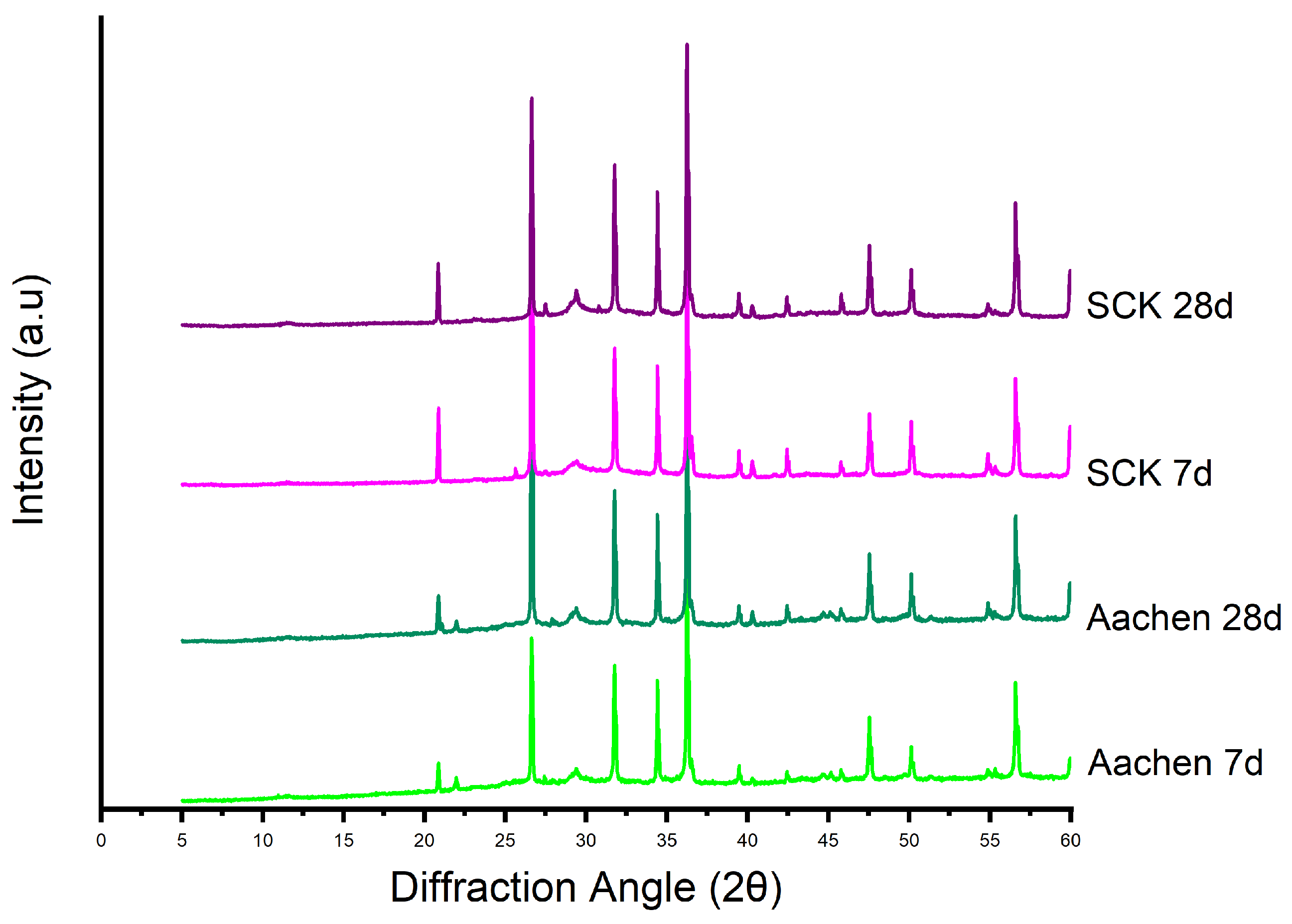
Figure 25.
Rietveld refinement of XRD data for Aachen GP and SCK GP at 7 and 28 days. Aachen GP exhibited ∼85% amorphous and ∼15% crystalline phases at both ages, with crystalline components including calcite (1.71%), corundum (0.96–1.36%), cristobalite (0.39–0.51%), fayalite (0.55–0.81%), trace quartz, and Fe0/Fe-silicide (0.11% at 28 days). SCK GP contained ∼78% amorphous and ∼22% crystalline phases at 7 days (quartz, calcite, corundum), shifting to ∼85% amorphous and ∼15% crystalline phases at 28 days (persistent quartz, minor calcite, corundum).
Figure 25.
Rietveld refinement of XRD data for Aachen GP and SCK GP at 7 and 28 days. Aachen GP exhibited ∼85% amorphous and ∼15% crystalline phases at both ages, with crystalline components including calcite (1.71%), corundum (0.96–1.36%), cristobalite (0.39–0.51%), fayalite (0.55–0.81%), trace quartz, and Fe0/Fe-silicide (0.11% at 28 days). SCK GP contained ∼78% amorphous and ∼22% crystalline phases at 7 days (quartz, calcite, corundum), shifting to ∼85% amorphous and ∼15% crystalline phases at 28 days (persistent quartz, minor calcite, corundum).
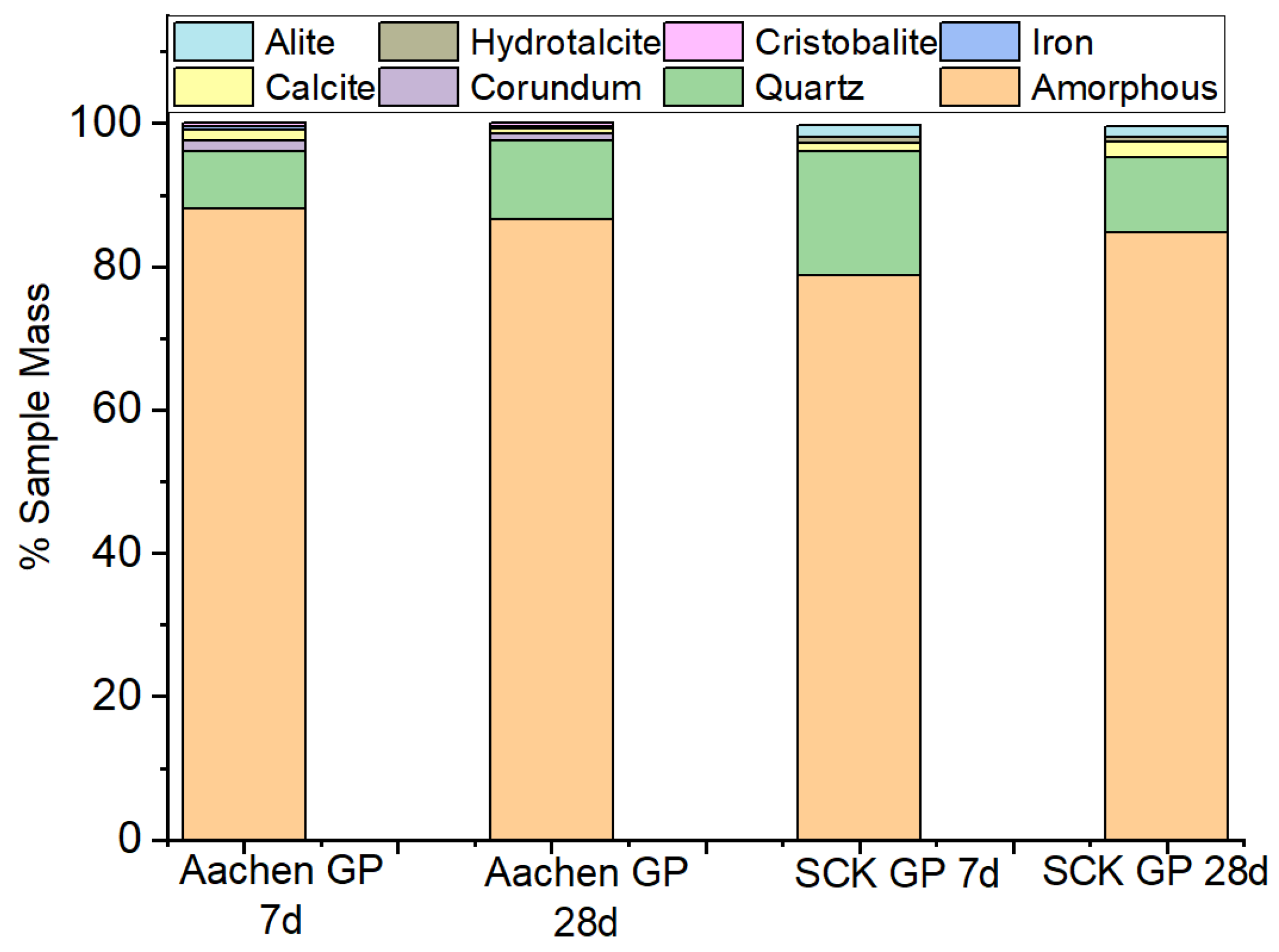
Figure 26.
TGA curves of SCK GP and Aachen GP at 7 and 28 days. The TGA curves illustrate the total weight loss as a function of temperature, corresponding to the release of physically adsorbed water, bound water from gel phases, and decomposition of minor crystalline phases.
Figure 26.
TGA curves of SCK GP and Aachen GP at 7 and 28 days. The TGA curves illustrate the total weight loss as a function of temperature, corresponding to the release of physically adsorbed water, bound water from gel phases, and decomposition of minor crystalline phases.
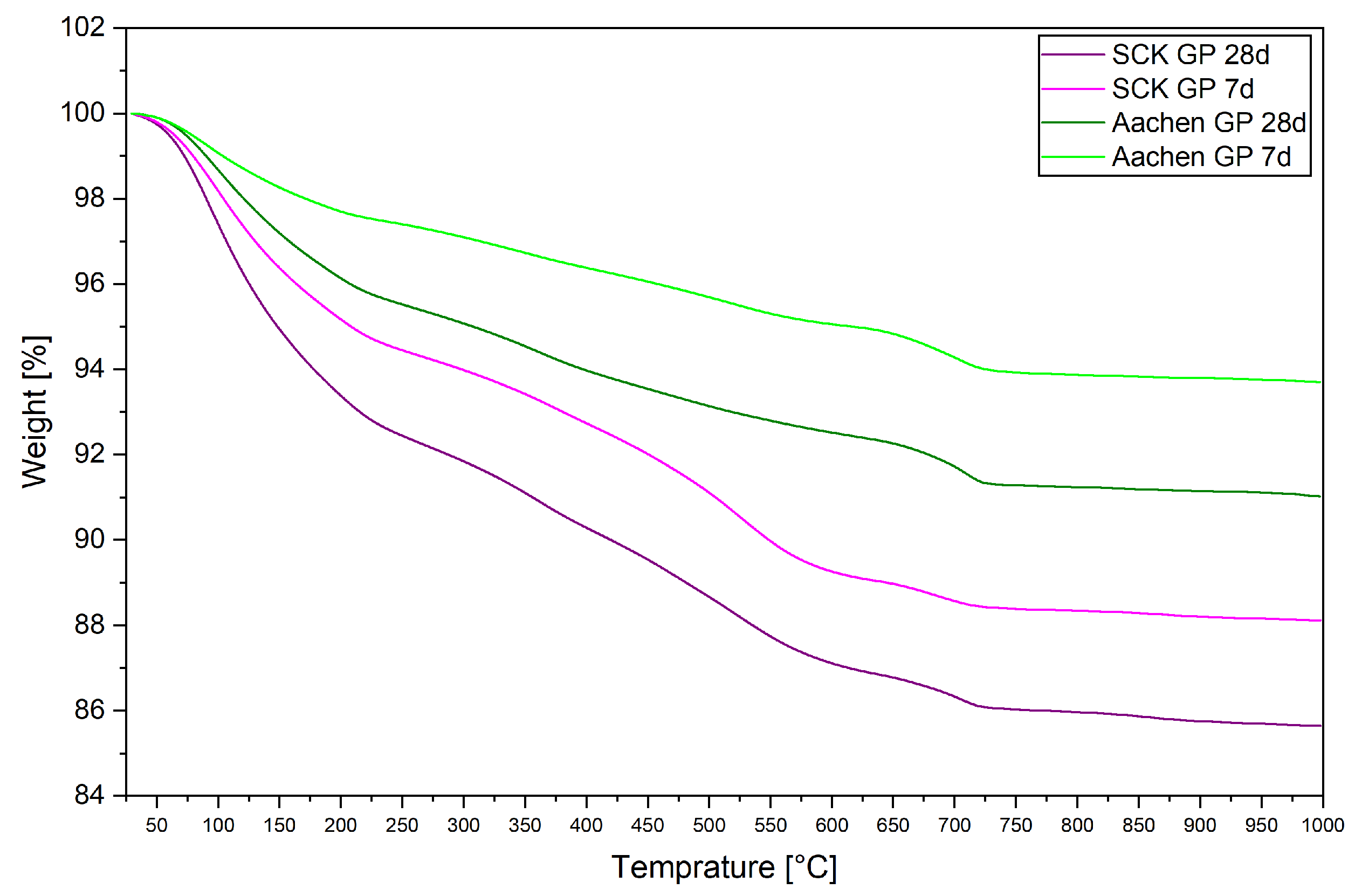
Figure 27.
DTG curves (first derivative of weight loss) of SCK GP and Aachen GP at 7 and 28 days. The DTG curves highlight the temperature ranges of maximum mass loss rates, reflecting phase transformations and dehydration behavior linked to gel structure and curing progression.
Figure 27.
DTG curves (first derivative of weight loss) of SCK GP and Aachen GP at 7 and 28 days. The DTG curves highlight the temperature ranges of maximum mass loss rates, reflecting phase transformations and dehydration behavior linked to gel structure and curing progression.
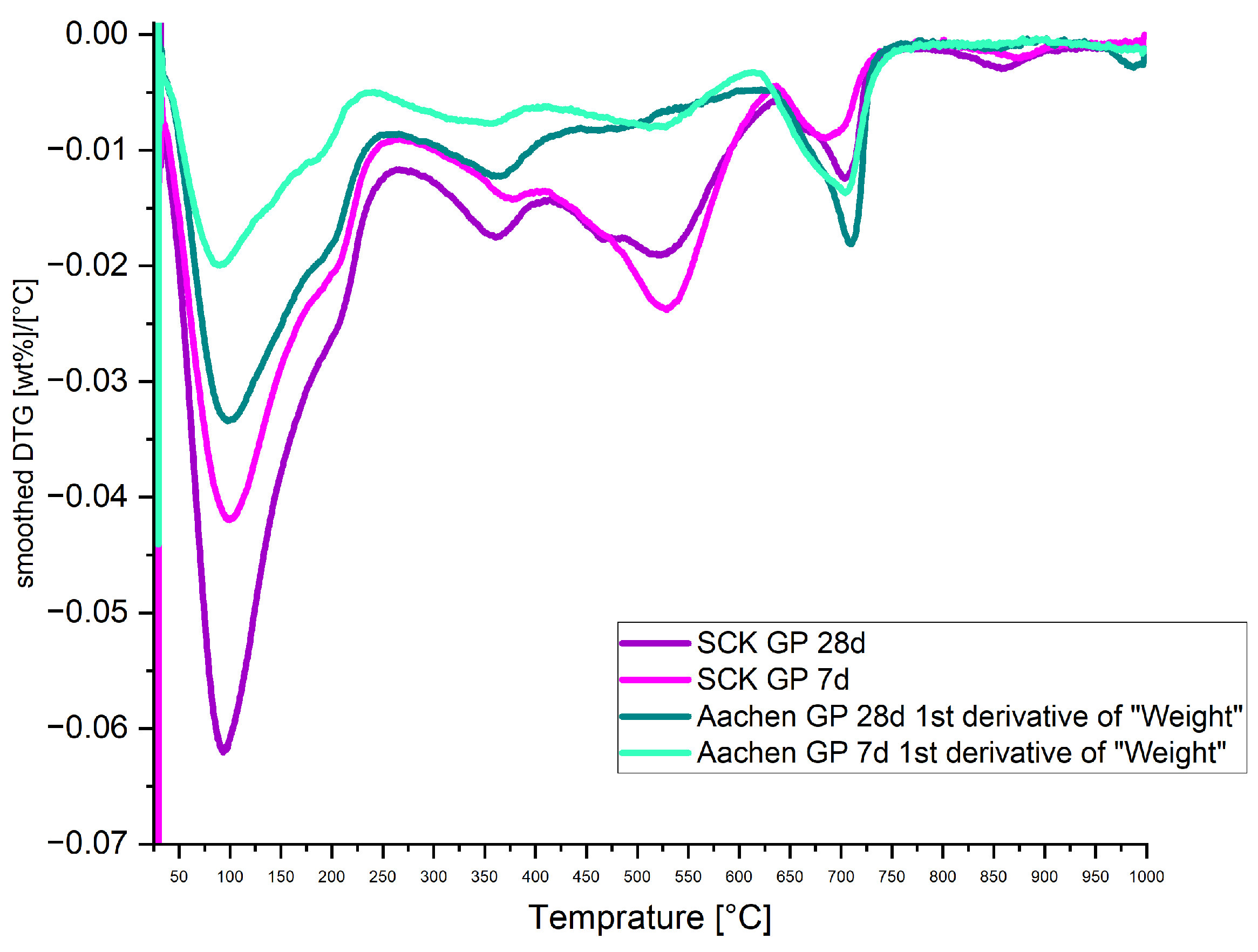
Figure 28.
DTG curves of SCK GP and Aachen GP at 7 and 28 days, vertically shifted to aid visualization.
Figure 28.
DTG curves of SCK GP and Aachen GP at 7 and 28 days, vertically shifted to aid visualization.
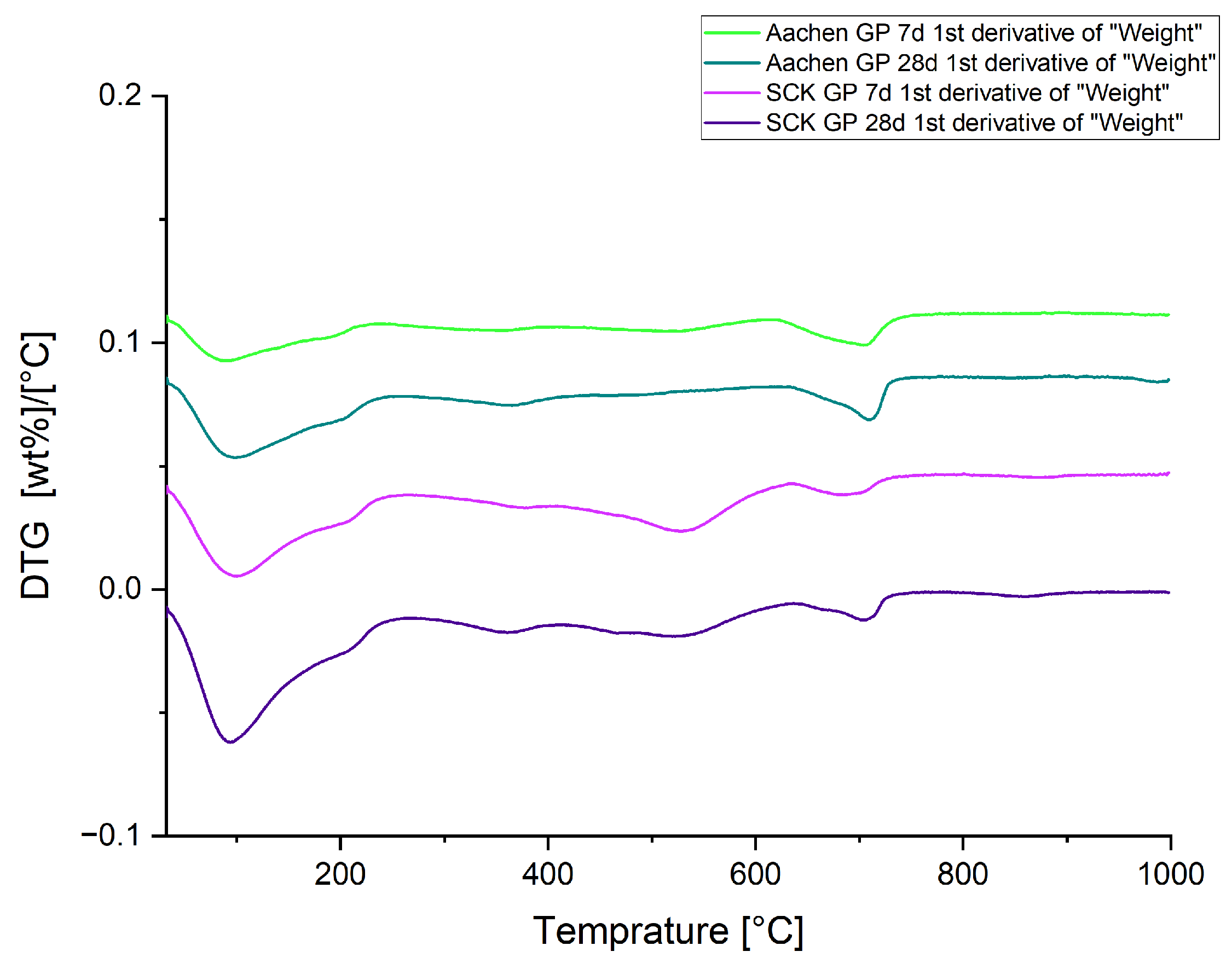

Table 1.
Comparison of the chemical composition of the blast furnace slag (BFS) and the iron-rich slag, both used in the Aachen GP formulation. Values are reported as oxide weight percentages (wt.%). A dash (–) denotes “not detected” or “not reported.”
Table 1.
Comparison of the chemical composition of the blast furnace slag (BFS) and the iron-rich slag, both used in the Aachen GP formulation. Values are reported as oxide weight percentages (wt.%). A dash (–) denotes “not detected” or “not reported.”
| Chemical Component | BFS (wt.%) | Iron-Rich Slag (wt.%) |
|---|---|---|
| CaO | 39.58 | 0.9 |
| SiO2 | 35.37 | 59.4 |
| MgO | 8.66 | 0.7 |
| Al2O3 | 12.29 | 7.6 |
| Fe2O3 | 0.37 | 24.6 |
| MnO / Mn2O3 | 0.54 | 1.8 |
| K2O | 0.59 | 2.5 |
| TiO2 | – | 0.3 |
| SO3 | 0.09 | 0.9 |
| Na2O | 0.27 | – |
| Na2O equivalent | 0.66 | – |
| Cr | 0.02 | – |
| Cl− | – | – |
| Glass content | 100 | – |
| (CaO + MgO + SiO2) | 83.60 | – |
| (CaO + MgO)/SiO2 | 1.36 | – |
Table 2.
Summary of mix proportions for the reference AAM (SCK GP) and the developed iron-rich slag-based formulation (Aachen GP) used in this study, normalized to a total of 1000 grams per mix. A dash (–) denotes that the quantity was not added.
Table 2.
Summary of mix proportions for the reference AAM (SCK GP) and the developed iron-rich slag-based formulation (Aachen GP) used in this study, normalized to a total of 1000 grams per mix. A dash (–) denotes that the quantity was not added.
| Component | SCK GP (g) | Aachen GP (g) |
|---|---|---|
| Blast furnace slag | 465.5 | 236.0 |
| Iron-rich slag | – | 236.0 |
| NaOH solution | 55.6 | 60.0 |
| Sodium disilicate | 15.2 | – |
| Additional water | 183.8 | 188.0 |
| Fine sand ( mm) | 280.0 | 280.0 |
| Water-to-binder ratio | 0.45 | 0.475 |
Table 3.
Water-accessible porosity (WAP) and water permeability (WP) at 7 and 28 days.
| WAP 7 d (%) | WAP 28 d (%) | WP (m/s) | |
|---|---|---|---|
| Aachen GP | 37.4 (n = 2) | 38.4 (n = 2) | (n = 1) |
| SCK GP | 34.4 (n = 2) | 35.5 (n = 3) | (n = 1) |
Table 4.
BET analysis results for Aachen GP and SCK GP at different curing ages.
| Sample | Surface Area (m2/g) | Pore Volume (cm3/g) | Pore Width (nm) |
|---|---|---|---|
| Aachen GP 7 d | 8.2 | 0.06 | 35 |
| Aachen GP 28 d | 12.4 | 0.09 | 32 |
| SCK GP 7 d | 4.1 | 0.02 | 33 |
| SCK GP 28 d | 6.8 | 0.02 | 31 |
Table 5.
FTIR peaks observed in Aachen GP at 28 days, arranged in descending order of wavenumber, with corresponding vibrational assignments.
Table 5.
FTIR peaks observed in Aachen GP at 28 days, arranged in descending order of wavenumber, with corresponding vibrational assignments.
| Wavenumber (cm−1) | Assignment |
|---|---|
| ∼3400 | O–H stretching (physically bound water and hydroxyl groups) |
| 1650 | H–O–H bending (molecular water) |
| 1475 | C–O stretching (carbonate group; shifted from 1410 cm−1 at 7 days) |
| 960 | Si–O–T asymmetric stretching (aluminosilicate gel network) |
| 900–1000 | Broad Si–O–T envelope (incomplete or evolving network) |
| 880 | Si–O–T shoulder (delayed network polymerization; possible Fe substitution) |
| 790–650 | Si–O–Si and O–Si–O bending vibrations |
| 700 | Si–O–Si symmetric bending (framework deformation) |
| 670, 514 | Tentative Si–O–Fe linkages (Fe incorporation; overlapping with Al/Si modes in NaOH-activated systems) |
| 625–830 | Overlapping Si–O, Fe–O, and fayalite-type lattice vibrations |
| 560 | Fe–O stretching (possibly shifted from 550 cm−1; weak in NaOH-activated matrices) |
| 400–800 | Complex Fe- and Si-related overlapping bands (low polymerization, spectral broadening) |
Table 6.
Summary of bound water content (105–600 °C) and total mass loss (25–950 °C).
| Sample | Curing Age | Bound Water (%) | Total Mass Loss (%) |
|---|---|---|---|
| SCK GP | 7 days | 7.9 | 11.2 |
| SCK GP | 28 days | 9.1 | 13.4 |
| Aachen GP | 7 days | 3.04 | 5.9 |
| Aachen GP | 28 days | 4.6 | 8.3 |
Disclaimer/Publisher’s Note: The statements, opinions and data contained in all publications are solely those of the individual author(s) and contributor(s) and not of MDPI and/or the editor(s). MDPI and/or the editor(s) disclaim responsibility for any injury to people or property resulting from any ideas, methods, instructions or products referred to in the content. |
© 2025 by the authors. Licensee MDPI, Basel, Switzerland. This article is an open access article distributed under the terms and conditions of the Creative Commons Attribution (CC BY) license (http://creativecommons.org/licenses/by/4.0/).
Copyright: This open access article is published under a Creative Commons CC BY 4.0 license, which permit the free download, distribution, and reuse, provided that the author and preprint are cited in any reuse.


