

Submitted:
03 October 2025
Posted:
03 October 2025
You are already at the latest version
Abstract
Background: Adolescents spend much of their leisure time using technological devices, especially mobile phones and video games, making their use susceptible to becoming problematic. Objectives: This study aims to examine the relationship between social anxiety and risk perception in problematic mobile phone use (PMU) and problematic video game use (PVGU) among adolescents aged 10 to 16, considering potential gender differences. Methods: A total of 757 participants completed the Spanish version of New Addictions Detection Questionnaire (UPVG), the Mobile Phone Problem Use Scale for Adolescents (MPPUSA), and the Social Anxiety Scale for Children-Revised (SASC-R). Results: Boys reported higher PVGU scores, and significant differences were found between genders in the perception of risks associated with both PMU and PVGU. No differences emerged in overall social anxiety or its subfactors. Within each gender, positive associations were observed between PMU, PVGU, and social anxiety. Predictive models explained up to 63% of the variance, identifying different risk and protective factors for boys and girls. Conclusions: Both PMU and PVGU should be analyzed from the viewpoint of gender. Although there are similarities between genders, relevant differences highlight the need for tailored preventive strategies.
Keywords:
video games
; mobile phone
; adolescents
; social anxiety
; risk perception
; gender
1. Introduction
Over the last decade, the use of information and communication technology (ICT) has expanded rapidly, becoming a fundamental component of the social, academic, and personal lives of adolescents worldwide [1]. The age of first exposure to devices such as smartphones and video games is steadily decreasing, often beginning in childhood [2,3]. In addition to their obvious usefulness for communication and leisure, these devices have introduced new ways of interacting, particularly through social networks and online video games. The use of technology has benefits, including improvements in hand-eye coordination, reaction time, problem-solving, spatial skills, teamwork, communication, and creativity [4,5,6,7]. However, excessive use has also raised public health concerns [1,8,9,10]. These dynamics take place in a complex context [2,11] marked on the one hand by social pressures—since peers and friends have and use these devices—and on the other by adults who are often permissive or approve of minors’ use of smartphones and online or offline games, failing to establish firm limits on their children’s behavior.
To date, research on the impact of technology on mental health has focused on usage time, arguing that more hours of use would lead to greater negative effects. However, more recent studies suggest that usage time is a limited predictor, providing little information about well-being or mental health [7]. Withing this context, problematic technology use is defined as a behavioral pattern that causes clinically significant impairment, affecting key areas of life such as academic performance, sleep quality, and social relationships [1,8,12]. Based on this concept of problematic use, Internet gaming disorder (IGD) has been defined as a persistent pattern of video gaming that disrupts daily life, accompanied by symptoms such as preoccupation with gaming, withdrawal, and diminished or lack of interest in other activities [13,14]. Likewise, problematic mobile phone use has been described as psychological dependence and compulsive use of smartphones, which can cause anxiety and distress when the device is not available for use [9].
Some of the risk factors that have been associated with the problematic use of these devices include anxiety and impulsivity [12], the tendency to avoid or escape negative feelings, and the pursuit of or need to intensify feelings of well-being [7,14]. These data are further supported by recent longitudinal reviews showing that screen use is bidirectionally associated with socio-emotional difficulties in childhood, with more intense effects in the case of gaming [15]. A cross-sectional study of Canadian adolescents showed that the effects of digital use depend on the type of activity. More specifically, social media was found to be linked to internalizing symptoms, whereas video games appeared to be associated with less loneliness and nervousness, with differences according to age and gender [16]. Among the mental health factors associated with problematic technology use in adolescents, social anxiety has been shown to be particularly significant [13,14,17,18].
Social anxiety is characterized by an intense fear of social situations in which the person fears being negatively evaluated by others, which can lead to avoidance behaviors [19,20]. In contrast, online interactions may provide adolescents with a perceived sense of security where they can control how they present themselves and reduce or avoid fear of judgement by others [14]. In a study of Chinese adolescents, Li et al. [17] found a strong association between social anxiety and problematic mobile phone use, with symptoms such as concern about negative evaluation and compulsive mobile phone use serving as the link between the two constructs. Similarly, a systematic review reported that individuals (children, adolescents, young adults, and adults) with social anxiety are at greater risk of developing problematic or addictive online gaming behaviors [13]. One explanation for this relationship is that a preference for online social interactions may mediate the relationship between social anxiety and IGD, as gamers suffering social anxiety tend to prefer digital over face-to-face interactions [14].
Similarly, maladaptive or negative cognitions and the use of avoidance as a coping strategy have been identified as central factors in these situations [18,21]. Taking together, these studies suggest that the technology use is not merely a consequence of social anxiety but rather can act as a reinforcer of the problem. Through negative reinforcement, it sustains avoidance of feared social situations and hinders the development of social skills in natural contexts.
Another relevant factor associated with problematic technology use is risk perception, defined as individuals’ subjective assessment of the likelihood that a negative event will occur and the severity of its consequences [11]. In the context of technology use, risk perception plays a central role in moderating adolescents’ behavior. For instance, when young people underestimate the risks associated with excessive mobile phone or video game use, they may be more likely to use them in a problematical manner [22]. Ruiz-Olivares et al. [22] found that risk perception varies according to age and patterns of use. Thus, a lack of awareness of these risks (i.e., impaired academic performance, reduced sleep quality, or strained family relationships) may be a vulnerability factor for developing addictive behaviors [8]. Analyzing and understanding risk perception is essential for early detection and the design of programs to prevent problematic behaviors. Such programs can serve to identify potential dangers while addressing attitudes, beliefs, and maladaptive behaviors in technology use [8,11,22].
The impact of technology use on mental health varies according to gender. Evidence has shown that girls are more likely to experience the negative effects of social media [3], whereas boys show a higher prevalence of problematic video game use [14]. Recent research has found that women tend to experience greater social anxiety and are more likely to use smartphones to maintain their social relationships [8,23]. Although total usage time is similar for both men and women, the reasons for use and associated psychological implications differ [1]. In this regard, a longitudinal study reported that boys and girls used smartphones differently, for example, to reduce emotional distress [24]. Conversely, a study of children and adolescents with ADHD found no gender differences in Internet, video games, or smartphone addiction [1]. However, preference for online social interactions and the presence of social anxiety have been identified as significant predictors of IGD [14].
Amid growing concerns about adolescents’ technology use, it is important to examine how social anxiety and risk perception influence problematic smartphone and video game use. The limited scientific literature on this subject highlights the need for further research. This study addresses that gap exploring the relationship between problematic mobile phone and video game use, social anxiety, and risk perception in adolescents aged 10 to 16 years. It also undertakes gender-differential analysis to develop predictive models that incorporate the above variables.
2. Method
2.1. Participants
Information was collected from 757 adolescents aged 10 to 16 in southern Spain using incidental random sampling. Of these, 51.6% (374) were males and 48.4% (351) were females. The mean age of the participants was 12.15 years (SD = 1.858). Of these, 21.2% were 10 years old; 23.9% were 11; 17.9% were 12; 12.5% were 13; 9.9% were 14; 9.1% were 15; and 5.6% were 16 years old.
2.2. Instruments
A questionnaire was designed using the instruments listed below.
- An ad hoc sociodemographic questionnaire was administered to collect information on the participants’ age, hours of mobile phone and video game use, age at first mobile phone use, and gender.
- Cuestionario de Detección de Nuevas Adicciones, (DENA) [25]. This questionnaire was administered to assess video game use on a 4-point Likert scale ranging from 0 (never) to 3 (always) and demonstrates acceptable reliability (Cronbach’s α 0.75).
- Mobile Phone Problem Use Scale in Adolescents (MPPUSA). To assess problematic mobile phone use, the Spanish adaptation of the questionnaire [26] was used. The MPPUSA consists of 27 items measured on a 10-point Likert scale ranging from 1 (never) to 10 (always). To determine types of mobile phone users, the following cut-off points were established: scores from 0 to 35 indicate occasional users, 36 to 173 regular users, 174 to 181 at-risk users, and 182 to 270 problematic users [26]. The scale shows excellent reliability (Cronbach’s α 0.97).
- Escala de Ansiedad Social para niños–Revised (SASC–R) [27] to assess social anxiety. The Spanish version of the scale consists of 18 items, with response options ranging from 1 (never) to 3 (often). The items are structured into three dimensions: Fear of Negative Evaluation (FNE) (items 2, 4, 6, 7, 9, 11, 13, and 14), Social Avoidance & Distress—Specific to New Peers (SAANP) (items 1, 3, 5, 8, 10, and 16), and Social Avoidance & Distress—General (SAGA) (items 12, 15, 17, and 18). The scale shows good reliability (Cronbach’s α 0.88).
- Escala de percepción del riesgo para el uso de la tecnología en niños y adolescentes (EPRUT). [22]. This scale assesses the extent to which adolescents perceive certain risks related to mobile phone and video game use, such as going to bed later than you should; difficulty falling asleep; not finishing meals because of technology use; suffering violence such as fights or bullying; having less time for leisure activities such as sports, family and personal relationships; arguing with your parents; going out less with friends, and getting bad grades or not doing homework. EPRUT is measured on a 16-item Likert scale ranging from 0 (not at all) to 5 (a lot). The reliability coefficient of the EPRUT is 0.84 (Cronbach’s alpha).
2.3. Procedure
Using an ex post facto cross-sectional research design, data were collected from several schools in a region in southern Spain. More than 15 schools were contacted, but only three agreed to participate in the research. Before beginning data collection, the necessary permissions were obtained from both the schools and the families. Informed consent and the importance of taking part in the study were explained to the participants, ensuring adherence to ethical aspects such as voluntariness, confidentiality, and anonymity, in accordance with the Declaration of Helsinki and Organic Law 3/2018 of 5 December on the Protection of Personal Data and the Guarantee of Digital Rights. The instrument described above was distributed and completed in the presence of the authors, who sought to control extraneous variables such as environmental conditions by responding to questions that arose during data collection and explaining how to complete the questionnaire. Data collection was carried out in the classroom. The average time to complete the questionnaire was 35 minutes.
2.4. Data Analysis
Using a database in SPSS, frequency analyses were conducted to describe the number of hours spent using mobile phones and video games. Analysis of variance (ANOVA) and correlation analyses based on gender were performed to observe possible differences across variables (i.e., problematic use of mobile phones and video games, social anxiety and its subfactors, and perceptions of risks associated with mobile phones and video games). Finally, multiple linear regressions were performed, with problematic mobile phone and video game use as the dependent variables and age, perception of risk and social anxiety as independent variables, according to gender.
3. Results
As a preliminary step, we considered analyzing the hours that boys and girls spend each day using mobile phones and playing video games. Table 1 shows the percentages of boys, girls, and total according to hours of use of both technologies. The differences observed between boys and girls are statistically significant for the use of video games, with Χ2 = 42.993 (p < .001). In the case of mobile phone use, no significant differences were found with Χ2 = 12.017 (p = .062). Regarding the age at which the participants received their first mobile phone, 69.1% had one before the age of 10, while 30.9% had one after the age of 10.
Regarding gender differences in the variables considered in the study (i.e., problematic use of mobile phones and video games, social anxiety and its subfactors, perception of risks associated with mobile phones and video games), Figure 1 shows the average scores obtained by boys, girls, and total participants. These mean scores show significant differences in aspects such as problematic use of video games [F = 125.431 (p < .001), µ2 = .152], arguing with your parents (mobile phones) [F = 9.475 (p < .01), µ2 = .015], going to bed later than you should (video game) [F = 22.335 (p < .001), µ2 = .039], difficulty falling asleep (video game) [F = 16.683 (p < .001), µ2 = .030], not finishing your meal or eating more slowly because you are using these technologies (video game) [F = 15.521 (p < .001), µ2 =.027], being subjected to violence such as fights, harassment, insults, etc. (VG) [F = 12.085 (p < .001), µ2 =.021], having less time for leisure activities such as sports (VG) [F = 19.672 (p < .001), µ2 =.035], arguing with your parents (video game) [F = 20.209 (p<.001), µ2 =.035], going out less with your friends (video game) [F = 12.623 (p < .001), µ2 =.022], getting bad grades or not doing your homework (video game) [F = 7.999 (p < .01), µ2 = .014].
Table 2 shows the relationship between the variables studied and problematic mobile phone and video game use in boys and girls. As can be seen in the table, usage among boys correlates positively with variables such as problematic video game use, age, social anxiety and two of its subfactors (fear of negative evaluation and social avoidance and specific distress), and with all the items referring to the perception of risk in mobile phone use. Problematic mobile phone use in girls correlates with the same variables as in boys.
On the other hand, problematic video game use in boys correlates with problematic mobile phone use, social anxiety, and two of its subfactors (fear of negative evaluation and social avoidance and specific distress), and with items regarding the perception of risk in video game use. Problematic video game use among girls correlates with problematic mobile phone use, age, social anxiety, and two subfactors (fear of negative evaluation, and social avoidance and general distress), as well as all the items regarding the perception of risk of video game use except for being subjected to violence such as fights and harassment.
With the aim of designing predictive models for problematic mobile phone and video game use in a differentiated manner for boys and girls, multiple regression analyses were performed, where the dependent variable was problematic mobile phone use in boys and girls and problematic video game use also in boys and girls. All other variables considered in the study (age, perception of mobile phone risk, social anxiety) were used as predictive factors. The four models included variables that made a significant contribution to the model, as well as some that, although not significant, significantly improved the model’s predictive capacity. As can be seen in Table 3 and Table 4, high R2 values were obtained, especially regarding mobile phone use, with variance prediction percentages of up to 63%.
As concerns problematic mobile phone use among boys, Table 3 shows how problematic video game use, social anxiety, perceived difficulty falling asleep, and not finishing meals act as risk factors, while social avoidance, general distress, and going out less with friends act as protective factors. As for problematic mobile phone use among girls, Table 4 shows that the variables problematic video game use, social anxiety, social avoidance and specific distress, going to bed later, arguing with parents, and getting bad grades are risk factors. In this case, going out less with friends acts as a protective factor.
Regarding problematic video game use among boys, variables such as problematic mobile phone use, fear of negative evaluation, going to bed later, and getting poor grades act as risk factors, while being a victim of violence or not finishing meals are protective factors (Table 3). As for girls’ problematic use of video games, going to bed later, going out less with friends, arguing with parents, social avoidance, and general distress are risk factors, while being a victim of violence and getting poor grades act as protective factors (Table 4).
4. Discussion
This study examined the relationship between problematic mobile phone and video game use and social anxiety and risk perception in adolescents aged 10 to 16 years old and performed a differential analysis based on gender. In general, higher problematic mobile phone use was observed in boys, while it was distributed more evenly between both genders. These findings are consistent with recent research that has described differential patterns of technology use depending on gender. Specifically, boys show higher risk in relation to video games (d = 0.86), while girls exhibit a higher prevalence of mobile phone use, particularly social media (d = 0.67) [1,2]. These findings are especially relevant when considered in the context of recent public health data: the WHO has warned of a progressive increase in the problematic use of social media and video games among European adolescents, with a higher prevalence among girls [7].
As regards social anxiety, although no significant differences were identified between genders in the overall scores or in the subfactors, a consistent association with both problematic mobile phone and video game use was found in both groups. This result is in line with studies that have identified anxiety as a robust predictor of problematic technology use in adolescents [3,4]. Cao et al. found that anxiety directly influences problematic smartphone use, with school adjustment having a mediating role and physical activity a moderating effect [5]. As for risk perception, the results show significant differences between boys and girls, thus contributing to previous evidence on the modulating role of this variable in the adoption of problematic behaviors [6].
One of the major innovations of this study is the development of gender-based predictive models with high percentages of explained variance (up to 63%), which reinforces the strength of the relationship between the variables studied. For boys, problematic video game use, social anxiety, and the perception of certain problems related to sleep and eating are found to be risk factors, while social avoidance and general distress are protective factors. In girls, on the other hand, risk factors include both the academic (poor school performance) and family context (conflicts with parents). This is consistent with the literature on the relevance of the social environment in shaping problematic technology use in adolescent girls [8,9].
Overall, these findings highlight the need for gender-differentiated preventive interventions that address both emotional and contextual factors. Furthermore, recent studies warn that it is not only the amount of time spent using technology that is associated with mental health problems, but especially the compulsive and addictive nature of technology use: adolescents with addictive patterns are up to three times more at risk of emotional problems [10]. This underscores the urgency of addressing the phenomenon from a multifactorial perspective by considering both social anxiety and risk perception.
4.1. Practical Implications
The findings of this study have important implications for the design of prevention and intervention programs in educational and community settings. Identifying risk and protective factors differentiated by gender would allow for the development of more specific and effective strategies. In the case of males/boys, it is important to consider controlling the time spent playing video games and managing social anxiety, while in females/girls, it is crucial to address the family and academic spheres by reducing conflict and promoting coping skills. Incorporating risk perception as a key variable can improve the effectiveness of awareness campaigns and digital literacy programs.
4.2. Limitations
This study has several limitations. First, the use of self-reported instruments may lead to biases due to social desirability, lack of self-knowledge, or motivation to respond. Second, the sample is from three schools in a specific region of southern Spain, which may limit the generalizability of the results. Thirdly, cross-sectional design prevents establishing causal relationships among the variables studied. Finally, the widespread social normalization of the use of technological devices among adolescents and adults may have diminished the perception of associated risks and conditioned the responses obtained.
4.3. Future Lines of Research
Longitudinal studies are recommended to examine the development of problematic mobile phone and video game use during adolescence, as well as their interaction with social anxiety and risk perception. It would also be interesting to incorporate mixed methodologies combining self-reports with objective measures (i.e., time spent using applications or video games, digital records). Expanding the sample to include diverse cultural and socioeconomic contexts could help clarify the influence of these variables in predictive models. Finally, future research should explore in depth the role of family, school, and peer groups in shaping patterns of problematic use.
5. Conclusions
This study has investigated the relationship between problematic mobile phone and video game use, social anxiety, and risk perception in adolescents, revealing significant differences based on gender. Specific risk and protective factors have been identified, providing a more accurate framework for understanding how to address these behaviors. These results reinforce the need for gender-differentiated preventive interventions and support the inclusion of emotional and contextual variables in the design of educational and public health programs aimed at reducing the impact of problematic mobile phone and video game use in adolescence.
Author Contributions
Conceptualization, Antonio Ruiz, Valentina Lucena, and Rosario Ruiz; methodology, Rosario Ruiz-Olivares y Antonio Raya; formal analysis, Antonio Raya and Rosairo Ruiz; data curation, Antonio Raya y Rosario Ruiz-Olivares.; writing—original draft preparation, Rosario Ruiz-Olivares, Antonio Ruiz, Antonio Raya y Valentina Lucena; writing—review and editing, Rosario Ruiz-Olivares, Antonio Ruiz, Antonio Raya y Valentina Lucena. All authors have read and agreed to the published version of the manuscript.
Funding
This research received no external funding.
Institutional Review Board Statement
The study was conducted in accordance with the Declaration of Helsinki and approved by the Institutional Review Board (or Ethics Committee) of UNIVERSITY OF CORDOBA, SPAIN (protocol code CEIH-22-22 and 30/09/2022 of approval).” for studies involving humans.
Informed Consent Statement
Informed consent was obtained from all subjects involved in the study.
Data Availability Statement
The data or result files can be requested from the first author.
Conflicts of Interest
The authors declare no conflicts of interest.
References
- Menéndez-García A, Jiménez-Arroyo A, Rodrigo-Yanguas M, Marín-Vila M, Sánchez-Sánchez F, Roman-Riechmann E, et al. Adicción a Internet, videojuegos y teléfonos móviles en niños y adolescentes: un estudio de casos y controles. Adicciones. 2022, 34, 195–204. [Google Scholar] [CrossRef]
- Moreno CR, Cuenca Peláez KF, Cool Cedeño D, España Murillo León M. El impacto de la tecnología en la vida social de los adolescentes. Rev Estud Gener. 2025, 4, 1–22. [Google Scholar] [CrossRef]
- Virós-Martín C, Montaña-Blasco M, Jiménez-Morales M. Can’t stop scrolling! Adolescents’ patterns of TikTok use and digital well-being self-perception. Humanit Soc Sci Commun 2024, 11, 1444. [CrossRef]
- Alanko, D. The health effects of video games in children and adolescents. Pediatr Rev. 2023, 44, 23–32. [Google Scholar] [CrossRef]
- Bilali A, Katsiroumpa A, Koutelekos I, Dafogianni C, Gallos P, Moisoglou I, et al. Association between TikTok use and anxiety, depression, and sleepiness among adolescents: a cross-sectional study in Greece. Pediatr Rep. 2025, 17, 34. [Google Scholar] [CrossRef]
- Granic I, Lobel A, Engels RCME. The benefits of playing video games. Am Psychol. 2014, 69, 60–70. [Google Scholar] [CrossRef]
- Sauter M, Braun T, Mack W. Social context and gaming motives predict mental health better than time played: an exploratory regression analysis with over 13,000 video game players. Cyberpsychol Behav Soc Netw. 2021, 24, 94–101. [Google Scholar] [CrossRef]
- Sharma K, Sarathamani T, Bhougal SK, Singh HK. Smartphone-induced behaviour: utilisation, benefits, nomophobic behaviour and perceived risks. J Creat Commun. 2021, 17, 336–56. [Google Scholar] [CrossRef]
- Wei J, Dang J, Mi Y, Zhou M. Mobile phone addiction and social anxiety among Chinese adolescents: mediating role of interpersonal problems. An Psicol. 2024, 40, 103–9. [Google Scholar] [CrossRef]
- Virós-Martín C, Montaña-Blasco M, Jiménez-Morales M. Can’t stop scrolling! Adolescents’ patterns of TikTok use and digital well-being self-perception. Humanit Soc Sci Commun. 2024, 11, 1444. [Google Scholar] [CrossRef]
- Gutiérrez Arenas MP, García-Rojas AD, Hernando Gómez A, Prieto Medel C. Percepción del riesgo de los menores ante el uso de las tecnologías: influencia de diferentes variables. Rotura - Rev Comun Cult Artes. 2025, (Especial Alfamed), 67–85. [Google Scholar] [CrossRef]
- Shaltout N. Investigating the risk and protective factors of Internet addiction among adolescents through the lens of cognitive behavioral theory: a cross-sectional study [master’s Thesis]. Cairo: The American University in Cairo; 2025. Disponible en: https://fount.aucegypt.edu/etds/2373.
- Gioia F, Mariano Colella G, Boursier V. Evidence on problematic online gaming and social anxiety over the past ten years: a systematic literature review. Curr Addict Rep. 2022, 9, 32–47. [Google Scholar] [CrossRef]
- Marino C, Canale N, Vieno A, Caselli G, Scacchi L, Spada MM. Social anxiety and internet gaming disorder: the role of motives and metacognitions. J Behav Addict. 2020, 9, 617–28. [Google Scholar] [CrossRef] [PubMed]
- Vasconcellos RP, Sanders T, Lonsdale C, Parker P, Conigrave J, Tang S, et al. Electronic screen use and children’s socioemotional problems: a systematic review and meta-analysis of longitudinal studies. Psychol Bull. 2025, 151, 513–43. [Google Scholar] [CrossRef] [PubMed]
- Zhang J, Children and Youth Planning Table of Waterloo Region, Browne D. Digital media use, social isolation, and mental health symptoms in Canadian youth: a psychometric network analysis. Can J Behav Sci 2025. [CrossRef]
- Li S, Feng N, Cui L. Network analysis of social anxiety and problematic mobile phone use in Chinese adolescents: a longitudinal study. Addict Behav. 2024, 155, 108026. [Google Scholar] [CrossRef]
- Zhou H, Jiang H, Zhang B, Liang H. Social anxiety, maladaptive cognition, mobile phone addiction, and perceived social support: a moderated mediation model. J Psychol Afr. 2021, 31, 248–53. [Google Scholar] [CrossRef]
- American Psychiatric Association. Manual diagnóstico y estadístico de los trastornos mentales (DSM-5). 5.ª ed. Madrid: Editorial Médica Panamericana; 2022.
- Vázquez, M. Videojuegos: una perspectiva desde la personalidad y el trastorno de ansiedad social. Rev Psicol Sin Fronteras. 2023, 6, 93–7. [Google Scholar]
- Plessis C, Guerrien A, Altintas E. Sociotropy and video game playing: massively multiplayer online role-playing games versus other games. Encephale, 2025; S0013-7006(24)00123-5. [CrossRef]
- Ruiz-Olivares R, Casas JA, Lucena V, Aguilar-Yamuza B. Propiedades psicométricas de la “Escala de percepción del riesgo del uso de la tecnología para niños y adolescentes”. Behav Psychol Psicol Conductual. 2024, 32, 203–19. [Google Scholar] [CrossRef]
- Haro B, Beranuy M, Vega MA, Calvo F, Carbonell X. Uso problemático del móvil y diferencias de género en formación profesional. Educ XX1. 2022, 25, 271–90. [Google Scholar] [CrossRef]
- Xu X, Li H, Bai R, Liu Q. Do boys and girls display different levels of depression in response to mobile phone addiction? Examining the longitudinal effects of four types of mobile phone addiction. Psychol Res Behav Manag. 2024, 17, 4329–44. [Google Scholar] [CrossRef]
- Labrador FJ, Villadangos SM, Crespo M, Becoña E. Desarrollo y validación del cuestionario de uso problemático de nuevas tecnologías (UPNT). An Psicol. 2013, 29, 836–47. [Google Scholar]
- López-Fernández O, Honrubia-Serrano ML, Freixa-Blanxart M. Adaptación española del “Mobile Phone Problem Use Scale” para población adolescente. Adicciones. 2012;24(2):123-30. Chorot P, Valiente RM, Santed Germán MA, Sánchez-Arribas C. Estructura factorial de la escala de ansiedad social para niños-revisada (SASC-R). RPPC [Internet]. 1 de mayo de 1999 [citado 18 de septiembre de 2025];4(2):105-13. Disponible en: https://revistas.uned.es/index.php/RPPC/article/view/3876. [CrossRef]
Figure 1.
Average scores for boys, girls, and total for the variables considered in the study.
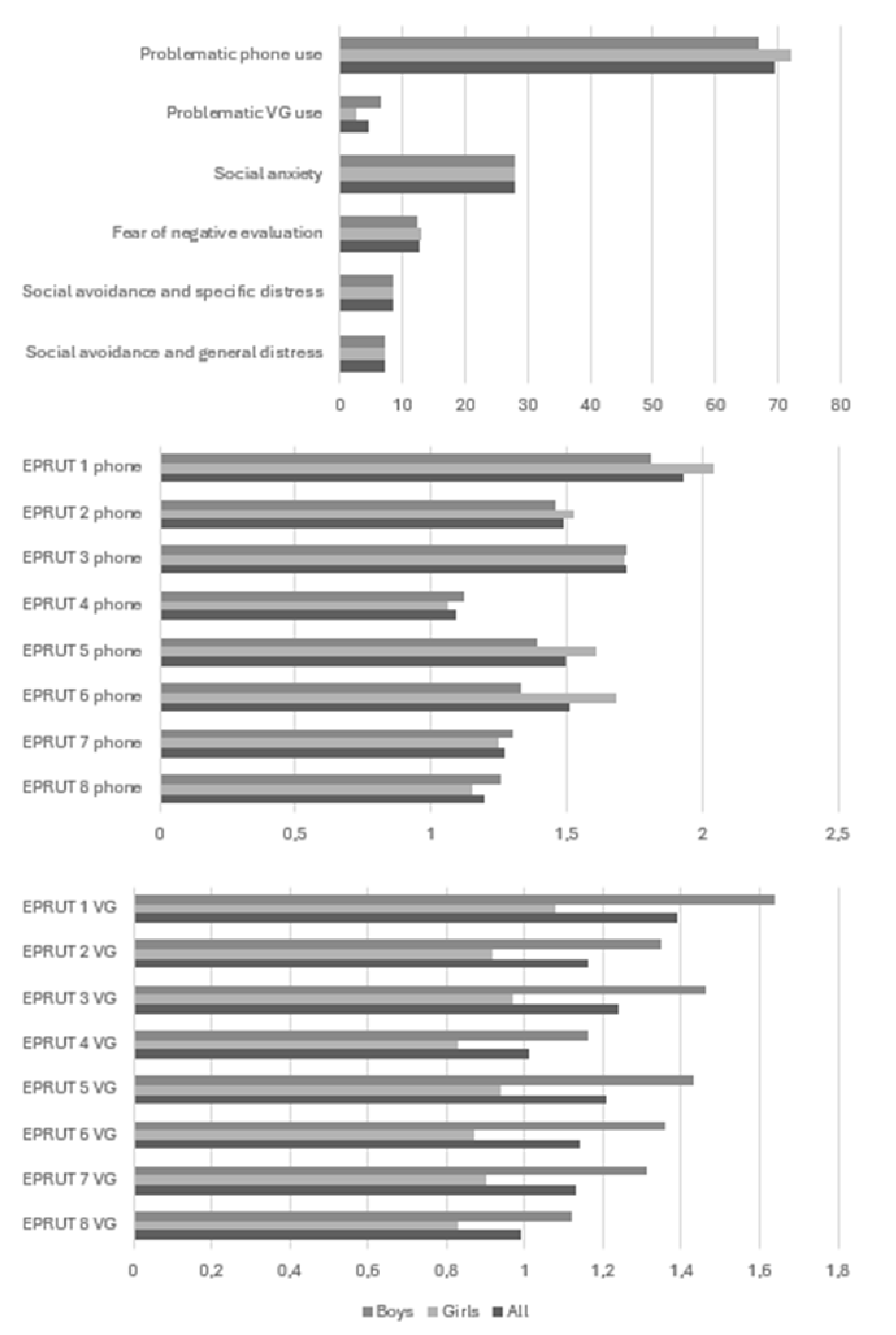

Table 1.
Percentage of boys, girls, and total according to the number of hours spent using mobile phones and playing video games.
Table 1.
Percentage of boys, girls, and total according to the number of hours spent using mobile phones and playing video games.
| Mobile | Video games | |||||
| Hours | Boys | Girls | Total | Boys | Girls | Total |
| 0 | 2.3 | 1.7 | 1.9 | 1.4 | 13.7 | 7 |
| 1 | 34.8 | 29.1 | 31.4 | 35 | 33.7 | 33.6 |
| 2 | 20.4 | 17 | 18.3 | 19.3 | 17.6 | 18 |
| 3 | 16.7 | 14.7 | 15.8 | 23.7 | 16.1 | 19.9 |
| 4 | 9.1 | 13.3 | 11 | 6.9 | 6.3 | 6.9 |
| 5 | 5.4 | 6.1 | 5.8 | 3.3 | 3.2 | 3.9 |
| 6 o more | 11.3 | 18.2 | 15.8 | 10.5 | 8.4 | 10.7 |
Table 2.
Pearson correlation between problematic mobile phone use, problematic video game use, and the variables considered in the study in boys and girls.
Table 2.
Pearson correlation between problematic mobile phone use, problematic video game use, and the variables considered in the study in boys and girls.
| Problematic Mobile Phone Use | |||
| Boys | Girls | Total | |
| Problematic Video Game Use | .621** | .156** | .383** |
| Age | .232** | .402** | .315** |
| Social anxiety | .370** | .388** | .386** |
| Fear of negative evaluation | .416** | .353** | .389** |
| Social avoidance and specific anxiety | .293** | .449** | .381** |
| Social avoidance and general anxiety | -.006 | -.048 | -.015 |
| Going to bed later than you should (mobile phone) | .514** | .599** | .568** |
| Difficulty falling asleep (mobile phone) | .444** | .480** | .471** |
| Not finishing your meal or eating more slowly... (mobile phone) | .435** | .316** | .388** |
| Being subjected to violence such as fights, bullying... (mobile phone) | .364** | .141* | .281** |
| Having less time to do your activities... (mobile phone) | .341** | .365** | .357** |
| Arguing with your parents (mobile phone) | .356** | .537** | .454** |
| Going out less with your friends (mobile phone) | .275** | .177** | .213** |
| Getting bad grades or not doing your homework... (mobile phone) | .361** | .439** | .400** |
| Problematic Video Game Use | |||
| Boys | Girls | Total | |
| Problematic Mobile Phone Use | .621** | .156** | .383** |
| Age | .011 | -.212** | -.091* |
| Social anxiety | .341** | .173** | .244** |
| Fear of negative evaluation | .353** | .123* | .199** |
| Social avoidance and specific distress | .214** | -.018 | .125** |
| Social avoidance and general distress | .058 | .227** | .138** |
| Going to bed later than you should (video game) | .450** | .377** | .456** |
| Falling asleep difficulty (video game) | .431** | .299** | .451** |
| Not finishing your meal or eating more slowly... (Video Game) | .227** | .220** | .258** |
| Being subjected to violence such as fights, bullying... (video game) | .273** | .080 | .265** |
| Having less time to do your activities... (video game) | .311** | .257** | .338** |
| Arguing with your parents (video game) | .319** | .343** | .352** |
| Going out less with your friends (video game) | .255** | .362** | .309** |
| Getting bad grades or not doing your homework... (video game) | .292** | .234** | .311** |
| *p < .05; **p < .01 | |||
Table 3.
Regression models for problematic mobile phone use and problematic video game use in boys and girls.
Table 3.
Regression models for problematic mobile phone use and problematic video game use in boys and girls.
| Problematic Mobile Phone Use | ||||||
| Boys | Girls | |||||
| β | t | p | β | t | p | |
| Problematic Video Game Use | 6.664 | 7.050 | <.001 | 1.870 | 3.182 | <.01 |
| Age | ||||||
| Social anxiety | 1.911 | 4.711 | <.001 | 1.084 | 2.848 | <.01 |
| Fear of negative evaluation | ||||||
| Social avoidance and specific distress | 2.611 | 3.063 | <.01 | |||
| Social avoidance and general distress | -2.371 | -2.785 | <.01 | |||
| Going to bed later... (mobile phone) | 10.164 | 5.004 | <.001 | |||
| Difficulty falling asleep (mobile phone) | 5.364 | 3.045 | <.01 | |||
| Not finishing meals... (mobile phone) | 7.594 | 4.673 | <.001 | |||
| Being subjected to violence such as... (mobile phone) | ||||||
| Having less time to... (mobile phone) | ||||||
| Arguing with your parents (mobile phone) | 7.324 | 3.374 | <.001 | |||
| Going out less with your friends (mobile phone) | -2.765 | -1.948 | .053 | -7.633 | -3.820 | <.001 |
| Getting bad grades or not... (mobile phone) | 11.863 | 4.465 | <.001 | |||
| R2=.587 | R2=.630 | |||||
Table 4.
Regression models for problematic mobile phone use and problematic video game use in girls.
Table 4.
Regression models for problematic mobile phone use and problematic video game use in girls.
| Problematic Video Game Use | ||||||
| Boys | Girls | |||||
| β | t | p | β | t | p | |
| Problematic Mobile Phone Use | .060 | 8.125 | <.001 | |||
| Age | ||||||
| Social anxiety | ||||||
| Fear of negative evaluation | .221 | 2.810 | <.01 | |||
| Social avoidance and specific distress | ||||||
| Social avoidance and general distress | .163 | 1.698 | .092 | |||
| Going to bed later... (video game) | .901 | 3.042 | <.01 | 1.046 | 2.064 | <.05 |
| Difficulty falling asleep (video game) | ||||||
| Not finishing your meal... (video game) | -.394 | -1.777 | .078 | |||
| Being subjected to violence such as... (video game) | -.601 | -2.006 | <.01 | -1.346 | -2.757 | <.01 |
| Having less time to... (video game) | ||||||
| Arguing with your parents (video game) | .839 | 1.307 | .193 | |||
| Going out less with your friends (video game) | 1.873 | 3.236 | <.01 | |||
| Getting bad grades or not... (video game) | .877 | 2.858 | <.01 | -2.073 | -3.245 | <.001 |
| R2=.556 | R2=.259 | |||||
Disclaimer/Publisher’s Note: The statements, opinions and data contained in all publications are solely those of the individual author(s) and contributor(s) and not of MDPI and/or the editor(s). MDPI and/or the editor(s) disclaim responsibility for any injury to people or property resulting from any ideas, methods, instructions or products referred to in the content. |
© 2025 by the authors. Licensee MDPI, Basel, Switzerland. This article is an open access article distributed under the terms and conditions of the Creative Commons Attribution (CC BY) license (http://creativecommons.org/licenses/by/4.0/).
Copyright: This open access article is published under a Creative Commons CC BY 4.0 license, which permit the free download, distribution, and reuse, provided that the author and preprint are cited in any reuse.


