

Submitted:
02 October 2025
Posted:
04 October 2025
You are already at the latest version
Abstract
The Luilu sector, located in the Katangan Copperbelt (southeastern DR Congo), has experienced intensified extractive activities over several decades. While this dynamic contributes to national economic growth, it generates environmental and social impacts that remain insufficiently documented, particularly regarding landscape structure and resilience. This study examines changes in land use and spatial organization between 1990 and 2024 under increasing anthropogenic pressures. The methodology combines a multi-temporal cartographic approach with landscape ecology indices (composition, fragmentation, connectivity, spatial complexity) applied to satellite imagery. The analysis reveals a significant decline in natural formations, notably Miombo woodlands (from 50.83% to 38.89%), correlated with the rapid expansion of agricultural (from 4.25% to 13.41%) and urban areas (from 0.64% to 5.05%), primarily driven by shifting cultivation and urbanization. Ecological indices indicate growing instability, increased fragmentation, and reduced ecosystem resilience. The largest patch index shows a reduction in forest dominance (29.62% to 24.34%), while fractal analysis highlights rapid, disorganized, and spatially complex urban expansion. These dynamics reflect a rapid, unplanned landscape reconfiguration, undermining ecological connectivity and reinforcing regional socio-environmental vulnerability. The study underscores the need to integrate landscape dynamics into local land management policies in order to balance mining development, food security, and ecosystem conservation.
Keywords:
anthropogenic pressure
; landscape ecology
; fragmentation
; Miombo
; remote sensing
; ecological connectivity
1. Introduction
At the global scale, terrestrial landscapes are undergoing rapid and profound transformations driven by increasing anthropogenic pressures, particularly urbanization, intensive agriculture, mining and forestry activities, and infrastructure development [1,2,3]. These dynamics alter the composition and configuration of habitats, leading to accelerated fragmentation, reduced ecological connectivity, and biodiversity loss [4,5]. In this context, land-use change—especially the conversion of natural vegetation into agricultural, urban, or industrial areas—represents one of the most tangible indicators of territorial reorganization [6,7,8,9,10].
In Central Africa, the Democratic Republic of Congo (DRC) strikingly illustrates this trend. Between 2010 and 2020, the country experienced an estimated annual forest loss of over 500,000 hectares, placing the DRC among the most affected nations globally [11]. This phenomenon impacts not only dense humid forests but also the Miombo woodlands, which account for approximately 23% of the national forest area [12] and play a critical ecological role in water regulation [13], carbon storage [14], and the livelihoods of local communities [15,16].
In the southeastern part of the country, particularly within the Katanga Copperbelt, anthropogenic pressures are intensified by the coexistence of intensive mining activities, expanding agriculture, and rapid urbanization [17]. Extractive hubs such as Kolwezi, Likasi, and Lubumbashi concentrate socio-economic dynamics that profoundly reshape landscapes [17,18]. These processes drive territorial reorganization characterized by the creation of clearings, forest cover degradation, and increased deforested areas [12].
The Luilu sector, located in Lualaba Province, provides a particularly representative example of these dynamics. Dominated by Miombo woodlands, this area is subjected to multiple disturbances, including charcoal production, slash-and-burn agriculture, artisanal and industrial mining, and informal urbanization [19]. The provincial capital, Kolwezi, exemplifies demographic and land pressure: its population grew from a few tens of thousands to nearly one million in less than a decade [20]. This demographic boom, combined with high unemployment rates, promotes often unregulated exploitation of forest resources, increasing landscape fragmentation [18]. In rural areas, extensive farming practices and overexploitation of specific tree species (e.g., Pterocarpus tintorius) compromise the ecological resilience of the Miombo woodlands [21].
Despite the magnitude of these transformations, fine-scale landscape dynamics remain insufficiently documented [19]. Most existing studies adopt regional or sectoral approaches, often focusing exclusively on forest or mining dynamics, without fully integrating the spatial, ecological, and structural dimensions of landscape reorganization [17,18,19]. In this context, remote sensing and landscape ecology tools are particularly relevant. Remote sensing provides homogeneous, comparable time series that allow the analysis of forest cover dynamics over several decades, even in regions where field inventories are scarce or discontinuous [22,23,24]. Landscape ecology, on the other hand, offers spatial metrics (e.g., Simpson’s diversity index, fractal dimension, dissection rate) that go beyond simple deforestation monitoring to evaluate landscape structure, connectivity, and ecological resilience [25,26]. Combining these approaches enables assessment not only of the magnitude of changes but also of their ecological and functional implications.
By integrating diachronic Landsat image analysis (1990–2024) with landscape ecology metrics, this study provides an innovative perspective on Miombo transformation trajectories and their consequences for landscape functional integrity. This dual approach, rarely applied at the local scale in the region, allows identification of fragmentation mechanisms, evaluation of land-use class stability, and estimation of the capacity of forest ecosystems to withstand disturbances under strong land and extractive pressures. The central hypothesis is that anthropogenic pressures in the Luilu sector lead to increasing ecological fragmentation, instability of land-use classes, and loss of landscape functional coherence, thereby compromising the ability of Miombo ecosystems to maintain their ecological functions.
2. Materials and Methods
2.1. Study Area
The study was conducted in the Luilu sector (7,644.88 km²; 24.894°–25.961° E; 10.176°–11.181° S), within the Mutshatsha territory, Lualaba Province, in southeastern DRC (Figure 1). Located in the Katanga Copperbelt at an altitude of 1,200–1,300 m, this area is strategic due to the high density of copper-cobalt deposits and the ecological pressures associated with extractive activities. The climate is subtropical humid with a dry winter (Cwa) and locally tropical savanna (Aw) [27], receiving 1,000–1,400 mm of annual rainfall with mean temperatures ranging from 17 to 25 °C. These conditions influence the phenology of the Miombo, the dominant vegetation type alongside dry forests (Muhulu), gallery forests (Mushitu), savannas, and marshy grasslands [28,29]. Soils are predominantly Ferralsols, highly weathered, nutrient-poor, and prone to erosion in the absence of vegetation cover [28,30].
Anthropogenic dynamics are reflected in rapid urbanization, slash-and-burn agriculture, charcoal production, and both artisanal and industrial mining [19]. These pressures drive deforestation, Miombo fragmentation, and soil degradation. Increasing land artificialization, including roads, mining infrastructure, and urban neighborhoods, alters hydrological regimes and exacerbates the ecological vulnerability of an area where the balance between climate, soils, and vegetation is already fragile.
2.2. Acquisition and Processing of Satellite Data
2.2.1. Source of Satellite Data
The Luilu sector was delineated using satellite images acquired at five dates representative of major recent politico-economic stages in the DRC: 1990 (beginning of the democratization process), 1998 (prior to the liberalization of the mining sector), 2010 (following the global economic crisis and mining liberalization), 2014 (the year preceding the provincial reorganization), and 2024 (current landscape conditions). Images were selected between late May and late August, corresponding to the dry season, to ensure better comparability and spectral consistency of vegetation cover [31].
The data were obtained from Landsat 5 Thematic Mapper (TM) and Landsat 8 OLI_TIRS sensors, both providing a 30 m spatial resolution. Images were downloaded from the USGS website (http://landsat.usgs.gov) and processed using the Google Earth Engine (GEE) platform, which combines a large catalog of public datasets with an optimized infrastructure for parallel processing of image time series [32]. The use of GEE also offers the advantage of accessing images that have already undergone standard-level corrections, ensuring the reliability of spatial and temporal analyses [33].
2.2.2. Preprocessing of Satellite Images
After import into Google Earth Engine (GEE), the Landsat Collection 2 images were radiometrically corrected to compensate for atmospheric, topographic, and instrumental effects [19]. The applyScaleFactors function was used to convert raw values into usable physical units: optical bands were recalibrated using a factor of 0.0000275 with a subtraction of 0.2, while thermal bands were corrected with a factor of 0.00341802 and an addition of 149.0 [32].
A systematic map() processing generated corrected bands for the entire collection, and the median composite was used to produce a clipped image for the study area (clip()) [34]. Pixels contaminated by clouds were removed using the cloud mask provided by the QA_PIXEL indicator [35]. Finally, the images were mosaicked, reprojected to the WGS84/UTM zone 35S coordinate system (EPSG:32735), and bilinearly resampled to harmonize spatial resolution and ensure continuity suitable for landscape dynamics analysis and land-use change assessment [36].
2.2.3. Selection of Training Areas
A false-color composite was generated using the MIR, NIR, red, and green bands, with minimum and maximum values of 0 and 0.3 and a gamma of 2, to optimize the interpretation of vegetation cover [37]. This combination exploits distinctive spectral properties: NIR, strongly reflected by chlorophyll, highlights dense vegetation; red indicates chlorophyll absorption; and green reflects the health of the vegetation cover [38].
Training areas were defined through visual interpretation of the composites, supplemented with GPS field data, aerial photographs, and annotations using Open Foris Collect Earth [39]. To ensure comparability between periods, training sites were selected from pixels that remained stable over time [40]. The selection aimed to maximize intra-class homogeneity and minimize mixed-pixel effects, prioritizing areas large enough to capture the internal variability of each class [41,42]. This rigorous approach enhanced the reliability of training data for classification.
A field campaign conducted from May to August allowed identification and georeferencing of land-use classes according to the typology of Malaisse [28] and Campbell et al. [43]: forest, shrub savanna, grassland, agriculture, built-up areas, bare soil, and water. In total, 82 points were collected for intact forest, 64 for shrub savanna, 58 for grassland, and 22 for agricultural areas. The number of samples was adjusted based on class representativeness, area, and temporal stability [12].
The classes are defined as follows:
- Forest: mixed formations with a sparse herbaceous layer under a 15–20 m canopy, including dry dense forest, gallery forests, and Miombo woodland dominated by Brachystegia, Julbernardia, and Isoberlina [43].
- Shrub savanna: shrub and tree formations, often resulting from Miombo degradation or the evolution of grass savannas; their expansion generally indicates anthropogenic influence [28].
- Grassland: steppe and herbaceous savannas, either natural or anthropogenic, whose extent also reflects human pressures [28].
- Agriculture: cultivated plots, either in rotation or fallow [44].
- Bare soil and built-up areas: bare or rocky soils, roads, settlements, and mining sites, particularly around Kolwezi.
- Water: rivers, lakes, and ponds.
2.2.4. Supervised Classification
Landsat images were classified using false-color composites with the Random Forest algorithm, chosen for its robustness in handling complex and heterogeneous multispectral data and its ability to capture nonlinear relationships between spectral bands, which are common in the fragmented and dynamic landscapes of the Luilu sector [35,45]. This decision-tree-based ensemble model effectively manages data noise and complex interactions among spectral variables, ensuring stable and reliable classifications in a diverse ecological context.
To optimize performance, parameters were set with Mtry = 2 and 100 trees, a configuration balancing prediction accuracy and overfitting risk. This setup allows the model to faithfully represent the spectral variability of different land-use classes while maintaining robustness against mixed pixels and heterogeneous areas [35].
Classification accuracy was assessed using confusion matrices [46,47], providing overall accuracy, user’s accuracy, and producer’s accuracy. These metrics evaluate the agreement between satellite data and field observations. User’s accuracy indicates the proportion of correctly assigned pixels, with low values signaling overestimation, while producer’s accuracy measures the proportion of real features correctly identified, with low values indicating underrepresentation of the class [47].
2.2.5. Landscape Dynamics Analysis
Spatial configuration was characterized using structural metrics describing fragmentation, dominance, and geometric complexity: mean patch area (ā) and total area (a) for spatial distribution, number of patches (n) for fragmentation, largest patch index (D) for connectivity, and mean fractal dimension (Df) for morphological complexity [48].
Landscape composition was assessed through transition matrices, quantifying spatio-temporal flows between land-use classes [17]. These matrices enabled calculation of the Landscape Stability Index (LSI), which measures ecological resilience as the ratio of area gained versus area lost by each class [49], and the Periodic Deforestation Rate (PDR), adjusted to the duration of each interval to estimate anthropogenic pressure on natural environments [50].
Spatial transformation processes were identified using the decision-tree method of Bogaert et al. [51], based on n, a, and cumulative perimeter (p). This method distinguishes anthropogenic dynamics (aggregation, expansion, displacement) from natural dynamics (attrition, perforation, shrinkage, deformation, dissection, fragmentation). A threshold of t = 0.75 was applied to differentiate dissection (> 0.75) from fragmentation (≤ 0.75) [52]. Finally, Simpson’s Diversity Index (SIDI) and Evenness Index (SIEI) were used to characterize class richness and spatial distribution [53].
3. Results
3.1. Land-Use Mapping
Supervised classification of Landsat images using the Random Forest algorithm in the Luilu sector achieved overall accuracies ranging from 83% to 93%, with Kappa coefficients between 0.78 and 0.91, confirming the statistical robustness of the results in accordance with remote sensing methodological standards [47,54]. User’s and producer’s accuracies indicate very reliable discrimination for water bodies (>98%), forests (>95%), and built-up areas (>88%). In contrast, grasslands and agricultural areas showed more variable accuracies, attributable to their spatial heterogeneity and seasonal dynamics, which complicate their differentiation (Table 2).
Analysis of the maps from 1990 to 2024 (Figure 2) highlights a continuous decline in natural vegetation cover, primarily replaced by agricultural, herbaceous, mining, and built-up areas, with particularly pronounced expansion in the northwest and southeast of the sector. The Miombo woodland, the dominant vegetation type in the region, experienced significant area loss. The “water” class, which remained stable, was excluded from subsequent dynamic analyses.
Overall, the Luilu landscape is undergoing a clear transition toward anthropogenic land uses, resulting in increasing fragmentation of forest habitats. This trend reflects high human pressure on ecosystems, compromising their ecological resilience and increasing the risk of long-term degradation.
3.2.1. Spatial Recomposition and Anthropization Dynamics
Analysis of the transition matrices reveals a profound and continuous transformation of land use in the Luilu sector over the past three decades (Table 3). The Miombo woodland, dominant in 1990, underwent sustained decline, decreasing from 50.8% to 38.9% of the territory by 2024. This loss is primarily due to conversion to agricultural land during the 1990s and to shrub savanna from the 2000s onward, reflecting both the intensification of shifting cultivation and the progressive ecological degradation of forest formations. The average annual deforestation rate is estimated at −0.69%, corresponding to an annual loss of 26.81 km² of Miombo woodland. This sustained rate, in the absence of stabilization or restoration measures, indicates ongoing forest ecosystem degradation and a loss of essential ecosystem services, such as climate regulation, soil protection, and water cycling.
Shrub savannas have experienced continuous expansion, fueled by the conversion of forests and grasslands. They function as unstable intermediary formations, reflecting the ecological plasticity of this cover type and the transition between natural and anthropized environments. Grasslands, in contrast, show a consistent decline, primarily converted to agricultural areas and shrub savannas, highlighting their role as a fragile buffer zone under human pressure.
Agricultural land has steadily increased, tripling its initial area between 1990 and 2006, and emerging as a central driver of natural landscape conversion. However, some agricultural plots have been reconverted to shrub savannas or built-up areas, indicating spatial instability linked to fallow cycles and land-use practices. Furthermore, bare soil and built-up areas, initially marginal (<1% in 1990), have grown exponentially since the 2000s, particularly around mining hubs and urbanized zones. This trend reflects progressive and largely irreversible territorial artificialization, intensifying fragmentation and reducing connectivity of natural habitats.
Overall, the Luilu landscape has shifted from a homogeneous forest matrix to an anthropized mosaic, characterized by forest and grassland regression, expansion of shrub savannas and agriculture, and marked growth of built-up and mining areas. These changes reflect high anthropogenic pressure, compromising ecological resilience and essential ecosystem services, including hydrological regulation, soil protection, and carbon sequestration. These dynamics underscore the urgency of integrated land-use strategies that combine forest conservation, sustainable agricultural management, and regulation of urbanization and mining activities to limit irreversible ecosystem degradation and preserve territorial sustainability.
3.2.2. Class Stability and Ecological Resiliences
The assessment of periodic stability indices (PSI) and their annual averages (ASI) (Table 4) reveals significant instability in land cover classes in Luilu, reflecting continuous spatial reorganization and intense territorial dynamics. These indices quantify the capacity of classes to maintain their area from one period to another: values greater than 1 indicate net expansion, whereas values below 1 indicate regression or conversion to other classes.
Anthropogenic classes—agriculture, shrub savanna, and bare/urban soils—mostly exhibit PSI > 1, confirming their role as recipients of areas derived from natural formations. Agriculture is characterized by high variability, with a peak expansion between 1990 and 1993 (PSI = 8.41) and a high ASI (0.65), reflecting rapid growth linked to shifting cultivation and the absence of land-use regulation. Shrub savanna, relatively stable (ASI = 0.31), functions as an ecological buffer, although it undergoes periodic fluctuations. Bare and urban soils show the most extreme instability, with PSI up to 27.50 and a maximum ASI (1.19), reflecting rapid expansion associated with urbanization and mining activities.
Conversely, natural formations such as grasslands and Miombo woodland exhibit PSI generally < 1, indicating a net loss of area. Grasslands, with an ASI of 0.27, appear particularly vulnerable to conversion, while Miombo woodland, despite occasional expansion episodes (PSI = 3.28 between 2021 and 2024), remains overall fragile (ASI = 0.33) under anthropogenic pressure. The landscape-wide stability index, ranging from 0.75 to 1.51 across periods (ASI = 0.31), confirms continuous territorial reorganization, with phases of intense conversion, notably between 1993 and 1998.
Overall, anthropization in the Luilu sector appears selective and intense, favoring open and exploited classes while weakening natural formations. These results highlight the urgency of integrated land management aimed at protecting the most vulnerable ecological formations and enhancing landscape resilience against the combined effects of agriculture, urbanization, and mining.
3.2.3. Evolution of Landscape Diversity in the Luilu Sector (1990–2024)
Analysis of Simpson diversity and evenness indices (Table 5) highlights a gradual shift toward greater landscape heterogeneity over the last three decades. The diversity index (SIDI) increased from 0.65 in 1990 to 0.74 in 2024 (+13.8%), reflecting diversification of land cover classes and a reduction in the initial homogeneity dominated by Miombo woodland (50.83% → 38.89%). This trend is corroborated by the evenness index (SIEI), rising from 0.58 to 0.76 (+25%), indicating a more balanced distribution of areas among classes.
This spatial redistribution reflects a relative enrichment of anthropogenic classes and a transition from a mono-dominant landscape to a more complex mosaic. However, this diversification is accompanied by increased ecological fragmentation, compromising habitat connectivity and functional coherence. Thus, the rising landscape diversity in Luilu illustrates deep spatial reorganization, the ecological consequences of which underscore the importance of integrated land management to maintain ecosystem resilience and support connectivity between natural and anthropogenic formations.
3.3. Structural Dynamics and Spatial Transformation Processes in Luilu (1990–2024)
3.3.1. Spatial Configuration of the Landscape
Natural classes—Miombo woodland, shrub savanna, and grassland—exhibit a high number of patches (n), indicating strong habitat fragmentation (Table 6). The mean patch area (ā) remains low (<0.03 km²), reflecting significant spatial dispersion. Miombo woodland, despite its relative extent, sees the area of its largest patch (D) decrease steadily from 29.62% in 1990 to 24.34% in 2024, indicating progressive loss of connectivity. Grasslands experience even more pronounced structural collapse, with D dropping from 9.57% to 0.52%. Shrub savanna, more unstable, reaches a peak D of 23.62% in 2010, confirming its role as an intermediate class in landscape reorganization.
Anthropogenic classes—agriculture and bare/urban soils—show sustained expansion. Agriculture grows rapidly between 1993 and 1998, with significant increases in area and dominance before stabilizing. Bare and urban soils follow a continuous upward trajectory, with patch aggregation allowing the largest unit to reach 46.87% in 2024. These classes exhibit high fractal dimensions (Df > 1.45), reflecting increased morphological complexity and irregular contours, characteristic of rapid and unplanned urbanization. Overall, spatial evolution reveals a polarized landscape where natural class fragmentation coexists with expansion and complexification of anthropogenic classes, compromising ecological connectivity and increasing human pressure on ecosystems.
3.3.2. Spatial Transformation Processes
Analysis of spatial transformation processes confirms the patterns observed in spatial configuration (Table 6). Between 1990 and 2001, Miombo woodland is primarily subjected to dissection (t = 0.92), indicating fragmentation without significant area loss. Shrub savanna experiences aggregation, while agricultural and built-up areas emerge through creation.
During 2001–2014, localized aggregation of Miombo woodland is observed, suggesting local regeneration events. In contrast, shrub savanna undergoes pronounced dissection (t = 0.98), and grasslands as well as agricultural areas are affected by suppression, indicating spatial retreat. Expansion of built-up and bare soil areas continues through creation.
Between 2014 and 2024, dissection extends to all vegetation formations: Miombo woodland (t = 0.76), shrub savanna (t = 0.93), and grassland (t = 0.94), confirming increased fragmentation of natural cover. Simultaneously, anthropogenic classes continue to expand through creation, consolidating territorial control and intensifying pressure on natural environments.
Thus, the structural dynamics of the Luilu landscape between 1990 and 2024 reveal advanced fragmentation of natural formations alongside spatial consolidation of anthropogenic classes. This territorial reorganization, driven by intensified human use and degradation of ecological coherence, underscores the need for integrated land management focused on preserving natural structures, maintaining ecological connectivity, and regulating land artificialization.
4. Discussion
4.1. Methodological Approach
Landsat imagery with a 30 m spatial resolution provides valuable capabilities for analyzing regional land use dynamics [55,56]. However, this resolution limits the detection of small agricultural plots, fragmented urban areas, or patchy natural formations, which may introduce biases in the calculation of fragmentation indices and the development of transition matrices. To mitigate these biases, several preprocessing steps were applied, including the filtering of isolated pixels, the aggregation of adjacent patches, and cross-validation using both ground sampling and aerial photograph interpretation [57].
Within this framework, the Random Forest (RF) algorithm was preferred for its robustness against noisy data and class imbalances [58]. Its performance was enhanced through rigorous calibration, the use of representative training datasets, and cross-validation, which reduced misclassification among spectrally similar classes [57]. Additionally, landscape indices such as ISP, ISA, SIDI, SIEI, and fragmentation indices were employed to quantify landscape structure and temporal changes. Nonetheless, these indicators do not directly capture socio-economic or climatic drivers, which were therefore integrated qualitatively based on local knowledge of agricultural practices, urbanization, and mining activities.
Moreover, while transition matrices are useful for quantifying land use conversions, they remain sensitive to classification errors and provide limited insight into underlying causes. To address these limitations, the use of an optimized RF, the integration of auxiliary data, and long-term temporal analysis allowed a more reliable representation of major dynamics, including deforestation, agricultural expansion, and urbanization. Finally, the Google Earth Engine (GEE) platform greatly facilitated access to Landsat time series and their large-scale processing [33]. It enabled efficient integration of auxiliary data and the application of Random Forest, thereby improving classification accuracy and the detection of land use changes.
4.2. Spatial Dynamics and Landscape Recomposition in the Luilu Sector (1990–2024)
Analyses reveal a profound landscape transformation in the Luilu sector between 1990 and 2024, characterized by a marked decline in natural formations and a continuous expansion of anthropogenic areas. Miombo woodlands decreased by 11.9 percentage points, while grasslands experienced an even more pronounced contraction, indicating that land conversion dynamics are strongly driven by human pressures, notably agriculture, urbanization, and mining activities.
This landscape recomposition closely reflects recent political-economic trajectories in the Democratic Republic of Congo. Since 1990, state weakening and the expansion of subsistence agriculture have led to the regression of natural formations. The 1998 conflict and mining liberalization accelerated forest fragmentation due to population displacement and increased dependence on local resources. From 2010 onwards, economic recovery and openness to foreign investors promoted the aggregation of anthropogenic areas. In 2014, provincial restructuring intensified land tenure tensions, reinforcing polarization between mining concessions and agricultural areas. By 2024, the cobalt boom has driven rapid expansion of mining and built-up areas, evident in fractal indices and the loss of ecological connectivity. These results indicate that the spatial dynamics observed in Luilu are inseparable from the country’s socio-political transformations and follow patterns similar to those documented in other Southern African regions, where savanna-forest mosaics undergo rapid recomposition under combined pressures of population growth, agricultural expansion, and mining [59,60].
At first glance, increases in landscape diversity and evenness indices (SIDI and SIEI) might suggest ecological complexification. However, this interpretation is misleading: these indices primarily reflect spatial redistribution in favor of highly anthropized classes rather than genuine ecological enrichment. In other words, quantitatively measured diversity masks functional homogenization and the loss of essential ecosystem services, a phenomenon previously documented in fragmented Zambian miombo landscapes [61]. Fragmentation of natural formations constitutes a major structuring process in this recomposition. The proliferation of small forest patches (<0.03 km²) and reduced connectivity indicate a shift from a landscape dominated by a continuous forest matrix to a fragmented configuration in which natural ecosystems become secondary. This process, widely documented in tropical forests, compromises ecological resilience, enhances edge effects, and increases vulnerability of sensitive species [62].
Concurrently, anthropogenic classes follow an inverse dynamic: they tend to aggregate, forming coherent clusters and reinforcing polarization between residual natural areas and artificialized zones. High fractal dimensions observed in built-up and mining areas reflect irregular spatial patterns characteristic of rapid, poorly planned occupation, combining opportunistic urban expansion with uncontrolled dispersion of mining sites, as observed in other mining fronts in Katanga and East Africa [63]. These dynamics lead to the simplification of plant communities: miombo woodlands lose sensitive woody species, while pioneer and pyrophytic species spread, homogenizing floristic composition and reducing functional diversity. Loss of ecological connectivity also compromises essential ecosystem services, including water regulation, carbon storage, and soil fertility, thereby reducing plant productivity and ecosystem resilience [64].
Mining activities strongly shape this recomposition. Copper and cobalt deposits, with Kolwezi as a global hub, drive concession expansion, massive deforestation, and soil artificialization. These activities generate indirect impacts such as soil and water pollution, accumulation of mining waste, and habitat degradation, resulting in aquatic species mortality, reduced forest regeneration, and invasion by opportunistic species. Unplanned urbanization amplifies these effects by increasing interfaces between human habitats and natural environments and reinforcing the landscape’s disorganized fractal morphology [65,66].
The expansion of anthropogenic mosaics—built-up, agricultural, and mining areas—renders the landscape more vulnerable to climatic disturbances and wildfires. Socio-economically, while agriculture and mining are growth and employment drivers, they compromise food security by reducing land available for sustainable farming and exert pressure on local subsistence resources, such as fuelwood, pastures, and non-timber forest products, which are essential to household economies. Land tenure conflicts between farmers, mining companies, and local communities intensify, echoing documented disputes in other territories of Lualaba and Haut-Katanga [67]. This paradox—development based on intensive resource exploitation yet generating ecological and social vulnerabilities—illustrates the limits of a non-integrated territorial management model.
The dynamics observed in Luilu reflect a broader regional pattern of landscape recomposition. In the Copperbelt and Southern African miombo ecosystems, anthropogenic classes rapidly aggregate while forests and grasslands undergo fragmentation and loss, leading to decreased ecological connectivity and increased landscape morphological complexity [68,69]. For example, in Zambian miombo, shifting cultivation produces a mosaic of forests, crops, and savannas, with shrub savannas serving as intermediary zones subjected to fire cycles and migration flows [70]. Similarly, in Mozambique and Angola, agricultural and energy pressures severely threaten miombo woodlands, with locally high deforestation rates [65].
Thus, the observed increases in landscape diversity indices (SIDI, SIEI) primarily reflect redistribution of classes under anthropogenic pressures rather than ecological sustainability. Examples from other Congolese cities confirm this trend: in Butembo, diffuse urbanization encroaches on vegetated lands, generating irregular fractal patterns comparable to those in Luilu [71]. In Lubumbashi, urban gradients show increased landscape diversity accompanied by reduced connectivity, confirming the generalization of this process in major Katanga agglomerations [3,19]. Across the Copperbelt, these recompositions compound diffuse metal pollution and soil artificialization, further reducing ecological and social resilience [72].
The landscape recomposition observed in Luilu from 1990 to 2024 illustrates a transition toward a socio-ecological system heavily dominated by anthropogenic use. Increasing fragmentation of miombo woodlands, simplification of plant communities, and rapid expansion of mining and built-up areas reflect functional homogenization of landscapes at the expense of ecological resilience. Fragmentation and aggregation processes of anthropogenic classes are amplified by demographic, economic, and ecological factors: rapid population growth increases demand for food, fuelwood, and residential space; mining intensifies deforestation and pollution; and the pronounced seasonality of miombo, frequent fires, and fragmentation reduce ecosystem regeneration capacity.
These transformations lead to major ecological consequences: biodiversity loss, functional impoverishment of plant communities, degradation of essential ecosystem services (carbon storage, soil fertility, water regulation), and increased vulnerability to climatic and anthropogenic disturbances. Socio-economically, they generate land tenure conflicts, compromise food security, and weaken local subsistence resources.
The dynamics observed in Luilu are consistent with patterns in the Copperbelt and Southern African miombo ecosystems, where shifting cultivation, mining, and diffuse urbanization reduce ecological connectivity and increase landscape morphological complexity [68,70]. The apparent increase in landscape diversity masks spatial redistribution favoring anthropogenic classes, reflecting functionally simplified and ecologically vulnerable landscapes. In conclusion, the spatial dynamics of Luilu highlight the limits of non-integrated territorial development. The coexistence of increasing anthropogenic pressures and profound ecological degradation underscores the need for integrated management strategies that reconcile socio-economic development with ecological conservation to preserve landscape resilience, biodiversity, and essential ecosystem services in the long term.
4.3. Socio-Ecological Implications of the Findings for Conservation and Sustainable Management
The landscape dynamics observed in the Luilu sector between 1990 and 2024 reveal a profound and ongoing territorial transformation, characterized by the regression of natural formations, expansion of anthropogenic classes, and increasing ecological fragmentation. Although miombo woodlands and grasslands still occupy a significant portion of the landscape, they are progressively dissected and lose connectivity, compromising ecological resilience and associated ecosystem services, such as hydrological regulation, soil protection, and carbon sequestration.
In response to this accelerated fragmentation of natural habitats, the implementation of integrated territorial strategies is essential. Such strategies should combine the establishment of protected areas, ecological restoration, and functional corridors to reconnect habitat cores. Comparable initiatives in Southern Africa illustrate the relevance of this approach: in Zambia, Lines et al. [73] demonstrated that corridors between Kafue National Park and the Kavango–Zambezi dispersal areas maintain ecological connectivity and prevent isolation of large carnivores such as lions, leopards, and hyenas. In Tanzania, the Serengeti–Ngorongoro corridors facilitated seasonal migrations of wildebeest and zebras [74,75]. In the Congo Basin, participatory restoration in Maringa-Lopori-Wamba reduced pressure on forests while improving local community incomes [76,77]. These examples demonstrate that the synergy between protection, restoration, and connectivity can simultaneously conserve biodiversity and enhance socio-economic benefits, supporting the applicability of these approaches to Luilu.
Concurrently, anthropogenic classes—particularly agriculture and shrub savannas—experience sustained expansion and spatial consolidation, reflecting intensified human use, especially agricultural. To curb land artificialization and unplanned occupation, it is imperative to promote coherent land policies, sustainable agricultural practices, and ecological transitions in production systems. Experiences in the Zambian Copperbelt show that land-use planning and agroforestry can reduce forest conversion while improving agricultural productivity [70]. These findings highlight that combining territorial governance, sustainable practices, and targeted restoration can limit soil degradation and maintain ecological coherence across landscapes.
Rapid urbanization and the expansion of bare and built-up areas represent a particularly concerning dynamic. These classes have grown continuously, concentrated around mining and urban centers, forming large spatial patches with complex fractal morphologies. This artificialization exacerbates habitat fragmentation, reduces ecological permeability, and compromises functional landscape connectivity. Implementing rigorous urban planning, ecological zoning, and green infrastructure is essential to contain disorderly expansion. In Lubumbashi (DRC), partial application of urban zoning and the creation of green belts have limited encroachment on natural areas while improving flood management [19]. These results confirm that integrated urban planning combined with ecological measures can help preserve territorial functionality.
Analysis of landscape diversity (SIDI) and evenness (SIEI) indices indicates increased heterogeneity, reflecting complex spatial recomposition and relative enrichment of anthropogenic classes. While this diversification may provide opportunities for certain socio-economic activities, it is accompanied by heightened ecological fragmentation, compromising habitat connectivity and ecosystem resilience. Measures such as maintaining ecological corridors and assisted natural regeneration are therefore essential to reconcile territorial development with conservation.
Similar initiatives confirm the effectiveness of these approaches: in the Zambian Copperbelt, corridors linking parks and forest areas restored ecological connectivity for large mammals and promoted forest regeneration [70]. In the Congo Basin, community-based reforestation and assisted regeneration projects in Maringa-Lopori-Wamba contributed to the recovery of degraded areas while enhancing local incomes and community engagement [78]. These experiences demonstrate that dynamic landscape monitoring, coupled with awareness-raising and community participation, is crucial to limit irreversible ecosystem degradation and strengthen territorial adaptive capacity in the face of combined pressures from agriculture, urbanization, and mining.
5. Conclusions
This study examined land use dynamics in the Luilu sector over a 34-year period, combining satellite data analysis with landscape ecology tools. The results show that the intensification of mining activities and agricultural expansion have driven significant spatial transformation: miombo woodlands, once dominant, declined by 22%, in favor of agricultural areas, shrub savannas, and built-up and bare soils, revealing the low ecological resilience of natural formations under anthropogenic pressures.
The increase in diversity and evenness indices reflects a more balanced redistribution of land cover classes, but it is accompanied by greater fragmentation and morphological complexity of the landscape, illustrated by the dissection of natural formations and the aggregation of anthropogenic classes, particularly around urban and mining areas. These transformations have direct consequences on ecological connectivity, ecosystem services, and the overall functionality of the territory.
Although the resolution of satellite imagery (30 m) and the lack of fine-scale socio-economic data limit the detection of micro-transformations and the analysis of local drivers, the observed trends are sufficiently robust to identify priority management pathways. They highlight the urgency of integrated governance that combines habitat conservation, ecological restoration of degraded areas, and regulation of anthropogenic uses in order to preserve ecological resilience and ensure sustainable territorial development.
Finally, further research is needed to model future land use trajectories, assess the affected ecosystem services (carbon storage, hydrological regulation, biodiversity), and better understand local land-use logics. Such work would provide a solid scientific basis for designing environmental policies adapted to the socio-ecological context of the Luilu sector.
Author Contributions
M.K.B. and M.M.M.; Conceptualization, Formal analysis, Writing – original draft and Methodology, H.K.M., F.M., J.F.B. and E.K.L.M.; Writing – review & editing and Visualization, YUS.; Project administration, Funding acquisition and Supervision, J.B.; Project administration, Funding acquisition, Supervision and Validation. All authors have read and agreed to the published version of the manuscript.
Funding
This research was funded by VLIR-UOS (IUC-UNILU, grant number CD2021IUC04A104) and by ARES (Academy of Research and Higher Education) through the AMORSE project (2024–2026), Arborekol_Kolwezi. The APC was funded by VLIR-UOS and ARES.
Institutional Review Board Statement
Not applicable
Informed Consent Statement
Not applicable
Data Availability Statement
The authors confirm that all data supporting the findings of this study are available within the article.
Acknowledgments
The authors gratefully acknowledge the support of VLIR-UOS (IUC-UNILU, grant number CD2021IUC04A104) and ARES (Academy of Research and Higher Education) for its support in the AMORSE project (2024–2026), Arborekol_Kolwezi. We also thank the University of Lubumbashi (UNILU) for administrative and technical support, and the local communities of Luilu for their collaboration and provision of valuable knowledge regarding land use practices.
Conflicts of Interest
The authors have no conflicts of interest to declare. All co-authors have reviewed and approved the contents of the manuscript, and there are no financial interests to report. We confirm that the submission represents original work and is not currently under review by any other publication.
References
- Fahrig, L. Effects of Habitat Fragmentation on Biodiversity. Annu. Rev. Ecol. Evol. Syst. 2003, 34, 487–515. [Google Scholar] [CrossRef]
- Yeo, K.; Tiho, S.; Ouattara, K.; Konate, S.; Kouakou, L.; Fofana, M. Impact de la fragmentation et de la pression humaine sur la relique forestière de l’Université d’Abobo-Adjamé (Côte d’Ivoire). J. Appl. Biosci. 2013, 61, 4551. [Google Scholar] [CrossRef]
- Khoji Muteya, H.; N’tambwe Nghonda, D.D.; Malaisse, F.; Bogaert, J.; Useni Sikuzani, Y. Mapping and quantifying deforestation in the Zambezi ecoregion of Central-Southern Africa: extent and spatial structure. Front. Remote Sens. 2025, 6, 1590591. [Google Scholar] [CrossRef]
- Lara-Pulido, J.A.; Guevara-Sanginés, A.; Arias Martelo, C. A meta-analysis of economic valuation of ecosystem services in Mexico. Ecosyst. Serv. 2018, 31, 126–141. [Google Scholar] [CrossRef]
- Orimoloye, I.R.; Ololade, O.O. Spatial evaluation of land-use dynamics in gold mining area using remote sensing and GIS technology. Int. J. Environ. Sci. Technol. 2020, 17, 4465–4480. [Google Scholar] [CrossRef]
- Bamba, I.; Barima, Y.S.S.; Bogaert, J. Influence de la densité de la population sur la structure spatiale d’un paysage forestier dans le bassin du Congo en R. D. Congo. Trop. Conserv. Sci. 2010, 3, 31–44. [Google Scholar] [CrossRef]
- Bogaert, J.; Bamba, I.; Koffi, K.J.; Sibomana, S.; Djibu, J.-P.K.; Champluvier, D.; Robbrecht, E.; De Cannière, C.; Visser, M.N. Fragmentation of Forest Landscapes in Central Africa: Causes, Consequences and Management. In Patterns and Processes in Forest Landscapes; Lafortezza, R., Sanesi, G., Chen, J., Crow, T.R., Eds.; Springer Netherlands: Dordrecht, The Netherlands, 2008; pp. 67–87. [Google Scholar] [CrossRef]
- Gillet, P.; Vermeulen, C.; Feintrenie, L.; Dessard, H.; Garcia, C. Quelles sont les causes de la déforestation dans le bassin du Congo? Synthèse bibliographique et études de cas. BASE 2016, 183–194. [Google Scholar] [CrossRef]
- Tchatchou, B.; Sonwa, D.J.; Ifo, S.; Tiani, A.M. Déforestation et dégradation des forêts dans le Bassin du Congo: État des lieux, causes actuelles et perspectives. CIFOR, 2015.
- Useni Sikuzani, Y.; Bogaert, J. The Evolution of Landscape Ecology in the Democratic Republic of the Congo (2005–2025): Scientific Advances, Methodological Challenges, and Future Directions. Earth 2025, 6, 97. [Google Scholar] [CrossRef]
- Pro, G.F.W.; Watcher, F.; Atlases, F. Global Forest Watch. Update, 2023.
- Cabala Kaleba, S.; Useni Sikuzani, Y.; Sambieni, K.R.; Bogaert, J.; Munyemba Kankumbi, F. Dynamique des écosystèmes forestiers de l'Arc Cuprifère Katangais en République Démocratique du Congo. I. Causes, transformations spatiales et ampleur. Tropicultura 2017, 35, 3. [Google Scholar]
- Assani, A.A.; Petit, F.; Mabille, G. Analyse des débits de la Warche aux barrages de Butgenbach et de Robertville. Bull. Soc. Géogr. Liège, 1999. [Google Scholar]
- Muledi, J.I.; Momo, S.T.; Ploton, P.; Kamukenge, A.L.; Ibey, W.K.; Pamavesi, B.M.; … Barbier, N. Allometric Equations for Aboveground Biomass Estimation in Wet Miombo Forests of the Democratic Republic of the Congo Using Terrestrial LiDAR. Environments 2025, 12, 260. [Google Scholar] [CrossRef]
- N’tambwe Nghonda, D.-D.; Muteya, H.K.; Kashiki, B.K.W.N.; Sambiéni, K.R.; Malaisse, F.; Sikuzani, Y.U.; Kalenga, W.M.; Bogaert, J. Towards an Inclusive Approach to Forest Management: Highlight of the Perception and Participation of Local Communities in the Management of Miombo Woodlands around Lubumbashi (Haut-Katanga, D.R. Congo). Forests 2023, 14, 687. [Google Scholar] [CrossRef]
- N’tambwe Nghonda, D.-D.; Khoji Muteya, H.; Mpanda Mukenza, M.; Cabala Kaleba, S.; Malaisse, F.; Koy, J.K.; Masengo Kalenga, W.; Bogaert, J.; Useni Sikuzani, Y. Exploring the Role of Traditional Ecological Knowledge in Restoring and Managing Miombo Woodlands: A Case Study from the Lubumbashi Region, Democratic Republic of the Congo. Forests 2025, 16, 435. [Google Scholar] [CrossRef]
- Cabala Kaleba, S.; Useni Sikuzani, Y.; Mwana Yamba, A.; Munyemba Kankumbi, F.; Bogaert, J. Activités anthropiques et dynamique des écosystèmes forestiers dans les zones territoriales de l’Arc Cuprifère Katangais (RD Congo). Tropicultura 2022. [CrossRef]
- Muteya, H.K.; Nghonda, D.-D.N.; Malaisse, F.; Waselin, S.; Sambiéni, K.R.; Kaleba, S.C.; Kankumbi, F.M.; Bastin, J.-F.; Bogaert, J.; Sikuzani, Y.U. Quantification and Simulation of Landscape Anthropization around the Mining Agglomerations of Southeastern Katanga (DR Congo) between 1979 and 2090. Land 2022, 11, 850. [Google Scholar] [CrossRef]
- Useni Sikuzani, Y.; Mpanda Mukenza, M.; Kikuni Tchowa, J.; Kabamb Kanyimb, D.; Malaisse, F.; Bogaert, J. Hierarchical Analysis of Miombo Woodland Spatial Dynamics in Lualaba Province (Democratic Republic of the Congo), 1990–2024: Integrating Remote Sensing and Landscape Ecology Techniques. Remote Sens. 2024, 16, 3903. [Google Scholar] [CrossRef]
- Useni Sikuzani, Y.; Mpanda Mukenza, M.; Malaisse, F.; Bogaert, J. Investigating of spatial urban growth pattern and associated landscape dynamics in Congolese mining cities bordering Zambia from 1990 to 2023. Resources 2024, 13, 107. [Google Scholar] [CrossRef]
- Mukenza, M.M.; Muteya, H.K.; Nghonda, D.-D.N.; Sambiéni, K.R.; Malaisse, F.; Kaleba, S.C.; Bogaert, J.; Sikuzani, Y.U. Uncontrolled Exploitation of Pterocarpus tinctorius Welw. and Associated Landscape Dynamics in the Kasenga Territory: Case of the Rural Area of Kasomeno (DR Congo). Land 2022, 11, 1541. [Google Scholar] [CrossRef]
- Useni Sikuzani, Y.; Kipili Mwenya, I.; Khoji Muteya, H.; Malaisse, F.; Cabala Kaleba, S.; Bogaert, J. Anthropogenic pressures and spatio-temporal dynamics of forest ecosystems in the rural and border municipality of Kasenga (DRC). Landsc. Ecol. Eng. 2024, 20, 195–212. [Google Scholar] [CrossRef]
- Useni Sikuzani, Y.; Khoji Muteya, H.; Yona Mleci, J.; Mpanda Mukenza, M.; Malaisse, F.; Bogaert, J. The Restoration of Degraded Landscapes along the Urban–Rural Gradient of Lubumbashi City (Democratic Republic of the Congo) by Acacia auriculiformis Plantations: Their Spatial Dynamics and Impact on Plant Diversity. Ecologies 2024, 5, 25–41. [Google Scholar] [CrossRef]
- Huang, Y.; Chen, Z.X.; Tao, Y.U.; Huang, X.Z.; Gu, X.F. Agricultural remote sensing big data: Management and applications. J. Integr. Agric. 2018, 17, 1915–1931. [Google Scholar] [CrossRef]
- Tarantino, C.; Adamo, M.; Mairota, P. Remote sensing for conservation monitoring: Assessing protected areas, habitat extent, habitat condition, species diversity, and threats. Ecol. Indic. 2013, 33, 45–59. [Google Scholar] [CrossRef]
- Rawat, J.S.; Kumar, M. Monitoring land use/cover change using remote sensing and GIS techniques: A case study of Hawalbagh block, district Almora, Uttarakhand, India. Egypt. J. Remote Sens. Space Sci. 2015, 18, 77–84. [Google Scholar] [CrossRef]
- Frohn, R.C. Remote Sensing for Landscape Ecology: New Metric Indicators for Monitoring, Modeling, and Assessment of Ecosystems; CRC Press: Boca Raton, FL, USA, 2018; pp. 1–350. [Google Scholar]
- Crowley, M.A.; Cardille, J.A. Remote sensing’s recent and future contributions to landscape ecology. Curr. Landsc. Ecol. Rep. 2020, 5, 45–57. [Google Scholar] [CrossRef]
- Kottek, M.; Grieser, J.; Beck, C.; Rudolf, B.; Rubel, F. World Map of the Köppen-Geiger climate classification updated. Meteorol. Z. 2006, 15, 259–263. [Google Scholar] [CrossRef] [PubMed]
- Malaisse, F. How to Live and Survive in Zambezian Open Forest (Miombo Ecoregion); Les Presses Agronomiques de Gembloux: Gembloux, Belgium, 2010. [Google Scholar]
- Hamadi, A.; Borderies, P.; Albinet, C.; Koleck, T.; Villard, L.; Ho Tong Minh, D.; Le Toan, T.; Burban, B. Temporal Coherence of Tropical Forests at P-Band: Dry and Rainy Seasons. IEEE Geosci. Remote Sens. Lett. 2015, 12, 557–561. [Google Scholar] [CrossRef]
- Gorelick, N.; Hancher, M.; Dixon, M.; Ilyushchenko, S.; Thau, D.; Moore, R. Google Earth Engine: Planetary-scale geospatial analysis for everyone. Remote Sens. Environ. 2017, 202, 18–27. [Google Scholar] [CrossRef]
- Pflumm, L.; Kang, H.; Wilting, A.; Niedballa, J. GEE-PICX: Generating cloud-free Sentinel-2 and Landsat image composites and spectral indices for custom areas and time frames – a Google Earth Engine web application. Ecography 2025, 5, e07385. [Google Scholar] [CrossRef]
- Ermida, S.L.; Soares, P.; Mantas, V.; Göttsche, F.-M.; Trigo, I.F. Google Earth Engine Open-Source Code for Land Surface Temperature Estimation from the Landsat Series. Remote Sens. 2020, 12, 1471. [Google Scholar] [CrossRef]
- Phan, T.N.; Kuch, V.; Lehnert, L.W. Land Cover Classification using Google Earth Engine and Random Forest Classifier—The Role of Image Composition. Remote Sens. 2020, 12, 2411. [Google Scholar] [CrossRef]
- Ma, Y.; Song, J.; Zhang, Z. In-Memory Distributed Mosaicking for Large-Scale Remote Sensing Applications with Geo-Gridded Data Staging on Alluxio. Remote Sens. 2022, 14, 5987. [Google Scholar] [CrossRef]
- Senay, G.B.; Schauer, M.; Friedrichs, M.; Velpuri, N.M.; Singh, R.K. Satellite-based water use dynamics using historical Landsat data (1984–2014) in the southwestern United States. Remote Sens. Environ. 2017, 202, 98–112. [Google Scholar] [CrossRef]
- Desai, S.; Mattoo, M.; Deshpande, A.M.; Dey, A.; Akiwate, S. Vegetation Change Detection Through NDVI Analysis Using Landsat-8 Data. 2024 4th Int. Conf. Comput., Commun., Control & Inf. Technol. (C3IT) 2024, 1–6. [CrossRef]
- Udin, W.S.; Zahuri, Z.N. Land Use and Land Cover Detection by Different Classification Systems using Remotely Sensed Data of Kuala Tiga, Tanah Merah Kelantan, Malaysia. J. Trop. Resour. Sustain. Sci. 2017, 5, 145–151. [Google Scholar] [CrossRef]
- Sedona, R.; Paris, C.; Tian, L.; Riedel, M.; Cavallaro, G. An Automatic Approach for the Production of a Time Series of Consistent Land-Cover Maps Based on Long-Short Term Memory. IGARSS 2022 - 2022 IEEE Int. Geosci. Remote Sens. Symp. 2022, 203–206. [CrossRef]
- Tomaselli, V.; Veronico, G.; Sciandrello, S.; Blonda, P. How does the selection of landscape classification schemes affect the spatial pattern of natural landscapes?
- Lu, K.; Ma, Z.; Huo, P.; He, Z.; Zhang, H.; Zheng, X. Mixed Pixel Saturability Based Area Estimation Model on Remote Sensing Image. 2023 IEEE 6th Int. Conf. Pattern Recognit. Artif. Intell. (PRAI) 2023, 751–757. [Google Scholar] [CrossRef]
- Campbell, B.M.; Campbell, B. ; Center for International Forestry Research (Eds.). The Miombo in Transition: Woodlands and Welfare in Africa; Center for International Forestry Research: Bogor, Indonesia, 1996. [Google Scholar]
- Muteya, H.K.; Nghonda, D.-D.N.; Kalenda, F.M.; Strammer, H.; Kankumbi, F.M.; Malaisse, F.; Bastin, J.-F.; Sikuzani, Y.U.; Bogaert, J. Mapping and Quantification of Miombo Deforestation in the Lubumbashi Charcoal Production Basin (DR Congo): Spatial Extent and Changes between 1990 and 2022. Land 2023, 12, 1852. [Google Scholar] [CrossRef]
- Zhao, J.; Lee, C.-D.; Chen, G.; Zhang, J. Research on the Prediction Application of Multiple Classification Datasets Based on Random Forest Model. 2024 IEEE 6th Int. Conf. Power, Intell. Comput. Syst. (ICPICS), 2024; 156–161. [Google Scholar] [CrossRef]
- Çakir, G.; Sivrikaya, F.; Keleş, S. Forest cover change and fragmentation using Landsat data in Maçka State Forest Enterprise in Turkey. Environ. Monit. Assess. 2008, 137, 51–66. [Google Scholar] [CrossRef]
- Olofsson, P.; Foody, G.M.; Stehman, S.V.; Woodcock, C.E. Making better use of accuracy data in land change studies: Estimating accuracy and area and quantifying uncertainty using stratified estimation. Remote Sens. Environ. 2013, 129, 122–131. [Google Scholar] [CrossRef]
- Bogaert, J.; Barima, Y.S.S.; Ji, J.; Jiang, H.; Bamba, I.; Mongo, L.I.W.; Mama, A.; Nyssen, E.; Dahdouh-Guebas, F.; Koedam, N. A Methodological Framework to Quantify Anthropogenic Effects on Landscape Patterns. In Landscape Ecology in Asian Cultures; Hong, S.-K., Kim, J.-E., Wu, J., Nakagoshi, N., Eds.; Springer Japan: Tokyo, Japan, 2011; pp. 141–167. [Google Scholar] [CrossRef]
- Bogaert, J.; Ceulemans, R.; Salvador-Van Eysenrode, D. Decision Tree Algorithm for Detection of Spatial Processes in Landscape Transformation. Environ. Manage. 2004, 33, 62–73. [Google Scholar] [CrossRef]
- Musavandalo, C.M.; Sambieni, K.R.; Mweru, J.P.M.; Bastin, J.F.; Ndukura, C.S.; Nguba, T.B.; … Bogaert, J. Land cover dynamics in the northwestern Virunga landscape: An analysis of the past two decades in a dynamic economic and security context. Land 2024, 13, 566. [Google Scholar] [CrossRef]
- Bogaert, J.; Ceulemans, R.; Salvador-Van Eysenrode, D. Decision Tree Algorithm for Detection of Spatial Processes in Landscape Transformation. Environ. Manage. 2004, 33, 62–73. [Google Scholar] [CrossRef]
- De Haulleville, T.; Rakotondrasoa, O.L.; Rakoto Ratsimba, H.; Bastin, J.-F.; Brostaux, Y.; Verheggen, F.J.; Rajoelison, G.L.; Malaisse, F.; Poncelet, M.; Haubruge, É.; Beeckman, H.; Bogaert, J. Fourteen years of anthropization dynamics in the Uapaca bojeri Baill. Forest of Madagascar. Landsc. Ecol. Eng. 2018, 14, 135–146. [Google Scholar] [CrossRef]
- McGarigal, K.; Cushman, S.A. Comparative evaluation of experimental approaches to the study of habitat fragmentation effects. Ecol. Appl. 2002, 12, 335–345. [Google Scholar] [CrossRef]
- Mama, A.; Sinsin, B.; Cannière, C.D.; Bogaert, J. Anthropisation et dynamique des paysages en zone soudanienne au nord du Bénin, 2013.
- Thenkabail, P.S.; Teluguntla, P.G.; Xiong, J.; Oliphant, A.; Congalton, R.G.; Ozdogan, M.; … Foley, D. Global cropland-extent product at 30-m resolution (GCEP30) derived from Landsat satellite time-series data for the year 2015 using multiple machine-learning algorithms on Google Earth Engine cloud (No. 1868). US Geological Survey, 2021.
- Hussain, K.; Mehmood, K.; Anees, S.A.; Ding, Z.; Muhammad, S.; Badshah, T.; … Khan, W.R. Assessing forest fragmentation due to land use changes from 1992 to 2023: A spatio-temporal analysis using remote sensing data. Heliyon 2024, 10, 14. [Google Scholar] [CrossRef] [PubMed]
- Kumar, C.; Walton, G.; Santi, P.; Luza, C. Random Cross-Validation Produces Biased Assessment of Machine Learning Performance in Regional Landslide Susceptibility Prediction. Remote Sens. 2025, 17, 213. [Google Scholar] [CrossRef]
- Mellor, A.; Boukir, S.; Haywood, A.; Jones, S. Exploring issues of training data imbalance and mislabelling on random forest performance for large area land cover classification using the ensemble margin. ISPRS J. Photogramm. Remote Sens. 2015, 105, 155–168. [Google Scholar] [CrossRef]
- McNicol, I.M.; Ryan, C.M.; Williams, M. How resilient are African woodlands to disturbance from shifting cultivation? Ecol. Appl. 2018, 28, 1645–1656. [Google Scholar] [CrossRef]
- Kalaba, F.K.; Quinn, C.H.; Dougill, A.J.; Vinya, R. Floristic composition, species diversity and carbon storage in charcoal and agriculture fallows and miombo woodland in Zambia. For. Ecol. Manage. 2013, 304, 99–109. [Google Scholar] [CrossRef]
- Ryan, C.M.; Pritchard, R.; McNicol, I.; Owen, M.; Fisher, J. Ecosystem services from southern African woodlands and their future under global change. Philos. Trans. R. Soc. B 2016, 371, 20150312. [Google Scholar] [CrossRef]
- Laurance, W.F.; et al. The fate of Amazonian forest fragments: A 32-year investigation. Biol. Conserv. 2011, 144, 56–67. [Google Scholar] [CrossRef]
- Anderson, J.E.; Rocliffe, S.; Haddaway, N.R.; Dunn, A.M. The role of mining in land use change in Africa: A systematic review. J. Clean. Prod. 2019, 231, 1224–1238. [Google Scholar] [CrossRef]
- Chidumayo, E.N. Forest degradation and recovery in a miombo woodland landscape in Zambia: 22 years of observations on permanent sample plots. For. Ecol. Manage. 2013, 291, 154–161. [Google Scholar] [CrossRef]
- Useni Sikuzani, Y.; Boisson, S.; Cabala Kaleba, S.; Nkuku Khonde, C.; Malaisse, F.; Halleux, J.M.; … Munyemba Kankumbi, F. Dynamique de l'occupation du sol autour des sites miniers le long du gradient urbain-rural de la ville de Lubumbashi, RD Congo. Biotechnol. Agron. Soc. Environ. 2020, 24, 1. [Google Scholar] [CrossRef]
- Mununga Katebe, F.; Raulier, P.; Colinet, G.; Ngoy Shutcha, M.; Mpundu Mubemba, M.; Jijakli, M.H. Assessment of heavy metal pollution of agricultural soil, irrigation water, and vegetables in and nearby the Cupriferous City of Lubumbashi,(Democratic Republic of the Congo). Agronomy 2023, 13, 357. [Google Scholar] [CrossRef]
- De Wasseige, C.; Flynn, J.; Louppe, D.; Hiol Hiol, F.; Mayaux, P. Les forêts du bassin du Congo-Etat des forêts 2013; Weyrich, 2014.
- Bourgeois, M.; Cossart, É.; Fressard, M. Mesurer et spatialiser la connectivité pour modéliser les changements des systèmes environnementaux. Approches comparées en écologie du paysage et en géomorphologie. Géomorphologie 2017, 23, 289–308. [Google Scholar]
- Decocq, G.; Dupouey, J.L.; Bergès, L. Dynamiques forestières à l'ère anthropocène: mise au point sémantique et proposition de définitions écologiques. Rev. For. Fr. 2021, 73, 21–52. [Google Scholar] [CrossRef]
- Ameja, L.G.; Ribeiro, N.; Sitoe, A.A.; Guillot, B. Regeneration and restoration status of Miombo woodland following land use land cover changes at the buffer zone of Gile National Park, Central Mozambique. Trees For. People 2022, 9, 100290. [Google Scholar]
- Simeon, K.; Alphonse, K.; Trésor, M.; Clément, T.; Thierry, A.S.; Aloïse, B.; Urbain, M.; Joel, L.; Ezéchiel, M.; Sylvestre, C. Land Use and Land Cover Change in the Urban Landscape of Butembo, Democratic Republic of the Congo (DRC). Int. J. Adv. Res. 2024, 7, 386–402. [Google Scholar] [CrossRef]
- Muimba-Kankolongo, A.; Banza Lubaba Nkulu, C.; Mwitwa, J.; Kampemba, F.M.; Mulele Nabuyanda, M. Impacts of trace metals pollution of water, food crops, and ambient air on population health in Zambia and the DR Congo. J. Environ. Public Health 2022, 2022, 4515115. [Google Scholar] [CrossRef]
- Lines, R.; Bormpoudakis, D.; Xofis, P.; Tzanopoulos, J. Modelling Multi-Species Connectivity at the Kafue-Zambezi Interface: Implications for Transboundary Carnivore Conservation. Sustainability 2021, 13, 12886. [Google Scholar] [CrossRef]
- Jones, T.; Bamford, A.J.; Ferrol-Schulte, D.; Hieronimo, P.; McWilliam, N.; Rovero, F. Vanishing wildlife corridors and options for restoration: a case study from Tanzania. Trop. Conserv. Sci. 2012, 5, 463–474. [Google Scholar] [CrossRef]
- Schleper, S. Pister les gnous: Médiation technologique entre humains et faune sauvage au Serengeti depuis les années 1950. In Protéger et détruire: Gouverner la nature sous les Tropiques; CNRS Editions: Paris, France, 2022; pp. 269–298. [Google Scholar]
- Nackoney, J.; Williams, D. Conservation prioritization and planning with limited wildlife data in a Congo Basin forest landscape: assessing human threats and vulnerability to land use change. J. Conserv. Plan. 2012, 8, 25–44. [Google Scholar]
- Mayifilua, J.; Mbula, D.; Muliele, J.C.; Ombeni, I. Maringa-Lopori-Wamba Landscape; Center for International Forestry Research, 2022.
- Vaglio, S.; Mauno, U.; Chiarelli, B. Application of Kyoto Protocol in the Conservation of Bonobos (Pan paniscus). Glob. Bioeth. 2007, 20, 53–63. [Google Scholar] [CrossRef]
Figure 1.
Location of the Luilu sector in Lualaba Province (DRC), including the mining city of Kolwezi and its 79 rural settlements. The sector is served by a network of national and provincial roads.
Figure 1.
Location of the Luilu sector in Lualaba Province (DRC), including the mining city of Kolwezi and its 79 rural settlements. The sector is served by a network of national and provincial roads.
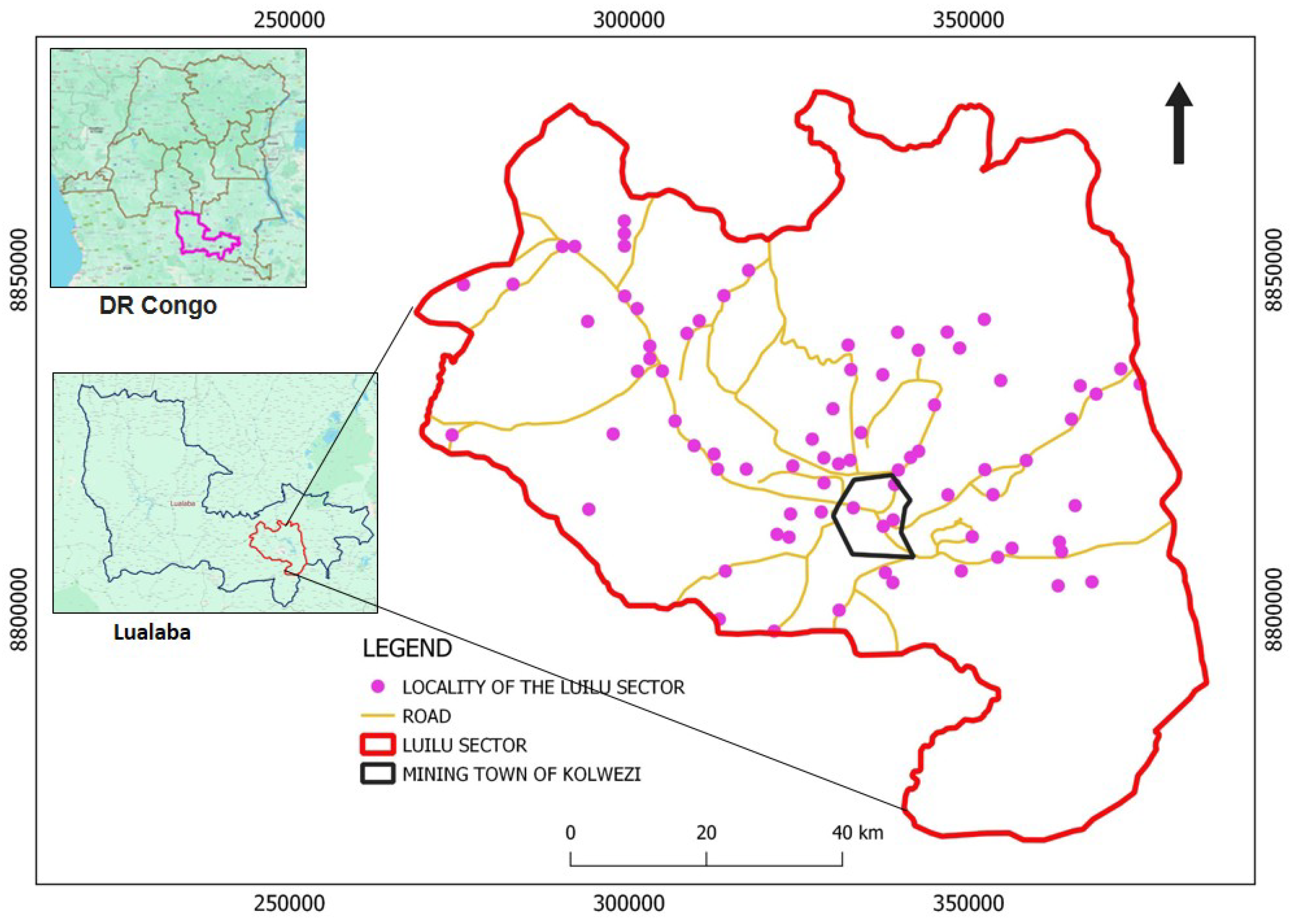
Figure 2.
Land-use maps of the study area for 1990, 1998, 2006, 2014, and 2024, based on Landsat image classification using the Random Forest algorithm. A decrease in Miombo woodland cover and an increase in agricultural land, built-up and bare soil areas, as well as shrub savanna, were observed. The years 1993, 2001, 2010, 2017, and 2021 are not shown in the figure.3.2. Landscape Composition and Stability in the Luilu Sector.
Figure 2.
Land-use maps of the study area for 1990, 1998, 2006, 2014, and 2024, based on Landsat image classification using the Random Forest algorithm. A decrease in Miombo woodland cover and an increase in agricultural land, built-up and bare soil areas, as well as shrub savanna, were observed. The years 1993, 2001, 2010, 2017, and 2021 are not shown in the figure.3.2. Landscape Composition and Stability in the Luilu Sector.
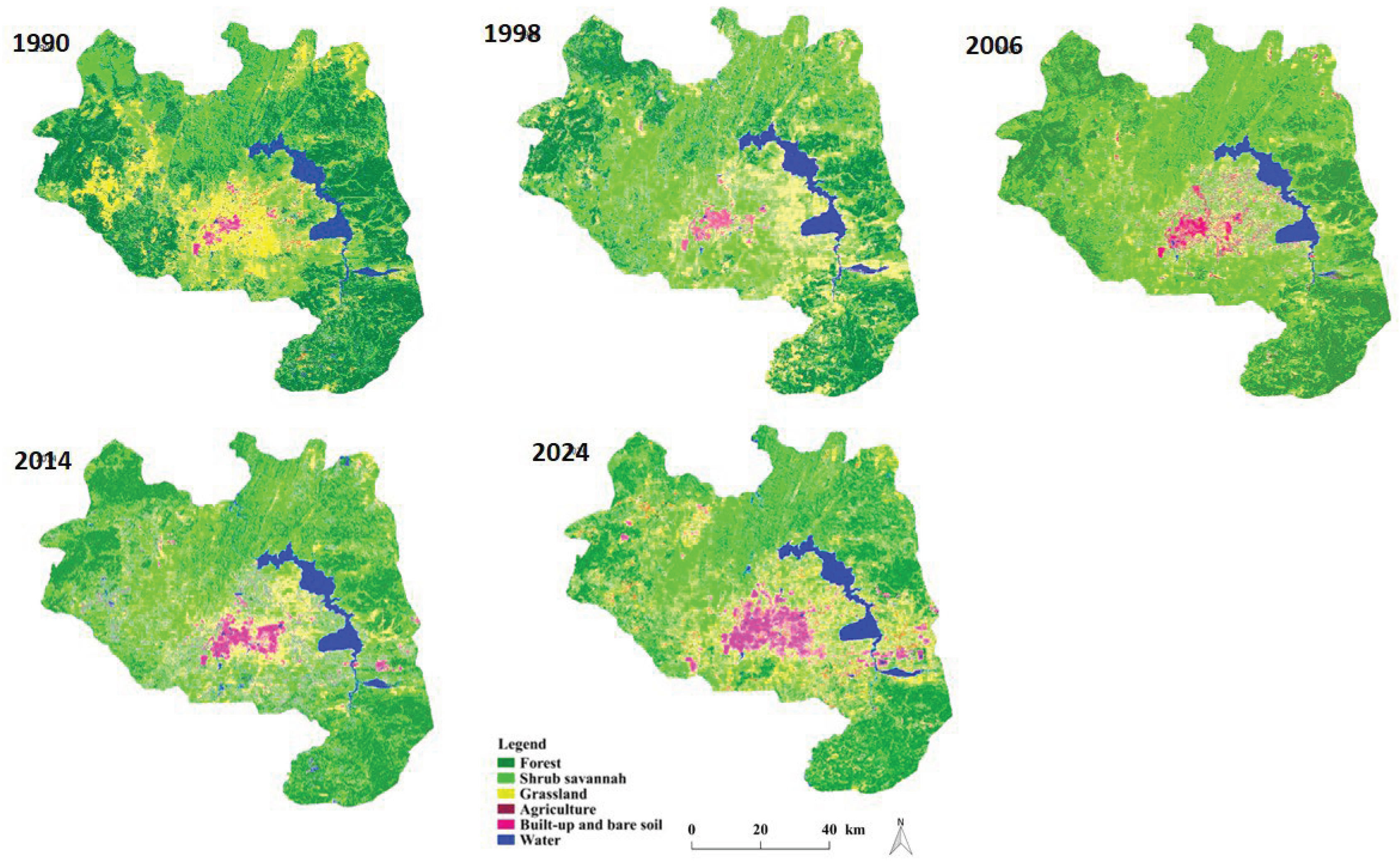

Table 2.
Accuracy assessment indices of supervised classifications of Landsat images (1990–2024) using the Random Forest algorithm. UA: User’s Accuracy; PA: Producer’s Accuracy.
Table 2.
Accuracy assessment indices of supervised classifications of Landsat images (1990–2024) using the Random Forest algorithm. UA: User’s Accuracy; PA: Producer’s Accuracy.
| Year | Forest UA | Forest PA | Shrub Savanna UA | Shrub Savanna PA | Grassland UA | Grassland PA | Agriculture UA | Agriculture PA | Built-up & Bare Soil UA | Built-up & Bare Soil PA | Water UA | Water PA | Overall Accuracy (%) | Kappa |
|---|---|---|---|---|---|---|---|---|---|---|---|---|---|---|
| 1990 | 91 | 100 | 94 | 94 | 78 | 70 | 71 | 71 | 100 | 100 | 100 | 100 | 93 | 91 |
| 1993 | 95 | 96 | 89 | 78 | 48 | 60 | 59 | 59 | 99 | 97 | 100 | 100 | 87 | 83 |
| 1998 | 67 | 95 | 78 | 66 | 73 | 80 | 89 | 47 | 96 | 99 | 100 | 100 | 86 | 82 |
| 2001 | 84 | 100 | 82 | 72 | 47 | 45 | 52 | 76 | 98 | 88 | 100 | 100 | 83 | 79 |
| 2006 | 84 | 100 | 79 | 69 | 57 | 60 | 56 | 59 | 86 | 94 | 100 | 97 | 84 | 80 |
| 2010 | 100 | 100 | 76 | 100 | 92 | 60 | 64 | 82 | 98 | 84 | 100 | 97 | 89 | 87 |
| 2014 | 75 | 100 | 74 | 72 | 53 | 45 | 71 | 59 | 94 | 93 | 97 | 100 | 83 | 78 |
| 2017 | 78 | 100 | 77 | 72 | 71 | 50 | 63 | 88 | 97 | 88 | 97 | 100 | 85 | 81 |
| 2021 | 81 | 100 | 79 | 81 | 56 | 50 | 56 | 53 | 100 | 97 | 100 | 97 | 86 | 82 |
| 2024 | 78 | 100 | 81 | 69 | 65 | 55 | 75 | 88 | 98 | 94 | 94 | 100 | 87 | 82 |
Table 3.
Transition matrices (in %) showing land-use changes between 1990–1993, 1993–1998, 1998–2001, 2006–2010, 2010–2014, 2014–2017, 2017–2021, and 2021–2024 in the Luilu sector, based on supervised classification using the Random Forest algorithm. Bold values indicate the proportion of land-use that remained unchanged. 1% corresponds to 76.64488 km². Totals do not sum to 100% because the “water” class was excluded from the analyses.
Table 3.
Transition matrices (in %) showing land-use changes between 1990–1993, 1993–1998, 1998–2001, 2006–2010, 2010–2014, 2014–2017, 2017–2021, and 2021–2024 in the Luilu sector, based on supervised classification using the Random Forest algorithm. Bold values indicate the proportion of land-use that remained unchanged. 1% corresponds to 76.64488 km². Totals do not sum to 100% because the “water” class was excluded from the analyses.
| Period | From \ To | Forest | Shrub Savanna | Grassland | Agriculture | Bare Soil & Built-up | Total |
|---|---|---|---|---|---|---|---|
| 1990–1993 | Forest | 29.74 | 9.01 | 2.32 | 9.88 | 0.01 | 50.97 |
| Shrub Savanna | 2.49 | 12.58 | 4.27 | 5.52 | 0 | 24.86 | |
| Grassland | 0.91 | 3.07 | 4 | 7.27 | 0.11 | 15.34 | |
| Agriculture | 0.16 | 0.64 | 1.85 | 1.57 | 0.05 | 4.28 | |
| Bare Soil & Built-up | 0 | 0 | 0.07 | 0.03 | 0.56 | 0.65 | |
| 1993–1998 | Forest | 23.67 | 4.85 | 4.09 | 0.76 | 0.01 | 33.39 |
| Shrub Savanna | 8.84 | 11.07 | 4.17 | 1.23 | 0.11 | 25.42 | |
| Grassland | 1.24 | 5.83 | 3.52 | 1.27 | 0.69 | 12.55 | |
| Agriculture | 3.97 | 12.39 | 5.24 | 2.55 | 0.29 | 24.44 | |
| Bare Soil & Built-up | 0 | 0 | 0.03 | 0.01 | 0.68 | 0.72 | |
| 1998–2001 | Forest | 25.24 | 9.55 | 1.64 | 1.27 | 0 | 37.7 |
| Shrub Savanna | 8.01 | 12.54 | 6.88 | 6.65 | 0.07 | 34.15 | |
| Grassland | 2.16 | 6.24 | 4.33 | 4.29 | 0.12 | 17.15 | |
| Agriculture | 0.83 | 1.36 | 1.51 | 2.09 | 0.03 | 5.81 | |
| Bare Soil & Built-up | 0.01 | 0.04 | 0.4 | 0.69 | 0.64 | 1.79 | |
| 2001–2006 | Forest | 26.73 | 8.04 | 0.65 | 0.81 | 0.03 | 36.26 |
| Shrub Savanna | 10.16 | 16 | 1.84 | 1.81 | 0.11 | 29.92 | |
| Grassland | 1.16 | 6.65 | 3.29 | 3.32 | 0.36 | 14.78 | |
| Agriculture | 0.6 | 6.52 | 2.4 | 4.85 | 0.65 | 15.02 | |
| Bare Soil & Built-up | 0.05 | 0.03 | 0.05 | 0.08 | 0.65 | 0.87 | |
| 2006–2010 | Forest | 27.81 | 9.77 | 0.91 | 0.25 | 0.12 | 38.87 |
| Shrub Savanna | 4.68 | 25.11 | 5.65 | 1.75 | 0.07 | 37.25 | |
| Grassland | 0.13 | 4.07 | 1.95 | 1.93 | 0.13 | 8.21 | |
| Agriculture | 0.37 | 6.01 | 1.65 | 2.48 | 0.36 | 10.88 | |
| Bare Soil & Built-up | 0.03 | 0.24 | 0.19 | 0.45 | 1.01 | 1.92 | |
| 2010–2014 | Forest | 26.94 | 4.05 | 1.45 | 0.32 | 0.05 | 32.82 |
| Shrub Savanna | 11.36 | 19 | 6.2 | 7.92 | 0.45 | 44.93 | |
| Grassland | 1.05 | 4.85 | 2.04 | 2.09 | 0.2 | 10.24 | |
| Agriculture | 0.12 | 1.47 | 2.39 | 2.24 | 0.57 | 6.79 | |
| Bare Soil & Built-up | 0.04 | 0.03 | 0.13 | 0.12 | 1.16 | 1.48 | |
| 2014–2017 | Forest | 25.29 | 11.71 | 1.13 | 1.24 | 0.03 | 39.4 |
| Shrub Savanna | 1.85 | 18.89 | 4.83 | 3.72 | 0.07 | 29.36 | |
| Grassland | 0.93 | 3.48 | 4.13 | 3.31 | 0.33 | 12.19 | |
| Agriculture | 0.05 | 3.72 | 2.67 | 6.07 | 0.16 | 12.67 | |
| Bare Soil & Built-up | 0 | 0.04 | 0.36 | 0.51 | 1.55 | 2.45 | |
| 2017–2021 | Forest | 18.32 | 9.27 | 0.49 | 0.15 | 0.04 | 28.27 |
| Shrub Savanna | 7.7 | 22.23 | 4.75 | 3.15 | 0.2 | 38.02 | |
| Grassland | 0.6 | 4.27 | 4.35 | 3.41 | 0.61 | 13.24 | |
| Agriculture | 1.16 | 4.32 | 3.39 | 5.15 | 0.92 | 14.94 | |
| Bare Soil & Built-up | 0.04 | 0.03 | 0.2 | 0.13 | 1.75 | 2.15 | |
| 2021–2024 | Forest | 23.02 | 2.21 | 1.13 | 1.44 | 0.15 | 27.95 |
| Shrub Savanna | 14.56 | 15.34 | 4.85 | 4.88 | 0.39 | 40.02 | |
| Grassland | 0.84 | 5.27 | 2.88 | 3.28 | 0.91 | 13.18 | |
| Agriculture | 0.77 | 4.39 | 2.56 | 3.36 | 0.88 | 11.96 | |
| Bare Soil & Built-up | 0 | 0.04 | 0.08 | 0.64 | 2.73 | 3.49 |
Table 4.
Periodic Stability Index (PSI) and Annual Stability Index (ASI) of Land Cover Classes and Landscape in Luilu (1990–2024).
Table 4.
Periodic Stability Index (PSI) and Annual Stability Index (ASI) of Land Cover Classes and Landscape in Luilu (1990–2024).
| Period | Forest PSI | Forest ASI | Shrub Savanna PSI | Shrub Savanna ASI | Grassland PSI | Grassland ASI | Agriculture PSI | Agriculture ASI | Bare & Built PSI | Bare & Built ASI | Landscape PSI | Landscape ASI |
|---|---|---|---|---|---|---|---|---|---|---|---|---|
| 1990–1993 | 0.17 | 0.06 | 1.04 | 0.35 | 0.75 | 0.25 | 8.41 | 2.8 | 1.7 | 0.57 | 1.02 | 0.34 |
| 1993–1998 | 1.45 | 0.29 | 1.61 | 0.32 | 1.5 | 0.3 | 0.15 | 0.03 | 27.5 | 5.5 | 0.75 | 0.15 |
| 1998–2001 | 0.88 | 0.29 | 0.8 | 0.27 | 0.81 | 0.27 | 3.46 | 1.15 | 0.19 | 0.06 | 0.87 | 0.29 |
| 2001–2006 | 1.26 | 0.25 | 1.53 | 0.31 | 0.43 | 0.09 | 0.59 | 0.12 | 5.48 | 1.1 | 1.14 | 0.23 |
| 2006–2010 | 0.47 | 0.12 | 1.65 | 0.41 | 1.34 | 0.34 | 0.52 | 0.13 | 0.75 | 0.19 | 1.51 | 0.38 |
| 2010–2014 | 2.14 | 0.54 | 0.4 | 0.1 | 1.24 | 0.31 | 2.3 | 0.58 | 3.97 | 0.99 | 1.15 | 0.29 |
| 2014–2017 | 0.2 | 0.07 | 1.81 | 0.6 | 1.12 | 0.37 | 1.33 | 0.44 | 0.65 | 0.22 | 1.39 | 0.46 |
| 2017–2021 | 0.95 | 0.24 | 1.13 | 0.28 | 0.99 | 0.25 | 0.7 | 0.18 | 4.43 | 1.11 | 1.16 | 0.29 |
| 2021–2024 | 3.28 | 1.09 | 0.48 | 0.16 | 0.84 | 0.28 | 1.19 | 0.4 | 3.07 | 1.02 | 0.96 | 0.32 |
| Mean | 0.33 | 0.31 | 0.27 | 0.65 | 1.19 | 0.31 | ||||||
Table 5.
Simpson Diversity Index (SIDI) and Simpson Evenness Index (SIEI) of Luilu (1990–2024).
| Year | Simpson Diversity Index (SIDI) | Simpson Evenness Index (SIEI) |
|---|---|---|
| 1990 | 0.65 | 0.58 |
| 1993 | 0.75 | 0.8 |
| 1998 | 0.71 | 0.69 |
| 2001 | 0.74 | 0.76 |
| 2006 | 0.69 | 0.65 |
| 2010 | 0.67 | 0.61 |
| 2014 | 0.73 | 0.73 |
| 2017 | 0.74 | 0.76 |
| 2021 | 0.73 | 0.74 |
| 2024 | 0.74 | 0.76 |
Table 6.
Spatial Structure Indices of the Luilu Landscape (1990–2024). Notation: n = number of patches; a = total class area (km²); ā= mean patch area (km²); D = largest patch index (%); Df(p) = fractal dimension and p-value of regression.
Table 6.
Spatial Structure Indices of the Luilu Landscape (1990–2024). Notation: n = number of patches; a = total class area (km²); ā= mean patch area (km²); D = largest patch index (%); Df(p) = fractal dimension and p-value of regression.
| Year | Index | Forest | Shrub Savanna | Grassland | Agriculture | Bare & Built | Water |
|---|---|---|---|---|---|---|---|
| 1990 | n | 111702 | 257212 | 235334 | 94265 | 1850 | 11489 |
| a | 2966.32 | 1867.66 | 1151.47 | 320.87 | 49.18 | 285.28 | |
| ā | 0.03 | 0.01 | 0 | 0 | 0.03 | 0.02 | |
| D | 29.62 | 2.66 | 9.57 | 0.72 | 30.75 | 81.26 | |
| Df(p) | 1.42(0.00) | 1.40(0.00) | 1.42(0.00) | 1.42(0.00) | 1.40(0.00) | 1.47(0.00) | |
| 1993 | n | 129801 | 334719 | 250210 | 216034 | 2590 | 4793 |
| a | 1946.77 | 1909.21 | 942.58 | 1832.91 | 55.18 | 238.54 | |
| ā | 0.01 | 0.01 | 0 | 0.01 | 0.02 | 0.05 | |
| D | 29.51 | 7.63 | 5.03 | 13.1 | 30.92 | 91.32 | |
| Df(p) | 1.42(0.00) | 1.42(0.00) | 1.45(0.00) | 1.42(0.00) | 1.50(0.00) | 1.52(0.00) | |
| 1998 | n | 156838 | 179298 | 198450 | 239031 | 10007 | 8617 |
| a | 2828.96 | 2560.83 | 1292.52 | 435.38 | 134.63 | 247.88 | |
| ā | 0.02 | 0.01 | 0.01 | 0 | 0.01 | 0.03 | |
| D | 19.97 | 13.78 | 2.85 | 0.16 | 43.4 | 82.6 | |
| Df(p) | 1.41(0.00) | 1.41(0.00) | 1.45(0.00) | 1.48(0.00) | 1.50(0.00) | 1.51(0.00) | |
| 2001 | n | 131569 | 251658 | 246762 | 125929 | 10534 | 1034 |
| a | 2719.76 | 2243.39 | 1108.43 | 1126.07 | 65.32 | 236.83 | |
| ā | 0.02 | 0.01 | 0 | 0.01 | 0.01 | 0.23 | |
| D | 23.6 | 5.27 | 2.75 | 12.83 | 18.92 | 95.24 | |
| Df(p) | 1.41(0.00) | 1.40(0.00) | 1.43(0.00) | 1.42(0.00) | 1.50(0.00) | 1.55(0.00) | |
| 2006 | n | 97820 | 174142 | 169684 | 156703 | 18776 | 705 |
| a | 2920.42 | 2793.83 | 616.76 | 816.97 | 147.39 | 204.49 | |
| ā | 0.03 | 0.02 | 0 | 0.01 | 0.01 | 0.29 | |
| D | 24.07 | 17.86 | 0.48 | 5.87 | 17.95 | 94.41 | |
| Df(p) | 1.43(0.00) | 1.41(0.00) | 1.44(0.00) | 1.43(0.00) | 1.49(0.00) | 1.47(0.00) | |
| 2010 | n | 77213 | 169674 | 140084 | 78906 | 12475 | 972 |
| a | 2479.07 | 3389.46 | 775.41 | 514.72 | 139.37 | 202.47 | |
| ā | 0.03 | 0.02 | 0.01 | 0.01 | 0.01 | 0.21 | |
| D | 15.44 | 23.62 | 0.72 | 6.22 | 22.25 | 92.16 | |
| Df(p) | 1.42(0.00) | 1.41(0.00) | 1.44(0.00) | 1.42(0.00) | 1.43(0.00) | 1.45(0.00) | |
| 2014 | n | 117902 | 186960 | 232705 | 110251 | 13082 | 9323 |
| a | 2964.21 | 2204.81 | 915.97 | 952.15 | 184.07 | 279.3 | |
| ā | 0.03 | 0.01 | 0 | 0.01 | 0.01 | 0.03 | |
| D | 22.38 | 4.57 | 2.33 | 6.18 | 51.79 | 75.64 | |
| Df(p) | 1.43(0.00) | 1.40(0.00) | 1.45(0.00) | 1.44(0.00) | 1.48(0.00) | 1.51(0.00) | |
| 2017 | n | 72279 | 152582 | 161123 | 83121 | 9753 | 7187 |
| a | 2121.22 | 2853.33 | 994.22 | 1123.81 | 163.79 | 244.14 | |
| ā | 0.03 | 0.02 | 0.01 | 0.01 | 0.02 | 0.03 | |
| D | 23.53 | 17.27 | 1.81 | 13.27 | 32.49 | 83.27 | |
| Df(p) | 1.43(0.00) | 1.43(0.00) | 1.43(0.00) | 1.43(0.00) | 1.48(0.00) | 1.47(0.00) | |
| 2021 | n | 142860 | 209388 | 209696 | 183891 | 12790 | 1771 |
| a | 2116.62 | 3013.03 | 993.22 | 900.54 | 263.63 | 213.45 | |
| ā | 0.01 | 0.01 | 0 | 0 | 0.02 | 0.12 | |
| D | 22.45 | 10.51 | 2.01 | 5.93 | 35.86 | 89.11 | |
| Df(p) | 1.43(0.00) | 1.40(0.00) | 1.44(0.00) | 1.42(0.00) | 1.46(0.00) | 1.51(0.00) | |
| 2024 | n | 121087 | 256435 | 287181 | 126465 | 41166 | 10818 |
| a | 2239.82 | 2043.84 | 863.63 | 1023.7 | 382.29 | 246.92 | |
| ā | 0.02 | 0.01 | 0 | 0.01 | 0.01 | 0.02 | |
| D | 24.34 | 6.18 | 0.52 | 2.61 | 46.87 | 76.48 | |
| Df(p) | 1.43(0.00) | 1.40(0.00) | 1.44(0.00) | 1.43(0.00) | 1.46(0.00) | 1.52(0.00) |
Disclaimer/Publisher’s Note: The statements, opinions and data contained in all publications are solely those of the individual author(s) and contributor(s) and not of MDPI and/or the editor(s). MDPI and/or the editor(s) disclaim responsibility for any injury to people or property resulting from any ideas, methods, instructions or products referred to in the content. |
© 2025 by the authors. Licensee MDPI, Basel, Switzerland. This article is an open access article distributed under the terms and conditions of the Creative Commons Attribution (CC BY) license (http://creativecommons.org/licenses/by/4.0/).
Copyright: This open access article is published under a Creative Commons CC BY 4.0 license, which permit the free download, distribution, and reuse, provided that the author and preprint are cited in any reuse.


