

Submitted:
01 October 2025
Posted:
02 October 2025
You are already at the latest version
Abstract
Citrus fruits are among the world's most important crops, with annual production exceeding 160 tons. However, their industrial processing generates substantial amounts of waste (mainly peels, seeds, and pulp), which can represent up to 50% of their total weight. This review examines innovative strategies to valorize these byproducts. Research shows that citrus residues (CR) have great potential for extracting high-value bio composites or converting them into biomaterials, going beyond traditional uses such as animal feed and biogas production. Special attention is paid to emerging applications in nanotechnology, nutraceuticals, biodegradable materials, and functional coatings. In line with the principles of the circular economy and green chemistry, this study highlights the potential of citrus residues to address major sustainability challenges while fostering the development of new market opportunities. The review also critically assesses current limitations related to scalability, regulatory frameworks, and consumer acceptance, with global and regional implications.
Keywords:
valorization strategies
; biorefinery
; sustainable packaging
; nutraceutical delivery
; upcycling
1. Introduction
Citrus fruits, members of the Rutaceae family, encompass a wide variety of genera and rank as the third most important group of fruit crops globally. Their high and growing demand stems from their versatility, as they are consumed in multiple forms—primarily as juices, jellies, jams and fresh fruit, but also as sources of essential oils, flavorings, and fragrances, among others [1,2]. However, this prosperity comes at an environmental cost: approximately 40% to 60% of processed citrus fruit is discarded as waste—including peels, seeds, pulp, and pomace—contributing to environmental liabilities such as methane emissions, groundwater contamination, and landfill saturation [3,4].
Traditionally, citrus by-products have been relegated to low-value applications such as animal feed or composting, overlooking their rich biochemical composition. For instance, citrus peels alone contain 10% to 20% pectin, essential oils (e.g., D-limonene), and polymethoxylated flavones with well-documented antioxidant and anti-inflammatory properties [5].
Recent advances in green chemistry and materials science have redefined citrus waste as a strategic resource for the development of high-value, non-conventional products. Innovations range from flexible electronics based on nanocellulose to biodegradable polymers derived from limonene, positioning citrus residues at the forefront of the circular bioeconomy [6]. Despite this progress, critical challenges remain in scaling up these technologies, standardizing extraction methods, and aligning with regulatory frameworks for novel applications. This review synthesizes the current state of the art in citrus waste valorization, with a focus on underutilized bioactive compounds and emerging markets, while also addressing the sociotechnical barriers that hinder industrial adoption.
1.1. The Global Citrus Waste Challenge
The global citrus industry has expanded significantly over the past two decades, fueled by rising demand for juices, fresh fruit, and essential oils. As documented in Figure 1, worldwide citrus production increased from 106.9 million tons in 2003 to 169.4 million tons in 2023 [7], reflecting a compound annual growth rate (CAGR) of 2.3%. This growth, however, generates a proportional waste burden: approximately 40–60% of processed biomass (peels, seeds, pulp) is discarded, translating to 68 - 100 million tons of annual waste in 2023 alone. The sheer volume of residues poses critical environmental risks, including soil acidification from limonene leaching and methane emissions from decomposition [3].
The concentration of citrus production intensifies waste-related issues in specific regions. Figure 2 highlights the leading producers across the four main citrus varieties. China dominates global production, accounting for 35% of the total among the varieties shown and supplies 59% of global mandarin demand. Brazil holds 34% of the orange market share, while India produces 22% of the world’s lemons. These and other regions depicted in the figure also exhibit some of the most concerning environmental pollution indicators associated with the improper handling of agro-industrial citrus waste. In many of these countries, particularly in rural areas or regions lacking adequate waste management infrastructure, these by-products are frequently discarded in landfills, dumped in open areas, or openly burned [8]. Such practices release significant amounts of greenhouse gases (CH₄, CO₂, NOₓ), fine particulate matter (PM₂.₅), volatile organic compounds, and dioxins, all of which negatively affect air quality and human health [9,10,11]. Furthermore, the accumulation of organic-rich residues in soils and water bodies contributes to eutrophication, foul odors, the proliferation of disease vectors, and the loss of local biodiversity [4,8]. China and other major producers have made substantial efforts to reduce the environmental impact of citrus cultivation, achieving significant progress over the past decade [12]. However, these efforts have primarily focused on the production phase, while waste management remains insufficiently addressed.
In the absence of emerging biotechnological interventions for citrus waste management, global waste volumes are projected to reach between 80 and 120 million tons by 2030. This trajectory poses a direct threat to the achievement of Sustainable Development Goals (SDGs) 12 (Responsible Consumption and Production) and 13 (Climate Action). Emerging biotechnologies offer scalable and sustainable pathways for valorizing citrus by-products; however, their successful deployment depends on the implementation of supportive policy frameworks, particularly in regions bearing the highest waste burdens [6].
1.2. Beyond Conventional Uses: The Need for Innovation
Traditionally, citrus waste has been used for animal feed, organic fertilizer production, and, to a lesser extent, biogas generation. While these conventional applications help reduce disposal costs and environmental burdens, they often do not fully exploit the potential of citrus residues as valuable bioresources. Recent research highlights that citrus waste is rich in bioactive compounds, fibers, and nutrients, making it suitable not only for animal nutrition but also for the development of high-value products in the food, agricultural, and energy sectors. For instance, innovative processing methods can transform citrus residues into animal feed with improved digestibility and protein content, thereby supporting livestock productivity and health [2,13,14,15,16,17,18]. Similarly, the use of citrus waste as an organic amendment has demonstrated benefits for soil quality and crop yields, contributing to more sustainable agricultural systems [19,20].
There is a growing motivation to utilize citrus waste as a renewable energy source. Biorefinery approaches now enable the conversion of citrus residues into biogas and biofuels, offering a sustainable alternative to fossil fuels and supporting the transition toward a circular bioeconomy [21,22,23,24]. The production of biogas from citrus waste not only mitigates greenhouse gas emissions but also generates digestate that can be used as a biofertilizer, further closing nutrient cycles in agriculture [25,26].
Despite these benefits, several challenges remain, such as the presence of anti-nutritional factors, the need for preservation methods like drying or ensiling (which can increase costs and the risk of nutrient loss), and the complexity of determining optimal inclusion rates for different animal species and growth stages. Technical and economic barriers also persist, including the need for efficient preservation and processing methods, and the optimization of valorization pathways to ensure scalability and profitability [14,23,27].
The valorization of citrus processing residues is increasingly driven by market demand for natural antioxidants, antimicrobials, and biodegradable materials, particularly within specialized sectors such as food packaging, cosmetics, pharmaceuticals, and emerging fields like wearable electronics. These residues are a rich source of bioactive compounds—including polyphenols, flavonoids, and essential oils—that exhibit potent antioxidant and antimicrobial properties. This inherent bioactivity positions citrus by-products as promising candidates for natural additives and functional ingredients in high-value applications [2,28]. In addition, the development of biodegradable polymers and biofilms from citrus-derived biopolymers directly addresses growing environmental concerns and regulatory pressures to replace conventional, non-degradable plastics. Recent studies have demonstrated the technical feasibility of producing biodegradable films and composites with built-in antioxidant and antimicrobial functions from citrus waste. These materials are suitable for active packaging and show potential for adaptation in wearable electronics and other niche markets that require sustainable and multifunctional materials [29,30,31]. Moreover, the unique microstructure and chemical composition of citrus residues enable the design of innovative bioinspired materials—such as fibers, fabrics, and nanostructured components—thus contributing to the transition toward a circular economy and zero-waste manufacturing models [29]. With continued advancements in consumer awareness and increasingly stringent environmental regulations, the integration of citrus waste-derived materials into specialized industries is expected to expand, driven by the dual imperatives of improved product functionality and environmental sustainability.
1.3. Objectives
This review aims to provide a comprehensive and critical synthesis of current advances in citrus waste valorization, with a focus on bridging the gap between laboratory-scale innovation and industrial-scale implementation. The specific objectives are to:
Map Emerging Technologies: Systematically catalog and evaluate advanced extraction, processing, and functionalization techniques—including green solvents, nanofabrication, and enzymatic hydrolysis—used to convert citrus residues (peels, seeds, pulp) into high-value biomaterials. Emphasis will be placed on optimizing yields, improving energy efficiency, and minimizing environmental impacts.
Evaluate Unconventional Applications: Assess the technical feasibility and commercial potential of novel products derived from citrus waste, such as smart packaging films, biomedical hydrogels, biodegradable electronics, and nutraceutical encapsulates. These applications will be benchmarked using key performance indicators, including barrier properties, mechanical strength, and bioactive compound retention.
Identify Barriers to Circular Integration: Analyze the main technical, economic, and regulatory challenges hindering the integration of citrus waste valorization into circular economy models. This includes addressing issues such as seasonal variability in waste composition, scalability constraints of biorefinery processes, and the need for robust certification frameworks for new biomaterials. Mitigation strategies will be proposed in alignment with Sustainable Development Goals 9 (Industry, Innovation and Infrastructure) and 12 (Responsible Consumption and Production).
Formulate Roadmaps for Stakeholders: Develop actionable recommendations and strategic roadmaps for researchers (e.g., AI-driven process optimization), industry stakeholders (e.g., pilot-scale industrial symbiosis networks), and policymakers (e.g., incentives for ISO-compliant circular systems) to accelerate the market adoption of sustainable citrus waste-derived products.
2. Citrus Waste Composition: A Treasure Trove of Bioactive Resources
2.1. Key Components by Waste Type
Citrus processing waste is primarily composed of three anatomical regions: peel (flavedo and albedo), the pulp partition (segment membrane) and seeds. Each of these components exhibits distinct structural and chemical characteristics, which determine their potential for high-value applications. Figure 3 shows the parts of a citrus fruit and a brief description of the main bioactive components in each one.
The flavedo is the outermost, colored layer of the citrus peel. It is characterized by a dense cellular structure with minimal intercellular space, providing mechanical protection and reducing water loss. The flavedo is particularly rich in essential oils, carotenoids, and polymethoxyflavonoids (PMFs), as well as coumarins and various phenolic acids. Studies have shown that the flavedo contains higher concentrations of phenolic acids, flavonols, flavones, and especially PMFs compared to the albedo, contributing to its strong antioxidant activity and characteristic citrus aroma [5,32,33,34]. For example, in Citrus sinensis and Citrus limon, the flavedo is a significant source of nobiletin, hesperidin, quercetin, and essential oils, with vitamin C content also higher than in the albedo [35,36]. The presence of these bioactive compounds makes the flavedo a valuable raw material for the extraction of natural antioxidants, flavorings, and functional ingredients [32,34,37,38].
The albedo is the inner, white, spongy layer of the peel, located between the flavedo and the pulp. It has a high proportion of intercellular spaces, which confer excellent water and oil holding capacities and make it an effective shock absorber. The albedo is especially rich in dietary fiber, pectin, hemicellulose, and polysaccharides, as well as flavanones (such as naringin and hesperidin), phenolic acids, and small amounts of vitamin C [32,33,35,39,40,41].
The pulp partition, also known as the segment membrane or tabique, is the internal membrane that separates the citrus segments. This component is a notable source of dietary fiber (up to 57 g/100 g), cellulose, pectin, and residual sugars, as well as appreciable amounts of polyphenols and flavonoids, though generally at lower concentrations than in the flavedo and albedo [35,41]. The segment membrane also contains significant levels of antioxidant compounds, contributing to the overall functional potential of citrus waste streams. Its structural polysaccharides and fiber content make it suitable for use in prebiotic and functional food formulations.
Citrus seeds are notable for their lipid content, particularly rich in linoleic acid, as well as phenolic compounds, limonoids, dietary fibers, vitamins, and carotenoids. The composition varies with citrus variety, maturity, and extraction method, but seeds consistently demonstrate antioxidative, anti-inflammatory, and anticancer activities, supporting their use in functional foods, nutraceuticals, and cosmetics[5,42,43]
2.2. Comparative Analysis of Citrus Varieties
The variability in bioactive compound composition among major citrus species, such as orange, mandarin, lemon, and grapefruit, plays a fundamental role in the development of effective agroindustrial waste valorization strategies. Recent research confirms that this variability is influenced by several factors, including cultivar, species variety, growing conditions, fruit ripeness, and processing techniques. Table 1 presents updated quantitative data on the content of key bioactive compounds predominantly present in citrus peels; these compounds are currently highlighted for potential applications in biomaterials, nutraceuticals, and environmentally friendly technologies.
The composition of citrus residues varies significantly between species, cultivation conditions, and extraction methods. Pectin, with a 13% to 23% DW content in peels, is widely used in the food and biomaterials industries for its gelling properties. Structural polysaccharides (cellulose, hemicellulose, lignin) are precursors to second-generation biofuels through hydrolysis and fermentation. D-limonene appears to be the major component in essential oils obtained from citrus residues, and yields depend largely on the extraction technology applied. Flavonoids, such as hesperidin, predominate in mandarin, the species on which the greatest amount of research has also been conducted. The total phenolic and flavonoid content (TPC, TFC) varies widely depending on the species and method, and advanced techniques, such as high hydrostatic pressure or pulsed electric fields, significantly improve yields. This variability highlights the need to standardize extraction protocols and reporting units to facilitate comparison across studies. Furthermore, the differential profiles of each citrus species suggest tailored biorefinery approaches to maximize value within a circular economic framework.
3. Emerging Extraction and Processing Technologies
Emerging extraction and processing technologies are revolutionizing the valorization of citrus waste, enabling the sustainable recovery of high-value bioactive compounds and advanced biomaterials. Recent research highlights the integration of green chemistry, nanotechnology, and biotechnology to maximize yield, efficiency, and environmental benefits.
3.1. Green Solvent Systems
A eutectic solvent is a multicomponent mixture characterized by a melting point lower than that of any of its individual pure components. This phenomenon is observed in systems with high stability in the liquid phase, where the components are virtually insoluble in the solid state. In this context, Deep Eutectic Solvents (DES) have emerged as promising tailor-made green solvents with a wide range of applications. Formulations such as choline chloride/levulinic acid/N-methylurea, glycerol, and ethylene glycol have demonstrated high efficiency and selectivity in the extraction of flavonoids—including polymethoxylated flavonoids and glycosides—as well as in the recovery of D-limonene from citrus peel waste. These systems have achieved extraction yields exceeding 85%, outperforming conventional solvents in both efficiency and environmental sustainability [60,61,62,63]. Furthermore, DES have proven effective in the extraction of microcellulose, which can subsequently be converted into cellulose nanocrystals [64], thus adding value to lignocellulosic biomass residues.
Supercritical carbon dioxide (scCO₂) extraction is a highly efficient green technology that utilizes CO₂ above its critical point (31.1 °C and 7.38 MPa), where it exhibits properties intermediate between those of a gas and a liquid. In this state, CO₂ possesses high diffusivity, low viscosity, and a tunable solvating power that can be adjusted through pressure and temperature, making it an ideal solvent for nonpolar and moderately polar compounds. This technique enables the efficient recovery of essential oils from citrus waste without exposure to high temperatures, thereby preventing thermal degradation and preserving both the bioactivity and aromatic profile of the extracted compounds. Moreover, supercritical CO₂ extraction has been shown to enhance the yield of phenolic and antioxidant compounds, and process parameters can be optimized to maximize the recovery of high-value bioactive metabolites [65,66,67]. Response surface methodology has even been applied to optimize extraction conditions, identifying 28.7 MPa and 60 °C as the optimal parameters for maximizing the recovery of flavonoids, total phenolics, and antioxidant activity [67]. This technique can reduce the use of organic solvents by up to 80% and has allowed the extraction of approximately 50% of D-limonene from the extract obtained from the freeze-dried and pulverized peels [68], with even higher yields reported when using propane instead of carbon dioxide [69].
3.2. Nanotechnology-Driven Approaches to Enhance Bioactive Compound Delivery
Nanotechnology-based strategies, specifically nanoencapsulation and nanoemulsification, have emerged as effective tools to mitigate the inherent limitations of bioactive compounds derived from citrus residues. These limitations include volatility, low water solubility, susceptibility to degradation by UV radiation, oxygen exposure, and pH fluctuations, thus outperforming conventional encapsulation methods such as spray drying or emulsification, which typically exhibit low encapsulation efficiency (<40%), uncontrolled release profiles, and thermal degradation of thermosensitive compounds [70]. A comprehensive review by Oprea et al. [71] elucidates the efficacy of lipid nanostructures (liposomes, solid lipid nanoparticles, emulsions) and polymeric systems in stabilizing citrus essential oils against these adverse conditions. This stabilization process demonstrably improves biocompatibility and functional availability for food and cosmetic applications.
Collectively, these findings highlight the critical technological considerations for successful nano-delivery systems, including: formulation method (ultrasonication, emulsion phase inversion, polymeric coatings, electrospinning), bioactive compound characteristics (hydrophobicity, heat sensitivity, etc.), droplet or particle size and distribution, physical stability (PDI, zeta potential, particle size after storage), and preservation of bioactivity (antioxidant, antimicrobial). These general technical principles are established here; specific applications in health, nutrition, and functional foods are further elaborated in Section 4.1.
3.3. Biotechnological Innovations
Biotechnological innovations are at the forefront of citrus waste valorization, enabling the transformation of residues into high-value products through enzymatic hydrolysis and microbial fermentation. These approaches not only enhance resource efficiency but also support the development of sustainable bioproducts for diverse industries.
Enzymatic hydrolysis uses specific enzymes—such as cellulases, pectinases, and hemicellulases—to break down complex polysaccharides in citrus waste into fermentable sugars and bioactive oligosaccharides. This process is highly efficient and environmentally friendly compared to chemical hydrolysis. For example, optimized enzymatic cocktails can significantly increase the release of fermentable sugars, which are then used as substrates for further bioprocessing [51,72,73]. Enzymatic hydrolysis of citrus pectin generates low-molecular-weight oligosaccharides with prebiotic activity, promoting beneficial gut microbiota and increasing the production of short-chain fatty acids, which have recognized health benefits [74]. Additionally, enzymatic hydrolysis can enhance the nutritional and functional properties of citrus-derived products by increasing the content of amino acids, vitamin C, and bioactive compounds [73].
Microbial fermentation leverages the metabolic capabilities of bacteria and yeasts to convert citrus waste hydrolysates into valuable biochemicals. Recent advances include the use of engineered strains, such as Weizmannia coagulans and Saccharomyces cerevisiae, for the efficient one-step conversion of citrus waste into L-lactic acid and meso-galactaric acid, respectively [75]. These processes combine enzymatic saccharification and fermentation, achieving high product yields and reducing process costs. Fermentation is also used to produce bioethanol, biosurfactants, and high-quality animal feed, with lactic acid bacteria improving the nutritional profile and shelf life of the resulting products [51,76]. Furthermore, fermentation can increase the antioxidant activity and bioactive content of citrus-derived products, making them suitable for functional food and nutraceutical applications [73,76]. Table 2 summarizes the main emerging technologies for the valorization of citrus waste.
4. Less Conventional Applications: From Lab to Market
This section synthesizes recent advancements in less conventional applications of citrus waste, demonstrating a shift beyond traditional uses towards innovative solutions poised for market entry. These applications span diverse sectors, including development of bioactive materials, generation of advanced biomaterials, creation of sustainable consumer goods, and novel agritech synergies. Progress in each of these areas is underpinned by a growing body of research seeking to address existing technical, economic, and regulatory barriers to market adoption.
4.1. Citrus Waste Valorization: Bioactive Innovations for Health, Wellness, and Sustainable Food Systems
Recent investigations, building upon established principles of nanoencapsulation and nanoemulsification (as detailed in Section 3.2), underscore the significant potential of citrus-derived bioactive compounds to enhance health, well-being, and sustainable food systems.
These investigations are exemplified by the incorporation of various citrus essential oils (bergamot, mandarin, orange, grapefruit, and lemon) into nanoemulsions using Tween-80 and ultrasonication, which resulted in an average droplet size of less than 50 nm [90]. The resulting nanoemulsions largely retained their antioxidant and antimicrobial activity after 30 days of storage, although some mandarin-based formulations exhibited reduced stability.
The application of lemon essential oil (LEO) nanoemulsions to fresh-cut kiwis not only reduced weight loss and enhanced firmness but also preserved nutrient content and antioxidant activity to levels comparable to 10 mg/L of vitamin C [91]Similar research found that LEO nanoemulsions effectively inhibited the growth of Phomopsis sp., a major cause of postharvest decay in kiwis, thereby contributing to food security and reduced economic losses [92].
Nanoencapsulation techniques have demonstrated the ability to improve the bioaccessibility of citrus pulp polyphenols. By encapsulating these compounds within various colloidal systems (liposomes, emulsions, etc.), researchers have enhanced their solubility, stability, and subsequent absorption within the body. Furthermore, active coatings combining LEO nanoemulsions with gelatinous matrices show promising barrier properties against water loss and browning in fresh produce [93,94], potentially prolonging shelf life, reducing food waste, and simultaneously delivering beneficial bioactive compounds directly to the food surface.
However, careful monitoring of several critical parameters is essential to maximize the functional effects of nanoencapsulated citrus bioactives. These include the selection of the encapsulation matrix (proteins, polysaccharides, biodegradable polymers), the bioactive compound loading, the particle/droplet size and Polydispersity Index (PDI), the zeta potential for colloidal consistency, stability during storage (temperature, time, light exposure), retention of biological activity (antioxidant, antimicrobial), and the sensory properties within the food matrix. Meticulous optimization of these variables is crucial for ensuring both the efficacy and consumer acceptance of these innovative products.
In the domain of functional material development for extending food shelf life, antimicrobial films infused with citrus essential oils (CEOs) are gaining traction. These films, typically combining citrus-derived pectin with complementary biopolymers such as xanthan gum, alginate, chitosan, or starch (all Generally Recognized As Safe, GRAS), offer desirable mechanical and barrier properties. CEOs, particularly those rich in D-limonene, provide broad-spectrum antimicrobial and antioxidant effects while enhancing the film's ability to modulate gas and moisture exchange. Fabrication methods, such as solution casting, extrusion, spraying, and dipping, allow for tailoring to specific applications, while ultrasound-assisted hydrodistillation provides an environmentally friendly alternative for extracting active volatile compounds [95,96,97].
The versatility of citrus-derived compounds extends beyond food applications, offering promising avenues for promoting overall health and well-being. Citrus peels serve as a rich reservoir of bioactive compounds with diverse therapeutic potential. Among these, hesperidin (Hesp), a glycosylated flavanone, has garnered significant attention for its multi-faceted properties, including anti-inflammatory, antioxidant, anti-cancer, and neuroprotective effects. Several studies have demonstrated hesperidin's efficacy in mitigating inflammation and oxidative stress in various models, such as cisplatin- and methotrexate-induced nephrotoxicity [8,47,98]. In these studies, hesperidin enhanced antioxidant capacity, reduced lipid peroxidation, and preserved renal architecture by upregulating cytoprotective proteins such as Nrf2 [99]. Novel nanoformulations, such as bilosomes (HES-BS), have further improved bioavailability and systemic efficacy, demonstrating their potential in advanced drug delivery systems for targeted therapeutic interventions [100].
Beyond nephroprotection, hesperidin and its derivatives (e.g., α-glucosyl hesperidin) have shown promise in ophthalmological applications by promoting corneal regeneration without inflammatory infiltration [101]. They have also demonstrated efficacy in managing metabolic disorders such as non-alcoholic fatty liver disease, where supplementation reduced key inflammatory markers (TNF-α, CRP, NF-κB) [99]. Emerging evidence even suggests a role for hesperidin in sports medicine, attenuating exercise-induced inflammation during post-exertion recovery [102]. These findings, coupled with improved formulation strategies, position hesperidin as a promising candidate for nutraceuticals and therapeutic biomaterials targeting both chronic and acute inflammatory conditions.
Collectively, these innovations reflect the increasing potential of citrus by-products, contributing to sustainability and overall well-being.
4.2. Advanced Biomaterials
Citrus-derived biomaterials have garnered increasing attention for their potential to replace synthetic counterparts in biomedical and sensing applications, aligning with sustainability and circular economy principles. Among them, pectin-based hydrogels are emerging as promising candidates for 3D-printed wound dressings. They have emerged as versatile candidates for advanced wound care systems [64]. Pectin, a heteropolysaccharide, contains reactive carboxyl and hydroxyl groups that facilitate ionic cross-linking (e.g., with Ca²⁺) and chemical modifications for targeted functions.
The incorporation of auxiliary biopolymers—such as gelatin, carboxymethylcellulose (CMC), or chitosan—improves the mechanical integrity and aqueous stability of these hydrogels, expanding their therapeutic utility. Innovative formulations combining pectin with ZnO nanoparticles and chitosan have demonstrated accelerated wound healing and intrinsic antimicrobial activity without cytotoxic effects [103]. Moreover, oxidation-mediated self-healing pectin hydrogels are being explored for dynamic tissue regeneration applications [104]. Recent advances include bio-inks integrating pectin, CMC, and nanoparticles, enabling patient-specific dressing fabrication via 3D printing [103] These findings underscore the promise of pectin hydrogels as scalable, eco-friendly platforms in next-generation biomedical materials.
In parallel, carbon quantum dots (CQDs) are a class of zero-dimensional carbon nanomaterials that exhibit unique properties such as intense fluorescence, biocompatibility, and tunable emission wavelengths and can be synthesized from citrus peel waste. These biodegradable nanomaterials are gaining ground for sensing and smart packaging. These plant-derived CQDs, usually obtained by hydrothermal or microwave-assisted carbonization, offer advantages such as photostability, tunable fluorescence, and surface functionalization potential, without the toxicity associated with heavy metal-based QDs [105,106,107]. Citrus peels are rich in phenolic precursors (e.g., flavonoids, limonoids) that facilitate CQD synthesis under green conditions.
Functionally, these CQDs show strong antimicrobial activity and have been embedded in biopolymer matrices like chitosan-pullulan or CMC-starch films, achieving over 99% inhibition against E. coli and S. aureus [108]. In food systems, citrus CQDs enable the development of intelligent packaging films responsive to volatile spoilage compounds and are incorporated into edible coatings to prolong shelf life [106,107]. Specific applications include fluorescent sensors for detecting bacterial contamination in milk and pesticide residues in citrus juices [109].
Despite promising laboratory-scale performance, challenges remain in terms of synthesis reproducibility, scalability, quantum yield enhancement, and biosafety validation under real-use conditions [110,111]. Addressing these limitations through standardized protocols and comprehensive toxicological assessments will be critical for translating citrus-derived CQDs into market-ready, sustainable diagnostic platforms.
4.3. Sustainable Consumer Goods
Leveraging the inherent biocompatibility, biodegradability, and functional properties of citrus-derived compounds, emerging innovations are enabling the creation of eco-friendly textiles, smart packaging, and biodegradable electronics that align with circular economy principles and low-impact manufacturing.
4.3.1. Citrus Fiber Composites in Sustainable Textiles
Citrus-derived fiber composites are gaining momentum in the textile industry as biodegradable, low-toxicity alternatives to petroleum-based materials. Citrus sinensis peels serve as a rich source of microcrystalline cellulose (MCC), whose extraction through environmentally benign protocols—alkaline pretreatment, acid hydrolysis, and chlorine-free bleaching—yields material with high crystallinity (~72%) and thermal stability (~308 °C). Scanning electron microscopy reveals a rod-like morphology with microfibrillar architecture, while elemental analysis confirms a high carbon and oxygen content, consistent with desirable reinforcement properties [112].
This citrus-derived MCC has been effectively incorporated into biopolymer-based composites, enhancing mechanical strength and thermal resistance while enabling circular use of agro-industrial waste [97]. Additionally, the transformation of citrus pulp into textile fibers has been industrialized by companies such as Orange Fiber S.r.l., demonstrating the viability of citrus-based fabrics with aesthetic, durable, and sustainable performance [97,113].
Beyond structural materials, citrus essential oils—including lemon, orange, and lime—are being utilized in functional textiles via microencapsulation. This strategy preserves volatile compounds and facilitates controlled release of bioactives with antimicrobial, antioxidant, insect-repellent, and aromatic properties [114]. When incorporated into coating matrices like chitosan, alginate, or gum arabic, and applied through padding techniques on cotton, wool, and polyester, these oils generate multifunctional textiles with enhanced UV resistance and biocidal effects [114,115]. The integration of plant-derived nanomaterials further imparts self-cleaning and energy-harvesting capabilities, while minimizing environmental impact. These innovations position citrus fibers and oils as key enablers of sustainable, high-performance textile ecosystems.
4.3.2. Limonene as a Green Solvent in Biodegradable Electronics
Limonene is emerging as a bio-based, non-toxic, and biodegradable alternative to hazardous solvents in organic electronics fabrication. Its potential for carbon-negative production through algae or microbial biosynthesis aligns with circular bioeconomy principles [116]. While its integration offers low environmental impact and compatibility with certain conjugated polymers, challenges persist concerning solvent–polymer miscibility and large-scale formulation. Binary solvent systems like limonene:indane have shown promise, enabling the processing of semiconductors like PM6 and BTP-eC9 and achieving power conversion efficiencies in OPVs approaching those of traditional toxic solvents [116]. Ongoing optimization and formulation strategies are crucial to expanding its applicability across various material systems. Interdisciplinary research, incorporating biochemistry, materials science, and green chemistry, is key to designing tailored terpene solvents. Comprehensive life cycle assessments and toxicological evaluations are essential to support the industrial transition towards green electronics based on citrus-derived inputs [116,117].
4.4. Agri-Tech Synergies
Biochar derived from citrus waste is emerging as a multifunctional input within sustainable agriculture, offering a scalable solution for soil remediation, nutrient management, and carbon sequestration. Produced through controlled pyrolysis (300–500 °C) or vermicomposting of citrus peels, this biochar exhibits high porosity, chemical stability, and surface functionality—primarily hydroxyl and carboxyl groups—making it an effective soil conditioner and adsorbent for heavy metals such as Pb, Cu, and As [118,119,120]. Its agronomic benefits include increased cation exchange capacity, pH regulation in acidic soils, enhanced retention of Ca, Mg, and K, and stimulation of microbial activity, all of which contribute to improved plant growth and root development [118].
Applications in crop systems have demonstrated promising results, including yield enhancement in sandy soils and disease suppression in tomatoes and peppers at application rates of 1–5% [121]. Beyond productivity, citrus biochar supports climate-smart agriculture by sequestering atmospheric CO₂ in stable carbon forms and reducing emissions of N₂O and CH₄, thanks to its high surface area and adsorptive capacity [122,123]. In citrus orchards, it has been shown to improve soil organic carbon dynamics, increasing resilience to water stress and environmental degradation.
These synergistic effects position citrus-derived biochar as a strategic tool within the Agri-TechBio framework, bridging technological innovation and circular economy principles. By transforming citrus residues into value-added amendments, this approach enables waste valorization, carbon mitigation, and agroecosystem restoration, especially in climate-vulnerable regions. As such, citrus biochar exemplifies how agri-tech integration can drive sustainable development at both farm and landscape scales.
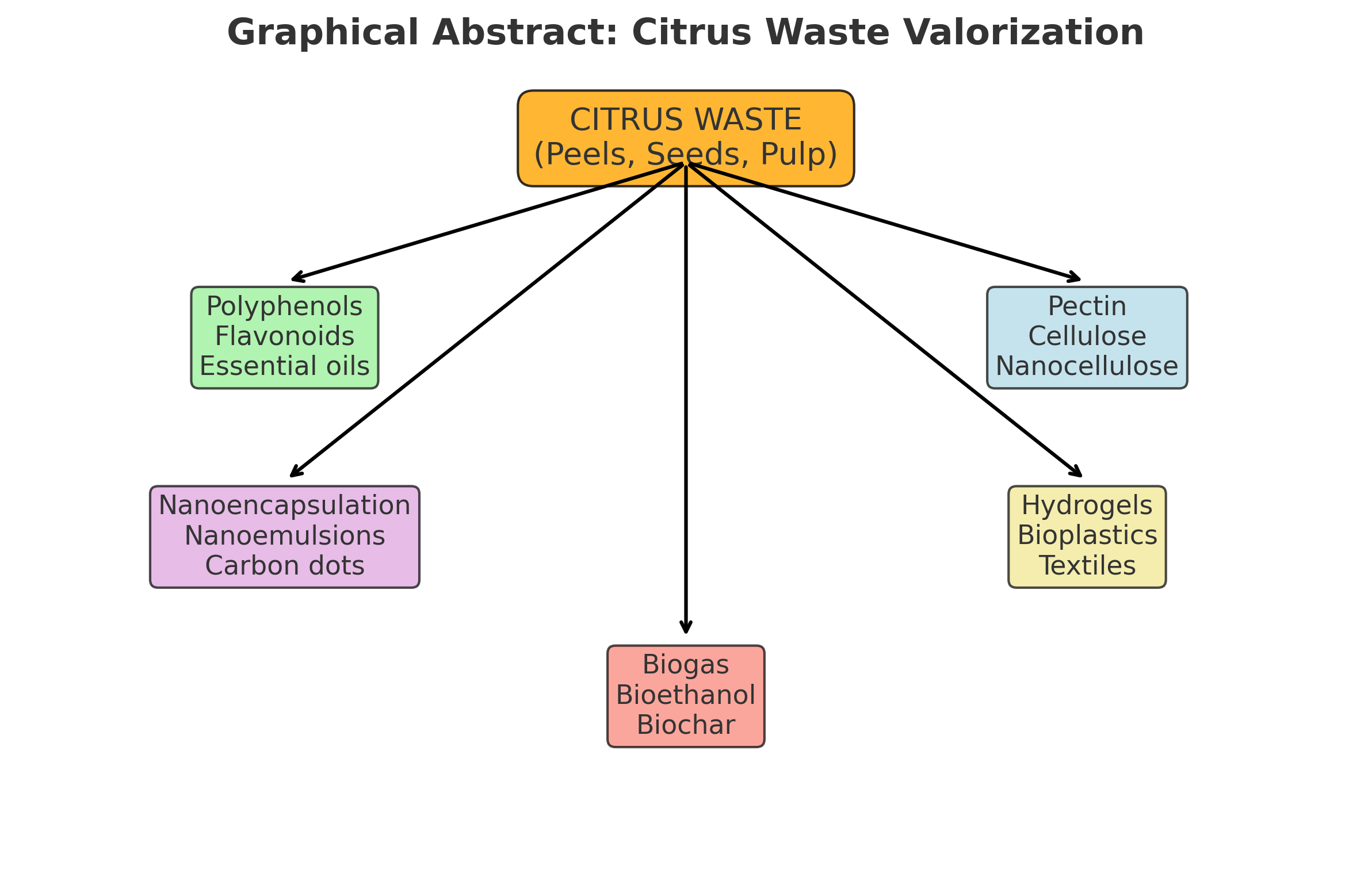
The type of treatment that citrus waste undergoes will determine the products that can be obtained. A summary of this can be seen in Figure 4.
5. Challenges and Unresolved Issues
The valorization of citrus waste is a field with great benefits, but also many challenges. The efficient and sustainable conversion of this type of waste into high-value products is challenged by technical, economic, regulatory, and environmental factors. Addressing these challenges is crucial for the development of integrated biorefinery models and the transition to a circular bioeconomy in citrus-producing regions [22,27]. The following section analyzes the main barriers and unresolved issues currently limiting the large-scale implementation of citrus waste valorization strategies.
5.1. Technical Barriers
Despite noteworthy advancements in the upcycling of citrus by products especially their conversion into bio-functional and value-added compounds considerable engineering and scientific hurdles remain. Principal limitations include the temporal and compositional variability of citrus feedstocks, as well as the susceptibility of bioactive constituents to degradation during processing. These combined challenges hinder process standardization, the achievement of reproducible results, and the successful large-scale implementation required for industrial adoption [124].
5.1.1. Seasonal Variability in Citrus Waste Composition
The biochemical composition of citrus by-products, particularly peels and pulps, is significantly influenced by factors such as varietal genotype, climatic conditions, and harvest practices [124,125]. D-limonene exhibits substantial variability (30-90%) based on citrus species, developmental stage, and geographic origin [38]. This variability significantly affects both the extraction yield and the inhibitory effects on microbial fermentation processes used in bioethanol and biogas production [22,126]. This compositional variability directly impacts the suitability of limonene as a green solvent, affecting both extraction yield and performance in electronics applications. For example, fluctuations in limonene content will affect its solvent properties, impacting polymer dissolution and device performance. Therefore, understanding and managing seasonal variability is crucial for ensuring consistent limonene quality and optimizing its effectiveness in biodegradable electronics and other applications.
5.2. Economic and Regulatory Hurdles
The implementation of sustainable technologies for the valorization of citrus byproducts—particularly in the isolation and modification of functional biomolecules and nanoscale materials—faces considerable financial and policy-related constraints. Despite their potential to substitute synthetic alternatives and reduce ecological footprint, these methods remain economically unfeasible and are frequently obstructed by the lack of harmonized regulatory standards, especially within emerging bio-economies [127,128,129].
5.2.1. High Costs of Green Extraction Methods
Despite their clear environmental and functional advantages, advanced green extraction methods—such as supercritical carbon dioxide (SC-CO₂), deep eutectic solvents (DES), ultrasound-assisted extraction (UAE), microwave-assisted extraction (MAE), and enzymatic hydrolysis—face substantial economic and regulatory barriers when compared to conventional solvent-based techniques. These technologies align closely with green chemistry principles by reducing solvent use, enhancing the recovery of thermolabile bioactives, and improving process safety and selectivity. However, their adoption at industrial scale is often limited by high capital and operational costs. The need for specialized equipment, precise process calibration, and elevated energy input results in significant financial burdens, particularly for small- and medium-sized enterprises (SMEs) [22,48]. Additionally, infrastructural gaps, restricted access to technology, and underdeveloped markets in citrus-rich regions—such as Latin America, Africa, and Southeast Asia—further hinder scalability and commercialization [22]. To overcome these challenges, early-stage integration of techno-economic assessments and life-cycle costing is critical. Strategies such as co-location with existing agro-industrial facilities, fostering industrial symbiosis, and developing integrated multi-stream biorefineries can enhance cost-effectiveness and promote the sustainable valorization of citrus waste.
5.2.2. Lack of Standardized Regulations for Citrus-Derived Nanomaterials
The rapid advancement of citrus-derived nanomaterials—including nanocellulose, nanoemulsions, and other functional nanosystems—has outstripped the development of consistent regulatory guidelines. While these nanomaterials show great promise in applications like smart packaging, biomedical coatings, targeted drug delivery, and biosensing, their legal and safety status, especially for food-contact applications, remains largely unclear. Current guidelines from major regulatory bodies (e.g., EFSA, FDA, OECD) often don't adequately address naturally sourced nanoparticles derived from agro-industrial waste, such as citrus byproducts. This leaves significant gaps in understanding toxicity thresholds, environmental impact, and long-term exposure [48,130].
The lack of globally standardized criteria for safety assessment, labeling, and approval processes creates legal ambiguity and significantly increases the time and cost of compliance, particularly for small and medium-sized enterprises (SMEs) and research-focused projects operating in regions with fragmented or evolving regulatory environments. These challenges hinder the widespread adoption and commercialization of potentially safe and beneficial nanotechnologies [130,131].
To ensure responsible integration and commercialization, internationally harmonized frameworks are crucial. These frameworks should incorporate evidence-based toxicity criteria, clear definitions, and streamlined approval pathways for sustainable nanomaterials. Simultaneously, developing open-access data repositories and fostering interdisciplinary collaborations between academia, industry, and regulatory agencies are essential to promote regulatory convergence and accelerate the translation of citrus-based nanotechnologies from the laboratory to the Marketplace [130,131].
5.3. Environmental and Social Trade-offs
Transforming citrus waste into nanomaterials and sophisticated bioproducts offers exciting prospects for promoting a regenerative and eco-conscious bioeconomy. Nonetheless, a careful evaluation of both ecological and societal repercussions is crucial. Two primary challenges emerge: the cradle-to-grave environmental footprint linked to the fabrication of nanostructures from citrus remnants, and the growing tension with nutritional-grade uses—especially concerning pectin, a staple in the global food industry [132,133].
5.3.1. Life Cycle Analysis (LCA) to Obtain Derivatives from Citrus Waste
While the valorization of citrus waste into nanomaterials—such as nanocellulose, carbon quantum dots (CQDs), and limonene-derived biopolymers—is often perceived as an environmentally preferable alternative to landfilling or incineration, recent life cycle assessments (LCAs) reveal a more nuanced sustainability profile. Although these approaches can mitigate certain environmental burdens, their overall impact is critically dependent on the chosen extraction technology, energy source, chemical inputs, and end-of-life management strategies [22,48]. For example, nanocellulose production frequently involves energy-intensive steps like mechanical milling, acid hydrolysis, and enzymatic treatment, often requiring significant volumes of water and reagents. These processes can generate a substantial ecological footprint, particularly when powered by fossil-fuel-based energy systems, thereby elevating the global warming potential and cumulative energy demand [134,135]. Furthermore, the synthesis of citrus-derived nanomaterials often relies on non-biodegradable surfactants, toxic catalysts, or organic solvents, raising additional environmental and health concerns [136].
Given these considerations, sustainability cannot be assumed solely based on the renewable origin of raw materials. Accurate and regionally contextualized life cycle assessments (LCAs) are imperative. These assessments must incorporate the boundaries of multifunctional systems, reflecting real-world variables such as local electricity grids, transportation logistics, and waste management infrastructure. Currently, comprehensive and standardized LCA data to produce citrus-derived nanomaterials remain limited, hindering informed decision-making by technology developers and policymakers. Future research should prioritize transparent and comparative LCA frameworks that consider environmental and social impacts across the entire product life cycle, thereby supporting the responsible advancement of citrus waste valorization [136,137].
Pectin and limonene recovery has been the subject of extensive LCA assessments, indicating that pectin extraction entails a significantly higher environmental burden than limonene recovery, mainly due to the high electricity demand and the use of ethanol as a solvent. A recent study revealed that 300 g of orange peel produces 8.22 g of pectin and 0.14 g of limonene; by replacing ethanol with more sustainable solvents, the environmental footprint of pectin production was reduced by 73.4% [66]. From a market perspective, the global pectin sector is projected to experience a compound annual growth rate (CAGR) of approximately 7% between 2023 and 2030, driven by demand in the food, pharmaceutical, and cosmetics industries. Similarly, the limonene market is exhibiting an upward trend due to its applications in cleaning products, fragrances, and bioplastics [66]. However, the economic viability of citrus waste valorization ultimately depends on process optimization and environmental impact minimization, and LCA plays a crucial role in identifying critical points and directing improvements toward sustainable industrial practices [22,27,66].
5.3.2. Competition with Food-Grade Applications
The rising demand for citrus-derived pectin, once primarily used in food products like jams and beverages, is now surging due to its expanding role in bioplastics, edible films, and biomedical applications. This diversification, while showcasing innovation in bio-based materials, has led to resource competition, supply strain, and significant price volatility in the global pectin market—impacting especially small-scale food processors in low and middle-income countries [138,139]. With prices increasing over 25% in the past five years, access to this key polysaccharide is becoming increasingly constrained due to competition from non-food sectors [124].
The shift toward high-value biomaterials from citrus waste risks undermining socially significant food uses—like artisanal jams and infant nutrition—by marginalizing smallholder farmers and regional processors who lack the means to compete with industrial actors [140]. To balance innovation with equity, scholars recommend a tiered valorization strategy that reserves premium citrus fractions for food and pharmaceutical applications while assigning lower-grade byproducts to industrial uses [141]. Inclusive innovation frameworks are also essential to ensure that citrus bioeconomy initiatives reflect local needs and safeguard fair access to vital food-grade resources for vulnerable communities [142].
5.4. Consumer Acceptance & Market Integration in Latin America
Consumer acceptance of citrus waste-derived products in Latin America presents a duality influenced by cultural, regulatory, and market factors. While a historical preference for synthetic additives persists, particularly in processed foods, a growing demand for natural and sustainable products, driven by perceived health and environmental benefits, is reshaping consumer preferences, as evidenced by recent surveys in Brazil indicating a high valuation of sustainable packaging and sustainability labels [143,144]. Front-of-package nutrition labeling in several Latin American countries has reinforced this sensitivity towards health and transparency attributes, increasing interest in "clean" and natural ingredients and packaging [145]. Nevertheless, significant barriers remain, including caution regarding nanotechnologies in food, sensory sensitivity to essential oils in coatings, and skepticism towards unverifiable environmental claims, which puts pressure on robust certifications and traceability [146,147]. The adoption of international certifications like GRAS and "novel food" approval by the EFSA, although nascent in the region due to a lack of regulatory harmonization, is emerging as a key requirement for accessing global markets [52,148]. At the public policy level, weak and fragmented regulatory frameworks in major producers like Brazil, Mexico, and Argentina, coupled with limited enforcement and incentives for waste valorization [22], constrain investment and the sector's competitiveness. Therefore, to foster consumer acceptance and the viability of citrus waste valorization in Latin America, it is recommended to prioritize sensory-neutral designs, clear labeling, and performance validations comparable to industry benchmarks, as well as strengthen public policies, create fiscal incentives, and promote the adoption of international certifications [8,22,52,148], while also promoting regulatory harmonization and traceability to prevent greenwashing [146].
5.5. Public Policy & Regulatory Landscape in Latin America
The regulatory landscape in Latin America is evolving towards circular economy and extended producer responsibility (EPR) models, directly impacting active/bio-based packaging and food contact materials. Chile is leading the region, having implemented the first mandatory collection and recycling targets for packaging under Law 20.920 (EPR Law) since 2023, expanding categories in 2025 (including textiles) and reinforcing reporting and management obligations [149,150,151]. Mexico has enacted the General Law on Circular Economy at the federal level (with updates between 2023 and 2025) and state laws (such as in Mexico City, 2023), promoting the reduction, reuse, recycling, and valorization of waste [152]. In Brazil, ANVISA updated its guide on food contact materials in 2024, incorporating criteria for chemical recycling and biodegradable/compostable materials, aligned with the National Solid Waste Policy [153,154], and has announced increased inspections and specific restrictions for substances in contact with food [155,156]. Colombia has consolidated a National Circular Economy Strategy [157,158,159] with inter-institutional governance and sector-specific roadmaps, while Peru has approved Circular Economy Roadmaps for industry [160,161] and specific sectors between 2020 and 2025. Collectively, these regulatory instruments create opportunity windows for citrus waste valorization through green procurement, EPR targets for packaging, and incentives for recyclable and bio-based materials, while also demanding compliance with specific requirements (positive listing, substance migration, technical performance), thereby favoring the scaling up of biopolymers, active coatings, and compostable packaging with robust LCA evidence.
6. Future Perspectives: Roadmaps for Sustainable Valorization
The valorization of citrus waste is currently undergoing a transition toward more advanced and circular industrial models, driven by technological innovations, novel materials, and evolving regulatory frameworks. Current trends show a convergence between biotechnology, materials engineering, circular economy principles, and digitalization, opening significant opportunities to maximize the added value of these by-products while contributing to the United Nations Sustainable Development Goals (SDGs), particularly SDG 9 (Industry, Innovation, and Infrastructure) and SDG 12 (Responsible Consumption and Production).
6.1. Integration with Circular Economy Models
The effective integration of citrus waste into industrial symbiosis networks is essential to optimize resource flows and increase added value. Pilot studies have demonstrated that multifunctional biorefineries co-processing citrus and olive residues can increase biogas yields by 38–42% while preserving flavonoids, as confirmed by LCA [66,162].
Blockchain-based traceability systems, such as those implemented in the CITRUSCALE project in Spain, have improved limonene recovery efficiency to 93–97% and facilitated the certification of carbon credits [52]. Furthermore, zero liquid discharge systems—combining membrane filtration with solar crystallization—have reduced freshwater consumption in Mediterranean processing plants by up to 87% [6].
A critical challenge lies in artificial intelligence (AI)-optimized logistics for transporting waste within a radius of less than 15 km, which could reduce emissions by up to 40%, provided that real-time composition sensors are available [64].
6.2. Innovations in Materials Science
Advances in materials science are redefining citrus waste valorization by transforming underutilized residues into high-performance functional biomaterials. Cutting-edge research now focuses on multifunctional hybrid architectures that combine nanotechnology, stimuli-responsive design, and catalytic engineering. These approaches overcome intrinsic limitations of conventional biopolymers—such as low thermal stability (<120 °C) and high hydrophilicity—while enabling applications in flexible electronics, self-healing polymers, and carbon-negative construction materials [52,98,117].
6.2.1. Advanced Hybrid Biomaterials
4D-printed pectin–cellulose scaffolds: designed for controlled drug release in response to pH and temperature variations, achieving up to 94% bioavailability of hesperetin in tumor microenvironments [98].
Limonene-based vitrimers: exhibiting self-healing properties (Tg: 118–125 °C) and 85% recyclability, offering a sustainable alternative to petroleum-derived thermosets [52].
Mycelium–citrus foams: produced by growing fungal mycelium on a citrus waste substrate, these materials are lightweight, biodegradable (complete degradation in 25–30 days), have low thermal conductivity (0.07–0.09 W/m·K), and possess acoustic absorption capabilities [117].
6.2.2 Catalytic Thermochemical Conversion
Microwave-assisted pyrolysis (450 °C, ZSM-5 catalyst) of citrus residues yields:
- Hydrogen-rich syngas (52–58%)
- Biochar (28–32%) suitable for soil remediation
- Phenolic oils (14–17%) as precursors for epoxy resins [6].
6.3. Cutting-Edge Research (2020–2024)
Nanocellulose from citrus peels: Due to their low lignin and high hemicellulose content, citrus peels are ideal feedstock for nanocellulose production. Extraction methods using ultrasonication and green solvents yield nanocellulose with high crystallinity, suitable for flexible electronics and biopolymer reinforcement [6,64]. Recent patents explore its use in bio-based batteries and high-performance composites [163].
Limonene as a platform chemical: Catalytic processes now enable its transformation into polyterpenes, bio-based plastics, and sustainable coatings, replacing fossil-based materials [52,117].
AI-driven process optimization: Machine learning models are being applied to optimize extraction and conversion parameters, improving yields and reducing energy consumption [66].
6.4. Emerging Trends and Knowledge Gaps
Emerging trends:
- Circular business models based on industrial symbiosis.
- Integration of biocatalytic processes for rapid and low-impact conversion.
Knowledge gaps and priorities:
- Industrial-scale nanocellulose production without generating toxic byproducts.
- Comprehensive long-term ecotoxicological assessments of citrus-derived nanomaterials and additives.
Table 3 shows a summary of the state of the art and future research perspectives or recommendations in the valorization of citrus waste.
7. Conclusions
Citrus waste is a versatile feedstock for high-value, low-environmental-impact products, yet its full potential remains untapped. Innovations in green chemistry and nanotechnology are unlocking unconventional applications, from smart packaging to biomedical devices. To bridge the lab-to-market gap, interdisciplinary collaboration and policy support are critical. This review positions citrus waste valorization as a cornerstone of the bioeconomy, aligning with SDGs 9 (Industry, Innovation, and Infrastructure) and 12 (Responsible Consumption and Production).
References
- FAO. CITRUS FRUIT FRESH AND PROCESSED Statistical bulletin 2020. 2020.
- Suri S, Singh A, Nema PK. Recent advances in valorization of citrus fruits processing waste: a way forward towards environmental sustainability. Vol. 30, Food Science and Biotechnology. The Korean Society of Food Science and Technology; 2021. p. 1601–26. [CrossRef]
- Satari B, Karimi K. Citrus processing wastes: Environmental impacts, recent advances, and future perspectives in total valorization. Vol. 129, Resources, Conservation and Recycling. Elsevier B.V.; 2018. p. 153–67. [CrossRef]
- English Alicia. The state of food and agriculture. 2019, Moving forward on food loss and waste reduction. Food and Agriculture Organization of the United Nations; 2019. 156 p.
- Maqbool Z, Khalid W, Atiq HT, Koraqi H, Javaid Z, Alhag SK, Al-Shuraym LA, Bader DMD, Almarzuq M, Afifi M, AL-Farga A. Citrus Waste as Source of Bioactive Compounds: Extraction and Utilization in Health and Food Industry. Vol. 28, Molecules. MDPI; 2023. [CrossRef]
- Ciriminna R, Petri GL, Angellotti G, Fontananova E, Luque R, Pagliaro M. Nanocellulose and microcrystalline cellulose from citrus processing waste: A review. Int J Biol Macromol [Internet]. 2024 Nov;281:135865. Available from: https://linkinghub.elsevier.com/retrieve/pii/S0141813024066741. [CrossRef]
- FAO. FAOSTAT Statistical Database [Internet]. 2025 [cited 2025 Jun 1]. Available from: https://www.fao.org/faostat/en/#data/QCL/visualize.
- Russo C, Maugeri A, Lombardo GE, Musumeci L, Barreca D, Rapisarda A, Cirmi S, Navarra M. The second life of citrus fruit waste: A valuable source of bioactive compounds†. Vol. 26, Molecules. MDPI; 2021. [CrossRef]
- Cheng Y, Cao X bing, Liu J meng, Yu Q qin, Zhang Q, He K bin. Agricultural fire impacts on brown carbon during different seasons in Northeast China. Science of the Total Environment. 2023 Sep 15;891.
- IQAir. World Live Air Quality Map [Internet]. 2025 [cited 2025 Jul 2]. Available from: https://www.iqair.com/world-air-quality.
- Alpizar F;, Backhaus T;, Decker N, Eilks I, Escobar-Pemberthy N, Fantke P, Geiser K, Ivanova M, Jolliet O, Kim HS, Khisa K, Gundimeda H, Slunge D, Stec S, Tickner J, Tyrer D, Urho N, Visser R, Yarto M, Suzuki . . General rights UN Environment Global Chemicals Outlook II-From Legacies to Innovative Solutions: Implementing the 2030 Agenda for Sustainable Development. UN Environment Global Chemicals Outlook II-From Legacies to Innovative Solutions: Implementing the 2030 Agenda for Sustainable Development. Citation. APA; 2019.
- Li J, Liang S, Liang X, Wang X, Bai X, Chen Y, Wu K, Liu X, Dong Z, Tan Q, Sun X, Hu C, Wu S. The carbon footprint and ecological costs of citrus production in China are going down. J Clean Prod. 2025 Mar 10;496. [CrossRef]
- Tayengwa T, Mapiye C. Citrus and winery wastes: Promising dietary supplements for sustainable ruminant animal nutrition, health, production, and meat quality. Vol. 10, Sustainability (Switzerland). MDPI; 2018. [CrossRef]
- Alnaimy A. Using of Citrus By-products in Farm Animals Feeding. Open Access Journal of Science. 2017 Sep 15;1(3). [CrossRef]
- Azizi M, Seidavi AR, Ragni M, Laudadio V, Tufarelli V. Practical applications of agricultural wastes in poultry feeding in Mediterranean and Middle East regions. Part 1: Citrus, grape, pomegranate and apple wastes. Worlds Poult Sci J. 2018 Sep 1;74(3):489–98. [CrossRef]
- Baker L, Bender J, Ferguson J, Rassler S, Pitta D, Chann S, Dou Z. Leveraging dairy cattle to upcycle culled citrus fruit for emission mitigation and resource co-benefits: A case study. Resour Conserv Recycl. 2024 Apr 1;203. [CrossRef]
- Andrianou C, Passadis K, Malamis D, Moustakas K, Mai S, Barampouti EM. Upcycled Animal Feed: Sustainable Solution to Orange Peels Waste. Sustainability (Switzerland). 2023 Feb 1;15(3). [CrossRef]
- Seidavi A, Zaker-Esteghamati H, Salem AZM. A review on practical applications of Citrus sinensis by-products and waste in poultry feeding. Vol. 94, Agroforestry Systems. Springer; 2020. p. 1581–9. [CrossRef]
- Kato-Noguchi H, Kato M. Pesticidal Activity of Citrus Fruits for the Development of Sustainable Fruit-Processing Waste Management and Agricultural Production. Vol. 14, Plants. Multidisciplinary Digital Publishing Institute (MDPI); 2025. [CrossRef]
- Consoli S, Caggia C, Russo N, Randazzo CL, Continella A, Modica G, Cacciola SO, Faino L, Reverberi M, Baglieri A, Puglisi I, Milani M, Longo Minnolo G, Barbagallo S. Sustainable Use of Citrus Waste as Organic Amendment in Orange Orchards. Sustainability (Switzerland). 2023 Feb 1;15(3). [CrossRef]
- Jeong D, Park H, Jang BK, Ju Y Bin, Shin MH, Oh EJ, Lee EJ, Kim SR. Recent advances in the biological valorization of citrus peel waste into fuels and chemicals. Vol. 323, Bioresource Technology. Elsevier Ltd; 2021. [CrossRef]
- Ortiz-Sanchez M, Omarini AB, González-Aguirre JA, Baglioni M, Zygadlo JA, Breccia J, D’Souza R, Lemesoff L, Bodeain M, Cardona-Alzate CA, Pejchinovski I, Fernandez-Lahore MH. Valorization routes of citrus waste in the orange value chain through the biorefinery concept: The Argentina case study. Chemical Engineering and Processing - Process Intensification. 2023 Jul 1;189. [CrossRef]
- Medina-Herrera N, Martínez-Ávila GCG, Robledo-Jiménez CL, Rojas R, Orozco-Zamora BS. From Citrus Waste to Valuable Resources: A Biorefinery Approach. Vol. 4, Biomass (Switzerland). Multidisciplinary Digital Publishing Institute (MDPI); 2024. p. 784–808. [CrossRef]
- Lee SH, Park SH, Park H. Assessing the Feasibility of Biorefineries for a Sustainable Citrus Waste Management in Korea. Vol. 29, Molecules. Multidisciplinary Digital Publishing Institute (MDPI); 2024. [CrossRef]
- Patsalou M, Chrysargyris A, Tzortzakis N, Koutinas M. A biorefinery for conversion of citrus peel waste into essential oils, pectin, fertilizer and succinic acid via different fermentation strategies. Waste Management. 2020 Jul 15;113:469–77. [CrossRef]
- Santiago B, Moreira MT, Feijoo G, González-García S. Identification of environmental aspects of citrus waste valorization into D-limonene from a biorefinery approach. Biomass Bioenergy. 2020 Dec 1;143. [CrossRef]
- Zema DA, Calabrò PS, Folino A, Tamburino V, Zappia G, Zimbone SM. Valorisation of citrus processing waste: A review. Vol. 80, Waste Management. Elsevier Ltd; 2018. p. 252–73. [CrossRef]
- Malik A, Najda A, Bains A, Nurzyńska-Wierdak R, Chawla P. Characterization of citrus nobilis peel methanolic extract for antioxidant, antimicrobial, and anti-inflammatory activity. Molecules. 2021 Jul 2;26(14). [CrossRef]
- Mahato N, Sharma K, Sinha M, Cho MH. Citrus waste derived nutra-/pharmaceuticals for health benefits: Current trends and future perspectives. Vol. 40, Journal of Functional Foods. Elsevier Ltd; 2018. p. 307–16. [CrossRef]
- Ibrahim S, Elsayed H, Hasanin M. Biodegradable, Antimicrobial and Antioxidant Biofilm for Active Packaging Based on Extracted Gelatin and Lignocelluloses Biowastes. J Polym Environ. 2021 Feb 1;29(2):472–82.
- Mousavi Kalajahi SE, Alizadeh A, Hamishehkar H, Almasi H, Asefi N. Orange Juice Processing Waste as a Biopolymer Base for Biodegradable Film Formation Reinforced with Cellulose Nanofiber and Activated with Nettle Essential Oil. J Polym Environ. 2022 Jan 1;30(1):258–69. [CrossRef]
- Wang Z, Chen X, Guo Z, Feng X, Huang P, Du M, Zalán Z, Kan J. Distribution and natural variation of free, esterified, glycosylated, and insoluble-bound phenolic compounds in brocade orange (Citrus sinensis L. Osbeck) peel. Food Research International. 2022 Mar 1;153. [CrossRef]
- Afifi SM, Gök R, Eikenberg I, Krygier D, Rottmann E, Stübler AS, Aganovic K, Hillebrand S, Esatbeyoglu T. Comparative flavonoid profile of orange (Citrus sinensis) flavedo and albedo extracted by conventional and emerging techniques using UPLC-IMS-MS, chemometrics and antioxidant effects. Front Nutr. 2023;10. [CrossRef]
- Alperth F, Pogrilz B, Schrammel A, Bucar F. Coumarins in the Flavedo of Citrus limon Varieties—Ethanol and Natural Deep Eutectic Solvent Extractions With HPLC-DAD Quantification. Phytochemical Analysis [Internet]. 2025 Jun 1 [cited 2025 Jul 20];36(4):1141–52. Available from: /doi/pdf/10.1002/pca.3499. [CrossRef]
- Lin LY, Peng CC, Huang YP, Chen KC, Peng RY. p-Synephrine Indicates Internal Maturity of Citrus grandis (L.) Osbeck cv. Mato Peiyu—Reclaiming Functional Constituents from Nonedible Parts. Molecules 2023, Vol 28, Page 4244 [Internet]. 2023 May 22 [cited 2025 Jul 20];28(10):4244. Available from: https://www.mdpi.com/1420-3049/28/10/4244/htm. [CrossRef]
- Anmol RJ, Marium S, Hiew FT, Han WC, Kwan LK, Wong AKY, Khan F, Sarker MMR, Chan SY, Kifli N, Ming LC. Phytochemical and Therapeutic Potential of Citrus grandis (L.) Osbeck: A Review. J Evid Based Integr Med. 2021;26.
- Tsai ML, Lin C Di, Khoo KA, Wang MY, Kuan TK, Lin WC, Zhang YN, Wang YY. Composition and bioactivity of essential oil from citrus grandis (L.) Osbeck ‘Mato Peiyu’ leaf. Molecules. 2017 Dec 1;22(12).
- Lv X, Zhao S, Ning Z, Zeng H, Shu Y, Tao O, Xiao C, Lu C, Liu Y. Citrus fruits as a treasure trove of active natural metabolites that potentially provide benefits for human health. Vol. 9, Chemistry Central Journal. BioMed Central Ltd.; 2015. [CrossRef]
- Multari S, Licciardello C, Caruso M, Anesi A, Martens S. Flavedo and albedo of five citrus fruits from Southern Italy: physicochemical characteristics and enzyme-assisted extraction of phenolic compounds. Journal of Food Measurement and Characterization [Internet]. 2021 Apr 1 [cited 2025 Jul 20];15(2):1754–62. Available from: https://link.springer.com/article/10.1007/s11694-020-00787-5. [CrossRef]
- Arora S, Kataria P, Ahmad W, Mishra R, Upadhyay S, Dobhal A, Bisht B, Hussain A, Kumar V, Kumar S. Microwave Assisted Green Extraction of Pectin from Citrus maxima Albedo and Flavedo, Process Optimization, Characterisation and Comparison with Commercial Pectin. Food Anal Methods [Internet]. 2024 Jan 1 [cited 2025 Jul 20];17(1):105–18. Available from:. [CrossRef]
- Aftab J, Abbas M, Sharif S, Mumtaz A, Zafar K, Ahmad N, Mohammed OA, Nazir A, Iqbal S, Iqbal M. LC-MS/MS Profiling, Antioxidant Potential and Cytotoxicity Evaluation of Citrus reticulata Albedo. Nat Prod Commun [Internet]. 2024 Aug 1 [cited 2025 Jul 20];19(8). Available from: https://scholar.google.com/scholar_url?url=https://journals.sagepub.com/doi/pdf/10.1177/1934578X241272471&hl=es&sa=T&oi=ucasa&ct=ufr&ei=d-9-aNWUEpOIieoP1r2BgQM&scisig=AAZF9b82h5taYZY9suawCIrHnLzX.
- Seyyedi-Mansour S, Carpena M, Donn P, Barciela P, Perez-Vazquez A, Echave J, Pereira AG, Prieto MA. Citrus Seed Waste and Circular Bioeconomy: Insights on Nutritional Profile, Health Benefits, and Application as Food Ingredient. Applied Sciences 2024, Vol 14, Page 9463 [Internet]. 2024 Oct 16 [cited 2025 Jul 20];14(20):9463. Available from: https://www.mdpi.com/2076-3417/14/20/9463/htm. [CrossRef]
- Zayed A, Badawy MT, Farag MA. Valorization and extraction optimization of Citrus seeds for food and functional food applications. Food Chem. 2021 Sep 1;355. [CrossRef]
- Taghizadeh-Alisaraei A, Hosseini SH, Ghobadian B, Motevali A. Biofuel production from citrus wastes: A feasibility study in Iran. Renewable and Sustainable Energy Reviews [Internet]. 2017 Mar 1 [cited 2025 Sep 2];69:1100–12. Available from: https://www.sciencedirect.com/science/article/pii/S1364032116305949. [CrossRef]
- Cypriano DZ, da Silva LL, Tasic L. High value-added products from the orange juice industry waste. Waste Management [Internet]. 2018 Sep 1 [cited 2025 Sep 2];79:71–8. Available from: https://www.sciencedirect.com/science/article/pii/S0956053X18304501. [CrossRef]
- Putnik P, Bursać Kovačević D, Režek Jambrak A, Barba FJ, Cravotto G, Binello A, Lorenzo JM, Shpigelman A. Innovative “Green” and Novel Strategies for the Extraction of Bioactive Added Value Compounds from Citrus Wastes—A Review. Molecules 2017, Vol 22, Page 680 [Internet]. 2017 Apr 27 [cited 2025 Sep 2];22(5):680. Available from: https://www.mdpi.com/1420-3049/22/5/680/htm. [CrossRef]
- Figueira O, Pereira V, Castilho PC. A Two-Step Approach to Orange Peel Waste Valorization: Consecutive Extraction of Pectin and Hesperidin. Foods 2023, Vol 12, Page 3834 [Internet]. 2023 Oct 19 [cited 2025 Aug 1];12(20):3834. Available from: https://www.mdpi.com/2304-8158/12/20/3834/htm. [CrossRef]
- Anticona M, Blesa J, Frigola A, Esteve MJ. High Biological Value Compounds Extraction from Citrus Waste with Non-Conventional Methods. Foods 2020, Vol 9, Page 811 [Internet]. 2020 Jun 20 [cited 2025 Jul 29];9(6):811. Available from: https://www.mdpi.com/2304-8158/9/6/811/htm. [CrossRef]
- Twinomuhwezi H, Godswill AC, Kahunde D. Extraction and Characterization of Pectin from Orange (Citrus sinensis), Lemon (Citrus limon) and Tangerine (Citrus tangerina). American Journal of Physical Sciences [Internet]. 2023 Mar 9 [cited 2025 Sep 15];1(1):17–30. Available from: https://iprjb.org/journals/AJPS/article/view/1049. [CrossRef]
- Kiteto MK, Vidija BM, Mecha CA. Production of bioethanol from citrus peel waste: A techno – economic feasibility study. Energy Conversion and Management: X [Internet]. 2025 Apr 1 [cited 2025 Aug 10];26:100916. Available from: https://www.sciencedirect.com/science/article/pii/S2590174525000480. [CrossRef]
- Vadalà R, Lo Vecchio G, Rando R, Leonardi M, Cicero N, Costa R. A Sustainable Strategy for the Conversion of Industrial Citrus Fruit Waste into Bioethanol. Sustainability (Switzerland) [Internet]. 2023 Jun 1 [cited 2025 Jul 28];15(12):9647. Available from: https://www.mdpi.com/2071-1050/15/12/9647/htm. [CrossRef]
- Panwar D, Saini A, Panesar PS, Chopra HK. Unraveling the scientific perspectives of citrus by-products utilization: Progress towards circular economy. Trends Food Sci Technol [Internet]. 2021 May 1 [cited 2025 Aug 4];111:549–62. Available from: https://www.sciencedirect.com/science/article/pii/S0924224421002107?via%3Dihub. [CrossRef]
- Andrade MA, Barbosa CH, Shah MA, Ahmad N, Vilarinho F, Khwaldia K, Silva AS, Ramos F. Citrus By-Products: Valuable Source of Bioactive Compounds for Food Applications. Antioxidants 2023, Vol 12, Page 38 [Internet]. 2022 Dec 25 [cited 2025 Sep 8];12(1):38. Available from: https://www.mdpi.com/2076-3921/12/1/38/htm. [CrossRef]
- Singh V, Chahal TS, Gill PPS, Jawandha SK, Singh V. Fruit colour progression in grapefruit with relation to carotenoid and Brix-acid ratio. Indian Journal of Horticulture. 2023 Jun 29;80(2):184–9. [CrossRef]
- Ghani A, Mohtashami S, Jamalian S. Peel essential oil content and constituent variations and antioxidant activity of grapefruit (Citrus × paradisi var. red blush) during color change stages. Journal of Food Measurement and Characterization [Internet]. 2021 Dec 1 [cited 2025 Sep 15];15(6):4917–28. Available from: https://link.springer.com/article/10.1007/s11694-021-01051-0. [CrossRef]
- Toprakçı G, Toprakçı İ, Şahin S. Highly clean recovery of natural antioxidants from lemon peels: Lactic acid-based automatic solvent extraction. Phytochemical Analysis [Internet]. 2022 Jun 1 [cited 2025 Sep 15];33(4):554–63. Available from: /doi/pdf/10.1002/pca.3109. [CrossRef]
- Argun ME, Öztürk A, Argun MŞ. Comparison of Different Extraction Methods on the Recovery Efficiencies of Valuable Components from Orange Peels. Turkish Journal of Agriculture - Food Science and Technology [Internet]. 2023 Dec 28 [cited 2025 Sep 16];11(12):2417–25. Available from: https://agrifoodscience.com/index.php/TURJAF/article/view/6519.
- Gómez-Mejía E, Sacristán I, Rosales-Conrado N, León-González ME, Madrid Y. Valorization of Citrus reticulata Blanco Peels to Produce Enriched Wheat Bread: Phenolic Bioaccessibility and Antioxidant Potential. Antioxidants (Basel) [Internet]. 2023 Sep 1 [cited 2025 Sep 9];12(9). Available from: https://pubmed.ncbi.nlm.nih.gov/37760045/. [CrossRef]
- Ibrahim FM, Abdelsalam E, Mohammed RS, Ashour WES, Vilas-Boas AA, Pintado M, El Habbasha ES. Polyphenol-Rich Extracts and Essential Oil from Egyptian Grapefruit Peel as Potential Antioxidant, Antimicrobial, and Anti-Inflammatory Food Additives. Applied Sciences 2024, Vol 14, Page 2776 [Internet]. 2024 Mar 26 [cited 2025 Sep 16];14(7):2776. Available from: https://www.mdpi.com/2076-3417/14/7/2776/htm. [CrossRef]
- Kalompatsios D, Palaiogiannis D, Makris DP. Optimized Production of a Hesperidin-Enriched Extract with Enhanced Antioxidant Activity from Waste Orange Peels Using a Glycerol/Sodium Butyrate Deep Eutectic Solvent. Horticulturae 2024, Vol 10, Page 208 [Internet]. 2024 Feb 22 [cited 2025 Jul 28];10(3):208. Available from: https://www.mdpi.com/2311-7524/10/3/208/htm. [CrossRef]
- Ozturk B, Parkinson C, Gonzalez-Miquel M. Extraction of polyphenolic antioxidants from orange peel waste using deep eutectic solvents. Sep Purif Technol [Internet]. 2018 Nov 29 [cited 2025 Jul 28];206:1–13. Available from: https://www.sciencedirect.com/science/article/pii/S1383586618310499. [CrossRef]
- Panić M, Andlar M, Tišma M, Rezić T, Šibalić D, Cvjetko Bubalo M, Radojčić Redovniković I. Natural deep eutectic solvent as a unique solvent for valorisation of orange peel waste by the integrated biorefinery approach. Waste Management [Internet]. 2021 Feb 1 [cited 2025 Jul 28];120:340–50. Available from: https://www.sciencedirect.com/science/article/pii/S0956053X20306802. [CrossRef]
- Xu M, Ran L, Chen N, Fan X, Ren D, Yi L. Polarity-dependent extraction of flavonoids from citrus peel waste using a tailor-made deep eutectic solvent. Food Chem [Internet]. 2019 Nov 1 [cited 2025 Jul 28];297:124970. Available from: https://www.sciencedirect.com/science/article/pii/S0308814619310726?via%3Dihub. [CrossRef]
- Chandrasekar CM, Carullo D, Saitta F, Krishnamachari H, Bellesia T, Nespoli L, Caneva E, Baschieri C, Signorelli M, Barbiroli AG, Fessas D, Farris S, Romano D. Valorization of citrus peel industrial wastes for facile extraction of extractives, pectin, and cellulose nanocrystals through ultrasonication: An in-depth investigation. Carbohydr Polym [Internet]. 2024 Nov 15 [cited 2025 Jul 28];344:122539. Available from: https://www.sciencedirect.com/science/article/pii/S0144861724007653?via%3Dihub. [CrossRef]
- Amador-Luna VM, Herrero M, Jiménez de la Parra M, Arribas ÁG, Ibáñez E, Montero L. Maximizing the neuroprotection from Citrus aurantium leaves: Optimization of a blended extract from a sequential extraction process with compressed fluids and NADES. Advances in Sample Preparation [Internet]. 2025 Feb 1 [cited 2025 Jul 28];13:100149. Available from: https://www.sciencedirect.com/science/article/pii/S2772582025000038?via%3Dihub. [CrossRef]
- Midolo G, Cutuli G, Porto SMC, Ottolina G, Paini J, Valenti F. LCA analysis for assessing environmenstal sustainability of new biobased chemicals by valorising citrus waste. Sci Rep [Internet]. 2024 Dec 1 [cited 2025 Jul 28];14(1):1–13. Available from: https://www.nature.com/articles/s41598-024-72468-y. [CrossRef]
- Argun ME, Argun MŞ, Arslan FN, Nas B, Ates H, Tongur S, Cakmakcı O. Recovery of valuable compounds from orange processing wastes using supercritical carbon dioxide extraction. J Clean Prod [Internet]. 2022 Nov 15 [cited 2025 Jul 28];375:134169. Available from: https://www.sciencedirect.com/science/article/pii/S0959652622037416. [CrossRef]
- Romano R, De Luca L, Aiello A, Rossi D, Pizzolongo F, Masi P. Bioactive compounds extracted by liquid and supercritical carbon dioxide from citrus peels. Int J Food Sci Technol [Internet]. 2022 May 18 [cited 2025 Jul 28];57(6):3826–37. Available from:. [CrossRef]
- de Freitas Batista MG, Herbst G, Kolicheski MB, Voll FAP, Corazza ML. d-Limonene extraction from Citrus reticulata Blanco wastes with compressed propane and supercritical CO2. J Supercrit Fluids [Internet]. 2025 Jan 1 [cited 2025 Jul 28];215:106426. Available from: https://www.sciencedirect.com/science/article/pii/S0896844624002614. [CrossRef]
- Saini A, Panesar PS, Bera MB. Valorization of fruits and vegetables waste through green extraction of bioactive compounds and their nanoemulsions-based delivery system. Bioresour Bioprocess [Internet]. 2019 Dec 1 [cited 2025 Jul 28];6(1):1–12. Available from: https://bioresourcesbioprocessing.springeropen.com/articles/10.1186/s40643-019-0261-9. [CrossRef]
- Oprea I, Fărcaș AC, Leopold LF, Diaconeasa Z, Coman C, Socaci SA. Nano-Encapsulation of Citrus Essential Oils: Methods and Applications of Interest for the Food Sector. Polymers 2022, Vol 14, Page 4505 [Internet]. 2022 Oct 25 [cited 2025 Sep 18];14(21):4505. Available from: https://www.mdpi.com/2073-4360/14/21/4505/htm. [CrossRef]
- Aulitto M, Alfano A, Maresca E, Avolio R, Errico ME, Gentile G, Cozzolino F, Monti M, Pirozzi A, Donsì F, Cimini D, Schiraldi C, Contursi P. Thermophilic biocatalysts for one-step conversion of citrus waste into lactic acid. Appl Microbiol Biotechnol [Internet]. 2024 Dec 1 [cited 2025 Jul 28];108(1):1–12. Available from: https://link.springer.com/article/10.1007/s00253-023-12904-7. [CrossRef]
- Li Y, Guo L, Mao X, Ji C, Li W, Zhou Z. Changes in the nutritional, flavor, and phytochemical properties of Citrus reticulata Blanco cv. ‘Dahongpao’ whole fruits during enzymatic hydrolysis and fermentation. Front Sustain Food Syst. 2024 Oct 3;8:1474760. [CrossRef]
- Lu X, Zhao C, Liu D, Hu M, Cui J, Wang F, Zeng L, Zheng J. A novel prebiotic enzymatic hydrolysate of citrus pectin during juice processing. Food Hydrocoll [Internet]. 2024 Jan 1 [cited 2025 Jul 28];146:109198. Available from: https://www.sciencedirect.com/science/article/pii/S0268005X23007440?via%3Dihub. [CrossRef]
- Protzko RJ, Latimer LN, Martinho Z, de Reus E, Seibert T, Benz JP, Dueber JE. Engineering Saccharomyces cerevisiae for co-utilization of d-galacturonic acid and d-glucose from citrus peel waste. Nat Commun [Internet]. 2018 Dec 1 [cited 2025 Jul 28];9(1). Available from:. [CrossRef]
- Saeed M, Kamboh AA, Huayou C. Promising future of citrus waste into fermented high-quality bio-feed in the poultry nutrition and safe environment. Poult Sci [Internet]. 2024 Apr 1 [cited 2025 Jul 28];103(4):103549. Available from: https://www.sciencedirect.com/science/article/pii/S0032579124001287?via%3Dihub. [CrossRef]
- Wani KM, Nayana P, Khalid ·, Wani M, Wani KM. Unlocking the green potential: sustainable extraction of bioactives from orange peel waste for environmental and health benefits. Journal of Food Measurement and Characterization 2024 18:10 [Internet]. 2024 Aug 23 [cited 2025 Jul 29];18(10):8145–62. Available from: https://link.springer.com/article/10.1007/s11694-024-02779-1. [CrossRef]
- Boukroufa M, Boutekedjiret C, Chemat F. Development of a green procedure of citrus fruits waste processing to recover carotenoids. Resource-Efficient Technologies [Internet]. 2017 Sep 1 [cited 2025 Jul 29];3(3):252–62. Available from: https://www.sciencedirect.com/science/article/pii/S2405653716301981.
- Bigi F, Maurizzi E, Haghighi H, Siesler HW, Licciardello F, Pulvirenti A. Waste Orange Peels as a Source of Cellulose Nanocrystals and Their Use for the Development of Nanocomposite Films. Foods [Internet]. 2023 Mar 1 [cited 2025 Jul 29];12(5):960. Available from: https://www.mdpi.com/2304-8158/12/5/960/htm. [CrossRef]
- Fakhariha M, Rafati AA, Garmakhany AD, Asl AZ. Nanoencapsulation enhances stability, release behavior, and antimicrobial properties of Sage and Thyme essential oils. Sci Rep [Internet]. 2025 Dec 1 [cited 2025 Jul 29];15(1):1–18. Available from: https://www.nature.com/articles/s41598-025-00022-5. [CrossRef]
- Yadav S, Sharma CS. Novel and green processes for citrus peel extract: a natural solvent to source of carbon. Polymer Bulletin [Internet]. 2018 Nov 1 [cited 2025 Jul 29];75(11):5133–42. Available from: https://link.springer.com/article/10.1007/s00289-018-2310-5. [CrossRef]
- Tang W, Han T, Liu W, He J, Liu J. Pectic oligosaccharides: enzymatic preparation, structure, bioactivities and application. Crit Rev Food Sci Nutr. 2025;65(11):2117–33. [CrossRef]
- Foti P, Ballistreri G, Timpanaro N, Rapisarda P, Romeo F V. Prebiotic effects of citrus pectic oligosaccharides. Nat Prod Res [Internet]. 2022 [cited 2025 Jul 29];36(12):3173–6. Available from: https://www.tandfonline.com/doi/abs/10.1080/14786419.2021.1948845. [CrossRef]
- de Paula F, Vieira NV, da Silva GF, Delforno TP, Duarte ICS. A Comparison of Microbial Communities of Mango and Orange Residues for Bioprospecting of Biosurfactant Producers. Ecologies [Internet]. 2022 Jun 1 [cited 2025 Jul 29];3(2):120–30. Available from: https://www.mdpi.com/2673-4133/3/2/10/htm. [CrossRef]
- Venkataraman S, Rajendran DS, Kumar PS, Rangasamy G, Vaidyanathan VK. A Comprehensive Review on the Refinery of Citrus Peel Towards the Production of Bioenergy, Biochemical and Biobased Value-Added Products: Present Insights and Futuristic Challenges. Waste and Biomass Valorization 2024 15:11 [Internet]. 2024 Jun 12 [cited 2025 Jul 29];15(11):6491–512. Available from: https://link.springer.com/article/10.1007/s12649-024-02557-6. [CrossRef]
- He Y, Zhu Y, Lv J, Gu Y, Wang T, Chen J. Effects of lactic acid bacteria fermentation on the bioactive composition, volatile compounds and antioxidant activity of Huyou (Citrus aurantium ‘Changshan-huyou’) peel and pomace. Food Quality and Safety [Internet]. 2023 Jan 1 [cited 2025 Jul 29];7:1–13. Available from:. [CrossRef]
- Tropea A, Potortì AG, Turco V Lo, Russo E, Vadalà R, Rando R, Di Bella G. Aquafeed Production from Fermented Fish Waste and Lemon Peel. Fermentation 2021, Vol 7, Page 272 [Internet]. 2021 Nov 21 [cited 2025 Jul 29];7(4):272. Available from: https://www.mdpi.com/2311-5637/7/4/272/htm. [CrossRef]
- Lima CA, Contato AG, de Oliveira F, da Silva SS, Hidalgo VB, Irfan M, Gambarato BC, Carvalho AKF, Bento HBS. Trends in Enzyme Production from Citrus By-Products. Processes 2025, Vol 13, Page 766 [Internet]. 2025 Mar 6 [cited 2025 Jul 28];13(3):766. Available from: https://www.mdpi.com/2227-9717/13/3/766/htm. [CrossRef]
- Gooruee R, Hojjati M, Behbahani BA, Shahbazi S, Askari H. Extracellular enzyme production by different species of Trichoderma fungus for lemon peel waste bioconversion. Biomass Convers Biorefin [Internet]. 2024 Jan 1 [cited 2025 Jul 29];14(2):2777–86. Available from: https://link.springer.com/article/10.1007/s13399-022-02626-7. [CrossRef]
- MEDELEANU ML, FĂRCAȘ AC, COMAN C, LEOPOLD LF, DIACONEASA Z, SENDRA E, CARBONELL PEDRO AA, SOCACI SA. Citrus Essential Oils’ Nano-emulsions: Formulation and Characterization. Bulletin of University of Agricultural Sciences and Veterinary Medicine Cluj-Napoca Food Science and Technology. 2024 Nov 15;81(2):95–113. [CrossRef]
- Chen C, Meng FB, Lv HJ, Gou ZZ, Qiu J, Li YC. Study on the bacteriostasis of lemon essential oil and the application of lemon essential oil nanoemulsion on fresh-cut kiwifruit. Front Sustain Food Syst. 2024 May 22;8:1394831. [CrossRef]
- Meng FB;, Gou ZZ;, Li YC;, Zou LH;, Chen WJ;, Liu DY, Meng FB, Gou ZZ, Li YC, Zou LH, Chen WJ, Liu DY. The Efficiency of Lemon Essential Oil-Based Nanoemulsions on the Inhibition of Phomopsis sp. and Reduction of Postharvest Decay of Kiwifruit. Foods 2022, Vol 11, Page 1510 [Internet]. 2022 May 22 [cited 2025 Sep 19];11(10):1510. Available from: https://www.mdpi.com/2304-8158/11/10/1510/htm. [CrossRef]
- Caballero S, Li YO, McClements DJ, Davidov-Pardo G. Encapsulation and delivery of bioactive citrus pomace polyphenols: a review. Crit Rev Food Sci Nutr [Internet]. 2022 [cited 2025 Sep 19];62(29):8028–44. Available from: https://pubmed.ncbi.nlm.nih.gov/33983085/. [CrossRef]
- Li F, Song X, Chen Y, He L, Wu Y, Huang Q, Huang M, Li X. Effect of barrier function of lemon essential oil-gelatin composite coating on flavor quality of kiwifruit during storage. Journal of Future Foods [Internet]. 2025 Aug 19 [cited 2025 Sep 19]; Available from: https://linkinghub.elsevier.com/retrieve/pii/S2772566925002204. [CrossRef]
- Dalei G, Das S, Mohanty D, Biswal S, Jena D, Dehury P, Das BR. Xanthan gum-Pectin Edible Coating Enriched with Sweet Orange (Citrus sinensis L.) Peel Essential Oil for Chicken Meat Preservation. Food Biophys [Internet]. 2025 Mar 1 [cited 2025 Aug 1];20(1):1–16. Available from: https://link.springer.com/article/10.1007/s11483-025-09949-8. [CrossRef]
- Rawat S, Pavithra T, Sunil CK. Citrus byproduct valorization: pectin extraction, characterization, and research advances in biomaterial derivation for applications in active film packaging. Discover Food 2024 4:1 [Internet]. 2024 Nov 19 [cited 2025 Aug 1];4(1):1–33. Available from: https://link.springer.com/article/10.1007/s44187-024-00238-w. [CrossRef]
- Sharma P, Vishvakarma R, Gautam K, Vimal A, Kumar Gaur V, Farooqui A, Varjani S, Younis K. Valorization of citrus peel waste for the sustainable production of value-added products. Vol. 351, Bioresource Technology. Elsevier Ltd; 2022. [CrossRef]
- Suri S, Singh A, Nema PK. Current applications of citrus fruit processing waste: A scientific outlook. Applied Food Research [Internet]. 2022 Jun 1 [cited 2025 Jul 28];2(1):100050. Available from: https://www.sciencedirect.com/science/article/pii/S2772502222000105?via%3Dihub. [CrossRef]
- Silla A, Punzo A, Caliceti C, Barbalace MC, Hrelia S, Malaguti M. The Role of Antioxidant Compounds from Citrus Waste in Modulating Neuroinflammation: A Sustainable Solution. Antioxidants [Internet]. 2025 May 1 [cited 2025 Aug 1];14(5):581. Available from: https://pmc.ncbi.nlm.nih.gov/articles/PMC12108332/. [CrossRef]
- Mahmoud SH, Moselhy WA, Azmy AF, El-Ela FIA. Hesperidin loaded bilosomes mitigate the nephrotoxicity induced by methotrexate; biochemical and molecular in vivo investigations. BMC Nephrol [Internet]. 2025 Dec 1 [cited 2025 Aug 1];26(1):1–16. Available from: https://bmcnephrol.biomedcentral.com/articles/10.1186/s12882-025-04328-4. [CrossRef]
- Gözcü S, Polat HK, Gültekin Y, Ünal S, Karakuyu NF, Şafak EK, Doğan O, Pezik E, Haydar MK, Aytekin E, Kurt N, Laçin BB. Formulation of hesperidin-loaded in situ gel for ocular drug delivery: a comprehensive study. J Sci Food Agric [Internet]. 2024 Aug 15 [cited 2025 Aug 1];104(10):5846–59. Available from: /doi/pdf/10.1002/jsfa.13407. [CrossRef]
- Samota MK, Kaur M, Sharma M, Sarita, Krishnan V, Thakur J, Rawat M, Phogat B, Guru PN. Hesperidin from citrus peel waste: extraction and its health implications. Quality Assurance and Safety of Crops and Foods. 2023;15(2):71–99.
- Sultana N. Biological Properties and Biomedical Applications of Pectin and Pectin-Based Composites: A Review. Molecules 2023, Vol 28, Page 7974 [Internet]. 2023 Dec 6 [cited 2025 Aug 2];28(24):7974. Available from: https://www.mdpi.com/1420-3049/28/24/7974/htm. [CrossRef]
- Xue L, An R, Zhao J, Qiu M, Wang Z, Ren H, Yu D, Zhu X. Self-Healing Hydrogels: Mechanisms and Biomedical Applications. MedComm (Beijing) [Internet]. 2025 May 1 [cited 2025 Aug 2];6(5):e70181. Available from: https://pmc.ncbi.nlm.nih.gov/articles/PMC12018771/. [CrossRef]
- Calì F, Cantaro V, Fichera L, Ruffino R, Trusso Sfrazzetto G, Li-destri G, Tuccitto N. Carbon Quantum Dots from Lemon Waste Enable Communication among Biodevices. Chemosensors 2021, Vol 9, Page 202 [Internet]. 2021 Jul 30 [cited 2025 Jul 31];9(8):202. Available from: https://www.mdpi.com/2227-9040/9/8/202/htm. [CrossRef]
- Jayakumar A, Radoor S, Shin GH, Kim JT. Lemon peel-based fluorescent carbon quantum dots as a functional filler in polyvinyl alcohol-based films for active packaging applications. Ind Crops Prod [Internet]. 2024 Mar 1 [cited 2025 Aug 2];209:117968. Available from: https://www.sciencedirect.com/science/article/pii/S0926669023017338. [CrossRef]
- Kundu A, Basu S, Maity B. Upcycling Waste: Citrus limon Peel-Derived Carbon Quantum Dots for Sensitive Detection of Tetracycline in the Nanomolar Range. ACS Omega [Internet]. 2023 Oct 3 [cited 2025 Aug 2];8(39):36449–59. Available from: /doi/pdf/10.1021/acsomega.3c05424?ref=article_openPDF. [CrossRef]
- Imran A, Ahmed F, Ali YA, Naseer MS, Sharma K, Bisht YS, Alawadi AH, Shehzadi U, Islam F, Shah MA. A comprehensive review on carbon dot synthesis and food applications. J Agric Food Res [Internet]. 2025 Jun 1 [cited 2025 Aug 2];21:101847. Available from: https://www.sciencedirect.com/science/article/pii/S2666154325002182. [CrossRef]
- Tavan M, Yousefian Z, Bakhtiar Z, Rahmandoust M, Mirjalili MH. Carbon quantum dots: Multifunctional fluorescent nanomaterials for sustainable advances in biomedicine and agriculture. Ind Crops Prod [Internet]. 2025 Sep 1 [cited 2025 Aug 2];231:121207. Available from: https://www.sciencedirect.com/science/article/pii/S0926669025007538. [CrossRef]
- Aksu M, Güzdemir Ö. Food Waste-Derived Carbon Quantum Dots and Their Applications in Food Technology: A Critical Review. Food Bioproc Tech [Internet]. 2025 Apr 29 [cited 2025 Aug 2];18(8):6753–78. Available from: https://link.springer.com/article/10.1007/s11947-025-03854-1. [CrossRef]
- Wu J, Chen T, Ge S, Fan W, Wang H, Zhang Z, Lichtfouse E, Van Tran T, Liew RK, Rezakazemi M, Huang R. Synthesis and applications of carbon quantum dots derived from biomass waste: a review. Environmental Chemistry Letters 2023 21:6 [Internet]. 2023 Aug 12 [cited 2025 Aug 2];21(6):3393–424. Available from: https://link.springer.com/article/10.1007/s10311-023-01636-9. [CrossRef]
- Palaniappan M, Palanisamy S, Khan R, H.Alrasheedi N, Tadepalli S, Murugesan T mani, Santulli C. Synthesis and suitability characterization of microcrystalline cellulose from Citrus x sinensis sweet orange peel fruit waste-based biomass for polymer composite applications. Journal of Polymer Research [Internet]. 2024 Apr 1 [cited 2025 Aug 2];31(4):1–16. Available from: https://link.springer.com/article/10.1007/s10965-024-03946-0. [CrossRef]
- Mahato N, Sharma K, Sinha M, Baral ER, Koteswararao R, Dhyani A, Cho MH, Cho S. Bio-sorbents, industrially important chemicals and novel materials from citrus processing waste as a sustainable and renewable bioresource: A review. J Adv Res [Internet]. 2020 [cited 2025 Aug 1];23:61–82. Available from:. [CrossRef]
- Julaeha E, Nurzaman M, Wahyudi T, Nurjanah S, Permadi N, Anshori J Al. The Development of the Antibacterial Microcapsules of Citrus Essential Oil for the Cosmetotextile Application: A Review. Molecules 2022, Vol 27, Page 8090 [Internet]. 2022 Nov 21 [cited 2025 Aug 2];27(22):8090. Available from: https://www.mdpi.com/1420-3049/27/22/8090/htm. [CrossRef]
- Mohamed AL, El-Zawahry M, Hassabo AG, Abd El-Aziz E. Encapsulated lemon oil and metal nanoparticles in biopolymer for multifunctional finishing of cotton and wool fabrics. Ind Crops Prod [Internet]. 2023 Nov 15 [cited 2025 Aug 2];204:117373. Available from: https://www.sciencedirect.com/science/article/pii/S092666902301138X. [CrossRef]
- Corzo D, Rosas-Villalva D, Amruth C, Tostado-Blázquez G, Alexandre EB, Hernandez LH, Han J, Xu H, Babics M, De Wolf S, Baran D. High-performing organic electronics using terpene green solvents from renewable feedstocks. Nat Energy [Internet]. 2023 Jan 1 [cited 2025 Jul 31];8(1):62–73. Available from: https://www.nature.com/articles/s41560-022-01167-7. [CrossRef]
- Negro V, Mancini G, Ruggeri B, Fino D. Citrus waste as feedstock for bio-based products recovery: Review on limonene case study and energy valorization. Bioresour Technol [Internet]. 2016 Aug 1 [cited 2025 Aug 1];214:806–15. Available from: https://www.sciencedirect.com/science/article/pii/S0960852416306460?via%3Dihub. [CrossRef]
- Chaudhary H, Dinakaran J, Rao KS. Comparative analysis of biochar production methods and their impacts on biochar physico-chemical properties and adsorption of heavy metals. J Environ Chem Eng [Internet]. 2024 Jun 1 [cited 2025 Aug 2];12(3):113003. Available from: https://www.sciencedirect.com/science/article/pii/S2213343724011333. [CrossRef]
- Lawal SY, Batagarawa SM, Musa A. Effect of Citrus sinensis peel-derived biochar on the concentrations of heavy metals in soil irrigated with municipal wastewater. Jabirian Journal of Biointerface Research in Pharmaceutics and Applied Chemistry [Internet]. 2024 Jan 7 [cited 2025 Aug 2];1(1):18–22. Available from: https://sprinpub.com/jabirian/article/view/jabirian-1-1-3-18-22. [CrossRef]
- Yekzaban A, Moosavi AA, Sameni A, Rezaei M. Effect of palm leaf and lemon peel biochar on some physical and mechanical properties of a sandy loam soil. Water and Soil Management and Modeling. 2023;3(1):69–83.
- Mohawesh O, Albalasmeh A, Gharaibeh M, Deb S, Simpson C, Singh S, Al-Soub B, Hanandeh A El. Potential Use of Biochar as an Amendment to Improve Soil Fertility and Tomato and Bell Pepper Growth Performance Under Arid Conditions. J Soil Sci Plant Nutr. 2021 Dec 1;21(4):2946–56. [CrossRef]
- Adeniyi AG, Ighalo JO, Onifade DV. Biochar from the Thermochemical Conversion of Orange (Citrus sinensis) Peel and Albedo: Product Quality and Potential Applications. Chemistry Africa [Internet]. 2020 Jun 1 [cited 2025 Aug 2];3(2):439–48. Available from: https://link.springer.com/article/10.1007/s42250-020-00119-6. [CrossRef]
- Mruthunjaya K, Manjula SN, Sharma H, Anand A, Kenchegowda M. Valorization of Citrus Waste for the Synthesis of Value Added Products. In: Valorization of Citrus Food Waste [Internet]. Springer, Cham; 2025 [cited 2025 Aug 2]. p. 179–213. Available from: https://link.springer.com/chapter/10.1007/978-3-031-77999-2_10.
- González-Miquel M, Díaz I. Valorization of citrus waste through sustainable extraction processes. Food Industry Wastes: Assessment and Recuperation of Commodities [Internet]. 2020 Jan 1 [cited 2025 Jul 30];113–33. Available from: https://www.sciencedirect.com/science/article/abs/pii/B9780128171219000061.
- Kumar R, Ali A, Sheoran SS. Challenges and Opportunities in Citrus Waste Valorization. Valorization of Citrus Food Waste. 2025;435–47.
- Zema DA, Calabrò PS, Folino A, Tamburino V, Zappia G, Zimbone SM. Valorisation of citrus processing waste: A review. Vol. 80, Waste Management. Elsevier Ltd; 2018. p. 252–73. [CrossRef]
- Riaz S, Hyder M, Xian L, Yue ZK, Abbas G, Waqar M, Irfan F, Kamal D, Tabassum H, Ali A. Extraction of Bioactive Compounds from Citrus Waste Through Green Technologies. Valorization of Citrus Food Waste [Internet]. 2025 [cited 2025 Jul 29];215–30. Available from: https://link.springer.com/chapter/10.1007/978-3-031-77999-2_11.
- Khalati E, Oinas P, Favén L. Techno-economic and safety assessment of supercritical CO2 extraction of essential oils and extracts. Journal of CO2 Utilization [Internet]. 2023 Aug 1 [cited 2025 Jul 31];74:102547. Available from: https://www.sciencedirect.com/science/article/pii/S2212982023001580. [CrossRef]
- Amenta V, Aschberger K, Arena M, Bouwmeester H, Botelho Moniz F, Brandhoff P, Gottardo S, Marvin HJP, Mech A, Quiros Pesudo L, Rauscher H, Schoonjans R, Vettori MV, Weigel S, Peters RJ. Regulatory aspects of nanotechnology in the agri/feed/food sector in EU and non-EU countries. Regulatory Toxicology and Pharmacology [Internet]. 2015 Oct 1 [cited 2025 Jul 30];73(1):463–76. Available from: https://pubmed.ncbi.nlm.nih.gov/26169479/. [CrossRef]
- More S, Bampidis V, Benford D, Bragard C, Halldorsson T, Hernández-Jerez A, Hougaard Bennekou S, Koutsoumanis K, Lambré C, Machera K, Naegeli H, Nielsen S, Schlatter J, Schrenk D, Silano V, Turck D, Younes M, Castenmiller J, Chaudhry Q, Cubadda F, Franz R, Gott D, Mast J, Mortensen A, Oomen AG, Weigel S, Barthelemy E, Rincon A, Tarazona J, Schoonjans R. Guidance on risk assessment of nanomaterials to be applied in the food and feed chain: human and animal health. EFSA Journal. 2021 Aug 1;19(8). [CrossRef]
- Mukhopadhyay A. Global Regulatory Framework for Nano-Agri-Input Products for Commercialization. Nanobiotechnology for Agricultural Sciences: Nano-Agri-Input Products for Crop Production and Environmental Protection [Internet]. 2025 Jan 1 [cited 2025 Jul 31];177–95. Available from: https://www.taylorfrancis.com/chapters/edit/10.1201/9781003620273-6/global-regulatory-framework-nano-agri-input-products-commercialization-arkadeb-mukhopadhyay.
- Crenna E, Hischier R, Defraeye T, Onwude D. Ecological hotspots of the journey of a South African citrus fruit. 2024 Dec 23 [cited 2025 Jul 31]; Available from: https://engrxiv.org/preprint/view/4251.
- Iñigo Martínez ME, Fuentes R, Ploper A, Paz D, Arena AP. Optimizing supply chains of citrus products with analysis across several design configurations. Environ Syst Decis [Internet]. 2025 Jun 1 [cited 2025 Jul 31];45(2):1–21. Available from: https://link.springer.com/article/10.1007/s10669-025-10008-3. [CrossRef]
- Dhahri S, Shall H, Thabet Mliki N. Towards sustainable Nanomaterials: Exploring green synthesis methods and their impact on electrical properties. Inorg Chem Commun. 2024 Oct 1;168. [CrossRef]
- Gaur R. Environmental impact and life cycle analysis of green nanomaterials. Green Functionalized Nanomaterials for Environmental Applications [Internet]. 2022 Jan 1 [cited 2025 Jul 31];513–39. Available from: https://www.sciencedirect.com/science/article/abs/pii/B978012823137100018X.
- Kane S, Miller SA, Kurtis KE, Youngblood JP, Landis EN, Weiss WJ. Harmonized Life-Cycle Inventories of Nanocellulose and Its Application in Composites. Environ Sci Technol [Internet]. 2023 Dec 5 [cited 2025 Jul 31];57(48):19137–47. Available from: https://pubs.acs.org/doi/pdf/10.1021/acs.est.3c04814?ref=article_openPDF. [CrossRef]
- Ahmad Aljafree NF, Norrrahim MNF, Samsuri A, Wan Yunus WMZ. Environmental impact and sustainability of nanocellulose-based nitrated polymers in propellants. RSC Adv [Internet]. 2025 Jul 10 [cited 2025 Jul 31];15(30):24167–91. Available from: https://pubs.rsc.org/en/content/articlehtml/2025/ra/d5ra02169c.
- Li D qiang, Li J, Dong H lin, Li X, Zhang J qi, Ramaswamy S, Xu F. Pectin in biomedical and drug delivery applications: A review. Int J Biol Macromol [Internet]. 2021 Aug 31 [cited 2025 Jul 31];185:49–65. Available from: https://www.sciencedirect.com/science/article/abs/pii/S0141813021013167.
- Munarin F, Tanzi MC, Petrini P. Advances in biomedical applications of pectin gels. Int J Biol Macromol [Internet]. 2012 Nov 1 [cited 2025 Jul 31];51(4):681–9. Available from: https://www.sciencedirect.com/science/article/abs/pii/S0141813012002759. [CrossRef]
- Aschemann-Witzel J, Bizzo HR, Doria Chaves ACS, Faria-Machado AF, Gomes Soares A, de Oliveira Fonseca MJ, Kidmose U, Rosenthal A. Sustainable use of tropical fruits? Challenges and opportunities of applying the waste-to-value concept to international value chains. Crit Rev Food Sci Nutr. 2023;63(10):1339–51. [CrossRef]
- Raimondo M, Caracciolo F, Cembalo L, Chinnici G, Pecorino B, D’Amico M. Making Virtue Out of Necessity: Managing the Citrus Waste Supply Chain for Bioeconomy Applications. Sustainability 2018, Vol 10, Page 4821 [Internet]. 2018 Dec 17 [cited 2025 Jul 31];10(12):4821. Available from: https://www.mdpi.com/2071-1050/10/12/4821/htm. [CrossRef]
- Asveld L. Inclusion and Resilience in the Bioeconomy. Bio Futures: Foreseeing and Exploring the Bioeconomy [Internet]. 2021 May 6 [cited 2025 Jul 31];605–19. Available from: https://link.springer.com/chapter/10.1007/978-3-030-64969-2_27.
- The 2025 Sustainable Packaging Consumer Report | Shorr Packaging [Internet]. [cited 2025 Sep 25]. Available from: https://www.shorr.com/resources/blog/sustainable-packaging-consumer-report/.
- Huaman-Moran RF, Chávez-Huaycuche V, Crhistian ;, Larrea-Cerna O, David ;, Callirgos-Romero A, Daniel ;, Alvarado Leon E. Nanotecnología y biopolímeros: Una alternativa sostenible para los empaques y embalajes. Manglar [Internet]. 2024 Dec 18 [cited 2025 Sep 25];21(4):545–60. Available from: http://www.scielo.org.pe/scielo.php?script=sci_arttext&pid=S2414-10462024000400545&lng=es&nrm=iso&tlng=es.
- 76% dos consumidores se importam com embalagens sustentáveis [Internet]. [cited 2025 Sep 25]. Available from: https://sagresonline.com.br/76-dos-consumidores-brasileiros-se-importam-com-embalagens-sustentaveis/?utm_source=chatgpt.com.
- ERT revela crecimiento de la demanda de bioplásticos en Brasil en 2025 - Conecta Verde [Internet]. [cited 2025 Sep 25]. Available from: https://conectaverde.com.br/ert-revela-crescimento-na-demanda-por-bioplasticos-no-brasil-em-2025/.
- Biswas R, Alam M, Sarkar A, Haque MI, Hasan MM, Hoque M. Application of nanotechnology in food: processing, preservation, packaging and safety assessment. Heliyon [Internet]. 2022 Nov 1 [cited 2025 Sep 25];8(11):e11795. Available from: https://www.sciencedirect.com/science/article/pii/S2405844022030833. [CrossRef]
- Shorbagi M, Fayek NM, Shao P, Farag MA. Citrus reticulata Blanco (the common mandarin) fruit: An updated review of its bioactive, extraction types, food quality, therapeutic merits, and bio-waste valorization practices to maximize its economic value. Food Biosci [Internet]. 2022 Jun 1 [cited 2025 Sep 25];47:101699. Available from: https://www.sciencedirect.com/science/article/pii/S2212429222001584?via%3Dihub. [CrossRef]
- Law 20920. Establishment of a framework for waste management, extended producer responsibility and recycling. – Policies - IEA [Internet]. [cited 2025 Sep 28]. Available from: https://www.iea.org/policies/16005-law-20920-establishment-of-a-framework-for-waste-management-extended-producer-responsibility-and-recycling?utm_source=chatgpt.com.
- Chile: Is your company affected by the recent changes? - ERP Global [Internet]. [cited 2025 Sep 28]. Available from: https://erp-recycling.org/news-and-events/2023/10/chile-is-your-company-affected-by-the-recent-changes/?utm_source=chatgpt.com.
- Chile targets fast fashion waste with landmark desert cleanup plan | Chile | The Guardian [Internet]. [cited 2025 Sep 28]. Available from: https://www.theguardian.com/world/2025/jun/26/chile-fast-fashion-waste-atacama-desert?utm_source=chatgpt.com.
- L E Y D E E C O N O M Í A C I R C U L A R D E L A C I U D A D D E M É X I C O.
- News Anvisa’s Latest Guidance on Food Contact Materials and Susta [Internet]. [cited 2025 Sep 29]. Available from: https://gpcgateway.com/common/news_details/MTM2MA/MTQ/zlib?utm_source=chatgpt.com.
- Recycling food packaging: Anvisa answers questions - Brazilian NR [Internet]. [cited 2025 Sep 29]. Available from: https://braziliannr.com/2024/03/01/recycling-food-packaging-anvisa-answers-questions/?utm_source=chatgpt.com.
- Anvisa and the New Regulation on Food and Packaging - CGM [Internet]. [cited 2025 Sep 29]. Available from: https://cgmlaw.com.br/en/anvisa-and-the-new-regulation-on-food-and-packaging/?utm_source=chatgpt.com.
- Brazil Updates Food Contact Material Regulations: Adds Two New Substances with Usage Restrictions | News | ChemRadar [Internet]. [cited 2025 Sep 29]. Available from: https://www.chemradar.com/en/news/detail/efo7hujctszk?utm_source=chatgpt.com.
- Estrategia Nacional de Economía Circular - [Internet]. [cited 2025 Sep 29]. Available from: https://www.minambiente.gov.co/asuntos-ambientales-sectorial-y-urbana/estrategia-nacional-de-economia-circular/?utm_source=chatgpt.com.
- Estrategia Nacional de Economía Circular | Ministerio de Ambiente y Desarrollo Sostenible [Internet]. [cited 2025 Sep 29]. Available from: https://archivo.minambiente.gov.co/index.php/estrategia-nacional-de-economia-circular-ec?utm_source=chatgpt.com.
- Vera-Acevedo LD, Raufllet E, Vera-Acevedo LD, Raufllet E. Análisis de la Estrategia Nacional de Economía Circular de Colombia a partir de dos modelos. Estudios Políticos [Internet]. 2022 May 16 [cited 2025 Sep 29];(64):27–52. Available from: http://www.scielo.org.co/scielo.php?script=sci_arttext&pid=S0121-51672022000200027&lng=en&nrm=iso&tlng=es. [CrossRef]
- Gobierno aprueba “Hoja de Ruta hacia una Economía Circular en Sector Industria” - Noticias - Ministerio del Ambiente - Plataforma del Estado Peruano [Internet]. [cited 2025 Sep 29]. Available from: https://www.gob.pe/institucion/minam/noticias/84631-gobierno-aprueba-hoja-de-ruta-hacia-una-economia-circular-en-sector-industria?utm_source=chatgpt.com.
- Hoja de Ruta Nacional de Economía Circular al 2030 – Economia circular en Perú [Internet]. [cited 2025 Sep 29]. Available from: https://economiacircularperu.pe/hoja-de-ruta-nacional-al-2030/.
- Benalia S, Falcone G, Stillitano T, De Luca AI, Strano A, Gulisano G, Zimbalatti G, Bernardi B. Increasing the Content of Olive Mill Wastewater in Biogas Reactors for a Sustainable Recovery: Methane Productivity and Life Cycle Analyses of the Process. Foods 2021, Vol 10, Page 1029 [Internet]. 2021 May 10 [cited 2025 Aug 9];10(5):1029. Available from: https://www.mdpi.com/2304-8158/10/5/1029/htm. [CrossRef]
- Facchinelli T, D’Amato E, Bettotti P, Trenti F, Guella G, Bartali R, Laidani NB, Spigno G, Scarpa M. Nanocellulose with hydrophobic properties by a one-step TEMPO-periodate oxidation of citrus waste. Cellulose [Internet]. 2024 Dec 1 [cited 2025 Aug 10];31(18):10895–913. Available from: https://link.springer.com/article/10.1007/s10570-024-06259-z. [CrossRef]
- Günter E, Popeyko O, Vityazev F, Popov S. Effect of Callus Cell Immobilization on the Textural and Rheological Properties, Loading, and Releasing of Grape Seed Extract from Pectin Hydrogels. Gels 2024, Vol 10, Page 273 [Internet]. 2024 Apr 17 [cited 2025 Aug 2];10(4):273. Available from: https://www.mdpi.com/2310-2861/10/4/273/htm. [CrossRef]
- Hamed R, Magamseh KH, Al-Shalabi E, Hammad A, Abu-Sini M, Abulebdah DH, Tarawneh O, Sunoqrot S. Green Hydrogels Prepared from Pectin Extracted from Orange Peels as a Potential Carrier for Dermal Delivery Systems. ACS Omega [Internet]. 2025 May 6 [cited 2025 Aug 2];10(17):17182–200. Available from: /doi/pdf/10.1021/acsomega.4c08449?ref=article_openPDF. [CrossRef]
- Das S, Singh VK, Dwivedy AK, Chaudhari AK, Dubey NK. Insecticidal and fungicidal efficacy of essential oils and nanoencapsulation approaches for the development of next generation ecofriendly green preservatives for management of stored food commodities: an overview. Int J Pest Manag [Internet]. 2024 [cited 2025 Jul 28];70(3):235–66. Available from: https://www.tandfonline.com/doi/abs/10.1080/09670874.2021.1969473. [CrossRef]
- Quiñonez-Montaño LJ, Núñez-Pérez J, Prado-Beltrán JK, Cañarejo-Antamba MA, Burbano-García JL, Chiliquinga-Quispe AJ, Rodríguez-Cabrera HM, Pais-Chanfrau JM. Ethanolic Extracts from Tangerine (<em>Citrus reticulata</em> L.) Peels as an Eco-Friendly Botanical Pesticide for Small-Farm Potato (<em>Solanum tuberosum</em> L.) Cultivation. 2025 Mar 18 [cited 2025 Jul 28]; Available from: https://www.preprints.org/manuscript/202503.1380/v1.
Figure 1.
Annual output of oranges, lemons, mandarins, grapefruit and other citrus fruits. Source: Own elaboration with data from FAOStat (2023)[7].
Figure 1.
Annual output of oranges, lemons, mandarins, grapefruit and other citrus fruits. Source: Own elaboration with data from FAOStat (2023)[7].
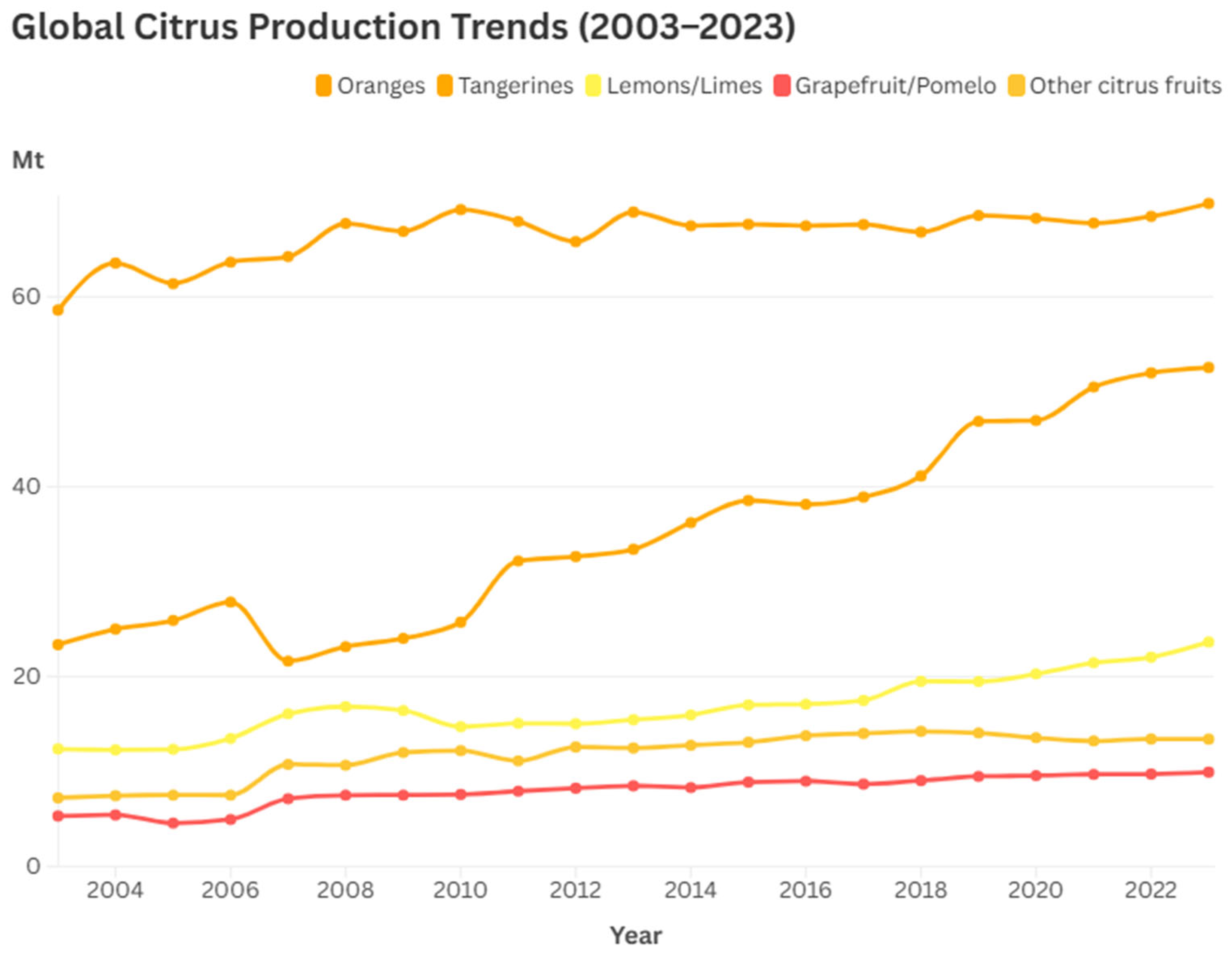
Figure 2.
Geographic Dominance in Citrus Production (2019–2023 Average): Top four producing nations per variety. Own elaboration with data from FAOStat (2023) [7].
Figure 2.
Geographic Dominance in Citrus Production (2019–2023 Average): Top four producing nations per variety. Own elaboration with data from FAOStat (2023) [7].
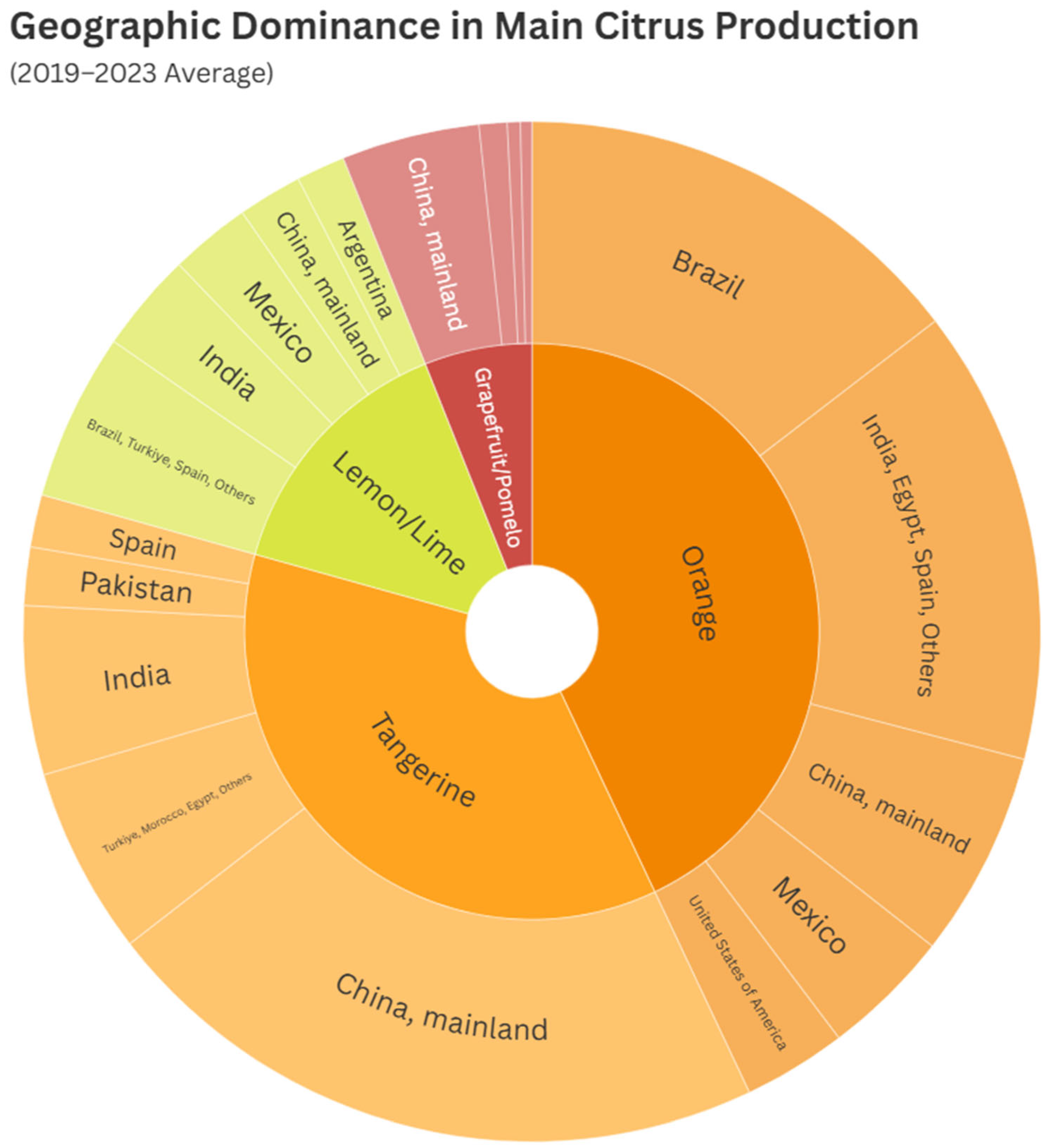
Figure 3.
Anatomical Distribution of Bioactive Compouds in Citrus Fruit (C. sinensis): Valorization potential of Peel, Pulp, and Seed Residues. Own elaboration with data from.
Figure 3.
Anatomical Distribution of Bioactive Compouds in Citrus Fruit (C. sinensis): Valorization potential of Peel, Pulp, and Seed Residues. Own elaboration with data from.
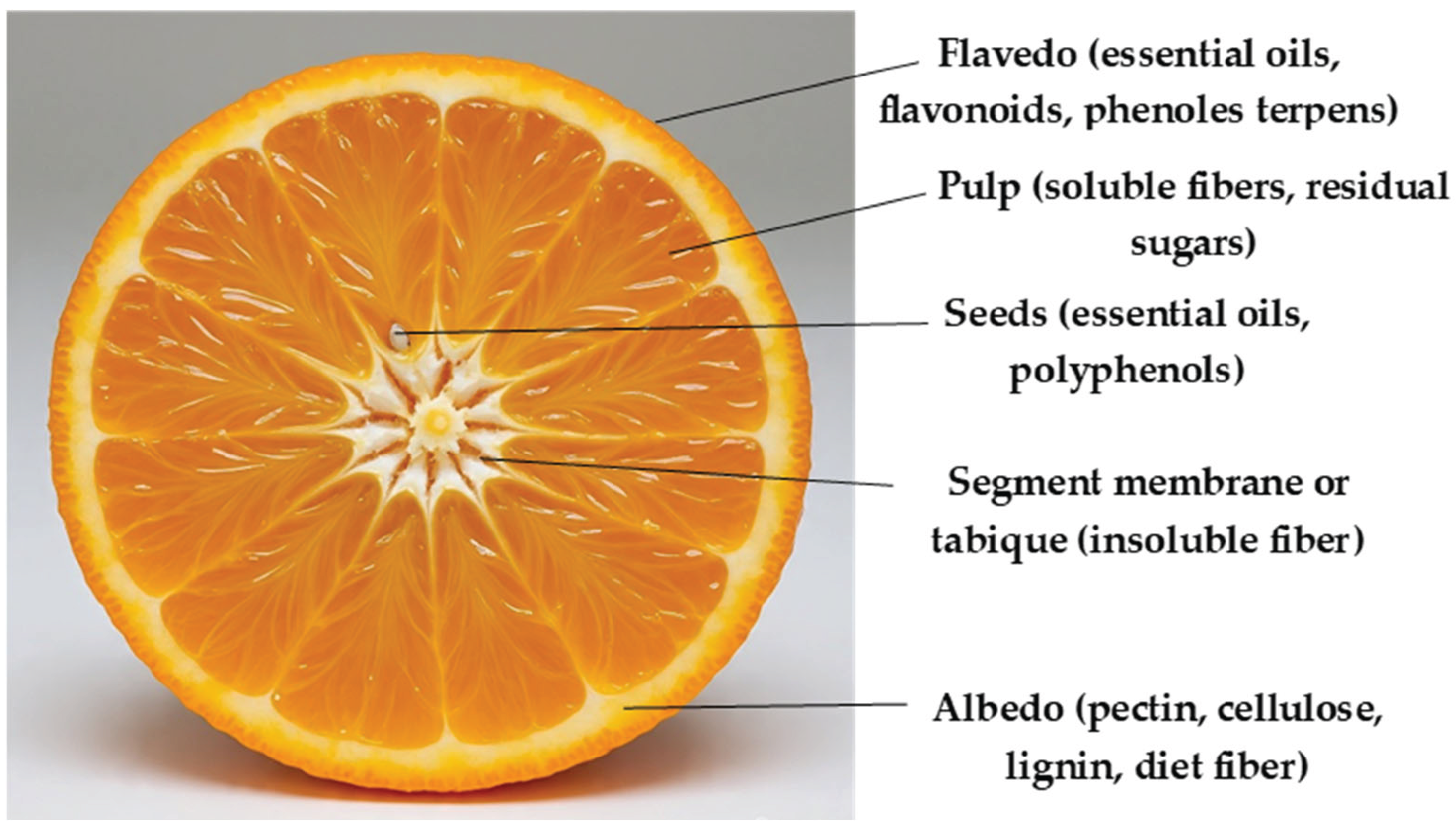
Figure 4.
Conceptual map illustrating the valorization pathways of citrus waste, including direct uses and biorefinery processes.
Figure 4.
Conceptual map illustrating the valorization pathways of citrus waste, including direct uses and biorefinery processes.
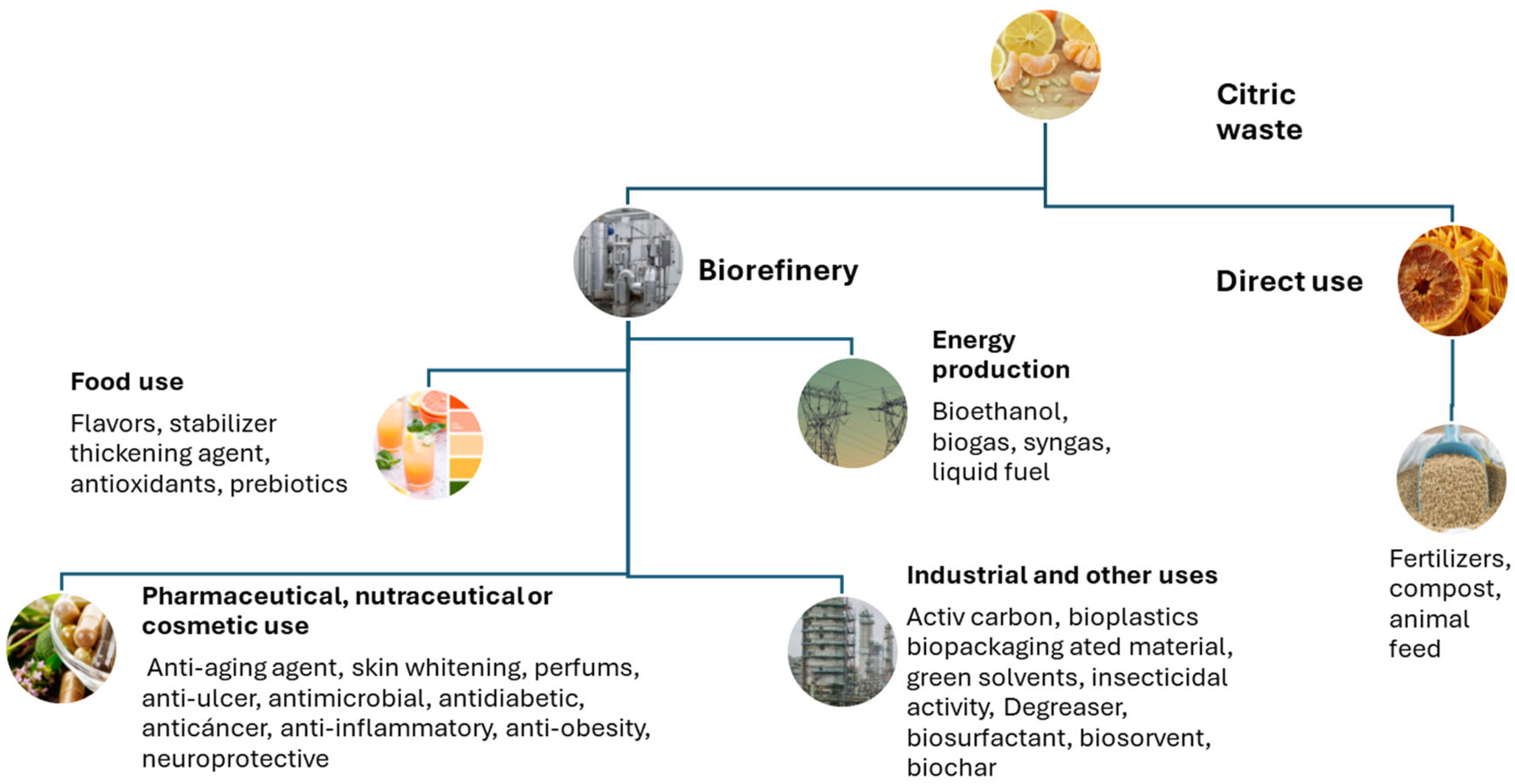

Table 1.
Quantitative composition of key bioactive compounds in citrus peel residues under different extraction methods.
Table 1.
Quantitative composition of key bioactive compounds in citrus peel residues under different extraction methods.
| Compoud | Orange | Lemon | Tangerine, mandarin or clementine | Grapefruit | Reference |
| Pectin (% DW) | 23.02 ± 2.12 18.49 ± 1.74 18.73 ± 1.19 |
13.00 ± 1.06 16.61 |
16.0 21.95 15.23 |
8.5 17.92 |
[44,45,46,47,48,49,50] |
| Cellulose (% DW) | 37.08 ± 3.10 19.73 ± 0.93 17.02 ± 2.70 |
23.06 ± 2.11 | 22.5 17.29 ± 1.02 |
26.57 | [17,44,45,46,50,51] |
| Hemicellulose (% DW) | 11.04 ± 1.05 6.33 ± 0.14 37.2 ± 3.3 |
8.09 ± 0.81 | 6.0 11.38 ± 0.98 |
5.60 | [17,44,45,46,50,51] |
| Lignin (% DW) | 7.52 ± 0.59 4.18 ± 0.69 |
7.56 ± 0.54 | 8.8 0.56 |
11.6 | [44,45,46,50,52] |
| Sugars (% DW) | 9.6 21.06 ± 1.93 |
6.5 | 10.1 | 8.1 | [44,45,50] |
| Carotenoids (μg/gβ-caroten) | 50.94 ± 2.28 6.30 |
11.09 ± 0.47 | 98.80 ± 2.95 | 3.61 - 61.42 | [48,53,54] |
| D-Limonene (% EO) | 94.88 | 94.427 | 97.38 | 90.92–93.98 | [48,55] |
|
Hesperidin (mg/g DW) |
2.07 ± 0.38 2.052 |
0.07 | 29.50 ± 0.32 13.74 64.45 58.60 |
0.071 0.62 – 1.09 |
[48,53,56] |
| TPC (mg GAE/g) | 12.20 66.36 12.59 |
15.74 18.12 15.22 |
30.84 152.57 58.68 |
21.17 12.48 |
[46,48] |
| TFC (mg QE/g) | 36.29 ± 5.69 | 30 ± 3 |
25.40 7.93 6.38 |
13.09 ± 0.06 | [48,57,58,59] |
Abreviations: DW = dry weight; EO = essential oil. TPC: total phenolic content expressed as mg gallic acid equivalent per g dry weight (mg GAE/g DW). TFC: total flavonoid content expressed as mg quercetin equivalent per g dry weight (mg QE/g DW). Values vary depending on extraction method (hydro distillation, supercritical CO₂, ultrasonication, high hydrostatic pressure, etc.).
Table 2.
Key Technologies for Citrus Waste Valorization.
| Technology | Target Product(s) | Key Advantage | Author(s) |
| Deep eutectic solvents (DES) | Flavonoids, microcellulose | high selectivity, green chemistry | [60,63,64] |
| Supercritical CO₂ extraction | Limonene, phenolics | no thermal degradation, high purity | [65,67,77] |
| Ultrasonication | Pectin, CNCs | energy efficient, high yield | [64,78,79] |
| Nanoencapsulation | Essential oils | controlled release, enhanced food safety | [2,5,80] |
| Enzymatic hydrolysis | Prebiotic oligosaccharides, sugars | mild conditions, prodution of functional products | [81,82,83] |
| Microbial fermentation | Biosurfactants, L-lactic acid, bioethanol, feed | Biochemical diversity, sustainability, high yield | [2,51,72,76,84,85,86,87] |
| Enzyme production | Cellulases, pectinases, xylanases | Supports biorefineries, circular economy | [23,88,89] |
Table 3.
State of the art and future directions in citrus waste valorization.
| Focus Area | Recent Advances | Key Challenges | References |
| Nanocellulose | Flexible electronics, biopolymer high-performance reinforcement, composites | industrial scale-up, reproducibility, byproduct safety | [6,64,163] |
| Limonene-based polymers | Bio-based plastics, vitrimers, sustainable coatings | process optimization, market adoption | [52,117] |
| Biochar | Soil remediation, carbon sequestration, nutrient retention | standardization of pyrolysis processes, long-term agronomic trials, scaling in diverse soils | [73,81,95,96,102,164,165] |
| Nutraceuticals (Hesperidin & Flavonoids) | Advanced drug delivery (nanoformulations, bilosomes), anti-inflammatory therapies | clinical validation, bioavailability, regulatory approval in functional foods and nutraceuticals | [8,76,77,78,79,80] |
| AI & circular models | Process optimization, industrial symbiosis, blockchain-based traceability | technological integration, real-time compositional data, cost of implementation | [66,69,162] |
| Ecotoxicity & LCA | Initial risk assessments for citrus-derived nanomaterials, partial LCAs reported | long-term ecotoxicological studies, comprehensive cradle-to-grave life cycle analyses | [112,121,166,167] |
| Consumer acceptance & market integration | Growing demand for natural additives, functional packaging, textiles (Orange Fiber S.r.l.) | consumer awareness, certification frameworks, equitable access for SMEs in emerging economies | [27,75,83,125] |
| Policy & governance | National circular economy roadmaps, EU Green Deal alignment, pilot regulations | lack of harmonized standards for nanomaterials, limited incentives in Latin America/Asia | [22,109,110,111,112,114,115] |
Disclaimer/Publisher’s Note: The statements, opinions and data contained in all publications are solely those of the individual author(s) and contributor(s) and not of MDPI and/or the editor(s). MDPI and/or the editor(s) disclaim responsibility for any injury to people or property resulting from any ideas, methods, instructions or products referred to in the content. |
© 2025 by the authors. Licensee MDPI, Basel, Switzerland. This article is an open access article distributed under the terms and conditions of the Creative Commons Attribution (CC BY) license (http://creativecommons.org/licenses/by/4.0/).
Copyright: This open access article is published under a Creative Commons CC BY 4.0 license, which permit the free download, distribution, and reuse, provided that the author and preprint are cited in any reuse.


