Preprint
Article

This version is not peer-reviewed.

Waste to Electricity: Electricity from Used Brine of an Operating Flash Power Plant

Submitted:

28 September 2025

Posted:

29 September 2025

You are already at the latest version

Abstract

The power sector faces two main challenges of high greenhouse gas emissions responsible for global warming and high dependence on fossil fuels. Although geothermal energy is significant and can play a leading role in emission reduction through increased generation, most of the resources are low to medium temperature resources with most of the power being generated by flash power plants. The organic Rankine cycle (ORC) is a promising for waste heat and low to medium temperature heat recovery. This study analysis the feasibility of an Organic Rankine cycle (ORC) for extra power generation from used brim exiting flashing stations of an operating flash technology geothermal power plant. Depending on the thermodynamic conditions, it is possible to install an organic Rankine plant as a bottoming plant to a conventional geothermal power plant, most of which are the flash power plants. In this study, a review of the organic Rankine cycle is done as well as a preliminary design of an organic Rankine plant proposed to recover heat from waste brine for generation of extra electricity. The study targeted Olkaria 1 Power Plant in Kenya, which applied a single stage flash technology for power generation. to utilize waste heat in used geothermal fluid exiting the flash stations for Olkaria IV flash power plant in Kenya. It was demonstrated that used brine exists the flash station at 12 bar exits with heat content of about 2,268,960 MWth/hr (mega-watt thermal/hour) which can be used to generate to 7.39 MWe by development of an Organic Rankine cycle to use the waste energy in brine. The study proposes development of an ORC geothermal power plant to generate electricity from brine leaving flash tanks to reduce energy wastage in brine with on n-pentane as the working fluid. The preliminary design and analysis shows that the investment is technically and economically feasible.

Keywords: 
;  ;  ;  ;  
Article highlights
  • Geothermal energy is high but its contribution to electricity generation hence the need to maximize energy extraction from available resources.
  • Over 70% of global electricity generation is from single flash generation plants, which implies loss of useful energy in used brine.
  • The selection of the most appropriate working fluid influences the cost and performance of the organic Rankine cycle.
  • Developing an organic Rankine cycle plant to use waste brine from flash plants will have economic and environmental benefits through generation of extra electricity from waste brine.
  • The organic Rankine cycle is an effective thermodynamic cycle for waste heat and low to medium heat recovery.
  • The overall cycle efficiency and power generation can be increased by waste heat recovery using binary cycles

1. Introduction

The global medium and long term emissions and climate change objectives is to reduce the greenhouse gas emissions (GGE) and achieve climate-neutrality in a world where fossil fuels are the main sources of energy. As a commitment to these objectives, the European Union (EU), has set a target of a 32% share of renewable energy (RE) and 32.5% improvement in energy efficiency by the year 2030 [1,2,3]. The Organic Rankine cycle (ORC) is promising heat-to-electricity conversion technology to waste heat and renewable energy recovery from many sources and applications like geothermal, solar, waste heat and biomass [4,5]. Geothermal energy has abundant reserves and is a reliable source of low carbon and renewable energy for thermal and electrical applications. Geothermal power plants like other heat conversion systems generate waste heat whose quantity depends on the conversion technology. Waste heat recovery has got economic, technical, and environmental benefits worth considering [6,7]. Geothermal energy exists as heat with varying resource temperatures generally between 50oC to 350oC [1]. Unlike other renewable sources of energy like wind and solar, geothermal heat supply and extraction is stable and steady making it ideal for base load electricity supply at high-capacity factors of 90-95% [8,9]. The supply is always independent of prevailing climatic and weather conditions, is stable and cost effective [2,3].
Geothermal energy resource is a renewable form of energy extracted as heat from the ground for various applications in heat and power [10]. As a renewable source of energy, geothermal, heat and electricity have an important role to play in the realization of the Paris agreement [11,12]. Since, most of the geothermal resources are classified as low and medium temperature reservoirs, the organic Rankine cycle will prove useful for maximum power generation from geothermal fluids [13,14,15].
Geothermal energy contributes less than 1% of the global power generation output hence the need to identify more feasible geothermal resources while efficiently exploiting discovered or developed resources for electricity generation. Various technologies can be used to generate electricity from geothermal all employing flash steam technology. They include dry steam technology, flash steam, organic Rankine cycle or a combination of the basic technologies depending on costs required and financing as well as the resource [9,13]. In this study, the overall status of all separated brine in Olkaria field was reviewed with the objective of determining the electricity potential of used brine.
The Organic Rankine Cycle (ORC) system in power generation is like the conventional Rankine system except for differences in the working fluids used. For ORC, instead of water as the working fluid or heat carrier, an organic working fluid that has a lower boiling temperature and pressure is used as the working fluid [16]. The system is a closed loop process with a working fluid being carefully selected to suit the operating conditions and environment. The working fluid is heated and vaporized in the evaporator and is expanded through a turbine which is connected to an asynchronous generator for power generation. From the condenser, the working medium passes to the feed pumps, which pressurizes the working fluid to the cycle pressure of the hot end of the cycle. To obtain a high electric efficiency, the backpressure of the turbine should be maintained as low as possible [16]. The main strength of the Organic Rankine cycle is that it can recover low grade heat and thus its suitability for use in in low temperature geothermal fields [15].
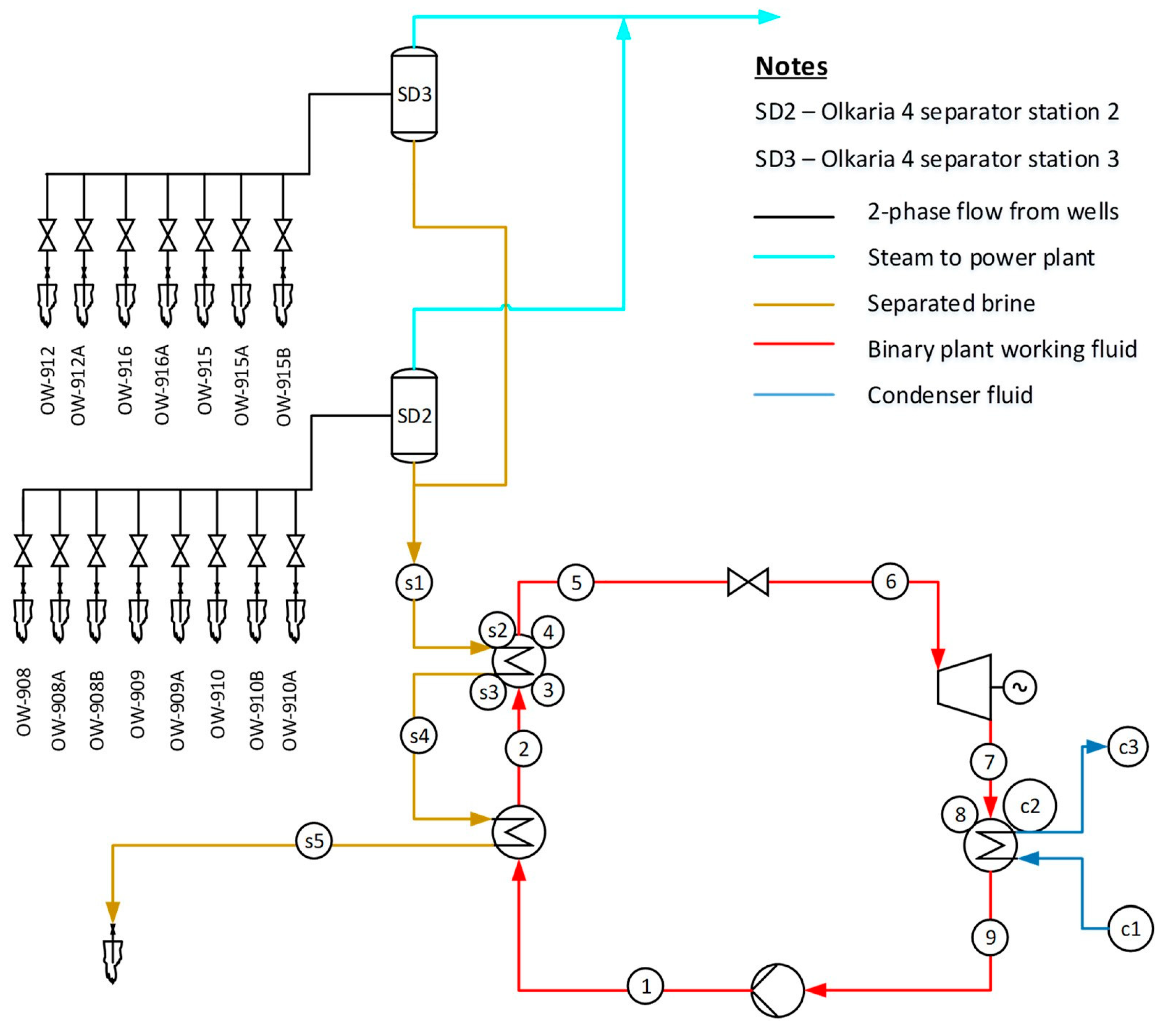
Organic Rankine cycle power plants are suitable for utilization of low-temperature energy sources (low-grade energy) such as geothermal resource having temperature below 150oC. This also includes brine or fluid from the flash chambers before injection to the injection well [17]. This study reviews the application of binary cycles in geothermal power generation and applies the organic Rankine cycle to recover heat from used brine from an operating flash power plant. This is done to reduce wastage of heat energy in geothermal resource fluid, increase efficiency of generation and power and generate extra revenue from the same geothermal resource [18,19]. Figure 1 below shows a binary plant that exploits used brine to generate extra power.
From Figure 1, it is observed that an ORC can be developed as a new plant but uses brine leaving the separator of the flash power plant.
The overall objective of this study is to review various binary cycles and their application in geothermal power generation. Waste brine leaving the Olkaria geothermal power stations in Kenya is analyzed for heat content and potential for extra power generation. In the last section of the analysis, a feasibility for an Organic Rankine cycle for Olkaria 4 power station is done with comparison for use of n-pentane and iso-butane as working fluids to establish the best option for power generation through a preliminary design of an Organic Rankine power plant. utilizing the used geothermal fluid from the flashing stations of Olkaria IV power plant. The study then recommends a detailed design that recognizes the strengths and weaknesses of the preliminary design.

1.1. Problem Statement

There are extremely abundant waste heat sources from industrial thermal systems, cooling systems, and many others. Economic recovery of these waste heat to useful electricity, will have significant tangible and very positive impact on energy consumption, health, and carbon emissions in sectors like manufacturing [20]. The concerns over greenhouse gas emissions mainly from non-renewable fossil fuels, and progress in clean energy technologies low grade waste heat recovery has become an important subject for research motivated by the fact that about 50% of global energy use is wasted due to efficiency limitations in the conversion process [21].
Over 60% of global electricity generation is derived from fossil fuel sources. This puts significant pressure on water resources, cause environmental pollution with emission of greenhouse gases and related global warming [6,22]. Additionally, the generation cycles used are inefficient leading to large amount of waste heat. The is the same case for geothermal sources using flash and dry steam technology. This is wasteful and should be limited by use of more efficient cycles like binary that have ability to extract heat from low temperature sources [23]. Most geothermal power plants globally use conventional and wellhead technologies which apply three basic conversion technologies, i.e., dry steam, flash and binary cycle generation technologies [14,24]. Most power plants use the flash technology which uses a separator or flash tank to isolate dry steam and moisture which forms brine. This brine often has significant quantities of recoverable energy that can be used for extra power generation [25]. The organic Rankine Cycle system is a feasible technology that can be used favorably in terms of technical sustainability, cost of investment, operation and maintenance while utilizing low and medium enthalpy geothermal fluids for heat and power generation [5,26,27].

1.2. Rationale of the Study

The world community is striving to reduce greenhouse gas emissions and limit global warming below 2 °C as agreed in the 2015 UN Climate Change Conference, at Paris [3]. Geothermal energy is renewable, sustainable, and green energy source for power generation, but it remains underutilized globally. As an example, in 2018, the globally installed generation capacity was 13.3 GW accounting for just 0.57% of total renewable energy capacity, hence the need to optimize any developed geothermal resources for maximum power production [28]. Waste heat recovery is a feasible option to reduce greenhouse gas emissions and hence diminish the environmental impact energy systems and processes. Waste heat recovery has a huge potential globally, for example energy wasted by the U.S. industrial systems has potential to produce about 20% of U.S. electricity capacity without burning any fossil fuels. Various countries committed to reduce emissions in line with Paris agreement, for example the EU countries have a target to reduce emissions by about 20%, which makes waste heat recovery a very attractive option.
Heat recovery from wastes and low grade heat sources like solar is an important strategy in reducing greenhouse gas emissions through efficiency measures [29]. In addition, given the target of reducing about 20% the emission of the EU countries, increasing efficiency and heat recovery from industrial processes will be crucial. Energy from waste heat conversion could be up to 2% of the European Industry energy use, which can effectively reduce emissions [30]. The basic ORC has significantly improved over years through research and development to operate over various conditions of the heat source. Countries like Kenya which are developing their geothermal resources for the last four decades mainly using flash conversion technology, should consider the binary power cycle for optimum exploitation of geothermal fields especially in Olkaria waste brine has s significant energy content [31].
The organic Rankine cycle is a system that can be used to exploit low and medium enthalpy geothermal resources which are the most dominant. The cycle has also proved to be more efficient in the extraction of low grade geothermal fluid which may be difficult to exploit with the conventional Rankine cycle technology [25,32]. As for the case of the operating Olkaria power plants, brine with temperature above 170oC and pressure of about 16 bars is return to the underground through the injection well [24]. Studies have shown that the cost for double flash plants is 5% higher than that of single flash; however, the plant output increased by 20 to 25%. The efficiency of double flash system is about 3% greater than that of single flash system. Flash steam power plants have low efficiency despite their simple construction structure and low cost [33,34].
The growing concern over the emissions and climatic changes have increased the importance of the optimization of conventional thermodynamic systems in power production. Compared with other technologies like, Kalina cycle, Trilateral Flash cycle and Supercritical cycle, the organic Rankine cycle claims to produce 15–50% more power output for the same heat and is ideal for low-temperature heat recovery for power generation with low maintenance costs [29].

2. Methodology N

2.1. Novelty and Contribution

Geothermal Energy Conversion Cycles

Geothermal Energy Conversion Cycles
Geothermal power plants are classified based on the energy conversion system used. Based on the conversion technology, geothermal power plants can be classified as flash dry steam plants, flash steam plants or binary cycle plants [13]. The technology selection is guided by the thermodynamic properties of the steam or geothermal fluid and other factors like cost and size of the steam field [10]. The thermodynamic properties of the resource, especially temperature influences the resource application and the most appropriate energy conversion technology. The conventional Rankine cycle steam turbines normally operate at a temperature above 180°C (350°F) while non-electrical applications can efficiently use geothermal resources with temperatures of 40°C to 180°C, based on specific application [35].
There are three categories of geothermal fluid based on steam temperature, i.e., high temperature for above 150oC, medium for temperature between 90oC and 150oC and low temperature resources if the resource temperature is less than 90oC [36].
Geothermal power plants function like fossil fuel and nuclear power plants except for the source of heat which is hot water or steam from earth through a series of pipelines to the power plant. The mechanical power is generated by the rotation of the turbine blades upon expansion of steam. The turbine shaft is coupled to a generator which then generates electric power. The condensate is normally reinjected back to the reservoir [37,38].
There are three basic types of geothermal heat to electricity conversion technologies globally. These are the dry steam, flash steam, and binary cycles which are selected based on the thermodynamic properties of the geothermal fluid [13,14]. Dry steam power plants use dry steam, but they are very few because of the scarcity of the dry steam geothermal resources. For hydrothermal fluids with temperature above 170°C, the most commonly used conversion system is the flash steam technology [39,40]. In this technology, hot water under pressure comes out of the production well and is sprayed into a flash tank at a lower pressure than the fluid, which causes it to vaporize to steam. In dual-flash plants the fluid that does not vaporize in the first flash tank undergoes a second stage of flashing to generate steam at a pressure lower than the first. Triple and even quad flashing can be done based on the design and geothermal fluid conditions [41]. For much lower fluid temperature below 150oC, the binary cycle technology is applied where a secondary low temperature boiling fluid is used to extract heat from the geothermal fluid. The secondary fluid then vaporizes and is used to drive a steam turbine by expanding through the turbine blades [13,37,38].

2.2. Dry Steam Plants

For conventional steam power plants, water is converted to dry superheated steam and used to expand in a steam turbine to perform mechanical work which spins the turbine rotor coupled to a generator for power generation [34,39]. For high enthalpy geothermal fluid normally with temperatures above 200OC existing as saturated or dry steam is piped directly to a steam turbine to generate power [42]. Dry steam geothermal plants are rare because geothermal resources with such favorable conditions are scarce. Such resources are found at Larderello in Italy and The Geysers (USA), Yellowstone National Park in Wyoming (USA) which is in a protected area hence not developed and very few other known places globally [9,13,43]. Other sites with dry steam geothermal resources are Lake counties in Northern California, Old Faithful geyser at the Yellowstone National Park in Wyoming [44], and the Kamojas in Indonesia [13,35,45].
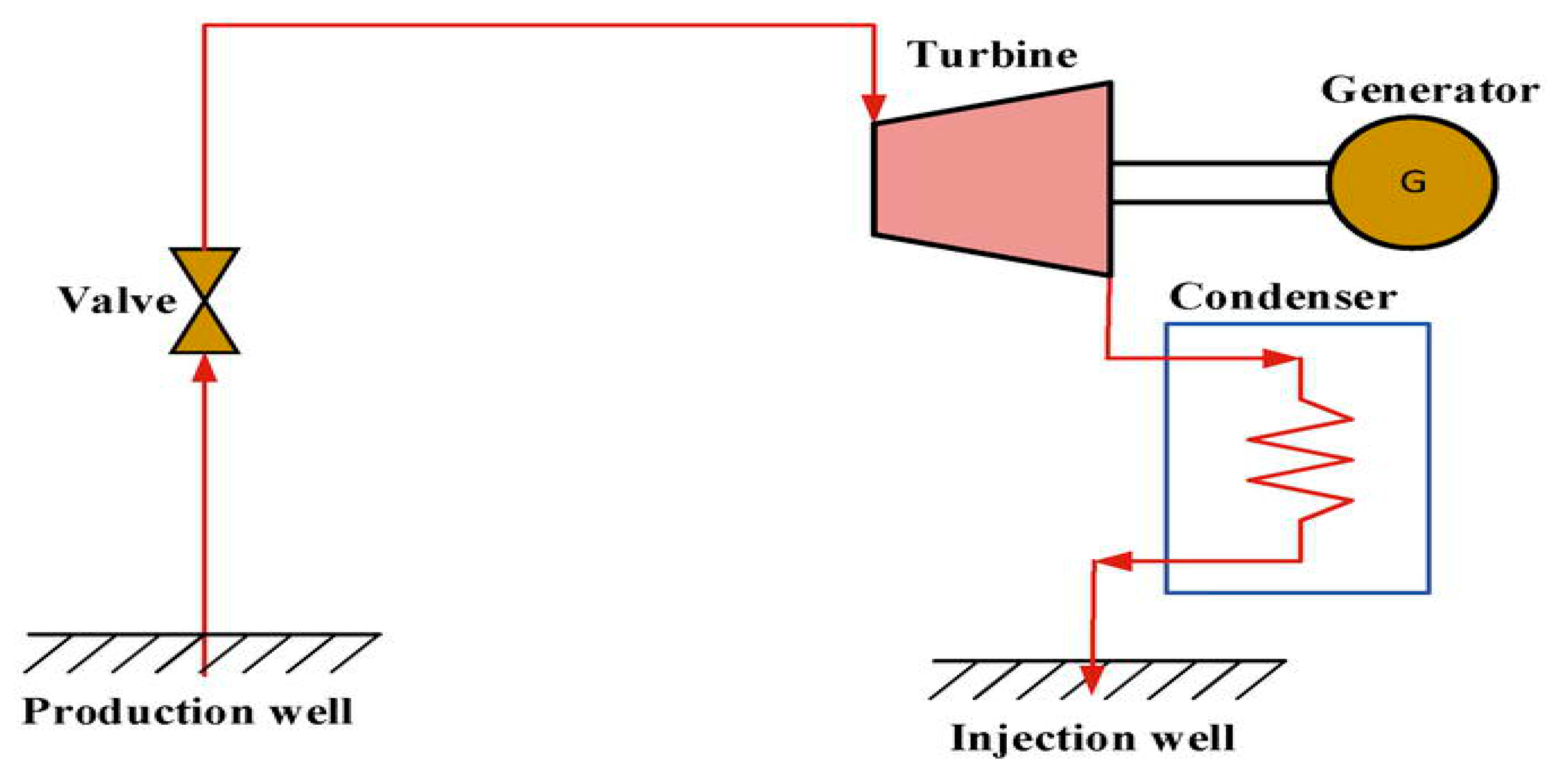
In dry steam power plants, dry steam is drawn from the production wells and directed to a turbine/generator coupled to a synchronous generator. This technology was first used in 1904 at Lardarello in Italy which is also the oldest geothermal power plant. Figure 2 below illustrates a dry steam power plant.
Figure 2 shows a dry steam power plant with steam from the production well piped to the steam turbine through a control valve.
The main features of a dry steam power plant which include a production well, injection well, reservoir with dry steam, steam turbine, generator, condenser, and cooling tower. According to [13,45] in a dry steam plant, steam is directed from a production well to the turbine from production well is delivered directly to the steam turbine via a strainer to remove any solid impurities while the condensate reinjected through reinjection wells. The average power plant size is 45 MWe.

2.3. The Flash System

A flash system, hot water or wet steam is directed to a separator where it flashes to low pressure steam and a liquid. Pressure reduction the separator or flash vessel causes the geothermal fluid to flash or vaporizes, into dry steam which is directed to a steam turbine for power generation. The exhaust steam exiting the turbine is condensed and reinjected to the reservoir [35]. Flash systems are used for resources existing as a two-phase mixture at high temperature [14]. The flash steam power plant systems are equipped with a separator which causes pressure drop that causes steam to be separated from the water. Steam generated is directed to a steam turbine where it expands and condenses. The condensate is collected with the brine and reinjected back into the reservoir [39,40,42]. Flash power plants can be single, double flash, triple flash etc. based on the number of flashing stages.
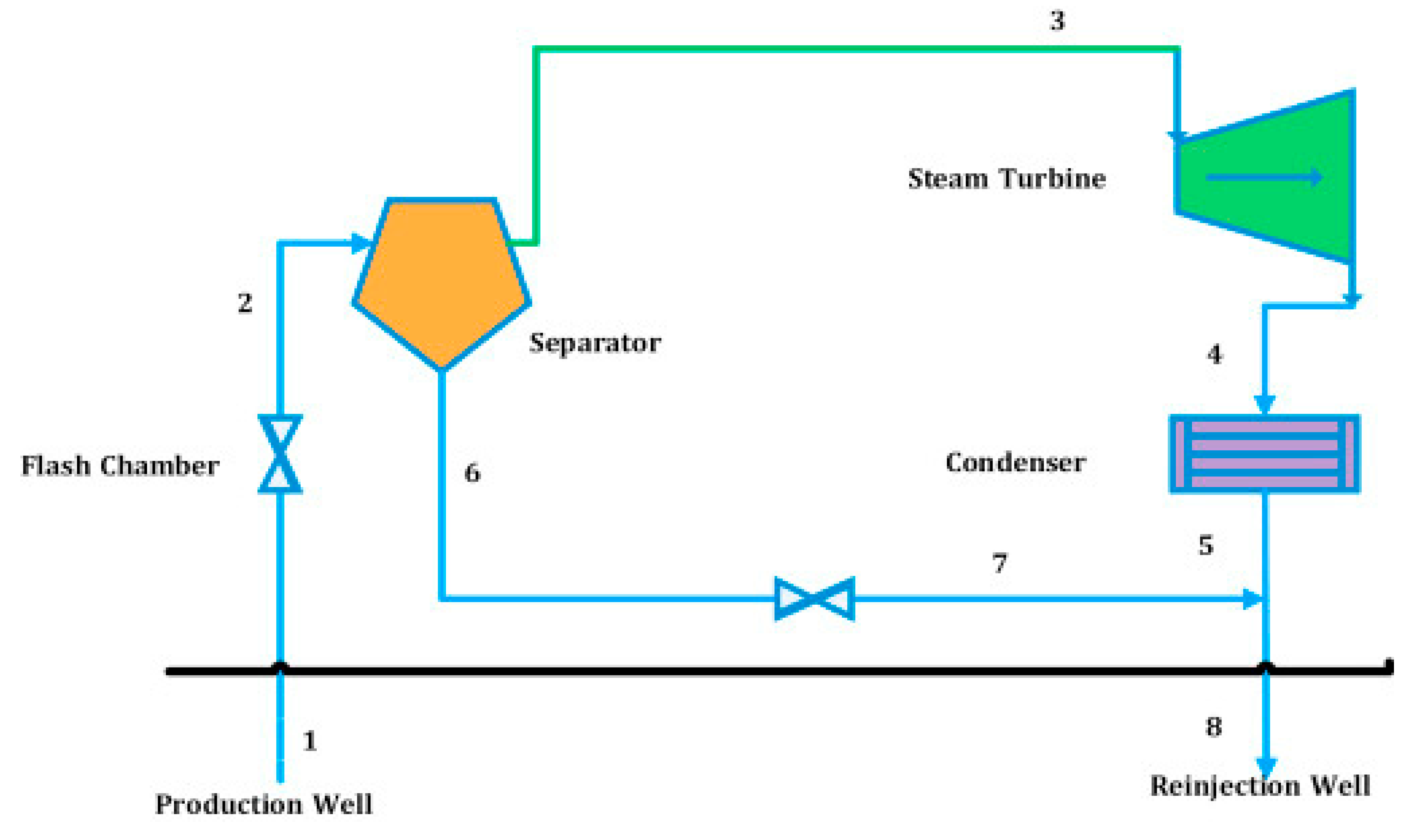
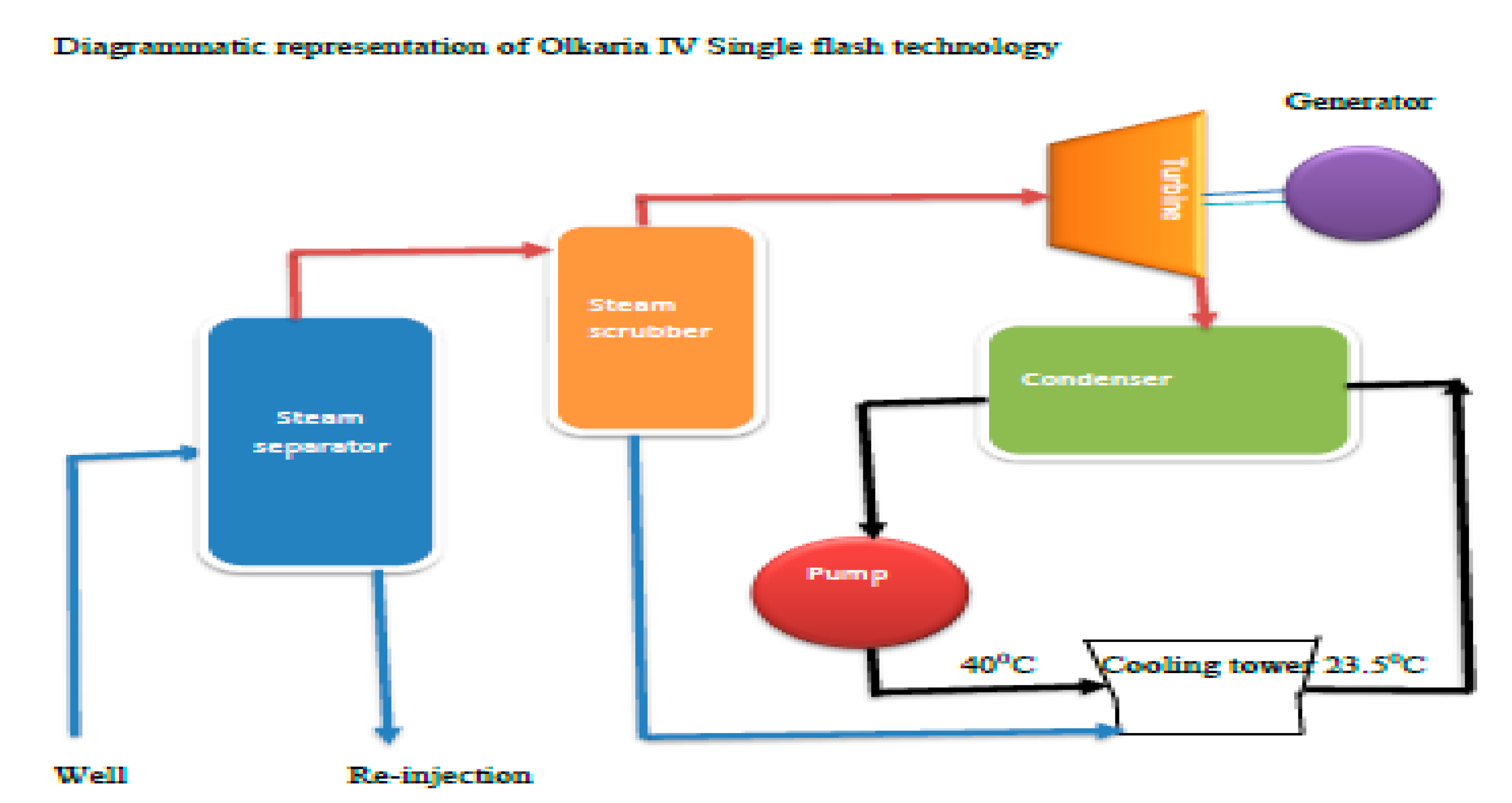
Single-flash geothermal system is the most prevalent geothermal power generation system globally and remains the most appropriate system of power generation for liquid-dominated geothermal system. In the year 2007, 159 single flash systems were in operation in 18 countries and accounted for 42% of global geothermal generation capacity. The system capacities generally varied from 3 MW to 90 MW while the average capacity for flash power plants was about 25.3 MW [46]. In single flash system, the geothermal fluid from the reservoir is separated in the separator to form steam and brine [47]. The largest single site binary power plant is the 100 MW Ngatamariki power plant in Central North Island of New Zealand, close to Taupo city with average fluid temperature of 1930C [24]. Figure 3 below illustrates a single flash geothermal power generating system.
From Figure 3, it is noted that the single flash geothermal system consists of the production well, a single separator which supplies steam to a steam turbine and the injection well which reinjects the brine and condensate to the reservoir.

2.4. Binary Power Plants

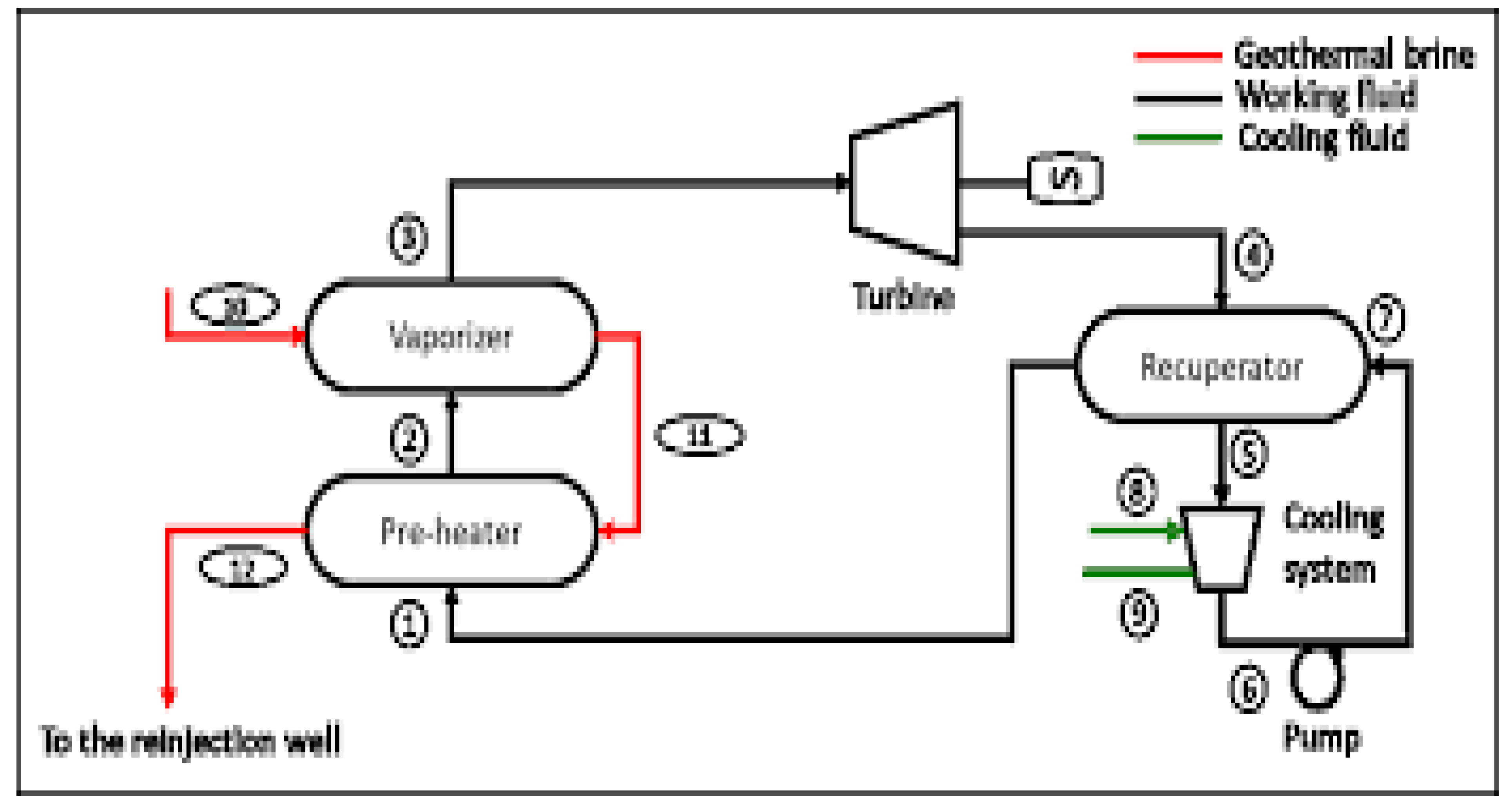
Binary cycles are used to convert medium-low temperature geothermal resources to electric power, mainly as organic Rankine, Kalina cycles and Goswami cycles [23]. Binary cycles use two fluids in a closed loop cycle, one being the geothermal resource fluid and the other an organic working fluid [13]. The geothermal fluid is passed through a heat exchanger where heat is transferred to a low temperature boiling fluid like Isobutane which acts as a working fluid [14]. The working fluid vaporizes and expands through a turbine which rotates the shaft coupled to a generator for power production. The working fluid is then condensed and recycled through the heat exchanger repeatedly. The geothermal fluid leaving the heat exchanger in a single pass is often reinjected back to the reservoir [35]. Figure 4 shows the general configuration of a binary cycle plant.
Figure 4 shows that basic construction of a binary cycle with three fluids, namely geothermal fluid, the working fluid, cooling fluid, a preheater, evaporator, turbine/expander and the recuperator. Among binary cycles, the organic Rankine cycle is identified as the best cycle for low temperature thermal energy sources [48,49].

2.4.1. Organic Rankine and Kalina Cycles

There are various types of binary cycles used in geothermal power plants based on the selected working fluid. They are mainly classified into Organic Rankine cycles which use refrigerants or organic fluids, Kalina and Goswami cycles which use ammonia mixtures [10]. In Organic Rankine Power plants, the geothermal fluid heats up and pressurizes a low boiling temperature and pressure a secondary fluid like penta-fluoropropane and Isobutane which normally in a closed cycle and hence no mixing. There are various working fluids available for selection influenced by various techno-economic factors. The organic Rankine cycle is a preferred technology for low enthalpy geothermal and for fluid temperatures lower than 150°C. However, with working fluids like R600a/R161 fluids the process can be applied for fluids with temperatures of up to 200OC [13,39,50]. The organic Rankine cycle technology is considered mature with many such power plants operating globally, although their sizes are often small hence their lower share of installed capacity [14,39,40]. Globally, 162 ORC units were in operation in May 2007 with capacity of 373 MW in 17 countries. This was about 4% of total geothermal power generating capacity yet the in terms of generating units was about 32% of the total [26,51]. This is because the organic Rankine cycle plants are often small in capacity.
Technically, the binary power plants are designed to operate with two thermodynamic cycles consisting of a geothermal fluid loop and a power cycle loop and are classified as either organic Rankine Cycle plants or Kalina plants based on the working fluid used [52]. Kalina cycles use a mixture of 70% ammonia and 30% water as the working fluid with higher efficiency and exergy potential compared to the Organic Rankine cycles [53]. The Kalina cycle is a modified Rankine cycle the uses a distillation separator and absorption recuperator and was invented by Alex Kalina in 1980s. These power plants are safer, have lower capital costs and are simpler with possible applications in both small and big power plants sizes 50-100 MW. With adequate optimization, Kalina cycles can be as high as 2.1 more efficient and generate 14.7% more power output than the Rankine cycle power plants can [54,55].
The thermal gradient between the geothermal fluid and the working fluid facilitates heat transfer via a heat exchanger. The working fluid is heated, vaporizes, and expands through a turbine which rotates turning a synchronous generator coupled to it for power generation. For power generation. The geothermal fluid from the heat exchanger is then injected in a closed loop, to the reservoir hence lowering emission rates as compared to other technologies of geothermal power generation [13,14,56]. Figure 2 below illustrates an organic Rankine geothermal power system.
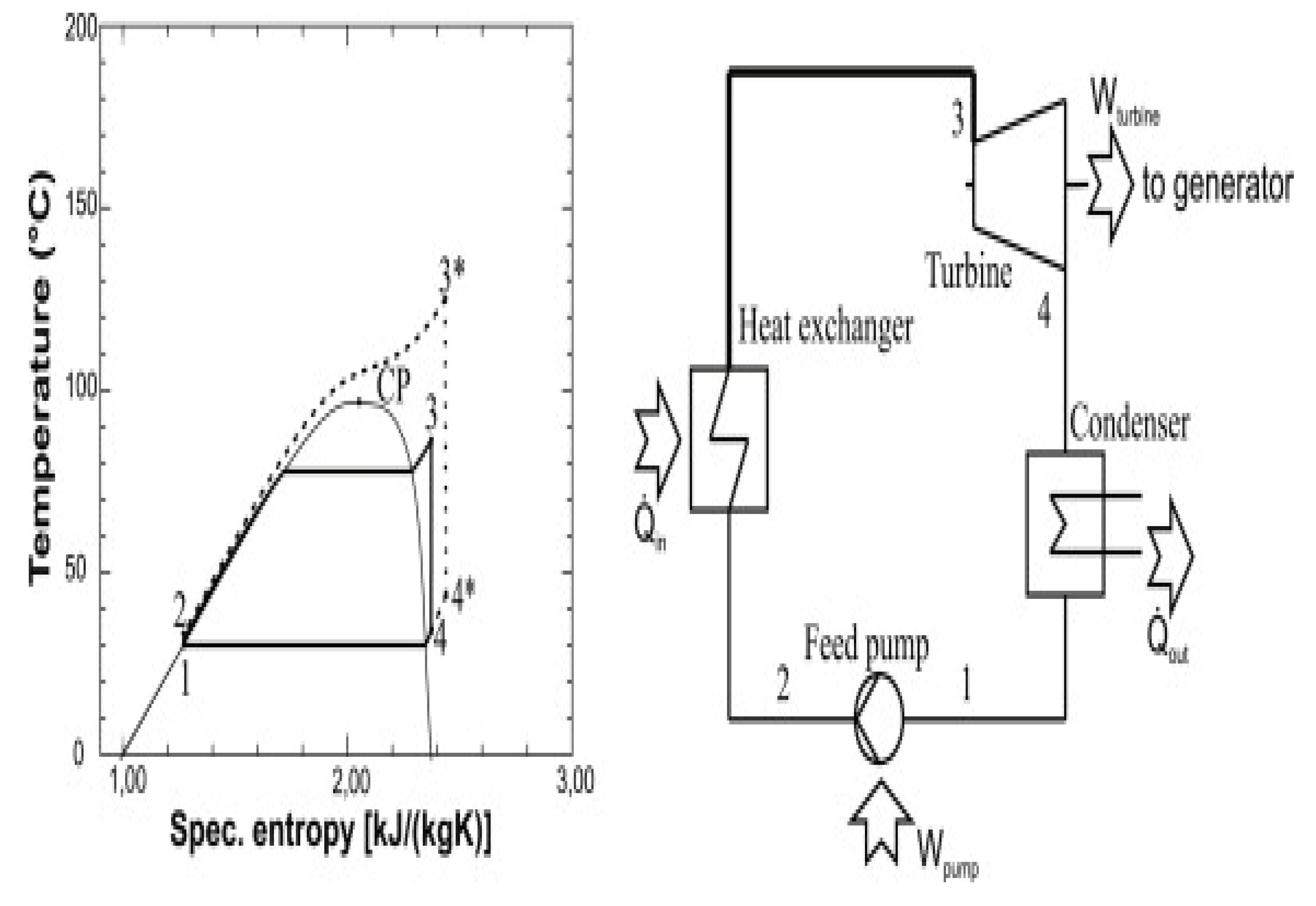
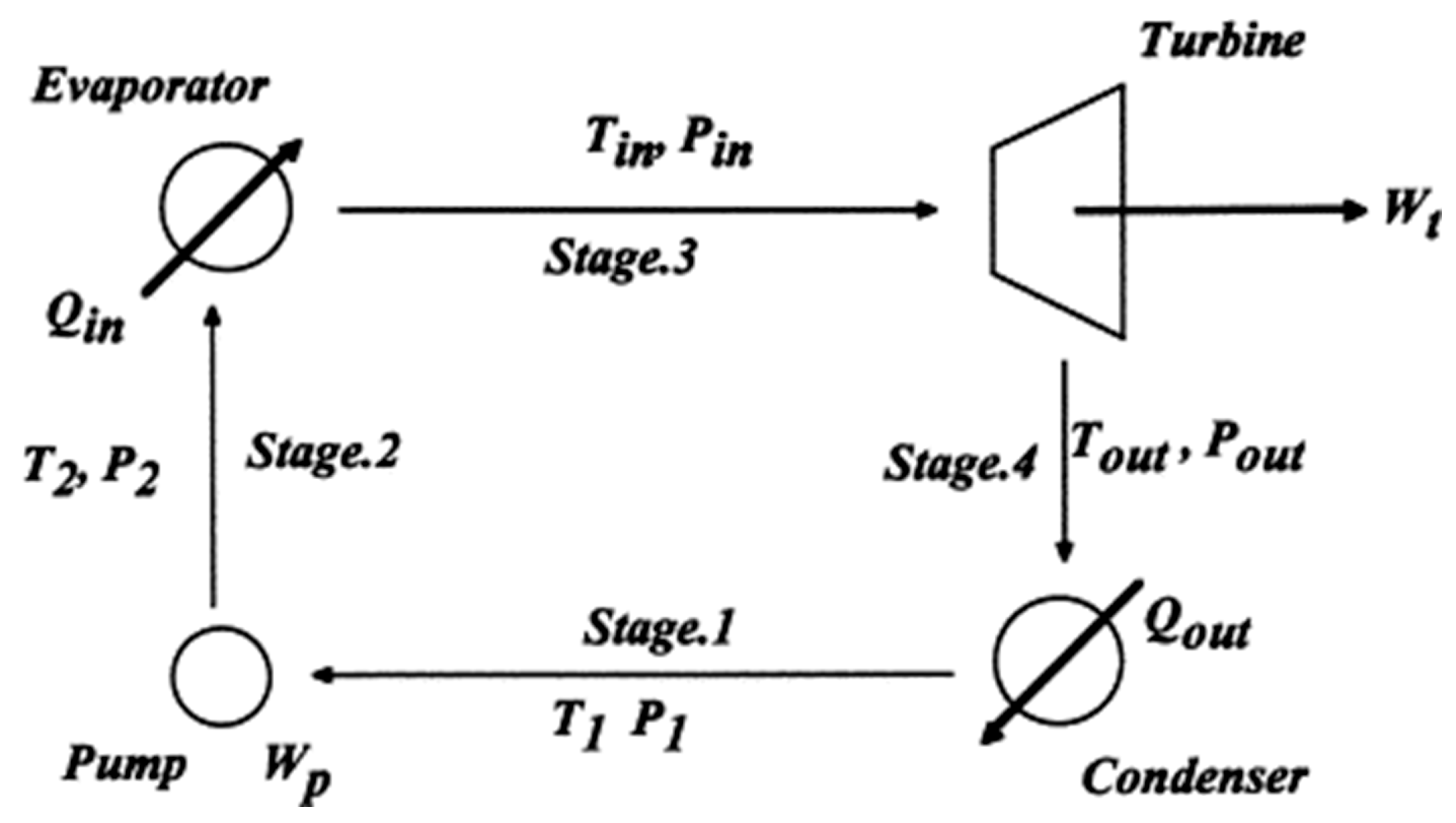
The organic Rankine system is a state-of-the-art technology used for conversion of medium–low temperature geothermal energy into electricity. The cycle consists offour main elements or components namely the boiler or evaporator, turbine, with generator, the condenser, and a pump. The fluid is vaporized in the boiler before it goes to drive a turbine or expander for mechanical work production [23]. Electricity is generated by a synchronous electric generator coupled to the expander. The exhaust from the expander is directed to a condenser where it condenses to a saturated liquid which is pumped to the boiler for another cycle to start in a closed system.
Lifetime of the organic Rankine Cycle power plant is on average 30 years, ORC power systems usually could be up to 30 years, and generally higher than conventional Rankine cycle power plants. The main threat in Organic Rankine cycle plants is condensation of the working fluid in the turbine which can lead to turbine blade corrosion. This can be reduced by working fluid superheating and proper selection of the working fluid for optimum operation [17].
An organic Rankine cycle generating system has got the main elements being the reservoir, production and used fluid injection well, cooling water feed pump, working fluid feed pump, working fluid condenser and preheater unit, power turbine and a generator unit for power generation. The secondary loop fluid exits the turbine at a lower pressure after expansion in the turbine and goes to the condenser where it is condensed and recirculated [9].
Globally today, the binary plants are one of the most widely used geothermal power plants with 155 units in operation in July 2004, that produced 274 MWe of electricity in 16 countries that accounted for 33% of the installed units. However, because of size limitations as they are usually small in capacity with average size of .8 MW, they accounted for about 3% of the total installed generation capacity of geothermal power. However bigger units of sizes f 7–10 MW have been developed [10,26]. Most power plants globally use the conventional steam turbines, while about 20%, use the binary cycles. In plant design any power station configuration chosen should seek to maximize the exergy efficiency of the whole system i.e. the resource and plant use not just the system thermal efficiency of the plant [57].

2.4.2. Organic Flash Cycle (OFC)/Regenerative Cycles

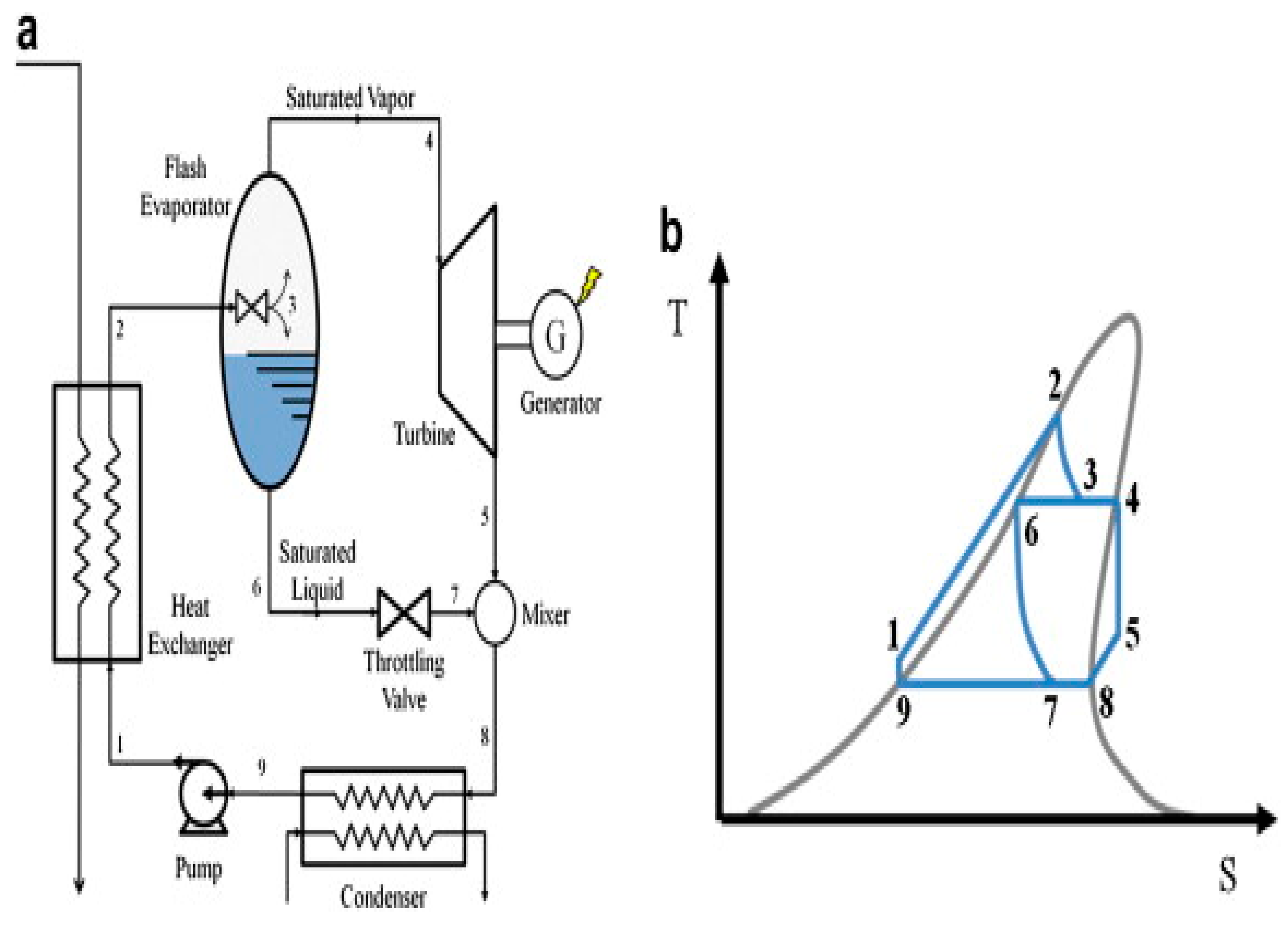
An organic flash cycle (OFC) is said to be a modified trilateral cycle that avoids the state of isothermal evaporation and avoids a two-phase expander in the cycle and as a result the organic flash cycle significantly reduces the irreversibility during the evaporation of the working [21]. The working fluid is heated to saturation and flashed by throttling. The saturated vapor the flash separator then expands through a turbine hence doing some work and rotating it. In a basic organic flash cycle, the working fluid in saturated form from the separator and turbine exhaust are responsible for the largest part of the total heat input. System performance can be improved by recovery of heat from the saturated liquid or the turbine exhaust to preheat the working fluid [58].
Organic Flash Cycles (OFCs) are used to achieve a good temperature match between the two fluids to minimize heat loss from a saturated liquid in the flash separator which reduces the cycle efficiency. Thermodynamic performance can be improved by regeneration through recovery of more heat from the saturated liquid to be used in preheating the working fluid [23]. In regeneration, the evaporation and flash temperatures are optimized for maximum net power generation for geothermal fluid temperatures between 120 °C to 180 °C having reinjection temperature of 70 °C. The optimal flash temperatures for organic flash cycle with regenerator (ROFC), the organic flash cycle with regenerator and organic flash cycle with internal heat exchanger (ROFC + IHE ) as well as the modified organic flash cycle (MOFC ) low compared with that of a basic organic flash cycle (BOFC) because of the limits of the preheat load and the pinch point which lead to a higher vapor mass flow rates [23,59]. The net power output increase and the decreases in the evaporator exergy losses by ROFC, ROFC + IHE and MOFC compared with those of BOFC tend to decrease with increasing geothermal water inlet temperature. A modified organic flash cycle (MOFC) can produce maximum net power which is up to 66.2% greater than power from the basic organic flash cycle (BOFC) for a geothermal fluid temperature of 120 ℃. The main limitation of the modified organic flash Rankine cycle (MOFC) is that it requires more evaporator area of about 51–78%, less condenser area by 13–42% less to produce same power as the BOFC [23]
In the study by [58] involving the use of a double flash Organic flash cycle O(FC), a modified OFC, two-phase OFC and a 2 phase MOFC showed that modified OFC (MOFC) generated 10–12% extra power compared to a conventional ORC. To reduce throttling irreversibility, a two-phase expander was adopted in the place a high-pressure throttling valve in the two-phase OFC. A two- phase MOFC produced up to 20% more net power compared to an ordinary ORC [58]. In terms of thermodynamic efficiency and economics of OFC and regenerative cycles (OFRC), [59] it was established that the unit cost of the OFRC was reduced and the efficiency of a double-flash OFRC was better than that of conventional ORCs [60]. Figure 5 shows an organic flash cycle.
Figure 5 shows the main elements of an organic flash cycle in 5a and a T-S thermodynamic representation of the cycle in 5b. The main elements are the flash evaporator, heat exchanger, condenser, pump, mixer, and throttling valve

2.4.3. Supercritical Organic Rankine Cycles

Supercritical ORCs, the Organic Rankine cycles applying zeotropic mixtures, trilateral cycles as well as the organic flash cycles (OFCs) can improve the temperature matching and thermal efficiencies. In a supercritical Organic Rankine cycle, the evaporation pressure for a supercritical ORC should be made greater than the critical pressure of the working fluid to avoid the isothermal evaporation which improves temperature matching between the working fluid and the heat source fluid. However, higher turbine inlet pressure causes increase in pump power consumption, increases the investment cost, as well as operational safety requirements. The use of a non-isothermal phase change of a zeotropic mixture allows for a good match of the temperature profiles in the process of evaporation and condensation. The main challenges of zeotropic mixtures are the uncertainty over the thermodynamic properties of the fluid which inhibits accuracy of computational models and efficient system design. Additionally, the heat transfer coefficients of zeotropic mixtures are lower hence require larger surface areas for adequate heat transfer. In a trilateral cycle, the liquid-phase working fluid absorbs heat from heating fluid in the cycle [35]. Desired reduction in heat transfer irreversibility by adaptive temperature matching between the working fluid and the heat heating fluid. However, the design of two-phase expanders with high isentropic efficiencies is still challenging [48]. Figure 6 shows the main processes and stages in a supercritical cycle.
From Figure 6, the main process of a typical supercritical cycle which include, regeneration, boiler superheating, reheating, expansion and condenser heat rejection.

2.5. Combination Cycles

Combination conversion cycles constitute a combination two or more of the basic conversion cycles i.e., dry steam, flash, and the binary cycles [13]. The suitable combination is selected based on the steam temperature and pressure conditions, reservoir and fluid characteristics, investment cost, and application among others. Combinations include flash and binary, dry steam and binary, flash, and binary combined. Where a flash/binary hybrid plant is used, the fluid is first flushed to steam in a separator then steam is fed to the turbine as the separated liquid is directed to a binary cycle plant for extra power generation [44]. Other examples of combinations are single flash/binary, Any combination adopted should guarantee a higher efficiency, list cost and maximum out [56,61].

Flash/Binary Combined Cycle

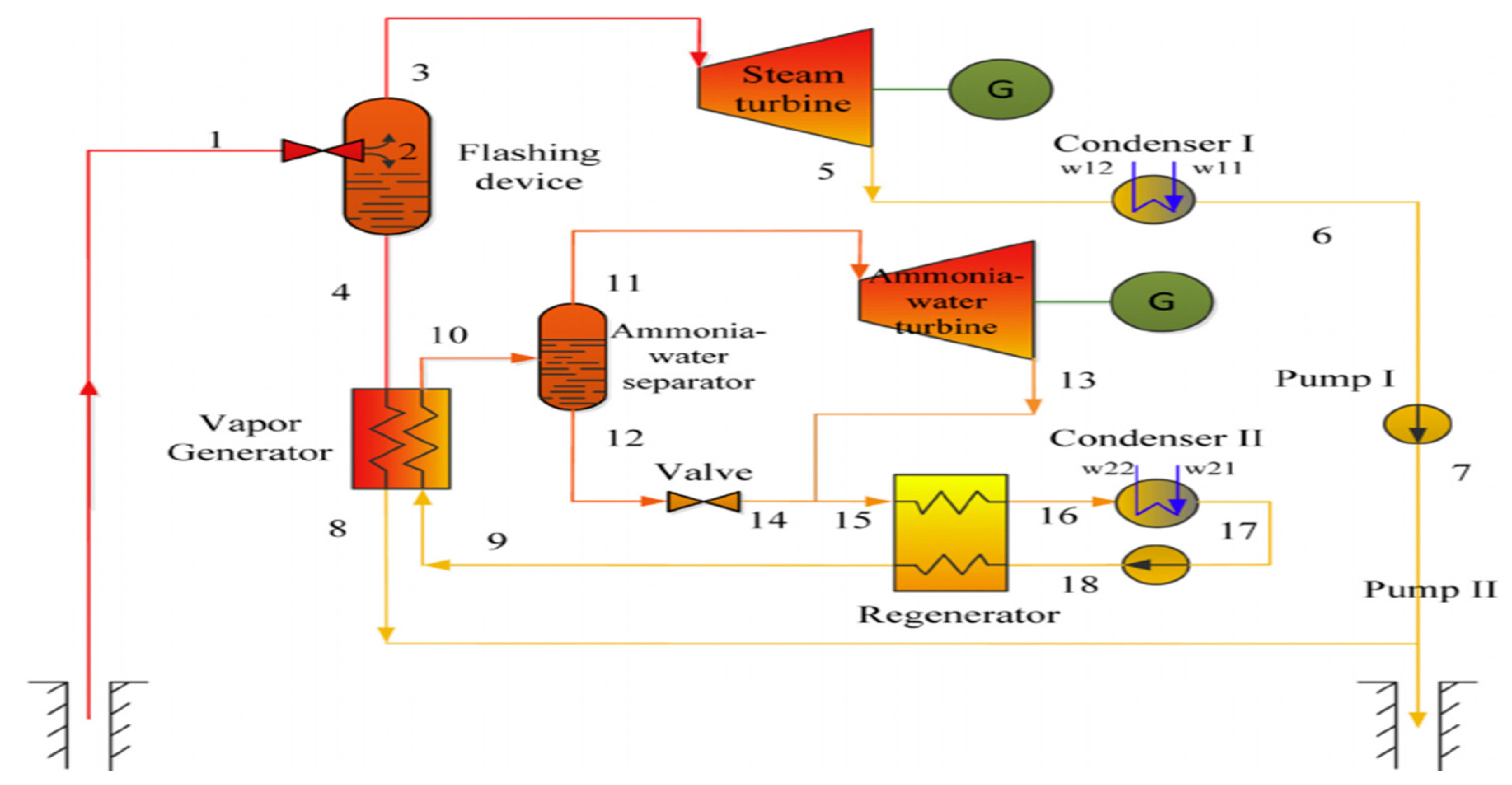
Depending upon of field characteristics, a geothermal power plant design can be such that it starts with a flash cycle followed by a binary unit which uses waste geothermal fluid to as the heat source and a secondary fluid on the working cycle to generate extra power. This will form a combined or hybrid flash-binary plant. In the first cycle, a flash plant is operated by geothermal fluid from the production which acts as the working fluid and is directed to reinjection well after exiting the turbine but with possible heat recovery before it goes back to the reservoir [22,62]. The waste leaving the separators can be sent directly to injection wells or can be send to the binary station for heat recovery. This improves overall generation since extra electricity is generated from the same geothermal fluid [38,56]. Figure 7 below illustrates a combination power plant.
Figure 7 above shows a combination flash-binary power plant with two turbines, one driven by steam from the production well flashed in the separator while the second one uses a binary fluid heated by separated brine on its way to the injection well. Steam turbine exhaust is condensed and before injection back to the reservoir via the injection well [37].

2.6. Hybrid/Combined Cycles

These are integrated geothermal energy conversion systems i.e. hybrid or geothermal system in combination with at least one other different source of energy like solar, coal, etc. (hybrid ) [63]. The overall objective in either arrangement is to achieve synergy and hence realize superior performance compared to separate or individual arrangement [63]. The benefits include higher utilization, higher thermal efficiency, increased net power output or more financial and economic benefits. Geothermal combined systems may consist of different types of flash-steam units and/or binary plants in an integrated combination that achieves advantages and benefits not realizable in separate units [18]. Examples of hybrid systems include fossil-fueled plants, such as coal-fired central stations, gas turbines, biomass, or waste-to-energy plants, or concentrating solar thermal or photovoltaic plants working in conjunction with geothermal power plant cycles like flash, binary or dry steam systems [63].

2.6.1. Solar-Thermal Combination Plant

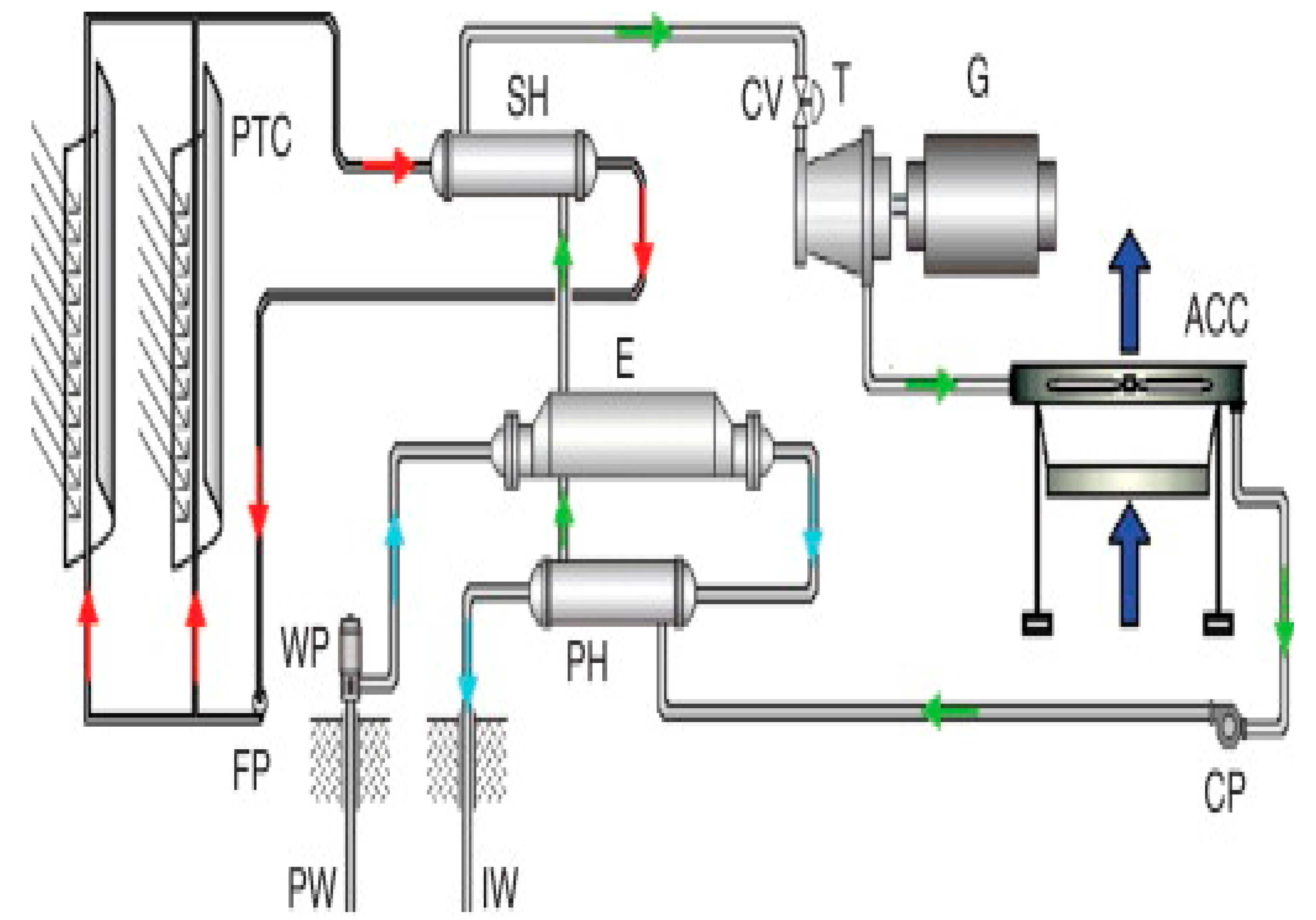
An example of a combination plant is the solar–geothermal plant whose main challenge in designing and managing the intermittent nature of solar energy versus the continuous nature of geothermal energy. Solar energy can supplement both geothermal binary and flash-steam plants by means of superheating and/or preheating of the working fluid. A basic binary cycle plant with a solar array of parabolic collectors is used to superheat the binary working fluid before it is fed to the turbine. The main challenge is the intermittence nature of solar availability and hence heating [37,38]. Figure 8 below illustrates a basic binary cycle with solar heating of working fluid.
Figure 8 above shows the main elements of a basic solar thermal power plant. They are the geothermal production well (PW), the solar concentrator (PTC), the flash separator (SH), control valve (CV), steam turbine (T) electric generator (G), coolant pump (CP), evaporator (E), preheater (PH), feed pump (FP) and the condensate cool (ACC) [37,38].
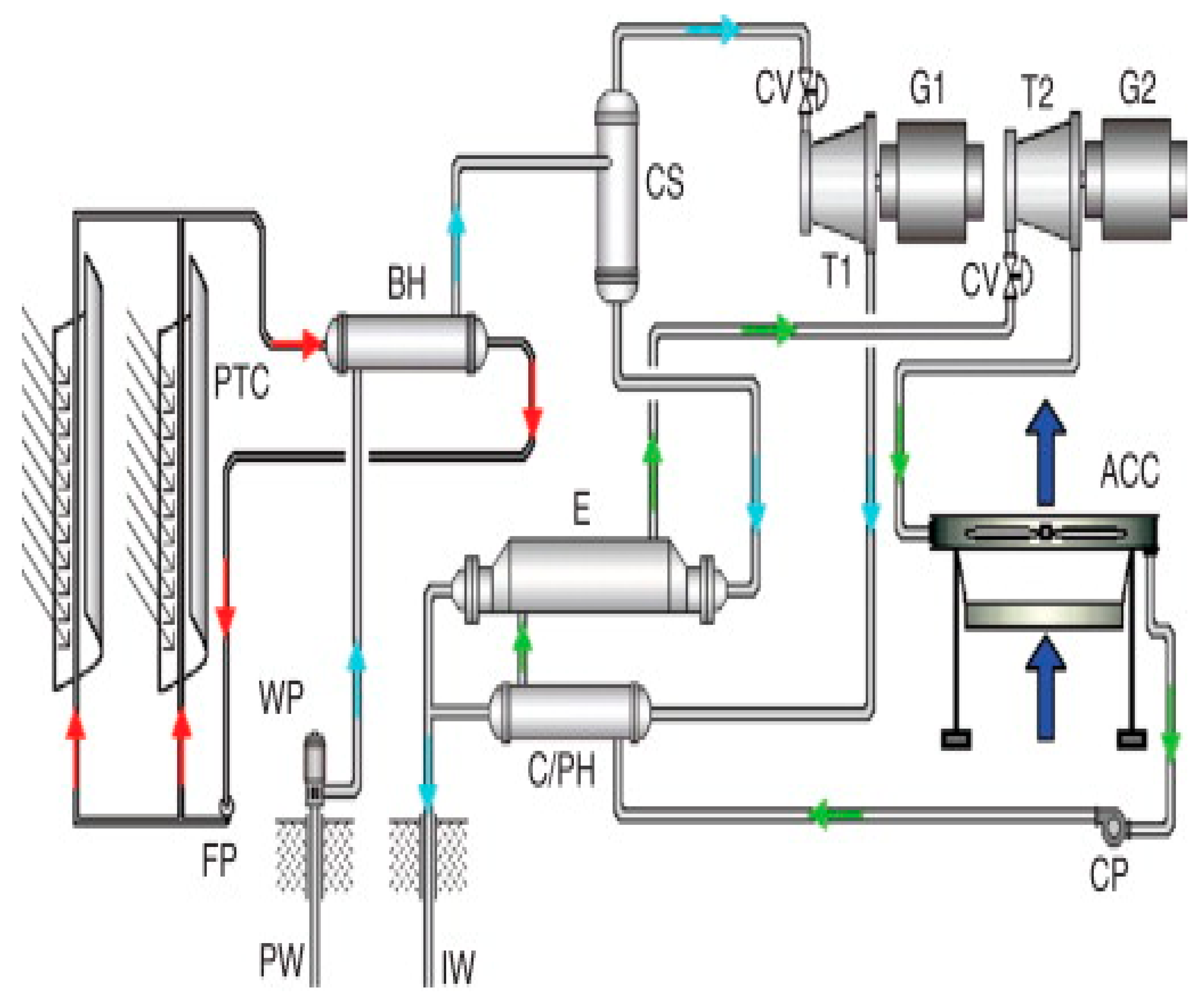
In the case of a more complex flash-binary plant with solar-brine heating, a moderate-temperature geothermal brine is heated with solar energy to the design flash temperature. This is followed by a topping up back pressure turbine to generate power to augment the binary cycle power coming from turbine the first turbine. The condensate of the solar power-driven turbine is used as feed to the condenser/preheater (C/PH) before being reinjected. The hot-separated brine is then used to heat up the binary working fluid, then mixed with steam condensate before reinjection. When used with an air-cooled condenser as shown below in Figure 9, this operation provides 100% reinjection of the geothermal fluid.
Figure 9 shows a binary solar combination power plant where the solar is used to superheat the working fluid before it goes to the first turbine T1 whose exhaust is preheated by the waste geothermal fluid leaving the separator (CS). The exhaust of the second turbine (T2) is mixed with exhaust of the first turbine (T1) before the mixture is heated by brine and used to run the second turbine as the working fluid.

2.6.2. Fossil-Geothermal Power Plants

It is possible to develop a combination of fossil fuel power plant and geothermal energy source for electric power generation [64]. This combination of geothermal energy and fossil fuels for power generation offers many thermodynamic advantages compared to individual technology approach. Different approaches that can be used include fossil superheating of geothermal steam, use of geothermal heat in preheating of fossil fuel power plants feed water which then replaces some high grade steam which can be used for extra power generation [65], and development of a compound geothermal fossil power plants [64].

2.7. Combined Heat and Power/Cogeneration Cycles

Combined heat and power is simultaneous generation of electricity with heat or thermal applications which significantly improves the overall cycle efficiency [49,66]. Use of cogeneration systems leads to higher thermodynamic and environmental performance and reduction in unit cost of energy. CHP is increasingly applied in geothermal energy exploitation as well as other renewable sources of energy like solar, wind and biomass. With huge quantities of low grade heat in geothermal fluid, cogeneration has a special role in geothermal energy utilization [66,67].
Cogeneration systems are classified into topping and bottoming up based on the sequence of energy exploitation adopted. In topping cycles, the energy supplied is first used for power generation followed by heat energy application, hence heat is a by-product of the cycle. Topping cycle is the most ideal for geothermal energy [68]. For a bottoming cycle, the energy is first used in thermal processes while rejected heat is used in power generation. These cycle are ideal in manufacturing like cement, iron and steel, ceramic production, gas production and petrochemical industries [38,68].

3. Design and Construction of Binary Cycle

3.1. Design Parameters

The main parameters that influence the proper functioning of an Organic Rankine cycle (ORC), are;
i.)
Identify the thermodynamic parameters for the cycle and hence identify the best working fluid.
ii.)
Determining the heat rates for the condenser and evaporator
iii.)
Model the expander and establish the expander [29].
In binary cycle plants, the working fluid is designed to operate in a closed cycle like the conventional thermal power plants i.e. coal, nuclear and other Rankine cycle plants. The binary cycle design is environmentally friendly and is ideal for low-grade heat extraction [69]. The working fluid selected however is not water/steam, but a low temperature boiling fluid [32,62]. A complete organic Rankine cycle additionally requires a heat source which is the geothermal fluid, evaporator, prime mover, condenser, and a feed pump [37,38,39].
The first geothermal binary power plant was developed and put in operation in 1967 at Paratunka near the city of Petropavlovsk on Kamchatka peninsula in Russia [1]. The plant had 670 kWe providing both heat and power for years thus providing useful lessons and experience for today’s binary cycle power plants. The concept of heating a secondary fluid started right at the inception of geothermal power plants when in 1912 at Larderello, Italy an indirect cycle was adopted for first 250 kW plant [38,41]. This was necessary because the steam/geothermal fluid was heavily contaminated with dissolved gases and minerals making direct use in a steam turbine impossible therefore a heat exchanger was used to generate steam from clean water for driving the steam turbine [2].
The role of the feed pump in the system is to circulate the condensed binary fluid through the preheater where it is vaporized. The geothermal fluid is then injected back into the reservoir via the re-injection well. The cooling in the condenser is either by water (wet cooling) or by air (dry cooling) as the cooling medium, which is necessary to restore the working fluid ready for another cycle. Therefore heat transfer in the power loop in the condenser, preheater and evaporator to or from the coolant, geothermal fluid and the working fluid which all require effective heat exchangers to realize high efficiencies for maximum power generation [70]. Heat from the turbine exhaust is passed to the working fluid in the preheater before it goes to the evaporator. The turbine exhaust passes through the condenser where the cooling water or air extracts the remaining heat. This demonstrates the significance of heat exchangers in the organic Rankine cycle in geothermal power generation. The main advantages of binary cycles are as follows.
i.)
It can use low temperature geothermal resources.
ii.)
It confines geothermal fluid to a closed loop and is pumped back to the ground through reinjection well without polluting the environment from the fluid and the no condensable gas.
iii.)
The binary-flashing cycle (BFC) is facilitating full geothermal fluid recovery / recycling due to the full use of the geothermal fluid [71,72,73,74].
Therefore, this implies that binary cycle power plants can be used in high enthalpy power plants to generate more power from the relatively high enthalpy brine leaving flash tanks or separator stations. They can also be used as standalone plants in medium enthalpy geothermal steam fields with up to 200oC using current technology and organic fluids [75]. However, the main challenge remains high operation and maintenance costs, high initial costs besides the environmental and safety risks associated with the organic secondary fluid [9,10].

3.2. Working Fluids for Organic Rankine Cycles

The primary objective of all geothermal power plants is to ensure maximize electricity generation with low temperature geothermal fluid. The organic Rankine cycle is often used for geothermal fluid temperatures below 150oC. This influences the selection of the working fluids for optimum performance. One of the main challenges in design of an organic Rankine cycle is the working fluid. A working fluid should have good thermodynamic properties for high heat source utilization. In the past, HFCs Hydrofluorocarbons were used as working fluids, but the growing concern about global warming has influenced the current call to use green working fluids. Studies on the use of the first and second laws of thermodynamics showed that a regenerative ORC with an internal heat exchanger and R123 as the working fluid yields highest thermal efficiency. Studies with pure fluids consisting of alkanes, fluorinated alkanes, ethers, and fluorinated ethers at a maximum turbine inlet temperature of 100 C with consideration of efficiency, turbine inlet volumetric flow rate and expansion ratio showed that for higher turbine inlet temperatures, o-fluids with higher critical temperatures were preferred choice. Investigations targeting thermodynamic performance in terms of efficiencies, volumetric flow rates and pressure ratios indicated that R152a, R600a, R600 and R290 have good performance. Studies on power production capability, heat exchanger and turbine sizes of ORCs showed that R227a yields higher power output than R134a, R123, R245fa, n-pentane or R290. Other studies on the effect of selected working fluid and cycle efficiencies showed that hydrocarbons offer better performance than some other refrigerants. For cogeneration application, isopentane proved to be more suitable for series circuits, while R600a and R227ea were better for parallel circuits arrangements which implied that ORCs with different working fluids yield different performance characteristics at different operating conditions [76].
Previous studies focused on analysis of cycle efficiency and temperature profile optimization for the working fluid and heat source. Little consideration was paid to the cooling system performance [76]. The selection of the right working fluid is very important and therefore should be done carefully to pick the most cost-effective fluid as the energy career [77]. The various factors to consider in the selection of a working fluid include health and safety, thermodynamic and chemical fluid properties like chemical stability, boiling pint, condensation point, density, as well as environmental friendliness of the organic fluid. No ideal fluid exists with the most desirable characteristics, hence the need for careful selection process to that one with the best combination is picked best results and for this model pentane was considered [15]. Since organic Rankine cycles are applied in low temperature and low-pressure heat sources, they can make use of refrigerants and organic fluids in the place of water used for the conventional Rankine cycles [48].
There are many refrigerants and organic fluids that can be used as working fluids for organic Rankine cycles. However, the selection should be guided by the following criteria [77].
i.)
Exclude working fluids burnt in the Kyoto and Montreal protocol
ii.)
Exclude toxic or poisonous working fluids.
iii.)
Avoid fluids that can react with the equipment or environment.
iv.)
Avoid flammable working fluids.
Organic Rankine Cycle working fluids can be classified into three categories based on their adiabatic expansion behavior, and are namely, wet fluids, dry fluids, and isentropic fluids. Working fluids having with simple molecular structure usually behave as wet fluids, those with higher complexity act as the dry fluids while working fluids with intermediate molecular weight are isentropic fluids [48].
Dry and isentropic working fluids are superior as they avoid condensation in the turbine which can damage turbine blades. A dry working fluid has a positive slope while a wet working fluid has a negative slope [77].
Generally, the fluid should be noncombustible within the operating range and environmental conditions, should be affordable, nontoxic, and give highest possible cycle efficiency and work output cost effectively. In this study choice is made between Iso- pentane and N-pentane which are commonly used fluids. Pentane has zero Ozone depletion potential (ODP) and global warming potential value which is 45 times below common fluids like as R245fa and R134a. Pentane remains in liquid phase at ambient conditions which reduce the handling cost. It should be noted that dry expansion working fluid eliminate the effect of erosion of the turbine blades increasing the life span of the blades as well as reducing maintenance cost. Generally, the dry expansion working fluid ORCs are compact in design, have high efficiency and are robust [16,24]. The binary cycle geothermal power plants use low temperature boiling medium like pentane and Freon According to [78]. They have the following disadvantages.
i.)
The secondary medium may be flammable hence risky.
ii.)
The fluid may be hot water and medium temperature steam have higher requirements for piping and pumping compared to pure steam and is difficult to handle in mountainous areas.
iii.)
Higher operation costs and hence
iv.)
Some countries have stringent environmental regulations which do not allow the use of many of the organic fluids.
v.)
scaling, cavitation and corrosion of important parts like pumps and heat exchangers makes the system expensive due to shorter lifespan of equipment and increased cost of operation and maintenance [52].

3.3. Heat Exchangers

Heat exchangers are devices that allow heat transfer between a hot and cold substance. They must be designed based on the operating conditions for the system to realize high efficiency of heat transfer [32,62,66,79]. In a study by [25] the performance of plate and shell tube exchangers was compared and found out that shell tube type has a simple geometry simple geometry, clear simple to design and can be made from a wide range of engineering materials. They are also easy to fabricate. The plate type heat exchangers are resource is more efficient for low enthalpy applications. The main challenge main challenge with shell tube heat exchangers is high-pressure drops. In the study by [77], it was noted that increasing pinch point reduces net work done and reduces heat transfer area and the cost of the heat exchanger. Maximum efficiency is realized at maximum tube inlet pressure and is simultaneously related to fluid mass flow rate.
The shell and tube heat exchangers are economically superior to the fin-tube type and plate type heat exchangers, but the fin tube heat exchangers are expensive but have better heat transfer performance for the same size [77]. The overall performance of heat exchangers will also vary with the environmental conditions especially the temperature difference between the heat sources and sink.

3.4. Optimum Design Operating Conditions

The organic Rankine cycle is a promising technology for efficient conversion of low temperature geothermal energy resources to electric power [76]. An ORC system with a wet cooling system can be used for fluids at a temperature of 100o C to 150 C and with reinjection temperature not less than 70 C. Commonly used hydrocarbon working fluids are isobutane (R600a), butane (R600), hexane, pentane (R601), and isopentane (R601a). The Organic Rankine Cycle net power output increases with a decrease in condensation temperature, although the circulating pump power input or consumption increases especially particularly for lower condensation temperatures and at higher flowrates of cooling water [76]. For optimum performance, the recommended condensation temperatures for maximum power output are 29.45oC to 29.75oC corresponding to condenser cooling temperature of 20oC and while pinch point temperature difference is 5oC in the condenser. Maximum generation is produced by an ORC using R600a when geothermal water inlet temperature is higher than 120oC. This is followed by R245fa and R600 for when reinjection temperature is less than 70oC. The refrigerant R600a has highest plant exegetic efficiency and smallest size factor [76].

4. Material and Methods

Various factors influence the performance of an organic Rankine cycle. These factors include the pump outlet pressure, pinch point, mass flow rate, heat exchanger design and performance, the type of the fluid used and its properties, and operating temperature of the sink and heat source [77]. This study is a case study with preliminary design of an organic Rankine Cycle for Olkaria IV flash geothermal power plant using waste or used brine.

4.1. Performance Analysis of Olkaria IV

The study involved collection of power plant data for analysis through questionnaires interviews and document analysis. Data was collected on available technology, power generation, brine conditions and other pertinent geothermal power plant information. Needed for power plant performance analysis.
Calculate availability factor.
Load factor e v e r a g e   l o a d p e a k   l o a d
Capacity factor e v e r a g e   l o a d i n s t a l l e d   c a p a c i t y
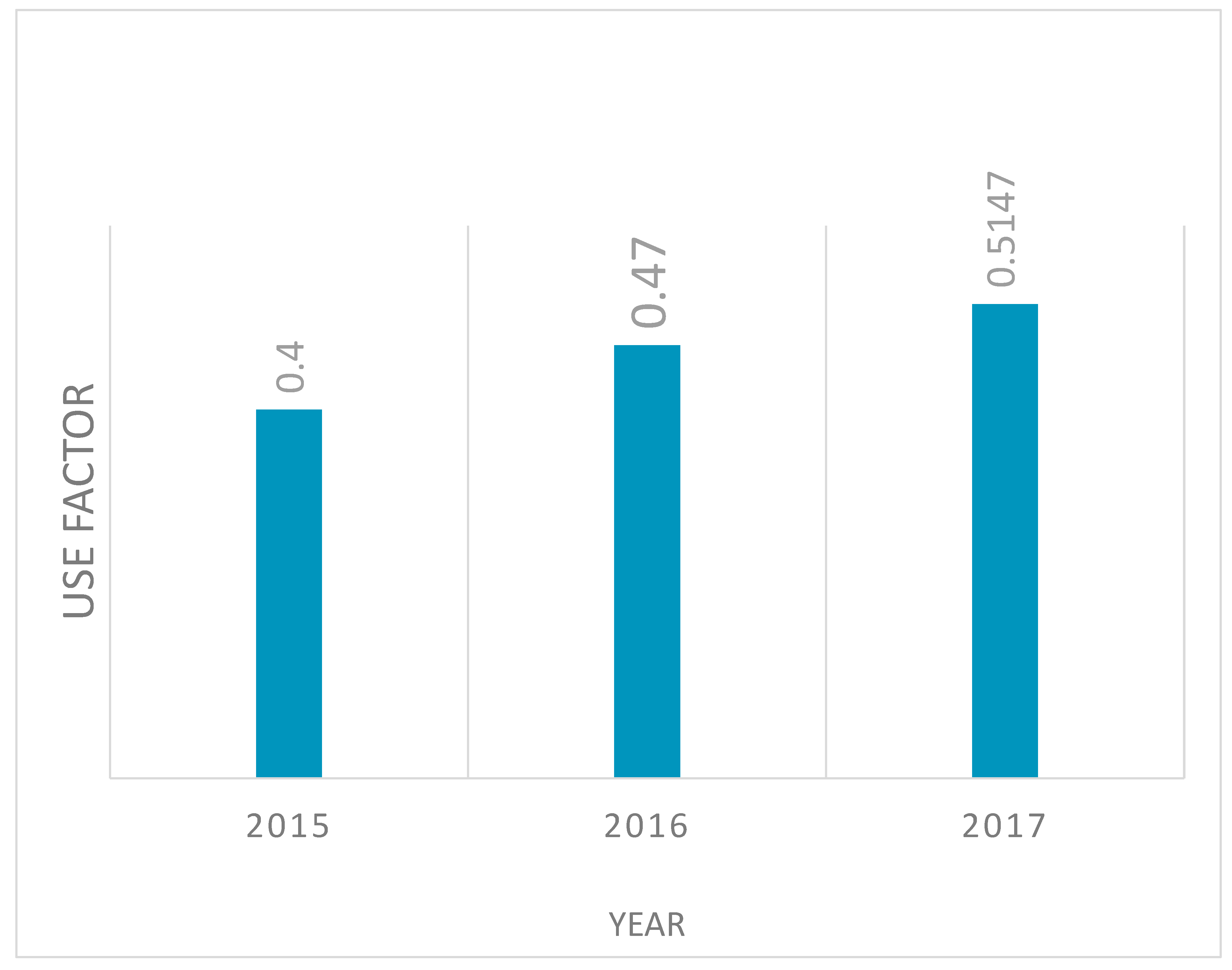
Plant use factor p o w e r   g e n e r a t e d i n s t a l l e d   c a p a c i t y x   N o   o f   h o u r s   i n   y e a r

4.2. Proposed Design

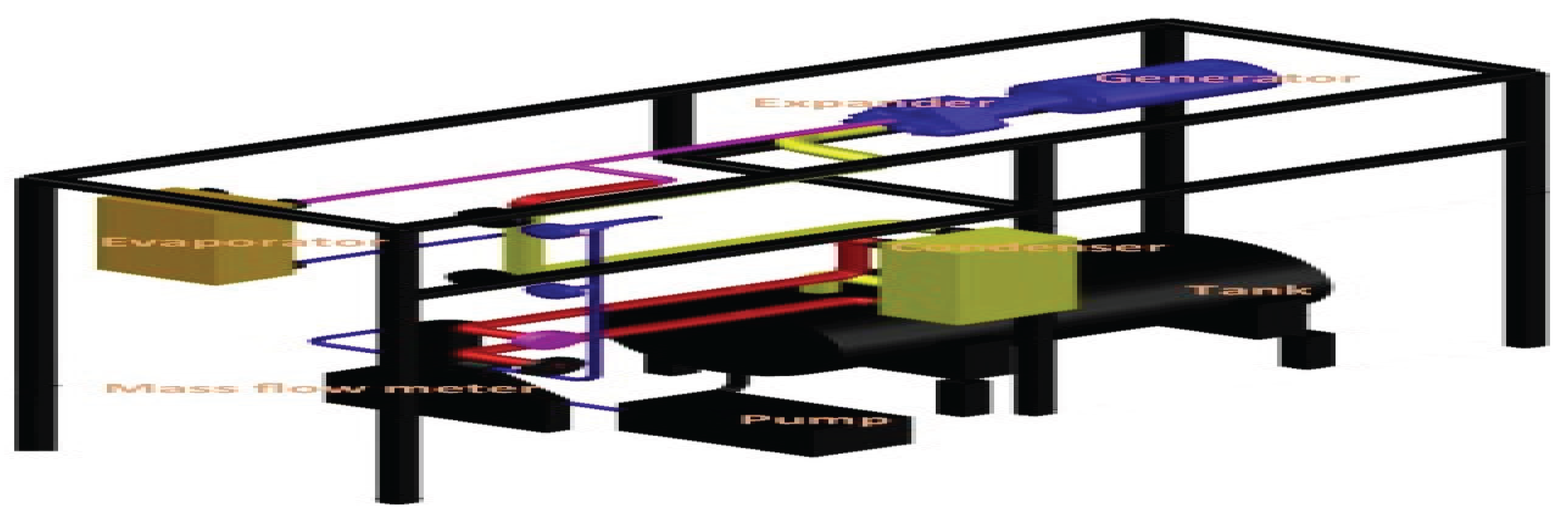
The design of an efficient geothermal power plant is a product of sound theoretical analysis in addition to several practical compromises based on experience. Based on the plant design and system configuration, at Olkaria IV geothermal power plant, the following design layout was proposed for analysis and implementation. Figure 10 below shows the proposed design of the organic Rankine Cycle.

4.3. Cycle Selection

In the proposed cycle, heat source of the brine is assumed to enter the plant at constant levels of temperature, pressure, and mass flow rate. The waste/used brine leaving separators heats the working fluid via a heat exchanger. From the heat exchangers, the brine is returned to the reinjection well where it then goes back into the reservoir [80]. Feasible cycles are:
i.)
Basic ORC (B-ORC)
In the basic organic Rankine cycle, the working fluid is heated to a saturated condition then superheated in the evaporator and a super heater, respectively. The superheated fluid then expands though the turbine to produces mechanical power that turns the generator for power generation before the exhaust fluid goes to the condenser. While in the condenser, the coolant which may be water or air often at ambient temperature absorbs heat from the working fluid then as condensate is pumped to the evaporator to complete the cycle and start another cycle repeatedly [30,81].
ii.)
Dual fluid ORC
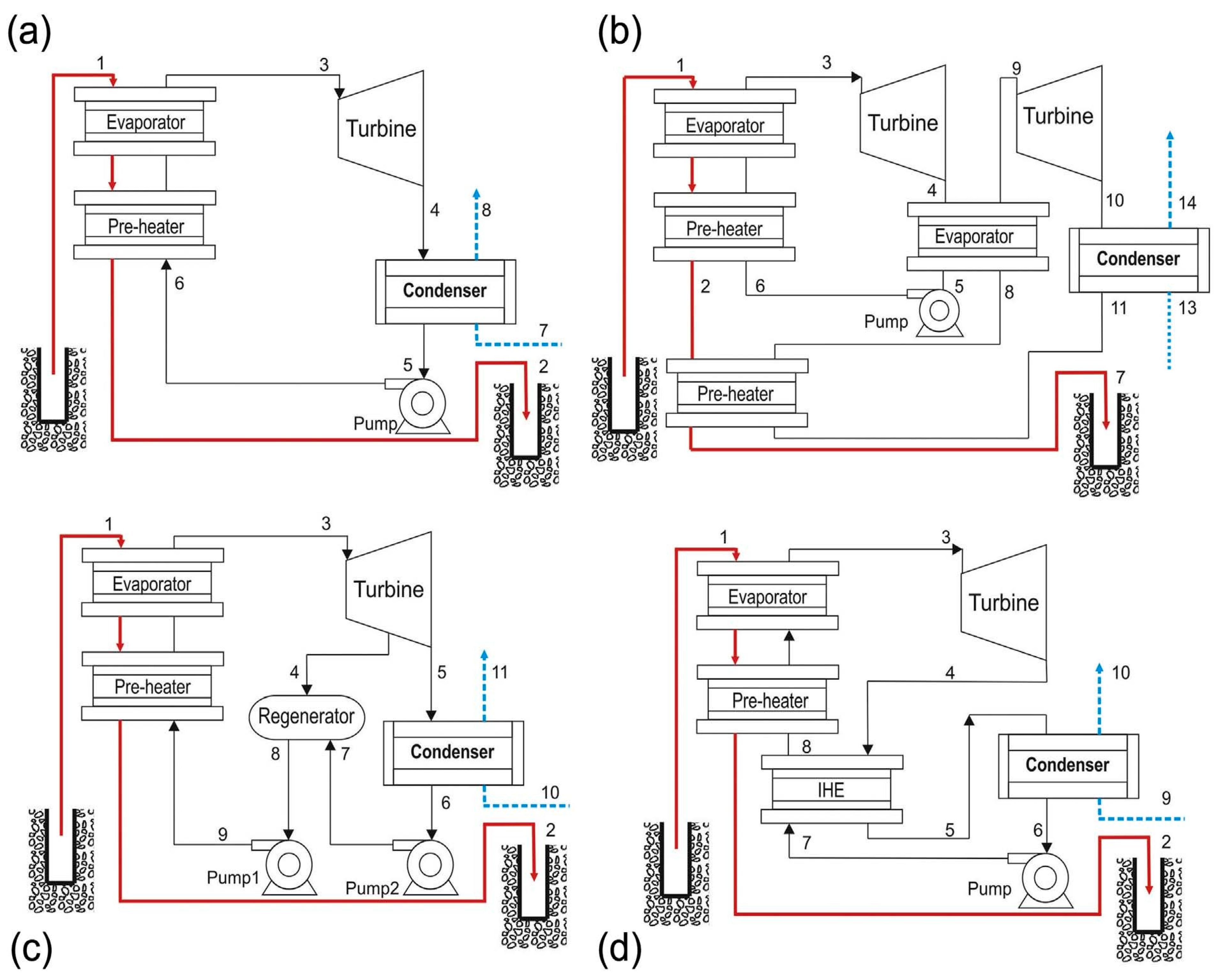
The dual ORC works with two connected loops, with two evaporators each with own working fluid as demonstrated in Figure 10(b) [30]. In the dual fluid Organic Rankine cycle, the exhaust fluid of the turbine in the primary ORC is led to the evaporator of the secondary cycle where it evaporates the secondary working fluid to a saturated working fluid. This fluid also acts as the condenser for the primary ORC generating a saturated liquid [81].
iii.)
Regenerative ORC (R-ORC)
In the regenerative Organic Rankine cycle, part of vapor is extracted from the middle stage of the turbine and sent to the regenerative chamber [30] as the remaining vapor is allowed to expand to the turbine exhaust then flow to the condenser for condensation. The regeneration process improves the overall thermal efficiency and minimizes irreversibility [81].
iv.)
ORC with Internal Heat Exchanger (IHE-ORC)
For the basic organic Rankine cycle, the fluid in turbine exhaust still exists in vapor phase, hence the need to recycle some part of the heat to improve overall performance. To achieve this, an internal heat exchanger is used to heat the exhaust leaving the turbine and before the condenser as an alternative ORC cycle [82,83]. This cycle is called Organic Rankine cycle with internal heat exchanger and is demonstrated in Figure 10(d) below. Figure 11 below demonstrates the various designs/configurations of Organic Rankine cycles that for use in the proposed design.
Figure 11 above shows that various cycle that can be adopted for the organic Rankine cycle plant with the major elements. These are the Basic ORC (B-ORC) shown in (a), dual fluid ORC shown in (b), regenerative ORC (R-ORC) shown in (c), and ORC with Internal Heat Exchanger (IHE-ORC) shown in (d) [80].
Studies by ref. [83]. On maximum thermodynamic efficiency based on the first-law efficiency showed that the ORC with an IHE using R123 as the working gave 7.65% and a binary cycle with the regenerative ORC with an IHE and R123 as the working fluid gave highest efficiency 15.35%. Furthermore, the maximum first-law efficiency using flash-binary with R123 as the working fluid yielded 11.81%. Therefore, the cycle selected, or combination will influence the cycle efficiency achieved and hence the power output of an organic Rankine cycle [84].

4.4. Thermodynamic Analysis and Assumption

There are several assumptions made in the design analysis. Pure water properties are used hence the effects of salts and other mineral components that are in the geothermal fluid are neglected. The losses in pipelines are also neglected in the design since the design assumes the use of short pipelines that are well insulated. The design and modelling additionally makes the following assumptions.
i.)
The pressure and temperature losses in the equipment are neglected [83].
ii.)
The changes in the process assume steady state condition [30].
iii.)
The assumption on the working fluid is that it evaporates and then condenses to saturated vapor in evaporator and saturated liquid in while in the condenser. i.e., the degree of super heating and sub cooling degrees are zero [30,82].
iv.)
The process assumes that compression and expansion take place the adiabatically and are also isentropic in pump and the turbine constant isentropic [30].
v.)
The ambient temperature is important for both a dead state and cooling water inlet temperature [30].
vi.)
The geothermal fluid is assumed to be a saturated liquid in the reservoir (x = 0) [30,81,83].

4.5. Working Fluid Selection

The selection of a working fluid is an important process for the reliability and performance of the organic Rankine cycle. The desirable features for the working fluid are thermal stability, thermodynamic characteristics, suitable working pressure range for the condenser and evaporator conditions, non-toxic, non-corrosive, and environmental safety in terms of the ozone depletion potential (ODP) and global warming potential (GWP) [85]. There is practically a clear relationship between maximum achievable exergy efficiency and the critical temperature in pure fluids and mixtures. Working fluids that achieve the highest efficiency exhibit a critical temperature in the range 80–84% of the maximum heat source temperature. The cycle with maximum efficiency has turbine inlet pressure close to the critical pressure of the working fluid. However, we have exemptions for some fluids like R115, R143a, and propylene which can realize close to maximum efficiency while employing a highly supercritical turbine inlet pressure and have critical temperature just at 66–69% of the maximum heat source temperature [30].
Research on performance of dry refrigerants that included pentane, R245fa and R600a in an Organic Rankine Cycle showed that the dry working fluid allow zero superheat at expander inlet which is the main advantage of these fluids at low temperature sources. Other studies have shown that, n-pentane results in higher cycle efficiency among the working fluids studied. In his work, [10] compared performance of ammonia-water mixture as a working fluid in Kalina cycle and an organic Rankine cycle. Ammonia water mixture did not have a constant boiling and condensing temperatures because it is a mixture and not a pure substance. The phase change occurred at varying temperature making boiling to start at a low temperature (20-1700C). As per the study, Kalina cycle has 15-50% more power output and increase in efficiency by 3% [10].
In the selection criteria for a working fluid, the critical temperature of fluids influences the thermodynamic performance of organic Rankine cycles while the economic performance of the cycles is influenced by parameters like de-superheating heat needed by the regenerator, and the heat or enthalpy of evaporation which influence heat integration with hot streams and raised mass flow rate of the working fluid [30].

4.5.1. Pure Working Fluids

Pure fluids which refers to working fluids consisting of one component are classified based on the quality of the expanded vapor after an isentropic (adiabatic and reversible) expansion from saturated vapor state. Pure working fluids are classified into three main categories: dry, wet, and isentropic fluids [86].
Table 1 below shows the best pure working fluids based on the critical pressures, critical temperature, flammability, ozone depletion potential and global warming potential. Examples of pure working fluids include Propane, Propyne, Propylene, Butane, Cisbutane, 1-Butene, Isobutene, Isobutane, Transbutane, Benzene, Toluene, Pentane, Isopentane, Neopentane, Hexane, Isohexane, Heptane, Octane, Nonane, Decane, Undecane, Dodecane, Cyclopropane, Cyclopentane, Cyclohexane, Methylcyclohexane, N-propylcyclohexane which are alkanes, Others are R218, C4F10, C5F12, RC318 which are perfluorocarbon (PFC), 1234yf, R1234ze, R1233zde, R1336mzz, R1216 which are hydrofluoroolefin (HFO), RE134a, RE245cb2, RE245fa2, RE347mcc which are hydrofluoroether(HFE), R161, R227ea, R236ea, R236fa, R245fa, R345ca, R365mfc which are Hydrofluorocarbon (HFC), R11, R12, R113, R114, R115 which are classified as Chlorofluorocarbon ( CFC), 21, R22, R123, R124, R141b, R142b which are Hydrochlorofluorocarbon (HCFC), MM, MDM, MD2M, MD3M, MD4M, D4, D5, D6 which are Siloxanes and Novec649 which is a Fluorinated Ketone [30]. Table 1 below shows the properties of 10 leading pure working fluids.
From Table 1 above, it is noted that RE347mcc has the highest critical temperature, lowest critical pressure, is not flammable and has no ozone depletion potential. R143a has got the lowest critical temperature of 72.710C. Although flammable, neopentane has a high critical temperature of 160.59oC, has no ozone depletion potential and no global warming potential.

4.5.2. Working Fluid Mixtures

Several mixtures of pure organic fluids have shown excellent properties as working fluids. Mixture that have proved to be feasible working fluids include, R1233zde/R134a, R1336mzz/R134a, Isobutane/Pentane, Isobutane/Isopentane, Butane/Pentane, Butane/Hexane, R245fa/R152a, Butane/Cyclopentane, Isobutane/R245fa, Butane/Propane, Toluene/Cyclohexane, MM/MDM, R1233zde/Propyne, R1233zde/Cyclopropane, R1336mzz/Propyne, R1336mzz/Cyclopropane, R1336mzz/Butane, R1336mzz/1-Butene, R1336mzz/Isobutene, R1336mzz/Isobutane, R1234ze/Cisbutene, R1234yf/Cisbutene, Nove649/Propyne,Novec649/Cyclopropane,Novec649/Butane,Novec649/Cisbutane,Novec649/1-Butene, Novec649/ Isobutene, Novec649/Isobutane, Novec649/Transbutene [30]. Table 2 below shows the properties of top mixtures of binary fluids that can be used as working fluids.
In the study by ref. [87], two optimization cases were applied with hot fluid inlet temperatures at 120 °C and 90 °C. The study compared performance of mixtures and pure fluids as working fluids against design parameters. The study results showed that mixed working fluids have capacity to increase net power output of the cycle and at the same time reduce the cycle pressure levels. From the study results, it was established that maximum net power output is achieved by fluids having a critical temperature about half of the hot fluid inlet temperature. It was also demonstrated that some mixtures yield maximum net power when the temperature glide of condensation is matched with cooling water temperature increase. It was further established that some working fluid mixtures have a large difference between these two parameters. Studies on Ethane showed that it obtains a large net power increase when used in mixtures than when used as pure a working fluid. As an example an optimized ethane/propane mixture produces some 12.9% net power increase compared to pure ethane when the hot fluid inlet temperature is 120 °C, while at 90oC hot fluid inlet temperature it produces some 11.1% net power increase [87]. These studies further demonstrated that when working fluids are used as mixtures, they tend to produce more power output. It also confirmed the importance of fluid temperature at the inlet in determining the cycle performance and output of the Organic Rankine cycle. Table 2 is a summary of 10 top working fluids
From Table 2, it is noted that mixtures of different organic fluids can be used as excellent working fluids. For example, a mixture of Isobutane/Isopentane has critical temperature of 153.82 and critical pressure of 37.53 bars in ratios of 0.66/0.34 which is almost equal to Isobutane when used in pure form. Other mixtures presented have critical pressures between 33.36 and 43.85 bars and critical temperature range of 140oC to 175.44oC which are attractive properties as working fluids.
In the research done by [88], an optimization of organic Rankine cycles (ORCs) was done for recovery of waste heat from a hypothetical aluminum production plant in Norway featuring two hot streams i.e. hot exhaust gases and the cell wall cooling air with waste heat of about 16 MWth at a temperature below 250°C. The study objective was to optimize the cycle variables i.e. pressures, temperatures, mass flow rates to ensure maximum performance using 102 pure fluids, some of which were recently synthesized refrigerants, and binary zeotropic mixtures. The study identified HFE-347mcc as the best fluid in terms of exergy efficiencyby achieving exergy efficiency of 85.28%, followed by neopentane, butane, and R114. The study also identified HFO-1336mzz as one of the most promising non-flammable working fluid with low Global Warming Potential (GWP). As for mixtures, the highest exergy efficiency was achieved by isobutane–isopentane mixture with the potential to increase net electrical power output by up to 3.3% compared to the output from pure fluids [19,88,89]. Upon carrying out a systematic techno-economic optimization, for two different electricity prices, the research identified RE347mcc as the best option in cases of both low and high electricity prices. By applying HFO-1336mzz, the analysis showed that the cost of the cycle was penalized by higher evaporation heat which negatively influence the heat integration process and the smaller regenerator [88].

4.5.3. Cycle Optimization

The selection of a working fluid for is guided by the primary fluid temperature, the configuration of the cycle, environmental considerations, and safety considerations. The Working fluids are also classified based on their saturation curve slope in the temperature-entropy diagram (dT/ds) [90]. Where those Organic fluids having a positive slope are dry fluids e.g., pentane, benzene and isopentane. Working fluids with negative slope are wet fluids and they include water, R134a and R152a and with infinite slope (isentropic fluids as R11 and R12. In recent years, many reports have discussed methods for selecting the best working fluid for wide range of geothermal systems [91,92,93]. Economic aspects are also vary significant in the selection of working fluids hence the need to carry out economic analysis before selecting the most appropriate working fluid for the binary power plants [94]. There are several power plants some power plants in the world working using Isobutane or n-pentane [80,95,96]. There is a clear relationship between critical temperature and maximum achievable exergy efficiency for both pure fluids and mixtures. Working fluids with highest efficiency generally have a critical temperature range of 80–84% of the maximum heat source temperature while maximum cycle efficiency is achieved when turbine inlet pressure is close to the critical pressure. This however does not apply for R115, R143a, and propylene which can achieve maximum efficiency at highly supercritical turbine inlet pressure [88]. This study shows that it is necessary to carry out a multi-objective analysis to identify the optimum working fluid.

4.6. The Heat Exchanger Design

Heat exchangers are designed to transfer heat between two or more fluids existing at different temperatures. The heat transfer can be between gas-to-gas, liquid-to-gas, or liquid-to-liquid through a solid separator that prevents mixing of the fluids, or direct fluid contact [97]. The heat exchanger is very important component of the ORC unit. It is from the heat exchanger where the brine will loss thermal energy to the working fluid converting it to vapor. The factors considered in the design of the heat exchanger included:
  • Area of heat transfer
  • Overall heat transfers co-efficient.
  • Temperature difference

4.6.1. Design and Construction

Various components are employed in heat exchangers, and likewise a wide range of materials used in the manufacture. The type of heat exchanger and desired applications influences the heat exchanger components and materials used. The common components of heat exchangers are shells, spirals, tubes or coils, plates, fins, and adiabatic wheels. The materials used for heat exchanger components varies with design requirements, but the choice is guided by strength and thermal conductivity. The common materials used are, titanium, stainless steel, heat exchangers, graphite, composites, ceramics, and plastics [97,98].

4.6.2. Type of Heat Exchangers

Based on the design characteristics indicated above, there are several different variants of heat exchangers available. Some of the more common variants employed throughout industry include:
  • Shell and tube heat exchangers
  • Double pipe heat exchangers
  • Plate heat exchangers
  • Condensers, evaporators, and boilers

4.7. Shell and Tube

Heat exchangers are critical devices in heat transfer process They come in different designs with varying performance characteristics, cost and efficiencies [99]. The common types of heat exchangers are Shell-and-tube, Finned tube, Bare tube, Plate-and-frame, Spiral and Plate coil types [99]. Shell and tube heat exchangers are the most common type of heat exchangers. They are built with a single or a series of parallel tubes ( tube bundle) which are normally enclosed within a sealed, cylindrical pressure vessel called the shell [99]. The operation is such that one fluid flows in the tube side while the other flows through the shell during the heat transfer [97]. In other designs, the heat exchanger may have finned tubes, single- or two-phase heat transfer, concurrent flow, countercurrent flow, or crossflow arrangements between the two fluids in a single or multiple pass flow configurations [97]. Shell and tube heat exchangers may also be available in helical coil heat exchangers, double pipe, and some of the applications like preheating, oil cooling, and steam generation as design addition [97,98].
The shell and tube type heat exchanger were selected for the condenser, preheater, and evaporator due to its advantage over the other types of heat exchangers. The following reasons accounted for selection of the type of heat exchanger:
i.)
The tube and shell heat exchangers give very large surface area due to their design.
ii.)
Are simple to fabricate,
iii.)
Are easy to clean.
iv.)
Are adapted for high pressure vessels.
v.)
Can be made from several engineering materials.
It consists of a shell which is usually a large pressure vessel with bundle of tubes running through it which increases the surface for heat exchange and baffles provided on shell side to support the tubes, uniformly maintain spacing between the tubes as well as directing the working fluid flow to enhance heat exchange [32,100,101].
The design process assumes that the heat exchangers are well-insulated and hence the heat transfer is just between the geothermal brine as primary fluid and the secondary fluid working fluid. The flow rates for both fluids are also assumed to be steady constant while the components of the kinetic and potential energy at entry and exit are assumed to be negligible. Assuming that the entire system is a thermodynamic system the governing equation is as shown below in equations i, ii, and iii respectively based on the configuration presented in Figure 9. Therefore, the governing equations will be.
i.)
mb(ha−hc) = m.wf(h1−h4)
Where ha and hc refers to the enthalpy of the brine at inlet and outlet of the heat exchanger, while h1 and h2 refers to the enthalpy of the working fluid at the inlet and outlet of the working fluid. wf denotes working while m is the mass flow rate of the working fluid. For cases where the brine has less dissolved gases and solids, the left-hand side of the equation can be estimated by the average specific heat of the brine cb times multiplied by the change in temperature.
ii.)
mbcb(Ta−Tc)=m.wf(h1−h4)
equation i is resolved into equation ii by replacing the bine enthalpy with brine temperature at inlet and outlet of the heat exchanger and its calorific value. The following equation may be used to find the required brine flow rate for a given set of cycle design parameters:
iii.)
mb=m. wfh1−h4cb (Ta−Tc)
Equation iii.) is used to determine the required brine flow rate for the designed system given the inlet and outlet temperature and brine enthalpies.
The heat exchanger system element which are the brine for heating, working fluid which does expansion work in the turbine, the preheater (PH), evaporator (E), and heat exchanger elements for evaporation and preheating of the working fluid with geothermal fluid. Key assumptions made include that the heat exchangers are well-insulated against all heat transfers s between the brine and the working fluid [102]. It is also assumed that the fluid flow is steady and that the KE and Potential energy at entry and exit remains unchanged [63,102].
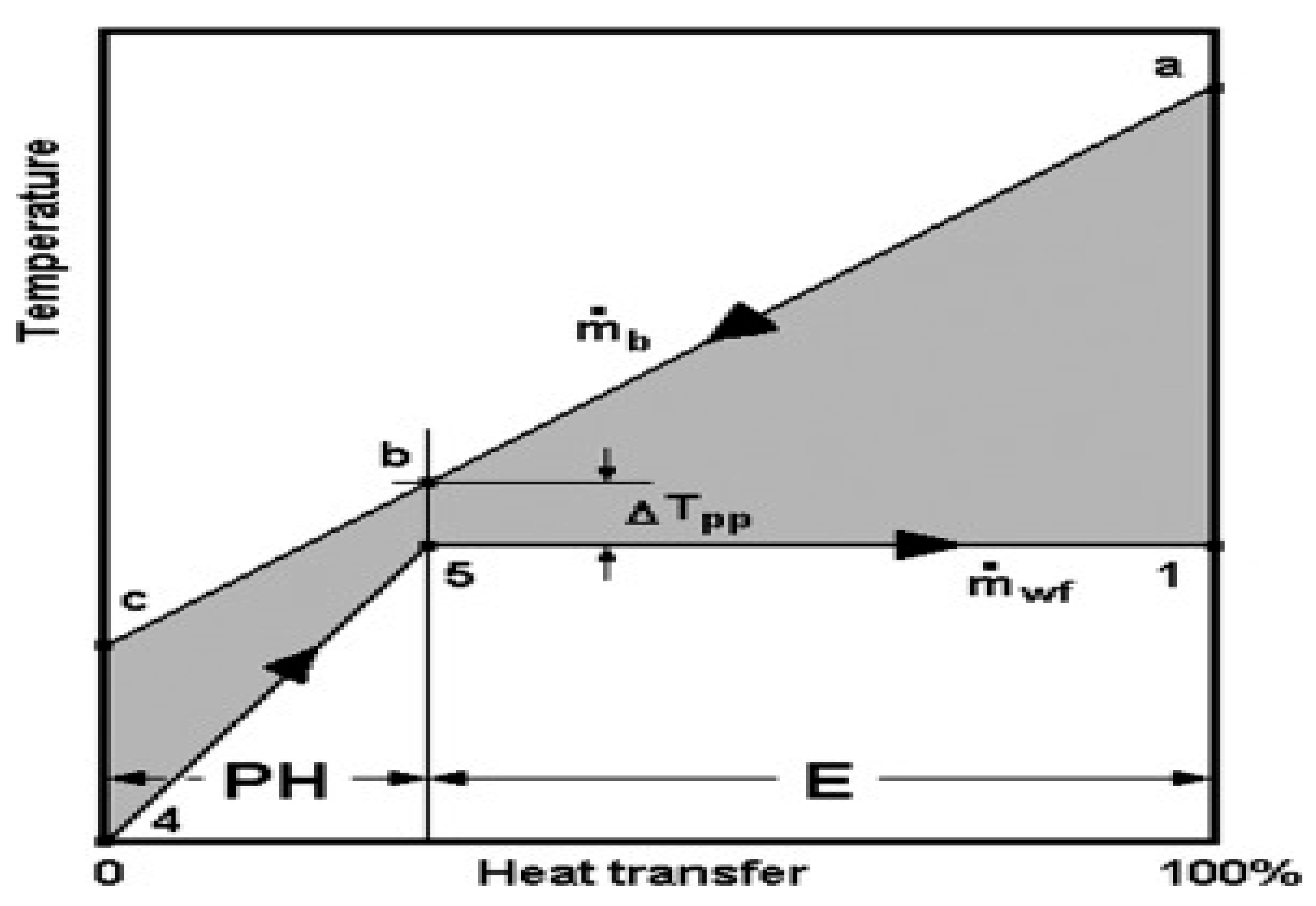
The temperature-heat transfer or T-q diagram is very useful in the design of individual heat exchangers of the binary geothermal system. This diagram is shown in Figure 12 below.
Figure 12 shows a temperature -heat transfer diagram used in the design of individual heat exchangers. The abscissa represents the quantity of heat passed from the brine to the working fluid shown as a percentage or heat units like kJ/kg of the working fluid [99].
The preheater PH is used to provides sensible heat necessary to increase the working fluid temperature to its boiling point, state 5. This is followed by evaporation between state 5 and 1 isothermally if the working fluid id pure. At the pinch point in the heat exchanger, the two fluids i.e., brine and the working fluid realise the minimum temperature difference. In the design, this value is designated the pinch-point temperature difference, ΔTpp. State 4 on the cycle is a compressed liquid at outlet of the fed pump, state 5 is a saturated liquid at boiler pressure while state 1 represents a saturated vapour with same conditions as the fluid entering the turbine.
Therefore, the two heat exchangers can be analysed separately in equations iv, v and vi below in equations:
i.)
Preheater: mbcb(Tb−Tc) =m·wf(h5−h4)
ii.)
Evaporator: mbcb(Ta−Tb) =m·wf(h1−h5)
The brine inlet temperature Ta is known from the actual state conditions of the geothermal fluid being fed to the heat exchanger system while the pinch-point temperature difference is got from the manufacturer’s specifications. Temperature Tb is determined from the predetermined value for T5. While it is theoretically possible for the pinch-point to occur at the cold end of the preheater (for a very steep brine cooling line), this practically never happens.
To determine evaporator heat transfer area, AE, the basic heat transfer relationship is given by equation vi below
i.)
Q·E=ŪAELMTD
where Ū is the overall heat transfer coefficient, and LMTD is the log-mean-temperature difference, which is given by equation vii for the evaporator.
ii.)
LMTD=(Ta−T1) −(Tb−T5) ln [Ta−T1/Tb−T5]
The evaporation heat transfer rate is given by equation viii below
iii.)
Q·E=mbcb (Ta−Tb) =m·wf(h1−h5)
For the preheater, the corresponding heat transfer equations are ix, x and xi below.
iv.)
QPH=ŪAPHLMTD
v.)
LMTDPH=(Tb−T5) −(Tc−T4) ln [Tb−T5Tc−T4]
vi.)
PH=mbcb(Tb−Tc) =m·wf(h5−h4)
The overall heat transfer coefficient Ū is experimentally determined with the appropriate fluids proposed for use in the power plant. There is need to apply appropriate correction factors based on the configuration of heat exchanger used namely, shell-and-tube, plate, parallel flow, pure counter flow, multiple-pass counter flow or crossflow. Specific correction factors are applied on the above heat transfer design equations depending on the configuration selected for the design [102].

4.7.1. Heat Transfer Coefficients

The heat transfer coefficients vary between the type of primary and working fluids used [102,103]. Table 3 below shows the overall heat transfer coefficients for different fluids.
From Table 3, it is noted that different fluids have different overall heat transfer coefficients. Heat transfer coefficient from ammonia to water is the highest followed by heat transfer between steam and water, while water to air is the lowest.

4.7.2. Choice of Flow Configuration for the Heat Exchanger

Based on the direction of flow of the fluids, heat exchangers can be parallel flow, counter flow or crossflow. The counter flow heat exchangers yield higher heat transfer compared to crossflow and parallel flow types. This leads to small size heat exchangers which ultimately reduces cost. In addition, counter flow configuration is the most effective design when the outlet temperature of the cold fluid is between the inletand outlet temperatures of hot the fluid [100].
The heat exchanger is designed such that the working fluid i.e., pentane will flow through the shell side while the hot brine is contained in the copper tubes of the evaporator. This type of pattern is advantageous in that it allows the fouling fluid to flow through the tubes hence ease to clean while the pentane which has lower mass flow rate flow through the shell [100,101].

4.7.3. Tube Sheets of the Heat Exchanger

The tube pitch is the distance between centers of two adjacent tubes. To provide uniform distribution of tubes optimum pitch of 1.25 times of the outside tube diameter may be used. In selecting the minimum tube sheet thickness, IS:4503 standard may be adopted for this design [32,100,101].

4.7.4. Design of Heat Exchanger Baffles

Baffles important elements of a heat exchanger needed to obtain higher transfer co-efficient by diverting the flow across the tube bundles. A baffle of 0.2 to 1 times of the inside diameter of tubes is common design. Closer baffles spacing gives greater transfer co-efficient due to higher induced turbulence. A baffle cut of 21 to 25% provide the best pressure drop. A 20% cut was adopted as it allowed the maximum number of tubes to be used [104].

4.7.5. Calculation of Heat Transfer Areas

The heat transfer in a heat exchanger is governed by the equation.
Qe= Ū.A. LMTD
where Ū is the overall heat trasfer co-efficient, A is the total heat transfer area of the heat exchanger surface while LMTD is the log mean temperature difference of the heat transfer given by
L M T D = Δ T A Δ T B l n Δ T A Δ T B
where T A   and T B   refers to temperature difference temperature of the two fluid streams at the entry and exit designated as A and end B, respectively.

4.8. Organic Rankine Cycle Design

The main elements of the organic Rankine cycle are the feed pump, the evaporator, the turbine and condenser. Figure 13 shows the basic Organic Rankine cycle
Figure 13 shows the main elements of the basic Organic Rankine cycle design. The main elements for design are the evaporator, the turbine/expander, the condenser and the feed pump. The processes are 1-2 for pumping or compression of working fluid, 2-3 for evaporation of the working fluid, 3-4 is expansion work in the turbine or expander while 4-1 represents condensation in the working fluid condenser.

4.8.1. Pre-Heaters

Preheaters are used to heat the working fluid to a temperature lower than evaporation point. The preheater is designed such that the power fluid or working fluid flows in the shell and the geothermal fluid flows in the tube side. Baffles guide the flow of the shell side fluid and must be designed for optimum heat transfer. The heat transfer is governed by the equation; M ˙ b h d h e = M ˙ w f h 2 h 1 . In this expression, M ˙ b refers to Mass flow rate of the brine., h d is enthalpy of the geothermal fluid at entry and h e the brine enthalpy at preheater exit. h 2 and h 1 are enthalpies for the working fluid at entry and exit from the preheater [101].

4.8.2. Evaporator

The work of the evaporator in the system is to heat the working fluid at the outlet of the feed pump to reach the required turbine inlet thermal conditions. The working fluid is heated to either superheated or saturated vapor state [69]. The evaporator outlet conditions of the working fluid are given by;
hin=h2+(Qin/ṁ)
where Qin, the specific enthalpy, h2 is the enthalpy at evaporator input, and hin is enthalpy at the evaporator outlet [69].
The evaporator further, vaporized, and superheated by about 2°C. The evaporator’s heat duty is the sum of the three heat components and is governed by the following equations. The total energy content of the working fluid leaving the evaporator is the sum of three components, namely.
i.)
Heat used to raise the temperature of the working fluid to boiling point given by the expression, M ¨ b h c h d = M ˙ ω f ( h 3 h 2 ) , where h c and h d stand for brine enthalpy at evaporator boiling point and exit point,   h 3 is enthalpy at evaporator boiling point while h 2   is enthalpy of working fluid at evaporator.
ii.)
Latent heat of vaporization
This is heat required to convert the fluid from liquid to vapor at the prevailing.
evaporator working pressure.
Given by; M ˙ b h b h e = M ˙ w f h 3 h 2 w h e r e   h b
and h e are enthalpies at due point and bubble point respectively
iii.)
Heat for superheating the working fluid.
The energy content of the working fluid is a function of the degree of superheat. This heat is required to raise the temperature of the working fluid above the boiling point

4.8.3. Condenser

A condenser is defined as a heat transfer device separating a coolant and the working fluid before it is recirculated [105]. Water or air can be used as the coolant in the condenser. Since an organic fluid has a lower boiling points compared to steam used in the Rankine cycle, air can effectively be used as a coolant. The cycle is designed such that the working fluid moves at a constant pressure phase change process in the condenser to form a saturated liquid. The process leads to the rejection of the latent heat into the environment or the coolant. The pressure in the condenser corresponds to the lower pressure of the Rankine cycle, P1, while the temperature corresponds to the saturation temperature of the pressure, P1. The, Qout, is the condenser load which is the rate of latent heat rejection the working fluid as it condenses [69]. The condenser heat load can be expressed as Qout=ṁ·(h4−h1).
The heat rejected in the condenser is expressed by the equation,
m h 4 h 1 = M c o n d   a i r   C a i r ( T c 4 T c 1 ) , where. M c o n d   a i r is air mass flow and C is the specific heat capacity of air which is acting as the coolant.

4.8.4. Feed Pumps

A feed pump is a device ORC power plant used to circulate the working fluid through the evaporator and expander in the system through its pumping or compression mechanism [5]. The working The feed pup receives saturated fluid from the condenser at low pressure P1 which pressurized to P2 into the evaporator. Work done during circulation Wp is given by the formula
Wp= (P2 - P1)mρƞp [69]. Where m is mass flow rate, ρ=working fluid density, and ƞp is the feed pump efficiency [69].
Based on the enthalpy of working fluid, feed pump work = h2-h1, hence substituting gives;
h2= =h1+Wp/ṁ.
The pump is used to pressurize the working fluid for recirculating in the power cycle. The ORC feed pump ensures a constant supply of the working fluid to the evaporator. It is important to employ appropriate selection charts to control cavitation [106]. Centrifugal pumps are best whenever high discharge volume is needed, but reciprocating pumps are the ultimate choice for high pressure applications [5,105]. The use of high suction pumps is associated with high incidents of cavitation in pumping systems and should therefore be avoided.
An important parameter is pump selection is the pump work ratio which is defined as the ratio of pumping work to done to power generated [5]. The difference between the gross power and net power output is an important design variable. In some applications, common ratios are 15 to 20% depending o factors like pump design and the working fluid used [85].
A pump is needed in the Organic Rankine cycle for pressurizing and circulation of the working fluid. Selection of the pump for small systems is a challenge due to unusual conditions. Of small flow rate but often high differential pressure. Different pumps can be used e.g. general purpose centrifugal pumps, Positive displacement pumps, diaphragm pumps which are known for ability to generate low flow rate across high-pressure differences, but cause undesirable. pulsation, gear pumps which have ability to smoothly supply fluid in low flow rates across high-pressure differences. Pumps with ability to supply relatively higher flow rate is recommended for efficient fluid movement and pressure [85].

4.8.5. ORC Turbine

The most important parameters in turbine design are the, the turbine inlet temperature (TIT), the pressure ratio and the mass flow rate of the working fluid at turbine inlet [69]. For conventional turbines, the TIT is kept high for greater turbine output, but it is not the case for low-grade heat sources and generally, thermal efficiency for low temperature r Rankine cycles are low which need to be overcome. According to [85] superheating at the inlet of the expander causes a reduction in thermal efficiency of the Organic Rankine cycle. From the work by [85] an increase in superheating by 1 °C, reduced the thermal efficiency by 0.021%. As a solution, the organic working fluid selected should have low latent heat but should have high density so that the mass flow rate is kept high at the turbine inlet [69]. The main challenge is that to operate the system at 0 (zero) superheating value at evaporator exit needs further in evaporator design [85].
The power output of an expander is a function of the working fluid used and thermodynamic conditions of the cycle. Working fluids are classified based on the characteristics of the expanded vapor at the outlet of the expander. The three categories of working fluids are wet, dry and isentropic [86].
Mechanical power is generated when superheated or saturated vapor expands through the turbine to generate mechanical power. The expanding vapor is depressurized by the rotating turbine blades and leaves the turbine at lower pressure Pout and at low temperature Tout [107].
The turbine output is given by
Wt= ṁ·ηt·(hin−hout), where Cp is isobaric specific heat capacity, Tin is the turbine inlet temperature [69].
Radial flow single stage impulse turbine is proposed in the design since the turbines have better efficiency for low output power plants and are also cost effective.
The selection of an organic Rankine cycle turbine /expander is important as it influences the performance and reliability of the Organic Rankine cycle power system. The selection of the expander type is dependent upon the working fluid and the system size. Not expansion machines can match the selected working conditions mainly in terms of the fluid pressure and flow rate values [85].

4.8.6. Cycle Efficiency

The efficiency of a thermodynamic cycle can be evaluated using parameters like thermal efficiency and the coefficient of performance (COP). The thermal efficiency or cycle efficiency is calculated using the following equation
η=(Wt−Wp)/Qin×100 [69]. Where Wt is turbine work and Wp is pumping work, Qjn is energy input to the system
The pressure drops in the turbine and condenser processes, but it rises in the evaporator Pressure rise occurs in the circulation pump but drops in the turbine. However, assuming a steady state analysis, no heat loss and pressure drop occurs in the entire system which implies that in a steady state, temperature at the evaporator outlet equals the turbine inlet. In this design analysis, the adiabatic efficiencies of the turbine and the pump are both assumed to be 85% [107].

5. Plant Design and Analysis

5.1. Comparison with Alternative Working Fluid

The objective function in the selection of a working fluid is to maximize the cycle energy and exergy efficiencies while at the same time minimize the total cost of electricity generation at optimized generation output [80,89].Therefore, the size of equipment has an important bearing on initial cost of the plant. Cost is a very important factor in the equipment selection as it affects the cost of power and plant profitability. Therefore, a working fluid that will lead to smaller equipment is preferred. The cost of components is estimated [25]. Table 4 below shows that unit costs for the power plant equipment.
From Table 4 it is noted that the condenser is the most expensive equipment per unit surface area at 600 USD/m2 followed by the evaporator at 500 USD/m2 while the preheaters and fans are the least expensive per kW. The turbine, feed pump has same unit costa at 450 USD /kW. The thermal efficiency for both cycles is obtained using the formula below.
Thermal efficiency is given as the ratio of net power to heat energy available i.e.
= W n e t Q i n
Net power output of the cycle
Network = Turbine work – pump work – fan work

5.2. Assumptions

Assumptions or reasonable scientific guesses are required for successful design of efficient and effective process equipment. The design process used the following assumptions in model development. Table 5 below shows the summary of design performance targets for the plant equipment.
Table 5 shows the target efficiencies for various parts and systems. The turbine mechanical efficiency is assumed to be 97% while its isentropic efficiency 85%. The pump isentropic efficiency is 65% while generator efficiency is assumed to be 70%.

5.3. Design and Operations Characteristics

This study showed that different geothermal power plants have unique design characteristics mainly due to varying steam properties and overall design considerations. The steam gathering systems for different power plants are not similar, for example Olkaria I and II power plants have one main separator for each well with separator pressure of 6.0 bar-a. On the other hand, Olkaria IV power plant and the new units for Olkaria 1 designated as units 4 and 5 have a common separator set at separator pressure of 12 bar-a. The same applies to Olkaria IV which has separator pressure of 12 bar The separation pressure for the wellhead power plants is about 15 bar-a. The separator pressure also determines the heat content of separated brine which is reinjected back to the ground [13,14,34,39,108,109]. The separated brine properties are summarized in Table 6 below according to plants.
From Table 6 above, it is observed that brine from wellhead separators has highest pressure, followed by brine for Olkaria IV and Olkaria I (New unit) from well 4 &5 which is at 12 bars Brine from Olkaria 1 &2 old geothermal power plant have brine leaving separators at 6 bars.
The corresponding brine saturation temperatures show that the used brine has huge extractable energy content. The data also shows that Olkaria IV brine has the highest energy content based on the mass flow rate, temperature and pressure. The thermodynamic conditions for all the brine in the various power plants studied have potential for further development by installation of binary cycle like organic Rankine cycle power plant extensions to use the waste heat in the brine. Binary technology can be used economically for water dominated geothermal fluids with temperature between 85oC below 170OC [9,13,108,110].
The total energy lost in the brine for separators leaving Olkaria1, Olkaria II, Olkaria IAU, Olkaria IV and wellheads is 7,580,615 MJth/hr. This is huge quantity of energy in waste brine lost that should be extracted with existing efficient technologies. For Olkaria IV field, the brine stream is directed to reinjection well OW-911. This is the brine stream with the largest mass flow at a temperature of 188°C and it receives brine from separators stations SD2 and SD3 in Olkaria IV field. An ORC power plant for installation on this brine stream will be modelled here. This is feasible according to [26]

5.4. Power Produced

The plant was commissioned in September 2014, and it consists of two units each with installed capacity of 149.8MW however the capacity connected to the grid is 140 MW. The generation for Olkaria IV power station between 2015 and 2018 is summarized below in Table 7
Table 7 shows that the power generation has increased from 525.6 GWhrs in 2015/2016 to 675.5 GWhrs in 2017/2018 operation years mainly due to improved power plant availability, reliability and efficiency realized over time.

5.5. Technology in Use and Plant Description

Olkaria IV power station operates on single flash geothermal power generation technology. The two-phase liquid from all the production wells is consolidated and sent to the flash tanks or steam separators. There exist four steam separators delivering steam to a common line. The steam is sent to steam scrubbers to remove moisture content in the air then sent to the turbine where it drives the generator. The exhaust steam is then cooled in a condenser before being re-injected. Figure 14 below is illustrating the current design of Olkaria IV flash power plant.
Figure 14 demonstrates the existing flash technology used at Olkaria 4. The main elements of the system are a separator, production wells, reinjection well, steam scrubber, feed pump, cooling tower turbine with electric generator, the condenser, and several accessories.
The availability factor was calculated from obtained data using the equations shown in the methodology. This is summarized in Figure 15 below.
From Figure 15, it is noted that the power plant use factor for Olkaria IV station was 0.4, 0.47 and 0.5147 for the years 2015, 2016 and 2017, respectively.

5.6. Comparing the Optimum Operating Conditions

The optimum operating conditions of n-pentane and isopentane were obtained and tabulated in the Table 8 below-pentane posed advantage over iso-pentane in terms mass flow rate of cooling air as well as better thermal efficiency compared to isopentane.
Table 8 shows that N-pentene gives more generation and thermal efficiency than Iso-pentane as working fluids. It requires small mass flow rate of working fluid hence small equipment like the preheater, fan, evaporator although it requires a larger condenser and evaporator.
The network done and cycle efficiency with n-pentene as the working fluid is higher than that of Iso-pentene. However, the condenser area, preheater area, pump area required is higher for n-pentane than iso-pentane except for the fan area and preheater area for iso-pentene which is larger. The mass flow rate of cooling air and working fluid for n-pentane is smaller than that for iso-pentane. Therefore, a more detailed techno economic analysis is needed to establish the best choice for working fluid whose objective should be to minimize costs but maximize power output.

5.7. Comparing the Cost of Equipment

The area of the components was established and the cost of equipment for the n-pentane and iso-pentane compared in the Table 9. All the enthalpies were read from EES software and detailed method of obtaining them shown in the appendix.
From Table 9 above, it is noted that although the overall cost of the plant using n-pentane is higher, the specific plant cost in dollars per unit power is lower than the plant using iso-pentane as the working fluid.
From Table 9, it is noted that when N-pentene is used as a working fluid, the initial capital requirement is higher, power output is higher and the specific power plant cost is lower than when Iso-pentane is used as the working fluid whose initial cost is lower, but power output is less and specific plant cost is higher making it less economical.

5.8. Economic Evaluation of the ORC Plant

In the proposed organic Rankine cycle for Olkaria IV, N-pentane is the working fluid with superior properties based on cost and generation hence efficiency. A cost analysis is based on plant availability factor of 0.5 which is a pessimistic value based on the real value for the year 2017 while the revenue is based on the power purchase agreement rate adopted in March 2019. Table 10 below is an economic evaluation for the project and estimated payback period.
From Table 10 above, the economic evaluation shows that the payback period for the investment is 6 years and 5 months or 77 months.
The system is closed loop, which limits environmental pollution as and scaling in the turbine, which is caused by water. Fouling which increases turbine maintenance costs. However, the system faces shortcomings like fouling/scaling effect in the heat exchangers, cavitation, high cost of maintenance and high initial costs of the project compared to the conventional systems [99]. Wider sustainability assessment within the dimensions of energy sustainability, i.e. technical, social, institutional, environmental, and economic sustainability should be done to increase the project socio-economic value so that the project can be more sustainable [111,112,113,114,115].

5.9. Fouling/Scaling Effect

The chemistry of the geothermal fluid has significant concentrations of minerals and gases which can cause scaling and corrosion of the installations which the geothermal fluids flow through [116]. Geothermal resources have a very high mineral content dissolved in water to form brine. Some of the minerals contained in the geothermal fluid include magnesium, potassium, calcium, and sodium with actual composition varying from one geothermal field to another. The chemistry off the geothermal fluid varies mainly according to temperature, but generally the fluid is dilute for low-temperature fields [14,116]. However, upon flashing, the concentration of the minerals increases to very higher level hence the risk risks of fouling or scaling. The process of removing heat from the brine using preheater and evaporator further increases the risk of fouling as scaling increase with reduction of temperature. Solubility of the materials reduce as the temperature reduce hence the fouling menace for heat exchangers in organic Rankine Cycle power plants.
The various types of scales realized in geothermal fields include carbonate minerals (calcite and aragonite), metal oxides, amorphous silicates, and sulphide. The most common geothermal scales are silica (SiO2) and calcite (CaCO3) are the most common scales in geothermal installations. These scales are white colored and visually difficult to distinguish from one another but in some cases the silica scales are grey or black due to small amounts of iron sulphide, which is a corrosion product in all geothermal pipelines [117]. In a quick test, a calcite scale is identified putting a drop of hydrochloric acid on a scale sample, and appearance of bubbles will confirm the presence of calcite scales [14,116].
The measures proposed to contain the effect of fouling in the heat exchangers include.
i.)
The heat exchanger is designed such that the working fluid i.e., pentane will flow through the shell side while the hot brine is contained in the copper tubes of the evaporator. This makes maintenance easier since the fouling fluid is on the easier to clean shell side.
ii.)
The temperature of the brine should not be cooled below 1300C. Below this temperature, precipitation will occur leading to formation of an insoluble calcium carbonate salt that will yield up to form scales that may cause pipe blockage or even pipe burst.
iii.)
To design against scaling in the heat exchanger, the flow direction and variables are considered to increase the velocity of the brine in the heat exchanger. The heat exchanger is tilted at an angle to allow brine flow to flow at higher velocity in the copper tubes.
iv.)
Furthermore, any formed scales can be wiped out and carried away by gravity as the brine flows in the copper tubes of the heat exchanger.
v.)
Use of chemical additives such as scale inhibitors and anti-scalants to reduce the carbonate concentration in the brine to reduce the Calcium carbonate formation.
Careful material selection is very important in original design of geothermal plants for long and reliable service [118]. However, geothermal fluids are in most cases not corrosive and hence the main casing and pipe material selection is use mild steel. Experience has however shown many cases of manageable localized corrosion challenges in many geothermal installations, which requires proper material selection, as well as good engineering practices operation and maintenance. The condensate is corrosive and hence stainless steel pipes or fiberglass are required. Due to the presence of H2S, Copper material is not recommended. There is additional requirements to for the air control room to filter H2S from in the ambient air to protect the copper wiring and switchgears [14,116,117]. The use of surface-active inhibitors to prevent the formation of deposits and erosion–corrosion processes is another measure that can enhance corrosion and scaling control in geothermal power plans and can be considered in the detailed design phase [119].

5.10. Cavitation in the ORC Turbines/Expanders and Pumps

Cavitation is a phenomenon that occurs when part of liquid suffers encounters vaporization when the absolute pressure in a local fluid field is reduced to saturated vapor pressure [120]. Cavitation is common in Organic Rankine cycles due to low boiling temperature of most organic fluids. Cavitation occurs in pumps, turbines and other rotating machines. The main cause of cavitation is dynamic variations of pressures and temperatures in the fluid system. In a pump, it occurs in the suction stage when pressure in the liquid is instantaneously reduced to or close to the fluid saturation pressure that corresponds to the liquid temperature [121,122]. Cavitation in pumps degrades performance, causes noise, vibration and mechanical damage. Cavitation can be reduced in pumps by providing adequate net positive suction head (NPSH), or net positive suction head available (NPSHa). This is the total energy of a fluid at the inlet of the pump less saturated vapor pressure at the operating temperature [120].
Cavitation can degrade the evaporator performance and system instabilities during operation. It is important to establish the correct net positive suction head or sub cooling for the pump in ORC system design and operation as a strategy in cavitation management [5]. Cavitation is encountered whenever the vapor pressure is higher than the fluid pressure, which the liquid at higher pressure to flash into vapor and the bubbles formed are carried by condensing water streams to higher-pressure zones where they condense into liquid form. The surrounding fluid then rushes into the cavity-giving rise to a very high-localized pressure reaching to about 7000 atmospheres. This may occur repeatedly in hundreds of times per second [5,123]. This phenomenon is thus termed as cavitation, and considerable noise and vibrations accompany it. This calls for less durability of turbines and lower turbine operating efficiency.
Ultra-high expander torques lead to attainment of saturation vapor at the turbine/expander inlet which causes the liquid droplets induced shock wave to cause deterioration of expander performance. To avoid this, it is necessary to operate within an optimal range of torques for the expanders to ensure better expander performance [121]. In pumps, sub cooling of the liquid working fluid by 20 °C can minimize pump cavitation [120,121].
Some design measures that can be applied to reduce cavitation ad its impact include
i.)
The match between pump and expander:
There is need to match the expander and pump parameters like capacities, state parameters, efficiencies, working pressures, enthalpies Matching of thermodynamic parameters for the pump and expander applies to both steady and unsteady organic Rankine operating conditions [121,122].
ii.)
The match between evaporator and condenser
Heat transfer and phase change takes place during evaporation and condensation creating considerable pressure drops often neglected during thermodynamic analysis which calls for careful design analysis in the design of heat exchangers. Evaporation and condensation heat transfer take place in the two heat exchangers. The phase change heat transfer coefficients of organic fluids are significantly lower than those of water. The heat exchanger design should match the two-phase flow and heat transfer between evaporator and condenser [121].
iii.)
The match between heat source and ORC
Organic Rankine cycles are significantly affected by the heat supply. Increase in heat source temperature increases pressure and so is increase in flow rate of heat carrier leading to more power output. These changes should be matched with equivalent increase pumping to adapt to changes in temperature and flowrate. On the other hand, a decrease in heat supply reduces cycle power r output and system efficiency hence the need to match the cycle parameters to changes in heat supply [121,122]
i.)
proper material selection (either alloy steels or stainless steels), adequate polishing of turbine surfaces (proper machining)
ii.)
Selecting turbines with low specific speeds. This being a design Consideration, impulse turbine is selected because it operates at lower specific speeds.

5.11. Cooling for Organic Rankine Cycle

Power plants have high cooling water requirements and account for significant amount of fresh water requirements. For example, about 41% of US fresh water consumption goes to cooling in power plants, of which 90% is employed in condenser cooling [123]. A simple and low-cost water-to-steam is historically applied for condensers and account for about 43% of the US power plant cooling systems [124].
It is necessary to cool the turbine or expander exhaust fluid before recirculation. This is usually done in condensers. An ideal coolant is needed to extract heat to desired temperature before recirculation usually by use of air or water. Air has lower heat transfer that leads to a larger heat transfer areas and volumetric flows compared to water [124,125]. If water is used as a coolant for the Organic Rankine cycle, a shell and tube heat exchanger is preferred since it offers greater flexibility in design and they are ideal for some liquid coolants. If air is the coolant used then a cross-flow finned tube heat exchanger is the preferred choice because it has high heat transfer area densities thus reduces the mass and volume flow rate requirements [125]. Since water has higher heat transfer area, its use as the coolant reduces the size of the heat exchanger. The finned tube condenser can be made of aluminum [124,125].
The use of air cooled condensers in power plants leads to a 5–10% plant-level efficiency penalty when compared to power plants applying a once-through cooling systems or wet cooling towers where water is often the coolant [124]. The use of air-cooled condensers also requires substantially higher capital than wet-cooled condensers because of the use of large finned surface areas which additionally need more in support structures [124,126].
Air-cooled condensers have common application in geothermal power plants. The Air cooled condensers flexible compared to water cooled condensers, they require less maintenance than water cooled than water cooled condensers and cannot cause undercooling or unnecessary over cooling. In air-cooled condensers operate by rejecting heat directly surrounding air. Therefore, the condensing temperature is a function dry-bulb temperature of the ambient air. The main advantage of air-cooled condensers in geothermal power generation is the low water requirements making them ideal for application in water scarce like deserts [127,128].

5.12. Non Condensable Gases

Non condensable gases (NCGs) are gases which cannot condense in normal operation. These gases include ordinary air and nitrogen. Non condensable gases exist in four main. Firstly, can permeate the system through poorly sealed pipes and valves. The second method is through generation from the decomposition of the working fluids at temperature and action of corrosion of devices during operation [129]. Thirdly, some non-condensable remain in the system after vacuum-pumping. Finally, non-condensable gases may infiltrate the organic Rankine cycle during repair and replacement of components. With application of, silicone oils as favorably choice for high temperature applications, the ORC system can be troubled due to low saturation pressure of silicone oils at room temperature [130].
It is very difficult to have total sealing of the system for long-term working condition making control of non-condensable gases in the Organic Rankine cycle a complicated undertaking. Non-condensable gases (NCGs) are present in organic Rankine cycle (ORC) system, with adverse effects [129,130]. In the study by [130], it was observed that the accumulation of non-condensable gases led to unexpected expander backpressure, which was as high as 0.68 bar higher more than saturation pressure. The non-condensable gases have overall effect of reducing the power output of the Organic Rankine cycle [130].
Therefore, since non condensable gases in the Organic Rankine cycle have a negative impact operation, maintenance and output, they should be control through proper operation, maintenance, selection of the correct working fluids and provision for removal of the gases from the system through well designed and located venting outlets. The cycle operating conditions should also be monitored and well designed to limit entry and generation of non-condensable gases.

6. Results and Discussion

6.1. Summary of Results

Binary thermodynamic cycles are effective energy conversion cycles for low and medium temperature fluids generally between 100oC and 150oC. Established binary cycles for low temperature geothermal are Kalina cycle (KC), organic Rankine cycle (ORC), and Goswami cycle (GWC) which can be designed and presented in different formats. Selection of a working fluid is a very important exercise in the design of a binary cycle. Selection of the best fluid should be guided by the understanding that the thermodynamic performance of ORCs is a function of critical temperature of fluids.
The economic performance on the other hand is affected by de-superheating heat that is available for the regeneration [30]. There is a relationship between maximum achievable exergy efficiency and the critical temperature for both pure working fluids and mixtures of working fluids. Working fluids with the highest efficiency have a critical temperature in the range 80–84% of the maximum temperature of the heat source. Additionally, a cycle realizes maximum cycle efficiency when the turbine inlet pressure is close to the critical pressure. However, this is not the same for all working fluids since fluids like R115, R143a, and propylene which can achieve maximum efficiency at a highly supercritical turbine inlet pressure with temperature of just 66–69% of the maximum heat source temperature.
The extraction of waste heat from the geo-fluid exiting a flash cycle is extremely significant from the economical as well as environmental point of view. The Sigle flash Olkaria 4 power plant at Olkaria in Naivasha in Kenya has the potential to generate extra power through a binary cycle power based on the high enthalpy of brine leaving the flash station at a pressure of 12 bars and saturation temperature of 188oC, hence energy loss of 2,268,960 MJth/hr based on the enthalpy of saturated steam at 12 bars. This study also revealed that the total energy wasted from the Olkaria stations through used brine leaving flashing stations is significant. It is estimated that the geothermal fluid leaving the flashing stations for Olkaria1, Olkaria II, Olkaria IAU, Olkaria IV and wellheads is about 7,580,615 MJth/hr which is quite high in terms of lost clean power generation. This energy can generate electricity hence more revenue while at the same time mitigating against greenhouse gas emissions through avoided generation from fossil fuel sources.
The selection of the most appropriate working fluid is based on several technical, thermodynamic, and economic considerations. A working fluid affects the design and performance of the organic Rankine systems since it affects its design, cost and performance. The selection of a working fluid is a vital step in the design of an Organic Rankine cycle. Important characteristics of the working fluid are desirable thermodynamic properties, thermal stability, non-toxic, non-corrosive, stability over the cycle pressures, and environmental stability and friendliness particularly in terms of the global warming potential and greenhouse emission potential. The selection can be based on design criteria, which may be output, investment costs, thermal efficiency, suitable pressure levels etc. [85,131].
Selection of a working fluid is a very important exercise in the design of an organic Rankine cycle. Selection of the best fluid should be guided by the understanding that the thermodynamic performance of ORCs is a function of critical temperature of fluids. The economic performance on the other hand is affected by de-superheating heat that is available for the regeneration [30]. There is a relationship between maximum achievable exergy efficiency and the critical temperature for both pure working fluids and mixtures of working fluids. Working fluids with the highest efficiency have a critical temperature in the range 80–84% of the maximum temperature of the heat source. Additionally, a cycle realizes maximum cycle efficiency when the turbine inlet pressure is close to the critical pressure. However, this is not the same for all working fluids since fluids like R115, R143a, and propylene realize maximum efficiency at a highly supercritical turbine inlet pressure with temperature of just 66–69% of the maximum heat source temperature. The factors to consider are summarized in Table 11 below
From Table 11, it is noted that at least eight factors are considered in the selection of the working fluid. They include molecular weight, heat transfer coefficient, fluid decomposition temperature, cycle top and condensation pressures, density and price that is a combination of technical and economic factors. The organic Rankine cycle promise to play a significant role in the energy transition through wider applications in micro scale ORCs in form of modular units in offices, homes, and industry as well as remote areas for power generation hence help in electricity access for the close to 2 billion people globally with no access to reliable grid connected electricity as well as applications like solar desalination and ORC in ocean thermal energy conversion as feasible applications of binary cycles.
The main elements and systems of an organic Rankine cycle that must be designed and optimized are the pump and pumping system, the evaporator, the generator, the expander and the condenser which are summarized in Figure 16 as an assembly.
Figure 16 shows the relational arrangement of the main elements and systems of an organic Rankine cycle which are interconnected by pipes and the working fluid.
The extraction of waste heat from the geofluid exiting a flash cycle is extremely significant from the economical as well as environmental point of view. The Single flash Olkaria 4 power plant at Olkaria in Naivasha in Kenya has the potential to generate extra power through a binary cycle power based on the high enthalpy of brine leaving the flash station at a pressure of 12 bars and saturation temperature of 188oC, hence energy loss of 2,268,960 MJth/hr based on the enthalpy of saturated steam at 12 bars. This study also revealed that the total energy wasted from the Olkaria stations through waste energy in geothermal fluid leaving the stations is i.e. Olkaria1, Olkaria II, Olkaria IAU, Olkaria IV and wellheads is about 7,580,615 MJth/hr which is quite high in terms of lost power generation and fossil fuel energy substitution. This energy can generate extra power hence more revenue while at the same time mitigating against greenhouse gas emissions through avoided generation from fossil fuel sources.

6.2. Design Strength and Weaknesses

i.) Design Strength
This study proposed a relatively efficient thermodynamic cycle compared to the conventional Rankine cycle which uses water as the working fluid. The organic Rankine cycle (ORC) is considered to be an effective strategy in low grade heat recovery with wide applications in heat recovery from sources like biomass combustion, industrial waste heat, and geothermal heat which helps in mitigating environmental greenhouse gas emissions and the related threat of global warming [29,132]. Besides the environmental benefits, waste heat and low great heat recovery which prevents fuel wastage, creates more revenue from extra power sales and improved system efficiency and profitability [133,134]. According to [135] the integration of an optimized, well-designed Organic Rankine cycle can effectively increase overall cycle efficiency and cut down on emissions cost effectively with fuel savings with about 2–5 years payback
These study identifies a positive application of the energy lost in the brine from separators for an existing flash steam power plant. The study estimated lost energy in the used brine for targeted flash systems to be about s 7,580,615 MJth/hr. This is huge quantity of energy lost that can be recovered for extra power generation and earn extra revenue for the investors while contributing towards the global energy transition by generating power from renewable and waste energy resources of about 7.4 MWe. The project proved to be technically and economically feasible with a payback period of about 77 months using n-pentane as the working fluid. More accurate project data can be subjected to a detailed design and analysis and economic evaluation.
ii) Design weaknesses
An efficient and effective Organic Rankine Cycle is a function of the working fluid used and the expander or turbine design applied by the system which determines the cycle efficiency and power out [29]. The selection of the fluid was not thoroughly done given that only two working fluids were compared. The important performance parameters like the degree of superheat was not established and analyzed to determine the appropriateness of selected working fluids for the design [85].
The optimal ORC cycle performance and overall design should be guided by the selection of the most appropriate working fluid for the cycle conditions. Research has shown that the use of optimally mixed zeotropic fluids instead of the customary pure fluids improves the cycle performance even though it may increase the system complexity and cost as well as some degree of heat transfer reduction. The main limitation of pure organic fluids is that they have fixed boiling temperatures, which introduces incompatibility between working fluid and the heat source temperature. By optimal mixing of two pure organic fluids with sufficient difference in their boiling points generates a temperature glide at phase change that leads to better temperature compatibility at the condenser or the evaporator. Other benefits of the zeotropic mixtures include better safety, better environmental compatibility, and improved volumetric flow rate. but exhibit reduced heat transfer characteristics compared to pure fluids [131]. According to [87]. A study targeting a total of 102 pure fluids, including recently synthesized refrigerants, and binary zeotropic mixtures to identify the best working fluids for fluids below 250oC identified HFE-347mcc as best pure fluid in terms of exergy efficiency of about 85.28%) followed by neopentane, butane, and R114. The study also identified, HFO-1336mzz as the most promising non-flammable working fluid having low Global Warming Potential (GWP). As for mixture the highest exergy efficiency was achieved by isobutene–isopentane, which generated about 3.3% more electrical power that pure fluids. Further analysis by the researchers by application of a techno-economic optimization, based on different electricity prices, identified a RE347mcc as the best option for use [88]. Therefore, the study recommends the investigation of using more efficient pure and mixed working fluids for possible increase net power output and reduction in pressure levels, which have the benefit of cost reduction for the system.
Additionally, the difference between gross power output and net power output of the design i.e. the back work ratio that is not a constant was not considered in the design. and can be mentioned as a function of pump performance. The back ratio is the ratio of pumping power used to the power generated [85]. Therefore, a more detailed design analysis and selection of the most efficient and cost effective pumping system is recommended in the detailed design of the heat recovery system.
Upon determination of the cycle and fluid conditions, the selection of an organic Rankine cycle turbine /expander is important as it influences the performance and reliability of the power system. The selection is guided by working fluid and the system size because not all turbines/expanders are ideal for selected working conditions and different type of machines will perform differently in terms of output and performance characteristics [29,85]. Maximum power output of the Organic Rankine cycle is the main objective of the cycle design. Therefore, selecting the optimum design conditions and selecting the best match in terms of the expander should be done carefully and thoroughly. However, in this design, the selection process was not detailed and no reference on a specific pump type and characteristics was done. The design should carry out a detailed expander selection process for maximum output and power system performance.
The organic Rankine cycle has got challenges in low grade and waste heat recovery because of the relatively low energy conversion efficiency which is generally between 8–12% Other competing cycles which may yield higher efficiency based on the cycle design are Supercritical Rankine Cycle (SRC), Kalina cycle (KC) and Trilateral Flash Cycle (TFC) [29]. The project can yield more power if more efficient conversion cycles are adopted instead of the organic Rankine cycle, which was used in this study.

6.3. Recommendations

This study concentrated on Olkaria 4 flash power plant out of the several flash power plants at Olkaria in Kenya, namely Olkaria I, Olkaria II and the several wellhead power stations operated by the Kenya Electricity Generating Company (KenGen). while noting that Olkaria II which is privately owned operates a binary cycle power plant of capacity 139 MW [136]. Similar studies are recommended for all other flash power plants and the wellhead power plants to identify the potential of developing flash-binary electricity generation and increase the generation capacity from geothermal fields. Detailed design which consider other efficient pure and mixed organic working fluids is recommended and as well as Kalina option and more recent configurations of binary cycles which are still under research and development ae recommended to establish the most efficient and cost-effective combination of geothermal generations systems for maximum and efficient power generation from existing geothermal fluids.
Since these study was a preliminary design, a detailed design analysis and selection of the most efficient and cost effective pumping systems, working fluids and expanders/turbines should be carried out before project execution. The study recommends that future geothermal projects should consider the combination power plant generation options for more efficient use of the geothermal resources [111,112,137].

7. Conclusion

It is both economical and technically feasible to generate electricity from low-temperature heat sources generally 80–300 °C like geothermal, waste heat, solar, biomass, cooling water, etc. The Organic Rankine Cycle (ORC) as applies organic working fluids get higher efficiency than the conventional Rankine cycle which uses water as the working fluid.
This study showed that brine leaving a single flash geothermal power plant has significant quantities of recoverable energy for extra power generation using binary thermodynamic cycles. Various binary cycles and working fluids can be used based on the condition of the geothermal fluid mainly in the form of fluid temperature. The organic Rankine cycle for geothermal power generation is a mature technology preferred for use in low and medium enthalpy geothermal. This study shows that different working fluids have differences in performance characteristics, making selection of an organic fluid a very important function in the design of an organic Rankine system. Comparison between, Isopentane and n-pentane similarly exhibited differences in properties with n-pentene exhibiting superior performance in terms of power plant thermal efficiency and power output, but research on use of mixtures of organic working fluids tend to yield attractive results in terms of cycle performance. The main cost item in the proposed expansion is cost of plant and equipment, although other costs are installation costs like transport, construction, staff training and development and operation and maintenance of plant. Technical evaluation shows that the investment is technically viable while projected economic performance proved that the plant is economically viable. Overall, the power plant efficiency will improve, revenue will increase, and extra green power means reduced carbon emissions and sustainability in power generation through fossil fuel substitution in power generation from renewable, low carbon and reliable geothermal power generation.
It may be concluded that the ORC is ideal for low-grade heat recovery, but optimum performance requires a careful selection of the working fluid based on the thermodynamic conditions of the heat source, required exit temperature and the expected work output within existing budget outlay.

Author Contributions

The first author prepared the draft under direction of the second author who edited and organized for the research funding and both authors are equally responsible to the research fraternity.

Funding

This research did not receive any direct third-party funding.

Availability of Data

Information and data related to the research can be obtained by contacting the authors.

Acknowledgments

The authors wish to extend their gratitude to all who assisted with data and access to the plant for the purpose of obtaining required data which made this study successful not forgetting the research assistants and volunteers who collected most the data. Much thanks to Engineer Christopher Kutswa of Kenya Electricity Generating Company (KenGen), the owner of Olkaria IV power station with the Company for his acceptance to review the data and reports for accuracy.

Conflicts of Interest

The authors of this paper have no conflict of interest whatsoever. They also have no competing financial interests and no personal relationships that could influence the research.

Ethical Approval and Consent to Participate

Not applicable to this research.

Consent for Publication

The authors have the authority to publish the research work in any publication.

Abbreviations

KenGen: Kenya Electricity Generating Company; KC: Kalina cycle;ksh: Kenya shilling; LMTD: Logarithmic mean temperature difference;MW: Megawatt; ORC:organic Rankine cycle; SRC: TFC: Supercritical Rankine Cycle; Trilateral Flash Cycle; TIT-Turbine inlet temperature;USD: US dollar

References

  1. Ó. García-Afonso, A. M. Delgado-Torres, and B. González-Díaz, "Potential of Organic Rankine Cycle for waste heat recovery from piston engine-based power plants in isolated power systems," Applied Thermal Engineering, vol. 203, p. 117815, 2022/02/25/ 2022. [CrossRef]
  2. G. Polanco Piñerez, G. Valencia Ochoa, and J. Duarte-Forero, "Energy, exergy, and environmental assessment of a small-scale solar organic Rankine cycle using different organic fluids," Heliyon, vol. 7, no. 9, p. e07947, 2021/09/01/ 2021. [CrossRef]
  3. M. Usman, M. Imran, F. Haglind, A. Pesyridis, and B.-S. Park, "Experimental analysis of a micro-scale organic Rankine cycle system retrofitted to operate in grid-connected mode," Applied Thermal Engineering, vol. 180, p. 115889, 2020/11/05/ 2020. [CrossRef]
  4. S. Hu, Z. Yang, J. Li, and Y. Duan, "A Review of Multi-Objective Optimization in Organic Rankine Cycle (ORC) System Design," Energies, vol. 14, no. 20, 2021. [CrossRef]
  5. W. Li and Z. Yu, "Cavitation models with thermodynamic effect for organic fluid cavitating flows in organic Rankine cycle systems: A review," Thermal Science and Engineering Progress, vol. 26, p. 101079, 2021/12/01/ 2021. [CrossRef]
  6. L. Rybach and T. Kohl, "Waste heat problems and solutions in geothermal energy,", Special Publications, vol. 236, pp. 369-380. [CrossRef]
  7. M. J. B. Kabeyi and A. O. Oludolapo, "Central versus wellhead power plants in geothermal grid electricity generation," Energy, Sustainability and Society vol. 11, no. 7, pp. 1-23, 2021, Art no. ESSO-D-20-00011R4. [CrossRef]
  8. F. V. Hackstein and R. Madlener, "Sustainable operation of geothermal power plants: why economics matters," Geothermal Energy, vol. 9, no. 1, p. 10, 2021/03/15 2021. [CrossRef]
  9. M. J. B. Kabeyi and A. O. Oludolapo, "Central versus wellhead power plants in geothermal grid electricity generation," Energy, Sustainability and Society vol. 11, no. 7, p. 23, 2021. [CrossRef]
  10. R. DiPippo, Geothermal power plants. Principles, applications, case studies and environmental impact, 2 ed. Kidlington, United Kingdom: Elsevier, 2007, p. 493.
  11. M. J. B. Kabeyi and O. A. Olanrewaju, "Biogas Production and Applications in the Sustainable Energy Transition," Journal of Energy, vol. 2022, no. 8750221, p. 43, 2022/07/09 2022. [CrossRef]
  12. M. Kabeyi and O. Olanrewaju, "Slaughterhouse waste to energy in the energy transition with performance analysis and design of slaughterhouse biodigestor," (in en), Journal of Energy Management and Technology, vol. 6, no. 3, pp. 188-208, 2022. [CrossRef]
  13. M. J. B. Kabeyi, "Geothermal electricity generation, challenges, opportunities and recommendations," International Journal of Advances in Scientific Research and Engineering (ijasre), vol. 5, no. 8, pp. 53-95, 2019. [CrossRef]
  14. M. J. B. Kabeyi and A. O. Olanrewaju, "Feasibility of Wellhead Technology Power Plants for Electricity Generation," International Journal of Computer Engineering in Research Trends, vol. 7, no. 2, pp. 1-16, 2020. [CrossRef]
  15. S. Quoilin, M. V. D. Broek, S. Declaye, P. Dewallef, and V. Lemort, "Techno-economic survey of Organic Rankine Cycle (ORC) systems," Renewable and Sustainable Energy Reviews, vol. 22, pp. 168-186, 2013/06/01/ 2013. [CrossRef]
  16. I. Obernberger, H. Carlsen, and F. Biedermann, "State-of -the art and future developments regarding small scale biomass CHP systems with special focus on ORC and Stirling engine technologies," presented at the International Nordic Bioenergy 2003 conference, 2003. [Online]. Available: https://graz.pure.elsevier.com/en/publications/state-of-the-art-and-future-developments-regarding-small-scale-bi.
  17. A. Ahmadi et al., "Applications of geothermal organic Rankine Cycle for electricity production," Journal of Cleaner Production, vol. 274, p. 122950, 2020/11/20/ 2020. [CrossRef]
  18. M. J. B. Kabeyi and O. A. Olanrewaju, "Dual cycle cogeneration plant for an operating diesel powerplant," presented at the 11th Annual International Conference on Industrial Engineering and Operations Management, Singapore, March 7-11, 2021, 2021. [Online]. Available: http://www.ieomsociety.org/singapore2021/papers/200.pdf.
  19. M. J. B. Kabeyi and O. A. Olanrewaju, "Fuel from plastic wastes for sustainable energy transition," presented at the 11th Annual International Conference on Industrial Engineering and Operations Management, Singapore, March 7-11, 2021, 2021. [Online]. Available: http://www.ieomsociety.org/singapore2021/papers/199.pdf.
  20. US Department of Energy, "Modifications and Optimization of the Organic Rankine Cycle," June 2017 2017. [Online]. Available: https://www.energy.gov/sites/prod/files/2017/09/f36/0463-INL-062817-compliant.pdf.
  21. G. Di, L. Giovannelli, Ambra, B. Pietro, and F. Fantozzi, "Comparison of mini Organic Rankine Cycle plants for waste heat recovery," presented at the AIP Conference Proceedings 2191, 2019. [Online]. Available: https://aip.scitation.org/doi/abs/10.1063/1.5138799.
  22. C. Spadacini, L. G. Xodo, and M. Quaia, "14 - Geothermal energy exploitation with Organic Rankine Cycle technologies," in Organic Rankine Cycle (ORC) Power Systems, E. Macchi and M. Astolfi Eds.: Woodhead Publishing, 2017, pp. 473-525.
  23. D. Meng, Q. Liu, and Z. Ji, "Performance analyses of regenerative organic flash cycles for geothermal power generation," Energy Conversion and Management, vol. 224, p. 113396, 2020/11/15/ 2020. [CrossRef]
  24. P. Valdimarsson, " Geothermal power plant cycles and main components " in Geothermal Drilling, Resource Development and Power Plants, Santa Tecla, El Salvador, January 16-22, 2011 2011, p. 24. [Online]. Available: https://geothermalcommunities.eu/assets/elearning/7.32.UNU-GTP-SC-12-35.pdf. [Online]. Available: https://geothermalcommunities.eu/assets/elearning/7.32.UNU-GTP-SC-12-35.pdf.
  25. G. G. Gitobu, "Model organic Rankine Cycle for Brine at Olkaria geothermal fiels, Kenya," United Nations University, 15, 2016. [Online]. Available: https://orkustofnun.is/gogn/unu-gtp-report/UNU-GTP-2016-15.pdf.
  26. M. Kopuničová, "Feasibility study of binary geothermal power plants in Eastern Slovakia - Analysis of ORC and Kalina power plants," MSc., The School of Renewable Energy Science,, University of Iceland and University of Akureyri., Akureyri, Iceland, 2009. [Online]. Available: https://geothermalcommunities.eu/assets/elearning/7.23.Martina_Kopunicova.pdf.
  27. Wolverine, Heat transfer to air-cooled heat exchangers Wolverine Tube Inc.,, 2018, p. 280. [Online]. Available: https://pdfgoal.com/downloads/wolverine_engineering_data_book_iii.
  28. C. Alimonti, P. Conti, and E. Soldo, "Selecting the Optimal Use of the Geothermal Energy Produced with a Deep Borehole Heat Exchanger: Exergy Performance," Proceedings, vol. 58, no. 1, p. 20, 2020. [Online]. Available: https://www.mdpi.com/2504-3900/58/1/20.
  29. V. Pethurajan, S. Sivan, and G. C. Joy, "Issues, comparisons, turbine selections and applications – An overview in organic Rankine cycle," Energy Conversion and Management, vol. 166, pp. 474-488, 2018/06/15/ 2018. [CrossRef]
  30. A. F. Castelli, C. Elsido, R. Scaccabarozz, Nord, Lars O., and E. Martelli, "Optimization of Organic Rankine cycles for waste heat recovery from Aluminiun production plants," Frontiers in Energy Research, vol. 7, no. 44, p. 19, 2019. [CrossRef]
  31. F. A. Ahangar, "Feasibility study of developing a binary power plant in the low-temperature geothermal field in puga, jammu and kashmir, india," presented at the GEOTHERMAL TRAINING PROGRAMME, Reykjavik, Iceland, 2012. [Online]. Available: http://jkspdc.nic.in/publication_files/geothermal_puga.pdf.
  32. M. J. B. Kabeyi and A. O. Oludolapo, "Design and Modelling of a Waste Heat Recovery System for a 250KW Diesel Engine for Cereal Drying," presented at the 2nd African International Conference on Industrial Engineering and Operations Management, Harare, Zimbabwe, 5-7 December 2020, 2020, 078 [Online]. Available: http://ieomsociety.org/harare2020/papers/78.pdf.
  33. M. J. B. Kabeyi and O. A. Olanrewaju, "Central versus wellhead power plants in geothermal grid electricity generation," Energy, Sustainability and Society, vol. 11, no. 1, p. 7, 2021/03/20 2021, Art no. ESSO-D-20-00011R4. [CrossRef]
  34. M. J. B. Kabeyi and O. A. Olanrewaju, "Geothermal wellhead technology power plants in grid electricity generation: A review," Energy Strategy Reviews, vol. 39, no. January 2022, p. 100735, 2022/01/01/ 2022. [CrossRef]
  35. P. F. Windrem and G. L. Marr, "Environmental Problems and Geothermal Permitting," Natural Resources Lawyer,, vol. 14, no. 4, pp. 675-685, 1982. [Online]. Available: https://www.jstor.org/stable/40922700.
  36. Y. Cao and M. A. Ehyaei, "Energy, exergy, exergoenvironmental, and economic assessments of the multigeneration system powered by geothermal energy," Journal of Cleaner Production, vol. 313, p. 127823, 2021/09/01/ 2021. [CrossRef]
  37. I. Dincer and A. Abu-Rayash, "Chapter 3 - Energy systems," in Energy Sustainability, I. Dincer and A. Abu-Rayash Eds.: Academic Press, 2020, pp. 59-92.
  38. I. Dincer and A. Abu-Rayash, Energy Sustainability, 2020. [Online]. Available: https://www.sciencedirect.com/topics/engineering/geothermal-power-plant.
  39. M. J. B. Kabeyi and A. O. Oludolapo, "Viability of Wellhead Power Plants as substitutes of Permanent Power plants," presented at the 2nd African International Conference on Industrial Engineering and Operations Management, Harare, Zimbabwe, December 7-10, 2020, 2020, 77. [Online]. Available: http://www.ieomsociety.org/harare2020/papers/77.pdf.
  40. M. J. B. Kabeyi and A. O. Oludolapo, "Characteristics and applications of geothermal wellhead powerplants in electricity generation," in SAIIE31 Proceedings, South Africa, H. Teresa, Ed., 5th – 7th October 2020 2020, vol. 2020, no. 31, South Africa: South African Institution of Industrial Engineers, pp. 222-235. [Online]. Available: https://www.dropbox.com/s/o0sj1l08v8n9sgh/SAIIE31%20Conference%20Proceedings.pdf?dl=. [Online]. Available: https://www.dropbox.com/s/o0sj1l08v8n9sgh/SAIIE31%20Conference%20Proceedings.pdf?dl=.
  41. R. DiPippo, "Chapter 8 - Binary Cycle Power Plants," in Geothermal Power Plants, R. DiPippo Ed. Oxford: Elsevier Science, 2005, pp. 163-196.
  42. N. Brender, "Feasibility study for a medium-enthalpy geothermal power plant in Rosario de la Frontera, Salta, Argentina," Master of Science in Energy and Environment, Energy and Environment, Karlsruhe Institute of Technology, Buenos Aires, 2018. [Online]. Available: https://ri.itba.edu.ar/handle/123456789/1568.
  43. National Renewable Energy Laboratory. "Geothermal Electricity Production Basics." National Renewable Energy Laboratory. https://www.nrel.gov/research/re-geo-elec-production.html (accessed 2021).
  44. Geothermal Energy Association, "Geothermal energy ". [Online]. Available: http://geo-energy.org/basics.aspx.
  45. C. Karytsas and D. Mendrinos, "Global Geothermal Power Market " presented at the European Geothermal Congress, Pisa, Italy, june, 2013. [Online]. Available: https://www.researchgate.net/publication/258926033Global_Geothermal_Power_Market.
  46. R. DiPippo, Geothermal Power Plants: Principles, Applications, Case Studies and Environmental Impact, 3 ed. Oxford: Elsevier.Ltd, 2012, pp. 82-111.
  47. Khasani and F. S. Abdullah, "Thermodynamics analysis of single-flash wellhead geothermal power plant at Jailolo field, Halmahera," presented at the AIP Conference Proceedings 2001, 16 August 2018, 2018. [Online]. Available: https://aip.scitation.org/doi/abs/10.1063/1.5049984.
  48. H. M. D. P. Herath, M. A. Wijewardane, R. A. C. P. Ranasinghe, and J. G. A. S. Jayasekera, "Working fluid selection of Organic Rankine Cycles," Energy Reports, vol. 6, pp. 680-686, 2020/12/01/ 2020. [CrossRef]
  49. M. J. B. Kabeyi, "Investigating the challenges of bagasse cogeneration in the kenyan Sugar Industry," International Journal of Engineering Sciences & Research Technology, vol. 9, no. 5, pp. 7-64, May 2020 2020. [CrossRef]
  50. M. E. Assad, E. Bani-Hani, and M. Khalil, "Performance of geothermal power plants (single, dual, and binary) to compensate for LHC-CERN power consumption: comparative study," Geothermal Energy, vol. 5, no. 1, pp. 1-16, 2017. [CrossRef]
  51. M. H. Dickson and M. Fanelli, "Geothermal Energy," in Geothermal Energy: Utilization and Technology 1ed. Paris: UNESCO, 2003, p. 225.
  52. D. Bonalumi, P. A. Borbarda, and C. M. Inverrnizzi, "Zero emission geothermal flash power plant," presented at the 72nd Conference of the Italian Thermal Machines Engineering Association, Lecce, Italy, 6-8 September 2017, 2017, ATI2017. [Online]. Available: https://pdf.sciencedirectassets.com/277910/1-s2.0-S1876610217X00222/1-s2.0-S1876610217338146/main.pdf.
  53. C. Koroneos and D. Rovas, "Exergy analysis of geothermal electricity using kalian cycle" International Journal Exergy, vol. 12, no. 1, pp. 54-69, 2013.
  54. R. S. Marugun and P. M. Subbarao, "Thermodynamic analysis of Rankine-Kalina combined cycle," International Journal of Thermodynamics, vol. 11, no. 3, pp. 133-141. [Online]. Available: https://dergipark.org.tr/en/pub/ijot/issue/5769/76761.
  55. J. M. Shehata, "Power Generation System with Low Enthalpy Geothermal Source: Kalina Cycle," International Journal of Innovative Science and Research Technology, vol. 4, no. 3, pp. 208-216, 2019. [Online]. Available: https://ijisrt.com/wp-content/uploads/2019/04/IJISRT19MA352.pdf.
  56. R. DiPippo, "Small geothermal power plants: Design, performance and economics," GHC Bulletin. [Online]. Available: https://geothermalcommunities.eu/assets/elearning/7.10.art1.pdf.
  57. L. Y. Bronicki, "1 - Introduction to geothermal power generation," in Geothermal Power Generation, R. DiPippo Ed.: Woodhead Publishing, 2016, pp. 1-3.
  58. T. Ho, S. S. Mao, and R. Greif, "Increased power production through enhancements to the Organic Flash Cycle (OFC)," Energy, vol. 45, no. 1, pp. 686-695, 2012/09/01/ 2012. [CrossRef]
  59. A. Baccioli, M. Antonelli, and U. Desideri, "Technical and economic analysis of organic flash regenerative cycles (OFRCs) for low temperature waste heat recovery," Applied Energy, vol. 199, pp. 69-87, 2017/08/01/ 2017. [CrossRef]
  60. J. Fischer, "Comparison of trilateral cycles and organic Rankine cycles," Energy, vol. 36, no. 10, pp. 6208-6219, 2011/10/01/ 2011. [CrossRef]
  61. S. T. Elíasson, S. Thorhallsson, and B. Steingrímsson, "Geothermal power plants " in Short Course VI on Utilization of Low- and Medium-Enthalpy Geothermal Resources and Financial Aspects of Utilization Santa Tecla, El Salvador, March 23-29, 2014 2014: UNU-GTP.
  62. M. J. B. Kabeyi and A. O. Oludolapo, "Performance Analysis of an Open Cycle Gas Turbine Power Plant in Grid Electricity Generation," presented at the 2020 IEEE International Conference on Industrial Engineering and Engineering Management (IEEM), Singapore, Singapore, 14-17 December 2020, 2020, IEEM20-P-0438 [Online]. Available: https://ieeexplore.ieee.org/stamp/stamp.jsp?tp=&arnumber=9309840.
  63. R. DiPippo, "14 - Combined and hybrid geothermal power systems," in Geothermal Power Generation, R. DiPippo Ed.: Woodhead Publishing, 2016, pp. 391-420.
  64. M. Bruhn, K. Erbas, and E. Huenges, "Efficient geothermal-fossil hybrid electricity generation: geothermal feedwater preheating in conventional power plants," Bulletin d’Hydrogbologie vol. 17, pp. 403-413. [Online]. Available: https://pangea.stanford.edu/ERE/pdf/IGAstandard/EGC/1999/Bruhn.pdf.
  65. Q. Liu, L. Shang, and Y. Duan, "Performance analyses of a hybrid geothermal–fossil power generation system using low-enthalpy geothermal resources," Applied Energy, vol. 162, pp. 149-162, 2016/01/15/ 2016. [CrossRef]
  66. M. J. B. Kabeyi and A. O. Oludolapo, "Preliminary Design of a Bagasse Based Firm Power Plant for a Sugar Factory," presented at the South African Universities Power Engineering Conference (SAUPEC), Nortn West University, South Africa, 27-28 January 2021, 2021, 104. [Online]. Available: https://easychair.org/cfp/SRP2021.
  67. N. Javanshir, S. Mahmoudi S. M., M. A. Kordlar, and M. A. Rosen, "Energy and Cost Analysis and Optimization of a Geothermal-Based Cogeneration Cycle Using an Ammonia-Water Solution: Thermodynamic and Thermoeconomic Viewpoints," Sustainability, vol. 12, no. 2, p. 484, 2020. [Online]. Available: https://www.mdpi.com/2071-1050/12/2/484.
  68. S. C. Bhatia, "14 - Geothermal power generation," in Advanced Renewable Energy Systems, S. C. Bhatia Ed.: Woodhead Publishing India, 2014, pp. 334-388.
  69. T. Yamamoto, T. Furuhata, N. Arai, and K. Mori, "Design and testing of the Organic Rankine Cycle," Energy, vol. 26, no. 3, pp. 239-251, 2001/03/01/ 2001. [CrossRef]
  70. Y. Gudmundsson and E. Hallgrimsdottr, " Wellhead power plants," presented at the Proceedings of 6th African Rift Geothermal Congress, Addis Ababa, Ethiopia, 2016. [Online]. Available: http://theargeo.org/fullpapers/WELLHEAD%20POWER%20PLANTS.pdf.
  71. M. J. B. Kabeyi, "Project and Program Evaluation Process, Consultancy and Terms of reference with challenges, opportunities and recommendations International Journal of " Project Management and Productivity Assessment (IJPMPA) vol. 8, no. 2, 2019. [CrossRef]
  72. M. J. B. Kabeyi and O. A. Olanrewaju, "Characteristics and applications of geothermal wellhead power plants in electricity generation " presented at the SAIIE31 Proceedings, Virtual, South Africa, 5th – 7th October 2020, 2020, 4422.
  73. J. W. Lund, "Characteristics, development and utilization of geothermal resources " GHC Bulletin. [Online]. Available: https://pdfs.semanticscholar.org/084d/ecf2a958f35fa125251181253401600a5708.pdf.
  74. L. Wang, X. Bu, and H. Li, "Investigation on geothermal binary-flashing cycle employing zeotropic mixtures as working fluids" Geothermal Energy, vol. 7, no. 36, pp. 1-16, 2019. [CrossRef]
  75. S. Frick, S. Kranz, G. Kupfermann, A. Saadat, and E. Huenges, "Making use of geothermal brine in Indonesia: binary demonstration power plant Lahendong/Pangolombian," Geothermal Energy, vol. 7, no. 30, pp. 1-19, 2019. [Online]. [CrossRef]
  76. Q. Liu, Y. Duan, and Z. Yang, "Performance analyses of geothermal organic Rankine cycles with selected hydrocarbon working fluids," Energy, vol. 63, pp. 123-132, 2013/12/15/ 2013. [CrossRef]
  77. S. W. Lee, J. G. Kwon, M. H. Kim, and H. Jo, "Cycle analysis and economic evaluation for seawater-LNG Organic Rankine Cycles," Energy, vol. 234, p. 121259, 2021/11/01/ 2021. [CrossRef]
  78. K. Wada, J. Maedomari, and K. Furuya, "Geothermal Power Generation System for Well Head," GRC Transactions vol. 41, pp. 1-5. [Online]. Available: http://pubs.geothermal-library.org/lib/grc/1033778.pdf.
  79. M. J. B. Kabeyi and A. O. Oludolapo, "Performance analysis of diesel engine power plants for grid electricity supply," in 31ST Annual Southern African Institution for Industrial Engineering Conference, South Africa, H. Teresa, Ed., 5th – 7th October 2020 2020, vol. 2020, no. 31: South African Institution of Industrial Engineers, 2020, pp. 236-250. [Online]. Available: https://www.dropbox.com/s/o0sj1l08v8n9sgh/SAIIE31%20Conference%20Proceedings.pdf?dl=. [Online]. Available: https://www.dropbox.com/s/o0sj1l08v8n9sgh/SAIIE31%20Conference%20Proceedings.pdf?dl=.
  80. S. Mohammadzadeh Bina, S. Jalilinasrabady, and H. Fujii, "Thermo-economic evaluation of various bottoming ORCs for geothermal power plant, determination of optimum cycle for Sabalan power plant exhaust," Geothermics, vol. 70, pp. 181-191, 2017/11/01/ 2017. [CrossRef]
  81. P. J. Mago and L. M. Chanra, 2007, "Use of organic rankine cycles to produce electric power from waste heat source," in Electric Power Research Trends, M. C. Schmidt Ed.: Nova Science PublishersNova, Inc., 2007, pp. 177–208.
  82. A. H. Mosaffa, L. G. Farshi, C. A. Infante Ferreira, and M. A. Rosen, "Exergoeconomic and environmental analyses of CO2/NH3 cascade refrigeration systems equipped with different types of flash tank intercoolers," Energy Conversion and Management, vol. 117, pp. 442-453, 2016/06/01/ 2016. [CrossRef]
  83. M. Yari, "Exergetic analysis of various types of geothermal power plants," Renewable Energy, vol. 35, no. 1, pp. 112-121, 2010/01/01/ 2010. [CrossRef]
  84. C. Guo, X. Du, L. Yang, and Y. Yang, "Performance analysis of organic Rankine cycle based on location of heat transfer pinch point in evaporator," Applied Thermal Engineering, vol. 62, no. 1, pp. 176-186, 2014/01/10/ 2014. [CrossRef]
  85. U. Muhammad, M. Imran, D. H. Lee, and B. S. Park, "Design and experimental investigation of a 1kW organic Rankine cycle system using R245fa as working fluid for low-grade waste heat recovery from steam," Energy Conversion and Management, vol. 103, pp. 1089-1100, 2015/10/01/ 2015. [CrossRef]
  86. G. Györke, U. K. Deiters, A. Groniewsky, I. Lassu, and A. R. Imre, "Novel classification of pure working fluids for Organic Rankine Cycle," Energy, vol. 145, pp. 288-300, 2018/02/15/ 2018. [CrossRef]
  87. J. G. Andreasen, U. Larsen, T. Knudsen, L. Pierobon, and F. Haglind, "Selection and optimization of pure and mixed working fluids for low grade heat utilization using organic Rankine cycles," Energy, vol. 73, pp. 204-213, 2014/08/14/ 2014. [CrossRef]
  88. A. F. Castelli, C. Elsido, R. Scaccabarozzi, L. O. Nord, and E. Martelli, "Optimization of Organic Rankine Cycles for Waste Heat Recovery From Aluminum Production Plants," (in English), Frontiers in Energy Research, Original Research vol. 7, 2019-June-20 2019. [CrossRef]
  89. M. J. B. Kabeyi and O. A. Olanrewaju, "Development of a cereal grain drying system using internal combustion engine waste heat," presented at the 11th Annual International Conference on Industrial Engineering and Operations Management Singapore, March 7-11, 2021, 2021. [Online]. Available: http://www.ieomsociety.org/singapore2021/papers/188.pdf.
  90. T. Kowalczyk, P. Ziółkowski, and J. Badur, "Exergy Losses in the Szewalski Binary Vapor Cycle," Entropy, vol. 17, no. 10, pp. 7242-7265, 2015. [Online]. Available: https://www.mdpi.com/1099-4300/17/10/7242.
  91. X. Liu, X. Wang, and C. Zhang, "Sensitivity analysis of system parameters on the performance of the Organic Rankine Cycle system for binary-cycle geothermal power plants," Applied Thermal Engineering, vol. 71, no. 1, pp. 175-183, 2014/10/05/ 2014. [CrossRef]
  92. A. Franco and M. Villani, "Optimal design of binary cycle power plants for water-dominated, medium-temperature geothermal fields," Geothermics, vol. 38, no. 4, pp. 379-391, 2009/12/01/ 2009. [CrossRef]
  93. F. Yang et al., "Performance analysis of waste heat recovery with a dual loop organic Rankine cycle (ORC) system for diesel engine under various operating conditions," Energy Conversion and Management, vol. 80, pp. 243-255, 2014/04/01/ 2014. [CrossRef]
  94. Z. Shengjun, W. Huaixin, and G. Tao, "Performance comparison and parametric optimization of subcritical Organic Rankine Cycle (ORC) and transcritical power cycle system for low-temperature geothermal power generation," Applied Energy, vol. 88, no. 8, pp. 2740-2754, 2011/08/01/ 2011. [CrossRef]
  95. M. Kanoglu and A. Bolatturk, "Performance and parametric investigation of a binary geothermal power plant by exergy," Renewable Energy, vol. 33, no. 11, pp. 2366-2374, 2008/11/01/ 2008. [CrossRef]
  96. R. DiPippo, "Second Law assessment of binary plants generating power from low temperature geothermal fluids," Geothermics, vol. 33, no. 5, pp. 565–586, 2004. [CrossRef]
  97. R. Ronquillo. "Understanding Heat Exchangers." Romina. https://www.thomasnet.com/articles/process-equipment/understanding-heat-exchangers/ (accessed 7 July 2022, 2022).
  98. J. Saari, "Heat exchanger dimensioning," Lappeenranta University Of Technology, 2020. [Online]. Available: https://sistemas.eel.usp.br/docentes/arquivos/5817712/LOQ4086/saari__heat_exchanger_dimensioning.pdf.
  99. B. R. Lamb, "26 - Heat Exchangers," in Plant Engineer’s Handbook, R. K. Mobley Ed. Woburn: Butterworth-Heinemann, 2001, pp. 437-445.
  100. R. K. Shah and D. a. P. Sekulic, Fundamentals of heat exchanger design, Hoboken, New Jersey: John Wiley and Sons, 2003, p. 972. [Online]. Available: https://windyhm.files.wordpress.com/2008/11/fundamentals-of-heat-exchanger-design-0471321710.pdf.
  101. T. Budiati and T. R. Biyanto, "Optimization of Design Heat Exchanger to Reduce Fouling Resistance in Milk Pasteurization " presented at the 1st International Conference on Food and Agriculture 2018, 2018.
  102. R. DiPippo, "Copyright," in Geothermal Power Plants (Fourth Edition), R. DiPippo Ed. Oxford: Butterworth-Heinemann, 2016, p. iv.
  103. R. DiPippo, Geothermal Power Plants: Principles, Applications, Case Studies and Environmental Impact, 4 ed. Masssachusetts, USA: Butterworth-Heinemann, 2015.
  104. J. H. Lienhard IV and J. H. Lienhad V, A heat transfer texbook, 5 ed. Masachusetts, USA: Phlogiston Press, 2019. [Online]. Available: https://ahtt.mit.edu/wp-content/uploads/2019/08/AHTTv500.pdf.
  105. A. Almtairi, M. A. Sharaf Eldean, A. M. Soliman, A. Mabrouk, and H. E. S. Fath, "A new preliminary system design of using geothermal well brine heater for desalination/nanofiltration process," Cleaner Engineering and Technology, vol. 4, p. 100213, 2021/10/01/ 2021. [CrossRef]
  106. M. J. B. Kabeyi and O. A. Olanrewaju, "Performance analysis of a sugarcane bagasse cogeneration power plant in grid electricity generation," presented at the 11th Annual International Conference on Industrial Engineering and Operations Management Singapore, March 7-11, 2021, 2021. [Online]. Available: http://www.ieomsociety.org/singapore2021/papers/201.pdf.
  107. M. Orosz and R. Dickes, "16 - Solar thermal powered Organic Rankine Cycles," in Organic Rankine Cycle (ORC) Power Systems, E. Macchi and M. Astolfi Eds.: Woodhead Publishing, 2017, pp. 569-612.
  108. M. J. B. Kabeyi and A. O. Olanrewaju, "Application of Geothermal Wellhead Generators in Sustainable Power Generation," Geothermal Resources Council Transactions, vol. 46, no. 2022, pp. 1692-1718, 2022, Art no. 1034703. [Online]. Available: https://www.geothermal-library.org/index.php?mode=pubs&action=view&record=1034703.
  109. M. J. B. Kabeyi and A. O. Oludolapo, "Characteristics and applications of geothermal wellhead powerplants in electricity generation," in 31ST Annual Southern African Institution for Industrial Engineering Conference, South Africa, H. Teresa, Ed., 5th – 7th October 2020 2020, vol. 2020, no. 31, South Africa: South African Journal of Industrial Engineering, 2020, pp. 222-235. [Online]. Available: https://www.saiie.co.za/system/files/2021-11/SAIIE31%20Conference%20Proceedings.pdf. [Online]. Available: https://www.saiie.co.za/system/files/2021-11/SAIIE31%20Conference%20Proceedings.pdf.
  110. M. J. B. Kabeyi and O. A. Olanrewaju, "Cogeneration potential of an operating diesel engine power plant," Energy Reports, vol. 8, 16, pp. 744-754, 2022/12/01 2022. [CrossRef]
  111. M. J. B. Kabeyi, "Organizational Strategic Diversification with Case Studies of Successful and Unsuccessful Diversification," International Journal of Scientific & Engineering Research., vol. 9, no. 9, pp. 871-886., 2018. [CrossRef]
  112. M. J. B. Kabeyi, "Michael porter’s five competitive forces and generic strategies, market segmentation strategy and case study of competition in global smartphone manufacturing industry," International Journal of Applied Research, vol. 10, no. 4, pp. 39-45, 2018. [CrossRef]
  113. M. J. B. Kabeyi, "Evolution of Project Management, Monitoring and Evaluation, with Historical Events and Projects that Have Shaped the Development of Project Management as a Profession," International Journal of Science and Research (IJSR), vol. 8 no. 12, 2019. [CrossRef]
  114. M. J. B. Kabeyi, "Corporate Governance in Manufacturing and Management with Analysis of Governance Failures at Enron and Volkswagen Corporations," American Journal of Operations Management and Information Systems, vol. 4, no. 4, pp. 109-123., 2020. [CrossRef]
  115. M. J. B. Kabeyi, "Project and Program Evaluation Consultancy With Terms of Reference, Challenges, Opportunities, and Recommendations," International Journal of Project Management and Productivity Assessment (IJPMPA), vol. 8, no. 2, pp. 47-68, 2020. [CrossRef]
  116. E. Gunnlaugsson, Ármannsson, Halldór, S. Thorhallsson, and B. Steingrímsson, "Problems in geothermal operation – scaling and corrosion," presented at the Short Course VI on Utilization of Low- and Medium-Enthalpy Geothermal Resources and Financial Aspects of Utilization, Santa Tecla, El Salvador, March 23-29, 2014, 2014. [Online]. Available: https://orkustofnun.is/gogn/unu-gtp-sc/UNU-GTP-SC-18-19.pdf.
  117. R. Boch et al., "Scale-fragment formation impairing geothermal energy production: interacting H2S corrosion and CaCO3 crystal growth," Geothermal Energy, vol. 5, no. 1, p. 4, 2017/05/22 2017. [CrossRef]
  118. R. Corsi, "Scaling and corrosion in geothermal equipment: problems and preventive measures," Geothermics, vol. 15, no. 5, pp. 839-856, 1986/01/01/ 1986. [CrossRef]
  119. G. V. Tomarov, D. V. Kolesnikov, V. N. Semenov, V. M. Podverbny, and A. A. Shipkov, "Prevention of corrosion and scaling in geothermal power plants equipment," presented at the World Geothermal Congress 2015, Melbourne, Australia 19-25 April 2015, 2015. [Online]. Available: https://www.geothermal-energy.org/pdf/IGAstandard/WGC/2015/27032.pdf.
  120. W. Li, A. McKeown, and Z. Yu, "Correction of cavitation with thermodynamic effect for a diaphragm pump in organic Rankine cycle systems," Energy Reports, vol. 6, pp. 2956-2972, 2020/11/01/ 2020. [CrossRef]
  121. X. Yang, J. Xu, Z. Miao, J. Zou, and C. Yu, "Operation of an organic Rankine cycle dependent on pumping flow rates and expander torques," Energy, vol. 90, pp. 864-878, 2015/10/01/ 2015. [CrossRef]
  122. A. Borsukiewicz-Gozdur, "Pumping work in the organic Rankine cycle," Applied Thermal Engineering, vol. 51, no. 1-2, pp. 781-786, 2013. [CrossRef]
  123. S. Roy and L. Chen, "Water use for electricity generation and other sectors: recent changes (1985–2005) and future projections (2005–2030)," Electric Power Research Institute, Palo Alto, CA, USA, Tech. Rep, vol. 1023676, 2011.
  124. J. G. Bustamante, A. S. Rattner, and S. Garimella, "Achieving near-water-cooled power plant performance with air-cooled condensers," Applied Thermal Engineering, vol. 105, pp. 362-371, 2016/07/25/ 2016. [CrossRef]
  125. S. S. de la Fuente, U. Larsen, R. Bucknall, and Greig, Alistair "Cooling Fluids and Ambient Temperature: Sensitivity Performance of a Container Ship Organic Rankine Cycle Unit," presented at the 7th Transport Research Arena TRA 2018, Viena, Austria, April 16-19, 2018. [Online]. Available: https://www.scipedia.com/wd/images/2/26/Fuente_et_al_2018a-beopen1612-8042-document.pdf.
  126. Y.-G. Park and A. M. Jacobi, "Air-side heat transfer and friction correlations for flat-tube louver-fin heat exchangers," Journal of Heat Transfer, vol. 131, no. 2, 2009.
  127. J. Zachary, "10 - Integrated solar combined cycle (ISCC) systems," in Combined Cycle Systems for Near-Zero Emission Power Generation, A. D. Rao Ed.: Woodhead Publishing, 2012, pp. 283-305.
  128. L. Zhang, S. Spatari, and Y. Sun, "Life cycle assessment of novel heat exchanger for dry cooling of power plants based on encapsulated phase change materials," Applied Energy, vol. 271, p. 115227, 2020/08/01/ 2020. [CrossRef]
  129. J. Bao and L. Zhao, "A review of working fluid and expander selections for organic Rankine cycle," Renewable and Sustainable Energy Reviews, vol. 24, pp. 325-342, 2013. [CrossRef]
  130. J. Li et al., "Experimental study of organic Rankine cycle in the presence of non-condensable gases," Energy, vol. 142, pp. 739-753, 2018/01/01/ 2018. [CrossRef]
  131. A. F. Babatunde and O. O. Sunday, "A Review of Working Fluids for Organic Rankine Cycle (ORC) Applications," IOP Conference Series: Materials Science and Engineering, vol. 413, p. 012019, 2018/09/10 2018. [CrossRef]
  132. M. J. B. Kabeyi and O. A. Olanrewaju, "Conversion of a Flash Power Plant to Organic Rankine System for Olkaria Geothermal Power Plants," in 2021 International Conference on Electrical, Computer, Communications and Mechatronics Engineering (ICECCME), 7-8 Oct. 2021 2021: IEEE, pp. 1-8. [Online]. Available: https://ieeexplore.ieee.org/document/9591048. [CrossRef]
  133. M. J. B. Kabeyi and A. O. Oludolapo, "Managing Sustainability in Electricity Generation," presented at the 2020 IEEE International Conference on Industrial Engineering and Engineering Management, Singapore, Singapore, 14-17 December 2020, 2020, IEEM20-P-0406 [Online]. Available: https://ieeexplore.ieee.org/document/9309994.
  134. M. J. B. Kabeyi and O. A. Olanrewaju, "Sustainable Energy Transition for Renewable and Low Carbon Grid Electricity Generation and Supply," (in English), Frontiers in Energy Research, Review vol. 9, no. 743114, pp. 1-45, 2022-March-24 2022. [CrossRef]
  135. Y. Lu, A. P. Roskilly, and X. Yu, "The Development and Application of Organic Rankine Cycle for Vehicle Waste Heat Recovery " in Organic Rankine Cycle Technology for Heat Recovery. London, United Kingdom: IntechOpen, 2018.
  136. United Nations, "Ormat Olkaria III Geothermal Power Plant in Kenya," 22 April, 2018 2018. [Online]. Available: https://www.un.org/esa/ffd/ffdforum/wp-content/uploads/sites/3/2018/04/Background-Paper_Ormat-Olkaria-III-Geothermal-Power-Plant.pdf.
  137. M. J. B. Kabeyi, "Challenges of implementing thermal powerplant projects in Kenya, the case of Kipevu III 120MW power station, Mombasa Kenya," Masters, Department of Education Management, University of Nairobi, Nairobi, 5866, 2012. [Online]. Available: http://erepository.uonbi.ac.ke:8080/xmlui/handle/123456789/11023.
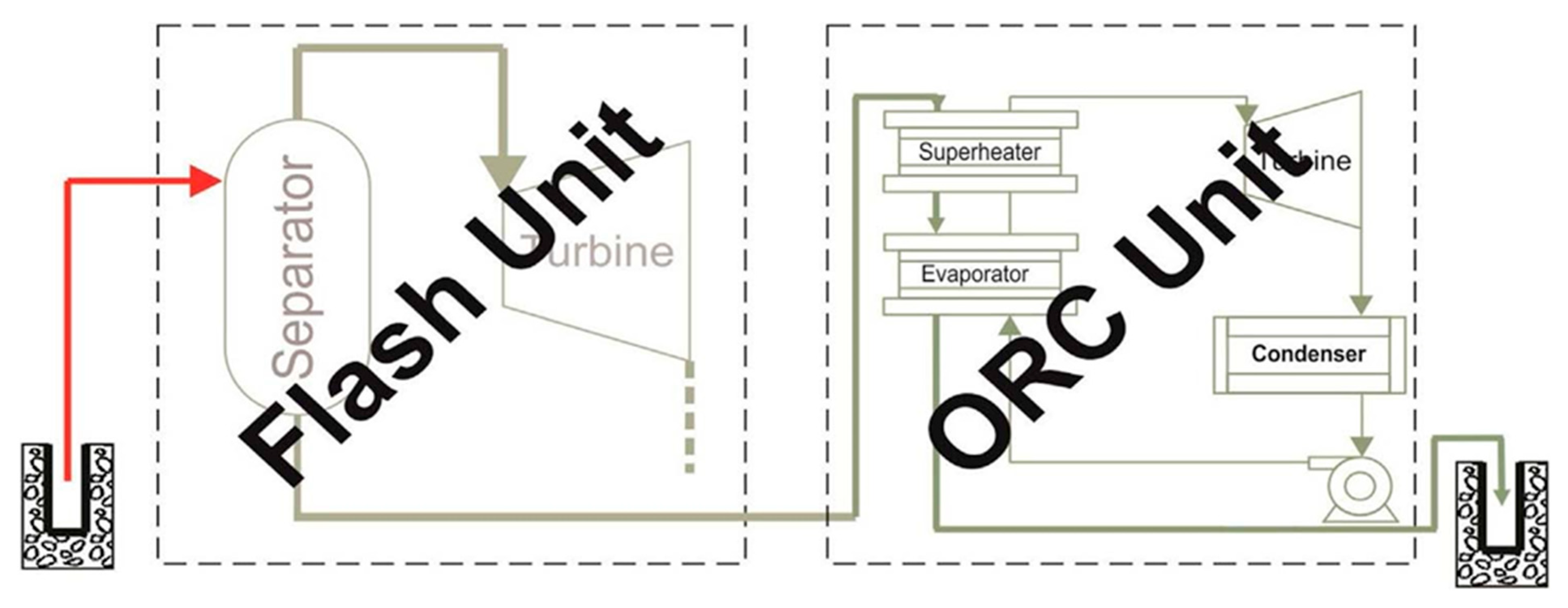
Figure 1. A flash system with an ORC utilizing used geothermal fluid.
Preprints 178635 g001
Figure 2. Dry steam power plant.
Preprints 178635 g002
Figure 3. A single flash system [13,37].
Preprints 178635 g003
Figure 4. Binary cycle plant.
Preprints 178635 g004
Figure 5. Organic flash cycle/Regenerative cycle.
Preprints 178635 g005
Figure 6. The Supercritical Rankine cycle.
Preprints 178635 g006
Figure 7. A combination flash-binary plant.
Preprints 178635 g007
Figure 8. Basic binary cycle with solar heating.
Preprints 178635 g008
Figure 9. A binary cycle with solar-brine heating of working fluid.
Preprints 178635 g009
Figure 10. shows the proposed design at Olkaria 4 flash steam power plant. The brine from the two separators SD3 and SD2 is fed to the ORC plant and separated brine injected to the ground. SD3 receives steam from 7 geothermal wells while SD2 receives steam geothermal fluids team from 8 production wells [25].
Preprints 178635 g010
Figure 11. Four feasible cycles for an organic Rankine cycle.
Preprints 178635 g011
Figure 12. temperature -heat transfer diagram for the evaporator and preheater.
Preprints 178635 g012
Figure 13. Basic Organic Rankine cycle design.
Preprints 178635 g013
Figure 14. Available single flash technology at Olkaria 4 power plant.
Preprints 178635 g014
Figure 15. The power plant use factor between 215 and 2017.
Preprints 178635 g015
Figure 16. Assembly of the Organic Rankine cycle.
Preprints 178635 g016
Table 1. Properties of best working fluids [30].
Fluids Critical
pressure(bars)
Critical
Temp. (oC)
Flammable Ozone
Depletion
Potential
Global
Warming
Potential
1 n-pentane(C5H12) 32.40 193.90 Yes 0 3
2 I-pentane (i- C5H12) 34.09 187.80 Yes 0 3
3 RE347mcc 24.76 164.55 No 0 530
4 Neopentane 31.96 160.59 Yes 0 0
5 Butane 37.96 151.98 Yes 0 4
6 I-butane (i-C2H10) 36.95 135.92 Yes 0 4
7 n-butane(n-C2H10) 37.18 150. Yes 0 4
8 R114(C2Cl2F4) 32.57 145.68 No 1 10,040
9 R115 31.29 79.95 No 1 7,370
10 Isobutene 40.09 144.94 Yes 0 0
11 Ammonia (NH3) 116.27 133.65 Low 0 0
12 R143a 37.61 72.71 Yes 0 4,470
13 1-Butene 40.05 146.14 Yes 0 0
14 Propylene (C3H6) 45.55 91.06 Yes 0 1.8
16 Propane(C3H8) 42.36 96.95 Yes 0 3
17 R245fa 36.51 154.01 No 0 812
18 R113 33.90 487.21 NO 0
19 R12 41.30 385.12 No 0
20 Benzene 49.00 565.20 Yes 1
21 Toluene 41.30 591.75 Yes 1
22 Methanol 81.00 512.60 Yes 1
23 R11 44.1 471.00 No 0
24 R134a 40.6 374.16 No 0
25 Water (H2O) 220.89 374.14 No 0 0
Table 2. Properties of top 10 working fluid mixtures [30].
Mixing Ratio Critical
Temperature(oC)
Critical
Pressure (Bars)
1 Isobutane/Isopentane 0.66/0.34 153.82 37.53
2 Novec649/1-butene 0.5/0.5 154.52 33.36
3 Isobutane/Pentane 0.73/0.27 152.57 37.99
4 R1336mzz/1-Butene 0.53/0.47 153.09 36.25
5 Novec649/Isobutane 0.43/0.57 148.83 35.87
6 Butane/pentane 0.67/0.33 167.43 37.85
7 Isopentane/R245fa 0.5/0.5 175.44 40.52
8 Novec649/Transbutene 0.4/0.6 147.41 36.16
9 R1234ze/Cisbutene 0.59/0.41 140.27 43.85
10 R1336mzz/Isobutane 0.45/0.55 142.94 34.19
Table 3. Heat transfer of different fluids [102,103].
Heat From Transfer To Overall Heat Transfer Coefficient(Ū) W/m2. k
Ammonia (condensing) Water 850-1400
Propane or butane (condensing) Water 700-765
Refrigerant (Condensing) Water 450-850
Refrigerant (Evaporating) Brine 170-850
Refrigerant (Evaporating) Water 170-850
Steam Gases 30-285
Steam Water 1000-3400
Steam (Condensing) Water 1000-6000
Water Air 25-50
Water Brine 570-1135
Water Water 1020-1140
Table 4. Cost of ORC equipment.
Component Unit Cost (US$/unit)
1 Preheater Area (M2) 450
2 Evaporator Area (M2) 500
3 Super heater Area (M2) 500
4 Recuperator Area (M2) 400
5 Condenser Area (M2) 600
6 Feed pump kW 450
7 Cooling Fan kW 450
8 Turbine kW 450
Table 5. Design assumptions.
Design parameter Parameter value
Isentropic efficiency of turbine η t 0.85
Turbine mechanical efficiency η m e c h 0.97
Isentropic efficiency of working fluid pump η p 0.65
Efficiency of fan in the cooling tower   η f a n 0.65
Efficiency of electric generator η g e n 0.7
Table 6. Brine mass flows and properties.
Plant Brine (t/hr.) Separation Press.
(bars)
Brine
temp. (°C)
Enthalpy of Steam
kJ/kg
Total Energy
(MJ)/hr
Olkaria I 235 6 158.9 2757 647,895
Olkaria II 566 6 158.9 2757 1,560,462
Olkaria IAU 524 12 188.0 2784 1,458,816
Olkaria IV 815 12 188.0 2784 2,268,960
Wellheads 589 15 198.3 2792 1,644,488
Total energy lost in the brine 7,580,615
Table 7. Power produced between 2015 and 2017.
Duration 2015-2016 2016-2017 2017-2018
Power generated 525.6 GWh 617.58 GWh 675.5 GWh
Table 8. n-Pentane versus isopentane (Author’s computations).
Parameter n-pentane Iso-pentane
1 Operating pressure (bars) 15 18
2 Mass flow rate of working fluid (kg/s) 119.2 128.4
3 Mass flow rate of cooling air 1264 3176
4 Evaporator area (m2) 736.7 727.9
5 Condenser area (m2) 538.4 480.8
6 Preheater area (m2) 655.4 752.4
7 Pump area (m2) 969.2 615.5
8 Fan area (m2) 317.4 795.5
9 Turbine work (kW) 8585.2 7175.9
10 Net work done (kW) 7398.7 5764.9
11 Cycle efficiency (%) 13.9 10.1
Table 9. Comparative cost of using iso-pentane or n-pentane as working fluids.
Component N-pentene Iso-pentane
Size (m2) Rate
(USD)
Total Cost Size Rate
(USD)
Total Cost
1 Preheater 655.4 m2 450 294,930 752.4 m2 450 338,580
2 Evaporator 736.7 m2 500 368,350 727.9 m2 500 363,950
3 Turbine work 8585.2 kW 450 3,863,340 7175.9 kW 450 3,229,155
4 Condenser 538.4 m2 600 323,040 480.8 m2 600 288,480
5 Feed pump 969.2 kW 450 436,140 615.5 kW 450 276,975
6 Cooling fan 317.4 kW 450 142,830 795.5 kW 450 357,975
7 Total 5,428,630 4,855,115
8 Net power produced 7398.7 5764.9
9 Specific cost of plant (USD/kW) 733.7 842.2
Table 10. Economic evaluation table.
Item Total cost (USD) Total cost (KES)
Total cost of items 5,275,210 527,521,000
Added project cost 967,300 96,730,000
TOTAL 6,242,510 624,251,000
ANNUAL REVENUE
Electricity produced in hour cost of power/hr Hrs/year Revenue generated in a year
Revenue 3 cents /kw/hr 8760 97,218,392.4
Pay Back Period Evaluation
Total cost/revenue generated 627,751,000/97,218,392.4 6.42 = 6 Years 5 months
The plant payback period is 6 years 5 months operating at 50% of the installed capacity
Table 11. Summary of selection criteria for working fluids.
Criteria Approach
1 Price: The price of the Organic fluids used affects the overall cost and preference should be fluids that have wider industrial applications which are generally cheaper.
2 Density of organic fluids Generally, high density fluids are preferred to low density fluids. Low density fluids require higher volumetric flow rate which implies bigger size components which increases installation cost. There is however need for a tradeoff since high volumetric flow rate facilitate reduction of rotational speed of the expander which improves expander reliability.
3 Condensation pressure The condenser should have a pressure as close as possible to the atmospheric pressure. This is because high condensation pressure technically increases system pressure which increases design cost. Too low pressure increases sealing needs and increases size of the condenser.
4 Freezing point Freezing point should be below the minimum ambient temperature to avoid solidification of the working fluid especially during idle periods
5 Cycle top pressure Top cycle pressure should be below the fluid critical pressure to prevent liquid droplets formation during expansion process and overcome instability during vaporization. This also reduces system cost in terms of design, operation, and maintenance costs. A trade-off must be found through a techno-economic analysis
6 Heat transfer coefficient High heat transfer coefficient reduces surface area requirements hence the size of the installation as well as cost.
7 Decomposition temperature The system and environmental temperatures should be lower than decomposition temperatures of the working fluids.
8 Molecular weight: Working fluids with high molecular weight require less rotational speed of expanders which reduces generator cost.
Disclaimer/Publisher’s Note: The statements, opinions and data contained in all publications are solely those of the individual author(s) and contributor(s) and not of MDPI and/or the editor(s). MDPI and/or the editor(s) disclaim responsibility for any injury to people or property resulting from any ideas, methods, instructions or products referred to in the content.
Copyright: This open access article is published under a Creative Commons CC BY 4.0 license, which permit the free download, distribution, and reuse, provided that the author and preprint are cited in any reuse.
Prerpints.org logo

Preprints.org is a free preprint server supported by MDPI in Basel, Switzerland.

Subscribe

Disclaimer

Terms of Use

Privacy Policy

Privacy Settings

© 2025 MDPI (Basel, Switzerland) unless otherwise stated