

Submitted:
25 September 2025
Posted:
29 September 2025
Read the latest preprint version here
Abstract
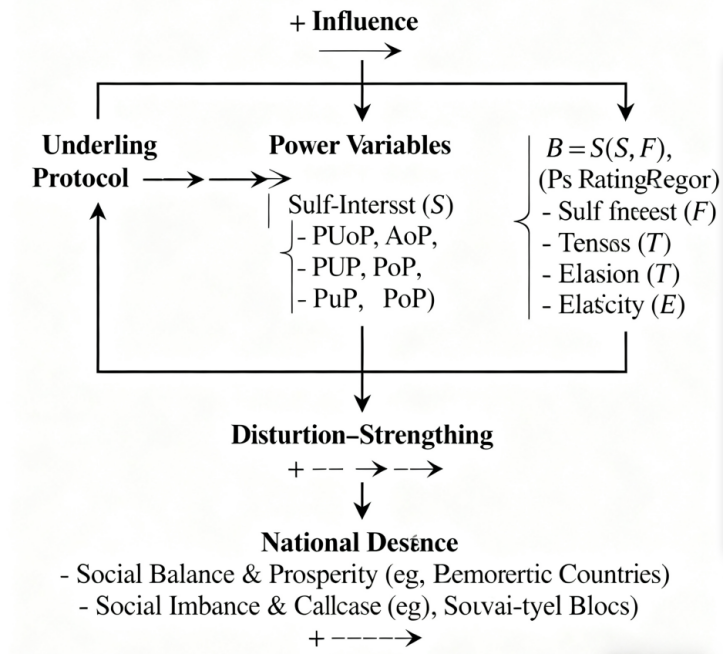
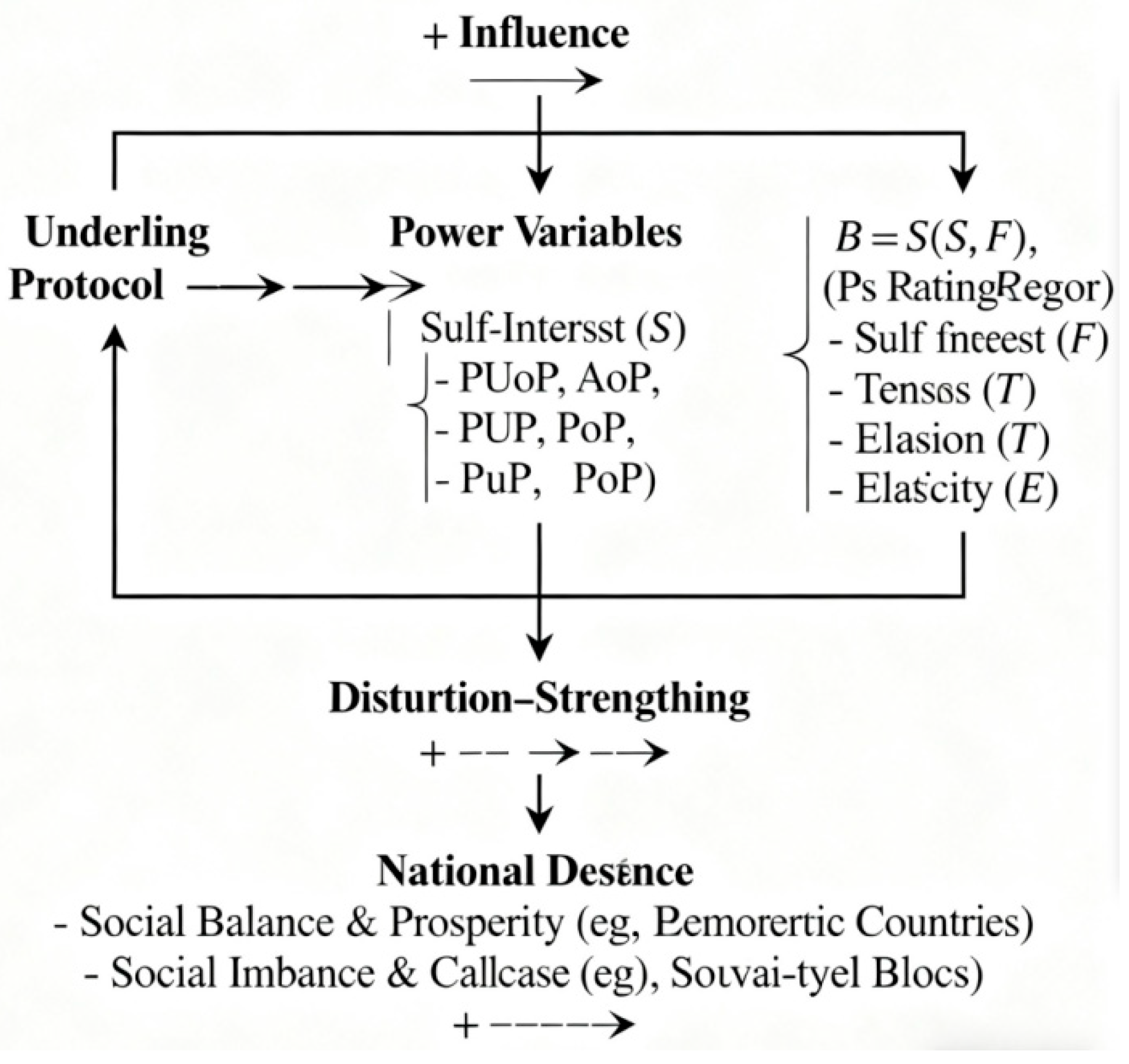
In the course of evolution, humans have developed an "underlying protocol" that balances self-interest and fairness, characterized by tension and flexibility. Like "an ancient scale within the human heart," this protocol adapts to complex social interactions. The rapid collapse of the Soviet-style socialist bloc, the social prosperity of contemporary "full-fledged democratic" blocs, and comparisons between China’s patrimonial bureaucratic dynasties and the 15 historically enduring states (each lasting over 500 years) all indicate a direct causal relationship between this underlying protocol and the fate of nations—with power being an exceptionally unique variable.
Keywords:
underlying protocol
; self-interest and fairness
; tension and flexibility
; power variable
; national fate
; causal relationship
1. Introduction
The issue of self-interest and fairness has been a topic of enduring interest since ancient times. Although people have more or less recognized the complex relationship between self-interest and fairness, they have often discussed these two seemingly contradictory concepts in isolation. On one hand, fairness is frequently linked to justice, morality, or efficiency [1]. For instance, in the classical era, Socrates argued that “justice is the virtue of the soul” [2], while Aristotle emphasized a conception of fairness rooted in proportional equality [3]. During the Enlightenment, David Hume proposed the idea of “moral sentiment” based on sympathy [4]; Immanuel Kant put forward the “Categorical Imperative,” which stands in opposition to self-interested motives [5]; and Adam Smith developed the concept of “sympathy” (which involves our ability to resonate with the feelings of others to varying degrees) [6a]. Among modern thinkers, John Rawls introduced the “Veil of Ignorance,” intended to exclude the interference of self-interest [7], and John Harsanyi advocated a rule-based utilitarian view of justice [8].
On the other hand, self-interest is widely acknowledged as an inherent human trait. Classical economics assumes that the “rational man” acts out of self-interest, asserting that “every individual is born to first and foremost care about himself” [6b], and that “our dinner does not come from the benevolence of the butcher, the brewer, or the baker, but from their regard to their own interest” [6c]. Individuals maximize their interests through self-interested behaviors such as exchange, and the “invisible hand” simultaneously guides them to promote the public good of society. Neoclassical economics in the 20th century continued to treat fairness as an exogenous variable constrained by law or morality. For example, Vilfredo Pareto simplified the “rational man” into a utility-maximization model, with fairness regarded as an external constraint of law or morality [9,10]. In the mid-to-late 20th century, new institutional economics (represented by Oliver Williamson) introduced the concept of “opportunistic tendency,” partially acknowledging the role of fairness but failing to fundamentally challenge the traditional mainstream framework [11]. Friedrich Hayek’s “spontaneous order” rejected the classical notion of “perfect rationality” and emphasized “bounded rationality” in abiding by rules (such as property rights and freedom of contract). However, he argued that true justice lies in procedural justice, and that “artificial” distribution would undermine the spontaneous order [12a,12b].
Thus, the symbiotic relationship between self-interest and fairness has, since ancient times, been like a hidden iceberg—lingering beneath the surface of human consciousness without being explicitly elaborated as a key topic. This changed with the first “ultimatum game (UG)” experiment in 1982 [13]. When participants were confronted with unfair proposals, they were forced to weigh self-interest against fairness, confront motivational conflicts of varying intensity, and even reject unfair offers at the cost of their own interests [14]. This phenomenon has been observed in repeated experiments across different countries and ethnic groups [15,16].
Over the past 43 years, interdisciplinary research on self-interest and fairness in fields such as behavioral economics, social neuroscience, and integrative psychology has become increasingly in-depth and extensive. Significant insights have been gained in three areas: social behavior, neural responses, and genetic factors. These findings have systematically refuted the traditional “binary opposition” hypothesis and confirmed that self-interest and fairness are dual engines of collaborative symbiosis in human evolution.
2. Methodology
This study employs the method of generalization to distill micro-level empirical findings from three domains—behavioral experiments, neuroscience, and genetics—thereby providing a solid tripartite chain of evidence for the existence of the “underlying protocol”. On this basis, through conceptual analysis and theoretical modeling, and finally via verification and application through comparisons of historical practices, it completes a transcendental demonstration spanning from micro-level psychological behaviors to macro-level national fate.
3. Results
Although the review of evidence from relevant interdisciplinary research in this paper may not be exhaustive—for example, current research on the neural systems supporting the implementation of fairness norms still requires more precise description [17], and the scope of genetic factors needs further expansion [18]—the known neural mechanisms and existing genetic evidence, particularly the interaction between two types of neural systems (reflexive intuitive and deliberate regulatory systems) when facing conflicts between self-interest and a sense of fairness [17–20], strongly support the following view: In the course of evolution, humans have developed psychological and behavioral tendencies that balance self-interest and fairness, and possess tension and elasticity. These tendencies, like “ancient algorithms” encoded in our genes, enable adaptation to complex social interactions. Regardless of whether people are aware of them, they exist objectively, innately forming the humanistic foundation of all strategic interactions and serving as the underlying principle of all social governance.
Thus, this inherent, inborn tendency is defined as “underlying protocols”—distinct from the “social contract” in political philosophy and the social contract theory in evolutionary psychology (used to explain social reciprocal exchange). The former suffers from being a reasoning-based approach, which easily leads to significant differences in understanding due to conflicting standpoints. For example, although Thomas Hobbes (in Leviathan), John Locke (in Two Treatises of Government), and Jean-Jacques Rousseau (in The Social Contract) shared the core concept of “contract,” they held fundamental differences in their assumptions about the state of nature, the purpose of the contract, the nature of sovereignty, the role of government, and the extent of individual freedom and right alienation. The latter, based on Darwinian evolution, cognitive science, and game theory, explores cognitive adaptability in reciprocal cooperation. It reveals that the human brain is extremely sensitive to violations of social contracts—especially deception involving gains without corresponding costs—and even addresses implicit or explicit reciprocal agreements or exchange relationships between individuals (e.g., “you help me, and I will help you”) as well as the “computational mechanism” of social exchange. However, the purpose of this theory is to explain the evolutionary mechanism of social exchange cognition [21].
In recent decades, to interpret the decline of nations and the collapse of societies in history, interdisciplinary scholars (in fields such as nonlinear dynamics, population economics, and game theory) have introduced various variables, including climate change and external conflicts [22,23] , population and resources [24,25], and class games [26,27]. Some studies—such as Randall Collins’ structural theory revealing “predictable long-term trends” [28]and Lü Peng et al.’s imperial life cycle model proposing an “automatic process” [29]—show a certain convergence with the “underlying protocols” and the “automatic correction” of their tension revealed in this paper. All these point to the possibility of an inherent driving force in social systems that transcends individual will and class standpoints (the causal relationship between underlying protocols, historical operation, and national destiny will be explored in another paper).
The underlying protocols revealed in this paper consist of three interacting components: the symbiotic relationship between self-interest and fairness, and the associated tension and elasticity. Based on literature evidence and for the sake of clarity, this paper also attempts to construct a theoretical basic model.
Symbiotic Relationship
Distribution, cooperation, and exchange are the most fundamental, universal forms of social interaction, as well as the core domains of social engagement—they are frequently intertwined with one another. For instance, cooperative outcomes require distribution, and exchange itself constitutes a form of cooperation. Interdisciplinary and cross-cultural experiments demonstrate that human psychological behaviors in these three domains clearly, universally, and consistently exhibit complex and profound interactions between the motivation for self-interest and the desire for fairness.
Evidence from Behavioral Experiments
In the domain of distribution, the ultimatum game [13,30] and its series of variant behavioral experiments—such as the dictator game [31] , simplified ultimatum game [32] , impunity game [33] , private impunity game [34] , and various combined games [35] —all reveal the critical role of fairness motivation in decision-making: individuals would rather receive nothing than accept an unfair distribution, even at the cost of their own interests. Clearly, people are punishing unfair behavior rather than rejecting inequality; participants do not care about the other party’s self-interest per se, but rather crave fairness in that specific interactive context. This phenomenon has been observed in repeated experiments across different countries and ethnic groups [15,16] . Consistent results have also been obtained in experiments involving different cultural contexts and monetary amounts: the higher the proportion allocated to responders, the lower the likelihood of rejection. The most common proposal is an equal 50/50 split, with the average offer typically ranging from 30% to 40% of the total [30] . If the offer falls below 20%, the rejection rate ranges from 40% to 60% [36] .
In comparative variant experiments, responders rejected unfair offers more frequently when the distributor was human—especially when the offer was blatantly unfair (e.g., less than 20% of the total). In contrast, when the distribution was made by a neutral third party or a computer, responders were far more likely to accept unfair allocations (even as lopsided as 1:9 or 2:8), with rejection rates significantly lower than when the proposer was human. This indicates that responders’ rejection is not driven by selfishness, but by resentment toward the distributor’s intent, providing the first evidence that fairness preference is dependent on social interaction [37] . This finding was further validated in another imaging experiment, where the same group of responders played the ultimatum game against both human proposers and computer programs. Results showed that when the opponent was a computer, responders accepted nearly 100% of all offers; however, the rejection rate for unfair offers from humans remained as high as 50%. This further confirms that fairness preference is essentially a dynamic response to others’ intentions in social interaction: responders only reject “deliberately unfair” offers when the distributor is human [38] .
In the domain of cooperation, individuals theoretically face the dilemma of the Prisoner’s Dilemma. In reality, however, social interactions are typically not single-shot zero-sum games but involve repeated, multi-round interactions. After multiple rounds of exploration and error correction, people tend to identify optimal strategies for reciprocal cooperation [39a,39b]. Reciprocity is a form of “conditional fairness” and one of the key manifestations of fair behavior in social interaction, yet the connotation of fairness extends far beyond reciprocity [32,40] . In third-party punishment games, even when unrelated to their own interests, 50% to 60% of bystanders are willing to incur personal costs to punish rule violators [41] . Additionally, other social decision-making experiments—including the gift exchange game [42] , public goods game [43a,43b], trust-money exchange game [44] , and justice game [35,45] —all confirm that humans are not purely self-interested.
While factors such as a society’s economic production method (foraging, farming, nomadism, etc.), social structure (closeness of kinship, market integration, scale of cooperation, anonymity, etc.), and cultural norms vary across contexts, leading to differences in how people weigh self-interested motives (seeking more for oneself) against motives for fairness, altruism, or reciprocity (desiring fair distribution, willingness to punish unfairness)—including significant variations in the specific standards of “fairness” (e.g., what constitutes a fair offer) and tolerance for unfair behavior, as well as willingness to punish—fairness preference itself is universal [46] .
Experiments on primates and human children have shown that fair behavior in children strengthens with age—for example, 3-year-olds tend to hoard resources, while school-age children exhibit greater fairness. Social experiences (e.g., cooperative systems, punishment mechanisms) may reinforce or refine these innate tendencies, but humans’ sense of fairness has a long evolutionary history and does not stem solely from social experience [47,48] .
Notably, in both real-life and laboratory settings, people are not always willing to help others when fairness rules are not involved; instead, they constantly weigh self-interest against altruism [49] . Moreover, widely observed altruistic behaviors—such as helping others, resource sharing, charitable giving, and volunteering—are often indirect. Nevertheless, social interaction contexts frequently involve fairness rules. Even when individuals differ in their degree of altruism or self-interest, generosity or stinginess, the trade-off between self-interest and altruism in such contexts translates into a trade-off between self-interest and fairness [50] .
Evidence from Neural Mechanism Experiments
Neuroscientific experiments have confirmed the antagonistic psychological relationship between self-interest and fairness. It has even been found that when self-interest conflicts with fairness, impairments in certain brain functions (e.g., damage to the DLPFC) have a causal impact on fairness-related decision-making [14] .
Alan Sanfey and colleagues were among the first to introduce magnetic resonance imaging (MRI) to ultimatum game research. Their experiments showed that the bilateral anterior insula—a key region for processing negative emotions—generates feelings of disgust and anger in response to unfairness, which in turn drives the rejection of unfair offers. Furthermore, the level of anterior insula activation is positively correlated with the degree of unfairness. The anterior cingulate cortex (ACC)—a known conflict monitor—detects tensions between self-interested and fairness motives, so its activity is also enhanced by unfair allocations. The dorsolateral prefrontal cortex is typically involved in cognitive processes such as goal maintenance and executive control, with the right dorsolateral prefrontal cortex (rDLPFC) being a key brain region for fairness-related decision-making. In other words, unfair distributions trigger activity in brain regions associated with emotion and cognition, and emotion plays a critical role in decision-making [38] .
In another experiment using transcranial direct current stimulation (tDCS) on the rDLPFC, the anodal stimulation group (enhanced excitability) showed significantly higher rejection rates and anger levels in response to unfair offers compared to the sham stimulation group (placebo control) and cathodal stimulation group (suppressed excitability). A positive correlation was also observed between anger intensity and rejection rate, allowing researchers to predict responders’ likelihood of rejecting unfair offers. Additionally, decision-making time was significantly longer for unfair offers than for fair ones, and this difference in response time was more pronounced in the anodal stimulation group. These results confirm the causal role of the rDLPFC in fairness-related decision-making: increasing cortical excitability in the rDLPFC enhances the inhibition of self-interested impulses, thereby facilitating the processing of fairness and strengthening individuals’ fair behavior and adherence to social reciprocity norms [51] .
Other experiments have shown that “damage” or “inhibition” of relevant brain regions impairs the perception of and decision-making about self-interest and fairness. For example, repeated low-frequency repetitive transcranial magnetic stimulation (rTMS) of the rDLPFC significantly reduces the willingness to reject unfair offers. This is because low-frequency rTMS inhibits the cognitive function of the rDLPFC, causing an imbalance between cognition and emotion and making participants more susceptible to self-interested temptations. Importantly, participants still perceived the offers as highly unfair, indicating that the normally functioning rDLPFC plays a key role in suppressing selfish impulses to uphold and enforce fairness norms, and in balancing behaviors related to self-interest and fairness [14] .
Unlike the cognitive function of the rDLPFC, damage to the ventromedial prefrontal cortex (VMPFC) impairs individuals’ ability to make emotion-based decisions. Participants with bilateral VMPFC lesions, despite overall emotional apathy, may exhibit irritability, anger, argumentativeness, and even verbal abuse in response to mild stimuli or setbacks. Consequently, they accepted fewer unfair offers in the ultimatum game [52] .
Numerous experiments in the domain of distribution demonstrate the existence of a systematic neural circuit for maintaining the symbiotic relationship between self-interest and fairness. According to the dual-system theory framework [17,19,20,53–55] , brain activity in the ultimatum game can be categorized into two distinct systems:
System 1 (automatic intuitive-reflexive system): Includes the anterior insula (AI), amygdala, dorsal striatum (DS), dorsal anterior cingulate cortex (dACC), and ventromedial prefrontal cortex (vmPFC). Its activation reflects the rapid evaluation of violations of fairness norms and drives altruistic punishment of violators [38,56] .
System 2 (controlled deliberative system): Includes the prefrontal cortex (PFC), posterior parietal cortex (PPC), medial prefrontal cortex (mPFC), anterior cingulate cortex (ACC), and hippocampus (Hipp) and surrounding temporal lobe (TL) regions. It is responsible for re-evaluating and regulating the intuitive system to decide whether to prioritize self-interest [54,57] or enforce social norms (e.g., fairness) [58] . Its activation helps balance motivational conflicts between self-interested tendencies and fairness norms, enabling more flexible decision-making [17,19,20] .
Consistently, researchers have observed that brain regions associated with the dual-system theory are more strongly activated when participants face unfair offers compared to fair ones in the ultimatum game [18] .
Neurological evidence in the domain of cooperation also shows that humans have evolved neural mechanisms for maintaining social fairness norms [44] . Professor Xiaolin Zhou’s research team used an interpersonal help paradigm to confirm the existence of a neural basis for weighing self-interest against others’ interests—including mechanisms for assessing trade-offs, making decisions about whether to help others, and accounting for individual differences (e.g., social value orientation) [49] .
Evidence from Genetic Control Experiments
Studies in behavioral and neuroscience have found that most human psychological traits are highly heritable [59] . There is strong evidence that genetic factors contribute moderately to substantially to almost all individual psychological differences [60] .
Genes have a significant impact on decision-making in the ultimatum game. Experiments show that men with high testosterone levels may be more likely to reject unfairly low offers [61] . Wallace B. and colleagues were the first to introduce behavioral genetics to research on responders’ rejection of unfair offers in the ultimatum game. Using a design that quantifies genetic and environmental factors, they recruited 658 twins from the Swedish Twin Registry. Comparative analysis of monozygotic (MZ) and dizygotic (DZ) twins yielded clear and striking results: additive genetic effects (i.e., genetic contributions) accounted for over 40% of the variance in decisions to reject unfair offers, while shared environmental effects contributed almost zero, with the remainder attributed to non-shared environmental factors (unique life experiences, events, opportunities, and relationships that differ between individuals) [62] .
To investigate whether fairness-induced brain activity is genetically controlled, Wang Yun and colleagues (2019) adopted a laboratory paradigm combined with functional magnetic resonance imaging (fMRI). They recruited 110 Chinese twins (62 pairs of MZ twins and 48 pairs of DZ twins) with an average age of 19.32 ± 1.38 years. Two factors influencing fairness decisions were manipulated: proposer type (human vs. computer partner) and stake size (two drastically different amounts, e.g., 1000 yuan vs. 10 yuan, for distribution). To observe fairness-related brain activity—including activation differences between unfair and fair offers—participants completed 40 rounds of the game (20 against human partners and 20 against computer partners).
Voxel-level analysis revealed that genetic factors accounted for 24% to 35% of the individual variance in responders’ rejection of unfair offers, indicating moderate heritability of costly punishment (i.e., punishing at a cost to oneself) in the game. More importantly, genetic effects on the rejection rate of unfair offers were observed regardless of whether the offer came from a human or computer partner, or whether the stake was high or low. This study provided the first evidence that genetic factors significantly influence activation of the bilateral anterior insula (AI)—a region associated with intuitive responses to violations of fairness norms—in response to unfairness, with an average heritability of 37% for the left AI and 40% for the right AI. In contrast to unfair offers, environmental factors played a dominant role in determining individual differences in the rejection rate of fair offers. Additionally, environmental (rather than genetic) factors were found to influence the rejection rate of unfair offers through proposer type or stake size [18] .
Currently, there are debates in academia regarding the interpretation of the relationship between self-interest and fairness. For example, within the dual-system theory framework, two competing explanations exist for the rejection of unfair offers: one view holds that pursuing self-interest by accepting any offer is an automatic response, and rejecting unfair offers to comply with fairness norms requires triggering the deliberative system to suppress selfish impulses [63,64] . Knoch D. and colleagues, based on experimental data, argued that the DLPFC plays a key role in overriding or weakening selfish impulses. After disrupting the rDLPFC with low-frequency rTMS, this disruption caused participants to become more willing to accept unfair offers out of self-interest, and they accepted unfair offers almost as quickly as fair ones—indicating that self-interested impulses have a stronger impact on behavior [14] . The other view suggests that pursuing fairness by rejecting unfair offers is an automatic response, and the deliberative system is required to control this impulse to accept unfair offers for maximum personal gain [65,66] . Both perspectives have received some empirical support [67–71] .
Currently, the question of whether self-interest or the pursuit of fairness has a more dominant response in social decision-making remains under investigation [49,72] . However, regardless of the neural mechanism underlying the resolution of motivational conflicts—whether driven by the pursuit of fairness, or using fairness as a means to achieve self-interest; whether self-interest is more weighted, or the two are evenly balanced—one fact is undeniable: the tendencies toward fairness and self-interest are symbiotic, and their interaction is encoded in our genes.
Tension and Elasticity
Over recent decades, various theories have offered extensive explanations for the psychological processes underlying human fairness preference from perspectives including cognition, emotion, and motivation [73,74] . In addition to the influential dual-system theory, there are earlier theories such as inequity aversion theory [75] ; strong reciprocity theory, which interprets fairness from an evolutionary perspective [76,77] ; emotional model theory, which explores fairness through the lens of emotion [56,78,79] ; and social value orientation theory, which focuses on individual differences in prosocial tendencies [74,80] . Regardless of the perspective, it is undeniable that during the long course of evolution, humans living in groups have naturally formed underlying protocols that are antagonistic yet self-consistent. These protocols not only promote dynamic balance between self-interest and fairness among individuals and groups but also, as implicitly or explicitly revealed by the aforementioned theories—from the perspective of motivation (inequity aversion), evolutionary function (strong reciprocity), emotional drive (emotional models), and individual differences (social value orientation)—exhibit inherent tension (e.g., strategic calculation), which has been verified from multiple angles [63–66,81] . The strategies and behaviors they explain, such as sacrificing personal interests for fairness and bearing short-term costs for long-term cooperation, embody the “elasticity” of these protocols, indicating that the protocols are equipped with adaptive tension and elasticity.
Evidence for Tension
The tension between the demands for self-interest and fairness is composed of two opposing forces: Destructive Forces (D) and Restorative Forces (R) [14] . Prevalent and critical Destructive Forces include unfairness imposed by self-interested motives (unfairness in procedure, process, and outcome) and defection in reciprocal cooperation (fraud, free-riding). For example, initiating unfair distribution or imposing exploitative cooperation can disrupt the balance between self-interested and fair psychological behaviors, impair cooperation efficiency, and even rupture social relationships; if defection (fraud, free-riding) is left unchecked and allowed to spread, it will undermine the stability of social cooperation systems [21,82] , and even lead to the “tragedy of the commons” [83,84] . These Destructive Forces can be categorized into two variables: Imposition of Unfairness (IU) and Defection and its Contagion (DC).
Corresponding Restorative Forces that maintain cooperation stability include resistance to and rejection of unfair treatment, behaviors driven by negative emotions and the transmission of cost signals [85,86] . When faced with unfair offers below 20%, participants generally refuse to accept them even at the cost of forgoing immediate benefits [30,31,38] . Even if the proposer does not suffer financial losses, participants still reject unfair distributions to punish self-interested distributors through isolation, while earning a reputation for opposing unfairness—facilitating reciprocal cooperation in the future [33,34] ; additionally, Restorative Forces include punishing defection (fraud and free-riding) and assisting victims of unfairness [87] . These can be summarized into three variables: Resisting Unfairness (RU), Punishing Defection (PD), and Helping Victims (HV).
Neural response experiments also confirm the role of tension in both direct and indirect social interactions. To prevent social system collapse and maintain fair cooperation, in social interactions involving distribution and cooperation (exchange) [30] , people prioritize fairness while caring for their own interests; when treated unfairly, many are willing to sacrifice their own interests to punish others’ unfair behavior [80,88] . Neuroimaging experiments have identified distinct neural mechanisms for unfairness aversion, fairness preference, and punishment of defectors: brain regions sensitive to fairness or showing enhanced value coding and reward responses to fair options include the ventromedial prefrontal cortex (VMPFC), posterior insula (pIns), posterior cingulate cortex (PCC), and superior temporal sulcus (STS); regions associated with the degree of injustice include the anterior insula (AIns), anterior cingulate cortex (ACC), dorsolateral prefrontal cortex (DLPFC), precuneus, and ventrolateral prefrontal cortex (VLPFC); and punishment of defection (fraud and free-riding) is jointly driven by the DLPFC (for evaluating norm violations) and the amygdala (for anger emotion), with amygdala activity correlating with punishment severity—distinct from the striatal circuit involved in reciprocal reward processing [41,45] .
De Quervain and colleagues from the University of Zurich designed a variant of the trust game called the “Money Exchange Game”, where Participant A repeatedly interacted with 7 Participant Bs. A and B exchanged gifts: when A transferred the initial 10 points to B, B received a 4-fold increase in value; if B returned half of the increased value to A, both benefited; if B kept all, A could punish B by deducting points at a multiplied rate. Neuroimaging scans showed that when A voluntarily incurred costs to punish unfair Bs, brain regions including the thalamus and caudate nucleus were activated. The thalamus, which integrates sensory and motor signals, relayed punishment-related information; the caudate nucleus— involved in reward processing and decision reinforcement—responded to dopamine signals, granting the punisher neurobiological satisfaction [44] .
The “Justice Game” demonstrates that even bystanders respond to unfair behavior. Stallen M. and colleagues recruited 55 male participants for a randomized, double-blind, placebo-controlled between-group experiment, with two scenarios: a two-person (“you-other”) scenario and a three-person (“other-other-you”) scenario. In the two-person scenario, one of the two players was randomly assigned as the “Taker”; both the Taker and the Partner received an initial 200 chips. The Taker could then seize chips from the Partner (“you”) and add them to their own earnings. After the Taker’s decision, “you” could punish the Taker by spending your own chips—each chip spent reduced the Taker’s earnings by 3 chips. The experiment showed that this deliberate unfair act triggered intense negative emotions in the victim, with the emotional experience of unfairness typically stronger than merely receiving an unfair offer in the ultimatum game.
In the three-person scenario, “you” acted as an Observer, also receiving an initial 200 chips, with two options: “punish” or “compensate”. In the first option, the Observer watched the Taker decide whether to seize chips from another participant (the Partner). After the Taker’s decision, the Observer could punish the Taker for unfairness, with each chip spent reducing the Taker’s earnings by 3 chips (the Observer was unaware if the Partner had also punished the Taker). In the second option, the Observer compensated the victimized Partner instead of punishing the Taker—each chip spent increased the Partner’s earnings by 3 chips. Although participants were willing to bear higher punishment costs when personally wronged than when witnessing others’ victimization, and cognitive neural responses to “punishment” differed between direct and observed unfairness, participants (both as victims and observers) were willing to incur costs to punish or compensate for unfairness—with observers more inclined to punish than compensate. This confirms bystanders’ willingness to engage in third-party punishment [45] .
Notably, acute stress triggers physiological and neural responses in third parties when facing severe unfairness, reversing the punishment pattern: shifting from punishing perpetrators to directly helping victims, replacing confrontational “punishment of violations” with “protection of the vulnerable”. Zhang Chao’s research team combined computational modeling (Drift Diffusion Model, DDM) with fMRI experiments, adding a third-party “stress group” to the ultimatum game. In each decision trial, the stress group had three options: punish the perpetrator (sacrifice tokens to reduce their earnings), help the victim (sacrifice tokens to increase their earnings), or do nothing. When the proposer made an unfair offer, the third party could choose punishment, compensation, or inaction.
Results showed no significant change in the pattern of punishing unfairness under moderate unfairness (60:40); while under extreme unfairness (80:20/90:10), the stress group exhibited significantly elevated cortisol levels and HPA axis activation; enhanced connectivity between the amygdala and ventromedial prefrontal cortex (vmPFC) activated the emotional network, amplifying empathic responses to the victim’s suffering. Simultaneously, increased DLPFC load impaired executive control, inhibiting impulsive punishment decisions and shifting behavior significantly toward helping. Participants prioritized helping even with limited resources, indicating that the severity of unfairness is the key context triggering this behavioral shift [87] .
Evolutionary theories integrating anthropology, genetics, and behavioral science explain the mechanism by which Restorative Forces suppress Destructive Forces. Christopher Boehm found that hunter-gatherer societies often use group punishment (e.g., shaming, threats, expulsion) to suppress and correct extreme self-interested behavior, preventing social chaos. His research provides a key framework for understanding the unity of self-interest and fairness, while confirming that fairness mechanisms are evolutionary adaptations for group survival [89] . Simulation experiments by Boyd and colleagues showed [82] that in groups, altruistic cooperation and altruistic punishment are integral: punishment serves to maintain sustained cooperation. Except for very small groups such as kinship families, people can barely maintain cooperation without punishment; in slightly larger groups, the lack of punishment mechanisms leads to the rapid spread of defection strategies in the group, and the frequency of cooperation gradually decreases, tending to a low level of cooperation, or even collapsing.
According to research by Robert Axelrod and colleagues, in strategy tournaments comparing unconditional cooperation, unconditional defection, and “Tit for Tat”, “Tit for Tat” emerged as the optimal strategy. This strategy starts with cooperation, avoids proactive defection; then immediately retaliates against defection (“you defect, so I defect”), preventing exploitation while sending clear rule signals; then resumes cooperation after retaliation (“you cooperate, so I cooperate”), avoiding cycles of retaliation. This fairness-oriented strategy secures more cooperation opportunities than unfair strategies, increasing individual survival probability and achieving optimal status in long-term social interactions [39a]. Computer simulations further showed that “Tit for Tat”, as a dominant fairness strategy, helps maintain the dynamic balance between reciprocal cooperation and retaliation against defection. It not only becomes a temporary dominant strategy but also persists naturally in long-term interactions among self-interested individuals, becoming an Evolutionarily Stable Strategy (ESS) [39b]. Subsequent studies have expanded strategies to address noise (e.g., misunderstandings), such as the “Win-Stay, Lose-Shift” strategy [90a]and introducing “moderate generosity” to reduce cooperation breakdown [91] .
Notably, unlike other organisms, humans often cooperate with genetically unrelated strangers in large groups, possibly never to meet again. Altruism among kin or in repeatedly interacting groups can be rewarded by beneficiaries, and this direct reciprocity mechanism is relatively easy to understand. However, in unfamiliar groups, altruistic behavior is unlikely to be rewarded by recipients, and humans often help others. Computer simulations show that this indirect reciprocity behavior may be beneficial in the long run [90b]. Helping others or refusing to help affects an individual’s “image scoring” within the group, which reflects the individual’s reputation and status. These are constantly evaluated and re-evaluated by others and taken into account in future social interactions, which may bring new cooperation opportunities to altruists. To verify this view, Wedekind C and Milinski M recruited 79 first-year university students for testing. These students were divided into eight groups and were told that they would never have the opportunity to meet the same person again in the mutual donation game. In the game, they could repeatedly donate money to others or receive donations from others; each player received an initial amount of 7.00 Swiss Francs (SFr) (except for Group 4, where each player had an initial account of 13.00 SFr); the recipient always gained 4.00 SFr, while the actual cost for the donor was 1.00 SFr (Groups 1 to 3) or 2.00 SFr (Groups 4 to 8). The difference caused by each donation was subsidized by the experimenter; if the donor did not give, both parties had zero cost and benefit. The game was conducted anonymously, but the historical record of whether the player gave or not was displayed in each interaction, and participants decided whether to help the other party by observing the other’s cooperation history (image). The results showed that those who had been generous to others in previous interactions received donations from other participants significantly more frequently, indicating that indirect reciprocal cooperation influenced by image scoring was occurring [92] . Neuroscience research has found that this indirect reciprocal altruistic behavior is related to brain region activity. For example, individuals with larger amygdalae are more likely to perceive the fear and pain of others and have a stronger driving force to help others unconditionally [93–95] . The research results prove that the image scoring mechanism applicable to indirect reciprocity scenarios may play a key role in the evolution of cooperative relationships in larger groups [92] , and the emergence of indirect reciprocity mechanisms may be a decisive step in human social evolution [90b]. There is a causal relationship between reputation, positive interpersonal relationships, and indirect reciprocity [96,97] .
To explore the mechanism of cooperation among strangers, researchers designed a standard Public Goods Game. The rules are: participants are divided into several groups of 4 people. In each round of the experiment, participants receive a certain initial capital (20 monetary units), and they need to decide how much of the capital to invest in public projects. The resources invested in public projects will be multiplied by a certain ratio (1 unit invested becomes 0.4 units of income for each member of the group, with a total magnification of 1.6) and then distributed to group members. The uninvested part belongs to the individual. The experiment found that although punishment is costly for the enforcer and does not produce any material benefits, when participants are allowed to spend personal resources to punish low contributors (altruistic punishment, that is, the punisher needs to pay costs and has no material return), cooperation will flourish, and the level of cooperation will increase significantly and remain stable; if there is no possibility of punishment, cooperation will break down and the social system will collapse. Altruistic punishment of defectors is a key motive for explaining cooperation [43a,43b].
In summary, tension between fairness and self-interest (manifested in behavioral responses, psychological calculations, and neural reactions) is prevalent and complex in social interactions. In reality, if Destructive Forces are excessive, it may lead to the breakdown of cooperative relationships or even the collapse of social systems; if Restorative Forces can suppress Destructive Forces, dynamic balance can be “corrected” through cooperation strategies such as “Tit for Tat”. Its specific manifestations and results are often affected by multiple variables in different contexts.
Evidence for Elasticity
Notably, although human social decisions are largely driven by fairness considerations, real environments are complex and variable. Twin studies by Wallace and colleagues (Sweden) and Wang Yun and colleagues (China) show that genetic factors contribute moderately to the rejection of unfair offers [62] . Among them, Wang Yun and colleagues used voxel-level analysis and found that 24%-35% of the individual differences in responders’ rejection of unfair offers were attributed to genetic contributions, and the remaining 65%-76% were attributed to non-shared environmental influences [18] , indicating that environmental factors have a greater impact on the trade-off between self-interest and fairness. Other genetic studies have also conveyed similar conclusions, such as political attitudes [98] , which, in addition to being affected by genetics, all consistently acknowledge the importance of environmental factors. This indicates that the genetic basis and social cognitive mechanisms formed in human evolution have adaptive characteristics.
In addition to adaptability, the underlying protocols of social interaction are also equipped with elastic mechanisms, which can delay the process of tension imbalance and provide a certain flexible space for the dynamic balance between self-interest and fairness.
First, the elasticity of underlying protocols is reflected in the “supporting” neural functions related to fairness perception. For example, the dopamine system participates in reward calculation and reward learning in fairness decisions. Schultz’s classic research confirmed that dopamine neurons respond to differences between expected and actual rewards [99] ; O’Doherty’s neuroimaging research further revealed the role of the human striatum in reinforcement learning, which can participate in the decision reinforcement process by encoding reward signals [100] ; similarly, Harbaugh and colleagues found through neuroimaging experiments that in the prosocial behavior of charitable donation, the striatum is also activated by fairness-related reward signals (such as social rewards from helping others), indirectly confirming its associated function in fairness decision-making and reinforcement learning [101] ; in moral judgment, the insula is involved in encoding negative moral contexts (such as unfairness or defection aversion), while the striatum is involved in reward integration (such as pleasure from fair distribution). Greene and colleagues’ fMRI experiments verified the activation of these brain regions in moral dilemmas [102] ; Delgado’s research showed that the striatum responds to moral behavior in trust games, that is, when opponents show moral behaviors such as trustworthiness, the activation intensity of the striatum increases significantly [103] ; prosocial paralimbic regions, especially the subgenual ACC, play a key role in altruistic and charitable decisions. Krueger and Moll confirmed this function through trust game and donation experiments [104,105] ; the insular cortex plays an important role in fairness and empathy, participating in risk assessment and empathic pain processing. Singer’s research proved that the insula has an empathic response to unfair behavior (sympathizing with fair opponents and approving of punishment for unfair opponents) [106] ; Kuhnen and Preuschoff revealed its coding function for risk perception [107,108] ; in addition, the insula (Insula) also integrates and transmits aversive emotional signals [109] , and relies on the motivational integration of the nucleus accumbens (NAcc) shell (regulating the intensity of motivation for avoidance behavior) and the defensive response of the central amygdala (CeA) (initiating threat-related defensive signals). This neural synergy model of active avoidance [110] , combined with the value integration function of the ventromedial prefrontal cortex (vmPFC) [111] , collectively promotes people to prefer to spend more effort to avoid losses rather than gain benefits [112] . Although the degree of behavioral performance may be different from that of adults, loss aversion is a psychological tendency that appears as early as childhood. Studies have found that even children and young children exhibit loss-averse behaviors such as the endowment effect [113] . The neural circuit formed by the dorsomedial prefrontal cortex (dmPFC) and the lateral hypothalamus (LH) plays a key role in social comparison and emotional transformation. Noritake and colleagues’ research confirmed that when individuals perceive their own income as lower than others, the activation of this circuit triggers negative social emotions of “inequity aversion”, and provides causal evidence through chemogenetic inhibition experiments [114] , and so on. Although there are debates in the academic community on the evolutionary interpretation of certain functions, it is undeniable that these evolutionarily conserved neural mechanisms provide the basis for social cognitive functions such as empathy, enabling humans to flexibly adjust their fairness expectation thresholds (fairness difference thresholds) and emotional responses according to environmental differences, thereby exhibiting behavioral elasticity with different utilities [115–118] .
Second, the elastic mechanisms of underlying protocols are also reflected in the variables of social interaction. Among the prevalent and important variables, in addition to the aforementioned cooperation strategies [21,39a,39b,82,89,90a,90b,91,92], there are also individual contribution and collective efficiency. Among them, individual contribution is related to the competitive desire and results of self-interest. Some researchers have found that in contextual factors such as the distributor’s intentionality [32,119–121] , the social distance between the distributor and the recipient [122] , and loss or gain [123–125] , personal contribution has a huge impact on fairness considerations [126,127] . In the comparison between self-contribution and others’ contribution, when individuals believe that it seems fair for those who contribute the most to obtain the largest share, they may accept unequal distribution. Experimental evidence shows that as they grow older, children will also accept unequal distribution based on differences in personal contribution [128] . Obviously, in the field of distribution, an individual’s self-contribution to income is undoubtedly an important variable. Researchers once designed a modified ultimatum game, adding a ball-guessing game before the start. At least one of the proposer and the responder had to guess correctly to enter the money-sharing link. In the game, by manipulating the accuracy of the responder’s guess, the degree of the responder’s contribution to obtaining the money-sharing qualification was changed. The results found that when the responder’s contribution was greater than the proposer’s, they rejected unfair proposals more frequently and gave lower fairness scores; at the neural level, when the responder’s self-contribution was greater, the anterior insula, anterior cingulate cortex, dorsolateral prefrontal cortex, and temporoparietal junction showed stronger activity in response to unfair proposals; while when the proposer’s contribution was greater, relatively speaking, the ventral striatum and medial orbital frontal gyrus showed higher activation in response to fair proposals. In addition, under the condition of self-contribution, the activation of the right dorsolateral prefrontal cortex during unfair proposals was positively correlated with the rejection rate. These findings reveal the importance of self-contribution in fairness-related social decision-making processes. That is, the more an individual contributes to income, the stronger their sense of unfairness, and the harder it is to justify unfair distribution [129] . The egalitarianism of Soviet-style socialism in the 20th century violated the principle of distribution based on personal effort or contribution.
Collective efficiency is a core issue affecting the implementation of underlying protocols. When pursuing collective interests, people have to face a trade-off between social equality and efficiency [130] . Multiple studies have revealed the significance of reciprocal fairness motives for promoting or inhibiting collective efficiency [32,43c,131]; Engelmann and Strobel (2004) conducted experiments through three distribution paradigms, namely Taxation Games (finding that 83.8% chose efficient and poverty-alleviating schemes, reflecting the compatibility of efficiency and fairness), Envy Games (finding that 70% sacrificed equality and chose efficient schemes, highlighting efficiency priority), and Rich/Poor Games (the rich tend to be poverty-alleviating, while the poor tend to be efficient), revealing that efficiency concerns, self-interest motives, and fairness preferences, including inequity aversion and maximin preference (i.e., focusing on the income of the most disadvantaged), are often intertwined [132a]. Although there are differences in academic views on the degree of influence of efficiency and inequity aversion [132b,133], the interweaving of efficiency, self-interest, and fairness motives undoubtedly profoundly affects decision-making behaviors in politics (power), economy (wealth), and society (public choice) [134–136] .
To investigate the neural basis of the trade-off between efficiency and fairness, Ming Hsu and colleagues designed an innovative distribution task experiment: 26 adult participants decided how to distribute these “meals” to a group of children in a Ugandan orphanage. In each experiment, participants had to choose between two distribution schemes: “maximizing the number of meals but unfair” and “fair but low efficiency”. The on-screen operation process was divided into five links, each of which specified the number of seconds to complete, in order to find the neural responses of participants in different links. Functional magnetic resonance imaging (fMRI) results found that in the decision-making process of weighing fairness and efficiency, the putamen responds to efficiency, the insula encodes unfairness, and the caudate nucleus/septal subgenual region encodes the subjective utility of efficiency and unfairness, driving the final decision. It is worth noting that individual differences in choices depend on the difference in the weight that participants assign to unfairness (rather than efficiency), that is, participants who receive strong negative emotional signals may be more sensitive to violations of fairness norms; while those who do not receive strong signals are mainly affected by efficiency. Therefore, although we often face the dilemma between fairness and efficiency, this study shows that the sense of fairness encoded by the insula is a necessary condition and emotional basis for distributive justice, while the efficiency signal encoded by the putamen can only indirectly affect decision-making through subjective value judgment [1] .
4. Discussion
A series of experiments from the three perspectives of behavior, psychology, and physiology discussed earlier demonstrate that: in social interaction decision-making [37], the underlying protocols that balance self-interest and fairness and possess tension and elasticity exist universally and objectively. This phenomenon has been observed in repeated experiments across different countries and ethnic groups [15,16]. Furthermore, behavioral experiments on capuchin monkeys [47], behavioral experiments on chimpanzees and children [48], and interdisciplinary anthropological or evolutionary studies [21,89,90b,92,97] further confirm that the symbiotic relationship between human self-interest (S) and fairness (F), along with its tension (T) and elasticity (E), has a long history. It existed as early as the primate period millions of years ago and is not a product of the civilized era.
Given that the core independent variables of the underlying protocols are self-interest (S) and fairness (F), and their core feature is “Dynamic Balance Force (B)”, this can be concisely expressed in a functional form as:
B = f[S,F]
To express it in a complete functional form, it is first necessary to sort out the basic logic of the evolution of relevant variables and their interrelationships. Regarding the symbiosis of self-interest (S) and fairness (F): if the demand for self-interest is suppressed or deprived to approach zero, individual contributions are often not valued, and society tends to become slack or even collapse. Researchers have found that farmers in Soviet collective farms had no direct sense of responsibility for any piece of land; the harvest of a team contracting experiment in the early 1970s was actually 20 times that of the adjacent collective farm [137a]. The same was true in Hungary: private land owned by farmers accounted for only 13% of the total farmland area, but its output accounted for one-third of the total output [138]. Voluntary “utopian” experiments in history all ended in failure, including influential ones such as the experiments by Henri de Saint-Simon and Robert Owen. Forced public ownership measures even led to human tragedies, such as the Thomas Münzer Uprising and the Kommunel von Münster [139]. The Kibbutz in Israel during the statehood restoration period, which followed the principle of “either collective settlement or no settlement at all”, lasted relatively long; however, it basically allowed free withdrawal, later permitted private ownership of goods, and gradually integrated into the market economy [140,141].
Similarly, if the demand for fairness (F) is suppressed to approach zero, social negative emotions will intensify, enthusiasm for cooperation will decrease, and people will become alienated from each other—possibly triggering social collapse. Alternatively, individuals may pursue self-interest without regard for reciprocal cooperation [40,142,143], which may lead to the “tragedy of the commons” (the collapse of social systems or public environments due to individual non-cooperation) [83,84].
In addition to the two core independent variables S and F, there are other variables that act directly on the system. In terms of Tension (T), it consists of two opposing factors: Destructive Forces and Restorative Forces. Destructive Forces include two sub-variables: Imposition of Unfairness (IU) and Defection and its Contagion (DC). The stronger the Destructive Forces (IU, DC)—i.e., the more severe the “Imposition of Unfairness” (IU) and/or “Defection and its Contagion” (DC)—the more the system tends to be unbalanced. Restorative Forces include three sub-variables: Resisting Unfairness (RU), Punishing Defection (PD), and Helping Victims (HV). Compared with Destructive Forces (IU, DC), if Restorative Forces (RU, PD, HV) are stronger—i.e., Punishing Defection (PD) and/or Helping Victims (HV) are more effective, and Resisting Unfairness (RU) works—the system tends to be more balanced. However, if Resisting Unfairness is ineffective, Punishing Defection is weak, or social assistance is absent—especially when the effectiveness of Resisting Unfairness or Punishment approaches zero—non-cooperative behavior will spread, and society will tend to collapse.
At the same time, Destructive Forces in Tension are alleviated by elastic mechanisms. Elasticity (E) includes three sub-variables: Cooperative Strategy (CS), Individual Contribution (IC), and Collective Efficiency (CE). If Individual Contribution (IC) is effectively realized, individuals can tolerate a certain degree of distributive inequality; moreover, the better the distribution based on contribution, the better the effect of alleviating Destructive Forces. However, if Individual Contribution is not respected, it may conversely turn into Destructive Force. If the goal of Collective Efficiency (CE) is legitimate, individuals can also voluntarily transfer part of their rights and even tolerate a certain degree of inequality; furthermore, the more equitable the methods, the better the effect of alleviating Destructive Forces. But if Collective Efficiency approaches zero, society tends to decline. If the goal of Cooperative Strategy is positive—such as “moderate generosity” or aversion to unfairness—cooperative relationships are easily maintained; otherwise, it may cause conflicts or transform into Destructive Force. The elasticity of Individual Contribution manifests as tolerance for unfair distribution; the elasticity of Collective Efficiency manifests as the transfer of partial private rights for collective interests; Cooperative Strategy is affected by various contexts. The three sub-variables interact with each other, but their direct correlations are relatively weak.
In addition, in complex interactive states, it is necessary to consider the cross-influences among multiple variables—such as between the sub-variables of the Elasticity term (E) and the Tension term (T). Theoretically, if Individual Contribution (IC) is respected, it may directly reduce the incidence of “Imposition of Unfairness” (IU) and/or “Defection and its Contagion” (DC)—i.e., IC may affect IU and/or DC. If Collective Efficiency (CE) and Cooperative Strategy (CS) have strong legitimacy (e.g., Vietnam’s Doi Moi), they may also enhance the legitimacy of Punishing Defection (PD) and improve the willingness of the public to Resist Unfairness (RU) and Help Victims (HV)—i.e., CE and CS may affect PD and/or RU, HV, and vice versa [21, 37, 40,41, 42, 43a, 43b, 45].
5. The Special Variable
Although there was no coercive power in the millions of years of evolution, leaders in the Paleolithic Age fulfilled their duties through their own influence [144a]. With the dawn of civilization, however, “power” emerged as a critical variable influencing fairness norms. A study found that power has a “moral amplifier” effect: when high-power individuals (e.g., officials, superiors) violate fairness, they trigger stronger moral outrage and a greater willingness to punish among the public than low-power individuals [145]. The operation of political power determines the degree of fairness in a country’s distribution. As early as the classical period, Aristotle pointed out that political justice lies in distributive justice, and a governor should be a guardian of justice and equality [3b]. Meanwhile, as Nobel laureates Daron Acemoglu and James A. Robinson stated, politics is the key to sustained economic prosperity—if political institutions are not inclusive, economic prosperity will not be sustainable [146a]. Therefore, political power also influences the balance between self-interest and fairness in the fields of cooperation and exchange.
If rulers are profoundly self-interested and are themselves defectors from reciprocal cooperation, then the frameworks for social interaction (i.e., institutions and organizations) they establish based on Power Self-Interest (PS) [147a] will distort not only the symbiotic relationship between self-interest and fairness but also warp the destructive forces (IU, DC) and restorative forces (RU, PD, HV) of tension (T), as well as the manifestation of elasticity (E). The destructive forces (IU, DC) are amplified by Power Self-Interest, leading to more severe Imposition of Unfairness (IU) and/or Defection and Contagion (DC). In particular, this will reverse the evolutionarily preserved repair mechanism of Punishing Defection (PD), which not only reduces the legitimacy of punishing defection, weakens the public’s willingness to Resist Unfairness (RU) and engage in social assistance (HV), but even directly becomes a destructive force against fairness norms. It may not only suppress the desire to compete reflected in Individual Contribution (IC) within elasticity but also distort the service purposes of Collective Efficiency (CE) and Cooperative Strategy (CS). Moreover, the deeper the degree of Power Self-Interest (PS), the more severe the distortion.
Throughout history, particularly in the two millennia since the Axial Age, the “corrective” effect of the underlying protocols on power self-interest has been a ubiquitous phenomenon, and this “correction” often manifests as a periodic “rebuilding from scratch” [148].
Of course, in the context of power, Self-Interest (S) and Fairness (F) in the underlying protocol remain the core independent variables and the most inherent drivers determining the “dynamic balance (B=f[S,F])” of society. If the symbiosis between Self-Interest (S) and Fairness (F) is severed, and the needs for self-interest or fairness are artificially deprived, society will tend to be unbalanced or even collapse under the backlash of the tension in the underlying protocol. In the 20th century, Soviet-style socialism violently “eliminated private ownership,” enforced a planned economy, suppressed the public’s demand for self-interest and desire to compete, and ignored individual contributions in distribution, resulting in severe social loafing and economic stagnation. As Hayek put it: “Without the recognition of private property, justice cannot exist” [12c]. The Nomenklatura manipulated resource allocation in the name of “public ownership” [149,138b], enjoying excessive self-interested privileges, while the people only had nominal fairness but no substantive fairness. This not only artificially severed the symbiotic relationship between self-interest and fairness but also caused the dual suppression of both, leading to the dual alienation of Power Self-Interest and social fairness. The degree of deviation from the underlying protocol even exceeded the lack of fairness in ancient dynasties. The consequence was that the lives of ordinary people became a struggle for survival, compelling them to develop informal coping mechanisms and resistance strategies—such as theft, bribery, and deception—to bypass institutional constraints [150]. The once-powerful Soviet Union collapsed rapidly after only 69 years of existence (1922-1991), and dozens of Soviet-style regimes in Europe, Asia, and Africa also collapsed one after another. In contrast, socialist countries such as China and Vietnam timely launched economic reforms aimed at satisfying self-interest needs, avoiding the fate of collapse—this serves as reverse evidence that the public’s needs for self-interest and fairness cannot be severed.
Similarly, if power is excessively self-interested, leading to severe social injustice, it will also face backlash from the tension in the underlying protocol. Max Weber (Weber, M.) classified China’s Qin-style dynasties as typical patrimonial bureaucracies [151a], characterized by an extreme degree of power self-interest. Although they barely maintained superficial stable order through coercive apparatus and bureaucratic systems, they severely distorted the fairness norms formed over millions of years of evolution, periodically plunging society into the abyss of turmoil and repeatedly being overthrown by popular uprisings. Montesquieu once described this vividly [152a], and G. W. F. Hegel clearly stated that Chinese history only repeats itself without progress [153] , showing “alternating between order and chaos without genuine revolution” [154,155] . Every dynasty, after reaching its peak in politics, culture, and economy, would decline due to moral corruption and repeatedly suffer the periodic backlash of the “dynastic cycle” [148,156].
Contemporary Observations
Regarding the origin of power, the Divine Right Theory posits that power is bestowed by the divine [157,158] ; the Social Contract Theory argues it stems from the delegation of the collective [159,160] ; the Consent Theory maintains it arises from the consent of the people [161] ; the Naturalistic Theory holds it derives from individual capability [162] ; and the Empirical Theory suggests it emerges from reflections on injustice [163] , among others. However, interdisciplinary research indicates that punishing non-cooperators constitutes an altruistic act: those who enforce punishment incur certain costs, yet the collective as a whole benefits. Punishers, nonetheless, gain a favorable reputation—they are generally perceived as more trustworthy, respectable, and more likely to become focal figures within the group. This enhanced reputation affords punishers at least one major benefit: others are eager to form cooperative alliances with them [43a,43c,164,165]. Simulations of the Asymmetric Volunteer’s Dilemma Game further reveal that in asymmetric interactions within large groups, “stronger individuals” achieve higher “cost-effectiveness” or “efficiency” in their altruistic contributions compared to “weaker individuals” (i.e., a more favorable cost-benefit ratio). This enables them to secure stable, maximized gains within the framework of ultra-rational strategies, which incentivizes them to proactively uphold cooperation. Consequently, the “Tragedy of the Commons” can be avoided without the need for identification or negotiation [166] —a phenomenon that may represent the embryonic form of early public power.
While theories on the origin of power vary, it is certain that “public ownership of power” and “public power used for the common good” are most aligned with the social norms shaped by millions of years of evolutionary selection. “The state of nature is a state of perfect freedom and equality, where every individual holds equal power” [161b]. This assertion has not only been corroborated by Enlightenment thinkers such as Locke but also verified by anthropology and history—prehistoric societies, over millennia, indeed universally featured tribal democracy and equality of rights [144b,167,168].
Contemporary history provides even more compelling evidence. Whether democracy serves as an engine of prosperity or is a consequence of economic prosperity has long been a subject of debate in economics [169] . This paper does not aim to explore the causal relationship between democracy and prosperity; instead, it focuses on the fact that democratic systems are more congruent with the fairness norms preserved through millions of years of evolution.
Modern practice demonstrates that genuine democracy entails pluralism and the rule of law. It inclines toward the public ownership of power and its use for the common good, and strives to satisfy the fairness demands (procedural fairness, opportunity fairness, and distributive fairness) of all social strata. It enables free and fair self-interested competition, allowing individuals to pursue self-actualization through diverse aspirations. Based on an analysis of numerous comparative cases, Daron Acemoglu and James A. Robinson note that countries with sustained prosperity are invariably inclusive. Inclusive Economic Institutions not only grant individuals the freedom to pursue occupations best suited to their talents but also provide an equitable environment for them to seize such opportunities. Inclusive Political Institutions, meanwhile, tend toward pluralism and achieve a certain degree of political centralization, which in turn establishes the rule of law and lays the foundation for property rights and inclusive market economies [146b]. A global contemporary phenomenon further confirms this: most affluent countries are democratic, while most impoverished nations are under authoritarian rule [169] . The political and economic conditions of the “full democracy” bloc serve as particularly robust evidence.
The Economist Intelligence Unit (EIU) first released the Democracy Index in 2006. Beyond statistical data, the final report did not disclose the type or number of experts involved, whether these experts were EIU staff or independent scholars, or their nationalities—a lack of transparency that has attracted criticism [170] . Additionally, economic living standards were not included as a criterion for democracy. Nevertheless, these flaws do not overshadow its strengths: the Democracy Index report is widely cited in international media and peer-reviewed academic journals, such as The Journal of International Affairs [171] .
The report assesses the democratic quality of 167 regimes worldwide and classifies them into four types: “Full Democracies” (scores of 8.00 to 10.00), “Flawed Democracies” (6.00 to 7.99), “Hybrid Regimes” (4.00 to 5.99), and “Authoritarian Regimes” (3.99 or below). “Full Democracies” are characterized by effective systems of government checks and balances, independent judiciaries, functionally efficient governments, and diverse, independent media—with only limited issues in their democratic operation [172] .
From 2006 to 2024, the Democracy Index has been published 17 times. The number of “Full Democracy” countries/regions peaked at 28 in 2008, declined to 19 in 2016, and rose to 25 in 2024. Ranked in order, the 25 “Full Democracy” countries/regions in 2024 are: Norway, New Zealand, Sweden, Iceland, Switzerland, Finland, Denmark, Ireland, the Netherlands, Luxembourg, Australia, Taiwan, China, Germany, Canada, Uruguay, Japan, the United Kingdom, Costa Rica, Austria, Mauritius, Estonia, Spain, the Czech Republic, Portugal, and Greece. Most of these have consistently appeared in previous “Full Democracy” lists. Even those not classified as “developed countries” by the United Nations stand out in their respective regions: for instance, while Uruguay does not meet the criteria of traditional developed countries, it ranks among the wealthiest nations in South America [173a]; Costa Rica, a high-income country [173b], excels in multiple areas including environmental protection, renewable energy utilization, and social welfare, earning it the reputation of the “Switzerland of Central America” [174] ; and Mauritius, undoubtedly a high-income country in Africa [173c], performs prominently in finance, tourism, and social welfare, with an overall development level approaching that of a “medium-developed country” [173d]. Notably, the social democratic “Nordic model” (Sweden, Denmark, Norway, Finland)—featuring “from cradle to grave” universal welfare programs covering all citizens [175] —exemplifies the balance between market economy and power checks, free competition and social security, and the maintenance of dynamic social equilibrium.
Classification of Power
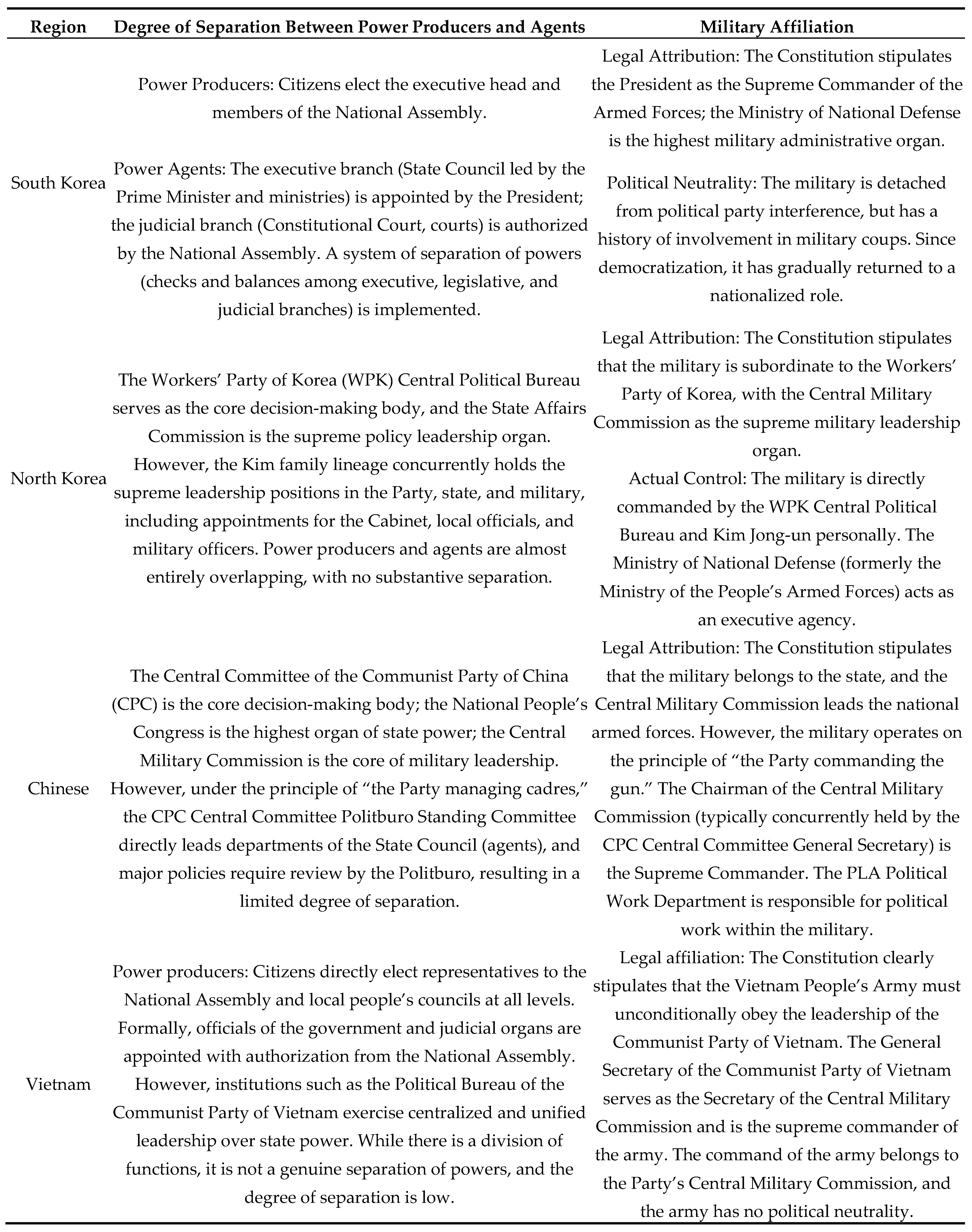
Using the analysis of the underlying institutional framework to observe the balance between power self-interest and social equity in a given country, this study aims to ascertain whether its power is of a self-serving nature (Self-Interest) and the degree of imbalance between power self-interest and social equity. Based on the nature of the military or the entities it pledges allegiance to, as well as the degree of separation between power producers and power agents, this study attempts to categorize the “power variable” into four major types:
Public Use of Power (PUoP): The military is subordinate to the state, with a sound system of checks and balances in place. The legislative (oversight), executive, and judicial powers are separated, each operating in accordance with legal authorization and procedures. This relatively optimally maintains a dynamic balance among various social strata, such as the full democracies identified by the Economist Intelligence Unit (EIU) or the flawed democracies capable of systematically resolving emerging issues [172] . In such contexts, there exists freedom of speech in society, and the degree of power self-interest is close to zero or effectively curbed.
Abuse of Public Power (AoP): The military is subordinate to the state, yet the system of checks and balances is insufficiently robust. Legal authorization and procedures contain loopholes or are artificially transgressed, leaving room for power self-interest and anonymous operations. Nevertheless, officials do not concurrently serve as legislators, and power agents are separated from power producers—such as flawed democracies with unfair elections or restricted media freedom, as well as hybrid regimes.
Private use of public power (PuP): The military swears allegiance to individuals or political parties, and power is partially converted into a tool for individuals, families, or groups (senior party leadership) to pursue private interests. Officials concurrently hold positions as legislators, while there is only limited separation between power agents and power producers. Manipulated electoral procedures and restricted freedom of speech exist in such contexts, such as authoritarian states like Russia and Belarus, as well as states that maintain the Soviet-style socialist power model, including Cuba, Venezuela, and Vietnam.
Privatization of Power (PoP): The military swears allegiance to families or political parties. Power agents double as power producers, who regard public power as private property and exercise monopolistic, hereditary, or exclusive control over it. There is an almost complete absence of independent media and freedom of speech in such contexts, such as North Korea under the Juche ideology system and some remaining authoritarian monarchies.
Subsequently, several sub-variables and their weights that influence the degree of Power Self-Interest (Ps) are defined. A weighted sum formula is then applied: the sub-variables across the defined dimensions are quantitatively scored, weights are assigned based on the importance of each sub-variable, and a composite score for the degree of Power Self-Interest (Ps) is calculated.
Weighted Sum Function Formula:
where:
Sₓᵢ represents the score of each dimensional variable. Each sub-variable is scored on a scale (e.g., 0–10), where 0 indicates “extremely high power self-interest” and 10 indicates “extremely strong public nature of power.” The scoring criteria must be based on accessible objective data (e.g., transparency indicators from international organizations, official oversight reports released by various countries).
Xᵢ denotes multiple dimensions, namely X₁, X₂, ..., Xₙ. For instance, X₁ refers to the effectiveness of power oversight, X₂ to the transparency of public resource allocation, X₃ to interest conflict avoidance mechanisms, and X₄ to the degree of public participation in decision-making.
Wᵢ represents the weights of the multiple dimensions, namely W₁, W₂, ..., Wₙ. Weights should be objectively assigned based on the variance contribution of the data itself. ΣWᵢ = 1 (the sum of weights equals 1) to ensure the score range is controllable.
By substituting the score (Sₓᵢ) and weight (Wᵢ) of each dimensional variable into the formula “Sₓ ₁ W ₁ + Sₓ ₂ W ₂ + ... + SₓₙWₙ,” the composite score for the degree of Power Self-Interest (Ps) can be derived.
First, postulate N sub-variables for the Power Self-Interest (Ps) metric; for instance, the four dimensions outlined in the table below. Next, establish quantitative rules by referencing internationally recognized assessment frameworks, such as the Democracy Index by the Economist Intelligence Unit (eiu.com), the Corruption Perceptions Index (CPI) by Transparency International (transparency.org), and the Freedom in the World Report by Freedom House (freedomhouse.org). Define scoring criteria and a scale (e.g., 0–10) for each sub-variable. Simultaneously, assign weights to each sub-variable based on their relative influence on the degree of power self-interest.for example:
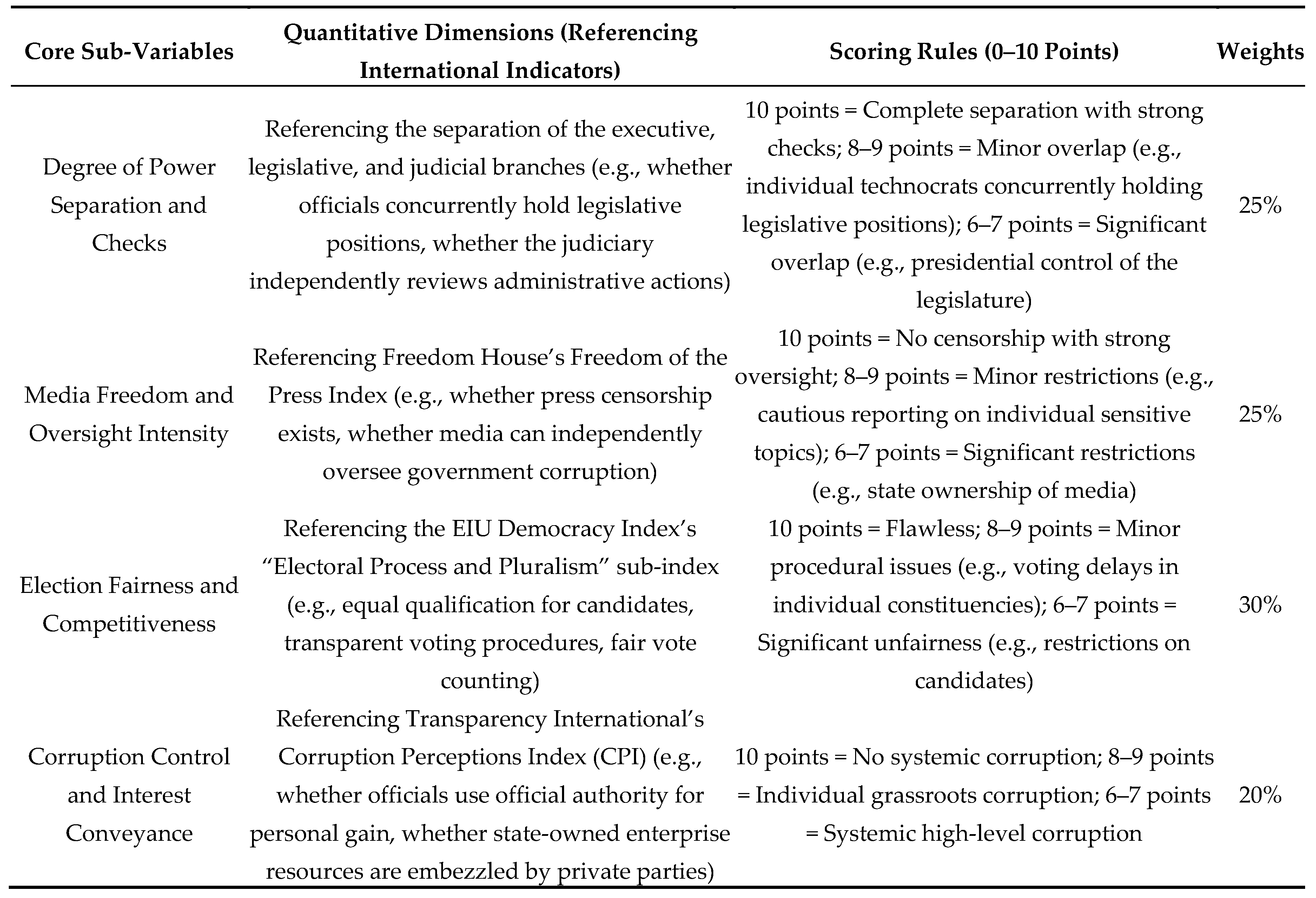
Substituting the scores and weights from the table into the aforementioned weighted sum formula (Σ(Sᵢ × Wᵢ)), the composite score for the degree of Power Self-Interest (Ps) can be derived. Countries can subsequently be categorized into power types based on this score as follows:
- Scores of 8.5–10 points fall into the category of Public Use of Power (PUoP);
- Scores of 7.0–8.4 points are classified as Flawed Democracies approximating Public Use of Power;
- Scores of 5.0–6.9 points are classified as Abuse of Power (AoP);
- Scores of 3.0–4.9 points are classified as Private use of public power (PuP);
- Scores of 0.0–2.9 points are classified as Privatization of Power (PoP).
If there is no need to grasp the specific extent of power self-interest, a simple method can be used for judgment: analyze the attributes of the “power variable” from two dimensions, namely the degree of separation between power producers and agents, and the subordinate relationship of the military. The following takes South Korea and North Korea, Mainland China and Taiwan, China as examples:
Historical Observations
Early civilization explorers lacked modern understanding of checks and balances on power. For millennia prior to the modern era, humanity had not acquired the democratic systems of contemporary society. In the process of “crossing the river by feeling the stones,” nearly all civilizations fell into the traps of Private use of public power (PuP) and Privatization of Power (PoP). However, variations in the degree of power self-interest led to vastly different historical trajectories. Thus, from an alternative perspective—comparing the longevity of states (i.e., political entities)—we can still discern the implicit relationship between fundamental operational principles and national destiny.
In terms of duration, “short-lived” regimes each met misfortune for unique reasons, often heavily influenced by accidental external factors. For example, the Empire of Alexander the Great, which spanned three continents, lasted a mere 7 years (330 BCE to 323 BCE), from the conquest of Persepolis to Alexander’s sudden death [176] . The Khwarezmian Empire, a Central Asian hegemon that had just risen in the early 13th century, was conquered by the more formidable Mongols from the east, enduring only about 20 years from the reign of Muhammad II [177] . In contrast, long-lived states throughout history shared one common trait: a certain degree of separation between power principals and power agents.
Using criteria including widely recognized founding dates, continuity in state names or successive name changes, and unbroken political entity or regime transitions, we excluded city-states with ambiguous historical records or unclear political continuity (e.g., Sumerian city-states, Maya city-states, and most Greek city-states), dependent vassal states (e.g., the Wei and Jin states of China’s Zhou Dynasty), and micro-states (e.g., Brunei, a Pacific island nation). A preliminary count identifies 15 states in history that endured for over 500 years (with 10 located in Europe). Among these long-lasting political entities:
5 bore the mantle of democracy or republicanism:Democratic Athens (c. 683 BCE–146 BCE, counted from the start of annual archon elections);Sparta (c. 8th century BCE–146 BCE, counted from Lycurgus’ reforms) [178] ; Ancient Rome (509 BCE–476 CE, with unbroken continuity in state name and political entity) [179] ; The Republic of Venice (c. 7th century CE–1797 CE) [180] ; The Republic of Genoa (c. 1100 CE–1797 CE) [181] .
4 were centralized states, 2 of which were transcontinental:The Eastern Roman Empire (395 CE–1204 CE, ending when Crusaders sacked Constantinople) [182a]; The Ottoman Empire (1299 CE–1922 CE) [183] ; 2 in Africa: the Kingdom of Kush (c. 950 BCE–350 CE) and the Kingdom of Aksum (c. 100 CE–940 CE) [184a].
7 were centralized-yet-decentralized states, 5 of which were in Europe:The Kingdom of France (843 CE–1792 CE, with weak royal power for most of the Middle Ages); The Holy Roman Empire (962 CE–1806 CE); England (1066 CE–present, with royal power shifting from strong to weak) [185] ; The Kingdom of Denmark (c. 10th century CE–present) [186] ; The Kingdom of Sweden (c. 13th century CE–present) [187] ; 2 in Asia: the Shang Dynasty of China (c. 1600 BCE–1046 BCE, with debated founding date) [188] ; Japan’s Chrysanthemum Throne (c. 3rd century CE–present) [189] .
Among these long-lived states, few—save for localized entities like democratic Athens and the Roman Republic—attempted to confine power within institutional constraints. Even republican systems lacked robust checks and balances. For instance, in Venice, the Great Council held legislative power, the Senate held executive power, and the Council of Forty held judicial power, yet officials of these different bodies all hailed from the same elite group [152b]. Nevertheless, their longevity clearly demonstrates their institutional comparative advantage. As Niccolò Machiavelli stated: “Compared to monarchies, republics possess greater vitality and longer-lasting good fortune” [190] . Montesquieu expressed a similar view regarding Rome: “No matter how corrupt Rome became, it did not suffer all the calamities that typically result, for the power of its institutions was so great” [152c].
Despite vast differences in the degree and form of “decentralization,” it is undeniable that the pre-modern “long-lived states”—France, the Holy Roman Empire, England, Denmark, and Sweden—were all contract-based feudal systems. Monarchs were not only checked and balanced by the nobility and customary law but also engaged in negotiations with the Church over ideological authority and coronation investiture [191,192] . Royal or imperial power was perpetually constrained to varying degrees, making it impossible to achieve deep-seated privatization of power, let alone reach the level of patrimonialism [151b]. Meanwhile, the Church was itself constrained by secular power. The success of the Protestant Reformation in the 16th century, beyond favorable circumstances, owed much more to this separation of ideological and secular power. For instance, Martin Luther received support and protection from some secular nobles such as Elector Frederick [193] , enabling Western European states to curb the abuse of power by the Roman Curia and gradually achieve religious freedom.
Japan’s Chrysanthemum Throne has enjoyed long-standing cultural exchanges with China, its close neighbor across the sea. However, its symbolic head of state and contract-based feudal system—comprising shoguns, daimyos, and samurai—bore greater resemblance to England, a nation with vastly different historical and cultural backgrounds [194] . China’s Shang Dynasty, by contrast, operated under a decentralized confederate system. As the saying goes, “The great affairs of the state lie in ritual and warfare” [195a]. Shang kings were primarily responsible for rituals and military campaigns, maintaining alliances through divination rituals, aristocratic marriages, or military deterrence, and safeguarding confederate security by uniting the armies of vassal states. A symbiotic relationship of cooperation and negotiation formed between Shang kings, the diviner class responsible for divination rituals, and the autonomous rulers of vassal states—limiting the scope and degree of the privatization of royal power [196] .
China is relatively geographically enclosed, with seas along its eastern and southern coasts and bordered by mountains and deserts to the west—terrain that is easy to defend but hard to attack. Logically, this should have provided more favorable conditions for long-term survival. However, after the Shang Dynasty, Chinese dynasties “rose with vigorous momentum and fell with suddenness” [195b].
In the more than 2,200 years since the Qin—the first imperial dynasty—Chinese history has seen 10 dynasties that unified both northern and southern China (excluding the Eastern Jin and Southern Song, which maintained a partial regime in the Jiangnan region). Among these, 8 witnessed large-scale peasant uprisings; 6 dynasties (the Qin, Western Han [including the Xin Mang period], Sui, Yuan, Ming, and Qing) were directly overthrown by peasant uprisings or social revolutions; 2 dynasties (the Eastern Han and Tang) declined after suffering nationwide devastation; and the remaining two (the Western Jin and Northern Song) were weakened by local peasant uprisings before being conquered by foreign ethnic groups [197] .
Of these 10 unified dynasties, only 4 lasted more than 200 years: the Tang Dynasty, which endured 289 years (including the Wu Zhou period, 618–907 CE); the Ming Dynasty, 276 years (1368–1644 CE); the Qing Dynasty, 268 years (1644–1912 CE); and the Western Han Dynasty, 211 years (including the Xin Mang interregnum, 202 BCE–9 CE). Two lasted between 100 and 200 years: the Eastern Han Dynasty, 195 years (25–220 CE); and the Northern Song Dynasty, 167 years (960–1127 CE). The remaining four—the Qin (221–207 BCE), Sui (581–618 CE), Western Jin (265–316 CE), and Mongol Yuan (1271–1368 CE)—existed for a mere 14, 29, 51, and 98 years respectively.
Such a cyclical phenomenon is extremely rare worldwide. These dynasties differed from the earlier Shang Dynasty, and even more so from the dynasties of Western and Northern Europe: each belonged to a distinct clan, with its own dynastic title, and the identities of power principals and power agents were not separated. Legislation, judiciary, and administration were all treated as the emperor’s private affairs—including the deposition or installation of imperial heirs and the appointment of officials nationwide, as repeatedly stated in historical records [198a, 198b]. All were typical patrimonial dynasties [151a] with a high degree of power privatization.
As discussed earlier, the deeper the degree of power self-interest, the stronger the backlash from the tension of underlying protocols, and the more prone society is to imbalance—a pattern undoubtedly reflected in the survival capacity of relevant states. Due to China’s inherent geographical enclosure, unified dynasties throughout history were rarely conquered by foreign ethnic groups, meaning external variables were to some extent “controlled.” In terms of the performance of power, China’s Qin-style dynasties—marked by “short lifespans” and “periodic collapses”—hold high comparative value as a reference.
Among the 15 aforementioned states that endured for over 500 years, the 4 centralized ones appear similar to traditional Chinese absolutism. In particular, the Eastern Roman Empire and the Ottoman Empire both possessed highly centralized bureaucratic systems and top-down vertical power chains. However, a closer comparison reveals subtle yet crucial differences:
The various dynasties of the Eastern Roman Empire were not names of the state or political regime, but rather designations for governments led by different dynasties. While the Augustus held the power to appoint patriarchs, he required coronation by the Church [182b]—functioning in essence as a “shepherd” authorized by God [199] . Additionally, the system of co-emperors existed, and the Augustus was constrained by Roman traditions [200] . These factors ensured that the supreme position of “Augustus” retained an inherent “public office” attribute. Unlike Chinese emperors, the Eastern Roman ruler could not treat the generation and delegation of power as “private household affairs”.
The court politics of the Ottoman Empire bore stronger Eastern characteristics. The Sultan served concurrently as the Caliph and directly appointed the Şeyhülislam (Grand Mufti), the supreme leader of the Ulema. However, Islamic law (Sharia) took precedence over the Sultan’s will [201] . Compounding this was the tragic “fratricidal law”: upon ascending the throne, a new Sultan was required to execute all his brothers and their descendants [202] , a practice later replaced by imprisonment. This self-destructive measure further restricted the degree to which the Sultan could privatize power as a family asset.
The Kingdom of Kush in Africa also featured a separation between religious and secular power. The Temple of Amun held ideological authority and the legitimacy to validate secular power, while the king constrained religious power through military force and personnel intervention. Meanwhile, royal succession was subject to traditional selection systems [184b]. The same applied to the Kingdom of Aksum, which succeeded Kush: an emperor’s ascension required an oath of allegiance from the Mekwanent Council (Noble Council). If the Council refused to hold the anointing ceremony (after Christianization) or the scepter-conferring ritual, the succession would be invalid. These nobles did not originate from a single kinship group but consisted of royal family members, governors, and bishops appointed by the Patriarch of Alexandria [184c, 203]. Consequently, rulers of these states could not simultaneously assume the identities of power principals and power agents.
6. Conclusions
Interdisciplinary experiments and demonstrations have shown that the underlying protocols retained through evolution are objective existences that transcend individual will and stance. In the context of power variables, their “corrective” effect on social interaction and operation is also ubiquitous.
Observing world history from ancient to modern times, prior to the modern era, power principals and agents in Chinese dynasties were almost entirely unified: legislators (oversight), executors, and judicial officers were all matters of the emperor’s private household. Power was extremely self-serving, reaching the level of patrimonialism, which severely deviated from the socially fair norms preserved through evolution. Under the tension of underlying protocols, this led to repeated regime changes. In contrast, the 15 states where power principals and agents were somewhat separated—with power self-interest not reaching an extreme level—all endured for over 500 years, and even over 1,000 years. In the modern era, the Soviet-style socialist bloc led by the Soviet Union violently eliminated private ownership, arrogantly implemented a planned economy, and artificially severed the symbiotic relationship between self-interest and fairness, resulting in severe social imbalance and humanitarian disasters that made sustainability impossible. Conversely, democratic states that conform to social fairness norms with power self-interest approaching zero—especially the approximately 20 “full democracy” bloc nations in the 21st century—have political and economic systems capable of maintaining the dynamic balance of underlying protocols (B=f[S,F]), enabling sustained social prosperity. By comparison, it is clear that there exists an inherent causal relationship, or at the very least a strong correlation, between the degree of adherence to underlying protocols and national destiny.
To date, humanity has undergone at least three waves of democratization [204], striving to escape the social distortions caused by misuse and privatization of public power through institutional checks and balances. The 2023/24 Human Development Report states that 90% of people worldwide support democracy, yet over half of global survey respondents still express support for leaders who bypass the basic rules of democratic processes and undermine democracy [205]. Thus, the proposition of underlying protocols and power variables retains practical warning significance and application value for addressing the contemporary “democratic paradox.”
Due to limitations in capability and scope, the cases used to verify underlying protocols in this study are typical and inevitably bear the risk of subjective selection. Therefore, the exploration of causality between underlying protocols, power variables, and social interaction requires further deepening and expansion.
Supplementary Materials
The following supporting information can be downloaded at the website of this paper posted on Preprints.org.
Acknowledgments
I would like to acknowledge Li Jianjun for his support in providing books and materials, express gratitude to Doubao for translation assistance (the original work was in Chinese), and thank the reviewing editor for taking the time to contribute.
Conflicts of Interest
The authors declare no conflicts of interest.
References
- Hsu M, Anen C, Quartz SR. The right and the good: distributive justice and neural encoding of equity and efficiency.Science.2008 May 23;320(5879):1092-5. [CrossRef] [PubMed]
- Plato.(2010).The Republic(Gu Shouguan, Trans.). Changsha:Yuelu Press.(pp. 353d, 353e). ISBN 978-7-80761-373-2.
- 3a.Aristotle.(2003).Nicomachean Ethics(Liao Shenbai, Trans. & Annotated). Beijing: Commercial Press.(pp.1131a,1131b) ISBN7-100-03575-9.
- 3b.Aristotle.(2003).Nicomachean Ethics (Liao Shenbai,Trans.& Annotated). Beijing: Commercial Press. (pp. 134-151, Book V “Justice”, 1131a10-1135a10). “A ruler is the guardian of justice. Since he is the guardian of justice, he is also the guardian of equality”(p.148,1134b35). ISBN 7100035759.
- Hume, D. (1980).A Treatise of Human Nature(Vol. 1 & 2) (Guan Wenyun, Trans.; Zheng Zhixiang, Rev.).Beijing: Commercial Press. (Book III “Morals”). ISBN 7-100-01165-5.
- Kant, I. (2013).Groundwork for the Metaphysics of Morals: Annotated Edition (Li Qiuling, Trans. & Annotated). Beijing: China Renmin University Press. (Chapter 2 “Transition from Popular Moral Philosophy to the Metaphysics of Morals”). ISBN 978-7-300-16845-6.
- 6a. Smith, A.(2014).The Theory of Moral Sentiments(Jiang Ziqiang, Qin Beiyu, Zhu Zhongdi, & Shen Kaizhang, Trans.). Beijing: Commercial Press. (pp. 5-6, Book I, Section 1). ISBN 978-7-100-09943-1.
- 6b. Smith, A.(2014).The Theory of Moral Sentiments(Jiang Ziqiang, Qin Beiyu, Zhu Zhongdi, & Shen Kaizhang, Trans.). Beijing: Commercial Press. (pp. 102-103, Book II, Part II, Chapter 2 “Of the Sense of Justice, Remorse, and the Consciousness of Merit”). ISBN 978-7-100-09943-1.
- 6c. Smith, A. (2018). An Inquiry into the Nature and Causes of the Wealth of Nations (Guo Yanan, Trans.). Shantou: Shantou University Press. (p. 14, Book I, Chapter 2 “Of the Principle which Gives Occasion to the Division of Labour”) (reprinted June 20). ISBN 978-7-5658-3459-2.
- Rawls, J. (1988).A Theory of Justice (He Huaihong, et al., Trans.). Beijing: China Social Sciences Press. (Chapter 1 “Justice as Fairness”; Chapter 3 “The Original Position”) (reprinted May 2012). ISBN 978-7-5004-0244-2.
- Harsanyi, John (1977). Morality and the Theory of Rational Behavior. Social Research: An International Quarterly 44(4):623-656.
- Pareto,V.(2016).The Mind and Society (Revised Edition) (Tian Shigang, Trans.). Beijing: Social Sciences Academic Press (China). (Chapter 9 “General Forms of Society”).ISBN 978-7-5097-8533-1.
- Wang, D. D. (2013).Lectures on New Political Economy: Reflections on Justice, Efficiency, and Public Choice in China. Shanghai: Shanghai People’s Publishing House. (Preface; Lectures 1-3).ISBN 978-7-208-11470-8.
- Williamson, O. E. (2017). The Economic Institutions of Capitalism: Firms, Markets, Relational Contracting (Duan Yicai & Wang Wei, Trans.). Beijing: Commercial Press. (Chapter 2 “The Contractual Man”; Chapter 3 “The Governance of Contractual Relations”) (Original work published 1985). ISBN 978-7-100-13859-8.
- 12a. Hayek, F. A.(1997).The Constitution of Liberty (Deng Zhenglai, Zhang Shoudong, & Li Jingbing, Trans.). Beijing: SDX Joint Publishing Company. (pp. 80-81, Chapter 4 “Freedom, Reason, and Tradition”; Chapter 10 “Law, Command, and Order”). ISBN 7-108-01104-2.
- 12b. Hayek, F. A.(2021).Law, Legislation and Liberty (3 vols.) (Deng Zhenglai, Zhang Shoudong, & Li Jingbing, Trans.). Beijing: Encyclopedia of China Publishing House. ISBN 9787520209847.
- 12c.Hayek, F. A. (2000). The Fatal Conceit: The Errors of Socialism (Feng Keli, et al., Trans.). Beijing: China Social Sciences Press. (pp. 33-34, Chapter 2 “The Origins of Liberty, Property and Justice”; “Where there is no property, there is no justice”). (Series: Western Modern Thought Series). ISBN: 7-5004-2793-X.
- 13.Güth W.et al.,1982( Güth W.,Schmittberger R., Schwarze B.(1982). An experimental analysis of ultimatum bargaining. Journal of Economic Behavior & Organization, 3(4), 367–88.
- 14.Knoch D,Pascual-Leone A,Meyer K,Treyer V,Fehr E. Diminishing reciprocal fairness by disrupting the right prefrontal cortex.Science.2006 Nov 3;314(5800):829-32. [CrossRef]
- 15.Colin F.Camerer(2003).Behavioral Game Theory:Experiments in Strategic Interaction,New Jersey: Princeton University Press.
- 16.Henrich J, Boyd R, Bowles S, Camerer C, Fehr E, Gintis H, McElreath R, Alvard M, Barr A, Ensminger J, Henrich NS, Hill K, Gil-White F, Gurven M, Marlowe FW, Patton JQ, Tracer D. “Economic man” in cross-cultural perspective: behavioral experiments in 15 small-scale societies. Behav Brain Sci. 2005 Dec;28(6):795-815; discussion 815-55. [CrossRef] [PubMed]
- 17.Feng C, Luo YJ, Krueger F. Neural signatures of fairness-related normative decision making in the ultimatum game: a coordinate-based meta-analysis.Hum Brain Mapp.2015 Feb;36(2):591-602. [CrossRef] [PubMed]
- 18.Wang Y, Zheng D, Chen J, Rao LL, Li S, Zhou Y. Born for fairness: evidence of genetic contribution to a neural basis of fairness intuition. Soc Cogn Affect Neurosci. 2019 May 31;14(5):539-548. [CrossRef] [PubMed] [PubMed Central]
- 19.Satpute AB, Lieberman MD. Integrating automatic and controlled processes into neurocognitive models of social cognition. Brain Res. 2006 Mar 24;1079(1):86-97. [CrossRef] [PubMed]
- 20.Lieberman MD. Social cognitive neuroscience: a review of core processes. Annu Rev Psychol. 2007;58:259-89. [CrossRef] [PubMed]
- 21.Barkow J. Cosmides L& Tooby J. Cognitive adaptations forsocial exchange.Barkow J. Cosmides L& Tooby J., editors,The adapied mind(pp.163-228). New York:Oxford University Press.1992.z-library.
- 22.Ulf Büntgen et al.,2500 Years of European Climate Variability and Human Susceptibility.Science331,578-582(2011). [CrossRef]
- 23.Qiang Chen:Climate shocks, dynastic cycles and nomadic conquests: evidence from historical China Oxford Economic Papers Pub Date : 2014-10-25. [CrossRef]
- 24.G. Feichtinger,C.V.Forst,C. Piccardi:A nonlinear dynamical model for the dynastic cycle.Chaos, Solitons & Fractals Pub Date : 1996-2. [CrossRef]
- 25. C. Y. Cyrus Chu,Ronald D. Lee:Famine, revolt, and the dynastic cycle Journal of Population Economics Pub Date : 1994-11. [CrossRef]
- 26.G. Feichtinger , A. J. Novak:Differential game model of the dynastic cycle: 3D-canonical system with a stable limit cycle.Journal of Optimization Theory and Applications(IF1.5)Pub Date:1994-03-01. [CrossRef]
- 27.Stoynov, Pavel.(2018). The Chinese dynastic cycle - historical and quantitative overview. Eleventh International Conference.3-10. Financial and Actuarial Mathematics-FAM-2018 6-10.09.2018,Sofia,Bulgaria Sixth International Conference;IT in Education, Art, Research and Business-ITERB-2018 6-10.09.2018, Sofia, Bulgaria.
- 28.Randall Collins:Prediction in Macrosociology: The Case of the Soviet Collapse American Journal of Sociology (IF 3.6) Pub Date : 1995-05-01. [CrossRef]
- 29.Lu, Peng & Chen, Dianhan. (2021). The life cycle model of Chinese empire dynamics (221 BC–1912 AD). The Journal of Mathematical Sociology.47.1-37. 10.1080/0022250X.2021.1981311.
- 30.Camerer, Colin F, Thaler, Richard H. Ultimatums, dictators and manners[J]. Journal of Economic Perspectives,1995,(9): P.214,P.216. https://www.aeaweb.org/articles?id=10.1257/jep.9.2.209.
- 31.Daniel Kahneman, Jack L. Knetsch & Richard H. 1986. “Fairness and the Assumptions of Economics,” The Journal of Business, University of Chicago Press, vol. 59(4), PP.285-300, October.Handle: RePEc:ucp:jnlbus:v:59:y:1986:i:4:p:s285-300.
- 32.Falk A, Fehr E, Fischbacher U. On the nature of fair behavior. Economic Inquiry. 2003;41(1):20–26.
- 33.Luke Garrod.(2009).Investigating Motives Behind Punishment and Sacrifice:A Within-Subject Analysis. SSRN Electronic Journal. 10.2139/ssrn.1499888.
- 34.Yamagishi T, Horita Y, Takagishi H, Shinada M, Tanida S, Cook KS. The private rejection of unfair offers and emotional commitment. Proc Natl Acad Sci U S A. 2009 Jul 14;106(28):11520-3. [CrossRef] [PubMed]
- 35.Chen, Y. F., Zhou, Y. A., & Song, Z. F. (2011). “Do People Care About Distributive Motivation or Distributive Outcome?” Economic Research Journal,(6),pp.31–44.
- 36.Ruan, Q. S., & Huang, X. H.(2005). “A Review of Western Research on Fairness Preference Theory.” Foreign Economics & Management, (6), pp. 10–16. (Supported by Sino-US Higher Education Cooperation Project, Project No.
- 37.Blount, S. (1995). When social outcomes aren’t fair: The effect of causal attributions on preferences. Organizational Behavior and Human Decision Processes,63(2),131-144. [CrossRef]
- 38.Sanfey AG, Rilling JK, Aronson JA, Nystrom LE, Cohen JD. The neural basis of economic decision-making in the Ultimatum Game. Science. 2003 Jun 13;300(5626):1755-8. [CrossRef] [PubMed]
- 39a. Axelrod, R. (2007). The Evolution of Cooperation (Revised Edition) (Wu Zhijian, Trans.). Shanghai: Shanghai People’s Publishing House. (pp. 22-36). ISBN 9787208071452.
- 39b. Axelrod, R. (2008). The Complexity of Cooperation: Based on Models of Competition and Cooperation Among Participants (Liang Jie, Gao Xiaomei, et al., Trans.). Shanghai: Shanghai People’s Publishing House. (pp. 20-26). ISBN 9787208075702.
- 40.Xiao Han, Shangmei Ma, Wen-Xu Wang, Angel Sánchez, H. Eugene Stanley, Shinan Cao, Boyu Zhang:Coordination of network heterogeneity and individual preferences promotes collective fairness,Patterns,2025,101293,ISSN 2666-3899. [CrossRef]
- 41.Buckholtz JW, Asplund CL, Dux PE, Zald DH, Gore JC, Jones OD, Marois R. The neural correlates of third-party punishment. Neuron.2008 Dec 10;60(5):930-40. [CrossRef] [PubMed]
- 42.Ernst Fehr, Georg Kirchsteiger, Arno Riedl, Does Fairness Prevent Market Clearing? An Experimental Investigation,The Quarterly Journal of Economics, Volume 108, Issue 2, May 1993, Pages 437–459. [CrossRef]
- 43a.Ernst Fehr& Simon Gächter(1999). Cooperation and Punishment in Public Goods Experiments. American Economic Review. 980-994.
- 43b.Ernst Fehr& Simon Gächter, (2002). Altruistic Punishment in Humans. Nature. 415. 137-40. 10.1038/415137a.
- 43c.Fehr, E., & Gächter, S. (2000). Cooperation and punishment in public goods experiments. The American Economic Review, 90 (4): 980-994.
- 44.de Quervain DJ, Fischbacher U, Treyer V, Schellhammer M, Schnyder U, Buck A, Fehr E. The neural basis of altruistic punishment.Science.2004 Aug 27;305(5688):1254-8. [CrossRef] [PubMed]
- 45.Stallen M,Rossi F,Heijne A,Smidts A,De Dreu CKW,Sanfey AG.Neurobiological Mechanisms of Responding to Injustice. J Neurosci. 2018 Mar 21;38(12):2944-2954. [CrossRef]
- 46.Henrich, Joseph, and others (eds), Foundations of Human Sociality: Economic Experiments and Ethnographic Evidence from Fifteen Small-Scale Societies (Oxford, 2004;online edn,Oxford Academic,20 Jan.2005). [CrossRef]
- 47.Brosnan, S., de Waal, F. Monkeys reject unequal pay.Nature 425, 297–299 (2003). [CrossRef]
- 48.Proctor, D., Williamson, R. A., de Waal, F. B. M., & Brosnan, S. F. (2013). Chimpanzees play the ultimatum game. *Proceedings of the National Academy of Sciences*, *110*(6), 2070–2075. [CrossRef]
- 49.Hu J, Hu Y, Li Y, Zhou X. Computational and Neurobiological Substrates of Cost-Benefit Integration in Altruistic Helping Decision. J Neurosci. 2021 Apr 14;41(15):3545-3561. [CrossRef] [PubMed]
- 50.Liu Y.et al,2019(Liu Y.,Li S.,Lin,W.et al.Oxytocin modulates social value representations in the amygdala.Nat Neurosci 22,633–641(2019). [CrossRef]
- 51.Hu X, Zhang Y, Liu X, Guo Y, Liu C, Mai X. Effects of transcranial direct current stimulation over the right dorsolateral prefrontal cortex on fairness-related decision-making. Soc Cogn Affect Neurosci. 2022 Aug 1;17(8):695-702. [CrossRef]
- 52.Koenigs M, Tranel D. Irrational economic decision-making after ventromedial prefrontal damage: evidence from the Ultimatum Game. The Journal of Neuroscience : the Official Journal of the Society for Neuroscience. 2007 Jan;27(4):951-956. [CrossRef] [PubMed]
- 53.Sanfey AG, Loewenstein G, McClure SM, Cohen JD. Neuroeconomics: cross-currents in research on decision-making. Trends Cogn Sci. 2006 Mar;10(3):108-16. [CrossRef] [PubMed]
- 54.Sanfey AG, Chang LJ. Multiple systems in decision making.Ann N Y Acad Sci.2008 Apr;1128:53-62. [CrossRef] [PubMed]
- 55.Buckholtz JW, Marois R. The roots of modern justice: cognitive and neural foundations of social norms and their enforcement.Nat Neurosci.2012 Apr 15;15(5):655-61. [CrossRef] [PubMed]
- 56.Gospic K, Sundberg M, Maeder J, Fransson P, Petrovic P, Isacsson G, Karlström A, Ingvar M. Altruism costs-the cheap signal from amygdala. Soc Cogn Affect Neurosci. 2014 Sep;9(9):1325-32. [CrossRef] [PubMed] [PubMed Central]
- 57.Brüne M, Scheele D, Heinisch C, Tas C, Wischniewski J, Güntürkün O. Empathy moderates the effect of repetitive transcranial magnetic stimulation of the right dorsolateral prefrontal cortex on costly punishment. PLoS One. 2012;7(9):e44747. [CrossRef] [PubMed]
- 58.Fehr E, Camerer CF. Social neuroeconomics: the neural circuitry of social preferences. Trends Cogn Sci. 2007 Oct;11(10):419-27. [CrossRef] [PubMed]
- 59.Bouchard TJ Jr, Lykken DT, McGue M, Segal NL, Tellegen A. Sources of human psychological differences:the Minnesota Study of Twins Reared Apart.Science.1990 Oct12;250(4978):223-8. [CrossRef] [PubMed]
- 60.Bouchard, T. J., Jr., & McGue, M..Genetic and environmental influences on human psychological differences.J Neurobiol.2003 Jan;54(1):4-45. [CrossRef] [PubMed]
- 61.Burnham TC. High-testosterone men reject low ultimatum game offers. Proc Biol Sci. 2007 Sep 22;274(1623):2327-30. [CrossRef] [PubMed]
- 62.Wallace B, Cesarini D, Lichtenstein P, Johannesson M. Heritability of ultimatum game responder behavior. Proc Natl Acad Sci U S A. 2007 Oct 2;104(40):15631-4. [CrossRef] [PubMed]
- 63.Myrseth KO, Fishbach A, Trope Y. Counteractive self-control.Psychol Sci.2009 Feb;20(2):159-63. [CrossRef] [PubMed]
- Martinsson, P., Myrseth K.O.R.,Wollbrant C.(2014). Social dilemmas: when self-control benefits cooperation.Journal of Economic Psychology,45,213-236. [CrossRef]
- 65.Rubinstein A. (2007). Instinctive and cognitive reasoning: a study of response times. The Economic Journal, 117(523), 1243–59.
- 66.Rand DG, Greene JD, Nowak MA. Spontaneous giving and calculated greed. Nature. 2012 Sep 20;489(7416):427-30. [CrossRef] [PubMed]
- 67.Van’t Wout M., Chang L.J., Sanfey A.G. (2010). The influence of emotion regulation on social interactive decision-making. Emotion, 10(6), 815–21. https://pmc.ncbi.nlm.nih.gov/articles/PMC3057682/.
- 68.Dunn B.D., Evans D., Makarova D., White J., Clark L. (2012). Gut feelings and the reaction to perceived inequity: the interplay between bodily responses, regulation, and perception shapes the rejection of unfair offers on the ultimatum game.Cognitive,Affective&Behavioral Neuroscience,12(3),419-29.https://link.springer.com/article/10.3758/s13415-012-0092-z.
- 69.Achtziger A., Alós-Ferrer C., Wagner A.K. (2016). The impact of self-control depletion on social preferences in the ultimatum game. Journal of Economic Psychology, 53,1-16.ISSN 0167-4870. [CrossRef]
- 70.Sütterlin S, Herbert C, Schmitt M, Kübler A, Vögele C. Overcoming selfishness: reciprocity, inhibition, and cardiac-autonomic control in the ultimatum game. Front Psychol. 2011 Jul 27;2:173. [CrossRef] [PubMed]
- 71.Halali E., Bereby-Meyer Y., Meiran N. (2014). Between self-interest and reciprocity: the social bright side of self-control failure. Journal of Experimental Psychology General, 143(2), 745–55.
- 72.Adam Bear, David G. Rand(2016). Intuition, deliberation, and the evolution of cooperation. Proceedings of the National Academy of Sciences, 113(4), 936-941. https://pmc.ncbi.nlm.nih.gov/articles/PMC4743833/.
- 73.Sanfey AG. Social decision-making: insights from game theory and neuroscience. Science. 2007 Oct 26;318(5850):598-602. [CrossRef] [PubMed]
- 74.Rilling JK, Sanfey AG. The neuroscience of social decision-making. Annu Rev Psychol. 2011;62:23-48. [CrossRef] [PubMed]
- Fehr, E. ,Schmidt K.M.(1999).A Theory of Fairness,Competition,and Cooperation.The Quarterly Journal of Economics,Volume 114,Issue 3,August 1999,Pages 817-868. [CrossRef]
- 76.Fehr E, Fischbacher U, Gächter S. Strong reciprocity, human cooperation, and the enforcement of social norms. Hum Nat. 2002 Mar;13(1):1-25. [CrossRef] [PubMed]
- 77.Bowles S, Gintis H.The evolution of strong reciprocity: cooperation in heterogeneous populations. Theor Popul Biol. 2004 Feb;65(1):17-28. [CrossRef] [PubMed]
- 78.Pillutla, M. M., & Murnighan, J. K. (1996). Unfairness, anger, and spite: Emotional rejections of ultimatum offers.Organizational Behavior and Human Decision Processes, 68(3), 208–224. [CrossRef]
- 79.Harlé KM, Chang LJ, van ‘t Wout M, Sanfey AG. The neural mechanisms of affect infusion in social economic decision-making: a mediating role of the anterior insula. Neuroimage. 2012 ;61(1):32-40. [CrossRef] [PubMed]
- 80.Hu X, Mai X. Social value orientation modulates fairness processing during social decision-making: evidence from behavior and brain potentials. Soc Cogn Affect Neurosci. 2021 Jul 6;16(7):670-682. [CrossRef] [PubMed] [PubMed Central]
- 81.Kaltwasser et al.,2016Kaltwasser L, Hildebrandt A, Wilhelm O, Sommer W. Behavioral and neuronal determinants of negative reciprocity in the ultimatum game. Soc Cogn Affect Neurosci. 2016 Oct;11(10):1608-1617. [CrossRef] [PubMed] [PubMed Central]
- 82.Boyd R, Gintis H, Bowles S, Richerson PJ. The evolution of altruistic punishment. Proc Natl Acad Sci U S A. 2003 Mar 18;100(6):3531-3535. [CrossRef] [PubMed] [PubMed Central]
- 83.Hardin G.(1968).The Tragedy of the Commons.Science162,1243-1248(1968). [CrossRef]
- 84.Rankin, Daniel J. et al.The tragedy of the commons in evolutionary biology.Trends in Ecology & Evolution(2007.12), Volume 22, Issue 12, 643 - 651.
- 85.Soler,M.(2012) Costly Signaling, Ritual and Cooperation: Evidence from Candomblé, an Afro-Brazilian Religion.Evolution and Human Behavior,33,346-356. [CrossRef]
- 86. Salahshour, M.Evolution of costly signaling and partial cooperation. Sci Rep 9, 8792 (2019). [CrossRef]
- 87.Wang H, Wu X, Xu J, Zhu R, Zhang S, Xu Z, et al. (2024) Acute stress during witnessing injustice shifts third-party interventions from punishing the perpetrator to helping the victim. PLoS Biol 22(5):e3002195. [CrossRef]
- 88.Decety J, Yoder KJ. The Emerging Social Neuroscience of Justice Motivation. Trends Cogn Sci. 2017 Jan;21(1):6-14. [CrossRef]
- 89.Boehm, C.(2012).Moral origins: The evolution of virtue,altruism,and shame.Basic Books/Hachette Book Group.ISBN:0465020480.
- 90a.Nowak MA, Sigmund K, 1993.Nowak, M.A. and Sigmund, K. (1993) A Strategy of Win-Stay, Lose Shift That Outperforms Tit-for-Tat in the Prisoner’s Dilemma Game. Nature, 364, 56-58.
- 90b.Nowak MA, Sigmund K. Evolution of indirect reciprocity by image scoring. Nature.1998 Jun 11;393(6685):573-7. [CrossRef] [PubMed]
- Nowak, MA. MartinA.Nowak,Five Rules for the Evolution of Cooperation.Science 314(5805), 1560-1563 (2006). [CrossRef]
- 92.Wedekind C, Milinski M. Cooperation through image scoring in humans. Science. 2000 ;288(5467):850-2. [CrossRef] [PubMed]
- 93.Marsh AA, Stoycos SA, Brethel-Haurwitz KM, Robinson P, VanMeter JW, Cardinale EM. Neural and cognitive characteristics of extraordinary altruists. Proc Natl Acad Sci U S A. 2014 Oct 21;111(42):15036-41. [CrossRef] [PubMed] [PubMed Central]
- 94.Sonne JWH, Gash DM. Psychopathy to Altruism: Neurobiology of the Selfish-Selfless Spectrum. Front Psychol. 2018 Apr 19;9:575. [CrossRef] [PubMed]
- 95.Bickart KC, Dickerson BC, Barrett LF. The amygdala as a hub in brain networks that support social life. Neuropsychologia. 2014 Oct;63:235-48. [CrossRef] [PubMed] [PubMed Central]
- 96.Knoch D, Schneider F, Schunk D, Hohmann M, Fehr E. Disrupting the prefrontal cortex diminishes the human ability to build a good reputation. Proc Natl Acad Sci U S A. 2009;106(49):20895-20899. [CrossRef]
- 97.Charles Marsh,Indirect reciprocity and reputation management: Interdisciplinary findings from evolutionary biology and economics,Public Relations Review,Volume 44,Issue 4,2018,Pages 463-470,ISSN 0363-8111. [CrossRef]
- 98.Hatemi PK, Medland SE, Klemmensen R, Oskarsson S, Littvay L, Dawes CT, Verhulst B, McDermott R, Nørgaard AS, Klofstad CA, Christensen K, Johannesson M, Magnusson PK, Eaves LJ, Martin NG. Genetic influences on political ideologies: twin analyses of 19 measures of political ideologies from five democracies and genome-wide findings from three populations. Behav Genet. 2014 May;44(3):282-94. [CrossRef] [PubMed]
- 99.Schultz W. Multiple reward signals in the brain. Nat Rev Neurosci. 2000 Dec;1(3):199-207. [CrossRef] [PubMed]
- 100.J. P. O’Doherty, Reward representations and reward-related learning in the human brain: Insights from neuroimaging, Curr. Opin. Neurobiol., 14 (6): 769-776 (2004).
- 101.Harbaugh WT, Mayr U, Burghart DR. Neural responses to taxation and voluntary giving reveal motives for charitable donations.Science,2007 Jun 15;316(5831):1622-1625. [CrossRef] [PubMed]
- 102.Greene JD, Sommerville RB, Nystrom LE, Darley JM, Cohen JD. An fMRI investigation of emotional engagement in moral judgment. Science. 2001 Sep 14;293(5537):2105-8. [CrossRef] [PubMed]
- 103.M. R. Delgado, R. H. Frank, E. A. Phelps,Perceptions of moral character modulate the neural systems of reward during the trust game Nat. Neurosci.8, 1611 (2005).
- 104. Krueger F, McCabe K, Moll J, Kriegeskorte N, Zahn R, Strenziok M, Heinecke A, Grafman J. Neural correlates of trust. Proc Natl Acad Sci U S A. 2007 Dec 11;104(50):20084-9. [CrossRef] [PubMed]
- 105.Moll J, Krueger F, Zahn R, Pardini M, de Oliveira-Souza R, Grafman J. Human fronto-mesolimbic networks guide decisions about charitable donation. Proc Natl Acad Sci U S A. 2006 Oct 17;103(42):15623-8. [CrossRef] [PubMed] [PubMed Central]
- 106.Singer T, Seymour B, O’Doherty JP, Stephan KE, Dolan RJ, Frith CD. Empathic neural responses are modulated by the perceived fairness of others. Nature. 2006 Jan 26;439(7075):466-9. [CrossRef] [PubMed] [PubMed Central]
- 107.Kuhnen CM, Knutson B. The neural basis of financial risk taking. Neuron. 2005 Sep 1;47(5):763-70. [CrossRef] [PubMed]
- 108.Preuschoff K, Bossaerts P, Quartz SR. Neural differentiation of expected reward and risk in human subcortical structures. Neuron. 2006 Aug 3;51(3):381-90. [CrossRef] [PubMed]
- 109.Feng, Z. H., Wang, K., Wang, C. Q., Meng, Y., Zhu, C. Y., Jin, S. C., & Zhou, S. S. (2006). “The Neural Mechanism of Disgust Emotion Processing.” Chinese Journal of Neurology, 39(10), pp. 655-658.
- 110.Ramirez F, Moscarello JM, LeDoux JE, Sears RM. Active avoidance requires a serial basal amygdala to nucleus accumbens shell circuit.J Neurosci.2015 Feb 25;35(8):3470-7. [CrossRef] [PubMed]
- 111.Veselic S, Muller TH, Gutierrez E, Behrens TEJ, Hunt LT, Butler JL, Kennerley SW. A cognitive map for value-guided choice in ventromedial prefrontal cortex. bioRxiv [Preprint]. 2023 Dec 16:2023.12.15.571895. [CrossRef] [PubMed]
- 112.Farinha AC ,Maia TV.People exert more effort to avoid losses than to obtain gains. J Exp Psychol Gen. 2021 Sep;150(9):1837-1853. [CrossRef] [PubMed]
- 113.Harbaugh, W. T., Krause, K., & Vesterlund, L. (2001). Are adults better behaved than children? Age, experience, and the endowment effect. Economics Letters, 70(2), 175-181.
- 114.Noritake,A., Ninomiya,T., Kobayashi,K. et al. Chemogenetic dissection of a prefrontal-hypothalamic circuit for socially subjective reward valuation in macaques.Nat Commun 14,4372 (2023). [CrossRef]
- 115.Ishii,K.& Eisen, C.(2020,). Socioeconomic Status and Cultural Difference.Oxford Research Encyclopedia of Psychology.Retrieved 13 Aug.2025. https://oxfordre.com/psychology/view/10.1093/acrefore/9780190236557.001.0001/acrefore-9780190236557-e-584.
- 116.Jung Yul Kwon, Alexandra S. Wormley, Michael E.W. Varnum,Changing cultures, changing brains: A framework for integrating cultural neuroscience and cultural change research,Biological Psychology,Volume 162,2021,108087,ISSN 0301-0511. [CrossRef]
- 117.Xinmu Hu, Xiaoqin Mai, Social value orientation modulates fairness processing during social decision-making: evidence from behavior and brain potentials, Social Cognitive and Affective Neuroscience, Volume 16, Issue 7, 21, Pages 670–682. [CrossRef]
- 118.Pugh ZH, Huang J, Leshin J, Lindquist KA, Nam CS. Culture and gender modulate dlPFC integration in the emotional brain: evidence from dynamic causal modeling. Cogn Neurodyn. 2023 Feb;17(1):153-168. [CrossRef] [PubMed]
- 119.Sutter M. Outcomes versus intentions: on the nature of fair behavior and its development with age. Journal of Economic Psychology. 2007;28: 69-78.
- 120.Güroğlu B, van den Bos W, Rombouts SA, Crone EA. Unfair? It depends: neural correlates of fairness in social context. Soc Cogn Affect Neurosci. 2010 Dec;5(4):414-423. [CrossRef] [PubMed]
- 121.Güroğlu B, van den Bos W, van Dijk E, Rombouts SA, Crone EA. Dissociable brain networks involved in development of fairness considerations: understanding intentionality behind unfairness. Neuroimage. 2011 Jul 15;57(2):634-641. [CrossRef] [PubMed]
- 122.Bohnet I, Frey BS. Social distance and other-regarding behavior in dictator games: comment. The American Economic Review. 1999;89:335-339.
- 123.Buchan, N. R., Croson, R. T. A., Johnson, E. J., & Wu, G. (2005). Gain and Loss Ultimatums. In J. Morgan (Ed.), Advances in Applied Microeconomics (Vol. 13, pp. 1–24). Amsterdam: Elsevier.
- 124.Zhou, X., & Wu, Y. (2011). Sharing losses and sharing gains: Increased demand for fairness under adversity. Journal of Experimental Social Psychology, 47(3), 582–588.
- 125.Guo X, Zheng L, Zhu L, Li J, Wang Q, Dienes Z, Yang Z. Increased neural responses to unfairness in a loss context. Neuroimage. 2013 Aug 15;77:246-253. [CrossRef] [PubMed]
- 126.Konow J. Fair shares: accountability and cognitive dissonance in allocation decisions. The American Economic Review. 2000;90:1072–1091.
- 127.Cappelen AW, Hole AD, Sorensen EO, Tungodden B. The pluralism of fairness ideals: an experimental approach. The American Economic Review. 2007;97(3):818–827.
- 128.Almås I, Cappelen AW, Sørensen EØ, Tungodden B. Fairness and the Development of Inequality Acceptance.Science328,1176-1178(2010). [CrossRef]
- 129.Guo X, Zheng L, Cheng X, Chen M, Zhu L, Li J, Chen L, Yang Z. Neural responses to unfairness and fairness depend on self-contribution to the income. Soc Cogn Affect Neurosci. 2014 Oct;9(10):1498-1505. [CrossRef] [PubMed]
- 130.Okun, A. M. (2013).Equality and Efficiency: The Big Tradeoff (Chen Tao, Trans.). Beijing: China Social Sciences Press. (p.1,Chapter 1).ISBN 978-7-5161-1757-6.
- 131.Fehr,E.,Gächter,S.& Kirchsteiger G.(1997):”Reciprocity as a Contract Enforcement Device: Experimental Evidence.” Econometrica 65, 833-860.
- 132a.Engelmann, D.& Strobel, M.(2004). Inequality Aversion, Efficiency, and Maximin Preferences in Simple Distribution Experiments. American Economic Review, 94, 857-869. [CrossRef]
- 132b.Engelmann,D.& Strobel, M.(2006).”Inequality Aversion, Efficiency, and Maximin Preferences in Simple Distribution Experiments: Reply.” American Economic Review,96 (5):1918-1923.
- 133.Fehr, Ernst, Michael Naef,& Klaus M. Schmidt.2006.”Inequality Aversion, Efficiency, and Maximin Preferences in Simple Distribution Experiments: Comment.” American Economic Review 96 (5):1912-1917. [CrossRef]
- 134.Debowicz, D., Saporiti, A., & Wang, Y. (2021). Redistribution, Power Sharing, and Inequality Concern.Social Choice and Welfare,57(2), 197-228. [CrossRef]
- 135.Le,M.T.,Saporiti,A.,&Wang,Y.(2021). Distributive politics with other-regarding preferences. Journal of Public Economic Theory, 23(2), 203–227.
- 136.Le, M. T., Saporiti, A., Inequity aversion and the stability of majority rule, Public Choice, 10.1007/s11127-024-01208-7, (2024).
- 137a.Smith,H.(1977).The Russians(Volume I)(Shanghai Editorial Group for International Affairs Digest, Trans.).Shanghai People’s Publishing House (Internal Distribution).pp.395-397.ISBN:3171-341.
- 137b.Smith, H. (1978). The Russians (Volume II) (Shanghai Editorial Group for International Affairs Digest, Trans.). Shanghai People’s Publishing House (Internal Distribution). “Chapter 19: The Outside World: The Scope of Privilege and Pariahdom,” pp. 363-380. ISBN: 3188-9.
- 138.Myers, D. G. (2016). Social Psychology (11th Edition) (Hou Yubo et al., Trans.). Beijing: Posts & Telecom Press. p. 272. (Reprinted 24). ISBN: 978-7-115-41004-7.
- 139.Xu, C.(2024). Institutional Genes: The Origins of China’s Institutions and Totalitarianism (National Taiwan University Press, Ed.) (Vol. 1). Taipei: National Taiwan University Press. (Chapter 6, The Institutional Gene of Totalitarian Ideology; Section 1, Originating from Christianity: The Münster Totalitarian Regime). ISBN: 9789863508984.
- 140.Wikipedia:Kibbutz;”The question was not whethergroup settlement was preferable to individual settlement; it wasrather one of either group settlement or no settlement at all.
- 141.Paula M. Rayman(1982):《Kibbutz Community and Nation Building》,Princeton University Press,2014,ISBN 13:9781400856589.
- 142.Jin, J.(2010).”Game Theory Analysis of the Structural Theory of Internal Stakeholders of Enterprises.” Statistics & Decision, 2010.
- 143.Bo,W.,Chuanhe,H.,Wenzhong,Y.,Feng,D.& Liya,X.(2011).An Incentive-Cooperative Forwarding Model Based on Punishment Mechanism in Wireless Ad Hoc Networks.Journal of Computer Research and Development, 48, 398.
- 144a. Stavrianos, L. S. (2006). A Global History: From Prehistory to the 21st Century (Seventh Revised Edition) (Wu Xiangying, Liang Chimin, Dong Shuhui, & Wang Chang, Trans.). Beijing: Peking University Press. (pp. 7-9).
- 144b. Stavrianos, L. S. (2006). A Global History: From Prehistory to the 21st Century (Seventh Revised Edition) (Wu Xiangying, Liang Chimin, Dong Shuhui, & Wang Chang, Trans.). Beijing: Peking University Press. (pp. 37-39).
- 145.Rachel C. Forbes, Robb Willer, Jennifer E. Stellar:Power as a moral magnifier: Moral outrage is amplified when the powerful transgress.Journal of Experimental Social Psychology(IF3.1) Pub Date:2025-08-08. [CrossRef]
- 146a. Acemoglu, D., & Robinson, J. A. (2014). Why Nations Fail: The Origins of Power, Prosperity and Poverty (Deng Bochen & Wu Guoqing, Trans.). Taipei: Acropolis Books. (pp. 465-470, Chapter 15 “Understanding Wealth and Poverty”). ISBN 13: 9789868879348.
- 146b. Acemoglu, D., & Robinson, J. A. (2014). Why Nations Fail: The Origins of Power, Prosperity and Poverty (Deng Bochen & Wu Guoqing, Trans.). Taipei: Acropolis Books. (pp. 102-103, Chapter 3 “The Making of Wealth and Poverty”; pp. 458-459, Chapter 15 “Understanding Wealth and Poverty”). ISBN 13: 9789868879348.
- 147.North, D. C. (1994). Institutions,Institutional Change and Economic Performance (Liu Shouying,Trans.).Shanghai:Shanghai Sanlian Publishing House.(pp.3-9,100).ISBN: 7542606611.
- 148.Dalio, R.(2021).Principles: The Changing World Order(Cui Pingping & Liu Bo, Trans.). Beijing: China CITIC Press Group. (Chapter 5 “The Big Cycle of Internal Order and Disorder”; Chapter 12 “The Rise of China and the Renminbi’s Big Cycle: ‘How the Typical Dynastic Cycle Occurs’“). ISBN: 9787521719499.
- 149.Voslensky, M.(1984).《Nomenklatura: The Soviet Ruling Class》,New York:Doubleday,ISBN-10:0385176570.
- 150.Fitzpatrick, S. (2000).《Everyday Stalinism: Ordinary Life in Extraordinary Times: Soviet Russia in the 1930s》,Oxford University Press,ISBN 13:9780195050011.
- 151a. Weber, M. (2004). The Sociology of Domination (Kang Le & Jian Huimei, Trans.). Guilin: Guangxi Normal University Press. (pp. 159-164, Chapter 3 “Patriarchal Domination and Patrimonial Domination” [“China”]). ISBN 7563345280.
- 151b.Weber, M. (2004). The Sociology of Domination (Kang Le & Jian Huimei, Trans.). Guilin: Guangxi Normal University Press. (Chapter 3 “Patriarchal Domination and Patrimonial Domination”). ISBN 7563345280.
- 152a.Montesquieu. (2011). The Spirit of the Laws (2 Vols.) (Xu Minglong, Trans.). Beijing: Commercial Press. (Chapter 7 “The Relationship Between the Different Principles of the Three Governments and Laws on Frugality, Luxury, and the Status of Women”, Section 7 “The Fatal Consequences of Luxury in China”). ISBN 978-7-100-08001-9.
- 152b.Montesquieu. (2011). The Spirit of the Laws (2 Vols.) (Xu Minglong, Trans.). Beijing: Commercial Press. (Chapter 11, Section 6 “The Political System of England”). ISBN 978-7-100-08001-9.
- 152c.Montesquieu. (1962). Considerations on the Causes of the Greatness of the Romans and Their Decline; with: Reflections on Taste (Wan Ling, Trans.). Beijing: Commercial Press. (p. 54, Chapter 10 “On the Corruption of the Romans”) (Reprinted 1997). ISBN 7-100-01870-6 / 1149.
- 153.Hegel, G. W. F. (2001). The Philosophy of History (Wang Zaoshi, Trans.). Shanghai: Shanghai Bookstore Publishing House. (p. 115, pp. 117-137). ISBN 7-80622-847-0.
- 154.Xia, Z. Y. (2015). A History of Ancient China. Beijing: Zhonghua Book Company. (Part 2 “Medieval History”, Chapter 1 “The Era of Prosperity (Qin and Han Dynasties)”, Section 17 “Emperor Wen’s Governance of Huang-Lao Thought”). ISBN 978-7-101-09809-9.
- 155.Liang, S. M. (2005). The Essence of Chinese Culture. Shanghai: Shanghai People’s Publishing House. (pp. 191-211, Chapter 11 “Circulating Between Order and Chaos Without Revolution: ‘Periodic Chaos’“). ISBN 7-208-05507-6.
- 156.Fairbank, J. and E. Reischauer (1960) East Asia: The Great Tradition. Boston, PP.115-116.
- 157.The Bible. Exodus 19:5-6.
- 158.Dong, Z. S. (2012). Chunqiu Fanlu (Zhang Shiliang, Zhong Zhaopeng, & Zhou Guitian, Trans. & Annotated). Beijing: Zhonghua Book Company. (Reprinted 17). ISBN 978-7-101-08566-2.
- 159.Hobbes, T. (2009). Leviathan (Li Sifu & Li Ting, Trans.). Beijing: Commercial Press. ISBN 978-7-100-06161-2.
- 160.Rousseau, J. J. (1980). The Social Contract (He Zhaowu, Trans.). Beijing: Commercial Press. ISBN 7-100-00492-6.
- 161. Locke, J. (2011). Two Treatises of Government (Second Treatise) (Ye Qifang & Qu Junong, Trans.). Beijing: Commercial Press. (Chapter 2 “Of the State of Nature”). ISBN 978-7-100-07955-6.
- 162.Nietzsche, F.(2018).The Will to Power (Sun Zhouxing, Trans.). Shanghai: Shanghai People’s Publishing House. ISBN 978-7-208-15017-1.
- 163.Dershowitz, A. M. (2014).Rights from Wrongs: A Secular Theory of the Origins of Rights (Huang Yuwen, Trans.). Beijing: Peking University Press. (p. 8, Introduction). ISBN 978-7-301-23536-2.
- 164.Buss, D. M. (2015). Evolutionary Psychology: The New Science of the Mind (4th Edition) (Zhang Yong & Jiang Ke, Trans.; Xiong Zhehong, Ed.). Beijing: Commercial Press. (p. 311) (Reprinted 22). ISBN 978-7-100-11053-2. 20 September.
- 165.Boehm, C.(2012).Moral origins: The evolution of virtue, altruism, and shame.Basic Books/Hachette Book Group.ISBN :0465020480.
- 166.He, JZ., Wang, RW., Jensen, C. et al. Asymmetric interaction paired with a super-rational strategy might resolve the tragedy of the commons without requiring recognition or negotiation. Sci Rep 5, 7715 (2015). [CrossRef]
- 167.(美)路易斯·亨利·摩尔根(Lewis Henry Morgan)著;李培茱译《美洲土著的房屋和家庭生活(Houses and House-Life of the American Aborigines,1881)》,北京:中国社会科学出版社,1985.统一书号11190-150.
- 168.Eleanor Leacock:“Women’s Status in EgalitarianSociety:Implications for Social Evolution”,Current Anthropology Volume 19, No. 2,1 June I978.
- https://www.journals.uchicago.edu/doi/pdf/10.1086/204025.
- 169.Sunde, Uwe. (2006). Wirtschaftliche Entwicklung und Demokratie - Ist Demokratie ein Wohlstandsmotor oder ein Wohlstandsprodukt?.Perspektiven der Wirtschaftspolitik.7.471-499. 10.1111/j.1468-2516.2006.00223.x.
- 170.Tasker, Peter (25 February 2016). “Peter Tasker: The flawed ‘science’ behind democracy rankings”. Nikkei Asia.
- 171.Manaev, Oleg; Manayeva, Natalie; Dzmitry, Yuran ().”More State than Nation: Lukashenko’s Belarus”.Journal of International Affairs.65(1):93–113.
- 172.Wikipedia:The Economist Democracy Index. https://en.wikipedia.org/wiki/The_Economist_Democracy_Index#cite_note-index2015-6.
- 173a.Uruguay Country Overview Page on the World Bank Official Website: https://www.worldbank.org/en/country/uruguay.
- 173b.High-Income Countries Comparison Page of the World Bank: https://data.worldbank.org.cn/?locations=CR-XD.
- 173c.Mauritius Country Overview Page of the World Bank: https://www.worldbank.org/en/country/mauritius/overview.
- 173d.United Nations Development Programme (UNDP). Human Development Report: https://hdr.undp.org/en/countries/profiles/MUS.
- 174.Hochmüller, M., & Müller, M. M. (2023). The Myth of Demilitarization in Costa Rica: Following the abolition of the Army, narratives celebrating Central America’s most peaceful nation have masked a militarized policing model shaped by U.S.-sponsored counterinsurgency. NACLA Report on the Americas, 55(4), 370–376. [CrossRef]
- 175.Zhang, J. H. (2013). “The Construction, Expansion and Evolution of the Concept of the ‘Nordic Model’: A Study from the Perspective of Social Policy.” Chinese Journal of European Studies, No. 2, pp. 105-119.
- 176.Arrian. (1979). The Anabasis of Alexander (E. Iliff Robson, English Trans.; Li Huo, Chinese Trans.). Beijing: Commercial Press. (Reprinted 2007). ISBN: 710003812X.
- 177.Barthold, W. (1984). Fourteen Lectures on the History of the Turks in Central Asia (Luo Zhiping, Trans.). Beijing: China Social Sciences Press. (pp. 143-162, Lecture 8 “The Khans of Khwarazm Facing the Mongol Invasion”). ISBN: 11190119.
- 178.Feng, Z. M. (1975). A Comprehensive History of the West (Vol. 3: Greek City-States) (Sparta, Athens). Taipei: Yenching Cultural Enterprise Co., Ltd.
- 179.Boardman, J., et al. (Eds.).(2015).The Oxford History of the Roman World (Guo Xiaoling, et al., Trans.). Beijing: Beijing Normal University Press. ISBN: 978-7-303-16087-7.
- 180.Norwich, J. J.(2021).A History of Venice: The Maritime Republic(Yang Leyan,Trans.).Nanjing:Yilin Press.(Part 3 “European Power”).ISBN 978-7-5447-8577-8.E-book:https://reader.101-g.
- 181.Steven A.Epstein.Genoa and the Genoese, 958-1528[M].P.46.Chapel Hill: The University of North Carolina Press.1996.
- 182a. Brownworth, L. (2016). Lost to the West: The Forgotten Byzantine Empire That Rescued Western Civilization (Wu Siya, Trans.). Beijing: China CITIC Press. (Reprinted 2017). ISBN: 9787508668444.
- 182b. Brownworth, L. (2016). Lost to the West: The Forgotten Byzantine Empire That Rescued Western Civilization (Wu Siya, Trans.). Beijing: China CITIC Press. (pp. 53-54, Chapter 4 “Barbarians and Christians”) (Reprinted 2017). ISBN: 9787508668444.
- 183.Balfour, P. (2018).The Ottoman Centuries: The Rise and Fall of the Turkish Empire (Luan Lifu, Trans.). Beijing: China CITIC Press. (Appendix: List of Ottoman Sultans). ISBN: 9787508689845.
- 184a. Li, A. S. (2011). Ancient Kingdoms of Africa (Li Anshan, Author). Beijing: Peking University Press. (pp. 39-64, Chapter 2 “Black Pharaohs Ruling Ancient Egypt (Kush)”; pp. 65-88, Chapter 3 “Descendants of Solomon and the Queen of Sheba (Aksum)”). ISBN: 978-7-301-18234-5.
- 184b. Li, A. S. (2015). “Nubian Civilization: The Pride of Africa.” Civilization, (03). (Retrieved from CNKI).Tu, E. K. (1985). “The Kingdom of Kush (Part 2): The Meroitic Period.” West Asia and Africa, (04). (Retrieved from CNKI).
- 184c. Li, A. S. (2011). Ancient Kingdoms of Africa (Li Anshan, Author). Beijing: Peking University Press. (pp. 81-82, Chapter 3 “Descendants of Solomon and the Queen of Sheba”). ISBN 978-7-301-18234-5.
- 185.Adejumobi, S. A. (2009).A History of Ethiopia (Dong Xiaochuan, Trans.). Beijing: Commercial Press. (p. 17, Chapter 1 “Ethiopia: Intellectual and Cultural Background”). ISBN: 978-7-100-06899-4.
- 186.Xu, Z. W. (2003).A History of Denmark: The Fairy-Tale Kingdom Sailing into the New Century. Taipei: Sanmin Book Co., Ltd. ISBN: 9571438456.
- 187.Andersson, I. (1963). A History of Sweden (Vols. 1 & 2) (Su Gongjun, Trans.). Beijing: Commercial Press. (Reprinted 1972). Uniform Book Number: 11017-130.
- 188.Xia-Shang-Zhou Chronology Project Expert Group (Ed.). (2001). Xia-Shang-Zhou Chronology Project: Interim Report (1996-2000) - Abridged Version. Beijing: World Publishing Corporation. ISBN: 7506241382.
- 189.Sakamoto, T. (2008).A History of Japan (Wang Xiangrong, Wu Yin, & Han Tieying, Trans.). Beijing: China Social Sciences Press. (Chapter 2 “Early Ancient Period”, Section 2 “The Establishment of a Unified State: ‘Wo of Wei’“) (Reprinted 14). ISBN 978-7-5004-6860-8.
- 190.Machiavelli, N.(2017).Discourses on Livy (Feng Keli, Trans.). Beijing: Central Compilation & Translation Press.(p. 361, Book III, Chapter 9, Section 2)(comparing the different responses of the Romans and Venetians to fortune).ISBN: 978-7-5117-3333-7.
- 191.Li, L. G. (2024).From the Roman Empire to the Holy Roman Empire: European Politics and Political Ideas (3rd-9th Centuries). Beijing: Peking University Press. ISBN: 9787301348840.
- 192.Bloch, M. (2004). Feudal Society (Vols. 1 & 2) (Zhang Xushan, et al., Trans. & Rev.). Beijing: Commercial Press. ISBN: 9787100041843.
- 192.Febvre, L. (2014). Martin Luther: A Destiny (Wang Yonghuan & Xiao Huafeng, Trans.). Shanghai: Shanghai Sanlian Publishing House. pp. 129-130. ISBN 978-7-5426-4953-9.
- 194.Macfarlane, A. (2022). China, Japan, Europe and the Anglo-sphere: A Comparative Analysis (Xun Xiaoya, Trans.). Beijing: China Science and Technology Press. (Chapter 1 “Four Civilizations”, Section 2 “The Japanese Cultural Sphere”). ISBN: 9787504693778.
- 195a. Zuo, Q. M. (2012).Zuo Zhuan(Vol. 2) (p.974, “Chenggong Year 13”). Beijing: Zhonghua Book Company. ISBN: 9787101088335.
- 195b.Zuo Zhuan (Vol. 1) (p.219, “Zhuanggong Year 11”). Beijing: Zhonghua Book Company, 2012. ISBN: 9787101088335.
- 196.Song, Z. H. (Ed.). (2011). A History of the Shang Dynasty (11 Vols.): Vol. 4 The Shang State and Society (by Wang Y. X. & Xu Y. H.) (Chapter 2 “The Shang King as the Supreme Leader of the Aristocratic Ruling Class”; Chapter 3 “The Aristocratic Ruling Class of the Shang Dynasty”; Chapter 6 “The State of the Shang Dynasty”); Vol. 10 Geography and Vassal States of the Shang Dynasty (by Sun Y. B. & Lin H.) (Chapter 6 “Shang Dynasty Vassal States”, Section 2 “The Relationship Between the Shang Dynasty and Vassal States”). Beijing: China Social Sciences Press. ISBN 9787500489245.
- 197.Bu, X. Q. (Chief Compiler). (2016). A General History of China (5 Vols.). Hefei: Anhui Education Publishing House. (Reprinted 24). ISBN 978-7-5080-8666-8.
- 198a. “What has the emperor’s family affairs to do with outsiders?” Ouyang Xiu, comp. New Book of Tang · Juan 223 (Part 1) · Liezhuan 148 (Part 1) · “Traitors (Part 1)” · “Biography of Li Linfu”. Hancheng Network (Guoxue Baodian). https://guoxue.httpcn.com/html/book/CQPWKOKO/KOAZKOCQPW.
- 198b. “How dare I not obey orders concerning Your Excellency’s family affairs?” Book of Zhou · Juan 11 · Liezhuan 3 · “Biography of Yuwen Hu, Duke Dang of Jin”. Hancheng Network (Guoxue Baodian). https://guoxue.httpcn.com/html/book/CQRNTBXV/KOXVXVILRN.
- 199.Pang, G. Q. (2023). “From the Perspective of Legal Codification: The Transformation of the Byzantine Empire in the 7th-8th Centuries.” Historical Research, (01). (Retrieved from Official Account of the Chinese Academy of History on Tencent News, , 2023).
- 200.Chen, Z. Q. (1999). “A Study on the Characteristics of the Byzantine Imperial Succession System.” Social Sciences in China, No. 1, pp. 180-194. (Retrieved from National Social Science Database, CNKI).
- 201.Wang, S. Y. (2023). Governing the Empire: The Political System of the Ottoman Empire. Shanghai: Shanghai People’s Publishing House. (Chapter 1 “Suleiman’s Legislation and the Institutional Construction of the Ottoman Empire”, Section 2 “’Suleiman’s Legislation’ in the Heyday of the Empire”). ISBN: 9787208181830. (This book is the final research achievement of the Key Project of the National Social Science Fund of China “Study on the Political System of the Ottoman Empire” (Project No.: 16ASS001)).
- 202.Jason Goodwin:《LORDS OF THE HORIZONS》Part I Curves and Arabesques.6.The Palace.Random House.2010,ISBN9788151115217.eBook.
- 203.Stuart Munro-Hay:《Aksum An African Civilization of Late Antiquity》VII The Monarchy 3.Dual Kingship,PP156-157,Edinburgh Univ Press,English,1991,ISBN:9780748601066.
- 204.Huntington, S. (1998). The Third Wave: Democratization in the Late Twentieth Century (Liu Junning, Trans.). Shanghai: Shanghai Sanlian Publishing House. ISBN: 7-5426-1143-7.
- 205.United Nations Development Programme (UNDP). (2024, March 13). 2023/24 Human Development Report: Wealthy Countries Set New HDI Records, While Half of Poor Nations Face Development Reversals. https://www.undp.
Disclaimer/Publisher’s Note: The statements, opinions and data contained in all publications are solely those of the individual author(s) and contributor(s) and not of MDPI and/or the editor(s). MDPI and/or the editor(s) disclaim responsibility for any injury to people or property resulting from any ideas, methods, instructions or products referred to in the content. |
© 2025 by the authors. Licensee MDPI, Basel, Switzerland. This article is an open access article distributed under the terms and conditions of the Creative Commons Attribution (CC BY) license (http://creativecommons.org/licenses/by/4.0/).
Copyright: This open access article is published under a Creative Commons CC BY 4.0 license, which permit the free download, distribution, and reuse, provided that the author and preprint are cited in any reuse.