

Submitted:
17 September 2025
Posted:
24 September 2025
You are already at the latest version
Abstract
The poor prognosis and high mortality of pancreatic cancer has prompted clinicians and researchers from around the world to understand the molecular pathways of pancreatic cancer and develop new treatments. Previous studies have shown that thymoquinone, the major active component in black seed, could be a “novel therapy” against pancreatic cancer. Here, we discuss in vivo and in vitro experiments which provided us with a new understanding of the therapeutic effects thymoquinone has on pancreatic cancer cells. These experiments used pancreatic ductal adenocarcinoma cell lines to conduct experiments, which accounts for about 90% of all pancreatic cancer cases.
Keywords:
pancreatic cancer
; thymoquinone
Introduction:
Relles et al. (2016) conducted a series of experiments, the first of which showed the effect thymoquinone has on the survival of pancreatic cancer cells. The authors approached this by quantifying the number of viable pancreatic cancer cells when treated with different concentrations of thymoquinone. Here, the authors saw that cell survival and proliferation decreased significantly as the concentration of thymoquinone was increased. While this is one of the first studies to show that pancreatic cancer cell viability decreases with treatment of thymoquinone, prior publications have also displayed a similar phenomenon in breast cancer cells (Dastjerdi et al., 2016), thyroid cancer cells (Ozturk et al., 2017), colon cancer cells (Zhang et al., 2016), and kidney cancer cells (Liou et al., 2019). Overall, this experiment was significant because it displays that thymoquinone can effectively kill pancreatic cancer cells.
Discussion:
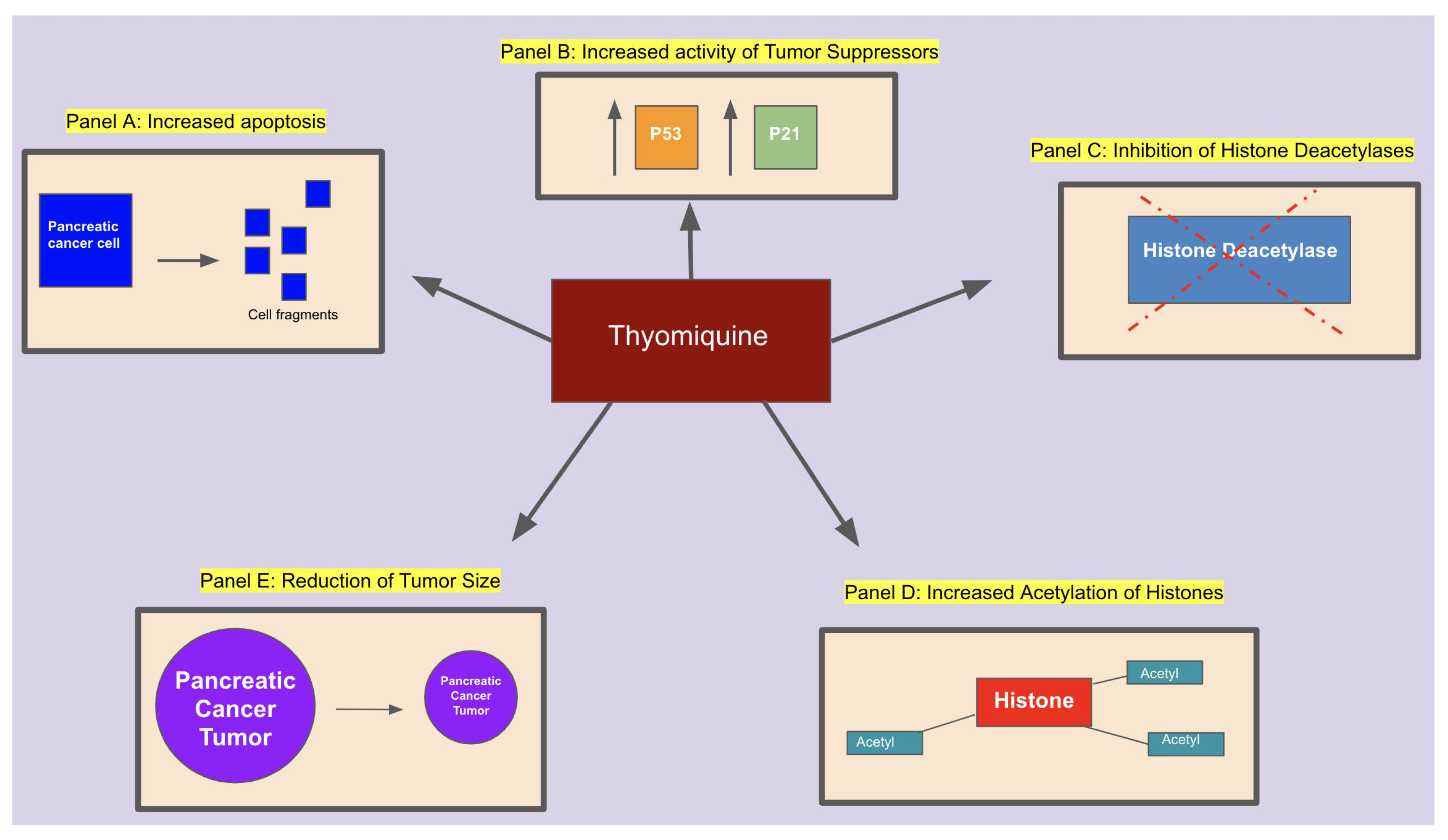
One of the main mechanisms of decreased cell viability is apoptosis; it occurs when the cell decides to kill itself. Apoptosis is a vital process that ensures cells with DNA damage, mutations, defects and cancerous properties do not replicate (Kimball, 2014; American Institute for Cancer Research, 2018), effectively preventing carcinogenesis. Relles et al. (2016) performed an experiment to demonstrate the impact thymoquinone has on apoptosis of pancreatic cancer cells. The authors used flow cytometric analysis to quantify the number of pancreatic cancer cells present in each cell cycle phase after they were treated with varying concentrations of thymoquinone. The authors here saw that there is a peak in the sub GO/G1 phase for all cells treated with thymoquinone. It is important to note that the presence of cells in the sub GO/G1 phase is correlated with cells that had a significant loss of DNA through apoptosis (even if those cells were from other cell cycle phases) (DNA fragmentation and Apoptosis, 2020). Hence, a peak in the flow cytometric analysis by Relles et al. (2016) revealed that pancreatic cancer cells treated with thymoquinone caused a significant amount of apoptosis. This experiment is in agreement with numerous prior studies that have shown thymoquinone induces apoptosis in pancreatic cancer cells (Torres et al., 2010), bladder cancer cells (Zhang et al., 2018), lung cancer cells (Samarghandian et al., 2019), prostate cancer cells (Dirican et al., 2014), and breast cancer cells (Dastjerdi, 2016). All of these studies re-iterate the idea that thymoquinone has the potential to be a therapy that can be used against a number of different cancers. It also shows that apoptosis is one of the mechanisms thymoquinone employs to kill pancreatic cancer cells (Figure 1A).
There are several different mechanisms that promote and induce apoptosis. p53 is a protein that was first introduced to scientific literature in 1979 (Lane & Crawford, 1979; Kat Arney, 2019), and it is now implicated as an important tumor suppressor protein which causes apoptosis (Wang et al., 2015). Defective p53 activity has been implicated in most cancers (Herrero et al., 2016), including 50-75% of pancreatic cancer cases (Morton et al., 2009). In order to understand the mechanism of apoptosis, Relles et al. (2016) performed an experiment quantifying the levels of mRNA expression of p53 using qPCR analysis. It was found that p53 activity nearly doubled when pancreatic cancer cells were treated with thymoquinone. This suggests the possibility that thymoquinone could cause apoptosis by increasing p53 activity (Figure 1B).
In addition, the experiment also found that after pancreatic cancer cells were treated with thymoquinone, p12 activity increased by a factor of 12. A p53 and p12 pathway causes cell cycle arrest (Garner & Raj, 2008); which is when a cell is inhibited from progressing to the next cell phase, stopping defective or cancerous cells from duplication (Li et al., 2019). Hence, the simultaneous increase in p53 and p12 activity also suggests that thymoquinone may cause cellular arrest through the p53-p12 pathway.
Lastly, the experiment also showed that when pifithrin-α (a chemical known to inhibit p53 activity (Murphy et al., 2004)) was introduced after the thymoquinone treatment, qPCR analysis demonstrated that upregulation of p12 still occurred. Interestingly, based on this result Relles et al. (2016) tries to argue that the increase of p12 activity happens independently of p53. However, it is important to understand that while p21 was still upregulated in the absence of p53, the upregulated p21 activity was still lower by a factor of 4 compared to when p53 was present. This highlights that while p53 is not crucial for the upregulation of p21 during thymoquinone treatment, p53 activity still significantly increases the efficiency of p21 upregulation.
Another mechanism of apoptosis and cell cycle arrest is induced through histone deacetylase inhibitors (Zhang & Zhong, 2014). Recent advancements in cancer research have implicated drugs that act as histone deacetylase inhibitors as promising cancer therapy treatments (Relles et al. 2016; Lane, A., & Chabner, B. 2009). Furthermore, supplementing traditional chemotherapy with histone deacetylases inhibitors has been shown to have increased therapeutic effects against different kinds of cancer (Valentini et al., 2007; Yoon et al., 2011; Diyabalanage et al., 2013). Histone deacetylases function by removing acetyl groups from histones, which causes a tighter wrapping of genetic material (Clinisciences, 2020) and a tighter overall chromatin structure (Ropero & Esteller, 2007). This effectively inhibits certain genes from being expressed. Unfortunately, when histone deacetylases are defective it can result in the unwanted inactivation of tumor suppressor genes (Relles et al., 2016), increasing susceptibility of developing cancer and promoting cancer cell proliferation. Histone deacetylase inhibitors act to effectively reverse this unwanted process.
Relles et al. (2016) conducted a series of experiments to show the effect thymoquinone has on histone acetylation. Relles et al. (2016) used qPCR analysis to quantify the mRNA activity of histone deacetylases after pancreatic cancer cells were treated with thymoquinone. This experiment showed that histone deacetylase activity was decreased by 40-50%. To further understand the effect thymoquinone has on histone acetylation, a western blot analysis was also performed by Relles et al. (2016) on pancreatic cancer cells after treatment with thymoquinone. This experiment showed that treatment of thymoquinone was correlated with increased acetylation of lysine. These results are significant, because they are the first in scientific literature to show that thymoquinone acts as both a histone deacetylases inhibitor and a promoter of histone acetylation in pancreatic cancer cells (Figure 1C-D). Studies by Parbin et al. (2016) and Qadi et al. (2019) have both demonstrated that thymoquinone acts as a histone deacetylase inhibitor, however no studies have confirmed that thymoquinone acts as a promoter of histone acetylation.
The last significant experiment performed by Relles et al. (2016) was designed to understand the impact thymoquinone can have on pancreatic cancer tumors in vivo. Relles et al. (2016) accomplished this by growing human pancreatic cancer tumors in mice, and then treating mice with different concentrations of thymoquinone. At the end of 5 weeks of treatment, it was found that 67% of all mice treated with thymoquinone had significantly decreased tumor sizes. The results of this experiment have serious implications for current pancreatic cancer patients. I mentioned earlier in this article that the current treatment for pancreatic cancer (surgical resection) is only available to 20% of patients at the time of diagnosis (Harvard Health Publishing, 2009). Before being approved for the resection, many pancreatic cancer patients have “borderline tumors” that are enlarged tumors involved with vessels (Javed et al., 2018; Isaji et al., 2018). This prompts clinicians to use neoadjuvant chemotherapy (chemotherapy taken before surgical resection is performed) to shrink tumor size (Treatment Before Surgery, 2017). This is done to improve chances of being approved for a resection and better chances that all of the tumor will be resected (Jang et al., 2018). This in vivo experiment by Relles et al. (2016) has effectively shown that thymoquinone can shrink the size of human pancreatic cancer tumors (Figure 1E). This is significant, because it demonstrates that thymoquinone can be used as a therapeutic treatment to reduce tumor size and make more pancreatic cancer patients eligible for resection (ultimately improving their survival rate).
Figure 1.
Effects of Thymoquinone Treatment on Pancreatic Cancer Cells and Tumors. Figure 1: Relles et al. (2016) showed that treating pancreatic cancer cells with thymoquinone resulted in (A) increased apoptosis, (B) increased activity of P53 and P21, (C) inhibition of histone deacetylation, (D) promotion of histone acetylation. Furthermore, Relles et al. (2016) showed that treating human pancreatic cancer tumors with thymoquinone resulted in (E) reduction in tumor size.
Figure 1.
Effects of Thymoquinone Treatment on Pancreatic Cancer Cells and Tumors. Figure 1: Relles et al. (2016) showed that treating pancreatic cancer cells with thymoquinone resulted in (A) increased apoptosis, (B) increased activity of P53 and P21, (C) inhibition of histone deacetylation, (D) promotion of histone acetylation. Furthermore, Relles et al. (2016) showed that treating human pancreatic cancer tumors with thymoquinone resulted in (E) reduction in tumor size.
Conclusion:
Overall, Relles et al. (2016) provided us a significantly increased understanding of how thymoquinone impacts pancreatic cancer cells and tumors (Figure 1A-E). The study clearly demonstrates the promising potential thymoquinone has as a therapeutic treatment for pancreatic cancer. This is significant, because thymoquinone (as a new treatment for pancreatic cancer) could improve the poor prognosis and low survival rate currently associated with the disease. Due to the important implications related to this study, future studies need to be conducted to further our understanding of therapeutic uses of thymoquinone.
References
- American Cancer Society. (2020). Cancer.Org. https://www.cancer.org/cancer/pancreatic-cancer/detection-diagnosis-staging/survival-rates.html.
- American Institute for Cancer Research. (2018). Analysing Research on Cancer Prevention and Survival. In wcrf.org. https://www.wcrf.org/sites/default/files/The-cancer-process.pdf.
- Chakraborty, S., & Singh, S. (2013). Surgical resection improves survival in pancreatic cancer patients without vascular invasion- a population based study. Annals of Gastroenterology, 26(4), 346–352. https://www.ncbi.nlm.nih.gov/pmc/articles/PMC3959484/.
- Chehl, N., Chipitsyna, G., Gong, Q., Yeo, C. J., & Arafat, H. A. (2009). Anti-inflammatory effects of the Nigella sativa seed extract, thymoquinone, in pancreatic cancer cells. HPB, 11(5), 373–381. [CrossRef]
- Clinisciences. (2020). LMK 235 [1418033-25-6] Clinisciences. Clinisciences.Com. https://www.clinisciences.com/autres-produits-186/lmk-235-1418033-25-6-182003944.html.
- Dastjerdi, M., Mehdiabady, E., Iranpour, F., & Bahramian, H. (2016). Effect of thymoquinone on P53 gene expression and consequence apoptosis in breast cancer cell line. International Journal of Preventive Medicine, 7(1), 66. [CrossRef]
- Dirican, A., Erten, C., Atmaca, H., Bozkurt, E., Kucukzeybek, Y., Varol, U., Oktay Tarhan, M., Karaca, B., & Uslu, R. (2014). Enhanced cytotoxicity and apoptosis by thymoquinone in combination with zoledronic acid in hormone- and drug-resistant prostate cancer cell lines. Journal of B.U.ON. : Official Journal of the Balkan Union of Oncology, 19(4), 1055–1061. https://www.ncbi.nlm.nih.gov/pubmed/25536616.
- Diyabalanage, H. V. K., Granda, M. L., & Hooker, J. M. (2013). Combination therapy: histone deacetylase inhibitors and platinum-based chemotherapeutics for cancer. Cancer Letters, 329(1), 1–8. [CrossRef]
- DNA fragmentation and Apoptosis - Flow Cytometry Core Facility. (2020). Qmul.Ac.Uk. http://www.icms.qmul.ac.uk/flowcytometry/uses/apoptosis/dnafragmentation/.
- Dzoyem, J. P., McGaw, L. J., Kuete, V., & Bakowsky, U. (2017). Anti-inflammatory and Anti-nociceptive Activities of African Medicinal Spices and Vegetables. Medicinal Spices and Vegetables from Africa, 239–270. [CrossRef]
- Garner, E., & Raj, K. (2008). Protective mechanisms of p53-p21-pRb proteins against DNA damage-induced cell death. Cell Cycle, 7(3), 277–282. [CrossRef]
- Harvard Health Publishing. (2009, April). The Whipple procedure - Harvard Health. Harvard Health; Harvard Health. https://www.health.harvard.edu/newsletter_article/The_Whipple_procedure.
- He, X., Li, Y., Su, T., Lai, S., Wu, W., Chen, L., Si, J., & Sun, L. (2018). The impact of a history of cancer on pancreatic ductal adenocarcinoma survival. United European Gastroenterology Journal, 6(6), 888–894. [CrossRef]
- Herrero, A., Rojas, E., Misiewicz-Krzeminska, I., Krzeminski, P., & Gutiérrez, N. (2016). Molecular Mechanisms of p53 Deregulation in Cancer: An Overview in Multiple Myeloma. International Journal of Molecular Sciences, 17(12), 2003. [CrossRef]
- Hirshberg Foundation. (2015). Prognosis. pancreatic.org. http://pancreatic.org/pancreatic-cancer/about-the-pancreas/prognosis/.
- Isaji, S., Mizuno, S., Windsor, J. A., Bassi, C., Fernández-Del Castillo, C., Hackert, T., Hayasaki, A., Katz, M. H. G., Kim, S.-W., Kishiwada, M., Kitagawa, H., Michalski, C. W., & Wolfgang, C. L. (2018). International consensus on definition and criteria of borderline resectable pancreatic ductal adenocarcinoma 2017. Pancreatology : Official Journal of the International Association of Pancreatology (IAP)... [et Al.], 18(1), 2–11. [CrossRef]
- Jang, J.-Y., Han, Y., Lee, H., Kim, S.-W., Kwon, W., Lee, K.-H., Oh, D.-Y., Chie, E. K., Lee, J. M., Heo, J. S., Park, J. O., Lim, D. H., Kim, S. H., Park, S. J., Lee, W. J., Koh, Y. H., Park, J. S., Yoon, D. S., Lee, I. J., & Choi, S. H. (2018). Oncological Benefits of Neoadjuvant Chemoradiation With Gemcitabine Versus Upfront Surgery in Patients With Borderline Resectable Pancreatic Cancer: A Prospective, Randomized, Open-label, Multicenter Phase 2/3 Trial. Annals of Surgery, 268(2), 215–222. [CrossRef]
- Javed, A. A., Wright, M. J., Siddique, A., Blair, A. B., Ding, D., Burkhart, R. A., Makary, M., Cameron, J. L., Narang, A., Herman, J., Zheng, L., Laheru, D., Weiss, M. J., Wolfgang, C., & He, J. (2018). Outcome of Patients with Borderline Resectable Pancreatic Cancer in the Contemporary Era of Neoadjuvant Chemotherapy. Journal of Gastrointestinal Surgery, 23(1), 112–121. [CrossRef]
- Kat Arney. (2019). Discovering the p53 cancer protein. Cancer Research UK - Science Blog. https://scienceblog.cancerresearchuk.org/2009/10/04/high-impact-science-p53/.
- Kimball, J. (2014, March 8). Apoptosis. Biology-Pages.Info. http://www.biology-pages.info/A/Apoptosis.html.
- Lane, A., & Chabner, B. (2009). Histone Deacetylase Inhibitors in Cancer Therapy | Journal of Clinical Oncology. Journal of Clinical Oncology. https://ascopubs.org/doi/full/10.1200/JCO.2009.22.1291.
- Lane, D. P., & Crawford, L. V. (1979). T antigen is bound to a host protein in SY40-transformed cells. Nature, 278(5701), 261–263. [CrossRef]
- Li, Y., Fan, J., & Ju, D. (2019). Neurotoxicity concern about the brain targeting delivery systems. Brain Targeted Drug Delivery System, 377–408. [CrossRef]
- Liou, Y., Chen, P., Chu, S., Kao, S., Chang, Y., Hsieh, Y., & Chang, H. (2019). Thymoquinone suppresses the proliferation of renal cell carcinoma cells via reactive oxygen species-induced apoptosis and reduces cell stemness. Environmental Toxicology, 34(11), 1208–1220. [CrossRef]
- Morton, J. P., Timpson, P., Karim, S. A., & Sansom, O. J. (2009, December). Mutant p53 drives metastasis and overcomes growth arrest/senescence in pancreatic cancer. ResearchGate; National Academy of Sciences. https://www.researchgate.net/publication/40696085_Mutant_p53_drives_metastasis_and_overcomes_growth_arrestsenescence_in_pancreatic_cancer.
- Murphy, P. J. M., Galigniana, M. D., Morishima, Y., Harrell, J. M., Kwok, R. P. S., Ljungman, M., & Pratt, W. B. (2004). Pifithrin-α Inhibits p53 Signaling after Interaction of the Tumor Suppressor Protein with hsp90 and Its Nuclear Translocation. Journal of Biological Chemistry, 279(29), 30195–30201. [CrossRef]
- Ozturk, S., Alp, E., Saglam, A. Y., Konac, E., & Menevse, E. (2017). The effects of thymoquinone and genistein treatment on telomerase activity, apoptosis, angiogenesis, and survival in thyroid cancer cell lines. Journal of Cancer Research and Therapeutics, 0(0), 0. [CrossRef]
- Pancreatic Cancer - Statistics. (2020, January). Cancer.Net. https://www.cancer.net/cancer-types/pancreatic-cancer/statistics.
- Relles, D., Chipitsyna, G. I., Gong, Q., Yeo, C. J., & Arafat, H. A. (2016). Thymoquinone Promotes Pancreatic Cancer Cell Death and Reduction of Tumor Size through Combined Inhibition of Histone Deacetylation and Induction of Histone Acetylation. Advances in Preventive Medicine, 2016, 1–9. [CrossRef]
- Ropero, S., & Esteller, M. (2007). The role of histone deacetylases (HDACs) in human cancer. Molecular Oncology, 1(1), 19–25. [CrossRef]
- Samarghandian, S., Azimi-Nezhad, M., & Farkhondeh, T. (2019). Thymoquinone-induced antitumor and apoptosis in human lung adenocarcinoma cells. Journal of Cellular Physiology, 234(7), 10421–10431. [CrossRef]
- Torres, M. P., Ponnusamy, M. P., Chakraborty, S., Smith, L. M., Das, S., Arafat, H. A., & Batra, S. K. (2010). Effects of Thymoquinone in the Expression of Mucin 4 in Pancreatic Cancer Cells: Implications for the Development of Novel Cancer Therapies. Molecular Cancer Therapeutics, 9(5), 1419–1431. [CrossRef]
- Treatment Before Surgery. (2017). Cancertodaymag.Org. https://www.cancertodaymag.org/Pages/Fall2017/Treatment-Before-Surgery-Chemotherapy.aspx.
- Valentini, A., Gravina, P., Federici, G., & Bernardini, S. (2007). Valproic acid induces apoptosis, p16INK4A upregulation and sensitization to chemotherapy in human melanoma cells. Cancer Biology & Therapy, 6(2), 185–191. [CrossRef]
- Wang, X., Simpson, E. R., & Brown, K. A. (2015). p53: Protection against Tumor Growth beyond Effects on Cell Cycle and Apoptosis. Cancer Research, 75(23), 5001–5007. [CrossRef]
- Yoon, C. Y., Park, M. J., Lee, J. S., Lee, S. C., Oh, J. J., Park, H., Chung, C. W., Abdullajanov, M. M., Jeong, S. J., Hong, S. K., Byun, S. S., Lee, E. S., & Lee, S. E. (2011). The histone deacetylase inhibitor trichostatin A synergistically resensitizes a cisplatin resistant human bladder cancer cell line. The Journal of Urology, 185(3), 1102–1111. [CrossRef]
- Zhang, J., & Zhong, Q. (2014). Histone deacetylase inhibitors and cell death. Cellular and Molecular Life Sciences, 71(20), 3885–3901. [CrossRef]
- Zhang, L., Bai, Y., & Yang, Y. (2016). Thymoquinone chemosensitizes colon cancer cells through inhibition of NF-κB. Oncology Letters, 12(4), 2840–2845. [CrossRef]
- Zhang, M., Du, H., Huang, Z., Zhang, P., Yue, Y., Wang, W., Liu, W., Zeng, J., Ma, J., Chen, G., Wang, X., & Fan, J. (2018). Thymoquinone induces apoptosis in bladder cancer cell via endoplasmic reticulum stress-dependent mitochondrial pathway. Chemico-Biological Interactions, 292, 65–75. [CrossRef]
Disclaimer/Publisher’s Note: The statements, opinions and data contained in all publications are solely those of the individual author(s) and contributor(s) and not of MDPI and/or the editor(s). MDPI and/or the editor(s) disclaim responsibility for any injury to people or property resulting from any ideas, methods, instructions or products referred to in the content. |
© 2025 by the author. Licensee MDPI, Basel, Switzerland. This article is an open access article distributed under the terms and conditions of the Creative Commons Attribution (CC BY) license (https://creativecommons.org/licenses/by/4.0/).
Copyright: This open access article is published under a Creative Commons CC BY 4.0 license, which permit the free download, distribution, and reuse, provided that the author and preprint are cited in any reuse.


