
Submitted:
21 September 2025
Posted:
23 September 2025
You are already at the latest version
Abstract
In conflict-affected regions, the collapse of electricity infrastructure precipitates a cascade of humanitarian crises. The Gaza Strip represents a chronic and acute case of this phenomenon, where recurrent military escalations and a protracted blockade have systematically dismantled its energy sector, subjecting over two million people to severe and persistent energy poverty. Employing a qualitative case study methodology, this paper synthesizes technical data from official Palestinian and international reports with a dual analytical framework grounded in energy resilience and energy justice. The findings reveal a dual reality: while extensive damage to the centralized grid is met with remarkable community-led adaptive responses—notably a widespread, bottom-up adoption of small-scale solar systems—these coping mechanisms are insufficient to overcome systemic barriers. Key reconstruction challenges include severe import restrictions on critical equipment, prohibitive parallel energy costs for households, and profound distributive injustices in power allocation. The paper argues that the conventional model of post-conflict reconstruction, focused on in-kind replacement of centralized infrastructure, perpetuates a cycle of vulnerability and deepens energy inequities. Consequently, this research advocates for a paradigm shift towards a decentralized, resilient, and just energy system. It concludes with actionable policy recommendations, including the strategic development of community-based solar microgrids and the establishment of an "Energy Equity Index" to ensure future investments are not only technically sound but fundamentally equitable.
Keywords:
Gaza Strip
; Post-Conflict Reconstruction
; Energy Resilience
; Energy Justice
; Electricity Infrastructure
; Microgrids
1. Introduction
Access to reliable electricity is the foundational lynchpin of modern society and a critical enabler of post-conflict recovery. As a socio-technical system, the electrical grid underpins all essential services, including healthcare, water purification, communication, and economic activity. Its disruption in the aftermath of violent conflict is therefore not merely a technical failure but a catalyst for cascading humanitarian crises, prolonging suffering and severely impeding the transition from emergency relief to sustainable development. In war-torn environments, electricity infrastructure is exceptionally vulnerable; it is often geographically exposed, dependent on complex supply chains, and frequently targeted for strategic purposes to cripple an adversary's functional capacity and civilian morale. The process of its reconstruction is thus a litmus test for the broader success of peace-building, state-building, and societal recovery efforts.
The literature on post-conflict infrastructure is replete with case studies—from the Balkans to Iraq and Syria—that document the immense technical, financial, and political hurdles of rebuilding what has been destroyed. These studies consistently highlight common challenges: the scale of capital investment required, the loss of skilled human resources, the complexities of navigating donor politics, and the difficulties of securing infrastructure in volatile security environments. However, a dominant focus on the technical and financial dimensions of reconstruction—a paradigm centered on replacing damaged hardware and restoring centralized generation capacity—often obscures the deeper socio-political dynamics at play. It frequently fails to interrogate the equity of the reconstruction process, overlooking fundamental questions of who benefits, whose needs are prioritized, and how power relations are reinscribed through the new material fabric of the grid.
Nowhere are these challenges and dynamics more acute or concentrated than in the Gaza Strip. For over two decades, Gaza has served as a tragic, real-world laboratory for the systemic failure of energy systems in a context of protracted conflict and occupation. Its situation is unique and constitutes an extreme case for several reasons. First, unlike conventional post-conflict scenarios where hostilities cease and a linear reconstruction phase begins, Gaza exists in a perpetual state of crisis, oscillating between periods of intense military escalation and a low-intensity conflict defined by a severe, long-standing blockade. This blockade imposes stringent restrictions on the importation of fuel, spare parts, and essential equipment, creating a man-made state of energy fragility that persists even in times of relative calm. Second, the cycle of destruction and repair is relentlessly repetitive. Electrical infrastructure, painstakingly rebuilt with international aid after one conflict, is often damaged or destroyed in the next, trapping the sector in a state of arrested development and institutionalizing a dependence on short-term, humanitarian-driven fixes. Third, the extreme population density of the Gaza Strip amplifies the humanitarian impact of every megawatt lost, turning chronic power deficits into an intimate, daily struggle for survival for its more than two million inhabitants.
This unique context has created a critical gap in academic and policy literature. While numerous reports from humanitarian agencies and financial institutions meticulously document the extent of damage and the quantifiable energy deficit, they often remain descriptive, focusing on immediate needs rather than systemic analysis. Concurrently, geopolitical analyses tend to focus on the high-level politics of the blockade and the Israeli-Palestinian conflict, without delving into the granular, lived reality of the energy crisis and the community-level responses it engenders. A significant lacuna exists at the intersection of infrastructure resilience, energy justice, and community-led innovation within this uniquely constrained environment. The prevailing scholarship has yet to systematically analyze the bottom-up, ad-hoc energy solutions that have emerged in Gaza—not merely as coping mechanisms, but as potential seeds of a fundamentally different, more resilient energy paradigm. Furthermore, the principles of energy justice, which interrogate the equitable distribution of energy benefits and burdens, have rarely been applied to scrutinize the reconstruction priorities and power distribution patterns in such a protracted crisis zone.
This paper aims to fill this critical gap by providing a comprehensive, multi-scalar analysis of Gaza's electricity crisis. It moves beyond a simple damage assessment to interrogate the complex interplay between infrastructure destruction, systemic political constraints, and community-based resilience. The central objectives of this study are threefold:
- To systematically document and analyze the cyclical nature of infrastructure damage and the subsequent emergence of both formal and informal community-led responses to the chronic energy deficit.
- To apply the theoretical lenses of Energy Resilience and Energy Justice to critically evaluate the failures of the conventional reconstruction model and the socio-economic inequities embedded within the current energy landscape.
- To identify and assess viable pathways towards a more resilient, equitable, and sustainable energy future for Gaza, drawing lessons from both local innovations and international best practices in decentralized energy systems.
The significance of this research extends beyond the specific case of Gaza. By examining an extreme case of socio-technical fragility, this paper offers crucial insights for policymakers, engineers, and humanitarian practitioners working in other fragile and conflict-affected settings worldwide. It argues that resilience in the 21st century is not merely a technical attribute to be engineered into a grid, but a social and political imperative that demands a shift from centralized, vulnerable systems to decentralized, community-empowering models. This study contributes empirically by providing a rich, integrated analysis of a chronically under-researched dimension of the Gaza crisis, and theoretically by bridging the conceptual frameworks of post-conflict studies, disaster resilience, and energy justice. Ultimately, it contends that reimagining the future of electricity in Gaza is not just about restoring power, but about restoring agency and building a foundation for a more just and durable peace.
2. Literature Review
This research is situated at the nexus of three distinct yet intersecting fields of study: post-conflict/post-disaster infrastructure reconstruction, socio-technical resilience theory, and the critical framework of energy justice. A review of these domains reveals the current state of knowledge, exposes a significant research gap, and positions the case of the Gaza Strip as a unique and vital contributor to the global discourse on building sustainable and equitable energy systems in fragile contexts.
2.1. The Dominant Paradigm: Technical-Financial Approaches to Infrastructure Reconstruction
A substantial body of literature has been dedicated to the challenges of rebuilding critical infrastructure in the wake of conflict and large-scale disasters. Early and still-influential scholarship, often emerging from engineering, economics, and international development, approaches reconstruction primarily as a technical and financial problem. This paradigm frames recovery as a linear process of damage assessment, capital mobilization, and in-kind replacement of assets to restore pre-crisis functionality. Case studies from post-war Iraq, Afghanistan, and the Balkans dominate this literature, focusing on the immense logistical hurdles, donor coordination challenges, and the staggering costs associated with rebuilding centralized systems like power grids, water networks, and transportation routes. The overarching goal within this framework is typically the rapid restoration of state capacity and economic activity, often guided by international financial institutions and foreign donor priorities.
However, critical scholarship has since highlighted the profound limitations of this technical-financial model. Such approaches have been criticized for being apolitical, often overlooking the fact that infrastructure is never neutral; its destruction is strategic, and its reconstruction is inherently political. The rebuilding process can exacerbate pre-existing inequalities, reinforce the power of political elites, and create new dependencies on external actors and technologies. In Iraq, for instance, billions of dollars invested in the electricity sector failed to achieve reliable supply, in part because the top-down, contractor-driven model failed to account for local political dynamics, governance deficits, and community needs. This body of work underscores that simply "building back" the same centralized, vulnerable systems often resets the stage for future failure, particularly if the underlying drivers of conflict and fragility are not addressed.
2.2. The Resilience Turn: From Robustness to Adaptive and Transformative Capacity
In response to the limitations of the traditional reconstruction paradigm, a "resilience turn" has gained prominence across disaster studies, urban planning, and infrastructure engineering. Resilience theory reframes the objective from mere robustness—the ability of a system to withstand a shock and return to its original state—to a more dynamic set of capacities. This includes adaptive capacity (the ability to adjust and learn from disruptions) and, most critically, transformative capacity (the ability to fundamentally alter the system's structure and function to create a new, more desirable state).
Within this framework, critical infrastructure is understood not as a collection of physical assets, but as a complex socio-technical system where human, institutional, and technological components are deeply intertwined. The failure of such a system, as witnessed after Hurricane Maria in Puerto Rico in 2017 or the Great East Japan Earthquake in 2011, is rarely due to a single technical fault but rather a cascade of interconnected failures. The prolonged blackout in Puerto Rico, for example, demonstrated the extreme vulnerability of a highly centralized, aging grid to a large-scale shock. The subsequent recovery, however, also highlighted resilience in action, as community-led initiatives pioneered the installation of solar-powered microgrids to create islands of power for essential services. These cases have generated a rich literature on the resilience benefits of decentralized, modular, and flexible energy systems, which can reduce single points of failure and empower local actors. This scholarship provides a powerful analytical lens for moving beyond simply rebuilding a fragile system and instead asking how to "build forward differently."
2.3. The Justice Imperative: Integrating Equity into Energy Systems
Concurrent with the resilience turn, the field of energy justice has emerged from environmental justice scholarship to provide a critical ethical framework for analyzing energy systems. It moves beyond technocratic questions of supply and demand to interrogate the social and political dimensions of energy production, distribution, and consumption. The framework is typically structured around three core tenets:
- Distributive Justice: Pertains to the equitable allocation of benefits (e.g., access to affordable, reliable electricity) and burdens (e.g., pollution from power plants, infrastructure costs, the impacts of blackouts) across all segments of society.
- Procedural Justice: Concerns the right to fair, transparent, and meaningful participation in energy decision-making processes for all stakeholders, regardless of race, class, or gender.
- Recognition Justice: Involves acknowledging and respecting the rights, needs, and unique vulnerabilities of different social groups, particularly marginalized and historically disadvantaged communities.
While initially focused on issues like the siting of hazardous facilities in minority communities or energy poverty in the Global North and South, the energy justice framework is profoundly relevant to post-conflict reconstruction. It forces a critical examination of which communities are reconnected first, whose energy needs are prioritized, and whether reconstruction investments deepen or alleviate existing socio-economic disparities. Despite its analytical power, its application to active and post-conflict zones remains strikingly underdeveloped.
2.4. The Research Gap and the Positioning of Gaza
Synthesizing these disparate streams of literature reveals a clear and critical research gap. While extensive research exists on infrastructure reconstruction, it is often technocratic and politically thin. The resilience literature offers a sophisticated framework for understanding system dynamics and champions decentralized solutions like microgrids, but its primary case studies are often natural disasters, not protracted political conflicts. The energy justice literature provides an essential ethical lens but has yet to be systematically applied to the unique political economy of reconstruction under occupation and blockade.
The missing link is an integrated analysis that applies the dual frameworks of socio-technical resilience and energy justice to a context of chronic, cyclical conflict. The existing literature lacks a robust examination of how communities innovate and adapt not to a single shock, but to a permanent state of energy precarity, and how conventional reconstruction efforts both succeed and fail when measured against the yardsticks of resilience and justice.
This is precisely where the case of the Gaza Strip offers a unique and vital contribution. Gaza is not a conventional post-conflict or post-disaster setting; it is a hybrid context of protracted crisis where the "disaster" is both man-made and recurrent. It serves as an accelerated stress test for centralized infrastructure models, a crucible for community-led resilience innovation, and a stark illustration of profound energy injustice. By positioning Gaza within this global research context, this paper seeks to bridge the aforementioned gap. It leverages the theoretical advancements in resilience and energy justice to move beyond a descriptive account of Gaza's electricity crisis, offering instead a theoretically grounded, critical analysis with implications that resonate far beyond its borders for building a more just and resilient energy future in the world's most fragile regions.
3. Methodology
3.1. Research Design: A Qualitative Case Study Approach
This research employs a qualitative case study design to conduct an in-depth, holistic investigation of the electricity infrastructure crisis in the Gaza Strip. This methodological choice is deliberately made and justified by the nature of the research problem. The crisis is not a simple, linear equation of supply and demand that can be captured by quantitative metrics alone; it is a complex, path-dependent phenomenon deeply embedded in a unique political, social, and technical context. A case study approach is exceptionally well-suited for such "how" and "why" questions, allowing for a rich, multi-faceted exploration of the dynamics, processes, and lived realities of the energy crisis. By focusing intensively on a single, bounded case, this study seeks to achieve a comprehensive understanding that can generate "thick descriptions" and transferable theoretical insights, rather than broad statistical generalizations.
The selection of the Gaza Strip as the case is based on its status as an "extreme" or "critical" case. As argued by Flyvbjerg (2006), the study of an extreme case can "reveal more information because they activate more actors and more basic mechanisms in the situation studied." The chronic and cyclical nature of destruction and reconstruction, combined with the unique constraints of the blockade, make Gaza a crucible where the dynamics of infrastructure fragility, community resilience, and energy injustice are thrown into sharp relief. The lessons learned from this intense context are therefore highly valuable, offering critical insights for understanding and addressing energy challenges in other fragile and conflict-affected settings globally.
3.2. Bounding the Case
To ensure analytical focus, the case is bounded as follows:
- Temporally: The study primarily focuses on the period from 2007, marking the imposition of the full blockade, to the present. This timeframe allows for an analysis of the cumulative and cyclical impacts of repeated conflicts and prolonged restrictions on the energy sector.
- Spatially: The geographical boundary is the Gaza Strip, though the analysis necessarily considers external factors, including the supply of electricity and fuel from Israel and Egypt and the role of international donors.
- Conceptually: The unit of analysis is Gaza's socio-technical electricity system, encompassing not only the physical infrastructure (power plant, grid, solar panels) but also the key institutions (e.g., PENRA, GEDCO), governance structures, community-level actors, and the lived experiences of energy scarcity.
3.3. Data Sources and Collection Strategy
This study adopts a multi-source data collection strategy to enable triangulation, thereby enhancing the validity and reliability of the findings. Data is drawn from a combination of official reports, grey literature, and the researcher's own professional experience.
3.3.1. Official Reports and Grey Literature
A systematic review and synthesis of published data form the empirical backbone of this research. These documents provide both quantitative and qualitative data on the state of the electricity sector. Key sources include:
-
Palestinian Energy and Natural Resources Authority (PENRA) and Gaza Electricity Distribution Company (GEDCO): These are the primary sources for technical and operational data. Their reports, though sometimes sporadic, provide critical statistics on:
- ◦
- Daily electricity supply versus estimated demand (typically around 120-180 MW supplied against a peak demand exceeding 500-600 MW).
- ◦
- Technical specifications of damage after each conflict, such as the number of destroyed transformers, damaged feeder lines (e.g., the nine cross-border lines from Israel), and kilometers of cabling requiring replacement.
- ◦
- Operational data on the Gaza Power Plant's output, fuel consumption, and recurring shutdowns.
- ◦
- Customer data, including billing rates, revenue collection challenges, and statistics on electricity theft or informal connections.
-
United Nations Office for the Coordination of Humanitarian Affairs (UNOCHA): OCHA's regular Situation Reports and thematic deep-dives on Gaza's infrastructure are invaluable for understanding the humanitarian impact. This data includes:
- ◦
- Daily average electricity availability per household, often tracked by governorate, providing a clear picture of the lived reality of blackouts (e.g., "4-6 hours on, 12 hours off").
- ◦
- Impact assessments on essential services, detailing the operational capacity of hospitals, water wells, and wastewater treatment plants, which are heavily reliant on UN-provided emergency fuel.
-
The World Bank and the United Nations Development Programme (UNDP): These organizations provide macro-level economic and developmental perspectives. Their reports are key sources for:
- ◦
- Formal Damage and Needs Assessments (DNAs) conducted post-conflict, which quantify the economic cost of infrastructure destruction and the capital required for reconstruction. A 2021 Rapid DNA, for instance, estimated tens of millions of dollars in damages to the energy sector alone.
- ◦
- Feasibility studies and project evaluations for interventions, such as the UNDP's projects to install solar power systems on the rooftops of hospitals and schools, providing data on the cost-benefit and resilience impact of such initiatives.
-
Palestinian Central Bureau of Statistics (PCBS): PCBS household surveys offer socio-economic data that helps contextualize the crisis, providing statistics on:
- ◦
- Household expenditure on energy, allowing for analysis of the "double-billing" phenomenon where families pay for both the public grid and expensive private generator subscriptions.
- ◦
- Prevalence of alternative energy sources, such as the percentage of households owning small generators or having installed solar panels.
3.3.2. Reflexive Practitioner Expertise
A unique component of this study's methodology is the integration of the researcher's professional field expertise as an engineer and emergency manager within Gaza's electricity sector. This insider perspective is not used as unverified anecdote, but as a lens through which to interpret and contextualize the official data. This approach, drawing from principles of autoethnography and reflexive practice, provides a grounded understanding of the day-to-day operational challenges, the informal decision-making processes during crises, and the nuances of community-led innovations that are often invisible in high-level reports. This positionality is acknowledged with full reflexivity, recognizing the potential for bias while leveraging its unique strength in bridging the gap between official data and on-the-ground reality.
3.4. Analytical Framework
The collected data will not be merely presented but will be systematically analyzed through a dual theoretical framework combining the concepts of Resilience and Energy Justice.
3.4.1. Operationalizing the Resilience Lens:
The resilience framework will be used to structure the analysis of the system's performance under stress. The data will be coded and categorized according to key resilience capacities:
- Vulnerability: Data from GEDCO and UNOCHA on network topology (e.g., over-reliance on a few central feeder lines) and the impact of the blockade on spare parts will be used to map the system's inherent vulnerabilities.
- Adaptive Capacity: Data on the proliferation of rooftop solar panels (from UNDP reports and PCBS surveys) and the emergence of informal generator networks will be analyzed as evidence of bottom-up, community-level adaptation to chronic system failure.
- Transformative Capacity: The analysis will assess the potential for existing innovations (e.g., pilot microgrid projects) to serve as catalysts for a fundamental transformation of the energy system from a centralized, fragile model to a decentralized, resilient one.
3.4.2. Operationalizing the Energy Justice Lens:
The energy justice framework will serve as a critical-evaluative tool to analyze the equity of the current system and reconstruction efforts. The data will be interrogated through the three core tenets:
- Distributive Justice: GEDCO's electricity distribution schedules and OCHA's data on power availability by region will be critically examined to identify and quantify spatial inequities between urban centers, rural areas, and refugee camps. Household expenditure data from PCBS will be used to analyze how the economic burden of the crisis is distributed.
- Procedural Justice: Donor reports and PENRA policy documents will be scrutinized for evidence of community consultation and participation in the planning of reconstruction projects. The framework will be used to assess whose voices are heard and prioritized in decision-making forums.
- Recognition Justice: The analysis will focus on how the specific energy needs of the most vulnerable groups (e.g., hospital patients reliant on life-support machines, families with low-incomes, female-headed households) are recognized—or ignored—in official energy policy and humanitarian response plans.
By integrating these two lenses, this methodology facilitates an analysis that is both technically informed and socially critical, producing findings that are robust, nuanced, and relevant for policy.
4. Findings
This section presents an analytical exposition of the collected data, revealing the multi-dimensional nature of the electricity crisis in the Gaza Strip. The findings are structured around four integrated themes: (1) a dissection of the physical damage to the infrastructure, (2) an analysis of the emergency responses that have formed a parallel energy ecosystem, (3) an identification of the structural challenges impeding any sustainable recovery, and (4) an exploration of innovative practices that hold the seeds of transformation.
4.1. Dissecting the Systemic Collapse: Quantifying Infrastructure Damage
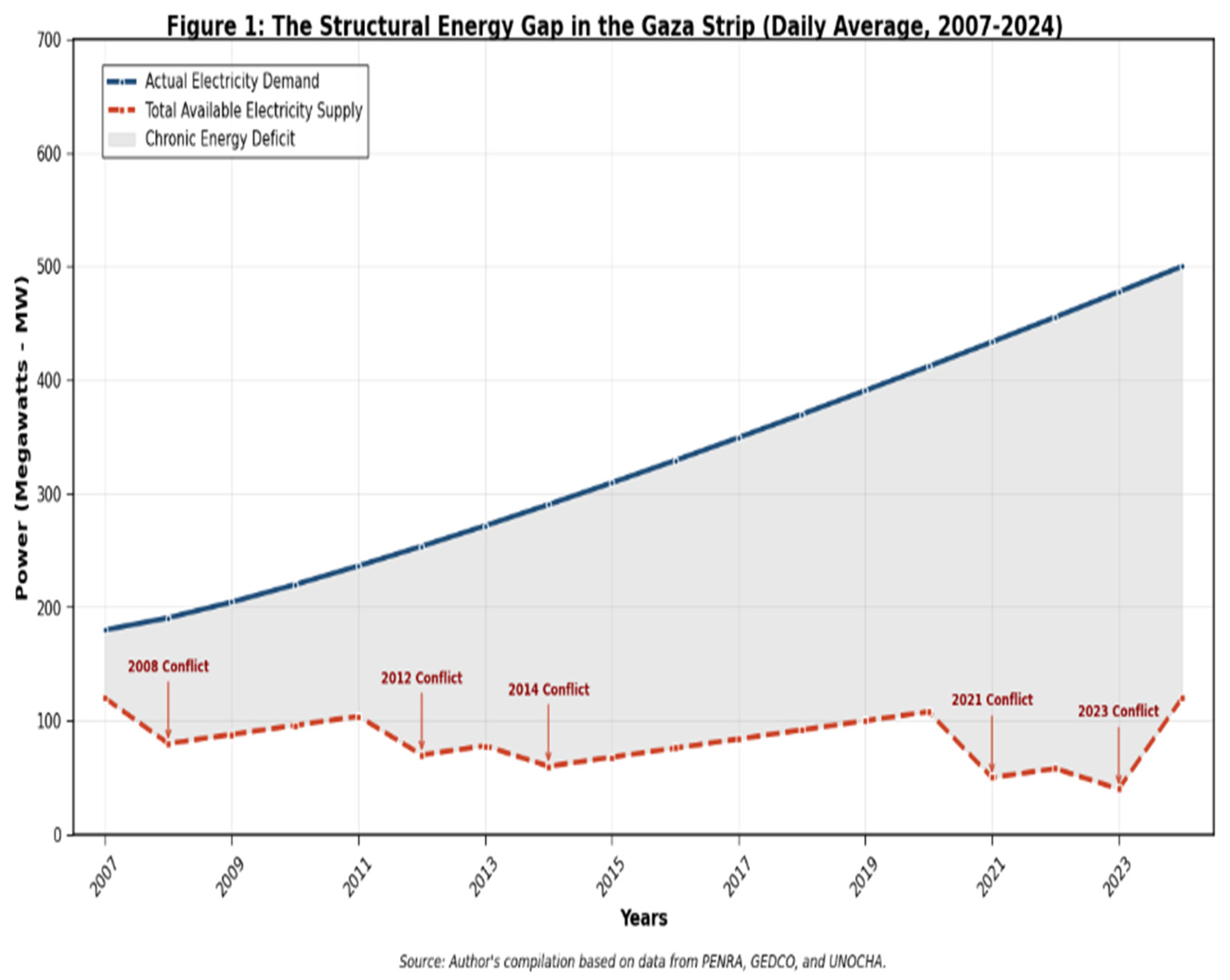
Gaza's electricity crisis is not merely a supply shortage but a systemic infrastructural collapse, periodically exacerbated. The analysis reveals that the core of the problem lies in the immense structural gap between available supply and actual demand. Under optimal conditions, the Strip receives between 120 to 180 MW (approximately 120 MW from Israeli feeder lines and 20-60 MW from the sole Gaza Power Plant (GPP) when partially operational). This supply is critically insufficient to meet a peak demand estimated to exceed 500 to 600 MW, creating a chronic deficit of at least 65% (Source: Aggregated data from PENRA and GEDCO, 2021-2023).
This chronic deficit transforms into a near-total collapse during rounds of conflict. Data analyzed from Damage and Needs Assessments (DNAs) conducted by the World Bank and the UN following the May 2021 conflict, for instance, paints a grim picture:
- Main Feeder Lines: Three of the nine main feeder lines from Israel were directly damaged, leading to an immediate loss of a significant portion of imported electricity.
- Internal Distribution Network: Over 70 kilometers of medium and low-voltage cables and 450 distribution transformers were destroyed, in addition to thousands of poles and household connections.
- Cumulative Impact: More significant is the cumulative effect. Equipment that is temporarily repaired using second-hand or "cannibalized" parts from other destroyed sites lacks efficiency and reliability. This elevates technical losses in the grid to over 35% in some areas, compared to the global standard of 8-10%.
These figures do not merely reflect material losses; they signify a systematic degradation of the grid's integrity. Each cycle of violence does not reset the system to zero but to a sub-zero state, leaving behind a fragmented, weakened grid that is increasingly vulnerable to future shocks.
Figure 1.
The Structural Energy Gap in the Gaza Strip (Daily Average, 2007-2024).
4.2. The Emergent Energy Ecosystem: A Multi-Level Analysis of Emergency Responses
In the vacuum of state capacity and the failure of the centralized grid, the society has not remained passive. A complex, parallel "energy ecosystem" has emerged, operating at multiple levels, which can be analyzed as follows:
-
Level 1: Household and Community Response (Bottom-up Adaptation):
- ◦
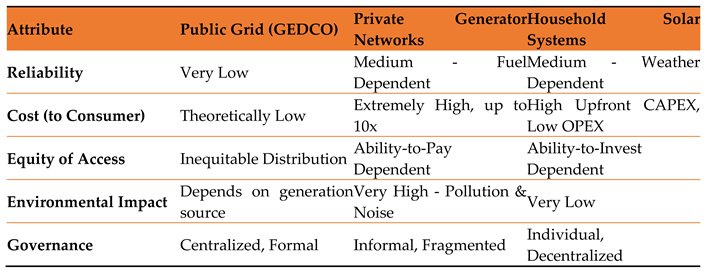
- Private Generator Networks: The "ampere subscription" model has become the primary source of electricity for a majority of the population during grid outages. Data from PCBS surveys reveals that households in Gaza spend up to 25% of their monthly income on energy, a significant portion of which goes to these subscriptions. The cost per kilowatt-hour from these generators ranges from 3 to 4 Israeli Shekels (ILS), which is 7 to 10 times the cost of official grid electricity (approx. 0.4 ILS). This response, while demonstrating adaptive capacity, has entrenched a massive distributive injustice.
- ◦
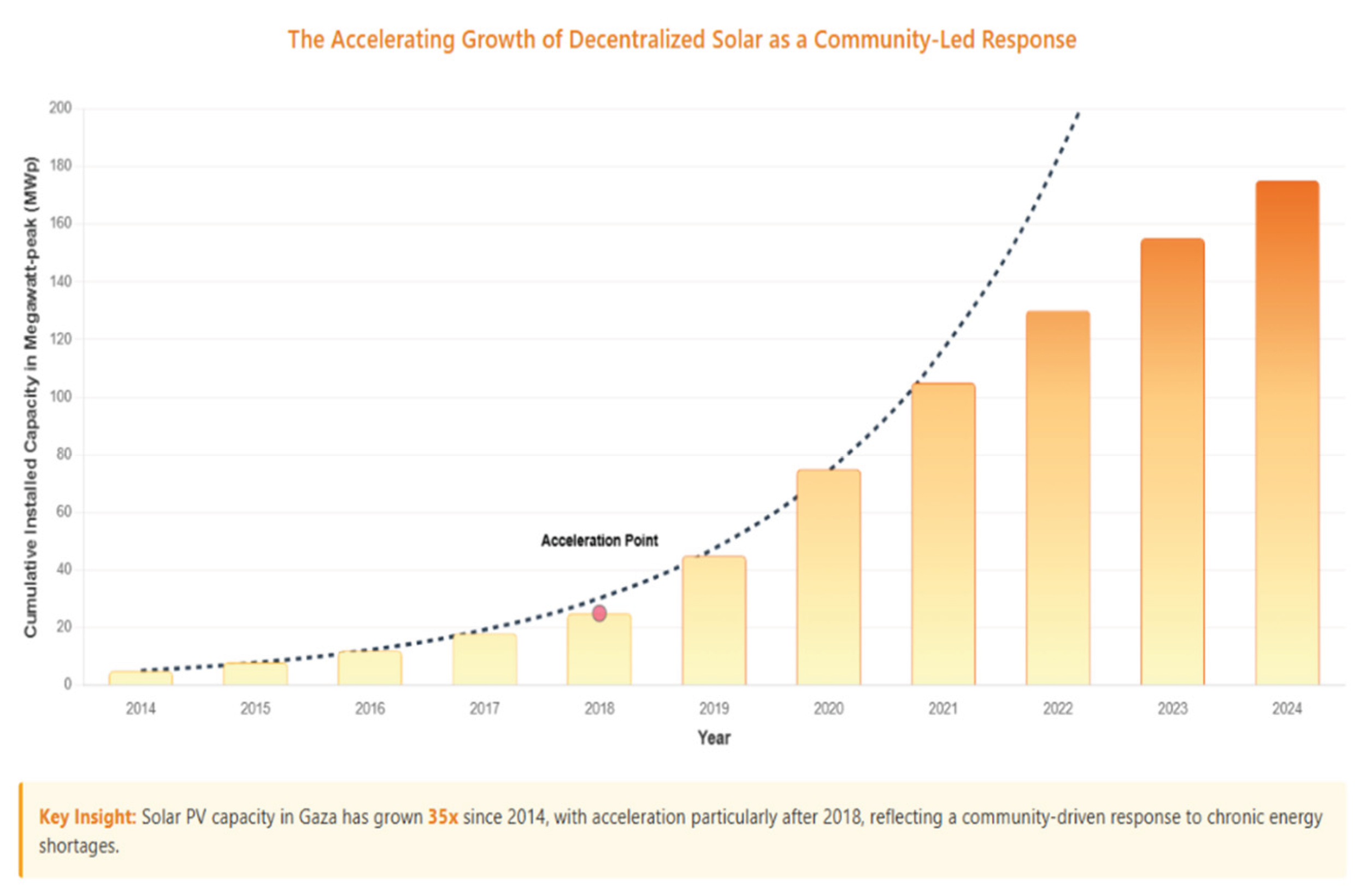
- The Silent Solar Revolution: The last decade has witnessed a massive boom in the installation of small-scale rooftop photovoltaic (PV) systems (typically 1-3 kW). UNDP estimates suggest there is now over 150 MW of decentralized solar capacity installed, effectively creating a "virtual power plant" larger than the official Gaza Power Plant.
-
Level 2: International Organization Response (Top-down Support):
- ◦
- International organizations have played the role of a "safety valve," preventing the complete collapse of critical services. The United Nations Development Programme (UNDP) and the International Committee of the Red Cross (ICRC) have strategically installed solar power systems on 35 hospitals and primary healthcare centers, as well as over 100 water and wastewater pumping stations.
- ◦
- UNOCHA coordinates the distribution of internationally funded emergency fuel to run the backup generators for these critical facilities when solar power is insufficient, ensuring a minimum continuity of services.
These two levels operate in parallel but are not integrated. The first is driven by necessity and lacks regulation, while the second is driven by humanitarian priorities and is limited in scope.

Table 1.
A Comparative Analysis of Operating Energy Systems in Gaza.
4.3. Compounding Barriers: A Multi-Dimensional Analysis of Reconstruction Challenges
The failure to rebuild the electricity sector is not merely due to a lack of funding or technical plans but is the result of complex, interlocking barriers:
- Political and Logistical Challenges (The Blockade): The Israeli blockade is the primary impediment. Critical equipment such as large transformers, insulated cables, and SCADA control systems are classified as "dual-use" items. Their importation is subject to a complex and lengthy security approval process that can take months or years, if approval is granted at all. This causes catastrophic project delays and forces engineers to resort to "cannibalization"—dismantling parts from some damaged equipment to repair other equipment.
- Economic Challenges (The Vicious Cycle): The electricity sector is trapped in a financial "death spiral." Low supply leads to consumer dissatisfaction and an unwillingness to pay, resulting in GEDCO's revenue collection rates falling below 40%. This financial deficit prevents the company from investing in maintenance and upgrades, which further degrades the grid and reduces supply, and the cycle continues. Compounding this is the "double-billing" phenomenon that drains the purchasing power of the population.
- Technical Challenges (Accumulated Degradation): As a result of the blockade and economic challenges, the grid suffers from chronic ailments. It operates without modern protection and control systems, relies on dangerous manual interventions, and suffers from voltage and frequency instability, which damages consumer appliances and further erodes public trust.
- Social Challenges (Spatial Energy Injustice): An analysis of distribution schedules reveals clear spatial injustice. Urban areas housing institutions and commercial enterprises often receive relatively more hours of electricity, while rural, agricultural areas and marginalized refugee camps are left to endure longer blackouts. This deepens existing developmental gaps and fuels a sense of grievance.
4.4. Seeds of Transformation: Pockets of Innovation and Resilience
Despite this bleak picture, innovative practices have emerged from the heart of the crisis that could form the basis of a more resilient future energy system:
- Decentralization as a De Facto Reality: The massive, albeit chaotic, proliferation of rooftop solar has, in effect, created a structural shift. It has cultivated a new generation of "prosumers" (producers and consumers of energy), breaking the monopoly of the state and external suppliers on electricity generation. This represents a transformation from a fully centralized model to a hybrid one, which is the foundation of resilience in modern infrastructure systems.
- Pioneering Microgrid Models: The projects implemented by international organizations to supply hospitals with solar power and battery storage systems serve as prototypes for integrated microgrids. These facilities have become "islands of resilience," capable of operating completely independently from the public grid for extended hours, guaranteeing the continuity of critical services even during a total blackout. These models provide a "proof of concept" for the feasibility of expanding this approach to encompass residential neighborhoods or small industrial zones.
These innovations, though currently small in scale, represent the seeds that can be nurtured to grow into a new energy system—one that aims not just to "build back the same," but to "build forward differently."
Figure 2.
Cumulative Growth of Installed Solar PV Capacity in Gaza (Estimates).
5. Discussion
The findings of this study do more than simply document a localized energy crisis; they offer profound critical insights that challenge prevailing assumptions about infrastructure reconstruction and reframe the concepts of resilience and justice in contexts of extreme fragility. In this section, we place the findings from Gaza in dialogue with global literature, explore their theoretical and practical implications, and distill lessons that transcend its geographical confines.
5.1. Situating Gaza in Global Context: From Uniqueness to Universal Lessons
At first glance, the case of Gaza may seem unique and isolated due to its unparalleled political context. However, placing it in a comparative perspective with other global infrastructure crises reveals convergent patterns and universal lessons. Gaza's experience does not exist in a vacuum; rather, it resonates with and radically extends the global narrative on infrastructure fragility.
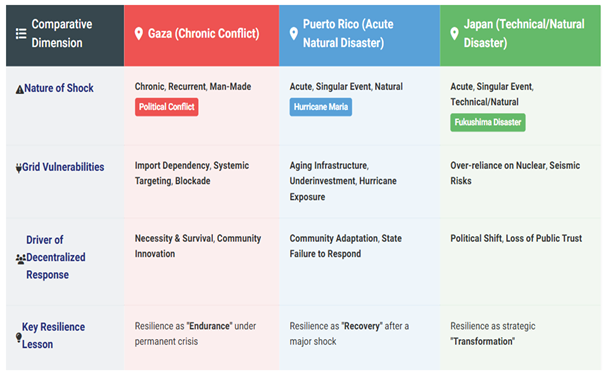
- Comparison with Puerto Rico (Hurricane Maria, 2017): The collapse of Puerto Rico's aging, centralized power grid post-hurricane led to months of darkness, exposing the latent vulnerabilities of the centralized energy model. As in Gaza, the most effective response emerged from the grassroots: a surge in rooftop solar installations and community microgrids that became lifelines. The similarity lies in demonstrating that decentralization is an innate response to the failure of centralization. The distinction, however, is crucial: whereas the shock in Puerto Rico was acute and singular (a natural disaster), the shock in Gaza is chronic and continuous (a man-made disaster). This makes Gaza’s lessons more urgent, as they teach not how to recover from a single shock, but how to survive under a permanent one.
- Comparison with Japan (Fukushima Disaster, 2011): The nuclear catastrophe led to a deep-seated loss of trust in the state-controlled, centralized energy system. The result was a massive political and investment shift towards renewable and decentralized energy sources. What Japan shares with Gaza is that a crisis triggered a reimagining of the socio-political "imaginary" of energy, away from a reliance on massive, centralized structures. However, while Japan's transformation was driven by government policy and investment, Gaza's is driven by necessity and community innovation in the absence of effective state action.
These comparisons position Gaza not as an anomaly, but as a "forced future laboratory." It demonstrates today, in concentrated form, what other regions may face in the future as a result of climate change or geopolitical instability. It offers definitive proof that reliance on fragile, centralized grids is a recipe for failure in the 21st century.
Table 2.
A Comparative Analysis of Global Energy Infrastructure Crises.
5.2. Re-Theorizing Resilience: From Shock Response to Co-Existence with Chronic Fragility
The findings from this study challenge conventional conceptualizations of resilience in the literature. Resilience is often defined as the ability to "bounce back" or "bounce forward" after a disturbance. But what does this mean in a context where there is no stable normal to return to? In Gaza, the system does not simply "fail" and then "recover"; it exists in a state of perpetual degradation.
Therefore, the Gaza case compels us to re-theorize resilience. Here, resilience is less about recovery and more about endurance and perseverance. The findings on the proliferation of private generators and solar systems are not just evidence of "adaptive capacity" but are survival strategies under conditions of "chronic precarity." Furthermore, a distinction must be made between two types of response:
- Passive Adaptation: Reliance on diesel generators is an adaptation that solves an immediate problem but creates long-term ones (prohibitive economic cost, pollution, noise) and keeps the population in a state of dependency.
- Transformative Adaptation: The adoption of solar power, especially when organized into community microgrids, represents a transformative leap. It does not just solve the problem of outages but also builds local productive assets, enhances technical skills, and creates a degree of energy sovereignty.
Our findings suggest that the innovations in Gaza are not merely technical fixes; they are socio-political practices of resilience. They are "acts of resistance" against an imposed state of fragility.
5.3. The Centrality of Justice: Energy as a Site of Inequity and Empowerment
This study forcefully confirms that the electricity crisis is not technically neutral; it is an arena where the deepest forms of social and economic injustice are manifested. Analyzing the findings through the lens of energy justice reveals three layers of injustice:
- Distributive Injustice: Manifests starkly in two phenomena: the "double billing" that imposes a disproportionate economic burden on poor households, and the "spatial injustice" in the distribution of scarce electricity hours, which exacerbates the economic marginalization of rural areas and refugee camps.
- Procedural Injustice: The process of reconstruction and energy planning is characterized by an almost complete absence of community participation. Decisions are made by international donors and political and technical elites, leading to solutions that may not meet the real needs of the population or foster a sense of ownership.
- Recognition Injustice: The needs of the most vulnerable groups are often ignored. The focus on restoring "megawatts" to the grid can overlook the vital need of a small clinic in a refugee camp for a few reliable, continuous kilowatts to run a medicine refrigerator.
Conversely, the grassroots solar boom can be read not just as a technical solution but as a claim for energy justice. It represents a reclaiming of agency by individuals and communities who have decided to build their own system when the formal one has failed them. In this sense, resilience and justice are inextricably linked: no truly sustainable resilience can be achieved if it is unjust.
5.4. Broader Implications: Forging a New Blueprint for Post-Conflict Energy Reconstruction
The case of Gaza, with all its tragedies and innovations, offers critical lessons for policymakers and humanitarian and development practitioners worldwide. These lessons can be summarized in three proposed paradigm shifts:
- Move Beyond the "In-Kind Replacement" Model: Reconstruction efforts must cease to focus exclusively on repairing or replacing destroyed centralized infrastructure with the same specifications. The guiding principle should be to "Build Forward Differently," prioritizing investments in hybrid systems that combine an improved central grid with decentralized, resilient microgrids.
- Integrate Justice into the Core of Resilience Design: Justice should not be an afterthought but a foundational component of project design. This requires developing practical tools, such as the proposed "Energy Equity Index (EEEI)," to evaluate projects based on how well they serve marginalized groups and ensure the fair distribution of benefits.
- Invest in Local Agency: Gaza has proven that communities are not passive victims but active innovators. The role of international aid must shift from being a "provider of solutions" to an "enabler of local capacity." This means funding local energy cooperatives, supporting the training of local technicians, and facilitating access to technology rather than imposing turnkey solutions.
In conclusion, Gaza serves as both a stark warning and a powerful blueprint. The future of post-conflict reconstruction lies not in rebuilding the fragile systems of the past, but in co-creating the resilient and just systems of the future.
6. Conclusion & Policy Recommendations
6.1. Conclusion
This study concludes that the electricity crisis in the Gaza Strip is not merely a technical deficit in energy supply, but a profound manifestation of "chronic fragility," politically imposed and leading to the systemic degradation of critical infrastructure. The analysis has demonstrated that the prevailing reconstruction paradigm, focused on the patchwork repair of a dilapidated centralized grid, is inherently flawed, as it reproduces the very vulnerabilities that lead to recurrent collapse.
Conversely, the findings reveal a parallel yet more consequential dynamic for the future: the organic emergence of a decentralized, grassroots-led energy system, exemplified by the massive proliferation of solar power as a survival and adaptation strategy. This community response, though chaotic, represents not just a temporary fix but evidence of a latent capacity for resilience and innovation, forming the nucleus of an alternative energy paradigm. This dual landscape, however, is fraught with deep energy injustice, as consumers bear a double economic burden, scarce resources are inequitably distributed, and local communities are marginalized from decision-making processes.
The essential lesson from Gaza is that true resilience cannot be engineered through wires and transformers alone. Resilience is a socio-technical capacity that arises when innovative technical solutions are integrated with principles of justice and community empowerment. Consequently, any future intervention must move beyond the logic of "rebuilding" and embrace the logic of "re-founding" a new energy system.
6.2. Policy Recommendations
Based on these conclusions, this paper puts forward three actionable and interconnected recommendations directed at Palestinian policymakers, international donors, and non-governmental organizations operating in the Gaza Strip:
- 1.
-
A Strategic Shift from Repair to Hybrid Investment:Donors and policymakers must redirect a significant portion of reconstruction funding away from short-term fixes for the central grid and towards a hybrid investment strategy. This strategy should support the development of solar-powered microgrids with storage systems, beginning with critical facilities (hospitals, water plants, schools) and gradually expanding to encompass residential and productive clusters. This approach not only enhances resilience by reducing central points of failure but also contributes to a degree of local energy sovereignty.
- 2.
-
Institutionalizing Energy Justice as an Investment Criterion:To ensure that new investments do not deepen existing inequities, we propose the development and adoption of a "Palestinian Energy Equity Index (PEEEI)." This index should become a mandatory tool for evaluating all proposed energy projects. Projects must be assessed not only on their technical and economic feasibility but also on their contribution to serving the most vulnerable groups, alleviating the energy cost burden on poor households, and providing clear mechanisms for community participation in their design and operation.
- 3.
-
Empowering the Local Renewable Energy Ecosystem:The true innovation in Gaza comes from the grassroots. Interventions must therefore focus on empowering this base rather than bypassing it. This requires concrete actions such as: (a) providing concessional loans and crowdfunding mechanisms for households and small businesses to install high-quality solar systems; (b) supporting vocational training programs to create a skilled workforce of solar technicians, thereby generating green jobs; and (c) facilitating the establishment of community energy cooperatives that can manage and operate local microgrids.
The future of energy in Gaza, and in similar fragile contexts worldwide, lies not in simply rebuilding wires and transformers, but in rebuilding the relationship between citizens and their energy systems—transforming it from one of deprivation and injustice to one of empowerment and ownership.
References
- Abdel-Baqi, A.; Phelan, P.E. Energy justice in protracted conflict: The case of the Gaza Strip, Palestine. Energy Research & Social Science 2022, 85, 102409. [Google Scholar] [CrossRef]
- Ajbaili, M. Gaza’s endless cycle of destruction and reconstruction. The New Arab. 2021. [Google Scholar]
- Alareer, A.; El-Harbawi, M. Feasibility of a 100% renewable energy system for the Gaza Strip by 2030. Sustainable Cities and Society 2021, 73, 103102. [Google Scholar] [CrossRef]
- Albatta, R.A.; Bocheva, G.S. The political economy of de-development in the Gaza Strip, Palestine. Journal of Conflict Transformation and Security 2021, 11, 51–76. [Google Scholar]
- Ali, S.H. Rebuilding post-conflict infrastructure: The challenge of legitimacy and good governance. Journal of International Peacekeeping 2018, 22, 195–219. [Google Scholar]
- Alonso, A.; Arcos-Vargas, A. Energy poverty and gender: A case study of the Gaza Strip, Palestine. Energy Policy 2020, 139, 111322. [Google Scholar] [CrossRef]
- Atallah, M. Gaza’s infrastructure: On the brink of collapse; Carnegie Endowment for International Peace, 2023. [Google Scholar]
- B'Tselem. (2021). Playing with fire in Gaza: Israel’s policy on the electricity crisis. The Israeli Information Center for Human Rights in the Occupied Territories.
- Berdiev, A.; Pasadilla, G. Infrastructure and institutional quality: A panel data analysis. Economic Systems 2017, 41, 266–277. [Google Scholar] [CrossRef]
- Broto, V.C. Energy landscapes and urban trajectories to the post-carbon city. Energy Policy 2017, 105, 524–534. [Google Scholar]
- Brown, M.A.; Sovacool, B.K. Climate change and global energy security: Technology and policy options; MIT Press, 2021. [Google Scholar]
- Burke, M.J.; Stephens, J.C. Political power and renewable energy futures: A critical review. Energy Research & Social Science 2018, 35, 78–93. [Google Scholar] [CrossRef]
- Caldecott, B.L. Stranded assets and the energy transition; Routledge, 2021. [Google Scholar]
- Chester, M.V. Resilience reconsidered. Infrastructure Complexity 2020, 7, 1–13. [Google Scholar]
- Daher, S.; Ruble, B.A. Rebuilding the city: The case of post-war Beirut. Urban Studies 2018, 55, 941–957. [Google Scholar]
- Dalby, S. Anthropocene geopolitics: Globalization, security, sustainability; University of Ottawa Press, 2020. [Google Scholar]
- El-Hallaq, M.A. Analysis of the factors affecting PV system adoption in the Gaza Strip. Renewable Energy Focus 2020, 35, 10–18. [Google Scholar]
- Flyvbjerg, B. Five misunderstandings about case-study research. Qualitative Inquiry 2006, 12, 219–245. [Google Scholar] [CrossRef]
- Folke, C. Resilience: The emergence of a perspective for social–ecological systems analyses. Global Environmental Change 2006, 16, 253–267. [Google Scholar] [CrossRef]
- Folke, C.; Biggs, R.; Norström, A.V.; Reyers, B.; Rockström, J. Social-ecological resilience and biosphere-based sustainability science. Ecology and Society 2016, 21. [Google Scholar]
- Gaza Electricity Distribution Company (GEDCO). (2022). Annual Report 2021. GEDCO Publishing.
- Gisha. (2023). Red Lines, Gray Zones: Israel's dual-use policy and its impact on Gaza's civilian infrastructure. Gisha - Legal Center for Freedom of Movement.
- Healy, N.; Barry, J. Politicizing energy justice and energy sovereignty: Opening up the broader socio-political questions. Energy Policy 2017, 107, 360–369. [Google Scholar]
- Holling, C.S. Resilience and stability of ecological systems. Annual Review of Ecology and Systematics 1973, 4, 1–23. [Google Scholar] [CrossRef]
- Ilic, M.D.; Jaddivada, A. Toward a resilient and intelligent power system; Springer, 2018. [Google Scholar]
- International Committee of the Red Cross (ICRC). (2022). Gaza: Two million people, ten hours of electricity a day.
- Jenkins, K.; McCauley, D.; Heffron, R.; Stephan, H.; Rehner, R. Energy justice: A conceptual review. Energy Research & Social Science 2016, 11, 174–182. [Google Scholar] [CrossRef]
- Klemun, M.M.; Rignall, K. The politics of microgrids: A critical review of community-centered energy transitions. Energy Research & Social Science 2021, 81, 102271. [Google Scholar]
- Kothari, U. Political imaginations in the post-conflict city. City 2014, 18, 539–545. [Google Scholar]
- Le Billon, P. The political ecology of war: Natural resources and armed conflicts. Political Geography 2001, 20, 561–584. [Google Scholar] [CrossRef]
- Linkov, I.; Trump, B.D. The science and practice of resilience; Springer, 2019. [Google Scholar]
- Loring, P.A. Toward a theory of resilience in the human-environment sciences. Environmental Science & Policy 2017, 73, 49–55. [Google Scholar]
- Mancarella, P. MIGRIDS: Concepts, architectures, and technical challenges. IEEE Transactions on Industrial Electronics 2014, 61, 3747–3759. [Google Scholar]
- Palestinian Central Bureau of Statistics (PCBS). (2023). Palestinian household expenditure and consumption survey, 2022. PCBS Publishing.
- Palestinian Energy and Natural Resources Authority (PENRA). (2020). Strategic Plan for Energy Sector in Palestine 2021–2023. PENRA.
- Pelling, M. Adaptation to climate change: From resilience to transformation; Routledge, 2011. [Google Scholar]
- Qahman, M.A.; Othman, A.A. Economic analysis of grid-connected photovoltaic systems in the Gaza Strip. Journal of Cleaner Production 2019, 234, 1–8. [Google Scholar]
- Roy, S. (2016). The Gaza Strip: The political economy of de-development. Institute for Palestine Studies. (Foundational work).
- Said, A. The politics of infrastructure in the occupied Palestinian territories; The Palestinian Policy Network: Al-Shabaka, 2020. [Google Scholar]
- Schleifer, P. Orchestrating infrastructure for development: New habits of governance; Cambridge University Press, 2021. [Google Scholar]
- Serdeczny, O.; Adams, S. After the storm: The politics and practice of post-disaster reconstruction. Disasters 2020, 44, 675–696. [Google Scholar]
- Shah, A.; Sovacool, B.K. The contested politics of post-disaster energy transitions: A case study of Puerto Rico after Hurricane Maria. Global Environmental Change 2022, 74, 102506. [Google Scholar] [CrossRef]
- Sovacool, B.K. Who are the victims of low-carbon transitions? Towards a political ecology of energy justice. Energy, Ecology and Environment 2021, 6, 273–287. [Google Scholar]
- Sovacool, B.K.; D'Agostino, A.L. The wicked politics of energy transitions: A case study of Puerto Rico's solar microgrid struggles. Energy Policy 2018, 117, 347–359. [Google Scholar]
- Sovacool, B.K.; Allen, M.J.B. The socio-technical governance of energy transitions. Tsinghua Science and Technology 2014, 19, 557–573. [Google Scholar]
- Sovacool, B.K.; Burke, M.; Baker, L.; Kotikalapudi, C.K.; Wlokas, H. New frontiers and conceptual frameworks for energy justice. Energy Policy 2017, 105, 677–691. [Google Scholar] [CrossRef]
- Stephens, J.C.; Wilson, E.J.; Peterson, T.R. Smart grids, big data, and the future of energy governance; Routledge, 2020. [Google Scholar]
- United Nations Conference on Trade and Development (UNCTAD). (2022). Report on UNCTAD assistance to the Palestinian people: Developments in the economy of the Occupied Palestinian Territory.
- United Nations Development Programme (UNDP). (2021). Solar power for Gaza's hospitals: A lifeline. UNDP Programme of Assistance to the Palestinian People.
- United Nations Development Programme (UNDP). (2023). Gaza Rapid Damage and Needs Assessment (RDNA) - Post-May 2023 Escalation.
- United Nations Office for the Coordination of Humanitarian Affairs (UNOCHA). (2023). Humanitarian Needs Overview: Occupied Palestinian Territory.
- United Nations Office for the Coordination of Humanitarian Affairs (UNOCHA). (2024). Hostilities in the Gaza Strip and Israel | Flash Updates. [Regularly updated reports].
- Walker, B.; Salt, D. Resilience thinking: Sustaining ecosystems and people in a changing world; Island Press, 2006. [Google Scholar]
- Walker, B.; Holling, C.S.; Carpenter, S.R.; Kinzig, A. Resilience, adaptability and transformability in social–ecological systems. Ecology and Society 2004, 9, 5. [Google Scholar] [CrossRef]
- Weinthal, E.; Sowers, J. Targeting infrastructure and livelihoods in the West Bank and Gaza. International Affairs 2019, 95, 319–340. [Google Scholar] [CrossRef]
- World Bank. (2018). Securing energy for development in the West Bank and Gaza. World Bank Group.
- World Bank. (2021). Gaza Rapid Damage and Needs Assessment. World Bank Group.
- World Bank. (2023). Unlocking the potential of the Palestinian economy: The role of private investment and infrastructure.
- Yona, L.; Ugursal, V.I. Resilience of power systems: A review of concepts, metrics, and analysis methods. Renewable and Sustainable Energy Reviews 2021, 145, 111091. [Google Scholar]
- Zio, E. Challenges in the vulnerability and risk analysis of critical infrastructures. Reliability Engineering & System Safety 2016, 152, 137–150. [Google Scholar] [CrossRef]
Disclaimer/Publisher’s Note: The statements, opinions and data contained in all publications are solely those of the individual author(s) and contributor(s) and not of MDPI and/or the editor(s). MDPI and/or the editor(s) disclaim responsibility for any injury to people or property resulting from any ideas, methods, instructions or products referred to in the content. |
© 2025 by the authors. Licensee MDPI, Basel, Switzerland. This article is an open access article distributed under the terms and conditions of the Creative Commons Attribution (CC BY) license (http://creativecommons.org/licenses/by/4.0/).
Copyright: This open access article is published under a Creative Commons CC BY 4.0 license, which permit the free download, distribution, and reuse, provided that the author and preprint are cited in any reuse.


