

Submitted:
16 September 2025
Posted:
17 September 2025
You are already at the latest version
Abstract
The transition towards sustainable and low-carbon energy systems highlights the crucial role of buildings, microgrids, and local communities as pivotal actors in enhancing resilience and achieving decarbonization targets. The application of artificial intelligence (AI) is of paramount importance, as it enables accurate prediction, adaptive control, and optimization of distributed resources. This review surveys recent advances in AI applications for transactive energy (TE) and dynamic energy management (DEM), emphasizing their integration with building automation, microgrid coordination, and community energy exchanges. It also considers the emerging role of life cycle–based methods, such as life cycle assessment (LCA) and life cycle cost (LCC), in extending operational intelligence to long-term environmental and economic objectives. The analysis is grounded in a curated set of 97 publications identified through structured queries and thematic filtering. The findings indicate substantial advancement in methodological approaches, notably reinforcement learning (RL), hybrid model predictive control, federated and edge AI, and digital twin applications. However, the study also uncovers shortcomings in sustainability integration and interoperability. The paper contributes by consolidating fragmented research and proposing a multi-layered AI framework that aligns short-term performance with long-term resilience and sustainability.
Keywords:
transactive energy
; artificial intelligence
; reinforcement learning
; demand side management
; energy efficiency
; microgrid
; energy communities
; energy management
1. Introduction
The accelerating transition towards sustainable and resilient energy systems is profoundly reshaping the design and operation of buildings, communities and distributed infrastructures. In the context of the ongoing transformations within the energy sector, particularly with regard to power grids, the significance of local microgrids is increasing [1,2]. This phenomenon can be primarily attributed to the increasing adoption of renewable energy sources (RES), particularly their integration within the infrastructure of residential properties, commercial buildings, building complexes, and local communities. Recent advancements in distributed renewable generation, energy storage, and digital infrastructures present significant opportunities to enhance efficiency, flexibility, and resilience [3,4]. Concurrently, these advancements introduce unprecedented complexities, thereby necessitating intelligent coordination across diverse spatial scales. In consequence, advanced control methodologies and algorithms have become increasingly significant in the organization of energy systems and their efficient utilization [5,6]. Therefore, the advent of Artificial intelligence (AI) has been identified as a pivotal catalyst for this transformation, providing data-driven instruments for forecasting, optimization, and adaptive decision-making that extend from individual devices to entire energy communities [7,8]. This progress results from the emergence of dynamic energy management procedures in recent years, as well as the increased involvement of prosumers (individuals and communities) in transactive processes. These procedures require effective, dynamic responses to changes in tariffs, as well as demand and supply levels in local microgrids and the external energy supply system.
In this context, two complementary paradigms have gained particular prominence. The first is transactive energy (TE), which facilitates decentralized, market-based coordination, thereby enabling prosumers and microgrids to trade energy and services according to dynamic value signals [9,10,11]. The second is dynamic energy management (DEM), which focuses on real-time optimization of distributed resources, combining forecasting, control algorithms, and reinforcement learning for adaptive coordination. Recent advancements in automation and communication technologies have served to reinforce both of these paradigms [12,13,14]. However, a significant proportion of research in this field continues to priorities short-term operational objectives over long-term sustainability. In this area, the author has analyzed development directions and identified new organizational concepts for prosumer microgrids, in the context of the ability to support demand-side management (DSM) functions through standard building automation and control systems (BACS), aligning with ongoing research and engineering development [15,16,17]. The advent of sophisticated data processing methodologies and the integration of cloud-based solutions for analysis in subsequent years has guided the research and application trajectory towards ascertaining the viability of organizing energy management systems in homes and buildings using deep reinforcement learning (DRL) [7,18,19]. In parallel, research and analysis on the effective use of tools to support the functional optimization of BACS are being conducted, with a view to improving energy performance and increasing the level of building readiness for smart grid solutions, particularly in the context of RES and energy storage integration [20,21,22,23,24].
Furthermore, beyond operational and market-oriented approaches, a third and less developed but increasingly critical dimension concerns the integration of life cycle–based methods—such as life cycle assessment (LCA) and life cycle cost (LCC)—with AI-enabled energy management. Traditionally treated as separate instruments of sustainability evaluation, LCA and LCC are now being progressively linked to digital twins, predictive analytics, and building automation [25,26,27,28]. This integration offers the possibility of extending the scope of TE and DEM frameworks, so that optimization encompasses not only short-term efficiency but also long-term environmental and economic performance. Embedding carbon footprint, embodied energy, and cost factors into energy management is essential if buildings and energy communities are to align with broader decarbonization trajectories and resilience targets [29,30,31,32,33,34,35]. In addition, emerging research has started to extend the discussion of local microgrids toward more constrained and self-sufficient infrastructures, including Closed Ecological Systems (CES). Although this area remains peripheral in comparison with mainstream building and community applications, CES concepts—developed for space missions or isolated habitats—offer a unique testbed for studying how AI-driven energy management, automation, and life-cycle integration can operate under extreme sustainability requirements. Insights from such research may in turn enrich the development of terrestrial microgrids and energy communities, especially in contexts demanding high levels of autonomy and resilience [32,33,34,35].
Taken together, the convergence of these domains defines the central scope of this review. Yet, despite substantial progress in each area, the literature remains fragmented, with methodological advances often developed in isolation and with limited transferability across domains. Overcoming this fragmentation is a prerequisite for moving beyond incremental efficiency gains toward effective DEM as well as systemic sustainability transitions in buildings and energy communities.
In light of the aforementioned background, the present paper aims to verify several interrelated theses:
- AI methods should evolve from isolated predictors and controllers toward layered frameworks that combine perception, control, and market coordination;
- Lifecycle and sustainability dimensions remain insufficiently embedded in these frameworks, especially transactive processes, resulting in a structural gap between operational efficiency and long-term resilience;
- Emerging application domains, such as CES, while not central to this review, offer valuable opportunities to stress-test building and microgrid concepts under extreme resource constraints.
Accordingly, the objectives of this review are threefold: (i) to synthesize the state of the art in AI applications for TE and DEM across buildings, microgrids, and communities; (ii) to examine the extent and manner in which life cycle–based approaches are being integrated into AI-driven energy management; and (iii) to identify research gaps and propose a conceptual framework that connects short-term operational intelligence with long-term sustainability. By consolidating these perspectives, the paper aims to provide both a comprehensive synthesis of the extant literature and a forward-looking research agenda for sustainable buildings, more effective TE processes and energy communities.
The rest of the paper is organized as follows. The Section 2 provides a comprehensive overview of the methodology and systematic elements that were applied in the process of searching and screening the literature. The primary outcomes of the review are outlined in Section 3, encompassing transactive energy, dynamic energy management, AI methodologies, and complementary life-cycle perspectives. Section 4 provides a critical discussion, situating the findings within broader methodological and conceptual debates and outlining a multi-layered framework for AI-driven sustainable energy systems. The final Section 5 highlights the original contributions of the paper, identifies research gaps, and suggests future directions for research.
2. Materials and Methods
To address the research objectives outlined in the Introduction, a structured procedure for literature identification and selection was adopted. Although this review paper follows the structure of a classical narrative review (IMRAD format), the process incorporated systematic review elements such as transparent queries, multi-stage filtering, and explicit inclusion/exclusion criteria, ensuring both rigor and thematic flexibility.
2.1. Literature Search Approach and Queries
A structured literature search was carried out in the Web of Science Core Collection (WoS) and Scopus, which were selected for their extensive coverage of high-impact journals and conference proceedings (e.g., IEEE, ACM, Elsevier conferences). The time frame under review was limited to 2015–2025, reflecting the period of rapid development of AI applications in energy systems. The database queries were conducted between 18 and 23 August 2025. The focus of the study was on research addressing AI-driven approaches to energy management in buildings and microgrids, including sustainability perspectives.
The scope of this review was captured by four thematic areas. Queries were constructed in WoS using the Topic Search (TS) field (title, abstract, keywords), and equivalent TITLE-ABS-KEY queries were used in Scopus.
- AI + Transactive/Peer-to-Peer Energy WoS example: TS=("artificial intelligence" OR "machine learning" OR "deep learning" OR "reinforcement learning" OR AI) AND TS=("transactive energy" OR "peer-to-peer energy" OR "P2P energy") AND PY=2015-2025;
- AI + Smart Local Energy Systems / Microgrids WoS example: TS=("artificial intelligence" OR "machine learning" OR "deep learning" OR "reinforcement learning" OR AI) AND TS=("local energy system" OR "smart local energy system" OR "smart microgrid") AND PY=2015-2025;
- AI + Life Cycle Assessment / Life Cycle Cost + Buildings WoS example: TS=("artificial intelligence" OR "machine learning" OR "deep learning" OR "reinforcement learning" OR AI) AND TS=("life cycle assessment" OR "life cycle cost" OR "LCA" OR "LCC") AND TS=("building" OR "buildings") AND PY=2015-2025
-
AI + Sustainable / Smart / Green Buildings and Energy Performance WoS example: TS=("artificial intelligence" OR "machine learning" OR "deep learning"OR "reinforcement learning" OR AI) AND TS=("sustainable building" OR "building energy performance") AND PY=2015-2025.
2.2. Initial Identification
The database search yielded a total of 2,101 records (715 from WoS, 1,386 from Scopus). The distribution of the thematic areas is presented in Table 1.
2.3. Screening and Eligibility
The records were processed through a multi-stage filtering procedure, carried out on the basis of abstracts and keywords.
- Stage 1 – Basic merging: Publications were retained only if they were present in both databases (WoS and Scopus), included a valid DOI, and had complete metadata (e.g., authorship information). This step reduced the dataset to 614 publications;
- Stage 2 – Thematic filtering: Abstracts and keywords were screened for explicit relevance to energy management in buildings, leaving 306 publications;
- Stage 3 – Content-based filtering: Works outside the technical scope of this review were excluded, such as purely economic market models, forecasting without EMS/building context, or sustainability assessments without AI.
The rationale for the adopted inclusion and exclusion criteria is summarized in Table 2, while the numerical results of each selection stage are shown in Table 3.
Following the filtration process, a total of 159 publications were retained for further analysis. This corpus forms the foundation for the ensuing analysis, which is structured in accordance with the IMRAD review format. Rather than relying on quantitative meta-analysis, the analysis places emphasis on thematic synthesis and critical discussion.
2.4. Special Consideration for Set 3 of Records Related to LCA/LCC and Buildings
It is noteworthy that Set 3, which integrated AI with LCA and LCC in the context of buildings, underwent the most substantial reduction during the filtration process. Initially, 41 publications were retained following thematic screening (see Table 3), however, subsequent to the final content-based filtering stage, only one publication remained. The majority of works addressed sustainability or life cycle analysis without explicit integration with AI-driven energy management.
Despite this reduction, the topic of LCA/LCC was recognized as being highly relevant to the objectives of this review. As emphasized in the Introduction, long-term sustainability and life cycle performance are pivotal dimensions of building energy systems, and there is an increasing demand for AI-based methodologies to optimize decision-making in this field. While the majority of the retrieved works did not meet the strict inclusion criteria, they provide valuable insights into the current research directions at the interface of LCA/LCC and building energy performance. Therefore, Set 3 was selected to a separate qualitative analysis before the final filtering. The rationale for this exception is twofold:
- Research perspective – to capture the state of the art in LCA/LCC for buildings and to understand how these methods are currently applied in relation to energy management, even if not always explicitly AI-driven;
- Original contribution – to highlight a gap and research opportunity where AI techniques can complement and extend traditional LCA/LCC approaches, particularly by enabling dynamic, predictive, and data-driven assessments in building energy systems.
This methodological exception ensures that the review not only synthesizes the literature that strictly fits the predefined criteria, but also identifies areas of emerging research need, reinforcing the originality of the contribution.
3. Results
This section reports the outcomes of the literature analysis, building on the research background outlined in Section 1 and the search and filtering strategy described in Section 2. Following a thorough review of the initial pool of 159 relevant publications, it was determined that full-text access was available for 144 works. A further 15 publications could not be examined in depth due to restricted availability. After a detailed full-text screening and evaluation of the content, 78 publications from this core set were selected for in-depth synthesis. In parallel, a complementary LCA/LCC Set 3 comprising 41 publications was also considered. There 38 full texts were accessible, and 19 were ultimately included after content analysis. When considered as a whole, these two groups form a consolidated corpus of 97 publications, which provides the empirical foundation for the results presented in the following subsections.
3.1. General Overview of the Reviewed Publications
The initial, roughly reviewed corpus encompasses 144 publications originating from a diverse set of publishers, with a clear dominance of large scientific outlets in the energy and sustainability domains. The majority of these publications were published by Elsevier (approximately 40%) followed by IEEE and MDPI (each with a share of approximately 20%). The remaining sample includes contributions from Springer, Wiley, Taylor & Francis, Frontiers, SAGE, Oxford University Press, AIP, and selected conference proceedings such as IBPSA and ACM. This distribution is indicative of two prevailing factors. Firstly, it reflects the central role of specialized energy and building journals (e.g., Applied Energy, Energy and Buildings, Journal of Building Engineering, Energies, Sustainability) in the field. Secondly, it demonstrates the increasing visibility of AI-focused work in broader interdisciplinary venues. The literature under review here covers a wide spectrum of research on AI applied to energy management in buildings, microgrids, and local energy systems. Despite this variety, the majority of contributions converge on operational aspects of prediction and control, particularly short-term demand, price, and renewable output forecasting, as well as real-time optimization of distributed resources.
A number of comprehensive review papers delineate the state of the art and provide methodological baselines for subsequent studies. The following works provide a classification of ML, DL, and RL techniques in relation to building energy management and microgrid control. This establishes a methodological framework for more specialized investigations [3,36,37]. Such contributions underscore the accelerated methodological evolution from conventional regression and statistical models towards advanced learning-based approaches.
Within this landscape, two thematic clusters are most prominent. Initially, research on TE has focused on peer-to-peer and community-based exchange mechanisms, hierarchical market structures, and agent-based bidding strategies. A number of representative studies propose the use of bilevel market formulations in order to ensure fairness. They also propose the design of DRL agents for electric vehicles in transactive charging, and the development of reduced-order load models for bidding strategies. In addition to these topics, advanced coordination methods such as deterministic policy gradients have been investigated [38,39,40]. These contributions collectively motivate the more detailed assessment of TE research presented in Subsection 3.2.
Secondly, DEM emerges as a parallel line of inquiry, addressing near-real-time coordination of distributed energy resources, storage, and flexible loads under uncertainty. Research in this area often combines forecasting with optimization, with ML being employed for online control, edge-AI approaches being used for localized prediction, and digital twins being utilized for scenario-based demand estimation in evolving grid contexts [36,41,42]. These contributions establish the basis for Subsection 3.3.
Finally, a transversal current across TE and DEM relates to the methodological diversity of AI approaches. Classical ML methods remain widely utilized for tasks such as anomaly detection and short-term load prediction, while DL) models are increasingly employed for sequential data and feature extraction. Multi-agent RL has emerged as the predominant paradigm for decision-making in decentralized environments. A body of research, including both systematic reviews and methodological papers, has recently emerged to provide a more detailed and consolidated overview of this evolution. This research clarifies both the potential and the limitations of current AI applications [43,44,45]. The insights from these works provide a direct rationale for Section 3.4, which synthesizes AI methods and techniques across TE and DEM.
3.2. Research on Transactive Energy
Research in the field of TE has evolved rapidly in recent years, reflecting the growing importance of decentralized coordination in smart local energy systems. The reviewed publications address TE from a variety of perspectives, ranging from conceptual market designs to device-level implementations and AI-based optimization methods.
3.2.1. Concepts and Market Designs
Across the corpus of literature, TE is framed as a set of control-and-market mechanisms for value-based coordination among distributed actors (prosumers, DER aggregators, distributed system operators - DSOs) operating at feeder/community scale. Three design families have been identified as the most dominant: (i) the coordination of communities and markets with bilevel or hierarchical optimization; (ii) peer-to-peer (P2P) and community energy sharing; and (iii) agent-based transactional control embedded in local markets. Gholizadeh et al. [39] propose a fair-optimal bilevel TE architecture for a community of microgrids that incorporates user discomfort, demand-response rebound, and voltage/current constraints This work represents an early example of equity-aware market design in distribution networks. Building on this line of research, Amasyali et al. [46] proposed a distributed, game-theoretic transactional control model. In this model, the DSO iteratively adjusts price vectors while load aggregators respond with modeled demand. This process yields privacy-preserving convergence without system-wide data sharing. P2P/community trading is treated via agent-based evaluation frameworks that blend modified diagonalization with RL and define explicit performance indices to compare billing and mid-market mechanisms across pricing regimes [47]. In complement to these studies, Yu et al. [48] simulated a residential community under a TE bidding scheme with model predictive control via mixed-integer linear programming (MPC/MILP) coordination, quantifying demand, import, and cost savings, and surfacing design choices for bidding rules and device-level control. Taking the specified aspects into consideration, it is evident that TE research has evolved from conceptual market constructs toward applied community demonstrations, thus paving the way for practical implementations.
3.2.2. Implementations in Microgrids and Local Energy Systems
The operationalization of TE is achieved through the implementation of domain-specific transactive controllers for flexible loads and DERs. For instance, Liu et al. [38] automated transactive HVAC control with RL inside the Transactive Energy Simulation Platform (TESP) developed by Pacific Northwest National Laboratory, thus overcoming the limitations of continuous-state control granularity and heterogeneity that had previously hindered the deployment of Q-learning. Furthermore, Sharma et al. [40] formulate an EV bid-based agent using recurrent Proximal Policy Optimization (PPO) algorithm under a partially observable Markov decision process (POMDP), demonstrating policy convergence on real price data and articulating how customer goals/constraints can be encoded in TE system bids. At the intersection of market physics, reduced-order aggregate models of bidding loads (e.g., thermostatic populations) facilitate the co-simulation with power-system solvers like framework for network co-simulation, thereby integrating TE market dynamics with feeder constraints [49]. Evidence from the extant literature clearly indicates a shift in focus from high-level market coordination toward device-level integration and grid-constrained operation.
3.2.3. AI methods for TE Coordination and Trading
According to the relevant technical literature in these fields, AI fulfils two coupled roles: (i) policy learning for agents participating in TE markets; and (ii) prediction/estimation to feed market clearing and control. Multi-agent RL is the prevailing paradigm for policy learning in market interactions and dispatch under uncertainty; examples include transactive EV bidding with PPO [40] and hybrid learning for multi-microgrid energy sharing with prosumer buildings [50]. The exploration of federated/distributed learning aims to align privacy constraints with price formation and to couple consensus+innovations optimization with learned surrogates at the edge. This is indicative of scalable, privacy-respecting TE implementations [51]. As demonstrated in the foundational reviews of microgrid EMS with ESS, TE is contextualized as one strand within broader game-theoretic, agent-based, and robust optimization approaches to local markets [3]. These insights indicate that AI is no longer merely a supplementary instrument; rather, it has evolved into a pivotal facilitator in shaping the design and scalability of TE systems.
3.2.4. Evaluation Criteria: Welfare, Fairness, and Grid Constraints
A key aspect of TE research pertains to the evaluation of system performance. Whilst a significant proportion of studies to date have concentrated on economic efficiency and welfare gains, recent works have expanded the scope to include fairness, user comfort, and technical feasibility under grid constraints. For instance, the bilevel community TE scheme developed by Gholizadeh et al. [39] jointly minimizes energy expenditure and user dissatisfaction whilst enforcing feeder operating limits through a semi-centralized fair restriction on net export one day ahead. In a similar way, P2P evaluation frameworks introduced by Zhou et al. define replicable performance indices that allow systematic benchmarking of different trading models across price environments [47]. These contributions demonstrate that TE research is gradually transitioning from narrow, cost-driven optimization towards a more comprehensive consideration of socio-technical criteria, including equity, comfort, and operational reliability.
3.2.5. Evaluation Criteria: Welfare, Fairness, and Grid Constraints
Alongside the work on evaluation criteria, another research strand is focusing on the robustness of TE systems and the platforms that enable their operation. Cybersecurity emerges as a key concern, with studies highlighting the importance of anomaly detection and adversarial behavior in transactional infrastructures. This is an essential complement to market design and agent learning [52]. Furthermore, robustness is also a concern for the modelling and execution environment. Liu et al. [38] emphasize the necessity of RL for HVAC agents in addressing continuous-state control and heterogeneous device responses to ensure reliable convergence in real deployments. They also highlight the challenges of scalability and robustness. Moreover, it is demonstrated that DRL can overcome the limitations of classical Q-learning by handling continuous state spaces and heterogeneous device responses. The TESP-based experiments also emphasize the need for simplified state representations and carefully designed reward structures to maintain scalability and robustness as the number of participating HVAC agents increases. In a similar way, reduced-order modelling of aggregated bidding loads is proposed not only as a means to enable tractable integration with power-system solvers, but also as a pathway to ensure stability and resilience of TE mechanisms under cyber-physical uncertainties [49]. These developments suggest that considerations of integrity, security and robustness are being integrated into TE research, despite the continued emphasis on short-term operational horizons.
3.2.6. Identified Gaps and Future Directions
Notwithstanding considerable advancement in the domains of short-horizon market clearing, agent learning, and community-scale demonstrations, the preponderance of TE studies continues to be concentrated on optimizing operational episodes (minutes-to-day-ahead) and proximate welfare under fixed tariffs and asset portfolios. The long-term ramifications, encompassing such domains as asset deterioration, collaborative investment configuration, distribution-level reliability across seasons and years, and life-cycle sustainability, are predominantly addressed through the delineation of future research agendas. As Yu et al. [48] explicitly note, objectives such as the reduction of greenhouse gases are regarded as extensions rather than core targets of current implementations, thereby underscoring the limited integration of environmental criteria. In their paper, Mutluri and Saxena [1] go further, identifying the absence of strategic planning and long-term resilience mechanisms as a structural gap in TE research. Their analysis demonstrates that while blockchain and AI facilitate secure and adaptive trading, they do not inherently address issues of infrastructure investment or system-wide sustainability. This suggests that the vast majority of TE studies place a strong emphasis on short-term operational mechanisms. In contrast, long-term economic and environmental implications are addressed only infrequently and are generally relegated to future research.
3.3. Research on Dynamic Energy Management
While TE (discussed in Subsection 3.2) emphasizes market-based coordination and value exchange among distributed actors, research on DEM focuses on operational intelligence: how distributed, flexible resources (loads, storage, DERs) are sensed, predicted, coordinated, and controlled in real time. While the focus of TE is on the actors involved in trade and the rules that govern it, DEM concerns on the system's reaction and adaptation to conditions that vary over time. Across the reviewed literature, DEM emerges as the second major pillar of local energy systems research, spanning microgrid-scale EMS, building/home EMS, and cross-cutting methods that fuse forecasting with control.
3.3.1. Scope and Reference DEM Architectures
Research on DEM consistently emphasizes reference architectures that connect fast device-level actuation with supervisory scheduling and learning. Early frameworks, including DEMs [12], demonstrated the capacity of adaptive dynamic programming to facilitate continuous optimization of microgrid resources in the presence of uncertainty. In a similar way, Shakir and Biletskiy [53] proposed a home-oriented EMS that integrates sensors, forecasting, and DER scheduling under comfort constraints. Additionally, a substantial body of literature has emerged that converges on the role of AI, Internet of Things (IoT), and edge computing as the technological substrate of modern DEM [54], while system-level analyses highlight the evolution of microgrids from AC and DC setups to hybrid and multi-energy forms, with energy storage systems at their core [3]. In a continuation of this line of enquiry, Mutluri and Saxena [1] explore the concept of networked microgrids (NMGs) as exemplars for resilience and scalability, typically characterized by a hierarchical primary–secondary–tertiary control structure. Exploration of multi-agent EMS, in which distributed agents coordinate DERs, storage, and flexible loads, is a complementary field of research. Such systems are increasingly applied not only in buildings but also in sectoral contexts, such as greenhouse management [55].
3.3.2. DSM/DSR and Flexible Asset Coordination with RL
A substantial body of research has emerged from these architectures, addressing DSM/DSR mechanisms and the real-time coordination of flexible assets. In this context, RL emerges as the predominant paradigm. Iqbal and Mehran [56] demonstrated that model-free RL can minimize operating costs in microgrids with renewables and storage under uncertainty. Building up on this, Dridi et al. [57] compared classical Q-learning with deep recurrent agents, demonstrating the latter's superiority in environments where partial observability and temporally correlated events are prevalent, such as in EMS operation. Furthermore, Darshi et al. [58] proposed a decentralized EMS in which multiple RL controllers operate across asset clusters, thus alleviating communication bottlenecks while maintaining near-optimality using unique framework of the model-free Q-learning algorithm. In order to consolidate these advances, Arwa and Folly [36] proceeded to review RL techniques for power control, mapping families such as Q-learning, deep deterministic policy gradient (DDPG), PPO, and hierarchical RL to DEM tasks, and underlining the growing need for safe RL and constrained formulations in practical deployments. When evaluated collectively, these works demonstrate a discernible progression from early tabular RL to deep and distributed agents, thus illustrating how DSM/DSR evolved into the crux of DEM research.
3.3.3. Forecast-Informed Control Loops
In order to enhance these control routines further, DEM is increasingly integrating forecasting as an embedded component of the loop. Lv et al. [41] implemented edge-based recurrent neural network (RNN) forecasters that predict short-term load and power locally, reducing latency and cloud dependency while supporting real-time scheduling. Concurrently, Bayer et al. [42] utilized digital twin simulations to generate demand trajectories and subject DEM policies to stress testing under scenarios such as high EV penetration. In addition, Sadrian Zadeh et al. [59] advanced supervised-learning approaches for IoT-driven state estimation, improving observability and enabling robust closed-loop control. At the distribution edge, Peiris et al. [60] employed ML profiling techniques to distinguish PV and EV load signatures, providing actionable features for flexibility allocation. These findings signify a transition from policy learning in isolation to the integration of predict–decide–act loops, where forecasts become inseparable from control.
3.3.4. Control Strategies Beyond Pure RL: MPC, Hybrid and Physics-Informed Tracks
In addition to RL, MPC remains a cornerstone of DEM, particularly in the context of buildings and community-scale applications. Chen et al. [61] proposed a data-driven robust MPC that constructs uncertainty sets for weather and occupancy forecasts using clustering and density estimation, embedding them in tractable robust optimization to jointly manage HVAC, geothermal, PV, and storage assets. The authors demonstrate how forecast error distributions can be directly transformed into robust comfort–cost trade-offs. In addition, a review of the literature on Digital Twins (DTs) and ML has highlighted that the operational value of MPC is contingent on the calibration of workflows, the interoperability of co-simulation frameworks, and the maintenance of lifecycle models. The paper [62] identified a lack of standardization as a significant impediment to the broader adoption of these practices. At the applied level, Aruta et al. [63] demonstrated that artificial neural network (ANN) assisted MPC in a monitored nearly-zero-energy building could reduce computation times while preserving comfort objectives. This was achieved by combining a nonlinear autoregressive with eXogenous inputs model surrogate with MPC linearization and achieving measurable savings compared with fixed setpoint baselines.
At the methodological frontier, Ma, et al. [64] mapped four pathways for physics-informed machine learning (PIML) – inputs, loss functions, architectures, and ensembles – and demonstrated how regularization constraints can be encoded into loss functions to enhance interpretability and generalization of building energy models. This line of work positions PIML as a means of generating interpretable surrogates inside predictive controllers. Within this trajectory, Qi et al. [65] proposed an advanced MPC scheme that integrates ANN based forecasting with metaheuristic optimization, demonstrating measurable cost reductions compared to rule-based control. The study incorporates event-triggered mechanisms to mitigate the heavy computational burden of traditional time-triggered MPC, achieving reductions in solve frequency of up to 80% while preserving comfort. What is very important, in situating their contribution, the authors explicitly frame their work within a broader research line, considering other research. First, Lee et al. [66] demonstrated that ANN-enhanced MPC exhibits superior performance to rule-based HVAC scheduling in commercial buildings, achieving reduced energy consumption while maintaining indoor quality. Second, Du et al. [67] developed an adaptive setpoint MPC that enhances temperature control across multiple building zones under uncertain loads. Third, Carli et al. [68] integrated the Fanger PMV index into MPC cost functions, balancing thermal comfort against consumption in Italian office buildings. Finally, Yang et al. [69] pioneered event-triggered MPC formulations that reduce computation frequency while maintaining stability and comfort. Collectively, these works highlight a steady maturation of MPC approaches towards more computationally efficient, comfort-aware, and scalable control strategies, directly inform the methodology of Qi et al. [65].
As further reviews demonstrate that MPC experimentation has been an ongoing process. In their research, Renganayagalu [62], in addition to Aruta et al. [63], have examined over a decade of HVAC/MPC implementations, meticulously documenting co-simulation methodologies and field pilots. They also highlight ongoing challenges, including modelling complexity, non-standard BMS interfaces, and integration expenditures. A district-scale review expands this trajectory, showing how hybrid MPC combines grey-box RC (Resistance-Capacitance) models with ANN or RNN predictors to balance accuracy and tractability, achieving heating savings of 15–28% in field tests [70]. Beyond the domain of buildings, hybrid predictive-control ideas have been extended to multi-carrier microgrids, where MPC coordinates electrolyze, batteries, and thermal storage in PV–hydrogen communities, thereby bridging physical constraints with market-coupled objectives [71].
Broader evaluations of advanced building controls have emphasized the convergence of MPC with Model-Based Control (MBC) alternatives, occupant-centric objectives, anomaly detection, and digital twin integration. These evaluations have also underscored the necessity for scalable frameworks that can be deployed across portfolios [72]. The evolution of DEM control has undergone a transition from standalone MPC to hybrid and physics-informed pipelines, indicating a trajectory where adaptability, safety and computational efficiency converge. In this context, MPC is no longer regarded as an alternative to RL, but rather as a complementary pillar.
3.4. AI methods and Techniques Applied Across TE and DEM
This subsection delineates the AI methodologies and instruments utilized in the prior analyzed TE and DEM applications. In contrast to the emphasis on functional mechanisms of dynamic management in Subsection 3.3, this subsection focuses on specific algorithmic families, ranging from classical machine learning to RL, multi-agent and hybrid approaches, as well as federated, edge and digital twin–based frameworks. The following subsubsections present these methods according to their functional layers, highlighting both dominant operational applications and emerging directions.
3.4.1. Perception and Prediction Layer: From Classical ML to Edge-AI and DT
In DEM and TE, short-term load and price forecasting as well as state estimation are the primary focus, realized by algorithms such as Random Forest (RF), Support Vector Machine (SVM), and Extreme Learning Machine (ELM), alongside deep learning methods (Long-Short Term Memory and Gated Recurrent Unit - LSTM/GRU, occasionally Convolutional Neural Network - CNN; with hybrids appearing in more recent works). Concurrently, methodologies for prosumer pattern recognition (e.g., PV/EV profiles) and occupancy detection in buildings are being developed [41,42,60,73]. To illustrate this point, consider the use of a DT in the simulation of future demand states, a technique that has been demonstrated to support planning and operational strategies [42]. Similarly, the utilization of edge-AI has been shown to minimize latency and communication costs in local forecasts [41]. In the context of local smart energy systems, the PV/EV signature classification process is undertaken utilizing measurement data [60]. Conversely, within the domain of buildings, vision-based detection and localization of occupants [73] is employed, alongside the utilization of drone-assisted thermal imaging in conjunction with DL support audits and the calibration of control systems [74]. The research trajectory is evidently shifting from a "model-centric" to a "data & deployment-centric" paradigm: edge learning for rapid local inference [41], federated forecasting without data centralization [51], and in buildings—DT+AI as a living model that integrates IoT sensors, simulation, and machine learning for predictive control, calibration, and explainable analytics [62,75,76]. Overall, perception- and prediction-oriented methods continue to prioritize short-term horizons and operational accuracy, with an increasing focus on federated and edge implementations. However, the integration of life-cycle assessment and closed-loop deployment remains in its infancy, resulting in a significant gap between accurate forecasting and strategic decision-making.
3.4.2. Decision-Making and Control Layer (DEM – Oriented)
RL has become the central mechanism in EMS/HEMS control, progressing from simple Q-tables to advanced actor–critic and policy optimization algorithms. Arwa and Folly [36] identify the transition from conventional Q-learning to PPO and Trust Region Policy Optimization (TRPO), emphasizing the growing role of transfer learning and prioritized experience replay. Concrete studies applied DDPG and Soft Actor-Critic (SAC) for demand-side resource aggregation [77], compared Deep Q-Network (DQN) versus RNN/LSTM in EMS environments [57], and employed DRL in IoT-microgrid settings [78]. There is an increasing tendency for RL to be coupled with MPC/MILP or metaheuristics, a development which facilitates faster online optimization and mitigates the so-called "curse of dimensionality" [2]. The evolution of research progresses from Q-learning and fitted Q-iteration, through DQN and A2C/A3C (Advantage Actor-Critic / Asynchronous Advantage Actor-Critic), toward PPO/TRPO suited for continuous and uncertain environments; in parallel, transfer learning emerges as a means of accelerating adaptation across tasks and domains [36]. The field of RL has evolved from the initial conception of algorithms to the development of hybrid actor–critic and MPC-enhanced controllers, thereby markedly enhancing the adaptability of EMS. Nevertheless, scalability, sample efficiency and safe deployment remain open challenges, particularly in microgrids with diverse and uncertain operating conditions.
3.4.3. Market-Level Coordination Layer (TE – Oriented)
In the field of TE, the primary challenge pertains to the coordination of multiple agents and the adherence to market regulations. Notable advances include Bayesian-MARL (Multiagent Reinforcement Learning) resilient to communication failures [79], game-theoretic transactional control within hierarchical architectures [46] and bilevel optimization with fairness components in communities of microgrids [39]. In order to scale bidding mechanisms, reduced-order models were introduced [49]. Additionally, the range of use cases extends from EV agents [40] to HVAC transactional control [38]. The emerging research landscape thus combines on employing MARL with PPO/TRPO and transfer learning under high-dimensional uncertainty with federated optimization for distributed trading and coordination, enhanced through edge-AI for real-time forecast-to-decision integration. Multi-agent and game-theoretic AI methods are central to enabling fair and efficient energy trading. While promising frameworks such as MARL, bilevel optimization, and federated markets are emerging, their robustness under imperfect communication and their transfer to real-world pilots are still limited, especially in community-scale and CES-like environments.
3.4.4. Distributed and Secure AI Frameworks: From FL to Hybrid Optimization and DT
Recent advances demonstrate a clear convergence of AI techniques into distributed and secure frameworks that integrate federated and edge learning, hybrid optimization strategies, and DT-driven analytics. Collectively, these approaches address the key challenges of scalability, privacy, and cybersecurity that were identified in TE and DEM applications, while at the same time elevating AI from isolated predictors and controllers to embedded, system-level capabilities.
Federated learning (FL) preserves data locality while enabling collaborative model training among dispersed actors. Adaptive FL has been proven to enhance multi-horizon load forecasting and anomaly detection in community buildings [80], while clustering-enhanced FL facilitates short-term prediction and distributed optimization in heterogeneous households [51]. Concurrently, privacy-preserving IoT–blockchain architectures for P2P trading integrate distributed machine learning with integrity control and auditability [81]. In terms of deployment, edge-AI has been evidenced to reduce inference latency and communication overhead [41,54]. This is illustrated by microgrid EMS integrating AI, IoT, and edge-based forecasting. Analogous concepts are also applicable to building-scale BMS, wherein edge computing is interwoven with DT and blockchain for lifecycle management [82]. Complementary these studies further emphasize the importance of access control and minimal data exposure in AI-enabled control systems [83].
In addition to considerations of privacy, cybersecurity has become a critical domain for AI in TE/DEM. In the context of cyber-physical power systems, the employment of Intrusion Detection System (IDS)/ML pipelines by frameworks has seen a marked increase. This development is indicative of a counterstrategy aimed at the mitigation of false-data injection, denial-of-service, and cascading failures within such systems [84]. It is important to note that related research directions include TE-oriented cyber-physical analytics [52] and FL-based intrusion detection in industrial and IoT environments [85]. At the microgrid level, autoencoder-based anomaly detection enables unsupervised and lightweight monitoring suitable for edge deployment [86], while operator-focused virtualized training platforms reinforce human-in-the-loop resilience for operational technology for smart grid systems [87,88]. In addition to the identification of defects, the "FMEA 2.0" methodology extends the application of ML to the assessment of risk and the establishment of priorities in smart microgrids [89]. Collectively it is underscored a shift towards an AI-centric approach to cybersecurity, wherein the utilization of federated sensing, model sharing, and cyber-range testbeds becomes pivotal for the protection of energy infrastructures.
AI is increasingly being used as a tool to accelerate optimization processes by embedding learning surrogates into classical methods. The utilization of neural networks and Gaussian processes as proxies for electro-thermal storage and network models facilitates accelerated co-optimization of ancillary services [3]. The integration of mathematical programming and heuristics has been demonstrated to enhance responsiveness, as evidenced by the combination of RL+MPC/MILP and the utilization of metaheuristic-assisted EMS [2]. These approaches include deep RL applied to demand-side resource aggregation [77] and agent-based online learning supporting EV power flow coordination in microgrids [90]. At the building and microgrid scale, hybrid DL–metaheuristic frameworks (e.g., bi-directional LSTM/capsule network – CapsNet with hybrid gazelle and seagull optimization algorithm - HGSOA) have been shown to improve forecasting and DSM scheduling, while LSTM+Genetic Algorithm (GA) is used in HEMS to co-schedule flexible loads with renewables [53,91]. Decentralized EMS designs further combine robust and convex programming with distributed intelligence to strengthen resilience and scalability [58]. These developments illustrate the emergence of integrated optimization pipelines, in which MPC and heuristic solvers are systematically augmented with ML surrogates and RL policies to achieve scalable, near-real-time decision support.
In closing, it is important to acknowledge the pivotal role that DT-driven AI has come to play in contemporary TE/DEM ecosystems. DT frameworks integrate BIM, IoT telemetry, simulation models, Bayesian calibration, and XAI, thereby enabling real-time benchmarking, predictive control, and what-if exploration of pricing and flexibility scenarios [62,75,76]. At urban and portfolio scales, Distributed Ledger Technology (DLT), Blockchain, and BMS stacks provide traceable, cross-lifecycle dataflows that support secure model management and auditing [82,91]. In conjunction with these architectures, PIML integrates governing equations and domain constraints directly into learning pipelines, thereby enhancing extrapolation capabilities, reliability, and operational safety – qualities that are of particular importance in critical energy infrastructures [64].
Collectively, these strands demonstrate the evolution of AI into holistic frameworks that integrate distributed learning, cybersecurity, optimization, and DT/PIML. Rather than being used as isolated forecasting or control tools, AI methods are increasingly employed as embedded layers that safeguard efficiency, privacy, resilience, and transparency across TE and DEM ecosystems. The cross-cutting Table 4 provides additional contextual information regarding these methods, illustrating their application across a range of structures, including buildings, microgrids, energy communities, and CES.
It is important to note that the inclusion of CES in Table 4 goes beyond the dominant scope of the current literature. The field of CES represents an emerging domain where energy management, life-support functions, and resource recycling are closely intertwined. However, this domain has received only limited attention in academic research on AI for TE and DEM to date. Simultaneously, technical domains associated with CES, including space habitat engineering, controlled environment agriculture, and bioregenerative life-support systems, are undergoing rapid development, propelled by industrial and space exploration initiatives. The proposed CES-related applications and potential trajectories for AI algorithms presented in the table should therefore be understood as authorial extensions based on analytical insights, informed by the SCOPUS AI-assisted mapping of the reviewed literature. This framing positions CES as a promising frontier where methods already explored in buildings, microgrids, and energy communities may find new and critical applications.
3.5. Complementary AI and Life Cycle Perspectives for Sustainable Buildings
This subsection addresses a complementary thematic area that extends the scope of the previous analyses by incorporating LCA, LCC, and long-term sustainability considerations into the discussion of artificial intelligence AI for building energy systems. As outlined in Section 2.4, this topic was recognized as strategically relevant, since life cycle performance and sustainability are pivotal dimensions of future energy communities and transactive microgrid models. Initially, 41 publications were identified; however, only 38 full texts were accessible, with three publications being inaccessible due to restricted licensing. Despite this limitation, the available studies provide valuable complementary insights that enrich the overall review.
The underlying rationale for conducting a separate analysis of this particular set is twofold. Firstly, from a research perspective, it facilitates the mapping of the state of the art in applying LCA/LCC to buildings and community-scale energy management, even in cases where explicit AI integration is still emerging. Secondly, from the perspective of original contribution, it emphasizes the research gap in which AI techniques have the capacity to complement and extend traditional life cycle approaches by facilitating dynamic, predictive, and data-driven assessments that transcend static evaluations. In this manner, the works under consideration herein initiate a space for reflection on systemic and long-horizon approaches to AI in energy, providing a life cycle anchor to complement the more operational focus observed in earlier subsections.
Whereas Section 3.4 concentrated on operational control and optimization mechanisms, the perspectives introduced here shift the focus toward long-term decision frameworks, where AI and life cycle methodologies intersect to guide sustainable pathways for buildings and energy communities.
3.5.1. AI for Dynamic and Predictive LCA/LCC in Building Energy Systems
The transition from static life cycle tools to predictive approaches was initially examined in the bibliometric mapping by Zheng and Yan [26], who highlighted the absence of integration between LCA methods and digital/AI workflows. This discrepancy was addressed by Sharif and Hammad [109], who utilized surrogate artificial neural networks ANNs to approximate renovation LCA and LCC and demonstrated the capacity of predictive models to inform energy management decisions on a large scale. This approach was further elaborated by Amini Toosi et al. [110], who embedded ML in Life Cycle Sustainability Assessment (LCSA) pipelines to capture sustainability trade-offs more dynamically. As demonstrated by related surrogate models for hybrid HVAC/PV systems, AI has been shown to balance operational flexibility with long-term embodied costs [111]. At the community scale, Elomari et al. [112] applied ML with multi-objective optimization (MOO) and multi-criteria decision-making (MCDM) to renewable energy communities, directly coupling LCA/LCC with governance of local energy sharing. Abokersh et al. [113] strengthened this line of enquiry by using an ANN and sensitivity analysis for robust optimization of solar district heating. These studies collectively illustrate how predictive AI-LCA can act as a decision anchor for transactive energy exchanges, where long-term life cycle costs and impacts shape short-term microgrid transactions. Additional work on linking AI with embodied and operational emissions in ventilation design [114] and optimization of office buildings under extreme climates [115] also points to the growing integration of life cycle parameters into building performance modeling.
3.5.2. Retrofit and Building-Integrated PV: AI-Enabled Life-Cycle Optimization
The domains of retrofit and BIPV represent areas in which AI and life cycle integration converge on the building-to-grid interface. Sharif et al. [116] were the first to utilize generative deep learning building energy model using variational autoencoders to create retrofit scenarios for LCA/LCC evaluation, thereby expanding the design option space for building owners. Imalka et al. [117] built upon this by employing surrogate ANN models for building integrated photovoltaic (BIPV) design optimization, where life cycle cost functions were treated as explicit objectives alongside energy yield. Li et al. [118] furthered this research by developing an autonomous BIPV deployment framework that integrates 3D capture, solar potential analysis, and LCC checks. It is important to note that these methods have the potential to reduce both environmental and economic burdens. Furthermore, they provide a framework for the integration of building-level assets into local microgrids, with artificial intelligence (AI) ensuring that decisions regarding retrofitting and PV systems are consistent with transactive energy strategies. This progression demonstrates the manner in which AI-based life cycle approaches in retrofits and BIPV establish the technical and economic basis for the integration of building prosumers within energy communities. Further contributions on structural optimization using evolutionary algorithms and LCA and ensemble learning for sustainable structural retrofitting discussed in [28] and [119] confirm that retrofit decisions increasingly combine AI with life cycle perspectives.
3.5.3. Community and District Energy Systems: Life-Cycle Anchors for AI-Driven Microgrids
At the community level, the most evident manifestation of AI-enhanced life cycle methods has been in the context of renewable energy communities and district heating systems. Elomari et al. [112] developed a MCDM framework integrating ML and LCA to support decision-making in renewable energy communities. This framework enabled the optimization of complex systems and the effective integration of predictive modelling with stakeholder governance. Abokersh et al. [113] advanced this by embedding ANN with sensitivity analysis to assess uncertainty in solar district heating optimization, ensuring that life cycle objectives are not compromised by operational variability. A subsequent extension by Abokersh et al. [120] integrated ANN with MCDM for near-zero energy building and passive energy building communities, showing how high renewable energy penetration aligns with life cycle economic feasibility. The extant literature indicates an evolution of AI methods from predictive assessment towards decision support for local market structures. The collective evidence suggests that transactive energy in smart microgrids cannot be decoupled from life cycle performance, as long-term costs and impacts shape the credibility of community-level exchanges and market stability. More broadly, comparative assessments of building sustainability systems [121] and policy-oriented reviews on AI for net-zero projects [31] further emphasize the role of life cycle methods as decision anchors in energy communities.
3.5.4. Community and District Energy Systems: Life-Cycle Anchors for AI-Driven Microgrids
In order for AI-enabled LCA to underpin transactive energy and microgrid systems, reliable and secure data infrastructures are essential. Danso et al. [122] investigated the integration building information modelling (BIM) and LCA in construction practice, demonstrating that in the absence of standardized procedures and awareness, automated life cycle workflows remain fragmented. At the operational edge, Sun et al. [123] addressed the cyber-security dimension by proposing ML-generated intrusion-specific rules for IDS, thus closing the "last-mile gap" between ML models and real-world networks. This research emphasizes the necessity of safeguarding life cycle information as it evolves into a valuable asset within the context of energy markets. However, the absence of interoperability and security in AI-driven LCA renders it ill-equipped to provide reliable support for transactive energy exchanges within local communities. Collectively, these studies underscore the imperative for technical advances to be complemented by secure governance frameworks, thereby facilitating trustworthy life cycle integration in smart microgrids. Additional perspectives from studies on green building assessment using neural networks [124] and science-mapping reviews on AI for sustainable buildings [31] reinforce the importance of knowledge structures and interoperability in advancing life cycle–based governance.
4. Discussion
In this section, the author interprets the results presented in Section 3 by situating them within a broader context of conceptual and methodological debates. The discussion emphasizes the convergence of AI methods across different domains, the identification of the main research gaps, and the potential for these insights to facilitate the development of integrated frameworks for sustainable energy systems.
4.1. Integrative View on AI in TE, DEM, and Life-Cycle Perspectives
The existing literature, as reviewed in Section 3, demonstrates that artificial intelligence contributes to smart local energy systems at multiple, interdependent levels. Rather than being confined to isolated functions, AI applications can be grouped into a layered structure that links perception and prediction, operational control, market coordination, and long-term sustainability. This perspective is summarized in Figure 1, which illustrates the main layers and the information flows that connect them.
As illustrated in Figure 1, the lower layers supply the data and predictions essential for higher-level decision-making. Successive layers then translate this information into control actions, market interactions and long-term planning. It is important to note that the framework is not purely hierarchical; feedback loops are evident, for example when sustainability objectives impose constraints on operational strategies, or when market signals influence the scope and accuracy of prediction models. The bidirectional link between control and market layers is of particular relevance, as it indicates that operational flexibility and trading mechanisms must evolve in parallel. This is an area where existing studies remain fragmented. In a similar manner, the downward arrows from sustainability to market and control emphasize the challenge of embedding long-term objectives, such as resilience or life-cycle costs, into short-term optimization. These interactions indicate the presence of research gaps and establish the foundation for the subsequent discussion in Section 4.2, where methodological challenges and structural limitations are examined in greater detail. In this manner, the layered perspective emphasizes the significance of integration: The potential of AI in energy systems is not achieved through the utilization of individual algorithms; rather, it is realized through the coordination of these algorithms across different functional horizons.
4.2. Conceptual Gaps and Methodological Challenges
While Section 3.2–3.5 documented substantial methodological progress in transactive energy, dynamic energy management, and AI-enabled life-cycle integration, a closer synthesis reveals recurring blind spots and unresolved challenges. These limitations are not confined to a single research stream but emerge across multiple thematic areas, suggesting structural constraints in the current research landscape. In order to provide a structured overview, the main gaps and challenges identified in the reviewed literature are summarized in Table 5.
The synthesis presented in Table 1 indicates a persistent focus on short-term optimization tasks within studies, with long-term performance and sustainability objectives receiving limited consideration. In the field of transactive energy, research has historically placed significant emphasis on market-clearing efficiency and agent-based bidding. However, the extent to which distribution-level reliability and environmental criteria are integrated remains limited. In the context of dynamic energy management, the efficacy of RL and hybrid MPC has been demonstrated in simulation studies. However, concerns regarding scalability, safe deployment, and interoperability with existing building management systems persist. Advances in methodology are similarly dispersed; a variety of AI methodologies – including deep learning, federated learning and digital twins – are utilized in isolation, without the presence of a unifying framework that would facilitate the comparison of these methodologies across a range of applications. Life-cycle integration is a particularly underrepresented field, with only a few studies to date attempting to embed predictive LCA/LCC into EMS workflows. It is widely acknowledged that cybersecurity and privacy-preserving mechanisms are of paramount importance. However, their implementation remains confined to laboratory-scale demonstrations, with inadequate validation under real-world conditions. These observations indicate the necessity for research that moves beyond isolated algorithmic innovations towards systemic approaches integrating operational intelligence, market coordination, sustainability, and resilience.
4.3. Cross-Domain Insights: From Buildings to Microgrids to CES
The discussion of research gaps in Section 4.2 emphasized that many challenges – such as limited scalability, weak integration of sustainability objectives, and fragmented methodological approaches – are not confined to a single application area. However, as the scope of analysis is expanded to encompass different domains, these characteristics become more evident. Building on these insights and on the findings of Section 3, it becomes evident that AI methods evolve along a continuum that spans building-level management, community-scale microgrids, and, as an emerging frontier CES. As illustrated in Figure 2, the complexity of systems and the required time horizons increase in a step-like manner when moving from operational building control, through community coordination, to survival-critical environments.
As presented in Figure 2, the building domain continues to be the most mature, with AI methods predominantly employed for short-term operational tasks such as forecasting, comfort management, and anomaly detection. At the microgrid or community level, these same approaches must be adapted to coordinate heterogeneous actors and distributed resources, introducing additional uncertainty and the need for negotiation mechanisms. Extending this logic to CES, however, results in the escalation of challenges: It is imperative that AI is not only capable of managing energy, but also integrating life-support and recycling functions, where reliability and resilience are critical. The diagonal trajectory delineated in the figure serves to emphasize two key concepts: firstly, the transferability of methods and, secondly, the progressive amplification of challenges. It is evident that algorithms which are effective in controlled building environments are likely to confront issues of scalability and robustness in communities. These issues assume an existential dimension in the context of CES. This framing positions cross-domain transfer not simply as a matter of applying existing tools in new settings, but as a research agenda that demands rethinking integration, resilience, and long-term sustainability across scales.
4.4. Towards a Multi-Layered AI Framework for Sustainable Energy Systems
The synthesis of gaps in Section 4.2 highlighted that existing research on AI for energy systems remains fragmented, with methodological advances often confined to isolated domains. In order to address these limitations, the author of this review proposes a multi-layered framework that integrates AI applications across four complementary layers: perception and prediction, control and optimization, market coordination, and sustainability anchoring. The framework is not intended to provide a static taxonomy, but rather to facilitate connections between current research trends and emerging requirements. The value of this approach lies in the alignment of short-term operational intelligence with long-term resilience, thereby establishing a connection between immediate efficiency gains and sustainability objectives. The core components of this framework, along with their links to current literature and proposed extensions, are outlined in Table 6.
As presented in Table 6, the framework is conceived as open and flexible, allowing for adaptation as technologies, standards, and application domains evolve. The review's scope aligns with its primary focus on energy microgrids, predominantly electrical in nature, and the constrained infrastructures of building systems. Moreover, the objective is to stimulate a comprehensive scientific and engineering discourse across diverse sectors. This includes contexts that are increasingly visible in research and industry debates: crewed space missions and isolated space habitats, where AI must manage energy together with life-support and recycling loops; as well as terrestrial islanded energy networks that integrate dispersed renewable energy sources. By organizing AI contributions in this manner, the framework underscores that building, community, and CES applications should be viewed as interlinked rather than separate research tracks. For researchers, it identifies avenues for exploration that have been under-explored, including predictive LCA integration and cross-layer architectures. The text provides a comprehensive overview of the expectations for engineers and practitioners, including robust control methods, transparent trading systems, and AI-enabled sustainability assessment. It is evident that the framework offers a conceptual synthesis of the field and a forward-looking agenda for sustainable energy systems.
The analyses presented in this section demonstrate that there has been substantial progress in the field of AI for energy systems, however this progress is inconsistent and shows clear opportunities for integration across functional layers and domains. The proposed multi-layered framework and the cross-domain perspective provide a foundation for outlining future research and practical directions, which are further elaborated in the concluding section.
5. Conclusions
This review has examined the application of AI to TE, dynamic energy management, and life-cycle–oriented approaches within smart local energy systems. The study analyzed 97 publications, highlighting both methodological advances and persistent gaps. The results demonstrate that, while forecasting, RL, and market-based coordination are becoming increasingly sophisticated in the domains of building and microgrids [41,56], their integration with long-term sustainability objectives remains limited [26,118].
The original contribution of this review lies in two perspectives. Firstly, a multi-layered AI framework is proposed that integrates perception, control, market, and sustainability layers. This addresses the fragmentation of current research and positions AI as a systemic enabler of sustainable infrastructures. The framework is designed to be open and flexible, with the capacity to evolve in response to new technologies, standards, and domains. Secondly, a cross-domain perspective is introduced. AI methods that have been validated in buildings and microgrids have the potential to inform critical CES, where energy must be co-managed with life-support and recycling loops [55]. Collectively, these contributions provide a roadmap for researchers and practitioners. The aforementioned framework is also directly related to sustainable buildings and energy communities. The buildings themselves constitute the entry point, where perception and prediction methods are most established [56,61]. The control and optimization layer is extended to microgrids and communities, where coordination among distributed assets becomes essential. The market layer facilitates participation in transactive energy systems, ensuring fairness and transparency [39,52]. The sustainability layer establishes a connection between both domains and life-cycle metrics, as well as resilience. In this manner, the framework provides a foundation for the transition from intelligent buildings to adaptive communities, and further to CES under extreme constraints.
On the basis of the results and analyses provided in this paper, it is suggested that future research should be advanced in four directions. Methodologically, towards interoperable and explainable AI stacks, the combination of edge and federated learning with robust RL and MPC hybrids [62]. At the system level, there is a necessity for stronger integration of market and control, especially in energy communities [39]. At the strategic level, the objective is to embed predictive LCA and resilience into EMS workflows [114]. At the frontier, CES provide a testbed for AI under extreme constraints, relevant to both space habitats and terrestrial islanded networks [72].
The subsequent stage of the framework's implementation should be its operationalization in real-world pilots across buildings, communities, and CES. This will result in the transition of AI from the stage of algorithmic innovation to its systematic implementation, thereby establishing a linkage between short-term operational intelligence and long-term sustainability and resilience. The realization of this vision necessitates a harmonized collaborative effort among research, industry and policy domains. Moreover, it is crucial for the scientific community to encourage the advancement of AI towards holistic frameworks that seamlessly integrate intelligence across various scales, domains and temporal horizons.
Funding
This research received no external funding.
Institutional Review Board Statement
Not applicable.
Informed Consent Statement
Not applicable.
Data Availability Statement
Not applicable.
Acknowledgments
During the preparation of this manuscript, the author used assistive tools the ChatGPT 5 as well as the SCOPUS-AI for purpose of synthesizing literature. The author has reviewed and edited the output and takes full responsibility for the content of this publication.
Conflicts of Interest
The author declare no conflicts of interest.
Abbreviations
The following abbreviations are used in this manuscript:
| A2C | Advantage Actor-Critic |
| A3C | Asynchronous Advantage Actor-Critic |
| AC | Alternating Current |
| AI | Artificial Intelligence |
| ANN | Artificial Neural Network |
| BACS | Building Automation and Control Systems |
| BIM | Building Information Modelling |
| BIPV | Building Integrated Photovoltaic |
| BMS | Building Management System |
| CES | Closed Ecological Systems |
| CNN | Convolutional Neural Network |
| DC | Direct Current |
| DDPG | Deep Deterministic Policy Gradient |
| DEM | Dynamic Energy Management |
| DERs | Distributed Energy Resources |
| DL | Deep Learning |
| DLT | Distributed Ledger Technology |
| DRL | Deep Reinforcement Learning |
| DSM | Demand Side Management |
| DSO | Distribution System Operator |
| DSR | Demand Side Response |
| DT | Digital Twin |
| ELM | Extreme Learning Machine |
| EMS | Energy Management Systems |
| EUI | Energy Use Intensity |
| EV | Electric Vehicle |
| FL | Federated Learning |
| GA | Genetic Algorithm |
| GRU | Gated Recurrent Unit |
| HEMS | Home Energy Management System |
| HGSOA | Hybrid Gazelle and Seagull Optimization Algorithm |
| HVAC | Heating, Ventilation, Air Condition |
| IDS | Intrusion Detection System |
| IMRAD | Introduction, Methods, Results and Discussion |
| IoT | Internet of Things |
| kNN | k-Nearest Neighbors |
| LCA | Life Cycle Assessment |
| LCC | Life Cycle Cost |
| LCSA | Life Cycle Sustainability Assessment |
| LSTM | Long-Short Term Memory |
| MARL | Multiagent Reinforcement Learning |
| MBC | Model Based Control |
| MCDM | Multi-Criteria Decision-Making |
| MILP | Mixed-Integer Linear Programming |
| ML | Machine Learning |
| MOO | Multi-Objective Optimization |
| MPC | Model Predictive Control |
| NILM | Non-Intrusive Load Monitoring |
| NMGs | Networked Microgrids |
| P2P | Peer-to-peer |
| PIML | Physics-Informed Machine Learning |
| POMDP | Partially Observable Markov Decision Process |
| PPO | Proximal Policy Optimization |
| PV | Photovoltaic |
| RES | Renewable Energy Sources |
| RF | Random Forest |
| RL | Reinforcement Learning |
| RNN | Recurrent Neural Network |
| SVM | Support Vector Machine |
| TE | Transactive Energy |
| TESP | Transactive Energy Simulation Platform |
| TRPO | Trust Region Policy Optimization |
| WoS | Web of Science |
| XAI | Explainable Artificial Intelligence |
References
- Mutluri, R.B.; Saxena, D. A Comprehensive Overview and Future Prospectives of Networked Microgrids for Emerging Power Systems. Smart Grids and Sustainable Energy 2024, 9, 45. [Google Scholar] [CrossRef]
- Arévalo, P.; Benavides, D.; Ochoa-Correa, D.; Ríos, A.; Torres, D.; Villanueva-Machado, C.W. Smart Microgrid Management and Optimization: A Systematic Review Towards the Proposal of Smart Management Models. Algorithms 2025, 18, 429. [Google Scholar] [CrossRef]
- Liu, X.; Zhao, T.; Deng, H.; Wang, P.; Liu, J.; Blaabjerg, F. Microgrid Energy Management with Energy Storage Systems: A Review. CSEE Journal of Power and Energy Systems 2023, 9, 483–504. [Google Scholar] [CrossRef]
- Elomari, Y.; Aspetakis, G.; Mateu, C.; Shobo, A.; Boer, D.; Marín-Genescà, M.; Wang, Q. A Hybrid Data-Driven Co-Simulation Approach for Enhanced Integrations of Renewables and Thermal Storage in Building District Energy Systems. Journal of Building Engineering 2025, 104. [Google Scholar] [CrossRef]
- Dhayalan, V.; Raman, R.; Kalaivani, N.; Shrirvastava, A.; Reddy, R.S.; Meenakshi, B. Smart Renewable Energy Management Using Internet of Things and Reinforcement Learning. In Proceedings of the 2024 2nd International Conference on Computer, Communication and Control (IC4), February 8 2024; IEEE; pp. 1–5. [Google Scholar]
- Barbierato, L.; Salvatore Schiera, D.; Orlando, M.; Lanzini, A.; Pons, E.; Bottaccioli, L.; Patti, E. Facilitating Smart Grids Integration Through a Hybrid Multi-Model Co-Simulation Framework. IEEE Access 2024, 12, 104878–104897. [Google Scholar] [CrossRef]
- Khan, M.A.; Saleh, A.M.; Waseem, M.; Sajjad, I.A. Artificial Intelligence Enabled Demand Response: Prospects and Challenges in Smart Grid Environment. IEEE Access 2023, 11, 1477–1505. [Google Scholar] [CrossRef]
- Al-Saadi, M.; Al-Greer, M.; Short, M. Reinforcement Learning-Based Intelligent Control Strategies for Optimal Power Management in Advanced Power Distribution Systems: A Survey. Energies (Basel) 2023, 16, 1608. [Google Scholar] [CrossRef]
- Caggiano, M.; Semeraro, C.; Abdelkareem, M.A.; Al-Alami, A.H.; Olabi, A.-G.; Dassisti, M. The Role of Industry 5.0 in the Energy System: A Conceptual Framework. Energy Sources, Part A: Recovery, Utilization, and Environmental Effects 2025, 47, 52–65. [Google Scholar] [CrossRef]
- Rodrigues, S.D.; Garcia, V.J. Transactive Energy in Microgrid Communities: A Systematic Review. Renewable and Sustainable Energy Reviews 2023, 171, 112999. [Google Scholar] [CrossRef]
- Chen, Y.; Yang, Y.; Xu, X. Towards Transactive Energy: An Analysis of Information-related Practical Issues. Energy Conversion and Economics 2022, 3, 112–121. [Google Scholar] [CrossRef]
- Venayagamoorthy, G.K.; Sharma, R.K.; Gautam, P.K.; Ahmadi, A. Dynamic Energy Management System for a Smart Microgrid. IEEE Trans Neural Netw Learn Syst 2016, 27, 1643–1656. [Google Scholar] [CrossRef]
- Arun, S.L.; Selvan, M.P. Intelligent Residential Energy Management System for Dynamic Demand Response in Smart Buildings. IEEE Syst J 2017, 1–12. [Google Scholar] [CrossRef]
- Sheng, R.; Mu, C.; Zhang, X.; Ding, Z.; Sun, C. Review of Home Energy Management Systems Based on Deep Reinforcement Learning. In Proceedings of the Proceedings - 2023 38th Youth Academic Annual Conference of Chinese Association of Automation, YAC 2023; Institute of Electrical and Electronics Engineers Inc., 2023; pp. 1239–1244. [Google Scholar]
- Ożadowicz, A. A New Concept of Active Demand Side Management for Energy Efficient Prosumer Microgrids with Smart Building Technologies. Energies (Basel) 2017, 10, 1771. [Google Scholar] [CrossRef]
- Shayeghi, H.; Shahryari, E.; Moradzadeh, M.; Siano, P. A Survey on Microgrid Energy Management Considering Flexible Energy Sources. Energies (Basel) 2019, 12, 2156. [Google Scholar] [CrossRef]
- Afzal, M.; Huang, Q.; Amin, W.; Umer, K.; Raza, A.; Naeem, M. Blockchain Enabled Distributed Demand Side Management in Community Energy System With Smart Homes. IEEE Access 2020, 8, 37428–37439. [Google Scholar] [CrossRef]
- Amer, A.A.; Shaban, K.; Massoud, A.M. DRL-HEMS: Deep Reinforcement Learning Agent for Demand Response in Home Energy Management Systems Considering Customers and Operators Perspectives. IEEE Trans Smart Grid 2023, 14, 239–250. [Google Scholar] [CrossRef]
- Latoń, D.; Grela, J.; Ożadowicz, A. Applications of Deep Reinforcement Learning for Home Energy Management Systems: A Review. Energies (Basel) 2024, 17, 6420. [Google Scholar] [CrossRef]
- Walczyk, G.; Ożadowicz, A. Moving Forward in Effective Deployment of the Smart Readiness Indicator and the ISO 52120 Standard to Improve Energy Performance with Building Automation and Control Systems. Energies (Basel) 2025, 18, 1241. [Google Scholar] [CrossRef]
- Samaras, P.; Stamatopoulos, E.; Arsenopoulos, A.; Sarmas, E.; Marinakis, E. Readiness to Adopt the Smart Readiness Indicator Scheme Across Europe: A Multi-Criteria Decision Analysis Approach. In Proceedings of the 2024 IEEE International Workshop on Metrology for Living Environment (MetroLivEnv), June 12 2024; IEEE; pp. 268–273. [Google Scholar]
- Calotă, R.; Bode, F.; Souliotis, M.; Croitoru, C.; Fokaides, P.A. Bridging the Gap: Discrepancies in Energy Efficiency and Smart Readiness of Buildings. Energy Reports 2024, 12, 5886–5898. [Google Scholar] [CrossRef]
- Siddique, M.T.; Koukaras, P.; Ioannidis, D.; Tjortjis, C. SmartBuild RecSys: A Recommendation System Based on the Smart Readiness Indicator for Energy Efficiency in Buildings. Algorithms 2023, 16. [Google Scholar] [CrossRef]
- Märzinger, T.; Österreicher, D. Supporting the Smart Readiness Indicator—A Methodology to Integrate A Quantitative Assessment of the Load Shifting Potential of Smart Buildings. Energies (Basel) 2019, 12, 1955. [Google Scholar] [CrossRef]
- Lehmann, M.; Andreas, J.; Mai, T.L.; Kabitzsch, K. Towards a Comprehensive Life Cycle Approach of Building Automation Systems. In Proceedings of the 2017 IEEE 26th International Symposium on Industrial Electronics (ISIE), June 2017; IEEE; pp. 1541–1547. [Google Scholar]
- Zheng, L.; Yan, X. A Review of Buildings Dynamic Life Cycle Studies by Bibliometric Methods. Energy Build 2025, 332, 115453. [Google Scholar] [CrossRef]
- Vakalis, D.; Hellwig, R.T.; Schweiker, M.; Gauthier, S. Challenges and Opportunities of Internet-of-Things in Occupant-Centric Building Operations: Towards a Life Cycle Assessment Framework. Curr Opin Environ Sustain 2023, 65, 101383. [Google Scholar] [CrossRef]
- Yavan, F.; Maalek, R.; Toğan, V. Structural Optimization of Trusses in Building Information Modeling (BIM) Projects Using Visual Programming, Evolutionary Algorithms, and Life Cycle Assessment (LCA) Tools. Buildings 2024, 14, 1532. [Google Scholar] [CrossRef]
- Rezaei, A.; Samadzadegan, B.; Rasoulian, H.; Ranjbar, S.; Abolhassani, S.S.; Sanei, A.; Eicker, U. A New Modeling Approach for Low-Carbon District Energy System Planning. Energies (Basel) 2021, 14. [Google Scholar] [CrossRef]
- Chatzikonstantinidis, K.; Giama, E.; Fokaides, P.A.; Papadopoulos, A.M. Smart Readiness Indicator (SRI) as a Decision-Making Tool for Low Carbon Buildings. Energies (Basel) 2024, 17, 1406. [Google Scholar] [CrossRef]
- Li, Y.; Antwi-Afari, M.F.; Anwer, S.; Mehmood, I.; Umer, W.; Mohandes, S.R.; Wuni, I.Y.; Abdul-Rahman, M.; Li, H. Artificial Intelligence in Net-Zero Carbon Emissions for Sustainable Building Projects: A Systematic Literature and Science Mapping Review. Buildings 2024, 14, 2752. [Google Scholar] [CrossRef]
- Bazmohammadi, N.; Madary, A.; Vasquez, J.C.; Guerrero, J.M. New Horizons for Control and Energy Management of Closed Ecological Systems: Insights and Future Trends. IEEE Industrial Electronics Magazine 2025, 19, 17–29. [Google Scholar] [CrossRef]
- Ciurans, C.; Bazmohammadi, N.; Vasquez, J.C.; Dussap, G.; Guerrero, J.M.; Godia, F. Hierarchical Control of Space Closed Ecosystems: Expanding Microgrid Concepts to Bioastronautics. IEEE Industrial Electronics Magazine 2021, 15, 16–27. [Google Scholar] [CrossRef]
- Vermeulen, A.C.J.; Papic, A.; Nikolic, I.; Brazier, F. Stoichiometric Model of a Fully Closed Bioregenerative Life Support System for Autonomous Long-Duration Space Missions. Frontiers in Astronomy and Space Sciences 2023, 10. [Google Scholar] [CrossRef]
- Ożadowicz, A. Modeling and Simulation Tools for Smart Local Energy Systems: A Review with a Focus on Emerging Closed Ecological Systems’ Application. Applied Sciences 2025, 15, 9219. [Google Scholar] [CrossRef]
- Arwa, E.O.; Folly, K.A. Reinforcement Learning Techniques for Optimal Power Control in Grid-Connected Microgrids: A Comprehensive Review. IEEE Access 2020, 8, 208992–209007. [Google Scholar] [CrossRef]
- Zhou, X.; Du, H.; Xue, S.; Ma, Z. Recent Advances in Data Mining and Machine Learning for Enhanced Building Energy Management. Energy 2024, 307, 132636. [Google Scholar] [CrossRef]
- Liu, B.; Akcakaya, M.; Mcdermott, T.E. Automated Control of Transactive HVACs in Energy Distribution Systems. IEEE Trans Smart Grid 2021, 12, 2462–2471. [Google Scholar] [CrossRef]
- Gholizadeh, N.; Abedi, M.; Nafisi, H.; Marzband, M.; Loni, A.; Putrus, G.A. Fair-Optimal Bilevel Transactive Energy Management for Community of Microgrids. IEEE Syst J 2022, 16, 2125–2135. [Google Scholar] [CrossRef]
- Sharma, S.; Battula, S.; Singh, S.N. Transactive Electric Vehicle Agent: A Deep Reinforcement Learning Approach. In Proceedings of the 2024 IEEE Power & Energy Society General Meeting (PESGM), July 21 2024; IEEE; pp. 1–5. [Google Scholar]
- Lv, L.; Wu, Z.; Zhang, L.; Gupta, B.B.; Tian, Z. An Edge-AI Based Forecasting Approach for Improving Smart Microgrid Efficiency. IEEE Trans Industr Inform 2022, 18, 7946–7954. [Google Scholar] [CrossRef]
- Bayer, D.R.; Haag, F.; Pruckner, M.; Hopf, K. Electricity Demand Forecasting in Future Grid States: A Digital Twin-Based Simulation Study. In Proceedings of the 2024 9th International Conference on Smart and Sustainable Technologies (SpliTech), June 25 2024; IEEE; pp. 1–6. [Google Scholar]
- Park, S.; Cho, K.; Choi, M. A Sustainability Evaluation of Buildings: A Review on Sustainability Factors to Move towards a Greener City Environment. Buildings 2024, 14, 446. [Google Scholar] [CrossRef]
- Zhang, L.; Guo, J.; Lin, P.; Tiong, R.L.K. Detecting Energy Consumption Anomalies with Dynamic Adaptive Encoder-Decoder Deep Learning Networks. Renewable and Sustainable Energy Reviews 2025, 207, 114975. [Google Scholar] [CrossRef]
- Yang, Y.; Duan, Q.; Samadi, F. A Systematic Review of Building Energy Performance Forecasting Approaches. Renewable and Sustainable Energy Reviews 2025, 223, 116061. [Google Scholar] [CrossRef]
- Amasyali, K.; Chen, Y.; Olama, M. A Data-Driven, Distributed Game-Theoretic Transactional Control Approach for Hierarchical Demand Response. IEEE Access 2022, 10, 72279–72289. [Google Scholar] [CrossRef]
- Zhou, Y.; Wu, J.; Long, C.; Cheng, M.; Zhang, C. Performance Evaluation of Peer-to-Peer Energy Sharing Models. Energy Procedia 2017, 143, 817–822. [Google Scholar] [CrossRef]
- Yu, D.; Brookson, A.; Fung, A.S.; Raahemifar, K.; Mohammadi, F. Transactive Control of a Residential Community with Solar Photovoltaic and Battery Storage Systems. IOP Conf Ser Earth Environ Sci 2019, 238, 012051. [Google Scholar] [CrossRef]
- Liu, B.; Akcakaya, M.; McDermott, T.E. Reduced Order Model of Transactive Bidding Loads. IEEE Trans Smart Grid 2022, 13, 667–677. [Google Scholar] [CrossRef]
- Sun, H.; Liu, N.; Tan, L.; Han, J. Data-driven Energy Sharing for Multi-microgrids with Building Prosumers: A Hybrid Learning Approach. IET Renewable Power Generation 2025, 19. [Google Scholar] [CrossRef]
- Du, Y.; Mendes, N.; Rasouli, S.; Mohammadi, J.; Moura, P. Federated Learning Assisted Distributed Energy Optimization. IET Renewable Power Generation 2024, 18, 2524–2538. [Google Scholar] [CrossRef]
- Zhang, Y.; Krishnan, V.V.G.; Pi, J.; Kaur, K.; Srivastava, A.; Hahn, A.; Suresh, S. Cyber Physical Security Analytics for Transactive Energy Systems. IEEE Trans Smart Grid 2020, 11, 931–941. [Google Scholar] [CrossRef]
- Shakir, M.; Biletskiy, Y. Smart Microgrid Architecture For Home Energy Management System. In Proceedings of the 2021 IEEE Energy Conversion Congress and Exposition (ECCE), October 10 2021; IEEE; pp. 808–813. [Google Scholar]
- Nammouchi, A.; Aupke, P.; Kassler, A.; Theocharis, A.; Raffa, V.; Felice, M. Di Integration of AI, IoT and Edge-Computing for Smart Microgrid Energy Management. In Proceedings of the 2021 IEEE International Conference on Environment and Electrical Engineering and 2021 IEEE Industrial and Commercial Power Systems Europe (EEEIC / I&CPS Europe), September 7 2021; IEEE; pp. 1–6. [Google Scholar]
- Nagarsheth, S.; Agbossou, K.; Henao, N.; Bendouma, M. The Advancements in Agricultural Greenhouse Technologies: An Energy Management Perspective. Sustainability 2025, 17, 3407. [Google Scholar] [CrossRef]
- Iqbal, S.; Mehran, K. Reinforcement Learning Based Optimal Energy Management of A Microgrid. In Proceedings of the 2022 IEEE Energy Conversion Congress and Exposition (ECCE), October 9 2022; IEEE; pp. 1–8. [Google Scholar]
- Dridi, A.; Boucetta, C.; Moungla, H.; Afifi, H. Deep Recurrent Learning versus Q-Learning for Energy Management Systems in Next Generation Network. In Proceedings of the 2021 IEEE Global Communications Conference (GLOBECOM), December 2021; IEEE; pp. 1–6. [Google Scholar]
- Darshi, R.; Shamaghdari, S.; Jalali, A.; Arasteh, H. Decentralized Energy Management System for Smart Microgrids Using Reinforcement Learning. IET Generation, Transmission & Distribution 2023, 17, 2142–2155. [Google Scholar] [CrossRef]
- Sadrian Zadeh, D.; Moshiri, B.; Abedini, M.; Guerrero, J.M. Supervised Learning for More Accurate State Estimation Fusion in IoT-Based Power Systems. Information Fusion 2023, 96, 1–15. [Google Scholar] [CrossRef]
- Peiris, V.; Awagan, G.; Jiang, J. A Machine Learning Approach for the Identification of Photovoltaic and Electric Vehicle Profiles in a Smart Local Energy System. In Proceedings of the 2024 59th International Universities Power Engineering Conference (UPEC), September 2 2024; IEEE; pp. 1–6. [Google Scholar]
- Chen, W.-H.; Yang, S.; You, F. Thermal Comfort Control on Sustainable Building via Data-Driven Robust Model Predictive Control. In Proceedings of the 2023 American Control Conference (ACC), May 31 2023; IEEE; pp. 591–596. [Google Scholar]
- Renganayagalu, S.K.; Bodal, T.; Bryntesen, T.-R.; Kvalvik, P. Optimising Energy Performance of Buildings through Digital Twins and Machine Learning: Lessons Learnt and Future Directions. In Proceedings of the 2024 4th International Conference on Applied Artificial Intelligence (ICAPAI), April 16 2024; IEEE; pp. 1–6. [Google Scholar]
- Aruta, G.; Ascione, F.; Bianco, N.; Mauro, G.M.; Vanoli, G.P. Optimizing Heating Operation via GA- and ANN-Based Model Predictive Control: Concept for a Real Nearly-Zero Energy Building. Energy Build 2023, 292, 113139. [Google Scholar] [CrossRef]
- Ma, Z.; Jiang, G.; Hu, Y.; Chen, J. A Review of Physics-Informed Machine Learning for Building Energy Modeling. Appl Energy 2025, 381, 125169. [Google Scholar] [CrossRef]
- Qi, Z.; Zhou, N.; Feng, X.; Abdolhosseinzadeh, S. Optimizing Space Heating Efficiency in Sustainable Building Design a Multi Criteria Decision Making Approach with Model Predictive Control. Sci Rep 2025, 15, 27743. [Google Scholar] [CrossRef]
- Lee, D.; Ooka, R.; Ikeda, S.; Choi, W.; Kwak, Y. Model Predictive Control of Building Energy Systems with Thermal Energy Storage in Response to Occupancy Variations and Time-Variant Electricity Prices. Energy Build 2020, 225, 110291. [Google Scholar] [CrossRef]
- Du, Y.; Zhou, Z.; Zhao, J. Multi-Regional Building Energy Efficiency Intelligent Regulation Strategy Based on Multi-Objective Optimization and Model Predictive Control. J Clean Prod 2022, 349, 131264. [Google Scholar] [CrossRef]
- Carli, R.; Cavone, G.; Dotoli, M.; Epicoco, N.; Scarabaggio, P. Model Predictive Control for Thermal Comfort Optimization in Building Energy Management Systems. In Proceedings of the 2019 IEEE International Conference on Systems, Man and Cybernetics (SMC), October 2019; IEEE; pp. 2608–2613. [Google Scholar]
- Yang, S.; Chen, W.; Wan, M.P. A Machine-Learning-Based Event-Triggered Model Predictive Control for Building Energy Management. Build Environ 2023, 233, 110101. [Google Scholar] [CrossRef]
- Sánchez-Zabala, V.F.; Gómez-Acebo, T. Building Energy Performance Metamodels for District Energy Management Optimisation Platforms. Energy Conversion and Management: X 2024, 21, 100512. [Google Scholar] [CrossRef]
- Fernández, F.J.V.; Segura Manzano, F.; Andújar Márquez, J.M.; Calderón Godoy, A.J. Extended Model Predictive Controller to Develop Energy Management Systems in Renewable Source-Based Smart Microgrids with Hydrogen as Backup. Theoretical Foundation and Case Study. Sustainability 2020, 12, 8969. [Google Scholar] [CrossRef]
- Liu, J.; Chen, J. Applications and Trends of Machine Learning in Building Energy Optimization: A Bibliometric Analysis. Buildings 2025, 15, 994. [Google Scholar] [CrossRef]
- Hu, S.; Wang, P.; Hoare, C.; O’Donnell, J. Building Occupancy Detection and Localization Using CCTV Camera and Deep Learning. IEEE Internet Things J 2023, 10, 597–608. [Google Scholar] [CrossRef]
- Challa, K.; AlHmoud, I.W.; Kamrul Islam, A.K.M.; Graves, C.A.; Gokaraju, B. Comprehensive Energy Efficiency Analysis in Buildings Using Drone Thermal Imagery, Real-Time Indoor Monitoring, and Deep Learning Techniques. IEEE Access 2025, 13, 65094–65104. [Google Scholar] [CrossRef]
- Almadhor, A.; Alsubai, S.; Kryvinska, N.; Ghazouani, N.; Bouallegue, B.; Al Hejaili, A.; Sampedro, G.A. A Synergistic Approach Using Digital Twins and Statistical Machine Learning for Intelligent Residential Energy Modelling. Sci Rep 2025, 15, 26088. [Google Scholar] [CrossRef]
- Tahmasebinia, F.; Lin, L.; Wu, S.; Kang, Y.; Sepasgozar, S. Exploring the Benefits and Limitations of Digital Twin Technology in Building Energy. Applied Sciences 2023, 13, 8814. [Google Scholar] [CrossRef]
- Zhou, L.; Zhou, Y.; Yi, Z.; Shi, D.; Huang, Z. Optimizing Grid Services: A Deep Deterministic Policy Gradient Approach for Demand-Side Resource Aggregation. In Proceedings of the 2024 IEEE PES Innovative Smart Grid Technologies Europe (ISGT EUROPE), October 14 2024; IEEE; pp. 1–5. [Google Scholar]
- Dridi, A.; Afifi, H.; Moungla, H.; Badosa, J. A Novel Deep Reinforcement Approach for IIoT Microgrid Energy Management Systems. IEEE Transactions on Green Communications and Networking 2022, 6, 148–159. [Google Scholar] [CrossRef]
- Zhou, H.; Aral, A.; Brandic, I.; Erol-Kantarci, M. Multiagent Bayesian Deep Reinforcement Learning for Microgrid Energy Management Under Communication Failures. IEEE Internet Things J 2022, 9, 11685–11698. [Google Scholar] [CrossRef]
- Wang, R.; Yun, H.; Rayhana, R.; Bin, J.; Zhang, C.; Herrera, O.E.; Liu, Z.; Mérida, W. An Adaptive Federated Learning System for Community Building Energy Load Forecasting and Anomaly Prediction. Energy Build 2023, 295, 113215. [Google Scholar] [CrossRef]
- Gharehveran, S.S.; Shirini, K.; Khavar, S.C.; Mousavi, S.H.; Abdolahi, A. Deep Learning-Based Demand Response for Short-Term Operation of Renewable-Based Microgrids. J Supercomput 2024, 80, 26002–26035. [Google Scholar] [CrossRef]
- Sadri, H. AI-Driven Integration of Digital Twins and Blockchain for Smart Building Management Systems: A Multi-Stage Empirical Study. Journal of Building Engineering 2025, 105, 112439. [Google Scholar] [CrossRef]
- Um-e-Habiba; Ahmed, I.; Asif, M.; Alhelou, H.H.; Khalid, M. A Review on Enhancing Energy Efficiency and Adaptability through System Integration for Smart Buildings. Journal of Building Engineering 2024, 89, 109354. [Google Scholar] [CrossRef]
- Tooki, O.O.; Popoola, O.M. A Critical Review on Intelligent-Based Techniques for Detection and Mitigation of Cyberthreats and Cascaded Failures in Cyber-Physical Power Systems. Renewable Energy Focus 2024, 51, 100628. [Google Scholar] [CrossRef]
- Tahir, B.; Jolfaei, A.; Tariq, M. Experience-Driven Attack Design and Federated-Learning-Based Intrusion Detection in Industry 4.0. IEEE Trans Industr Inform 2022, 18, 6398–6405. [Google Scholar] [CrossRef]
- Thulasiraman, P.; Hackett, M.; Musgrave, P.; Edmond, A.; Seville, J. Anomaly Detection in a Smart Microgrid System Using Cyber-Analytics: A Case Study. Energies (Basel) 2023, 16, 7151. [Google Scholar] [CrossRef]
- Manbachi, M.; Hammami, M. Virtualized Experiential Learning Platform (VELP) for Smart Grids and Operational Technology Cybersecurity. In Proceedings of the 2022 IEEE 2nd International Conference on Intelligent Reality (ICIR), December 2022; IEEE; pp. 54–57. [Google Scholar]
- Manbachi, M.; Nayak, J.; Hammami, M.; Bucio, A.G. Virtualized Experiential Learning Platform for Substation Automation and Industrial Control Cybersecurity. In Proceedings of the 2022 IEEE Electrical Power and Energy Conference (EPEC), December 5 2022; IEEE; pp. 61–66. [Google Scholar]
- Kadechkar, A.; Grigoryan, H. FMEA 2.0: Machine Learning Applications in Smart Microgrid Risk Assessment. In Proceedings of the 2024 12th International Conference on Smart Grid (icSmartGrid), May 27 2024; IEEE; pp. 629–635. [Google Scholar]
- Amir, M.; Zaheeruddin; Haque, A.; Kurukuru, V.S.B.; Bakhsh, F.I.; Ahmad, A. Agent Based Online Learning Approach for Power Flow Control of Electric Vehicle Fast Charging Station Integrated with Smart Microgrid. IET Renewable Power Generation 2025, 19. [Google Scholar] [CrossRef]
- Singh, K.C.; Baskaran, S.; Marimuthu, P. Cost Analysis Using Hybrid Gazelle and Seagull Optimization for Home Energy Management System. Electrical Engineering 2025, 107, 1441–1462. [Google Scholar] [CrossRef]
- Lu, Y.; Hao, N.; Li, X.; Alshahrani, M.Y. AI-Enabled Sports-System Peer-to-Peer Energy Exchange Network for Remote Areas in the Digital Economy. Heliyon 2024, 10, e35890. [Google Scholar] [CrossRef] [PubMed]
- Wenninger, S.; Wiethe, C. Benchmarking Energy Quantification Methods to Predict Heating Energy Performance of Residential Buildings in Germany. Business & Information Systems Engineering 2021, 63, 223–242. [Google Scholar] [CrossRef]
- Yuan, X.; Han, P.; Duan, Y.; Alden, R.E.; Rallabandi, V.; Ionel, D.M. Residential Electrical Load Monitoring and Modeling – State of the Art and Future Trends for Smart Homes and Grids. Electric Power Components and Systems 2020, 48, 1125–1143. [Google Scholar] [CrossRef]
- Deng, H.; Fannon, D.; Eckelman, M.J. Predictive Modeling for US Commercial Building Energy Use: A Comparison of Existing Statistical and Machine Learning Algorithms Using CBECS Microdata. Energy Build 2018, 163, 34–43. [Google Scholar] [CrossRef]
- Kim, Y.; Ahn, K.; Park, C. Issues of Application of Machine Learning Models for Virtual and Real-Life Buildings. Sustainability 2016, 8, 543. [Google Scholar] [CrossRef]
- Papadopoulos, S.; Kontokosta, C.E. Grading Buildings on Energy Performance Using City Benchmarking Data. Appl Energy 2019, 233–234, 244–253. [Google Scholar] [CrossRef]
- Wang, J. A Hybrid Deep Learning and Clonal Selection Algorithm-Based Model for Commercial Building Energy Consumption Prediction. Sci Prog 2024, 107. [Google Scholar] [CrossRef]
- Liu, J.; Zhang, Q.; Dong, Z.; Li, X.; Li, G.; Xie, Y.; Li, K. Quantitative Evaluation of the Building Energy Performance Based on Short-Term Energy Predictions. Energy 2021, 223, 120065. [Google Scholar] [CrossRef]
- Srividhya, J.P.; Prabha, K.E.L.; Jaisiva, S.; Rajan, C.S.G. Power Quality Enhancement in Smart Microgrid System Using Convolutional Neural Network Integrated with Interline Power Flow Controller. Electrical Engineering 2024, 106, 6773–6796. [Google Scholar] [CrossRef]
- Yang, L.; Nagy, Z.; Goffin, P.; Schlueter, A. Reinforcement Learning for Optimal Control of Low Exergy Buildings. Appl Energy 2015, 156, 577–586. [Google Scholar] [CrossRef]
- Li, Y.; O’Neill, Z. An Innovative Fault Impact Analysis Framework for Enhancing Building Operations. Energy Build 2019, 199, 311–331. [Google Scholar] [CrossRef]
- Rosa, A.C.; Mateu, C.; Haddad, A.; Boer, D. Data-Augmented Deep Learning Models for Assessing Thermal Performance in Sustainable Building Materials. Journal of Sustainable Development of Energy, Water and Environment Systems 2025, 13, 1–12. [Google Scholar] [CrossRef]
- Yang, J.; Xia, B. Application of Machine Learning Algorithms Based on Active Learning Strategies and Interpretable Models for HVAC System Energy Consumption Prediction. Engineering Reports 2025, 7. [Google Scholar] [CrossRef]
- Hong, T.; Chen, C.; Wang, Z.; Xu, X. Linking Human-Building Interactions in Shared Offices with Personality Traits. Build Environ 2020, 170, 106602. [Google Scholar] [CrossRef]
- Liu, H.; Wu, Y.; Liu, W.; Xue, T.; Xu, J. A New Synthesized Framework of Artificial Neural Network-Based Sensitivity Analysis for Building Energy Performance: A Case Study of Shanghai, China. Build Environ 2025, 283, 113290. [Google Scholar] [CrossRef]
- Hemmatabady, H.; Welsch, B.; Formhals, J.; Sass, I. AI-Based Enviro-Economic Optimization of Solar-Coupled and Standalone Geothermal Systems for Heating and Cooling. Appl Energy 2022, 311, 118652. [Google Scholar] [CrossRef]
- Alnaser, A.A.; Maxi, M.; Elmousalami, H. AI-Powered Digital Twins and Internet of Things for Smart Cities and Sustainable Building Environment. Applied Sciences 2024, 14, 12056. [Google Scholar] [CrossRef]
- Sharif, S.A.; Hammad, A. Developing Surrogate ANN for Selecting Near-Optimal Building Energy Renovation Methods Considering Energy Consumption, LCC and LCA. Journal of Building Engineering 2019, 25, 100790. [Google Scholar] [CrossRef]
- Amini Toosi, H.; Del Pero, C.; Leonforte, F.; Lavagna, M.; Aste, N. Machine Learning for Performance Prediction in Smart Buildings: Photovoltaic Self-Consumption and Life Cycle Cost Optimization. Appl Energy 2023, 334, 120648. [Google Scholar] [CrossRef]
- Yue, N.; Li, L.; Xu, C. Multi-Objective Optimization of a Hybrid PVT Assisted Ground Source and Air Source Heat Pump System for Large Space Buildings Using Transient Metamodel. Energy 2025, 328, 136473. [Google Scholar] [CrossRef]
- Elomari, Y.; Mateu, C.; Marín-Genescà, M.; Boer, D. A Data-Driven Framework for Designing a Renewable Energy Community Based on the Integration of Machine Learning Model with Life Cycle Assessment and Life Cycle Cost Parameters. Appl Energy 2024, 358, 122619. [Google Scholar] [CrossRef]
- Abokersh, M.H.; Vallès, M.; Cabeza, L.F.; Boer, D. A Framework for the Optimal Integration of Solar Assisted District Heating in Different Urban Sized Communities: A Robust Machine Learning Approach Incorporating Global Sensitivity Analysis. Appl Energy 2020, 267, 114903. [Google Scholar] [CrossRef]
- Liu, P.; Tønnesen, J.; Caetano, L.; Bergsdal, H.; Justo Alonso, M.; Kind, R.; Georges, L.; Mathisen, H.M. Optimizing Ventilation Systems Considering Operational and Embodied Emissions with Life Cycle Based Method. Energy Build 2024, 325, 115040. [Google Scholar] [CrossRef]
- Liu, Y.; Wang, W.; Huang, Y. Prediction and Optimization Analysis of the Performance of an Office Building in an Extremely Hot and Cold Region. Sustainability 2024, 16, 4268. [Google Scholar] [CrossRef]
- Sharif, S.A.; Hammad, A.; Eshraghi, P. Generation of Whole Building Renovation Scenarios Using Variational Autoencoders. Energy Build 2021, 230, 110520. [Google Scholar] [CrossRef]
- Tharushi Imalka, S.; Yang, R.J.; Zhao, Y. Machine Learning Driven Building Integrated Photovoltaic (BIPV) Envelope Design Optimization. Energy Build 2024, 324, 114882. [Google Scholar] [CrossRef]
- Li, Q.; Yang, G.; Bian, C.; Long, L.; Wang, X.; Gao, C.; Wong, C.L.; Huang, Y.; Zhao, B.; Chen, X.; et al. Autonomous Design Framework for Deploying Building Integrated Photovoltaics. Appl Energy 2025, 377, 124760. [Google Scholar] [CrossRef]
- Vlasenko, T.; Hutsol, T.; Vlasovets, V.; Glowacki, S.; Nurek, T.; Horetska, I.; Kukharets, S.; Firman, Y.; Bilovod, O. Ensemble Learning Based Sustainable Approach to Rebuilding Metal Structures Prediction. Sci Rep 2025, 15, 1210. [Google Scholar] [CrossRef] [PubMed]
- Abokersh, M.H.; Gangwar, S.; Spiekman, M.; Vallès, M.; Jiménez, L.; Boer, D. Sustainability Insights on Emerging Solar District Heating Technologies to Boost the Nearly Zero Energy Building Concept. Renew Energy 2021, 180, 893–913. [Google Scholar] [CrossRef]
- Anyanya, D.; Paulillo, A.; Fiorini, S.; Lettieri, P. Evaluating Sustainable Building Assessment Systems: A Comparative Analysis of GBRS and WBLCA. Front Built Environ 2025, 11. [Google Scholar] [CrossRef]
- Danso, A.K.; Edwards, D.J.; Adjei, E.K.; Adjei-Kumi, T.; Owusu-Manu, D.-G.; Fianoo, S.I.; Thwala, W.D. Analysis of the Underlying Factors Affecting BIM-LCA Integration in the Ghanaian Construction Industry: A Factor Analysis Approach. Construction Innovation 2024. [Google Scholar] [CrossRef]
- Sun, X.; Zhang, D.; Qin, H.; Tang, J. Bridging the Last-Mile Gap in Network Security via Generating Intrusion-Specific Detection Patterns through Machine Learning. Security and Communication Networks 2022, 2022, 1–20. [Google Scholar] [CrossRef]
- Huang, Y. The Technological Assessment of Green Buildings Using Artificial Neural Networks. Heliyon 2024, 10, e36400. [Google Scholar] [CrossRef] [PubMed]
Figure 1.
Layered AI Framework for TE, DEM, and LCA/LCC.
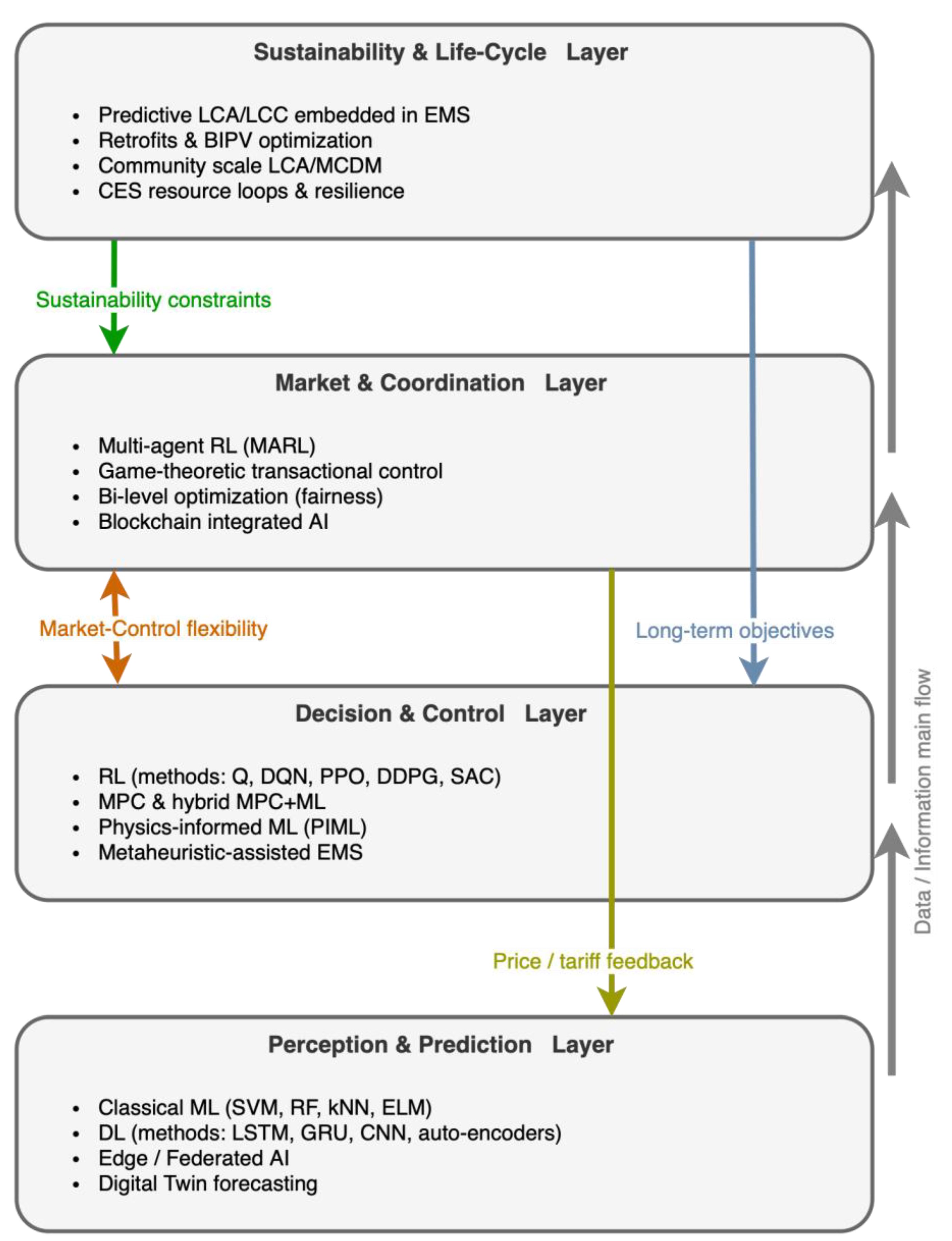
Figure 2.
Conceptual continuum of AI applications from buildings to microgrids and then CES, along increasing system complexity and time horizons.
Figure 2.
Conceptual continuum of AI applications from buildings to microgrids and then CES, along increasing system complexity and time horizons.
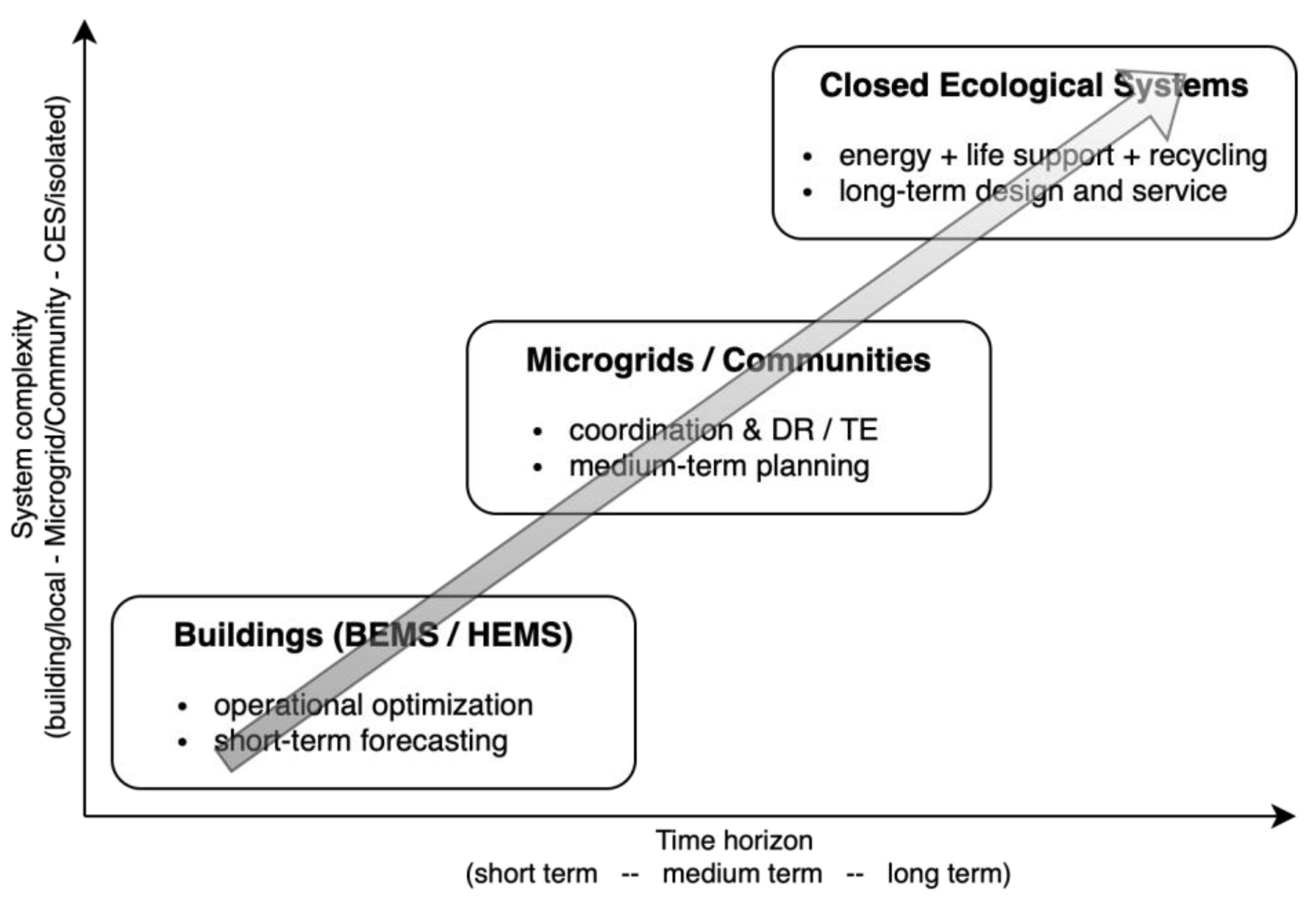

Table 1.
Initial search results (2015–2025, according to the defined queries).
| Set of Records | Thematic Area | Web of Science | Scopus | Total |
|---|---|---|---|---|
| 1 | AI + Transactive/Peer-to-Peer Energy | 189 | 322 | 511 |
| 2 | AI + Smart Local Energy Systems / Microgrids | 53 | 122 | 175 |
| 3 | AI + Life Cycle Assessment / Life Cycle Cost + Buildings |
149 | 211 | 360 |
| 4 | AI + Sustainable / Smart / Green Buildings and Energy Performance |
324 | 713 | 1,055 |
| Total | 715 | 1,386 | 2,101 |
Table 2.
Inclusion and exclusion criteria applied in the literature screening.
| Criterion | Included if… | Excluded if… |
|---|---|---|
| Source quality | Record indexed in WoS or Scopus, with complete metadata and DOI. |
Record without DOI, missing authors, or incomplete metadata. |
| Topical scope | Explicit mention of energy management in buildings (including Heating, Ventilation, Air Condition (HVAC), lighting, microgrids, Energy Management Systems, Demand Side Response (EMS/DSR), building performance). |
Focus exclusively on unrelated domains (e.g., mobility, large-scale grid operations). |
| AI relevance | AI techniques explicitly applied (Machine Learning - ML, Deep Learning - DL, Reinforcement Learning - RL, etc.) to energy-related functions in buildings or local microgrids. | No AI component, or purely conceptual without technical application. |
| Application domain | EMS, DSM, DSR, predictive control, optimization, building energy performance, sustainability with AI. |
Purely economic/market models (auctions, bidding, trading) without EMS/control aspects. |
| Forecasting role | Forecasting integrated into EMS, DSM/DSR, or microgrid operation. |
Standalone forecasting (photovoltaic - PV, wind, price) without EMS/control context. |
| Sustainability assessment | AI applied to LCA/LCC in connection with building energy management. |
LCA/LCC without AI or without EMS/building application. |
Table 3.
Multi-stage selection and reduction of publications.
| Stage | Set 1 | Set 2 | Set 3 | Set 4 | Total | % of Previous | % of Start |
|---|---|---|---|---|---|---|---|
| Initial identification (WoS + Scopus) | 511 | 175 | 360 | 1,055 | 2,101 | 100% | 100% |
| After merging (both databases, DOI, completeness) |
173 | 48 | 100 | 293 | 614 | 29.2% | 29.2% |
| After thematic filtering (EMS in buildings) | 119 | 29 | 41 | 117 | 306 | 49.8% | 14.6% |
| After content-based filtering (final set) |
29 | 23 | 1 | 106 | 159 | 52.0% | 7.6% |
Table 4.
Cross-cutting overview of AI methods and applications across TE, DEM, buildings, microgrids, energy communities, and CES.
Table 4.
Cross-cutting overview of AI methods and applications across TE, DEM, buildings, microgrids, energy communities, and CES.
| AI Method | TE (Trading, Markets) |
DEM (DSM/DSR, Control) |
Buildings (BEMS/HEMS) |
Microgrids | Energy Communities |
Closed Ecological Systems |
|---|---|---|---|---|---|---|
|
Classical ML (SVM, RF, K-Nearest Neighbors - kNN, Extreme Learning Machine - ELM) |
Price & demand forecasting; bidding profiles [49,92,93] |
Load prediction, Non-Intrusive Load Monitoring (NILM), anomaly detection [60,94,95,96,97] | Energy Use Intensity (EUI) benchmarking, HVAC classification [48,93,95,97] |
DER pattern recognition, energy quantification methods [60,93] | Local demand/supply modeling [50,53] | Resource forecasting and pattern recognition for life-support loops [1,55] |
|
Deep Learning (LSTM, GRU, CNN, Regional CNN, Autoencoders) |
Short-term price signals, prosumer response [98,99,100] |
HVAC load prediction, IAQ/IEQ modeling [41,42,61,74,91] |
Occupancy detection, CO₂ prediction, drone thermal imagery [61,73,74,80] |
Recurrent EMS controllers [41,57] |
Net demand forecast, VPP integration [48,51,80] |
Prediction of environmental variables (temperature, humidity, CO₂) in greenhouses and space habitats [55,72] |
|
Reinforcement Learning (Q, DQN, A2C/A3C, PPO, DDPG, SAC) |
Transactive bidding, EV scheduling [40,46,77] |
LowEx control, EMS with storage [2,56,78,101] |
Smart HVAC dynamic control, comfort-aware policies [61] |
Adaptive EMS, ancillary services [36,77,78,90,102] |
MARL for distributed DR and pricing coordination [46,51,79] |
Adaptive control of life-support subsystems, water/air recycling optimization [55,103] |
|
Multi-Agent AI & Game Theory |
Cooperative /competitive market negotiation, fairness [39,46,79,81] |
Hierarchical DSM/DSR coordination [58,104] |
Occupant centric decision and behavior prediction [105] |
Coordination in networked microgrids, resilience enhancement [1,3,104] |
Federated MARL for transactive energy communities, blockchain-based TE [51,80,81] | Multi-agent control of food–energy–water loops in habitats [55,106] |
|
Hybrid AI (MPC+ML, Metaheuristics+ML, Surrogates) |
Surrogate MILP/MINLP for bidding optimization [3,102,107] |
RL+MPC and RL+MILP for EMS responsiveness [2,77,102] |
HEMS scheduling with LSTM+GA; DSM via BLSTM/CapsNet+HGSOA [53,91] |
ANN/GP surrogates for ESS and multi-energy scheduling [3,58,102] |
Consensus + FL for distributed optimization [51,58] | MPC+RL for CES climate /energy management [72,75] |
|
Federated & Edge AI |
FL-assisted distributed trading and coordination [51,58,100] |
Edge-AI for real-time EMS [41,54] | Adaptive FL for building forecasting; privacy-by-design automation [80,83] |
Edge-enabled EMS with IoT integration [51,54] | FL-assisted aggregation and consensus building [51,58,80] |
Edge/federated AI to preserve privacy and autonomy in CES habitats [75,82] |
|
Digital Twins & Blockchain Integration |
DT-enabled TE forecasting, auditing, blockchain-secured trades [81,82] |
DT+AI for EMS and predictive resilience [2,62,76] | BIM/IoT+DT for performance gap reduction [62,75,76] | DT /Blockchain /Building Management System (BMS) for microgrids [82,108] | DT frameworks for resilience in NMGs and TECs [1,58] |
DTs of bioregenerative CES habitats [64,72,75] |
|
Physics-Informed & Interpretable ML (PIML, Explainable AI - XAI) |
Trust metrics, explainable bidding and optimization [64] |
PIML for EMS stability and reliability [64] |
Bayesian calibration, explainability in building energy management DTs [62,76] |
XAI-based anomaly detection and IDS in MGs [2,86] |
Explainability in federated trading optimization [9,76] |
PIML/XAI for lifecycle resilience in CES habitats [64,83] |
|
Cybersecurity & Risk Aware AI |
Blockchain-secured TE markets and EV transactive flows [2,40,81] |
IDS with ML frameworks for EMS; homomorphic encryption for anomaly detection [2,52,84,85,86] |
Risk-aware ML in building automation [83,89] |
FMEA 2.0 for MG risk assessment; operator cyber-range training [87,88,89] |
Cybersecurity in federated TE and IoT environments [51,85,87,88] |
Predictive anomaly detection and ML-based maintenance in CES loops [64,82] |
Table 5.
Research gaps and methodological challenges in AI-driven TE, DEM, and LCA/LCC integration.
| Area | Observed Focus in Literature | Identified Gap / Challenge | Future Direction |
|---|---|---|---|
| Transactive Energy (TE) | Short-term market clearing (minutes–day-ahead), MARL-based bidding, bilevel fairness models |
Weak coupling with grid reliability, seasonal variability, and long-term investment decisions; resilience under cyber-physical uncertainty underexplored [39,40,52] |
Extend TE frameworks with multi-horizon optimization, AI-enhanced resilience metrics, and integration of environmental objectives |
| Dynamic Energy Management (DEM) | RL-based demand response, hybrid MPC for HVAC and microgrids, edge-AI forecasts |
Scalability and sample efficiency of RL not solved; safe deployment in heterogeneous real-world systems largely missing; interoperability with legacy BMS limited [56,57,58,61,62] |
Development of standardized DEM platforms combining robust RL/MPC hybrids with edge computing and safe RL formulations |
| AI Methodologies | Strong innovation in RL, DL, federated/edge AI, emerging DT applications |
Fragmentation across methods; limited explainability and trust; lack of integration into layered, interoperable frameworks [36,41,62,64,76] |
Move towards multi-layered AI architectures that integrate perception, control, market, and sustainability with explainability by-design |
|
Life-Cycle Integration (LCA/LCC) |
Surrogate models for retrofit/BIPV, conceptual links to community energy |
Lack of dynamic, predictive LCA coupled to EMS; minimal integration with operational control; uncertainty treatment and data standardization weak [26,109,110,111,112,114,118] |
Embed predictive LCA/LCC in EMS workflows; couple AI-based control with embodied/operational impact models; improve interoperability of data and signals |
|
Cross-domain (Buildings → Microgrids → CES) |
Building EMS well studied; microgrids emerging; CES nearly absent |
Limited research on transferability across scales and domains; no holistic studies linking building-level AI with CES-like survival-critical contexts [1,55,72,75] |
Use CES as a frontier testbed to stress-test AI for resilience, closed-loop resource management, and long-horizon sustainability |
|
Cybersecurity & Privacy |
Early works on federated learning, blockchain, IDS for microgrids |
Limited robustness against adversarial attacks; weak integration of cybersecurity into control loops; privacy preserved mainly in lab-scale pilots [52,82,83,84,85] |
Advance privacy by-design AI in EMS/TE; validate adversarial robustness in pilots; integrate AI-based intrusion detection with control frameworks |
Table 6.
Proposed multi-layered AI framework for sustainable energy systems, contrasting literature trends with suggested extensions.
Table 6.
Proposed multi-layered AI framework for sustainable energy systems, contrasting literature trends with suggested extensions.
| Layer | Trends Observed in Literature | Proposed Extensions (Framework Contribution) |
|---|---|---|
|
Perception & Prediction |
Widespread use of ML/DL for short-term forecasting (loads, prices, anomalies); early adoption of edge and federated approaches; DT mostly at experimental stage |
Develop unified, scalable pipelines combining edge/federated AI and digital twins for real-time, privacy-preserving, and explainable prediction |
|
Control & Optimization |
RL and MPC-hybrids show strong potential but remain validated mainly in simulations; limited safety guarantees and poor interoperability with legacy BMS |
Advance robust RL/MPC formulations with built-in safety, interoperability standards, and deployment in real-world pilots at building and community scales |
|
Market & Coordination |
MARL, game-theoretic models, and blockchain used in conceptual or lab-scale TE studies; DEM–TE coupling still fragmented | Establish integrated control–market architectures that embed fairness, resilience, and transparency, enabling deployment in energy communities and scalable TE platforms |
|
Sustainability & Life-Cycle |
Very limited works embedding LCA/LCC into EMS; mostly conceptual or surrogate models without operational integration |
Embed predictive LCA/LCC in EMS workflows; couple AI-based control with embodied/operational impact models; improve interoperability of data and signals |
Disclaimer/Publisher’s Note: The statements, opinions and data contained in all publications are solely those of the individual author(s) and contributor(s) and not of MDPI and/or the editor(s). MDPI and/or the editor(s) disclaim responsibility for any injury to people or property resulting from any ideas, methods, instructions or products referred to in the content. |
© 2025 by the authors. Licensee MDPI, Basel, Switzerland. This article is an open access article distributed under the terms and conditions of the Creative Commons Attribution (CC BY) license (http://creativecommons.org/licenses/by/4.0/).
Copyright: This open access article is published under a Creative Commons CC BY 4.0 license, which permit the free download, distribution, and reuse, provided that the author and preprint are cited in any reuse.


