

Submitted:
06 October 2025
Posted:
07 October 2025
You are already at the latest version
Abstract
A new software platform is presented in this article to oversee and manage urban and industrial smart systems by employing digital twin technologies and immersive, interactive metaverse settings, thereby achieving environmentally sustainable urban infrastructure. The system proposed is prepared to track, simulate, and optimize building performance using predictive analytics and interactive dashboards, and thus serves as a modular, interoperable solution. By defining a multi-residential site management case study, a working prototype is developed and implemented here using simulated and realistic datasets, thereby designed for real-time calculation and visualization of key performance indicators (KPIs) across various areas, including energy efficiency, preventive maintenance, user experience through design, and economic performance. The choice of KPIs, such as energy usage intensity, return on investment, and user satisfaction, can benefit from this technology setup and yield improvements through enhanced operational efficiency, clearer decision-making, and long-term cost-effectiveness. Although such obstacles exist, empirical testing with real data may reveal that integration with hardware, interoperability with existing setups, and economic costing are feasible for small to medium-sized players. With evaluation performed using simulated data, the platform suggests a prospective setup ready to be tested through pilot testing with real-world deployment. In situating the Smart Infrastructure Metaverse here, as a transformation setup of digital governance within a built and developed framework with technological innovation coupled with sustainability and with inclusivity to all the players/stakeholders, the cities embarked here through ever-increasing digital ecosystems with advantages of having such works through an emerging discussion of how immersive technology informs here of a next-generation potential of smart, sustainable, and participatory urban living.
Keywords:
Smart Building Management
; Metaverse Technologies
; Sustainability
; Key Performance Indicators (KPIs)
; Digital Twins and IoT
1. Introduction
The acceleration of urbanization, the imperative of ecological transition, and mounting pressure on energy and management systems are transforming the way that cities design and operate living spaces (Lifelo et al., 2024). Conventional reactive practice with single-partial efficiency objectives is insufficient to face today’s complexity (Chen et al., 2024). Here, the metaverse is not regarded as a leisure activity, but rather as a virtual infrastructure that integrates digital twins, IoT, AI, and immersive AR/VR portals (Wang et al., 2023; Lee et al., 2024). The question posed by this document is: how can a management platform based on a metaverse enhance the sustainability, efficiency, and governance of smart residential complexes? The novelty of this document lies in its integration of technological, organizational, and social viewpoints within a single architecture (Han et al., 2022). The novelty arises through three mechanisms: the metaverse is regarded as an operational platform that interconnects administrators, residents, and service suppliers (Masubuchi et al., 2025); KPIs are used as common metrics for measurement and communication (Schrage et al., 2024); and prototyping is employed to assess feasibility. The essence consists of the interconnection of technologies: digital twins simulate buildings, IoT provides predictive models (Luo et al., 2025), AI inspects anomalies and optima (Abdelmoti et al., 2025), and immersive VR/AR permits managers and residents to move and inspect data within 3D models (Masubuchi et al., 2025). Here, experiential and collaborative decision-making prevail over operational decision-making (Wang et al., 2023), and interoperability is necessary to prevent digital dismemberment (Lee et al., 2024). A KPI architecture assesses effectiveness systematically, addressing energy, operation, user comfort, collaboration, economic return, and adoption (Schrage et al., 2024). KPIs bridge facility management and new horizons of immersive involvement (Chen et al., 2024). Prototyping unites backend, databases, IoT APIs, and VR/AR portals and validates dashboards, energy simulation, predictive modules, and governance arenas (Masubuchi et al., 2025). This represents a proof-of-concept and experimentation laboratory for adoption (Han et al., 2022). Simulation of data plays only a temporary role, facilitating validation while datasets of reality are rare (Luo et al., 2025), and is subordinated to wider technological evolution (Abdelmoti et al., 2025). This publication aims to transcend the fragmentation of smart building research by providing a comprehensive ecosystem of various technologies within a single immersive platform (Chen et al., 2024; Lifelo et al., 2024). In contrast to generic smart city models, it centres on residential structures and condominiums, frequently characterized by inefficient management, government opacity, and poor citizen involvement (Wang et al., 2023). Through integration of sustainability, data science, facilities management, and immersive technologies, it creates value to academia, policymakers, and developers (Lee et al., 2024). In sum, the metaverse is conceptualised as an operational infrastructure that brings together technology, measurement, and prototyping to address genuine needs of sustainability, efficiency, and equity (Han et al., 2022). Based on the research question, KPI framework, and concept of prototyping, this paper initiates a discussion on the smarter and more inclusive governance of urban living spaces (Lifelo et al., 2024; Schrage et al., 2024).
The paper then proceeds as follows: the second section provides the theoretical and technological background, accompanied by a quotation highlighting the relevance of digital twins, IoT, VR/AR, and predictive analytics. The third lays down the KPI landscape, with measurable objectives of efficiency, sustainability, and experience. The fourth examines economic feasibility, cost alignment with future returns. The fifth lays down the functional contents of the platform, with an emphasis on modularity and immersive dashboards. The sixth publishes results of prototype implementations. The seventh explains methodology and case study. The eighth demonstrates a sample dashboard as a decision-support tool. The ninth branches out into discussion. The tenth overcomes obstacles. The last section concludes and recommends future research.
2. Research Question: Toward an Integrated Metaverse-Based Platform for Smart Building Management
The main research topics addressed in this paper are derived from the objectives of the NextHub Project. This project included activities focused on investigating technologies and use cases related to metaverse platforms for Smart Building applications. In this context, our work proposes the design and prototypical development of a management system based on a framework of specific KPIs. These KPIs can be enhanced through immersive and interactive experiences offered by the metaverse, as well as the multiple information sources provided by supporting digital technologies. To identify suitable references, we explored various keyword and concept combinations using specific queries in the Elsevier Scopus database. We began with various search conditions related to the “Smart Building” domain to encompass the broad range of applications in Intelligent Building and Building Automation. We also considered the “Metaverse” technological framework, which encompasses enabling technologies such as Digital Twins, IoT, VR/AR, and predictive analytics. The inclusion of “KPIs” served to represent the performance measures needed for Management Systems, particularly Decision Support Systems. We investigated the following research question:
“How can a metaverse-based management platform (a digital environment as defined above), structured around standardized and multidimensional key performance indicators (measurable values that indicate effectiveness across multiple areas), integrate digital twins (virtual models of real-world systems), IoT (networks of interconnected devices), AI (artificial intelligence for data-driven automation), and immersive XR (Extended Reality, encompassing Virtual, Augmented, and Mixed Reality), to move beyond fragmented technological experimentation and deliver measurable improvements in sustainability, efficiency, and governance of smart residential and industrial buildings?”
What we realized at the end of this preliminary step is the glaring lack of items related to the use of “Metaverse” for “Smart Building” applications. That specific research question has been proven by setting the following query within Scopus: (TITLE-ABS-KEY (“metaverse”)) AND (TITLE-ABS-KEY (“smart building”)). The decision to employ the query TITLE-ABS-KEY(“metaverse”) AND TITLE-ABS-KEY(“smart building”) has proven highly strategic for assessing the research question, as it generated only five results across leading scientific databases.
This lack of abundance is not a deficiency but instead betrays the novelty of the intersection of themes being researched. The limited corpus highlights the absence of a codified body of research explicitly linking the metaverse to smart building management, thereby justifying the research’s timeliness and contemporary relevance. The retrieved five contributions are not marginal or sideline efforts; rather, they collectively chart the dispersed but hopeful landscape of the discipline. They span infrastructural considerations of distributed intelligence (Zhang et al., 2022) to literature reviews of extended reality across building management (Casini, 2022), IoT–blockchain intertwinings (Ud Din et al., 2023), experimental prototyping of digital twin–metaverse unification (Masubuchi et al., 2025), and conceptual implications of digital twins and immersive technologies across architectural scenarios (Tang et al., 2025). Each of these pieces proposes an integral part of the ecosystem but fails to synthesize into a comprehensive framework, thus leaving unresolved the very heart of the challenge of transforming technological innovation into actionable governance value. Zhang et al. (2022) make a significant contribution at the infrastructural level by proposing a service-oriented edge computing architecture that enhances distributed intelligence. Their work is important because it lays down the computational substrate that would be necessary to accommodate the future integration of the metaverse and smart buildings, and stresses low latency, scalability, and dependability. However, the study is limited to system architecture on its face and devotes itself very little to considering how such infrastructures might get operationalized to confront the very practical demands of building governance: efficiency, maintenance, and comfort. The omission of this reveals a blind spot within the literature: while technical robustness cannot be achieved without managerial translation, without such translation, that robustness threatens to devolve into an abstract promise rather than an operationalizable novelty. Casini (2022) provides a comprehensive review of extended reality applications in building operation and maintenance. This is a helpful piece of work that demonstrates how immersive technologies can contribute to data-driven decision-making, predictive maintenance, and an enriched experience. Nevertheless, the review betrays the infantility of the field by dramatizing that applications of XR exist in fragmented and disconnected systematic patterns of evaluation. Without standardized indicators of performance, deployment of XR cannot be compared across scenarios or benchmarked against objectives such as sustainability or cost-effectiveness. This resonates with a structural flaw in the literature: technologies hold promises and are often congratulated, but the lack of numerically tractable metrics stifles their evolution into strategic tools of governance. Ud Din et al. (2023) shift attention from immersive experience to digital governance by studying the intersection of IoT and blockchain within the metaverse. Their research demonstrates how trust, trackability, and security can be fostered within decentralized settings, a crucial aspect of stakeholder involvement in smart building ecosystems. However, despite the empirical demonstration, the study fails to discuss how such blockchain-based governance mechanisms translate into operational efficiencies within the domains of efficiency, energy, or comfort. The omission of these aspects reinforces the image of a literature divided into separate streams addressing infrastructural preparation, immersive tools, governance, and trust, but none of them synthesizes these aspects into a comprehensive and measurable model. Masubuchi et al. (2025) bring the discourse closer to practice through prototype experiments that combine IoT sensors with a commercial metaverse platform to demonstrate a smart building. This marks an important step because it demonstrates feasibility and provides a solid example of system integration. However, even here, the focus is on technical interoperability and system latency, discarding any overall methodology for understanding performance within ecological, economic, or societal terms. The prototype thus represents an early move toward practice but fails to deliver any evaluative model that can be repeated or scaled up. It thus proves only that promising technical demonstrations exist, but that they, by themselves, cannot fulfill the broader objectives of governance. Tang et al. (2025) offer a conceptual synthesis by situating digital twinning and metaverse technologies within the epoch of AI and extended reality. The theoretical conceptualization is ambitious because it situates these technologies within a broader context of digital architecture and immersive design. However, their research output is programmatic rather than empirical, identifying transformational potential but not demonstrating it through metrics, prototype demonstration, or ground truth. This again mirrors the state of research, with theoretical enthusiasm being plentiful but operational translation scarce. Considered collectively, these five results emphasize both the promise and the deficiency of the existing literature. They converge on the insight that the metaverse, combined with digital twins, IoT, AI, and XR, holds the potential to profoundly revolutionize smart building management. They diverge by scope, each covering only a slice of the ecosystem. The lack of a unifying framework that can integrate immersive interaction with standardized, multidimensional KPIs of any order deprives the research domain of the ability to progress from visionary promise to operational governance. This fragmentation amplifies the relevance of the research design: the lack of results proves not only that the question is new but also that such a study that unifies these disconnected dimensions into a coherent, replicable, and measurable model is awaited with urgency. By critically positioning itself against this limited corpus, this present research demonstrates its novelty and inventiveness. The newness lies in exploring an understudied interstice between metaverse technologies and smart building governance, as confirmed by the limited results of the query. The inventiveness is evident in the answer: instead of focusing uniquely on infrastructure, immersive tools, blockchain governance, prototypes, or conceptual vision, the research integrates these dimensions into a modular and interoperable platform. The addition of standardized and multidimensional KPIs, encompassing energy efficiency, maintenance performance, comfort, governance clarity, and economic feasibility, represents a key methodological breakthrough absent from the literature. The integration of these indicators into an immersive management environment based on the metaverse serves not only to prove feasibility but to ensure that results are measurable, comparable, and consumable. The rigid bijection that exists between the five returns of the query and the current study serves to repeat the usefulness of the research question. Zhang et al. (2022) uncover the infrastructural pillars that make distributed intelligence possible, and this study builds on by inscribing managerial functionalities. Casini (2022) reveals the promise of XR in building operations, a promise actualized here through the integration of digital twins and data analytics within a KPI framework. Ud Din et al. (2023) identify blockchain-enabled trust, supplementary to but not a substitute for efficiency, comfort, and sustainability metrics; this research fills the gap with its evaluative layer. Masubuchi et al. (2025) open up the possibility of integrating the metaverse with IoT, but without a systematic review; this research fills that gap. Tang et al. (2025) describe the conceptual integration of digital twins, AI, and XR, while this research takes that conceptual promise and embeds it into a prototype based on outcomes that can be measured. Each of the five papers thus sheds light on a partial aspect of the ecosystem, only when combined with the others, and only then do they delimit the outlines of a discipline ready to be developed through integral advances. The novelty of the theme, therefore, consists not in postulating that technologies of the metaverse can improve the management of smart buildings—an assertion already found in literature—but in showing how this improvement can be operationalized, measured, and governed. The research design is supported by the lack of precedent, the dispersion of existing contributions, and the resulting black hole that together create the absence of standardized KPIs and integrated management schemes. By filling this black hole, the research elevates the discussion from decentralized technological experiments to systemic integration, moving from promises to operational control, and from fragmented case studies to a replicable model. In fine, the thin yield of the research question of five results constitutes, by itself, a powerful demonstration of the novelty of the research question and of the thesis. The systematic analysis of these articles reveals the lack of success of existing approaches and highlights the necessity of an integral design. By presenting a management platform for the metaverse, based on standardized KPIs and integrating digital twins, IoT, AI, and XR, the research assumes its role, not only addressing existing gaps but also making a pioneering contribution that will define, in itself, the future direction of the discipline. Far from being a limitation, this scarcity of literature on this intertwinement validates the innovative character of the research and supports this thesis of developing a measurable, transparent, and participatory management system for smart residences and industrial buildings.
3. Theoretical and Technological Framework
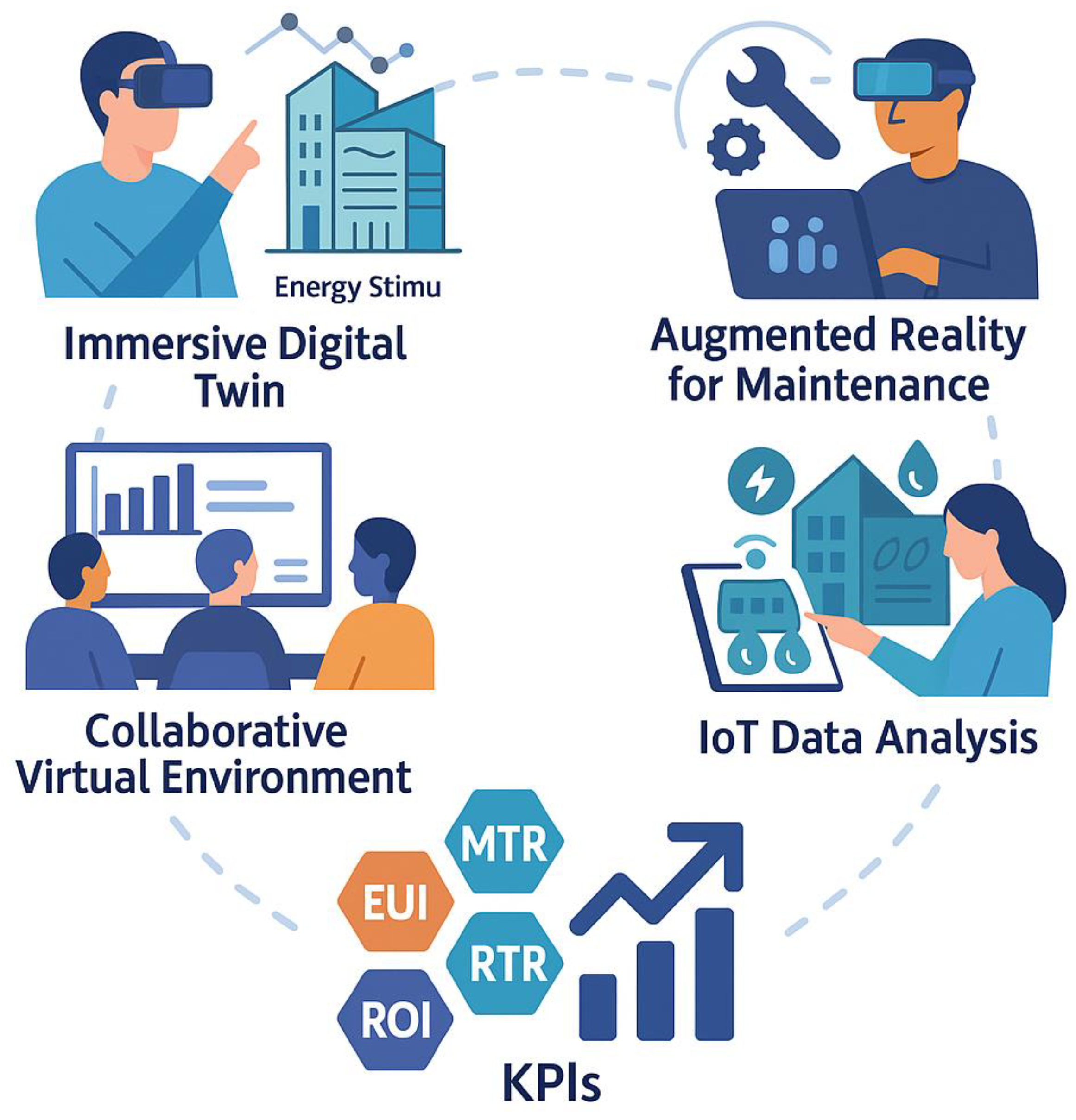
By integrating building management with metaverse technologies, we can access a vast array of tools to reimagine the traditional building management model as a more virtual, efficient, and sustainable experience. Such integration is not confined to limited usage, but extends across various layers of operations, allowing various stakeholders to interact with the space in a fresh and meaningful way. Each of these tools, ranging from digital twins and virtual reality to virtual collaboration spaces and IoT-attached data analytics, possesses its individual strengths in solving perennial building management issues, including maintenance optimisation, energy efficiency, and people connection (Lifelo et al., 2024; Hosamo, 2023). Together, they provide an unparalleled technological novelty ecosystem that is ripe for full research and industrial and academic systematization (Zocchi et al., 2024; OYEYIPO et al., 2024).
Immersive Modeling of Digital Twins with Real-Time Energy Simulations. Digital twins, or virtual representations of physical assets, have been applied to various industries, including manufacturing, aviation, and healthcare (Hosamo, 2023). When kept within the metaverse, digital twins achieve an additional layer of immersion, allowing building information to be readily accessible in real-time to facility managers, inhabitants, and third parties through immersive visualization (Lifelo et al., 2024). To qualify as smart, that is, to facilitate simulation and monitoring within a three-dimensional virtual world of any facilities component, ranging from the HVAC to lighting network, by real-time energy simulation embedded within such twins, gives predictive insights about what effect usage, occupancy, or environmental tweaks will have on energy usage (Zocchi et al., 2024). They are specifically needed to achieve sustainability objectives because they allow proactive rather than reactive adjustments. Unlike standard dashboards, immersive digital twins enable decision-makers to “walk through” their data, visually identify inefficiencies, and prototype optimization strategies on the spot within a risk-free virtual environment (Hosamo, 2023).
Predictive Maintenance Facilitated by Augmented Reality. Arguably, the most persistent building management issue is high-cost disruption resulting from equipment breakdown. Typical maintenance practices frequently depend on corrective interventions that are costly or inefficient. Predictive maintenance, supported by sensor and artificial intelligence-based analytics, enables the early prediction of faults before they deteriorate (Dhaou et al., 2024). Such a paradigm, infused with an Augmented Reality (AR) component, yields multiple benefits. AR enables maintenance staff to view instructions, performance data, and repair manuals superimposed over reality using smart glasses or a phone screen (Wang et al., 2022). Within a metaverse building platform infrastructure, predictive maintenance is a key feature. Moreover, predictive maintenance is even more collaborative: design and maintenance staff can co-experience a simultaneous immersive reality, troubleshoot live and contemporaneously, and update maintenance records with ease (Hosamo, 2023). Such an arrangement not only guarantees a minimized mean time to repair (MTTR) but also maximizes the first-time fix rate (FTFR), with the downside being lower operational costs and equipment enduring longer.
User Interaction within Virtual Collaborative Environments. The governance of condominiums and multi-residential buildings is often hindered by a lack of transparency, low stakeholder participation, and poor communication between administrators and residents. Virtual collaborative environments offered by the metaverse help resolve these issues. They provide a platform for administrators, tenants, and service providers to converse as avatars (OYEYIPO et al., 2024). These environments simulate everyday spaces, such as meeting rooms, command centers, or virtual replicas of buildings. In these spaces, residents can access sustainability reports, propose initiatives, or participate in decision-making support. Administrators can use interactive dashboards to notify stakeholders of budget allocations or set maintenance priorities transparently. This transformation shifts bureaucratic, non-transparent processes into interactive, participatory events, thereby enabling greater trust and higher participation among stakeholders. Collaborative environments also support remote participation in meetings, reducing physical requirements. This, in turn, helps sustainability objectives by curbing mobility-based emissions. Central to these immersive experiences is the use of IoT sensor data. Such data enables multidimensional analysis at the core of a building’s smart ecosystem. Sensors measuring temperature, humidity, CO₂, occupancy, and equipment effectiveness generate massive data streams that are challenging to interpret using traditional analysis methods (Dhaou et al., 2024). The metaverse introduces a new standard for interpreting these multidimensional streams. When IoT data is overlaid on immersive dashboards or digital twins, managers can identify correlations that are invisible to the naked eye (Ramanasankaran et al., 2023; Zocchi et al., 2024). For instance, overlays can reveal where occupancy aligns with energy demand peaks or where poor indoor environmental quality impacts occupant comfort. Immersive IoT data displays enhance situational awareness, accelerate decision-making, and reduce cognitive overload compared to traditional methods (Sajovic et al., 2023). A solid measurement structure based on Key Performance Indicators (KPIs) is necessary to judge the effectiveness of these advances. Their real impact is assessed and tracked through the systematic use of KPIs. KPIs serve as a common language for technical operators, managers, and policymakers. They help ensure that metaverse integration delivers measurable benefits and that common metrics are applied across various contexts (Zocchi et al., 2024). For energy management, tracking energy usage intensity (EUI) and carbon footprint shows efficiency improvements. In maintenance, technical indicators such as Mean Time to Repair (MTTR) and Preventive Maintenance Ratio (PMR) specify operational enhancements (Hosamo, 2023). User-focused KPIs, such as the Occupant Satisfaction Index (OSI) and Indoor Environmental Quality (IEQ), clarify how immersive technologies affect comfort and well-being. Economic KPIs, such as payback period and ROI, connect technical results with financial outcomes. This makes the case for sustainability without sacrificing affordability.
The Role of Integration and Innovation. What’s new isn’t any single piece of technology—in the forms of digital twins, IoT, VR/AR, or predictive analytics—but their aggregation within a management platform that’s predicated on a metaverse (Lifelo et al., 2024; OYEYIPO et al., 2024). It consolidates simulation, maintenance, co-working, and data analytics into a single world. Such a management platform is intended to enhance operational effectiveness and address overall sustainability challenges through the alignment of technological, economic, and social goals (Zocchi et al., 2024). There’s prior research addressing such tools individually; however, very few papers have attempted to consider their synergistic potential by converging with immersive worlds. Such a gap highlights the novelty of our research, proposing a convergent analysis of the effect of metaverse-based smart building management using simulated datasets and the rollout of a prototype. In short, the metaverse is a game-changing technology platform for building management. By offering immersive simulation, predictive maintenance, co-working management, and high-end IoT-driven analytics, it revolutionizes the experience and management of buildings. Systematic roll-out of KPIs ensures that such a revolution is both visionary and trackable, excluding wishy-washy strategies and instead building an evidence-based roadmap to enhance efficiency, sustainability, and user experience.
Figure 1.
Metaverse-Enabled Smart Building Management Framework. This visual summarizes the integration of digital twins, predictive maintenance with AR, collaborative virtual environments, and IoT-enabled analytics within a metaverse-based system. Key Performance Indicators (KPIs) are applied as the measurement framework to evaluate sustainability, efficiency, and user engagement.
Figure 1.
Metaverse-Enabled Smart Building Management Framework. This visual summarizes the integration of digital twins, predictive maintenance with AR, collaborative virtual environments, and IoT-enabled analytics within a metaverse-based system. Key Performance Indicators (KPIs) are applied as the measurement framework to evaluate sustainability, efficiency, and user engagement.
4. KPI Framework for Immersive Smart Building Management
To evaluate a potential building management platform empowered by the metaverse’s effect and value, a set of common Key Performance Indicators (KPIs) that collectively assesses a building’s balance and comprehensive functionality across multiple levels (technical, economic, and people-based) within five interconnected areas (domains) that comprise its overall functionality: Energy Efficiency, Operations & Maintenance, User Experience & Comfort, and Return on Investment & Technology Adoption. Each indicator is defined using standardized equations, qualified by a dual focus: its horizon-scanning effect within an immersive metaverse-enabled interface, and its down-to-earth operational implications for building management. Muffling such indicators within each other allows a combined, scenario-based numerical analysis of systems operating within various environmental, organizational, and technological conditions (Table 1).
Such a KPI-driven framework constitutes an excellent canvas to observe, to emulate, and to tune intelligent building operations with immersive media. Through the application of metaverse functionality to standard facility management metrics, the system enables a multi-faceted analysis of energy efficiency, maintenance effectiveness, usage activity, and economic feasibility. Merging technical intensity with immersive visualization fortifies decision-taking protocols and stakeholder involvement. In that regard, such a framework serves to prove the prototype but also to ensure a scalable template to be modified to future deployments across a myriad of intelligent building scenarios.
5. Economic Feasibility and Cost-Benefit Analysis of Metaverse Integration
Besides the technology of integrating metaverse technologies with smart structures, financial implications play a crucial role in long-term success. The Smart Infrastructure Metaverse market is continuing to increase gradually, extending its usage beyond residential applications into factories, supply chains, healthcare, and urban planning (Yaqoob et al., 2023; Thakur et al., Zeng et al., 2022; Spais et al., 2025). This verifies that the metaverse is a disruption, not hype, across various industries (Chatzopoulou et al., 2023). In structures, it provides value through efficiency gains, Operating cost savings, and improved building experience (Wang & Medvegy, 2022). But adoption carries large initial costs (Yaqoob et al., 2023). A solid digital foundation—encompassing computing power, high-speed internet, and Secure storage—is needed but is often pricey, particularly for small businesses (Noroozinejad Farsangi et al., 2024; Ud Din et al., 2023; Spais et al., 2025). There are also costs of reconfiguring business processes (Thakur et al., 2023; Noroozinejad Farsangi et al., 2024; Yaqoob et al., 2023) and buying hardware such as VR/ AR devices and servers, and software licenses of the metaverse and simulation software (Ud Din et al., 2023; Zeng et al., 2022). Content generation to achieve 3D visualizations and immersive simulation also requires specialized, expensive capabilities (Zeng et al., 2022; Yaqoob et al., 2023; Wang & Medvegy, 2022). To SMEs, these thresholds typically deter adoption, widening the gap between large businesses and those falling behind (Thakur et al., 2023; Chatzopoulou et al., 2023). But medium- to long-term returns outweigh initial costs. Predictive maintenance saves cash spent on repair and extends system life (Yaqoob et al., 2023). Digital twin energy simulation saves cash spent on utilities (Misilmani & Elbastawissi, 2023). Structures utilizing metaverse tools reap their competitive edge through energy efficiency, Transparency, and improved comfort, which translates into higher property prices and an increased appetite for investors (Wang & Medvegy, 2022; Thakur et al., 2023). The platforms also foster increased transparency in governance, lower administrative costs, and smoother relations with various players (Chatzopoulou et al., 2023). Briefly, whereas adoption of technologies requires massive initial investment in infrastructure, process redesigning, hardware, software, and immersive contents, financial returns over the long run—financial savings, increased property value, and better government practice—tally up (Thakur et al., 2023; Zeng et al., 2022). To make such benefits extend to large businesses, financing tools of SMEs should be in place (Chatzopoulou et al., 2023; Yaqoob et al., 2023).
6. Platform Functional Capabilities
The envisioned management platform is a module-based and interoperable system designed to address building governance issues across the metaverse. Modularity enables managers to turn on only the applicable modules and scale up as needed, while interoperability ensures smooth integration with existing systems, IoT networks, and third-party services, thereby avoiding digital silos (Noroozinejad Farsangi et al., 2024; Okonta et al., 2024). The inclusion of KPIs within interactive dashboards stands out: unlike fixed charts, these immersive dashboards enable stakeholders to delve into 3D building data on energy, maintenance, or satisfaction levels, fostering transparency and joint decision-making (Li et al., 2024). Scenario testing is made possible, whereby managers can test, for instance, variations of the HVAC or lighting and visualize their effects in real-time (Masubuchi et al., 2025; Awan et al., 2024). Energy simulation lies at the heart of the platform. By using digital twins, dynamic parameters such as occupancy, weather, and equipment efficiency are simulated to determine consumption, allowing for strategies like insulation upgrades or the integration of renewable energy. Immersive visualization enables stakeholders to “walk through” their energy data, transitioning from reactive to predictive management and enhancing sustainability and efficiency (e.g., Zainab & Bawanay, 2023; Adnan et al., 2024). Maintenance too is revolutionized: IoT sensors track equipment health, while failures are predicted by AI, and technicians carry out proactive intervention through the aid of 3D visualization and virtual instructions (Bouachir et al., 2022; Gu et al., 2024). Clear records of maintenance intervention add to increased accountability (Masubuchi et al., 2025). Staff can practice emergency scenarios or inspections safely within virtual settings, while residents participate in virtual meetings, access performance reports, and engage in governance, fostering trust and involvement (Li et al., 2024; Aloqaily et al., 2022). Scalability enables deployment ranging from a single condominium to entire urban networks and extending to district heating, renewables, or digital twins, while maintaining coherent data integration and KPI-based scoring (Adnan et al., 2024; Li et al., 2024). At its heart, the platform brings together IoT to collect data, AI to open-end its analysis, and the metaverse to provide immersive visualizations. This closed-loop system enables stakeholders to identify patterns, test interventions, and derive actionable insights (Aloqaily et al., 2022; Bouachir et al., 2022; Gu et al., 2024). By integrating modularity, interoperability, predictive simulation, and AI-based maintenance, it envisions a scalable, inclusive, and sustainable platform for intelligent building management.
7. Prototype Implementation and Preliminary Results
It was created as a proof-of-concept to test the possibility of a condominium management platform operating within a metaverse. The goal of the prototype is to confirm decision-support abilities, enhance clarity, and boost operational and environmental performance through immersive technologies. The technology-wise integration of backend and frontend systems, relational databases, and APIs provides IoT interoperability with VR/AR environments, enabling intuitive building data interaction and completing its technology set. The system is designed based on a modular building approach and scales with the demands of stakeholders. The system architecture comprises three layers: data collection through IoT sensor-based data acquisition, analytics utilizing machine learning to provide predictions and optimization, and immersive visualization through the deployment of metaverse interfaces. The multi-layer architecture facilitates flexibility and potential future deployment across various contexts. Among the implemented features, interactive dashboards using KPIs can be highlighted. Unlike fixed charts, dashboards provide managers, residents, and facility staff with the ability to explore building performance through 3D models, offering access to energy consumption, maintenance status, and satisfaction indicators (Li et al., 2024).
Such functionalties reveals for visualizations of interventions—such as upgrading insulation or integrating renewable energy—prior to actual deployment (Masubuchi et al., 2025; Awan et al., 2024). Digital-twin-based simulation is able to display energy, cost, and carbon consequences live (Noroozinejad Farsangi et al., 2024; e Zainab & Bawanay, 2023). Another important function is predictive maintenance, where IoT sensors monitor vibrations, temperatures, and usage intensities, and AI creates alerts and advisories. The AR environments aid technicians with clearer diagnostic and repair procedures, as well as collaboration, allow decreased MTTR and increased FTFR (Bouachir et al., 2022; Gu et al., 2024). Usability, in these cases, is measured by metrics such as adoption rate and session length, and preliminary testing reveals improvements in ROI, IEQ, and EUI. Challenges exist, including scalability issues with large volumes of data, interoperability with heterogeneous IoT systems, and high computational demands in immersive environments. Limited infrastructure and limited budgets can also impede deployment. However, the prototype illustrates key principles of integrating IoT, AI, and immersive visualization into a unified framework, paving the way for future pilots and real-world deployment. It signifies new promises of digital governance, sustainability, and resident involvement with smart condominiums.
8. Methodology and Case Study
The research methodology consists on an integrated monitoring and management system for multi-building complexes using IoT devices, digital twins, artificial intelligence (AI), and metaverse worlds (Noroozinejad Farsangi et al., 2024; Singh et al., 2025). It is based on three steps: data acquisition and processing, immersive visualization, and decision support. Initially, distributed IoT networks capture heterogeneous data, such as energy consumption, HVAC metrics, lighting, maintenance, and environmental indices such as air quality and acoustic comfort and noise (Lam et al., 2024) to assess comfort. Such inputs get evaluated by AI analytics to identify anomalies, construct predictive models, and tune performance (Kumar Gupta et al., 2024; Sunkara et al., 2024). The second step creates a digital twin of the complex to facilitate real-time simulation of its physical world. Managers, technicians, and residents move through 3D portals to visualized energy flows, equipment conditions, and environmental dynamics and make abstract metrics intuitive (Markopoulos, 2024; Lee & Song, 2024; Li et al., 2024). The third step interprets results into interactive dashboards conceptualized out of KPIs. Unlike fixed tools, these dashboards operate across screens and immersive VR/AR, quantifying energy efficiency by usage intensity and carbon avoidance (Zhou, 2024), maintenance by MTTR, FTFR, and preventive ratios, comfort by satisfaction indices and indoor quality indices (Lam et al., 2024), and economic viability by payback and adoption levels. A case study of a mixed-use residential complex and smart manufacturing tested the method using simulation studies. Results indicate increased efficiency, accelerated service response, higher satisfaction of occupants, and collaborative governance. Immersive meetings help parties to collectively evaluate performance, make resource allocations, and consent to sustainability projects, minimizing contest and enhancing legitimacy (Markopoulos, 2024). Overall, the methodology gives a reproducible template to handle complex-built environments, reconciling technical, economic, and social goals within a single digital domain (Singh et al., 2025; Li et al., 2024), see Figure 2.
9. Dashboards
Below we draw the attention to some of the dashboards developed in the prototype in relation to the above-mentioned case study, which has been specifically defined for a first level of validation through the generation of dataset providing realistic data.
The dashboard shown in Figure 3 is not only an energy value display, but also a decision-support system with real-time monitoring and strategic planning across multiple building sites. The dashboard represents the final stage of the system methodology, where data that has been processed is visualized and contextualized for the viewer through standard screens and immersive metaverse sessions. It reveals significant indicators of performance, including energy usage intensity, carbon output, and historic patterns of consumption. The indicators are derived through artificial intelligence (AI)-driven analysis of real-time data sensed across building fixtures, including HVACs, lighting, occupancy, and other building elements. Integration with digital twin technology enables these observations to be visualized spatially, facilitating better comprehension and answering questions that support predictive maintenance, anomaly detection, and resource planning. The dashboard ultimately serves a strategic function by linking technical performance to user experience and sustainability targets and becomes part of a single digital regime for smart building management (Figure 3).
The dashboard in Figure 4 extends beyond static reporting to provide a dynamic interface for tracking, analyzing, and individualizing maintenance processes of multi-building systems. Data input by distributed IoT sensors to AI motors is continuously evaluated to recognize anomalies, predict failures, and calculate system performance indicators, including Mean Time to Repair (MTTR) and First-Time Fix Rate (FTFR). Such indicators are graphical over time and aid managers in making informed judgments about the effectiveness and consequential implications of predictive interventions. The dashboard indicates maintenance performance progression and reveals savings, including cost savings, reduced downtime, and extended equipment life. Such savings exist due to real-time feedback loops, whereby insights extracted by virtue of AI align with the digital twin model of the building. Users can interact with such insights by employing immersive settings and viewing system health and repair history, as well as spatially navigating. Thus, the dashboard serves the purpose of building collaborative decision-making by allowing technical staff and officials to harmonize maintenance attention with overall sustainability and efficiency goals. In the overall design of the system, it facilitates the transformation of maintenance attention from reactive to proactive maintenance, thereby forming part of a smart, transparent, and responsive building management system (Figure 4).
The dashboard in Figure 5 focuses on comfort and user experience KPIs and plays a key role in the integrated system, where environmental data, user feedback, and interactions converge through IoT, AI, and immersive visualization. Its essence lies in transforming the subjective and behavioral aspects of building usage—such as comfort perception, responsiveness to occupants’ demands, and environmental category-wise satisfaction—into metrics that can be measured and inform strategic and operational decisions. Indoor environmental quality parameters, including temperature, noise, lighting, and air quality, are sensed through smart sensor data, while digital interfaces embedded within the system provide user feedback. The inputs here undergo scrutiny by AI systems that identify trend-based assessments, decipher discomfort patterns, and dynamically adjust system responses. The dashboard visualizes these processes and provides measurement tools to determine the extent to which the building’s environment meets occupants’ expectations. Through digital twins, this can be spatialized contextually, allowing managers to evaluate the comfort conditions applied to specific rooms or zones and respond accordingly. Immersive access to such indicators translates into increased transparency and facilitates participatory management through which the very occupants can converse with data that reflects their experience. Thus, not only does the dashboard contribute to operational improvements, but it also fortifies the social and experiential component of smart building management (Figure 5).
The dashboard in Figure 6 addresses the financial aspects of the intelligent building management system by providing return on investment and technology adoption KPIs through an integrated vision that combines IoT, artificial intelligence, digital twins, and immersive platforms. Instead of merely monitoring economic performance, it provides a systematic representation of how digital transformation translates into measurable value, encompassing energy savings, maintenance efficiencies, and system-wide impact. The illustration of ROI constituents, payback periods, and benefit-cost ratios reveals the success of the system in not only separating operating costs but also allowing investment in emerging technologies. The technology adoption plan indicates how quickly digital solutions, such as AI-based analytics and connected devices, are being adopted within the built sector. Such infusion is monitored by usage logs, system integration, and interactivity fed into the layer of artificial intelligence within the architecture. The dashboard serves as a system of strategic monitoring, enabling administrators to align investments with performance output and, through transparency, account for resources being spent. Through financial measures aligned with operational and experiential KPIs, the dashboard enables evidence-based governance and aids the replicability of the template, with the effect that innovation continuously stands to be tested through its real-world economic and functional returns (Figure 6).
The dashboard in Figure 7 provides a synthesized and scientifically organized summary of the overall methodological setup, containing a consolidated summary of KPIs that capture the effect of an integrated smart building management system utilizing IoT, AI, digital twins, and virtual technologies. Developed as a boon auxiliary to both operational insight and research exposition, the dashboard maps each KPI to its formula, actual value, target benchmark, and corresponding effect within the world of the metaverse. Through the virtue of multiform directionality, this allows the various parties to not only understand how each measure is computed, but additionally how each contributes to overall system goals, such as energy efficiency, maintenance maximization, user satisfaction, and return on investment. The correlation matrix divulges interdependencies between regions of performance, supporting advanced querying and facilitating predictive modeling. Interpretative power is propelled by AI, through which real-time data streams are constantly computed to update relationships between metrics and adjudicate system behaviour. Performance benchmarking additionally places the results within context by contrasting various building types and demonstrating the generalizability and scalability of the recommended methodology. The dashboard thus serves as a meta-analytical interface that encompasses the circle between data capture, system refinement, and scientific validation, and boosts the replicability and management of the digital setup within large-scale environments (Figure 7).
10. Discussion
The integration of immersive technologies emerges as the new disruptive paradigm for intelligent building management. This research situates itself within the context of ecological intelligence and system harmony, considering how the metaverse, digital twins, and predictive analytics can enhance relationships between people, systems, and environments. The first strength is energy efficiency: digital twins enable energy flows to be modeled and visualized within immersive environments, supporting anticipatory rather than reactive decision-making (Sayed et al., 2025). Such visioning is an act of ecological adaptation, whereby adjustments are made to occupancy, time of day, and season to prevent waste and environmental damage. Maintenance too becomes predictive. IoT sensors and artificial intelligence flag anomalies before failures occur, while AR provides technicians with intuitive guidance and collaboration facilities. This reduces downtime, extends the life of infrastructure, and fosters attentiveness. Residents, who are normally marginal within traditional systems, move to the center through immersive dashboards and collaboration rooms. They can observe, comment, and co-decide over governance, supporting wider inclusion and transparency. Indicators of occupant satisfaction and response times signify a culture of listening, essential to sustainability. Financially, whilst initial investments in hardware, infrastructure, and content run into millions, long-term savings and gains to asset value offset costs, with ROI turning positive within the modelled payback period. Equity questions remain, however, with SMEs unlikely to benefit without policy intervention. Limitations of the prototype include its dependence on simulated data, which should be shifted to empirical confirmation (Sayed et al., 2025); fragmented IoT ecosystems lacking interoperability; and cybersecurity implications arising from the proliferation of sensitive data (Abdelalim et al., 2025). Nevertheless, the prototype can provide a conceptual seed to sustainable, inclusive building ecosystems. By intermingling immersive technologies with predictive analytics and participatory governance, it reconsiders the built environment as a living habitat—reactive, adaptive, and evolving (Casini, 2022).
11. Limitations
Building a metaverse-enabled smart building management system promises a lot but comes with a constraint. The conceptual design provides fertile ground and unveils vulnerability and unpredictability that require being managed responsibly (Tang et al., 2025). The first among several limitations is over-reliance on simulated data: while digital twins and predictive analytics supplement projections, they are abstractions that cannot possibly respond to the unpredictability of human behavior. The lack of actual-world field testing creates a gap between projected and actualized use by people (Lyu & Fridenfalk, 2024; Noroozinejad Farsangi et al., 2024). User variability poses another challenge to adoption, as immersive dashboards and virtual governance require digital literacy that not all groups possess and may exclude older or less experienced players (Nagy et al., 2024). The technology of infrastructure creates its own obstacles. High IoT network and server density, as well as XR equipment, require significant capital expenditures and the hardening of interoperability; however, markets already suffer from splintered standards and vendor lock-in that hinder scalability (Fan et al., 2023; Yang et al., 2025). Security is also a requirement: the volume of sensitive data pertaining to energy, occupancy, and behavior amplifies privacy risks and requires adaptive models of governance (Agostinelli & Nastasi, 2022). Economically, the cost of equipment and immersive equipment may deter SMEs from adopting them, thereby exacerbating inequality without extraneous policy intervention (Yu et al., 2024). There is also a cognitive load—that continuous monitoring and notices may cause fatigue rather than empowerment — and requires designs that balance involvement and simplicity. There is also localization, with energy models, rules, and interfacing differing between contexts; failing to localize risks can lead to generic solutions (Casini, 2022). The evolving metaverse also contributes to instability, requiring tools to respond to changing infrastructures and Governance (Noroozinejad Farsangi et al., 2024). Lastly, metrics of evaluation remain limited: while energy-reduction or satisfaction KPIs provide insight, they cannot yet account for relationships or longer-term dynamics of ecosystems (Tang et al., 2025). Overall, then, these limitations—technical, social, and ecological—do not diminish the vision but underscore the necessity of humility, inclusion, and adaptability. Such ecosystem conditions, which only thrive through balance and feedback, require infrastructural digitizes to evolve within their confines to achieve resilience.
12. Conclusions
Looking back on the design of a smart building management system enabled by the metaverse, we not only glimpse a technical breakthrough but also the germ of a wider, ecological, and socio-digitally enabled vision. As the first swirls of a tree ring, this piece strives to align digital inventiveness with the intelligence of the natural world. It does not solve all building management problems, but it opens a new perspective on how we live, care about, and interact with space. From energy optimisation and predictive maintenance to participatory governance, not only efficiency but also empathy is modelled by the system. Through the convergence of digital twins, AR/VR, and the metaverse, buildings themselves become not only data-aware but also response-aware—responding to the moment, season, occupancy, and need. Energy is transformed into a manageable current to predict, simulate, and respond to, as well as for maintenance and digital stewardship. Employees appreciate transparency and cooperation, which are enhanced by immersive tools that add traceability and common sense. Most revolutionary of all is the shift in the user’s position, from passive consumer to co-active co-participant. Access to real-time data and shared decision-making fosters a culture of care, where sustainability is a lived, ethical imperative. Competence and coherence flow through building competence, and the workforce is tuned into the cadences of digital-physical integration. Economically, the system resonates with natural growth: initially resource-hungry but delivering long-term savings, increased asset value, and enhanced resilience. Equity is, however, crucial—without supportive policy and finance, rewards risk pooling to large players. Challenges abound: simulated data versus lived richness, the splintering of technology, inclusivity, protection against cyberharm, and governance. But these tensions mark natural steps to maturity. The deeper promise lies not with perfection but with provocation: reimaging infrastructure as relational rather than antagonistic. Next-generation smart buildings can be our living habitats—interfaces between digital and ecological worlds, adaptive, responsive, and participative. Their success relies not only on code but on code by choice—on prioritising care, equity, and ecological intelligence. The metaverse represents not a future destination, but a medium —an imperative to act together and live with wisdom. The building thus grows to be not just a structure—it becomes a story of adaptation, connection, and co-evolution.
Acknowledgment
this work has been supported by the following Project: “xTech NextHub: Competence Center for Innovative Solutions Development’’ through the Bando Regionale della Puglia per gli Aiuti in Esenzione 17 del 30/09/2014-BURP 139 suppl. del 06/10/2014 e s.m.i.—Titolo II Capo 2 del Regolamento Generale “Avviso per la Presentazione dei Progetti Promossi da Grandi Imprese ai Sensi Dell’articolo 17 del Regolamento”.
Appendix A. Descriptive Statistics of Smart Building Metaverse Dataset

Table A1.
Variables and Acronyms of the Smart Building Metaverse Dataset.
| Variable | Acronym | Variable | Acronym |
| Building_Area_m2 | AREA | Standard_Onboarding_Time | SOT |
| Energy_Consumption_kWh | EC | Metaverse_Onboarding_Time | MOT |
| Energy_Consumption_before_kWh | ECB | Active_Users_VR | AVR |
| Emission_Factor_kgCO2_per_kWh | EFAC | Invited_Users | IUV |
| Total_Repair_Time_hours | RTR | Economic_Benefits | EB |
| Number_of_Interventions | INTV | Total_Costs | TCOS |
| First_Time_Fix | FTF | Metaverse_Users | MU |
| Total_Maintenance_Hours | TMH | Total_Users | TU |
| Preventive_Maintenance_Hours | PMH | Initial_Investment | INV |
| Survey_Total_Score | STS | Annual_Savings | SAV |
| Survey_Responses | SRS | EUI | EUI |
| Total_Response_Time_hours | TRT | Consumption_Reduction_% | CRP |
| Number_of_Requests | NREQ | Carbon_Footprint | CFP |
| Thermal_Comfort | TC | MTTR | MTTR |
| Air_Quality | AQ | FTFR_% | FTFR |
| Lighting | LGT | PMR_% | PMR |
| Noise | NOI | OSI | OSI |
| Wt | WT | RTUR | RTUR |
| Wa | WA | IEQ | IEQ |
| Wl | WL | Onboarding_Reduction_% | ORP |
| Wn | WN | Engagement_Index_% | ENG |
| ROI_% | ROI | Adoption_Rate_% | ARP |
| Payback_Period | PAYB | Building_ID | BLD |
References
- Abdelmoti, A. M., Shafiq, M. T., Rauf, A., & Khalfan, M. M. A. (2025). Challenges in Asset Management and Digital Twins: Industry Insights. Buildings, 15(11), 1809.
- Adnan, M., Ahmed, I., Iqbal, S., Fazal, M. R., Siddiqi, S. J., & Tariq, M. (2024). Exploring the convergence of Metaverse, Blockchain, Artificial Intelligence, and digital twin for pioneering the digitization in the envision smart grid 3.0. Computers and Electrical Engineering, 120, 109709.
- Agostinelli, S., & Nastasi, B. (2022, June). Immersive facility management—a methodological approach based on BIM and mixed reality for training and maintenance operations. In International Conference on Technological Imagination in the Green and Digital Transition (pp. 133-144). Cham: Springer International Publishing.
- Aloqaily, M., Bouachir, O., Karray, F., Al Ridhawi, I., & El Saddik, A. (2022). Integrating digital twin and advanced intelligent technologies to realize the metaverse. IEEE Consumer Electronics Magazine, 12(6), 47-55.
- Awan, K. A., Din, I. U., Almogren, A., & Rodrigues, J. J. (2024). MediTwin: A web 3.0-integrated digital twin for secure patient-centric healthcare in the metaverse. IEEE Transactions on Consumer Electronics, 70(3), 5654-5661.
- Bouachir, O., Aloqaily, M., Karray, F., & Elsaddik, A. (2022, September). AI-based Blockchain for the Metaverse: Approaches and Challenges. In 2022 Fourth international conference on blockchain computing and applications (BCCA) (pp. 231-236). IEEE.
- Casini, M. (2022). Extended reality for smart building operation and maintenance: A review. Energies, 15(10), 3785. [CrossRef]
- Chatzopoulou, I., Tsoutsa, P., & Fitsilis, P. (2023, November). How metaverse is affecting smart cities economy. In Proceedings of the 27th Pan-Hellenic Conference on Progress in Computing and Informatics (pp. 254-259).
- Dhaou, I. B., Spagnuolo, G., & Tenhunen, H. (2024). IoT Enabled-DC Microgrids.
- e Zainab, H., & Bawanay, N. Z. (2023, December). Digital Twin, Metaverse and Smart Cities in a Race to the Future. In 2023 24th International Arab Conference on Information Technology (ACIT) (pp. 1-8). IEEE.
- Gu, X., Yuan, Y., Yang, J., & Li, L. (2024, June). AI-empowered Pose Reconstruction for Real-time Synthesis of Remote Metaverse Avatars. In 2024 21st International Joint Conference on Computer Science and Software Engineering (JCSSE) (pp. 86-93). IEEE.
- Han, Y., Niyato, D., Leung, C., Miao, C., & Kim, D. I. (2022, May). A dynamic resource allocation framework for synchronizing metaverse with iot service and data. In ICC 2022-IEEE International conference on Communications (pp. 1196-1201). IEEE.
- Hosamo, H. H. (2023). Digital Twin technology toward more sustainable buildings Predictive maintenance, energy optimization and occupants’ comfort in non-residential buildings.
- Kumar Gupta, R., Dhasmana, G., Benvin, S., HK, B., Jadhav, G., & Rao, T. (2024, December). AI-Infused Predictive Digital Twin Systems for Resilient IoT Software Architectures. In 2024 4th International Conference on Mobile Networks and Wireless Communications (ICMNWC) (pp. 1-7). IEEE.
- Lam, H. K., Lam, P. D., Gu, B. H., Ok, S. Y., & Lee, S. H. (2024). Digital Twin: Smart City Platform Development with Personal Thermal Comfort. 멀티미디어학회논문지, 27(11), 1298-1313.
- Lee, J., & Song, J. (2024, August). Maritime Metaverse: A Historical Graph-based NGSI-LD Framework for Digital Twin Integration. In 2024 IEEE International Conference on Metaverse Computing, Networking, and Applications (MetaCom) (pp. 316-321). IEEE.
- Lee, L. H., Braud, T., Zhou, P. Y., Wang, L., Xu, D., Lin, Z.,... & Hui, P. (2024). All one needs to know about metaverse: A complete survey on technological singularity, virtual ecosystem, and research agenda. Foundations and trends® in human-computer interaction, 18(2–3), 100-337.
- Li, X., Yang, Y., Xie, B., He, Z., Chen, J., & Gan, W. (2024, December). AI-Driven Metaverse Digital Twin Cities: Prototype Platform Design for Integrated Virtual Urban Ecosystems and Services. In 2024 3rd International Conference on Automation, Robotics and Computer Engineering (ICARCE) (pp. 393-399). IEEE.
- Lifelo, Z., Ding, J., Ning, H., & Dhelim, S. (2024). Artificial intelligence-enabled metaverse for sustainable smart cities: Technologies, applications, challenges, and future directions. Electronics, 13(24), 4874.
- Luo, Q., Sun, C., Li, Y., Qi, Z., & Zhang, G. (2025). Applications of digital twin technology in construction safety risk management: a literature review. Engineering, construction and architectural management, 32(6), 3587-3607.
- Lyu, Z., & Fridenfalk, M. (2024). Digital twins for building industrial metaverse. Journal of Advanced Research, 66, 31-38.
- Markopoulos, E. (2024). Integrating Digital Twins into the Metaverse for Dynamic and Computer-Human Interactive Building Information Modelling. Integrating Digital Twins into the Metaverse for Dynamic and Computer-Human Interactive Building Information Modelling, 149, 11-22.
- Masubuchi, Y., Hiraki, T., Hiroi, Y., Zaizen, M., & Morita, J. (2025). Development of digital twin environment through integration of commercial metaverse platform and IoT sensors of smart building. In Proceedings of the 2025 IEEE Conference on Virtual Reality and 3D User Interfaces Abstracts and Workshops (VRW) (pp. 852–855). IEEE. [CrossRef]
- Misilmani, A. H., & Elbastawissi, I. (2023). “ Revolutionizing Urban Planning: Exploring the Synergy of BIM-GIS, Metaverse (VR & AR), and Real-World Applications to Urban Heritage Buildings in Beirut’s Rmeil and Medawar Clusters”. MSA Engineering Journal.
- Nagy, A., Spyridis, Y., Mills, G. J., & Argyriou, V. (2024, July). User experience evaluation of AR assisted industrial maintenance and support applications. In 2024 10th International Conference on Virtual Reality (ICVR) (pp. 270-277). IEEE.
- Noroozinejad Farsangi, E., Shehata, A. O., Rashidi, M., Ghassempour, N., & Mirjalili, S. (2024). Transitioning from BIM to digital twin to metaverse. Frontiers in Built Environment, 10, 1486423.
- Okonta, E. D., Vukovic, V., & Hayat, E. (2024). Prospective Directions in the Computer Systems Industry Foundation Classes (IFC) for Shaping Data Exchange in the Sustainability and Resilience of Cities. Electronics, 13(12), Article 2297.
- OYEYIPO, O., Osuizugbo, I. C., Eze, E. C., & Aiyamenkhue, E. Exploring the Nexus between Drivers and Barriers of Metaverse–Based Safety Drills Adoption in Construction. Available at SSRN 5075091.
- Ramanasankaran, R., Zhang, C., Shatdal, A., Lee, Y., & Douglas, J. D. (2023). U.S. Patent Application No. 17/855,607.
- Sajovic, I., Kert, M., & Boh Podgornik, B. (2023). Smart textiles: A review and bibliometric mapping. Applied Sciences, 13(18), 10489.
- Schrage, M., Kiron, D., Candelon, F., Khodabandeh, S., & Chu, M. (2024). The future of strategic measurement: Enhancing KPIs with AI. Future.
- Singh, M. K., Pal, K., Reddy, L. C., Verma, A. S., & Raj, D. (2025, March). Secure and Efficient Integration of Blockchain, Digital Twins, and Metaverse for Real-Time Asset Management. In 2025 3rd International Conference on Disruptive Technologies (ICDT) (pp. 25-29). IEEE.
- Spais, G., Jain, V., Dwivedi, Y. K., Viglia, G., & Carlson, J. (2025). A New Walk in the Future of the Metaverse: Marketing Implications for Consumer Behavior. Journal of Consumer Behaviour, 24(2), 860-865.
- Sunkara, K. C., Dhasmana, G., Yadav, N., Desai, I., & Shankar, R. (2024, December). Cyber Twin Technology for AI-Driven Real-Time Software Security in IoT Ecosystems. In 2024 4th International Conference on Mobile Networks and Wireless Communications (ICMNWC) (pp. 1-7). IEEE.
- Tang, M., Nikolaenko, M., Alrefai, A., & Kumar, A. (2025). Metaverse and digital twins in the age of AI and extended reality. Architecture, 5(2), 36. [CrossRef]
- Thakur, S. S., Bandyopadhyay, S., & Datta, D. (2023). The metaverse as a virtual form of smart cities: opportunities and challenges. International Journal of Computer Applications, 975(17), 45-53.
- Ud Din, I., Awan, K. A., Almogren, A., & Rodrigues, J. J. P. C. (2023). Integration of IoT and blockchain for decentralized management and ownership in the metaverse. International Journal of Communication Systems, 36(18), e5612. [CrossRef]
- Wang, H., Ning, H., Lin, Y., Wang, W., Dhelim, S., Farha, F.,... & Daneshmand, M. (2023). A survey on the metaverse: The state-of-the-art, technologies, applications, and challenges. IEEE Internet of Things Journal, 10(16), 14671-14688.
- Wang, J., & Medvegy, G. (2022). Exploration of the future of the metaverse and smart cities. ICEB 2022 Proceedings (Bangkok, Thailand). 12. https://aisel.aisnet.org/iceb2022/12.
- Wang, L., Tang, D., Liu, C., Nie, Q., Wang, Z., & Zhang, L. (2022). An augmented reality-assisted prognostics and health management system based on deep learning for IoT-enabled manufacturing. Sensors, 22(17), 6472.
- Yang, L., Ni, S. T., Wang, Y., Yu, A., Lee, J. A., & Hui, P. (2025). Interoperability of the metaverse: A digital ecosystem perspective review. IEEE Engineering Management Review.
- Yaqoob, I., Salah, K., Jayaraman, R., & Omar, M. (2023). Metaverse applications in smart cities: Enabling technologies, opportunities, challenges, and future directions. Internet of Things, 23, 100884.
- Yu, D., Chen, W., Meng, T., Yu, H., & Mahamadu, A. M. (2024, July). Applications of Immersive Technologies in Construction Computing: A Systematic Literature Review. In EC3 Conference 2024 (Vol. 5, pp. 0-0). European Council on Computing in Construction.
- Zeng, Y., Zeng, L., Zhang, C., & Cheng, A. S. (2022). The metaverse in cancer care: Applications and challenges. Asia-Pacific Journal of Oncology Nursing, 9(12), 100111.
- Zhang, M., Cao, J., Sahni, Y., Jiang, S., & Wu, T. (2022). EaaS: A service-oriented edge computing framework towards distributed intelligence. In Proceedings of the 16th IEEE International Conference on Service-Oriented System Engineering (SOSE) (pp. 165–175). IEEE. [CrossRef]
- Zhou, L. (2024). Trustworthy digital twinning data platform for power infrastructure construction projects using blockchain and semantic web. Frontiers in Built Environment, 10, 1440513.
- Zocchi, G., Hosseini, M., & Triantafyllidis, G. (2024). Exploring the synergy of advanced lighting controls, building information modelling and internet of things for sustainable and energy-efficient buildings: A systematic literature review. Sustainability, 16(24), 10937.
Figure 2.
Smart Building Management Framework in the Metaverse. Note: The integration of the metaverse in intelligent building management represents a paradigm shift toward sustainable, efficient, and collaborative approaches. Through its integration with IoT, digital twins, and predictive analytics, it enables real-time tracking of performance economies and the optimization of resources. Through comfort desirability, as well as investment dashboards that can be immersed in real-time, and clearly defined KPIs, its managers measure energy efficiency and preventive maintenance in real-time. Besides enhancing the occupant experience, this model reinforces transparency and space governance as a means of proactively managing the space. Ultimately, it fosters environmental sustainability, economic value, and collective wellness through an integrated, data-driven, and immersive building management system.
Figure 2.
Smart Building Management Framework in the Metaverse. Note: The integration of the metaverse in intelligent building management represents a paradigm shift toward sustainable, efficient, and collaborative approaches. Through its integration with IoT, digital twins, and predictive analytics, it enables real-time tracking of performance economies and the optimization of resources. Through comfort desirability, as well as investment dashboards that can be immersed in real-time, and clearly defined KPIs, its managers measure energy efficiency and preventive maintenance in real-time. Besides enhancing the occupant experience, this model reinforces transparency and space governance as a means of proactively managing the space. Ultimately, it fosters environmental sustainability, economic value, and collective wellness through an integrated, data-driven, and immersive building management system.
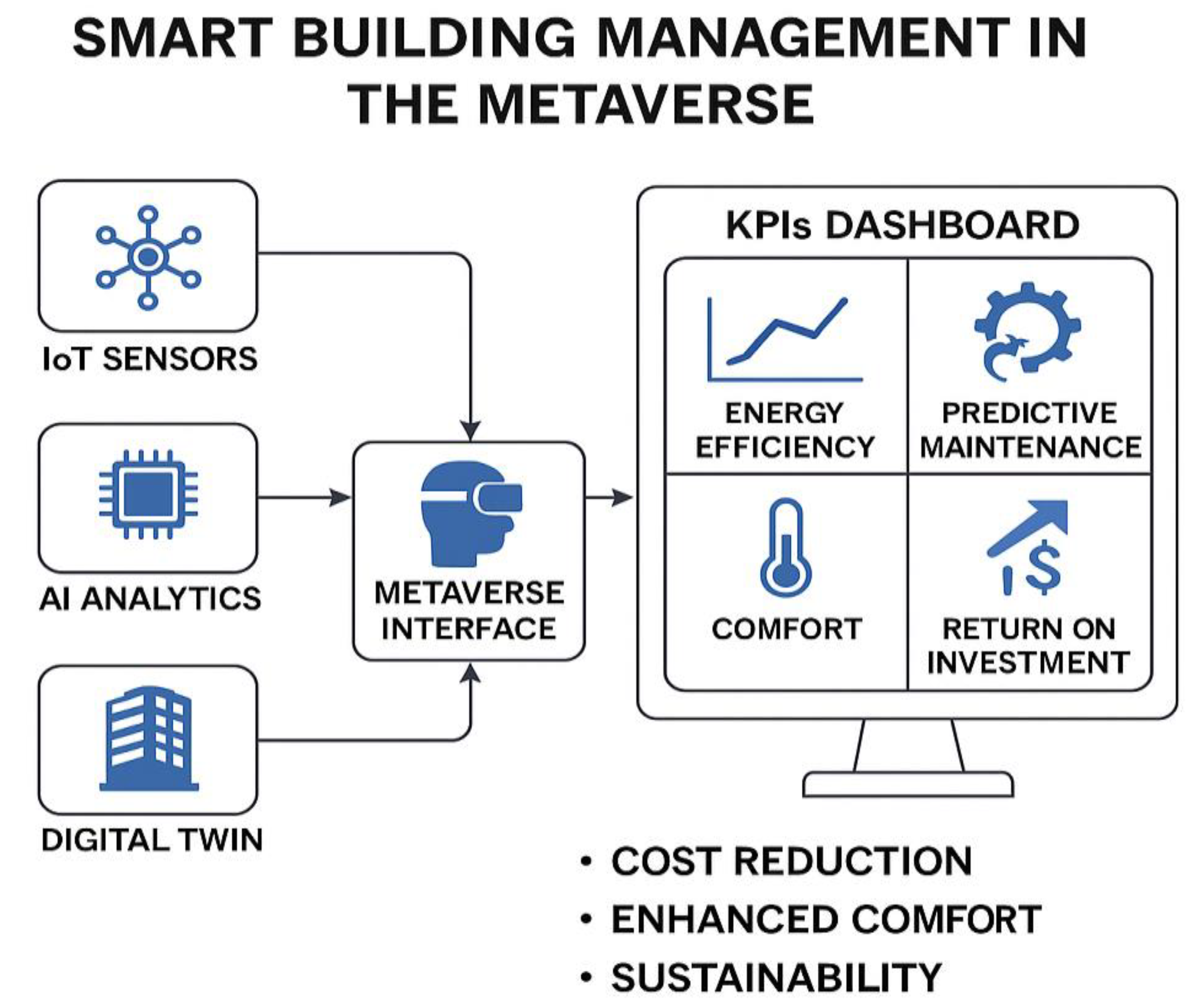
Figure 3.
Dashboard of Energy Efficiency and Carbon Footprint KPIs in Metaverse-Enabled Smart Building Management. Note: The dashboard illustrates how immersive simulations and predictive analysis within the metaverse support energy monitoring and sustainability goals. Key indicators such as Energy Usage Intensity (EUI), carbon footprint reduction, consumption trends, and system-level distribution provide stakeholders with actionable insights to optimize building operations and reduce environmental impact.
Figure 3.
Dashboard of Energy Efficiency and Carbon Footprint KPIs in Metaverse-Enabled Smart Building Management. Note: The dashboard illustrates how immersive simulations and predictive analysis within the metaverse support energy monitoring and sustainability goals. Key indicators such as Energy Usage Intensity (EUI), carbon footprint reduction, consumption trends, and system-level distribution provide stakeholders with actionable insights to optimize building operations and reduce environmental impact.
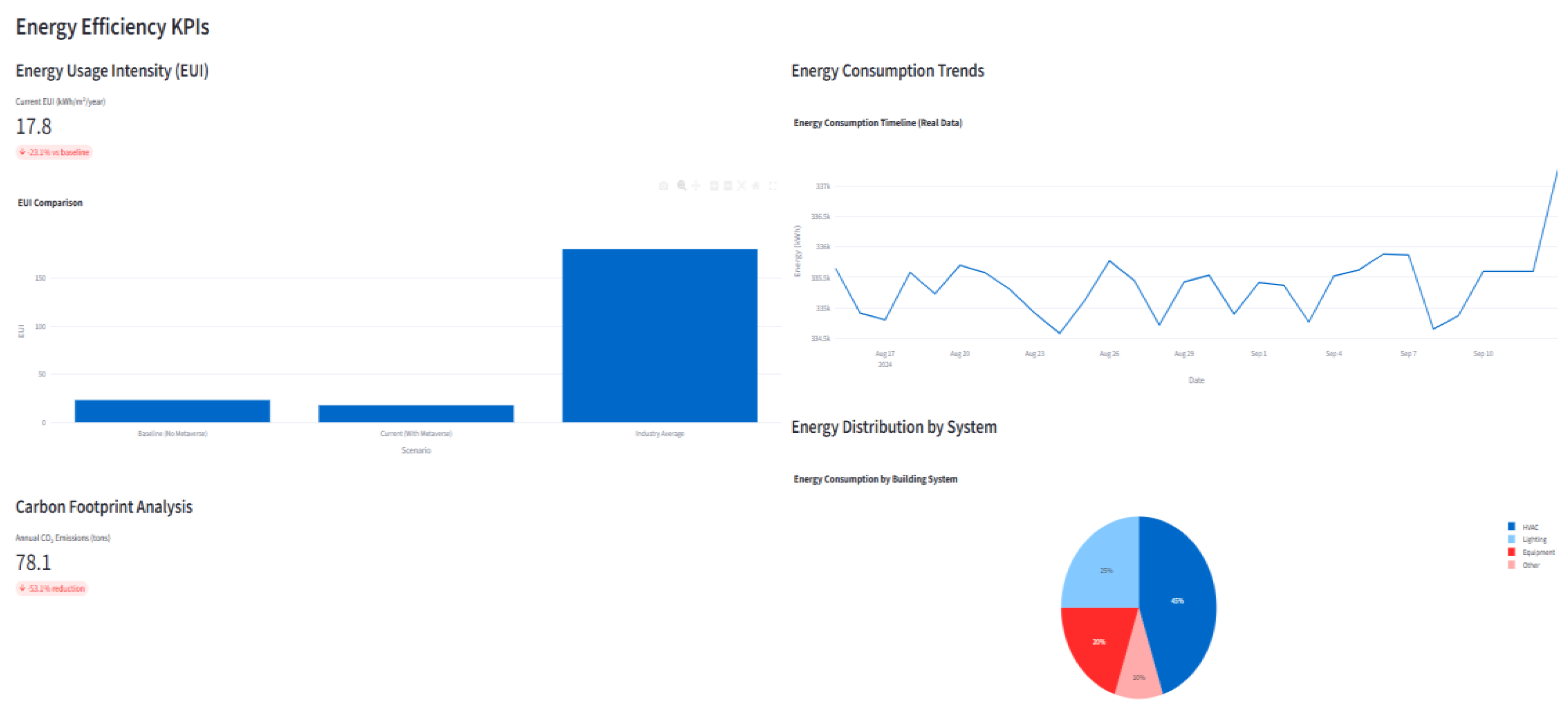
Figure 4.
Dashboard of Operations and Maintenance KPIs in Metaverse-Enabled Smart Building Management. Note: The dashboard highlights improvements in maintenance efficiency through predictive strategies. Key indicators such as Mean Time to Repair (MTTR) and First-Time Fix Rate (FTFR) show measurable gains compared to baseline values. The distribution of maintenance types emphasizes the shift toward predictive approaches, while impact metrics demonstrate reductions in costs and downtime alongside extended equipment lifespans. The performance timeline provides a longitudinal view of MTTR and FTFR trends, offering stakeholders evidence-based insights into operational reliability and optimization.
Figure 4.
Dashboard of Operations and Maintenance KPIs in Metaverse-Enabled Smart Building Management. Note: The dashboard highlights improvements in maintenance efficiency through predictive strategies. Key indicators such as Mean Time to Repair (MTTR) and First-Time Fix Rate (FTFR) show measurable gains compared to baseline values. The distribution of maintenance types emphasizes the shift toward predictive approaches, while impact metrics demonstrate reductions in costs and downtime alongside extended equipment lifespans. The performance timeline provides a longitudinal view of MTTR and FTFR trends, offering stakeholders evidence-based insights into operational reliability and optimization.
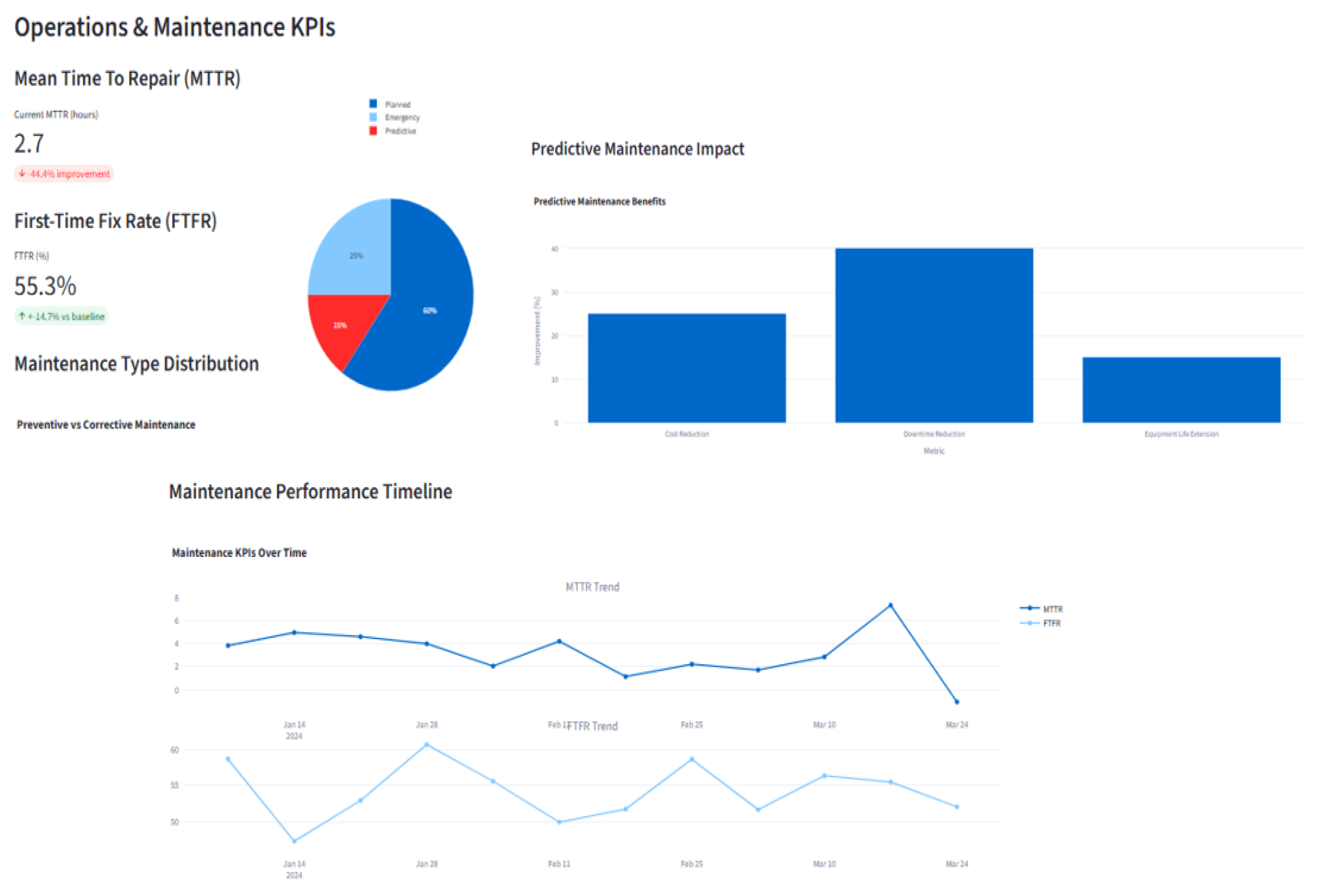
Figure 5.
Dashboard of User Experience and Comfort KPIs in Metaverse-Enabled Smart Building Management. Note: The dashboard presents key indicators of resident well-being, including the Occupant Satisfaction Index (OSI), response time to user requests, satisfaction scores by category, and the Indoor Environmental Quality (IEQ) index. Results highlight moderate improvements in OSI and RTUR compared to baseline values, while category-level analysis reveals higher satisfaction with air quality and noise control relative to temperature and lighting. The combined view underscores the importance of integrating user-centered KPIs alongside technical metrics to ensure that smart building management enhances both efficiency and occupant comfort.
Figure 5.
Dashboard of User Experience and Comfort KPIs in Metaverse-Enabled Smart Building Management. Note: The dashboard presents key indicators of resident well-being, including the Occupant Satisfaction Index (OSI), response time to user requests, satisfaction scores by category, and the Indoor Environmental Quality (IEQ) index. Results highlight moderate improvements in OSI and RTUR compared to baseline values, while category-level analysis reveals higher satisfaction with air quality and noise control relative to temperature and lighting. The combined view underscores the importance of integrating user-centered KPIs alongside technical metrics to ensure that smart building management enhances both efficiency and occupant comfort.
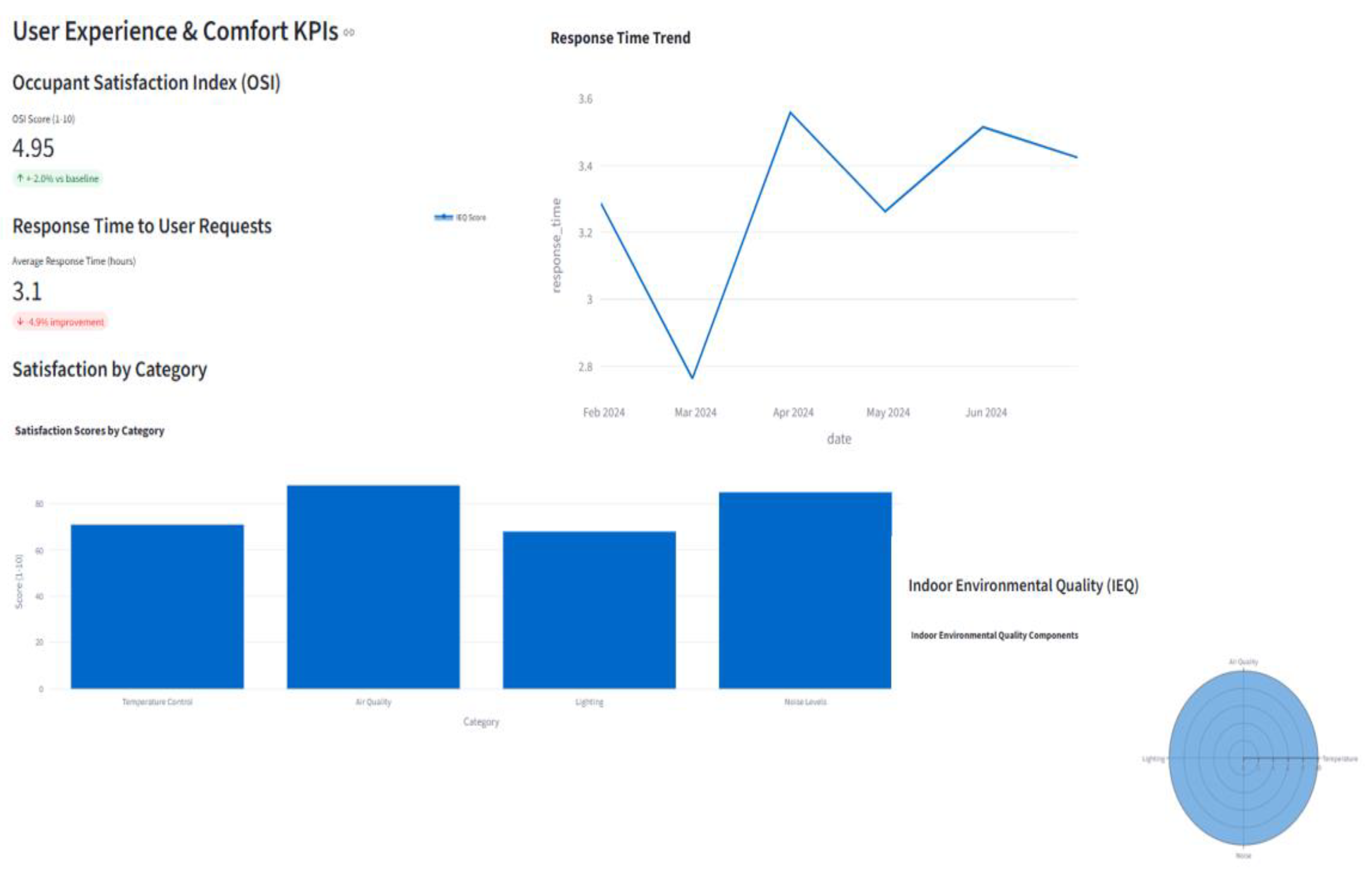
Figure 6.
Evaluating ROI and Adoption in Metaverse-Based Building Management. Note: This dashboard visualizes financial KPIs and technology adoption trends in a metaverse-enabled smart building prototype, highlighting savings, investment returns, and long-term benefits.
Figure 6.
Evaluating ROI and Adoption in Metaverse-Based Building Management. Note: This dashboard visualizes financial KPIs and technology adoption trends in a metaverse-enabled smart building prototype, highlighting savings, investment returns, and long-term benefits.
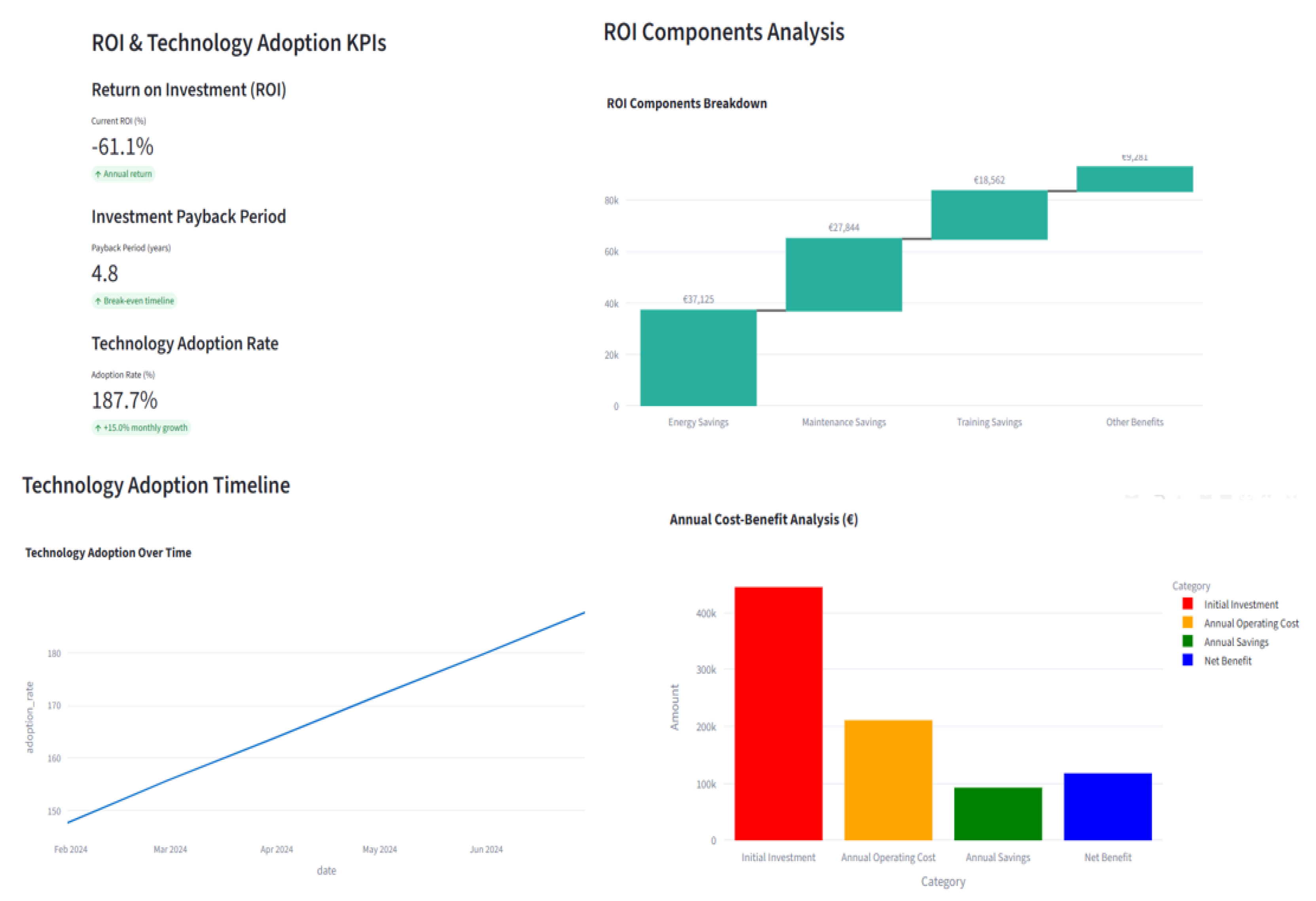
Figure 7.
KPI-Based Scientific Evaluation of Metaverse-Enabled Smart Building Management. Note: A comprehensive summary of key performance indicators (KPIs), correlation patterns, and benchmarking scores for smart building prototypes integrating metaverse technologies.
Figure 7.
KPI-Based Scientific Evaluation of Metaverse-Enabled Smart Building Management. Note: A comprehensive summary of key performance indicators (KPIs), correlation patterns, and benchmarking scores for smart building prototypes integrating metaverse technologies.
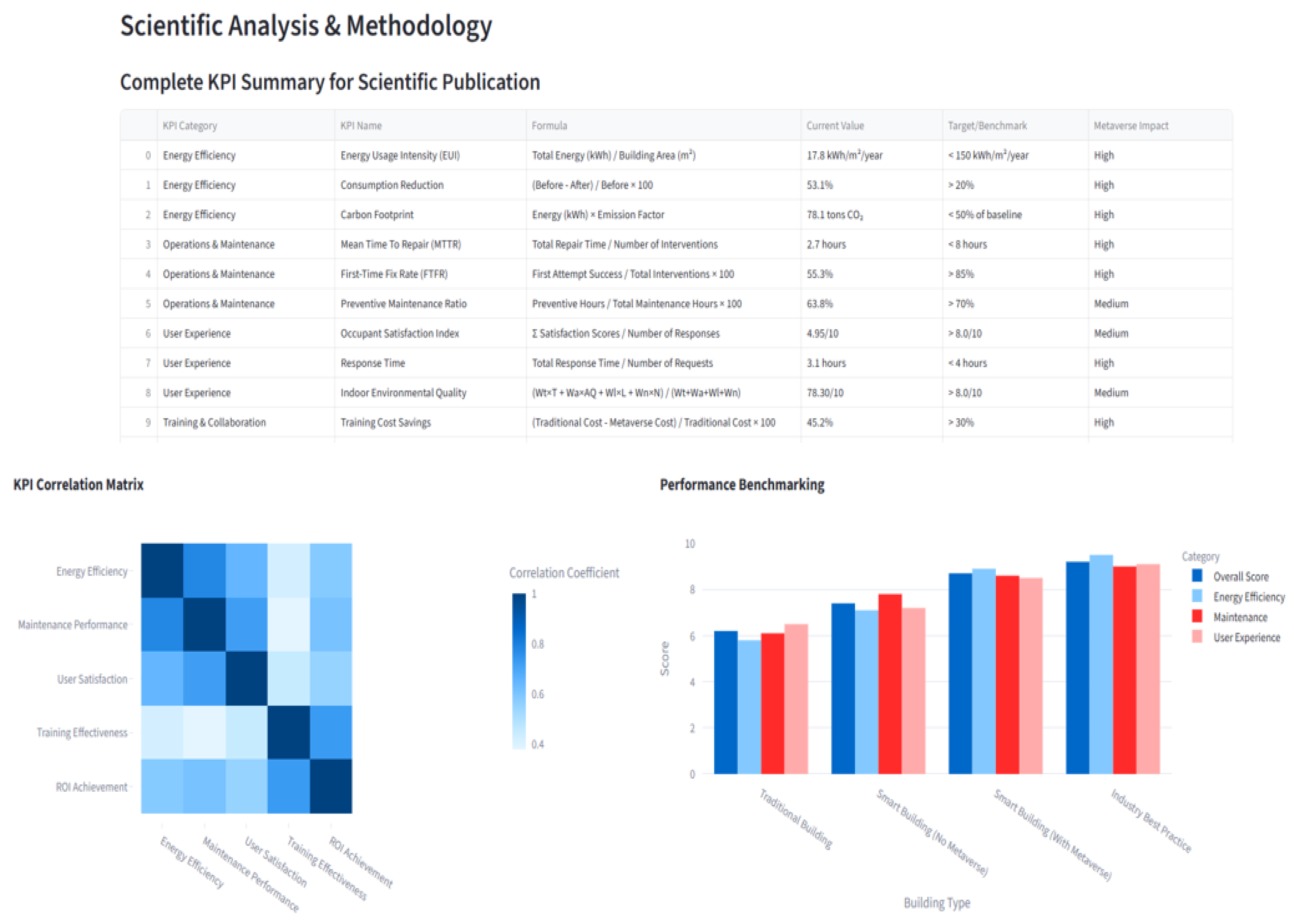
Table 1.
KPI Matrix for Smart Building Management in the Metaverse.
| Category | KPI | Formula / Definition | Impact on Metaverse | Impact on Smart Building |
| Energy Efficiency | Energy Usage Intensity (EUI) | Immersive visualization of energy use per zone | Optimization of energy waste | |
| Consumption Reduction from Simulations (%) | Real-time scenario simulations for energy savings | Reduction in energy consumption | ||
| Carbon Footprint | Carbon dashboards in virtual environments | Environmental impact tracking and mitigation | ||
| Operations & Maintenance | Mean Time to Repair (MTTR) | Real-time coordination in shared virtual space | Downtime reduction | |
| First-Time Fix Rate (FTFR) | Shared AR assistance in collaborative repair scenarios | Increased operational efficiency | ||
| Preventive Maintenance Ratio (PMR) | Immersive planning of maintenance activities | Proactive maintenance strategy | ||
| User Experience & Comfort | Occupant Satisfaction Index (OSI) | Real-time feedback through virtual interfaces | Improved user well-being and comfort | |
| Response Time to User Requests (RTUR) | Instant support via avatars or bots in VR | Increased responsiveness to user needs | ||
| Indoor Environmental Quality Score (IEQ) | Immersive monitoring of thermal, air, lighting, noise quality | Enhanced indoor environmental quality | ||
| ROI & Technology Adoption | Return on Investment (ROI) | Predictive modeling and ROI visualization in VR | Financial justification for tech adoption | |
| Adoption Rate (%) | Metric of user acceptance in virtual environments | Indicator of successful platform integration | ||
| Payback Period (PP) | VR scenario modeling of return timelines | Estimate of investment recovery time |
Note: This table gives a standardized Key Performance Indicator (KPI) template that assesses the effect of immersive metaverse technologies on smart building management. It covers five main areas—Energy Efficiency, Operations & Maintenance, User Experience & Comfort, and ROI & Technology Adoption. Each KPI is outlined by a clear formula and examined by its dual effect: how it works within the metaverse interface and how that translates into perceivable building improvements.
Disclaimer/Publisher’s Note: The statements, opinions and data contained in all publications are solely those of the individual author(s) and contributor(s) and not of MDPI and/or the editor(s). MDPI and/or the editor(s) disclaim responsibility for any injury to people or property resulting from any ideas, methods, instructions or products referred to in the content. |
© 2025 by the authors. Licensee MDPI, Basel, Switzerland. This article is an open access article distributed under the terms and conditions of the Creative Commons Attribution (CC BY) license (http://creativecommons.org/licenses/by/4.0/).
Copyright: This open access article is published under a Creative Commons CC BY 4.0 license, which permit the free download, distribution, and reuse, provided that the author and preprint are cited in any reuse.


