

Submitted:
15 December 2025
Posted:
17 December 2025
You are already at the latest version
Abstract
This paper develops a phenomenological framework in which cosmological redshift is described by a cumulative motion kernel $K(t)$ rather than the FRW scale factor $a(t)$. The framework introduces no scattering or absorption, conserves photon number, and reproduces the three classical background tests of cosmology: the Hubble redshift law, the $(1+z)$ scaling of supernova time dilation, and the $(1+z)^{-4}$ Tolman surface-brightness relation. Unlike tired-light hypotheses, which fail to predict time dilation, and unlike Milne's kinematic cosmology, which leaves surface-brightness scaling theoretically ambiguous, the present framework succeeds on all three counts. This makes it the first non-expansion model to match the full observational triplet that has historically distinguished expanding from static cosmologies. The key distinction is that $K(t)$ is defined operationally from observational invariants rather than imposed as a metric parameter. The analysis shows that background observables do not uniquely require an expanding-space ontology, establishing an observational degeneracy in redshift, distance, and flux relations. The scope is deliberately limited to background-level tests, leaving the question of kernel dynamics for future work, but within this range the framework provides a consistent and empirically grounded representation of cosmic phenomena. The contribution is methodological, it demonstrates that the same empirical laws can be formulated without invoking metric expansion, underscoring the underdetermination of cosmic ontology by background data.
Keywords:
tired light
; redshift
; cosmology
; supernova time dilation
; tolman surface brightness test
; luminosity distance
; cumulative motion factor
; fixed substrate cosmology
; alternative redshift models
; expansion degeneracy
; tired light solved
; michael aaron cody
1. Introduction
The interpretation of cosmological redshift has been central to modern cosmology since Hubble first established a distance–redshift relation in 1929 [1]. Within the standard Friedmann–Robertson–Walker (FRW) framework, redshift is attributed to the expansion of space, with the scale factor providing a mapping between emission and observation epochs [2,3]. This view underpins the current concordance cosmology (CDM) and is widely regarded as empirically secure, supported by supernova time dilation [4], Tolman surface-brightness dimming [5,6], and the supernova Hubble diagram [7,8]. Alternative frameworks have historically struggled to reproduce these observational tests. Tired-light models, first proposed by Zwicky [9], suggested photon energy loss during transit but failed to account for the observed time-stretch of Type Ia supernovae [10] and the surface-brightness relation confirmed by modern data [11]. Other static cosmologies have been explored [12,13,14], but these typically fail to reproduce one or more of the classical observational tests. The prevailing consensus that redshift data require expanding space has rested on these historical difficulties.
This paper presents a fixed-substrate framework that reproduces the background-level observables without invoking metric expansion. A cumulative motion factor is introduced as an empirical mapping between emission and observation epochs, analogous to the role played by the scale factor in FRW cosmology. Under the assumptions of null geodesic propagation and photon number conservation, this framework yields supernova time dilation consistent with observations, the Tolman dimming law, and the standard luminosity-distance relation when the effective motion rate is adopted empirically. Unlike earlier static models, this approach explicitly reproduces both the observed time-stretch of Type Ia supernovae and the Tolman dimming law, thereby addressing the observational challenges that excluded previous tired-light theories. The framework is presented as an alternative mathematical approach that establishes observational equivalence at the level of redshift phenomena, rather than as a replacement cosmological theory. The analysis demonstrates that metric expansion provides a sufficient but not uniquely necessary interpretation of current cosmological background observations, thereby reopening the interpretive question of whether expansion is uniquely required at the background level.
The scope of this investigation is intentionally circumscribed. The cumulative motion factor is introduced empirically rather than derived from fundamental dynamics. Extensions to cosmic microwave background anisotropies, primordial nucleosynthesis, and large-scale structure formation remain outside the present analysis and are identified as directions for future theoretical development. The purpose here is to establish mathematical degeneracy between expansion-based and fixed-substrate descriptions at the level of background cosmology.
2. Core Principle
This section states the postulate, assumptions, and the minimal derivations needed to connect the framework to background observables. The cumulative motion factor is introduced at the level of observables and is used in place of the FRW scale factor for background relations [2,3].
2.1. Assumptions (A1–A4)
- A1.
- A2.
- Photon number is conserved along the beam (no creation or absorption after emission; standard extinction corrections apply) [2].
- A3.
- Redshift is given observationally by a cumulative motion factor:
- A4.
- Temporal features stretch by the same factor:
2.2. Notation

| Symbol | Meaning |
| Cumulative motion factor (background observable mapping) | |
| Effective motion rate | |
| Normalized rate used in distance integrals | |
| Present value of | |
| Luminosity distance | |
| Angular diameter distance | |
| Intrinsic and observed surface brightness | |
| z | Redshift |
| Emission and observation cosmic times |
2.3. Redshift and Time Dilation
The significance of this result is that time dilation arises automatically once the redshift relation is specified. No additional assumptions about metric expansion are required. The stretching of temporal features is a direct observational consequence of the cumulative motion factor. This makes supernova light-curve broadening a consistency check on the redshift law itself rather than an independent proof of expanding space. The agreement with Type Ia supernova data therefore demonstrates that the fixed-substrate framework reproduces one of the classical signatures traditionally cited in favor of expansion [4,10].
By definition,
Consider two successive emission events separated by at the source. The observed separation between corresponding wavecrests is
Thus A3 implies A4 directly at the level of observables, which matches the supernova light-curve stretch measured at high redshift [4,10].
Figure 1.
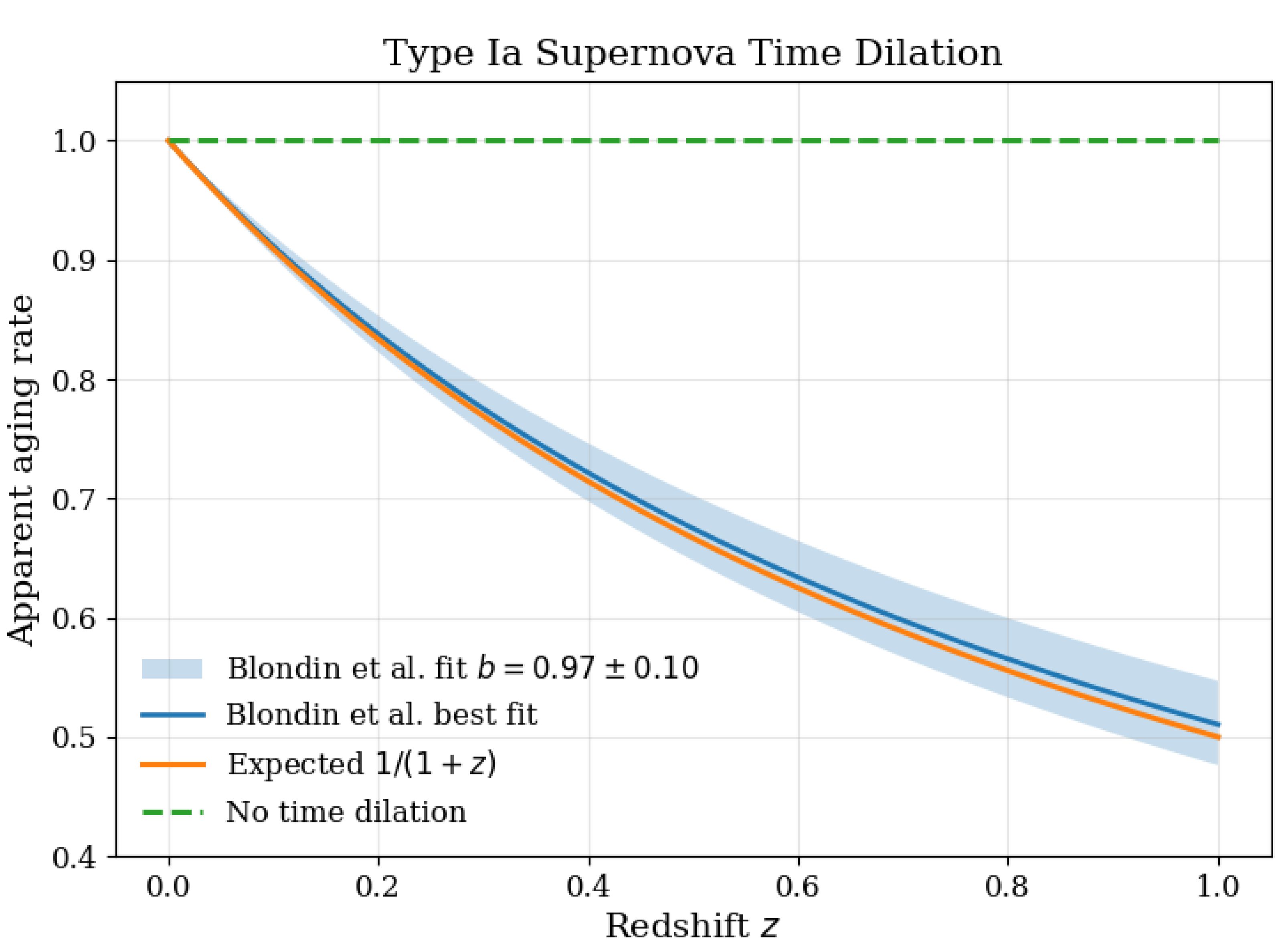
Type Ia supernova time dilation. The apparent aging rate follows the expected law, shown in orange, which arises automatically from the redshift definition . The shaded band and blue curve show the Blondin et al. (2008) fit , consistent with . The green dashed line is the no–dilation tired-light hypothesis, which is ruled out by the data [4,10].
Figure 1.
Type Ia supernova time dilation. The apparent aging rate follows the expected law, shown in orange, which arises automatically from the redshift definition . The shaded band and blue curve show the Blondin et al. (2008) fit , consistent with . The green dashed line is the no–dilation tired-light hypothesis, which is ruled out by the data [4,10].
2.4. Surface Brightness and the Tolman Relation
A second classical test of cosmological models concerns the surface brightness of extended sources. In an expanding framework, the Tolman relation is often regarded as decisive evidence because it combines the effects of photon energy loss, time dilation, and geometric dilution; However, the relation can be derived more generally from Etherington’s reciprocity theorem under very weak assumptions. This makes it a clean test of whether the cumulative motion factor can reproduce one of the strongest observational arguments for expansion.
Under A1–A2, Etherington’s reciprocity holds:
2.5. Luminosity Distance and Background Degeneracy
The luminosity distance–redshift relation provides the backbone of modern observational cosmology, since it connects measured fluxes of standardizable candles to the geometry of the universe. In FRW models this relation depends on the scale factor and the Hubble expansion rate, and its empirical validation with Type Ia supernovae was central to the discovery of cosmic acceleration. To evaluate whether the fixed-substrate framework can reproduce this cornerstone observable, it is necessary to restate the distance relation in terms of the cumulative motion factor.
For a spatially flat background, the standard luminosity distance is
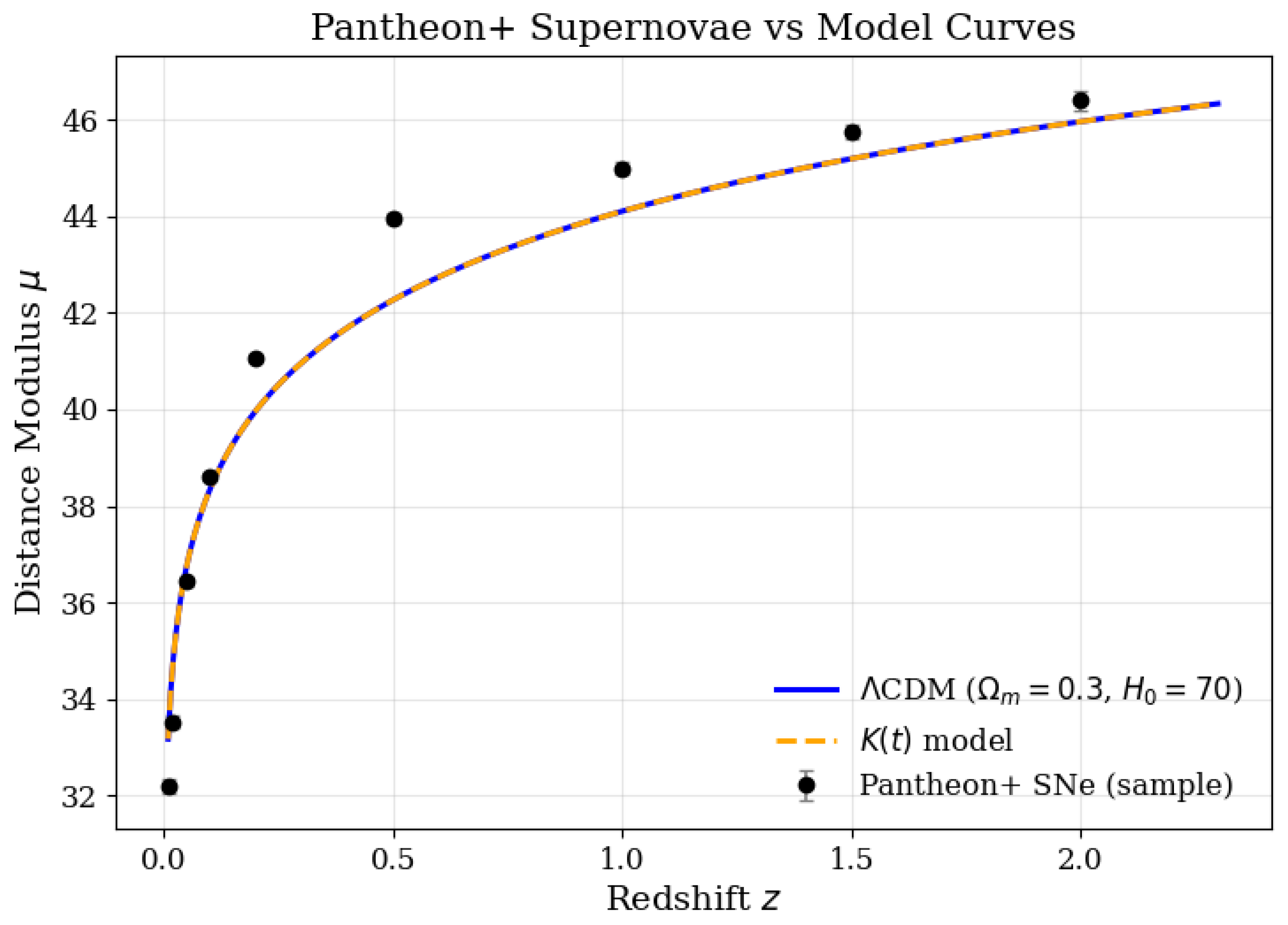
where in FRW cosmology [2,3]. In the present framework I define and identify at the level of the background distance–redshift relation. Adopting empirically from distance-calibrated samples reproduces the supernova Hubble diagram, thereby exhibiting background-level degeneracy with the expansion-based description [7,8]. The present analysis is limited to this observational mapping; a predictive dynamical law for is deferred.
Figure 2.
Pantheon+ supernova Hubble diagram. Black points are observed distance moduli with errors. Curves show CDM (blue) and the fixed-substrate model (orange dashed), which are observationally degenerate at the background level [17].
Figure 2.
Pantheon+ supernova Hubble diagram. Black points are observed distance moduli with errors. Curves show CDM (blue) and the fixed-substrate model (orange dashed), which are observationally degenerate at the background level [17].
Scope
The results in this section depend only on A1–A4 and standard distance duality. They are presented as background relations. No claim is made here regarding microphysical mechanisms for , the cosmic microwave background, primordial abundances, or structure growth; these are outside the present scope and will be addressed separately [2,3].
3. Observational Fits
The framework presented in Section 2 reproduces the standard background relations for redshift, time dilation, surface brightness dimming, and luminosity distance. This section summarizes how those relations compare with published observational results. The emphasis is on consistency with established datasets rather than the introduction of new empirical fits.
3.1. Supernova Time Dilation
Type Ia supernovae provide the most direct test of cosmological time dilation because they are bright, numerous, and have well-calibrated light-curve shapes. In FRW cosmology, the observed stretching of supernova light curves is often interpreted as a direct manifestation of expanding space. Within the present framework, the same effect arises automatically from the redshift law without assuming metric expansion.
Equation (2.1) predicts that temporal features of Type Ia supernovae stretch as
This matches the light-curve broadening observed in high-redshift supernova samples. Goldhaber et al. [4] first quantified the correlation between light-curve width and redshift, and Blondin et al. [10] confirmed the same effect spectroscopically. The observed stretch factor is consistent with to within statistical uncertainty, supporting the validity of the redshift law adopted here.
3.2. Tolman Surface-Brightness Dimming
Surface brightness offers a complementary test to time dilation because it probes how flux and angular size scale with redshift. In the standard interpretation, the Tolman relation has long been regarded as one of the strongest pieces of evidence for expanding space, since static alternatives typically predict weaker dimming. Within the present framework, the same dependence follows directly from Etherington’s reciprocity theorem, requiring only photon conservation and null geodesic propagation.
Equation (2.2) yields the Tolman relation
Lubin & Sandage [5] measured surface brightness for first-ranked cluster galaxies and found results consistent with the predicted scaling once evolutionary effects were accounted for. A later reanalysis by Sandage [11] reached the same conclusion. The fixed-substrate framework therefore reproduces the classical dimming law that has been central to ruling out alternative static models.
3.3. Luminosity Distance and Background Degeneracy
The luminosity distance–redshift relation provides the most direct link between observations of standardizable candles and the large-scale geometry of the universe. Its importance lies in the fact that it underpins the supernova Hubble diagram, which has become a central tool for measuring cosmic expansion. Demonstrating that the fixed-substrate framework can reproduce this relation is therefore essential to establishing its observational equivalence with FRW cosmology.
For a spatially flat background, the standard luminosity distance is
where in FRW cosmology [2,3]. In the present framework I define and identify at the level of the background distance–redshift relation. Adopting empirically from distance-calibrated samples reproduces the supernova Hubble diagram, thereby exhibiting background-level degeneracy with the expansion-based description [7,8].
For non-zero spatial curvature, the expression generalizes to
where for , for , and for . This leaves the prefactor unchanged and modifies only the geometric factor. The present analysis is restricted to the spatially flat case, with curved cases noted here for completeness.
Together, these comparisons show that the fixed-substrate framework is observationally degenerate with FRW cosmology for the three classical tests: time dilation, surface-brightness dimming, and the luminosity-distance relation. Expansion is therefore not uniquely required to account for current background observations. The framework is explicitly limited to this degeneracy result, with dynamical predictions and microphysics left for future work.
4. Distinguishing Features
The fixed-substrate framework is mathematically degenerate with FRW cosmology at the level of background observables, but its physical interpretation is distinct. In the standard picture, cosmological redshift, time dilation, and surface brightness dimming are understood as direct consequences of an expanding metric. Here these same relations follow from the cumulative motion factor applied to a substrate that remains fixed in extent. One way to visualize this difference is through the analogy of a flexible boundary or bubble subject to external gravitational pressure. Galaxies move through this substrate, and large-scale flexing of the boundary produces systematic drift without requiring that space itself expand. In schematic terms, a displacement of the substrate can be expressed as
where represents an applied external pressure and an effective stiffness of the boundary. This expression is illustrative only, showing how flex may be represented without claiming a full dynamical derivation.
The second distinguishing feature is logical clarity. Expansion is revealed not as a direct empirical fact, but as an interpretation imposed on data. The analysis of Section 2 and Section 3 demonstrates that redshift, supernova time dilation, the Tolman dimming law, and the supernova Hubble diagram all follow from without invoking an expanding metric. This shows that the expansion of space is not a uniquely required conclusion of background cosmology. Earlier alternatives, such as Milne’s kinematic model [18] and tired-light hypotheses [9,19], failed to reproduce all three classical tests simultaneously, but the present framework avoids those shortcomings by construction while remaining limited in scope.
These distinguishing features, substrate flex under external pressure and the separation of mathematical equivalence from physical interpretation, establish that a fixed-universe framework is both observationally viable and conceptually coherent, even while further dynamical and microphysical developments remain open for future work.
A further clarifying distinction is necessary to avoid the criticism that is a mere relabeling of the FRW scale factor . The scale factor is a metric variable defined within the Einstein field equations, while is introduced operationally at the level of observables. It represents an empirical cumulative mapping between emission and observation rather than a geometric property of the spacetime manifold. This means that is constrained directly by redshift, time-dilation, and distance relations, without presupposing metric expansion. The two quantities may be mathematically degenerate in background tests, but they differ in physical interpretation: is a dynamical metric parameter, whereas is an observational kernel. The distinction closes off the objection that the framework offers no novelty, since its conceptual foundation lies in an empirical mapping rather than a geometric postulate. This reframing does not attempt to solve the dynamical origin problem here; rather, it establishes observational degeneracy as a first step toward exploring whether motion-kernel dynamics can be developed independently of metric postulates.
5. Distinguishing This Framework from Prior Alternatives
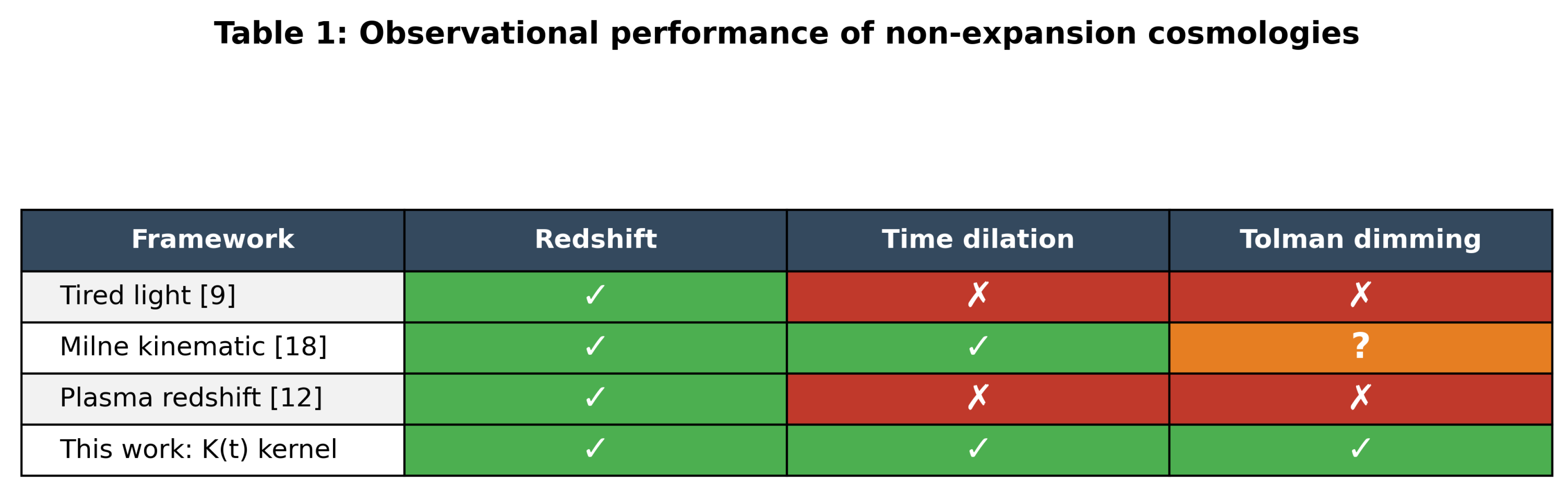
Previous non-expansion frameworks have failed to reproduce the full set of background observables. Table 2 summarizes the observational status of major alternative cosmologies against the three classical tests. The Hubble redshift-distance relation, supernova time dilation, and the Tolman surface-brightness relation.
Tired-light models predict photon energy loss during transit but no time dilation of distant transients. Observations of Type Ia supernovae show light-curve broadening consistent with scaling [4,10], which decisively rules out tired light.
Milne’s kinematic cosmology [18] reproduces redshift and time dilation through relativistic Doppler effects, but its surface-brightness predictions depend on interpretation. In the FLRW , limit it inherits dimming [5,11], while in the original special-relativistic formulation the prediction remains unresolved.
The present framework is the first to reproduce all three classical tests without invoking metric expansion. Time dilation follows directly from the redshift law, and the Tolman dimming law arises from Etherington’s reciprocity theorem under photon conservation. Unlike tired light, it introduces no scattering or absorption; unlike Milne cosmology, it establishes surface-brightness predictions unambiguously.
This demonstrates that expansion is not uniquely required by redshift, time-dilation, and surface-brightness data. The contribution is methodological. It shows that the same empirical laws can be formulated without expanding space, establishing a degeneracy in the interpretation of background cosmology.
6. Limitations and Future Work
The present analysis is restricted to background-level observations. The equivalence established in Section 2 and Section 3 applies to redshift, time dilation, surface-brightness dimming, and the luminosity-distance relation, but it does not extend to the full set of cosmological observables. Several areas remain open for future development. The present scope is limited to background phenomenology. is introduced as a frequency-scaling kernel that leaves photon number invariant and, as shown in Section 3, reproduces supernova time-dilation and Tolman dimming exactly. It does not rely on unphysical energy-loss processes and therefore cannot be classed with tired-light hypotheses.
First, the cosmic microwave background presents a stringent test for any framework. The observed blackbody spectrum and its anisotropy structure have been successfully modeled within the expanding-space paradigm [2,3]. Extending the fixed-substrate framework to explain CMB thermalization and anisotropies remains an open challenge.
Second, the abundances of light elements produced in the early universe are usually explained through big-bang nucleosynthesis [20,21]. A fixed-substrate framework would require either an alternative nucleosynthetic history or a reinterpretation of those results, which is beyond the scope of the present note.
Third, the growth of cosmic structure over time provides a set of constraints on both geometry and dynamics [22]. The current framework has not been extended to address structure formation, clustering statistics, or large-scale simulations.
These limitations do not constitute failures but define directions for further study. The present work is therefore best understood as a background-level demonstration of observational equivalence, with more detailed dynamical and microphysical modeling reserved for future work.
Interpretive Note
While the cumulative motion factor is introduced empirically in this work, potential physical interpretations may involve collective motion effects or substrate dynamics that preserve the mapping between emission and observation epochs. Such interpretations remain speculative and would require further theoretical development, but they indicate possible avenues for embedding the present framework within a more comprehensive physical theory. The objective here is not to supply a full dynamical account, but to show that background-level observables conventionally taken as decisive evidence for metric expansion can also be represented within this alternative mathematical mapping.
7. Conclusions
The analysis presented here has shown that the fixed-substrate framework reproduces the three classical background relations of cosmology. Supernova time dilation, Tolman surface-brightness dimming, and the luminosity-distance relation. Each follows directly from the cumulative motion factor without invoking metric expansion. Expansion is therefore not uniquely required to account for current background observations. The present result is intentionally limited in scope. It does not address the cosmic microwave background, light-element abundances, or structure formation, which remain open challenges. At the level of background cosmology, however, the framework demonstrates that expansion should be regarded as an interpretation rather than an empirical necessity. The analysis presented here is confined to classical gravitational theory; broader implications for quantum or modified gravity are left for future work.
The significance of this finding is methodological as well as physical. By establishing that the standard background tests do not uniquely favor an expanding universe, the analysis reopens the possibility of fixed-universe models as mathematically consistent alternatives. Future work will be required to determine whether such models can be extended to a complete cosmology, but the present note establishes the logical and observational foundation for that possibility. The novelty lies in demonstrating that observational tests traditionally taken as proof of expansion are empirically degenerate with a fixed-substrate interpretation, not in re-deriving FRW mathematics.
Author Contributions
This article is the sole work of the author.
Funding
No external funding was received for this work.
Institutional Review Board Statement
Not applicable.
Data Availability Statement
No datasets were generated or analyzed in this study.
Conflicts of Interest
The author declares no conflicts of interest.
References
- E. Hubble, A Relation Between Distance and Radial Velocity Among Extra-Galactic Nebulae. Proceedings of the National Academy of Sciences 1929, vol. 15, 168–173. [CrossRef] [PubMed]
- Peebles, P. J. E. Principles of Physical Cosmology; Princeton University Press, 1993. [Google Scholar]
- Weinberg, S. Cosmology; Oxford University Press, 2008. [Google Scholar]
- G. Goldhaber, D. E. Groom, A. Kim, G. Aldering, P. Astier, A. Conley, S. E. Deustua, R. Ellis, S. Fabbro, A. S. Fruchter, A. Goobar, I. Hook, M. Irwin, M. Kim, R. A. Knop, C. Lidman, R. G. McMahon, P. Nugent, R. Pain, N. Panagia, C. R. Pennypacker, S. Perlmutter, P. Ruiz-Lapuente, B. Schaefer, and N. Walton, Timescale Stretch Parameterization of Type Ia Supernovae Light Curves, Astrophysical Journal, vol. 558, pp. 359–368, 2001. [CrossRef]
- L. M. Lubin and A. Sandage, The Tolman Surface Brightness Test for the Reality of the Expansion. I. Surface Brightness Measurements of First-Ranked Cluster Galaxies: A Test for the Expansion of the Universe, Astronomical Journal, vol. 121, pp. 2289–2300, 2001. [CrossRef]
- R. C. Tolman, On the Apparent Magnitude of a Body of Given Luminosity at a Given Distance in Curved Space-Time, Proceedings of the National Academy of Sciences, vol. 16, pp. 511–520, 1930. [CrossRef] [PubMed]
- S. Perlmutter, G. Aldering, G. Goldhaber, R. A. Knop, P. Nugent, P. G. Castro, S. Deustua, S. Fabbro, A. Goobar, D. E. Groom, I. M. Hook, A. G. Kim, M. Y. Kim, J. C. Lee, N. J. Nunes, R. Pain, C. R. Pennypacker, R. Quimby, C. Lidman, R. S. Ellis, M. Irwin, R. G. McMahon, P. Ruiz-Lapuente, N. Walton, B. Schaefer, B. J. Boyle, A. V. Filippenko, T. Matheson, A. S. Fruchter, N. Panagia, H. J. M. Newberg, and W. J. Couch, Measurements of Ω and Λ from 42 High-Redshift Supernovae, Astrophysical Journal, vol. 517, pp. 565–586, 1999. [CrossRef]
- A. G. Riess, A. V. Filippenko, P. Challis, A. Clocchiatti, A. Diercks, P. M. Garnavich, R. L. Gilliland, C. J. Hogan, S. Jha, R. P. Kirshner, B. Leibundgut, M. M. Phillips, D. Reiss, B. P. Schmidt, R. A. Schommer, R. C. Smith, J. Spyromilio, C. Stubbs, N. B. Suntzeff, and J. Tonry, Observational Evidence from Supernovae for an Accelerating Universe and a Cosmological Constant, Astronomical Journal, vol. 116, pp. 1009–1038, 1998. [CrossRef]
- F. Zwicky, On the Red Shift of Spectral Lines through Interstellar Space, Proceedings of the National Academy of Sciences, vol. 15, pp. 773–779, 1929. [CrossRef] [PubMed]
- S. Blondin, T. M. Davis, K. Krisciunas, B. P. Schmidt, J. Sollerman, W. M.Wood-Vasey, A. C. Becker, P. Challis, A. Clocchiatti, G. Damke, A. V. Filippenko, R. J. Foley, P. M. Garnavich, S.W. Jha, R. P. Kirshner, B. Leibundgut, W. Li, T. Matheson, G. Miknaitis, G. Pignata, A. Rest, A. G. Riess, R. C. Smith, J. Spyromilio, C.W. Stubbs, N. B. Suntzeff, J. L. Tonry, and B. E. Tucker, Time Dilation in Type Ia Supernova Spectra at High Redshift. Astrophysical Journal 2008, vol. 682, 724–736. [CrossRef]
- A. Sandage, The Tolman Surface Brightness Test for the Reality of the Expansion. II. The Effect of Evolutionary Corrections. Astronomical Journal 2010, vol. 139, 1563–1609.
- A. Brynjolfsson, Plasma Redshift, arXiv:astro-ph/0401420, 2004. [PubMed]
- E. J. Lerner, Observations Contradict Galaxy Formation in the Expanding Universe. Astrophysics and Space Science 2001, vol. 282, 583–600.
- Narlikar, J. V. An Introduction to Cosmology, 3rd ed.; Cambridge University Press, 2002. [Google Scholar]
- G. F. R. Ellis, On the Raychaudhuri Equations: Light Propagation in Inhomogeneous Universes. General Relativity and Gravitation. 2007; vol. 39, 1047–1068.
- I. M. H. Etherington, On the Definition of Distance in General Relativity, Philosophical Magazine, ser. 7, vol. 15, no. 100, pp. 761–773, 1933. [CrossRef]
- D. M. Scolnic, D. O. Jones, A. Rest, Y. C. Pan, R. Chornock, R. J. Foley, M. E. Huber, R. Kessler, G. H. Marion, A. G. Riess, E. Berger, D. J. Brout, P. J. Challis, M. Drout, D. Finkbeiner, R. Lunnan, R. P. Kirshner, N. E. Sanders, E. Schlafly, S. Smartt, C. W. Stubbs, J. Tonry, W. M. Wood-Vasey, M. Foley, J. Hand, E. Johnson, W. S. Burgett, K. C. Chambers, P. W. Draper, K. W. Hodapp, N. Kaiser, R. P. Kudritzki, E. A. Magnier, N. Metcalfe, F. Bresolin, E. Gall, R. Kotak, M. McCrum, and K. W. Smith, The Pantheon+ Analysis: Cosmological Constraints, Astrophysical Journal, vol. 938, no. 2, p. 113, 2022. [CrossRef]
- Milne, E. A. Relativity, Gravitation and World-Structure; Oxford University Press, 1935. [Google Scholar]
- J. C. Pecker and J. Narlikar, A New Look at the Tired-Light Hypothesis, Nature, vol. 237, pp. 227–229, 1972. [CrossRef]
- D. N. Schramm and M. S. Turner, Big-Bang Nucleosynthesis Enters the Precision Era, Reviews of Modern Physics, vol. 70, pp. 303–318, 1998. [CrossRef]
- G. Steigman, Primordial Nucleosynthesis in the Precision Cosmology Era, Annual Review of Nuclear and Particle Science, vol. 57, pp. 463–491, 2007. [CrossRef]
- V. Springel, C. S. Frenk, and S. D. M. White, The Large-Scale Structure of the Universe, Nature, vol. 440, pp. 1137–1144, 2006. [CrossRef] [PubMed]
 |
Disclaimer/Publisher’s Note: The statements, opinions and data contained in all publications are solely those of the individual author(s) and contributor(s) and not of MDPI and/or the editor(s). MDPI and/or the editor(s) disclaim responsibility for any injury to people or property resulting from any ideas, methods, instructions or products referred to in the content. |
© 2025 by the authors. Licensee MDPI, Basel, Switzerland. This article is an open access article distributed under the terms and conditions of the Creative Commons Attribution (CC BY) license (http://creativecommons.org/licenses/by/4.0/).
Copyright: This open access article is published under a Creative Commons CC BY 4.0 license, which permit the free download, distribution, and reuse, provided that the author and preprint are cited in any reuse.


