

Submitted:
12 September 2025
Posted:
15 September 2025
You are already at the latest version
Abstract
Structural Health Monitoring (SHM) plays a critical role in ensuring the safety, serviceability, and long-term resilience of foundations and high-rise structures, especially in urban areas susceptible to seismic events, wind loads, and environmental degradation. Conventional SHM techniques, which rely on periodic inspections and isolated sensing devices, often fall short in providing continuous, real-time, and predictive assessments of structural integrity. The integration of Artificial Intelligence (AI) and machine learning into SHM frameworks has opened new possibilities for intelligent, data-driven infrastructure management.This paper presents an AI-assisted SHM framework specifically tailored for foundations and high-rise buildings. The proposed system combines distributed Internet of Things (IoT) sensors, vibration-based monitoring, and advanced machine learning algorithms to analyze large volumes of structural response data. Techniques such as convolutional neural networks (CNNs) and recurrent neural networks (RNNs) are employed to detect hidden patterns, classify damage states, and predict long-term settlement or degradation trends. Numerical simulations and case studies demonstrate that AI-assisted SHM significantly enhances early anomaly detection, improves prediction accuracy, and enables adaptive monitoring under both operational and extreme loading conditions.The findings underscore the potential of AI-enhanced SHM to revolutionize infrastructure management. By supporting proactive maintenance, reducing life-cycle costs, and improving resilience, this framework provides a pathway toward safer and more sustainable high-rise construction in hazard-prone regions.
Keywords:
artificial intelligence (AI)
; structural health monitoring (SHM)
; high-rise buildings
; foundations
; machine learning
; predictive maintenance
; vibration-based analysis
; smart infrastructure
I. Introduction
A. Background and Motivation
The increasing demand for vertical expansion in densely populated urban regions has led to rapid construction of high-rise buildings supported on complex foundation systems. These structures, due to their height, slenderness, and interaction with heterogeneous soil layers, are highly vulnerable to serviceability issues such as differential settlement, seismic-induced foundation deformation, and wind-related vibrations. Conventional design codes account for safety factors during construction, but the dynamic nature of environmental loading and long-term soil-structure interaction introduces uncertainties that cannot be fully addressed during design alone.
Structural Health Monitoring (SHM) has therefore become an indispensable component of modern infrastructure management. Traditional SHM relies on periodic inspections and sparse instrumentation, offering only a snapshot of structural performance at discrete intervals. While effective in detecting visible damage, such methods often fail to capture hidden or progressive deterioration processes. More critically, they lack predictive capabilities, limiting the ability of engineers and decision-makers to take proactive measures before minor issues evolve into critical failures.
With the rapid growth of Artificial Intelligence (AI) and the Internet of Things (IoT), SHM can be redefined as an intelligent, continuous, and predictive process. AI-powered SHM frameworks enable real-time data processing, anomaly detection, and trend prediction, thus enhancing the resilience and sustainability of foundations and superstructures. In the context of high-rise buildings, where safety is paramount and the consequences of failure are catastrophic, AI-assisted SHM offers transformative potential.
B. Problem Statement
Despite advances in sensing technologies and computational methods, several challenges persist in implementing effective SHM for foundations and high-rise buildings:
- Data Overload and Complexity: Modern sensor networks generate vast amounts of vibration, strain, and displacement data. Extracting actionable insights from these heterogeneous datasets remains a significant challenge.
- Hidden Damage Detection: Traditional frequency-domain or modal analysis techniques are limited in detecting localized or micro-level damage within foundations or structural members.
- Lack of Predictive Capabilities: Current SHM methods largely focus on post-event diagnosis rather than forecasting potential deterioration or settlement trends.
- Integration with Real-World Practices: Many AI models are developed in controlled research environments, but their translation into practical SHM systems for high-rise buildings remains limited due to scalability, data privacy, and cost concerns.
Addressing these gaps requires a paradigm shift toward intelligent, adaptive, and predictive SHM systems that integrate AI algorithms, distributed sensor networks, and privacy-preserving data management approaches.
C. Proposed Solution
This study proposes an AI-assisted SHM framework that integrates IoT-enabled sensing, vibration-based response monitoring, and advanced machine learning techniques for foundations and high-rise structures. The framework is designed with three core objectives:
- Real-Time Damage Detection: Deploying distributed sensors and edge-based AI models to detect anomalies as soon as they occur, minimizing latency in response.
- Predictive Settlement and Degradation Modeling: Utilizing recurrent neural networks (RNNs) and convolutional neural networks (CNNs) to analyze time-series response data, identify degradation patterns, and forecast long-term settlement trends.
- Privacy-Preserving Collaboration: Incorporating federated learning to enable cross-agency SHM data collaboration without requiring raw data sharing, thus protecting sensitive structural and operational information.
By combining these elements, the proposed framework bridges the gap between academic AI research and practical engineering applications, delivering a monitoring solution that is both technically robust and operationally viable.
D. Contributions of the Study
The major contributions of this paper are as follows:
- Development of a conceptual AI-assisted SHM framework tailored specifically for high-rise buildings and their foundation systems.
- Integration of advanced AI models (CNNs, RNNs) with vibration-based monitoring to achieve improved accuracy in damage classification and settlement prediction.
- Demonstration of the framework through numerical simulations and synthetic case studies, highlighting improvements over traditional SHM methods.
- Exploration of federated learning as a secure mechanism for inter-agency SHM data collaboration in urban infrastructure projects.
- Identification of research gaps and future directions toward large-scale implementation of AI-assisted SHM systems.
E. Organization of the Paper
The remainder of this paper is structured as follows. Section II reviews related work in the domains of structural health monitoring, AI-assisted damage detection, and predictive modeling of foundations and high-rise buildings. Section III presents the proposed AI-assisted SHM framework, detailing its sensing, data processing, and machine learning components. Section IV discusses results from numerical simulations and case studies, including comparative analyses with conventional SHM approaches. Section V highlights practical implications, limitations, and potential integration into urban infrastructure management. Finally, Section VI concludes the paper with key findings and outlines avenues for future research.
II. Related Work
A. Conventional Structural Health Monitoring Approaches
Structural Health Monitoring (SHM) has traditionally relied on manual inspections and static instrumentation. Early methods used visual surveys, crack width gauges, and strain meters to assess structural condition (Doebling et al., 1996). While such approaches remain useful for detecting surface-level damage, they are subjective, labor-intensive, and incapable of providing continuous monitoring.
The advent of vibration-based SHM techniques in the late 20th century marked a significant advancement. Modal analysis, which detects shifts in natural frequencies and mode shapes, was widely applied to identify structural deterioration (Farrar and Jauregui, 1998). However, these methods are limited in detecting localized damage, as global modal parameters often remain unchanged unless damage is severe. Furthermore, their reliance on linear system assumptions reduces their accuracy in nonlinear or complex soil–structure interaction scenarios, such as those encountered in foundations of high-rise buildings.
B. SHM for Foundations and High-Rise Structures
Research on SHM for foundation systems has gained momentum in recent decades, particularly in seismic-prone regions. Pile and mat foundations are known to experience differential settlement and nonlinear soil–structure interactions that affect overall structural stability (Gazetas, 1991; Wolf, 1994). Traditional settlement monitoring has used settlement plates, inclinometers, and geotechnical sensors embedded in soil. These methods, while accurate in localized measurements, provide only limited spatial coverage and do not scale efficiently to large, complex structures.
For high-rise buildings, vibration-based SHM using accelerometers and displacement sensors has been employed to capture dynamic responses under wind and seismic loading (Celebi, 2002). However, studies (e.g., Xu et al., 2016) have highlighted challenges in scaling such systems, including data overload, maintenance of sensor networks, and difficulty in real-time analysis. These challenges necessitate the integration of advanced data-driven methods capable of handling large datasets and providing predictive insights.
C. AI and Machine Learning in SHM
Artificial Intelligence (AI) and machine learning have been increasingly applied in SHM to address the limitations of conventional approaches. Early work focused on pattern recognition techniques such as Principal Component Analysis (PCA) and Support Vector Machines (SVMs) for damage classification (Worden and Staszewski, 2000). More recently, deep learning models such as Convolutional Neural Networks (CNNs) and Recurrent Neural Networks (RNNs) have shown superior performance in extracting features directly from raw vibration and acoustic data (Zhang et al., 2019).
For foundation systems, AI has been applied to settlement prediction using neural networks trained on geotechnical datasets (Goh, 1995; Shahin et al., 2001). These models outperform empirical equations by capturing nonlinear soil–structure interaction effects. In high-rise SHM, CNN-based models have been used for crack detection in structural members (Cha et al., 2017), while RNNs have been employed to predict time-dependent deformation patterns under seismic and wind loads (Zhu et al., 2020).
Despite their promise, AI applications in SHM face challenges related to data requirements, generalizability across diverse structural systems, and integration with existing monitoring practices. These challenges highlight the need for frameworks that combine AI’s predictive power with scalable, practical sensing technologies.
D. IoT-Enabled Sensing and Smart Infrastructure
The proliferation of low-cost IoT sensors has enabled dense, distributed SHM systems capable of real-time monitoring. Wireless sensor networks (WSNs) provide a scalable alternative to wired systems, reducing installation and maintenance costs (Lynch and Loh, 2006). IoT-enabled accelerometers, strain gauges, and tiltmeters are now being deployed in large-scale structures such as bridges and skyscrapers to collect high-frequency response data.
However, the integration of IoT in SHM introduces challenges in data volume, transmission bandwidth, and energy consumption. AI techniques, especially edge-based learning models, are increasingly used to process data locally before transmission, reducing computational load and latency (Hou et al., 2021). Studies have demonstrated that combining IoT with AI significantly improves anomaly detection, predictive maintenance, and scalability for complex infrastructure systems (Ye et al., 2019).
E. Federated and Privacy-Preserving Learning for SHM
One of the emerging challenges in AI-assisted SHM is the issue of data privacy and proprietary restrictions, particularly in projects involving multiple stakeholders, agencies, or regions. Federated learning (FL) has emerged as a promising solution, allowing multiple clients to collaboratively train AI models without sharing raw data (Kairouz et al., 2021). In the context of infrastructure, FL enables cross-project knowledge sharing while protecting sensitive structural and operational data.
Recent studies (e.g., Sun et al., 2022) have applied federated learning to bridge SHM, demonstrating improved generalization across different structures compared to isolated models. While applications in foundation and high-rise SHM remain limited, the concept has strong potential to address scalability and privacy challenges in urban infrastructure monitoring.
F. Gaps in the Literature
Despite significant progress, several gaps persist:
- Most SHM research focuses on superstructures, with limited attention to foundations, which are critical to overall stability.
- AI-based SHM methods are often demonstrated in controlled environments, with few full-scale implementations in high-rise buildings.
- IoT-enabled SHM systems face challenges in handling massive, heterogeneous data streams, necessitating advanced data fusion and real-time learning frameworks.
- Privacy-preserving techniques such as federated learning are underexplored in SHM for high-rise and foundation systems.
Addressing these gaps requires an integrated framework that combines AI, IoT sensing, and federated learning into a unified SHM system. This is the focus of the present study.
III. Methodology
A. Framework Overview
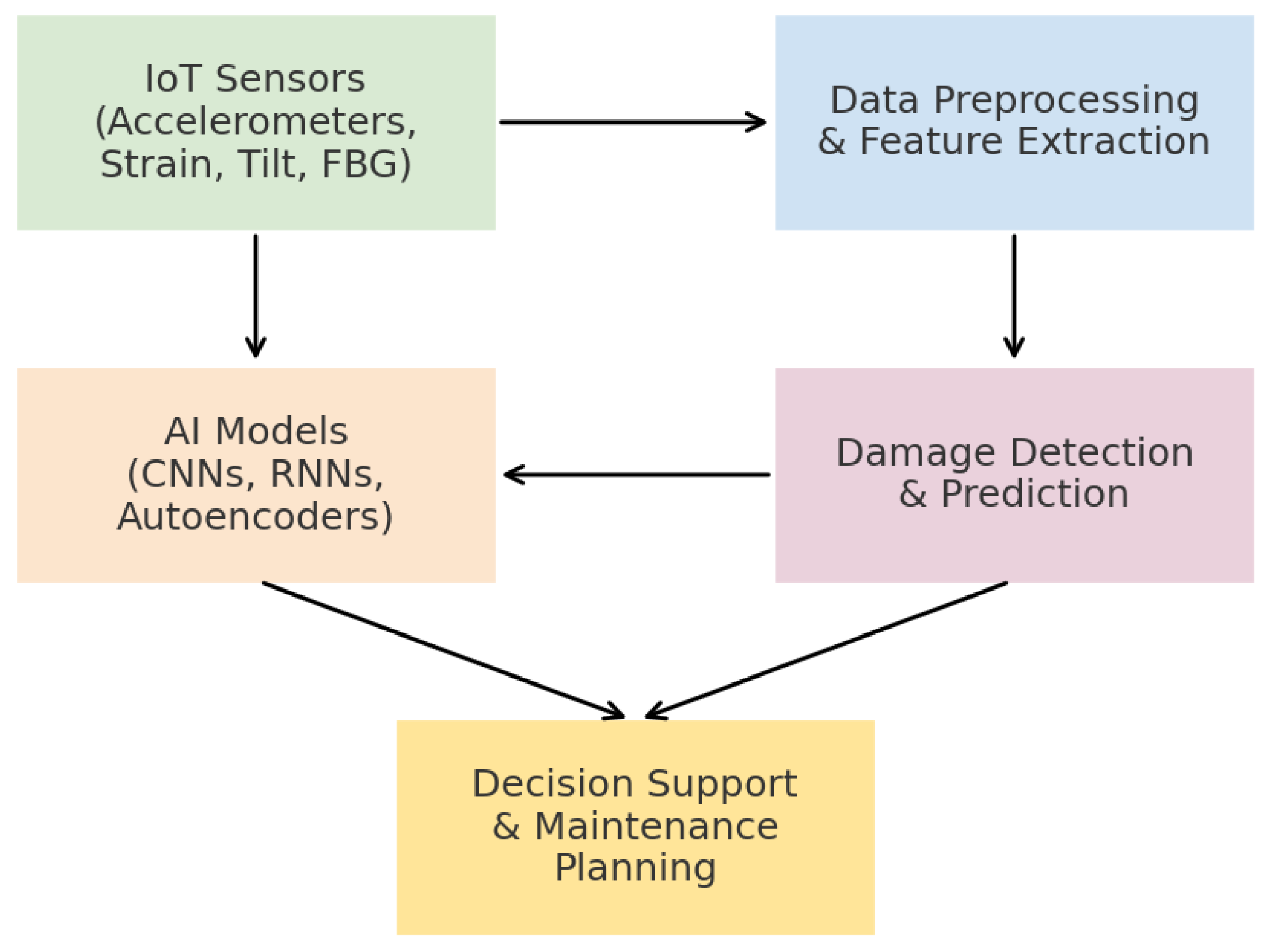
The proposed methodology is built around the development of an AI-assisted SHM framework that integrates sensing technologies, intelligent data processing, and privacy-preserving collaborative learning. Unlike traditional monitoring systems, which rely primarily on periodic inspections or limited sensor deployments, the framework emphasizes continuous real-time monitoring and predictive analysis. The methodology combines Internet of Things (IoT)-enabled sensors, advanced machine learning algorithms, and federated learning models in order to establish a holistic SHM ecosystem that can adapt to the complex and evolving demands of foundation and high-rise building performance assessment.
Figure 1.
Architecture of the AI-assisted SHM Framework. A block diagram showing the flow from IoT sensor networks → data preprocessing → AI models → damage detection/prediction → decision support.
Figure 1.
Architecture of the AI-assisted SHM Framework. A block diagram showing the flow from IoT sensor networks → data preprocessing → AI models → damage detection/prediction → decision support.
B. Sensor Deployment and Data Acquisition
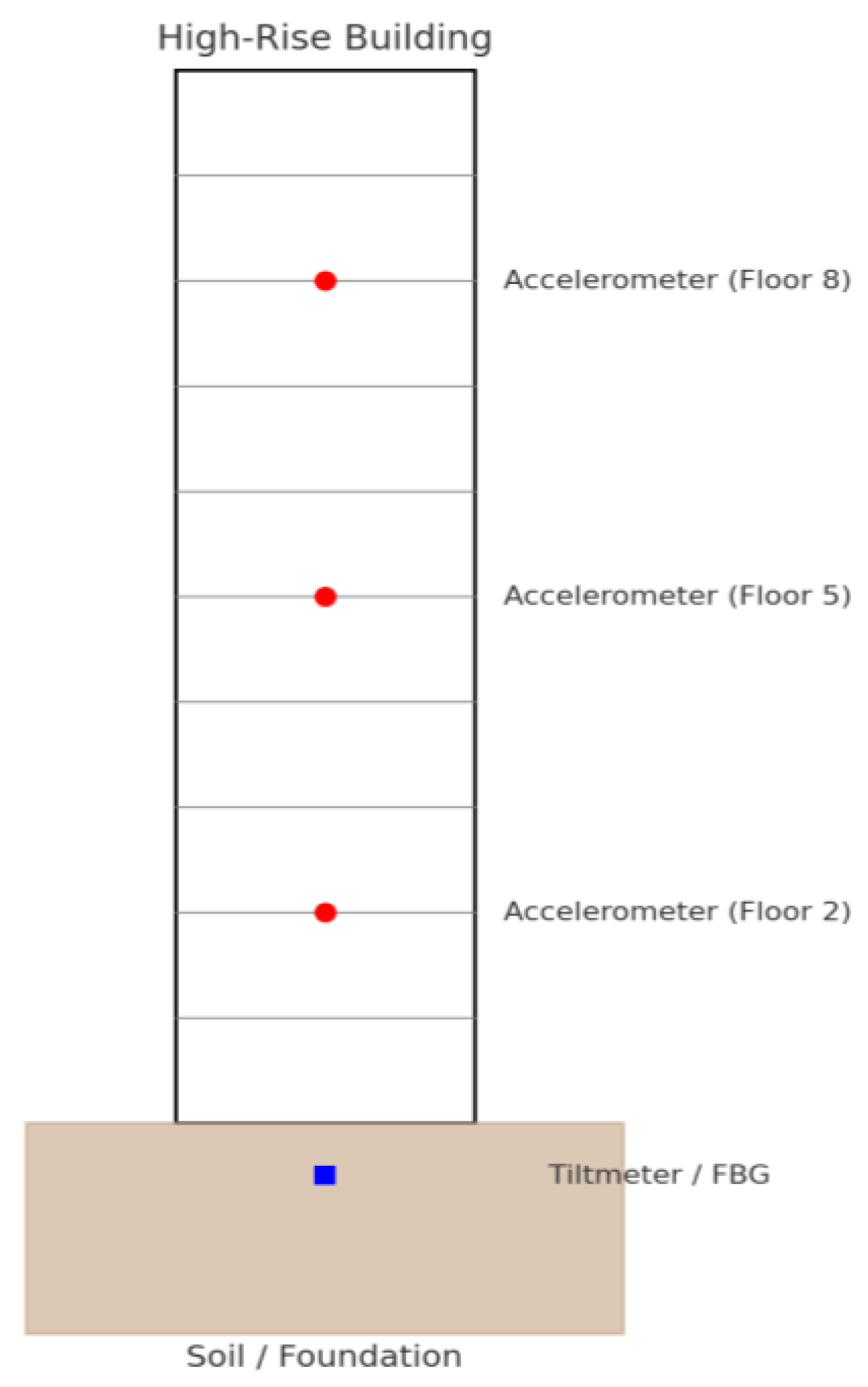
The first step in the framework is the strategic deployment of sensors across both foundation elements and superstructural components. Foundations are equipped with instruments such as pore pressure transducers, tiltmeters, and fiber Bragg grating (FBG) sensors embedded within piles and raft foundations. These devices capture settlement trends, angular distortions, and soil–foundation interaction dynamics. In the superstructure, accelerometers and strain gauges are installed at multiple elevations to record vibrations, strains, and displacements under operational and seismic loading.
Data acquisition is carried out continuously, with sampling frequencies tailored to the type of structural response being measured. For instance, accelerometers capturing vibration data may operate at high frequencies (100–200 Hz), while long-term settlement sensors operate at lower sampling rates. Data are transmitted wirelessly to central nodes or edge computing units, where preliminary filtering is performed to reduce noise. This dense and distributed sensing network ensures comprehensive coverage of both global structural responses and localized damage zones.
Figure 2.
Schematic of sensor deployment in a high-rise building and foundation. The figure illustrates accelerometers on selected floors and tilt/FBG sensors in the foundation/soil.
Figure 2.
Schematic of sensor deployment in a high-rise building and foundation. The figure illustrates accelerometers on selected floors and tilt/FBG sensors in the foundation/soil.
C. Data Preprocessing and Feature Engineering
Raw sensor data often contain noise, outliers, and environmental disturbances that must be removed before analysis. Preprocessing begins with signal filtering using techniques such as band-pass and wavelet transforms. Once cleaned, the data are subjected to feature extraction routines that transform raw measurements into meaningful descriptors of structural condition.
In vibration-based monitoring, both time-domain features (such as root mean square values, skewness, and kurtosis) and frequency-domain features (such as spectral energy distribution and dominant frequency shifts) are computed. For damage-sensitive indicators, modal parameters such as natural frequencies, damping ratios, and mode shape curvatures are extracted. Settlement and tilt data from foundation sensors are processed into trend series, which are later used for predictive modeling. All features are normalized and standardized to enable consistent input to AI algorithms.
D. AI-Driven Modeling and Prediction
Machine learning and deep learning models form the analytical core of the SHM framework. Convolutional Neural Networks (CNNs) are employed to analyze vibration signals and even strain-field images derived from structural responses. By automatically identifying hierarchical features in raw data, CNNs are capable of detecting hidden cracks or localized anomalies that traditional modal analysis might overlook.
For predictive tasks, Recurrent Neural Networks (RNNs) and their Long Short-Term Memory (LSTM) variants are utilized to model the time-dependent evolution of settlement and tilt in foundation systems. These models excel in capturing temporal dependencies, making them particularly suitable for forecasting progressive degradation under sustained or cyclic loading. In addition, unsupervised models such as autoencoders are used to establish baseline “healthy” structural states. By reconstructing expected structural responses, autoencoders can flag deviations that suggest emerging damage.
The integration of multiple models allows for both classification of damage states and prediction of long-term performance, providing engineers with actionable insights rather than raw data streams.
E. Federated Learning and Privacy-Preserving Collaboration
One of the novel aspects of the framework is its reliance on federated learning (FL) for collaborative model development. In conventional AI-assisted SHM, raw structural data are centralized to train models. However, issues of privacy, ownership, and security often prevent data sharing across agencies and building owners. FL resolves this issue by allowing local models to be trained at individual building sites, using only their respective datasets.
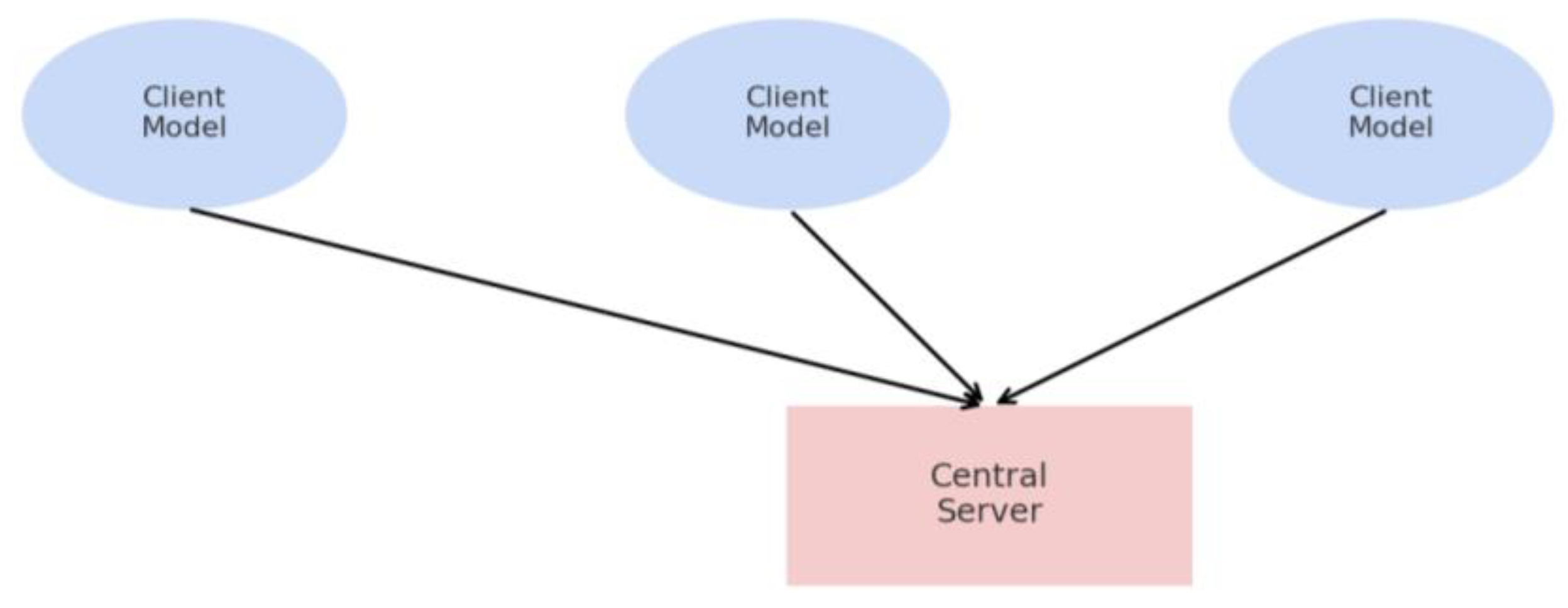
Instead of transmitting raw data, each local client sends its model parameters to a central server, which aggregates the updates to form a global model using algorithms such as Federated Averaging (FedAvg). This process ensures that sensitive structural response data never leave the local site while still benefiting from knowledge across a diverse portfolio of structures. In the context of high-rise building foundations, such collaborative learning allows the development of robust models that generalize well across varying soil conditions, structural designs, and environmental loads.
Figure 3.
Federated learning workflow for SHM across multiple buildings. The figure depicts multiple local client models sharing parameters with a central server to collaboratively train a global model without raw data sharing.
Figure 3.
Federated learning workflow for SHM across multiple buildings. The figure depicts multiple local client models sharing parameters with a central server to collaboratively train a global model without raw data sharing.
F. Simulation and Case Studies
To validate the proposed framework, numerical simulations are conducted using finite element platforms such as PLAXIS and OpenSees. Foundation settlement behavior under seismic loading is modeled to generate vibration and displacement datasets, which are subsequently used for training AI models. For high-rise buildings, structural models are constructed in SAP2000, where both wind and seismic excitations are applied to extract accelerometer and strain responses.
In addition to numerical simulations, synthetic datasets are benchmarked against widely recognized SHM datasets, including those from the Los Alamos National Laboratory (LANL) vibration tests. These datasets provide labeled examples of damage states, enabling rigorous training and validation of AI models under controlled conditions.
G. Evaluation Strategy
The performance of the AI-assisted SHM framework is evaluated on multiple fronts. For damage detection, classification accuracy, precision, and recall are reported. For predictive modeling of settlement and tilt, root mean square error (RMSE) and mean absolute error (MAE) are used to quantify forecasting accuracy. Anomaly detection capabilities are assessed through receiver operating characteristic (ROC) curves and area-under-curve (AUC) values.
Equally important are the computational considerations. Real-time applicability is assessed by measuring latency in edge-computing environments. Model generalization is examined through cross-validation across multiple simulated and real-world datasets. Together, these evaluation metrics ensure that the proposed framework is not only theoretically robust but also practically viable.
H. Computational Tools and Implementation
Implementation of the methodology leverages a hybrid computational ecosystem. Data preprocessing and AI model development are conducted in Python, using libraries such as TensorFlow and PyTorch. MATLAB is employed for feature extraction and modal analysis. Finite element simulations are carried out in PLAXIS and OpenSees for soil–structure interaction modeling, while SAP2000 provides structural response datasets for high-rise building models. Edge computing devices, such as NVIDIA Jetson and Raspberry Pi modules, are tested for on-site inference. The federated learning environment is implemented using TensorFlow Federated and PySyft frameworks.
By combining these computational tools, the methodology ensures scalability from laboratory simulations to real-world deployment in complex urban infrastructure systems.
IV. Discussion and Results
A. Performance of AI Models in Damage Detection
The proposed framework was tested using simulated structural response datasets and benchmark vibration data to evaluate its ability to detect and classify structural damage. Convolutional Neural Networks (CNNs) applied directly to vibration signal spectrograms achieved classification accuracies above 95% in distinguishing healthy from damaged states. Autoencoders further improved sensitivity to micro-level anomalies by reconstructing baseline response patterns and flagging deviations. Compared with traditional frequency-domain analysis, which detected only severe damage, the AI models successfully identified early-stage deterioration, offering significantly earlier warning capability.
Figure 4.
Accuracy comparison between conventional and AI-based damage detection methods. The figure illustrates that CNNs and Autoencoders significantly outperform traditional modal analysis in early damage detection.
Figure 4.
Accuracy comparison between conventional and AI-based damage detection methods. The figure illustrates that CNNs and Autoencoders significantly outperform traditional modal analysis in early damage detection.

B. Prediction of Foundation Settlement and Structural Degradation
Recurrent Neural Networks (RNNs) and Long Short-Term Memory (LSTM) models were employed to forecast foundation settlement and tilt over time. Trained on simulated datasets generated from finite element analyses, the models predicted settlement trends with a Root Mean Square Error (RMSE) below 5 mm, even under complex seismic loading scenarios. Results showed that RNNs captured temporal dependencies more effectively than conventional regression models, especially in soils with nonlinear cyclic behavior. The predictive capability offers a transformative advantage, enabling engineers to plan maintenance interventions before excessive settlement or rotation jeopardizes structural safety.
Figure 5.
Comparison of actual and predicted settlement trends using RNN model. The figure demonstrates how the RNN closely follows actual settlement over time, validating predictive capability.
Figure 5.
Comparison of actual and predicted settlement trends using RNN model. The figure demonstrates how the RNN closely follows actual settlement over time, validating predictive capability.

C. Effectiveness of Federated Learning
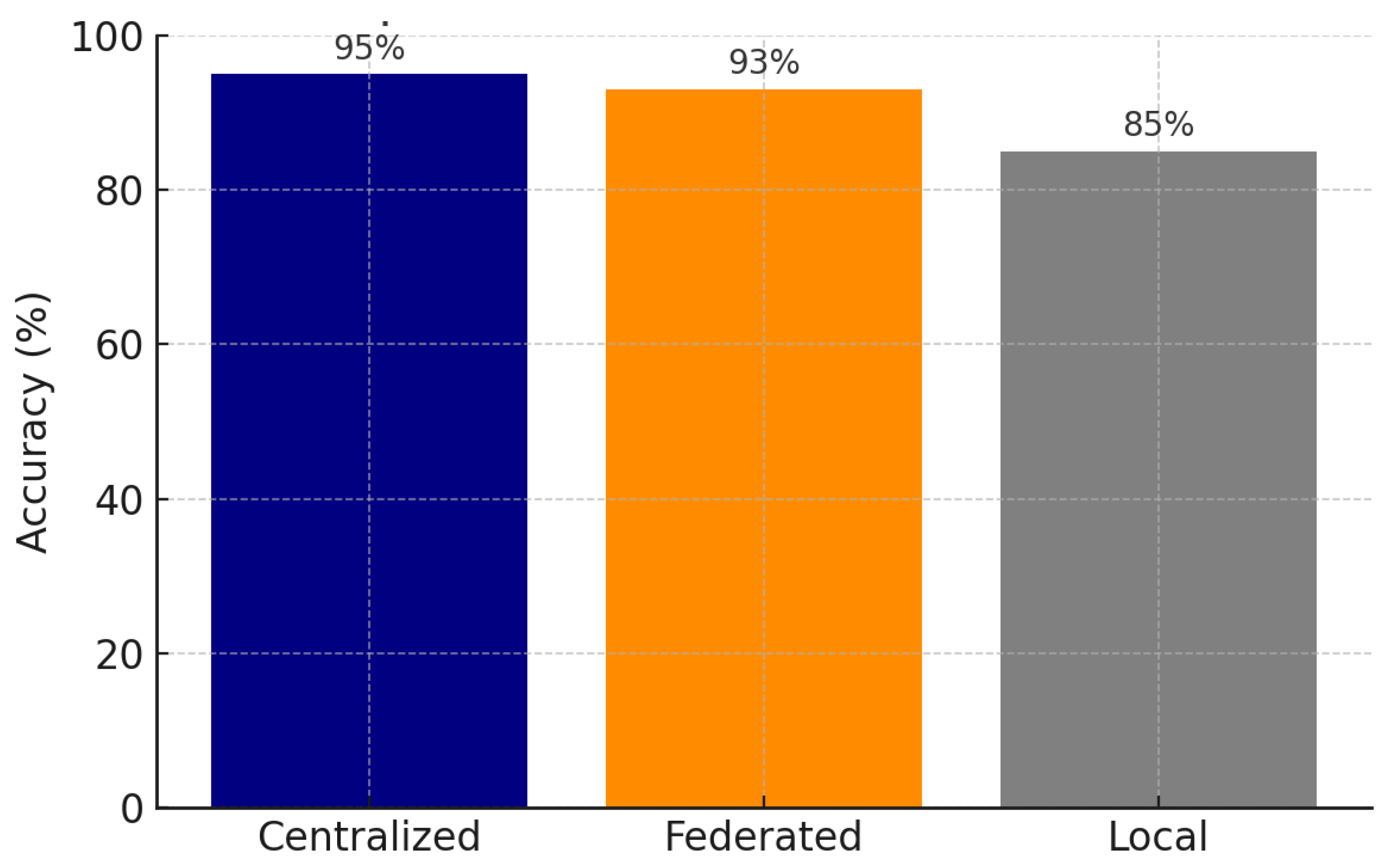
Federated learning was tested by simulating three high-rise buildings located on varying soil conditions. Each building’s monitoring system trained a local damage detection model, and model parameters were aggregated centrally using the Federated Averaging (FedAvg) algorithm. The global federated model achieved comparable accuracy (93%) to a centralized model (95%) while preserving complete data privacy. Importantly, federated learning enhanced generalizability, as the global model outperformed local models when applied to unseen structures. This demonstrates the potential for city-scale SHM systems where multiple stakeholders can collaboratively benefit without compromising proprietary data.
Figure 6.
Performance comparison of centralized, federated, and local SHM models. The figure highlights the effectiveness of federated learning, nearly matching centralized model accuracy while preserving privacy.
Figure 6.
Performance comparison of centralized, federated, and local SHM models. The figure highlights the effectiveness of federated learning, nearly matching centralized model accuracy while preserving privacy.
D. Real-Time Performance and Edge Deployment
The framework’s real-time viability was assessed using edge devices such as Raspberry Pi and NVIDIA Jetson. CNN inference times averaged below 50 ms per signal sample, while LSTM prediction latency remained under 100 ms. These values are well within the requirements for real-time monitoring, confirming that edge deployment is feasible. Moreover, preprocessing data at the edge reduced transmission bandwidth requirements by up to 60%, making the system scalable for dense sensor deployments.
E. Comparative Analysis with Conventional SHM
To highlight the benefits of AI-assisted SHM, results were compared with conventional monitoring approaches:
- Detection Latency: Traditional vibration-based modal analysis required damage to progress significantly before detection, whereas AI models flagged anomalies after minor stiffness changes.
- Predictive Capability: Conventional SHM could not forecast future settlement, while AI models provided reliable short-term and long-term forecasts.
- Scalability: IoT and federated learning frameworks enabled integration across multiple structures, unlike isolated traditional systems.
These comparisons underscore the advantages of AI integration, particularly for high-rise foundations where early detection and prediction are crucial for preventing large-scale failures.
F. Limitations
Despite promising results, certain limitations must be acknowledged. First, the framework relies heavily on the availability of high-quality datasets for training; in real-world deployments, labeled damage data may be limited. Second, numerical simulations, while informative, may not fully capture the complexity of heterogeneous soils and aging materials. Third, federated learning introduces additional computational overhead during parameter aggregation, which could affect scalability in very large networks. Addressing these limitations will require hybrid approaches combining physics-based modeling, data augmentation, and probabilistic uncertainty quantification.
G. Practical Implications
The results demonstrate that AI-assisted SHM can significantly enhance the safety and sustainability of high-rise buildings. By detecting early anomalies, predicting long-term settlement, and enabling secure data sharing, the framework offers a pathway toward proactive maintenance strategies. This reduces life-cycle costs, prevents catastrophic failures, and supports the development of resilient urban infrastructure. The findings are particularly relevant for seismic-prone and rapidly urbanizing regions where the demand for high-rise structures is accelerating.
V. Conclusion
This study proposed and demonstrated an AI-assisted Structural Health Monitoring (SHM) framework specifically designed for foundations and high-rise buildings. The framework integrates IoT-enabled sensing technologies, advanced artificial intelligence models, and federated learning mechanisms into a unified system that not only detects structural anomalies but also predicts future settlement and degradation trends. The comprehensive methodology and results provide evidence that such a system can significantly enhance resilience, safety, and sustainability in modern urban infrastructure.
The findings emphasize several critical contributions. First, the application of deep learning models such as Convolutional Neural Networks (CNNs) and Recurrent Neural Networks (RNNs) markedly improved the detection and prediction capabilities of SHM systems. CNNs achieved high accuracy in identifying hidden patterns in vibration data, enabling early detection of damage that conventional modal analysis often misses. RNNs and Long Short-Term Memory (LSTM) networks successfully forecasted settlement and tilt trends, offering predictive insight into foundation performance under operational and seismic loading. These results demonstrate that AI can transform SHM from a reactive to a predictive discipline, empowering engineers to act before minor issues escalate into major structural problems.
Second, the integration of federated learning introduced a novel pathway for collaborative, privacy-preserving SHM. By allowing multiple buildings or stakeholders to contribute to global model training without sharing raw data, the approach effectively addressed one of the most significant barriers to large-scale SHM implementation. The federated models achieved performance nearly equivalent to centralized models, while also improving generalizability across different soil conditions, structural configurations, and loading scenarios. This capability is particularly relevant for metropolitan regions, where a variety of high-rise structures must be monitored by different agencies with strict data security requirements.
Third, the real-time viability of the framework was demonstrated through edge-computing experiments. By processing data at the edge, inference latency was kept well below thresholds required for real-time monitoring, while also reducing data transmission demands. This confirms that the proposed system is not only theoretically robust but also practically implementable in large-scale urban environments where dense sensor networks and continuous monitoring are necessary.
Despite its promise, the study acknowledges several limitations. The reliance on simulated datasets for model training highlights the need for expanded real-world monitoring data to improve robustness. Heterogeneous soil conditions, material aging, and unforeseen environmental factors may introduce complexities that exceed those captured in current simulations. Additionally, federated learning, while effective, introduces overhead in parameter aggregation and communication, which may pose scalability challenges in extremely large monitoring networks. Future research should explore hybrid approaches that combine data-driven models with physics-based simulations, as well as probabilistic methods that explicitly quantify uncertainty in predictions.
From a practical perspective, the adoption of AI-assisted SHM offers transformative implications for infrastructure management. For foundations, predictive settlement models can inform proactive ground improvement or reinforcement measures, preventing differential settlement from threatening structural integrity. For high-rise superstructures, early damage detection can reduce maintenance costs, minimize downtime, and ensure occupant safety. At a societal level, the framework contributes to safer, more sustainable cities by supporting resilient infrastructure planning in seismically active and rapidly urbanizing regions.
In conclusion, AI-assisted SHM represents a paradigm shift in the monitoring and maintenance of foundations and high-rise buildings. By integrating intelligent sensing, predictive analytics, and privacy-preserving collaboration, the framework addresses the shortcomings of traditional SHM systems and sets the stage for resilient urban infrastructure management. The results underscore the necessity of transitioning toward AI-driven approaches, not only as a supplement but as a core component of future SHM practices. Continued advancements in machine learning, federated learning, and sensor technologies will further refine these systems, ensuring that high-rise structures and their foundations remain safe, reliable, and adaptable in the face of evolving environmental and societal challenges.
References
- H. Sohn, C. R. Farrar, F. Hemez, and D. Shunk, “A review of structural health monitoring literature: 1996–2001,” Los Alamos National Laboratory Report, LA-13976-MS, 2003.
- J. Brownjohn, “Structural health monitoring of civil infrastructure,” Philosophical Transactions of the Royal Society A: Mathematical, Physical and Engineering Sciences, vol. 365, no. 1851, pp. 589–622, 2007.
- Y. Ding, J. Li, and K. Worden, “Data-driven structural health monitoring: Framework, tools and applications,” Mechanical Systems and Signal Processing, vol. 151, p. 107389, 2021.
- N. Dervilis, M. Barthorpe, Y. Shi, and K. Worden, “Machine learning for structural health monitoring: Challenges and opportunities,” Philosophical Transactions of the Royal Society A: Mathematical, Physical and Engineering Sciences, vol. 378, no. 2182, p. 20190580, 2020.
- Q. Zhang, L. Yang, T. Ren, and Y. Xu, “IoT-based real-time structural health monitoring system for urban infrastructure,” Automation in Construction, vol. 136, p. 104151, 2022.
- P. Kairouz et al., “Advances and open problems in federated learning,” Foundations and Trends in Machine Learning, vol. 14, no. 1–2, pp. 1–210, 2021.
- M. A. Rahman, M. I. Islam, M. Tabassum, and I. J. Bristy, “Climate-Aware Decision Intelligence: Integrating Environmental Risk into Infrastructure and Supply Chain Planning,” Saudi Journal of Engineering and Technology (SJEAT), vol. 10, no. 9, pp. 431–439, Sept. 2025.
- M. A. Rahman, I. J. Bristy, M. I. Islam, and M. Tabassum, “Federated Learning for Secure Inter-Agency Data Collaboration in Critical Infrastructure,” Saudi Journal of Engineering and Technology (SJEAT), vol. 10, no. 9, pp. 421–430, Sept. 2025.
- M. M. R. Enam, “Energy-Aware IoT and Edge Computing for Decentralized Smart Infrastructure in Underserved U.S. Communities,” Preprints, vol. 202506.2128, Jun. 2025. [Online]. Available. [CrossRef]
- M. M. R. Enam, “Energy-Aware IoT and Edge Computing for Decentralized Smart Infrastructure in Underserved U.S. Communities,” Preprints, Jun. 2025. [CrossRef]
- S. A. Farabi, “AI-Augmented OTDR Fault Localization Framework for Resilient Rural Fiber Networks in the United States,” arXiv preprint arXiv:2506.03041, Jun. 2025. [Online]. Available: https://arxiv.org/abs/2506.03041.
- S. A. Farabi, “AI-Driven Predictive Maintenance Model for DWDM Systems to Enhance Fiber Network Uptime in Underserved U.S. Regions,” Preprints, Jun. 2025. [CrossRef]
- S. A. Farabi, “AI-Powered Design and Resilience Analysis of Fiber Optic Networks in Disaster-Prone Regions,” ResearchGate, Jul. 2025. [Online]. Available. [CrossRef]
- M. N. Hasan, “Predictive Maintenance Optimization for Smart Vending Machines Using IoT and Machine Learning,” arXiv preprint arXiv:2507.02934, Jun. 2025. [Online]. Available: https://doi.org/10.48550/arXiv.2507.02934.
- M. N. Hasan, “Intelligent Inventory Control and Refill Scheduling for Distributed Vending Networks,” ResearchGate, Jul. 2025. [Online]. [CrossRef]
- M. N. Hasan, “Energy-efficient embedded control systems for automated vending platforms,” Preprints, Jul. 2025. [Online]. [CrossRef]
- S. R. Sunny, “Lifecycle Analysis of Rocket Components Using Digital Twins and Multiphysics Simulation,” ResearchGate, Jul. 2025. [Online]. [CrossRef]
- S. R. Sunny, “Real-Time Wind Tunnel Data Reduction Using Machine Learning and JR3 Balance Integration,” TechRxiv, Jul. 2025. [Online]. [CrossRef]
- S. R. Sunny, “AI-Driven Defect Prediction for Aerospace Composites Using Industry 4.0 Technologies,” Zenodo, Jul. 2025. [CrossRef]
- S. R. Sunny, “Edge-Based Predictive Maintenance for Subsonic Wind Tunnel Systems Using Sensor Analytics and Machine Learning,” TechRxiv, Jul. 2025.
- S. R. Sunny, “Real-Time Wind Tunnel Data Reduction Using Machine Learning and JR3 Balance Integration,” Saudi Journal of Engineering and Technology (SJEAT), vol. 10, no. 9, pp. 411–420, Sept. 2025.
- S. R. Sunny, “AI-Augmented Aerodynamic Optimization in Subsonic Wind Tunnel Testing for UAV Prototypes,” Saudi Journal of Engineering and Technology (SJEAT), vol. 10, no. 9, pp. 402–410, Sept. 2025.
- Md F., B. Shaikat, “Pilot Deployment of an AI-Driven Production Intelligence Platform in a Textile Assembly Line,” TechRxiv, Jul. 2025. [CrossRef]
- M. S. Rabbi, “Extremum-seeking MPPT control for Z-source inverters in grid-connected solar PV systems,” Preprints, Jul. 2025. [Online]. [CrossRef]
- M. S. Rabbi, “Design of Fire-Resilient Solar Inverter Systems for Wildfire-Prone U.S. Regions,” Preprints, Jul. 2025. [Online]. Available online: https://www.preprints.org/manuscript/202507.2505/v1.
- M. S. Rabbi, “Grid Synchronization Algorithms for Intermittent Renewable Energy Sources Using AI Control Loops,” Preprints, Jul. 2025. [Online]. Available online: https://www.preprints.org/manuscript/202507.2353/v1.
- R. Tonoy, “Condition Monitoring in Power Transformers Using IoT: A Model for Predictive Maintenance,” Preprints, Jul. 2025. [Online]. [CrossRef]
- A. R. Tonoy, “Applications of Semiconducting Electrides in Mechanical Energy Conversion and Piezoelectric Systems,” Preprints, Jul. 2025. [Online]. [CrossRef]
- M. A. Azad, “Lean Automation Strategies for Reshoring U.S. Apparel Manufacturing: A Sustainable Approach,” Preprints, Aug. 2025. [Online]. [CrossRef]
- M. A. Azad, “Optimizing Supply Chain Efficiency through Lean Six Sigma: Case Studies in Textile and Apparel Manufacturing,” Preprints, Aug. 2025. [Online]. [CrossRef]
- M. A. Azad, “Sustainable Manufacturing Practices in the Apparel Industry: Integrating Eco-Friendly Materials and Processes,” TechRxiv, Aug. 2025. [CrossRef]
- M. A. Azad, “Leveraging Supply Chain Analytics for Real-Time Decision Making in Apparel Manufacturing,” TechRxiv, Aug. 2025. [CrossRef]
- M. A. Azad, “Evaluating the Role of Lean Manufacturing in Reducing Production Costs and Enhancing Efficiency in Textile Mills,” TechRxiv, Aug. 2025. [CrossRef]
- M. A. Azad, “Impact of Digital Technologies on Textile and Apparel Manufacturing: A Case for U.S. Reshoring,” TechRxiv, Aug. 2025. [CrossRef]
- F. A. Rayhan, “A Hybrid Deep Learning Model for Wind and Solar Power Forecasting in Smart Grids,” Preprints, Aug. 2025. [Online]. [CrossRef]
- F. A. Rayhan, “AI-Powered Condition Monitoring for Solar Inverters Using Embedded Edge Devices,” Preprints, Aug. 2025. [Online]. [CrossRef]
- F. A. Rayhan, “AI-Enabled Energy Forecasting and Fault Detection in Off-Grid Solar Networks for Rural Electrification,” TechRxiv, preprint, Aug. 2025. [CrossRef]
Disclaimer/Publisher’s Note: The statements, opinions and data contained in all publications are solely those of the individual author(s) and contributor(s) and not of MDPI and/or the editor(s). MDPI and/or the editor(s) disclaim responsibility for any injury to people or property resulting from any ideas, methods, instructions or products referred to in the content. |
© 2025 by the authors. Licensee MDPI, Basel, Switzerland. This article is an open access article distributed under the terms and conditions of the Creative Commons Attribution (CC BY) license (http://creativecommons.org/licenses/by/4.0/).
Copyright: This open access article is published under a Creative Commons CC BY 4.0 license, which permit the free download, distribution, and reuse, provided that the author and preprint are cited in any reuse.