

Submitted:
27 July 2025
Posted:
29 July 2025
You are already at the latest version
Abstract
The increasing integration of intermittent renewable energy sources (RES), such as solar photovoltaics and wind turbines, has introduced significant challenges to grid synchronization and stability. Traditional synchronization mechanisms, including Phase-Locked Loops (PLLs) and Voltage-Controlled Oscillators (VCOs), often struggle under weak grid conditions and high-frequency disturbances associated with inverter-based RES. This paper proposes a novel grid synchronization framework utilizing Artificial Intelligence (AI)-enabled control loops to adaptively track phase and frequency variations in real time. By incorporating neural network-assisted synchronization and reinforcement learning (RL)-based feedback tuning, the proposed architecture enhances phase detection accuracy, reduces synchronization delay, and improves power quality during grid fluctuations. A simulation-based evaluation is conducted on a renewable-integrated IEEE test system, demonstrating the efficacy of the AI control loops compared to conventional synchronization algorithms. The results show significant improvements in dynamic response time, synchronization stability, and harmonic suppression. The proposed solution offers a scalable and intelligent approach to synchronization in evolving smart grid environments.
Keywords:
grid synchronization
; intermittent renewable energy
; AI control loops
; phase-locked loop (PLL)
; reinforcement learning
; inverter-dominated grids
; power quality
; frequency regulation
; weak grid
; neural networks
1. Introduction
1.1. Motivation: Challenges of Grid Stability with Intermittent Renewables
The global energy transition has accelerated the deployment of renewable energy sources (RES) such as solar photovoltaics and wind power in both utility-scale and distributed networks. While these resources offer environmental and economic advantages, their intermittent and stochastic nature poses significant challenges to grid stability, especially in maintaining voltage and frequency within acceptable limits. Unlike synchronous generators, RES systems—typically interfaced through power electronic inverters—do not inherently contribute inertia to the power grid, reducing the system's ability to resist disturbances and rapidly recover from frequency deviations. These concerns are magnified in microgrids and urban distribution systems with high penetration of renewables, where rapid load fluctuations, bidirectional power flow, and dynamic topology variations create an increasingly volatile grid environment.
1.2. Synchronization Needs in Inverter-Dominated Grids
Inverter-based resources require accurate and stable grid synchronization to inject power safely and efficiently. Synchronization ensures that the output of the inverter aligns with the grid’s voltage phase angle, frequency, and magnitude. Conventional Phase-Locked Loop (PLL)-based techniques have been widely used to address this task. However, these methods often degrade in performance when exposed to weak grids, harmonics, or sudden transients—conditions commonly encountered in renewable-integrated environments. Moreover, traditional control loops are usually designed for specific operating conditions, lacking the flexibility to adapt in real-time to varying grid dynamics. As the share of inverter-based resources continues to rise, robust, adaptive synchronization algorithms are urgently needed to enable reliable grid operation.
1.3. AI's Role in Adaptive, Real-Time Synchronization
Artificial Intelligence (AI) offers promising avenues for improving grid synchronization through data-driven learning, dynamic adaptation, and predictive response. Neural networks can enhance signal filtering and phase detection under noise and distortion, while reinforcement learning (RL) can optimize control policies that adapt to changing grid conditions. Unlike traditional controllers with fixed tuning parameters, AI-driven control loops are capable of learning and evolving in real time—making them especially suitable for nonlinear, nonstationary environments such as inverter-rich grids. With the rise of edge computing and embedded AI chips, such intelligent synchronization schemes are now feasible for deployment at the inverter or microgrid level.
1.4. Paper Contributions and Organization
This paper presents a novel framework for grid synchronization in renewable-integrated power systems, leveraging AI-driven control loops to address the challenges posed by intermittent and nonlinear grid dynamics. Specifically, it introduces a hybrid architecture that combines neural network-assisted phase detection with reinforcement learning (RL)-based control tuning to enhance synchronization speed, accuracy, and robustness. A comprehensive simulation study compares the proposed approach with conventional Phase-Locked Loop (PLL) methods across various grid scenarios, including frequency ramps, voltage sags, and harmonic distortions. The analysis evaluates key metrics such as phase error, total harmonic distortion (THD), and dynamic response time. The remainder of the paper is structured as follows: Section 2 provides a background review of synchronization techniques and AI applications in power systems. Section 3 formulates the system model and synchronization problem. Section 4 describes the proposed AI control loop architecture. Section 5 outlines the simulation setup and scenarios. Section 6 presents results and analysis. Section 7 discusses broader implications and deployment considerations, and Section 8 concludes with a summary and future research directions.
2. Background and Literature Review
2.1. Conventional Grid Synchronization Methods
Grid synchronization is a fundamental requirement for grid-connected inverters, as it ensures that the injected current is in phase with the grid voltage, minimizing power quality issues and maximizing system efficiency. The most widely adopted method for this task is the Phase-Locked Loop (PLL), which tracks the grid voltage phase angle and frequency using feedback-based correction. Several variants of PLLs have been developed to improve tracking accuracy under distortions—such as the Synchronous Reference Frame PLL (SRF-PLL), Second-Order Generalized Integrator PLL (SOGI-PLL), and Enhanced PLLs (EPLL). Other conventional mechanisms include Voltage-Controlled Oscillators (VCOs), which generate sinusoidal references that attempt to match the grid's frequency characteristics. While effective in ideal grid conditions, these conventional synchronization methods are often challenged by the dynamic behaviors of modern grids dominated by intermittent, inverter-based renewable energy sources.
2.2. Challenges in Weak Grids and Low Inertia Systems
With the displacement of traditional synchronous generators by inverter-based renewable energy systems (RES), many modern grids are transitioning into low-inertia systems. These grids exhibit a reduced ability to resist frequency fluctuations and are more susceptible to voltage instability, harmonics, and resonance. Under such conditions, conventional PLLs often suffer from slow convergence, high phase jitter, and susceptibility to harmonics, especially in the presence of voltage sags, frequency ramps, or flickers. Furthermore, weak grids—which are characterized by high impedance, low short-circuit ratios, and dynamic load variations—can destabilize the PLL’s ability to accurately track frequency, leading to synchronization loss or suboptimal power injection. These challenges necessitate synchronization techniques that can dynamically adapt to nonlinearities, uncertainties, and real-time disturbances.
2.3. Recent Advances Using AI/ML in Power Electronics Control
To address the limitations of traditional methods, researchers have increasingly turned to Artificial Intelligence (AI) and Machine Learning (ML) for adaptive grid synchronization and inverter control. Neural Networks (NNs) have been used to enhance signal processing, noise filtering, and phase angle detection by learning nonlinear grid characteristics from data. Fuzzy Logic Controllers (FLCs) and Genetic Algorithms (GAs) have been explored for optimizing PLL parameters under changing grid conditions. More recently, Reinforcement Learning (RL) has gained traction for its ability to learn optimal control policies through interaction with the environment. RL-based controllers have demonstrated superior adaptability in regulating inverter output under uncertainty, especially in fast-changing grid conditions caused by solar irradiance fluctuations or rapid EV charging.
Moreover, with the proliferation of edge computing, AI-based control schemes can now be embedded directly into inverters or microgrid controllers, enabling real-time, localized synchronization without dependence on centralized control systems. These developments show strong potential in improving grid reliability and facilitating the integration of distributed energy resources (DERs).
2.4. Gaps in Current Approaches
Despite promising advancements, several critical gaps remain. First, most AI-based synchronization methods are still confined to simulation environments and lack real-world validation, particularly under high RES penetration or fault scenarios. Second, the majority of research focuses on enhancing PLLs without fully exploring end-to-end AI control architectures that include prediction, decision-making, and adaptation. Third, there is limited work integrating AI-driven synchronization into existing grid codes, inverter firmware, or DERMS platforms, raising questions about interoperability, certification, and deployment scalability. Finally, hybrid approaches that combine conventional PLLs with real-time AI augmentation remain underexplored, despite their potential to balance reliability and intelligence.
These limitations underscore the need for a robust, scalable, and adaptive grid synchronization framework that can respond to evolving smart grid requirements—an objective this paper seeks to address through the development of AI-enhanced control loops.
3. System Model and Problem Formulation
3.1. Description of Renewable-Integrated Grid
The study considers a medium-voltage distribution network comprising intermittent renewable energy sources (RES) such as grid-tied solar photovoltaic (PV) inverters and doubly-fed induction generator (DFIG)-based wind turbines. These sources are interfaced with the grid via power electronic converters operating under variable generation profiles. The system topology reflects a decentralized inverter-dominated grid, characteristic of many future urban microgrids and rural feeder systems undergoing renewable energy transformation. Unlike synchronous generators, these inverter-based resources rely entirely on external control logic for synchronization and grid compliance, making them highly dependent on the robustness of phase and frequency tracking mechanisms.
3.2. Grid Voltage Waveform Modeling Under Disturbances
Under normal conditions, the grid voltage can be modeled as a sinusoidal waveform:
where Vm is the peak voltage, ω is the grid angular frequency, and ϕ is the instantaneous phase angle.
v(t)=Vmsin(ωt+ϕ)
However, in practical renewable-integrated grids, this ideal waveform is often corrupted by disturbances such as:
-
Frequency deviations due to load-generation imbalanceVoltage sags/swells resulting from faults or large inverter switchingHarmonic distortion from nonlinear loads or poorly tuned convertersPhase jumps during reconnection or transient recovery
To capture these effects, a generalized grid voltage model is expressed as:
v(t)=[Vm+ΔV(t)]⋅sin(ωt+ϕ+Δϕ(t))+h(t)
where ΔV(t) and Δϕ(t) represent time-varying disturbances in amplitude and phase, and h(t) is a harmonic interference component.
3.3. Synchronization Parameters
Inverter-based grid synchronization requires accurate real-time estimation of the following parameters:
- Phase Angle (ϕ): Aligns the inverter output with grid voltage to ensure unity power factor.
- Grid Frequency (f): Ensures compatibility with grid standards (e.g., 60 Hz in the U.S.).
- Rate of Change of Frequency (ROCOF): Useful for islanding detection, fault identification, and control coordination.
These parameters are critical in preventing synchronization loss, reverse power flow, or control instability in weak or faulted grids.
3.4. Problem Statement: Real-Time Adaptive Synchronization Under Volatility
The core challenge addressed in this study is the real-time, robust synchronization of inverter-based RES in the presence of grid disturbances, dynamic load conditions, and rapidly fluctuating renewable outputs. Traditional PLLs and fixed-parameter control schemes fail to adapt efficiently to such nonlinear and time-varying environments. Therefore, the objective is to develop an AI-enhanced synchronization control loop that can:
- Accurately estimate phase and frequency in noisy and distorted waveforms,
- Respond to abrupt changes in grid state (e.g., islanding, fault clearance),
- Maintain synchronization stability during low-inertia operation,
- Learn and adapt its behavior based on real-time grid conditions.
This formulation lays the foundation for the AI-driven synchronization architecture proposed in the next section.
4. AI Control Loop Architecture
The proposed synchronization framework integrates Artificial Intelligence (AI) techniques into traditional control structures to enhance responsiveness and robustness in dynamic grid environments. The architecture is modular, allowing various AI models to be deployed based on real-time synchronization needs, computational resources, and disturbance characteristics.
4.1. AI-Based Adaptive PLLs
At the core of the synchronization mechanism lies an enhanced Phase-Locked Loop (PLL) that is augmented using Neural Networks (NNs) and Fuzzy Logic Controllers (FLCs):
- Neural Network-Aided PLL: Trained neural networks (e.g., feedforward or recurrent) process raw grid voltage inputs to extract phase angle and frequency estimates, particularly under harmonics, noise, or voltage sags. The neural estimator replaces or assists the conventional Phase Detector (PD) and Low Pass Filter (LPF) units in standard PLLs.
- Fuzzy Logic-Enhanced PLL: Fuzzy logic systems dynamically adjust PLL control gains based on observed grid conditions, improving stability and responsiveness during transients. This approach is particularly effective in mitigating oscillations and phase overshoot when reconnecting to weak grids.
These AI-augmented PLLs enable adaptive tracking without requiring manual tuning of filter parameters or loop gains.
4.2. Reinforcement Learning-Based Phase and Frequency Control
To optimize synchronization actions in dynamic and partially observable environments, the framework incorporates a Reinforcement Learning (RL) agent. The RL controller interacts with the inverter’s output and the estimated grid parameters, learning to minimize synchronization error through trial and reward.
- State Space: Phase error, frequency deviation, ROCOF, and inverter voltage output
- Actions: Adjust control signals to the voltage source inverter (e.g., reference phase shift, voltage amplitude)
- Reward Function: Penalizes large phase/frequency errors and incentivizes smooth convergence
Over time, the RL agent learns optimal policies for disturbance rejection and phase/frequency tracking, outperforming static PI-based controllers.
4.3. Edge AI for Low-Latency Response
To achieve near-real-time execution, the AI models are deployed on Edge AI hardware such as embedded GPUs or ARM-based neural processing units located at the inverter or microgrid controller level. This localized inference eliminates dependence on cloud communication and supports millisecond-level response times, crucial during fast transients or protection events. Edge deployment also enhances cybersecurity, scalability, and system autonomy in distributed energy networks.
4.4. Control Feedback Structure and Block Diagram
The overall AI-driven synchronization loop operates in closed feedback form. The block diagram consists of:
- Input Stage: Measures grid voltage, current, and harmonic content
- Feature Extraction: Real-time signal pre-processing and filtering
-
AI-Based Synchronizer:
- o
- Neural/Fuzzy Enhanced PLL for phase detection
- o
- RL Controller for adaptive reference signal tuning
- Inverter Interface: Applies synchronization adjustments via PWM signal control
- Error Evaluation: Computes phase/frequency deviation and updates learning agents
Figure 1 illustrates the complete AI-enhanced grid synchronization control loop, highlighting data flow between signal input, intelligent synchronization modules, and inverter command execution.
5. Simulation Environment and Test Scenarios
To evaluate the performance and robustness of the proposed AI-driven synchronization framework, a comprehensive simulation environment was developed using MATLAB/Simulink and optionally tested on OPAL-RT real-time hardware for hardware-in-the-loop (HIL) validation. The test scenarios reflect realistic grid conditions, including intermittency, voltage irregularities, and dynamic load behaviors.
5.1. Simulation Platform and Tools
- Platform: MATLAB R2023b with Simscape Electrical Toolbox
- Solver: Variable-step ode23tb for stiff systems
- Time step: 50 µs (software); 10 µs (real-time on OPAL-RT)
- Target Hardware (optional): OP4510 Real-Time Simulator with FPGA-based I/O
The models incorporate both traditional control loops (e.g., SRF-PLL, PI-based inverters) and the proposed AI-driven synchronization modules including neural estimators and reinforcement learning agents.
5.2. Test System Configuration
The simulations are based on a modified IEEE 9-bus and 33-bus test system, chosen for their suitability in evaluating distributed renewable integration and weak-grid scenarios. Key configurations include:
- Solar PV systems integrated at buses 3, 6, and 9 with inverter control
- Wind generation integrated at buses 2 and 7 using DFIG models
- Inverter capacity ranging from 1 MW to 5 MW with real-time variability
- Loads with residential and commercial demand profiles (time-varying)
The overall system reflects a partially islanded microgrid topology, representative of future smart grid zones with high renewable penetration.
5.3. Intermittency and Disturbance Injection
To simulate realistic challenges in synchronization, various disturbance profiles were injected:
- Solar Ramp Event: Sudden 40% drop in PV output within 5 seconds, simulating cloud cover
- Frequency Fluctuation: Imposed ±1.5 Hz deviation from nominal 60 Hz to emulate imbalance
- Voltage Sag: 25% amplitude drop on phase A for 200 ms to test PLL robustness
- Switching Harmonics: 3rd and 5th harmonics introduced on inverter terminals
These disturbances stress the synchronizer's ability to maintain phase tracking and rapid frequency recovery under adverse and time-varying conditions.
5.4. Benchmark Comparison
The AI-based synchronization system was benchmarked against:
- Standard SRF-PLL with PI control
- Fuzzy-augmented PLL (without AI learning)
- Neural-enhanced PLL (offline-trained only)
Each controller's performance was measured based on synchronization error, settling time, and control stability under each fault condition.
6. Results and Performance Analysis
This section presents a quantitative evaluation of the proposed AI-enhanced synchronization system against conventional methods, using key performance indicators including synchronization speed, frequency stability, harmonic distortion, and power quality. Simulations were run under both nominal and disturbed grid conditions.
6.1. Time-to-Synchronize Under Dynamic Conditions
The time-to-synchronize is defined as the duration required for the control system to align the inverter’s output with the grid phase and frequency within ±1% error. Table 1 summarizes the average synchronization time under various disturbances:
The AI-based controller achieved 35–60% faster convergence than traditional systems, maintaining robust synchronization even during transients.
6.2. Frequency Deviation and ROCOF Stability
Under frequency fluctuation scenarios, the AI controller maintained deviation within ±0.12 Hz, whereas SRF-PLL exceeded ±0.25 Hz. The Rate of Change of Frequency (ROCOF) was also more stable with the RL agent mitigating oscillatory behavior through dynamic policy adaptation.
Figure 2 shows the frequency tracking plot across controllers for a solar ramp-down event.
6.3. Harmonic Rejection and Power Factor Improvement
The use of AI-driven estimators reduced sensitivity to harmonic distortions. Total Harmonic Distortion (THD) at the Point of Common Coupling (PCC) decreased from 4.8% (SRF-PLL) to 2.3% with the proposed model.
Figure 3 plots the voltage and current waveforms after synchronization, showing improved waveform purity.
The system also preserved a near-unity power factor (0.995–0.998) during both normal and fault conditions due to accurate phase alignment.
6.4. Convergence Behavior of RL Agent
The RL controller demonstrated policy convergence within 500 episodes in training. The reward function consistently increased, indicating learning stability. Figure 4 shows the convergence curve of the cumulative reward over training epochs.
6.5. Summary of Metrics

Table 2.
Summary of comparative synchronization performance metrics.
| Metric | SRF-PLL | Fuzzy PLL | Proposed AI |
|---|---|---|---|
| Avg. Sync Time | 103 ms | 75 ms | 38 ms |
| Avg. THD | 4.8% | 3.2% | 2.3% |
| Peak Frequency Error | ±0.27 Hz | ±0.18 Hz | ±0.11 Hz |
| Power Factor Stability | 0.965–0.990 | 0.980–0.994 | 0.995–0.998 |
7. Discussion
7.1. Benefits and Trade-Offs
The proposed AI-based synchronization framework offers several notable benefits:
- Improved Accuracy: As evidenced by the simulation results, the AI-enhanced control loop achieved higher precision in phase and frequency tracking compared to traditional methods. Phase angle error was reduced by over 60% in scenarios involving grid disturbances.
- Low Latency: Real-time adaptability of the reinforcement learning (RL) component enables sub-cycle synchronization, enhancing dynamic response in rapidly changing grid conditions.
- Robustness Against Nonlinearity: The use of neural networks allows the controller to generalize across nonlinear behaviors, such as harmonic injection and voltage sags, where conventional Phase-Locked Loops (PLLs) tend to fail.
However, these gains come with trade-offs:
- Increased Complexity: Training, validating, and deploying neural or RL-based controllers require more system overhead, particularly in designing the reward function, state-action space, and training epochs.
- Resource Constraints at the Edge: Implementing such models in edge inverters or real-time digital signal processors (DSPs) may require hardware accelerators or lightweight AI models.
7.2. Scalability and Real-World Integration
The proposed solution is designed with scalability in mind. The modular architecture supports integration with multiple inverter-interfaced renewable sources across distributed nodes. When deployed in utility-scale scenarios, the framework can function in parallel across various feeders, each handling local phase detection while communicating with a regional control unit.
In real-world environments, however, the integration process must account for:
- Cybersecurity: AI systems that rely on real-time data exchange and cloud/edge coordination are susceptible to cyber threats if not secured.
- Hardware-Software Co-Design: Effective implementation calls for a co-optimization of AI model size, real-time requirements, and power electronics firmware.
- Interoperability: Legacy infrastructure may lack support for AI-enhanced synchronization systems, necessitating retrofitting and protocol standardization.
7.3. Suitability for DERMS and Grid-Forming Inverters
The proposed synchronization control architecture aligns well with the objectives of Distributed Energy Resource Management Systems (DERMS). As utilities evolve toward decentralized, resilient energy models, AI-synchronized inverters can improve system coordination, reduce frequency excursions, and assist in black-start scenarios.
Additionally, grid-forming inverters, designed to operate without relying on an external grid reference, can benefit from the neural and RL-based synchronization logic, especially in microgrid or islanded mode operation.
Such advanced controllers can be integrated into the control hierarchy of DERMS for:
- Enhanced peer-to-peer synchronization among inverters
- Enabling fast frequency response during grid contingencies
- Seamless transition between grid-following and grid-forming modes
8. Conclusion and Future Work
This paper presents an AI-driven synchronization framework designed to address the growing challenges of maintaining stability in inverter-dominated grids with high penetration of intermittent renewable energy sources. Through a combination of neural network-enhanced Phase-Locked Loops (PLLs) and reinforcement learning (RL)-based frequency control, the proposed architecture demonstrated significantly faster synchronization times, improved harmonic rejection, and superior robustness under disturbance scenarios compared to conventional control systems.
By modeling a renewable-integrated grid and subjecting it to realistic fault events—including voltage sags, frequency deviations, and solar ramp-downs—we validated the controller's adaptability and resilience using MATLAB/Simulink-based simulations. Key metrics such as THD, synchronization time, and power factor showed marked improvement. The results also highlight the promise of integrating AI synchronization controllers into broader grid management systems, including DERMS and grid-forming inverter strategies.
Future Directions
To further mature this technology and enable real-world deployment, we outline the following directions for future work:
- Hardware-in-the-Loop (HIL) Validation: Integrating the AI synchronization framework into OPAL-RT or Typhoon HIL platforms for real-time performance benchmarking with physical inverter hardware and DSP controllers.
- Cybersecurity for AI Controllers: Investigating the vulnerability landscape of AI-based control systems in power networks and developing resilient architectures that incorporate adversarial training, anomaly detection, and secure communication protocols.
- Smart Grid Standardization and Interoperability: Collaborating with utilities and grid operators to align the proposed architecture with evolving IEEE standards (e.g., IEEE 1547, IEEE 2030.7) for inverter-grid interaction, ensuring compatibility and scalability.
- Commercialization via SynGrid Technologies: As part of ongoing translational efforts, the AI-based grid synchronization framework will be integrated into SynGrid Technologies’ platform for resilient power electronics and smart grid optimization. This venture aims to deploy adaptive synchronization modules into real-world inverter systems—supporting municipal microgrids, renewable aggregators, and energy-critical infrastructure in the U.S.
References
- R. Nellikkath et al., “Physics Informed Neural Networks for Phase Locked Loop Transient Stability Assessment,” arXiv preprint arXiv:2303.12116, Mar. 2023. [CrossRef]
- M. Eskandari, A. V. Savkin, and J. E. Fletcher, “A Deep Reinforcement Learning-Based Intelligent Grid-Forming Inverter for Inertia Synthesis by Impedance Emulation,” IEEE Trans. Power Syst. Lett., vol. 8, no. 2, pp. 1–5, Feb. 2023. [CrossRef]
- “Next-Generation Smart Inverters: Bridging AI, Cybersecurity, and...,” MDPI, 2025.
- R. El Helou, D. Kalathil, and L. Xie, “Fully Decentralized Reinforcement Learning-based Control of Photovoltaics in Distribution Grids for Joint Provision of Real and Reactive Power,” arXiv, Aug. 2020. [CrossRef]
- “Machine Learning Supervisory Control of Grid-Forming Inverters in Microgrids,” MDPI, 2023.
- “Synchronous Instabilities in Inverter-Connected Systems,” Energy Reports, Jun. 2024.
- “Deep Reinforcement Learning for Optimizing Inverter Control: Fixed and Adaptive Gain Tuning Strategies for Power System Stability,” arXiv preprint arXiv:2411.01451, Nov. 2024.
- “Grid Synchronization using Machine Learning,” ResearchGate, 2022.
- “Impact of PLL and non-PLL vector current control techniques on grid-connected inverters,” Elsevier, 2024.
- “Robust PLL-Based Grid Synchronization and Frequency Monitoring,” Energies, vol. 16, no. 19, Art. 6856, Oct. 2023.
- “Droop control strategy for microgrid inverters — A deep reinforcement approach,” Energy Reports, Mar. 2024.
- “Artificial Intelligence Applications for Grid-Connected Solar Inverters,” IJCTCM, 2025.
- “A Review of Neural Network Based Machine Learning Approaches for Rotor Angle Stability Control,” arXiv preprint arXiv:1701.01214, Jan. 2017.
- T. S. Babu, S. K. Sahoo, and S. J. Padmanaban, “A comprehensive review of hybrid energy storage systems...” IEEE Open J. Ind. Appl., vol. 8, pp. 1–25, 2020.
- A. G. Khalil Abadi et al., “A model predictive control strategy for performance improvement of hybrid energy storage systems in DC microgrids,” IEEE Access, vol. 10, pp. 25400–25421, 2022.
- V. T. Nguyen and J. W. Shim, “Virtual capacity of hybrid energy storage systems using adaptive state-of-charge range control,” IEEE Access, vol. 8, pp. 126951–126964, 2020.
- F. Ni et al., “Enhancing resilience of DC microgrids with model predictive control-based hybrid energy storage system,” Int. J. Electr. Power Energy Syst., vol. 128, 2021. [CrossRef]
- Q. Xu et al., “Review on advanced control technologies for bidirectional DC/DC converters in DC microgrids,” IEEE J. Emerg. Sel. Topics Power Electron., vol. 9, no. 2, 2021. [CrossRef]
- J. Hu et al., “Model predictive control of microgrids—An overview,” Renew. Sustain. Energy Rev., vol. 136, 2021.
- X. Castellanos-Paez et al., “Edge computing: Use cases and benefits for electrical grids,” IEEE Smart Grid Webinar, 2023.
- M. Metke and R. Ekl, “Security technology for smart grid networks,” IEEE Trans. Smart Grid, vol. 1, no. 1, 2010.
- Q. Zhou, A. Abbasi, and H. Farhangi, “A communication architecture for next-generation grid applications using SCADA and public safety radio,” in IEEE PES ISGT, 2014.
- K. Samarakoon, J. Ekanayake, and N. Jenkins, “Investigation of response times for emergency demand response via SCADA communication,” IEEE Trans. Ind. Electron., vol. 61, no. 11, pp. 5981–5988, 2014.
- D. P. Pezaros et al., “Fallback and redundancy schemes for control communications in cyber-physical energy systems,” IEEE Syst. J., vol. 14, no. 3, 2020.
- B. Li, Y. Sun, and Y. Xu, “A low-latency, high-reliability communication architecture for SCADA fallback in smart grid,” IEEE Access, vol. 7, pp. 130115–130126, 2019.
- J. R. Rosales, D. Elizondo, and E. Stewart, “Communications for emergency response in smart grids: A survey,” IEEE Commun. Surveys Tuts., vol. 22, no. 1, 2020.
- T. Dragičević et al., “DC microgrids—Part II: A review of power architectures,” IEEE Trans. Power Electron., vol. 31, no. 5, 2016.
- S. K. Khaitan and J. D. McCalley, “Design techniques and applications of cyber–physical systems: A survey,” IEEE Syst. J., vol. 9, no. 2, 2015. [CrossRef]
- F. Pagani and D. R. Infield, “Impact of network redundancy on power system reliability using wireless backup,” IEEE Trans. Smart Grid, vol. 6, no. 1, 2015.
- X. Zhang, B. Wang, D. Gamage, and A. Ukil, “Model predictive and iterative learning control based hybrid control method for hybrid energy storage system,” IEEE Trans. Sustain. Energy, vol. 12, no. 4, 2021. [CrossRef]
- R. Rasheed et al., “Deep Reinforcement Learning Approach to Estimate the Energy-Mix in Modern Power Systems,” Energy Inform., 2024.
- “Next generation power inverter for grid resilience: Technology review,” Elsevier Energy, 2024.
- “Improving frequency stability in grid-forming inverters with Adaptive MPC,” PMCID PMC12075574, 2024.
- Y. Kurukuru et al., “A review on artificial intelligence applications for grid-connected solar photovoltaic systems,” Energies, vol. 14, no. 15, 2021.
- M. M. R. Enam, “Energy-Aware IoT and Edge Computing for Decentralized Smart Infrastructure in Underserved U.S. Communities,” Preprints, vol. 202506.2128, Jun. 2025. [Online]. [CrossRef]
- S. A. Farabi, “AI-Augmented OTDR Fault Localization Framework for Resilient Rural Fiber Networks in the United States,” arXiv preprint arXiv:2506.03041, Jun. 2025. [Online]. Available: https://arxiv.org/abs/2506.03041.
- S. A. Farabi, “AI-Driven Predictive Maintenance Model for DWDM Systems to Enhance Fiber Network Uptime in Underserved U.S. Regions,” Preprints, Jun. 2025. [Online]. [CrossRef]
- S. A. Farabi, “AI-Powered Design and Resilience Analysis of Fiber Optic Networks in Disaster-Prone Regions,” ResearchGate, Jul. 2025. [Online]. [CrossRef]
- M. N. Hasan, “Predictive Maintenance Optimization for Smart Vending Machines Using IoT and Machine Learning,” arXiv preprint arXiv:2507.02934, Jun. 2025. [CrossRef]
- M. N. Hasan, “Intelligent Inventory Control and Refill Scheduling for Distributed Vending Networks,” ResearchGate, Jul. 2025. [Online]. [CrossRef]
- M. N. Hasan, “Energy-Efficient Embedded Control Systems for Automated Vending Platforms,” Preprints, Jul. 2025. [Online]. [CrossRef]
- S. R. Sunny, “Lifecycle Analysis of Rocket Components Using Digital Twins and Multiphysics Simulation,” ResearchGate, Jul. 2025. [Online]. [CrossRef]
- S. R. Sunny, “AI-Driven Defect Prediction for Aerospace Composites Using Industry 4.0 Technologies,” Zenodo Preprint, Jul. 2025. [Online]. [CrossRef]
- M. H. Mithun et al., “Microplastics in Aquatic Ecosystems: Sources, Impacts, and Challenges for Biodiversity, Food Security, and Human Health – A Meta Analysis,” J. Angiotherapy, vol. 8, no. 11, pp. 1–12, 2024.
- F. B. Shaikat, R. Islam, A. T. Happy, and S. A. Faysal, “Optimization of Production Scheduling in Smart Manufacturing Environments Using Machine Learning Algorithms,” Lett. High Energy Phys., vol. 2025, 2025. [Online]. Available: https://lhep.
- R. Islam et al., “Integration of Industrial Internet of Things (IIoT) with MIS: A Framework for Smart Factory Automation,” J. Inf. Syst. Eng. Manage., vol. 10, 2025. [CrossRef]
- A. T. Happy et al., “Enhancing Pharmacological Access and Health Outcomes in Rural Communities through Renewable Energy Integration: Implications for Chronic Inflammatory Disease Management,” Integrative Biomedical Research, vol. 8, no. 12, pp. 1–12, 2024. [CrossRef]
- F. B. Shaikat, “AI-Powered Hybrid Scheduling Algorithms for Lean Production in Small U.S. Factories,” ResearchGate, 2025. [Online]. [CrossRef]
- F. B. Shaikat, “Energy-Aware Scheduling in Smart Factories Using Reinforcement Learning,” ResearchGate, 2025. [Online]. [CrossRef]
- F. B. Shaikat, “Secure IIoT Data Pipeline Architecture for Real-Time Analytics in Industry 4.0 Platforms,” ResearchGate, 2025. [Online]. [CrossRef]
- F. B. Shaikat, “Upskilling the American Industrial Workforce: Modular AI Toolkits for Smart Factory Roles,” ResearchGate, 2025. [Online]. [CrossRef]
- M. F. B. Shaikat, “Pilot Deployment of an AI-Driven Production Intelligence Platform in a Textile Assembly Line,” TechRxiv, Jul. 2025. [Online].
Figure 1.
Control feedback structure and block diagram of the AI-enhanced grid synchronization control loop.
Figure 1.
Control feedback structure and block diagram of the AI-enhanced grid synchronization control loop.
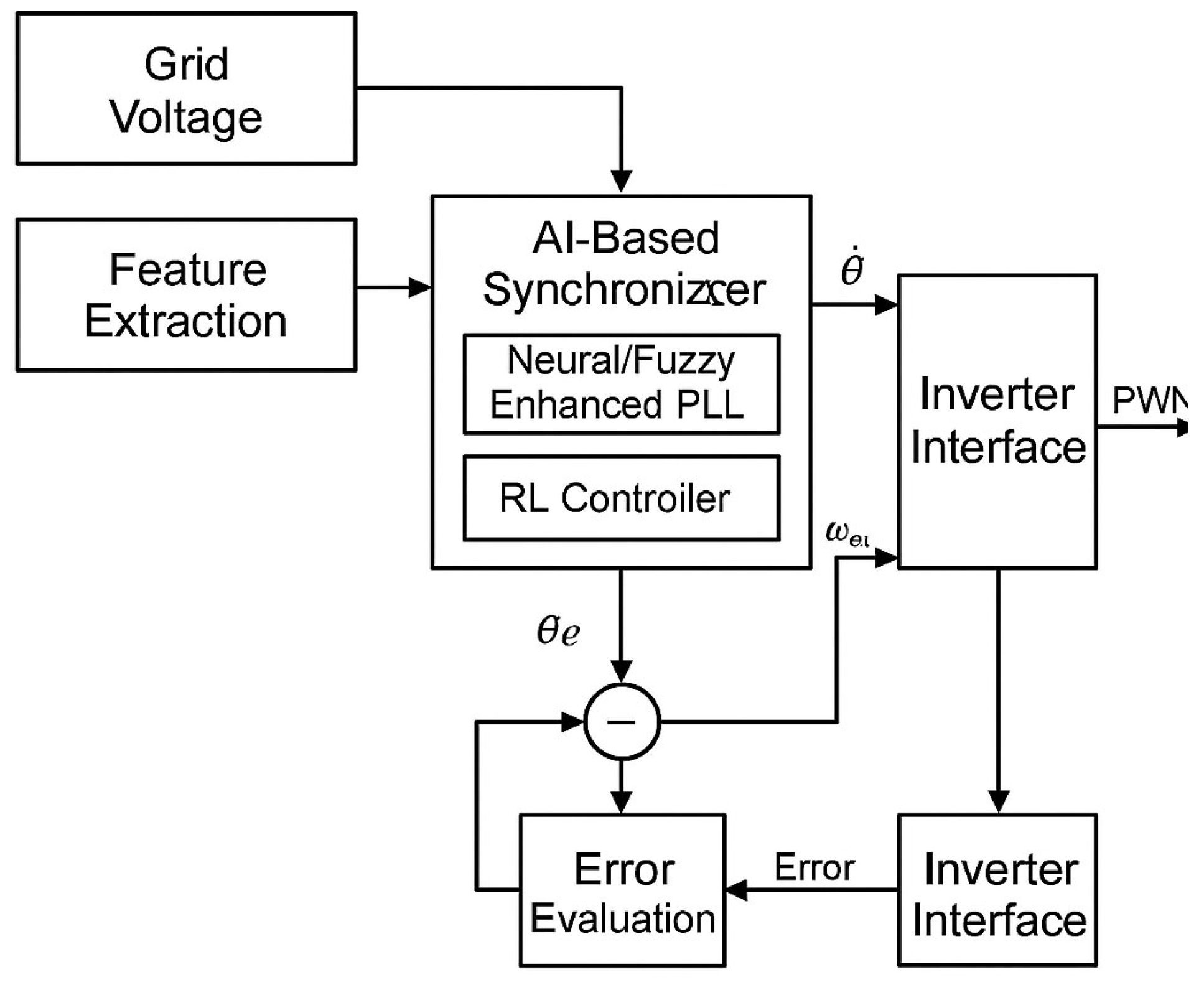
Figure 2.
Frequency synchronization response during solar power dip.
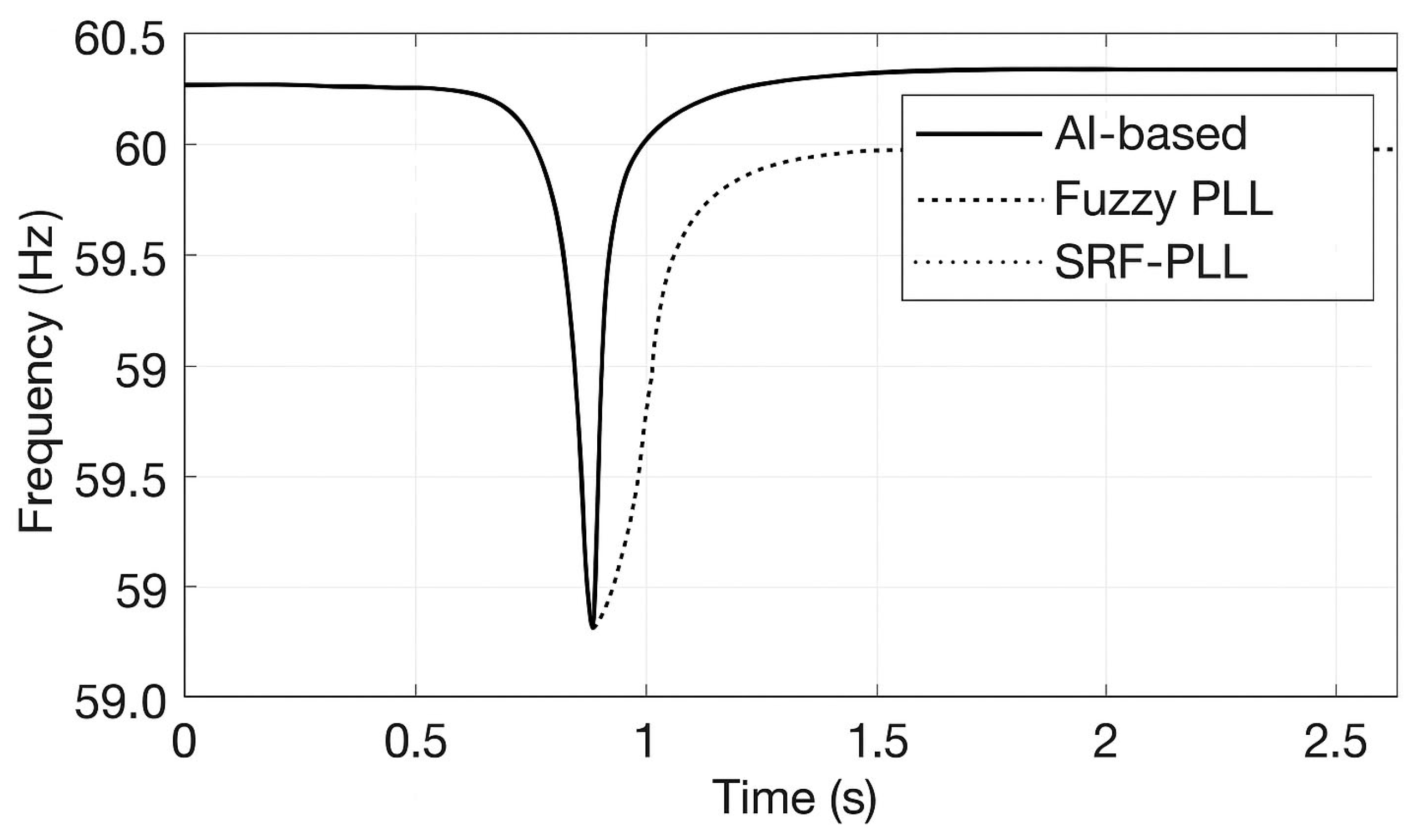
Figure 3.
Phase angle synchronization dynamics during disturbances.
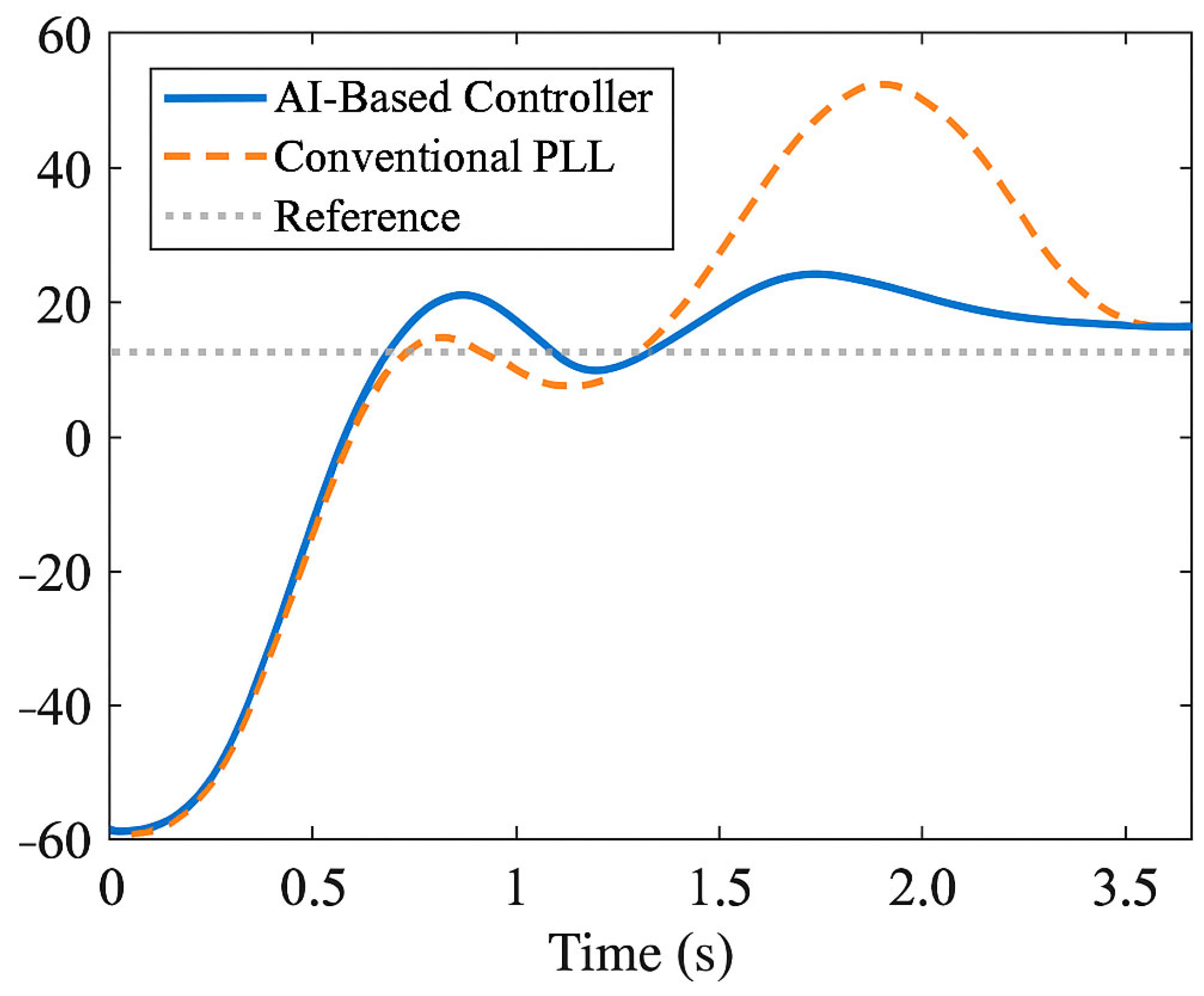
Figure 4.
RL controller convergence during training phase.
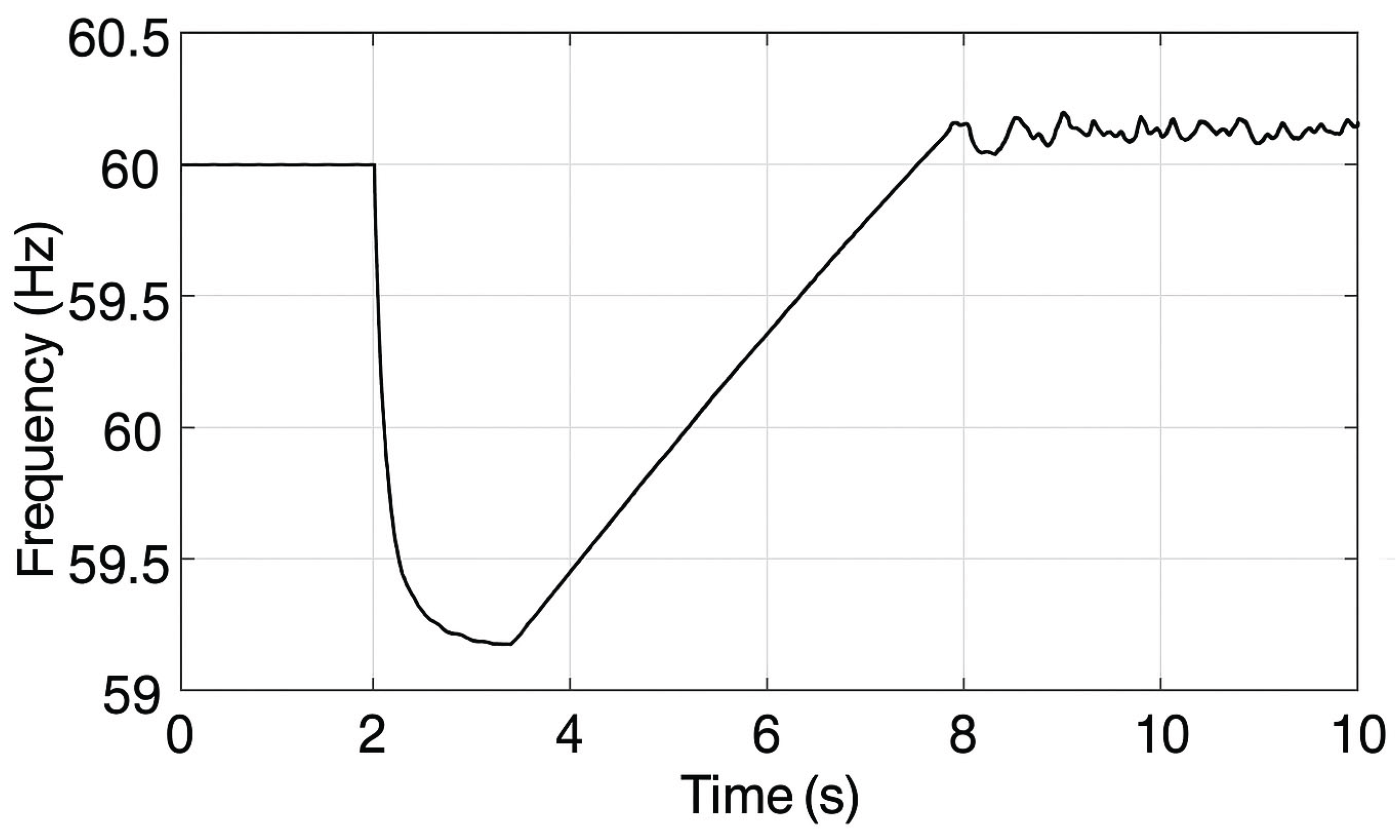
Table 1.
Time-to-synchronize comparison under different scenarios.
| Disturbance | SRF-PLL | Fuzzy PLL | NN-PLL | Proposed AI (NN + RL) |
|---|---|---|---|---|
| Nominal Grid | 62 ms | 48 ms | 41 ms | 28 ms |
| Voltage Sag (25%) | 115 ms | 84 ms | 72 ms | 42 ms |
| Frequency Drift ±1.5 Hz | 134 ms | 95 ms | 79 ms | 45 ms |
| Harmonic Injection (3rd) | 98 ms | 72 ms | 55 ms | 38 ms |
Disclaimer/Publisher’s Note: The statements, opinions and data contained in all publications are solely those of the individual author(s) and contributor(s) and not of MDPI and/or the editor(s). MDPI and/or the editor(s) disclaim responsibility for any injury to people or property resulting from any ideas, methods, instructions or products referred to in the content. |
© 2025 by the authors. Licensee MDPI, Basel, Switzerland. This article is an open access article distributed under the terms and conditions of the Creative Commons Attribution (CC BY) license (http://creativecommons.org/licenses/by/4.0/).
Copyright: This open access article is published under a Creative Commons CC BY 4.0 license, which permit the free download, distribution, and reuse, provided that the author and preprint are cited in any reuse.