

Submitted:
12 September 2025
Posted:
15 September 2025
You are already at the latest version
Abstract
Solid fuel combustion produces harmful particulate matter (PM) and gaseous emissions in the flue gas. To mitigate PM, advanced filtration materials using metal meshes, metal composites, and MOF-polymer composites have been studied. Gaseous emissions can be adsorbed using metal-organic frameworks (MOFs). Metal filters are suitable for high-temperature flue gas filtration (>200 °C) thanks to their high mechanical strength and thermal stability. This review covers research articles (2019–2023) on metal filters and MOF-polymer composites for flue gas filtration. While metal filters are already widely implemented in industrial systems, MOF-polymer composites remain at the research and development stage. Particular emphasis is placed on their filtration performance at high-temperature flue gas and assessment of their potential in combustion systems.
Keywords:
metal filters
; MOF-polymer composites
; flue gas filtration
; filtration efficiency
; pressure drop
; adsorption
1. Introduction
Air pollution caused by PM and gaseous emissions is considered a major environmental problem worldwide. Air pollution threatens human health and the environment. Inhaled fine particulate matter (PM2.5) penetrates the human body and can cause respiratory and cardiovascular issues; it may also contribute to the development of cancer [1,2,3]. PM2.5, compared to coarse particles (>PM2.5), adsorb more harmful chemicals (toxic organic substances, heavy metals, and harmful microorganisms) on their surface due to their larger specific surface area and more active sites [4,5]. The State of Global Air 2024 report states that air pollution was responsible for 8.1 million deaths worldwide in 2021 [6].
Emissions in high-temperature flue gas (>200 °C) are generated in industrial sectors such as energy (waste, fossil fuel, and biomass combustion, gasification), metallurgy, chemical and petrochemical industries, cement plants, glass manufacturing, and transport [7,8]. Combustion of fuels can produce emissions of PMs, SOx, NOx, CO, VOCs [9], and PAH [10]. It has been found that the concentration of PM smaller than 1 µm is produced in greater quantities in boilers when burning wood than in boilers burning heating oil [10,11,12]. From incomplete combustion, soot and condensable organic particles (tar) are produced [10,13]. High-temperature emissions are produced not only in industrial combustion sources but also in small combustion sources for households. The replacement of low-emission boilers will lead to a significant improvement in air quality, especially during the heating season (although complete elimination of emissions will not occur).
The PM in hot flue gases can be effectively removed from the air via high-temperature filters [7]. The filtration of PM is a key method for the effective reduction of air pollution [1]. In addition, up-to-date hot gas filtration is important for protecting industrial equipment and improving process efficiency and heat recovery [14], which leads to reduced power consumption [8]. In addition, improving process efficiency results in a reduction of CO2 emissions [15], which are responsible for global warming [1]. Concentrations of gaseous emissions in the flue gas (e.g., CO2, VOC) can be reduced by using adsorbents, so-called metal-organic frameworks (MOFs) [1,9]. The combination of PM filtration and adsorption of harmful gaseous emissions is an effective solution for improving the air [1].
Currently, there are various high-temperature resistant filter materials for flue gas filtration, including inorganic ceramic materials [16], polymer-based materials [7], metal materials [17], and glass fibers [18]. The disadvantage of ceramic and glass filters is their inferior mechanical performance [7]. The advantages of a suitably selected metal filter material are high mechanical strength, high thermal stability, and corrosion (oxidation [5]) resistance [19].
The authors' previous article [16] focused on general information about filtration and on the current state of knowledge on ceramic filters, which are also effective for high-temperature filtration of PM in flue gas [16]. This review is not only about metal filters, which, compared to ceramic filters, have better mechanical properties (mechanical resistance) and therefore offer the potential for more efficient regeneration, but also about innovative MOF-polymer composites, which can adsorb gaseous emissions. The review article contains an overview of research articles mainly published between 2019–2023 on metal filters (mesh, composite) and MOF-polymer composites for flue gas filtration, providing an overview of the currently tested these filters and their ability to filter fine PM and thanks to MOF nanoparticles adsorb gaseous emissions from the high-temperature flue gas stream. Furthermore, the review article includes an overview of commercially offered metal filters for large combustion devices. In addition, it provides comparison and practical potential of the described filters in combustion systems.
2. Metal Filters
2.1. Properties
Porous sintered metal filters can be made of metallic fibers or powders (granules) [8,20]. Other types of metal filters are metallic wire mesh filters [5], needle-felt filters, and expanded metal filters [8]. The porosity of sintered powder metallic filter ranges between 20–40 % (30–35 % [8]) [20]. The porosity of the sintered fiber metallic filter reaches up to 90 % (75–85 % [8]) [20]. Fiber metallic filters, compared to powder metallic filters, have greater penetrability, enhanced thermal stability, mechanical strength, and corrosion resistance [21]. In addition, a fiber metallic filter can be easily regenerated by back pressure, because it is more resistant to clogging [8].
Metal filters can be fabricated from various steel grades (e.g., stainless steel [22]) and metal alloys [23]. To prevent oxidation and corrosion, which can lead to irreversible clogging of pores, it is necessary to select a metal filter based on its thermal and chemical stability [23]. If the flue gas contains sulfur (e.g., H2S, SO2) or chlorides (HCl), special alloys such as Hastelloy X, HR 160, Inconel, or Monel are used to create a protective layer on its surface [23].
Metal filters are lightweight, they have low thermal conductivity, large specific surface area, and good penetrability [21]. Compared to ceramic filters, metal filters have main advantages such as completely welded construction (weldability [21]), [8] mechanical damping [21], and mechanical robustness, so they are able to withstand any vibrations that arise due to the pulse-jet regeneration [15]. Ceramic filters have a risk of breakage during pulse-jet regeneration [16]. In addition, the main composition of ceramic fibers corresponds to the composition of flue gases, e.g., Al2O3 or SiO2 [17,24]. A similar fiber and PM composition can result in increased intermolecular adhesion work [17,25], which can lead to more difficult regeneration of filters. Metal filters are frequently formed into pleated structures to increase the effective filtering area [26]. The pleated filters can be categorized into two types based on their layout: square filters and cylindrical filters [26].
Sintered stainless steel (metal) fiber or powder can be made into candles [8,27,28]. Sintered metal fiber elements are predominantly made from stainless steel and high-grade metal alloys because they are suitable for use in extreme conditions (high temperatures and pressures) [8]. Fabric filters made of stainless steel are mechanically resistant, chemically resistant, and resistant to corrosive compounds found in flue gas, such as HCL and SO2 [10,29], and they are temperature resistant up to 700 °C [10]. Similarly to ceramic filter candles, metal filter candles are used for high-temperature flue gas filtration [30]. Sintered metal candles are more durable than ceramic candles, reducing the risk of cracking and rupture [30]. The porosity, diameter of pores, and density of metal candles can be 85 %, 10–60 μm, and 1650 kg/m3 [31]. The preferred geometry of metal filter candles, similarly to ceramic candles, is with one side closed [16,32]. Outer diameters of candles are typically 60–150 mm, and the length of candles is between 1–3 m [8]. The removal of dust cake on the surfaces of candles can be done simply and effectively by pulsed jet blowback (cleaning efficiency is greater than 99.5 %) [8]. The filter may contain layers with different pore sizes; finer pore sizes on the blow-in side and coarser pore sizes on the support layers [8].
2.2. Use of Metal Filters
Sintered metal fiber filters have been utilized in hot gas applications for many years (due to their toughness, high thermal shock resistance, and extended operational lifespan) [14,33]. Specifically, sintered stainless steel fiber candles have been in use for over 10 years [8,34]. Furthermore, metal filters are tested for hot flue gas filtration in diesel engine exhausts [35]. Metal fiber filters are the preferred material for nuclear-grade pre-filters in air purification systems in nuclear power plants, thanks to their high temperature and radiation resistance [22,26,36,37].
3. MOF-Polymer Composites
3.1. Properties
Metal-organic framework (MOF) is a material composed of metal nodes (metal ions or clusters) and organic linkers (ligands), that are linked by coordination bonds [38,39,40]. MOF-based filters hold great potential for air purification due to their adjustable porosity (pore diameter [39]), large surface area that enhances gas adsorption, chemical and thermal stability [38], defined structure, and flexible modification [39]. The pore size of MOF is approximately 1–2 nm [39].
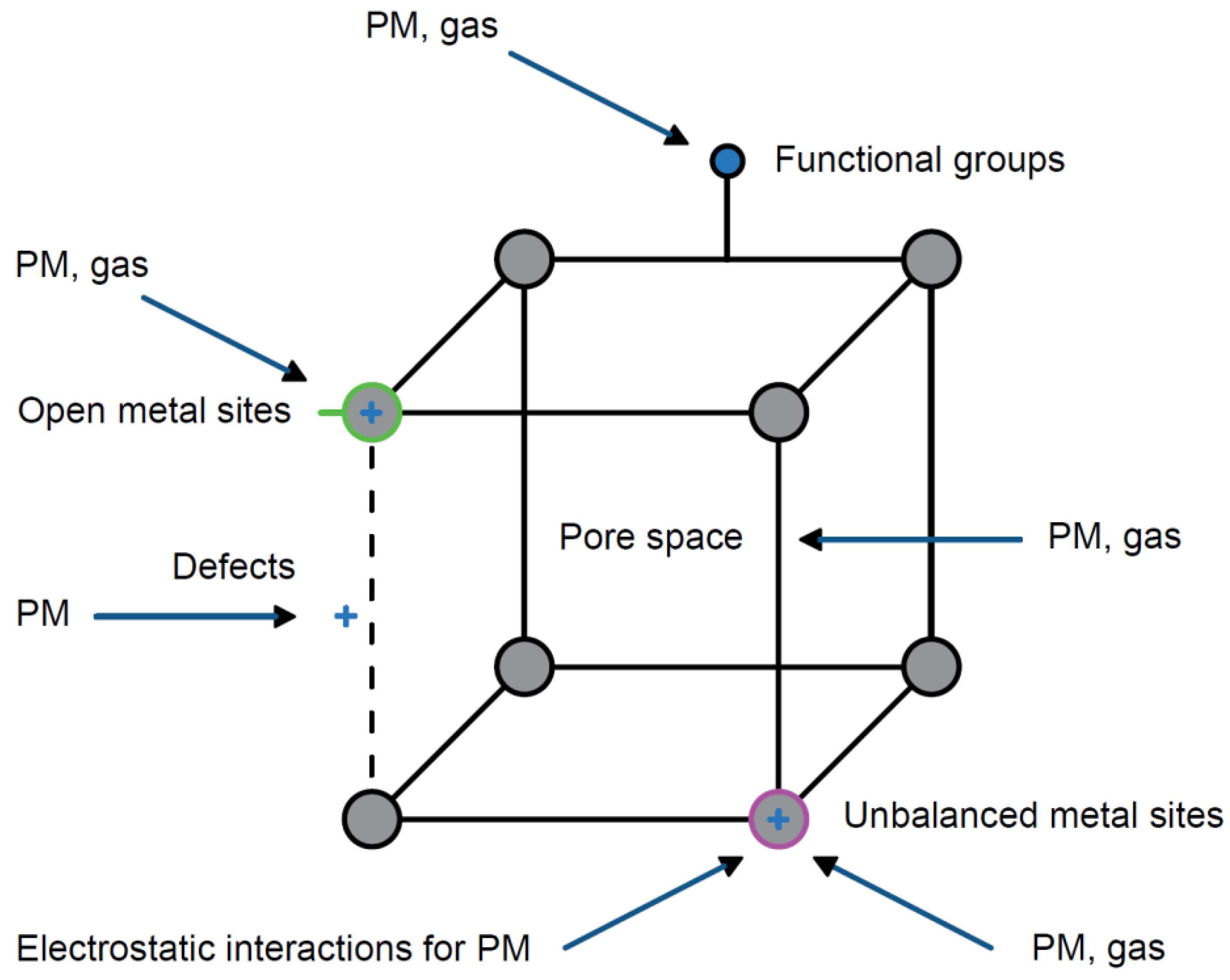
The typical skeleton material of the MOF class of materials is the Zeolitic Imidazole Framework (ZIF), for example, ZIF-8 [7,38]. ZIF-8 has been applied in gas adsorption thanks to its high specific surface area, which has an abundance of active metal sites, as well as good thermal stability, porosity, and low density [7,9]. The high specific surface area, zigzag pore structure, and numerous micropores of ZIF-8 lead to higher filtration efficiency of PM [7] and physical adsorption of gaseous emissions (VOC, aniline) via filling of microporous volume [9]. Open metal sites and functional groups (e.g., NH2 [9]) on the ZIF-8 also provide higher filtration efficiency of PM and higher chemical adsorption capacity for gaseous emissions [7,9,41,42]. ZIF-8 can also effectively capture PM through electrostatic attraction because of unbalanced metal sites and surface defects [7,43]. The positive charge on the surface of MOF, arising from unbalanced metal sites, polarizes the PM, thereby enhancing the electrostatic attraction, see Fig. 1 [44].
Figure 1.
Schematic representation of filtration and adsorption mechanisms in a MOF structure (redrawn and modified from [39]).
Figure 1.
Schematic representation of filtration and adsorption mechanisms in a MOF structure (redrawn and modified from [39]).
MOF nanoparticles [1,9] or carbon nanowires [5] are often applied to polymer fibrous filters to increase their mechanical strength [38,45]. By applying, for example, ZIFs on the fiber surface (polymer matrix), a functional hybrid material can be formed [9]. The polymer fibrous material can be, for example, Polyimide (PI) [1,7,9]. Polymer nanofibers have high thermal stability and flame retardance [1,9], corrosion resistance, radiation resistance, self-extinguishment, and strong mechanical properties (high strength) up to 500–600 °C [9,46].
Electrospinning [47] is a method for producing polymer microfibers [38] and nanofibers [1]. Materials created by electrospinning have a high specific surface area, high porosity, and adjustable microstructure [1]. The surface of fibers made using electrospinning tends to be smooth [48], and various methods are used for surface-activated fibers [9], such as self-assembly [1,9] and hydrogen bonding [9]. To further improve the material properties, Polyhedral Oligomeric Silsesquioxane (POSS) can be added to polymers, resulting in a polymer-based hybrid material [9,49]. In the case that the polymer fiber diameter is smaller than 500 nm, a slip-flow effect is created, which reduces pressure drop but enhances filtration efficiency [5,50,51].
3.2. Use of MOF-Polymer Composites
4. Tested Filters and Achieved Filtration Parameters
In this section, the individual research findings of various authors are summarized in short paragraphs that provide the most important information related to the filtration efficiency of tested filters. The most important (main) parameters of filtration are summarized in Table 1. These research articles were retrieved by combining words from the title and keywords of this review article within a defined time (2019-2023) from the Web of Science database or via Google Scholar. Older references were included only for theoretical background in previous sections.
4.1. Metal Mesh Filters
Qu et al. [17] proposed optimal, efficient, and continuous self-cleaning stainless steel fabric (SFF), specifically in the shape of a stainless steel weaved bag (SSWB), which is wound around a tube with a supporting core. A single-bag and pilot-scale experiments were conducted. A pilot-scale system was set up for hot flue gas. The maximum penetration particle size (MPPS) was determined by calculation. The pressure drop before cleaning was less than 3 kPa, which means that no cleaning technique was needed. The filter has a self-cleaning ability (continuous service for 1440 hours); thanks to low adhesion between PM and filter fibers, a thicker dust layer can be easily removed by turbulent gas flow or vibration. In addition, the stainless steel filter is only used for surface filtration, and thus deep filtration and clogging of the filter with PM do not occur. Tested SSWF is suitable for hot flue gas filtration.
The following study describes the use of a metal filter in a small-scale biomass boiler. Schott et al. [10] developed a new fabric filter based on a stainless-steel mesh with pulse-jet regeneration. Filters in the shape of candles (stainless steel fabric was welded into the shape of candles) were tested on a small-scale biomass boiler with a rated heat output of 24 kW, which was powered by wood pellets and wood chips. The primary components of the filter included the filter housing and filter candles. The filter housing contains 15 filter candles. The measurement of filtration efficiency was conducted according to VDI guideline 2066-1. For pulse-jet cleaning, compressed air (6 bar and pulse-jet duration 100 ms) was used. The ash box was periodically emptied. Cleaning the filter candles was performed externally because cooling the flue gas in the exhaust pipes by pulse-jet would lead to condensation of water vapor and tar, which could clog the filter candles [10,55]. Once the filter cake was formed on the filter surface, the outlet concentration of PM dropped below 10 mg/m3. For application potential, further development is necessary. In further research, the authors consider using an innovative precoat material for achieving reductions in PM and gaseous emissions.
4.2. Metal Composite Filters
Yang et al. [5] produced and demonstrated a novel composite filter with 3D networks of carbon nanowires grown on a 304 stainless steel mesh using an in situ vapor growth method at 1100 °C. For the filtration tests, a custom-built setup was used. PM from incense coil contains organic components, such as PAHs and hydroxyl compounds. The surface (functional) groups on nanowires can interact with polar groups on PM, thus contributing to the proactive capturing of the organic substances found in PM based on near-field interactions. Thanks to the extended network of the nanowires, PM can easily collide and be attached to one of the nanowires. The filter was regenerated by electrical resistive heating, thus nearly burning the captured PM at 550 °C. The filter was thermally stable thanks to the graphitic component in the nanowires. Therefore, the prepared filter is recyclable, robust, heat resistant, and is potentially suitable for filtration of hot gases such as diesel engine exhausts and organic waste gas emissions.
Xie et al. [56] developed a new composite filter to increase filtration efficiency, which consisted of a metal web (base fabric), which was coated (by hot-pressing) with polytetrafluoroethylene (PTFE) microporous membrane (surface layer), which had smaller mean diameter fiber (0.38 µm) than metal web fiber (1.71 µm). Dense fibers on the surface of the filter can prevent PM from entering inside the filter, so cleaning the filter by pulse-jet cleaning can be more efficient/easier. The authors designed an experimental setup for the performance measurement of the filter. The filter had satisfactory high-temperature resistance. The cake/fabric adhesive force was 102.36 N/m2. The permeability of the metal web filter and PTFE membrane was 2.69 m2×10−12 and 1.25 m2×10−12. The average cleaning interval was 421 seconds. The authors plan to test filtration efficiency for different particle sizes in the future.
Gui et al. [57] prepared FeAl/Al2O3 porous composite microfiltration membrane (PCMM). The filtration test was conducted in-house air filtration apparatus. Porous intermetallic FeAl has the potential for high-temperature flue gas thanks to excellent thermal shock resistance capacity [57,58], but for excellent filter fineness, it was suitable to add Al2O3. The filtration capability of the filter is determined based on the size of the pore-throat. The filter is not efficient for particles smaller than 1 µm.
4.3. MOF-Polymer Composites
Xie et al. [59] fabricated a composite filter PI@PDA@MOF. MOF crystals were integrated into the PI fibers. In the MOF framework, there was an abundant microporous window smaller than 2 nm. The measurement of the filtration efficiency of the filter was carried out according to European standard (EN 1822-3:2009).
Xie et al. [9] prepared PI-POSS@ZIF hybrid polymer-based filter. On the surface of PI-POSS, there is a large number of amino-functionalized nanoparticles (functional groups) NH2-ZIF-8. The filter was created using electrospinning and a subsequent process of hydrogen bonding self-assembly. The tensile strength of the filter was 7.33 MPa. The measurement of the filtration efficiency of the filter was carried out according to European standard (EN 1822-3:2009). (For filtration, a copper mesh substrate with 200 mesh (pore size 180 µm) was used, which had a negligible impact on filtration). During ultrasonic cleaning, the pressure drop was recovered to 50 Pa, so the filter had good reusability. The filter for high-temperature air purification has a good filtration performance, a large specific surface area, and is temperature stable and mechanically resistant. Thanks to the rich open metal sites, functional groups, and extensive micropore structures of NH2-ZIF-8, the filter has good adsorption capacity for VOCs (formaldehyde (89.95 mg/g), benzene, toluene) and aniline. In addition, NH2-ZIF-8 has polar groups (high ζ potential) for increasing electrostatic interactions between the filter and PMs.
Zhu et al. [7] fabricated a composite air filter ZIF-8/PI NFA, which contains ZIF-8 nanoparticles on polyimide (PI) nanofiber aerogel matrix. The PI nanofiber aerogel exhibits good air permeability, high filtration efficiency, good thermal stability, and mechanical properties. The dispersed zigzag pore structure of ZIF-8 also has high filtration efficiency for nanoparticles thanks to its high specific surface area. In addition, ZIF-8 has an opposite electric charge to PM, so the capture also occurs through electrostatic attraction. For the high-temperature flue gas filtration, a self-designed air filtration device was used. The filter is robust (mechanical strength), effective, and high-temperature resistant, with flame-retardant ability. This filter has potential in the field of high-temperature air filtration, for example, in industrial, automotive, and indoor purification.
Dong et al. [39] prepared a superhydrophobic composite filter SH-Mp-PET(Ti, Zn, Cu), where different MOF-crystals (NH2-MIL-125, ZIF-8, and HKUST-1)) are attached to a PET-based filter material, which leads to an increase in the surface roughness of the fiber. In addition, it thus improves the stability of MOFs in water (High-humidity environments). Composite filter SH-Mp-PET (Zn) exhibited the highest electrostatic filtration performance. The filter was thermally stable up to 200 °C. This prepared composite filter is suitable for flue gas treatment in high-humidity metallurgical industry environments.
Wei et al. [1] manufactured Janus double-layer composite nanofibrous membrane, respectively PI–based nanofibrous membrane consisting of PI/CD-MOF and PI membranes. The filter was created using co-electrospinning. For filtration, metal mesh was used as a substrate. The good filtration performance of the filter was thanks to the high specific surface area of the nanofibrous filter. Due to the open metal sites of Cu-MOF, the filter exhibits satisfactory CO2 adsorption capacity was 14.2002 cm3/g. The filter also exhibits unidirectional water permeability performance thanks to the Double-layer composite nanofibrous membrane. The filter can serve in addition to high-temperature filtration as personal protection (protective mask, fire-protective clothing). Furthermore, it is suitable for gas adsorption and separation.
4.4. Summary of Tested Filters
A summarization based on Table 1 is described here. Table 1 shows the achieved parameters of the individual studies described above. Studies in which the authors measured the filtration efficiency and pressure drop of the filters. The order of the studies is based on the types of filters and the year of publication of the studies.
All filter types achieved filtration efficiencies > 90%, with MOF-polymer composites exhibiting the lowest pressure drop < 140 Pa. However, the results are not comparable between each other, because filtration efficiency and pressure drop are influenced by several variables, as described in the previous study [16]. The filtration efficiency is, for example, influenced by the velocity of flue gas, inlet dust concentration, the maximum penetration particle size, and operation time [17]. Only the results of the two studies of MOF-polymer composites are comparable to each other because the authors Xie et al. used almost the same values of variables in these studies. In their more recent study [9], the diameter of the PI fibers was many times smaller, which had a positive effect on the filtration efficiency and pressure drop. Table 1 also shows that the smallest PM, specifically PM0.3, was tested for MOF-polymer composites. In section 6 these filters are discussed.
4.4.1. Recommendation for Improving Filter Performance Testing
The authors do not report the porosity of filters when measuring metal filters (shown here in only two studies – 2× [10,57]), strength (1×) [9], permeability of filters (1×) [56], and regeneration efficiency (1×) [10]. Operation time (1×) [17] is also important, as it clarifies after what operation period the filtration efficiency begins to decrease. The life cycle of the filter, whether the filter is recyclable, is also important information (1× mention [5]) [16].
From the summary Table 1, it follows that the authors use for measurement filtration efficiency dust-laden flue gas (Al2O3, SiO2), NaCl (<300 °C), and PM produced from incense or incense coil. It also follows that PM0.3 were the smallest tested filtered particles (using "PM" is not accurate) [16], while the largest mass concentration from solid fuel combustion is with a size of 89–146 nm [60]. To solve this issue, the scanning mobility particle sizer (SMPS) device can be used for measurements, as it enables the determination of filtration efficiency for specific particle sizes within the mentioned measurement ranges. It is also important to use a stable particle source. Specifying MPPS is also crucial, because it identifies the particle size range where the filter exhibits the lowest filtration efficiency.
The authors often do not mention the standard according to which the filtration efficiency of the tested filters was determined. Only one author in his two studies [9,59] provided the European standard (EN 1822–3:2009), and for measurements on a small boiler, VDI guideline 2066-1 was used. The mentioned standard EN 1822–3:2009 (replaced by a more current standard ISO 29463-3) specifies a flow rate of up to 800 cm3/s (2.88 m3/h) [61]. Also, the companies offering metal filters do not provide this information on their websites, either. This significantly limits transparency and the possibility of comparing the quality of filters. There are also standards such as ISO 11057 and ASTM D6830, but these measure filtration efficiency using the gravimetric method. It may be appropriate to introduce a novel uniform methodology for measuring filters using SMPS. However, the disadvantage is that SMPS is not suitable for high flue gas temperatures and high concentrations, therefore the sample must be diluted and cooled.
5. Commercially Offered Metal Filters
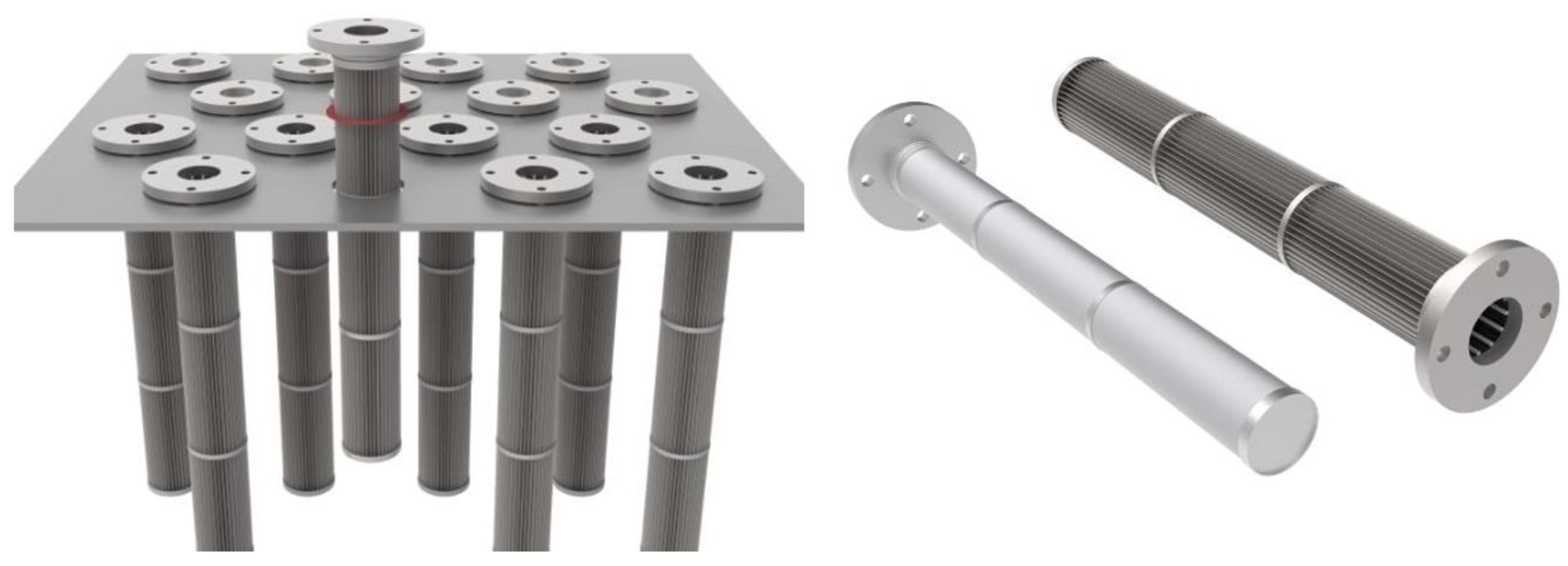
In the world, there are several companies offering metal filters. Company Boedon offers three types of metal filters for hot gas filtration: sintered felt filter bag (<1000 °C), strengthened hot gas cleaning filter (<650 °C), and standard hot gas cleaning filter (<450 °C). These filters are resistant to high temperatures and acid, and alkali corrosive gases. The sintered felt filter bag (see Fig. 2.) is made of stainless steel (304, 316L, 310S, 314, etc.), FeCr Al, titanium, nickel, etc. And composed of a metal cage skeleton, a coarse metal fiber layer, and a fine metal fiber layer. The sintered felt filter bag is offered in two designs (conventional type and pleated type). The maximum operating temperature of a sintered felt filter bag is 1000 °C, and porosity is 75–88 %. Another type of filter is the strengthened hot gas cleaning filter, which has a maximum operating temperature of 650 °C. This filter is generally made of FeAl or TiAl, which are made into metal powder blanks. The filter has good thermal shock resistance, air permeability is 100 m3/(m2.h), and retained dust particle size is ≤0.1 μm. Another kind of filter bag is the standard hot gas cleaning filter, which has a maximum operating temperature of 450 °C. This filter is created from metal powder through a sintering process, resulting in a flexible sintered filter sheet (then it is cut to the appropriate size to fit into the cage bone). It has a porosity of 30–70 %, air permeability is 100 L/(dm2.min), and retained dust particle size is ≤0.1 μm [63].
Figure 2.
Sintered felt filter bags [64].
Figure 2.
Sintered felt filter bags [64].
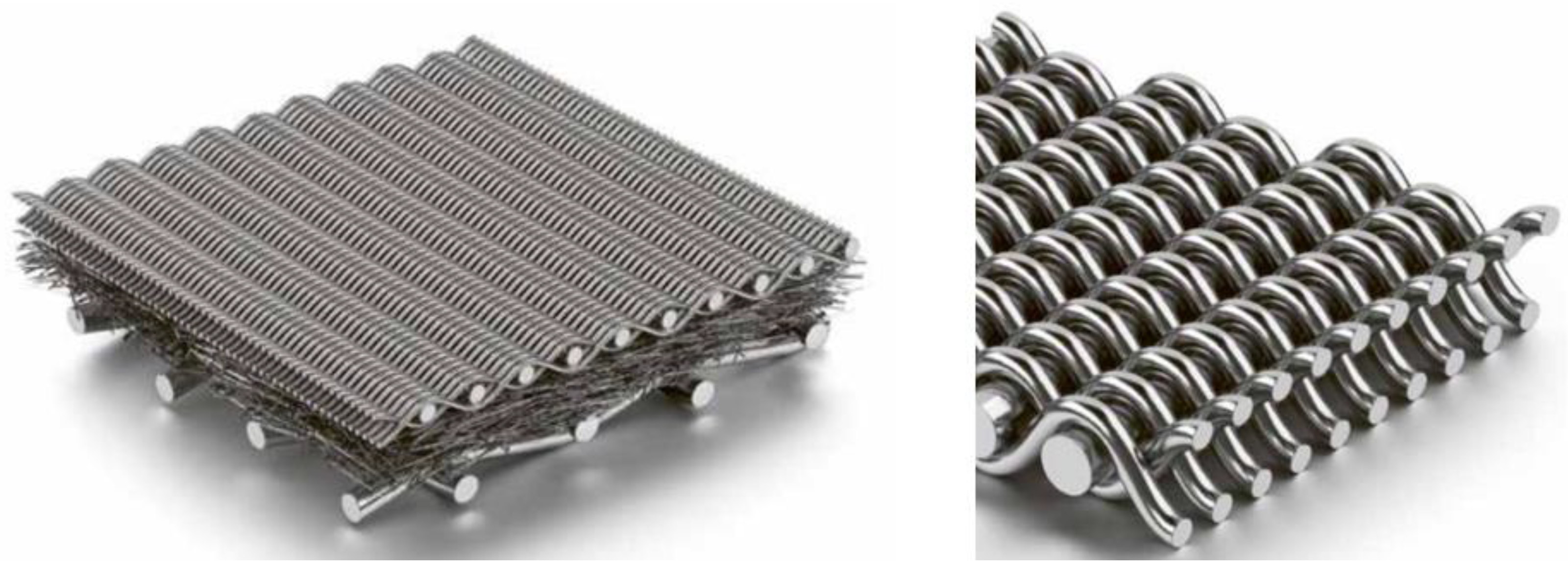
Company GKD offers metallic mesh filter elements for hot gas filtration, which are thermally resistant up to 600 °C. Specifically, they offer a highly porous Trimetric filter that has high filtration efficiency (with a flow velocity of 0.7–1 m/min), mechanical resistance to vibrations, regenerability during the service, and the filter can be cleaned externally. Trimetric filter enhances process efficiency (by reducing CO2 emissions) and minimizes costs. The filter is created by a combination of Optimized Dutch Weaves (on the inflow side) and nonwoven metal fiber mesh (on the outflow side), see Fig. 3. The filter is modular, so it can be applied to existing cartridge filter systems, bag filter systems, or systems based on filter leaves. For bag filter applications, reversed plain dutch weaves (RPDW) (pure wire mesh layers) are used, because thanks to their structure, they have increased tensile strength, and thus can be attached to existing supporting bodies [15].
Figure 3.
The combination of optimized dutch weaves (on the inflow side) and nonwoven metal fiber mesh (on the outflow side) (on the left) and reversed plain dutch weaves (RPDW) (on the right) [15].
Figure 3.
The combination of optimized dutch weaves (on the inflow side) and nonwoven metal fiber mesh (on the outflow side) (on the left) and reversed plain dutch weaves (RPDW) (on the right) [15].
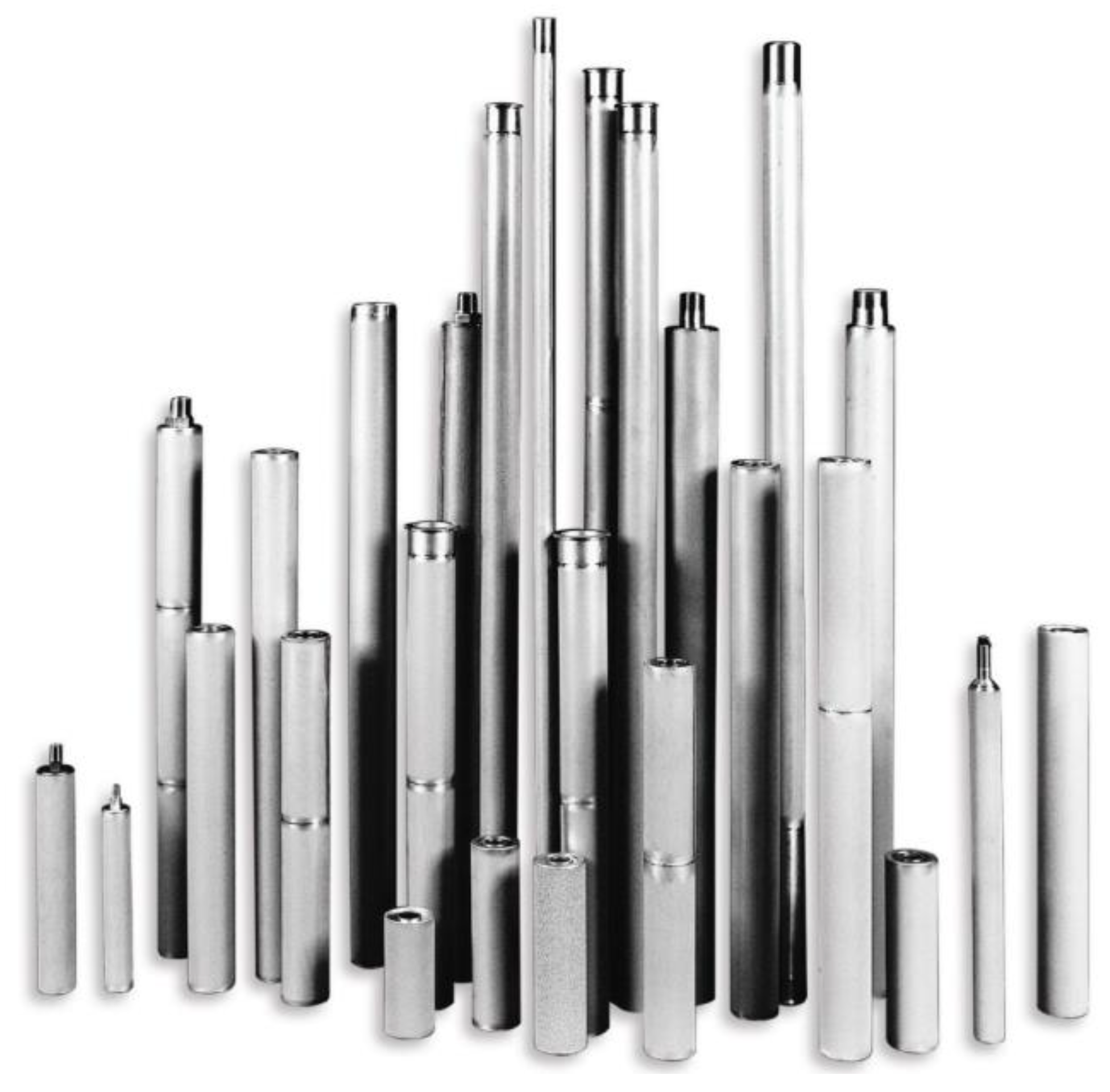
Company Mott Corporation offers sintered porous metal filter elements, see Fig. 4. Rolled and welded elements are typically 316L stainless steel porous media with 316 stainless steel hardware. Other materials include stainless steels (304L, 310, 347, and 430); superalloys (Hastalloy), Nickel-Chromium superalloys (Inconel), Nickel-copper alloys (Monel 400), other nickel alloys (Nickel 200, Alloy 20), and other materials (titanium). Clogged filters can be cleaned by a blowback system (blowing back), or contaminants can be removed chemically by solvents (chemical cleaning). Chemically inert materials are removed using ultrasonic cleaning. Also, controlled-atmosphere fluid bed furnaces can be used for cleaning [65].
Figure 4.
The sintered porous metal filter elements [65].
Figure 4.
The sintered porous metal filter elements [65].
Company Saifilter offers high mechanical strength metal filters in versions such as sintered metal fibre or sintered metal mesh for hot gas filtration. They are resistant to temperatures up to 450 °C [66,67].
Company DDD offers corrosion resistant and heat resistant stainless steel filter media (woven wire cloth, sintered wire cloth laminate, and sintered metal fiber media) [68].
Company DaZhou Metal Mesh offers stainless steel woven wire mesh made of 304 stainless steel alloy. Furthermore, they offer sintered mesh filters, which are depth filters with a thickness of 1.7 mm and are constructed from multiple layers of stainless-steel woven mesh (materials are AISI 304, AISI 316, or AISI 316L). It is possible to filter PM from 1 µm to 200 µm. Their heat resistance is 600 °C. The filtration elements can be made in different designs, such as disc, round, cylindrical, conical, and pleated shapes. The types are sintered dutch woven wire mesh and sintered square woven wire mesh. Furthermore, they offer metal fiber felt filters, made of 316L, 316, 304, and pure nickel [69].
Company Filtalloy technology offers hot gas filtration elements, respectively, sintered metal filters with asymmetric metal film. The filters are made of stainless steel 316L, 310S, or Fe-Cr-Al alloy, their oxidation temperatures are 400, 600, and 800 °C, and porosities are 75, 75, and 68 % [70].
Company Kumar Process Consultants & Chemicals offers powder sintered filters for hot flue gas filtration, made of stainless steel 316 or 316L, nickel-based filter (Hastelloy C22/C276/X), inconel alloys, titanium, and iron-aluminium alloys (intermetallic). They offered various structures of filter, such as powder sintered (cylindrical cartridges), pleated, fiber felt, and multilayered sintered [71].
5.1. Summary of Commercially Offered Metal Filters
There are several companies offering metal filters for large combustion devices in various designs. Such filters can have a retained dust particle size of ≤0.1 μm. They have high temperature and chemical resistance and are easily regenerated, making them suitable for long-term operation in harsh industrial environments.
6. Discussion
In this section, the findings from the described research studies are discussed/summarized.
6.1. Filtration and Adsorption Mechanisms of the Described Filters
In metal mesh filters, which have a microstructure, filtration of PM occurs through the filtration mechanisms described in the previous study (impaction, diffusion, sieving, electrostatic interactions, etc.), mainly surface filtration, where the formation of a filter cake increases filtration efficiency [16].
In metal composite filters, filtration of PM also occurs, and the presence of surface (functional) groups on carbon nanowires contributes to the capturing of organic compounds present in the PM based on near-field interactions [5].
In MOF-polymer composites, PM filtration and gaseous emissions adsorption occur through the mechanisms described in section 3.1. Polymer nanofibers with diameters below 500 nm increase PM capture through the slip-flow effect and mechanisms such as interception and sieving, thus reducing pressure drop while maintaining high filtration efficiency [5,50,51]. This innovative nanomaterial (with fiber diameter below 1000 nm) is capable of filtering PM0.3 due to its fine structure, while the MOF, e.g. ZIFs (pore size ~1–2 nm) can adsorb on their surface toxic volatile organic compounds VOCs (formaldehyde, benzene, toluene), aniline, and carbon dioxide (CO2) via chemical or physical adsorption, thus contributing to global warming. As mentioned in the introduction, these fine PM0.3 carry more harmful pollutants than larger PM, therefore, their removal is essential.
6.2. Regeneration of the Described Filters
External metal mesh filters in the form of stainless-steel fabric, which have only surface filtration, have a high filtration efficiency and can be self-cleaning during continuous operation for 1440 h (easily removed by turbulent gas flow or vibration) in case of low adhesion between the particles and the filter. This implies that a filter cake can be formed more quickly on the surface of the filter, which increases the filtration efficiency. There is no deep filtration of the filter and therefore no clogging of the filter by particles [17]. Metal mesh filters in the form of metal candles used for small combustion boilers can be easily cleaned by pulse-jet cleaning, typically every two hours during continuous operation [10].
Metal composite filters can be regenerated by burning the particles at 550 °C using electrical resistive heating. However, in the case of carbon nanowires grown on a 304 stainless steel mesh, repeated regeneration which takes three hours led to gradual degradation of the filter structure [5]. Metal composite filters can have a smaller size of fiber on the surface of the filter than on the support. Dense fibers on the surface of the filter can prevent PM from entering inside the filter, so pulse-jet cleaning of filters can be more efficient/easier than for a pure metal mesh filter [56]. However, detailed studies on long-term mechanical integrity of filters after multiple regeneration cycles are still limited.
MOF-polymer composites, due to their fragile structure [72], can be regenerated by softer methods, such as ultrasonic cleaning [9]. From the studies described on MOF-polymer composites, only one study reported filter cleaning. It was shown that after five filtration cycles (each cycle takes 120 minutes) of ultrasonic cleaning, the filter maintained high filtration efficiency, indicating good reusability and potential for long-term applications [9].
6.3. Comparison and Practical Potential of the Described Filters
In this section, the described tested filters are compared and assessed in terms of their practical potential for combustion systems.
The main advantage of metal mesh filters (e.g., from stainless steel) is their mechanical, chemical, and temperature resistance. Some metal filters were tested at flue gas temperatures of up to 800 °C. According to the commercially offered metal filters, it is obvious that they are suitable for high-temperature flue gas filtration. The manufacturing of filters is simple and cheap, and thanks to efficient regeneration, such a filter can be reused. The disadvantage may be their ability to filter only PM.
Metal composite filters can also be used for high-temperature flue gas filtration. The application of these filters depends on the materials used. For example, FeAl/Al₂O₃ PCMM filters have high mechanical, thermal, and chemical stability and are thus suitable for demanding industrial environments [57]. In aggressive environments, for example, metal filters with a protective coating are suitable, as mentioned in section 2.1. The disadvantage is that they are more complex and expensive to produce.
MOF-polymer composites can adsorb gaseous emissions, making them a highly innovative composite nanomaterial compared to metal filters, which primarily filter PM. Apart from the advantages mentioned in section 3.1, they have disadvantages such as lower temperature resistance, lower mechanical resistance due to their brittleness, and complex and expensive production. The authors of the studies tested MOF-polymer composites at up to 300 °C due to the presence of MOF, although, for example, polymer fibers PI have a higher temperature resistance. Other types of MOFs may exhibit higher thermal stability, for example, zirconium-based MOFs such as NH₂-UiO-66 [73]. Despite the disadvantages, CO₂ concentration can be reduced through adsorption, which could lead to lower costs for emission allowances in industry, in addition to environmental benefits. In addition to the adsorption of gaseous emissions using MOF-polymer composites, recent developments also investigate their catalysis for reducing CO2 [74] and other compounds. MOF-polymer composites can also be used in combination with metal filters, either integrated together or arranged sequentially to improve the purification of flue gas from gaseous emissions. Alternatively, MOF nanoparticles can also be applied to metal substrates [75], thus combining the advantages of these two materials. However, further research is needed to verify their functionality for high-temperature flue gas filtration.
7. Conclusion and Future Challenges
The authors of the studies test filters for high-temperature flue gas filtration (>200 °C) in various types – metal mesh, metal composite, and MOF-polymer composites. The main findings are summarized as follows:
- Metal filters and MOF-polymer composites are very promising materials for reducing air pollution. Their usage and maintenance depend on their thermal, chemical (e.g., oxidation), and mechanical resistance. The choice of material must be adapted to the operating environment, including the chemical composition of the flue gas, temperature, and humidity. Further research is needed to improve the thermal resistance of MOF-based filters.
- For comparing the efficiency of the tested filters, a uniform measurement methodology is necessary. This is related to the refinement of standards for measuring the filtration efficiency of filter materials for high-temperature flue gas filtration.
- With stricter limits and greater awareness of air pollution, filters may be introduced in combustion systems, but further research is still needed for the practical application of an efficient, operationally safe, and recyclable filter at an acceptable financial cost.
Acknowledgements
This research was funded by projects of the Brno University of Technology: FSI-S-23-8223 Optimization of processes and fuels for lower emissions.
Institutional Review Board Statement
Not applicable.
Informed Consent Statement
Not applicable.
Data Availability Statement
Data are contained within the article.
Conflicts of Interest
The authors declare no conflict of interest.
References
- Wei, W.; Tao, Y.; Feng, T.; Wu, Y.; Li, L.; Pang, J.; Li, D.; Xu, G.; Liang, X.; Gao, M.; et al. Self-Assembly-Dominated Hierarchical Porous Nanofibrous Membranes for Efficient High-Temperature Air Filtration and Unidirectional Water Penetration. J. Memb. Sci. 2023, 686, 121996. [Google Scholar] [CrossRef]
- Gao, Y.; Tian, E.; Zhang, Y.; Mo, J. Utilizing Electrostatic Effect in Fibrous Filters for Efficient Airborne Particles Removal: Principles, Fabrication, and Material Properties. Appl. Mater. Today 2022, 26, 101369. [Google Scholar] [CrossRef]
- Wang, S.; Zhao, Y. Air Pollution and Lung Cancer Risks. In Encyclopedia of Environmental Health; Elsevier, 2011; pp. 26–38.
- Anderson, J.O.; Thundiyil, J.G.; Stolbach, A. Clearing the Air: A Review of the Effects of Particulate Matter Air Pollution on Human Health. J. Med. Toxicol. 2012, 8, 166–175. [Google Scholar] [CrossRef] [PubMed]
- Yang, K.; Yu, Z.; Yu, C.; Chen, H.; Pan, F. An Electrically Renewable Air Filter with Integrated 3D Nanowire Networks. Adv. Mater. Technol. 2019, 4. [Google Scholar] [CrossRef]
- State of Global Air Report 2024 | State of Global Air. Available online: https://www.stateofglobalair.org/resources/report/state-global-air-report-2024 (accessed on 8 July 2024).
- Zhu, C.; Yang, F.; Xue, T.; Wali, Q.; Fan, W.; Liu, T. Metal-Organic Framework Decorated Polyimide Nanofiber Aerogels for Efficient High-Temperature Particulate Matter Removal. Sep. Purif. Technol. 2022, 300, 121881. [Google Scholar] [CrossRef]
- Li, S.; Baeyens, J.; Dewil, R.; Appels, L.; Zhang, H.; Deng, Y. Advances in Rigid Porous High Temperature Filters. Renew. Sustain. Energy Rev. 2021, 139, 110713. [Google Scholar] [CrossRef]
- Xie, F.; Wang, Y.; Zhuo, L.; Ning, D.; Yan, N.; Li, J.; Chen, S.; Lu, Z. Multiple Hydrogen Bonding Self-Assembly Tailored Electrospun Polyimide Hybrid Filter for Efficient Air Pollution Control. J. Hazard. Mater. 2021, 412, 125260. [Google Scholar] [CrossRef]
- Schott, F.; Baumbach, G.; Straub, D.; Thorwarth, H.; Vogt, U. Novel Metal Mesh Filter Equipped with Pulse-Jet Regeneration for Small-Scale Biomass Boilers. Biomass and Bioenergy 2022, 163, 106520. [Google Scholar] [CrossRef]
- Kaivosoja, T.; Jalava, P.I.; Lamberg, H.; Virén, A.; Tapanainen, M.; Torvela, T.; Tapper, U.; Sippula, O.; Tissari, J.; Hillamo, R.; et al. Comparison of Emissions and Toxicological Properties of Fine Particles from Wood and Oil Boilers in Small (20–25 KW) and Medium (5–10 MW) Scale. Atmos. Environ. 2013, 77, 193–201. [Google Scholar] [CrossRef]
- Sippula, O.; Hokkinen, J.; Puustinen, H.; Yli-Pirilä, P.; Jokiniemi, J. Comparison of Particle Emissions from Small Heavy Fuel Oil and Wood-Fired Boilers. Atmos. Environ. 2009, 43, 4855–4864. [Google Scholar] [CrossRef]
- Johansson, L.S.; Tullin, C.; Leckner, B.; Sjövall, P. Particle Emissions from Biomass Combustion in Small Combustors. Biomass and Bioenergy 2003, 25, 435–446. [Google Scholar] [CrossRef]
- Yang, L.; Ji, Z.; Xu, Q.; Li, H. Performance Assessment of Sintered Metal Fiber Filters in Fluid Catalytic Cracking Unit. Int. J. Chem. Eng. 2014, 2014, 1–10. [Google Scholar] [CrossRef]
- Metallic Mesh Filter Elements for Hot Gas Filtration Available online: https://www.gkd-group.com/wp-content/uploads/2023/08/hot-gas-filtration_brochure_c_gkd.pdf.
- Gregorovičová, E.; Pospíšil, J. Ceramic Filters for High-Temperature Flue Gas Filtration and Their Regeneration: A Review of the Current State of Knowledge. Process Saf. Environ. Prot. 2024, 190, 688–703. [Google Scholar] [CrossRef]
- Qu, H.; Lai, N.; Jiang, B.; Liu, X.; Xia, D. An Efficient and Continuous Filter Operation for Dust-laden Flue Gas Based on a Self-cleaning Stainless Steel Weaved Filter. Environ. Prog. Sustain. Energy 2023, 42. [Google Scholar] [CrossRef]
- Chen, M.; Zeng, Y.; Wang, H. PTFE Foam Coating Ultrafine Glass Fiber Composite Filtration Material with Ultra-Clean Emissions. Sep. Purif. Technol. 2025, 352, 128219. [Google Scholar] [CrossRef]
- FRMC Hot Gas Filter – Replace Ceramic for Ultra-High TEMP. Available online: https://www.metalfilter.org/metalfilter/frmc-hot-gas-filter/index.html (accessed on 8 August 2024).
- Rahimpour, M.R.; Makarem, M.A.; Meshksar, M. Advances in Synthesis Gas: Methods, Technologies and Applications: Syngas Purification and Separation; Elsevier Science, 2022; ISBN 9780323985215.
- Liu, P.; Chen, G.F. Porous Materials: Processing and Applications; Elsevier Science, 2014; ISBN 9780124078376.
- Li, L.; Zhou, Y.; Sun, Z.; Gu, H.; Shi, J.; Wang, X.; Chen, M.; Zhao, Z. Improved Design of Metal Fiber Filter Materials: Experiment and Theory. J. Memb. Sci. 2023, 675, 121559. [Google Scholar] [CrossRef]
- Tarleton, E.S. Progress in Filtration and Separation; Elsevier Science, 2014; ISBN 9780123983077.
- Shi, J.; Kumar, C. The Effect of Fibre Surface Roughness on the Mechanical Behaviour of Ceramic Matrix Composites. Mater. Sci. Eng. A 1998, 250, 194–208. [Google Scholar] [CrossRef]
- Israelachvili, J.N. Intermolecular and Surface Forces; Intermolecular and Surface Forces; Academic Press, 2011; ISBN 9780123919335.
- Li, L.; Zhou, Y.; Li, X.; Hou, X.; Xu, Y.; Sun, Z.; Gu, H.; Ding, R. Three-Dimensional Numerical Simulation and Structural Optimization of Filtration Performance of Pleated Cylindrical Metal Fiber Filter. Sep. Purif. Technol. 2023, 311, 123224. [Google Scholar] [CrossRef]
- Baeyens, J. The Growing Potential of Sintered Metal Fiber Filters. Proc6th Glob Con f Mater Sci Eng 2017, 24–27. [Google Scholar]
- Schildermans, I.; Baeyens, J.; Smolders, K. Pulse Jet Cleaning of Rigid Filters: A Literature Review and Introduction to Process Modelling. Filtr. Sep. 2004, 41, 26–33. [Google Scholar] [CrossRef]
- Struschka, M.; Goy, J. Entwicklung Eines Kompakten Und Kostengünstigen Gewebefilters Für Biomassekessel. Inst. für Feuerungs-und Kraftwerkstechnik (IFK), Univ. Stuttgart 2015.
- Shah, Y.T. Chemical Energy from Natural and Synthetic Gas; CRC Press, 2017; ISBN 9781523114054.
- Yang, L.; Ji, Z.; Wu, X.; Ma, W. Application and Operating Experience of Sintered Metal Fiber Hot Gas Filters for FCC Unit. Procedia Eng. 2015, 102, 1073–1082. [Google Scholar] [CrossRef]
- Dey, A.; Kayal, N.; Chakrabarti, O.; Innocentini, M.D.M. Permeation Behavior of Oxide Bonded SiC Ceramics at High Temperature and Prediction of Pressure Drop in Candle Filters. Trans. Indian Ceram. Soc. 2022, 81, 59–67. [Google Scholar] [CrossRef]
- Jha, S.; Rubow, K.L.; Sekellick, R. Sintered Metal Hot Gas Filters Available online: https://mottcorp.com/wp-content/uploads/2020/05/Sintered-Metal-Hot-Gas-Filters.pdf.
- childermans, I.; Baeyens, J. Hot Gas Filtration: A Growing Market. In Proceedings of the Proceedings of the 4th International Conference for Conveying and Handling Particulate Solids, Budapest, May 2003; 2003.
- Kamp, C.J.; Folino, P.; Wang, Y.; Sappok, A.; Ernstmeyer, J.; Saeid, A.; Singh, R.; Kharraja, B.; Wong, V.W. Ash Accumulation and Impact on Sintered Metal Fiber Diesel Particulate Filters. SAE Int. J. Fuels Lubr. 2015, 8, 2015–2015-01–1012. [Google Scholar] [CrossRef]
- Ma, S.; Zhou, Y.; Sun, Z.; Gu, H.; Yuan, H.; Cao, S. Numerical Simulation Study on Depth Filtration Performance of Metal Fiber Pre-Filters with Different Pleat Structures. Nucl. Eng. Des. 2024, 425, 113337. [Google Scholar] [CrossRef]
- Ma, S.; Zhou, Y.; Sun, Z.; Gu, H.; Wang, Y.; Yu, X. Numerical Simulation Study on the Filtration Performance of Metal Fiber Filters. Prog. Nucl. Energy 2024, 171, 105169. [Google Scholar] [CrossRef]
- Kim, M.-W.; Kim, Y.-I.; Park, C.; Aldalbahi, A.; Alanazi, H.S.; An, S.; Yarin, A.L.; Yoon, S.S. Reusable and Durable Electrostatic Air Filter Based on Hybrid Metallized Microfibers Decorated with Metal–Organic–Framework Nanocrystals. J. Mater. Sci. Technol. 2021, 85, 44–55. [Google Scholar] [CrossRef]
- Dong, W.; Gao, Q.; Zhou, S.; Tang, G.; Xiang, T.; Chun, T.; Zhang, K.; Long, H.; Qian, F.; Li, G. Ultra-Superhydrophobic MOFs Coated on Polydopamine-Modified Polyethylene Terephthalate for Efficient Removal of Particulate Matter. Chem. Eng. J. 2023, 466, 143083. [Google Scholar] [CrossRef]
- Liu, X.-M.; Xie, L.-H.; Wu, Y. Recent Advances in the Shaping of Metal–Organic Frameworks. Inorg. Chem. Front. 2020, 7, 2840–2866. [Google Scholar] [CrossRef]
- Hao, Z.; Wu, J.; Wang, C.; Liu, J. Electrospun Polyimide/Metal-Organic Framework Nanofibrous Membrane with Superior Thermal Stability for Efficient PM 2.5 Capture. ACS Appl. Mater. Interfaces 2019, 11, 11904–11909. [Google Scholar] [CrossRef] [PubMed]
- Soleimani, B.; Niknam Shahrak, M.; Walton, K.S. The Influence of Different Functional Groups on Enhancing CO2 Capture in Metal-Organic Framework Adsorbents. J. Taiwan Inst. Chem. Eng. 2024, 163, 105638. [Google Scholar] [CrossRef]
- Wang, Z.; Yin, F.; Zhang, X.-F.; Zheng, T.; Yao, J. Delignified Wood Filter Functionalized with Metal-Organic Frameworks for High-Efficiency Air Filtration. Sep. Purif. Technol. 2022, 293, 121095. [Google Scholar] [CrossRef]
- Mao, J.; Tang, Y.; Wang, Y.; Huang, J.; Dong, X.; Chen, Z.; Lai, Y. Particulate Matter Capturing via Naturally Dried ZIF-8/Graphene Aerogels under Harsh Conditions. iScience 2019, 16, 133–144. [Google Scholar] [CrossRef] [PubMed]
- Bian, Y.; Wang, R.; Wang, S.; Yao, C.; Ren, W.; Chen, C.; Zhang, L. Metal–Organic Framework-Based Nanofiber Filters for Effective Indoor Air Quality Control. J. Mater. Chem. A 2018, 6, 15807–15814. [Google Scholar] [CrossRef]
- Zhang, M.; Niu, H.; Wu, D. Polyimide Fibers with High Strength and High Modulus: Preparation, Structures, Properties, and Applications. Macromol. Rapid Commun. 2018, 39. [Google Scholar] [CrossRef]
- Xiao, H.; Low, Z.-X.; Gore, D.B.; Kumar, R.; Asadnia, M.; Zhong, Z. Porous Metal–Organic Framework-Based Filters: Synthesis Methods and Applications for Environmental Remediation. Chem. Eng. J. 2022, 430, 133160. [Google Scholar] [CrossRef]
- Garg, K.; Bowlin, G.L. Electrospinning Jets and Nanofibrous Structures. Biomicrofluidics 2011, 5. [Google Scholar] [CrossRef]
- Gao, D.; Wang, P.; Shi, J.; Li, F.; Li, W.; Lyu, B.; Ma, J. A Green Chemistry Approach to Leather Tanning Process: Cage-like Octa(Aminosilsesquioxane) Combined with Tetrakis(Hydroxymethyl)Phosphonium Sulfate. J. Clean. Prod. 2019, 229, 1102–1111. [Google Scholar] [CrossRef]
- De Riccardis, M.F. Electrospun Nanofibrous Membranes for Air Filtration: A Critical Review. Compounds 2023, 3, 390–410. [Google Scholar] [CrossRef]
- Zhang, S.; Rind, N.A.; Tang, N.; Liu, H.; Yin, X.; Yu, J.; Ding, B. Electrospun Nanofibers for Air Filtration. In Electrospinning: Nanofabrication and Applications; Elsevier, 2019; pp. 365–389.
- Wang, A.; Fan, R.; Zhou, X.; Hao, S.; Zheng, X.; Yang, Y. Hot-Pressing Method To Prepare Imidazole-Based Zn(II) Metal–Organic Complexes Coatings for Highly Efficient Air Filtration. ACS Appl. Mater. Interfaces 2018, 10, 9744–9755. [Google Scholar] [CrossRef] [PubMed]
- Bian, Y.; Niu, Z.; Zhang, C.; Pan, Y.; Wang, Y.; Chen, C. Encrusting MOF Nanoparticles onto Nanofibers via Spray-Initiated Synthesis to Boost the Filtration Performances of Nanofiber Membranes. Sep. Purif. Technol. 2024, 331, 125569. [Google Scholar] [CrossRef]
- Yang, Z.; Zhen, Y.; Feng, Y.; Jiang, X.; Qin, Z.; Yang, W.; Qie, Y. Polyacrylonitrile@TiO2 Nanofibrous Membrane Decorated by MOF for Efficient Filtration and Green Degradation of PM2.5. J. Colloid Interface Sci. 2023, 635, 598–610. [Google Scholar] [CrossRef]
- Eltrop, L.; Härdtlein, M.; Jenssen, T.; Henßler, M.; Kruck, C.; Özdemnir, E.D.; Hartmann, H.; Poboss, N.; Scheffknecht, G. Leitfaden Feste Biobrennstoffe:[Planung, Betrieb Und Wirtschaftlichkeit von Bioenergieanlagen Im Mittleren Und Großen Leistungsbereich](4., Vollst. Überarb. Aufl.). Gülzow-Prüzen FNR 2014.
- Xie, B.; Li, S.; Chu, W.; Liu, C.; Hu, S.; Jin, H.; Zhou, F. Improving Filtration and Pulse-Jet Cleaning Performance of Metal Web Filter Media by Coating with Polytetrafluoroethylene Microporous Membrane. Process Saf. Environ. Prot. 2020, 136, 105–114. [Google Scholar] [CrossRef]
- Gui, W.; Liang, Y.; Dong, D.; Lin, J. FeAl/Al2O3 Porous Composite Microfiltration Membrane for Highly Efficiency High-temperature Particulate Matter Capturing. J. Porous Mater. 2021, 28, 955–961. [Google Scholar] [CrossRef]
- Zhang, L.M.; Hirai, T.; Kumakawa, A.; Yuan, R.Z. Cyclic Thermal Shock Resistance of TiC/Ni3Al FGMs. Compos. Part B Eng. 1997, 28, 21–27. [Google Scholar] [CrossRef]
- Xie, F.; Zhang, N.; Zhuo, L.; Qin, P.; Chen, S.; Wang, Y.; Lu, Z. “MOF-Cloth” Formed via Supramolecular Assembly of NH2-MIL-101(Cr) Crystals on Dopamine Modified Polyimide Fiber for High Temperature Fume Paper-Based Filter. Compos. Part B Eng. 2019, 168, 406–412. [Google Scholar] [CrossRef]
- Gregorovičová, E.; Pospíšil, J.; Sitek, T. The Bulk Density and Cohesion of Submicron Particles Emitted by a Residential Boiler When Burning Solid Fuels. Fire 2023, 6, 445. [Google Scholar] [CrossRef]
- ISO 29463-3:2011 - High-Efficiency Filters and Filter Media for Removing Particles in Air — Part 3: Testing Flat Sheet Filter Media. Available online: https://www.iso.org/standard/51837.html (accessed on 17 October 2024).
- Wei, W.; Han, Y.; Chen, J.; Han, F.; Zou, D.; Zhang, F.; Zhong, Z.; Xing, W. Fabrication of Robust SiC Ceramic Membrane Filter with Optimized Flap for Industrial Coal-Fired Flue Gas Filtration. Sep. Purif. Technol. 2022, 302, 122075. [Google Scholar] [CrossRef]
- Impossible, W. Standard Hot Gas Cleaning Filter Available online: https://www.boedon.com/pdf/hot-gas-filtration-filter-elements-catalogue.pdf.
- Metal Hot Gas Filter Offers Great Resistant to High Temperatures. Available online: https://www.boedon.com/products/industrial-filtration/hot-gas/index.html (accessed on 3 August 2024).
- Porous Metal Filter Elements Available online: https://mottcorp.com/wp-content/uploads/2020/05/Filter-Element-Overview.pdf.
- Industrial High-Temp Gas Filter | Saifilter Hot Gas System. Available online: https://www.saifilter.com/products/hot-gas-industry-filter/ (accessed on 22 April 2025).
- High Temperature Gas Filtration System Available Media and Materials Sintered Metal Fibre Sintered Metal Mesh Available online: https://www.saifilter.com/wp-content/uploads/2020/11/Saifilter-Hot-Gas-Filters-Brochure.pdf.
- Stainless Steel Filter Media Available online: https://dorstener-drahtwerke.de/wp-content/uploads/2023/09/Marktinfo-Filtermedia-Englisch.pdf.
- DaZhou Metal Mesh Industrial|Iron Wire|Filtration Metal Mesh. Available online: https://www.dzmetalmesh.com/ (accessed on 6 September 2024).
- Filter Elements Available online: https://alloyfilter.com/wp-content/uploads/2022/08/ALL-FILTER-ELEMENTS-FROM-FILTALLOY.pdf.
- Filters Manufacturer in India | Kumar Filters. Available online: https://kumarfilter.com/index.php (accessed on 6 September 2024).
- Deeraj, B.D.; Jayan, J.S.; Raman, A.; Asok, A.; Paul, R.; Saritha, A.; Joseph, K. A Comprehensive Review of Recent Developments in Metal-Organic Framework/Polymer Composites and Their Applications. Surfaces and Interfaces 2023, 43, 103574. [CrossRef]
- Meng, Y.; Yue, F.; Zhang, S.; Zhang, L.; Li, C.; Shi, M.; Ma, Y.; Berrettoni, M.; Zhang, X.; Zhang, H. Zr-MOF/MXene Composite for Enhanced Photothermal Catalytic CO2 Reduction in Atmospheric and Industrial Flue Gas Streams. Carbon Capture Sci. Technol. 2024, 13, 100274. [Google Scholar] [CrossRef]
- Liu, K.-G.; Bigdeli, F.; Panjehpour, A.; Larimi, A.; Morsali, A.; Dhakshinamoorthy, A.; Garcia, H. Metal Organic Framework Composites for Reduction of CO2. Coord. Chem. Rev. 2023, 493, 215257. [Google Scholar] [CrossRef]
- Omarova, A.; Baimatova, N.; Kazemian, H. MOF-199-Based Coatings as SPME Fiber for Measurement of Volatile Organic Compounds in Air Samples: Optimization of in Situ Deposition Parameters. Microchem. J. 2023, 185, 108263. [Google Scholar] [CrossRef]

Table 1.
Overview of filtration efficiency and pressure drop of tested filters.
| Filter type | Dimensions (mm) / Filtration area (cm2) | Combustion source (product) | Production method | Mesh or wire size / Fiber or wire diameter (µm) / Porosity (%) | Flue gas temperature (°C) |
Particle size (µm) |
Flow rate (Airflow) (m3/h) | Airflow Velocity (m/s) |
Pressure drop (Pa) |
Filtration efficiency (%) / Dust concentration (mg/m3) |
|---|---|---|---|---|---|---|---|---|---|---|
|
METAL MESH Qu et al. [62] Stainless steel weaved bag (SSWB) |
8200 cm2 130 mm (Diameter) 2000 mm (Length) |
Dust-laden flue gas (SiO2 and Al2O3) | Plain Dutch weave method | 800 ± 10 | 5.71 (Average) |
1560 ± 5 |
0.03 (Superficial) |
2820–2910 (<3000) (Before cleaning) |
Above 99.9 with 1440 h <8.3 (Outlet) 17000 ± 300 (Inlet) |
|
|
METAL MESH Schott et al. [10] Stainless steel mesh |
800 cm2 (One candle) 1200 cm2 (Total) |
Dust-laden flue gas | Weave – braid, twill, linen | 25, 50, 135 (Mesh size) 61.3, 34.6, 36 (Porosity) |
700 (Max.) |
64.1 ± 4.7 | 0.9 ± 0.1 |
1200 ± 10 (Max.) 200-400 (Residual) |
90 (Max.) <20 (Outlet) (for 25 and 50 mesh size) 83 (Max. regenerability efficiency) |
|
|
METAL COMPOSITE Yang et al. [5] Carbon nanowires growth on a 304 Stainless steel mesh |
Incense coil | In situ vapor growth method | 30 × 30 (Openings of the mesh) 10–100 (The length of nanowires) ~0.12 (Diameter of the nanowires) |
PM2.5 |
0.002432 |
0.1 |
200–300 (Initial) |
96.1 (After four cycles >95) >2 (Inlet) |
||
| PM10 | ||||||||||
|
METAL COMPOSITE Xie et al. [56] Metal web with PTFE |
0.37 mm (Metal web) 0.11 mm (PTFE membrane) (Thickness) 230 mm (Length) 85 mm (Wide) |
Dust (SiO2) | Hot-pressing process | 1.71 (Metal web fiber) 0.38 (PTFE fiber) |
260 | 2.61 (Median diameter) PM2.5 = 46.52 % |
0.1023 (Face) |
425 (Residual) |
99.32 0.532 (Outlet, average) 130 (Inlet) |
|
|
METAL COMPOSITE Gui et al. [57] FeAl/Al2O3 PCMM |
7.065 cm2 (Effective) 5 mm (Thickness) |
Incense | Powder metallurgy method via the combination of mutual diffusion and chemical reaction | 2.34 (Average pore diameter) 1–3 (Bigger pore diameter) 0–1 (Smaller pore diameter) 47.6 (Porosity) |
600 | PM2.5 | 0.12 | 3000 |
96.2 |
|
| PM2.5–10 | 99.3 | |||||||||
|
MOF-POLYMER COMPOSITES Xie et al. [59] PI@PDA@MOF fibers |
100 cm2 (Effective) |
NaCl particles (0.3–10 µm) |
8 (Average diameter of PI Fiber) 5–6 mm (Length of PI fibers) |
260 | PM0.3 | 0.032 | 57.5 | 93.05 ± 1.27 | ||
|
MOF-POLYMER COMPOSITES Xie et al. [9] PI-POSS@ZIF |
100 cm2 (Effective) |
NaCl particles (0.3–10 µm) |
Electrospinning and hydrogen bonding self-assembly | 0.266 ± 0.035 (PI fiber diameter) |
280 | PM0.3 |
0.032 |
49.21 | 99.28 | |
|
MOF-POLYMER COMPOSITES Zhu et al. [7] ZIF-8/PI NFA |
5 mm (Thickness) 50 cm2 (Effective) |
Incense | Electrospinning, imidization, etc. | 300 | PM2.5-10 | 0.053 (Face) |
88.5 | 99.3 | ||
| PM2.5 | 99.5 | |||||||||
|
MOF-POLYMER COMPOSITES Dong et al. [39] SH-Mp-PET (Ti, Zn, Cu) |
0.001–0.002 (Pore size of MOF) |
Up to 200 (Thermal stability) |
PM0.3 | 53 (Ti) |
97.97 ± 0.81 | |||||
| 49 (Zn) |
97.76 ± 0.48 | |||||||||
| 50 (Cu) |
97.83 ± 0.54 | |||||||||
|
MOF-POLYMER COMPOSITES Wei et al. [1] PI/CD-MOF nanofiber filter |
100 cm2 (Effective) |
NaCl particles (0.3–2.5 µm) |
Co-electrospinning method | 1000 (Metal mesh) 0.680 ± 0.020 (PI fiber diameter) |
<300 | PM0.3 | 0.032 | 136 | 99.85 |
Disclaimer/Publisher’s Note: The statements, opinions and data contained in all publications are solely those of the individual author(s) and contributor(s) and not of MDPI and/or the editor(s). MDPI and/or the editor(s) disclaim responsibility for any injury to people or property resulting from any ideas, methods, instructions or products referred to in the content. |
© 2025 by the authors. Licensee MDPI, Basel, Switzerland. This article is an open access article distributed under the terms and conditions of the Creative Commons Attribution (CC BY) license (http://creativecommons.org/licenses/by/4.0/).
Copyright: This open access article is published under a Creative Commons CC BY 4.0 license, which permit the free download, distribution, and reuse, provided that the author and preprint are cited in any reuse.


