
Submitted:
08 September 2025
Posted:
10 September 2025
You are already at the latest version
Abstract
Amid the limited adoption of agroecology among farmers, a controversy overlooked in past studies is the perception that the agroecological approach represents a Western agenda being promoted in developing countries for ulterior motives. A study was conducted to address the contention which determined how the agroecology agenda should be reconstructed to navigate the diverse aspirations and perceptions of farmers and other actors, and the wider agricultural sector context of Malawi. The study drew on 20 key informant interviews at macro and micro levels and 16 focus group discussions with extension workers and farmers. It was found that while agroecology is relevant to Malawi, there are many critical unresolved issues around it concerning aspirations, perceptions and national priorities. The agroecology agenda is introduced by external actors to farmers in a top down fashion and often is promoting experts’ aspirations. Both development partners and local promoters of agroecology projects were perceived to have hidden agenda. However, the promoters advance a narrative that blames the farmers for agricultural problems. The agricultural commercialisation agenda prioritizes profits, challenging agroecology with its multiple goals. Beyond this, there are many dilemmas among agroecology actors. This calls for agroecology agenda to be reconstructed by founding it on farmers’ varied aspirations to stop the expert-driven approach.
Keywords:
agroecological transition
; agri-food system
; agricultural commercialisation
1. Introduction
The agri-food food systems are simplistically categorized into (i) conventional food systems anchored mainly by use of agrochemicals which are hinged on industrial agriculture and subsistence agriculture, and; (ii) sustainable food system such as agroecology [1,2,3,4]. The conventional food systems driven by a combination of historical, economic, political, and technological factors that have shaped global agriculture over the past century, dominate. Positively, the conventional food systems have succeeded in supplying large volumes of food to global markets and improving food safety [2,5,6]. However, its positives are outweighed by its symptoms of multi-faceted failures such as such as causing environmental degradation, undernutrition, obesity, food waste, food loss, social inequality, poverty and socio-political negative impacts and vulnerability to external shocks [3,6,7,8,9].
Agricultural research and development scholars consider the solution to agroecological systems because they improve on the multiple negative impacts of the dominant conventional production systems that dominate modern agriculture [2,7,9,10,11,12,13,14]. However, despite their potential, the agroecological practices have not been widely adopted across different farming communities [15], thus attracting perspectives and controversies on what and who to blame.
One of the controversies surrounding the scaling-up of agroecology is that many farms in the developing world (i.e. sub-Saharan Africa), particularly those of small-scale farmers, are already agroecological by default [16,17]. While this argument is disputed in many facets as from some studies [18,19] which found low transitions, there is an extension of the controversy not addressed in the literature. This perceptive states that agroecology approach is a western agenda, being pushed to developing countries for ulterior motives. It further adds that both developed countries and local partners promoting agroecology through funding initiatives in developing countries and those fighting against it have imperial and ulterior motives. In this way, the perspective distances developing countries from the agroecology agenda, speculates that it is introduced in a top down fashion and that it is not aligned to the developing country agricultural sector context. Approaching this contention from the western countries’ side would be difficult since no promoter would openly indicate ulterior motives. However, the debate can be properly informed if stakeholders in the developing countries perceived to be receiving and promoting the agricultural innovation are involved engaged to indicate their aspirations and perceptions to determine relevance of the agroecology agenda, an aspect studies did not inform. Leaving this contention not verified risked the impetus for its growth because of the speculations.
Overall, agroecology niche in Malawi, one of the developing countries in the southern Africa, appears to receive some notable support from all dimensions; practice, science and a movement. Beside questioning the intensions of those supporting and promoting agroecology in the country, the agricultural sector context has emerging national priorities transcending food security goals to economic and social security. The agroecology agenda in Malawi is is beng pushed in a context whose overarching national agenda is economic. The Malawi Vision 2063 is anchored on the three pillars with the being Agricultural Productivity and Commercialization [20]. Under this, the commercialization agenda promotes mechanisation, financing of both small-scale and large-scale farming known as “mega farms” among other commercially oriented initiatives. Malawi Government has also been advancing flagship programmes to scale up commercialization of agriculture such as input loan product of the National Economic Empowerment Fund (NEEF), Greenbult Authority and many multilateral flagship programmes such as Agriculure Commercisalistion Prioject (AGCOM), Shire Valley Transofromation Programme (SVTP) and Transforming Agriculture through Diversification and Entrepreneurship Programme (TRADE). Beside the national developments, there would also be opportunities and dilemmas which would enlighten further how agroecology is successfully or failing to navigate.
Against this background, a study was conducted to address the contention by assessing alignment of the agroecology approach with stakeholder aspirations and the diverse agricultural sector context in Malawi. The study sought to determine how the agroecology agenda was introduced and is navigating in the face of the diverse aspirations of farmers and actors, and the wider agricultural sector context which would verify how relevant it is to the developing country currently. It was hypothesized that the aspirations, perceptions and the diverse agricultural context would either align or cross-paths with the agroecology niche, an area which was not elucidated in the literature hitherto. The addition this study brings to the body of knowledge is the reflection on the agroecology agenda itself in view of the multiple expectations and perceptions from diverse farmers, actors and the wider diverse agricultural context beyond areas receiving agroecology interventions. In this way, the study brought the complexity in scope of the analysis of the topic desired for understanding the “wicked problem” of agroecology transition. The study aimed to specifically address the following aspects (i) aspirations of various categories of farmers and extension and advisory service (EAS) actors on agriculture (ii) perceptions of stakeholders on why agroecology is being promoted in Malawi (iii) alignment of agroecology approach with the agricultural commercialization agenda in Malawi, and (iv) consensus (convergences and synergies) and dilemmas (divergencies and trade-offs) on negotiating the agroecology agenda [where other emerging areas beyond agricultural commercialization context were analyzed].
2. Materials and Methods
2.1. Study Area
The study was conducted in Malawi, a country located in Southern Africa, in three contextually distinct study locations across Malawi: Misuku Extension Planning Area (EPA) in Chitipa District, located at the northernmost part of the country; Lisasadzi EPA in Kasungu District within the Central Region; and Mbewe EPA in the Lower Shire Valley in the southern region of Malawi (Figure 1). These study sites were intentionally chosen for their contextual diversity, encompassing variations in EAS delivery, physical, climatic, social, and economic characteristics. Despite these differences, all three locations faced similar challenges, including low agricultural productivity, declining natural ecosystems and recurring climatic disasters.
2.2. Data Collection Methods
Primary data were collected using three strategies namely; (i) key informant interviews (KIIs) with macro and meso level EAS actors, (ii) focus group discussions (FGDs) with diverse farmer categories, and (iii) review of secondary sources particularly for complementing and triangulating the primary data. The methods are described;
2.2.1. Key Informant Interviews
One of the problems with qualitative research is determining number of people to be interviewed [22]. In this study, information adequacy (internal validity) rather than how many people are interviewed (external validity) was prioritized, thus aligning with the concept of information power. This implies that sample adequacy, data quality, and variability of relevant events were more important than the number of participants [23]. The information power differs from saturation point which means analysis of new participants’ narratives does not add more insight or new findings. This research agrees with [23] that qualitative interview studies may benefit from sampling strategies by shifting attention from numerical input of participants to the contribution of new knowledge from the analysis (variability). The study achieved 20 key informant interviews with Public (policy maker, subject matter specialists (SMS), field officers), Non-Governmental Organisation (NGOs), Private (Financial Institutions-FIs, Enterprises), Farmers, Farmer Organisations, Universities and Research stations. The key informants were at national, district and community levels.
2.2.2. Focus Group Discussions with Small-Scale Farmers and EAS actors
A combined total of sixteen (16) FGDs were conducted with small-scale farmers and EAS actors across all three study sites that provided information power for the analysis. The interviews were conducted concurrently at two levels: (i) the district level, with members of the District Agricultural Extension Coordinating Committee (DAECC), which included subject matter specialists and professionals from the government, NGOs, and the private sector, and (ii) the area level, with members of the Area Agricultural Coordinating Committee (AACC), consisting of frontline staff from both government and NGO sectors. The DAECC and AACC are the technical structures within the District Agricultural Extension and Support Services (DAESS). Farmers interviewed included members of the DAESS structures, such as Agricultural Support Providers (ASPs), cooperatives (market-oriented farmers), and a broader category of randomly selected small-scale farmers. All the actors were asked to indicate their aspirations, challenges and future goals, among others.
2.2.3. Desk review
Secondary sources government documents on national agricultural priories, flagship documents report and websites.
2.3. Data Analysis
2.3.1. Qualitative Analytical Techniques
Qualitative data were from KIIs and FGDs. One of the greatest challenges with qualitative studies is to maintain reliability, especially on data analysis procedures. Qualitative data typically are large and messy yet they lack clear-cut rules on how to analyze them as it is with quantitative data analysis [22]. However, clear procedures and rules of analysis should also apply to qualitative data just like it is with quantitative data. Therefore, the study adapted steps by [24] to systematically analyze the qualitative data;
Step 1: Qualitative data were systematically organized and prepared for analysis. This process involved transcribing FGDs, KIIs as well as compiling relevant secondary sources. The data was initially categorized by source level—national, district, and community—and then further sorted by district to ensure contextual relevance and facilitate comparative analysis across the study sites.
Step 2: All qualitative data were initially read or scanned to gain a general sense of the information and reflect on its overall meaning. This preliminary review allowed the researcher to understand the scope and relevance of the data in relation to each research objective. It also served to inform the development of coding categories by identifying emerging patterns, themes, and concepts.
Step 3: Development of the codes. Coding involved the systematic development of nodes and themes based on both emergent patterns from the dataset and alignment with the study’s research objectives. Given the large volume of qualitative data, the coding process was facilitated using QSR NVivo Software (version 12), a widely used qualitative data analysis tool. NVivo enabled efficient organization, categorization, and retrieval of data through the creation of nodes representing key themes. This software was chosen due to its robustness and reliability [22,23]. The coding process adopted in this research, included codes on topics that the researcher expected and the unique and unusual ones [24].
Step 4: Organizing the data around the codes. After developing the codes, the data was now organized around the codes/nodes. Every section of each data document was reviewed to allocate it to any of the codes.
Step 5: Analysis of the dataset. Using NVivo software, the data were analyzed by clicking its node/theme which brought all the data from different sources together revealing sources for easy reference. The outputs for each node/theme were organized per the specific objective of the study for each reference.
Step 6: Reading and interpretation of the analyzed nodes/themes. Under each specific objective of the study, data analyzed under each node/theme analyzed were studied in detail and repeatedly, interpreted to produce findings.
3. Results
3.1. Aspirations of Various Categories of Farmers and EAS Actors on Agriculture and Farming Systems
3.1.1. Current Aspirations of Farmers on Agriculture
Majority of farmers reported embracing the goal of achieving high productivity for food and income security. To meet this goal, the farmers reported to rely on conventional farming methods. Within the spectrum of conventional farming, there are many farming systems such as scale (small-scale, medium and large), period farming is done (rainfed and irrigated farming), number of enterprises (mixed farming) and tools used (cultural versus mechanized farming). Use of agrochemicals is common among majority of farmers. Large scale farmers are leading in terms of intensity of use of agrochemicals because they have the financial capital means to secure them through equity and liabilities. Also, the small-scale/subsistence is still modelled on intensive farming particularly with the promotion of agricultural inputs by the government (fertilizers and hybrid seed). The limitation with the small-scale farmer in general is low farm input capital. This is why even small-scale farmers queue up during rainy season to access the chemical fertilizers subsidized by the Malawi Government.
Majority of small-scale farmers still use hoes to cultivate, and manual labor to do other functions such as harvesting and value addition, showing low level of mechanization. It was also reported that some farmers are still practicing shifting cultivation in Misuku EPA. Nonetheless, there are some government projects and initiatives promoting mechanization among farmers in cooperatives (both small-scale and medium). For instance, matching funds for procurement of tractors. Such cooperatives are more advanced. For instance, Misuku Cooperative reported having machinery for primary processing and vehicles for ferrying produce to markets for secondary processing. However, low mechanization is not a big deal for small-scale farmers but those organized in cooperatives and medium farmers is a challenge. Estates are already mechanized. Table 1 shows a summary of inputs that agribusiness-oriented farmers in cooperative used.
While majority of the farmers of all sizes have been focused on the conventional model of production, there are emerging challenges to farming that have triggered adjustments to the farming systems in terms of sustainability. The problems are outlined as found in the study:
- Soil and land degradation; Farming land and soils have degraded for most farmers. Widely, soil infertility is one of the farming challenges among many farmers of all classes. Cases of soil erosion such as gullies and rills are common. This is due to decades of poor farming practices and other anthropogenic practices. For instance, Misuku Cooperative farmers indicated that they cut down trees every season to make a table for drying coffee, a practice that is contributing to soil erosion in the area.
In response to this challenge, technologies some farmers are using include manure application, legume intercropping, crop residue incorporation, crop rotation, agroforestry technologies and other technologies for restoring soil health.
“We use manure and crop residues to replenish the depleted nutrients in the soil”, said a member of Chimphaka Cooperative in Kasungu.
Nonetheless, poor soil infertility is also encouraging use of chemical fertilizers in as much as its use is also regarded as contributing to the problem.
“These years, production of crops depends heavily on chemical fertilizer unlike in the past. In the past, soils were fertile due to high retention of organic matter from the vegetation and minimum soil erosion”, said a member of a Cooperative in Chikwawa.
- Climate change; Farmers widely reported facing challenges in farming due to climate change. The commonly mentioned challenges include dry spells, droughts and floods. Furthermore, the drought conditions were also reported to have increased incidences of pests and diseases for both crops and livestock. For example, fall army worm has been one of the serious pests attacking maize plants. The problems were severe in Chikwawa, going by the results of the FGDs. The district experiences floods and droughts often compared to other areas in which the study was conducted.
“Climate change has brought issues such as low rainfall, dry spell and floods and this has affected crop production in the recent decades. Climate change has also contributed to the outbreak of pest and diseases which were not there in the past and this increase the cost of production”, said a farmer from Mbewe EPA during a FGD with a cooperative.
Against this background, climate smart agricultural practices (CSA) are promoted. Examples of common CSA practices are conservation agriculture (conserves soil and moisture and reduces erosion), planting drought tolerant crops, disease tolerant crops, promoting irrigation, using manure, protection of water catchments, installing soil and water management structures (i.e. trenches in coffee production, swales in many other crops, box ridging and cultivation along across steep slopes). To control erosion, farmers are also working to keep trees in their farms and other areas.
“Due to climate change, we are now told to practice sustainable farming. We are advised by extension workers to do crop residue incorporation, mulching, crop rotation, inter cropping and plant vetiver to improve soil fertility and control water run offs”, said one of subsistence farmers in Chikwawa, Mbewe EPA.
- Malnutrition: With high levels of malnutrition as stated (about 39% of under five children suffer chronic malnutrition), farmers are also being oriented to nutrition sensitive agriculture. This is the type of agriculture which embraces a need to produce many crops and livestock so that the households of the farmers consume nutritious and diversified foods, the Malawi’s six food groups (meat, staples, legumes, vegetables, fruits and fats and oils). Thus, farmers are advised to have their farming systems reflect these groups to achieve dietary diversity. Some of the approaches include agricultural diversity (crop and livestock) and having homestead/backyard gardens. Practice of such nutrition sensitive agriculture is hindered by cultural beliefs (i.e. culture or religion prohibiting consumptions), limited access to the seeds, inadequate availability of material and financial resources, lack of sensitization of all the key the food systems actors. Consequently, it is still a struggle for many farmers to design their farming systems based on nutrition.
- Market demands; The market is demanding specific crops and livestock. Maize, rice and some selected legumes (groundnuts, soya, beans and pigeon peas) are the major food crops. Tobacco, sugarcane, cotton, tea and coffee are the major cash crops.
Livestock highly demanded on the market are cattle, goats and chickens. The advantage with the market demand is it has attracted a wide range of farmers to participate in farming because of the money circulating. Younger and educated farmers are now venturing into farming. This is aligning well with the mega farm thoughts as relatively better off farmers are now participating.
- Gender participation; Women are being encouraged to participate in the farming business because they have been side-lined in major household decision making processes.
- Loss of biodiversity; Farming is increasingly orienting to the market, with production focusing on few high value enterprises. Most smallholders focus on combining maize, soya bean and groundnuts. Most medium farmers would also engage in tobacco in addition to the aforementioned. Large estate focus on one crops or livestock. For instance, Illovo estate only focuses on sugarcane. Upon government request, it produced maize in some years. Many farmers indicated to have lost maize local variety which their ancestors passed on from generation to generation. Likewise, other indigenous crops such as millet, Bambara nuts, Mucuna and local small livestock are being lost also. The farmers indicated that some of these local species were tolerant to tough conditions. Which is why some extension agents are promoting the cultivation of such indigenous species is challenged by the demands of the markets which often do not include them as high value crops. Farmers looking for income rarely focus on this.
- Food safety; With a focus on the market, farmers with capacity apply large quantities of agrochemicals. The aim is to produce more and win by economies of scale. As found in the study, production of more foods is being perceived to be associated with application of more agrochemicals. This study found that limitation to application of agrochemicals on food crops is not environmental stewardess per se but capacity to buy and use the chemicals. It was also clear that there are no standards set for agri-foods sold on the local markets regarding what level of agrochemicals are safe for consumptions.
- Rising cost of agrochemicals; The farmers reported that the current farming system is expensive compared to the past farming system. They claimed that in the past decades, smallholder farmers did not have to apply chemical fertilizers, herbicides and pesticides because the need was less. Nonetheless, the current farming system, requires fertilizer, pesticides and herbicides. Such inputs are said to be expensive. With the high inflation experienced over the past four years, now at over 30% [25], the claim is true. Prices of fertilizers, other agricultural chemicals and hybrid seeds have more than tripled since 2020. While produce is also fetching relatively better prices, farmers are still in a difficult situation. In responding to the barriers, the findings suggest that farmers have been working to substitute some of the farming practices. This tallies with the findings in the characterization of the farmers on agroecology typology which sound that they are at the efficiency and substitution level and not yet on the re-design stage.
Due to the wide range of the issues and problems, actors in Malawi are now advancing food systems approach which is broader than the value chain model which had been active before this period. Under this, there are efforts to address multiple challenges of the foods systems such as input supply, food security, market issues, post-harvesting, nutrition, food safety among others. The food systems thinking is a new and buzz word in Malawi, and it is still gaining its foot. For example, Bunda College under LUANAR established a PhD in food systems two years ago. Malawi Government and NGOs are promoting food systems flagship projects. The food systems approach is yet to transform farming systems as it is still new.
3.1.1.1. Are Farmers Happy with the Current Farming Systems?
There was a mix of responses to the question of whether farmers perceive the current dominant farming systems good or bad. Farmers embracing some of the sustainable production practices such as manure expressed optimism. With the rising cost of fertilizers, many farmers are resorting to combining the inorganic and organic fertilizers. Some farmers, not in majority, with livestock blend manure and chemical fertilizers. Likewise, agroforestry and many other forms of intercropping has brought long term benefits to the local farms, according to the farmers. According to the farmers, the current farming systems differ from those practices decades ago in a way that they have now started to include sustainable production methods for improving soil fertility and controlling soil erosion.
“We are happy with the way we farm now compared to decades ago. The current farming systems are driving us towards a better future where we will be able to farm without the need for fertilizers or chemicals”, said one male farmer from Chikwawa, Mbewe AASP FGD.
It is important to understand that the farmers who said are happy based their claims on their perceived progress towards desired farming systems.
Other farmers reported to not being happy with the current dominant farming systems. One of the reasons cited was that they demand heavy use of external inputs which they can hardly afford. The farmers also indicated that some of the sustainable agricultural practices are bulky and contribute to increased workload. Examples of such practices include manure making and application, digging planting pits and mulching of furrows.
“We are not happy with the way farming is done now compared to some decades ago. The current farming systems require a lot of inputs which are not affordable to most of us farmers here. …. use of pesticides to control pests and the of fertilizers which is now expensive and if we do not use these inputs the production is always low. The farming nowadays also requires a lot of labor, for example manure making, pit making, manure application.” Said one of the farmers, Chitipa, Misuku AASP FGD.
Other problems with the existing farming systems according to the farmers centered on lack of profitability. The following were the aspects underscored:
- Lack of reliable markets; While produce markets are plenty, reliable and value markets are scarce. Farmers indicated that majority of them sell their produce to the vendors offering low prices and sometimes tampering with weighing scales in their favor. Consequently, the farmers fail to recover the high costs incurred required inputs to practice the current farming systems. Government sets minimum price for crops, but most vendors do not comply as the prices are determined by largely forces of supply and demand.
Apart from produce markets, another challenge mentioned was lack of input markets for sustainable practices.
“We are facing different issues with the current farming systems. Some of the farming systems are dependent on the availability of market which is a challenge around here. They advise us to not use recycled seeds, to practice crop diversification and other farming systems but we do not have reliable markets to sell our products and buy the required inputs for these systems”. Said one of the Misuku AASP FGD.
- High cost of production due to an increase in the prices of inputs such as fertilizer, pesticides, herbicides and rentals; The FGDs revealed that most farmers hardly make profits. They also expressed anxiety that Government has reduced the number of AIP beneficiaries, yet the prices of the inputs are high.
Other problems with the farming system according to key informants interviewed for triangulating the findings are as follows;
- Lack of food safety; There is no guarantee for food safety in the food system from production to consumption. Farm produce does not sufficiently go through proper standards to determine safety of food consumptions. It is only processed foods that in some cases go through Malawi Bureau of Standards (MBS) certification system. Nonetheless, not all processed foods consumed on the markets go through the MBS.
- Lack of environmental stewardess; There is lack of food waste management. Methods of production such as heavy use of agrochemicals contaminates water bodies and affect soil health over time.
- Inequality; There is inequality between farmers and other actors. Other development actors have more powers when it comes to governance. They also get more rewards. Furthermore, within the farmers, smallholder farmers and less better off are now empowered to deal with the dynamics on the free market where vendors are loose. Within households, women still lag in terms of decision making on production and sharing of proceeds.
- Low agricultural productivity; There is still overall low agricultural productivity despite the high consumption of agrochemicals.
- Lack of efficiency; Majority of small-scale farmers hardily use proper technologies in farming and value addition. There is more reliance of the human manual labor that is often inconsistent in quality unlike if farm mechanization is embraced. For instance, a hoe is still the main farm implement.
The farming systems have been more focused on substituting some of the unsustainable farming practices. Nonetheless, because it is not a re-design stage, problems associated with conventional/industrial agriculture model are still there. With these problems, it is a sign that the dominant farming systems now are not generally serving the goals in all the frontiers of sustainability; economic, social and environment. Generally, the performance could be regarded better economically even though profitability is not widespread in the absence of subsidies.
3.1.2. Future Aspirations of Farmers on Agriculture and Means of Getting There
3.1.2.1. Farming Systems Preferred by Farmers in Future
Farmers were asked to indicate the farming systems they would like to see in the future. While the timeline was 10 years to come, the responses were based on less than the period or more than the period depending on the personal plans.
A wide range of responses was drawn in the study. There was a common message among the small-scale subsistence farmers (through FGDs) and those that were small-scale commercial (interviewed through the AASPs). Farming systems that they desired to pursue were described as those that will not need to use chemical fertilizers, pesticides and herbicides like they were in the old times. Such approached to farming were said to reduce the cost of production, improve soil fertility, restore soil health and food safety (reduce health hazards from foods). Thus, there was emphasis that the future farming system should aim to improve soil fertility for reducing reliance on the use of chemical fertilizers. Practices mentioned were use of organic manure, agroforestry, crop diversification, crop rotation, conservation agriculture and planting more trees. The goal of such future farming systems among the small-scale farmers is to attain food, nutrition and income security. The income security is to enable them send children to school and build decent houses.
“In the future, say 10 years to come, we want to do farming that no longer relies on the use of chemical fertilizers or any other kinds of pesticides or herbicides because these inputs are expensive and are not affordable to most of us…. It is our wish to see the change in the current farming system. We should go back to the old farming system which did not require application of fertilizer…. A farming system which is cheap but profitable…. The current farming system does not meet the economic needs of the farmers…. We need a farming system that address soil health problems such as organic farming. The current farming system depends much on chemical fertilizers which do not address the soil health challenges” said different sets of farmers, Misuku AASP FGD, Chitipa District.
For some small-scale farmers exposed to agroecological interventions, their desires in interest in the same type. For instance, one of the members of a FFs in Lisasadzi EPA Kasungu expressed his desire of practicing agroecology in future. However, they understood the challenges associated with transfer of technology, requesting that proper trials should be done conducted by EAS actors. However, the goals remained food security and nutrition and economic sustainability. They also indicated a need to be climate sensitive.
“We desire agroecology-focused farming for sustainable and resilient agriculture, but these farming systems should be designed based on the pre-season weather forecast and pre-tried to prevent contradiction like those in CA vs weather variation”. A member of a Farmer Field School, Lisasadzi EPA, Kasungu.
Cooperative members interviewed had a clear goal of wishing to have a farming system that is highly profitable which will enable them build assets such as constructing houses made of burnt bricks and iron sheets. They also expected to have a type of agriculture that will be able to provide money for enjoyment such as eating meat, owning motorcycles, owning cars, sleeping on very comfortable mattress (i.e. six-inch mattress, according to one of the respondents). They also indicated a need to employ laborers to work in their farms.
“We wish to see intensive farming that will be able to give us more returns so that our living standard can change to better…. The goal of the future farming system will be to maximize profit so that members of the cooperative should be able to send their children to school”. Chikwawa Cooperative, Mbewe EPA, Chikwawa District.
The cooperative members mentioned that one of the means to achieving profitability in the farming system is embracing mechanization of their farms which was said to save labor costs and improve timeliness of farming operations. The zeal for mechanization is growing because of the buzz mega-farm initiative the government is pursuing.
“We just hear of mega-farm. As a cooperative, we would like to have our farmers modelled as mega farms because we believe it is profitable. We would want our farming system to rely on the use of own machine for farming like solar pumps, improved canals and tractors to reduce hiring costs and use it as a source of income to our cooperative”. A member of Chimphako Cooperative, Lisasadzi EPA, Kasungu District.
It did not matter where the cooperative was from or what it does, but it was clear that the issue of mechanization featured greatly.
“In 10 years to come we would want to see a farming system that should rely on the use of improved/ modern machines for digging trenches and making holes instead of using hoes, using electric equipment like a digital scale and coffee processing machine, currently we are using petrol and diesel to run our machines not electricity”. Said a respondent from Misuku Cooperative, Misuku EPA, Chitipa District.
“We wish to see a highly mechanized farming system whereby the use of sophisticated machines will be our priority. For instance, using drone for irrigation” Mbewe Cooperative, Mbewe EPA, Chikwawa District.
There is an also a wish to integrate livestock (including dairy farming) into their crop systems for manure, draught power and consumption (meat and milk).
There was a recognition that farming systems should be resilience of shocks such as floods. This was very clear with Chikwawa farmers who experience frequent floods. They reported that floods wash away their crops and livestock, alongside other assets.
“Here in our area, we face the challenge of flooding. So, we would like to see farming systems that will help in conserving our crops in times of flooding”, Said one of the farmers, Mbewe AASP, Mbewe EPA, Chikwawa.
While the farmers mentioned the crops as under threat to the floods, other assets as well fall vulnerable which relate to the farming. There is also washing away of agrochemicals into water bodies and thus contaminating the natural water bodies. Some of the areas also experience droughts as shocks requiring technologies that counter the challenges.
For estate farmers (large-scale farmers), the goal of their farming system is making more and more profits. While they already practice intensive farming (heavy application of chemicals), they have wishes to become more advanced technologically to improve efficiency and make wider profit margins. For instance, they seek to incorporate precision agriculture (high tech) from production, harvesting, processing and recycling. It was clear that farming is relying on basic technology such as tractors. The estate owners would need a very highly mechanized farming at all levels of the operations for efficiency and quality control. This would reduce demand for laborers and worry for consistency. The estate owners also mentioned a need for future farming systems that manage soil health, incorporate organic matter or apply lime to reduce acidity.
3.1.2.2. Means of Achieving the Future Farming Systems and Barriers
The study identified a wide range of aspects farmers envisaged to be important for achieving their preferred farming systems. These include aspects on finance, extension and markets among others.
“We can get there if we receive adequate extension services, adequate financial support, access to better markets and also if we embrace the sustainable farming systems”. Misuku AASP FGD, Misuku EPA, Chitipa District.
The determinants as found in the study are presented;
- Financing; To reach the desired farming systems all the farmer categories indicated a need for both financing raised from the farm and sourced from FIs.
Cooperative members indicated that they make initiative in making savings to realise the farming systems they desire. This is achieved through members buying shares. For example, each member is encouraged to buy a share, monthly. For instance, each share cost MK4,000 at Chimphako Cooperative in Kasungu District.
At household level, small-scale farmers also reported that they make savings based on how they want to improve their farming systems to be more productive. Large scale farmers also raise finances internally. However, the funds are limited because they fall short of the targeted financial needs of the farming enterprises. Asked how come the farmers are not able to raise enough capital for boosting their farming business, they indicated they hardily realize enough money from the sales of their produce on the local markets due to either low prices or low quantities.
Currently, farmers have land as a basic asset. Farming communities visited also have water bodies already exploited, or which could be exploited. The study found that depending on the nature of enterprise, a farmer group such as a cooperative would need infrastructure, farm machinery and equipment, food processing equipment and food storage equipment. For instance, dairy farmers would need a house, milk cooling equipment and a solar equipment for maintaining milk quality and saving energy costs respectively. Also, farmers complained that most of the sustainable agricultural practices are bulky and laborious such that they require machinery or equipment to ease the burden.
“Some of the current farming system which would still be relevant in future and labor intensive and time consuming. For example, manure making, manure application, crop residue incorporation and others”. Said one of the participants of Lisasadzi AASP FGD, Kasungu District.
So far, the study informs that the finances would be needed for equipment or infrastructure or physical assets. However, the farmers also indicated a need for financial capital for meeting operational costs. The cooperatives indicated to have no adequate funds to buy commodities from their members despite being expected to do so. In so doing, they miss opportunities to attract membership and buying of shares which would strengthen the groups.
Currently, Malawi Government has been providing a matching grant through its flagship project called Agricultural Commercialisation (AGCOM) project which among others provides support to farmers’ cooperative meet their financial needs, mainly the physical assets. However, the need is huge as cooperatives and farmers are eager to accessing the opportunity which also need them to contribute. The farmers also expressed the struggle in getting loans from formal banks due to lack of collateral.
“There are so many barriers [to accessing finance] and one of which is collateral charged by AGCOM for one to secure a grant. For example, we need to contribute 30% of the funds we are requesting. This is a problem because we cannot raise such amount of money”, said one of the female respondents in Chikwawa Mbewe EPA FGD with a Cooperative.
Government also provides subsidized chemical fertilizers and seed for maize production under the Affordable Input Program (AIP). Small-scale farmers complained that this does not benefit all the farmer categories in need of it, and according to them. It is said to often benefit the better-off farmers. The better-off farmers access the chemical fertilizers directly as beneficiaries or buy buying the access from the resource poor farmers who hardily afford to redeem the inputs.
- Markets; While markets of all forms of produce are available to farmers and other upstream actors, low profitability is the principal issue according to the study. The common market for most farmers, as found in this study, was vendors being off takers/buyers. Vendors represent the aggregators that often buy produce at farm gate level either as individual or representing big companies. According to the subsistence farmers (especially those not in any farmer group) interviewed, they indicated that some of the vendors even buy the green crop right in the field before the harvest. What was common from all the interviews was that vendors determine the price of the commodities of the producers despite them just being the buyers. Ordinarily, farmers would need to be the ones making the price offers. To survive in this terrain of the buyers dictating prices, the consolation is when there are many buyers from whence farmers choose to earn a better price. In the event of all the prices on offer being lower than expected or below the breakeven price, the farmers sell at a give-away price because they are often destitute to earn the money for meeting immediate household needs.
“We can get there [ to desired farming system] if we can have access to better markets. Currently we sell the little that we produce to the vendors and make losses. If the markets can improve, farmers can be making profits and have enough capital to improve our current farming systems to take us there” Said one of the farmers, Mbewe AASP, Mbewe EPA, Chikwawa.
One of the key barriers on the access to markets was mentioned as lack of access to market information. The farmers indicated that they lack computers and modern phones to access internet for searching for markets or communicating effectively with actors presenting market opportunities.
- Technical and material capacity building; Among the wide range of small-scale farmers interviewed, it was reported that they lack knowledge and skills on the desired farming systems such as agroecology and organic farming. The core reason mentioned for the limited knowledge and skills for the future farming systems was inadequate frontline extension workers with capacity to perform the functions of supporting the farming systems they target to undertake. There was an acknowledgement that even though NGOs who promote sustainable agriculture are spread across the country, they are limited by funds in terms of reaching out to all groups of farmers who may have interest. However, the farmers mentioned that the government extension frontline workers are in majority, and that even the NGOs use the same staff to train them. The farmers also believe that not only frontline extension workers are inadequate but also majority promote the conventional agriculture which is what the government mainly supports. Thus, the government’s subject matter specialists (SMSs) and the frontline staff are trained and specialized in the conventional agriculture.
The role of extension services in the transition to future and better farming systems was pronounced by the farmers indicating that extension services should embrace the future farming systems that will need to be commercial, efficient, climate and nutrition sensitive among others.
“We can get there if we receive adequate extension services. The government and other players in agriculture should expand the sources of information about farming systems so that every farmer should be able to access the extension services on better farming systems”. Kasungu AASP FGD.
However, EAS were not only inadequate but also not aligned with the farmers’ desired farming systems in future. The members of the all the AASPs interacted mentioned that they lack trainings, and particularly of the type of agriculture that they wish to be undertaking. The AASP would like to be sensitizing other farmers on the desired farming systems which they currently lack knowledge and skills on.
“Also, adequate extension services are required for us to get there. These services should not only be focusing on providing information to the farmers but also training us the AASP members so that we can have knowledge to teach farmers on different sustainable farming services. Currently, the extension services that we get in our community are inadequate. Due to the limited number of extension service providers, they do not manage to reach out to all the farmers in the community”. A member of the Mbewe AASP FGD, Mbewe EPA, Chikwawa District.
Another problem mentioned was that many frontline extension workers no longer opt to stay in the government houses located in the rural areas but rather choose to stay in nearest trading or urban settlements. According to the farmers, this limits their access to information.
The farming systems are also not aligned to a set of processing standards. This is critical when farmers intend to undertake processing which demands inspection and certification.
For some of the non-governmental extension workers, they are said to be poorly remunerated affecting their morale to work and support farmers seeking to transition to some desired farming systems.
“Our extension workers are not motivated to work and provide advice to our farmers because they have not been paid for 3 consecutive months, for instance”. Mentioned one of the cooperatives [deliberately not mentioned for ethics since it is a sensitive matter].
The farmers of various categories indicated that certified seeds tolerant to droughts and emerging pest and diseases proliferating from climate change are not easy to access for most of them because they are too expensive to be purchased every growing season or so. They indicated that climate change signs include receiving rains later than they used to decades ago.
Furthermore, livestock was recognized as crucial in making future farming systems possible for enhancing nutrient recycling. Farmers with livestock, especially cattle, indicated that it is easy to accumulate manure for applying on their farms and improving soil fertility and health. However, many small-scale farmers confessed that they do not keep a tangible number of livestock to realize the benefits of having enough manure. Thus, they suggested that programs such as livestock pass-on should be promoted by government to reach out to all the small-scale farmers who deserve the assets. They said that in the current efforts, it is NGOs only that promote the pass-on livestock among selected communities and individuals, leaving most equally deserving communities and farmers. Challenges on livestock rearing reported were poor feeding regime (due to less land holding and land use changes), lack of resources to purchase the livestock on their own and theft.
- Land tenure; Farmers acknowledged that they would need land for investing their desired farming systems. Some farmers claimed that they have enough land to practice all manner of farming systems they wish to undertake. This was mostly reported in Misuku Hills and Lisasadzi. However, not all farmers have land they can call their own. Due to shortage of land, some farmers rent land annually which affects their decision to invest the sustainable production practices into it. On the other hand, farmers were also against ideas of land consolidation per given area because it would take their rights away on what they choose to produce. They feared that people will no longer practice the farming system they want but rather practice what the cooperative wants. The issue concerns policy initiative on land governance so that those willing to cultivate and mange land sustainably should be given a chance to own land.
- Infrastructural development at policy level; Many farmers live in areas with potential for irrigation which could potentially align with desired farming systems for meeting goals of food security and income. Nonetheless, they need external support to invest in such infrastructure on the diverse value chains and farming systems they would indulge in. The infrastructure could include constructing dams and irrigation canals. Dams would not only support irrigation but also fishing and livestock farming. The farmers in Chikwawa, for instance, suggested that they need more projects/interventions supporting the households in dealing with floods in our community. For instance, developing irrigation infrastructure that is durable and that could withstand floods. This is because the areas experience floods that wash away crops and livestock almost every year.
Furthermore, rural roads upgrading and processing factory in the rural areas were also mentioned as very important investments that government could strategically focus. Most of the rural roads were said to be only available during the dry season and become impassable during the rainy season.
Some of the cooperatives already have processing plants such as the Misuku Cooperative. For instance, it has 16 zones which have pulper/de-pulping machines for primary processing of coffee and warehouses and offices. Nonetheless, it needs solar powered primary processing machines to reduce cost of the primary processing.
- Incorporation of ideas and experiences of farmers in technology development; Farmers indicated that they would like to see research into technologies concerning the future farming systems incorporating their ideas and experiences. Farmers showed awareness on the potential of indigenous knowledge to support advancement of farming systems. By indicating a need for farming systems that should resemble the old ways of farming before they followed some of the “destructive scientific ways of farming”, small-scale farmers are acknowledging the importance of some of the ways of farming passed on from generations to generations.
- Promote by-laws to support some sustainable farming systems; The future farming systems will require landscape approach to implementation if they are to make meaningful impact. The current way of managing livestock is free grazing rights where farmers free up livestock during the dry season as the community only guards the rainfed farming systems. Thus, livestock destroys all the grasses and residences, or mulch kept deliberately by farmers willing to change their farming systems. Also, plants kept in the farms after the rainy season are browsed by livestock from other community members disturbing the design of the farmer per those willing to transition. So, farmers willing to transition to other farming systems apply more effort to make it work such as guarding the farms or fencing around it which makes it costly, increase work burden and less attractive.
3.1.3. Current Aspirations of EAS Actors on Agriculture
To assess the farming systems focused, the external EAS actors were asked to indicate the type of goals the farming systems focus on. It was found that mainstream EAS aims to increase agricultural production per unit area. National goals of the Malawi’s Ministry of Agriculture which are accomplishing food, nutrition and income security.
“Goals of extension services here are to get farmers to have enough food throughout the year, being economically stable and have good human nutrition”. Said AACC member, Lisasadzi EPA, Kasungu.
The EAS actors were further asked to indicate the means which they promote for reaching the goals. The EAS attributed to increasing population to their promotion of agrochemical-based farming systems to improve productivity. The EAS actors have also been promoting improvement of soil health and adaptation to climate change to enhance productivity and resilience. The common term used is that extension is predominantly promoting CSA practices and technologies mainly among the small-scale farmers. CSA practices are said to be very accommodative because they involve both practices of conventional faming and sustainable farming such as conservation agriculture. However, agrochemicals are still largely promoted under the CSA, mainly chemical fertilizers, pesticides and herbicides.
3.1.3.1. Issues with the Current Dominant Systems Supported by Extension
According to the KIIs, EAS believed that the dominant type of agriculture which is being promoted as means to achieve the farming goals of food, nutrition and income security is not working to their expectations due to the following intertwining challenges:
- The dominant farming systems are destroying soil structure and soil health because of wider application of agrochemicals (leading to acidity and creation of hard pans), tillage systems and increasingly monocropping planting patterns that leave the soil vulnerable to soil losses; The chemicals are also killing microorganisms and thus slowing down decomposition of organic matter.
“…Under conventional farming system, which is being promoted, the negative effect of the use of fertilizer includes building up of soil hard pads due to the chemicals. Fertilizer does not improve the soil health but only help in increasing yields.” FGD, Chitipa DAECC members.
- There is higher incidences of pest and disease attacks on crops than before; Some of the reasons are that crop varieties and breeds are hybrid and less adapted to local conditions. The problem was also attributed to climate change effects which were said to provide conducive environment for proliferation of the pest and microorganisms.
iii. For farmers intending to use sustainable agricultural practices are not implementing these according to recommendations because they are not endowed with intensive knowledge; Such farmers need close support and a wide spectrum of knowledge, yet EASs are not adequately available in terms of diversity and frequency. There are many vacant positions for the frontline staff for government departments. Also, NGOs that have funding are often more specialized in one aspect which they assess their impact and only focus on given geographical areas. Often, they also rely on the already constrained government staff. For instance, they would focus on selected households in a TA and just focus on nutrition. Furthermore, there is also a challenge of poor coordination as some NGOs are enhancing depending syndrome while others are focused on helping farmers become self-reliant.
“Sometimes, we also have short-term projects implemented by non-governmental organization which leave interventions and communities in suspense and sometimes the projects are left in the hands of a governmental personnel or an extension worker to takeover. Due to work overload as we already know, we have few extension workers and the extension farmer ratio is high hence it becomes difficult to manage operating all the project and the normal duties assigned” One of the participants of a FGD, Chikwawa DAECC.
- Limited access to finance for investing in agricultural enterprise for operational costs and capital expenditure; Farmers need large amounts of land, inputs, labor and machinery for enhancing efficiency. An example was mentioned of AGCOM which supporting some farmers in cooperatives. However, majority of farmers remain outside cooperatives and only cooperatives with capacity to contribute access to this finance were said to benefit such financing opportunities. The financing gap was said to worse due to the need to incorporate efficiency and sustainable agricultural practices in the current farming systems which need more input investment. An example was provided by one of the key informants saying that the maize planting system of 1 x 1 demands more farmer labor and input likewise system rice intensification.
- Many farmers for a long time have been running on low profitability because of low agricultural productivity and limited access to profitable markets; This is when a proper economic analysis is applied to the enterprises. Reasons for the low profitability from the supplier side (farmers, such as low financial capital, low technical capacity, limited agribusiness skills and other support), and buyers (exploitative business strategies).
- Limited agricultural diversity; Many farmers do not produce enough diversified crops and livestock systematically (number of species and evenness); In the process, some crop species and livestock are not highly practiced. For example, common crops included maize, soya, groundnuts and tobacco, coffee (north), sesame (lower shire). On livestock, it is usually cattle, goats, pigs and chickens. Other unconventional livestock such as ducks are not commonly raised despite that they multiply faster than most of the conventional livestock.
- There is poor government policy and legal framework on investment in agriculture: i.e. Investing in subsidizes agrochemical, poor regulation of extension and markets, low mechanization, ow investment in infrastructure and equipment, food safety at all levels of agriculture and limited land.
“The challenge is that the provision of agricultural extension service is not supported by laws. As a nation, we don’t have an act which means DAECC cannot take an action against any malpractices like some agricultural organisations motivated enough to grow trees.”. One of the FGDs participants, Chitipa DAECC.
3.1.4. Aspirations of EAS Actors on Future Agriculture and Farming Systems
With the goals of EAS not being met because of issues highlighted, EAS actors were asked to indicate what should be future goals of EAS on agriculture and which farming systems should be employed. The study also sought to establish perceptions of EAS actors on what EAS should be as to achieve and which type of agriculture should be promoted. Key informant interviews suggested that EASs have multiple goals as follows;
- To see farmers adopting agricultural technologies that enhance productivity for food and income independence; EAS should ensure it supports farmers in using sustainable farming practices such as manure application, tree planting, mulching, crop intercropping and others. They should be using practices that will help address the twin goals of restoring soil health and increasing production.
“We should empower farmers to do things for themselves not doing for them and also issues of handouts should stop if we are to transform these farming communities” said one of the FGD participants, Chitipa DAECC.
- To see farmers achieving higher agricultural productivity and efficiency; For instance, farmers should grow more food using few resources for them to have sufficient food throughout the year and to go into commercial farming to improve their livelihoods. With this, the broader goal is for Malawi to be a nation that can achieve zero hunger and poverty reduction.
- To see farmers sustaining attain food security and nutrition;
- Farmers indulge in not only food security drive but also in commercialisation and do profitable farming;
- To see farmers able to survive through climatic shocks such as floods and droughts.
- To see inclusive farming;
Table 2 shows a summary of the goals as stated by the EAS actors.
In the quest to achieve the goals and future farming systems envisaged, a wide range of bridging actions were suggested by the key informants. The following is the synthesis of the actions;
- Government would employ more extension workers to bridge the extension officer to farmer ratio considered small; Furthermore, NGOs should employ their own extension officers instead of using the government staff whom the government is relying upon.
- Farmers should have access to a wide range of information on sustainable farming systems on the sustainable farming practices; For enhancing instrumental value, extension actors would need to train the community-based farmers and the lead farmers so that they should have enough knowledge on the sustainable farming systems to share to other farmers in the community.
- Demand driven approach would be implemented but augmented with paid extension services to enhance its sustainability.
- Extension should be there to make sure that the recycling of wastes and residues is being promoted and practiced by the farmers because it is one way of restoring the soil health by replacing back the nutrients absorbed by the crop residues than burning them.
- Extension should promote principles of farming that will lead to the ecological balance. Farming practices followed by farmers should be those that consider all the elements of the environment and their interaction for a better future farming system.
- Extension should make sure farmers are using their resources/inputs efficiently and effectively and increase their productivity and profitability.
3.1.4.2. Opportunities and Means of Getting There
KIIs also revealed the following opportunities present for transitioning to desired farming systems in the future;
- Current extension promotes participatory rural appraisal tools which help identify challenges farmers are facing such as village mapping, transect walk, focus group discussions, farming calendar, wealth ranking, preference ranking etc.
- Extension system in Malawi has established structures at all levels, district level, EPA level and village level; The structures, called DAESS offer potential for stakeholders to interact with each other. There are also innovation platforms/local structures that could be used appropriately for extension. For instance, stakeholders mentioned that they DAECC which can regulate how extension services should be delivered and implemented in the district by different organisations. This can be taken as an advantage to make farmers demand whatever they need for farming. However, functionality of the structures is varied across the country, with others having completely non-functional ones.
- There is gap between the actual productivity and the potential productivity. The gap is wide and needs to be minimized; This gives researchers and extension actors a need to work to provide relevant information which could help address the gap.
- There is a growing younger generation interested in farming that has potential to champion the digital agriculture and artificial intelligence.
- Some farmers still have land to use for investment permanent ways of farming; For example, in Chitipa, due to patrilineal type of family system, farmers have more land and will not be limited to practice any technology and farming system.
- There are some organisations that are promoting sustainable agricultural practices where farmers could get technical and other form of support; in Chitipa, a project under Self Health Africa was focusing on carbon credit through promoting tree planting among farmers. There are a lot of agricultural cooperatives where farmers can join and undertake commercial farming activities.
- Policies also somehow mention aspects of a need for farming to be resilient to shocks and profitable which suggests areas of agreement.
- Huge local and export markets for many commodities exist. The key challenge remains quality and quantity also related to lack of market information and unregulated exploitative behavior. Any farming system that addresses these may help unlock market potential.
- Malawi is producing many qualified young men and women who have completed their studies from different institutions. If the government can employ these energetic young men and women, the ratio of extension worker to farmer can balance.
- Some of the areas have rich and diverse natural capacity for supporting future farming systems. For instance, in Misuku EPA, they have hills full of natural vegetation that provides farmers with a diverse choice of farming systems they want to engage in like bee keeping and tree farming like pine tree which increases the economic sustainability of the farming family. They are also receiving the reliable rainfall compared to other areas.
3.1.4.2. Barriers of Getting to the Desired Future Farming Systems
EAS actors acknowledged that currently, the envisaged farming systems may not be realized because of the barriers that exist that need to be overcome;
- Limited financial resources limited actions/interventions by both government and NGOs; According to the extension workers, the government does not provide enough resources which would help to achieve their planned activities as a result such as field days, demonstration and facilitating farmer field schools. As mentioned, there is high vacancy rate in most subject matter specialists and frontline extension workers in government (40-60 % vacancy rate). This implies inability to reach out to many farmers. Most of the research taking place is donor driven. The donors have their own strategies which may not sync with that of the government. The research stations also do not have well trained stuff to collect the required data on the ground for evaluation of research technologies Furthermore, they do not have state of the art facilities and equipment for research and innovation.
“Most of the research taking place are donor driven, donors have their own strategies which is contrary to the government. And we don’t have well trained stuff to collect the required data on the ground for evaluation of research technologies” One of the national research station’s key informants.
- Coordination of different stakeholder remains a challenge; Government and some NGOs sometimes pull farmers in different directions. With the farming systems, it is the same. Government systems or offices just accept any interventions that are not suited with the area
“For example, some NGOs brought banana seedlings here despite them being here already thinking they are bringing an innovation”. FGD participants of AACC, Lisasadzi EPA, Kasungu.
- Farmers, researchers and extension actors are not ready to take up the farming systems yet; Their mindset is still focused on the current farming systems. Some farmers resist uptake because they do not see immediate benefits on the sustainable farming practices.
- Climate change effects such as droughts, floods, pests and diseases are greatly making extension and research difficult; For instance, the climate is continuing to change now and again so we are afraid that our sustainable farming practices that we perceive that are functional now might not work tomorrow.
- Lack of infrastructure. Poor roads, warehouses for farmers limited access to market opportunities; Poor housing of extension workers gives an excuse to frontline workers to stay away from workstation. Offices look dilapidated and thus not motivating the frontline workers.
3.2. Perceptions of Stakeholders on Why Agroecology is being Promoted in Malawi
Farmers and EAS actors were asked to indicate their views on intentions behind actors promoting agroecology or any perceived sustainable agriculture approaches. The common view among the farmers interviewed was that nearly all agricultural innovations are introduced to their rural farming communities by external agents who they called “extension workers” which mainly aim to modernize their farming systems for envisaged increased productivity. The agricultural innovations promoted were mentioned which included conventional and sustainable agricultural approaches/practices. They mentioned that the sustainable agricultural practices include an aspect of nurturing the environment for sustainable agricultural productivity. Some farmers thought that while the aim to modernize agricultural productivity is manifest, they have a view that there are also hidden intensions. In line with this view, some, farmers, especially the elderly, recalled that most of the sustainable farming technologies such as botanicals, minimum tillage (not making tillage), indigenous crops and local breeds being promoted by EAS actors currently are not new in the rural farming communities. They reported that long before they were exposed to the modern farming techniques by extension workers, they used to farm traditionally. This included using cultural ways to boost soil fertility like shifting cultivation and land fallowing which was possible because they had huge land holding sizes then since population density was low. They said that it was the extension workers that diverted their focus from the traditional agricultural practices to the modern ones which embraced hybrid varieties, local breeds, tillage practices and use of agrochemicals since 1990s to date. It is against this background that they wondered why some of the EAS actors have now been promoting low tillage, use of botanicals and indigenous species among others, which contradict their earlier stance hence confusing them. To some of the farmers, they think EAS actors have the hidden motivations which are related to monetary incentives associated with their visits to the farmers [one farmer from one of the study sites deliberately not identified categorically embarrassed one of the research assistants that even this survey was taking place because the team had benefitted field allowances, and that it was not out of greater good for the farmers]. According to the farmers, the hidden agenda of the EAS actors is more pressing that the manifest one because their local agricultural innovations are disregarded in action until when they are abandoned by the farmers only to emerge later when they are championed by the EAS actors. However, the farmers perceived the agroecology approach [when defined by the researcher] as appropriate for addressing some of their farming problems they experience such as soil infertility, land degradation, climate change effects and providing alternatives rising costs of agricultural inputs.
The frontline EAS actors underlined that sustainable agricultural practices such as agroecology are promoted to ensure sustainability of agricultural productivity in the face of climate change, soil and land degradation and inequality. The EAS professionals, policy makers and researchers mentioned that agroecology as complementary to the current agriculture, making intensification sustainable. They all seemed to agree that the conventional agriculture has been having sustainability issues due to degrading environment and hence needs integration or co-opting sustainable practices. Some of the EAS actors also mentioned that in a democratic country, farmers are free to choose any available approaches to farming.
EAS actors specialized in promoting the agroecology or like-minded approaches (like permaculture and organic farming) were more concerned with how ecosystems have been destroyed by the conventional practices and that there is need to reverse the situation.
The EAS actors’ responses often detached their personal interests as they largely mentioned how agroecology would help the farmers [for other EAS actors] and the agro-ecosystem (for the sustainable agriculture specialists). When probed further, on where the agenda originates and how it is supported, it was common that it is development partners generally making the agenda prominent; either initiating it or promoting it. Further, some of the EAS actors were also mentioning their personal interests which were career and financial incentives. Researchers find this as a new area for research for promotion and recognition. Where funding is secured, it provides the staff with financial incentives such as allowances.
“Most of the research taking place are donor driven, donors have their own strategies which is contrary to the government. And we don’t have well trained stuff to collect the required data on the ground for evaluation of research technologies” One of the national research station’s key informants.
It was also found that most of the EAS actors that have been promoting the sustainable agriculture approaches for decades were more motivated by environmental and social stewardship as there was little or no funding then. However, the emerging EAS actors specialized in sustainable agricultural practices appeared to primarily embrace agribusiness and funding aspects.
Agrodealers who also indicated to provide advisory services to buyers were more interested in capitalizing the gains in selling the alternative inputs such as organic manure. This was learnt through the interviews with salespersons of the organic manure. Perceived high prices of the agrochemicals were said to be the core reasons farmers are willing to use the alternative agriculture inputs. According to some farmers, they also want to improve their soil healthy after years of applying chemical fertilizers. The researcher identified a wide range of organic fertilizer producers on Facebook and also through radio adverts such as Eagle Mbeya Fertilizer and Funani brands. With the agrodealers, their interests are not necessarily promoting sustainable agriculture but exploiting a market opportunity.
3.3. Alignment of Agroecology with the Commercialisation Agenda in Malawi
The perceptions are presented according to types of respondents interviewed.
3.3.1. Small-Scale Farmers
Small-scale farmers interviewed through FGDs were very positive that they can practice agroecology approach when the researcher explained what it means and when they related it to some of the sustainable agricultural practices which they undertake. The small-scale farmers indicated that any agricultural approach should be able to fulfil their goals which are food security and income though high yields and improved access to markets. The farmers then expressed doubt if these goals are very important in agroecology. The farmers generally doubted agroecology can adequately meet their needs because they thought that may not help produce bumper yields for consumption and sale.
“Most of us think that it is not possible to practice agroecology alone and become food and income secure because we think one may not achieve bumper yields without intensively using agrochemical inputs”, Small-scale farmers FGDs, Misuku EPA, Chitipa District.
The small-scale farmers mentioned that some sustainable agricultural technologies are labor intensive and suited for applying on a small piece of land. Since the farmers mentioned that they are in the course of practicing farming as business, their worry was the difficulty of applying such sustainable agricultural technologies on a larger piece of land. It was reported that farmers with small land holdings expand by renting from others whenever they produce surplus for sale. In particular, they mentioned compost manure as being bulky and requiring a lot of raw materials and energy to apply on a large piece of land.
3.3.2. Medium-Scale and Large-Scale Farmers
This category of farmers had their ultimate interest of profitability of the farming enterprises. They reported that their decisions are based on this dimension. They reported that they prefer allocating resources in the conventional farming system to sustainable agricultural practices because they believe it gives them the results on profitability when prices are favorable on the market. They reported to using fertilizer and herbicides because they provide an assurance to the high productivity goal. The medium-scale farmers indicated that sustainable agriculture may not work at large scale because the methods are labour intensive and also, the organic inputs such as manure may not be as effective as the chemical inputs which would increase scale of losses. They underlined that information that prove otherwise is not accessible on the initial investment required for some sustainable agricultural technologies if they are to be implemented on a big farm and how they can predict effectiveness of the same.
“I agree that small-scale farmers can substitute chemical fertilizers with organic fertilizers but not commercial or semi-commercial farmers like us. I don’t think sustainable farming can work for those involved in mega farms like us because sustainable farming is labor intensive. For someone to prepare manure that will be enough for such a huge farm, say 50 ha, is not a simple job”, Said one of the participants of the Cooperative FGD: Mbewe EPA, Chikwawa District.
Large-scale farmers (estates) also shared the view that agroecology may be hard on large-scale as their as they rely heavily on portable agrochemicals. They indicated that they make calculations of quantities used and expected results, a concept related to precision agriculture. However, they indicated that for sustainable agricultural practices, it is not the case as there are no clear and certified recommendations. They also mentioned that it would mean more staff recruited as labor demand is increased with the operations. Where mechanization is the option to deal with huge labor demand, the question of equipment and machinery for agroecology farm came. It was mentioned that currently, the machineries are designed for the conventional farms which, for instance, would work where there are less trees or in need of deep tillage.
However, the few medium-scale farmers involved in the agroecology related approaches namely permaculture and organic farmers were very optimistic that sustainable agricultural approaches work when appropriately designed and implemented over time. The farmers in this category thought that farmers who do not believe in agroecology approaches often apply component agricultural technologies which may not give full results as they do not benefit the principles. Also, in the first years of implementation, the benefits are not yet tangible. For instance, a farmer growing crops and livestock could use draught power to reduce the labour burden of transporting manure to the crop field.
“Agroecology approach requires proper designing of the farm to benefit many principles such as synergy, efficiency and recycling. It also requires years to experience tangible benefits on the farm which are then sustained thereafter. For instance, applying manure in combination with agroforestry practices may not achieve desired results in the first to two years but from three onwards when the soil health has been restored. At this time, the farmer may have yields that could even compete with chemical fertilizers. Unfortunately, many farmers do not design their farms but try component technologies, are not patient to invest long term agricultural technologies and wait for results in years and do not holistically appreciate benefits beyond yields”. Said a medium-scale owner of a permaculture farm.
The farmers using the approach also acknowledged that for one to have a proper agroecology farm, there is a high investment requirement in the initial years. However, despite the repayment period being long, agroecology or related approaches are said to be beneficial in the long term. However, the marketing barrier among those practicing was lack of premium prices for the commodities from agroecology farms which they also believe does not attract commercially oriented farmers. Some of the farmers and sustainable agricultural promoters indicated that their significant income came from the fees they charge to international education visitors of their farms (i.e. universities), provision of trainings to staff of organisations and funding from foreign development partners. Farmers in this category were not willing to share records of their annual income from the farms to safeguard their privacy.
3.3.3. EAS Actors
Majority of the public (ministry and agencies) and NGO EAS actors believed that agroecological practices are more applicable to small-scale farms than the large-scale farms. This set of actors doubted the suitability of the sustainable production methods on large scale farms and predicting benefits (economic, social and environment) in the long term. To this effect, they also underlined the struggle in providing empirical evidence that support applicability of the approach at medium or large-scale without compromising the economic aspect. The set of actors also revealed that majority of initiatives/projects funded on agricultural commercialisation are focused on conventional agriculture model. Thus, the link between agroecology and farming business is an area that was found to not being fully exploited. It was only isolated EAS actors supporting sustainable agricultural models in terms of agribusiness who were often overlapping as farm owners and advisers or trainers.
3.3.4. Private Sector (Agrodealer Suppliers, Off-Takers, Financial Institutions)
Behind the agricultural commercialization agenda, there is a wide range of private actors which include agrodealers, processors, business regulatory corporations, business development service providers and financial institutions.
The agrodealers supplied agricultural inputs to farmers, while some of them also overlapped this role with buying of produce. As per the findings of this study, majority of the agrodealers were supplying agrochemicals and the hybrid seeds which are inputs for conventional agriculture. A minority of agrodealers were found to engage in supplying organic agriculture inputs which however lacked certification.
“Agrodealers just sell inputs and also buy produce, they do not take any part in promoting sustainable farming systems among the farmers”, participant of the Misuku AASP FGD, Chitipa District.
“The agrodealers are profit oriented stakeholders. They sell inputs to the farmers and some of these include weed controlling chemicals and yet there are some organizations that are saying the use of chemicals are harmful to the soil.” Said one of the frontline extension workers, Mbewe AACC, Mbewe EPA, Chikwawa District.
Likewise, buyers (agrodealers, processors and local vendors) also did not distinguish the type of agricultural commodities in terms of methods of production but type of value chain. Thus, there was no niche market for agroecologically produced foods.
Business regulatory corporations such as Malawi Bureau of Standards (MBS) and The Competition and Fair-Trading Commission (CFTC) provided services that supported the conventional agriculture. As from this study, it was found that certification of agroecology inputs was not in place because there was no standard and inspection system in place at the MBS. There was also no protection of agroecology niche from unfair competition which is unfairly suppressed by the conventional agricultural promoters such as multinationals. This was the case because CFTC indicated that it did not receive complaints from promoters of agroecology as per its protocols.
There was a wide range of agri-enterprise development service provides public (i.e. SMEDI) and non-state actors (consulting firms and individuals). Majority of agri-enterprise development service providers focused on agribusiness models that relied or assumed use of certified hybrid seeds and use of agrochemicals to maximize profits. There were nonetheless, very few experts of agroecology, permaculture, organic agriculture and other sustainable agricultural approaches that incorporated a business approach. Some of these were based on support from development partners such as GIZ funding organic agriculture value chain development and Biovision Foundation funding agroecology business models.
Another set of private sector actor assessed were the FIs. The study found that there were some financing initiatives promoting the commercialisation agenda. Examples of the flagship initiatives include AGCOM, TRADE and FARMSE. Such initiatives are advancing high productivity and access to markets. Within such initiatives, the model is conventional agriculture.
The study found that FIs promoted financial products which were much more focused on conventional agriculture [more details about the FIs are in the next chapter]. The products promoted were found to be tailored to conventional agriculture and not agroecology. For instance, NEEF, a public owned financial program with huge presence countrywide has a highest disbursement of agricultural loans to farmers and other agrodealers. The program promotes conventional agriculture model, financing hybrid seeds, chemical fertilizers and pesticides. The loans are for both individual farmers and through groups. While NEEF agricultural loans finance rainfed farming, the loans also support irrigation endeavors in response to high occurrence of crop failure resulting from climate change. In addition, NEEF also provides tree seedlings in some instances to support farmers’ efforts in land nurturing and restoration. While they appreciate the importance of crop diversification, key informants reported that NEEF products, just as other FIs promote enterprise specific products which do not tally with agroecology’s interests of landscape.
When asked why the loans are focused on conventional agriculture, the FIs seemed to be less aware of the details of the alternative agriculture. They thought any sustainable agricultural practices are just incremental changes (improvement) of the existing agriculture. When the researcher described agroecology as a niche or alternative agriculture, the FIs perceived it a s as higher risk investment than conventional agriculture because the former because of the need for more time before results are seen which would translate to extended repayment. Furthermore, they expressed fears that it would require a more complicated product to tailor to the multidimensional nature of enterprises on the farm. For instance, if a farmer would like to set up or re-design an agroecology farm, they would need finances for an intergraded land use design and not just for the one enterprise. Currently, the financial products disbursed in the agricultural sector were reported to be enterprise-specific according to the key informant interviews with FIs.
3.3.5. Consumers
FGDs with small-scale farmers, informed that some of them produce using sustainable agricultural methods which gives them confidence to consume as they know that they used ways that result in health foods being produced. However, the farmers reported they are not able to convince buyers on the markets to pay higher for such sustainably produced commodities because there is no proof that they produced them as such. Likewise, customers on the local markets interviewed informed that they find it difficult to tell if an agricultural commodity being offered for sale in their local markets was produced agroecologically or not. This is because of lack of certification mark. Therefore, the fears of consumers interviewed were that they may be prone to being lied to by sellers or traders unless they witness how the food is produced. According to the farmers that claimed to use sustainable agricultural methods, they believed that their commodities deserve to fetch better prices as they took care of the environment which benefits everyone in the communities.
3.4. Consensus and Dilemmas on Negotiating Agroecology Agenda
The analysis is extended beyond agricultural commercialization context to consensus (convergences and synergies) and dilemmas (trade-offs and divergences) in negotiating and managing series of relationships at different levels across multiple, multilayer and interwoven actors in the agroecology transition agenda.
3.4.1. Consensus (Convergences and Synergies) on Agroecology
Malawi Government aligns its agriculture to the national policy goals of food security and income. The goals have been shaped to include nutrition security, reducing inequality, promoting rural economies, and environmental enhancement. Agroecology have many principles whereby some of them align to the mentioned goals of food security (resilience), nutrition security (agricultural diversity, culture & food tradition), social equality (human and social values), rural economy advancement through rural electrification (circular economy), income (resilience) and environmental stewardship (recycling, efficiency, synergy and diversity).
In the FGDs conducted with a wide range of small-scale farmers from across the study sites, they agreed that sustainable agricultural practices produce unique multiple benefits such as restoring soil health, promoting biodiversity and reducing yield variability during drought or dry spells which may not all be provided by the conventional model. In the context of using compost manure, farmers mentioned that is it cushioning them from the expensive chemical fertilizers. What they do is they buy less agrochemical fertilizers and then supplement it with manure or use it to make the popular “Mbeya manure”. EAS actors from government and NGOs also considered such practices as restoring degraded land, restoring soil fertility, conserving water and the soils and supporting all beneficial organisms in agroecosystems.
Key informants who practiced or promoted agroecology or permaculture stressed that agroecology principles also speak to the sustainable development goals that include eradicating hunger and poverty [next chapter goes deeper in analyzing policies with respect to agroecology] and nurturing environment. Beyond the farm level benefits, they mentioned that it sequesters carbon and clean air for the public.
As reported in the results of the first and second research objectives, there were many EAS actors and farmers promoting and practicing conventional agriculture respectively. Within this set of actors and farmers indulging in conventional agriculture, they are also increasingly believing in co-opting of the sustainable agricultural practices into the conventional agriculture. This allows the farmers still practice conventional agriculture while incrementally changing it to adjust for emerging issues such as climate change, land degradation and markets (i.e. need for Fairtrade Certification). Government actions and policies were found to promote co-opting of sustainable agricultural techniques such as manure and agroforestry among others. NGOs and other non-state actors also reported promoting conventional agriculture while incorporating CSA practices and other sustainable agricultural techniques.
The study also found that some EAS actors and farmers had a belief that conventional and sustainable agricultural practices should be combined to produce optimum yields sustainably. They believed that in so doing, synergy is enhanced because the twin goals of productivity and environmental sustainability are accomplished. Such EAS actors were against a notion of advancing each type of agriculture as a separate approach because it cannot meet all the twin goals on its own. Combining conventional agricultural practices and sustainable agricultural practices were regarded as a sustainable agricultural intensification.
There are also few EAS actors and farmers interviewed in the study who were dedicated to promoting and practicing sustainable agriculture such as agroecology to be the only right root to farm respectively. In particular, the agroecology or related concepts was found to be promoted among NGO actors, organisations and enterprises specialized in promoting permaculture and agroecology (SCOPE Malawi, Agroecology Hub, Kusamala Institute of Ecology, Permaculture Paradise etc). Those that advance agroecology or permaculture practices hailed some of the CSA practices (i.e. promoting indigenous drought tolerant varieties) but objected to the broad philosophy of CSA practices approach as it gives room to other practices that do not align with agroecology. i.e. promoting genetically modified organisms (GMOs) that engage biodiversity and promoting carbon trade which encourage large companies to emit more provided they pay for the carbon credits which are also reported to be on the lower to the disadvantage of agroecology/permaculture farmers.
3.4.1.1. Dilemmas (Divergences and Trade-offs) on Agroecology
The findings on the dilemmas are reported per the type of EAS actor.
- Farmers; Generally, farmers indicated that they are reached out by EAS actors with several key sustainable agriculture approaches being promoted namely agroecology, permaculture, CSA, organic agriculture and regenerative agriculture. Since multiple variants of the sustainable agriculture approaches beside agroecology are promoted in the same communities or across the communities, the farmers reported that they are confused on which one works as there are agricultural technologies within these approaches that overlap and at times contradict. The sustainable agriculture approaches are either promoted concurrently or across time depending on circumstances. EAS actors mentioned motivation being the self-interest or availability of development funds [based on what approach is trending at a given point in time]. Another dilemma among the farmers is when the same EAS actor, especially the government staff, comes with different opposing initiatives. For example, the same EAS actor promoting conventional agriculture in another project and then promotes sustainable agricultural practices in another project or when another NGOs shows up. According to the farmers, the EAS actors ignore the other approaches when focusing on another approach, instead of promoting them together and asking farmers to make choices themselves. The challenge does not only apply at the farming system level but also at the agricultural technology level. For instance, agricultural component technologies promoted as individual technologies by different EAS actors are sometimes viewed as competitors.
For instance, some conservationists would recommended use of mulch from maize for soil conservation while livestock experts would encourage use of mulch to feed livestock. This is said to be worsened by uncoordinated EAS that focus on component technologies instead of systems.
The following are further specific details on the dilemmas among specific farmer categories;
Small-scale farmers;
- ○
- Farmers perceived agroecology to be feasible in meeting household food needs but the prevailing conventional food market demand: Farmers of this category aim at realizing high yields to achieve food security and high income. During the FGDs, farmers who claimed to be practicing agroecology doubted if agroecology could produce surplus to meet the market demands. The farmers acknowledged that they have been exposed to market-oriented extension where they are urged to produce based on what the market demands which sometimes leads them into specializing into commodities fetching high prices while other species are neglected. They reported that organized markets demand more quantities of one crop and they do not care how the commodity was produced. For the farmers who claimed to use sustainable agricultural practices, they mentioned that it meets their food needs, it is resilient and diversified but it is not based on market demands.
- ○
- Farmers perceive agrochemicals to be more effective than alternatives while also acknowledging their negative side effects in the soils. The FGDs informed that Farmers revere agrochemicals. They clearly believed that they are more effective than alternatives like botanicals. For instance, they believe chemical fertilizers contain essential nutrients required for plant growth even though it degrades the soils. So, they must make a choice of attaining bumper yields while at the same time degrading soils. Another exam-le mentioned was where farmers cultivating on large land that need more labor opt for herbicides to kill weeds even though they claim these chemicals affect soil health in the long run. Thus, farmers weigh on the productivity gains and environmental aspect and from the FGDs, the former supersedes for majority of small-scale farmers. When asked why they take the perceived risk of using agrochemicals which they know the side effects, they reported that they are more pressed with the food and income than they worry on the condition of soils which take time to reveal.
- ○
- Conventional agriculture offers immediate needs while agroecology largely offers long-term benefits. FGDs with the small-scale farmers revealed that farmers opt to use conventional agricultural practices when they are looking for immediate results -i.e. apply chemical fertilizers to have bumper yields in a given season. According to the small-scale farmers, sustainable agricultural practices offer long-term benefits such as improvement in the soul structure and regain soil fertility among others. For example, some agroforest trees such as Faidherbia albida several years to impact on the soil health.
- ○
- Farmers have a feeling that their innovation in sustainable agricultural practices are not embraced by the external EAS actors. Farmers expect extension actors to incorporate the knowledge of farmers in various sustainable agricultural practices because they have experiences that they believe work in their areas. However, they indicated that external EAS actors are more interested in them to use what they are promoting [foreign agricultural technologies]. They admitted that they need these foreign agricultural technologies which have also helped them in many ways such as the hybrid seeds and many other ways of conserving land (i.e. vetiver, making swales, ridge alignment and making compost manure). However, they also wish if the EAS actors were able to pay attention to their knowledge and innovation and incorporated it or advise where they should improve.
- ○
- Agroecology and other sustainable agricultural approaches are not being tailored to different farmer categories. The farmers constitute diverse categories (men, women, agribusiness versus subsistence, youth, adolescents, the elderly, persons with disabilities and the illiterate etc) which come with needs and interests requiring different approaches and interventions not available as others are being left behind. Farmers reported that some farmer groups with more resources are widely targeted in many projects that advance the initiatives to act as role models who do not have the same resource endowment and talent.
- ○
- Farmers feel EAS actors have not helped address their perceived unresolved challenges with some of the sustainable agricultural technologies promoted. During the FGDs, small-scale farmers reported that they feel like there is competing demands for some of the raw materials used in the sustainable farming methods. For example, some farmers are close to urban areas or are trading where maize residues are used in place of the scarce firewood mulching in their field. Maize bran is also used as feed for livestock and sometimes food for people. The FGDs also informed that some of the sustainable agricultural technologies resolve one farming problem while giving rise to another farming problem. For example, some farmers organized in a farmer field school experienced more worms that affected their produce when they mulched their fields to reduce water stress. Other farmers experienced reported increased termite incidences when they mulched their fields. According to the farmers, EAS actors seem to pay little attention to their experiences with these technologies as they shift attention towards promoting new agricultural innovations. In some areas, farmers with interest in substituting fertilisers with manure, they are afraid of floods that wash away the manure [this was reported mainly in Chikwawa where they experience frequent floods], yet EAS actors seem to not help them in dealing with such problems.
Medium-scale farmers
FGDs with the majority of farmers of this category informed that they are ultimately interested in the profitability of the farming enterprises which they thought conventional agriculture is tailored for. They thought sustainable agricultural approaches such as agroecology do not prioritize profits. The farmers of this category doubted if it is possible to balance profits, social and environment stewardship as they thought there is usually a trade-off. For instance, they thought a farmer has to give up some amount of harvests when they apply low chemical fertilizers and complement with compost manure in order to gain enhanced soil health. Nonetheless, only one medium-scale farmer engaged in sustainable agricultural related approaches but with an agribusiness mindset. He mentioned that the key to making high income while farming sustainably is to explore all areas of benefits on the farm other than just singling out profits. He mentioned promoting aesthetic value which attracts visitors paying a gate fee, selling indigenous species seedlings, providing trainings for organisations at a fee and developing proposal to support small-scale farmers on the sustainable agricultural approach. According to the farmer, while the income grows, it poses a challenge of isolating the profits from the farming activities making it hard to compare. He also reported that he has so many ideas and innovation on the sustainable agriculture practices which he is always willing to share to external EAS actors especially scientists and extension workers but lacks proper systematized channel. According to him, EAS actors are more focused on the small-scale farmers.
Large-scale farmers
In-depth interviews with large-scale farmers informed that their ultimate interest is profitability. They purely treat farming as a business which must make profits to survive. In the quest to do this, they rely on external inputs which are scientifically or experientially proven to enhance productivity. This involves intensive application of the inputs which includes reliance on chemicals, herbicides and growth hormones for livestock. Some of them mentioned the concept of precision agriculture where they follow strict recommendations in order to predict productivity for every unit of input. In their view, agroecology may not align with this predicted productivity because inputs used are often not properly recommended scientifically in terms of quantities. Furthermore, the farmers were worried that focusing on multiple goals beyond profits to social and environment may cause the farm to not achieve optimum income. They expressed that business usually demands full attention to the economic aspect to achieve profits.
Large -scale farmers also mentioned that EAS actors from government and NGOs do not reach out to them except where outgrower schemes are promoted or if the large farmers are also acting as markets for local farmers. They indicated that for agricultural extension and advisory services, they hire their own technical specialists and internet. They believe that the EAS actors would be needed for sharing experiences for improving efficiency.
- Extension Actors (Government, NGOs and Universities): They generally all want to enhance food security and income among households; They also understand that generally, what is right is that extension should be participatory but they continue to apply transfer of technology model which implicitly or explicitly still apply transfer of technology. The dilemma is described in the following paragraphs;
- ○
- The funder is righter than the recipient [farmer] on what intervention should be promoted Public EAS actors informed that the ministry-based extension and research system promote agricultural technologies among farmers it considers appropriate; Government promotes using own operational funds and sometimes using funds or grants to implement flagship projects of its interest. Where government gets funding from development partners, the study found that the projects are also usually implemented using the conditions of the funder which largely promote transfer of technology regardless of the relevance. In a similar fashion, NGOs empower communities and households based on the interests and priorities of their development partner (provider of funds). The development partners set the agenda; whether supporting conventional agriculture, sustainable agriculture or a mix of the two types of agriculture. NGOs were found to being able to alter their mission and goals to adapt to funding opportunities for their survival. The key informants further revealed that they work hard to fit in the interests of the funding windows. In some cases, NGOs have long-term development partners who sync well in terms of the NGOs and the partners priorities.
Researchers from public and international research institutions indicated that they conduct research mainly with the interests of advancing their careers through promotion and recognitions from publications. The research agenda is based on opportunities for the research and direction from research funders some of which are multinationals that advance sell of agrochemicals and hybrids (or GMOs). This means they are opposed to agroecology. It also means a researcher may be swayed to support a type of agriculture which attracts funding and not out of genuine passion. In this way, the funder’s ideas are advanced using researchers as conduits.
“Most of the research taking place are donor driven, donors have their own strategies which sometimes contradict with those of the government and the needs of farmers” One of the national research station’s key informants.
- ○
- Many EAS actors no longer have passion to serve the needs of farmers but their own hence affecting service provision. Some of the key informants were revealing that the latent or underlying interests of the EAS actors in promoting agricultural interventions is the financial incentives especially when funded project activities are concerned. It was mentioned that government staff during the single party era were often dedicated and passionate to helping farmers, households and communities. In this era, EAS actors were said to take pride in bettering the lives of the farmers. However, in the modern times, EAS actors were said to no longer have passion about service provision but rather focused on improving their own financial and material wealth at the expense of the farmers. Some of the veteran government policy makers were able to reveal that the policy reviews or development initiatives have actually become a money scheme. Government experts or development partners initiate these. Once the policy documents are developed and financial benefits realize, they go ahead to look for another policy to review or develop and so on. Some of the key informants even mentioned that this also the underlying reason why coordination and collaboration among EAS actors is still a challenge despite existence of many structures for enhancing functionality of the same because the need to share financial resources becomes an obstacle. With the income being the drive, EAS actors are more focused on the opportunities for fund-raising than the communities themselves. From these isolated ideas of projects driven by the need to access funding for own development, there are diverse and conflicting approaches used among the EAS actors depending on the source of funding. For example, other actors [mostly the NGOs] were said to be promoting dependence syndrome whenever they have funding. Government actors were said to avoid handouts outside their flagship projects due to low funding. It is also because of this situation that there is no objectivity from EAS actors on what farming systems are appropriate to the diverse farmers. Majority promote the conventional agriculture which has all categories of experts (government, NGOs, researchers, agrodealers etc) and attract support from development partners due to its scientific backing and involvement of multinationals in the economies of the developed countries. On the other hand. Sustainable agricultural approaches such as agroecology attract less development partner support and thus EAS actors [who are attracted to funding] because it is perceived to fight for its place against the dominance of the conventional agriculture regime.
“The agrodealers are profit-oriented stakeholders. They sell inputs to the farmers and some of these include weed controlling chemicals and yet there are some organizations that are saying the use of chemicals are harmful to the soil. There is a mismatch of information brought by different stakeholders.” Said one of the frontline extension workers, Mbewe AACC, Mbewe EPA, Chikwawa District.
- ○
- Having the desire to help farmers appropriately but low funding leading to poor support: Key informant interviews with EAS actors from the public and NGOs revealed that they lack adequate funding to holistically address some farmer needs which affect quality and quality of technical, financial and access to markets services and support. For instance, lack of adequate funding among the EAS actors leads to limited number of extension agents being employed. The funds are also limited extension activities such as field days and initiatives such as livestock pass-on or supporting farmers with seed capital.
“We lack funding support to organize enough field days for the farmers to grasp enough knowledge on the sustainable farming systems…...we lack means of transportation for example to go into the villages to conduct trainings to the farmers”. Said one of the frontline extension workers, Mbewe AACC, Mbewe EPA, Chikwawa District.
It was stressed that farming problems overwhelm the available support. Farmers informed that they need holistic support if they are to undertake agroecology or any sustainable agricultural approach. According to the farmers, holistic support constitutes at minimum; availability of trusted source of inputs, technical advisory services, financial services and access to markets. Some of the farmers indicated that it is the lead farmers often receiving part of the mentioned support and not the wider resource poor farmers. However, lead farmers who support extension agents also complained of not being adequately trained and incentivized.
In terms of the root causes of the low funding, it was mentioned that government prioritizes resource allocation to conventional agriculture which perceived to be more efficient than the sustainable agricultural approaches such as agroecological farming systems. The allocation for the conventional agriculture, it is also said to be more focused on the material (provision of subsidized chemical fertilizers) than the support for extension system. Generally, low funding was also regarded as one of the causes for poor policy implementation. Key informants acknowledged existence of many policies in Malawi but with poor implementation.
- ○
- Perception of the EAS actors on the scale of farming at which agroecology can work: In line with what many farmers perceived, many EAS actors believed that most of agroecological practices could work better on a small -scale than large. According to them there has been a struggle in demonstrating applicability of sustainable production methods to large scale farms and predicting benefits (economic, social and environment) in the long term. The struggle, according to the EAS actors, emanates from the fact that agroecological practices are complex. For example, a farmer using Mbeya but also using other non-recommended technologies such as recycled seed which may be conceived to be low yielding. In such a way, it is difficult to attribute improvement of yield. When it comes to comparison between conventional and agroecological farming systems, there is bias in the assessment. Conventional assessment methods focus on comparing the economic aspect (yield and its income value), leaving out the social and environmental aspects. Such approach excludes externalities of the conventional agricultural systems which would add costs and reduce margins. On the other hand, they do not account for the multiple benefits of the agroecological farming practices beyond yield.
- Private sector (agrodealer suppliers, off-takers, financial institutions): The mainstream private sector revealed that profitability is what drives them to indulge into supply of agricultural input in any value chain or type of agriculture; According to some of the agrodealers interviewed, they often stock agricultural inputs that are certified which include hybrid seeds, pesticides, chemical fertilizers and many others. They also stock the mentioned agricultural inputs based on demand from various farmers. Against this backdrop, they explained that organic inputs are not certified and that the demand is low hence not being socked in. However, the agrodealers mentioned that there is an emerging niche market for organic inputs, mainly organic fertilizers, but being limited by lack of certification making farmers not able to trust the producers/suppliers. There are also many fake agrodealers, tarnishing the image of the certified agrodealers. These sell substandard agro-inputs to farmers. So even if agroecology inputs appear among such agrodealers, farmers may not immediately embrace them.
With their focus on profitability, majority of the private companies have no interest in corporate responsibility, according to some of the extension workers.
Financial institutions view agriculture as a high-risk investment. Within the agricultural sector, they also view sustainable agricultural practices as lacking in efficiency and certification.
- Consumers: Consumers [people found on the markets] want food that is nutritious, safe and tasty; They also indicated that they are encouraged to buy food with guaranteed safety as they care for their health. For rural consumers, they said that they know what inputs are used for producing foods which include pesticides and chemical fertilizer which create some worry on how healthy the food is. For some urban consumers, they mentioned the need for food to not only be nutritious but also environmentally and socially conducive. The urban consumers mentioned that their the foods on their markets are not certified and that they cannot trace the producer. As such, they are not able to tell by observations whether the food is agroecological or not.
4. Discussion
4.1. Aspirations of Farmers and EAS Actors on Agriculture
The first part of this chapter assessed the aspirations of various categories of farmers and EAS actors on agriculture in order to assess if they align with the agroecology approach or not. Many farmers solidly mentioned that their farming goals are high productivity for both food and income. This was triangulated with EAS actors who mentioned that goals of extension services are to get farmers to have enough food throughout the year, being economically stable and good human nutrition. The mentioned goals were found to rely on conventional agriculture and are in line with the broader context in the country whose population has more than doubled from 1998 to 2024 leading to massive land use changes (conversion of forests into farming land) and declining land holding sizes. According to [25], population was 9.8 million in 1998, 13.1 million in 2008, 17.6 million in 2018 and now around 20.2 million in 2024. Likewise, the Malawi population density has more than doubled from 1998 to 2024, implying pressure on land; 105 p/sq. km in 1998, 138 p/sq. km in 2008, 186 p/sq. km in 2018 and 214.38 p/sq. km [25] . On average, per capita land in Malawi is less than a hectare. According to [26], majority of farmers (60.1%) in Malawi operate less than 0.8 hectares (ha). This is higher compared to other countries in the region; for instance, 28.4% in Tanzania and 38.7% in Uganda. With the small land holding size, many farmers would seek to produce more per unit land. Furthermore, food and nutrition insecurity are high in Malawi. Malawi records unacceptable levels of malnutrition, especially among the under-five (39%, down from 37% in 2016), which is still higher than the African region of about 30% and the global average of 22.9%. The majority (71.7%) of the population is living below the international poverty line. Food insecurity has been experienced year in and out due to among others declining productivity from climatic shocks. According to the report of the Integrated Food Security Phase Classification (IPC), about 5.7 million people were expected to face high levels of acute food insecurity between October 2024 and March 2025, an increase from the 4.2 million people projected for June to September 2024. Therefore, increasing productivity is a way of maximizing the available factors of production to realize the food and income security goals. This is one of the reasons why the conventional farming systems are dominant as they are perceived to be in line with meeting goals. Also, the nutrition component has been embedded in the current farming system for small-scale farmers and less for the estate (through fortification). For majority of the small-scale farmers, farming systems are still conventional but adjusted to address the following problems; soil and land degradation, climate change effects (promoting CSA practices), limited access to value markets-farmers are learning to produce in response to market opportunities leading to mono-cropping and loss of biodiversity, low gender participation and rising cost of agrochemicals. The emergence of food systems approach and the sustainability issues are challenging the scope of the farming goals, which were supposed to transcend productivity to include marketing, food safety (and other social issues and environmental issues (i.e. food waste, loss and recycling).
Generally, farmers’ perception on the state of existing farming systems is that they are not happy with them because they still experience the farming problems despite their efforts such that they still have no reliable markets for their produce, relies heavily on external inputs which incur high cost of production, their produce have no safety guarantees on the markets, there is inequality (between men and women, downstream and upstream actors) and lack of efficiency due to lack of mechanization. EAS actors also triangulated the challenges with the current farming systems aligning with what the farmers reported, saying that they are destructive of soils and beneficial microorganisms. The EAS actors also mentioned other challenges such as lack of comprehensive expertise on sustainable agricultural practices, climate change vulnerability, weak government policy and legal framework on investment and limited access to finance to invest in agricultural enterprise for operational costs and capital expenditure. Due to the problems reported by farmers and EAS actors, the broader problem of low agricultural productivity and production remains, causing food insecurity and low income. For the medium and large-scale farmers, they reported being largely concerned with low mechanization and technology usage respectively. Under conventional agriculture, low profitability is one of the challenges [27] in the long term and also when externalities are accounted. Presence of the mentioned farming problems indicate presence of a conventional agriculture which happen all the frontiers of sustainability are not balance. Problems associated with conventional/industrial agriculture model indicate that the farming system has not reached a stage of re-designing according to diversified agroecological systems [1]. This is the situation because the current aspirations on agriculture have not been fully embracing social and environment dimensions and so with the means which left hind the agroecology approach broadly.
When farmers and EAS actors were asked on which type of agricultural goals and means should be pursued in future in view of the existing challenges, the responses varied among different farmer categories and the EAS actors. The variation was due to differences in scale of the farms and type of EAS actors. For the small-scale farmer, they showed a desire for more inclusive agricultural goals than the existing ones. Farmers not exposed to agroecology mentioned that they still believe that any type of farming that they should undertake in the future should ensure it enhances food security, nutrition security, economic sustainability and adapt to climate change. The income security is to enable them send children to school and build decent houses [with iron sheets and cement floors]. To achieve this, they desired farming systems that reduce use of chemical fertilizers, pesticides and herbicides like they were in the old times in order to reduce the cost of production, improve soil fertility, restore soil health and food safety (reduce health hazards from foods). Practices mentioned in the future farming systems were use of organic manure, agroforestry, crop diversification, crop rotation, conservation agriculture and planting more trees in and around farms. One FGDs with FFS members in Kasungu which was exposed to agroecology intervention mentioned that they would want their future farming systems to be in line with agroecology approach.
However, small-scale commercial farmers emphasized the need to for future agriculture to prioritize profitability to enable them realize their dreams of building better houses [made of iron sheet roofs and built with cement], eating meals consisting of meat, drinking milk tea, owning motorcycles, owning cars, sleeping on very comfortable mattress (i.e. six-inch mattress, according to one of the respondents] and employing labors to help farming. In their thoughts, intensive and mechanized agriculture was the means to realizing these goals, as they casted doubt on the ability of agroecology per se to meet their expectations.
Whether subsistence or small-scale commercial farmers, they also believed that integrating livestock in the farming systems would help in providing manure, draught power and milk consumption.
Farmers from the disaster-prone areas [in Chikwawa] would like farming systems that are also resilience to shocks such as drought and floods. They thought that agroecology may be relevant on the aspects of promoting trees in the farm.
Large-scale farmers mentioned that they would seek to make more income from their undertaking which they believe is achievable if they become more efficient and able to consistently control quality through mechanization and advancement in the agricultural technology. They mentioned precision agriculture (high tech) which would help improved their operations from production, harvesting, processing and recycling. According to them, agroecology may not be what they are looking for.
KIIs with EAS actors also triangulated what the diverse farmer categories aspired in the future. The EAS actors mentioned that future goals of agriculture should mainly be enhanced and efficient productivity for food and income independence to achieve zero hunger and poverty. The farming systems and EAS should be inclusive and mainstream climatic shocks such as floods and droughts. EAS actors that support sustainable agricultural approaches such as agroecology underlined that this type of agriculture is the least supported compared to conventional and sustainable intensification.
To get to the desired multiple goals [some of which favored agroecology others not], both farmers and EAS actors indicated a need to shift the approach. The current farming support is biased to conventional agriculture, leaving out the growth of other sustainable agricultural niche approaches. Thus, the shift should be where EAS actors embrace multiple goals which will include a place for agroecology niche to grow. All types of agriculture were said to need support on financing (both operational and capital expenditure at farm level), access to markets, technical capacity building, land tenure, supportive infrastructure at community and national levels (physical and technological i.e. precision farming and artificial intelligence) and promoting by-laws at community level to support landscape technologies. EAS Actors need to provide facilitative actions to all types of agriculture equally, dominant and emerging ones like agroecology promoting co-creation between farmers and external actors and coordination among different actors in the food systems. Furthermore, the multiple agriculture goals need wider interaction mechanisms of EAS actors and farmer, and also adjusting the mismatching ratio of frontline workers trained in all the types of agriculture and farmers.
4.2. Perceptions on the Agenda for Promoting Agroecology
Many farmers believe that the external EAS actors define the agenda for promoting agricultural innovations which include agroecology. Two main reasons were mentioned; (i)because the EAS are paid to do the work of “bringing in new technologies” to the farmers to transform their farming systems regarded as a manifest function, (ii) because the EAS actors have hidden monetary and career motivations associated with agricultural projects. Some EAS actors confessed being driven by the mandate [making themselves busy] and financial incentives that come with promoting agricultural projects or agricultural policy development. The results revealed that government and development partners tend to influence what type of agriculture should trend through the provision of funding which attracts EAS actors to align themselves to the stream of funding. Likewise, model farmers who work hand in hand with the EAS actors are also being attracted to the financial incentives, and so with farmers who also benefit start up materials where available. The development partners, according to some KIIs, are interested in imperialism through the funding by dictating what type of agriculture should be promoted in developing countries. This means that agroecology is largely being advanced out of these hidden agenda at all levels. This means top down approach is dominant in the way agroecology is being promoted which contradicts its principles such as co-creation and knowledge sharing. This finding is in line with others studies such as [28] who underlined the same reasons (i.e. monetary and career benefits, influence of development partners) for the persistence of the linear model of promoting single source agricultural innovations. This means modernization model is predominant. However, there was a minority of EAS actors and farmers that advance agroecological practices out of conviction on the environment and social dimensions of farming. Such experts are being overshadowed by the EAS actors endowed with resource mobilization skills and are able to swing across agricultural innovations depending on where the funding is available.
4.3. Alignment of Agroecology with the Commercialization Agenda in Malawi
The study found a common perception that agroecology is more suited to small-scale farms than it is to large scale farms. It was indicated that sustainable agriculture may not work at large scale because some of its methods are labor intensive. Commercialization growth is leading to many farmers expanding farmland which is perceived to make it difficult for them to practice agroecology. Another concern was that many farmers at all levels are more interested in achieving high productivity for food security and profitability depending on their level (i.e. small-scale subsistence are looking for food security while commercial farmers solely target profitability). However, majority of the farmers did not believe organic inputs such as manure could be as effective as the chemical inputs to help them with the desired productivity levels. EAS actors triangulated this view saying that there is lack of empirical evidence on the applicability of the bulky sustainable agricultural methods at a large scale. Agricultural inputs and outputs for agroecology are not certified making their marketing difficult. Furthermore, access to finance was more favorable to conventional agriculture than sustainable agricultural approaches. This is because conventional agriculture is dominant and more profit oriented than agroecology is. The perceptions underscore the emphasis on profitability of farming which would make agroecology unattractive because its strength is in the multidimensional benefits.
The findings agree with the assertions that reductionist or linear ways of assessing performance of farming systems are wide, with a focus on one aspect namely, economic [5,29,30]. The perceptions do not align with the calls for multidimensional assessment of farms in which agroecology may have an advantage [5,18,29,30,31].
4.4. Consensus and Dilemmas on the Agroecology Approach
Different farmers and EAS actors agree that agroecology or any sustainable agricultural approach comes with multiple benefits that embrace social, economic and environment. This was why farmers reported to improve conventional agriculture by incorporating some sustainable agricultural practices. However, mere substitution of the practices does not bring the desired benefits associated with re-designing farms in accordance to agroecology principles [5]. However, farmers considered a risk to totally transform their farm agroecologically because they seek to have the economic aspect to be the priority among other benefits.
The study identified dilemmas that make it difficult for farmers to make decisions on agroecology which include market demand, inclusion of farm’s innovations, challenge of prioritizing long-term benefits over short term, unresolved challenges of sustainable agricultural practices and prioritizing productivity over everything on the farm. For instance, on soil fertility, many farmers are concerned with chemical fertilization ignoring the biophysical aspect 32, 33]. According to the EAS actors, the underlying dilemma is the need to balance their interests and those of development partners or funders and the drive for profitability among farmers and the private actors, sidelining the social and environment aspects. This agrees with existing literature on the top down as what pleases the funders is what make it to the farmers [28,30].
5. Conclusions
While agroecology is relevant to Malawi, there are many critical unresolved issues around it concerning aspirations, perceptions and national priorities. The agroecology agenda is introduced by external actors to farmers in a top down fashion, which might have made it overlook these issues. The dominance of the linear model is attributed to hidden agenda of both development partners and locals promoting agroecology projects, a contradiction it stands for . However, the promoters advance a narrative that blames the farmers for agricultural problems. The study further found that agroecology has a huge challenge of the agricultural commercialisation context which prioritizes the economic aspect other social and environmental dimensions. Thus, judgement of the agroecology performance is economic yet it has advantage when multidimensionally assessed. Major worries of the many participants in the agricultural commercialisation context is on applicability of agroecology on a large scale and effectiveness of the organic inputs compared to the agrochemicals.
Despite being stuck with productionist thinking, different farmers and EAS actors agree that agroecology or any sustainable agricultural approach comes with multiple benefits that embrace social, economic and environment. An opportunity is there for promoting agroecology because the dominant agriculture is not satisfying the participants because it has challenges relating to productivity, food safety, financing, land tenure, capacity building, infrastructure, weak laws and policies among others.
Therefore, there is a need to reconstruct the agroecology agenda by starting with the farmers on what they aspire from farming and how, for adapting the agroecology agenda and improving its ability to navigate across difficult terrain of developing countries like Malawi. While the hidden agendas may persist, at least farmers should be appropriately supported to make informed decisions on agroecology.
6. Patents
There are no patents attached to this work.
Author Contributions
Conceptualization, L.K.; DK, and methodology, L.K. I.M. & D.K. and analyzing data and writing, L.K., and reviewing and editing, I.M, D.K. & J.K. All authors have read and agreed to the published version of the manuscript.
Funding
This research received no external funding.
Institutional Review Board Statement
The study was cleared by the Lilongwe University of Agriculture and Natural Resources (LUANAR) following student’s research protocol, since the first author was a PhD student.
Informed Consent Statement
Informed consent was obtained from all subjects involved in the study.
Data Availability Statement
Data is unavailable due to privacy or ethical restrictions because the study included stakeholders in sensitive positions in governments who specially made requests that data be handled privately. Nonetheless, un special request, it can be made available upon signing data safeguarding forms.
Conflicts of Interest
The authors declare no conflicts of interest.
Abbreviations
The following abbreviations are used in this manuscript:
| MDPI | Multidisciplinary Digital Publishing Institute |
| DOAJ | Directory of open access journals |
| EAS | Extension and Advisory Services |
| NEEF | National Economic Empowerment Fund |
| AGCOM | Agricultural Commercialisation Project |
| SVTP | Shire Valley Transformation Program |
| AIP | Agricultural Input Program |
| FI | Financial Institutions |
| TRADE | Agriculture through Diversification and Entrepreneurship Programme |
| EPA | Extension Planning Area |
| FGD | Focus Group Discussion |
| MK | Malawi Kwacha |
| DAECC | District Agriculture Extension Coordination Commiteee |
| AASP | Area Agriculture Stakeholder Panels |
| AACC | Area Agriculture Coordination Committee |
| NGO | Non Govetnmental Organisation |
| CSA | Climate Smart Agriculture |
| LUANAR | Lilongwe Universtiy of Agriculture and Natural Resources |
References
- Gliessman, S. (2015) Agroecology: The Ecology of Sustainable Food Systems. Boca Raton: Taylor and Francis.
- IPES-Food (2016) ‘Uniformity Diversity From Uniformity’, p. 96. Available at: http://www.ipes-food.org/_img/upload/files/UniformityToDiversity_FULL.pdf.
- Gaitán-Cremaschi, D. et al. (2019) ‘Characterizing diversity of food systems in view of sustainability transitions. A review’, Agronomy for Sustainable Development, 39(1). [CrossRef]
- IPES-food, C. (2020) ‘COVID-19 and the crisis in food systems : Symptoms , causes , and potential solutions’, (April), pp. 1–11.
- Gliessman, S. (2016) ‘Transforming food systems with agroecology’, Agroecology and Sustainable Food Systems, 40(3), pp. 187–189. [CrossRef]
- FAO (2018) Guiding the transition to sustainable food and agricultural systems the 10 elements of agroecology. Rome: FAO of the UN.
- Bilali, H. El et al. (2018) ‘Power and politics in agri-food sustainability transitions’, (July), pp. 1–5.
- Kpienbaareh, D. et al. (2020) ‘Spatial and ecological farmer knowledge and decision-making about ecosystem services and biodiversity’, Land, 9(10), pp. 1–14. [CrossRef]
- Wezel, A. et al. (2020) ‘Agroecological principles and elements and their implications for transitioning to sustainable food systems . A review’.
- Kemp, R., Schot, J. and Hoogma, R. (1998) ‘Regime shifts to sustainability through processes of niche formation: The approach of strategic niche management’, Technology Analysis and Strategic Management, 10(2), pp. 175–198. [CrossRef]
- Markard, J., Raven, R. and Truffer, B. (2012) ‘Sustainability transitions: An emerging field of research and its prospects’, Research Policy, 41(6), pp. 955–967. [CrossRef]
- Isaac, M. E. et al. (2018) ‘Agroecology in Canada: Towards an integration of agroecological practice, movement, and science’, Sustainability (Switzerland), 10(9), pp. 1–17. [CrossRef]
- El Bilali, H. (2019) ‘The multi-level perspective in research on sustainability transitions in agriculture and food systems: A systematic review’, Agriculture (Switzerland), 9(4). [CrossRef]
- Bezner-Kerr, R. (2020) ‘Agroecology as a means to transform the food system’, 70, pp. 77–82. [CrossRef]
- Gliessman, S. (2022) ‘Can agricultural extension be of service to agroecology ?’, Agroecology and Sustainable Food Systems, 46(7), pp. 953–954. [CrossRef]
- Razanakoto, O. R. et al. (2020) ‘Why smallholder farms ’ practices are already agroecological despite conventional agriculture applied on market-gardening’, Outlook on Agriculture. [CrossRef]
- Tittonell, P. et al. (2020) ‘Agroecology in Large Scale Farming—A Research Agenda’, Frontiers in Sustainable Food Systems, 4(December). [CrossRef]
- Lucantoni, D. et al. (2023) ‘Evidence on the multidimensional performance of agroecology in Mali using TAPE’, Agricultural Systems, 204(February 2022), p. 103499. [CrossRef]
- Gharbi, I. et al. (2025) ‘Assessment of the Agroecological Transition of Farms in Central Tunisia Using the TAPE Framework’. [CrossRef]
- National Planning Commission (NPC) (2020) Malawi 2063. Lilongwe: National Planning Commission (NPC).
- Kundhlande G, Franzel S, Simpson B. Gausi E. 2014. Farmer-to-farmer extension approach in Malawi: A survey of organizations using the approach ICRAF Working Paper No. 183. Nairobi, World Agroforestry Centre. [CrossRef]
- Bryan, A. (2012) Social Reseach Methodsمائیں. 4th edn. Oxford University Press.
- Malterud, K., Siersma, V. D. and Guassora, A. D. (2015) ‘Sample Size in Qualitative Interview Studies : Guided by Information Power Sample Size in Qualitative Interview Studies : Guided by Information Power’, (December). [CrossRef]
- Creswell, J. (2014) Research Design: Qauntitative, qualitative and mixed approaches. 4th edn. SAGE Publications Inc.
- NSO and ICF (2024) Demographic and Health Survey-Key Indicators. Zomba.
- Julien et al. (2019) Assessing farm performance by size in Malawi, Tanzania, and Uganda. Food Policy Volume 84, April 2019, Pages 153-164. Available:. [CrossRef]
- Muyanga, M. et al. (2020) ‘The future of smallholder farming in Malawi’, Journal of Gender, Agriculture and Food Security, 2371(2022), p. 46. Available at: https://ageconsearch.umn.edu/record/319855/.
- Biggs, S. D. (1990) ‘Agricultural Source of Innovation and Technology Model of Promotion’, 18(11).
- Ostrom, E. (2009) ‘A General Framework for Analyzing Sustainability of Social-Ecological Systems’, Science, 419(325). [CrossRef]
- Drinkwater, L. E., Friedman, D. and Buck, L. (2016) Innovative Solutions to Complex Challenges. Sustainable Agriculture Research and Education (SARE). Available at: http://www.sare.org/Learning-Center/Books/Systems-Research-for-Agriculture.
- Mottet, A. et al. (2019) Tape - Tool for Agroecology Performance Evaluation. Rome. Available at: http://www.fao.org/3/ca7407en/ca7407en.pdf.
- Thierfelder, C. and Wall, P. C. (2011) ‘Innovations as Key to the Green Revolution in Africa’, in A. Bationo, B. Waswa, J.M.M. Okeyo, F. Maina, J. M. K. (ed.). Springer Science, p. 1269 1277. [CrossRef]
- Kaluzi, L., Thierfelder, C. and Hopkins, D. W. (2017) ‘Smallholder Farmer Innovation and Contexts in Maize-Based Conservation Agriculture Systems in Central Malawi’, Sustainable Agriculture Research, 6(3), p. 85. [CrossRef]
Figure 1.
This is a figure. Map showing Malawi and community level study sites. Adapted from [21] (p. 3).
Figure 1.
This is a figure. Map showing Malawi and community level study sites. Adapted from [21] (p. 3).
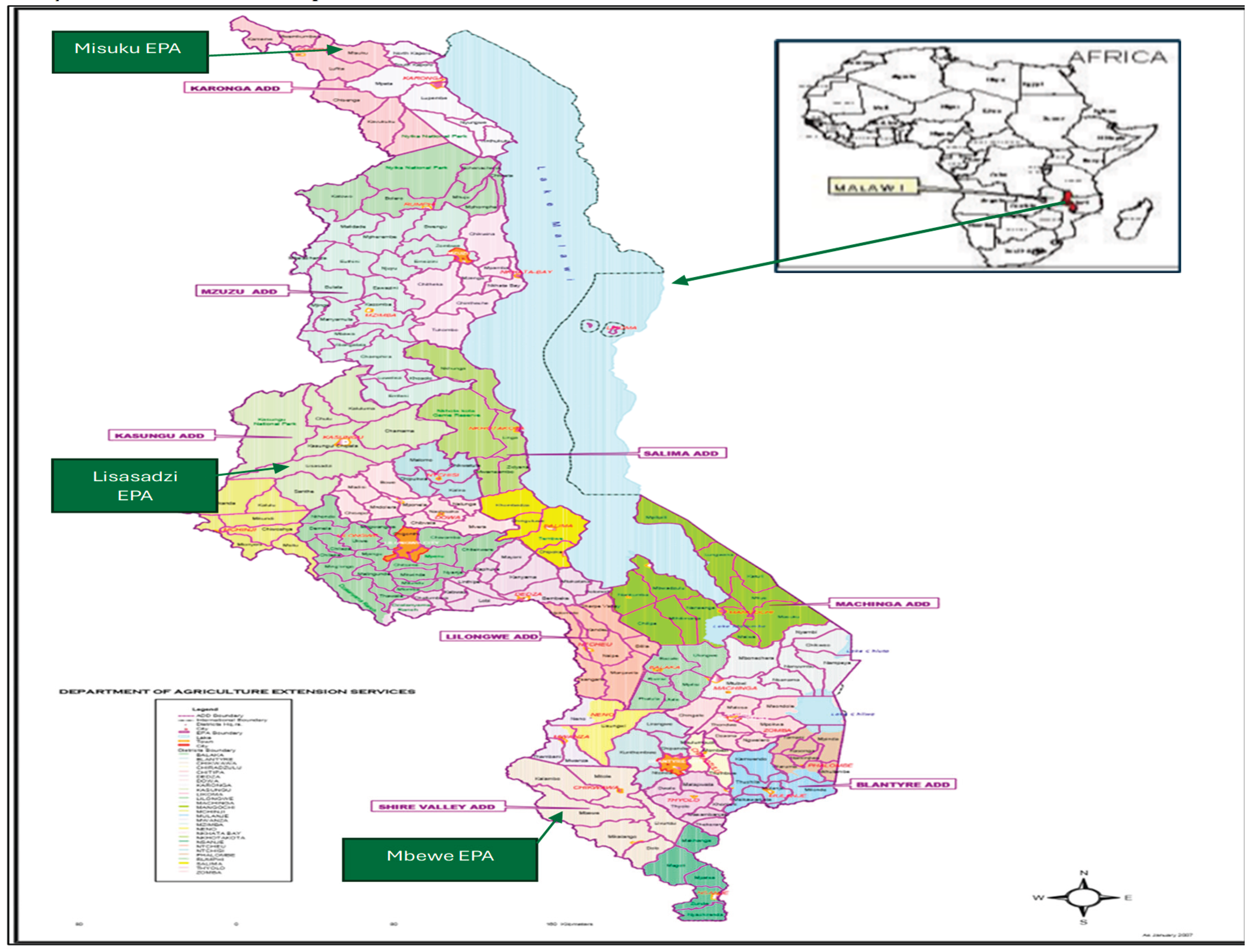

Table 1.
This is a table. Summary of farm inputs used by a business-oriented cooperative.
| Farm | Processing area | Market |
| holes watering canes secateurs pruning saw slasher chemicals fertilizer pails sacks |
pails sacks scale drying tables machines |
stationary (delivery notebooks, pen, calculator) sacks vehicles |
Table 2.
This is a table. Summary of the goals as stated by the EAS actors.
| EAS Actors | What farming system and extension they would like to see |
|---|---|
| DAECC | Labour saving technologies that still produce good results because some of the technologies we are promoting now are labour intensives and expensive like construction of live fencing around conservation agriculture fields. For example, farming system that promotes the use of machine instead of hoe. Technologies that should provide good results within a short period of time. i.e. Provide enough carbon credit and biomass within a short period of time to replenish the soil fertility. Farming system that integrates agroecology. Farming system that should suit with farmers working in groups like cooperative. Farming systems that include bio fortified crops like orange maize (MH44), beans, yellow sweet potatoes for improving nutrition Farming systems that enable communities have adequate income through agriculture commercialization. Farming systems that will enrich our soils with nutrients to harvest bumper yields with less inputs being used on the farm. Farming systems that will encourage the inclusion of animals in the system so that farmers should have diverse sources of nutrients and that animals should be providing manure to the farmers. |
| Researchers | Precision agriculture: farmers should be precious in the way the use their land and resources like farm input for high production. Increased human population requires land to be used optimally and that can only be attained if we employ precision agriculture. Digital agriculture to help in achieving precision agriculture to benefit the coming in of Artificial Intelligence (AI) in agricultural research and food system and advancement of climate smart agriculture and irrigation. |
| AACC | Farming systems that will be able to help the farmers in time of crisis such as floods as it is the major problem that farmers in the area face almost every year [message was strong in Chikwawa] Farming systems that will require the farmers to use less inputs especially the chemicals. Farming systems that will enable the farmers to produce more and be food secured throughout the year. Farming systems that embrace climate resilience, biodiversity conservation, and inclusivity. Farming systems that should aim to integrate sustainable agricultural approaches such as agroecology and to be adopted. |
Disclaimer/Publisher’s Note: The statements, opinions and data contained in all publications are solely those of the individual author(s) and contributor(s) and not of MDPI and/or the editor(s). MDPI and/or the editor(s) disclaim responsibility for any injury to people or property resulting from any ideas, methods, instructions or products referred to in the content. |
© 2025 by the authors. Licensee MDPI, Basel, Switzerland. This article is an open access article distributed under the terms and conditions of the Creative Commons Attribution (CC BY) license (http://creativecommons.org/licenses/by/4.0/).
Copyright: This open access article is published under a Creative Commons CC BY 4.0 license, which permit the free download, distribution, and reuse, provided that the author and preprint are cited in any reuse.


