

Submitted:
09 September 2025
Posted:
10 September 2025
You are already at the latest version
Abstract
Understanding the influence of weather on human well-being and mobility is essential for promoting healthier lifestyles. In this study we employ data collected from 151 participants over a continuous 30-day period in Switzerland to examine the effects of weather on well-being and mobility, Physiological data were retrieved through wearable devices, while mobility was automatically tracked through Google Location History, enabling detailed analysis of participants’ mobility behaviors. Mixed-effects linear models were used to estimate the effects of temperature, precipitation, and sunshine duration on well-being and mobility, while controlling for potential socio-demographics confounders. In this work, we demonstrate the feasibility of combining multi-source physiological and location data for environmental health research. Our results show small but significant effects of weather on several well-being outcomes (activity, sleep, and stress), while mobility was mostly affected by the level of precipitation. In line with previous research, our findings confirm that normal weather fluctuations exert significant but moderate effects on health-related behavior, highlighting the need to shift research focus toward extreme weather variations that lie beyond typical seasonal ranges. Given the potentially severe consequences of such extremes for public health and health-care systems, this shift will help identify more consistent effects, thereby informing targeted interventions and policy planning.
Keywords:
longitudinal data
; data fusion
; mixed effects regression
; wearable data
; weather
; environmental health
1. Introduction
Since the advent of the “theory of climates”, most famously articulated by Montesquieu in The Spirit of Laws [1], who argued that variations in climate shape people’s temperament, behavior, and even political institutions, scholars have long speculated on the influence that meteorological and seasonal dynamics exert on human well-being and behavior. While early theory posited relatively deterministic effects, empirical research over the past decades has yielded a far more nuanced and inconclusive picture. Systematic reviews indicate that meteorological influences are often moderate at best, whereas others report negligible or context-specific strong associations [2,3]. This divergence reflects not only the complexity of human responses to environmental factors but also recurrent methodological and measurement limitations that constrain the reliability of prior findings.
Comparative assessments of systematic reviews have shown that work on temperature and weather effects frequently suffers from deficiencies in protocol registration, risk-of-bias assessment, and reporting transparency, raising questions about the robustness of previous conclusions [4]. Umbrella reviews further highlight that confidence in the existing evidence is often low to critically low, largely due to inconsistent operationalization of outcomes, high heterogeneity across studies, and limited ability to address confounding or interactions [5]. Meta-analyses on ambient temperature and mental health corroborate these findings, showing that although associations can be detected, effect sizes are highly variable, heterogeneity is substantial, and analytical approaches rarely capture lagged or non-linear effects [2].
Further complications arise when contrasting objective measurements with subjective perceptions. Studies show only weak correspondence between meteorological indicators and self-reported experiences of weather, suggesting that perceptual and reporting biases may distort observed associations [6,7,8]. Similarly, subjective well-being measures, often collected through self-reported surveys or experience sampling, are prone to recall bias, mood effects, contextual influences, and missing responses, which can lead to inconsistencies between reported and actual states [9,10]. This gap is not trivial, as much of the existing evidence relies on self-reported well-being or retrospective survey data, meaning that discrepancies between experienced and measured conditions could systematically distort effect estimates. The issue is equally salient for mobility, since weather is known to influence transport choices, activity locations, and the use of active versus motorized modes. Yet research demonstrates that self-reported travel adaptations to weather often diverge from mobility patterns captured through GPS or sensor-based tracking, suggesting that individuals may underreport, misremember, or misclassify their behavioral responses to meteorological variation [11,12]. Capturing both places visited, weather conditions, and objective well-being through multimodal, high-resolution tracking is therefore crucial to disentangle actual behavioral and affective changes from perceptual bias, and to generate more credible estimates of the true impact of meteorological variability.
In light of these gaps, we contribute to the growing research on the impact of weather on well-being and mobility through the analysis of longitudinal objective and subjective multi-source data collected as part of an observational study conducted in Switzerland in 2024 [13]. Through the integration of high quality MeteoSwiss weather data, reliable data filtering, and the use of mixed-effects linear regression models, we estimate the effects of weather on several outcomes related to objective and subjective well-being and on distances traveled with different transportation types while controlling for potential socio-demographic confounders. Our work fits in field of environmental health research by demonstrating the feasibility of integrating objective multi-source data to derive practical insights into the effect of environmental factors on humans. Its design mitigates between-person confounding, ensures temporal granularity, and addresses measurement limitations, thereby offering a robust contribution to understanding whether—and to what extent—weather variations shape human well-being and behavioral choices.
The structure of the paper is as follows. Section 2 provides an overview of previous research investigating the relationships between weather, well-being, and mobility choices. Section 3 describes the study protocol, the data used, and the statistical methods that we employed. Section 4 reports the estimates of the weather effects on well-being and mobility that we drew from our sample of observations. Finally, Section 5 provides a critical discussion of the results and of their limitations, while Section 6 summarizes the work and provides insights for future works.
2. Related Work
Previous literature found evidence that atmospheric weather has an effect on both well-being [14] and mobility [15]. Among several well-being outcomes, researchers investigated the relationship between weather and subjective well-being [16,17], happiness [18,19], sleep [20,21,22,23], physical activity and sedentary behaviors [24,25], anxiety and depression [26]. However, results are often inconsistent across studies, with authors finding small or non-significant effects [25]. As an example, Feddersen et al. found that warm and sunny days are associated with higher levels of self-reported well-being [17], while Connolly et al. reported that, in regions with hot weather, increase in temperature levels cause a decrease in well-being [16]. Weather effects on well-being during the COVID-19 pandemic were also analyzed, with results reporting no influence of weather on mental well-being during the pandemic [25]. The different results reported in literature on the effects of weather may be due different methodologies in the self-assessment of well-being, with studies involving large cohorts solely relying on self-reported information, which may be affected by recall bias and aggregation over long time windows [16,17,18,19,24,25,26]. Instead, few studies focused on the use of objective data to measure the impact of weather on well-being. The use of objective measurements allows to reduce the risks of recall bias in self-reported data, and it also allows researchers to collect several measurements of well-being over extended periods of time with less burden posed on study participants, as few to none active tasks are needed. The use of commercial devices for well-being tracking, such as smartwatches and smart rings, allows for the continuous and passive monitoring of objective physiological data through which objective information can then be derived and used for the estimation of weather effects on well-being. An example use of objective data in the sleep domain is from Mattingly et al [20]. In this study, the authors employed a subset of the Tesserae dataset [27] to assess the impact of weather on sleep duration, bedtime, and wake-up times through a year long multimodal study. The authors exploited objective data collected through smartwatches (Garmin Vivosmart 3) and linked them to the weather of participants’ homes. Results from this study (216 participants, 51836 observations) indicated small but statistically significant seasonal and weather effects, with bedtimes and wake-up times being later with increasing temperature values, and sleep duration being lower with increasing lengths of the day. Recently, Li et al. [23] reported their analysis on more than 23 millions observations and more than 200 participants, with increasing temperature linked to reduced total sleep time. In a study with an objective measure of physical activity through accelerometers, (127 participants, 720 observations) Sumukadas et al. found day length, temperature, and sunshine to explain 73% of the variance in measured daily activity [28]. In a similar study by Feinglass et al., the authors analyzed the effects of weather on a three-year long study with six weekly measurement waves (241 participants, 4823 observations) and found daylight hours, cold and hot days, and light or heavy rainfall to be associated with lower physical health [29]. Similar results on physical activity were found in several studies using accelerometer-based measurements or steps counts from commercial wearables [24,30,31].
Well-being is not the only domain that was investigated in relationship with weather data. A vast literature corpus deals with the analysis of the effects of atmospheric weather (temperature, precipitation, humidity, ...) on human mobility and transportation mode choices [15]. Climate change, with its consequences on weather, can have tremendous effects on human mobility and transportation choices, and therefore it is necessary to investigate how transport mode choices are influenced by weather to take appropriate actions in time [32]. Similar to what we previously described for well-being, in the mobility domain authors either relied on self-reported information through surveys [33,34,35,36] or based their analysis on objective data (e.g., GPS traces provided by smartphones or dedicated trackers, smart cards transactions, ...) [37,38,39,40,41]. Among studies that focused on the use of objective mobility data, Pang et al. built a global dataset based on mobility assessed through data retrieved via social networks and found nice weather (high temperature and moderate pressure) to have a positive impact on human mobility [37]. Lepage et al. integrated data from bike sharing, taxi, and public transport companies to analyze transportation demand under different metereological conditions [40]. Otim et al. used a total of 2671 GPS trajectories from Bejing to analyze transport mode choices [41]. Even though several studies focusing on the assessment of the effects of weather on mobility make use of objective data, the majority of them are typically cross-sectional, with surveys containing information from each study participant only for a single day/trip, thus failing into capturing intra-subject fluctuations due to weather differences.
3. Materials and Methods
3.1. Study Protocol
We recruited a total of N=294 study participants for a 30-days data collection as part of the project "RENEWAL - Tackling the energy and wellbeing impact of telework practices through multisource data" [13]. We enrolled study participants from six companies and institutions located in Canton Ticino (Switzerland) on a rolling basis from February to May 2024. We requested participants to always wear a Garmin Vivosmart 5 to track physiological data continuously, day and night. We employed Google Location History (GLH) to track trips and locations using Google Takeout to retrieve mobility data. Self-reported information was also provided by participants in different formats. At the start of the study, they completed an onboarding questionnaire mainly focused on socio-demographics, work-, and leisure-related information. Furthermore, they also filled out the Short Form Health Questionnaire (SF-12), which provides a self-assessment of physical and mental health [42]. Throughout the study, participants received a daily diary asking to self-assess their sleep quality, health, and stress for the day, together with information about their workday, leisure activities, and transport mode choices.
Study participants were thoroughly informed about the study and signed an informed consent before taking part in the study. The study protocol followed the declaration of Helsinki for studies involving human participants [43] and was reviewed by the local ethical committe (SwissEthics Clarification of Responsibility Req-2023-0106). A more detailed description of the study protocol is available in [13].
3.2. Weather Data
We employed MeteoSwiss (https://opendatadocs.meteoswiss.ch/) as a weather data source, using the closest weather station to the participants’ home as daily source of weather information. A total of 7 weather stations (Acquarossa, Biasca, Cadenazzo, Cevio, Locarno, Lugano, Stabio) were used for the retrieval of weather information, spanning the whole area of Canton Ticino were the study was conducted. MeteoSwiss provides several aggregated weather information for each station. Among them, there is average, maximum, and minimum air temperature at 5 centimeters and 2 meters above ground; average wind speed; relative humidity; total precipitation during the day; absolute and relative sunshine duration. We retrieved all these weather information and linked them to each participant using the weather station closest to their home address. Figure 1 shows the variation of weather across all the available weather stations for the whole duration of the study, for both temperature, precipitation, and sunshine duration. Considering all the available measurements across the weather stations, median () temperature at 2 meters above ground was of 10.5 (7.9,13.6), with increasing temperatures from February (7.5, 6.0 to 9.0) to May (14.4, 12.8 to 15.9). For slightly more than half of the days (53%), the total daily precipitation was lower than 0.1 mm. For the remaining days it was lower than 30 mm (40%), with few exceptions with total daily precipitation greater than 30 mm (7%). March and April were the two months with the highest amount of recorded precipitations across all stations, with the highest being March. Finally, median () sunshine duration was of 191 (2, 413) minutes and, similarly to temperature, increased from February (131, 0 to 320) to April (324, 47 to 544), followed by a decrease in May (131, 11 to 340).
3.3. Data Processing
Physiological data were retrieved through Garmin Health API1. This free service provides, upon direct acceptance from study participants, several data points related to the physiological domain and computed through Garmin proprietary algorithms running on the smartwatch provided to study participants [44]. We processed these data (heart rate, steps, sleep, ...) to extract daily features across several domains related to well-being. Mobility data were instead retrieved from GLH services, that automatically extracts location visits and movements through GPS and network data on smartphones [45,46,47]. Google does not allow for the automatic retrieval of GLH data through API. Therefore, we instructed study participants to export these data through Google Takeout, and upload the resulting zip file in a dedicated section of the mobile application that was provided to them for the duration of the study [13]. We then processed location data and extracted daily traveling distances according to different modes of transport: active mobility (cycling, running, walking), motor vehicles (car, motorcycle, taxi, ...), and public transport (bus, tram, train).
3.4. Data Filtering
We filtered the collected data to consider only days with reliable data. Filtering was performed using different data sources. First, we considered only weekdays, excluding weekends as they may be characterized by different patterns of activity, mobility, and sleep, and may not be representative of typical behaviors [20,48]. Second, we considered only days in which the total time the vivosmart5 was worn was at least 70% (approximately 17 hours out of 24), so that aggregated features of steps and stress were representative of the majority of the day. Daily wearing time was determined based on heart rate samples, with the assumption that heart rate values are provided only when the smartwatch is placed on the wrist. Then, we considered only those days for which night sleep was automatically tracked by the provided smartwatches, excluding nights with missing sleep data or with manual insertion of sleep times.
In addition to wearing time and sleep, we also accounted for the amount of daily coverage for location data. Daily coverage was computed by resampling the provided GLH location segments (i.e., a movement from point A to point B with a given transportation type) into location bins of 5 minutes, and considering the participant as being in the same static location if the distance between the end of one location segment and the start of the following location segment was lower than 200 meters. This was done with the aim of keeping only days for which participants’ locations and travel patterns were known for most of the day, thus justifying the usage of the closest weather station to their home to determine the weather data for each day. We chose to keep only days for which at least 70% of the location was known, using the same threshold that we set for the wearing time of the smartwatch. The use of location data allowed us also to identify travel days, represented by those days in which participants were traveling away from their home. Using this information, we excluded days for which the maximum reported distance from their home was equal to 300 kilometers, suggesting travels away from home for which weather data retrieved from the weather station closest to the home address didn’t represent a reliable source of weather information. This traveling threshold was chosen similar to [20], which chose to keep only observations with an average distance from home greater than 320 km. Finally, to further improve the reliability of our estimates employing longitudinal data, we additionally filtered our dataset to consider only study participants for which at least 10 observations were available.
3.5. Statistical Modeling
To examine the effects of whether on well-being and mobility, we used mixed effects linear regression (MELR) models. Since our dataset consists of repeated observations for each participant over time, this approach properly accounts for inter-individual variability [49]. The general specification for our MELR models is:
where y is the outcome of interest, is the intercept, are the coefficients for predictors , is the random intercept assigned to the i-th participant, and e is the residual error.
We tested hierarchical models including increasing blocks of predictors. First, we built an empty model with no fixed effects (Model 1). Then, we integrated socio-demographics information collected at the baseline as time-invariant predictors for the model (Model 2). At this stage, we included the following time-invariant predictors: age, work organization, sex, having a supervisor role at work, having children, SF-12 mental component score, SF-12 physical component score. The choice of these predicotrs was based on previous studies which included similar sets of measurements and predictors [20]. The supervisor role was derived based on the computation of the International Standard Classification of Occupations (ISCO), which was derived based on work-related information reported in the onboarding questionnaire. Participants with an ISCO code of “Managers" or “Technicians and Associate professionals" was defined as having a supervisor role. Finally, we added three weather predictors into a final model (Model 3): mean daily temperature, total daily precipitation, and daily sunshine duration. We used the closest weather station to participant’s home to assign daily weather information. The choice of these three predictors (temperature, precipitation, and daily sunshine duration) was driven by the choices of i) having the same set of predictors across both well-being and mobility domains ii) sharing a similar set of predictors with previous related works [20,25]. In our modeling we didn’t include wind speed, as we assumed it to have no effect on well-being related outcomes [28]. During the monitoring period, no snow was measured, and therefore was excluded from the modeling.
3.6. Outcomes
We focused our analysis on the effects of weather on 11 outcomes related to participant well-being and mobility, which are summarized in Table 1. For well-being, we examined seven health-related features across different physiological domains. In the activity domain, we considered the number of steps taken during the awake cycle as retrieved by the Garmin wearable (from wake-up to bedtime) as well as the percentage of time spent in sedentary behavior during the same time window. Sleep was also assessed through Garmin data, looking at bedtime, wake-up time, and total sleep duration, with weather information from a given day used to predict outcomes on the following night. Stress was examined using three complementary indicators. The first was the self-reported stress level, collected through daily diaries by asking participants “Today, do you feel stressed? Stress refers to a condition in which you feel tense, restless, nervous or anxious, or cannot sleep at night because you are agitated". Answers to this question were recorded on a 5-point Likert scale from 1 (Not at all) to 5 (Extremely). Following Norman [53], this measure was modeled as continuous, albeit originally ordered categorical. The second indicator was the daily average Garmin stress score, which ranges from 0 (no stress) to 100 (extreme stress) and is derived from heart rate and heart rate variability (HRV) measurements [54]. Finally, we considered night recovery, computed as the normalized percentage change in “body battery" a Garmin proprietary metric estimating the body’s available energy, during nighttime sleep, which can be considered both as a measure of sleep quality as well as an indicator of stress while sleeping, which could be linked to reduced resting capabilities. For the mobility domain, we analyzed the total daily distance traveled by participants, with transportation modes automatically detected through GLH. Distances traveled by plane were excluded, and we focused instead on three categories: active mobility, motor vehicles, and public transport.
For each outcome, we computed the intra-class coefficient (ICC), defined as:
where is the variance of the estimated random intercepts of the MELR models, is the variance of the within-person residuals, BP stands for between-person, and WP for within-person [49]. With ICC values ranging from a minimum of 0 up to a maximum of 1, we can determine whether all the variance in the data is longitudinal (i.e., due to within person changes), which results in a ICC of 0, or if it is only cross-sectional (i.e., due to between-person differences), which instead results in a ICC of 1.
4. Results
4.1. Dataset
Our initial dataset was composed of 8820 observations from the whole set of 294 study participants. Upon filtering the dataset with the conditions detailed in Section 3.4, we were left with an analytical sample of 151 participants and 2120 observations. The majority of the participants was male (98, 65%). Median age was of 42 years old, with males being older than females An unbalanced distribution was found for the organization for which participants were working, with a higher proportion for company 5 (59, 51%). Similar proportions were found for having children, with 57% of females and 54% of males reporting having at least one children. Overall, 34% of the included study participants had a supervisory role at work, with a higher proportion of males (39%) than females (25%). The mean (min, max) number of observations per participant was equal to 14 (10, 22).
Figure 2 shows the coordinates of the seven weather stations, together with the location of both home and work addresses for the analytical sample. The median () maximum daily distance between the self-reported home address and the closest weather station, used for linking weather data to participants’ daily measurements, was of 8.9 (5.2, 18.8), with 95% of the available observations having a maximum daily distance from the closest weather station of 48.7 kilometers. To assess the extent to which participants moved away from home while traveling, we also computed the maximum daily traveled distance from their home addresses, and we found a median () distance of 7.6 kilometers (2.8, 19.1). In the analytical sample, participants wore the smartwatch for a median () percentage of time during their awake cycle of 100% (96.44, 100), with a duration of their time spent awake during the day of 16.75 hours (15.92, 17.67). The location of study participants during these days was tracked for a median () number of daily hours equal to 24 (21.5, 24) using a threshold for the distance between two consecutive location segments of 200 meters. The dataset covered 75 days starting from February up to May of the same year (2024), with an available number of observations per day across all study participants of 32 (2.5, 48).

Table 2.
Socio-demographics information of the participants available for analysis after after filtering the complete dataset.
Table 2.
Socio-demographics information of the participants available for analysis after after filtering the complete dataset.
| Sex | Overall (N=151) | ||
|---|---|---|---|
| F (N=53) | M (N=98) | ||
| Age | 42 (32,47) | 47 (37,47) | 42 (37,47) |
| SF-12 MCS | 43.45 (37.90,51.59) | 49.61 (44.30,55.18) | 47.91 (41.80,53.04) |
| SF-12 PCS | 55.70 (53.60,57.40) | 55.04 (52.00,56.17) | 55.30 (52.28,56.59) |
| Company | |||
| C1, (N, %) | 3 (6%) | 17 | 20 |
| C2, (N, %) | 3 (6%) | 13 | 16 |
| C3, (N, %) | 11 (21%) | 12 | 23 |
| C4, (N, %) | 7 (13%) | 13 | 20 |
| C5, (N, %) | 23 (43%) | 36 | 59 |
| C6, (N, %) | 6 (11%) | 7 | 13 |
| Supervisor role, (N, %) | 13 (25%) | 38 (39%) | 51 (34%) |
| Having children, (N, %) | 30 (57%) | 53 (54%) | 83 (55%) |
Table 3 reports the descriptive statistics of the continuous variables (outcomes and weather) measured during the study across all study participants in the analytical sample over time. We assessed also the distribution of the weather changes experienced by by them. For daily temperature, we computed the difference between the maximum and minimum daily mean temperature for each participant, and found a median () difference of 8.9 (7.8, 10.6) degrees. We performed the same analysis for sunshine duration, with a median () difference between the maximum and minimum sunshine duration experience by participant of 10.7 (10.3, 11.8) daily hours. For daily precipitation, we counted the number of days in which the daily total precipitation was greater than 1 mm from midnight to midnight, resulting in a median () number of days of 5 (4, 7) across analytical sample members.
4.2. Weather Effects on Well-Being
4.2.1. Activity
Table 4 and Table 5 report the results of the MELR modeling of daily steps and the percentage of time in sedentary state, respectively. The ICC value for daily steps was of 0.378, indicating that around 40% of the variance in the measurements is due to within-person changes over time, with the remaining variance due to between person differences. We didn’t find any significant effect of weather features (temperature, precipitation, and sunshine duration) on the amount of steps per day. Both in the Model 2 and Weather models, the mental (SF-12 MCS) and physical (SF-12 PCS) component of the health assessment carried out at baseline were positively associated with the number of steps per day, with people in better health status (higher MCS/PCS) walking more during the day. Interestingly, one organization (C5) was characterized by a significant positive coefficient, further justifying the inclusion of the company predictor in the modeling.
The additional activity-related outcome that we considered was the percentage of time spent in sedentary behavior during the day. For this outcome, we found an ICC value of 0.475, suggesting that, with respect to daily steps, higher variance can be explained by within-person changes over time. We found a statistically significant effect of the physical health, as assessed by the SF-12 PCS (Model 2: -0.195, 95% CI: -0.340 to -0.053, ; Model 3: -0.201, 95% CI: -0.345 to -0.057, ). For weather features, we found increasing temperature (-0.115, 95% CI: -0.218 to -0.012, ) as well as increasing sunshine duration (-0.093, 95% CI: -0.168 to -0.017, ) to reduce the percentage of time spent in sedentary behavior, while no effect was found for the level of precipitation during the day.
4.2.2. Sleep
For the sleep domain, Table 6, Table 7, and Table 8 report the MELR coefficients resulting from the modeling of next night total sleep time, next night bedtime, and next day wake-up time, respectively. Total sleep time is measured in decimal hours, while bedtime and wake-up time are reported as hours from midnight. The three sleep time measurements of total sleep time, bedtime, and wake-up time resulted in ICC values of 0.24, 0.42, and 0.35, respectively. These values suggest that variance in bedtime values is characterized by higher between-person differences, while for total sleep time variance is more explained by within-person changes on a day-to-day level.
The results of our modeling of total sleep time show a small significant effect of daily mean temperature on total sleep time (95% CI: 0.6 to 3.0, ), with an average 1.8 minutes increase per each degree increase in daily mean temperature. Except sex, no socio-demographic predictor was found to be significantly associated with total sleep time. In our results, we found that males slept, on average, 24.2 minutes less than females (Model 2: 95% CI: -39.2 to -9.1, ; Model 3: 95% CI: -38.9 to -8.9, ).
The effect of daily temperature that we found for total sleep time disappeared for bedtime (Table 7), for which only socio-demographic factors (age and sex) were found to be significantly associated with sleep onset time. In particular, older participants and females tended to go to bed earlier, with bed time decreasing by about 1 minute for each additional year of age (Model 2 95% CI: -2.0 to -0.06, ; Weather 95% CI: -1.9 to 0, ). Females, compared with males, went to bed about 30 minutes earlier (Model 2: –30.5 minutes, 95% CI –48.5 to –12.5, p<0.01; Model 3: –30.7 minutes, 95% CI –48.7 to –12.7, p<0.01).
Moving onto the modeling of wake-up time (Table 8), we found a significant positive coefficient of temperature (2.9, 95% CI: 1.7 to 4.1, ), and a smaller, but still significant, positive effect of the level of daily precipitation on the wake-up time (0.4, 95%CI: 0.06 to 0.6, ). These results suggest that the increase in total sleep time due to higher temperatures can be explained with a delay in wake-up time, rather than an anticipation of bedtime. Similar to bedtime, we found a negative association between age and wake-up time, with older people waking up 1.3 minutes earlier for each unit increase in age (Model 2: 95%CI: -2.2 to 0.0, ; Weather 95% CI: -2.1 to 0.0, ).
4.2.3. Stress and Recovery
Table 9, Table 10, and Table 11 report the MELR coefficients resulting from the modeling of mean stress during the day, self-reported stress level, and next night recovery, respectively. The stress values were those characterized by the highest ICC value, equal to 0.66, with the variance mostly explained by differences between people in the mean stress value. Instead, self-reported stress and night recovery were both characterized by an ICC of 0.37. For the mean stress during the day assessed through physiological data, we found that an increase in mean daily temperature and sunshine duration led to increase levels of measured stress during the day (daily temperature: 0.176, 95% CI: 0.016 to 0.336, ; sunshine duration: 0.143, 95%CI 0.027 to 0.260, ). Among socio-demographics predictors, only the SF-12 MCS was statistically significant (Model 2: -0.341, 95% CI: -0.582 to -0.104, ; Model 3: -0.341, 95% CI: -0.581 to -0.101, ), with people having highermental health scores experiencing less stress during the day.
The modeling of self-reported stress value showed similar results for socio-demographics, with increasing mental health status leading to lower daily-self reported values (Model 2: -0.038, 95% CI: -0.049 to -0.026, ; Model 3: -0.038, 95% CI: -0.049 to -0.027, ). However, opposite results were found for the effects of weather, with higher temperatures related to lower self-reported stress values (-0.03, 95% CI: -0.045 to -0.016, ).
Finally, no socio-demographic characteristic was found to be a significant predictor of night recovery as measured through the Garmin body battery feature (Table 11). Among the weather variables, only sunshine duration was significant, with higher sunshine duration leading to lower recovery values (-0.30, 95% CI: -0.597 to -0.004, ).
4.3. Weather Effects on Mobility
After examining the effects of weather on well-being, we turned to mobility behaviors and patterns. Table 12, Table 13, and Table 14 present the results of the MELR models predicting daily distance traveled by active mobility, motor vehicles, and public transportation, respectively. For all three modes, most of the variance in daily distance was attributable to within-person fluctuations over time, as indicated by ICC values of 0.26 for active mobility, 0.17 for motor vehicles, and 0.12 for public transportation.
Figure 3.
Percentage of daily distance traveled with the three different mobility types (active mobility, motor vehicles, and public transport) with varying mean daily temperatures.
Figure 3.
Percentage of daily distance traveled with the three different mobility types (active mobility, motor vehicles, and public transport) with varying mean daily temperatures.
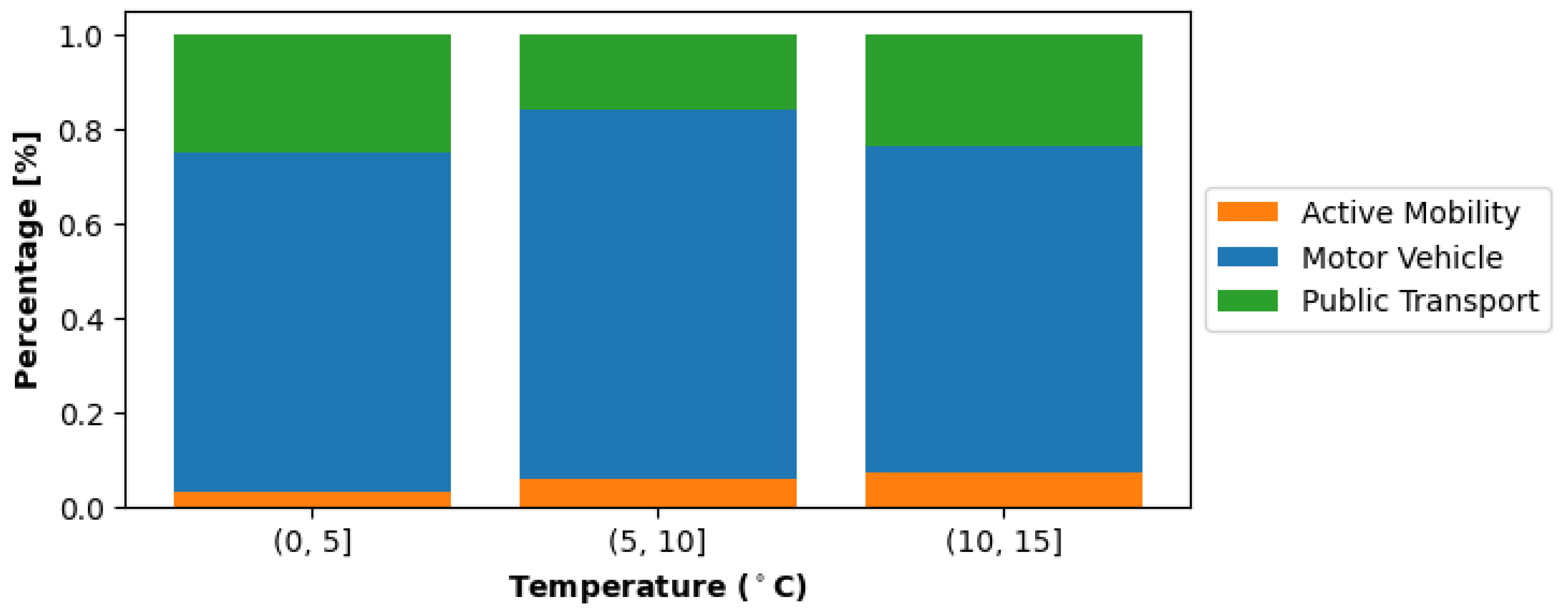
For active mobility (cycling, running, walking), the complete Model 3 revealed significant effects of age, sex, and precipitation. Specifically, older individuals and men covered longer daily distances with active mobility, as indicated by positive associations with age (0.104, 95% CI 0.047 to 0.161, ) and sex (1.139, 95% CI: 0.065 to 2.213, ).
We observed a negative association between precipitation and active mobility (-0.022, 95% CI: -0.043 to -0.001, ), indicating that greater rainfall corresponded to shorter distances covered on foot or by bike. For daily distance traveled with motor vehicles, the model did not reveal ans statistically significant effects of weather. Among socio-demographic factors, only the employing organization showed a association with motor vehicle use, while no other predictors were significant.
Finally, for public transportation, Model 3 identified significant effects of both SF-12 PCS and precipitation. Better physical health (i.e., higher scores of SF-12 PCS) was associated with shorter distances traveled by public transport (-0.703, 95%CI -1.079 to -0.326, ), whereas higher precipitation levels corresponded to greater reliance on this mode of travel (0.123, 95% CI: 0.002 to 0.244, ).
5. Discussion
In this manuscript we reported the study design, methodology and the results obtained when assessing the impact of weather, as measured by mean daily temperature, level of precipitation, and sunshine duration, on ten different outcomes related to well-being (activity, recovery, sleep, and stress) and mobility. For our analysis, we used the dataset collected as part of the RENEWAL study [13], that involved a total of 294 participants for 30 continuous days and for which objective data (i.e., physiological data through Garmin Health API) and self-reported data (i.e., surveys and ecological momentary assessments) were retrieved. Given the longitudinal nature of our dataset, we employed MELR models to analyze how three key weather predictors, namely mean daily temperature, total daily precipitation, and total sunshine duration, affect these outcomes taking into account both intra-person and inter-person differences. To improve the robustness of our analysis, we filtered our daily observations with strict criteria to keep only reliable observations. We considered only weekdays in which the provided smartwatch was worn more than 70% of the time and for which automatic sleep tracking was available. Furthermore, we kept only days with at least 70% coverage in terms of location data, and we excluded days with presumed travels too far away from home (i.e., with maximum daily distance greater than 300 km), similar to what was done in [20]. Our final dataset consisted of 2120 daily observations from 151 participants, spanning the period from February to May 2024, with a median () number of observations available per participant of 14 (10,22).
Our analysis showed modest effects of weather on both well-being and mobility outcomes. For well-being, MELR models found a positive effect of temperature on total sleep time, wake-up time, and physiological stress, while a negative association with temperature was found for self-reported stress values and the percentage of sedentary time during the day. The amount of sunshine during the day positively affected the physiologically measured stress and the percentage of sedentary time during the day, while negatively impacting the recovery during the next night sleep. We didn’t find any statistically significant association between weather and bedtime and the total number of daily steps. Our results for wake-up time, are in line with was found by Mattingly et al. [20] with objective sleep data tracked with Garmin smartwatches. The authors found a modest effect of daily temperature on wake-up time. However, their study was conducted over a longer period of time, with participants enrolled for approximately a year. Therefore, authors were able to include also seasonality among the predictors for MELR models, and seasons resulted significant in the prediction of other sleep-related outcomes (total sleep time, bedtime, and wake-up time). In the same study, in contrast to our results temperature was not found to be associated with total sleep time, which was instead affected by season, with sleep duration decreasing in spring with respect to winter. Similarly, in a recent paper by Li et al. [23] which included automatic sleep tracking through Huawei smartwatches, the authors found total sleep time to be reduced by approximately 10 minutes for every 10∘ increase in temperature. This contrasting results on sleep-related outcomes may be explained by the limited observation period of our study, with the majority of observations belonging to spring and with little temperature variations. Due to this, we were not able to include seasonality effects in our models, and we instead weather to impact total sleep time and wake-up time, suggesting a shift in wake-up times with increasing temperature, with bedtime remaining unaffected. As far as the activity domain is concerned, our results are in line with previous findings that reported increasing physical activity with increasing temperature and sunshine duration [24,28,29,31]. Our models showed a statistically significant effect of temperature and sunshine duration on the percentage of time spent in active or highly active states (i.e., non-sedentary behavior) but not on the amount of daily steps, suggesting an increasing extent of physical activities not necessarily including walking or running exercises. Interesting, we found opposite results when assessing the impact of weather on stress. In our models, we used two different stress measurements: an objective stress measure, defined as the mean stress value reported by the Garmin smartwatch (i.e., a Garmin proprietary algorithm based on HRV and heart rate analysis [54]) and the self-reported stress value in the daily diaries. While we found warmer days to reduce the self-reported stress value, in line with previous large-scale survey-based studies [17,25], our analysis showed temperature and sunshine duration to increase the amount of physiological stress as measured through HRV and heart rate, which, to the best of our knowledge, is still unexplored in the available literature. This can be explained by the fact that self-reported and physiological stress are two different representations, with authors finding small to medium effect sizes between self-reported stress and objective physiological stress measures [55]. Furthermore, objective stress measured by Garmin through their proprietary algorithms takes into account also the extent of activity and the recovery phases following it, thus suggesting that warmer and longer days are linked to a greater amount of activity carried out during the day, as confirmed by our results on effects of weather on sedentary behaviors. Finally, for well-being we also assessed the impact of weather on a the night recovery, i.e. on the amount of “energy" recovered by the body while sleeping at time and being in a rest state. Our models showed a significant modest and negative effect of the sunshine duration on this outcome.
Moving on to the mobility domain, we assessed the impact of weather on the total daily traveled distance according to three different mobility types: active mobility, motor vehicles, and public transport. We found a statistically significant effect of precipitation on both active mobility and public transport, with a reduced distance traveled by active mobility with increasing precipitation, while the opposite holds for public transport, with increased distances with higher precipitation values. When modeling the distance traveled by motor vehicles, we didn’t find any significant effect of weather. This analysis may suggest an overall stability of distances traveled with motor vehicles, while distance traveled using active mobility transportation types (mainly walking or cycling) are replaced with public transportation in case of higher precipitations during the day. When compared to other studies using objective mobility and location data, Pang et al. found a positive effect of weather on the overall mobility, without differentiating between different types of mobility [37]. Lepage et al. found precipitation to reduce the amount of bikesharing (i.e., indirect measurement of distance traveled with active mobility) [40], while Otim et al. didn’t include precipitation among the predictors for transport mode choices, and found higher temperature to increase the amount of walking share and to reduce bike share [41].
This study does not come without limitations. First of all, when compared to other studies using objective data for well-being and mobility assessments, our dataset is smaller. In the two largest studies assessing the impact of weather on sleep, Mattingly et al. had a total of 51836 observations [20] and Li et al. 23 million observations [23], which are way larger than our 2120 observations. These datasets also span multiple monitoring months, allowing to assess also the effect of seasons rather than only daily weather measurements. Ours, instead, was limited to a short observation period of four spring months during the year 2024, limiting the possibility of studying seasonal effects on the chosen outcomes. In addition to this, our observations were confined in the region of Canton Ticino (Switzerland) and northern Italy, and study participants were mostly mostly office and information workers, thus limiting the generalization capabilities of our results, since other populations (e.g., shift workers) and/or countries with different weather conditions may experience different effects of weather on their well-being and mobility. Furthermore, while on one hand the strict filtering process that we carried out on the dataset left us with a reliable set of observations, on the other hand it may have introduced a bias in the dataset as only the highly compliant participants were left in the analytical sample used for the modeling. Finally, our analysis on mobility distances considered them as a whole during the day, without splitting them into commuting or recreational trips, which could help into better assessing the impact of weather [36]. As an example, Sabir et al. found commuting (recreational) trips to be less (more) affected by weather conditions [33].
Even when considering these potential limitations our results on longitudinal objective and subjective data confirm previous findings in literature for several of the analyzed outcomes (sleep and self-reported stress), while at the same providing new and interesting insights on other outcomes (objective physiological stress and night recovery). The main robustness of our study lays in the use of objective data for the assessment of weather impacts, with the majority of the studies using self-reported aggregated data. Our analysis also showed that it is possible to use passively collected GLH data for the assessment of weather impact on mobility, potentially allowing for the use of the enormous amount of retrospective GLH data to further refine the results reported in this manuscript. We believe that future improvements on the framework outlined in this paper, with longer observation periods spanning multiple locations, can help assessing the impact of weather on well-being and mobility, driving insights and policies that could prevent severe impacts due to climate change.
6. Conclusions
This paper analyzed 8,820 observations from workers in southern Switzerland to assess how typical weather variations influence individual well-being and mobility using a multi-source objective and subjective data framework. After filtering for reliable weekday data based on wearing time and location tracking, we applied robust mixed-effects models and found small but statistically significant effects of weather on our outcomes. Increasing temperatures were associated with longer total sleep time, delayed wake-up times, and lower self-reported stress, yet objectively measured physiological stress rose with prolonged sunshine and higher temperatures. Likewise, rising precipitation corresponded with reduced distances traveled by active mobility and increased reliance on public transportation. In line with a widespread body of research, these findings confirm that normal weather fluctuations exert significant but moderate effects on health-related behaviors. They highlight the need to shift research focus toward extreme weather variations—such as heatwaves—that lie beyond typical seasonal ranges (e.g. Authors). Given the potentially huge consequences of such extremes for public health and health-care systems, future studies should employ longer tracking periods that integrate both seasonality and extreme weather events into their modeling frameworks. This shift will not only illuminate the full spectrum of weather’s impact on individual well-being and mobility but also help in identifying effects that are more consistent in magnitude, thereby informing targeted public health interventions and policy planning.
Author Contributions
Conceptualization, D.M., F.F, and T.G.; methodology, D.M.; formal analysis, D.M.; data curation, D.M.; writing—original draft preparation, D.M., T.G.; writing—review and editing, F.F. and T.G.; project administration, T.G.; funding acquisition, T.G.. All authors have read and agreed to the published version of the manuscript.
Funding
This research was funded by the University of Applied Sciences and Arts of Southern Switzerland (SUPSI) under grant number 13RAY5RENEWAL.
Institutional Review Board Statement
The study was conducted in accordance with the Declaration of Helsinki, and reviewed by SwissEthichs (Req-2023-01063, 18.09.2023). Approval by SwissEthics was waived as the study didn’t fall within the scope of Article 2 of the Federal Act on Research involving Human Beings (Human Research Act, HRA).
Informed Consent Statement
Informed consent was obtained from all subjects involved in the study.
Data Availability Statement
The data presented in this study are available on request from the corresponding author due to confidentiality of the data and are subject to a data sharing agreement.
Acknowledgments
The authors would like to thank Gabriele Passoni for his help in the analysis of the collected data.
Conflicts of Interest
The authors declare no conflicts of interest.
Abbreviations
The following abbreviations are used in this manuscript:
| GLH | Google Location History |
| ICC | Intra-Class Coefficient |
| MELR | Mixed Effects Linear Regression |
| SF-12 MCS | Short-Form Health Questionnaire Mental Component Score |
| SF-12 PCS | Short-Form Health Questionnaire Physical Component Score |
References
- de Montesquieu, C. Montesquieu: The spirit of the laws; Cambridge University Press, 1989.
- Thompson, R.; Lawrance, E.L.; Roberts, L.F.; Grailey, K.; Ashrafian, H.; Maheswaran, H.; Toledano, M.B.; Darzi, A. Ambient temperature and mental health: a systematic review and meta-analysis. The Lancet Planetary Health 2023, 7, e580–e589. [Google Scholar] [CrossRef]
- Byun, G.; Choi, Y.; Foo, D.; Stewart, R.; Song, Y.; Son, J.Y.; Heo, S.; Ning, X.; Clark, C.; Kim, H.; et al. Effects of ambient temperature on mental and neurological conditions in older adults: A systematic review and meta-analysis. Environment international 2024, 194, 109166. [Google Scholar] [CrossRef] [PubMed]
- Song, X.; Luo, Q.; Jiang, L.; Ma, Y.; Hu, Y.; Han, Y.; Wang, R.; Tang, J.; Guo, Y.; Zhang, Q.; et al. Methodological and reporting quality of systematic reviews on health effects of air pollutants were higher than extreme temperatures: a comparative study. BMC Public Health 2023, 23, 2371. [Google Scholar] [CrossRef]
- Cuijpers, P.; Miguel, C.; Ciharova, M.; Kumar, M.; Brander, L.; Kumar, P.; Karyotaki, E. Impact of climate events, pollution, and green spaces on mental health: an umbrella review of meta-analyses. Psychological medicine 2023, 53, 638–653. [Google Scholar] [CrossRef] [PubMed]
- Reser, J.P.; Bradley, G.L. The nature, significance, and influence of perceived personal experience of climate change. Wiley Interdisciplinary Reviews: Climate Change 2020, 11, e668. [Google Scholar] [CrossRef]
- Thaker, J.; Cook, C. Experience or attribution? Exploring the relationship between personal experience, political affiliation, and subjective attributions with mitigation behavioural intentions and COVID-19 recovery policy support. Journal of environmental psychology 2021, 77, 101685. [Google Scholar] [CrossRef]
- von Mackensen, S.; Hoeppe, P.; Maarouf, A.; Tourigny, P.; Nowak, D. Prevalence of weather sensitivity in Germany and Canada. International journal of biometeorology 2005, 49, 156–166. [Google Scholar] [CrossRef]
- Almeida, D.M.; Wethington, E.; Kessler, R.C. The daily inventory of stressful events: An interview-based approach for measuring daily stressors. Assessment 2002, 9, 41–55. [Google Scholar] [CrossRef] [PubMed]
- Kahneman, D.; Krueger, A.B.; Schkade, D.A.; Schwarz, N.; Stone, A.A. A survey method for characterizing daily life experience: The day reconstruction method. Science 2004, 306, 1776–1780. [Google Scholar] [CrossRef]
- Saneinejad, S.; Roorda, M.J.; Kennedy, C. Modelling the impact of weather conditions on active transportation travel behaviour. Transportation research part D: transport and environment 2012, 17, 129–137. [Google Scholar] [CrossRef]
- Shen, Q.; Chen, P.; Pan, H. Factors affecting car ownership and mode choice in rail transit-supported suburbs of a large Chinese city. Transportation Research Part A: Policy and Practice 2016, 94, 31–44. [Google Scholar] [CrossRef]
- Gerosa, T.; Marzorati, D.; Galati Rando, M.; Baldassari, A.; Faraci, F.; Cellina, F. Combining smartphones, smartwatches, and online surveys for thorough mobility and well-being research: recommendations for effective data collection. Manuscript under review at Transportation Research Interdisciplinary Perspectives (Elsevier).
- Zhang, W.; Li, W. How weather conditions affect well-being: an explanation from the perspective of environmental psychology. Frontiers in Public Health 2025, 13. [Google Scholar] [CrossRef] [PubMed]
- Böcker, L.; Dijst, M.; Prillwitz, J. Impact of everyday weather on individual daily travel behaviours in perspective: a literature review. Transport reviews 2013, 33, 71–91. [Google Scholar] [CrossRef]
- Connolly, M. Some Like It Mild and Not Too Wet: The Influence of Weather on Subjective Well-Being. Journal of Happiness Studies 2012, 14, 457–473. [Google Scholar] [CrossRef]
- Feddersen, J.; Metcalfe, R.; Wooden, M. Subjective Wellbeing: Why Weather Matters. Journal of the Royal Statistical Society Series A: Statistics in Society 2015, 179, 203–228. [Google Scholar] [CrossRef]
- Tsutsui, Y. Weather and Individual Happiness. Weather, Climate, and Society 2013, 5, 70–82. [Google Scholar] [CrossRef]
- Peng, Y.F.; Tang, J.H.; Fu, Y.c.; Fan, I.c.; Hor, M.K.; Chan, T.C. Analyzing Personal Happiness from Global Survey and Weather Data: A Geospatial Approach. PLOS ONE 2016, 11, e0153638. [Google Scholar] [CrossRef]
- Mattingly, S.M.; Grover, T.; Martinez, G.J.; Aledavood, T.; Robles-Granda, P.; Nies, K.; Striegel, A.; Mark, G. The effects of seasons and weather on sleep patterns measured through longitudinal multimodal sensing. npj Digital Medicine 2021, 4, 76. [Google Scholar] [CrossRef]
- Richter, K.; Nunius, S.; Müller, M. Climate and sleep. Somnologie 2025, 29, 149–155. [Google Scholar] [CrossRef]
- Hwang, H.A.; Kim, A.; Park, J.; Lee, W.; Bae, H.J.; Bae, S. Association between temperature rise from climate normal and sleep quality. Scientific Reports 2025, 15. [Google Scholar] [CrossRef]
- Li, A.; Luo, H.; Zhu, Y.; Zhang, Z.; Liu, B.; Kan, H.; Jia, H.; Wu, Z.; Guo, Y.; Chen, R. Climate warming may undermine sleep duration and quality in repeated-measure study of 23 million records. Nature Communications 2025, 16. [Google Scholar] [CrossRef]
- Turrisi, T.B.; Bittel, K.M.; West, A.B.; Hojjatinia, S.; Hojjatinia, S.; Mama, S.K.; Lagoa, C.M.; Conroy, D.E. Seasons, weather, and device-measured movement behaviors: a scoping review from 2006 to 2020. International Journal of Behavioral Nutrition and Physical Activity 2021, 18. [Google Scholar] [CrossRef]
- Burdett, A.; Etheridge, B.; Spantig, L. Weather affects mobility but not mental well-being during lockdown. Technical report, ISER Working Paper Series, 2020.
- Cruz, J.; White, P.C.L.; Bell, A.; Coventry, P.A. Effect of Extreme Weather Events on Mental Health: A Narrative Synthesis and Meta-Analysis for the UK. International Journal of Environmental Research and Public Health 2020, 17, 8581. [Google Scholar] [CrossRef]
- Mattingly, S.M.; Gregg, J.M.; Audia, P.; Bayraktaroglu, A.E.; Campbell, A.T.; Chawla, N.V.; Das Swain, V.; De Choudhury, M.; D’Mello, S.K.; Dey, A.K.; et al. The Tesserae Project: Large-Scale, Longitudinal, In Situ, Multimodal Sensing of Information Workers. In Proceedings of the Extended Abstracts of the 2019 CHI Conference on Human Factors in Computing Systems. ACM, CHI ’19; 2019; pp. 1–8. [Google Scholar] [CrossRef]
- Sumukadas, D.; Witham, M.; Struthers, A.; McMurdo, M. Day length and weather conditions profoundly affect physical activity levels in older functionally impaired people. Journal of Epidemiology & Community Health 2009, 63, 305–309. [Google Scholar] [CrossRef]
- Feinglass, J.; Lee, J.; Semanik, P.; Song, J.; Dunlop, D.; Chang, R. The Effects of Daily Weather on Accelerometer-Measured Physical Activity. Journal of Physical Activity and Health 2011, 8, 934–943. [Google Scholar] [CrossRef]
- Edwards, N.M.; Myer, G.D.; Kalkwarf, H.J.; Woo, J.G.; Khoury, P.R.; Hewett, T.E.; Daniels, S.R. Outdoor Temperature, Precipitation, and Wind Speed Affect Physical Activity Levels in Children: A Longitudinal Cohort Study. Journal of Physical Activity and Health 2015, 12, 1074–1081. [Google Scholar] [CrossRef]
- Vecellio, D.J.; Lagoa, C.M.; Conroy, D.E. Physical Activity Dependence on Relative Temperature and Humidity Characteristics in a Young, Insufficiently Active Population: A Weather Typing Analysis. Journal of Physical Activity and Health 2024, 21, 357–364. [Google Scholar] [CrossRef]
- Gössling, S.; Neger, C.; Steiger, R.; Bell, R. Weather, climate change, and transport: a review. Natural Hazards 2023, 118, 1341–1360. [Google Scholar] [CrossRef]
- Sabir, M.; van Ommeren, J.; Koetse, M.J.; Rietveld, P. Impact of weather on daily travel demand. Work Pap Dep Spat Econ VU Univ Amsterdam 2010. [Google Scholar]
- Saneinejad, S.; Roorda, M.J.; Kennedy, C. Modelling the impact of weather conditions on active transportation travel behaviour. Transportation Research Part D: Transport and Environment 2012, 17, 129–137. [Google Scholar] [CrossRef]
- Liu, C.; Susilo, Y.O.; Karlström, A. The influence of weather characteristics variability on individual’s travel mode choice in different seasons and regions in Sweden. Transport Policy 2015, 41, 147–158. [Google Scholar] [CrossRef]
- Belloc, I.; Gimenez-Nadal, J.I.; Molina, J.A. Weather Conditions and Daily Commuting. Journal of Regional Science 2025, 65, 818–842. [Google Scholar] [CrossRef]
- Pang, J.; Zablotskaia, P.; Zhang, Y. , On Impact of Weather on Human Mobility in Cities. In Web Information Systems Engineering – WISE 2016; Springer International Publishing, 2016; pp. 247–256. [CrossRef]
- Zhou, M.; Wang, D.; Li, Q.; Yue, Y.; Tu, W.; Cao, R. Impacts of weather on public transport ridership: Results from mining data from different sources. Transportation Research Part C: Emerging Technologies 2017, 75, 17–29. [Google Scholar] [CrossRef]
- Tao, S.; Corcoran, J.; Rowe, F.; Hickman, M. To travel or not to travel: ‘Weather’ is the question. Modelling the effect of local weather conditions on bus ridership. Transportation Research Part C: Emerging Technologies 2018, 86, 147–167. [Google Scholar] [CrossRef]
- Lepage, S.; Morency, C. Impact of Weather, Activities, and Service Disruptions on Transportation Demand. Transportation Research Record: Journal of the Transportation Research Board 2020, 2675, 294–304. [Google Scholar] [CrossRef]
- Otim, T.; Dörfer, L.; Ahmed, D.B.; Munoz Diaz, E. Modeling the Impact of Weather and Context Data on Transport Mode Choices: A Case Study of GPS Trajectories from Beijing. Sustainability 2022, 14, 6042. [Google Scholar] [CrossRef]
- Ware, J.E.; Kosinski, M.; Keller, S.D. A 12-Item Short-Form Health Survey: construction of scales and preliminary tests of reliability and validity. Medical care 1996, 34, 220–233. [Google Scholar] [CrossRef]
- World Medical Association. World Medical Association Declaration of Helsinki: ethical principles for medical research involving human subjects. JAMA 2013, 310, 2191–2194. [Google Scholar] [CrossRef]
- Martinez, G.J.; Mattingly, S.M.; Mirjafari, S.; Nepal, S.K.; Campbell, A.T.; Dey, A.K.; Striegel, A.D. On the Quality of Real-world Wearable Data in a Longitudinal Study of Information Workers. In Proceedings of the 2020 IEEE International Conference on Pervasive Computing and Communications Workshops (PerCom Workshops). IEEE; 2020; pp. 1–6. [Google Scholar] [CrossRef]
- Ruktanonchai, N.W.; Ruktanonchai, C.W.; Floyd, J.R.; Tatem, A.J. Using Google Location History data to quantify fine-scale human mobility. International Journal of Health Geographics 2018, 17. [Google Scholar] [CrossRef]
- Cools, D.; McCallum, S.C.; Rainham, D.; Taylor, N.; Patterson, Z. Understanding Google Location History as a Tool for Travel Diary Data Acquisition. Transportation Research Record: Journal of the Transportation Research Board 2021, 2675, 238–251. [Google Scholar] [CrossRef]
- Amram, O.; Oje, O.; Larkin, A.; Boakye, K.; Avery, A.; Gebremedhin, A.; Williams, B.; Duncan, G.E.; Hystad, P. Smartphone Google Location History: A Novel Approach to Outdoor Physical Activity Research. Journal of Physical Activity and Health 2025, 22, 364–372. [Google Scholar] [CrossRef] [PubMed]
- Duffy, J. ; Roepke. Differential impact of chronotype on weekday and weekend sleep timing and duration. Nature and Science of Sleep. [CrossRef]
- Hoffman, L. Longitudinal analysis: Modeling within-person fluctuation and change; Routledge, 2015.
- pandas development team, T. pandas-dev/pandas: Pandas, 2020. [CrossRef]
- Virtanen, P.; Gommers, R.; Oliphant, T.E.; Haberland, M.; Reddy, T.; Cournapeau, D.; Burovski, E.; Peterson, P.; Weckesser, W.; Bright, J.; et al. SciPy 1.0: Fundamental Algorithms for Scientific Computing in Python. Nature Methods 2020, 17, 261–272. [Google Scholar] [CrossRef] [PubMed]
- Seabold, S.; Perktold, J. statsmodels: Econometric and statistical modeling with python. In Proceedings of the 9th Python in Science Conference; 2010. [Google Scholar]
- Norman, G. Likert scales, levels of measurement and the “laws” of statistics. Advances in Health Sciences Education 2010, 15, 625–632. [Google Scholar] [CrossRef]
- Firstbeat Technologies Ltd. Stress and recovery analysis method based on 24-hour heart rate variability, 2014.
- Booth, B.M.; Vrzakova, H.; Mattingly, S.M.; Martinez, G.J.; Faust, L.; D’Mello, S.K. Toward Robust Stress Prediction in the Age of Wearables: Modeling Perceived Stress in a Longitudinal Study With Information Workers. IEEE Transactions on Affective Computing 2022, 13, 2201–2217. [Google Scholar] [CrossRef]
| 1 |
Figure 1.
Temperature (top), precipitation (middle), and sunshine duration (bottom) data from the day of the first participant in up to the day of the last participant out. Temperature data are shown as mean (blue solid line), minimum (black dashed line) and maximum (red dashed line), together with the corresponding 95% CI. Precipitation and sunshine duration data are reported as mean (bar height) and standard deviation (error bar). All data refer to the 7 weather stations that were employed for the retrieval of weather data.
Figure 1.
Temperature (top), precipitation (middle), and sunshine duration (bottom) data from the day of the first participant in up to the day of the last participant out. Temperature data are shown as mean (blue solid line), minimum (black dashed line) and maximum (red dashed line), together with the corresponding 95% CI. Precipitation and sunshine duration data are reported as mean (bar height) and standard deviation (error bar). All data refer to the 7 weather stations that were employed for the retrieval of weather data.
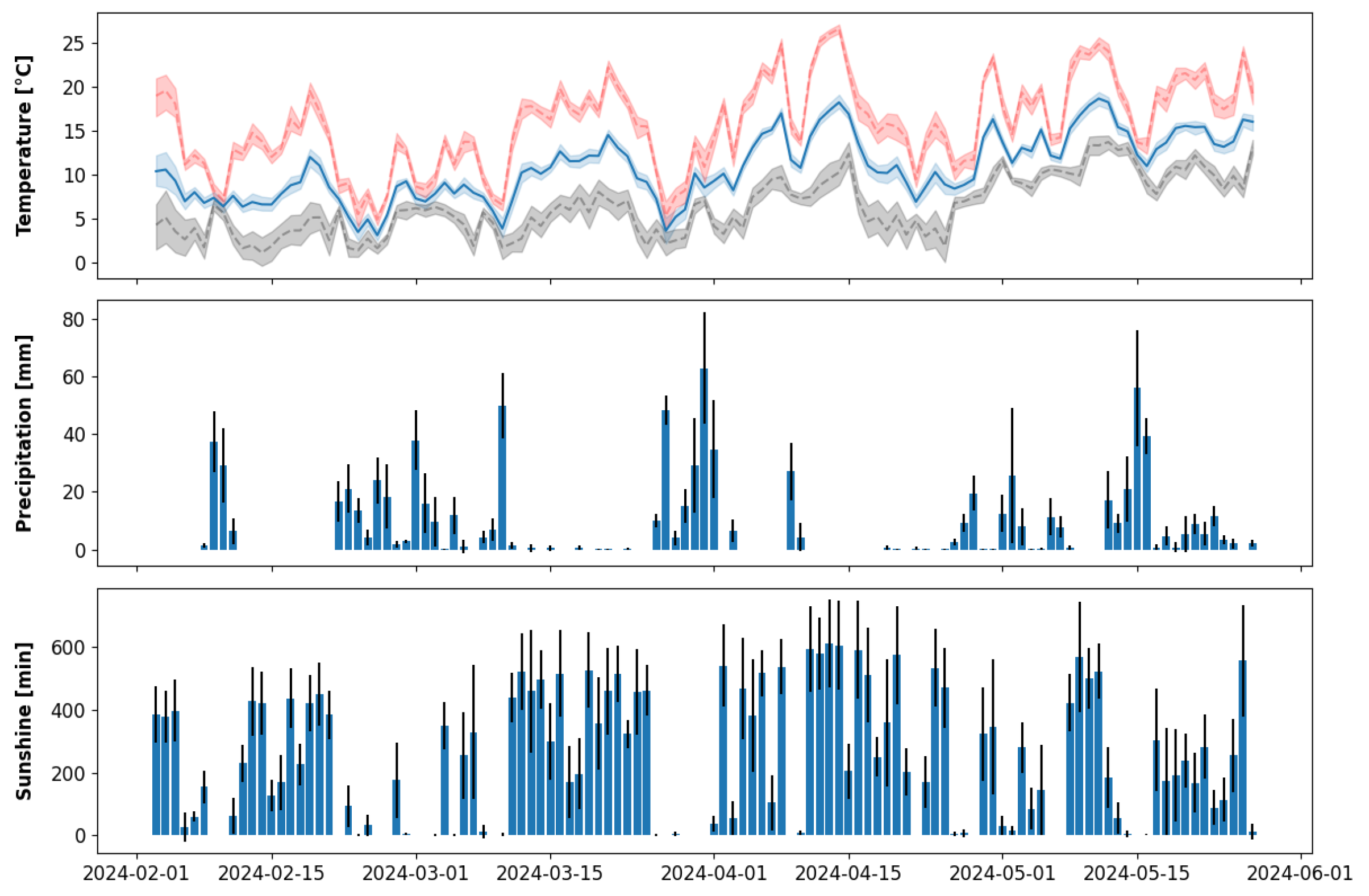
Figure 2.
Coordinates of weather stations employed for the retrieval of weather information (red points) and home (left plot) and work (right plot) location coordinates of the subset of study participants used for the analysis.
Figure 2.
Coordinates of weather stations employed for the retrieval of weather information (red points) and home (left plot) and work (right plot) location coordinates of the subset of study participants used for the analysis.
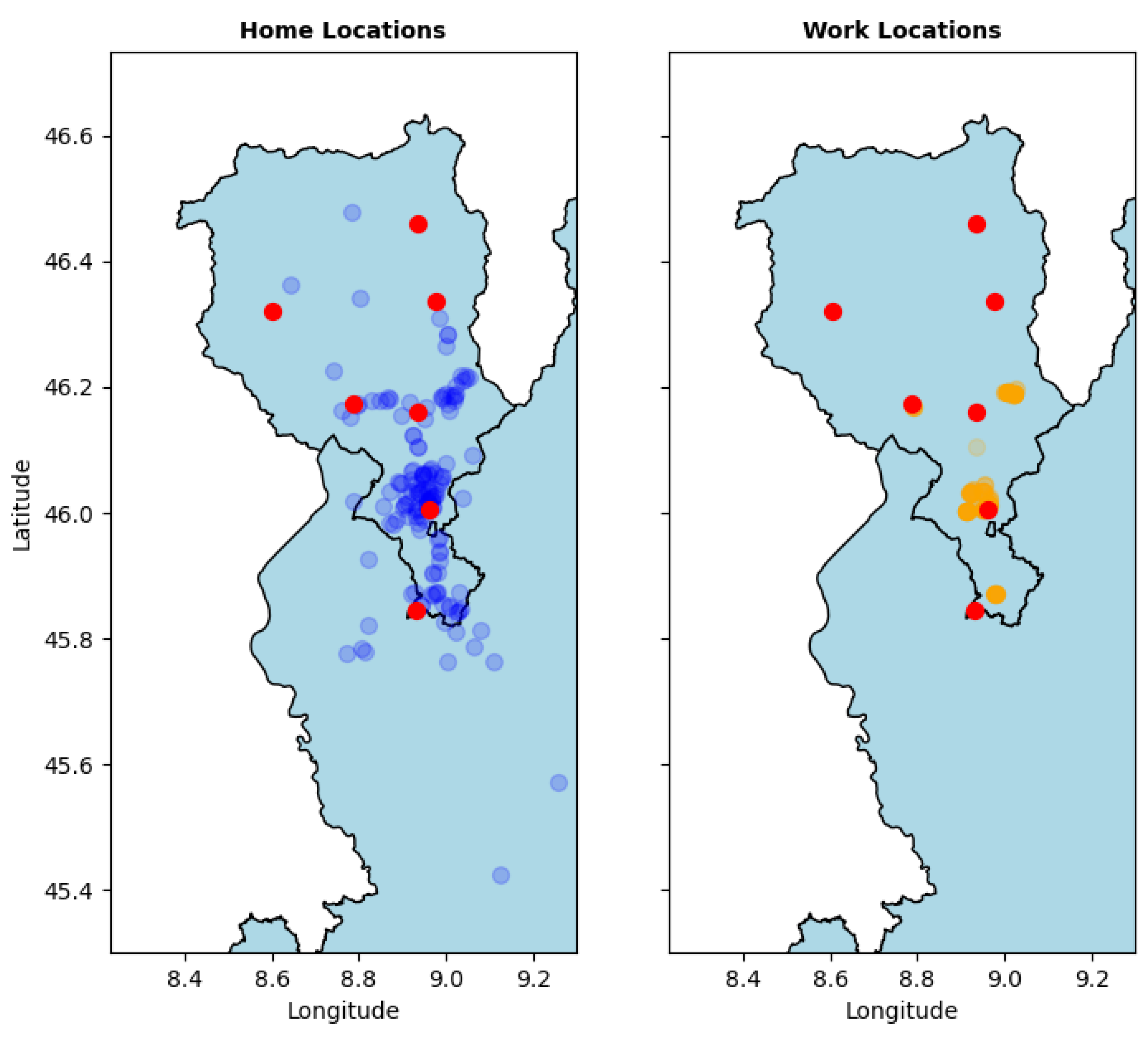
Table 1.
Detailed description of the outcomes considered for the MELR analysis, together with their source and scale. A.U.: Arbitrary Unit.
Table 1.
Detailed description of the outcomes considered for the MELR analysis, together with their source and scale. A.U.: Arbitrary Unit.
| Domain | Outcome | Source | Description | Scale | Unit |
|---|---|---|---|---|---|
| Well-being | Daily Steps | Garmin | Count of daily steps while awake | Steps | |
| Sedentary % | % of time in sedentary state while awake | 0-100 | % | ||
| Bedtime | Bedtime on next night | 0-24 | Hours | ||
| Wake-up Time | Wake-up on next night | 0-24 | Hours | ||
| Total Sleep Time | Total amount of sleep hours | Hours | |||
| Night Recovery | Normalized change of body battery while sleeping | % | |||
| Daily Stress | Mean measured physiological stress | A.U. | |||
| Self-Reported Stress | Diary | Perceived stress during the day | A.U. | ||
| Mobility | Active Mobility | GLH | Total daily distance traveled with active mobility | km | |
| Motor Vehicle | Total daily distance traveled with motor vehicles | km | |||
| Public Transport | Total daily distance traveled with public transport | km |
Table 3.
Descriptive statistics of the continuous variables. Bedtime and wake-up time are reported as hours from midnight.
Table 3.
Descriptive statistics of the continuous variables. Bedtime and wake-up time are reported as hours from midnight.
| Outcome | Daily Steps | 8392.07 | 3682.85 | 5782.25 | 7859.50 | 10280.00 |
| Sedentary % | 82.12 | 7.58 | 77.71 | 83.17 | 87.40 | |
| Total Sleep Time [hours] | 7.14 | 1.35 | 6.35 | 7.17 | 7.98 | |
| Bedtime [hours] | -0.48 | 1.36 | -1.40 | -0.65 | 0.30 | |
| Wake-up Time [hours] | 6.95 | 1.31 | 6.15 | 6.83 | 7.52 | |
| Mean Stress [%] | 50.71 | 14.64 | 40.23 | 51.51 | 61.20 | |
| Self-Reported Stress [1-5] | 2.47 | 0.98 | 2.00 | 2.00 | 3.00 | |
| Night Recovery [%] | 58.37 | 27.57 | 34.74 | 57.90 | 83.20 | |
| Active Mobility [km] | 2.77 | 5.81 | 0.00 | 0.59 | 2.63 | |
| Motor Vehicles [km] | 31.32 | 49.92 | 0.35 | 16.69 | 41.39 | |
| Public Transport [km] | 8.99 | 30.86 | 0.00 | 0.00 | 1.85 | |
| Weather | Temperature [∘ C] | 11.20 | 3.17 | 8.80 | 11.20 | 13.00 |
| Precipitation [mm] | 5.56 | 11.85 | 0.00 | 0.00 | 3.80 | |
| Sunshine [hours] | 5.25 | 4.16 | 0.34 | 5.27 | 9.12 |
Table 4.
Results of empty model, socio-demographics model, and weather model predicting the total number of daily steps while awake. For the sake of clarity, coefficients are rounded to nearest integer. Significant coefficients are highlighted in bold. *;**;*** MCS: Mental Component Score; PCS: Physical Component Score.
Table 4.
Results of empty model, socio-demographics model, and weather model predicting the total number of daily steps while awake. For the sake of clarity, coefficients are rounded to nearest integer. Significant coefficients are highlighted in bold. *;**;*** MCS: Mental Component Score; PCS: Physical Component Score.
| Daily Steps | ||||||
|---|---|---|---|---|---|---|
| Model 1 | Model 2 | Model 3 | ||||
| Coef. | CI | Coef. | CI | Coef. | CI | |
| Intercept | 8470*** | 8086 to 8854 | 8011*** | 6607 to 9416 | 7538*** | 6052.0 to 9024.0 |
| Age | 5 | -38 to 48 | 6 | -37 to 49 | ||
| Sex [0=Female] | -439 | -1251 to 373 | -432 | -1242 to 379 | ||
| Company [0=C1] | ||||||
| C2 | -367 | -1856 to 1121 | -448 | -1936 to 1039 | ||
| C3 | 925 | -467 to 2317 | 851 | -539 to 2241 | ||
| C4 | 728 | -681 to 2136 | 546 | -871 to 1964 | ||
| C5 | 1422* | 190.0 to 2654 | 1256* | 16 to 2495 | ||
| C6 | 755 | -865 to 2374 | 742 | -875 to 2359 | ||
| Supervisor role [0=No] | -113 | -927 to 702 | -118 | -932 to 695 | ||
| Having children [0=No] | -80 | -861 to 701 | -81 | -860 to 698 | ||
| SF-12 MCS | 66** | 19 to 112 | 66** | 20 to 113 | ||
| SF-12 PCS | 86** | 22 to 150 | 87** | 23 to 151 | ||
| Temperature | 41 | -13 to 95 | ||||
| Precipitation | -7 | -19 to 6 | ||||
| Sunshine Duration | 30 | -9 to 70 | ||||
| Marginal R2 | 0.000 | 0.062 | 0.067 | |||
| ICC | 0.378 | |||||
Table 5.
Results of empty model, socio-demographics model, and weather model predicting the percentage of sedentary time while awake. Significant coefficients are highlighted in bold.
*;**;***MCS: Mental Component Score; PCS: Physical Component Score.
Table 5.
Results of empty model, socio-demographics model, and weather model predicting the percentage of sedentary time while awake. Significant coefficients are highlighted in bold.
*;**;***MCS: Mental Component Score; PCS: Physical Component Score.
| Sedentary % | ||||||
|---|---|---|---|---|---|---|
| Model 1 | Model 2 | Model 3 | ||||
| Coef. | CI | Coef. | CI | Coef. | CI | |
| Intercept | 81.989*** | 81.117 to 82.861 | 83.995*** | 80.842 to 87.149 | 85.487*** | 82.202 to 88.772 |
| Age | 0.021 | -0.075 to 0.117 | 0.018 | -0.078 to 0.115 | ||
| Sex [0=Female] | 2.31* | 0.488 to 4.132 | 2.295* | 0.475 to 4.114 | ||
| Company [0=C1] | ||||||
| C2 | -1.014 | -4.354 to 2.326 | -0.798 | -4.137 to 2.54 | ||
| C3 | -2.980 | -6.107 to 0.146 | -2.817 | -5.940 to 0.306 | ||
| C4 | -1.940 | -5.103 to 1.223 | -1.489 | -4.666 to 1.688 | ||
| C5 | -3.839** | -6.605 to -1.073 | -3.414* | -6.193 to -0.636 | ||
| C6 | -3.472 | -7.109 to 0.165 | -3.456 | -7.089 to 0.176 | ||
| Supervisor role [0=No] | -0.148 | -1.977 to 1.681 | -0.141 | -1.967 to 1.686 | ||
| Having children [0=No] | -1.484 | -3.235 to 0.267 | -1.482 | -3.231 to 0.266 | ||
| SF-12 MCS | -0.063 | -0.167 to 0.042 | -0.064 | -0.169 to 0.040 | ||
| SF-12 PCS | -0.196** | -0.340 to -0.053 | -0.201** | -0.345 to -0.057 | ||
| Temperature | -0.115* | -0.218 to -0.012 | ||||
| Precipitation | 0.003 | -0.021 to 0.026 | ||||
| Sunshine Duration | -0.093* | -0.168 to -0.017 | ||||
| Marginal R2 | 0.000 | 0.087 | 0.094 | |||
| ICC | 0.475 | |||||
Table 6.
Results of empty model, socio-demographics model, and weather model predicting total sleep time. Total sleep time is measured in decimal hours. Significant coefficients are highlighted in bold. *;**;*** MCS: Mental Component Score; PCS: Physical Component Score.
Table 6.
Results of empty model, socio-demographics model, and weather model predicting total sleep time. Total sleep time is measured in decimal hours. Significant coefficients are highlighted in bold. *;**;*** MCS: Mental Component Score; PCS: Physical Component Score.
| Total Sleep Time | ||||||
|---|---|---|---|---|---|---|
| Model 1 | Model 2 | Model 3 | ||||
| Coef. | CI | Coef. | CI | Coef. | CI | |
| Intercept | 7.147*** | 7.03 to 7.264 | 7.331*** | 6.899 to 7.763 | 7.025*** | 6.550 to 7.500 |
| Age | -0.009 | -0.022 to 0.005 | -0.008 | -0.021 to 0.005 | ||
| Sex [0=Female] | -0.403** | -0.653 to -0.152 | -0.398** | -0.648 to -0.148 | ||
| Company | ||||||
| C2 | 0.002 | -0.456 to 0.461 | -0.038 | -0.498 to 0.421 | ||
| C3 | 0.173 | -0.255 to 0.601 | 0.163 | -0.264 to 0.591 | ||
| C4 | -0.086 | -0.519 to 0.348 | -0.177 | -0.616 to 0.262 | ||
| C5 | 0.109 | -0.269 to 0.488 | 0.027 | -0.357 to 0.410 | ||
| C6 | 0.187 | -0.311 to 0.686 | 0.194 | -0.303 to 0.692 | ||
| Supervisor role [0=No] | -0.074 | -0.325 to 0.177 | -0.069 | -0.320 to 0.181 | ||
| Having children [0=No] | 0.052 | -0.189 to 0.293 | 0.050 | -0.191 to 0.290 | ||
| SF-12 MCS | 0.001 | -0.013 to 0.016 | 0.001 | -0.013 to 0.016 | ||
| SF-12 PCS | -0.004 | -0.024 to 0.015 | -0.004 | -0.024 to 0.016 | ||
| Temperature | 0.030** | 0.008 to 0.051 | ||||
| Precipitation | 0.003 | -0.002 to 0.008 | ||||
| Sunshine Duration | 0.000 | -0.016 to 0.016 | ||||
| Marginal R2 | 0.000 | 0.036 | 0.039 | |||
| ICC | 0.240 | |||||
Table 7.
Results of empty model, socio-demographics model, and weather model predicting bedtime. Bedtime is measured in decimal hours from midnight. Significant coefficients are highlighted in bold. *;**;*** MCS: Mental Component Score; PCS: Physical Component Score.
Table 7.
Results of empty model, socio-demographics model, and weather model predicting bedtime. Bedtime is measured in decimal hours from midnight. Significant coefficients are highlighted in bold. *;**;*** MCS: Mental Component Score; PCS: Physical Component Score.
| Bedtime | ||||||
|---|---|---|---|---|---|---|
| Model 1 | Model 2 | Model 3 | ||||
| Coef. | CI | Coef. | CI | Coef. | CI | |
| Intercept | -0.481*** | -0.628 to -0.334 | -0.871** | -1.389 to -0.353 | -1.018*** | -1.566 to -0.470 |
| Age | -0.017* | -0.033 to -0.001 | -0.016* | -0.032 to -0.000 | ||
| Sex [0=Female] | 0.508** | 0.208 to 0.808 | 0.511** | 0.211 to 0.811 | ||
| Company | ||||||
| C2 | -0.271 | -0.82 to 0.279 | -0.292 | -0.842 to 0.258 | ||
| C3 | 0.045 | -0.469 to 0.559 | 0.044 | -0.470 to 0.558 | ||
| C4 | 0.434 | -0.086 to 0.954 | 0.384 | -0.140 to 0.909 | ||
| C5 | 0.321 | -0.134 to 0.775 | 0.277 | -0.181 to 0.736 | ||
| C6 | 0.134 | -0.464 to 0.732 | 0.139 | -0.459 to 0.737 | ||
| Supervisor role [0=No] | 0.099 | -0.201 to 0.4 | 0.103 | -0.198 to 0.404 | ||
| Having children [0=No] | -0.265 | -0.553 to 0.024 | -0.266 | -0.555 to 0.022 | ||
| SF-12 MCS | -0.005 | -0.023 to 0.012 | -0.005 | -0.023 to 0.012 | ||
| SF-12 PCS | -0.017 | -0.041 to 0.007 | -0.017 | -0.040 to 0.007 | ||
| Temperature | 0.017 | -0.003 to 0.036 | ||||
| Precipitation | 0.002 | -0.003 to 0.006 | ||||
| Sunshine Duration | -0.005 | -0.020 to 0.009 | ||||
| Marginal R2 | 0.000 | 0.093 | 0.094 | |||
| ICC | 0.415 | |||||
Table 8.
Results of empty model, socio-demographics model, and weather model predicting wake-up time. Wake-up time is measured in decimal hours from midnight. Significant coefficients are highlighted in bold. *;**;*** MCS: Mental Component Score; PCS: Physical Component Score.
Table 8.
Results of empty model, socio-demographics model, and weather model predicting wake-up time. Wake-up time is measured in decimal hours from midnight. Significant coefficients are highlighted in bold. *;**;*** MCS: Mental Component Score; PCS: Physical Component Score.
| Wakeup | ||||||
|---|---|---|---|---|---|---|
| Model 1 | Model 2 | Model 3 | ||||
| Coef. | CI | Coef. | CI | Coef. | CI | |
| Intercept | 6.959*** | 6.827 to 7.092 | 6.816*** | 6.357 to 7.275 | 6.326*** | 5.832 to 6.819 |
| Age | -0.022** | -0.036 to -0.008 | -0.021** | -0.035 to -0.007 | ||
| Sex [0=Female] | 0.089 | -0.177 to 0.355 | 0.097 | -0.169 to 0.364 | ||
| Company | ||||||
| C2 | -0.242 | -0.729 to 0.245 | -0.308 | -0.796 to 0.181 | ||
| C3 | 0.196 | -0.259 to 0.651 | 0.184 | -0.272 to 0.64 | ||
| C4 | 0.269 | -0.191 to 0.73 | 0.121 | -0.345 to 0.587 | ||
| C5 | 0.374 | -0.029 to 0.776 | 0.241 | -0.166 to 0.648 | ||
| C6 | 0.292 | -0.237 to 0.822 | 0.306 | -0.225 to 0.836 | ||
| Supervisor role [0=No] | -0.012 | -0.278 to 0.255 | -0.003 | -0.27 to 0.264 | ||
| Having children [0=No] | -0.22 | -0.476 to 0.035 | -0.225 | -0.481 to 0.031 | ||
| SF-12 MCS | -0.007 | -0.023 to 0.008 | -0.007 | -0.023 to 0.008 | ||
| SF-12 PCS | -0.019 | -0.04 to 0.002 | -0.019 | -0.04 to 0.002 | ||
| Temperature | 0.049*** | 0.029 to 0.069 | ||||
| Precipitation | 0.006* | 0.001 to 0.01 | ||||
| Sunshine Duration | -0.004 | -0.019 to 0.01 | ||||
| Marginal R2 | 0.000 | 0.09 | 0.10 | |||
| ICC | 0.347 | |||||
Table 9.
Results of empty model, socio-demographics model, and weather model predicting mean stress value during the day. Mean stress goes from a minimum of 0 (no stress) to a maximum of 100 (high stress). Significant coefficients are highlighted in bold. *;**;*** MCS: Mental Component Score; PCS: Physical Component Score
Table 9.
Results of empty model, socio-demographics model, and weather model predicting mean stress value during the day. Mean stress goes from a minimum of 0 (no stress) to a maximum of 100 (high stress). Significant coefficients are highlighted in bold. *;**;*** MCS: Mental Component Score; PCS: Physical Component Score
| Mean Stress | ||||||
|---|---|---|---|---|---|---|
| Model 1 | Model 2 | Model 3 | ||||
| Coef. | CI | Coef. | CI | Coef. | CI | |
| Intercept | 50.878*** | 48.94 to 52.815 | 47.498*** | 40.271 to 54.725 | 45.177*** | 37.788 to 52.566 |
| Age | -0.016 | -0.237 to 0.204 | -0.012 | -0.234 to 0.209 | ||
| Sex [0=Female] | -1.07 | -5.242 to 3.101 | -1.047 | -5.229 to 3.134 | ||
| Company | ||||||
| C2 | 3.934 | -3.715 to 11.582 | 3.602 | -4.067 to 11.271 | ||
| C3 | 4.003 | -3.167 to 11.173 | 3.76 | -3.428 to 10.948 | ||
| C4 | 5.925 | -1.326 to 13.176 | 5.242 | -2.046 to 12.53 | ||
| C5 | 4.359 | -1.982 to 10.700 | 3.714 | -2.658 to 10.087 | ||
| C6 | 7.442 | -0.895 to 15.780 | 7.422 | -0.935 to 15.779 | ||
| Supervisor role [0=No] | -0.588 | -4.779 to 3.604 | -0.598 | -4.799 to 3.604 | ||
| Having children [0=No] | 0.139 | -3.868 to 4.146 | 0.136 | -3.880 to 4.153 | ||
| SF-12 MCS | -0.343** | -0.582 to -0.104 | -0.341** | -0.581 to -0.101 | ||
| SF-12 PCS | 0.196 | -0.133 to 0.525 | 0.203 | -0.127 to 0.533 | ||
| Temperature | 0.176* | 0.016 to 0.336 | ||||
| Precipitation | -0.001 | -0.038 to 0.036 | ||||
| Sunshine Duration | 0.143* | 0.027 to 0.260 | ||||
| Marginal R2 | 0.000 | 0.076 | 0.080 | |||
| ICC | 0.659 | |||||
Table 10.
Results of empty model, socio-demographics model, and weather model predicting the self-reported stress value. Self-reported stress goes from a minimum of 1 (no stress) to a maximum of 5 (extreme stress). Significant coefficients are highlighted in bold. *;**;*** MCS: Mental Component Score; PCS: Physical Component Score.
Table 10.
Results of empty model, socio-demographics model, and weather model predicting the self-reported stress value. Self-reported stress goes from a minimum of 1 (no stress) to a maximum of 5 (extreme stress). Significant coefficients are highlighted in bold. *;**;*** MCS: Mental Component Score; PCS: Physical Component Score.
| Self-Reported Stress | ||||||
|---|---|---|---|---|---|---|
| Model 1 | Model 2 | Model 3 | ||||
| Coef. | CI | Coef. | CI | Coef. | CI | |
| Intercept | 2.487*** | 2.385 to 2.588 | 2.350*** | 2.004 to 2.696 | 2.64*** | 2.272 to 3.008 |
| Age | 0.002 | -0.009 to 0.012 | 0.001 | -0.010 to 0.011 | ||
| Sex [0=Female] | 0.244* | 0.044 to 0.444 | 0.238* | 0.040 to 0.437 | ||
| Company | ||||||
| C2 | -0.04 | -0.407 to 0.326 | -0.000 | -0.365 to 0.364 | ||
| C3 | 0.258 | -0.085 to 0.601 | 0.266 | -0.075 to 0.606 | ||
| C4 | 0.224 | -0.123 to 0.571 | 0.316 | -0.032 to 0.664 | ||
| C5 | 0.035 | -0.269 to 0.338 | 0.117 | -0.187 to 0.421 | ||
| C6 | 0.142 | -0.257 to 0.541 | 0.134 | -0.262 to 0.53 | ||
| Supervisor role [0=No] | -0.031 | -0.232 to 0.17 | -0.036 | -0.236 to 0.163 | ||
| Having children [0=No] | -0.187 | -0.38 to 0.005 | -0.184 | -0.375 to 0.007 | ||
| SF-12 MCS | -0.038*** | -0.049 to -0.026 | -0.038*** | -0.049 to -0.027 | ||
| SF-12 PCS | -0.010 | -0.026 to 0.006 | -0.010 | -0.026 to 0.006 | ||
| Temperature | -0.030*** | -0.045 to -0.016 | ||||
| Precipitation | -0.003 | -0.006 to 0.000 | ||||
| Sunshine Duration | 0.004 | -0.006 to 0.015 | ||||
| Marginal R2 | 0.000 | 0.107 | 0.114 | |||
| ICC | 0.370 | |||||
Table 11.
Results of empty model, socio-demographics model, and weather model predicting night recovery. Night recovery is measured as percentage from 0 (no recovery) to 100 (maximum recovery). Significant coefficients are highlighted in bold. *;**;*** MCS: Mental Component Score; PCS: Physical Component Score.
Table 11.
Results of empty model, socio-demographics model, and weather model predicting night recovery. Night recovery is measured as percentage from 0 (no recovery) to 100 (maximum recovery). Significant coefficients are highlighted in bold. *;**;*** MCS: Mental Component Score; PCS: Physical Component Score.
| Night Recovery | ||||||
|---|---|---|---|---|---|---|
| Model 1 | Model 2 | Model 3 | ||||
| Coef. | CI | Coef. | CI | Coef. | CI | |
| Intercept | 58.277*** | 55.438 to 61.117 | 56.490*** | 45.6 to 67.379 | 58.948*** | 47.438 to 70.459 |
| Age | -0.163 | -0.497 to 0.17 | -0.166 | -0.500 to 0.167 | ||
| Sex [0=Female] | 4.482 | -1.813 to 10.777 | 4.479 | -1.825 to 10.783 | ||
| Company | ||||||
| C2 | 2.459 | -9.081 to 13.998 | 2.797 | -8.771 to 14.364 | ||
| C3 | 3.754 | -7.04 to 14.548 | 4.139 | -6.674 to 14.951 | ||
| C4 | 0.894 | -10.027 to 11.816 | 1.523 | -9.497 to 12.544 | ||
| C5 | -0.579 | -10.13 to 8.971 | 0.056 | -9.578 to 9.691 | ||
| C6 | 0.727 | -11.833 to 13.286 | 0.810 | -11.767 to 13.386 | ||
| Supervisor role [0=No] | 1.535 | -4.781 to 7.85 | 1.587 | -4.738 to 7.912 | ||
| Having children [0=No] | -4.411 | -10.463 to 1.641 | -4.425 | -10.485 to 1.635 | ||
| SF-12 MCS | 0.194 | -0.167 to 0.555 | 0.190 | -0.172 to 0.552 | ||
| SF-12 PCS | -0.048 | -0.546 to 0.449 | -0.059 | -0.557 to 0.439 | ||
| Temperature | -0.125 | -0.531 to 0.281 | ||||
| Precipitation | 0.015 | -0.078 to 0.109 | ||||
| Sunshine Duration | -0.301* | -0.597 to -0.004 | ||||
| Marginal R2 | 0.000 | 0.024 | 0.027 | |||
| ICC | 0.373 | |||||
Table 12.
Results of empty model, socio-demographics model, and weather model predicting daily kilometers in active mobility (cycling, running, walking). Significant coefficients are highlighted in bold. *;**;*** MCS: Mental Component Score; PCS: Physical Component Score.
Table 12.
Results of empty model, socio-demographics model, and weather model predicting daily kilometers in active mobility (cycling, running, walking). Significant coefficients are highlighted in bold. *;**;*** MCS: Mental Component Score; PCS: Physical Component Score.
| Active Mobility Distance [km] | ||||||
|---|---|---|---|---|---|---|
| Model 1 | Model 2 | Model 3 | ||||
| Coef. | CI | Coef. | CI | Coef. | CI | |
| Intercept | 2.774*** | 2.255 to 3.292 | 1.766 | -0.097 to 3.629 | 1.38 | -0.651 to 3.412 |
| Age | 0.103*** | 0.046 to 0.161 | 0.104*** | 0.047 to 0.161 | ||
| Sex [0=Female] | 1.131* | 0.052 to 2.21 | 1.139* | 0.065 to 2.213 | ||
| Company [0=C1] | ||||||
| C2 | -0.203 | -2.180 to 1.775 | -0.293 | -2.264 to 1.679 | ||
| C3 | 0.715 | -1.130 to 2.560 | 0.579 | -1.258 to 2.416 | ||
| C4 | -0.808 | -2.675 to 1.060 | -1.015 | -2.898 to 0.869 | ||
| C5 | 1.648* | 0.015 to 3.281 | 1.457 | -0.189 to 3.104 | ||
| C6 | -0.800 | -2.948 to 1.348 | -0.841 | -2.979 to 1.296 | ||
| Supervisor role [0=No] | -0.305 | -1.386 to 0.775 | -0.327 | -1.403 to 0.748 | ||
| Having children [0=No] | -0.308 | -1.347 to 0.730 | -0.306 | -1.339 to 0.727 | ||
| SF-12 MCS | 0.030 | -0.032 to 0.092 | 0.030 | -0.032 to 0.092 | ||
| SF-12 PCS | 0.008 | -0.078 to 0.093 | 0.010 | -0.075 to 0.095 | ||
| Temperature | 0.029 | -0.063 to 0.120 | ||||
| Precipitation | -0.022* | -0.043 to -0.001 | ||||
| Sunshine Duration | 0.062 | -0.005 to 0.129 | ||||
| Marginal R2 | 0.000 | 0.053 | 0.061 | |||
| ICC | 0.264 | |||||
Table 13.
Results of empty model, socio-demographics model, and weather model predicting daily kilometers in motor vehicles (car, motorcycle, taxi). Significant coefficients are highlighted in bold. *;**;*** MCS: Mental Component Score; PCS: Physical Component Score.
Table 13.
Results of empty model, socio-demographics model, and weather model predicting daily kilometers in motor vehicles (car, motorcycle, taxi). Significant coefficients are highlighted in bold. *;**;*** MCS: Mental Component Score; PCS: Physical Component Score.
| Motor Vehicle Distance [km] | ||||||
|---|---|---|---|---|---|---|
| Model 1 | Model 2 | Model 3 | ||||
| Coef. | CI | Coef. | CI | Coef. | CI | |
| Intercept | 30.729*** | 26.893 to 34.564 | 49.26*** | 36.082 to 62.438 | 43.307*** | 28.016 to 58.597 |
| Age | 0.08 | -0.327 to 0.486 | 0.091 | -0.319 to 0.501 | ||
| Sex [0=Female] | 3.536 | -4.117 to 11.189 | 3.672 | -4.048 to 11.392 | ||
| Company [0=C1] | ||||||
| C2 | -27.850*** | -41.872 to -13.827 | -28.948*** | -43.132 to -14.763 | ||
| C3 | -33.537*** | -46.564 to -20.509 | -34.438*** | -47.592 to -21.284 | ||
| C4 | -29.332*** | -42.536 to -16.127 | -31.988*** | -45.597 to -18.380 | ||
| C5 | -26.410*** | -37.956 to -14.863 | -28.794*** | -40.688 to -16.900 | ||
| C6 | -22.570** | -37.760 to -7.380 | -22.722** | -38.045 to -7.400 | ||
| Supervisor role [0=No] | 6.952 | -0.691 to 14.595 | 6.907 | -0.803 to 14.618 | ||
| Having children [0=No] | 1.634 | -5.742 to 9.010 | 1.592 | -5.847 to 9.030 | ||
| SF-12 MCS | -0.104 | -0.544 to 0.336 | -0.104 | -0.548 to 0.340 | ||
| SF-12 PCS | 0.200 | -0.407 to 0.807 | 0.214 | -0.398 to 0.826 | ||
| Temperature | 0.628 | -0.205 to 1.461 | ||||
| Precipitation | -0.112 | -0.306 to 0.081 | ||||
| Sunshine Duration | 0.194 | -0.420 to 0.807 | ||||
| Marginal R2 | 0.000 | 0.059 | 0.062 | |||
| ICC | 0.172 | |||||
Table 14.
Results of empty model, socio-demographics model, and weather model predicting daily kilometers in public transportation (bus, train, tram). Significant coefficients are highlighted in bold. *;**;*** MCS: Mental Component Score; PCS: Physical Component Score.
Table 14.
Results of empty model, socio-demographics model, and weather model predicting daily kilometers in public transportation (bus, train, tram). Significant coefficients are highlighted in bold. *;**;*** MCS: Mental Component Score; PCS: Physical Component Score.
| Public Transport Distance [km] | ||||||
|---|---|---|---|---|---|---|
| Model 1 | Model 2 | Model 3 | ||||
| Coef. | CI | Coef. | CI | Coef. | CI | |
| Intercept | 9.144*** | 7.028 to 11.26 | 3.300 | -4.914 to 11.513 | 3.149 | -6.301 to 12.598 |
| Age | 0.172 | -0.081 to 0.426 | 0.171 | -0.081 to 0.423 | ||
| Sex [0=Female] | 1.533 | -3.238 to 6.303 | 1.441 | -3.310 to 6.193 | ||
| Company [0=C1] | ||||||
| C2 | 4.707 | -4.034 to 13.448 | 4.992 | -3.738 to 13.722 | ||
| C3 | 4.267 | -3.853 to 12.387 | 4.578 | -3.514 to 12.67 | ||
| C4 | 5.637 | -2.594 to 13.868 | 6.596 | -1.783 to 14.974 | ||
| C5 | 12.430** | 5.233 to 19.627 | 13.173*** | 5.853 to 20.494 | ||
| C6 | 0.376 | -9.092 to 9.843 | 0.47 | -8.957 to 9.896 | ||
| Supervisor role [0=No] | -0.447 | -5.212 to 4.317 | -0.422 | -5.166 to 4.322 | ||
| Having children [0=No] | -2.993 | -7.591 to 1.605 | -2.963 | -7.541 to 1.615 | ||
| SF-12 MCS | 0.064 | -0.211 to 0.338 | 0.069 | -0.204 to 0.343 | ||
| SF-12 PCS | -0.706*** | -1.085 to -0.328 | -0.703*** | -1.079 to -0.326 | ||
| Temperature | -0.178 | -0.700 to 0.344 | ||||
| Precipitation | 0.123* | 0.002 to 0.244 | ||||
| Sunshine Duration | 0.191 | -0.194 to 0.575 | ||||
| Marginal R2 | 0.000 | 0.042 | 0.044 | |||
| ICC | 0.124 | |||||
Disclaimer/Publisher’s Note: The statements, opinions and data contained in all publications are solely those of the individual author(s) and contributor(s) and not of MDPI and/or the editor(s). MDPI and/or the editor(s) disclaim responsibility for any injury to people or property resulting from any ideas, methods, instructions or products referred to in the content. |
© 2025 by the authors. Licensee MDPI, Basel, Switzerland. This article is an open access article distributed under the terms and conditions of the Creative Commons Attribution (CC BY) license (http://creativecommons.org/licenses/by/4.0/).
Copyright: This open access article is published under a Creative Commons CC BY 4.0 license, which permit the free download, distribution, and reuse, provided that the author and preprint are cited in any reuse.


