

Submitted:
05 September 2025
Posted:
08 September 2025
You are already at the latest version
Abstract
Planetary Boundary transgressions occur as the result of a conflict between human engineered systems and the natural life-support systems on Earth. In this paper, we validate the Berkana Institute's Two Loops Theory of Change which posits that big living systems cannot be changed from within. We can only abandon them and start over. We show that the desired objectives of world peace and planetary health can be attained through a "Planet B" style engineering of human systems to meet the 17 UN Sustainable Development Goals (SDG), sans SDG #8 (Economic Growth) and with the addition of Beyond Cruelty Foundation's SDG #18 (Zero Animal Exploitation). We show that the transition to fully plant-based systems as envisioned in SDG #18 mitigates all seven planetary boundary transgressions and aids in the development of a regenerative, equitable and sustainable civilization that we call Planet B.
Keywords:
planetary boundaries
; systems engineering
; world peace
; planetary health
; sustainable development goals
Introduction
Humanity is at a crossroads. The transgression of seven planetary boundaries [21,25,30], biosphere integrity, novel entities, biogeochemical flows, climate change, land use, fresh water use, and ocean acidification, signals that our relationship with Earth’s life-support system is in a state of crisis. These transgressions are not random accidents but the predictable outcome of human-engineered systems designed around myths of human supremacy, separation from Nature, and endless economic growth [18]. Attempts to reform such systems from within have repeatedly failed, as entrenched interests and cultural inertia resist fundamental transformation.
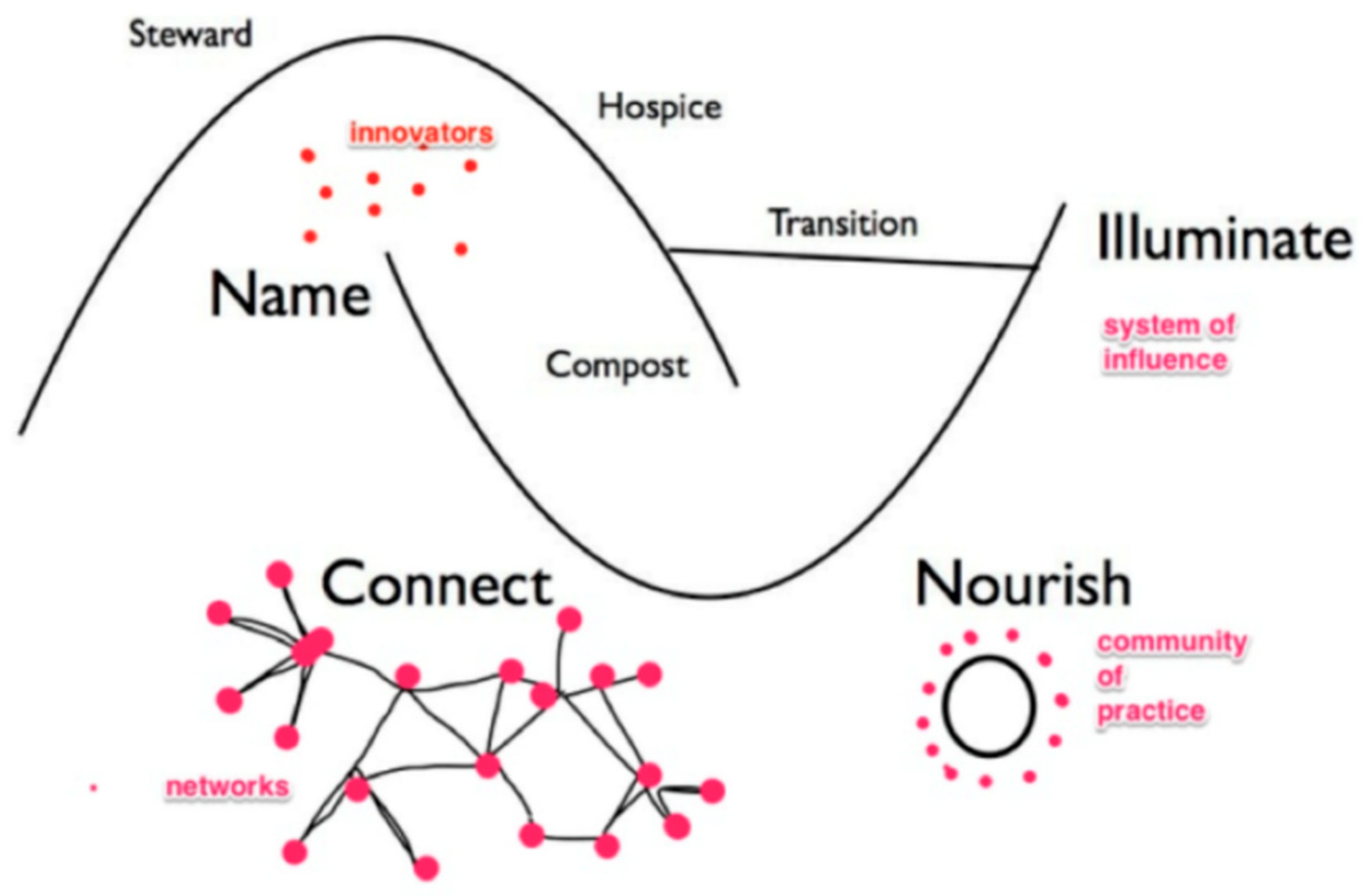
This paper builds upon the Berkana Institute’s Two Loops Theory of Change [33,34], which posits that large, living systems cannot be transformed through internal reform alone. Instead, true transformation occurs when new systems are created that render the old ones obsolete. To validate this, we examine persistent legacies of injustice, such as human slavery [4] and colonialism [6], that have morphed rather than disappeared, despite formal abolitions. The historical continuity of these systems underscores the inadequacy of reforms from within.
In response, this paper presents a systems engineering framework for building Planet B [24], a regenerative, compassionate civilization intentionally designed to meet global objectives of world peace and planetary health. Unlike the current paradigm, Planet B is grounded in life-affirming values and ethical axioms that honor all beings. We critique the mainstream UN Sustainable Development Goals [31] (SDGs) for being structurally compromised by SDG #8: Decent Jobs and Economic Growth, which promotes endless economic growth, a goal that is fundamentally at odds with ecological stability. Instead, we propose the inclusion of Beyond Cruelty Foundation’s SDG #18: Zero Animal Exploitation [3], as a critical and necessary upgrade to the SDG framework.
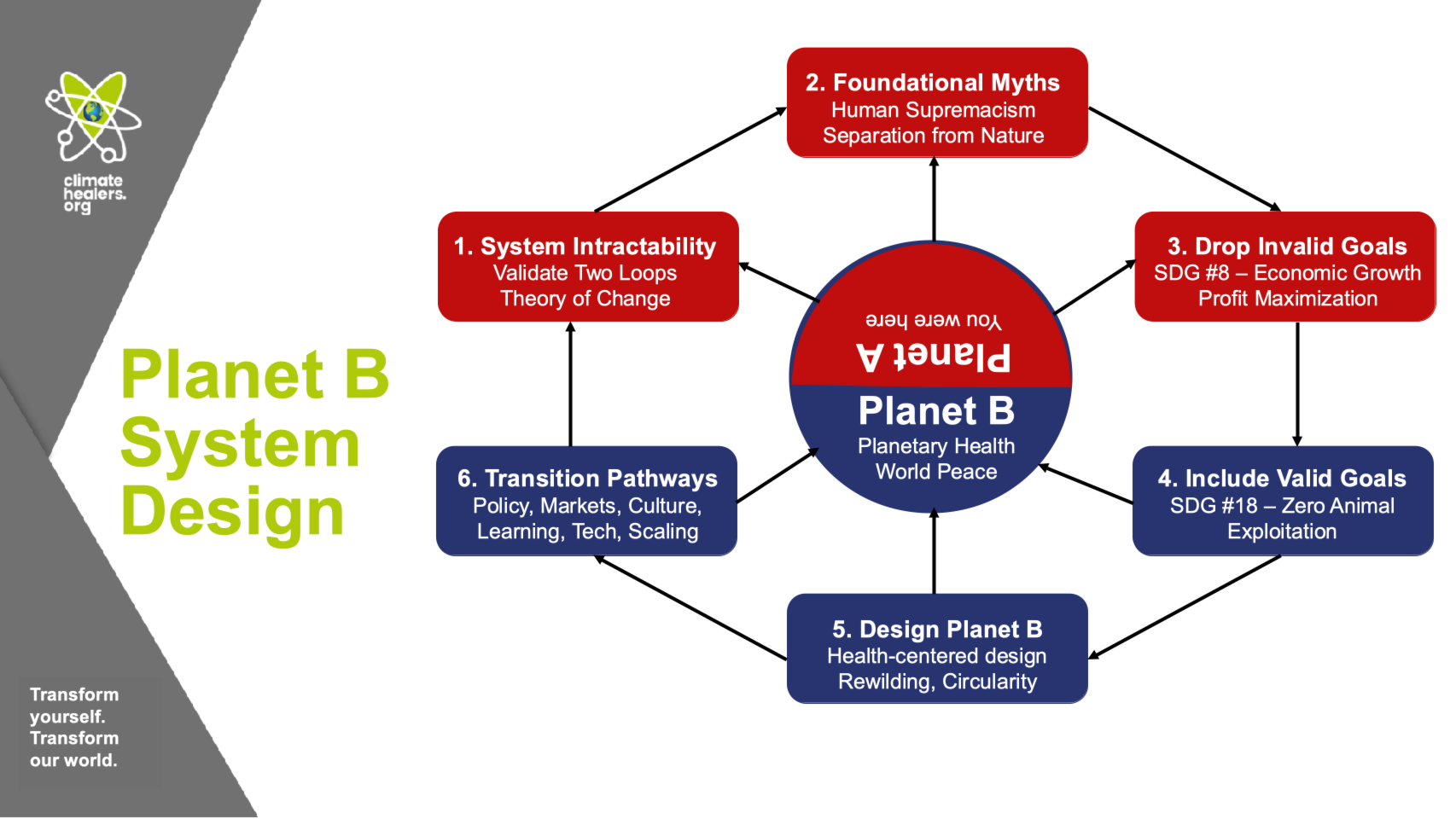
This paper is divided into six parts:
- 1. The Intractability of Legacy Systems
In this section, we examine how global systems of domination, such as slavery and colonialism, have persisted under new forms despite official abolishment. This analysis underscores the validity of the Berkana Institute’s assertion that systemic change must emerge from outside existing paradigms.
- 2. Foundational Myths vs. Foundational Axioms
We identify the dominant cultural myths that perpetuate planetary destruction, such as the myth of human supremacy, separation from Nature and the necessity for endless economic growth. In contrast, we articulate a new set of foundational axioms rooted in compassion, interdependence, and nonviolence that must underpin sustainable systems on Planet B.
- 3. Dropping Invalid Goals
In this section, we propose a validity test for goals and explore how SDG #8: Decent Jobs and Economic Growth compromises the integrity of the entire SDG framework. We demonstrate that infinite economic growth on a finite planet leads to ecological overshoot, resource depletion, and social inequity, which directly undermine the remaining goals that the SDGs aim to achieve.
- 4. Including Valid Goals
We show how adopting SDG #18: Zero Animal Exploitation catalyzes systemic healing. By eliminating animal exploitation, we reduce greenhouse gas emissions, restore ecosystems, improve human health, and foster ethical coherence. We present evidence that a global transition to plant-based systems directly addresses all seven planetary boundary transgressions while advancing every other SDG.
- 5. Designing Planet B (Fully Plant-Based Systems)
In this section, we outline a systems engineering blueprint for reconfiguring agriculture, food supply chains, economic and cultural practices around plant-based principles. This design prioritizes ecological regeneration, equitable resource distribution, and human health, making SDG #18 actionable from local communities to global governance.
- 6. Transitioning to Planet B
We present strategies for implementing the transition to Planet B through policy shifts, technological innovations, learning initiatives, and grassroots movements. Special emphasis is placed on cultural transformation, economic realignment, and the role of global collaboration in scaling plant-based systems.
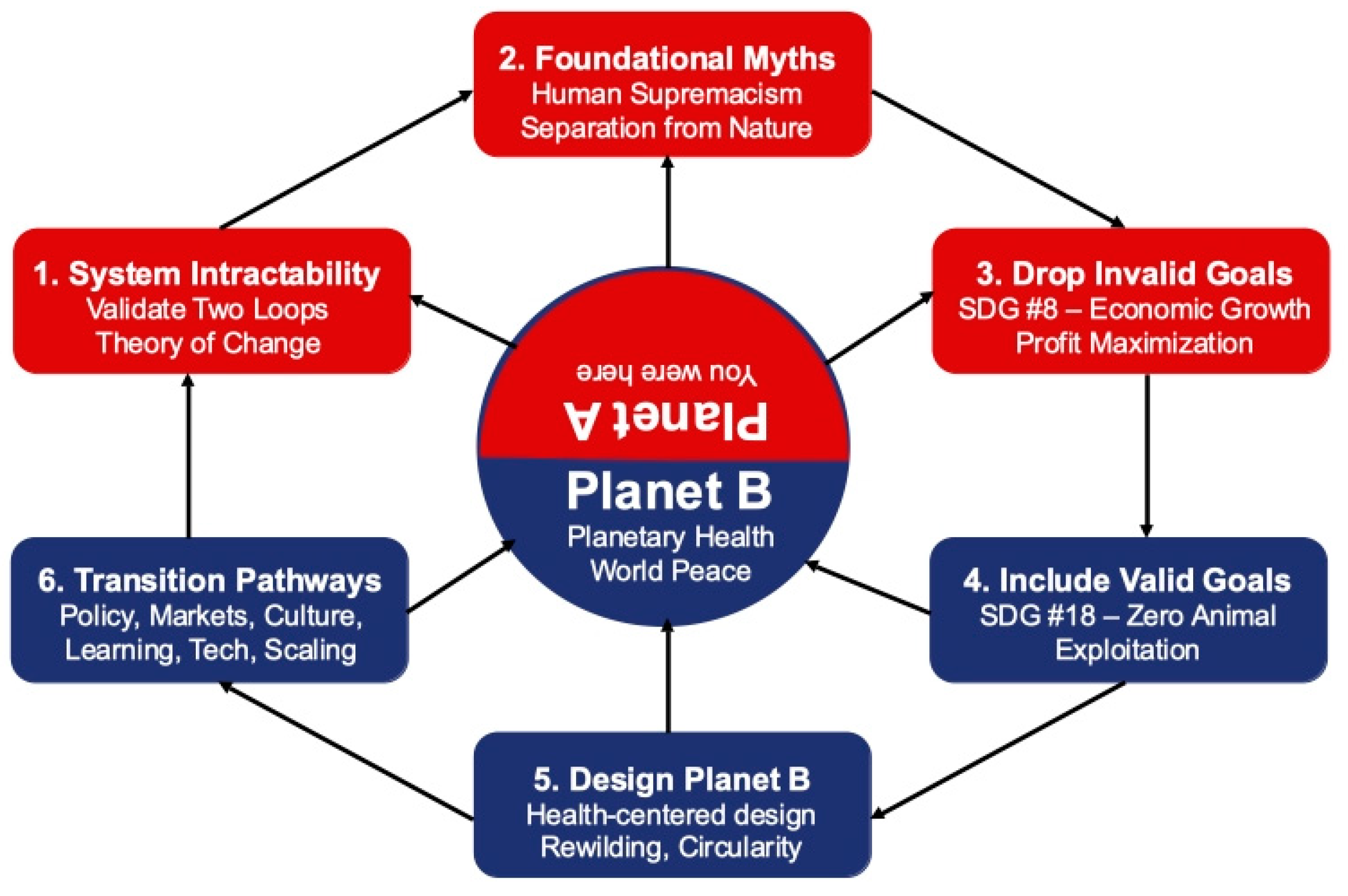
By integrating these six elements in a circular flow for continuous refinement as shown in Figure 1, we claim that a transition to Planet B is both technologically feasible and urgently necessary. It is through the deliberate design and adoption of plant-based systems that humanity can achieve the twin goals of world peace and planetary health. It is most likely the only viable pathway to a just, sustainable, and thriving future for all life on Earth.
1. The Intractability of Legacy Systems
1.1. Definition and Properties
A system is an organized framework to accomplish an objective. In this paper, legacy systems denote large, adaptive systems such as economies, states, food regimes, and knowledge institutions that are
(i) multi-layered with technological, legal and cultural characteristics, and
(ii) self-stabilizing via feedbacks on resource flows, incentives, and norms.
As living systems, when perturbed, they reconfigure to preserve core properties even as surface features are reformed. Three system properties explain their resistance to change from within:
Narrative lock-in. Foundational stories on human supremacy, scarcity and economic growth act as high-level controllers that bound the solution space for problems that arise. Solutions outside this space are treated as “unrealistic,” regardless of merit.
Institutional inertia. Laws, infrastructures, and professional societies propagate past decisions even as they become outdated. For instance, the UN Intergovernmental Panel on Climate Change (IPCC) continues to use the 1996 reporting guidelines for greenhouse gas emissions, even though climate science has progressed by leaps and bounds since 1996.
Political-economic capture. Powerful beneficiaries shape rule-sets, metrics, and even the framing of scientific problems, redirecting proposed changes toward efficiency tweaks, while leaving core system characteristics untouched.
These properties map directly onto the Berkana Institute’s Two Loops model[33,34]. As the incumbent loop matures, internal repair capacities privilege continuity, while genuine reforms accumulate in a parallel, emergent loop.
Figure 2.
The Berkana Institute’s Two Loops Theory of Change (source: Berkana Institute).
1.2. Abolition Without Erasure
The 19th-century legal abolition of chattel slavery [4] did not abolish its economic purpose. The equivalent of slavery re-emerged through debt peonage, convict leasing, racialized policing, and later through mass incarceration. From a systems perspective, slavery was morphed rather than erased since coercive labor was reinstantiated through new legal encodings. The incumbent loop preserved
(a) a cheap, disciplined labor pool,
(b) a punitive control apparatus, and
(c) racialized hierarchies that rationalized unequal extraction.
The courts, media and the education system performed narrative work to normalize the surface level changes. This shows that even well-intentioned genuine reforms fail when the system’s objective function remains intact.
1.3. Independence Without Decolonization
Formal decolonization in the 20th century dismantled imperial administrations yet left the extractive function largely unchanged. Post independence, extraction from the colonies was achieved through unfavorable terms of trade, debt conditionalities, export-oriented agriculture, unequal intellectual property regimes, and health care paradigms aligned with donor interests. For instance, the European Economic Commission funded the National Dairy Development Board in India to increase dairy consumption even though the majority of Indians cannot digest lactose. India is now the largest dairy producer and the second largest beef exporter in the world, while also becoming the diabetes capital of the world.
In control-theoretic terms, net resource transfer from the colonies was maintained through finance, standards, and development expertise rather than military garrisons [6]. The substitution of flags, anthems, and constitutions merely provided surface level changes sufficient to quell mass unrest.
1.4. Why Climate-Nature Policy Stalls Inside the Incumbent Loop
Contemporary environmental governance inherits this pattern. The unchecked growth of material throughput on a finite planet and a food regime premised on non-human animal exploitation conflict with planetary carrying capacity and interspecies justice. Yet most solutions privileged inside the incumbent loop optimize emissions intensity, not reversal of harm. Efficiency upgrades, voluntary pledges, and growth-compatible “green transitions” preserve the goal of aggregate expansion of the human enterprise. Simultaneously, high-leverage demand-side measures, such as ending animal exploitation and rewilding are marginalized as “lifestyle changes” rather than treated as system level prerequisites. The result is apparent action without meaningful results. While conferences proliferate, and metrics improve at the margin, state variables of the planetary life-support system such as biosphere integrity, novel entities, biogeochemical flows and CO2 emissions, continue to transgress beyond safe ranges.
1.5. Formal Proposition and Corollary
Proposition. In mature legacy systems, interventions that do not modify the system’s objective function and constraint set will produce only surface-levels changes without disrupting the core functions.
Corollary. To terminate harmful functions, e.g., extractive growth, and animal exploitation, reforms must (a) replace the objective function, (b) alter constraints and payoffs across layers, and (c) instantiate the new design in parallel institutions capable of outcompeting or rendering obsolete the incumbent institutions.
1.6. Mechanisms of Absorption
The incumbent loop uses four distinct mechanisms to absorb proposed changes without altering its core functionality:
Compensating dynamics. Efficiency gains lower apparent costs, triggering rebound effects that restore and even increase aggregate throughput, as in the Jevon’s paradox.
Instrument drift. Metrics and models are re-parameterized to legitimate the status quo, e.g., growth-centric success criteria, reclassifying externalities as exogenous.
Co-optation of dissent. Radical critiques are translated into safe managerial programs wherein funding architectures privilege incrementalism.
Cultural containment. Media and education curate the Overton window, ensuring that compassion-centric, multi-species ethics remain peripheral to “serious policy.”
1.7. Summary
Historical reforms that left objective functions intact produced surface-level, not structural changes. The same logic explains contemporary environmental stalemate. Consistent with the Two Loops Theory of Change, durable change requires building a parallel operating system that we call Planet B, whose controllers are compassion, sufficiency, and multi-species flourishing, operationalized via the adoption of SDG #18 and the deliberate design of fully plant-based, regenerative systems.
2. Foundational Myths vs. Foundational Axioms
2.1. Diagnosing the Foundational Myths Structuring Planet A
We use myth in the technical sense of a narrative that contains an element of truth but functions as a high-level controller that constrains admissible policy and design choices. On Planet A, four interlocking myths govern socio-technical organization [24]:
- Myth 1: Endless growth as the master objective.
Economic expansion is treated as a necessary condition for human well-being and institutional stability. The necessity for growth is coded into currency architectures and governance objectives so that political, corporate, and scientific actors are constrained to preserve growth even when it conflicts with ecological limits. This normalization persists even in high-consumption societies already in ecological overshoot who are often considered “too big to fail,” where official plans explicitly commit to cutting emissions without reducing growth.
- Myth 2: Consumption and commodification as social logic.
Consumption is elevated from means to organizing value. Advertising infrastructures continuously stimulate demand, while supply chains optimize for the accessibility of exotic, discretionary goods rather than universal sufficiency. The result is systemic misallocation so that a food system which procures multiples of required quantities produces chronic hunger and widespread micronutrient deficiency.
- Myth 3 — Separation from Nature and human exceptioalism.
A story of human separation from the rest of Life, bolstered by cultural and scientific framings of the self as a discrete, competing unit for scarce resources, licenses the differential moral valuation of beings and the routine exploitation of non-human animals. Explicitly speciesist institutions such as slaughterhouses are thereby normalized even as analogous harms among humans are condemned. This asymmetry is a root driver of ecological breakdown and social harms.
- Myth 4 — Mis-specified responsibility for ecological breakdown.
A fourth, more recent myth narrows causality for ecological breakdown to fossil fuel combustion alone, politically obscuring food-system drivers through selective accounting choices. This mis-specification diverts effort toward growth-compatible efficiency fixes on the energy infrastructure while marginalizing high-leverage dietary and land-use transformations.
A secondary example illustrates the mechanism of myth-making. The pedagogical association of protein with animal foods and calcium with dairy foods obscures the ubiquity of protein and calcium in all foods, naturalizes animal consumption and erases plant sources with measurable health and equity consequences.
2.2. Foundational Axioms for Planet B
The transition to Planet B requires axioms that
(i) correct the above myths,
(ii) re-parameterize institutional objective functions, and
(iii) ground design/test criteria across sectors.
We synthesize these axioms from whole-system governance frameworks and value transformations necessary for the restoration of planetary health.
- Axiom A: Interdependence of all Life
Align governance, law, economics, media, education, and technology with the principles of Life and whole-system health. Peace is illusory if oppression exists anywhere in the Community of Life.
- Axiom B: Nonviolence / Zero Animal Exploitation
Recognize non-human animals as moral subjects; institutionalize Ahimsa (non-harming) as a hard constraint. This closes a primary pathway of ecological degradation and social injustice through speciesism.
- Axiom C: Sufficiency over growth
Replace growth imperatives with goals oriented towards planetary healing and purpose beyond the self.
- Axiom D: Honesty and humility as design criteria
Evaluate systems against the “5H” litmus test criteria: honesty, humility, health, happiness, and harmony. Reject system architectures that fail these values.
- Axiom E: Universal provisioning within planetary limits
Organize for clean air, healthy soils, pure water, and vitalizing food for all beings; redesign supply chains and production so that universal needs, not luxury consumption, constitute the optimization target.
- Axiom F: Distributed, participatory governance
Adopt distributed decision architectures that place whole-system health at the core and give standing to human and non-human stakeholders.
- Axiom G: Technology subordinated to Life
Direct scientific and technological advancement to serve whole-system healing rather than throughput expansion. Evaluate tools by their contribution to biosphere integrity and compassion.
2.3. Operationalization and Falsifiability
The axioms above are actionable rather than aspirational. They prescribe
(i) constraint re-writing, e.g., elimination of exploitation under Axiom B,
(ii) goal substitution under Axiom C, and
(iii) new evaluation functions under Axioms D–G.
They are empirically testable through system-level indicators already enumerated in governance frameworks, e.g., stabilization and restoration of planetary boundary variables, adoption of distributed governance, and measurable shifts in provisioning quality for humans and other animals.
2.4. De-Programming Myths
Because myths are reproduced through pedagogy and everyday practice, overcoming them must include curricular corrections, e.g., on plant sources of protein and calcium, and narrative reform, along with institutional redesign.
In summary, Planet B requires explicit axioms that reverse the operational myths of Planet A and re-compose our socio-technical control architecture around whole-system health, compassion, and multi-species flourishing.
3. Dropping Invalid Goals
3.1. Why Goals Matter in Systems Engineering
In socio-technical system design, goals instantiate the objective function. They determine which states are considered successes, what trade-offs are admissible, and how feedback is interpreted. When an objective is ill-posed, the system will optimize toward harmful states no matter how sophisticated the policies, models, or technologies layered on top. Section 2 proposed axioms for Planet B regarding interdependence, non-violence, sufficiency, equity, and honesty. Here we operationalize those axioms by identifying and retiring goals on Planet A that are biophysically infeasible, systemically incoherent, or ethically inadmissible. Dropping invalid goals is a required step in systems engineering to remove opposing forces so that the desired objectives of world peace and planetary health become achievable stable points.
3.2. A Validity Test for Goals (GVT)
We define a Goal Validity Test (GVT) with four necessary conditions:
- GVT-F (Feasibility): The goal is compatible with planetary boundary constraints and thermodynamic or biogeochemical realities.
- GVT-C (Coherence): Pursuit of the goal does not systematically undermine other agreed upon goals.
- GVT-E (Ethical admissibility): The goal is consistent with Axioms A–B so that it does not require institutionalized harm to humans or other animals.
- GVT-M (Meaningful measurement): Indicators track ends such as wellbeing and ecological integrity, rather than proxies such as Gross Domestic Product (GDP) that detach from those ends under optimization pressure.
A goal that fails any one of GVT-F/C/E/M is invalid at the top level and should be retired or reframed.
3.3. Case Analysis: SDG #8 (“Sustained Economic Growth”) Fails GVT
SDG #8 installs “sustained economic growth”, often measured as real GDP growth, as a global objective. In control theoretic terms, it acts as a master set-point that undermines other goals.
GVT-F (Feasibility) failure. At planetary scale, GDP growth remains strongly coupled to aggregate energy and material throughput. While energy/material/waste intensity reductions are possible, the rate and scope of reductions needed to grow GDP indefinitely and re-enter the safe operating space of the life-support systems of the planet has not been observed at global scale. Treating growth as a standing objective therefore violates the feasibility condition under multiple boundaries such as climate, biosphere integrity, land system change, biogeochemical flows, and novel entities.
GVT-C (Coherence) failure. A growth set-point exerts negative pressure on other SDGs, such as SDG #3: Good Health and Well Being. At the moment, 90% of the health care economy is engaged in treating 15 chronic conditions caused by 8 risky behaviors. When growth is a priority, those risky behaviors are encouraged to grow the health care economy, causing failure on SDG #3.
When conflicts arise between any goal and the growth set-point, budget, policy, and narrative systems typically prioritize “green growth” pathways over alternatives with higher leverage but lower compatibility, e.g., dietary shifts, rewilding, and sufficiency. Coherence is lost because the optimization target reinterprets constraints as adjustable.
GVT-E (Ethical) failure. The growth objective structurally favors sectors whose value added scales with commodification of beings and habitats. In practice, this has normalized the mass use of non-human animals as inputs for food, fashion, testing, and entertainment. That reliance conflicts with Axiom B (nonviolence), rendering the goal ethically inadmissible as a top-level aim.
GVT-M (Measurement) failure. GDP conflates desirable and undesirable activity, is blind to depletion and suffering, and is trivially gamed via monetization and externalization. As an objective, it incentivizes proxies rather than end-state improvements on health, equity, and ecosystem vitality.
In conclusion, SDG #8, in its growth-as-goal formulation, fails all four validity conditions. On Planet B, growth may occur locally as a side-effect of healing and provisioning, but it cannot serve as a goal.
3.4. Additional Invalid Goal Patterns Linked to Boundary Transgressions
Beyond SDG #8, several common objectives should be retired or reframed:
-
“Increase per-capita animal-source protein” as a nutrition goal.
- GVT-F: Expands methane, nitrous oxide, land conversion, and freshwater use, while incurring carbon opportunity cost by displacing rewilding.
- GVT-E: Requires institutionalized harm to sentient beings and therefore, violates Axiom B.
- Replacement on Planet B:Protein adequacy from plants with amino-acid literacy and culturally resonant cuisines.
-
“Maximize yields via input intensification” as an agricultural goal.
- GVT-F/C: Drives novel entities and biogeochemical boundary pressures, while undermining soil biota and biosphere integrity.
- Replacement on Planet B:Maximize nutritional provisioning within planetary boundaries.
-
“Net-zero by X while sustaining growth” as a climate goal.
- GVT-F/C: Relies on speculative carbon capture technologies and land claims that collide with food, water, and biodiversity goals.
- Replacement on Planet B:Rapid absolute reductions achieved through food systems transformations, elimination of wasteful activities, and ecological restoration projects.
-
“Expand animal farming productivity and exports” as a rural development goal.
- GVT-F/E: Entrenches boundary pressures and normalized harm, while exposing communities to zoonoses and market volatility.
- Replacement on Planet B:Rural prosperity via plant-based value chains, restoration livelihoods, community kitchens, and agroforestry.
3.5. Anticipating Counter-Arguments
“Growth is needed to end poverty.” Empirically, large wellbeing gains derive from targeted provisioning of nutrition, clean water, primary health, education, and resilient housing, not aggregate GDP increases per se. The Planet B reframing is needs-first. Directly focusing on universal provisioning within planetary boundaries can easily outperform trickle-down growth in cost-effectiveness, resource usage and ethics.
“Green growth via absolute decoupling is coming.” Even if pockets of absolute decoupling appear, a growth set-point reintroduces rebound and offshoring. Planet B adopts sufficiency in over-consuming contexts and capability expansion in under-consuming contexts, both within explicit ecological limits.
“Animal agriculture is culturally important.” While cultural continuity is desirable, we know that culture also evolves. Planet B centers freely chosen plant-based traditions and offers dignified transition pathways, expanding culinary identity while aligning with nonviolence and planetary health.
4. Including Valid Goals
4.1. UN SDGs as Starting Point
We propose using the UN Sustainable Development Goals [31] (SDGs) as the starting set of valid goals for Planet B since all 195 nations at the UN have signed on to meet these goals by 2030. Of the 17 UN SDGs, we strongly recommend dropping the invalid goal SDG #8 for reasons outlined in Section 3. We suggest the inclusion of additional goals be governed by a Goal Inclusion Protocol (GIP) as outlined below.
4.2. Goal Inclusion Protocol
Section 3 specified a Goal Validity Test (GVT: Feasibility, Coherence, Ethical admissibility, and Meaningful measurement). We now define a Goal Inclusion Protocol (GIP) as follows.
A goal is included when
(i) it passes GVT,
(ii) it improves at least one planetary-boundary state variable without degrading any other, and
(iii) it advances at least one of the Section 2 axioms (interdependence, nonviolence, sufficiency, equity, honesty).
Formally, let x denote system states, b(x) planetary boundary functions, and w(x) wellbeing functions across humans and other animals. A goal g is valid if
under plausible policy and technology sets, with ethical admissibility satisfied.
Δbi (x) ≤ 0 ∀ i, ∃ j: Δbj (x) < 0, Δwi (x) ≥ 0 ∀ i,
4.3. Case Analysis of SDG #18: “Zero Animal Exploitation”
The inclusion of Beyond Cruelty Foundation’s SDG #18: “Zero Animal Exploitation” is justifiable under the Goal Inclusion Protocol. Since removing animal exploitation simultaneously relaxes multiple biophysical constraints and corrects for speciesism, a deeply ethical defect on Planet A, SDG #18 actually functions as a keystone goal. In optimization terms, SDG #18 changes the feasible set F by
(i) eliminating high-harm technologies and practices from the admissible policy space, and
(ii) unlocking high-benefit land-use changes for rewilding that were previously infeasible.
Animal agriculture uses 37% of the ice-free land area of the planet for grazing alone [13]. On average, land animals consume 39 kgs of food in order to produce 1 kg of animal biomass for human consumption, in terms of dry weight.
Animal matter constitutes 15% of the food consumed by humans today, while plants provide the remaining 85%. About half the biomass extracted from croplands is consumed by animals.
Figure 3.
Recalibrating UN Sustainable Development Goals (SDGs) with SDG #18 instead of SDG #8.(source: UN SDGs and Beyond Cruelty Foundation).
Figure 3.
Recalibrating UN Sustainable Development Goals (SDGs) with SDG #18 instead of SDG #8.(source: UN SDGs and Beyond Cruelty Foundation).
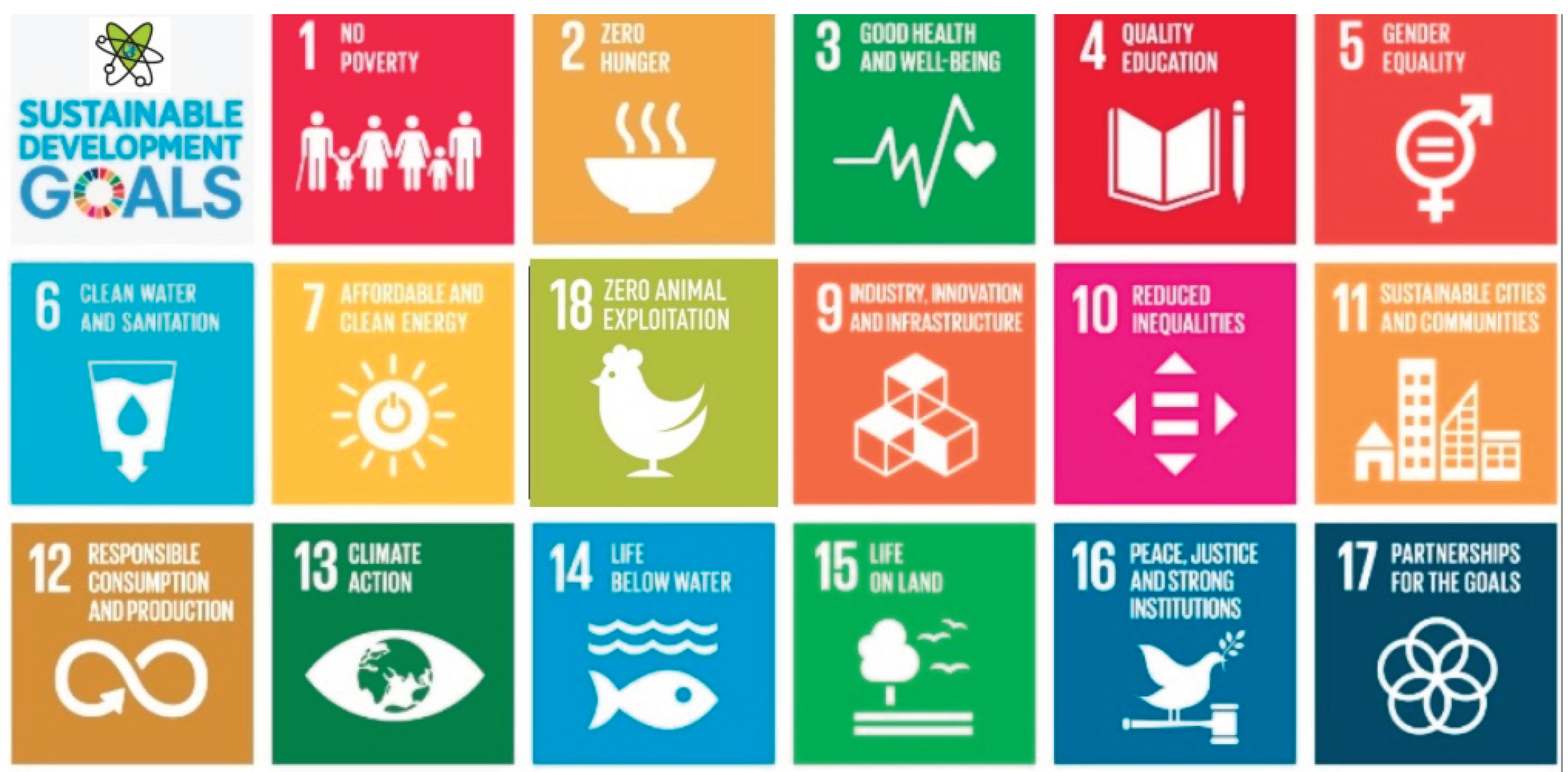
The inclusion of SDG #18 frees nearly 40% of the ice-free land area of the planet for rewilding, mitigating all seven transgressed planetary boundaries - biosphere integrity, novel entities, biogeochemical flows, climate change, land use, water use, and ocean acidification. For SDG #18,
Δbi (x) < 0 ∀ i
The Beyond Cruelty Foundation has documented the means by which SDG #18 facilitates the implementation of the UN SDG set. Of the remaining 16 SDGs, sans SDG #8, two need to be recalibrated to cohere with SDG #18:
SDG #14: “Life Below Water” – Conserve and restore the ocean, rivers and marine life to their natural state. On Planet A, this goal is about exploiting the oceans, rivers and marine life for human use. The official UN description of this goal reads, “Conserve and sustainably use the oceans, rivers and marine resources for sustainable development.”
SDG #15: “Life on Land” – Conserve and restore native ecosystems, combat desertification, halt and reverse land degradation, and halt and reverse biodiversity loss. Once again, on Planet A, this goal was about exploiting land for human purposes without causing too much damage. The official UN description reads, “Protect, restore and promote sustainable use of terrestrial ecosystems, sustainably manage forests, combat desertification, halt and reverse land degradation, and halt biodiversity loss.”
4.4. The Valid Goal Set (VG)
Concomitant with SDG #18, we propose a minimal, mutually reinforcing set of Valid Goals (VG) that together instantiate the Planet B objective function.
- VG1 — Zero Animal Exploitation (SDG #18, by adoption). Organize provisioning, science, and culture so that animals are never treated as commodities. Expand sanctuary and wildness.
- VG2 — Universal Plant-Based Provisioning. Ensure affordable, delicious, culturally resonant whole-food plant-based diets as the social default in schools, healthcare settings, workplaces, and public venues.
- VG3 — Large-scale Rewilding and Ecological Connectivity. Restore and connect habitats (land and sea) at landscape scale with community guardianship.
- VG4 — Rapid Methane and Nitrous Oxide Decline. Achieve steep, near-term declines through dietary shifts, manure elimination, legume-centric agronomy, and soils-first nutrient management.
- VG5 — Soil and Water Integrity. Regenerate soil organic matter and watershed function via perennial polycultures, agroforestry, and nutrient budgets aligned with local biogeochemistry.
- VG6 — Equity-First Universal Basic Provisioning. Meet needs for food, shelter, care, education, and mobility within ecological caps. Prioritize communities historically excluded.
- VG7 — Participatory, Multi-species Governance. Institutionalize deliberation (citizens’ assemblies) and Animal Guardians with standing. Embed Rights-of-Nature in local charters.
- VG8 — Knowledge Commons for Healing. Open source Research and Development (R&D) and data for legumes, pulses, minimally processed foods, restoration, and ecological monitoring.
These goals satisfy GVT by construction and create positive cross-elasticities so that progress on any one facilitates progress on others (e.g., VG1 → VG3/4 via land return and decline in methane emissions).
4.5. Measurement Architecture
Valid goals require indicators that track ends:
- Animal wellbeing: sanctuary and wild population flourishing indices. We can create an animal exploitation index by tracking factory farms and experimentation facilities.
- Dietary provisioning: cost and availability of a healthy plant-based basket, uptake in public provisioning, and micronutrient adequacy.
- Rewilding: fraction of protected/connected habitats, edge-to-core ratios, functional diversity.
- Methane/N₂O: sectoral emissions with high-frequency monitoring, nutrient surplus maps.
- Soil/Water: soil organic carbon (SOC), infiltration rates, evapotranspiration balance, watershed nutrient loads.
- Equity: wellbeing measures, e.g., P90–P10 gaps in nutrition, morbidity, access.
- Governance: participation rates in assemblies; decisions reflecting multi-species considerations.
- Knowledge commons: open-licensing share, adoption latency from research to practice.
We can apply floors on provisioning and caps on ecological impact, with early-warning leading indicators, e.g., biodiversity counts, to avoid overshoot.
4.6. Incentive Alignment Without Coercion
Planet B privileges choice architectures over mandates: plant-based defaults in public services, community kitchens, recognition and celebration of restoration and sanctuary stewardship, open procurement that guarantees demand for legumes, pulses, fruits, vegetables, and perennials. Incentives are framed as opportunities to opt in to healthier, tastier, kinder, and more resilient ways of living.
4.7. Robustness, Risks, and Mitigation
Risks include substitution toward ultra-processed plant foods, inequitable access, or ecological leakage. The corresponding mitigations include nutritional standards that favor minimally processed foods, affordability guarantees, trade and finance alignment with VG1–VG6, and continuous monitoring with adaptive management. Governance risks are mitigated by rotating citizens’ assemblies, transparent data, and locally grounded Animal Guardians.
5. Designing Planet B (Fully Plant Based Systems)
5.1. The Aim of the Design
In this section, we specify a deployable, non-coercive socio-technical architecture that renders SDG #18: “Zero Animal Exploitation” operational from local to global. The design treats Planet B as a controllable system with
(i) hard constraints on planetary boundaries and non-violence toward non-human animals,
(ii) objective functions on universal nutritional adequacy, health, equity and joyful participation,
(iii) actuators for procurement, culture, and finance, and
(iv) sensors to ensure transparency and open source development.
We use an “AhimsaCoin” economy [23] as the monetary substrate that aligns everyday incentives with SDG #18 without compulsion.
5.2. Constraints and Requirements
The Planet B design space is bounded by the following two constraints and three hard requirements:
(i) Ethical constraint: Institutionalized harm to non-human animals is out of scope in public systems, while rewilding and sanctuaries are in scope.
(ii) Biophysical constraints: Rapid declines [28] in CH4 and N2O are design objectives within local N, P biogeochemistry. We use soil, water and biosphere integrity caps with carbon opportunity maximization via land return to Nature.
(iii) Provisioning requirement: Affordable, culturally resonant whole-food, plant-based (WFPB) diets with macro/micronutrient adequacy across life stages.
(iv) Equity requirement: In order to ensure rapid adoption of Planet B, we propose preferential gains for historically marginalized populations, with dignified, supported transitions for livelihoods currently coupled to animal exploitation.
(v) Resilience requirement: We propose portfolio diversity in crops, regions, and storage, with distributed control and open knowledge in order to ensure graceful degradation under environmental stresses.
5.3. The AhimsaCoin Economic Substrate
In order to operationalize SDG #18, we propose an AhimsaCoin economic substrate to replace growth compulsion and scarcity assumptions with a bottom-up allowance from Nature that encodes equality, sufficiency and nonviolence. This resonates with the popular idea that Nature has endowed all human beings with an inalienable right to life, liberty and the pursuit of happiness.
Unit and issuance: One AhimsaCoin (A) represents the productive output of 1 m2-year of the Earth’s surface. A is offered directly to persons at a uniform cadence (baseline: 1 A every ~50 minutes), creating a lifelong, unconditional stream that secures basic provisioning without debt.
Throughput-linked retirement: AhimsaCoins are retired (“burned”) at point of biocapacity use via publicly auditable “retirement coefficients” rk of A per unit activity k.
Plant-based provisioning causes low harm with nutrient efficiency and therefore, low rk.
Ecological restoration and rewilding causes negative effective rk, and earns dividends in A for the community with verified outcomes.
Animal exploitation activities result in non-settling under the protocol since the ledger does not clear transactions that instantiate exploitation. This is not coercion of individuals, but rather an institutional choice. Public systems, major buyers, and communities choose AhimsaCoin flows because they secure freedom-from-want while aligning with SDG #18. Actors preferring exploitative flows can still transact in legacy currencies, but Planet B institutions route purchasing power through A, thereby shifting markets nonviolently.
Choice architecture: We propose public procurement in A, with multi-year, cost-plus contracts for legumes, grains, produce, minimally processed staples, all settled in A.
We propose universal basic provisioning with endowment streams covering a WFPB reference basket and essential services. Unspent A lapses in demurrage, rewarding sufficiency and discouraging hoarding.
Transition finance is provisioned through A with time-bound income bridges, retraining and cooperative conversions for workers and stakeholders pivoting from animal dependent livelihoods.
With open ledgers and governance, citizens assemblies with animal guardians set rk, audit identity and retirement processes, and adjust cadence with population and ecological restoration feedbacks.
Expected Result: With institutional adoption of A, non-settlement of exploitation activities on A flows, and positive dividends for ecological restoration on A, the feasible set of everyday choices tilts decisively towards plant-based provisioning and rewilding, without policing private behavior.
5.4. Food Production System
The food production system is optimized for a diverse crop portfolio, comprising of
(i) pulses such as beans, peas, lentils, chickpeas, peanuts and soy,
(ii) whole grains such as millets, sorghum, rice, wheat, corn and oats,
(iii) roots, tubers, vegetables, fruits,
(iv) nuts and seeds.
We use multi-species climate-resilient rotations with legume covers and living mulches for maximizing yield and soil carbon accrual.
We prefer perennial crops and agroforestry with alley cropping, shelter belts, riparian buffers and tree-crop mosaics to regulate microclimate and provide habitat for native animal species.
We employ water management systems using rainwater harvesting, drip irrigation where appropriate, and with coordinated watershed plans.
Energy is provisioned with on-farm solar and battery storage with low tillage, low horsepower implements and machinery pools owned by producer co-ops.
5.5. Ecological Restoration
We convert former grazing land and feed-crop land into native grasslands, wetlands, forests and coastal ecosystems connected at landscape scales.
We prioritize rewetting and restoration of peatlands and mangroves to restore high-carbon, high biodiversity systems.
We promote lifetime caring sanctuaries for formerly domesticated non-human animals, integrated with ecological restoration and education.
We encourage indigenous led compacts and community conservancies with biodiversity credits tied to verified outcomes and not as offsets against ongoing harm.
5.6. Health System Integration
The normalization of Lifestyle Medicine and the preponderance of wellness centers over hospitals characterizes Planet B health systems [2,35]. The health system promotes food as medicine protocols with diet-first interventions for diabetes, Cardio Vascular Disease (CVD) and Blood Pressure (BP) and Body Mass Index (BMI) reductions. Nutrition and culinary competencies are embedded in medical, nursing and public health education with community health workers trained as food guides for the public.
Both individual and planetary health integration is accomplished through performance metrics on reductions in diabetes and CVD incidence, LDL/HbA1C/BP distributions, increases in rewilded and connected areas, soil organic carbon content, nutrient surpluses and functional diversity as well as decreases in CH4 and N2O atmospheric concentrations.
5.7. Governance and Participation
We expect cities, regions and entire nations to adopt SDG #18 and participate in the AhimsaCoin economy through open deliberation.
We appoint Councils for the Community of Life with indigenous leadership, scientists, ethicists, youth and Animal Guardians to create and review plans.
Citizens assemblies co-design menus for community kitchens, rewilding maps, procurement specs and AhimsaCoin retirement coefficients, rk.
We drive adoption through plant-based defaults, transparency, celebration and support, rather than sanctions.
5.8. Summary
The blueprint for Planet B outlined in this section ensures that SDG #18 is realized not by edict, but by making compassionate, plant-based provisioning the easiest, cheapest, tastiest, and celebrated choice. The AhimsaCoin economic substrate is designed to align money with morality and ecological restoration.
6. Transitioning to Planet B
The most efficient way to achieve this transition to Planet B is through a multi-pronged approach with massive grassroots campaigns and strategic cultural shifts. Here are seven strategies for accomplishing this:
(i): Normalize plant-based living fast. Flood the culture with images, stories, role models, and products that make plant-based living feel normal, aspirational, joyful, and easy. Make SDG #18 mainstream, not marginalized.
(ii): Transform institutions simultaneously. Schools, hospitals, government programs, corporate cafeterias, and wherever food is served, must rapidly default to plant-based first. Policy change follows culture, but culture follows policy too. We must work to do both.
(iii): Frame SDG #18 as a justice issue, not just a personal choice. Link SDG #18 to climate justice, food security, indigenous rights, racial justice and public health. Make it morally obvious, not just a matter of taste or preference. Make compassion non-negotiable.
(iv): Leverage technology and media. Tiktok, Youtube, podcasts, multi-player games, and apps can be leveraged to own the cultural conversation. Short-form storytelling, movies, viral campaigns, humor and art can be used to reach hearts and sway minds.
(v): Build local self-sustaining models. Create plant-based farms, cooperatives, villages and communities that thrive visibly as proof of concept for Planet B. If people can see it, they would believe it is possible.
(vi): Make plant-based the easy, affordable default. Work to reduce cost barriers, increase accessibility and dismantle the false image of sacrifice. Plant-based living must look and feel like abundance, not deprivation.
(vii): Activate courageous leadership. Religious leaders, politicians, educators, scientists and artists must find the courage to proclaim that plant-based is planet-based and the future is nonviolent.
This is how we shift the culture, policies, economy and ultimately, the heart. We have no choice but to do so.
Conclusion
This paper advanced a systems engineering pathway to world peace and planetary health by (i) diagnosing why incumbent, living systems resist reform;(ii) replacing their controlling myths with explicit axioms; (iii) dropping invalid goals, chiefly growth as a standing objective (SDG #8); and (iv) including valid goals centered on interdependence, non-violence, sufficiency, equity, and honesty. We then specified an implementable architecture for Planet B— fully plant-based socio-technical systems that operationalized SDG #18: Zero Animal Exploitation—and proposed AhimsaCoin as a nonviolent monetary substrate that aligns everyday incentives with those goals without coercion.
In section 1, we showed that legacy systems are intractable by design. Using the persistence of slavery and colonialism after their formal abolition as canonical cases, we showed how narrative lock-in, institutional hysteresis, and political-economic capture neutralize internal reforms. The Berkana Two Loops model thus functions as control guidance for us to build a parallel loop.
In section 2, we replaced myths with axioms. The operative stories of Planet A on endless growth, commodification as social logic, and speciesist separation were replaced with axioms of interdependence, non-violence, and sufficiency. These axioms were then used as boundary conditions and test criteria for design.
In section 3, we formalized a Goal Validity Test comprising feasibility, coherence, ethical admissibility, and meaningful measurement. SDG #8 fails this test and can at best be retained as a side-effect, but not as an objective. In contrast, the valid goal set (VG1–VG8) produces positive cross elasticities so that progress on one eases progress on others.
In section 4, we specified a Goal Inclusion Protocol and showed how SDG #18: “Zero Animal Exploitation” functions as a keystone goal. We showed how plant-based systems meet universal nutritional needs while restoring biosphere integrity and widening freedom.
In section 5, we operationalized SDG #18 with the AhimsaCoin economic substrate. By endowing all people with a uniform stream of ecological allowance (A) and retiring A at the point of biocapacity use, the base economy rewards sufficiency, favors plant-based provisioning, and funds rewilding. Crucially, non-settlement of exploitation flows in the AhimsaCoin substrate moves public systems without policing private behavior.
Our system engineering is designed to accomplish non-coercive transition, with the benefit of near-term cooling and long-term healing. Dietary shifts (VG1–VG2) and land return (VG3) unlock immediate methane and nitrous oxide declines while creating durable carbon drawdown through rewilding and perennial agroecologies (VG5).
Universal plant-based provisioning, living-income benchmarks, and financing in the AhimsaCoin economic substrate reduce the transition risk for workers and communities currently tied to animal-dependent livelihoods.
To move from theory to dominance, we recommend three concurrent pilots as Minimum Viable Experiments (MVE), each with indicators and independent audit:
MVE Cities: 10–20 cities to adopt plant-based defaults across schools, hospitals, and public workplaces. Public procurement settles in the AhimsaCoin economic substrate. Primary outcomes to be monitored include cost and uptake of WFPB diets, CH₄/N₂O footprints of city food purchases, diet-related clinical markers, and equity gaps.
MVE Land Corridors: Regional retirement of grazing and feed-crop land parcels into connected rewilding experiments with animal sanctuary integration. The primary outcomes to be monitored include habitat connectivity, soil organic carbon, watershed nutrients, biodiversity indices, and restoration dividends paid in A.
MVE Economic Ledgers: AhimsaCoin identity, issuance, and retirement protocols bound to ports, grids, and wholesale markets with citizens’ assemblies setting retirement coefficients. The primary outcomes to be monitored include sectoral retirement intensity, share of public spend in A, leakage rates, and public trust.
Each pilot can be conducted on a consent-based, open source basis and designed for replication.
Open questions remain on the calibration of retirement coefficients. Translating biophysical intensities into fair, comprehensible A-retirement rates requires iterative refinement and citizen oversight.
In addition, we have to verify the viability of unique identity and governance in A. We concede that privacy preserving, human-only issuance of A with low fraud risk is non-trivial but achievable.
The WFPB core must be flexible for regional variations, culinary heritage, and specific nutritional contexts.
While exploitative flows may persist in legacy currencies, knowledge commons must be protected from enclosure to keep entry barriers low.
However, we believe that these are research, design, and institution-building challenges that are not insurmountable.
If this blueprint is sound, then within 24–36 months of MVE implementation we should observe:
(i) significant drops in food-system CH₄ and N₂O per capita;
(ii) increased habitat connectivity and soil carbon trends;
(iii) declining public outlays on diet-related disease alongside stable or reduced provisioning costs;
(iv) high public acceptance of A-based procurement and visible reduction of animal-exploitation flows in A-settled markets.
Failure to observe these shifts at scale-adjusted thresholds would warrant revision of the system design flows.
In closing, Planet B is not a place we travel to. It is an operating protocol that we can instantiate wherever communities choose different axioms, valid goals, and a monetary system that honors Life. The Two Loops model tells us not to waste resources pleading with a mature system to stop being itself. Our engineering design shows us how to build the second loop in which non-violence is a constraint, sufficiency is encouraged, and freedom is obtained by design.
We contend that this path is neither utopian nor punitive. It is practical, measurable, and available now. Plant-based defaults, rewilding corridors, food-as-medicine, participatory governance with Animal Guardians, and a nonviolent AhimsaCoin economic substrate enhance basic security while guiding the life-support systems of the planet back within planetary boundaries.
When enough of us make the choice to transition to Planet B, the old loop will likely become obsolete by comparison.
References
- Alexander, M. (2010). The New Jim Crow: Mass incarceration in the age of colorblindness, The New Press.
- Barnard, N. D. , Levin, S. M., & Yokoyama, Y. (2015). A systematic review and meta-analysis of changes in body weight in clinical trials of vegetarian diets. Journal of the Academy of Nutrition and Dietetics, 115, (6), 954–969. [CrossRef]
- Beyond Cruelty Foundation. (n.d.). SDG #18: Zero Animal Exploitation, (Policy proposal/website).
- Blackmon, D. A. (2008). Slavery by another name: The re-enslavement of Black Americans from the Civil War to World War II, Anchor.
- Crippa, M. , Solazzo, E., Guizzardi, D., Monforti-Ferrario, F., Tubiello, F. N., & Leip, A. (2021). Food systems are responsible for a third of global anthropogenic GHG emissions. Nature Food, 2, (3), 198–209. [CrossRef]
- Davis, M. (2001). Late Victorian holocausts: El Niño famines and the making of the Third World, Verso.
- Dinerstein, E. , Vynne, C., Sala, E., Joshi, A. R., Fernando, S., Lovejoy, T. E., … Wikramanayake, E. (2019). A Global Deal for Nature: Guiding principles, milestones, and targets. Science Advances, 5, (4), eaaw2869. [CrossRef]
- Eisen, M. B. , & Brown, P. O. (2022). Reducing animal agriculture’s impact on climate change. Proceedings of the National Academy of Sciences, 119, (18), e2120584119.
- Food and Agriculture Organization of the United Nations (FAO). (2013). Tackling climate change through livestock: A global assessment of emissions and mitigation opportunities.
- Gerber, P. J. , Steinfeld, H., Henderson, B., Mottet, A., Opio, C., Dijkman, J., Falcucci, A., & Tempio, G. (2013). Tackling climate change through livestock: A global assessment of emissions and mitigation opportunities, FAO.
- Harwatt, H. , & Hayek, M. N. (2019). Eating away at climate change with negative emissions: Repurposing UK agricultural land to meet climate goals. Sustainability, 11, (22), 6466.
- Hayek, M. N. , Harwatt, H., Ripple, W. J., & Mueller, N. D. (2021). The carbon opportunity cost of animal-sourced food production on land. Nature Food, 2, (1), 25–32. [CrossRef]
- Intergovernmental Panel on Climate Change (IPCC). (2019). Climate Change and Land: An IPCC Special Report on climate change, desertification, land degradation, sustainable land management, food security, and greenhouse gas fluxes in terrestrial ecosystems (SRCCL).
- Intergovernmental Panel on Climate Change (IPCC). (2021). Climate Change 2021: The Physical Science Basis, (AR6 WG1). Cambridge University Press.
- Intergovernmental Panel on Climate Change (IPCC). (2022). Climate Change 2022: Mitigation of Climate Change, (AR6 WG3). Cambridge University Press.
- Intergovernmental Panel on Climate Change (IPCC). (2023). AR6 Synthesis Report, IPCC.
- Jackson, T. (2017). Prosperity without growth: Foundations for the economy of tomorrow (2nd ed.). Routledge.
- Kallis, G. (2018). Degrowth.
- Poore, J. , & Nemecek, T. (2018). Reducing food’s environmental impacts through producers and consumers. Science, 360, (6392), 987–992. [CrossRef]
- Raworth, K. (2017). Doughnut economics: Seven ways to think like a 21st-century economist, Chelsea Green.
- Richardson, K. , Steffen, W., Rockström, J., Lucht, W., Cornell, S. E., Fetzer, I., … Jaramillo, F. (2023). Earth beyond six of nine planetary boundaries. Science Advances, 9(37), eadh2458. [CrossRef] [PubMed]
- Ripple, W. J. , Wolf, C., Newsome, T. M., Barnard, P., & Moomaw, W. R. (2019). World Scientists’ Warning of a Climate Emergency. BioScience, 70, (1), 8–12. [CrossRef]
- Rao, S. (2016). Carbon Yoga: The Vegan Metamorphosis, Climate Healers Publication.
- Rao, S. (2025). There IS a Planet B: Implementing the Greatest Transformation in Human History, Climate Healers.
- Rockström, J. , Steffen, W., Noone, K., Persson, Å., Chapin, F. S. III, Lambin, E., … Foley, J. (2009). A safe operating space for humanity. Nature. 461(7263), 472–475. [PubMed]
- Satija, A. , Bhupathiraju, S. N., Spiegelman, D., Chiuve, S. E., Manson, J. E., Willett, W., … Hu, F. B. (2016). Healthful and unhealthful plant-based diets and the risk of coronary heart disease in U.S. adults. Journal of the American College of Cardiology, 70, (4), 411–422. [CrossRef]
- Sen, A. (1981). Poverty and famines: An essay on entitlement and deprivation, Oxford University Press. [CrossRef]
- Shindell, D. , Faluvegi, G., Seltzer, K., & Shindell, C. (2018). Quantified, major benefits of the US Clean Air Act for public health and climate. Nature Sustainability. 1(12), 611–620.
- Springmann, M. , Clark, M., Mason-D’Croz, D., Wiebe, K., Bodirsky, B., Lassaletta, L., … Willett, W. (2018). Options for keeping the food system within environmental limits. Nature. 562(7728), 519–525. [CrossRef] [PubMed]
- Steffen, W. , Richardson, K., Rockström, J., Cornell, S. E., Fetzer, I., Bennett, E., … Sörlin, S. (2015). Planetary boundaries: Guiding human development on a changing planet. Science, 347, (6223), 1259855. [CrossRef]
- United Nations. (2015). Transforming our world: The 2030 Agenda for Sustainable Development, (A/RES/70/1). United Nations.
- United Nations Environment Programme (UNEP). (2021). Global Methane Assessment: Benefits and costs of mitigating methane emissions, UNEP.
- Wheatley, M. J. , & Frieze, D. (2006). Using emergence to take social innovations to scale. The Berkana Institute, (Two Loops framework).
- Wheatley, M. J. (2017). Who do we choose to be? Facing reality, claiming leadership, restoring sanity, Berrett-Koehler.
- Willett, W. , Rockström, J., Loken, B., Springmann, M., Lang, T., Vermeulen, S., … Murray, C. (2019). Food in the Anthropocene: The EAT–Lancet Commission on healthy diets from sustainable food systems. The Lancet, 393, (10170), 447–492.
- Wilson, E. O. (2016). Half-Earth: Our planet’s fight for life, Liveright.
Figure 1.
Planet B System Design Flow (Planet B is the world of Planet A turned upside down).
Disclaimer/Publisher’s Note: The statements, opinions and data contained in all publications are solely those of the individual author(s) and contributor(s) and not of MDPI and/or the editor(s). MDPI and/or the editor(s) disclaim responsibility for any injury to people or property resulting from any ideas, methods, instructions or products referred to in the content. |
© 2025 by the authors. Licensee MDPI, Basel, Switzerland. This article is an open access article distributed under the terms and conditions of the Creative Commons Attribution (CC BY) license (http://creativecommons.org/licenses/by/4.0/).
Copyright: This open access article is published under a Creative Commons CC BY 4.0 license, which permit the free download, distribution, and reuse, provided that the author and preprint are cited in any reuse.


