

Submitted:
09 July 2024
Posted:
10 July 2024
You are already at the latest version
Abstract
Ecological Society is based on socioeconomic systems directed to the equilibrium of inter-relationships between environment, climate, production systems, technologies and human communities to promote the overall well-being of people and the Earth planet. It has a main goal for supporting sustainable development and equitable societies and achieving optimal health outcomes recognizing the interconnection between people, technologies, animals, plants, and their shared environment for the one health. Using data of scientific publications and patents until the year 2024, this study shows new technologies that can support the energy transition with the shift from fossil fuels to renewable energy sources in an effort to reduce CO2 emissions for an ecological society having, whenever possible, zero-carbon economies to reduce environmental pollution and climate change and foster health and wellbeing of people. Results reveal that sustainable technologies supporting the transformation of the energy sector, economies and societies, and having a rapid growth, are blue hydrogen, floating photovoltaic systems, carbon capture and utilization, green hydrogen and liquid metal batteries. These findings can guide decisions of policymakers and stakeholders towards fruitful investments driving the transition from fossil-based to zero-carbon socioeconomic systems to have a long-run sustainable development of overall world system that has to direct towards an ecological society associated with one health.
Keywords:
ecological society
; sustainable future
; fossil-fuel pollution
; climate change
; sustainable technologies
; energy transition
; zero-carbon
; environmental impact
; sustainable society
; equal society
; renewable energy
; sustainable development
1. Introduction
Evolution of modern societies with industrial acceleration, high population growth, different conflicts is generating changes in environment, climate, land use and biodiversity with deterioration of many ecosystems (Foley et al., 2013). Intensive industrialization of advanced and developing economies and land clearing are increasing carbon emissions associated with a rise in atmospheric greenhouse gases and emerging contaminants (Marsh, 1864; Fowler et al., 2020; Núñez-Delgado et al., 2024, 2024a, 2023). The intensity of human interactions with the total environment (atmosphere, lithosphere, hydrosphere, biosphere, and anthroposphere) has accelerated in recent decades (Chin and Fu, 2013). Many changes are due to transformations in physical, biological, and chemical processes in soils and waters for manifold human activities, urban development, industrialization, intensive agriculture and mining, construction and removal of dams and levees (Adam, 2021; Ali et al., 2021; Belpomme et al., 2007; Coccia, 2017, 2018, 2019, 2020; Constant et al., 2014; IPCC, 2007; 2013). Human societies are also inducing warming climate and further alterations in Earth processes and systems (Global change, 2022, La Scalia et al., 2022; NASA Global climate change, 2022; Steingraber, 1997; Thomson and Stanberry, 2022). The human interactions are changing Earth’s surface, oceans, cryosphere, ecosystems, and climate such that scholars suggest a new geological epoch called Anthropocene (Crutzen and Stoermer, 2000; cf., Ayres, 1990, 1990a; Bowman et al., 2011; Glikson, 2013; Campbell, 2002; Chin et al., 2013; Coccia, 2009, 2010; 2021; Kaza et al., 2018; Ruddiman, 2003; Steffen et al., 2007; Sterner et al., 1998; Zalasiewicz et al., 2011). In this context, all places on Earth are affected by human activity and this tendency is increasing with the growing human population that may exceed 10.5 billion inhabitants later this century (United Nations, 2010). van Dijk et al. (2021) argue that total global food demand may increase from 35% to 56% by 2050, while population at risk of hunger is expected to change from −91% to +8%. The factor of climate change can increase the upper limit of these ranges to +62% for total food demand and to +30% for population at risk of hunger. Human-induced degradation on Earth system is increasing environmental pollution, emerging contaminants, greenhouse gas emissions and global temperature that may be more than + 3.5 °C of warming by 2100s (Hausfather and Peters, 2020; Moss et al., 2010; Tollefson, 2020; Chapman et al., 2022; National Academies of Sciences, 2022; Wang et al., 2021). Linstone (2010, p. 1417, original emphasis) states that: “the global future will strongly depend on our willingness to take near-term action for a sustainable long-term future”. The recovery of environmental degradation can be achieved with sustainable technologies directed to renewable energy for societies based on ecological society that foster an equilibrium between atmosphere, lithosphere, hydrosphere, and overall biosphere (Sanni and Verdolini, 2022; Chapman et al., 2022; National Academies of Sciences, 2022; NIST, 2022).
The investigation goal here is to show new sustainable technologies that guide the socioeconomic pathway of economies toward transformation of the energy sector from fossil-based to zero-carbon systems for supporting an ecological society that reduces environmental pollution and fosters ecological transition (energy-industrial and agri-food transformations) in human societies.
2. Study design
Data collection
The study uses data of Scopus (2024), a multidisciplinary on-line database of journal articles and patents by the academic publisher Elsevier. Table 1 shows some critical sustainable technologies for supporting energy transition according to literature of environmental and sustainable sciences (EPO, 2022; Gonzalo et al., 2022; Li et al., 2022; Wang et al., 2022; Balaji and Rabiei, 2022; Elavarasan et al., 2022; Chapman et al., 2022; Gadikota, 2021; Bapat et al., 2022; Moritz et al., 2022; Esmaeilzadeh, 2022; Strepparava et al., 2022). Data are downloaded on 18th June 2024. Articles and patents are basic units for scientific and technology analyses (Coccia et al., 2022) to detect new sustainable technologies oriented to renewable energy, carbon capture and utilization and clean production processes.
Variables
The scientific development of sustainable technologies for the transformation of the energy sector directed to carbon neutrality in a perspective of ecological society is investigated considering articles collected from the search queries described in Table 1 until June 2024. Technological directions also consider total number of patents in current technological cycle of these technologies: patents indicate inventions and potential innovations supporting the evolution of sustainable technologies by using the search queries described in Table 1.1
Modelling and data analysis procedure
Firstly, logarithmic transformation of data is applied to have normality in distribution of variables and perform appropriate parametric analysis for producing robust results.
Secondly, statistical descriptives are used to visualize trends of scientific development of these sustainable technologies over time.
Thirdly, the tool "Search documents" in Scopus (2024) of terms indicated in table 1 provides a time series of articles for technology i at t. These data are analyzed with the following log-linear model to show trends:
log yi,t = a + b time+ ui,t
- − yi, t is scientific products of technology i at the time t
- − a is a constant; b is the coefficient of regression; u i,t = error term of technology i at the time t
- − log is logarithmic with base e= 2.7182818
The parameters a and b of model (1) are estimated with the Ordinary Least-Squares (OLS) Method.
Statistical analyses are performed with the software IBM SPSS Statistics 26 ®.
3. New technologies for sustainable economies
Figure 1 shows trends of publications of some sustainable technologies for the shift from fossil fuels to renewable energy sources in an effort to reduce CO2 emissions for ecological transition and sustainable development. The growing trajectories are mainly offshore wind turbines, green hydrogen, carbon capture and utilization, blue hydrogen, and floating photovoltaic systems.
Figure 2 confirms that the amount of scientific publications and patents in sustainable technologies is higher in offshore wind turbines, redox flow batteries and green hydrogen (cf., Table 1).
Table 2 shows the estimated relationships based on log-linear model (1). The higher coefficient of regression is in blue hydrogen b=0.64 (p-value=0.01); it indicates that 1 -unit change in X (time) corresponds to approximately and expected increase in Y of e 0.64= 1.90, 90%. Other emerging technologies having a rapid temporal growth are Floating photovoltaic systems and Carbon Capture and Utilization b=0.35 (p-value=0.001), as a consequence e0.35= 1.42: 1 -unit change in X (time) corresponds to approximately and expected increase in Y of 42%. Other promising sustainable technologies having an acceleration of scientific knowledge and advances are Green Hydrogen b=0.27 (p-value=0.001), every year this technology increases by 31% and Liquid Metal Batteries b=0.25 (p-value=0.001), every year this sustainable technology increases by 28%
4. Discussion
Results, using the estimated coefficients of regression in Table 2, reveal, unlike figure 1 that sustainable technologies having a rapid growth are blue hydrogen, floating photovoltaic systems, carbon capture and utilization, green hydrogen and liquid metal batteries. Considering the relevance of these technologies, they are described to show their potentiality:
- ▪
-
Hydrogen (H2) is considered a sustainable energy driver, especially when generated using renewable energy sources such as solar, wind and hydropower. A distinction is between "grey" hydrogen, "blue" hydrogen and "green" hydrogen:
- "Grey" hydrogen is produced using natural gas by a "steam reforming" process that also generates CO2.
- "Blue" hydrogen is produced the same way, but more than 80% of the CO2 emissions are captured and stored rather than being released into the atmosphere.
- Finally, "Green hydrogen" is produced using renewable energy sources. This process can be done by means of the electrolysis of water using solar, wind or hydropower as the electricity source.
- ▪
- Carbon capture utilization and storage (CCU) enables the capture of carbon dioxide (CO2) generated by combustion or industrial processes. This CO2 can be used as a resource in manufacturing industries for products or to be stored, instead of being emitted into the atmosphere. Storage locations are underground geological formations, such as depleted oil or gas wells, or salt caverns. CCU is a general purpose technology for achieving net-zero emissions and carbon neutrality in economies (Coccia, 2015a, 2017a). Main advantages of CCU are that capturing CO2 directly at source prevents its emission into the atmosphere. The use of CCU is useful for hydrogen production processes that use fossil fuels ("blue" hydrogen). Moreover, CCU may support the goal of "negative emissions". In short, re-using CO2 can be an ingredient for new products such as a fuel, a chemical or a building material.
Captured CO2 that cannot be re-used, have to be stored in locations such as depleted oil or gas wells.
- ▪
- Photovoltaic installations have been located in places where the climate was conducive to a good number of hours of sunshine. Technology of floating photovoltaics uses the surface of important bodies of water to install floating photovoltaic panels. The World Bank argues that floating solar power could double the existing installed capacity of solar power using square kilometers of artificial water reservoirs, i.e., swamps, reservoirs and so on. Singapore in Asia inaugurated a 60 MW plant in 2021 and has requested a study for increasing to 140 MW. In Europe, the Netherlands has several floating photovoltaic plants and Spain has a lot of infrastructures of this new technology in reservoirs, dams, etc. (Iberdrola, 2024).
- ▪
- Finally, an alternative to recycling batteries is re-using them in second-life applications. Technology of liquid metal batteries is able to retain 99% of their original capacity over 5 000 charging cycles because they do not suffer the structural damage that conventional batteries experience as charged atoms flow through them. This technology can reduce the economic cost of storing solar and wind power on the electricity grid, leading to a larger overall proportion of clean power being consumed during peak load time.
Other promising sustainable technologies in the emerging phase of evolution are:
- □
- Technology of redox-flow batteries have mainly aqueous-based systems, enable very flexible scalability and large-scale storage. Redox-flow batteries are a cost-effective technology of stationary storage, particularly when it comes to long discharges, long storage times and high cyclability. This technology is appropriate for integration into a renewable energy systems based on production and energy storage solutions.
- □
- Complex technology of smart grids for electricity delivery is based on smart metering infrastructure, smart distribution boards, renewable energy sources and energy storage systems. These elements are interconnected and monitored using fiber broadband paired with a wireless backup system in order to achieve the goal of "cost-efficiently integrate the behaviour and actions of all users connected to it - generators, consumers to ensure economically efficient, sustainable power system with low losses and high levels of quality and security of supply and safety”. Their advantages are networks that can handle bidirectional energy flow; network users can supply energy to the grid (for instance, generated by rooftop photovoltaic panels); moreover, smart grid technologies can support demand-side management, real-time adjustments in energy distribution lines and lower energy prices. In this context, blockchain platforms use a decentralized network of distributed nodes to validate transactions and maintain the smart grid data integrity (Centobelli et al., 2021). Smart grids are the basis for local energy markets such that energy customers are inter-related with producers to trade energy on a market platform by using blockchain technology and internet of things that can support decentralized market architectures (Strepparava et al., 2022).
5. Conclusions and energy policy implications for ecological society
As the future is coming fast, societies will be dealing with a vastly different climate and energy landscape soon. The study here examines the evolution of new trajectories of technologies directed to energy transition. Results suggest technologies having an accelerated growth that can positively support sustainable socioeconomic systems in future. In particular, this study shows that new directions of technologies directed to carbon neutrality are mainly based on CO2 capture and utilization, blue hydrogen, photovoltaic solar plants etc. A main finding here is also the interaction between these different technologies directed to ecological transition is generating accelerated co-evolution pathways for sustainability, such as the technological interaction between CO2 capture and utilization and blue hydrogen more and more basic for clean production (cf., Coccia, 2017c, 2018a, 2019a). Results show that energy transition for ecological society is by no means a linear process and it is associated with scientific advances, described here, in sustainable technologies and changing conditions of total environments. In fact, renewable energy sources often are intermittent: such as a limited number of hours of sunlight per day and inevitable down time at night, variability of wind speed, such that supply and demand can generate continuous disequilibrium. Sustainable technologies discussed here can support renewable electricity for a large share of energy consumption in the industrialized countries by 2055, but not all of it. Hydrogen has the potential to help bridge the gap, including as a vector for renewable energy storage, alongside batteries. Renewables-based hydrogen can also be used as feedstock for the chemical sector and as fuel. It can provide a medium-term solution for certain industrial sectors that may otherwise be hard to decarbonize.
These new directions have to be more and more pursued to support sustainability and reduce environmental issues associated with shortage or depletion of natural resources (Meadows et al., 1972; Sulston, 2012). Hence, economic systems should support some technologies, analyzed here, that have potential aspects to effectively reduce environmental degradation and preserve biosphere for a sustainable future of human society with ‘one health’ (Magdoff, 2013; Magdoff and Bellamy Foster, 2011; Saeli et al., 2022).
This study provides critical information to guide R&D investments and energy policies of policymakers towards promising research fields and technologies directed to energy transition to foster sustainable development for a positive industrial and societal impact (cf., Roshani et al., 2021; Mosleh et al., 2022; Coccia, 2021a).
In general, countries should design and implement systemic and long-run strategies and energy policies directed to reduce their coal and petroleum-based economies by developing and implementing some sustainable technologies, detected here, which have fruitful perspectives towards renewable energies, clean productions, recyclable goods, etc. in a context of overall circular economy that guides the ecological transition for a sustainable economic growth and well-being of future generations (cf., Aresta and Dibenedetto, 2020; Pronti and Coccia, 2021). Hence, economic systems should support some technologies, analyzed here, that have potential aspects to effectively reduce environmental degradation and preserve total environment for a sustainable future of human society (Magdoff, 2013; Magdoff and Bellamy Foster, 2011; Saeli et al., 2022). In addition to sustainable technologies, energy and sustainable polices have to support within megalopolis and large urban agglomerations an equilibrium between environment, natural resources and human society: i.e., an eco-socialism system based on a cooperation among people, institutions, firms and other actors to cope with resource limits and preserve. In addition, environmental, social and economic policies have to support the equilibrium in human society with the goal of achieving optimal health outcomes recognizing the interconnection between people, animals, plants, and their shared environment for one health in a perspective of equal ecological society (Aidnik, 2022; Adaman and Devine, 2022).
To conclude countries should design and implement systemic and long-run environmental, energy and industrial polices to reduce their coal and petroleum-based economies by developing and implementing some sustainable technologies directed to carbon neutrality based on renewable energies, clean productions, in a context of circular economy that guides the ecological transition for a sustainable economic growth and well-being of future generations (cf., Aresta and Dibenedetto, 2020; Pronti and Coccia, 2021).
| 1 | See also Coccia, 2022; Coccia et al., 2022. |
References
- Adam D. (2021). How far will global population rise? Researchers can't agree. Nature, 597(7877), 462–465. [CrossRef]
- Adaman Fikret & Pat Devine 2022. Revisiting the Calculation Debate: A Call for a Multiscale Approach, Rethinking Marxism, 34:2, 162-192. [CrossRef]
- Aidnik M. 2022. Envisioning a Utopian Ecosocialism in the Darkness of the Covid-19 Pandemic, Capitalism Nature Socialism. [CrossRef]
- Akan, A.P.; Coccia, M. (2022). Changes of Air Pollution between Countries Because of Lockdowns to Face COVID-19 Pandemic. Applied Sciences 12 (24), 12806. [CrossRef]
- Akan, A.P.; Coccia, M. 2023. Transmission of COVID-19 in cities with weather conditions of high air humidity: Lessons learned from Turkish Black Sea region to face next pandemic crisis, COVID, vol. 3, n. 11, 1648-1662. [CrossRef]
- Ali A., Audi, M., & Roussel, Y. (2021). Natural Resources Depletion, Renewable Energy Consumption and Environmental Degradation: A Comparative Analysis of Developed and Developing World. International Journal of Energy Economics and Policy, 11(3), 251–260.
- Amarlou, A., & Coccia, M. (2023). Estimation of diffusion modelling of unhealthy nanoparticles by using natural and safe microparticles. Nanochemistry Research, 8(2), 117-121. [CrossRef]
- Ampelli, C. 2020. Electrode design for ammonia synthesis. Nat Catal 3, 420–421 (2020). [CrossRef]
- Anastopoulos I., Bontempi E., Coccia M., Quina M., Shaaban M. 2023. Sustainable strategic materials recovery, what’s next? Next Sustainability, VSI: Sustainable strategic materials recovery_Editorial, n. 100006. [CrossRef]
- ArcelorMittal 2022. Clean power steelmaking. see https://automotive.arcelormittal.com/sustainability/clean_power_steelmaking.
- Ardito, L.; Coccia, M.; Messeni Petruzzelli, A. Technological exaptation and crisis management: Evidence from COVID-19 outbreaks. R&D Manag. 2021, 51, 381–392. [CrossRef]
- Aresta M, Dibenedetto A. 2020. Carbon Recycling Through CO2-Conversion for Stepping Toward a Cyclic-C Economy. A Perspective. Front. Energy Res. 8:159. [CrossRef]
- Ayres R. U. 1990a. Technological transformations and long waves. Part II. Technol. Forecast. Soc. Chang. 37 (2), 111–137.
- Ayres R. U. 1998. Towards a Disequilibrium Theory of Endogenous Economic Growth. Environmental and Resource Economics, vol. 11, n. 3–4, pp. 289–300.
- Ayres R.U., 1990. Technological transformations and long waves. Part I. Technol. Forecast. Soc. Chang. 37 (1), 1–37.
- Balaji K., Rabiei M. 2022. Carbon dioxide pipeline route optimization for carbon capture, utilization, and storage: A case study for North-Central USA. Sustainable Energy Technologies and Assessments 51,101900.
- Balkan green energy news 2022. Renewables, China building world’s biggest green hydrogen factory. https://balkangreenenergynews.com/chinas-sinopec-building-worlds-biggest-green-hydrogen-factory/.
- Bapat, S., Koranne, V., Shakelly, N., (...), Rajurkar, K.P., Malshe, A.P. 2022. Cellular agriculture: An outlook on smart and resilient food agriculture manufacturing. Smart and Sustainable Manufacturing Systems 6(1), pp. 1-11.
- Belpomme D., Irigaray P., Hardell L., Clapp R., Montagnier L., Epstein S., Sasco A.J. 2007. The multitude and diversity of environmental carcinogens, Environmental Research, vol. 105, n. 3, pp. 414-429.
- Bowman D.M. et al. 2011. The human dimension of fire regimes on Earth. Journal of Biogeography, vol. 38, n. 12, pp. 2223–2236.
- Calza F., Parmentola A., Tutore I., 2020. Big data and natural environment. How does different data support different green strategies? Sustainable Futures, Volume 2, n. 100029. [CrossRef]
- Campbell C.J. 2002. Petroleum and People. Population and Environment, vol. 24, n. 2, pp. 193-207.
- Cavallo, E., Ferrari E., Bollani, L., Coccia M. 2014. Attitudes and behaviour of adopters of technological innovations in agricultural tractors: A case study in Italian agricultural system, Agricultural Systems, vol. 130, pp. 44-54. [CrossRef]
- Cavallo, E., Ferrari E., Bollani, L., Coccia M. 2014. Strategic management implications for the adoption of technological innovations in agricultural tractor: the role of scale factors and environmental attitude, Technology Analysis & Strategic Management, vol. 26, n. 7, pp. 765-779. [CrossRef]
- Cavallo, E., Ferrari E., Coccia M. 2015. Likely technological trajectories in agricultural tractors by analysing innovative attitudes of farmers. International Journal of Technology, Policy and Management, vol. 15, n. 2, pp. 158–177. [CrossRef]
- Centobelli P, Cerchione R, Del Vecchio P, Oropallo E, Secundo G. 2021. Blockchain technology for bridging trust, traceability and transparency in circular supply chain. Inf Manag; 103508.
- Chapman, A., Ertekin, E., Kubota, M., (...), Kirchheim, R., Sofronis, P. 2022. Achieving a Carbon Neutral Future through Advanced Functional Materials and Technologies, Bulletin of the Chemical Society of Japan 95(1), pp. 73-103.
- Chen, J., Mao, B., Wu, Y., (...), Yu, A., Peng, L. 2023. Green development strategy of offshore wind farm in China guided by life cycle assessment. Resources, Conservation and Recycling, 188,106652.
- Chin A., Fu R., Harbor J., Taylor M. P., Vanacker V. 2013. Anthropocene: Human interactions with earth systems, Anthropocene, vol. 1, pp. 1-2.
- Cho R. 2022. What Is Decarbonization, and How Do We Make It Happen? Columbia Climate School. https://news.climate.columbia.edu/2022/04/22/what-is-decarbonization-and-how-do-we-make-it-happen/.
- CNBC 2022. Sustainable energy. https://www.cnbc.com/2022/09/15/green-hydrogen-siemens-commissions-german-production-plant.html.
- Coccia M. (2014). Socio-cultural origins of the patterns of technological innovation: What is the likely interaction among religious culture, religious plurality and innovation? Towards a theory of socio-cultural drivers of the patterns of technological innovation, Technology in Society, vol. 36, n. 1, pp. 13-25. [CrossRef]
- Coccia M. (2018a). An introduction to the theories of institutional change, Journal of Economics Library, vol. 5, n. 4, pp. 337-344.
- Coccia M. (2019b). Comparative Incentive Systems. In: Farazmand, A. (eds) Global Encyclopedia of Public Administration, Public Policy, and Governance. Springer, Cham. [CrossRef]
- Coccia M. (2019c). Theories of Development. A. Farazmand (ed.), Global Encyclopedia of Public Administration, Public Policy, and Governance, Springer. [CrossRef]
- Coccia M. (2020). An index to quantify environmental risk of exposure to future epidemics of the COVID-19 and similar viral agents: Theory and Practice. Environmental Research, volume 191, n. 110155. [CrossRef]
- Coccia M. (2020d). How (Un)sustainable Environments are Related to the Diffusion of COVID-19: The Relation between Coronavirus Disease 2019, Air Pollution, Wind Resource and Energy. Sustainability 12(22), 9709. [CrossRef]
- Coccia M. (2021). Effects of the spread of COVID-19 on public health of polluted cities: results of the first wave for explaining the dejà vu in the second wave of COVID-19 pandemic and epidemics of future vital agents. Environmental Science and Pollution Research. 28(15), 19147-19154. [CrossRef]
- Coccia M. (2021). Evolution and structure of research fields driven by crises and environmental threats: the COVID-19 research. Scientometrics, vol. 126, n. 12, pp. 9405-9429. [CrossRef]
- Coccia M. (2021). High health expenditures and low exposure of population to air pollution as critical factors that can reduce fatality rate in COVID-19 pandemic crisis: a global analysis. Environmental Research, 199, 111339. [CrossRef]
- Coccia M. (2021). How do low wind speeds and high levels of air pollution support the spread of COVID-19? Atmospheric Pollution Research, vol. 12, n.1, pp. 437-445. [CrossRef]
- Coccia M. (2021). The relation between length of lockdown, numbers of infected people and deaths of COVID-19, and economic growth of countries: Lessons learned to cope with future pandemics similar to COVID-19. Science of The Total Environment, vol. 775, n. 145801. [CrossRef]
- Coccia M. 2009. Measuring the impact of sustainable technological innovation. International Journal of Technology Intelligence and Planning, vol. 5, n. 3, pp. 276-288. [CrossRef]
- Coccia M. 2009. What is the optimal rate of R&D investment to maximize productivity growth? Technological Forecasting & Social Change, vol. 76, n. 3, pp. 433-446. [CrossRef]
- Coccia M. 2010a. Democratization is the driving force for technological and economic change, Technological Forecasting & Social Change, vol. 77, n. 2, pp. 248-264. [CrossRef]
- Coccia M. 2010b. Foresight of technological determinants and primary energy resources of future economic long waves. International Journal of Foresight and Innovation Policy, vol. 6, n. 4, pp. 225–232. [CrossRef]
- Coccia M. 2011. The interaction between public and private R&D expenditure and national productivity. Prometheus-Critical Studies in Innovation, vol. 29, n.2, pp.121-130. [CrossRef]
- Coccia M. 2012. Evolutionary trajectories of the nanotechnology research across worldwide economic players, Technology Analysis & Strategic Management, vol. 24, n.10, pp. 1029-1050. [CrossRef]
- Coccia M. 2012. Political economy of R&D to support the modern competitiveness of nations and determinants of economic optimization and inertia, Technovation, vol. 32, n. 6, pp. 370–379. [CrossRef]
- Coccia M. 2014. Driving forces of technological change: The relation between population growth and technological innovation-Analysis of the optimal interaction across countries, Technological Forecasting & Social Change, vol. 82, n. 2, pp. 52-65. [CrossRef]
- Coccia M. 2014. Steel market and global trends of leading geo-economic players. International Journal of trade and global markets, vol. 7, n.1, pp. 36-52. [CrossRef]
- Coccia M. 2015a. General sources of general purpose technologies in complex societies: Theory of global leadership-driven innovation, warfare and human development, Technology in Society, vol. 42, August, pp. 199-226. [CrossRef]
- Coccia M. 2017. Disruptive firms and industrial change, Journal of Economic and Social Thought, vol. 4, n. 4, pp. 437-450.
- Coccia M. 2017. New directions in measurement of economic growth, development and under development, Journal of Economics and Political Economy, vol. 4, n. 4, pp. 382-395.
- Coccia M. 2017a. The Fishbone diagram to identify, systematize and analyze the sources of general purpose technologies. J. Adm. Soc. Sci., vol. 4, n. 4, pp. 291-303.
- Coccia M. 2017c. Sources of technological innovation: Radical and incremental innovation problem-driven to support competitive advantage of firms. Technology Analysis & Strategic Management, vol. 29, n. 9, pp. 1048-1061. [CrossRef]
- Coccia M. 2018. An introduction to the theories of national and regional economic development, Turkish Economic Review, vol. 5, n. 4, pp. 350-358.
- Coccia M. 2018. Optimization in R&D intensity and tax on corporate profits for supporting labor productivity of nations, The Journal of Technology Transfer, vol. 43, n. 3, pp. 792-814, 10.1007/s10961-017-9572-1. [CrossRef]
- Coccia M. 2018. Theorem of not independence of any technological innovation, J. Econ. Bib., vol. 5, n. 1, pp. 29-35.
- Coccia M. 2018. What are the characteristics of revolution and evolution? Journal of Economic and Social Thought, vol. 5, n. 4, pp. 288-294.
- Coccia M. 2019. Comparative World-Systems Theories. A. Farazmand (ed.), Global Encyclopedia of Public Administration, Public Policy, and Governance, Springer. [CrossRef]
- Coccia M. 2019. Intrinsic and extrinsic incentives to support motivation and performance of public organizations, Journal of Economics Bibliography, vol. 6, no. 1, pp. 20-29.
- Coccia M. 2019. Theories of the evolution of technology based on processes of competitive substitution and multi-mode interaction between technologies. Journal of Economics Bibliography, vol. 6, n. 2, pp. 99-109.
- Coccia M. 2019. Why do nations produce science advances and new technology? Technology in society, vol. 59, November, n. 101124, pp. 1-9. [CrossRef]
- Coccia M. 2019a. A Theory of classification and evolution of technologies within a Generalized Darwinism, Technology Analysis & Strategic Management, vol. 31, n. 5, pp. 517-531. [CrossRef]
- Coccia M. 2020. Factors determining the diffusion of COVID-19 and suggested strategy to prevent future accelerated viral infectivity similar to COVID, Science of the Total Environment, volume, 729, n. 138474. [CrossRef]
- Coccia M. 2020. How does science advance? Theories of the evolution of science. Journal of Economic and Social Thought, vol. 7, n. 3, pp. 153-180.
- Coccia M. 2021. Effects of human progress driven by technological change on physical and mental health, STUDI DI SOCIOLOGIA, 2021, N. 2, pp. 113-132. [CrossRef]
- Coccia M. 2021a. Comparative Critical Decisions in Management. In: Farazmand A. (eds), Global Encyclopedia of Public Administration, Public Policy, and Governance. Springer, Cham. [CrossRef]
- Coccia M. 2022. Technological trajectories in quantum computing to design a quantum ecosystem for industrial change, Technology Analysis & Strategic Management. [CrossRef]
- Coccia M. 2023. New directions of technologies pointing the way to a sustainable global society. Sustainable Futures, vol. 5, December, n. 100114. [CrossRef]
- Coccia M. 2023. New Perspectives in Innovation Failure Analysis: A taxonomy of general errors and strategic management for reducing risks. Technology in Society, vol. 75, n. 102384.
- Coccia M. 2023. Promising technologies for fostering simultaneous environmental and socioeconomic sustainability. J. Econ. Soc. Thoug., vol. 10, n.1-2 (March-June), pp. 28-47.
- Coccia M. 2024. Bolstering effect in the interaction between artificial intelligence and quantum science for scientific and technological development. Advance. [CrossRef]
- Coccia M. 2024. Digital Pathology Ecosystem: Basic Elements to Revolutionize the Diagnosis and Monitoring of Diseases in Health Sector. In: Faghih, N. (eds) Digital Entrepreneurship. Contributions to Management Science. pp. 111-134, Springer, Cham. [CrossRef]
- Coccia M. 2024. New Technological Directions for a Sustainable Development and Sustainability. In: Núñez-Delgado, A. (eds) Planet Earth: Scientific Proposals to Solve Urgent Issues. Springer, Cham. [CrossRef]
- Coccia M. 2024. The Foundation of the General Theory of Scientific Variability for Technological Evolution. Preprints-104746. [CrossRef]
- Coccia M. The General Theory of Scientific Variability for Technological Evolution. Sci. 2024; 6(2):31. [CrossRef]
- Coccia M., 2018. Disruptive firms and technological change, Quaderni IRCrES-CNR, vol., 3, n. 1, pp. 3-18. [CrossRef]
- Coccia M., Bellitto M. 2018. A critique of human progress: a new definition and inconsistencies in society, Quaderni IRCrES-CNR, 4(3), 51-67. [CrossRef]
- Coccia M., Bellitto M. 2018. Human progress and its socioeconomic effects in society, Journal of Economic and Social Thought, vol. 5, n. 2, pp. 160-178, ISSN: 2149-0422, www.kspjournals.org.
- Coccia M., Benati I. (2018). Comparative Evaluation Systems, A. Farazmand (ed.), Global Encyclopedia of Public Administration, Public Policy, and Governance, Springer. [CrossRef]
- Coccia M., Benati I. (2018a). Comparative Studies. Global Encyclopedia of Public Administration, Public Policy, and Governance –section Bureaucracy (edited by Ali Farazmand). Chapter No. 1197-1, pp. 1-7, Springer, Cham. [CrossRef]
- Coccia M., Roshani S. 2024. Evolutionary Phases in Emerging Technologies: Theoretical and Managerial Implications from Quantum Technologies, in IEEE Transactions on Engineering Management. [CrossRef]
- Coccia M., Roshani S. 2024a. General laws of funding for scientific citations: how citations change in funded and unfunded research between basic and applied sciences. Journal of Data and Information Science, 9(1), 1–18. [CrossRef]
- Coccia M., Watts J. 2020. A theory of the evolution of technology: technological parasitism and the implications for innovation management, Journal of Engineering and Technology Management, vol. 55, 101552. [CrossRef]
- Coccia, M. Asymmetry of the technological cycle of disruptive innovations. Technol. Anal. Strat. Manag. 2020, 32, 1462–1477. [CrossRef]
- Coccia, M. Classification of innovation considering technological interaction. J. Econ. Bibliogr. 2018, 5, 76–93.
- Coccia, M. Comparative Institutional Changes. In Global Encyclopedia of Public Administration, Public Policy, and Governance; Farazmand, A., Ed.; Springer: Berlin/Heidelberg, Germany, 2019. [CrossRef]
- Coccia, M. Competition between basic and applied research in the organizational behaviour of public research labs. J. Econ. Lib. 2018, 5, 118–133.
- Coccia, M. Converging genetics, genomics and nanotechnologies for groundbreaking pathways in biomedicine and nanomedicine. Int. J. Heal. Technol. Manag. 2012, 13, 184. [CrossRef]
- Coccia, M. Converging scientific fields and new technological paradigms as main drivers of the division of scientific labour in drug discovery process: The effects on strategic management of the R&D corporate change. Technol. Anal. Strat. Manag. 2013, 26, 733–749. [CrossRef]
- Coccia, M. Deep learning technology for improving cancer care in society: New directions in cancer imaging driven by artificial intelligence. Technol. Soc. 2019, 60, 101198. [CrossRef]
- Coccia, M. Destructive Technologies for Industrial and Corporate Change. In Global Encyclopedia of Public Administration, Public Policy, and Governance; Farazmand, A., Ed.; Springer: Cham, Switzerland, 2020. [CrossRef]
- Coccia, M. Disruptive innovations in quantum technologies for social change. J. Econ. Bibliogr. 2022, 9, 21–39.
- Coccia, M. Fishbone diagram for technological analysis and foresight. Int. J. Foresight Innov. Policy 2020, 14, 225. [CrossRef]
- Coccia, M. General properties of the evolution of research fields: A scientometric study of human microbiome, evolutionary robotics and astrobiology. Scientometrics 2018, 117, 1265–1283. [CrossRef]
- Coccia, M. Law of variability in science driving technological evolution. Preprints 2023, 2023120187. [CrossRef]
- Coccia, M. Measuring intensity of technological change: The seismic approach. Technol. Forecast. Soc. Chang. 2005, 72, 117–144. [CrossRef]
- Coccia, M. New directions of technologies pointing the way to a sustainable global society. Sustain. Futur. 2023, 5, 100114. [CrossRef]
- Coccia, M. New organisational behaviour of public research institutions: Lessons learned from Italian case study. Int. J. Bus. Innov. Res. 2008, 2, 402. [CrossRef]
- Coccia, M. Optimization in R&D intensity and tax on corporate profits for supporting labor productivity of nations. J. Technol. Transf. 2017, 43, 792–814. [CrossRef]
- Coccia, M. Probability of discoveries between research fields to explain scientific and technological change. Technol. Soc. 2022, 68, 101874. [CrossRef]
- Coccia, M. Radical innovations as drivers of breakthroughs: Characteristics and properties of the management of technology leading to superior organisational performance in the discovery process of R&D labs. Technol. Anal. Strat. Manag. 2015, 28, 381–395. [CrossRef]
- Coccia, M. Sources of disruptive technologies for industrial change. L’industria–Riv. Econ. Politica Ind. 2017, 38, 97–120. [CrossRef]
- Coccia, M. Spatial patterns of technology transfer and measurement of its friction in the geo-economic space. Int. J. Technol. Transf. Commer. 2010, 9, 255. [CrossRef]
- Coccia, M. Technological Innovation. In The Blackwell Encyclopedia of Sociology; Ritzer, G., Rojek, C., Eds.; John Wiley & Sons, Ltd.: Hoboken, NJ, USA, 2021. [CrossRef]
- Coccia, M. Technological Parasitism. J. Econ. Soc. Thought 2019, 6, 173–209.
- Coccia, M. Technological Parasitism; ©KSP Books: 2019; Istanbul - Turkey. ISBN 978-605-7602-90-9.
- Coccia, M. The evolution of scientific disciplines in applied sciences: Dynamics and empirical properties of experimental physics. Scientometrics 2020, 124, 451–487. [CrossRef]
- Coccia, M. The source and nature of general purpose technologies for supporting next K-waves: Global leadership and the case study of the U.S. Navy's Mobile User Objective System. Technol. Forecast. Soc. Chang. 2017, 116, 331–339. [CrossRef]
- Coccia, M. The theory of technological parasitism for the measurement of the evolution of technology and technological forecasting. Technol. Forecast. Soc. Chang. 2019, 141, 289–304. [CrossRef]
- Coccia, M. Variability in Research Topics Driving Different Technological Trajectories. Preprints 2024, 2024020603. [CrossRef]
- Coccia, M. What Is Technology and Technology Change? A New Conception with Systemic-Purposeful Perspective for Technology Analysis. J. Soc. Adm. Sci. 2019, 6, 145–169.
- Coccia, M., Roshani, S. 2024b. Research funding and citations in papers of Nobel Laureates in Physics, Chemistry and Medicine, 2019-2020. Journal of Data and Information Science, 9(2), 1–25. [CrossRef]
- Coccia, M.; Bontempi, E. New trajectories of technologies for the removal of pollutants and emerging contaminants in the environment. Environ. Res. 2023, 229, 115938. [CrossRef]
- Coccia, M.; Ghazinoori, S.; Roshani, S. Evolutionary Pathways of Ecosystem Literature in Organization and Management Studies. Res. Sq. 2023. [CrossRef]
- Coccia, M.; Roshani, S.; Mosleh, M. Evolution of Quantum Computing: Theoretical and Innovation Management Implications for Emerging Quantum Industry. IEEE Trans. Eng. Manag. 2024, 71, 2270–2280. [CrossRef]
- Coccia, M.; Roshani, S.; Mosleh, M. Evolution of Sensor Research for Clarifying the Dynamics and Properties of Future Directions. Sensors 2022, 22, 9419. [CrossRef]
- Coccia, M.; Roshani, S.; Mosleh, M. Scientific Developments and New Technological Trajectories in Sensor Research. Sensors 2021, 21, 7803. [CrossRef]
- Coccia, M.; Wang, L. Evolution and convergence of the patterns of international scientific collaboration. Proc. Natl. Acad. Sci. USA 2016, 113, 2057–2061. [CrossRef]
- Coccia, M.; Wang, L. Path-breaking directions of nanotechnology-based chemotherapy and molecular cancer therapy. Technol. Forecast. Soc. Chang. 2015, 94, 155–169. [CrossRef]
- Coccia, Mario, New Directions in Quantum Technologies (May 6, 2022). J. Econ. Bib., vol. 9, n.1, pp. 21-39. [CrossRef]
- Coccia, Mario. 2024. "Converging Artificial Intelligence and Quantum Technologies: Accelerated Growth Effects in Technological Evolution", Technologies 12, no. 5: 66. [CrossRef]
- Constant K., Nourry C., Seegmuller T. 2014. Population growth in polluting industrialization, Resource and Energy Economics, vol. 36, n. 1, pp. 229-247.
- Crutzen P.J., Stoermer E.F. 2000. The Anthropocene, Global IGBP Change Newsletter, n. 41, pp. 17–18.
- CTCN 2022. CO2 storage technologies. https://www.ctc-n.org/technologies/co2-storage-technologies.
- Cui X., Tang C., Zhang Q. 2018. A Review of Electrocatalytic Reduction of Dinitrogen to Ammonia under Ambient Conditions, Advanced Energy materials. Volume8, Issue22, 1800369. [CrossRef]
- Edeme R. K., Nelson C. Nkalu, Janefrancis C Idenyi, Winnie O. Arazu, 2020. Infrastructural Development, Sustainable Agricultural Output and Employment in ECOWAS Countries, Sustainable Futures, Volume 2, bn. 100010. [CrossRef]
- Elavarasan R. M., Pugazhendhi R., Muhammad Irfan, Lucian Mihet-Popa, Irfan Ahmad Khan, Pietro Elia Campana. 2022. State-of-the-art sustainable approaches for deeper decarbonization in Europe – An endowment to climate neutral vision. Renewable and Sustainable Energy Reviews, vol. 159, 112204. [CrossRef]
- Elia A., Taylor M., Ó Gallachóir B., Rogan F. 2020. Wind turbine cost reduction: A detailed bottom-up analysis of innovation drivers, Energy Policy, vol. 147, 111912. [CrossRef]
- EPO (2022). Technologies to enable a sustainable energy transition. https://www.epo.org/en/news-events/in-focus/green-tech/energy-transition-technologies (25 June 2024).
- Equinor (2022) Carbon capture, utilisation and storage (CCS). https://www.equinor.com/energy/carbon-capture-utilisation-and-storage.
- Esmaeilzadeh, P. 2022. Benefits and concerns associated with blockchain-based health information exchange (HIE): a qualitative study from physicians' perspectives. BMC Medical Informatics and Decision Making, 22(1),80.
- Foley S. F., Gronenborn D., Andreae M. O., Kadereit J. W., Esper J., Scholz D., Pöschl U., Jacob D. E., Schöne B. R., Schreg R., Vött A., Jordan D., Lelieveld J., Weller C. G., Alt K. W., Gaudzinski-Windheuser S., Bruhn K. C., Tost H., Sirocko F., Crutzen P. J. 2013. The Palaeoanthropocene – The beginnings of anthropogenic environmental change, Anthropocene, vol. 3, pp. 83-88.
- Fortunato, S.; Bergstrom, C.T.; Börner, K.; Evans, J.A.; Helbing, D.; Milojević, S.; Petersen, A.M.; Radicchi, F.; Sinatra, R.; Uzzi, B.; et al. Science of science. Science 2018, 359, eaao0185. [CrossRef]
- Fowler D., Brimblecombe P., Burrows J., Heal M. R., Grennfelt P., Stevenson D. S., Jowett A., Nemitz E., Coyle M., Liu X., Chang Y., Fuller G. W., Sutton M. A., Klimont Z., Unsworth M. H., Vieno M. 2020 A chronology of global air quality. Phil. Trans. R. Soc. A. 378: 20190314. [CrossRef]
- Gadikota G. 2021. Carbon mineralization pathways for carbon capture, storage and utilization. Communications Chemistry 4(1),23.
- Ghiat I., Al-Ansari T., 2021. A review of carbon capture and utilisation as a CO2 abatement opportunity within the EWF nexus. Journal of CO2 Utilization, vol. 45, n. 101432. [CrossRef]
- Glikson A. 2013. Fire and human evolution: The deep-time blueprints of the Anthropocene. Anthropocene, vol. 3, pp. 89-92.
- Global change 2022. Population growth. A project of the University of California Museum of Paleontology https://ugc.berkeley.edu/background-content/population-growth/ (accessed March 2022).
- Gonzalo Peinado, A., Benmessaoud, T., Entezami, M., García Márquez, F.P. 2022. Optimal maintenance management of offshore wind turbines by minimizing the costs, Sustainable Energy Technologies and Assessments, 52,102230.
- Hausfather Z., Peters G. P. 2020. Emissions - the 'business as usual' story is misleading. Nature, 577(7792), 618–620. [CrossRef]
- Howson P. 2019. Tackling climate change with blockchain. Nat. Clim. Chang. 9, 644–645 (2019). [CrossRef]
- Hughes A., Park A., Kietzmann J., Archer-Brown C. 2019. Beyond Bitcoin: what blockchain and distributed ledger technologies mean for firms. Bus Horiz., 62, pp. 273–81.
- Iberdrola 2022. Puertollano Green Hydrogen Plant. https://www.iberdrola.com/about-us/what-we-do/green-hydrogen/puertollano-green-hydrogen-plant.
- Iberdrola 2024. Floating photovoltaic solar energy, https://www.iberdrola.com/innovation/floating-photovoltaic (accessed 24 June 2024).
- IEA 2022. Carbon capture, utilisation and storage. https://www.iea.org/fuels-and-technologies/carbon-capture-utilisation-and-storage.
- IPCC 2007, Summary for Policymakers, in Climate Change 2007: Impacts, Adaptation and Vulnerability. Contribution of Working Group II to the Fourth Assessment Report of the Intergovernmental Panel on Climate Change, Cambridge University Press, Cambridge, UK, p. 17.
- IPCC, 2013: Summary for Policymakers. In: Climate Change 2013: The Physical Science Basis. Contribution of Working Group I to the Fifth Assessment Report of the Intergovernmental Panel on Climate Change [Stocker, T.F., D. Qin, G.-K. Plattner, M. Tignor, S.K. Allen, J. Boschung, A. Nauels, Y. Xia, V. Bex and P.M. Midgley (eds.)]. Cambridge University Press, Cambridge, United Kingdom and New York, NY, USA.
- Javid, I., Chauhan, A., Thappa, S., Verma, S.K., Anand, Y., Sawhney, A., Tyagi, V.V., Anand, S., 2021. Futuristic decentralised clean energy networks in view of inclusive-economic growth and sustainable society. J. Cleaner Prod. 127304.
- Kaldellis, J.K., Chrysikos, T. 2019. Wave energy exploitation in the Ionian Sea Hellenic coasts: spatial planning of potential wave power stations. International Journal of Sustainable Energy, 38(4), pp. 312-332.
- Kargı B., Mario Coccia, Bekir Cihan Uçkaç (2023). Findings from the first wave of COVID-19 on the different impacts of lockdown on public health and economic growth. International Journal of Economic Sciences. Vol. XII, No. 2 / 2023, pp. 21-39. [CrossRef]
- Kargı B., Mario Coccia, Bekir Cihan Uçkaç (2023a). How does the wealth level of nations affect their COVID19 vaccination plans? Economics, Management and Sustainability. 8(2): 6-19. [CrossRef]
- Kargı B., Mario Coccia, Bekir Cihan Uçkaç (2023b). The Relation Between Restriction Policies against Covid-19, Economic Growth and Mortality Rate in Society. Migration Letters, Vol. 20, n. 5, pp. 218-231.
- Kargı, B., M. & Coccia, M. (2024). The Developmental Routes Followed by Smartphone Technology Over Time (2008-2018 Period). Bulletin of Economic Theory and Analysis, 9(2), 369-395. http://dergipark.org.tr/tr/pub/beta/issue/85655.
- Kaza S., Yao L. C., Bhada-Tata P., Van Woerden F. 2018. What a Waste 2.0 : A Global Snapshot of Solid Waste Management to 2050. Urban Development;. Washington, DC: World Bank. https://openknowledge.worldbank.org/handle/10986/30317.
- Khan, M.N., Huang, J., shah, A., (...), Zhang, H., Núñez-Delgado, A. 2022. Mitigation of greenhouse gas emissions from a red acidic soil by using magnesium-modified wheat straw biochar. Environmental Research 203,111879.
- La Scalia G, La Fata CM, Certa A, Micale R. 2022. A multifunctional plant for a sustainable reuse of marble waste toward circular economy. Waste Management & Research. 2022;40(6):806-813. [CrossRef]
- Li M., Cao S., Zhu X., Xu Y. 2022. Techno-economic analysis of the transition towards the large-scale hybrid wind-tidal supported coastal zero-energy communities. Applied Energy 316,119118.
- Linstone H. A. 2010. Historians and complexity: trends vs. collapses? Technological Forecasting and Social Change, vol. 77, n. 8, pp. 1415-1428.
- Lv X.-W., Weng C.-C., Yuan Z.-Y. 2020. Ambient Ammonia Electrosynthesis: Current Status, Challenges, and Perspectives. ChemSusChem, vol. 13, n. 12, pp. 3061-3078. [CrossRef]
- Magdoff F. 2013. Global Resource Depletion: Is Population the Problem? Monthly Review.
- Magdoff F., Bellamy Foster J. 2011. What Every Environmentalist Needs to Know About Capitalism. Monthly Review Press, New York, pp. 124–131.
- Marsh G.P. (1864) Man and Nature. Reprinted in 1965. Harvard University Press, Cambridge.
- Meadows D., Meadows D. Randers J., Behrens III W.W (1972). The Limits to Growth; A Report for the Club of Rome's Project on the Predicament of Mankind. New York: Universe Books. ISBN 0876631650.
- Moritz, J., Tuomisto, H.L.,Ryynänen, T. 2022. The transformative innovation potential of cellular agriculture: Political and policy stakeholders’ perceptions of cultured meat in Germany Journal of Rural Studies, 89, pp. 54-65.
- Mosleh, M.; Roshani, S.; Coccia, M. 2022. Scientific Laws of Research Funding to Support Citations and Diffusion of Knowledge in Life Science. Scientometrics, 127, 1931–1951. [CrossRef]
- Moss, R., Edmonds, J., Hibbard, K. et al. 2010. The next generation of scenarios for climate change research and assessment. Nature 463, 747–756 (2010). [CrossRef]
- NASA Global climate change (2022). The Effects of Climate Change. https://climate.nasa.gov/effects/ (Accessed March 2022).
- National Academies of Sciences, Engineering, and Medicine 2022. Carbon Dioxide Utilization Markets and Infrastructure: Status and Opportunities: A FirstReport. Washington, DC: The National Academies Press. [CrossRef]
- Nemet G. F. 2006. How Well Does Learning-by-Doing Explain Cost Reductions in a Carbon-Free Energy Technology? FEEM Working Paper No. 143.06, Available at SSRN: https://ssrn.com/abstract=946173. [CrossRef]
- NIST 2022. NIST Reference Fluid Thermodynamic and Transport Properties Database (REFPROP): Version 10 https://www.nist.gov/srd/refprop.
- Nti K. E., Samuel Jerry Cobbina, Eunice Efua Attafuah, Evelyn Opoku, Michael Amoah Gyan, 2022. Environmental sustainability technologies in biodiversity, energy, transportation and water management using artificial intelligence: A systematic review. Sustainable Futures, vol. 4, n. 100068. [CrossRef]
- Núñez-Delgado A., Bontempi E., Coccia M., Kumar M., Farkas K., Domingo, J. L. 2021. SARS-CoV-2 and other pathogenic microorganisms in the environment, Environmental Research, vol. 201, n. 111606. [CrossRef]
- Núñez-Delgado, Avelino, Elza Bontempi, Yaoyu Zhou, Esperanza Álvarez-Rodríguez, María Victoria López-Ramón, Mario Coccia, Zhien Zhang, Vanesa Santás-Miguel, and Marco Race. 2024. "Editorial of the Topic “Environmental and Health Issues and Solutions for Anticoccidials and other Emerging Pollutants of Special Concern”" Processes 12, no. 7: 1379. [CrossRef]
- Núñez-Delgado, Avelino, Zhien Zhang, Elza Bontempi, Mario Coccia, Marco Race, and Yaoyu Zhou. 2023. Editorial on the Topic “New Research on Detection and Removal of Emerging Pollutants” Materials, vol. 16, no. 2: 725. [CrossRef]
- Núñez-Delgado, Avelino, Zhien Zhang, Elza Bontempi, Mario Coccia, Marco Race, and Yaoyu Zhou. 2024. Topic Reprint, New Research on Detection and Removal of Emerging Pollutants, Volume I, MDPI, mdpi.com/topics. [CrossRef]
- Núñez-Delgado, Avelino, Zhien Zhang, Elza Bontempi, Mario Coccia, Marco Race, and Yaoyu Zhou. 2024a. Topic Reprint, New Research on Detection and Removal of Emerging Pollutants, Volume II, MDPI, mdpi.com/topics. [CrossRef]
- Oh H. S. 2020. Unit commitment considering the impact of deep cycling, Sustainable Futures, Volume 2, n. 100031. [CrossRef]
- Peplow M. 2022. The race to upcycle CO2 into fuels, concrete and more. Nature 603, 780-783 (2022). [CrossRef]
- Pérez Carlos J., Ponce Carlos J., 2015. Disruption costs, learning by doing, and technology adoption, International Journal of Industrial Organization, vol. 41, pp. 64-75. [CrossRef]
- Price, D. Little Science, Big Science; Columbia University Press: New York, NY, USA, 1986.
- Pronti, A., Coccia, M. 2020. Multicriteria analysis of the sustainability performance between agroecological and conventional coffee farms in the East Region of Minas Gerais (Brazil). Renewable Agriculture and Food Systems, vol. 36, n. 3, pp. 299-306. [CrossRef]
- Pronti, A., Coccia, M. 2021. Agroecological and conventional agricultural systems: comparative analysis of coffee farms in Brazil for sustainable development, Int. J. Sustainable Development, Vol. 23, Nos. 3/4, pp. 223-248. [CrossRef]
- Resources magazine 2022. Carbon Capture and Storage 101. https://www.rff.org/publications/explainers/carbon-capture-and-storage-101/.
- Roco, M.; Bainbridge, W. Converging Technologies for Improving Human Performance: Integrating from the Nanoscale. J. Nanoparticle Res. 2002, 4, 281–295.
- Roger M, Brown F, Gabrielli W, et al. 2018. Efficient hydrogendependent carbon dioxide reduction by Escherichia coli. Curr Biol 2018; 28:140–5.
- Roshani, S.; Bagherylooieh, M.-R.; Mosleh, M.; Coccia, M. 2021. What Is the Relationship between Research Funding and Citation-Based Performance? A Comparative Analysis between Critical Disciplines. Scientometrics 2021, 126, 7859–7874. [CrossRef]
- Roshani, S.; Coccia, M.; Mosleh, M. Sensor Technology for Opening New Pathways in Diagnosis and Therapeutics of Breast, Lung, Colorectal and Prostate Cancer. HighTech Innov. J. 2022, 3, 356–375. [CrossRef]
- Ruddiman W. F. 2003. The anthropogenic greenhouse era began thousands of years ago. Climate Change, vol. 61, pp. 261–293.
- Saeli M.i, N. Capela M., Campisi T., Seabra M. P., Tobaldi D. M., La Fata C. M., 2022. Architectural technologies for life environment: Spent coffee ground reuse in lime-based mortars. A preliminary assessment for innovative green thermo-plasters, Construction and Building Materials, Volume 319,n. 126079. [CrossRef]
- Sahal, D. 1981. Patterns of Technological Innovation; Addison-Wesley Publishing Company, Inc.: Reading, MA, USA.
- Sanni M., Verdolini E., 2022. Eco-innovation and openness: Mapping the growth trajectories and the knowledge structure of open eco-innovation. Sustainable Futures, Volume 4, n. 100067. [CrossRef]
- Scharnhorst, A.; Borner, K.; Besselaar, P. Models of Science Dynamics: Encounters Between Complexity Theory and Information Sciences; Springer: Berlin/Heidelberg, Germany, 2012.
- Scopus 2022. Start exploring, search documents. ttps://www.scopus.com/search/form.uri?display=basic#basic (accessed “5 March 2022).
- Soloveichik, G. 2019. Electrochemical synthesis of ammonia as a potential alternative to the Haber–Bosch process. Nat Catal 2, 377–380 (2019). [CrossRef]
- Steffen W., Crutzen P.J., McNeill J.R. 2007. The Anthropocene: are humans now overwhelming the great forces of nature? AMBIO, vol. 36, pp. 614–621.
- Steingraber S. (1997) Industrial pollution, pesticides, and cancer. Living Downstream. An Ecologist Looks at Cancer and the Environment. Reading, Addison-Wesley, Massachusetts, ISBN 0-201-48303-3.
- Sterner T., Coria J. (2012) Policy instruments for environmental and natural resource management, 2nd ed. RFF Press and Routledge, New York, NY.
- Sterner T., Jeroen C. J., Van Den Bergh M. (1998) “Frontiers of Environmental and Resource Economics”, Environmental and Resource Economics, vol. 11, n. 3–4, pp. 243–260.
- Strepparava, D., Nespoli, L., Kapassa, E., (...), Katelaris, L., Medici, V. 2022. Deployment and analysis of a blockchain-based local energy market. Energy Reports 8, pp. 99-113.
- Sulston J. 2012. People and the Planet, The Royal Society (Britain), http://royalsociety.org.
- Sun, X.; Kaur, J.; Milojević, S.; Flammini, A.; Menczer, F. Social Dynamics of Science. Sci. Rep. 2013, 3, 1069. [CrossRef]
- Tavella F., Giusi G., Ampelli C. 2022. Nitrogen reduction reaction to ammonia at ambient conditions: A short review analysis of the critical factors limiting electrocatalytic performance. Current Opinion in Green and Sustainable Chemistry, vol. 35, n. 100604. [CrossRef]
- Thomson, M. C., Stanberry L. R. 2022. Climate Change and Vectorborne Diseases. N Engl J Med 2022; 387:1969-1978. [CrossRef]
- Tollefson J. (2020). How hot will Earth get by 2100? Nature, 580(7804), 443–445. [CrossRef]
- Tracxn, 2022. Top Thermal Energy Storage System Startups. https://tracxn.com/d/trending-themes/Startups-in-Thermal-Energy-Storage-System 8accessed November 2022.
- Uçkaç, B.C., Coccia, M., & Kargi, B. (2023). Diffusion COVID-19 in polluted regions: Main role of wind energy for sustainable and health, International Journal of Membrane Science and Technology, 10(3), 2755-2767. [CrossRef]
- Uçkaç, B.C., Coccia, M., & Kargı, B., (2023a). Simultaneous encouraging effects of new technologies for socioeconomic and environmental sustainability. Bulletin Social-Economic and Humanitarian Research, 19(21), 100-120.
- van Dijk, M., Morley, T., Rau, M.L. et al. A meta-analysis of projected global food demand and population at risk of hunger for the period 2010–2050. Nat Food 2, 494–501 (2021). [CrossRef]
- Wang, F., Harindintwali, J. D., Yuan, Z., Wang, M., Wang, F., Li, S., Yin, Z., Huang, L., Fu, Y., Li, L., Chang, S. X., Zhang, L., Rinklebe, J., Yuan, Z., Zhu, Q., Xiang, L., Tsang, D. C. W., Xu, L., Jiang, X., Liu, J., … Chen, J. M. (2021). Technologies and perspectives for achieving carbon neutrality. Innovation (Cambridge, Mass.), 2(4), n. 100180. [CrossRef]
- Wang, L., Kolios, A., Liu, X., Venetsanos, D., Rui, C. 2022. Reliability of offshore wind turbine support structures: A state-of-the-art review. Renewable and Sustainable Energy Reviews 161,112250.
- Willett, W., Rockström, J., Loken, B., Springmann, M., Lang, T., Vermeulen, S., Wood, A. J.T.L., 2019. Food in the anthropocene: the EAT. Lancet Commiss. Healthy Diets Sustain. Food Syst. 393 (10170), 447–492. [CrossRef]
- Zalasiewicz, J., Williams, M., Haywood, A., Ellis, M. 2011. The Anthropocene: a new epoch of geological time? Philos. Trans. R. Soc. A, vol. 369, pp. 835–841. Ayres, R.U., 1990a. Technological transformations and long waves. Part I. Technol. Forecast. Soc. Chang. 37 (1), 1–37.
- Zhu Qian, 2019. Developments on CO2-utilization technologies, Clean Energy, Volume 3, Issue 2, June 2019, Pages 85–100. [CrossRef]
Figure 1.
Trends of publications of sustainable technologies.
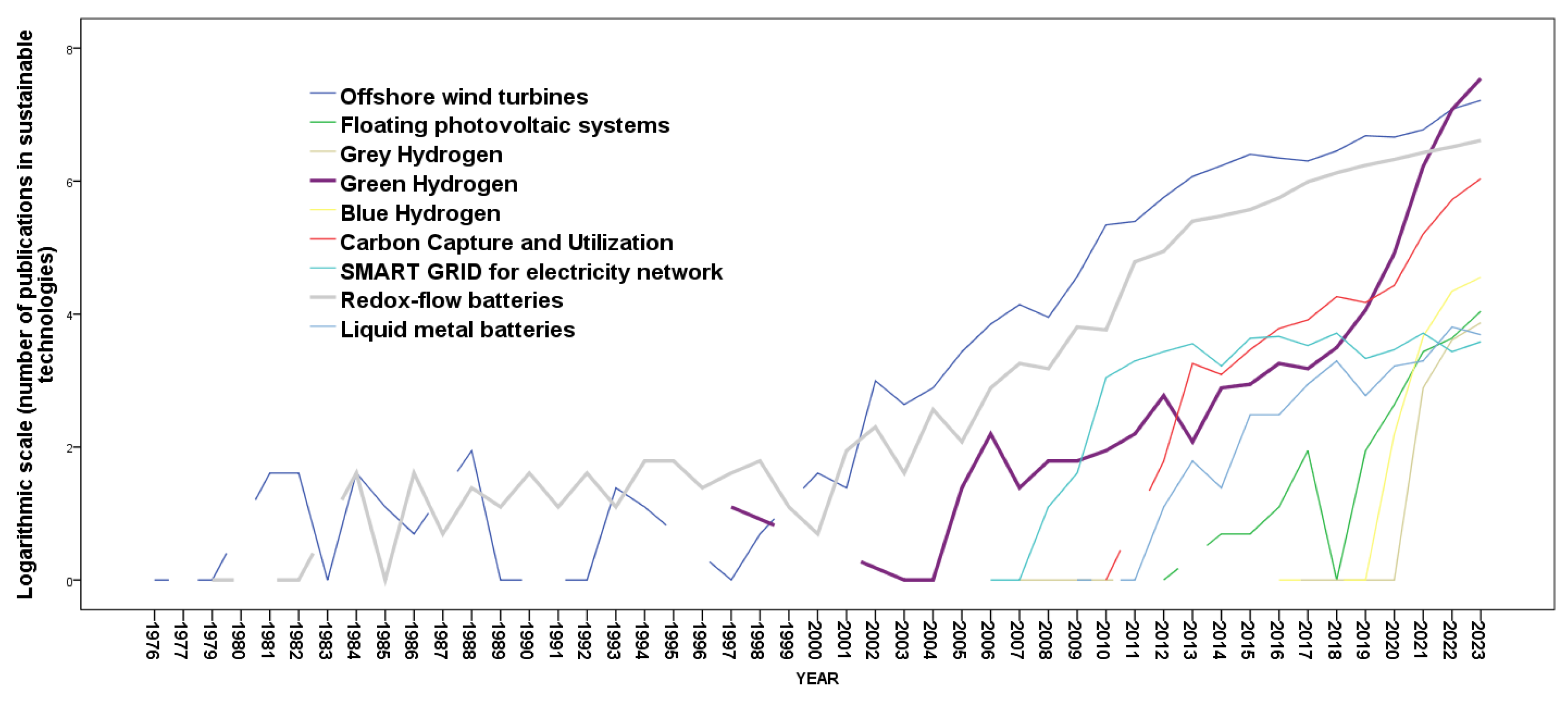
Figure 2.
Comparison of patents and publications of sustainable technologies.
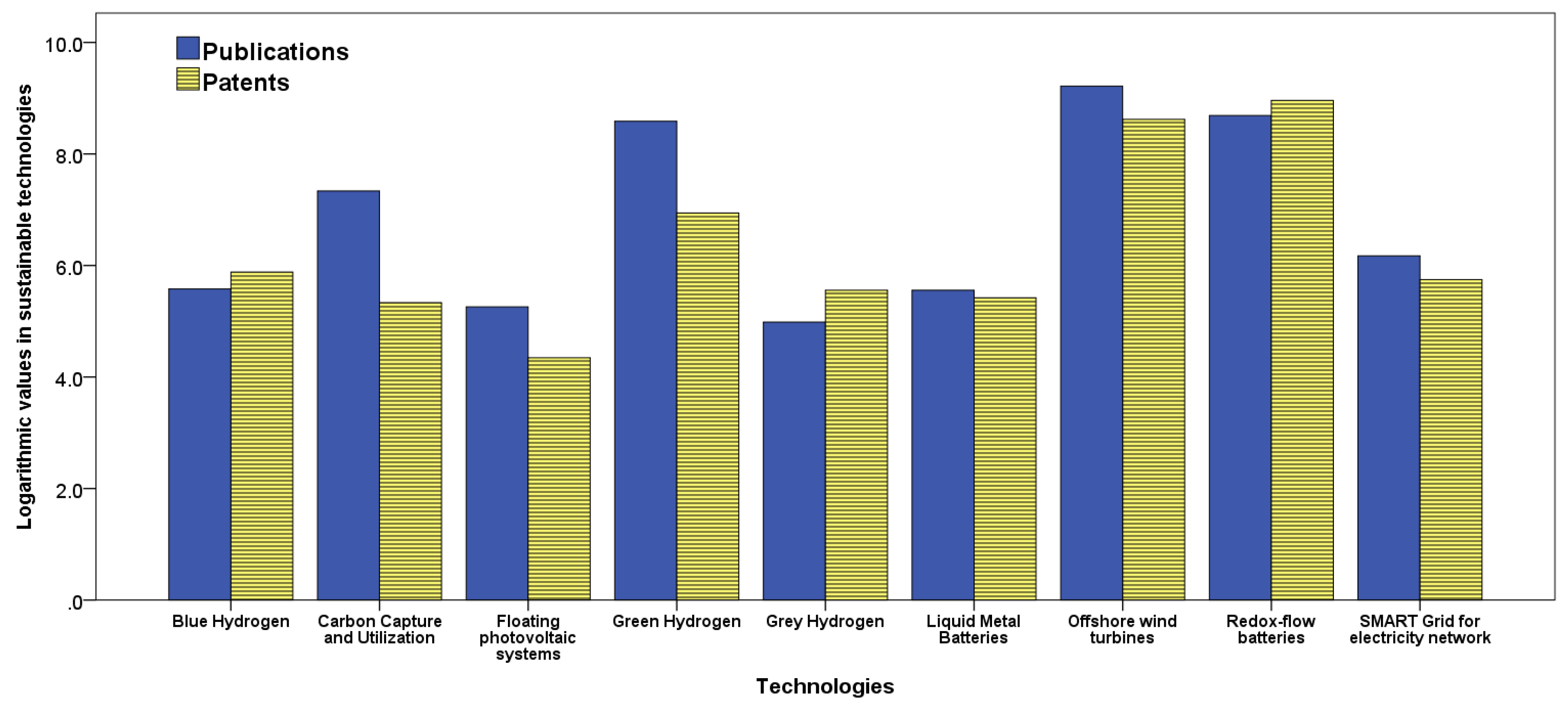

Table 1.
Queries for detecting directions of sustainable technologies. Source: Scopus 2024.
| Queries of articles and patents of sustainable technologies | Data analyzed until June 2024 | ||
| Articles | Patents | ||
| Total number | Patent period | Total number | |
| Offshore wind turbine (1976-2024) | 10074 | (1998-2024) | 5541 |
| Floating photovoltaic systems (2012-2024) | 192 | (2010-2024) | 77 |
| Grey hydrogen (2007-2024) | 146 | (2001-2024) | 259 |
| Green hydrogen (1997-2024) | 5352 | (1991-2024) | 1033 |
| Blue hydrogen (2016-2024) | 265 | (1979-2024) | 358 |
| Carbon capture utilization and storage (2010-2024) | 1535 | (2013-2024) | 207 |
| Smart grids of electricity networks (2006-2024) | 480 | (2010-2024) | 313 |
| Redox-flow batteries (1979-2024) | 5932 | (1983-2024) | 7792 |
| Liquid metal batteries (2009-2024) | 259 | (1981-2024) | 226 |
Table 2.
Estimated relationships of scientific production on time in technologies directed to future sustainability.
Table 2.
Estimated relationships of scientific production on time in technologies directed to future sustainability.
| Coefficient B, time | Constant | F-test | R2 | |
| Offshore wind turbines | 0.17*** | −332.74*** | 218.32*** | 0.85 |
| Floating photovoltaic systems | 0.35*** | −697.83*** | 38.94*** | 0.80 |
| Grey Hydrogen | 0.22 | −443.71 | 5.16 | 0.56 |
| Green Hydrogen | 0.27*** | −541.44*** | 89.76*** | 0.81 |
| Blue Hydrogen | 0.64** | −1292.24** | 17.24** | 0.78 |
| Carbon Capture and Utilization | 0.35*** | −699.62*** | 88.60*** | 0.88 |
| Smart Grid for Electricity Network | 0.15** | −289.52** | 13.62** | 0.45 |
| Redox-flow batteries | 0.16*** | −316.80*** | 307.08*** | 0.88 |
| Liquid Metal Batteries | 0.25*** | −491.67*** | 62.74*** | 0.83 |
Note: Dependent variable: Log publications of technology i; Explanatory variable: time, year; *** significant at 1‰; ** significant at 1%; * significant at 5%. F is the ratio of the variance explained by the model to the unexplained variance. R2 is the coefficient of determination. In the log-linear model, the literal interpretation of the estimated coefficient b is that a one-unit increase in X will produce an expected increase in log Y of b units. In terms of Y itself, this means that the expected value of Y is multiplied by eb.
Disclaimer/Publisher’s Note: The statements, opinions and data contained in all publications are solely those of the individual author(s) and contributor(s) and not of MDPI and/or the editor(s). MDPI and/or the editor(s) disclaim responsibility for any injury to people or property resulting from any ideas, methods, instructions or products referred to in the content. |
© 2024 by the authors. Licensee MDPI, Basel, Switzerland. This article is an open access article distributed under the terms and conditions of the Creative Commons Attribution (CC BY) license (http://creativecommons.org/licenses/by/4.0/).
Copyright: This open access article is published under a Creative Commons CC BY 4.0 license, which permit the free download, distribution, and reuse, provided that the author and preprint are cited in any reuse.


