

Submitted:
27 March 2025
Posted:
28 March 2025
You are already at the latest version
Abstract
Green hydrogen has emerged as a critical pillar of sustainable energy transitions, with its potential as a carbon-free fuel to decarbonize hard-to-electrify sectors while bolstering energy security. This study examines the trajectory of green hydrogen and renewable energy research within extended BRICS nations (the five core BRICS plus recent entrants) using bibliometric analysis, aiming to map publication trends, thematic focus, and collaborative networks from 2005 to 2024. A comprehensive dataset of 292 publications (2005–2024) was retrieved from Scopus. These records were analyzed to evaluate research output growth, citation impact, leading journals, and international co-authorship patterns. The results reveal a rapidly growing body of literature with accelerating output in recent years and substantial citation impact (with an average of approximately 25 citations per article). China leads in both publication volume and influence, followed by India and Russia, attesting to robust national research initiatives. Approximately one-quarter of the studies involve international co-authorship, underlining active collaboration among these countries and beyond. These bibliometric insights offer valuable guidance for policymakers and industry stakeholders by highlighting core strengths (e.g., hydrogen production technologies) and pinpointing gaps where capacity-building is needed. This evidence-based understanding can inform strategic policy-making, foster technological innovation, and shape future research directions within these emerging economies. In conclusion, by mapping the green hydrogen research landscape of key emerging economies, this study provides a crucial foundation for accelerating green hydrogen innovation and reinforces the role of extended BRICS in the global clean energy transition.
Keywords:
Green Hydrogen
; Extended BRICS
; Bibliometric Analysis
; Sustainable Energy Transition
; Research Collaboration Networks
1. Introduction
Climate change and energy security concerns have made the global shift to renewable energy an urgent priority. According to the Intergovernmental Panel on Climate Change (IPCC,2018), restricting global temperature rise to 1.5°C demands urgent and extensive shifts within energy infrastructures worldwide underscoring the need to accelerate clean energy adoption. In this context, green hydrogen has risen to prominence as a sustainable energy carrier and a key pillar of decarbonization strategies. Produced via electrolysis powered by renewables, green hydrogen can replace fossil fuels in applications that are hard to electrify—such as heavy industry, long-haul transport, and seasonal storage—without emitting carbon dioxide. Many decarbonization scenarios now anticipate hydrogen playing an important role in achieving net-zero level in the future; for example, the International Energy Agency (IEA, 2019) projects that hydrogen could meet roughly 12–13% of global final energy demand by 2050. This growing optimism reflects hydrogen’s immense potential to drive the transition to a carbon-neutral world. Emerging economies in the extended BRICS group (Russia, China, South Africa, India, and Brazil) are central to the renewable energy transition due to their sheer scale and rapid growth. Collectively, the nation’s comprising BRICS represent approximately 40% of the global population and consume close to 40% of the world's energy consumption, and they generate a substantial share of greenhouse gas emissions [1]. Their energy policies and innovation trajectories will thus heavily influence global decarbonization efforts. Recognizing this responsibility, BRICS nations have increasingly turned their focus toward renewable energy and green hydrogen development. China and India, in particular, have launched ambitious national hydrogen programs (e.g. China’s fuel-cell vehicle plans and India’s National Hydrogen Mission), while Russia, Brazil, and South Africa are investing in pilot projects and strategies to harness green hydrogen for industrial use and export [2,3]. This momentum across the extended BRICS points to their intention to become key players in the emerging hydrogen economy. Indeed, strengthening research and innovation in green hydrogen will be pivotal in positioning these nations at the forefront of the global transition toward sustainable clean energy.
Despite the growing importance of green hydrogen in the extended BRICS, there is a notable gap in the literature when it comes to systematically mapping and understanding research in this domain for these countries. To date, most bibliometric analyses of hydrogen energy have taken a global or technology-specific view, without a dedicated focus on the BRICS economies. For instance, [4] conducted a bibliometric study on green hydrogen production, storage, and utilization worldwide, demonstrating extensive research activity in sustainable hydrogen technologies. Similarly, various studies have reviewed renewable energy research trends in general (e.g., using bibliometric methods to analyze the water-energy-food nexus or renewable integration) without zooming in on the BRICS context. However, no prior work – to our knowledge – has specifically examined the evolution of green hydrogen research within the extended BRICS nations as a distinct group. This represents a significant research gap, given that these countries’ trajectories in hydrogen R&D may differ from global patterns due to their unique economic, policy, and resource contexts. Addressing this gap is not only of academic interest but also of practical importance. A systematic mapping of the scientific literature in this domain can yield critical insights for policymakers, researchers, and industry stakeholders. By revealing who is publishing on green hydrogen, in what subtopics, and with what impact, such an analysis helps identify strengths and weaknesses in the current knowledge base. It can inform decision-makers about where to channel resources or foster collaboration, and highlight opportunities for technology transfer and innovation. In essence, bibliometric mapping provides a mirror of the research landscape, helping stakeholders see the trends and networks that might otherwise remain obscured in the deluge of publications. Therefore, a bibliometric approach is an invaluable tool for understanding the progress of green hydrogen research in the extended BRICS and for guiding its future development.
Based on the foregoing, this current study seeks to fill the noted gap by systematically analyzing the green hydrogen and renewable energy research landscape in the extended BRICS countries using bibliometric methods. Specifically, the study examines publications from 2005 to 2024 to characterize how this field has evolved in these emerging economies. We investigate publication trends, key sources of knowledge, collaborative networks, and the thematic structure of research, with the goal of providing a wide-ranging and in-depth synthesis of green hydrogen research in the BRICS context. To guide this investigation, we pose the following research questions:
RQ1: How have annual scientific production and influence evolved between 2005 and 2024?
RQ2: Which sources are the most impactful, prominent, and dynamic in this field?
RQ3: How is the impact and collaboration of different countries distributed in this domain?
RQ4: What is the intellectual structure of the field, including the most influential documents, co-citation patterns, and the historiographic evolution of manuscripts?
RQ5: How is the conceptual structure of the research field characterized, based on elements such as TreeMap visualization, three-field plot (Countries–Keyword–Source), co-occurrence network, and thematic evolution?
By addressing these questions, the study provides a data-driven picture of green hydrogen and renewable energy research in the extended BRICS milieu. Our current study offers several important contributions to scholarship and practice. Theoretically, it advances the energy literature by extending bibliometric research into a critical but under-examined context – that of major developing economies – thereby enriching our understanding of how green hydrogen knowledge is developing outside the usual hubs of the Global North. In doing so, it sheds light on the research dynamics of a group of countries poised to significantly influence the future hydrogen economy. Methodologically, the study demonstrates a comprehensive bibliometric approach employing state-of-the-art tools and techniques (e.g., performance analysis, co-citation and co-occurrence mapping, and historiographic analysis) which ensures robust findings. Practically, the insights from our analysis carry valuable implications for policymakers and industry stakeholders in the extended BRICS nations. By identifying the most influential research themes, sources, and collaboration networks, this study helps pinpoint areas of strength (such as core competencies and leading institutions) as well as gaps that may require capacity-building or investment. Finally, by systematically mapping the landscape of green hydrogen and renewable energy research in the extended BRICS, this study not only fills a crucial knowledge gap but also provides actionable knowledge to support the strategic advancement of a sustainable hydrogen economy in some of the world’s most influential emerging nations.
The subsequent sections of this manuscript are arranged in the order described below:
Section 2 presents a succinct literature review that synthesizes previous work on green hydrogen and renewable energy, highlighting both bibliometric studies and alternative review approaches. Section 3 describes the methodology, detailing the data collection process, filtering criteria, and the bibliometric tools used for performance, intellectual, and conceptual analysis. Section 4 reports the results, including publication trends, key metrics, and network visualizations. Section 5 discusses these findings in light of policy implications and future research directions, and Section 6 brings the discussion to a close by recapping the main contributions and offering suggestions for future research. Finally, Section 7 presents the conclusion, summarizing the key findings, addressing limitations, and suggesting future research directions for further exploration in the field.
2. Literature Review
Current research on green hydrogen (GH) and renewable energy (RE) develops at high speed because nations worldwide strive to progress toward sustainable carbon-neutral power systems. The production technique of GH through electrolysis of water driven by renewable energy sources has made it appealing for decarbonizing industry as well as transportation sectors and power generation facilities. The worldwide adoption rate of RE technologies continues to increase because they help modernize the global energy system. The scientific field analyzes research evolution of GH and RE by developing several methods to explore challenges and opportunities. The most widely used methodology employed today is bibliometric analysis because it helps researchers study research trends and thematic evolution and explore knowledge networks. Academic researchers in this field now embrace a diversity of review techniques encompassing systematic research with narrative reports and techno-economic breakdowns that support bibliometric measurements for more complete assessments. The literature review organizes existing research into three fundamental sections including bibliometric studies of GH beyond RE, bibliometric studies of RE beyond GH and alternative review methods that cannot be restricted to bibliometric analysis.
2.1. Bibliometric Studies on Green Hydrogen Beyond Renewable Energy
Green hydrogen (GH) research has expanded its analysis from renewable energy (RE) applications into multiple technological aspects along with economic factors and policy considerations. [4] performed a bibliometric investigation of GH generation storage utilization which demonstrated extensive research activity in sustainable hydrogen technologies. Research investigations focusing on GH production without RE dependence are evident in [5] who studied production systems and technological developments. [3] evaluated hydrogen production from water industries using bibliometrics, integrating circular economy perspectives. A bibliometric studies and literature review by [6] delved into hydrogen production methodologies, emphasizing green and blue hydrogen as pivotal for future energy systems. The study discussed the potential of these technologies to significantly reduce greenhouse gas emissions. [7] used bibliometric analysis and state-of-the-art assessing photoanodes for GH production, emphasizing their environmental feasibility. [2] studied GH scientific literature through thematic mapping to reveal cooperation networks which emphasized sustainability goals through, mainly, social network analysis (SAR) and a bibliometric technique.
2.2. Bibliometric Studies on Renewable Energy Beyond Green Hydrogen
Renewable energy research in multiple fields has become more prominent than its direct connection with GH emissions according to bibliometric research studies. Power system integration of renewable energy has received broad analysis throughout multiple studies. [8] described two major difficulties when using Scopus data to model system complexities and define boundaries. The study by [9] utilized bibliometric methods to investigate the water-energy-food nexus particularly its relationship to land use. [10] among other authors conducted supply chain performance research which mainly studied solar and wind energy systems to identify their logistical and economic barriers.
[11] examined multi-criteria decision models for RE evaluation while stressing the requirement to extend sustainability assessment indicators. [12] studied the development history of 100% RE systems modelling through an analysis of increasing publications. The study by [13] analyzed how artificial intelligence helps RE through its applications for solar and wind energy forecasting and stability assessment. Different research projects analyzed both RE sustainability and technological developments. The research by [14] through bibliometric analysis showed theoretical modelling to be the primary focus area for ocean RE. The paper by [15] used bibliometric analysis and systematic literature review based on Scopus and Web of Science data to compare renewable energy sources and sustainability aspects. Research into renewable energy in Africa shows specific trends according to [16] who identified solar power and rural power supply and economic development as major research areas. The research by [17] analyzed how renewable energy systems are applied in shipping but placed environmental advantages above monetary considerations. [18] analyzed how renewable energy sources contribute to energy conservation through green policy assessments.
Studies today highlight renewable energy’s significant contribution to attaining both economic sustainability as well as environmental sustainability. [19] conducted a study through bibliometric methods to investigate how renewable energy supports economic development in developing countries. [20] conducted a study to gauge RE research effects on environmental sustainability while describing the research collaborations through citation networks. [21] analyzed RE integration into economic systems while uncovering essential factors for deploying RE technologies. The research conducted by [22] examined how sustainable development relates to RE technology innovation processes. These studies demonstrate the various uses of RE studies as they gain importance beyond their contribution to global heating.
2.3. Alternative Review Approaches in Green Hydrogen and Renewable Energy Research Beyond the Bibliometric Approach
The valuable findings from bibliometric analysis receive enhanced understanding when combined with different review strategies. Both narrative and systematic reviews provide essential knowledge synthesis methods after bibliometric mapping has been completed. [23] conducted a qualitative synthesis that studied GH's implementation in isolated communities while assessing them from both positive and negative perspectives as well as system decentralization hurdles. In a critical review, [24] examined the contributions of green hydrogen energy systems to achieving near-zero greenhouse gas emissions. The paper offered an in-depth evaluation of green hydrogen as a transformative alternative within renewable energy frameworks. [25] investigated GH socioeconomic elements through systematic review methods to establish how storage technology and blending practices alongside risk management will develop in the future. The mix of techno-economic assessments together with life cycle assessments produces vital understanding regarding sustainable aspects of renewable energy and green hydrogen. The analysis conducted by [26] demonstrates how different methodological limitations influence the environmental effects observed when applying LCA alongside life cycle cost (LCC) to unitized regenerative fuel cells in GH applications. The analysis of policy frameworks along with socio-technical elements has been studied using other conceptual methods. Additionally, a systematic literature review by [27] analyzed societal acceptance and stakeholders' perceptions of hydrogen technologies. The study provided insights into the social dimensions of hydrogen adoption, which is crucial for policy and implementation strategies.
3. Research Gap and Future Agenda
The work conducted by [28] serves as the main relevant research regarding our topic because it applies a bibliometric method to combine Green Hydrogen (GH) and Renewable Energy (RE) throughout all countries from 2018 to 2022. The publications from the expanded BRICS region make up nearly one-third of total field publications while only constituting 5% of world countries according to [28]. This observation caught the attention and underscores the uniqueness of this study focusing in this narrower region. This study extends the duration covered from [28] by using the same bibliometric analytical approach. Additional detailed bibliometric studies about evolving research trends and policy-driven research connections and collaborative relationships need to be analyzed in this specific geopolitical context. Additional studies must be performed to achieve a thorough examination of technological developments, socio-economic difficulties together with environmental factors. Future research needs to establish geographical mappings of GH and RE research in the expanded BRICS region while evaluating their effects on regional energy policies and developing sustainable transition tactics for these economies.
4. Methodology, Tools, and Materials
4.1. Data Collection
To conduct this bibliometric study on Green Hydrogen and Renewable Energy research within the extended BRICS group, we retrieved data from the Scopus database, SCOPUS is selected for its extensive coverage of scientific materials [29,30]. The search strategy was formulated using two sets of descriptors to ensure a comprehensive dataset (see Table 1).
The search query applied in Scopus was as follows:
((“Green hydrogen” OR “Hydrogen production” OR “Green hydrogen” OR “Hydrogen fuel cells” OR “Hydrogen technolog*” OR “Green hydrogen econom*”) AND (“Renewable energ*” OR “Renewable sources” OR “Solar energ*” OR “Wind power” OR “Renewable energ* integration” OR “Renewable energ* policies”))
4.2. Data Processing Following PRISMA Approach
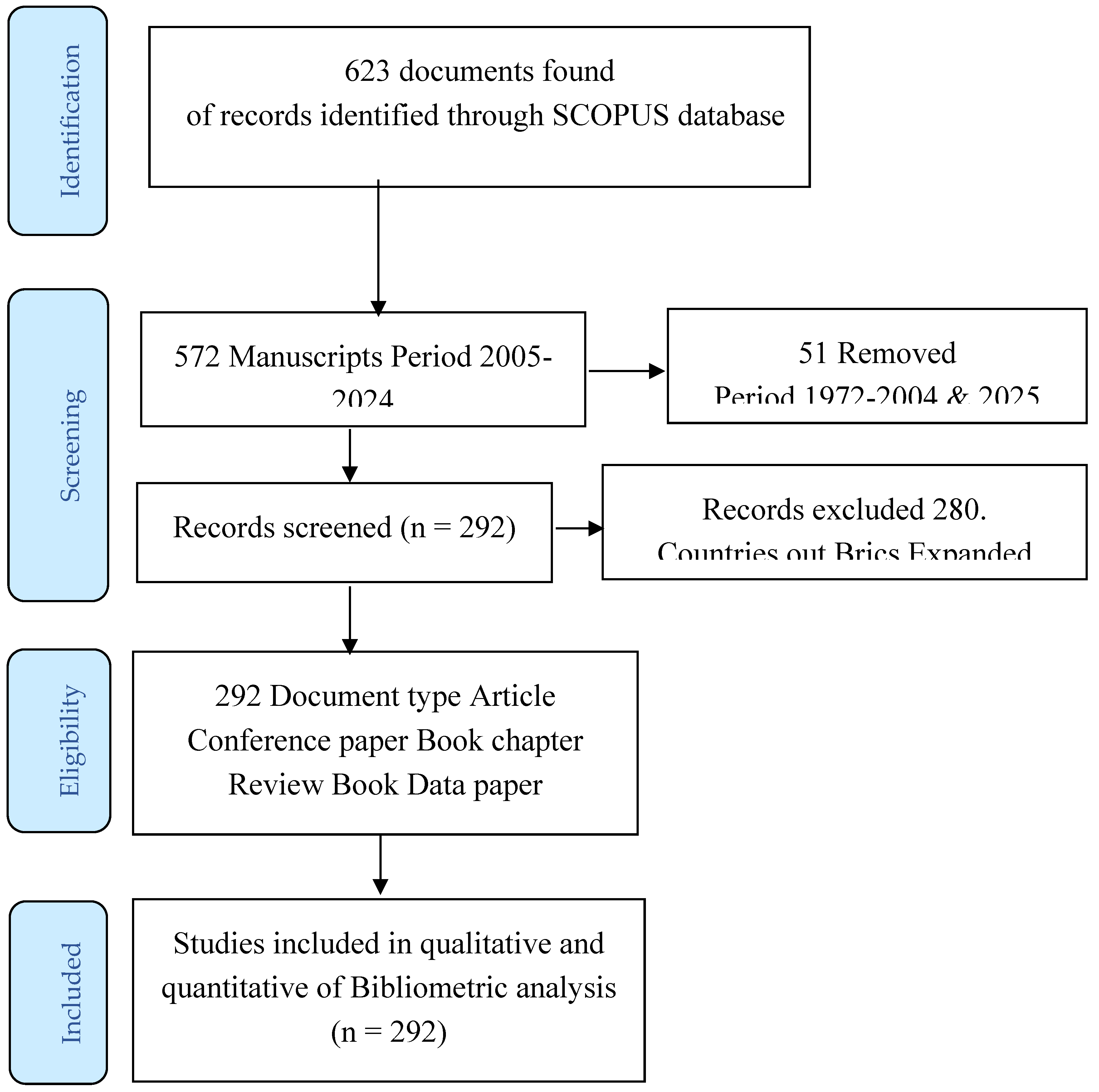
We processed the retrieved data through the PRISMA approach according to Figure.1 Simultaneously 623 documents were found in the Scopus database search. A total of 572 manuscripts which appeared between 2005 and 2024 were considered for analysis after applying the filtering process but 51 records were excluded which had publication dates between 1972–2004 and 2025. A further inspection reduced the comprehensive dataset to 292 documents after eliminating 280 publications that stemmed from countries beyond the BRICS intercontinental group, however the 292 papers included the core BRICS countries Brazil, Russia, India, China, and South Africa along with Argentina, Egypt, Ethiopia, Iran, Saudi Arabia, and the United Arab Emirates. The analysis included different document categories including articles, conference papers and book chapters and reviews and data papers and books. All these types of documents were used in both qualitative and quantitative of Bibliometric analysis.
4.3. Main Keys in Bibliometric Studies
Various essential bibliometric indicators served as the basis for the analysis. A research trend analysis was established through publication annual production metrics and influence evaluation between 2005 and 2024. The research evaluated powerful and changing sources within the field while investigating international collaboration patterns and country impact distribution. Co-citation analysis along with identification of top influential documents and manuscript historiographic evolution created the intellectual mapping of the research domain. The research utilized treemaps together with three-field plots that connected countries to keywords and sources as well as co-occurrence networks to analyze conceptual structures and thematic time-sensitive changes. The proposed research framework system tracks every aspect of Green Hydrogen and Renewable Energy studies in extended BRICS territories and helps create future policy frameworks.
Figure 1.
Research Design based on PRISMA Chart of Bibliometric Process of GR & RE.
5. Results
5.1. Description Statistics
From Table 2, the research incorporates 292 publications between 2005 and 2024 that originated from 139 sources including books and journals. The documents found in the dataset have existed for 3.45 years on average implying that the analysis includes older academic literature than Table 1. The 27.22% growth rate shows steady growth based on publications from 2005 to 2024 at a slower pace than data from the first analysis. Academic recognition of these works is higher in this dataset since researchers have cited each document an average of 25.29 times. The collection contains 2064 Keywords Plus (ID) and 800 Author’s Keywords (DE) which demonstrate extensive thematic variety. Authors Collaboration The dataset contains 981 authors who typically collaborate for research instead of working solo because there are only seven authors who published single-authored documents. The number of researchers involved in writing each document reaches 4.67 on average while maintaining a similar collaborative approach as before. International co-authorship appears in 25.68% of the documents indicating a strong trend towards academic collaboration between researchers from different countries.
5.2. Annual Scientific Production and Influence Evolution
- Annual production (2005–2024)
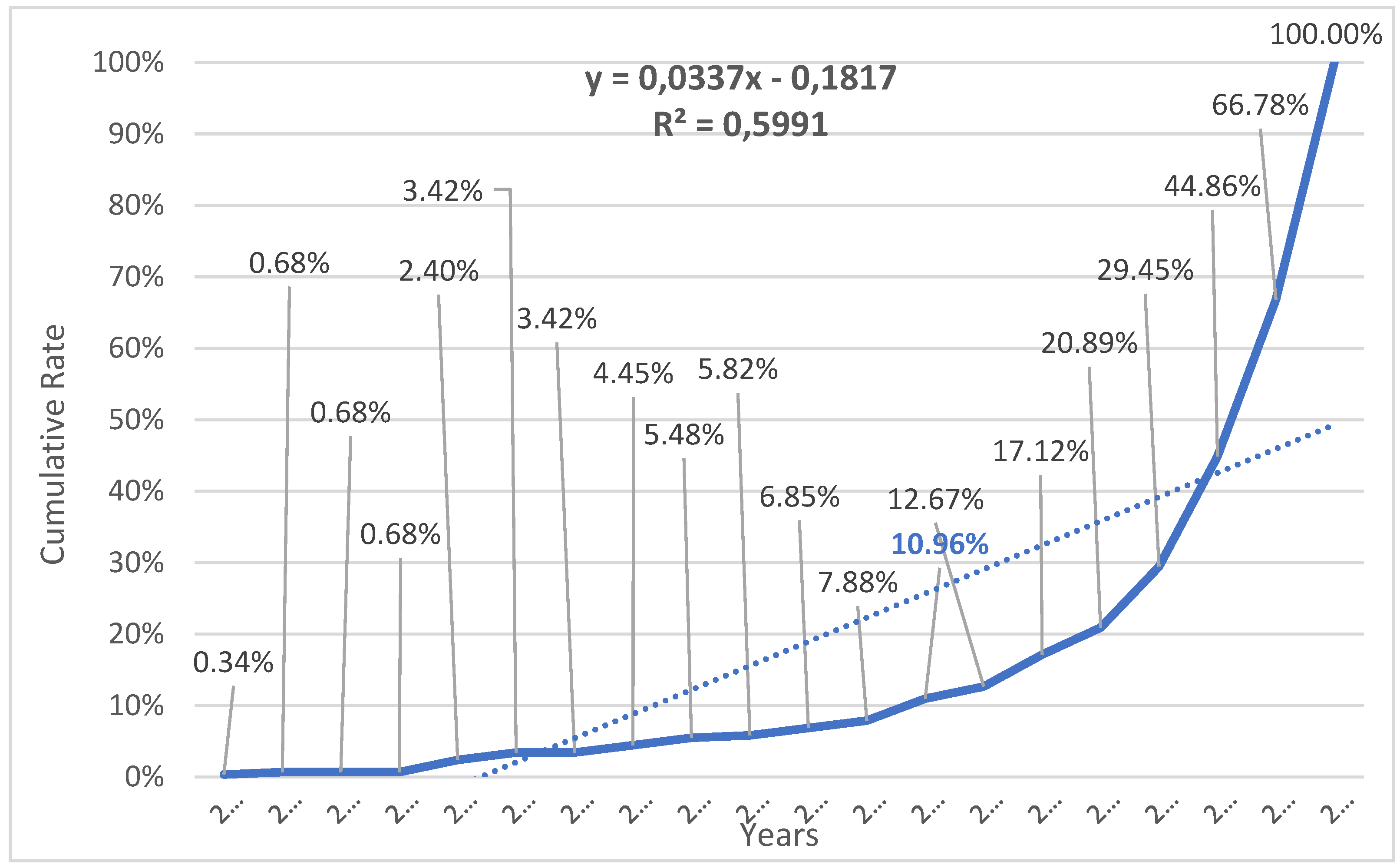
The academic research flow in this field has been presented through a cumulative rate curve spanning 2005 to 2024. The line indicates the overall trend during this period whose mathematical description is y=0.0337x−0.1817 while R2=0.5991 confirms a moderate association between variables. The cumulative rate shows gradual growth throughout the period from 2005–2012. Cumulative academic production reached 3.42% during the period from 2008 to 2008 which showed moderate research activity. This gradual trend continues until 2012. During 2013 through 2017 there was a sustained upward development in academic productivity. Academic productivity data between 2014 and 2017 generated an 6.85% increase followed by a 12.67% rate at the end of the period. The persistent growth pattern shows academic productivity has been improving in this studied time span. The rise in cumulative rate becomes steeper between 2018 and 2020 because it reaches a value of 20.89% in 2020. The starting point for fastened academic output emerges during this phase. Research data demonstrates maximum expansion during the time period from 2021 through 2024. From 2022 to 2023 the cumulative rate increases dramatically from 29.45% to 66.78% before reaching 100% by 2024. Analysis shows that the academic work volume achieved 33.22% of its total output during this time frame which represents a significant productivity breakthrough possibly because of technological progress funding and strategic approaches. The sharp growth in academic productivity indicates a transformational phase in which researchers dedicate themselves to making research contributions and improving their productivity levels. Further research efforts will reveal the particular elements that motivated this outstanding increase.
Figure 2.
Annual production (2005–2024).
- Annual Influence (2005–2024)
Table 3 highlights the trends in average citations per publication (ACP) and average citations per year (ACY) from 2005 to 2024, revealing notable fluctuations. Average publication citation numbers (ACP) together with average year citation numbers (ACY) remained steady at low levels during 2005-2009 yet exhibited a modest improvement trend throughout that period. During 2010 to 2015 ACP rose to 112 alongside ACY reaching its highest point of 10.18 as ACP and ACY demonstrated exceptional analysis performance. During the 2016 to 2020 period the citation impact showed fluctuations that caused a noticeable decline in 2020. During the time span of 2021 through 2024 there was a steep fall in both ACP and ACY. The decline could be explained by growing field competition or changing citation norms as well as expanding quantities of published articles. The recent years show declining citation rates that call for additional research to determine the root causes behind this trend change.
5.3. Impactent, Prominent and the more Dynamic Sources
Based on Table 4 the BRICS region demonstrates distinct strengths through the three top sources explained in Table 5 that make significant contributions to Green Hydrogen (GH) and Renewable Energy (RE). The International Journal of Hydrogen Energy serves as the top source in the research community due to its highest total citations of 2088 paper count at 47 and h-index of 23 which proves its key role in advancing research of Green Hydrogen specifically. The journal Energy Conversion and Management positions itself in the second place by accumulating 811 TC while maintaining a moderate 15 NP which demonstrates its ability to produce influential research. The research journal maintains an h_index value of 13 that demonstrates substantial scholarly impact on both GH and RE fields. The Renewable and Sustainable Energy Reviews earns the third place in TC with 369 citations from only 3 published papers that place it 7th in NP rankings. The journal demonstrates outstanding impact through each article it produces which focuses on critical subjects in Renewable Energy research. Its h_index of 3 underscores its limited but highly influential contributions. These journals demonstrate diverse approaches to progress in GH and RE by emphasizing either high productivity and consistent impact or selective publication of high-impact research within the BRICS territory.
Trends in the dataset show an increasing interest in the GH and RE in these journals, due to several motives, such as the growing concerns on the necessity for cleaner energy such as GH and climate change solutions. The depicted data within Figure 3 and Table 4 adds researchers, authors, and editor boards teams to understand trends in the field and draw research projects and publications for the future. Positively, all these journals have been recorded as specialists in the Scope of Hydrogen and/or Energy.
5.4. Distribution of Countries’ Impact and Collaboration
5.4.1. Most Authors’ Citations by Countries
Figure 4 demonstrates that China dominates the field through its substantial 3506 citations which exceed those of other countries. The research field shows India and Iran along with Egypt experiencing increasing importance as demonstrated by their rising citation numbers (513, 382, and 369 respectively). The research output from Brazil, Saudi Arabia, South Africa, Ethiopia and Argentina stands lower than other nations in green hydrogen and renewable energy research. Research activities in China currently dominate the field but India together with Iran and Egypt demonstrate growing research influence. Research impact development opportunities remain available to various countries.
5.4.2. Distribution of Articles and Corresponding Author Types
As Figure 5 and Table 5 indicate, China leads all other countries by producing 149 research articles which account for 51% of the total studies analyzed. India stands as the second-largest contributor to the research output with 19 articles (6.5% of the total) after China which leads with 149 articles (51%). The remaining countries including Egypt and Iran and Brazil and Saudi Arabia produced fewer articles ranging between 6 and 12 papers. Among the countries analyzed the data reveals an important pattern regarding the distribution of Single Corresponding Author Papers (SCP). Single Corresponding Author Papers (SCPs) make up 87% of all articles in China which accounts for 129 out of its total 149 publications. The majority of scientific papers in India (78.9%) and Iran (81.8%) have a single corresponding author as their leader. Egypt along with Brazil demonstrates an almost equal distribution of Single Corresponding Author Papers (SCP) and Multiple Corresponding Author Papers (MCP).
5.4.3. Collaboration Trends and MCP Ratios
The data indicates that Egypt and India demonstrate elevated MCP ratios due to their patterns of collaborative research. Egypt demonstrates a 50% Multiple Corresponding Author Paper ratio in their research by having six articles with multiple authors (6 out of 12 articles). The MCP ratio in India reaches 21.1% which indicates moderate circumstances of multi-author research collaboration. The research collaboration in Brazil and Saudi Arabia extends beyond one corresponding author but remains lower than other countries at 28.6% and 16.7% respectively. China presents the lowest Multi-Corresponding Author Percentage ratio at 13.4% because its science output depends mainly on solitary authors. The MCP ratios demonstrate that Egypt leads collaborative research while China and Iran conduct their studies independently.
5.4.4. Insights into Research Collaboration and Future Trends
Research practices among the countries of extended BRICS show distinctive patterns according to statistical findings. The extensive number of articles published by China does not translate to equal collaboration levels since multiple corresponding author papers are less common in Chinese research thus indicating Chinese research operates as a standalone system which avoid international cooperation. Egypt demonstrates higher engagement in worldwide research networks through its MCP ratio which exceeds that of other nations specifically in green hydrogen and renewable energy fields. The research landscape of India demonstrates strong international potential because 21.1% of its scientific papers include multiple corresponding authors. The article count of Brazil and Saudi Arabia remains low indicating these countries might pursue additional international research connections in the future. Future research collaboration trends show evidence that Egypt and India will become leading partners in international joint research projects because of their elevated MCP ratios.

Table 5.
Contribution of Corresponding Author’s Countries.
| Country | Articles | SCP | MCP | Freq | MCP_Ratio |
| CHINA | 149 | 129 | 20 | 0,51 | 0,134 |
| INDIA | 19 | 15 | 4 | 0,065 | 0,211 |
| EGYPT | 12 | 6 | 6 | 0,041 | 0,5 |
| IRAN | 11 | 9 | 2 | 0,038 | 0,182 |
| BRAZIL | 7 | 5 | 2 | 0,024 | 0,286 |
| SAUDI ARABIA | 6 | 5 | 1 | 0,021 | 0,167 |
Note: SCP= Single Corresponding Author Papers, MCP= Multiple Corresponding Author Papers.
5.5. The Intellectual Structure
The intellectual structure refers to the network of knowledge that outlines a research area by recognizing the most influential works, authors, and theoretical foundations. The aim of analyzing the intellectual structure is to explore the knowledge base by determining when the most cited works and their authors (including institutional affiliations) emerged and how they have influenced the field. This analysis is primarily based on co-citation networks, historiography, and bibliographic coupling, which help visualize the connections between academic contributions. By mapping these relationships, it reveals the evolution of knowledge, major schools of thought, and shared or divergent research themes. Additionally, the findings from this analysis provide a structured summary of the field’s intellectual development, highlighting key paradigms and theoretical frameworks. The comprehensive approach not only identifies the most influential contributions but also encapsulates various intellectual perspectives, ultimately offering insights that guide future research and reveal knowledge gaps.
5.6. Most Influential Documents
The Table 6 showcases important research contributions which guide studies in green hydrogen and renewable energy throughout the BRICS extended region and additional countries. Among the publications from 2018 and prior dates there exists a higher total citation (TC) count compared to newer papers because they have acquired additional time to attract citations and impact their field. The scientific manuscript "Water Electrolysis Based on Renewable Energy for Hydrogen Production" by CHI J from 2018 has gained 1044 citations which earns it the title of top paper within the dataset. This research paper maintains a strong and active role in hydrogen production studies as demonstrated by its 130.50 Average Citations per Year indicator. The dark fermentation method for bio-hydrogen production through Amin M in 2022 shows rapid increasing interest with 320 citations along with an 80.00 citations per year average. Among the recent publications CHEN H, 2023, and LI X, 2023 have achieved a citation average of 41.33 each year since their release. The dataset encompasses several areas in hydrogen production and renewable energy through studies about electrolysis and catalytic advancement (CHI J, 2018; LI X, 2023) and hydrogen production methods from biomass and organic waste (AMIN M, 2022; QOLIPOUR M, 2017) and techno-economic and life cycle assessments (SINGH A, 2017; BHATTACHARYYA R, 2017) with sustainable energy systems and global energy interconnection (WANG M, 2019). Research into hydrogen production and renewable energy maintains its essential role in developing sustainable energy solutions because these studies receive numerous citations and new publications demonstrate strong potential to direct upcoming discussions.
5.7. Historiographic Evolution of Manuscripts
The term historiographic analysis defines the total number of occurrences a research work receives within a predetermined bibliometric range according to [31]. Through the extraction of paper text titles along with keywords researchers can analyze citation patterns to determine which search scopes boost work citations combined with their chronological positioning in the research network. The definition complements broader historiographic research in bibliometrics since it tracks how academic literature develops throughout time periods. Historigraphic analysis produces its findings through evaluations of Local Citation Score (LCS) and Global Citation Score (GCS) that measure scholarly influence. Local Citation Score optimizes field-specific key work identification by studying citation patterns in chosen datasets therefore it allows scholars to track historical developments of research ideas among specific academic groups. GCS provides an evaluation of a work's total disciplinary influence which helps recognize foundational research that defines major academic fields of study. Researchers use the LCS and GCS comparison to distinguish between works which significantly influence narrow domains (high LCS and low GCS) from important studies that impact multiple domains (high GCS and high LCS) in historiographic mapping. Bibliometric historiography builds intellectual field history by examining information from citation networks as well as co-citation relationships alongside authorship patterns and journal influence combined with keyword shifts to reconstruct research field development. Historiographic analysis established by Garfield offers researchers a numerical system that evaluates scholarly impact through bibliometric historiography which places these findings within academic evolution patterns to reveal academic contribution effects on evolving knowledge systems.
Following to the Table A1 (See Appendix) the historiographic analysis explores the research development of green hydrogen and renewable energy across Extended BRICS nations through four important phases.
1. The research period from 2005 to 2012 introduced basic concepts about producing hydrogen from solar power and wind power along with biomass energy sources. Gao, Jin and He (2009) conducted research that studied how non-grid wind power could produce hydrogen alongside seawater desalination operations. Large-scale production of hydrogen using wind energy and bio-ethanol and solar energy in 2012 became the basis for additional forward movements.
2. Researchers began testing new experimental technologies that combined photocatalysis with biomass gasification and wind power hybrid systems during the years from 2013 to 2017. Studies evaluated the financial attractiveness of independent renewable hydrogen systems and presented results that supported BRICS countries pursuing diverse energy systems (Kalinci, 2015; Orhan, 2015.
3. Economic viability and efficient operations along with grid connectivity became the primary areas of study during the years 2018 to 2020. The research analyzed three methods for large-scale hydrogen optimization which included chemical-looping hydrogen production alongside seawater electrolysis combined with biogas reforming. The implemented methods provided BRICS nations solutions to their energy access inequalities by optimizing their exploitation of renewable energy sources.
4. Recent studies during the year 2021 through present focus on several essential aspects of hydrogen commercialization combined with policy development and infrastructure establishment for large-scale production. Studies investigate off-mains solar PV-hydrogen fuel cell systems as described by Pal (2022) and offshore wind-based hydrogen production according to Luo (2022). Future research between 2023-2024 will concentrate on three areas: decreasing the carbon footprint through improved hydrogen supply chain management while establishing global market links.
For Future Research Directions Green hydrogen production positions, the Extended BRICS nations to become global leaders through their large-scale transformation from experimental research to standardized economic developments. Key future research areas include:
- Hydrogen infrastructure development and supply chain optimization
Studies should focus on finding ways to decrease costs when producing electrolysis systems and renewable hydrogen power.
- Hydrogen storage solutions and energy security policies
- International cooperation for hydrogen trade and technology transfer
5.8. The Conceptual Structure
During bibliometric analysis the conceptual structure demonstrates how researchers organize intellectual knowledge by showing how different concepts relate to themes and topics across literature collections. The mapping system delivers a critical function to observe knowledge development patterns and establish research direction trends. The two central components for conceptual structure understanding consist of co-word analysis alongside thematic mapping. The fundamental relationship between keywords in co-word analysis uses network visualization to display keyword clusters which helps identify main topics and their connections. Research topics receive classification during thematic mapping which assigns them into three distinct categories such as motor themes, emerging themes and niche themes using diagrams based on density and centrality. Both TreeMap visualization and its corresponding representation enable researchers to view hierarchical research themes in a dynamic interface that showcases dominant and new academic areas in a research domain.
5.8.1. The TreeMap
The TreeMap technique shows the actual term frequencies proportional to their importance in studies about green hydrogen (GH) and renewable energy (RE) within the expanded BRICS framework. The research field emphasizes "Hydrogen Production" as its most important subject because it appears 23% percent of the time in the analysis, as is shown within Figure 6. The trend toward hydrogen generation methods represents an essential part in building sustainable energy systems. The second most important topic in this investigation pertains to renewable energy with a frequency of 16% as it demonstrates how green hydrogen can be integrated into sustainable energy systems. The research foundation built upon Hydrogen receives special recognition with ten percent occurrence throughout this academic field. The production methods including Solar Energy at 11% and Water Electrolysis at 5% and Electrolysis at 4% demonstrate the importance of renewable energy sources together with electrochemical methods for hydrogen generation. Wind Power along with Offshore Wind Power establish their significance within the hydrogen economy through appearance data at 4% and 3% respectively. The prominence of "Green Hydrogen" (7%) highlights a significant focus on environmentally sustainable hydrogen production within BRICS nations. Fundamental research spans three areas through the appearance of "Fuel Cell" (3%), "Hydrogen Energy" (3%), "Energy Storage" (3%) and "Optimization" (2%). These concepts concentrate on hydrogen applications through fuel cells and hybrid energy storage systems and optimization techniques. Solar system research occurs through the exploration of Photovoltaic technology (2%) within the field of hydrogen production. The TreeMap provides evidence of intensive academic research activities which focus on hydrogen manufacturing techniques together with renewable energy system integration. The visual structure helps to develop your overall paper structure by presenting the main themes and new directions which will drive future green hydrogen and renewable energy strategies in BRICS nations.
5.8.2. Three-Field Plot Countires-Keyword Source
The three-field Sankey chart visual in Figure 8 displays the interconnected relationships of Countries (AU_CO), Keywords (ID) and Sources (SO) through its rectangular node representations and line placement. The height values of rectangular nodes show how often particular connections occur and the width measurements on links describe relationship strengths between nodes. China discovered itself as the leading influence in all three areas during the analysis. Hydrogen Production and Solar Power Generation stand among the leading Keywords in which the Topic is connected while the International Journal of Hydrogen Energy serves among its primary information sources. The analysis placed India in second place because its influence is strong in Solar Energy and Wind Power and it supports important Sources including Energy Conversion and Management. The research of Iran and Saudi Arabia and Brazil showed average performance through connections with productive Sources as well as relevant Keywords. The Keyword Hydrogen Production stood out as the most frequently used term because it demonstrated a strong link between China and other leading countries while also gaining prominence through its appearances in International Journal of Hydrogen Energy. The combination of Solar Power Generation and Renewable Energies functioned as notable Keywords which demonstrate worldwide significance. The keywords Electrolysis and Wind Power represented supplemental research areas but occurred with reduced frequency compared to other keywords. The International Journal of Hydrogen Energy proved to be the most significant Source which linked strongly to various countries while connecting to multiple Keywords. The reviewed Sources Energy Conversion and Management and Taiyangneng Xuebao (Solar Energy Journal) along with Sustainable Energy Technologies and Assessments demonstrated their dedication to sustainable renewable energy systems. Overall, Figure 8 demonstrates a significant collaborative effort in renewable energy research, with China leading contributions across all fields. The focus on Hydrogen Production and related areas reflects a global interest in advancing sustainable energy solutions. Leading Sources, particularly the International Journal of Hydrogen Energy, play a pivotal role in disseminating this research, showcasing the interconnected nature of the global research network in fostering innovation in hydrogen and renewable energy technologies.
5.8.3. Co-Occurrence Network
Bibliometric analysis uses co-occurrence networks as essential tools for visualizing and analyzing relationships and connections between keywords and concepts from research publications. The method works to determine significant research themes by studying common keyword patterns which indicate primary knowledge areas in the studied domain. The map created by this network system presents the conceptual framework of a discipline by showing alignments between research concepts thereby delivering a complete intellectual mapping that promotes subfield detection. The research theme intellectual organization becomes the focus of a co-occurrence analysis that works through Biblioshiny's network evaluation of keywords. The approach utilizes author keywords together with keyword plus elements from different databases to produce a systemic understanding of diverse research domains with their connected elements. The evaluation exhibits networks of common keyword occurrences which display the relationship structures in both Green Hydrogen (GH) and Renewable Energy (RE) domains. Each research cluster includes systematically positioned keywords which create unified stories and help researchers grasp complex GH and RE developments. This research design simultaneously detects literature-connected disciplines while revealing unexplored areas in academic publications and delivers a comprehensive method to study research field development and structure [32,33,34]
The research shows Cluster 1 as the largest cluster with 20 nodes while using a red color designation (Figure 9 and Table 7). This cluster splits into two smaller clusters that demonstrate its different topics. The first sub-cluster, "Hydrogen Technologies and Applications," focuses on core areas such as Hydrogen Production, Renewable Energy, Solar Energy, Water Electrolysis, Energy Storage, and Fuel Cell. The group of keywords demonstrates research about green hydrogen production along with energy storage mechanisms alongside cutting-edge hydrogen technology advancement toward hydrogen economic systems. The second sub-cluster "Renewable Energy Systems and Techniques" depicts the backing technologies of Biomass together with Renewable Energy Sources and Photovoltaics and Organic Rankine Cycle which demonstrate the integration of multiple renewable energy systems during hydrogen production. The combination of these sub-clusters demonstrates how green hydrogen plays an essential part in all BRICS energy transition operations since it advances both decarbonization initiatives and sustainable development needs. Cluster 2 which appears in blue represents 8 nodes while holding the name "Advanced Hydrogen and Emerging Technologies." The research focuses on high-tech GH production through various keywords including Green Hydrogen, Offshore Wind Power, Hydrogen Energy, Optimization, and Electrolysis. The cluster shows innovation techniques for using renewable wind energy sources along with optimizations to maximize the performance and broad applicability of hydrogen production methods. The BRICS countries use emerging technologies such as Green Ammonia and Electrolysis to advance their pursuit of diversified hydrogen generation strategies while recognizing technological advances as fundamental in implementing hydrogen adoption. One single node in the green cluster of Cluster 3 performs Economic and Strategic Analysis. The Economic Analysis cluster demonstrates how strategic research in GH should focus on affordable solutions that embed hydrogen technologies into a sustainable transition process. The BRICS nations face a strategic need to merge economic development with sustainable targets for promoting regional and worldwide green hydrogen adoption.
For future, the co-occurrence network analysis reveals important research trends for GH and RE within BRICS countries which include three main points: 1) BRICS nations will develop advanced production techniques through electrolysis and renewable energy integration for expanding their growing energy needs. 2) The implementation of innovative renewable platforms including wind power together with solar power along with biomass methods for hydrogen generation benefits BRICS countries due to their high availability of clean energy sources. 3) Management of economic factors together with policy development must proceed in order to advance sustainable energy transitions through hydrogen-based systems. 4) The production of hydrogen for global environmental targets demands sustainable along with decarbonized methods that minimize emissions. 5) Lifecycle Analysis takes place alongside enhanced attention to minimize GH system carbon footprints to achieve maximum environmental advantage and independent energy status. The research evaluation demonstrates both the combined nature of GH and RE science through BRICS frameworks as well as the essential innovative and strategic elements for hydrogen-powered sustainability.
5.8.4. Thematic Evolution
The research has produced essential themes about green hydrogen and renewable energy across different timeframes in the extended BRICS region. These developing themes demonstrate research moving from basic investigations to developments in technology together with economic priorities (see Figure 10).
- 2005-2018 (Initial Period)
Basic concepts of "hydrogen," "wind energy," and "hydrogen production" defined this time period. The main emphasis during this research phase centered on learning the essential elements of hydrogen energy and wind power systems before advancing to later stages. "Educational institutions and research organizations are developing "non-grid-connected" systems to explore decentralized renewable energy solutions for off-grid applications. These thematic elements proved to be dominant characteristics within this literature area since their Weighted Inclusion and Inclusion Indexes reached a maximum score of 1.00. These themes received little stability based on their low Stability Index because research trends shifted differently after the study period.
- 2019-2023 (Expansion Period)
Research about renewable energy has established itself as the primary investigation focus by incorporating several sub-themes including offshore wind power, hydrogen production, renewable energy sources, process design and electrolysis. Research interest regarding "offshore wind power" has increased as scientists seek more effective methods to produce hydrogen using renewable wind resources which follows ongoing global transitions towards renewable energy. Multiple research topics in this area demonstrated a high Occurrence Index of 22 because the field of study is rapidly expanding. Process design and electrolysis now appear as fundamental elements of research devoted to technological aspects alongside engineering considerations of hydrogen production systems. Specialized studies about hydrogen generation process optimization began to replace broad renewable energy discussions during this period.
5.8.5. The Conceptual Structure Map using (MCA) method
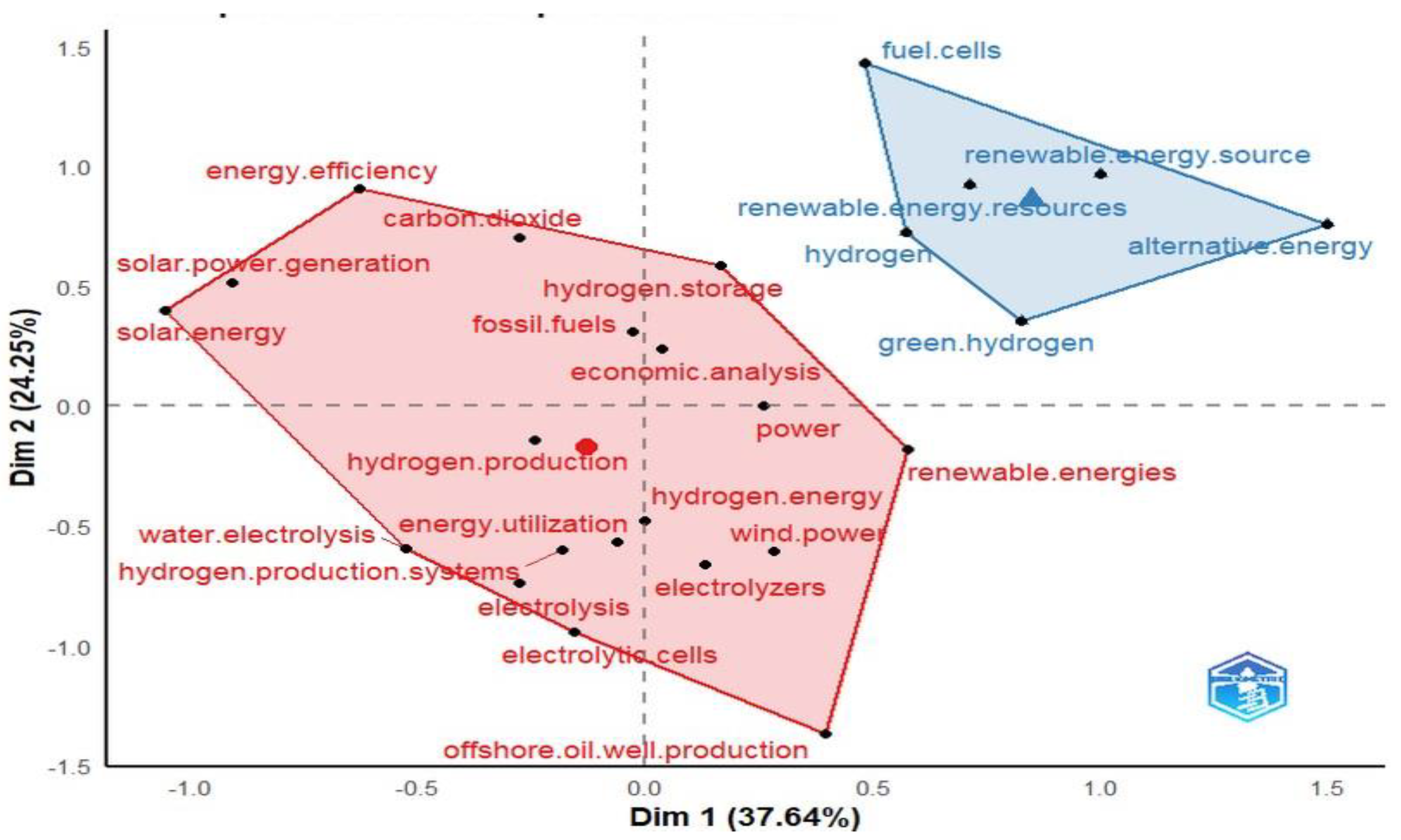
A Conceptual Structure Map demonstrates the connections between green hydrogen and renewable energy research keywords and authors through Multiple Correspondence Analysis (MCA). The data accommodates 61.89% of its variance through Dim 1 at 37.64% and Dim 2 at 24.25%. Hydrogen production technologies form a separate dimension from renewable energy integration in the Conceptual Structure Map. The second dimension shows distinctions between energy efficiency and environmental matters and technical production aspects. Two major clusters emerge. The red polygoned cluster comprises research on hydrogen production along with utilization activities that stress the technical aspects of generating hydrogen under its main keywords Hydrogen Production and Water Electrolysis and Energy Utilization and Fuel Cells. The section comprises three parts that demonstrate sustainability and decarbonization: Renewable Energies together with Solar Energy and Carbon Dioxide. Economic Analysis accompanies Hydrogen Storage solutions to handle these respective problems. Hydrogen Production Utilization Sustainability serves as the most predominant subject.
The blue triangle cluster contains renewable energy source and alternative application terms including Green Hydrogen and Renewable Energy Resources and Fuel Cells and Alternative Energy. The group focuses on renewable energy involvement in clean energy integration alongside green hydrogen development as its thematic core is "Renewable Energy Sources and Green Hydrogen Development." The two clusters connect through a direct link between renewable energy hydrogen production systems in the red cluster and sustainable renewable energy management in the blue cluster. Cross-dimensional terms like Economic Analysis bridge technical production with broader policy considerations. The map highlights two core objectives which combine renewable power systems with hydrogen technologies through technical developments while promoting sustainable practices. Strategic developments will focus on improving renewable energy connections, cost optimization in hydrogen systems and broadening fuel cell capabilities and reducing carbon emissions to fulfill hydrogen technology objectives.
6. Discussion
Figure 11.
Factorial analysis of conceptual structure map-method: MCA of high-frequency keywords.
The bibliometric analysis of Green Hydrogen (GH) and Renewable Energy (RE) research within the extended BRICS nations provides a structured understanding of the research field. This discussion responds to key research questions by examining trends in scientific production, the most influential sources, international collaboration, intellectual development, and the conceptual structure of the field.
R-Quest1: Evolution of Annual Scientific Production and Influence (2005–2024)
GH and RE research output has grown steadily between 2005 and 2024, with a notable surge after 2018. Early research between 2005 and 2012 was largely focused on fundamental hydrogen production methods and renewable energy integration, as noted by [5]. The subsequent period (2013–2024) saw a transition towards applied investigations, including economic feasibility, policy frameworks, and electrolysis advancements [35]. This pattern aligns with the global shift towards decarbonization policies, which have fueled scientific and industrial interest in GH technologies. However, citation analysis highlights fluctuating impact, with a peak in citations between 2015 and 2020, which can be attributed to major breakthroughs in hydrogen storage and utilization [7]. The declining trend in recent years suggests an increasing volume of publications leading to citation dispersion, a phenomenon observed in maturing research fields [22].
R-Quest2: Most Impactful, Prominent, and Dynamic Sources
The International Journal of Hydrogen Energy emerges as the most influential journal in the field, with a high total citation count and productivity, reflecting its pivotal role in advancing hydrogen technology research [3]. Other impactful sources include Energy Conversion and Management and Renewable and Sustainable Energy Reviews, both of which have contributed significantly to studies on renewable integration and techno-economic evaluations of hydrogen production [12,15]. Additionally, Applied Energy and Journal of Cleaner Production have provided substantial contributions to the economic and sustainability aspects of hydrogen energy, indicating an increasing interdisciplinary focus in GH research [11]. The diversity of sources highlights a convergence of technical, economic, and policy-driven research on GH and RE within the extended BRICS region.
R-Quest3: Impact and Collaboration of Different Countries
China leads GH and RE research in the extended BRICS, both in terms of output and impact, followed by India and Russia, reflecting their strong governmental and industrial commitments to hydrogen development [2]. India has focused on solar-based hydrogen production and electrolysis, while Russia's contributions highlight advances in hydrogen storage and hybrid energy systems [16]. South Africa and Brazil, though smaller contributors, show growing engagement in hydrogen research, often in collaboration with global partners. International co-authorship rates stand at 25.68%, signifying robust global collaboration, particularly between BRICS and European institutions [9]. The partnerships reflect the global urgency for hydrogen-based solutions and the role of BRICS nations in shaping the future of sustainable energy transitions.
R-Quest4: Intellectual Structure and Historiographic Evolution
The historiographic analysis identifies key foundational works that have significantly influenced GH and RE research trajectories. Studies such as [36] on water electrolysis, [37] on bio-hydrogen production, and [38] on techno-economic assessments serve as major intellectual anchors in the field. Co-citation analysis reveals thematic clusters, primarily focused on hydrogen production technologies, economic feasibility studies, and policy frameworks [24]. Research has evolved from theoretical production models to applied solutions addressing commercialization and supply chain optimization [27]. Bibliographic coupling further indicates an interdisciplinary transition, linking hydrogen research with sustainable development, climate change mitigation, and policy implementation [26]. This intellectual progression suggests a maturing research field with increasing real-world applicability and policy relevance.
R-Quest5: Conceptual Structure of the Research Field
The TreeMap visualization of GH and RE research highlights "Hydrogen Production" as the dominant thematic area (23%), followed by "Renewable Energy" (16%) and "Water Electrolysis" (5%), reflecting the field’s emphasis on production methods and energy integration [6]. The Three-Field Plot further establishes strong associations between leading research nations (China, India, Iran), primary research themes (Hydrogen Production, Solar Energy, Wind Power), and major publishing sources (International Journal of Hydrogen Energy, Energy Conversion and Management), confirming the interconnected nature of research productivity and knowledge dissemination [25].
Co-occurrence network analysis identifies three major research clusters. The Hydrogen Technologies and Applications cluster focuses on production, fuel cells, and storage solutions, reflecting industry-driven technological development [8]. The Advanced Hydrogen and Emerging Technologies cluster examines offshore wind-based hydrogen production, electrolysis advancements, and process optimization, showcasing research priorities in increasing efficiency [14]. The Economic and Strategic Analysis cluster addresses financial feasibility, policy frameworks, and international hydrogen trade, demonstrating a shift towards market integration [21].
Thematic evolution analysis classifies GH and RE research into three periods. The 2005–2012 phase focused on early hydrogen production techniques, particularly non-grid wind power generation [17]. The 2013–2017 phase saw expansion into experimental technologies such as biomass gasification and hybrid wind-solar hydrogen production [15]. The 2018–2024 period is characterized by a shift towards commercialization, supply chain optimization, and large-scale hydrogen integration within RE systems [19]. This evolution aligns with increasing industry participation and government policies supporting hydrogen economy development.
7. Conclusions
The research problem required a bibliometric investigation to study green hydrogen (GH) and renewable energy (RE) research developments in extended BRICS nations. Research into decarbonization and emerging economy contributions to global energy transformations requires deep understanding of field development patterns and international partnerships and topics. The research study fulfilled an important knowledge gap by creating maps of BRICS nations' research publications about GH and RE and analyzing their intellectual organization to develop strategic directions for future development.
The research shows that GH and RE investigation has shown steady expansion within BRICS after 2018 while China dominates in both research production and academic influence. Three main influential publications in GH and RE research are the International Journal of Hydrogen Energy, Energy Conversion and Management, and Renewable and Sustainable Energy Reviews. Research collaborations primarily extend between BRICS institutions and their European counterparts. The research field about hydrogen production has shifted from basic technical methods to add disciplinary applications which focus on policy generation alongside economic validation and industrial use. The conceptual research directions concentrate on hydrogen production methods and electrolysis innovation as well as GH economic sustainability.
7.1. Discuss Implications
This research adds value to professional domains by conducting an extensive bibliometric evaluation of GH and RE studies throughout BRICS economies. The study demonstrates the requirement for focused hydrogen technology investments as well as improved international sector collaborations and research agendas influenced by policy principles. BRICS nations continue their technological progress which establishes them as leading stakeholders in the worldwide hydrogen economic framework. This research delivers valuable findings to help policymakers and stakeholders in funding agencies alongside industry leaders develop better energy transition approaches.
The research contains several limitations due to its extensive bibliometric method. The use of Scopus database as an information source omits research that appears in non-scoped journals together with regional research repositories. Malfunctions in bibliometric analysis generate useful quantitative data while lacking the capacity to measure policy effectiveness alongside the socioeconomic effects of adopting technologies for promotion. Additional research would benefit from including expert interviews as well as case studies to assist bibliometric findings.
7.2. Future Research and Recommendation
Further research needs to evaluate the extended policy implications which BRICS economies face due to their investments in GH and RE development. Further insights about global energy transitions can be developed by performing a comparative analysis between the BRICS nations and other emerging economies. Environmental impact assessments and economic modeling methods combined with life-cycle analyses will help professionals better evaluate the practicality of using GH. Research effectiveness would increase if studies delved into precise industrial sectors (such as transportation and heavy manufacturing) and their processes of transitioning to hydrogen-based energy systems.
Author Contributions
Conceptualization, Z.O and R.B; Methodology, R.B; Software, R.B; Validation, Z.O and R.B; Formal Analysis, Z.O and R.B; Investigation, Z.O and R.B; Data Curation, R.B.; Writing – Original Draft Preparation, Z.O and R.B; Writing – Review & Editing, Z.O and R.B; Supervision, Z.O and R.B; Project Administration, Z.O.
Data Availability Statement
No additional data was created.
Acknowledgments
This research was supported by the Deanship of Scientific Research at King Faisal University (Grant No. KFU251112), whose funding is gratefully acknowledged.
Conflicts of Interest
The authors declare no conflicts of interest.
Abbreviations
The following abbreviations are used in this manuscript:
| GH | Green Hydrogen |
| RE | Renewable Energy |
| RQuest | Research Question |
| ACP | Average Citations per Publication |
| ACY | Average Citations per Year |
| NP | Number of Papers |
| IF | Impact Factor |
| TC | Total Citations |
| PY | Publication Year |
| PY_start | Journal’s Year of starting |
| H-index | Hirsch Index |
| G-Index | Egghe Index |
| M-Index | H-index per Year |
Appendix A
Appendix A.1
Table A1.
Historiographic Evolution of Manuscript.
| Paper | Title | Author_Keywords | Year | LCS | GCS |
| SHARMA RS, 2005, PROC SOL WORLD CONGR: BRINGING WATER WORLD, INCL PROC ASES ANNU CONF PROC NATL PASSIVE SOL CONF | CONCEPTUALIZATION OF RENEWABLE ENERGY BALANCING CYCLE (REBC) FOR HYDROGEN PRODUCTION AND MITIGATION OF THE GLOBAL WARMING THROUGH SOLAR THERMAL POWER GENERATION | CONVERGENCE SCHEMES; HYDROGEN PRODUCTION; PRESSURIZED VOLUMETRIC AIR RECEIVER TECHNOLOGY; RENEWABLE ENERGY BALANCING CYCLE (REBC); UT-3 PROCESS | 2005 | 0 | 0 |
| CHEN X-R, 2006, HUAGONG XIANDAI | RESEARCH PROGRESS IN HYDROGEN PRODUCTION FROM WATER ON PHOTOCATALYSTS WITH SOLAR ENERGY | HYDROGEN PRODUCTION; PHOTOCATALYSTS; SOLAR ENERGY; WATER DECOMPOSITION | 2006 | 0 | 2 |
| GAO B, 2009, WNWEC - WORLD NON-GRID-CONNECTED WIND POWER ENERGY CONF | ANALYSIS OF A NON-GRID-CONNECTED WIND POWER-SEAWATER DESALINATION AND HYDROGEN PRODUCTION BASE DISTRIBUTION IN CHINA | DISTRIBUTION; HYDROGEN PRODUCTION INDUSTRY; NON-GRID-CONNECTED WIND POWER; SEAWATER DESALINATION | 2009 | 0 | 2 |
| JIN C, 2009, WNWEC - WORLD NON-GRID-CONNECTED WIND POWER ENERGY CONF | WIND ENERGY EXPLOITATION AND HYDROGEN PRODUCTION BASES CONSTRUCTION APPLYING NON-GRID-CONNECTED WIND POWER IN JIANGSU COASTAL AREAS | HYDROGEN PRODUCTION BASE; NON-GRID-CONNECTED; WIND ENERGY | 2009 | 0 | 0 |
| ..... | ..... | ..... | … | ||
| HE L, 2024, MANUF SERV OPER MANAGE | FROM CURTAILED RENEWABLE ENERGY TO GREEN HYDROGEN: INFRASTRUCTURE PLANNING FOR HYDROGEN FUEL-CELL VEHICLES | GREEN TRANSPORTATION; HYDROGEN FUEL-CELL VEHICLES; INFRASTRUCTURE PLANNING; POWER SYSTEMS | 2024 | 0 | 1 |
| MOHAMMADI Z, 2024, INT J HYDROGEN ENERGY | AN INNOVATIVE TRANSIENT SIMULATION OF A SOLAR ENERGY SYSTEM WITH A THERMOCHEMICAL HYDROGEN PRODUCTION CYCLE FOR ZERO-ENERGY BUILDINGS | HYDROGEN; OPTIMIZATION; THERMOCHEMICAL CYCLE; TRNSYS SOFTWARE; ZERO-ENERGY BUILDINGS | 2024 | 0 | 2 |
| GUPTA M, 2024, PROC - INT CONF COMPUT MODEL, SIMUL OPTIM, ICCMSO | A COMPARATIVE STUDY AND MATHEMATICAL MODELING OF PBUCP USING RENEWABLE ENERGY SOURCES AND HYDROGEN FUEL CELL VEHICLE | HYDROGEN FUEL CELL VEHICLE; PROFIT BASED UNIT COMMITMENT PROBLEM; RENEWABLE ENERGY SOURCES; UNIT COMMITMENT | 2024 | 0 | 0 |
| HONG C, 2024, INT J HYDROGEN ENERGY | LAYOUT OPTIMIZATION OF THE “PIPE+SHIP” TRANSMISSION NETWORK FOR THE DECENTRALIZED OFFSHORE WIND POWER-HYDROGEN PRODUCTION | DECENTRALIZED OFFSHORE WIND POWER-HYDROGEN PRODUCTION; HYDROGEN TRANSMISSION NETWORK; LAYOUT OPTIMIZATION; LOCATION–ALLOCATION PROBLEM; PIPE-SHIP HYBRID MODE; SHIPPING ROUTE OPTIMIZATION | 2024 | 0 | 4 |
| QI X, 2024, INT J HYDROGEN ENERGY | ENERGY, EXERGY, EXERGOECONOMIC AND EXERGOENVIRONMENTAL ANALYSES OF A HYBRID RENEWABLE ENERGY SYSTEM WITH HYDROGEN FUEL CELLS | ENERGY STORAGE; EXERGOECONOMIC; EXERGOENVIRONMENTAL ANALYSIS; RENEWABLE ENERGY SYSTEMS | 2024 | 0 | 14 |
References
- Mohanty, S.; Sethi, N. The energy consumption-environmental quality nexus in BRICS countries: the role of outward foreign direct investment. Environ. Sci. Pollut. Res. 2021, 29, 19714–19730. [CrossRef]
- Ribeiro, H.C.M.; Corrêa, R. Analysis of the Scientific Production on the Green Hydrogen Theme Published in Scientific Journals Indexed by EBSCO. 2023, 17, e03165–e03165. [CrossRef]
- Kabir, M.M.; Akter, M.M.; Huang, Z.; Tijing, L.; Shon, H.K. Hydrogen production from water industries for a circular economy. Desalination 2023, 554. [CrossRef]
- Rodríguez-Aburto, C.; Poma-García, J.; Montaño-Pisfil, J.; Morcillo-Valdivia, P.; Oyanguren-Ramirez, F.; Santos-Mejia, C.; Rodriguez-Flores, R.; Virú-Vasquez, P.; Pilco-Nuñez, A. Bibliometric Analysis of Global Publications on Management, Trends, Energy, and the Innovation Impact of Green Hydrogen Production. Sustainability 2024, 16, 11048. [CrossRef]
- Fernández-Arias, P.; Antón-Sancho, Á.; Lampropoulos, G.; Vergara, D. On Green Hydrogen Generation Technologies: A Bibliometric Review. Appl. Sci. 2024, 14, 2524. [CrossRef]
- Jaradat, M.; Almashaileh, S.; Bendea, C.; Juaidi, A.; Bendea, G.; Bungau, T. Green Hydrogen in Focus: A Review of Production Technologies, Policy Impact, and Market Developments. Energies 2024, 17, 3992. [CrossRef]
- Khusnun, N.; Arshad, A.; Jalil, A.; Firmansyah, L.; Hassan, N.; Nabgan, W.; Fauzi, A.; Bahari, M.; Ya'Aini, N.; Johari, A.; et al. An avant-garde of carbon-doped photoanode materials on photo-electrochemical water splitting performance: A review. J. Electroanal. Chem. 2022, 929. [CrossRef]
- Hache, E.; Palle, A. Renewable energy source integration into power networks, research trends and policy implications: A bibliometric and research actors survey analysis. 2018, 124, 23–35. [CrossRef]
- Sarkodie, S.A.; Owusu, P.A. Bibliometric analysis of water–energy–food nexus: Sustainability assessment of renewable energy. Curr. Opin. Environ. Sci. Heal. 2020, 13, 29–34. [CrossRef]
- Azevedo, S.G.; Santos, M.; Antón, J.R. Supply chain of renewable energy: A bibliometric review approach. Biomass- Bioenergy 2019, 126, 70–83. [CrossRef]
- Bortoluzzi, M.; de Souza, C.C.; Furlan, M. Bibliometric analysis of renewable energy types using key performance indicators and multicriteria decision models. Renew. Sustain. Energy Rev. 2021, 143. [CrossRef]
- Khalili, S.; Breyer, C. Review on 100% Renewable Energy System Analyses—A Bibliometric Perspective. IEEE Access 2022, 10, 125792–125834. [CrossRef]
- Zhang, L.; Ling, J.; Lin, M. Artificial intelligence in renewable energy: A comprehensive bibliometric analysis. Energy Rep. 2022, 8, 14072–14088. [CrossRef]
- Hu, H.; Xue, W.; Jiang, P.; Li, Y. Bibliometric analysis for ocean renewable energy: An comprehensive review for hotspots, frontiers, and emerging trends. Renew. Sustain. Energy Rev. 2022, 167. [CrossRef]
- Jabeen, S.; Malik, S.; Khan, S.; Khan, N.; Qureshi, M.I.; Saad, M.S.M. A COMPARATIVE SYSTEMATIC LITERATURE REVIEW AND BIBLIOMETRIC ANALYSIS ON SUSTAINABILITY OF RENEWABLE ENERGY SOURCES. Int. J. Energy Econ. Policy 2020, 11, 270–280. [CrossRef]
- Afrane, S.; Ampah, J.D.; Aboagye, E.M. Investigating evolutionary trends and characteristics of renewable energy research in Africa: a bibliometric analysis from 1999 to 2021. Environ. Sci. Pollut. Res. 2022, 29, 59328–59362. [CrossRef]
- Kołakowski, P.; Gil, M.; Wróbel, K.; Ho, Y.-S. State of play in technology and legal framework of alternative marine fuels and renewable energy systems: a bibliometric analysis. Marit. Policy Manag. 2021, 49, 236–260. [CrossRef]
- Ziabina, Y.; Pimonenko, T. The Green Deal Policy for Renewable Energy: A Bibliometric Analysis. Virtual Econ. 2020, 3, 147–168. [CrossRef]
- Oliveira, H.; Moutinho, V. Renewable Energy, Economic Growth and Economic Development Nexus: A Bibliometric Analysis. Energies 2021, 14, 4578. [CrossRef]
- Winardi, B.; Zm, A.A. Quantifying the Impact of Renewable Energy Research on Environmental Sustainability. West Sci. Interdiscip. Stud. 2023, 1, 551–563. [CrossRef]
- Chou, C.-H.; Ngo, S.L.; Tran, P.P. Renewable Energy Integration for Sustainable Economic Growth: Insights and Challenges via Bibliometric Analysis. Sustainability 2023, 15, 15030. [CrossRef]
- Judijanto, L.; Yusuf, R.; Al Imran, H.; Wahyudi, E. Exploring Research Development on Renewable Energy Technology Innovation in Sustainable Development. West Sci. Interdiscip. Stud. 2023, 1, 1167–1176. [CrossRef]
- Viteri JP, Viteri S, Alvarez-Vasco C, Henao F. A systematic review on green hydrogen for off-grid communities –technologies, advantages, and limitations. Int J Hydrogen Energy [Internet]. 2023;48:19751–71. Available from: https://api.elsevier.com/content/article/eid/1-s2.0-S0360319923008856.
- Gómez, J.; Castro, R. Green Hydrogen Energy Systems: A Review on Their Contribution to a Renewable Energy System. Energies 2024, 17, 3110. [CrossRef]
- Sharma, G.D.; Verma, M.; Taheri, B.; Chopra, R.; Parihar, J.S. Socio-economic aspects of hydrogen energy: An integrative review. Technol. Forecast. Soc. Chang. 2023, 192. [CrossRef]
- Gulotta, T.M.; Salomone, R.; Lanuzza, F.; Saija, G.; Mondello, G.; Ioppolo, G. Life Cycle Assessment and Life Cycle Costing of unitized regenerative fuel cell: A systematic review. Environ. Impact Assess. Rev. 2022, 92. [CrossRef]
- Emodi, N.V.; Lovell, H.; Levitt, C.; Franklin, E. A systematic literature review of societal acceptance and stakeholders’ perception of hydrogen technologies. Int. J. Hydrogen Energy 2021, 46, 30669–30697. [CrossRef]
- Roucham, B.; Lefilef, A.; Zaghdoud, O.; Mohammed, K.S. The evolution of green hydrogen in renewable energy research: Insights from a bibliometric perspective. Energy Rep. 2024, 13, 576–593. [CrossRef]
- Safi, B.; Roucham, B.; Mahmoudi, H. Ex Post Facto and Trends on Total Quality Management Papers: Bibliometric Analysis in Algerian Scientific Platform. Qual. Innov. Prosper. 2023, 27, 77–95. [CrossRef]
- Farooq, R. Knowledge management and performance: a bibliometric analysis based on Scopus and WOS data (1988–2021). J. Knowl. Manag. 2022, 27, 1948–1991. [CrossRef]
- Garfield, E. Historiographic Mapping of Knowledge Domains Literature. J. Inf. Sci. 2004, 30, 119–145. [CrossRef]
- Van Eck, N.J.; Waltman, L. Visualizing bibliometric networks. In Measuring Scholarly Impact; Springer: Cham, Switzerland, 2014; pp. 285–320. [CrossRef]
- Dolhey, S. A bibliometric analysis of research on entrepreneurial intentions from 2000 to 2018. J. Res. Mark. Entrep. 2019, 21, 180–199. [CrossRef]
- Olczyk, M. A systematic retrieval of international competitiveness literature: a bibliometric study. Eurasian Econ. Rev. 2016, 6, 429–457. [CrossRef]
- Rodríguez-Aburto, C.; Poma-García, J.; Montaño-Pisfil, J.; Morcillo-Valdivia, P.; Oyanguren-Ramirez, F.; Santos-Mejia, C.; Rodriguez-Flores, R.; Virú-Vasquez, P.; Pilco-Nuñez, A. Bibliometric Analysis of Global Publications on Management, Trends, Energy, and the Innovation Impact of Green Hydrogen Production. Sustainability 2024, 16, 11048. [CrossRef]
- Chi, J.; Yu, H. Water electrolysis based on renewable energy for hydrogen production. Chin. J. Catal. 2018, 39, 390–394. [CrossRef]
- Amin, M.; Shah, H.H.; Fareed, A.G.; Khan, W.U.; Chung, E.; Zia, A.; Farooqi, Z.U.R.; Lee, C. Hydrogen production through renewable and non-renewable energy processes and their impact on climate change. Int. J. Hydrogen Energy 2022, 47, 33112–33134. [CrossRef]
- Singh, A.; Baredar, P.; Gupta, B. Techno-economic feasibility analysis of hydrogen fuel cell and solar photovoltaic hybrid renewable energy system for academic research building. Energy Convers. Manag. 2017, 145, 398–414. [CrossRef]
Figure 3.
Dynamic Sources.
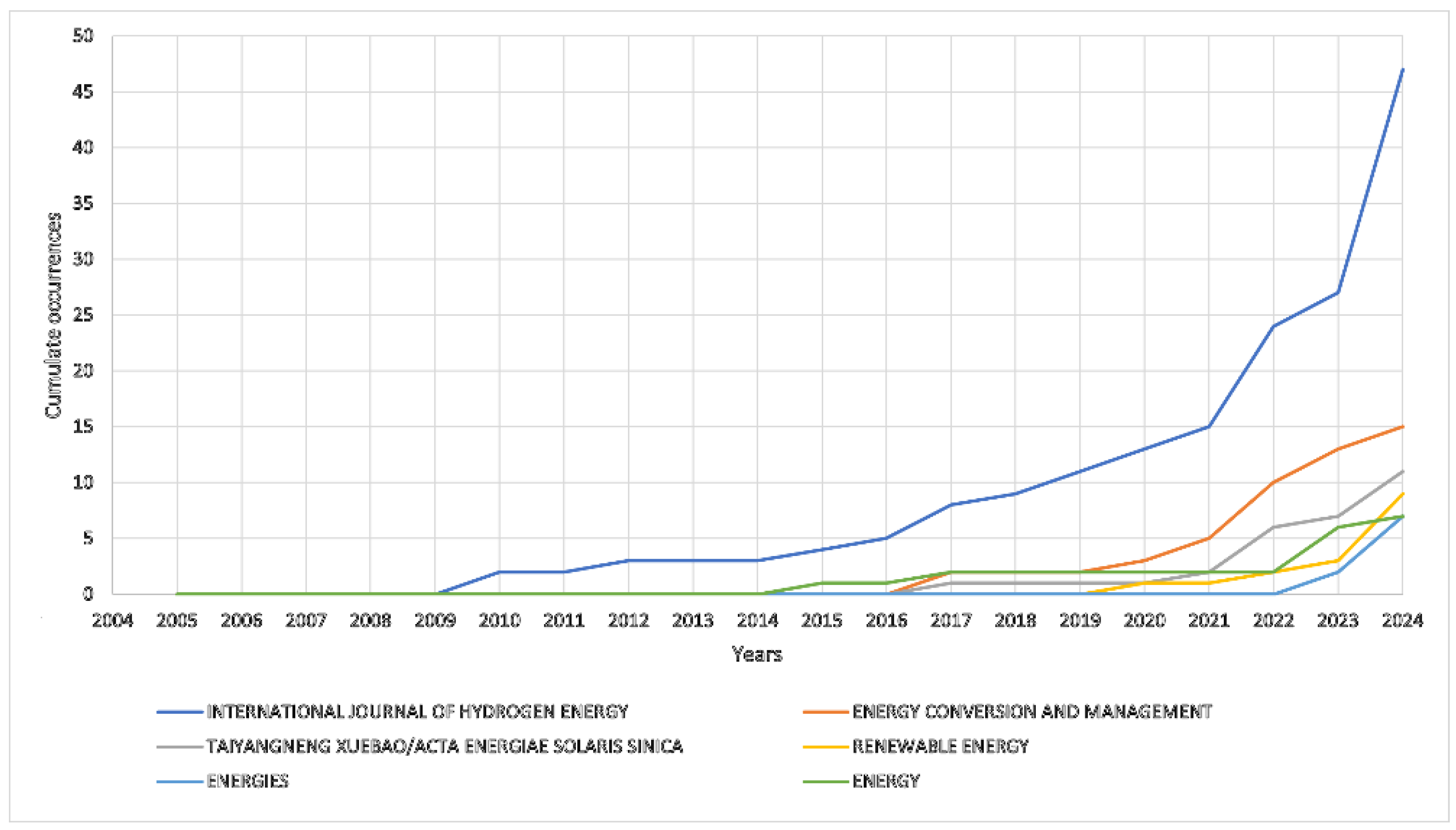
Figure 4.
Most authors’ citations by countries.
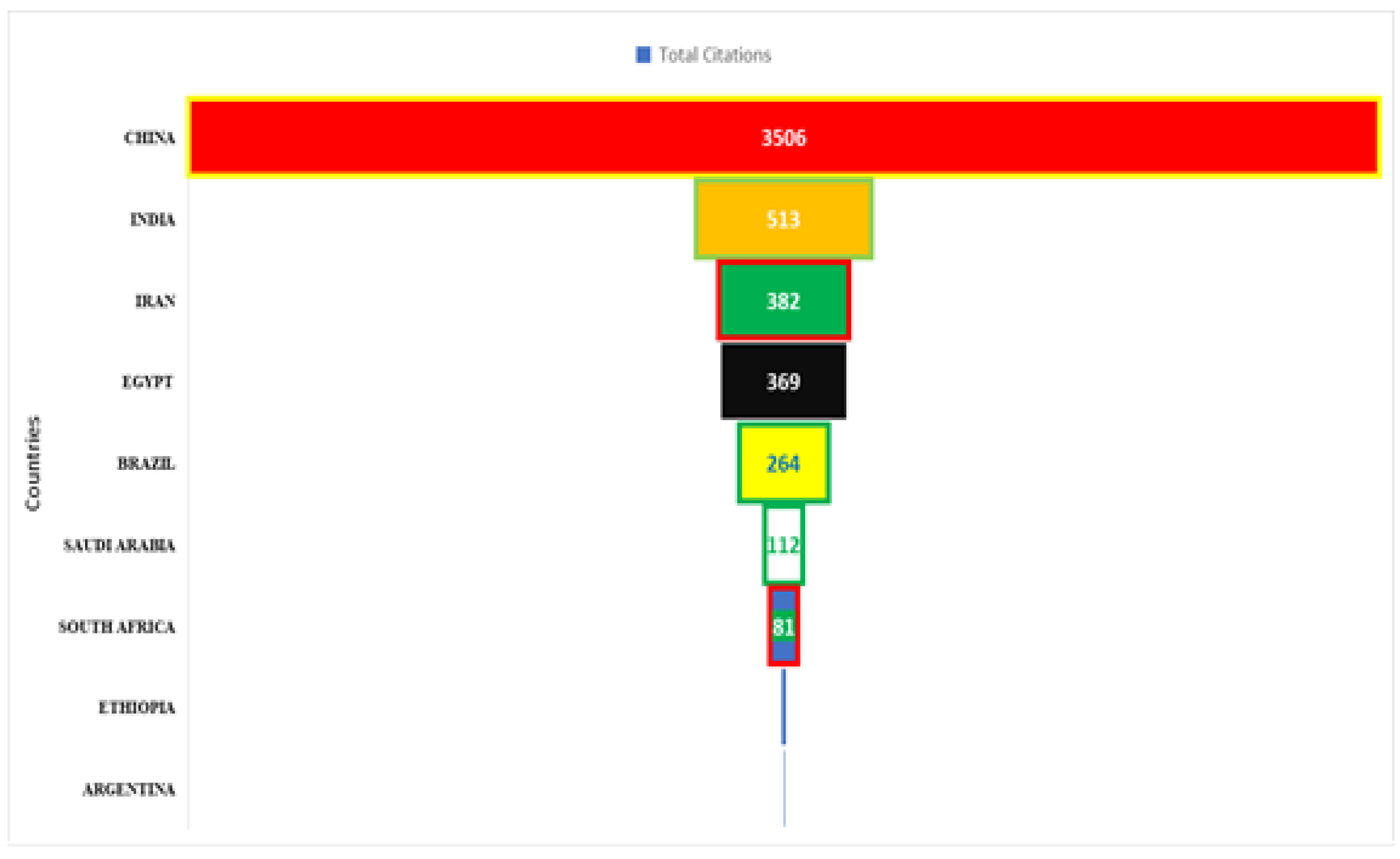
Figure 5.
Corresponding author’s Countries.
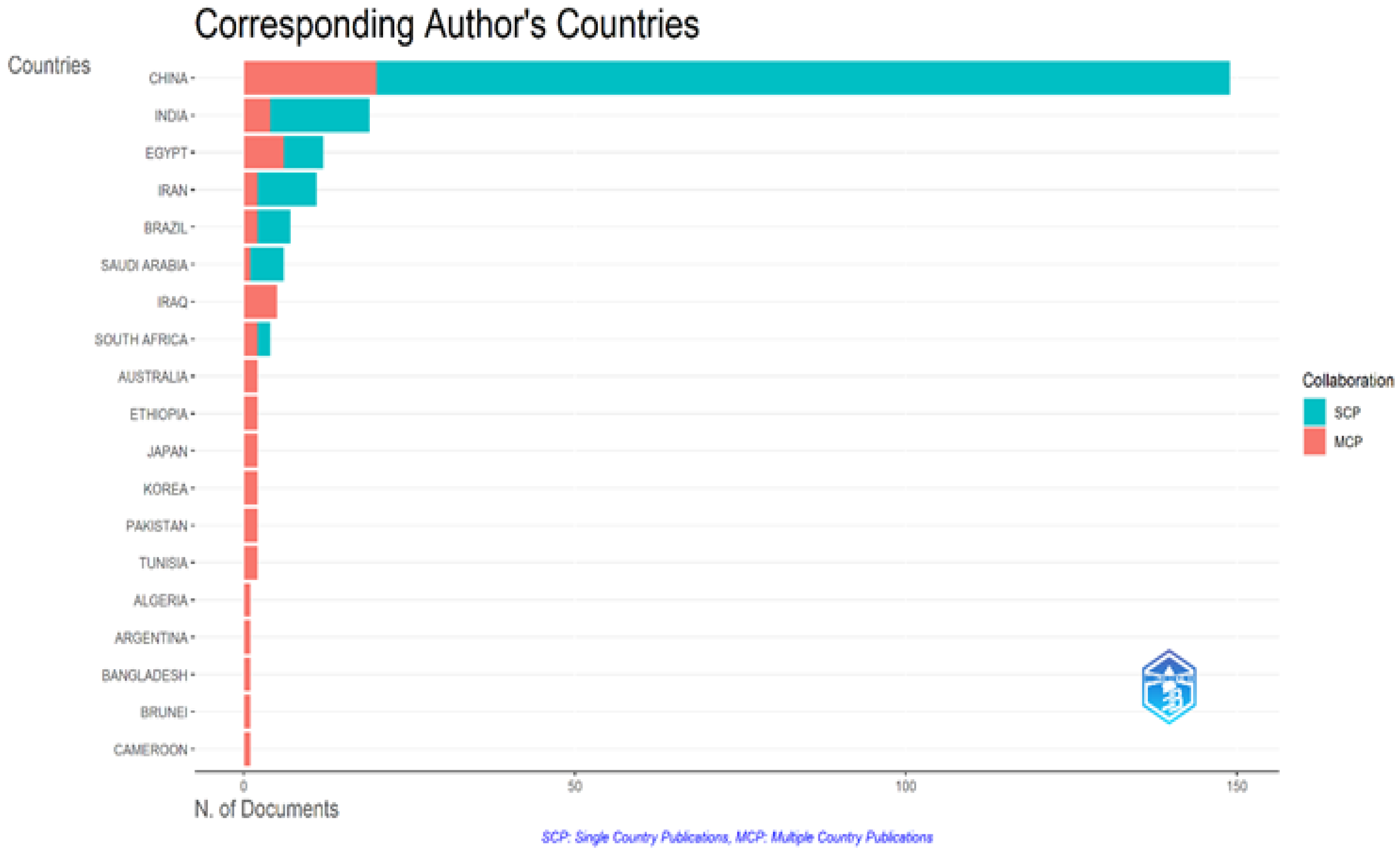
Figure 6.
TreeMap Keywords frequencies.
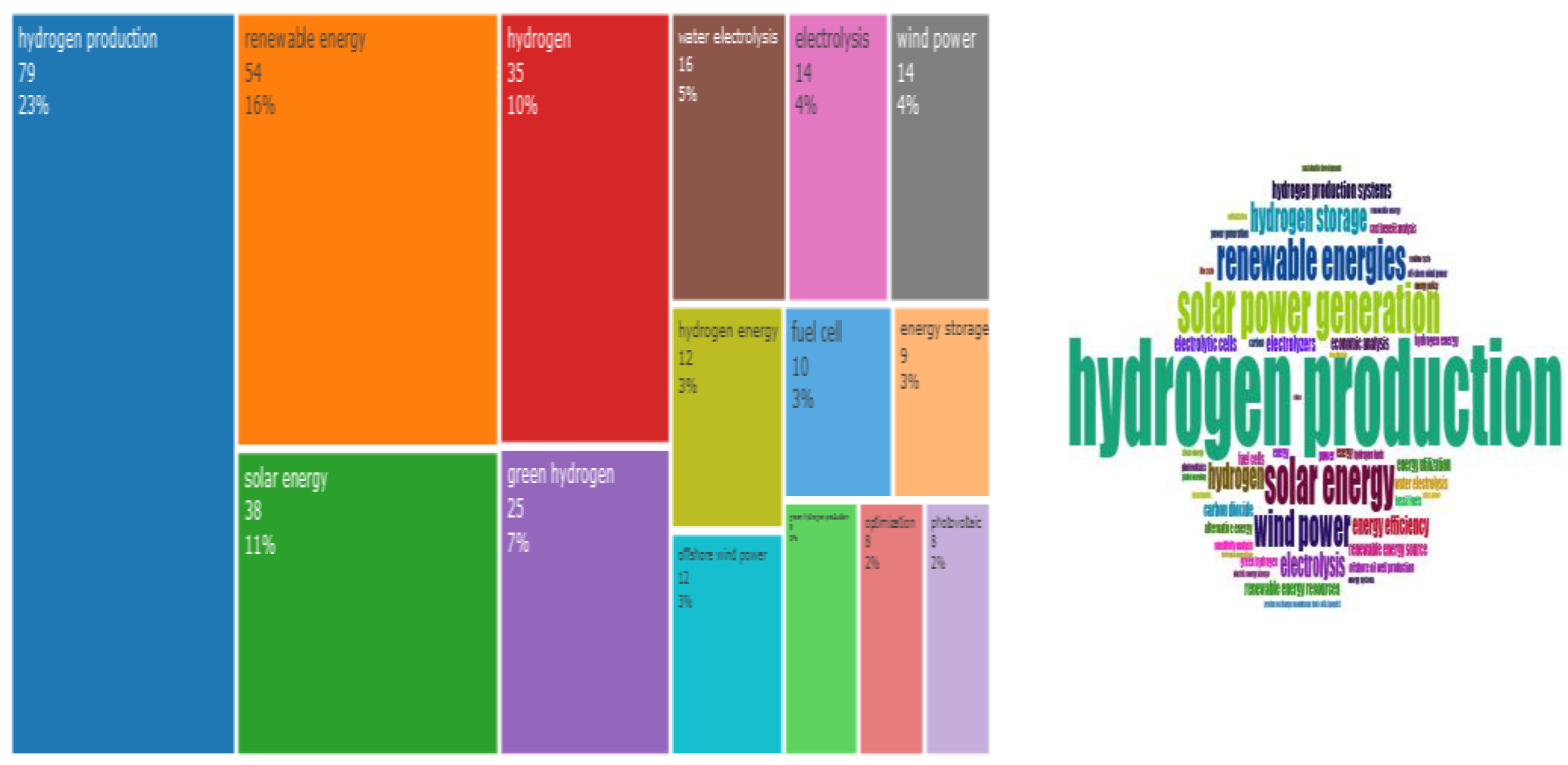
Figure 7.
Dynamic Keywords.
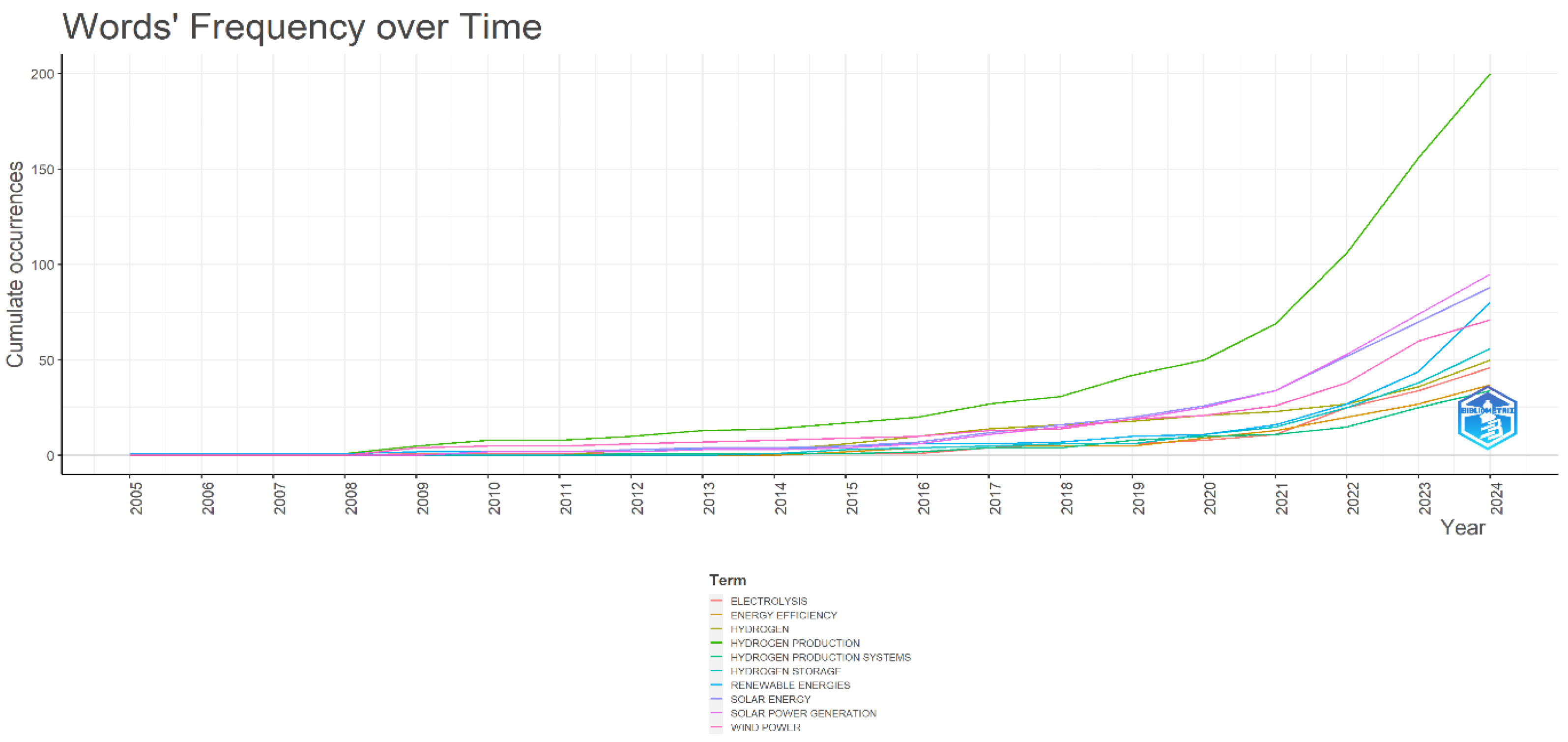
Figure 8.
Sankey chart for Country-Keyword-Source.
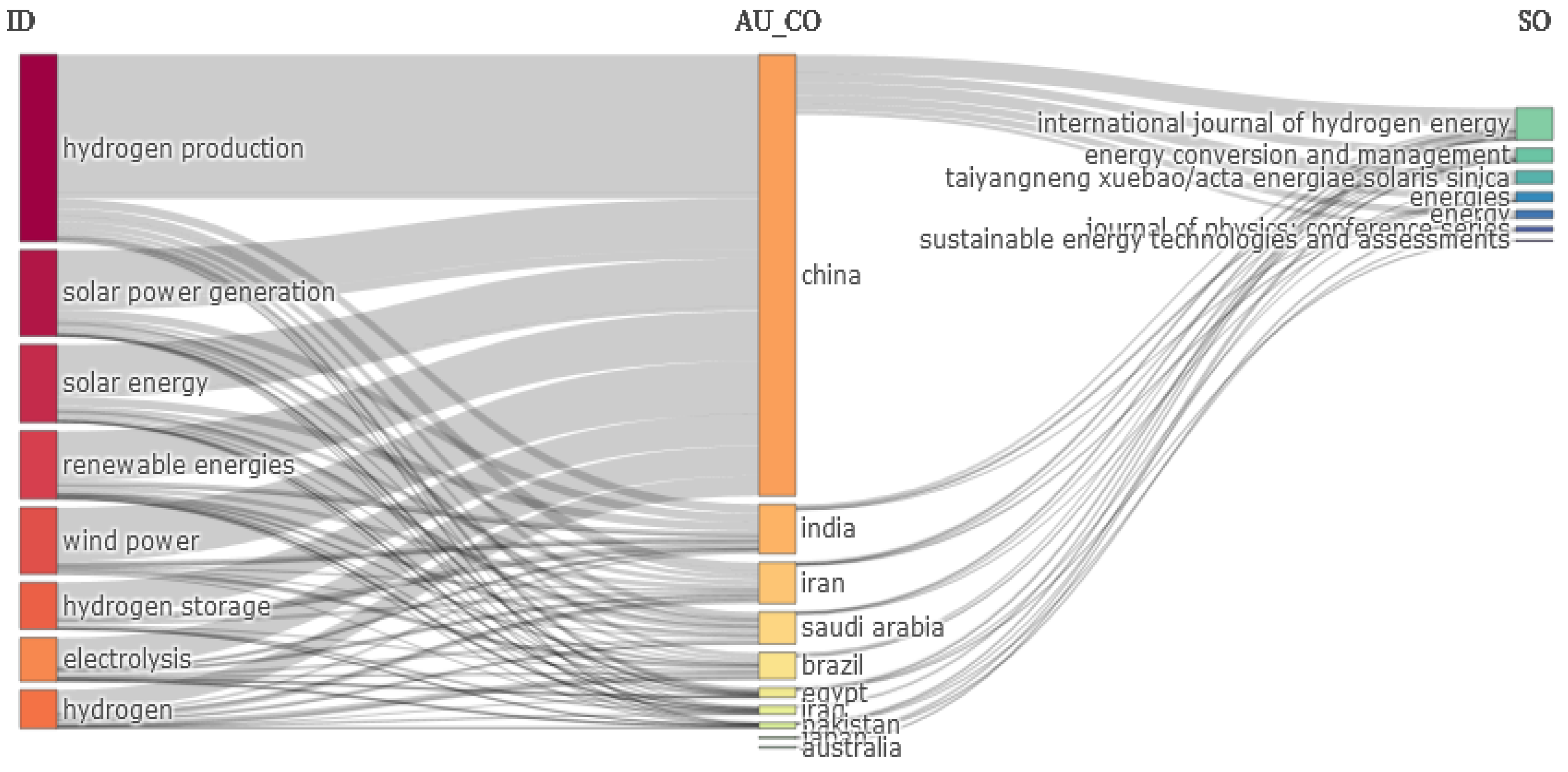
Figure 9.
Co-Occurrence Network.
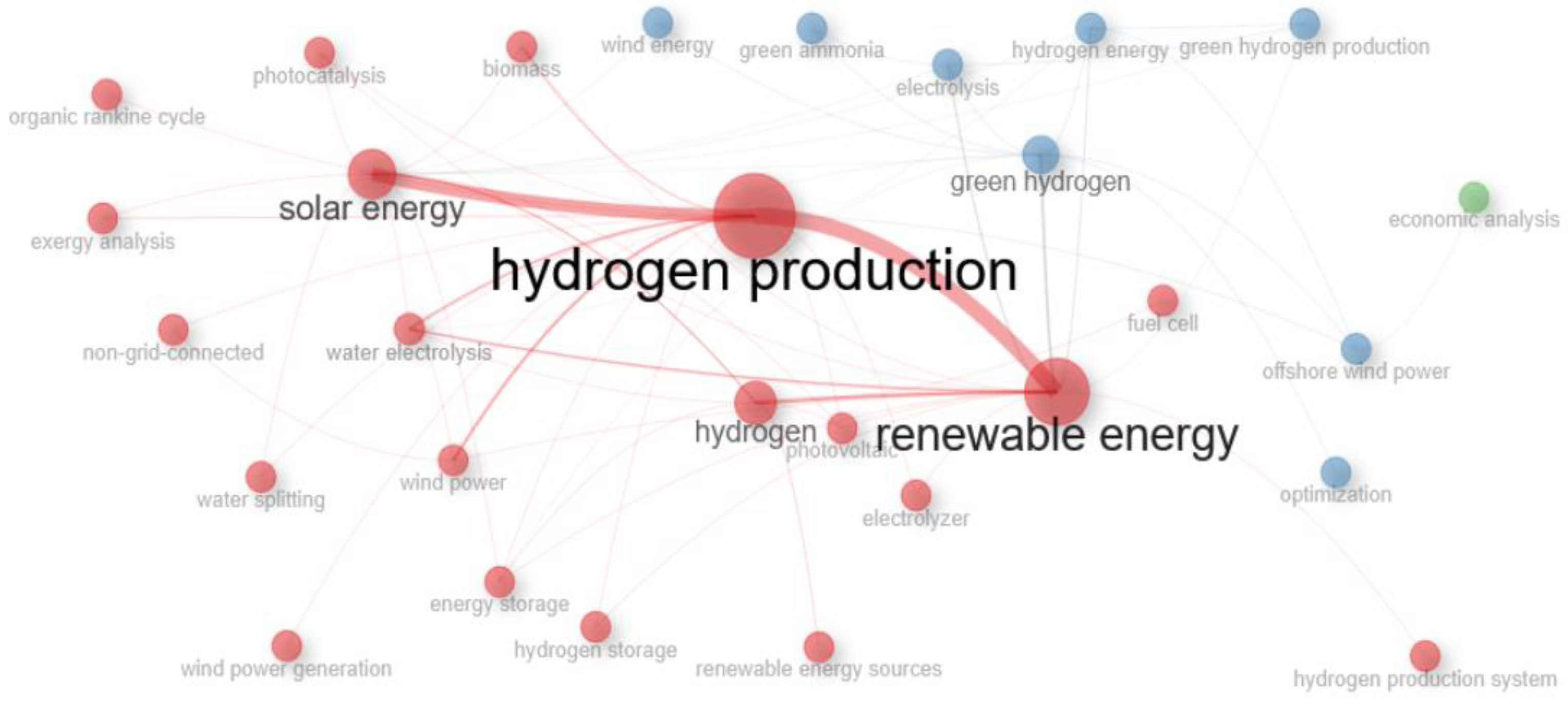
Figure 10.
Sankey chart for Thematic Evolution.
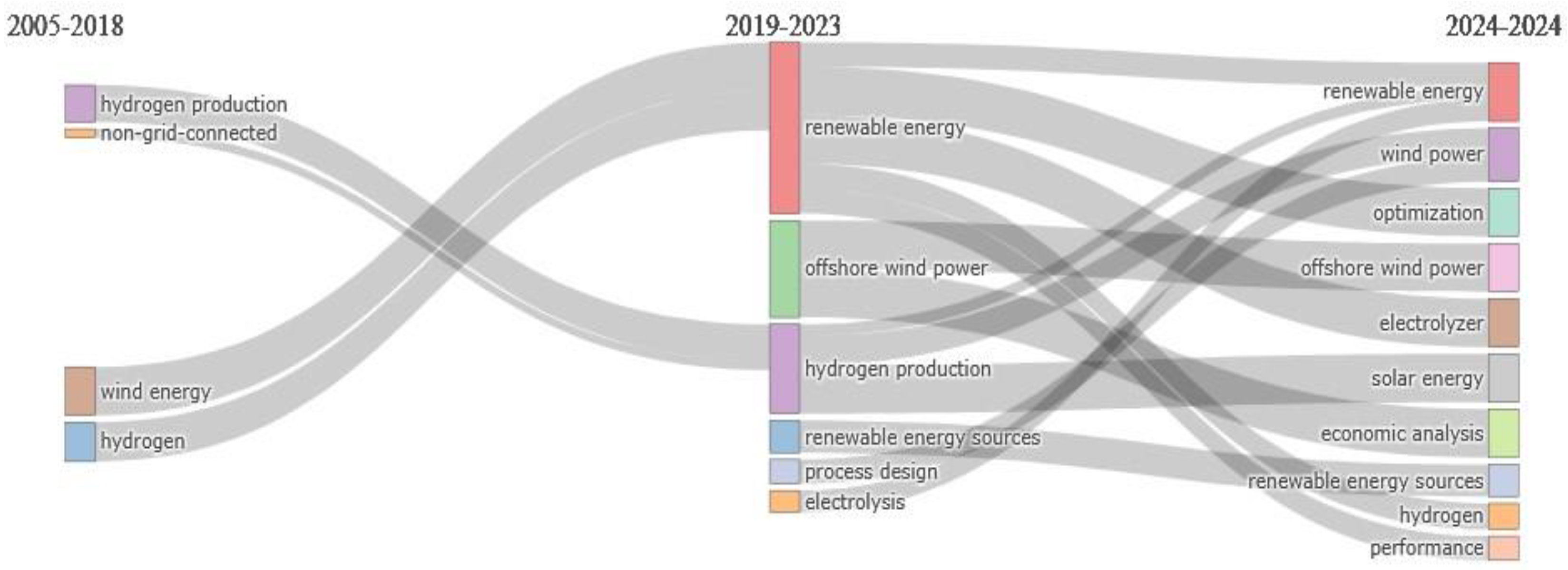
Table 1.
Sets of Descriptors Used in the Search Query.
| Set 1 | Set 2 |
| Green hydrogen | Renewable energ* |
| Hydrogen production | Renewable sources |
| Green hydrogen | Solar energ* |
| Hydrogen fuel cells | Wind power |
| Hydrogen technolog* | Renewable energ* integration |
| Green hydrogen econom* | Renewable energ* policies |
Note: Using * to include all the possible endings of a descriptor, for insatance energ* includes "energy", "energies", "energical", etc.
Table 2.
Dataset Main information.
| Description | Results |
| MAIN INFORMATION ABOUT DATA | |
| Timespan | 2005:2024 |
| Sources (Journals, Books, etc) | 139 |
| Documents | 292 |
| Annual Growth Rate % | 27,22 |
| Document Average Age | 3,45 |
| Average citations per doc | 25,29 |
| Keywords Plus (ID) | 2064 |
| Author's Keywords (DE) | 800 |
| Authors | 981 |
| AUTHORS COLLABORATION | |
| Single-authored docs | 7 |
| Co-Authors per Doc | 4,67 |
| International co-authorships % | 25,68 |
Table 3.
Citations per publication ACP and citations per year (ACY) over time.
| Year | N | ACP | ACY |
| 2005 | 1,00 | 0 | 0,00 |
| 2006 | 1,00 | 2 | 0,10 |
| 2009 | 5,00 | 7,8 | 0,46 |
| 2010 | 3,00 | 45,67 | 2,85 |
| 2012 | 3,00 | 12 | 0,86 |
| 2013 | 3,00 | 38,33 | 2,95 |
| 2014 | 1,00 | 74 | 6,17 |
| 2015 | 3,00 | 112 | 10,18 |
| 2016 | 3,00 | 25 | 2,50 |
| 2017 | 9,00 | 70,44 | 7,83 |
| 2018 | 5,00 | 229,4 | 28,68 |
| 2019 | 13,00 | 39 | 5,57 |
| 2020 | 11,00 | 44,09 | 7,35 |
| 2021 | 25,00 | 22,64 | 4,53 |
| 2022 | 45,00 | 38,11 | 9,53 |
| 2023 | 64,00 | 17,64 | 5,88 |
| 2024 | 97,00 | 3,99 | 2,00 |
Table 4.
Most impacting and prolific sources.
| Element | TC | TC Rank | NP | NP Rank | h_index | g_index | m_index | PY_start |
| INTERNATIONAL JOURNAL OF HYDROGEN ENERGY | 2088 | 1 | 47 | 1 | 23 | 45 | 1,438 | 2010 |
| ENERGY CONVERSION AND MANAGEMENT | 811 | 2 | 15 | 2 | 13 | 15 | 1,444 | 2017 |
| RENEWABLE AND SUSTAINABLE ENERGY REVIEWS | 369 | 3 | 3 | 7 | 3 | 3 | 0,333 | 2017 |
| SUSTAINABLE ENERGY TECHNOLOGIES AND ASSESSMENTS | 206 | 4 | 6 | 5 | 5 | 6 | 0,714 | 2019 |
| APPLIED ENERGY | 174 | 5 | 5 | 6 | 3 | 5 | 0,500 | 2020 |
| ENERGY | 172 | 6 | 7 | 4 | 6 | 7 | 0,545 | 2015 |
| JOURNAL OF MATERIALS CHEMISTRY A | 152 | 7 | 3 | 7 | 3 | 3 | 0,231 | 2013 |
| RENEWABLE ENERGY | 127 | 8 | 9 | 3 | 5 | 9 | 0,833 | 2020 |
| SOLAR ENERGY | 106 | 9 | 3 | 7 | 3 | 3 | 0,300 | 2016 |
| JOURNAL OF CLEANER PRODUCTION | 87 | 10 | 3 | 7 | 3 | 3 | 0,750 | 2022 |
Note: TC=Total Citation, Number of Paper, PY_start= Journal’s Year of starting.
Table 6.
Most influential Works.
| Paper | Title | Journal | DOI | TC | TC Rank | ACY | ACY Rank |
| CHI J, 2018 | Water electrolysis based on renewable energy for hydrogen production | CUIHUA XUEBAO CHIN J CATALYSIS | 10.1016/S1872-2067(17)62949-8 | 1044 | 1 | 130,50 | 1 |
| AMIN M, 2022 | Hydrogen production through renewable and non-renewable energy processes and their impact on climate change | INT J HYDROGEN ENERGY | 10.1016/j.ijhydene.2022.07.172 | 320 | 2 | 80,00 | 2 |
| KALINCI Y, 2015 | Techno-economic analysis of a stand-alone hybrid renewable energy system with hydrogen production and storage options | INT J HYDROGEN ENERGY | 10.1016/j.ijhydene.2014.10.147 | 289 | 3 | 26,27 | 7 |
| SINGH A, 2017 | Techno-economic feasibility analysis of hydrogen fuel cell and solar photovoltaic hybrid renewable energy system for academic research building | ENERGY CONVERS MANAGE | 10.1016/j.enconman.2017.05.014 | 210 | 4 | 23,33 | 8 |
| WANG M, 2019, | Review of renewable energy-based hydrogen production processes for sustainable energy innovation | GLOB ENERGY INTERCONNECT | 10.1016/j.gloei.2019.11.019 | 198 | 5 | 28,29 | 6 |
| QOLIPOUR M, 2017 | Techno-economic feasibility of a photovoltaic-wind power plant construction for electric and hydrogen production: A case study | RENEWABLE SUSTAINABLE ENERGY REV | 10.1016/j.rser.2017.04.088 | 164 | 6 | 18,22 | 9 |
| KHAN T, 2022 | Review on recent optimization strategies for hybrid renewable energy system with hydrogen technologies: State of the art, trends and future directions | INT J HYDROGEN ENERGY | 10.1016/j.ijhydene.2022.05.263 | 143 | 7 | 35,75 | 5 |
| BHATTACHARYYA R, 2017 | Photovoltaic solar energy conversion for hydrogen production by alkaline water electrolysis: Conceptual design and analysis | ENERGY CONVERS MANAGE | 10.1016/j.enconman.2016.11.057 | 131 | 8 | 14,56 | 10 |
| CHEN H, 2023 | Low-carbon economic dispatch of integrated energy system containing electric hydrogen production based on VMD-GRU short-term wind power prediction | INT J ELECTR POWER ENERGY SYST | 10.1016/j.ijepes.2023.109420 | 124 | 9 | 41,33 | 3 |
| LI X, 2023 | Latest approaches on green hydrogen as a potential source of renewable energy towards sustainable energy: Spotlighting of recent innovations, challenges, and future insights | FUEL | 10.1016/j.fuel.2022.126684 | 124 | 9 | 41,33 | 4 |
Table 7.
Co-Occurrence Words.
| Node Color | Cluster Name | Nodes |
| Red | Hydrogen Technologies and Applications | Hydrogen Production, Renewable Energy, Solar Energy, Water Electrolysis, Wind Power, Hydrogen, Energy Storage, Electrolyzer, Hydrogen Storage, Water Splitting, Fuel Cell |
| Renewable Energy Systems and Techniques | Biomass, Renewable Energy Sources, Organic Rankine Cycle, Photocatalysis, Non-grid-connected, Photovoltaic, Hydrogen Production System, Exergy Analysis, Wind Power Generation | |
| Blue | Advanced Hydrogen and Emerging Technologies | Green Hydrogen, Offshore Wind Power, Hydrogen Energy, Optimization, Wind Energy, Green Ammonia, Electrolysis, Green Hydrogen Production |
| Green | Economic and Strategic Analysis | Economic Analysis |
Disclaimer/Publisher’s Note: The statements, opinions and data contained in all publications are solely those of the individual author(s) and contributor(s) and not of MDPI and/or the editor(s). MDPI and/or the editor(s) disclaim responsibility for any injury to people or property resulting from any ideas, methods, instructions or products referred to in the content. |
© 2025 by the authors. Licensee MDPI, Basel, Switzerland. This article is an open access article distributed under the terms and conditions of the Creative Commons Attribution (CC BY) license (http://creativecommons.org/licenses/by/4.0/).
Copyright: This open access article is published under a Creative Commons CC BY 4.0 license, which permit the free download, distribution, and reuse, provided that the author and preprint are cited in any reuse.


