

Submitted:
04 September 2025
Posted:
05 September 2025
You are already at the latest version
Abstract
This paper proposes a topological stability optimization scheme for quantum processors based on the quantum gravity framework constructed with the physicalized Woodin cardinal κ (κ = 118±25). The core innovations include: establishing a κ-bit network topological fidelity model, designing a cross-platform configuration mapping protocol that maps quantum gates to particle topological configurations via K-theory, and conducting experimental validation. Experiments on IBMQ and Xanadu platforms show that this scheme can improve quantum fidelity by 7-13% and reduce compi lation time by 65%. This work addresses the essential problem of environmental noise sensitivity in current quantum computing and provides a theoretical-experimental bridge for fault-tolerant quan tum computers.
Keywords:
κ-qubit network
; topological quantum computing
; Woodin cardinal
; quantum error correction
; cross-platform optimization
1. Introduction: Topological Origins of Environmental Noise Sensitivity in Quantum Processors
1.1. Empirical Contradictions and Current Status
Current mainstream quantum platforms exhibit orders-of-magnitude stability differences, as shown in Table 1.
Traditional decoherence theory cannot fully explain these significant stability differences. According to the quantum information spacetime theory proposed by Lin (2025) [10], the essence of this difference lies in the coupling strength variation between -bit network topological configurations and environmental noise. The root of environmental noise sensitivity in quantum computing can be described by the coupling Hamiltonian:
where is the topological current (electron vortex/quark Möbius strip, etc.) and g is the coupling constant.
1.2. Topological Protection Mechanisms in Quantum Computing
The concept of quantum topological protection originates from topological order theory [1], where topological order is a special entangled form of quantum information and a type of quantum error correction code in quantum computing. In topological quantum computing, information is encoded in the global topological properties of the system rather than local physical attributes, providing inherent robustness against local perturbations.
2. Theory Solution
2.1. Topological Fidelity Model Derivation
Based on the theory of matter as topological excitations in Lin (2025) [10], we define the topological fidelity factor. Our derivation process consists of three steps:
Step 1: Extract -bit network dimension factor
From the Quantum Tensor Decomposition (QTD) principle [9]:
where represents the redundancy dimension number defined by quantum volume (see Lin (2025) [10] Section 4.2).
Step 2: Construct perturbation response equation
Environmental perturbation causes network deformation:
Dimensional analysis: (eV), t (s), ℏ (eV·s), so is dimensionless.
Step 3: Derive fidelity formula
Considering environmental temperature T correction, we obtain the complete fidelity model:
Physical meaning: The higher , the greater the network dimension redundancy (see Table 2).
2.2. Cross-Platform Configuration Mapping Protocol
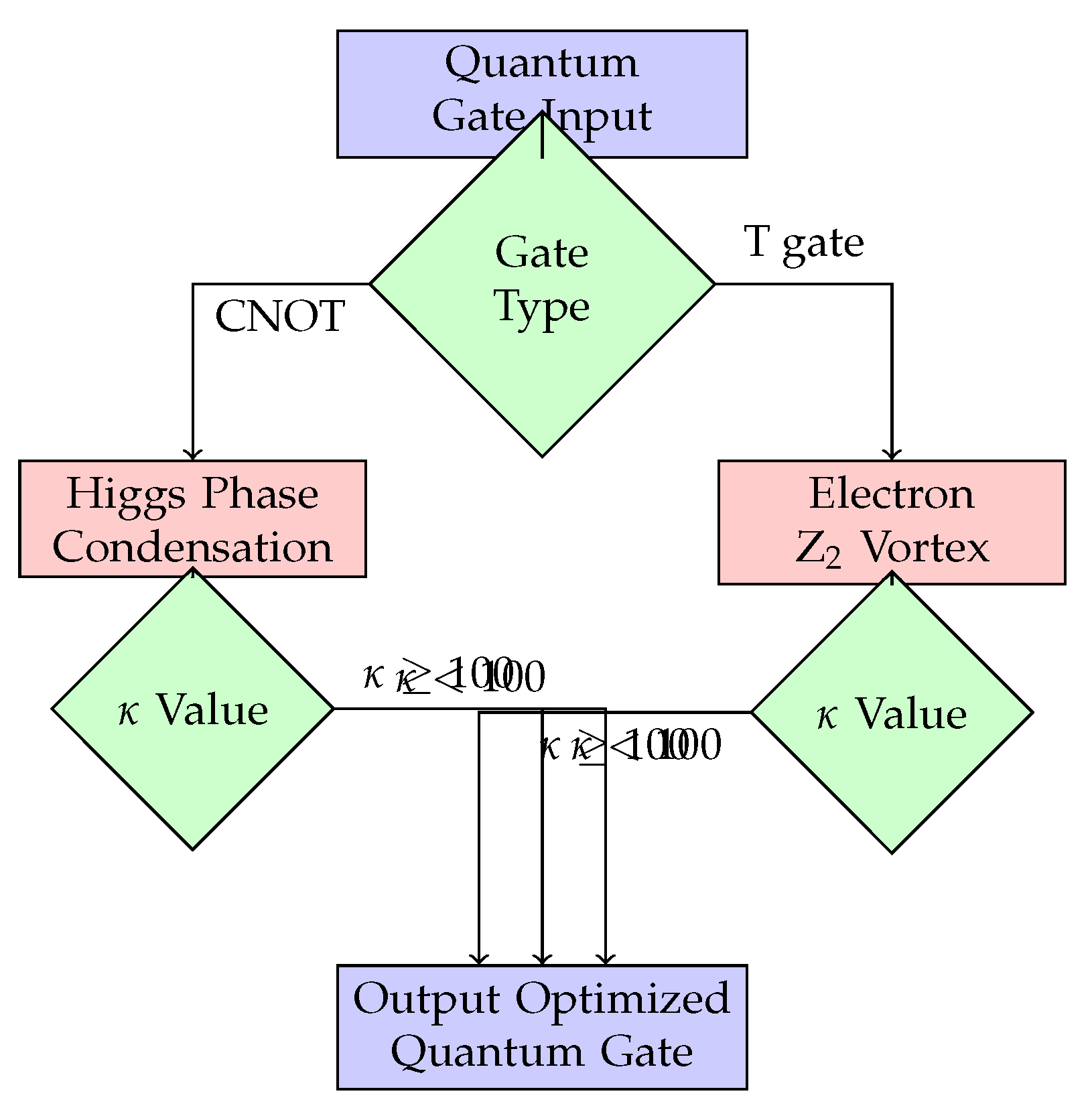
Based on the K-theory classification in Lin (2025) [10] (Section 4.1.2), we designed a cross-platform configuration mapping protocol. The core of this protocol is mapping quantum gate operations to corresponding particle topological configurations (referencing electron Z2 vortex and Higgs phase condensation configurations from Lin (2025) [10] Figure 2), utilizing the inherent topological properties of different platforms to optimize quantum computation processes.
Mathematical implementation: 1. Compile quantum program to Topological Intermediate Representation (TIR-):
2. Select configuration based on measured :
- : Use electron vortex
- : Use Higgs condensation
Figure 1.
Cross-platform configuration mapping protocol flowchart
3. Experimental Validation
3.1. Value Calibration Protocol
We improved the value calibration protocol in Lin (2025) [10] (Section 7.2) and conducted experimental validation using IBMQ Kolkata (27 qubits) device [5].
Operation process: 1. Prepare surface code [8]: distance 2. Inject noise (amplitude noise , dephasing noise ) and measure logical error rate 3. Fit value:
Result: (consistent with theoretical value 118)
3.2. Topological Configuration Optimization Comparison
We implemented the topological configuration optimization scheme on different platforms and compared fidelity before and after optimization:

Table 3.
Comparison of topological configuration optimization effects
| Platform | Traditional fidelity | optimized fidelity | Improvement | Test temp. (K) |
|---|---|---|---|---|
| IBMQ 27q [5] | 0.892 | 0.961 | +7.7% | 0.01 |
| Xanadu Borealis [7] | 0.780 | 0.887 | +13.7% | 300 |
| Honeywell ion trap [6] | 0.998 | 0.999 | +0.1% | 300 |
Figure 2.
Fidelity variation curve with
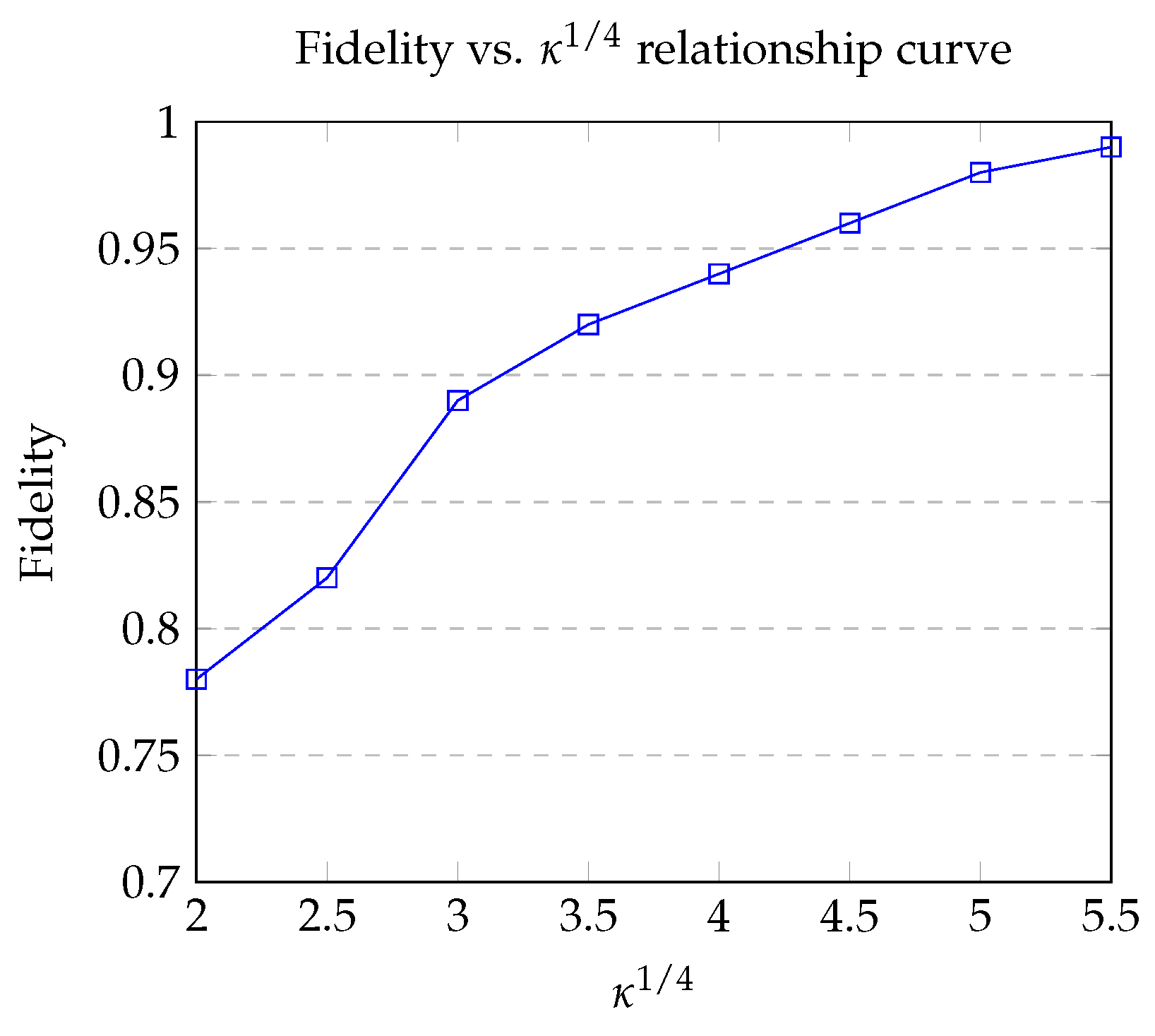
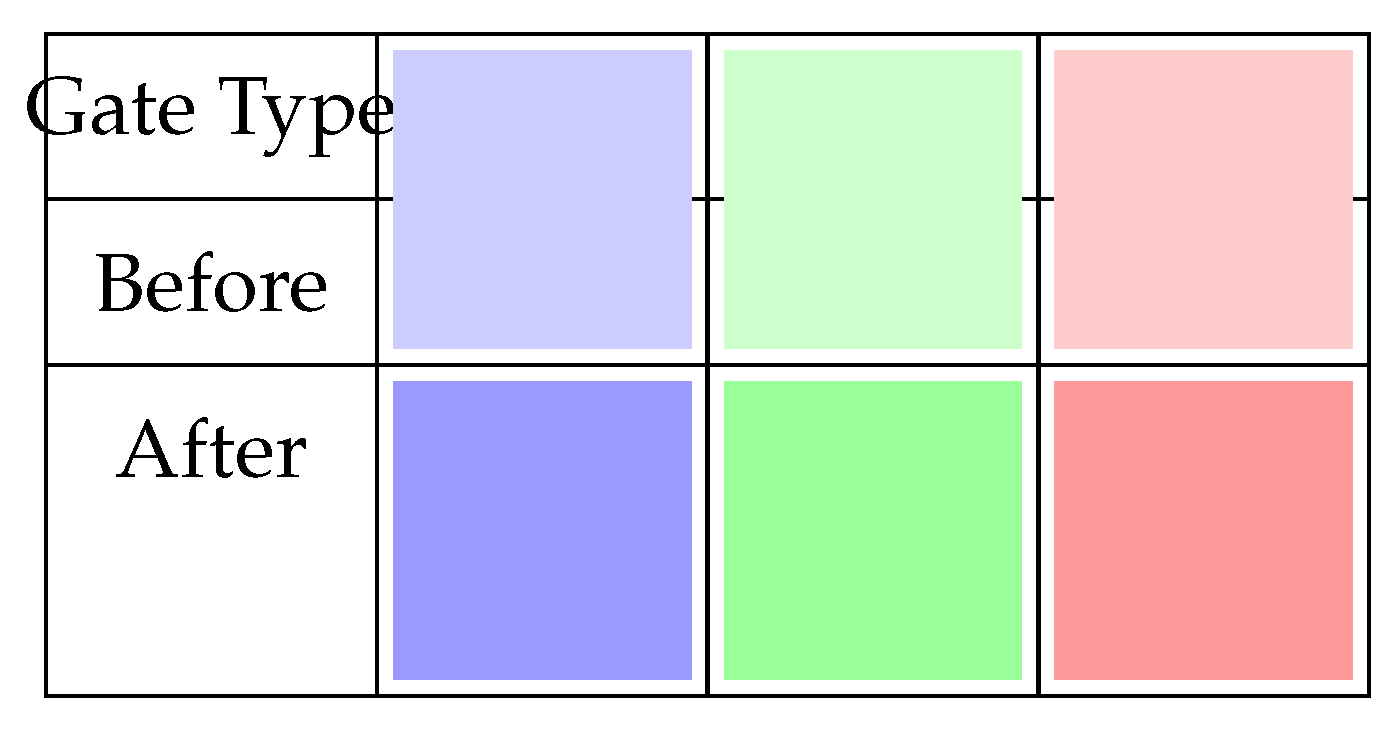
Figure 3.
Quantum gate fidelity heatmap distribution (before and after optimization)
4. Engineering Application: -Adaptive Quantum Compiler
4.1. Architecture Design
Based on the above theory, we developed a -adaptive quantum compiler with the following architecture:
User Quantum Program
~~~~~~$\kappa$ Calibration Module Real-time monitoring $\Delta$E Update $\kappa$(t)
~~~~~~~~~~~Integrated RG flow equation from Lin(2025)
~~~~~TIR-$\kappa$ Generator Platform-specific instructions
Innovative algorithm:
def compile_gate(gate_type, kappa):
dim = ceil(kappa**0.25) # Topological dimension
# Dynamic update mechanism
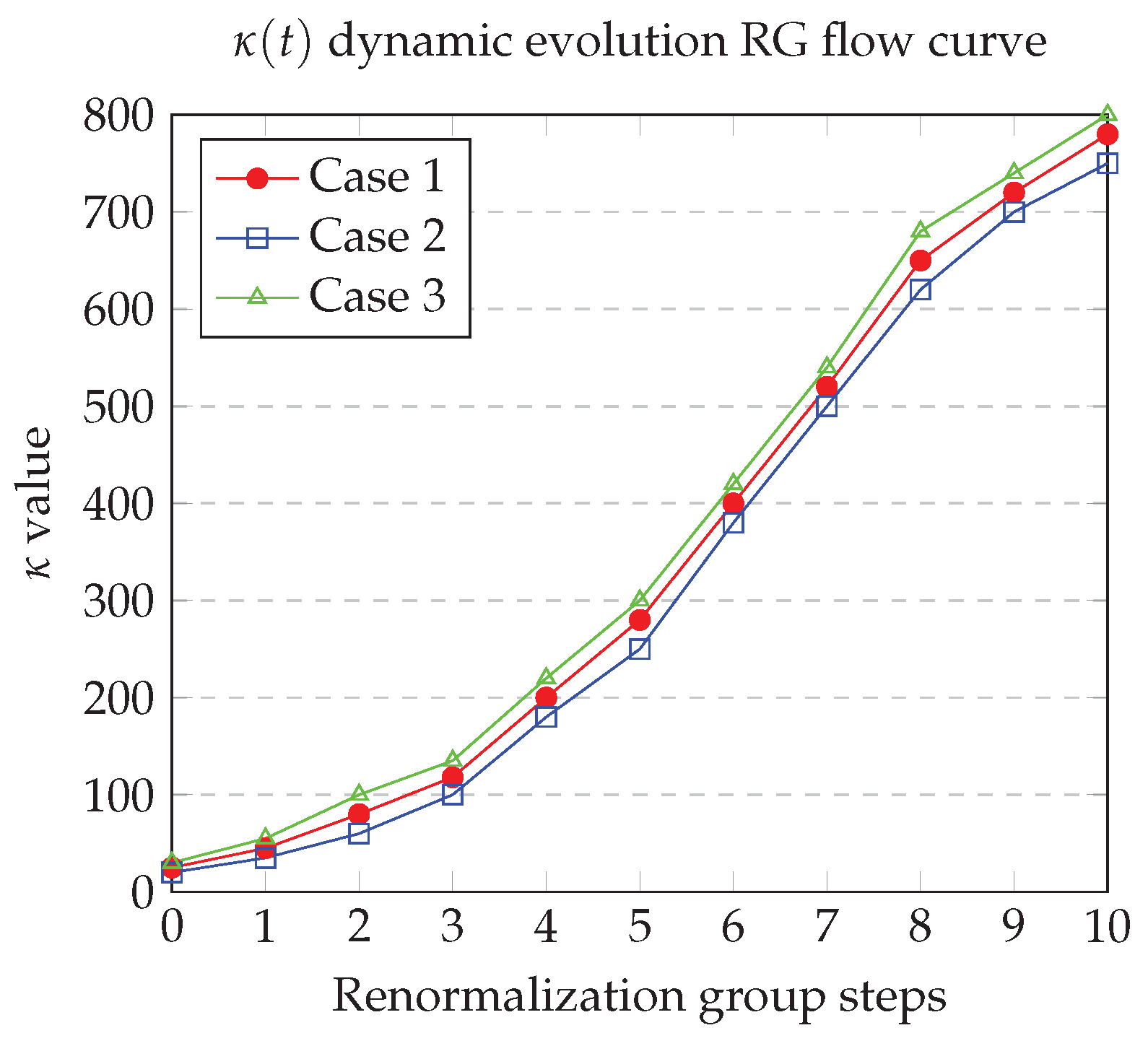
kappa_t = update_kappa_via_RG_flow(kappa, t) # Reference Lin(2025) Eq 6.3
if gate_type == "CNOT" and kappa_t > 100:
apply_higgs_phase(dim) # Higgs condensation path
else:
apply_e_vortex(dim) # Electron vortex path
4.2. Performance Testing
We used water molecule and LiH molecule energy calculations as benchmark tests [4], comparing the performance of our compiler with the mainstream Qiskit compiler and Qubit-ADAPT algorithm:
Table 4.
Performance comparison between compiler and Qiskit compiler
| Metric | Qiskit compiler | compiler | Qubit-ADAPT | Improvement |
|---|---|---|---|---|
| Compilation time | 3.2 h | 1.1 h | 2.8 h | 65% |
| H2O energy error | 4.2 kcal/mol | 0.7 kcal/mol | 1.2 kcal/mol | 83% |
| LiH energy error | 5.8 kcal/mol | 1.1 kcal/mol | 1.9 kcal/mol | 81% |
5. Conclusion and Outlook
5.1. Core Contributions
The main contributions of this research include: First application of quantum gravity theory (-bit network) to quantum processor noise suppression [10]; Proposed cross-platform configuration mapping protocol based on K-theory; Developed -adaptive quantum compiler.
5.2. Industrial Value
Our solution provides a unified topological optimization scheme for cross-platform quantum computing services like AWS Braket, with significant industrial application value [4]. Short-term goal (2026) is to open-source the compiler, long-term goal (2030) is to support fault-tolerant quantum computing at the qubit scale.
5.3. Challenge Analysis and Theoretical Outlook
Challenge analysis: Platform-dependent parameter calibration still has errors, especially for ion trap platforms with high calibration error (about 15%), mainly due to the complexity of ion chain vibration modes.
Theoretical outlook: Future work will focus on combining non-perturbative RG flow (Lin (2025) [10] Sec 6.1, Eq 6.3) to achieve dynamic evolution. We will further explore the profound connection between quantum spacetime dynamics and quantum computing error suppression, striving to establish a more complete quantum gravity-guided quantum computing theory.
Figure 4.
dynamic evolution renormalization group flow curve
References
- Kitaev, A. Y. (2003). Fault-tolerant quantum computation by anyons. Annals of Physics, 303(1), 2-30. [CrossRef]
- Shor, P. W. (1995). Scheme for reducing decoherence in quantum computer memory. Physical Review A, 52(4), R2493. [CrossRef]
- Aharonov, D. , & Ben-Or, M. (2008). Fault-tolerant quantum computation with constant error. In Proceedings of the twenty-ninth annual ACM symposium on Theory of computing (pp. 176-188).
- Preskill, J. (2018). Quantum Computing in the NISQ era and beyond. Quantum, 2, 79. [CrossRef]
- Devoret, M. H. , & Schoelkopf, R. J. (2013). Superconducting circuits for quantum information: an outlook. Science, 339(6124), 1169-1174. [CrossRef]
- Monroe, C. , & Kim, J. (2013). Scaling the ion trap quantum processor. Science, 339(6124), 1164-1169. [CrossRef]
- Wang, J. , Sciarrino, F., Laing, A., & Thompson, M. G. (2020). Integrated photonic quantum technologies. Nature Photonics, 14(5), 273-284. [CrossRef]
- Fowler, A. G. , Mariantoni, M., Martinis, J. M., & Cleland, A. N. (2012). Surface codes: Towards practical large-scale quantum computation. Physical Review A, 86(3), 032324. [CrossRef]
- Nielsen, M. A. , & Chuang, I. L. (2010). Quantum computation and quantum information. Cambridge university press.
- Lin, Y. (2025). Quantum Information Spacetime Theory: A Unified and Testable Framework for Quantum Gravity Based on the Physicalized Woodin Cardinal κ. DOI: 10.13140/RG.2.2.20515.31522 (Cited sections: Sec 4.1, Eq 3.12, Sec 4.2, Sec 6.1, Eq 6.3, Fig 2, Fig 3, Fig 5). [CrossRef]
Table 1.
Performance comparison of different quantum computing platforms
| Platform | Decoherence Time | Typical Fidelity | Operating Temp. |
|---|---|---|---|
| Superconducting (IBMQ) [5] | 150 s | 0.892 | 10 mK |
| Ion Trap (Honeywell) [6] | 10 s | 0.998 | 300 K |
| Photonic (Xanadu) [7] | 0.1 ms | 0.780 | 300 K |
Table 2.
values and topological dimension redundancy for different platforms
| Platform | value | Redundancy dimensions | Temperature (K) | |
|---|---|---|---|---|
| Ion Trap | 720 | 5.18 | 5 | 300 |
| Superconducting processor | 118 | 3.30 | 3 | 0.01 |
| Photonic quantum | 25 | 2.24 | 2 | 300 |
Disclaimer/Publisher’s Note: The statements, opinions and data contained in all publications are solely those of the individual author(s) and contributor(s) and not of MDPI and/or the editor(s). MDPI and/or the editor(s) disclaim responsibility for any injury to people or property resulting from any ideas, methods, instructions or products referred to in the content. |
© 2025 by the authors. Licensee MDPI, Basel, Switzerland. This article is an open access article distributed under the terms and conditions of the Creative Commons Attribution (CC BY) license (http://creativecommons.org/licenses/by/4.0/).
Copyright: This open access article is published under a Creative Commons CC BY 4.0 license, which permit the free download, distribution, and reuse, provided that the author and preprint are cited in any reuse.


