

Submitted:
03 September 2025
Posted:
04 September 2025
You are already at the latest version
Abstract
Hybrid AC/DC microgrids have emerged as a promising solution for integrating di-verse renewable energy sources, enhancing energy efficiency, and strengthening the resilience of modern power systems. However, the intrinsic complexity of these sys-tems stemming from the coexistence of AC and DC domains, the intermittent nature of renewable generation, and unpredictable operating conditions—demands advanced control strategies to ensure stable and reliable operation. Robust control techniques have garnered increasing interest due to their capacity to maintain system perfor-mance in the face of disturbances, model uncertainties, and parameter variations. This paper offers a thorough comparison of recent robust control strategies used in hybrid AC/DC microgrids. Intelligent and adaptive controllers and classical model-based methods are systematically categorized and evaluated based on their control architec-ture. Important research gaps are identified, such as the lack of a unified benchmark-ing criteria, limited experimental validation, and integration challenges with decen-tralized architectures. Unlike prior surveys that cover a broad spectrum of microgrid types, this review is exclusively dedicated to hybrid AC/DC microgrids, highlighting the hierarchical distribution of control approaches and outlining future perspectives for scalable and certifiable robust controllers.
Keywords:
robust control strategies
; hybrid AC/DC microgrids
; hierarchical control architecture
; distributed control systems
; power system resilience
1. Introduction
In recent years, MGs independent, autonomous, and scalable energy production and distribution systems have been a major topic of interest for electrical engineers working on sustainable energy solutions. These systems provide a dependable and sustainable energy source and are particularly useful in isolated areas, areas with inadequate infrastructure, or places at high risk of power outages. They can function in either islanded mode or grid-connected mode. The widespread usage of RESs like solar panels, wind turbines, FCs, and energy storage devices like batteries is one of the traits that distinguish MGs [1,2,3]. They provide a dynamic and controlled local network when combined with different kinds of loads. MGs can operate more dependably in the face of grid disruptions or abrupt changes in load demand because to their adaptable construction. However, the deployment of sophisticated control systems that can guarantee voltage and frequency stability, power quality, and coordination among many components is necessary for the efficient use of decentralized and intrinsically intermittent resources like wind or solar power. Additional issues, such as controlling bidirectional power flow, coordinating between the two domains, and guaranteeing optimum performance of interlinking converters, are particularly evident in HMGs, which include both AC and DC subsystems. These difficulties show how important it is to have sophisticated and reliable control mechanisms in order to ensure the safe, reliable, and effective operation of such systems [4,5,6,7].
Compared to traditional MGs, HMG systems, which include both AC and DC sub-networks, provide far more difficult control and operating issues. This complexity results from the requirement to control power flow across both AC and DC infrastructures as well as the intrinsic variability and weather dependence of RESs like solar and wind. BPCs are necessary to provide appropriate energy conversion and distribution since, for example, solar photovoltaic systems normally produce DC power, but many residential and industrial loads run on AC. However, load variations, the unpredictability of RESs, and control delays may all negatively impact these converters' performance, which might result in voltage instability, deterioration of the power quality, or even system-wide interruptions. Furthermore, complex control mechanisms that can simultaneously ensure voltage regulation, load sharing, and system stability are required due to the fundamental differences in the dynamic behavior of AC systems such as the presence of frequency and sinusoidal waveforms versus DC systems, which are characterized by constant voltage and direct current. For hybrid AC/DC microgrids to continue operating reliably and optimally, especially in the face of uncertainties and disruptions, sophisticated control strategies such as adaptive control, resilient control, or hierarchical control frameworks must be designed and put into practice [8,9,10,11,12,13,14]. Traditional linear control strategies, often designed around nominal operating points, struggle to guarantee stability and performance across the wide range of operating conditions encountered in HMGs. Model inaccuracies, parameter drifts (in filter components), and unmodeled dynamics further exacerbate these challenges. Robust control theory provides a powerful framework to address these issues.
To handle the growing complexity and dynamic uncertainties involved in integrating RESs and controlling both AC and DC subsystems, a broad range of robust control algorithms have been developed recently for HMGs. These tactics, which each have unique benefits and capacities, include model-based controllers, sophisticated optimization methods, and state of the art algorithms like ML. Exact control over voltage levels, frequency stability, and power flow is made possible by model-based control techniques, which use exact system models to forecast and manage system behavior. Their efficacy, however, could be constrained by their dependence on precise models in situations where there are model mismatches or in quickly evolving contexts. However, control techniques, like as fuzzy logic and ML, provide more flexibility and adaptability by enabling the system to learn from operational data and adjust to unanticipated changes in generation and load or unexpected disruptions. Furthermore, optimization-based controllers may identify near-optimal operating locations under a variety of restrictions, increasing system dependability and efficiency. This is especially true for controllers that use evolutionary algorithms or real-time optimization frameworks. With the goal of ensuring stable, resilient, and effective functioning of HMGs in the face of uncertainty, parameter fluctuations, and external disturbances, these sophisticated robust control approaches are increasingly being coupled in hybrid designs to capitalize on their complimentary capabilities [15,16,17,18,19,20,21].
The area of resilient control for hybrid AC/DC microgrids has seen significant advancements. New techniques have been developed recently to assist increase these MGs' efficiency, adaptability, and stability. For AC/DC microgrids, a robust hybrid sensitivity-based control technique is presented with the goal of enhancing system performance in the face of uncertainties and disruptions. To improve stability in weak grid settings, two-way virtual inertia support is also taken into consideration while controlling the grid-forming converters [22]. Furthermore, in order to enhance operational flexibility and lessen reliance on centralized communications, distributed resilient optimization techniques have been developed for AC/MTDC hybrid power systems taking the DC grid into consideration. Comparison research using H∞ control based on the IGWO algorithm has been carried out in the area of voltage control in DC MGs, and the findings are encouraging [23,24]. The absence of established criteria for performance assessment, the limits of empirical validation, and the difficulties of integration in decentralized systems are some of the issues that still exist despite these advancements.
Although several review articles have discussed control techniques in MGs, most of them either address robust control methods in general without specific focus on hybrid configurations, or cover only AC or DC systems [25], or do not fully concentrate on hybrid microgrids and instead examine them alongside AC and DC systems [26]. Furthermore, the systematic categorization of resilient controllers based on deployment architectures (centralized, decentralized, distributed, plug-and-play) and control hierarchy (primary, secondary, tertiary) has received little attention. By providing an organized and comparative analysis of robust control strategies designed especially for hybrid AC/DC microgrids, this research seeks to close these gaps.
2. Hybrid Microgrids (HMGs)
HMGs are small-scale smart grid systems that co-locate AC and DC sub-networks within a single distribution framework. In these architectures the AC utility grid is linked via bidirectional converters to a DC bus hosting DC-native resources. In effect, hybrid AC/DC microgrids combine the advantages of AC and DC architectures. By allowing AC or DC-based devices to be tied in directly with minimal conversion stages, they reduce losses and simplify integration. This makes them particularly well suited to today’s energy mix, where converter-based generation and loads are proliferating: for example, PV panels, FCs and batteries produce or store DC power, while loads such as EV chargers and electronics inherently use DC. As Unamuno and Barrena note, hybrid designs easily accommodate increasing DC-based units (EV, PV generation, FCs, ESS) while maintaining the AC-based devices on the AC network [27]. In practice, HMGs serve as platforms for embedding high levels of renewables and storage in the grid. Recent studies describe hybrid systems combining solar and wind generation, utility-scale batteries and vehicle-to-grid connected EV fleets under unified energy management [28]. These systems support bidirectional flows and flexible dispatch (using EVs as movable storage) and thus help meet smart-grid objectives for efficiency, resilience and decarbonization. However, despite these advantages, HMGs pose several engineering challenges. Control strategies must simultaneously manage the dynamics of both AC and DC sub-networks while coordinating power sharing across a shared interface, often necessitating advanced EMSs and multilevel hierarchical control schemes. Moreover, initial capital costs remain relatively high due to the need for specialized bidirectional converters and hybrid protection mechanisms. A representative HMG configuration is shown in Figure 1.
3. Robust Control Challenges in HMG
To enhance operational flexibility, improve energy conversion efficiency, and facilitate the integration of various RESs, hybrid AC/DC microgrids are designed to leverage the complementary features of both AC and DC systems. Numerous difficulties are brought about by this integration, nevertheless, including variances in system parameters, errors in power output and consumption, and oscillations in voltage and frequency. Traditional control techniques may not be able to ensure system stability and optimum performance in such dynamic and complicated contexts. By offering system resilience against modelling mistakes, external disruptions, and variable operating circumstances, robust control has become a potent remedy for these problems [29,30]. Figure 2 shows the MG control system's hierarchical structure.
Numerous reliable control techniques have been created to meet the unique requirements of HMGs. Backstepping control, SMC, and H-infinity control are some of the most used methods. Strong disturbance rejection is provided by H-infinity control, which works particularly well with bounded uncertainty. Because of its resilience to changes in parameters and its capacity to manage nonlinear systems, SMC is highly regarded. Conversely, backstepping makes it possible to construct nonlinear controllers in a methodical manner. These techniques, which support system stability in situations that change quickly, are often designed for power electronic converters, interlinking interfaces, and voltage/current management inside the MG [31,32,33].
In addition to conventional techniques, intelligent and adaptive robust control systems are gaining favour owing to their capacity to cope with high degrees of uncertainty and complexity. Techniques such as fuzzy logic control, neural networks, and ML-based controllers allow the system to learn from its surroundings and adjust its control approach in real-time. These controllers can dynamically react to variations in load demand, renewable generation fluctuation, and component deterioration, enhancing the overall dependability and responsiveness of the HMG. Moreover, they may be built to work in a distributed fashion, minimizing dependence on centralized control systems and boosting scalability [34,35].
Although robust control for HMGs has advanced significantly, there are still a number of obstacles to overcome. These include the necessity for precise system identification, the challenge of guaranteeing real-time implementation on embedded systems, and the trade-off between control performance and complexity. Furthermore, maintaining cybersecurity and incorporating strong control in settings with little communication are crucial issues. It is anticipated that future studies would concentrate on creating high-performance, low-complexity controllers, combining intelligent and resilient approaches, and enhancing plug-and-play functionality. In the changing energy environment, these advancements will be crucial to the realization of completely autonomous, dependable, and resilient HMGs [36,37,38].
4. Robust Control for HMG
Robust control in HMGs ensures V/F stability, power quality, and reliable active/reactive power sharing under uncertainties, load variations, and communication delays. Hierarchical control schemes (primary, secondary, and tertiary) address distinct operational needs based on grid connectivity and topology. In grid-connected mode, active and reactive power are regulated via frequency and AC voltage adjustments, respectively, while DC voltage deviations govern power balance in DC subgrids. In islanded mode, centralized tertiary controllers are disabled to prevent instability, with synchronization loops ensuring grid alignment. Robust controllers process error signals (ΔVAC, ΔVDC, Δf) to mitigate disturbances, employing techniques like H-infinity or MPC. Control strategies is varied in HMGs by structure (centralized for small-scale, decentralized for large-scale), and mode (grid-connected or islanded). Droop control suits primary-level small-capacity systems, while secondary-level architectures adapt to scale. Tertiary control optimizes grid-tied energy dispatch. These strategies enhance stability margins, reduce harmonics, and ensure adaptive power sharing, making HMGs resilient and efficient. In order to enable it to respond to stiff voltage sources on either side, [39] presents a transverter that is modelled after transformers connecting AC grids. For the best controller performance, it suggests model bank synthesis and employs a back-to-back converter with droop control. In [40], authors offer a current control approach for the interlink converter based on LMI. Regardless of the converter system characteristics, the interlink converter's primary feature is its ability to allow bidirectional power exchange between the two sub-grids in the event of a power-demand imbalance in one of them. A reliable DC-link voltage and current control method for a BIC in a hybrid ac/dc microgrid is presented in [41]. It overcomes the drawbacks of traditional approaches that need distant measurement and small-signal-based control design by using backstepping and feedback linearization techniques. Using a straightforward fixed-parameter low-order controller, [42] introduces a robust multi-objective controller for voltage-source-converter-based dc-voltage power-ports in hybrid ac/dc networks, guaranteeing outstanding tracking performance, robust disturbance rejection, and stability against operating point and parameter variation. The authors in [43] propose a mixed sensitivity robust control approach for grid-connected AC/DC HMGs. It changes the control of grid connections to address dispersed network disruptions. The Riccati approach may be used to produce the grid-connected robust controller, which improves system performance. A reliable, optimum coordinated control strategy for multiple voltage source converters in AC-DC distribution networks is presented in this work [44]. To guarantee system security and reduce network loss, it employs an optimization methodology. A current limit approach is also included into the system to improve accuracy and dependability. It enhances system security, according to numerical experiments. In [45], a sliding mode surface-based robust control method for a grid-connected hybrid DC/AC microgrid is proposed. By shaping the initial loop using passivity theory, the method guarantees that state variable errors converge to zero values. Under changing parameters, the method offers converter-based state variables steady mobility. A reliable ILQG controller for monitoring and dampening SN voltage in a PV-based hybrid AC-DC microgrid is proposed in this research [46]. Performance oscillations may result from the controller's usage of an integrator to extend SN dynamics while maintaining a steady DC voltage at the SN load terminal. Using output voltage and current measurements, [47] proposes a feedback control system for a hybrid bidirectional interlinking converter in an AC/DC microgrid. It suggests a strong droop control approach that takes power switching transients and load dynamics into account. A stand-alone MG that combines DG powered by RESs with local loads is presented in [48]. An intelligent control method based on fuzzy logic is suggested to preserve the stability of the DC-link voltage and frequency. An alternative to a synchronous generator is a BESS. The suggested control strategy minimizes frequency variations, cuts down on transient time, and keeps generators from operating beyond their power ratings during disruptions. In order to optimize the use of renewable power, decrease the use of conventional power, and minimize power via BPC, [49] suggests a ROPMS for HMG and a robust tracking commitment for BPC. Table 1 shows the robust control for HMG analysis method. Figure 3 shows an example of robust control for HMG.
5. Overview of Several Robust Control Technique for HMG
5.1. Droop Control for HMG
The authors of [50] suggest a control technique for interlinking converters and investigates power sharing concerns in interconnected AC/DC microgrids. The approach consists of inner-loop data-driven model-free adaptive voltage control and outer-loop dual-droop control. Based on input/output measurement data, the controller's design uses the Lyapunov approach to guarantee system stability. Power management in hybrid AC-DC microgrids that use solar, wind, and battery sources is covered in [51]. A PID controller and an adaptive neuro-fuzzy inference system are used to regulate the MGs. To cut expenses, an elephant herding optimization technique is used once running costs have been determined. The interlinking converter uses the autonomous droop control approach. A generalized and effective power-flow technique for hybrid ac/dc microgrids is presented in [52]. It takes into account operational factors like as voltages, frequency, coupling, unbalanced sub-grids, and slack buses. The approach sequentially solves power-flow variables, using the quadratically-convergent NR technique for decoupled equations, and models sub-grid elements in sequence components for quicker parallel solution. Power management in hybrid AC-DC microgrids that use solar, wind, and battery sources is covered in this paper. Through the introduction of a novel technique known as SDC for ac/dc HMGs, [53] investigates the relationship between grid-forming droop control and virtual synchronous machine control, guaranteeing predictable, nonlinear dynamics in both networks under significant disruptions. A novel supervisory control technique for an islanded hybrid AC/DC microgrid with a high penetration of RESs is presented in [54]. In order to restore grid frequency and voltage, lower generation costs, and increase accuracy by taking reactive power impacts into account, it employs a MPC-based optimization problem. A new droop control method for a hybrid AC/DC microgrid that connects conventional and DC MGs is examined in [55]. It introduces the quasi-proportional resonance control strategy's voltage outer loop and ideal settings. For hybrid AC/DC microgrids, [56] presents a GPS-based decentralized control approach that linearly modifies output voltages in relation to per-unit output current. In order to accomplish global power sharing, it also suggests a droop control technique for the interlink converter, guaranteeing equivalent output voltage variations for AC and DC DERs. In order to do active power filtering as well, a modified control strategy for IC is suggested in [57]. In order to filter AC side line currents and maintain a sinusoidal voltage at the AC bus under nonlinear loading situations, IC in combination with the DC subgrid may function as an APF. There hasn't been much research done on this kind of IC control in an islanded HMG yet. The power flow method for an LV hybrid AC-DC microgrid is presented in [58]. It makes use of virtual impedance and droop control principles, and its efficacy is confirmed by thorough simulation results. In order to provide plug-and-play distributed generating characteristics, [59] addresses the droop control of AC and DC buses in bidirectional AC/DC converters and suggests a unique active power management technique for power balancing and independent sharing in HMGs. In order to ensure power balance and bus voltage stability, [60] suggests a MG management technique that includes droop control between grid-connected and energy storage converters during operation. The energy storage converter maintains load power balance and stabilizes bus voltage after islanding. In AC/DC HMGs, interlinking converters preserves the stability of the power supply. Based on AC frequency and DC voltage, a bidirectional droop control is developed to determine power transmission power [61]. A recovery control lowers voltage drop and frequency. In DC MGs, which use interlinking converters to provide power to the AC side, voltage management is essential. To effectively manage load demand and voltage regulation among dispersed generators, droop control methods are used in [62]. By removing the need to switch between MPPT and voltage regulation modes, the suggested unified dp/dv control technique for a Multi-port DC-DC converter enhances transient performance, DC bus voltage regulation, and battery SOC management. however, its validation is primarily simulation-based, with limited consideration of sensor noise, non-ideal converter behavior, and practical deployment in islanded or large-scale systems. More broadly, the literature often emphasizes modeling and simulation results over experimental or field validation, with many approaches assuming idealized network conditions. Furthermore, repeated discussion of the benefits of robust and droop control across multiple studies may obscure specific methodological insights. To strengthen the applicability of these methods, future research should focus on large-scale implementation, experimental testing, resilience under parameter variations and uncertainties, and practical integration challenges, including cyber-security and communication delays. Table 2 shows the droop control for HMG analysis method.
5.2. Hierarchical Control for HMG
In order to effectively regulate the MG and create an integrated nonlinear hierarchical control and management system for hybrid ac/dc MGs, [63] concentrated on nonlinear exponential control and distributed secondary control techniques. The BIC in a hierarchically controlled HMG is regulated uniformly in [64]. By eliminating commutory triggering mechanisms and system collapse brought on by imprecise or sluggish mode shifts, this method unifies control structures. A hierarchical control system for parallel power electronics interfaces in an HMG is presented in [65]. It examines both grid-connected and freestanding modes of operation. A common secondary control level to remove voltage deviation, a tertiary control level for external DC system connection, and decentralized control employing the droop technique make up the three-level hierarchical control system. The three layers of primary, secondary, and tertiary control in this paper's proposed hierarchical control system for MGs which incorporates ISA-95 and electrical dispatching standards ensure intelligence and adaptability [66]. Power flow modelling for iHMGs, including secondary frequency and voltage restoration management, secondary voltage restoration control, and droop-controlled distributed generating units, is presented in this work [67]. [68] presents a supervisory and local layer hierarchical self-regulation control approach for ESSs. For system stability, the local layer employs virtual inertia control, while the supervisory layer utilizes a cost function to regulate output power. The model includes a FC, hydrogen storage tank, and electrolyzer. A sturdy hierarchical control architecture for a hybrid shipboard MG system with many DGs and integrations of renewable energy resources is shown in [69]. In addition to performing system stability analysis and control law design, it verifies the design's performance against noise and undesired load situations. A hierarchical and distributed control approach for clusters of AC and DC MGs linked by a flexible DC distribution network is presented in [70]. A framework including DG-layer, MG-layer, and CC-layer layers is described, and two control mechanisms are suggested for varying voltage needs. In order to maintain low THD states, minimize the influence of power quality, and anticipate operational states in advance, [71] presents a quicker model predictive optimization method for primary control. Secondary switching control is then implemented. While these methods demonstrate significant performance improvements, challenges remain in managing parameter variations, nonlinearities, and uncertainties, as well as ensuring real-time implementation and practical scalability. Overall, the studies provide valuable insights into control design and coordination mechanisms in hybrid AC/DC microgrids. Table 3 shows the hierarchical control for HMG analysis method.
5.3. Control for HMG
In order to improve stability and tracking precision, [72] suggests a robust control approach for bidirectional converters. Through Park transformation, the technique lowers system order, simplifying controller design and lowering the complexity of phase angle tracking. In [73], a robust frequency control for islanding provisional MGs is proposed, focusing on hybrid AC/DC and AC conventional parts. The optimal controller is determined using an algorithm and sensitivity functions, despite lack of scientific reports. [74] proposes a coordinated control method for an AC/DC HMG, dividing control into three flexible switching modes to meet power quality requirements and achieving precise control of frequency and voltage based on optimal distributed coordinated control theory. Two adaptive control techniques are presented in [75] for the smooth transition between islanded and grid-connected modes as well as for MG voltage and frequency adjustment in islanded mode. The controllers use MPC and to enhance droop control performance. The P/Q control technique is used to modify the transmission of active and reactive electricity when linked to the utility grid. Integral of square error, integral of absolute error, and integral time-weighted absolute error are used as the basis for comparisons. The study presented in [76] describes a control strategy that uses droop control and robust control to modify the voltage and frequency of an MG in islanded mode under various loading scenarios. Four steps make up the method: an LCL filter and coupling circuit, a droop control loop, a voltage control loop, and a current control loop. In order to support the traditional droop control approach, [77] suggests an control method based on HS. The V/F controller's performance is improved by using the suggested technique. It can improve autonomous MG power quality while controlling voltage and frequency to their regulated levels. In order to understand the hybrid interacting behaviors of MGs, [78] presents a unique hybrid model. It suggests a two-level hierarchical hybrid control system that alternates between discrete management and continuous controllers. Stability, security, load demand, cost reduction, and emission reduction are all guaranteed by the upper-level discrete management. Nevertheless, challenges remain in managing system nonlinearities, parameter variations, and the computational complexity of implementing predictive and hierarchical controllers in real-time large-scale systems. Future research should focus on developing scalable, intelligent, and adaptive control schemes that maintain robustness under variable operational conditions, optimize energy dispatch, and address practical considerations such as communication delays and cyber-security, thereby translating these sophisticated strategies into reliable, real-world HMGs. Table 4 shows the control for HMG analysis method.
5.4. Distributed Control for HMG
In order to offer appropriate voltage and frequency controls as well as power sharing, [79] presents a unique hierarchical control strategy for MGs that combines main and secondary layers for cooperative voltage and frequency secondary control approaches. A new distributed coordination control technique for many SMGs in a hybrid AC/DC microgrid is presented in [80]. By eliminating reliance on particular variables for power exchange, this technique guarantees complete controllability for interlinking converters. Additionally, it ensures continuity and control of power supply even in the event of a single SMG failure. In [81], iPEBB for hybrid DC/AC microgrids are proposed as a distributed control option for modular power converters. Every iPEBB functions autonomously, but a central controller oversees the system as a whole, assigns roles to each iPEBB, and accomplishes control objectives. In order to govern power flow across hybrid AC/DC microgrids, [82] presents a novel distributed coordinated control technique for numerous ICs. The system mitigates circulating current, controls DC voltage for DC SMGs, and enables dependable management and regulation of power flow between SMGs. The altered outer control loop minimizes circulating current at the DC side and guarantees precise power sharing. Using variable control schemes and good dynamic responsiveness, the project [83] presents an MPC-based distributed control algorithm that determines BIC to govern the most deviated parameter in nonlinear settings after analyzing grid conditions. A new distributed active power control technique for interlinking converters in an IHMG is presented in [84]. It seeks to establish power sharing without the need for extra controllers. A unified state-space model is provided together with an estimator and a mathematical formula for active power references. In order to maximize the use of RESs, [85] suggests an EMS for an HMG network. To provide precise load demand forecast and appropriate management during power-sharing periods, the system employs integral controllers and proportional resonance to handle DG and PV sources. In order to distribute power efficiently, [86] suggests a distributed control approach for a hybrid AC/DC microgrid that makes use of a higher control layer and the adaptive droop technique. Distributed generating units, converters, energy storage devices, and RESs make up the system. In [87], a distributed coordination control approach that takes SOC storages into account is proposed for numerous BPCs in a hybrid AC/DC microgrid. The suggested approach increases the complexity of the control technique while guaranteeing system dependability. By taking into account both AC and DC subgrids, it improves the HMG's dependability while making the control method more intricate. With an emphasis on cost-effective operation, [88] suggests a unified distributed control strategy for hybrid AC/DC microgrids. Consensus among sources, average voltage recovery, and voltage observers are all part of the plan. The bidirectional DC-AC interlinking converter's reference power is set by the PI controller, and worldwide incremental costs are equalized in accordance with the corresponding protocols.
For increased dependability and lower communication costs, [89] suggests a locally-distributed and globally-decentralized MG control system that makes use of local sparse low-bandwidth communication networks. Flexible controllers for connecting and integrating converters in hybrid AC/DC microgrids are suggested by [90]. These controllers minimize droop power flow and system stability problems by being made for several stacked bidirectional DC-AC ICs/IFCs outlays. They concentrate on controlling the wide-spread AC/DC bus characteristics, which guarantees system stability under a variety of operating circumstances. A centralized battery energy stack is included into the suggested HMG for high-power transfer efficiency. In [91], authors use a hierarchical distributed cooperative control technique for both clusters inside and between micrography to address electricity sharing concerns in AC/DC HMG clusters. A distributed control approach for a hybrid MG with linked AC and DC subgrids is examined in [92]. By combining LEC with GEC, the technique lowers implementation costs, increases algorithm convergence time, and improves operation dependability. Bidirectional interlinking converters connect the linked subgrids, guaranteeing worldwide economic activity in compliance with the equal IC concept. In order to achieve global system economic operation, [93] suggests a distributed control architecture for a hybrid AC/DC microgrid. There are two layers to the architecture: DC bus voltage-IC droop and AC frequency-IC droop. By offering a universal approach for fac and Vdc recovery, the DCCF improves system scalability and lessens communication constraints. To remove hidden loading conditions and guarantee that all DG ICs converge to the same value in the steady state, an original RLI is suggested. The work described in [94] integrates a pulse load and suggests a new power flow management technique for a hybrid AC-DC microgrid that uses energy storage and solar power. With a DC-DC boost converter, synchronous generator, and PV farm, the system runs in islanding mode. A framework for the best operation management of hybrid AC-DC microgrids that includes battery storage and both dispatchable and non-dispatchable energy sources is presented in [95]. The framework makes use of the ADMM, multi-agent mechanism, and distributed consensus-based structure. A novel optimization technique based on the CSA is created for the best local solutions since the objective function is nonlinear. To increase power distribution and dependability, a control technique using particle swarm optimization and energy management algorithms was put out [96]. In order to support the HESS, the strategy featured an auxiliary power control unit and was based on the load profile and power generating resources. High-frequency and low-frequency components made up the net power. Through power sharing, power exchange, and power management, the study suggests a distributed control strategy for a hybrid three-port AC/DC/DS microgrid, allowing for dependable autonomous operation. This plan [97] incorporates multi-level power exchange control to minimize needless power exchange and extend storage lifespan, as well as decentralized control that enables each power module to function independently. A distributed control approach for hybrid cascaded-parallel MGs that integrates many low-voltage power sources is presented in [98]. For increased system redundancy, it adds a sign function, active and reactive power regulators, and a low bandwidth communication network. Table 5 shows the distributed control for HMG analysis method.
5.5. SMC for HMG
In order to improve hybrid AC/DC microgrid stability and power sharing, especially for nonlinear and unbalanced loads, [99] presents a decentralized resilient method. Two controllers for positive and negative sequence power and current control are included; they are based on Lyapunov function theory and SMC. In order to reduce outside disruptions and cyberattacks, the study [100] presents a fuzzy SMC technique for voltage regulation in an islanded AC/DC HMG. It makes use of an integrated SMC and the T-S fuzzy model. Using a wind-driven generator, solar module, battery storage, power converters, and a SMC for optimal power extraction, [101] investigates the utilization of wind, solar, and battery energy as major sources for HRES. In [102] it is suggested a hybrid AC/DC microgrid that combines 4.5 kW solar and 8 kW wind systems with an ASMC based on a barrier function. Notwithstanding disruptions, the system guarantees output variable convergence. In order to provide DC bus voltage management during islanding and AC/DC link bus voltage regulation during grid-connected mode, control rules are defined using global mathematical modelling. An effective and cost-effective setup for a wind/solar PV system coupled with a BESS is proposed in [103]. It suggests a GSMCFO to improve the HMGs robust, steady-state, and transient performance. The controller maintains power balance, controls DC-link voltage, guarantees appropriate power transmission, and tracks maximum power points. The isolated wind-diesel HMGs suggested coordination control approach lowers demand variance and frequency deviation from changes in renewable energy. For diesel and wind turbine generating systems, it employs the sliding mode approach and a smart neural network observer. By taking load fluctuation into account and using an adaptive neural network observer, it increases control precision [104]. In order to govern hybrid smart MG power systems under uncertainty, [105] proposes an ASMC that uses fuzzy logic. The Lyapunov theory is used to guarantee the stability of the controller. Table 6 shows the SMC for HMG analysis method.
5.6. Other Method Control for HMG
A backstepping method for creating controllers for hybrid AC/DC microgrids is presented in [106]. Solar photovoltaics, wind turbines, BESSs, and loads are all part of the DC-side. A synchronous generator and a bidirectional voltage source converter are used in the AC portion. In order to maintain voltages and guarantee power sharing, the controllers are decentralized. Control Lyapunov functions are used to theoretically examine the MG's stability. Using a neutral point clamped NPC converter to manage voltage and AC currents and maintain a power factor close to unity, [107] investigates the use of a novel backstepping predictive technique to control the DC and AC components of HMGs. In [108], a hierarchical control system that permits a small DC voltage variation for bidirectional power transmission in a hybrid AC/DC microgrid is introduced. Additionally, it explores how electric car involvement affects reactive power management and converter capacity reduction, and it proposes a reactive power control method. A distributed coordination control approach for many BPCs in a hybrid AC/DC microgrid is presented in [109]. The technique allows the two sub-grids to sustain one another in both grid-connected and islanded modes by facilitating suitable power interaction between them. Three enhancements include using DC droop control for DC current sharing, managing the square of DC voltage for linearized control, and suppressing AC circulating current using a d-q-0 three-axis control method. The study presented in [110] suggests a distributed coordination control approach for hybrid AC/DC MGs that uses a distributed consensus method to restore AC frequency and DC voltage to nominal values, maintain power sharing, and regulate correct DC current and reactive power sharing. Reference [111] suggests an online optimum control technique for HESSs in AC-DC MGs that is based on reinforcement learning. By addressing irregularities in uncontrolled charging and discharging, this technique enhances power efficiency and quality. The C&D profile is optimized and disturbances are suppressed by using the optimum control theory. e work presented in [112] trains models using LSVR, Matern 5/2 GPR, and rational quadratic GPR utilizing historical climate data from Islamabad, Pakistan. A power scheduling control method is put into place once the models are examined using RMSE. In [113], a hybrid AC/DC microgrid powered by wind turbines and PVs is examined. It creates and verifies a novel control system that uses fuzzy logic and adaptive neural networks to reduce electrical grid energy usage. The use of FC and PV as RESs is investigated in [114]. It suggests a DNN based technique for an enhanced MPPT controller. Despite possible power losses, the objective is to enhance the output power quality in FC and hybrid PV systems. Table 7 presents the control strategy categorized under other methods used in the analysis of the HMG system.
6. Discussion
Intermittent energy sources, nonlinear loads, and a variety of management designs provide major obstacles to preserving system stability, power quality, and overall dependability in hybrid AC/DC microgrids. In order to handle the inherent uncertainties and external disruptions in such systems, robust control has become a sophisticated and scientifically supported method. Methods like mixed-sensitivity design, SMC, and H∞ control provide a high tolerance to measurement noise, time delays, and parameter changes. Without needing a precise model of every system component, these techniques allow the creation of controllers with strong disturbance rejection capabilities, large stability margins, and quick dynamic response. While each category of robust control techniques has been independently reviewed in the preceding subsections, a direct comparative analysis is essential for practitioners to select suitable methods under different operational contexts. Table 8 summarizes key features of each control strategy, including implementation complexity, robustness level, adaptability to uncertainties, communication requirements, and suitability for different microgrid modes.
Research has shown that interlinking converters, which act as the crucial interface between AC and DC subsystems, benefit greatly from strong control tactics. Their use greatly enhances the MGs dynamic responsiveness, voltage stability, and power flow management. Furthermore, the system's performance is improved under a variety of operational scenarios, including islanded mode, grid-connected mode, and power transfer conditions, by incorporating robust controllers into hierarchical control structures. Figure 4 shows classification of robust control strategies based on design philosophy and adaptability.
Furthermore, the next generation of intelligent robust controllers is represented by new hybrid techniques like robust ML-based control and adaptive robust control. Without requiring human retuning, these techniques adjust in real time to significant changes in the environment and system uncertainty. Under changing operating circumstances, they provide optimum and real-time performance by using technologies such as neural networks, fuzzy logic, and reinforcement learning algorithms.
In summary, the use of intelligent and resilient control strategies that concurrently guarantee system stability, efficiency, and dependability has become essential due to the growing complexity of HMG operation. This is a crucial and exciting topic for future MG research as designing and implementing such controllers calls for precise modelling, a deep understanding of system dynamics, and the application of sophisticated analytical techniques. Table 9 presents a comparative analysis of robust control strategies for HMGs, evaluating their performance across key technical parameters.
Although robust control systems have theoretical benefits, there are a number of practical obstacles to overcome before they can be used in HMGs. Scalability is still a big problem, particularly when using decentralized or distributed controllers in large-scale systems. Performance in hierarchical or multi-agent systems may be severely hampered by communication delays and data packet losses, especially at the secondary and tertiary control levels. Furthermore, the real-time application of sophisticated optimization or ML-based controllers may be limited by the processing limitations of embedded systems. Future strong control solutions must also pay close attention to cybersecurity flaws and legacy system compatibility problems. In order to convert solid control research into dependable and economically viable MG solutions, these issues must be resolved.
Despite extensive research on data-driven controllers for hybrid AC/DC microgrids, several barriers hinder their industrial deployment. First, learning-based controllers often lack rigorous stability proofs and formal safety guarantee. They typically require large, high-quality training datasets and significant computational resources, which may not be available on limited-edge hardware. Moreover, most AI-based control schemes have been validated only in simulation or small laboratory setups, leaving a “reality gap” that raises reliability concerns. Finally, the decision-making logic of complex neural models can be opaque, undermining user trust. In sum, the lack of interpretability and standardized certification for AI controllers is a major obstacle to their widespread adoption [113]. Moreover, industrial adoption is hindered by persistent concerns over cybersecurity, lack of interpretability, and the difficulty of integrating AI controllers with legacy systems. To address these issues, recent studies propose several strategies. Digital-twin platforms and real-time simulators can serve as virtual testbeds for evaluating AI controllers under realistic conditions before deployment. Incorporating physical knowledge into learning – for example via PINNs may improve generalization and help satisfy stability constraints.
Complementarily, emerging certifiable AI methods aim to embed safety certificates (such as Lyapunov-barrier functions) within controller design to guarantee stability and constrain behavior. Finally, closing the loop with actual hardware through more hardware-in-the-loop tests and standard benchmark problems is essential to build confidence. In summary, bridging the simulation–reality gap and establishing common standards are key steps toward enabling trustworthy AI control in HMG [115].
7. Future Work
A brief review of HMGs' architecture and a review of robust control strategies for HMGs have been performed in this paper. In recent years, significant progress has been made in the field of robust control for HMGs, but there are still challenges that will provide the basis for future research. One of the most important research directions is the development of ML-based robust controllers with real-time adaptive capabilities, so that these controllers can maintain optimal performance and system stability in the face of changing environmental conditions and dynamic uncertainties without relying on accurate models [23]. Also, designing distributed robust control strategies that can cope with communication delays, link degradation, and scalability of MG structures is another important research priority [116]. Various types of cyber-attacks can compromise system reliability and performance. Among these, DoS and FDI attacks are among the most prevalent threats [117]. On the other hand, in today's world where cyber-attacks in energy systems are increasing, the need to improve cyber resilience in resilient control systems is strongly felt, including by using new techniques such as secure distributed control or methods based on robust cryptography [118]. In addition, combining risk assessment models with robust control design can help identify system vulnerabilities and vulnerabilities and prevent instability [119]. Also, combining data-driven probabilistic predictions with robust control, especially in the field of energy planning and distributed resource management, can provide an effective solution to reduce uncertainty and optimize operation in future MGs [120]. Also, given the limited attention given to backstepping control methods in HMG applications, future research can focus on developing an advanced adaptive backstepping controller specifically designed to address the unique challenges of HMGs. This controller should simultaneously handle parametric uncertainties, disturbances from intermittent RESs, and operational mode transitions. Finally, looking ahead, the anticipated development of 6G networks promises to revolutionize microgrid operations further. With projected ultra-low latency (<1ms) and terabit-speed data transmission, 6G could enable unprecedented real-time coordination of distributed energy resources when implemented in future energy systems. For adaptive control schemes like the proposed AFSMC, this next-generation infrastructure would provide even more precise data exchange for parameter adjustment. The combination of intelligent control algorithms with evolving communication technologies - from current 5G to future 6G capabilities - will progressively enable more autonomous, self-healing microgrid.
8. Conclusion
Several robust control techniques for AC/DC HMGs were examined in this research. The study review's findings demonstrate the need of robust control in enhancing stability, controlling uncertainties, and enhancing performance from RESs. The use of techniques including intelligent algorithms, SMC, and control has improved voltage and frequency management, increased fault tolerance, and expanded system flexibility. Additionally, it was discovered that distributed and hierarchical control structures work extremely well for better satisfying the intricate requirements of HMGs. The creation of innovative resilient control techniques will be a crucial route for the future growth of smart MGs, given the present difficulties, which include growing intermittent supplies, grid instability, and the need for real-time reaction.
Author Contributions
Conceptualization, P.P., M.J., A.M.A., M.R.Z. and J.-R.R.; methodology, P.P., M.J., A.M.A., M.R.Z. and J.-R.R.; software, A.M.A. and M.R.Z.; validation, P.P., M.J., A.M.A. and J.-R.R.; formal analysis, J.-R.R.; investigation, P.P., M.J., A.M.A., M.R.Z. and J.-R.R.; resources, P.P. and J.-R.R.; data curation, J.-R.R.; writing—original draft preparation, A.M.A., P.P., M.J., M.R.Z. and J.-R.R.; writing—review and editing, P.P., M.J., A.M.A., M.R.Z. and J.-R.R.; visualization, A.M.A.; supervision, J.-R.R.; project administration, P.P. and J.-R.R.; funding acquisition, J.-R.R. All authors have read and agreed to the published version of the manuscript.
Funding
This project received funding from grant PID2023-147016OB-I00, by MICIU/AEI/10.13039/501100011033/ and by ERDF “A way of making Europe”, by the European Union and from the Agència de Gestió d’Ajuts Universitaris i de Recerca-AGAUR (2021 SGR 00392).
Data Availability Statement
The original contributions presented in the study are included in the article, further inquiries can be directed to the corresponding author.
Conflicts of Interest
Authors M.J., A.M.A., and M.R.Z. were employed by Pooya Power Knowledge Enterprise. The remaining authors declare that the research was conducted in the absence of any commercial or financial relationships that could be construed as a potential conflict of interest.
Abbreviations
The following abbreviations are used in this manuscript:
| AC | Alternating current |
| ADMM | Alternating direction method of multipliers |
| AI | Artificial intelligence |
| APF | Active power filter |
| ASMC | Adaptive sliding mode controller |
| BESS | Battery energy storage system |
| BIC | Bidirectional AC/DC interlinking converter |
| BPC | Bidirectional power converter |
| CC | Cluster coordinator |
| CSA | Crow search algorithm |
| DC | Direct current |
| DER | Distributed energy resource |
| DG | Distributed generation |
| DNN | Deep neural network |
| DoS | Denial-of-service |
| DS | Distributed storage |
| EMS | Energy management system |
| ESS | Energy storage system |
| EV | Electric vehicle |
| FC | Fuel cell |
| FDI | False data injection |
| GEC | Global economic control |
| GPS | Global positioning system |
| GPR | Gaussian process regression |
| GSMCFO | Global sliding-mode control with fractional-order terms |
| HS | Harmony search |
| HESS | Hybrid energy storage system |
| HMG | Hybrid microgrid |
| HRES | Hybrid renewable energy system |
| IBS | Interconnected Battery System |
| IC | Interlinking converter |
| i0d, i0q | dq-axis components of load currents |
| IFC | Interfacing converter |
| IGWO | Improved gray wolf optimization |
| IHMG | Islanded hybrid AC/DC microgrid |
| ILQG | Integral linear-quadratic-Gaussian |
| iPEBB | Intelligent power electronics building blocks |
| LCL | Inductance-capacitance-inductance |
| LEC | Local economic control |
| LMI | Linear matrix inequalities |
| LSVR | Linear support vector regression |
| LV | Low voltage |
| MG | Microgrid |
| ML | Machine learning |
| MPC | Model predictive control |
| MPPT | Maximum power point tracking |
| NR | Newton-Raphson (power flow algorithm) |
| NPC | Neutral point clamped |
| PCC | Point of Common Coupling |
| PI | Proportional integral |
| PID | Proportional-integral-derivative |
| PINN | Physics-informed neural networks |
| PV | Photovoltaic |
| RES | Renewable energy sources |
| RLI | Relative loading index |
| RMSE | Root means square error |
| ROPMS | Robust optimal power management strategy |
| SDC | Symmetric droop control |
| SMC | Sliding mode control |
| SMG | Sub-microgrid |
| SN | Secondary network |
| SOC | State of charge |
| THD | Total harmonic distortion |
| V0d, V0q | dq-axis components of PCC voltages |
| V/F | Voltage/frequency |
References
- Ahmad, G.; Hassan, A.; Islam, A.; Shafiullah, M.; Abido, M.A.; Al-Dhaifallah, M. Distributed Control Strategies for Microgrids: A Critical Review of Technologies and Challenges. IEEE Access 2025. [Google Scholar] [CrossRef]
- Ahmad, S.; Shafiullah, M.; Ahmed, C.B.; Alowaifeer, M. A review of microgrid energy management and control strategies. IEEE Access 2023, 11, 21729–57. [Google Scholar] [CrossRef]
- Barbalho, P.I.; Moraes, A.L.; Lacerda, V.A.; Barra, P.H.; Fernandes, R.A.; Coury, D.V. Reinforcement learning solutions for microgrid control and management: a survey. IEEE access 2025. [Google Scholar] [CrossRef]
- Dagar, A.; Gupta, P.; Niranjan, V. Microgrid protection: A comprehensive review. Renewable and Sustainable Energy Reviews 2021, 149, 111401. [Google Scholar] [CrossRef]
- Saimadhuri, K.Y.; Janaki, M. Advanced control strategies for microgrids: A review of droop control and virtual impedance techniques. Results in Engineering 2024, 103799. [Google Scholar]
- Al-Ismail, F.S. DC microgrid planning, operation, and control: A comprehensive review. IEEE Access 2021, 9, 36154–72. [Google Scholar] [CrossRef]
- Thirunavukkarasu, G.S.; Seyedmahmoudian, M.; Jamei, E.; Horan, B.; Mekhilef, S.; Stojcevski, A. Role of optimization techniques in microgrid energy management systems—A review. Energy Strategy Reviews 2022, 43, 100899. [Google Scholar] [CrossRef]
- Azeem, O.; Ali, M.; Abbas, G.; Uzair, M.; Qahmash, A.; Algarni, A.; Hussain, M.R. A comprehensive review on integration challenges, optimization techniques and control strategies of hybrid AC/DC Microgrid. Applied Sciences 2021, 11, 6242. [Google Scholar] [CrossRef]
- Zaman, M.R.; Sarker, S.; Halim, M.A.; Ibrahim, S.; Haque, A. A Comprehensive Review of Techno-Economic Perspective of AC/DC Hybrid Microgrid. Control Systems and Optimization Letters 2024, 2, 36–42. [Google Scholar] [CrossRef]
- Sarwar, S.; Kirli, D.; Merlin, M.M.; Kiprakis, A.E. Major challenges towards energy management and power sharing in a hybrid AC/DC microgrid: a review. Energies 2022, 15, 8851. [Google Scholar] [CrossRef]
- Najafzadeh, M.; Ahmadiahangar, R.; Husev, O.; Roasto, I.; Jalakas, T.; Blinov, A. Recent contributions, future prospects and limitations of interlinking converter control in hybrid AC/DC microgrids. IEEE Access 2021, 9, 7960–84. [Google Scholar] [CrossRef]
- Aljafari, B.; Vasantharaj, S.; Indragandhi, V.; Vaibhav, R. Optimization of DC, AC, and hybrid AC/DC microgrid-based IoT systems: a review. Energies 2022, 15, 6813. [Google Scholar] [CrossRef]
- Tackie, S.N. A Review of Control Techniques in AC/DC and Hybrid Microgrid. International Journal on Technical and Physical Problems of Engineering (IJTPE) 2023, 6–13. [Google Scholar]
- Chang, F.; O’Donnell Jr, J.; Su, W. Voltage stability assessment of AC/DC hybrid microgrid. Energies 2022, 16, 399. [Google Scholar] [CrossRef]
- Sindi, H.F.; Alghamdi, S.; Rawa, M.; Omar, A.I.; Elmetwaly, A.H. Robust control of adaptive power quality compensator in Multi-Microgrids for power quality enhancement using puzzle optimization algorithm. Ain Shams Engineering Journal 2023, 14, 102047. [Google Scholar] [CrossRef]
- Lam, Q.L.; Riu, D.; Bratcu, A.I. Frequency robust control application in islanded microgrids considering parametric uncertainties and distinct photovoltaic penetration rate scenarios. IEEE Access 2023, 11, 92589–616. [Google Scholar] [CrossRef]
- Gaeed Seger Al-salloomee, A.; Romero-Cadaval, E.; Roncero-Clemente, C. Robust Control Scheme for Optimal Power Sharing and Selective Harmonic Compensation in Islanded Microgrids. Electronics 2024, 13, 3719. [Google Scholar] [CrossRef]
- Satapathy, A.S.; Mohanty, S.; Mohanty, A.; Rajamony, R.K.; Soudagar, M.E.; Khan, T.Y.; Kalam, M.A.; Ali, M.M.; Bashir, M.N. Emerging technologies, opportunities and challenges for microgrid stability and control. Energy Reports 2024, 11, 3562–80. [Google Scholar] [CrossRef]
- Mavali, A.; Saatlo, A.N. Coordinated Control and Energy Management of Distributed Generation Inverter Using Robust Control in Microgrid. Signal Processing and Renewable Energy 2023, 7, 53–76. [Google Scholar]
- Sjeyanthi, M.S.; Ashok, V.; Alkkhayat, A.H.; Rana, A.; Pandey, S.; Kumar, R.S.; Bhalke, D.G. Robust Control of Power System Frequency Regulation in Islanded Microgrids. E3S Web of Conferences 2024, 540, 10019. [Google Scholar] [CrossRef]
- Jasim, A.M.; Jasim, B.H.; Bureš, V.; Mikulecký, P. A new decentralized robust secondary control for smart islanded microgrids. Sensors 2022, 22, 8709. [Google Scholar] [CrossRef]
- Kavousighahfarokhi, A.; Mohd Radzi, M.A.; Noorbakhsh, S.M.; Khorshidi, E.; Hematzadeh Dastgerdi, P.; Karimi, M.; Torki Harchegani, A. Advancing voltage control in DC microgrids: a comparative study with IGWO-based H∞ control. International Journal of Dynamics and Control 2024, 12, 3339–53. [Google Scholar] [CrossRef]
- Li, H.; Lekić, A. Distributed robust optimization method for AC/MTDC hybrid power systems with DC network cognizant. 2024 International Conference on Smart Energy Systems and Technologies (SEST); IEEE, 2024; pp. 1–6. [Google Scholar]
- Bakeer, A.; Chub, A.; Abid, A.; Zaid, S.A.; Alghamdi, T.A.; Salama, H.S. Enhancing grid-forming converters control in hybrid AC/DC microgrids using bidirectional virtual inertia support. Processes 2024, 12, 139. [Google Scholar] [CrossRef]
- Jin, X.; Shen, Y.; Zhou, Q. A systematic review of robust control strategies in DC microgrids. The Electricity Journal 2022, 35, 107125. [Google Scholar] [CrossRef]
- Mohammadi Fazel Behnam Mohammadi-Ivatloo Gevork, B. Gharehpetian, Mohd Hasan Ali, Wei Wei, Ozan Erdinç, and Mohammadamin Shirkhani. Robust control strategies for microgrids: A review. IEEE Systems Journal 2022, 16, 2401–2412. [Google Scholar]
- Unamuno, E.; Barrena, J.A. Hybrid ac/dc microgrids—Part I: Review and classification of topologies. Renewable and Sustainable Energy Reviews 2015, 52, 1251–9. [Google Scholar] [CrossRef]
- Güven, A.F. Integrating electric vehicles into hybrid microgrids: A stochastic approach to future-ready renewable energy solutions and management. Energy 2024, 303, 131968. [Google Scholar] [CrossRef]
- Mahmoud, M.S.; Alyazidi, N.M.; Abouheaf, M.I. Adaptive intelligent techniques for microgrid control systems: A survey. International journal of electrical power & energy systems 2017, 90, 292–305. [Google Scholar]
- Muyeen, S.M.; Takahashi, R.; Murata, T.; Tamura, J. A variable speed wind turbine control strategy to meet wind farm grid code requirements. IEEE Transactions on power systems 2009, 25, 331–40. [Google Scholar] [CrossRef]
- Bevrani, H.; Ise, T.; Miura, Y. Virtual synchronous generators: A survey and new perspectives. International Journal of Electrical Power & Energy Systems 2014, 54, 244–54. [Google Scholar] [CrossRef]
- Zhang, Y.; Gatsis, N.; Giannakis, G.B. Robust energy management for microgrids with high-penetration renewables. IEEE transactions on sustainable energy 2013, 4, 944–53. [Google Scholar] [CrossRef]
- Bidram, A.; Davoudi, A. Hierarchical structure of microgrids control system. IEEE Transactions on Smart Grid 2012, 3, 1963–76. [Google Scholar] [CrossRef]
- Microgrid: advanced control methods and renewable energy system integration; Mahmoud, M.S., Ed.; Elsevier, 2016. [Google Scholar]
- Shafiee, Q.; Guerrero, J.M.; Vasquez, J.C. Distributed secondary control for islanded microgrids—A novel approach. IEEE Transactions on power electronics 2013, 29, 1018–31. [Google Scholar] [CrossRef]
- Baran, M.E.; El-Markaby, I. Fault analysis on distribution feeders with distributed generators. IEEE transactions on power systems 2005, 20, 1757–64. [Google Scholar] [CrossRef]
- Vandoorn, T.; Meersman, B.; De Kooning, J.; Vandevelde, L. Controllable harmonic current sharing in islanded microgrids: DG units with programmable resistive behavior toward harmonics. IEEE Transactions on Power Delivery 2012, 27, 831–41. [Google Scholar] [CrossRef]
- Ashabani, S.M.; Mohamed, Y.A. New family of microgrid control and management strategies in smart distribution grids—analysis, comparison and testing. IEEE Transactions on Power Systems 2014, 29, 2257–69. [Google Scholar] [CrossRef]
- Gu, Y.; Li, Y.; Yoo, H.J.; Nguyen, T.T.; Xiang, X.; Kim, H.M.; Junyent-Ferre, A.; Green, T.C. Transfverter: Imbuing transformer-like properties in an interlink converter for robust control of a hybrid AC–DC microgrid. IEEE Transactions on Power Electronics 2019, 34, 11332–41. [Google Scholar] [CrossRef]
- Fitri, I.R.; Kim, J.S.; Song, H. A robust suboptimal current control of an interlink converter for a hybrid AC/DC microgrid. Energies 2018, 11, 1382. [Google Scholar] [CrossRef]
- Dehkordi, N.M.; Sadati, N.; Hamzeh, M. Robust backstepping control of an interlink converter in a hybrid AC/DC microgrid based on feedback linearisation method. International Journal of Control 2017, 90, 1990–2004. [Google Scholar] [CrossRef]
- Davari, M.; Mohamed, Y.A. Robust multi-objective control of VSC-based DC-voltage power port in hybrid AC/DC multi-terminal micro-grids. IEEE Transactions on Smart Grid 2013, 4, 1597–612. [Google Scholar] [CrossRef]
- Guo, T.; Li, P.; Wang, J.; Liu, Z.; Li, J.; Cai, Y.; Zhou, F. A grid-connected robust control based on mixed sensitivity for AC/DC hybrid microgrid. AIP Advances 2020, 10. [Google Scholar] [CrossRef]
- Sun, F.; Ma, J.; Yu, M.; Wei, W. A robust optimal coordinated droop control method for multiple VSCs in AC–DC distribution network. IEEE Transactions on Power Systems 2019, 34, 5002–11. [Google Scholar] [CrossRef]
- Amirkhan, S.; Radmehr, M.; Rezanejad, M.; Khormali, S. A robust control technique for stable operation of a DC/AC hybrid microgrid under parameters and loads variations. International Journal of Electrical Power & Energy Systems 2020, 117, 105659. [Google Scholar]
- Datta, D.; Fahim, S.R.; Sarker, S.K.; Muyeen, S.M.; Islam Sheikh, M.R.; Das, S.K. A robust control method for damping and tracking of secondary network voltage of a PV based hybrid AC/DC microgrid. Frontiers in Energy Research 2020, 7, 580840. [Google Scholar] [CrossRef]
- Alam, F.; Ashfaq, M.; Zaidi, S.S.; Memon, A.Y. Robust droop control design for a hybrid AC/DC microgrid. 2016 UKACC 11th international conference on control (CONTROL); IEEE, 2016; pp. 1–6. [Google Scholar]
- Asghar, F.; Talha, M.; Kim, S.H. Robust frequency and voltage stability control strategy for standalone AC/DC hybrid microgrid. Energies 2017, 10, 760. [Google Scholar] [CrossRef]
- Buduma, P.; Das, M.K.; Mishra, S.; Panda, G. Robust power management and control for hybrid AC-DC microgrid. 2020 3rd International Conference on Energy, Power and Environment: Towards Clean Energy Technologies; IEEE, 2021; pp. 1–6. [Google Scholar]
- Zhang, H.; Zhou, J.; Sun, Q.; Guerrero, J.M.; Ma, D. Data-driven control for interlinked AC/DC microgrids via model-free adaptive control and dual-droop control. IEEE Transactions on Smart Grid 2015, 8, 557–71. [Google Scholar] [CrossRef]
- Prasad, T.N.; Devakirubakaran, S.; Muthubalaji, S.; Srinivasan, S.; Karthikeyan, B.; Palanisamy, R.; Bajaj, M.; Zawbaa, H.M.; Kamel, S. Power management in hybrid ANFIS PID based AC–DC microgrids with EHO based cost optimized droop control strategy. Energy Reports 2022, 8, 15081–94. [Google Scholar] [CrossRef]
- Allam, M.A.; Hamad, A.A.; Kazerani, M. A sequence-component-based power-flow analysis for unbalanced droop-controlled hybrid AC/DC microgrids. IEEE Transactions on Sustainable Energy 2018, 10, 1248–61. [Google Scholar] [CrossRef]
- Hart, P.J.; Lasseter, R.H.; Jahns, T.M. Symmetric droop control for improved hybrid AC/DC microgrid transient performance. 2016 IEEE Energy Conversion Congress and Exposition (ECCE); IEEE, 2016; pp. 1–8. [Google Scholar]
- Lee, J.O.; Kim, Y.S.; Moon, S.I. Novel supervisory control method for islanded droop-based AC/DC microgrids. IEEE Transactions on Power Systems 2018, 34, 2140–51. [Google Scholar] [CrossRef]
- Yang, D.; Xu, Z.; Li, W.; Bu, F. Droop control strategy of the AC/DC hybrid micro-grid based on quasi-PR control. The Journal of Engineering 2017, 2017, 2634–42. [Google Scholar] [CrossRef]
- Golsorkhi, M.S.; Savaghebi, M. A decentralized control strategy based on VI droop for enhancing dynamics of autonomous hybrid AC/DC microgrids. IEEE Transactions on Power Electronics 2021, 36, 9430–40. [Google Scholar] [CrossRef]
- Shravan, R.V.; Vyjayanthi, C. Active power filtering using interlinking converter in droop controlled islanded hybrid AC-DC microgrid. International Transactions on Electrical Energy Systems 2020, 30, e12333. [Google Scholar] [CrossRef]
- Li, C.; Chaudhary, S.K.; Vasquez, J.C.; Guerrero, J.M. Power flow analysis for droop controlled LV hybrid AC-DC microgrids with virtual impedance. 2014 IEEE PES General Meeting| Conference & Exposition; IEEE, 2014; pp. 1–4. [Google Scholar]
- Liu, Z.; Miao, S.; Kang, Y.; Fan, Z.; Ye, C.; Li, L.; Chao, K. A bidirectional droop control strategy for the hybrid microgrid with AC/DC distributed generation integration. 2018 13th IEEE Conference on Industrial Electronics and Applications (ICIEA); IEEE, 2018; pp. 1762–1767. [Google Scholar]
- Wang, J.; Yang, K.; Zhao, G. Research on control characteristics of AC/DC hybrid microgrid based on droop control. IOP Conference Series: Earth and Environmental Science 2021, 675, 012070. [Google Scholar] [CrossRef]
- Gao, Z.; Li, C.; Liu, Y.; Tian, C.; Teng, W.; Rao, Y. Bidirectional droop control of AC/DC hybrid microgrid interlinking converter. 2019 2nd International Conference on Safety Produce Informatization (IICSPI); IEEE, 2019; pp. 213–217. [Google Scholar]
- Prasad, T.N.; Devi, A.L.; Kanuru, V.I. A Unified Droop Control Strategy for DC Bus Voltage Regulation and MPPT Control of Multi Input Bi-Directional DC-DC Converter in ac-DC-Microgrid. Journal of Mechanics of Continua and Mathematical Science 2020, 15, 408–23. [Google Scholar]
- Biglarahmadi, M.; Ketabi, A.; Baghaee, H.R.; Guerrero, J.M. Integrated nonlinear hierarchical control and management of hybrid AC/DC microgrids. IEEE Systems Journal 2021, 16, 902–13. [Google Scholar] [CrossRef]
- Wang, J.; Jin, C.; Wang, P. A uniform control strategy for the interlinking converter in hierarchical controlled hybrid AC/DC microgrids. IEEE Transactions on industrial electronics 2017, 65, 6188–97. [Google Scholar] [CrossRef]
- Lu, X.; Guerrero, J.M.; Sun, K.; Vasquez, J.C.; Teodorescu, R.; Huang, L. Hierarchical control of parallel AC-DC converter interfaces for hybrid microgrids. IEEE Transactions on Smart Grid 2013, 5, 683–92. [Google Scholar] [CrossRef]
- Guerrero, J.M.; Vasquez, J.C.; Matas, J.; De Vicuña, L.G.; Castilla, M. Hierarchical control of droop-controlled AC and DC microgrids—A general approach toward standardization. IEEE Transactions on industrial electronics 2010, 58, 158–72. [Google Scholar]
- Tinajero, G.D.; Nasir, M.; Vasquez, J.C.; Guerrero, J.M. Comprehensive power flow modelling of hierarchically controlled AC/DC hybrid islanded microgrids. International Journal of Electrical Power & Energy Systems 2021, 127, 106629. [Google Scholar] [CrossRef]
- Yang, H.; Li, Q.I.; Zhao, S.; Chen, W.; Liu, H. A hierarchical self-regulation control for economic operation of AC/DC hybrid microgrid with hydrogen energy storage system. IEEE Access 2019, 7, 89330–41. [Google Scholar] [CrossRef]
- Alam, F.; Haider Zaidi, S.S.; Rehmat, A.; Mutarraf, M.U.; Nasir, M.; Guerrero, J.M. Robust hierarchical control design for the power sharing in hybrid shipboard microgrids. Inventions 2022, 8, 7. [Google Scholar] [CrossRef]
- Wu, X.; Zhang, L.; Xu, Y.; Wang, S.; Guerrero, J.M. Hierarchical and distributed control of AC and DC microgrid clusters interconnected by flexible DC distribution network. CSEE Journal of Power and Energy Systems 2025. [Google Scholar]
- Wang, Z.; Yu, X.; Shan, Y. Hierarchical Control of AC/DC Hybrid Microgrid Based on Primary Model Predictive Optimization and Secondary Switching Control. Journal of Electronics and Electrical Engineering 2024, 188–203. [Google Scholar] [CrossRef]
- Li, P.; Yan, S.; Yu, X.; Zhang, J. The H∞ control method of bidirectional converter in hybrid AC/DC microgrid. 2016 IEEE Power and Energy Society General Meeting (PESGM); IEEE, 2016; pp. 1–5. [Google Scholar]
- Tayebi, A.H.; Sharifi, R.; Salemi, A.H.; Faghihi, F. Presentation of an H∞ based frequency control for islanding provisional microgrid consisting of hybrid AC/DC microgrid. International Transactions on Electrical Energy Systems 2021, 31, e12715. [Google Scholar] [CrossRef]
- Li, P.; Guo, T.; Han, X.; Liu, H.; Yang, J.; Wang, J.; Yang, Y.; Wang, Z. The optimal decentralized coordinated control method based on the H∞ performance index for an AC/DC hybrid microgrid. International Journal of Electrical Power & Energy Systems 2021, 125, 106442. [Google Scholar] [CrossRef]
- Sedhom, B.E.; El-Saadawi, M.M.; Hatata, A.Y.; Abd-Raboh, E.H. H-Infinity versus model predictive control methods for seamless transition between islanded-and grid-connected modes of microgrids. IET Renewable Power Generation 2020, 14, 856–70. [Google Scholar] [CrossRef]
- Sedhom, B.E.; El-Saadawi, M.M.; Hatata, A.Y.; Elhosseini, M.A.; Abd-Raboh, E.E. Robust control technique in an autonomous microgrid: A multi-stage H∞ controller based on harmony search algorithm. Iranian Journal of Science and Technology, Transactions of Electrical Engineering 2020, 44, 377–402. [Google Scholar] [CrossRef]
- Sedhom, B.E.; El-Saadawi, M.M.; Elhosseini, M.A.; Saeed, M.A.; Abd-Raboh, E.E. A harmony search-based H-infinity control method for islanded microgrid. ISA transactions 2020, 99, 252–69. [Google Scholar]
- Dou, C.X.; Liu, D.L.; Jia, X.B.; Zhao, F. Management and control for smart microgrid based on hybrid control theory. Electric Power Components and Systems 2011, 39, 813–32. [Google Scholar] [CrossRef]
- Biglarahmadi, M.; Ketabi, A.; Baghaee, H.R.; Guerrero, J.M. Two-layer distributed control of hybrid AC/DC microgrids supplying nonlinear, unbalanced and constant-power loads. International Journal of Electrical Power & Energy Systems 2024, 162, 110298. [Google Scholar]
- Abuhilaleh, M.; Li, L.; Zhu, J.; Hossain, M.J. Distributed control and power management strategy for an autonomous hybrid microgrid with multiple sub-microgrids. 2018 Australasian Universities Power Engineering Conference (AUPEC); IEEE, 2018; pp. 1–6. [Google Scholar]
- Villa, G.; Gómez-Aleixandre, C.; García, P.; García, J. Distributed control alternatives of modular power converters for hybrid dc/ac microgrids. 2018 IEEE Energy Conversion Congress and Exposition (ECCE); IEEE, 2018; pp. 6379–6386. [Google Scholar]
- Abuhilaleh, M.; Li, L.; Zhu, J.; Hossain, M.J. Distributed control and power management strategy for parallel bidirectional power converters in hybrid microgrids. IECON 2019-45th Annual Conference of the IEEE Industrial Electronics Society 2019, 1, 2148–2153. [Google Scholar]
- Ali, S.U.; Aamir, M.; Jafri, A.R.; Subramaniam, U.; Haroon, F.; Waqar, A.; Yaseen, M. Model predictive control—Based distributed control algorithm for bidirectional interlinking converter in hybrid microgrids. International Transactions on Electrical Energy Systems 2021, 31, e12817. [Google Scholar] [CrossRef]
- Chang, J.W.; Lee, G.S.; Moon, S.I.; Hwang, P.I. A novel distributed control method for interlinking converters in an islanded hybrid AC/DC microgrid. IEEE Transactions on Smart Grid 2021, 12, 3765–79. [Google Scholar] [CrossRef]
- Rahmani, R.; Fakharian, A. A distributed control architecture for autonomous operation of a hybrid AC/DC microgrid system. AUT Journal of Electrical Engineering 2018, 50, 25–32. [Google Scholar]
- Baek, J.; Choi, W.; Chae, S. Distributed control strategy for autonomous operation of hybrid AC/DC microgrid. Energies 2017, 10, 373. [Google Scholar] [CrossRef]
- Lv, Z.; Xia, Y.; Chai, J.; Yu, M.; Wei, W. Distributed coordination control based on state-of-charge for bidirectional power converters in a hybrid AC/DC microgrid. Energies 2018, 11, 1011. [Google Scholar] [CrossRef]
- Feng, W.; Yang, J.; Liu, Z.; Wang, H.; Su, M.; Zhang, X. A unified distributed control scheme on cost optimization for hybrid AC/DC microgrid. 2018 IEEE 4th Southern Power Electronics Conference (SPEC); IEEE, 2018; pp. 1–6. [Google Scholar]
- Ge, X.; Han, H.; Xiong, W.; Su, M.; Liu, Z.; Sun, Y. Locally-distributed and globally-decentralized control for hybrid series-parallel microgrids. International Journal of Electrical Power & Energy Systems 2020, 116, 105537. [Google Scholar]
- Agrawal, A.; Gupta, R. Distributed coordination control of hybrid energy resources for power sharing in coupled hybrid DC/AC microgrid using paralleled IFCs/ILCs. IET Smart Grid 2019, 2, 89–105. [Google Scholar] [CrossRef]
- Jena, S.; Padhy, N.P. Distributed cooperative control for autonomous hybrid AC/DC microgrid clusters interconnected via back-to-back converter control. 2020 IEEE Power & Energy Society General Meeting (PESGM); IEEE, 2020; pp. 1–5. [Google Scholar]
- Li, X.; Dong, C.; Jiang, W.; Wu, X. Distributed control strategy for global economic operation and bus restorations in a hybrid AC/DC microgrid with interconnected subgrids. International Journal of Electrical Power & Energy Systems 2021, 131, 107032. [Google Scholar] [CrossRef]
- Lin, P.; Jin, C.; Xiao, J.; Li, X.; Shi, D.; Tang, Y.; Wang, P. A distributed control architecture for global system economic operation in autonomous hybrid AC/DC microgrids. IEEE Transactions on Smart Grid 2018, 10, 2603–17. [Google Scholar] [CrossRef]
- Ma, T.; Serrano, B.; Mohammed, O. Distributed control of hybrid AC-DC microgrid with solar energy, energy storage and critical load. 2014 Clemson University Power Systems Conference; IEEE, 2014; pp. 1–6. [Google Scholar]
- Papari, B.; Ozkan, G.; Hoang, H.P.; Badr, P.R.; Edrington, C.S.; Parvaneh, H.; Cox, R. Distributed control in hybrid AC-DC microgrids based on a hybrid MCSA-ADMM algorithm. IEEE Open Journal of Industry Applications 2021, 2, 121–30. [Google Scholar] [CrossRef]
- Sepehrzad, R.; Moridi, A.R.; Hassanzadeh, M.E.; Seifi, A.R. Energy management and optimal multi-objective power control in ac/dc micro-grid using hybrid energy storage system. ISA Transactions 2020, 112. [Google Scholar]
- Wang, P.; Jin, C.; Zhu, D.; Tang, Y.; Loh, P.C.; Choo, F.H. Distributed control for autonomous operation of a three-port AC/DC/DS hybrid microgrid. IEEE Transactions on Industrial Electronics 2014, 62, 1279–90. [Google Scholar] [CrossRef]
- Yuan, W.; Wang, Y.; Ge, X.; Hou, X.; Han, H. A unified distributed control strategy for hybrid cascaded-parallel microgrid. IEEE Transactions on Energy Conversion 2019, 34, 2029–40. [Google Scholar] [CrossRef]
- Baghaee, H.R.; Mirsalim, M.; Gharehpetian, G.B.; Talebi, H.A. A decentralized power management and sliding mode control strategy for hybrid AC/DC microgrids including renewable energy resources. IEEE transactions on industrial informatics 2017. [Google Scholar] [CrossRef]
- Jiang, H.; Zhao, Y.; Su, H.; Wang, Y. Design of fuzzy sliding mode controller for islanded AC/DC hybrid microgrid with cyber-attacks. IET Control Theory & Applications 2024, 18, 2142–54. [Google Scholar]
- Suresh, P.; Lenine, D. Design And Investigation of Sliding Mode Control Based DC-link Converter of Hybrid Microgrid System. International Journal of Integrated Engineering 2024, 16, 346–57. [Google Scholar]
- Armghan, A.; Hassan, M.; Armghan, H.; Yang, M.; Alenezi, F.; Azeem, M.K.; Ali, N. Barrier function based adaptive sliding mode controller for a hybrid AC/DC microgrid involving multiple renewables. Applied Sciences 2021, 11, 8672. [Google Scholar] [CrossRef]
- Maaruf, M.; Khalid, M. Global sliding-mode control with fractional-order terms for the robust optimal operation of a hybrid renewable microgrid with battery energy storage. Electronics 2021, 11, 88. [Google Scholar] [CrossRef]
- Yuan, M.; Fu, Y.; Mi, Y.; Li, Z.; Wang, C. The coordinated control of wind-diesel hybrid micro-grid based on sliding mode method and load estimation. IEEE Access 2018, 6, 76867–75. [Google Scholar] [CrossRef]
- Araoye, T.O.; Ashigwuike, E.C.; Umar, S.A.; Nnadi, D.B. Adaptive sliding mode control based on fuzzy logic for hybrid smart microgrid energy management system. Australian Journal of Electrical and Electronics Engineering 2023, 20, 354–70. [Google Scholar] [CrossRef]
- Roy, T.K.; Mahmud, M.A.; Islam, S.N.; Muttaqi, K.M.; Haque, M.E.; Oo, A.M. Control and power sharing in hybrid AC/DC microgrids using a nonlinear backstepping approach. 2018 IEEE Industry Applications Society Annual Meeting (IAS); IEEE, 2018; pp. 1–8. [Google Scholar]
- Barros, J.D.; Rocha, L.; Silva, J.F. Backstepping predictive control of hybrid microgrids interconnected by neutral point clamped converters. Electronics 2021, 10, 1210. [Google Scholar] [CrossRef]
- Safari, A.; Rahbarimagham, H. An Improved Control Strategy for Managing Reactive Power and Reducing Capacity of Interlinking Converters by Participating of Electric Vehicles in Hybrid AC/DC Microgrids. IEEE Access 2025. [Google Scholar] [CrossRef]
- Xia, Y.; Peng, Y.; Yang, P.; Yu, M.; Wei, W. Distributed coordination control for multiple bidirectional power converters in a hybrid AC/DC microgrid. IEEE Transactions on Power Electronics 2016, 32, 4949–59. [Google Scholar] [CrossRef]
- Yoo, H.J.; Nguyen, T.T.; Kim, H.M. Consensus-based distributed coordination control of hybrid AC/DC microgrids. IEEE Transactions on Sustainable Energy 2019, 11, 629–39. [Google Scholar] [CrossRef]
- Duan, J.; Yi, Z.; Shi, D.; Lin, C.; Lu, X.; Wang, Z. Reinforcement-learning-based optimal control of hybrid energy storage systems in hybrid AC–DC microgrids. IEEE Transactions on Industrial Informatics 2019, 15, 5355–64. [Google Scholar] [CrossRef]
- Kanwal, S.; Khan, B.; Ali, S.M. Machine learning based weighted scheduling scheme for active power control of hybrid microgrid. International Journal of Electrical Power & Energy Systems 2021, 125, 106461. [Google Scholar] [CrossRef]
- Chettibi, N.; Mellit, A.; Sulligoi, G.; Pavan, A.M. Adaptive neural network-based control of a hybrid AC/DC microgrid. IEEE Transactions on Smart Grid 2016, 9, 1667–79. [Google Scholar] [CrossRef]
- Nureddin, A.A.; Rahebi, J.; Ab-BelKhair, A. Power management controller for microgrid integration of hybrid PV/fuel cell system based on artificial deep neural network. International Journal of Photoenergy 2020, 2020, 8896412. [Google Scholar] [CrossRef]
- Gutiérrez-Escalona, J.; Roncero-Clemente, C.; Husev, O.; Matiushkin, O.; Blaabjerg, F. Artificial Intelligence in the Hierarchical Control of ac, dc and Hybrid ac/dc Microgrids–A Review. IEEE Access 2024. [Google Scholar] [CrossRef]
- Li, D.; Zhang, Q.; Pan, L.; Duan, H.; Hong, D.; Wu, G. Research on Multi-Time Scale Flexible Resource Aggregation and Evaluation for New Power Systems. Inventions 2025, 10, 8. [Google Scholar] [CrossRef]
- Fakhrooeian, M.; Basem, A.; Gholami, M.M.; Iliaee, N.; Amidi, A.M.; Hamzehkanloo, A.H.; Karimipouya, A. An artificial insurance framework for a hydrogen-based microgrid to detect the advanced cyberattack model. Scientific Reports 2025, 15, 3762. [Google Scholar] [CrossRef] [PubMed]
- Babahajiani, P.; Zhang, P.; Liu, J.; Wei, T.C. Provably Quantum-Secure Microgrids through Enhanced Quantum Distributed Control. arXiv 2024, arXiv:2405.15163. [Google Scholar] [CrossRef]
- Herding, R.; Ross, E.; Jones, W.R.; Endler, E.; Charitopoulos, V.M.; Papageorgiou, L.G. Risk-aware microgrid operation and participation in the day-ahead electricity market. Advances in Applied Energy 2024, 15, 100180. [Google Scholar] [CrossRef]
- Lei, Y. A wave forecasting method based on probabilistic diffusion LSTM network for model predictive control of wave energy converters. Applied Soft Computing 2024, 164, 112006. [Google Scholar] [CrossRef]
Figure 1.
Example configuration of an HMG system.
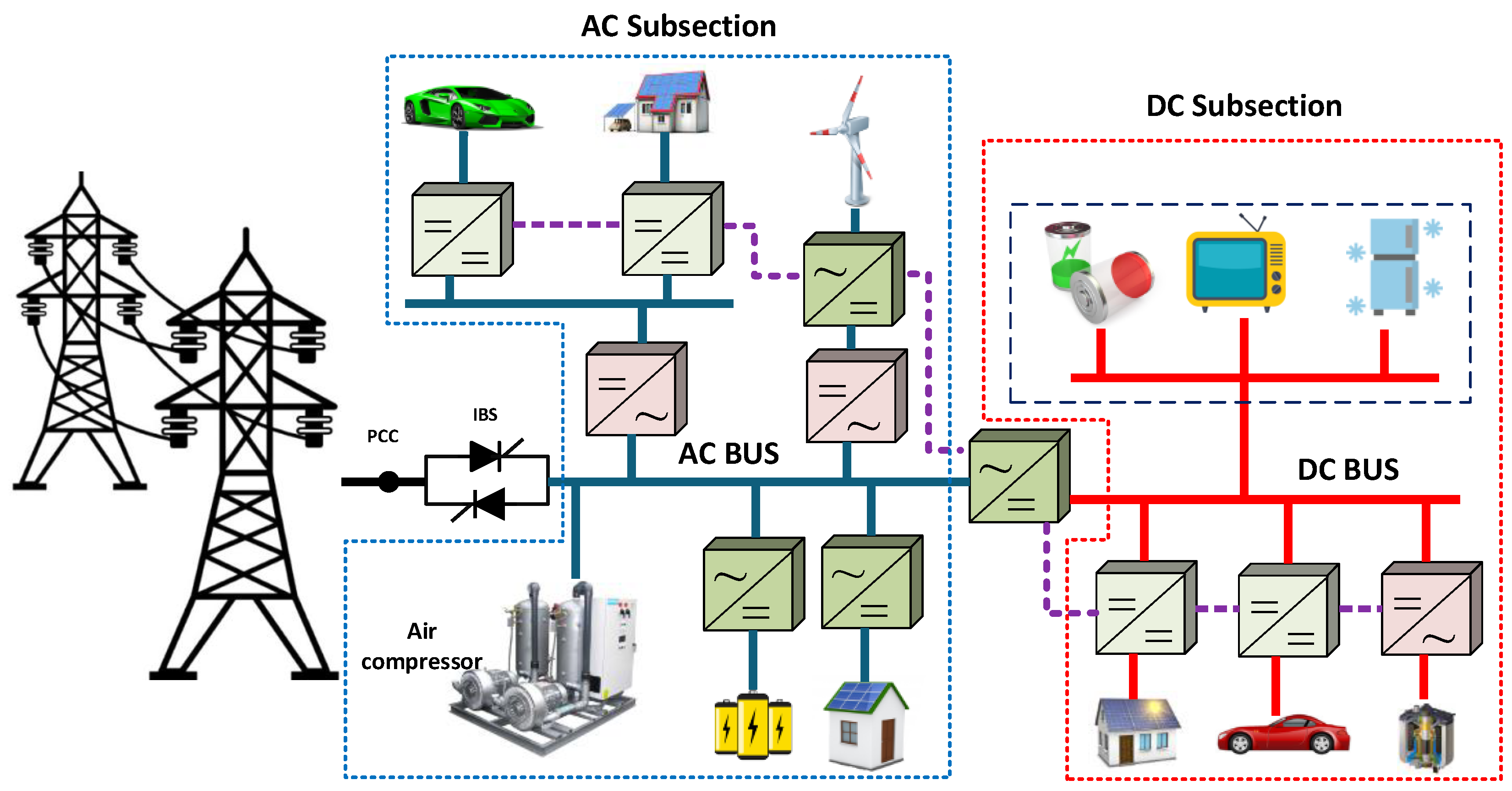
Figure 2.
Typical hierarchical control layers in MGs, including primary, secondary, and tertiary control levels.
Figure 2.
Typical hierarchical control layers in MGs, including primary, secondary, and tertiary control levels.
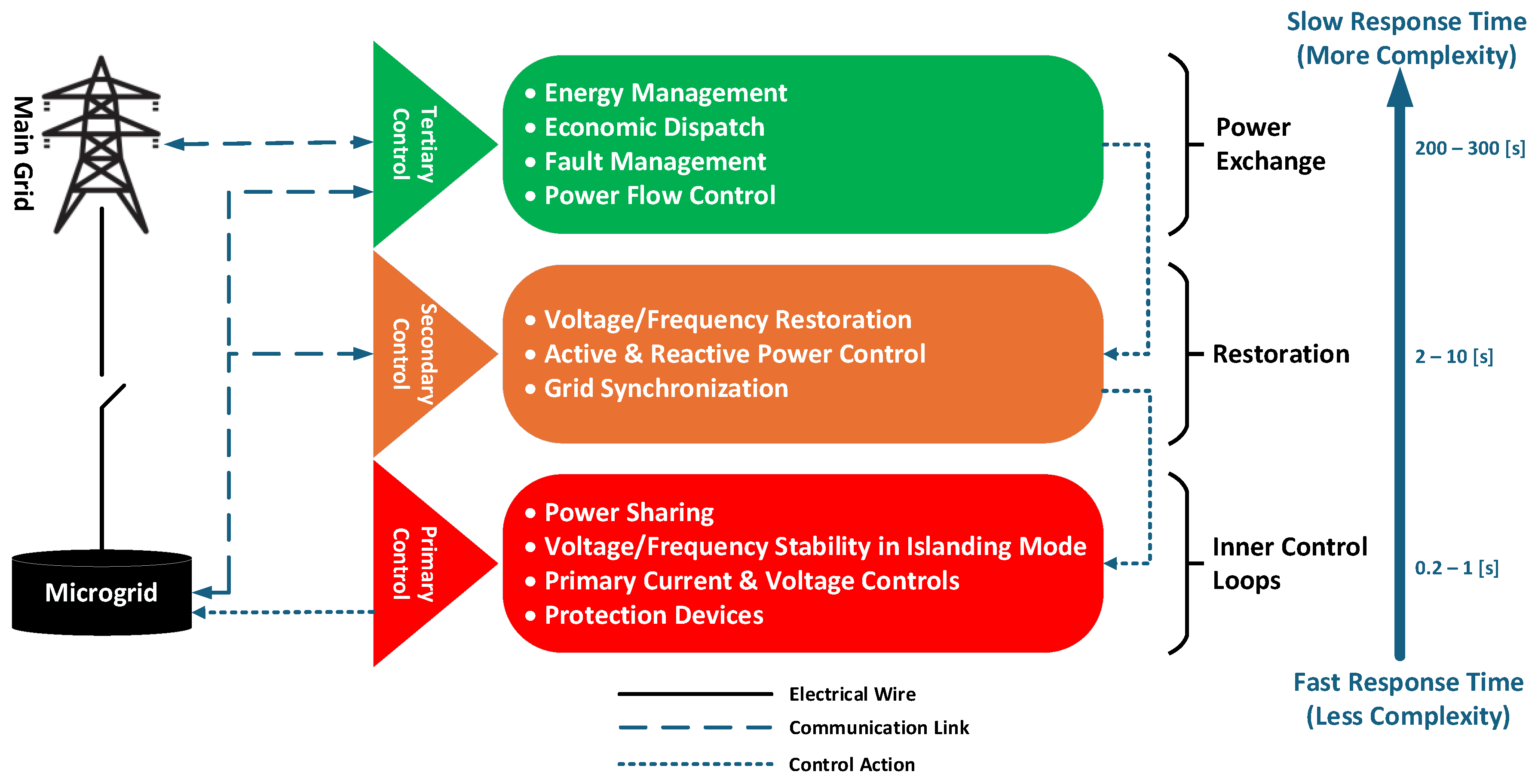
Figure 3.
Example of robust control architecture for an HMG [40].
Figure 3.
Example of robust control architecture for an HMG [40].
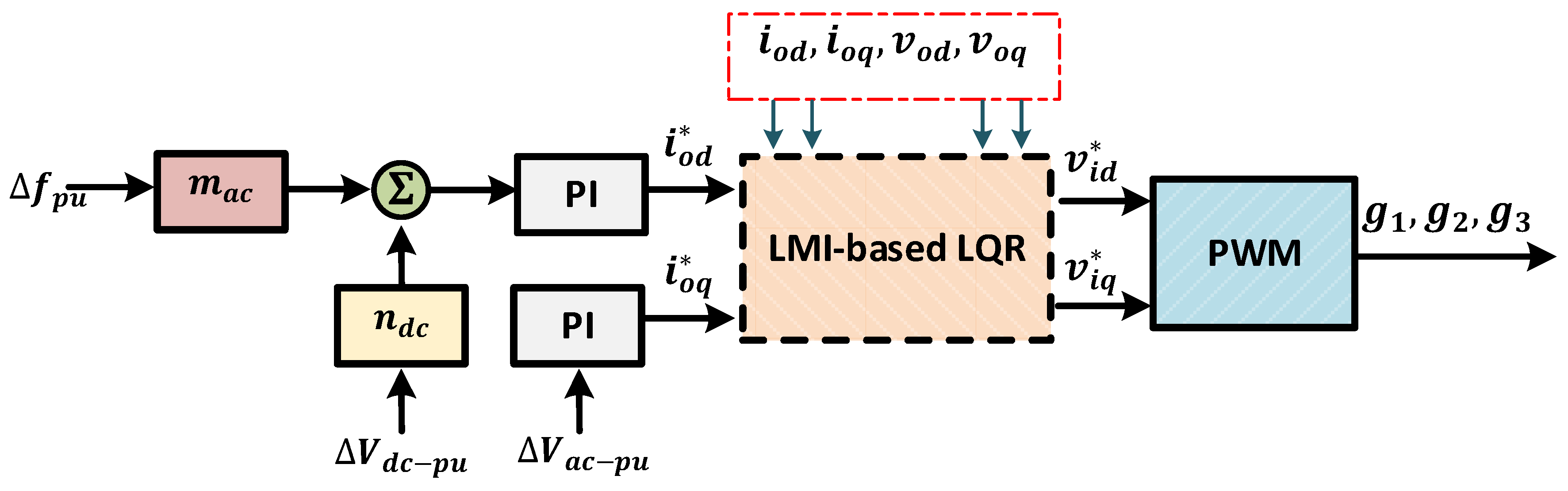
Figure 4.
Classification of robust control strategies based on design philosophy and adaptability.
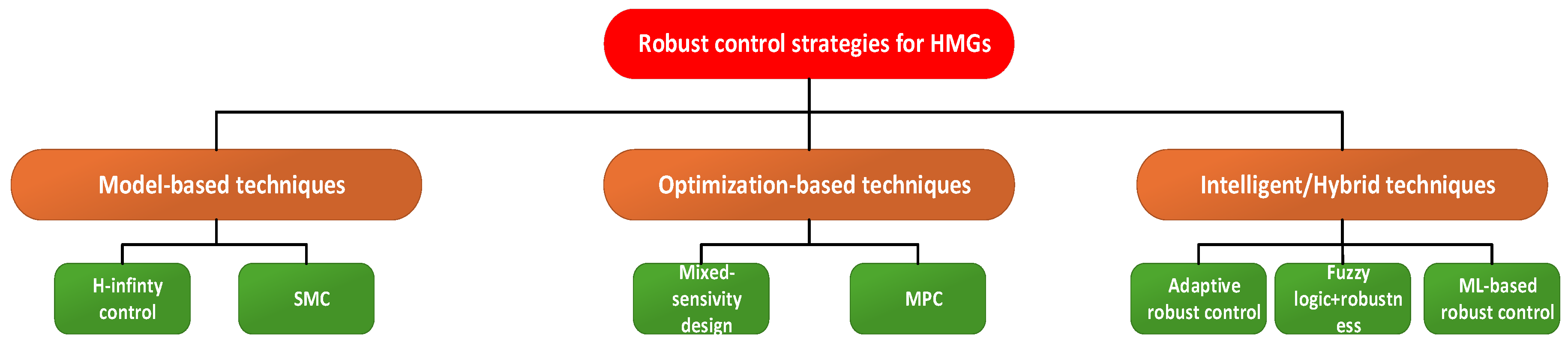

Table 1.
Robust control for HMG analysis method.
| Ref. | Structure | Operating Mode | Objective | Results and Metris |
|---|---|---|---|---|
| [39] | Decentralized | Combined | Optimization of control parameters | Optimal controller performance |
| [40] | Decentralized | Combined | Maintaining stability | Proper controller performance |
| [41] | Decentralized | Combined | DC link voltage control | Rejecting disruptive signals |
| [42] | Centralized | Grid connected | Rejecting a resistant disorder | Proper controller performance |
| [43] | Centralized | Grid connected | Improving power quality | Proper controller performance |
| [44] | Decentralized | Grid connected | Robustness system Improvement | Cost reduction |
| [45] | Decentralized | Grid connected | Dynamic modification of state variables | Sustainability assessment |
| [46] | Decentralized | Grid connected | Grid voltage control | Shorter sitting time |
| [47] | Decentralized | Combined | Power flow control | Resistant to fluctuations |
| [48] | Decentralized | Islanded | Maintaining DC link frequency and voltage stability | Minimizing frequency deviation |
| [49] | Decentralized | Combined | Power management | Optimal controller performance |
Table 2.
Droop control for HMG analysis method.
| Ref. | Structure | Operating Mode | Objective | Results and Metris |
|---|---|---|---|---|
| [50] | Centralized | Combined | Power sharing | DC terminal voltage recovery |
| [51] | Centralized | Grid connected | Power management | Proper controller performance |
| [52] | Centralized | Islanded | Voltage and frequency control | Proper controller performance |
| [53] | Decentralized | Islanded | Transient stability analysis | Improved dynamic response |
| [54] | Centralized | Islanded | Frequency and voltage recovery | Lower production cost |
| [55] | Centralized | Islanded | Safety and economic performance | High accuracy method |
| [56] | Decentralized | Islanded | Improving power sharing and load balancing | Fast dynamic response |
| [57] | Decentralized | Islanded | Active power filtering and power sharing | Efficiency of the method |
| [58] | Decentralized | Islanded | Power management | Performance optimization |
| [59] | Decentralized | Islanded | Active power control | Power balance |
| [60] | Centralized | Combined | Voltage stability | power balance |
| [61] | Decentralized | Islanded | Efficient power transmission | Frequency and voltage recovery |
| [62] | Decentralized | Combined | Improved DC bus voltage regulation and battery SOC control | Improved transient performance |
Table 3.
Hierarchical control for HMG analysis method.
| Ref. | Structure | Operating Mode | Objective | Results and Metris |
| [63] | Decentralized | Combined | High power quality | Better controller performance |
| [64] | Centralized | Combined | BIC uniform control | Stable performance |
| [65] | Decentralized | Combined | DC load current sharing | Three-layer control function |
| [66] | Decentralized | Combined | Voltage deviation recovery | Effectiveness of the method |
| [67] | Centralized | Islanded | Power stability assessment | Decent speed and convergence rate |
| [68] | Centralized | Islanded | Economic optimization | Reduce operating costs |
| [69] | Centralized | Combined | Strength of hierarchical control | Noise resistant |
| [70] | Decentralized | Combined | Coordination between linked inverters | Effectiveness of the method |
| [71] | Decentralized | Combined | Reactive power stability | THD reduction |
Table 4.
control for HMG analysis method.
| Ref. | Structure | Operating Mode | Objective | Results and Metris |
|---|---|---|---|---|
| [72] | Centralized | Grid Connected | Voltage stability | Improved phase angle accuracy |
| [73] | Centralized | Islanded | Frequency control | Determining the weighting function |
| [74] | Decentralized | Combined | voltage control | Achieving dynamic power balance |
| [75] | Decentralized | Combined |
Accurate voltage and frequency regulation | improved dynamic response |
| [76] | Centralized | Islanded | Improve voltage and frequency regulation | reduced disturbance |
| [77] | Decentralized | Islanded | Enhance MG power quality | Demonstrated superior V/F regulation and improved power quality |
| [78] | Decentralized | Combined | Model and control the hybrid dynamic behaviors of MGs | Minimize operational cost |
Table 5.
Distributed control for HMG analysis method.
| Ref. | Structure | Operating Mode | Objective | Results and Metris |
| [79] | Decentralized | Combined | Improved voltage and frequency regulation | Power sharing |
| [80] | Decentralized | Combined | Power flow management | Continuity of power transmission |
| [81] | Centralized | Combined | Independent control and central management | Efficiency and flexibility of the structure |
| [82] | Decentralized | Grid Connected | DC power current and voltage regulation | Reduce circulating current |
| [83] | Decentralized | Grid Connected | Voltage and current regulation | Setting parameters |
| [84] | Decentralized | Islanded | Active power control | Power sharing |
| [85] | Centralized | Combined | Energy management system | Freight demand forecasting |
| [86] | Centralized | Combined | Reliable and efficient performance | Optimal energy distribution |
| [87] | Decentralized | Combined | Power management | Increased reliability |
| [88] | Decentralized | Combined | Economic optimization of the system | Voltage improvement |
| [89] | Decentralized | Islanded | System performance optimization | Reducing communication costs |
| [90] | Decentralized | Grid Connected | Improve system reliability and performance | Voltage control and power sharing |
| [91] | Decentralized | Combined | Improving power and voltage quality | Stability against disturbances |
| [92] | Decentralized | Grid Connected | Optimizing the economic distribution of power | Economic performance |
| [93] | Decentralized | Grid Connected | Reducing operating costs | Reducing communication load |
| [94] | Decentralized | Islanded | Improve power management | High efficiency |
| [95] | Decentralized | Islanded | Optimal operations management | Optimal convergence |
| [96] | Decentralized | Combined | Power distribution optimization | Increased reliability |
| [97] | Decentralized | Islanded | Power sharing between networks and storage | Reducing unnecessary power exchange |
| [98] | Decentralized | Islanded | Effective power sharing | Small signal stability |
Table 6.
SMC for HMG analysis method.
| Ref. | Structure | Operating Mode | Objective | Results and Metris |
|---|---|---|---|---|
| [99] | Decentralized | Combined | Dynamic stability | improved power control |
| [100] | Centralized | Islanding | Reducing the chattering phenomenon | Ensuring sustainability |
| [101] | Centralized | Combined | Extraction of Maximum power | Comparison with P&O algorithm |
| [102] | Centralized | Islanding | Ensure robust voltage regulation under disturbances without prior knowledge of disturbance bounds | voltage stability |
| [103] | Decentralized | Grid-connected | Improve dynamic and steady-state response | Achieve robust MPPT for PV and wind |
| [104] | Decentralized | Islanding | Reduce frequency deviation | improved output regulation |
| [105] | Centralized | Combined | Ensure system stability under uncertainties | Reduce chattering and improve power quality |
Table 7.
Other method control for HMG analysis method.
| Ref. | Structure | Operating Mode | Objective | Results and Metris |
|---|---|---|---|---|
| [106] | Decentralized | Combined | Voltage control | Sustainability analysis |
| [107] | Decentralized | Combined | DC voltage regulation | Harmonic distortion reduction |
| [108] | Decentralized | Combined | Power management | Reduction of nominal capacity of interface converter |
| [109] | Decentralized | Combined | Reducing eddy currents | Power improvement |
| [110] | Decentralized | Combined | Maintaining the balance of power | Power subscription management |
| [111] | Centralized | Combined | Suppress disturbances caused by fast charging/discharging of HESS | Improve transient performance |
| [112] | Centralized | Islanding | Controlling power flow and maintaining battery reserve levels in real-time conditions, | Reducing frequency fluctuations |
| [113] | Centralized | Grid-connected | Accurate tracking of maximum power point for RESs. | Reducing power consumption from the main grid (reducing energy costs). |
| [114] | Decentralized | Combined | Improving the quality of generated power in hybrid solar and FC systems. | Reducing power fluctuations and improving the overall quality of generated power. |
Table 8.
Comparison of several robust control strategies: complexity, adaptability, communication, suitability.
Table 8.
Comparison of several robust control strategies: complexity, adaptability, communication, suitability.
| Control Strategy | Robustness to Uncertainties | Computational Complexity | Real-Time Suitability | Communication Dependency | Suitable Operating Modes |
|---|---|---|---|---|---|
| SMC | Very High | Medium | High (with tuning) | Low | Islanded, Fast-varying loads |
| Control | High (bounded disturbances) | High | Medium-Low | Medium | Grid-connected |
| Droop Control | Medium | Low | Very High | Very Low | All (especially Islanded) |
| Hierarchical Control | Medium | Medium | Medium | Medium | All (with centralized EMS) |
| Distributed Control | Medium-High (topology tolerant) | High | Medium | Medium-High | Scalable, Multi-agent HMGs |
Table 9.
Comparison of robust control strategies.
| Control strategy | Advantages | Challenges |
|---|---|---|
| H-infinity control | Strong worst-case performance; frequency-domain tuning | Requires accurate models; complex computation |
| SMC | High robustness to parameter changes and nonlinearities | Chattering effect; implementation difficulty |
| Mixed-sensitivity design | Balances robustness and performance; systematic design | Model-dependence; limited experimental validation |
| Adaptive robust control | Adjusts to unknown parameters in real-time | Stability guarantees can be hard to prove; slow convergence |
| Fuzzy + Robust control | Handles uncertainty and vagueness; intuitive logic | Tuning rules is complex; lacks general stability proofs |
| ML-based robust control | Learns optimal policies; no need for full model | Requires large data; lack of transparency; hardware resource constraints |
Disclaimer/Publisher’s Note: The statements, opinions and data contained in all publications are solely those of the individual author(s) and contributor(s) and not of MDPI and/or the editor(s). MDPI and/or the editor(s) disclaim responsibility for any injury to people or property resulting from any ideas, methods, instructions or products referred to in the content. |
© 2025 by the authors. Licensee MDPI, Basel, Switzerland. This article is an open access article distributed under the terms and conditions of the Creative Commons Attribution (CC BY) license (http://creativecommons.org/licenses/by/4.0/).
Copyright: This open access article is published under a Creative Commons CC BY 4.0 license, which permit the free download, distribution, and reuse, provided that the author and preprint are cited in any reuse.


