1. Introduction
The discourse on digital transformation has increasingly shifted from industrial applications toward broader societal and economic contexts. One of the most prominent concepts in this trajectory is the digital twin, which is commonly defined as a dynamic virtual representation of a physical system that is continuously updated with real-time data (Grieves & Vickers, 2017; Tao et al., 2019). While digital twin technologies have demonstrated substantial impact in manufacturing, logistics, and smart cities, their application within traditional marketplaces—particularly in emerging economies such as Indonesia—remains largely unexplored.
Traditional markets in Indonesia play a pivotal role in sustaining food distribution and economic activities. Despite the rapid growth of e-commerce, more than 70 percent of food distribution in Indonesia continues to be mediated through traditional markets (Kementerian Perdagangan RI, 2022). These marketplaces are not merely transactional hubs but also serve as socio-cultural institutions embedded in community life (Bappenas, 2021). However, structural challenges persist: unstable commodity prices, inefficient supply chains, and fragmented data management. For instance, in the lead-up to Idul Fitri 2023, staple food prices such as rice and chili surged by 20–30 percent across several provinces, reflecting the vulnerability of traditional markets to disruptions in supply and distribution (Bank Indonesia, 2023).
Current digitalization efforts in Indonesian markets have largely been limited to partial interventions, such as the adoption of QRIS-based cashless payments or digital promotions through social media (Sutanto & Nugroho, 2020). While these initiatives contribute to transactional modernization, they fall short of addressing systemic issues such as supply-demand imbalance, data transparency, and policy responsiveness. This gap highlights the necessity of more holistic digital transformation strategies that not only digitalize transactions but also provide governance mechanisms for market stability.
Recent research underscores the relevance of structured frameworks and governance approaches for such transformation. The Value Exchange Network (VEN) framework provides a systemic lens to map and manage digital ecosystems in traditional markets (Almunawar et al., 2025), while IT Governance and Management (ITGM) frameworks—particularly the alignment of COBIT 2019 with Indonesia’s SPBE policies—offer concrete guidelines for stakeholder coordination, resource management, and regulatory compliance (Bujung et al., 2024). Moreover, the potential of digital twin technology to integrate big data governance, predictive analytics, and stakeholder communication has been demonstrated in adjacent domains such as tourism (Rahmadian et al., 2023), offering valuable lessons for market governance.
Against this backdrop, conceptualizing and prototyping web-based applications that integrate digital twin principles emerges as a timely research direction. User-centered design approaches, such as Design Thinking, have proven effective in tailoring marketplace applications for micro, small, and medium enterprises (MSMEs), with evidence showing that accessible and inclusive designs significantly enhance adoption rates (Samsudin et al., 2024; Sari et al., 2024). Yet, how these design paradigms intersect with digital twin governance models for traditional market contexts in Indonesia remains insufficiently examined.
This study aims to advance the narrative discourse on digital twin applications by exploring how conceptual frameworks, governance mechanisms, and user-centric webapp prototypes can converge to support the digital transformation of Indonesian traditional markets. Rather than presenting empirical results, this research adopts a narrative approach to synthesize theoretical perspectives, empirical observations, and contextual frameworks. The contribution lies in articulating a conceptual pathway for integrating digital twin technologies into the governance of traditional markets, thereby providing a foundation for future empirical investigations and policy experimentation.
2. Theoretical Foundations
2.1. Systems Theory and Market Mechanisms
The complexity of traditional markets can be understood through the lens of General Systems Theory (von Bertalanffy, 1968), which posits that social and economic entities function as open systems consisting of interrelated components that adapt to environmental inputs. Traditional markets in Indonesia exemplify such systems: the dynamics of supply, demand, and price are influenced not only by transactional flows but also by cultural norms, community interactions, and policy interventions. Viewing markets as systems underscores the interdependence between micro-level actors (e.g., small vendors) and macro-level structures (e.g., government price controls, logistics networks).
Complementing this systems perspective is Market Equilibrium Theory, which provides an economic rationale for how prices are formed through the interaction of supply and demand (Marshall, 1920; Samuelson, 1948). In traditional markets, equilibrium is often fragile, as seasonal fluctuations, infrastructural bottlenecks, and external shocks—such as rising fuel costs—can rapidly destabilize balance. The recurrent volatility in staple food prices across Indonesia highlights the inadequacy of purely transactional digital interventions and calls for systemic monitoring tools that can capture the complex interactions underpinning market equilibrium.
Taken together, these theoretical lenses establish the need for approaches that move beyond digitizing isolated activities. Instead, digital transformation of traditional markets requires tools that can replicate systemic behaviors, monitor equilibrium dynamics, and provide stakeholders with real-time insights into how micro-level changes reverberate across the entire market system.
2.2. Technology Adoption and System Dynamics
While systems and equilibrium theories provide a macro-level foundation, understanding how digital innovations are received within traditional markets requires insights from technology adoption models. The Technology Acceptance Model (TAM) (Davis, 1989) posits that perceived usefulness and ease of use are central to whether individuals adopt new technologies. In the context of traditional market vendors—many of whom possess limited digital literacy—interfaces that are overly complex risk alienating potential users. Extensions of TAM, such as the Unified Theory of Acceptance and Use of Technology (UTAUT) (Venkatesh et al., 2003), further emphasize the role of social influence, facilitating conditions, and effort expectancy, which are highly relevant in community-oriented market environments. These frameworks suggest that digital twin applications and webapp prototypes must be designed with simplicity, accessibility, and cultural alignment to ensure adoption among diverse user groups.
At the methodological level, System Dynamics (Forrester, 1961) provides a modeling paradigm that aligns closely with the objectives of digital twin technology. By simulating feedback loops and time delays in supply-demand interactions, system dynamics enables researchers to explore how policy interventions—such as subsidies, rental fee adjustments, or transportation cost changes—propagate through the marketplace ecosystem. Such models are particularly relevant for traditional markets, where disruptions often manifest non-linearly and require predictive insights for effective governance.
Together, technology adoption theories and system dynamics modeling provide the bridge between conceptual frameworks and practical applications. They highlight not only the design imperatives for user acceptance but also the analytical tools needed to capture and simulate the complex realities of traditional market governance. These foundations pave the way for integrating digital twin principles into web-based prototypes that are simultaneously technically robust and socially acceptable.
3. Conceptualizing Digital Twin for Traditional Markets
3.1. Definition and Components of Digital Twin
The concept of the digital twin has evolved as a cornerstone of digital transformation, defined as a virtual replica of a physical system continuously updated with real-time data to enable monitoring, simulation, and decision-making (Grieves & Vickers, 2017; Tao et al., 2019). Its fundamental components typically include: (i) a physical entity or process, (ii) a digital representation, and (iii) data flows that ensure dynamic synchronization between the two. In industrial contexts, these components facilitate predictive maintenance, process optimization, and resource allocation. Translating this paradigm to traditional markets entails creating digital representations of vendors, commodities, prices, and consumer flows—interconnected within a data-driven ecosystem that mirrors the real-time dynamics of a physical market.
While industrial applications emphasize precision and engineering optimization, the adaptation to traditional markets requires flexibility and inclusivity. Markets are inherently socio-economic systems where cultural practices, informal negotiations, and trust-based interactions coexist with transactional processes. Thus, the digital twin for traditional markets must extend beyond technical replication to accommodate socio-cultural dynamics that influence behavior and decision-making.
3.2. Digital Twin and Big Data Governance
Beyond technical design, the success of digital twin applications hinges on governance frameworks that regulate how data are collected, shared, and utilized. Rahmadian et al. (2023), in their work on tourism digital twins, highlight the critical role of big data governance in ensuring transparency, accountability, and compliance with ethical and regulatory standards. Such insights are particularly relevant for traditional markets, where concerns around data ownership, privacy, and trust between stakeholders are pronounced.
Effective governance structures are required not only to manage data quality and security but also to balance the interests of diverse actors—vendors, consumers, market administrators, and government agencies. Without robust data governance, digital twin initiatives risk reinforcing existing asymmetries in information access and decision-making power. Conversely, properly designed governance frameworks can foster trust, facilitate stakeholder engagement, and enhance the legitimacy of digital twin solutions in traditional market settings.
3.3. Frameworks for Digital Transformation
Recent scholarship underscores the importance of structured frameworks for guiding digital transformation in traditional marketplaces. The Value Exchange Network (VEN) framework offers a four-stage process—mapping, designing, implementing, and managing—that emphasizes ecosystem thinking and structured guidelines (Almunawar et al., 2025). This framework provides a conceptual pathway for aligning technological innovation with the socio-economic realities of traditional markets, ensuring that digital initiatives remain responsive to local contexts.
Complementing this perspective, IT Governance and Management (ITGM) frameworks—particularly the alignment of COBIT 2019 with Indonesia’s Sistem Pemerintahan Berbasis Elektronik (SPBE)—offer practical mechanisms for ensuring accountability, stakeholder coordination, and policy alignment (Bujung et al., 2024). By embedding digital twin initiatives within broader governance architectures, ITGM approaches address critical challenges such as limited resources, fragmented authority, and the need for compliance with national digitalization agendas.
Taken together, VEN and ITGM frameworks provide mutually reinforcing strategies: while VEN foregrounds ecosystem mapping and value flows, ITGM anchors these processes within institutional and regulatory structures. This dual perspective suggests that digital twin prototypes for traditional markets should not be developed as isolated technological artifacts but as components of larger governance ecosystems.
3.4. Toward Webapp Prototypes for Market Governance
The conceptual translation of digital twin frameworks into tangible tools necessitates prototyping approaches that prioritize user engagement and accessibility. Design Thinking has emerged as a widely adopted methodology for developing digital solutions tailored to MSMEs and community-based markets (Samsudin et al., 2024; Sari et al., 2024). Emphasizing empathy, iterative design, and user testing, this approach ensures that webapp prototypes align with the capabilities and expectations of diverse user groups, from small-scale vendors to municipal regulators.
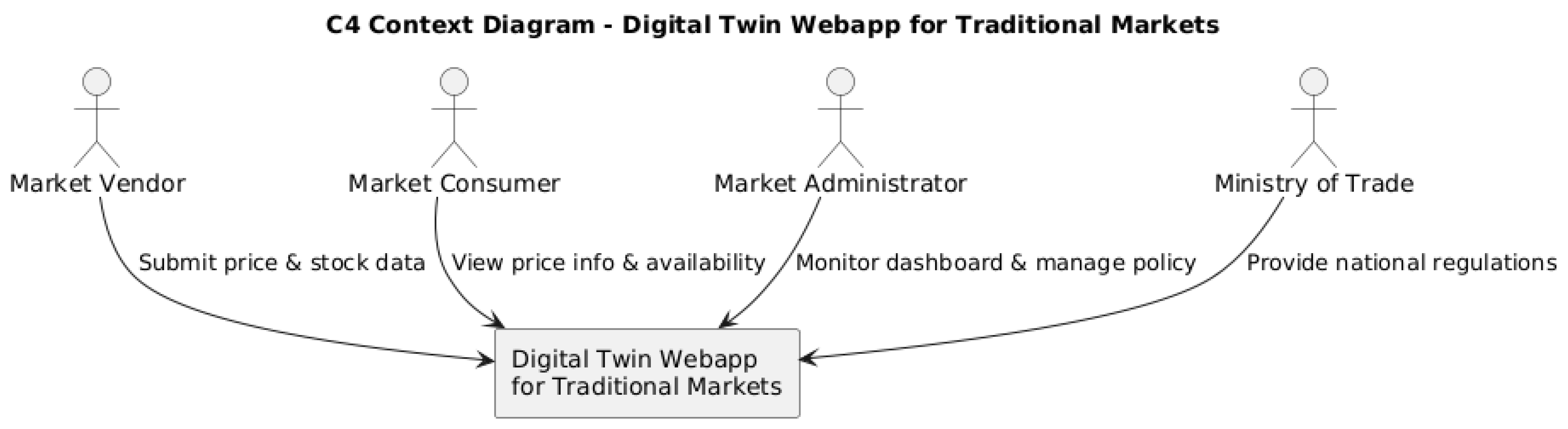
Comparative studies demonstrate that webapp prototypes designed with simplified interfaces, visual guidance, and interactive dashboards significantly improve user satisfaction and adoption rates (Sari et al., 2024). In the context of digital twin applications, such prototypes can serve as gateways for vendors and administrators to access real-time market data, run policy simulations, and visualize the impacts of interventions. Importantly, user-centric design mitigates the risk of technological exclusion among stakeholders with limited digital literacy.
3.5. Synthesis
The conceptualization of digital twin applications for traditional markets requires an integrative approach that combines technical components, data governance, and user-centered design. VEN and ITGM frameworks ensure structured transformation and institutional alignment; big data governance addresses trust, transparency, and compliance; and Design Thinking bridges the gap between sophisticated modeling and practical usability. These insights collectively highlight that the digital twin for traditional markets is not merely a technological innovation but a governance tool embedded within broader socio-economic and policy ecosystems.
4. Designing Webapp Prototypes for Market Governance
4.1. User-Centric Approaches to Prototyping
The design of digital twin applications for traditional markets must reconcile technological sophistication with user accessibility. A key challenge lies in the diverse demographic composition of market stakeholders, which includes vendors with limited digital literacy, consumers accustomed to informal transactions, and administrators tasked with monitoring complex economic flows. In this context, Design Thinking has emerged as a robust methodology for creating user-oriented solutions, emphasizing empathy, iterative prototyping, and feedback integration (Samsudin et al., 2024; Sari et al., 2024).
Applications developed under this paradigm have demonstrated that simplified interfaces—featuring visual cues, guided navigation, and interactive tutorials—significantly improve adoption and sustained use among vendors and consumers in rural and urban markets (Sari et al., 2024). For administrators, tailored dashboards can provide structured overviews of price dynamics, supply availability, and crowd density, thereby facilitating informed decision-making. These insights underscore the importance of embedding participatory design processes in the early stages of prototype development to ensure cultural and contextual resonance.
4.2. Prototype Features for Market Digital Twin
Building on the theoretical and governance frameworks outlined earlier, a prototype webapp for market digital twin applications should incorporate the following core features:
4.3. Integration with Governance Frameworks
The technical features of the webapp prototype must be situated within broader digital transformation frameworks to ensure sustainability. The Value Exchange Network (VEN) framework (Almunawar et al., 2025) provides a systematic approach for mapping stakeholders and aligning value flows, ensuring that the webapp does not privilege one group at the expense of another. Meanwhile, the COBIT 2019–SPBE integration (Bujung et al., 2024) offers actionable guidelines for aligning the prototype with Indonesia’s national digital governance agenda, thereby facilitating policy support and institutional adoption.
This dual integration ensures that the prototype is not merely a technological artifact but also a governance instrument embedded in regulatory and ecosystem structures.
4.4. Toward Participatory Implementation
While technical design and governance integration are crucial, the long-term viability of market digital twin applications depends on participatory implementation. Vendors, consumers, and administrators must be actively involved not only as end-users but as co-creators in the iterative prototyping process. Such an approach aligns with the socio-cultural fabric of traditional markets, where trust and community participation are central to legitimacy. Comparative evidence indicates that participatory design substantially improves user satisfaction, reduces resistance to adoption, and enhances the overall resilience of digital transformation initiatives (Sari et al., 2024).
4.5. Synthesis
The design of webapp prototypes for traditional market governance is best understood as a multidimensional endeavor that integrates user-centered design, technical features, and governance alignment. While the dashboard and simulation modules operationalize digital twin concepts, the incorporation of data governance, participatory design, and policy frameworks ensures contextual relevance and sustainability. This synthesis suggests that successful prototyping is less about technical perfection and more about creating adaptive, inclusive, and trust-oriented digital ecosystems.
5. Narrative Insights and Discussion
The narrative synthesis presented in the preceding sections highlights several interrelated insights into the prospects and challenges of applying digital twin concepts to traditional market governance in Indonesia. By integrating systems theory, technology adoption models, and system dynamics with governance frameworks and user-centered design, a conceptual pathway emerges for how digital transformation can be pursued in an inclusive and sustainable manner.
5.1. Reframing Traditional Markets as Digital Ecosystems
Traditional markets in Indonesia are often framed in policy discourse as residual institutions that need to be modernized. However, systems theory reveals that these markets are not static relics but dynamic ecosystems where supply-demand interactions are mediated by social, cultural, and institutional factors (von Bertalanffy, 1968; Marshall, 1920). Digital twin applications enable reframing markets as living systems that can be digitally mirrored, simulated, and optimized, not to replace their socio-cultural functions but to enhance their resilience and adaptability. This reorientation underscores the potential of digital twins as governance instruments rather than purely technological solutions.
5.2. The Imperative of Governance and Data Stewardship
The analysis further reveals that technology alone cannot resolve market inefficiencies without robust governance structures. The VEN framework (Almunawar et al., 2025) emphasizes the need to map and align stakeholder value flows, while IT Governance and SPBE integration (Bujung et al., 2024) provides institutional anchors for policy alignment and accountability. Insights from tourism digital twins (Rahmadian et al., 2023) reinforce the centrality of big data governance in ensuring transparency and building trust. For traditional markets, this translates into the imperative of designing governance protocols that address data ownership, privacy, and equitable access—issues that are often neglected in digitalization initiatives targeting low-resource communities.
5.3. User-Centric Design as a Determinant of Adoption
While governance provides the structural backbone, user-centered design determines whether digital twin applications gain traction on the ground. Evidence from marketplace prototype research (Samsudin et al., 2024; Sari et al., 2024) demonstrates that accessible and inclusive interfaces substantially improve adoption, even among users with limited digital literacy. For Indonesian markets, where vendors are heterogeneous in age, education, and technological exposure, participatory prototyping becomes not just desirable but essential. By embedding cultural cues, local languages, and intuitive navigation, webapp prototypes can foster trust and reduce resistance, ensuring that digital twin applications are socially embedded rather than externally imposed.
5.4. Navigating Challenges of Resource and Literacy Constraints
The narrative also brings into focus enduring challenges. Resource limitations, both financial and infrastructural, pose constraints to implementing sophisticated digital twin systems in traditional markets. Digital literacy gaps exacerbate these limitations, potentially reinforcing inequalities between vendors who can adopt technology and those who cannot. These challenges suggest that incremental prototyping, modular deployment, and capacity-building programs must accompany technical development. Without such complementary measures, digital twin initiatives risk reproducing the very asymmetries they aim to mitigate.
5.5. Toward a Conceptual Synthesis
Taken together, the insights suggest that digital twin applications for traditional market governance cannot be understood solely through technical or economic lenses. Instead, they represent a confluence of systemic modeling, governance frameworks, and human-centered design. The novelty of this narrative lies not in presenting empirical outcomes but in articulating how these dimensions intersect within the Indonesian context. The discussion underscores that future empirical research should not only test technical feasibility but also investigate governance mechanisms, user adoption patterns, and socio-economic impacts.
6. Conclusions and Future Directions
This narrative inquiry has explored the conceptual underpinnings and design considerations for integrating digital twin technologies into the governance of traditional markets in Indonesia. By weaving together systems theory, market equilibrium perspectives, technology adoption models, system dynamics, governance frameworks, and user-centered design methodologies, the discussion highlights the multifaceted nature of market digitalization. Rather than positioning digital twin applications as purely technological innovations, the analysis frames them as governance instruments situated within broader socio-economic, institutional, and cultural ecosystems.
Several conclusions can be drawn from this synthesis. First, reframing traditional markets as dynamic systems underscores the need for holistic digital interventions that account for interdependencies among vendors, consumers, administrators, and policymakers. Second, robust governance structures—anchored in frameworks such as the Value Exchange Network (Almunawar et al., 2025) and IT Governance–SPBE integration (Bujung et al., 2024)—are indispensable for ensuring accountability, data stewardship, and institutional alignment. Third, user-centered design approaches, particularly those grounded in Design Thinking (Samsudin et al., 2024; Sari et al., 2024), are critical determinants of adoption and long-term viability, especially in contexts characterized by diverse literacy levels and socio-cultural practices.
While the conceptual pathway outlined here offers a foundation, significant gaps remain that warrant future empirical research. These include: (i) testing the technical feasibility of digital twin prototypes in pilot markets with real-time data integration, (ii) examining user adoption patterns and barriers across diverse demographic groups, (iii) assessing the socio-economic impacts of policy simulations embedded in digital twin applications, and (iv) evaluating governance mechanisms for data ownership, privacy, and trust. Addressing these gaps requires interdisciplinary approaches that combine technical innovation, social science inquiry, and policy analysis.
Future research should also explore how digital twin applications for markets can be scaled across different regional contexts in Indonesia, while remaining sensitive to local cultural and institutional variations. Comparative studies between urban and rural markets, as well as cross-country analyses in Southeast Asia, could further enrich understanding and provide transferable lessons. Ultimately, the integration of digital twins into traditional market governance represents not only a technological frontier but also an opportunity to advance inclusive, transparent, and sustainable models of digital transformation in emerging economies.
References
- Almunawar, M., Anshari, M., De Pablos, P., & Fauzi, A. (2025). Embracing digital business ecosystem: transforming traditional marketplaces. Journal of Science and Technology Policy Management. [CrossRef]
- Bank Indonesia. (2023). Laporan Perekonomian Indonesia 2023. Jakarta: Bank Indonesia.
- Bappenas. (2021). Laporan Pembangunan Ekonomi Kerakyatan. Jakarta: Bappenas.
- Bujung, R., Hartanto, R., & Winarno, W. (2024). IT Governance & Management for Smart City: Aligning COBIT 2019 with SPBE Policies for Traditional Market Digitalization Initiatives. 2024 International Conference on Information Technology Systems and Innovation (ICITSI), 441–449. [CrossRef]
- Davis, F. D. (1989). Perceived usefulness, perceived ease of use, and user acceptance of information technology. MIS Quarterly, 13(3), 319–340. [CrossRef]
- Fitriani, D. (2021). Perkembangan riset bisnis digital di Indonesia. Jurnal Ekonomi dan Bisnis Digital, 5(2), 101–112.
- Forrester, J. W. (1961). Industrial Dynamics. Cambridge: MIT Press.
- Grieves, M., & Vickers, J. (2017). Digital twin: Mitigating unpredictable, undesirable emergent behavior in complex systems. In F.-J. Kahlen, S. Flumerfelt, & A. Alves (Eds.), Transdisciplinary Perspectives on Complex Systems (pp. 85–113). Springer. [CrossRef]
- Kementerian Perdagangan RI. (2022). Statistik Perdagangan Dalam Negeri 2022. Jakarta: Kemendag.
- Marshall, A. (1920). Principles of Economics (8th ed.). London: Macmillan.
- Rahmadian, E., Feitosa, D., & Virantina, Y. (2023). Digital twins, big data governance, and sustainable tourism. Ethics and Information Technology, 25, 1–22. [CrossRef]
- Samsudin, I., Hartanto, R., & Winarno, W. (2024). Designing a marketplace platform for MSMEs: A strategic approach to digitalization within the smart city concept in Pringsewu Regency. 2024 International Conference on Intelligent Cybernetics Technology & Applications (ICICyTA), 172–178. [CrossRef]
- Samuelson, P. A. (1948). Foundations of Economic Analysis. Cambridge: Harvard University Press.
- Sari, A., Pramono, P., Saputra, I., & Prakoso, A. (2024). Optimalisasi proses digitalisasi UMKM melalui aplikasi marketplace berbasis design thinking. Edumatic: Jurnal Pendidikan Informatika, 8(2). [CrossRef]
- Sutanto, J., & Nugroho, Y. (2020). Digitalisasi pasar tradisional: Tantangan dan peluang. Jurnal Manajemen Indonesia, 20(3), 245–258.
- Tao, F., Qi, Q., Liu, A., & Kusiak, A. (2019). Digital twins and cyber–physical systems toward smart manufacturing and Industry 4.0. Engineering, 5(4), 653–661. [CrossRef]
- Venkatesh, V., Morris, M. G., Davis, G. B., & Davis, F. D. (2003). User acceptance of information technology: Toward a unified view. MIS Quarterly, 27(3), 425–478. [CrossRef]
- von Bertalanffy, L. (1968). General System Theory: Foundations, Development, Applications. New York: George Braziller.
|
Disclaimer/Publisher’s Note: The statements, opinions and data contained in all publications are solely those of the individual author(s) and contributor(s) and not of MDPI and/or the editor(s). MDPI and/or the editor(s) disclaim responsibility for any injury to people or property resulting from any ideas, methods, instructions or products referred to in the content. |
© 2025 by the authors. Licensee MDPI, Basel, Switzerland. This article is an open access article distributed under the terms and conditions of the Creative Commons Attribution (CC BY) license (http://creativecommons.org/licenses/by/4.0/).