
Submitted:
30 May 2025
Posted:
30 May 2025
You are already at the latest version
Abstract
Digital platform ecosystems confront critical management challenges as they overcome path dependence amid rapid technological change. This study explores cross-category innovation as a key strategic action, using a longitudinal case study of ByteDance to analyze how digital technology drives ecosystem evolution, and constructs a "technology-driven–strategic action–ecosystem evolution" framework to examine the interplay between technological capabilities and strategic actions. Findings identify two stages: In the category emergence stage, platforms establish a core business ecosystem via identity, legitimacy and differentiation strategies, leveraging technologies like algorithmic recommendation to shape user cognition and market legitimacy. In the category spanning stage, platforms leverage platform envelopment, open innovation and status strategies to expand cross-category ecosystems, enabling technological spillover and integrated innovation across new domains. The findings reveal a co-evolution mechanism of cross-category innovation strategy and ecosystems, where the cross-category innovation strategy serves as both a driving force for ecosystem evolution and acquires new strategic opportunities. This study offers insights for building sustainable ecosystems that transcend industry boundaries and enhance resilience.
Keywords:
digital platform ecosystems
; cross-category innovation
; platform strategy
; category evolution
1. Introduction
With the rapid advancement of digital technologies, digital platform ecosystems have emerged as a critical organizational paradigm driving industrial transformation and economic development. As core actors, digital platform firms leverage cutting-edge technologies (e.g., cloud computing, big data, AI) to establish interactive and open architectures. Complementary enterprises achieve collaborative innovation by integrating or mobilizing complementary assets through these platforms, thereby delivering diversified products or services. Users participate in ecosystem construction and optimization through data generation, consumption behavior, and usage feedback [1]. Digital technology, through its data-driven and intelligent characteristics, lowers the barriers to communication and decision-making while driving the integration of flexible models and cross-scenario functions. Digital platform ecosystems rapidly scale user bases via network effects, accumulate digital assets, and enhance commercial value. However, traditional platforms face increasing threats from accelerated technological iterations. Digital platforms’ generality, real-time interconnectivity, and scalability enable collaboration and competition transcending conventional industry boundaries. In this context, industry disruptors may not originate from direct competitors but from entirely unrelated domains. For instance, Amazon and Google have established dominance in e-commerce, cloud computing, and AI services. Platforms overly reliant on specific competitive advantages and established success paths risk falling into the “Icarus paradox”, clinging to traditional strengths at the expense of new opportunities [2]. Consequently, breaking path dependence and enabling sustained ecosystem evolution have become pivotal management challenges in the digital era.
As a strategic initiative transcending traditional industry boundaries, cross-category innovation integrates technological advantages, business models, and institutional logics from distinct domains to create novel market opportunities and reshape competitive landscapes. This concept provides critical insights into the emerging characteristics of digital platforms’ cross-industry expansion. Categorization theory posits that categories act as socio-structural frameworks for analyzing organizational partitioning, inter-group interactions, and transformative restructuring [3]. However, conventional frameworks rooted in property rights structures and transaction cost theory fail to adequately explain the unique dynamics of digital platforms’ cross-industry penetration. Through category creation and spanning, digital platforms transcend traditional organizational and transactional boundaries, reconstructing users’ cognitive categories [4]. Such mechanisms disrupt entrenched industry structures and establish competitively viable new categories. This theoretical lens offers a material-ontology perspective to decode how digital platform ecosystems leverage cross-category innovation to overcome path dependence [5].
Based on categorization theory, this study proposes a “technology-driven–strategic action–ecosystem evolution” framework to address three core research questions: First, what key stages constitute the cross-category innovation strategies of digital platforms, and how do their core strategic actions reflect technology-driven characteristics? Second, through which strategic actions do digital platforms overcome inter-platform barriers to restructure ecosystem architectures? Third, how do cross-category innovation strategies and ecosystems co-evolve synergistically to achieve sustainable development? To investigate these questions, we conduct a longitudinal case study of ByteDance, a Chinese internet technology company. The selection rationale stems from ByteDance’s evolutionary trajectory: originating as an algorithm-driven content platform, it has progressively spanned diverse domains including short-video social networking, e-commerce, cloud services, and general artificial intelligence. This progression comprehensively demonstrates how digital platforms leverage technological foundations to execute cross-category innovation through strategic actions. The findings aim to address how to construct a digital platform ecosystem that breaks through path dependency and provide valuable insights into sustainable development.
2. Literature Review
2.1. Cross-Category Innovation Under Categorization Theory
In organizational theory, categorization theory responds to a classic question: Would in-depth development in a specific field or cross-category development lead to higher performance? Zuckerman (1999) first proposed that organizations need to conform to the cognitive framework of industry categories to obtain legitimacy; otherwise, they may be ignored by the capital market [6]. The research emphasized the necessity for organizations to adapt to specific categories. Many scholars have discussed around this topic and formed “category imperative principles” that have had a profound influence on subsequent research. The classification rules regard categories as the core components of the external institutional environment and link categories to the influences exerted by critics, regulators, consumers, etc. on different types of organizations [7]. Its mechanism of action is manifested as the dual-mode evaluation process of the audience on the organization, that is, the organization conveys the cultural “code” belonging to the characteristics of a specific category, and the audience first judges the category to which the organization belongs, then determines the extent to which it conforms to the category expectations [8,9]. Although meeting the expectations of the audience is usually wise, subsequent research has found that the greatest rewards may flow to those who create new categories and innovate in the corresponding interfaces [10]. Pontikes (2012) pointed out that the audience can highly receive organizations of mixed, cross-disciplinary and extended categories, and even regard them as signals of innovation, which is conducive to the innovative development of the organization [11]. Cross-category innovation stems from organizations linking previously unmerged categories, integrating different material elements, business model components or institutional logics to form strategic actions that challenge existing classification systems and create new market spaces [12]. Durand and Khaire (2017) distinguished two modes of cross-category formation based on whether cross-category is formed by elements outside the existing classification system or by internal elements: category emergence and category creation [13]. Wu et al. (2020) supplemented the theoretical framework by explaining two scenarios—category spanning and category reclassification—based on categorization evolution [14]. Cross-category innovation enables organizations to adjust their identity and form to adapt to competitive pressures in emerging markets. Through strategic actions like identity construction, legitimacy acquisition, and status enhancement, it shapes new value creation models. Cross-category innovation marks the transformation of an organization’s future form. Relevant research and applications can help promote technological changes, industrial evolution, and disruptive innovation in the market.
2.2. Cross-Category Innovation Driven by Digital Technology
As an evolved form of platform digitalization, the digital platform ecosystem constructs a value co-creation network via digital technology. The technical architecture design paradigm of this system is driven by the characteristics of digital technology. Among them, the modular feature enables the system to have dynamic reconfiguration capability, the distributed architecture supports the cross-boundary expansion of the system scale, and the intelligent data analysis ensures the standardization and reusability of information interaction.
Digital technology provides underlying resource support for cross-category innovation in the digital platform ecosystem through modular and distributed architectures. At the physical and technical level, the platform enhances product development efficiency through modular design, builds an internal reusable core foundation based on a distributed architecture, and supports the access of third-party software and hardware [14]. For instance, the SAP cloud platform connects service providers in vertical fields such as logistics and finance through open application programming interfaces (APIs), forming an enterprise application ecosystem. This architecture offers two major advantages for cross-category innovation: First, it reduces access costs through technology reuse. The platform does not need to redevelop the underlying technology for new businesses. It can quickly build new services by calling existing modules. The second is to develop cross-category innovative businesses based on core businesses. The platform can pilot new functions through microservice transformation without affecting its core business, gradually cultivate user recognition, and then integrate them into the main interface. For instance, WeChat can expand e-commerce and local life services through mini-programs, or promote innovative collaboration with complementary enterprises through standardized technical agreements to discover more innovative components and technologies [15]. The above-mentioned approach has given rise to the digital technology implementation path of the platform envelopment strategy. When the platform accumulates cross-category capabilities through technology reuse, it can achieve rapid penetration into adjacent markets through means such as functional binding or mergers and acquisitions [16], forming a positive cycle from the overflow of digital technology capabilities to the expansion of the ecological boundary. Platform envelopment in the digital world explores strategies through which digital platforms expand into adjacent markets or sectors to forge competitive ecosystems [17].
The acceptance degree of users towards cross-category innovation of digital platforms is closely related to the coupling level of technology and cognition. Firstly, data-driven intelligent analysis can fully reuse data and reduce cognitive complexity. Computational social science combines quantitative big data algorithm analysis with qualitative narrative development, which can identify behavioral pattern differences from real-time interactive data, transform cross-category products and services into forms that conform to users’ existing cognition, and promote users to accept cross-category innovations [18]. And on this basis, optimize the service plan and matching efficiency of the new platform. Secondly, social communication can trigger user cognitive transfer. By using user-generated content, social viral growth, and co-created narratives, it reshapes the semantic consensus of categories among users, achieving cognitive leap of categories [19]. Third, technological endorsement constructs user cognitive legitimacy. Cross-category innovation needs to address users’ doubts about the identity of new services. Cognitive legitimacy can be endowed through technological certification and authoritative collaboration [20]. For instance, Tmall Global has achieved product traceability through blockchain technology, extending its ecosystem boundaries to trusted services in cross-border e-commerce and enhancing users’ trust in new categories.
2.3. Cross-Category Innovation in the Digital Platform Ecosystem
At present, there are relatively few studies on cross-category innovation in the digital platform ecosystem, and the relevant studies are mainly focused on the discussions on cross-boundary innovation ecosystems. Based on the integration perspective of organizational ecology theory and resource dependence theory, the cross-boundary behavior of the innovation ecosystem can be defined as: Incumbent enterprises rely on the ecological niche advantages in the existing ecosystem field, identify potential innovation partners by constructing a dynamic search mechanism, and then develop cross-boundary resource integration capabilities [21].This kind of inter-organizational collaborative innovation behavior is essentially an innovation practice in which enterprises break through the boundaries of traditional resource constraints by reconstructing the value network relationships. For example, enterprises achieve cross-domain integration of heterogeneous innovation resources by leveraging the complex interaction relationships among the members of the ecosystem network. As a strategic action, cross-category innovation in digital platform ecosystems differs from cross-boundary innovation in that it mapping the relationships among platforms, users and evaluators from the perspective of categories. The core characteristic of cross-category innovation lies in the simultaneous recon-struction of technical resource bases and user cognitive boundaries. The cross-category innovation strategy emphasizes that organizations should maintain necessary com-monalities while defining category boundaries through unique attributes to exclude competitors from different fields. By introducing elements such as technologies, business models and institutional logics of different categories, it solves problems such as resource integration and cognitive construction in the process of value innovation. Its application value lies in ensuring that organizations have the competence to meet market development and user needs and promoting the improvement of internal coordination efficiency and competitiveness.
Cross-category innovation requires business collaboration between platforms and complementary enterprises. It must also account for the exponential growth of participant types, intelligent evolution of interaction models, nonlinear value creation, and decentralized governance transformation in the digital age [22,23].The digital platform ecosystem is divided into various forms such as transactional ecosystems, information-based ecosystems, and innovative ecosystems [24]. The core function of the transactional ecosystem lies in building a digital connection system and achieving precise matching between supply and demand through the hardware infrastructure layer. As the infrastructure for information dissemination, the value creation mechanism of the information-oriented ecosystem is reflected in the intelligent classification and dynamic distribution of information through technologies such as algorithm recommendation and semantic analysis. The core characteristics of an innovative ecosystem are manifested as the construction of a universal technical architecture system. Through modular interface standards, open API protocols and collaborative development mechanisms, the deep integration of core products and complementary innovative modules is achieved.There are significant differences among the three types of digital platforms in terms of functional positioning, collaboration methods, and value creation. Cross-category innovation among these three may bring new functions and new business models [26], avoiding excessive reliance on specific competitive advantages and success paths, but at the same time increasing the complexity of managing different types of platforms. Therefore, achieving cross-category innovation requires the joint drive of multiple aspects such as technology, data, organization and system to reconstruct the ecological niche, balance the strategic stability between the hierarchical management of the organization and the open and classified evolution, take the accumulation of technological capabilities as the basis, maintain the strategic action capacity of innovation, and promote the spiral upward development of the ecosystem.
To sum up, the research on digital platform ecosystems and cross-category innovation has gradually become an academic focus. Although related studies have provided certain concepts and theoretical foundations for this paper, the current comprehensive research is relatively scarce. The digital platform ecosystem has the ability to develop beyond the boundaries of traditional industries, but it lacks information on how to use digital technology-driven and cross-category innovation strategies to respond to corresponding situational changes and competitive pressures. Cross-category innovation involves the integration of technologies, systems and resources in multiple fields and is an important way to break through the boundaries of traditional innovation. However, the existing research does not explore its internal mechanism deeply enough and cannot provide strong theoretical guidance for the innovation practice of digital platforms. Therefore, this paper takes ByteDance as a case to explore the cross-category innovation strategy selection and evolution process of the digital platform ecosystem, and summarizes the corresponding theoretical model, contributing to the research on platform innovation strategies and classification theories in the context of the digital economy.
2.4. Research Framework
Based on categorization theory, this study constructs a research framework of “technology-driven–strategic action–ecosystem evolution”, as shown in Figure 1. It focuses on the phased strategies and evolution mechanisms of cross-category innovation in the digital platform ecosystem, and analyzes the co-evolution logic of strategic action and the ecosystem under technology-driven. The research divides the cross-category innovation of digital platforms into two stages: category creation and category spanning. In each stage, specific strategic actions are taken to promote the upgrade of the ecosystem from the foundation of core business to cross-category collaboration. During the category creation stage, focus on building technological advantages and shaping the legitimacy of user cognition. Digital platforms rely on the modular encapsulation of core technologies such as algorithm recommendation and user profiling, and through a series of cross-category innovation strategies, build an information-based ecosystem based on core businesses. The key at this stage is to break through the existing classification system through technological innovation and form the market perception of new value categories. During the category spanning stage, leverage the dual-wheel drive of technology and business to break through the category boundaries. Digital platforms’ strategies expand into adjacent markets or sectors to forge competitive ecosystems, leveraging technological capabilities to secure dominance across category expand [25]. The platform achieves cross-scenario reuse of technical capabilities and integration of multi-source data through a series of cross-category innovation strategies. The core of this stage is to promote the evolution of the information-based ecosystem into a transactional and innovative platform through the coupling of technical architecture and strategic design, and to achieve technological spillover and scene integration innovation. The value creation model of the platform has shifted from the independent emergence of platform technology and value to the co-creation by multiple subjects. This framework, based on categorization theory, reveals how digital platforms can break through path dependence and build sustainable competitive advantages through technological modularization, phased strategic design and ecological collaboration. It provides theoretical guidance for analyzing the internal logic of cross-industry development of digital platforms and also offers practical guidance for enterprises to implement cross-category innovation strategies in stages.
3. Study Design
3.1. Research Method
This section may be divided by subheadings. It should provide a concise and precise description of the experimental results, their interpretation, as well as the experimental conclusions that can be drawn.Case studies, as an important method for exploring complex management phenomena, can describe, test and generate theories through situation analysis, and deeply explore the interaction mechanism between theory and practice [27,28]. With the attribute advantages of practicality and theoretical richness, the case has now been widely applied in applied disciplines such as management science and social science [29]. Given the dynamics and contextual dependence of cross-category innovation in the digital platform ecosystem, this study adopts an exploratory single-case study method. The core basis for method selection includes: (1) Theoretical exploration requirements: There is a lack of systematic analysis of the technology-driven mechanism and strategic action process of cross-category innovation. Single-case studies can focus on specific phenomena and deeply deconstruct the key constructs and action paths. (2) Typicality of phenomena: Single-case studies help summarize and generalize the dynamic process of cross-category innovation. Analyzing the leapfrog development of multiple business segments provides a unique window for observing strategic actions driven by technology, and can effectively present the characteristics of changes at different stages. (3) Process tracking advantage: Single-case studies can collect vertical data from typical enterprises, deeply capture the intrinsic relationship between technology-driven and strategic decision-making, and analyze the co-evolution logic of cross-category innovation strategies and ecosystems driven by technology. Based on this, this study follows the steps and norms of exploratory single-case studies.
3.2. Case Selection
The main reasons for choosing ByteDance as the case lie in the following three aspects: First, the compatibility between the enterprise’s development process and the research theory. ByteDance leveraged algorithmic recommendation as its core technology, initially focusing on information distribution and short-video content before expanding into personalized e-commerce recommendations, showcasing technological spillover and scenario reconstruction. Essentially, this is a process of technological capability spillover and scenario reconstruction. Data-driven intelligent analysis can deeply understand users’ cognitive preferences. By reusing digital technologies and data, cross-category innovation can be transformed into perceivable products that conform to users’ cognition. This can effectively transfer digital capabilities to new category markets and enhance users’ new experiences. The second is that enterprise is representative of technology-driven cross-category innovation practices. ByteDance has integrated most of the functions of digital platforms and is one of the few enterprises that have achieved a full-domain layout of cross-category ecosystems. Its business covers three types of ecosystems: information-oriented (Toutiao, Douyin), transaction-oriented (Douyin e-commerce), and innovative (Huoshan Engine, Doubao), and each type of platform has formed significant market influence. It fully presents the evolution path of digital platforms achieving cross-category innovation through technological empowerment and has significant industry representativeness. The third is the in-depth tracking supported by multi-source data sources for research. ByteDance, as a well-known domestic digital platform enterprise, has been closely followed and interviewed by research institutions and media for a long time. The available materials include the company’s annual reports, product white papers, industry research reports, and in-depth media reports, which comprehensively present the company’s technological layout and strategic decision-making context. The rich information provides a guarantee for the data collection and verification of this article.
3.3. Data Collection
The data collection process covering secondary data and participatory observations, etc. It is shown in Table 1. By prioritizing secondary materials (e.g., annual reports, prospectuses, industry reports, and media articles), we established a preliminary understanding of the case enterprise. For multi-source validation, financial reports, industry analyses, and over 200 media articles were cross-referenced to align strategic narratives with observable outcomes such as ByteDance’s cross-category innovation. Secondary data provide a foundational understanding of the case’s strategic context, while participatory observations and product functional module analysis offer real-time insights into operational dynamics. Annual reports, industry reports and media articles cross-referenced with observations of public interviews and speeches. Secondary data are cross-referenced with Product function module usage. Meanwhile, thematic consistency is ensured by validating claims about technological modularity and data-driven strategies against technical documentation and public product releases, ensuring alignment between reported strategies and operational reality. Additionally, user growth metrics and market share figures were drawn from reputable third-party databases to enhance objectivity, forming a robust evidentiary base for the study. The above data form cross-validation to enhance the reliability and validity of the research. This approach integrats diverse data types to corroborate findings, thereby strengthening the study’s rigor.
3.4. Data Analysis
Based on an exploratory longitudinal case study, the data analysis scope of this study covers the evolution of the company’s core business from its establishment in 2012 to 2024, with a focus on cross-category innovation events directly related to technology-driven approaches. It is divided into two stages: category emergence and category spanning. In the first stage, the collected data were sorted out, and the stages were divided by timeline for diachronic coding. A “Historical event library” was constructed to systematically sort out the development history of ByteDance and identify the time nodes of each key event, as shown in Figure 2.
In the second stage, the inductive qualitative research method proposed by Gioia et al. (2013) was followed to guide data analysis [30]. First-order and second-order data structures were adopted for conceptual coding, and theoretical themes were formed through analysis, induction and aggregation. First, identify the narratives related to ByteDance’s cross-category innovation from the data. Summarize and generalize the narratives through structured coding methods to complete the layer-by-layer abstraction from the original data to the first-order concepts, second-order topics, and then to the aggregated dimensions. Ultimately, a complete evolution process of ByteDance’s cross-category innovation strategy and digital platform ecosystem was constructed, as shown in Figure 3.
4. Case Analysis and Findings
4.1. Category Emergence Stage: Technology Empowers Core Business
Category emergence refers to the formation of valuable new categories in the market by producers and audiences using components and features other than the classification system. The emergence of categories in the digital platform ecosystem is essentially a process of breaking through the existing classification system and constructing new value categories driven by technological advantages [31]. Digital technology refers to a nested technical architecture composed of intelligent components, connection components, and data-driven capabilities. It reshapes the innovation logic through a layered modular architecture with functional separation, endowing technical components with high programmability and reconfigurability, and promotes digital objects such as algorithms and data streams to break through the limitations of physical carriers, forming an open and distributed innovation ecosystem. Innovative enterprises, as market forces willing to disrupt the established order, are the direct driving force for the emergence of categories. ByteDance leverages digital technologies to build user-centric collaborative logic, shaping audience cognitive legitimacy. It has pioneered a new category driven by intelligent recommendations in the content consumption field, achieving a crucial leap from technological innovation to the establishment of an ecological niche.
4.1.1. Digital Technology Emerges
Category emergence refers to the evolution of valuable categories by producers and audiences using components and features other than the classification system. Generally speaking, innovative enterprises, as market forces willing to disrupt the established order, are the direct driving force for the emergence of categories [32]. Against the backdrop of the vigorous development of digital technology, core business products such as Toutiao and Douyin under ByteDance have emerged. ByteDance focuses on two key digital technology components: algorithmic recommendation systems and user profiling technology. Represented by collaborative filtering algorithms and deep learning models, these technologies are modularized and encapsulated, serving as the cornerstone supporting the operation of its products. The collaborative filtering algorithm analyzes users’ behavioral data, such as browsing history, likes, comments, etc. to discover user groups with similar interests and hobbies, and recommends the content that others in this group like for the target users. Deep learning models can automatically learn complex patterns and features in data and model users’ interests more accurately. The two work in tandem to achieve personalized content distribution, providing users with a “thousand faces for a thousand people” content experience. With the development of its business, ByteDance has integrated its algorithmic recommendation system, user profiling technology and content carriers such as short videos and news across the technology stack, reorganizing its technical architecture. Represented by Toutiao and Douyin, a super platform architecture with content as the entry point has been established. In this architecture, algorithmic recommendation technology becomes the core link connecting users and content. It is not only responsible for screening and classifying the massive amount of content, but also customizes exclusive content streams for each user based on user portraits [33]. Meanwhile, the behavioral data of users on the platform is constantly fed back to the algorithm, enabling it to continuously optimize the recommendation effect and form a dynamic and self-optimizing cycle. This architectural reorganization has broken the traditional media content distribution model, achieving decentralized content dissemination. Both professional content creators and ordinary users have the opportunity to gain extensive exposure through high-quality content, stimulating users’ enthusiasm for creation and participation, and enriching the platform’s content ecosystem.

Table 2.
Typical Evidence of the category creation stage of the digital platform ecosystem.
| Aggregate Dimensions | Second Order Categories | First Order Categories | Evidences |
|---|---|---|---|
| Digital technology-driven | Digital technology emerging | Algorithmic recommendation systems and user profiling technologies |
|
| Cross-category innovation strategy | Identity strategy | All in the core business |
|
| Respond to users’ cognitive rules and demands |
|
||
| Legitimacy strategy | Cognitive legitimacy |
|
|
| Acquisition of legitimacy |
|
||
| Uniqueness strategy | Immersive Experience |
|
|
| Lead the trend in market positioning |
|
||
| Digital platform evolution of ecosystem | A digital platform ecosystem based on core business | Complement and integrate around core business ecosystem |
|
| Value emergence |
|
4.1.2. Cross-Category Innovation Strategy
(1) Identity strategy
New categories are rarely clearly defined in the early stage of their formation. Therefore, early entrants have great uncertainty about the meaning, boundaries and even the existence of the categories themselves [34]. For a category to survive and remain vigorous, it is crucial to achieve the best level of coherence, and identities from both internal and external perspectives need to pass the test of the “cognitive infrastructure”. When Toutiao was first launched, there were already traditional news clients in the market. Users might have found algorithmic recommendations novel, but they also had doubts, such as the problem of the information cocoon. Early adopters included technology enthusiasts and information-demand-oriented users, such as college students and white-collar workers. Toutiao has implemented the “Information Entropy Balance Algorithm”, introduced a review team, and combined it with familiar scenarios of users by embedding the sharing functions of Weibo and WeChat. Initially, the “Hot Topics” section was retained, with 30% of the content being manually edited. Gradually, it will transition to pure algorithmic recommendations to better align with users’ cognitive processes. During the establishment process of Douyin, in his speech at the Toutiao Creator Conference, the founder Zhang Yiming clearly defined the slogan of “All in the short video field”, established the user positioning of becoming “a music short video community for young people”, positioning itself as a music short-video community for young people, with short videos as the core function and 15-second explosive music as its focus, which conforms to the aesthetics and rhythm of young people. It has positioned its position in the classification system. Unlike distribution methods such as Kuaishou and Meipai that rely on social relationships or popular tags, Douyin quickly and accurately recommends content that interests users through algorithm-driven immersive experiences. By using algorithmic recommendation technology, it builds a unique new identity in users’ minds, making it easier for them to discover content they are interested in and enhancing user stickiness and usage time. Douyin has strengthened its identity as a national entertainment infrastructure through forms such as the Spring Festival Gala and variety show sponsorship. It has provided new Spring Festival Gala collaboration methods such as topic challenges, AR shooting, and imitation shows, forming a broader user identity recognition.
(2) Legitimacy strategy
Legitimate category membership is not merely an abstract concept but has practical value. The classification rules provide a relatively consistent understanding and order framework for categories that conform to the legal region, which is more in line with the audience’s cognition and expectations, and thus leads to positive evaluations and performance. Categories that are not within the legal region will affect the mediating role of evaluators, causing them to pay less attention or lower their ratings [10]. Enterprises that join legitimate categories will receive value rewards. Therefore, organizations need to adopt various strategies to obtain and maintain legitimacy. According to the data from iResearch in 2013, 42% of the user survey feedback expressed concerns that Toutiao’s information recommendation system would narrow their perspective. Toutiao quickly acquires legitimacy by enabling users of different ages, regions and interests to find valuable content and emphasizing the value of their information. Douyin has rapidly expanded its content to cover multiple fields such as life, food, knowledge popularization, and skills teaching, breaking the boundaries of traditional entertainment and making the public realize that short videos are not only for entertainment and relaxation but also a new way to acquire knowledge, express oneself, and interact social. This legitimacy strategy of linking new categories with the category prototypes recognized by users helps to reduce the cognitive costs and uncertainties of the audience [4]. Organizations that are cross-category or stigmatized need to strengthen their connection with legal forms. They can gain legitimacy by shifting stigma, reducing cognitive pressure and negative evaluations [36]. During the category emergence stage, the early algorithms had insufficient quality control over self-media content, and problems such as the spread of false information, infringement of self-media content, vulgar content, and value deviation occurred frequently. ByteDance, as an innovative enterprise, not only had to obtain its own legitimacy but also needed to establish the legitimacy of industry categories accepted by society [37]. In 2017, we actively engaged in in-depth cooperation with authoritative media and professional institutions, leveraging their authority and professionalism to support high-quality content creators, establish a multi-level and refined content review system, reshape the platform’s content image, guide the industry towards positive development, and enhance our own legitimacy.
(3) Uniqueness strategy
The novelty of category emergence stems from innovators constructing and communicating new material attributes that are distinct from existing categories. The competition in this dimension focuses on uniqueness and innovation. ByteDance’s products rely on powerful algorithmic recommendation technology to conduct in-depth analysis of users’ interest preferences and behavioral habits, achieving precise content recommendations. The Douyin algorithm will precisely push videos that match users’ interests based on their browsing, liking, commenting and other behaviors, allowing users to constantly come across the content they are interested in and immerse themselves in it. In contrast, the content recommended by some similar short-video products is not precise enough. Users tend to come across a large amount of information they are not interested in, making it difficult for them to remain immersed. Toutiao is not limited to information reading. It also integrates various content forms such as Q&A and short videos to meet users’ information acquisition and entertainment needs in different scenarios. Douyin’s initial user positioning was mainly to fill the user gap in first and second tier cities in the short-video market. Objectively speaking, when Douyin entered the short-video field, the market resources of short-video were almost completely divided up by similar products. At that time, Kuaishou’s target audience was mainly concentrated in third and fourth tier cities and most rural areas in China, thus making first - and second tier cities blank areas for Kuaishou’s target audience. Personalized and creative features aligned with the preferences of users in first and second tier cities who pursue fashion trends, enjoy challenges and innovations. Douyin was the first to introduce various innovative special effects and interactive functions, such as dance music videos and creative videos like “Doudou Doudou” of famous paintings. Meanwhile, Douyin actively expanded its overseas business by launching the international short-video platform TikTok, acquiring Musical.ly and integrating it into TikTok, quickly capturing the global demand for short-videos and demonstrating its strategic prediction of blank markets and market demands. Bytedance, relying on its powerful algorithmic recommendation technology, has established its unique category identity to gain a foothold in the industry and created new categories that better meet the needs of the audience and market rules.
4.1.3. A Digital Platform Ecosystem Based on Core Business
The technical task during the emergence stage of the digital platform ecosystem is to build the infrastructure for the ecosystem, and the ecological task is to shape the roles played by different stakeholders in the ecosystem. Although these roles are partly defined by the technical architecture of the ecosystem, they need to be strengthened by defining behavioral norms and role expectations [38]. Core enterprises of digital platforms need to modularly encapsulate algorithmic recommendation systems and user profiling technologies to form reusable technical components, and through cross-technology stack integration, build an information-based platform ecosystem centered on Toutiao and Douyin. This technical componentization strategy not only reduces the technical cost of internal business expansion, but more importantly, provides standardized access interfaces for external complementary enterprises, upgrading algorithm technology from a business support tool to an ecological infrastructure. Take the Douyin recommendation algorithm as an example. It has evolved from a content distribution tool to a core mechanism that determines the content dissemination path, creator opportunities, and user experience. It has become the technical middle platform for the operation of the entire ecosystem, gradually building a multi-party interactive ecosystem relying on technical resources and influencing the evolution direction of the ecosystem [39]. From the perspective of the platform and complementary enterprises, Toutiao and Douyin, as core platforms, balance the ecological structure through technological openness and ecological control rights, provide coordination mechanisms, access rules, intellectual property rights and financial capital and other institutional and resource foundations, attract developers, brand owners, MCN institutions and other complementary enterprises to join, create a good user experience, and form a value co-creation network. From the perspective of users, they are both consumers and creators of the content. The convenient creation tools and extensive dissemination channels provided by the platform have attracted a large number of users to participate in content creation, forming a rich and diverse content ecosystem. During the process of consuming content, users contribute data to the platform through actions such as liking, commenting, and sharing. These data further optimize the algorithm recommendation and enhance the accuracy of content distribution. Algorithmic recommendation has evolved from a simple content distribution tool to the foundational infrastructure of the entire ecosystem. The role of digital technology has successfully transformed from “business support” to “ecosystem definition”. ByteDance has gradually built an information-oriented platform ecosystem with strong competitiveness and established a digital platform ecosystem based on core business.
4.2. Category Spanning Stage: Continuous Innovation Strengthens Platform Value
During the category spanning stage, ByteDance broke through the barriers of ecosystem stickiness and platform conversion costs through a dual-wheel drive of technology and business, building a ternary architecture of the back-end basic layer, the middle platform data layer and the front-end application layer. It accumulated general technical capabilities such as algorithm recommendation and data processing to the middle platform, achieving technology reuse and rapid iteration across business scenarios, and significantly reducing innovation costs [40]. The homogeneous migration and cross-domain aggregation capabilities of digital technology can not only support platform cross-category innovation but also give birth to digital platform ecosystems with data network effects as the core. Digital platforms build cross-organizational collaboration networks through technologies such as cloud computing, big data, and artificial intelligence, and gain more accurate insights into user cognitive characteristics and behavior patterns through the accumulation of user behavior data and the iteration of machine learning algorithms, making the platform value system evolve towards digitalization, collaboration, and integration. Through the coupling of technical architecture and strategic design, the deep embedding of technology and the mutual reinforcement of the application of technology leverage and ecological synergy are formed, jointly acting on the cross-category development of the platform, achieving the continuous expansion of ecosystem boundaries and the continuous innovation of competitive advantages.
4.2.1. Cross-Category Application of Digital Technology
The cross-category application of digital technology is the core driving force for ByteDance to break through strategic rigidity and achieve continuous innovation. Facing the potential innovation obstacles that may be caused by the efficiency-oriented process in the Icarus Paradox, ByteDance provides rapid and stable technical support via modular encapsulation of technical capabilities and cross-business empowerment. The development team does not need to rebuild the recommendation system for each business, reducing the human and time investment in technology research and development and lowering the cost of innovation. ByteDance’s “big middle platform + small front-end” architecture integrates core technologies such as algorithm recommendation, multimodal content understanding, and real-time data processing in the middle platform layer, providing standardized technical components for front-end business. For instance, Feishu, as an enterprise collaboration platform, reuses the user profiling and message push technologies of the middle platform while retaining an independent organizational structure management module. Reusing mature digital technologies can accelerate the development and iteration speed of new businesses, and further promote the cognitive upgrade at the organizational level [41]. By analyzing the price sensitivity of users in the Douyin e-commerce scenario and the differences in their preferences for content consumption scenarios, the middle platform technology team has iterated a more accurate cross-scenario recommendation model, which in turn enhances the efficiency of content distribution and product recommendation. ByteDance’s data lake system integrates multi-source data such as content consumption, social interaction, and e-commerce transactions. Through cross-scenario associations of user behavior tags and geographical location information (POI), it forms a composite demand map. Take local life services as an example. Douyin adds geographical location tags to offline merchants through POI technology, matching the points of interest of users when browsing videos with the group-buying information of nearby merchants, achieving a seamless connection from content browsing to one-click purchase. This model of unified common technology supply and independent demand development ensures core platform algorithmic consistency while enabling cross-category platforms to adapt to vertical field rules, balancing strategic uniformity with business uniqueness.
The cross-category application of digital technology is not merely a simple transfer of capabilities; it requires the continuous optimization of multi-platform collaborative operation capabilities and business scenarios. When ByteDance migrated its algorithmic recommendation technology from an information-based platform to a transactional platform, it added modules such as real-time bidding and dynamic inventory perception in response to the unique demands of Douyin’s e-commerce product transactions, such as price, inventory, and merchant reputation. This enabled the recommendation model based on user behavior data to shift from content relevance to transaction conversion orientation, helping complementary enterprises enhance their purchase conversion rates. The optimized algorithm increased Douyin e-commerce’s GMV and enabled real-time decision-making for ranking local life service merchants, forming a transformation from general technical capabilities to vertical scene adaptation. This effectively avoided the innovation rigidity caused by the specialization of a single field of technology and enabled the core technology to continuously evolve in cross-category innovation. Volcano Engine, by reusing multi-modal content understanding technology, has joined hands with SAIC to develop an intelligent cockpit interaction system, achieving multi-dimensional human-machine interaction such as voice and gestures. The spillover of technology not only strengthens ByteDance’s leading position in the ecosystem, but also enriches the application dimensions of technology through the nourishment of external scenarios. It expands in cutting-edge fields such as the metaverse and generative artificial intelligence (AIGC), and through the cross-scenario integration of edge computing and large model technology, it has launched cross-category innovation platforms like Pixsoul and Doubao. It demonstrates ByteDance’s exploration potential in the field of innovative platforms.
Table 3.
Typical Evidence of the transition stages of digital platform ecosystem categories.
| Aggregate Dimensions | Second Order Categories | First Order Categories | Evidences |
|---|---|---|---|
| Digital technology-driven | Cross-category application of digital technology | Big middle platform and data reuse |
|
| Multi-platform collaborative operation and business scenario optimization |
|
||
| Cross-category innovation strategy | Platform envelopment strategy | Vertical cross-category envelopment |
|
| Horizontal business envelopment |
|
||
| Open innovation strategy | An open developer platform |
|
|
| Empowerment through opening up to the outside world |
|
||
| Status strategy | Establish category dominance |
|
|
| Continuous innovation and adaptation to market demands |
|
||
| Digital platform evolution of ecosystem | A digital platform ecosystem based on cross-category collaboration | Cross-category collaboration |
|
| value co-creation |
|
4.2.2. Cross-Category Innovation Strategy
(1) Platform envelopment strategy
The platform envelopment strategy integrates or bundles the functions of its own platform with those of the target platform, shares user relationships and common components, thereby forming a more functional ecosystem and expanding its market boundaries [42]. It usually refers to a platform covering more markets by expanding adjacent businesses, making use of existing resources and user bases. In the process of building the digital platform ecosystem, ByteDance has fully utilized the platform envelopment strategy to achieve cross-category innovation, greatly expanding the market boundaries. Based on its huge user base and powerful data traffic, Douyin has crossed over from the short-video field to the content consumption field, and carried out vertical coverage along the industrial chain. The main page of Douyin is embedded with cross-category business function entrances such as shopping malls, group buying, and live streaming. When users browse beauty videos, they can click to jump to the product link to complete the purchase. When watching store exploration videos, they can receive group buying coupons from nearby merchants in real time. The new form that conforms to users’ continuous understanding of the combination of digital platform categories meets the new demand of users for using multi-platform collaborative services on a single platform. In 2023, the GMV of Douyin’s e-commerce exceeded 2 trillion yuan, and its local life services covered 4.5 million stores across the country. ByteDance has integrated content platforms such as Tomato Novels and Red Fruit Short Dramas into a unified technology and data middle platform, conducting cross-category development of intellectual property (IP) resources to achieve a horizontal content ecosystem envelopment. For instance, popular online novels from Tomato Novel generate short video plot clips through AI and promote traffic on Douyin. The hit content of the Red Fruit short drama has, in turn, driven an increase in the reading volume of the original novel. This horizontal envelopment not only enriches the content supply of Douyin, but also breaks the content limitations of a single short-video platform through the intercommunication of user systems among various platforms, forming a full-form content creation ecosystem.
(2) Open innovation strategy
ByteDance’s cross-category innovation strategy not only relies on internal technological breakthroughs but also actively implements an open innovation strategy. Through multi-dimensional and multi-level innovative collaboration and resource integration, has shaped a unique competitive advantage, driving the diversified expansion and continuous growth of the business [44]. The open innovation strategy enables the opening of technical interfaces and the integration of external resources. The core enterprises of the platform control the ecosystem boundaries through the openness of APIs and build an innovation ecosystem with multilateral participation [15]. Douyin has opened up APIs at multiple levels such as video creation, content recommendation, and user interaction. Developers have developed various innovative applications based on these interfaces, covering areas such as special effects filters, interactive games, and content management tools. This not only enriches Douyin’s functional ecosystem and meets users’ diverse needs but also brings ByteDance a continuous stream of creativity and technology. By opening the mini-program interface to integrate services such as Meituan and Ctrip, users can directly complete hotel reservations and order takeout within Douyin, further enriching the application scenarios of the platform. ByteDance simultaneously leverages its technological advantages to open up and empower the outside world. By building a creator ecosystem collaborative network, it opens up its cloud computing and AI capabilities to external enterprises, transforms its internal technical capabilities into common industry solutions, and expands the boundaries of technology application through data analysis and intelligent recommendation technology services. It attracts external enterprises to join in, jointly enhancing its technological level and business capabilities. It has also brought more cooperation opportunities and commercial value to ByteDance, forming an internal and external collaborative innovation network, building an innovation ecosystem with multi-party participation and value sharing, and achieving cross-industry resource integration and scene expansion.
(3) Status strategy
As organizations move from chaos to order and categories evolve from prototypes to mature stages, the scope of categories keeps expanding. Categories rearrange, reinterpret and reevaluate existing elements and attributes, and expand new resources and opportunities by constantly introducing strategic elements. The status of core category enterprises keeps rising. The dominant category in the advantageous ecological niche will have a stronger ability to obtain social, cultural and material resources. ByteDance early on made a name for itself in the field of mobile Internet content distribution with its information and news product Toutiao. Since then, the company has keenly perceived the huge potential in the short-video field and successfully created phenomenon-level products such as Douyin and TikTok. With the explosive growth of Douyin’s user base, ByteDance has further explored user demands and market potential, expanding its business into the e-commerce sector. In the process of developing across different business categories, Douyin has built a new e-commerce business ecosystem by taking short videos and live streaming as the carriers and combining with its huge user traffic. Douyin fully leverages its dominant category advantages accumulated in the short-video field to provide a clear market definition and boundaries for e-commerce businesses. On the one hand, Douyin, through the forms of short videos and live streaming, provides merchants with brand-new channels for product display and promotion, attracting a large number of merchants to settle in and enriching the product categories. On the other hand, by analyzing user preferences through big data, precise product recommendations can be achieved to enhance the shopping experience of users. Enterprises can more effectively seize opportunity windows by positioning their products and technological directions based on the dominant position category. They can take advantage of the market definitions and boundaries provided by the dominant position category to conduct targeted technological experiments and market development. Through continuous innovation and adaptation to market demands, they can gradually establish technological advantages and market positions in their fields [34].
4.2.3. A Digital Platform Ecosystem Based on Cross-Category Collaboration
The digital platform ecosystem of cross-category collaboration is the multi-dimensional value construction driven by cross-category application of technology. ByteDance has integrated cross-category businesses such as short videos, e-commerce, local life services, cloud services and AIGC into an organic ecosystem through the coupling of technological architecture innovation and strategic design, demonstrating its evolution path from a single information-based ecosystem to a cross-category value co-creation ecosystem [35]. The cross-category application of digital technology enables digital platform enterprises to compete across industries, building a ternary architecture of the back-end basic layer, the middle platform data layer and the front-end application layer. The businesses of each layer are closely related and operate in coordination. Through the platform envelopment strategy, new functions are incorporated into the core platform to achieve cross-category scene integration and innovation, and promote the generation of efficient and value-oriented collaboration. Data-driven envelopment examines strategies where digital platforms leverage data analytics to expand into adjacent markets [43]. Digital platform enterprises, in light of their existing resources and user base, weigh the scope of the platform’s envelope strategy, undertake functions such as expanding cognitive boundaries, balancing institutional logic conflicts, and obtaining cross-category legitimacy, enabling innovative category products to penetrate the market, broadening the space for social culture and corporate strategic planning, and creating a more innovative cross-category digital platform ecosystem that combines users’ broad intentions. Complementary enterprises such as merchants and MCN agencies have all embedded themselves in the data traffic closed-loop, promoting the evolution of the entire ecosystem through data sharing, resource sharing and technological collaboration. Among them, the platform opens up resources and capabilities to external enterprises, content producers provide high-quality content, developers offer complementary technologies and creativity, the payment platform handles transactions, and hardware manufacturers provide equipment support. Together, all parties have achieved resource sharing and complementary advantages, meeting users’ needs and releasing diversified commercial value. Then, through cross-reuse of user data and resources from complementary enterprises, the operating costs can be reduced, the efficiency of resource allocation can be improved, and the coordinated development of cross-category businesses can be promoted. The digital platform ecosystem based on cross-category collaboration can precisely position the technical direction, obtain resource and technological advantages, implement the open innovation strategy, and through the opening of technical interfaces and the integration of external resources, build a multilateral innovation ecosystem, ultimately forming a positive feedback cycle of user scale expansion - increase in complementary enterprise revenue - cross-category innovation of the platform.
In conclusion, the strategic choice and development evolution of the digital platform ecosystem are important topics in management research in the digital age. Based on categorization theory, this study explores the evolution process of cross-category innovation strategies and the digital platform ecosystem in accordance with the research framework of “technology-driven–strategic action–ecosystem evolution”. The specific model is shown in Figure 4.
5. Research Conclusions and Prospects
5.1. Research Conclusions
Based on the categorization theory, this study reveals the phased strategic choices and evolution process of cross-category innovation in the digital platform ecosystem through longitudinal case studies. The main conclusions are as follows:
(1) The driving role of digital technology in cross-category innovation strategies. Modern society is in a period of continuous transformation. During the period of category emergence, core technologies are the cornerstone of the development of the digital platform ecosystem. Technology-driven development is manifested in the modular encapsulation of core technologies and the reconstruction of user cognition. The core ecosystem is constructed through identity strategy, legitimacy strategy and uniqueness strategy. Among them, Category cognition plays a key guiding role in cross-category innovation strategies. The platform’s acute insight into users’ cognitive rules is the prerequisite for identifying the direction of innovation. Through cross-category identity strategies and legitimacy strategies, it can break through users’ inherent cognitive boundaries and establish a unique platform positioning in the fierce market competition. With the diversification of user demands, the unique experiences created through cross-category innovation can better meet people’s diverse expectations. Digital platform enterprises make strategic decisions, lay out new businesses, and provide products with professional capabilities to ensure new categories meet market competition legitimacy and user experience uniqueness. During the category spanning stage, the platform envelopment strategy provides users with more convenient one-stop services. By enveloping different types of businesses to the core platform, it helps the core platform maintain its leading position. The dual-wheel drive of technology and business promotes the construction of an open platform architecture across categories. Through rapid iteration of products and technologies, and timely adjustment of R&D directions and business strategies, it is the direction to gain strategic advantages. Technology-driven cross-category innovation requires continuous investment in fundamental R&D, business model innovation, and user experience optimization, alongside the launch of new functions and products to cope with the rapidly changing competitive environment and continuously consolidate and expand market share.
(2) The unique advantages of the cross-category innovation strategy in the digital platform ecosystem. In the process of cross-category innovation, digital platform enterprises will transfer the core advantages such as technical capabilities, data insights and user bases accumulated in specific fields to new categories, shape unique value propositions, avoid homogenized competition, and enable the platform to quickly establish technical barriers in cross-category business, achieving business and market expansion. When a digital platform has a massive user base, it will be able to attract more complementary enterprises and users to settle in, forming scale advantages and network effects, bringing more business opportunities to the digital platform, enabling it to achieve rapid development in cross-category businesses and enter the survival space of competitors. Meanwhile, enterprises need to maintain consistency between the core technical logic and the user value proposition while conducting adaptive innovations based on the characteristics of different types of businesses to ensure the coherence of the internal organizational structure and the external ecological relationship. Strategies that balance legitimacy and distinctiveness can avoid category rigidity or excessive innovation, thereby enhancing the sustainable development of digital platform ecosystems. High legitimacy helps establish clear category boundaries, promoting cognitive legitimacy and coordination among members. High distinctiveness, however, allows a category to stand out but may also incur value penalties due to over-uniqueness. The equilibrium between these two dimensions contributes to category persistence and represents a strategic balance between member identity and positioning within the classification system. For newly formed categories, strategies may include clarifying membership criteria or emphasizing their unique value. For established categories, adapting to external challenges and internal changes requires absorbing new members or repositioning their market roles, while continuously adjusting their consistency and distinctiveness. In the digital platform ecosystem, collaborative cooperation is an important foundation for achieving cross-category innovation. Digital platform enterprises establish close cooperative relationships with their complementary partners within the ecosystem. By integrating resources from all parties, they achieve complementary advantages and jointly promote the integration and innovation among different business categories. A successful ecosystem should make participants satisfied with their positions. Digital platform enterprises need to find a strategic balance between collaborative cooperation and competition, and flexibly adjust their strategies according to their own market environment. Strengthen cooperation with complementary enterprises during the category creation stage to jointly explore the market; In the cross-category field, enhance one’s own innovation capabilities and leading position through the goal of continuous innovation and the drive of technological depth and technological leverage.
(3) The co-evolution mechanism of cross-category innovation strategies and evolution in the digital platform ecosystem. The cross-category innovation and evolution of the digital platform ecosystem present a two-way interactive co-evolution mechanism. The core is reflected in the dynamic coupling of technology-driven, strategic actions and the ecosystem, which jointly become an important force promoting the evolution and development of the digital platform ecosystem. The cross-category innovation strategy takes technology-driven as its underlying logic. Through the modular accumulation and cross-category reuse of core technologies, it provides continuous impetus for ecosystem evolution. On this basis, through strategic actions such as identity construction, platform enveloping, and open innovation, the boundaries of traditional industry classification are broken through, driving the transfer of user cognition and the reconstruction of market classification. These strategic actions promote the deep integration of digital resources and new category businesses, and drive the ecosystem to gradually evolve from the initial information-oriented ecosystem to a cross-category ecosystem covering transaction-oriented and innovative types. Realize the cross-scenario spillover and value creation of technical capabilities. At the organizational structure level, the platform has evolved from a simple business architecture to a multi-level and multi-dimensional complex system. Different business segments achieve organic interaction through technical interfaces and data sharing. At the value system level, the linear value creation model of a single subject shifts to a networked value co-creation model involving multiple subjects. Platforms, complementary enterprises, developers, users, etc. achieve resource integration and value addition through cooperative interaction. This evolution not only expands the strategic space of the platform, but also provides rich application scenarios and resource support for new cross-category innovations through scene integration and ecological collaboration. The co-evolution mechanism of the digital platform ecosystem is essentially the systematic synergy of technology, strategy and ecosystem. The cross-category innovation strategy is not only the driving force for the evolution of the ecosystem, but also acquires new development opportunities in the process of ecosystem upgrading, ultimately forming a sustainable innovation ecosystem. Enterprises need to seize the opportunity of ecological structure transformation driven by technology, build a multi-value co-creation system, continuously explore across categories to stimulate innovation vitality, and ensure strategic resilience with sustained competitive capabilities, achieving a leapfrog development from core business-based to cross-category collaborative ecosystems.
5.2. Management Significance
In view of the insufficient analysis of the dynamic evolution process of cross-category innovation in digital platform enterprises in existing studies, this study takes ByteDance as a case to deeply explore the cross-category innovation strategic actions and the evolution and development of the ecosystem at different stages. At the theoretical level, this study systematically summarizes the theoretical model of cross-category innovation for the first time. The categorization theory was selected as the theoretical basis for the platform innovation strategy and the analysis of platform development and transformation. Traditional research focuses on static legitimacy and distinctiveness, whereas our study introduces dynamic technological drivers as active agents of category redefinition. For example, ByteDance’s algorithmic recommendations do not merely adapt to existing categories but create new cognitive, demonstrating technology’s role in proactively shaping market perceptions. This study fills a relatively small research gap in the categorization strategies of organizational actions and capabilities, providing a new research path for understanding the essence of the digital platform ecosystem structure and the adaptation of strategic choices. At the practical level, this study’s framework, centered on digital technology-driven strategies, is applicable to platforms with similar technical architectures and user-centric models, such as Amazon. Amazon’s expansion from e-commerce to AWS (cloud computing) reflects our model’s emphasis on modular technology reuse and cognitive reconstruction. Tencent’s “Super App” strategy—where WeChat integrates social, payments, and enterprise services—aligns with our cross-category innovation research. The model’s applicability varies with platform type and institutional context: transactional platforms may prioritize operational efficiency over cognitive innovation, while innovative platforms require stronger technological breakthroughs to redefine categories. This discussion enhances the explanatory breadth by linking ByteDance’s mechanisms to broader platform dynamics while acknowledging contextual nuances. The research provides highly valuable references for digital platform enterprises to formulate cross-category innovation strategies. Based on the model proposed in this study, combined with their own development stage and market environment, enterprises can identify innovation scenarios, cultivate key driving capabilities, rationally plan strategic actions, balance the degree of cross-category collaboration, and grasp the changing trends of the ecosystem. It helps to enhance the success rate and competitiveness of cross-category innovation, provides new ideas for enterprises to build a continuously innovative ecosystem, and promotes breakthroughs and innovations in the digital platform ecosystem in a complex and ever-changing environment.
5.3. Research Limitations and Prospects
This study has achieved certain results in exploring the cross-category innovation strategies and evolution of the digital platform ecosystem, but there are still limitations. On the one hand, the discussion on the application of sustained innovation capabilities in digital platform contexts is not sufficient. Although multiple cross-category innovation strategies have been identified, the specific application methods, influencing factors and mechanisms of continuous innovation capabilities in different scenarios have not been deeply analyzed yet. Subsequent studies can refine these mechanisms through more empirical research. On the other hand, strategy is a complex concept. Although this study has proposed relevant theoretical models, there is insufficient research on the details in the process of strategy formulation and implementation, such as the dynamic adjustment of strategic decisions and the synergy among different strategies. At the same time, it is also necessary to pay attention to the overall healthy development of the digital platform ecosystem, formulate reasonable systems and rules, ensure the balance of interests of all parties, and achieve the long-term stable development of the ecosystem. Given the importance of governance in sustaining ecosystem health, future research should explore dynamic governance models for cross-category platforms, such as incentive mechanisms for complementors, conflict resolution protocols, and adaptive rule-making in cross-category market environments. In the future, in-depth research can be conducted on the influencing factors and implementation paths of the co-evolution of innovation strategies and ecosystems, and more detailed discussions can be carried out.
Author Contributions
Conceptualization, S.S. and F.T.; methodology, S.S. and B.G.; validation, S.S. and B.G.; formal analysis, S.S.; investigation, S.S. and F.T.; resources, F.T.; data curation, S.S.; writing—original draft preparation, S.S. and F.T.; writing—review and editing, S.S., B.G., and F.T.; visualization, S.S. and B.G.; supervision, F.T.; funding acquisition, S.S. B.G., and F.T. All authors have read and agreed to the published version of the manuscript.
Funding
This research was supported by the National Natural Science Foundation of China under Grant 72072008.
Institutional Review Board Statement
Not applicable.
Informed Consent Statement
Informed consent was obtained from all subjects involved in the study.
Data Availability Statement
The data presented in this research are available on request from the corresponding author.
Conflicts of Interest
The authors declare no conflict of interest.
References
- Hein A, Schreieck M, Riasanow T, et al. Digital platform ecosystems[J]. Electronic markets, 2020, 30: 87-98.
- Miller D. Organizational configurations: Cohesion, change, and prediction[J]. Human relations, 1990, 43(8): 771-789.
- Navis C, Glynn M A. How new market categories emerge: Temporal dynamics of legitimacy, identity, and entrepreneurship in satellite radio, 1990–2005[J]. Administrative science quarterly, 2010, 55(3): 439-471.
- Tang F, Jin X, Gu S. Legitimation of Business Model Innovation from the Perspective of Evaluator Categorization: A Case Study of the Emergence of Online Car-Hailing[J]. Frontiers of Business Research in China, 2024, 18(2): 153-194.
- Lo J Y, Fiss P C, Rhee E Y, et al. Category viability: Balanced levels of coherence and distinctiveness[J]. Academy of Manage-ment Review, 2020, 45(1): 85-108.
- Zuckerman E W. The categorical imperative: Securities analysts and the illegitimacy discount[J]. American journal of sociology, 1999, 104(5): 1398-1438.
- Hsu G, Hannan M T. Identities, genres, and organizational forms[J]. Organization science, 2005, 16(5): 474-490.
- Phillips D J, Zuckerman E W. Middle-status conformity: Theoretical restatement and empirical demonstration in two markets[J]. American Journal of Sociology, 2001, 107(2): 379-429.
- Durand R, Paolella L. Category stretching: Reorienting research on categories in strategy, entrepreneurship, and organization theory[J]. Journal of Management Studies, 2013, 50(6): 1100-1123.
- Zuckerman E W. The categorical imperative revisited: Implications of categorization as a theoretical tool[M]//From categories to categorization: Studies in sociology, organizations and strategy at the crossroads. Emerald Publishing Limited, 2017: 31-68.
- Pontikes E G. Two sides of the same coin: How ambiguous classification affects multiple audiences’ evaluations[J]. Administrative Science Quarterly, 2012, 57(1): 81-118.
- Allen R T, McDonald R M. Methodological pluralism and innovation in data-driven organizations[J]. Administrative Science Quarterly, 2025: 00018392251313737.
- Durand R, Khaire M. Where do market categories come from and how? Distinguishing category creation from category emergence[J]. Journal of Management, 2017, 43(1): 87-110.
- Wu X, Chen X, Wang X. Category Theory: A Literature Review Based on the Categorization Processes Framework[J]. Nankai Business Review, 2020, 23(06): 200-213.
- Gawer A, Cusumano M A. Industry platforms and ecosystem innovation[J]. Journal of product innovation management, 2014, 31(3): 417-433.
- Kwak K, Kim W, Park K. Complementary multiplatforms in the growing innovation ecosystem: Evidence from 3D printing technology[J]. Technological Forecasting and Social Change, 2018, 136: 192-207.
- Condorelli D, Padilla J. Harnessing platform envelopment in the digital world[J]. Journal of Competition Law & Economics, 2020, 16(2): 143-187.
- Negro G, Leung M D. “Actual” and perceptual effects of category spanning[J]. Organization Science, 2013, 24(3): 684-696.
- Cudennec A, Durand R. Valuing spanners: Why category nesting and expertise matter[J]. Academy of Management Journal, 2023, 66(1): 335-365.
- Glynn M A, Navis C. Categories, identities, and cultural classification: Moving beyond a model of categorical constraint[J]. Journal of Management Studies, 2013, 50(6): 1124-1137.
- Ocasio W, Loewenstein J, Nigam A. How streams of communication reproduce and change institutional logics: The role of categories[J]. Academy of Management Review, 2015, 40(1): 28-48.
- Walrave B, Talmar M, Podoynitsyna K S, et al. A multi-level perspective on innovation ecosystems for path-breaking innovation[J]. Technological forecasting and social change, 2018, 136: 103-113.
- Benitez G B, Ghezzi A, Frank A G. When technologies become Industry 4.0 platforms: Defining the role of digital technologies through a boundary-spanning perspective[J]. International Journal of Production Economics, 2023, 260: 108858.
- Pershina R, Soppe B, Thune T M. Bridging analog and digital expertise: Cross-domain collaboration and boundary-spanning tools in the creation of digital innovation[J]. Research Policy, 2019, 48(9): 103819.
- Baier M S, Berger S, Kreuzer T, et al. What makes digital technology? A categorization based on purpose[J]. Communications of the Association for Information Systems, 2023, 52(1): 4.
- Cennamo C. Competing in digital markets: A platform-based perspective[J]. Academy of Management Perspectives, 2021, 35(2): 265-291.
- Mann G, Karanasios S, Breidbach C F. Orchestrating the digital transformation of a business ecosystem[J]. The Journal of Strategic Information Systems, 2022, 31(3): 101733.
- Yin Y, Stecke K E, Li D. The evolution of production systems from Industry 2.0 through Industry 4.0[J]. International Journal of Production Research, 2018, 56(1-2): 848-861.
- Eisenhardt K M. Building theories from case study research[J]. Academy of management review, 1989, 14(4): 532-550.
- Gioia D A, Corley K G, Hamilton A L. Seeking qualitative rigor in inductive research: Notes on the Gioia methodology[J]. Organizational research methods, 2013, 16(1): 15-31.
- Habtay S R. A firm--level analysis on the relative difference between technology--driven and market--driven disruptive business model innovations[J]. Creativity and Innovation Management, 2012, 21(3): 290-303.
- Montauti M, Wezel F C. Charting the territory: Recombination as a source of uncertainty for potential entrants[J]. Organization Science, 2016, 27(4): 954-971.
- Konstan J A, Riedl J. Recommender systems: from algorithms to user experience[J]. User modeling and user-adapted interaction, 2012, 22: 101-123.
- Suarez F F, Grodal S, Gotsopoulos A. Perfect timing? Dominant category, dominant design, and the window of opportunity for firm entry[J]. Strategic management journal, 2015, 36(3): 437-448.
- Grodal S, Gotsopoulos A, Suarez F F. The coevolution of technologies and categories during industry emergence[J]. Academy of Management Review, 2015, 40(3): 423-445.
- Delmestri G, Greenwood R. From a Cinderella into a Queen’: Radical status recategorization[J]. Administrative science quarterly, 2016, 61(4): 507-550.
- Reuber A R, Dimitratos P, Kuivalainen O. Beyond categorization: New directions for theory development about entrepreneurial internationalization[J]. Journal of International Business Studies, 2017, 48: 411-422.
- Autio E. Orchestrating ecosystems: a multi-layered framework[J]. Innovation, 2022, 24(1): 96-109.
- Shipilov A, Gawer A. Integrating research on interorganizational networks and ecosystems[J]. Academy of management annals, 2020, 14(1): 92-121.
- Ciarli T, Kenney M, Massini S, et al. Digital technologies, innovation, and skills: Emerging trajectories and challenges[J]. Research Policy, 2021, 50(7): 104289.
- De Cornière A, Taylor G. Data-driven mergers[J]. Management Science, 2024, 70(9): 6473-6482.
- Schreieck M, Ondrus J, Wiesche M, et al. A typology of multi--platform integration strategies[J]. Information Systems Journal, 2024, 34(3): 828-853.
- Condorelli D, Padilla J. Data-driven envelopment with privacy-policy tying[J]. The Economic Journal, 2024, 134(658): 515-537.
- Yoo Y, Henfridsson O, Kallinikos J, et al. The next frontiers of digital innovation research[J]. Information Systems Research, 2024, 35(4): 1507-1523.
- Cusumano M A, Gawer A, Yoffie D B. The business of platforms: Strategy in the age of digital competition, innovation, and power[M]. New York: Harper Business, 2019.
Figure 1.
Research Framework.
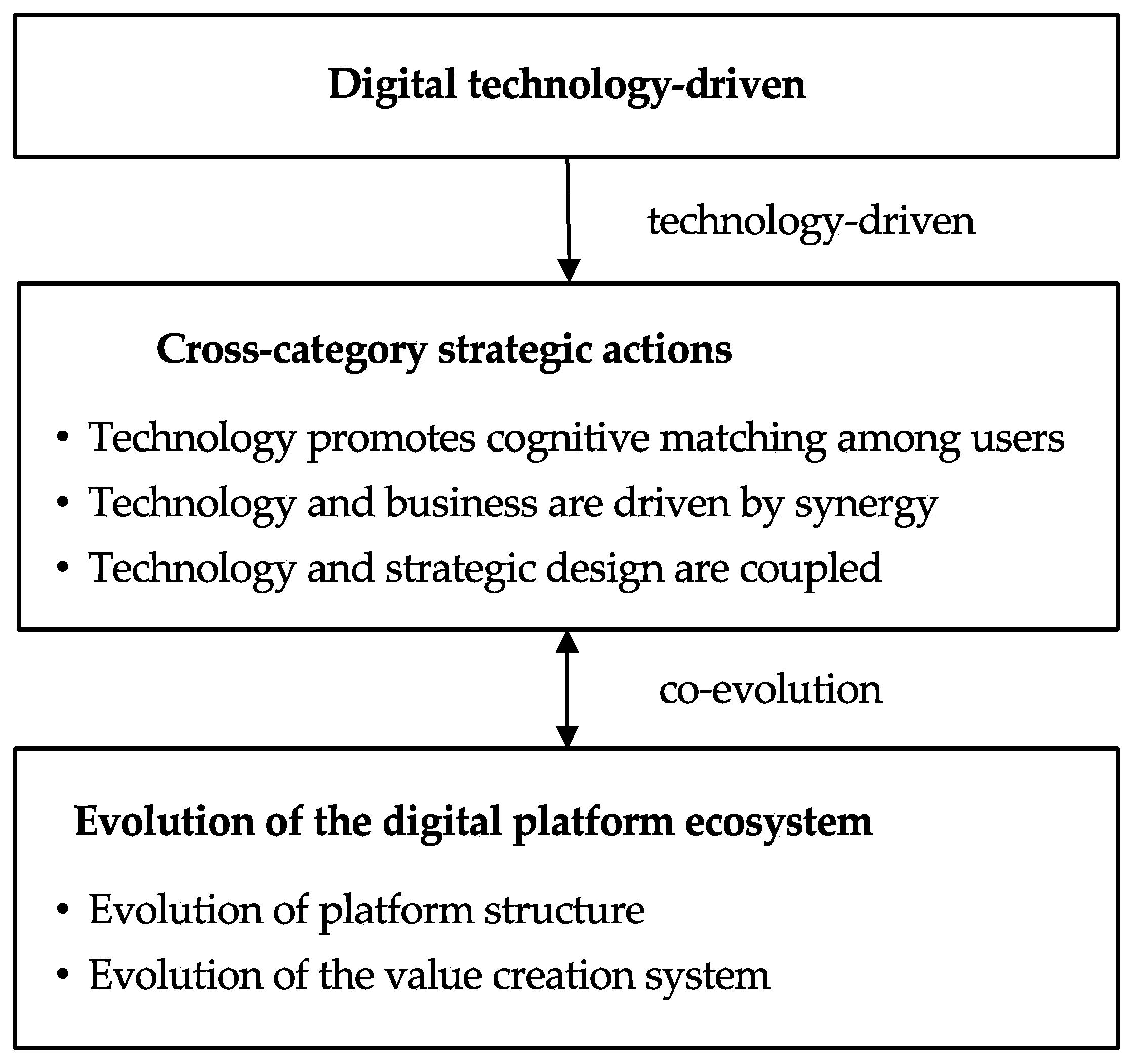
Figure 2.
The development history of ByteDance.
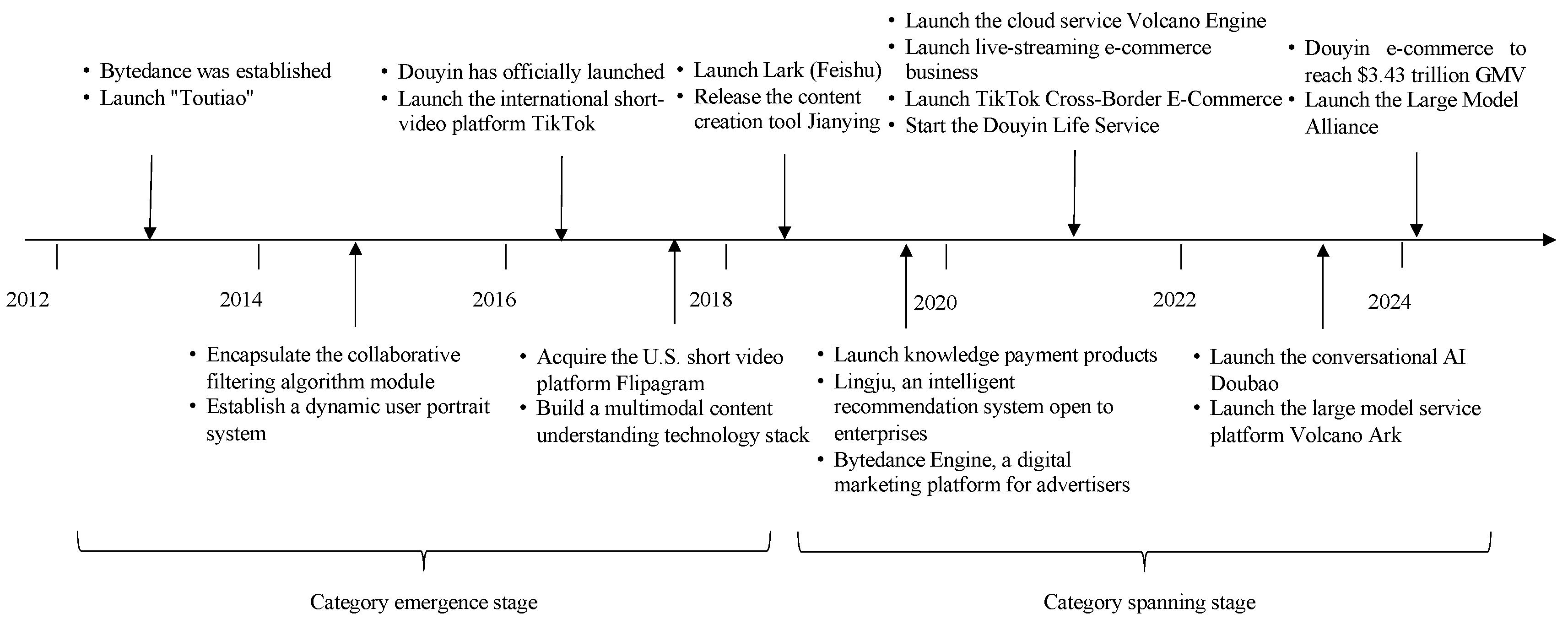
Figure 3.
Data Analysis Structure Diagram.
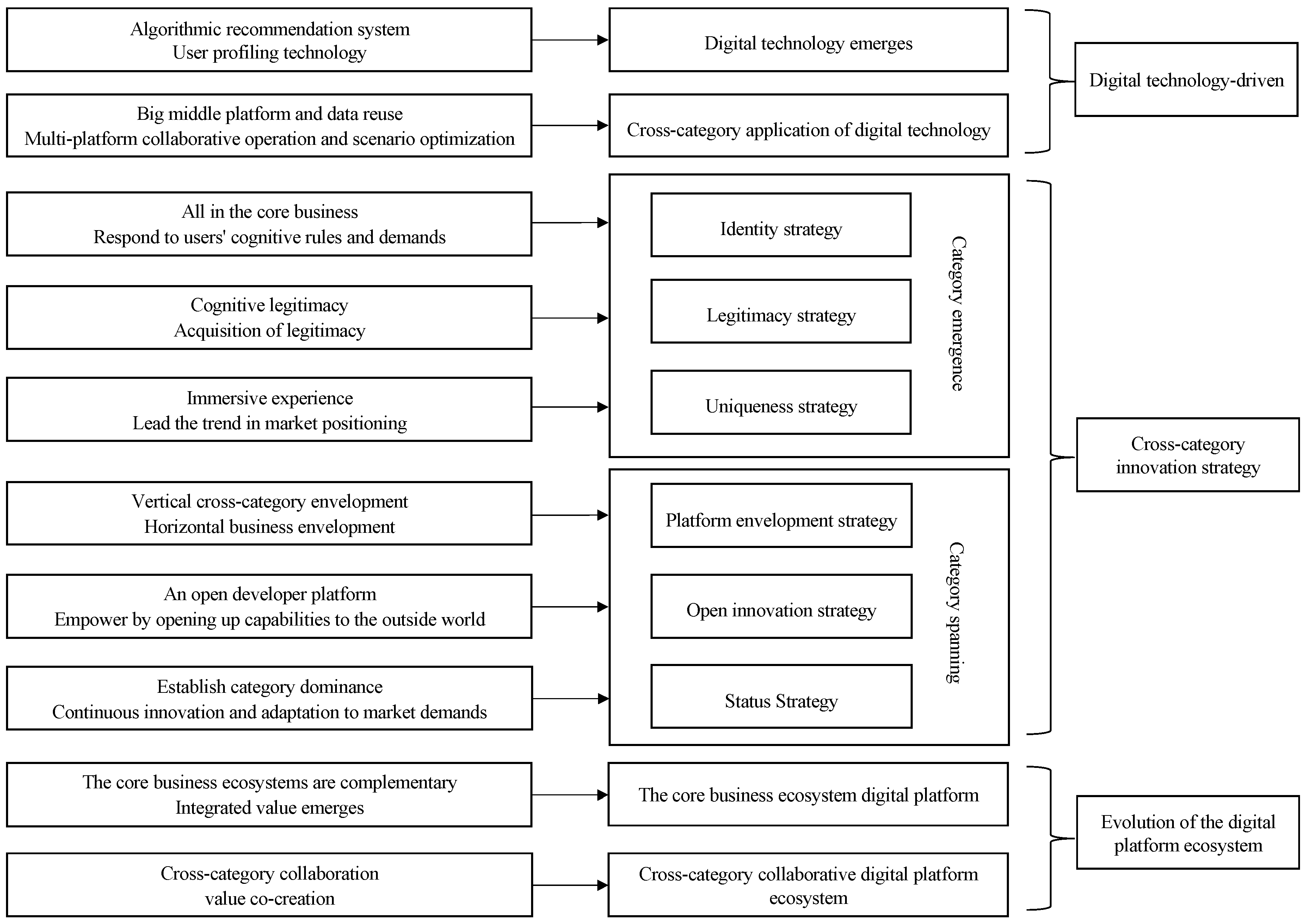
Figure 4.
Cross-category innovation strategy and Evolution Model of the digital platform ecosystem.
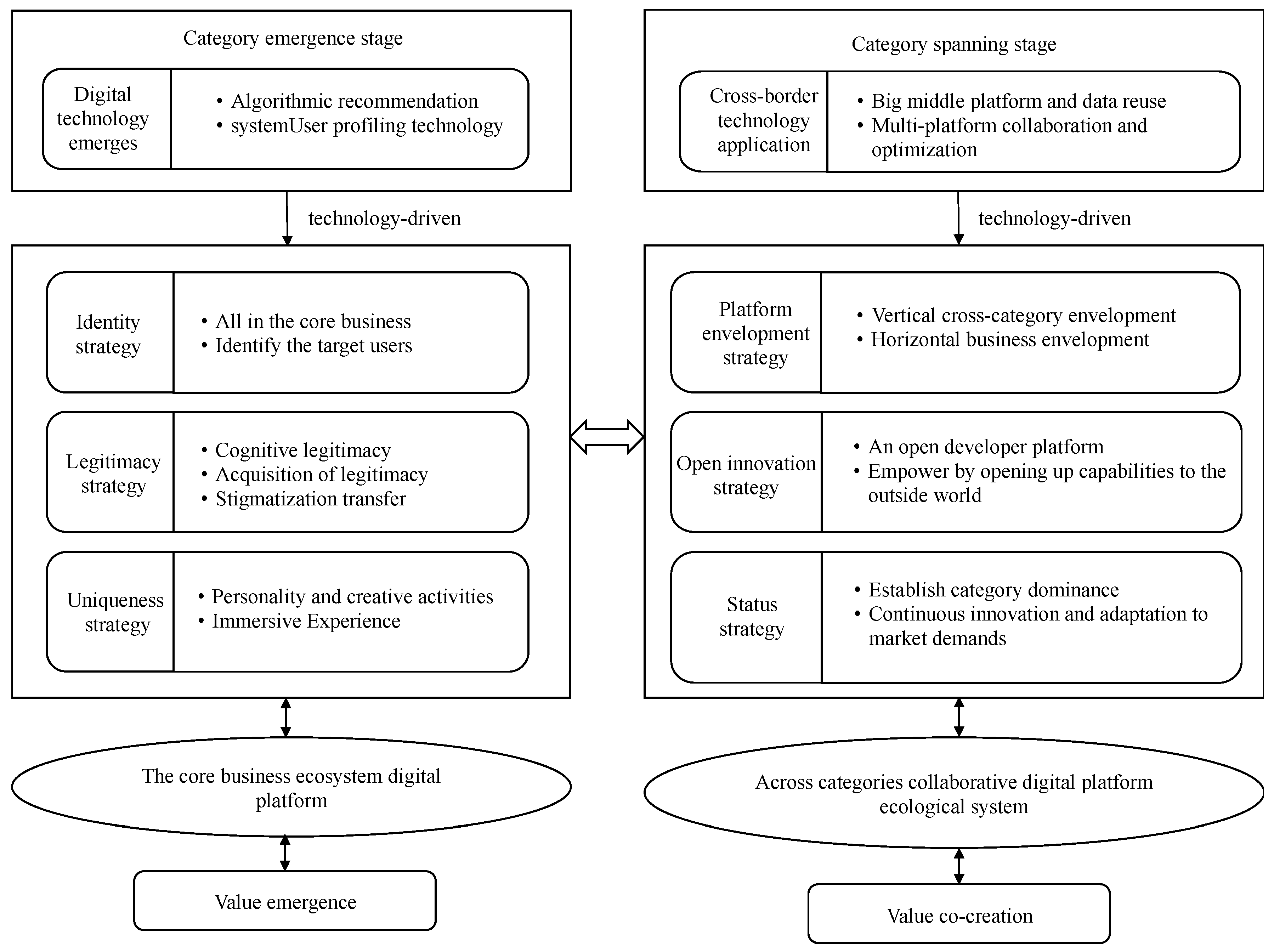
Table 1.
Overview of Data Collection and Coding.
| Data Category | Data Source | Data words | Coding |
|---|---|---|---|
| Secondary Data | Official and legally disclosed information, company annual reports, etc | 80,000 | N |
| Authoritative information such as official websites and official public accounts | 105000 | G | |
| Records of public interviews and speeches recognized by senior executives, etc | 80000 | R | |
| Academic articles on CNKI, Web of Science, etc | 150000 | X | |
| Direct Observation | Product function module usage | 10100 | B |
Disclaimer/Publisher’s Note: The statements, opinions and data contained in all publications are solely those of the individual author(s) and contributor(s) and not of MDPI and/or the editor(s). MDPI and/or the editor(s) disclaim responsibility for any injury to people or property resulting from any ideas, methods, instructions or products referred to in the content. |
© 2025 by the authors. Licensee MDPI, Basel, Switzerland. This article is an open access article distributed under the terms and conditions of the Creative Commons Attribution (CC BY) license (https://creativecommons.org/licenses/by/4.0/).
Copyright: This open access article is published under a Creative Commons CC BY 4.0 license, which permit the free download, distribution, and reuse, provided that the author and preprint are cited in any reuse.


